To offset the appropriation of funds to replenish the Unemployment Trust Fund with unobligated nonveterans funds from the American Recovery and Reinvestment Act of 2009.
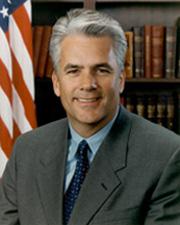 Sen. John Ensign (R-NV)
Legislative Activity
Stay on top of the latest movement without scrolling through every action
Roll call votes on amendments in Senate: Amendment SA 1905 not agreed to in Senate by Yea-Nay Vote. 41 - 56. Record Vote Number: 250.
July 30, 2009
View full timeline
Roll call votes on amendments in Senate: Amendment SA 1905 not agreed to in Senate by Yea-Nay Vote. 41 - 56. Record Vote Number: 250.
July 30, 2009
Senate amendment not agreed to: Amendment SA 1905 not agreed to in Senate by Yea-Nay Vote. 41 - 56. Record Vote Number: 250.
July 30, 2009
Senate amendment proposed (on the floor): Amendment SA 1905 proposed by Senator Ensign.(consideration: CR S8514-8516, S8518-8525, S8529; text as modified: CR S8514)
July 30, 2009
Amendment SA 1905 proposed by Senator Ensign. (consideration: CR S8514-8516, S8518-8525, S8529; text as modified: CR S8514) To offset the appropriation of funds to replenish the Unemployment Trust Fund with unobligated nonveterans funds from the American Recovery and Reinvestment Act of 2009.
July 30, 2009
Amendment SA 1905 not agreed to in Senate by Yea-Nay Vote. 41 - 56. Record Vote Number: 250.
July 30, 2009
Senate amendment submitted
July 29, 2009
Votes
1 roll call on this amendment
Text
Proposed
HIGHWAY TRUST FUND RESTORATION

The PRESIDING OFFICER. Under the previous order, the Senate will
proceed to the consideration of H.R. 3357, which the clerk will report.
The legislative clerk read as follows:

A bill (H.R. 3357) to restore sums to the Highway Trust
Fund, and for other purposes.

Amendment No. 1907, as Modified

The PRESIDING OFFICER. The Senator from Louisiana.
Mr. VITTER. Mr. President, I call up my amendment and ask that it be
modified with the changes at the desk.
The PRESIDING OFFICER. The clerk will report the amendment, as
modified.
The legislative clerk read as follows:

The Senator from Louisiana [Mr. Vitter] proposes an
amendment numbered 1907, as modified.

The amendment, as modified, is as follows:

(Purpose: To temporarily protect the solvency of the Highway Trust
Fund)

Strike section 1 and insert the following:

SECTION 1. TEMPORARY PROTECTION OF HIGHWAY TRUST FUND
SOLVENCY.

Notwithstanding section 5 of the American Recovery and
Reinvestment Act of 2009 (Pub. Law 111-5), from the amounts
appropriated or made available and remaining unobligated
under such Act, the Director of the Office of Management and
Budget shall transfer $7,000,000,000 to the Highway Trust
Fund. The Director of the Office of Management and Budget
shall report to each congressional committee the amounts so
transferred within the jurisdiction of such committee. The
amounts so transferred shall remain available without fiscal
year limitation.
Mr. VITTER. Mr. President, I urge all colleagues to come together, as
the American people surely want us to do, and adopt this amendment. I
truly believe this amendment is the responsible way to address the
shortfall in the highway trust fund.
This amendment funds the highway trust fund shortfall by using money
from the already-passed stimulus bill. That is important because
otherwise we are racking up yet more deficit and more debt on top of
the mountains of

[[Page S8509]]

debt we have already accumulated to pass on to our children and
grandchildren. This is important so that, yes, needed highway work can
be done, particularly needed work in the midst of a recession, but it
can be done without racking up yet more debt to weigh down the economy
and burden our children and grandchildren.
I wish to make two central points about this idea and why this
amendment is necessary. First, the level of debt we are accumulating is
truly staggering. It is beyond our ability to get our hands around.
This year alone, the deficit has surpassed $1 trillion. This year's
deficit spending has gone beyond $1 trillion. By the way, we are not
finished this year. It continues to grow. This year, we have racked up
over $1.8 trillion of new debt because there is the $1 trillion in the
normal year's spending plus the huge stimulus bill of $800 billion. In
terms of racking up new debt to put on the backs of our children and
grandchildren, there is $1.8 trillion of new debt this year. That is
way beyond anything we have experienced in our lifetime. Just the
trillion dollars of deficit spending rivals the sort of numbers we used
to talk about not so long ago for the entire Federal budget.
But, unfortunately, it gets worse. It gets significantly worse
because this Congress, over my objection, passed President Obama's
budget, and that budget takes those mountains of debt I just
described--at already sky-high historic levels--and what does it do?
Does it work it down? No. It doubles that level of debt in 5 years. It
more than triples that level of debt in 10 years. That is the path we
are on, and that is the legacy we are handing to our children and
grandchildren. That is simply completely irresponsible. To have this
mountain of debt already accumulated this year, at historically high
levels--$1.8 trillion accumulated this year alone, and it is growing--
and then to have a budget plan that doubles that in 5 years and triples
it in 10 years is inexcusable. In that 5-year period, this President
will have racked up more debt than every predecessor President before
him combined. We need to get off that path, and the American people
know it.
The American people understand, through their common sense, that this
is a recipe for disaster. All of us as parents want to hand our kids a
better world, a world of more opportunity, a better future than even we
had handed to us from our parents. Yet we are on a path to do exactly
the opposite and hand our kids an enormous burden, hand them a tomorrow
full of clouds and uncertainty, particularly dominated by this threat--
central fundamental economic threat--of deficit and debt. We cannot
accept that. Yet here we are on the floor with the other side proposing
to fund the highway trust fund with--guess what--more debt, more
borrowing, more borrowing by the government from whoever buys our debt,
including wonderful allies around the world like the Communist Chinese
Government.
We need to get off this path, and this is one important step in doing
that, saying: Yes, we will continue vital highway programs, but we will
do it by taking from the already-appropriated stimulus funds. That is
appropriate money that is already appropriated through the process. We
will not do it by borrowing yet more money.
The other side has fancy arguments about: Well, this is really taking
back a loan we sent the general fund 8 years ago. Let's make no mistake
about it, that money is long gone. This is racking up more debt, purely
and simply. For that very reason--because it is racking up more debt,
because it increases outlays in this fiscal year--it has a budget point
of order against it, which I will raise before our final vote. So if
you need any further proof that the underlying bill requires borrowing
yet more money, racking up yet more debt, it is nailed down by the fact
that there is a budget point of order against the underlying bill,
which I will raise.
The second critical reason we should adopt the Vitter amendment and
fund highway projects from stimulus money and not rack up yet more debt
goes to the nature of the stimulus and the attempt which has been very
slow and very faltering of using those stimulus dollars to help revive
the economy. Of course, that was the whole argument behind the
stimulus: We are in a severe recession. We need to do something. We
need to get spending and economic activity out the door. We need to
hold down unemployment. That was the whole argument. From the very
beginning, I did not think that would be the result. That is why I
voted against the stimulus, both because of the nature of the
spending--it is a lot of big government programs, not a lot of true
shovel-ready infrastructure spending--and because of the timing of the
spending. I thought from the very beginning that relatively few dollars
would go out the door immediately and a lot of the stimulus money would
not be spent for years. Well, unfortunately, all of that is coming
true. Again, if you look at the nature of the spending in the stimulus
and the timing of it, it leaves a lot to be desired.
I think all of us in this body, and Americans across the country,
favored infrastructure spending as the centerpiece of the stimulus.
Yes, let's do real, concrete, shovel-ready projects. Let's build roads
and highways and bridges as the best example of a true, concrete,
shovel-ready infrastructure project. I certainly strongly supported
that element of spending as a way--not the only way but as a way--to
help revive our economy.
Unfortunately, that type of project was never a major part of the
stimulus bill as passed. In fact, if you take all of the roads and
highways and bridges, all of that construction in the entire stimulus,
how much of the bill do you think it is? Fifty percent? Certainly not.
Thirty percent? Keep going down. Twenty percent? No. Ten percent? Try
3.5 percent. Mr. President, 3.5 percent of the entire stimulus focused
on what the American people thought really could be spent to help
stimulate the economy: shovel-ready infrastructure projects on roads
and highways and bridges.
My amendment is a way to increase that part of the stimulus that goes
to that project to increase highway funding through the stimulus, which
I think there was a very broad consensus to do from the beginning, but
it never got done in the stimulus.
The second big problem with the stimulus is the timing of that money.
It has gone out the door very slowly. Of the entire $800 billion
stimulus bill, which was supposed to be immediate relief for the
economy--let's start turning the corner on this recession immediately
passing that bill--today, months later, a half a year later, 10 percent
has gone out the door. Only 10 percent has been spent. That is
ludicrous.
Of that tiny slice that was roads and highways and bridges--the 3.5
percent--guess how much of that money has gotten spent. Mr. President,
1 percent of that. Not 1 percent of the whole bill, not almost a third
of the 3.5 percent. I mean 1 percent of the 3.5 percent; in other words
.035 percent of the entire bill--a meaningless amount. So let's
increase the amount of money we take from the stimulus pot and
immediately get it out the door for vital highway projects.
Because of those factors in the stimulus--the nature of the spending,
which was never focused on real, shovel-ready infrastructure; only 3.5
percent going to roads and highways and bridges; and the timing of the
money, which has been amazingly slow; only 10 percent of the stimulus
spent right now and only 1 percent on roads and highways and bridges--
what has been the effect on the economy? Well, of course, the effect
has been slim to none.
This chart I have in the Chamber says it all. This graph is what the
proponents of the stimulus bill say would happen to unemployment over
time: We pass the stimulus, and it is going to help revive the economy.
It is going to make sure unemployment peaks at less than 8 percent and
then comes down. Well, unfortunately, the reality has been very
different, because compared to this prediction by the proponents of the
stimulus, this is the reality, as I show you on this chart. This is
what unemployment has been doing in the last several months--going up
and up and up, well beyond the peak that was predicted, reaching almost
10 percent today.
Again, this is the second fundamental reason we need to adopt the
Vitter amendment, because the stimulus, as it was put together, is not

[[Page S8510]]

weighted nearly enough toward real infrastructure such as roads and
highways and bridges, and it is not weighted nearly enough on spending
now versus years from now. This Vitter amendment will help change that
for the better. It will reweight the stimulus, at least at the margin,
to more roads and highways and bridges and more spending now because we
need it now in the midst of this recession now.
So again I urge all of my colleagues to come around and embrace and
support this Vitter amendment. Doesn't it make sense to say we need to
start now in terms of rejecting this path of more and more and more
debt? Because the underlying bill, make no mistake about it, is funded
by more borrowing, more debt. That is why a budget point of order lies
against the underlying bill. I will raise that budget point of order
before the end of our debate.
Secondly, doesn't it make sense to say: Look, the stimulus idea was
about exactly this sort of spending? Americans across the country favor
stimulus spending that is really focused on roads and highways and
bridges and real infrastructure, things that are truly shovel ready.
They do not favor big government waste programs and they do not favor
spending 3 years from now because that is going to have no impact to
get us out of this recession right now.

This amendment, again, will fine-tune the stimulus in the positive
direction, toward spending on roads and highways and bridges, and
virtually all of us support more of that spending, including the
distinguished chairman of the Environment and Public Works Committee.
She had an amendment on the stimulus to do just that, which was opposed
and defeated by the other side.
This amendment will also fine-tune the stimulus to get more money out
the door now. Don't we need that? Only 10 percent of the $800 billion
has been spent. Don't we need to front-load it a lot more than that to
have any sort of significant positive impact on this recession?
Again, tragically, the unemployment figures say it all. The
prediction: Peak at 8 percent, come down from there. The reality: We
continue to go up and up and up--perilously close right now--toward 10
percent.
Again, I urge all of my colleagues, Democrats and Republicans, to
join together, to work together, as the American people want us to do,
around a basic commonsense idea. Let's stop the debt. Let's stop
racking up yet more debt, putting it on the backs of our children and
grandchildren. Let's front-load the stimulus and do shovel-ready
infrastructure now rather than big government projects 3 years from
now.
With that, Mr. President, I yield back my time.
The PRESIDING OFFICER. The Senator from California.
Mrs. BOXER. Mr. President, could the Presiding Officer let us know
how much time remains on the Vitter amendment and general debate?
The PRESIDING OFFICER. The Senator from California has 30 minutes
remaining. The Senator from Louisiana has yielded back his time. There
is 20 minutes of debate on the bill itself.
Mrs. BOXER. Mr. President, thank you very much.
Mr. President, of all the times to stop job creation in its tracks, I
will tell you, this is not the time to do it. The Republican response
to the bill that has come over from the House--the bill that would
restore the funding, make sure there is funding in the highway trust
fund to get us through September 30, and also make sure we can handle
unemployment insurance and also ensure that our families can get
mortgages, those who qualify--the answer from our Republican friends,
and they have a right to do it, is to take that funding from the
unobligated stimulus package.
Now, here is the thing. We know we are starting to finally get those
dollars for our economic recovery out the door. We know that. Yes, they
are not flying out the door because the administration wants to make
sure these are worthy projects. But I will tell you right now, the
Republicans are putting at risk the very program they say they embrace:
the highway program. The fact is, we still have $10 billion for
highway-related jobs that would be subjected to the Vitter amendment.
So, irony of ironies, they say they are extending the highway trust
fund, but that amendment puts these funds at risk, puts these jobs at
risk.
The stimulus is designed to create those jobs. The funding is getting
out the door. I have gone to my State and seen it at work. Yes, we know
employment is lagging. So what do you do when employment is lagging?
You do not go to a program that is designed to put people to work.
I think it is important to note that the House bill is not only
deficit neutral, it actually reduces the deficit. According to CBO, not
only does it do it in 2010 but over the next 5- to 10-year period. That
is because of the way they are funding the trust fund and the way they
are funding the housing priority.
What the Republicans are doing is they are taking a deficit reduction
measure that keeps the highway trust fund solvent through the end of
September, that makes sure people can continue to get unemployment
insurance, that makes sure people can get mortgages--those who
qualify--and they are saying that, instead of reducing the deficit,
let's slash the stimulus program, take funding away from our States,
away from our counties, our cities, and our businesses back home when
it is not necessary.
Mr. DURBIN. If the Senator will yield further, I am trying to see
whether there is net job creation from the Senator's amendment or if we
would lose ground with it. If our goal is to create more jobs in
America--I listened to the Senator's explanation, and I would like to
ask the Senator from California this: Even if we just take the money
out of one pocket and move it to another pocket, how does that create
new jobs in America?
Mrs. BOXER. Clearly, it is not even moving funds, it is slashing
funds from the stimulus program, which has one purpose, and that
purpose is to create jobs.
Mr. VITTER. Will the Senator yield?
Mrs. BOXER. We have heard from our Republicans friends over and over
again, who voted against the stimulus--although I have to say some of
them are standing in front of projects built with stimulus dollars, but
we will forget that for now--we are hearing from them that the stimulus
isn't working fast enough. What do they want to do today but cut the
funding?
What I have suggested--and I want to get my friend's reaction to
this--to my friends on the other side--because I agree we ought to
extend the highway trust fund for 18 months; I don't like the way they
are paying for it--is to wait until the end of the stimulus program,
and if there is funding at that time that hasn't been obligated, that
has been left on the table, take those funds and add them to the
highway trust fund.
Mr. DURBIN. If the Senator will further yield, I ask the Senator from
California this: Since the Senator from Louisiana didn't support the
President's recovery and reinvestment program, and most of those on his
side of the aisle did not, those of us who voted for it did it with the
understanding it would do a number of things. It provides tax relief
for families, and it provides a helping hand to those who are
unemployed, so they can afford health care insurance if they have lost
their job, for example. It does provide infrastructure programs and
projects. It is my understanding we are a little over 4 months into
this 2-year stimulus program--not quite 5 months into it--and the
Senator from Louisiana wants to basically declare it a failure, never
having voted for it. I ask the Senator from California, when the
Senator from Louisiana talks about the number of dollars committed, the
number of projects we have agreed to, it was my understanding that, as
of a couple weeks ago, we had obligated over $200 billion out of the
$787 billion, meaning we promised we will pay, once the projects are
underway and the jobs are actually created, and that number is going to
continue to grow as we obligate it. Is it not also true that we want to
make certain, whether we are spending money for projects under the
highway trust fund or the stimulus bill, that we don't waste taxpayer
dollars; we want to look carefully at each project to make sure it
serves a public purpose and make certain Americans are going to work at
a decent wage, and when it is over, we not only get through the
recession, but we have a legacy of projects that will serve our economy
and our Nation.

[[Page S8511]]

If the Senator from Louisiana has his way, he is going to take the
money out that we are currently investing into creating jobs in America
and move it into the highway trust fund. I am wondering if the Senator
could respond. Does it make any sense for us to take a different
approach on the stimulus and not be careful that the money we spend is
actually spent well?
Mr. VITTER. Will the Senator yield?
Mrs. BOXER. I will yield to the Senator from Louisiana on his time,
but I will keep my time right now. It is very important we thread this
needle in the right way. We want those jobs out there, and we want them
out there as fast as they can get there.
Out of the $27 billion for highway projects, there is $10 billion
remaining. I can assure both my friends that it is very important to be
careful in the way you do it. If you do it too quickly, you know what
will happen on the floor of the Senate. We will have our friends on the
other side saying: `` they rushed.'' We want to be careful, but we
don't want to, at this point, as we see this recovery starting to take
hold--we all believe and hope it is true--we know employment is the
lagging indicator. This is not the time to throw a dagger into the
heart of job creation. That is what the Senator's amendment will do.
Mr. DURBIN. I ask the Senator from California, if I have the
appropriate amendment before us, does the Senator from Louisiana go
beyond the highway trust fund in the money that is transferred? Does he
apply some of the money from the stimulus to unemployment and to
mortgage insurance or is that a separate amendment? I know his
amendments were filed late last night, and I am not sure.
Mrs. BOXER. I believe the Senator's amendment--and he can explain
it--deals with the trust fund, and others will have similar amendments
for UI and mortgage insurance.
Mr. DURBIN. I ask the Senator--and this is a legitimate inquiry, as I
don't know the answer--on the stimulus projects we are funding, what is
the requirement for a local match for those projects, as opposed to
requirements for projects under the highway trust fund?
Mrs. BOXER. My understanding is it is 100 percent because it is the
stimulus. We are trying to do that because our States are suffering--
yours is and mine. We saw our Republican Governor talk about how heavy
our hearts are back there, and we decided to help our State. This is
very different. It is 100 percent offset.
Mr. DURBIN. The stimulus is 100 percent Federal, which means projects
go forward even if States are struggling with the budget. If the money
goes into the highway trust fund for projects, most of that required a
State or local match, right?
Mrs. BOXER. That is correct; 20, 30 percent.
Mr. DURBIN. Most States, including Illinois, California, and others,
would have a more difficult time moving projects forward through the
highway trust fund rather than the stimulus, which is 100 percent
Federal dollars.
Actually, the Senator from Louisiana is cutting down the opportunity,
reducing the opportunity for infrastructure projects by requiring this
match through the highway trust fund; isn't that correct?
Mrs. BOXER. I say to the assistant majority leader, he is absolutely
correct. I understand the need to extend the trust funds to 18 months.
On that part, Senator Vitter and I are in agreement. But the way he
funds it is hurtful to the American people, to the American workers, to
our businesses, and to our contractors. Even though we know a lot of us
want to see these funds get out there quicker, they are on the verge--
Vice President Biden has said we have committed more than a fourth of
the Recovery Act total funds. We are on track to meet the deadline set
when the act was passed in February, spending 70 percent by the end of
September of 2010. He points out that the purpose of the stimulus was
the jolt for immediate help but then a long-term economic recovery.
This kind of amendment--and the others we will see--which says to the
American people: Gee, it is 4 months and we want to forget about this
whole notion--doesn't make sense. The timing of this is way off. If at
the end of the 2-year period, within which the stimulus is supposed to
act, there is money left over, I will be the first one saying: Let's
either reduce the deficit with it or let's put it into the highway
trust fund. I do believe infrastructure should have gotten more funds
from the stimulus, but that is another point.
Mr. DURBIN. My last question to the Senator from California--and I
join her in opposition to this amendment--is this: If the net result of
the Vitter amendment is not to increase jobs in America but actually
will reduce jobs in America, it seems like it is the opposite of what
we ought to be doing in the middle of a recession, with so many
Americans losing work. We want to create good-paying jobs here at home,
and the Vitter amendment, by increasing the need for a State and local
match, for example, is going to decrease the likelihood of creating
jobs. The stimulus money--100 percent Federal money that is for shovel-
ready projects--will move more quickly into the economy and into
paychecks and will help us rebound from this recession we are in.
I say to the Senator from California, I thank her for her opposition
to this amendment. I hope our colleagues on both sides will realize
that even if you didn't vote for the stimulus, voting for the Vitter
amendment is going to take money away from projects in your States that
will create good-paying jobs.
Mrs. BOXER. Before my friend leaves, I think I can put some specifics
out to him. We already know there are $10 billion worth of highway
projects that have not been obligated. That is at risk right away. We
know there are Superfund cleanups that are long overdue. We have funds
for that. We have $5.5 billion in construction-related activity that
deals with cleaning up underground leaking storage tanks and the
specialized, good-paying jobs that those activities create. We have
$300 million to restore our Nation's wildlife refuges. We have $100
million in a great program Republicans and Democrats have been lauding
in my committee--the Economic Development Administration--where you
leverage those funds from business. That would be at risk. We have $5
billion available for flood control. It is ironic that my friend from
Louisiana--I have been working with him and Senator Landrieu to do
everything in our power to stop flooding. We have problems in our
State, and Lord knows and the world knows about the problem in Senator
Vitter's State; $5 billion was available for flood control, for water
supply and harbor maintenance, all of which are focused on job
creation, and the irony of ironies is that those funds could well be
cut under the Vitter amendment.
Mr. DURBIN. So the Senator's amendment would effectively cut funds
used in the stimulus for flood control?
Mrs. BOXER. Any funds not obligated out of the $5 billion available.
As we know, Vice President Biden says, on average, 25 percent of the
funds have been obligated. That means a good portion of the $5 billion
for flood control would, in fact, be at risk.
I thank my friend for coming over and helping me explain to our
colleagues and the American people why we oppose this amendment, even
though it may be well intentioned. At the end of the day, it hurts our
people and their chance to get good jobs.
I yield the floor and reserve my time.
The ACTING PRESIDENT pro tempore. The Senator from Louisiana is
recognized.
Mr. VITTER. Madam President, let me briefly address some of the
issues and misconceptions that have come up by focusing on four key
points.
First, I believe the Senator from Illinois said: Why would we want to
take anything out of the stimulus and stop job creation? I have a news
flash: There is no job creation. Unemployment is going up. Again,
unfortunately and tragically, the unemployment numbers say it all. This
was the projection from the proponents of the stimulus about
unemployment peaking at 8 percent and then coming down. Tragically,
this is the reality. Joblessness goes up and up, toward 8 percent. So
there is no job creation right now.
No. 2, the Senator from Illinois said: Why would we want to move
money from one pocket into another pocket? That doesn't do anything.
Well, it does a lot if the pocket we are removing money from is stuff
that would not be spent until after 2011, and we move it

[[Page S8512]]

to a pocket focused on real, concrete roads, highways, and bridges--
spending that can be done now. That is a big change in terms of the
type of spending we are talking about. It is a big change in terms of
the timing of the spending.
The biggest reason for the stimulus having no significant impact on
unemployment is the type and the timing of the spending. On the timing
side, only 10 percent of the entire $800 billion stimulus has been
spent to date. On the type of spending, only 3.5 percent of the whole
bill was ever for roads, highways, and bridges. Only 1 percent of
that--1 percent of the 3.5 percent--has been spent yet. So, yes, we are
moving money from one pocket to another so as not to run up more debt.
In the process, we are having a lot more immediate, positive impact on
employment. That is very important.
Point No. 3: In direct response to the Senator from California, if
she would like to wall off any stimulus money--the money for roads,
highways and bridges and the money for flood control--and say the
President cannot use that money in this transfer, I would be very open
and supportive of such a second-degree amendment.
I did not do that simply to give the administration maximum
flexibility in terms of working out those details. However, again, if
the Senator from California would like to propose a second-degree
amendment to wall off true highway funding or flood control funding, or
whatever, I would be happy to support that.
Fourth and finally, I couldn't believe my ears, but I think the
Senator from California said the underlying bill involves deficit
reduction. Let's get real. I know Washington is a fairy tale world. I
know things are turned upside down so often, like Alice in Wonderland,
but the underlying bill involves racking up more debt, more deficit.
That is the whole motivating factor of my amendment. The underlying
bill does nothing but borrow more. Don't take my word for it; look at
the fact that there is a budget point of order against the underlying
bill which I will point out and raise for consideration by the Senate.
So the underlying bill clearly involves more debt. How could it not?
We are taking money from the general fund to fill in the highway trust
fund. Guess what. We are deficit spending in the general fund. We are
already, through the general fund, racking up a deficit. So if we take
money from there, we have to backfill that if we spend the same amount
with more borrowing, more deficit, more debt.
Again, if we care about turning the corner on deficit and debt, this
is the responsible amendment to support and the responsible approach to
take. The underlying bill racks up more debt; the Vitter amendment
avoids that.
Again, there is a budget point of order against this underlying bill
about which, with the cooperation of the Senator from California, I
believe she needs to make some introductory comments, but I will make
that budget point of order now.
I yield the floor to the Senator from California.
Mrs. BOXER. Madam President, how much time remains on the Vitter
amendment on either side?
The ACTING PRESIDENT pro tempore. The Republican side has 9\1/2\
minutes for Senator Vitter; 15 minutes for Senator Boxer.
Mrs. BOXER. And on the general debate?
The ACTING PRESIDENT pro tempore. Twenty minutes on the general
debate.
Mrs. BOXER. Madam President, I am going to put a couple of items in
the Record and make sure Senator Vitter can offer his budget point of
order. I asked if Senator Durbin would be willing to take 10 minutes on
our side on the general debate. I don't think I have to ask unanimous
consent, but why don't I do that. I ask unanimous consent that after I
conclude and after Senator Vitter makes his point of order, then we get
to Senator Durbin for his 10 minutes.
The ACTING PRESIDENT pro tempore. Without objection, it is so
ordered.
Mrs. BOXER. Madam President, on the issue of the Congressional Budget
Office score that scores the House bill as deficit reduction, I find it
intriguing that my friend who supports the CBO when they say we are
spending money--for example, on the health bill, they say: Oh, look.
CBO says it costs money, but he derides it when CBO says this
particular bill is a deficit reducer.
I ask unanimous consent to have printed in the Record the CBO score
that shows, in fact, the bill sent over from the House reduces the
deficit.
There being no objection, the material was ordered to be printed in
the Record, as follows:

H.R. 3357: TO RESTORE SUMS TO THE HIGHWAY TRUST FUND AND FOR OTHER PURPOSES
----------------------------------------------------------------------------------------------------------------
Changes in direct spending (in millions of dollars)
---------------------------------------------------------------
2009            2010          2009-2014       2009-2019
----------------------------------------------------------------------------------------------------------------
Section 1--Appropriate $7 billion to the Highway
Trust Fund:
Budget Authority............................               0               0               0               0
Estimated Outlays...........................           1,000          -1,000               0               0
Section 4--Increase Loan Limit to $400 Billion
for the GNMA Mortgage-backed Securities Loan
Guarantee Program Account:
Estimated Budget Authority..................             -40               0             -40             -40
Estimated Outlays...........................             -40               0             -40             -40
Total, H.R. 3357:
Estimated Budget Authority..............             -40               0             -40             -40
Estimated Outlays.......................             960          -1,000             -40            -40
----------------------------------------------------------------------------------------------------------------
NOTES:
Section 2 would have no estimated budgetary impact relative to CBO's baseline. The costs of providing benefits
under the unemployment compensation program are assumed in the baseline, consistent with section 257 of the
Deficit Control Act of 1985, which states that ``funding for entitlement authority is assumed to be adequate
to make all payments required.''
Section 3 also would not have a budget impact. Allowing FHA to guarantee additional loans has no cost or savings
because under the Federal Credit Reform, CBO's estimate of the subsidy cost of new FHA guarantees is zero.
Source: Congressional Budget Office.

Mrs. BOXER. Madam President, notwithstanding the order of July 29, I
ask that it be in order for Senator Vitter to make a budget point of
order against H.R. 3357 at this time, and that a motion to waive the
applicable point of order be considered made, with the vote on waiving
the point of order occurring at a time to be determined.
The ACTING PRESIDENT pro tempore. Without objection, it is so
ordered.
Mr. VITTER. Madam President, I will make that point of order. The
underlying bill is such a great deficit reduction that it would involve
more borrowing and more debt and more mandatory spending. It would
specifically increase mandatory spending and exceed the committee's
section 302(a) allocation. Therefore, I raise a point of order against
the bill pursuant to section 302(f) of the Congressional Budget Act of
1974.
The ACTING PRESIDENT pro tempore. Under the previous order, the
waiver is considered made.
Mr. DURBIN. Madam President, I seek recognition pursuant to the
unanimous consent agreement of the Senator from California, 10 minutes
remaining on our side on the general debate.
The ACTING PRESIDENT pro tempore. Without objection, it is so
ordered.
Mr. DURBIN. Madam President, the Senator from Louisiana suggests the
stimulus bill the President enacted is not creating jobs because we
still have unemployment. The fact is, it is creating jobs and we are
still in a recession. Were we not working with the stimulus bill to put
money back in the economy to create American jobs, it would be worse.
We all know that.
When the President came to office, he encountered an economy that was
losing on average 700,000 jobs a month. Our growth rate had hit a
negative 6.3 percent. Foreclosures were at record levels, and
residential investment had

[[Page S8513]]

fallen. Banks were in crisis and freezing lending. Madam President, $10
trillion in wealth had been lost. Virtually every American with a
savings or retirement account had taken a hit. That is when the
President took his hand off the Bible and accepted the responsibility
of office, and that is what he inherited.
He came to Congress and said: Let's put money in the economy and get
Americans back to work. Let's invest in things that will pay off in the
long run. Let's build the bridges, the highways, the airports. Let's
make sure we make investments that not only create jobs today, but we
can rely on in the future to build our economy. And we did it, with
limited help from the other side of the aisle.
The Senator who is offering this amendment voted against it. The
position for most Senators on the other side of the aisle was, let's do
nothing; let's let the market work this out.
Do you have any idea where we would be today if the market was still
working this out? I am afraid we would be in sorry shape. We would
continue to see job loss and continue to see more and more unemployed
Americans, which is exactly the opposite of what we want.
Now comes the Senator from Louisiana who opposed the stimulus package
in the midst of this economic crisis and now says: Let's take money out
of the stimulus package that is creating good-paying jobs in America.
Let's take it away from the States where they get 100 percent Federal
funding for their projects. Let's put it in a different fund. It isn't
creating any new investment, but let's put it in a different fund that
now requires a State match.
What that means is, if your State budget is struggling--we know a lot
of States are--the Senator from Louisiana does you no favor. He is
taking a project in your State that is important for your economic
future, closes it down and says: We will be glad to give you some of
that money back as long as you can come up with matching funds.
I am afraid that is not helpful. It is hurtful at a time when this
economy needs all the help it can get. When it comes to the stimulus
package, understand, we are a little over 4 months into this stimulus,
this 2-year stimulus package.
The Senator from Louisiana says: I am prepared to declare it a
failure; let's stop right now.
I am not prepared to declare it a failure. In fact, I think there is
an indication that it is starting to put America back to work.
Because of the Recovery Act, on which the Senator from Louisiana
wants to reduce spending--listen to this--95 percent of working
families are already getting tax credits in their paychecks. Those
dealing with job loss are collecting an extra $25 a week if they are
out of work. That does not sound like much if you have a job, but if
you are out of work, it means something.
There also is help for unemployed people to pay health insurance. I
don't know if the Senator from Louisiana didn't vote for that. I don't
know if he thinks that is a good idea. If I were unemployed, I would
want my family to have health insurance. That is pretty basic.
There is money to help seniors and college students, many of whom
have faced the idea of suspending their college education because mom
and dad are struggling at home. The Senator from Louisiana may be
opposed to that; I am not. I want them to stay in school. I want them
to get their degrees because they will lead America.
We provided $34 billion in funds for States for Medicaid because our
States are struggling to provide health care for the poor. The Senator
from Louisiana may oppose that. That is his right to do. I happen to
think that providing basic health care to the poor in America is
evidence we are a caring and compassionate nation and will continue to
be.
The money that has gone to States and local governments has avoided
the layoffs of teachers and police officers and other law enforcement
in Louisiana, Illinois, California, and around the Nation. The Senator
from Louisiana may think that is a waste of money, we never should have
done that. But for a safer America and for an America where kids can go
to school and have the teachers they need, I think the money was well
spent.
Beyond that, this Recovery Act in which we are involved is one that
is starting to make some results. Just starting. I am not being
Pollyanna-ish about this. We are still in a recession. I think we are
coming out--I hope we are coming out.
In January, the month before this Recovery Act went into law, we lost
741,000 jobs. Terrible. By June, the economy was losing one-third fewer
jobs. I wish we were not losing any jobs, but the fact is the stimulus
is starting to work.
The Senator from Louisiana, who did not support it, who had no plan
for this economy, now wants to take the money out just at the moment it
is starting to work. Boy, the perfect Washington answer. Let's move in
right now, 4 months into a 2-year program, and declare it a failure.
That may be his approach, but I don't think it works for America.
In less than 160 days, more than 30,000 projects have been started
under this bill--30,000 across the country. I went to Peoria, IL. There
is a project at the airport which is critical to its economic future
funded by the stimulus bill, creating good-paying local jobs right in
the heartland of Illinois. More than $23 billion will be made available
to fund over 6,600 shovel-ready construction projects; 3,200 are
underway. If the Senator from Louisiana has his way, we will stop right
there. We will start cutting back on these projects right now. That is
his idea of economic recovery.
Over $369 million has been put into rural water systems. I can tell
you, representing a State with a lot of small towns, such as Louisiana,
they need this money to make sure their drinking water is safe for the
people who live there. The Senator from Louisiana says: Enough said;
let's start cutting back on that.

Madam President, $2 billion has been moved out to State governments
and community organizations for weatherization and energy efficiency on
low-income homes, and half a billion in overdue cleanup of Superfund
sites. The Senator from Louisiana says: Let's cut that money; let's
reduce that money. I don't think that makes sense.
We know if we did not have this Recovery Act, there would be more
unemployment, more people out of work, fewer dollars being paid in
taxes to the Federal Government and State governments. Our situation
would be worse when it comes to the deficit. The more people who are
unemployed, the fewer who are paying taxes, the more people need
services. It is a recipe for a deficit that grows.
The Vitter amendment, by reducing the spending power of the stimulus
funds, will make our deficit worse. That is a fact. He must acknowledge
that. I hope he does.
In terms of obligating these funds, I want to make sure at the end of
the day, having voted for this and supported it, that the money is well
spent. I don't want a single dollar wasted. We are going to take care
to make sure these projects make sense, that we have a justification
for them, and they will serve America and our economy's future. That is
responsible and accountable transparency.
I know the Senator from Louisiana says we are 4 months in, we have
not gotten it spent, it is time to bail out. That kind of
shortsightedness will not work. The idea that we would cut back on
funds for flood control in the States of Louisiana and Illinois makes
no sense whatsoever. The Senator from Louisiana is wanting to cut back
those funds so he can transfer money into the highway trust fund.
I think we are on the path to recovery. I hope that path is a short
one and we reach it soon. In the meantime, the Vitter amendment will
not help. The Vitter amendment makes it worse. The situation is that
the projects we are counting on to get America back to work, good-
paying jobs right here at home, are in danger because of this
amendment.
I urge my colleagues on both sides of the aisle, even if they didn't
vote for the stimulus package, do the math--100 percent Federal money
for the project in that State, as opposed to the Vitter approach which
would require 20 percent or more from the State before they could go
forward with any projects at a time when most States

[[Page S8514]]

are struggling. This is not the answer. This will not be the only part
of the problem; it will be a big part of the problem.
I yield back the remainder of my time.
The PRESIDING OFFICER (Mrs. Hagan). The Senator from Nevada.

Amendment No. 1905, as Modified

Mr. ENSIGN. Madam President, I call up my amendment at the desk and
ask that it be modified with the changes that are at the desk.
The PRESIDING OFFICER. The instruction line of the amendment is so
modified.
The clerk will report.
The legislative clerk read as follows:

The Senator from Nevada [Mr. Ensign] proposes an amendment
numbered 1905, as modified.

Mr. ENSIGN. Madam President, I ask unanimous consent that the reading
of the amendment be dispensed with.
The PRESIDING OFFICER. Without objection, it is so ordered.
The amendment is as follows:

(Purpose: To offset the appropriation of funds to replenish the
Unemployment Trust Fund with unobligated nonveterans funds from the
American Recovery and Reinvestment Act of 2009)

On page 3, after line 12, add the following:

SEC. 5. USE OF STIMULUS FUNDS TO OFFSET APPROPRIATION OF
FUNDS TO REPLENISH UNEMPLOYMENT TRUST FUND.

The unobligated balance of each amount appropriated or made
available under the American Recovery and Reinvestment Act of
2009 (Public Law 111-5) (other than under title X of division
A of such Act) is rescinded pro rata such that the aggregate
amount of such rescissions equals $7,500,000,000 in order to
offset the amount appropriated to the Unemployment Trust Fund
under the amendment made by section 2 of this Act. The
Director of the Office of Management and Budget shall report
to each congressional committee the amounts so rescinded
within the jurisdiction of such committee.

Mr. ENSIGN. Madam President, in my home State of Nevada, the
unemployment rate has reached 12 percent, and we are seeing
unemployment continue to rise across the country. The President said
the stimulus bill that was passed this year was going to keep
unemployment no higher than 8.3 percent across the country. We know it
is a lot higher than that everywhere now. This is not just a Nevada
problem, it is a problem in every State.
American families across the country are hurting, and they are
hurting badly. I am offering an amendment that will help families
during these tough times. 18 States have depleted their State
unemployment fund and are now borrowing from the Federal unemployment
fund to cover benefits. The Federal Fund is now running dangerously
low. I am offering an amendment to shore up the Federal fund and help
the States that have depleted their own funds. My amendment will help
in a way that is fiscally responsible. My amendment is very simple. It
would say we are going to use money out of the stimulus bill to
replenish the Federal unemployment funds that the States are borrowing
from, and we are going to do that in a way where we don't increase the
deficit. My amendment does not play any phony numbers games, unlike the
bill that was sent over here from the House of Representatives. The
House bill says, technically, it is not increasing the deficit. The
Federal Government, however, is borrowing from future generations, and
will very likely forgive the States that have borrowed money, which
will therefore increase the deficit.

The U.S. Department of Labor estimates it will take about $7.5
billion to replenish the Federal fund for the rest of the Fiscal Year.
Next year, it is projected to be at $30 billion. And we have already
seen in the stimulus bill that this Congress is giving money away to
the States. We will continue to borrow from future generations so we
can forgive that debt the States have run up. States are not going to
be able to pay back all they have borrowed, right? That is what we all
assume. So let's show some fiscal responsibility and take the money
needed to replenish the Federal unemployment fund, out of the stimulus.
The Senator from Illinois was just on the floor talking, and I
listened carefully to some of the things he was saying. He was saying
that if we actually borrow less--as does the Vitter amendment, for
instance--it means our deficit is going to be more. Well, that just
doesn't pass the commonsense test. I know what he is saying. He is
saying, basically, if we take the money away from the stimulus--in
other words, we borrow less now--it is not going to help the economy as
much. That was the philosophy behind the stimulus package, that by
borrowing money and putting that government money into the economy, we
would help the economy recover. I think it is not arguable that there
are a certain amount of jobs that can be created by government
spending.
The reason I voted against the stimulus bill is because I thought a
lot of the money was irresponsibly spent and it was going to run up the
deficit. So I was looking more long term, not just short-term. The
problem with continuing to borrow more and more is we have the threat
of long-term economic harm. We have the threat of long-term inflation
in this country, which will be devastating to this economy.
Under the President's budget that was passed here in the Congress, it
is projected that our national debt will double in 5 years and triple
in 10 years. Think about that. Take all of the debt that was borrowed
in the history of this country, from George Washington to George W.
Bush, and that debt is going to be doubled in 5 years and tripled in 10
years. That is unsustainable. We have to think about future
generations.
States do need help to replenish their Federal unemployment insurance
fund. They do need that help. We recognize that. But let's do this in a
way where we are not borrowing more money from our children's future.
That is really what this is about.
We had the former Fed Chairman, Alan Greenspan, talking to our
conference at lunch a couple of weeks ago. One of the things he talked
about and one of his big fears is that the United States is borrowing
too much money and that can be a future threat to our economy in the
form of inflation. If we get to the point where other countries decide
not to loan us this money anymore--if they quit buying our Treasury
bills, in other words--our economy falls off a cliff. We don't want to
get to that point.
That is why we need to start taking small steps, which can lead to
larger steps on being fiscally responsible in this country. We hear
Senators from both sides of the aisle get up and talk all the time
about being fiscally responsible. Yet every time we have a small
proposal that shows fiscal responsibility around here, it is rejected:
We can't do that now. We can't do that with this program. The stimulus
program is off limits.
Even though a large amount of the stimulus isn't going to be spent
for a long time, it was originally supposed to help our economy this
year. And the Senator from Illinois just said the economy is
recovering. There are signs the recession is slowing down; however,
this looks as if this is going to be a completely jobless recovery.
That is not what the stimulus bill was supposed to be about. It was
supposed to be about creating jobs.
We had alternatives, actually, that would have created jobs, that
would have helped the housing industry. The housing industry was the
part of our economy that drug the rest of the economy down. So we
thought we should have fixed housing before we started putting money
into all these other projects and all these other government programs.
That was rejected by the Democratic majority, unfortunately. I still
believe we need to help the housing industry.
Senator Johnny Isakson from Georgia has a good proposal--to give a
$15,000 tax credit to anyone who would buy a home. In my State of
Nevada, the housing market is still devastated. We have huge
foreclosure rates. We have a large amount of inventory to sell out
there. The housing market is starting to turn around in some of the
other States, but it still has a long way to go, and we could really
help the housing market.
The bottom line is that we need to be more fiscally responsible to
future generations. My amendment today is just taking a small step
toward that.
My dad used to tell me all the time when I was growing up: You have
to watch the small amounts of money. He used to say: If you watch the
$20 bills, the large amounts of money will take care of themselves.
Well, let's start watching the small amounts. I know

[[Page S8515]]

$7.3 billion is not a small amount of money, but around here, it is.
Let's start watching at least these amounts of money so that when we
are talking about the $1.8 trillion deficits, we can start taking care
of that and we can start being fiscally responsible to future
generations.
I urge my colleagues to support this commonsense amendment. I think
the Vitter amendment is the right direction to go as well. This is
something we need to do for future generations.
Madam President, I yield the floor.
The PRESIDING OFFICER. The Senator from California.
Mrs. BOXER. Madam President, I rise to speak against the Ensign
amendment, and I want to explain why, so I will take my time off that
discussion and retain the remainder of my time on the other amendments.
Let me say that Senator Ensign has come to the floor and he wants to
talk about fiscal responsibility. I welcome that debate. He blames the
Democrats for not doing anything to help us get a handle on deficits
and debt. But let's go back to recent history--not ancient history,
recent history.
Bill Clinton left the White House in the year 2000, and we had a
budget surplus. That was very hard to get to, but we Democrats did it
with him and with the help of some of our Republicans. We had a debt
practically eliminated. It was on the way down. And I remember
discussions about what do we do when we have no more Treasuries to buy.
Then we had George Bush elected, and we had the Republicans
supporting him. In a nanosecond, the whole table turned. We went from
budget surpluses as far as the eye could see to deficits as far as the
eye could see. We went from a debt that was going to be extinguished to
a debt that began climbing.
As a result of these policies, there was a call for change in this
country. We had more Democrats elected. We have a Democratic President,
and he inherited one giant mess. The chickens came home to roost.
So our President said to the Nation: I am going to do everything I
can to get out of this economic mess. Help me. Help me pass a bill that
will put people to work. He said: I know it is going to be hard. I know
it is going to take time, but we need to do this because of the
recession. And if we don't get out of this recession, we are not going
to be able to attack the problem of deficit and debt.

Anyone who knows President Obama knows that when he was a Senator, he
was always conscious of our fiscal issues and distressed about the
course we had been on for the last 8 years.
So here is what happens. We are 4 months into the economic recovery
package. I have been to places in California, I have seen people
getting those jobs--highway jobs, water infrastructure jobs, cleaning
up Superfund sites, restoring our wildlife refuges. Those are just some
examples of the jobs. And we know, according to Vice President Biden,
that about 25 percent of those funds have been obligated.
Senator Vitter came down here and said nothing is working; we are not
getting those jobs out there. Let's go in and cut that stimulus
program--put a dagger in its heart is what they want to do, when it
isn't necessary to do so.
The Congressional Budget Office, as I have said--and I have put into
the Record--tells us the bill the House sent us does nothing to
increase the deficit. As a matter of fact, it is a small benefit to the
deficit over 10 years. They figure it is about $40 million--not much,
but it doesn't produce more deficits.
So they come to the floor and they are arguing the House bill at the
desk causes deficits when the Congressional Budget Office says, after
they had done a study, absolutely not. They still insist it does. Fine.
They do not agree with the CBO.
By the way, they do agree with the CBO when the CBO says there are
costs to health care reform. Then they embrace the CBO. But now they
can't because it doesn't fit their political rhetoric.
So all I can say is, if you take all these amendments--and, look, I
don't think they are meant to be mean-spirited. I think they are honest
in their approach. They do not like the fact that we passed the
stimulus bill. They do not believe in it, even though a few of them on
the other side--a few of them--have gone to see some of the projects
that are putting their own people to work. A few have done that. I find
that a little disingenuous, but that is their choice.
Their argument just doesn't hold up. Look, if we take the funding out
of the stimulus, we put at risk $10 billion of highway-related jobs. We
put at risk millions of dollars that would otherwise be paid to our
construction industry. We put at risk very important construction
projects at military bases, long overdue Superfund cleanups, the
creation of clean energy jobs in the future, improvements to outdated
rural water systems. Why would we want to do this--Why, in the middle
of a recession, when we have come up with a way to handle this that
does not add to our deficit?
On the highway trust fund, Democrats and Republicans in the Senate
agree we ought to do an 18-month extension. On that part of the Vitter
amendment, you will find me on his side, but not to take the funds out
of the unspent stimulus money that is on the ground and putting people
to work and will continue to do so. It has only been 4 months since the
funding has started to get out the door. Have a little patience. You
know, for 8 years we saw the economy turn into a bad way. For 8 years,
we saw this economy turning bad. For 8 years, we saw the recession
building. For 8 years, we saw the deficit building. For 8 years, we saw
the debt building. It is not going to take 4 or 5 months to turn this
around. And why would we put a dagger in the heart of job creation at
this point, no matter how noble the effort?
I believe it is very important that we don't play games with this
bill that is at the desk. For example, Senator Bond is going to offer a
very good amendment. It has nothing to do with cutting the stimulus; it
just corrects a real problem, and it restores funding to the trust
fund. He is absolutely right on that, and I absolutely will support his
amendment. But here is the thing. We have until September 30 to make
that fix, when we have to reauthorize the program. This is just a
financial transfer into the fund. September 30, we need to actually
reauthorize the highway bill. We take care of Senator Bond. But the
reason I cannot support it is, as he well knows, the House has stated--
and I do not agree with their attitude, I don't agree with it but they
have stated--this is it. We are giving you this quick influx of funds,
and we do not want to have it come back with amendments.

We can put off the Bond amendment. We have time to deal with it. I
praise Senator Bond for continuing to raise this matter before us
because we do have to take care of it. Let's just get it straight. When
people come down to this floor and rail against deficits and rail
against the debt, just remember that little simple piece of history
that is documented, that President Clinton left President George W.
Bush a surplus as far as the eye could see and a debt going down. Now
the other side of the aisle claims our President is not moving fast
enough on all these fronts. Let me assure my colleagues our President
cares a lot about the financial future of this country. He has two
little kids. He knows exactly what their burden is. I do not believe
that fiscal responsibility belongs to the other party because it was
our party, under Bill Clinton, that got this country in the best
financial shape it was in for decades. It only took a few short years
to see all that go out the window.
Let's not lecture each other. If they continue to do it, I will just
continue to bring up the facts. But, again, I see Senator Bond is here.
I am going to repeat what I said before he got here. I complimented the
good Senator because I think he is totally right on his amendment.
However, I do know if it is attached to this bill what will happen
because the House has told us. They will not take up the replenishment.
We risk the highway trust fund running out of funds. I personally will
work with the Senator from Missouri and my colleague, Senator Inhofe,
to make sure the Bond amendment is part of the reauthorization which we
will have to do in September. But I thank him because he perseveres. He
brings it up all the time, and it is good that he does so. I support
exactly what he is trying to do, but the timing, unfortunately, would
undermine the replenishment of the trust fund.

[[Page S8516]]

I yield the floor and retain the remainder of my time.
The PRESIDING OFFICER. The Senator from Oklahoma is recognized.
Mr. INHOFE. Madam President, as the ranking member of the committee,
first of all, while I love the chairman dearly, she is dead wrong on
all the information she just gave you. Let me go over that briefly.
First of all, on the Clinton administration. Let's keep in mind that
even then-Vice President Al Gore admitted they had a recession coming
at that time and that reduced the amount of money that was coming in to
run the government. We all know that is basic economics. We also know
during the 8 Clinton years he downgraded the military by 40 percent--
not 10 percent or 15 percent. I will never forget the euphoric
attitude: The Cold War is over now; we don't need a defense any longer.
We cut down our end strength and our modernization program and all of a
sudden 9/11 came and we were in the middle of fighting a war with a
military that was downgraded by the President. Obviously, it took a lot
of money to bring us out.
I would say on behalf of President Bush that was a tough situation,
but he grabbed hold of it. Yes, we had to spend more money at the time,
but he had to rebuild what was torn down during the Clinton years.
One word about the Vitter and Ensign amendments. They are both good
amendments, and all they are doing is what I thought the chairman of
our committee joined me in wanting to do back when we were considering
the stimulus bill, the $789 billion bill. Only 3.5 percent of that went
to roads and highways and bridges. That would really have stimulated
the economy. I had an amendment cosponsored by the chairman, Chairman
Boxer. We were unable to get it passed. That would have turned this
into a real stimulus bill. Frankly, we would not be here today if we
had been successful doing that.
Look, 67 percent of that $789 billion is unobligated today. What
better use could there be than using that for construction, for getting
into something where we can actually stimulate the economy? This has to
be done. Our roads, our highways, our bridges are in deplorable
condition. Our chairman and I agree on that. We want a robust
reauthorization bill. But in the meantime, to be able to take some of
the money that is in the stimulus bill that doesn't stimulate
anything--we are not talking about taking away from military
construction. I am the second ranking member on the Armed Services
Committee. I wouldn't tolerate that. That is already in there. But the
unobligated funds amount to about 67 percent or about over $400 billion
of the stimulus bill.
I am going to strongly support--in fact, I recommended to both
Senators Vitter and Ensign--that this is a good place to find the money
we have to find in order to rebuild our system.
I have to say something about the Bond amendment because I will have
to leave the floor in just a minute. I am fully supportive of the
amendment. The rescission is bad for every State and bad for the
highway program. This amendment corrects an accounting provision in
SAFETEA that removes $8.7 billion of what was supposed to be unneeded
contract authority.
I think the rescission was not intended to have the real funding
impacts on the States, but the provision in the Energy Independence and
Security Act of 2007 changed how the rescission was to be implemented.
Now States stand to lose about $400 million of real money.
Madam President, $40 million of that $400 million comes from
Oklahoma. Right now the Oklahoma secretary of transportation, Gary
Ridley--and I believe he is the best secretary of transportation
anywhere in the Nation--recently told me my State will be forced to
cancel $40 million in projects that were supposed to begin this year.
For this reason, this amendment cannot be put off. We have to pass it
now; otherwise, States will have to cut planned projects in
anticipation of this rescission.
Some are arguing this amendment would somehow endanger the passage of
the trust fund rescue. I flatly reject this argument. The other body is
still in session. Right now they are over there, and we should not bow
to its whims. This is not just a Senate problem to fix. The House has a
responsibility to address it too.
As I stated earlier, the House is still in session and they can take
a few extra hours before their adjourning to pass a highway fix bill
with the Bond rescission language in it. It is ludicrous to talk about
infrastructure spending being an ingredient in creating jobs on one
hand and on the other hand allowing $8.7 billion in contract authority
to disappear.
I urge my colleagues to support all three of these amendments.
I yield the floor.
The PRESIDING OFFICER. The Senator from Missouri is recognized.

Amendment No. 1904

Mr. BOND. Madam President, I thank the ranking member, Senator
Inhofe, for his support of the amendment. I thank the Chair for her
kind words, even though we disagree. We, all three of us, strongly
support the need to get highway funds moving to build the
infrastructure we need in our transportation. This is a critical time.
Right now our economy is struggling to recover from the worst
recession in generations; hard-working Americans in my home State of
Missouri and across the nation are losing their jobs; and our states
are straining to fund projects that are critical to our constituents.
Unfortunately, unless we act now, our economy, workers, and our States
will be dealt another heavy blow.
At the end of September, millions will be cut in on-going, shovel
ready highway projects. That does not have to happen. This drastic cut
will halt critical transportation projects--like the repair of highways
and bridges--across the Nation. In addition to halting critical
infrastructure projects, this cut will cost jobs in all 50 States.
My amendment is the action we must take now to protect our struggling
economy and protect jobs from this dangerous rescission. This amendment
will protect our economy and workers by eliminating the $8.7 billion
rescission of contract authority mandated in the last highway bill--
SAFETEA LU--for September 30, 2009.
The reason for repealing this dangerous cut now is simple. We should
not be giving money to States for infrastructure, jobs and economic
growth with one hand and on September 30 taking money away with the
other. This contradictory action just doesn't make any sense and runs
counter to our own efforts to improve our Nation's infrastructure.
According to our State departments of transportation, rescinding
contract authority can limit our state's ability to fund their
priorities and operate their programs as efficiently as possible. There
are real world consequences for our States if we continue with these
rescissions. The most obvious consequence will be a halt to much needed
improvements to our Nation's infrastructure.
I don't think I need to remind people of the state of our
infrastructure around this country. If I do, then you simply aren't
paying attention.
We are beginning to burst at the seams, our vehicle miles traveled
remain at historic highs, congestion rates are up with more and more
people sitting in traffic next to trucks carrying products to and from
businesses across the Nation. Our deteriorating infrastructure is a
real problem and it is taking an economic toll at a time when we simply
cannot afford more burdens on our system. Unfortunately, the real world
consequences of this dangerous cut will be hardest on workers and
families. The Missouri Department of Transportation estimates that this
rescission would mean about $201 million in lost projects and countless
pink slips in Missouri. Missouri is not alone. The numbers for other
States are startling: California, $793 million; Pennsylvania, $404
million; New York, $406 million; Maryland, $140 million. But most
importantly, behind these numbers there are jobs. The American
Association of State Highway and Transportation Officials estimates
that for every billion dollars rescinded, our States will miss out on
nearly 33,000 jobs.

If Senators were to contact their State's department of
transportation they would quickly understand the full impact this
rescission would have back at home. I urge my colleagues to do that
before voting.
In fact, let's hear from some State DOT directors on the real effect
this recession will have back at home.

[[Page S8517]]

Colorado Director of Transportation Russell George stated that the
upcoming $8.7 billion rescission will cost the State $98.7 billion:

that could have otherwise been obligated and out the door
helping to employ hard working Coloradoans and providing
important infrastructure projects to the State. This real
dollar cut is about 20 percent of the total federal funds
Colorado receives each year.

The Department of Transportation director in Nevada, Susan
Martinovich, said that the upcoming rescission of $61 million
represents 25 percent of the State's annual $236 million Federal aid
allocation and that she would be forced to cancel $48 million of
projects that are already under construction, having a ``devastating
effect'' on workers.
We have kicked the can down the road on this rescission for far too
long.
Right now, with this amendment, is our last opportunity to do what is
best for our economy, American workers, and our States by repealing
this rescission. I know that I don't want to go back to my State having
voted against so many jobs for Missouri.
Repealing this rescission will allow States to continue to move
forward to meet our infrastructure needs and to create the jobs that
struggling families and this economy so desperately needs.
I also have a letter of support from Americans for Transportation
Mobility. I ask unanimous consent it be printed in the Record.
There being no objection, the material was ordered to be printed in
the Record, as follows:

FasterBetterSafer, Americans

for Transportation Mobility,

Washington, DC, July 30, 2009.
To the Members of the United States Senate: The Americans
for Transportation Mobility (ATM) coalition strongly urges
you to pass H.R. 3357, which would address the looming
shortfall in the Highway Trust Fund, and make highway and
public transportation reauthorization a top Congressional
priority during the remainder of the year. The coalition also
supports the Bond amendment, which would repeal the
rescission of $8.708 billion in highway contract
apportionment to states scheduled to take effect on September
30, 2009.
The 2005 highway and transit reauthorization legislation,
the ``Safe, Accountable, Flexible, Efficient, Transportation
Equity Act: a Legacy for Users'' (SAFETEA-LU), which expires
at the end of September, guaranteed at least $223 billion for
federal highway program investments through fiscal year 2009.
This investment level was predicated on a forecast of
anticipated revenues collected for the Highway Trust Fund's
Highway Account over the life of SAFETEA-LU. Unfortunately,
the Highway Account is expected to run short of cash to
liquidate obligations sometime in the next few weeks.
To avert the imminent crisis, Congress should provide
revenue to support the Highway account expeditiously. H.R.
3357 would achieve this by transferring $7 billion from the
general fund of the Treasury to the Highway Trust Fund's
Highway Account. This measure would provide states and
localities with needed continuity in federal reimbursements
to ensure infrastructure efforts around the country do not
come to a screeching halt.
While H.R. 3357 is critical to supporting ongoing
infrastructure efforts, it is only a short-term solution to
an imminent crisis. Continued bailouts for the Highway Trust
Fund are hardly a sustainable approach to the nation's
infrastructure investment needs. Congress must develop a
comprehensive, long-term solution to ensure the platform of
our economy is sound.
The ``user fee'' system has been in place since 1956 when
Congress dedicated the gas tax to pay for construction of the
Interstate Highway System. This system and the Highway Trust
Fund have been a stable source of funding for decades and
have offered states and localities the predictability and
consistency necessary for capital investment. Additional
revenue will be needed to sustain this system and fuel taxes
are currently the simplest, fairest, and most effective way
to fund surface transportation infrastructure investment.
Capital investment requires capital, and there is no
alternative for the systemic funding needed at the federal
level.
The Coalition strongly urges you to pass H.R. 3357 to
address the imminent shortfall in the Highway Trust Fund and
support the Bond amendment to repeal the looming rescission.
Congress must make highway and public transportation
reauthorization the national priority it should be to ensure
long-term stability in national infrastructure planning and
investment.
Sincerely,
Americans for Transportation Mobility.

Mr. BOND. For the Record, this is composed of the American Public
Transportation Association; American Road and Transportation Builders
Association; Associated Equipment Distributors; Association of
Equipment Manufacturers; Associated General Contractors; American
Society of Civil Engineers; International Union of Operating Engineers;
Laborers International Union of North America; National Asphalt
Pavement Association; National Stone, Sand and Gravel Association;
United Brotherhood of Carpenters and Joiners of America; and the U.S.
Chamber of Commerce.
Madam President, our distinguished chairman of the committee has said
if this bill is amended, it will fail because the House of
Representatives may not take it. But as the ranking member pointed out,
they are still in session. If we believe this is right, accept the Bond
amendment, pass this bill as amended, send it to the House, give them
the chance to do what is right. Our job is to make sure we get this
business right before we go home on August recess.
If the House refuses to take it, they will have to go home and spend
all next week explaining why they are at home instead of having passed
a bill that could have had workers on highway and bridge projects
working at home. They should be asked, if they go home, if they refuse
to pass it: Why did you leave early? The Senate is still in session.
You could have stayed there and gotten rid of the rescission that will
cut jobs.
There is, I guess, going to be a Budget Act point of order raised
against this bill. I will, of course, ask to waive the Budget Act point
of order. I would note that if you are going to take budget points of
order seriously, this whole bill could be challenged on a Budget Act
point of order. I will not do that because I want to see this done.
But let's be clear: This so-called money for this bill comes in from
going back and assuming interest was paid on the intergovernmental
transfers. We do not do that. That is totally bogus. That is a pencil-
whipping trick that I do not believe anybody would honestly score.
That is the problem with the whole bill itself, not just with my
amendment. If you want to be serious about paying for this bill, and my
amendment, the Vitter amendment, it is very simple: We can rescind a
small amount of money, a small portion of the stimulus bill that was
passed, and less than only 10 percent has been used. That money we can
use to put people to work on shovel-ready projects, make sure the work
goes on that otherwise would be cut off by an artificial September 30
date.
I hope my colleagues will support the waiver of the point of order on
the budget amendment. Because if you do not, quite simply, to put it in
terms we are using every day, if we fail to repeal the rescission, we
will be taking the shovels out of hands of workers ready to go to work
on shovel-ready projects. That is not something I wish to go home and
explain to the people of my State. I do not think Senators and Members
of the House would want to go home and explain to the people or the
constituents in their areas that they represent.
I call up my amendment.
The PRESIDING OFFICER. The clerk will report.
The assistant legislative clerk read as follows:

The Senator from Missouri [Mr. Bond] proposes an amendment
numbered 1904.

Mr. BOND. Madam President, I ask unanimous consent that the reading
of the amendment be dispensed with.
The PRESIDING OFFICER. Without objection, it is so ordered.
The amendment is as follows:

(Purpose: To repeal a certain provision of the SAFETEA-LU)

At the appropriate place, insert the following:

SEC. __. RESCISSION OF UNOBLIGATED BALANCES.

Section 10212 of the Safe, Accountable, Flexible, Efficient
Transportation Equity Act: A Legacy for Users (119 Stat.
1937) is repealed.
Mr. LEVIN. Madam President, I support repealing the rescission
contained in the SAFETEA-LU bill that requires that on September 30,
2009, $8.7 billion of apportioned contract authority provided to States
for investment in infrastructure be rescinded. This is important to
Michigan and all the other States across the Nation that cannot afford
to have Federal infrastructure funding cut at a time of severe funding
constraints. I will work to repeal this rescission so Michigan and
other States do not lose these needed Federal transportation funds.
Based on the assurances of the chairman of the Senate Environment and

[[Page S8518]]

Public Works Committee that this will be corrected before September 30
and the extremely time sensitive nature of the underlying bill, I will
oppose the motion to waive the Budget Act with respect to the Bond
amendment to this bill. H.R. 3357 restores funding to the highway trust
fund to keep it solvent through September. With the House of
Representatives scheduled to adjourn tomorrow any Senate amendment to
H.R. 3357 would require that it be sent back to the House, likely
killing this important bill. We cannot risk letting the highway trust
fund run out of funds.
I will work with the chairman of the Senate Environment and Public
Works Committee to repeal the SAFETEA-LU rescission as part of the bill
to extend SAFETEA-LU programs for 18 months.
Ms. STABENOW. Madam President, I support rescinding section 10212 of
the Safe Accountable, Flexible, Efficient, Transportation Equity Act: A
Legacy for Users. Section 10212 will rescind apportioned contract
authority for States for infrastructure investment on September 30,
2009. If section 10212 goes into effect, my State could lose up to $100
million in transportation funds this year alone. While I support the
intent of amendment No. 1904, offered by my colleague, Senator Bond, to
rescind section 10212 and maintain apportioned contract authority for
States, I believe it is more important to follow the direction of
Chairman Boxer and pass H.R. 3357 as a clean bill with no amendments.
Providing funding for transportation, unemployment insurance, and
housing programs included in H.R. 3357 are vital for the State of
Michigan, and we must pass this bill quickly rather than delay it in a
long conference process. I look forward to working with both Chairman
Boxer, who is committed to resolving the problems surrounding section
10212, and with Senator Bond to address this problem in a timely
manner.
The PRESIDING OFFICER. The Senator from California.
Mrs. BOXER. Before Senator Bond leaves the floor, I wanted to thank
him for his leadership on this issue. I wanted to assure him and all
the people who support this amendment that this amendment will pass. It
will not pass today, I do not think, for one main reason. We are
fearful of playing these parliamentary games with the House on the
highway trust fund.
We have until September 30 to address this issue. My friend is
entirely correct, we must deal with this rescission. We have to repeal
it and we are going to repeal it. I will work with him to do that.
I simply wished to say that on September 30, when we are faced with
our next deadline, the entire bill has to be reauthorized. So it is not
only this problem but many other issues have to be addressed. Again, I
wish to state this: I am not happy the House sent us this very short
extension.
I and I know my colleague wanted to see the highway trust fund
extended for 18 months. I think the places we differ have to do with
how we pay for the extension. Senator Vitter and all my colleagues who
are dealing with unemployment insurance and the rest want to cut funds
out of the job-producing stimulus program. I think it is unnecessary.
I also would say to my colleagues who say we are borrowing and we are
borrowing to do all this: Simply look at the CBO score which scores
this as a positive. The House bill is scored as a positive because of
some of the legislative changes in it. Again, I wish to be clear, I
will work side by side with Senator Bond. We are going to reauthorize
the highway bill. It might be for 18 months. Maybe we can get together
and we can come up with a bill for 5 or 6 years. We have to find a
funding source to do that. I hope we can. But we will deal with the
Bond amendment. We have to deal with it. The Senator is exactly right--
exactly right.
He talks about taking shovels away from workers. The only place I
disagree with him is that I think you are taking shovels away from
workers by cutting the stimulus. I visited my State. I see people being
put to work.
As Vice President Biden said: We have only seen 25 percent of the
stimulus money go out the door.
So I also wanted to ask unanimous consent when Senator McCain comes
to the floor he wanted some time to speak on the Bond amendment. So I
ask Senator McCain be given up to 15 minutes to speak on the Bond
amendment.
The PRESIDING OFFICER. Without objection, it is so ordered.
Mrs. BOXER. I yield the floor and I suggest the absence of a quorum.
The PRESIDING OFFICER. The clerk will call the roll.
The assistant legislative clerk proceeded to call the roll.
Mr. McCAIN. I ask unanimous consent that the order for the quorum
call be rescinded.
The PRESIDING OFFICER. Without objection, it is so ordered.
Mr. McCAIN. Madam President, I rise in opposition to the Bond
amendment No. 1904, which if enacted would add another $8.5 billion to
the $1.8 trillion deficit we are accumulating this year.
As many of my colleagues will recall, when Congress considered the
Safe, Accountable, Flexible, Efficient Transportation Equity Act in
2005, the so-called SAFETEA Act, we included a section that required
that $8.543 billion of unobligated contract authority be rescinded on
September 30, 2009.
The question, obviously, would arise: Why would we do such a thing,
authorize money but then say it will be rescinded or cancelled? It was
done for one simple reason; that is, because of the size of the bill it
would have been subject to a point of order because it exceeded the
budget.
By the way, I would remind my colleagues this was a $223 billion
bloated and earmarked highway bill. So apparently it is not sufficient,
in the minds of some, that we at least honor a commitment we made,
which would have canceled about $8.5 billion.
Please keep in mind it was a $223 billion piece of legislation.
Please keep in mind that earlier this year we passed a $787 billion
stimulus bill, that only 10 percent of the money has been spent, and
only 1 percent of the $787 billion stimulus has been spent on highway
and infrastructure projects.
So we know there are many billions of dollars more that will be spent
on highway and infrastructure projects out of the stimulus bill that
has not been spent. Yet that does not seem to be enough, we need to add
another $8.5 billion.
I would point out that this amendment, the same amendment, was
considered in the Senate Environment and Public Works Committee on July
15 and was defeated by a vote of 14 to 5.
Well, sometime we have to stop. You keep coming to the floor time
after time and saying: At some point we have to consider our children
and our grandchildren and the kind of debt they are inheriting. This is
another $8.5 billion which was not budgeted, which will add to the
burgeoning debt America is staggering under and at a time when we know
that tens of billions of dollars additional will be spent on highway
and infrastructure.
It is almost sad to see this because it began with gimmickry in order
that the bill on the floor at that time would not be subjected to a
budget point of order, knowing there would be an attempt at some point
to restore it, which is now being made.
In 2005, we were accumulating deficits but unlike anything we have
experienced in the last several months and since the economy cratered
back in September of last year.
I hope my colleagues will reject this amendment. It is unnecessary,
unneeded, and unwanted. Frankly, it is another sign that we don't
understand how serious the deficit problem is, that we are accumulating
the biggest deficit since World War II as a percentage of our gross
national product.
I hope my colleagues will vote against the amendment.
I suggest the absence of a quorum.
The PRESIDING OFFICER. The clerk will call the roll.
The assistant legislative clerk proceeded to call the roll.
Mr. REED. I ask unanimous consent that the order for the quorum call
be rescinded.
The PRESIDING OFFICER. Without objection, it is so ordered.

Amendment No. 1905

Mr. REED. Madam President, I rise in opposition to the Ensign
amendment. This amendment would fund the unemployment compensation
trust fund by taking unobligated money from the recovery package. It is
ironic that one of the major tools we are using to maintain employment
and grow it is the recovery package. In

[[Page S8519]]

Rhode Island, our State used about $200 million, which is a significant
sum in their budget, to ensure they didn't have to lay off workers,
which would have increased the demand on unemployment, and that they
could maintain services. All of this is a result of the recovery
package.
We are beginning to see the momentum pick up. For example, with
respect to weatherization, Rhode Island initially received some funds,
but then the bulk of the funds would be received based upon submission
of their plan. The plan is underway. The State will see roughly $20
million over the next several months to get people to work doing
weatherization. Not only does this help the environment, it also
provides employment, particularly for those most hard hit, the
construction industry.
To take this money now and put it in the trust fund is
counterintuitive and counterproductive. On those grounds alone, we have
to seriously look at this amendment.
The other issue that should be mentioned, among several, is that CBO
has indicated that this approach of moving funds in the underlying bill
has no effect on their baseline. It is an intergovernmental transfer
that the underlying legislation is proposing.
So this issue, again, is more of a comment, perhaps, on the recovery
package than trying to effectively stem unemployment and to provide
funds for those who are unemployed.
The issue of unemployment is probably the most significant one we
face in the country, particularly in my home State. We know joblessness
is rising. It is 12.4 percent in Rhode Island. Rhode Island and 18
other States have had to borrow $12 billion to keep their State
unemployment trust funds solvent. Rhode Island has borrowed more than
$80 million itself to cover unemployment costs, and over the next few
months, they will draw on a line of credit of about $40 million to keep
paying these benefits, which are absolutely critical to families who
have lost their jobs. If we don't, today, transfer these funds, as
suggested in the underlying legislation, Rhode Island and many other
States would be looking at a real crisis in which they would fail to be
able to respond to this need for unemployment compensation.
On the merits of where the money comes from--i.e., the Recovery Act,
which is the biggest tool we have that is trying to keep people working
and employ more people--it doesn't make sense. And not making this
transfer, as suggested by the underlying legislation, would imperil the
State's ability to provide unemployment compensation in a labor market
that is still very weak. We have to do more, and we also have to be
more innovative in our approach to unemployment.
One of the things my State has done with its own resources is a work-
share program. Rhode Island and 17 other States are using their
resources to provide WorkShare, an effective program. Essentially, it
allows an employer to cut back on the number of hours a worker is
engaged, and that worker would qualify for what is basically a partial
unemployment check,--not the full check, so it doesn't put that much of
a drain on the trust fund. Part of the conditions in Rhode Island is
that the employer must maintain the benefits the workers enjoy. So it
is really a win-win-win. First, people do not lose their health care
because they must maintain the benefits. Second, they are still
employed, so there is continuity of workers on the factory floor or in
the office. Third, the pressure on the State trust fund is lessened.
One of the things that is particularly appropriate to mention when it
comes to this program is that it provides a big bang for the buck. Mark
Zandi, an economist who is well renowned, has indicated that for every
dollar of funds we put in through the unemployment system, we get $1.69
back. That makes sense. People who are getting these funds are using
them right away. They are going into the economy with their other funds
to buy food, to buy the necessities of life they need. This has a
stimulus effect on the economy. That is another reason we have to move
very aggressively.
But I would like to broaden this concept of WorkShare, which has been
so effective in Rhode Island, to ensure we have a system that would
provide some Federal support to those States that are engaged in work
share programs. Again, it is not only a very efficient program, it is
very popular with industry and business in Rhode Island.
I had the occasion to visit a Hope Global plant, and they have
engaged in WorkShare. In fact, the number of companies in the State
engaged in WorkShare has gone up dramatically, given the economic
recession.
At this company, I listened to a woman who worked there with her
husband, and they benefitted from this program. She said, point blank:
Without it, we would have lost our health care and we would have lost
our home.
So we can do more when it comes to flexibility and innovation with
respect to unemployment. This also includes passing legislation
immediately to extend unemployment insurance. Over half a million
workers will exhaust their benefits by the end of September, and 1.5
million will run out of coverage by the end of the year. This is an
extraordinary number of Americans, and we need to provide them the
support of the unemployment system, particularly high unemployment
States like Rhode Island.
Also, as I indicated before, this is a way in which we cannot only
moderate the crisis of unemployment for families but also to stimulate
our economy. In fact, in that sense, it complements the Recovery Act.
To take away funds from the Recovery Act to place into the unemployment
trust fund would blunt the overall macroeconomic stimulus that we need
to get this economy moving again.
The unemployment levels today are unacceptable, particularly in my
State of Rhode Island. It is the No. 1 concern. Related to
unemployment, for many people in my State, is the concomitant loss of
their health care. So we have to move aggressively on health care
reform also. But we have to act, and we can act, and we should act. I
urge my colleagues to reject the Ensign amendment.
I yield the floor.
The PRESIDING OFFICER (Mr. Udall of New Mexico). The Senator from
Georgia.
Mr. CHAMBLISS. Mr. President, I ask unanimous consent to speak as in
morning business.
The PRESIDING OFFICER. Without objection, it is so ordered.
(The remarks of Mr. Chambliss are printed in today's Record under
``Morning Business.'')
Mr. CHAMBLISS. Mr. President, I suggest the absence of a quorum.
The PRESIDING OFFICER. The clerk will call the roll.
The legislative clerk proceeded to call the roll.
Mr. COBURN. Mr. President, I ask unanimous consent that the order for
the quorum call be rescinded.
The PRESIDING OFFICER. Without objection, it is so ordered.
Mr. COBURN. Mr. President, I am expecting Senator McCain on the
Senate floor anytime, but I think I will begin.
The Government Accountability Office released a report yesterday that
talked about the highway trust fund. What they noted is that over the
last 4 years $78 billion of that trust fund has been spent on things
other than highways, bridges, and roads.
Some of the things it has been spent on nobody would have any
question. But here we find ourselves--the second time in a year--trying
to bail out the trust fund, and we are going to get to decide whether
we are going to steal it from our kids or steal it from the stimulus
bill, which will actually make it much more stimulative than the money
that is there.
But we find ourselves in trouble. When this trust fund was first set
up, it was set up during the Eisenhower administration. It was designed
to build the Interstate Highway System and help us with roads and
bridges and secondary roads and bridges throughout the country. What it
has morphed into is that a large percentage of it now does not go for
any of that.
So we find ourselves in the midst of a recession--with last year
having high gas prices which depressed the money going into the fund,
and with a recession now, with decreasing revenues going into the
fund--and we have all these projects that we know are priorities for us
that need to be fixed.
The other thing we learned from this report is that 13,000 people in
this country a year die because of bad roads, bad bridges, and bad
highways.

[[Page S8520]]

So it would seem to me the highway trust fund moneys ought to be spent
to eliminate those 13,000 deaths, and the priority ought to be about
roads, bridges, and highways.
I will put into the Record many other items where the money is spent.
Ten percent is mandated for highway beautification. Well, I think that
is great--if we do not have a trust fund that is broken, and we do not
have 200,000 bridges in the country that structurally have some defect,
93,000 of which are seriously structurally defective. I think it is
important that we turn our attention to priorities that will support
that.
We are going to have a lot of votes on this today.
I am supportive of us doing what we need to do for the trust fund. I
am also supportive of making sure the priorities of the trust funds are
about bridges, roads, and highways. Because of what happened in Tulsa,
OK, yesterday, we have a man in ICU. Somebody hit a bridge with a car,
and he was driving under the bridge in another lane, and chunks of
concrete fell through his windshield and seriously injured him. Our
highway department knew we had a problem with that bridge--not going
under it or over it, but the foundation was suspect in terms of the
concrete underlying it, and the uprights. So the dollars that went to
build a bicycle path and to plant flowers along the highways and the
dollars that went to put in walking paths means that guy is in the
hospital today because the dollars didn't go for what they were
intended.
So when we have had $78 billion over the last 4 years that didn't go
for roads, highways, and bridges, and instead went for things that
aren't going to enhance safety or help save 13,000 lives a year,
America has to ask: What are your priorities?
I commend to my colleagues the GAO report: ``Highway Trust Fund
Expenditures on Purposes Other Than Construction and Maintenance of
Highways and Bridges During Fiscal Years 2004-2008'' on the GAO Web
site at
www.
GAO.gov.
Mr. President, I make the point that as they look at this, there are
important things for us to consider. We know that had we passed a
better stimulus bill, we would be doing twice as much now in terms of
fixing the real problems in this country in terms of transportation
infrastructure. But we didn't. We passed a stimulus bill that created
transfer payments on 70 percent of it, and 20 percent of it may be
considered to be stimulative. So the hope is that, as we go forward--
and we are going to bail this out--what we really need to do is, let's
have our own money. In Oklahoma, we have never gotten 100 percent back.
The highest was last year. When I came to Congress, we were getting
back 74 cents out of every dollar. If we can keep that money, we can
get more done with it than what we get done through the trust fund now.
That may be one solution to ultimately getting us out of this
situation.
Mr. INHOFE. If the Senator will yield, it is a real problem we have
here. I remember, up until about 5 years ago, our trust fund took care
of our needs. The problem we had was not just the fact that as it goes
up, the proceeds go down, but that we got involved in things that had
nothing to do with transportation. It used to be bridges,
transportation, and highways. It was adequate at that time, but the
hitchhikers would say there is a big surplus, so let's tap into that,
and now we have all these things having nothing to do with
transportation.
Mr. McCAIN. Will the Senator yield?
Mr. COBURN. Yes, but first I have one other point.
In the last 20 years, we have built 25 transportation museums rather
than the money going to highways. Remember the Minneapolis bridge that
collapsed? We are putting money into museums, and I wonder if we are
going to build a museum about the collapse of the bridge in
Minneapolis. We are putting money into museums instead of making sure
the roads and bridges--especially the bridges--are safe in this
country. Our priorities are messed up, and the American people know
that. Hopefully, we can redirect transportation dollars to true
transportation projects, not to the aesthetics that we cannot afford
now, even though they may be nice, and, No. 2, are causing additional
deaths on our highways.
Mr. McCAIN. Will the Senator yield for a question?
Mr. COBURN. Yes.
Mr. McCAIN. Couldn't it also be traced to earmarks and porkbarrel and
``demonstration projects''? Couldn't it be traced to the fundamental
fact that the 1982 highway bill included 10 demonstration projects
totalling $386 million? The 1987 bill had 152 porkbarrel projects,
totaling $1.4 billion. The 1991 bill had 538 locations with specific
porkbarrel projects, totaling $6.1 billion. The 1998 highway bill had
1,850 earmark projects, totaling $9.3 billion, and then in 2005 had
5,634 earmark projects, totaling $21.6 billion. How can anybody who
calls himself or herself a fiscal conservative stand by and allow this
kind of thing to happen?
And what happens? There was $2.3 billion for landscaping enhancements
along, of all places, the Ronald Reagan Freeway; $480,000 to
rehabilitate a historic warehouse along the Erie Canal; $600,000 for
the construction of horse-riding trails in Virginia; $2.5 million for
the Daniel Boone Wilderness Trail Corridor; $400,000 to rehabilitate
and redesign the Erie Canal Museum; $400,000 for a jogging, bicycle,
and trolley trail in Columbus, GA. How in the world can those things be
justified and then expect our constituents not to rise up?
Mr. COBURN. The answer to the Senator's question is, they can't.
There is no question that there are certain priorities. What has
happened is, as we try to address priorities for individual States,
because the States don't get their money back--and there may be a great
project in there, and along comes a lousy one.
I just make the point that we have our eye off the ball. The eye
needs to go back. All you have to do is go read the story that happened
in Tulsa, OK, yesterday. Had we been applying money to transportation
instead of nontransportation through this trust fund, that gentleman
probably would not be in the hospital today. A 700-pound piece of
concrete fell through his windshield, trapping him in the car. We don't
just have a problem of not enough money in the trust fund, our problem
is that the money that goes out doesn't go for the real things the
trust fund was designed to do in the first place.
I will restate, and then I will yield back. We have to do one of two
things. Until this country gets out of the financial damage it is in,
first, we have to make sure the money is spent on transportation
projects, real transportation projects, to save some of those 13,000
who are being lost because we are not fixing roads, bridges, and
highways. Second, let's eliminate the thing and let the States keep
their money, and we will figure out how to spend it at home. In
Oklahoma, we have never gotten a square deal yet.
Mr. McCAIN. Will the Senator yield for a question?
Mr. COBURN. I am happy to.
Mr. McCAIN. Does the Senator know how much we are spending on highway
and transportation projects in the stimulus, the $787 billion stimulus
bill?
Mr. COBURN. It could be around 4 or 5 percent. Senator Inhofe will
know the answer to that.
Mr. INHOFE. The answer is 3.5 percent, and an additional 3.5 percent
in military construction, totaling about 7 percent.
Mr. McCAIN. Does the ranking member know how much of that has been
spent in dollars?
Mr. INHOFE. Sixty-seven percent has not been obligated, so 33 percent
is obligated.
Mr. McCAIN. I thank the Senator.
Mr. COBURN. Let me add, also, that if you go to USAspending.gov and
to recovery.gov, you will find that as of last week--I don't know what
it is this week--only $78 billion of the whole stimulus package has
actually been spent. More of it has been obligated but not actually
spent. I think there is another $150 billion obligated out of that.
That is one of the reasons we are not seeing the effect of the
stimulus. One, it is not going to stimulate things, and it is not
getting to where we need it.
Mr. INHOFE. If the Senator will yield, that is another reason the
Vitter amendment and Ensign amendment are good. You are talking about
money that is out there, not recoverable. Let's try to direct it where
we can get something from it. I had an amendment during the stimulus
bill to try to triple

[[Page S8521]]

the amount of money that would go into actual construction, and they
would not take it up.
The PRESIDING OFFICER. The Senator from Arizona is recognized.
Mr. McCAIN. Mr. President, as Senator Coburn has just mentioned, we
released a report today examining how the highway trust fund receipts
have been used for projects other than road and bridge construction and
maintenance over the past 5 years. It relies heavily on the new GAO
analysis that was performed at our request on how we prioritize, or
fail to prioritize, our Nation's transportation spending.
Again, I remind my colleagues that the GAO concluded that, over the
last 5 years alone, we spent $78 billion on projects other than road
and bridge construction and maintenance. I will repeat that--$78
billion on projects other than the construction and maintenance of
roads and bridges.
Where did it go? According to GAO, over $2 billion was spent on 5,547
projects for bike paths and pedestrian walkways. As one example, it
identified a $878,000 project for a pedestrian and bicycle bridge for a
Minnesota town of 847 people. I don't know what that works out to be,
but it works out to roughly $1,000 per person. I would be interested to
know how many inhabitants actually use that bridge. We all know about
the ``bridge to nowhere''; perhaps this is a ``bridge for no one.''
Another $850 million went for 2,272 ``scenic beautification'' and
landscaping projects around the country, and $84 million was spent on
roadkill prevention, wildlife habitat connectivity, and highway runoff
pollution mitigation projects. Yet another $84 million went to 398
pedestrian and bicyclist safety projects. I don't mean to diminish
safety, but do we really need to spend Federal dollars for brochures
like the one we cited in our report that encouraged bicyclists to
``make eye contact, smile, or wave to communicate with motorists.
Courtesy and predictability are a key to safe cycling.'' Still another
$28 million went to the transportation museums, and $215 million went
to scenic or historic highway programs. The list goes on. I know
Americans find these numbers as disturbing as I do. They should because
they demonstrate that Congress is not focused on our Nation's
transportation priorities.

We should not forget that 2 years ago, the I-35 West Bridge over the
Mississippi River collapsed during rush hour, killing 13 and injuring
123 more of our fellow citizens. That tragedy exposed a nationwide
problem of deficient bridges. According to the Department of
Transportation, in 2008, of the Nation's 601,396 bridges, 151,394, or
25 percent, of our bridges were deficient. Over 71,000 of them had
significant deterioration and reduced load-carrying capability, and
almost 80,000 didn't meet current design standards. Yet we have been
spending billions of dollars on bike paths, museums, landscaping, and
roadkill-reduction programs.
Part and parcel of the problem, obviously, is the addiction to
earmarks. As I mentioned before, the way the earmarks have grown, one
of the standard arguments made by the earmarkers and porkbarrelers in
Congress is that it has always been like this; we have always had
congressional discretion because we know better than the bureaucrats
where the taxpayers' money should go. Frankly, I agree that sometimes
that is the case, if it competes with other programs, if it is
scrutinized and authorized by the appropriate committees. But what we
do is we earmark these porkbarrel projects, and many times--let's have
a little straight talk, Mr. President--they are in return for campaign
contributions, and we see corruption.
People are under investigation. Lobbyists' offices are being raided
by the FBI. Again, I am not going to repeat what I said to the Senator
from Oklahoma, but the 1982 highway bill had 10--count them--10
demonstration projects, and it was $386 million; in 1987, $1.4 billion;
1991, $6.1 billion; 1998, we get up to 1,850, totaling $9.3 billion;
and 2005, 5,634 earmarked projects totaling $21.6 billion of American
taxpayers' dollars. That is where we find the bypasses and the
beautification projects and the trails. And all those are earmarked by
specific Members of Congress. Meanwhile, we have 25 percent of our
bridges that are deficient and 71,000 of them have significant
deterioration and reduced load-carrying capability and 80,000 that do
not meet current design standards.
What are we going to say to the taxpayers of America if, God forbid--
and I pray not--there is another bridge collapse? What do we say to
them? That we took their tax dollars and built a museum instead of
fixing their bridges and highways to ensure their safety?
Maybe--just maybe--if we had not spent $21.6 billion on earmarked
projects, maybe some of that money, just maybe some of that money might
have gone to fix the design problems on the bridge over the
Mississippi. Maybe not. Maybe we didn't know. I am not making a
judgment here. But it seems to me that sooner or later, if you earmark
as much as $21.6 billion of the taxpayers' money for museums and
bypasses and brochures, sooner or later the priority projects suffer.
Again, projects originally authorized under SAFETEA-LU, the 2005
highway bill, included $3.2 billion for landscaping enhancements along
the Ronald Reagan Freeway. I have often wondered how often Ronald
Reagan turns over in his grave. I bet he was spinning on that one. Mr.
President, $480,000 to rehabilitate a historic warehouse along the Erie
Canal; $600,000 for the construction of horse riding trails in
Virginia. You will notice all these projects are earmarked to a
specific locality. That is what, among other things, they have in
common. There is $2.5 million for the Daniel Boone Wilderness Trail
Corridor; $400,000 to rehabilitate and redesign the Erie Canal Museum;
$400,000 for jogging, bicycle, and trolley trails in Columbus, GA. The
list goes on and on.
No one thinks our Nation should be without flowers, ferries, bike
paths, and boat museums. But today we have to make some choices about
priorities and how we spend limited resources.
This has to be considered in the backdrop of this year a $1.8
trillion deficit, the largest in the history of this country since
World War II. There is no end in sight. It is almost overwhelming, a
$1.8 trillion deficit this year. But what is worse, there is no way
out. No one knows of a plan to bring us to a balanced budget without
fundamental reform of Medicare and Social Security. Here before us on
health care reform, we see another trillion dollars piled on that.
When are we going to decide we cannot afford taxpayers' dollars to
rehabilitate and redesign museums, for trails, for beautification and
landscaping enhancements when we have other priorities on
transportation that have to do with the safety of our citizens?
I thank the Senator from Oklahoma for his continued advocacy for the
taxpayers of America. I thank him for all the efforts he makes. I
regret that neither he nor I will be elected Miss Congeniality in the
Senate again this year. But I also believe the American people are
beginning to wake up, and they are beginning to get angry. We saw this
in the tea parties that took place all over this country. I hear it and
see it in response to my Twitters. Over 1 million people now follow my
Twitters and my tweets. They are very interested in this. We are going
to post all these. We are going to let the American people know where
their dollars have gone.
I urge my colleagues, let's, for once, catch up with the American
people and start becoming fiscally conservative. One of the best ways
we can be careful stewards of their tax dollars is to make sure we
place as our highest priority their safety as they travel the highways
and cross the bridges of the United States of America.
I yield the floor.
The PRESIDING OFFICER. The Senator from Alabama is recognized.
Mr. SESSIONS. Mr. President, what is the time remaining on this side?
The PRESIDING OFFICER. On the Vitter amendment, 9 minutes is
remaining.
Mr. McCAIN. If the Senator will yield, so I may make a unanimous
consent request, I ask unanimous consent to have printed in the Record
the Introduction and Conclusion of a report entitled ``Out of Gas:
Congress Raids the Highway Trust Fund for Pet Projects While Bridges
and Roads Crumble'' by Senator Coburn and myself.
There being no objection, the material was ordered to be printed in
the Record, as follows:

Introduction

One of the many recent government bailouts consisted of $8
billion for the bankrupt

[[Page S8522]]

Highway Trust Fund (HTF)--a fund set up to support, through
federal gasoline and other taxes, all federal transportation
programs and projects.
However, the $8 billion did not solve the problem. The
Highway Trust Fund will go bankrupt (again) by the end of
August 2009 unless Congress bails it out (again). This week
the U.S. House of Representatives voted to spend $7 billion
of taxpayers' money, just to keep the Fund temporarily
afloat, and the U.S. Senate is poised to do the same. Mere
months ago, Congress provided over $27 billion for highway
and infrastructure projects as part of the American Recovery
and Reinvestment Act of 2009.
Yet billion-dollar government bailouts are not the solution
to protect our nation's infrastructure. Congress must begin
by reprioritizing funds.
Flowers, bike paths, and even road-kill reduction programs,
are just some of the many examples of extraneous expenditures
(some of which are legally required) funded by Congress
through federal transportation bills. Many of these projects
are funded as earmarks, while others are born from
legislators turning their private passions into public
programs. Congress instead should allow states greater
flexibility to allocate their highway dollars to their most
pressing transportation needs. If Congress fails to
reprioritize transportation spending, then crumbling bridges,
congested highways, and poor road conditions will continue to
deteriorate much to the detriment of all Americans.
Congress must also curb its addiction to earmarking and
setting aside transportation funding for legislators' pet
projects and programs. If history is any guide, though, the
next highway bill will not be earmark free. Congress has
increased significantly the earmarking of federal highway
funding:
The 1982 highway bill included 10 demonstration projects
totaling $386 million;
The 1987 highway bill included 152 demonstration projects
totaling $1.4 billion;
The 1991 highway bill included 538 location-specific
projects totaling $6.1 billion;
The 1998 highway bill included 1,850 earmarked projects
totaling $9.3 billion; and
The 2005 highway bill included over 5,634 earmarked
projects totaling $21.6 billion.

gao releases new report

A new U.S. Government Accountability Office (GAO) report,
compiled at the request of Senators Tom Coburn and John
McCain, details how the U.S. Department of Transportation
(DOT) has obligated $78 billion over the last five years for
``purposes other than construction and maintenance of
highways and bridges.'' This $78 billion figure does not
fully capture how much has been promised, or authorized, by
Congress over the last five years for these ``other
purposes,'' it just reflects how much has been released for
spending, or obligated, so far.
The $78 billion, five-year total for obligated expenditures
for non-highway, non-bridge construction or maintenance
projects includes:
Over $2 billion on 5,547 projects for bike paths and
pedestrian walkways and facilities;
$850 million for 2,772 ``scenic beautification'' and
landscaping projects;
$488 million for behavioral research;
$313 million for safety belt performance grants;
$224 million for 366 projects to rehabilitate and operate
historic transportation buildings, structures, and
facilities;
$215 million for 859 projects under scenic or historic
highway programs;
$121 million on 63 projects for ferryboats and ferry
terminal facilities;
$110 million for occupant protection incentive grants;
$84 million for 398 projects for safety and education of
pedestrians and bicyclists;
$84 million for 213 road-kill prevention, wildlife habitat
connectivity, and highway runoff pollution mitigation
projects;
$28 million to establish 55 transportation museums;
$19 million for 25 projects to control and remove outdoor
advertising;
$18 million for motorcyclist safety grants; and
$13 million on 50 projects for youth conservation service.
While some of these expenditures may merit funding,
periodic congressional review is essential to determine if
all merit continued funding, if measurable outcomes are
demonstrating their success, and if their goals could be
accomplished with fewer dollars.
Upon review, Congress may find some of these expenditures
are unnecessary luxuries and others--such as establishing new
transportation museums--simply cannot be justified while the
Highway Trust Fund has insufficient funds for repairing
dangerous roads and bridges.

re-examine before refilling

As Congress debates ``refilling'' (by deficit spending) the
soon-to-be-empty Highway Trust Fund, it should first look at
ways to reprioritize areas of current spending that may not
reflect the realities of a decaying national transportation
infrastructure. Many politicians are quick to defend spending
millions in federal funds on their districts' bike paths,
transportation museums, road-side flowers, and even the
``bridge to nowhere.'' Yet, Congress needs to evaluate
whether such projects merit federal funding in light of our
current trillion-dollar deficit, the economic downturn, and
the realities of a collapsing transportation infrastructure
that literally is costing American lives.

the status quo will not work

Critics of the GAO report and this report will claim these
examples are but a small portion of overall transportation
spending and do not begin to address the long-term Trust Fund
shortfall.
Yet, we cannot continue to spend $78 billion in areas other
than crucial road and bridge construction and maintenance and
beg Congress to steal from our nation's children and
grandchildren when the Highway Trust Fund runs dry. We cannot
spend hundreds of millions of tax dollars to renovate
``historic facilities'' such as gas stations and then
complain that history will look poorly on a nation that let
its vital interstate transportation system fall into
disrepair.
We should not force states to spend approximately 10
percent of all their surface transportation program funds on
``enhancement'' projects like landscaping, bicycle safety,
and transportation museums, when fixing a bridge or repairing
a road would be a more practical and necessary use of these
limited funds.
We have asked individuals and families across the country
to examine their own budgets and start spending more
responsibly. We should expect nothing less of our nation's
leaders in Congress.
Tom Coburn.
John McCain.
U.S. Senators.

Conclusion

Our country is literally running on empty. Future
generations of Americans will inherit a multi-trillion dollar
debt because Washington politicians have long relied on
reckless borrowing to finance their wish lists of pet
projects and programs. There seems to be no crisis facing our
nation that Washington politicians believe borrowing or
bailouts cannot solve.
Now the politicians want to be trusted with yet another
bailout, this time of The Highway Trust Fund. Politicians
will not make tough choices, so taxpayers must begin
demanding them.
The choices faced today with the Highway Trust Fund are:

What is the best way to spend Highway Trust Funds: Is it to
make roadways and bridges more scenic, or more safe?
What is the best way to pay for our nation's infrastructure
needs: Is it to raise taxes on gasoline, borrow more money
for yet another government bailout, or reduce spending on
non-essential projects that do not strengthen roads or
bridges?

GAO reports our nation obligated $78 billion over five
years to projects other than crucial bridge and highway
maintenance and repair. Now, Congress is being asked to
borrow $7 billion from general tax revenues to only
temporarily refill the Highway Trust Fund.
No one is saying our nation should be without flowers and
ferries or bike paths and boat museums. But today's choices
must be about priorities. Should those priorities include
spending millions on programs that tell bikers to smile and
making states use funds for the safety of their turtles
instead of the safety of their citizens?
At a minimum, states should be given the flexibility to opt
out of the federal Transportation Enhancement funding
requirement.
The shortfall in the Highway Trust Fund could also be
addressed without further deficit spending by shifting unused
funds from the American Recovery and Reinvestment Act of
2009. Transferring unspent stimulus funds to ensure the
Highway Trust Fund remains solvent would be consistent with a
stated purpose of the Act to improve our transportation
infrastructure to support job growth.
Congress should walk the fiscally responsible path. Each
chamber should implement a moratorium on all transportation-
related earmarks for the remainder of the 111th Congress.
Washington politicians should be required to sit down with
the new GAO report, the transportation bailout request, and
our red pens. From there, crossing out extraneous
transportation spending should be our first priority. Lives
depend on it.

Mr. McCAIN. I thank my colleague from Alabama.
Mr. SESSIONS. Mr. President, while Senator McCain is here, we were
talking about the amount of money the government has spent. We talked
about how a third of the money has been obligated from this stimulus
package. But I advise, according to the CBO report in June, they only
expected 11 percent of the money to actually be disbursed by the end of
this year, at least the money that deals with highways, mass transit,
and issues of that kind. That is stunningly low because we were told
something quite different.
This Vitter amendment is exactly the kind of thing we need to be
doing every single day: try to challenge the conventional thinking to
figure out how we can deal with a need today without increasing
America's debt.
What Senator Vitter says is when we passed this $800 billion stimulus
package in January, nobody had a chance to read it. We were told
repeatedly--and

[[Page S8523]]

the President himself said more than once--it was to build
infrastructure, to complete highways, roads, and bridges. That is what
the money was going to be for. He said in February: They are not going
to be make-work jobs but jobs doing the work Americans desperately need
done, jobs rebuilding our crumbling roads and bridges, and jobs
repairing our dangerously deficient dams and levees so we won't face
another Katrina.
I am not sure Congress can stop another Katrina from coming, but we
can perhaps be better prepared for it. But what a lot of people do not
know, is that less than 4 percent of the money in that bill was
directed for highways and bridges. It was a game, a political trick,
because the American people believe that when you need to create jobs,
you might as well build something that is permanent, that will benefit
the people for years to come and that creates real jobs. In their
minds, I think most people envisioned stepping up our road projects.
But only, as I said, 4 percent of the entire package went for that
purpose.
Now we have a lot of that money not spent. Apparently, 89 percent
will not be spent by the end of this fiscal year. Some of it is not
obligated at all. We have a shortage in the foundational highway trust
fund bill, and we need to come up with $27 billion. So which do we do?
Do we take some of the money that was in the stimulus package that we
were told was to be for roads and bridges and use that money and not
increase the deficit because that money is already showing up as a hit
to the U.S. Treasury or does the money come from some other source that
will increase the debt by $27 billion?
The only reason not to oppose this, that I can see, is some people
have already spent this $27 billion in their own minds. They don't want
to see it utilized for this purpose, and they are undermining our
ability to do so. We have a national crisis.
Let me show this chart. It is so stunning that people don't believe
it, but it is based on the budget that President Obama submitted, his
10-year budget. It was analyzed by the Congressional Budget Office, our
own group here who has a good reputation. Basically, the Director is
elected by a Democratic majority in the Congress, and this is what they
show about our deficit.
We have to stop doing this. We cannot sustain a deficit.
In 2008, the debt was $5.8 trillion. The debt of the United States,
since the founding of the American Republic, was $5.8 trillion. In 5
years, according to the CBO, by following this budget, counting this
stimulus package but not even counting the trillion dollar health care
proposal and other things that might get added to it, they scored that
in 5 years, the debt would be $11.8 trillion--double. In 5 more years,
taking it to 10 years, the debt would triple to $17.3 trillion. This is
the entire debt of the United States of America since the founding of
the Republic--it will triple in 10 years. It is unacceptable. We cannot
sustain this.
Let me show this chart. Trillions is difficult for people to
comprehend, but when you borrow money and you go into debt, you have to
pay interest on it. People buy Treasury bills. That is what we do to
fund the deficit.
In 2009, this fiscal year, we will make interest payments of $170
billion on the debt and the money we borrowed. The total Federal
highway program, I believe, is $40 or $50 billion, isn't that right
Senator Inhofe? He is the expert. So this is four times the Federal
highway bill annually. We spend approximately $100 billion on
education. These interest payments increase every year. According to
the Congressional Budget Office, 10 years from now, we will not be
spending $170 billion on interest, we will be spending $799 billion.
That is the red numbers, $799 billion in interest, for which we get not
1 foot of highway paved, not $1 to the classroom, not $1 for health
care, just interest because we borrowed so much money.
I also point out the numbers do not get better. Over the 10-year
budget, the Obama budget, the debt goes up rapidly in the outyears. I
note that President Bush was criticized for having a big deficit. The
highest deficit he ever had--which was unacceptable, I have to say--was
$459 billion. According to the Congressional Budget Office, there is
not 1 year in the next 10 that we will have a deficit that low. The
lowest year is over $600 billion. They calculate the deficit as it
grows, and in the 10th year, they calculate the deficit for that 1 year
to be $1.1 trillion--$1.1 trillion--on an upward spiral.
What I wish to say is there is no plan to pay this debt off. The only
plan we have is to see surging debts into the future. That is why you
have heard this phrase repeatedly, ``This is not sustainable.'' And it
is not. But when we cannot even use our stimulus money to fix the road
problem we have, we are not serious about the challenges facing this
country.
The bit about interest, if the interest rates go up higher than CBO
has scored based on the amount of money we have to borrow--and that
could happen--we could end up with an annual interest payment of over
$1 trillion.
Mr. INHOFE. Will the Senator yield?
Mr. SESSIONS. Yes, I will.
Mr. INHOFE. First of all, we made an effort--and the Senator
referenced the Vitter amendment. We have 67 percent of the $789 billion
that is not obligated. That means it is not there. The Senator is
right; in their minds it may be obligated, but it is not obligated. We
tried to have an amendment to triple the amount of money that would
have gone to roads and highways and bridges back during the
consideration, and we couldn't get that in. The Senator was a cosponsor
of my amendment. Now we are trying to do the same thing we were unable
to do then.
This is supposed to be a stimulus bill. The total amount of stimulus
in this bill, in my opinion, is about 7\1/2\ percent. This is an
opportunity to do something with real jobs and not have any problem in
increasing our debt or deficit.
So I appreciate the fact that my colleague is coming down, and
several Senators will be coming down, and drawing this to the attention
of the American people as well as to our friends on the other side.
There is our opportunity to save lives, to do infrastructure--one of
the major reasons we are here in this Chamber today.
Mr. SESSIONS. I appreciate that comment and my colleague's
leadership. He has consistently been a champion for infrastructure and
roads. We face a tight budget, and I feel strongly about this. I know I
am raising my voice but somehow we have to break through the fog and
let the American people know that every time we face a little problem
we can't just spend more money. We have to look for ways to solve the
problem that doesn't increase our debt.
By the way, in case anybody has any doubts, any new spending that we
initiate increases the debt because we are running a deficit. So any
new spending increases the deficit for the year because it is not
offset or paid for.
So I am worried about where we are heading. I do believe
infrastructure will pay for itself in the long run, but there is a
limit to how much we can spend on it. However, I will concede that we
certainly don't need to have a savaging of our highway bill at this
point in time and have hundreds of thousands of people perhaps laid off
from work because we don't have the money to finish projects that need
to be completed. Instead, let's take the money that is in the stimulus
bill. Let's take that money and use it now to fix the shortfall in the
highway trust fund. Once we do that, we will create jobs. How many, I
don't know, but it will create jobs, and that is a double benefit.
We get a permanent benefit for the American infrastructure, and we
create jobs for Americans now. We take the money that is sitting there
and not being spent and accelerate its use in the time we need it.
I would point out to my colleague the reason this is important, and
the reason the administration was able to ram through this stimulus
bill--the largest single expenditure in the history of the American
Republic, almost $800 billion in one fell swoop, with hundreds of pages
and people having no idea what was in it--is because they said we are
facing rising unemployment, and we need to get this money out in a
hurry so we can put people to work. Well, only 11 percent of it is
going to be obligated by the end of this year.
Unemployment is already at 9.5 percent, and most experts are
predicting it will probably continue to go up to 10, maybe 11 percent.
Yet we can't get this money out, and we are cutting the highway budget?
When we have this

[[Page S8524]]

shortfall, what do people come up with? Well, they are going to pay for
it by adding more debt. We have an economic slowdown, so we no longer
have to worry about the deficit. We don't have to worry about the
deficit, they tell us. But we do.
Our children are going to be paying interest on these trillions of
dollars for the rest of their lives, and the only people who are going
to get the benefit from it are the people living today. That is a
selfish thing. We should use the stimulus in an effective way to create
jobs--and there are even debates about how wise some of those methods
are economically. But the way this package is being managed, the money
is not getting out, unemployment is surging, and there doesn't seem to
be any hope for the short term for unemployment to abate. So I am
worried about it. I do believe we can do better.
They will say: Well, President Bush had a deficit. We inherited all
this. But President Bush didn't ask for the $800 billion in stimulus
money that President Obama asked for this year. That is on top of the
debt, and I think anybody who is president needs to be thinking about
how to reduce spending not see it spin out of control. I don't believe
President Bush would have submitted a budget that shows in 10 years--in
that one year, 2019--it would be $1.1 trillion. We have never seen
anything like that.
There will not be a year of President Obama's Presidency, according
to this--if he serves 8 years--in which this deficit will be as low as
President Bush's, and they are predicting growth. No recession is
projected in the next 10 years, when CBO scored what the deficits might
be. So this is a fair analysis of it.
Mr. President, I want to say I am pleased Senator Vitter has proposed
a way that will allow us to meet the shortfall in the highway trust
fund without increasing the debt this year, and it is consistent with
what the people who proposed the stimulus bill promised all along--that
the stimulus money would be used for highways and bridges. It is the
right thing to do. I hope we can pass this, and I think the American
people should watch closely on how the votes go on this bill.
I thank the Chair, I reserve the remainder of the time, and I yield
the floor.
The PRESIDING OFFICER. The Senator from Illinois is recognized.
Mr. DURBIN. Mr. President, our national debt is a national challenge
and a national problem, and we can face it and face it honestly,
Democrats and Republicans. We can't leave these debts to our children.
That is a fact. But let's have some honesty in recounting the history
of this debt.
When President Clinton left office 9 years ago, he gave to President
George W. Bush a surplus not a debt, a surplus. He had not only
balanced the budget, he was generating a surplus, and it was giving
longer life to Social Security. President George W. Bush inherited this
surplus and an accumulated national debt over the 200-year history of
the United States of $5 trillion--$5 trillion. Remember that number
because 8 years later, when President Bush left office, the national
debt had doubled--doubled--with the support of his party.
Why did it double? It doubled because he fought a war and didn't pay
for it. He accumulated debt year after year--in addition to the
terrible casualties and losses of our brave fighting men and women--and
left that debt to future generations. Then, in the midst of this, he
cut taxes. For the first time in the history of the United States of
America, a President, in the midst of war, cut taxes for the wealthiest
people in our country, supported by the same party that comes now and
preaches to us their sermon of fiscal integrity.
So when President Bush left office, he left President Obama a deficit
and a national debt that had doubled under his watch, with Republican
congressional leadership support. That is a fact. Those are facts.
President Obama inherited that debt and inherited the problems that
came with it and the sickest economy America had seen in 75 years. That
is what he was given.

So President Obama said: We have to be serious about our debt, but we
have to be honest about it too. Until we get out of this recession,
until we stop this rampant unemployment where people are losing their
jobs and can't fend for their families and can't pay taxes--obviously,
because they do not have work--we are going to see this deficit
continue to grow. To stabilize this economy, we need to put people back
to work.
The President said: I know it is tough to spend money when you are in
debt, but at this moment in time it is like buying a tourniquet to stop
the bleeding. We have to do it, even if it takes every penny we have.
And he put together a stimulus bill to get this economy back on its
feet. With the exception of three then-Republican Senators, not a
single one of them would support this effort to stop the recession.
When President Obama came to office, we were losing 741,000 jobs a
month. Now, 4 months into our 24-month stimulus, we have cut that
number by one-third, and I hope we have turned the corner. But this
massive economy of ours, connected throughout the world with so many
other global economies, it is pretty tough to turn this battleship and
move it in the right direction. I think the President has done the
right thing.
The amendment offered by the Senator from Louisiana is an amendment
which says: Give up. Give up on stimulating this economy. Give up on
stopping this recession. Stop building these projects that create
American jobs--good-paying jobs. Stop investing in our infrastructure
for future generations. Stop addressing this recession head on and pray
for a good outcome.
I am sorry, but I can't buy it. The Senator from Louisiana is
offering a proposal to take money out of the President's recovery and
reinvestment package that was determined to stabilize this economy. He
wants to take the money out of it when we are 4 months into it. He says
this morning: We are not spending this money fast enough.
Incidentally, he voted against this, but now he is criticizing it
saying we are not spending it fast enough. Well, I want to spend it
quickly, but I want to spend it wisely, and I want accountability. At
the end of the day, the taxpayers will hold us all accountable: Did you
spend our tax dollars wisely? Did you spend them on projects that
really do benefit our country? Did you waste it? Was there fraud? I
want those questions answered in the positive frame of mind that we
have done everything we can do. So it is not being spent as fast as its
critics say, but I think it is being spent wisely, and we are creating
jobs all across America.
Thousands of projects are on line now creating good-paying jobs. The
amendments we are considering today on the Republican side of the
aisle, all from Members who opposed the President's effort to stop this
recession with the stimulus bill, every one of them wants to put an end
to the stimulus package. With 150 days into this 2-year bill, they want
to put an end to it by starting to take money out of it. They have
given up on it. They have given up on a package which, incidentally,
provided a tax break for 95 percent of the working families in America.
Does that help? You bet it does. These families are struggling in the
recession too. They have seen their life savings devastated by the
stock market in the last year. Giving them a helping hand is a sensible
thing to do.
It is a bill they voted against--the President's bill--which says
let's give unemployed workers $25 more per week so they can get by.
Sure, it doesn't sound like a lot of money, except when you don't have
a job and every penny counts. They want to criticize, as well, the
President's idea of providing health insurance to unemployed workers.
No, they said that was a terrible idea. They voted against it.
Think about this: You have just lost your job, you may lose your
house, your child has to go to the doctor with a raging fever, and you
pray to God a diagnosis isn't going to come down that will wipe out
your life savings. For them it is an extravagance--the idea of
providing health insurance for unemployed people. For me, it is part of
America, a caring country that stands by people when they are facing
the misfortunes of losing their job.
The list goes on and on, and they oppose all of it. They now come and
say, we not only opposed it at the outset, we are going to start taking
money out of it. We are going to pass it around, moving it in a lot of
directions. Some want to put it in the highway trust

[[Page S8525]]

fund, some in unemployment insurance, and some want to put it in
housing programs. But the net result is the same. It takes the money
the President wanted to use to stimulate this economy and create good-
paying jobs. We need to resist these amendments.
Mr. President, I understand Senator DeMint wants to offer an
amendment, and we are supposed to close at 2. So I don't know if he is
prepared at this time, but if he is, I would be happy to yield the
floor.
The PRESIDING OFFICER. The Senator from South Carolina is recognized.
Mr. DeMINT. I thank my colleague. I would like to make a few
comments. I am not going to offer an amendment at this time.
Mr. President, sometimes in this place it is hard to extract the
truth from the words. I, frankly, don't understand the opposition to
using money for transportation that has already been allocated to
transportation.
I think we have had enough of saying we need to spend more money and
borrow more money because the Bush administration spent too much and
borrowed too much. This is a bipartisan problem. Hopefully, we will
have a bipartisan solution.
What is being proposed today is we need more money for highways. The
highway trust fund is running out of money. We need more money to pay
unemployment benefits. They are running out of money. We would like
more money for FHA loans. We have to decide do we want to use money
that is already designated for purposes of our economy and helping
people who don't have jobs or do we want to borrow more money and spend
more money and add more money to our debt?
I don't think this situation is a good reason to say: Hey, we were
bad in the past, so let's continue those practices. We are not
suggesting with these amendments that we should stop the stimulus plan.
We are saying we should use it for the same purposes it was set up for.
Let's use it to build roads and bridges and create jobs. Let's use it
to make sure those who are unemployed get their benefits. Let's use it
to restimulate our housing market.
The PRESIDING OFFICER. The Senator will now suspend. The Senate is
ready to take a recess.
Mr. DeMINT. I thank the Chair for all the time to speak, and I yield
the floor.
The PRESIDING OFFICER. Under the previous order, the Senate stands in
recess until 3 p.m.

____________________