Prohibiting use of funds to fund the Association of Community Organizations for Reform Now (ACORN).
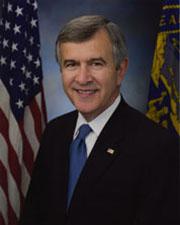 Sen. Mike Johanns (R-NE)
Legislative Activity
Stay on top of the latest movement without scrolling through every action
Roll call votes on amendments in Senate: Amendment SA 2355 as modified agreed to in Senate by Yea-Nay Vote. 83 - 7. Record Vote Number: 275.(text as modified: CR S9313-9314)
September 14, 2009
View full timeline
Roll call votes on amendments in Senate: Amendment SA 2355 as modified agreed to in Senate by Yea-Nay Vote. 83 - 7. Record Vote Number: 275.(text as modified: CR S9313-9314)
September 14, 2009
Senate amendment agreed to: Amendment SA 2355 as modified agreed to in Senate by Yea-Nay Vote. 83 - 7. Record Vote Number: 275.(text as modified: CR S9313-9314)
September 14, 2009
Senate amendment proposed (on the floor): Amendment SA 2355 proposed by Senator Johanns.(consideration: CR S9308-9318; text: CR S9308)
September 14, 2009
Amendment SA 2355 proposed by Senator Johanns. (consideration: CR S9308-9318; text: CR S9308) Prohibiting use of funds to fund the Association of Community Organizations for Reform Now (ACORN).
September 14, 2009
Amendment SA 2355 as modified agreed to in Senate by Yea-Nay Vote. 83 - 7. Record Vote Number: 275. (text as modified: CR S9313-9314)
September 14, 2009
Senate amendment submitted
September 11, 2009
Votes
1 roll call on this amendment
Text
Modified
TRANSPORTATION, HOUSING AND URBAN DEVELOPMENT, AND RELATED AGENCIES
APPROPRIATIONS ACT, 2010

The ACTING PRESIDENT pro tempore. Under the previous order, the
Senate will resume consideration of H.R. 3288, which the clerk will
report.
The assistant legislative clerk read as follows:

A bill (H.R. 3288) making appropriations for the
Departments of Transportation, and Housing and Urban
Development, and related agencies for the fiscal year ending
September 30, 2010, and for other purposes.

The ACTING PRESIDENT pro tempore. The Senator from Washington.
Mrs. MURRAY. Mr. President, we are again here on Monday afternoon
talking about a very important bill that came to the floor last
Thursday. That is the investment in infrastructure, transportation, and
housing across the country. We have many issues important to many
Members who want to get this bill passed and to the President as
quickly as possible so we can move forward. My colleague from Missouri
and I have worked very hard to put the bill together. We are here this
afternoon ready and waiting for our colleagues to offer amendments so
we can get to final passage. I know the majority leader wishes us to
finish this fairly quickly. We have a number of appropriations bills we
want to complete before the end of September deadline. So we ask our
colleagues to get their amendments up, and we will move through them as
quickly as we can.
The ACTING PRESIDENT pro tempore. The Senator from Missouri.
Mr. BOND. Mr. President, I echo what the chairman of our
subcommittee, the Senator from Washington, has said. We have had it out
now. We have had this bill out. It has been on the floor since
Thursday. We had Friday and the weekend to look at it. A number of my
colleagues, many on this side of the aisle, have talked about offering
amendments. I hope they will be ready to bring those amendments down. I
think one or two are going to be offered this afternoon so we can have
votes scheduled at 5:30, as the majority leader has suggested. It is
not only the majority leader, it is the Senator from Washington and I
who are urging people to come down. This is a very important bill.
Everybody has transportation needs, concerns, and issues. Housing is
such a significant challenge right now, given the situation in the
financial markets and the situation with housing. We have many people
who are dependent upon federally supported housing. We need to make
sure we have the funds made available to take care of their needs.
We have special needs projects such as the VASH program for veterans
with assisted housing that the Chair and I have entered into. That is
very important for bringing our service men and women home and giving
them the right kind of accommodation. All of these things are in the
context of significant financial problems in the Federal Housing
Administration. FHA, if you read the papers, is at a crisis point. I
have described it as a ticking timebomb. Regrettably, I think that is
still an accurate calculation. We have funds to provide to HUD and to
the Secretary of HUD, to the IG and others, to deal with problems
before they become more serious. So we need to get this bill passed.
I hope our colleagues would bring their amendments forward. We will
only be able to vote until 3 o'clock tomorrow afternoon. We would
appreciate them bringing as many amendments as they can forward before
then, this afternoon and tomorrow, so we can go about the business of
conferencing with the House, getting a measure that will get to the
President so he can sign it and put these critically important funds to
work.
I yield the floor.
Mrs. MURRAY. I suggest the absence of a quorum.
The ACTING PRESIDENT pro tempore. The clerk will call the roll.
The assistant legislative clerk proceeded to call the roll.
Mr. JOHANNS. I ask unanimous consent that the order for the quorum
call be rescinded.
The ACTING PRESIDENT pro tempore. Without objection, it is so
ordered.

Amendment No. 2355

Mr. JOHANNS. Mr. President, I ask that amendment No. 2355 be called
up.
The ACTING PRESIDENT pro tempore. The clerk will report.
The assistant legislative clerk read as follows:

The Senator from Nebraska [Mr. Johanns] proposes an
amendment numbered 2355.

Mr. JOHANNS. I ask unanimous consent that reading of the amendment be
dispensed with.
The ACTING PRESIDENT pro tempore. Without objection, it is so
ordered.
The amendment is as follows:

(Purpose: Prohibiting direct or indirect use of funds to fund the
Association of Community Organizations for Reform Now (ACORN))

After section 414, insert the following:
Sec. 4__. None of the funds made available under this Act
may be directly or indirectly distributed to the Association
of Community Organizations for Reform Now (ACORN).

Mr. JOHANNS. Mr. President, I rise today to discuss an amendment
pertaining to ACORN, otherwise known as the Association of Community
Organizations for Reform Now.
Records will indicate that ACORN has received $53 million in Federal
funds--taxpayer money--since 1994. In the current transportation and
housing appropriations bill, ACORN is eligible to add to that number,
to receive millions more in taxpayer funds from several different
accounts and purposes. It could receive money through mortgage
counseling, it could receive money through CDBG, community development
block grants, and it could receive money from the Neighborhood
Stabilization Program.
The people of Nebraska sent me to Washington to protect them from
waste and fraud and abuse, and they asked me to change the status quo.
I take that responsibility very seriously. That is why my amendment
would prohibit one more penny--one more penny--of taxpayer money from
going to ACORN in the transportation and housing appropriations bill.
The recent news surrounding ACORN is alarming, at a minimum. In fact,
it is outrageous. Last week, Miami-Dade prosecutors issued arrest
warrants for 11 ACORN employees. The employees are charged with
falsifying voter registration cards. A total of 1,400 voter
registration cards were turned in, and 888 of those cards were found to
be a fake. This means almost three-quarters of the voting cards were
fraudulent. Then, damaging news surfaced regarding hidden videotapes at
the Baltimore and Washington, DC, ACORN offices. You will not believe
this: They feature ACORN employees offering advice on illegal
activities, including tax evasion, prostitution, and fraud. Today we
find out that a different ACORN office--this time in Brooklyn--also
offered advice on the same topics. I

[[Page S9309]]

would suggest, obviously, this is a pattern of very rotten behavior.
Well, the alarm bells are rightly going off.
The Census Bureau notified ACORN on Friday that it is severing all
ties with the group for all work having to do with the 2010 census.
Notwithstanding the fact that is long overdue, I applaud them for that
action.
The Census letter pulled no punches, and I am quoting:

. . . it is clear that ACORN's affiliation with the 2010
Census promotion has caused sufficient concern in the general
public, has indeed become a distraction from our mission, and
may even become a discouragement to public cooperation,
negatively impacting 2010 Census efforts. Unfortunately, we
no longer have confidence--

``We no longer have confidence''--

that our national partnership agreement is being effectively
managed through your many local offices. For the reasons
stated, we therefore have decided to terminate the
partnership.

Some may even say today, as amazing as this would sound, that the
recent events are isolated, that they are not a fair and accurate
representation of ACORN. How you could say that I am not sure, but to
these defenders, I urge them to read the 88-page incriminating report
published in July by the minority staff of the House Committee on
Oversight and Government Reform. It is entitled--and, again, I am
quoting, and I have the report here--``Is ACORN Intentionally
Structured as a Criminal Enterprise?''
Mr. President, I ask unanimous consent that the Executive Summary of
that report be printed in the Record.
There being no objection, the material was ordered to be printed in
the Record, as follows:

U.S. House of Representatives, Committee on Oversight and Government
Reform, Darrell Issa (CA-49), Ranking Member

Is ACORN Intentionally Structured as a Criminal Enterprise?

I. Executive Summary

``We should be unfaithful to ourselves if we should ever
lose sight of the danger to our liberties if anything partial
or extraneous should infect the purity of our free, fair,
virtuous, and independent elections''--President John Adams,
Inaugural Address, 1797.
The Association of Community Organizations for Reform Now
(ACORN) has repeatedly and deliberately engaged in systemic
fraud. Both structurally and operationally, ACORN hides
behind a paper wall of nonprofit corporate protections to
conceal a criminal conspiracy on the part of its directors,
to launder federal money in order to pursue a partisan
political agenda and to manipulate the American electorate.
Emerging accounts of widespread deceit and corruption raise
the need for a criminal investigation of ACORN. By
intentionally blurring the legal distinctions between 361
tax-exempt and non-exempt entities, ACORN diverts taxpayer
and tax-exempt monies into partisan political activities.
Since 1994, more than $53 million in federal funds have been
pumped into ACORN, and under the Obama administration, ACORN
stands to receive a whopping $8.5 billion in available
stimulus funds.
Operationally, ACORN is a shell game played in 120 cities,
43 states and the District of Columbia through a complex
structure designed to conceal illegal activities, to use
taxpayer and tax-exempt dollars for partisan political
purposes, and to distract investigators. Structurally, ACORN
is a chess game in which senior management is shielded from
accountability by multiple layers of volunteers and
compensated employees who serve as pawns to take the fall for
every bad act.
The report that follows presents evidence obtained from
former ACORN insiders that completes the picture of a
criminal enterprise.
First, ACORN has evaded taxes, obstructed justice, engaged
in self dealing, and aided and abetted a cover-up of
embezzlement by Dale Rathke, the brother of ACORN founder
Wade Rathke.
Committee investigators have established that a violation
of corporate duties led to gross abuses of tax laws and other
federal regulations. According to documents obtained from
insiders, ACORN was made aware of its lax management
structure but chose to ignore the problems and continue a
cover-up of criminal activity. By refusing to report Dale
Rathke's embezzlement of $948,607.50 as an excess benefit
transaction, ACORN appears to have violated the Internal
Revenue Code. ACORN's cover-up of the embezzlement for more
than eight years would also constitute obstruction of
justice.
Second, ACORN has committed investment fraud, deprived the
public of its right to honest services, and engaged in a
racketeering enterprise affecting interstate commerce.
Committee investigators have documented ACORN's use of
charitable contributions against donor intent, typified by
ACORN's secret transfer of donor funds to recover losses due
to embezzlement. Moreover, ACORN comingles the accounts of
federally-funded affiliates with politically-active
affiliates and lacks sufficient oversight to safeguard
taxpayer and donor interests, even though it receives
millions of federal dollars.
ACORN's purposeful lack of quality control translates into
the employment of convicted felons and other suspect persons.
Through a strategy of providing financial incentives to
employees who meet voter registration quotas, ACORN conducts
voter drives that routinely produce fraudulent registrations.
In fact, ACORN's employment practices have the intentional
effect of encouraging voter registration fraud while linking
criminal culpability to the lowest-level employees rather
than the directors who contrive the illegal schemes.
To date, nearly 70 ACORN employees have been convicted in
12 states for voter registration fraud, though no federal
charges have been filed against ACORN's directors. In fact,
Pennsylvania judge Richard Zoller--after holding a low-level
ACORN employee liable for election law violations--noted that
``somebody has to go after ACORN.''
Third, ACORN has committed a conspiracy to defraud the
United States by using taxpayer funds for partisan political
activities.
Committee investigators have unearthed documentation that
ACORN and its affiliates conducted meticulous research that
fed aggressive campaign initiatives designed to elect
Democratic candidates in targeted races. ACORN forged both
formal and informal connections with former Illinois Governor
Rod Blagojevich, Ohio Senator Sherrod Brown and President
Barack Obama, among others. Each of these campaigns received
financial and personnel resource contributions from ACORN and
its affiliates as part of a scheme to use taxpayer monies to
support a partisan political agenda. These actions are a
clear violation of numerous tax and election laws.
Documents contained in this report reveal ACORN's political
agenda. ACORN's 2005-2007 Strategic Plan states that ``just
as important as . . . mobilizing existing progressive voters,
ACORN and similar groups actually create new progressive
voters.'' In the same document, ACORN acknowledges that its
``issue campaigns play the dual role . . . of attracting new
members, and educating or politicizing existing members.''
One particular issue where ACORN claims success is ``fighting
key elements of the national Republican program.''
In other documents, ACORN affiliates take credit for the
election of former-Illinois Governor Rod Blagojevich. In the
2006 year-end report of ACORN affiliate Service Employees
International Union (SEIU) Local 880, efforts to elect
Blagojevich and advance partisan political agendas are called
``flawless.''
Labor organizations, unions, and other tax-exempt entities
stretched Chicago-style political manipulation and back room
schemes beyond Illinois to other state-wide and national
campaign efforts. In the State of Ohio, where ACORN directors
drafted a political plan contained in this report, overt
partisan goals are enumerated. The ACORN Ohio Political Plan
states: ``ACORN will target three competitive Ohio
congressional districts as well as a half dozen state rep
seats nested within the districts. Our electoral work will
mobilize and educate voters [and] our paid professional
canvass will execute tightly managed Voter ID and GOTV
canvasses moving our core constituency of base and swing
voters to the polls to vote for the candidates who most
closely align with a progressive Working Families Agenda.''
Moreover, documents provided by former ACORN employees and
contained in this report demonstrate the degree to which
ACORN and ACORN affiliates organized to elect President
Barack Obama in 2008.
Fourth, ACORN has submitted false filings to the Internal
Revenue Service (IRS) and the Department of Labor, in
addition to violating the Fair Labor Standards Act (FLSA).
Committee investigators have tracked ACORN's numerous
failures to comply with federal laws that required the
payment of excise taxes on excess benefits to Dale Rathke.
SEIU Local 100--under the direction of ACORN founder Wade
Rathke--filed bogus reports with the Labor Department in
order to conceal embezzlement. ACORN violated the overtime
and record-keeping provisions of FLSA. All of these
fraudulent acts would constitute a violation of 18 U.S.C.
Sec. 1001 by presenting false documents to the United States
government.
Fifth, ACORN falsified and concealed facts concerning an
illegal transaction between related parties in violation of
the Employee Retirement Income Security Act of 1974 (ERISA).
Committee investigators have concluded that ACORN plundered
employee benefits and violated fiduciary responsibilities
under ERISA by relieving corporate debts through prohibited
loans to a related party. Moreover, ACORN affiliates lack
independent control of their own assets and maintain shoddy
accounting practices that serve to hide ACORN's secret and
illegal use of monies.
ACORN conspired to conceal information concerning
prohibited transactions from its board in violation of its
corporate charter. ACORN's termination of board members who
sought to uncover its illegal activities perpetuates a cover-
up at the expense of adherence to its own bylaws.
The evidence contained in this report proves that ACORN's
stated purpose to promote grassroots civic participation has
been perverted through fraudulent and illegal acts. The
weight of evidence against ACORN and its affiliates is
astounding. This syndicate of tax-exempt organizations has
coordinated and implemented a nation-wide

[[Page S9310]]

strategy of tax fraud, racketeering, money-laundering and
manipulating the American electorate.
Scrutiny is essential to lift a dark cloud of suspicion
from nonprofit community organizations; to bring to justice
the responsible parties who have heretofore been shielded
from prosecution by ACORN's obscure organizational structure;
to protect the American system of democratic self-government
from manipulation and disruption; and to free our political
climate from the choke of corruption that threatens to
strangle free and fair elections.

Mr. JOHANNS. According to the report:

Operationally, ACORN is a shell game played in 120 cities,
43 states and the District of Columbia through a complex
structure designed to conceal illegal activities, to use
taxpayer and tax exempt dollars for partisan political
purposes, and to distract investigators. Structurally, ACORN
is a chess game in which senior management is shielded from
accountability by multiple layers of volunteers and
compensated employees who serve as pawns to take the fall for
every bad act.

There is a history here, and it is a sad history. In 1998, an ACORN
employee was arrested for falsifying voter registration forms. In 1999,
Philadelphia authorities found hundreds of fraudulent registration
forms by ACORN. In October of 2008, the pattern continues. ACORN's
Nevada offices were raided by Federal agents, and in 2009 their Las
Vegas field director was charged with voter registration fraud. In May
2009, seven ACORN employees were charged in Pittsburgh for voter
registration fraud.
I cite this sad, tragic history because the events of the last week
were not isolated, and I do not believe it was accidental that this
video caught ACORN employees delivering the same message in different
cities. They magnify a troubling, systemic, and criminal pattern. In
fact, they serve as a public window into an organization that is
besieged by corruption, by fraud, and by illegal activities, all
committed--all committed--on the taxpayers' dime. Mr. President, I
would suggest to you, if we had the capability to ask every taxpayer in
America: Is this how you want your money spent, we would have a nearly
unanimous count saying: Absolutely not.
At a time when we are experiencing record deficits and the economy is
struggling every day to get back on its feet, how in the world can
anyone come to this floor of the Senate and say: I want to cast my vote
to continue to fund this organization with taxpayer dollars, hard-
earned dollars by American families, when so many questions of
legitimacy reign? I think the answer to that is simple. I do not see
how anybody could cast that vote. To do so, in my judgment, would
ignore the proof, and it would also ignore our responsibility to
protect taxpayers from waste and fraud and abuse. I would go so far as
to say that I respect that some of my colleagues believe the work done
by ACORN in some communities might be valuable. But I would
respectfully suggest that the problems riddling this organization, in
office after office, cannot and should not be trivialized. This is an
opportunity for the Senate to stand up and say: Enough is enough, just
as the Census Bureau did.
As Judge Richard Zoller said, after holding an ACORN employee liable
for election law violations:

Somebody has to go after ACORN.

Well, I suggest today, on the floor of the Senate, that ``somebody''
is each and every U.S. Senator. That ``somebody'' is each Senator, who
now has the ability to come to the floor and say to the taxpayers back
home: We will not tolerate this any longer. Until a full investigation
is launched into ACORN, no taxpayer money should be used to fund its
activities. A vote in favor of my amendment is a vote in favor of the
taxpayer and a vote against the status quo.
Mr. President, I yield the floor and suggest the absence of a quorum.
The ACTING PRESIDENT pro tempore. The clerk will call the roll.
The assistant legislative clerk proceeded to call the roll.
Mr. VOINOVICH. Mr. President, I ask unanimous consent that the order
for the quorum call be rescinded.
The ACTING PRESIDENT pro tempore. Without objection, it is so
ordered.
Mr. VOINOVICH. Mr. President, I ask unanimous consent that I be
permitted to speak as in morning business for up to 25 minutes.
The ACTING PRESIDENT pro tempore. Without objection, it is so
ordered.

Fiscal Update

Mr. VOINOVICH. Mr. President, building on a series of speeches I have
given over the past few years and in the tradition of a former Member
of this body, Senator Fritz Hollings of South Carolina, I hope to
provide my colleagues and the American people with regular updates on
our catastrophic national debt. Unfortunately, given the lack of action
to address this coming tsunami, I believe President Obama and Congress
need to be reminded of the fiscal realities in which we find ourselves.
Senator Hollings came down to the Senate floor every few weeks with a
poster updating the national debt, and today I renew his tradition, and
I will continue it until we do something about this unsustainable
financial crisis.
One of my grandchildren's favorite stories is ``The Emperor's New
Clothes'' by Hans Christian Anderson. In the tale, an emperor goes
about the land wearing a nonexistent suit sold to him by a new tailor
who convinced the monarch the suit is made of the finest silks. The
tailors--two swindlers--tell the emperor that the threads of his robes
will be so fine that they will look invisible to those dimwitted or
unfit for their position. The emperor and his ministers, themselves
unable to see the clothing, lavish the tailor with praise for the suit
because they do not want to appear dimwitted or incompetent.
Word spread across the kingdom of the emperor's beautiful new robes.
To show off the extraordinary suit, a parade was formed. People lined
the streets to see the emperor show off his new clothes. Again, afraid
to appear stupid or unfit, everyone pretends to see the suit. It is
only when a child cries out ``the emperor wears no clothes'' does the
crowd acknowledge that the emperor is, in fact, naked.
Much like the emperor, America's elected leaders know we face a
fiscal train wreck, but we are choosing to ignore our current economic
reality. I am here to tell my colleagues and President Obama, the
emperor has no clothes and we are naked in terms of dealing with our
deficits and national debt.
As shown right here on this chart, get the book out. I am sure you
have it. Read it. That is where we are right now. The irony is that the
American people know we are naked, and they are coming to Washington to
let us know we are naked, and so does the rest of the world, and our
credibility and our credit today are at risk.
I have this chart, what I refer to as the ``Wheel of Misfortune.''
This lays out quite clearly what our national debt is today.
One of the reasons I ran for the Senate back in 1998 was I wanted to
come to Washington and reduce the national debt and balance budgets,
which is something I did as the mayor of the city of Cleveland and
something I did as Governor of the State of Ohio.
When I came to the Senate in 1999, our gross national debt stood at
$5.6 trillion or 61 percent of the GDP. Today, as you can see from the
chart behind me, the gross national debt is nearly $11.8 trillion. I
understand the President is going to ask us to increase our debt limit
to $12 trillion and, quite frankly, I believe he is going to be asking
us to raise the debt limit to more than $12 trillion.
This is an increase of more than 100 percent in 10 years. Much of
this increase has come recently. In fact, from 2008 to 2009 alone, the
Federal debt will increase 22 percent, boosting the country's debt-to-
income ratio--our national debt as a percentage of GDP--from 70 percent
last year to 86 percent this year. We haven't seen this kind of GDP
debt since the Second World War. It was 65 years ago during the Second
World War that we saw these kinds of numbers.
By the way, this does not include our unfunded Medicare and Social
Security obligations which the Peterson Foundation recently tagged at
$56.4 trillion. This is the equivalent of a $483,000 debt per American
household or $184,000 for every man, woman, and child in America today.
Those are unfunded liabilities.
It doesn't take an economist to realize our course is unsustainable.
President Obama and this Congress are fully aware of this reckless
fiscal path. Yet they continue to spend and borrow,

[[Page S9311]]

spend and borrow. Our Federal Government is the worst credit card
abuser in the world. We talk to our kids about not abusing their credit
cards. What kind of example do we set? You know what. We are putting
the tab on the credit of our children and grandchildren.
Like the boy who cried ``the emperor has no clothes,'' the American
people see through this sham. There were a bunch of them here this
weekend who saw through the sham. A recent poll conducted by the
Peterson Foundation showed that after their personal job, the most
pressing concern of Americans is the national debt. Americans are
cutting back, folks, in their own family. They are making tough
decisions. They know they haven't been living within their means.
Some people are saying: Why are they paying attention to this
finally? Well, they are finally realizing in their own families they
need to redo the way they are doing things, and they are asking
themselves: Why isn't our Federal Government doing the same thing we
are doing in our households? It is no wonder they are looking at
government's reckless spending with disapproval and wondering why we
are not doing the same thing they are doing. They are mad as hell, and
they aren't going to take it anymore.
The media is also finally starting to pay attention to this issue.
Recently, the Washington Post ran an article by Fred Hiatt, their chief
editorial writer, acknowledging that our long-term fiscal path is
unsustainable, as well as an editorial taking the administration to
task for lacking a plan on how to start digging our economy out of this
fiscal crisis.
Additionally, Newsweek published an article by Fareed Zakaria where
he outlines what he describes as ``the disease of modern democracy: the
system cannot impose any short-term pain for long-term gain.'' We are
unwilling to pay for it or do without.
The first one, this Newsweek article, is called,

There is a Silver Lining.
The crisis has forced the United States to confront bad
habits developed over the past few decades. If we can kick
those habits, today's pain will translate into gains.

The other is a Washington Post article entitled ``No Laughing Matter.
Why the U.S. Needs to Get Serious About Long-Term Budget Deficits.''
Mr. VOINOVICH. Mr. President, I ask unanimous consent to have printed
in the Congressional Record the articles to which I previously
referred.
There being no objection, the material was ordered to be printed in
the Record, as follows:

[From Newsweek Magazine, Oct. 20, 2008]

There Is a Silver Lining

(By Fareed Zakaria)

Some of us--especially those under 60--have always wondered
what it would be like to live through the kind of epochal
event one reads about in books. Well, this is it. We're now
living history, suffering one of the greatest financial
panics of all time. It compares with the big ones--1907,
1929--and we cannot yet know its full consequences for the
financial system, the economy or society as a whole.
I'm betting that, in the end, the world's governments will
win this battle against fear. They have potentially unlimited
tools at their disposal, especially if they act in concert.
They can nationalize firms, call bank holidays, suspend
trading for weeks, buy up debt and equity, and renegotiate
home mortgages. Most important, the American government can
print money. All of these tools have long-term effects that
are extremely troublesome, but they are nothing compared with
the potential collapse of the financial system. And
Washington seems to have recognized that it must do whatever
is required to shore up that system. Big questions remain.
What will it take to stop the fall? How costly will it be?
How long before the rescue plan starts to have an effect? But
at some point, the panic that gripped world markets last week
will end. Of course, that will not mean a return to growth or
a bull market. We're in for tough times. But it will mean a
return to sanity.
Amid all the difficulties and hardship that we are about to
undergo, I see one silver lining. This crisis has--
dramatically, vengefully--forced the United States to
confront the bad habits it has developed over the past few
decades. If we can kick those habits, today's pain will
translate into gains in the long run.
Since the 1980s, Americans have consumed more than they
produced--and they have made up the difference by borrowing.
Two decades of easy money and innovative financial products
meant that virtually anyone could borrow any amount of money
for any purpose. If we wanted a bigger house, a better TV or
a faster car, and we didn't actually have the money to pay
for it, no problem. We put it on a credit card, took out a
massive mortgage and financed our fantasies. As the fantasies
grew, so did household debt, from $680 billion in 1974 to $14
trillion today. The total has doubled in just the past seven
years. The average household owns 13 credit cards, and 40
percent of them carry a balance, up from 6 percent in 1970.
But the average American's behavior was virtue itself
compared with the government's. Every city, every county and
every state has wanted to preserve its many and proliferating
operations and yet not raise taxes. How to square this
circle? By borrowing, using ever more elaborate financial
instruments. Revenue bonds were backed up by the prospect of
future income from taxes or lotteries. ``A growing trend is
to securitize future federal funding for highways, housing
and other items,'' says Chris Edwards of the Cato Institute.
The effect on the projects, he points out, is to make them
more expensive, since they incur interest payments. Because
they ``insulate the taxpayer from the cost''--all that needs
to be paid now is the interest--they also tend to produce
cost overruns.
Local pols aren't the only problem. Under Alan Greenspan,
the Federal Reserve obstinately refused to inflict any pain.
Russian default? Cut interest rates. Worried about Y2K? Cut
rates. NASDAQ crash? Cut rates. The economy slows after 9/11?
Cut rates. Whatever the problem, the solution was to keep the
money flowing and goose the economy. Eventually, by putting
the housing market on steroids, the strategy created problems
too large to untangle.
The whole country has been complicit in a great fraud. As
economist Jeffrey Sachs points out, ``We've wanted lots of
government, but we haven't wanted to pay for it.'' So we've
borrowed our way out of the problem. In 1990, the national
debt stood at $3 trillion. (That sounds high, but keep
reading.) By 2000, it had almost doubled, to $5.75 trillion.
It is currently $10.2 trillion. The number moved into 11
digits last month, which meant that the National Debt Clock
in New York City ran out of space to display the figures. Its
owners plan to get a new clock next year.
``Leverage'' is the fancy Wall Street word for debt. It's
at the heart of the current crisis. Warren Buffett explained
the problem in his inimitable way on ``The Charlie Rose
Show.'' ``Leverage,'' he said, ``is the only way a smart guy
can go broke . . . You do smart things, you eventually get
very rich. If you do smart things and use leverage and you do
one wrong thing along the way, it could wipe you out, because
anything times zero is zero. But it's reinforcing when the
people around you are doing it successfully, you're doing it
successfully, and it's a lot like Cinderella at the ball. The
guys look better all the time, the music sounds better, it's
more and more fun, you think, `Why the hell should I leave at
a quarter to 12? I'll leave at two minutes to 12.' But the
trouble is, there are no clocks on the wall. And everybody
thinks they're going to leave at two minutes to 12.''
If there is a lesson to be taken from this crisis, it's a
simple and old rule of economics: there is no free lunch. If
you want something, you have to pay for it. Debt is not a bad
thing. Used responsibly, it is at the heart of modern
capitalism. But hiding mountains of debt in complex
instruments is a way to disguise costs, an invitation to
irresponsible behavior.
At some point, the magical accounting had to stop. At some
point, consumers had to stop using their homes as banks and
spending money that they didn't have. At some point, the
government had to confront its indebtedness. The United
States--and other overleveraged societies--have now gotten
the wake-up call from hell. If we can respond and change our
behavior markedly, this might actually be a blessing in
disguise. (Though, as Winston Churchill said when he lost the
election of 1945, ``at the moment it appears rather
effectively disguised.'')
In the short term, all the solutions to the current crisis
require that governments take on more debts and larger
obligations. This is inevitable and necessary. But that
doesn't mean we should, as some noted economists advocate,
stimulate the economy with more tax cuts. That would be only
one more way to keep the party going artificially--like
asking a drunk to go to AA next year, but in the meantime to
have even more whisky. A far better stimulus would be to
announce and expedite major infrastructure and energy
projects, which are investments, not consumption, and
therefore have a much different effect on the country's
fiscal fortunes. (They are not listed separately in the
federal budget, but that's just bad accounting.)
In the medium and long term, we have to get back to basics.
Households, for instance, should save more. Governments
should put incentives in place that make such savings more
likely. The U.S. government offers enormous incentives to
consume (the deduction of mortgage interest being the best
example), and it works. We have the biggest houses in the
world, the thinnest flat-screen TVs and the most cars. If we
were to tax consumption and encourage savings, that would
also work. Regulations on credit-card debt should be revised
to ensure that people understand the risks and costs of these
instruments. Moving in this direction would be good for
families and for the government as well.
Wall Street will also need to change. Paul Volcker has long
argued that the recent

[[Page S9312]]

spate of financial innovation was nothing of the kind: it
simply shuffled around existing resources while contributing
few real benefits to the economy. Such activity will now be
reduced significantly. Boykin Curry, managing director of
Eagle Capital, says, ``For 20 years, the DNA of nearly every
financial institution had morphed dangerously. Each time
someone at the table pressed for more leverage and more risk,
the next few years proved them `right.' These people were
emboldened, they were promoted and they gained control of
ever more capital. Meanwhile, anyone in power who hesitated,
who argued for caution, was proved `wrong.' The cautious
types were increasingly intimidated, passed over for
promotion. They lost their hold on capital. This happened
every day in almost every financial institution over and
over, until we ended up with a very specific kind of
person running things. This year, the capital that remains
is finally being reallocated to more careful, thoughtful
executives and investors--the Warren Buffetts . . . of the
world.''
Volcker has also argued that the highly complex financial
system was not nearly as stable as people believed and that
far-reaching efforts were needed to regulate and stabilize
it. Now these issues will get attention at the highest level.
The fear on Wall Street is that a Democratic administration
would overregulate. But look at who is advising Barack
Obama--Buffett, Volcker, former Treasury secretaries Robert
Rubin and Larry Summers. It is more likely that what will
come from their efforts will be a better-regulated financial
system that, while producing less-extravagant profits, will
be more stable and secure.
The financial industry itself is likely to shrink, and
that's not a bad thing, either. It has ballooned dramatically
in size. Curry points out that ``30 percent of S&P 500
profits last year were earned by financial firms, and U.S.
consumers were spending $800 billion more than they earned
every year. As a result, most of our top math Ph.D.s were
being pulled into nonproductive financial engineering instead
of biotech research and fuel technology. Capital expenditures
went into retail construction instead of critical
infrastructure.'' The crisis will stop the misallocation of
human and financial resources and redirect them in more-
productive ways. If some of the smart people now on Wall
Street end up building better models of energy usage and
efficiency, that would be a net gain for the economy.
The American economy remains extremely dynamic and
flexible. Even now, the most surprising data continue to be
how resilient the economy has been through all these shocks.
That will not last, especially if the panic persists. But
even so, it highlights the fact that the U.S. economy has
underlying virtues and, after a tough recession, will
probably recover faster than many can now imagine. The rise
in emerging-market economies, which have been powering global
growth, will not vanish overnight, either.
A new discipline would benefit America in a more general
sense, too. Ever since the collapse of the Soviet Union, the
United States has operated in the world with no constraints
or checks on its power. This has not been good for its
foreign policy. It has made Washington arrogant, lazy and
careless. Its decision making has resembled General Motors'
business strategy in the 1970s and 1980s, a process driven
largely by a vast array of internal factors but little sense
of urgency or awareness of outside pressures. We didn't have
to make strategic choices; we could have it all. We could
make blunders, anger the world, rupture alliances, waste
resources, wage war incompetently--it didn't matter. We had
more than enough room for error--lots of error.
But it's a different world out there. If Iraq cast a shadow
on U.S. political and military credibility, this financial
crisis has eroded America's economic and financial power. In
the short run, there has been a flight to safety--toward
dollars and T-bills--but in the long run, countries are
likely to seek greater independence from an unstable
superpower. The United States will now have to work to
attract capital to its shores, and manage its fiscal house
better. We will have to persuade countries to join in our
foreign endeavors. We will have to make strategic choices. We
cannot deploy missile interceptors along Russia's borders,
draw Georgia and Ukraine into NATO, and still expect Russian
cooperation on Iran's nuclear program. We cannot noisily
denounce Chinese and Arab foreign investments in America one
day and then hope that they will keep buying $4 billion worth
of T-bills another day. We cannot keep preaching to the world
about democracy and capitalism while our own house is so
wildly out of order.
It's a fundamental American belief that competition is
good--in business, athletics and life. Checks and balances
are James Madison's crucial mechanisms, exposing and
countering abuse and arrogance and forcing discipline on
people. This discipline will be painful for a country that
has gotten used to having it all. But it will make us much
stronger in the long run. If we can learn the right lessons
from this crisis, the United States will once more be playing
by its own rules. And that cannot be bad for us.

[From the Washington Post, June 5, 2009]

No Laughing Matter

The Obama administration inherited from its predecessor
both a tanking economy and a huge federal budget deficit.
Under the circumstances, it cannot be faulted for increasing
the deficit in the short run, because a mammoth recession
called for fiscal stimulus. Thus, it is neither surprising
nor irreversibly dangerous that the total federal debt held
by the public looks as if it will reach 57 percent of gross
domestic product by the end of fiscal 2009 on Sept. 30--well
above the previous four decades' average of about 40 percent.
What is more alarming is that, barring major spending cuts or
tax increases, President Obama's budget could drive that
figure to 82 percent by 2019, according to the Congressional
Budget Office.
We are already getting a taste of the problems that could
develop if the president and Congress do not address this
soon. Since the end of last year, the interest rate on 10-
year Treasury notes has gone up from 2 percent to over 3.5
percent. That number is within historical norms; indeed,
Treasury rates probably had been artificially depressed
during the financial panic of the fall. But the spike, which
will cost the government tens of billions of dollars, also
reflects mounting investor concern--at home and, especially,
abroad--about the U.S. fiscal situation. If government
borrowing costs continue to accelerate, they could kill
economic growth for years to come.
It was a sign of the times that Treasury Secretary Timothy
F. Geithner had to travel to Beijing this week to reassure
China, the world's largest holder of Treasury debt, that
lending money to the U.S. government is still a wise thing to
do. Mr. Geithner insisted that, ``in the United States, we
are putting in place the foundations for restoring fiscal
sustainability.'' To be sure, China doesn't have many good
alternatives to parking its massive trade surpluses in
dollars. But it does have some, including commodities and the
debt of more fiscally prudent European governments. In a
moment that all Americans should consider a wake-up call, Mr.
Geithner was met with laughter when he told a group of
Chinese students that their country's assets were ``very
safe'' in Washington.
The chairman of the Federal Reserve, Ben S. Bernanke, was
considerably more decorous than the Chinese students in
testimony before Congress on Wednesday but, in essence, only
slightly less skeptical. ``Even as we take steps to address
the recession and threats to financial stability,'' he said,
``maintaining the confidence of the financial markets
requires that we, as a nation, begin planning now for the
restoration of fiscal balance.''
Mr. Bernanke did not say explicitly that there is no such
plan in Mr. Obama's budget--at least not according to the
CBO, whose estimates of the president's budget show annual
deficits lingering indefinitely above 4 percent of GDP. Nor
did he point out that Congress has yet to come up with
credible financing for the president's desirable but
expensive health-care proposal. He did not say that Mr. Obama
and Congress have done nothing so far to deliver on the
president's pledge of entitlement reform. But if the Fed
chairman had said those things, he would have been absolutely
right.

Mr. VOINOVICH. Mr. President, now is the time to take the first step
toward fiscal responsibility and making good on our promises by
enacting meaningful, comprehensive tax and entitlement reform. The
recent pay-as-you-go legislation passed by the House isn't going to get
the job done. We know that. This Band-Aid relies on smoke and mirrors
and exempts the 2001 and 2003 tax cuts, patching the alternative
minimum tax, updating physician payments in Medicare, and modifying the
estate tax. It is intellectually dishonest. Even the Budget Committee
chairman in the Senate, Senator Conrad, calls this pay-go that came out
of the House insincere. If Congress is going to reenact statutory pay-
go, then it should apply to everything, not just to what is convenient.
We need real comprehensive reform. I am pleased to say it appears as
though President Obama is finally starting to get it. In an interview
with the Washington Post, President Obama endorsed the idea of creating
a commission where--here is what he said:

Everything is going to be on the table when it comes to
examining our tax and entitlement systems and presenting
long-term solutions to place the United States on a fiscally
sustainable course.

He went on to say:

What you end up having to do in terms of structural reforms
realistically is you probably have to set up some sort of
commission or mechanism that reports back with the prospect
of maybe locking in a pledge for action, post election.

I know we have talked about this on occasion, about this commission
and setting it up and trying to get the administration to commit to it
so we can let the American people know we are sincere about doing
something about this debt and balancing our budget.
For the past three Congresses, I have been calling for such a
commission. This Congress, I am proud to say, Senator Lieberman has
joined me as an original cosponsor to create the commission now.

[[Page S9313]]

Similar to the BRAC process, the Save America's Future Economy
Commission--we call it SAFE--would break the legislative logjam in
Washington by creating a bipartisan, bicameral committee to draw up
policy prescriptions for the government's long-term budget shortfalls
that would then go before Congress on an up-or-down vote. The
legislation is similar to legislation introduced by Congressmen Jim
Cooper and Frank Wolf in the House, and today they have 69 cosponsors.
It is vital--it is vital--to ensuring the solvency of entitlement
programs for future generations.
It is my understanding that Pete Peterson and David Walker of the
Peterson Foundation have endorsed this legislation along with the
Heritage Foundation, the Brookings Institute, the Business Roundtable,
and a host of other former CBO Directors who said it is time for us to
do something about the problem, and they understand we will not get it
done with the regular order of business. We have to have a commission
come back with a recommendation, put it on a fast track, send it to the
House, send it to the Senate, and let us either vote up or down as we
do with the commissions we have set up on closing bases.
I am sure many of my colleagues are familiar with this legislation. I
know David Walker has met with both Republican and Democratic
legislative leaders or directors regarding this legislation.
Continuing down our current path, folks, is unsustainable. It is
unsustainable, and it is immoral. For too long we have clothed
ourselves in economic falsehoods, pretending they would protect us from
the harsh economic realities. Folks, time is running out. The world
sees that the emperor, in fact, has no clothes. I am calling on
President Obama to follow through on his comments about the need for a
commission and support the SAFE Commission Act.
OMB Director Peter Orszag has understood our fiscal crisis in the
past and called for the creation of an entitlement commission, but
since joining the administration he has stopped pushing for a
commission, instead focusing just on health care reform. The bottom
line is health care reform is but one of the major issues that needs to
be addressed to respond to our fiscal crisis. We must also reform the
Tax Code to encourage personal savings, investment, job creation, and
economic growth. A lot of Americans are not aware of this fact, that we
spend $240 billion a year paying our taxes; that is, to pay for
professional help and keeping track of all of the papers we need to
have when we prepare to pay our Federal income tax.
I think the current health care debate in Congress is a perfect
example of why a piecemeal approach doesn't work. If we dealt with the
fiscal crisis, it would be a lot easier for us to deal with health
care.
There is a new poll out just today, AP, that says half of Americans
are more concerned about tackling our debt than our health care reform,
education, and climate change. Did my colleagues hear that? Over half
of them say deal with the fiscal crisis. The reason I believe we are
having such a darn difficult time dealing with health care and why we
are not going to pass any kind of climate change legislation is that
the people of this country know we have a fiscal crisis and they want
us to contend with that before we deal with these other issues.
I think the American people know we can't afford the health care
system we now have, and we must find a way to be more responsible.
Think of this: We spend $2.2 trillion on health care in this country.
The Medicare trust fund will be insolvent in 2017, and we have to
reform the way we pay physicians under the program, which experts say
will cost us $280 billion over 10 years. Furthermore, the States are
already overburdened by the cost of their Medicaid programs.
We gave the States $87 billion in the stimulus bill. I can tell you
in ordinary circumstances, many States usually come to Washington with
a tin cup. I can guarantee you that the Governors of this country are
going to be down here with a large bathtub asking us to fill it because
of the problems they confront.
In other words, they can't now take care--well, they can now because
they got the $87 billion, but once that runs out, they are going to be
down here saying: We can't handle the current system as it is. How can
we expand Medicaid when we can't take care of the Medicaid Program we
now have? With the financial crisis we have in this country, we have to
be careful of taking on something we can't afford, particularly when we
can't afford to pay for what we already have.
I am surprised that in the President's speech last week he didn't
talk about the fact that by 2017--everybody needs to understand this--
the money coming in for Medicare would not be adequate to take care of
the people who are out there who are eligible for Medicare. It is part
of what I call that unfunded liability I talked about earlier.
The Peterson Foundation recently commissioned an in-depth health care
study conducted by the Lewin Group, and I urge my colleagues to take a
close look at this analysis and see the principles the Peterson
Foundation lays out to determine a fiscally responsible health care
reform bill.
I am not the only one calling for Congress to be fiscally responsible
when considering health care reform. In order for health care reform
legislation to be fiscally responsible, it must, one, pay for itself
over a 10-year period; two, not add to the deficit beyond a 10-year
period; three, bend the cost curve down to reduce health care spending;
and four, significantly reduce current unfunded obligations. That is
what we should be talking about.
President Obama and Congress must act. We all came to Washington to
serve, and we have a moral responsibility to leave this place better
than what we found it. How will we look our children and grandchildren
in the eye knowing we have mortgaged their future at a time when we
know they are going to have to work harder than we have to maintain the
standard of living we enjoy.
God has blessed me with three children and seven grandchildren. I am
constantly worried about what kind of America they are going to be
living in. I know darn well the competition we face today worldwide is
a lot more fierce than anything I experienced during my life here. I
know because of that competition they are going to have to work harder.
They are going to have to work smarter. It would be very cruel for us,
on top of that, to lay this terrible burden on their shoulders and say:
We weren't willing to pay for it or do without, so you take care of it.
It is your problem. You handle it.
I was pleased to hear President Obama echo this last Wednesday during
his joint session of Congress, the same sentiment I have just made. He
stated--and I quote the President of the United States:

I understand that the politically safe move would be to
kick the can further down the road--to defer reform one more
year, one more election, one more term. But that is not what
the moment calls for. That is not what we came here to do. We
did not come here to fear the future. We came here to shape
it. I still believe we can act, even when it is hard.

President Obama's words ring true in light of the fiscal challenges
we face as a nation today. And they should get the first priority.
Until we start on a commission, Congress, the administration, the
American people, and the world will know the Emperor has no clothes. We
are naked in terms of realizing and dealing with our fiscal crisis. Now
is the time to act.
Mr. President, I suggest the absence of a quorum.
The ACTING PRESIDENT pro tempore. The clerk will call the roll.
The bill clerk proceeded to call the roll.
Mrs. MURRAY. Madam President, I ask unanimous consent that the order
for the quorum call be rescinded.
The PRESIDING OFFICER (Mrs. Hagan). Without objection, it is so
ordered.
The Senator from Missouri.

Amendment No. 2355, as Modified

Mr. BOND. Madam President, I ask unanimous consent that the Johanns
amendment be modified with the changes at the desk.
The PRESIDING OFFICER. Without objection, it is so ordered.
The amendment (No. 2355), as modified, is as follows:

(Purpose: Prohibiting use of funds to fund the Association of Community
Organizations for Reform Now (ACORN))

After section 414, insert the following:
Sec. 4__.  None of the funds made available under this Act
may be distributed to the

[[Page S9314]]

Association of Community Organizations for Reform Now (ACORN)
or its subsidiaries.

Mr. BOND. I suggest the absence of a quorum.
The PRESIDING OFFICER. The clerk will call the roll.
The bill clerk proceeded to call the roll.
Mr. BOND. Madam President, I ask unanimous consent that the order for
the quorum call be rescinded.
The PRESIDING OFFICER. Without objection, it is so ordered.
Mr. BOND. Madam President, I rise today to support the amendment
offered by my colleague from Nebraska, Senator Johanns. He has proposed
an amendment to end taxpayer funding for the Association of Community
Organizations for Reform Now.
We cannot allow taxpayer funds to support groups engaged in repeated
voter registration fraud activities, and now their repeated assistance
for housing, tax, and mortgage fraud.
I recognize--and let's be clear about it--that ACORN has helped
counsel homeowners through the recent mortgage meltdown. Doubtless,
they have helped good people find affordable housing solutions. But
that cannot outweigh the numerous and repeated abuses of taxpayer
dollars allowed to occur in their name.
In my home State of Missouri, several ACORN workers in Kansas City
admitted to voter registration fraud. There have been other
investigations throughout the State. Unfortunately, ACORN vote fraud in
Missouri is not isolated. ACORN workers in Arkansas, Colorado, Florida,
Michigan, North Carolina, New Mexico, Ohio, Minnesota, Pennsylvania,
Texas, Virginia, Wisconsin, and Nevada have all been associated with
fraudulent voter registration activities.
This long list shows this is not a problem of a handful of rogue
employees but, regrettably, an endemic systemwide culture of fraud and
abuse. Now we have disgusting and unacceptable video footage of ACORN
housing workers counseling on how prostitutes might circumvent mortgage
applications, tax law, and child endangerment laws. Again, this
despicable behavior is not isolated to one rogue employee but has
occurred repeatedly in Washington, Baltimore, and New York.
For those who say that minority and low-income advocates are being
picked upon, I say the causes of expanding housing and voting
opportunities and wise counseling and assistance to those who need help
are too important to be allowed to be sullied by such a morally
fraudulent organization. The tireless volunteers and underpaid staffers
toiling to help the impoverished and disenfranchised do not deserve to
have their reputation pulled down by the organization they work for
which cannot put an end to these abuses. All taxpayers deserve to know
their hard-earned tax dollars are not going toward voter, housing,
mortgage, or tax fraud assistance.
Congress has the opportunity to end this relationship now. I am
hoping we will be able to vote this afternoon, and I urge my colleagues
to support the Johanns amendment.
I yield the floor.
Mr. HATCH. Madam President, I rise to speak in support of an
amendment by my good friend, Senator Mike Johanns, that would prevent
our taxpayer dollars from being directed to the Association of
Community Organizations for Reform Now, more commonly known as ACORN. I
also want to commend the Census Bureau's recent decision to cut all
ties with ACORN.
Simply put I am very pleased with this decision, which was announced
late last week through a letter from Census Bureau Director Robert
Groves to ACORN's National Headquarters. As I met with Dr. Groves in my
office just last week, I raised this very issue and expressed my
disappointment, along with the disappointment of many of the Utahns I
represent, that ACORN would have any association with such an important
and historic event such as the 2010 Census.
Anyone who knows me, knows that I am always supportive of reasonable
efforts to ensure that taxpayer funds are not used for unlawful
activities, particularly when those activities may be construed to be
partisan in nature. That is why I have followed this particular issue
so closely throughout the year and raised the issue directly with
Director Groves.
In fact, as next year's census quickly approaches, I continue to work
with Census officials at the Commerce Department on all levels. As all
Utahns are keenly aware, the Decennial Census requires precision and
uniformity--both of which I am closely monitoring as the Census moves
forward.
To that end, I am hopeful that the Census Bureau will ensure that all
Americans are counted fairly and accurately, with the privacy of the
individual always in mind. I applaud Director Groves and his decision
for the Census Bureau to cut all ties with ACORN. I am pleased that he
listened not only to my concerns, but also to the concerns of thousands
of Utahns and Americans from across country who have expressed severe
disappointment with ACORN's involvement in the 2010 Census. Personally,
I feel ACORN should not have been involved in the 2010 Census in the
first place. However, I recognize Director Groves' decision as an
important step toward an accurate and fair count and look forward to
assisting in additional efforts toward that same end in the near
future.
While I am encouraged by the recent actions by the Census Bureau, I
believe it is critical to adopt Senator Johanns' amendment so we can
know with certainty that partisan political organizations like ACORN
will not be underwritten with taxpayer dollars.
The PRESIDING OFFICER. The Senator from Washington.
Mrs. MURRAY. Madam President, I ask unanimous consent that at 5:30
p.m. today, the Senate proceed to vote in relation to the Johanns
amendment No. 2355, as modified; that no amendment be in order to the
amendment prior to the vote; and that there be 2 minutes of debate
prior to a vote in relation to the amendment, with the time equally
divided and controlled in the usual form.
The PRESIDING OFFICER. Without objection, it is so ordered.
Mrs. MURRAY. Madam President, with that, there will be a vote at 5:30
this afternoon, and if any other Senators wish to come to the floor to
speak to their amendments, we are here ready and waiting for them to do
that.
With that, I suggest the absence of a quorum.
The PRESIDING OFFICER. The clerk will call the roll.
The legislative clerk proceeded to call the roll.
Mr. KAUFMAN. Madam President, I ask unanimous consent the order for
the quorum call be rescinded.
The PRESIDING OFFICER. Without objection, it is so ordered.
Mr. KAUFMAN. Madam President, I ask unanimous consent to speak as in
morning business for up to 25 minutes.
The PRESIDING OFFICER. Without objection, it is so ordered.

Financial Abuses

Mr. KAUFMAN. Madam President, tomorrow is the first anniversary of
the Lehman Brothers collapse, the largest bankruptcy in United States
history. Lehman's failure sent shock waves throughout the entire
country.
The resulting financial meltdown plunged the American economy into
the most severe recession since the 1950s. Credit markets froze,
investor confidence collapsed, stock prices crashed, and millions of
Americans lost their jobs, their homes, and their savings.
Lehman brought about its own demise. Once the Nation's fourth-largest
investment bank, Lehman allowed a culture of recklessness to engulf its
firm.
But the blame for this downward spiral and for the consequences to
millions of Americans does not end with Lehman. At a time when banks
were taking on unprecedented risk, our regulatory agencies were taking
their referees off the field.
The SEC, like other regulatory agencies, has made many mistakes in
recent years: from failing to monitor the credit rating agencies and
permitting the banks to increase their capital-leverage ratios to as
much as 30- or 50-to-1 to buy up what turned out to be toxic assets, to
removing the uptick rule without putting anything effective in its
place and failing to put in place systems to monitor and adjust its
regulations as the markets rapidly evolved.
Our Nation has paid dearly for these mistakes.
In response, we have vowed to shine a light on Wall Street, to enact
financial regulatory reforms, to push for clearer

[[Page S9315]]

and enforceable laws, to strengthen our oversight agencies--all in an
effort to prevent history from repeating itself and to rebuild the
credibility of and investor confidence in our markets.
But our actions have not yet followed our words.
President Obama has proposed a new financial regulation plan that
would enforce stricter capital and liquidity requirements for
investment banks, revamp the disjointed regulatory system, and impose
higher standards for risky products like credit default swaps.
I applaud President Obama's efforts to address the regulatory
problems that devastated our economy and I look forward to working with
my colleagues to create a systemic risk regulator, to regulate
derivatives effectively, and to ensure consumer financial protections.
But we cannot simply react to problems after they have occurred. We
must also adopt a forward-looking approach to regulation that
recognizes manipulation and wrongdoing while it is happening and stops
it in its tracks.
Because of the damage that was done to our economy by the prior
financial scandals, the regulatory agencies and Congress need to catch
up and redress prior mistakes--while at the same time focus on current
questionable market practices before new problems arise.
Since I became a Senator in January, I have been spending much of my
time in Congress asking questions and promoting regulatory solutions to
current questionable practices on Wall Street. And I have stressed
repeatedly the need for the SEC to step forward as a strong and
determined cop on the beat.
I believe that democracy and fair markets are the foundation of our
American society.
They are both based on the notions of equality and fairness--the idea
that all Americans have an equal opportunity to succeed.
For markets to have credibility and investors to have confidence,
Congress and the SEC must act urgently to restore a level playing field
for investors.
If investors don't believe the markets are fair, they won't invest in
them. It is as simple as that.
Fairness may be an ever-changing and elusive concept when it comes to
the financial markets, but it must be defined and then defended by the
regulators. Where abuses continue in our financial markets, those
abuses must be addressed through clear rules with teeth and through
tough enforcement.
Otherwise, we will be left with two financial markets: One market for
huge-volume, high-speed players, who can take advantage of every
loophole for profit, and another market for retail investors, whose
orders are seemingly filled as an afterthought without any special
priority.
For example, since March, I have worked with a bipartisan group of
Senators to push the SEC to do more about abusive or so-called
``naked'' short selling.
When Lehman Brothers began to go down, many believe naked short
sellers drove it into its grave, profiting handsomely by manipulating
the price of Lehman's stock down, down, down.
The SEC will be holding a roundtable on September 30th to discuss
pre-borrow requirements and centralized ``hard locate'' system
solutions that I and other Senators have proposed. I strongly urge the
Commission to propose new rules addressing these issues and to begin to
elicit serious comments about their effectiveness.
At the very least they should set up pilot programs to test how they
might work.
Otherwise, if the SEC does nothing, I am concerned that when the
conditions for profitable naked short selling reoccur, there will be no
enforceable rules to stop it, and the SEC will be unable to punish
those who undertake it, just as the SEC has yet to punish anyone for
the naked short selling events of last year.
More recently, several questionable market structure issues have come
to light, threatening market fairness in ways we are only beginning to
understand.
Wall Street has undergone a radical transformation in only the last
few years. Only a few years ago, powerful trading organizations, like
the New York Stock Exchange, handled over 80 percent of all
transactions. Today, the market is currently heavily fragmented and
dominated by high-frequency traders.
According to research by the Tabb Group, there are now over 50
trading venues in the United States. Technologically advanced high-
frequency trading firms now represent over 61 percent of the daily
trading volume in stocks.
Institutional investors prefer to trade in dark liquidity pools,
which arguably violate the spirit of rules that require fair and non-
discriminatory access to quotations.
These innovations, from market fragmentation to high-speed electronic
trading, have produced benefits, including increased liquidity,
narrowed spreads, and lowered commissions for most investors.
But while competition and innovation have flourished, the fundamental
fairness of our markets cannot be taken for granted.
Actions by the SEC over recent decades have had the unintended
consequence of producing markets that now seem to favor the most
technologically sophisticated traders, sometimes at the expense of
ordinary retail investors. Moreover, competition for market trading
volume among market centers now includes questionable practices such as
liquidity rebates, flash order offerings, co-location of servers, and
other inducement arrangements with broker-dealers and other market
participants.
Congress, the SEC, and the public they serve need to stand back and
better understand what has happened. Even for the skilled insiders, it
is all very complicated and opaque, and the challenge we face is to
understand the benefits, costs, and risks of these developments to
long-term investors, in a market environment very different from just 5
years ago.
This is why I recently called on the SEC to undertake a comprehensive
review of a broad range of market issues, analyzing the current market
structure from the ground up before piecemeal changes built on the
current structure add to the potential for execution unfairness.
I am concerned that questionable practices threaten to further erode
investor confidence in our financial markets and that our understanding
and regulatory capability have not kept pace with those changes.
To her credit, SEC Chairman Schapiro, for whom I have great respect
as well as for the urgent tasks she confronts in this challenging era
for the Commission, has begun such a review and has agreed to broaden
it.
In her letter responding to my concerns, she too recognizes the
trade-offs between liquidity and fairness, as well as the importance of
standing up for the interests of long-term investors.
She wrote: ``If . . . the interests of long-term investors and
professional short-term traders conflict, the Commission previously has
emphasized that `its clear responsibility is to uphold the interests of
long-term investors.' I firmly agree that the Commission's focus must
be on the protection of long-term investors.''
Alan Greenspan, the former Fed Chairman, in commenting on the fixed
income markets, learned this lesson too late: technological
developments without effective regulation do not always lead to the
best interests of investors.
He wrote: ``All of the sophisticated mathematics and computer
wizardry essentially rested on one central premise: that enlightened
self interest of owners and managers of financial institutions would
lead them to maintain a sufficient buffer against insolvency by
actively monitoring and managing their firms' capital and risk
positions.'' The premise failed in the summer of 2007, the former Fed
Chairman said, leaving him ``deeply dismayed.''
We are all deeply dismayed, and we do not ever want to be so dismayed
again.
So while recent developments in the equity and options markets are
very different from what happened in the fixed income markets, Congress
must exercise its oversight capacity to lay out the issues and ask the
tough questions about high-frequency trading and recent market
structure issues.
High-frequency traders have many tools at their disposal that give
them significant advantages over regular investors.
The first is speed. In order to receive information as quickly as
possible,

[[Page S9316]]

high-speed firms place their computer servers right next to the
exchanges. Co-locating allows them to receive information a few
milliseconds before the rest of the world. Because every millisecond is
critical in the world of high-frequency trading, firms are willing to
pay millions of dollars annually for this advantage.
Information on price movement and market trends is routed directly to
electronic algorithms, designed by top engineers to make trades
automatically.
These programs rely on the rapid acquisition of information in order
to read the markets and execute trades instantaneously, sometimes as
many as 1,000 times in a single second.
To prevent abuse, the SEC must ensure ``fair access'' for co-located
servers at the exchanges and a method of allocation that does not
disadvantage retail orders.
Another advantage for insiders in this new system, arises from what
are known as market latency disparities.
Market fragmentation appears to permit high-speed traders to use the
disparities in time, place, speed, and price to advantage themselves
over unsuspecting investors.
Let me read from a recent article in The Economist magazine entitled
``Rise of the Machines.'' ``High-frequency traders attempt to uncover
how much an investor is willing to pay--or sell for--by sending out a
stream of probing quotes that are swiftly cancelled until they elicit a
response. The traders then buy or short the targeted stock ahead of the
investor, offering it to them a fraction of a second later for a tidy
profit.''
While the cost to each individual might be slight, the Tabb Group
estimates that high-speed stock traders banked about $8 billion in
profits last year. Let me repeat: $8 billion with a ``b.'' How much of
this profit came from legitimate practices that benefited all
investors, and how much of it was a toll paid by the average investor?
We all know the old adage, that it is easier to steal a penny or two
from 100 million people than to steal a million dollars from one
person.
We need to know if high-speed traders are proving this to be true in
our markets every day.
Some market practices have also introduced potential conflicts of
interest into the marketplace. For example, trading venues offer
rebates to investors who post limit orders, which bring liquidity to
their exchange, and charge for market orders, which take liquidity out
of the exchange. Some broker-dealer firms direct a sizable majority of
their order flow to the exchanges that offer the highest payments and
lowest fees.
In theory, best execution is always the first priority, as
regulations clearly state that even if the customer's order is routed
to a market that does not have the best price, it must be rerouted to
the market center that does.
I am concerned that regulators are outmatched by the rapid advances
in high-speed trading. In a highly fragmented system where millions of
trades take place in a microsecond, the ability to measure and enforce
so-called ``best execution'' may be a vain hope.
The so-called Rule 605 forms, which purport to measure execution
quality, are woefully outdated. The first column for time for execution
reads ``0-9 seconds.'' In a gap of 9 seconds, prices can change
significantly. In a world of 50 market venues, with structural latency
issues being targeted by an entire industry of high-frequency traders,
millions of trades reaping millions of dollars can take place before
retail investors and the regulators who protect their interests can
comprehend what happened.
We need to ask if regulators are looking through the wrong end of a
telescope when they should be using a microscope.
Average investors must now wonder if their orders are being routed to
a venue because it offers the best execution quality for them, or
because it leads to the most revenue or lowest transaction fees for
their brokers.
Liquidity rebates paid by the exchanges have increased trade volume
and thereby provided added revenue for exchanges.
Most of the traders who capitalize on rebates are high-frequency
traders who execute millions of low-risk trades a day. These market
participants are not investors. Rather, they step in between buy and
sell orders, trade on both sides of a security, and cash in on double
the rebate.
Let me again read from The Economist: ``Another popular HFT [high-
frequency trading] strategy is to collect rebates that exchanges offer
to liquidity providers. High-frequency traders will quickly outbid
investors before immediately selling the shares to the investor at the
slightly higher purchase price, collecting a rebate of one-quarter of a
cent on both trades.''
Some argue that such innovations add needed liquidity to the market.
But high-speed traders mainly target the most frequently-traded stocks.
Liquidity is light and spreads are wide on many lower-volume stocks.
We must rigorously examine the degree to which rebates actually bring
liquidity to the marketplace where it is needed and help the market
function properly.
I have discussed a variety of questionable practices that deserve and
I hope will receive a searching examination by the SEC and by Congress.
While some of these innovations have produced benefits, they have
also created wide disparities between high-speed traders and average
investors. We do not have a clear accounting of all the costs and
benefits of these recent market structure changes.
Under the current system, until empirical data shows up to dispel our
concerns, we have little reason to believe average investors can
compete with the high-speed traders they are up against.
We must question whether certain broker-dealers are acting in the
best interests of their customers, under cover of flawed regulation and
antiquated enforcement techniques. At the same time, we have dark
trading platforms that are insufficiently monitored by regulators and
which undermine public price discovery.
Moreover, unlike specialists and traditional market-makers that are
regulated, some of these new high-frequency traders are unregulated,
though they are acting in a market-maker capacity.
They have no requirements to ``maintain a fair and orderly'' market.
They trade when it benefits them.
If we experience another shock to the financial system, will this
new, and dominant, type of pseudo market maker act in the interest of
the markets when we really need them? Will they step up and maintain a
two-sided market, or will they simply shut off the machines and walk
away? Even worse, will they seek even further profit and exacerbate the
downside?
Because our rules and regulations are so inapt, most of the practices
I've mentioned today are still legal, but they are not fair.
It used to be that steroids were not banned by Major League Baseball.
In fact, they were great for business. The game's biggest sluggers hit
home runs at an unprecedented rate, enthralling fans in the process.
But the game was tainted, the competition was unfair, and the power was
not genuine. Eventually, the game suffered a crisis of legitimacy.
High-frequency trading, while not illegal, may operate in ways that
undermine the legitimacy of our financial markets. In order to restore
investor confidence, we must effectively regulate unfair performance-
enhancers. We must shine a light on dark pools, conduct a searching
examination of high-frequency trading strategies to ensure they are not
manipulative, ban flash orders, and give regulators the tools they need
to ensure that broker-dealers are acting in the best interests of their
clients.
I know as well as anyone the benefits of free markets. I know that
technology, innovation, and competition are critical components of
economic growth. But we must balance those interests, against the
values of fairness and equal opportunity. We must bring back a level
playing field, encourage long-term investment, and help our economy
grow.
I am not here today, to stand in the way of progress. I do not wish
to return to a horse-and-buggy system.
High frequency trading and the ``Rise of the Machines''--as The
Economist called it--are here to stay.
I don't want to ban them. I don't want to slow them down.
Simply put, technological developments should not control our
regulatory destiny; rather, our regulatory

[[Page S9317]]

agencies should ensure that technological progress everywhere bring
benefits to long-term investors. And where the interests of the two are
in conflict, our regulators must stop the practices of professional
short-term traders that harm the interests of long-term investors.
The market structure rules themselves should not enshrine or permit
illicit advantages that a careful review, a surgeon's scalpel,
electronically constructed solutions, and effective enforcement can
end.
Neither should needed solutions that protect investor interests, like
reinstatement of some form of the uptick or bid test--or the need for a
``hard locate'' requirement to end naked short selling once and for
all--remain unused primarily in deference to the desires and
convenience of high-frequency traders.
For our part, we in Congress need to undertake a fundamental review
of the oversight responsibilities we give to regulators, examining
whether they have adequate tools to carry out these responsibilities.
We have become complacent in thinking that continually updating our
body of regulations is enough, when in reality we perhaps have failed
to provide regulators with the necessary tools they need to observe
these complex financial institutions.
So on this anniversary of the Lehman Brothers collapse, I conclude by
saying I look forward to working with my colleagues, not only to
address the financial crises of the past, but also to scrutinize and
begin to correct the financial abuses of the present, so we can avoid
the problems of the future.
I yield the floor and suggest the absence of a quorum.
The PRESIDING OFFICER. The clerk will call the roll.
The legislative clerk proceeded to call the roll.
Mr. JOHANNS. I ask unanimous consent that the order for the quorum
call be rescinded.
The PRESIDING OFFICER. Without objection, it is so ordered.
Mr. JOHANNS. Madam President, at 5:30, in a few minutes, we are going
to vote on the pending amendment, which is an amendment to bar ACORN
from receiving any money from the appropriations bill we are
considering. I spoke earlier today, so I will only speak a couple of
minutes.
I wanted to come to the floor again to underscore the importance of
this vote and to underscore the history that brings us here today to
take this action. The history is a sad one.
On September 9, 2009, Miami-Dade prosecutors issued arrest warrants
for 11 ACORN employees. The employees are charged with falsifying voter
registration cards. A total of 1,400 voter registration cards were
turned in, and 888 of those were found to be fake. That means that
almost three-quarters of those cards were fraudulent.
Late last week, damaging news surfaced regarding hidden videotapes at
the New York, Baltimore, and Washington, DC, ACORN offices. What is the
feature on these videotapes? They feature ACORN employees offering
advice on a number of illegal activities, including tax evasion,
prostitution, and fraud--all with taxpayer dollars.
Finally, the Census Bureau notified ACORN on Friday in a letter that
it was severing all ties. The Census Bureau has had a bellyful. They
severed all ties with this group having to do with the 2010 census.
Here is what they said in the letter:

. . . it is clear that ACORN's affiliation with the 2010
Census promotion has caused sufficient concern in the general
public, has indeed become a distraction from our mission, and
may even become a discouragement to public cooperation,
negatively impacting the 2010 Census efforts.

The letter goes on:

Unfortunately, we no longer have confidence that our
national partnership agreement is being effectively managed
through your many local offices. For the reasons stated, we
therefore have decided to terminate the partnership.

According to a report published in July by the minority staff of the
House Committee on Oversight and Government Reform, again quoting:

Operationally, ACORN is a shell game played in 120 cities,
43 states and the District of Columbia through a complex
structure designed to conceal illegal activities, to use
taxpayer and tax exempt dollars for partisan political
purposes, and to distract investigators. Structurally, ACORN
is a chess game in which senior management is shielded from
accountability by multiple layers of volunteers and
compensated employees who serve as pawns to take the fall for
every bad act.

It doesn't stop there. In 1998, an ACORN employee was arrested for
falsifying voter registration forms. In 1999, Philadelphia authorities
found hundreds of fraudulent registration forms by ACORN. In October of
2008, ACORN's Nevada offices were raided by Federal agents and in 2009
their Las Vegas field director--their field director: unbelievable--was
charged with voter registration fraud.

In May 2009, seven ACORN employees were charged in Pittsburgh for
voter registration fraud.
To date, nearly 70 ACORN employees have been convicted in 12 States
for voter registration fraud.
The events of the last week are not isolated. We have only caught
them. As Judge Richard Zoller said, after holding an ACORN employee
liable for election law violations:

Somebody has to go after ACORN.

Madam President, I suggest this afternoon that ``somebody'' is each
and every Member of the Senate. Until a full investigation is launched
into ACORN, no taxpayer money should be used to fund their activities.
A vote in favor of my amendment is a vote in favor of the taxpayer and
against the status quo.
I will just wrap up by saying, if somehow we could bring the
taxpayers of America to the Senate floor and ask them: Do you want your
taxpayer dollars to continue to fund this organization, with this kind
of history, with the videos that have been just released,
overwhelmingly, taxpayers would say: Absolutely not.
This is our opportunity to stand up against an organization that does
not deserve the trust of the American people.
Madam President, I yield the floor and suggest the absence of a
quorum.
The PRESIDING OFFICER. The clerk will call the roll.
The assistant legislative clerk proceeded to call the roll.
Mr. JOHANNS. Madam President, I ask unanimous consent that the order
for the quorum call be rescinded.
The PRESIDING OFFICER. Without objection, it is so ordered.
Mr. JOHANNS. Madam President, I ask for the yeas and nays on the
pending amendment and I yield back all time.
The PRESIDING OFFICER. Is there a sufficient second? There appears to
be.
The yeas and nays are ordered.
The clerk will call the roll.
The assistant legislative clerk called the roll.
Mr. DURBIN. I announce that the Senator from West Virginia (Mr. Byrd)
and the Senator from Maryland (Mrs. Mikulski) are necessarily absent.
Mr. KYL. The following Senators are necessarily absent: the Senator
from North Carolina (Mr. Burr), the Senator from Oklahoma (Mr. Coburn),
the Senator from South Carolina (Mr. Graham), the Senator from New
Hampshire (Mr. Gregg), the Senator from Texas (Mrs. Hutchison), the
Senator from Arizona (Mr. McCain), and the Senator from Louisiana (Mr.
Vitter).
Further, if present and voting, the Senator from South Carolina (Mr.
Graham) would have voted ``yea.''
The PRESIDING OFFICER. Are there any other Senators in the Chamber
desiring to vote?
The result was announced--yeas 83, nays 7, as follows:

[Rollcall Vote No. 275 Leg.]

YEAS--83

Akaka
Alexander
Barrasso
Baucus
Bayh
Begich
Bennet
Bennett
Bingaman
Bond
Boxer
Brown
Brownback
Bunning
Cantwell
Cardin
Carper
Chambliss
Cochran
Collins
Conrad
Corker
Cornyn
Crapo
DeMint
Dodd
Dorgan
Ensign
Enzi
Feingold
Feinstein
Franken
Grassley
Hagan
Harkin
Hatch
Inhofe
Inouye
Isakson
Johanns
Johnson
Kaufman
Kerry
Klobuchar
Kohl
Kyl
Landrieu
Lautenberg
LeMieux
Levin
Lieberman
Lincoln
Lugar
McCaskill
McConnell
Menendez
Merkley
Murkowski
Murray
Nelson (NE)
Nelson (FL)
Pryor
Reed
Reid
Risch
Roberts
Rockefeller
Schumer
Sessions
Shaheen
Shelby
Snowe
Specter
Stabenow
Tester
Thune
Udall (CO)
Udall (NM)
Voinovich
Warner
Webb
Wicker
Wyden

[[Page S9318]]

NAYS--7

Burris
Casey
Durbin
Gillibrand
Leahy
Sanders
Whitehouse

NOT VOTING--9

Burr
Byrd
Coburn
Graham
Gregg
Hutchison
McCain
Mikulski
Vitter
The amendment (No. 2355), as modified, was agreed to.
Mrs. MURRAY. Madam President, I move to reconsider the vote, and I
move to lay that motion on the table.
The motion to lay on the table was agreed to.

Vote Explanation

<bullet> Ms. MIKULSKI. Madam President, had I been present, I would
have voted in favor of amendment No. 2355 offered by Senator
Johanns.<bullet>
Mrs. MURRAY. Madam President, my counterpart, Senator Bond, and I
have been on the Senate floor Thursday afternoon, Thursday evening,
Friday, and this afternoon and into the evening today. We are waiting
for Members to bring their amendments to the floor.
For the information of all Senators, there will not be votes after 3
o'clock tomorrow, as everybody knows. We intend to finish this bill by
Wednesday. So there is not a lot of floor time tomorrow.
If anyone has an amendment, offer it tonight. We will set up the vote
for tomorrow or Wednesday. Again, we intend to finish this bill by
Wednesday. So do not expect that your amendments will have time after
that.
Again, I ask Members who have amendments to bring them to the floor
and offer them so we can get them considered and up for a vote.
Again, it is going to be a short week. We need to get the bill done
by Wednesday. We ask everybody to please consider that and come and
offer their amendments so we can get this bill moving.
Mr. CONRAD. Madam President, I rise to offer for the record the
Budget Committee's official scoring of H.R. 3288, the Departments of
Transportation, Housing and Urban Development, and Related Agencies
Appropriations Act for fiscal year 2010.
The bill, as reported by the Senate Committee on Appropriations,
provides $67.7 billion in discretionary budget authority for fiscal
year 2010, which will result in new outlays of $51.8 billion. When
outlays from prior-year budget authority are taken into account,
discretionary outlays for the bill will total $134.5 billion.
The Senate-reported bill matches its section 302(b) allocation for
budget authority and is $8 million below its allocation for outlays. No
budget points of order lie against the committee-reported bill.
I ask unanimous consent that the table displaying the Budget
Committee scoring of the bill be printed in the Record.
There being no objection, the material was ordered to be printed in
the Record, as follows:

H.R. 3288, TRANSPORTATION, HOUSING AND URBAN DEVELOPMENT, AND RELATED
AGENCIES APPROPRIATIONS ACT, 2010
[Spending comparisons--Senate-Reported Bill (in millions of dollars)]
------------------------------------------------------------------------
General
Defense    Purpose     Total
------------------------------------------------------------------------
Senate-Reported Bill:
Budget Authority...................        174     67,526     67,700
Outlays............................        174    134,287    134,461
Senate 302(b) Allocation:
Budget Authority...................  .........  .........     67,700
Outlays............................  .........  .........    134,469
House-Passed Bill:
Budget Authority...................        174     68,647     68,821
Outlays............................        174    134,411      4,585
President's Request:\1\
Budget Authority...................        174     68,696     68,870
Outlays............................        174    134,829    135,003

Senate-Reported Bill Compared To:

Senate 302(b) allocation:
Budget Authority...................  .........  .........          0
Outlays............................  .........  .........         -8
House-Passed Bill:
Budget Authority...................          0     -1,121     -1,121
Outlays............................          0       -124       -124
President's Request:
Budget Authority...................          0     -1,170     -1,170
Outlays............................          0       -542       -542
------------------------------------------------------------------------
\1\ For comparison purposes, Pesident's requested level is adjusted to
remove $39.45 billion in proposed BA that continues to be classified
as transportation obligation limitations.

Note: Table does not include 2010 outlays stemming from emergency budget
authority provided in the 2009 Supplemental Appropriations Act (P.L.
111-32).

____________________