To provide additional funds for the State Criminal Alien Assistance Program by reducing corporate welfare programs.
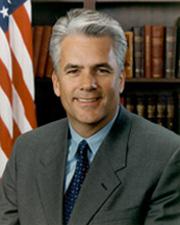 Sen. John Ensign (R-NV)
Legislative Activity
Stay on top of the latest movement without scrolling through every action
Roll call votes on amendments in Senate: Motion to waive the Budget Act with respect to amendment SA 2648 rejected in Senate by Yea-Nay Vote. 32 - 67. Record Vote Number: 339.
November 5, 2009
View full timeline
Roll call votes on amendments in Senate: Motion to waive the Budget Act with respect to amendment SA 2648 rejected in Senate by Yea-Nay Vote. 32 - 67. Record Vote Number: 339.
November 5, 2009
Considered by Senate. (consideration: CR S11148, S11171-11172)
November 5, 2009
Point of order raised in Senate with respect to amendment SA 2648.
November 5, 2009
Motion to waive the Budget Act with respect to amendment SA 2648 rejected in Senate by Yea-Nay Vote. 32 - 67. Record Vote Number: 339.
November 5, 2009
Amendment SA 2648 ruled out of order by the chair.
November 5, 2009
Considered by Senate. (consideration: CR S10339)
October 13, 2009
Senate amendment proposed (on the floor): Amendment SA 2648 proposed by Senator Ensign.(consideration: CR S10272; text as modified: CR S10272)
October 8, 2009
Amendment SA 2648 proposed by Senator Ensign. (consideration: CR S10272; text as modified: CR S10272) To provide additional funds for the State Criminal Alien Assistance Program by reducing corporate welfare programs.
October 8, 2009
Senate amendment submitted
October 7, 2009
Votes
1 roll call on this amendment
Text
Proposed
COMMERCE, JUSTICE, SCIENCE, AND RELATED AGENCIES APPROPRIATIONS ACT,
2010

The PRESIDING OFFICER. Under the previous order, the Senate will
resume consideration of H.R. 2847, which the clerk will report.
The legislative clerk read as follows:

A bill (H.R. 2847) making appropriations for the
Departments of Commerce and Justice, and Science, and Related
Agencies for the fiscal year ending September 30, 2010, and
for other purposes.

Pending:

Vitter/Bennett amendment No. 2644, to provide that none of
the funds made available in this act may be used for
collection of census data that does not include a question
regarding status of United States citizenship.
Johanns amendment No. 2393, prohibiting the use of funds to
fund the Association of Community Organizations for Reform
Now.
Bunning amendment No. 2653, to require that all legislative
matters be available and fully scored by CBO 72 hours before
consideration by any subcommittee or committee of the Senate
or on the floor of the Senate.
Levin/Coburn amendment No. 2627, to ensure adequate
resources for resolving thousands of offshore tax cases
involving hidden accounts at offshore financial institutions.
Durbin modified amendment No. 2647, to require the
Comptroller General to review and audit Federal funds
received by ACORN.

The PRESIDING OFFICER. The Senator from Arizona.

Amendment No. 2626

Mr. McCAIN. Mr. President, I send amendment No. 2626 to the desk, and
I ask for its immediate consideration or, if necessary, set aside the
pending business and call up amendment No. 2626.
The PRESIDING OFFICER. Is there objection to the pending amendment
being set aside?
Without objection, it is so ordered.
The clerk will report the amendment.
The legislative clerk read as follows:

The Senator from Arizona [Mr. McCain] proposes an amendment
numbered 2626.

Mr. McCAIN. Mr. President, I ask unanimous consent that the reading
of the amendment be dispensed with.

[[Page S10266]]

The PRESIDING OFFICER. Without objection, it is so ordered.
The amendment is as follows:

(Purpose: To eliminate funding for Public Telecommunications
Facilities, Planning and Construction)

On page 111, strike lines 4 through 15.

Mr. McCAIN. Mr. President, I come to the floor with an amendment that
would eliminate another unneeded and unwanted earmark which is
suggested by the President of the United States.
Before I go into that, I ask unanimous consent to have printed in the
Record an article from this morning's Washington Post entitled ``Ex-
Staffers Winning Defense Panel Pork, Study Finds.''
There being no objection, the material was ordered to be printed in
the Record, as follows:

Ex-Staffers Winning Defense Panel Pork, Study Finds

(By Carol D. Leonnig)

In the coming year's military spending bill, members of a
House panel continue to steer lucrative defense contracts to
companies represented by their former staffers, who in turn
steer generous campaign donations to those lawmakers, a new
analysis has found.
The Center for Public Integrity found that 10 of the 16
members of the House subcommittee on defense appropriations
obtained 30 earmarks in the bill worth $103 million for
contractors currently or recently employing former staffers
who have become lobbyists. The analysis by the Washington
Watchdog group found that earmarks still often hinge on a web
of connections, despite at least three criminal
investigations of the practice that became public in the past
year. Those probes focus on a handful of defense contractors
and a powerful lobbying firm that together won hundreds of
millions of dollars in work from the House panel and are
closely tied to its chairman, Rep. John P. Murtha (D-Pa.).
On Tuesday, the Senate approved a $636 billion military
spending bill for fiscal year 2010; the House approved its
version in July. House and Senate members now will work in
conference to resolve differences between their two bills.
The Center for Public Integrity's analysis found some
shifts in earmarking patterns since its similar analysis of
the 2008 defense bill. First, Rep. Peter J. Visclosky (D-
Ind.), whose office records were subpoenaed by federal
prosecutors in May, has markedly reduced his earmark requests
and sought no work for private companies. Also, defense
appropriators are generally steering more earmarks to
nonprofits.
The Washington Post has documented more than $400 million
in defense earmarks that Murtha has directed in the past
decade to research groups in his district, including the Penn
State Electro-Optics Center and the John P. Murtha Institute
for Homeland Security, which steered much of the funds to
private contractors.
Since last fall, federal investigators have been probing
the PMA Group, a now-shuttered lobbying firm whose clients
had unusual success in winning earmarks from Murtha's
subcommittee. Founder Paul Magliocchetti is a close friend of
Murtha's and worked as a defense appropriations staffer when
Murtha was a rank-and-file member of the committee.
PMA and its clients had been big donors to Murtha and his
fellow subcommittee members in the past decade, according to
a Center for Responsive Politics report, with Murtha
receiving the most. Since 1998, workers at those firms and
their family members provided $2.4 million to Murtha--who
helped insert more than $100 million in defense-related
earmarks into 2008 appropriations bills. Visclosky was
second, collecting $1.4 million, and Rep. James P. Moran, Jr.
(D-Va.) was next, with $997,000.

Mr. McCAIN. Mr. President, I quote from the beginning of it,
something that is well known but continues to be authenticated about
the corruption of the process that we go through in appropriations. It
says, ``Ex-Staffers Winning Defense Panel Pork, Study Finds.''

In the coming year's military spending bill, members of a
House panel continue to steer lucrative defense contracts to
companies represented by their former staffers, who in turn
steer generous campaign donations to those lawmakers, a new
analysis has found.

Not an astonishing finding but, again, authenticating of the
corruption that goes on around here and the reason Americans are fed
up.

The Center for Public Integrity found that 10 of the 16
members of the House subcommittee on defense appropriations
obtained 30 earmarks in the bill worth $103 million for
contractors currently or recently employing former staffers
who have become lobbyists. The analysis by the Washington
watchdog group found that earmarks still often hinge on a web
of connections, despite at least three criminal
investigations of the practice that became public in the past
year.

Mr. President, I bring forward another amendment--this will be my
sixth--to eliminate a program and the appropriations for it that the
President of the United States has asked for. I often quote from this
document. This will be the sixth one. This document is entitled,
``Terminations, Reductions and Savings, Budget of the U.S. Government,
Fiscal Year 2010.''
Again, I would like to read from the introduction. This comes from
the administration. It says:

The President's 2010 Budget seeks to usher in a new era of
responsibility--an era in which we not only do what we must
to save and create new jobs and lift our economy out of
recession, but in which we also lay a new foundation for
long-term growth and prosperity. Making long overdue
investments and reforms in education so that every child can
compete. . . .

It goes on and on. In the next paragraph:

Another central pillar of a sound economic foundation is
restoring fiscal discipline. The administration came into
office facing a budget deficit of $1.3 trillion for this year
alone--

By the way, I think that is up to $1.4 trillion now--

and the cost of confronting the recession and financial
crisis has been high. While these are extraordinary times
that have demanded extraordinary responses, we cannot put our
Nation on a course for long-term growth with uncontrollable
deficits and debt.

It goes on to talk about the problems we face.

[T]he President has announced a procurement reform effort
that will greatly reduce no-bid contracts and save $40
billion, and at the Cabinet's first meeting, he directed
agency heads to identify at least $100 million in
administrative savings.

Then it says:

This volume is the first report of that effort. In it, the
Administration identifies programs that do not accomplish the
goals set for them, do not do so efficiently, or do a job
already done by another initiative--and recommends these
programs for either termination or reduction.

We are talking about the administration speaking. We have identified
121 terminations, reductions, and other areas of savings that will save
approximately $17 billion next year alone.
It goes on to describe what they are:

Half of these savings for the next fiscal year come from
defense programs and half come from non-defense. No matter
their size, these cuts and reductions are all important to
setting the right priorities with our spending, getting our
budget deficit under control, and creating a Government that
is as efficient and it is effective.

As I said at the beginning of my remarks, this will be the sixth
amendment I have offered to support the President's request for
reduction or termination of unneeded or unwanted programs. I am
confident this will be the sixth time that the appropriators on both
sides of the aisle will vote down the President's request--not my
request, not my assumption, but that of the President of the United
States and the Office of Management and Budget.
By the way, had the Senate agreed with my amendments--which they did
not--and supported the call of the President to end programs that do
not accomplish the goals set for them, we would have saved the
taxpayers $87 million. In this day and age with multitrillion-dollar
deficits, $87 million is not a lot around this town, but it certainly
is back in my home State of Arizona.
What this amendment does, and I quote again from the President's
document, and I will read from it:

The Budget supports public broadcasting through increased
appropriations to the Corporation for Public Broadcasting and
eliminates the unnecessary Public Telecommunications
Facilities Grant Program.

Let me make it clear. The administration is supporting increases in
public broadcasting but is trying to eliminate the unnecessary Public
Telecommunications Facilities Grant Program in the Department of
Commerce.

PTFP funding equals less than 4 percent of the Corporation
for Public Broadcasting funding and has in recent years
supported the transition to digital television broadcasts
which will be completed in fiscal year 2009.

The administration goes on to say:

Since 2000, most [of these] awards have supported public
television station's conversion to digital broadcasting.
Digital broadcasting facilities mandated by the Federal
Communications Commission will be completed in fiscal year
2009, and there is no further need for this program.

Again, it goes on to say:

The Administration proposes to support public broadcasters
through CPB, and the

[[Page S10267]]

Budget includes $61 million for the Corporation for Public
Broadcasting in 2010, which is in addition to the $420
million enacted advance appropriation, for total proposed
2010 resources of $481 million, nearly $20 million above
2009. The Budget also includes an advance appropriation
request for the Corporation for Public Broadcasting in 2012
of $440 million to support public broadcasters. The
Corporation for Public Broadcasting funds can support the
same types of capital projects as PTFP funding as well as
stations' operating and programming costs. . . .
The National Telecommunications and Information
Administration, the Commerce Department bureau that has
administered this program, was provided $4.7 billion in the
American Recovery and Reinvestment Act to implement the new
Broadband Technology Opportunities Program. Terminating this
program will enable the NTIA to focus its efforts on BTOP,
[the Broadband Technology Opportunities Program] a major
challenge for this small Commerce Department bureau, and one
which will aid the nation's economic recovery and help
promote long-term competitiveness.

These are not my words. These are the words of the President of the
United States. We are talking about $20 million savings by eliminating
this program.
One of the arguments we are going to hear, and one of the great
sacred cows around here, is the Corporation for Public Broadcasting.
This does not affect the increase in funds for public broadcasting. It
simply terminates a program that the President of the United States
believes is not necessary because its mission has been completed.
I imagine we will lose again with appropriators on both sides of the
aisle voting not to eliminate a program--again, the sixth amendment I
have had trying to implement the recommendations of the President of
the United States and the Office of Management and Budget, and while we
are staring at a $1.4 trillion deficit for this year and a $9 trillion
debt for the next 10 years. Those estimates have been completely
underestimated.
I tell the managers, the American people are mad. They are very
angry. There is going to be another tea party in my home State this
weekend. You know we are mad because we are stealing their children's
money; 43 cents out of every dollar we are spending today is on
borrowed money. Who is going to pay it back? They know they are. They
know our kids and grandkids are. We cannot even eliminate a program or
programs the President of the United States requests that we terminate.
There will come, and it will come fairly soon, a day of reckoning.
The reason I added this article from the Washington Post this morning
is because, I say to my friends and colleagues, there is corruption,
and there is corruption in the earmarking and porkbarrel process that
goes on. The American people are tired of it. I urge my colleagues to
adopt the amendment.
I ask for the yeas and nays.
The PRESIDING OFFICER. Is there a sufficient second.
There appears to be a sufficient second. The yeas and nays are
ordered.
Mr. McCAIN. Mr. President, I yield the floor.
Ms. MIKULSKI. I suggest the absence of a quorum.
The PRESIDING OFFICER. The clerk will call the roll.
The assistant legislative clerk proceeded to call the roll.
Ms. MIKULSKI. Mr. President, I ask unanimous consent the order for
the quorum call be rescinded.
The PRESIDING OFFICER. Without objection, it is so ordered.
Ms. MIKULSKI. Mr. President, I strongly oppose the amendment of the
Senator from Arizona to strike the funding in the bill for the
Department of Commerce Public Telecommunications Facilities. His
amendment would eliminate from the bill $20 million. That $20 million
goes for competitive grants for public radio and TV stations around the
Nation to upgrade their infrastructure and technology. His amendment
would terminate the grant program in fiscal year 2010.
He argues that President Obama's budget proposed to eliminate the
program, so Congress should too. We are a separate and coequal branch
of government. In this case, the CJS Committee respectfully disagrees
with the President's budget. We know our President inherited a terrible
mess. We know the previous administration ran up debts and deficits and
now, as we try to clean it out, our President is looking for modest
cuts to the budget. But here, with public telecommunications
facilities, this is exactly what we need during these troubled economic
times to provide access to quality TV to ordinary people who might not
be able to afford cable TV, satellite TV, or dish TV.
I am ready to dish on the McCain amendment. We need jobs in this
country, and we need to let people know their government is on their
side and that they can have access to public television--public
television.
Sure it is a public option. We like the public option on TV.
But we know for our local stations, where donations are down and
their revenues starved, you cannot put up the necessary antenna and
other technology by doing it on bake sales and dialing for dollars.
They need help from their government. This is what this does: A modest
$20 million that will help replace equipment such as antennas, power,
and telephone hookups, generators and other kinds of things.
It will improve technology to keep up with changing requirements.
Grants are competitive. There are no porkbarrel projects in this, no
earmarks. The grants are competitive. The Commerce Department selects
what are the ones that meet the compelling needs in communities. By the
way, the local community has to provide 25 percent of local cost share
so it is not a free ride.
The President's budget and the amendment sponsor argue that this
technology program is no longer needed because all radio, public radio
and TV stations are already going from analog to digital, so we do not
need it.
This argument is flawed for two reasons. First, digital conversion
has never been nor ever will be the sole purpose of the Public
Telecommunications Facilities Program. The Public Telecommunications
Facilities Program was intended to help public radio and TV upgrade
their infrastructure and buy new equipment. Digital conversion
equipment is eligible, but that is not all.
I am saying this because not only do we provide public TV. It is
great to have the Corporation for Public Broadcasting. That is about
content. About content. But you need to have an infrastructure to
deliver the content. In many of our communities, the infrastructure is
worn. It is dated. It is 20, 22 years old. So they are looking to
replace it. Guess what. When they do replace it, it creates jobs, jobs,
jobs in those local communities. It takes talented men and women to put
that antenna or that tower up, to install that very important new
digital equipment.
For $20 million, we can broadcast to people, we can broadcast
quality, and we have people going to work putting up and replacing
dated equipment. Last year this program received almost $50 million in
applications but had only $20 million to award. This funding is
important in rural and underserved areas.
Last year, the technology program received 57 applications from
Native American communities alone. The President and the Senator from
Arizona argue it is not needed because the Corporation for Public
Broadcasting will pick up the slack. I will repeat: I love Orszag, but
maybe he did not read the fine print, which is the Corporation is for
ongoing operations and programming. It does not provide funding for new
infrastructure.
It is about infrastructure; just like we want to have money to build
our highways, we need to have superinformation highways. This helps the
public facilities be able to do it. The local communities depend on the
Commerce Department to do this.
The program has built the Public Broadcasting System. It ensures that
the American public has access across the Nation. This is not Senator
Mikulski talking because she is the chair of the CJS and she wants to
hold onto every program. I got a letter, as did my ranking member, from
21 Members of the Senate, including the chairman of the Commerce
Committee, asking us to put $44 million into the Appropriations
Committee to fund this. We could only afford to do $20 million, the
same as last year.
Why? Let me read from their letter: For some four decades, PTFP has
served as a critical infrastructure program for building public
broadcasting systems of radio and TV stations that reach 95 percent of
the American people.

[[Page S10268]]

What does this do? It maintains infrastructure for transmitters,
translators for the deaf, power, and antennas.
It has been drastically underfunded in the past several years since
suffering an 18-percent cut in 2002 and 2003. Over the years, PTFP has
foregone $270 million in Federal funds over the authorized level during
the last 8 years.
I am not going to sound like an accountant here. I want to sound like
I have accountability to my communities. I want them to have access to
public TV and public radio and the technology to transmit it. ``PTFP's
preservation role has always been most important,'' says the letter
from the 20 Senators, ``because it is the only source of Federal
emergency funds for public radio and television in the event of an
emergency.''
After Katrina and Rita, several stations in the gulf region were
awarded these emergency grants so they could start rebroadcasting.
Without those funds, many communities would have been vulnerable to the
compounded effects of losing local news and the kinds of programs they
needed as they were struggling to rebuild.
On average, according to the letter from my 21 colleagues, including
the chairman of the Commerce Committee, stations leverage these PTF
funds by an additional 50 percent. So this is a Federal-local
partnership.
PTF funding is about providing access to quality TV. In my own
community, it has meant access to educational programs. It has meant a
way to link up to community colleges and the way they have done
distance learning. Many of the early children's programs, many of those
early children's programs often help get children learning ready.
Again, yes, that is about content. But content cannot be delivered
without infrastructure.
During several weeks this summer as I lived in a rehabilitation
facility getting physical therapy, many of my constituents said: Well,
is it not great to watch public TV? We can see what is going on in the
world. They loved the MacNeil/Lehrer show, even though it is not called
that anymore, to get news about what was going on in the country.
They loved hearing public debate in a civil way, thrilled and enjoyed
``Mystery Theater,'' and at the same time were excited that their
grandchildren were able to get learning ready, either at the preschool
level or the work it was doing in the community college.
There are a lot of things government does that is unpopular with
people. But one of the things it does that is very popular with the
American people is public TV and public radio. We have to maintain
quality content. We have to maintain quality infrastructure.
Because of that, I urge the defeat of the McCain amendment
eliminating $20 million and essentially zapping those much-needed
antenna and monitoring and transmission facilities we need. There are
other things we can zap. Let's not zap public TV and public radio.
I yield the floor and suggest the absence of a quorum.
The PRESIDING OFFICER. The clerk will call the roll.
The assistant legislative clerk proceeded to call the roll.
Ms. MIKULSKI. I ask unanimous consent that the order for the quorum
call be rescinded.
The PRESIDING OFFICER. Without objection, it is so ordered.
Ms. MIKULSKI. Mr. President, I ask unanimous consent that at 12:15
p.m. today the Senate proceed to vote in relation to the McCain
amendment No. 2626; with no amendment in order to the amendment prior
to the vote; further that prior to the vote, there be 2 minutes of
debate equally divided and controlled in the usual form.
The PRESIDING OFFICER. Without objection, it is so ordered.

Health Care

The PRESIDING OFFICER. The Senator from North Dakota.
Mr. CONRAD. Mr. President, I have come to the floor very briefly to
talk about the Congressional Budget Office's score of the health care
reform proposal that is before the Senate Finance Committee.
I understand that earlier today there were members on the other side
who were questioning whether the Finance Committee's proposal is paid
for and whether it reduces the deficit and whether it bends the cost
curve of health care in the right way.
Let me say that the Congressional Budget Office has now issued their
determination on all those issues. Their conclusions are very clear.
The Congressional Budget Office has said--and I will put on the chart
stand a page from their report. It shows very clearly, over the 10
years of the bill, from 2010 to 2019, that the deficit will be reduced
by $81 billion if the Finance Committee proposal were to become law.
With respect to the question that apparently has been raised by some,
as to whether this bill is paid for, the Congressional Budget Office
has answered clearly and unequivocally. They have said the bill is not
only paid for over the 10 years, but it actually reduces the deficit by
$81 billion.
Second, on the longer term question of bending the cost curve and
whether this proposal bends the cost curve in the right way, the
Congressional Budget Office has also been clear and unequivocal. Here
is what they said in their report of October 7, just yesterday:

In subsequent years, beyond 2019, the collective effect of
the Finance plan would probably be continued reductions in
Federal budget deficits.
. . . CBO expects that the proposal, if enacted, would
reduce federal budget deficits over the ensuing decade
relative to those projected under current law--with a total
effect during that decade that is in the broad range of
between one-quarter and one-half percent of gross domestic
product.

What does that mean? What CBO is saying is in the first 10 years, the
Finance Committee plan would reduce the deficit by $81 billion. In the
second decade, they are saying it would reduce the deficit by one-
quarter to one-half percent of gross domestic product. Gross domestic
product over that decade, the second decade, is estimated to be
cumulatively $260 trillion. That would be the gross domestic product of
the United States from 2020 on through the next 10 years. One-quarter
percent of $260 trillion is $650 billion of deficit reduction in the
second 10-year period. That would be one-quarter of 1 percent of GDP.
One-half percent of GDP over that second 10-year period would be $1.3
trillion.
Just to be clear, CBO has told us in their report of yesterday--and
the Congressional Budget Office is the nonpartisan scorekeeper, the one
we all look to for objective facts--that the Finance Committee proposal
reduces the deficit by $81 billion over the next 10 years and in the
second 10 years would reduce the deficit by one-quarter to one-half
percent of gross domestic product. No one can be certain what the gross
domestic product will be in the second 10 years. Current projections
are that it will be $260 trillion. So one-quarter to one-half percent
of that second decade would be a reduction in the deficit from what
would otherwise occur of $650 billion to $1.3 trillion, bending the
cost curve in the right way.
I might add parenthetically, the Finance Committee plan is the only
plan that has been produced that the Congressional Budget Office says
reduces the deficit in the first 10 years and bends the cost curve in
the right way, has further deficit reduction, in the second 10 years.
I am a little disappointed when I hear some of my colleagues coming
to the floor and suggesting that this really isn't paid for. We have a
way of determining what scores are around here. We can all make up our
own facts or we can rely on the Congressional Budget Office, which is
the objective scorekeeper, nonpartisan. I have great respect for them
even though I have had strenuous disagreements with them at times about
how they score things. Indeed, I had strong disagreements with them on
how they scored some of these proposals. But there has to be an
arbitrator here, somebody we look to, someone with credibility, and the
Congressional Budget Office does.
For Members to come to the floor and suggest this isn't paid for
flies in the face of the facts before us from the CBO. The
Congressional Budget Office reported yesterday clearly and
unequivocally that the Finance Committee plan is paid for; that it, in
fact, reduces the deficit by $81 billion over the next 10 years; that
it has further deficit reduction in the second decade of one-quarter to
one-half percent of GDP. As I have said, in the second 10 years the
forecast is that gross domestic product over that 10-year period

[[Page S10269]]

will approach $260 trillion. One-quarter to one-half percent of that
amount would be $650 billion to $1.3 trillion of additional deficit
reduction in the second decade. Those are the unvarnished facts. I hope
that during the debate, which will be tough enough, which will be
contentious enough, we will not resort to trying to mislead people as
to the objective facts before us.
It has been said by a previous President that facts are stubborn
things. Indeed, they are. One of the stubborn facts is, we are on a
course that is utterly unsustainable with respect to health care.
Today, we are spending $1 of every $6 in this economy on health care.
Seventeen percent of the gross domestic product is going to health
care. The CBO long-term budget outlook says that in the next period
from 2010 to 2050, we will go to spending 38 percent of our gross
domestic product on health care unless we do something. That would be
more than $1 of every $3 in this economy going to health care; in fact,
close to every $1 of every $2.50 going to health care. That is an
unsustainable course.
The question before this body and before the Congress and before this
President will be, Do we act or do we stick with the status quo? I
suggest sticking with the status quo is utterly indefensible. There is
no way to suggest that sticking with the status quo is going to succeed
for America's families, businesses, or the government itself.
The hard reality is, Medicare and Medicaid spending as a percentage
of GDP is going up dramatically during this forecast period. It has
been happening. This chart shows clearly, between 1980 and 2009, the
share of our gross domestic product going to Medicare and Medicaid has
been rising inexorably. We know that trend will continue unless we do
something about it. That means we have to act. That means we have to
take responsible steps to rein in the skyrocketing cost of health care.
That is critically important to families, businesses, and their
competitive position, and it is absolutely essential to the Federal
Government. The trustees of Medicare have told us clearly: Medicare is
going to go broke in 8 years unless we act. The Medicare trust fund has
already gone cash-negative. The Social Security trust fund has already
gone cash-negative. The time and the need for action is about as clear
as it can possibly be.
I appreciate the opportunity to respond to what some colleagues
suggested this morning. It is clear--the Congressional Budget Office
has told us--that the Finance Committee proposal is not only paid for,
it actually reduces the deficit both over the next 10 years and over
the next decade after that 10-year period as well. That is a
significant accomplishment by the Finance Committee chairman who laid
down this mark. We will see where the votes lie on Tuesday.
I yield the floor and suggest the absence of a quorum.
The PRESIDING OFFICER. The clerk will call the roll.
The assistant legislative clerk proceeded to call the roll.
Mr. NELSON of Florida. I ask unanimous consent that the order for the
quorum call be rescinded.
The PRESIDING OFFICER. Without objection, it is so ordered.
Mr. NELSON of Florida. Mr. President, I wish to speak on behalf of
those of us who are concerned about NASA and express my personal
appreciation to the Senator from Maryland, chairman of the
appropriations subcommittee that handles NASA, for the tremendous work
she has done in appropriating money to keep NASA going. If I may, I
want to go beyond the Senator's appropriation. She has taken the very
difficult task of a budget that is quite lean, put out by the
President, and has come up with the best she can come up with in trying
to sustain the Nation's human space program with those resources.
What we know is, over the course of the last several years, the
Office of Management and Budget and the White House have not given
adequate resources to those of us in this Chamber who want a vigorous
human space program. We simply, over the last several years, have not
been able to get the resources we need for NASA to do everything it has
been asked to do, with the result that NASA is now at a crossroads.
I commend Senator Mikulski for her work in how she has put together
this budget. We find ourselves now with the opportunity beyond this
specific budget to strengthen and advance our leadership in the world
or to stand by and allow what has become a hallmark of U.S. leadership
to slip by the wayside.
Last month, the blue ribbon panel the President appointed, called the
Augustine Commission, released a summary of the findings from the final
report on the Nation's space program. That report has not come out in
detail. We await its release. In part, what it says is, the U.S. human
space flight program that has made America a world leader in science
and technology ``appears to be on an unsustainable trajectory.''

Specifically, the report will say:

[O]ur space program is being asked to pursue goals without
the appropriately allocated resources.

So this country stands at a crossroads for NASA with a stark choice
before us: We can continue on the path we are on--underfunding and
underallocating our space program--or we can choose to act. We can
choose to act by ensuring that the appropriate resources are allocated
to meet the goals laid out before us.
The Augustine Commission was abundantly clear. It said that--while
the current path we are on is unsustainable--``meaningful human
exploration is possible under a less constrained budget'' with an
additional $3 billion a year. That is $30 billion additional over a 10-
year period. These are not my words. These are the Augustine
Commission's words.
Even though we face uncertain economic times--certainly in a
recession--the challenge of finding that additional money is one we
cannot afford to ignore.
I wish to add my voice to others from this Chamber in asking the
President to divert $3 billion to NASA from the unspent portion of the
$787 billion in the economic stimulus recovery money. The stimulus
bill--that we passed by a one-vote margin back earlier this year--was
to get this economy moving again, to stimulate, to electric shock
therapy the economy back to life by getting dollars out, turned over,
and jobs created.
That is a very good source for this money, for NASA to be able to
continue on the road of what almost every American wishes for--to
continue to explore the unknown.
We have identified other possible revenue sources for future years.
But no matter how much we find by scraping the bottom of the barrel, it
is still going to come down to one thing: It is going to be the
President's decision.
If we remember, similar to President John Kennedy before him, a
President has to decide and has to commit the resources. If this
President will do it, it will commit the space program that will keep
America a global leader in science and technology.
Why do I say that? Think of all the effects of the spinoffs that came
out of the Apollo Program when President Kennedy said: We are going to
the Moon and back, and that was within a 9-year period.
Currently, our space program is funded at less than 1 percent of the
total Federal budget. Yet our space program has always paid back
dividends--both tangible and intangible--which is vastly greater than
the initial investment.
The additional funding for NASA, I have indicated, will ensure the
United States remains at the very top for the peaceful use of
technology for the betterment of humankind. Of singular importance,
this commitment will help us to inspire the next generation of
explorers and the next generation of scientists and technologists and
engineers and mathematicians and educators. It is this payoff which is
Apollo's greatest and lasting legacy.
We have a similar opportunity right now in front of us. You think
about that generation of kids who got inspired when President Kennedy
said we were going to do what was almost thought to be the impossible
and how many of those kids went into math and science and technology
and engineering. Look what that generation brought to us in the global
marketplace.
The Augustine Commission notes that the time may finally be upon us
when commercial space companies can begin to carry some of the burden
of the access to low-Earth orbit. Many of

[[Page S10270]]

these companies are already developing capabilities to give us a
commercial resupply of the International Space Station. Are they going
to be successful? We certainly hope so. Are they going to be timely? We
do not know. These commercial ventures are already behind the timeline.
We certainly hope they are going to be timely.
This ability, according to the Augustine Commission, is critical to
ensuring our ability to operate the station beyond 2016. Almost
everybody unanimously agrees we should be planning to keep the
International Space Station, of which we are still continuing to
complete its construction and equipping, to keep that going at least
until 2020 and to maximize the return of what has become a substantial
$100 billion investment.
Those commercial endeavors serve another function. They also create
new industries and, with that, new jobs for Americans. But we are still
going to have to have the question of: What is NASA's new mission, new
architecture? How are we going to fund it? What are we going to do with
the workforce in the meantime that is going to have severe disruptions?
This is what the President of the United States is going to have to
decide as soon as the Augustine Commission report is final and is
published.
The International Space Station has proven to us that many nations
can work together on enormous endeavors in a peaceful fashion. The
station--just now being completed--is at its dawn, and its many
economic, scientific, and social payoffs from our investment are still
to be realized. But the international partnerships formed during the
design, the construction, and the ongoing operation of the station have
proven something. It has proven that the world community looks to the
United States for leadership in space.
Many of the world's nations are patiently waiting to see which
direction our country chooses, which direction this country chooses as
a result of our President's decision. At the same time, these many
nations are prepared to follow the U.S. lead in the form of additional
commitments and resources in space. To turn our backs on space at this
moment would have negative effects that would reverberate around the
world.
It is interesting that last night President Obama hosted several
young people at the White House for a star-gazing party. Oh, that must
have been very exciting for those young people. They had the
opportunity to view, in vivid detail, craters on the Moon, the rings of
Saturn, the colors of the planet Jupiter, and the belt of the Milky
Way. For many of those kids, it was the first time they ever even
thought of viewing those things.
The wonderment displayed by those children--and many of those adults
there as well--proved, once again, that the space program inspires. If
all goes well, tomorrow morning America will successfully plow a rocket
into the surface of the Moon to help determine conclusively whether
large quantities of water can be found just beneath the lunar surface.
Imagine, this mission may reveal new knowledge about a source of water
for astronauts in the future and fuel for their rockets to explore the
cosmos.
A suitably funded space program is the best catalyzing element to
gather and organize the energies and abilities of this Nation. In
return, this program will pay many dividends, perhaps the most
important of which is to inspire, encourage, and motivate the next
generation of Americans.
I ask my colleagues to join me in supporting Senator Mikulski on her
appropriations bill but then to join me in supporting increased funding
for NASA and this Nation's space program.
You can tell I am quite intense about this subject. I have had the
privilege of being a beneficiary of our Nation's space program. I have
seen us achieve extraordinary things. It is a part of our character as
a people. We are, by nature, as Americans, explorers and adventurers,
and I do not want us to ever give that up. That is why I make this plea
to the Congress of the United States and to the President of the United
States for NASA's funding.
Mr. President, I yield the floor.
The PRESIDING OFFICER. The Senator from Illinois.
Mr. BURRIS. Mr. President, I ask unanimous consent to speak as in
morning business.
The PRESIDING OFFICER. Without objection, it is so ordered.

Health Care Reform

Mr. BURRIS. Mr. President, many of my colleagues have taken to the
floor in recent weeks to discuss the details of health care reform and,
in particular, the clear need for a public option.
We have heard from distinguished Senators on both sides of the aisle.
For the most part, this has been a healthy debate. But it is a debate
that has been going on for almost a century. Over the years, the
problem has grown. Care has become more and more expensive.
Today, $1 out of every $6 spent in this country goes to pay for
health care. Insurance company profits are up. Health outcomes are
down. After a century of thoughtful debate, I believe the way forward
is clear--very clear. The only way to achieve meaningful health care
reform and bring costs down is through a public option that creates
real competition in the system.
Let me be clear. I will not vote for any health care bill that does
not include a public option. That is because the stakes are too high to
settle for anything less.
Every day, more people get sick and die because they cannot get the
quality care they need; 45,000 Americans died last year because they
did not have adequate coverage. That is one death every 12 minutes and
45,000 more will die this year and next year and every year until we
pass meaningful health care reform.
Some of my colleagues think we are moving too fast, and they say we
should wait. I say the American people have been waiting long enough.
We must not wait another moment.
A public option would restore choice and accountability to the
insurance market. It would help bring down costs and make quality care
affordable for every single American.
If you cannot afford private insurance under the current system, you
will have the opportunity to buy a low-cost public plan or a private
plan that is guaranteed to be affordable based on your income level.
If you have private insurance but it is too expensive or they do not
treat you right, you will have the opportunity to switch to an
affordable and high-quality public plan. No American has ever
experienced such freedom of choice when it comes to health coverage.
That is because consolidation in the insurance market has left a few
corporations with control of the whole industry. In Illinois, two
companies dominate 96 percent of the market. They can charge
excessively high premiums, drop your coverage for any reason or no
reason at all, and cap the amount they will spend on treatment in any
given year. That is why their profits are breaking records and growing
four times faster than wages, while the rest of us suffer the effects
of a terrible recession.

But we can rein in these costs. If we pass insurance reforms that
include a public option, these corporations would have to compete for
your business. Premiums would come down. No one would be able to drop
your coverage because of a preexisting condition. Companies would not
be able to drop you in the event of a catastrophic illness, and they
would not be able to place a cap on the benefits you can receive during
your lifetime. Honesty and fair play would be restored to the system.
I don't understand how my colleagues on the other side of the aisle
can oppose such a plan. I don't understand how they can oppose
competition in the market, which I have always regarded as a
quintessential American idea. Certainly there is nothing wrong with
making a profit. Insurance companies play an important role in our
system, and I support that role. But between 2000 and 2007, the profits
for the top 10 insurance companies grew at an average of 428 percent.
Let me repeat that. Between 2000 and 2007, the profits of the top 10
insurance companies grew by an average of 428 percent. This is not only
unreasonable, it is breaking American businesses and families.
Many analysts agree that health care costs have contributed to the
severity of the current economic crisis, and it is easy to see why.
Competition and appropriate regulations will rein in these excessive
profits and put pressure on the companies to improve coverage or risk
losing customers.

[[Page S10271]]

Reform with a public option will restore choice to the insurance
industry. Millions of Americans will be able to get coverage for the
very first time. And far from driving companies out of business, health
reform will allow an estimated 1 million to 3 million new customers to
purchase coverage from private insurers. It will enhance their
business.
Some of my colleagues have expressed concerns about the cost of a
public plan, but if they look at the way the program will function,
they will see there is no reason for concern. As in any business, a
not-for-profit public insurance option would require some initial
capital to get it off the ground, but afterwards it would rely on the
premiums it collects to remain self-sufficient. The current system is a
strain on the American taxpayers. A public option will not be.
There will be no government takeover. I will repeat that. There is no
such thing as a government takeover. There will be no death panels, no
rationing, and no red tape between you and your doctor. The public
option would complement private insurance providers, not drive them out
of business.
It is time to take decisive action. This Senate has been debating
health care reform for almost a century, while outside this Chamber
ordinary Americans suffer more and more under a broken system. I
believe we have been talking about it enough. Our way forward is clear.
Now is the time for us to act. That is why I will not compromise on the
public option.
I urge my colleagues to join with me to stand on the side of the
American people and demand nothing less than the real reform a public
option would provide. We must not wait another moment.
Mr. President, I thank you, and I yield the floor.
The PRESIDING OFFICER. The Senator from Maryland.
Ms. MIKULSKI. Mr. President, we will shortly be voting on the McCain
amendment. We look forward to closing that debate. But before we do, I
wish to comment that we are going to dispose of as many amendments as
we can today and we are also going to arrive at a finite list of
amendments. So for those Senators who do have amendments on both sides
of the aisle, Senator Shelby and I ask our colleagues to come and offer
them so we can dispose of them, as we did with the Senator from
Arizona. He offered his amendment, we had a good debate, and we are
going to vote on it. So please, colleagues, if you have amendments,
come to the Senate floor and offer them.
Second, if you have amendments that you wish to file, this is the day
to file them. We are trying very hard to see if we can finish today,
but that seems to be a bit of an exuberant wish on my part and on the
part of Senator Shelby. But if we can't finish today, we would at least
like to get a sense of the amendments colleagues wish to bring over
today. Then when we get to the Columbus Day weekend, we can work to
either come to an agreement to take them, or a way of disposing of them
when we come back from commemorating when America was discovered by
Columbus.
Again, I ask my colleagues to come forward and either offer
amendments or file amendments.
Mr. President, I note the absence of a quorum.
The PRESIDING OFFICER (Mr. Burris). The clerk will call the roll.
The bill clerk proceeded to call the roll.
The PRESIDING OFFICER. The Senator from Alaska.
Mr. BEGICH. Mr. President, I ask unanimous consent that the order for
the quorum call be rescinded.
The PRESIDING OFFICER. Without objection, it is so ordered.

Amendment No. 2646

Mr. BEGICH. Mr. President, I ask unanimous consent that the pending
amendment be set aside and I call up amendment No. 2646.
The PRESIDING OFFICER. Without objection, it is so ordered.
The clerk will report.
The bill clerk read as follows:

The Senator from Alaska [Mr. Begich], for himself and Ms.
Murkowski, proposes an amendment numbered 2646.

Mr. BEGICH. Mr. President, I ask unanimous consent that the reading
of the amendment be dispensed with.
The PRESIDING OFFICER. Without objection, it is so ordered.
The amendment is as follows:

(Purpose: To allow tribes located inside of certain boroughs in Alaska
to receive Federal funds for their activities)

At the appropriate place, insert the following:
Sec. __. Section 112(a)(1) of the Consolidated
Appropriations Act, 2004 (Public Law 108-199; 118 Stat. 62)
is repealed.

Mr. BEGICH. Mr. President, at a later time I will have a floor
statement.
Mr. President, I note the absence of a quorum.
The PRESIDING OFFICER. The clerk will call the roll.
The bill clerk proceeded to call the roll.
Mr. McCAIN. Mr. President, I ask unanimous consent that the order for
the quorum call be rescinded.
The PRESIDING OFFICER. Without objection, it is so ordered.

Amendment No. 2626

There will now be 2 minutes of debate, equally divided, prior to a
vote in relationship to amendment No. 2626, offered by the Senator from
Arizona, Mr. McCain.
The Senator from Arizona is recognized.
Mr. McCAIN. Mr. President, this is another attempt to agree with the
President's request to cut some unneeded spending. This time, it is
only $20 million, which around here is obviously chicken feed. But the
President has requested that this $20 million be cut. It is not needed.
The program it was funded for is complete.
I ask my colleagues to vote for the amendment.
I yield the floor.
The PRESIDING OFFICER. The Senator from Maryland is recognized.
Ms. MIKULSKI. Mr. President, as the manager of the bill, I oppose the
McCain amendment. This $20 million is competitive funding that helps
local public TV and radio stations with equipment, things such as
antennas, generators, fire-suppression equipment, and transmission. It
improves technology. It enables our very important public TV stations
to modernize.
This is a competitive grant program--no earmarks but big footprints.
It does require local cost sharing of 25 percent. It also creates jobs
in local communities by actually installing this equipment, while we
move out the very wonderful content of public TV and public radio.
We, too, are stewards of the purse. The Commerce Department----
Mr. McCAIN. Mr. President, we have to have the regular order at some
time.
The PRESIDING OFFICER. The Senator's time has expired.
Ms. MIKULSKI. Mr. President, I do like to know that. I like to follow
the regular order. If the Chair would have notified me, I would have
stopped sooner.
I call for the vote.
The PRESIDING OFFICER. The question is on agreeing to the amendment.
The clerk will call the roll.
The legislative clerk called the roll.
Mr. DURBIN. I announce that the Senator from West Virginia (Mr. Byrd)
and the Senator from Massachusetts (Mr. Kerry) are necessarily absent.
Mr. KYL. The following Senator is necessarily absent: the Senator
from Ohio (Mr. Voinovich).
The PRESIDING OFFICER. Are there any other Senators in the Chamber
desiring to vote?
The result was announced--yeas 33, nays 64, as follows:

[Rollcall Vote No. 317 Leg.]

YEAS--33

Alexander
Barrasso
Bayh
Bennett
Brownback
Bunning
Chambliss
Coburn
Cochran
Corker
Cornyn
Crapo
DeMint
Ensign
Enzi
Graham
Grassley
Gregg
Hatch
Hutchison
Inhofe
Isakson
Johanns
Kyl
LeMieux
Lugar
McCain
McConnell
Risch
Roberts
Sessions
Thune
Wicker

NAYS--64

Akaka
Baucus
Begich
Bennet
Bingaman
Bond
Boxer
Brown
Burr
Burris
Cantwell
Cardin
Carper
Casey
Collins
Conrad
Dodd
Dorgan
Durbin
Feingold
Feinstein
Franken
Gillibrand
Hagan
Harkin
Inouye
Johnson
Kaufman
Kirk
Klobuchar
Kohl
Landrieu
Lautenberg

[[Page S10272]]

Leahy
Levin
Lieberman
Lincoln
McCaskill
Menendez
Merkley
Mikulski
Murkowski
Murray
Nelson (NE)
Nelson (FL)
Pryor
Reed
Reid
Rockefeller
Sanders
Schumer
Shaheen
Shelby
Snowe
Specter
Stabenow
Tester
Udall (CO)
Udall (NM)
Vitter
Warner
Webb
Whitehouse
Wyden

NOT VOTING--3

Byrd
Kerry
Voinovich
The amendment (No. 2626) was rejected.
The PRESIDING OFFICER. The Senator from Maryland.

Amendment No. 2653

Ms. MIKULSKI. Mr. President, unless the distinguished Democratic
leader is ready to speak, I ask unanimous consent that the Bunning
amendment, No. 2653, be the pending business.
The PRESIDING OFFICER. Without objection, the amendment is the
pending.
Ms. MIKULSKI. Mr. President, I also make a point of order against the
amendment that it violates rule XVI, paragraph 4--legislation on an
appropriations bill.
The PRESIDING OFFICER. The point of order is sustained and the
amendment falls.
Ms. MIKULSKI. Thank you, Mr. President.
The PRESIDING OFFICER. The Senator from Kentucky.
Mr. BUNNING. Mr. President, I am very disappointed the majority has
chosen to block full consideration of my amendment. What I am trying to
accomplish is simply more transparency in the Senate. This would be
accomplished by requiring a Congressional Budget Office score and
posting of legislation 72 hours before consideration by committees or
the full Senate.
As a recent poll has shown, 83 percent of the American people support
a waiting period before Congress votes on bills. My amendment would
provide this to the American people. I think it is outrageous the other
side is using a procedural tactic to block consideration of this
amendment on this bill.
Be assured I will be back to bring up this issue again and get a fair
and full consideration of it by the Senate.
I thank the Chair.
The PRESIDING OFFICER. The Senator from Nevada.

Amendment No. 2648, as Modified

Mr. ENSIGN. Mr. President, I call up amendment No. 2648, and I send a
modification to the desk.
The PRESIDING OFFICER. Is there objection?
Without objection, it is so ordered. The clerk will report.
The legislative clerk read as follows:

The Senator from Nevada [Mr. Ensign] proposes an amendment
numbered 2648, as modified.

Mr. ENSIGN. I ask unanimous consent that further reading of the
amendment be dispensed with.
The PRESIDING OFFICER. Without objection, it is so ordered.
The amendment is as follows:

(Purpose: To provide additional funds for the State Criminal Alien
Assistance Program by reducing corporate welfare programs)

At the appropriate place insert:

state criminal alien assistance program

For an additional amount for the State Criminal Alien
Assistance Program $172,000,000 to remain available until
expended.
Offset.--All amounts appropriated under this Act, except
for amounts appropriated for SCAAP, shall be reduced on a pro
rata basis by the amount necessary to reduce the total amount
appropriated under this Act, except for amounts appropriated
for SCAAP, under the heading ``Office of Justice Programs''
under this title, by $172,000,000.

Mr. ENSIGN. Mr. President, I rise today to propose an amendment
adding $172 million for the State Criminal Alien Assistance Program and
offset it with corporate welfare funding currently in the bill.
The State Criminal Alien Assistance Program, known as SCAAP, provides
Federal payments to States and localities that incur correctional
officer salary costs for incarcerating undocumented criminal aliens
with at least one felony or two misdemeanor convictions for violations
of State or local law and are incarcerated for at least four
consecutive days during the reporting period.
This program also reimburses State, county, parish, tribal, or other
municipal governments for the costs associated with the prosecution of
criminal cases declined by local U.S. Attorney's Offices.
While we have made strides in securing our border, illegal
immigration remains a significant problem, and the Federal Government
should bear the additional burden placed on States and local
governments. While this amendment does not fix our problems with
illegal immigration, it does help local communities address costs
associated with the incarceration of illegal immigrants who continually
and repeatedly violate the laws of our country.
This will bring this program's funding up to the 2009 level of $400
million. This increase will match the level the other Chamber, the
House of Representatives, accepted by a nearly unanimous vote of 405 to
1. With increased funding for SCAAP, we can keep more repeat offenders
off our streets and reduce some of the catch-and-release practices
instituted by many communities that just don't have the resources to
keep these criminals where they belong, which is behind bars.
So I urge my colleagues to support this amendment to ensure that
critical funds reach our State, county, parish, tribal, and municipal
governments to help battle the problems associated with illegal
immigration and to keep lawbreaking illegal immigrants off our streets.
Mr. President, I ask unanimous consent to have printed in the Record
an article from the Las Vegas Review-Journal relating to this matter.
There being no objection, the material was ordered to be printed in
the Record, as follows:

Las Vegas Police Refer 2,000 Inmates to Immigration Officials

(By Antonio Planas and Lynnette Curtis)

The Metropolitan Police Department forwarded the names of
nearly 2,000 inmates to federal immigration officials during
the first 10 months of a controversial partnership that
allows specially trained corrections officers to start
deportation proceedings against immigration violators.
The agreement between the Police Department and U.S.
Immigration and Customs Enforcement officially began Nov. 15
and is limited to the Clark County Detention Center.
Nearly 10,000 county jail inmates through Sept. 19 were
identified as being born outside the country or their
identities were in question, said officer Jacinto Rivera, a
Las Vegas police spokesman.
Police sent the names of 1,849 inmates who were determined
to be in the country illegally to ICE for possible
deportation.
It's unknown how many of those inmates were deported. ICE
doesn't track removals that way, the agency said Wednesday.
Illegal immigrants referred to the agency by local law
enforcement become part of ICE's larger caseload. Those cases
can drag on for months or even years.
The Police Department's partnership with immigration
officials has always been narrower in scope than that of
Maricopa County in Arizona and does not allow officers to
arrest people for immigration violations. Only once an
individual has been arrested on unrelated charges can he or
she be screened for possible deportation.
Sheriff Doug Gillespie has repeatedly insisted the
partnership is meant to target violent criminals.
In fact, police did not forward to immigration officials
the names of an additional 1,808 inmates who also were
identified as being in the country illegally because those
inmates had no violent criminal history, Rivera said.
Overall, 62,803 people were booked into the county jail
between Nov. 15, 2008, and Sept. 19, 2009.
Hispanic and civil rights groups have fiercely criticized
``287 (g)'' partnerships, named for the corresponding section
of the federal Immigration and Nationality Act, saying they
target Hispanics and could lead to racial profiling and make
people afraid to report crimes.
``Evidence is mounting across the country that 287 (g)
programs are being run in problematic ways,'' said Maggie
McLetchie, an attorney with the American Civil Liberties
Union of Nevada. ``We understand federal immigration laws
need to be enforced, but that's the job of federal
immigration officers, not the job of Las Vegas police.

Motion to Recommit

Mr. ENSIGN. Mr. President, I send a motion to the desk.
The PRESIDING OFFICER. The clerk will report the motion.
The legislative clerk read as follows:

The Senator from Nevada [Mr. Ensign] moves to recommit the
Act H.R. 2847 to the Committee on Appropriations with
instructions to report the same back to the Senate with
changes that reduce the aggregate level of appropriations in
the Act for fiscal year 2010, excluding amounts provided
for the Bureau of the Census, by $3,411,000,000 from the
level currently in the Act.

Mr. ENSIGN. Mr. President, what this motion is similar to the motions
I have made on previous spending bills. What we are asking the
Appropriations

[[Page S10273]]

Committee to do is to fund our government at the 2009 level.
In 2009, we saw huge funding increases. Then, with all of the
spending programs, the government has seen massive increases on top of
the increases in spending we had last year. So what we are saying is,
while businesses, families, local governments, and State governments
across the country are cutting their budgets, the Federal Government
should freeze spending levels to 2009 levels. Let us not go on this
massive increase in spending.
We understand the census, which we do just once every 10 years, is
not part of the normal budget process, so we allowed for that. We allow
for the census to be funded. But everything else should be funded at
2009 levels.
We allow the Appropriations Committee to set the priorities; that is,
what funding is to go into which particular program. Some programs are
more effective than others, and they may have different priorities.
That should be the prerogative of the Appropriations Committee. But
what this body should be doing is sending a message to the American
people that we care about our children and our grandchildren.
What we are seeing right now is that we are borrowing 43 cents of
every dollar we spend. Think about that. Think about a family or a
business borrowing 43 cents out of every dollar they spend. That is
what we are doing. I think this next chart illustrates very well on
whom this burden is going to fall.
The picture of this young lady was taken out in the public. She had a
sign around her which said: I am already $38,375 in debt, and I only
own a dollhouse.
It is a picture of a cute little girl, and it would really be a cute
picture if it wasn't so sad because it is true. Every child in America
has a huge debt burden put on them because of the spending.
During the last many years we have heard about the spending programs.
The other side of the aisle actually ran on fiscal discipline. They
said we spent too much money under the Bush administration. By the way,
I agreed with that statement. I think we did spend too much money
during the first part of this decade. But the spending levels now, in
comparison, are skyrocketing. We are adding trillions and trillions of
dollars in debt to future generations.
So my motion, very simply, says: Instead of this large increase in
this spending bill, we are going to live at last year's numbers. We are
not even going to cut in ways State governments and local governments
are doing. They are cutting. We are going to live within last year's
funding levels--which were, by the way, increased dramatically. Last
year, I think the same appropriations bill got a 15-percent increase.
Let's at least live at last year's level instead of living on huge
increases this year.

I think this motion is the responsible thing to do for future
generations and for the future of our country. We have to think about
this debt. What is this debt going to do? We are hearing about the
weakening dollar. There are articles every day in financial magazines
about what a weak dollar means to America. The higher the debt, the
weaker the dollar gets. We are adding trillions of dollars onto the
debt. That weak dollar is going to hurt our economy into the future. We
have to worry about not only inflation, but hyperinflation. We have to
worry about whether jobs are going to continue to go overseas because
of a weak dollar.
Every country that has tried to handle their debt by devaluing their
currency, which is what seems to be going on now--has never succeeded.
The only way to control your debt is to get spending under control.
That is what we have to do in this body. That is what we have to do in
this country. My motion says: Time out. Time out from all the spending.
Let's at least live at last year's spending level. Let's put a freeze
on Federal spending so we are not hurting future generations. I
encourage my colleagues to vote for this.
I yield the floor.
The PRESIDING OFFICER. The Senator from Colorado is recognized.
Mr. UDALL of Colorado. Mr. President, I ask unanimous consent to
speak as in morning business.
The PRESIDING OFFICER. Without objection, it is so ordered.
(The remarks of Mr. Udall of Colorado are printed in today's Record
under ``Morning Business.'')
The PRESIDING OFFICER. The Senator from Ohio is recognized.

Health Care

Mr. BROWN. Mr. President, I come to the floor regularly to share
letters from constituents of mine, Ohioans, letters we get from people
commenting on the health care system. Many of these letters--most of
them, in fact--have come from people who thought they had good
insurance. If you had called them a year ago or 3 years ago or even, in
some cases, a month ago and said: Are you satisfied with your
insurance, they most likely would have said yes. Then one of their
family members gets sick and it is a very expensive illness, spend
weeks in the hospital or has all kinds of doctors visits and tests, and
they end up spending so much that they lose their health insurance. The
insurance company cancels them. The insurance companies call it a
rescission.
You read the fine print and you see these policies are not what they
are cracked up to be. That is one important reason why this health
insurance bill is so important.
Let me share a couple of these letters with my colleagues.
Edward, from Montgomery County, that is the Dayton area--Dayton,
Kettering, Huber Heights, that area of Ohio, sort of southwest Ohio.

About 5 years ago I took my wife to the hospital one
evening because she hurt her back. They took an X-ray but
told her nothing was wrong. She came back home, but she
stayed up all night crying in pain.
I then took her to the emergency room where the doctors
took an MRI. It showed she had a ruptured lumbar disc that
could have led to paralysis. The insurance paid for the MRI,
but their attitude was sickening. After being admitted that
night, the next day the hospital told her she had to go home
because the insurance wouldn't pay for the stay.
The doctors and nurses disagreed with that decision, but
insurance rules.
The public option is the only thing that will keep these
companies honest.

Edward from Montgomery County has it exactly right. He knows we need
insurance reform so the insurance companies can no longer deny care for
preexisting conditions, no longer discriminate against people because
of gender or disability or age or geography. He understands there
should not be a cap, an annual cap or a lifetime cap, on coverage, so
if someone gets very sick and it is very expensive, their insurance
could no longer be canceled.
But he also understands not only do we need to change the rules, as
our bill that we will bring to the Senate floor does, to change those
rules so insurance companies can no longer game the system, this
legislation also includes a strong public option as Edward asked for. A
public option will make sure the insurance companies stay honest. It
will inject competition into the insurance industry, and it will give
people choice. That is why we call it a public option. It is a choice.
If you are in southwest Ohio, in my State, you only have two
insurance companies, and they have 85 percent of the insurance market.
That is not competition. You know that means rates are higher. That is
why injecting competition with the public option will help stabilize
insurance rates and make the insurance companies behave a whole lot
better than they have been.
Let me share two other letters. I see my colleague from Pennsylvania,
Senator Casey, is in the Chamber. Linda from Hamilton County, also
southwestern Ohio, Cincinnati, Blue Ash, Avondale, that part of Ohio.

I am 60 years old and I have private health insurance--if
you want to even call it that. I pay $450 a month and so few
services are covered until I reach a $10,000 deductible.
Three years ago I had a double mastectomy. As a result, I
can no longer go to another insurance company because of
preexisting conditions.
I have a good life. My husband and I worked hard, saved our
money, and have enjoyed our retirement so far. But I now find
myself not being proactive about my health care because I
know I will have to pay out-of-pocket for care until I reach
$10,000.
That's not insurance. It is highway robbery. I want you to
vote----

She says: Senator----

I want you to vote for the public option. Get in there and
fight for those who have nothing and for those of us who want
to remain healthy in our golden years.

Listen to what she says:

I now find myself not being proactive about my health
care----

[[Page S10274]]

Because she has a $10,000 deductible, living now, it sounds like,
probably, on a fixed income, she simply cannot afford to pay that kind
of money out of pocket to get the sort of maintenance of care she
needs. So she simply is not taking as good care of herself. She is not
able to have physicians and nurses and others help her maintain her
health the way we encourage our constituents to do. We want people to
get regular checkups. We want them to do all kinds of preventive care.
She can't afford to because of this deductible. So she already, in some
sense, has been a casualty of our health care system. I pray it is not
worse than that. But in too many cases, that has happened. She argues
again--she says: I want you to vote for the public option. She
understands she will not have this kind of $10,000 deductible if she
chooses the public option--a choice, but a choice that she sounds like
she would make. She will not be turned away or in her mind think she
can't get this other health insurance, these other health care services
because they are so expensive. She understands and she asks for a
choice--the choice of a public option.

This is the last letter I will read before I yield the floor.
Christopher from Summit County, the Akron area, northeast Ohio, Akron
and Barberton and Tallmadge and Stow and that area of the State,
writes:

As a 58-year-old self-employed entrepreneur, it is
virtually impossible to obtain serious and genuine health
coverage insurance. Thanks to a relatively minor pre-existing
condition and total lack of a public option, I fall through
the cracks in the wealthiest nation in the world.

Two sentences he writes: ``It is impossible to obtain serious and
genuine health insurance'' and ``Thanks to a relatively minor pre-
existing condition and lack of a public option, I fall through the
cracks in the wealthiest nation in the world.'' Why can't somebody like
Christopher--he is self-employed, he had the initiative to start a
business and employ himself, and he wants to have insurance. He is 58
years old. His medical problems don't sound particularly severe, but he
has a minor preexisting condition. He can't get insurance. That is why
we are changing the law. We are no longer allowing denial of care for
preexisting conditions, but we also need a public option, as
Christopher asks for, for him to choose from if he would like to choose
the public option or Aetna or Medical Mutual, an Ohio company, or CIGNA
or BlueCross or whatever. But he also understands that the public
option will enforce these rules, so the insurance companies can no
longer game the system. In other words, the public option, as the
President has said, will make the insurance companies more honest.
It is clear our legislation does a handful of things that are so
important. It is clear this will move our country forward. It says: If
you have insurance and you are satisfied with it, you can keep that
insurance, but we are going to build consumer protections around that
insurance: No more denial of care for preexisting conditions; no more
caps on coverage if you get very sick and you lose your plan--they
can't throw you off your plan then; no more discrimination based on
gender or geography or disability or age.
The third thing our legislation does is it gives all kinds of
incentives to small businesspeople to insure their employees: tax
credits, allowing them to go into a larger pool with consumer
protections. And our legislation provides insurance for people who do
not have it, with some help from the government if people are low or
median income.
So all of that will mean a healthier population. It will mean choices
for people because they can choose the public option or they can choose
private care, and they know the public option will make our whole
health care system much better.
As we move forward and get this legislation to the President's desk
before Christmas, I am excited about what we can do to make peoples
lives better and to make for a healthier country.
I yield the floor.
The PRESIDING OFFICER. The Senator from Pennsylvania is recognized.
Mr. CASEY. Mr. President, first of all, I commend the words of my
colleague, Senator Brown, on the issue of health care but in particular
the importance of having a public option in our health care plan and
the legislation the Senate will take up.

Afghanistan Policy

I rise today to speak in particular with regard to the debate we are
having--just beginning to have, by the way, and need to have a lot more
debate about--the U.S. role in Afghanistan, with a special focus in
terms of my own remarks today on building the Afghanistan National
Army. At the same time, I would also like to recognize the dedication
of the Pennsylvania National Guard as well.
But first with regard to Afghanistan, the challenge we face in
Afghanistan and Pakistan is a grave challenge indeed. Those who might
disagree on the way forward or what to do next can agree on that, that
it is a grave challenge. In order to get it right, and we must get it
right, we need to debate these issues thoroughly.
I have been fortunate enough in the 3 years since I have been in the
Senate to be a member of the Foreign Relations Committee. As a member
of that committee, most recently--the last couple of months, really--I
have had several opportunities, as others have on the committee, to
examine the military, political, diplomatic, and regional implications
of our presence in Afghanistan. Chairman John Kerry has taken a very
comprehensive approach, and I applaud his efforts.
I also support the administration's deliberate consideration in
making this strategic determination. The President is taking the time
that I believe is necessary to make the right decision.
General McChrystal as well has contributed much to this debate, not
only with his report but, more importantly than what he put on paper,
the kind of leadership he has provided to our troops on the battlefield
and the way he has assessed the threats to our security and to our
troops and to the Afghan people and the way he has articulated those
threats.
Now he has made a recommendation to the President. We hear a lot
about what General McChrystal's report said, at least parts of it. We
also hear a lot about General McChrystal's recommendation on troops.
What we have heard very little about and need to hear more about is the
nonmilitary part. What will happen on the nonmilitary aspects of this
counterinsurgency strategy? That is vitally important and at the same
level of importance as what we do militarily. So we have to get it
right militarily and in terms of the other strategy.
But one thing we have not heard a lot about is that General
McChrystal has actually, in words I am quoting from the New York Times,
endorsed the President's deliberate approach. General McChrystal was
quoted on October 2 in the New York Times as follows: ``The more
deliberation and the more debate we have, the healthier that is going
to be'' for the strategy. So for as much attention as has been paid to
what his report says, or at least part of what his report says, I think
it is also important to listen to his words about taking the time to
debate it and taking the time to deliberate it because if all we do in
the Senate is point a finger to the White House and say the White House
must do this or the President must do this or the administration must
do this, we are not fulfilling our responsibilities in the Senate.
A number of us have been talking about this challenge, but we have to
hear from more voices here and we have to debate this in a very
substantive, serious, thorough, and bipartisan way. I will talk more
about that in a moment.
In that same New York Times story, General McChrystal was also quoted
as saying: ``I don't think we have the luxury of going so fast that we
make the wrong decision.'' So I think it is important to highlight what
General McChrystal has said about the approach we take, the approach
President Obama is taking, spending a number of weeks looking at this,
focusing on the strategy before the resources. A lot of people in this
town want to just talk about troop levels only and resources only
instead of getting a sense of where we should be strategically first
and then getting to resources.
We should consider the ideas set forth in a recent Wall Street
Journal op-ed by the following Senators: McCain, Graham, and
Lieberman--all

[[Page S10275]]

respected voices on national security and foreign policy.
This is not going to be the strategy going forward, the solution to a
difficult problem; this is not going to be a Democratic solution and it
is not going to be a Republican solution; this has to be a strategy and
a solution that comes from both parties.
Also, I should say that only by working together can we develop the
best strategy, and to literally focus on strategy before the question
of resources. We cannot simply use sound bites to communicate the
complexities of this conflict or simply reassert talking points from
the Iraq war debate. If that is all we are going to do around here, we
might as well not have a debate because that will not do it for this
debate, especially when we are talking about what is at stake here and
especially in this case. Politics must stop at the water's edge. I
think we can do that. This body has done it in the past, and we can do
it again.
Let me say at the outset that our problems in Afghanistan are
political in nature and will ultimately require a political solution.
This does not mean additional troops may not be needed, but it does
indicate to me that our strategy needs to reflect a deeper commitment
to supporting the Afghan people in their efforts to focus on at least
three principal areas--one, the obvious priority of security. There is
a lot to talk about just under that umbrella. The second focus we have
to have, as well as the Afghan people, is governance. We cannot govern
for them; they have to govern themselves. President Karzai and whoever
else has authority in that country to provide services have to
demonstrate to us and to the world that they can govern themselves. So
first security and then governance and finally development, and that
obviously is a joint effort, not just American-Afghan but all of the
more than 40 nations that are helping us in Afghan to help communities
with water systems and infrastructure and education and so many
others--health care included--so many other aspects that involve
development or at least quality of life in Afghanistan.
Ultimately, our success will come in empowering Afghan institutions
to address their own internal security. In some cases, this may mean
co-opting certain elements of the Taliban, in other cases taking on the
Taliban directly. We are now at a stage where the United States can
play a positive role in making sure the political framework for the
country is sound.
The chairman of the Armed Services Committee, Carl Levin, has helped
to focus attention on the critical importance of training the Afghan
National Army or the so-called ANA. I applaud Chairman Levin's
leadership in this regard and support his call for an acceleration--a
rapid acceleration of troop training to the levels of 240,000 Afghan
National Army troops by 2012. While there is some disagreement over
these training timelines, no one disputes the central importance of
getting the Afghan security forces trained well and soon. As this force
is prepared to provide security, it will decrease the need for a robust
U.S. presence in the country.
I applaud the efforts of Major General Formica, head of the U.S. unit
charged with training the Afghan troops. While the ANA certainly needs
substantial additional assistance, we need to acknowledge the fact that
this fighting force did not exist 7 years ago. Due in large part to the
extraordinary efforts of coalition forces and people like the general,
the ANA can be considered a measured success. Without these remarkable
efforts, the Afghan National Army would not be in a position to grow at
the pace necessary in the coming months.
I should also add that the recent Presidential election in
Afghanistan presented a very difficult security challenge, and both the
Afghan National Army as well as the police performed pretty well. We
could witness some security problems but on a much more limited basis
than many would have predicted. So that is a bit of good news in all
the bad news we hear about Afghanistan.
Challenges do remain, however, and this training process will not be
easy. A little more than 40 percent of the population in Afghanistan is
of the Pashtun ethnicity, although they are not fully represented in
the army at these levels. The officer corps of the Afghan National
Army, based on traditions that go back decades, is primarily made up of
Tajiks, who represent just over 25 percent of the population. The most
substantial fighting in Afghan currently takes place in the Pashtun
belt, an area of the country in the south and east along the border
with Pakistan. I hope the Afghan National Army can continue to take
these important ethnicity concerns into consideration as they grow the
force.
These are critically important concerns about ethnicity. We have to
recognize that and not turn away from it.
Second, Afghanistan has a very high illiteracy rate; some estimate as
high as 70 percent. This presents considerable complication in troop
training as some recruits are not able to read or write orders,
understand maps or interpret instructions on how to operate equipment.
Our trainers have come up with creative training techniques using
pictures, for example, but this is no substitute for basic skills
required in a modern army.
The third challenge with regard to building up the Afghan National
Army and perhaps the most significant is posed by the substantial
resources needed to stand up such a force. Army recruits are paid only
$100 a month, while there are reports that the Taliban pays as much as
$300 a month. Both are small amounts, but when the Taliban is paying
three times as much, that presents a challenge that we must confront,
if we are serious about this. The Afghan National Army should begin to
address the discrepancy. Overall the cost of maintaining this expanded
force will be considerable, and it is unlikely that the Afghan
Government will be able to shoulder this burden anytime soon. It is a
challenge that involves both cost and the reality that the government
doesn't have the resources to do all it needs to do in building up the
Afghan Army. We need to be honest about that. This will be expensive
but nowhere near as expensive as the continued deployment and costs
associated with maintaining an international coalition force.
I have tried to outline some of the realistic challenges we face in
standing up the Afghan Army. Afghan Defense Minister Wardak, whom I met
during my trip in August, oversees this effort in Kabul. Minister
Wardak has been commended for his leadership of the Afghan armed
forces. He believes these ambitious troop increases are challenging but
possible. I hope we can aggressively pursue Chairman Levin's plan, no
matter what comes of the President's strategy. An expanded and enhanced
Afghan Army should be a central part of the equation. In the final
analysis, this fight against the Taliban is an Afghan fight. We need to
be there to support them, but a stable and peaceful Afghanistan will
ultimately depend upon how well the Afghan Government can provide
security for its own people.
(The further remarks of Mr. Casey are printed in today's Record under
``Morning Business.'')
Mr. CASEY. I yield the floor and suggest the absence of a quorum.
The PRESIDING OFFICER. The clerk will call the roll.
The assistant legislative clerk proceeded to call the roll.
Mr. THUNE. I ask unanimous consent that the order for the quorum call
be rescinded.
The PRESIDING OFFICER. Without objection, it is so ordered.

Health Care Reform

Mr. THUNE. Mr. President, this week the latest version of the health
care reform plan was scored by the CBO. The expectation is that
sometime in the next few days, the Finance Committee will report out a
bill which at some point will be merged with the bill that was produced
by the HELP Committee. I rise to make some observations about the
process generally, because we are talking about literally one-sixth of
the American economy. This is not something that is inconsequential,
and certainly it is something that is personal to most Americans.
Health care is something they value deeply. Any type of reform ought to
focus on patient-centered health care--not insurance centered, not
politician centered, not Washington, DC centered, but patient-centered
health care. As we get into this debate, we ought to have an
opportunity not only for Members of the Senate to carefully examine
what is in

[[Page S10276]]

this legislation but also for the American people. The American people
deserve and have a right to know what is going to be in any final bill.
My first point is that we have tried. An amendment was offered in the
Finance Committee by the Senator from Kentucky, Mr. Bunning, that would
require for any bill that ultimately, once it is reduced to legislative
language and has an estimate from the CBO about what it might cost,
there be 72 hours for people to evaluate it, Senators as well as the
general public. That amendment was defeated in the committee
deliberations. Seventy-two hours is the bare minimum that ought to be
required and necessary for people here in the Senate to look at what
will be inevitably north of 1,000 pages of legislative language.
The reason I say ``will be'' is because we don't know yet. We haven't
seen legislative language to date. All we have is a concept paper. The
Finance Committee will be voting out a concept paper. That concept
paper has been scored by the Congressional Budget Office but it is just
that. It is a concept paper. We have yet to see anything that resembles
legislative language that ultimately is what we in the Senate will be
asked to vote on.
The simple expectation is that there ought to be an adequate amount
of time, whatever that amount is, but at a minimum 72 hours was all
that was requested by the Senator from Kentucky in his amendment before
the Finance Committee. That was defeated by the Democratic majority.
He subsequently offered that today, a resolution as an amendment to
the currently pending legislation, the CJS appropriations bill. It was
objected to. There was a point of order raised against it. It is pretty
clear that our colleagues on the majority side do not want to consider
having any sort of a requirement imposed that would allow people an
adequate amount of time to review this incredibly consequential and
impactful piece of legislation coming before the Senate.
I make that observation to start with because it is relevant. This
process needs to be open and transparent. The American people have a
right to know exactly what is in this legislation. Even Senators and
Senators on the Finance Committee right now don't know because they
haven't seen bill language. What they are going to be voting on is a
concept paper. And what the estimate that has been provided by the CBO
is in response to is a concept paper, not legislative language. I argue
to my colleagues that we need to have at least a certain amount of
time. I would argue more than that--it ought to be 2 weeks, when we are
talking about something this voluminous and this consequential for
Americans or the American economy. I regret that our colleagues on the
Democratic side of the aisle are objecting to what is even a minimum
amount of time to review this legislation, and that would be a 72-hour
time limit.
I don't believe for a minute that the Finance Committee bill, even if
and when it is reduced to legislative language, is the thing we will be
voting on. There has been a lot of reaction to it and a lot written in
the last couple of days about how this would be scored by the CBO. And
there is a story out today that it actually would reduce the deficit,
which I will get into in a moment.
But before addressing that, this bill, when it does become a bill,
will have to be married with another bill passed earlier by the HELP
Committee. Those two will be merged. Where will they be merged? They
will not be merged on the floor of the Senate. They will be merged
behind closed doors in the majority leader's office by a handful of
people who will be determining what is in the legislation. Then at some
point they will have to come out and we will get an opportunity to look
at it.
I don't think the work the Finance Committee is putting in right now
is anywhere close to what the end result will be. I argue that we will
see a very different product produced by the majority leader when they
go behind closed doors and a handful of people write the health care
bill that will come before the Senate.
Those are a couple of observations I wished to make with respect to
the process and how flawed I believe it is with regard to the issue of
being open and transparent and making sure there is accountability to
the people.
The second observation I wish to make has to do as well with the fact
that most Americans believe there is a right way and a wrong way to do
this. The right way ought to be making sure we are prioritizing our
spending and being careful with taxpayer dollars.
The wrong way is for Washington to go about this in the traditional
way; which is, to raise taxes still higher, put the country further
into debt, and more money into programs we do not believe--at least a
lot of us do not believe--will work in the long run. Again, I will
point out in a minute why we think this is the case, why these programs
will not work in the long run.
The right way to do this is for us to protect and expand that doctor-
patient relationship and to do it in a way that is fiscally responsible
and to do it in a way that gets at the real crux of the issue; that is,
how do we reduce the cost of health care in this country.
As to the current bill, which I mentioned earlier, there have been
some news stories in the last day or so about how this bill reduces the
deficit, with $829 billion in spending and about $81 billion in surplus
to reduce the deficit. What I think is important for people to focus on
is, because there is a delayed implementation of these provisions in
this bill that do not start kicking in until 2014 or thereabouts, the
numbers that are being used by the other side and being reported upon
by the media reflect a 10-year period starting now and going forward.
But when the bill is fully implemented, when all the provisions are
finally in place and we get the 10-year window from that point
forward--or from that point through the 10-year window--that is when we
get a real assessment of what the costs are. If we do that, the cost of
this legislation is not the $829 billion that has been put out publicly
and has been sort of picked up by the media in the last day or two, but
it is nearly double that amount. It is $1.8 trillion.
So it is a massive amount of new spending, a massive expansion of the
Federal Government at the Federal level, and a massive amount of
spending that somehow is going to have to be paid for either in the
form of additional revenues, cuts in Medicare--which is what is being
proposed--which I do not think, frankly, is ever going to happen. We
tried back in 2005 when we were reforming Medicare to shave $10 billion
out of that. We could not get the votes for it in the Senate. We had to
bring the Vice President back from Pakistan to cast the deciding vote.
So the notion that somehow we are going to be voting to cut $500
billion from Medicare is a pipe dream. You would have to be smoking
something to believe that is actually going to happen. That is one of
the ways that $1.8 trillion of new spending is paid for.
The other way it is paid for is with higher taxes. The problem with
that is the taxes do not just fall on the ``rich'' or ``wealthy.'' They
do not just fall on the insurance companies, which is where some of the
taxes and fees in the Finance Committee bill are directed. They fall on
the American people. In fact, I think it is important to point out the
Congressional Budget Office, when asked about this, said 90 percent of
the tax burden in 2019--90 percent of the tax burden in the health care
bill--would fall on wage earners making less than $200,000 a year. That
directly violates and contradicts the commitment and the promise the
President made that he would not impose taxes on people making less
than $250,000 a year.
So we have these massive tax increases which, according to CBO, are
going to fall disproportionately on people making less than $200,000 a
year, and we have these cuts in Medicare which, in my view, are not
going to happen or, if they do, could be very devastating to seniors,
as well as to a lot of the health care providers across this country.
But here is what is most amazing about all that: almost $2 trillion
in new spending over a 10-year period--$500 billion, $600 billion of
tax increases; $500 billion in Medicare cuts to pay for this--and who
is to say if the Medicare cuts do not happen a lot of this will not end
up being borrowed, which piles up huge debt on future generations of
Americans. But after all that, and after all the bills, including the
Finance Committee bill, it assumes a tremendous level of government
intervention and involvement in the health care

[[Page S10277]]

economy of this country. The government is going to be in the middle of
making decisions that traditionally have been made by doctors and
patients.
But after all that, we would assume, at the end of the day, the
underlying purpose and goal of this--which is to reduce health care
costs--would have been achieved. The truth is, it does not reduce
costs. The bottom line is, after everything else is said and done, and
we look at all the spending and all the taxing and all the new
government expansion and all the new government interference and
involvement and intervention in the health care economy and the
fundamental doctor-patient relationship, we have not done anything to
lower costs for the Americans who are struggling with the high cost of
health care.
In fact, the Congressional Budget Office, during the Finance
Committee markup last week, when asked whether the insurance company
taxes would be passed on--and how would that impact the people who are
actually having to pay the insurance premiums out there--they said
those new taxes will be passed on dollar for dollar. We have seen all
kinds of varying estimates about the amount of the increase, but there
has not been a bill yet, of the five that have been produced by any of
the committees in the Congress, that bends the cost curve down. They
all raise and increase costs.
I think that is the Achilles heel, ultimately--that the American
people, who are struggling with the high cost of health care, are
looking for solutions and for reforms that will actually put downward
pressure on prices, and all that is being talked about is spending a
couple trillion dollars of their tax dollars, raising taxes and cutting
Medicare in order to raise their overall cost of insurance. Only in
Washington, DC, could something that stunning actually make it in the
light of day.
So at the end of the day, it ought to be about reducing costs for
Americans. It ought to be about trying to provide access for those who
do not have access to health insurance. By the way, the most recent
version of the Baucus bill--the Finance Committee bill--still leaves 25
million Americans uncovered. So we are not covering a lot of people we
are proposing to cover. We are increasing costs of health care for
people who currently have insurance, and we are creating a couple
trillion dollars of new spending when this bill is fully implemented
over 10 years that, again, is going to, in some way, have to be
financed with taxes, Medicare cuts, or, worse yet, perhaps borrowing,
which will come on the backs of future generations.
The amount of debt we are going to have at the end of 2019, according
to CBO, is enough so that every household in this country will owe
$188,000. Imagine if you are a young couple today just exchanging your
vows, you are starting your family, you are getting ready to move on
with your life, and you get handed a big fat wedding gift from the
Federal Government to the tune of a $188,000 IOU. That is not fair to
future generations.
We ought to learn to live within our means. We talk about reforming
health care. We ought to put reforms in place that actually reduce the
cost of health care for working-class families in this country, that do
not raise their taxes, that do not borrow from their children and
grandchildren. Those are the types of things we would like to see as
part of this debate.
We have already put forward a number of proposals that would do just
that: allowing people to buy insurance across State lines--interstate
competition would put downward pressure on prices and insurance rates
across this country--allowing people to join larger groups, small
business health plans--something we voted on repeatedly in the Congress
which has been consistently defeated in votes--dealing with the issue
of defensive medicine, which it is estimated costs the health care
economy about $100 billion annually; doing something about medical
malpractice and all those physicians who order those additional tests
simply because they are worried about being sued.
We have had proposals put forward that would change the tax treatment
of employer-provided health care plans so that those who do not have
insurance would have a tax credit that would be available to them so
they could go out and buy health insurance in the private marketplace.
We are laying out a lot of solutions we believe actually get at the
fundamental issue before the American people, and that is the high cost
of health care and also trying to provide coverage for those who do not
have it. None of these proposals, in my view--and I think the
Congressional Budget Office, in their analysis, bears it out. These are
all proposals that bend the cost curve up, that increase and raise
insurance costs for this country.

The only reason they could go out like they did yesterday and say,
well, this actually reduces the deficit, is because of the massive tax
increases and the massive cuts in Medicare that it assumes will take
place.
Again, I want to mention one more time, in closing, notwithstanding
the numbers that were released yesterday by the Congressional Budget
Office--and the way they were reported by the media--the number people
need to focus on is the cost of this program when it is fully
implemented.
Because it is delayed, because many of the provisions in the bill, in
its entirety, for the most part, are going to be delayed--the
implementation--until 2014, we have to get the full picture of the
cost, what it is going to cost in the 10 years once it is fully
implemented because a lot of the revenues are front loaded, the costs
are back-end loaded. That is why this sort of wires and mirrors--the
approach that is being used--understates the overall cost. They can go
forward and say, well, we are reducing the deficit over 10 years
because of all the tax increases, which kick in right away, but some of
the costs in the program do not come into play until later on.
So the American people need to be engaged in this debate. They need
to have their voices heard. Frankly, they have a right to know exactly
what is in this legislation. That is why it should not be rushed. It
should be done in a way that allows people to actually review this
bill. It ought to be done in the light of day.
Secondly, it ought to be done in a way that actually is fiscally
responsible to future generations so we do not pile this huge burden of
debt on them. But even more importantly than that, it ought to
accomplish the stated objective, which is to reduce the overall health
care costs for Americans.
These proposals do not do that. There are ideas out there and
solutions out there that do, some of which I just talked about. If we
would be willing to sit down and come to a consensus about those things
that actually do drive health care costs down, we could pass health
care reform through the Senate this year, through the House of
Representatives, put it on the President's desk, and do something that
actually meaningfully reduces costs for Americans and what they pay for
health care.
Mr. President, I yield the floor.
The PRESIDING OFFICER. The Senator from Delaware.
Mr. KAUFMAN. Mr. President, I ask unanimous consent to speak as in
morning business.
The PRESIDING OFFICER. Without objection, it is so ordered.

Tribute to Erica Williams and HER SEC Team

Mr. KAUFMAN. Mr. President, I rise again today to honor a great
Federal employee, something I have been doing each week on the Senate
floor. I do so because I believe it is very important to recognize the
unsung heroes who work every day on behalf of the Nation with great
effort and often with great sacrifice.
Today, I want to honor an employee of the Securities and Exchange
Commission, one of our most important independent Federal agencies,
whose work affects all Americans. This great Nation was founded on a
belief in freedom and fairness--two fundamental pillars of American
society.
This is what the Revolutionaries fought for in the time of Samuel
Adams and George Washington. It is what the Framers enshrined during
the era of Alexander Hamilton and Thomas Jefferson. Maintaining
democratic government and fair, open markets were the charge of every
administration and Congress from their day to ours.
In the decades since World War II, American global leadership has
focused on promoting these two concepts throughout the world. Democracy
and

[[Page S10278]]

a fair marketplace complement each other perfectly. A society based on
fair markets cultivates an egalitarian political culture. Likewise,
democracy instills in all citizens the sense that they ought to enjoy
in commerce what they so cherish in government: a marriage of liberty
and equality.
I have already spoken from this desk several times about the
challenges we and the SEC jointly face today in protecting our
financial markets. I have talked repeatedly about how, as a nation, our
credit and equity capital markets are a crown jewel. Only a year ago we
suffered a credit market debacle that led to devastating consequences
for millions of Americans.
I have squarely blamed the self-regulation philosophy of the SEC as
being a major part of that problem. By this I mean that the SEC had too
often deferred to those it regulates for knowledge, experience, and
certitude. I feel so strongly about this because we have lived through
an era where regulators and the leadership of regulatory agencies
failed to regulate. Perhaps Congress, too, failed to give the
regulators the tools and resources they needed to do their jobs
effectively.
These failures have contributed not only to a financial disaster but
also to a loss of public confidence in our markets and our national
economy. In addition, these failures run counter to our ideals of
democracy and market fairness.
During the time of the Revolution, we were a nation of farmers and
merchants bound together by our common dependence on the trade of
manufactured goods, foodstuffs, and local services. Today, we have
become a nation of investors. Tens of millions of Americans own
retirement accounts, and they depend on fair markets to protect those
long-term holdings.
Many Americans have suffered directly as a result of the markets
losing value. Those who have not been hurt personally surely know
someone--a parent, a friend, or a coworker--who has. The financial
crisis has forced many to delay retirement or even go back to work.
Most working Americans have lost something; some have lost almost
everything.
Under its previous leadership, the SEC lost its way. While the
failure of the SEC to follow up on tips about the Bernie Madoff Ponzi
scheme is certainly emblematic of this failure--and probably a huge
blow to the morale of the agency--I believe morale at the agency may
also have suffered for a much more fundamental reason. Too often in the
past, the SEC leadership kept its employees from pursuing its core
mission. This happened not only at the SEC but at other Federal
agencies as well. There was simply a philosophical difference between
their policies and the need for effective enforcement of regulations.
Employees at the SEC, while still working hard every day, sadly, I
suspect, have become somewhat demoralized by this and by resulting
setbacks. And, I might add, SEC employees have also had to endure
criticism of the Commission in recent months by concerned Members of
Congress--myself chief among them.

Today, the SEC stands at a crossroads.
In the wake of last year's historic election, Washington has been
focused on change. The greatest thing about change is that it offers
the promise of a new start. I wholeheartedly believe one of the most
fundamental qualities of the American people is the ability to pick
ourselves up, dust ourselves off, and return to the important task
before us.
For the SEC, this means a renewed focus on its original mission: to
maintain public faith in our markets, to protect all investors. The SEC
needs to reassure our long-term investors--many of whom are average
Americans saving for retirement--that the system is not rigged against
them. I know the SEC can, and will, be a can-do agency once more.
In 2005, the SEC moved into a new headquarters just a few blocks from
the Capitol. It is a beautiful glass and stone building with a high,
curving facade. The lobby is full of light, and its windows frame a
view of the Capitol dome. Much of the building wraps around a
courtyard, and in the center of that courtyard is a playground for the
children who attend the SEC's employee daycare. Across the street are a
school and a row of small businesses, including a busy coffee house.
Behind the new building are the tracks leading out from Union Station
carrying business travelers and commuters each day.
The men and women who work in that building don't need to be reminded
who they work for. They see them every day out of their windows. The
stability and fairness of our financial markets affects every American,
from the small business owner to the coffee house patron; from the
daily commuter to the future of that toddler in daycare. I believe a
new building provides a chance for a new beginning.
I agree with the President that at least with regard to the financial
crisis, the worst is behind us. Now is the time for the SEC to step to
the plate. I know they can do it. I have faith in the SEC because it
stabilized our markets in the aftermath of the Great Depression. I have
faith in the SEC because it always proved to be resilient during times
of institutional change, and I have faith in the SEC because it has
some of the most talented public servants who are now working
tirelessly to catch up after several years of failed leadership.
One of those public servants is Erica Williams, a lawyer for the
SEC's Enforcement Division. A graduate of the University of Virginia
Law School, Erica has been with the SEC for 5 years. During that time,
she has distinguished herself as a trial lawyer on several complex
cases involving accounting and fraud. Before coming to the SEC, she
worked at a major private sector law firm in Washington.
In July, she and her team of SEC enforcement attorneys won a hard-
fought verdict in Federal court on a case involving insider trading.
This case, commonly referred to as SEC v. Nothern, was a rare case
involving U.S. Treasury bonds.
She could not have had better colleagues on this case than John
Rossetti, Sarah Levine, and Martin Healy, all of whom equally deserve
recognition. John is a graduate of Catholic University Law School, and
he served for 9 years as an SEC enforcement attorney. Sarah, who holds
a law degree from Yale, clerked for Justice David Souter before coming
to the SEC in 2007 as a trial attorney. Martin supported their efforts
as a regional trial counsel at the SEC's office in Boston.
Erica and her team had to prove that the defendant had insider
knowledge from someone inside the Treasury Department. Approximately $3
million in illegal profits had been generated from this scheme. They
argued their case strongly and thoroughly. They also had to prosecute
the case with fewer resources than are usually available to private
sector litigators. They worked weekends and sacrificed time with their
families for long hours spent in the office or on the road. It all paid
off, a victory that reflects what the SEC is all about: punishing and
deterring wrongdoing.
What Erica achieved with her team is more than a court victory,
however. She is helping to send a message the SEC is back; that those
who are contemplating fraud better think twice. That is why I am
honoring her as my ``Great Federal Employee'' of the week.
I know this is only the beginning. The SEC knows it needs to focus on
deterring those activities that make our markets unfair. That is what
Erica's victory and what other recent gains of the Commission have
done. As new SEC Enforcement Division Director Robert Khuzami has said,
the SEC is engaged in ``a rigorous self-assessment of how we do our
job.'' Their victory is what Khuzami meant when he promised ``a focus
on cases involving the great and most immediate harm and on cases that
send an outside message of deterrence.''
I also have faith in SEC Chairman Mary Schapiro, who shares my
concern about the stability and the quality of our markets. She
understands the trade-offs between market liquidity and market
fairness, and she recognized how important it is to protect the
interests of long-term investors.
As my colleagues are aware, since March, Chairman Schapiro and I have
exchanged communications, and I believe under her leadership the SEC is
coming back stronger and better able to pursue its mission.
The famous Alabama football coach, Paul ``Bear'' Bryant, once said:

[[Page S10279]]

I have learned over the years how to hold a team together.
How to lift some up, how to calm others down, until finally
they've got one heartbeat, together, a team.

Chairman Schapiro believes in the SEC's mission, and she is working
diligently to ensure that all who work there are doing so with one
heartbeat--as a team. They, too, believe in the SEC's mission, and we
have to make certain they get all the resources they need, not only to
catch up but also to operate ahead of tomorrow's market threats.
Taped to the door of Chairman Schapiro's office is a sign for all
those entering with new proposals or ideas. It reads: ``How does it
help investors?'' This ethos must once again be the source of
inspiration for everyone who works in that beautiful new building.
As the SEC embarks on its next chapter, I want all of its employees
to know when they walk out of that lobby each day and see the Capitol
dome, they should feel confident that those of us who work under it are
their partners. We will be their partners by making certain the SEC is
strong enough to do its job, and we will work together with the
Commission to help identify and prevent new problems before they arise.
The American people also should have patience and hope that the SEC is
back and on the right track. We all hold a common stake in its success.
The era of looking the other way is now behind us. The time has come
to look forward. I hope my colleagues will join me not only in honoring
the service of outstanding Federal employees of the SEC such as Erica
Williams and her team but in recommitting ourselves to help them pursue
our common goal. When it comes to protecting America's investors, we
must have one heartbeat.
I yield the floor and suggest the absence of a quorum.
The PRESIDING OFFICER (Mr. Brown). The clerk will call the roll.
The bill clerk proceeded to call the roll.
Mr. SHELBY. Mr. President, I ask unanimous consent that the order for
the quorum call be rescinded.
The PRESIDING OFFICER. Without objection, it is so ordered.
Mr. SHELBY. Mr. President, I ask unanimous consent to speak as in
morning business.
The PRESIDING OFFICER. Without objection, it is so ordered.

Air Force Tanker Competition

Mr. SHELBY. Mr. President, I rise today to speak about the recently
restarted Air Force KC-X tanker competition.
On February 29, 2008, after a lengthy competition, the U.S. Air Force
announced that the team of Northrop Grumman and EADS was selected to
deliver the best, most capable tanker to our warfighters, at a price of
$3 billion less than their rival Boeing's offer.
It was only after the GAO sustained a mere 8 out of 111 complaints
submitted by the losing team--Boeing--that the award was overturned and
the competition was placed in limbo.
Even after GAO's recommendation, there is still nothing to suggest
that the KC-45 was not the best tanker solution. This is a very
important point to remember. The Air Force's contracting system may
have been flawed, but nowhere did GAO state that the KC-45 is not the
best tanker for our airmen.
A year later, Defense Secretary Robert Gates terminated the award and
canceled the entire tanker acquisition program.
Secretary of Defense Gates' decision to cancel the Air Force's No. 1
acquisition priority outright clearly placed politics and business
interests over the interests of the warfighter.
While Secretary Gates may have characterized this decision as a
``cooling off'' period, it sent a clear message that only a Boeing
tanker will be acceptable. The defense acquisition policy was
unmistakable: No Boeing, no tanker. That is a fundamentally flawed
policy that may please some Members of Congress from the States in
which Boeing would build the tankers, but it fails to satisfy the
critical need for the best new tankers for our warfighters. In that
case, politics obviously trumped military necessity and troop welfare.
After review of the September 24 draft RFP that begins the new tanker
competition, I again have serious concerns that fairness and capability
are being completely ignored.
For a moment, let me elaborate. As a result of the last protest,
Northrop Grumman was compelled to submit its proprietary, competitive-
sensitive pricing data to the GAO, which, in turn, provided that
critical information to Boeing. Let me say it again. Boeing now has all
of Northrop Grumman's competitive pricing information. Yet they are
going to be competing again.
Boeing knows exactly how the Northrop Grumman team was able to offer
the best deal to the Department of Defense during the last competition.
Boeing knows all of Northrup Grumman's bidding strategies.
In a competition for a defense contract, nothing is more carefully
protected than a company's pricing and bidding strategy.
Let me remind my colleagues here that Northrup Grumman/EADS offered a
clearly better plane, at a price that was $3 billion less than Boeing.
And now, today, Boeing knows how they did it.
Northrop Grumman has repeatedly asked the Department of Defense to
level the playing field by providing them--Northrop Grumman--with
Boeing's pricing information from the previous competition. To date,
the Pentagon has continually denied Northrop Grumman's requests. The
Department of Defense has stated that Northrop Grumman's pricing and
bidding strategies are not relevant issues in the current competition,
and that the data is outdated.
Not relevant? I could not disagree more. It is intuitively obvious to
anyone who is even vaguely familiar with the concept of competitive
government bidding that the Department of Defense, from the outset, is
tilting the competition toward Boeing. Northrop Grumman is being
severely penalized before the game even begins. This situation is
inconceivable and must be changed.
Further, after review of the draft RFP, it is becoming increasingly
clear that this competition is not structured around what we call a
``best value'' competition that would ensure that our warfighter
receives the best plane. Rather, it is structured around the lowest
price technically acceptable competition that does one thing and one
thing only--it reduces the chances that our warfighters will receive
the most superior plane on the market.
One would think that our Air Force's top priority would be to ensure
that our men and women in uniform have the best, most capable
equipment. It seems to me that is not the case.
A lowest price technically acceptable procurement process focuses
heavily on cost and does not take into account additional or advanced
capabilities that may be available on the aircraft that will help us in
the years to come. This means that price is more important than
quality; that performance is not a critical factor; that added
capabilities, technology that could help save the lives of our men and
women in uniform and have an edge on the opposition, is not a key
factor in the draft RFP.

The fact that the draft RFP is structured so that cost is almost the
only component considered in the competition makes the aforementioned
pricing data issue even more relevant.
When combined with Boeing's knowledge of Northrop Grumman's pricing
data and not vice versa, it has become abundantly clear that the
Department of Defense and the Air Force have their thumbs on the scale
in favor of Boeing.
As was clearly shown in the previous competition, Boeing has a less
capable airframe, but Boeing now has all of Northrop Grumman's pricing
data and a full understanding of Northrop Grumman's bidding strategies.
This information is the holy grail for Boeing that provides them with
everything necessary to surely submit a lower cost bid for their less
capable aircraft.
If this matter should not be a concern, then there should be no issue
whatsoever with the Department of Defense providing Boeing's prior data
to Northrop Grumman because Boeing, again, has Northrop Grumman's data,
as they recompete.
In order for this competition to be untainted, to be fair, to be at
the level of openness and transparency that my colleagues and I were
repeatedly assured would be the case, I believe it is imperative that
Northrop Grumman be allowed to obtain Boeing's pricing data from the
last tanker competition and that the competition shift away from

[[Page S10280]]

purely a cost basis to what is best for the warfighter.
It makes no sense for a procurement process that has been continually
hampered by scandal, delays, and jail time for certain officials to
begin the latest version of this competition with such an absurdly
uneven playing field.
As we go forward, it is my sincere hope that the safety of our
warfighters and the security of our Nation will become the priority, as
it has been in the past, this time and decisions will not be based on
political pressures that unfairly tilt competition.
Unless the Department of Defense and the Air Force live up to their
commitment of impartiality and transparency, I am fearful that our
warfighters will have to settle for second best. Apparently, that is
just fine with some, as long as Boeing wins.
I yield the floor.
THE PRESIDING OFFICER. The Senator from Maryland is recognized.
Mr. CARDIN. Mr. President, I ask unanimous consent to speak as in
morning business.
The PRESIDING OFFICER. Without objection, it is so ordered.
(The remarks of Mr. Cardin pertaining to the introduction of S. 1765
are printed in today's Record under ``Statements on Introduced Bills
and Joint Resolutions.'')
Mr. CARDIN. Mr. President, I yield the floor and suggest the absence
of a quorum.
The PRESIDING OFFICER. The clerk will call the roll.
The assistant bill clerk proceeded to call the roll.
Mr. SHELBY. Mr. President, I ask unanimous consent that the order for
the quorum call be rescinded.
The PRESIDING OFFICER. Without objection, it is so ordered.

Amendment No. 2625

Mr. SHELBY. Mr. President, I now call up amendment No. 2625.
The PRESIDING OFFICER. Is there objection?
Without objection, it is so ordered. The clerk will report.
The assistant bill clerk read as follows:

The Senator the from Alabama [Mr. Shelby], for himself and
Mrs. Feinstein, proposes an amendment numbered 2625.

The amendment is as follows:

(Purpose: To provide danger pay to Federal agents stationed in
dangerous foreign field offices)

On page 170 at the end of line 19 insert the following:
Sec. XXX. Section 151 of the Foreign Relations
Authorization Act, Fiscal Years 1990 and 1991 (Public Law
101-246, as amended by section 11005 of Public Law 107-273; 5
U.S.C. 5928 note) is amended:
(a) by striking ``or'' after ``Drug Enforcement
Administration'' and inserting ``, the''; and (b) inserting
after ``Federal Bureau of Investigation'': ``, the Bureau of
Alcohol, Tobacco, Firearms and Explosives or the United
States Marshals Service''.

Mr. SHELBY. Mr. President, I, along with Senator Feinstein, have
offered this amendment that would make the U.S. Marshals and the ATF
agents, who put their lives on the line in dangerous foreign countries
to protect our Nation and our citizens, eligible for danger pay.
The U.S. Marshals and ATF agents are actively assisting Mexican law
enforcement and the Mexican military in one of the bloodiest wars in
the world today--the Mexican drug war. There have been nearly 10,000
drug war murders and deaths in Mexico since January of 2007. President
Calderon has deployed 45,000 troops and 5,000 Federal police to 18
Mexican States to help combat these cartels.
Every week, we read about the gruesome murders of Mexican law
enforcement officers, many of whom have our own Federal agents serving
at their side. Currently, FBI and DEA agents receive danger pay in
Mexico, while U.S. Marshals and ATF agents do not. I believe it is
outrageous that these agents--our agents--serving their country and
risking their lives on a daily basis, do not receive this compensation
like their Department of Justice counterparts.
This amendment I offer on behalf of myself and Senator Feinstein
simply brings danger pay parity to the Department of Justice Federal
law enforcement officers working in dangerous foreign countries. This
amendment, I believe, has a lot of merit, and although Senator Mikulski
is not here right now, I believe she would join with me in support of
this amendment.
Mr. President, I suggest the absence of a quorum.
The PRESIDING OFFICER (Mr. Franken). The clerk will call the roll.
The assistant bill clerk proceeded to call the roll.
Mr. KOHL. Mr. President, I ask unanimous consent that the order for
the quorum call be rescinded.
The PRESIDING OFFICER. Without objection, it is so ordered.

Order of Procedure

Mr. KOHL. Mr. President, I ask unanimous consent that at 3:30 p.m.,
the Senate proceed to the consideration of the conference report to
accompany H.R. 2997, the Department of Agriculture, Rural Development,
Food and Drug Administration Appropriations Act; that debate time on
the conference report be limited to 30 minutes, equally divided and
controlled between Senators Kohl and Brownback or their designees; that
if points of order are raised, any vote on the motions to waive occur
beginning upon the use or yielding back of time; and that following the
disposition of the points of order, and if the motions to waive are
successful, then at 4 p.m., the Senate then proceed immediately to vote
on adoption of the conference report; that upon adoption of the
conference report, the Senate then resume consideration of H.R. 2847,
and the Ensign motion to recommit with 2 minutes prior to a vote in
relation to the motion, with no amendments in order to the motion.
The PRESIDING OFFICER. Without objection, it is so ordered.

____________________