To require States to impose cost-sharing for any individual enrolled in a State child health plan whose income exceeds 200 percent of the poverty line.
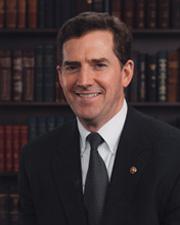 Sen. Jim DeMint (R-SC)
Legislative Activity
Stay on top of the latest movement without scrolling through every action
Senate amendment submitted
January 27, 2009
View full timeline
Senate amendment submitted
January 27, 2009
Senate amendment proposed (on the floor): Amendment SA 43 proposed by Senator DeMint to Amendment SA 39.(consideration: CR S859-866, S879-880; text: CR S859-860)
January 27, 2009
Roll call votes on amendments in Senate: Motion to table amendment SA 43 agreed to in Senate by Yea-Nay Vote. 60 - 37. Record Vote Number: 16.
January 27, 2009
Amendment SA 43 proposed by Senator DeMint to Amendment SA 39. (consideration: CR S859-866, S879-880; text: CR S859-860) To require States to impose cost-sharing for any individual enrolled in a State child health plan whose income exceeds 200 percent of the poverty line.
January 27, 2009
Motion to table amendment SA 43 agreed to in Senate by Yea-Nay Vote. 60 - 37. Record Vote Number: 16.
January 27, 2009
Votes
1 roll call on this amendment
Text
Proposed
CHILDREN'S HEALTH INSURANCE PROGRAM REAUTHORIZATION ACT OF 2009

The ACTING PRESIDENT pro tempore. Under the previous order, the
Senate shall resume consideration of H.R. 2, which the clerk will
report.
The legislative clerk read as follows:

A bill (H.R. 2) to amend title XXI of the Social Security
Act to extend and improve the Children's Health Insurance
Program, and for other purposes.

The ACTING PRESIDENT pro tempore. The majority leader.

Amendment No. 39

(Purpose: In the nature of a substitute)

Mr. REID. Madam President, there is an amendment at the desk that I
wish the clerk to report.
The ACTING PRESIDENT pro tempore. The clerk will report.
The legislative clerk read as follows:

The Senator from Nevada [Mr. Reid], for Mr. Baucus,
proposes an amendment numbered 39.

Mr. REID. Madam President, I ask unanimous consent that the reading
of the amendment be dispensed with.
The ACTING PRESIDENT pro tempore. Without objection, it is so
ordered.
(The amendment is printed in today's Record under ``Text of
Amendments.'')
The ACTING PRESIDENT pro tempore. The Republican leader.

Amendment No. 40 to Amendment No. 39

(Purpose: In the nature of a substitute)

Mr. McCONNELL. Madam President, I support the State Children's Health
Insurance Program. I think virtually every Member of the Senate does. I
voted to create the program and believe we need to responsibly
reauthorize it.
In its original form, the State Children's Health Insurance Program
was meant to provide insurance to children from families who earn too
much to qualify for Medicaid but not enough to afford private
insurance.
There is no doubt, as I indicated earlier, we all support providing
insurance to low-income children. I am sure that is 100 Members of the
Senate. In fact, this program originally passed on a broad bipartisan
basis with 43 Republicans and 42 Democrats supporting it. It was
enacted by a Republican Congress, signed by a Democratic President, and
was a model of bipartisanship. Two of my colleagues, Senator Grassley
and Senator Hatch, reached across the aisle to craft a bipartisan
compromise in the last Congress. Unfortunately, our Democratic
colleagues have gone back on many of the prior agreements that were
reached in creating that bill last year, making this issue more
contentious than it ought to be and setting a troubling precedent for
future discussions on health care reform.
The original purpose of the State Children's Health Insurance Program
was to serve low-income, uninsured children. The bill we are being
asked to consider sanctions a loophole that allows a few select States,
such as New York, to provide insurance to children and families earning
more than $80,000 a year--$80,000 a year--instead of insuring low-
income children first. This is more than double the median household
income in many States, including my State of Kentucky. It is grossly
unfair that a family in Kentucky making $40,000 must pay for the health
insurance of a family making double that, especially if the Kentuckian
cannot afford it for his own family.
The bill before the Senate is not limited to children either. It
preserves loopholes that allow adults to enroll in a program that is
intended for children.
Earlier estimates of similar legislation found that nearly half of
the new children added by this bill already have private health
insurance. Let me say that again. Earlier estimates of similar
legislation found that nearly half of the new children added by this
bill already have private health insurance. Republicans, on the other
hand, believe we ought to target scarce resources to uninsured
children, not those who already have coverage.
Republicans will offer amendments to fix the shortcomings of this
bill and to provide a responsible alternative that will return SCHIP to
its intended purpose: serving the kids in struggling families who need
the help most. That is whom we ought to be helping.
Our bill, the Kids First Act, will provide funding increases to State
SCHIP programs and help them find those eligible children who are not
yet enrolled, and our Kids First idea is better because it closes the
loophole that allows some States to extend their program to higher
income families, even while they have thousands of lower income
children who still are not covered. The Kids First Act truly puts kids
first, eliminating nearly all adults from a program designed for
children so that more children can be covered. Finally, by responsibly
allocating scarce resources, our bill increases funding for SCHIP
without raising new taxes. We believe Republicans have a better
alternative.
Madam President, I now send that alternative to the desk.
The ACTING PRESIDENT pro tempore. The clerk will report.
The legislative clerk read as follows:

The Senator from Kentucky [Mr. McConnell] proposes an
amendment numbered 40 to amendment No. 39.

Mr. McCONNELL. Madam President, I ask unanimous consent that the
reading of the amendment be dispensed with.
The ACTING PRESIDENT pro tempore. Without objection, it is so
ordered.
(The amendment is printed in today's Record under ``Text of
Amendments.'')
The ACTING PRESIDENT pro tempore. The Senator from Illinois.
Mr. DURBIN. Madam President, we are now commencing debate on the
Children's Health Insurance Program. I wish to speak to the amendment
that has been offered by Senator McConnell, as well as the pending
legislation.
It is a grim reality in America that each day, 17,000 Americans are
losing their jobs. Each day, 9,000 Americans are facing new mortgage
foreclosure notices. Madam President, 17,000 lost jobs and 9,000 have
lost homes. In the process, some 11,000 Americans are losing their
health insurance every single day. So the issue that was before us when
we created the Children's Health Insurance Program has become gravely
worse, and we are finding more and more Americans who are being
squeezed out of health insurance coverage--46 million uninsured
Americans today, including 9 million children.
We decided to make children a priority in terms of providing health
insurance. What the Federal Government said to the States was: We will
come up with a program, but we will give you more than the normal
Medicaid share; we are going to give you a share that is enhanced so
that you will consider covering these uninsured children. In that
situation, many States took advantage of it.
I might just say, Madam President, that I understand Senator Grassley
is in the Chamber and has a 10:30 a.m. Finance Committee meeting and I
have a 10:30 a.m. Appropriations Committee meeting. Let me do my best
to share the time so I can leave him with the remaining 10 minutes or
so. Is that fair? I want to make sure Senator Grassley has a chance
because we have to go to important meetings.
The difficulty we face today, the reality is we wanted this program
primarily to help families making up to 200 percent of what we call
median family income. That would basically mean they would be making
roughly up to $42,000 a year. So if you are making $42,000 or less, we
want those kids covered.
Then we said to the States: You can go as high as 300 percent, and
that would take it up to $63,000. You would have to pay more for that
out of State funds if you think that group of kids of families making
between $42,000 and $63,000 need the help. And some States took
advantage of it.
Then there were two exceptions, as I understand it. High cost of
living States--New York and New Jersey--asked for permission to go even
higher, up to $77,000 to $83,000 I think was the annual income. When
many of the critics of this legislation, including the Republican
leader, who just spoke, talk about what is wrong with it, they point to
New York and New Jersey. I can tell you those are rare exceptions to
the rule across America. By and large, this program is geared for
people with incomes below $42,000 a year, and in some

[[Page S853]]

cases below $63,000, with only two exceptions that I know, New York and
New Jersey. And I will stand corrected if there is another State.
But the point is, to argue that this is a program that is for the
wealthiest among us is to ignore the obvious. Those two States
notwithstanding, people making $63,000 a year I do not put in the
category of wealthy. Certainly, those making $42,000 I wouldn't at all.
In fact, they are almost smack dab in the middle of the middle-income
families in America. When they face the cost of insurance not covered
by their employer, it can be an extraordinarily high expense. That is
why many of them opt out of coverage for the family, which means
mothers, fathers, and children go without health insurance. Imagine
making $42,000 a year and seeing a third or 40 percent of your income
going into FICA and taxes. What does that leave you with, about $2,000
a month? And with $2,000 a month, how many families can realistically
turn around and buy a health insurance plan on the private market?

I also worry about this argument that we want to trap people into
private health insurance that could be a bad policy that is very
expensive, instead of giving them an option of coming into the
Children's Health Insurance Program. If our goal is to give these
families affordable health insurance, then why do we want to trap them
in a private plan? Some will stay with the private plan because they
are happy with it; others have a plan that, frankly, has a high
deductible, high copay, limited coverage, and high cost. We want to
trap those families in that plan?
Sadly, the amendment that is offered by Senator McConnell has a
mandatory 6-month waiting period between leaving private health
insurance and enrolling in CHIP. What kind of benefit is that for the
families of Illinois or Kentucky who are in a bad private health
insurance plan--the only one they can afford? We want to give them real
insurance that can be there when they need it.
We know there are families who desperately will need help. I have
here the photograph of a family from Illinois. It is a classic story.
This is a family, Steve and Katie Avalos and their son Manolo. In 2005,
Katie became pregnant while Steve was still in law school, and because
of Federal programs such as CHIP and Medicaid, the State of Illinois
was able to provide health coverage for Katie through the All Kids
Program. With help from St. Joe's Hospital, Katie was enrolled in the
Illinois Moms & Babies Program. She received excellent prenatal care.
In February 2006, her beautiful little baby boy Manolo was born with a
rare neurologic condition that affects his balance, coordination, and
speech. He was living with something called Dandy Walker Syndrome and
as a result has had slow motor development and progressive enlargement
of his skull.
Because Manolo has a preexisting condition, his options for health
insurance are very limited. Yet with All Kids, our version of the
Children's Health Insurance Program in Illinois, Katie can give her
child the services that are important building blocks for his future
success. Katie is grateful for reliable health insurance. Without it,
Manolo would not have experienced his many successes. He was able to
walk at age 2\1/2\, and the family is so happy. Without that helping
hand, without the rehab and the special medical care, that might never
have happened. Manolo turns 3 in a few days, on February 2, and he has
his whole life in front of him.
Was this a bad investment, investing in this family, investing in
this child, giving them a chance for the medical care they needed so
this little boy has a normal life? When I hear from critics who argue
that this is something we can't afford, or unfortunately it is going to
crowd out private health insurance, I wonder if they know what a
private health insurance plan would have cost this family with a child
with a preexisting condition. They would have been lucky to find one
they could afford, and it would have had many exclusions and many
riders.
Now Senator McConnell says to this poor family, stick with it for 6
months no matter what it is costing, no matter the fact that it doesn't
cover what your child needs. I don't think that is the way to go. I
think what we have to understand is that many people came together,
Democrats and Republicans, to pass this bill initially--to pass it
twice, though it ended up with President Bush's veto--and in all of
these instances we were affirming the bottom line. And the bottom line,
as President Obama and others have said, is health insurance is
critically important for all of us.
President Obama said:

People don't expect government to solve all their problems.
But they sense deep in their bones that with just a slight
change in priorities, we can make sure that every child in
America has a decent shot at life and that the doors of
opportunity remain open to all. They know we can do better.

Those are the words of President Obama in his speech to the 2004
Democratic convention. I know deep in our bones the Senate will stand
together to give an additional 4 million kids coverage with health
insurance. A bill that had been vetoed twice by President Bush can
become the law of the land so this family--this loving family with a
beautiful little boy--and thousands of others like them have a chance
at quality health insurance.
I might conclude by saying that this debate is important for the
course of the Senate, because all of us understand we have had some
tough times on the Senate floor over the last couple of years--95
filibusters, a record-breaking number. What we want to do this week is
to prove, as we did last week, that we can have amendments offered
constructively; that we can debate them, deliberate them, and vote on
them in an expeditious way. We can have a fair hearing on these
amendments and come to a vote and not face a cloture vote and 30 hours
of the Senate sitting in quorum calls with nothing happening. But it
takes a cooperative effort on both sides. I think we can reach that
again, and I hope we will prove it this week and by the end of the week
pass this critical legislation to give 4 million kids, such as Manolo
here, a chance for a better life.
Madam President, I yield the floor.
The ACTING PRESIDENT pro tempore. The Senator from Iowa.
Mr. GRASSLEY. Madam President, our goal is to cover 4 million kids,
as was spoken by the majority whip. Our goal is to do it in a way so
that we actually have the resources to cover children who do not have
health insurance.
There are some aspects of the underlying bill before us that would
lead families to drop private health insurance, and I am cognizant of
what Senator Durbin said, that if you have a bad policy, maybe you
ought to be on SCHIP. I don't dispute that. But we have found that when
you crowd people out of private health insurance, it is more apt to
happen at the highest income levels than at the levels he was talking
about, where we ought to be helping people under $42,000.
Then there is another category where they want to help people that
sponsors have already assumed the responsibility of making sure their
health care would be covered. In that category, we find $1.3 billion
being wasted that we can take and use on children who don't have
coverage.
So there is no dispute about covering 4 million people. There is a
dispute about whether we ought to encourage people who are of higher
income to drop out of private policies and to go on the Children's
Health Insurance Program. If you talk to people in the Congressional
Budget Office--the nonpartisan Congressional Budget Office--you will
find that is a fact. Then when we have people sign a contractual
relationship with the Federal Government that they are going to provide
for the needs of the people they bring into this country, we feel--at
least for a period of 5 years, and that is present law--that they
should maintain that contractual relationship they have with the
government; otherwise, those people would not be here in the first
place. So we want to cover 4 million people. We want to cover people
who don't have insurance. We don't want to encourage higher income
people who do have insurance to go into the State health insurance
program, and we want to make sure that people maintain their
contractual obligations.
We are going to offer a series of amendments today and tomorrow to
bring out these differences between the two approaches, but I am not
going to stand by and let anybody on the other side of the aisle say
there is a dispute

[[Page S854]]

about covering 4 million people. I will make the point on this side of
the aisle that we want to make sure we put emphasis upon covering
people who don't have insurance, where they are willing to look at
encouraging people to leave private insurance and go into a State-run
program or encouraging people to avoid their contractual obligations
with the Federal Government. Using our approach, it seems to me, the
goal then can be reached so we actually reach more people who don't
have insurance.

Amendment No. 41 to Amendment No. 39

Now, the first amendment I am going to offer deals with this issue I
referred to as a contractual obligation. The amendment I am offering
today is very simple. It increases the coverage of low-income American
children currently eligible for Medicaid but who are uninsured relative
to the bill before this Senate. My amendment does this by striking the
Federal dollars for coverage of legal immigrants and uses those funds
to cover more low-income American kids instead.
Let me make it very clear: Whichever bill passes, we are talking
about 4 million more kids, but we are still talking about a lot of kids
who still aren't going to have coverage that we ought to be concerned
about. So this is all about priorities. The Congressional Budget Office
has reviewed my amendment and it indeed does the job of covering more
low-income American kids. In fact, my amendment will get as many or
more low-income American kids health coverage than the majority's bill
does with the coverage of legal immigrants.

Does that sound right? It is right. It does not reduce the number of
kids covered. It covers as many low-income kids, and maybe even more.
The difference is that the additional low-income kids who get health
coverage with my amendment are U.S. citizens. It does a better job of
enrolling these low-income children than the bill before the Senate. I
thought that covering children who were eligible for Medicaid but who
were insured was a bipartisan goal shared by my Democratic colleagues.
This amendment does exactly that.
I want to get back to the background on the amendment. In other
words, there are people who are legally in the country--no dispute
about that, legally in the country--who have sponsors. Without the
sponsors, they would not be here. Those sponsors have signed an
agreement with the Federal Government for these people to come into
this country, that they will take care of them for 5 years, that they
will not become a public charge. So those sponsors promised for their
needs so that they would not be on programs that come out of the
Federal Treasury, or else they would not be here. That is a cost of
$1.3 billion when you are going to let those people not honor their
contractual relationships and allow them to go on the Children's Health
Insurance Program. And are they any better off? No, because the people
who brought them here promised they were going to fulfill those needs
and not become a public charge. But we would take that $1.3 billion and
spend it on people who were not promised any coverage but qualify for
the Children's Health Insurance Program and cover more kids in the
process.
Madam President, I am going to send my amendment to the desk, and I
ask that it be read.
Before I do that, I am sorry, I have to ask unanimous consent to set
the pending amendment aside.
The ACTING PRESIDENT pro tempore. The amendment is in order at this
time, and the clerk will report.
The legislative clerk read as follows:

The Senator from Iowa [Mr. Grassley], for himself, Mr.
Hatch, Mr. Roberts, and Mr. Vitter, proposes an amendment
numbered 41 to amendment No. 39.

Mr. GRASSLEY. Madam President, I ask unanimous consent that the
reading thus far constitute the reading.
The ACTING PRESIDENT pro tempore. Without objection, it is so
ordered.
The text of the amendment is as follows:

(Purpose: To strike the option to provide coverage to legal immigrants
and increase the enrollment of uninsured low income American children)

Strike section 214 and insert the following:

SEC. 214. INCREASED FUNDING FOR ENROLLMENT OF UNINSURED LOW
INCOME AMERICAN CHILDREN.

Section 2105(a)(3)(E) (42 U.S.C. 1397ee(a)(3)(E)), as added
by section 104, is amended by adding at the end the
following:
``(iv) Increase in bonus payments for fiscal years 2012
through 2019.--With respect to each of fiscal years 2012
through 2019:

``(I) Clause (i) of subparagraph (B) shall be applied by
substituting `38 percent' for `15 percent'.
``(II) Clause (ii) of subparagraph (B) shall be applied by
substituting `70 percent' for `62.5 percent'.

Mr. GRASSLEY. Madam President, did I make a mistake, that I was not
supposed to set the amendment aside? I apologize if I made a mistake.
The ACTING PRESIDENT pro tempore. The Senator can proceed at this
time without consent.
Mr. GRASSLEY. I have said all I am going to say, and from that
standpoint, we will be debating this amendment throughout the day. We
do not object to what the majority leader said, that he would like to
vote on these amendments today. I think it is our intention to do that
sometime during the day.
I yield the floor.
The ACTING PRESIDENT pro tempore. The Senator from Utah.
Mr. HATCH. Madam President, as someone who considers the creation of
the CHIP program one of my happiest legislative accomplishments as a
Senator, this is a very difficult and disappointing week for me. Like
the rest of the Nation, after this historic election, I was so hopeful
we would mark this new era with the passage of bipartisan CHIP
legislation. However, the partisan process engineered by the other side
of the aisle so far on this issue of great importance, has only
reinforced the American people's cynicism about Washington's partisan
political games. Americans are tired of this, and I am tired of this.
Change is not just a slogan on a campaign poster, it is about real
action.

I began this year with great hope that we would all come together to
complete our work from 2007 and have a bill signed into law that would
have overwhelming support on both sides of the aisle. But that hope has
turned quickly into disappointment and the promise of change into a
commitment to remain the same.
It appears that decisions were already made without those of us who
worked morning, noon and night for several months in 2007 to create a
bipartisan CHIP bill not once, but twice at the consternation of many
colleagues on my own side. And I want to make one point perfectly clear
to my colleagues in this chamber--Senator Grassley and I were willing
to roll up our sleeves and do it again this year. That is because we
remain committed to those 6 million low-income, uninsured children who
are eligible for CHIP and Medicaid coverage.
I am bitterly disappointed by the outcome of this bill. CHIP is a
program I deeply love and built with my friends and colleagues who
share my concern about the welfare of uninsured children of the working
poor--the only ones who were left out of this process.
Again, in the Senate, we could have had a bill that would have
brought the vast majority of members together once and for all to help
these children. But that was not to be.
When our new President was campaigning across the country, he made a
promise to the American people that he would invoke change and end the
bitter partisanship on Capitol Hill. I find it ironic that he will be
meeting with GOP members to talk about bipartisan efforts in the
economic stimulus package the same week that the Senate is about to
pass the very first partisan CHIP bill. The other three bills that this
body has passed on the CHIP program were approved with overwhelming
bipartisan support--69 votes for; both parties.
When President Obama was elected, I truly believed his promise of
bipartisan change. And at risk of sounding overly sarcastic, I believe
that if this bill and the process so far on the stimulus legislation
are any indicator of what the future will bring, the American people
will demand to know exactly what kind of change the Democrats pledge to
bring to Washington.
I know my colleagues will agree that we put our hearts and souls into
negotiating the reauthorization of the CHIP program in 2007. We stuck
together through some very tough decisions--whether or not to allow
coverage of pregnant women through CHIP, whether or not to continue
coverage of childless adults and parents, whether

[[Page S855]]

or not to allow States to expand CHIP income eligibility levels, how to
eliminate crowd-out and, most important, how to get more low-income,
uninsured children covered through CHIP. We had some tough discussions,
but in the end, we ended up with two bills, CHIP I and CHIP II, that
covered almost 4 million low-income, uninsured children. Unfortunately,
neither version of the bill was signed into law and, in the end, we
simply extended the CHIP program through March 2009.
Back then, we knew that we needed to prepare, once again, for another
debate on the reauthorization of the CHIP program in early 2009. But we
all felt that the outcome would be different and that the legislation
that I developed with Senators Grassley, Rockefeller and Baucus which I
believe greatly improved the CHIP program, would be signed into law.
While the CHIP legislation that we passed in the Senate was not
perfect, which we fondly refer to as CHIPRA I and CHIPRA II, it
represented a compromise and laid the foundation for bipartisanship and
trust that was integral to getting the legislation not once but twice
to the President's desk.
The bill being considered this week is not that bill because it
includes provisions that I feel were not part of our bipartisan
agreement such as the inclusion of a State option to cover legal
immigrant children and pregnant women. Amendments will be offered to
improve this legislation but if they are not accepted, I will not be
able to support this bill. And I deeply regret it.
I started putting together ideas regarding the CHIP program after I
met with two Provo, UT, families in which both parents worked. Each
family had six children. Neither family, with both incomes, had more
than $20,000 a year in total gross income. They clearly could not
afford health insurance for their children. CHIP was the only answer to
their plight. They were the only people left out of the process. They
worked. They did the best they could.
When Senators Kennedy, Rockefeller, Chafee and I wrote this program
in 1997, we wrote it with the intent of helping the children of those
Provo families and others like them. Our intent was to help the
children of the working poor, the only children who did not have access
to health coverage back then. These children's families made too much
money to qualify for Medicaid and not enough money to buy private
health insurance.
In addition, it came to light that both the Clinton and Bush
administrations permitted individuals to be covered by CHIP who did not
fit the definition that we had in mind for children of the working
poor. In fact, they were not even children. They were childless adults
and parents of CHIP eligible children. My good friend Senator Grassley
likes to remind us that there is no ``A'' in the CHIP program. There is
only a ``C'' and we all know what that ``C'' stands for and it is not
adults.
I believe that having adults on this program caused the price tag of
CHIP to escalate and even led to some States running out of their CHIP
allotments prematurely. To add insult to injury, because States receive
a higher Federal matching rate for covering individuals in the CHIP
program, States were given financial incentives to continue covering
adults.
As part of our compromise in 2007, childless adults would have been
phased off CHIP and transitioned to their States' Medicaid programs.
Parents would have been covered in a capped program and within a set
timeframe, States would have either received the Medicaid matching rate
or the matching rate half way between the State's Medicaid matching
rate and the CHIP matching rate. This was called RE-MAP. States would
have only gotten the RE-MAP Federal match if they covered a certain
number of low-income children.
Our two bills from 2007, CHIPRA I and CHIPRA II, brought this
situation to light and put a stop to covering future adults once and
for all. In fact, States will no longer be allowed to submit waivers to
cover adults through the CHIP program once the bill before the Senate
becomes law. That seems right.
We have also seen some States cover children whose family income is
well above 200 percent of the Federal poverty level. Typically, these
higher income families have access to private health insurance so they
end up having a choice between private health insurance, paid for in
part by their employers, or CHIP coverage, almost fully paid for by the
Federal and State governments.
Unfortunately, many of these families end up choosing CHIP over
private health coverage, thus contributing to higher costs incurred by
the CHIP program. Adding higher income families to State CHIP programs
also affects the Federal taxpayer who ends up paying for a significant
part of the CHIP program.
And, once again, States currently receive the higher CHIP Federal
matching rate for covering these higher income children. This is
something that really bothers me because it is so contrary to the
original goal of the CHIP program.
There are other issues as well--the crowd-out policy that we worked
out to address the serious crowd-out concerns raised by Members was not
included in this mark.
This policy, section 116 of CHIPRA I and CHIPRA II called for the
Government Accountability Office, GAO, to study what States are doing
to eliminate crowd-out in the CHIP program. In addition, the Institute
of Medicine, the IOM, was directed to come up with the best way for
measuring, on a State-by-State basis, the number of low-income children
who do not have health coverage and the best way to collect this data
in a uniform manner across the country. Today, there is no standard for
States to collect data on the uninsured, including uninsured, low-
income children.
So right now, it is a guessing game for States to figure out how many
low-income, uninsured children reside in their States. To me, it is a
no brainer that we should incorporate a standard way to collect this
important information to help us figure out how many low-income,
uninsured children still need health coverage.
The deleted section also required the Health and Human Services
Secretary to develop recommendations on best practices to address CHIP
crowd-out. It also directed the Secretary to develop recommendations on
how to create uniform standards to measure and report on both CHIP
crowd-out and health coverage of children from families below 200
percent of the Federal poverty level.
I simply do not understand why on earth the majority would drop such
an important provision. I don't understand that since we worked so hard
to solve these problems. Don't we want to eliminate crowd-out to ensure
that the children in the most need are the top priority? Don't we want
to make sure that the data collected in Utah on uninsured, low-income
children is collected the same way across the country? Don't we want to
compare apples to apples? Or is it possible that some in this body
simply want to continue the guessing game and never truly know how many
low-income, uninsured children live in their States?
We will have a vote on this provision during this debate and it is my
hope that Senators on both sides of the aisle will want to have answers
on crowd-out and appropriate data collection. I cannot believe that
Members subscribe to the irresponsible, anything goes policy which is
exactly what they are advocating if they vote against the amendment to
add this provision back into the bill.
Another issue that is very important to me is the coverage of high-
income children through the CHIP program. When we were negotiating
CHIPRA I and CHIPRA II in 2007, we agreed 300 percent of the Federal
poverty level for CHIP was high enough. CHIPRA I provided States with
the lower Medicaid matching rate, FMAP, for covering children over 300
percent of FPL. CHIPRA II, the second bill vetoed by the President,
went one step further and stopped all Federal matching rates for CHIP
children over 300 percent of FPL. That is the policy that I support--
there is no reason on earth that a family making $63,000 per year
should be covered by CHIP and that a State should be rewarded with any
Federal matching dollars for covering these high-income children.
In fact, there is one State that provides CHIP coverage up to 350
percent of FPL and another State that is trying to cover children up to
400 percent

[[Page S856]]

of FPL. In my opinion, when States start moving in that direction, they
are taking a block grant program, one that we felt should be operated
by the States to help children of the working poor, to push towards a
single payer health system. That is what they are pushing for. That is
not what we agreed to in 1997 when we created CHIP.
However, the legislation before us today allows States that had
submitted State plan amendments or had their waiver approved to
increase their income eligibility levels to over 300 percent of FPL to
receive the higher Federal matching rate for the CHIP program. These
States are New Jersey, a State that now covers children up to 350
percent of the Federal poverty level and New York, a State that
submitted a plan to CMS to cover children up to 400 percent of the
Federal poverty level. I do not support this provision and will be
supporting an amendment to prevent these two States from receiving the
higher CHIP matching rate. that are willing to work within the limits
we set and have worked well under the original CHIP bill.

Another issue that deeply troubles me is the insistence to include a
State option to cover legal immigrant children and pregnant women, who
are not citizens of our country, through the CHIP program.
In 2007, we made agreements that our legislation would not include
the coverage of legal immigrant children and pregnant women. I have
consistently voted against adding that new category, even if it is at
the State option, because I believed then, as I believe now, that
before we even consider expanding the CHIP program to legal immigrant
children, we need to do the best job we can to cover the children of
the working poor who are U.S. citizens.
While we have improved, we still have at least 6 million other
children to cover, maybe more, with the dire economic conditions
currently facing our country.
Now, before we even started drafting our first CHIP bill in 2007, we
agreed that legal immigrant children would not be added to the CHIP
program. That agreement was very important to me and to other
Republicans who eventually supported the two CHIP bills that we
negotiated in 2007.
In addition, we have always struggled to find sufficient dollars to
reauthorize the CHIP program. The bill before the Senate is only a 4\1/
2\ year reauthorization due to limited funds. I understand there is
some extra money in the bill for the legal immigrant provision. I
believe that we should be using that money to cover low-income
uninsured children who are U.S. citizens first. How many children who
are U.S. citizens will be without health care because we have decided
to cover legal immigrants through CHIP?
I wish to know the answer to that question before this bill becomes
law. Now, ordinarily I support helping legal immigrants in almost every
way. But we do not have enough money to take care of our own citizens'
children. That is a matter of great concern to me and it is of great
concern to a significant number of Members of both bodies who probably
will vote against this bill because of that provision. In fact, there
are plenty of reasons to vote against this bill because it was written
in such a partisan fashion.
I might add, the legal immigrant provision is now in this
legislation, and, as a result, there are many Members in both Houses of
Congress who now oppose the bill. We simply do not understand why we
are not taking care of our children who are U.S. citizens first. Once
that goal is accomplished, I would be willing to make a commitment to
the work on resolving all of the issues regarding legal immigrants once
and for all.
But now is not the time. There is not enough money even in this bill
to take care of our children who are citizens. This is especially true
when our country is in economic crisis and there are more children who
are U.S. citizens who need health insurance coverage because their
parents may have lost their jobs or may have lower paying jobs. I do
not believe this is an unreasonable request. For the life of me, I
cannot understand why those who support the coverage of legal immigrant
children cannot work with us to resolve this issue, especially if they
want a bill that has broad bipartisan support.
But without a doubt, the issue that broke down negotiations between
the Senate and House Republicans at the end of 2007 involved Medicaid
eligibility. Section 115 of the legislation would allow States to
create higher income eligibility levels for Medicaid. When are we going
to quit throwing money at programs?
Simply put, a State could establish one income level for Medicaid, a
higher income eligibility level for CHIP, and then cover more kids at
an even higher income eligibility level through Medicaid. In other
words, a State could cover higher income children through Medicaid at
an even higher income level than children covered by CHIP.
This provision sets no limits on the income eligibility level for
Medicaid. Now, that is ridiculous. It is irresponsible. It is fiscally
unsound. Everybody here knows it. In 2007, the House Republicans wanted
to put a hard cap of 300 percent of Federal poverty level on State
Medicaid programs. I agreed with them, but others did not. I am quite
disturbed that the legislation before the Senate still allows States to
cover high-income children under their State Medicaid plans.
Technically speaking, section 115 of this bill would allow a State to
cover children under Medicaid whose family income is over 300 percent,
over $63,000 for a family of four.
During this debate, I intend to support and speak in favor of
amendments to address this very serious concern of mine. It ought to be
a serious concern of everyone here, since there a limited amount of
money that may be used.
Additionally, section 104 of the legislation creates a bonus
structure for States that enroll Medicaid-eligible children in their
State Medicaid programs. The idea is to reward States for covering
their poorest children. If a State increases its Medicaid income
eligibility levels, using the language in section 115, additional
children added to Medicaid would not be eligible for a bonus during the
first 3 fiscal years. However, at the beginning of the fourth fiscal
year, it is possible that States could receive a bonus for enrolling
higher income children in their State Medicaid programs.
Now, this provision simply does not make any sense. I urge my
colleagues to drop it once and for all. A State should not be rewarded
for covering a high-income child in its State Medicaid program,
especially when it is not going to be covering those who need to be
covered and should be covered.
Well, I have to admit, Senator Grassley and I went through a lot of
pain on this side, and in the House of Representatives, bringing people
together for the overwhelming votes that we did have in both the Senate
and the House, but especially here in the Senate on both CHIPRA I and
CHIPRA II.
Then, all of a sudden we find that since the Democrats have taken
over and now have a significant majority, they do not need Senator
Grassley and me anymore.
Now, my feelings are not hurt, I want you all to know that. But I am
disgusted with this process that is so partisan. I am particularly
upset because everybody in this body knows that I fought my guts out to
get the original CHIP program through to begin with in 1997. And it
would not have happened had I not brought it up in the Finance
Committee markup on the Balanced Budget Act. In fact, it became the
glue that put the first balanced budget together in over 40 years.
So you can imagine why I feel the way I do. I know how badly Senator
Grassley feels. We are both conservatives, but we both worked our guts
out trying to bring about an effective approach, and it was effective
in CHIPRA I and CHIPRA II.
Unfortunately, in 2007, neither bill did not have enough votes to
override a veto. I think our President had very poor advice, and
anybody who looks at the mess this legislation is in right now, and the
lack of bipartisanship, will have to agree that we should have signed
into law either CHIPRA I or CHIPRA II. But then that is the past.
I hope my colleagues on the other side will recognize that some of us
worked hard to try and bring about effective legislation, taking on our
own administration, taking on wonderful friends on our own side, to
bring about legislation that would work a lot better than the bill
before us today. This bill, in my opinion, is going to lead to higher
costs and less coverage of children.
Why? What is the reasoning behind it? Well, unless there are
essential

[[Page S857]]

changes made to this legislation during the floor debate, I will be
voting against my own bill, and against the program I helped create in
1997. It is sufficient to say that I am not only disappointed, but I am
angry. This entire debate has personally been grievous to me, because
it has now become a partisan exercise instead of being about covering
low-income, uninsured children, where we could have had a wonderful
bipartisan vote. We could have made this third reauthorization bill a
tremendous victory for the President.

Well, he may feel tremendous victory anyway, even though it is a
partisan one. But I do not look at it that way. To start out the year
on this note does not bode well for future health care discussions,
including health reform and the Medicare bill that we will be
considering this fall. In fact, one of the very first bills that the
President, who ran on a platform of bipartisanship and change, will
sign into law is going to be a partisan CHIP bill, produced as a result
of the same old Washington gamesmanship. That is pathetic when you
think about it, because we should be together on this bill, and a large
majority would have voted again for legislation similar to either
CHIPRA I or CHIPRA II.
I want to encourage the President and his colleagues to seriously
consider what they are doing. We were so close to working out a
bipartisan CHIP agreement and, in my opinion, I believe they are
missing an incredible bipartisan health care victory by making this a
partisan product. So I urge the President and my friends on the other
side--they are my friends--I urge them to reconsider this strategy. I
think we still have time to turn this around and make it the bipartisan
bill many of us would like it to be. Ensuring access to quality and
affordable care for Americans is not a Republican or Democratic issue,
it is an American issue. Our citizens expect nothing less than a
bipartisan, open, and inclusive process to address a challenge that
makes up 17 percent of our economy and will increase to 20 percent
within the next decade. A bipartisan CHIP bill would have been an
incredible step in that direction.
However, once again politics has triumphed over policy, Washington
over Main Street.
The famous novelist Alphonse Karr once said, ``The more things
change, the more they remain the same.'' There is no better proof of
this statement than this CHIP legislation. I continue to hope that the
change promised in this election did not have an expiration date of
January 20, 2009, but rather was a real and accountable promise to our
citizens. There is no better place to start this change than on this
CHIP bill by making it truly bipartisan.
Mr. President, I send an amendment to the desk.

Amendment No. 45 to Amendment No. 39

The PRESIDING OFFICER. Without objection, the pending amendment is
set aside. The clerk will report.
The legislative clerk read as follows:

The Senator from Utah [Mr. Hatch], for himself and Mr.
Grassley, proposes an amendment numbered 45 to amendment No.
39.

Mr. HATCH. Mr. President, I ask unanimous consent that the reading of
the amendment be dispensed with.
The PRESIDING OFFICER. Without objection, it is so ordered.
The amendment is as follows:

(Purpose: To prohibit any Federal matching payment for Medicaid or CHIP
coverage of noncitizen children or pregnant women until a State
demonstrates that it has enrolled 95 percent of the children eligible
for Medicaid or CHIP who reside in the State and whose family income
does not exceed 200 percent of the poverty line)

On page 136, between lines 15 and 16, insert the following:
(c) Condition for Federal Matching Payments.--
(1) In general.--Section 1903(i) (42 U.S.C. 1396b(i)) is
amended--
(A) in paragraph (23), by striking ``or'' after the
semicolon;
(B) in paragraph (24)(C), by striking the period and
inserting ``; or''; and
(C) by inserting after paragraph (24)(C), the following:
``(25) with respect to amounts expended for medical
assistance for an immigrant child or pregnant woman under an
election made pursuant to paragraph (4) of subsection (v) for
any fiscal year quarter occurring before the first fiscal
year quarter for which the State demonstrates to the
Secretary (on the basis of the best data reasonably available
to the Secretary and in accordance with such techniques for
sampling and estimating as the Secretary determines
appropriate) that the State has enrolled in the State plan
under this title, the State child health plan under title
XXI, or under a waiver of either such plan, at least 95
percent of the children who reside in the State, whose family
income (as determined without regard to the application of
any general exclusion or disregard of a block of income that
is not determined by type of expense or type of income
(regardless of whether such an exclusion or disregard is
permitted under section 1902(r))) does not exceed 200 percent
of the poverty line (as defined in section 2110(c)(5)), and
who are eligible for medical assistance under the State plan
under this title or child health assistance or health
benefits coverage under the State child health plan under
title XXI.''.
(2) Application to chip.--Section 2107(e)(1)(E) (42 U.S.C.
1397gg(e)(1)(E)) (as amended by section 503(a)(1)) is amended
by striking ``and (17)'' and inserting ``(17), and (25)''.

Mr. HATCH. My amendment simply says that before a State may exercise
an option to provide CHIP and Medicare to legal immigrant children and
pregnant women, that State must demonstrate to the Secretary of Health
and Human Services that 95 percent of its children under 200 percent of
the Federal poverty level have been enrolled in either the State's
Medicaid program or the CHIP program.
The Secretary may make this determination based on the best data
available, and may use any technique necessary for sampling and
estimating the number of low-income, uninsured children in that State.
When legal immigrants enter this country, their sponsors agree, the
people who bring them in agree, to be responsible for their expenses
for the first 5 years they live in the United States.
The CHIP bill contains a provision which was added during the Finance
Committee consideration of the bill that negates that agreement by
allowing immediate health coverage of legal children and pregnant
women. This is the first reason I am offering this amendment.
The second reason is that there are U.S. children who are citizens of
this country who are low income and uninsured. They do not have health
insurance coverage. They qualify for Medicaid and CHIP too. I believe
these children should be our first priority as far as CHIP and Medicaid
coverage is concerned. They should be the priority. Once these children
have health coverage, then we can talk about expansions to other
populations.
I worked very closely with my Democratic colleagues on creating not
one but two bipartisan CHIP bills in 2007, CHIPRA I and CHIPRA II.
As I have explained, I voted against my President because I wanted
the CHIP program to be reauthorized in the bill we wrote. One of the
first agreements that Senator Grassley and I made with Senators Baucus
and Rockefeller was that legal immigrant children would not be covered
under the CHIP program because their sponsors made a commitment to be
financially responsible for them for 5 years. That was even before we
started drafting CHIPRA I.
I simply cannot support a CHIP bill that allows States to cover legal
immigrant children while there are at least 6 million low-income
uninsured children, 200 percent of poverty and below, who do not have
health coverage and are eligible for CHIP and Medicare.
These children ought to be our first priority. My amendment ensures
the majority of these children have health coverage before we expand
CHIP and Medicaid eligibility to legal immigrants. I urge my colleagues
to support this amendment. It is a reasonable approach. It might have
the capacity of helping to bring some of us together in a more
bipartisan manner. I hope our colleagues will pay strict attention to
some of the things I have said because I believe I have earned the
right to be listened to on all aspects of the CHIP bill.
I yield the floor.
The PRESIDING OFFICER (Mr. Udall of New Mexico). The Senator from
Maryland.
Mr. CARDIN. Mr. President, let me compliment my friend, Senator
Hatch, for his longstanding work on behalf of the Children's Health
Insurance Program. He points out--and rightly so--that this legislation
was developed in a bipartisan manner, where Democrats and Republicans
worked together to establish a Federal program that allowed our States
to use their mechanism to cover children. That is where our difference
might be now. We are looking

[[Page S858]]

at reauthorization legislation. We are looking at how we can make this
program more effective, covering more children, giving States the tools
they need so children can be covered under the CHIP program. The
concerns my friend from Utah raises basically would impede on State
discretion. We have a national program that is built upon allowing the
States to implement and cover children. Each State is different. The
priorities among States are certainly different. We need to give the
States the tools they need so children actually are covered effectively
by this program.
The amendment my friend from Utah has offered would prohibit States
from covering legal immigrants and pregnant women. These are, in many
cases, people who have been here for a long time, hard-working, tax-
paying families, and they are playing according to the rules.
This restriction was imposed in 1996 by Congress. Since that time,
many of the restrictions that have been placed upon legal immigrants
have been removed. In this instance, what the committee is recommending
is to give the States the option of covering legal immigrants without
the 5-year wait period. It is not mandating it. It gives all States the
option, if they so desire, to cover. Currently, 23 States want to cover
these children.
The last time an amendment was offered and we tried to do away with
the prohibition on States, our Republican colleagues said: This
shouldn't be done as an independent issue. Why don't we take it up when
we reauthorize the Children's Health Insurance Program. That is where
it should come up. It should not come up on an unrelated bill. That is
exactly what we are doing.
This is the reauthorization bill for the Children's Health Insurance
Program. This is the time to correct what was done in 1996, in haste,
that in many other Federal programs we have already changed. This
allows the States to do it.
Many other issues my friend from Utah raised, I assume, will have
individual amendments to deal with them. But in most cases, it is the
issue of whether we are going to trust our States to run the program.
That was the compromise reached between Democrats and Republicans.
Quite frankly, there are more people on the Democratic side of the
aisle who wanted a stronger Federal presence. But our Republican
colleagues said: Let's build upon the State programs. That is what we
did in the compromise. That is why the Children's Health Insurance
Program has truly been a bipartisan bill.
The bill reported out by the committee is a bipartisan bill. So let
me talk for a few minutes about the importance of S. 275, the
Children's Health Insurance Program Reauthorization Act of 2009. For
millions of children across America who are waiting for the
comprehensive health care coverage they need, this week could not have
come soon enough. There is a crisis in health care in this country. The
United States spends far more per capita than any other nation on
health care services. Yet our health status lags in many areas,
especially in preventable diseases. This is primarily because we have
so many Americans who lack coverage and a fragmented, inefficient
health care system that shifts costs onto those who are covered. This
is no longer a matter of whether we take action to achieve universal
health insurance but how.
We can begin, in the 111th Congress, by guaranteeing children access
to the care they need to grow into healthy adults. We can make great
strides by reauthorizing CHIP and covering millions of uninsured
children now.
Most uninsured Americans belong to working families. It is the CHIP
program, first established 12 years ago, that can provide children in
these families with affordable health insurance. As a Member of the
House, I voted for the bill that created CHIP. At the time, 37 million
Americans were uninsured. At the time, I did so with the hope that CHIP
would be the first step toward universal health coverage. Although we
did not reach the goal then, I believe we are on track to achieve it
this year. In the years since, more employers have dropped their
coverage. The number of uninsured has increased. Today the number
stands at 46 million and growing. I say ``growing'' because today's
headlines contain more grim news for our workforce. The New York Times
reported a staggering list of companies that announced job cuts on
Monday: Caterpillar, 20,000 jobs; Sprint-Nextel, 8,000 jobs; Home
Depot, 7,000 jobs; General Motors, 2,000 jobs; Texas Instruments, 3,400
jobs; Philips Electronics, 6,000 jobs.
Over the past year, more than 12.5 million Americans have lost their
jobs. Our unemployment rate is now 7.2 percent, the highest in 16
years. As President Obama said yesterday:

These are not just numbers. These are working men and women
whose families have been disrupted and whose dreams have been
put on hold.

Whenever we have a family who loses their job, in many cases, they
lose their health insurance. If they lose their health insurance, in
many cases, they lose their access to quality health care. The numbers
are increasing. In many cases, we have two working families. One person
loses their job which may cover the family, the other spouse has only
single coverage and can't get family coverage or doesn't have the money
to afford family coverage. This disrupts a family's ability to take
care of their own health care needs. We know CHIP works. Studies have
shown and proved that enrollment in CHIP improves the health care of
children. When previously uninsured children sign up for CHIP, they are
far more likely to get regular primary medical and dental care. They
are less likely to visit the emergency room for services that could be
rendered in a doctor's office. That saves us health care dollars. They
are more likely to receive immunizations and other services they need
to stay healthy and lead to healthier schools and communities. They are
more likely to get the prescription drugs they need to recover from
illness.
The best evidence of the program's success doesn't rest in studies or
surveys. It rests in the families themselves. The Bedford family from
Baltimore is a success story, one of millions of families in CHIP.
Craig and Kim Lee Bedford and their five children have testified on
Capitol Hill about the difference the Maryland CHIP program has made in
their lives. Mrs. Bedford said:

Perhaps the greatest impact the Maryland Children's Health
Insurance Program has had on our family is that we no longer
have to make impossible health choices based on a financial
perspective. We no longer have to decide whether a child is
really sick enough to warrant a doctor's visit. We no longer
have to decide whether a child really needs a certain
medication prescribed by his pediatrician.

Mr. Bedford said:

The face of CHIP is families such as ours, families that
work hard, play by the rules, trying to live the American
dream.

So for the Bedford family and millions more, CHIP has been a success.
But there are still millions of children who have not enrolled in the
program offered by their States. Our State is making progress,
simplifying their enrollment procedures, expanding outreach efforts and
using joint applications for Medicaid and CHIP so families can enroll
together. The States are making progress, but as we reauthorize the
Children's Health Insurance Program, let's make sure we make real
progress.
Our bill will extend the program for 4.5 years and allow an
additional 4.1 million children nationwide to enroll. We have to get
this bill done.
I wish to talk about the MCHIP program, the Maryland State program.
It has one of the highest income eligibility thresholds in the Nation.
I know my colleagues have talked about this. This is needed because of
the high cost of living in our State. Eligibility is 300 percent of the
Federal poverty level, not because our Governor wants to move people
from private insurance to public insurance plans. It is at 300 percent
because working families at this income level do not have access to
affordable health insurance. That is the statistics in my State. Those
families need CHIP. This is a State option.
As to one point my friend from Utah mentioned, I don't think the
Federal Government should be prescriptive. Allow the States to figure
out what program works best. There are incentives to cover low-income
families. There are higher matches from the Federal Government, as it
should be. We should make sure the lower income families are covered
first, and we do under CHIP. Children under the age of 19 may be
eligible for MCHIP, if their

[[Page S859]]

family income is at or below 200 percent of the Federal poverty level
or up to $34,000 for a family of three. Our program has been a true
success. Enrollment has grown from about 38,000 enrollees in 1999 to
more than 100,000 today. In Maryland, the need has always exceeded
available funds. We actually spend more money than the Federal
Government will give us. The Federal match through the CHIP formula
established in 1997 is not enough to meet all the costs of the MCHIP
program. Some States do not use their entire allotment, while other
States, such as Maryland, have expenditures that exceed their
allotment. Congress has addressed this problem by redistributing the
excesses of the States that have them to States that have shortfalls.
Now we must move forward for future years.
This is what we are doing on the floor of the Senate today. I thank
Chairman Baucus and Senator Rockefeller for their efforts on this bill.
This bill will allow us to continue to cover children and families with
incomes up to 300 percent of poverty. Maryland would also have access
to contingent funds, if a shortfall arises, and additional funds based
on enrollment gains. With this new money, Maryland can cover an
estimated 42,800 children who are currently uninsured over the next 5
years.
There is another important part of this bill I wish to talk about for
a moment, section 501. It hasn't gotten much attention, but it
certainly has received a lot of attention around the country. Section
501 ensures that dental care is a guaranteed benefit under CHIP. I
agree with my friend from Utah, we need to set standards at the
national level. Dental benefits must be included. According to the
American Academy of Pediatric Dentistry, dental decay is the most
common chronic childhood disease among children. It affects 1 in 5
children between the ages of 2 and 4 and half of those between the ages
of 6 and 8. Children living in poverty suffer twice as much tooth decay
as middle- and upper-income children. Nearly 40 percent of Black
children have untreated tooth decay in their permanent teeth. More than
10 percent of the Nation's rural population has never visited a
dentist. More than 25 million people live in areas that lack adequate
dental services.
Next month will mark 2 years since a young man from suburban Maryland
named Deamonte Driver passed away. He was 12 years old, when he died in
February of 2007 from an untreated tooth abscess. His mother tried to
access the system, tried to get him to a dentist. What was needed was
an $80 tooth extraction. Because of the failure of the system to cover
his services, an inability to get to a dentist, Deamonte ended up in an
emergency room. A quarter of a million dollars was spent in emergency
surgeries. He lost his life in the United States in 2007.
This bill will do something about it by covering oral health care, as
it should. Deamonte's death has shown us that, as C. Everett Koop once
said, ``There is no health without oral health.'' No children should
ever go without dental care. I have said before, I hoped that Deamonte
Driver's death will serve as a wake-up call for Congress. Section 501
of this bill shows that it has. We must never forget that behind all
the data about enrollment and behind every CBO estimate, there are real
children who need care.
When I spoke about Deamonte Driver after his death, I urged my
colleagues to ensure that the CHIP reauthorization bill we send to the
President includes guaranteed dental coverage. This bill does include
guaranteed dental coverage. It also provides ways in which families
will have a better understanding of the need for oral health care. It
also provides ways in which families can access dentists who will treat
them under either the CHIP program or the Medicaid Program.
This legislation is a major step forward on dental care. We need to
do more. I want to acknowledge the work particularly of Senators
Bingaman and Snowe on oral health care. They have been real champions
in this body in moving forward on these types of legislation.
This bill will also require GAO to study and report on access to
dental services by children in underserved areas, access to oral health
care through Medicaid and CHIP, and how we can use midlevel dental
health providers in coordination with dentists to improve access to
dental care for children. The results of this study will give us the
information we need to further improve coverage.
We still have to raise reimbursement for dental providers, and send
grants to the States to allow them to offer wraparound coverage for
those who have basic health insurance but no dental insurance. But
these provisions are an excellent start.
After two vetoes of a bipartisan CHIP bill by the former President, I
am so pleased to stand here today on the floor of the Senate and
express my strong support for S. 275. This is the week in which we can
make progress in covering people in this country, particularly our
children, with health insurance. One week after the inauguration of
President Obama, we are poised to move this bill through the Congress
and to his desk so it can finally become law.
I urge all my colleagues to vote in favor of this legislation, as we
start down the path to universal health coverage for all Americans.
With that, Mr. President, I yield the floor.
The PRESIDING OFFICER. The Senator from South Carolina.

Amendment No. 43 to Amendment No. 39

Mr. DeMINT. Mr. President, I ask unanimous consent that the pending
amendment be set aside, and I call up amendments Nos. 42, 43, and 44,
and ask for their immediate consideration.
The PRESIDING OFFICER. Is there objection?
Mr. CARDIN. Mr. President, I do object. The reason, quite frankly, is
that we have worked out with the Republican leader that we would have
three amendments pending. We have those three amendments pending. I
think it is important we have an opportunity to act on those three
amendments. We certainly look forward to other opportunities where my
colleague will be able to offer the amendment, but at this point I
object.
The PRESIDING OFFICER. Objection is heard.
The Senator from South Carolina retains the floor.
Mr. DeMINT. Thank you, Mr. President. I do not intend to speak on
them, so we would not use any time. I think it is important we have
amendments pending so our colleagues will have ample time to review
them.
I would ask the Senator to reconsider. Again, I am not going to speak
on them. I only want them pending so we can distribute them and people
can begin to see what is in them.
Mr. CARDIN. Mr. President, if my colleague will yield?
Mr. DeMINT. Yes.
Mr. CARDIN. We would be pleased to allow the Senator to call up
amendment No. 43 but not the entire list of amendments the Senator
sought.
Mr. DeMINT. I appreciate the benevolence, and I would hope the
Senator would agree that all of these amendments at some point can be
made pending in the debate.
But I will call up only amendment No. 43 right now.
Mr. CARDIN. To point out to my friend, we already have three
amendments that are pending, and we are hoping to make progress, and we
want to get votes on these amendments. I will not raise an objection to
setting aside the amendment for the sole purpose of offering amendment
No. 43.
The PRESIDING OFFICER. Without objection, it is so ordered.
The clerk will report the amendment.
The assistant legislative clerk read as follows:

The Senator from South Carolina [Mr. DeMint] proposes an
amendment numbered 43 to amendment No. 39.

Mr. DeMINT. Mr. President, I ask unanimous consent that further
reading of the amendment be dispensed with.
The PRESIDING OFFICER. Without objection, it is so ordered.
The amendment is as follows:

(Purpose: To require States to impose cost-sharing for any individual
enrolled in a State child health plan whose income exceeds 200 percent
of the poverty line)

At the appropriate place, add the following:

SEC. __. REQUIRED COST-SHARING FOR HIGHER INCOME INDIVIDUALS.

Section 2103(e) (42 U.S.C. 1397cc(e)) is amended--
(1) in paragraph (3)(B), by striking ``and (2)'' and
inserting ``, (2), and (5)'';
(2) in paragraph (4), by striking ``Nothing'' and inserting
``Except as provided in paragraph (5), nothing''; and

[[Page S860]]

(3) by adding at the end the following new paragraph:
``(5) Required cost-sharing for higher income
individuals.--Subject to paragraphs (1)(B) and (2), a State
child health plan shall impose premiums, deductibles,
coinsurance, and other cost-sharing (regardless of whether
such plan is implemented under this title, title XIX, or
both) for any targeted low-income child or other individual
enrolled in the plan whose family income exceeds 200 percent
of the poverty line in a manner that is consistent with the
authority and limitations for imposing cost-sharing under
section 1916A.''.

The PRESIDING OFFICER. The Senator from South Carolina is recognized.
Mr. DeMINT. Thank you, Mr. President.
Obviously, I am disappointed in the process. It is important we let
our colleagues know what amendments will be offered so we can begin to
discuss them; and many times we have the opportunity to work these
things out, improve them before debate. Unfortunately, many times in
the past we have seen where the majority pushes the bringing up of
these amendments to the very end and then says we do not have time to
debate them. I hope that will not occur this time.
I have three good amendments. The one I just brought up I will not
speak on at this point but will mention the subject of that amendment.
It is a cost-sharing arrangement with the States that for all
recipients of SCHIP over 200 percent of poverty the States are required
to ask for some small cost-sharing with people who use this insurance.
It is important that we look at this as a program that, hopefully, will
move people from a Government-sponsored plan to eventually a private
plan, with our goal being every American is eventually insured with a
policy they can own and afford and keep.
So this would work with the States to require a small cost-sharing
arrangement with the beneficiaries who are 200 percent of poverty or
more, and it would not be more than 5 percent of income, and States can
charge as little as they would like. But the whole point is to begin to
encourage personal responsibility and to let people know this is not a
permanent giveaway but something they need to participate in.
I look forward to discussing this amendment in more detail along with
my other amendments sometime in the future. But right now, Mr.
President, I yield the floor.
The PRESIDING OFFICER. The Senator from Pennsylvania is recognized.
Mr. CASEY. Mr. President, I rise at this moment to review, in a
summary form, pertinent aspects of the legislation. I know we are going
to be having a debate on various parts of this bill that have been the
subject of a lot of conflict in the last couple of days. But I think it
is very important we kind of get back to the basics to talk about why
we are here.
We are not here to only debate several provisions of this
legislation. We are here to debate, in a larger sense, whether we are
going to pass a children's health insurance bill this year, this month,
or not. That is the fundamental debate we are having. We had the
opportunity, in 2007, in a bipartisan way, here in the Senate to
achieve a rare and, frankly, unprecedented bipartisan agreement on a
significant piece of legislation, the result of which would have been,
over a 5-year period of time, to insure 10 million American children.
I am not sure any other generation of Americans has had that
opportunity. We had a bipartisan consensus in the Senate. It approached
70 votes--in the high sixties--every time it was voted on; a veto-proof
number of votes, a majority. It went to the House, of course. The House
debated it, and they had an overwhelming bipartisan vote in the House.
It went to President Bush, and he vetoed it twice. Then it came back
for an override, and we were able to override it in the Senate, but in
the House they fell short. That is where we are. So because of the
actions of President Bush, that bill never became law.
Now we are back to debating whether this Congress is going to provide
health insurance to not just 10 million--it is now 10.6 million--
American children. We are either going to do it or we are not. All this
other stuff is interesting to debate, and we will continue to debate
it, but we are either going to do it or we are not.
Let me give you one example of what this means. Forget all the
numbers for a second and all the programs and all the quibbling about
some point of conflict. We will address those issues today, and I will
as well. But let's get back to the basics: what this legislation means
to a family.
For example, as a result of this legislation, if we do our job here
and get this legislation passed, and if the House does its job and
passes this legislation, millions of American children will have the
opportunity for all kinds of good health care provisions, a lot of them
preventive in nature.
We have a lot of discussions in this body where people talk about the
workforce and growing the economy and building a stronger skilled
workforce in the future. None of that means much unless you are going
to do this, OK. A child will not develop, they will not achieve in
school, and they will not be productive members of our workforce unless
we pass legislation such as the children's health insurance bill.
I will give you one example: well-child visits. Anyone who knows
anything about child development--I do not consider myself in any way
an expert on this issue; others may--but we all know, as parents--
forget legislators or experts--it is as parents we know how important
it is to have a child go to the doctor a couple times, at a minimum,
several times in their first year of life. It is a key time for parent
and physician to communicate. Doctors recommend six visits in the first
year of a child's life.
Now, with this legislation we have an opportunity to guarantee that
millions more children will see a doctor six times in their first year
of life. That is something we ought to do.
They get a complete physical exam. Height, weight, and other
developmental milestones are mentioned. Hearing and vision are checked.
Important topics, such as normal development, nutrition, sleep, safety,
infectious diseases, and all kinds of other issues, are discussed;
general preventive care.
Now, if we allow some of these discussions and debates today to bog
this down and not get it passed in a bipartisan way, what we are
preventing is, among other things, millions of children getting this
care. It is as simple as that. So those who are going to use these
other things to put them in the way as impediments or obstacles, to
block this legislation, should be reminded and the American people
should be reminded what they are stopping. This is not complicated. It
is whether millions of children are going to have health insurance; and
one aspect of that care or that health insurance is a well-child visit.
The other point I want to make in the early going today is there is a
good bit of mythology that surrounds this legislation, and sometimes
facts are not put on the table. This is mostly a question of whether
working families are going to have health insurance. There is a
frustration now that so many families are living with the loss of a
job, the loss of a home, the loss of their livelihood and, therefore,
their hopes and their dreams.
The least the Senate should do, in the midst of what is arguably the
worst economic circumstance in more than a generation--maybe the worst
economy we have faced since the 1930s; we can debate all that, but it
is bad out there, it is real bad for families--the least we could do is
to say, we may not have solved the larger health care challenge, we may
not have fully debated all the aspects of health care we are going to
debate and I hope we can vote on, but at least we can take an existing
program that we know works, that is battle tested, that has results for
15 years now--my home State of Pennsylvania; when my father served as
Governor, he signed this into law, which was the first big State to do
it. He knew it worked. He knew it worked then, and he supported it
strongly. It has worked in Pennsylvania. We have over 180,000 kids
covered. This legislation would increase that to the point we could
almost cover every child in the State, for example.
But in the midst of this economy, the least the Senate should do is
say: We may not have solved all of our economic trouble, we may not
have even solved significant aspects of our health care challenge, but
the minimum--the minimum--this Senate and this Congress and this
administration should do is get this done, and get it done now.

[[Page S861]]

All these other debates are interesting and important, but, frankly,
some of them are academic in nature. I know they have risen to the
level of conflict, and I know the media likes to report on conflict.
That is their job. But a lot of them, compared to the gravity of what
is at stake here, are academic, in my judgment. And I think for some--
not everyone but for some--they are deliberately calculated to stop
this legislation, deliberately so. I hate to say that, but it is the
way I feel. We are getting down to the details now of getting this
done, and we have to be blunt and direct.
So we are going to have debates about parts of this legislation, but
at the end of the day the question is whether the Senate is going to
provide millions more children with health care. That is the question.
All this other stuff does not amount to or does not rise to that level.
They may be important debates, but they do not rise to that level.
One more point, and I will yield because I know we have colleagues
waiting.
Seventy-eight percent of children covered by CHIP are from working
families--working families. I will get into some of the other aspects
as well. But at this time I will yield the floor because I know we have
colleagues waiting.
The PRESIDING OFFICER. The Senator from Oklahoma.
Mr. COBURN. Mr. President, I wish to ask the Senator from
Pennsylvania a couple questions, if he might be so kind as to respond.
Your earlier statement was without this, children will not develop,
children will not become productive members of our society.
Having taken care of 4,000 infants and done well child exams on them,
what is the number of children out there who are not getting vision and
hearing screens right now?
Mr. CASEY. Well, I don't have a number on them.
Mr. COBURN. The number is zero because every one of them is tested.
Mr. CASEY. Let me finish.
Mr. COBURN. I control the time.
Mr. CASEY. Let me finish the answer. If we do not pass this--if we
don't pass this, those children won't get that preventive care. It is
as simple as that.
Mr. COBURN. That is simply not true.
Mr. CASEY. How are they going to get preventive care?
Mr. COBURN. They are going to get preventive care, and let me tell my
colleagues how. What is the number of children who are not getting
preventive care in the first 6 months of life right now? We don't know
that number, and that is exactly the problem.
Here is the point: Every one of us wants children to get health care.
It is not about wanting children to get health care.
Mr. CASEY. This is the way to do it.
Mr. COBURN. The fact is, we have an SCHIP program now and a Medicaid
Program right now where we have 5.4 million kids who are eligible and
who are not enrolled.
What we are doing is exactly the opposite of what President Obama
stated we should be doing. He stated that we should be being
responsible. I would contend that one of the areas of being responsible
is to make sure programs work. When we have a program where last year,
on average, 5.5 million kids were covered and another 5.4 million kids
who were eligible weren't covered, I would tell my colleagues that
program isn't working very well. It is not working. So what have we
done? We have expanded the eligibility with this bill.
The debate over how we cover all the rest of Americans--we will have
that debate, and I am sure we are going to have that debate this year.
But the fact that 51 percent of the eligible children under the
programs we have now, under the requirements we have now, are covered
means 49 percent aren't. In this bill is a measly little $100 million
to try to expand the enrollment of those kids who are already eligible.
I would think the average American out there who does have insurance
or who may not have insurance might say: Well, why don't you make the
program you have today work? We would have more kids covered than this
bill will totally cover if we just made the requirements that the
States and Medicaid directors throughout do the outreach to get the
kids who are eligible.
The fact is, most of the poor women in this country--up to 300
percent right now--deliver under either title XIX or Medicaid. Their
children are covered the first year of life. They are not going to miss
the first well child visit. As a matter of fact, they are the ones--the
biggest problem we have is getting the people who have coverage to be
responsible and to bring their kids in. It is not about coverage; it is
about responsibility--the very thing our new President said we need to
reach up to and grab.
The other point that has to be brought forward in this debate is
there is a lack of integrity with this bill. Let me tell my colleagues
what it is. I do not doubt this Senator's integrity whatsoever. He is a
friend of mine. When he speaks, he speaks from the heart. But when we
manipulate the numbers and we drop a program from $13 billion to $8
billion in the last year of the first 5 years of its authorization so
we don't have to meet the requirements of living within our means, and
then we transfer $13.2 billion so we lower the baseline--this is all
inside baseball--what, in fact, we are doing is we are lying to the
American people to the tune of $41.3 billion. That is what CBO says.
That is what CBO says in a letter to Paul Ryan, the ranking member on
the Budget Committee in the House, that, in fact, because we
manipulated the numbers, because we cheated with the numbers, that it
is actually going to cost $41.2 billion or $41.3 billion more than what
we are saying it is going to cost.
Why is that important? Because we have decided to pay for this with
one of the most regressive taxes toward poor people that we can. The
consequence is that we are going to tax them and then we are going to
wink and nod to the rest of the American public to say: This $41.2
billion, oh, don't worry about it; we are going to fudge the rules; we
are not going to play the game honestly and with integrity. There is
not going to be change you can believe in because the Senate's bill
winks and nods at $41 billion. We all know that is there. We all know
that is the only way they can do it to where it is scored in terms of
pay-go.
So what we did is we paid attention to the numbers but not to the
integrity behind the numbers. So the American taxpayer in some way or
another will take on, from 2014 to 2019, an additional $41 billion.
That is not change, folks, regardless of how good our goal is,
regardless that every Member of this body wants to see kids who don't
have care covered. Every Member wants to see that. We don't want the
first child, we want every American covered--every American covered.
But to do that under the guise of ``integrity in our numbers'' puts us
right back into the same problems that got us into the deep financial
problems we have today.
Let's be honest. Let's talk about what this bill really costs, what
we know it would cost if we didn't play a game with the numbers, and
what we could do to offset some of the programs President Obama says
need to be eliminated so we can do the things that are good. There is
not one attempt in this bill to do that. As a matter of fact, there is
an attempt to cover non-U.S. citizens at the expense of U.S. citizens
in this bill.
So basically we are going to keep a 9-percent approval rating because
we are not going to earn the trust of the American people about being
honest about what something really costs. I want to tell my colleagues,
that undermines the whole debate. It sends us on a track to where we
are going to be a Third World country because we won't even be honest
about what things really cost. There is nothing wrong with having an
honest debate about what this bill really costs, but to deceive the
American people on what this bill actually costs--actually costs and
will actually cost them--it is not going to cost us; it is going to
actually cost them. It is going to cost them in terms of a lower
standard of living and less opportunity.
Let's get honest about what it really costs, and it really costs
$41.2 billion more than what we say it is going to cost. Let's do the
hard work. If the bill is such that the Senator from Pennsylvania
thinks it is absolutely necessary so children will develop, so children
will become productive, isn't it worth getting rid of things that don't
make

[[Page S862]]

kids develop and don't make them productive? Isn't it worth us taking
the heat to get rid of programs that aren't effective so we can
actually pay for this? Instead, we are in essence lying to the American
public about the true cost of this bill. That is what has to stop.
The integrity of those who want to do this is fine. The integrity of
the numbers stinks. For us to say we are for children and have that
honorable position that we are for children, but at the same time we
want to undermine the faith in this place so they can't believe us in
the future because we are going to charge them $41.2 billion more than
it actually costs says a whole lot about us.
Every child should have an opportunity for health care. Every child
should have prevention. Every child should get a hearing screen and a
vision screen as we do now at every newborn nursery in this country.
Every child should get their immunizations at every opportunity when
they encounter--first at 2 months, 3 months, 6 months, 9 months, and a
year, their first year of life. The whole purpose for that screening is
to see if development is not normal.
The Senator from Maryland talked about the mandated oral health care
in this bill. The mandated oral health care in this bill is a direct
consequence of one of our other programs to help people. It is called
food stamps. When we look at the mix of food stamps, what do we see? We
see a high predilection for high-fructose corn syrup in the foods that
we use food stamps to buy which causes the very dental caries we are
fighting. So do we fix the real problem or do we treat the symptoms? We
ought to be about fixing the real problems. So if we want to do and
mandate oral health care in this bill, why don't we put a limitation on
the high-fructose corn syrup products and high-glucose products that
are the No. 1 cause of the dental caries the kids are having? An ounce
of prevention is worth a pound of cure. But we didn't do that.

We didn't come forward with a total plan on health care, which is the
whole problem as we try to expand this bill to meet a need. What we
need to do--and I think the Senator from Pennsylvania agrees--is we
need to reform all of health care. It needs to be based on prevention.
It needs to be based on prevention. It needs to be based on teaching
and preventing disease rather than treating disease.
My hope is that when we come through this, whatever we do, win or
lose--whether my side wins or the other side wins--what should happen
is Americans should win. The American people should win. What that
means is an honest debate about the numbers--not a game with the
numbers, an honest debate about the numbers--and what it really means
is an honest debate about what the real problems are and not about
things that aren't the real problems.
We have plenty of money in health care. We don't need to increase
spending in health care. What we need to do is redirect the spending
that is there. We spent $2.28 trillion last year on health care. Thirty
percent of that money didn't go to help anybody get well or prevent
anybody from getting sick. That is $600 billion. If we would look at it
and say prevention is going to be No. 1, and No. 2 is going to be every
American insured, we could go a long way toward solving this problem.
Unfortunately, however, we have chosen to start off the new SCHIP by
trying to pull the wool over the eyes of the American taxpayer, by
playing funny numbers. Why would we leave that out there? Why would we
do that? It lessens the integrity of the debate. It lessens the quality
of the work product we put forward. It undermines the very thing we
need most from the American people, which is their confidence that we
are doing what is in the best long-term interests of the country. This
bill isn't in the best long-term interests of the country. The bill
doesn't address the needs of the Medicaid populations out there today
who aren't served who could be served if, in fact, we should mandate
that the States go and do it. But we have chosen not to do that. We
have chosen to expand up the chain before we fix the problems down the
chain. We have chosen to take dollars and give them to those who are
more fortunate instead of spending dollars on the people who are the
least fortunate in this country, all in the name of a movement to close
in ultimately on a single-payer health system. Let's have the debate
about single-payer health system.
One final point I will make before I yield to my friend from North
Carolina, and that is this: The most important thing after access is
choice. We know what. Medicaid offers little choice. SCHIP offers
little choice. The reason is because we have a payment system that
rewards specialty and doesn't reward primary care. It started with
Medicare, and it has worked its way through Medicaid. So our average
pediatrician in this country makes about a fourth of what the average
surgeon does or about a fourth of what the average gastroenterologist
makes, and we ask ourselves: Why can't we get more pediatricians? Our
average family practitioner makes a little bit more than that, but not
much, and we ask ourselves: Why can't we get people out there into
primary care? Our average internist makes just a little bit more but
still about a fourth of what the specialists make because we have
decided to pay it. Who is going to take care of them? Let me tell you
who is going to take care of them: PAs and nurse practitioners. Some
are excellent, some are great, but none of them have the training of a
physician. We are slowly walking to a health care area where we are
going to tell people you have coverage, but the coverage is you do not
have choice and you do not have the same level of care because we have
not chosen the priorities of compensating primary care, compensating
pediatricians, compensating pediatric dentistry, compensating
internists to care for these kids.

Choice is the most important thing, and the reason is because if a
mother is taking her child to a health care professional in which she
does not have confidence, do you know what happens? She does do what
they say.
As we eliminate choice, which is what happens in SCHIP and Medicaid
because so few physicians take it because the reimbursement rate is so
low, we eliminate the doctor-patient relationship in establishing the
confidence necessary to make sure, as the Senator from Pennsylvania
said, that these kids will develop, that they will become productive.
The idea behind this whole program is we have taken away the most
important attribute of consequences of care, and that is confidence in
the provider.
I yield to my colleague from North Carolina.
The PRESIDING OFFICER. The Senator from Pennsylvania.
Mr. CASEY. Mr. President, I know our colleague from North Carolina
has been waiting. I wish to make a couple brief points and come back to
them. Our colleague has been waiting.
The Senator from Oklahoma makes a number of interesting points. Some
of them are going to be the subject of even more debate. I will make a
couple brief points about the question of enrollment and, therefore,
outreach.
One of the biggest problems with the veto and the blockage of the
children's health insurance legislation in 2007 was we did not have the
resources to do the kind of outreach, to enroll those who are eligible
but not enrolled. We would have gotten as many as 3.3 million more
eligible kids had the 2007 bill not been blocked. Point No. 1 on
outreach.
This bill, in fact, has steps to improve enrollment. In fact, it
provides bonuses if States do a better job of enrolling children. We
will get back to that in a moment.
The point about single payer that the Senator made, we are going to
have a lot of debate about philosophy on health care overall and where
this whole health care debate is going to go. That statement is
premature or unrelated to what we are doing today.
What we are doing today is talking about whether we are going to pass
the children's health insurance bill, not some new program but a
program that has been tested. We want to add millions more children to
that program.
The final point--and I know our colleague has been waiting--is the
question of choice. The Senator from Oklahoma made a point about what
choices people will have if they are enrolled, if families are enrolled
in SCHIP, Medicaid or any other program of its kind. The problem for a
lot of families right now is not that they are lacking in choice of
options; the problem for a lot

[[Page S863]]

of families, if their children are not enrolled, is they have no
choice, they have no health insurance at all, except if they want to go
to the emergency room, which is bad for the economy and bad for that
family because it is usually too late in the game, so to speak, to get
the kind of preventive care or to mitigate a problem.
For a lot of families right now, this is not a question of choices.
They have no choice because they have no health insurance. I will come
back to this point, but I wish to yield for my colleague from North
Carolina.
The PRESIDING OFFICER. The Senator from North Carolina.
Mr. BURR. Mr. President, I thank my colleague from Pennsylvania. I do
not wish to dwell on what he said, but let me make this point. He said
we are not here to talk about the bigger health care piece. From the
standpoint of the bill, he is exactly right. This is another attempt to
grow the size of a Federal Government program to include more Americans
in it without taking on the tough task of debating how we fix health
care in this country; and what are the reforms that have to take place
so every American has the opportunity to be insured.
Let me cite some facts about the Baucus bill. The Baucus bill spends
$34 billion over 5 years. Actually, it might spend more than that based
on CBO. It increases the number of enrollees in SCHIP by 5.7 million
children. By the way, 2 million of those children are currently covered
under their parents' insurance. Let me say that again. We are spending
$34 billion over 5 years to increase enrollment in SCHIP by 5.7 million
children, and 2 million of them are already covered under their
parents' health care insurance.
When our benefit gets bigger, when it becomes even more inclusive,
what happens? We say to the American people: Why should you pay for it?
We have a government program to cover your children instead.
There is an alternative, and it has already been offered in one of
the first three amendments. It is the McConnell amendment, Kids First.
It spends $19.3 billion over the same 5 years. It enrolls 3.1 million
new kids. For $19.3 billion, we get 3.1 million kids, and for $34
billion over 5 years, we only get 3.7 million new kids when you
consider the 2 million that are already insured. The American taxpayers
ought to ask us: For the additional 600,000 kids who are uninsured
today whom we would be pulling in under the Baucus bill, what does it
cost them per child? The answer is $4,000.
Having just had a son who reached an age in college that he can no
longer be under my insurance, I was amazed when I tried to get this
college senior insurance. Naturally, I turned to the Federal Government
I work for and said: Surely you have a plan already in place for my
child and the other 2 million Government workers who might fall into
this classification.
They said: We certainly do. We have negotiated with the same
insurance company for the same coverage that your son was under when he
was covered by you.
What is the annual cost of that? I said to the Office of Personnel
Management.
They said: $5,400 a year. Mr. President, $5,400 a year. The
Government negotiated for my 22-year-old, healthy-as-a-bull son to be
covered under the same insurance plan he had before.
What did I do? I picked up the phone. I called the university. I
said: Surely you have plans for kids whose insurance runs out. They
said: We certainly do. We have it with this company, it is this plan.
It was the exact same coverage I had as a Federal employee. I asked the
magical question I would ask anybody: How much does it cost per year?
The answer: $1,500. One phone call and I saved $3,000 for a 22-year-
old, healthy-as-a-bull college senior because I no longer let the
Federal Government be a part of his health care decisions. I took him
out. For $1,500, my son was covered. For every year under that 22 years
of age, an amazing thing happens. Children get cheaper to cover. They
get cheaper to cover because they are less likely to have serious
illnesses.
The most likely period of illness for somebody under 18 is what Dr.
Coburn referred to, the first year of life. That is why we make sure
that in that first year of life, every kid gets the exams they need to
make sure they are on the path to not only a successful life but a
healthy life.
One should not be amazed to find out that the average cost for
insuring someone under 18 years old is about $1,200 a year for full
health coverage, compared to $4,000 under the Baucus bill. But what are
we debating here today? This was the part, from my colleague's earlier
statement: If we allow discussions and debates to bog us down, then
this is a huge mistake. That is what he said.

We are having a discussion and a debate about what the American
taxpayers are willing to pay for a benefit. We all agree the SCHIP
program should be expanded. But some of us believe we ought to have the
bigger debate now about how we fix the American health care system. How
do we walk away from the Senate Chamber confident that every American
has the opportunity to have a health insurance policy?
But, no, we have decided not to do that. We have decided to take one
little piece--kids. Why? Because every American wants to do something
for children. I want to do it. But I am also inclined to do the right
thing for kids, not just anything for kids.
It was said earlier that this was a bipartisan bill. Let me point out
for my colleagues and for those paying attention to this debate, when
this legislation passed the Finance Committee, it got one Republican
vote. I am not sure that is the bipartisan measurement tool President
Obama said he needed when he was sworn in as our 44th President. As a
matter of fact, he is aggressively coming to the Hill in about 1 hour
to meet with Republicans to talk about the stimulus package because he
does not want a stimulus package to just barely pass. He wants
overwhelming bipartisan support. But bipartisan support was just
defined here as when one Republican votes with every Democrat to pass a
bill.
An amazing thing, if you look back to 2007--excuse me, 2008, I think
it was--when a bipartisan SCHIP bill did come out of the Finance
Committee. The ranking member voted for it, and the second highest
ranking Republican in seniority voted for it. They came to the floor
and spoke on it. Chairman Baucus--it was his bill. There was bipartisan
support. So, what happened this year? Why didn't we start with the
bipartisan bill we had last year? They took everything Senator
Grassley, everything Senator Hatch incorporated into the bipartisan
bill, and they ran right over them. They threw it out. If you see
something on the floor in the Senate today, it is road kill. That is
where Senator Grassley and Senator Hatch were thrown aside. Not in an
effort to reach bipartisanship, but in an effort to be prescriptive as
to exactly what SCHIP said and who it covered.
Make no mistake about it, when Senator Chuck Grassley comes to the
floor--and every Senator in this Chamber understands it--and says that
when you strike the 5-year waiting period before legal immigrants can
get benefits, you have now opened the insurance program to new legal
immigrants to America who have a responsibility, which is accepted by
their sponsor, to make sure they do not accept Federal Government
benefits. In other words, they are not at the taxpayer trough for at
least 5 years.
What did we do with that important legal safeguard in this bill? We
discarded it. We said: No, we will let you at the taxpayer trough. We
will let you there on day one, even though when you came into the
country you and your sponsor said: I will not do that for 5 years.
Not only did we do that, we actually threw away the verification that
they are legal. We no longer under SCHIP will require a photo ID of
somebody who walks in to be enrolled in SCHIP. All we say is you have
to have a name and you have to have a Social Security number, one of
which can be made up, the other of which can be bought. It is an
amazing thing. We see it every day.
We have had every sort of immigration debate on this Senate floor. We
are building a wall along the border today because there is an
immigration problem. Yet we have now said: You know what, let's forget
about that part about sponsorship when you come to this country
legally. Let's forget about the obligation that your sponsor had to
make sure that for 5 years they were there for the financial assistance
you

[[Page S864]]

needed. And, oh, by the way, in case there are folks out there who
might not be here legally, let's not require them to show a photo ID to
make sure the person who is in line matches the name they gave us and
matches the Social Security number that was provided.
What we have done is we have opened a tremendous loophole. I am all
for making sure, as I said earlier and Dr. Coburn has said, we want to
make sure every American has health insurance. I am not trying to cut
anybody out.
But if we want to target those people who are here legally for under
5 years, or those people, for heavens' sake, who are here illegally,
then we should integrate them into a health care system that works.
Today, cost shifting alone in the American health care system costs
$200 billion a year. If we are talking about having a debate on health
care, let's talk about how to eliminate that $200 billion that doesn't
go to prevention, doesn't go to wellness, doesn't go to insurance
coverage. It goes to a big black hole that doesn't deliver health care
to any American.
As I stated, this is not a debate about health care reform. It is a
debate about growing a Federal Government program.
The SCHIP statistics: 7.4 million children were enrolled in SCHIP in
2008, a 4-percent increase over 2007. Yet, if you look at the devil in
the details, there were only 5.5 million enrolled on average per month;
7.4 million total enrolled, 5.5 million on average throughout the year.
And 5.4 million additional people are eligible for Medicaid or for
SCHIP in this country and are not enrolled. Exactly what Dr. Coburn
said earlier to my good friend from Pennsylvania. We have 5.4 million
children who, today, are eligible for Medicaid or for SCHIP but are not
enrolled.
I remember when Dr. Coburn and I held up the President's PEPFAR bill,
when we were talking about an increase in funding from $15 billion to
$50 billion for AIDS treatment in Africa. There was only one thing,
when they increased substantially this amount of money for the program,
they also dropped the requirement that 50 percent of the funds actually
be used to treat people living with AIDS or HIV disease. They said we
would leave that up to the NGOs implementing the program.
In other words, the NGOs said: To get any further into the population
of people who have HIV and AIDS, that is going to be really tough.
Rather than attempt to do something tough, we were going to lift the
requirement that 50 percent of the money had to be spent on medical
treatment.
So, what are we doing here? Now we have gotten to the SCHIP
population that is tough--5.4 million kids who are eligible for
Medicaid, eligible for SCHIP but are not enrolled. What are we saying?
OK, States, we know it is tough to get to that 5.4 million kids so we
are going to allow you to expand the pool you are able to solicit for
this program. We are going to increase the percentage of Federal
poverty that you are going to be able to include in this program--and I
might say this to my good friend Senator Ben Cardin, who served in the
House with me, not only did I vote for this program, I helped craft the
first SCHIP bill. I remember the laborious days when we sat trying to
figure out exactly how to structure it, a program that was designed for
States to run, for us to target those kids in America whose families
did not have enough income to afford health care for them but had too
much income to be eligible for Medicaid. It was targeted specifically
at the families who were over 100 percent of the Federal poverty level
but under 200 percent of the Federal poverty level.
That may be Greek to a lot of folks, so let me point out: At 200
percent of the Federal poverty level for a family of four, a person
earns $44,000. Now we are up to 300 percent of poverty in SCHIP and 300
percent of poverty is $66,000 a year. But there is an exception,
because New Jersey currently has a waiver to go up to 350 percent of
the Federal poverty level in SCHIP. That puts them at $77,175, for a
family of four.
What about the Baucus bill? The Baucus bill also allows, for New
Jersey and New York, the ability to go up to 400 percent of poverty--
$88,200 a year for a family of four.
For God's sake, do not lecture me on what SCHIP was designed to try
to do in this country. We are leaving 5.4 million kids behind today who
currently are eligible, and then you tell me there is some rational
reason why we should roll over and pass something without a debate that
increases the eligibility from where I had it targeted at $44,000 a
year and raise it up to $88,200 a year. Why do others think we need to
increase the eligibility? It is simple. Because it is too hard to reach
the 5.4 million children who are below 200 percent or 300 percent of
poverty who are eligible but not enrolled today in this country.
On another topic, the Medicaid FMAP in this country ranges from 50
percent to 75.9 percent with a ceiling of 83 percent, meaning that is
how much the Federal Government gives to the States for our portion of
their Medicaid payment. SCHIP offers a higher Federal match than
Medicaid. The SCHIP match ranges from 65 to 83.1 with a ceiling of 85
percent.
If you listened to me list the numbers, I think you can figure out
what is going on, on the Senate floor today. Why do some want to
increase the eligibility limits? It is because, for some States under
Medicaid, they get a 50-percent match, but under SCHIP they get a 65-
percent match. So, you want to expand SCHIP eligibility because then
the Federal Government is picking up 15 percent more of the tab. Why
wouldn't some want the parameters of SCHIP to increase if we are
letting the State off the hook for 15 percent of the cost they are
obligated to cover?
As a matter of fact, in full disclosure, let me say that in North
Carolina our SCHIP match rate is 74.8 percent, and our North Carolina
Medicaid match rate is 64.6 percent.
I think it is important also to remind my colleagues that in the
Baucus bill, even though it limits the SCHIP match rate to children and
families below 300 percent of poverty, it still does allow Medicaid to,
in fact, wrap around that. I call it the Medicaid sandwich. Medicaid
covers people up to 100 percent of poverty, SCHIP fills in right here,
and then Medicaid goes back right on top.
I am not sure there is a rational, sane person in the world who would
design the health care system we currently have. Yet we are on the
Senate floor today, and we will be here tomorrow and the next day and
we will probably be here the entire week, and we are here trying to
rationalize why this program needs to be reauthorized in its current
form, why we should drop things that have been bipartisan in the past
so we can increase the enrollment size to include somebody here legally
but under sponsorship, or people here illegally but who want to be
covered. We are here to debate whether the eligibility parameters
should be increased.
I return to my colleague from Pennsylvania, to another one of his
quotes. He said ``all this stuff doesn't rise to the level.'' Well, I
believe it does. Everybody is entitled to their opinion. But I believe
this stuff does rise to the level of Senate debate. I believe it rises
to the level of public disclosure.
The American people look at SCHIP. And I might note, Mr. President,
we had this debate last year as we got ready for reauthorization, when
all of a sudden SCHIP dropped the ``S.'' I noticed, with the first two
speakers on the majority side today, that everything refers to the CHIP
program. I assume I have not picked up the provision in this bill yet
that eliminates this as a ``State'' program, and now it is going to be
only the ``Children's Health Insurance Program,'' run by the Federal
Government, administered by the Federal Government, and the States will
not have anything to do with it.
I haven't found that provision yet but, then again, we have not had
the bill long enough to read all the nuances of it. We have had it long
enough to read the budget aspects of it, and I think Dr. Coburn alluded
to that very effectively.
CBO says the Baucus bill spends, in fiscal year 2012, $14.98 billion.
Rather than continue that spending level for SCHIP into 2013, the bill
somehow drastically reduces the allocation to only $5.7 billion in
2013.
Let me cover that again. In 2012, we allocate $14.98 billion for
SCHIP, almost $15 billion. But under the bill's

[[Page S865]]

structure in 2013, we allocate only $5.7 billion for the health care of
that same population. Somehow we are either going to lose two-thirds of
the kids under the program or we are miraculously going to find another
$9 billion.
You know, numbers like $9 billion appear frequently up here. It is
called debt. It is called debt on our children and our grandchildren.
We make it up, we print it, we fund it, it goes into place.
I might add, I am not sure I am the only one who caught onto this. I
think Senator Baucus caught onto it too when he wrote the bill because
in 2013 he also has a one-time charge of $11.4 billion, not counting
the 2013 allocation. I was worried that I might not have read the
numbers right the first time until I looked at 2013 and I found the
one-time charge.
He just doesn't want that amount included as a score under the 5-year
timeline. Why? Because as Dr. Coburn said, we are being less than
honest with the American taxpayer. We are suggesting that this program
can be run for X and we know it is going to cost Y. How in the world
can we take something up as serious as children's health insurance and
lie about the numbers? If we lie about the numbers, how do we expect
the American people to believe us when we say we are only covering 300
percent of poverty, or we are only covering kids?
On that point: We are only covering kids? I know it will be shocking
to some--probably not to all--to find out that we currently cover
334,616 adults under the SCHIP program: 334,616 adults under the State
Children's Health Insurance Program. Why? Because we allowed States to
increase the eligibility under waivers because it was too tough to find
the 5.4 million kids who were eligible under the original structure of
the SCHIP bill that we wrote and passed in 1997.
In 1996, we conceived a plan, passed in 1997. It went for 10 years--
$40 billion. It went for 10 years, $4 billion a year. Before we had
ever gotten to the end of the 10 years we already changed the
parameters, already changed the eligibility, we already put more money
into it. We knew 10 years ago, now 11, soon to be 12 years ago, we
needed to fix our health care system. We didn't do it under the Clinton
administration, we didn't do it under the Bush administration, we
didn't do it in the 104th Congress, 105th, 106th, 107th, 108th, 109th,
110th, 111th--well, maybe in the 111th Congress. We are in the 111th
now.
And regarding the assertion that we should not have this health care
debate? We should have this debate. We should fix it. For once, the
Senate ought to step up and say let's quit continuing to do something
that we know is broken and let's fix it. Let's not just increase
eligibility of a broken program, let's fix the program. Let's not just
talk about supplying an insurance product to a certain segment of
America. Let's do it for everybody. Let's have an honest debate and
discuss whether every American ought to be insured and let's have a
debate as to how we get there.
Over the next 2 days we are going to talk extensively about this
program. Today a Grassley amendment has been offered--it strikes the
ability for legal immigrants to be brought into the program during
those first 5 years. And a Hatch amendment which is very clear. If a
State wants to bring in other people into the SCHIP program, then they
have to verify that they have reached a threshold where 95 percent of
the eligible kids are enrolled in the program. Mr. President, 95
percent of all the eligible kids would have to be in the program in
order for this to be expanded--I think this is reasonable. If you are
concerned with covering children, then I think this is a slam dunk
amendment, and I might add it was part of the bipartisan bill last
year.
The last amendment is Kids First, offered by Leader McConnell. I
might reiterate one more time, it spends $19.3 billion over 5 years.
It increases the enrollment in SCHIP by 3.1 million kids, as opposed
to the Baucus bill that spends $34 billion over 5 years that increases
enrollment by 5.7 million but does it by enrolling 2 million kids who
are currently under their parents' insurance. That means our additional
costs, the cost to the American taxpayer, is $4,000 per child for the
additional 600,000 kids who would have health insurance for the first
time under the Baucus bill because they are currently uninsured.
But we have options. We will have more amendments. We will have more
debates. I look forward to working with my colleagues on what I think
is a very serious piece of legislation.
I yield the floor.
The PRESIDING OFFICER. The Senator from Pennsylvania is recognized.
Mr. CASEY. Mr. President, a couple of points: Obviously, based upon
what my two colleagues have said this morning, we do not agree on a
number of points. That is pretty obvious. But I think there is one area
of common ground which maybe we can make progress on; that is, the
point that was raised by both the Senator from Oklahoma and the Senator
from North Carolina about the eligible but not enrolled.
I know one of the biggest problems over time, for example, in
Pennsylvania with this program has been that you have a great program
but not enough people know about it. If you do outreach by way of
television advertising, that is the most effective by far, but any kind
of outreach would be welcomed certainly by me and by those who are
supportive of the legislation. The problem is, if we do not pass this
legislation, all of the good intentions that I think are evident in
what was said about getting people enrolled is without merit. So that
is an area on which we can agree.
I have to say, one of the things I get from this chart with the
carriers on it, one of the points that has been made about this is,
because it is a Federal and State program that is obviously supported
by public resources, the impression is that somehow it is a 100-percent
public program, it is just growing government, and the usual arguments
that are made against it.
I understand the philosophy behind it. This is often lost; that this
is indeed now for 15 years, and will be, a very successful public-
private partnership. These, for example, are in Pennsylvania, the
private providers for the Children's Health Insurance Program in our
State: Aetna, Ameri Choice, Capital Blue Cross, First Priority Health,
Highmark, Highmark Blue Cross Blue Shield of Western Pennsylvania,
Keystone Health Plan, Unison Kids and UPMC for Kids. This is the very
definition of a successful--remarkably successful--public-private
partnership where hundreds of thousands of children in our State and
literally millions across the country have been provided health
insurance.
With regard to the numbers, where are we now in terms of covered
versus not covered under this program? Nationally, the covered number
is 6.7 million right now. The number of children who are not covered
amounts to 4.1 million children. And 83 percent, or 3.4 million of
those 4.1 million uninsured covered by the legislation are currently
eligible.
So we have all of these children, more than 4 million children, who
are eligible but are not enrolled. Some of the issues we talked about
earlier about enrollment, simplifying paperwork, and eliminating
bureaucratic areas, we should work on that, and that is what is
contemplated by this legislation: funding for outreach and enrollment,
which has been pushed by people in both parties in connection with this
legislation, and incentives to States to encourage them to provide
coverage for those who are eligible but not enrolled.
The point was made also about bipartisanship. Look, the definition of
bipartisanship does not mean unanimous. I realize in the Finance
Committee there was more Democratic support than Republican support.
But the fact remains this program, the birth of this program and the
continuation of it, has been bipartisan. The votes in 2007 were
evidence of that, and I think even the debate today and the support--I
should say more than the debate--the support is bipartisan.
When this is voted on in the Senate, you will have a lot of
Democratic support, obviously, but you will also have significant
Republican support. That is the definition of bipartisan, in my
judgment. Maybe it is in the eye of the beholder, but I am trying to
emphasize this is indeed bipartisan.
We are going to have time today in the hours ahead of us on the
question of immigration. Two points I wanted to make: One is the 5-year
bar. Basically,

[[Page S866]]

what we are talking about is a restoration of something that was in
place before. Prior to 1996, lawfully residing immigrants, those
holding green cards and those defined as ``permanently residing under
the color of law,'' those individuals, prior to 1996, were indeed
eligible for Medicaid. And this amendment, the Rockefeller-Snowe-
Bingaman-Kerry-Wyden, a lineup of names that is bipartisan, by the
way--that amendment offers a restoration of eligibility for only some
of these immigrants: children and pregnant women who are here
lawfully--lawfully--who intend to remain in the United States and who
meet all other Medicaid and CHIP eligibility requirements. That is what
we are talking about. We are talking about children, legal immigrant
children, and pregnant women.
Removing the 5-year bar could help States provide coverage to
additional low-income children. What do we mean by that? You would
think, listening to this debate, that removal of this is somehow
brandnew, that it has never happened before, and no States are doing
that. In fact, right now 23 States use their own funds to pay for
health coverage for lawfully residing immigrants, immigrant children.
Let me say that again: lawfully residing immigrant children or pregnant
women, those 23 States, during the 5 years, who have become ineligible
for Medicaid or CHIP. If this 5-year waiting period were removed, these
States could secure Federal matching funds which would free up State
funds to cover additional low-income children.
So this is something States are wrestling with now, and what this
would do is provide an option for States to have some help in the
coverage they are providing for those individuals. So it is nothing
dramatically new, but I think it is humane, and it is prudent based
upon what has happened with this program over time.
Let me make one other point about the issue of legal immigration and
the so-called public charge: Nothing in the bill changes the agreement
a person makes when sponsoring an immigrant, when an immigrant comes to
this country. Citizenship and Immigrant Services, so-called CIS, does
not consider participation in a public health program a failure to
support the immigrant. Longstanding Citizenship and Immigration Service
guidance makes it clear that immigrants will not be considered a public
charge if they use health care benefits, including Medicaid and CHIP,
prenatal or other low-cost care at clinics. So when we are talking
about this issue, it is important to put that on the table, what
Citizenship and Immigration Services would consider to be a public
charge.
I want to get back to some of the provisions in the bill. I wanted to
get that chart on rural children. One of the discussions we have had
over many months now is, Who benefits from this program? Certainly,
children across the board, children in urban and suburban communities.
But what is often not emphasized is--and I want to make this point
because I have a significant part of our State that is rural, and most
of our State, when you get outside of the major urban areas of
Philadelphia and Pittsburgh, is indeed rural. Rural children are more
likely to be poor. Nearly half of rural children live in low-income
families at or below 200 percent of the poverty level.
In this economy, when you consider the confluence of bad
circumstances for rural children and rural families, here is what you
have: escalating costs for energy, which disproportionately affects
rural Americans; significant job loss in rural communities; an
inability to have access to health care--I should say a lack of access
to health care in rural communities. All kinds of problems.
This bill, among the many other good things it does, would have a
disproportionately positive impact, in my judgment, when you look at
the data on rural children. Rural children increasingly rely on
children's health insurance. More than one-third of rural children rely
upon the Children's Health Insurance Program or Medicaid. One-third of
rural children rely upon one of these two programs.
So in this debate it is important that we stress the broad reach of
this bill as it pertains to children from across the board, across the
demographic and even economic landscape.
Mr. President, I yield the floor.
The PRESIDING OFFICER. The Senator from Oklahoma.
Mr. COBURN. I will make this short because I know we have a swearing
in.
I wanted to make a few points. When President Obama talks about being
responsible, if you sign an affidavit that you will cover and be the
sponsor for a legal immigrant in this country, you ought to do that.
That is what he is talking about. He is not talking about: I will do it
until I can get someone else to take care of my responsibility, talking
about it, if you sign an affidavit that you will do it.
The idea that 22 States already do this is great. If States want to
do it, that is what makes our Union so great, that 22 States can,
except now they cannot afford to do it, and we are going to be bailing
them out to the tune of about $300 billion on Medicaid and SCHIP
programs in the supplemental or the spending package or the stimulus
package that is coming through.
What this bill is going to do is make permanent that people do not
have to be responsible when they, in fact, sign an affidavit that they
will sponsor a legal immigrant.
One final point I would make is, the Senator from Pennsylvania listed
all of those premium assistance programs that Pennsylvania has because
that is what they are, premium assistance rather than a regular SCHIP
program. Well, in this bill you have extremely limited any new premium
assistance programs without an absolute mandate and an absolute mandate
on what kind of program you have. You will be in an HMO. You will not
have the doctor of choice, and you will not go where you want; you will
go where you are sent.
So great points, great need in our country, great debate, but
integrity first. Be honest with the numbers about what they really
mean. Everybody in this Chamber knows they are not, but we are not
going to change that. Even if we offer an amendment, it is not going to
go anywhere because nobody knows what to get rid of to be able to
afford to pay for that.
I yield the floor.
Mr. CASEY. Mr. President, I suggest the absence of a quorum.
The PRESIDING OFFICER. The clerk will call the roll.
The legislative clerk proceeded to call the roll.
Mr. REID. I ask unanimous consent that the order for the quorum call
be rescinded.

____________________