To prevent the Federal Communications Commission from repromulgating the fairness doctrine.
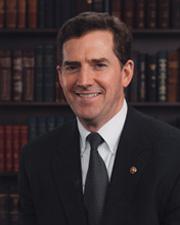 Sen. Jim DeMint (R-SC)
Legislative Activity
Stay on top of the latest movement without scrolling through every action
Senate amendment proposed (on the floor): Amendment SA 573 proposed by Senator DeMint.(consideration: CR S2516-2517, S2524-2525; text: CR S2516)
February 26, 2009
View full timeline
Senate amendment proposed (on the floor): Amendment SA 573 proposed by Senator DeMint.(consideration: CR S2516-2517, S2524-2525; text: CR S2516)
February 26, 2009
Senate amendment agreed to: Amendment SA 573 agreed to in Senate by Yea-Nay Vote. 87 - 11. Record Vote Number: 71.
February 26, 2009
Roll call votes on amendments in Senate: Amendment SA 573 agreed to in Senate by Yea-Nay Vote. 87 - 11. Record Vote Number: 71.
February 26, 2009
Amendment SA 573 proposed by Senator DeMint. (consideration: CR S2516-2517, S2524-2525; text: CR S2516) To prevent the Federal Communications Commission from repromulgating the fairness doctrine.
February 26, 2009
Amendment SA 573 agreed to in Senate by Yea-Nay Vote. 87 - 11. Record Vote Number: 71.
February 26, 2009
Senate amendment submitted
February 25, 2009
Votes
1 roll call on this amendment
Text
Proposed
DISTRICT OF COLUMBIA HOUSE VOTING RIGHTS ACT OF 2009

The ACTING PRESIDENT pro tempore. Under the previous order, the
Senate will resume consideration of S. 160, which the clerk will report
by title.
The assistant legislative clerk read as follows:

A bill (S. 160) to provide the District of Columbia a
voting seat and the State of Utah an additional seat in the
House of Representatives.

Pending:

Ensign amendment No. 575, to restore second amendment
rights in the District of Columbia.
Coburn amendment No. 576 (to amendment No. 575), of a
perfecting nature.

[[Page S2508]]

Thune amendment No. 579, to amend chapter 44 of title 18,
U.S. Code, to allow citizens who have concealed carry permits
from the State or the District of Columbia in which they
reside to carry concealed firearms in another State or the
District of Columbia that grants concealed carry permits, if
the individual complies with the laws of the State or the
District of Columbia.
Kyl amendment No. 585, to provide for the retrocession of
the District of Columbia to the State of Maryland.

The ACTING PRESIDENT pro tempore. Under the previous order, the time
until 10:30 will be equally divided and controlled between the Senator
from Arizona, Mr. Kyl, and the Senator from Connecticut, Mr. Lieberman,
or their designees.
The Senator from Connecticut is recognized.
Mr. LIEBERMAN. Mr. President, under the previous order, the Senate
will now move to the Kyl amendment, I believe, on retrocession, not to
be confused with retrogression, although there may be some similarity
between the two.
I am looking at the Senator from Maryland, who will rise to the
defense in a moment.
As my colleagues know, last night the majority leader filed a cloture
motion on this bill, S. 160, the District of Columbia House Voting
Rights Act. We made some progress yesterday. There are a few amendments
still pending. Obviously, it is our hope that we will be able to
complete the bill today and hopefully not have to go to the cloture
vote. But that depends on our colleagues.
So I would yield on the pending Kyl amendment to the distinguished
Senator from Maryland.
The ACTING PRESIDENT pro tempore. The Senator from Maryland.

Amendment No. 585

Mr. CARDIN. I thank my friend from Connecticut for his leadership on
this issue. Let me tell my colleagues, I think this is a major human
rights issue. I have the opportunity of representing this body as the
chairman of the Helsinki Commission. The Helsinki Commission deals
internationally with issues of human rights. It is interesting that the
United States has taken the leadership on protecting the rights of
individuals to vote and to be able to determine their own government.
So we have invested a lot of resources in the Helsinki Commission to
protect steps to monitor elections around Europe and central Asia and
to fight for minority communities to have the right to vote and to have
open and honest voting.
Let me tell you, last year there was a resolution filed in our
Parliamentary Assembly of the CSCE to encourage America to give the
people of the District of Columbia the right to vote. The international
community understands that we are out of compliance with basic
international norms on giving our citizens the right to participate in
their parliament.
So I look at this bill first as a basic right, that every American
should be able to have their voice heard here in the Congress of the
United States. I support this bill because it moves us in the right
direction. But I must tell you, I believe the people of the District
should have two Members of this body, two U.S. Senators, and a voting
Member of Congress, and I know we tried to do that in the 1970s with a
constitutional amendment. I was proud at that time to be a State
legislator in Maryland as speaker of the Maryland House. We passed and
ratified that constitutional amendment because we thought it was the
right thing for the District to have full representation in this body
and to have a voting representative in the House of Representatives.
So this legislation, as I said, moves in the right direction. It
gives the people of the District a voting Representative in the House
of Representatives. That, we should do. And then it even goes further,
recognizing the political sensitivity of having another Congressman who
may represent one political party. Since the District registration is
heavily Democratic, the compromise is to give another Representative to
the State of Utah because they are the closest to having been able to
obtain another Representative and the registration in Utah is heavily
Republican. So it balances it from a political point of view. I
understand that is how the system works here. I think this is a fair
compromise. What I do not understand is why we are getting all of these
other amendments on this bill as an effort to try to kill the
underlying bill. Let's have an up-or-down vote on it.
The people of the District have been waiting a long time. I think it
is the right thing for us to do to say: Let's give them a vote. Let's
get rid of these amendments because these amendments are not aimed at
trying to solve the problem, they are aimed at trying to defeat the
bill, which brings me to the amendment offered by Senator Kyl that is
currently pending.
I find this amendment somewhat surprising. Let me tell you why. It
would cede the District back to the State of Maryland. It would change
the border of my State that I represent in this body. Now, I would have
thought--maybe I am naive about this--that if a Senator was introducing
an amendment which would change the border of a particular State, that
he would talk to the Senators from that State, he would talk to the
Governor from that State, he would try to work with the Representatives
from that State because if this amendment were adopted, it would affect
every single person in Maryland. Our formulas for aid to our counties
and Baltimore City are based upon population. If all of a sudden
Maryland grows by a couple hundred thousand people, it affects the way
our counties operate essential services. Yet there was no effort made
by the author of this amendment to consult with the political
leadership of my State.
I do not know how another Senator would feel if I introduced an
amendment--and I am glad to see Senator Kyl has returned to the floor.
I don't know how Senator Kyl would feel if I introduced an amendment
that said, perhaps, Arizona's borders should change a little bit
because it makes more sense to do it that way, and there is no need to
talk to the Senators from Arizona about it or the government of
Arizona, we are just going to do it. I do not think that is the right
thing to do.
So I am somewhat puzzled. I must tell you, to me, it is a matter of
an unfunded mandate on my State. It is a matter of what federalism is
about. It is a matter of States rights, and it is a matter of common
decency.
Now, I read the amendment coming over, and I am not sure how these
lines were drawn, but I would have thought, if Maryland were to get the
District, we would at least get the Kennedy Center. But it looks as if
they took the Kennedy Center out, for reasons I cannot explain. I do
not know how these lines were drawn. So perhaps my friend will help me
understand this better and understand whether the courtesies of the
Senate mean you can put legislation in affecting the borders of one
State or another without even having the courtesy to talk to the
Members of that State.
I can tell you that Maryland very much works very closely with the
Mayor of Washington and the people of the District. We have a wonderful
regional governmental organization. We work cooperatively on providing
services to the people of this region. We have an excellent
relationship. We support giving the people of the District
representation in Congress because it is the right thing to do, and we
want them to have their own Representatives here. We think it is a
wrong suggestion to now say: Oh, we can solve this problem by changing
the borders of the State of Maryland for that.
I urge my colleagues to reject the Kyl amendment and let us get on
with passing this very important bill for Americans who have been
denied a voice in the Congress of the United States.
I yield the floor.
The ACTING PRESIDENT pro tempore. The Senator from Arizona is
recognized.
Mr. KYL. Mr. President, if the Senator from Maryland has a moment, I
would be very happy to respond to some of the concerns he raised. They
are all legitimate questions, I acknowledge up front. No State should
have territory foisted upon it. That is absolutely true. And the
questions raised here were good questions.
First of all, the amendment before us is an amendment that has
frequently been offered in the House of Representatives. It has been
vetted over there for a long time. So this is not something new.
Secondly, it is absolutely clear from section 6 of the amendment that
nothing happens with regard to retrocession unless the State of
Maryland agrees.

[[Page S2509]]

The effectiveness provision reads as follows:

Not later than 30 days after the State of Maryland enacts
legislation accepting the retrocession described in section
1(a), the President shall issue a proclamation announcing
such acceptance.

Unless the State of Maryland affirmatively, through an act of the
people's representatives of that State, vote to do this, there is no
retrocession to the State of Maryland.
That answers the question of States rights.
Mr. CARDIN. Will the Senator yield?
Mr. KYL. Of course.
Mr. CARDIN. Does he believe it is fair to say to the people of the
District of Columbia that their right to have a voice in the House of
Representatives depends upon the will of the people of Maryland?
Mr. KYL. I say to my colleague, the first point he made was that the
State of Maryland should have a say in this, and it should be a
definitive say. If the State of Maryland doesn't want the residents of
the District of Columbia to be part of the State, that informs our
decision about what the people of the State of Maryland want. I
wouldn't force that decision upon them any more than the Senator
suggests should be the case. The State of Maryland should have that
say. If the Senator is saying: I can tell you right now Marylanders
don't want these folks from the District as part of their State, we
ought to know that by a definitive process rather than assuming it to
be the case going into the debate. That would be my response.
Mr. CARDIN. Will my colleague yield further?
Mr. KYL. I am happy to engage in a colloquy.
Mr. CARDIN. I am wondering how my colleague would feel if legislation
was introduced here by a Senator not from Arizona saying: I understand
what the people of Arizona want better than the Senator does. I want to
introduce a bill affecting land rights or property rights or anything
in the State of Arizona, and I will make it subject to the vote of the
people of Arizona. It will change the border area a little bit, and I
know you don't want this, but I am going to do it anyway. I am curious
how the Senator would respond if such legislation was introduced and
the Senator who introduced it said: I am allowing your Governor to take
it to the people. I know there will be a lot of pressure building up on
that. But it is not relevant to the Senators from Arizona.
Mr. KYL. Mr. President, my colleague makes a good point. I will
respond in two ways. First, I appreciate the sentiment and would hope
that when western land issues are dealt with in this body, our eastern
colleagues would apply that same principle. Frequently, there is a
sense that folks in the east know best about what we should be doing
with Federal lands in the west. I certainly respect that sentiment.
Obviously, in some respects, that is not as important as the
fundamental political jurisdictional issue we are facing here. The
question of retrocession is a fundamental issue, and it has to do with
a fundamental right the District of Columbia residents would have to
participate in State government. I recognize there are some
differences, but I offer that first response.
Second, I am not presupposing anything with the amendment. The
question will always be before the Maryland electorate whether they
want to do this. I don't know whether the Maryland electorate wants to
do this. I presume there would be a debate. The result of that debate,
decided by the people of Maryland or their elected representatives,
would be dispositive on the question. Nobody is foisting anything on
anyone. I would be the first to say: If the people of Maryland don't
want the residents of the District to be part of the State of Maryland,
then the Congress would have to be informed by that decision. I would
think it would be dispositive.
Could I respond to a couple other points first and then I will be
happy to engage in a further colloquy.
On the matter of the way the lines were drawn, the history of this is
that the so-called national areas, the areas where the Federal
buildings, various Government departments are located, the Mall, the
monuments and those sorts of things, would not be part of the
retrocession. The bulk of the bill draws those lines. I can't tell my
colleague exactly what the philosophy was with respect to each of those
areas. Any question about what should or should not be in, be it the
Kennedy Center or anything else, is a legitimate subject of discussion.
It could be the subject of amendment. This has been a matter that has
been not frequently but not infrequently debated in the House of
Representatives. So there is some history of the rationale behind the
line drawing. But with respect to where any of these particular lines
are drawn, obviously, the Senators from Maryland should be key in
helping us to decide where those lines would be. There is nothing
locked in stone here that could not be considered the subject of an
amendment.
Finally, with respect to the unfunded mandate part, I am not sure it
wouldn't work the other way around. I cited a couple days ago the
statistics about the money that the Government provides for the
District of Columbia. Some of that money has to do with the running of
these Government departments, the construction of buildings,
maintenance of the buildings, and so on, but much of it does not. Much
of it has to do with what the Constitution provides as to the general
welfare of the people within the District. I suspect that under any
scenario, the money that has been provided to the District of Columbia
would still be far in excess of the money returned to any of the
several States. And because of the unique nature of the District and
the history and traditions, much of that funding would naturally carry
over to future years. There is no way the Federal Government is not
going to fund all of the national areas that are retained in this
legislation.
As the District's Delegate Norton said in a press release recently,
much of the money in the stimulus bill that is going to refurbish or
construct office buildings that are Federal Government buildings
provides employment opportunities for the residents of the District.
While we should obviously be sensitive to any issues of transfer, if
the State of Maryland were to accept the residents of the District of
Columbia, it is a very legitimate point, and all of those things are
appropriate for discussion.
On the matter of the unfunded mandate, it would probably work the
other way around, that Maryland would receive a lot of money from the
Federal Government. In any event, the Federal national areas that would
be receiving the amount of money that they naturally do would certainly
help the residents who work here in what is now the District of
Columbia.
There is nothing in this amendment that is intended to jam anything
down the throats of the people of Maryland. They have the final and
ultimate say of what is done. I wouldn't propose anything different
from that.
Mr. CARDIN. Will the Senator yield?
Mr. KYL. Absolutely.
Mr. CARDIN. Let me make a brief comment with regard to the mandate on
Maryland. Maryland would be under tremendous pressure to change funding
formulas consistent with what aid the District currently receives. It
would have a major impact on the ability of our State to carry out its
fundamental aid formulas to local governments, considering how
significant the District would be, the population, relative to the
State of Maryland.
The second point is, I can tell you how the people of Maryland feel.
They believe the residents of the District of Columbia should have
their voting representative in the House of Representatives. That is
how the members of our congressional delegation have acted. That is how
Senators are acting. We know that is what the District wants. We agree
with that. I hope we can get an up-or-down vote on this bill and let's
move forward.
I thank the Senator for yielding.
Mr. KYL. If I may make one other point, we will have an up-or-down
vote on this amendment at 10:30 and on the bill, of course. I want to
conclude my comments to the Senator, because he, obviously, has a good
sense of what the people of Maryland want. I concede that. Again, I
concede the premise of his point which is that the people of Maryland
should have a say before this is done. The reason for the amendment is
simply this: We believe it is unconstitutional for the Congress to
simply provide a congressional district without an amendment to the
Constitution.

[[Page S2510]]

I personally think the residents of the District should be represented
in the House. The only other way to do that, for those of us who
believe it is unconstitutional to pass the legislation pending before
us, and a court will in relatively short order make a determination on
whether that is true, and let's assume that the court says, you can't
do it, Congress, by simple legislation, then short of a constitutional
amendment, this is the only other way to achieve the objective. It is
presented in good faith. It is presented as the only other logical
alternative for the residents of the District of Columbia to have their
own congressional district. Because of the number of people who live in
the District, something over 600,000, and because the representation
from House congressional districts today is approximately a shade over
600,000, the fact is that the residents of the District could have a
district of their own or essentially exactly as the District is
configured today without presumably modifying the lines of other
Maryland districts. Of course, that would be up to the State of
Maryland in the way that it sets its congressional district lines.
Mr. CARDIN. Will the Senator yield on that point?
Mr. KYL. I am happy to.
Mr. CARDIN. Having served in the House and also going through
redistricting, the courts are now requiring an exact number of
equality. So it would be improbable that the lines would remain the
same.
Mr. KYL. I said that is why it would be ``almost.'' You might have to
include a few residents of what are now Maryland within the District,
and I acknowledge that to be the case. In any event, I accept the
fundamental premise of the Senator. Our amendment addresses that
specifically. My hope would be that if the courts should declare that
we cannot by legislation do what this bill attempts, then the people of
Maryland would strongly consider whether the next best alternative is
to provide for the retrocession we have in this amendment as the next
best way to provide a vote for the residents of the District of
Columbia.
I yield the floor.
The ACTING PRESIDENT pro tempore. The Senator from Connecticut.
Mr. LIEBERMAN. Mr. President, I thank the Senator from Arizona and
the Senator from Maryland for a thoughtful discussion. I rise to oppose
amendment No. 585, offered by the Senator from Arizona. Unlike some of
the other amendments pending, this one goes to the heart of what the
underlying bill that came out of committee is all about, which is how
do we give voting rights in Congress to 600,000 Americans who happen to
live in our Nation's Capital who don't have such representation now. I
disagree with the method, but I appreciate the fact that this is not
germane in a parliamentary sense, but it is directly relevant to the
underlying injustice and inequity. But for the reasons that the Senator
from Maryland made clear, this is not a practical solution to the
problem before us, the longstanding injustice.
It requires the consent of the people of Maryland, and all their
leaders tell us that the people will not support it. So it may be a
solution on paper, but it is not going to be a solution and a fix to
the problem in fact. It is also full of complications that would ensue.
For instance, section 2 of the amendment would automatically transfer
all pending legal actions in the District of Columbia to an
``appropriate Maryland court.'' We can only imagine the legal and
political tangle that could create given that Maryland and the District
actually have distinct legal structures, rules, and precedents. Section
3 of the amendment describes at some length the boundaries of a small
but still sizable national capital service area that would continue to
be controlled by Congress and which would consist of key Federal
buildings and monuments. There are complications there too. Who would
police and maintain those streets and otherwise administer this large
swath of downtown Washington?
As has been said, it would require a constitutional amendment to
repeal amendment XXIII which granted the District of Columbia three
electoral votes in Presidential elections. If amendment XXIII were not
repealed, presumably the effect would be to grant a disproportionately
large role in Presidential elections to a relatively small population
that would continue to reside in that national capital service area and
that would remain under congressional control. In fact, the amendment
recognizes this and, therefore, would not become effective until such a
repeal amendment to the Constitution is ratified.
As I have said, this is an alternative solution to the problem. I
appreciate it in that it would, if it overcame the obstacles, actually
be a remedy, but it is not the right or realistic remedy to the
injustice of nonvoting representation in Congress for residents of the
District. The right and reasonable and realistic solution is the
underlying bill before us, S. 160. That is why I oppose the amendment
and urge the passage of the bill.

The ACTING PRESIDENT pro tempore. The Senator from Arizona.
Mr. KYL. Mr. President, let me respond to two points my colleague
made, and they are both legitimate questions. The first is some of the
technical problems. I am sure there are a lot of technical problems we
have not even thought about that would attend. This is a big change.
Whether you adopt the underlying legislation or you go through a
process such as retrocession, there will have to be a lot of
adjustments and accommodations, to be sure.
But on questions such as, for example, policing the Mall and so on,
those things are already well understood and resolved. For example, I
have spoken recently with Capitol Police and asked them about the
overlapping jurisdiction: Where, for example, does the Capitol Police
jurisdiction end and where does the DC Police jurisdiction begin, and
so on? They have all these things worked out. I do not think there is
any difficulty with those kinds of technical issues. But there will be,
undoubtedly, others that will have to be addressed as well.
Secondly, my colleague is correct, in order to avoid the anomalous
situation where a few people who might be technically residents
downtown and not have other residence downtown--being in the Federal
areas or national areas as described in this legislation--we would have
to eliminate the twenty-third amendment to make sure those people would
not have three electoral votes for the Presidency. I cannot imagine
that if retrocession did occur the citizens of the country would not
follow through on that essentially technical issue and approve the
recession of the twenty-third amendment. But it is one of the things
that will have to be done. That is absolutely true.
Again, I will conclude by saying, for those of us who believe it
would be preferable for the residents of the District to have their own
representative in the House of Representatives and, in fact, to be able
to vote for Senators, and have that representation as well, if they are
part of a State--if, in fact, the underlying legislation is
unconstitutional, as many of us believe it is--then this amendment
offers a constructive way to achieve the same result, I would suggest,
with very little in the way of adjustment, but with some adjustment
that would have to occur--again, subject solely to the approval of the
people of the State of Maryland.
I say to our colleagues, this vote is scheduled for 10:30, so if
there are people who want to discuss other amendments or other matters,
or to further debate this amendment, this would be a good time to do
so.
Mr. LIEBERMAN. Mr. President, I thank my friend from Arizona. He is
absolutely right. I have been informed that the senior Senator from
Delaware is on his way to the floor to speak on this amendment. But I
echo what Senator Kyl has said, that we have some other pending
amendments. The floor is open until the vote at 10:30, and I urge our
colleagues to come and take advantage of that opening.
With that, Mr. President, I suggest the absence of a quorum.
The ACTING PRESIDENT pro tempore. The clerk will call the roll.
The assistant legislative clerk proceeded to call the roll.
Mr. CARPER. Mr. President, I ask unanimous consent that the order for
the quorum call be rescinded.
The ACTING PRESIDENT pro tempore. Without objection, it is so
ordered.
Mr. CARPER. Mr. President, yesterday morning, at about 8 o'clock,
down

[[Page S2511]]

in, I think, S. 115, there was a prayer breakfast. Actually, that
happens about every week. And for many weeks in the last year or two,
our Acting President pro tempore was one of two Members--one a Democrat
and one a Republican--who brought people together for an hour of
fellowship. They would have breakfast together and sing a hymn--or at
least try to sing a hymn--or a song of some kind, and they would share
their story, if you will, their spiritual journey with one another.
I usually do not get to go to those; I am on a train coming down from
Wilmington, DE. But I have been a time or two, and I find it very
uplifting. There is a smaller gathering that will occur today a little
after noon, right here off the Senate floor, and it will be a group
convened by our Chaplain, Barry Black, who is a retired Navy rear
admiral. He used to be Chief of Chaplains for the Navy and the Marine
Corps.
What we have is a little bit like an adult Sunday school class. There
are people of different faiths who show up. Sometimes we may have five
or six or seven or eight or nine people there, Democrats and
Republicans.
I always like to tell the story that happened about a couple years
ago, when we were having orientation for new Senators--something our
Acting President pro tempore has been a part of establishing--but we
had a last session of orientation for new Senators--I think it was
about 2004, right after the election--a last session where John Breaux,
a Democrat, was leaving and Don Nickles, a Republican, was leaving the
Senate, and they both were talking to our new Senators and their
spouses about bridging the partisan divide.
Don Nickles talked--he has a great sense of humor; so does John
Breaux, as we know--and Senator Nickles was about to leave the Senate.
He was talking to the Democrats and Republicans who had just arrived,
and their spouses, and he said: You all ought to think about going to
this Bible study group. It is uplifting. It is inspiring. It is
refreshing. You get to know your colleagues better. It does not take
that much time every week. He said: You ought to try to do it. Tom
Carper and I go to that Bible study group. He is a Democrat and I am a
Republican.
He said: Week after week, month after month, you sit together, you
read Scriptures together, you talk and share with one another your
thoughts and problems and what you are facing in your life. You pray
for each other. He said: You know, after I do that, it is hard to walk
out on the Senate floor and stab Tom Carper in the back. He said: It is
not impossible, but it is hard.
One of the other things that is hard is for us to actually figure out
how our faith should guide us in the decisions we make here. I am
always inspired by the depth of conviction of the floor manager, the
chief sponsor of this bill, Senator Lieberman, and how his faith guides
him in the work we do here.
But Barry Black, our Chaplain, often challenges us in the Senate--
Democrats and Republicans--and not just there, but, later today, in our
Bible study class, and also at the Wednesday morning prayer breakfast,
and throughout the week--he is always challenging us: How should we use
our faith to help guide us in the decisions we make?
The other thing he is good at doing is reminding us, about every
other week, of the two great Commandments in the New Testament. The
first: Love Thy Lord Thy God with all thy heart, all thy soul, all thy
mind. And the second one is: To love thy neighbor as thyself--which we
also call the Golden Rule: Treat others the way we want to be treated.
Chaplain Black likes to say the ``CliffsNotes'' of the New Testament is
the Golden Rule: Treat other people the way we want to be treated.
When I run into great leaders in my life, in this country and in
other countries, a lot of times the good leaders are those who actually
internalize the Golden Rule, who do try to treat others the way they
want to be treated. I am pleased to say that the two Senators who are
here on the floor right now certainly embody that rule too.

How does that pertain to the legislation before us? Well, I think it
pertains to the legislation before us because there are about 600,000
people who live in the District of Columbia. Some of them actually work
here with us, but they live here in the District of Columbia and they
pay taxes. They pay Federal taxes. They don't get to vote. They don't
have a vote here in the Senate. They don't have a Representative, if
you will, who can vote for them and for their interests and concerns in
the House of Representatives.
Delaware has about 850,000 people, so we have a few more people than
the District of Columbia. There are some other States that have fewer
people than we do. There is actually probably a State or two that has
fewer people living in it than does the District of Columbia. I won't
call out those States here this morning. They are pretty big in
geography but not so big in population. They have two Senators and at
least one U.S. Representative. Whether the issue is foreclosures,
budget, or stimulus package, they have somebody here to vote, to
represent them, to speak on the floor and to offer legislation, amend
legislation, and to vote on legislation. We saw in the stimulus package
how critical one or two votes can be. The District of Columbia has
nobody here and they have nobody voting for them in the House. They
have a delegate--a very good one--who can vote in committee, offer
legislation, offer amendments, and introduce bills, but can't actually
vote when the time comes. There is something about that that seems
unfair to me. It seems unfair to me. I think it certainly seems unfair
to the sponsor of the bill, Senator Lieberman, and to a lot of people
who cosponsored the legislation, as have I.
None of us is suggesting that there ought to be two Senators
representing folks from the District of Columbia. In allowing the
delegate to become sort of a full-fledged U.S. Representative over in
the House, there is a trade that--we would expect that person to be a
Democrat, at least initially; maybe someday Republican--but the idea
would be to provide an additional Republican representative, in this
case from the State of Utah. That seat may become a Democratic seat. I
wouldn't want to bet my paycheck on it, but it might. So we are trying
to come up with an equitable, a fair, a reasonable compromise. Isn't
politics the art of compromise? This is a compromise.
There are some who have suggested that is unconstitutional. I am not
a constitutional expert. I know a lot of smart people have considered
it. We will have an opportunity--if this legislation is passed and
signed by the President, there will be an opportunity for an expedited
process and the Federal courts, the appropriate courts will determine
whether this measure, this statute actually is constitutionally sound.
My hope is it will be. A lot of forethought has gone into this issue
already.
In closing, let me say in the minute or so that is left on our side,
I wish to thank Senator Lieberman for his steadfast leadership on this
issue and for making it not just a bipartisan issue but a tripartisan
issue, by making sure we have both Republicans and Democrats and
Independents such as himself and Bernie Sanders to weigh in and to
support this legislation; not just to offer the bill but actually to
stand up and call on the rest of us to do what we know in our hearts is
fair and just, and to put ourselves in the shoes of the folks who live
here in Washington, DC and who work and pay their taxes and who deserve
a full-fledged vote, at least in the House of Representatives. We will
wait another day to take up that battle here in the Senate.
That having been said, I yield back my time.
The ACTING PRESIDENT pro tempore. The time for the majority has
expired.
Mr. LIEBERMAN. Mr. President, seeing no one on the other side in the
Chamber, I ask unanimous consent to speak for no more than 5 minutes,
probably less.
The ACTING PRESIDENT pro tempore. Without objection, it is so
ordered.
Mr. LIEBERMAN. I thank the Chair. I will yield if anyone on the other
side comes in.
I thank my friend from Delaware for his very eloquent and thoughtful
statement. The pending amendment is on retrocession. As the Senator
began his remarks about the Bible study and prayer groups, I thought he
was going to talk about redemption and not retrocession, but he got to
the point. I must say, if I may continue the argument the Senator from
Delaware made

[[Page S2512]]

very eloquently in two ways, S. 160, the underlying bill, does
provide--please allow me some license here for a kind of political
redemption--for the voters of the District of Columbia who up until
this time have been denied a voting representative in Congress. The
whole premise of our Government is that we govern with the consent of
the governed, but here we have 600,000 Americans who, through
historical anomalies and maybe more recently partisan disagreements,
don't get to consent or object to anything we do to them or even for
them.
The second--and I thank my friend from Delaware for making this point
about the Golden Rule. I hope all of our colleagues in the Senate will
apply that fundamental ethical human principle to this vote and think
about how we would feel if we were the District's Delegate in the House
of Representatives. Eleanor Holmes Norton is a gifted and wonderful
person. I have known her--I won't state the year because I don't want
to compromise the privacy of her age; mine has already been compromised
this week. We were at law school together. She is an extraordinarily
gifted person and a very diligent and passionate and aggressive
advocate for the people of the District of Columbia. Imagine how we
would feel if we were occupying the seat she occupies in the House of
Representatives. She gets to debate issues. She gets to talk. But when
the roll is called, imagine how we would feel--my friend from Delaware
and our dear friend from Arkansas who occupies the Chair at the moment,
myself--if there were a major item here in the Senate and we could
debate it, but then the roll is called and it is as if our mouths are
stifled, muffled. We couldn't vote. That is what Delegate Norton goes
through in the House of Representatives. If we think about it that way,
in the terms the Senator from Delaware stated, to treat others as we
would like to be treated ourselves, it seems only fair, reasonable,
human to give Delegate Norton and the 600,000 people she represents the
right to vote on the floor.
So I thank my friend for taking the time to come over and speak as
eloquently and convincingly as he has.
With that, I yield the floor and suggest the absence of a quorum.
The ACTING PRESIDENT pro tempore. Without objection, it is so
ordered. The clerk will call the roll.
The legislative clerk proceeded to call the roll.
Mr. LIEBERMAN. Madam President, I ask unanimous consent that the
order for the quorum call be rescinded.
The PRESIDING OFFICER (Mrs. Gillibrand). Without objection, it is so
ordered.
Under the previous order, the question is on agreeing to amendment
No. 585.
Mr. KYL. Madam President, I ask for the yeas and nays.
The PRESIDING OFFICER. Is there a sufficient second? There is a
sufficient second.
The clerk will call the roll.
The legislative clerk called the roll.
Mr. DURBIN. I announce that the Senator from Massachusetts (Mr.
Kennedy) is necessarily absent.
Mr. KYL. The following Senator is necessarily absent: the Senator
from Tennessee (Mr. Corker).
Further, if present and voting, the Senator from Tennessee (Mr.
Corker) would have voted ``yea.''
The PRESIDING OFFICER. Are there any other Senators in the Chamber
desiring to vote?
The result was announced--yeas 30, nays 67, as follows:

[Rollcall Vote No. 69 Leg.]

YEAS--30

Alexander
Barrasso
Bennett
Bond
Bunning
Burr
Chambliss
Coburn
Cochran
Cornyn
Crapo
DeMint
Enzi
Graham
Grassley
Hatch
Hutchison
Inhofe
Isakson
Johnson
Kyl
Martinez
McCain
McConnell
Risch
Roberts
Shelby
Thune
Vitter
Wicker

NAYS--67

Akaka
Baucus
Bayh
Begich
Bennet
Bingaman
Boxer
Brown
Brownback
Burris
Byrd
Cantwell
Cardin
Carper
Casey
Collins
Conrad
Dodd
Dorgan
Durbin
Ensign
Feingold
Feinstein
Gillibrand
Gregg
Hagan
Harkin
Inouye
Johanns
Kaufman
Kerry
Klobuchar
Kohl
Landrieu
Lautenberg
Leahy
Levin
Lieberman
Lincoln
Lugar
McCaskill
Menendez
Merkley
Mikulski
Murkowski
Murray
Nelson (FL)
Nelson (NE)
Pryor
Reed
Reid
Rockefeller
Sanders
Schumer
Sessions
Shaheen
Snowe
Specter
Stabenow
Tester
Udall (CO)
Udall (NM)
Voinovich
Warner
Webb
Whitehouse
Wyden

NOT VOTING--2

Corker
Kennedy

The amendment (No. 585) was rejected.
Mr. LIEBERMAN. Madam President, I move to reconsider the vote, and I
move to lay that motion on the table.
The motion to lay on the table was agreed to.
Mr. LIEBERMAN. Madam President, I believe two of our colleagues wish
to speak as in morning business at this time. After that, our intention
is to pick up the amendment offered by the Senator from South Carolina,
Mr. DeMint, on the fairness doctrine, and then Senator Durbin also will
be offering a matter on the fairness doctrine as well.
With that in mind, I yield the floor to one of the two Senators to my
right, and they may joust as to who goes first.
Mr. BOND. Madam President, I thank my colleague from Connecticut,
with whom I worked so closely last fall and at the end of January, for
allowing us to go forward. I ask unanimous consent to speak as in
morning business, and my colleague, the Senator from Iowa, I believe,
wishes to speak as in morning business after that, as indicated by the
manager of the bill.
The PRESIDING OFFICER. Without objection, it is so ordered.
(The remarks of Mr. Bond and Mr. Grassley are printed in today's
Record under ``Morning Business.'')
Mr. ENSIGN. Madam President, I ask unanimous consent that the pending
amendment be set aside to call up the amendment No. 587.
The PRESIDING OFFICER. Is there objection?
Mrs. FEINSTEIN. Reserving the right to object, it is my understanding
that the Senator from Nevada wishes to call up the amendment and speak
very briefly--he mentioned to me 2 minutes. I believe I am in the line
to speak and I wish to speak on this amendment.
Is that the agreement?
Mr. ENSIGN. Madam President, I ask unanimous consent that I be
allowed to call up my amendment, get it pending, and speak on it for 2
minutes.
Mrs. FEINSTEIN. Is the subject of this amendment vouchers?
Mr. ENSIGN. Yes.
Mrs. FEINSTEIN. No problem.

Amendment No. 587

The PRESIDING OFFICER. Without objection, it is so ordered.
The clerk will report.
The assistant legislative clerk read as follows:

The Senator from Nevada [Mr. Ensign] proposes an amendment
numbered 587.

Mr. ENSIGN. Madam President, I ask unanimous consent that the reading
of the amendment be dispensed with.
The PRESIDING OFFICER. Without objection, it is so ordered.
The amendment is as follows:

(Purpose: To reauthorize the DC School Choice Incentive Act of 2003 for
fiscal year 2010)

At the end, add the following:

SEC. __. REAUTHORIZATION OF THE DC SCHOOL CHOICE INCENTIVE
ACT OF 2003.

(a) Reauthorization.--Section 313 of the DC School Choice
Incentive Act of 2003 (title III of division C of Public Law
108-199, 118 Stat. 134) is amended by striking ``fiscal year
2004 and such sums as may be necessary for each of the 4
succeeding fiscal years'' and inserting ``fiscal year 2010''.
(b) Severability.--Notwithstanding section 7, if any
provision of this Act (other than this section), and
amendment made by this Act (other than by this section), or
the application of such provision or amendment to any person
or circumstance is held to be unconstitutional, this section,
the amendment made by this section, and the application of
such to any person or circumstance shall not be affected
thereby.

Mr. ENSIGN. Madam President, I rise to offer a DC voucher program for
low-income children at or below 185 percent of the Federal Poverty
Line. Children would be eligible to receive up to $7,500 to attend a
private school in the District.
It has been said that education, especially K-12 education is a civil
right. I

[[Page S2513]]

believe it is. In Washington, DC, public schools are failing too many
of our kids--especially our low-income kids. These children are trapped
in schools that are failing.
About half the kids in Washington, DC, public schools do not
graduate, and this is not because of money. The District spends perhaps
the most in the country, on education. They spend almost $15,000 a year
per student per year in public schools. That is almost three times the
amount we spend per student per year in Nevada. Yet the performance of
the public schools in the District is pathetic. There are very few
Members of Congress who would allow their kids to go to these failing
schools.
The reason I am offering my amendment today, which would reauthorize,
for 1 year, a very valuable voucher program, is because the upcoming
Omnibus appropriations bill basically guts the program. We need to make
sure this program is in place in time for parents to plan for their
children's education in the fall.
This is an important amendment. This is a civil rights amendment. We
are talking about the right to a DC Representative voting here, we
should care enough about our children to give them the right to a good
education. That is what this amendment is about. Now, we are going to
try to work this out. We may not be offering this amendment if we can
get an agreement from the majority leader for time on the floor
sometime this spring to be able to debate a full bill. That is what I
would hope we could be able to do. If not, then we will hope for a vote
on this amendment.
I yield the floor.
The PRESIDING OFFICER. The Senator from Connecticut.
Mr. LIEBERMAN. Madam President, if I may very briefly respond to my
friend from Nevada, I appreciate the statement he has made. Personally,
I agree with him on this DC scholarship program which I supported in
past years. The authorization is running out.
The Homeland Security and Governmental Affairs Committee, as my
friend knows, actually still possesses jurisdiction over matters
related to the District of Columbia. So we would be the proper
committee to consider an authorization bill.
As I have said to my friend, I do not know what I would support. I do
not know what the outcome of the committee would be. But I appreciate
the spirit in which he has presented this amendment. I agree with him
totally that we ought to be reauthorizing this program, and we will
work together to see, with the majority leader, whether we can get an
agreement that there will be floor time with a time limit given to a
debate and an attempt to reauthorize the program when it expires, which
I believe is in this fiscal year, meaning that it would affect the
school year that begins in September.
So I will pursue that with the leader and will continue our
conversations. I thank him for offering the amendment.
I now yield the floor to our distinguished colleague from California.
The PRESIDING OFFICER. The Senator from California.

Amendment No. 575

Mrs. FEINSTEIN. Madam President, I thank the manager of the bill. I
rise today to speak in strong opposition to amendment No. 575 offered
by Senator Ensign. This amendment is not the instant amendment that he
just spoke about; it is the amendment that essentially would repeal all
commonsense gun laws in the District of Columbia.
I believe the amendment is reckless. I believe it is irresponsible. I
believe it will lead to more weapons and more violence on the streets
of our Nation's Capital. It will endanger the citizens of the District,
the Government employees who work here, our elected officials, and
those who visit this great American Capitol. And, of course, if
successful, it will be the first new step in a march to remove all
commonsense gun regulations all over this land.
The Ensign amendment repeals gun laws promoting public safety,
including DC laws that the U.S. Supreme Court indicated were
permissible under the second amendment in the Heller decision. I
strongly disagree with the Supreme Court decision in Heller that the
second amendment gives individuals a right to possess weapons for
private purposes not related to State militias, and that the
Constitution does not permit a general ban on handguns in the home. But
that is the law. It has been adjudicated. It has gone up to the highest
Court, and I am one who believes if we do not like the law, we should
try to make changes through the proper legal channels. However, it is
important to note that Heller also stands for the proposition that
reasonable, commonsense gun regulations are entirely permissible.
As the author of the original assault weapons ban that was enacted in
1994, I know commonsense gun regulations do make our communities safer,
while at the same time respecting the rights of sportsmen and others to
keep and bear arms.
Just yesterday, the Department of Justice announced the arrest of 52
people in California, Minnesota, and Maryland. In addition to seizing
12,000 kilograms of cocaine and more than 16,000 pounds of marijuana,
the DEA also seized 169 illegal firearms from members of the Sinoloa
Cartel.
Where did they get those guns? It would be interesting to find out
because this cartel is one of several that law enforcement believes is
responsible for kidnappings and murders within the United States in
addition to engaging in violent gun crimes.
In talking about the Sinoloa Cartel yesterday, Attorney General
Holder noted that reinstituting the assault weapons ban would benefit
the United States, as well as help stop the flood of weapons being sent
from the United States to Mexico for use by drug cartels to cause
violence on both sides of the border.
I am prepared to wage the assault weapons battle again and intend to
do so. I have been quiet about this because there are many pressing
needs of this Nation. But with the help of the President, the
administration, and the people of this great country, we do need to
fight back against these kinds of amendments.
Justice Scalia wrote in the majority opinion on the Heller case that
a wide variety of gun laws are ``presumptively lawful,'' including the
laws ``forbidding the carrying of firearms in sensitive places'' and
regulations governing ``the conditions and qualifications of the
commercial sale of arms.''
I cannot think of any place more sensitive than the District of
Columbia. Even bans on ``dangerous and unusual weapons'' are completely
appropriate under the Heller decision. So it is interesting to me that
you have this decision, and then you have the Senate moving even to
obliterate what is allowable under the decision.
Senator Ensign's amendment completely ignores Heller's language and
takes the approach that all guns for all people at all times is called
for by Heller. It is not.
We have all seen the tragic consequences of gun violence: the
massacre of students at Virginia Tech University in 2007, the murders
at Columbine High School in Colorado, the North Hollywood shootout
where bank robbers carrying automatic weapons and shooting armor-
piercing bullets shot 10 Los Angeles Police Department SWAT officers
and seven civilians before being stopped.
We have seen criminal street gangs able to buy weapons at gun shows
and out of the back seats or the trunks of automobiles. We have seen
their bullets kill hundreds, if not thousands of people across this
great land--men, women, and children.

I remember one case in the San Francisco Bay area not long ago where
a youngster taking a piano lesson in a home had a bullet from a gang
member pierce the wall of the home, cut his spine, and today he is a
paraplegic. It is unbelievable for me to think of the ease with which
people can buy weapons.
As Senator Schumer said, if this amendment becomes law, even if you
cannot see, even if you cannot pass a sight test, you can have access
to firearms. That is not what this Nation should encourage. Those
incidents and the gun violence that occurs every day across this
country show us that we should be doing more, not less, to keep guns
out of the hands of criminals and the mentally ill and not give them
unfettered access to firearms.
It is worth noting just how far this amendment goes in repealing DC
law and just how unsafe it will make the streets of this Capitol. Here
is what it

[[Page S2514]]

would do: It would repeal DC's ban on semiautomatic weapons, including
assault weapons. If this amendment becomes law, military-style assault
weapons with high-capacity magazines will be allowed to be stockpiled
in homes and businesses in the District, even near Federal buildings
such as the White House and the Capitol. Even the .50 caliber sniper
rifle, with a range of over 1 mile, will be allowed in DC under this
amendment. This is a weapon capable of firing rounds that can penetrate
concrete and armor plating. And at least one model of the .50 caliber
sniper rifle is easily concealed and transported. One gun manufacturer
describes this model as a ``lightweight and tactical'' weapon and
capable of being collapsed and carried in ``a very small inconspicuous
package.''
Is this what we want to do? There is simply no good reason anyone
needs semiautomatic, military-style assault weapons in an urban
community. It is unfathomable to me that the same high-powered sniper
rifle used by our Armed Forces will be permitted in the Nation's
Capital. Yet this is exactly what the amendment would allow if passed
by the Senate.
Next, the amendment would repeal existing Federal anti-gun
trafficking laws. For years, Federal law has banned gun dealers from
selling handguns directly to out-of-State buyers who are not licensed
firearms dealers. This has helped substantially in the fight against
illegal interstate gun trafficking, and it has prevented criminals from
traveling to other States to buy guns.
Senator Ensign's amendment repeals this longstanding Federal law and
allows DC residents to cross State lines to buy handguns in neighboring
States. Illegal gun traffickers will be able to easily obtain large
quantities of firearms outside of DC and then distribute those guns to
criminals in DC and in surrounding States.
And no one should be so naive as to say that this amendment will not
do this. It will. The amendment repeals DC law restricting the ability
of dangerous and unqualified people to obtain guns. The amendment also
repeals many of the gun regulations that the Supreme Court said were
completely appropriate after Heller.
So all of those who will vote for this amendment should not do so
thinking they are just complying with the Heller decision. This is part
of a march forward by gun lobby interests in this country to begin to
remove all commonsense regulations, and no one should think it is
anything else.
This would repeal the DC prohibition on persons under the age of 21
from possessing firearms, and it repeals all age limits for the
possession of long guns, including assault weapons.
Do we really want that? I think of the story of an 11-year-old who
had a reduced barrel shotgun and just recently killed somebody with it.
Is this what we want to see all over this country, the ability of
virtually anyone to obtain a firearm regardless of their age? I don't
think so.
The amendment even repeals the DC law prohibiting gun possession by
people who have poor vision. I heard Senator Schumer speak about this
yesterday afternoon. Unbelievably, under this amendment, the District
would be barred from having any vision requirement for gun use, even if
someone is blind. Is this the kind of public policy we want to make for
our Nation? Is this how co-opted this body is to the National Rifle
Association and others? I hope not.
One of the reasons we have 6-year terms is to allow us to make
difficult decisions. There is no higher charge than protecting our
public safety. We should protect individuals. The way we protect
individuals is by enacting public policy that is prudent, reasonable,
and subject to common sense. This amendment does none of the above.
I ask my colleagues to think carefully about this amendment, because
if it succeeds, trust me, the march for similar legislation will be on.
I introduced the assault weapons legislation. I survived. I had an
election in 1994, just after I had introduced it. I survived. The
people of my State want commonsense gun control. They don't want local
jurisdictions stripped of any ability to enact prudent regulation.
The Presiding Officer is in the chair. The husband of one of her
colleagues, going home on the Long Island train, was shot and killed by
someone who never should have had a weapon. How many of these incidents
do we have to have? How many businesses employing people who are
mentally ill have to suffer when they have a grudge against an
employee, and kill 6, 7, 8, 9, or 10 people? How many schools do we
have to have where aggrieved students go out and acquire the most
powerful weapons and come into cafeterias, libraries, or classrooms and
mow down students? A vote for this amendment, any way we look at it,
makes this easier to happen.
I believe passionately about this. I will never forget, many years
ago, before I was mayor, walking into the robbery of a corner grocery
store. When people die of gunshot wounds, it is not the way it is on
television or in the movies. I saw brain matter all over the walls. I
saw the husband, a proprietor, the wife, a proprietor. This individual
who came in even shot the dog. People are capable of terrible
criminality. We should not encourage that criminality by making their
access to weapons so very easy.
As I say, this is the first step in a march to see that there is no
ability to enact prudent gun regulation throughout the United States.
I ask every colleague, before they vote for this, to think about the
people they represent and whether society is going to be safer because
of their vote. How deep have we sunk in catering to these interests?
For shame.
The amendment before the Senate repeals all firearm registration
requirements in the District, making it even more difficult for law
enforcement to trace guns used in crimes and track down the registered
owner. The amendment repeals all existing safe-storage laws and
prohibits the District from enacting any additional safe-storage laws.
After the Heller decision, the District passed emergency legislation to
allow guns to be unlocked for self-defense, but requiring that they
otherwise be kept locked to keep guns out of the hands of children and
criminals. We all ought to want that. The Ensign amendment repeals even
this modest limitation and prevents the District of Columbia City
Council from enacting any law that discourages--whatever that means--
gun ownership or requiring the safe storage of firearms. How can we, in
the Capital of the United States where we have had so many tragic
events, possibly do this? This is simply ridiculous and goes well
beyond the Supreme Court's ruling in Heller.
Think about what this means. Consider that every major gun
manufacturer recommends that guns be kept unloaded, locked, and kept in
a safe place. Under this amendment, the District could not enact any
legislation requiring that guns be stored in a safe place, even in
homes with children. How can anyone believe this broad-brush amendment
is the right thing to do? How can any of us believe it provides
protection for the people we represent?
Let me make one other point. The American people clearly do not agree
with this amendment. Last fall, when a virtually identical bill was
being considered in the House of Representatives, a national poll found
that 69 percent of Americans opposed Congress passing a law to
eliminate the District's gun laws--69 percent. That is about as good as
we get on any controversial issue. Additionally, 60 percent of
Americans believe Washington will become less safe if Congress takes
this step. Is this what we want? Do we want the Capital of the United
States to become less safe? I don't think so. Today, if this amendment
passes in the Senate, it will be directly against the wishes of the
American people. It will not pass because it is good public policy--it
will only be passed to placate the National Rifle Association. I say
for shame.
As a former mayor who saw firsthand what happens when guns fall into
the hands of criminals, juveniles, and the mentally ill, I believe this
amendment places the families of the District of Columbia in great
jeopardy. The amendment puts innocent lives at stake. It is an affront
to the public safety of the District. It is an affront to local home
rule. This isn't just a bad amendment; it is a very dangerous one. I
very strongly urge Senators to join me in opposing it.
I yield the floor.
The PRESIDING OFFICER. The Senator from Kansas.
Mr. BROWNBACK. Madam President, I appreciate the debate on several
key

[[Page S2515]]

amendments. I also want to recognize my colleague from California and
her strong support--indeed, key position--on the voucher program, the
DC scholarship program that she has been one of the primary architects
of and wants to get measurables on it. It is in the subcommittee on
appropriations on which I serve, and she has been a key person on that.
It is my hope we can work that out, whether it is going to be at a
later time for reauthorization or if we can pass it here today. It is a
key program, and I want to recognize what my colleague has done on that
historically. That is what I come to the floor to talk about, as well
as a couple of other things that are coming up but particularly the DC
scholarship program. It is an amendment. We have it appropriated in the
appropriations bill, but it is required for reauthorization. It needs
to be reauthorized. My hope is that the majority leader will say, yes,
we will bring this up for reauthorization and give us floor time to do
that. I understand the manager of this bill has said he would bring it
up in his committee and do a markup in committee.
I have worked for this program for some period of time. I have worked
with the students and parents in this program. They love it. They
appreciate the chance to succeed in a failed school system. The DC
Opportunity Scholarship Program has received applications from over
7,000 low-income students, has served over 2,600 of these children. We
have far more applicants than we do slots. When these students entered
the program, they had average math and reading test scores in the
bottom third of all test takers. Recent evaluation by the U.S.
Department of Education--this goes back to last year--affirms academic
gains among scholarship students less than 2 years after receiving a
scholarship. Last year, after less than 1 year in the program, two
subgroups of students, representing 83 percent of participating
students, showed positive results in math, and both years showed
overwhelming parental satisfaction. Parents like it. Students are doing
better. It is working.

I certainly wish to salute Mayor Fenty and DC school chancellor
Michelle Rhee for making education reform and support for this program
something important in the District. They made this a high priority.
Certainly, we have to get the schools functioning in the District of
Columbia. This is a piece of it that is working for 1,700 students. We
need it reauthorized to be able to continue to move it forward. It
would be heartless for us not to do it.
I recognize a number of people have a problem with it on this bill. I
understand that. If there is a chance we can get an agreement that the
reauthorization would take place later, that would be a wise route to
go, and then follow through regular order. But this one is working and
is working well. It is being well received by parents and students. It
has an odd sort of support base where it has both left and right. It
has a lot of people in a low-income situation supporting it. It is one
of those pieces of legislation that have a broad base of support
ideologically and practically. People want to see it moving forward and
have it succeed as an overall program. I am very hopeful this Congress
can do that.
Two other quick points. One is coming up on the fairness doctrine
that will be considered. The fairness doctrine, to educate my
colleagues--I am sure everybody is familiar with it--was promulgated by
the FCC in 1949 to ensure that contrasting viewpoints would be
presented on radio and television.
In 1985, the FCC began the process of repealing the doctrine after
concluding that it actually resulted in broadcasters limiting coverage
of controversial issues of public importance.
Now we are hearing from some voices saying this doctrine should be
put back in place. I urge colleagues to not do that. This isn't the way
for us to get a good discussion going in the public marketplace.
Indeed, the results in the past, and I believe today, would be that the
doctrine would actually result in less, not more, broadcasting of
important issues to the public. Airing controversial issues would
subject broadcasters to regulatory burdens and potentially severe
liabilities. They simply would say: We will not put anything on.
Just think about the changing landscape in broadcast radio and
television that has taken place since 1949. These numbers are
startling. In 1949, there were 51 television stations in the country
and 2,500 radio stations. Maybe a lot of people wish we would go back
to that era of less media, but we will not. In 1958, there were 1,200
television stations and 9,800 radio stations. Today, there are 1,800
television stations and 14,000 radio stations. There is simply no
scarcity to justify content mandates such as the fairness doctrine that
would be a regulatory nightmare for radio and television stations.
Plus, we have all the new media, social networking, and individual
citizen access to information on the Internet that does not warrant
this being put back into place.
Finally, to comment on the second amendment rights, the Supreme
Court, in a historic ruling, has found that second amendment rights
apply to the individual, and that applies to individuals across the
country, that applies to individuals in the District of Columbia. I
think those should be continued and guaranteed and supported by this
body as well. I think it would be appropriate for us to support that
and support that in this legislation.
Madam President, in conclusion, I would like to have printed in the
Record two editorials in agreement from two publications that
frequently do not agree. One is from the Wall Street Journal and the
other is from the Washington Post. Both are in support of the DC
voucher program, saying it works--it works for kids, it works for
parents--and is something that should be continued. I have never had
printed in the Record before editorials from those two publications at
the same time agreeing on the same topic, particularly in education. I
think what it says is that this one is working and should be continued.
So I ask unanimous consent that the editorials be printed in the
Record.
There being no objection, the material was ordered to be printed in
the Record, as follows:

[From the Wall Street Journal, Feb. 25, 2009]

Obama's School Choice

President Obama made education a big part of his speech
Tuesday night, complete with a stirring call for reform. So
we'll be curious to see how he handles the dismaying attempt
by Democrats in Congress to crush education choice for 1,700
poor kids in the District of Columbia.
The omnibus spending bill now moving through the house
includes language designed to kill the Opportunity
Scholarship Program offering vouchers for poor students to
opt out of rotten public schools. The legislation says no
federal funds can be used on the program beyond 2010 unless
Congress and the D.C. City Council reauthorize it. Given that
Democrats control both bodies--and that their union backers
hate school choice--this amounts to a death sentence.
Republicans passed the program in 2004, with help from
Democratic Senator Dianne Feinstein, and it has been
extremely popular. Families receive up to $7,500 a year to
attend the school of their choice. That's a real bargain,
given that D.C. public schools spend $14,400 per pupil on
average, among the most in the country.
To qualify, a student's household income must be at or
below 185% of the poverty level. Some 99% of the participants
are minority, and the average annual income is $23,000 for a
family of four. A 2008 Department of Education evaluation
found that participants had higher reading scores than their
peers who didn't receive a scholarship, and there are four
applicants for each voucher.
Vouchers also currently exist in Arizona, Florida, Georgia,
Ohio, Louisiana, Utah and Wisconsin. And school choice
continues to proliferate elsewhere in the form of tax credits
and charter schools. The District's is the only federally
funded initiative, however, and local officials from former
Mayor Anthony Williams to current Mayor Adrian Fenty and
Schools Chancellor Michelle Rhee support its continuation. As
Ms. Rhee put it in a December 2007 interview with the
Journal, ``I would never, as long as I am in this role, do
anything to limit another parent's ability to make a choice
for their child. Ever.''
Ms. Rhee is working to reform all D.C. public schools,
which in 2007 ranked last in math and second-to-last in
reading among all U.S. urban school systems on the federal
National Assessment of Educational Progress. Without the
vouchers, more than 80% of the 1,700 kids would have to
attend public schools that haven't made ``adequate yearly
progress'' under No Child Left Behind. Remember all of those
Members of Congress standing and applauding on Tuesday as Mr.
Obama called for every American child to get some education
beyond high school? These are the same Members who protect
and defend a D.C. system in which about half of all students
fail even to graduate from high school.

[[Page S2516]]

On Tuesday, Mr. Obama spoke of the ``historic investment in
education'' in the stimulus bill, which included a
staggering, few-strings-attached $140 billion to the
Department of Education over two years. But he also noted
that ``our schools don't just need more resources; they need
more reform,'' and he expressed support for charter schools
and other policies that ``open doors of opportunity for our
children.''
If he means what he says, Mr. Obama won't let his fellow
Democrats consign 1,700 more poor kids to failing schools
he'd never dream of letting his own daughters attend.
____

[From the Washington Post, Feb. 25, 2009]

Voucher Subterfuge

Congressional Democrats want to mandate that the District's
unique school voucher program be reauthorized before more
federal money can be allocated for it. It is a seemingly
innocuous requirement. In truth it is an ill-disguised bid to
kill a program that gives some poor parents a choice
regarding where their children go to school. Many of the
Democrats have never liked vouchers, and it seems they won't
let fairness or the interests of low-income, minority
children stand in the way of their politics. But it also
seems they're too ashamed--and with good reason--to admit to
what they're doing.
At issue is a provision in the 2009 omnibus spending bill
making its way through Congress. The $410 billion package
provides funds for the 2009-10 school year to the D.C.
Opportunity Scholarship Program, a pioneering effort that
awards scholarships of up to $7,500 a year for low-income
students to attend private schools. But language inserted by
Democrats into the bill stipulates that any future
appropriations will require the reauthorization of the
program by Congress and approval from the D.C. Council.
We have no problem with Congress taking a careful look at
this initiative and weighing its benefits. After all, it was
approved in 2004 as a pilot program, subject to study. In
fact, this is the rare experimental program that has been
carefully designed to produce comparative results. But the
proposed Democratic provision would short-circuit this study.
Results are not due until June, and an additional year of
testing is planned. Operators of the program need to accept
applications this fall for the 2010-11 school year, and
reauthorizations are complicated, time-consuming affairs.
Indeed, staff members on various House and Senate committees
scoffed yesterday when we asked about the chances of getting
such a program reauthorized in less than a year. Legislation
seeking reauthorization has not even been introduced.
If the Democratic leadership is so worried about process,
it might want to review a recent report from the
Congressional Budget Office listing the hundreds of millions
of dollars that have been appropriated to programs whose
authorizations have expired. Many of these programs get far
more than the $14 million allocated to the Opportunity
Scholarships. House Minority Leader John A. Boehner (R-Ohio)
was right to call out the Democrats for this back-door
attempt to kill the voucher program. The attention should
embarrass congressional Democrats into doing the right thing.
If not, city leaders, including D.C. Mayor Adrian M. Fenty
(D), need to let President Obama know that some 1,800 poor
children are likely to have their educations disrupted.

Mr. BROWNBACK. Madam President, I yield the floor.
The PRESIDING OFFICER (Mrs. Hagan). The Senator from Connecticut.
Mr. LIEBERMAN. Madam President, I ask unanimous consent that the
Senate now debate concurrently the Durbin amendment No. 591 and the
DeMint amendment No. 573; that no amendments be in order to either
amendment prior to a vote in relation to the amendment; with the time
equally divided and controlled between Senators Durbin and DeMint or
their designees; that at 2 p.m. today, the Senate proceed to vote in
relation to the Durbin amendment No. 591, to be followed by a vote in
relation to the DeMint amendment No. 573; that prior to the second
vote, there be 2 minutes of debate equally divided and controlled in
the usual form, and the second vote be 10 minutes in duration.
The PRESIDING OFFICER. Is there objection?
The Senator from South Carolina.
Mr. DeMINT. Madam President, reserving the right to object--and I
will not object--will the time be equally divided between now and 2
o'clock?
Mr. LIEBERMAN. That was my understanding. As a point of
clarification, it actually is as I suggested earlier, which is that the
floor is open for debate from now until 2 and that the time is equally
divided. Obviously, if others want to come to the floor and speak about
something else, they can ask unanimous consent to do that.
Mr. DeMINT. Madam President, I have no objection.
The PRESIDING OFFICER. Without objection, it is so ordered.
Mr. LIEBERMAN. I thank the Chair.
The PRESIDING OFFICER. The Senator from South Carolina.

Amendment No. 573

Mr. DeMINT. Madam President, I ask unanimous consent to set aside the
pending amendment and call up DeMint amendment No. 573.
The PRESIDING OFFICER. Without objection, it is so ordered.
The clerk will report.
The bill clerk read as follows:

The Senator from South Carolina [Mr. DeMint] proposes an
amendment numbered 573.

Mr. DeMINT. Madam President, I ask unanimous consent that reading of
the amendment be dispensed with.
The PRESIDING OFFICER. Without objection, it is so ordered.
The amendment is as follows:

(Purpose: To prevent the Federal Communications Commission from
repromulgating the fairness doctrine)

At the end of the bill add the following:

SEC. 9. FAIRNESS DOCTRINE PROHIBITED.

(a) Limitation on General Powers: Fairness Doctrine.--Title
III of the Communications Act of 1934 is amended by inserting
after section 303 (47 U.S.C. 303) the following new section:

``SEC. 303A. LIMITATION ON GENERAL POWERS: FAIRNESS DOCTRINE.

``Notwithstanding section 303 or any other provision of
this Act or any other Act authorizing the Commission to
prescribe rules, regulations, policies, doctrines, standards,
guidelines, or other requirements, the Commission shall not
have the authority to prescribe any rule, regulation, policy,
doctrine, standard, guideline, or other requirement that has
the purpose or effect of reinstating or repromulgating (in
whole or in part)--
``(1) the requirement that broadcasters present or
ascertain opposing viewpoints on issues of public importance,
commonly referred to as the `Fairness Doctrine', as repealed
in In re Complaint of Syracuse Peace Council against
Television Station WTVH, Syracuse New York, 2 FCC Rcd. 5043
(1987); or
``(2) any similar requirement that broadcasters meet
programming quotas or guidelines for issues of public
importance.''.
(b) Severability.--Notwithstanding section 7(a), if any
provision of section 2(a)(1), 2(b)(1), or 3 or any amendment
made by those sections is declared or held invalid or
unenforceable by a court of competent jurisdiction, the
amendment made by subsection (a) and the application of such
amendment to any other person or circumstance shall not be
affected by such holding.

Mr. DeMINT. Madam President, I ask unanimous consent to add as
cosponsors to my amendment Senators Vitter, Inhofe, Wicker, Bond,
Bennett, Enzi, Barrasso, Brownback, and Alexander.
The PRESIDING OFFICER. Without objection, it is so ordered.
Mr. DeMINT. Thank you, Madam President.
This has been a good debate, not just about DC voting rights but
constitutional rights in our country, and if we are going to go by our
own opinions and good intentions or are we going to follow the
Constitution. Clearly, a lot of us wish to give fair representation to
everyone who lives in the District of Columbia. But our oath of office
is not to our good intentions, it is to protect and defend the
Constitution of the United States.
The Constitution is very clear that Congressmen and Senators are
allocated only to States. The District of Columbia was set up as a
neutral entity, certainly where people will live and work associated
with the business of the Federal Government, but there is nothing in
the Constitution that would give a Congressman or Senators to this
Federal District of Columbia. So we are talking about a constitutional
issue.
We have had other constitutional issues, such as the Bill of Rights
guarantee to bear arms, and there will be an amendment to that effect
with the bill. I wish to bring up another constitutional issue, which
is the right of free speech and the freedom of the press.
A number of Members of Congress have been talking about the annoyance
of having radio talk show hosts talk about what we are doing here. I do
not blame the other side for being annoyed when a radio talk show host
actually describes what is in a bill, since we have gotten in the habit
of not actually reading them ourselves. When we have radio talk show
hosts all around the country going through page by page, contradicting
what is actually being said here, I can understand that people wish to
muzzle those radio talk show hosts. That could be the opinion of some
of those in Congress today, but it happens to go against the
Constitution when we try to decide what people can say and what they
believe.
There is actually a doctrine that was mentioned by the Senator from
Kansas

[[Page S2517]]

called the fairness doctrine that is one of those political doublespeak
titles that is radio censorship that actually tries to control what
radio talk show hosts could say. That doctrine was dispensed with by
Reagan, and since then we have thousands of radio talk shows with wide
varieties of opinion. But many are starting to talk about bringing back
this radio censorship idea to try to force radio stations to present
alternative opinions every time a radio talk show host presents an
opinion of their own.
What this would do is create a dysfunctional situation where no radio
station could afford to have a talk show host express an opinion of any
kind if they had to go out and find someone to express the opposite
opinion and in the meantime face lawsuit after lawsuit from the ACLU
and others. Because whose opinion is going to determine what is fair,
what is balanced, what is diverse? But the whole implication here is
that the Federal Government and the Federal Communications Commission
are somehow going to decide for us what is fair and what is balanced
and what is diverse.
The amendment I am offering today, which we call the Broadcaster
Freedom Act, would prohibit the Federal Communications Commission from
reestablishing any part of what is called the ``fairness doctrine''
into their regulatory structure today.
Plain and simple, most people here have said they do not want it to
come back. President Obama said last week he is against the fairness
doctrine. So who could oppose us making it a law that some bureaucrat
over at the Federal Communications Commission could not write into
regulations all or parts of this censorship of radio talk shows across
the country?
It is a pretty simple amendment, but I have a feeling it is getting
ready to sound lot more complicated when the other side starts
presenting what is in it. We have found in this body that the facts,
the truths, sometimes do not make a lot of difference. But anyone who
votes against my amendment, the Broadcaster Freedom Act, is voting
against the Constitution. They are voting against the freedom of the
press. They are voting against the freedom of speech in this country.
The one hope we have to turn this Government around, to stop this
spending, and the intervention in all areas of our life, is a free
press that can tell people the truth about what is going on. More and
more, we have the radio talk show hosts and the bloggers and some cable
news that every day are telling Americans more about what we are doing,
and Americans are getting more informed, they are getting more engaged
and increasingly more outraged about what we are doing.
I encourage my colleagues to support my amendment and to vote against
this side by side that is being presented by the Democratic majority.
What we are seeing in this side by side is the real intention of the
Democratic majority as far as dealing with this fairness doctrine. They
are going to propose that we as a Congress direct the Federal
Communications Commission--that we are going to say: ``shall take
actions to encourage and promote diversity in communication media
ownership.''
Now, they are not just saying radio here. This is ``communication.''
This includes the Web, the Internet, the blogs, blogisphere,
television, newspapers. This language would direct the Federal
Communications Commission to take action to enforce diversity in
communication. This is Soviet-style language that you are going to get
some rosy picture of in a minute. But it is so open and so vague that
about every communication outlet in this country is going to be faced
with accusations that their ownership is not diverse.
What does ``diverse'' mean? Does it mean ``white and black''? What
they are after is what they believe, what their opinions are. If this
were applied to our offices here in the Senate, we could not say
anything, I could not express my opinion today without being obligated
by law to go find somebody to say something completely opposite of what
I am saying. This is not freedom. Anyone who votes for this alternative
is voting to repress the freedom of speech in this country, the freedom
of media.
The second part of what they have after ``promote diversity in
communication media''--all media; only the lawyers and the bureaucrats
are going to tell us what that means--is ``to ensure that broadcast
station licenses are used in the public interest.'' That is already a
law, and that is good, and television and radio stations that use the
public airwaves all over the country are held accountable by current
law to do things in the public interest, and many of them are very good
at that, and it is very helpful in our communities.
But I will ask my colleagues not to let this distraction confuse them
about the real intention. If we pass the broadcaster freedom amendment
today, we are going to close the front door to taking away the freedom
of speech in this country. But this alternative opens the backdoor to
what the Democratic majority is after; that is, to muzzle this
annoyance of people on the radio who are telling the truth about what
is going on in this Congress.
If they can go out and threaten a station that they are not diverse
in their ownership, and some judge or some bureaucrat is going to
decide whether they are diverse--and who knows what that means--we are
going to create such risk and such liability and such intimidation that
this will not even look like America in a few years.
This is dangerous material that is being offered on the other side. I
will encourage my colleagues to remember our oath of office. It has
nothing to do with enforcing our opinions or some judge's opinion on
some radio station out there that is trying to give its opinion to the
American people. We are dangerously close to the enslavement of
socialism in this country with the expansion of Government on every
front.
This is intolerable. Do not let the pretty language you are getting
ready to hear confuse you because this is against everything we swear
an oath to in this Congress. I encourage my colleagues to vote against
the Durbin amendment, vote for the Broadcaster Freedom Act, and I would
appreciate their support.
Thank you, Madam President, and I reserve the remainder of my time.
The PRESIDING OFFICER. The Senator from Illinois.

Amendment No. 591

Mr. DURBIN. Madam President, I am beginning to believe the Senator
from South Carolina opposes my amendment. He has called it
unconstitutional, Communist, socialistic, enslavement, and he is just
getting started. So I wish to explain what the debate is all about.
It is a fundamental question, and it is one I have reflected on. The
fairness doctrine is the idea that broadcasters should cover issues
important to local viewers and should cover these issues fairly; in
other words, allow for different viewpoints to be heard and allow those
ideas to be presented in a way that is balanced or, as one of the
networks say, fair and balanced.

The fairness doctrine isn't a new idea; it is one that has been
around in some shape or form since the 1920s, and it was formally
adopted by the Federal Communications Commission as a standard in
1949--60 years ago. Back then, though, the world was a lot different.
Television was in its infancy. It was just starting. In the 1950s, of
course, there emerged three major television networks--NBC, ABC, and
CBS. Congress and the FCC had a legitimate concern that these three
networks and their local stations could abuse their power, because when
you broadcast to radio and television consumers, you are not using
something you own, you are using the public airways. We own it. All of
us collectively as Americans own it. We license those who use it and
say: You are allowed to broadcast your television signal or your radio
signal and you have to do it under certain rules and regulations.
Listening to the Senator from South Carolina, he is basically saying:
Government, step aside. If a private entity wants to get involved in
broadcasting, that is an exercise of free speech.
Well, historically, the courts have not agreed with my friend from
South Carolina. They have said that you can impose reasonable
obligations on those who have licenses to use the airwaves. They don't
own the airwaves; the public owns the airwaves, and there is a public
interest in reaching certain goals in those airwaves. One of those

[[Page S2518]]

public interests was expressed and defined for many years as the
fairness doctrine. The fairness doctrine basically said Americans are
entitled to hear both sides of the story so there is balance and
fairness in the news and in the expressions of ideas on these radio and
TV stations. The fairness doctrine was clearly I think American, not
Communist; constitutional--no one struck it as unconstitutional during
the period of time it was in effect--and I don't know about the
enslavement of socialism; I will have to reflect on that for a minute.
But the fact is, it was the law of the land. The mightiest broadcast
stations, radio and TV stations that could have gone to court, I say to
my friend from South Carolina, and challenge that idea as
unconstitutional were not successful in doing so. It is hard to imagine
we would restrict their broadcasting and they wouldn't challenge it if
it was unconstitutional. Well, that is a fact. Facts sometimes are hard
to deal with in debates such as this, but that was the reality.
That was then and this is now. The world has changed. The world of
broadcasting has changed. We still have the major networks--ABC, NBC,
and CBS--but we also have CNN, FOX News, MSNBC, and hundreds of other
channels on cable TV. We have public broadcasting. We have more than
14,000 AM and FM radio stations, hundreds of satellite radio stations,
and we have the Internet. It is clear that technology has changed
dramatically since 1949 and the institution of the fairness doctrine.
There are more ways now than ever to hear a variety of perspectives on
a number of issues.
So when the fairness doctrine was repealed in 1987, many of us
objected. The basic argument: Americans have the right to hear both
sides of the story; television and radio stations should still hold
themselves to that standard. Let the American people decide. Don't let
one major network jam through a political viewpoint over the public
airwaves that the American people, frankly, have to take or leave. I
thought that was the right position then in 1987, but I will tell my
colleagues the world has changed.
President Obama has said while on the campaign trail and in the White
House that he doesn't support reinstating the fairness doctrine, and
neither do I. You will find no mention of the fairness doctrine on the
White House Web site; you will find no effort to reinstitute the
fairness doctrine in my amendment. Because, quite honestly, now it
isn't a question of NBC giving me one point of view and I have to take
it or leave it. We all know what happens when you go home with the
remote control; you have more choices than you know what to do with.
That gives a variety of opinions an opportunity to be expressed on
television--the same thing is true on radio--for Americans to hear a
different point of view. If they want to switch from Rachel Maddow to
Bill O'Reilly, they will hear a much different view of the world. It is
there. It reflects the reality of technology and media today.
So I think it is interesting that the Senator from South Carolina
still bangs away at this notion that some people on the floor want to
reinstate the fairness doctrine. I don't. There may be others who do.
My amendment has nothing to do with that.
The amendment Senator DeMint has written was not carefully written. I
don't know if he understands some of the language he included. I call
his attention to a paragraph in his amendment, paragraph 2 of section
303A. It seems like a very general statement that shouldn't cause any
trouble, but I am afraid it does, because after he goes after
eliminating the fairness doctrine, he also includes any similar
requirement that broadcasters meet program and quotas or guidelines for
issues of public importance. Now, that is a problem. I don't know if he
understands it is a problem, but it is. This amendment does more than
ban the FCC from doing something it wasn't going to do anyway.
Incidentally, nobody is talking about reinstating the fairness
doctrine. This is the ``bloody shirt.'' That term is a political term
that came about after the Civil War when people would come to the floor
and try to inflame passions, and they said: You are waving the bloody
shirt of the war; stop that. Let's have a rational conversation.
Well, the rightwing broadcasters on their side, conservative
broadcasters, have been waving this bloody shirt of the fairness
doctrine for months. They love this. They have set up this kind of
false choice that you are going to take away the right of free speech
and they are trying to impose the fairness doctrine. It hasn't
happened, it isn't going to happen, and I am not trying to make it
happen.
The DeMint amendment also contains a provision which I read to my
colleagues that seriously cripples the FCC's ability to ensure
responsible broadcasting. Remember: Public airwaves that the radio and
TV station owners apply for a license from the Government to use to
make money. The public airwaves truly are the property of the American
people. We say to broadcasters that in return for a license to use
those airwaves, your Government is going to ask that you use them in
the public interest. Now, what does it mean to say we use the airwaves
in the public interest? According to Senator DeMint, it is the
enslavement of socialism. Well, here are the 14 major elements listed
by the FCC when it comes to defining the public interest: Opportunity
for local self-expression, development and use of local talent,
programs for children, religious programs, educational programs, public
affairs programs, editorialization by licensees, political broadcasts,
agricultural programs, news programs, weather and market services,
sports programs, service to minority groups, and entertainment
programming.
Senator DeMint's amendment--that second paragraph I read which has
not been carefully written--goes way beyond stopping the fairness
doctrine; it undermines the FCC's ability to make sure broadcasters
meet these public interest obligations. So what. What if the public
interest requirement disappeared tomorrow? What difference would it
make? Let me tell my colleagues the difference it would make. There
would be no requirement that your local station provide local news and
weather. There would be no requirement that your local television
station provide children with programming that is free from sex and
violence. There would be no requirement to make sure advertising to
children is subject to appropriate limitations and no requirement to
provide a minimum amount of educational programming on each channel.
Does that have anything to do with the fairness doctrine? It doesn't.
What Senator DeMint is doing is undermining broadcasting in the public
interest.
If a station decided to run a religious program, they would be doing
it in the public interest. Senator DeMint removes that definition of
public interest. In fact, he says--let's go back to the exact language
of his amendment. He says, ``any similar requirement that broadcasters
meet programming quotas or guidelines for issues of public
importance.'' So his language goes too far.

What we have tried to do is to make sure we don't limit the FCC's
ability to protect the most vulnerable and impressionable viewers and
listeners in America--our kids and our grandkids. The DeMint amendment
takes away that requirement of licensees, radio and TV licensees, to
protect children from sex and violence. They might do it anyway, they
might not, but there would be no license requirement under the DeMint
language.
I still believe broadcasters who use public airwaves should use them
in a fair and reasonable way in the public interest, and I believe the
FCC should be able to enforce this. If the DeMint amendment is passed
and if it became law, if you wanted to enforce the fact that on
Saturday morning, when a lot of kids are watching television, the local
television station is running a gory movie or one that is on the edge
when it comes to sexual content, it would be hard, if not impossible,
to do it. I am sure that is not the Senator's intent, but that
paragraph was very poorly written, and that is why I change it.
Now, there is also the suggestion by the Senator from South Carolina
that if we encourage diversity of media ownership, somehow that is
communistic. From my point of view, it is not. Diversity of ownership
opens the public airwaves to a variety of different owners. I am not
saying here--and no one is suggesting--that the law for the Federal
Communications Commission says you can give this license to a
Republican and this one to a Democrat or

[[Page S2519]]

this one to a liberal and this one to a conservative. When I talk about
diversity of media ownership, it relates primarily to gender and race
and other characteristics of that nature. We don't mandate it, even
though you would think we did when you hear Senator DeMint read from my
amendment. What we say is the Commission shall take actions to
encourage and promote diversity in communications media ownership. I
don't think that is a mandate to give licenses to any one group; it
just says ``take actions to promote and encourage,'' something that is
already in the law.
I might say to the Senator, section 307B of the Communications Act--
and I hope you will have your staff look at it--requires that the FCC
ensure that license ownership be spread among diverse communities. It
is there already. It is there already. This enslavement of socialism,
in the words of the Senator from South Carolina, is already there. I
don't think this is socialistic, communistic or unconstitutional. It is
in the law. So to say we are going to promote what the law already says
is hardly a denial of basic constitutional freedoms. Second, the
Communications Act requires the FCC to eliminate market entry barriers
for small businesses to increase the diversity of media voices. That is
section 257, which I hope your staff will look at too.
To argue that what I am putting in here is a dramatic change in the
law or is going to somehow muzzle Rush Limbaugh is not the case. What
we are suggesting is, it is best that we follow the guidelines already
in the law to promote and encourage diversity in media ownership. Even
with cable, satellite, and Internet, broadcast TV and radio, there are
still important ways we learn about what is going on in our communities
and in our country.
The Senator from South Carolina went on to say this amendment would
affect the Internet and blogs. I have to remind the Senator they are
not licensed. They don't have FCC licenses. They are not affected by
this debate. You can start a blog tomorrow, I can, too, and I don't
have to go to the FCC for approval. They certainly cannot monitor that
blog to determine whether it is in the public interest. That is not the
law. The Senator is on this rampage and, yet, when you look at the
facts, they do not apply to the Internet or blogs.
We should be concerned, however, that the policies of the last decade
have led to bigger and more consolidated media outlets controlling more
of the stations and more of the content. As a result of these policies
today, women and minorities are less likely to own media stations, even
though the existing law says that is a goal when it comes to licensure.
Nationwide, women own just 5 percent of all broadcast TV stations.
Racial or ethnic minorities own just 3.3 percent. In Chicago, the city
I am proud to represent--diverse and vibrant with many significant
minority communities--there is only one commercial TV station owned by
a racial or ethnic minority. The numbers are almost as dismal in radio.
Nationwide, women own just 6 percent of broadcast stations; minorities,
7.7 percent. In Chicago, only four radio stations are owned by
minorities. That is about 5 percent of the radio stations in Chicago,
less than the national average.
The content of the media should reflect the diversity of America.
These statistics show this is not currently the case. The law says that
should be our goal. The existing law says that should be our goal. I
restate the existing law, and the Senator from South Carolina calls it
communism. I don't think it is. I think it is still a worthy goal so
that there is diversity in ownership, diversity in stations. I am
acknowledging the obvious.
I am acknowledging the obvious: We are no longer in the world of
three television networks; we are in a world where we have many
different choices. I ask that we reaffirm diversity and media ownership
so there will be choices. I hope the Senator from South Carolina cannot
argue that we should not have choices, that we cannot turn the dial to
our favorite stations, or punch the remote control to reach those
stations. I think that as long as America has those choices, it serves
the original goal of letting us hear different sides of the story and
doesn't reimpose the fairness doctrine, which none of us are asking
for.
We need to make the media more accessible to all voices in America.
Isn't that what we are all about in this country? Don't we basically
say we trust the people of this country to hear both sides of the story
and make up their own minds? We sure do. We give them a right to vote.
I guess that is the most instructive delegation of authority you can
give to a person: you get to pick your leadership based on your
opinion.
All I am asking is that we encourage diversity of media ownership so
there are more options, more opinions being shared, and Americans can
choose the ones they want. I will repeat so my friend from South
Carolina understands clearly, I do not favor the reinstatement of the
fairness doctrine. The world has changed. The world of media and
technology has changed. I believe Americans are entitled to hear
different points of view, and that is why I restate the existing law--
and I have given citations for both sections of the Communications
Act--which is that we need to have more diversity in media ownership in
America. I have not proposed taking away a license from anybody or
giving one to anybody. Setting this as a goal is as American as apple
pie and has nothing to do with communism or Marxism.
I say to the Senator I was careful in writing this amendment, so I
included a section very similar to his section (2) but narrowing it to
the issue of fairness. I say--and this is so short that I will read
parts:

The Commission shall take actions to encourage and promote
diversity in communication ownership and ensure that
broadcast station licenses are used in the public interest.

That is so there is diversity in ownership and we protect kids from
sex and violence. If the Senator thinks that is communism, I disagree
with him.
Then I say:

Nothing in section 303A--

Which is what we are talking about in this amendment--

shall be construed to limit the authority of the commission
regarding matters unrelated to a requirement that
broadcasters present or ascertain opposing viewpoints on
issues of public importance.

I protect what I think was the intent of his amendment to prohibit
the reinstitution of the fairness doctrine, which nobody has suggested,
but to make it clear that is as far as we go. We are not eliminating
the requirement of broadcasting in the public interest for obvious
reasons: We want to protect kids; we want to protect families; we want
to keep sex and violence away from kids; and make sure there is local
news and weather so people can turn on the TV stations and learn about
it.
All of these things, from my point of view, are constructive, and I
hope we all agree. The Senator from South Carolina has said that old
Durbin will argue for the fairness doctrine. Let's correct the record.
I am not doing that. The fairness doctrine, in 2009, doesn't make
sense. It might have made sense in 1948. We should not reinstitute
that, but let's not give up on fairness. Let's make sure American
viewers of television and listeners of radio have choices. Making those
choices can form an opinion that leads to their expression of points of
view and their votes. There is nothing wrong with that.
For the people who want to take a license and use the airwaves, there
are basic rules. We don't want you to put gory movies and sex on
television during early morning hours on a Saturday when kids are
watching. We want you to be careful in your content so you don't do
something that is abusive of your use of our public airwaves.
I yield the floor.
The PRESIDING OFFICER. The Senator from South Carolina is recognized.
Mr. DeMINT. Madam President, I always enjoy a good debate with the
Senator from Illinois. He is certainly good at what he does and, in
this case, that is confusing facts. The good news for us and all
Americans is, this afternoon, on radio talk shows all across the
country, they can find out what is in both of these amendments and what
it really means. They are not going to hear it here today. There have
been a lot of distortions but interesting admissions.
Certainly, the Senator from Illinois made it very clear that he
should be a part of determining what is fair and balanced and how we
should determine

[[Page S2520]]

what is both sides. He mentioned there are 14,000 radio stations. What
he does with his amendment is he orders ``shall take action to
encourage and promote diversity and communication media ownership.'' He
wants our FCC to monitor 14,000 radio stations to decide if their
ownership is diverse. He said it doesn't apply to the Internet, but we
do regulate the Internet. We regulate everything in America, folks--
everything that a Federal dollar touches.
Believe me, this language is not just about radio stations; it is
about doing the impossible, and that is to centrally manage the
ownership of radio and other communications in this country. It goes
back to his original opinion that, yes, he believes there should be
fair and balanced perspective presented in the media. But what he
believes--and what many on his side believe--is that fairness should be
determined by those of us in Government rather than the listeners and
viewers who tune into that radio or the TV station or go to that Web
site.
It is not for us to determine what is fair and balanced. His
distortion about my amendment and what it does is exactly wrong. We do
not address or change in any way the requirements of radio stations to
act in the public interest. The nonsense about children's programming
and indecency has nothing to do with this. It is another section in the
law. I don't affect that in any way.
What this is about is, saying to your face, America, that they are
not for reinstating the censorship of radio, while at the same time
introducing an amendment that would allow us to go in and make our
judgment, our opinion, about what is diverse ownership of a radio
station.
Let me read again what this provision in my amendment addresses. He
says it takes away the public interest clause. It has nothing to do
with that. But it prohibits this backdoor approach to getting back to
the principles of the fairness doctrine by saying broadcasters do not
have to meet programming quotas and guidelines. In other words, we
can't decide how many opinions they have to offer and what the
guidelines for those opinions are. It is not for us to say. They have
to fulfill their public interest obligations. We don't change that. But
this clause would keep the good Senator from Illinois and those on his
side who want to censor radio from allowing the FCC to go in and set
some kind of quotas on how often, how they need to state their
opinions, and the guidelines for that. It creates a license for us to
go in and determine what opinions, how many opinions, and basically it
is the fairness doctrine through the back door.
I will restate that this Broadcasters Freedom Act protects the
constitutional rights of freedom of speech and freedom of the press. It
does nothing to dislodge or change the requirement that public
stations--radio or whatever communications--meet the current law
requirements to act in the public good. But it does keep us, as a
government, from setting quotas and guidelines of what opinions can be
expressed and how often they can be expressed.
Mr. LIEBERMAN. Will the Senator yield for a question?
Mr. DeMINT. Yes.
Mr. LIEBERMAN. On that last point, am I correct in reaching the
conclusion--and that second clause is prohibiting any similar
requirement that broadcasters meet programming quotas or guidelines for
issues of public importance--that you do not intend to affect or
dislodge in any way existing FCC laws or guidelines with regard to, for
instance, decency standards, language, or sexually loaded content, or
violent content that currently prevails?
Mr. DeMINT. The Senator is right. We have legal opinions on that, and
it doesn't overrule any existing commission regulations. We asked the
broadcasters' legal counsel, and this is intended to narrow this
fairness doctrine backdoor approach of controlling what people say by
establishing quotas and guidelines about how that is done. I thank the
Senator for that question.
We have probably talked enough about this subject. I reserve the
remainder of my time. I yield the floor and suggest the absence of a
quorum.
The PRESIDING OFFICER. The clerk will call the roll.
The legislative clerk proceeded to call the roll.
Mr. DeMINT. Madam President, I ask unanimous consent that the order
for the quorum call be rescinded.
The PRESIDING OFFICER. Without objection, it is so ordered.
Mr. DeMINT. Madam President, I ask unanimous consent that the time
during the quorum call be equally divided.
The PRESIDING OFFICER. Without objection, it is so ordered.
Mr. DeMINT. I yield the floor and suggest the absence of a quorum.
The PRESIDING OFFICER. The clerk will call the roll.
The legislative clerk proceeded to call the roll.
Mr. VOINOVICH. Madam President, I ask unanimous consent that the
order for the quorum call be rescinded.
The PRESIDING OFFICER. Without objection, it is so ordered.

Amendment No. 587

Mr. VOINOVICH. Madam President, today I speak as a Member of the
Senate, but also as a former chairman and now ranking member of the
Oversight of Government Management, the Federal Workforce, and the
District of Columbia Subcommittee. I have had a relationship with the
District for quite some period of time and have been very interested in
the District and also in the District's reaching out in terms of
providing a quality education for the boys and girls who live in the
District, understanding that this is the Nation's Capital and it should
be the shining city on a hill where people can come from all over
America and see the very best we have in our country in terms of
educational opportunities and, I also feel, the opportunity of people
to have the right to vote.
As a result of my concerns about the ways to rectify the lack of
voting representation for the District, I have approached this bill
with the belief that citizens who pay taxes and serve in the military
should have House representation so long as such representation
conforms to the Constitution.
Although a constitutional amendment would provide the clearest
constitutional means to ensure District residents are provided House
representation, after studying the legal arguments, I have concluded
that there are sufficient indicia and precedent that the Constitution's
District clause grants Congress the constitutional authority to give
the District a House Member. As for any argument that the bill is
unconstitutional, I need only to say that I believe any ambiguity and
disagreement will be resolved quickly by the courts.
After weighing the constitutional arguments and equities, I have
decided to support this legislation--in fact, I am a cosponsor of this
legislation--on one condition: We must also continue to give the
families of the District a vote on how their children are educated.
Accordingly, I am proud to join Senator Ensign in offering an
amendment to reauthorize the District of Columbia Scholarship Program
for an additional year. Perhaps one may wonder why am I so concerned
about this issue. It is because of the fact that when I was Governor of
Ohio, we started a scholarship program in Ohio for children who were
not members of the public schools. That experiment has worked to the
benefit of thousands of children, particularly in the Cleveland
district, who have gone through the system and are now in college. I
meet with them, and they tell me: Were it not for the Cleveland
Scholarship Program where I had a choice to go to another school, I
don't believe I would be in college today and be as successful as I
have been.
When I instituted that program, it was said it was unconstitutional.
I am pleased to say that several years ago, the U.S. Supreme Court said
that providing scholarships to nonpublic school systems fit in with the
Constitution of our country.
When we had an opportunity to help the District, we provided $14
million for public schools, $14 million for charters, and $14 million
for the scholarship program. It is a critical component of a three-
sector education strategy to provide a quality education to every child
in the District, regardless of income or neighborhood.
The program provides up to $7,500 per student per year to fund
tuition, fees, and transportation expenses for K-12 for low-income DC
families.
To qualify, students must live in the District and have a household
income of no more than 185 percent of the Federal poverty level. In
2008, that was

[[Page S2521]]

about $39,000 per family of four. In fact, the average income for
families using scholarships in 2008 was just over $24,000.
Since its inception, the program has served over 2,600 students. They
have about 7,500 who would like to get in the program, but they do not
have a place for them. Entering students had average math and reading
test scores in the bottom third.
A recent evaluation of the Department of Education reaffirms academic
gains among participants less than 2 years after receiving a
scholarship. They are benefiting from it. We need more time to see how
it works out. I wish to underscore that I think this is part of this
whole package we put together.
Many Members of this body are unaware of the fact that today the
people who live in the District can go to any public college in the
United States and we provide up to $10,000 for out-of-State tuition.
They are not aware of the fact that Don Graham over at the Washington
Post got the business community together and set up the Washington
scholarship program, the CAP program, and $2,500 is available for
youngsters. Or that the Gates Foundation thinks so much of what is
happening in the District that they provided another $120 million to
keep kids in school in the two worst dropout districts in the District
of Columbia.
There are some wonderful things happening in the District, and yet--
and yet--there are some people here, because of special interest
groups, who want to do away with the scholarship program. They want to
deny these children an opportunity to have this educational
opportunity, this smorgasbord we have available to them.
What this amendment does is it extends for 1 year that program as we
look at it and see how it goes through its metamorphosis.
I have to say to my colleagues on the other side of the aisle and
this side of the aisle, if you want to do something that is disastrous
to the kids in the District in terms of public relations and the
interest of all these people in the District, go ahead and make it
impossible for this program to keep going.
Think about this: the Gates Foundation, the College Assistance
Program--great things are happening in the District today. What a
terrible message it would send to the rest of the country and those who
care about education in the District if we were denied this
opportunity, this experiment to continue in the District.
I ask unanimous consent to have printed in the Record two editorials,
one on January 26 titled ``School Vouchers, District parents know why
the program should continue.'' The demand for it is tremendous. They
want it. And a recent editorial, ``Hoping no one notices, congressional
Democrats step between 1,800 DC children and a good education.''
There being no objection, the material was ordered to be printed in
the Record, as follows:

[From the Washington Post, Jan. 26, 2009]

School Vouchers--District Parents Know Why the Program Should Continue.

Early surveys of D.C. parents of children receiving federal
school vouchers showed many of them liked the program because
they believed their children were in safe schools. Over time,
a new study shows, their satisfaction has deepened to include
an appreciation for small class sizes, rich curricula and
positive change in their sons and daughters. Above all, what
parents most value is the freedom to choose where their
children go to school.
Here, for example, is what one parent told University of
Arkansas researchers studying the District's Opportunity
Scholarship Program: ``I know for a fact they would never
have received this kind of education at a public school. . .
. I listen to them when they talk, and what they are saying,
and they articulate better than I do, and I know it's because
of the school, and I like that about them, and I'm proud of
them.'' Overall, researchers found that choice boosts
parents' involvement in their children's education.
Whether they continue to have such a choice could be
determined soon. The program that provides scholarships of up
to $7,500 per year for low-income students to attend private
schools is funded only through the 2009-10 school year.
Unusually restrictive language being drafted for the omnibus
budget bill would forbid any new funding unless Congress
reauthorizes the program and the District passes legislation
in agreement. Yet results of the Education Department's
scientific study of the program are not expected until June.
We hope that, despite his stated reservations about
vouchers, President Obama includes money in his upcoming
budget to safeguard the interests of children in this
important local program and to preserve an unusually rigorous
research study. Mr. Obama and his education secretary, Arne
Duncan, say they eschew ideology in favor of what serves the
interests of children. Here's a chance to help 1,716 of them.
____

[From the Washington Post, Feb. 25, 2009]

Voucher Subterfuge--Hoping No One Notices, Congressional Democrats Step
Between 1,800 D.C. Children and a Good Education

Congressional Democrats want to mandate that the District's
unique school voucher program be reauthorized before more
federal money can be allocated for it. It is a seemingly
innocuous requirement. In truth it is an ill-disguised bid to
kill a program that gives some poor parents a choice
regarding where their children go to school. Many of the
Democrats have never liked vouchers, and it seems they won't
let fairness or the interests of low-income, minority
children stand in the way of their politics. But it also
seems they're too ashamed--and with good reason--to admit to
what they're doing.
At issue is a provision in the 2009 omnibus spending bill
making its way through Congress. The $410 billion package
provides funds for the 2009-10 school year to the D.C.
Opportunity Scholarship Program, a pioneering effort that
awards scholarships of up to $7,500 a year for low-income
students to attend private schools. But language inserted by
Democrats into the bill stipulates that any future
appropriations will require the reauthorization of the
program by Congress and approval from the D.C. Council.
We have no problem with Congress taking a careful look at
this initiative and weighing its benefits. After all, it was
approved in 2004 as a pilot program, subject to study. In
fact, this is the rare experimental program that has been
carefully designed to produce comparative results. But the
proposed Democratic provision would short-circuit this study.
Results are not due until June, and an additional year of
testing is planned. Operators of the program need to accept
applications this fall for the 2010-11 school year, and
reauthorizations are complicated, time-consuming affairs.
Indeed, staff members on various House and Senate committees
scoffed yesterday when we asked about the chances of getting
such a program reauthorized in less than a year. Legislation
seeking reauthorization has not even been introduced.
If the Democratic leadership is so worried about process,
it might want to review a recent report from the
Congressional Budget Office listing the hundreds of millions
of dollars that have been appropriated to programs whose
authorizations have expired. Many of these programs get far
more than the $14 million allocated to the Opportunity
Scholarships. House Minority Leader John A. Boehner (R-Ohio)
was right to call out the Democrats for this back-door
attempt to kill the voucher program. The attention should
embarrass congressional Democrats into doing the right thing.
If not, city leaders, including D.C. Mayor Adrian M. Fenty
(D), need to let President Obama know that some 1,800 poor
children are likely to have their educations disrupted.

Mr. VOINOVICH. Madam President, do you know why? It is because of the
National Education Association. They do not want it to happen. They
fought it in my State. The Ohio school boards fought it. I will never
forget going up for an endorsement in 2004 when I ran last time. When I
ran in 1998, I got support from the Ohio Education Society. They said:
No Governor has done more for education than George Voinovich. So I
came to Washington. They kind of forgave me for the scholarship program
in Cleveland. They kind of let that go.
Madam President, 2004 came along, and I went through the whole
endorsement procedure. I did everything. After it was over, many people
came up to me and said: George, you absolutely did a fabulous job with
your presentation, what you are trying to do with education on the
national level and you are concerned about it. But we got the word from
Washington that you are not going to be endorsed because you have
broken the rule in supporting scholarships, supporting an opportunity
for kids to have another opportunity to go to school and try something
new.
I want to say this. In this country of ours, we cannot survive with
half the kids in our urban districts dropping out of school. I am glad
the President spoke about it in his State of the Union. I am glad the
President talked about charter schools. But the real question is, Is he
going to stand up and are the Democrats on the other side of the aisle
and some Republicans going to stand up to the National Education
Association, the National School Boards Association and some of these
groups that want to keep things as they are?
I am going to tell you something, Madam President. We will never make

[[Page S2522]]

it. I want everybody to understand that I am for this bill, voting
rights, but I am not going to support this bill unless I am convinced
we are going to have an opportunity to debate this issue in the Senate
and keep this program going for the boys and girls who are benefiting
from it, the same kind of program that benefited so many thousands of
people in the State of Ohio.
I yield the floor.
The PRESIDING OFFICER. The Senator from Connecticut.
Mr. LIEBERMAN. Madam President, I thank my friend from Ohio. He
speaks with such admirable passion about the needs of children who
obviously are not his. He has a record on this issue. He knows, as I
do, though, that some groups may disapprove, oppose this DC low-income
student scholarship program. One group that doesn't oppose it--in fact,
enthusiastically supports it--is the parents of low-income children in
the District who have oversubscribed by multiples for this program
every year.
We are going to have conversations during this discussion. I support
this program, as my friend from Ohio knows. Hopefully, we can get to a
point where we can have an agreement that will get some floor time for
this discussion. As I said earlier, since the Homeland Security and
Governmental Affairs Committee has tucked within it jurisdiction over
matters related to the District of Columbia, we would, I believe, be
the authorizing committee.
I am certainly committed to holding a hearing on the reauthorization
bill. The Senator from Ohio rightly wants to guarantee by one means or
another that there will be floor debate on this issue in a timely way;
that is, so that we can consider it in plenty of time for the DC school
system to act.
Most of all, I tell him I admire the strength of his position because
it is a position that cares for children. It is not against anything.
It is for a good education for all our children. I thank him. I admire
him.
I yield the floor.
I suggest the absence of a quorum.
The PRESIDING OFFICER (Mr. Udall of Colorado). The clerk will call
the roll.
The legislative clerk proceeded to call the roll.
Mr. DURBIN. Mr. President, I ask unanimous consent that the order for
the quorum call be rescinded.
The PRESIDING OFFICER. Without objection, it is so ordered.

Amendment No. 591

Mr. DURBIN. Mr. President, I ask unanimous consent that the pending
amendment be set aside and that the clerk report the amendment which I
have pending at the desk.
The clerk will report the amendment.
The assistant legislative clerk read as follows:

The Senator from Illinois [Mr. Durbin] proposes an
amendment numbered 591.

Mr. DURBIN. I ask unanimous consent that the amendment be considered
as read.
The PRESIDING OFFICER. Without objection, it is so ordered.
The amendment is as follows:

(Purpose: To encourage and promote diversity in communication media
ownership, and to ensure that the public airwaves are used in the
public interest)

At the end of the bill add the following:

SEC. 9. FCC AUTHORITIES.

(a) Clarification of General Powers.--Title III of the
Communications Act of 1934 is amended by inserting after
section 303 (47 U.S.C. 303) the following new section:

``SEC. 303B. CLARIFICATION OF GENERAL POWERS.

``(a) Certain Affirmative Actions Required.--The Commission
shall take actions to encourage and promote diversity in
communication media ownership and to ensure that broadcast
station licenses are used in the public interest.
``(b) Construction.--Nothing in section 303A shall be
construed to limit the authority of the Commission regarding
matters unrelated to a requirement that broadcasters present
or ascertain opposing viewpoints on issues of public
importance.''.
(b) Severability.--Notwithstanding section 7(a), if any
provision of section 2(a)(1), 2(b)(1), or 3 or any amendment
made by those sections is declared or held invalid or
unenforceable by a court of competent jurisdiction, the
amendment made by subsection (a) and the application of such
amendment to any other person or circumstance shall not be
affected by such holding.

Mr. DURBIN. Mr. President, I suggest the absence of a quorum.
The PRESIDING OFFICER. The clerk will call the roll.
The assistant legislative clerk proceeded to call the roll.
Mrs. LINCOLN. Mr. President, I ask unanimous consent that the order
for the quorum call be rescinded.
The PRESIDING OFFICER. Without objection, it is so ordered.
Mrs. LINCOLN. Mr. President, I ask unanimous consent to speak as in
morning business.
The PRESIDING OFFICER. Without objection, it is so ordered.
(The remarks of Mrs. Lincoln and Mr. Chambliss are printed in today's
Record under ``Morning Business.'')
Mr. CHAMBLISS. Mr. President, I suggest the absence of a quorum.
The PRESIDING OFFICER. The clerk will call the roll.
The assistant legislative clerk proceeded to call the roll.
Mr. BROWN. I ask unanimous consent that the order for the quorum call
be rescinded.
The PRESIDING OFFICER. Without objection, it is so ordered.

Buy America

Mr. BROWN. Mr. President, we are in the worst recession since the
Great Depression. We have been in a recession in my State longer than
the official 13 months that economists have noted. With the economic
recovery package signed into law last week, we took a major step toward
getting our economy on the path for success and toward rebuilding and
strengthening the Nation's middle class. The economic recovery package
means billions of dollars to help shore up State budgets and help
States pay for essential programs such as Medicaid and unemployment
insurance. The economic recovery package means money for job-creating
efforts from shovel-ready projects to long-term investment in new
technology.
In this economic crisis, we have seen demand for manufactured goods
slow to a crawl. Coupled with the unavailability of credit, many
manufacturers have ceased or idled operations. American manufacturing
shed 800,000 jobs last year, nearly one-third of all job losses. Last
week many people probably missed the bad news on manufacturing released
by the Federal Reserve. The Fed reported that output in manufacturing
fell 2.5 percent in January. That means manufacturing lost 207,000 jobs
in January alone. That is on top of manufacturing falling nearly 3
percent in December. This puts manufacturing's decline over the last 3
months at a shocking 26.7 percent.
That is why this recovery package is so important. The recovery
package has two key objectives: stimulate the economy and create jobs.
The Government is investing billions of tax dollars in infrastructure,
in safety net programs and alternative energy development. It is common
sense to ensure that Federal funds for this recovery are used to buy
American products and to help promote manufacturing and job creation.
Studies across the board say more jobs are created when we have
strong domestic sourcing requirements. One recent study estimates 33
percent more manufacturing jobs will be created with ``Buy America''.
When we utilize domestically manufactured goods, the more jobs we will
create and the greater the stimulus will be to our economy, an economy
that has been the engine of growth for the world. The American people
clearly have spoken out that they want this ``Buy America'' provision.
``Buy America'' is common sense. The majority of Americans know that.
Some 84 percent favored strong ``Buy America'' provisions in the
stimulus.
Last week in Cleveland I visited ArcelorMittal Steel, a steel
manufacturer that employs lots of people but is a foreign-owned
company. I met with the plant manager and his staff. I met with union
workers, including some who were recently laid off. This company,
similar to all steel companies, is down 45 percent of its capacity.
They are forced to lay off workers because the demand for steel has
declined--steel for autos, steel for household appliances, steel for
infrastructure projects. We talked about ``Buy America'' provisions and
how that can help the plant get up and running again. It is important
to note that ArcelorMittal is an international company. Its
headquarters is not located in the United States. Yet that company
believes ``Buy America'' provisions make sense, a foreign-based company
that supports ``Buy America'' provisions in the recovery package. There

[[Page S2523]]

are more foreign-based companies with American factories such as
ArcelorMittal that can benefit from the stimulus. I hope ``Buy
America,'' if properly implemented and properly enforced, will help
manufacturers such as ArcelorMittal and even attract new foreign
investment in the United States. We need to make sure these provisions
are properly implemented. We need to make sure that when a State or
local government requests a waiver on ``Buy America'' provisions, the
agency makes the request known. We need transparency so that, at the
very least, the taxpayers know if dollars are going to domestic or
foreign manufacturers.
There are good reasons on occasion to have waivers. Sometimes
domestic steel or iron or cement might be too costly for a project to
make sense. Sometimes the right product in the right quantity may not
be available at the right time. Waivers are fine if implemented
correctly, fairly, and with transparency. But that has not always been
the case. Since 2001, the Federal Highway Administration has granted 54
``Buy America'' waivers. The Federal Transit Administration has granted
more than 40 waivers. Most were granted based on the product not being
available in the United States. When the waiver request is not known by
anyone except the Federal agency that receives it, how do we know the
products are not made in America? Waivers can be fine but not if they
are granted without transparency. We have a responsibility to the
taxpayer to ensure that these dollars are creating American jobs.
Americans, whether they are in Denver or Columbus, have supported
``Buy America'' in large numbers. We know that, when the President
spoke down the hall in the House about this stimulus package and about
our efforts. We also know, if we are going to ask Americans to reach
into their pockets and spend tens of millions of dollars on
infrastructure projects, as Americans have said they would, we also
need to know this will create the jobs we promised.
The American people want three things: Accountability, which we give
in this package; they want to know that this infrastructure is done by
American workers; and they want to know their tax dollars are used to
buy materials made in America for these projects that American workers
are building.
We have a responsibility to give American manufacturers the
opportunity to bid on the steel and iron and cement and the concrete
that will be in demand for these massive investments. ``Buy America''
is significant because it helps ensure we have a diverse and strong
manufacturing base.
Textbook trade theory says that making companies more and more
specialized in one sector is an unquestionable good, but that is not
always true. We have seen countries such as Great Britain
overspecialize in finance while neglecting manufacturing. Some might
say that has happened here. The people screaming bloody murder about
``Buy America'' are the same people who oversold the benefits of free
trade. These are entrenched interests, companies that, for instance,
outsource their manufacturing, move their manufacturing plants abroad.
They import products back into the United States, and they use cheap
labor. That is so much of the story. In opposing ``Buy America,''
companies would say: We want to be able to sell our products overseas.
That is not the real story. The real story is these companies want to
outsource their production to China, use very inexpensive labor, take
advantage of no worker safety rules in China, take advantage of very
weak environmental rules in China, make those products there and then
import them back into the United States, outsource the jobs to China,
make the products there, and bring the products back to the United
States. We know what that does to American employment. We also know
what it does for food safety, toy safety, vitamins, all the things we
have seen, contaminants in the food and toys. We cannot afford this any
longer. We cannot be a healthy economy without strong manufacturing. A
healthy economy is a balanced one, not overly dependent on one sector.
Let me be clear. ``Buy America'' is not about slowing international
trade. The editorial boards and pundits may scream trade war when the
Congress considers how it will spend taxpayer dollars, but there is no
danger of a trade war. There is no danger of protectionism. We are a
country with the most open markets in the world. We are a country with
an $800 billion trade deficit, $2 billion a day going out of the
country rather than money coming into the country. How can we be called
protectionist when we have that policy?
The United States will continue to have the most open market in the
world, and we should. The United States is a signatory to the World
Trade Organization and other trade deals that actually limit policies
that countries can use on things such as ``Buy America'' or on climate
change or on food and product safety. That, in itself, is a subject
matter for further debate.
This is about using tax dollars in the best way to create jobs in
Illinois, Colorado, and in Ohio. Now that the provisions are in the
bill, Congress will work with the Obama administration in implementing
them with transparency and accountability. It is the right thing to do.
It will put Americans back to work. Americans demand that their tax
dollars be spent on American workers using American products to build
this infrastructure to make a better economy.
I thank the Chair.
Mr. FEINGOLD. Mr. President, the fairness doctrine was repealed by
the FCC over 20 years ago. I do not support its reinstatement because I
don't like the idea of the government micromanaging speech. I also have
serious questions about whether it would be constitutional to reinstate
the fairness doctrine, given the wide variety of media outlets
available for the expression of different points of view. That is why I
voted for the amendment offered by Senator DeMint banning the fairness
doctrine.
Unfortunately, that amendment was drafted so broadly that it could
have also restricted the FCC from encouraging localism and ensuring
that broadcasters are living up to their public interest
responsibilities. These are responsibilities that broadcasters agree to
when they are provided a segment of spectrum--a valuable piece of
public property--and they should not be undone. I supported the Durbin
amendment to clarify that public interest obligations remain, while
ensuring that the fairness doctrine does not return.
Mr. DORGAN. My vote on the DeMint amendment, No. 573, should not be
construed as a vote in favor of restoring the fairness doctrine. I do
not favor restoring the fairness doctrine.
However, the DeMint amendment went much further than legislating on
the fairness doctrine. His amendment would have prohibited the FCC from
establishing any program guidelines at all no matter how reasonable.
For example, his amendment would have prohibited the FCC from
establishing guidelines for children's programs or guidelines to
prohibit violent programming during a family viewing hour in the
evening. These are just two examples that the DeMint amendment would
have prohibited.
To be clear, I support the provision in the DeMint amendment that
would have precluded the restoration of the fairness doctrine. My view
is that the fairness doctrine is not appropriate for today's market. I
do support the creation of reasonable public interest standards that
attach to a broadcast license dealing with localism issues and
community responsibility. But, I could not vote for such a broad
amendment that would have stripped from FCC reasonable and appropriate
regulation of the type described above.

Amendment No. 591

The PRESIDING OFFICER (Mr. Bennet). The Senator from Illinois.
Mr. DURBIN. It is my understanding the vote is scheduled for 2
o'clock.
The PRESIDING OFFICER. The Senator is correct.
Mr. DURBIN. I ask unanimous consent that it be moved until 2 minutes
after 2 and I be allowed to speak and there be response.
The PRESIDING OFFICER. Without objection, it is so ordered.
Mr. DURBIN. Mr. President, before us is a debate on the fairness
doctrine. Sixty years ago, the Federal Communications Commission said
radio and TV stations had to tell Americans both sides of the story. In
those days, television was just starting. In the 1950s,

[[Page S2524]]

three networks emerged and the fairness doctrine applied for
decades. Then, in 1987, the FCC canceled the fairness doctrine, and
there has been a debate ever since whether we should return to it.

Well, if you want to argue whether Americans should hear both sides
of every story to make up their minds, I think it is a pretty basic
concept. But while we were debating whether to return to the fairness
doctrine, media and technology changed dramatically. It is no longer
three networks, it is 200 channels, cable channels, and all sorts of
opportunities for information.
So the fairness doctrine in its day was the right thing for the right
reason. Today it is not. Senator DeMint wants to eliminate it--make
sure no one brings it back. No one is planning on bringing it back.
There is no problem with that. But he included some language in his
amendment that goes too far. It takes away the authority of the Federal
Communications Commission to basically determine that radio and TV
stations use their Federal licenses in the public interest. What does
that mean?
It means the FCC can tell a television station it cannot put on a
violent movie early on Saturday morning when kids are tuning in to
cartoons. It cannot put on something with sexual tones to it at a time
when children and family are watching. There are limitations because it
is using America's airwaves to make money. Use them responsibly in the
public interest. I think it was inadvertent, but, in fact, he removed
that. He removed that authority of the FCC.
My amendment says two things. It is the first amendment we will vote
on. First, the existing statutory requirement for diversity in media
ownership is going to be encouraged so we have more and more different
people applying for licenses for radio and TV stations. There is
nothing wrong with that, as I see it. It is already in the law.
Secondly, do not take away the FCC's power to say to public licensees
of television and radio: Operate in the public interest. Make sure you
have local news and weather. Make sure you do not have sexual content
and violence on children's shows--basic things that are common sense.
I do not think the Senator from South Carolina wanted to change that.
He did inadvertently. My amendment cleans it up. If the Durbin
amendment is adopted, I encourage people to support both the Durbin
amendment and the DeMint amendment. If my amendment is not adopted, I
hope they will reconsider their support for Senator DeMint's amendment.
The PRESIDING OFFICER. The Senator's time has expired.
The Republican leader is recognized.
Mr. McCONNELL. Mr. President, I am going to proceed for a few moments
on leader time.
The PRESIDING OFFICER. The Senator may proceed.
Mr. McCONNELL. Mr. President, in recent months, a number of our
colleagues on the other side of the aisle have expressed support for
reinstating the so-called fairness doctrine. But let's be honest. The
fairness doctrine was anything but fair. It amounted to Government
control over political speech, and in the end it actually resulted in
less, not more, political discourse over the airwaves because
broadcasters did not want to deal with all of its redtape. That is
precisely why the Federal Communications Commission repealed it back in
1987, and why we must keep it from being reinstated now.
The reality behind this so-called fairness doctrine is that some of
my friends on the other side do not like what they are hearing on the
radio these days. So instead of addressing the criticisms head on, they
want to silence them.
Americans will not stand for that, and we will not let it happen.
Government is not the speech police, and I will not support--and I am
confident the American people do not support--efforts to restrict free
speech.
The Founding Fathers enshrined the right to free speech in the very
first amendment to the Constitution because they knew it was
fundamental--that it was the one right without which the others would
lose their force. They also knew future generations would have to
continue to defend that right from those who viewed it as an obstacle
to their goals.
We should adopt the DeMint amendment to kill the so-called fairness
doctrine once and for all.
I yield the floor.
The PRESIDING OFFICER. The question is on agreeing to amendment No.
591 offered by the Senator from Illinois.
Mr. DURBIN. Mr. President, I ask for the yeas and nays.
The PRESIDING OFFICER. Is there a sufficient second?
There appears to be a sufficient second.
The clerk will call the roll.
The assistant legislative clerk called the roll.
Mr. DURBIN. I announce that the Senator from Massachusetts (Mr.
Kennedy) is necessarily absent.
The PRESIDING OFFICER. Are there any other Senators in the Chamber
desiring to vote?
The result was announced--yeas 57, nays 41, as follows:

[Rollcall Vote No. 70 Leg.]

YEAS--57

Akaka
Baucus
Bayh
Begich
Bennet
Bingaman
Boxer
Brown
Burris
Byrd
Cantwell
Cardin
Carper
Casey
Conrad
Dodd
Dorgan
Durbin
Feingold
Feinstein
Gillibrand
Hagan
Harkin
Inouye
Johnson
Kaufman
Kerry
Klobuchar
Kohl
Landrieu
Lautenberg
Leahy
Levin
Lieberman
Lincoln
McCaskill
Menendez
Merkley
Mikulski
Murray
Nelson (FL)
Nelson (NE)
Pryor
Reed
Reid
Rockefeller
Sanders
Schumer
Shaheen
Stabenow
Tester
Udall (CO)
Udall (NM)
Warner
Webb
Whitehouse
Wyden

NAYS--41

Alexander
Barrasso
Bennett
Bond
Brownback
Bunning
Burr
Chambliss
Coburn
Cochran
Collins
Corker
Cornyn
Crapo
DeMint
Ensign
Enzi
Graham
Grassley
Gregg
Hatch
Hutchison
Inhofe
Isakson
Johanns
Kyl
Lugar
Martinez
McCain
McConnell
Murkowski
Risch
Roberts
Sessions
Shelby
Snowe
Specter
Thune
Vitter
Voinovich
Wicker

NOT VOTING--1

Kennedy

The amendment (No. 591) was agreed to.
Mr. DURBIN. Mr. President, I move to reconsider the vote.
Mr. NELSON of Nebraska. I move to lay that motion on the table.
The motion to lay on the table was agreed to.

Amendment No. 573

The PRESIDING OFFICER. There will now be 2 minutes of debate, equally
divided, before a vote in relation to amendment No. 573 offered by the
Senator from South Carolina. Who yields time?
The Senator from South Carolina.
Mr. DeMINT. Mr. President, if I could have my colleagues' attention
for just a moment, I think this should be an easy vote for all of us.
President Obama has expressed his opposition to the fairness doctrine.
Senator Durbin has expressed his opposition to the fairness doctrine.
This amendment, the Broadcasters Freedom Act, prohibits the Federal
Communications Commission from implementing all or part of the fairness
doctrine, which has been repealed.
I wish to clear up one misunderstanding that has been stated on the
other side. This amendment does not affect the public interest
requirements of broadcast radio. It does not change children's
programming or opposition to indecency. What it does is, it prohibits
quotas and guidelines on programming, which is another way to prohibit
the implementation of the fairness doctrine.
While the fairness doctrine is a direct and obvious method to burden
and chill broadcaster speech, there are also several indirect ways that
are not as well-known, but no less available to proponents of limiting
the freedom of our national media.
Last year's FCC Localism Notice of Proposed Rulemaking--MB Docket No.
04-233, released January 24, 2008, ``Localism Notice''--contained a
number of ``tentative conclusions'' that, if adopted, would result in
greater regulation of broadcaster speech.
First, the FCC proposed to reintroduce license renewal processing
``guidelines'' that would measure specific categories of speech aired
by broadcasters.

[[Page S2525]]

The guidelines would pressure broadcasters to air Commission-specified
amounts of programming in Commission-defined program categories.
Although the Localism Notice does not specify which categories
broadcasters would be measured by, political programming, public
affairs programming, and local news are mentioned as possible types of
programming to be regulated. Broadcasters that do not meet the
thresholds to the Commission's satisfaction would risk losing their
license to broadcast.
While ostensibly the renewal processing guidelines are meant to
increase the total amount of local programming, the adjective ``local''
is ill-defined in this proceeding. It could be expanded to include an
almost limitless array of speech and could shift with the political
winds.
My amendment, DeMint No. 573, would not eliminate the FCC's power to
develop license renewal processing guidelines completely, but only its
authority to develop processing guidelines that mimic its past
authority under the fairness doctrine, hence the language which limits
it to quotas or guidelines for issues of public importance.
The second way in which the Commission has proposed to indirectly
regulate broadcaster speech is by return of ascertainment requirements,
which would mandate that every broadcaster develop and meet with an
``advisory board'' made up of community groups and local officials that
would ``inform the stations' programming decisions.'' This proposal
would make broadcasters very vulnerable to pressure or even harassment
by groups that do not approve of their programming.
A similar ascertainment requirement was eliminated in the early 1980s
after the Commission determined that the rule did more to create
bureaucratic burdens than it did to improve broadcasting.
Like the processing guidelines, the ascertainment requirement could
become a factor for broadcasters at license renewal. Groups that feel a
local broadcaster did not listen to their suggestions through the
advisory board--suggestions to, for example, air more programming that
addresses whatever social or political issue is of concern to these
groups--could challenge the broadcasters' license and argue that the
broadcaster ignored the ``needs and interests'' of their local
community. Talk radio would be particularly vulnerable to this type of
harassment, as would religious broadcasters.
Again, my amendment, DeMint No. 573, would not eliminate the
Commission's authority to mandate ascertainment completely, but only
its authority to mandate that broadcasters seek out opposing viewpoints
on ``issues of public importance.''
I encourage all of my colleagues to support this amendment.
The PRESIDING OFFICER. Who yields time in opposition?
Mr. LIEBERMAN. Mr. President, I yield back the time on our side.
Mr. DeMINT. Mr. President, I ask for the yeas and nays.
The PRESIDING OFFICER. Is there a sufficient second? There is a
sufficient second. The question is on agreeing to the amendment.
The clerk will call the roll.
The assistant legislative clerk called the roll.
Mr. DURBIN. I announce that the Senator from Massachusetts (Mr.
Kennedy) is necessarily absent.
The PRESIDING OFFICER (Mr. Merkley). Are there any other Senators in
the Chamber desiring to vote?
The result was announced--yeas 87, nays 11, as follows:

[Rollcall Vote No. 71 Leg.]

YEAS--87

Akaka
Alexander
Barrasso
Baucus
Bayh
Begich
Bennet
Bennett
Bond
Boxer
Brown
Brownback
Bunning
Burr
Burris
Byrd
Cantwell
Cardin
Carper
Casey
Chambliss
Coburn
Cochran
Collins
Corker
Cornyn
Crapo
DeMint
Dodd
Durbin
Ensign
Enzi
Feingold
Gillibrand
Graham
Grassley
Gregg
Hagan
Hatch
Hutchison
Inhofe
Inouye
Isakson
Johanns
Kaufman
Klobuchar
Kohl
Kyl
Landrieu
Lautenberg
Leahy
Levin
Lieberman
Lincoln
Lugar
Martinez
McCain
McCaskill
McConnell
Menendez
Merkley
Mikulski
Murkowski
Murray
Nelson (FL)
Nelson (NE)
Pryor
Reid
Risch
Roberts
Schumer
Sessions
Shaheen
Shelby
Snowe
Specter
Stabenow
Tester
Thune
Udall (CO)
Udall (NM)
Vitter
Voinovich
Warner
Webb
Wicker
Wyden

NAYS--11

Bingaman
Conrad
Dorgan
Feinstein
Harkin
Johnson
Kerry
Reed
Rockefeller
Sanders
Whitehouse

NOT VOTING--1

Kennedy

The amendment (No. 573) was agreed to.
Mr. LIEBERMAN. Mr. President, I move to reconsider the vote, and I
move to lay that motion on the table.
The motion to lay on the table was agreed to.
Mr. LIEBERMAN. Mr. President, I have a unanimous consent request that
has been agreed to on both sides. It is as follows: I ask unanimous
consent that amendments Nos. 579 and 587 be withdrawn and that when the
Senate resumes consideration of the Ensign amendment No. 575, the
second-degree amendment No. 576 be withdrawn; that there then be 30
minutes of debate prior to a vote in relation to the Ensign amendment,
with no amendment in order to the amendment prior to a vote, with the
time equally divided and controlled between Senators Ensign and
Feinstein or their designees; and further, that Senator Feinstein's 15
minutes begin at 3:30 p.m.; that at 3:45 p.m., the Senate proceed to
vote in relation to amendment No. 575; that upon disposition of
amendment No. 575, no further amendments be in order; that the
substitute amendment, as amended, be agreed to, the bill, as amended,
be read a third time, and the Senate proceed to vote on passage of the
bill; that passage of the bill be subject to a 60-vote threshold; that
if the bill achieves that threshold, then the motion to reconsider be
laid upon the table; provided further that the cloture motion be
withdrawn, with this addendum: that 2 minutes of Senator Ensign's time
be reserved to occur at 3:45 p.m., with the vote occurring with respect
to Ensign amendment No. 575 following Senator Ensign's 2 minutes.
The PRESIDING OFFICER. Without objection, it is so ordered.
The Senator from South Dakota.

Amendment No. 579 Withdrawn

Mr. THUNE. Mr. President, I had filed an amendment and have pending
at the desk amendment No. 579, which is a concealed carry amendment. I
talked about it yesterday on the floor of the Senate. I would like to
have had a vote on it and certainly believe it is something the Senate
ought to consider. It is worth voting on.
My State of South Dakota is one of many States around the country
that has concealed carry laws. What my amendment simply would have done
is allowed those who have concealed carry permits in a particular State
to have reciprocity with other States that have concealed carry laws,
respectful of the laws of those other States, but it would have allowed
people of this country under the second amendment to exercise the
individual right to carry firearms insofar as they are adhering and
following the laws of the State not only in which they reside but the
State in which they would be carrying that firearm. That is something
for which I think there is a lot of support.
I introduced a bill in the Senate. It has 19 cosponsors. As I said, I
offered the amendment to this particular piece of legislation. My
understanding is the other side does not want to vote on it. What I
have tried to ascertain is whether the chairman of the Judiciary
Committee, the Senator from Vermont, Mr. Leahy, would be willing to
hold a hearing. He informs me he will do that. I will have a hearing on
the bill itself.
With that understanding, Mr. President, my intention is to withdraw
amendment No. 579 and hope that we will have an opportunity to consider
it at some point at a future date.
The PRESIDING OFFICER. The amendment has been withdrawn.
The Senator from Connecticut.
Mr. LIEBERMAN. Mr. President, I thank my friend from South Dakota. I
just want to say as a manager of the bill, I was present at the
conversation with Senator Leahy, the chairman of the Judiciary
Committee, and Senator Thune. The conversation was exactly as reported.
Senator Leahy could not be here because he had other pressing
business,

[[Page S2526]]

but he asked me to represent to our colleagues that the Judiciary
Committee will hold a hearing on the amendment offered by Senator Thune
and now withdrawn.
The PRESIDING OFFICER. The Senator from Arizona.
Mr. KYL. Mr. President, the last amendment is going to be debated
soon. Senator Ensign is here to begin that debate.
Both Senator McConnell and I would like to make some brief remarks.
(The remarks of Mr. Kyl and Mr. McConnell are printed in today's
Record under ``Morning Business.'')
The PRESIDING OFFICER. The Senator from Nevada.

Amendment No. 575

Mr. ENSIGN. Mr. President, I wish to take a little bit of time to
refute some of the inaccuracies about my amendment dealing with the
repeal of the gun ban in the District of Columbia. This really is about
restoring second amendment rights to residents who live here in the
District of Columbia. We have a constitutional right and duty to deal
with matters dealing with the District of Columbia.

Last year, the Supreme Court ruled that the laws that had been passed
by the city council in the District of Columbia were in fact
unconstitutional because the District of Columbia did not recognize
there was a constitutional right to the individual--not just a militia
but to the individual--to keep and bear arms. Since then, the District
of Columbia has attempted to subvert what the Supreme Court said by
putting very burdensome types of laws to make it more and more
difficult for District residents to own a gun in order to protect
themselves in their own homes.
It is interesting. If you go back to what the Founders talked about,
as far as the second amendment, look at James Madison. He wrote in
Federalist No. 46:

. . . the advantage of being armed, which the Americans
possess over the people of almost every other nation . . .
forms a barrier against the enterprises of ambition, more
insurmountable than any which a simple government of any form
can admit of.

Washington, DC, has blatantly violated this right for more than 30
years, and it has led to catastrophic results. This chart reflects the
murder rates in Washington, DC, relative to 48 other of the largest
cities, excluding Chicago, from the top 50 list. And this is all
weighted by population. You can see here, and especially as we go
forward, when other crime rates in the country were actually going down
and murder rates in the country were going down, as Washington, DC, was
enacting more and more gun ban laws and stricter gun ban laws, the
murder rate in Washington, DC, continued to rise.
It has been characterized that this bill would allow a 10-year-old to
carry shotguns in the streets of Washington, DC. That is completely
ridiculous. That is a scare tactic. Our amendment basically ensures the
individual's second amendment right. It removes the tremendous barriers
and burdens on law-abiding citizens to be able to have the protection
they want, to protect themselves in their own homes.
Right now, we know that if a criminal in Washington, DC, wants to get
a gun, they will get a gun. We are making it difficult for the people
who actually abide by the law to get a gun. We want law-abiding
citizens to have the arms, not just the criminals. That is what this
amendment is really all about.
You are probably going to hear some people say that Washington, DC,
is just trying, within the Supreme Court decision, to enact laws that
will put reasonable restrictions on guns. I would say that is not the
case, and the reason it is not the case is they are actually trying to
make technical changes in the law which they think will restrict
people's rights to keep and bear arms. It is going against the intent
of what the Supreme Court has enacted.
People across the United States have recognized for a long time how
important it is for individuals to be able to keep and bear arms.
Around the world, we often hear asked: Well, why does Great Britain
have a lower murder rate than the United States? Well, first of all,
there are a lot of cultural differences between the United States and
Great Britain. But also, since Great Britain enacted some of its
strictest gun control laws, murder rates have actually gone up in
London.
In case after case where you look to find out whether gun control
laws actually are effective in reducing crime, the statistics are
pretty overwhelming against it. Criminals will get the guns. They get
them on the black market or they go someplace, but they get their guns.
The question is, Are law-abiding citizens going to be able to protect
themselves in their own homes?
That is what this amendment is attempting to do, to say to citizens
who live in the District of Columbia: We are going to protect your
second amendment rights. The laws the District of Columbia has enacted
to own a gun are stricter than what we require in Nevada to get a
concealed weapons permit.
Mr. President, I believe it is high time this body give the citizens
who live in the District of Columbia that second amendment right to
keep and bear arms in order to protect themselves in their own homes,
so I urge my colleagues to support this amendment.
Mr. President, I will save a couple of minutes right before the vote
to be able to conclude my remarks, but how much time remains on my
side?
The PRESIDING OFFICER. There is 9 minutes remaining.
Mr. ENSIGN. Mr. President, I reserve the remainder of my time, and I
suggest the absence of a quorum.
The PRESIDING OFFICER. The clerk will call the roll.
The legislative clerk proceeded to call the roll.
Mr. SCHUMER. Mr. President, I ask unanimous consent that the order
for the quorum call be rescinded.
The PRESIDING OFFICER. Without objection, it is so ordered.
Mr. SCHUMER. Mr. President, I rise now for the second time in strong
opposition to Senator Ensign's amendment. This is a dangerous amendment
that goes far beyond anything the Supreme Court contemplated in the
Heller decision. If you have been committed to a mental institution, if
you can't pass a vision test, this forces the District of Columbia to
still allow you to have a gun. That doesn't make any sense.
Americans basically believe in the Heller decision, which says there
is a right to bear arms in the Constitution. But Americans have the
good sense to know that no amendment is absolute. We put limitations on
the first amendment--libel laws, pornography; you can't falsely scream
``fire'' in a crowded theater. We put limits on every other amendment.
Why is it that some in the gun lobby say there should be no limitation
on the second amendment? They support limitations on the first
amendment. I am sure most of them feel antipornography laws are
justified.
Just as those on the left, I believe, are wrong to say the first
amendment should be broad, the fourth amendment should be broad, the
fifth amendment should be broad, but the second amendment should be
seen through the pinhole of only militias, those on the other side are
equally wrong when they do the converse and say the first amendment
should be narrow, the fourth amendment should be narrow, the fifth
amendment should be narrow, but the second amendment should have almost
no limitation.
Isn't it reasonable to say that someone who has been in a mental
institution shouldn't automatically get a gun? Isn't it reasonable to
say that if someone fails a vision test, they should not automatically
get a gun? Of course it is. But because we get into sort of a macho
game here of, hey, we are going to show there should be no limitations
on the second amendment, we end up hearing about fundamentally absurd
propositions that those who fail vision tests should be allowed a gun.
It defies common sense to say that someone who is voluntarily committed
to a mental institution should be allowed to get a gun. In fact,
limitations on access to guns by the mentally ill was one of the few
things Justice Scalia, a strong second amendment supporter,
specifically said would be okay after Heller.
Let me just say to my colleagues, we are only a few years after
Virginia Tech and the pain and tragedy for the parents who anguish
every day for their lost sons and daughters. They came to us and
lobbied us and said: Please just pass minimal laws to prevent those who
are mentally ill from getting a gun. Now we are saying that in the
District of Columbia that will be OK.

[[Page S2527]]

As for the vision, there cannot be a more reasonable restriction than
the requirement that someone see before they are allowed on the streets
with a gun. We wouldn't want that in our communities where we live. Why
would we impose it on the District of Columbia? The District of
Columbia has the highest per capita homicide rate in the United States.
I understand, if you are from, say, Wyoming--there are broad, open
spaces, very low crime rate--that the rules on guns should be different
than the rules in Washington, DC and New York City. I understand that.
I accept it, as someone who has been an advocate of gun control.
But why are we imposing those laws that may work in Wyoming on the
people of the District of Columbia? Firearms cause more needless damage
in Washington, DC than anywhere else. The Heller decision made it clear
that Washington, DC could impose reasonable restrictions on the right
to bear arms and that was perfectly consonant with the Constitution.
Every Justice of the Supreme Court, including those who are the most
conservative, such as Justice Scalia, such as Justice Thomas, believe
there can be some limitation imposed. Because the NRA does not, too
many in this country, and in this Chamber, jump when they say so.
It is wrong. It makes people's lives less safe. It is unfortunate. I
hope this body will have the courage to reject the Ensign amendment
while still affirming the right to bear arms as certified in the Heller
case.
I yield the floor.
Mr. HATCH. Mr. President, I rise to support final passage of S. 160,
the District of Columbia House Voting Rights Act.
I have spoken and written many times about my conclusion that the
Constitution allows Congress to provide a House seat for the people of
the District of Columbia.
And I have said for more than 30 years that Americans living in the
District should have all the rights of citizenship, including voting
rights.
The bill would also give an additional seat temporarily to the State
next qualifying for one under the 2000 census.
I believe the bill before us is a constitutional and balanced way to
achieve these important goals.
Article I, section 2, states that the House shall be composed of
Members elected by the ``People of the several States.''
The District did not yet exist when those words were drafted.
The observation that this provision does not itself provide a House
seat for the people of the District begs rather than answers the
constitutional question.
That question is whether the House Composition Clause prohibits
Congress from providing for the people of the District what the
Constitution provides for the people of the States.
The Constitution uses the word ``States'' in various provisions.
Opponents of this bill have argued that some of those cannot include
the District.
Once again, that observation begs rather than answers the
constitutional question.
For more than two centuries, the Supreme Court has held that other
provisions framed in terms of ``States'' can indeed apply to the
District.
Or, even more relevant to the bill before us today, the Supreme Court
has ruled that Congress can legislatively do for the District what the
Constitution does for States.
I believe the House Composition Clause falls in this category.
The Supreme Court has held, for example, that Congress could apply to
the District the direct taxes that the original Constitution
apportioned among the several States.
Opponents of the bill before us have not even attempted to explain
why the phrase ``the several States'' can apply to the District, which
is obviously not a State, but the phrase ``the People of the several
States'' cannot apply to the District, which obviously has population.
The Supreme Court has held that Congress can extend to the District
Federal court jurisdiction over lawsuits by citizens of different
States.
The great Chief Justice John Marshall wrote in 1805 that while the
Constitution does itself extend such diversity jurisdiction to the
District, ``this is a subject for legislative . . . consideration.''
He added that the contrary conclusion, which I take to be the
position of those opposing the bill before us today, would be simply
extraordinary.
Those opponents have not even attempted to explain why extending
diversity jurisdiction to the District is a subject for legislative
consideration but extending House representation to the people of the
District is not.
The Supreme Court has held that Congress can extend to the District
the restrictions the fourteenth amendment imposes upon the States.
Once again, the Court suggested that Congress's plenary authority
over the District would be a sufficient basis for such legislation.
Opponents of S. 160 have cited the decision in Adams v. Clinton for
the proposition that the Constitution does not provide a right to
congressional representation for the District.
I agree.
That decision did not say, however, that Congress was precluded from
doing so.
In fact, the court said the opposite.
The court in Adams said that while it lacked authority to grant such
representation in the name of the Constitution, the plaintiffs could
``plead their case in other venues,'' including ``the political
process.''
That is precisely what the bill before us represents and opponents of
S. 160 have not even attempted to explain otherwise.
Let me repeat, the constitutional question is not whether the
Constitution itself grants House representation to the people of the
District. It does not.
The constitutional question is whether Congress may, under its
explicit and plenary authority over the District, legislatively provide
for the people of the District what the Constitution provides for the
people of the States.
Those who say that the word ``States'' necessarily excludes the
District must at least try to show that the many judicial precedents
saying otherwise either were wrongly decided or are somehow irrelevant
to this bill. They have not even attempted to do either.
I believe that the foundational principle of representation and
suffrage, the legislative actions by America's Founders, two centuries
of judicial precedent, and Congress's explicit legislative authority
over the District in all cases whatsoever combine to allow Congress to
enact the bill before us today.
One of my predecessors as a Senator from Utah, George Sutherland, was
later appointed to the Supreme Court.
He wrote for the Court in 1933 what I believe is relevant to this
debate today:

The District [of Columbia] was made up of portions of two
states of the original states of the Union, and was not taken
out of the Union by the cession. Prior thereto its
inhabitants were entitled to all the rights, guarantees, and
immunities of the Constitution. . . . We think it is not
reasonable to assume that the cession stripped them of those
rights.

More than 30 years ago, I made the same argument on this floor and
later argued that one way to achieve this goal was by giving the people
of the District representation in the House.
The defeat of the retrocession amendment offered by the Senator from
Arizona showed that the underlying bill is the only legislative vehicle
for providing this representation.
I voted for that amendment as a vote on the idea of retrocession,
which I find has some general merit.
Even with my vote, however, the Senate resoundingly defeated it.
So I urge the Senate to pass this bill.
It constitutionally gives one House seat to the people of the
District.
It fairly gives another seat to the State qualifying for one under
the last census.
It explicitly and implicitly disclaims Senate representation for the
District.
It provides for expedited judicial review.
In short, I believe this is a sound and fair way to strengthen our
system of self-government so that Americans can exercise the most
precious right available in a free country, the right to participate in
electing those who govern us.
Mr. FEINGOLD. Mr. President, I am pleased to support this bill, and
congratulate the Senator from Connecticut and the Senator from Utah for
their tireless efforts. Senator Lieberman and Senator Hatch have

[[Page S2528]]

put forward innovative, bipartisan legislation that will strengthen our
democracy. I also want to recognize the contribution of the majority
leader, who, by championing this issue, renews and fulfills our
country's commitment to equality, democracy, and justice.
When I watch my colleagues on the floor today, I see the spirit of
Paul Douglas, Hubert Humphrey, and Everett Dirksen. This legislation is
part of the struggle to fulfill the promise of America that led to the
landmark civil rights bills of 1957, 1964, and 1965. Today, we follow
in the footsteps of some of our greatest predecessors. We are here to
right a historic wrong, to enfranchise hundreds of thousands of our
fellow Americans by giving them a vote in Congress.
The struggle to give Washington, DC, a vote in the House of
Representatives has already been historic. I was disappointed that the
Senate was the graveyard for this bill in 2007. By using a filibuster
to prevent the bill from even reaching the floor at that time,
opponents of this bill recalled history, too--an unfortunate history we
should not revisit. I am sure that I do not need to remind anyone here
that for decades the Senate was an implacable bulwark that no civil
rights bill could breach. Unfortunately, when this great institution
was faced a year and a half ago with a new kind of voting rights bill,
it did not rise to the challenge.
Now we have a chance to correct this breach of American principles
and pass the District of Columbia House Voting Rights Act of 2009. And
so now is the time to remedy the injustice being done to Americans
residing in the District of Columbia, and stop this violation of their
fundamental rights. Now is the time to take action on this legislation
and to finally give the disenfranchised District at least a partial say
in the decisions of the Congress, to make the ``People's House'' a body
that truly represents all of the people of this Nation.
In 1964, the Supreme Court stated that ``[n]o right is more precious
in a free country than that of having a voice in the election of those
who make the laws under which, as good citizens, we must live.'' It is
time for Congress to live up to those words. At a time when Americans
whose families wait for them at home in the District are fighting for
our country overseas, it is a cruel and bitter irony that their own
country denies them the right to representation in the House.
With all of the difficult issues and momentous decisions facing this
Congress, the people of DC deserve a voice in it, now more than ever.
As of February 14, 29 DC residents have been killed or wounded in Iraq
or Afghanistan, wars that their elected representative had no say in
commencing or funding. Approximately 1,500 homes are in foreclosure or
pre-foreclosure, unemployment has gone up over 3 percent in the last
year, to 8.8 percent. Just like all other Americans, the residents of
the District want to participate in the crucial and difficult debates
this Congress is having over foreign and economic policy. They want to
set a new course for this country. Their voices should count just as
much as their fellow citizens'.
Opponents of this bill have asserted that it is unconstitutional. I
chaired a Judiciary Committee hearing in May 2007 to examine whether
the Constitution, perhaps the greatest testament to democracy and
freedom in human history, prevents the elected legislature of the
people of this country from granting the most basic right of
citizenship to the people of the District of Columbia. The hearing
confirmed that while this is not an easy question of constitutional
interpretation, there are strong arguments for the bill's
constitutionality. Our conclusions were strengthened by the finding of
the Committee on Homeland Security and Governmental Affairs that
Congress's authority to legislatively extend House representation is
supported by two centuries of judicial precedent.
In light of the historic wrong that this bill will correct, the case
for its constitutionality is certainly strong enough to justify
enacting it and letting the Supreme Court make the final decision. The
Constitution grants Congress the power of ``exclusive legislation, in
all cases whatsoever,'' over the District; I believe that we can use
that authority to ensure that this Government's just powers are derived
from the consent of the governed. Moreover, the basic sweep of the
Constitution, its very essence, is to protect the fundamental rights of
the citizens of this country, including the right to be represented in
Congress.
The other fundamental document of our founding, the Declaration of
Independence, laid out a list of grievances against the King of Great
Britain, including the following:

He has refused to pass other Laws for the Accommodation of
large Districts of People, unless those People would
relinquish the Right of Representation in the Legislature, a
Right inestimable to them, and formidable to Tyrants only.

That inestimable right has been denied to the residents of the
District of Columbia for far too long.
We in Congress have a duty to fulfill the promise of democracy for DC
residents. Those who rely on constitutional arguments to oppose this
bill should ask themselves what the Framers would think today, if they
were faced with the question of whether their handiwork should be used
to prevent Congress from granting over a half million people the most
basic right in a democracy--the right of representation in the
legislature. It is simply inconceivable to me that those great and
brave patriots would be comfortable with such a blatant injustice.
I hope that we finally have the votes to right this historic wrong. I
urge my colleagues to support the District of Columbia House Voting
Rights Act of 2009, and grant the most basic of democratic rights to
the people of the District.
Mr. CORNYN. Mr. President, I ask unanimous consent a Washington Times
article by George Smith on February 13, 2009; testimony by John P.
Elwood, Deputy Assistant Attorney General before the Subcommittee on
the Constitution, Civil Rights, and Property Rights, Senate Committee
on the Judiciary on May 23, 2007; and a Statement of Administration
Policy from September 18, 2007, be printed in the Record.
There being no objection, the material was ordered to be printed in
the Record, as follows:

[From the Washington Times, Feb. 13, 2009]

Not on Constitution Avenue

(By George C. Smith)

As the Obama administration commences its reign of one-
party government, attention has understandably focused on the
president's economic stimulus program and his new approach to
the foreign terrorist threat.
But preoccupation with these topics should not divert
attention from what may be the most ominous, and radical,
collaboration between the new president and the Democratic-
controlled Congress: the enactment of blatantly
unconstitutional legislation to bypass the constitutional
amendment process and give the District of Columbia a seat in
the House of Representatives in a crass triumph of raw
political power over the rule of law.
With relentless clarity, in provision after provision, the
Constitution specifies that representation in both Houses of
Congress is limited to the states--and the District of
Columbia is not a state. The very first sentence of the
Constitution says, ``All legislative powers herein granted
shall be vested in a Congress of the United States''--not a
Congress of the United Entities, Districts, Territories or
Enclaves. The second sentence then specifies that the House
of Representatives is to be composed of members ``chosen by
the people of the several States.'' All told, no fewer than
11 constitutional provisions make it clear that congressional
representation is linked inextricably to statehood.
If there were any plausible doubt that congressional
representation was intentionally limited to the states when
the Constitution was drafted in 1787, it would have been
conclusively removed when the 39th Congress reiterated that
``Representatives shall be apportioned among the several
States'' when it revisited the question of congressional
apportionment in drafting the 14th Amendment in 1866. (In
1866 as well as in 1787, there was no ambiguity and no
mistake in the express linkage of congressional
representation to statehood.)
This does not mean, however, that the District of Columbia
cannot obtain congressional representation. It only means it
must do so by means of a constitutional amendment, as plainly
provided in Article V of the Constitution.
For more than 200 years, this understanding of the
Constitution (intelligible to any literate 12-year-old who
reads its text) was accepted even by ardent advocates of D.C.
representation. On repeated occasions in the 1960s and 197os,
for example, the Democratic-controlled House Judiciary
Committee ruefully acknowledged that a constitutional
amendment was ``essential'' if D.C. were to receive such
representation. They expressly recognized that the
Constitution did not allow Congress to grant D.C.
representation by simple legislation, and

[[Page S2529]]

proceeded to propose the constitutional amendment that was
necessary. The amendment failed to achieve ratification, but
the rule of law was honored.
The constitutional text limiting congressional
representation to the states has not changed during the past
several years. Nor have judicial interpretations of that
text, which have consistently acknowledged that limitation.
What has changed, however, is the willingness of D.C.
representation advocates to run roughshod over the
Constitution because they now have the raw political power to
pass a statute awarding the District a seat in the House by
main force.
As a fig leaf to cover up their brute power play, they
invoke the risible theory that a constitutional provision
authorizing Congress to exercise legislative jurisdiction
over federal enclaves--including the District, but also
including military reservations, park lands and similar
enclaves--enables Congress to override express constitutional
requirements, including the limitation of congressional
representation to states, as long as they are doing so on
behalf of the District. Oddly, this interpretation of the
Enclave Clause somehow escaped the grasp of the Framers, the
courts, and Congress for more than two centuries.
Apart from the fact that the Supreme Court has flatly held
that Congress' power under the Enclave Clause is indeed
limited by other constitutional requirements, the absurdity
of the theory is demonstrated by considering its logical
consequences. It would enable Congress to undercut the entire
structure of state-based congressional representation--in the
Senate as well as in the House--by extending representation
to an unlimited variety of enclaves and territories by simply
passing statutes reflecting evanescent political majorities.
A more radical subversion of constitutional government would
be difficult to imagine.
During the 110th Congress, it was only President Bush's
veto threat, and a razor-thin sufficiency of Republican
Senate votes to sustain a filibuster, that prevented
enactment of the D.C. House seat legislation--what liberal
legal scholar Jonathan Turley referred to as the most
``premeditated'' unconstitutional act in decades. But with
Barack Obama's election and solid Democrat majorities in both
Houses, there is no longer a finger in the dike. D.C.
Delegate Eleanor Holmes Norton has asserted that Mr. Obama
has committed to signing such legislation.
Significantly, the Justice Department carefully and
forcefully opined and testified during the last Congress that
the D.C. House legislation is patently unconstitutional.
Given the current president's apparent commitment to sign the
bill, however, it is difficult to envisage the new political
appointees of the Obama Justice Department raising any
constitutional objections to this grotesque power play.
Interestingly, however, former Clinton-era Solicitor General
Walter Dellinger recently observed that the persons named by
the president-elect to advise him on such constitutional
issues at the Justice Department ``bring a stature to the job
that will allow them to say no to the president when no is
the correct answer.'' ``No'' obviously remains the correct
answer to the question of whether the president should sign
D.C. House seat legislation that repudiates the
Constitution's text, more than 200 years of unwavering
historical practice and repeated pronouncements of the
federal judiciary. But only the delusional would expect that
the new president's men and women at Justice would stand with
the Constitution against the menacing force of raw political
power.
____

CONSTITUTIONALITY OF D.C. VOTING RIGHTS ACT OF 2007

S. 1257, a bill to grant the District of Columbia
representation in the House of Representatives as well as to
provide an additional House seat for Utah, violates the
Constitution's provisions governing the composition and
election of the United States Congress.

Testimony Before the Subcommittee on the Constitution, Civil Rights,
and Property Rights, Senate Committee on the Judiciary

Thank you for the opportunity to discuss the Department's
views on S. 1257, a bill to grant the District of Columbia
representation in the House of Representatives as well as to
provide an additional House seat for Utah. For the same
reasons stated in the Statement of Administration Policy on
the House version of this legislation, the Administration
concludes that S. 1257 violates the Constitution's provisions
governing the composition and election of the United States
Congress. Accordingly, if S. 1257 were presented to the
President, his senior advisors would recommend that he veto
the bill. I will confine my testimony to the constitutional
issues posed by the legislation.
The Department's constitutional position on the legislation
is straightforward and is dictated by the unambiguous text of
the Constitution as understood and applied for over 200
years. Article I, section 2 of the Constitution provides:
``The House of Representatives shall be composed of Members
chosen every second Year by the People of the several States,
and the Electors in each State shall have the Qualifications
requisite for Electors of the most numerous branch of the
State Legislature.''
This language, together with the language of eleven other
explicit constitutional provisions, including the Twenty-
Third Amendment ratified in 1961,\1\ ``makes clear just how
deeply Congressional representation is tied to the structure
of statehood.'' \2\ The District of Columbia is not a State.
In the absence of a constitutional amendment, therefore, the
explicit provisions of the Constitution do not permit
Congress to grant congressional representation to the
District through legislation.
Shortly after the Constitution was ratified, the District
of Columbia was established as the Seat of Government of the
United States in accordance with Article I, Sec. 8, cl. 17 of
the Constitution. The Framers deliberately placed the capital
in a federal enclave that was not itself a State to ensure
that the federal Government had the ability to protect itself
from potentially hostile state forces. The Framers also gave
Congress ``exclusive'' authority to enact legislation for the
internal governance of the enclave to be chosen as the Seat
of Government--the same authority Congress wields over the
many other federal enclaves ceded by the States.
Beginning even before the District of Columbia was
established as the Seat of Government, and continuing to
today, there have been determined efforts to obtain
congressional representation for the District. Apart from the
various unsuccessful attempts to secure such representation
through litigation, such efforts have consistently recognized
that, because the District is not a State, a constitutional
amendment is necessary for it to obtain congressional
representation. S. 1257 represents a departure from that
settled constitutional and historical understanding, which
has long been recognized and accepted by even ardent
proponents of District representation.
One of the earliest attempts to secure congressional
representation for the Seat of Government was made by no less
a constitutional authority than Alexander Hamilton at the
pivotal New York ratifying convention. Recognizing that the
proposed Constitution did not provide congressional
representation for those who would reside in the Seat of
Government, Hamilton offered an amendment to the Enclave
Clause that would have provided:
``That When the Number of Persons in the District of
Territory to be laid out for the Seat of the Government of
the United States, shall according to the Rule for the
Apportionment of Representatives and Direct Taxes Amount to
[left blank] such District shall cease to be parcel of the
State granting the Same, and Provision shall be made by
Congress for their having a District Representation in that
Body.'' \3\
Hamilton's proposed amendment was rejected. Other
historical materials further confirm the contemporary
understanding that the Constitution did not contemplate
congressional representation for the District and that a
constitutional amendment would be necessary to make such
provision.\4\ These historical facts refute the contention by
proponents of S. 1257 that the Framers simply did not
consider the lack of congressional representation and, if
they had considered it, that they would have provided such
representation. In fact, Framers and ratifiers did consider
the question and rejected a proposal for such representation.
In more recent years, major efforts to provide
congressional representation for the District were pursued in
Congress in the 1960s and 1970s, but on each occasion
Congress expressly recognized that obtaining such
representation would require either Statehood or a
constitutional amendment. For example, when the House
Judiciary Committee favorably recommended a constitutional
amendment for District representation in 1967, it stated as
follows:
``If the citizens of the District are to have voting
representation in the Congress, a constitutional amendment is
essential; statutory action alone will not suffice. This is
the case because provisions for elections of Senators and
Representatives in the Constitution are stated in terms of
the States, and the District of Columbia is not a State.''
\5\
Congress again considered the District representation issue
in 1975, and the House Judiciary Committee again expressly
acknowledged that, ``[i]f the citizens of the District are to
have voting representation in Congress, a constitutional
amendment is essential; statutory action will not suffice.''
\6\
Of course, the courts have not directly reviewed the
constitutionality of a statute purporting to grant the
District representation because, for the reasons so
forcefully reiterated by the House Judiciary Committee,
Congress has not previously considered such legislation
constitutionally permissible. But numerous federal courts
have emphatically concluded that the existing Constitution
does not permit the provision of congressional representation
for the District. In Adams v. Clinton, a three-judge court
stated, in a decision affirmed by the Supreme Court, that
``the Constitution does not contemplate that the District may
serve as a state for purposes of the apportionment of
congressional representation'' and stressed that Article I
``makes clear just how deeply Congressional representation is
tied to the structure of statehood.'' 90 F. Supp. 2d 35, 46-
47 (D.D.C.), aff'd, 531 U.S. 941 (2000); see generally S. Ry.
Co. v. Seaboard Allied Milling Corp., 442 U.S. 444, 462
(1979) (stating that summary affirmance is a precedential
ruling on the merits). In Banner v. United States, 428 F.3d
303 (D.C. Cir. 2005) (per curiam), a panel of the D.C.
Circuit that included Chief Justice John Roberts flatly
concluded: ``[t]he

[[Page S2530]]

Constitution denies District residents voting representation
in Congress. . . . Congress is the District's Government, see
U.S. Const. art. I, Sec. 8, cl. 17, and the fact that
District residents do not have congressional representation
does not alter that constitutional reality.'' Id. at 309.\7\
The court added: ``[i]t is beyond question that the
Constitution grants Congress exclusive authority to govern
the District, but does not provide for District
representation in Congress.'' Id. at 312. And in explaining
why the Constitution does not permit the District's delegate
in Congress to have the voting power of a Representative in
Michel v. Anderson, 817 F. Supp. 126 (D.D.C. 1993), the court
stressed that the legislative power ``is constitutionally
limited to `Members chosen . . . by the People of the several
States.' U.S. Const. Art. I, Sec. [2], cl. 1.'' Id. at 140.
The numerous explicit provisions of the constitutional
text; the consistent construction of those provisions
throughout the course of American history by courts,
Congress, and the Executive; \8\ and the historical evidence
of the Framers' and ratifiers' intent in adopting the
Constitution conclusively demonstrate that the Constitution
does not permit the granting of congressional representation
to the District by simple legislation.
We are aware of, and not persuaded by, the recent and novel
claim that this legislation should be viewed as a
constitutional exercise of Congress's authority under the
Enclave Clause, U.S. Const. art. I, Sec. 8, cl. 17, to
``exercise exclusive legislation'' over the Seat of
Government and other federal enclaves. That theory is
insupportable. First, it is incompatible with the plain
language of the many provisions of the Constitution that,
unlike the Enclave Clause, are directly and specifically
concerned with the composition, election, and very nature of
the House of Representatives and the Congress. Those
provisions were the very linchpin of the Constitution,
because it was only by reconciling the conflicting wishes of
the large and small States as to representation in Congress
that the Great Compromise that enabled the Constitution's
ratification was made possible. Consequently, every word of
Article I's provisions concerning the composition and
election of the House and the Senate--and particularly the
words repeatedly linking congressional representation to
``each State'' or ``the People of the several States''--was
carefully chosen. In contrast, the Enclave Clause has nothing
to do with the composition, qualifications, or election of
Members of Congress. Its provision for ``exclusive
legislation'' concerns legislation respecting the internal
operation of ``such District'' and other enclaves. The
Enclave Clause gives Congress extensive legislative authority
``over such District,'' but that authority plainly does not
extend to legislation affecting the entire Nation. S. 1257
would alter the very nature of the House of Representatives.
By no reasonable construction can the narrowly focused
provisions of the Enclave Clause be construed to give
Congress such sweeping authority.
Second, whatever power Congress has under the Enclave
Clause is limited by the other provisions of the
Constitution. As stated by the Supreme Court in Binns v.
United States, 194
U.S. 486 (1904), the Enclave Clause gives Congress plenary
power over the District ``save as controlled by the
provisions of the Constitution.'' Id. at 491. As the Supreme
Court has further explained, the Clause gives Congress
legislative authority over the District and other enclaves
``in all cases where legislation is possible.'' \9\ The
composition, election, and qualifications of Members of the
House are expressly and specifically governed by other
provisions of the Constitution that tie congressional
representation to Statehood. The Enclave Clause gives
Congress no authority to deviate from those core
constitutional provisions.
Third, the notion that the Enclave Clause authorized
legislation establishing congressional representation for the
Seat of Government is contrary to the contemporary
understanding of the Framers and the consistent historical
practice of Congress. As I mentioned earlier, the amendment
unsuccessfully offered by Alexander Hamilton at the New York
ratifying convention to authorize such representation when
the Seat of Government's population reached a certain level
persuasively demonstrates that the Framers did not read the
Enclave Clause to authorize or contemplate such
representation. Other contemporaneous historical evidence
reinforces that understanding. See supra n. 4. Moreover,
Congress's consistent recognition in practice that
constitutional amendments were necessary not only to provide
congressional representation for the District, but also to
grant it electoral votes for President and Vice President
under the 23rd Amendment, belies the notion that the Enclave
Clause has all along authorized the achievement of such
measures through simple legislation. Given the enthusiastic
support for such measures by their congressional proponents,
it is simply implausible that Congress would not previously
have discovered and utilized that authority as a means of
avoiding the enormous difficulties of constitutional
amendment.
Fourth, the proponents' interpretation of the Enclave
Clause proves far too much; the consequences that would
necessarily flow from acceptance of that theory demonstrate
its implausibility. As the Supreme Court has recognized,
``[t]he power of Congress over the federal enclaves that come
within the scope of Art. I, 8, cl. 17, is obviously the same
as the power of Congress over the District of Columbia.''
\10\ It follows that if Congress has constitutional authority
to provide congressional representation for the District
under the Enclave Clause, it has the same authority for the
other numerous federal enclaves (such as various military
bases and assorted federal lands ceded by the States). But
that is not all. The Supreme Court has also recognized that
Congress's authority to legislate respecting the U.S.
territories under the Territories Clause, U.S. Const. art.
IV, 3, cl. 2, is equivalent to its ``exclusive legislation''
authority under the Enclave Clause. See, e.g., Binns, 194
U.S. at 488. If the general language of the Enclave Clause
provides authority to depart from the congressional
representational provisions of Article I, it is not apparent
why similar authority does not reside in the Territories
Clause, which would enable Congress to enact legislation
authorizing congressional representation for Puerto Rico, the
Virgin Islands, and other territories. These unavoidable
corollaries of the theory underlying S. 1257 demonstrate its
invalidity. Given the great care with which the Framers
provided for State-based congressional representation in the
Composition Clause and related provisions, it is implausible
to suggest that they would have simultaneously provided for
the subversion of those very provisions by giving Congress
carte blanche to create an indefinite number of additional
seats under the Enclave Clause.
Finally, we note that the bill's proponents conspicuously
fail to address another logical consequence that flows from
the Enclave Clause theory: If Congress may grant the District
representation in the House by virtue of its purportedly
expansive authority to legislate to further the District's
general welfare, it follows logically that it could use the
same authority to grant the District (and other enclaves and
territories) two Senators as well.
At bottom, the theory that underlies S. 1257 rests on the
premise that the Framers drafted a Constitution that left the
door open for the creation of an indefinite number of
congressional seats that would have fatally undermined the
carefully crafted representation provisions that were the
linchpin of the Constitution. Such a premise is contradicted
by the historical and constitutional record.
The clear and carefully phrased provisions for State-based
congressional representation constitute the very bedrock of
our Constitution. Those provisions have stood the test of
time in providing a strong and stable basis for the
preservation of constitutional democracy and the rule of law.
If enacted, S. 1257 would undermine the integrity of those
critical provisions and open the door to further deviations
from the successful framework that is our constitutional
heritage. If the District is to be accorded congressional
representation without Statehood, it must be accomplished
through a process that is consistent with our constitutional
scheme, such as amendment as provided by Article V of the
Constitution.
John P. Elwood,
Deputy Assistant Attorney General.

endnotes

\1\ E.g., U.S. Const. art. I, Sec. Sec. 2-4; art. II, Sec. 1,
cl. 2; amend. XIV, Sec. 2; amend. XVII; amend. XXIII, Sec. 1.
\2\ Adams v. Clinton, 90 F. Supp. 2d 35, 46-47 (D.D.C.),
aff'd, 531 U.S. 940, 941 (2000).
\3\ The Papers of Alexander Hamilton 189-90 (Harold C. Syrett
ed., 1962) (emphasis added).
\4\ See 10 Annals of Congress 991, 998-99 (1801) (remarks of
Rep. John Dennis of Maryland) (stating that because of
District residents' ``contiguity to, and residence among the
members of [Congress],'' that ``though they might not be
represented in the national body, their voice would be heard.
But if it should be necessary [that they be represented], the
Constitution might be so altered as to give them a delegate
to the General Legislature when their numbers should become
sufficient''); see also 5 The Documentary History of the
Ratification of the Constitution 621 (Merrill Jensen, John P.
Kaminski & Gaspare J. Saladino eds., 1976) (statement by
Samuel Osgood, a delegate to the Massachusetts ratifying
convention, that he could accept the Seat of Government
provision only if it were amended to provide that the
District be ``represented in the lower House,'' though no
such amendment was ultimately included in the amendments
recommended by the Massachusetts convention).
\5\ Providing Representation of the District of Columbia in
Congress, H.R. Rep. No. 90-819, at 4 (1967) (emphasis added).
\6\ Providing Representation of the District of Columbia in
Congress, H.R. Rep. No. 94-714, at 4 (1975).
\7\ Judge Roberts was a member of the D.C. Circuit when
Banner was briefed and argued, but was serving as Chief
Justice when the opinion issued. See Banner, 428 F.3d at 304-
05 n.l.
\8\ See, e.g., Letter for Mr. Benjamin Zelenko, Committee on
the Judiciary, House of Representatives, from Martin F.
Richman, Acting Assistant Attorney General, Office of Legal
Counsel (Aug. 11, 1967) (expressing the view that ``a
constitutional amendment is essential'' for the District to
obtain voting representation in Congress in the
recommendations for the Committee Report on a proposed
constitutional amendment); District of Columbia
Representation in Congress: Hearings on S.J. Res. 65 Before
the Subcomm. on the Constitution of the Comm. on the
Judiciary, 95th Cong. 16-29 (1978) (statement of John M.
Harmon, Assistant Attorney General, Office of Legal Counsel).
In endorsing a constitutional amendment as the means of
obtaining congressional representation for the District, Mr.
Harmon discussed the alternative ways of obtaining such
representation, particularly the option of statehood
legislation. Conspicuous by its absence was any suggestion
that such representation could be provided through
legislation granting the District a seat.
\9\ O'Donoghue v. United States, 289 U.S. 516, 539 (1993)
(citation omitted).
\10\ Paul v. United States, 371 U.S. 245, 263-64 (1963).

[[Page S2531]]

____
Executive Office of the President, Office of Management
and Budget, Washington, DC, September 18, 2007.

Statement of Administration Policy

S. 1257--District of Columbia House Voting Rights Act of 2007

The Administration strongly opposes passage of S. 1257. The
bill violates the Constitution's provisions governing the
composition and election of the United States Congress.
Accordingly, if S. 1257 were presented to the President, his
senior advisors would recommend that he veto the bill.
The Constitution limits representation in the House to
Representatives of States. Article I, Section 2 provides:
``The House of Representatives shall be composed of Members
chosen every second Year by the People of the several States,
and the Electors in each State shall have the Qualifications
requisite for Electors of the most numerous Branch of the
State legislature.'' The Constitution also contains 11 other
provisions expressly linking congressional representation to
Statehood.
The District of Columbia is not a State. Accordingly,
congressional representation for the District of Columbia
would require a constitutional amendment. Advocates of
congressional representation for the District have long
acknowledged this. As the House Judiciary Committee stated in
recommending passage of such a constitutional amendment in
1975:
``If the citizens of the District are to have voting
representation in the Congress, a constitutional amendment is
essential; statutory action alone will not suffice. This is
the case because provisions for elections of Senators and
Representatives in the Constitution are stated in terms of
the States, and the District of Columbia is not a State.''
Courts have reached the same conclusion. In 2000, for
example, a three-judge panel concluded ``that the
Constitution does not contemplate that the District may serve
as a state for purposes of the apportionment of congressional
representatives.'' Adams v. Clinton, 90 F. Supp. 2d 35, 46-47
(D.D.C. 2000). The Supreme Court affirmed that decision.
Furthermore, Congress's own Research Service found that,
without a constitutional amendment, it is ``likely that the
Congress does not have authority to grant voting
representation in the House of Representatives to the
District of Columbia.''
Claims that S. 1257 should be viewed as an exercise of
Congress's ``exclusive'' legislative authority over the
District of Columbia as the seat of the Federal government
are not persuasive. Congress's exercise of legislative
authority over the District of Columbia is qualified by other
provisions of the Constitution, including the Article I
requirement that representation in the House of
Representatives is limited to the ``several States.''
Congress cannot vary that constitutional requirement under
the guise of the ``exclusive legislation'' clause, a clause
that provides the same legislative authority over Federal
enclaves like military bases as it does over the District.
For all the foregoing reasons, enacting S. 1257's extension
of congressional representation to the District would be
unconstitutional. It would also call into question (by
subjecting to constitutional challenge in the courts) the
validity of all legislation passed by the reconstituted House
of Representatives.

Mr. KYL. Mr. President, I ask unanimous consent the testimony by
Professor Jonathan Turley before the House Judiciary Committee
September 14, 2006, be printed in the Record.
There being no objection, the material was ordered to be printed in
the Record, as follows:

District of Columbia Voting Rights

Statement of Jonathan Turley, Committee on House Judiciary,
Subcommittee on Constitution

It is an honor to be asked to testify on the important
question of the representational status of the District of
Columbia in Congress. Due to the short period for the
preparation of written testimony and a family emergency, the
committee staff has permitted me to submit this summary of
the testimony that I will offer on September 14, 2006. A full
written statement is being completed and will be available at
the hearing.
General Comments
There should be general agreement that the current non-
voting status of the District is fundamentally at odds with
the principles and traditions of our constitutional system.
As Justice Black stated in Wesberry v. Sanders: ``No right is
more precious in a free country than that of having a voice
in the election of those who make the laws under which, as
good citizens, we must live. Other rights, even the most
basic, are illusory if the right to vote is undermined.''
Yet, unlike many issues before Congress, there has always
been a disagreement about the means rather than the ends of
full representation for the District residents. Regrettably,
I believe that H.R. 5388 is the wrong means. Despite the best
of motivations, the bill is fundamentally flawed on a
constitutional level and would only serve to needlessly delay
true reform for District residents. Indeed, there would be an
inevitable and likely successful legal challenge to a bill.
Even if successful, this bill would ultimately achieve only
partial representational status. Frankly, giving the District
only a vote in the House is the equivalent of allowing Rosa
Parks to move halfway to the front of the bus in the name of
progress. District residents deserve full representation and,
while this bill would not offer such reform, there are
alternatives, including a three-phased proposal that I have
advocated in the past.
The Original Purpose and Diminishing Necessity of the Federal
Enclave
The creation of the federal enclave was the direct result
of the failure of state officials to protect Congress during
a period of unrest. On January 1, 1783, Congress was meeting
in Philadelphia when they were surprised by a mob of
Revolutionary War veterans demanding their long-overdue back
pay. It was a period of great discontentment with Congress
and the public of Pennsylvania was more likely to help the
mob than to help suppress it. Indeed, when Congress called on
state officials to call out the militia, they refused.
Congress was forced to flee, first to Princeton, N.J., then
to Annapolis and ultimately to New York City.
When the framers gathered again in Philadelphia in the
summer of 1787 to draft a new constitution, the flight from
that city five years before was still prominent in their
minds. Madison and others called for the creation of a
federal enclave or district as the seat of the federal
government--independent of any state and protected by federal
authority. Only then, Madison noted could they avoid ``public
authority [being] insulted and its proceedings . . .
interrupted, with impunity.''
In addition to the desire to be free of the transient
support of an individual state, the framers advanced a number
of other reasons for creating this special enclave. There was
a fear that a state (and its representatives in Congress)
would have too much influence over Congress, by creating ``a
dependence of the members of the general government.'' There
was also a fear that the symbolic honor given to one state
would create in ``the national councils an imputation of awe
and influence, equally dishonorable to the Government and
dissatisfactory to the other members of the confederacy.''
There was also a view that the host state would benefit too
much from ``[t]he gradual accumulation of public improvements
at the stationary residence of the Government.
The District, therefore, was created for the specific
purpose of being a non-State without direct representatives
in Congress. The security and operations of the federal
enclave would remain the collective responsibilities of the
entire Congress--of all of the various states. While I
believe that this purpose is abundantly clear, I do not
believe that most of these concerns have continued relevance
for legislators. Since the Constitutional Convention, courts
have recognized that federal, not state, jurisdiction
governs federal lands. Moreover, the federal government
now has a large security force and is not dependent on the
states for security. Finally, the position of the federal
government vis-a-vis the states has flipped with the
federal government now the dominant party in this
relationship. The real motivating purposes of the creation
of the federal enclave, therefore, no longer exist. What
remains is the symbolic question of whether the seat of
the federal government should be on neutral ground. It is
a question that should not be dismissed as insignificant.
To the contrary, I personally believe that the seat of the
federal government should remain completely federal
territory as an important symbol of the equality of all
states in the governance of the nation. The actual seat of
government, however, is a tiny fraction of the existing
federal district.
The Unconstitutionality of H.R. 5388
I believe that the Dinh/Starr analysis is fundamentally
flawed and that H.R. 5388 would violate the clear language
and meaning of Article I. To evaluate the constitutionality
of the legislation, it is useful to follow a classic
constitutional interpretation that begins with the text,
explores the original meaning of the language, and then
considers the implications of the rivaling interpretations
for the constitutional system. I believe that this analysis
clearly shows that the creation of a vote in the House of
Representatives for the District would do great violence to
our constitutional traditions and process. To succeed, it
would require the abandonment of traditional interpretative
doctrines and would allow for future manipulation of one of
the most essential and stabilizing components of the
Madisonian democracy: the voting rules for the legislative
branch.
1. Textual Analysis
Any constitutional analysis necessarily begins with the
text of the relevant provision or provisions. In this case,
there are two central provisions. The most important textual
statement relevant to this debate is found in Article I,
Section 2 that states unambiguously that the House of
Representatives shall be composed of members chosen ``by the
people of the several states.'' As with the Seventeenth
Amendment election of the composition of the Senate, the text
clearly limits the House to the membership of representatives
of the several states. The second provision is the District
Clause found in Article I, Section 8 which gives Congress the
power to ``exercise exclusive Legislation in all Cases
whatsoever, over such District.''
On its face, the reference to ``the people of the several
states'' is a clear restriction of the voting membership to
actual states. This is evidenced in a long line of cases that
exclude District residents from benefits or

[[Page S2532]]

rights given to citizens of states under the Constitution.
It has been argued by both Dinh and Starr that the textual
clarity in referring to states is immaterial because other
provisions with such references have been interpreted as
nevertheless encompassing District residents. This argument
is illusory in my view. The major cases extending the meaning
of states to the District involve an irreconcilable conflict
between a literal interpretation of the term ``state'' and
the expressed inherent rights of all American citizens under
the equal protection clause and other provisions. District
citizens remain U.S. citizens, even though they are not state
citizens. The creation of the federal district removed one
right of citizens--voting in Congress--in exchange for the
status conferred by resident in the Capitol City. It was
never intended to turn residents into noncitizens with no
constitutional rights.
The upshot of these opinions is that a literal
interpretation of the word ``states'' would produce facially
illogical and unintended consequences. Since residents remain
U.S. citizens, they must continue to enjoy those protections
accorded to citizens. Otherwise, they could all be enslaved
or impaled at the whim of Congress.
2. Original and Historical Meaning
Despite some suggestions to the contrary, the absence of a
vote in Congress was clearly understood as a defining element
of a federal district. During ratification, various leaders
objected to the disenfranchisement of the citizens in the
district and even suggested amendments that would have
addressed the problem. One such amendment was offered by
Alexander Hamilton, who wanted the District residents to be
able to secure representation in Congress once they grew to a
reasonable size. Neither this nor other such amendments
offered in states like North Carolina and Pennsylvania were
adopted.
Whatever ambiguity existed over continuing authority of
Maryland or Virginia, the disenfranchisement of citizens from
votes in Congress was clearly understood. Indeed, not long
after the cessation, a retrocession movement began. Members
questioned the need to ``keep the people in this degraded
situation'' and objected to the subjection of American
citizens to ``laws not made with their own consent.'' At the
time of the ratification, leaders knew and openly discussed
the non-voting status of the District in the clearest and
strongest possible language.
This debate in 1804 leaves no question as to the
early understanding of the status of the District as a
non-state without representational status. Much of this
debate followed the same lines of argument that we hear
today. While acknowledging that ``citizens may not possess
full political rights,'' leaders like John Bacon of
Massachusetts noted that they had special status and
influence as residents of the Capitol City. Yet,
retrocession bills were introduced within a few years of
the actual cessation--again prominently citing the lack of
any congressional representation as a motivating factor.
Indeed, the retrocession of Virginia highlights the
original understanding of the status of the District.
Virginians contrasted their situation with those residents
of Washington. Washingtonians, however, were viewed as
compensated for their loss of political representation. As
a committee noted in 1835, ``[o]ur situation is
essentially different, and far worse, than that of our
neighbors on the northern side of the Potomac. They are
citizens of the Metropolis, of a great, and noble
Republic, and wherever they go, there clusters about them
all those glorious associations, connected with the
progress and fame of their country. They are in some
measure compensated in the loss of their political
rights.''
Much is made of the ten-year period during which District
residents voted with their original states--before the
federal government formally took over control of the
District. This, however, was simply a transition period
before the District became the federal enclave.
3. Policy Implications
There are considerable risks and problems with this
approach to securing a vote in Congress for the District.
First, by adopting a liberal interpretation of the meaning of
states in Article I, the Congress would be undermining the
very bedrock of our constitutional system. The membership and
division of Congress was carefully defined by the Framers.
The legislative branch is the engine of the Madisonian
democracy. It is in these two houses that disparate factional
disputes are converted into majoritarian compromises--the
defining principle of the Madisonian system. By allowing
majorities to manipulate the membership rolls would add a
dangerous instability and uncertainty to the system.
Second, if successful, this legislation would allow any
majority in Congress to manipulate the voting membership of
the House. This is not the only federal enclave and there is
great potential for abuse and mischief in the exercise of
such authority. Third, while the issue of Senate
representation is left largely untouched in the Dinh/Starr
analysis, there is no obvious principle that would prevent a
majority from expanding its ranks with two new Senate seats
for the District. Two Senators and a member of the House
would be a considerable level of representation for a non-
state with a small population. Yet, this analysis would
suggest that such a change could take place without a
constitutional amendment.
Finally, H.R. 5388 would only serve to delay true
representational status for district residents. On a
practical level, this bill would likely extinguish efforts at
full representation in both houses. During the pendency of
the litigation, it is highly unlikely that additional
measures would be considered--delaying reforms by many years.
Ultimately, if the legislation is struck down, it would leave
the campaign for full representation in shambles.
The Problematic Basis for Awarding an At-Large Seat to Utah
The proposal of awarding an at-large seat to Utah is an
admittedly novel question that would raise issues of first
impression for the courts. However, I am highly skeptical of
the legality of this approach, particularly under the ``one-
man, one-vote'' doctrine established in Wesberry v. Sanders,
376 U.S. 1 (1964). This is a question that leads to some
fairly metaphysical notions of overlapping representation and
citizens with 1.4 representational status. On one level, the
addition of an at-large seat would seem to benefit all Utah
citizens equally since they would vote for two members. Given
the deference to Congress under the ``necessary and proper''
clause, an obvious argument could be made that it does not
contravene the ``one man, one vote'' standard.
However, there are various reasons why a federal court
would be on good ground to strike down this portion of H.R.
5388. First, while the Supreme Court has not clearly
addressed the interstate implications of ``one man, one
vote,'' this bill would likely force it to do so. Awarding
two representatives to each resident of Utah creates an
obvious imbalance vis-a-vis other states. House members are
expected to be advocates for this insular constituency. Here,
residents of one state could look to two representatives to
do their bidding while other citizens would limited to one.
Given racial and cultural demographic differences between
Utah and other states, this could be challenged as diluting
the power of minority groups in Congress.
Second, while interstate groups challenge the increased
representation for Utah citizens, the at-large seat could
also be challenged by some intrastate groups as diluting
their specific voting power. If Utah simply added an
additional congressional district, the ratio of citizens to
members would be reduced. The additional member would
represent a defined group of people who have unique
geographical and potentially racial or political
characteristics. However, by making the seat at large,
these citizens would now have to share two members with a
much larger and more diffuse group--particularly in the
constituency of the at-large member. It is likely that the
member who is elected at large would be different from one
who would have to run in a particular district such as a
more liberal or diverse section of the Salt Lake City
population.
Third, this approach would be used by a future majority of
Congress to manipulate voting in Congress and to reduce
representation for insular groups. Rather than creating a new
district that may lean toward one party or have increased
representation of one racial or religious group, Congress
could use at-large seats under the theory of this
legislation. Moreover, Congress could create new forms of
represented districts for overseas Americans or for federal
enclaves. The result would be to place Congress on a slippery
slope where transient majorities tweak representational
divisions for their own advantage.
Finally, while it would be difficult to predict how this
plan would fare under a legal challenge, it is certain to be
challenged. This creates the likelihood of Congress having at
least one member (or two members if you count the District
representative) who would continue to vote under a
considerable cloud of questioned legitimacy. In close votes,
this could produce great uncertainty as to the finality or
legitimacy of federal legislation. This is entirely
unnecessary. If a new representative is required, it is
better to establish a fourth district not just a fourth at-
large representative for legal and policy reasons.
A Modified Retrocession Proposal
One hundred and sixty years ago, Congress retroceded land
back to Virginia under its Article I authority. Retrocession
has always been the most direct way of securing a resumption
of voting rights for District residents. Most of the District
can be simply returned from whence it came: state of
Maryland. The greatest barrier to retrocession has always
been more symbolic rather than legal. Replacing Washington,
DC with Washington, MD is a conceptual leap that many are
simply not willing to make. However, it is the most logical
resolution of this problem.
For a number of years, I have advocated the reduction of
the District of Columbia to the small area that runs from the
Capitol to the Lincoln Memorial. The only residents in this
space would be the First Family. The remainder of the current
District would then be retroceded to Maryland. However, I
have also proposed a three-phase process for retrocession. In
the first phase, a political transfer would occur immediately
with the District securing a house seat as a Maryland
district and residents voting in Maryland statewide
elections. In the second phase, incorporation of public
services from education to prisons to law enforcement would
occur. In the third phase, any tax and revenue incorporation
would occur.

[[Page S2533]]

These phases would occur over many years with only the
first phase occurring immediately upon retrocession. Indeed,
I recommend the creation of a three-commissioner body like
the one that worked with George Washington in the
establishment of the original federal district. These
commissioners would recommend and oversee the incorporation
process. Moreover, Maryland can agree to continue to treat
the District as a special tax or governing zone until
incorporation is completed. Indeed, Maryland may chose to
allow the District to continue in a special status due to
this unique position. The fact is that any incorporation is
made easier, not more difficult, by the District's historic
independence. Like most cities, it would continue to have its
own law enforcement and local governing authority. However,
it would also benefit from incorporation into Maryland
educational system and other statewide programs related to
prisons and other public needs.
In my view, this approach would be unassailable on a legal
level and highly efficient on a practical level. I realize
that there remains a fixation with the special status of the
city, but much of this status would remain. While the city
would not technically be the seat of government, it would
obviously remain for all practical purposes our Capitol City.
Regardless of what proposal is adopted, I strongly
encourage you not to move forward with H.R. 5388. It is an
approach that achieves less representation than is deserved
for the District by means that asserts more power than is
held by the Congress. It is certainly time to right this
historical wrong, but, in our constitutional system, it is
often more important how we do something than what we do.
This is the wrong means to a worthy end. However, it is not
the only means and I encourage the members to direct these
considerable energies toward a more lasting and complete
resolution of the status of the District of Columbia in
Congress.

Jonathan Turley,

Shapiro Professor,
George Washington University Law School.

Mr. McCONNELL. Mr. President, I commend to my fellow Senators the
April 3, 1987 U.S. Justice Department Office of Legal Policy Report to
the Attorney General entitled ``The Question of Statehood for the
District of Columbia.'' I ask unanimous consent that the Executive
Summary and section titled ``Proposals for Giving Representation in
Congress to the District of Columbia, Voting Member in the House of
Representatives'' be printed in the Record.
There being no objection, the material was ordered to be printed in
the Record, as follows:

Executive Summary

Efforts to admit the District of Columbia to the Union as a
state should be vigorously opposed. Granting the national
capital statehood through statutory means raises numerous
troubling constitutional questions. After careful
consideration of these issues, we have concluded that an
amendment to the Constitution would be required before the
District of Columbia may be admitted to the Union as a state.
Statehood for the Nation's capital is inconsistent with the
language of the Constitution, as well as the intent of its
Framers, and would work a basic change in the federal system
as it has existed for the past two hundred years. Under our
Constitution, power was divided between the states and the
federal government in the hope, as Madison wrote, that
``[t]he different governments will control each other,'' thus
securing self-government, individual liberty, and the rights
of minorities. In order to serve its function in the federal
structure a state must be independent of the federal
government. However, the District of Columbia is not
independent; it is a political and economic dependency of the
national government.
At the same time, it is essential that the federal
government maintain its independence of the states. If the
District of Columbia were now admitted to statehood, it would
not be one state among many. Because it is the national
capital, the District would be primus inter pares, first
among equals. The ``State of Columbia . . . could come
perilously close to being the state whose sole business is to
govern, to control all the other states. It would be the
imperial state; it would be `Rome on the Potomac.''' It was
this very dilemma that prompted the Founders to establish the
federal capital in a district located outside of the borders
of any one of the states, under the exclusive jurisdiction of
Congress. Their reasons for creating the District are still
valid and militate against granting it statehood.
Many have recognized the fundamental flaws in plans to
grant the District of Columbia statehood. For instance, while
testifying in support of the proposed 1978 District
amendment, which would have treated the District of Columbia
``as if it were a State'' for purposes of national elections,
Senator Edward Kennedy dismissed what he called ``the
statehood fallacy,'' and stated that, ``[t]he District is
neither a city nor a State. In fact, statehood may well be an
impossible alternative, given the practical and
constitutional questions involved in changing the historical
status of the Nation's Capital.'' A pamphlet entitled
``Democracy Denied'' circulated in support of the 1978
amendment, and fully endorsed by District Delegate Walter E.
Fauntroy, plainly acknowledged that granting statehood to the
District of Columbia ``would defeat the purpose of having a
federal city, i.e., the creation of a district over which the
Congress would have exclusive control.'' That pamphlet also
recognized that statehood ``presents a troublesome problem
with the 23rd Amendment if the federal district were to be
wiped out by legislation.'' Indeed, Delegate Fauntroy has
opposed statehood for the District in the past, correctly
pointing out that ``this would be in direct defiance of the
prescriptions of the Founding Fathers.'' As former Senator
Mathias of Maryland stated, ``[i]t is not a State . . . it
should not be a State.''
These points are well taken. The factors that mitigated
against statehood for the District of Columbia in 1978 have
not changed. The rejection of the District voting rights
constitutional amendment by the states does not make
statehood any more desirable, or any less constitutionally
suspect, today than it was a decade ago. Granting statehood
to the District of Columbia would defeat the purpose of
having a federal city, would be in direct defiance of the
intent of the Founders, and would require an amendment to the
Constitution.

I. Need for an Amendment to the Constitution Before the District of
Columbia May Be Admitted to the Union as a State

Even if statehood for the District of Columbia represented
sound policy, we do not believe that it can be accomplished
merely by a statute admitting the District to the Union. The
Constitution contemplates a federal district as the seat of
the general government, and would have to be amended. The
Department of Justice has long taken this position. In 1978,
Assistant Attorney General John M. Hannon concluded on behalf
of the Carter Administration that, ``it was the intent of the
Framers that the actual seat of the Federal Government, as
opposed to its other installations, be outside any State and
independent of the cooperation and consent of the State
authorities . . . . If these reasons have lost validity, the
appropriate response would be to provide statehood for the
District by constitutional amendment rather than to ignore
the Framers' intentions.''
The retention of federal authority over a truncated,
federal service area would not answer this constitutional
objection. The language of the Constitution grants Congress
exclusive authority over the district that became the seat of
government, not merely over the seat of the government. The
district that became the seat of government is the District
of Columbia. It does not appear that Congress may, consistent
with the language of the Constitution, abandon its exclusive
authority over any part of the District.
Further, the Twenty-third Amendment requires that ``[t]he
District constituting the seat of Government of the United
States'' appoint electors to participate in the Electoral
College. The amendment was proposed, drafted and ratified
with reference to the District of Columbia. When the states
adopted this amendment, they confirmed the understanding that
the District is a unique juridical entity with permanent
status under the Constitution. Another amendment would be
necessary to remake this entity.
Finally, we believe that Congress' ability to admit the
District of Columbia into the Union as a new state would
depend upon the consent of the legislature of the original
ceding state. Article IV, section 3 of the Constitution
provides that: ``no new State shall be formed or erected
within the Jurisdiction of any other State; nor any State be
formed by the Junction of two or more States, or parts of
States, without the Consent of the legislatures of the States
concerned as well as of the Congress.'' Accordingly, the
consent of Maryland would be necessary before the District of
Columbia could be admitted to the Union. Should Maryland
refuse to consent, the area that is now the District of
Columbia could not be made a state without amendment of
Article IV, section 3.
Thus, before the District of Columbia may be admitted to
the Union as a state, the Constitution would have to be
amended. Such an amendment, however, would be unwise.

II. The Sound Historical Reasons for a Federal District Still Operate
Today

In the Founders' view, a federal enclave where Congress
could exercise complete authority, insulating itself from
insult and securing its deliberations from interruption, was
an ``indispensible necessity.'' They settled upon the device
of a federal district as the means by which the federal
government might remain independent of the influence of any
single state, to avoid, in the words of Virginia's George
Mason, ``a provincial tincture to ye Natl. deliberations.''
The passing years have, if anything, increased the need for
ultimate congressional control of the federal city. The
District is an integral part of the operations of the
nation's government, which depends upon a much more complex
array of services, utilities, transportation facilities, and
communication networks than it did at the Founding. If the
District were to become a state, its financial problems,
labor troubles, and other concerns would still affect the
federal government's operations. Congress, however, would be
deprived of a direct, controlling voice in the resolution of
such problems. In a very real sense, the federal government
would be dependent upon the State of Columbia for its day to
day existence.

[[Page S2534]]

The retention of congressional authority over a much
reduced federal enclave would not solve this problem. The
Founder's contemplated more than a cluster of buildings,
however grand, and their surrounding parks and gardens as the
national capital. The creation of a new ``federal town'' was
intended, in large part so that Congress could independently
control the basic services necessary to the operation of the
federal government. As former Senator Birch Bayh pointed out
in 1978, ``when our Founding Fathers established this as a
capital city . . . they did not just establish a place that
should be the Federal city and say this is where the Federal
buildings are. But they envisioned this as a viable city, a
capital city with people who work, have businesses, and have
transportation lines, and homes. The essential establishment
of the Nation's Capital was not an establishment of the
Nation's Federal buildings but the Nation's city.''
Further, there remain virtually insurmountable practical
problems with District statehood. The operations of the
federal government sprawl over the District. As a result, the
new ``state'' would be honeycombed with federal
installations, its territory fragmented by competing
jurisdictions. As Assistant Attorney General Patricia Wald
asked while testifying on behalf of the Carter
Administration, regarding the proposed 1978 District
amendment, ``[w]ould the remaining non-Federal. area
constitute in any real sense a geographically homogeneous
entity that justifies statehood?'' It was for these very
reasons that former Mayor Washington expressed doubts about
statehood for the District. In 1975 he commented that the
city of Washington is ``so physically, and economically and
socially bound together that I would have problems with
statehood in terms of exacting from it some enclaves, or
little enclaves all around the city. Ultimately, it seems
to me, that would erode the very fabric of the city
itself, and the viability of the city.''
Finally, in a very real sense the District belongs not only
to those who reside within its borders, but to the Nation as
a whole. In opposing statehood for the District in 1978,
Senator Bayh, an otherwise ardent proponent of direct
District participation in congressional elections, eloquently
summed up the objection: ``I guess as a Senator from Indiana
I hate to see us taking the Nation's Capital from [5,000,000]
Hoosiers. It is part ours. I do not see why the District
should be a State because it is, indeed, the Nation's
Capital.''

III. The District of Columbia is Not Independent of the Federal
Government

A. Dependence on the Federal Establishment
The states of the American Union are more than merely
geographic entities: Each is what has been termed ``a proper
Madisonian society''--a society composed of a ``diversity of
interests and financial independence.'' It is this diversity
which guards the liberty of the individual and the rights of
minorities. As Madison wrote, ``the security for civil rights
. . . consists in the multiplicity of interests . . . The
degree of security . . . will depend on the number of
interests . . . and this may be presumed to depend on the
extent of country and number of people comprehended under the
same government.''
The District of Columbia lacks this essential political
requisite for statehood. It has only one significant
``industry,'' government. As a result, the District has one
monolithic interest group, those who work for, provide
services to, or otherwise deal with, the federal government.
The national government was, historically, the city's only
reason for being. Close to two-thirds of the District's
workforce is employed either directly or indirectly in the
business of the federal government. Indeed, in 1982 the
District government maintained that, in the Washington
Metropolitan area, for every federal worker laid off as a
result of government reductions in force, one person would be
thrown out of work in the private sector.
The implications of this monolithic interest are far
reaching. For instance, the Supreme Court, in Garcia v. San
Antonio Metropolitan Transit Authority, 469 U.S. 528 (1985),
has recently decided that the delicate balance between
federal and state power is to be guarded primarily by the
intrinsic role the states play in the structure of the
national government and the political process. The
congressional delegation from the District of Columbia,
however, would have little interest in preserving the balance
between federal and state authority entrusted to it by
Garcia. The continued centralization of power in the hands of
the national government would, in fact, be to the direct
benefit of ``Columbia'' and its residents. Hence; the system
of competing sovereignties-designed to preserve our
fundamental liberties would be compromised.
B. Economic Dependence
In addition to political independence and diversity, a
state must have ``sufficient population and resources to
support a state government and to provide its share of the
cost of the Federal Government.'' The District of Columbia
simply lacks the resources both to support a state government
and to provide its fair share of the cost of the federal
government. The District is a federal dependency. Annually,
in addition to all other federal aid programs, it receives a
direct payment from the federal treasury of a half billion
dollars; some $522 million was budgeted for the District in
Fiscal 1987, $445 million to be paid directly to the
District's local government. All in all, District residents
outstrip the residents of the states in per capita federal
aid by a wide margin. For instance, in 1983 the District
received $2,177 per capita in federal aid, some five and one-
half times the national average of $384.
Not surprisingly, Washington Mayor Marion Barry has plainly
stated that the District would still ``require the support of
the Federal Government'' if statehood were granted. The
continuation of federal support is ordinarily justified
because of the percentage of federal land in the District of
Columbia that cannot be taxed by the local government.
However, the federal government owns a greater percentage of
the land area of 10 states, each of which bears the full
burdens of statehood without the sort of massive federal
support annually received by the District of Columbia. If the
District aspires to statehood, it must be prepared to stand
as an equal with the other states in its fiscal affairs.

Conclusion

The District of Columbia should not be granted statehood.
In our considered opinion, an amendment to the Constitution
would be needed before the District could be admitted as a
state, and in any case, the reasons that led the Founder's to
establish the national capital in a district outside the
borders of any state are still valid. The District's special
status is an integral part of our system of federalism, which
itself was a compromise between pure democracy and the need
to secure individual liberties and minority rights. The
residents of the District enjoy all of the rights of other
citizens, save the right to vote in congressional elections.
They exchanged this right, as Mr. Justice Story wrote, for
the benefits of living in the ``metropolis of a great and
noble republic.'' Instead, ``their rights [are] under the
immediate protection of the representatives of the whole
Union.'' This was the price of the national capital, and
District residents have enjoyed the fruits of this bargain
for almost two centuries.
____

III. Proposals for Giving Representation in Congress to the District of
Columbia

The numerous schemes proposed over the last two hundred
years to give the residents of the federal district some sort
of direct voting representation in Congress may be distilled
into five basic proposals: (1) legislation to allow the
District a voting member in the House of Representatives
alone; (2) retrocession of the District of Columbia to
Maryland, retaining a truncated federal district; (3)
allowing District residents to vote as residents of Maryland
in national elections; (4) an amendment to the Constitution
to give the District full representation in both House and
Senate as if it were a state; and (5) full statehood. None of
these proposals offers a sound policy solution, and several
appear to be fatally flawed when exposed to constitutional
scrutiny.
A. Voting Member in the House of Representatives
From time to time it has'' been suggested that the District
be granted, by simple legislation, a voting member in the
House of Representatives. This proposal, however, runs into
significant constitutional difficulties.
Those sections of the Constitution which define the
political structure of the federal government speak uniformly
in terms of the states and their citizens. Article I, section
2 provides that, ``[t]he House of Representatives shall be
composed of Members chosen every second Year by the People of
the several States . . . . No person shall be a
Representative . . . who shall not, when elected, be an
Inhabitant of that State in which he shall be chosen.''
Article I, section 3 provides that, ``[t]he Senate of the
United States shall be composed of two Senators from each
State . . . . No Person shall be a Senator. . . . who shall
not, when elected, be an Inhabitant of that State for which
he shall be chosen.'' With respect to the election of the
President, Article II, section 1 provides that, ``[e]ach
State shall appoint, in such Manner as the Legislature
thereof may direct, a Number of Electors, equal to the whole
Number of Senators and Representatives to which the State may
be entitled in the Congress.'' The Seventeenth Amendment
directs that ``[t]he Senate of the United States shall be
composed of two Senators from each State, elected by the
people thereof.'' In short, ``[d]irect representation in the
Congress by a voting member has never been a right of United
States citizenship. Instead, the right to be so represented
has been a right of the citizens of the States.''
The word ``state'' as used in Article I may not be
interpreted to include the District of Columbia, even though
as a ``distinct political society'' it might qualify under a
more general definition of that term. Consistent with the
intent of the Framers, such arguments were properly dismissed
long ago by Chief Justice Marshall in Hepburn v. Ellzey. In
that case, plaintiffs, residents of the District, claimed
that they were citizens of a state for purposes of diversity
jurisdiction in the federal courts. The Court rejected this
position. Marshall reasoned that Congress had adopted the
definition of ``state'' as found in the Constitution in the
act providing for diversity jurisdiction, and that the
capital could not be considered such a ``state''. Citing
Article I, sections 2 and 3, and Article II, section 1, he
concluded that ``the members of the American confederacy
only are the states contemplated.'' ``These clauses show
that the word state is used in the constitution as
designating a member of

[[Page S2535]]

the union, and excludes from the term the significance
attached to it by writers on the law of nations.''
Congress, to be sure, has often treated the District of
Columbia as a state for purposes of statutory benefit
programs. It is customarily included in the major federal
grant programs by the well-worn phrase ``for purposes of
this legislation, the term `State' shall include the
District of Columbia.'' The courts, also, have
occasionally interpreted the word ``state'' to include the
District of Columbia. However, the District has never been
automatically included under the term ``state'' even in
federal statutes. In District of Columbia v. Carter, the
Supreme Court held that it was not a ``State or
Territory'' under 42 U.S.C. Sec. 1983, which creates a
federal cause of action for civil rights violations under
color of state law. Under the test articulated by Justice
Brennan in that case, ``[w]hether the District of Columbia
constitutes a ``State or Territory'' within the meaning of
any particular statutory or constitutional provision
depends upon the character and aim of the specific
provision involved.'' In any event, allowing the District
to participate on an equal footing with the states in
federal statutory programs is different in kind from
reading the language of the Constitution itself in such a
way as to allow alteration of the very composition of the
Congress by legislative fiat.
The Constitutional mandate is clear. Only United States
citizens who are also citizens of a state are entitled to
elect members of Congress. This is hardly a novel
proposition. There are many different levels of rights
recognized in our system. Aliens, for instance, enjoy certain
basic rights, including the benefit of the Equal Protection
Clause but are not citizens of the United States and have no
vote. The residents of United States possessions overseas
also enjoy the protection of the Constitution, but may not
vote in federal elections. Many of them are United States
citizens--the residents of Puerto Rico and Guam, for
instance, fit this category. Like the residents of the
District of Columbia, American citizens who are not also
citizens of a state do not participate in congressional
elections, and they never have enjoyed such participation.
The residents of the District of Columbia may not participate
directly in congressional elections without becoming citizens
of a state, or without an amendment to the Constitution.

Mr. McCONNELL. Mr. President, a few weeks ago, I had the honor of
raising my right hand and reciting a solemn oath required by the
Constitution itself. According to that oath, the first and last duty of
a U.S. Senator is to support and defend the U.S. Constitution. By
opposing the legislation before us, I believe I am doing both.
The Constitution is short because its authors wanted to be clear, and
on the issue of congressional representation they could not have been
more so. According to Article I, Section II, only States elect Members
of Congress. And, according to the same article, the seat of the
Federal Government is not to be considered a State. So the question
before us is not whether the Framers meant for the seat of Government
to have representation in Congress. They clearly did not. Rather, the
question before us is why they didn't want the seat of Government to
have representation. And, as a follow-up: What recourse did they leave
those who might want to revise what they had written.
In answer to the first question, the Framers opposed statehood for a
number of good reasons. First, they didn't want the Federal Government
to be beholden to a single State, a situation that would of course
unfairly benefit the residents of that State, either materially or
through added prestige, at the expense of all the other States. Second,
they wanted the Federal Government to have the freedom to relocate if
the need arose.
This was not an easy issue for the Framers. But the plain text of the
Constitution leaves no doubt as to how they came down on the question:
In the end, they decided the interests of the whole were best served by
carving out a Federal district that stood apart from the States. This
way Federal officials would be able to protect the interests of the
whole and give the Federal Government the freedom it would need to
operate with complete independence and freedom of movement.
Clearly, not everyone is satisfied with the result. But there should
be no doubt about what the words of the Constitution says--not just on
the day it was ratified, but throughout our history.
The 23rd amendment, for instance, gave Washington, DC the same number
of electoral votes that it would receive as ``if it were a state.''
What this means, of course, is that at the time this amendment was
ratified in 1961, no one was under the illusion that DC was a State--or
that it should be treated as one, short of a constitutional amendment.
Clearly, the Framers recognized the deficiencies of the final
product. In creating a Federal district, they knew permanent residents
of that district would lack representation in Congress. And this is why
they left us a remedy within the Constitution itself. If and when the
``People of the United States'' wished to revise the U.S. Constitution,
they could do so by amending it, just as they did in 1961.
The process of amendment is clearly outlined in article V, and it has
served the American people well for more than two centuries. Over the
years, we have amended our founding document 27 times. From eradicating
slavery, to securing the right to vote for women, to putting a limit on
the years a President can serve in office, the people of the United
States have used the amendment process as the way to secure or expand
rights.
So the surest way to honor the aspirations of DC residents is to
pursue a remedy which respects the Constitution. One way is through a
constitutional amendment that uses the same language as the bill before
us. Another would be to allow the residents of the District to vote as
if they were residents of a bordering State, or even to declare them
residents of a bordering State.
As the Senate's greatest student and fiercest living guardian of the
Constitution, the senior Senator from West Virginia, said just last
year on the Senate floor:

If we wish to grant representatives of the citizens of the
District of Columbia full voting rights, ``let us do so, once
again, the proper way, by passing a resolution to amend the
Constitution consistent with its own terms.''

The bottom line is this: Any proposal to secure the right to vote
must honor the Constitution, which Lincoln called the ``only safeguard
of our liberties.'' Anything less would violate the oath we have sworn
to uphold, and would guarantee a challenge in the courts that would
only further prolong this debate.
The better way is the surer way--and that's the constitutional way.
I will oppose this proposal. I urge my colleagues to do the same.
The PRESIDING OFFICER. The Senator from Connecticut.
Mr. LIEBERMAN. Mr. President, in a few moments the Senator from
California, Senator Feinstein, is scheduled to be here to speak on the
Ensign amendment and I will yield to her to vote at 3:45. But I say we
are coming to a pivotal moment in a march that has gone on for years
and years now. In some sense it goes back more than two centuries
when--for reasons that are hard for historians let alone Senators to
fathom, the District was established as a National Capital, separated
from the State to which it had been attached before--an omission was
made that was grave and inconsistent with the founding principles of
this country. The residents of this National Capital of the greatest
democracy of the world were left without a Representative here in
Congress who could vote. In a government premised on the consent of the
governed, the 600,000 residents of the District today do not have a
voting Representative here in Congress.
If you step back, it is actually unbelievable. No one has argued that
this is somehow a just result. The fact is that it is patently unjust
and un-American, in the sense of a violation of the best principles of
this country, of freedom, of democracy, of the Republic based on the
votes of the people. So the argument against the proposal that has come
out of the committee that I am privileged to chair, that enjoys
bipartisan support, is nonetheless that this is not quite the right way
to do it.
I understand those who have argued against our proposal have said
that the Constitution does not allow us to do it quite this way; that
it requires a constitutional amendment. The effect of this I think is
to say to the residents of the District: Wait a little while longer. It
has only been a couple of hundred years that you have been denied a
voting Representative.
That is not fair. In fact, the preponderance of constitutional
opinion is that the so-called District clause occupies the field and
gives us the opportunity to right this historic wrong. Over and over
again, notwithstanding the clause my colleagues rely on which says that
the House shall be composed of Members chosen by the people of the

[[Page S2536]]

several States--they emphasize States--yet in decision after decision
the Supreme Court of the United States has said that the District
should be considered as a State or else its citizens will be denied
equal protection; due process as a State for purposes of the interstate
commerce clause; as I stated, for the purposes of diversity of
jurisdiction, the opportunity for people to gain access to Federal
courts for the right of trial by jury. So the Supreme Court of the
United States has made very clear that the District, even when the
Constitution refers to States, should be considered as a State. There
may be a constitutional argument on the other side; I do not think it
is a compelling argument. But if you accept the injustice of the status
quo for the residents of the District, an unacceptable injustice that
is an embarrassment to this great democracy of ours, then even if you
think what S. 160 does is not constitutional, vote to end the injustice
because the proposal, S. 160 itself, provides for expedited appeal to
the court to determine the constitutionality.

After all, there is always debate. No one knowingly votes for
something they think is unconstitutional. Yet there are so many times
when we have to acknowledge, as powerful as this great deliberative
body is, we are not the ultimate arbiter of constitutionality. That
privilege, that power, was given by the Constitution to the judicial
branch of our Government.
So I hope, my friends, as we draw close to the hour of decision, that
my colleagues, whatever their conclusion about the constitutionality
is, will vote to end the injustice imposed on residents of the
District. I have always believed America is many things, but in this
sense, is a journey. It is a journey historically to realize the
extraordinary revolutionary principles adopted in our Declaration of
Independence and Constitution that have been followed by so many other
countries since the great statement in the Declaration of Independence,
those self-evident truths, that all of us are created equal; we are
endowed by our creator with these inalienable rights to life and
liberty and the pursuit of happiness.
The Constitution enshrines a system of representative government, a
great republic, government by the consent of the governed. But we must
acknowledge that at the outset of our history, as lofty as the
principles were embraced and expressed in the Deceleration and the
Constitution, they were not fully realized at the outset of our
history. People of color, African Americans, were not only denied the
rights of citizenship but were only counted three-fifths the equal of
Whites. Women did not have the right to vote. Many men did not have the
right to vote because the vote in most States was limited to those who
owned land.
So over our history, we have been on this extraordinary journey to
realize, generation after generation, the ideals stated by our
Founders. Of course, in many cases it took too long, but here we are in
a country where voting, at least, has been extended fully to most
people in our country--the right to vote, the right to have voting
representation in Congress. Yet there is this growth remaining; 600,000
of our fellow Americans get taxed, get called to war, get regulated and
supervised and everything else, and yet have no say here with a vote by
a Representative in the House of Representatives. That is what this
bill would do.
It is not a small step, it is a significant, historic step forward on
the journey to realize the best principles of this great Republic. When
the time comes, I hope and believe our colleagues in both parties will
finally right this wrong and extend voting representation in the House
to residents of the District.
I am pleased to see the Senator from California on the Senate floor,
and I would yield to her at this time.
The PRESIDING OFFICER. The Senator from California is recognized.
Mrs. FEINSTEIN. Mr. President, I thank the manager of the bill. I
rise today to speak in strong opposition to amendment No. 575 offered
by Senator Ensign.
I believe the amendment is reckless. I believe it is irresponsible. I
believe it will lead to more weapons and more violence on the streets
of our Nation's Capital. It will endanger the citizens of the District,
the Government employees who work here, our elected officials, and
those who visit this great American Capitol. And, of course, if
successful, it will be the first new step in a march to remove all
commonsense gun regulations all over this land.
The Ensign amendment repeals gun laws promoting public safety,
including DC laws that the U.S. Supreme Court indicated were
permissible under the second amendment in the Heller decision. I
strongly disagree with the Supreme Court decision in Heller that the
second amendment gives individuals a right to possess weapons for
private purposes not related to State militias, and that the
Constitution does not permit a general ban on handguns in the home. But
that is the law. It has been adjudicated. It has gone up to the highest
Court, and I am one who believes if we do not like the law, we should
try to make changes through the proper legal channels.
However, it is important to note that Heller also stands for the
proposition that reasonable, commonsense gun regulations are entirely
permissible. As the author of the original assault weapons ban that was
enacted in 1994, I know commonsense gun regulations do make our
communities safer, while at the same time respecting the rights of
sportsmen and others to keep and bear arms.
Justice Scalia wrote in the majority opinion on the Heller case that
a wide variety of gun laws are ``presumptively lawful,'' including the
laws ``forbidding the carrying of firearms in sensitive places'' and
regulations governing ``the conditions and qualifications of the
commercial sale of arms.''
I cannot think of any place more sensitive than the District of
Columbia. Even bans on ``dangerous and unusual weapons'' are completely
appropriate under the Heller decision. So it is interesting to me that
you have this decision, and then you have the Senate moving even to
obliterate what is allowable under the decision.
Senator Ensign's amendment completely ignores Heller's language and
takes the approach that all guns for all people at all times is called
for by Heller. It is not.
We have all seen the tragic consequences of gun violence: the
massacre of students at Virginia Tech University in 2007, the murders
at Columbine High School in Colorado, the North Hollywood shootout
where bank robbers carrying automatic weapons and shooting armor-
piercing bullets shot 10 Los Angeles Police Department SWAT officers
and seven civilians before being stopped.
We have seen criminal street gangs able to buy weapons at gun shows
and out of the back seats or the trunks of automobiles. We have seen
their bullets kill hundreds, if not thousands of people across this
great land, men, women, and children.
As Senator Schumer said, if this amendment becomes law, even if you
cannot see, even if you cannot pass a sight test, you can have access
to firearms. That is not what this Nation should encourage. Those
incidents and the gun violence that occurs every day across this
country show us that we should be doing more, not less, to keep guns
out of the hands of criminals and the mentally ill and not give them
unfettered access to firearms.
It is worth noting just how far this amendment goes in repealing DC
law and just how unsafe it will make the streets of this capital. Here
is what it would do: It would repeal DC's ban on semiautomatic weapons,
including assault weapons.
If this amendment becomes law, military-style assault weapons with
high-capacity magazines will be allowed to be stockpiled in homes and
businesses in the District, even near Federal buildings such as the
White House and the Capitol. Even the .50 caliber sniper rifle, with a
range of over 1 mile, will be allowed in DC under this amendment. This
is a weapon capable of firing rounds that can penetrate concrete and
armor plating. And at least one model of the .50 caliber sniper rifle
is easily concealed and transported. One gun manufacturer describes
this model as a ``lightweight and tactical'' weapon and capable of
being collapsed and carried in ``a very small inconspicuous package.''
Is this what we want to do? There is simply no good reason anyone
needs semiautomatic, military-style assault weapons in an urban
community. It is

[[Page S2537]]

unfathomable to me that the same high-powered sniper rifle used by our
Armed Forces will be permitted in the Nation's Capitol. Yet this is
exactly what the amendment would allow if passed by the Senate.
Next, the amendment would repeal existing Federal antigun trafficking
laws. For years, Federal law has banned gun dealers from selling
handguns directly to out-of-State buyers who are not licensed firearms
dealers. This has helped substantially in the fight against illegal
interstate gun trafficking, and it has prevented criminals from
traveling to other States to buy guns.
Senator Ensign's amendment repeals this longstanding Federal law and
allows DC residents to cross State lines to buy handguns in neighboring
States. Illegal gun traffickers will be able to easily obtain large
quantities of firearms outside of DC and then distribute those guns to
criminals in DC and in surrounding States.
And no one should be so naive as to say that this amendment will not
do this. It will. The amendment repeals DC law restricting the ability
of dangerous and unqualified people to obtain guns. The amendment also
repeals many of the gun regulations that the Supreme Court said were
completely appropriate after Heller.
So all of those who will vote for this amendment should not do so
thinking they are just complying with the Heller decision. This is part
of a march forward by gun lobby interests in this country to begin to
remove all commonsense regulations, and no one should think it is
anything else.
This would repeal the DC prohibition on persons under the age of 21
from possessing firearms, and it repeals all age limits for the
possession of long guns, including assault weapons.
Do we really want that? I think of the story of an 11-year-old who
had a reduced barreled shotgun and just recently killed somebody with
it. Is this what we want to see all over this country, the ability of
virtually anyone to obtain a firearm regardless of their age? I don't
think so.
The amendment even repeals the DC law prohibiting gun possession by
people who have poor vision. I heard Senator Schumer speak about this
yesterday afternoon. Unbelievably, under this amendment, the District
would be barred from having any vision requirement for gun use, even if
someone is blind. Is this the kind of public policy we want to make for
our Nation? Is this how co-opted this body is to the National Rifle
Association and others? I hope not.
The amendment before the Senate repeals all firearm registration
requirements in the District, making it even more difficult for law
enforcement to trace guns used in crimes and track down the registered
owner. The amendment repeals all existing safe-storage laws and
prohibits the District from enacting any additional safe-storage laws.
After the Heller decision, the District passed emergency legislation
to allow guns to be unlocked for self-defense, but requiring that they
otherwise be kept locked to keep guns out of the hands of children and
criminals. We all ought to want that.
The Ensign amendment repeals even this modest limitation and prevents
the District of Columbia City Council from enacting any law that
discourages, whatever that means, gun ownership or requiring the safe
storage of firearms. How can we, in the Capitol of the United States
where we have had so many tragic events, possibly do this? This is
simply ridiculous and goes well beyond the Supreme Court's ruling in
Heller.
Think about what this means. Consider that every major gun
manufacturer recommends that guns be kept unloaded, locked, and kept in
a safe place. Under this amendment, the District could not enact any
legislation requiring that guns be stored in a safe place, even in
homes with children. How can anyone believe this broad- brush amendment
is the right thing to do? How can any of us believe it provides
protection for the people we represent?
Let me make one other point. The American people clearly do not agree
with this amendment. Last fall, when a virtually identical bill was
being considered in the House of Representatives, a national poll found
that 69 percent of Americans opposed Congress passing a law to
eliminate the District's gun laws, 69 percent. That is about as good as
we get on any controversial issue. Additionally, 60 percent of
Americans believe Washington will become less safe if Congress takes
this step.
Is this what we want? Do we want the Capitol of the United States to
become less safe? I don't think so. Today, if this amendment passes in
the Senate, it will be directly against the wishes of the American
people. It will not pass because it is good public policy, it will only
be passed to placate the National Rifle Association. I say for shame.
As a former mayor who saw firsthand what happens when guns fall into
the hands of criminals, juveniles, and the mentally ill, I believe this
amendment places the families of the District of Columbia in great
jeopardy. The amendment puts innocent lives at stake. It is an affront
to the public safety of the District. It is an affront to local home
rule. This isn't just a bad amendment; it is a very dangerous one. I
very strongly urge Senators to join me in opposing it.
Mr. President, when this bill was tried in the House a year ago, a
poll was done nationally in which 69 percent of the people were against
it. I have to believe a dominant majority would still be against it. I
urge a no vote on the amendment.
The PRESIDING OFFICER. The Senator from Nevada is recognized for 2
minutes.
Mr. ENSIGN. Mr. President, I wish to clear up a couple of
misstatements made by the other side. First, they said that somebody
who is mentally ill could get a gun under this provision. That is not
the case. We basically take the Federal definition which does not allow
people who are mentally ill to get guns because reasonable background
checks can be required and should be required so that somebody who is
mentally ill won't get a gun. We don't want to see a Virginia Tech type
of a situation happen again. This amendment does not allow it.
The bottom line is, the District of Columbia has the highest murder
rate. It has had the highest murder rate, and that rate has gone up as
the District has enacted stricter and stricter gun control laws. As the
Senator from California said, we want to protect citizens. Shouldn't we
do what other places have done and allow law-abiding citizens to
actually own guns? That is what the amendment provides. It says: Let's
protect the second amendment rights for law-abiding District of
Columbia residents so they can protect themselves against intruders
coming into their homes.
Criminals are going to get their guns. We know that. Criminals get
their guns in DC and around the country. They do it through the black
market. In DC, they can go right across the border and get a gun pretty
easily. We want to make sure that law-abiding citizens are able to get
guns and to protect themselves. That is the basis for this amendment,
to say: Let's uphold the Supreme Court. Let's make sure we protect the
second amendment rights of citizens in the District of Columbia. We are
exercising our constitutional duty both with oversight over the
District of Columbia and by protecting the second amendment rights of
our citizens.
I urge a yea vote on the amendment.
The PRESIDING OFFICER. All time has expired.
The Senator from Connecticut.
Mr. LIEBERMAN. Mr. President, Senator Reid wishes to speak for 2
minutes before the vote. Therefore, I suggest the absence of a quorum.
The PRESIDING OFFICER. The clerk will call the roll.
The assistant legislative clerk proceeded to call the roll.
Mr. ENSIGN. I ask unanimous consent that the order for the quorum
call be rescinded.
The PRESIDING OFFICER. Without objection, it is so ordered.
Mr. ENSIGN. I ask for the yeas and nays on amendment No. 575.
The PRESIDING OFFICER. Is there a sufficient second?
There appears to be a sufficient second.
The yeas and nays were ordered.
The PRESIDING OFFICER. The majority leader.
Mr. REID. I suggest the absence of a quorum.
The PRESIDING OFFICER. The clerk will call the roll.

[[Page S2538]]

The assistant legislative clerk proceeded to call the roll.
Mr. REID. I ask unanimous consent that the order for the quorum call
be rescinded.
The PRESIDING OFFICER. Without objection, it is so ordered.
Mr. REID. Mr. President, I ask unanimous consent that the vote
commence upon completion of my statement.
The PRESIDING OFFICER. Without objection, it is so ordered.
Mr. REID. Mr. President, we have had a good debate on this bill. It
has gone on all week. I thank my colleagues on both sides of the aisle
for a very productive, intelligent conversation. The Senate today is
moving to right a century's-old wrong. It is inexcusable and
indefensible that nearly 600,000 people who live in the District of
Columbia don't enjoy a voice in Congress as do other American citizens.
We are the only democracy in the world that denies citizens of its
capital--our capital, Washington, DC--the right to vote in a national
legislature in any way. Residents of Washington, DC pay taxes. They sit
on juries. They serve bravely in the armed services. Yet they are
provided only a delegate in Congress who is not permitted to vote. This
injustice has stood for far too long. Shadow representation is shadow
citizenship and is offensive to our democracy.
I hope the bill will pass today. It is a bill that is fair,
bipartisan, and long overdue. If we can send American soldiers to fight
for democracy around the world and ensure citizens of other nations
that they have a right to vote, the least we can do is give the same
opportunity to fellow Americans in the shadow of this great Capitol. We
will shortly vote on a bill that honors the residents of the District
who responsibly meet every single expectation of American citizenship
but are denied one of the most basic civil rights in return.
I commend Chairman Lieberman, who has taken leadership on this issue
for no reason or agenda other than he believes it is right to do this.
I urge all Senators to vote for this measure.
The PRESIDING OFFICER. The question is on agreeing to amendment No.
575, offered by the Senator from Nevada, Mr. Ensign. The yeas and nays
have been ordered.
The clerk will call the roll.
The assistant legislative clerk called the roll.
Mr. DURBIN. I announce that the Senator from Massachusetts (Mr.
Kennedy) is necessarily absent.
The PRESIDING OFFICER (Mr. Nelson of Nebraska). Are there any other
Senators in the Chamber desiring to vote?
The result was announced--yeas 62, nays 36, as follows:

[Rollcall Vote No. 72 Leg.]

YEAS--62

Alexander
Barrasso
Baucus
Bayh
Begich
Bennet
Bennett
Bond
Brownback
Bunning
Burr
Byrd
Casey
Chambliss
Coburn
Cochran
Collins
Conrad
Corker
Cornyn
Crapo
DeMint
Dorgan
Ensign
Enzi
Feingold
Graham
Grassley
Gregg
Hagan
Hatch
Hutchison
Inhofe
Isakson
Johanns
Johnson
Kyl
Landrieu
Lincoln
Martinez
McCain
McCaskill
McConnell
Murkowski
Nelson (NE)
Pryor
Reid
Risch
Roberts
Sessions
Shelby
Snowe
Specter
Tester
Thune
Udall (CO)
Udall (NM)
Vitter
Voinovich
Warner
Webb
Wicker

NAYS--36

Akaka
Bingaman
Boxer
Brown
Burris
Cantwell
Cardin
Carper
Dodd
Durbin
Feinstein
Gillibrand
Harkin
Inouye
Kaufman
Kerry
Klobuchar
Kohl
Lautenberg
Leahy
Levin
Lieberman
Lugar
Menendez
Merkley
Mikulski
Murray
Nelson (FL)
Reed
Rockefeller
Sanders
Schumer
Shaheen
Stabenow
Whitehouse
Wyden

NOT VOTING--1

Kennedy

The amendment (No. 575) was agreed to.
Mr. REID. Mr. President, I move to reconsider the vote.
Mr. LEVIN. I move to lay that motion on the table.
The motion to lay on the table was agreed to.
Mr. REID. Mr. President, this will be the last vote this week. We
hope to be able to get to the omnibus on Monday. We are going to be on
the omnibus one way or the other on Monday. I will file cloture on the
matter if I have to, but I think we are going to move to that Monday.
We have a lot of work to do. The CR expires on Friday. I have had
conversations today with the Republican leader. We both understand the
urgency of trying to get this done. We are going to try to have as many
amendments as time will allow. People should be here ready to move on
this bill as soon as we are able to get to it. I have already heard
from a couple of Senators who have amendments ready to go. What we will
try to do is alternate sides on amendments and hopefully finish it on
Thursday. Next Friday is supposed to be a nonvoting day. We hope we can
keep it that way, but this is an important piece of legislation we must
complete.
This is the last vote for the day.
The PRESIDING OFFICER. The substitute amendment, as amended, is
agreed to.
The bill was ordered to be engrossed for a third reading and was read
the third time.
Mr. LEVIN. Mr. President, I ask for the yeas and nays.
The PRESIDING OFFICER. Is there a sufficient second? There appears to
be a sufficient second.
The bill having been read the third time, the question is, Shall the
bill pass?
The clerk will call the roll.
The legislative clerk proceeded to call the roll.
Mr. DURBIN. I announce that the Senator from Massachusetts (Mr.
Kennedy) is necessarily absent.
The PRESIDING OFFICER (Ms. Klobuchar). Are there any other Senators
in the Chamber desiring to vote?
The result was announced--yeas 61, nays 37, as follows:

[Rollcall Vote No. 73 Leg.]

YEAS--61

Akaka
Bayh
Begich
Bennet
Bingaman
Boxer
Brown
Burris
Cantwell
Cardin
Carper
Casey
Collins
Conrad
Dodd
Dorgan
Durbin
Feingold
Feinstein
Gillibrand
Hagan
Harkin
Hatch
Inouye
Johnson
Kaufman
Kerry
Klobuchar
Kohl
Landrieu
Lautenberg
Leahy
Levin
Lieberman
Lincoln
Lugar
McCaskill
Menendez
Merkley
Mikulski
Murray
Nelson (FL)
Nelson (NE)
Pryor
Reed
Reid
Rockefeller
Sanders
Schumer
Shaheen
Snowe
Specter
Stabenow
Tester
Udall (CO)
Udall (NM)
Voinovich
Warner
Webb
Whitehouse
Wyden

NAYS--37

Alexander
Barrasso
Baucus
Bennett
Bond
Brownback
Bunning
Burr
Byrd
Chambliss
Coburn
Cochran
Corker
Cornyn
Crapo
DeMint
Ensign
Enzi
Graham
Grassley
Gregg
Hutchison
Inhofe
Isakson
Johanns
Kyl
Martinez
McCain
McConnell
Murkowski
Risch
Roberts
Sessions
Shelby
Thune
Vitter
Wicker

NOT VOTING--1

Kennedy

The bill (S. 160), as amended, was passed, as follows:

S. 160

Be it enacted by the Senate and House of Representatives of
the United States of America in Congress assembled,

TITLE I--DISTRICT OF COLUMBIA HOUSE VOTING RIGHTS ACT OF 2009

SECTION 1. SHORT TITLE.

This Act may be cited as the ``District of Columbia House
Voting Rights Act of 2009''.

SEC. 2. TREATMENT OF DISTRICT OF COLUMBIA AS CONGRESSIONAL
DISTRICT.

(a) Congressional District and No Senate Representation.--
(1) In general.--Notwithstanding any other provision of
law, the District of Columbia shall be considered a
congressional district for purposes of representation in the
House of Representatives.
(2) No representation provided in senate.--The District of
Columbia shall not be considered a State for purposes of
representation in the United States Senate.
(b) Conforming Amendments Relating to Apportionment of
Members of House of Representatives.--
(1) Inclusion of single district of columbia member in
reapportionment of members among states.--Section 22 of the
Act entitled ``An Act to provide for the fifteenth and
subsequent decennial censuses and to provide for
apportionment of Representatives in Congress'', approved June
28, 1929 (2 U.S.C. 2a), is

[[Page S2539]]

amended by adding at the end the following new subsection:
``(d) This section shall apply with respect to the District
of Columbia in the same manner as this section applies to a
State, except that the District of Columbia may not receive
more than one Member under any reapportionment of Members.''.
(2) Clarification of determination of number of
presidential electors on basis of 23rd amendment.--Section 3
of title 3, United States Code, is amended by striking ``come
into office;'' and inserting ``come into office (subject to
the twenty-third article of amendment to the Constitution of
the United States in the case of the District of
Columbia);''.

SEC. 3. INCREASE IN MEMBERSHIP OF HOUSE OF REPRESENTATIVES.

(a) Permanent Increase in Number of Members.--Effective
with respect to the 112th Congress, or the first Congress
sworn in after the implementation of this Act, and each
succeeding Congress, the House of Representatives shall be
composed of 437 Members, including the Member representing
the District of Columbia pursuant to section 2(a).
(b) Reapportionment of Members Resulting From Increase.--
(1) In general.--Section 22(a) of the Act entitled ``An Act
to provide for the fifteenth and subsequent decennial
censuses and to provide for apportionment of Representatives
in Congress'', approved June 28, 1929 (2 U.S.C. 2a(a)), is
amended by striking ``the then existing number of
Representatives'' and inserting ``the number of
Representatives established with respect to the 112th
Congress, or the first Congress sworn in after implementation
of the District of Columbia House Voting Rights Act of
2009''.
(2) Effective date.--The amendment made by paragraph (1)
shall apply with respect to the regular decennial census
conducted for 2010 and each subsequent regular decennial
census.
(c) Transmittal of Revised Apportionment Information by
President.--
(1) Statement of apportionment by president.--Not later
than 30 days after the date of the enactment of this Act, the
President shall transmit to Congress a revised version of the
most recent statement of apportionment submitted under
section 22 of the Act entitled ``An Act to provide for the
fifteenth and subsequent decennial censuses and to provide
for apportionment of Representatives in Congress'', approved
June 28, 1929 (2 U.S.C. 2a), to take into account this Act
and the amendments made by this Act. The statement shall
reflect that the District of Columbia is entitled to one
Representative and shall identify the other State entitled to
one representative under this section. Pursuant to section 22
of the Act entitled ``An Act to provide for the fifteenth and
subsequent decennial censuses and to provide for
apportionment of Representatives in Congress'', approved June
28, 1929 (2 U.S.C. 2a), as amended by this Act, and the
regular decennial census conducted for 2000, the State
entitled to the one additional representative is Utah.
(2) Report by clerk.--Not later than 15 calendar days after
receiving the revised version of the statement of
apportionment under paragraph (1), the Clerk of the House of
Representatives shall submit a report to the Speaker of the
House of Representatives indicating that the District of
Columbia is entitled to one Representative and identifying
the State which is entitled to one additional Representative
pursuant to this section. Pursuant to section 22 of the Act
entitled ``An Act to provide for the fifteenth and subsequent
decennial censuses and to provide for apportionment of
Representatives in Congress'', approved June 28, 1929 (2
U.S.C. 2a), as amended by this Act, and the regular decennial
census conducted for 2000, the State entitled to the one
additional representative is Utah.
(3) Additional statements and reports.--
(A) In general.--Subject to subparagraph (B) and following
the revised statement of apportionment and subsequent report
under paragraphs (1) and (2), the Statement of Apportionment
by the President and subsequent reports by the Clerk of the
House of Representatives shall continue to be issued at the
intervals and pursuant to the methodology specified under
section 22 of the Act entitled ``An Act to provide for the
fifteenth and subsequent decennial censuses and to provide
for apportionment of Representatives in Congress'', approved
June 28, 1929 (2 U.S.C. 2a), as amended by this Act.
(B) Failure to complete.--In the event that the revised
statement of apportionment and subsequent report under
paragraphs (1) and (2) can not be completed prior to the
issuance of the regular statement of apportionment and
subsequent report under section 22 of the Act entitled ``An
Act to provide for the fifteenth and subsequent decennial
censuses and to provide for apportionment of Representatives
in Congress'', approved June 28, 1929 (2 U.S.C. 2a), as
amended by this Act, the President and Clerk may disregard
paragraphs (1) and (2).

SEC. 4. UTAH REDISTRICTING PLAN.

The general election for the additional Representative to
which the State of Utah is entitled for the 112th Congress,
pursuant to section 3(c), shall be elected pursuant to a
redistricting plan enacted by the State, such as the plan the
State of Utah signed into law on December 5, 2006, which--
(1) revises the boundaries of congressional districts in
the State to take into account the additional Representative
to which the State is entitled under section 3; and
(2) remains in effect until the taking effect of the first
reapportionment occurring after the regular decennial census
conducted for 2010.

SEC. 5. EFFECTIVE DATE.

The additional Representative other than the Representative
from the District of Columbia, pursuant to section 3(c), and
the Representative from the District of Columbia shall be
sworn in and seated as Members of the House of
Representatives on the same date as other Members of the
112th Congress or the first Congress sworn in after
implementation of this Act.

SEC. 6. CONFORMING AMENDMENTS.

(a) Repeal of Office of District of Columbia Delegate.--
(1) Repeal of office.--
(A) In general.--Sections 202 and 204 of the District of
Columbia Delegate Act (Public Law 91-405; sections 1-401 and
1-402, D.C. Official Code) are repealed, and the provisions
of law amended or repealed by such sections are restored or
revived as if such sections had not been enacted.
(B) Effective date.--The amendments made by this subsection
shall take effect on the date on which a Representative from
the District of Columbia takes office.
(2) Conforming amendments to district of columbia elections
code of 1955.--The District of Columbia Elections Code of
1955 is amended as follows:
(A) In section 1 (sec. 1-1001.01, D.C. Official Code), by
striking ``the Delegate to the House of Representatives,''
and inserting ``the Representative in Congress,''.
(B) In section 2 (sec. 1-1001.02, D.C. Official Code)--
(i) by striking paragraph (6); and
(ii) in paragraph (13), by striking ``the Delegate to
Congress for the District of Columbia,'' and inserting ``the
Representative in Congress,''.
(C) In section 8 (sec. 1-1001.08, D.C. Official Code)--
(i) in the heading, by striking ``Delegate'' and inserting
``Representative''; and
(ii) by striking ``Delegate,'' each place it appears in
subsections (h)(1)(A), (i)(1), and (j)(1) and inserting
``Representative in Congress,''.
(D) In section 10 (sec. 1-1001.10, D.C. Official Code)--
(i) in subsection (a)(3)(A)--

(I) by striking ``or section 206(a) of the District of
Columbia Delegate Act''; and
(II) by striking ``the office of Delegate to the House of
Representatives'' and inserting ``the office of
Representative in Congress'';

(ii) in subsection (d)(1), by striking ``Delegate,'' each
place it appears; and
(iii) in subsection (d)(2)--

(I) by striking ``(A) In the event'' and all that follows
through ``term of office,'' and inserting ``In the event that
a vacancy occurs in the office of Representative in Congress
before May 1 of the last year of the Representative's term of
office,''; and
(II) by striking subparagraph (B).

(E) In section 11(a)(2) (sec. 1-1001.11(a)(2), D.C.
Official Code), by striking ``Delegate to the House of
Representatives,'' and inserting ``Representative in
Congress,''.
(F) In section 15(b) (sec. 1-1001.15(b), D.C. Official
Code), by striking ``Delegate,'' and inserting
``Representative in Congress,''.
(G) In section 17(a) (sec. 1-1001.17(a), D.C. Official
Code), by striking ``the Delegate to Congress from the
District of Columbia'' and inserting ``the Representative in
Congress''.
(b) Repeal of Office of Statehood Representative.--
(1) In general.--Section 4 of the District of Columbia
Statehood Constitutional Convention Initiative of 1979 (sec.
1-123, D.C. Official Code) is amended as follows:
(A) By striking ``offices of Senator and Representative''
each place it appears in subsection (d) and inserting
``office of Senator''.
(B) In subsection (d)(2)--
(i) by striking ``a Representative or'';
(ii) by striking ``the Representative or''; and
(iii) by striking ``Representative shall be elected for a
2-year term and each''.
(C) In subsection (d)(3)(A), by striking ``and 1 United
States Representative''.
(D) By striking ``Representative or'' each place it appears
in subsections (e), (f), (g), and (h).
(E) By striking ``Representative's or'' each place it
appears in subsections (g) and (h).
(2) Conforming amendments.--
(A) Statehood commission.--Section 6 of such Initiative
(sec. 1-125, D.C. Official Code) is amended--
(i) in subsection (a)--

(I) by striking ``27 voting members'' and inserting ``26
voting members'';
(II) by adding ``and'' at the end of paragraph (5); and
(III) by striking paragraph (6) and redesignating paragraph
(7) as paragraph (6); and

(ii) in subsection (a-1)(1), by striking subparagraph (H).
(B) Authorization of appropriations.--Section 8 of such
Initiative (sec. 1-127, D.C. Official Code) is amended by
striking ``and House''.
(C) Application of honoraria limitations.--Section 4 of
D.C. Law 8-135 (sec. 1-131, D.C. Official Code) is amended by
striking ``or Representative'' each place it appears.
(D) Application of campaign finance laws.--Section 3 of the
Statehood Convention Procedural Amendments Act of 1982 (sec.
1-135, D.C. Official Code) is amended by

[[Page S2540]]

striking ``and United States Representative''.
(E) District of columbia elections code of 1955.--The
District of Columbia Elections Code of 1955 is amended--
(i) in section 2(13) (sec. 1-1001.02(13), D.C. Official
Code), by striking ``United States Senator and
Representative,'' and inserting ``United States Senator,'';
and
(ii) in section 10(d) (sec. 1-1001.10(d)(3), D.C. Official
Code), by striking ``United States Representative or''.
(3) Effective date.--The amendments made by this subsection
shall take effect on the date on which a Representative from
the District of Columbia takes office.
(c) Conforming Amendments Regarding Appointments to Service
Academies.--
(1) United states military academy.--Section 4342 of title
10, United States Code, is amended--
(A) in subsection (a), by striking paragraph (5); and
(B) in subsection (f), by striking ``the District of
Columbia,''.
(2) United states naval academy.--Such title is amended--
(A) in section 6954(a), by striking paragraph (5); and
(B) in section 6958(b), by striking ``the District of
Columbia,''.
(3) United states air force academy.--Section 9342 of title
10, United States Code, is amended--
(A) in subsection (a), by striking paragraph (5); and
(B) in subsection (f), by striking ``the District of
Columbia,''.
(4) Effective date.--This subsection and the amendments
made by this subsection shall take effect on the date on
which a Representative from the District of Columbia takes
office.

SEC. 7. NONSEVERABILITY OF PROVISIONS AND NONAPPLICABILITY.

(a) Nonseverability.--If any provision of section 2(a)(1),
2(b)(1), or 3 or any amendment made by those sections is
declared or held invalid or unenforceable by a court of
competent jurisdiction, the remaining provisions of this Act
or any amendment made by this Act shall be treated and deemed
invalid and shall have no force or effect of law.
(b) Nonapplicability.--Nothing in the Act shall be
construed to affect the first reapportionment occurring after
the regular decennial census conducted for 2010 if this Act
has not taken effect.

SEC. 8. JUDICIAL REVIEW.

(a) Special Rules for Actions Brought on Constitutional
Grounds.--If any action is brought to challenge the
constitutionality of any provision of this Act or any
amendment made by this Act, the following rules shall apply:
(1) The action shall be filed in the United States District
Court for the District of Columbia and shall be heard by a 3-
judge court convened pursuant to section 2284 of title 28,
United States Code.
(2) A copy of the complaint shall be delivered promptly to
the Clerk of the House of Representatives and the Secretary
of the Senate.
(3) A final decision in the action shall be reviewable only
by appeal directly to the Supreme Court of the United States.
Such appeal shall be taken by the filing of a notice of
appeal within 10 days, and the filing of a jurisdictional
statement within 30 days, of the entry of the final decision.
(4) It shall be the duty of the United States District
Court for the District of Columbia and the Supreme Court of
the United States to advance on the docket and to expedite to
the greatest possible extent the disposition of the action
and appeal.
(b) Intervention by Members of Congress.--
(1) In general.--In any action in which the
constitutionality of any provision of this Act or any
amendment made by this Act is challenged (including an action
described in subsection (a)), any member of the House of
Representatives (including a Delegate or Resident
Commissioner to the Congress) or the Senate shall have the
right to intervene or file legal pleadings or briefs either
in support of or opposition to the position of a party to the
case regarding the constitutionality of the provision or
amendment.
(2) Court efficiency.--To avoid duplication of efforts and
reduce the burdens placed on the parties to the action, the
court in any action described in paragraph (1) may make such
orders as it considers necessary, including orders to require
intervenors taking similar positions to file joint papers or
to be represented by a single attorney at oral argument.
(c) Challenge by Members of Congress.--Any Member of
Congress may bring an action, subject to the special rules
described in subsection (a), to challenge the
constitutionality of any provision of this Act or any
amendment made by this Act.

SEC. 9. FCC AUTHORITIES.

(a) Clarification of General Powers.--Title III of the
Communications Act of 1934 is amended by inserting after
section 303 (47 U.S.C. 303) the following new section:

``SEC. 303B. CLARIFICATION OF GENERAL POWERS.

``(a) Certain Affirmative Actions Required.--The Commission
shall take actions to encourage and promote diversity in
communication media ownership and to ensure that broadcast
station licenses are used in the public interest.
``(b) Construction.--Nothing in section 303A shall be
construed to limit the authority of the Commission regarding
matters unrelated to a requirement that broadcasters present
or ascertain opposing viewpoints on issues of public
importance.''.
(b) Severability.--Notwithstanding section 7(a), if any
provision of section 2(a)(1), 2(b)(1), or 3 or any amendment
made by those sections is declared or held invalid or
unenforceable by a court of competent jurisdiction, the
amendment made by subsection (a) and the application of such
amendment to any other person or circumstance shall not be
affected by such holding.

SEC. 10. FAIRNESS DOCTRINE PROHIBITED.

(a) Limitation on General Powers: Fairness Doctrine.--Title
III of the Communications Act of 1934 is amended by inserting
after section 303 (47 U.S.C. 303) the following new section:

``SEC. 303A. LIMITATION ON GENERAL POWERS: FAIRNESS DOCTRINE.

``Notwithstanding section 303 or any other provision of
this Act or any other Act authorizing the Commission to
prescribe rules, regulations, policies, doctrines, standards,
guidelines, or other requirements, the Commission shall not
have the authority to prescribe any rule, regulation, policy,
doctrine, standard, guideline, or other requirement that has
the purpose or effect of reinstating or repromulgating (in
whole or in part)--
``(1) the requirement that broadcasters present or
ascertain opposing viewpoints on issues of public importance,
commonly referred to as the `Fairness Doctrine', as repealed
in In re Complaint of Syracuse Peace Council against
Television Station WTVH, Syracuse New York, 2 FCC Rcd. 5043
(1987); or
``(2) any similar requirement that broadcasters meet
programming quotas or guidelines for issues of public
importance.''.
(b) Severability.--Notwithstanding section 7(a), if any
provision of section 2(a)(1), 2(b)(1), or 3 or any amendment
made by those sections is declared or held invalid or
unenforceable by a court of competent jurisdiction, the
amendment made by subsection (a) and the application of such
amendment to any other person or circumstance shall not be
affected by such holding.

TITLE II--SECOND AMENDMENT ENFORCEMENT ACT

SEC. 201. SHORT TITLE.

This title may be cited as the ``Second Amendment
Enforcement Act''.

SEC. 202. CONGRESSIONAL FINDINGS.

Congress finds the following:
(1) The Second Amendment to the United States Constitution
provides that the right of the people to keep and bear arms
shall not be infringed.
(2) As the Congress and the Supreme Court of the United
States have recognized, the Second Amendment to the United
States Constitution protects the rights of individuals,
including those who are not members of a militia or engaged
in military service or training, to keep and bear arms.
(3) The law-abiding citizens of the District of Columbia
are deprived by local laws of handguns, rifles, and shotguns
that are commonly kept by law-abiding persons throughout the
United States for sporting use and for lawful defense of
their persons, homes, businesses, and families.
(4) The District of Columbia has the highest per capita
murder rate in the Nation, which may be attributed in part to
local laws prohibiting possession of firearms by law-abiding
persons who would otherwise be able to defend themselves and
their loved ones in their own homes and businesses.
(5) The Federal Gun Control Act of 1968, as amended by the
Firearms Owners' Protection Act of 1986, and the Brady
Handgun Violence Prevention Act of 1993, provide
comprehensive Federal regulations applicable in the District
of Columbia as elsewhere. In addition, existing District of
Columbia criminal laws punish possession and illegal use of
firearms by violent criminals and felons. Consequently, there
is no need for local laws which only affect and disarm law-
abiding citizens.
(6) Officials of the District of Columbia have indicated
their intention to continue to unduly restrict lawful firearm
possession and use by citizens of the District.
(7) Legislation is required to correct the District of
Columbia's law in order to restore the fundamental rights of
its citizens under the Second Amendment to the United States
Constitution and thereby enhance public safety.

SEC. 203. REFORM D.C. COUNCIL'S AUTHORITY TO RESTRICT
FIREARMS.

Section 4 of the Act entitled ``An Act to prohibit the
killing of wild birds and wild animals in the District of
Columbia'', approved June 30, 1906 (34 Stat. 809; sec. 1-
303.43, D.C. Official Code) is amended by adding at the end
the following: ``Nothing in this section or any other
provision of law shall authorize, or shall be construed to
permit, the Council, the Mayor, or any governmental or
regulatory authority of the District of Columbia to prohibit,
constructively prohibit, or unduly burden the ability of
persons not prohibited from possessing firearms under Federal
law from acquiring, possessing in their homes or businesses,
or using for sporting, self-protection or other lawful
purposes, any firearm neither prohibited by Federal law nor
subject to the National Firearms Act. The District of
Columbia shall not have authority to enact laws or
regulations that discourage or eliminate the private
ownership or use of firearms. Nothing in the previous two
sentences shall be construed to prohibit the District of
Columbia from regulating or prohibiting the carrying of
firearms

[[Page S2541]]

by a person, either concealed or openly, other than at the
person's dwelling place, place of business, or on other land
possessed by the person.''.

SEC. 204. REPEAL D.C. SEMIAUTOMATIC BAN.

(a) In General.--Section 101(10) of the Firearms Control
Regulations Act of 1975 (sec. 7-2501.01(10), D.C. Official
Code) is amended to read as follows:
``(10) `Machine gun' means any firearm which shoots, is
designed to shoot, or may be readily restored to shoot
automatically, more than 1 shot without manual reloading by a
single function of the trigger, and includes the frame or
receiver of any such weapon, any part designed and intended
solely and exclusively, or combination of parts designed and
intended, for use in converting a weapon into a machine gun,
and any combination of parts from which a machine gun can be
assembled if such parts are in the possession or under the
control of a person.''.
(b) Conforming Amendment to Provisions Setting Forth
Criminal Penalties.--Section 1(c) of the Act of July 8, 1932
(47 Stat. 651; sec. 22-4501(c), D.C. Official Code) is
amended to read as follows:
``(c) `Machine gun', as used in this Act, has the meaning
given such term in section 101(10) of the Firearms Control
Regulations Act of 1975.''.

SEC. 205. REPEAL REGISTRATION REQUIREMENT.

(a) Repeal of Requirement.--
(1) In general.--Section 201(a) of the Firearms Control
Regulations Act of 1975 (sec. 7-2502.01(a), D.C. Official
Code) is amended by striking ``any firearm, unless'' and all
that follows through paragraph (3) and inserting the
following: ``any firearm described in subsection (c).''.
(2) Description of firearms remaining illegal.--Section 201
of such Act (sec. 7-2502.01, D.C. Official Code) is amended
by adding at the end the following new subsection:
``(c) A firearm described in this subsection is any of the
following:
``(1) A sawed-off shotgun.
``(2) A machine gun.
``(3) A short-barreled rifle.''.
(3) Conforming amendment.--The heading of section 201 of
such Act (sec. 7-2502.01, D.C. Official Code) is amended by
striking ``Registration requirements'' and inserting
``Firearm Possession''.
(b) Conforming Amendments to Firearms Control Regulations
Act.--The Firearms Control Regulations Act of 1975 is amended
as follows:
(1) Sections 202 through 211 (secs. 7-2502.02 through 7-
2502.11, D.C. Official Code) are repealed.
(2) Section 101 (sec. 7-2501.01, D.C. Official Code) is
amended by striking paragraph (13).
(3) Section 401 (sec. 7-2504.01, D.C. Official Code) is
amended--
(A) in subsection (a), by striking ``the District;'' and
all that follows and inserting the following: ``the District,
except that a person may engage in hand loading, reloading,
or custom loading of ammunition for firearms lawfully
possessed under this Act.''; and
(B) in subsection (b), by striking ``which are
unregisterable under section 202'' and inserting ``which are
prohibited under section 201''.
(4) Section 402 (sec. 7-2504.02, D.C. Official Code) is
amended--
(A) in subsection (a), by striking ``Any person eligible to
register a firearm'' and all that follows through ``such
business,'' and inserting the following: ``Any person not
otherwise prohibited from possessing or receiving a firearm
under Federal or District law, or from being licensed under
section 923 of title 18, United States Code,''; and
(B) in subsection (b), by amending paragraph (1) to read as
follows:
``(1) The applicant's name;''.
(5) Section 403(b) (sec. 7-2504.03(b), D.C. Official Code)
is amended by striking ``registration certificate'' and
inserting ``dealer's license''.
(6) Section 404(a)(3) (sec. 7-2504.04(a)(3)), D.C. Official
Code) is amended--
(A) in subparagraph (B)(i), by striking ``registration
certificate number (if any) of the firearm,'';
(B) in subparagraph (B)(iv), by striking ``holding the
registration certificate'' and inserting ``from whom it was
received for repair'';
(C) in subparagraph (C)(i), by striking ``and registration
certificate number (if any) of the firearm'';
(D) in subparagraph (C)(ii), by striking ``registration
certificate number or''; and
(E) by striking subparagraphs (D) and (E).
(7) Section 406(c) (sec. 7-2504.06(c), D.C. Official Code)
is amended to read as follows:
``(c) Within 45 days of a decision becoming effective which
is unfavorable to a licensee or to an applicant for a
dealer's license, the licensee or application shall--
``(1) lawfully remove from the District all destructive
devices in his inventory, or peaceably surrender to the Chief
all destructive devices in his inventory in the manner
provided in section 705; and
``(2) lawfully dispose, to himself or to another, any
firearms and ammunition in his inventory.''.
(8) Section 407(b) (sec. 7-2504.07(b), D.C. Official Code)
is amended by striking ``would not be eligible'' and all that
follows and inserting ``is prohibited from possessing or
receiving a firearm under Federal or District law.''.
(9) Section 502 (sec. 7-2505.02, D.C. Official Code) is
amended--
(A) by amending subsection (a) to read as follows:
``(a) Any person or organization not prohibited from
possessing or receiving a firearm under Federal or District
law may sell or otherwise transfer ammunition or any firearm,
except those which are prohibited under section 201, to a
licensed dealer.'';
(B) by amending subsection (c) to read as follows:
``(c) Any licensed dealer may sell or otherwise transfer a
firearm to any person or organization not otherwise
prohibited from possessing or receiving such firearm under
Federal or District law.'';
(C) in subsection (d), by striking paragraphs (2) and (3);
and
(D) by striking subsection (e).
(10) Section 704 (sec. 7-2507.04, D.C. Official Code) is
amended--
(A) in subsection (a), by striking ``any registration
certificate or'' and inserting ``a''; and
(B) in subsection (b), by striking ``registration
certificate,''.
(c) Other Conforming Amendments.--Section 2(4) of the
Illegal Firearm Sale and Distribution Strict Liability Act of
1992 (sec. 7-2531.01(4), D.C. Official Code) is amended--
(1) in subparagraph (A), by striking ``or ignoring proof of
the purchaser's residence in the District of Columbia''; and
(2) in subparagraph (B), by striking ``registration and''.

SEC. 206. REPEAL HANDGUN AMMUNITION BAN.

Section 601(3) of the Firearms Control Regulations Act of
1975 (sec. 7-2506.01(3), D.C. Official Code) is amended by
striking ``is the holder of the valid registration
certificate for'' and inserting ``owns''.

SEC. 207. RESTORE RIGHT OF SELF DEFENSE IN THE HOME.

Section 702 of the Firearms Control Regulations Act of 1975
(sec. 7-2507.02, D.C. Official Code) is repealed.

SEC. 208. REMOVE CRIMINAL PENALTIES FOR POSSESSION OF
UNREGISTERED FIREARMS.

(a) In General.--Section 706 of the Firearms Control
Regulations Act of 1975 (sec. 7-2507.06, D.C. Official Code)
is amended--
(1) by striking ``that:'' and all that follows through
``(1) A'' and inserting ``that a''; and
(2) by striking paragraph (2).
(b) Effective Date.--The amendments made by subsection (a)
shall apply with respect to violations occurring after the
60-day period which begins on the date of the enactment of
this Act.

SEC. 209. REMOVE CRIMINAL PENALTIES FOR CARRYING A FIREARM IN
ONE'S DWELLING OR OTHER PREMISES.

(a) In General.--Section 4(a) of the Act of July 8, 1932
(47 Stat. 651; sec. 22-4504(a), D.C. Official Code) is
amended--
(1) in the matter before paragraph (1), by striking ``a
pistol,'' and inserting the following: ``except in his
dwelling house or place of business or on other land
possessed by that person, whether loaded or unloaded, a
firearm,''; and
(2) by striking ``except that:'' and all that follows
through ``(2) If the violation'' and inserting ``except that
if the violation''.
(b) Conforming Amendment.--Section 5 of such Act (47 Stat.
651; sec. 22-4505, D.C. Official Code) is amended--
(1) by striking ``pistol'' each place it appears and
inserting ``firearm''; and
(2) by striking ``pistols'' each place it appears and
inserting ``firearms''.

SEC. 210. AUTHORIZING PURCHASES OF FIREARMS BY DISTRICT
RESIDENTS.

Section 922 of title 18, United States Code, is amended in
paragraph (b)(3) by inserting after ``other than a State in
which the licensee's place of business is located'' the
following: ``, or to the sale or delivery of a handgun to a
resident of the District of Columbia by a licensee whose
place of business is located in Maryland or Virginia,''.

SEC. 211. REPEALS OF DISTRICT OF COLUMBIA ACTS.

The Firearms Registration Amendment Act of 2008 and the
Firearms Registration Emergency Amendment Act of 2008, as
passed by the District of Columbia, are repealed.

SEC. 212. SEVERABILITY.

Notwithstanding any other provision of this Act, if any
provision of this Act, or any amendment made by this Act, or
the application of such provision or amendment to any person
or circumstance is held to be unconstitutional, this title
and amendments made by this title, and the application of
such provision or amendment to other persons or circumstances
shall not be affected thereby.

Mr. LIEBERMAN. Madam President, I move to reconsider the vote, and I
move to lay that motion on the table.
The motion to lay on the table was agreed to.
Mr. LIEBERMAN. Madam President, I rise today to thank my colleagues
for voting to pass the historic District of Columbia House Voting
Rights Act of 2009 and giving the citizens who live in the capital of
the free world the right to exercise that most basic of freedoms--the
right to choose who governs them.
Passage of this act is another step on our long march to make our
democracy ever more inclusive.
Thomas Jefferson once wrote:

It is by their votes the people exercise their sovereignty.

[[Page S2542]]

But when Jefferson wrote those words only a small pool of white
landowners got to choose who governed them.
Since then, through acts of state legislatures, the Congress and the
courts the right to vote has been extended to men over 21--regardless
of property ownership--to newly freed black men who, along with their
families, had previously counted as just three fifths of a person, and
then to women and to 18 year olds.
And after extending those rights we further decided that each of
these votes should count equally--``one man, one vote,'' and that no
one legally entitled to vote could be denied the franchise by a poll
tax or voting test.
The men and women of the District--a city of nearly 600,000--fight in
our wars and pay Federal taxes; yet, they have no say on issues of war
and peace or how their money is spent.
Perhaps the ultimate slight of denying the right to vote to District
residents was that if an American were to move abroad, their right to
vote in their home State was guaranteed, regardless of how long they
remained out of the country. The only way they could lose that right
was if they were to either renounce their citizenship or return to the
United States and live in Washington, DC.
Today we fixed this situation and we can all be proud of our work.
I want to thank Senator Reid for bringing this to the floor and thank
his outstanding floor staff--as well as other Democratic and Republican
Senate staffers--for their hard work.
And finally, I would like to take a moment to thank Michael
Alexander, Kevin Landy, Holly Idelson Deborah Parkinson, Leslie
Phillips, Scott Campbell, David Rosenbaum and the rest of the staff of
the Homeland Security and Governmental Affairs Committee staff for
their hard work in bringing this bill successfully to the floor of the
Senate.
I am proud to share this historic moment with them.
I yield the floor.
The PRESIDING OFFICER. The Senator from California is recognized.

____________________