In the nature of a substitute.
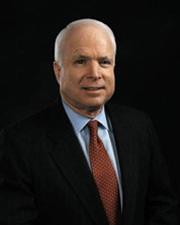 Sen. John McCain (R-AZ)
Legislative Activity
Stay on top of the latest movement without scrolling through every action
Senate amendment not agreed to: Amendment SA 592 not agreed to in Senate by Yea-Nay Vote. 32 - 63. Record Vote Number: 74.
March 3, 2009
View full timeline
Senate amendment not agreed to: Amendment SA 592 not agreed to in Senate by Yea-Nay Vote. 32 - 63. Record Vote Number: 74.
March 3, 2009
Roll call votes on amendments in Senate: Amendment SA 592 not agreed to in Senate by Yea-Nay Vote. 32 - 63. Record Vote Number: 74.
March 3, 2009
Considered by Senate. (consideration: CR S2652, S2655-2657)
March 3, 2009
Amendment SA 592 not agreed to in Senate by Yea-Nay Vote. 32 - 63. Record Vote Number: 74.
March 3, 2009
Senate amendment submitted
March 2, 2009
Senate amendment proposed (on the floor): Amendment SA 592 proposed by Senator McCain.(consideration: CR S2608-2612; text: CR S2608)
March 2, 2009
Amendment SA 592 proposed by Senator McCain. (consideration: CR S2608-2612; text: CR S2608) In the nature of a substitute.
March 2, 2009
Votes
1 roll call on this amendment
Text
Proposed
OMNIBUS APPROPRIATIONS ACT, 2009

The ACTING PRESIDENT pro tempore. Under the previous order, the
Senate will proceed to the consideration of H.R. 1105, which the clerk
will report by title.
The legislative clerk read as following:

A bill (H.R. 1105) making omnibus appropriations for the
fiscal year ending September 30, 2009, and for other
purposes.

[[Page S2599]]

The ACTING PRESIDENT pro tempore. The Senator from Hawaii.
Mr. INOUYE. Mr. President, I rise today in support of H.R. 1105, the
Omnibus Appropriations Act of 2009. This is a measure that should have
been completed last year but was not because of the previous
administration's unwillingness to negotiate in good faith. But today we
have the opportunity to put partisanship behind us and to continue the
task of rebuilding our economy, reinvesting in America and, frankly,
making our Government work again.
I want to point out that today is March 2. We are now almost halfway
through the fiscal year. Except for Defense, Veterans, and Homeland
Security, our executive branch agencies are all still operating on a
continuing resolution.
Under the continuing resolution, no new programs can begin. Funding
levels are held to last year's level. This means that even things such
as price increases due to inflation and the cost of civil servant pay
raises must be absorbed within the existing agency funding levels.
Many worthy initiatives which were approved by the Appropriations
Committee are being held at artificially low spending totals. And, as
we all know, the continuing resolution will expire on Friday--this
Friday.
It is not in the best interests of the taxpayer or the agencies we
are funding to operate the Federal Government on autopilot. A yearlong
continuing resolution does not allow a Federal agency any flexibility
to address changing priorities. Passage of H.R. 1105 begins the process
of returning our Departments and agencies to a more regular order. We
simply must complete this bill this week--in fact, this Thursday.
The 2009 omnibus bill has strong support from both sides of the
aisle, including the vice chairman of the Appropriations Committee,
Senator Thad Cochran. Further, the distinguished minority leader was
accurate with his comments in January that this bill has been fully
vetted and is ready for immediate passage.
This measure is not, as some have suggested, duplicative of the
spending provided by the recently enacted American Recovery and
Reinvestment Act. This argument misses the point entirely. The purpose
of the recovery package is to jump-start economic growth by making
significant investments above the annual budget. The omnibus is the
baseline budget.
But equally important to the funding contained in the bill is the
fact that the omnibus bill will provide much needed guidance to
executive branch agencies that have been operating without such
guidance under the continuing resolution. In addition, there are a
number of new initiatives across the Government that cannot be
implemented without passage of this bill.
So it is my sincere hope this is the last omnibus bill we will see
for some time to come, as it is my intention as chairman of the
Appropriations Committee to pass each of our annual appropriations
measures through the regular order. But having said that, it is clearly
impossible for fiscal year 2009, and for all the reasons mentioned
above, there is no doubt that this bill is far superior to yet another
continuing resolution.
The $410 billion in spending contained in this measure will
accomplish a number of objectives, including giving extra momentum to
the American Recovery and Reinvestment Act, by funding additional
projects and, therefore, saving thousands of additional jobs. In this
time of economic crisis, nothing is more important than keeping America
working.
I will offer a few examples of the kinds of initiatives that I
included in this 2009 omnibus.
Energy security: There is perhaps no issue more critical to the
future safety and prosperity of our Nation than energy security. This
omnibus bill invests in America's security by prioritizing research and
development of renewable energy and energy efficiency, including solar
power, biofuels, vehicle technologies, energy-efficient buildings, and
advanced energy research.
Law enforcement: In the absence of strong support for law
enforcement, the current economic downturn threatens to increase
violent crime throughout our Nation. As cash-strapped States struggle
with tight budgets, this bill will help keep Americans safe by
supporting the Community Oriented Policing Services or the COPS
Program, and the Byrne Justice Assistance Grants, which help State and
local law enforcement fight and prevent crime in communities across
America.
Public health and safety: In the wake of disturbing incidents of
compromised food safety that have jeopardized the health of our
citizens, we have significantly increased investments for the Food and
Drug Administration to strengthen the Food Safety and Inspection
efforts. This bill will also protect the health and well-being of
Americans by cleaning our air and our water. It contains investments
significantly above the former administration's inadequate request for
clean drinking water and wastewater, cleaning up hazardous waste and
toxic sites, and for the implementation of the Clean Air Act.
Health care: Millions of Americans are struggling to gain access to
quality affordable health care, particularly during these difficult
economic times. This measure will give scores of Americans better
access to health care through State access health grants and State
high-risk insurance pools and by supporting community health centers
and rural health facilities.
Education: As our economy struggles to regain its footing, millions
of Americans are understandably fearful they will not be able to afford
to pay for their children's college education. This measure provides
$1.9 billion to support student financial aid programs, including
Perkins loans and Federal supplemental educational opportunity grants.
Every day, thousands of Americans are losing their jobs--every day.
Every day, State and local governments see increased demand and
decreased resources. Every day, projects that could provide good jobs
for working Americans are delayed or canceled due to an inability to
properly fund them.
This Omnibus appropriations act will provide resources, guidance, and
new initiatives at a time when they are desperately needed. I urge my
colleagues to join me in supporting the passage of this measure.
Mr. President, I have two documents, one relating to reasons why this
omnibus bill should be enacted and the other a copy of a press release
made a few weeks ago. I ask unanimous consent that these two documents
be printed in the Record.
There being no objection, the material was ordered to be printed in
the Record, as follows:

25 Reasons Why the FY 2009 Omnibus Should Be Enacted

Funding Impacts on Existing Critical Programs

Safety of consumer goods and products
(1) Food and Medical Product Safety Inspections: H.R. 1105,
the Omnibus Appropriations Act of 2009, would provide the
Food and Drug Administration with an increase of nearly $325
million, of which $150 million is included in the current
Continuing Resolution (CR). If H.R. 1105 is not enacted into
law, the proposed increased funding level for the FDA would
be reduced by $175 million. This reduction in funding would
significantly decrease the number of food and medical product
safety inspections, both domestic and overseas, that FDA
could perform. [Division A--AGRICULTURE]
(2) Consumer Product Safety: H.R. 1105 would provide the
Consumer Product Safety Commission (CPSC) with an increase of
$25.4 million, or 32 percent, above the FY 2008 enacted
level. Without this funding increase, the CPSC would not be
able to implement many of the reforms and new directives
contained in the newly-enacted Consumer Product Safety
Improvement Act of 2008 to make children's products safer,
such as the consumer complaint database, an overseas
presence, and increased Inspector General staffing, and CPSC
staffing generally. [Division D--FINANCIAL SERVICES]
Keeping families in their homes
(3) Families Will Lose Housing: H.R. 1105 includes over $15
billion for the renewal of Section 8 Tenant-Based vouchers.
This program provides housing for eligible families that
cannot afford housing. As the economy has worsened, an
increasing number of families are in need of affordable
housing options. The FY 2009 Omnibus Appropriations bill
would provide an increase of $340 million over the FY 2008
enacted level. If H.R. 1105 is not enacted into law, nearly
45,000 families could lose their housing from the Section 8
tenant-based account being flat-funded. [Division I--
TRANSPORTATION/HUD]
(4) The Federal Housing Administration (FHA) will have to
stop helping families facing foreclosure to refinance into
affordable mortgages: The FY 2009 Omnibus appropriations bill
would increase the volume cap for

[[Page S2600]]

FHA loan guarantees to $315 billion, from the FY 2008 enacted
level of $185 billion. In the absence of this increase, FHA's
increasingly central role in addressing the foreclosure
crisis will cause it to reach the lower cap before the close
of the current fiscal year. At that point, new homebuyers,
and distressed current homeowners needing to refinance, will
be unable to access safe, affordable FHA-guaranteed home
mortgages. [Division I--TRANSPORTATION/HUD]
(5) Single-Family Guaranteed Housing Loans: The CR provides
for a level of $5.2 billion for Section 502 guaranteed rural
housing loans. H.R. 1105 would provide for a level of $6.2
billion. Demand for this program is rising at a substantial
rate. Given the role of housing markets in the current
economic downturn, increased funding for these housing loans
will help ease the credit shortfall by allowing current
borrowers to refinance existing Rural Housing Service (RHS)
loans, and to refinance non-RHS loans if the borrower would
now be eligible for an RHS direct loan. The additional $1.0
billion in guaranteed rural housing loans also would increase
the availability of funding for potential borrowers seeking
home ownership, thereby removing existing vacant housing from
the market which will in turn help to stabilize the overall
housing market. [Division A--AGRICULTURE]
Fighting crime
(6) Federal Law Enforcement Efforts through the Department
of Justice (DOJ): H.R. 1105 would increase funding to the
Department of Justice by $2.7 billion above the enacted
level. If the FY 2009 Omnibus is not enacted, $550 million
less would be provided for the FBI to protect our Nation and
our communities from terrorism and violent crime. The FBI
would have to institute an immediate hiring freeze of agents,
analysts, and support staff. This will mean 650 fewer FBI
special agents, and 1,250 fewer intelligence analysts and
other professionals fighting crime and terrorism on U.S.
soil. In terms of the Drug Enforcement Administration (DEA),
failure to pass the FY 2009 Omnibus would result in $52
million less for the DEA to target and stem the flow of
illegal narcotics seeping into our Nation and our
communities. The DEA would have to institute an immediate
hiring freeze of agents, as well as a 13 day furlough of all
agents. As a result, DEA will carry out 90 fewer raids
against drug production and trafficking organizations.
[Division B--COMMERCE, JUSTICE, SCIENCE]
(7) Anti-terrorist Enforcement Programs at the Department
of Treasury: Funding of $153.3 million, an $11 million
increase above the FY 2008 enacted level, for the Office of
Terrorism and Financial Intelligence and the Financial Crimes
Enforcement Network will make key enhancements to tracking,
detection and prevention of terrorist financing, enforcement
of economic sanctions against terrorist networks, and
coordination of enforcement with other countries. [Division
D--FINANCIAL SERVICES]
Protecting the public
(8) U.S. Attorneys: H.R. 1105 would provide an additional
$76.5 million for our U.S. Attorneys. If the FY 2009 Omnibus
is not enacted into law, the lack of increased funding would
require layoffs of 850 positions, including 451 attorneys, or
furloughing all U.S. Attorney staff for 16 days. Either
option would result in U.S. Attorneys cutting prosecution
caseload by 11,275 cases. U.S. Attorneys are the Nation's
prosecutors responsible for prosecuting violent gun, drug and
gang crimes, child exploitation, public corruption, money
laundering and terrorism cases before U.S federal courts.
[Division B--COMMERCE, JUSTICE, SCIENCE]
(9) Security Requirements for Protecting the President and
Vice President: The FY 2009 Omnibus bill would provide an
additional $100 million in urgently needed funding for the
U.S. Secret Service to meet the increased security
requirements for President Obama and Vice President Biden.
Funding is provided for additional agents, intelligence
personnel, associated training, and for improved White House
and Secret Service communications. [Division J--FURTHER
PROVISIONS]
(10) Enforcement of Securities Laws: Inadequate resources
for the Securities and Exchange Commission would hamper their
ability to undertake vigorous enforcement of securities laws
to help bolster the integrity of the financial markets, just
when such enforcement is needed most. [Division D--FINANCIAL
SERVICES]
(11) Worldwide Security Protection: H.R. 1105 would provide
$1.12 billion for the Department of State's (DOS) Worldwide
Security Protection for non-capital security upgrades, an
increase of $355 million above the FY 2008 enacted level.
This account funds all the Diplomatic Security agents at
every post world-wide, armored vehicles, and training. If
H.R. 1105 is not enacted into law, DOS would be unable to
hire additional personnel to increase protection at high-
threat embassies overseas or to add oversight of security
contractors in Iraq, Afghanistan and Israel-West Bank.
[Division H--STATE]
(12) Nuclear Nonproliferation Programs: H.R. 1105 would
increase funding for the National Nuclear Security
Administration's nuclear nonproliferation programs by $146
million over FY 2008. This increased funding is critical to
the United States' efforts to secure weapons grade nuclear
material around the world that could be used by terrorists.
[Division C--ENERGY]
Environmental and natural resources
(13) Fixed costs associated with programs of the Department
of Interior (DOI) and the Environmental Protection Agency
(EPA): H.R. 1105 would provide an additional $1.0 billion in
funding for the programs included under the Interior title of
the Omnibus appropriations bill. Of that amount, 68 percent
is attributable to fixed and other inflationary costs. If
H.R. 1105 is not enacted into law, DOI, EPA, the Forest
Service and the Indian Health Service would be required to
cut current services further to absorb those fixed costs.
[Division E--INTERIOR]
(14) Weather and Climate Satellites: H.R. 1105 would
provide an increase in $309 million in funding for the
National Oceanic and Atmospheric Administration's (NOAA)
weather and climate satellites. Without this increase in
funding, there will be $235 million less in funding for the
next generation of weather satellites to provide warnings and
protect communities from severe weather. The procurement for
these critical new satellites would have to be paused in
2009, delaying construction of the new satellites and
resulting in severe gaps in forecasting coverage in future
years. This means that communities would not get accurate
weather reporting, and would not be warned of incoming
natural disasters. Further, there would be $74 million less
in funding for satellite climate sensors. There will be no
funding under a full-year CR to restore critical climate
modeling equipment that was removed by the previous
Administration from the next generation polar orbiting
satellites. These sensors will help us better understand
and predict changes in the Earth's climate. [Division B--
COMMERCE, JUSTICE, SCIENCE]
(15) Diesel Emission Reduction Act Grants: The FY 2009
Omnibus would provide $60 million for the national Diesel
Emission Reduction Act grant program, a 22 percent increase
over the FY 2008 enacted level of $49 million. These grants
are used to replace or retrofit aging diesel engines,
particularly for heavy trucks and school buses, reducing air
pollution and improving public health. [Division E--INTERIOR]
(16) Hazardous Fuels: The FY 2009 omnibus would provide
$531 million for the Forest Service and Department of the
Interior to fund hazardous fuels reduction projects, an
increase of $21 million over the FY 2008 enacted level of
$510 million for both agencies. These funds are used for
forest thinning projects on Federal lands that reduce the
frequency and severity of catastrophic wildfires, protecting
public safety and natural resources. These funds will also
help reduce the skyrocketing cost of fighting wildfires; last
year, the Federal government alone spent nearly $2 billion
fighting wildfires. [Division E--INTERIOR]
Health
(17) Influenza Pandemic: H.R. 1105 would provide
approximately $500 million to prepare for and respond to an
influenza pandemic. Funds are available for the development
and purchase of vaccine, antivirals, necessary medical
supplies, diagnostics, and other surveillance tools.
[Division F--LABOR/HHS]
(18) Global Health and Child Survival (GHCS): H.R. 1105
would provide $7.114 billion for Global Health and Child
Survival, an increase of $737 million above the FY 2008
enacted level. Without the additional resources proposed in
the FY 2009 Omnibus, USAID would not be able to expand the
malaria programs in Africa where a million people, mostly
children, die from malaria annually. In addition, without the
Omnibus bill, funding for family planning services would be
reduced by $63 million, limiting access for poor women.
Further, funding for life-saving immunization programs would
be reduced by $48 million, resulting in higher maternal and
infant mortality for entirely preventable illnesses.
[Division H--STATE]
(19) HIV/AIDS: The FY 2009 Omnibus would provide a total of
$5.509 billion for programs to combat HIV/AIDS, $459 million
above the FY 2008 level. Without the additional funding in FY
2009, the United States will not be on target to meet the
goals set in the PEPFAR Reauthorization Act to increase
treatment to 3 million people (up from 2 million people
currently served), 12 million infections prevented (up from
10 million) and care for 12 million (up from 10 million),
including 5 million Orphans/Vulnerable Children (up from 4
million). [Division H--STATE]
Science and research and education
(20) America Competes Act--Department of Energy's (DOE)
Office of Science: H.R. 1105 would provide an increase of
$754 million above the FY 2008 enacted level for DOE's Office
of Science. The funding level provided in the FY 2009 Omnibus
is in response to passage of the America Competes Act, and
the expressed goal of doubling the U.S. investment in science
over 10 years. Without this funding increase, Congress would
fail to advance the bipartisan vision of the America Competes
Act. [Division C--ENERGY].
(21) America Competes Act--the National Institute of
Standards and Technology (NIST) and the National Science
Foundation (NSF): H.R. 1105 would provide an increase of $426
million in funding for activities authorized by the America
Competes Act, of which $63 million in funding would be for
NIST and $363 million in funding would be for NSF. Without
the funding increase for NIST, the United States' ability
both to keep up with advancements in industry technology and
to compete in the global economy are hampered. Without the
funding increase for NSF, fewer research grants will be
awarded, engaging a smaller workforce of scientists,

[[Page S2601]]

technicians, engineers, and mathematicians. [Division B--
COMMERCE, JUSTICE, SCIENCE]
(22) Development of the next U.S. Human Space
Transportation Vehicle: H.R. 1105 would provide an additional
$650 million above the level of funding provided by the CR
for the National Aeronautics and Space Administration's
(NASA) Constellation program, which is the development of the
next U.S. human space transportation vehicle (called Orion
and Ares). Without this increase in funding, NASA will be
required to cut over 4,000 jobs in 2009. Layoff notices for
employees in Florida, Texas, Mississippi, Alabama, Utah, and
Louisiana will be mailed in March, and layoffs will begin in
May. In addition, the lack of increased funding will have
long term impact on the actual development of Orion and Ares
which will be delayed by over 6 months, exacerbating the 5-
year gap in time during which the United States will not have
its own vehicle to access space after the Space Shuttle is
retired. [Division B--COMMERCE, JUSTICE, SCIENCE]
Infrastructure and workforce investments
(23) Endangering Continuation of Amtrak Route and Wage
Agreement: A full year CR would hold Amtrak operating
assistance at $475 million instead of the $550 million
provided in the FY 2009 Omnibus. This funding reduction could
endanger the continuation of all existing Amtrak routes and
would eliminate funding for the labor settlement payment owed
to all Amtrak wage employees under their collective
bargaining agreement. [Division I--TRANSPORTATION/HUD]
(24) Worsening the Shortage of Fully Trained Air Traffic
Controllers: The Federal Aviation Administration (FAA) faces
a crisis in maintaining an adequate workforce of trained air
traffic controllers. Without the increases provided in the FY
2009 omnibus, the FAA would be forced to freeze or reduce the
number of new air traffic controllers the agency can bring on
board and train--worsening the experience shortage we already
have in our air traffic control towers. [Division I--
TRANSPORTATION/HUD]
(25) Committee funding for U.S. Senate: At the beginning of
the 111th Congress, Democratic Leadership committed to
holding the minority harmless at the FY 2008 funding level,
and using that funding level as the FY 2009 baseline for
funding a 60/40 Democratic/Republican split. This agreement
would prevent significant reductions in force throughout the
Republican Committee structure. The FY 2009 bill provides an
additional $8.4 million in committee funding. Without this
funding increase, minority staffing levels will need to be
reduced. [Division G--LEGISLATIVE BRANCH]
____

House and Senate Appropriations Committees Announce Additional Reforms
in Committee Earmark Policy

Initiatives Build on Unprecedented Transparency Instituted in the 110th
Congress

(For Immediate Release, Tuesday, Jan. 6, 2009)

Washington.--Today, Rep. Dave Obey (D-WI), Chairman of the
House Appropriations Committee, and Sen. Daniel K. Inouye (D-
HI), incoming Chairman of the Senate Appropriations
Committee, announced three significant changes to further
increase transparency and reduce funding levels for earmarks,
building on reforms brought about in the last Congress.
Previously implemented reforms:
2007 Moratorium: In January of 2007, Democrats imposed a
one-year moratorium on earmarks for 2007 until a reformed
process could be put in place.
Rules for Transparency: Under the 2007 rules, each bill
must be accompanied by a list identifying each earmark that
it includes and which member requested it. Those lists are
available online before the bill is ever voted on. In the
House, each earmark on those lists is backed up by a public
letter from the requesting member identifying the earmark,
the entity that will receive the funds and their address,
what the earmark does, and a certification that neither the
requesting member nor their spouse will benefit from it
financially. In the Senate, each Senator is required to send
the committee a letter providing the name and location of the
intended recipient, the purpose of earmark, and a letter
certifying that neither the Senator nor the Senator's
immediate family has a financial interest in the item
requested. The certification is available on the internet at
least 48 hours prior to a floor vote on the bill.
Significant Reductions: In the 2008 bills, the total dollar
amount earmarked or non-project-based accounts in
appropriations bills was reduced by 43%.
Other Measures: Earmarks produced by conference committees,
not in the original House or Senate bills, are clearly
identified with an asterisk. Members are able to offer floor
amendments on earmarks under the rules of the House and
Senate.
In our continuing effort to provide unprecedented
transparency to the process, new reforms to begin with the
2010 bills include:
Posting Requests Online: To offer more opportunity for
public scrutiny of member requests, members will be required
to post information on their earmark requests on their Web
sites at the time the request is made explaining the purpose
of the earmark and why it is a valuable use of taxpayer
funds.
Early Public Disclosure: To increase public scrutiny of
committee decisions, earmark disclosure tables will be made
publically available the same day as the House or Senate
Subcommittee rather than Full Committee reports their bill or
24 hours before Full Committee consideration of
appropriations legislation that has not been marked up by a
Senate Subcommittee.
Further Cuts: Earmarks will be further reduced to 50% of
the 2006 level for non-project-based accounts. In FY 2008,
earmark funding levels were reduced by 43% below the 2006
level. Earmarks will be held below 1% of discretionary
spending in subsequent years.
``Today we build on the unprecedented reforms made to
earmarks since Democrats took control of the Congress in
2007,'' said Obey and Inouye. ``These reforms mean that
earmarks will be funded at a level half as high as they were
in 2006, face greater public scrutiny, and members of
Congress will have more time and access to more information
before they vote on bills and as they prepare amendments.''

Mr. INOUYE. Mr. President, I ask unanimous consent that I may yield
to the vice chairman of this committee with the understanding that I
will hold the floor.
The ACTING PRESIDENT pro tempore. Without objection, it is so
ordered.
The Senator from Mississippi.
Mr. COCHRAN. Mr. President, I am pleased to join my friend, the
distinguished Senator from Hawaii, in presenting the 2009 Omnibus
Appropriations Act to the Senate. This bill contains the nine regular
appropriations bills that have not been enacted and accounts for nearly
half of all regular discretionary spending for the 2009 fiscal year.
I am supporting the approval of this bill by the Senate even though
the process that has brought us to this point has left a lot to be
desired.
I also share with those on my side of the aisle the concerns about
the level of discretionary spending contained in this bill, which is
$20 billion over President Bush's request.
I voted against the budget resolution that established the
discretionary spending allocations for this bill, and I voted in favor
of Senator Gregg's motion to instruct the conferees on the budget
resolution to lower the discretionary caps to more modest levels. That
motion was defeated by one vote, and the conference report on the
budget resolution was adopted.
I commend my distinguished friend from Hawaii for resisting pressures
to add controversial new policy matter to this bill. This is new
legislation as opposed to a conference report, and as such any number
of policy riders could have been included in the bill. A few
provisions, such as language dealing with the Endangered Species Act,
were included, but, largely, the bill stays within the legislation
represented by the House and Senate bills.
Of the nine bills in this omnibus measure, none were ever considered
on the floors of the House or the Senate. Two of the bills were never
marked up in the Senate committee, and six of the bills were not marked
up in the House committee. But I can assure the Senate that the content
of the legislation before us is consistent with the parameters
established by the individual House and Senate bills, even though some
of those bills were never presented formally to either body.
Previous omnibus bills have been comprised of individual bills
reported by the House and the Senate committees, and generally of bills
that were passed by at least one of the legislative bodies. The bill
before us today is a new kind of legislative document which I hope we
will not see replicated in the future.
Last year, the bicameral leadership made a conscious decision not to
engage President Bush on spending issues and to avoid taking votes on
extending the ban on Outer Continental Shelf oil and gas leasing.
Perhaps that decision had some political benefits for some Members, but
procedurally and substantively, it had detrimental impacts.
First of all, the moratorium on Outer Continental Shelf oil and gas
leasing has been removed from the Interior appropriations bill. Second,
for the last 6 months, most Federal agencies have been compelled to
operate at funding levels very similar to those they would have
received had we simply enacted the individual bills in a form that
President Bush would have signed.
Today, we could be discussing the merits of supplemental
appropriations if they had been needed rather than starting from
scratch halfway through the fiscal year. Had we enacted the
appropriations bills last fall, agencies

[[Page S2602]]

would have been carrying out their responsibilities with approved
levels of funding.
Funding for buildings, roads, trails, and water projects would have
provided jobs and would have been obligated by now. To the extent those
activities might have helped stimulate the economy, they would have
been very beneficial. Instead, due to inaction by Congress, agencies
have been in a holding pattern for nearly half of the fiscal year under
the terms of the continuing resolution.
Two weeks ago, Congress sent to the President a huge stimulus bill.
It contains some $311 billion in appropriations for a variety of
programs. We had a vigorous debate about the bill in the Senate, and it
passed with the minimum number of votes required. I voted against the
stimulus bill in part because the bill included large amounts of
funding for programs that are not immediately stimulative such as
health information technology and broadband deployment. These would
have been more appropriately considered in the context of a
Presidential budget and at the more measured pace of the annual
appropriations process. We will be living with the impacts of these
decisions made in the stimulus bill--all made in great haste--for years
to come. It is fair to ask to what degree does the omnibus bill
duplicate the stimulus bill.
There is no question that the order in which we are considering the
stimulus and the omnibus is exactly backward. We should have used the
stimulus bill to supplement regular appropriations, not the other way
around.
There are a number of accounts and programs funded in this omnibus
bill that are also funded in the stimulus bill. In most cases the
omnibus funds those programs at or near prior year levels, and one can
argue the stimulus funding for those programs was a deliberate
supplement. In other cases, the omnibus funds the same accounts
contained in the stimulus but for different purposes. There are a few
programs in the omnibus that, quite frankly, should have been scaled
back based on the contents of the stimulus bill. So despite the
unconventional and unfortunate process by which this bill was produced,
it does represent a product that was fairly negotiated.
Some would like us to enact a continuing resolution for the remainder
of the year that holds programs to their fiscal year 2008 funding
levels, thereby saving billions of dollars. But knowing the impact that
a full-year continuing resolution would have on individual programs, I
don't think the majority would propose such a measure, and I don't
think the President would sign it either.
Another possible outcome would be a modified continuing resolution
similar to that enacted for fiscal year 2007--something that would
eliminate all manner of congressional directives and oversight
mechanisms but spend no less money than we are currently considering.
Surely there are other possible outcomes. But, in my view, continued
uncertainty in the day-to-day operations of the Federal Government at a
time of national crisis is not worth the marginal and highly
speculative gains that might come from defeating this bill.
We now have received a preliminary budget from the new President. In
a few weeks, we will be considering the budget resolution for fiscal
year 2010, and we will be debating such things as appropriate
discretionary spending levels. I look forward to a debate on that as
there is much in the President's budget request worth debating.
But it is time to put the fiscal year 2009 budget to rest. I am
committed to do everything in my power not to repeat the dismal process
that has brought us to this juncture, and I know the chairman of the
committee, the distinguished Senator from Hawaii, shares that
commitment. Neither of us wants to deny Senators the opportunity to
help shape appropriations bills in the early parts of the process
through amendment and discussion of alternatives. Neither of us wants
to hide anything from the scrutiny of the legislative process, and
neither of us wants Members to have to pass judgment on nine
appropriations bills all at once rather than individually.
I thank the distinguished Senator from Hawaii for the job he has done
as chairman of the Appropriations Committee. He is leading the
committee through a trying time, but he is doing it in the very best
sense of bipartisanship and establishing working relationships that
will serve the interests of not only the Senate but of the American
people. These are relationships our committee can contribute to in the
future, and I know they will under his leadership. I look forward to
continuing to work with him to achieve timely and open consideration of
other appropriations bills.
I thank the distinguished Senator for yielding to me.
The ACTING PRESIDENT pro tempore. The Senator from Hawaii.
Mr. INOUYE. I thank my distinguished vice chairman for his remarks.
Mr. President, I submit pursuant to Senate rules a report, and I ask
unanimous consent that it be printed in the Record.
There being no objection, the material was ordered to be printed in
the Record, as follows:

Disclosure of Congressionally Directed Spending Items

I certify that the information required by rule XLIV of the
Standing Rules of the Senate related to congressionally
directed spending items has been identified in the
explanatory statement offered by the Chairman of the
Committee on Appropriations of the House of Representatives
which accompanies the bill H.R. 1105 and that the required
information has been available on a publicly accessible
congressional website at least 48 hours before a vote on the
pending bill. Additional information is provided below to
augment or correct the explanatory statement.

[[Page S2603]]

CONGRESSIONALLY DIRECTED SPENDING ITEMS
------------------------------------------------------------------------------------------------------------------------------------------------------------------------------------------------
Account                                                                Project                                                         Funding                   Member
------------------------------------------------------------------------------------------------------------------------------------------------------------------------------------------------
SUBCOMMITTEE ON AGRICULTURE, RURAL DEVELOPMENT, FOOD AND DRUG ADMINISTRATION, AND RELATED AGENCIES

Animal, Plant, Health           State of Delaware's Department of Agriculture, Dover, Delaware, for a full-service, fully functional, modern           $69,000  Kaufman
Inspection Service.             animal health diagnostic laboratory.
Special Research Grants.......  University of Delaware, Newark, Delaware, to upgrade Delmarva's avian flu diagnostic and biocontainment                $94,000  Kaufman
facilities to combine Delaware and Maryland's laboratory information management system.
Special Research Grants.......  University of Delaware, Newark, Delaware, to continue the work of the Institute for Soil and Environmental             $70,000  Kaufman
Quality (ISEQ) by supporting programs and acquiring equipment that is essential for Critical Zone research.
Special Research Grants.......  National Beef Cattle Genetic Evaluation Consortium, (of which Cornell University is a part), to analyze beef          $655,000  Gillibrand
records of seedstock cattle throughout the country.
Special Research Grants.......  Agribusiness research through the Viticulture Consortium, Cornell University and University of California...        $1,454,000  Gillibrand
Special Research Grants.......  Apple fire blight, Cornell University/New York State Agricultural Experiment Station, University of Michigan          $346,000  Gillibrand
Special Research Grants.......  Virginia Tech Research Grant--Biodesign and Processing......................................................          $868,000  Warner
Research Education/Federal      High Value Horticulture and Forestry Crops (VA).............................................................          $502,000  Warner
Admin..
Special Research Grants.......  Aquaculture.................................................................................................          $139,000  Warner
Special Research Grants.......  Fish and Shellfish Technologies (Virginia)..................................................................          $331,000  Warner
Special Research Grants.......  Sustainable Engineered Materials from Renewable Resources--Virginia Tech University.........................          $485,000  Warner
------------------------------------------------------------------------------------------------------------------------------------------------------------------------------------------------
SUBCOMMITTEE ON COMMERCE, JUSTICE, SCIENCE, AND RELATED AGENCIES

Procurement, Acquisition and    University of Delaware, Newark, Delaware, for a real-time satellite receiving station.......................          $750,000  Kaufman
Construction/National Oceanic
and Atmospheric
Administration.
COPS Technology/Department of   City of Newark Police Department, Newark, Delaware, for video surveillance cameras in downtown area.........          $115,420  Kaufman
Justice.
COPS Technology/Department of   Delaware State University, Dover, Delaware, to continue work on the Crime Scene and Evidence Tracking               $2,000,000  Kaufman
Justice.                        Project which develops and tests day-to-day law enforcement and public safety application.
COPS Technology/Department of   Delaware State Police, Dover, Delaware, to perform preliminary engineering assessments before message                 $100,000  Kaufman
Justice.                        switcher upgrades.
COPS Technology/Department of   Delaware State Police, Dover, Delaware, for the purchase and installation of in-car cameras and related               $500,000  Kaufman
Justice.                        equipment.
COPS Technology/Department of   Delaware State Police, Dover, Delaware, for the purchase of a mobile gunshot locator system.................          $250,000  Kaufman
Justice.
COPS Technology/Department of   New Castle County Police Department, New Castle, Delaware, for a program to increase the efficiency and               $200,000  Kaufman
Justice.                        effectiveness of license plate scanning technology.
Juvenile Justice/Department of  Jobs for Delaware Graduates, Inc., Dover, Delaware, to expand services delivered to at-risk middle and high         $1,353,000  Kaufman
Justice.                        school students.
Juvenile Justice/Department of  University of Delaware, Newark, Delaware, for the Center for Drug and Alcohol Studies, to continue a                   $65,000  Kaufman
Justice.                        statewide survey of youth that provides estimates and trends in student substance abuse, crime, and
gambling.
National Institute of           Nanoscale fabrication and measurement project at the University at Albany (SUNY), College of Nanoscale              $1,000,000  Gillibrand
Standards and Technology.       Science and Engineering (CNSE).
Byrne Discretionary Grants/     Real Estate Fraud Unit in the Kings County District Attorney's Office for the investigation and prosecution           $875,000  Gillibrand
Department of Justice.          of deed theft, mortgage fraud, and related real estate-based crimes, Kings County, New York.
COPS Methamphetamine/           City of Rochester, Rochester, New York, to intensify patrols, improve the tracking of narcotics shipments,            $675,000  Gillibrand
Department of Justice.          provide technical support and enhance local crime prevention programs for at-risk youth.
National Aeronautics and Space  Binghamton University to develop a focused research and development initiative on large area flexible solar           $500,000  Gillibrand
Administration.                 cell modules, Binghamton, New York.
Byrne Discretionary Grants/     Information-sharing database to analyze gang related crime in the Oneida County District Attorney's Office,           $215,000  Gillibrand
Department of Justice.          Utica, New York.
COPS Technology/Department of   Countywide interoperable public safety communications system, Rockland and Westchester Counties, New York...        $1,670,000  Gillibrand
Justice.
COPS Technology/Department of   City of Yonkers Police Department to reduce non-emergency 3-1-1 calls through the creation of a new public            $400,000  Gillibrand
Justice.                        hotline.
Byrne Discretionary Grants/     Oliver Hill Courts Building security upgrades...............................................................          $400,000  Warner
Department of Justice.
Juvenile Justice/Department of  City of Chesapeake gang deterrence program..................................................................          $100,000  Warner
Justice.
Operations, Research and        Assistance to MD/VA watermen affected by Blue Crab harvest restrictions.....................................       $10,000,000  Warner
Facilities/National Oceanic
and Atmospheric
Administration.
Byrne Discretionary Grants/     Northern Virginia Gang Task Force...........................................................................        $2,500,000  Warner
Department of Justice.
Byrne Discretionary Grants/     Northwest Virginia Regional Drug Task Force.................................................................          $750,000  Warner
Department of Justice.
COPS Technology/Department of   City of Radford Police Force relocation.....................................................................          $250,000  Warner
Justice.
COPS Technology/Department of   Virginia State Police SWVA Drug Task Force..................................................................          $250,000  Warner
Justice.
Juvenile Justice/Department of  An Achievable Dream Newport News............................................................................          $700,000  Warner
Justice.
Science/National Aeronautics    NASA Wallops Island Flight Facility--Launch Pad Improvements................................................       $14,000,000  Warner
and Space Administration.
Space/National Aeronautics and  NASA Wallops Island Flight Facility--Small Satellites and unmanned aerial systems...........................        $5,000,000  Warner
Space Administration.
Operations, Research and        Oyster Restoration in Chesapeake Bay........................................................................        $2,000,000  Warner
Facilities/National Oceanic
and Atmospheric
Administration.
Operations, Research and        VIMS--Virginia Trawl Survey.................................................................................          $150,000  Warner
Facilities/National Oceanic
and Atmospheric
Administration.
Cross Agency Support/National   Accomack and Northhampton Counties--Broadband deployment (Eastern Shore)....................................        $2,000,000  Warner
Aeronautics and Space
Administration.
Operations, Research and        Virginia Institute of Maine Science, Virginia Trawl Survey, Glouchester, VA.................................          $150,000  John Warner, Webb
Facilities/National Oceanic
and Atmospheric
Administration.
Byrne Discretionary Grants/     City of Vancouver, new records management system, Vancouver, WA.............................................          $500,000  Murray only
Department of Justice.
Byrne Discretionary Grants/     National Council of Juvenile and Family Court Judges, Child Abuse Training Programs for Judicial Personnel:           $920,000  Reid, Ensign, Reed, Schumer,
Department of Justice.          Victims Act Model Courts Project, Reno, Nevada.                                                                                 Sessions, Smith, Voinovich,
Whitehouse, Wyden, Bennett,
Biden, Hatch, Kennedy, Kerry,
Landrieu, Lautenberg, Leahy
Byrne Discretionary Grants/     National Crime Prevention Council, Arlington, Virginia......................................................          $500,000  Kohl, Leahy, Reed, Crapo,
Department of Justice.                                                                                                                                          Whitehouse only
Byrne Discretionary Grants/     Safe Streets Campaign, Pierce County Regional Gang Prevention Initiative, Tacoma, Washington................        $1,000,000  Murray
Department of Justice.
------------------------------------------------------------------------------------------------------------------------------------------------------------------------------------------------
SUBCOMMITTEE ON ENERGY AND WATER DEVELOPMENT

Investigations................  Army Corps of Engineers Wave Data Study Coastal Field Data Collection Project, Delaware, for the collection           $500,000  Kaufman
and analysis of coastal weather and sea condition data.
Investigations................  Army Corps of Engineers Christina River Watershed Feasibility Study, New Castle County, Delaware, to                  $287,000  Kaufman
continue investigations for flood damage reduction, ecosystem restoration, water quality control, and other
related purposes.
Investigations................  Army Corps of Engineers White Clay Creek Flood Plain Management Services study, New Castly, Delaware, to              $200,000  Kaufman
continue a study to evaluate flooding and flooding damage as a result of tropical storms.
Operation and Maintenance.....  Army Corps of Engineers Harbor of Refuge project, Lewes, Delaware, to perform stability analysis, condition           $235,000  Kaufman
surveys, and repairs.
Operation and Maintenance.....  Army Corps of Engineers Indian River Inlet and Bay project, Sussex County, Delaware, to survey and analyze            $235,000  Kaufman
scour holes.
Operation and Maintenance.....  Army Corps of Engineers Intracoastal Waterway project, Delaware River to Chesapeake Bay in New Castle              $13,710,000  Kaufman
County, Delaware, for maintenance and dredging (Multi-State; Delaware request was $5,150,000).
Operation and Maintenance.....  Army Corps of Engineers Mispillon River Project, Kent and Sussex Counties, Delaware, for maintenance                  $249,000  Kaufman
dredging and field inspections.
Operation and Maintenance.....  Army Corps of Engineers Wilmington Harbor project, Wilmington Harbor to Newport, Delaware, for aggressive           $3,479,000  Kaufman
management and capacity restoration of federal disposal areas and chemical sediment testing.
Department of Energy--Energy    Delaware State University, Dover, Delaware, for the Center for Hydrogen Storage Research for research and           $1,427,250  Kaufman
Efficiency and Renewable        development of a hydrogen storage system.
Energy.
Department of Energy--Energy    University of Delaware Lewes Campus, Lewes, Delaware, for a wind turbine model and pilot project for                $1,427,250  Kaufman
Efficiency and Renewable        alternative energy.
Energy.
Expenses......................  Delaware River Basin Commission, (headquartered in) West Trenton, New Jersey, for water quality, monitoring           $715,000  Kaufman
and assessment, habitat restoration, drought coordination, public sewer water supply protection, and
integrated water resource planning.
Investigations................  Army Corps of Engineers to manage the Upper Delaware River Watershed, New York..............................           $96,000  Gillibrand

[[Page S2604]]

Construction..................  Fire Island Inlet to Montauk Point for the New York Hurricane Protection and Storm Damage Reduction Project.        $2,010,000  Gillibrand
Department of Energy--Energy    Landfill Gas Utilization Plant Count of Chautauqua at the county landfill in Ellery, New York...............        $1,903,000  Gillibrand
Efficiency and Renewable
Energy.
Department of Energy--Office    For work to be done in Otsego, New York, on supercapacitors at Sandia National Laboratories.................        $1,500,000  Gillibrand
of Science.
Investigations................  Army Corps of Engineers' Forge River Watershed Project, Long Island, New York...............................          $119,000  Gillibrand
Operation and Maintenance.....  Appomattox River............................................................................................          $527,000  Warner
Construction..................  Combined Sewer Overflow Lynchburg...........................................................................          $287,000  Warner
Construction..................  Combined Sewer Overflow Richmond............................................................................          $287,000  Warner
Construction..................  James River Deepwater Turning Basin.........................................................................          $766,000  Warner
Investigations................  Upper Rappahannock River (Phase II).........................................................................           $96,000  Warner
Investigations................  AIWW--Bridge Replacement at Deep Creek......................................................................          $478,000  Warner
Investigations................  Chowan River Basin, Virginia................................................................................           $96,000  Warner
Investigations................  Dismal Swamp and Dismal Canal...............................................................................           $59,000  Warner
Operation and Maintenance.....  Norfolk Harbor and Channels.................................................................................        $9,808,000  Warner
Construction..................  Norfolk Harbor and Channels--Deepening......................................................................          $478,000  Warner
Operation and Maintenance.....  Rudee Inlet.................................................................................................          $344,000  Warner
Investigations................  Vicinity of Willoughby Spit, Norfolk VA.....................................................................          $287,000  Warner
Construction..................  Virginia Beach Hurricane Protection.........................................................................        $1,340,000  Warner
Investigations................  Belle View/New Alexandria Flood Plain Management Services Program Studies...................................          $200,000  Warner
Investigations................  Four Mile Run Restoration...................................................................................          $239,000  Warner
Construction..................  Roanoke River (Upper Basin).................................................................................        $1,029,000  Warner
Department of Energy--Fossil    Center for Advanced Separation Technologies.................................................................        $2,854,500  Warner
Energy Research and
Development.
Investigations................  Clinch River Watershed......................................................................................           $96,000  Warner
Construction..................  Grundy Flood Control Project................................................................................        $8,000,000  Warner
Investigations................  New River, Claytor Lake.....................................................................................           $96,000  Warner
Construction..................  Chesapeake Bay Oyster Recovery..............................................................................        $2,000,000  Warner
Construction..................  Non-Native Oyster EIS.......................................................................................          $328,000  Warner
Construction..................  Tangier Island, Accomack County.............................................................................  ................  Warner
Construction..................  Village of Oyster Northampton County VA.....................................................................  ................  Warner
------------------------------------------------------------------------------------------------------------------------------------------------------------------------------------------------
SUBCOMMITTEE ON FINANCIAL SERVICES AND GENERAL GOVERNMENT

Small Business Administration,  New Castle County Chamber of Commerce for an Emerging Enterprise Center, business incubator.................          $499,000  Kaufman
Salaries and Expenses.
Small Business Administration,  Virginia's Center for Innovative Technology, Mine safety technology and communication improvements, Herndon,          $237,500  Warner
Salaries and Expenses.          VA.
------------------------------------------------------------------------------------------------------------------------------------------------------------------------------------------------
SUBCOMMITTEE ON DEPARTMENT OF THE INTERIOR, ENVIRONMENT, AND RELATED AGENCIES

Environmental Protection        City of Wilmington, Delaware, for the Wilmington Wastewater Treatement Plant Headworks Upgrade..............          $300,000  Kaufman
Agency, State and Tribal
Assistance Grants Program.
Environmental Protection        Government of New Castle County, New Castle Delaware, for Old Shellpot Interceptor upgrades.................          $698,000  Kaufman
Agency, State and Tribal
Assistance Grants Program.
Forest Service, State and       Delaware Department of Agriculture--Forest Service, Camden, Delaware, for the purchase of forestland to be          $2,000,000  Kaufman
Private Forestry (Forest        added to Redden State Forest.
Legacy Program)-.
Environmental Protection        Town of Onancock Wastewater Treatment Plant.................................................................          $500,000  Warner
Agency, State and Tribal
Assistance Grants Program.
Forest Service, Land            Appalachian Trail Right of Way and Greenway Acquisition--(Listed as ``land acquisitions in the George               $1,775,000  Warner
Acquisition.                    Washington and Jefferson National Forest''.
National Park Service, Land     Shenandoah Valley Battlefields Foundation...................................................................        $1,985,000  Warner
Acquisition.
Fish and Wild Service, Land     Rappahannock River Valley National Wildlife Refuge..........................................................        $1,500,000  Warner
Acquisition.
Environmental Protection        City of Lynchburg Combined Sewer Overflow...................................................................          $500,000  Warner
Agency, State and Tribal
Assistance Grants Program.
Environmental Protection        City of Opa Locka, Wastewater System Improvements...........................................................          $500,000  Nelson, Bill
Agency, State and Tribal
Assistance Grants Program.
Environmental Protection        Palm Beach County, Lake Region Water Treatment Plant........................................................          $500,000  Martinez
Agency, State and Tribal
Assistance Grants Program.
Environmental Protection        Southwest Florida Water Management District, Upper Peace River Restoration of the West-Central Florida Water          $500,000  Martinez
Agency, State and Tribal        Action Restoration Plan.
Assistance Grants Program.
------------------------------------------------------------------------------------------------------------------------------------------------------------------------------------------------
SUBCOMMITTEE ON DEPARTMENTS OF LABOR, HEALTH AND HUMAN SERVICES, AND EDUCATION, AND RELATED AGENCIES

Elementary & Secondary          Delaware Department of Education, Dover, Delaware, for the Starting Stronger for Student Success program to           $190,000  Kaufman
Education (includes FIE).       eliminate school-entry readiness gaps.
Elementary & Secondary          Delaware Department of Education, Dover, Delaware, to increase the English proficiency of English Language            $190,000  Kaufman
Education (includes FIE).       Learners by providing high quality instructional programs.
Elementary & Secondary          Metropolitan Wilmington Urban League, Wilmington, Delaware, to expand the ``Achievement Matters!'' project            $190,000  Kaufman
Education (includes FIE).       to more students.
Centers for Disease Control     Delaware Division of Public Health, Dover, Delaware, to assist in implementing several key recommendations            $190,000  Kaufman
and Prevention (CDC).           of a state task force on infant mortality.
Health Resources and Services   Beebe Medical Center, Lewes, Delaware, for the construction of a new School of Nursing......................          $476,000  Kaufman
Administration (HRSA)--Health
Facilities and Services.
Health Resources and Services   Christiana Care Health System, Wilmington, Delaware, to renovate and expand Wilmington Hospital's Emergency           $285,000  Kaufman
Administration (HRSA)--Health   Department.
Facilities and Services.
Health Resources and Services   St. Francis Hospital Foundation, Wilmington, Delaware, to make capital infrastructure improvements..........          $285,000  Kaufman
Administration (HRSA)--Health
Facilities and Services.
Health Resources and Services   University of Delaware, Newark, Delaware, for the Delaware Biotechnology Institute for high-end, state-of-            $190,000  Kaufman
Administration (HRSA)--Health   the-art research equipment.
Facilities and Services.
Health Resources and Services   Wesley College, Dover, Delaware, for the expansion of the nursing school program............................          $333,000  Kaufman
Administration (HRSA)--Health
Facilities and Services.
Health Resources and Services   Westchester County Department of Labs & Research, Valhalla, New York, for construction, renovation, and               $809,000  Gillibrand
Administration (HRSA)--Health   equipment.
Facilities and Services.
Administration on Aging (AOA).  Town of North Hempstead, New York, for the Project Independence naturally occurring retirement communities            $333,000  Gillibrand
demonstration project.
Health Resources and Services   Staten Island University Hospital, Staten Island, New York, for construction, renovation, and equipment for           $476,000  Gillibrand
Administration (HRSA)--Health   the emergency department.
Facilities and Services.
Employment and Training         United Auto Workers Region 9, Local 624, New York, for incumbent worker training............................          $428,000  Gillibrand
Administration (ETA)--
Training & Employment
Services (TES).
Employment and Training         Manufacturers Association of Central New York, Syracuse, New York, to improve employment and training in the          $285,000  Gillibrand
Administration (ETA)--          manufacturing sector.
Training & Employment
Services (TES).
Health Resources and Services   Greater Hudson Valley Family Health Center, Inc., Newburgh, New York, for construction, renovation, and               $476,000  Gillibrand
Administration (HRSA)--Health   equipment.
Facilities and Services.
Institute for Museum and        George Eastman House International Museum of Photography and Film, Rochester, New York, for educational               $381,000  Gillibrand
Library Services.               programs.
Health Resources and Services   Catholic Health System, Buffalo, New York, for telemedicine equipment for acute stroke assessment...........          $143,000  Gillibrand
Administration (HRSA)--Health
Facilities and Services.
Higher Education (includes      Dowling College, Oakdale, New York, to create and establish a school of Banking and Financial Services......          $190,000  Gillibrand
FIPSE).
Higher Education (includes      Union Graduate College, Schenectady, New York, for program support of a Masters degree in Emerging Energy             $285,000  Gillibrand
FIPSE).                         Systems.
Higher Education (includes      St. Bonaventure University, St. Bonaventure, New York, for the Father Mychal Judge program, which may                 $285,000  Gillibrand
FIPSE).                         include student scholarships and travel costs for student exchanges and visiting professorships.
Administration for Children     Nassau County Coalition Against Domestic Violence, Inc., Hempstead, New York, to provide legal services to            $381,000  Gillibrand
and Families (ACF)--Social      low-income victims of domestic violence.
Services.
Health Resources and Services   Niagara University, Niagara Falls, New York, for the Nursing Leadership project.............................           $95,000  Gillibrand
Administration (HRSA)--Health
Facilities and Services.
Health Resources and Services   Cold Spring Harbor Laboratory, Cold Spring Harbor, New York, for The Women's Cancer Genomics Center.........          $714,000  Gillibrand
Administration (HRSA)--Health
Facilities and Services.
Higher Education (includes      Virginia Department of Correctional Education--Transition Program for Incarcerate Youth.....................           $95,000  Warner
FIPSE).
Health Resources and Services   Hampton University--Proton Beam Therapy Facility--Cancer Treatment Initiative...............................          $571,000  Warner
Administration (HRSA)--Health
Facilities and Services.
Substance Abuse and Mental      Arlington Mental Health and Substance Abuse Crisis Intervention and Diversion Program.......................          $143,000  Warner
Health Services
Administration (SAMHSA)--
Substance Abuse Treatment.
Elementary & Secondary          Boys & Girls Club of Greater Washington (Virginia Clubs)....................................................           $95,000  Warner
Education (includes FIE).
Elementary & Secondary          Child and Family Network Centers--Leveling the Playing Field (SEFS).........................................           $95,000  Warner
Education (includes FIE).
Health Resources and Services   Inova Health System; Claude Moore Health Education Center...................................................          $523,000  Warner
Administration (HRSA)--Health
Facilities and Services.

[[Page S2605]]

Employment and Training         NW Works--Autism Inclusion Initiative.......................................................................           $95,000  Warner
Administration (ETA)--
Training & Employment
Services (TES).
Elementary & Secondary          Dinwiddie County Public Schools Library/Media Program.......................................................           $95,000  Warner
Education (includes FIE).
Elementary & Secondary          The Institute for Advanced Learning and Research--The STEM Mobile Learning Laboratory Project...............           $95,000  Warner
Education (includes FIE).
Higher Education (includes      Dickenson County Industrial Development Authority Clintwood, VA.............................................           $95,000  Warner
FIPSE).
Health Resources and Services   Norton Community Hospital--Women's Center/Technology Enhancement Project....................................           $95,000  Warner
Administration (HRSA)--Health
Facilities and Services.
Substance Abuse and Mental      Virginia Department of Mental Health, Mental Retardation, and Substance Abuse Services, Richmond, VA, to              $285,000  Warner
Health Services                 provide treatment services for addiction to prescription pain medication.
Administration (SAMHSA)--
Substance Abuse Treatment.
Health Resources and Services   Eastern Shore Rural Health System--Onley Community Health Center............................................          $476,000  Warner
Administration (HRSA)--Health
Facilities and Services.
Higher Education (includes      The Virginia Foundation for Community College Education--Great Expectations Program.........................           $95,000  Warner
FIPSE).
------------------------------------------------------------------------------------------------------------------------------------------------------------------------------------------------
SUBCOMMITTEE ON TRANSPORTATION AND HOUSING AND URBAN DEVELOPMENT, AND RELATED AGENCIES

Buses and Bus Facilities......  University of Delaware, Newark, Delaware, for an Automotive-Based Fuel Cell Hybrid Bus Program..............          $475,000  Kaufman
Interstate Maintenance          Delaware Department of Transportation Newark Toll Plaza, Newark, Delaware, to improve the toll facility to          $2,375,000  Kaufman
Discretionary.                  incorporate highway speed E-Z Pass toll lanes.
Interstate Maintenance          Delaware Department of Transportation, Dover, Delaware, to add a fifth lane to I-95/SR-1 interchange........        $1,900,000  Kaufman
Discretionary.
Transportation, Community and   Delaware Department of Transportation, Dover, Delaware, to replace the bridge along SR-1 over the Indian            $1,900,000  Kaufman
System Preservation.            River Inlet.
Economic Development            Delaware Children's Museum, Wilmington, Delaware, for construction..........................................          $190,000  Kaufman
Initiatives.
Economic Development            Easter Seals Delaware & Maryland's Eastern Shore, New Castle County, Delaware, to expand the existing                 $142,500  Kaufman
Initiatives.                    facility.
Economic Development            St. Michael's School and Nursery, Wilmington, Delaware, for HVAC replacement................................          $285,000  Kaufman
Initiatives.
Economic Development            Ministry of Caring, Wilmington, Delaware, for handicap accessibility to a women's homeless shelter..........          $475,000  Kaufman
Initiatives.
Economic Development            Wilmington Housing Authority for exterior facade repair of fire damage to low-income housing................          $475,000  Kaufman
Initiatives.
Transportation, Community and   Main Street Multimodal Access and Revitalization Project, Buffalo, New York.................................          $950,000  Gillibrand
System Preservation.
Economic Development            Development of a pedestrian bridge in Poughkeepsie, New York................................................          $950,000  Gillibrand
Initiatives.
Federal Lands (Public Lands     New York State Department of Transportation for the Fort Drum Connector (I-81 to Fort Drum North Gate), New         $1,425,000  Gillibrand
Highways).                      York.
Surface Transportation          Establishment of railroad quiet zones in the Town of Hamburg, New York......................................          $475,000  Gillibrand
Priorities.
Buses and Bus Facilities......  Niagara Falls International Railway Station/Intermodal Transportation Center, City of Niagara Falls, New              $950,000  Gillibrand
York.
Surface Transportation          Campus loop road extension for St. John Fisher College, Monroe County, New York.............................          $475,000  Gillibrand
Priorities.
Alternatives Analysis.........  New York State Metropolitan Transportation Authority for the West of Hudson Regional Transit Access Project.        $1,900,000  Gillibrand
Surface Transportation          New York State Department of Transportation for New York State Route 12 in Broome, Chenango, Madison,                 $475,000  Gillibrand
Priorities.                     Oneida, and Herkimer Counties, New York.
Surface Transportation          Town of Clarkstown, New City Hamlet, New York, to revitalize South Main Street..............................          $475,000  Gillibrand
Priorities.
Capital Investment Grants.....  New York State Metropolitan Transportation Authority for the Second Avenue Subway--Phase I, New York, New         $277,697,000  Gillibrand
York.
Capital Investment Grants.....  New York State Metropolitan Transportation Authority for the Long Island Rail road East Side Access, New          $209,623,898  Gillibrand
York.
Surface Transportation          Gate and Intersection Improvements at Fort Lee, VA..........................................................        $1,425,000  Warner, Mark
Priorities.
Interstate Maintenance          I-95/Fairfax County Parkway Interchange, VA.................................................................        $1,900,000  Warner, Mark
Discretionary.
Surface Transportation          Route 1/Route 123 Interchange Improvements, VA..............................................................          $950,000  Warner, Mark
Priorities.
Transportation, Community, and  US 17/Dominion Blvd Widening (Cedar Rd to Great Bridge Blvd) and Drawbridge Replacement (over Atlantic                $237,500  Warner, Mark, Webb
System Preservation.            Intercoastal Waterway), Chesapeake, VA.
Federal Lands--Highways.......  US Route 1/VA Route 619 Traffic Circle/Interchange, at the entrance of USMC Quantico Marine Corps Base,             $1,187,500  Warner, Mark
Prince William County, VA.
Capital Investment Grants.....  VRE Rolling Stock, VA.......................................................................................        $5,000,000  Warner, Mark
Buses.........................  Greater Richmond Transit Company (GRTC) Bus Replacement, VA.................................................          $617,500  Warner, Mark
Buses.........................  Southside Bus Facility Replacement in Hampton Roads, VA.....................................................        $1,235,000  Warner, Mark
Buses.........................  WMATA Bus and Bus Facility Safety Initiative, MD............................................................          $475,000  Warner, Mark
Capital Investment Grants.....  Dulles Corridor Metrorail, VA...............................................................................       $29,100,000  Warner, Mark
Capital Investment Grants.....  Norfolk LRT, VA.............................................................................................       $23,592,108  Warner, Mark
Capital Investment Grants.....  Largo Metrorail Extension, DC/MD............................................................................       $34,700,000  Warner, Mark
Capital Investment Grants.....  Improvements to the Rosslyn Metro Station, VA...............................................................        $2,000,000  Warner, Mark
Capital Investment Grants.....  BRT, Potomac Yard-Crystal City, City of Alexandria and Arlington County, VA.................................        $1,000,000  Warner, Mark
Economic Development            Boys and Girls Club of Fauquier County, VA, for facility renovations in support of the new building,                  $198,000  Warner, Mark
Initiatives.                    including making the building handicap accessible.
Economic Development            Newport News, VA, for acquisition, demolition and relocation activities, and capital improvements of                  $432,250  Warner, Mark
Initiatives.                    dilapidated housing.
Surface Transportation          Railroad Grade Separation Undercrossing, Livingston, MT.....................................................          $332,500  Tester
Priorities.
Buses and Bus Facilities......  Greater Minnesota Transit Capital, MN.......................................................................        $2,850,000  Klobuchar
Transportation, Community, and  Pinon Hills Boulevard East and Animas River Bridge, NM......................................................          $895,375  Bingaman
System Preservation.
Airport Improvement Program...  Des Moines International Airport, Runway 13R/31L Land Acquisition, IA.......................................          $475,000  Grassley
Interstate Maintenance          Pedestrian Bridges over I-80, Iowa City, Johnson County, IA.................................................          $475,000  Grassley
Discretionary.
Surface Transportation          Highway 169 Corridor Project Environmental Assessment, Preliminary Engineering and Planning, Humbodlt, IA...          $760,000  Grassley
Priorities.
Surface Transportation          Wapsi Great Western Line Trail, Mitchell County, IA.........................................................          $570,000  Grassley
Priorities.
Transportation, Community and   24th Street/23rd Avenue Corridor Improvement, Council Bluffs, IA............................................          $237,000  Grassley
System Preservation.
Transportation, Community and   4-Laning of US 20 from Sac-Calhoun County Line to Molville, IA..............................................          $570,000  Grassley
System Preservation.
Transportation, Community and   Mississippi Drive Corridor, Muscatine, IA...................................................................          $475,000  Grassley
System Preservation.
Surface Transportation          North Access Road at Jacksonville International Airport, FL.................................................          $570,000  Martinez
Priorities.
Transportation, Community and   Design and Construction for the Widening of US 331, Walton County, FL.......................................          $237,500  Martinez
System Preservation.
Transportation, Community and   I-12 Interchange at LA-16, Denham Springs, LA...............................................................          $950,000  Vitter
System Preservation.
FTA Priority Consideration....  Gainesville-Haymarket Virginia Railway Express (VRE), VA....................................................  ................  Webb
------------------------------------------------------------------------------------------------------------------------------------------------------------------------------------------------

[[Page S2606]]

Mr. INOUYE. Mr. President, I suggest the absence of a quorum.
The ACTING PRESIDENT pro tempore. The clerk will call the roll.
The legislative clerk proceeded to call the roll.
Mr. McCAIN. Mr. President, I ask unanimous consent that the order for
the quorum call be rescinded.
The ACTING PRESIDENT pro tempore. Without objection, it is so
ordered.
Mr. McCAIN. Mr. President, we are looking right now at a $410 billion
piece of legislation approved by the House last week, largely on party
lines, that we are beginning to debate today. It is 1,123 pages. It is
interesting that it is accompanied by a 1,844-page statement of
managers. Put them together, and we have 2,967 pages of legislation.
Not surprisingly, the measure has unnecessary and wasteful earmarks. So
much for the promise of change. So much for the promise of change. This
may be--in all the years I have been coming to this floor to complain
about the earmark, porkbarrel corruption that this system has bred,
this may be probably the worst--probably the worst.
I just went through a campaign where both candidates promised change
in Washington; promised change from the wasteful, disgraceful,
corrupting practice of earmark, porkbarrel spending. We have former
Members of Congress residing in Federal prison. We have former
congressional staffers under indictment and in prison. So what are we
doing here? Not only is this business as usual, but this is an
outrageous insult to the American people.
Today we find out that the unemployment rate in the great State of
California just went over 10 percent. It just went over 10 percent. So
what are we going to do? We are going to spend $1.7 million for pig
odor research in Iowa. We are going to spend $2 million for the
promotion of astronomy in Hawaii. Why do we need--I ask the Senator
from Hawaii: Why do we need to spend $2 million to promote astronomy in
Hawaii when unemployment is going up and the stock market is tanking?
Do we really need to continue this wasteful process?
This includes $6.6 million for termite research in New Orleans; $2.1
million for the Center for Grape Genetics in New York. You will notice
there is a State or a district or a town or a location associated with
all of these projects. You will notice that because that is what it is:
$1.7 million for a honey bee factory in Weslaco, TX. Forgive me if I
mispronounced the name of the town in Texas.
So here we are. Here we are promising the American people hope and
change, and what do we have? Business as usual. What does the
administration say? What does the administration say? Mr. Peter Orzag--
an individual I don't know--brushed off questions during his appearance
on ``This Week'' about whether the President would sign a spending bill
that contains 9,000 earmarks--9,000 earmarks. Noting that during the
campaign President Obama said he would work to limit earmarks and make
them more transparent, his response was: This is last year's business.
We want to just move on.
Last year's business? The President will sign this appropriations
bill into law. It is the President's business. It is the business of
the President of the United States. It is the business of the President
of the United States to do what he said. When we were in debate seeking
the support of the American people, he stated he would work to
eliminate--eliminate--earmarks.
Last September, President Obama said during the debate in Oxford, MS:

We need earmark reform and when I am President, I will go
line-by-line to make sure we are not spending money unwisely.

That is the quote of the promise the President of the United States
made to the American people in a debate with me in Oxford, MS.
So what is brought to the floor today? Nine thousand earmarks,
billions and billions of dollars of unneeded and wasteful spending, and
the President's budget person says: This is last year's business. We
want to just move on. That is insulting to the American people.
White House Chief of Staff Rahm Emanuel appeared on ``Face the
Nation.'' According to the New York Times, Mr. Emanuel said:

Mr. Obama was not happy with the large number of earmarks
in this bill, but--

Mr. Emanuel said--

the President kept lawmakers from adding a single earmark
to this $287 billion stimulus package and a $32.8 billion
plan to the State Children's Health Insurance Program.

By the way, that statement is disingenuous on its face.
So I guess we are doing last year's business. Does that mean last
year's President will sign this porkbarrel bill? I wish to freely
acknowledge--I wish to freely acknowledge that Republicans were guilty
of this as well. I have said time after time there are three kinds of
Members of Congress: Republican Members, Democrat Members, and
appropriators.
If it sounds as if I am angry, it is because I am. The American
people today want the Congress to act in a fiscally responsible manner,
and they don't want us to continue this corrupting practice.
My colleague from Oklahoma is here. He calls it a gateway drug--a
gateway drug. I am not going to pick up this managers' package. Look at
this. Look at this. Look at this. Have we had a single one of these
projects authorized? Has any of them gone through the authorizing
committee? Have any of these projects been examined for whether they
are better or worse or more meritorious than others? No. They are in
there because of the political clout and seniority of Members of
Congress. That is what this is all about--political influence.
Maybe one could argue when this economy was good and we were in a
surplus this kind of wasteful spending could be brushed aside; that it
was somehow, in the view of some, acceptable. It is not now. It is not
now. There are millions of Americans out of work, unemployment is
climbing, and the stock market is tanking.
So what do we do in response to that, as every American family is
having to tighten their belts, sitting around the kitchen table
figuring out how they are either going to keep a job or get health
insurance, keep their families together and stay in their homes? We are
going to spend $333,000 for the design and construction of a school
sidewalk in Franklin, TX. Now, maybe that Franklin, TX, school needs a
sidewalk. Maybe other places need a sidewalk too.
We are going to spend $951,500 for a sustainable Las Vegas. What does
that mean? What does sustainable Las Vegas mean?
We are going to spend $143,000 for Nevada Humanities to develop and
expand an online encyclopedia.
Is there no place besides Nevada that they need to expand an online
encyclopedia? There hasn't been a lot of coverage on the $200,000 for a
tattoo removal violence outreach program in the L.A. area. Is that
program also needed in other areas? Why did we pick out L.A.? There is
$238,000 for the Polynesian Voyaging Society in Honolulu, HI. We have
$238,000 for the Polynesian Voyaging Society in Honolulu, HI, when
people are out of a job. There is $100,000 for the regional robotics
training center in Union, SC. There is $238,000 for the Alaska PTA.
There is $150,000 for a rodeo museum in South Dakota.
Americans are angry, Mr. President, and they are going to know a lot
more about this bill before we have a final vote. They are going to
know a lot more about it. Americans are going to be angry. Americans
are angry now at what we have done. The approval rating of Congress is
incredibly low. So we will be going through a lot of this.
By the way, there is an outfit called PMA. A lot of Americans haven't
heard of PMA. It is a lobbying organization. Contained within this
legislation are 14 earmarks that the managers of the bill put in, and
these 14 earmarks total nearly $9.7 million. Guess to whom they are
directed--clients of the PMA Group. The PMA Group, for the benefit of
my colleagues, is a lobbying group, a firm recently forced to close its
doors after being raided by the FBI for suspicious campaign donation
practices. The firm is under investigation. So what did they do? They
went out and got $9.7 million worth of your taxpayer dollars, totaling
$9.7 million, after being raided by the FBI for suspicious campaign
donation practices. They remain under investigation. Do you think maybe
we could take that out?
I have long spoken about a broken appropriations process, vulnerable
to

[[Page S2607]]

corruption and abuse, and the allegations against the PMA Group and
some Members of Congress stand as a testament to the urgent need for
reform. How could we allow these provisions to move forward while their
principal sponsor is under Federal investigation? How do we do that?
Mr. President, we will be talking a lot more in the days ahead as we
go through this legislation. I hope the American people will rise up
and demand that what we need to do is just have a continuing
resolution, continue with the spending levels that were part of the
continuing resolution. If this is a ``change,'' then let's start
implementing change.
If there is any testament to business as usual here in the Congress
of the United States, it is this bill before us. Americans all over
this country hope for change. They hope the corruption, earmarking, and
porkbarrel practices will stop. What are we giving them? We are giving
them a slap in the face, that is what we are giving them.
I know my colleague from Oklahoma is here. I will be glad to hear the
explanation from my colleagues, the distinguished managers of the bill,
as to why 14 earmark projects obtained by the PMA Group, which has been
shut down and is under FBI investigation, why we need $1.7 million for
pig odor research in Iowa, and why we have 1,100 pages of the managers'
statement. A managers' statement is supposed to be a description of the
bill. What has happened over the years is that we have stuck in more
and more provisions in the managers' statement which then, according to
the agencies of Government, have the force of law. So we get tens of
billions of dollars of unnecessary and wasteful earmarks. So much for
the promise of change.
I yield the floor.
The ACTING PRESIDENT pro tempore. The Senator from Hawaii is
recognized.
Mr. INOUYE. Mr. President, I suggest the absence of a quorum.
The ACTING PRESIDENT pro tempore. The clerk will call the roll.
The legislative clerk proceeded to call the roll.
Mr. COBURN. Mr. President, I ask unanimous consent that the order for
the quorum call be rescinded.
The ACTING PRESIDENT pro tempore. Without objection, it is so
ordered.
Mr. COBURN. Mr. President, before we get started----
Mr. INOUYE. Will the Senator yield?
Mr. COBURN. Yes, I am happy to yield to the chairman.
Mr. INOUYE. Is the Senator going to propose an amendment?
Mr. COBURN. I will not at this time.
Mr. INOUYE. Thank you.
Mr. COBURN. Mr. President, it is interesting--and the American people
ought to pay attention to this--what we have right now is a bill that
is $410 billion. It is $363 million a page. And now we have
instructions from the majority leader that no amendments are allowed to
be offered. That is what the intent of the quorum call was. That is why
the honorable chairman asked me that question. The only way I can talk
on the floor is if I agree not to offer an amendment to $410 billion
worth of spending, at $363 million per page. What are we coming to? Now
we can't offer amendments. I reached out to Senator Reid and said I
would work with him on packaging amendments in a way that would not
delay this bill, in a way that we can still have a good debate and lots
of amendments offered. My goodness, you have 57 votes. You can win
almost any vote here. Why do you not want to have amendments? They
don't want to have amendments because they really don't want the
American people to know what is in this bill. That is why.
This bill represents the spending for all of these agencies we have
not sent the money to this fiscal year. But it also represents the
worst excesses of Congress. It represents parochialism ahead of
principle. It represents putting politicians first and putting the
people last. That is what this bill represents. It represents the exact
opposite of what our President said he wanted, which was ``change you
can believe in.'' Now we have change that is exactly what we saw before
President Obama became President. We have the same standard of
behavior. Tons of earmarks are in this bill. That is a totally
different question. This bill has grown by over $32 billion from the
same period last year, of which we just increased most of these
agencies on an average of around 80 percent with the stimulus bill. Now
we are going to increase it another 8.4 percent, and we are not
supposed to offer amendments. We are not supposed to take out things
that are obviously quid pro quo in terms of earmarks and campaign
contributions, as the Senator from Arizona just mentioned, from the
donors we are seeing who are being investigated right now.
The way to get our Government back is to have free and honest debate
in the greatest deliberative body in the world, which is supposed to be
the U.S. Senate. Now we cannot offer amendments on a bill that is
almost half of the entire discretionary spending of the country because
we are not sure they want to take a vote on a bill. I have not been
bashful about what I want to do.
There is an Emmett Till bill that we passed under controversy here.
We got it passed. There is not one penny for funding for the Emmett
Till Unsolved Civil Rights Crimes in this bill, which your side totally
promised would be in this spending. You are abandoning Alvin Sykes and
all these families who had unsolved civil rights crimes over the last
30, 40 years in this country and reneging on a promise that said you
would put the money in the Justice Department. Yet there is not a penny
there. We are high and mighty when it comes to authorizing and when we
promise we will do the right thing. But when it comes down to it, we
would rather give earmarks for pig smell than fund the solution for
unsolved civil rights crimes. I tell you, by doing that, I think we
have dishonored a great number of people who worked hard to make sure
that bill got passed, the least of which is not Alvin Sykes, a man who
has dedicated the last 10 years of his life to seeing that justice was
not denied to these families. Here we have a bill which we made promise
after promise that we would take care of, and we have done nothing. Of
course nobody wants to change this bill. They don't want to change the
bill because we are running up to a deadline we have known about since
the fiscal year started. No, you cannot change the bill because we will
have to extend the CR. There are a lot of benefits to extending the CR:
One, we save our grandkids $38 billion--that is one of the benefits--
and two, we don't reward behavior that causes us to be less than
honorable.
There are 8,570 earmarks in this bill. I am not opposed to earmarks
if they are authorized and go through a committee and Senators say they
are a priority. But the average American, when they look at all these
earmarks, is going to say: How in the world is that a priority? Yet we
spend $7.7 billion out of that $30 billion--increased spending--so we
can help Senators get reelected and so they will look good at home.
Mr. President, I worry about our Republic. You should be worried too.
In the face of the greatest economic difficulty we have seen in over
half a century in this country, the status quo has not changed in the
Senate. We have not called up the courage to do what is best for this
country. What we have done is relied on what is best for the
politicians. I worry about what our kids are going to see, what
standards of living they are going to have, because it is exactly this
behavior that will mortgage their future, and it is not just the
dollars, it is the misdirection of funds against a standard that common
sense would say is not a priority now. We ought to be doing what is
most important for this country first and what is best for the
politicians last. This bill has it wrong. It has it backward.
I told the majority leader a moment ago that I would work with him to
make sure we didn't obstruct. But maybe we should obstruct this bill,
we should stop this bill. Based on the waste in it, the lack of
oversight, lack of metrics in the programs, the earmarks in it, and the
outright greed for the special class in this country--and that special
class is the connected class of the politician. That is who benefits
most from this bill. It makes me want to vomit.
You should worry about process in this Chamber because process is the
thing that creates transparency. The American people are going to get
to see--if we get an opportunity to offer amendments--what is really in
this bill.

[[Page S2608]]

I will finish my rant by saying that I wonder what the Senators
before us, 50 and 100 years ago, would say about what is going on with
process in this Chamber right now. You have the votes to defeat
anything. Yet you don't want to have an amendment that you have to take
a vote on that says this is a priority or this isn't a priority.
To me, I think that lacks honor, I know it lacks courage, and it
lacks the dignity this institution deserves.
I yield the floor.
The PRESIDING OFFICER (Mrs. Hagan). The Senator from Hawaii.
Mr. INOUYE. Madam President, does the Senator from Texas wish to
speak?
The PRESIDING OFFICER. The Senator from Texas.
Mr. CORNYN. Madam President, I thank the distinguished bill managers
for the opportunity to speak by unanimous consent as in morning
business for up to 10 minutes.
The PRESIDING OFFICER. Without objection, it is so ordered.

Texas Independence Day

Mr. CORNYN. Madam President, I rise to speak on behalf of Texas
Independence Day, March 2. On this date in 1836, delegates from 59
Texas settlements in what was then Mexico declared their independence
from that country and their determination to live in liberty. The
delegates who met in this small town known as Washington-on-the-Brazos
were a diverse group. Two of the delegates were native Mexicans, Jose
Francisco Ruiz and Jose Antonio Navarro. The rest were immigrants from
Europe, from Mexico, and, yes, from the United States. Two-thirds of
the delegates were less than 40 years old.
Several of the delegates had political experience, men such as Sam
Houston, who had been Governor of the State of Tennessee. He, Robert
Potter, and Samuel Carson had all served in the Congress. Richard Ellis
had participated in the constitutional convention of the State of
Alabama, and Martin Parmer had done the same in Missouri.
These delegates, and the people they represented, had a clear goal.
They wanted freedom. In this case, the freedom guaranteed to them under
the Mexican Constitution but which had been lost under the dictatorship
of then-President Antonio Lopez de Santa Anna.
The Texas delegates modeled their declaration of independence on the
one signed in Philadelphia 60 years earlier. They expressed their
grievances, their determination to protect their freedoms, and their
vision for a new nation--the Republic of Texas.
The ``Unanimous Declaration of Independence by the Delegates of the
People of Texas'' was signed by those 59 delegates on March 2. Five
copies were sent to the towns of Bexar, Goliad, Nacogdoches, Brazoria,
and San Felipe. Because there were no printing presses in Washington-
on-the-Brazos, the printer in San Felipe was ordered to print 1,000
copies in handbill form. The original copy was sent to the U.S.
Department of State in Washington, where it would stay for six decades
before being returned to the State where it was written.
Even as the delegates signed this historic document, they knew their
love of liberty might demand the ultimate sacrifice. At that moment,
less than 200 miles to the west, Santa Anna's army was laying siege to
the Alamo. Just days earlier, its young commander, William Barret
Travis, sent out this letter. He wrote:

Fellow citizens & compatriots--I am besieged, by a thousand
or more of the Mexicans under Santa Anna--I have sustained a
continual Bombardment & cannonade for 24 hours & have not
lost a man--The enemy has demanded a surrender at discretion,
otherwise, the garrison are to be put to the sword, if the
forth is taken--I have answered the demand with a cannon
shot, & our flag still waves proudly from the walls--I shall
never surrender or retreat. Then, I call on you in the name
of Liberty, of patriotism and everything dear to the American
character, to come to our aid, with all dispatch--The enemy
is receiving reinforcements daily & will no doubt increase to
three or four thousand in four or five days. If this call is
neglected, I am determined to sustain myself as long as
possible & die like a soldier who never forgets what is due
to his own honor & that of his country--Victory or Death!

Madam President, death came to the defenders of the Alamo, but
victory came to the people of Texas shortly thereafter. On April 21 of
that year, Sam Houston and about 900 Texas soldiers defeated the larger
Mexican Army at the Battle of San Jacinto. The surprise attack was so
successful. It lasted all of 18 minutes, and the next day, Santa Anna
himself was captured. By this victory, Texans won the independence they
had declared less than 2 months earlier.
Sam Houston went on to serve as President of the Republic of Texas,
after serving as Governor of Tennessee, a Member of the House of
Representatives from Tennessee, then as President of the Republic of
Texas. And after statehood, he served right here in the Senate as one
of the first two Senators from our State.
I am honored to hold the same seat in this body that was first held
by Sam Houston. He served here for 13 years. He was a champion of
Native Americans and raised his voice against secession and Civil War.
Today, Texans honor the courage and sacrifices of those who won our
independence and those who have followed in their footsteps to this
day.
In the past year alone, I have had the honor to present a Bronze Star
to a native of Harlingen, TX, who helped lead the breakout from a
beachhead in Anzio during World War II. I was honored to present a
Purple Heart to a resident of Seguin who was severely wounded by mortar
fire in Korea. I have seen tears of sorrow and of pride of those who
have lost loved ones in Iraq. And I have honored young men and women
who even now are completing their first year of study at our Nation's
service academies.
All these heroes and their families have paid the ultimate tribute to
those who stood for freedom 173 years ago. In remembrance of all those
who have risked their lives to keep Texas and the United States a land
of liberty, I close with the words of our State song:

God bless you Texas! And keep you brave and strong, That
you may grow in power and worth, Thro'out the ages long.

Madam President, I yield the floor.
Mr. INOUYE. Madam President, I suggest the absence of a quorum.
The PRESIDING OFFICER. The clerk will call the roll.
The assistant legislative clerk proceeded to call the roll.
Mr. McCAIN. Madam President, I ask unanimous consent that the order
for the quorum call be rescinded.
The PRESIDING OFFICER. Without objection, it is so ordered.

Amendment No. 592

Mr. McCAIN. Madam President, I send an amendment to the desk and ask
for its immediate consideration.
The PRESIDING OFFICER. The clerk will report the amendment.
The assistant legislative clerk read as follows:

The Senator from Arizona [Mr. McCain] proposes an amendment
numbered 592.

(Purpose: To continue funding at fiscal year 2008 levels through the
end of fiscal year 2009)

Strike all after the enacting clause and insert the
following:

SECTION 1. CONTINUING 2008 FUNDING LEVELS.

Section 106(3) of Public Law 110-329 is amended by
striking ``March 6, 2009'' and inserting ``September 30,
2009''.

Mr. McCAIN. Madam President, this amendment is very simple and
straightforward. Instead of the bloated, earmark-filled $410 billion
Omnibus appropriations bill and statement of managers totalling 2,967
pages that no Member could possibly have read given the sheer volume,
this amendment would provide for a long-term CR to fund the Federal
Government through the end of this fiscal year. It is a one-page
amendment. It approaches fiscally responsible discipline in an
expeditious way which is why just 2 years ago we agreed to nearly the
exact same approach when we agreed by a vote of 81 to 15, on February
14, 2007, to revise the continuing appropriations resolution 2007.
I note no Member of the majority voted in opposition to that approach
which, similar to the amendment I am proposing, funded nearly all the
agencies of the Federal Government, except the Department of Defense
and the Department of Homeland Security which had been enacted as
regular appropriations bills. The only difference today is the MILCON-
VA funding was approved last year and is not part of this continuing
resolution, that and the fact that the majority is in control of the
House, Senate, and White House.
When are we going to grasp the seriousness of the economic situation
confronting us? We learned Friday that the GDP sank 6.2 percent in the
last

[[Page S2609]]

quarter of 2008, far worse than what was expected. With the economy
contracting by the fastest pace in a quarter century, this needs to
serve as a wakeup call. We cannot afford literally to continue under
this same status quo.
Let's consider some cold, hard facts. The current national debt is
$10.7 trillion. The 2009 projected deficit is $1.2 trillion. The total
cost of the economic stimulus enacted 2 weeks ago is $1.24 trillion.
That is $789 billion plus interest. TARP I and II, $700 billion; TARP
III, $250 billion to $750 billion or more; the President's budget
request for 2010, $3.6 trillion. And now here we are debating a pork-
filled $410 billion Omnibus appropriations bill to fund the Federal
Government through the second half of the fiscal year at a funding
level that is nearly 10 percent greater than spending for the last
fiscal year, which, according to the ranking minority of the House
Appropriations Committee, represents the largest increase in annual
discretionary spending since the Carter administration.
Combine the total costs of this omnibus with the Defense and Homeland
Security and Military Construction bills passed last year, and spending
for fiscal year 2009 will top $1 trillion.
Now let's consider the impact of the funding increases in this bill,
combined with the billions of dollars provided to these agencies in the
stimulus. According to a document prepared by the House Appropriations
Committee minority, the combined cost of the omnibus and the recently
passed stimulus bill results in the following increases in this year's
spending in billions of dollars: Agriculture, the percent increase over
last year is 45 percent. That is $26.1 billion. Commerce, State and
Justice--this is with the stimulus and the bill before us, with its
1,100 pages of managers' statement--is a 41 percent increase. Energy
and water, a 151 percent increase; financial services, 43 percent;
Interior, 45 percent; Labor-HHS, 91 percent; legislative branch, 12
percent; State and foreign ops, 13 percent; Transportation, 139
percent--a total of an 80-percent increase over last year's spending.
We are committing generational theft because we are going to ask our
kids and our grandkids to pay this bill.
While I wish to say it is time to put a halt to business as usual, I
find myself thinking this level of funding defies that description. It
is beyond anything I have ever witnessed and is extremely alarming.
That is why we should adopt this long-term continuing resolution that
will effectively freeze spending to last year's level and eliminate
wasting an additional $7.7 billion on more than 9,000 wasteful
earmarks.
Just as the chairman of the Appropriations Committee, Senator Byrd,
said during the February 2007 debate on a continuing resolution, it is
a fiscally disciplined resolution, and so is this one. During the week,
there will be many discussions on the floor about the questionable
funding contained in this omnibus spending bill. It is difficult even
for me to grasp the level of unnecessary spending proposed in this
bill. It may be the most egregious pork-barrel spending I have
witnessed in all my years here.

Over the past few days, I have been listing a top 10 each day of some
of the most stunning provisions. I have been twittering. Remarkably, it
would take me almost 3 years to list every earmark--if I continued to
list the top 10--until all the more than 9,000 were mentioned. I state
this to put some perspective on the enormity of this level of
earmarking.
I have been through some of them before, but they make you laugh and
they make you cry: $190,000 for the Buffalo Bill Historical Center in
Cody, WY; $951,500 for the Oregon Solar Highway.
Some of these projects may be worthwhile. They may be projects we all
need. If they are, they should go through the process of authorization
and appropriation. They are not. They are inserted in an appropriations
bill in a fashion that no Member of this body has read this managers'
statement or this bill. That is what is wrong with it.
There will be arguments in favor of a certain earmark. There will be
an argument for $6.6 million for termite research in New Orleans. Then
why didn't it go through the proper authorizing committee and then have
the funds appropriated? That is what is required by the procedures of
the Senate, which have been violated more and more and more. And
unfortunately, what happens when you commit any egregious breach, when
you engage in activities that are unethical, they grow and they grow.
And I say--and I say again--this is serious stuff. We have former
Members of Congress and their staffs residing in Federal prison.
The Senator from North Dakota and I spent a couple of years
investigating Mr. Abramoff, and we did so under the authorizing
committee of the Indian Affairs Committee--what some view as an obscure
committee--and we uncovered these egregious activities of ripping off
Native Americans of millions of dollars; of the incestuous relationship
between staffers and Members of Congress and this process. We confined
our activities to Native Americans. There was much more evidence of
wrongdoing. But because we were the Indian Affairs Committee, we kept
our investigation to those.
I don't know how many people are now in prison, but I know recent
indictments have come down. So this is not trivial stuff we are talking
about. This is corruption. And when we do things such as this, then it
encourages a practice.
I asked earlier in my comments how in the world could we appropriate
items which had been lobbied for by a group called PMA, whose offices
were raided by the Federal Bureau of Investigation? How can we insert
their earmarks into an appropriations bill? I don't get it.
My amendment is simple. It goes back to a continuing resolution and
funds the activities of the Government at last year's levels, which
obviously were sufficient last year. We need to do some belt
tightening, I don't think there is any doubt about that. We are asking
every American family to do that today. And every American family is
having to do it today as we face an unprecedented economic distress
which is affecting literally every family in America. It is a great and
ongoing tragedy. It seems to me that we, as a Congress, can at least
not increase the spending over last year's level as Americans have lost
at least half of their savings in the stock market in the last year.
I hope we will approve this amendment, and I yield the floor.
The PRESIDING OFFICER. The Senator from Oregon.

Health Care Reform

Mr. WYDEN. Madam President, I thank the distinguished chairman of the
committee for the chance to speak at this time. I am going to talk a
bit about the cause of health care reform, and I know the chairman has
been a leader in this area lo these many years.
For some time, the planets have started to align for the cause of
health reform, and today the President put in place some stars in
Kathleen Sebelius and Nancy-Ann DeParle for key assignments in this
health reform effort. Both of them bring extraordinary qualifications
to their positions.
Kathleen Sebelius is a renowned expert on the cause of insurance
reform. This is going to be especially important because the insurance
model today is fundamentally flawed. It is all about cherry-picking--
taking healthy people and sending sick people over to government
programs more fragile than they are. Under Kathleen Sebelius, I am of
the view we will reinvent that insurance system. Private insurers will
compete on the basis of price, benefit, and quality.
I believe we will have bipartisan support for that effort. The
President has talked about it. Chairman Baucus has it in his white
paper. Chairman Kennedy has long advocated this very different model of
private insurance. I am pleased to say in our bipartisan Healthy
Americans Act, which Senator Bennett and I have sponsored, we include
it as well. With Kathleen Sebelius and her expertise in the insurance
field, we will be in a position to get it done and get it done with
bipartisan support.
Nancy-Ann DeParle brings the same qualifications to the task of
fixing health care. She is an expert in health care numbers. She was
involved what was then the Health Care Finance Administration. But what
I like the most about Nancy-Ann DeParle is that she has always
understood that enduring solutions to big questions--such as fixing
health care--are going to require that we bring together bipartisan
support for those efforts.

[[Page S2610]]

To his credit, the President has emphasized how important it is to
have bipartisan support for this challenge. I believe at this point
Democrats and Republicans can come together and end the gridlock over
health care reform. I think we are now seeing emerge a bipartisan
consensus that each party has been right on fundamentals with respect
to health care.
Democrats have been right about the proposition that you cannot fix
the system without covering everybody. If you don't cover everybody,
the people who are uninsured shift their bills to the insured, and they
shift the most expensive bills. So my view is my party has been right
on the question of coverage, and it is time to get all Americans good
quality, affordable health care.
I also believe Republicans have contributed significantly because we
do need a strong private sector, one that encourages innovation, one
that steers clear of price controls and a one-size-fits-all Federal
solution. So I think there is opportunity now for private sector
choices as well as expanding coverage. Again, President Obama has
included that kind of thinking, Chairman Baucus has, Chairman Kennedy
has, and we have it in the Healthy Americans Act as well.
Some are saying--and we have heard this repeatedly in recent weeks--
that our country, with our fragile economy, can't afford health care
reform. I am of the view that our economy can't afford the status quo.
If you think about what is going on in North Carolina, the reason
people's take-home pay doesn't go up is because it is all going to
health care. The fact is that fixing the economy and fixing health care
are two sides of the same coin. The Obama administration--particularly
Peter Orszag, the Budget Director--has long recognized this.
The President was right to say that after 60 years of talking about
health care, he didn't want to wait until year 61 to get something
done; he wanted to do it this year. Today, by appointing Kathleen
Sebelius and Nancy-Ann DeParle, he got these efforts off to a very
strong start.
This Thursday we will have a health care summit. Proponents,
opponents, and those of differing views will be around the table.
Again, the President has made the right call by inviting some who
haven't been advocates for health care reform in the past. But I think
we are seeing a dramatic departure from a lot of the positions of the
past, and that is what is going to make Thursday's session very
exciting and I believe very productive.
For example, in 1993 and 1994, when our country debated health care
reform under the Clinton plan, the business community said, We can't
afford to fix health care. Now the business community--businesses small
and large and of all philosophies--are saying, We can't afford the
status quo. Chairman Baucus and Chairman Kennedy and their ranking
minority members, Chuck Grassley and Mike Enzi, have a long record of
being able to work in a bipartisan fashion to build on those new
sentiments coming from the business community.
I believe Senator Bennett and I, with the 13 Senators who are part of
the Healthy Americans Act coalition, can bring to the President, can
bring to our chairs and ranking minority members, some ideas that can
pick up bipartisan support. They know we are anxious to work with them
and to work with them quickly. To stick to the President's timetable is
going to require that kind of bipartisan goodwill, and I believe it is
now there.
I believe that the health care challenge in this country, with
exploding costs and demographics that are relentless, requires a lot of
the old thinking be set aside. I believe it is doable. In the course of
the last 2 years, I have had a chance to visit more than 80 of our
colleagues in their offices, to listen to them, to get their thoughts
on what needs to be done in health care, and to a person, I found a
desire to act and to act now.
I think, as the President knows, you can't have a town meeting--
whether it is North Carolina or Oregon, or anywhere else in this
country--without health care dominating the discussion. So this
Thursday provides an opportunity to bring people together. We will have
the nominations of Kathleen Sebelius and Nancy-Ann DeParle going
forward. I am certain they are going to be approved with very
substantial bipartisan support, and then we will be down to the task of
writing legislation.
On the key issues there is agreement among reformers. Clearly, you
have to cover everybody to stop cost shifting. You have to change the
insurance model so that instead of spending time scouring out the bad
risks and taking only healthy people, there is a different model of
private insurance where plans compete on the basis of price, benefit
and quality. We are going to come together and make sure we are
purchasing value for our health care dollar.
Dr. Orszag has pointed out on many occasions that something like 30
percent of the health care dollar goes for services of little or no
value. That is these services don't help patients get healthier.
Chairman Baucus and Chairman Kennedy have some good ideas for changing
that as well.
I think, finally, there will be a very sharp new focus on prevention
and wellness. When Senator Bennett and I were talking about the Healthy
Americans Act, we thought there were a number of key areas we felt
strongly about. But what we felt most strongly about was getting a new
emphasis on prevention and wellness. That is why we called it the
Healthy Americans Act--because to a great extent, Madam President, we
don't have health care at all in this country. We have sick care.
Medicare Part A, the biggest health care program in our country, will
pay thousands of dollars for senior citizens' hospital bills, and
Medicare Part B, on the other hand, will not do anything to award
prevention and to keep people healthy. So in the Healthy Americans Act
we say seniors who make efforts to lower their blood pressure or lower
their cholesterol will get lower Part B premiums.
The fact is, the entire health system does little to encourage
prevention. For example, with the typical workers changing their jobs
every few years--right now the workers, by the time they are 40, change
their jobs 11 times--there is not a great incentive for private
insurers to invest in prevention. So what the President seeks to do--
and Chairman Baucus, Chairman Kennedy, Senator Bennett, myself,
distinguished chairman of the Appropriations Committee who is part of
our legislation--we are saying let's make health coverage portable so
you can take it from place to place as you change your job, and in the
future private insurance companies will have an incentive to invest in
wellness and prevention and good health care because people will be
staying with them. In today's system, when workers jump from one job to
another every year or year and a half there is no incentive for the
insurance company to invest in your health.
Madam President, I said the planet was aligning for the cause of
health reform. With the appointment of two true stars, Kathleen
Sebelius and Nancy-Ann DeParle, the President took another significant
step toward achieving our goal today. I believe, after 60 years of
bickering about this subject--it literally goes back to the 81st
Congress with Harry Truman--there is new momentum for an enduring fix
for the challenges of American health care. To make an enduring
solution to those challenges requires that Democrats and Republicans
come together. I think that is going to be possible with both parties
having the ability to secure major objectives they have worked for in
the past.
With Thursday's summit coming up, I think the American people will
see that now the hard work is going to go forward. This time, after
years and years of polarizing debates, there is going to be an
opportunity to come together. I believe the Congress, with the
leadership of President Obama, is going to take that opportunity.
I yield the floor.
Mr. INOUYE. I suggest the absence of a quorum.
The PRESIDING OFFICER. The clerk will call the roll.
The assistant legislative clerk proceeded to call the roll.
Mr. KYL. Madam President, I ask unanimous consent the order for the
quorum call be rescinded.
The PRESIDING OFFICER. Without objection, it is so ordered.
Mr. KYL. Madam President, I would like to speak to the fiscal year
2009 appropriations bill, or what we call the

[[Page S2611]]

Omnibus appropriations bill, that is before us right now, beginning
with a general discussion and then some of the concerns that many of us
on the Republican side have with this legislation.
As I think most folks know, this is the second half of funding for
the fiscal year we are in right now. The first half went through
March--or basically through the end of this coming week--and then the
second half of the year we said we would do late, and that is this
legislation. I will discuss more of the process later, but the reason
this was done in two pieces, I think, is twofold.
First of all, the majority was not able to get the entire bill done
last year, either intentionally or because it represented a lot of
work--although that is the way we do it every other year--and second, I
think there was a feeling there was a good likelihood they would add to
their numbers on the majority side and potentially have a Democratic
President, and so there may be some policy changes and other changes
they would want to make in the legislation that they would have an
easier chance to get passed than if they had done that when there were
more Republicans in this body, for example, and a Republican President
who could veto the bill.
I say that because some of the things that are in this bill clearly
represent changes from what was going to be the funding for this fiscal
year until this special process was indulged. I do think and hope my
colleagues on the Democratic side appreciate one of the reasons
Republicans have concerns about this are these changes that have been
made.
In general terms, the $410 billion funding level is $32 billion or 8
percent higher than the fiscal year 2008 enacted level. At a time when
we are suffering from pretty tough economic times, this is a pretty
healthy increase in spending over last year. According to the House
Republican appropriators, if you exempt the 9/11 funding in the bill,
it is the largest increase in annual discretionary spending since the
Carter administration. The bill is long--it is 1,124 pages long--and in
addition to that there is a 1,000-page joint explanatory statement.
I confess I have not gotten through all of those things. But staff
have tried to read through it and have identified some of the things I
want to discuss this afternoon.
If you add the bills we did pass to fund the Government for the
entire year--the Defense bill, Homeland Security and Military
Construction--then the total of the discretionary funding for the year
will exceed $1 trillion for the first time in the history of the United
States.
So it is a big spending bill. The total, as I said, is about $21
billion above President Bush's fiscal year 2009 request.
Some of the spending concerns specifically are the following:
Probably the biggest is the fact that when we did the so-called
stimulus bill, we spent almost $1 trillion. Much of that was spent on
programs that are actually imbedded in this Omnibus appropriations
bill. Constituents may be a little bit confused on that point. We know
they know we have an appropriations bill that got us started on the
year 2009.
They know we had this $1 trillion-plus so-called stimulus bill. So
why are we doing an Omnibus appropriations bill on top of that? It is a
good question, especially in those areas where there is duplicative
funding, which there is a lot of. There are 122 programs that already
received hundreds of billions of dollars in the stimulus bill. You
would think they would not be included in this bill, so that you had
duplicate spending.
But, no, they were both in the stimulus bill and also in this bill.
According to, again, the House Appropriations Committee Republicans,
the omnibus and stimulus together include $680 billion for new
programs. There are also program expansions, there is one-time
spending. If you add all these things together, you have an 80-percent
increase in the funds for those accounts over the 2008 level. Think of
that, an 80-percent increase.
Now, you can even rationalize maybe a 6- or 8-percent increase over
the previous year. But an 80-percent increase? That is obviously way
too much. Just a couple of examples of things that got into this bill.
There is $15 million for beginning of a study for a new House office
building. I served time in the House of Representatives, and actually
worked in two different office buildings in the House. Working in the
Rayburn House Office Building, a beautiful new building, there is
plenty of room.
I think we would all like bigger space, but is that something we want
to be spending money on this year, given our current economic
environment and the fact that we just got through funding the new
Congressional Visitor Center, which was massively over budget?
But more important than some of these spending items are the policy
concerns. These are the areas of the bill that certainly Republicans
would not have agreed to as part of the process: School Choice for the
District of Columbia. This bill effectively eliminates the School
Choice Program by prohibiting any student from participating in the
program after the 2009-2010 school year unless Congress reauthorizes
the program and the DC Council approves the bill. So you are setting up
two big roadblocks to the continuation of what has been a very popular
program for folks in the District of Columbia.
A provision on greenhouse gas emissions. This bill, with this
provision, taxes a large step toward allowing the Endangered Species
Act to literally be used to regulate greenhouse gas emissions, although
it was obviously never intended for that purpose.
Specifically, it allows the Interior Department to withdraw two
specific Endangered Species Act rules within 60 days of enactment
without any public notice or comment. The practical effect of this rule
withdrawal is that any acts that increase carbon dioxide or greenhouse
gas emissions, which means almost anything we do, since, of course, we
breathe carbon dioxide, would be subject to a lawsuit if it did not
first consult the U.S. Fish and Wildlife Service on mitigation against
potential impacts of climate change and harm to polar bears. That is
the specific rule we are talking about.
Examples of actions subject would include construction projects,
energy production, agricultural practices, to name a few. This is a
radical departure from anything we have done in the past. It is a
policy change that most Republicans simply cannot agree with.
There is something called nominal drug pricing, which would allow
Planned Parenthood and other organizations to buy certain drugs for
nominal prices and then resell those drugs at a profit. This is not
what they are in business to do.
There is a very controversial section on family travel to Cuba.
Section 620 and 621 of the Financial Services Division weakens the
existing travel restrictions to Cuba. Now, that is the kind of serious
policy which we need to have a serious policy debate about in this
Congress. Is that the kind of thing we want to include in this
appropriations bill? I think not.
The so-called Kemp-Kasten: Section 7079(b). This is a section we have
had in the law forever. This particular section includes language which
would undermine this longstanding Kemp-Kasten language. I said
``forever.'' It has been since 1984. It is a provision that denies
Federal funding for organizations that are involved with coercive
abortions. While the Kemp-Kasten provisions are still intact in the
omnibus, an exemption is created for a very important organization, the
U.S. Population Fund or the UNFPA, which is a controversial program
that the United States has not funded in the past due to its past
involvement with China's one-child policy. Again, it is a very
important change in policy. If we are going to do things such as that,
we should debate it on the floor of the House and Senate and make a
decision, not just fold them into an appropriations bill.
Finally, we hear a lot on the earmarks these days. I was surprised to
learn this bill includes earmarks totalling about $7.7 billion, 8,750
earmarks, allegedly. Nobody argues that every single expenditure
Congress directs is inappropriate, especially if they have already been
authorized. But I suspect that in these 8,750 earmarks, there is an
awful lot that does not represent authorized spending by the Congress.
I would note that the three security-related appropriations bills
enacted last fall added another $6.6 billion in earmarks, which would
bring the total

[[Page S2612]]

in this bill to $14.3 billion in disclosed earmarks. That is not
acceptable.
The President supported an amendment to the budget resolution for
2009, the so-called DeMint amendment, with Senator McCain and Senator
Clinton, to establish an earmark moratorium for fiscal year 2009. The
vote on that failed 29 to 71. But I would hope the President, as a
result of his position on this, would weigh in.
Finally, I mentioned in the very beginning the process, how we got to
this point. Why are we considering, after a recordbreaking stimulus
bill of over $1 trillion, why are we passing another appropriations
bill now, before we have done a budget for this year and before we do
the appropriations bills for the coming year? Well, it is because last
year the Congress did not fund the entire year of Federal agency
funding. Congress only funded the first 6 months.
Some people like to blame President Bush for this. President Bush had
nothing to do with it. He was the President. He does not write the
appropriations bills. He does not pass the appropriations bills in the
Congress. I really think, as I said, it was a combination of factors.
For one thing, some bills, at least one that I know--well, two--the
Interior bill and the legislative branch bill--were never passed out of
committee. President Bush had nothing to do with that. It is a failure
of Congress to get these bills passed out of the committee. Remember
that the Interior bill never got out of Committee in either the House
or Senate because the majority was worried about taking the offshore
drilling, the so-called oil shale and OCS oil exploration and drilling
votes.
That bill got out of neither committee. It had nothing to do with the
President. Given the delay in bringing the omnibus bill to the floor;
in other words, waiting until the very week in which the resolution
that funded the first half of the Government expires, we are clearly
taking a chance that either we are going to rush through this and not
give it appropriate time or we are going to have a continuing
resolution of at least some length of time. I presume it should not
have to be for very long, but I would find it very doubtful that we
could pass this bill, especially with the other things we have to do
tomorrow, before the end of Thursday evening of this week. So there
will be a lot of amendments, obviously, proposed to it. I think we
should expect right now we will have to at least extend for a few days
the funding for the second half of the year.
My own thought would be we should actually have something like a
continuing resolution for the remainder of the year, especially if the
price for not doing that is to adopt these many policy changes which
are serious, significant, and require a lot more debate on the Senate
floor than simply having been included in an appropriations bill, that
would not enable them to get the kind of debate that I think ordinarily
would attend to them.
This is the outline of the bill we have before us. Obviously, we are
going to have a lot of amendments to it. Some will deal with the
amounts of money in the bill, others will deal with the policy that is
embedded in the bill. I hope my colleagues on both sides of the aisle
would be willing to allow this debate, a fulsome debate, with the
amendments that need to be offered, in order to conclude the bill in a
responsible fashion.
Mr. INOUYE. Madam President, I suggest the absence of a quorum.
The PRESIDING OFFICER. The clerk will call the roll.
The bill clerk proceeded to call the roll.
Mr. DURBIN. I ask unanimous consent that the order for the quorum
call be rescinded.
The PRESIDING OFFICER. Without objection, it is so ordered.
Mr. DURBIN. Madam President, I ask unanimous consent to speak as in
morning business.
The PRESIDING OFFICER. Without objection, it is so ordered.

Peaceful Reunification of Cyprus

Mr. DURBIN. Madam President, in the last few decades we have seen
historic changes around the world--the end of apartheid in South
Africa, the peaceful collapse of the Soviet Union, the dismantling of
the Berlin Wall, a wave of democratization across Eastern Europe and
Latin America. My mother's homeland, her land of birth, the country of
Lithuania, was once occupied by Nazis and then the Soviets. Today, it
is a free, prosperous, democratic nation. These have all been moments
of hope and inspiration. Yet, sadly, despite so much progress, we
continue to be challenged by a number of longstanding internal
conflicts in different corners of the world. From Sudan, to Kashmir, to
Sri Lanka, internal divisions in the historical grievances have led to
divided people and unnecessary human suffering.
Recently, during the Presidents Day break 2 weeks ago, I had the
opportunity to visit one such impasse that today shows at least the
promise for resolution--the island of Cyprus. U.N. peacekeepers first
came to Cyprus in 1964 due to intercommunal fighting. Since 1974,
Cyprus has been divided into the government-controlled two-thirds of
the island and the remaining one-third of the island which is
administered by Turkish Cypriots. The Republic of Cyprus, which joined
the European Union in 2004, continues to be the only internationally
recognized government on the island.
Tragically, Cyprus has been divided now for more than 30 years, with
the U.N. buffer zone separating the entire island, the so-called green
line. Violence today is rare, thank goodness, but the long-term impacts
of the separation are stark--displaced people, memories of family
members killed in earlier violence, and lost property rights. Quite
simply, a people who share a common island have been unnecessarily
divided for far too long.
In recent years, a number of important steps have been taken to
improve relations toward eventual reunification. Crossing points
between the two sides have opened. Thousands of people pass peacefully
between the two sides of the island without incident.
A Committee on Missing Persons comprised of scientists from both the
Turkish and Greek Cypriot communities has been established. Of all the
things we visited during the course of the 48 hours, an intensive
visitation on the island of Cyprus, it is a cruel irony that one of the
most hopeful was this Committee on Missing Persons. This is what they
do. They have identified some 2,000 missing people, in some 40 years or
more, 1,500 on the Greek side, 500 on the Turkish side, and they are
trying to find the remains of their loved ones who have been gone for
so long. They take DNA samples from all members of the family, and then
they wait for anonymous, confidential reports of grave sites. They send
their archeologists out to excavate the grave sites, bring the skeletal
remains into a laboratory, where scientists, both Turkish and Greek,
try to reassemble skeletons and then take DNA samples and link them
with families who reported missing persons. So far, over 130 of those
missing persons have been identified. They have been brought back to
their families. There has been a moment of closure and peace.
One would think, because these people disappeared in the most
tumultuous and violent times, that, in fact, this would be another
excuse, another opportunity for exploitation politically. But it
doesn't happen. These families, after waiting for decades, have finally
come to closure with the death of their loved one and really want to
look forward. It is a very sober and dignified program and one that
gives me some hope for this island, that people whose lives have been
touched with violence can still find their way to peaceful resolution
in their own minds when they finally are given the remains of someone
they love. Thus far, no politician has taken advantage of these
identifications to further more division or mistrust.
Most importantly, today there are two leaders who are extraordinary.
Demetris Christofias is the President of the Republic of Cyprus. Mehmet
Ali Talat leads the other side of the island on the Turkish side. They
are engaged in serious negotiations to reunify the island. I had a
chance to meet with both of them, speak to them at length. At great
political risk, they are sitting down to try to work out their
difficulties. They need help. They need the support of the Greek and
Turkish Governments because although they may not have a direct
presence--in the case of Turkey, their troops are there, and there is a
direct presence--there is a community of interest between the

[[Page S2613]]

Turkish Cypriots and Turkey and the Greek Cypriots and Greece. The
support of those two nations can be very helpful in bringing the
peaceful reunification of the island.
Christofias and Ali Talat are friends. They have made a peaceful and
lasting agreement, or at least they have worked for one which unifies
the island their top priority, and it should be one we encourage and
support. Their efforts are brave and forward-thinking. They are to be
commended for working to make history for the people of Cyprus.
While the negotiations are a Cypriot-led process, the United Nations
has a representative and special adviser, Alexander Downer, whom I met
with and who is trying to find ways to bring the two sides together. He
is an important symbol of the world's interest in the effort to find
lasting peace on the island. We need to support his work.
After visiting Cyprus, I had the opportunity to visit both Greece and
Turkey, two key NATO allies and friends of the United States. I was
heartened there by leaders in both countries expressing hope for the
peaceful reunification of the island of Cyprus.
These are important and inspiring steps forward, but there is still a
great deal to be done toward final agreement. Many issues still need to
be negotiated, and there is room for more confidence-building measures
such as the Committee on Missing Persons and the opening of more
crossing points. I am also concerned that failure to reach some kind of
agreement this year may result in missing one of the most hopeful,
perhaps last great opportunities in recent times to reunify the island.
For more than a generation, the situation in Cyprus has left an
island and a region divided. People have died. Families have been
separated. There has been a great deal of pain inflicted on the people
of this island.
Cyprus, Greece, and Turkey are all friends of the United States and
important to the region. While this is a Cypriot-led process and
negotiation, I wish to express my strong hope and support for the
current negotiations to bring peaceful and enduring settlement to the
island.
One of the last visits I made, as I left Turkey, was to stop in
Istanbul and meet with the Ecumenical Patriarch, the leader of the
Greek Orthodox church. The Patriarch represents a church that has been
in Istanbul for 17 centuries. There are now about 5,000 Greek Orthodox
left in Istanbul. It is a small and dwindling community. But Istanbul
as a city has a great symbolic importance to the patriarch and his
church. He told me one of his highest priorities was the closing of the
Halki Seminary 38 years ago. I told him I would reach out to the
Turkish side in the hopes that they would meet with the patriarch and
reopen discussions about this issue. I recently spoke to Secretary of
State Hillary Clinton about this as well. I know she is headed to the
Middle East. I hope she will raise it.
This gentle man, the Ecumenical Patriarch, is asking for a chance for
a seminary class so that his priests and bishops can be trained and
prepared for the priesthood and for the hierarchy of his church. It is
not an unreasonable request. I hope there is a way we can find within
the constitution, within the laws, within the treaties involving Turkey
to give them this opportunity. This gentle man, who prays for peace
every day, should be rewarded with the reopening of his seminary. I
hope the leaders of Turkey in Ankara, who were kind enough to meet with
me, will find a way after decades to reopen these negotiations.
I yield the floor.
The PRESIDING OFFICER. The Senator from New Jersey.

Realities In Cuba

Mr. MENENDEZ. Madam President, there will be parts of my comments
that, for historical purposes, will be said in Spanish, and then I will
translate them into English, so I ask unanimous consent that be
permitted.
The PRESIDING OFFICER. Without objection, it is so ordered.
Mr. MENENDEZ. Madam President, February 16 of this year marked 50
years since the revolution in Cuba that brought Fidel Castro and his
brother, Raul, to power. Some have used this anniversary as an
opportunity to put forth some romantic views of the revolution. So I
have come to the floor to talk about the realities of the situation in
Cuba. The reality is that this golden anniversary for the Castros is an
impoverished anniversary for the rest of the country.
Over the course of 50 years, the tides of romanticism have come and
gone, but they have always crashed hard against the rocks of reality.
All the pictures of Che Guevara on T-shirts cannot hide the brutality
of the declaration he made before the United Nations in 1964. He said
then:

hemos fusilado, fusilamos y seguiremos fusilando mientras sea
necesario--

Translated that means:

[W]e have executed people, we execute people now and we
will continue executing people for as long as we deem
necessary.

No words better sum up the character of the revolution. The Cuban
regime has bent and gilded the spirit of their people over a rotten
core of brutality, depravation, and fear.
Here are the realities of the last five decades on the island:
According to the Free Society Project of the Cuban Archive, which has
verification for every case, the number of people the regime has
murdered or abducted numbers in the thousands, if not the tens of
thousands. Hundreds of thousands of children have been separated from
their parents. Millions of men, women, and young people have been
forced into the fields to cut sugarcane and perform other hard labor
against their will.
Here are the realities of Cuba today:
The Government is, pure and simple, a brutal dictatorship. Every now
and then, the regime stages meaningless elections with 609 candidates,
all 609 chosen by the regime, vying for only 609 seats in a National
Assembly that does not do anything without the approval of the Castro
brothers.
Despite fertile soil and perfect climate, as well as significant
financial assistance, access to food is tightly rationed. The average
Cuban worker lives on an income of less than $1 a day.
World Bank statistics show that fewer people have telephones,
televisions, computers, and cars than in almost any other country in
Latin America. The regime makes sure as few people as possible can use
the Internet, so that the percentage of people who have access in Cuba
is less than in Haiti.
The regime's claims about great progress in health care and education
are immediately undermined by the costs paid--in lives lost, economic
opportunities stolen, and freedoms denied. The island was not rich in
1959. Yet Cubans have fewer opportunities to get ahead than they did 50
years ago.
Across a wide variety of indicators of human development, Cuba has
watched other countries in Latin America make similar or even greater
gains. This poverty has an enormous cost. The widespread desperation of
families has forced far too many young girls and boys into becoming sex
workers, even though defenders of the revolution constantly cite the
elimination of prostitution as one of its supposed accomplishments. In
fact, a few years ago, Cuba was listed by Voyeur Magazine as the sex
tourism hotspot of the world. So much for that success of the
revolution of eliminating prostitution.
The Castro revolution has been most adept not at spreading education
and prosperity but at instilling penetrating fear and terror,
perpetuating their own power through a Stalinist police state.
The Cuban security forces were trained to torture by the dreaded
Stasi of East Germany and carry on that legacy today. If you doubt
that, ask Senator McCain about one of his torturers in Vietnam, a Cuban
agent.
The world has expressed outrage at the treatment of detainees in the
prison at Guantanamo Bay, and President Obama announced he would close
it within a year. When the news of that decision reached Juan Carlos
Herrera Acosta, who has spent more than 6 years in jail for his
political views, he said:

<up-sd-dn ?='None'>Cuando el mundo abrira sus ojos y dira que hay
que cerrar los otros guantanamos que existen en Cuba?

Translated that means:

When will the world open its eyes and say that it's time to
close the other Guantanamos in Cuba?

There is no excuse for turning a blind eye to the 300 other prisons
on the island, prisons that make Guantanamo Bay look tame by
comparison.
Armando Valladares, who wrote the prize-winning book ``Against All

[[Page S2614]]

Hope,'' was imprisoned in the infamous Isla de Pinos in 1960 for his
opposition to communism. He lived through the hell of Castro's jail,
suffering violence, forced labor, and solitary confinement.
His writings were smuggled out, read throughout the world, and he was
finally released after intense international pressure, 22 years after
he was taken prisoner. Here are some of his memories of his captivity:

I recall the two sergeants, Porfirio and Matanzas, plunging
their bayonets into Ernesto Diaz Madruga's body. . . .
Boitel, denied water, after more than fifty days on a hunger
strike, because Castro wanted him dead; Clara, Boitel's poor
mother, beaten by Lieutenant Abad in a Political Police
station just because she wanted to find out where her son was
buried. . . . Officers . . . threatened family members if
they cried at a funeral.
I remember Estebita and Piri dying in blackout cells, the
victims of biological experimentation. . . . So many others
murdered in the forced-labor fields, quarries and camps. A
legion of specters, naked, crippled, hobbling and crawling
through my mind, and the hundreds of men mutilated in the
horrifying searches [they went through].
Eduardo Capote's fingers chopped off by a machete.
Concentration camps, tortures, women beaten. . . .
And in the midst of that apocalyptic vision of the most
dreadful and horrifying moments in my life, in the midst of
the gray, ashy dust and the orgy of beatings and blood,
prisoners beaten to the ground, a man emerged, the skeletal
figure of a man wasted by hunger with white hair, blazing
blue eyes, and a heart overflowing with love, raising his
arms to the invisible heaven and pleading for mercy for his
executioners.
``Forgive them, Father, for they know not what they do.''
And a burst of machine-gun fire ripping open his chest.

Those are Armando Valladares' live memories of the 22 years he spent
in Castro's jails.
This has been going on since 1959, but, unfortunately, it is not a
thing of the past.
In 2003, armed security forces raided 22 libraries and sent 14
librarians to jail with terms of up to 26 years in prison, simply
because they established a library in their community. Oh how dreadful
is the power of a book that could cause those people who created
libraries to spend a quarter of a century in prison.
That year, it rounded up 75 journalists, human rights activists and
opposition leaders and gave them summary trials and sent them to jail
for up to 28 years.
To put a human face on this, because sometimes we talk about
dictatorships and the consequences of their actions and we talk about
people in mass numbers--but these are the faces: Oswaldo Paya; Marta
Beatriz Roque; Oscar Espinosa Chepe; Armando Valladares, whom I quoted;
and others who actually languish inside the jails in Cuba and who have
been beaten and/or who ultimately have been harassed in the pursuit of
peaceful civil society movements.
In 2003, Fidel Castro ordered one of the most sweeping, brutal
crackdowns on opposition figures in years--a roundup of 75 dissidents
and their summary trials.
In that black spring, his agents took away Marta Beatriz Roque. She
is an economist, a leader of a group called the Assembly for Promoting
Civil Society, a coalition of nongovernmental organizations dedicated
to peaceful democratic change on the island. In 2003, she was sentenced
to 20 years behind bars for the crime of wanting peaceful change, for
the crime of speaking her mind.
In prison, her diabetes and blood pressure made her so ill that the
regime let her leave her tiny cell. But they did not let her go far.
Two years later, the Government sent a mob to attack her as she was
traveling to meet a U.S. diplomat. They beat her. And when she tried to
leave to get medical care, they trapped her in her home. She was 60
years old.
Now, every day of her life, she knows she could wake up and be thrown
in a cell once more, left to die for the crime of thinking independent
thoughts, for the crime of asking for change.
During the crackdown in the spring of 2003, Fidel Castro also
arrested Dr. Oscar Elias Biscet. Dr. Biscet founded the Lawton
Foundation for Human Rights, one of the first independent civic groups
in Havana.
On February 27, 1999, he was arrested for hanging the national flag
sideways at a press conference, and he was sentenced to 3 years in
jail. He was protesting the forced abortions he was ordered to perform.
After his release, he organized seminars on the Universal Declaration
of Human Rights for Cubans. And he was arrested again in December of
2002 for organizing these seminars.
In April of 2003, he was sentenced to 25 years in jail and sent to a
special state prison. I have, in the Chamber, this picture of his jail
cell. His dark, damp cell is barely bigger than he is. In 2007, he was
awarded the Presidential Medal of Freedom, the highest civilian honor
this country gives to anyone. But he still has not won something far
more important: his own freedom. He still languishes in a cell like
this.
It is a myth that detentions of activists has dropped off since Raul
Castro, Fidel Castro's brother, took power. More than 1,500 were
rounded up last year, according to the Cuban Commission on Human Rights
and National Reconciliation, an independent observer group. They may be
released temporarily, but they are always subject to rearrest.
Multiple human rights organizations confirm that the Cuban regime is
still holding more than 200 political prisoners whom we know of--
independent journalists, economists, human rights workers, and doctors
all jailed for speaking their minds.
In the United States, we saw an election last year that was all about
a powerful call for change. The year before, 70 young Cuban youth were
walking down the streets of Havana and detained simply for wearing a
white wristband that has one simple word on it: ``CAMBIO''--``Change.''
All they did was wear a simple, white wristband to express what they
wanted to see.
While in the United States, the mantra of change can get you elected
to the Presidency of the United States. In Cuba, the mere suggestion of
change can get you arrested. What an irony.
The dictatorship maintains a network of spies on every single block.
It is called ``El Comite por la Defensa de la Revolucion.'' It is a
block-watch organization in every city, in every village, in every
hamlet. If they suspect you, first, you will find yourself quietly
demoted at work. Then you will lose your job. You will wake up one
morning and your house will be covered in graffiti calling your family
worms. You will walk outside and four former friends will now spit in
your path.

The case of Adolfo Fernandez Sainz could hardly be more
representative. He is a journalist forced to spend 15 years of his life
behind bars, in part for the crime of owning the novel by George
Orwell, ``1984.'' Fifteen years of his life behind bars.
But the saddest proof that a country is operated like a prison is
when people are shot trying to escape. It was a hallmark of Soviet
Russia and East Germany, Communist Hungary and Czechoslovakia, but
today the Caribbean is the Cuban's Berlin Wall. All boats and building
materials belong to the State, so taking a shipment to the waters or
even building a raft can be considered crimes, often punishable by
death. Cuban planes have attacked ships from the air. The Cuban Navy
has attacked ships from the sea, surrounding boats, sinking them,
sending men, women, and children to the bottom of the ocean.
The Cuba Archive has documented almost 250 cases of assassinations as
people fled, in addition to the countless thousands who have died at
sea, either drowning or being killed by sharks. Those Florida Straits,
as people searched for freedom, are the burial grounds of so many that
we don't know.
Cubans know the risks, and yet they continue to seek freedom. Since
2005, the Washington Post cites the number who have fled to America or
sought to flee to America at 80,000--some of the country's best and
brightest, risking arrest and death, leaving under the cover of
darkness. Since 1959, according to the Center for the Study of
International Migrations, nearly 1.7 million Cubans have been forced
into exile.
For those who cannot leave, there is another sign of despair on the
island. The World Health Organization data reveals a sad fact: that
Cuba has one of the highest suicide rates in the hemisphere.
For over five decades we have seen democracy take hold in every
country on the Western Hemisphere but one--one island, suspended in the
past, resisting the tide of history, its people

[[Page S2615]]

waiting for something to change. In 1962, the United States restricted
commerce within travel to Cuba. It stands as a legal, political, and
moral statement that we reject the dictatorship's abuses and it serves
as a way to weaken the regime. At the beginning, it was embargoed in
name only. U.S. foreign subsidiaries were allowed to freely commerce
with Cuba and it wasn't until the mid-1980s that these loopholes were
closed. The Cuba Democracy Act and later the Libertad Act caused the
Cuban regime to downsize what had become the third largest military per
capita in the Western Hemisphere. That was good for the Cuban people
and good for the hemisphere because Castro could no longer send his
troops to promote revolution and to destabilize Latin American
countries.
But that came about not out of ideological change by the Castro
brothers; it came about as a result of economic necessity. The U.S.
dollar--the most hated symbol of the revolution and illegal to own for
quite some time--is now eagerly sought by the regime, creating a divide
in Cuba. It is a divide between those who have access to U.S. dollars
from their families and can use them at state-run dollar stores with
prices that gouge those Cubans--and millions who have no family to send
them dollars and chafe at that disparity. They question a regime that
doesn't allow the freedom to work at jobs such as tourism and others,
that might give them access to those dollars. This conflict exists
because these circumstances came about not as a change in Castro's
ideology; they came about because of economic necessity. Economic
necessity, not ideological change, further drove the regime to accept
international investment--specifically, in tourism and mining--
something that was also previously illegal. This has created resentment
by Cubans who are sent to work at these establishments by a state
employment agency; and where the Cuban who goes to work at these
foreign companies, their labor is sent there, they have to go work
there, they get paid in worthless Cuban pesos, while the state gets
paid in dollars for their labor. They get a fraction of the cost of
their labor.
In addition, foreign companies summarily fire workers without
recourse and get new workers from the state employment agency--no
questions asked. Cubans have been denied access to visit these hotels
in their own country and now--only now--are they told they can do so if
they can pay hundreds of dollars a night when they make less than a
dollar a day.
Notwithstanding these economic challenges that have created pressure
for change in Cuba, opponents of the embargo are quick to point out
that it has been in place for many years and the Castros remain in
power. They seem very confident that allowing more American money to
flow into Cuba will magically topple the regime. The truth is their
prediction about cause and effect runs completely contrary to what has
actually happened there. Over the years, millions of Europeans,
Canadians, Mexicans, South and Central Americans, among others, have
visited Cuba, invested in Cuba, spent billions of dollars, signed trade
agreements, and engaged politically. And what has been the result of
all of that money and all of that engagement? The regime has not opened
up; on the contrary, it has used resources to become more oppressive.
Foreign funds often temporarily reach the hands of Cuban families, but
they are then forced to spend those dollars in government-run dollar
stores so that the money ultimately winds up in the hands of the Cuban
Government and many suspect in the secret bank accounts of the
Communist Party elite.
So allowing Americans to sit on beaches which Cubans cannot visit
unless they work there; smoking a Cuban cigar for which a worker gets
slave wages, sipping a Cuba libre, which is an oxymoron, will not bring
the Cuban people their liberty. When the government isn't manipulating
international aid, it sometimes rejects it altogether, as it did during
last year's hurricane season, further punishing its people.
So I ask those who argue that lifting the economic embargo on Cuba
means the demise of the Castro regime--nothing I would want to see
more--why, then, has lifting the embargo been the No. 1 foreign policy
objective of the Castro regime? Does it seek its own demise after 50
years? Certainly not. What it seeks is the economic viability to
continue to perpetuate itself.
But beyond the practical realities, I think there is also a broader
principle at stake. Now, as power has passed somewhat--because Fidel is
still alive--from Fidel to Raul, from one dictator to another, are we
to declare that their tyranny outlasted our will to resist it? When a
murderer escapes the police and is a fugitive, do we declare them
innocent after a few years because we haven't caught them? Should we
suddenly say it is too much for the Cuban people to be able to decide
for themselves what course their nation will take? Should we decide to
suddenly legitimize the behavior of the regime and strengthen its
ability to continue perpetuating crimes? Which one of the freedoms we
seek for the Cuban people as a condition of our full engagement as a
country are we willing to deny them? Which one--free speech, free
association, freedom of religion, freedom to politically organize and
elect their own leadership? Which one? Which one of those freedoms that
we are willing to say to the Cuban people they cannot enjoy are we
willing to give up?
I have also heard the suggestion from opponents of legal restrictions
on Cuba that the United States has dealt with other brutal
dictatorships more openly than this one. Those who make that argument
must have a strange definition of a successful policy. If we consider
prison camps and child labor, forced abortions and slavery, violent
suppression of protest, Tiananmen Square, ethnic cleansing of Tibet,
and denial of human rights, be it in China or anywhere around the
world, anywhere these violations are happening, if we are willing to
accept that as successful engagement, I believe we are deeply mistaken.
The disregard of human rights violations for the sake of economic gain
in the past is never an argument to do it again in the future.
A full and open discussion of the real situation in Cuba is timely
for more reasons than the fiftieth anniversary of Castro's revolution.
It is timely because in this Omnibus appropriations bill that we have
before us there are some who have attempted to sneak in changes to our
current policy. But perhaps the greatest irony of all is that this bill
includes three important foreign policy changes with respect to Cuba
that have not been subjected to debate in this body. They have not been
questioned for their impact on both our national interests and our
national security. They have not gone through the Foreign Relations
Committee. They have not been subjected to a vote on the floor of
either the House of Representatives or the Senate. These modifications
deserve a full examination. They should be subjected to vigorous
debate. We should gather evidence, bring a wide range of voices to the
table, and make careful and thoughtful considerations of their
implications. But this isn't what is taking place. Instead, this body
is being asked to swallow these changes in the crudest process I can
imagine: without analysis, without inclusion, and without debate.
Now, supporters of these modifications claimed that they are carrying
them out in the hopes of fostering democratic change in Cuba, even as
they do so in a way that silences democratic debate in our country. The
United States cannot claim to be a model for democratic process and
inclusive change if we find ourselves resorting to such undemocratic
means. Jamming these foreign policy changes in an Omnibus
appropriations package by a handful of Members at the exclusion of the
rest of this body, not to mention the rest of the other body, and not
to mention the executive branch, whose jurisdictions these changes fall
within, is simply not democratic.
These changes come in the same week that the Senate Foreign Relations
Committee's ranking member, and my very dear, distinguished colleague
from Indiana, Senator Lugar, produced a staff trip report. I have seen
it quoted as the ``committee's report.'' It is the staff trip report,
and I respect that it has some value, but it is not the full
committee's undertaking and approval.
The memo suggests some of the very things we see in this omnibus. But
instead, in my view of a responsible report, this document presents a
loose

[[Page S2616]]

set of recommendations based upon a few days of observations on the
island by a single source, and none of it quotes the fact that there
was an engagement with one human rights activist, with one political
dissident, with one democracy activist, with one independent
journalist--not one.
Now I ask my colleagues: Does it make any sense that we would see
such a basis for a report based upon what are clearly superficial
observations, followed by sweeping and untested recommendations about
how we should engage with the last totalitarian dictatorship in the
Western Hemisphere? Let me point out a few of the main contradictions
in that report.
First, the lack of focus on democracy and human rights in the memo
was astonishing to me. In a literal and in a legal sense, support for
Cuba's prodemocracy movement is at the core of United States policy
toward Cuba. It is represented in law under the Cuban Liberty and
Democratic Solidarity Act of 1996. The report doesn't even mention the
centrality of representative democracy in United States policy toward
Cuba and the entire hemisphere. By the same token, the memo does not
even mention that the United States of America is the world's--the
world's--largest provider of humanitarian assistance to the people of
Cuba through both individual assistance and nongovernmental
organizations.
This fact makes it indisputably clear: The focus of United States
policy is the Cuban people--not its regime--advocating for their
freedom and empowering them to bring change.
The way the memo addresses the economic situation on the island is no
less of an enormous flaw. On the one hand, this memo claims that
economic sanctions have been ineffective, but on the other hand, it
says: ``Popular dissatisfaction with Cuba's economic situation is the
regime's vulnerability.''
What a contradiction. But it would be even more of a contradiction
for the United States to do anything to rescue the regime by improving
its economic portion, therefore neutralizing its vulnerability. This
report says that ``popular dissatisfaction [that people's
dissatisfaction] with Cuba's economic situation is the regime's
vulnerability.'' But it would be even more of a contradiction for the
U.S. to do anything to rescue the regime by improving its economic
fortunes, therefore neutralizing its vulnerability.
Yet that is exactly what one of the recommendations in the memo that
is included in the omnibus would do. That suggested policy change would
give the Cuban regime financial credit to purchase agricultural
products from the United States. On its face, that would seem like a
concession to American farmers. We certainly want to see American
farmers sell all over the world. But let's think about this for a
moment.
Anyone applying for even a small loan in our country right now has to
undergo--if their credit record is poor, they would be rejected for
that loan. Well, Cuba's credit history is horrible. The Paris Club of
creditor nations recently announced that Cuba has failed to pay almost
$30 billion in debt. Among poor nations, that is the worst credit
record in the world. So I ask: If the Cuban Government has put off
paying those it already owes $30 billion, why does anybody think it
would meet new financial obligations to American farmers?
Considering the serious economic crisis we are facing right now, we
need to focus on solutions for hard-working Americans, not subsidies
for brutal dictatorships.
We should evaluate how to encourage the regime to allow a legitimate
opening--not in terms of cell phones and hotel rooms that Cubans can't
afford to own, but in terms of the right to organize, the right to
think and speak what they believe.
However, what we are doing with this omnibus bill is far from
evaluation. The process by which these changes have been forced upon
this body is so deeply offensive to me and so deeply undemocratic that
it puts the Omnibus appropriations package in jeopardy, despite all the
other tremendously important funding this bill would provide.
The real reason why so many--and we have seen this barrage of reports
that come particularly from outside of this body, whose work, by the
way, is often subsidized by business interests--advocate Cuba policy
change is about money and commerce; it is not about freedom and
democracy.
It makes me wonder why those who spend hours and hours in Havana
listening to Fidel Castro's soliloquies cannot find minutes for human
rights and democracy advocates. It makes me wonder why those who go and
enjoy the sun of Cuba will not shine the light of freedom on its jails
full of political prisoners. It makes me wonder how they advocate for
labor rights in the United States but are willing to accept forced
labor in Cuba. They talk about democracy in Burma, but they are willing
to sip rum with Cuba's dictators.
There is another report that came out last week, which I hope this
body does not vote on the omnibus bill without reading. It is the State
Department's 2008 Human Rights Report. I want to read from it at
length, in case my colleagues don't have the opportunity. It says,
referring to Cuba's human rights situation:

The government continued to deny its citizens their basic
human rights and committed numerous, serious abuses. The
government denied citizens the right to change their
government. . . . As many as 5,000 citizens served sentences
for ``dangerousness,'' without being charged with any
specific crime. The following human rights problems were
reported: beatings and abuse of detainees and prisoners,
including human rights activists, carried out with impunity;
harsh and life-threatening prison conditions, including
denial of medical care; harassment, beatings, and threats
against political opponents by government-recruited mobs,
police, and State security officials; arbitrary arrest and
detention of human rights advocates and members of
independent professional organizations; denials of fair
trials; and interference with privacy, including pervasive
monitoring of all private communications.

It goes on to say:

There were also severe limitations on freedom of speech and
press; denial of peaceful assembly and association;
restrictions on freedom of movement, including selective
denial of exit permits to citizens and the forcible removal
of persons from Havana to their hometowns; restrictions on
freedom of religion; and refusal to recognize domestic human
rights groups or permit them to function legally.
Discrimination against persons of African descent, domestic
violence, underage prostitution, trafficking in persons, and
severe restrictions on worker rights, including the right to
form independent unions, were also a problem.

That is the end of the quote from the latest State Department Report
on Human Rights--in this case talking about Cuba.
President Obama often repeats what Martin Luther King understood--
that injustice anywhere is a threat to justice everywhere. The people
of Cuba have never given up on their aspirations for democracy and
economic freedom. Now is not the time to give up on them. Because we
can't do everything doesn't mean we should not do everything we can.
A new American President does mean an opportunity for change.
President Obama, who saw repression in Indonesia when he was a child,
promises us this. He said this in a speech in Florida as a candidate:

My policy toward Cuba will be guided by one word: libertad
[that means freedom]. And the road to freedom for all Cubans
must begin with justice for Cuba's political prisoners, the
rights of free speech, a free press and freedom of assembly;
and it must lead to elections that are free and fair.

So here is what I think we can do to help that happen. Much has been
written about seeking change in our policy. Let me offer some changes
as well, as someone who has followed this his whole life.
In exchange for more liberal remittances to Cuban families, let us
insist that the Cuban regime not charge 20 percent of every dollar sent
to Cuba. Say I have family in Cuba and I want to send them money to
help them out in desperate times, and I send them $100. The Cuban
regime takes $20 of that. Why? If you go to Western Union and send
money anyplace in the world, it's maybe 3, 4, or 5 percent--not 20. The
regime is taking money for itself, denying Cuban families the very
opportunity to have more.
Let us also allow remittances, via license, to human rights
activists, democracy activists, and other civil society advocates.
Some suggest that there be cooperation with Cuba on narcotics
trafficking. Well, let them hand over the 200 fugitives from the United
States that the FBI knows are in Cuba, including JoAnne Chesimard, the
convicted killer of New Jersey State

[[Page S2617]]

Trooper Werner Foerster. Let her come back to the United States and
face justice. There are 200 of them.
In exchange for more frequent visits from Cuban-American families who
bring money and resources to the island, let us insist that the Cuban
regime permit those who want to travel to Cuba and visit human rights
activists, democracy activists, independent journalists, and other
civil society advocates, be given visas as well.
Today, Members of Congress and others who want to promote democracy
and human rights in Cuba, as we do in organizations throughout the
world, are routinely denied entrance into Cuba. Those who want to sit
with Castro and let him speak for hours about the revolution get a
visa. Those who want to go talk to these people in the photos, who
languish inside either Cuba's jails or are detained in their homes and
are struggling to create democracy, no, you cannot get a visa. They are
happy to accept those who bring dollars but not those who speak truth
to power.
Let us have the United States offer more visitor and student visas
for eligible Cubans to come to the United States to see and live our
way of life. Having Americans travel to Cuba could never be as powerful
as having Cuban youth see the greatness of our country and its
pluralistic, diverse representative democracy. That taste of freedom
would be infectious.

In return, we simply seek a commitment from Cuba to accept their
citizens' return, and to guarantee the issuance of exit permits for all
qualified migrants.
Cuba is one of the few countries in the world that will not permit
its citizens to travel even when they have a legitimate visa to do so.
And when they give them license to leave, they must pay to do so.
If we want to facilitate the sales of food to Cuba, let us insist
they be sold in open markets, available to all Cubans, without it being
part of Castro's food rationing plan--a plan meant to further control
the Cuban people.
For those who disagree with our policies toward Cuba, let them ask
themselves:
What are they doing to promote democracy, human rights, and civil
society in Cuba?
What are they doing to support Antunez, Oswaldo Paya, Marta Beatriz
Roque, and Oscar Elias Biscet?
What are they doing to cast an international spotlight on Cuba's
valiant human rights activists, Cuba's equivalents of Aleksandr
Solzhenitsyn, Vaclav Havel, or Lech Walesa?
Do they sit back as they languish in jail or are harassed or do they
invite them to their embassies in Cuba, to speak in their countries
about their struggles for freedom? Do they raise the issue of human
rights in Cuba with the Castro regime? Do they cast a spotlight on
these people, as we did in Poland with Lech Walesa, or in the former
Czechoslovakia with Vaclav Havel, and with Solzhenitsyn?
In pursuing any proposal or policy change, we have to recognize, as
President Obama made clear to repressive regimes throughout the world
in his inaugural address, that we extend a hand if they are willing to
unclench their fist. However, if the omnibus bill is signed by the
President as is, he will be extending a hand while the Castro regime
maintains its iron-handed clenched fist.
During his Presidential campaign, then-Senator Obama promised this.
He said:

I will maintain the embargo. It provides us with the
leverage to present the regime with a clear choice: If you
take significant steps toward democracy, beginning with the
freeing of all political prisoners, we will take steps to
begin normalizing relations.

He said:

That's the way to bring about real change in Cuba--through
strong, smart and principled diplomacy.

That was the policy that Americans understood he would pursue when
they voted for him.
I believed then that Candidate Obama meant what he said, and I
believe now that President Obama intends to remain true to his word.
Following our conscience and our laws, we simply cannot let up our
pressure on the regime without seeing symbols of progress.
The United States and the international community must continue to
work diligently to help bring freedom to Cuba. But we cannot forget how
many valiant efforts have come within Cuba itself, how decades of fear
and repression have also led to acts of courage. I stand here today in
solidarity with all of those brave Cubans who have sacrificed and shown
remarkable courage so that one day the Cuban people will finally know
the basic blessings of liberty that we are entitled to as human beings
and that we in this Nation enjoy.
Just days ago, 130 Cubans kept vigil outside of the Placetas
Hospital, waiting for news about the condition of a young activist,
Iris Tamara Perez Aguilara, who had gone into hypoglycemic shock after
a hunger strike to protest the regime.
This is not the best picture, but it is what we got out of Cuba. It
is a picture of some of them talking about:
In this home live those who are having a hunger strike for peaceful
change and for respect for human rights and specifically talking
against the torture of one of their colleagues.

She has been joined in her hunger strike by her husband Jorge Luis
Garcia Perez ``Antunez,'' along with Segundo Rey Cabrera and Diosiris
Santana Perez. They have avowed to continue their protest until the
torture of political prisoner Mario Alberto Perez Aguilera, held at the
Santa Clara Provincial Prison, ceases immediately. They will continue
their protest until he is taken out of a tiny solitary confinement
cell, until he is no longer beaten and forced to starve, until the
regime allows Antunez's sister, Caridad Garcia Perez, to rebuild her
home destroyed by the hurricanes last year, which they have not allowed
as further punishment to these activists.
Imagine that: Your home is lost in a hurricane. You want to rebuild
it, and the regime stops you from being able to rebuild the home as
further punishment because of your peaceful efforts to try to create
change and respect for human rights in the country.
When Iris emerged from the hospital the other day, the Cuban citizens
waiting outside surrounded her to express their thanks and support for
what she was doing. They hoped she would keep up her work for an
organization named after an American pioneer they deeply admire. It is
called the el Movimiento Feminista de Derechos Civiles Rosa Parks--the
Rosa Parks women's civil rights movement.
The hundreds of political prisoners and all Cubans who live with the
daily chains of political repression have shown their commitment that
Cuba will change, and this change will come from within, from the Cuban
people. But they need our help. We must continue to fight here to do
what we can to empower them. We must continue to acknowledge them when
they empower themselves.
Let me close with what President Obama has quoted. He quoted Jose
Marti who once wrote:

It is not enough to come to the defense of freedom with
epic and intermittent efforts when it is threatened at
moments that appear critical. Every moment is critical for
the defense of freedom.

This year, 50 years later, Cuba is still in the cold winter of
poverty and oppression. But I hold up hope that people all around the
world, and most importantly within Cuba itself, will use this
remarkable moment and every moment, as they are doing, as these men and
women are doing, to bring about a new birth of freedom, to rise up in a
groundswell that will thaw the frost of tyranny and bring about a
spring of hope and change--change the Cuban people can believe in,
change that they are praying for.
I yield the floor.
The PRESIDING OFFICER (Mr. Warner). The majority leader.
Mr. REID. Mr. President, before my friend leaves the floor, I have
had the opportunity to listen to not all but 80 percent of what he
said. I had meetings going on in my office, and I had not been able to
watch it all.
As the distinguished Senator from New Jersey knows, I have locked
arms with Congressman and now Senator from New Jersey for many years.
In fact, my votes in years past have not always been in the majority,
but they have always been something I felt comfortable doing and still
feel comfortable doing.
I appreciate the statement made by my friend from New Jersey. I am
committed to work with him to see what

[[Page S2618]]

we can do to resolve the injustice that is taking place 90 miles off
the shore of America and, once and for all, give those people who live
in Las Vegas--people do not realize the largest number of Cuban
Americans live in Florida, next is New Jersey, and, surprisingly, next
is Nevada.
I worked with my friends there, Tony Alamo and many others, over the
years to try to bring justice to an unjust system. I appreciate very
much the statement made by my friend from New Jersey. I look forward to
working with him on all other issues.
Mr. MENENDEZ. Mr. President, will the majority leader yield for a
moment?
Mr. REID. Yes.
Mr. MENENDEZ. I wish to thank the distinguished majority leader for
his longtime support for the Cuban people, for taking the votes and
positions when it is not within the popular mainstream. And I
appreciate his expression of support today as a continuation of that
long history. He has my personal admiration. More importantly, those
who are struggling for freedom and democracy inside Cuba appreciate it
as well.
Mr. REID. Mr. President, Virginia, Nevada, New Jersey, and the other
47 States are well served by my friend from New Jersey.
The PRESIDING OFFICER. The Senator from Mississippi.
Mr. WICKER. Mr. President, tomorrow I will rise to offer a pro-life
and pro-child amendment to the fiscal year 2009 Omnibus Appropriations
Act. But more than that, it will be an amendment that is profreedom
that follows in the line of reasoning of my friend and my colleague
from New Jersey. It is anti-oppression, prowoman and anticoercion.
My amendment tomorrow will restore the Kemp-Kasten anticoercion
population control provision that has been a fundamental part of our
foreign policy for almost a quarter of a century.
Since 1985, the Kemp-Kasten provision has denied Federal funding to
organizations or programs that, as determined by the President, support
or participate in a program of coercive abortion or involuntary
sterilization. Should my amendment be adopted, then President Obama
would be able to make an official determination as to whether
organizations engage in such coercive practices.
The Kemp-Kasten amendment has been included in appropriations bills
without substantial changes for 23 years, until today. Perhaps at this
point it would be helpful to my colleagues if I outlined the
differences between the Mexico City policy and the Kemp-Kasten
provision.
Already, as one of his very first acts as President, President Obama
chose to nullify the so-called Mexico City policy. The Mexico City
policy said the United States would not federally fund groups that
promote or provide abortion as a method of family planning. According
to a Gallup poll released last month, overturning this pro-life policy
was the least popular of the President's actions in his first week in
office. Only 35 percent supported funding groups that promote or
provide abortions as a method of family planning, and 58 percent oppose
this new Obama administration policy.
I disagreed with President Obama on his Mexico City policy. I think
most Americans, frankly, disagree with President Obama on this Mexico
City decision. I think most Americans would rather not spend taxpayer
dollars on international organizations that promote abortion as a
method of family planning.
Having said that, I am not surprised by the President's decision. He
ran, frankly, as a pro-abortion candidate. Senator McCain ran as a pro-
life candidate. I think the decision in the election came down to other
issues. Elections have consequences, but can we not all agree that
forced abortion is wrong? Can we not all agree that coerced
sterilization is wrong? That is what Kemp-Kasten has stood for for
almost a quarter of a century.
Regardless of how Senators come down on the pro-life or pro-choice
debate, can we not all at least agree on this one proposition, that the
United Nations should not be able to spend American tax dollars on
coercion in the name of family planning? That is the issue dealt with
in Kemp-Kasten, and that is the only issue addressed in my amendment.
Here is what the bill language currently does. It purports to retain
Kemp-Kasten, but then goes on to direct funds to the United Nations
Population Fund ``notwithstanding any other provision of law.''
``Notwithstanding any other provision of law''--these six words, in
effect, nullify the Kemp-Kasten anticoercion provision. It is either
contradictory or purposely deceptive that one portion of the omnibus
bill purports to retain Kemp-Kasten while another paragraph has the
real effect of gutting Kemp-Kasten.
One might inquire: Why does the majority party not trust a President
of their own party to make a determination about whether U.N. funds are
provided to coercive abortion programs? Surely a majority of this body
does not favor funding UNFPA even if the organization is engaging in
coercion. Surely we can all agree on that. Perhaps not.
The truth is, the U.N. Population Fund, UNFPA, has actively
supported, comanaged, and whitewashed pervasive crimes against women in
the guise of family planning. Just last year, the U.S. State Department
found, once again, that the UNFPA violated the anticoercion provision
of Kemp-Kasten and, accordingly, reprogrammed all funding originally
earmarked to the UNFPA to other maternal health care and family
planning projects.
The most recent State Department report on UNFPA activities in China
shows that UNFPA funds are, indeed, funneled to Chinese agencies that
coercively enforce the one-child policy.
What has changed in less than a year? Are we to believe that all
these organizations have suddenly shifted their policies? This bill
gives UNFPA a 25-percent funding increase and a deadly exception.
What has really changed is that we have a new administration with a
pro-abortion agenda. I don't think coerced abortions were what the
American people voted for last November. Creating this exception
specifically for UNFPA makes a mockery of longstanding U.S. policy to
protect human rights abroad. If we cannot stop the abuse in other parts
of the globe, at the very least we should not be encouraging abuse with
U.S. funds. We should be pressing the UNFPA to conform to human rights
standards, instead of trying to change human rights standards to
conform to the oppressive Chinese population control program.
By creating a loophole for UNFPA, we regrettably send a message to
oppressive governments that coercive abortion is not a serious concern
for American citizens. This message could not be further from the
truth.
I urge my colleagues tomorrow to support the Wicker amendment and
continue our longstanding policy against coercive abortion. Let's
continue the time-honored Kemp-Kasten policy.
Mr. President, I suggest the absence of a quorum.
The PRESIDING OFFICER. The clerk will call the roll.
The assistant legislative clerk proceeded to call the roll.
Mr. THUNE. Mr. President, I ask unanimous consent that the order for
the quorum call be rescinded.
The PRESIDING OFFICER. Without objection, it is so ordered.
Mr. THUNE. Mr. President, I ask unanimous consent that two amendments
that I have filed at the desk to H.R. 1105 be called up and made
pending.
The PRESIDING OFFICER. Is there objection?
Mr. INOUYE. I object.
The PRESIDING OFFICER. Objection is heard.
Mr. THUNE. Thank you, Mr. President. If I might speak to one or both
of these amendments, one in particular right now that I would like to
reference, let me start by saying that H.R. 1105, which is under
consideration now by the Senate, is yet another voluminous document,
not unlike the stimulus bill we considered a couple of weeks ago. This
one actually is 1,122 pages long and represents over $400 billion of
spending by our Government. The fact that it is this long and
represents several hundred million dollars per page here of spending
would suggest that it ought to be legislation that is given a lot of
consideration in the Senate, on which many amendments can be offered
and different points of

[[Page S2619]]

view expressed. It would appear that process is going to be short-
circuited on this bill and that we are not going to have the
opportunity to offer amendments to it.
With regard to the general bill itself, I would simply point out what
a number of my colleagues already have; that is, this appropriations
bill, although having passed a trillion-dollar stimulus bill a couple
of weeks ago, still represents over an 8-percent increase over the
previous year's level.
So 2009, fiscal year 2009, which we are currently in, this is work
that did not get completed last year by September 30, which is the end
of the fiscal year. So we passed a continuing resolution that expires
on March 6; therefore, the reason we have to be before the Senate
trying to pass nine appropriations bills that were not completed in the
form of this 1,122-page Omnibus appropriations bill. But an 8.3-percent
increase over the same nine appropriations bills that were passed last
fiscal year, after having already passed over $1 trillion in the
stimulus bill, much of which will be directed to the agencies that will
receive the plussed-up funding under this bill. But over 8 percent is
more than twice the rate of inflation. So having passed a trillion-
dollar stimulus bill, we are now coming on the heels of that and taking
up a piece of legislation that is going to increase Federal spending by
over 8 percent over last year's spending level.
That would suggest that this is something we ought to take a little
time with because many of the agencies that are funded under this
appropriations bill already received huge infusions of new funding in
the stimulus bill. The Labor, Health, and Human Services-Education
bill, along with the stimulus bill, and the funding that is included in
this bill, will receive a 99-percent increase in funding over last
year. There is another appropriations account that will get a 150-
percent increase over last year's appropriated level. These are
gargantuan increases in funding.
It would seem to me that we ought to at least be able to bring this
appropriations bill in at last year's level. There is going to be an
amendment, perhaps one already offered by Senator McCain, to extend the
continuing resolution which would save taxpayers over $32 billion
because that would represent the 8.3-percent increase that is included
in this bill on top of all the additional funding that many of these
agencies are going to receive as a result of the stimulus bill.
I regret the fact that the majority is not going to allow us to offer
amendments to this bill. It would appear they want to move this
quickly. I can see the rationale for that, when you are spending this
amount of money in this short of a time period. The more the American
people have an opportunity to see what is in it, the more concerned and
the more resistance would build and you would see a tremendous at-the-
grassroots level movement to try and stop this kind of spending spree
we have seen in Washington. I would hope the process will be opened
whereby Members on both sides can offer amendments to this bill that
can be considered and perhaps voted on and maybe even bring some fiscal
sanity to it by getting us back into a form that actually would save
the American taxpayers a significant amount of money, after we have
just asked the American taxpayers and our children and grandchildren to
fund a stimulus bill to the tune of over $1 trillion with interest and
much more than that, over $3 trillion, if much of the spending in that
bill is continued and not terminated in the 2-year period for which it
was intended.
I wanted to speak to an amendment that I have filed at the desk and
asked to have made pending, which was objected to by the majority--
again, an indication of how amendments are going to go on this piece of
legislation. I offer this amendment because last week 87 Members of the
Senate voted to uphold our first amendment rights by supporting a
statutory prohibition of the so-called fairness doctrine. This
amendment was accepted as part of the DC voting rights bill, which is
currently awaiting action by the House of Representatives.
My concern is that once the House considers this bill, whenever it
may be that the Senate and House versions get conferenced together,
that provision will no longer be part of the final DC voting rights
bill. I am hopeful the DeMint amendment is retained in the final
version of the DC Voting Rights Act, but I am fearful it will be
stripped out behind closed doors.
I filed an amendment at the desk to the Omnibus appropriations bill
that would prohibit the FCC from using any funds to reinstate the
fairness doctrine during the remainder of fiscal year 2009. If this
amendment is accepted to the omnibus bill, the 87 Senators who last
week supported this prohibition will have assurances that the fairness
doctrine will not be reinstated for the remainder of this year,
regardless of whether the DeMint amendment remains part of the DC
voting rights legislation.
By way of background, many of my colleagues heard this discussion
last week, but the so-called fairness doctrine has a long and infamous
history. The FCC promulgated the fairness doctrine in 1949 to ensure
that contrasting viewpoints would be presented on radio and television.
In 1985, the FCC began repealing the doctrine after concluding that it
actually had the opposite effect. They concluded then what we all know
today: that the fairness doctrine resulted in broadcasters limiting
coverage of controversial issues of public importance. Recently, many
on the left have advocated reinstating the doctrine, arguing that
broadcasters, including talk radio, should present both sides of any
issue because they use the public airwaves. However, recent calls to
reinstate the fairness doctrine fail to take into account several
considerations.
The first is, in reality the fairness doctrine resulted in less, not
more, broadcasting of issues of importance to the public. Because
airing controversial issues subjected broadcasters to regulatory
burdens and potentially severe liabilities, they simply made the
rational choice not to air any such content at all.
Second, the number of radio and TV stations and the development of
newer broadcast media such as cable and satellite TV and satellite
radio have grown dramatically in the past 50 years. In 1949, there were
51 television and about 2,500 radio stations. In 1985, there were 1,200
television and 9,800 radio stations. Today there are nearly 1,800
television and nearly 14,000 radio stations. There is simply no
scarcity to justify content regulation like the fairness doctrine.
The third observation is that the development of new media, social
networking, and access to the Internet has changed media forever.
Supporters of government-mandated balance either ignore the multiple
new sources of media or reveal their true intention, which is to
regulate content of all forms of communication and ultimately stifle
certain viewpoints on certain media such as talk radio.
The fourth observation I would make is this: Broadcast content is
driven by consumer demand. Consumers of media show whether they are
being served well by broadcasters when they choose either to tune in or
turn off the programming that is being offered. The fairness doctrine
runs counter to individual choice and freedom to choose what we listen
to or see on the air or read on the Internet. The fairness doctrine
should not be reinstated.
Last week, the Senate acted in a strong bipartisan manner in
opposition to the fairness doctrine. What I am asking the Senate to do
is to consider one additional measure to ensure that our first
amendment rights are protected and that consumers have the freedom to
choose what they see and hear over our airwaves. This amendment ensures
that the FCC does not use any resources to reinstate the fairness
doctrine through the end of the fiscal year until a more permanent
solution can be reached through a statutory prohibition.
It is a very straightforward amendment and one that follows along the
lines of the debate held last week. I wish I was confident that the
prohibition on reinstatement of the fairness doctrine that was included
last week in the DC voting rights bill would be retained in the
conference with the House. I have reason to believe that will be
stripped out, and this is one additional way in which this body can
weigh in and ensure that the fairness doctrine is not reinstated, not
put back into effect, and that American consumers have the freedom to
choose

[[Page S2620]]

what they want to see and what they want to hear over our airwaves.
I hope at some point I will be able to get it pending, to perhaps
have a vote on it. It would be unfortunate on a bill of this
consequence and magnitude, when, again, we are talking about 1,122
pages of this legislation, all of which is spending another $400-some
billion--$410 billion or thereabouts in additional spending on top of
the $1 trillion stimulus passed a couple weeks ago--that we would have
an opportunity at least to offer amendments, to debate amendments, to
get amendments voted on, and this is one that I would like to have a
vote on. It would certainly be my sincere hope that the majority at
some point would open the door to those of us on both sides who would
like to have amendments voted on which, frankly, could improve the
bill. There will be others that will be offered and, hopefully,
considered which will get at the overall size and cost of the bill
which, as an 8.3-percent increase over last year's appropriated level,
last year's spending level, a $32 billion increase over last year's
level, is an enormous amount of money in light of all the spending that
is going on around here.

I might mention as well, that is the largest 1-year hike in annual
appropriated spending since the Carter administration. What we are
talking about is 8 percent, over 8 percent, more than twice the rate of
inflation, but also the largest 1-year hike in annual appropriated
spending since the Carter administration. That is, again, on the heels
of $1 trillion spent a couple of weeks earlier, much of which was
directed at these very same agencies of Government that will receive
funding under this 1,122-page bill.
We need to open this process. We need to be able to offer amendments.
We need to get amendments voted on. It would certainly be my hope that
would be the case.
I have one other amendment which I will speak to perhaps tomorrow
which would move some money from one account to another to fund
something that was a very important priority the Congress established
last year during the PEPFAR debate. I offered, along with Senators
Dorgan and Kyl, Senator Clinton and a number of others, an amendment
that carved a couple billion out of that $50 billion authorization for
needs on Native American reservations; specifically directed to law
enforcement, which is a security issue; to health care, which is
something that is desperately lacking on many reservations; and at
water development--all critical needs and all important priorities and
things we ought to be concerned with.
I would move money from another account in this bill to actually
provide funding for the authorization that Congress created as part of
the PEPFAR bill a year ago. This ought to be a priority for the
Congress. We are talking about spending this amount of money and
funding all these various accounts and agencies. We certainly ought to
find room to fund some of the priorities that were created as a result
of the PEPFAR legislation.
I will be offering that amendment as well and will also be requesting
that it be made pending and that we have an opportunity to vote on it.
It would seem to me that many of the other amendments that Members on
our side would like to offer, as well as Members on the other side
would like to offer, ought to be able to be put before the Senate and
voted upon in an attempt to try to make this bill stronger and better.
We all have different ideas about how to make this a better bill. I
hope the majority will allow us to do that.
I yield the floor.
The PRESIDING OFFICER. The majority leader.
Mr. REID. Mr. President, I ask unanimous consent that when the Senate
resumes consideration of H.R. 1105 tomorrow, Tuesday, March 3, the time
until 11:45 a.m. be for debate with respect to the McCain amendment No.
592, with the time equally divided and controlled between Senators
Inouye and McCain or their designees, with no amendment in order to the
amendment prior to a vote in relation to the amendment; that at 11:45
a.m., the Senate proceed to a vote in relation to the amendment No.
592.
The PRESIDING OFFICER. Without objection, it is so ordered.
Mr. REID. Mr. President, while I have two of my Republican colleagues
on the floor, and others, of course, listening, I have been told by the
Republican leadership there is a number of extremely important
amendments from the minority's perspective. No. 1 is this amendment
that Senator McCain has offered. Another one that comes to my mind is
one that a number of people on the other side of the aisle have talked
about often, which would lower the amount of spending to the CR level.
I do not how much money that is. So we are waiting for someone to offer
that.
We heard a presentation made by Senator Wicker this afternoon that he
has an abortion-related amendment. We understand Senator Vitter has an
abortion-related amendment. I have had several conversations today with
Dr. Coburn, and he has been very constructive in working with us in
coming up with four amendments, none of which I like. But there are
four amendments, and we are going to work our way through these, where
people have ample time to talk about them, as soon as we can.
But I thought it was important, before we have our caucus tomorrow,
to at least get this one amendment the minority feels very strongly
about. We will work our way through this and see what happens tomorrow.
There is no end to amendments that could be offered on this bill.
This is a very big bill. It is nine subcommittees. I hope everyone
would focus on what would happen if we could pass this bill. It would
be good for the institution. We could get back to a process where we do
12 individual appropriations bills. That would be so important because
this is not the way to legislate, having these great big bills. We have
done it in the last several years, and it is not in keeping with--I am
no longer a member of the Appropriations Committee, but I was on the
Appropriations Committee for a quarter of a century, or something like
that. It is a wonderful committee. But it has not been doing the job it
is supposed to do for this institution.
So I hope we, by the end of this week, can pass this omnibus bill. I
want to make sure the minority has the opportunity to offer amendments.
But as I have indicated, there will come a time sometime when we will
have to stop amending and try to get the matter passed. But that will
come at a later time.
Mr. THUNE. Mr. President, will the leader yield for a question?
Mr. REID. Mr. President, I am happy to.
Mr. THUNE. Mr. President, I will simply ask, through the Chair, if I
might: The leader talked about being able to offer amendments. I have
filed a couple amendments. Is there some point at which--you mentioned
the one amendment you have an agreement on now that will be voted on
tomorrow--where other amendments will be able to be made pending and
voted on, that Members will be able to get their amendments actually--
Mr. REID. The answer, through the Chair to my friend from South
Dakota, is, yes, we are going to try to get to as many amendments as we
can. With a bill as complex as this, we cannot stack up endless
amendments, so we are going to have to work out a process where if we
stack amendments, they will have to be few in number. And ``few'' is in
the eye of the beholder. But the answer to the Senator's question:
There is no reason that I know of--I do not know the subject matter of
the Senator's amendment or amendments--but I have no reason to believe
that we should not be able to get to his amendment.
Mr. THUNE. I thank the Chair.
Mr. REID. The point I am trying to make is, we are not trying to
avoid voting on tough amendments. I have outlined to you some pretty
difficult amendments. Dr. Coburn did not think up his amendments riding
the subway over from his office in one of the office buildings. A lot
of thought has gone into his amendments, and they are very difficult
amendments. I would like to avoid them, but I do not see any reason how
I can do that. So in answer: I repeat, there will be time for
amendments. It is just a question of when there will be enough time.
Certainly tomorrow. And I hope we can work through these on Wednesday
and have a better feel where we need to go.

[[Page S2621]]

Mr. THUNE. Through the Chair, I thank the leader for his answer. And
I will be available. Mine are filed, and I would love to get them
actually up.
Mr. ALEXANDER. Mr. President, I understand the majority leader may
want to close, and I am happy to wait until he does, if he wishes.
Mr. REID. Mr. President, I have been told we can do what we call
wrap-up. It will take a minute or two. If my friend from Tennessee
would withhold, we will rip right through this.
Mr. ALEXANDER. Mr. President, I will be delighted.
The PRESIDING OFFICER. The majority leader is recognized.

____________________