To prohibit the use of reconciliation in the Senate for climate change legislation involving a cap and trade system.
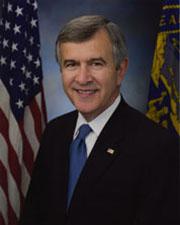 Sen. Mike Johanns (R-NE)
Legislative Activity
Stay on top of the latest movement without scrolling through every action
Senate amendment agreed to: Amendment SA 735 agreed to in Senate by Yea-Nay Vote. 67 - 31. Record Vote Number: 126.
April 1, 2009
View full timeline
Senate amendment agreed to: Amendment SA 735 agreed to in Senate by Yea-Nay Vote. 67 - 31. Record Vote Number: 126.
April 1, 2009
Roll call votes on amendments in Senate: Amendment SA 735 agreed to in Senate by Yea-Nay Vote. 67 - 31. Record Vote Number: 126.
April 1, 2009
Considered by Senate. (consideration: CR S4112, S4141-4144, S4149-4150)
April 1, 2009
Amendment SA 735 agreed to in Senate by Yea-Nay Vote. 67 - 31. Record Vote Number: 126.
April 1, 2009
Considered by Senate. (consideration: CR S4009)
March 31, 2009
Senate amendment submitted
March 30, 2009
Senate amendment proposed (on the floor): Amendment SA 735 proposed by Senator Johanns.(consideration: CR S3974-3977; text: CR S3974)
March 30, 2009
Amendment SA 735 proposed by Senator Johanns. (consideration: CR S3974-3977; text: CR S3974) To prohibit the use of reconciliation in the Senate for climate change legislation involving a cap and trade system.
March 30, 2009
Votes
1 roll call on this amendment
Text
Proposed
CONGRESSIONAL BUDGET FOR THE UNITED STATES GOVERNMENT FOR FISCAL YEAR
2010

The ACTING PRESIDENT pro tempore. Under the previous order, the
Senate will proceed to consideration of S. Con. Res. 13, which the
clerk will report.
The assistant legislative clerk read as follows:

A Senate concurrent resolution (S. Con. Res. 13) setting
forth the congressional budget for the United States
Government for fiscal year 2010, revising the appropriate
budgetary levels for fiscal year 2009, and setting forth the
appropriate budgetary levels for fiscal years 2011 through
2014.

The ACTING PRESIDENT pro tempore. The majority leader.
Mr. REID. Mr. President, I have spoken to the two managers of the
bill. As soon as Senator McConnell comes to the floor, they will turn
the floor over to him. He is coming, but he was detained on the way. So
if the two managers will go ahead and start the bill, and when Senator
McConnell gets to the floor, he has a statement he wants to make, and
that will start the time counting.
The ACTING PRESIDENT pro tempore. The Republican leader.
Mr. McCONNELL. Mr. President, Americans have serious concerns about
this budget and the massive amount of spending, taxing, and borrowing
it calls for right in the middle of a recession. They are also
increasingly concerned that Democratic leaders in Washington seem to be
less and less straightforward about what we are actually doing here on
Capitol Hill.
Americans were upset to learn that a provision was quietly dropped
from the stimulus bill that would have kept taxpayer dollars from going
to executives at failed financial firms. But they were equally upset at
how those bonuses came about--the language blocking them was quietly
stripped from the bill in a closed conference room somewhere in the
Capitol without anybody looking.
A few days after that, openness took another holiday on Capitol Hill
when Democratic leaders announced new budget gimmicks that had the
effect of concealing the true long-term costs of the administration's
$3.6 trillion budget. And now questions about diminishing transparency
relate to the budget itself--a budget that almost makes the trillion-
dollar stimulus bill look fiscally responsible by comparison.
Everyone knows that the national debt is already too high and that
this budget would cause that debt to balloon even more--doubling in 5
years and tripling in 10. Yet, even with all that borrowing, the
administration still will not have enough money to pay for the massive
expansion of Government outlined in this budget. In order to cover the
cost, they propose two things: a tax on income that hits small business
very hard and a new national energy tax that would hit every American
household and business.
But the Democratic budget writers had a problem: This new energy tax
is deeply unpopular, and it is a serious job killer. According to some
estimates, this tax could cost every American household up to $3,100 a
year just for doing the same things people have always done, such as
turning on the lights and doing the laundry. It is also a tax on all
economic activity, from factory floors to front offices. This tax won't
just hit American households, it will cost us jobs.
Another problem was that virtually all Republicans and a lot of
Democrats agree with most Americans that this new national energy tax
is a terrible idea and that we can't afford it. Yet, without this tax,
there is just no other way for Democratic leaders to pay for all the
new Government programs the administration wants. The solution to the
problem was this: Democratic budget writers decided to use a rule that
allows them to fast track legislation down the road, including
potentially the new energy tax, without any input from Democrats and
Republicans who either have serious concerns about this tax or who
oppose it altogether.
The chairman of the Budget Committee argues that this version of the
budget resolution doesn't allow this avenue for fast tracking
legislation on an energy tax, and that may be so. But we also know two
things: First, the language House budget writers have used in their
budget resolution leaves the door wide open to include the energy tax,
and the Democrats need this tax as a slush fund to pay for all the new
programs the budget creates.
Some still argue that this fast-track process won't be used for the
energy tax. They must not be paying attention to the administration's
budget director, who says fast tracking the energy tax isn't off the
table. And they must not have been paying attention to our friend the
majority leader, who, to his credit, has been quite candid about the
fact that the amount of money the administration needs for its health
care proposals is almost exactly what the administration says it can
raise from a national energy tax. Americans don't need another $3,100
added to their tax bill.
And just as worrisome is the method being used to ram this tax
through Congress: lay the groundwork, keep it quiet, and rush it
through with as little transparency and as little debate as possible.
If there is anything we have learned over the past few weeks, it is
that the American people want more people watching the store, not
fewer. If the bonuses taught us anything at all, it is that Americans
think we should take more time, not less, when considering how to spend
their money. If Democratic leaders intend to pay for all the
administration's programs with a new energy tax, they should say so
now, bring it to the full Senate, and let the people decide. Anything
less on a policy shift of this magnitude betrays a troubling lack of
straightforwardness about the Democrats' plan for imposing a massive
new tax on the American people and American businesses.
Mr. President, I yield the floor, and I suggest the absence of a
quorum.
The ACTING PRESIDENT pro tempore. The clerk will call the roll.
The assistant legislative clerk proceeded to call the roll.
Mr. CONRAD. Mr. President, I ask unanimous consent that the order for
the quorum call be rescinded.
The ACTING PRESIDENT pro tempore. Without objection, it is so
ordered.
Mr. CONRAD. Mr. President, I ask unanimous consent that the use of
calculators be permitted on the floor during consideration of the
budget resolution.
The ACTING PRESIDENT pro tempore. Without objection, it is so
ordered.
Mr. CONRAD. Mr. President, I know my colleague, Senator Gregg, the
ranking member, has a statement he would like to make, and so I will
withhold for his statement.
The ACTING PRESIDENT pro tempore. The Senator from New Hampshire.
Mr. GREGG. Mr. President, I appreciate the courtesy of the Senator
from North Dakota, who is always extraordinarily courteous,
professional, and generous. Before we begin the specific debate on the
issue of the budget, which obviously we both have to be here for--and I
know he has a lot of things going on in North Dakota with the
flooding--I would like to make a few remarks off topic.
(The further remarks of Mr. Gregg and Mr. Conrad are printed in
today's Record under ``Morning Business.'')

[[Page S3943]]

Mr. CONRAD. Mr. President, I speak to the matter now before us on the
floor of the Senate, the budget.
I would like to start by pointing out what this President has
inherited because this President, who has only been in office a few
months, has inherited a series of crises almost unparalleled in our
country's history. You think about it. Not only does he have a fiscal
crisis, he has a housing crisis, he has a financial crisis, he has two
wars, and he has a legacy of debt that is truly stunning.
The debt more than doubled in the previous 8 years, the foreign
holdings of U.S. debt tripled in the previous 8 years, and the
President inherited an economy in recession for more than a year, an
economy which contracted by more than 6 percent in the last quarter of
last year. Of course, when that happens, deficit and debt soar. That is
precisely what has happened. In the last years, the deficit and debt
have skyrocketed. So this President walks into a very challenging
situation.
This shows what happened to just the Federal debt in the past years.
It went from $5.8 trillion to over $12 trillion. The way we do it, we
don't hold Presidents responsible for their first year because they are
inheriting a situation. We don't hold George Bush responsible for the
first year he was in office. He was working off the previous
President's budget. And we do not hold this President responsible for
the first year because he inherits the previous President's budget. But
this is what happened in the previous 8 years: more than doubling of
the debt. Perhaps even more alarming, there was a tripling of foreign-
held debt.
President Bush, as we can see by this chart--it took 42 Presidents
224 years to build up $1 trillion of foreign-held debt. President Bush,
during his period, ran up more than $2 trillion of foreign holdings of
U.S. debt. Last year alone when we went to finance our debt, 68 percent
of the funding came from foreign entities.
Some say that is a sign of strength. I don't share that view. To have
the Chinese be our biggest financier, to have Japan be No. 2, to have
them financing 68 percent of our newly issued debt--I don't think that
is a sign of strength. I think it is a sign of vulnerability.
Not only did President Obama inherit those very tough fiscal
situations, he also inherited a country facing very dire economic
conditions, with over 3.3 million private sector jobs lost in the last
6 months alone.
You can see, going back to September, 300,000 jobs were lost. That
jumped up to almost 400,000 in October of 2008; in November of 2008,
over 600,000 jobs lost. Then it approached almost 700,000 in December
of 2008. In January of 2009 there were nearly 700,000 jobs lost; in
February of 2009, another almost 700,000 jobs lost.
We see the unemployment rate rose very dramatically, starting back in
March of 2007, when it was just at about 4.4 percent. Then it started
skyrocketing back in March of 2008. You can see it took off at a very
rapid rate to a level of 8.1 percent in February of 2009.
This is much more than numbers on a poster. These are real people
losing their jobs--meaning their ability to hold on to their homes was
threatened, meaning their ability to provide for their families was
diminished. These people are wondering what comes next for them; what
are we going to do that is going to make a difference in their lives.
We also see economic growth contracted very dramatically from the
third quarter of 2008, when there was a negative one-half of 1 percent
of growth, to the fourth quarter of 2008 where the economy contracted
at a rate of over 6 percent. That is the worst economic performance in
decades.
That is the situation this President inherited. But it is more than
that. He is inheriting record deficits; a doubling of the national
debt; the worst recession since the Great Depression; financial market
and housing crises, as I indicated; 3.3 million jobs lost in the last 6
months; and on top of that, ongoing wars in Iraq and Afghanistan.
I have often thought of the crushing responsibility on the shoulders
of this President, but he is equal to it. I can say, in meeting after
meeting I have had with him, one of the things that has always appealed
to me about Barack Obama, now President Obama--not only is he a very
smart person, but he is remarkably calm.
Even in the face of great crisis, this President maintains a coolness
under fire. I find it very appealing and very reassuring that with all
of these crises he is absolutely calm and he is very clear thinking.
That is what we need at this time.
So when the President came with major priorities in his budget, I
think many across America thought, those are exactly the right
priorities. He is talking about reducing our dependence on foreign
energy, one of his three key priorities; excellence in education. If we
do not have the best education in the world, we are not going to be the
strongest country in the world; for very large major health care
reform, because I think everyone understands that is the 800-pound
gorilla. That is the thing that could swamp the boat, because we are
spending $1 of every $6 in this economy on health care, and we are
headed for more than $1 of every $3 in this economy going to health
care if we stay on the current trend line. Clearly that is
unsustainable and the President has called for major health care
reform.
A continuation of middle-class tax cuts, the 2001 and 2003 tax cuts.
The President added additional middle-class tax cuts in his budget. All
the while the President called for these major initiatives, but to do
it and cut the deficit in half over the 5 years. We have tried our
level best to meet the President's major priorities, understanding that
we were going to have to make some changes, because the Congressional
Budget Office, who did their forecast of revenue available, had done
their forecast several months after the President's forecast was done.
In the meantime, the situation, as I have already shown, had
deteriorated. So we were left with a circumstance in which we had $2.3
trillion less to write a budget than did the President when he wrote
his.
When I say $2.3 trillion, I want to emphasize that. I am not talking
about ``million,'' I am not talking about ``billion,'' I am talking
about ``trillions'' of dollars. Trillions of dollars. A trillion
dollars is 1,000 billion dollars; 1,000 billion dollars.
So when we say $2.3 trillion was lost in the forecast of revenue
available, that is a big deal. I was given the responsibility of
telling the President that we were faced with that very changed
circumstance, because the Congressional Budget Office does not report
to the President, it reports to the Congress. So when we learned of
this very significant change, I and Chairman Spratt, the chairman of
the Budget Committee in the House, were given the responsibility to
meet with the President and to inform him of these very significant
changes.
As you can imagine, the President was not very happy. But I can tell
you he is a realist, and he understood immediately the implications. He
understood immediately that we would have to make some changes in his
budget. But he asked us to preserve his key priorities, and that is
what we have attempted to do.
Again, we need to reduce our dependence on foreign energy. I think
everyone knows, or nearly everyone, that this is one of the major
fundamental threats to the United States. Our dependence on foreign
energy, back in 1985, we imported 27 percent of the oil we use. By
2008, that had increased to 57 percent of the oil we are using being
imported from abroad, much of it from unstable parts of the world, some
of them not very friendly to the United States.
So this poses a fundamental long-term economic and security threat to
our country. The President has rightly identified, even though the
pressure is off right now because oil prices are way down, that this is
something we have got to face up to if we are going to have a strong
America in the future.
So in this budget we have responded with a reserve fund that reduces
dependence on foreign energy, creates green jobs, helps preserve the
environment, and helps with high home energy costs. We do it through a
reserve fund to accommodate legislation, to invest in clean energy, and
address global climate change.
We also provide the President's level of discretionary funding for
the Department of Energy for the year. We

[[Page S3944]]

build on the economic recovery package investments in renewable energy,
efficiency, and conservation, low-carbon coal technology, and
modernizing the electric grid. That process had been started in the
economic recovery package. It is in the budget; critically important to
the economic future of the country.
In terms of a focus on excellence in education, there are lots of
warning signs out there that we are starting to lose the battle to be
the best educated people in the world. But what are the indications?
Here is just one. We are now dramatically lagging China in producing
engineers. You can see, in 1985, each of our countries produced about
the same number of engineers. We produced, each of us, about 75,000
engineers.
But look at what has happened since in the United States. The number
of engineers we are producing has declined to about 65,000. Look at
what has happened in China. They have increased from about 75,000 to
more than 440,000 engineers. Now, why is that important? I think we
know it is important because you have got to have engineers if you are
going to be building a strong infrastructure. If you do not have a
strong infrastructure, you do not have a strong base for competition in
this globalized world economy.
We have done everything we can to capture the President's priority of
emphasizing excellence in education. We generate economic growth and
jobs, prepare the workforce to meet the global economy, make college
more affordable, and improve student achievement. We do it with a
higher education reserve fund.
To facilitate the President's student aid increases, we extend the
simplified college tax credit providing up to $2,500 a year, and we
also focus on the President's requested level of $5,550 for Pell grants
and fully fund his education priorities, such as early education.
Now, I was raised by my grandparents. My grandmother was a
schoolteacher. She was five feet tall. We called her Little Chief. We
called her Little Chief because she commanded respect. And in our
family, she would tell us there are three priorities: Education is No.
1. Education is No. 2. And education is No. 3.
I tell you, we got the message, my generation. I have 13 cousins.
Every one got advanced degrees. We were not a family of any special
means, a middle-class family. But we understood that education was the
way to secure a better future. She made it very clear to us that was
the expectation. We need to reemphasize excellence in education in this
country.
But we also face an enormous challenge in health care. As I indicated
in my opening remarks, $1 in every $6 in this economy is going for
health care. This chart shows 16 percent of our GDP, and we have just
gotten updated numbers that show now we are over 17 percent of our
gross domestic product going to health care. If we stay on the current
trend line, by 2050, 37 percent of our gross domestic product will be
going for health care. That is utterly unsustainable. It is the biggest
threat to our long-term deficits and debt. It is the biggest threat to
our economic competitive position. It is the biggest threat to the
economic viabilities of families and companies and communities. So this
is something that must be addressed.
President Obama has called for major health care reform, and we have
sought to preserve that priority in the budget resolution. We invest in
health care in an attempt to bend the health care cost curve to save
money, reduce long-term costs, reduce the buildup of deficits and debt,
also to improve health, to expand coverage, to increase research, and
promote food and drug safety.
We do it in three fundamental ways. First, a reserve fund to
accommodate the President's initiative to reform the health care
system. What does a reserve fund mean? It means simply this: The
committees of jurisdiction are given full flexibility to write
legislation to accomplish the President's goals. But they have certain
requirements, and the requirement is that they pay for what they
produce, that it be deficit neutral.
The administration has said all along, that is their intention, and
we try to match that intention in this budget. The reserve fund also
addresses Medicare physician payments. It is already scheduled in law
that doctors will take very significant reductions. We do not want to
see that happen. So, again, we are saying to the committees of
jurisdiction: Fix it and pay for it. Fix it and pay for it, because we
cannot add to the deficit and debt to do it.
Finally, we continue to invest in key health care programs such as
the National Institutes of Health and the Food and Drug Administration.
On defense, which is always of great interest in terms of a budget
resolution, we actually provided $45 billion more in funding for
defense than President Bush's final defense plan. You can see the final
defense plan of President Bush is this red block. The hatch lines here
are the additional funding we have provided over the years 2010 to
2013, because that is as far as the Bush defense plan goes. We provided
$45 billion more. Frankly, President Obama came forward and said: Look,
let us more honestly account for war costs than has previously been
done. In the previous administration, all too often they did not put in
the budget funding for war. This President did, and we do in the budget
resolution.
Now, the President also gave us a charge to cut the deficit by more
than half over the 5 years of the budget resolution. You can see that
we have done, that this year we project the deficit at $1.7 trillion
under this budget resolution, and we step it down every year. We will
reduce it by $500 billion the first year, by $300 billion the second
year, by another $300 billion the third year, by a little bit the
fourth year, and by another about $60 billion the final year, to get
down to $508 billion. That is a reduction of more than two-thirds over
the 5 years, as a share of gross domestic product, which is what the
economists like to look at, because that takes out the effect of
inflation.
You can see we are reducing the deficits from 12.2 percent of gross
domestic product in 2009, down to less than 3 percent in 2014. That is
the magic goal, less than 3 percent of gross domestic product. Because
at that level the economists tell us you stabilize the growth of the
debt. That is the goal the President set, getting down to 3 percent of
GDP or less in a deficit in the fifth year, and we beat that goal by a
little bit.
There has been a lot of talk about the spending in this budget
resolution. I want to make clear here is what happens. The spending
again is a share of gross domestic product. Again the economists say
that is the most fair comparison over time because it takes out the
effect of inflation. You can see in 2009, we are spending 27.6 percent
of GDP in this budget. That is a very high level historically. And, of
course, the reason for it is the tremendous economic downturn, the need
to provide stimulus to the economy, to provide lift. So spending is at
a high level as a share of the gross domestic product in 2009.
You can see each and every year we step it down until 2012, and then
basically it stays at that level for 2013, 2014, at about 22 percent of
GDP. So we are going from 27.6 percent of GDP this year to 24.5 percent
in 2010, down to 23.3 in 2011, and then basically stabilize at 22
percent of GDP through 2014, again getting down to our target of a
deficit of less than 3 percent of GDP in the fifth year.
Again, on spending, to go into some additional detail, breaking down
discretionary spending, as you know, in the budget we have mandatory
spending, things such as Social Security and Medicare. Those are
mandatory programs, mandatory in the sense that if you qualify, the
Federal Government pays for what you have coming. Discretionary
programs are programs that are open for the Appropriations Committee to
adjust every year. If we look at the discretionary side of our budget,
we can see, on defense, we are providing the full request by the
President, a 3.8-percent increase. Internationally, we are not
providing the President's full request because of the diminished
resources available to us. So we cut the President's request by $4
billion. We are still providing an increase of almost 18 percent. Why
are we giving such a large increase to international accounts? The
reason is quite simple. We are engaged in two wars.

The Secretary of State called me the weekend before this weekend at
home. The Secretary of Defense called me at

[[Page S3945]]

home. Both delivered the same message. They were a little unhappy,
disappointed that I was cutting international accounts by $4 billion
from the President's request. They emphasized the importance of these
increases because what has been done before is to make supplemental
requests outside the budget. This President said no more of that. We
are going to be direct. We are going to be open in the money we are
requesting. These funds are needed to deal with Iraq and Afghanistan
and Pakistan and other threats we are facing around the world.
Interestingly, I have never before, in my 22 years in the Budget
Committee, had the Secretary of Defense call me to support the budget
for the State Department. Why would the Secretary of Defense call me
and ask me to increase what I have provided for in the international
accounts? He told me: There is a lot that is being spent out of the
Defense Department budget that should be spent out of the State
Department budget for activities in Afghanistan and Iraq. President
Obama has put those categories of spending where they belong, and it
ought to be supported. Of course, I have great respect for them both. I
had to tell them: When you lose $2.3 trillion, you have to make a lot
of changes to make it add up. So I felt compelled to reduce these
accounts from the President's request.
Domestic spending, we increase by 6 percent. The President asked for
more in that category. Again, we simply could not make the numbers work
without making reductions.
So the total in this area, $1.03 trillion, is from last year. This
year it is $1.08 trillion, for a combined increase in discretionary
spending of 5.3 percent. We can see on nondefense discretionary, that
combines international and domestic, we are giving a 7-percent
increase. The President asked for over 10 percent. Again, I know there
are people who are disappointed. I am sorry, but my responsibility is
to deal with the reality with which I am presented. The reality I was
presented with was $2.3 trillion less in revenue. I have had to make
reductions in the discretionary accounts. I have had to make reductions
in mandatory accounts. I have had to make changes on the tax side of
the ledger in order to get the deficit down to a sustainable level.
Revenue changes in the budget resolution: I have heard some say we
have all these tax increases. That is not what the Congressional Budget
Office says, when they look at my budget and look at all the proposals
and compare it to current law. They conclude that I am providing $825
billion of tax reduction. That is a different story than we hear coming
from some quarters. That is not my claim. This is what the
Congressional Budget Office finds when they look at my budget and
compare it to current law. Why the difference? First, we have extended
all the middle-class tax relief provided in 2001 and 2003;
specifically, the 10-percent bracket, the child tax credit, the
marriage penalty relief. All that is continued in this budget, as well
as education incentives. On top of that, alternative minimum tax reform
costs $216 billion to prevent 24 million Americans from being subjected
to the alternative minimum tax. We also have estate tax reform; estate
tax reform at $3.5 million an individual, $7 million a couple. Those
people who have estates of less than that amount will pay zero in
estate tax. Over 99 percent of the estates in America will pay zero,
nothing, not a penny. That is a reform that needed to be made. It is
included in this budget. The President called for it, and we have
adopted it.
We also have a series of business provisions and the so-called tax
extenders, things that need to be adjusted every year. We do it in this
budget for a subtotal of tax relief of $958 billion. We have an offset
to that, certain loophole closures, shutting down abusive tax havens,
abusive tax shelters, offshore tax dodges that will raise $133 billion
for total tax cuts of $825 billion.
In the President's budget, he has recommended that we not continue
all the tax relief contained in the 2001 and 2003 acts for people
earning over $250,000 a year. We have adopted that recommendation in
this budget. All of the middle-class tax relief from 2001 and 2003 is
here. It is funded. It is provided for.
In addition, the President called for additional tax reductions for
middle-class people, the so-called make work pay provisions. Two years
of that is already funded in the economic recovery package. So that
will continue for the next 2 years. The President wanted to make that
program permanent. Again, we could not do that in light of the new
forecast. So we have provided that those make work pay provisions can
be extended, if they are paid for. They will continue for the next 2
years, but after that, if they were to be extended, they would have to
be paid for.
We also provide for important budget enforcement in the budget
resolution. We have discretionary caps for 2009 and 2010. We maintain a
strong pay-go rule. We have a point of order against long-term deficit
increases, a point of order against short-term deficit increases. We
allow reconciliation for deficit reduction only, which was the original
purpose of reconciliation. We provide a point of order against
mandatory spending on an appropriations bill; no backdoor stuff that
used to go on, people raiding the Federal Treasury by coming in here
and changing mandatory spending on an appropriations bill.
The budget resolution also addresses our long-term fiscal challenges
in these ways. No. 1, we have the health reform reserve fund. That is
absolutely the key element to dealing with our long-term buildup of
deficits and debt. That is the part of our spending that is absolutely
out of control. The only way to get it back under control is
fundamental health care reform which is provided for in this budget on
a deficit-neutral basis. We also have program integrity initiatives to
crack down on waste, fraud and abuse and a long-term deficit increase
point of order to require 60 votes to increase the deficit long term.
President Obama has said this about the need for further work on our
long-term fiscal situation. Let me be clear: The first 5 years--this
budget is a 5-year budget--we do quite a good job, a credible job of
getting the deficit down. We reduce it by more than two-thirds. We get
it down to less than 3 percent of GDP. But the second 5 years of the
President's plan, even if we extended our budget for 5 years, is going
to require much more effort. We are on an unsustainable course for the
long term. In the next 5 years, I think we have done a credible job of
moving in the right direction, reducing the deficit by two-thirds. But
beyond the 5 years, we have big problems on the horizon.
The start in this budget to deal with it is health care reform
because it is the 800-pound gorilla. But it is going to take more than
that. It is also going to take tax reform because we have a tax system
that is hemorrhaging to these offshore tax havens, abusive tax shelters
and, frankly, a system that is very inefficient at collecting the
revenue that is due. If we collected the money that is due under the
current Tax Code, we would have no structural deficit. We wouldn't need
any tax increase. If we just collected the money that is due under the
current tax levels, we would have no structural deficit. The problem
is, we aren't collecting the money that is due under the current code.
We are only collecting about 75 percent of what is due. A big reason
for that is the explosion of offshore tax havens, abusive tax shelters,
the tax gap. All those things are rendering the tax system very
ineffective.
The President recognizes the need for further action to address the
long-term fiscal imbalance as well. He said:

Now, I want to be very clear. While we are making important
progress towards fiscal responsibility this year, in this
budget, this is just the beginning. In the coming years,
we'll be forced to make more tough choices, and do much more
to address our long-term challenges.

That is the truth. We are going to have to do much more in those
years beyond the 5 years of this budget.
Finally, I would like to address the question of a 5-year budget
versus a 10-year budget. The President sent us a 10-year budget. We
have written a 5-year budget. Some have said that is an attempt to
conceal the effect of the second 5 years. The President sent us a 10-
year budget. It has been fully scored by the Congressional Budget
Office. There is no hiding of anything. The President provided us a 10-
year budget. I was critical of the previous administration for not
providing a 10-year budget because I was concerned they

[[Page S3946]]

were hiding the effect of their tax cuts in the second 5 years. This
President has made no attempt to conceal his 10-year plan. He sent it
to us. It has been scored by the Congressional Budget Office. We know
what it is.

But Congress, when it writes budgets, has almost always written a 5-
year budget. In fact, of the 34 budgets Congress has written under the
Budget Act, 30 have been 5-year budgets. Why? Because the projections
for year 6 through year 10, the projections for revenues and
expenditures for years 6 through 10, have been woefully inaccurate.
They have been notoriously unreliable. But never have I seen them more
unreliable than right now. That's because of the extraordinary
uncertainty we're facing in the near term. Inaccuracies in the
forecasts for the next several years will compound into huge
differences in years 6 through 10.
So we wrote a 5-year budget that fully discloses the spending and
revenue for the 5 years. We did not write a 10-year budget. Congress
almost never has. But the President did. And the President's 10-year
plan is fully disclosed.
We have done our level best to make changes that were necessary in
what the President sent us in order to address his key priorities and
at the same time to reduce the deficit in the way that he called for
and to reach a deficit that was less than 3 percent of GDP in the fifth
year.
I am proud of what we have done. Is it a perfect document? The work
of men and women is never perfect. We are flawed. I will confess to
that. To me, the greatest flaw is we still have not fully coped with
the long-term deficit and debt challenge to this country. Much more
will have to be done.
Senator Gregg and I have one proposal. We have a proposal for a task
force that would require Members of Congress and the administration--16
of them--to be given a responsibility to come up with a plan to get our
long-term deficit and debt condition in order. If 12 of the 16 could
agree, that plan would come to Congress for a vote.
I believe it is going to take some special effort, some special
structure to deal with these long-term deficits and debt threats. I
want to say for myself, I do believe the long-term debt accumulation
does fundamentally threaten the economic security of America. While we
have a good start in this first 5 years, much more must be done.
Mr. President, I thank you for this time.
I will yield the floor.
Before I do it, I thank Senator Gregg, the ranking member of the
Budget Committee. There are many policy issues that divide us. There
are some where we are joined at the hip. But Senator Gregg has been a
thorough professional in all of the work of the Budget Committee this
year. His staff is outstanding as well. I recognize Senator Gregg as
somebody who has credibility. He may say some things that are somewhat
uncharitable about the budget I am presenting today. I understand that.
That is his job. He has strong feelings, and I applaud him for them
because that is what we need. If everybody in the room thinks the same
thing, nobody is thinking very much. I will tell you one thing, Senator
Gregg is thinking. He cares deeply about the economic future of this
country, and he is doing his level best to get us on a path that makes
more sense. I applaud him for it. But I would be remiss if I did not
recognize the professionalism and leadership he has exhibited in the
work of the Budget Committee this year. In no way does that mean he
endorses this plan. He will make very clear he does not. He strongly
disagrees, as is his right. But I do want to recognize the very good
working relationship we enjoy.
I thank the Chair and yield the floor.
The PRESIDING OFFICER (Mr. Akaka). The Senator from North Dakota, Mr.
Conrad, yields the floor.
The Senator from New Hampshire is recognized.
Mr. GREGG. Thank you, Mr. President.
Let me first thank the chairman for his generous comments, and let me
second those relative to himself and his staff.
We obviously have a deep difference of opinion as to the best way to
proceed relative to shepherding the financial house of our Nation, and
especially specifically relative to this budget that has been sent to
us by this President. But I have an immense amount of respect for him
and his staff, who are professional and extremely courteous, and we
have a great personal and working relationship, which actually makes
the job much more enjoyable as a result of that.
And, of course, we send to North Dakota our deep concerns about what
they are going through with the floods. I know the Senator was out
there this weekend supporting the folks who are working so hard to try
to protect their communities--an amazing story: 80,000 volunteers in a
town of 90,000. It is very impressive. Let's hope the waters recede
before they do any more damage.
I should mention that UNH beat North Dakota in the hockey game this
weekend in the NCAA. I noticed my colleague from North Dakota did not
actually mention that.
Mr. CONRAD. Mr. President, if I could say, our hockey team lost to
his hockey team in the last one-tenth of 1 second. I say to the
Senator, our Congressman in North Dakota said: We don't want the flood
fight to have the same outcome.
Mr. GREGG. Nor do we.
Mr. CONRAD. We don't want to have won this right to the end and then
lose it at the end. So even the hockey game has provided inspiration
for the flood fight. We wish we had won the hockey game, but it is most
important that we win the flood fight.
Mr. GREGG. It was an exciting game, and North Dakota played
extraordinarily well.
Mr. President, we do differ on this budget. The budget that has been
proposed by the President of the United States has essentially been
given its stamp of approval by what has been brought forward by the
Senator from North Dakota. There are virtually no differences. As
Director Orszag said, they are 98 percent the same, and they are.
This budget, in our opinion, represents a clear and present danger to
the financial health of our Nation and to the financial security of our
children. It is a budget which spends far too much money, taxes far too
much, and borrows an extraordinary amount--it is clearly far too much.
It basically repeals the essential laws of common sense--the essential
laws of common sense--that say you cannot simply keep spending at a
rate that you cannot afford to pay for forever and not have to suffer
as a society, and suffer significantly.
Margaret Thatcher sort of captured the tempo of this budget. To
paraphrase her, she might have said about this budget: The problem with
the Obama budget is that at some point you run out of money.
If you follow the proposals of this budget, you are going to run out
of money sooner rather than later. In order to understand this budget,
you have to understand the dramatic nature of this budget.
Historically, when we have debated budgets in this body, they have been
important because they obviously represent guideposts for our Congress,
but they have not been a philosophical document that has redirected the
Nation fundamentally.
On the part of the President--I give him credit that he is not trying
to hide this--his budget openly attempts to redirect the Government of
the United States and move it significantly, dramatically to the left,
expanding the role of the Government in all sorts of areas, expanding
the cost of Government in a historic way, and expanding the burden of
the Government in the area of taxes and in the area of borrowing in a
way which we have never contemplated as a nation.
To try to put it into perspective, under the budget prepared by the
President and sent up here--and it is essentially the same as the
budget we are receiving from the Senate Democrats today--the
President's budget doubles the national debt in 5 years. That is pretty
bad. Then it triples the national debt in 10 years. And that
is intolerable.

Now, I have tried to figure out how you explain to people what $1
trillion or what $15 trillion is or what $17 trillion is. It is very
hard. Conceptually, it is extraordinarily difficult to get your hands
around what $1 trillion is.
As you can see, I had this chart made up when the original estimate
was $15 trillion--it went up to $17 trillion--to

[[Page S3947]]

show the number of zeros here. It is a staggering amount of money that
is being added to the Federal debt. You have to ask yourself: Who is
going to pay all this money? This is real money. It has been spent on
programs the President wants. Who is going to pay it all? Who is going
to pay $15 trillion--with all of these zeros?
Well, unfortunately, our children and our children's children get
that debt. It gets put on their backs. At the end of the President's
budget, the average household in this country will owe $130,000 in debt
for the Federal Government--$130,000. They will have an interest
payment on this debt--the average household--of over $6,000. So the
debt they are getting may actually exceed the value of their house.
Put another way--which was first coined by my esteemed chairman--he
designed this wall of debt. This is the wall of debt, as shown on this
chart. This is what the Federal debt does over the period of the Obama
budget. It goes straight up. It is a massive wall of debt, which is an
incredible burden on our Nation, and really an unacceptable burden if
you are going to be accurate about it.
To try to put it in a more understandable term, as shown on this
chart: This is a picture of President Obama, of course, on the right
side of the chart. On the left side of the chart are pictures of all
the Presidents we have had in our Nation since our Nation began 232
years ago, starting with George Washington and going through George W.
Bush.
In that period, from George Washington through people such as
Madison, Adams, Lincoln, Grant, Hayes, Wilson, Roosevelt the first,
Roosevelt the second, Truman--in this period from George Washington all
the way through George W. Bush, we have accumulated about $5.8 trillion
of national debt. That is how much those Presidents added to our
national debt.
Within the first 5 years of this Presidency, President Obama will add
more debt on the backs of our people and our Nation than all these
Presidents put together. Within 5 years, he will have taken the total
debt put on the backs of Americans and doubled it since the country
began--a staggering fact.
Now, does this have to happen, the addition of all this debt because
of the fact that he has inherited a terrible situation? And he has, and
we all admit to that; this economy is in a very difficult way. No, it
does not. Yes, in the short term there has to be a government that is
run at a deficit in a very significant way in order to try to get the
economy going because we all understand the Federal Government is,
right now, the only liquid entity around here. So the money is being
pumped into the economy to try to give it some lift.
But this recession is not going to go on forever. We are a resilient
nation. We will recover from this recession. It will be over hopefully
sooner rather than later. But it certainly is not going to run that
much longer in the terms of this Presidency. Certainly, by the midterm
of this Presidency, we should be out of this recession.
So you would presume--you would presume--at that point, say, in 2011
or 2012 at the latest, the spending of the Government and the deficit
of the Government would start to come under control, that there would
be some attempts to bring it down and manage it in a more historic way.
Unfortunately, that does not happen under this budget. What the
President is proposing is that we continue to grow the size of
Government at an extraordinary rate, independent of whether we are in a
recession. The average deficit over the term of this President's budget
is $1 trillion a year--$1 trillion a year. That is a staggering number.
To put it in a historical context, that adds up to about 5 to 6 percent
of gross domestic product, and historically the deficit has been about
2 percent of gross domestic product. At the end of this Presidency, the
public debt, which is what people own outside the Government, will be
80 percent of the productivity of the country--80 percent of the
productivity of the country. What does that mean, 80 percent of the
productivity of the country? Well, historically, the public debt has
been about 40 percent of the productivity of the country, but under
this President, he is going to take that public debt very quickly up to
60 percent, then to 70 percent, and then, by the end of the period of
the budget proposed, it will be at 80 percent. That is such a high
number, when you couple it with the deficits of $1 trillion a year,
that you get to a point where it is simply not sustainable. That is why
this budget is a clear and present danger to the fiscal health of this
Nation and to the opportunities of our children. In fact, ironically,
if the United States were to try to seek membership into the European
Union--which, of course, we have no interest in doing, but those are
all industrialized nations and they do have a standard for operating
their governments in a responsible way. The standard of the European
Union is, public debt can't exceed 60 percent of Gross Domestic
Product, that deficits can't exceed 3 percent of GDP. We will be twice
that number, and it is not sustainable.

Now, did this have to happen? Did the President have to run up these
debts? If we had stayed on a pure glidepath and done nothing--in other
words, operated the Government as it is--as it is--this blue line would
be the cost of the Government. We would actually almost be in balance
by the year 2018. That is current law. Now, CBO uses very arcane rules
as to how it builds a baseline, but it is the baseline that we
determine as a Congress to use. I wouldn't accept that baseline as a
recipe for future policy because there are some tax increases in there
I don't like, but even if you were to factor out the tax increases, the
line would come in the middle here. The reason this goes up so
significantly, the reason President Obama's budget goes up so
significantly in its deficits is because they propose a radical
increase in spending. It is pretty much that simple. It is not about
economics or taxes; it is about spending. Essentially, the President's
proposal is to incredibly increase the size of the Federal Government
and the amount it spends, not only in the short run, which we all
accept is necessary--although it has been poorly handled relative to
the stimulus bill; worse than poorly handled, it has been a waste of
money relative to the stimulus bill--but this is the spike in spending
to reflect the deficit and the attempt to address it through the
stimulus bill. But look here: After we are out of the recession in the
year 2011, the line keeps on going way up--way up--to 25 percent of GDP
by the end of this budget.
Well, you say, what does that mean, 25 percent of GDP. Well, how big
a government is relative to the productivity of the economy defines how
productive the economy will be. You can't have a productive economy if
the Government is taking out all the money. It doesn't work very well.
Historically, we as a country have tried to keep--and this is the black
line here, and you will see it has been very level ever since the year
1958--this is the average, this black line, of how much spending the
Government has done. It is around 20 percent of GDP, the product of the
United States. Under the Obama years, as proposed by President Obama,
that is going to be increased at a staggering rate--huge increases in
spending.
President Obama is not trying to hide this. He has not tried to be--
he has been very open about it. He said, to paraphrase him,
essentially: I believe we create more prosperity by expanding the size
of Government in a number of areas. In fact, if you listen to the
Senator from North Dakota, he listed all these areas they are going to
explode the size of Government in, moving it dramatically to the left,
and increasing it at an incredible rate. In the budget document he
sent, he said exactly that. He said: At this particular moment,
Government must lead the way in providing the short-term boost
necessary to lift us from a recession that is severe and lay the
foundation for prosperity.
He went on to say he intended to do this by spending a great deal of
money on his priorities, which were clean energy, education, health
care, and new infrastructure. However, he doesn't stop spending the
money after this recessionary period; he keeps it going into the
outyears at a rate which is not sustainable. It is simply not
sustainable. You can't take the money from the productive side--from
the people who are working and producing jobs and taking risks and
going out there and actually producing wealth for this Nation, in the
sense that they are actually producing something we have to

[[Page S3948]]

sell and use in trade and basically create jobs as a result of that--
you can't take the money from them and move it over to the Government
at a rate that exceeds the historical norm at this level and expect you
are going to be able to maintain prosperity for the years to come. It
doesn't work. It does not work. As Margaret Thatcher says, you
eventually run out of money.
The effect of this massive increase in spending is a massive increase
in debt. This is the national debt, publicly held debt, which I
discussed before, as a percentage of GDP. It averages about 36 percent
since 1958. That is the black line right here. It has been up, it has
been down, but that is the average. Under President Obama's plan, it
goes straight through the roof, and this, I say to my colleagues, is
the threat. This is the threat. This is the clear and present danger to
our people, to our Nation, and to our children's future, because when
you get debt up to that level, you are not able to function as a
government. People get concerned about buying your bonds and buying
your dollars and using your currency.
You don't have to listen to me to find out that is the case. The
Chinese Government has made that very clear, and they happen to be the
biggest holder of our dollars. In fact, the chairman is always talking
about how outrageous it is that the Chinese own so much of our debt.
Well, they own it because they considered it to be a good investment,
and if they didn't own it, we would be paying a lot more in interest
payments and in taxes in this country and our dollar would be less
valuable. But Mr. Zhou, the governor of the central bank in China, has
said he is getting concerned about this crisis and about the value of
our dollar. The Premier of China said: ``We lent such huge funds to the
United States and, of course, we are concerned about the security of
our assets.''
Well, it is disconcerting and obviously not very nice to find out for
us as a nation--one that has always considered itself to be a
reasonably independent and strong Nation, the most independent and
strongest in the world--that the Premier of China, who owns most of our
debt outside the United States, is worried about it.
Why is he worried about it? Why are the Chinese worried about it? Why
are the other nations which buy our debt worried about it? Because they
look at this line, they look at this budget. This isn't done in a
vacuum. They know what this budget proposes. The President's budget
proposes massive increases in spending but absolutely no fiscal
discipline. It has discretionary spending jumping by $1.4 trillion--
trillion--it has mandatory spending, a net mandatory spending increase,
as it was sent up here, of $1.1 trillion, and it has zero savings in
the core accounts, which are mandatory accounts. That leads to these
massive debts.
It also has, interestingly enough, $1.5 trillion in new taxes. Now,
that is a pretty staggering figure in and of itself, $1.5 trillion. I
was entertained to hear my colleague from North Dakota say: Well,
actually, we get a tax cut in this bill. That is going to come as a
real surprise to all the people whose taxes are going to go up very
significantly as a result of this budget. For small business people,
taxes are going to go up dramatically as a result of this budget.
People who take charitable deductions and homeowner deductions in the
higher brackets, their taxes are going to go up, which will probably
affect charitable giving under this bill.
But the most insidious tax proposed in this budget is something
euphemistically called a carbon tax. Well, what is a carbon tax? That
is a way to bury a term so you never understand what they are doing.
A carbon tax is literally a new national sales tax on your electric
bills, a brand new national sales tax. We don't have a national sales
tax in this country. What is being proposed in this budget by this
President is a brand new national sales tax on your electric bill. So
every time you hit your light switch in your house, you are going to
get hit with a new tax--a sales tax--and it is a big one. It is a big
one. The White House sent this specious estimate of it. They said it
was $646 billion, but that was low-balling the number. MIT, which
doesn't have a dog in this fight, took a look at a similar proposal,
along with a number of other groups, and they said it would actually
generate over $300 billion in new taxes every year. It works out to
about $3,000 per household. So everybody living in America today who
has an electric bill or other energy bills, as a result of this new
national sales tax, if the President gets what he wants, is going to
pay $3,000 more in taxes a year, on average, for their energy bills.
That is a huge tax, and it is an incredibly regressive tax. I saw this
chart that the chairman brought up, saying we are going to create green
jobs. That is all about this energy tax, by the way. That is akin to
calling it a carbon tax; they are going to call it creating green jobs.
What are they going to call the jobs they are sending overseas? Because
industries in this country, which have to use a lot of electricity--
those are the hard-core industries that we still have in this country--
can no longer compete because they got hit with this massive increase
in taxes on their energy production and use. What are they going to
call those jobs? Green jobs sent overseas? The simple fact is, this
type of tax increase is incredibly regressive. Sales taxes are
regressive by definition, but a sales tax that is targeted on the
productive side of the ledger, as this one is, is exceptionally
regressive, as is the dramatic increases in taxes on small businesses
in this country.

Now, my colleague has said a number of things about how their budget
is different from the President's. It is a little bit different, but it
is 98 percent the same, and that is the score. I think I have a chart
which reflects that. This is the difference between the two budgets.
They are identical on discretionary for all intents and purposes,
identical on outlays, identical on revenues. Interestingly enough,
however, CBO came back and gave us--CBO is the Congressional Budget
Office--an honest evaluation of the President's budget, and some of the
things they said, which hopefully scared a few people around here, were
that the President's budget increased deficit spending by $9.2 trillion
over 10 years, $2.3 trillion more than what the President had told us;
that on an annual basis, it averages out to a budget deficit of about
$1 trillion a year, and that the percent of public debt jumps, as I
have mentioned, but it needs to be reemphasized that it jumps from what
it is today to 80 percent of GDP. The deficits jump to 5 or 6 percent
of GDP.

The administration has had both the Treasury Secretary and the OMB
Director up here over the years--the OMB Director has been coming up
here for years but the Treasury Secretary just recently--testifying
that the deficits in excess of 3 percent weren't sustainable. They said
that; we didn't say that.
So when CBO honestly evaluated their budget and did things such as
actually calculate the fact that there was 8.1 percent unemployment,
and it is probably going to go up and, as the President said, the top
rate would be 8.1 percent, but we weren't there yet--when CBO put the
real numbers onto the President's numbers and got these massive
increases in spending and in debt, well, these folks decided that we
cannot have that. They wanted to get that back down to 3 percent. Did
they do it by reducing spending or reducing any of the President's
spending initiatives? No. Zero. Do you know how they did it? They did
it by playing the old-fashioned games around here of smoke and mirrors
and hiding the ball, saying one thing but meaning another.
The President, to his credit, and to the credit of Mr. Orszag, was
forthright in their budget, which was probably as close to an honest
statement--with exception of the defense number--of what was really
happening here relative to spending and what was going to happen as we
have had in a long time. I congratulated them for that and still do.
But we went backward with this proposal from the Democratic leadership.
So that they could get it below 3 percent as a percentage of GDP and
get their deficit and debt numbers down, they left out of their budget
$1.1 trillion of spending and taxes that President Obama had in his.
They are not different, so it is just games. They didn't score their
budget correctly or honestly or straightforward. Their budget becomes
the ``tax too much, spend too much, borrow too much, and now hide too
much'' budget. At least the President's budget wasn't a ``hide too
much'' budget, although his defense number has serious problems

[[Page S3949]]

with it. At least he didn't take $1.1 trillion in very illusory action,
moving the shell around so that you cannot find the real numbers,
claiming they made real savings in those accounts. It is actually just
pretty ridiculous to take that step backward.
Of course, they now claim that they cut the deficit in half. Now,
that is where we depart from common sense. There are a lot of things on
which they tried to repeal the law of common sense in their budget, but
this is the most outrageous. First, they increased the deficit fivefold
and then they reduce it back to half of that and then claim they are
cutting the deficit in half. That is like taking six steps back, three
steps forward, and saying you are making progress. You are not making
any progress. They are so far out of whack with what has been the
historical norm that it is not even acceptable. The deficit they ended
up with after taking six steps back and three steps forward is still in
the 4-percent range. It is still throwing debt on the books at a rate
you cannot afford, and it is absurd to claim that is fiscally
responsible.
Well, before I get into what we would do, I will mention a couple of
gimmicks that are played here because they are beyond the shell game
gimmick, which is pretty outrageous--moving around $1.1 trillion so
they don't have to put it on the budget. They take it off budget,
essentially, so they can look as if they are doing better than the
President, even though they have the exact same policies and numbers as
the President, for all intents and purposes.
They do a couple other things. They have reserve funds--lots of them.
This is a way to make like you are doing something that is fiscally
responsible by saying: You cannot spend this money unless you can pay
for it. The only problem is that they make the reserve funds in the
most critical area--specifically, health care, which we all know we are
going to want to address this year. They create this incredible
activity. They put into place a health care reserve fund, which means
they are going to rewrite the policy of health care for this country.
Every part of this Nation is going to be affected.
You heard the chairman say that 17 percent of the gross domestic
product in this country is involved in health care. The purpose of this
proposal--the health care reserve fund--is to address that 17 percent.
There is virtually nothing in this country that isn't affected by that.
Either everyone is directly affected or a member of their family is or
their job is.
There is a rule here called pay-go, which has become the mantra of
the other side of the aisle about how they are going to be fiscally
disciplined. I never heard anyone from the Democratic party or the
Congress, including the President when he was running for President and
running for Senate, fail to talk about how they were going to use pay-
go to discipline the Federal Government because it implies that they
are going to pay for what they are doing. It is a great term, by the
way. The only problem is, they don't ever use it. They claim they are
going to do it, but they never do. I call it ``Swiss cheese-go''
because there are so many holes in it. In the last 3 years, when the
Democrats ran the Congress, they avoided pay-go in the amount of $341
billion in spending.
This health care trust fund is a brazen act of putting a hole in pay-
go. Up front, they say we are not going to apply pay-go to health care
reform. Pay-go has a rule that says that in the first 6 years you have
to meet it, and the second 5 years you have to meet it. No, we are not
going to do that; we are going to be able to spend it over 11 years
before you have to meet the pay-go rules. Why don't you just give it up
and say we are not going to discipline ourselves. There is no pay-go
rule, and it is a problem.
The second gimmick that really concerns me--it is more than a
gimmick--is a big-time exercise of threatening the prerogative of the
Senate and the constitutional purpose of the Senate, which is the use
of reconciliation. This is a term of art, and nobody outside the
Congress really understands it. Essentially, reconciliation was put
into the budget process when the budget was created for the purpose of
making sure that what the budget said should be spent or should be
taxed actually occurs, so that there was a procedure to reconcile--to
say to committees if they exceeded a certain amount of spending and it
wasn't inside the budget: You must change that spending; if your tax
policy created more of a deficit, you must change that tax policy. It
is a procedure which, over the years, has evolved. It has been used
aggressively by both President Clinton and President Bush to pursue
policies that already exist or to adjust policies that already exist--
whether it happens to be already existing laws on welfare or existing
laws on tax policy. Yes, it has been used effectively and aggressively
in those areas. But it has never been used to create a brand new policy
on something that has as dramatic and all-encompassing and pervasive
effect on the American public as to change the entire health care
system or something like that. It has never been used to create out of
whole cloth, ab initio, a brand new major tax system, such as a
national sales tax on electric bills, and its use is solely a purpose
of the Senate. The House doesn't need reconciliation.
How does reconciliation work? It basically eliminates the prerogative
of the Senate to amend the bill. The greatest prerogative of the Senate
is that we have the right to debate, to discuss, and to amend
legislation. The House doesn't have that right. The House has something
called a Rules Committee, and it is under the control of the Speaker.
The membership of the Rules Committee is made up 2 to 1, plus 1, so the
Speaker could never lose a vote in the Rules Committee. The Rules
Committee sets out for the House of Representatives when a bill comes
to the floor--no matter the policy of the bill--and that you will have
this many hours of debate and they will allow this many amendments and
here is what they are. They can run through a bill in a half hour if
they want. That is the way the House has functioned for years. It is
the way the House was supposed to function when it was set up
constitutionally. The Senate, on the other hand, has no such rule. When
a bill is brought to the floor of the Senate, it is open for debate,
discussion, and amendment. If you can get 60 votes, you can get it off
the floor.
The budget sets up a process to allow the Senate to function more
like the House. The budget is on the floor for 50 hours of debate.
Amendments are allowed--any amendment, really, but at some point people
run out of energy and stop offering amendments--and there has to be a
vote.
In order to reconcile parts of the budget, the reconciliation system
was set up where there is 20 hours of debate and virtually no
amendments because they would have to be germane, and that is a high
standard to meet here.
So the reconciliation situation is that it allows you to basically
ram through the Senate--as you would through the House--a bill without
amendment, discussion, debate, or amendments. It is a huge weapon. If
used incorrectly, it fundamentally undermines the constitutional
purpose of the Senate. It turns the Senate into the House of
Representatives and makes us a body in which amendments are not allowed
and debate doesn't occur, of any significance. It has a truly
debilitating effect on the idea that you will have a body in this
constitutionally structured Government of economics and balances where
debate occurs vociferously and aggressively and where problems can be
aired out in a more timely and orderly manner than occurs in the House
of Representatives. So it should never be used to ab initio create a
massive, new program, such as a tax on everyone's electric bill. It
should never be used for the purpose of undertaking a major policy
event, such as rewriting the health care of the United States, which
will affect everybody.
To the chairman's credit, he doesn't have it in this bill. He
understands that. He has spoken out fairly effectively on this point--
probably more concisely and effectively than I have spoken on it. But
the House of Representatives has put reconciliation instructions in.
What earthly reason could there be for the House of Representatives to
put reconciliation instructions in their bill? They don't need it; they
have a Rules Committee.
It is obvious. This is a game, a very dangerous game. The House puts
in

[[Page S3950]]

reconciliation instructions but the Senate doesn't put it in because
the leadership knows that maybe it cannot get that across the floor and
doesn't want a vote on such a thing. So they can take it to conference
and, much to nobody's surprise, the conference budget comes back with
reconciliation instructions, which control activities on the Senate
floor.
It is totally inappropriate that the House should be dictating to the
Senate how we are going to legislate and structure our debate system
here on the floor and try to make us into the House of Representatives.
It is unconscionable in the context of the constitutional structure of
our Government. Yet that is the game that is being played here, and it
is a cynical game. It is totally wrong. If for no other reason,
everyone in this body should not vote for a budget that has
reconciliation in it.
On our side of the aisle, we think we can do better. I have talked at
some length about the clear and present danger this budget represents
to our children because of the massive increase in debt. We don't think
that has to be the course of action. You don't have to run the spending
of the United States up to 23 percent of GDP, which this chart
reflects, way above 25 actually, way above the historical norm. That is
not necessary. Short-term spending may be necessary for this
significant problem we have with the recession, but you do not have to
take the Government and expand it radically, move it to the left, and
spend money on what these groups are and constituencies are at this
rate. The Government should live within the basic historic norm of 20
percent of GDP as part of its spending. That is where we part ways
philosophically.

The President genuinely believes, and the party passing this budget,
the Democratic Party, generally believes you create prosperity--and the
President said it; he used those terms--you create prosperity by
expanding the Government significantly in these different areas of
social interest. You do not if you are spending up those areas so much
that people cannot afford it.
It does not happen that way. The way you create prosperity is by
keeping Government at an affordable level, doing what it is supposed to
do while you give individuals the ability to go out and be productive,
take risks, and create jobs. That is a difference of philosophy here.
When the President proposed in his budget the way he is going to
address health care, where we presently spend 17 percent of our gross
national product on health care right now--that is 5 to 6 percentage
points more than the next closest industrialized nation, so there is a
huge amount of money being spent on health care--he proposes we explode
that spending by another $1.2 trillion. We don't have to. We can get
every American insurance, and good insurance, without radically
increasing the amount we are spending on health care. We can do it by
more effectively spending the money we already have in the health care
system.
If you are spending 17 percent of the gross domestic product on
health care, you do not have to take it up to 18, 19, 20 percent. In
fact, if you do, you are probably not getting much efficiency out of
it. Rather, spend more efficiently the money you are already spending.
We believe as a party that everybody has a right to decent health
care insurance, and we also believe as a party we can do that within
the context of the money that is already available by being more
efficient, by giving people more choices, and by not putting the
Government between patients and their doctors. We do not believe in
nationalizing the health care system, which is basically what these
numbers are, the stalking horse for, that the President is proposing.
In the area of energy, the President's answer to energy is that you
put in place a new national sales tax, as I have mentioned before, on
every electric bill in this country, everybody's electric bill, so that
when you turn on your light switch you get hit with a new sales tax.
That is probably not going to produce a whole lot of energy. It is
going to probably undermine the productivity of our economy, and it
certainly is going to ship a lot of jobs offshore.
The way to produce a better energy policy is to look in an
environmentally sound way for more American supply and you can conserve
more energy. So we drill, and we can drill in an environmentally sound
way in identified offshore areas and produce more American energy. You
create more powerplants through using nuclear power, a totally clean
form of energy from the standpoint of pollution to our air. You use
wind, solar, and other alternatives, but you acknowledge the fact that
you cannot possibly get to the goal we have to get to, which is enough
energy to continue to maintain our international competitiveness as a
nation and continue our prosperity as a nation, if we are just using
solar and wind.
Solar and wind make up 2 percent of our national energy supply. If
you triple it, you only get 6 percent, and tripling it would be a
little difficult because there are a lot of people who do not want
windmills in front of their houses, whereas nuclear can be expanded,
whereas we can drill and find more American energy more effectively,
whereas we can use oil shale, which we have more of than Saudi Arabia
has oil, to produce energy more effectively, and we can be more
conservation minded, and there is agreement on that, obviously, on both
sides of the aisle. But you do not accomplish this by sticking the
American people with a brand new national sales tax.
In the area of cost discipline, clearly we do not have to run up
spending at these rates. We should bring them back down, and the way
you bring them back down is by addressing entitlement spending.
This budget that was sent up by the President of the United States,
who claims he is interested in fiscal responsibility--although,
obviously, it is sorely tested by the numbers in this budget, these
trillions of dollars of new debt--does not, on net, reduce the
entitlement accounts. He does suggest that Part D premiums be paid for
in part by wealthy people. I agree with that. We have actually offered
that amendment on our side of the aisle for the last 2 years under this
Democratic Congress and were beaten every year on that proposal. I am
glad the President is on our side this time. Maybe we will be able to
adopt it. It is called the Ensign amendment.
The fact is, unless you have a comprehensive approach to disciplining
entitlement spending so it is affordable, and we continue to deliver
reasonably good quality care and support to senior citizens, we are not
going to get these spending issues under control. You cannot kick this
can down the road, as the President has said. You have to start, and
the President has not started now. This budget has nothing in it to
that effect.
In one other area where we would do something significantly different
is defense. This budget basically assumes a declining funding of
defense for the next 10 years that is significantly less than what is
presently funded as a percentage of GDP.
We are at war. I wish al-Qaida was going to go away. I wish these
folks who represent such a huge and immediate threat to us, especially
if they get their hands on a weapon of mass destruction, did not exist,
but they do. They do exist, and they are a threat--a very significant
threat. We cannot confront them through goodwill because they are not
interested in goodwill. We have to confront them with a military that
is properly funded, properly cared for, and properly armed. That,
unfortunately, takes money.
The first obligation, the first absolutely most important obligation
of the Federal Government is national defense. Yet this budget, first,
does not include sufficient funding for the President's war costs and,
second, as a practical matter, it simply assumes that you can run the
military on the cheap, I guess, and that is a big mistake.
We do have differences, as Chairman Conrad has said, over how this
budget is structured. They come back to this very core issue of debt,
of what we are leaving our children, what we are passing on to our
children. It is simply not right for one generation to give another
generation less than what we received from our parents.
We, as a nation, have always--always--had the older generation pass
to the younger generation a better, stronger, and more prosperous
nation. Yet we are now on a pathway, if this budget is followed
forward, where the debt and the deficits will be so high

[[Page S3951]]

that our children will not be able to have as good a life as we have
had. The cost of maintaining this Government will so burden them their
ability to finance a home, buy a home, send their kids to college, or
just live a lifestyle that is something of the level and enjoyment and
prosperity that we have had will be seriously--seriously--threatened.
It is not fair to do that, not fair for one generation to do that to
another generation. Yet the numbers do not lie.
I understand the Democrats did not want to show us the second 5 years
of the budget. They hid it, along with a lot of other things they hid,
in this budget, but the President showed us the second 5 years of the
budget. Every American should take pause because when you see the debt
go up by $9.2 trillion, when you see the public debt ratio to GDP go to
80 percent, when you see deficits annually of $1 trillion a year on
average for as far as you can see, when you see a deficit rate of 5 to
6 percent of GDP, you are talking about a country which is headed
toward a fiscal crisis the likes of which we probably have not seen
since the Great Depression. It is a country which cannot afford its
Government. It is a nation that will be passing on to its children
significantly less than was passed on to us.
Mr. President, I yield the floor.
I suggest the absence of a quorum.
The PRESIDING OFFICER (Mr. Lieberman). The clerk will call the roll.
The assistant legislative clerk proceeded to call the roll.
Mr. GREGG. Mr. President, I ask unanimous consent that the order for
the quorum call be rescinded.
The PRESIDING OFFICER. Without objection, it is so ordered.
Mr. GREGG. Mr. President, I ask unanimous consent that for the
remainder of this debate on the budget over the next 50 hours, the time
be equally divided under a quorum call.
The PRESIDING OFFICER. Without objection, it is so ordered.
Mr. GREGG. I suggest the absence of a quorum.
The PRESIDING OFFICER. The clerk will call the roll.
The assistant legislative clerk proceeded to call the roll.
Mr. CONRAD. Mr. President, I ask unanimous consent that the order for
the quorum call be rescinded.
The PRESIDING OFFICER. Without objection, it is so ordered.
Mr. CONRAD. Mr. President, I would like to come back to the argument
I continue to hear advanced--that because we have gone from the 10-year
budget the President proposed to a 5-year budget, something is being
hidden. I don't believe anything is being hidden from anyone.
Of the 34 budgets the Congress of the United States has done since
the Budget Act, 30 of them were 5-year budgets--30 of the 34. Only four
were 10-year budgets. The reason Congress has tended to do 5-year
budgets--not just tended to but overwhelmingly has done 5-year
budgets--is that the outyear forecasts are notoriously unreliable;
notoriously.

Some have said I criticized the previous administration for not doing
a 10-year budget. Indeed, I did--because I believed they were trying to
hide the effect of their tax cuts in the second 5 years. But this
administration did not do a 5-year budget. This administration did a
10-year budget. There is nothing hidden. It is all out there for
anybody to see. The Congressional Budget Office has scored the
President's 10-year budget. Some of us have expressed concern about the
second 5 years.
People get in a habit around here and they get used to doing
something a certain way, they get used to criticizing budgets a certain
way so they keep doing it. It was legitimate to criticize the previous
administration for not doing a 10-year budget. It was legitimate to
suggest they might have something to hide. But this administration did
a 10-year budget. We in Congress--remember, ultimately the budget is a
congressional act. The President does not have to sign it. It does not
become law. Congress has almost always done a 5-year budget; 30 of the
34 budgets written under the Budget Act have been 5-year budgets,
including the last 5, including 2 in which Senator Gregg was the
chairman. Again, it has been done that way, number one, because the
outyear forecasts have been notoriously unreliable and, number two,
because we do a budget every year.
In fact, there is some question whether a 5-year budget is required
because we are going to do a new budget every year. So what matters the
most in any budget is the first year.
But I did wish to address that because I see this criticism. I saw it
in the David Broder column. I have immense respect for him. I saw it in
the David Rogers column. I have immense respect for him. But I don't
think the criticism applies in this particular situation. Nobody has
been more clear, publicly or privately, than I have that the second 5
years of the Obama budget raises a real concern about the
sustainability of our fiscal direction.
Let me just say, if you took my budget, which is a 5-year budget, the
budget that came out of the Budget Committee, and extended it for 10
years, you would see dramatically lower deficits and debt than in the
President's budget. In fact, I believe the first 5 years we have saved
$600 billion from the President's proposal. In the second 5 years the
total savings--for the 10 years, if we extended our budget 5 years,
would be over $2 trillion. That is just in the nature of the beast. You
know, the savings grow over time. We have put in $600 billion of
savings in the first 5 years.
With respect to the question of spending, we are only increasing
domestic spending--and that includes defense, that includes
international, and that includes domestic spending in the appropriated
accounts--5.3 percent. That is a modest number. Some of our friends on
the other side want to absolutely freeze spending. I say to them I
think that would be a serious mistake in an economic downturn, to
absolutely freeze spending. In this situation, where the economy is
contracting sharply, consumers cannot fill in the gap. They are tapped
out, and they are worrying about losing their jobs. Companies cannot
fill in the gap because they, too, are threatened. The only entity with
resources to step in, to fill the breach, is the Federal Government.
One of the things we learned in the Great Depression was that
profound mistake that was made was not necessarily on the fiscal policy
side--although that didn't help--but the biggest mistake was on the
monetary policy side controlled by the Federal Reserve. They did not
expand the money supply. They did not provide liquidity to prevent the
contraction from deepening, from growing, and from becoming far more
destructive.
Thank goodness we have learned. That is not what is happening here.
The Federal Reserve is providing liquidity, and that is on the monetary
side. On the fiscal policy side, we did pass a large stimulus package--
as imperfect as it was. We provided a large stimulus package to help
fill in some of the gap between where the economy should be and where
it is, the gap that was exacerbated by a more than 6-percent
contraction in the economy in the fourth quarter of last year.
I believe we are doing many of the right things--again, however
imperfectly. If I were able to design the stimulus package, I must say
it would have been much different. I would have put much more money
into infrastructure. I believe that would have been a better way to
stimulate the economy. Even so, there was substantial infrastructure in
the stimulus package. Not as much as I would have preferred but,
nonetheless, a significant amount. Additionally, I think the Federal
Reserve is going in the right direction with respect to the policies it
is pursuing in terms of providing liquidity and credit.
When we talk about Hoover economics that our colleagues on the other
side of the aisle embraced back in the 1930s, the fundamental
assumption was that markets were self correcting. That is what Hoover
economics was founded upon, the notion that the Federal Reserve did not
need to take countercyclical action and that the Federal Government did
not need to take countercyclical actions in terms of helping people who
were unemployed. Hoover opposed providing that kind of Federal
Government assistance.
Today we know that such assistance actually one of the most
stimulative things you can do because that money gets into the economic
bloodstream very quickly. It gives lift to the economy, it reduces the
size of the contraction, it reduces job loss, it reduces

[[Page S3952]]

more and more homes going into foreclosure because people can't pay
their mortgage, it reduces the vicious cycle that can suck down an
economy.
I just wish to be clear. When we have been critical of their stance
against stimulus, their stance against doing the things that are being
done by the Fed, they have this mantra they chant. Too much spending--
let me look at our budget in terms of spending. In the short term, yes,
spending increases because you are countering the cycle of the economy,
so we are up to 27 percent of GDP in spending this year. But then we
step it down to 22 percent of GDP, of gross domestic product, by the
fifth year. So that is going in the right direction--even for our
friends on the other side.
They say too much taxes. Let me remind them, in the President's
proposal, on a net basis, according to the Congressional Budget Office,
his budget cuts taxes $2.2 trillion. That is a 10-year budget. Our
budget on a 5-year basis cuts taxes $825 billion, on a net basis. Yes,
there are some tax increases on those of us who are high-income
earners. Yes, we have our taxes increased somewhat. But on an overall
basis, the President's budget has significant tax cuts from current
law, as does the budget that is before us now.
Third, they say too much debt. Look, I am in agreement with them. But
where were they in the good times during the Bush administration, when
they doubled the debt of this country? They doubled the debt of this
country when economic times were relatively good--until the end of the
Bush administration when the economy collapsed. That is what this
President inherited. He inherited an economy that was in full collapse:
It declined 6 percent in the last quarter of last year; an economy that
was in free fall; an economy with a housing crisis, a financial crisis,
a banking crisis, and a fiscal crisis.
I say to my friends on the other side, it was their policies that put
us in the soup. It was their policies of doubling the debt, of tripling
foreign holdings of U.S. debt, that put us in this ditch. Now this
President has to try to clean up the mess and part of cleaning up the
mess is higher deficits and debt in the short term. That is
unavoidable. That was already happening in a very dramatic way before
this President ever took office. He inherited a deficit. If he had done
nothing, he would have inherited a deficit this year of $1.3 trillion.
That is after our friends on other side had already doubled the debt
over the previous 8 years, and, worse, tripled foreign holdings of U.S.
debt. Now we have China as the biggest creditor and our friends here
say: Gee, China might not continue to finance our debt.
My friends, where were you? I warned about that starting in 2001.
Anybody can review the record. You can go back and look at what I said
on the public record over and over and over, that we were headed for
big problems financing our debt. The party on the other side did not
seem to respond.
Now, all of a sudden, they are concerned about the debt they have
passed on to this President. That is not fair. I am plenty willing to
say, as I have said publicly, the second 5 years of the Obama budget
needs a lot more work. We are going to have to do a lot more to keep
the deficit going down. But the first 5 years is a good start for the
President's budget and ours is even somewhat better. In fairness to
him, we had to make additional adjustments in his budget because the
Congressional Budget Office said we lost $2.3 trillion in revenue--$2.3
trillion from the forecast the President was working off of that was
made some time earlier.
I hope, in this debate, we do not try to lay at the desk of this
President, who has been in office less than 3 months, disasters he
inherited. No. No, we are not going to let that happen. That is not
going to go unconfronted because that is not fair. This President
walked into more crises than I can think of confronting any President,
going back to Franklin Delano Roosevelt--a housing crisis deeply
underway before he ever took office, a banking crisis deeply underway
before he ever took office, a financial crisis deeply underway before
he ever took office. So let us be fair in this debate and discussion
about where responsibility lies.
Barack Obama, President Obama did not create any of these problems.
He has been asked to clean up the mess and an incredible mess it is.
One other point I wish to make, and a place where I do strongly agree
with Senator Gregg, is the need to do much more for the long term. That
is why he and I have proposed a 16-member task force given the
responsibility and the authority to come up with a plan. If 12 of the
16 could agree, that plan would come to the floor for a vote because I
do not believe we are going to get through this without special
measures and special procedures and a process to take on this long-term
debt bomb that overhangs our country. But let's be fair about who is
responsible for building the foundation of this mess. It does not lie
at the feet of President Obama.
I see the Senator from Alaska. Is the Senator seeking time?
Ms. MURKOWSKI. I am, in morning business.
Mr. CONRAD. This would be a perfect time. I would be happy to yield
the floor and give her an opportunity. While the Senator is getting
ready, she has, as the Chair knows, has had a skiing accident. We are
glad to see she is up and ambulatory and here at work. We are delighted
she is back.
I yield the floor.
The PRESIDING OFFICER. I think we will soon see that the Senator from
Alaska is not only ambulatory but her vocabulary is working quite well.
The Chair recognizes the Senator from Alaska.
Ms. MURKOWSKI. Mr. President, I ask unanimous consent to speak as in
morning business.
The PRESIDING OFFICER. Without objection, it is so ordered.

Mount Redoubt Eruption

Ms. MURKOWSKI. Mr. President, today I am rising to talk about an
issue that has captivated my constituents in the State of Alaska. We
have got a mountain that is erupting. Mount Redoubt, which is located
about 150 miles southwest of Anchorage, our largest community, has been
more than active in the past week or so generating a great deal of
press, a great deal of interest, and a considerable amount of impact in
my State. So I wanted to take a few minutes this afternoon to talk
about what is happening up North, talk a little bit about the
importance of volcano monitoring.
I think we are all aware that there have been some recent comments
made about Federal spending for volcano monitoring, and the suggestion
that perhaps this might be wasteful money in that we do not have any
need to be monitoring volcanos.
I can assure you that monitoring volcanos is critically important to
the Nation, to the world, and particularly to Alaska right now, where,
as I say, we are being held hostage by a volcano.
A little bit of a personal note here. This afternoon--my boys' spring
break concluded last evening. We have been up in the State enjoying
spring skiing. And they are grounded by Mount Redoubt. They may be home
Wednesday evening. Now, others might think this is a bad thing, but for
these young pages here this morning, when you are 17 and you are shut
out of school for an additional 3 days after spring break concludes,
and you have to stay in Alaska and keep skiing, maybe the volcano is
not a bad thing.
But there is a very serious aspect to what we are talking about.
Mount Redoubt has erupted 17 times now since March 22. And when it was
initially under watch, you would see the steam and the haze coming off
the volcano. But then we started to see some pretty significant
eruptions, eruptions that would go 65,000 feet up into the air.
This is a picture of Mount Redoubt. This was actually taken back in
1989, the last time Mount Redoubt was active. But what happens is these
plumes go straight up into the air, get caught by the jet stream at 40-
or 65,000 feet, and then that ash is dispersed throughout the State.
What we have been seeing up North this week, and actually for about
the past 10 days, is the cancellation of air flights, complete closure
of the Anchorage International Airport over the weekend. Alaska
Airlines alone has canceled about 230 flights. It has affected about
10,000 passengers, including my boys.
What is happening as a result of this volcano does become quite
personal. We have school districts down in the southern part of the
State where they have experienced the ash fall-out, where the students
have dust masks, respirator masks so they are not breathing the ash
that is coming through.

[[Page S3953]]

Home Depot made a point of staying open 24 hours a day so people
could get the masks, the ventilator masks, get tape to put around their
windows, around the doors, because this ash, this particulate is so
fine that it comes underneath and into your home, it gunks up your
computers, it clogs your car engine.
It is most worrisome, most threatening, though, with airplane
engines, the ash itself, this particulate that is like ground-up stone
and has this very debilitating effect of messing up your engine. So
what is happening is at the airports, the engines of the airplanes, if
they are not inside, which we do not have the capacity for, are being
wrapped in Saran Wrap--more sophisticated than Saran Wrap but having to
be wrapped. Our military at Elmendorf and Ft. Richardson is looking to
relocate their assets, so that these very fine precision aircraft are
not in harm's way.
A lot is happening as a result of this volcano and the series of
eruptions. The volcanoes in Alaska make up well over three-quarters of
U.S. volcanoes that have erupted in the last 200 years. About 50
volcanic eruptions occur around the world every year. This is according
to USGS. It seems like a high number, but most of them are not
eruptions that make much in terms of headlines.
The United States ranks third, behind Indonesia and Japan, in the
number of historically active volcanoes. That is why it is so very
important to fund volcano monitoring, which in Alaska is through the
Alaska Volcano Observatory. The AVO, as I call it, is one of five
volcano observatories in the United States. It is a joint program of
the USGS, the United States Geologic Service, the Geophysical Institute
of the University of Alaska-Fairbanks, and the State of Alaska Division
of Geological and Geophysical Surveys. The AVO is unique in the United
States, and probably in the world, in that it is a thoroughly
collaborative undertaking of Federal scientists, State scientists,
university faculty, and students.
AVO was formed in 1988, after an eruption of Mt. Augustine, and uses
Federal, State, and university resources to monitor and study Alaska's
hazardous volcanoes, to predict, to give that early warning, and record
eruptive activity, and also to mitigate volcanic hazards to life and
property.
Alaska has over 30 active volcanoes that are currently being
monitored by the AVO. There is no other observatory in the world that
even comes close to that. The AVO also analyzes available satellite
data twice daily from thermal anomalies and ash plumes at about 80
volcanoes in the North Pacific. Russian volcanos frequently put ash
into areas where the United States has aviation safety
responsibilities. Alaska's active volcanoes also offer superb
opportunities for basic scientific investigation of volcanic processes.
An important component of AVO's program is to conduct research at
selected volcanic centers.
Now, I mentioned the hazard to air traffic. I think it is important
for people to understand that when we are talking about volcanic ash
being in the air and being distributed, it is not just something that
is dirty and an annoyance, but it has the potential to be life
threatening and absolutely deadly. If the jet engines ingest the
volcanic ash, the potential for catastrophe is very real.
Back in 1989, December 15 of 1989, there was a Boeing 747 flying
about 150 miles northeast of Anchorage and it went through the ash
plume that had erupted from the Redoubt volcano. It was flying at night
so they could not see they were flying into an ash cloud.
We did not have the monitoring process, so the pilots were flying on
through and it sucked in the ash at--I am not entirely certain what
altitude they were flying when they first encountered the ash--but the
plane, with 231 passengers aboard, lost more than 10,000 feet
elevation. All four engines lost power. And they went down 10,000 feet.
That is about 2 miles.
Now, we do a lot of flying around here. Next time you are up in that
airplane, look down and think about losing all of the power in your 747
and falling out of the sky almost 2 miles before these incredibly
skilled pilots are able to restart the engines.
They were able to land the airplane safely, no lives lost, but I
cannot imagine what it would have been like to have been a passenger on
that jet aircraft. The airplane suffered about $80 million in damage.
All four of those engines were shot. And, again, the good news out of
the story is that there was no loss of life.
The FAA estimates, based on information provided by the FAA, that
more than 80,000 large aircraft per year and 30,000 people per day are
in the skies over and potentially downwind of many of Alaska's
volcanoes, mostly on the heavily traveled great circle routes between
Europe and North America and Asia. It is along this route, which
coincidentally follows the northern portion of the Pacific Ring of
Fire, that there are over 100 volcanoes capable of depositing ash into
the flight path. Some are in Japan, many are in Russia, but about half
of them are in Alaska. And by analyzing the satellite imagery and
working with the National Weather Service to predict where the winds
will carry the ash, AVO assists the FAA in warning aircraft of areas to
avoid.

Volcanic eruptions from Cook Inlet volcanoes--these are right around
the south central area: Spurr, Redoubt, Iliamna, and Augustine--can
have severe impacts, as these volcanoes are nearest Anchorage, which is
obviously our largest population center.
Back in 1989, when Redoubt blew before, I was working in an office,
and essentially we were shut down because the ventilation system needed
to be turned off, computers needed to be turned off and covered. The
impacts economically and in all ways are very real.
The last major series of eruptions of Mt. Redoubt were in 1989 and
1990. These eruptions totaled 23. So right now with Redoubt we are
already up to 17. The 23 that took place in 1989 occurred over a 6-
month period. We are seeing 17 eruptions over a period of about 10
days.
These eruptions seriously affected the population, commerce, and oil
production throughout Cook Inlet and air traffic about as far away as
the State of Texas. Total estimated economic costs were about $160
million, making this eruption of Redoubt the second most costly in U.S.
history after Mount St. Helens. It had significant impact on the
aviation and oil industries as well as on the people of the Kenai
Peninsula.
As mentioned, this volcanic ash is fine bits of abrasive glass that
can damage lungs, it can damage vehicles, electronic equipment. Right
now, as we speak, in the area just outside of Anchorage, at Mount
Alyeska, where I was a couple of weeks ago, we are hosting the U.S.
National Ski Championships. We have got some of the country's finest
athletes who are performing on that hill. They cannot race if they are
breathing in this volcanic particulate.
The Redoubt eruption also damaged five commercial jetliners. This was
again back in 1989. It caused several days' worth of airport closures
and airline cancellations in Anchorage and on the Kenai Peninsula.
Drifting ash clouds disrupted air traffic as far away as Texas.
International volcano monitoring is also a role of the Federal
Government. It helped, very likely, to save many lives, and significant
money, in the case of the 1991 eruption of Mount Pinatubo in the
Philippines, where the United States had military bases at the time.
The eruption back in 1991 lasted more than 10 hours and sent a cloud
of ash as high as 22 miles into the area that grew to more than 300
miles across.
The USGS spent less than $1.5 million monitoring the volcano and was
able to warn of the impending eruption which allowed the authorities to
evacuate residents, as well as aircraft and other equipment from U.S.
bases there. The USGS estimates that the efforts saved thousands of
lives and prevented property losses of at least $250 million.
It is not enough, though, to justify a program by identifying a
danger. The more important question is whether something can be done to
reduce the impact of a volcanic eruption in terms of property damage
and loss of life. That means getting people out of harm's way by
providing advanced warning. That is exactly what the USGS Volcano
Hazards Program seeks to do through the existing volcano observatories
in the United States. Some

[[Page S3954]]

may say there is an abundance of caution going on right now by shutting
down the airport, by cancelling flights, by diverting flights. But as a
mother whose sons are there and going to be relying on air travel, I
want to make sure that we err on the side of caution.
I want to make sure we are using those scientists who will tell us
exactly when it is safe to be back up flying.
The advances made in monitoring can now provide much more accurate
and timely predictions of eruptions. Back in 1989, AVO was only able to
provide a few days' warning before Mount Redoubt erupted. This year,
they began to detect activity and notified the public a couple months
before it eventually erupted. The biggest challenge remains finding an
adequate and stable source of funding. The USGS Volcano Hazards Program
has been constantly underfunded. Both USGS and the FAA provide funding,
but it is not enough to manage all of the observatories or provide for
an expansion of the system to cover increased monitoring and volcano
research.
It is because of inadequate funding and the critical importance of
this program that I intend to introduce a bill that will provide
funding stability volcano monitoring needs. This program shows that
with a modest investment, a very large benefit can be produced in
reducing the impacts of catastrophic events. My legislation will
establish a national volcano early warning and monitoring system within
the United States Geological Survey to monitor, warn, and protect
citizens from undue and avoidable harm from volcanic activity. USGS
will coordinate a management plan with other relevant Federal
departments, including the Department of Transportation, FAA, the
National Oceanic and Atmospheric Administration, the Department of
Homeland Security, and the Federal Emergency Management Agency. The
legislation authorizes appropriations annually to the Department of
Interior to carry out the act.
I appreciate the attention given me on this issue this afternoon. As
I mentioned, all eyes are upon the State of Alaska right now as we
watch this volcano, but this is not the only one we are actively
monitoring and watching. We want to make sure that not only the
residents of the State of Alaska are provided a level of safety through
monitoring and warning but any of those who may be endangered because
of Mother Nature doing what Mother Nature does on a very unpredictable
trajectory. So what we are attempting by introduction of legislation to
establish the national volcano early warning and monitoring system is
good, and I look forward to having the support of my colleagues on this
very important matter.
I yield the floor and suggest the absence of a quorum.
The PRESIDING OFFICER (Mr. Webb). The clerk will call the roll.
The bill clerk proceeded to call the roll.
Mr. CONRAD. I ask unanimous consent that the order for the quorum
call be rescinded.
The PRESIDING OFFICER. Without objection, it is so ordered.
Mr. CONRAD. Mr. President, I wish to go back for a moment to the
question of a 10-year budget versus a 5-year budget, because I have
heard so many questions raised about why we did a 5-year budget rather
than a 10.
Again, the Congress has done 34 budgets under the Budget Act, 30 of
which have been 5-year budgets. A key reason has been that the longer
term forecasts are notoriously unreliable. CBO said the current
forecast ``has greater than normal uncertainty.''

CBO'S current forecast, particularly for the near term, is
subject to a greater than normal degree of uncertainty . . .
Both the magnitude of the contractionary forces operating in
the economy and the magnitude of the government's actions to
stabilize the financial system and stimulate economic growth
are outside the range of recent experience.

The Federal Reserve Chairman, Mr. Bernanke, said the economic outlook
is subject to considerable uncertainty.

This outlook for economic activity is subject to
considerable uncertainty . . . One risk arises from the
global nature of the slowdown.

He went on to say:

If actions taken by the Administration, the Congress, and
the Federal Reserve are successful in restoring some measure
of financial stability--and only if that is the case--there
is a reasonable prospect the current recession will end in
2009 and that 2010 will be a year of recovery.

Again, very small differences have very big effects over time.
Senator Gregg himself said in March of this year:

Ten-year forecasts are very much a guess . . .

That is why almost every time the Congress does a 5-year budget
rather than a 10-year budget. In fact, the last five budgets done by
Congress, including three under Republican chairmen, have been 5-year
budgets.
Now, there has been some suggestion by columnists that doing a 5-year
budget suggests you are hiding something. Again, I want to emphasize,
President Obama came forward with a 10-year budget that has been fully
scored. Nothing is being hidden from anybody. That score is out there.
It is available. It is public. So there is nothing being hidden. And
Congress has almost always done 5-year budgets just because of the
extraordinary uncertainty of those outyears.
I also want to say, for a moment, those who argue that this budget
has too much spending are up against the factual record. The factual
record is that in this year, the spending will be 28 percent of gross
domestic product. We bring that down very sharply in the first 3 years.
We get it down to 22 percent of GDP by 2012. Again, there is a deficit
in the fifth year of less than 3 percent of GDP, which the economists
tell us is critical to having a sustainable debt.
Let me say my own view. I believe we have to do better than that. I
believe we have to do better than that. I believe the outyears under
any of the budgets are unsustainable. I believe we have to have some
special process such as the one Senator Gregg and I have proposed, and
I am completely open to other suggestions about how we deal with the
entitlement reform and the tax reform we so badly need.
I see our colleague, Senator McCain, is now in the Chamber. We
advised his office we would like to get him in at about this hour, so I
would be happy to take a break and give Senator McCain a shot at this.
I yield the floor.
The PRESIDING OFFICER. The Senator from Arizona.
Mr. McCAIN. Mr. President, I thank my friend from North Dakota, and I
thank him for his hard work under very difficult circumstances.
Obviously, the debate begins on the budget resolution for fiscal year
2010. Like the President's plan, the measure offered amounts, in all
candor, to generational theft. It increases spending by $225 billion
over current levels, raises at least $361 billion in taxes, and borrows
$1.1 trillion more than what we expect to borrow under current law.
But unlike the President's plan, the resolution budgets for 5 years.
Now, I would like to say, in deference to my friend from North Dakota
and members of the Budget Committee, I am aware that in previous years
a 5-year budget process has been generally the way to do business.
There are years where we have used 10 years. The President's budget was
10 years. In these difficult times, given the circumstances under which
we are laboring, I think we do a disservice to not do a 10-year budget.
So budgeting for only a 5-year period in many respects hides the costly
expansion of Government that is sure to take place after 2014.
As we go through this debate--and I notice the Senator from North
Dakota has many charts--I will be bringing forward some charts that
show the dramatic expansion in cost for a whole variety of reasons,
including demographics and more and more baby boomers retiring, which,
as the President's chief budget person, Mr. Orszag, has stated, is
``not sustainable.''
The Senate owes it to the American taxpayer, in my view, to produce a
10-year budget that shows the unsustainable fiscal path we are on and
the terrible burden we are passing on to future generations because of
the explosive debt it produces.
The Senator from North Dakota, the distinguished chairman of the
Budget Committee, just mentioned a proposal for a commission for reform
of Social Security and Medicare, and I agree with him. But I would also
argue that on the issue of Social Security we could all sit down in a
matter of hours and address the issue of Social Security. We know the
factors that are involved. We know what the costs are.

[[Page S3955]]

We know the fixes that basically are necessary. And it would have to be
done in the spirit of compromise, as Tip O'Neill and former President
Reagan did way back in 1983, the last time there was any significant
reform to Social Security. Medicare and Medicaid and health care is
obviously a much more complicated issue.
In an op-ed entitled ``Hiding a Mountain Of Debt'' from yesterday's
Washington Post, David Broder, who, in my view, is perhaps the most
respected columnist in America in many ways, and certainly the most
experienced, wrote:

[T]he Democratic Congress is about to perform a cover-up on
the most serious threat to America's economic future. . . .
The Congressional Budget Office sketched the dimensions of
the problem on March 20, and Congress reacted with shock. The
CBO said that over the next 10 years, current policies would
add a staggering $9.3 trillion to the national debt--one-
third more than President Obama had estimated by using much
more optimistic assumptions about future economic growth. . .
.
The ever-growing national debt will require ever-larger
annual interest payments, with much of that money going
overseas to China, Japan and other countries that have been
buying our bonds.
Reacting to this scary prospect, the House and Senate
budget committees took the paring knife to some of Obama's
spending proposals and tax cuts last week. But many of the
proposed savings look more like bookkeeping gimmicks than
realistic cutbacks. . . .
But the main device the Democratic budgeteers employed was
simply to shrink the budget ``window'' from 10 years to five.
Instantly, $5 trillion in debt disappeared from view, along
with the worry that long after the recession is past, the
structural deficit would continue to blight the future of
young working families.

Mr. President, I ask unanimous consent to have the David Broder
column that appeared in the Washington Post yesterday printed in the
Record.
There being no objection, the material was ordered to be printed in
the Record, as follows:

[From the Washington Post, Mar. 27, 2009]

Hiding a Mountain of Debt

(By David S. Broder)

With a bit of bookkeeping legerdemain borrowed from the
Bush administration, the Democratic Congress is about to
perform a cover-up on the most serious threat to America's
economic future.
That threat is not the severe recession, tough as that is
for the families and businesses struggling to make ends meet.
In time, the recession will end, and last week's stock market
performance hinted that we may not have to wait years for the
recovery to begin.
The real threat is the monstrous debt resulting from the
slump in revenue and the staggering sums being committed by
Washington to rescuing embattled banks and homeowners--and
the absence of any serious strategy for paying it all back.
The Congressional Budget Office sketched the dimensions of
the problem on March 20, and Congress reacted with shock. The
CBO said that over the next 10 years, current policies would
add a staggering $9.3 trillion to the national debt--one-
third more than President Obama had estimated by using much
more optimistic assumptions about future economic growth.
As far as the eye could see, the CBO said, the debt would
continue to grow by about $1 trillion a year because of a
structural deficit between the spending rate, averaging 23
percent of gross domestic product, and federal revenue at 19
percent.
The ever-growing national debt will require ever-larger
annual interest payments, with much of that money going
overseas to China, Japan and other countries that have been
buying our bonds.
Reacting to this scary prospect, the House and Senate
budget committees took the paring knife to some of Obama's
spending proposals and tax cuts last week. But many of the
proposed savings look more like bookkeeping gimmicks than
realistic cutbacks. The budget resolutions assume, for
example, that no more money will be needed this year to bail
out foundering businesses or pump up consumer demand, even
though estimates of those needs start at $250 billion and go
up by giant steps.
Republicans on the budget committees offered cuts that were
larger and, in some but not all instances, more realistic.
But the main device the Democratic budgeteers employed was
simply to shrink the budget ``window'' from 10 years to five.
Instantly, $5 trillion in debt disappeared from view, along
with the worry that long after the recession is past, the
structural deficit would continue to blight the future of
young working families.
The Democrats did not invent this gimmick. They borrowed it
from George W. Bush, who turned to it as soon as his
inherited budget surpluses withered with the tax cuts and
recession of 2001-02. But Obama had promised a more honest
budget and said that this meant looking at the long-term
consequences of today's tax and spending decisions.
There are plenty of people in Congress for whom the CBO
report was no surprise, and some of them have proposed a
solution that would confront this reality. Kent Conrad, the
chairman of the Senate Budget Committee, and Judd Gregg, its
ranking Republican, have offered a bill to create a
bipartisan commission to examine every aspect of the budget--
taxes, defense and domestic spending, and, especially,
Medicare, Medicaid and Social Security. Congress would be
required to vote promptly, up or down, on its
recommendations, or come up with an alternative that would
achieve at least as much in savings.
In the House, Democrat Jim Cooper of Tennessee and
Republican Frank Wolf of Virginia have been pressing a
similar proposal but have been regularly thwarted.
The roadblock in chief is Nancy Pelosi, the speaker of the
House. She has made it clear that her main goal is to protect
Social Security and Medicare from any significant reforms.
Pelosi has not forgotten how Democrats benefited from the
2005-06 fight against Bush's effort to change Social
Security. Her party, which had lost elections in 2000, 2002
and 2004, found its voice and its rallying cry to ``Save
Social Security,'' and Pelosi is not about to allow any
bipartisan commission to take that issue away from her
control.
The price for her obduracy is being paid in the rigging of
the budget process. The larger price will be paid by your
children and grandchildren, who will inherit a future-
blighting mountain of debt.

Mr. McCAIN. What does the President's budget do? It doubles the
public debt in 5 years and nearly triples it in 10 years. As a
consequence, beginning in 2019, the Government will spend more on
interest than on the defense of our Nation. That is $806 billion on
interest, $720 billion on defense. That is eight times more than we
will spend on education and eight times more than we will spend on
transportation. The budget proposals offered by the President and the
Senate Democrats put us on an unsustainable fiscal path and will pass
on to future generations an unprecedented level of debt they will never
be able to afford.
We should not take lightly the significant impact our mounting debt
has on our future financial stability and security. Currently, China
owns nearly $2 trillion of our debt, and because of the global economic
downturn, the Chinese are now focused on pumping their money into their
own economy. I believe one of my colleagues said it best when he
warned: ``The only thing worse than China holding so much of our debt,
is China declining to finance any more of our debt.''
Buying our national debt is no longer a very attractive investment
for the Chinese and, given the explosion of debt currently envisioned
in the President's budget, an even less inviting one in the future. We
see evidence of this approaching predicament brought on by their well-
founded concerns about the dollar's declining value and in China's
recent suggestion that the world should consider a new international
currency to replace the dollar.
Here are some cold, hard facts: Our current national debt is $10.7
trillion. The projected deficit for 2009 is $1.7 trillion. The total
cost of the stimulus bill enacted last month is over $1.1 trillion. We
gave the Troubled Asset Relief Program, known as TARP, $700 billion,
but everyone expects the administration will request up to an
additional $750 billion or more. President Obama recently signed an
Omnibus appropriations bill totaling $410 billion. The Federal Reserve
recently pumped another $1.2 trillion into our markets, and the
President has submitted a budget request of $3.6 trillion.
Just today, we have decided we will keep General Motors and Chrysler
alive, when General Motors and Chrysler should go to a prepackaged
bankruptcy. They could enter bankruptcy, change the parameters on which
they are doing business, and emerge as more competitive and efficient
automobile manufacturing corporations that could compete with
automobile manufacturing here in the United States, only they are not
located in Michigan, they are located in other States. So instead of
sending General Motors and Chrysler into the prepackaged bankruptcy
they deserve, we now have taken the unprecedented step of firing the
CEO of General Motors--a remarkable move by the Federal Government, I
think unprecedented in the history of this country. What does the
signal send to other corporations and financial institutions about
whether the Federal Government will decide to fire them as well?
But the fundamental issue here is, who is too big to fail? Who is too
big to fail in America? And what do I tell the businessperson in
Phoenix, AZ, who is

[[Page S3956]]

about to have to close their doors because they do not have the
financing and they have not been bailed out? Who is too big to fail and
who is too small to survive? That is why we have seen an outpouring and
outrage over the bonuses paid to executives of financial institutions
that they neither deserve nor warrant.
The President's budget numbers are simply staggering. On average, he
adds $1 trillion to the debt every year for the next 10 years. He
produces deficits totaling $9.2 trillion over this period, taking
spending from 20 percent of GDP up to 25 percent of GDP. The deficit
for fiscal year 2009 will be more than three times the previous record
of the biggest deficit. The President's budget also contains $1.4
trillion in tax increases. It resurrects the death tax and, even at
this critical time, discourages investment in our economy by raising
the top rate on capital gains and dividends by one-third.
If the CBO-projected deficits in the budget's outyears prove close to
accurate, by 2019 Americans would owe a debt that is over 80 percent of
our gross domestic product--the highest level since 1948--and double
our debt's current share of gross domestic product. It would create
more debt than under every President from George Washington to George
W. Bush combined. As others have already warned, the Nation would be
bankrupt, and the America our children and grandchildren inherit would
be, for the first time in history, a land of limited opportunities.
Beyond the serious ramifications of the budget numbers, we also need
to be concerned about the very real fight we face over reconciliation.
The House has included reconciliation instructions for both health care
and education. The administration has been clear that it wants climate
change added to the reconciliation measures.
I recently read where the administration is considering declaring
greenhouse gases a health risk. Just 2 weeks ago, the EPA delivered
documents to the White House stating findings that global warming
threatens both public health and welfare. If this declaration is made,
none of us should be surprised to see changes to environmental law used
as an opening to fund universal health care.
I fully recognize that Republicans have in the past engaged in using
reconciliation to further the party's agenda. It was wrong then. I wish
it had not been done. And I hope and I wish it would not be done now.
But the groundwork has been laid. I think this would be a grave
mistake. We should be working on the most pressing issues in a
bipartisan, thoughtful manner.
We are in the midst of a severe recession. The U.S. Labor Department
announced that employers cut another 651,000 jobs in February, raising
the unemployment rate to 8.1 percent, the highest since 1983. These
statistics are dire and argue for Government's intervention to
stimulate the economy. However, it would be an appalling dereliction of
duty to use the crisis caused by the global credit crunch, as some
members of the administration have suggested, to excuse profligate
spending that would not hasten economic growth and that puts the United
States on an accelerated path to bankruptcy.

I believe the President's budget has fallen prey to the siren song of
short-term expediency. It is bad economics. The antiquated U.S. Code
has driven an increasing number of businesses--especially small,
dynamic startup ventures--to file their taxes as individuals. Nearly
one-half of Americans work in businesses with fewer than 50 employees,
and we should focus on keeping those jobs and creating more of them.
While the administration argues that a minuscule number of businesses
are affected by its proposed tax increases, a majority of small
business income will be hit by them. Jobs are where the money is, and
increasing taxes on jobs endangers the recovery.
It is a misguided policy toward fairness. Rising inequality is a 30-
year process with its roots in skills and education--not tax policy.
Lastly, insulating 95 percent of voters from the consequences of
their electoral decisions is dangerous for a democracy. It is also
misleading. Does anyone really believe we can expand all nondefense
spending to a record share of GDP, reform the health care system that
is one-sixth of the economy, reinvent the energy portfolio that powers
our lives, and drive next-generation broadband to every home, while
cutting taxes for 95 percent of Americans? It doesn't add up, it won't
add up, and it won't last.
I fully recognize tough choices need to be made in order to get our
country back on course. It is like the old saying, ``Everyone wants to
go to heaven, but no one wants to die.'' Except in Washington, it would
be, everyone wants fiscal prosperity, but no one wants to force the
belt tightening.
For two centuries, Americans have worked hard so their children could
have better lives and greater opportunity. Do we really want to reverse
that order by having our children work hard so we don't have to make
hard economic choices now?
The Federal budget must address the most pressing issues facing our
Nation. Among those priorities are keeping Americans safe and the
Nation secure, enhancing economic growth and raising standards of
living, reducing the burden of debt for the next generation, reforming
our health care system, and shifting to a cleaner, more secure energy
portfolio. The budget must also ensure that taxpayers' dollars are
managed in the most fiscally responsible manner by targeting resources
to priorities, spending no more than needed, eliminating waste and
special interest projects, and holding the Government accountable to
the taxpayer.
We are obviously living in perilous economic times, but with resolute
action and clarity of vision, we can emerge from this period with
strong job growth, rising incomes, restored confidence, and the ability
to meet our patriotic obligation of passing to the next generation the
opportunity to make their lives safer, more prosperous, and more
enriching than our own. We are in a financial crisis, a housing crisis,
and a consumer-led recession. Why, then, does the President's budget
envision borrowing trillions of dollars for new initiatives in
education and health care, energy, the environment, transportation, and
technology without any spending discipline or offsets?
Of course, those programs sound appealing, but whether you support or
oppose those long-term goals, addressing our most important and
immediate problems should be our urgent priority. We have not devoted
resources to the right problems. We have left our principles behind as
we deliver check after Treasury check, and we will not be able to
continue down this road.
I hope again that we, on both sides of the aisle, can sit down
together for a change and work out a bipartisan agreement. I believe
with the right kind of preparation and the right kind of work, we could
have come up with a budget proposal that took into consideration the
concerns of those of us on this side of the aisle. As with the stimulus
package, as with the omnibus bill, as with SCHIP, and with other issues
that have come before this body, there has not been what the American
people want so badly for us to do, and that is to sit down and work
together and come up with a common recipe for the common challenges we
face that affect all Americans, whether they be Republican or Democrat.
Again, I regret that this budget, after our usual national--well, I
won't go into it, but the budget vote-arama, that this budget will go
down, will be passed largely on party lines. I regret that. We will
have time in the future, as we are facing other issues such as health
care reform, issues of climate change and others--energy independence--
that we should be able to sit down together. So far we haven't. I wish
we had.
Mr. President, I yield the floor.
The PRESIDING OFFICER. The Senator from North Dakota.
Mr. CONRAD. Mr. President, I thank the Senator for his observations
on the budget. I do wish to indicate the budget before us is different
than the budget the President sent us. First of all, the Senator
mentioned reconciliation instructions. We have no reconciliation
instructions in this budget--not on health care, not on climate change,
not on education. My own belief is that was never the purpose of
reconciliation. Reconciliation was really designed to be for deficit--
--
Mr. McCAIN. Mr. President, will the Senator yield for a question?
Mr. CONRAD. I am happy to yield.

[[Page S3957]]

Mr. McCAIN. Does the Senator really believe that reconciliation will
not be part of the final budget resolution?
Mr. CONRAD. Well, I would say this to the Senator: I don't know, but
I know it is not part of this resolution, and that was rather intense
debate, as my colleague can imagine. I have said publicly and privately
what I believe. I don't believe reconciliation was ever intended for
the purpose of writing this kind of substantive reform legislation such
as health care reform, such as climate change.
As people get into how reconciliation actually works, I think they
are going to be a lot less eager to pursue it. If I could just give two
examples.
Mr. McCAIN. Mr. President, would the Senator yield for another
question?
Mr. CONRAD. I am happy to yield.
Mr. McCAIN. I am sure one of the things my distinguished colleague is
referring to is that after 10 years, whatever the reconciliation would
then expire. But I also would again question whether the Senator is
aware that it is accepted as common knowledge that there will be
reconciliation in this budget resolution when it is finally passed,
whether it contains health care reform, education reform, and/or
climate change.
I do acknowledge, again, before my friend answers, that Republicans
began this, and it was the wrong thing to do. It was the wrong thing to
do. Sometimes you reap what you sow. So I fully acknowledge that.
However, I think to address an issue as serious as health care reform
in America, to put it on a budget resolution would be a very serious
breach of the customary way the Senate addresses these issues. I thank
the distinguished chairman of the Budget Committee for his hard work on
this issue for many years.
Mr. CONRAD. I thank the Senator. I would just say I am going to argue
strenuously against it in conference committee. The Senator asked me
what will be the result. I don't know. Am I going to be able to prevail
in the conference committee on this matter? I don't know. But I really
do think--I hope colleagues who think reconciliation is the answer will
think very carefully about how it actually works.
Anything in reconciliation, first of all, is subject to the Byrd
rule. The Byrd rule says any legislative proposal that does not score,
that doesn't cost money or save money, is subject to automatic strike.
Any provision that the score is only incidental to the policy change is
subject to automatic strike.
Our distinguished Parliamentarian has said, if you try to write major
legislation in reconciliation, you will be left with Swiss cheese. So I
hope people are thinking about that. I know there are attractive
features of reconciliation, and it is true I think Republicans abused
it in writing the tax reductions because I deeply believe
reconciliation was only intended for deficit reduction. So I think it
was wrong to have been applied solely for tax reduction during the
years the Republicans were in control. I don't think two wrongs make a
right. I don't think we should do it for substantive legislation that
is really not deficit reduction legislation.
One other thing I wish to say--and I hope people are thinking very
carefully about this. The way reconciliation works is there is only one
instruction for revenue, one instruction for spending, one instruction
for debt in a year. So if you are going to put all of these provisions
together, you are going to have education, you are going to have health
care reform. You may well have to do those in one bill--in one bill.
Now, are we really going to do that? Are we going to have education
reform and health care reform put in one legislative vehicle? I think
we better think very carefully about that. So I thank the Senator from
Arizona for his observations.

I do wish to stress that the budget we have before us is
substantially different than the budget the President sent, and there
is a simple reason for that. We have $2.3 trillion less over 10 years
to write this budget. This is a 5-year budget, so we made $608 billion
in changes. In spending alone on the discretionary side, we have
reduced discretionary spending over 5 years by $160 billion--$160
billion. We have changed the mandatory side of the equation by $240
billion. We have changed the revenue line by almost $160 billion. So I
hope as people look at this budget, they will recognize substantial
changes have been made in light of the new forecast. We have attempted
to be responsible, and we have gotten the deficit down by two-thirds by
the fifth year and less than 3 percent of GDP, which is what all the
economists say is necessary to stabilize the debt.
My own strong belief is we need to do even better than that in the
second 5 years in light of the retirement of the baby boomers and in
light of this enormous debt that has been stacked up. Again, that did
not happen--it was not the fault of President Barack Obama. He
inherited a colossal debt. He inherited a colossal fiscal crisis,
financial crisis, housing crisis. It wasn't his fault. He didn't create
it. He is in on the cleanup crew.
I thank the Chair and yield the floor.
The PRESIDING OFFICER. The minority whip is recognized.
Mr. KYL. Mr. President, first, let me say the job the chairman of the
Budget Committee has is very difficult. I think I can speak for
virtually everybody on our side of the aisle when I say there is a lot
of respect for the way he has approached this job, especially this
year. I, for one, appreciate the comments about the difficulty with the
deficits and with the application of reconciliation. I think the
chairman is exactly right. There are a lot of issues with
reconciliation, and if it is to be used for the purpose as he
identified it, if what Republicans did was wrong, then as lawyers say:
a fortiori, this would be wrong, meaning it is even more the case
because this would be policy that doesn't even relate specifically to
taxes, except indirectly.
So I certainly hope the chairman can be successful in his efforts to
remove or to ensure that reconciliation instructions are not included
as a part of this budget. From my standpoint, primarily because that
would effectively take Republicans out of the ball game in terms of
helping to write new health care and environmental and energy and
education policy, that should better be done on a bipartisan basis, or
at least to the extent possible on a bipartisan basis. That would be
very difficult to do if reconciliation got involved. So I appreciate
his efforts in that regard.
I wish to begin by quoting a statement that President Obama made at a
recent press conference:

The best way to bring our deficit down in the long run is .
. . with a budget that leads to economic growth by moving
from an era of borrow and spend to one where we save and
invest.

That is true. I think it is too bad that the President's budget
doesn't meet the test he laid out. It borrows and spends more than any
previous budget, and its new taxes will retard economic
growth, especially at a time when the stock markets are unsteady,
consumers are wary, and unemployment continues to rise, the President's
budget should not propose unprecedented spending increases, huge tax
increases on individuals, businesses, and families, and deficits as far
as the eye can see.

This is not an era of new responsibility. Simply put, the budget
spends too much, it taxes too much, and it borrows too much.
First, with regard to spending, we need to remember that middle-class
families and small businesses are making sacrifices and tradeoffs in
their own budgets every day. But not in Washington. The Federal
Government continues to spend trillions of taxpayer dollars on bailouts
and new Government programs. This $3.9 trillion budget continues
business as usual, making no hard choices about how to rein in out-of-
control Government spending. It also marks a nearly 20-percent growth
in nondefense Federal spending since the end of 2008. This budget is so
big that, according to the Heritage Foundation estimates, 250,000 new
Federal bureaucrats may be required to spend it all.
Nor is there any intention of cutting back. This budget does not
contemplate one-time investments followed by years of reduced spending.
Instead, billions in new outlays will continue indefinitely. So it is
not just about massive spending but about the permanent accruement of
power in Washington. As the Wall Street Journal recently editorialized:

With [his] fiscal 2010 budget proposal, President Obama is
attempting not merely

[[Page S3958]]

to expand the role of the Federal Government, but to put it
in such a dominant position that its power can never be
rolled back.

Don't be fooled by the word ``investments.'' The lion's share of this
new spending is not what a well-run business or IRS would count as an
``investment,'' such as equipment or other tangible assets. Most of the
new spending would be for services where long-term value is difficult
to measure.
Going to the item of taxes, President Obama said he will cut taxes
for 95 percent of Americans. But his budget would raise taxes by $1.4
trillion over 10 years. It not only lets some of the existing tax cuts
expire--thus raising taxes--but it implements a new $646 billion energy
tax that will impact every American household, regardless of income,
and is estimated to increase energy costs for every family by $3,168
annually. It is described as a ``downpayment,'' meaning there is more
to come.
This tax is touted as a way to curb greenhouse gas emissions, but
there is no way around the fact that it will be a tax on virtually all
economic activity, since almost every aspect of our daily lives
requires energy from fossil fuels. I recall candidate Obama telling the
San Francisco Chronicle that ``under my plan of a cap and trade system,
electricity rates would necessarily skyrocket.'' Is this what we need
or want--especially in a time of recession?
It is also important to understand that existing expiring income tax
relief for individuals is not a new tax cut. When an Arizona family
thinks of a tax cut, it assumes it will pay less in taxes from one year
to the next. The administration claims that if you don't pay more in
taxes, you are receiving a tax cut. This difference, to borrow a phrase
from Mark Twain, is like the difference between lightning and a
lightning bug.
The budget also increases taxes on half of small businesses with 20
or more employees. So far, during this recession, small businesses have
created all of the net new jobs. Why is this tax a good idea?
We are straying too far from the principle that the purpose of taxes
is to pay for the costs of Government in a way that does the least
damage to the economy. Hippocrates' oath for his medical students to
``first, do no harm'' should also apply to fiscal policy. This budget
will not lead to economic recovery. What, in these times, could be more
important?
Finally, as to borrowing, there is the deficit. Last year, the
deficit was $459 billion. The Congressional Budget Office now projects
a $1.669 trillion deficit in 2009. In 5 years, this budget will double
the public debt. In 10 years, it will triple the public debt. After
bottoming out at $658 billion in 2012--a level still more than 40
percent above the highest deficit during George W. Bush's Presidency--
the Congressional Budget Office projects the deficit to increase to
$9.2 trillion in 2019, an astounding 82.4 percent of GDP. It also
creates more debt than the combined debt under every President since
George Washington. Think of that. That is not sustainable, as even the
President's OMB Director, Peter Orszag, has said.
Let's not forget the finance charges. Beginning in 2012, and every
year thereafter, the Government will spend more than $1 billion per day
on finance charges to holders of U.S. debt. How will this impact the
average American family? Federal spending on finance charges for our
Government's debt will be about $1,500 per household for 2009. Under
President Obama's budget, this number soars to nearly $5,700 per
household by 2019. What happened to his plan to ``spend wisely''?
This excessive borrowing increases our dependence on creditors in
countries such as China and Japan. These two countries now hold more
than a third of our foreign debt. Other countries hold more than half
of America's total publicly held debt. When other countries hold a
large amount of our debt, they also have leverage to influence our
currency, trade, and even our national security policies.
The final point I want to make relates to what I regard as class
warfare. I am struck by the language of the budget, starting this class
warfare in America. Page 5 of the budget reads:

While middle-class families have been playing by the rules,
living up to their responsibilities as neighbors and
citizens, those at the commanding heights of our economy have
not.

Is this true? Is it true that everyone in the upper brackets has not
lived up to their responsibilities or played by the rules? Many of your
family physicians, for example, fall into the category of top earners--
after years of training and mountains of debt from student loans and
round-the-clock work hours, on call for you and me. Are they guilty of
not living up to their responsibilities or playing by the rules? That
is what the President's budget says.
Most high-income people work pretty hard. They contribute to the
economy, give to charity, and pay a lot in taxes. The budget complains
that the top 1 percent of earners now holds 22 percent of the Nation's
income. But it fails to recognize that they also pay 40 percent of all
Federal income taxes.
As Daniel Heninger recently wrote in the Wall Street Journal:

What is becoming clearer as [President Obama's] presidency
unfolds is that something deeper is underway here than merely
using higher taxes to fund his policy goals in health,
education, and energy . . . . The rancorous language used to
describe these taxpayers makes it clear that they will be
made to ``pay for'' the fact of their wealth--no matter how
many of them have worked honestly and honorably to produce
it. No Democratic President in 60 years has been this
explicit.

Republicans want to work with the President to get the economy back
on track. But the massive amounts of spending, taxing, and borrowing in
this budget will hinder an economic recovery. In times such as these,
we have to focus on growing our economy, not growing the Government.
The PRESIDING OFFICER. The Senator from Florida is recognized.
Mr. NELSON of Florida. Mr. President, let's see what we start with
when we start to draw a budget. In this current fiscal year, there is
going to be a deficit of $1.7 trillion; that is, Federal revenues are
going to be less than Federal expenditures by $1.7 trillion.
Why did that occur? It occurred for a number of reasons over the last
several years and budgets that were developed that caused the Federal
Government to have a huge deficit. On top of that, you have a declining
economy with the tax receipts of the Federal Government, because of the
declining economy going south. As a result, what you have is an ever-
expanding deficit because expenditures are going up in times of a down
economy, particularly with regard to the stimulus bill and with regard
to the completion of the appropriations bill for this current fiscal
year. All of that spending, with the declining revenues, based on past
practices, has brought us to this point. So we inherit a deep hole from
which we start.
The question is, how do we get out of that hole and, at the same
time, how do we stimulate the economy in order that we can get our
economic engine running again and get America moving again? I think the
chairman of the committee, Senator Conrad, has done a magnificent job
in his mark that takes this present $1.7 trillion deficit in this year,
2009, downward, or increasing the margin to a narrow margin by which
the Federal revenues are exceeded by the Federal expenditures and puts
that on a path to where you bring the Federal deficit down to less than
3 percent of gross domestic product 5 years out.
What this budget document does is take us from a position of $1.7
trillion in this year, and then, over the next 5 years, takes it down
to a position that is about $500 billion--still a huge deficit, but
when you compare it to $1.7 trillion or compare it to the fact that all
of the economists will testify that any deficit within the range of 3
percent is an acceptable deficit to keep the economy going and, in
fact, the deficit 5 years away is less than 3 percent--it is 2.9
percent--then you should have a budget document that puts us on a path
for economic recovery.
I have heard all of these comments about how this budget is spend,
spend, spend, and how this is going to run us into bankruptcy, and all
that. Well, consider a few facts. First, there is a series of reserve
funds for necessary legislation that we want to achieve, such as
reforming the health care system. Unless we can get a health care
reform enacted into law, we will have very little chance of getting our
arms around an exploding budget in the future, because you have to rein
in these health care costs. So a series of reserve funds is set up in
the budget.

[[Page S3959]]

Some would say that is budgetary sleight of hand, until you get into
the details of the budget and find out that these reserve funds have to
be fiscally or financially neutral and, if they are not, the budget law
of the velvet hammer is enacted to come down that any exceeding of a
budget-neutral reserve fund has the consequence that the expenditures
in that reserve fund have to be paid for.
In other words, the hammer is there if you are not going to produce--
in this case we are talking about health care reform--a package over 5
years--and in this case I think it is 10 years--then the hammer of the
Budget Act comes down and says not only is that not allowed, you have
to bring up a tax revenue in order to pay for whatever the expenditures
in that reserve fund are.
Other reserve funds have to be budget neutral. Clean energy and
preserving the environment, higher education, child nutrition, and
Women, Infants, and Children, infrastructure investments, economic
stabilization and growth, America's veterans and the wounded
servicemembers, the judgeships, reforming defense acquisition,
investments in local governments, and strengthening the Food and Drug
Administration--each one of them is a reserve fund that has to be paid
for. They have to be budget neutral under this budget we are going to
pass. If they are not, the hammer of the budget law comes down on them
so that not only can you not enact that particular reserve legislation,
but, in fact, if you go over it, you have to provide for the Federal
revenues that will pay for it. I think we have an enforceable document.
I will make one other point and that is that out of this 5-year
budget, this document slashes some $800 billion of spending and tax
relief, tax cuts from the President's budget--$800 billion. Most of
that is slashing spending. Some of that is an elimination of some of
the President's tax cuts.
The net effect is, it has, over 5 years, a reduction of the deficit
by $800 billion. That is moving in a conservative fiscal direction.
People are wondering: Did the Budget Committee do anything with the
President's budget? Mr. President, $800 billion is a significant
amount. But that is 5 years. When we project this budget out over 10
years, how much is slashed? It is a whopping $2.7 trillion in the
President's 10-year budget projections.
I think it is clear by these numbers that this is a much more
moderate or conservative approach to spending and tax policy, and with
the hammer, the enforcement mechanism of the budget law governing these
different trust funds--important legislation that we want to enact--we
have a manageable way to take us from fiscal recklessness, where we are
now with a $1.7 trillion deficit, to a manageable 2.9 percent of GDP 5
years from now and a deficit that is approximately $500 billion.
It would be nice if, over the course of those 5 years, we could move
back into balance. It would have been nice, 8 years ago when we had a
surplus, had we not enacted the budgets that were enacted back then
that took us from a position of surplus, to have used that surplus to
pay down the national debt. Instead, a course of action was enacted
that took us to huge budget deficits, where we find ourselves today.
Therefore, we have a situation that is very difficult.
To maintain the amount of stimulus in the economy to keep us on a
stabilized economic road to the future, this budget is about the best
we can have. Concurrently, if proposals by the Treasury Department to
get the banks lending again are starting to work in the economy with a
stabilized and moderate approach to budgeting, then we will start to
see our economy come back to life. It is my hope that this is the
commonsense kind of budget blueprint we need going forth for the next 5
years.
I yield the floor.
I suggest the absence of a quorum.
The PRESIDING OFFICER (Mrs. Hagan). The clerk will call the roll.
The assistant legislative clerk proceeded to call the roll.
Mr. CONRAD. Madam President, I ask unanimous consent that the order
for the quorum call be rescinded.
The PRESIDING OFFICER. Without objection, it is so ordered.
Mr. CONRAD. Madam President, we have heard a lot of concern this
afternoon about deficits and debt and spending from our colleagues on
the other side. I wish to remind them of a little of the history of
what brought us here. This is what happened with spending when they
were in charge--spending about doubled in the Bush administration. Of
course, we know the debt more than doubled, and we are left with an
ocean of red ink.
That is what this administration inherited. This wasn't President
Obama's doing. This is what he walked into. Here is what happened to
the debt and the deficit under the previous administration. They
actually inherited substantial surpluses, which they rapidly turned
into record deficits and then plunged the thing right off the cliff. If
we are going to be fair about how we got here, I think the other side
is going to have to accept an awful lot of responsibility. Here is what
happened to the debt--it more than doubled, from $5.8 trillion in 2001
to $12.1 trillion in 2009.
Senator Gregg, the ranking Republican on the committee, said: I am
willing to accept this short-term deficit number, not debate it,
because we are in a recession and it is necessary for the Government to
step in and be aggressive, and the Government is the last source of
liquidity. So you can argue that this number, although horribly large,
is something we will simply have to live with.
That is the ranking member of the Budget Committee. Look, I think he
is entirely right. The hard reality is we have no choice but to accept,
in the short-term, these large deficits as the Government seeks to
provide liquidity to prevent an all-out collapse. But over time, this
budget brings the spending down. I am not talking about the President's
budget now. I am talking about the budget I have presented here. We
take the budget--total discretionary spending--from 9.5 percent of GDP
in 2010 down to 7.3 percent of GDP in the fifth year.
When you distinguish between defense and nondefense discretionary,
what you see is that I am bringing them both down at about an
equivalent rate. So defense, in 2010, will be 4.8 percent of GDP; at
the end of the 5 years of this budget, it will be down to 3.7 percent
of GDP. Similarly, nondefense discretionary will be 4.7 percent of GDP
in 2010, and we take that to 3.6 percent of GDP in 2014.
On the discretionary accounts, which is about one-third of all
Federal spending, on the discretionary accounts, both defense and
nondefense, I am bringing them both down as a share of our national
income and doing it in about the same proportion.
We are doing that because, look, we don't have a lot of options. When
the President wrote his budget, he had $2.3 trillion more in revenue
than we have. Now, he did his budget some time earlier, and the
forecasts were more robust. Once CBO did their more recent forecast,
$2.3 trillion was gone. That requires a response, if we are also going
to answer the President's charge to dramatically bring down the
deficit, and we have also done that--from $1.7 trillion in 2009 to just
over $500 billion in 2014. That is a reduction of more than two-thirds
in the deficit of the United States.
Of course, economists like to measure it in terms of a percentage of
gross domestic product rather than dollar terms because that adjusts
for inflation. But look what we have done in that way: We have gone
from 12.2 percent of GDP in 2009 to less than 3 percent as a deficit
and share of the economy in 2014--again, more than a two-thirds
reduction--and we get below the magic 3 percent, which is where most
economists say we stabilize the growth of the debt.
I am quite proud of what this budget has accomplished in the 5 years
of its term. I am the first to acknowledge that when Senator Gregg
stands and says we are not doing enough about the second 5 years, sign
me up. I agree with him entirely. Certainly, the President's budget has
far more debt and deficit in the second 5 years than ours, if you
extended our policies. But I would say that either one of them doesn't
do enough for the second 5 years. We have to do much more. That is why
Senator Gregg and I have proposed a special procedure to give 16
Members the responsibility to come up with a plan, and if 12 of the 16
agree, then that plan would come to Congress for a vote.

[[Page S3960]]

Now, we changed the President's budget over the first 5 years by $608
billion. That is a lot of money. Madam President, 30 percent of it is
on the revenue side, 31 percent on the discretionary spending. In other
words, we reduced the President's spending by $167 billion over the
next 5 years. Anybody who doesn't think that is a big deal, come to my
office and listen to the phone calls.

The mandatory spending we reduced by 39 percent of the total $608
billion we changed from the President's budget. So we distributed the
pain about equally. We did it on a proportionate basis.
Mandatory spending is the biggest part of the budget, so they took
more of the reduction. Discretionary spending and revenue were done of
about equal proportion. We tried to be fair. We didn't go to just one
committee of jurisdiction, or two committees, and say: You take the
whole burden of making these changes. We went to everybody, and we
said, you know, we have to share the pain and we have to share it
equally.
Again, on the question of spending in the budget that is before us--I
am not talking about the President's budget. The President's budget is
not before us; the budget the Budget Committee has is before this body,
the budget that we are going to vote on, which nobody, it seems, wants
to talk about. They want to talk about some other budget. But they
don't have a budget of their own.
If our budget is so bad, where is their budget? They don't even have
a budget. So if our budget is so bad, where is their budget? We don't
see their budget. I just say this: On nondefense discretionary the
average annual increase under the budget resolution is 2.5 percent.
Some say we ought to just freeze it. I don't think that would be very
wise to do. That wouldn't even offset inflation. But this is a pretty
tough budget that is before us. I want my colleagues to know,
nondefense discretionary spending is increased over the life of this
budget on average 2.5 percent.
Let's go to that final slide, if we could.
Where are the increases in the nondefense discretionary accounts
under this budget resolution? You can see, here is where they are. The
biggest chunk is defense. More than one-third of the increase is in
national defense. That is in part because the President, instead of
hiding the costs of the war, has put the costs of the war in the
budget. That is what we have done. So if you look at the nondefense
discretionary increase under the budget resolution, one-third is
defense.
Madam President, 14 percent is international and 10 percent is for
our veterans. We have given the biggest increase for veterans health
care ever--and deservedly so. They have suffered the wounds of war and
they deserve to have those wounds treated and they deserve to be
treated with respect when they come home. So 10 percent of the increase
is there. Ten percent is education, 10 percent is income security, 8
percent is the census.
One-twelfth of the increase is the census that has to be done every
10 years. That is an extraordinary expense, but here it is. We have to
deal with it and we do. Natural resources and environment are 6
percent, transportation is 3 percent, and ``other'' is 2 percent.
The discretionary increase comes in those categories. I hope my
colleagues, as they discuss the budget, deal with the budget that is
before us. It is substantially different than the budget the President
sent us because, again, when the President wrote his budget he had $2.3
trillion more in revenue over 10 years than we do under the new scoring
that was done just before we concluded work on this budget.
I think the American people would expect us to make changes when the
facts change. When the revenue changes dramatically I think they would
expect us to make adjustments, and that is what we have tried to do.
I am quite proud of this budget document that we have produced, this
outline for the country, because we have done our level best to keep
faith with the priorities established by the President. He said to me,
when I told him we were going to lose $2 trillion--he said: Look, do
everything you can to preserve my priorities. He said, No. 1: Please do
everything you can to make sure we can reduce our dependence on foreign
energy. That is not just the President's priority, that is the priority
of the American people.
No. 2, he said: Do your level best to preserve my priority by
focusing on excellence in education because if we are not the best
educated, we are not going to be the strongest country on Earth very
long--and we have done that in this budget.
No. 3, he said: Please preserve my priority on major health care
reform because that is the place that is going to take us over the
cliff, in terms of our long-term economic future. That is the thing
that is burdening families and businesses and taxpayers, so please do
everything you can to preserve my key priorities, and do it in the
context of dramatically reducing the budget deficit.
We have done that in this budget. We have preserved his priorities on
reducing dependence on foreign energy, on excellence in education, on
major health care reform. We provided reserve funds, deficit neutral
reserve funds for each one of those categories, and we have reduced the
deficit by two-thirds. We have gotten it down to 3 percent of GDP,
which was his charge to us. We have done it all, even though we faced a
dramatic reduction in revenue available to us.
Does that mean we could just copy the President's budget? Obviously
not. We had to make adjustments, and we made $608 billion of
adjustments over the first 5 years. I believe that was necessary and
appropriate and prudent, and I hope we can hold onto those changes as
we go through the markup. I am already hearing there are people who
want to come here and increase the spending. I have already heard
people are going to offer amendments to take away some of these
adjustments. I am told Republicans and Democrats are meeting right now,
this afternoon, to figure out how to come in and change this budget, to
raise the spending. I am told there are a lot of Members represented at
this meeting.
Let me send a word to them: Change this at your peril. We have
carefully crafted this package to be able to win majority support. I
think you better think very carefully about changing what we have
brought to the floor because you might move it in your direction--more
spending--only to wind up with a defeat on final passage of this
budget. I hope those who are meeting will think very carefully about
coming to the floor and trying to increase the spending in this
resolution.
I yield the floor.
Mr. GREGG. Madam President, we are awaiting a speaker, but while we
await the speaker, who is on his way--I think Senator Specter is
coming--I want to respond to a couple of points by the Senator from
North Dakota.
The PRESIDING OFFICER. The Senator from New Hampshire is recognized.
Mr. GREGG. He quoted me, with a huge chart--I always appreciate that,
get my name out there; my eloquence is once again reestablished--but it
is regrettable that he didn't continue the quote. The point I made in
that was that in the short term there is a necessity to spend money
because the Government is the last source of liquidity right now, and
we need that in order to try to get the economy going. But what is
inexcusable about this budget is that in the years 2011, 2012, and
beyond spending continues. It goes down from 28 percent to 23 percent
and then it starts to go back up to 23, 24, 25 percent of gross
domestic product. It is spending done entirely by deficits--an average
of trillion-dollar deficits over the next 10 years under the
President's budget.
The point is, of course, you may have to spend now. We do have to
spend now. The spending is not done that well. It was a total
misappropriation of money. The stimulus bill was just walking around
money for different interest groups in which the appropriators happen
to have a vested interest. Legitimate. Most of them were very nice
groups. But most of them didn't stimulate the economy. But after the
stimulus event is over and the recession has abated, to continue this
level of spending is unconscionable. It creates a debt that our
children will have to bear, a debt that is unfair to pass on to them.
My point, of course, is, as we move into the out-years we have to try
to rein in spending, try to control spending because the issue is
spending. That

[[Page S3961]]

is the bottom line. The problem is spending.
So you have this budget that has been proposed which is dramatically
increasing the size of the Government intentionally. The President said
he wants to do that. He said: I intend to create prosperity by
expanding the size of the Government. He does it through creating a
massive amount of debt--$9.2 trillion of new debt over the next
10 years, running the size of the debt as a burden on our economy up to
80 percent of gross domestic product--which is not sustainable and
which will basically throw us into a situation where our children will
not be able to afford the Government that is being passed on to them.

So when the Senator quotes me--and I appreciate him quoting me--I
wish he would continue the sentence or continue the paragraph or the
thought because it is the rest of the thought where the issue lies. The
issue doesn't lie in the short term; the issue lies in the long term.
The issue lies in what we are passing on to our children. The issue
lies in the fact that under this budget, as brought to us, the debt and
the deficit are exploding at a rate that no country can support. None.
It creates financial hardship for this Nation if we continue down this
path.
On another point, the Senator from North Dakota continues to bring up
these charts about how they are bringing their deficit down below 3
percent, and the President has his up at 4.5 percent. The 4.5 percent
is not sustainable. Everybody agrees with that. And 3 percent of the
gross domestic product is barely sustainable.
How do they get there? They get there by simply using the old-
fashioned shell game around here, which has been used for years, which
is not putting on the budget that which we absolutely know is going to
occur. At least the President had the decency and forthrightness to put
into his budget these things we absolutely know are going to be spent
on.
They claim with these reserve funds: ``Oh, we are responsible by
doing reserve funds.'' That is a totally disingenuous statement. The
President knows these reserve funds are not legitimate, and that is why
he didn't use them. He put it in the doctor's fix and scored it. They
put in a doctor's fix and don't score $90 billion, approximately. It is
a significant amount.
The President said we are not going to have AMT; we are going to have
a permanent fix on AMT. For 3 years this budget that is brought to us
doesn't score AMT as revenues, but for the last 2 years it scores it as
revenues. Why do they take these revenues even though we know we are
not going to get them? So they can make their numbers look better, get
below this 3 percent level, which is just a game.
Health care: The President in his budget says health care in his
reform is going to cost about $400 billion over these first 5 years. Is
any of that in this budget? None of it. A reserve fund, which is not
even subject to pay-go, is used in order to mask that number. That
helps to get below the 3 percent.
I mean, it is the use of the old gimmicks, the things which we at
least respect the President for having come forward and saying: They
are gimmicks, and therefore I am not going to use them. So just lay the
President's numbers over this budget, and you get the exact same
budget. When Peter Orszag, Director of the OMB, said there is 98
percent identity between these budgets, he was right and the practical
effect was right.
The budget that was brought to the Senate floor is a profligate
budget. It is a budget which basically goes out and spends at a level
of 22 percent of gross domestic product for as far as the eye can see
and generates revenues of 18 percent, 18.5 percent if they are lucky.
That is after they raise taxes on the alleged wealthy--the small
businesspeople of this country, the people who create the jobs--after
they have hammered the small businesspeople who create jobs with a $1.4
trillion tax increase, hit us with a national sales tax on our electric
bills, taking all that money and not using it to reduce the deficit at
all, just use it to expand spending--after they have done all that,
they have this huge gap which runs up debt, debt which is going to be
unsustainable and unaffordable for our children.
It is certainly not appropriate. But at least the President was
honest about it and straightforward and did not use a bunch of gimmicks
to try to hide it so we could have an open and fair debate about it.
Unfortunately, that is not the case in the budget that is brought
forward here. It is a budget which uses these games. Games which for a
long time, have been used too often. I probably used a few of them when
I was chairman.
But it is about time, since we have a President who is willing to
come forward and say: This is the way it should be done, that we follow
his lead and at least have the integrity to say he was right when he
was transparent.
I yield the floor.
The PRESIDING OFFICER. The Senator from North Dakota.
Mr. CONRAD. Madam President, let me be very clear. I absolutely
reject the notion that the budget the Budget Committee has brought
before this body has gimmicks or is misleading in any way.
I tell you what we do. We say things have to be paid for. Let's talk
about the reserve funds that were just criticized. The reserve funds
for health care, for energy, and education have a condition attached.
The condition is, if the committees of jurisdiction come forward with
legislation, they have to pay for them. That is the gimmick.
In Washington, things are so screwed up they think if you require
something to be paid for, it is a gimmick. I do not think it is a
gimmick to require things to be paid for. We should have been doing
that a long time ago.
No. 2, he referenced the docs fix. The docs fix is this. Under
current law, doctors who treat Medicare patients are going to have a
cut. The President said: No, they are not going to have a cut. We will
put it in the budget. But he had no offset for it. We are saying: No,
we do not want the docs who treat Medicare patients to get a cut
either. But, committees, if you produce the savings necessary to do
that, we will not have the docs cut. You know what. That is what we
have been doing.
I am on the Finance Committee. We have been assuring that the doctors
who treat Medicare patients do not take the cuts that are in the law.
But we have paid for it. That is what this budget does. It says to the
Finance Committee: Do not cut the docs, but pay for it. Do not just put
it on the budget, and do not worry about sticking it on the debt.
I am proud of that. That is exactly what we should have done.
On the alternative minimum tax, we say, for the next 3 years, when we
are in a time of economic weakness and vulnerability, you can fix the
alternative minimum tax that will otherwise affect 24 million Americans
up from 4 million today. We say: No, do not let them get hit with more
taxes at a time of economic weakness. But beyond the 3 years, if we are
going to fix the alternative minimum tax--and indeed we should--pay for
it. Pay for it.
That is what this budget says. That is no gimmick. That is being
responsible.
On health care, the reserve fund says: Yes, we should have major
health care reform. But pay for it. So the administration has said, it
is their intention to pay for it. That is the intention in this budget,
that it be paid for.
Let me be clear. These reserve funds, the ones triggered in the
legislation are paid for. They call that a gimmick. I call it
responsible. I know it is a new concept in this town.
Most people here, I have to tell you, our friends on the other side,
their record is not pretty. When they were in charge, they doubled the
debt. They were for every tax cut and every spending initiative. The
result is they exploded the debt, doubled the debt of this country,
tripled foreign holdings of debt. We are saying: No, we are not going
to continue on that path. We insist on a trajectory that dramatically
brings down the deficit. That means we have to insist that all these
good things get offset, get paid for.
Now, the argument on the other side is, it will not happen. Not going
to happen. We are not going to pay for things. Well, shame on us. Shame
on us if we do not. Shame on us if we do not pay for the doc fix. We
have been paying for it. Why all of a sudden do we say we cannot?
The alternative minimum tax. I will be the first one to say we have
not been

[[Page S3962]]

paying for that, against my votes, because I do not want the
alternative minimum tax to be imposed. But it ought to be offset so it
does not add to the deficit.
The same is true on energy. We should have significant energy
legislation to reduce our dependence on foreign oil. But we ought to
pay for it. I was part of a group called the Gang of 10--5 Democrats, 5
Republicans--who became the Group of 20--10 Democrats and 10
Republicans.
We came forward with major energy legislation to reduce our
dependence on foreign energy, but we paid for it. We provided the
offsets so it did not add to the deficit or the debt. I hope very much
that is the principle we adopt.
I yield the floor and look forward to my able colleague's rejoinder.
The PRESIDING OFFICER. The Senator from New Hampshire.
Mr. GREGG. Not to belabor the point, but if they are so devoid of
gimmicks, why did they waive their own pay-go rule in the health care
reserve fund? I mean, on the face of it, they lost the argument. It is
their budget. It takes the pay-go rule and emasculates it, and it is
their pay-go rule. They are not making them subject to their own rules
of fiscal enforcement in their own budget.
So, yes, gimmicks are replete. That is just one of them. The
alternative minimum tax, that is a gimmick. They know they are not
going to get the revenues from AMT. They score the revenue numbers from
AMT in the last 2 years. That is a total gimmick. Everybody knows that
is a gimmick here. We do not account for TARP II. Now, maybe they are
not going to support their President on TARP II. They do not account
for it, so I guess they figure the President does not need anymore
money for assisting the financial stress the country is under; the
President does. We do not account for it.
Disaster costs. How do you eliminate disaster costs in the budget and
claim it is not a gimmick? We all know there are disasters to fund. My
goodness gracious. Clearly, there are disasters that are going to
require significant funding. In an attempt to be forthright on that,
the President put in a number. Taken out of this budget. Why? Because
they wanted to get under this number, 3 percent.
Nothing to do with whether disasters are going to occur or not occur
over the next 5 years or whether we are going to spend money on them
over the next 5 years. It was purely an accounting gimmick, nothing
more, nothing less than an accounting gimmick.
Health care reform. The President's own budget scores it at $372
billion. Do you think this Congress is going to step up and say to the
President: Oh, we are going to pay for this, even though you do not
think we should pay for it. I doubt that. I mean, another gimmick. The
President was at least forthright and said it was going to cost $372
billion, and he put it in his budget. Why are they not paying for it on
the other side, not because they do not think it is not going to be
there, this cost, but because they want to get under this 3 percent.
Interest. My goodness. How do you gimmick interest? Well, they did
it. They are not accounting for the interest, which these expenditures
obviously incur. Interest is a pretty stable number. You are either
going to get it and have to pay for it or you are not. The fact is, the
goal was to look better than the President, even when you were doing
exactly what the President wanted you to do.
It is pretty hard to come here with a straight face and claim your
number is significantly different than the President's. It would be
nice if it were. I wish it were. I wish it were. But it is not. What it
all leads to is a massive amount of debt--a massive amount of debt.
Even 3 percent is not sustainable. But, certainly, the real number,
which is 4 to 5 percent, is clearly not sustainable. Even 60 percent,
is not sustainable, which is the number they claim they get to. I mean,
that is not sustainable. That is not an acceptable number, and, in
fact, would not even get you into the European Union, it is so
unsustainable.
But it is not the real number, 80 percent is the number, 80 percent
of public debt to GDP. That is the projected number.
So these numbers are staggering. They should give everyone pause and
cause them to say: What are we doing here? What are we doing to our
kids? To our Nation? Are we going to hand them off to a country that is
so deeply in debt, that is running up debt at such a significant rate,
or are we going to try to kid our kids and say: Oh, well, you know,
we--those numbers are not real. You are not going to get stuck with
these numbers and this amount of debt.
We know we are going to stick them with these numbers and this amount
of debt. I hear all about this--we have all heard this almost
interminably now: Well, the last administration did this, and the last
administration did that. I would point out that this Congress was
controlled by the Democratic Party for the last 2 years.
So it was not just the Republican President, it was the Democratic
Congress that was spending money. I have never been one to be very--to
have defended the last President on the issue of spending because I
thought the Presidency did not do a very good job on spending. I voted
against most of the things that were passed around here that spent
money.
The Part D premium, which was the worst example, $8 trillion unfunded
liability. The agriculture bill, massive expansion, inappropriate.
Done. Highway bill. Massive expenditure, $26 billion dollars of
earmarks.
So, yes, there was failure to discipline the budget on the spending
side of the ledger in the last Presidency. But there was an accomplice
around here. It was called the Democratic Congress. Now, regrettably,
we have a President who said very openly, he is going to spend money,
and a lot of it, to promote prosperity by expanding the size of
Government on all these different accounts which he deems to be worthy.
I imagine they are worthy. The only problem is we cannot afford them
as a culture or as a government because the cost to our children will
be a debt they cannot bear. You can try to pass a budget that covers
that up through games and darts and gimmicks and shell games and
various little exercises in redoing the accounting rules, such as
changing pay-go.
But in the end, we all know what it is going to lead to, which is a
deficit and a debt that is not sustainable and a nation put at risk as
a result of that.
The PRESIDING OFFICER. The Senator from North Dakota.
Mr. CONRAD. Madam President, again, there are not gimmicks here.
There are requirements to pay for things. I know that seems like a
gimmick to some because they are not used to paying for anything in
this town. But that is what this budget says ought to be the operative
principle: You start paying for things. If you want to have the doc
fix, and I do, you pay for it.
That is what we have been doing in the Finance Committee. We have
been paying for it. The President sent a budget that says you don't
have to. But then we lost $2.3 trillion. So we are back to saying: Yes,
you have to pay for it.
The alternative minimum tax for 3 years, when the economy is down, we
say: No, do not raise revenues some other place to offset that because
that would not make good economic sense at a time of weakness.
But when the economy recovers, offset the costs. That is exactly what
we are going to have to do to get the books back in balance around
here. The President put into his budget over $200 billion for disasters
over the next 10 years.
The Congressional Budget Office would not score it. They say it is
too speculative. Nobody at this point can tell you what the disasters
are going to be. Look, I am especially sensitive to this. I have a
major disaster going on in my State right now. I would love to put the
money in. But there is not a soul on Earth who can tell you how much it
is going to be at this point in time. We do not know if the levees are
going to hold or if they are going to break.
To put in a number that has no relationship to any reality, that is
honest accounting? I appreciate the President's attempt, but the
Congressional Budget Office would not score one thin dime of it because
they said it is too speculative.
I find it so curious. The other side complains all the time about
``too

[[Page S3963]]

much spending, too much debt.'' You do something to reduce spending in
the budget I have offered--we cut the President's budget on domestic
discretionary spending by over $160 billion--and now they complain
about that.
I do not know how you ever get to the end without insisting that
things get paid for and reducing spending and trying to get in place an
overall fiscal condition that puts you on the right glidepath.
Now, the gentleman says you do not get to 3 percent of GDP because
you have these reserve funds.
The reserve funds require, before anything happens, that the reserve
funds be deficit neutral. That is a condition, a requirement. So, yes,
you do get to 3 percent of GDP on the deficit, because we are not going
to release those reserve funds, and I am the one who has been given the
responsibility to decide whether they are released. We have put in a
condition, and I can't release them if they are not paid for.
Hallelujah, let's start paying for things around here.
I yield the floor.
The PRESIDING OFFICER. The Senator from Pennsylvania.
Mr. SPECTER. Madam President, I have sought recognition to comment on
the issue of reconciliation which may, according to some speculation,
seek to deal with substantive legislative proposals such as health care
or perhaps even education or perhaps even global warming. I believe any
such effort would be a colossal mistake, to try to change Senate
procedures to deal with such substantive measures on a legislative
vehicle which will take 51 votes instead of allowing for the customary
Senate debate which could be cut off only by 60 votes.
In this Chamber, we had a fierce debate in 2005, where the Democrats
were lined up on filibustering President Bush's nominees for the
Federal courts. Republicans were threatening a so-called nuclear or
constitutional option. At that time the Democrats were utilizing the
time-honored process of continuing the debate unless Republicans had 60
votes to invoke cloture and cut off debate, which Republicans did not
have. The partisan feelings got so high that there was a plan devised
where the system could be short cut, have a ruling of the Chair and
have a motion to overrule the ruling of the Chair, have it decided by
51 votes. Fortunately, that did not occur.
Historically, as I spoke at some length on the issue at that time,
the filibuster, the extended debate in the Senate, had guaranteed
judicial independence in the impeachment proceeding of Justice Chase in
about 1805, and saved the independence of the Presidency in the
impeachment of Andrew Johnson in 1868. So that issue was avoided.
Now we have what may well be an effort to circumvent the 60-vote
rule. The unique feature of the Senate, which has frequently been
called the world's greatest deliberative body, is that any Senator can
offer virtually any amendment on virtually any bill at virtually any
time. That plus extended debate gives this Chamber the opportunity to
acquaint people with serious problems and to build up public demand one
way or another. That is an expression of speech and persuasion in a
setting where there is opportunity to advance the public good. If we
start to shortcut that procedure and undertake major legislative change
on items such as health care or global warming or education, we will
destroy a most precious aspect of Senate procedure.
According to the Congressional Research Service, reconciliation ``was
created as part of the Congressional Budget Act of 1974 as a way to
assure compliance with the direct spending revenue and the debt limit
levels set forth in the budget resolution agreed to by Congress.''
The rules governing consideration in the Senate limit debate to 20
hours and, when all amendments are considered, the bill then moves on
to a final vote. The House Resolution this year instructs the Energy
and Commerce Committee and the Committee on Ways and Means to produce
legislation on ``Health Care Reform'' and for the Education and Labor
Committee to produce legislation on ``Investing in Education.'' These
committees could produce legislation on other subjects within their
jurisdiction, including climate change.

Senator Byrd, in a speech on February 12, 2009, at hearings entitled
``Senate Procedures for Consideration of the Budget Resolution/
Reconciliation,'' had this to say--and we all know and prize Senator
Byrd's erudition as the leading Senate scholar and spokesman and also
the author of the Budget Act of 1974. This is what Senator Byrd said:

I can say with confidence that the process the Senate
utilizes today hardly resembles the process envisioned in
1974. Today the reconciliation process serves as a reminder
of how well-intentioned changes to the Senate rules can
threaten the institution in unforeseen ways. Reconciliation
can be used by a determined majority to circumvent the
regular rules of the Senate in order to advance partisan
legislation.

Senator Byrd decried and protested loudly and effectively against
that process. Earlier this month, March 12, 33 Senators, including 8
Democrats led by Senator Byrd, wrote to the Budget Committee Chairman
and Ranking Member to ``oppose using the budget reconciliation process
to expedite passage of climate legislation.''
The letter stated:

Legislation so far-reaching should be fully vetted and give
appropriate time for debate, something the budget resolution
process does not allow. Using this procedure would circumvent
normal Senate practice and be inconsistent with the
Administration's stated goals of bipartisanship, cooperation,
and openness.

I think it worthwhile to focus for a moment on what President Obama
has emphasized in an effort to get bipartisanship, cooperation, and
openness. There are those of us on this side of the aisle who have
cooperated. I think it fair to say that to misuse the reconciliation
process would be a very strong blow against bipartisanship and
cooperation. Obviously, it would impede future activity by the Obama
administration in reaching across the aisle to get necessary Republican
votes.
Senator Byrd went on to say:

I was one of the authors of the legislation that created
the budget reconciliation process in 1974, and I am certain
that putting health care reform and climate change
legislation on a freight train through Congress is an outrage
that must be resisted.

Pretty strong words, ``freight train'' and ``outrage.''
There are eight Senators on the letter to the Chairman and Ranking
Member. I ask unanimous consent that the full text of the letter be
printed in the Record.
There being no objection, the material was ordered to be printed in
the Record, as follows:

U.S. Senate,

Washington, DC, March 12, 2009.
Hon. Kent Conrad,
Chairman, Committee on Budget, U.S. Senate, Washington, DC
Hon. Judd Gregg,
Ranking Member, Committee on Budget, U.S. Senate, Washington,
DC
Dear Chairman Conrad and Ranking Member Gregg: We oppose
using the budget reconciliation process to expedite passage
of climate legislation.
Enactment of a cap-and-trade regime is likely to influence
nearly every feature of the U.S. economy. Legislation so far-
reaching should be fully vetted and given appropriate time
for debate, something the budget reconciliation process does
not allow. Using this procedure would circumvent normal
Senate practice and would be inconsistent with the
Administration's stated goals of bipartisanship, cooperation,
and openness.
We commend you for holding the recent hearing. entitled
``Procedures for Consideration of the Budget Resolution/
Reconciliation,'' which discussed important recommendations
for the upcoming budget debate. Maintaining integrity in the
budget process is critical to safeguarding the fiscal health
of the United States in these challenging times.
Sincerely,
Mike Johanns; Robert C. Byrd; David Vitter; Blanche L.
Lincoln; George V. Voinovich; Carl Levin; Johnny
Isakson; Evan Bayh; Kit Bond; Mary Landrieu; James E.
Risch; E. Benjamin Nelson; Lamar Alexander; Bob Casey,
Jr.; Michael B. Enzi; John McCain.
Tom A. Coburn; Jim Bunning; John Barrasso; John Ensign;
Bob Corker; James M. Inhofe; Chuck Grassley; Roger
Wicker; Mike Crapo; Susan M. Collins; Thad Cochran; Kay
Bailey Hutchison; Mark Pryor; Lisa Murkowski; Pat
Roberts; Saxby Chambliss; Sam Brownback.

Mr. SPECTER. One other Senator has been quoted, one other Democratic
Senator, in Politico last Tuesday, March 24, as warning that the
circumvention of regular order could do ``serious damage to our
bipartisan effort.''

[[Page S3964]]

We have the statement of Chairman Conrad in the March 26 article in
the New York Times stating:

I don't believe reconciliation was ever intended for this
purpose. It doesn't work well for writing major, substantive
legislation.

Senator Baucus, chairman of the Finance Committee, has been very
outspoken in his opposition. I will quote him as follows from the Hill
on March 26:

``Reconciliation would hurt healthcare reform, it would
make it partisan, it would hurt, it would stymie it, it would
make it very partisan.'' The reconciliation route is not
designed to deal with measures such as health care.
``Healthcare reform is so large, you're going to have many
provisions that are not directly related to revenue or
directly related to spending.''

The article goes on to point out that Senator Baucus also said that
putting health care reform under budget reconciliation would require
that it be sunset after 5 years. Senator Baucus said:

It has to be term-limited five years; that's nuts.

Those are his words. Senator Baucus also said that the only way to
pass ``sustainable'' health care reform would be to attract Republican
support with which reconciliation protection would not be necessary.
Taking the eight Senators who signed the letter of March 12, adding
the Senator identified in Politico from which I quoted, plus Senator
Baucus and Senator Conrad, adding those to the 41 Republican Senators
who would likely be against misusing the reconciliation process--I
don't speak for all of the other 40, but I think that is a fair
inference--would be 52. That would present finding 50 Senators, plus
the Vice President, if he chose to cast the 51st vote, so that the
reconciliation process would not be possible.
It is important that all colleagues focus on this issue
institutionally and how important it is. Whenever you cite numbers,
there will always be slippage, but when you have the kind of strong
language I have referred to today, there is strong reason that we
should not have 51 votes somehow created in this body to misuse the
reconciliation process.
I thank the Chair and yield the floor.
The PRESIDING OFFICER. The Senator from North Dakota.
Mr. CONRAD. Madam President, I yield 5 minutes to the Senator from
New Mexico.
The PRESIDING OFFICER. The Senator from New Mexico.
Mr. UDALL of New Mexico. Thank you, Madam President.
I thank the chairman for his excellent presentation today on the
budget. I have been listening to a lot of this debate, and one of the
things we all know is that a budget reflects our values. The President
and the chairman of the Budget Committee have talked about how the four
major things we are trying to do in this budget are health care,
education, energy, and global warming, and also reducing the deficit.
I have seen over the years the chairman work on deficit reduction,
and I know this bill is a very serious bill in terms of moving us
toward that goal, as the President has said, over 4 years to try to get
this budget under control. I certainly appreciate his hard work.
Madam President, I ask unanimous consent to speak as in morning
business.
The PRESIDING OFFICER. Without objection, it is so ordered.
(The remarks of Mr. Udall of New Mexico pertaining to the
introduction of S. 743 are printed in today's Record under ``Statements
on Introduced Bills and Joint Resolutions.'')
Mr. UDALL of New Mexico. Madam President, I yield the floor.
The PRESIDING OFFICER. The Senator from North Dakota.
Mr. CONRAD. Madam President, from Senator Gregg's time, I yield 15
minutes to the distinguished Senator from Utah, Mr. Hatch.
The PRESIDING OFFICER. The Senator from Utah.
Mr. HATCH. Madam President, I rise today to express my deep concern
about the tax increases--both explicit and hidden--in President Obama's
budget and in the Democratic budget resolution before us today.
Erwin Griswold, the former Solicitor General under President Lyndon
Baines Johnson, and also President Richard M. Nixon, once said:

We have long had death and taxes as the two standards of
inevitability. But there are those who believe that death is
the preferable of the two. At least, as one man said, there's
one advantage about death; it doesn't get worse every time
Congress meets.

Unfortunately, this budget would lead to taxes getting worse. In
fact, they would get much worse, and not just for the so-called well-
off and well-connected, as the budget refers to those who are targeted
for explicit tax increases.
The title of President Obama's budget is ``An Era of Responsibility--
Renewing America's Promise.'' However, this budget is irresponsible as
to its implications for the next generations.
As I have mentioned before many times on this floor, I have 6
children, 23 grandchildren, and 3 great-grandchildren, and I am very
concerned about their future and the future of all of our families
throughout America, just as all of our colleagues are concerned about
their posterity as well.
When I think about responsibility and the promise of America, I think
about these next generations, both in my family and in the families of
my constituents, and others, of course. This is why I am so concerned
about this budget, and especially the tax burden this budget would
place on the next generations of my fellow Utahans and all Americans.
This budget includes a number of tax increases, but I want to focus
on just three of the major ones that would particularly affect these
next generations.
Now, the Obama ``tax-orama:'' There will be a tax hike on America's
industrial output and energy, a tax hike on America's job creation, and
a tax hike on America's competitiveness.
During his address to Congress last month, President Obama promised:

[I]f your family earns less than $250,000 a year, you will
not see your taxes increased a single dime. I repeat: not one
single dime.

That is what he said. We have heard this promise before. However,
from his first days in office, the President has proposed raising taxes
and the cost of living on lower income wage earners, as well as on all
Americans.
Now, how? Through the trillion-dollar-plus cap-and-trade climate
change legislation that President Obama is proposing. This proposal, if
enacted, would force energy and industrial companies throughout America
to either pass these gargantuan costs on to their customers and
employees or go out of business.
This tax on America's industrial output and energy is not even called
a tax in the President's budget. Instead, it is referred to as
``climate revenues.'' However, we should not let that fool us. As the
old saying goes: If it walks like a duck and quacks like a duck, it is
a duck. This tax, estimated to total between $1.2 trillion and $1.9
trillion over the next 10 years, would be by far the largest tax
increase in the history of the world.
It is true these new taxes might not be paid directly to the IRS or
be withheld from workers' paychecks. Instead, they would be much more
insidious. They would show up in the form of higher utility bills,
higher costs for consumer goods, lost jobs, and a lower standard of
living for everyone.
This tax hike on America's industrial output and energy--just think
about it, called cap and trade--they refer to as ``climate revenues.''
Potentially, it is a $1.9 trillion tax on energy costs and an increase
in the cost of living.
Well, the nasty thing about them is the American family may not even
know how much they are paying--just that their standard of living has
gone down.
The administration tries to tell us lower income Americans will be
held harmless because the revenues from this new tax will be used to
compensate them. Now, we have seen this type of compensation already
from this administration, particularly in the stimulus bill.
If you look back to last year, before a Senate Finance Committee
hearing, Peter Orszag, then CBO Director and now President Obama's
Director of the Office of Management and Budget, admitted:

Under a cap-and-trade program, firms would not ultimately
bear most of the costs of the allowances but instead would
pass them along to their customers in the form of higher
prices.

That was before the Senate Finance Committee on which I sit, on April
28, 2008. That is what OMB Director Orszag said about cap and trade.
Well, passing these costs on to consumers is bad enough and will
cause a

[[Page S3965]]

great deal of hardship to families and to the economy, but my question
is, what happens if the firms are not able to pass these costs on to
their customers? The answer is, they will go out of business and jobs
will be lost. Either way the American family loses under this proposal.
As I mentioned, the President's budget says Americans will be
compensated for these higher prices. However, I think a better word for
the kind of compensation this budget has in mind is ``income
redistribution:'' Let's take from those who have and give to those who
have not. It is the same philosophy that brought us tax cuts for people
who do not pay taxes.
Well, I suggest in the name of responsibility that if we want to
raise taxes on Americans, let's do it in a straightforward way, where
it is visible and does less damage. Raising taxes on anyone at this
time of extreme economic vulnerability is a mistake, but this proposal
does exactly what the President promised never to do and then excuses
it by saying this is not a tax. Now, that is a bunch of hooey.
This new tax on America's industrial output and energy would be a
colossal error and could cripple the ability of the next generations to
reach, let alone exceed, the standard of living we now enjoy. This
would be a tragedy because seeing our children and grandchildren do
better than we have done is the real promise of America.
If this new tax on our industrial output and energy were the extent
of the tax increases the President's budget proposes, it would be bad
enough. Unfortunately, there is more bad news. The budget goes so far
as to undermine and weaken the so-called stimulus bill enacted in
February by calling for an increase in taxes that will affect job
creation.
As we all know, the goal of all of our colleagues is to save or
create millions of jobs. The explicit tax increases called for in the
budget, however, would take away the very means for the private sector
to perform this job creation. It would do this through increases in
taxes on capital gains taxes, dividends, carried interest, and by
raising the top individual rates where most small business income is
taxed.
Just ask any small business owner who reports his or her business
income on their own tax returns, as most do, and they will tell you if
you increase taxes for the top two rates, then they will be forced to
either reduce salaries or put a freeze on new hires. With nearly
200,000 small businesses in Utah, I do not think Utah can generate
substantial job growth if small businesses face these tax increases.
The same is true for other States. Two-thirds of jobs and small
businesses are in firms with employees numbering between 20 and 499.
These small businesses are the ones owned by individuals and taxed as
individuals who would be targeted by President Obama's tax increases.
The Small Business Administration tells us that 70 percent of new jobs
each year are created by small businesses. Why in the world would we
want to harm the ability of America's job-creation engine--small
businesses--to help us create or save the jobs we so badly need right
now? This is sheer folly.

Time and time again, research has shown that decreasing taxes on
small businesses increases employment and raises wages. On the other
hand, increasing taxes on small businesses hinders investment,
including employment. Research by the Tax Foundation shows that raising
the marginal tax rate by 5 percentage points reduces the percentage of
entrepreneurs who invest by 10.4 percent and lowers their average
investment by 9.9 percent. Reducing the tax rate from 39.6 percent to
33.2 percent increases the likelihood of hiring by 12 percent and
raises the median wage for those hired employees by 3.2 percent.
These tax increases, which target the so-called wealthy, will miss
the mark and hurt everyone, particularly those who lose their jobs or
who do not get the job that might have been. The tax hike on America's
job creation: two-thirds of small business jobs are targeted by
President Obama's tax increases. Seventy percent of all new jobs each
year are created by small businesses. These tax increases are going to
hinder job growth.
Tragically, there is even more in this budget that would attack our
ability to create jobs. The third leg of this assault is on America's
competitiveness in a global economy. Beyond strengthening job growth
for small businesses, we must also create an environment that
encourages companies to invest in the United States as well as to
expand worldwide to meet growing opportunities. Academic scholarship
has shown that domestic companies that invest overseas strengthen their
employment at home.
Unfortunately, we are moving in the wrong direction already.
According to last year's listings of the world's largest companies, the
so-called Global 500, only 8 of the top 25 corporations in the world
were headquartered in the United States. Forty years ago, almost all of
the top 25 were headquartered in America and were American firms.
This trend has a significant impact on jobs and the economy in the
United States. Just this past month, several energy companies have
announced plans to move to Switzerland because of that country's low
corporate tax. To be frank, after looking at President Obama's budget
proposal, I do not blame them. Such a move could become a matter of
corporate survival if we are not careful. In fact, our system of
worldwide taxation, coupled with one of the highest tax rates in the
world, is enough to cause any firm to think twice about locating its
worldwide headquarters here. And this is before the changes included in
the Obama budget, which make the business landscape far less friendly.
How are we supposed to be globally competitive when we have the
second highest corporate tax rate in the world? Our corporate tax rate
is currently at 35 percent, second only to Japan's, with the average
global corporate tax rate around 26 percent. It is no wonder that many
companies in the United States are looking elsewhere. These are tax
hikes on America's global competitiveness. Think about that. Domestic
companies that invest overseas strengthen their employment at home. The
United States is one of the few major nations to tax companies on
worldwide income. The average global corporate tax rate here is 35
percent. We are the second highest in the world, second only to Japan.
The President believes our Tax Code includes incentives for U.S.
businesses to ship jobs overseas, and the budget includes vaguely
defined proposals that would supposedly put an end to this practice.
However, the evidence shows that our tax laws do not lead to U.S. job
loss but to increases in U.S. employment when companies invest
overseas.
In summary, the Obama budget for fiscal year 2010, along with the
budget resolution before us today, is a three-pronged assault on
American job creation through new taxes on America's industrial output
and energy, tax increases on America's job creation for small
businesses, and tax increases on America's competitiveness. This
assault is a huge contradiction to the stated goals of the President to
create or save 4 million jobs. I know he is sincere and believes he can
do that, but not with this budget. While it is true that most of these
tax increases will not hit until 2011, this is likely to be just as
dangerous a time for these job-killing tax hikes as 2009 would be. Most
economists believe that if we are lucky, we will just be beginning to
recover from this ugly recession in 2011. Instead of these antigrowth
policies, we should be enacting policies of support, investment, and
growth.
The great American satirist Ambrose Bierce once described
responsibility as:

A detachable burden easily shifted to the shoulders of God,
Fate, Fortune, Luck, or one's neighbor. In the days of
astrology it was customary to unload responsibility upon a
star.

In President Obama's budget titled the ``Era of Responsibility,''
President Obama is attempting to unload responsibility on future
generations. This is the wrong way to go. I hope we can make some
changes to the budget this week that will help us grow the economy
instead of growing the size of the Government. A stronger economy is
the best legacy we can leave to the next generation.
I yield the floor.
The PRESIDING OFFICER. The Senator from North Dakota.
Mr. CONRAD. Madam President, just one part of what the Senator has
said do I wish to seek to clarify, and that is that while the United
States does have

[[Page S3966]]

the second highest stated corporate rate, we have one of the lowest
effective corporate rates in the industrialized world. The reason for
the difference is all the exemptions and exclusions that exist in our
code for corporate rates. So while we do have the second highest
published or nominal rate for corporate taxes, if you look at all of
the industrialized countries in the world and what their effective
corporate tax rate is, you find that ours is well below average.
Now, that doesn't mean we shouldn't have tax reform because many of
us believe we need thoroughgoing tax reform, but I think there is a
certain amount of confusion about the difference between our statutory
rates and our effective rates.
Mr. HATCH. Madam President, if the Senator will yield on that.
Mr. CONRAD. I am happy to.
Mr. HATCH. I understand the nominal rate argument. The problem is
that we are talking about taxing the corporate profits that are earned
overseas. No other major industrialized nation in the world does that.
If they do that, they make us globally uncompetitive.
In just the last couple of weeks, I have been trying to raise money
for the National Republican Senatorial Committee. As I have called
around, it is amazing to me how many corporate executives have said to
me: We love this country. We want our companies to grow in this
country. We want to be able to stay here.
Some of them are second-generation folks. But I have had a number of
them say that if we do some of the corporate tax changes and some of
the tax expenses that are assessed in this bill, they will move. One in
particular said: I am going to have to move my company to Switzerland
because we will not be competitive if that particular budget passes.
Now, I believe we can make arguments that the nominal rate may be
something that must be considered, and I think it should, but I don't
think you can argue against the fact that we are doing some very stupid
things in this budget. Frankly, in the end, we might wind up having a
lot more difficulty and we may lose even more of our major businesses
because to be competitive they will move, and a lot of them have
already moved.

So let's wake up around here and let's realize that--look, I respect
the distinguished Senator from North Dakota. He has one of the tougher
jobs--he and our colleague, the Senator from New Hampshire, Judd Gregg,
have one of the tougher jobs in the history of the country. Doing these
budgets is very difficult with some of the problems we have. But I have
listed three things that are going to sock corporate America like you
can't believe. Frankly, one of them is the third point on the prong,
and that is taxing corporate profits overseas. It is just a matter of
reality that if we do this, we are going to reap the whirlwind. It is
just that simple.
Mr. DORGAN. Madam President, if my colleague from North Dakota would
yield for a question on this subject.
Mr. CONRAD. I am happy to yield.
Mr. DORGAN. Our colleague from Utah, Senator Hatch, if he would just
observe, this issue is not a new one. I know Senator Grassley, who is
on the Finance Committee, is here, and there has been a lot of
discussion about this: Do we have an extraordinarily high rate of
taxation on corporations or don't we? We just heard on the floor that
we rank I think the second highest in tax rates on corporations. Well,
this is not some arcane discussion between people who can't understand
exactly what is happening. We rank, I believe, third from the bottom in
the rate of taxes paid by corporations of all of the OECD countries--
30-some countries, we rank third from the bottom, not from the top.
So they come out here and say: Well, we have a high rate. Our
statutory rate is high, toward the top, no question about that, but
that is not what corporations are paying. They are not paying the rate,
they are paying the rate minus all of the deductions and loopholes. The
fact is, the corporate tax burden in this country is right close to the
bottom of all of the other industrialized countries. Now, this ought
not be debatable. We can easily find out what the facts are. So are we
competitive with respect to the corporate income tax? The answer is
yes.
I understand why the Chamber of Commerce and others want to
perpetuate this notion that somehow we overtax corporations, but, in
fact, the taxes paid by American corporations rank right near the
bottom of all of the 30 or so OECD countries, the industrialized
countries--right toward the bottom, not the top. That is what they, in
fact, pay. If we are going to debate public policy, let's debate it
with a set of facts so that we all understand what the facts are. The
fact that people are talking about this in the context of what is the
tax burden on corporations? The answer is, we are toward the bottom of
all of the OECD countries. Those are the facts.
Mr. CONRAD. Madam President, the Senator is correct. I am on the
Finance Committee, and I have this responsibility on the Budget
Committee. It is very clear, while we do have a high nominal rate--I
think we are second highest in the industrialized world--the effective
rate that companies actually pay, we are near the bottom.
At this point, I wish to yield 25 minutes to my colleague from North
Dakota.
Mr. DORGAN. Madam President, I know this is a very important debate,
this issue of the budget. This is: What are our priorities? I have said
often that 100 years from now, we will all be dead and the only
evidence of what our value system was right here, right know, will be
evaluated by historians. Historians will be alive, and they will look
back and say: What did that country believe in? What was their value
system? What did they think was important? What did they invest in? So
take a look at all of this and then make judgments.
We will have a debate all this week on this issue: What is important
for the country? What do we believe represents our highest set of
values? Kids? I have always said I know what might be in second, third,
or fourth place in people's lives, but I certainly know what is in
first place--their kids, right? So what about our budget with respect
to health care for kids, just as an example. When we establish the
priorities of what is important in our country, this is where we do it:
in the budget. We debate it, we think about it, and then we say: This
is what our country believes to be important. Here is what we should
invest in to make this a better place in which to live.
I came to the floor to say something about the financial crisis and
the financial meltdown in our country because that has a profound
impact on this debate on the budget. This financial meltdown has begun
to dry up the Federal revenues on the tax side. It has pushed up
dramatically the expenditure side because we have what are called
stabilizers in our economy. When people lose their jobs, they get
unemployment checks. So we have these economic stabilizers that
increase spending, even during this financial crisis when you see
decreased revenue. That has a huge impact on this budget.
If this financial crisis has this kind of an impact on the budget,
then we have a right to know what has caused all of this to happen, and
what can we do to make sure it never happens again.
Last week, the Secretary of the Treasury announced a number of steps
for financial regulatory reform, and those are a move in the right
direction. He says we are going to regulate hedge funds, we are going
to require the oversight of what are unregulated derivatives--these
fancy, exotic financial products these days--we are going to require
many of them to be regulated, although not fully. He needs to go
further. But the Secretary is moving in the right direction to regulate
hedge funds, to get rid of this dark money and bring derivatives and
CDOs and credit default swaps and so on into the daylight. Then he
talks about a powerful regulator that would be able to take a look at
systemic risks and so on. I think all of that advances the ball and is
in the right direction.
But this doesn't yet answer the larger question we have to answer
with respect to this financial crisis and this meltdown. That larger
question, using an automobile metaphor, is this: Is it time for a
tuneup or is it time for a complete overhaul of the system? I come down
on the side that you have to overhaul the entire system if you are
going to provide the confidence needed in the American people going
forward.

[[Page S3967]]

Now, let me explain how I see what has gone on. For the last 15, 20
years, we have had a bunch of people who were worshiping at the altar
of this new type of finance--new financial instruments, new larger
financial institutions, securitized credit, and selling the risk
forward so that someone giving a home loan to a prospective homebuyer
doesn't have to underwrite it or care so much about the risk, because
they can sell that risk to an investment bank or a hedge fund, and sell
it several times--these fancy, complex financial products.
I mentioned credit default swaps. There also has been a dramatic
expansion of debt and leverage with almost every part of our financial
enterprise in this country. Congress repealed the protections that used
to exist for banks called the Glass-Steagall Act. Congress not only
repealed these protections that used to protect banks so they could not
invest in real estate and securities, and so on, but then allowed for
the creation of the very large holding companies so they could get
involved in one big financial swap--one-stop shopping. Gramm-Leach-
Bliley did this, supported by the Clinton administration, I might say.
These are all new-fashioned ideas. They got rid of the old-fashioned
ideas, such as Glass-Steagall--just deregulate the market and don't
worry about them.
Alan Greenspan chimed in, saying: I want to make a nice sound with
all of this deregulation that is going on in Congress and I believe in
self-regulation. We don't have to regulate. The Chairman of the Federal
Reserve Board, Mr. Greenspan, said that would work. The lending terms
and the incomes were from outer space; the incomes were unbelievable in
all of these areas. And then the lending terms were completely
unsupportable, and I will describe a few of those today.
We need to overhaul all this. What do we do to overhaul this? We have
to get rid of this too-big-to-fail notion. We are now allowing banks
that are too big to fail to merge with troubled banks, making them,
apparently, too much bigger to fail, which is bizarre. We need to get
rid of the holding companies, which never should have been allowed to
happen in the first place. We need to go back to Glass-Steagall and
create a portion of that to separate banking from the other risk
enterprises.
Until we do that and address those fundamental questions, I think it
is going to be very hard to instill the kind of confidence we want to
instill in the American people. The New York Times asked the question
in their editorial on Sunday of this week: What is it we are trying to
fix? What caused the meltdown?
If you go back to the mid-1990s, I wrote an article in the Washington
Monthly Magazine that was a cover story in 1994, I believe. The title
was ``Very Risky Business.'' I wrote about derivatives, and I wrote
that about tens of billions in derivatives that then existed. I
introduced four pieces of regulation to regulate derivatives trading.
None of it was acceptable because those involved in the new, modern
approach to finance felt that you don't regulate these things. They
will self-regulate and everything will be fine.
Of course, it was not fine and we had not only the notion of too big
to fail, but the repeal of Glass-Steagall. We had the deregulation of
all of this and the fusing of banking with riskier enterprises in
holding companies. Regulators came to town boasting about the fact that
we were willing to be blind. We had products developed that were hard
to understand for even those engaged in trading them. Coupled with
that, we had an unbelievable culture of greed, and the result was a
financial meltdown.
The question is, what has caused, as the New York Times said, this
house of cards? What is the cause? Do we know? Well, the fact is we
need to know in order to move forward. The American people need to
know. There needs to be a narrative that says here is what happened. We
understand a portion of what happened, and it has been a calamity.
Nobody understands all of it. The Attorney General of New York is doing
some investigations here and there, but there is no comprehensive
investigation. I believe there ought to be a select committee of the
Senate, and I have introduced such legislation, with Senator McCain as
a cosponsor. I believe we must do a select committee of the Senate to
address these issues. I believe we also ought to have a financial
crimes task force at the Justice Department to prosecute that which is
discovered is illegal--a whole series of things.
We need to reconnect Glass-Steagall and decide that too big to fail
is a doctrine that itself is old-fashioned, and we have to run our
banks through a banking ``carwash'' of sorts, where you get rid of the
bad assets and keep the good and rename them, if necessary. We need a
banking system that is a circulatory system of our economy. But we
cannot ignore what happened. We have to understand what happened and we
have to fix it.
Let me go back to 1999, if I might, during the debate over the repeal
of Glass-Steagall and passage of a bill called Gramm-Leach-Bliley. I
was one of eight Senators who voted against it. On May 6, 1999, I said
this bill will, in my judgment, raise the likelihood of future massive
taxpayer bailouts. It will fuel the consolidation of mergers in the
banking and financial services. I said that 10 years ago. I felt that
would happen if we decided to let the big banks get bigger, without
regulatory involvement. I said during that debate that we will, in 10
years time, look back and say we should not have done that repeal of
Glass-Steagall, because we forgot the lessons of the past.
I wish this didn't happen, but it did. I wish to talk about what we
do now. There are four steps. One, investigation. We need to find out
what happened here. The New York Times has said--and I agree--in their
questions on reform--in Sunday's editorial, it says that without an
investigation, the reform effort will be, at best, hit or miss and, at
worst, a charade.
Congress should start now to gear up for an investigation, using as
its model the 1930s Pecora inquiry into the stock market crash, or the
Watergate hearings of the 1970s. Here is a picture of Mr. Pecora, whom
I described. Mr. Ferdinand Pecora was chief counsel of the Senate
Banking Committee during the 1930s investigating the Wall Street
banking and stock brokerage practices. He was involved in an
investigation that I think was a very important one with respect to the
cause and effect of the Great Depression. A real investigation is
necessary and it will at least give those people who are furious about
what happened an understanding and an outlet to understand and be a
part of knowing what happened.
Now, I want to talk about the roots of some of this and why I think
it is scandalous. The trigger of this financial crisis, I think, was
the subprime scandal. Under the subprime scandal, there was so much
debt and leverage that it was nearly unbelievable. We need something
such as that to develop the narrative of what happened.
Let me describe the triggering mechanism with respect to the subprime
lending. I went to the Internet today, and I will read a couple of
invitations on the Internet. This is from speedybadcreditloans.com:

Do you want your loan approved on the terms you desire,
with easy credit and no credit check? This is the smartest
and fastest way to get the money you need for a home loan.
Bad credit, no credit, bankruptcy, you have been declined
before? Don't worry at Speedy Bad Credit Loans we have
lenders dealing with all kinds of credit loans. You will get
the money you need, and fast.

That is today. They are willing to loan on those terms today.
You can go to the Internet and find a dozen of these. In fact, I will
show you this. Leading up to this crash, this financial crisis, Zoom
Credit said this in their advertisement:

Credit approval is seconds away. Get on the fast track, and
at the speed of light they will approve you. Even if your
credit is in the tank, Zoom Credit is like money in the bank.
We specialize in credit repair and debt consolidation.
Bankruptcy, slow credit, no credit, who cares?

Is it a surprise that a financial system that allows this nonsense to
go on somehow, at some point, collapses? That is not a surprise to me.
Here is Millenium Mortgage's advertisement:

Twelve months, no mortgage payment. That's right, we will
make your payments for the first 12 months. Our loan program
may reduce your current monthly payment by as much as 50
percent and allow you to make no payments for the first 12
months. Call us today.

Countrywide, the single largest mortgage company in America--by the
way,

[[Page S3968]]

its CEO was able to get out of this with around $140 million, or so, I
am told. They said:

Do you have less than perfect credit? Do you have late
mortgage payments? Have you been denied by other lenders?
Call us. Are you a bad risk? Call us, we will lend you some
money.

What did the biggest mortgage company in our country do? It made all
these mortgages and then wrapped them up into securities--they
securitized them. I have described it like the making of sausage, when
they used to pack them with sawdust as filler. They packed these
securities with good loans, bad loans, subprime loans, and conventional
loans, and sold them to an investment bank, or a hedge fund--and, by
the way, when you read about the toxic assets in the bowels of these
institutions, these are the toxic assets.
Is it a surprise? This is bad business. They all made big money. They
were like hogs at a trough, with unbelievable greed. They made massive
amounts of money. Yet they were able to sell the risk forward, and the
people in the hedge funds made money, and the people in the investment
banks made money. The amount of money they made is unbelievable. Bear
Stearns went belly up. Alan Schwartz, the CEO of Bear Stearns the 5
years prior, made $117 million. Jimmy Cane, the previous CEO, 5 years
prior, made $128 million. At Lehman Brothers, Dick Fuld, 5 years prior
to him going bankrupt, made $350 million. This was a carnival of greed.
Everyone was doing well, except the economy, with this unbelievable
avalanche of debt and leverage that all completely collapsed.
Now, we have a situation today where we have the American people
trying to figure out what happened. I described the subprime loan
scandal, which was at its roots. They were all making a lot of money by
victimizing the American people. I should say some of the people were
not victims. Some of these folks were willing victims because they
wanted to buy a house with a special deal and flip it and make money.
They got caught. They are not really victims. They were trying to
profiteer. A lot of other folks were victims of this sort of scam.
I mentioned that these big investment banks took on all these assets
and then got bailed out, and we now think there is $9 trillion of
American taxpayers' money at risk going out through the back door of
the Federal Reserve Board, Treasury, and the FDIC--$9 trillion. There
has never been a hearing about that. No one has been able to get the
Federal Reserve Board before a hearing to tell us where those trillions
of dollars are pledged, who got the money, and how much money did they
get. You cannot find out. The information we do have is pried out of
the Federal Reserve Board. Bloomberg News corporation filed a lawsuit
to get some of this information. That is unbelievable.
I mentioned these big financial firms that got all these bailouts.
About $45 billion in TARP funds have gone to Bank of America. Bank of
America got $30 billion in January of this year. Bank of America, last
September, was urged to buy Merrill Lynch, a failed investment bank, by
the then-Treasury Secretary Paulson. So what happened was the marriage
was arranged by the Treasury Secretary and was going to be consummated
in January. It turns out that in December, Merrill Lynch, which lost
$27 billion in 2008, paid $3.6 billion in bonuses to their employees.
Let me say that again. An investment bank called Merrill Lynch that
lost $27 billion--$15 billion in the fourth quarter alone--paid $3.6
billion in bonuses in December just prior to being taken over by Bank
of America. Then Bank of America received $20 billion in TARP funds
from the American taxpayers--in addition to $10 billion it had just
been paid, which was initially allocated to Merrill Lynch. Pretty
unbelievable.
Here are the Merrill Lynch bonuses, $3.6 billion. The top four
executives got $121 million. This is for a company that lost $27
billion last year and was a failing company. Madam President, 694
executives got more than $1 million each. These are bonuses that would
normally have been paid in January. They were paid in December, and my
suspicion is they were paid by arrangement with Bank of America to be
paid before the end of the year and before $30 billion went from the
American taxpayers to Bank of America that just took over Merrill
Lynch. That means, in my judgment, the American taxpayers paid bonuses
to those who worked for a company that lost $27 billion in a year.
Do people have a right to be furious about this situation? You bet
they do, and they should.
There are a lot of needs we have in this country to try to find a way
to fix this situation so it never happens again. But as I have
indicated, the first step, it seems to me, always is to try to
understand what has happened and what to do about it.
The Washington Post had a story recently. In fact, I believe it was
an editorial. They talked about the fact that hedge funds were not a
part of the problem in this financial meltdown. I don't know about
that. Let me show some examples of incomes at the hedge fund level.
This is a man named James Simons. There is no implication here about
being right or wrong, legal or illegal. My point is about the
spectacular amount of income, what I call incomes from outer space. Mr.
Simons made $2.5 billion last year--$2.5 billion. It is interesting. He
runs a hedge fund.
Here is a man named John Paulson, who also runs a hedge fund. He made
$2 billion last year. It seems to me he is probably profoundly
disappointed because the year before, John made $3.7 billion. And, oh,
by the way, my best guess is that each of them probably pays a 15-
percent income tax rate, something called carried interest. But that is
another story for another day. They pay income tax rates, in most
cases, that would be below the marginal tax rate paid by their
receptionist in their office. That is not their fault. That is the
fault of the Tax Code and the fault of this Congress for not changing
it.
John Paulson last year made $3.7 billion. He has a reason probably to
come home and say: Honey, we need to tighten our belt here. Madam
President, $3.7 billion--by the way, that is $10 million a day. In
2007, he made in 4 minutes what the average worker works for a year to
make. Incomes from outer space, big old hedge funds--they play a role
in this collapse. The Washington Post said they have played no role.
Oh, really? Really? Where are they in the food chain of derivatives,
credit default swaps, CDOs? Does the Washington Post know? Of course,
it doesn't. It doesn't have the foggiest idea what role hedge funds may
have played in this situation.
What we do know is there is a lot of dark money out there traded off
the exchanges. Nobody knows what risk you have. That is why you have
had all these big-shot bankers walking around acting like they are in
some sort of seizure because nobody knows how much risk has been taken
on. Every time we turn around it is more. It is billions, hundreds of
billions, then trillions of dollars.
As I said earlier, we need to create a select committee in the Senate
and soon. It is this body's job. We are the ones who send the money
out. We are the ones who have said we are going to provide $700 billion
of TARP funds. It is our responsibility to track it and to understand
what has caused its need.
Second, I think there is a substantial reason--by the way, there are
some attorneys general of this country, including Mr. Cuomo in New
York, who are doing first-rate work in investigating. But I think there
is substantial reason to believe there is a need for a national
financial crimes prosecution task force.
Do I think all of this is criminal? Not at all. I think some of it is
born of ignorance, some of it is born of greed, some of it is born of
deliberate, willful blindness. But there are some, in my judgment, who
desperately deserve to be investigated and, if necessary, prosecuted.
Finally, real reform. Real reform exists when we have real
regulators, when we revisit 1999 and restore a portion of Glass-
Steagall, when we decide to take down the ceilings and walls of these
large holding companies, when we decide we are going to restore, once
again, trust in banks.
Let me also say that in my home State, I visit with a lot of
community bankers. They are not at risk. They did not do this. They did
not invest in these assets. Most of them did banking the old-fashioned
way. They took deposits and made loans. When they

[[Page S3969]]

made loans, they underwrote the loans. That is the way banking ought to
be done. We need to revisit that with respect to some of the largest
banking and financial enterprises in our country.
I am convinced we can fix all of this. I understand there is great
anxiety. None of us have been here before. No one quite knows what is
the medicine to try to address this economic illness. I understand.
There is reason to be anxious. But I am also convinced we can and we
will find the opportunity to put this back on track and fix what is
wrong in this country. We will not fix what is wrong unless we
understand the core and root cause of what has happened.
There is nothing I see--nothing I see--that is going to give us that
answer. It is our responsibility. If we are required to put up the
money, to try to find a way to invest in future health and so on, it is
our responsibility to find out what happened and make sure it cannot
happen again.
Steps are being taken in the right direction. I applaud those steps
by the Treasury Secretary and others. But we are not nearly there with
the giant steps that are necessary to fix that which has been existing
now and growing for a decade or two.
Finally, I was telling a group the other day about Ray Charles, who
used to sing that great song ``America the Beautiful,'' when he sang ``
. . . spacious skies, For amber waves of grain, For purple mountains
majesties. . . .'' The interesting thing about Ray Charles, who sang
that song unlike anybody else could sing it, was he was blind. Somehow,
to me, it always meant it wasn't so much someone being able to see this
as it was to experience what the idea of America is. America is an
idea. Part of this idea, born over two centuries now, is we have the
capability to do almost anything if we get together and decide to work
together. We can do that now. We can put this country back on track.
This is a financial collapse of significant proportions, perhaps the
greatest crisis we have faced since the Great Depression. But I am not
despondent about that if we can begin to take the steps--not the baby
steps but the big steps--in the right direction to decide to fix what
went wrong. The first step to do that always is to understand what went
wrong and then join together and say: We can make this right; we can
make a better future happen if we decide to link arms and come up with
the answers.
I am going to speak, at some point later, on the budget as well. But
nothing impacts this budget in a more profound way than the financial
collapse and meltdown which we have seen. It dramatically increases the
need for funding for economic stabilizers, unemployment and so on and
it substantially reduces the revenue. It has caused a substantial
increase in deficits. Even as we debate this budget going forward for 2
years, 5 years, 10 years, the fact is we have to get this right. We
have to put this economy on track, and I believe we can do that if we
make the right decisions very soon.
I yield the floor and suggest the absence of a quorum.
The PRESIDING OFFICER (Mr. Warner). The clerk will call the roll.
The legislative clerk proceeded to call the roll.
Mr. GREGG. Mr. President, I ask unanimous consent that the order for
the quorum call be rescinded.
The PRESIDING OFFICER. Without objection, it is so ordered.
Mr. GREGG. Mr. President, at this point, I yield to the Senator from
Iowa, and I ask unanimous consent that upon completion of his
statement, unless the Democratic membership has a speaker to intercede,
the next speaker be the Senator from South Dakota, who will be
recognized to offer the first amendment, which I understand on our side
is going to be acceptable.
Mr. DORGAN. Mr. President, reserving the right to object, and I will
not object, the point is following the next Democratic speaker, if
there is one?
Mr. GREGG. Yes.
Mr. DORGAN. I do not have an objection.
The PRESIDING OFFICER. Without objection, it is so ordered.
The Senator from Iowa.
Mr. GRASSLEY. Mr. President, today the Senate begins consideration of
whether we should apply more or less budget discipline to record debts
and deficits that my President, President Obama, inherited when he came
into office January 20 of this year.
Last week, we heard a lot of revisionist fiscal history or it might
best be described as heavy editing of recent budget history. Our
President has alluded to it several times. I agree with the President
there is a lot of revisionism in this debate. The revisionist history
basically boils down to two conclusions: The first is that all the good
fiscal history of the 1990s was derived somehow from a partisan tax
increase bill that passed in 1993; and that, two, all the bad fiscal
history of this decade to date is attributable to the bipartisan tax
relief plans of 2001 and later.
Not surprisingly, nearly all the revisionists who speak generally
oppose tax relief and support tax increases. The same crew generally
supports spending increases and opposes spending cuts.
In the debate so far, many on this side of the aisle have pointed out
some key and undeniable facts. It might surprise you, but we happen to
agree with President Obama on one key fact. This President did inherit
a big deficit and a lot of debt.
During the last quarter of 2008, the antirecessionary spending,
together with lower tax receipts because of the recession, and the TARP
activities has set a fiscal table of a deficit of $1.2 trillion. That
was, in fact, on the President's desk when he took over the Oval Office
on January 20 of this year. That is the highest deficit as a percentage
of the economy in post-World War II history inherited by any of the
Presidents since World War II.
Quite obviously, this is not a pretty fiscal picture. I have a chart
that shows the history of that fiscal time, through the last
administration and the big deficit at this point about which President
Obama speaks.
As predicted a couple months ago, that fiscal picture got a lot
uglier with the stimulus bill. For the folks who saw that bill as an
opportunity to recover America, with Government taking a larger share
of the economy over the long term, I say congratulations because you
got what you wanted. For those Senators who voted for the stimulus
bill, those Senators put us on a path to a bigger role in Government.
So let me make it clear. Those Senators who voted for the stimulus
bill, you put us on a path to a bigger role in Government. Over a
trillion dollars of new deficit spending was hidden in that bill. It
caused some of the extra ink on this chart for the year we are in. This
is what was inherited by January 20, but legislation passed since
January 20 adds that much. Supporters of that bill, then, as far as I
am concerned, need to own up to the fiscal course that has been charted
by actions of this Congress and this President since January 20.
Now, to be sure, after the other side pushed through the stimulus
bill and the second $350 billion of TARP money, the Congressional
Budget Office reestimated the baseline. A portion of this new red ink
upfront is due to that reestimate. The bottom line, however, is that
the reestimate occurred several weeks after the President and a robust
Democratic majority took over the Government. Decisions were made, and
the fiscal consequences followed. Those fiscal consequences are in
these red figures, above what would have been if Bush's budget had
stayed in place during this period of time. That is where we would be.
Some on the other side raise this point about the March CBO
reestimate. Of course, that is fine, but if they were to be consistent
and intellectually honest, then they would have to acknowledge the CBO
reestimate that occurred in 2001, after President Bush took office. The
surplus went south because of what? Because of economic conditions. The
$5.6 trillion number--so often quoted by those on the other side--was
illusory. And I will say more about that in just a few minutes.
Here is where the revisionist history comes from. It is a strategy to
divert, through a twisted blame game, from the facts before us. How is
the history revisionist? Well, I would like to take each conclusion one
by one.
The first conclusion is that all of the good fiscal history was
derived from the 1993 tax increase. To knock down that falsehood, all
you have to do is

[[Page S3970]]

take a look at this chart. And this chart is not produced by data I
accumulated but data from the Clinton administration. So here we have a
history put forth with data from the Clinton administration about the
tax increase of 1993 and whether it did a lot of good or not so much
good.
Much of the ballyhooed partisan 1993 tax increase accounts for just
13 percent--just 13 percent--of the deficit reduction that took place
during all of the 1990s--again, just 13 percent.
Now let's look at what are the biggest sources of deficit reduction,
because obviously it is not the tax increase.
Thirty-five percent came from a reduction in defense expenditures. Of
course, that fiscal benefit originated from President Reagan, who
stared down the Communist regime in Russia. The same folks on that side
who opposed President Reagan's buildup somehow want to take credit for
the fiscal benefit of the peace dividend--that 35 percent.
The next biggest source of deficit reduction--32 percent--came from
other revenue. Basically, this was the fiscal benefit from progrowth
policies, such as the bipartisan capital gains tax cut of 1997 and, of
course, the free-trade agreements President Clinton, with Republican
votes, established. That is the 32 percent that reduced the deficit
from that point of view.
The savings from the policies that I earlier mentioned translated,
obviously, into interest savings, and that interest savings is this 15
percent right here.
Now, for all the chest thumping about the 1990s, the chest thumpers
who pushed for big social spending didn't bring much to the deficit
reduction table of 1990. That amounted to a mere 5 percent.
What is more, the fiscal revisionists in this body tend to forget who
the players were. They are correct that there was a Democratic
President in the White House, but they conveniently forget that the
Republicans controlled the Congress for the period where the deficit
came down and turned to surplus. They tend to forget that they fought
the principle of balanced budgets, which was the centerpiece of the
Republican fiscal policy that led, over a 4-year period of time in the
late 1990s, to paying down $570 billion on the national debt.
Now, you may remember the Government shutdowns of late 1995. Remember
what that was all about? It was about a plan to balance the budget.
Republicans paid a pretty high political price for forcing that issue.
But in 1997, President Clinton agreed. You may recall all through the
1990s what those yearend battles were all about. On one side were
congressional Democrats and the Clinton administration pushing for more
spending, and on this side of the aisle congressional Republicans were
pushing for tax relief. Well, what happens when you have that extreme--
more spending on the one end, less spending and tax decreases on the
other? Both sides end up compromising. That is the real fiscal history
of the 1990s.
So now let's turn to the other conclusion of the fiscal revisionists.
That conclusion happens to be that in this decade, since the year 2000,
all fiscal problems are attributable to the widespread tax relief
enacted in 2001, 2003, 2004, and 2006. In 2001, President Bush came
into office. He inherited an economy that was careening downhill. You
know, NASDAQ lost 50 percent of its value in the year 2000, not in the
year 2001. That bubble burst. You may remember that starting in
February 2000, we started on a 46-month decline in manufacturing, so we
had a manufacturing recession already set in place. Then, of course,
came the economic shock of the 9/11 terrorist attacks. And, of course,
you have to add in corporate scandals to that economic environment. You
will remember Enron.
It is true--very true--that as fiscal year 2001 came to a close, the
projected surplus turned into a deficit, and the chart shows that right
here in 2001. In just the right time, though, the 2001 tax relief plan
kicked in. As the tax relief hit its full force in 2003, the deficit
grew smaller. This pattern continued from 2003 through 2007.
If my comments were meant to be a partisan shot, I could say that
this favorable fiscal path from 2003 to 2007 was the only period--aside
from the 6 months in 2001--where Republicans controlled the White House
and the Congress. But, unlike fiscal history revisionists, I am not
trying to make any partisan points. I am just trying to get to the
fiscal facts.
I have another chart that compares the tax receipts for 4 years after
the much-ballyhooed 1993 tax increase and the 4-year period after the
2003 tax cuts. Observe this chart. On a year-to-year basis, this chart
compares the change in revenues as a percentage of GDP. In 1993, the
Clinton tax increase brought in more revenue as compared to the 2003
tax cut. You can see here, compared to here. That trend does reverse,
as you see here, as both policies moved along. You can see how the
extra revenue went up over time relative to the flat line of the 1993
tax increase.
This is the 1993 tax increase bringing in revenue and then pretty
much flat-lining out over a long period of time; whereas you can see
the tax relief bill of 2001 went down and then very dramatically
increased in revenue. This ought to disabuse people who think that
every time you increase tax rates you bring in more revenue and when
you decrease tax rates you bring in less revenue. This chart shows that
you can decrease tax rates and bring in more revenue.
So let's get the fiscal history right. The progrowth tax and trade
policies of the 1990s, along with the peace dividend, had a lot more to
do with deficit reduction in the 1990s than the 1993 tax increase. In
this decade, deficits went down after tax relief plans were put into
full effect.
Now that is the past. We need to make sure we understand it. You have
to understand the past because the past is going to be brought up the
next 4 days of this week as we are on this budget resolution. And, by
golly, people ought to be accurate when they state what the impact is
of the 1993 tax increase versus all the blame that is given on this
side of the aisle for actions taken in 2001 and beyond with those tax
reductions.
What is most important is the future. People in our States send us
here to deal with future policy. This budget debate should not be about
Democrats flogging Republicans and vice versa. The people don't send us
here to flog one another like partisan cartoon cutout characters, and
do it over past policies. They do not send us here to endlessly point
fingers of blame. Let's focus on the fiscal consequences of the budget
that is before the Senate over the next 4 days.
President Obama rightly focused us on the future with his eloquence
during his campaign. I would like to paraphrase a quote from the
President's nomination acceptance speech:

We need a President who can face the threats of the future,
not grasping at the ideas of the past.

Well, President Obama was right. We need a President--and I would add
Congressmen and Senators--who can face the threats of the future. This
budget as currently written poses considerable threats to the fiscal
future. It taxes too much, it spends too much, and it borrows too much.
Grasping at ideas of the past, or playing the partisan blame game, will
not deal with the threats to our fiscal future.

Let's face the honest fiscal facts. Let's not revise fiscal history
as we start this critical debate about the fiscal choices ahead of us.
The people who send us here have a right to expect nothing less of us.
As I noted in remarks just completed a shorttime ago, a portion of
the new deficits to the Congressional Budget Office March re-estimate.
CBO revised the deficit downward by $1.3 trillion over 10 years. The
revision is attributable to much worse economic conditions. The
bottomline, however, is that re-estimate occurred several weeks after
the President and robust Democratic majorities took over the
government. Decisions were made and the fiscal consequences followed.
Some on the other side raise this point about the March CBO re-
estimate. That's fine, but, if they were to be consistent and
intellectually honest, then they would have to acknowledge the CBO re-
estimate that occurred in 2001 after President Bush took office. The
surplus went South because of economic conditions and new spending
needed to deal with the consequences of the 9/11 terrorist attacks. The
$5.6

[[Page S3971]]

trillion number so often quoted by those on the other side was revised
within a year of President George W. Bush's presidency.
In January 2002, CBO revised the $5.6 trillion number downward to
$1.6 trillion. To listen to folks on the other side, you would think
all of that $4 trillion downward adjustment was attributable to the
bipartisan tax relief of 2001.
In fact, the tax relief accounted for 40 percent of the adjustment.
Most of the balance, $2.6 trillion, was due to factors that had noting
to do with the tax relief. I am talking about the reduced revenues,
increased spending for the war on terror and homeland security and
other factors.
So, if folks on the other side want to be intellectually honest about
the budget and fiscal history, they need to be consistent on how the
CBO re-estimates are treated. If you are going to give President Obama
$1.3 trillion for the post-January 20, 2009 re-estimates, then you have
to give President George W. Bush credit for twice as much, $2.6
trillion. That's what CBO said in January 2002. we can't have different
standards for different people and be intellectually honest.
One other point that came up was the comparative corporate tax rates.
As Senator Hatch pointed out, the U.S. statutory corporate rate is very
high. The Chairman of the Budget Committee agreed but then stated that
the U.S. effective corporate rate is relatively low. Business taxation
occurs in corporate and non-corporate form, through S corporations,
partnerships, and proprietorships. If you want to compare U.S. taxation
with the rest of the developed world, it is best to look at comparative
business tax rates on investment. If you do so, you will find the U.S.
has a higher rate than the G-7 group of comparative economies. You will
find this data in an analysis prepared by former Senior Treasury
Economist Robert Carroll.
This analysis is contained in an August 2008, Tax Foundation paper
entitled ``Fiscal Fact Comparing International Corporate Tax Rates:
U.S. Corporate Tax Rate Increasingly Out of Line by Various Measures.''
The PRESIDING OFFICER. The Senator from Oregon is recognized.
Mr. WYDEN. Mr. President, this week the Senate focuses on the Federal
budget and folks at home are going to hear a lot about reserve funds
and reconciliation and a lot of other technical budget lingo. A reserve
fund, for example, is not some kind of checking account where you can
go get a bunch of money to spend on Government programs. It is more
like a work plan that is used to structure how difficult policy
judgments are made on important issues.
Budget reconciliation is perhaps even more incomprehensible to folks.
That is why I want to spend a few minutes this afternoon talking about
what it means, particularly in terms of health care reform, which we
all understand is a particularly pressing domestic concern. Budget
reconciliation, strictly speaking, means reconciling Government policy
with budget targets. If you were to pursue health care reform using
budget reconciliation, you would, under the Senate rules, need only a
majority vote here in the Senate as opposed to 60 votes, which is often
needed in the Senate to cut off debate. So Senators now find themselves
being buttonholed by reporters for something of a health care
interrogation. The question invariably is, is a Senator in favor of
using reconciliation for health care reform?
The theory, I gather, is if a Senator is in favor of using budget
reconciliation, the Senator is just in favor of bullying health care
reform through the Senate with a narrow majority. And somehow, if a
Senator is not for using reconciliation on health care reform, that
Senator is not sympathetic to the cause of fixing the American health
care system.
It is my view that, like most of these kinds of issues, this is
vastly oversimplifying the case. In my view, I have spent more than 5
years trying to make the issue of reconciliation on health care
irrelevant. Senator Bennett and I, for example, have teamed up, now
joined by 14 colleagues of both political parties, evenly divided,
because we believe it is critically important to address this issue of
health care reform in a bipartisan way.
Every time we talk about this issue, we talk about our desire to work
with the chairman of the Finance Committee. I see the ranking minority
member on the floor, Senator Grassley. It is our desire to work with
Chairman Baucus and Senator Grassley and Chairman Kennedy and our
colleague from Wyoming, Senator Enzi. Everything we have worked toward
in this area of health care reform has been pointed toward the goal of
making reconciliation irrelevant because we wish to be part of an
effort, working with Chairman Baucus and Senator Grassley and Chairman
Kennedy and Senator Enzi, on a path to getting 68 to 70 votes here in
the Senate so we can have an enduring and bipartisan coalition in place
to fix American health care.
I will tell you, on the basis of visiting most of our colleagues in
their office to listen to them on the issue of health care reform, I
think it is possible to find a path to 60 to 70 votes on this critical
domestic question. I think there is a growing consensus here in the
Senate that both political parties have been right on major concerns
they have about American health care. I think there is a growing
awareness that our party, the Democratic Party, has been right on the
issue of ensuring that all Americans have good quality, affordable
coverage. If you don't do that, what happens is the people who are
uninsured shift their bills to the insured and they shift the most
expensive bills. So you cannot fix this system unless you get all
Americans good quality, affordable coverage.
I think Republicans have had a very valid point with respect to
giving flexibility to the private sector on the issue of health care.
It is important, so as to not freeze innovation, to make sure there are
not price controls, there are not global budgets so there are plenty of
private sector choices, the way Members have with respect to this
issue. It is something of a philosophical truce. Democrats have been
right on the issue of making sure that you expand coverage to stop the
cost shifting and deal with the question of holding down costs which is
so important to American business and tough global financial markets.
And Republicans have had a valid point with respect to the role of the
private sector.
I think there is a growing consensus about how, if you are going to
contain costs in American health care, you have to go to areas that
change the incentives, that drive the behavior in American health care.
Right now, most individuals don't even have a choice with respect to
their health care. If they are lucky enough to have employer-based
coverage, they don't get a choice. So they are already in a position,
in my view, that is not fair and certainly is not in sync in a way that
works for the Members of the Senate. The distinguished President of the
Senate and every other Member come here and get plenty of private
sector choices for their health care, and I think there is a growing
sense here in the Senate that those kinds of choices ought to be
available to all Americans. Fourteen Senators are behind legislation
that would do that. I point out the very fine white paper offered on
American health care by the distinguished chairman of the Finance
Committee envisions Americans having more choices for their coverage,
the way Members of Congress have.
We are going to talk about a lot of issues this week with respect to
the budget. You are going to hear a lot about reserve funds and
reconciliation. I hope that as colleagues go through this topic and
issues related to it, the rules with respect to how you are going to
pay for American health care, I hope there will be a recognition that a
lot of Senators wish to make the issue of reconciliation on health care
irrelevant.
Senator Bennett and I, for example, have received a report from the
Congressional Budget Office--it is on my Web site--making it clear that
our proposal is revenue neutral 2 years in and in the third year starts
bending the cost curve downward. The way we get those savings, in most
particulars, is through approaches that Chairman Baucus has advocated
in the white paper I have mentioned here on the floor.
There are plenty of opportunities for finding common ground on this
budget, on bringing Democrats and Republicans together on key issues
such as

[[Page S3972]]

health care, on making the whole question of reconciliation go by the
boards because Democrats and Republicans have come together.
I want to close by commending Chairman Conrad for the approach he has
taken with respect to the budget and for his desire, particularly, to
work in the health care area of the budget in a bipartisan way. He
worked with me, for example, on the issue of suggesting in the budget
that periodic reports would have to be made with respect to health cost
containment. That sends a strong message that the Senate is not going
to wait around for 10 years or so to see if there are any savings.
Chairman Conrad has added language to make it clear that on an ongoing
basis there should be an effort to wring out savings from the existing
$2.5 trillion being spent on American health care this year. Chairman
Conrad does not want to sit around and wait for 10 or 12 or 15 years to
see if anybody can save some money on American health care. He has
picked up, as the Congressional Budget Office said in their report to
Senator Bennett and me and our colleagues, there are savings that can
be made over the next few years.
There is enough money being spent on American health care today. It
is not being spent in the right places. This year we will spend $2.5
trillion on health care. There are 305 million of us. If you divide 305
million into $2.5 trillion, you can go out and hire a doctor for every
seven families in the United States. You could hire a doctor for every
family in the State of Virginia or Oregon or elsewhere, pay the doctor
$225,000 a year, and invariably when I bring this up to physicians,
they say: Where can I go to get my 7 families?
We spend enough on health care. We don't spend it in the right
places. Chairman Conrad, by approaching the health care issue as he has
in this budget, allows us to first focus on the savings that can be
produced out of the existing $2.5 trillion. I commend Chairman Conrad
for working with us in that fashion.
I also commend the ranking minority member for his work on health
care as well. He is a cosponsor of the Healthy Americans Act and has
made it very clear that he wants to work with Chairman Baucus and
Senator Grassley and Chairman Kennedy and Senator Enzi so that we bring
the Senate together in a bipartisan fashion.
There is much to work with here. As Senators do get buttonholed by
reporters with respect to the issue of whether they are in favor of
using reconciliation for health reform, I hope Senators will see that
this is not a yes or no answer but that there is a large and bipartisan
group of us who want to pass health care reform this year on President
Obama's timetable--this year--but we want to do it by bringing
Democrats and Republicans together and making the issue of
reconciliation on the issue of health care reform irrelevant.
I yield the floor.
I suggest the absence of a quorum.
The PRESIDING OFFICER. The clerk will call the roll.
The assistant legislative clerk proceeded to call the roll.
Mr. CONRAD. Mr. President, I ask unanimous consent that the order for
the quorum call be rescinded.
The PRESIDING OFFICER. Without objection, it is so ordered.
Mr. CONRAD. On a number of previous speakers, I am afraid I had to be
away from the floor to deal with some of the challenges back home with
flooding. Some of the previous speakers have referenced tax increases
as part of the budget I have offered my colleagues in the Senate.
Let me indicate very clearly, the budget resolution that is before us
has net tax cuts, net tax cuts of $825 billion. The other assertions
directed at the President's budget about tax increases--and there are
tax increases in the President's budget and in my budget, but they are
completely dwarfed by the tax cuts that are in our budget.
In the President's budget, over 10 years, he has $2.4 trillion of net
tax cuts. In other words, if you take the tax raises that are in the
President's budget and you stack them up against the tax cuts in the
President's budget, he has a net of $2.4 trillion of tax cuts over 10
years.
In the budget I have offered my colleagues that has come from the
Budget Committee, that is a 5-year budget instead of a 10-year budget
of the President, we have net tax cuts of $825 billion.
Here is why that is so. Middle-class tax relief from 2001 and 2003 is
all extended in this budget. That means the 10-percent tax, the child
tax credit, the marriage penalty relief, the education incentives, all
those things are extended in this budget for those earning less than
$250,000 a year.
The net effect of that change alone is $601 billion tax relief. In
addition, we provided relief from the alternative minimum tax for 3
years. That costs $216 billion. We have estate tax reform that takes
the level of exemption to $3.5 million per person, $7 million per
family. That means 99.8 percent of the people in this country will pay
no estate tax. None. Zero. That costs $72 billion.
We have business tax provisions and extenders, those provisions that
periodically have to be extended. They are incentives to the business
community. That costs $69 billion. That is a total of $958 billion of
tax reductions over 5 years. And then if you look at the offsets, the
loophole closers, going after the offshore tax havens, the abusive tax
shelters, that raises $133 billion for net tax reduction over 5 years
of $825 billion, most of it for the middle class.
I see Senator Thune here now. If he is ready to go, we would be ready
for him to go. How much time does the Senator seek?
Mr. THUNE. Probably 15 minutes.
Mr. CONRAD. I yield 15 minutes of Senator Gregg's time to Senator
Thune.
The PRESIDING OFFICER. The Senator from South Dakota is recognized.

Amendment No. 731

Mr. THUNE. I thank the Senator from North Dakota for yielding. I call
up an amendment I have filed at the desk and ask unanimous consent that
it be made pending.
The PRESIDING OFFICER. The clerk will report.
The bill clerk read as follows:

The Senator from South Dakota [Mr. Thune] proposes an
amendment numbered 731.

Mr. THUNE. Mr. President, I ask unanimous consent that the reading of
the amendment be dispensed with.
The PRESIDING OFFICER. Without objection, it is so ordered.
The amendment (No. 731) is as follows:

(Purpose: To amend the deficit-neutral reserve fund for climate changes
legislation to require that such legislation does not increase
electricity or gasoline prices)

On page 33, line 21, after ``economy,'' insert ``without
increasing electricity or gasoline prices,''.

Mr. THUNE. The Senate is in the process of an important fiscal debate
which will set the Federal budget for the next 5 years. The budget
process is particularly important as our Nation faces a prolonged
recession and an ongoing financial crisis.
I think there are two primary questions facing the Congress at this
time. One is, how do we help the middle class cope with the current
recession. Secondly, how do we create jobs and investments that will
lead us out of this recession?
The Democratically led Congress, I believe, missed a major
opportunity to address the economic recession during the debate of the
stimulus bill. Rather than providing significant tax relief for middle-
class families and small businesses, Congress poured billions of
taxpayer dollars into Government programs and pet projects.
The middle class was largely left behind in the stimulus bill. In
return for an $800 billion stimulus bill, the average taxpayer gets a
temporary tax break of roughly $8 per week, not even enough, in most
places, to buy a cup of coffee each day.
Unfortunately, the administration's budget proposal is another missed
opportunity to address the fundamental issues that are plaguing our
economy. Not only does the administration's budget increase taxes on
families and small business owners, it calls for a massive national
sales tax on energy as well.
This sales tax, which is implemented in the name of global warming,
will dramatically increase energy costs for all consumers. I wish to
point out something that President Obama said with regard to that
energy cap-and-trade plan. He said:

Under my plan of a cap-and-trade system, electricity rates
would necessarily skyrocket.

[[Page S3973]]

This regressive national sales tax on energy will hit lower and
middle-income households at a time when they can least afford it. Now,
incidentally, the architect of the President's budget, Peter Orszag,
who is the Director of the Office of Management and Budget, agrees that
the President's energy tax will have a significant impact on energy
prices, and lower income families will bear a greater burden on account
of this tax.
Orszag testified before Congress that a cap-and-trade program would
increase energy costs which will immediately be passed on to the
consumer. During a House of Representatives Budget Committee hearing in
2007, Mr. Orszag stated:

Under a cap-and-trade program, firms would not ultimately
bear most of the cost of the allowances, but instead would
pass them along to their customers in the form of higher
prices for products such as electricity and gasoline.

Orszag is also on record saying:

The higher prices caused by the cap would lower real wages
and real returns on capital, which would be equivalent to
raising marginal tax rates on those sources of income.

In September of 2008, Mr. Orszag testified before the House Committee
on Ways and Means.

The rise in prices for energy and energy-intensive goods
and services would impose a larger burden relative to income
on low-income households than on high-income households.

Both Mr. Orszag and President Obama, they are not the only ones who
believe higher energy prices on account of climate change legislation
will have a greater negative impact on low-income families.
I quote from the Wall Street Journal on March 9 of this year:

Cap-and-trade, in other words, is a scheme to redistribute
income and wealth, but in a very curious way. It takes from
the working class and gives to the affluent; takes from
Miami, Ohio, and gives to Miami, Florida; and takes from an
industrial America that is already struggling and gives to
rich Silicon Valley and Wall Street ``green-tech'' investors
who know how to leverage the political class.

I would also quote from Warren Buffet.

That tax [the cap-and-trade tax] is probably going to be
pretty regressive. If you put a cost on putting carbon into
the atmosphere . . . it's going to be borne by customers. And
it's a tax like anything else.

Now is not the right time to place another burden on families who are
struggling to make ends meet during the current recession. Many two-
income families are now reduced to one. One-income families are trying
to make do with reduced wages or fewer hours. Mortgage payments have
become a burden too great for millions of families. In light of the
unprecedented challenges that are facing the middle class, I find it
unconscionable that President Obama and the Democrats in Congress want
to place an indirect tax on these families through increased energy
costs.
In April of 2007, MIT conducted an economic study of the Sanders-
Boxer climate change bill. Interestingly enough, at that time, 2007,
then-Senator Obama was a cosponsor of that bill. The proposal he has
put in front of us very closely resembles that proposal.
MIT concluded in their analysis of that particular piece of
legislation that the Federal Government would take in an additional
$366 billion in revenue each year, which is equivalent to over $3,128
per household. That is in the year 2015.
Having said that, if you think about $366 billion coming in in
additional revenue to the Federal Government, that means someone in
this country is paying that tax. As I mentioned earlier, many have
concluded it is not going to be the utilities, those taxes are going to
be passed on and borne by power consumers, electric, fuel consumers in
this country.
If the MIT study is correct, that would be equivalent to over $3,100
per household. So I think it is important to note that President
Obama's cap-and-trade tax is even more stringent than the Sanders-Boxer
climate change bill, which I alluded to, which the MIT study makes
reference to, which would only increase the national sales tax on
energy prices.
In other words, President Obama's cap-and-trade proposal is even more
stringent than the one that was analyzed by researchers at MIT who
concluded, again, it would cost the average household in this country
over $3,100 per year.
President Obama wants to take some of the proceeds from the carbon
tax revenue and give it back to families through the Making Work Pay
tax credit. The Making Work Pay tax credit totals about $400 per
individual and about $800 per married couple. This credit barely covers
a fourth of the household costs of the energy cap-and-trade tax of
$3,100 per household.
The President's message to the middle class is: Don't worry about
paying the additional $3,100 each year in higher energy costs because
the Government is going to refund $800 of that total in the form of the
making-work-pay tax credit. That comes out to about a quarter of what
the tax is going to be, the energy tax that each family will be faced
with, if this particular proposal were to become law.
Additionally, a significant number of individuals and married couples
making less than $250,000 a year are not going to be eligible for the
making-work-pay tax credit and are still going to be hit by the
national sales tax on energy. The national energy sales tax is a direct
contradiction to President Obama's campaign pledge not to increase
taxes on those making less than $250,000 a year. The making-work-pay
tax credit does not apply to a lot of people who make under that
amount. The energy tax will apply to all of the people in this country
to the tune of about $3,100 a year, according to the MIT analysis.
According to a recent Washington Times article, the Obama cap-and-
trade proposal could be far more costly than the estimated figures in
the Obama budget blueprint. According to this article, President
Obama's climate plan could cost close to $2 trillion, which would
inevitably be passed on to consumers in the form of higher electricity,
gas, and heating oil, as well as higher prices for other goods and
services affected by higher energy costs. That is a bad deal for hard-
working, taxpaying Americans, and it is the wrong solution to our
economic problems.
Like many Midwest States, South Dakota is heavily dependent upon coal
power to meet our energy needs. One public power utility in South
Dakota analyzed what little details are available on the President's
national sales tax on energy and determined that their power costs
would increase by $107 million per year by 2015. That represents a 65-
percent increase in annual power costs. One of the largest municipal
power customers would see their annual costs go up by $13 million for a
rural community of just over 20,000 residents. That community is
Watertown, SD. One of the largest industrial customers of a municipal
power provider would see their electric bill increase by $2 million per
year.
Like many other States, South Dakota is trying to deal with the
economic recession and is looking for ways to create jobs and help
businesses grow. The President's proposal to tax energy will result in
a new annual tax of $2 million on just one business in my State. It
will kill jobs and stifle economic growth, and it should not be
included in the fiscal year 2010 budget resolution.
In the words of the CEO of this South Dakota-based power public power
provider:

In plain English, [the President's climate change proposal]
represents a perpetual tax increase on our electric
consumers.

I want to show another power company in South Dakota, Black Hills
Corporation, a diversified energy company serving customers in South
Dakota, Colorado, Wyoming, Kansas, Nebraska, and Iowa. They have
provided some generic examples of how a cap-and-trade proposal would
impact the monthly electric bills of various types of customers. The
first chart is at $50 per ton of carbon dioxide, a monthly residential
bill increases from $94 to $154. That is your average residential bill.
A small commercial customer would see their monthly bill increase from
$4,500 to $7,500 per month. You probably can't see, because this is
fairly small print, that increase, but if you look at what the estimate
is, the current cost being $4,500 for a small commercial customer bill,
under the proposed climate change tax, if enacted, that would go up to
about $7,500 per month.
So we are looking at about a 67-percent increase per month. When you

[[Page S3974]]

start multiplying that out, it becomes a staggering amount of money on
an annual basis.
A school customer would see their electric bill--this is the same
power company, same statistics that apply to this, about $50 per ton of
carbon dioxide--if they had a typical bill today of $15,000, under this
particular plan they could see that electric bill go from $15,000 a
month to $30,000 a month. Again, you probably can't see the small
print, but essentially what it is telling us is that a current $15,000-
per-month cost for electricity for a typical school in South Dakota
would virtually double on a monthly basis. If you annualized that, that
is $180,000 a year additional cost for a school in South Dakota which,
in most cases, is struggling to provide school supplies and pay
teachers fair salaries.
Finally, take a look at a large industrial customer bill, the current
monthly cost for power. With the energy tax that is under consideration
in the President's proposal, that would go up to about $234,000 per
month under the cap-and-trade proposal.
I guess my point is, when you start looking at the kinds of costs
this imposes on industries--and I used these examples from my State and
information that was furnished to us by utility companies there--if you
take a large industrial customer who is going to see their energy costs
increase by $110,000 each month and you annualize that, you are looking
at an additional $1.4 million each year on account of this proposal.
The bottom line is, the amendment I have offered would amend the
reserve fund included in a future climate cap-and-trade proposal. I
know several of my colleagues, Republican colleagues, will be offering
amendments to strike or lessen the impact of the President's national
sales tax on energy as part of the budget process.
What my amendment does is ensure that any cap-and-trade proposal
drafted under this deficit-neutral reserve fund would not increase
gasoline prices or electricity rates for consumers. I believe this
amendment is the very least we can do for consumers dealing with the
economic downturn and businesses struggling to make it through a
prolonged recession.
I encourage colleagues to support the amendment. I hope we will not
include, in any budget resolution or reconciliation instructions coming
back from the House or wherever that might occur, any language that
would in any way implement the cap-and-trade proposal. This amendment
ensures that doesn't happen in a way that would increase gasoline and
electricity rates for customers.
I ask that when we get to the vote, my colleagues will support the
amendment.
I yield the floor.
The PRESIDING OFFICER. The Senator from South Dakota.
Mr. CONRAD. I thank the Senator from South Dakota for his amendment
and indicate clearly that this budget resolution does not prejudge in
any way the climate change debate. It does not assume that there will
be cap and trade or that there will not be. It leaves to the committees
of jurisdiction the responsibility to come up with the best possible
plan and to do it in a deficit-neutral way. That is the trigger. That
is the condition. Whatever plan they devise must be deficit neutral and
will have to go through the legislative process.
I yield 7 minutes from Senator Gregg's time to Senator Johanns.
The PRESIDING OFFICER. The Senator from Nebraska.

Amendment No. 735

Mr. JOHANNS. Mr. President, I call up amendment No. 735 which is at
the desk.
The PRESIDING OFFICER. Is there objection to laying aside the pending
amendment?
Mr. CONRAD. We have no objection.
The PRESIDING OFFICER. Without objection, it is so ordered.
The clerk will report:
The bill clerk read as follows.

The Senator from Nebraska [Mr. Johanns] proposes an
amendment numbered 735.

Mr. JOHANNS. I ask unanimous consent that reading of the amendment be
dispensed with.
The PRESIDING OFFICER. Without objection, it is so ordered.
The amendment is as follows:

(Purpose: To prohibit the use of reconciliation in the Senate for
climate change legislation involving a cap and trade system)

Section 202 is amended by inserting at the end the
following: ``(c) The Chairman of the Senate Committee on the
Budget shall not revise the allocations in this resolution if
the legislation provided for in subsections (a) or (b) is
reported from any committee pursuant to section 310 of the
Congressional Budget Act of 1974.''

Mr. JOHANNS. I rise to offer an amendment to the budget resolution.
The amendment is simple. It inserts language that would bar the use of
budget reconciliation for climate legislation. Budget reconciliation
essentially fast tracks legislation. It limits debate. It circumvents
normal Senate procedure and requires only a simple majority for
passage.
For weeks, the House leadership, the Senate leadership, and the
administration have been pushing the Senate to use reconciliation to
pass cap-and-trade legislation. They certainly have not taken it off
the table. This is a mistake. Members on both sides of the aisle and on
both sides of the Capitol agree with me.
The Senate resolution before us does not include reconciliation
instructions. That is noteworthy. It is commendable. However, it is the
conference report that concerns me. It should raise a red flag for all
Senators.
Let me step back for a minute and review where we are. We now know
that the House budget has included reconciliation instructions to the
Committee on Energy and Commerce and two other committees. Why would
the House include instructions at all? The House has a Rules Committee
that sets rules for debate and amendments. Reconciliation instructions
in the House budget are therefore meaningless except for one purpose:
to open the door to cap-and-trade policy in the final budget resolution
that emerges from the conference process.
Now that we have reached the heart of the matter, let me say again:
The House language is there to dictate how the Senate conducts its
business. The House language is a placeholder, a Trojan horse to limit
debate, amendment, transparency, and a thoughtful consideration in the
Senate on cap and trade.
We know that the leadership in the Senate is already planning how it
will spend the cap-and-trade revenues. How do I know this? The Senate
majority leader said last week that the collection of revenues from cap
and trade would be useful for other governmental spending down to the
very last penny.
Budget reconciliation is actually about lowering spending and
controlling the debt. So let's take a closer look at the House
language. After all, that language might set the rules for debate in
the Senate, unless my amendment is adopted.
The House instructions call for a savings of $3 billion. The key,
though, is this: The committees could raise hundreds of billions of
dollars in new taxes and fees, including cap and trade, so long as new
spending is $3 billion below the total revenues collected. Cap-and-
trade legislation is expected to generate almost a trillion dollars in
revenues--a lot of spending. I make this point to illustrate the
significance of taxing and spending that could be passed under the
guise of reconciliation.
Finally, I see that the House language even provides a placeholder in
the text for Senate reconciliation instructions. Section 202 provides
the following:

Senate reconciliation instructions to be supplied by the
Senate.

I suggest we adopt my amendment and send a clear, bipartisan message
opposing the use of reconciliation for cap and trade. Cap and trade is
simply too large, too significant, and too important and costly to pass
under the cloak of another bill.
The senior Senator from West Virginia, a man I admire immensely, said
it eloquently:

Putting climate change legislation on a freight train
through Congress is an outrage that must be resisted.

Quoting again:

It is an abdication of the constitutional role of the
Senate.

I cannot say it better.
Before closing, I would like to discuss the economic impacts of this
cap-and-trade freight train for a moment. The President's climate
proposal could cost an American family an additional $3,000 per year or
about $250 a month. Most families will see much of this

[[Page S3975]]

extra expense show up in their electric bill, especially if the family
is from a State where significant amounts of electricity are generated
by coal.
That is right, everyone with a light switch will see the pain of this
policy.
The rest of the additional costs could show up in all sorts of bills
families struggle to pay. If a family uses natural gas to heat their
home, cook or fuel their small business, the bill will go up. Higher
natural gas prices drive fertilizer costs up. When these increases are
coupled with higher gasoline and diesel fuel prices, the costs to our
farmers in terms of production go up. That means the costs of dairy,
beef, pork, and chicken producers are bound to increase. Some of those
higher costs will be seen at the grocery store. Because steel and
cement manufacturing would be affected, even the cost of heavy
construction goes up, and that impacts our infrastructure.
Americans are on the hook for all of this, while China gains a
competitive advantage.
I could go on and on, but I think I have said enough. Aren't these
economic impacts significant enough to warrant an open discussion, a
transparent debate? Not some parliamentary maneuver hatched in a late-
night conference committee?
Well, I think they are. Our constituents deserve to understand the
true impact of the decisions we debate on this floor.
To sum up, cap-and-trade legislation is complex and costly. Americans
deserve, and the issue demands, a thoughtful, deliberate approach. I
urge my colleagues to support this amendment.
I yield the floor and yield the remainder of my time.
The PRESIDING OFFICER. The Senator from North Dakota.
Mr. CONRAD. Mr. President, I thank Senator Johanns for offering his
amendment early on like this. I think this is the way we ought to
function on a budget resolution. Let's get these amendments up and
debate them and have a chance for people to get votes early in the
process.
Mr. President, on our list, Senator Bond was to be next.
Mr. BOND. I am ready.
Mr. CONRAD. I ask the Senator, how much time does he need?
Mr. BOND. About 6 minutes, I would think.
Mr. GREGG. Mr. President, I yield the Senator 6 minutes.
The PRESIDING OFFICER. The Senator from Missouri.
Mr. BOND. Mr. President, I appreciate the managers giving me time.
We are all concerned about our struggling families and workers during
this time of economic pain. We know too many families are struggling to
make ends meet, unable to pay their mortgages, bills or debts. They are
struggling, out of a job or failing to find work that can support a
family.
We should not impose an energy tax on our families and workers, as
President Obama proposes through his budget cap-and-trade plan that
will cause pain for our families and workers for years and decades to
come.
While the President and his supporters say this is a cap-and-trade
scheme to cut carbon, it will result in higher costs for makers and
users of energy. Those higher energy prices will be passed straight to
the consumer, who will feel like they are paying a new energy tax, and
that is what it will be. Under the Obama energy tax, Americans would
pay more for every time we turn on a light, put gas in our cars or heat
our homes.
They also did not include the President's energy tax in their budget,
the Democrats will claim. But the leadership keeps reminding us they
are prepared to impose an energy tax through the budget reconciliation
process. Therefore, it is important we confront what this will mean for
our families and workers who would have to pay more for everything from
power bills to grocery bills if their budget energy tax plan succeeds.
Higher energy prices will mean many must make a decision between heat
or eat. I have in the Chamber this photo of a young girl in a newspaper
ad for a low-income housing assistance program. Her family cannot
afford the heating bills, thus, the caption: ``I have two coats. One
for outside and one for inside.''
For too many families such as this girl's, higher heating bills from
President Obama's energy tax will force them to decide between paying
heating bills or food bills--heat or eat.
Seniors will face a tough choice too. They already pay too much for
prescription drug medicines. Tragically, we know many seniors die
during heat waves because they lack air-conditioning.
Higher electricity bills will force seniors on fixed incomes to
choose between buying their lifesaving prescription drugs or paying for
their lifesaving air-conditioning.
This is a direct impact on senior citizens throughout the Nation.
Many workers will not have a choice when they are told they are
losing their family-supporting job. President Obama's energy tax will
hit blue-collar workers particularly hard. Many of them depend upon
energy-intensive manufacturing to support their middle class way of
life. This will be a particularly heavy burden on the Midwest and the
South.
Higher energy costs will kill jobs in energy-intensive
manufacturing--steel, aluminum, cement, chemicals, plastics,
fertilizers, and the pharmaceutical industry.
Green jobs are held out as a solution for some. But far too many will
see their future go from blue collars to burgers under the Obama energy
tax.
All of us will face more pain at the pump. Higher energy costs
imposed on our oil refiners will translate straight to higher gasoline
and diesel prices. Families who depend on affordable gas will suffer,
truckers who depend on affordable diesel will suffer, farmers who
depend on affordable fuel will suffer, and workers who depend on
affordable commutes will suffer from an energy tax.
How bad will things be? The President was only willing to admit to
the $646 billion he put in his budget. But administration officials in
meetings with staff are admitting costs ``two to three'' times that
amount or $1.3 trillion to $1.9 trillion to be paid by average
citizens.
We have to remember this is only an 8-year total. The President wants
his program to run through at least 2050, so the total new energy taxes
imposed on families and workers will be much higher and continue.
Sponsors of the cap-and-trade bill we debated and defeated in the
Senate last year said it would impose $6.7 trillion in higher energy
costs over its lifetime. Mr. President, $6.7 trillion was an outrageous
amount of money to impose on families and workers, and the Senate
rightfully defeated the proposal. However, we can expect President
Obama's energy tax will be even more expensive than $6.7 trillion
because of his planned stricter requirements and use of price
maximizing auctions.
The $6.7 trillion Lieberman-Warner bill the Senate defeated proposed
to cut energy emissions by 70 percent. The President proposes an 80-
percent cut.
The $6.7 trillion Lieberman-Warner bill, defeated here, required
participation with a mix of no-cost approaches and auctions. On the
other hand, the President is proposing a 100 percent use of auctions to
set program prices.
What is an action about, after all, but a method to maximize prices?
Thus, President Obama's budget energy tax will maximize higher energy
prices from climate legislation. That means President Obama will force
families and workers to pay even more than $6.7 trillion in higher
energy bills.
President Obama's budget energy tax will drive gasoline prices even
higher than the $1.40 per gallon EPA predicted for the bill we
defeated, the Warner-Lieberman proposal at the $6.7 trillion number.
President Obama's budget energy tax will force electricity bills even
higher than the 44-percent increase EPA predicted for the Lieberman-
Warner proposal.
President Obama's budget energy tax will cost the average household
even more than the $4,377 per year predicted for the Lieberman-Warner
bill.
President Obama's budget will cut even more than the 3 million jobs
the American Council for Capital Formation predicted for the defeated
Lieberman-Warner proposal.
While I think no time is a good time to debate imposing at least $6.7
trillion in new energy taxes, we certainly should not do so now.
That is why I am filing three amendments. My first amendment will
require that any climate legislation

[[Page S3976]]

passed by the Senate does not cause significant job losses, especially
in the Midwest, Great Plains, and the South. My second amendment will
ensure that any climate legislation does not increase residential
electricity, natural gas or fuel oil bills for homeowners. The last
amendment would protect farmers from higher fertilizer and fuel prices.
Senator Thune has filed an amendment to prevent climate legislation
from raising electricity or gasoline prices. I strongly support this
amendment.
I hope we can protect our families, farmers, and workers by refusing
higher energy taxes, and I ask my colleagues for their support.
I thank the Chair and I thank my colleagues.
The PRESIDING OFFICER. The Senator from North Dakota.
Mr. CONRAD. Mr. President, I thank Senator Bond for the time he has
given to the budget discussion tonight.
I ask Senator Sessions, how much time would he like?
Mr. SESSIONS. Mr. President, I would ask to be notified at 7 minutes.
Mr. CONRAD. All right.
Mr. President, I yield from Senator Gregg's time 7 minutes to the
Senator, who is a member of the Budget Committee, and a very active and
valued member of the committee, Senator Sessions.
The PRESIDING OFFICER. The Senator from Alabama is recognized.
Mr. SESSIONS. Mr. President, I thank the chairman of the Budget
Committee. I say to the Senator, it is a pleasure to work with you. You
do a great job in an exceedingly difficult situation.
But the net result so far is a budget that is thunderously
irresponsible, and we cannot and should not pass it. We must not pass
this budget. I think it would send a signal that we are not serious
about our financial future, that the world may think, as the President
of the European Union said in Europe recently, from the Czech Republic,
that the United States fiscal policy is on the road to hell. That was
his direct quote in the newspaper.
So this is a serious matter.
A President's budget states what the President believes in, and what
he wants to see accomplished over a period of time. A 10-year budget--
which he submitted--is good. Sometimes we do 5 years. It could be 5
years. Senator Conrad and the Democratic members of the Budget
Committee, unhappy with the numbers of the 10-year budget, submitted a
5-year budget, and just did not talk about the second 5 years. But
there is a grim second 5 years also.
So this budget is a plan, a direction, a list of priorities of the
President. What we can see with absolute certainty is that financial
responsibility is not a priority for the President. It is not. In fact,
the title of his budget is ``A New Era of Responsibility''--and the
numbers I am going to be talking about are either numbers that come
right out of his budget called ``A New Era of Responsibility,'' from
the Office of Management and Budget, and it has explicit numbers about
what it intends to spend, how much debt will be created and how much
taxes will be imposed and how it all will play out over a 10-year
period.
So the Senate Budget Committee's budget suggests it is better or at
least it does not spend as much money. But I do not think that is
sustainable. I think the real analysis came from the Director of the
Office of Management and Budget, Mr. Peter Orszag, the President's
budget manager, who said it is 98 percent of what President Obama asked
for.
Because there are some gimmicks in the Senate budget. And there are
flaws in it that make it look better, such as not fully accounting for
the cost of fixing the alternative minimum tax or the doctor fix or
TARP II or some of the other things we know we are going to be spending
money on.
Let me just sum up the situation with regard to the CBO analysis, the
Congressional Budget Office analysis. Our Congressional Budget Office
analyzes the President's budget and attempts to explain what it is.
They calculate numbers just like the President did. But very truly
their analysis is more realistic and more likely to be true than the
President's because he took some gimmicks too--not as many, I have to
admit, as some have taken, but he has quite a number of gimmicks in
it. Without the gimmicks, our Congressional Budget Office gives us a
reliable analysis. They work both Houses of Congress, their leadership
is selected by the Democrats, and it is certainly not a Republican
institution. They are proud of their nonpartisanship and their accuracy
and their figures.

So this is what would happen to the debt held by the public if this
budget passes and becomes reality. In 2008, debt held by the public was
$5.8 trillion. That represents the entire debt of the United States of
America since its founding. Under the proposed budget of President
Obama, by 2013 that debt will double to $11.8 trillion. In 5 years, it
will do that. In 2019, 5 more years later, it triples to $17.3
trillion. I do not believe those numbers are challengeable in any
significant way.
If you take the President's budget, you make sure that the figures,
calculated with legitimate expectations of the future as CBO has done--
this is what they come up with. The President's proposal assumes more
favorable numbers--instead of $17.3 trillion, $15-plus trillion, which
is almost virtually three times the $5.8 trillion we have today. He
admits that is what his budget does, with his own numbers. So that is a
big question.
Here is an example of where we are with the debt. My colleagues
savaged President Bush for excessive spending, and the debt held by the
public did go up during his time in office, to over $5 trillion, but
this is not an exaggeration, colleagues. This is what the numbers show.
It is going to go up to $17 trillion.
So my first point to my colleagues and to those who might be
listening is these numbers are not political numbers ginned up out of
thin air; these are numbers that have been calculated from the
President's own budget, entitled ``A New Era of Responsibility,''
according to the Congressional Budget Office, and that is when they
score the situation to be 10 years from now.
So you say: Well, we are in an economic disaster area. We have very
bad problems in the economy.
Well, maybe we do, but the President, in his expectation of income to
the Government, other than this year being a year of negative growth,
assumes we will have positive growth in the future.
Mr. President, I ask unanimous consent for 3 additional minutes.
The PRESIDING OFFICER. Without objection, it is so ordered.
Mr. SESSIONS. So according to his budget, in year 3, we will have 4
percent growth for 3 consecutive years and never have a recession and
have good growth all 10 years, except for this year, where we will have
1.2 percent negative growth. Well, I think that is probably too
optimistic. If it is too optimistic, then this figure is going to be
worse. It could be far worse.
So what does that mean? Does the debt make a difference?
This is today's Wall Street Journal, an article by Mr. Mark
Whitehouse in which he states that countries with mounting debt burdens
will:

Ultimately face a growing temptation to allow inflation to
accelerate more than they typically would--a move that would
slash the value of their debts as the prices of everything
else rose.

He points out that poor demand at a U.S. Government bond auction and
the failure of a separate auction in the UK added to unease about the
market's willingness to support the country's heavy borrowing. So we
have now not only our country going in debt, we have the UK going into
debt, causing the European Union folks to get very nervous.
So who is going to buy this debt? When we go into debt, it doesn't
just happen; somebody has to loan us the money. Right now, we sell
Treasury bills. China has bought a whole lot of them, as well as Saudi
Arabia and other countries. We are talking about selling twice as many
in 5 years, three times as many in 10, and at the same time other
countries are going into debt. Who is going to buy this, and what does
it mean to the economy?
Mr. Whitehouse quotes Mr. Kenneth Rogoff, an economics professor at
Harvard and a former chief economist of the International Monetary
Fund. This is what he said in today's paper. Mr. Rogoff says annual
inflation could go as high as 8 to 10 percent within 3 to 5 years in
the United States and sooner

[[Page S3977]]

in the UK. He projects eight to ten percent inflation in 3 to 5 years,
based on what we are doing today. He notes that the average inflation
rate in 1 month in this country has gone up 25 percent, the projected
rate of inflation.
Debt matters. There are no free lunches. Nothing comes from nothing.
Debts have to be repaid--not only repaid; we have to pay interest on
it, and the interest on this debt will go, according to the
Congressional Budget Office, from $170 billion this year--that is what
we pay out of our whole $3 trillion budget--$170 billion is the
interest on the public debt--this $5 trillion. CBO is projecting that
10 years from now, we will pay in interest $800 billion--$806 billion,
to be exact. We spend $100 billion on education, so we will have
interest payments in just 10 years 8 times as large as the amount of
money we spend on education. Our highway spending, $40 billion a year
today--it will go up some, but we will be spending 20 times as much in
interest. So future generations in America will be paying an incredible
burden of interest, denying them money to spend on education and
highways and other good things because we irresponsibly spent it now.
It is not right. It is wrong. It should not occur. We really need to
have a national discussion about this and try to fix this problem.
I thank the Chair and yield the floor.
Mr. GREGG. Mr. President, I wish to congratulate the Senator from
Alabama, who has always succinctly and effectively described what we
are confronting here, which is a wall of debt, a massive wall of debt,
which will overwhelm our children. So I thank him for his statement.
At this point, I think the chairman had some comments on proceeding.
Mr. CONRAD. Mr. President, I ask unanimous consent that on Tuesday,
March 31, when the Senate resumes consideration of the budget
resolution, the statutory time remaining be 40 hours, each side
controlling 20 hours.
The PRESIDING OFFICER. Is there objection?
Without objection, it is so ordered.
Mr. CONRAD. Mr. President, I further ask unanimous consent that we
come in at 10 a.m. and go to the budget resolution, with Senator Patty
Murray being recognized for 15 minutes; at the conclusion of her
remarks, that Senator Gregg or his designee be recognized for the
purpose of offering an amendment with 1 hour equally divided; that at
the conclusion of that debate, Senator Boxer be recognized to offer an
amendment in relationship to the Thune amendment and that there be 1
hour equally divided; also, at the end of that period, that I be
recognized, or my designee, for a possible side-by-side to the Johanns
amendment. We may not need that, but we may, and so I ask unanimous
consent that that time be reserved as well.
The PRESIDING OFFICER. Without objection, it is so ordered.
Mr. CONRAD. With that, we are ready to stand in recess for the day. I
think we are ready to go to closing.

____________________