To express the sense of the Senate that the Senate should pass a joint resolution proposing an amendment to the Constitution that limits the number of terms a Member of Congress may serve.
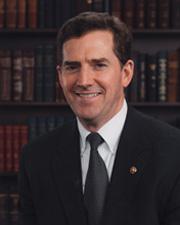 Sen. Jim DeMint (R-SC)
Legislative Activity
Stay on top of the latest movement without scrolling through every action
Senate amendment not agreed to: Amendment SA 1488, under the order of 2/2/2012, not having achieved 60 votes in the affirmative, was not agreed to in Senate by Yea-Nay Vote. 24 - 75. Record Vote Number: 11.
February 2, 2012
View full timeline
Senate amendment not agreed to: Amendment SA 1488, under the order of 2/2/2012, not having achieved 60 votes in the affirmative, was not agreed to in Senate by Yea-Nay Vote. 24 - 75. Record Vote Number: 11.
February 2, 2012
Roll call votes on amendments in Senate: Amendment SA 1488, under the order of 2/2/2012, not having achieved 60 votes in the affirmative, was not agreed to in Senate by Yea-Nay Vote. 24 - 75. Record Vote Number: 11.
February 2, 2012
Considered by Senate. (consideration: CR S291, S308)
February 2, 2012
Amendment SA 1488, under the order of 2/2/2012, not having achieved 60 votes in the affirmative, was not agreed to in Senate by Yea-Nay Vote. 24 - 75. Record Vote Number: 11.
February 2, 2012
Considered by Senate. (consideration: CR S239)
February 1, 2012
Senate amendment submitted
January 31, 2012
Senate amendment proposed (on the floor): Amendment SA 1488 proposed by Senator DeMint to Amendment SA 1470.(consideration: CR S195-197; text: CR S195)
January 31, 2012
Amendment SA 1488 proposed by Senator DeMint to Amendment SA 1470. (consideration: CR S195-197; text: CR S195) To express the sense of the Senate that the Senate should pass a joint resolution proposing an amendment to the Constitution that limits the number of terms a Member of Congress may serve.
January 31, 2012
Votes
1 roll call on this amendment
Text
Proposed
STOP TRADING ON CONGRESSIONAL KNOWLEDGE ACT--Continued

The PRESIDING OFFICER. The Senator from Connecticut is recognized.
Mr. LIEBERMAN. Mr. President, what is the regular order, may I ask?
The PRESIDING OFFICER. The pending amendment is amendment No. 1483 by
Senator Leahy to S. 2038.
Mr. LIEBERMAN. I thank the Chair. So we are on the STOCK Act and
Senator Leahy has introduced this amendment, which I appreciate that he
has done that. This underlying bill, as we said yesterday, responds to
the concern about whether Members of Congress and our staffs are
covered by insider trading laws; that is, laws that prohibit a person
from using nonpublic information for private profit.
I suppose most of us here believed we have always been covered by
insider trading laws. There were some questions raised about that at
the end of last year. In fact, our committee held a hearing on two
bills offered, one by Senator Kirsten Gillibrand of New York, the other
by Senator Scott Brown of Massachusetts, on this question, and we had
some broadly respected, credible experts on securities law who said in
fact there might be a question about Members of Congress, whether
Members of Congress and our staffs were covered by Securities and
Exchange Commission law and regulation on insider trading for a reason
that would only make sense to lawyers and therefore may not be sensible
but I will mention it anyway.
It is that the law relating to insider trading is actually the result
not of a specific statute prohibiting insider trading, it is the result
of regulations and enforcement actions by the SEC pursuant to antifraud
provisions of the Securities Exchange Act of 1934.
In these regulations that have become the law of insider trading, a
necessary element for prosecution for violating insider trading laws is
the breach of a duty of trust, of a fiduciary duty. The law professors
told us at our hearing at the end of last year that in fact one might
raise the question of whether Members of Congress had a duty of trust
as defined in insider trading cases, which is more typically the duty
of trust that a corporate executive, for instance, has to stockholders.
I presume that most Members of Congress would say of course we have a
duty of trust, we have a very high duty of trust to our country, to our
constituents. But it is, apparently, in the contemplation of securities
law, perhaps not covered by the existing definitions, so this bill
makes clear that Members of Congress and our staffs are covered by
insider trading laws.
We cannot derive personal profit from using nonpublic information
that we gain as a result of our public offices. That is made absolutely
clear by stating that indeed we do have a duty of trust to the
Congress, to the government of the United States and, most importantly,
to our constituents, to the people who were good enough to send us
here.
I do believe that provision gives us an opportunity to take a step
forward. It is going to take a lot more than one step to rebuild the
trust and confidence that the American people have lost at this moment
in our history in Congress and in our overall Federal Government.
There are two other very important provisions. One requires Members
of Congress and our staffs to file a statement within 30 days of any
transaction, purchase, or sale of a stock or other security with the
Senate--and that would immediately go on line, as will now, as a result
of this legislation, the annual financial disclosure statements that we
file. Incidentally, these statements are now available to the public
but you have to go to the office here in the Senate to get them and
copy them. That is out of date and not consistent with the general
principles of transparency and disclosure that I think people rightly
expect of Congress today.
Our bill makes clear that both the annual statements and the 30-day
statements have to be filed on line. That should help provide the
transparency that the SEC itself has said--in testimony before the
House of Representatives on this bill or one quite similar to it--would
assist them, the SEC, in guarding against insider trading by Members of
Congress or our staffs; that is, that the regular reporting, the 30-day
reporting and the on-line reporting, would assist them in preventing
insider trading.
I know there are a lot of amendments filed; actually, thankfully, not
too many, but a significant number. Seeing the presence of the Senator
from Oklahoma, I hope he may be here to take up one of his amendments.
Obviously we would all like to begin to debate the amendments and have
some votes.
I yield to the Senator from Maine, Senator Collins.

[[Page S188]]

Ms. COLLINS. Mr. President, before the Senator from Oklahoma offers
his amendment--and I will not take a great deal of time in my
comments--I want to respond to some questions that many of our
colleagues have raised about the reporting requirements in this bill.
One of my colleagues, for example, has asked if a change in a Member's
or staff's allocation in the Thrift Savings Program would be required
to be reported under this bill. It would not. It is not required to be
reported under the annual financial disclosure and it is not required
under this bill.
A second of our colleagues has brought up a question of how would
mutual funds be treated. Again, I would say that the treatment is not
changed by this bill, other than the time period. Under this bill, as
under the annual financial disclosure forms, qualified investment
funds--those are the widely available mutual funds that are exempt from
trades being disclosed--would be exempt under this bill as well.
As with our annual financial disclosures, you still list the fund and
the amount of assets in categories for those funds, but you indicate
that they are a qualified exempt fund and there is no requirement for
trying to figure out what the trades are within that fund.
I mention these two examples because I fear there is some
misinformation about the bill that is circulating. There is a
legitimate dispute over whether 30 days is too short a time, whether
the 90-day period in the original bill is better, which is my own
preference. But the fact is that the information that is being reported
is not being changed. The issue is how often it is reported. The
inquiries from my colleagues about the implications for the Thrift
Savings Plan allocations and for qualified exempt investment funds,
widely held mutual funds, remain the same. They are reported, the
category of the investment, the amount is reported, but the individual
trades within the fund are not reported.

I apologize for surprising the Senator from Connecticut with this
inquiry, and hope he will forgive me for that, but I would, through the
Chair, pose a question to the Senator from Connecticut, the chairman of
the committee, as to whether his understanding is the same as mine with
regard to the Thrift Savings Plan and qualified mutual funds?
The PRESIDING OFFICER. Without objection, it is so ordered.
Mr. LIEBERMAN. Mr. President, first let me thank Senator Collins for
making these points because there is concern about this particular part
of the bill. There is a lot of misinformation around. I totally agree
with her interpretation, which is that the reporting on the 30-day
basis in the bill will not change what is reported and therefore both
transactions within Thrift Savings Plan accounts and in qualified
mutual funds will not have to be reported. I thank my colleague for
clarifying that.
Ms. COLLINS. I thank my colleague and friend from Connecticut, the
chairman of the committee.
Thank you, Mr. President, for allowing us to pose a question through
the Chair. I hope our colleagues have heard this exchange, this
colloquy, which clarifies what appears to be a rather widespread
misunderstanding about the reach of this bill. As I said, the 30-day
issue is a different issue, a legitimate dispute as to whether that is
too aggressive. We have some colleagues who think it should be a 10-day
reporting period and an amendment has been filed to implement that. I
personally prefer the 90 days in the original bill. I think that is
more realistic. But the fact is there is a lot of misinformation and
questions regarding what is reported. I appreciate the clarification
from the Senator, the chairman of the committee.
At this point I yield to Senator Coburn for the next amendment.
The PRESIDING OFFICER. The Senator from Oklahoma.
Mr. COBURN. Mr. President, as my colleagues are no doubt aware, I
stand in opposition to this bill, not because I think we should have
insider trading. As a physician I am trained to fix the real problem
and you are treating the symptoms. Several months ago, CBS did a series
and showed some questionable, not necessarily insider trading, stock
transactions, which, given the low level of confidence by the American
public in this institution, have raised the question: What about
insider trading?
I honestly believe everyone in our body is never going to use insider
trading to advantage themselves over the best interests of our country.
But the real problem is the confidence in the Congress to do what is in
the best long-term interest of the country. The reason the confidence
is not there doesn't have anything to do with insider trading as we
would normally think about it. It has to do with insider trading that
we do not normally think about, as to how we sell a vote to get
something else on the next vote, how we trade a position, how we saw
positions were bought and sold on the health care bill. Whether it be
the Cornhusker Kickback or the Florida Gator-aid, whatever it was, the
fact is the American people saw behavior of Members of Congress doing
things that were politically expedient rather than what is in the long-
term best interest of our country. That is the real insider trading
scandal we ought to be addressing.
How do we do that? The way we address that is bring to the floor
bills that actually address the problems our country is having today.
Every second of every day this year our Government will spend $121,000.
We will borrow $52,000 a second every day. We are not addressing any of
that in the Senate. We did not all last year and we are not this year.
The real problem in front of our country is America does not see a
Congress that is willing to address the real issues and make the hard
choices.
Hard choices are coming. We will make those choices ultimately. Some
of us will not be here. But the longer we delay in making those very
difficult choices--such as saving Medicare, such as saving Social
Security, such as reforming the Tax Code to stimulate economic activity
and create job opportunities for Americans--that is what they want us
doing.
The other thing I will mention is I was one of two people who voted
against the last ethics law. I ask my colleagues, did we improve the
Senate with the last ethics law? Will we improve the quality of
representation with this law? I do not think so. I think what we are
doing is playing a political game to say we are all guilty, now we have
to prove that we are not. That is not what our system of law is built
on. Our system of law is built on the fact innocent until we are proven
guilty. The assumption that the Senate is undertaking now is that some
of our colleagues are doing insider trading on the stock market.
Nothing could be further from the truth. The real insider trading is
the horse-trading that goes on in this body that is not always in the
best interest of the country. This legislation is not about to earn
back the trust of the American people.

The SEC and the Ethics Committee already have the power to
investigate inside trading abuses. Yearly we fill out a report saying:
Let's deem every trade we have made. If it is true what the chairman of
the committee said that what the SEC would like to do is have it more
refined so they can have better access, then that ought to be the bill
we bring forward. We ought to bring forward a bill that says: No. 1, we
are under the laws of the SEC, section 10b, and we are. We don't hear
that said anywhere, but we are. If our intent is to bring forward a
bill to fix the potential for insider trading, then that is what we
ought to be doing. But the assumption we are guilty first and have to
prove we are not by making a notification every 30 days of any trade
that somebody makes for us--we may not have even been involved, but we
have a fiduciary that we asked to trade for us, and then we are going
to have to make that representation.
Has anybody asked the question: What happens if you do have inside
information, have no involvement whatsoever in a trade because you put
it in a trust account for yourself, but it is still being traded and
they happen to coordinate at the same time? Are you guilty of insider
trading or are you going to spend $50,000 to $100,000 proving that you
are not guilty?
This is a fine institution. It can be better, but it is best when it
fixes the real problems, not the symptoms of the problems.

Amendment No. 1473 to amendment No. 1470

Mr. President, I ask unanimous consent that the pending amendment be

[[Page S189]]

set aside and that amendment No. 1473 be called up.
The PRESIDING OFFICER. Is there objection? Without objection, it is
so ordered.
The clerk will report.
The legislative clerk read as follows:

The Senator from Oklahoma, [Mr. Coburn], for himself, Mr.
Udall of Colorado, Mr. McCain, Mr. Burr, Mrs. McCaskill, and
Mr. Paul, proposes an amendment numbered 1473.

Mr. COBURN. Mr. President, I ask unanimous consent that the amendment
be considered as read.
The PRESIDING OFFICER. Without objection, it is so ordered.
The amendment is as follows:

(Purpose: To prevent the creation of duplicative and overlapping
Federal programs)

At the appropriate place, insert the following:

SEC. ___. PREVENTING DUPLICATIVE AND OVERLAPPING GOVERNMENT
PROGRAMS.

(a) Short Title.--This section may be cited as the
``Preventing Duplicative and Overlapping Government Programs
Act''.
(b) Reported Legislation.--Paragraph 11 of rule XXVI of the
Standing Rules of the Senate is amended--
(1) in subparagraph (c), by striking ``and (b)'' and
inserting ``(b), and (c)'';
(2) by redesignating subparagraph (c) and subparagraph (d);
and
(3) by inserting after subparagraph (b) the following:
``(c) The report accompanying each bill or joint resolution
of a public character reported by any committee (including
the Committee on Appropriations and the Committee on the
Budget) shall contain--
``(1) an analysis by the Congressional Research Service to
determine if the bill or joint resolution creates any new
Federal program, office, or initiative that would duplicate
or overlap any existing Federal program, office, or
initiative with similar mission, purpose, goals, or
activities along with a listing of all of the overlapping or
duplicative Federal program or programs, office or offices,
or initiative or initiatives; and
``(2) an explanation provided by the committee as to why
the creation of each new program, office, or initiative is
necessary if a similar program or programs, office or
offices, or initiative or initiatives already exist.''.
(c) Senate.--Rule XVII of the Standing Rules of the Senate
is amended by inserting at the end thereof the following:
``6. (a) It shall not be in order in the Senate to proceed
to any bill or joint resolution unless the committee of
jurisdiction has prepared and posted on the committee website
an overlapping and duplicative programs analysis and
explanation for the bill or joint resolution as described in
subparagraph (b) prior to proceeding.
``(b) The analysis and explanation required by this
subparagraph shall contain--
``(1) an analysis by the Congressional Research Service to
determine if the bill or joint resolution creates any new
Federal program, office, or initiative that would duplicate
or overlap any existing Federal program, office, or
initiative with similar mission, purpose, goals, or
activities along with a listing of all of the overlapping or
duplicative Federal program or programs, office or offices,
or initiative or initiatives; and
``(2) an explanation provided by the committee as to why
the creation of each new program, office, or initiative is
necessary if a similar program or programs, office or
offices, or initiative or initiatives already exist.
``(c) This paragraph may be waived by joint agreement of
the Majority Leader and the Minority Leader of the Senate
upon their certification that such waiver is necessary as a
result of--
``(1) a significant disruption to Senate facilities or to
the availability of the Internet; or
``(2) an emergency as determined by the leaders.''.

Mr. COBURN. This is a bipartisan amendment. This amendment is
sponsored by Senator McCain, Senator McCaskill, Senator Udall from
Colorado, Senator Burr, and Senator Paul, as well as myself.
This is a straightforward amendment. We have asked for this multiple
times but have not gotten it. What this amendment says is, every bill
that comes before Congress and to be considered by the Senate should
determine whether it is duplicating something that is already happening
in the Federal Government. It is common sense, and all we are saying is
to have an analysis by the CRS, Congressional Research Service, to
determine if the bill creates a new Federal program, office, or
initiative that would duplicate or overlap any existing Federal
program, Federal office, or initiative with a similar mission, similar
purpose, similar goal or activities along with a listing of all the
overlapping duplicative Federal programs or offices or initiatives or
initiative.
Now, why is that important? Last February the GAO brought to us the
first third of the Federal Government and outlined to us $200 billion
worth of spending on duplicate programs. They gave it to us. It was
held as a great thing. Now we know we have all of these areas: 82
teacher-training programs, 47 job-training programs, 56 financial
literacy programs, and on and on. They brought that to us, and we all
said that was good. The problem is we didn't do anything about it. If
we want to restore confidence in the Congress, do something about the
problems that have been identified already.
This is a good government policy that says before we act on a new
bill that we actually will know what we are doing, and we will have
checked with CRS, and they will tell us if we are duplicating again
something that is already happening now.
One of the other amendments we should pass is to have every agency
give us their list of programs every year. Do you realize there is only
one agency in the Federal Government, one department, that actually
knows all their programs? There is only one. It is the Department of
Education. They are the only ones we can go to and find a list of all
of their programs. The rest of them don't know it. There is no catalog.
They have no idea.
So before we pass a new piece of legislation, we ought to at least
have the help of the Congressional Research Service, and we ought to
pass good legislation that doesn't duplicate. It may be a well-
intentioned piece of legislation, but because we, as a Congress, have
failed in our oversight responsibility, we don't know that it is
duplicative when we bring it to the floor and pass it in the Senate.
All I am asking is, let's do a doublecheck, especially in the time of
trillion-dollar deficits. We ought to do a doublecheck and make sure we
are not duplicating something that is already happening.
That is important for a second reason: If we don't know we are
duplicating something, that means we are not ``oversighting'' what is
occurring right now, the program or the office or the initiative that
is out there now, if we don't have knowledge of it. Rather than create
a new program, it might give us the opportunity to fix one that was
well-intentioned but is not working.
So this is a good government amendment that is bipartisan that says:
Let's do this before we pass additional legislation. But let's know
what we are doing. It is complete and it is thorough. It also will
provide greater transparency for both us and taxpayers regarding the
impact of the legislation we are passing.
Some may say: What if we have an emergency? This has a clause in it
that says if it is an emergency, that requirement is waived. So if in
the case of an emergency we need to do something, we will waive the
requirement that we have to look at CRS to see if there are
duplications. So it is a commonsense amendment. I would hope my
colleagues will support it, and that we can, in fact, actually fix the
real problems not the symptoms of the disease.

Amendment No. 1474 to amendment No. 1470

Mr. President, I ask unanimous consent that the current amendment
that is pending be set aside, and I call up amendment No. 1474.
The PRESIDING OFFICER. Is there objection? Without objection, it is
so ordered.
The clerk will report.
The legislative clerk read as follows:

The Senator from Oklahoma, [Mr. Coburn], for himself and
Mr. McCain, proposes an amendment numbered 1474.

The amendment is as follows:

(Purpose: To require that all legislation be placed online for 72 hours
before it is voted on by the Senate or the House)

At the appropriate place, insert the following:

SEC. ___. AVAILABILITY OF LEGISLATION IN THE HOUSE AND
SENATE.

(a) In General.--It shall not be in order in the Senate or
the House of Representatives to proceed to any legislative
matter unless the legislative matter has been publically
available on the Internet as provided in subsection (b) in
searchable form 72 hours (excluding Saturdays, Sundays and
holidays except when the Senate or the House of
Representatives is in session on such a day) prior to
proceeding.
(b) Availability.--With respect to the requirements of
subsection (a), the legislative matter shall be available on
the official website of the committee with jurisdiction

[[Page S190]]

over the subject matter of the legislative matter.
(c) Waiver and Suspension.--
(1) In the senate.--The provisions of this section may be
waived in the Senate only by the affirmative vote of two-
thirds of the Members, duly chosen and sworn.
(2) In the house.--The provisions of this section may be
waived in the House of Representatives only by a rule or
order proposing only to waive such provisions by an
affirmative vote of two-thirds of the Members, duly chosen
and sworn.
(3) Point of order protection.--In the House of
Representatives, it shall not be in order to consider a rule
or order that waives the application of paragraph (2).
(4) Motion to suspend.--It shall not be in order for the
Speaker to entertain a motion to suspend the application of
this section under clause 1 of rule XV of the Rules of the
House of Representatives.
(d) Legislative Matter.--In this section, the term
``legislative matter'' means any bill, joint resolution,
concurrent resolution, conference report, or substitute
amendment.

Mr. COBURN. Mr. President, this is another good government amendment.
If we want to restore confidence, this is something we should do. It
says before we vote on a bill, we are going to have at least 72 hours
to read it. It is going to be available online with a CBO score so that
when we cast a vote, we actually know what we are casting a vote on and
we actually know how much it costs. It just says it has to be online
for 72 hours.
In other words, we get the privilege of reading the bills we are
voting on, and we also get the privilege of knowing the financial costs
of the bill or at least an estimate of the financial cost and what that
will entail. This transparency is designed to make the Senate better.
If we want to build confidence with the American public, then the way
we build confidence is to assure them that we knew exactly what we were
doing when we cast a vote, not guessing at what the consequences and
the details of that legislation are.

For many pieces of legislation right now, what we have seen in the
last 2 or 3 years is there was no time given, no capability to study
the legislation to make improvements, and many of the pieces of
legislation came without the ability to modify it. If we cannot read
the legislation, then we cannot amend it. What does that tell us about
the legislative temperament and thoughtfulness of the Senate? We cannot
read it, we don't have time to contemplate and consider it, and we
cannot amend it even if we could. That doesn't have anything to do with
the Senate as it was designed and has functioned for the last 170
years. It has everything to do with politics today rather than the best
long-term interests of the country.
Amendments like this have gained a large amount of bipartisan support
and have had the support in the past when we voted on it, although we
have not acquired the 67 votes that have been necessary in the past to
pass it. The cosponsor of this amendment is Senator McCain. He
understands the importance of reading what we pass. All of our
colleagues do. Why not put in the self-discipline that we have to
rather than the political moment that says we have to vote on this
whether we know anything about it or not?
During the health care debate, eight of my colleagues sent a letter
to review the health care legislation. They ultimately voted for the
health care legislation. Their request was to give them 72 hours to
read the legislation. The legislative text and complete budget scores
from the Congressional Budget Office of the health care legislation
considered on the Senate floor should be made available on a Web site
the public can access for at least 72 hours prior to the first vote to
proceed to the legislation.
Why shouldn't the public be able to see what we are doing 72 hours
before we do it? Just as important, why shouldn't we be able to know
what we are doing before we vote so it is straightforward, commonsense,
and transparent to the American public as well as to our colleagues in
the Senate that now we have the time available to read a piece of
legislation contemplated and hopefully have the opportunity to improve
it. What is the goal? The best long-term outcome for the country.

Amendment No. 1476

Mr. President, I would ask that the pending amendment be set aside,
and I call up amendment No. 1476.
The PRESIDING OFFICER. Without objection, it is so ordered.
The clerk will report.
The legislative clerk read as follows:

The Senator from Oklahoma, [Mr. Coburn], proposes amendment
numbered 1476.

The amendment is as follows:

(Purpose: In the nature of a substitute)

Strike all after the enacting clause and insert the
following:

SECTION 1. MEMBER CERTIFICATION.

Section 102(a) of the Ethics in Government Act of 1978 is
amended by inserting at the end the following:
``(9)(A) A statement (as provided in subparagraph (B))
certifying that financial transactions included in the report
filed pursuant to section 101 (d) and (e) were not made on
the basis of non-public information.
``(B) The certification required by this paragraph is as
follows: `I hereby certify that the financial transactions
reflected in this disclosure form were not made on the basis
of material, non-public information.' ''.

Mr. COBURN. Mr. President, this amendment would provide a complete
substitute for the STOCK Act. It requires Members and staff to certify
that they have not used inside information for private financial
profit. In other words, they are going to make an affirmative statement
under the law that they have not violated section 10b of the Securities
and Exchange Act. All Members would be required to sign the following
statement on an annual financial disclosure form: I hereby certify that
the financial transactions reflected in this disclosure form were not
made on the basis of material nonpublic information.
The STOCK Act does not create new restrictions for Congress against
insider trading. We all know that. Those restrictions are there. There
are no new restrictions. We don't change the restrictions at all. The
SEC has stated that the Members of Congress and staff are already
subject to insider trading laws. They just need some clarity with that.
They also would like to have timeliness with that.
In fact, all Americans are subject to these laws, including the
Senate, found primarily in section 10b. This provision restricts anyone
who trades stocks from using material nonpublic information to profit
financially, and Congress is no different from anybody else.
The STOCK Act was carefully written to carefully reaffirm that
Congress is not exempted from these laws, and I believe the chairman
stated that just a moment ago, which we would include in this. As such,
the bill brings no new reforms to the table nor does it create any real
expectation that behavior will change. It just requires paperwork
filing. All Members and relevant staff should have to certify they are
not trading on private information.
Each year every Member and certain high-salaried staff are required
to disclose their financial holdings. Senate rule 37 also already
prohibits any Senator or staff from conflicts of interest. That would
be a conflict of interest. Specifically, rule 37 prohibits the receipt
of compensation by virtue of influence improperly exerted from his
position as a Member or officer or employee.
So we are covered doubly. We are already covered under rule 37, and
we are covered under section 10b of the Securities and Exchange Act.
If, in fact, somebody fails to do this, then they will be liable
under the False Statements Act in title 18, section 1001, which makes
it a crime to lie to Congress. Section 1001 prohibits anyone from
knowingly and willfully making any material false, fictitious, or
fraudulent statement to the government. The punishment for violating
the False Statements Act is a fine and a prison term up to 5 years.
This does not mean that someone who makes a good-faith effort but
mistakenly forgets something will face punishment. Yet any Member who
knowingly signs that form in error will be liable for making a false
statement on his or her finances, carrying large penalties.

I think efforts to reestablish trust in the Congress are important. I
disagree with my colleagues that this is one that will make a
difference. It won't. Nothing materially changes other than a paperwork
requirement. Nothing materially changes other than having to report
every 30 days instead of annually.
What is the real problem? The people of this country do not have
confidence in Congress because Congress does not address the real
issues of the country.
Mr. President, I yield the floor.
The PRESIDING OFFICER. The Senator from Connecticut.

[[Page S191]]

Mr. LIEBERMAN. Mr. President, I rise to thank my friend from Oklahoma
for coming to the floor and introducing these three amendments. It
begins the process of considering the legislation.
I wish to go back to the first point he made, which I think is an
important point--that we have to do a lot more than deal with the
concern that Members of Congress and our staffs are not covered by
insider trading laws to restore the confidence of the American people
in this institution. It has taken a long time to get us as low as we
are in public esteem today, and it is going to take a long time, I am
afraid, to get back to it.
The first thing we can do is begin to work more across party lines to
be less partisan, to be less ideologically rigid. This institution
represents people across the widest array of origins, of ideologies, of
political policy beliefs, et cetera. We can't function without
compromise. When I say ``compromise,'' I don't mean a compromise of
principle, I mean compromise in the sense that one can rarely in a
democratic institution of this kind--small ``d''--get everything one
aspires to get on a particular piece of legislation. If a person gets
half of what they are aspiring to or even more, hopefully, that is a
good result.
It reminds me of what my dad used to say about marriage, which was
that in a successful marriage a spouse felt they were giving in 70
percent of the time to the other spouse, and maybe that is a good
guideline for a successful Congress. We are not doing that enough here,
and we are particularly not doing it enough on the central question of
the deficit annually and the debt overall. The public sees this, so
they are upset.
I wish to, therefore, put what we are doing in the STOCK Act in
context. I think if we pass it, both because of the clarity with which
we state that Members of Congress and our staffs are covered by anti-
insider trading laws and the disclosure improvements we make in the
law, we will take a step forward in beginning to rebuild some
confidence the American people have lost in this institution, but, O
Lord, it is only the beginning. The more we can deal particularly with
the imbalances we have created in our Federal books, the more we are
going to restore confidence in this institution.
Also, I hope we can prove on this measure and any number of others
that we are still capable of working across party lines to get things
done. That is, after all, why our constituents sent us here.
This is the beginning of my 24th year in the Senate. It has been a
privilege. This is my last year in the Senate since I have announced I
am not seeking reelection. I am forced to say that last year was the
least productive of the 23 years I have been here. I hope we can
perhaps on this bill prove, at least, that we can come together and get
this done, and it will be the beginning of getting other much more
important things done, including, as Senator Coburn has stated, doing
something about the debt and the deficit. I have been privileged to
work with him on some ideas we have put forward to make that happen. We
can't do it and make everybody happy. We can't do it and make all the
interest groups happy. But that is not why we came here. We came here
to support and protect this extraordinary country of ours that we are
blessed to be citizens of. So I say that by way of a first reaction.
The second is that I wish to take some time in that context to take a
look at amendments Nos. 1473 and 1474 that the Senator from Oklahoma
has introduced, the first to prevent the creation of duplicative and
overlapping Federal programs, and the second is this requirement that
all legislation be placed online for 72 hours before voted on in the
House and Senate. Both of these on first response have some merit, in
my opinion. Certainly the first one has a lot of merit.
I am concerned and I know all of us--meaning Senators Collins, Brown,
and Gillibrand--who have worked to bring the main parts of the bill out
are concerned that we not go too far afield in amendments to the bill
for fear that it will weight it down and it will ultimately get stopped
or, at worst, that the majority leader will take the bill off the floor
because we are not coming to a point of completing our business because
amendments keep coming in that are not relevant. But these are two
serious amendments, and I want to look at them and take a little time
to respond.
The third, amendment No. 1476, I guess is a good news, bad news
reaction that I have. The good news is that this really is directly
relevant to the substance of the bill. The bad news, if you will, is
that I am opposed to it because it really does--it is a totally
different approach to what we are trying to do in the bill. I don't
think it accomplishes the intention of most Members on this bill
because it would really replace the entire STOCK Act with the
requirement that Members or anyone in the government who has to fill
out a financial disclosure form certify that they--we--haven't traded
on inside information. I don't think as a result that the amendment
does anything to clarify the current ambiguity in the law; that is, the
question we heard raised before our committee by these experts on
securities law about whether Members of Congress are really covered. If
we don't clarify that we have a duty of trust to bring our behavior
totally within existing securities law against insider trading, then I
don't think the legislation would get us to where we need to go and we
are still left with the kind of ambiguity that creates the kind of
mistrust I know none of us want.
We have spoken at length on this question with the Securities and
Exchange Commission staff, and I must say they share the concerns I
have just expressed and believe that if the legislation doesn't
explicitly state that a duty of trust exists and is held by Members of
Congress, then the legislation will not do what is needed to get at the
problem, which is whether an insider trading case brought before a
court could be objected to by a Member of Congress who is the target of
that suit.
Mr. COBURN. Will the Senator yield?
Mr. LIEBERMAN. Yes.
Mr. COBURN. Through the Chair, would the chairman accept that
modification to my amendment, that we would, in fact, establish
positively that Members of Congress are under rule 10b of the
Securities and Exchange Commission? Would that give the Senator less
heartburn?
Mr. LIEBERMAN. Well, it would give me less heartburn, but it would
probably still leave me needing at least a Rolaid.
Mr. COBURN. Well, I have plenty of those. In fact, I will do better--
I will give you a Zantac.
Mr. LIEBERMAN. We should reason together. But, as the Senator from
Oklahoma knows, there are three main parts to the STOCK Act. One is the
declaration we have just talked about, and the second and third are
disclosure requirements, one 30 days, and then the other is the online
requirement. But I am glad to talk with the Senator about adding the
requirement of a certification to the STOCK Act as opposed to
substituting it for the whole STOCK Act.
The PRESIDING OFFICER. The Senator from Oklahoma.
Mr. COBURN. Mr. President, I ask unanimous consent that my amendment
No. 1476 be modified with the change to the instruction line only. I am
just doing some housekeeping on that.
The PRESIDING OFFICER. Is there objection?
Without objection, it is so ordered.
The amendment is as follows:

Strike all after the first word and insert the following:

SECTION 1. MEMBER CERTIFICATION.

Section 102(a) of the Ethics in Government Act of 1978 is
amended by inserting at the end the following:
``(9)(A) A statement (as provided in subparagraph (B))
certifying that financial transactions included in the report
filed pursuant to section 101 (d) and (e) were not made on
the basis of non-public information.
``(B) The certification required by this paragraph is as
follows: `I hereby certify that the financial transactions
reflected in this disclosure form were not made on the basis
of material, non-public information.' ''.

Mr. COBURN. I would make one other point, and I am not trying to put
my chairman in the hot seat, but nobody in this Chamber can name
somebody right now who is trading on inside information. I believe that
is a true statement. Yet we are changing the law not because anybody
has done something wrong but because we are struggling to try to get
people to think we are doing things right. There is

[[Page S192]]

nothing wrong with that as long as we are not going to entrap our
colleagues.
The question I have is, if we can't name somebody and if there is not
factual truth, what we are really putting the Senate on notice for is
that, by the way, you are assumed to be trading on inside information
now, and therefore we must do this to ensure that you are not. Well, I
don't believe anybody in this body is doing that. And when we put our
Members in that position by changing the law to, for example, 30 days--
if I have three stock tradings and I miss it by 1 day, what is the
consequence of that filing and of this bill? What is going to be the
penalty that comes out of the Ethics Committee for missing it 1 day or
missing one of the three trades because you didn't know? We have lots
of questions that are not answered.

I can tell my colleagues that many Members of this body have spent a
lot of their personal money defending themselves on accusations that
were absolutely untrue before the Ethics Committee, and that should be
addressed and clarified in the body, the report language, of this bill.
I have no doubt this bill is going to pass in one form or another. I
understand I am in the very slim minority of people who think it is
unnecessary because I think the law already applies to us, and I also
don't think we have a bunch of cheats working in the Senate. But would
the Senator agree through the Chair that we ought to make clarification
of everything we can so we know what the ultimate results are or are we
going to leave that up to the lawyers on the Ethics Committee? What are
we going to do with that? Are we going to determine what the penalties
are for late filing or an accidental omission? What is going to be our
direction to the Ethics Committee in this regard?
Mr. LIEBERMAN. Mr. President, I thank Senator Coburn. Let me go back
to the first point, but it is not the question he ultimately asked.
The Senator is raising a very high standard because I hope nobody is
involved in insider trading as a Member of Congress. I presume they are
not. There were some serious allegations made last year by people
outside Congress against Members of--certain Members of Congress, a
small number. They have been denied and responded to by those Members.
I presume that if there is any substance to them, the SEC will be
investigating and take action. But obviously, necessarily, for dealing
with insider trading, we would not know it is going on because they are
using nonpublic information privately to secure private profit. So, as
the Senator from Oklahoma well knows, the purpose of the law is to make
sure that if anybody is doing this--and again, I know the people here,
this is an honorable group of people, but if anybody is acting
dishonorably--human nature being what it is--and a prosecution is
brought by the Securities and Exchange Commission, then there won't be
any defense that the law doesn't cover Members of Congress. It is
simple as that.
But let me come to the other point. I know there is a lot of unease
amongst some Members about the 30-day requirement in this bill, which
is that within 30 days one has to file a disclosure of any trade in a
stock or security that a Member has been involved in that has a value
of more than $1,000. There is a lot of concern about the requirements
that will put on Members. Ultimately, the Ethics Committee will
adjudicate this. I assume there would be some rule of reasonableness if
an unintentional error was made, and I certainly am happy to try to
clarify in report language what our intention is, but the overall
intention is to create transparency.
While I am on this--and I will be very brief with this--I know that
people are worried about what it will take to fulfill this requirement
and that it is in some sense unfair to ask Members of Congress to have
to disclose stock purchases or sales within 30 days. But it is my
understanding that people defined by law as corporate insiders have to
declare it within 48 hours of trades they make in their company stock.
The staff of the SEC have to publicly declare their trades within 5
days. So it is possible to do this. I gather it is possible to do it by
simply asking whomever trades for you to copy the office here in the
Senate when a transaction occurs, and then it automatically goes into a
database online. We are asking more, and for some it will be an
inconvenience. But we are different. We hold a public office. We have a
public trust and public responsibility. So that is why this provision
was in the original STOCK Act introduced in the House, bipartisan, and
here in the Senate, both by Senator Gillibrand and Senator Brown. But I
do want to state I am happy to work with the Senator from Oklahoma on
report language that will encourage the Ethics Committee to apply a
kind of rule of reason if there is an unintentional violation of that
30-day reporting requirement.

The PRESIDING OFFICER (Mr. Franken). The Senator from Oklahoma.
Mr. COBURN. Mr. President, I have one more question for the chairman.
If, in fact, this is what we should do--and I think the body is going
to agree this is what we should do--does not the Senator think this
should apply to the administration as well, the executive branch, that
this should apply the same 30-day rule to every member of the executive
branch? You talk about real knowledge of inside information, they have
it. We do not have it. They have it. Why would this rule not apply to--
no matter who is President--executive employees in the administration?
Mr. LIEBERMAN. Mr. President, the Senator from Oklahoma is asking
good questions.
Let me say first, as a point of clarification, as a result of an
amendment submitted in the committee by Senator Paul, and adopted, the
insider trading parts of the bill do relate to executive branch
employees. The 30-day disclosure requirement does not. I am happy to
work with the Senator on this. I gather the administration itself
applies certain disclosure requirements to a group of people in the
administration at a Cabinet level or somewhat slightly below, but,
obviously, not to all executive branch employees. But we can talk about
this one.
I continue to be concerned, overall, that we are going to extend this
so far and make it so ``good'' that it is going to fall of its own
weight and not make it through. But the Senator is raising a reasonable
question, and Senator Brown and I just talked about it. We are glad to
continue the conversation.
Mr. COBURN. Mr. President, I would make a couple points. One, we
already file all our stock trades--correct?--every year.
Mr. LIEBERMAN. That is right. We file annually.
Mr. COBURN. Every change in every investment we have, we file every
year. We already do that. We are already under rule 37 of the rules of
Senate Ethics, which forbids any conflict of interest action that would
benefit ourselves. That would include inside information to trade
stocks. There are 5 to 10 times as many senior executive positions
within the administration than Members of Congress that, in fact, this
same thing should apply to.
If the important thing is ``within 30 days,'' my hope would be the
chairman and the sponsor of the bill, Senator Brown, would give very
clear instructions to the Ethics Committee on how this is to work.
Because I will note for you, last year 16 Senators got a 90-day
extension on their filings with the Ethics Committee. That is 16
percent. We have to have some vow to make sure we do not put the
Members who are absolutely innocent of anything in a corner because
they cannot timely respond to this bill.
So my hope is--and I will finish with this; I know Senator Brown
wants to speak--looking at the timeliness of the filing I think is
important to still accomplish what you want, but not make it so
rigorous that people are going to fall out of that. We all know how
things get busy here, how we come in, we come out. We are traveling,
and we have all these things we are responding to. It will be difficult
for many Members to comply with the 30 days.
My hope would be you would look at that, and you would also look at
rule 37 of Senate Ethics because, in fact, we are already doubly
covered. We are covered under 10b. And I do not have any problem with
modifying my amendment to say we are covered so you cannot have a
defense to say you are not. But we are also covered under rule 37,
which forbids any conflict of interest under which you would benefit
personally.
With that, I yield the floor and thank the chairman of the committee.

[[Page S193]]

The PRESIDING OFFICER. The Senator from Massachusetts.
Mr. BROWN of Massachusetts. Mr. President, I have enjoyed the back
and forth between the chairman and the Senator from Oklahoma. The
Senator from Oklahoma has raised some very valid points, points that we
actually had discussed in committee.
I originally asked for a 90-day reporting period, and it was changed
out of committee to the 30-day period. Obviously, I am happy to work
with the Senator from Oklahoma and the chairman and the ranking member
to determine if, in fact, there is some guidance necessary to Ethics;
and, sure, I am happy to do it. This needs to not only be done in the
proper manner but, obviously, to be implemented in a way that everybody
can comply and not be caught short in that type of situation.
So I am looking forward--in speaking to the chairman--that we will
certainly take those valid points into consideration, any guidance we
need to put in for the record, or letters of guidance to Ethics as to
what our legislative intent is. I am happy to do that and look forward
to continuing that dialog.
I yield the floor.
Mr. LIEBERMAN. Mr. President, I thank my friend from Massachusetts.
Seeing no one else seeking recognition, I suggest the absence of a
quorum.
The PRESIDING OFFICER. The clerk will call the roll.
The assistant legislative clerk proceeded to call the roll.
Mr. SANDERS. Mr. President, I ask unanimous consent that the order
for the quorum call be rescinded.
The PRESIDING OFFICER. Without objection, it is so ordered.

The Postal Service

Mr. SANDERS. Mr. President, I want to say a word about an issue I
think has not gotten the kind of attention it deserves here in
Washington or even among the general public; that is, the situation
regarding our Postal Service.
Right now, for a number of reasons, the Postal Service is facing
financial difficulties.
No. 1, it is no secret to any American that first-class mail has
declined significantly because the American people are using e-mail and
not first-class mail, and that decline in first-class mail has
significantly impacted the revenue for the Postal Service.
Second of all, not widely known is the fact that the Postal Service,
every single year now, because of legislation passed in 2006, is forced
to come up with $5.5 billion--every single year--for future health
retiree benefits. To the best of my knowledge--and to the best of the
knowledge of anybody whom I have talked to--there is no agency of
government forced to come up with anything near this kind of onerous
requirement, nor is any corporation in the private sector doing that as
well.
So the issue we face is whether we are going to save the U.S. Postal
Service, whether we are going to bring about reforms which make the
Postal Service strong and relevant to the 21st century and the digital
age or whether we--as the Postmaster General has proposed--cut 40
percent of the workforce, shut down 3,700 post offices--most of them
rural--end Saturday mail service, lay off or cut back on the workforce
of the Postal Service by 40 percent--over 200,000 American workers,
many of them, by the way, veterans who are now serving and working in
the Postal Service.
Let me start off again with what the Postmaster General has proposed.
Let me talk a little bit about legislation which has been led by
Senator Lieberman and Senator Carper, which I think will be coming to
the floor, I expect, next week, and then talk about where I think, and
a number of us think, we should be going to strengthen that bill.
No. 1, this is what the Postmaster General has suggested that he
needs to do in order to solve the financial problems facing the Postal
Service. One, close down about 3,700, mostly rural, post offices. I
will tell you, coming from a rural State, a post office is not just a
post office. In many parts of Vermont, many parts of America, rural
post offices serve many functions. If you get rid of those post
offices, you are causing severe distress to the identity, the sense of
self of small towns in rural America.
No. 2, what the Postmaster General has suggested is the shutting down
of about 252 mail processing facilities--about half of the mail
processing facilities in this country. If you do that, there is no
debate that you are significantly slowing down the delivery of mail in
America. If you used to put a letter in a postal box, and it might get
there in 1 day, now the talk is it may get there in 3 days. If today it
gets there in 3 days, it might in the future, under these cuts, get
there in 5 days.
Here is the fear I have and many other Members of the Senate and
House have: If the Postal Service is trying to compete against the
instantaneous communications of e-mail, what does it mean that you are
slowing mail service significantly? Many of us believe this is the
beginning of a death spiral for the Postal Service in the sense that
many consumers, many businesses will say: Hey, what is the sense of me
working with the Postal Service if my mail or packages are going to get
there in 3 days or 5 days?
So we think shutting down 252 mail processing facilities, slowing
down mail services, is laying the foundation for the destruction of the
Postal Service as we know it.
To my mind, the issue is not whether we make changes or maintain the
status quo. The status quo is not working. The Postal Service has to
change. In my view, and I think the view of many others, the Postal
Service must become much more aggressive, much more entrepreneurial,
must be going out to the business community, must be going out to
consumers and saying: We have these services we can offer you.
I will give you a few examples, and some of them, by the way, are
included in the legislation brought forth by Senators Lieberman and
Carper and Collins and Scott Brown.
For example, in a rural State, if people would like to walk into a
post office and get a letter notarized, they cannot do it today. If
people walk into a post office and want to get 10 copies of their
letter, they cannot do it today. The United States Congress has said
they cannot do that. If somebody walks into a rural post office and
wants to get a fishing license or a hunting license or fill out a
driver's license, they cannot do that right now.
So I think what we need is a new business model for the post office,
much more entrepreneurial. I would suggest--and what is happening
around the world is, clearly, the United States Postal Service is not
the only postal service having to deal with the digital world. What we
are seeing in Europe and throughout the world is countries responding
by giving their postal services much more flexibility.
One example: A lot of people are unemployed. A lot of people get
unemployment checks. Sometimes in order to cash those checks they have
to go to a payday lender. Why can't they walk into a postal service and
cash that check at a minimal fee rather than paying 10, 15, or 20
percent to a payday lender?
So I think one of the provisions that has to be included in any
serious postal reform legislation is a blue ribbon commission made up
of the best entrepreneurs we can find, those people within the Postal
Service who have the most experience who will tell us what we can do
and how we can raise additional revenue when we have thousands of post
offices all over this country. Can they be renting out their space?
What other services can they be providing? Right now we have our letter
carriers delivering mail to about 150 million doors every single day, 6
days a week, all over the country. What more can they be doing?
So the debate we are having is two visions of the future of the post
office. No. 1, the Postmaster General is saying: Let's cut 40 percent
of the workforce over a period of time. Let's slow down mail delivery
service. That is the business model he is proposing.
Some of us are saying, when we have a rural constituency, when we
have senior citizens who live at the end of a dirt road who are
dependent upon the post office in order to get their prescription drugs
in the mail, when we have rural areas that very much depend on rural
post offices, that the goal is to give more flexibility to the post
offices so they can be more competitive, so they can raise additional
sums of funding in order to deal with their financial problems.

[[Page S194]]

A couple of specific points: Almost everybody agrees now that the
$5.5 billion required from the post office is absolutely onerous. I
have talked to the Office of Personnel Management. They think $2.5 or
$3 billion is quite enough, given the fact we have $45 billion already
in the account. Talk to other people and they will say given the fact
that $45 billion is already earning interest, that, in fact, we do not
have to do anything. We do not have to add anything more into that
account, and it will deal with all of the future health care retiree
benefits the post office requires.
So I believe we have to be very firm and say, No. 1, if the post
office is going to survive in any significant way, we have to maintain
1- to 3-day delivery standards for first class mail. Second, we have to
maintain 6-day delivery of mail, not end Saturday service. Third, we
have to protect our rural post offices. Fourth, we have to
significantly reduce prefunding requirements for future retiree health
benefits, not to mention that there is also widespread agreement that
the Postal Service has overpaid the FERS account, the Federal
Employment Retirement Service, by some $11 billion. Obviously, that has
to be dealt with.
Lastly, in my view, as I said previously, we need to develop a new
business model for the Postal Service, get them involved in the digital
age, not run away from it--get them involved. Expand what they can do
both with State and local governments as well as what they can do with
the private sector.
So in the coming days, this is an issue that a number of us will be
working on. I look forward to the support of my colleagues on both
sides of the aisle.
I yield the floor.
The PRESIDING OFFICER. The Senator from Massachusetts.
Mr. BROWN of Massachusetts. Mr. President, I appreciate the Senator's
reference to the post office, and the postal issue is something
Senators Collins, Lieberman, Carper, and I have been working on
probably about 300 or 400 hours at this point. So I look forward to his
involvement as well.
At this point, getting back to the business at hand dealing with the
STOCK Act, I ask that Senator Paul be recognized. I believe he has
three amendments that he would like to offer.
I yield the floor.
The PRESIDING OFFICER. The Senator from Kentucky.

Amendments Nos. 1484, 1485, 1487 to Amendment No. 1470 en bloc

Mr. PAUL. Mr. President, I ask unanimous consent to set aside the
pending amendment and call up amendments Nos. 1484, 1485, and 1487 en
bloc.
The PRESIDING OFFICER. Without objection, it is so ordered.
The clerk will report.
The assistant bill clerk read as follows:

The Senator from Kentucky [Mr. Paul] proposes amendments
numbered 1484, 1485, and 1487 to amendment No. 1470.

Mr. PAUL. Mr. President, I ask unanimous consent that the reading of
amendments be dispensed with.
The PRESIDING OFFICER. Without objection, it is so ordered.
The amendments are as follows:

Amendment NO. 1484

(Purpose: To require Members of Congress to certify that they are not
trading using material, non-public information)

Strike all after the enacting clause and insert the
following:

SECTION 1. MEMBER CERTIFICATION.

Section 102(a) of the Ethics in Government Act of 1978 is
amended by inserting at the end the following:
``(9)(A) A statement (as provided in subparagraph (B))
certifying that financial transactions included in the report
filed pursuant to section 101 (d) and (e) were not made on
the basis of non-public information.
``(B) The certification required by this paragraph is as
follows: `I hereby certify that the financial transactions
reflected in this disclosure form were not made on the basis
of material, non-public information.' ''.

SEC. 2. USE OF NONPUBLIC INFORMATION AND INSIDER TRADING BY
CONGRESS AND FEDERAL EMPLOYEES.

A Member, officer, or employee of Congress, a Federal
employee (as defined in section 2105), including the
President, the Vice President, and an employee of the United
States Postal Service or the Postal Regulatory Commission,
and a judicial officer are not exempt from and is fully
subject to the prohibitions arising under section 10(b) of
the Securities Exchange Act of 1934 and Rule 10b-5
thereunder, including the insider trading prohibitions.

AMENDMENT NO. 1485

(Purpose: To apply the reporting requirements to Federal employees and
judicial officers)

Strike section 6 and insert the following:

SEC. 6. PROMPT REPORTING OF FINANCIAL TRANSACTIONS.

(a) Reporting Requirement.--Section 101 of the Ethics in
Government Act of 1978 is amended by adding at the end the
following subsection:
``(j) Not later than 30 days after any transaction required
to be reported under section 102(a)(5)(B), a Member of
Congress or officer or employee of Congress, a Federal
employee (as defined in section 2105), including the
President, the Vice President, and an employee of the United
States Postal Service or the Postal Regulatory Commission,
and a judicial officer shall file a report of the
transaction.''.
(b) Effective Date.--The amendment made by subsection (a)
shall apply to transactions occurring on or after the date
that is 90 days after the date of enactment of this Act.

AMENDMENT NO. 1487

(Purpose: To prohibit executive branch appointees or staff holding
positions that give them oversight, rule-making, loan or grant-making
abilities over industries or companies in which they or their spouse
have a significant financial interest)

At the appropriate place, insert the following:

SEC. ___. LIMITATION ON EXECUTIVE BRANCH OFFICERS AND
EMPLOYEES INVOLVEMENT IN MATTERS INVOLVING
FINANCIAL INTEREST.

The Ethics in Government Act of 1978 (5 U.S.C. App) is
amended by adding at the end the following:

``TITLE VI--GOVERNMENT-WIDE LIMITATION ON INVOLVEMENT IN MATTERS
INVOLVING FINANCIAL INTEREST

``SEC. 601. LIMITATION ON INVOLVEMENT.

``(a) Definitions.--In this section--
``(1) the term `Executive agency' has the meaning given
that term in section 105 of title 5, United States Code;
``(2) the term `equity interest' includes stock, a stock
option, and any other ownership interest;
``(3) the term `immediate family member' has the meaning
given that term in section 115 of title 18, United States
Code;
``(4) the term `remuneration' includes salary and any
payment for services not otherwise identified as salary, such
as consulting fees, honoraria, and paid authorship; and
``(5) the term `significant financial interest', relating
to an individual, means--
``(A) with regard to any publicly traded entity, that the
sum of the fair market value of any remuneration received by
the individual from the entity during the most recent 2-year
period and the fair market value of any equity interest of
the individual in the entity is more than $5,000; and
``(B) with regard to any entity that is not publically
traded--
``(i) that the fair market value of any remuneration
received by the individual from the entity during the most
recent 2-year period is more than $5,000; or
``(ii) that the individual has an equity interest in the
entity.
``(b) Limitation.--An individual may not hold a position as
an officer or employee of an Executive agency in which the
individual would have oversight, rule-making, loan, or grant-
making authority--
``(1) over any entity in which the individual or the spouse
or other immediate family member of the individual has a
significant financial interest; or
``(2) the exercise of which could affect the intellectual
property rights of the individual or the spouse or other
immediate family member of the individual.''.

Mr. PAUL. These amendments are recognizing what the authors of this
bill have been discussing: that people should not profit off of their
involvement in government; they should not profit off of special
relationships; they should not profit off of special knowledge they
gain in the function of serving the people.
Currently, there are some large donors who have been giving to this
administration who have profited enormously and disproportionately.
This will allow this bill to apply to the administration, and I do not
believe people who are multimillionaires and billionaires should use
the apparatus of government, as was used in the loans that were given
to Solyndra, by someone who is profiting off of their relationship and
ties to the President, profiting off of people who used to work for
these companies who are now employed in the administration and using
these connections to get taxpayer money to go to private individuals.
This is wrong and this should stop.
I think this bill is a great vehicle for discussing how people in
government are abusing their roles in government to make more money at
the expense of the taxpayer. I think it should end.
I yield the floor.
The PRESIDING OFFICER. The Senator from Massachusetts.

[[Page S195]]

Mr. BROWN of Massachusetts. Mr. President, we obviously just received
the amendments. We look forward to digesting them and actually working
on some of the points. They are well taken. So we look forward to doing
that.
Since there is no Democrat here to offer another amendment, I would
then, in the spirit of back and forth, yield the floor to the Senator
from South Carolina.
The PRESIDING OFFICER. The Senator from South Carolina.

Amendment No. 1488 to Amendment No. 1470

(Purpose: To express the sense of the Senate that the Senate should
pass a joint resolution proposing an amendment to the Constitution that
limits the number of terms a Member of Congress may serve)

Mr. DeMINT. Mr. President, I ask unanimous consent to set aside the
pending amendment. I have amendment No. 1488 at the desk and ask for
its immediate consideration.
The PRESIDING OFFICER. Without objection, it is so ordered.
The clerk will report.
The assistant bill clerk read as follows:

The Senator from South Carolina [Mr. DeMint] proposes an
amendment numbered 1488 to amendment No. 1470: At the
appropriate place, insert the following: Section: Sense of
the Senate: It is the sense of the Senate that the Senate
should pass a joint resolution proposing an amendment to the
Constitution that limits the number of terms a Member of
Congress can serve.

Mr. DeMINT. Mr. President, I allowed that to be read because it is so
short. I think all of us know that in just about all areas of life
power corrupts. And despite the good people in the Congress, the good
intentions here, we have found that the longer folks stay in Washington
the more likely their associations with interest groups and other
temptations often cause bad behavior.
What we are working on here with this STOCK Act is just treating the
symptoms again when what we need to do is work on the root causes. If
we bring a professional class of politicians to Washington, and we know
incumbents always have the advantage in reelections, elections are not
the only way to limit terms.
If we want good government, if we want representation of the people,
then we need to have folks represented in the House and the Senate who
are from the people and not from an elite class of politicians in
Washington. That is why for years many of us on both sides of the aisle
have worked on this idea of term limits.
My amendment is not a law. It does not set any specific term limits
for the House or the Senate. It is a sense of the Senate that says we
should pass a constitutional amendment that allows the States to ratify
some limit on the terms of office. We know this would likely attract
people who want to make representation a calling and not a career. So I
would hope that as we look at this total bill, and certainly we do not
want insider trading, Congressmen and Senators benefiting from their
service in any personal way, if we want to get at the root cause of
many of the problems here, many of the problems between parties across
the aisle, many of the false differences, we need to limit the terms of
people who come to Washington and bring in some fresh voices from all
over the country. I think we will get better government, certainly less
corruption.
I yield the floor, and I suggest the absence of a quorum.
The PRESIDING OFFICER. The clerk will call the roll.
The assistant legislative clerk proceeded to call the roll.
Mr. BEGICH. Mr. President, I ask unanimous consent that the order for
the quorum call be rescinded.
The PRESIDING OFFICER. Without objection, it is so ordered.
Mr. BEGICH. Mr. President, I know there has been some discussion.
Today we are talking about the STOCK Act. I know there has been some
back and forth on what is the appropriate time when people should
notify the public. I just hope at the end of the day our body is not
afraid of transparency at every level.
The amendment I brought forward in the committee on which I sit dealt
with the STOCK Act and made sure that all issues around any
transactions that we make are going to be publicly disclosed in a
timely manner--30 days--but electronically. So it does not matter where
you are around the country, you can access it.
So I hope we do not forget what our goal is; that is, creating more
disclosure, more transparency so people know what we are doing in
Congress. The STOCK Act is just one of those steps.
I rise today to support the STOCK Act as a sponsor of this act,
legislation prohibiting insider trading by Members of Congress and
their staffs. Since day one in the Senate I have made transparency a
top priority in my office. Alaskans deserve to know what their Members
of Congress are up to. That is why I worked hard to make sure they have
access to critical information. I believe we must hold ourselves to a
higher standard.
Since being elected I have posted my personal disclosures, my
personal financial disclosures, on my Senate Web site so my
constituents have full knowledge of how and what I am engaged in, and
they can get it electronically. They can access my personal information
electronically anytime they want. This is something Senators are not
required to do but is just common sense. I will talk more about
transparency in just a moment.
Now, when it comes to the STOCK Act, I know my constituents at home
in Alaska and other Americans are probably shocked this bill is even
necessary. They are asking themselves, and I have heard this: Is it
really legal for Members of Congress to participate in insider trading?
The fact is, insider trading is illegal for all Americans, including
Members of Congress. All along, the SEC, the Securities and Exchange
Commission, has had the authority to enforce insider trading laws.
But it is time for a little clarity. Trust and accountability are
critical to our roles in Congress. That is why I support and have
cosponsored this important bill, the STOCK Act. This stands for Stop
Trading on Congressional Knowledge, again, the STOCK Act. This bill
reaffirms that it is against the law for Members of Congress to engage
in insider trading and confirms that anyone who does not follow the
rules will be prosecuted.
Members of Congress are not, and should not be, immune. We have a
responsibility to do our jobs in an honest, open, and transparent
manner, and to demonstrate that we are here every day fighting for our
residents--in my case, the residents of Alaska. All you need do is look
at Congress's approval rating to figure out that Americans don't think
we have lived up to our end of the deal.
This bill is an important step in the right direction to regaining
public trust. However, reminding our colleagues of laws we should have
already known about is not enough. Transparency is a key element of
moving forward. As I said, it is common sense.
That is why Senator Tester and I introduced a transparency amendment
during the markup process. As he said in committee, listening to the
testimony and debate, we thought it was necessary to take an additional
step. I am pleased to say it was adopted and incorporated into the bill
by the full committee.
The provision is simple. It requires that annual financial disclosure
forms--the ones I put on my Web site--filed by Members of Congress and
their staffs be posted online and accessible to the American public.
When you think about where we are in this world, in the 21st century,
with electronics and telecommunications and how we are not doing that
today--I went on the Alaska Public Offices Commission Web site, which
is the equivalent of what we are talking about today. If you want to
file yours in Alaska, your disclosure form, as a State legislator--or
in my case as former mayor--it is now all electronic.
The current system we have here is outdated, not transparent. It is
not easily accessible to our folks back home. Under this new provision,
Members, candidates, and staffs must file their financial disclosure
forms electronically. They will use a new system created and maintained
by the Secretary of the Senate, Sergeant at Arms, and the Clerk of the
House of Representatives. The American public will be able to search,
sort, and download data contained in the financial disclosure form.
This information will be maintained online during their time of service
and 6 years after the Member leaves office.

[[Page S196]]

I commend Chairman Lieberman, Ranking Member Collins, Senators
Gillibrand, Brown of Massachusetts, and Levin for their work on this
legislation. The STOCK Act will make Congress more accountable and, I
hope, will inspire confidence in the American people that we are here
to represent their interests and not our own.
Again, I encourage passage of this legislation. It is another step to
ensure that we have full transparency, and we should never be afraid of
making sure our folks back home know exactly who we are, what we are
doing, and what our work is here in Washington.
I yield the floor.
The PRESIDING OFFICER. The Senator from Massachusetts.
Mr. BROWN of Massachusetts. Mr. President, first, I commend the
Senator from Alaska for his efforts during the committee process. He
offered some good amendments that we ultimately took up and accepted.
We look forward to his continued involvement in the process.
As we have said, we need to make sure that all of the amendments are
relevant. We hope he will join with us and get some of his colleagues
to focus on the very important issues we are trying to work on and not
get sidetracked.
That being said, I congratulate him and look forward to working with
him.
I yield the floor.
The PRESIDING OFFICER. The Senator from Connecticut.
Mr. LIEBERMAN. Mr. President, let me join in what the Senator from
Massachusetts said. Senator Begich, with Senator Tester, offered an
amendment in committee that has not gotten as much attention as some
other parts of the bill--but it will have at least as great a positive
effect as the other parts of the bill--which is so simple that it makes
you wonder why we have not done it before. I have been quoting Dr.
Seuss lately, and I won't do it here, but there is a saying that
sometimes the best answers to questions that are complicated are simple
answers--something like that; I am losing something in the translation.
But Senator Begich and Senator Tester require that the annual
financial reports we file, which are public documents--for the public
to see them, they or some representative have to go to the office of
the Secretary of the Senate to look at them or make copies. We are in
the information age, the digital age. So Senator Begich and Senator
Tester took a small step on the bill--which is a large step for the
American people--which is that these reports will now be online and
electronically filed. Everybody, not just the SEC, will have immediate
access to those financial disclosure reports.
Incidentally, the 30-day provision for disclosure will also be
covered by that, and will also be available.
The Director of Enforcement, Robert Khuzami, of the SEC, testified
before the House committee on the comparable bill that the 30-day
requirement and the annual requirement for electronic filing would
assist the SEC in carrying out its responsibilities.
Once again, I thank the Senator from Alaska for his contribution to
the bill.
Mr. BEGICH. I thank the Senator.
One quick comment. Imagine the folks from Alaska who want to get a
copy of a report. They have to find somebody in DC to go to a clerk and
get a copy and send it over, and now, if this passes, they can go
online from anywhere.
Again, I thank Senators Lieberman, Brown, and others. We are honored
to be able to contribute our piece to it. It will be easier for the
public to get this information. I thank the Senator for his kind
comments.
I yield the floor.
Mr. LIEBERMAN. Mr. President, I suggest the absence of a quorum.
The PRESIDING OFFICER. The clerk will call the roll.
The assistant bill clerk proceeded to call the roll.
Ms. KLOBUCHAR. Mr. President, I ask unanimous consent that the order
for the quorum call be rescinded.
The PRESIDING OFFICER (Mr. Manchin). Without objection, it is so
ordered.
Ms. KLOBUCHAR. Mr. President, I rise today in strong support of the
Stop Trading on Congressional Knowledge, better known as the STOCK Act,
legislation that is critical to increasing accountability in Federal
office and restoring the public's faith in government.
I am a cosponsor of the STOCK Act and have been working to address
concerns about insider trading in Congress. I appreciate the leadership
of my colleague from Minnesota, Tim Walz, in the House who spearheaded
the bill, as well as the work of my colleagues, including Senator
Gillibrand and Senator Brown, who have shown leadership in moving this
issue forward.
No one is above the law in this country, least of all the lawmakers.
At a time when Americans are crying out for leaders who are willing to
put public interest before political gain, the STOCK Act presents a
rare opportunity for both parties to come together and pass a bill that
not only makes for good policy but that is, very simply, the right
thing to do.
Over the last few years, we have worked to restore accountability and
integrity to the major institutions in this country. We have worked to
rein in recklessness on Wall Street. We have enforced greater
accountability in Federal budgets. And in 2007, we passed historic
reforms to strengthen congressional ethics laws.
I am standing here today because we can and must do more. Those of us
who have the privilege of writing the rules have a responsibility to
play by the rules, to not just talk the talk but walk the walk, and the
STOCK Act is about making sure we are doing just that. This commonsense
bill will strengthen our democracy by ensuring that no Federal employee
or Member of Congress can profit from nonpublic information they have
obtained through their position.
First and foremost, the legislation clarifies and strengthens laws
for regulating insider trading by Members of Congress and their staff.
It redefines the practice to clearly state that it is illegal to
purchase assets based on knowledge gained through congressional work or
service, ensuring Members of Congress are held to the same standards as
the people we represent. That seems only fair.
Some people have argued that there are already laws on the books for
this, but the fact is that insider trading by Members of Congress and
their staff is currently not prohibited by the Securities Exchange Act
or congressional rules. Furthermore, the status of trading on
congressional information has never been explicitly outlawed. The
resulting ambiguity has made it incredibly difficult to enforce these
rules, which is almost certainly part of the reason not a single
violation has ever been prosecuted.
The STOCK Act would clear up the ambiguity and make these laws
crystal clear. It would give both the SEC and the ethics committee in
each Chamber the authority to investigate and prosecute charges of
insider trading, and it would make it a violation of the rules of the
House and the Senate to engage in such activity, meaning that anyone
who uses their role as a Member of Congress to enrich themselves would
have to answer to the Department of Justice and the Securities and
Exchange Commission.
The bill would also enforce better oversight by significantly
strengthening reporting requirements. Members of Congress are already
required to disclose the purchase or sale of securities and commodities
on an annual basis, and the STOCK Act would take these requirements
several steps further. Not only would it mandate that Members and
employees disclose any and all transactions of over $1,000 within 30
days of the trade, but it would require that information about the
transaction be published online.
Finally, to close the revolving door between Congress and special
interest groups, the STOCK Act would introduce much needed transparency
into the industry known as political intelligence consulting--the
practice of reaching out to people working in the legislative and
executive branches to gain market intelligence regarding proposed
rules, regulations, and bills. The STOCK Act would require the
Government Accountability Office to study this issue and see what we
can do to ensure that these consultants are subject to the same
reporting requirements and restrictions imposed on lobbyists.
Trust is the tie that binds our democracy, but with faith in
government now at an alltime low, it is clear that some

[[Page S197]]

of those ties did break. Why would we not want to strengthen those
bonds? Why would we not want to show the people who have sent us to
Washington that we have nothing to hide by passing this bill? America
was built on the principles of hard work, fair play, and personal
responsibility. These are the rules middle-class families in States
such as Minnesota and all across America are still playing by today. We
in Congress need to be willing to stand up and say we are willing to do
the same.
I want to end my remarks today by sharing two letters that were sent
to my office on the subject of the STOCK Act. The first is from a
Minnesotan named Robert, who wrote:

Elected officials need to get back to the business of
representing those who sent them to Washington to serve, not
increasing their personal wealth based on information they
learn from holding those offices--information that, were it
not for their elected office, they would otherwise not be
privy to.

The second letter comes from a Minnesotan named David, who makes this
issue crystal clear. He says:

Voters elect politicians to do what is best for the
country, not to become rich.

I could not have put it better myself, and I could not agree more. I
arrived in this town in a Saturn with my college dishes from 1985 and a
shower curtain in the back seat, so clearly this is not as relevant to
my personal situation. But I truly believe, if we are going to restore
trust in government, we need to pass this bill.
I yield the floor.
The PRESIDING OFFICER. The Senator from Massachusetts.
Mr. BROWN of Massachusetts. Mr. President, I commend the Senator from
Minnesota for coming down. I appreciate her comments, her hard work on
this issue, and thank her for her efforts.
Once again I reiterate to folks who may be listening, we are
gathering amendments. I believe they are stacking up. Some are very
relevant. Some have pieces of relevancy. What we have been trying to do
is take the best of each one and try to formulate a plan to move
forward and try to get some votes, obviously today and tomorrow, and
get this done as quickly as possible and get it over to the House.
I once again reiterate my request to have all amendments be relevant
to the issue at hand. Like Senator Lieberman--I am not going to quote
Dr. Seuss as he did, but I want to be sure we have a bill that has a
chance not to get bogged down but to pass expeditiously.
To let folks know in the gallery and also those watching on
television, there have been some very good amendments, good ideas.
Some, actually, we may end up combining. There are amendments coming up
in the days ahead that we have not had a chance even to look at because
the amendments are coming in fast and furiously. We have not had a
chance to get out and try to comment as to what we are doing with this
amendment or that amendment. There are good points in virtually every
amendment. We need to be sure we get the best and strongest bill we
possibly can. I want to add that.
I do not see Senator McCaskill here.
I yield the floor.
The PRESIDING OFFICER. The Senator from Pennsylvania.

Amendment No. 1472

Mr. TOOMEY. Mr. President, I would like to take a moment to discuss
an amendment that I think is relevant to this discussion. I thank my
colleague, Senator McCaskill, for her work on this topic. It goes to
the issue of the integrity by which this body and Congresses in general
operates, which certainly is a central issue regarding this particular
bill. Our amendment goes to a particular aspect of the integrity of
this body.
My concern is that in the absence of our amendment, many of our
colleagues will likely resume a very wasteful, nontransparent process
which is prone to corruption and abuse, and that is the process of
earmarking. I wish to speak a little bit about earmarks and what they
are and why I think we ought to have a permanent legislative ban on the
process.
Let me be clear about the process. Earmarks exist precisely in order
to circumvent any real scrutiny, transparency, or any process by which
this body, the other body, or the American people can evaluate the
merits of a given project. There is no authorization to earmarks. There
is no proper scrutiny. There is no competitive bidding among competing
demands for resources. I think the process itself is indefensible.
In part because the process is so badly flawed, we should not be
surprised that it leads to extraordinary waste. We have seen it. Some
of the earmarks have become famous because they are so wasteful and
inappropriate. We all heard about the ``bridge to nowhere.'' Recent
earmarks include, above and beyond that, a $1 million alternative
salmon products earmark. There was a $1.9 million earmark for the
Charles Rangel Center for Public Service requested by none other than
Congressman Charles Rangel. There was $550,000 for a glass museum, $2.5
million for Arctic winter games. The list goes on and on. I could go on
all day with indefensible projects that got into law, taxpayer dollars
that were spent precisely because these earmarks were permitted. I
would argue that it has gotten to the point where it really adds up to
real dollars and cents.
Those who would like to resume earmarking would like to suggest that
it is not a real number, doesn't add up to a whole lot of money. Over
the course of the last 15 years, the total value of taxpayer dollars
spent this way has tripled. In the last Congress, it reached $36
billion.
One other thing that is particularly pernicious about earmarks is
that over time they became a currency used to buy votes. There was this
unwritten law that if you ask for an earmark in a spending bill and you
get it, you are obligated to vote for that bill regardless of how
bloated, inappropriate, wasteful, or otherwise nonsensical that bill
might be. That is a really terrible process.
Finally, the fact is, it is an opportunity for corruption. I am not
suggesting there is corruption involved in most earmarks. I am sure
there is not. But we do know of some examples of some of our colleagues
who did in fact use earmarks quite inappropriately to enrich
themselves. I know of one in jail right now because of that. While that
is certainly the very unusual exception, the fact is a process such as
that is badly flawed and should be remedied.
As we all know, there is a current temporary moratorium in place on
earmarks that has been adopted by both bodies and both parties. But
that temporary moratorium expires this year. What our amendment does is
create a permanent legislative ban on earmarks. It does that by
creating a point of order. Any Senator can come down to the Senate
floor and strike an earmark if one is inserted in a spending bill, and
it would take a two-thirds vote of the Senate to override the effort to
strike the earmark.
It is important to know that this amendment does not strike the
entire bill. It would not invalidate the bill or otherwise disrupt the
bill. It would surgically remove the earmark that would be offending
this point of order.
As I say, I thank Senator McCaskill for her support. I thank Senator
Coburn for the many years in which he has battled, as have others,
especially Senator McCain and others. But Senator Coburn once described
earmarks as the gateway drug to spending addiction, and I think he is
really onto something with that characterization.
I think it is time we change the culture in Washington, that we
change the culture of Congress, get away from a culture that says, how
can we maximize spending, which really has been the culture of Congress
for way too long, and move to a culture that says, how do we maximize
savings, because when we are running trillion-dollar annual deficits,
we have to find savings anywhere we can. I can't think of a better
place to start.
If we really want to change Washington, if we really want to reduce
wasteful spending, if we really want to eliminate opportunities for
corruption, if we really want to change the culture of spending and
begin the process of doing these things to hopefully restore some of
the confidence of the American people in their government, one of the
ways we can do this very constructively is to pass this amendment.
I yield the floor.
The PRESIDING OFFICER. The Senator from Missouri.
Mrs. McCASKILL. Mr. President, I thank Senator Toomey for joining me.
He has been a great leader on this since he arrived in the Senate, in
terms of

[[Page S198]]

the fight against earmarks. I thank him for that.
I also welcome him to our band of warriors in terms of fighting the
earmark culture in Washington. It has been a fairly small number of
Senators since I arrived here in January of 2007. I will be honest, the
Senator spent some time in the House, so he was more familiar with the
process of earmarking than I was. When I came to the Senate, I did not
really understand how it worked. I did not really get it. I do not
think, until you have gotten here and watched it from the inside, you
truly appreciate how flawed it is in terms of a way of distributing
public money. It really is going in the back room and sprinkling fairy
dust. It is really a process that has more to do with who you are and
whom you know than merit.
Have there been lots of projects that have been funded that I have
supported? Of course. Did I make a decision--a difficult one--to not
cherry-pick certain earmarks to go after on the floor? Instead, I have
tried, when I got here and realized the problems, to reform the
process, not just to say, let's find this one earmark in this bill and
gin up an amendment on it; rather, let's try to stop the process in its
entirety because it makes no sense. And that is what this amendment
does. It actually will stop the process in its entirety.
Why do we need it if we have a moratorium? Why now? Frankly, when I
first started saying I wanted to do away with all earmarking, I was
laughed at by Members of this body, directly and indirectly. Sometimes
I felt as if people were patting me on the head and saying: Go away.
You have no chance to do this. I am proud of the fact that we have
gotten a moratorium now. The truth is, there are a lot of Members of
this body who want to go back to the old ways, and I think it is very
important that we do a permanent ban. I certainly thank the Senator for
helping, and I think the amendment we are working on together will make
sure we will not have what happened in the House this year.

Mr. TOOMEY. Will the Senator yield?
The PRESIDING OFFICER. The Senator from Pennsylvania.
Mr. TOOMEY. I wished to touch on a point the Senator just made that I
think is important to underscore. I would agree without hesitation that
there are any number of earmarked projects that probably have very good
merit. This is not at all to suggest that every earmark that has ever
occurred had no merit. That is not what this is about.
What we are criticizing and what we are trying to change is a very
badly flawed process that permits a great deal of projects that have no
merit to get funded that otherwise would not be funded. Those that have
merit--and goodness knows all kinds of projects, especially
transportation projects--ought to be funded, but they ought to be
funded in a transparent and honest way, subject to evaluation by an
authorizing committee and subject to competition, so those projects
that have the greatest merit and the greatest need would be funded
first. That is what I think we are trying to get at and get away from
this process where an individual Member of either this body or the
other body, in the dark of night, can drop in some specific provision
because he or she wanted it without it being subject to the proper
scrutiny and evaluation and competition that the taxpayer deserves.
I just wished to underscore that point. I appreciate the Senator's
work and the message she brought.
The PRESIDING OFFICER. The Senator from Missouri.
Mrs. McCASKILL. I will tell my colleagues that I think for too long
too many Senators believed the measure of their worth as a Senator had
everything to do with how much money they were bringing home. I have a
new idea. Instead of the measure of our worth being how much we can
spend, I think the measure of our worth ought to be how much we can
save. This place turned on the notion that if one stayed here long
enough, if they got to be an appropriator, they got more earmarks. If
they became a ranking member on a subcommittee on appropriations, they
got even more.
Then I found out about honey pots. I didn't know about honey pots
until I got here. I don't know if Senator Toomey is familiar with that
term, but let me educate him about what that term means. A honey pot is
what the ranking minority member and chairman set aside as their
special pot of money that they get to spend on earmarks that is greater
than everyone else's. Some of the appropriations subcommittees have
honey pots and some don't. The very notion that we are deciding how to
divide the money based on how long we have been here, what our party
affiliation is, what committees we serve on is not the way we should
spend public money. We spend public money based on merit or on a
formula based on how many people are in our State.
One of the other things that drives me crazy is this talking point
against doing away with earmarks: We can't let the bureaucrats decide.
We can't let the executive branch decide. It is the power of the purse.
We have had the power of the purse in Congress for hundreds of years.
Earmarking is a modern invention. We have the right to oversee the
executive budget, change the executive budget, cut the executive
budget, and add money to the executive budget. We can do that as a
Congress and that has nothing to do with earmarking.
Let me also say this about this talking point: This notion that
earmarked money just grows on trees somehow--where does the money for
earmarking come from? It comes from other programs. Guess what programs
it is taken from. It is taken from programs--I will just say from
programs such as surface transportation.
Let's talk about that. We have a local process in Missouri. We have
stakeholders all across the State who go to meetings and the public is
invited and these agencies work very hard at trying to prioritize their
transportation projects based on the economic needs of their community,
based on safety considerations. These local folks work very hard to
prioritize their projects, and what does earmarking do? It cuts in
line. One individual's judgment supplants all the local planning.
This is not about Washington bureaucrats. In a lot of these instances
it is about saying: I know better than the people back home know. Look
at the Byrne grants, another perfect example. Money for the Byrne
grants--which is a State-administered program done on a competitive
basis at the State level--they have been stealing money out of the
Byrne grants for earmarks so one individual Senator can decide this
sheriff needs new equipment as opposed to the State authorities
deciding that there may be a crime problem in one area of the State,
such as a methamphetamine problem that needs special attention.
Mr. TOOMEY. Will the Senator yield?
The PRESIDING OFFICER. The Senator from Pennsylvania.
Mr. TOOMEY. This is a very important point. It is a common refrain
from those who would like to go back to earmarking: We can't turn this
over to the bureaucrats. Who controls the bureaucrats? It is Congress.
If we think the bureaucrats are allocating resources in a way that we
don't approve of, we can change the rules. We write the law that
determines the criteria, the metrics, the methodology, the process by
which they compete and evaluate competing projects. That is entirely up
to us. So it is not fair for us to suggest that while the bureaucrats
will not spend it wisely, then we should set the rules so they must.
Frankly, they don't have the kind of incentives that some people who
are holding elected office think they have to try to show up back home
with a big oversized check. The bureaucrat doesn't have that incentive.
I would argue I can't imagine any bureaucrat who would award several
hundred million dollars to build a bridge to nowhere or to build a
cowgirl hall of fame or an indoor tropical rain forest. These are
things that if a bureaucrat did make those decisions, it would be
because they were following ridiculously flawed guidelines given to
them by Congress. So this in no way diminishes Congress's control of
the purse strings; it insists on a more accountable process by which we
allocate the resources from the purse.
Mrs. McCASKILL. Mr. President, it is easy to see why earmarking is
held so dear to so many Members. I remember when I first was elected
and people

[[Page S199]]

began showing up in my office that, frankly, had not been big
supporters of mine. All of us who are here--and if we are brutally
honest for the folks back home--we want to be loved. We put ourselves
out there for public acceptance or rejection every 2, 4, 6 years. So
people started showing up and being very nice to me who had not
particularly been supporters of mine, and they were being nice to me
and I thought, What is up here? Then all of a sudden I figured it out.
They were all showing up to get their earmarks. The people in
Missouri--I don't know about Pennsylvania--but in Missouri they are
very worried about not having earmarks because they have been fed this
line all these years: If we don't have earmarks, we are not going to
get anything. We are not going to get our share. We are not going to
get as much as we deserve.

Let's take water. Pennsylvania--this is a good example because
Pennsylvania didn't get very much in water projects either. I don't
know how many rivers there are in Pennsylvania. I should be more
familiar with the geography there. But to say that Missouri is a river
State is an understatement. I mean, we have the confluence of the two
greatest rivers of our country, the Missouri and Mississippi Rivers, in
our State. We have major impact in terms of water projects that need to
be done in our State because of how prominent water is in the State of
Missouri. But yet we have been way down the line in terms of water
projects because we don't have an appropriator on that committee. We
have appropriators on other committees but not on that committee.
I keep telling the folks at home, if we compete with other States for
water projects, we are going to do just fine, and that is the way it is
supposed to work. States are supposed to get what they need and not get
the benevolence of Washington because they happen to have somebody who
has been here long enough to be on the right committee to have the
right chairmanship or the right ranking committee so they can get even
more. That is not the way this place should be run. It is not the right
way to spend public money.
Mr. TOOMEY. Would the Senator yield?
Mrs. McCASKILL. I will.
The PRESIDING OFFICER. The Senator from Pennsylvania.
Mr. TOOMEY. I can tell the Senator how I think a big majority of
Pennsylvanians feel about this because I hear from them every day.
Sure, there are some folks who would love to resume earmarks because
they benefited from them in the past. I think the vast majority of
Pennsylvanians--and I would guess Americans--generally understand that,
especially at a time when we have reached $15 trillion in debt, when
our debt now exceeds the entire size of our economy, when we are
running annual deficits of over $1 trillion for the last several
consecutive years and, frankly, probably in the years to come. We are
in an unsustainable mode right now. What my constituents want is for us
to put ourselves on a viable, sustainable fiscal path. That means
getting spending under control. So I don't think our constituents want
us to see how much money we can spend, as the Senator pointed out. They
want to see how much we can save, and I think they would overwhelmingly
welcome ending a process that clearly leads to wasteful spending.
Mrs. McCASKILL. I hope we get a vote on this amendment. I am not
optimistic about that because, typically--let's be honest--the vast
majority of the leadership in this body has typically been
appropriators and many of them want to go back to earmarking, and this
is on both sides of the aisle.
As I started to point out before, it was the Republican Armed
Services Committee in the House that set aside a slush fund and began
doing earmarking on the Defense authorization bill. We were able to
expose it and stop it, but clearly people are having a hard time
breaking this habit. So I think this amendment is very important. I am
happy to go toe-to-toe with anyone over the merits of this amendment. I
am happy to stand shoulder-to-shoulder with anyone in this Congress,
Republican or Democrat, who is willing to stop this process once and
for all.
I think this amendment would do it. I hope we get a vote on it, and
if we don't, it will not be the last time I think they will hear from
both of us about our bill and how serious we are about getting it
passed.
There will come a time that this bill will pass because the American
people are on to us. The American people are on to this bad habit. They
want it to end and they will have their way. It may not be today, it
may not be this week, but I remind the Members of the Senate that it
wasn't that long ago people laughed out loud at me when I said there
would be an end to earmarking. They thought that was the silliest joke
they had ever heard, and we have made a lot of progress thanks to the
American people.
By the way, the credit should not go to me or Senator McCain or
Senator Coburn--who have been working on this for much longer than I
have--it should go to the American people who are figuring this out and
rising in record numbers to say: We don't like earmarks. Stop it. We
should give credit to them for paying attention. I hope they stay on
it, and I hope we will eventually prevail.
Mr. TOOMEY. If the Senator would yield one final time.
The PRESIDING OFFICER. The Senator from Pennsylvania.
Mr. TOOMEY. I appreciate the Senator's kind indulgences. I am newer
to this body, and maybe that explains my relative optimism. I am
hopeful that we do get a vote, and I am hopeful, if we do get a vote,
it will succeed. I point to the voluntary moratorium both Chambers
instituted 1 year ago as a sign that this is increasingly becoming the
consensus view among Members of both bodies. I don't know if I am
right. I am hopeful. If we don't succeed today, that means we need to
come back on another day when we can succeed because there is no doubt
in my mind that the people of Pennsylvania--and I suspect across
America--want us to win this battle and begin to rein in wasteful
spending. There is no better place to start than to ban these earmarks.
I thank the Senator from Missouri for her leadership and her work.
I yield the floor.
Mrs. McCASKILL. I also yield and thank the Senator for his work. This
should be the easiest for us to get done. We have some hard work we
have to do around here that is going to mean sacrifice and changes that
are not going to be easy for anyone. This ought to be simple, so let's
try to get it done.
I yield the floor.
Mr. LIEBERMAN. I suggest the absence of a quorum.
The legislative clerk proceeded to call the roll.
Mr. BROWN of Massachusetts. Madam President, I ask unanimous consent
that the order for the quorum call be rescinded.
The PRESIDING OFFICER (Mrs. Hagan). Without objection, it is so
ordered.
Mr. BROWN of Massachusetts. Madam President, as you know, people are
coming down requesting amendments be brought up. Since I did not see
any Democrats offering any, I yield to Senator Paul. He has an
amendment.
The PRESIDING OFFICER. The Senator from Kentucky.

Amendment No. 1490 to Amendment No. 1470

Mr. PAUL. Madam President, I ask unanimous consent to set aside the
pending amendment and call up amendment No. 1490.
The PRESIDING OFFICER. Is there objection?
Mr. LIEBERMAN. Madam President, I have no objection to proposing the
amendment.
The PRESIDING OFFICER. Without objection, it is so ordered.
The clerk will report.
The legislative clerk read as follows:

The Senator from Kentucky [Mr. Paul] proposes an amendment
numbered 1490 to amendment No. 1470.

Mr. PAUL. Madam President, I ask unanimous consent that the reading
of the amendment be dispensed with.
The PRESIDING OFFICER. Without objection, it is so ordered.
The amendment is as follows:

(Purpose: To require former Members of Congress to forfeit Federal
retirement benefits if they work as a lobbyist or engage in lobbying
activities)

At the appropriate place, insert the following:

SEC. __. FORFEITURE OF CREDIT FOR SERVICE AS A MEMBER IF
FORMER MEMBERS OF CONGRESS BECOME LOBBYISTS.

(a) Definitions.--In this section--

[[Page S200]]

(1) the term ``creditable service'' means service that is
creditable under chapter 83 or 84 of title 5, United States
Code;
(2) the term ``lobbyist'' has the meaning given that term
in section 3 of the Lobbying Disclosure Act of 1995 (2 U.S.C.
1602);
(3) the term ``Member of Congress'' has the meaning given
that term in section 2106 of title 5, United States Code; and
(4) the term ``remuneration'' includes salary and any
payment for services not otherwise identified as salary, such
as consulting fees, honoraria, and paid authorship.
(b) Forfeiture of Credit for Service.--Any service as a
Member of Congress shall not be creditable service if the
Member of Congress, after serving as a Member of Congress--
(1) becomes a registered lobbyist;
(2) accepts any remuneration from a company or other
private entity that employs registered lobbyists; or
(3) accepts any remuneration from a company or other
private entity that does business with the Federal
Government.

Mr. PAUL. This amendment will address some of the situations that are
concerning the American people. I think the ability to serve in the
Senate is a great honor. The ability to serve in the House of
Representatives is a great honor. But I am somewhat sickened and
somewhat saddened by people who use their office, who leave office and
become lobbyists, who leave office and call themselves historians but
basically leave office and peddle the friendships they have found here
and the relationships to make money. I think it is hard to prevent
people from being lobbyists. But I think if people choose to leave the
Senate and leave the House of Representatives and become lobbyists,
they should give up something. These people are making millions of
dollars lobbying Congress. I think maybe they should give up their
pension. Maybe they should give up the health benefits that are
subsidized by the taxpayer.
If someone is going to use their position as an ex-Senator or as an
ex-Congressman to enrich themselves, maybe they should have to give up
some of those perks they accumulated while in office. So this amendment
would say that if you go out and become a lobbyist, you have to give up
your pension and you have to give up your health benefits and you need
to pay for them yourself. I think this is the least we can ask.
I think we have a great deal of coverage now talking about people who
are either lobbyists or not or whether they are historians. The bottom
line is we have a lot of people peddling their friendship and their
influence for monetary gain, and I do not think the taxpayers should be
subsidizing that.
I yield the floor and I suggest the absence of a quorum.
The PRESIDING OFFICER. The clerk will call the roll.
The assistant legislative clerk proceeded to call the roll.
Ms. COLLINS. Madam President, I ask unanimous consent that the order
for the quorum call be rescinded.
The PRESIDING OFFICER. Without objection, it is so ordered.
Ms. COLLINS. Madam President, I thought I would bring our colleagues
up to date on what is going on this evening, as it is getting late. We
are close, I believe, to working out an agreement for a vote on an
amendment that was offered by Senator Paul earlier. It has to do with
extending to executive branch officials the same kind of reporting
requirement to ban insider trading that would apply to Members of
Congress and their staffs. It is an amendment that enjoys the support
of both managers and the principal authors of this bill.
We are trying to make sure, however, that we narrow the amendment so
that it applies to top-level Federal employees and not to low-level
Federal employees, who have no policy responsibilities. So we were
looking at limiting it to Senate-confirmed positions. The problem with
that is it brings in all of the military appointments that are Senate
confirmed, so we want to make sure we exclude those individuals who are
clearly not the target of the amendment.
We continue to work--the managers, the sponsors of the bill, and the
sponsor of the amendment, Senator Paul--in order to refine his
amendment. It is still our hope that we can reach that compromise and
have a rollcall vote tonight. We will keep our colleagues informed
about whether it will be possible to complete the drafting that would
be needed to modify his amendment.

Amendment No. 1490

In the meantime, I want to talk very briefly about an amendment
Senator Paul filed, his amendment No. 1490. This is an amendment that
would require former Members of Congress to forfeit their Federal
retirement benefits if they work as a lobbyist or even engage in any
lobbying activity--regardless, I might say, of whether they served 40
years in this body.
I also note that the language in this amendment is extraordinarily
broad. For example, the definition of remuneration includes salaries,
any payment for services not otherwise identified as salary, such as
consulting fees, honoraria, and paid authorship. Think about that. As I
read the language, a former Member of Congress who writes a book would
be in danger of forfeiting his or her pension. In other words, this is
going to apply to authors. It mentions honoraria, so if a former Member
of Congress gives a speech and receives $1,000 for giving that speech,
that former Member is going to forfeit his or her pension--earned
pension?
I don't even know that this would pass constitutional muster. But
there is certainly a fairness issue, it seems to me. I don't know if
the intent of the Senator from Kentucky was to draft this as broadly as
he did to include and define as remuneration paid authorship. In other
words, if you wrote a book--and it would not even have to be a book;
what if you wrote a newspaper article or an op-ed for the Washington
Post and received $250 for that? Do you forfeit the Federal pension?
What if you worked in the private sector for a number of years, worked
in State government for a number of years, and then worked for a few
years serving the people of this country in Congress? Would you then
forfeit your pension if you provided some lobbying activities? If you
wrote a book? If you gave a speech for money? This is extraordinarily
broad.
I see the Senate majority leader is on the floor, so I will stop
discussing this amendment. I did want our colleagues to actually read
the text of this amendment before we ever vote on it.
It defines remuneration not just as salary or payment for services
not otherwise identified as salary, but consulting fees, honoraria, and
paid authorship. In other words, if after being in Congress you wrote a
book or you wrote an op-ed for which you were paid, you forfeit your
Federal pension because you did some lobbying activities? This strikes
me as a very sweeping amendment that does not belong on this bill.
The PRESIDING OFFICER. The majority leader.
Mr. REID. I am happy to hear what that amendment does, and I thank
the Senator.

____________________