To improve the bill.
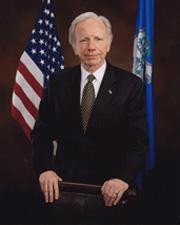 Sen. Joseph I. Lieberman (D-CT)
This amendment's own text couldn't be picked out of its Congressional Record passage, so the passage is shown in full.
TEXT OF AMENDMENTS
SA 2849. Mr. PAUL submitted an amendment intended to be proposed by
him to the bill S. 3576, to provide limitations on United States
assistance, and for other purposes; which was ordered to lie on the
table; as follows:
Strike all after the enacting clause and insert the
following:
SECTION 1. LIMITATION ON FOREIGN ASSISTANCE.
(a) Prohibition.--
(1) In general.--Except as provided under paragraph (2),
beginning 60 days after the date of the enactment of this
Act, no amounts may be obligated or expended to provide any
direct United States assistance, loan guarantee, or debt
relief to a Government described under subsection (b).
(2) Exception.--With respect to the Government of Pakistan,
the prohibition under paragraph (1) shall be effective as of
the date of the enactment of this Act.
(b) Covered Governments.--The Governments referred to in
subsection (a) are as follows:
(1) The Government of Libya.
(2) The Government of Egypt.
(3) The Government of Pakistan.
(c) Certification.--The President may certify to Congress
that a Government described under subsection (b)--
(1) is cooperating or has cooperated fully with
investigations into an attack, trespass, breach, or attempted
attack, trespass, or breach;
(2) is facilitating or has facilitated any security
improvements at United States diplomatic facilities, as
requested by the United States Government; and
(3) is taking or has taken sufficient steps to strengthen
and improve reliability of local security in order to prevent
any future attack, trespass, or breach.
(d) Request To Suspend Prohibition on Foreign Assistance.--
(1) In general.--Except as provided under paragraph (2),
upon submitting a certification under subsection (c) with
respect to a Government described under subsection (b), the
President may submit a request to Congress to suspend the
prohibition on foreign assistance to the Government.
(2) Pakistan.--No request under paragraph (1) may be
submitted with respect to the Government of Pakistan until--
(A) Dr. Shakil Afridi has been released alive from prison
in Pakistan;
(B) any criminal charges brought against Dr. Afridi,
including treason, have been dropped; and
(C) if necessary to ensure his freedom, Dr. Afridi has been
allowed to leave Pakistan alive.
(e) Expedited Consideration of Presidential Request.--
(1) In general.--For purposes of this subsection, the term
``joint resolution'' means only a joint resolution introduced
in the period beginning on the date on which a request under
subsection (d) is received by Congress and ending 60 days
thereafter (excluding days either House of Congress is
adjourned for more than 3 days during a session of Congress),
the matter after the resolving clause of which is as follows:
``That Congress approves the request submitted by the
President to suspend the prohibition on foreign assistance to
the Government of __ in effect since __, and such prohibition
shall have no force or effect.''(The blank spaces being
appropriately filled in).
(2) Referral.--A joint resolution described in paragraph
(1) shall be referred to the committees in each House of
Congress with jurisdiction.
(3) Submission date defined.--For purposes of this section,
the term ``submission date'' means the date on which a House
of Congress receives the request submitted under subsection
(d).
(4) Discharge of senate committee.--In the Senate, if the
committee to which is referred a joint resolution described
in paragraph (1) has not reported such joint resolution (or
an identical joint resolution) at the end of 20 calendar days
after the submission date, such committee may be discharged
from further consideration of such joint resolution upon a
petition supported in writing by 30 Senators, and such joint
resolution shall be placed on the calendar.
(5) Senate consideration of resolution.--
(A) Motions.--In the Senate, when the committee to which a
joint resolution is referred has reported, or when a
committee is discharged (under paragraph (4)) from further
consideration of a joint resolution described in paragraph
(1), it is at any time thereafter in order (even though a
previous motion to the same effect has been disagreed to) for
a motion to proceed to the consideration of the joint
resolution, and all points of order against the joint
resolution (and against consideration of the joint
resolution) are waived. The motion is not subject to
amendment, or to a motion to postpone, or to a motion to
proceed to the consideration of other business. A motion to
reconsider the vote by which the motion is agreed to or
disagreed to shall not be in order. If a motion to proceed to
the consideration of the joint resolution is agreed to, the
joint resolution shall remain the unfinished business of the
Senate until disposed of.
(B) Debate.--In the Senate, debate on the joint resolution,
and on all debatable motions and appeals in connection
therewith, shall be limited to not more than 10 hours, which
shall be divided equally between those favoring and those
opposing the joint resolution. A motion further to limit
debate is in order and not debatable. An amendment to, or a
motion to postpone, or a motion to proceed to the
consideration of other business, or a motion to recommit the
joint resolution is not in order.
(C) Vote on final passage.--In the Senate, immediately
following the conclusion of the debate on a joint resolution
described in paragraph (1), and a single quorum call at the
conclusion of the debate if requested in accordance with the
rules of the Senate, the vote on final passage of the joint
resolution shall occur.
(D) Appeals of decisions of the chair.--Appeals from the
decisions of the Chair relating to the application of the
rules of the Senate to the procedure relating to a joint
resolution described in paragraph (1) shall be decided
without debate.
(6) Inapplicability of certain provisions.--In the Senate,
the procedures specified in paragraph (4) or (5) shall not
apply to the consideration of a joint resolution respecting a
request--
(A) after the expiration of the 60 session days beginning
with the applicable submission date; or
(B) if the request submitted under subsection (d) was
submitted during the period beginning on the date occurring--
(i) in the case of the Senate, 60 session days, or
(ii) in the case of the House of Representatives, 60
legislative days,
before the date the Congress adjourns a session of Congress
through the date on which the same or succeeding Congress
first convenes its next session, after the expiration of the
60 session days beginning on the 15th session day after the
succeeding session of Congress first convenes.
(7) Receipt of joint resolution from other house.--If,
before the passage by one House of a joint resolution of that
House described in paragraph (1), that House receives from
the other House a joint resolution described in paragraph
(1), then the following procedures shall apply:
(A) The joint resolution of the other House shall not be
referred to a committee.
(B) With respect to a joint resolution described in
paragraph (1) of the House receiving the joint resolution--
(i) the procedure in that House shall be the same as if no
joint resolution had been received from the other House; but
(ii) the vote on final passage shall be on the joint
resolution of the other House.
(f) Report on Unsecured Weapons in Libya.--Not later than
90 days after the date of the enactment of this Act, the
President shall submit a report to Congress examining the
extent to which advanced weaponry remaining unsecured after
the fall of Moammar Qaddafi was used by the individuals
responsible for the September 11, 2012, attack on the United
States consulate in Benghazi, Libya.
(g) Rule of Construction.--Nothing in this section may be
construed as an authorization for the use of military force.
______
SA 2850. Ms. MURKOWSKI (for herself and Mr. Manchin) submitted an
amendment intended to be proposed by her to the bill S. 3525, to
protect and enhance opportunities for recreational hunting, fishing,
and shooting, and for other purposes; which was ordered to lie on the
table; as follows:
On page 7, after line 21, add the following:
SEC. 104. HERITAGE OF RECREATIONAL FISHING, HUNTING, AND
RECREATIONAL SHOOTING ON FEDERAL LAND.
(a) Definitions.--In this section:
(1) Federal public land.--
(A) In general.--Except as provided in subparagraph (B),
the term ``Federal public land'' means any land or water that
is--
(i) owned by the United States; and
(ii) managed by a Federal agency (including the Department
of the Interior and the Forest Service) for purposes that
include the conservation of natural resources.
(B) Exclusions.--The term ``Federal public land'' does not
include--
(i) land or water held or managed in trust for the benefit
of Indians or other Native Americans;
(ii) land managed by the Director of the National Park
Service or the Director of the United States Fish and
Wildlife Service;
(iii) fish hatcheries; or
(iv) conservation easements on private land.
(2) Hunting.--
(A) In general.--Except as provided in subparagraph (B),
the term ``hunting'' means use of a firearm, bow, or other
authorized means in the lawful--
(i) pursuit, shooting, capture, collection, trapping, or
killing of wildlife; or
(ii) attempt to pursue, shoot, capture, collect, trap, or
kill wildlife.
(B) Exclusion.--The term ``hunting'' does not include the
use of skilled volunteers to
[[Page S6637]]
cull excess animals (as defined by other Federal law).
(3) Recreational fishing.--The term ``recreational
fishing'' means--
(A) an activity for sport or for pleasure that involves--
(i) the lawful catching, taking, or harvesting of fish; or
(ii) the lawful attempted catching, taking, or harvesting
of fish; or
(B) any other activity for sport or pleasure that can
reasonably be expected to result in the lawful catching,
taking, or harvesting of fish.
(4) Recreational shooting.--The term ``recreational
shooting'' means any form of sport, training, competition, or
pastime, whether formal or informal, that involves the
discharge of a rifle, handgun, or shotgun, or the use of a
bow and arrow.
(b) Recreational Fishing, Hunting, and Recreational
Shooting.--
(1) In general.--Subject to valid existing rights, and in
cooperation with the respective State and fish and wildlife
agency, a Federal public land management official shall
exercise the authority of the official under existing law
(including provisions regarding land use planning) to
facilitate use of and access to Federal public land for
recreational fishing, hunting, and recreational shooting
except as limited by--
(A) any law that authorizes action or withholding action
for reasons of national security, public safety, or resource
conservation;
(B) any other Federal law that precludes recreational
fishing, hunting, or recreational shooting on specific
Federal public land or water or units of Federal public land;
and
(C) discretionary limitations on recreational fishing,
hunting, and recreational shooting determined to be necessary
and reasonable as supported by the best scientific evidence
and advanced through a transparent public process.
(2) Management.--Consistent with paragraph (1), the head of
each Federal public land management agency shall exercise the
land management discretion of the head--
(A) in a manner that supports and facilitates recreational
fishing, hunting, and recreational shooting opportunities;
(B) to the extent authorized under applicable State law;
and
(C) in accordance with applicable Federal law.
(3) Planning.--
(A) Effects of plans and activities.--
(i) Evaluation of effects on opportunities to engage in
recreational fishing, hunting, or recreational shooting.--
Federal public land planning documents (including land
resources management plans, resource management plans, travel
management plans, and energy development plans) shall include
a specific evaluation of the effects of the plans on
opportunities to engage in recreational fishing, hunting, or
recreational shooting.
(ii) Other activity not considered.--
(I) In general.--Federal public land management officials
shall not be required to consider the existence or
availability of recreational fishing, hunting, or
recreational shooting opportunities on private or public land
that is located adjacent to, or in the vicinity of, Federal
public land for purposes of--
(aa) planning for or determining which units of Federal
public land are open for recreational fishing, hunting, or
recreational shooting; or
(bb) setting the levels of use for recreational fishing,
hunting, or recreational shooting on Federal public land.
(II) Enhanced opportunities.--Federal public land
management officials may consider the opportunities described
in subclause (I) if the combination of those opportunities
would enhance the recreational fishing, hunting, or shooting
opportunities available to the public.
(B) Use of volunteers.--If hunting is prohibited by law,
all Federal public land planning document described in
subparagraph (A)(i) of an agency shall, after appropriate
coordination with State fish and wildlife agencies, allow the
participation of skilled volunteers in the culling and other
management of wildlife populations on Federal public land
unless the head of the agency demonstrates, based on the best
scientific data available or applicable Federal law, why
skilled volunteers should not be used to control
overpopulation of wildlife on the land that is the subject of
the planning document.
(4) Bureau of land management and forest service land.--
(A) Land open.--
(i) In general.--Land under the jurisdiction of the Bureau
of Land Management or the Forest Service (including a
component of the National Wilderness Preservation System,
land designated as a wilderness study area or
administratively classified as wilderness eligible or
suitable, and primitive or semiprimitive areas, but excluding
land on the outer Continental Shelf) shall be open to
recreational fishing, hunting, and recreational shooting
unless the managing Federal public land agency acts to close
the land to such activity.
(ii) Motorized access.--Nothing in this subparagraph
authorizes or requires motorized access or the use of
motorized vehicles for recreational fishing, hunting, or
recreational shooting purposes within land designated as a
wilderness study area or administratively classified as
wilderness eligible or suitable.
(B) Closure or restriction.--Land described in subparagraph
(A) may be subject to closures or restrictions if determined
by the head of the agency to be necessary and reasonable and
supported by facts and evidence for purposes including
resource conservation, public safety, energy or mineral
production, energy generation or transmission infrastructure,
water supply facilities, protection of other permittees,
protection of private property rights or interests, national
security, or compliance with other law, as determined
appropriate by the Director of the Bureau of Land Management
or the Chief of the Forest Service, as applicable.
(C) Shooting ranges.--
(i) In general.--Except as provided in clause (iii), the
head of each Federal public land agency may use the
authorities of the head, in a manner consistent with this
section and other applicable law--
(I) to lease or permit use of land under the jurisdiction
of the head for shooting ranges; and
(II) to designate specific land under the jurisdiction of
the head for recreational shooting activities.
(ii) Limitation on liability.--Any designation under clause
(i)(II) shall not subject the United States to any civil
action or claim for monetary damages for injury or loss of
property or personal injury or death caused by any
recreational shooting activity occurring at or on the
designated land.
(iii) Exception.--The head of each Federal public land
agency shall not lease or permit use of Federal public land
for shooting ranges or designate land for recreational
shooting activities within including a component of the
National Wilderness Preservation System, land designated as a
wilderness study area or administratively classified as
wilderness eligible or suitable, and primitive or
semiprimitive areas.
(5) Report.--Not later than October 1 of every other year,
beginning with the second October 1 after the date of
enactment of this Act, the head of each Federal public land
agency who has authority to manage Federal public land on
which recreational fishing, hunting, or recreational shooting
occurs shall submit to the Committee on Natural Resources of
the House of Representatives and the Committee on Energy and
Natural Resources of the Senate a report that describes--
(A) any Federal public land administered by the agency head
that was closed to recreational fishing, hunting, or
recreational shooting at any time during the preceding year;
and
(B) the reason for the closure.
(6) Closures or significant restrictions of 1,280 or more
acres.--
(A) In general.--Other than closures established or
prescribed by land planning actions referred to in paragraph
(4)(B) or emergency closures described in subparagraph (C), a
permanent or temporary withdrawal, change of classification,
or change of management status of Federal public land or
water that effectively closes or significantly restricts
1,280 or more contiguous acres of Federal public land or
water to access or use for recreational fishing or hunting or
activities relating to fishing or hunting shall take effect
only if, before the date of withdrawal or change, the head of
the Federal public land agency that has jurisdiction over the
Federal public land or water--
(i) publishes appropriate notice of the withdrawal or
change, respectively;
(ii) demonstrates that coordination has occurred with a
State fish and wildlife agency; and
(iii) submits to the Committee on Natural Resources of the
House of Representatives and the Committee on Energy and
Natural Resources of the Senate written notice of the
withdrawal or change, respectively.
(B) Aggregate or cumulative effects.--If the aggregate or
cumulative effect of separate withdrawals or changes
effectively closes or significant restrictions affects 1,280
or more acres of land or water, the withdrawals and changes
shall be treated as a single withdrawal or change for
purposes of subparagraph (A).
(C) Emergency closures.--
(i) In general.--Nothing in this section prohibits a
Federal public land management agency from establishing or
implementing emergency closures or restrictions of the
smallest practicable area of Federal public land to provide
for public safety, resource conservation, national security,
or other purposes authorized by law.
(ii) Termination.--An emergency closure under clause (i)
shall terminate after a reasonable period of time unless the
temporary closure is converted to a permanent closure
consistent with this subsection.
(7) No priority.--Nothing in this section requires a
Federal agency to give preference to recreational fishing,
hunting, or recreational shooting over other uses of Federal
public land or over land or water management priorities
established by other Federal law.
(8) Consultation with councils.--In carrying out this
section, the heads of Federal public land agencies shall
consult with the appropriate advisory councils established
under Executive Order 12962 (16 U.S.C. 1801 note; relating to
recreational fisheries) and Executive Order 13443 (16 U.S.C.
661 note; relating to facilitation of hunting heritage and
wildlife conservation).
(9) Authority of states.--
(A) In general.--Nothing in this section interferes with,
diminishes, or conflicts with the authority, jurisdiction, or
responsibility
[[Page S6638]]
of any State to manage, control, or regulate fish and
wildlife under State law (including regulations) on land or
water within the State, including on Federal public land.
(B) Federal licenses.--
(i) In general.--Except as provided in clause (ii), nothing
in this section authorizes the head of a Federal public land
agency head to require a license, fee, or permit to fish,
hunt, or trap on land or water in a State, including on
Federal public land in the State.
(ii) Migratory bird stamps.--This subparagraph shall not
affect any migratory bird stamp requirement of the Migratory
Bird Hunting and Conservation Stamp Act (16 U.S.C. 718a et
seq.).
______
SA 2851. Mr. HATCH submitted an amendment intended to be proposed by
him to the bill S. 3525, to protect and enhance opportunities for
recreational hunting, fishing, and shooting, and for other purposes;
which was ordered to lie on the table; as follows:
At the end, add the following:
TITLE III--LAND CONVEYANCE
SEC. 301. DEFINITIONS.
In this title:
(1) City.--The term ``City'' means the city of Fruit
Heights, Utah.
(2) Map.--The term ``map'' means the map entitled
``Proposed Fruit Heights City Conveyance'' and dated 2012.
(3) National forest system land.--The term ``National
Forest System land'' means the approximately 100 acres of
National Forest System land, as depicted on the map.
(4) Secretary.--The term ``Secretary'' means the Secretary
of Agriculture.
SEC. 302. CONVEYANCE OF CERTAIN LAND TO THE CITY OF FRUIT
HEIGHTS, UTAH.
(a) In General.--The Secretary shall convey to the City,
without consideration, all right, title, and interest of the
United States in and to the National Forest System land.
(b) Survey.--
(1) In general.--If determined by the Secretary to be
necessary, the exact acreage and legal description of the
National Forest System land shall be determined by a survey
approved by the Secretary.
(2) Costs.--The City shall pay the reasonable survey and
other administrative costs associated with a survey conducted
under paragraph (1).
(c) Use of National Forest System Land.--As a condition of
the conveyance under subsection (a), the City shall use the
National Forest System land only for public purposes.
______
SA 2852. Mr. HATCH submitted an amendment intended to be proposed by
him to the bill S. 3525, to protect and enhance opportunities for
recreational hunting, fishing, and shooting, and for other purposes;
which was ordered to lie on the table; as follows:
At the end, add the following:
TITLE III--LAND CONVEYANCE
SEC. 301. LAND CONVEYANCE, UINTA-WASATCH-CACHE NATIONAL
FOREST, UTAH.
(a) Conveyance Required.--On the request of Brigham Young
University submitted to the Secretary of Agriculture not
later than one year after the date of the enactment of this
Act, the Secretary shall convey, not later than one year
after receiving the request, to Brigham Young University all
right, title, and interest of the United States in and to an
approximately 80-acre parcel of National Forest System land
in the Uinta-Wasatch-Cache National Forest in the State of
Utah consisting of the SE\1/4\SE\1/4\ of section 32, T. 6 S.,
R. 3 E., and the NE\1/4\NE\1/4\ of section 5, T. 7 S., R. 3
E., Salt Lake Base & Meridian. The conveyance shall be
subject to valid existing rights and shall be made by
quitclaim deed.
(b) Consideration.--
(1) Consideration required.--As consideration for the land
conveyed under subsection (a), Brigham Young University shall
pay to the Secretary an amount equal to the fair market value
of the land, as determined by an appraisal approved by the
Secretary and conducted in conformity with the Uniform
Appraisal Standards for Federal Land Acquisitions and section
206 of the Federal Land Policy and Management Act of 1976 (43
U.S.C. 1716).
(2) Deposit.--The consideration received by the Secretary
under paragraph (1) shall be deposited in the general fund of
the Treasury to reduce the Federal deficit.
(c) Guaranteed Public Access to Y Mountain Trail.--After
the conveyance under subsection (a), Brigham Young University
represents that it will--
(1) continue to allow the same reasonable public access to
the trailhead and portion of the Y Mountain Trail already
owned by Brigham Young University as of the date of the
enactment of this Act that Brigham Young University has
historically allowed; and
(2) allow that same reasonable public access to the portion
of the Y Mountain Trail and the ``Y'' symbol located on the
land described in subsection (a).
(d) Survey and Administrative Costs.--The exact acreage and
legal description of the land to be conveyed under subsection
(a) shall be determined by a survey satisfactory to the
Secretary. Brigham Young University shall pay the reasonable
costs of survey, appraisal, and any administrative analyses
required by law.
______
SA 2853. Mr. HATCH submitted an amendment intended to be proposed by
him to the bill S. 3525, to protect and enhance opportunities for
recreational hunting, fishing, and shooting, and for other purposes;
which was ordered to lie on the table; as follows:
At the end, add the following:
TITLE III--NATIONAL MONUMENTS IN UTAH
SEC. 301. LIMITATION ON FURTHER EXTENSION OR ESTABLISHMENT OF
NATIONAL MONUMENTS IN UTAH.
This proviso of the last sentence of the first section of
the Act of September 14, 1950 (64 Stat. 849, chapter 950; 16
U.S.C. 431a), is amended by inserting ``or Utah'' after
``Wyoming''.
______
SA 2854. Mr. HATCH submitted an amendment intended to be proposed by
him to the bill S. 3525, to protect and enhance opportunities for
recreational hunting, fishing, and shooting, and for other purposes;
which was ordered to lie on the table; as follows:
At the end, add the following:
TITLE III--LAND CONVEYANCE
SEC. 301. DEFINITIONS.
In this title:
(1) Federal land.--The term ``Federal land'' means any land
(including mineral rights) under the jurisdiction of the
Secretary in the State, including any public land in the
State (as defined in section 103 of the Federal Land Policy
And Management Act of 1976 (43 U.S.C. 1702)).
(2) Secretary.--The term ``Secretary'' means the Secretary
of the Interior.
(3) State.--The term ``State'' means the state of Utah.
SEC. 302. CONVEYANCE OF FEDERAL LAND TO THE STATE OF UTAH.
(a) In General.--Not later than December 31, 2014, the
Secretary shall convey to the State all right, title, and
interest of the United States in and to the Federal land.
(b) Reconveyance.--If the State reconveys any Federal land
conveyed to the State under subsection (a), the State shall,
as soon as practicable after the date of the reconveyance,
pay to the Secretary concerned an amount equal to 95 percent
of the amount received by the State in consideration for the
Federal land reconveyed.
______
SA 2855. Mr. HATCH submitted an amendment intended to be proposed by
him to the bill S. 3525, to protect and enhance opportunities for
recreational hunting, fishing, and shooting, and for other purposes;
which was ordered to lie on the table; as follows:
At the end, add the following:
TITLE III--CLARIFICATION OF AUTHORITY, UINTAH AND OURAY INDIAN
RESERVATION
SEC. 301. CLARIFICATION OF AUTHORITY.
The Act entitled ``An Act to define the exterior boundary
of the Uintah and Ouray Indian Reservation in the State of
Utah, and for other purposes'', approved March 11, 1948 (62
Stat. 72), as amended by the Act entitled ``An Act to amend
the Act extending the exterior boundary of the Uintah and
Ouray Indian Reservation in the State of Utah so as to
authorize such State to exchange certain mineral lands for
other lands mineral in character'' approved August 9, 1955,
(69 Stat. 544), is further amended by adding at the end the
following:
``Sec. 5. In order to further clarify authorizations under
this Act, the State of Utah is hereby authorized to
relinquish to the United States, for the benefit of the Ute
Indian Tribe of the Uintah and Ouray Reservation, State
school trust or other State-owned subsurface mineral lands
located beneath the surface estate delineated in Public Law
440 (approved March 11, 1948) and south of the border between
Grand County, Utah, and Uintah County, Utah, and select in
lieu of such relinquished lands, on an acre-for-acre basis,
any subsurface mineral lands of the United States located
beneath the surface estate delineated in Public Law 440
(approved March 11, 1948) and north of the border between
Grand County, Utah, and Uintah County, Utah, subject to the
following conditions:
``(1) Reservation by united states.--The Secretary of the
Interior shall reserve an overriding interest in that portion
of the mineral estate comprised of minerals subject to
leasing under the Mineral Leasing Act (30 U.S.C. 171 et seq)
in any mineral lands conveyed to the State.
``(2) Extent of overriding interest.--The overriding
interest reserved by the United States under paragraph (1)
shall consist of--
``(A) 50 percent of any bonus bid or other payment received
by the State as consideration for securing any lease or
authorization to develop such mineral resources;
``(B) 50 percent of any rental or other payments received
by the State as consideration for the lease or authorization
to develop such mineral resources;
``(C) a 6.25 percent overriding royalty on the gross
proceeds of oil and gas production under any lease or
authorization to develop such oil and gas resources; and
``(D) an overriding royalty on the gross proceeds of
production of such minerals other than oil and gas, equal to
50 percent of
[[Page S6639]]
the royalty rate established by the Secretary of the Interior
by regulation as of October 1, 2011.
``(3) Reservation by state of utah.--The State of Utah
shall reserve, for the benefit of its State school trust, an
overriding interest in that portion of the mineral estate
comprised of minerals subject to leasing under the Mineral
Leasing Act (30 U.S.C. 181 et seq) in any mineral lands
relinquished by the State to the United States.
``(4) Extent of overriding interest.--The overriding
interest reserved by the State under paragraph (3) shall
consist of--
``(A) 50 percent of any bonus bid or other payment received
by the United States as consideration for securing any lease
or authorization to develop such mineral resources on the
relinquished lands;
``(B) 50 percent of any rental or other payments received
by the United States as consideration for the lease or
authorization to develop such mineral resources;
``(C) a 6.25 percent overriding royalty on the gross
proceeds of oil and gas production under any lease or
authorization to develop such oil and gas resources; and
``(D) an overriding royalty on the gross proceeds of
production of such minerals other than oil and gas, equal to
50 percent of the royalty rate established by the Secretary
of the Interior by regulation as of October 1, 2011.
``(5) No obligation to lease.--Neither the United States
nor the State shall be obligated to lease or otherwise
develop oil and gas resources in which the other party
retains an overriding interest under this section.
``(6) Cooperative agreements.--The Secretary of the
Interior is authorized to enter into cooperative agreements
with the State and the Ute Indian Tribe of the Uintah and
Ouray Reservation to facilitate the relinquishment and
selection of lands to be conveyed under this section, and the
administration of the overriding interests reserved
hereunder.
``(7) Termination.--The overriding interest reserved by the
Secretary of the Interior under paragraph (1), and the
overriding interest reserved by the State under paragraph
(3), shall automatically terminate 30 years after the date of
enactment of this section.''.
______
SA 2856. Mr. HATCH submitted an amendment intended to be proposed by
him to the bill S. 3525, to protect and enhance opportunities for
recreational hunting, fishing, and shooting, and for other purposes;
which was ordered to lie on the table; as follows:
At the end, add the following:
TITLE III--TIMBER SALE CONTRACTS
SEC. 301. EXTENDING NATIONAL FOREST SYSTEM TIMBER SALE
CONTRACTS.
(a) Definitions.--In this section:
(1) Qualifying contract.--The term ``qualifying contract''
means a contract (including an integrated resource timber
contract) for the sale of timber on National Forest System
land--
(A) that was awarded before January 1, 2010;
(B) for which the original contract term was for 2 or more
years;
(C) for which there is unharvested volume of timber
remaining;
(D) for which, not later than 90 days after the date of
enactment of this Act, the contract awardee makes a written
request to the Secretary for an extension of time;
(E) for which the Secretary determines there is not an
urgent need to harvest due to deteriorating timber
conditions;
(F) for which the Secretary determines there is not an
urgent need to harvest to accomplish fuel reduction
objectives in wildland-urban interface areas; and
(G) that is not in breach or default.
(2) Secretary.--The term ``Secretary'' means the Secretary
of Agriculture, acting through the Chief of the Forest
Service.
(3) Wildland-urban interface.--The term ``wildland-urban
interface'' has the meaning given the term in section 101 of
the Healthy Forests Restoration Act of 2003 (16 U.S.C. 6511).
(b) Extension of Time.--
(1) In general.--Notwithstanding any other provision of law
and subject to the conditions described in paragraph (2), the
Secretary may extend the term of a qualifying contract for
not more than 2 years after the applicable contract
termination date.
(2) Conditions.--An extension of a qualifying contract
under paragraph (1) shall be subject to the following
conditions:
(A) The total contract term shall not exceed 10 years,
including the extension granted under this section.
(B) A qualifying contract that receives a 1-year
substantial overriding public interest extension authorized
by the Chief of the Forest Service in 2012 may only receive
an extension of 1 year under this section.
(C) Periodic payment dates that have not been reached as of
the date of a request by a contract awardee under this
section shall be adjusted in accordance with applicable law
and policies.
(c) Effect.--
(1) No surrender of claims.--Nothing in this section shall
result in the surrendering of any claim by the United States
against any contract awardee that arose under a qualifying
contract before the date on which the Secretary extends the
qualifying contract term under this section.
(2) Release of liability.--Before receiving an extension of
a contract term under this section, the contract awardee
shall release the United States from all liability, including
further consideration or compensation, resulting from--
(A) the extension of the qualifying contract term; or
(B) a determination by the Secretary under this section to
not extend the contract term.
(3) Future administrative actions.--Nothing in this section
precludes the Secretary from modifying a qualifying contract
extended under this section to grant administrative relief
consistent with applicable law (including regulations) and
policy.
______
SA 2857. Mr. HATCH submitted an amendment intended to be proposed by
him to the bill S. 3525, to protect and enhance opportunities for
recreational hunting, fishing, and shooting, and for other purposes;
which was ordered to lie on the table; as follows:
On page 100, after line 13, add the following:
SEC. 249. REMOVAL OF GRAY WOLF IN THE STATE OF UTAH FROM THE
LIST OF ENDANGERED OR THREATENED SPECIES.
(a) Definitions.--In this section:
(1) Gray wolf.--The term ``gray wolf'' means any taxonomic
group traditionally associated with the gray wolf, including
Canus lupus baileyi, regardless of specific taxonomy of any
particular gray wolf variety as a species, subspecies, or
other designation.
(2) Secretary.--The term ``Secretary'' has the meaning
given the term in section 3 of the Endangered Species Act of
1973 (16 U.S.C. 1532).
(b) Removal of Gray Wolf in the State of Utah From the List
of Endangered or Threatened Species.--Notwithstanding any
other provision of law, not later than 60 days after the date
of enactment of this section, the Secretary shall promulgate
regulations removing from the list of endangered or
threatened species under section 4(c) of the Endangered
Species Act of 1973 (16 U.S.C. 1533(c)) the gray wolf within
the borders of the State of Utah.
______
SA 2858. Mr. HATCH submitted an amendment intended to be proposed by
him to the bill S. 3525, to protect and enhance opportunities for
recreational hunting, fishing, and shooting, and for other purposes;
which was ordered to lie on the table.
At the end, add the following:
TITLE III--PUTTING THE GULF OF MEXICO BACK TO WORK
SEC. 301. SHORT TITLE.
This title may be cited as the ``Putting the Gulf of Mexico
Back to Work Act''.
SEC. 302. DEFINITIONS.
In this title:
(1) Covered civil action.--The term ``covered civil
action'' means a civil action containing a claim under
section 702 of title 5, United States Code, regarding agency
action (as defined for the purposes of that section)
affecting a covered energy project in the Gulf of Mexico.
(2) Covered energy project.--
(A) In general.--The term ``covered energy project'' means
the leasing of Federal land of the outer Continental Shelf
for the exploration, development, production, processing, or
transmission of oil, natural gas, wind, or any other source
of energy in the Gulf of Mexico, and any action under a
lease.
(B) Exclusion.--The term ``covered energy project'' does
not include any dispute between the parties to a lease
regarding the obligations under the lease, including any
alleged breach of the lease.
(3) Secretary.--The term ``Secretary'' means the Secretary
of the Interior.
Subtitle A--Outer Continental Shelf Land
SEC. 311. DRILLING PERMITS.
Section 11 of the Outer Continental Shelf Lands Act (43
U.S.C. 1340) is amended by striking subsection (d) and
inserting the following:
``(d) Drilling Permits.--
``(1) In general.--The Secretary shall by regulation
require that any lessee operating under an approved
exploration plan--
``(A) obtain a permit before drilling any well in
accordance with the plan; and
``(B) obtain a new permit before drilling any well of a
design that is significantly different than the design for
which the existing permit was issued.
``(2) Safety review required.--The Secretary shall not
issue a permit under paragraph (1) without ensuring that the
proposed drilling operations meet all--
``(A) critical safety system requirements, including
blowout prevention; and
``(B) oil spill response and containment requirements.
``(3) Timeline.--
``(A) In general.--The Secretary shall determine whether to
issue a permit under paragraph (1) not later than 30 days
after the date on which the Secretary receives the
application for a permit.
``(B) Extension of time.--
``(i) In general.--The Secretary may extend the period in
which to consider an application for a permit for up to 2
periods of 15 days each if the Secretary has given written
notice of the delay to the applicant.
``(ii) Notice.--The notice described in clause (i) shall--
``(I) be in the form of a letter from the Secretary or a
designee of the Secretary; and
[[Page S6640]]
``(II) include--
``(aa) the name and title of each individual processing the
application;
``(bb) the reason for the delay; and
``(cc) the date on which the Secretary expects to make a
final decision on the application.
``(4) Denial of application.--If the Secretary denies the
application, the Secretary shall provide the applicant--
``(A) a written statement that provides clear and
comprehensive reasons why the application was not accepted
and detailed information concerning any deficiency; and
``(B) an opportunity to remedy any deficiencies.
``(5) Failure to make decision within 60 days.--If the
Secretary does not make a decision on the application by the
date that is 60 days from the date on which the Secretary
receives the application, the application shall be considered
approved.''.
Subtitle B--Judicial Review of Agency Actions Relating to Outer
Continental Shelf Activities in Gulf of Mexico
SEC. 322. EXCLUSIVE VENUE FOR CERTAIN CIVIL ACTIONS RELATING
TO COVERED ENERGY PROJECTS IN GULF OF MEXICO.
A covered civil action shall be brought only in a judicial
district in the Fifth Circuit unless there is no district in
that circuit in which the action may be brought.
SEC. 323. TIME LIMITATION ON FILING.
A covered civil action is barred unless the action is filed
not later than the date that is 60 days after the date of the
final Federal agency action.
SEC. 324. EXPEDITION IN HEARING AND DETERMINING ACTION.
A court shall endeavor to hear and determine any covered
civil action as expeditiously as practicable.
SEC. 325. STANDARD OF REVIEW.
(a) In General.--In any judicial review of a covered civil
action, administrative findings and conclusions relating to
the challenged Federal action or decision shall be presumed
to be correct.
(b) Standard.--The presumption described in subsection (a)
may be rebutted only by a preponderance of the evidence
contained in the administrative record.
SEC. 326. LIMITATION ON PROSPECTIVE RELIEF.
In a covered civil action, a court shall not grant or
approve any prospective relief unless the court finds that
the relief is narrowly drawn, extends no further than
necessary to correct the violation of a legal requirement,
and is the least intrusive means necessary to correct that
violation.
SEC. 327. LIMITATION ON ATTORNEYS' FEES.
(a) In General.--Sections 504 of title 5 and 2412 of title
28, United States Code, do not apply to a covered civil
action.
(b) Payment From Federal Government.--No party to a covered
civil action shall receive from the Federal Government
payment for attorneys' fees, expenses, and other court costs.
TITLE IV--RESTARTING AMERICAN OFFSHORE LEASING NOW
SEC. 401. SHORT TITLE.
This title may be cited as the ``Restarting American
Offshore Leasing Now Act''.
SEC. 402. DEFINITIONS.
In this title:
(1) Environmental impact statement for the 2007-2012 5-year
ocs plan.--The term ``environmental impact statement for the
2007-2012 5-Year OCS plan'' means the final environmental
impact statement prepared by the Secretary entitled ``Outer
Continental Shelf Oil and Gas Leasing Program: 2007-2012'',
and dated April 2007.
(2) Multisale environmental impact statement.--The term
``multisale environmental impact statement'' means the
environmental impact statement prepared by the Secretary
relating to proposed Western Gulf of Mexico OCS Oil and Gas
Lease Sales 204, 207, 210, 215, and 218, and proposed Central
Gulf of Mexico OCS Oil and Gas Lease Sales 205, 206, 208,
213, 216, and 222, and dated September 2008.
(3) Secretary.--The term ``Secretary'' means the Secretary
of the Interior.
SEC. 403. REQUIREMENT TO CONDUCT PROPOSED OIL AND GAS LEASE
SALE 216 IN CENTRAL GULF OF MEXICO.
(a) In General.--As soon as practicable, but not later than
60 days after the date of enactment of this Act, the
Secretary shall conduct offshore oil and gas Lease Sale 216
under section 8 of the Outer Continental Shelf Lands Act (33
U.S.C. 1337) .
(b) Environmental Review.--For the purposes of the lease
sale described in subsection (a), the environmental impact
statement for the 2007-2012 5-Year OCS plan and the multisale
environmental impact statement shall be considered to satisfy
the requirements of the National Environmental Policy Act of
1969 (42 U.S.C. 4321 et seq.).
SEC. 404. REQUIREMENT TO CONDUCT PROPOSED OIL AND GAS LEASE
SALE 220 ON OUTER CONTINENTAL SHELF OFFSHORE
VIRGINIA.
(a) In General.--As soon as practicable, but not later than
1 year after the date of enactment of this Act, the Secretary
shall conduct offshore oil and gas Lease Sale 220 under
section 8 of the Outer Continental Shelf Lands Act (33 U.S.C.
1337).
(b) Environmental Review.--For the purposes of the lease
sale described in subsection (a), the environmental impact
statement for the 2007-2012 5-Year OCS plan and the multisale
environmental impact statement shall be considered to satisfy
the requirements of the National Environmental Policy Act of
1969 (42 U.S.C. 4321 et seq.).
SEC. 405. REQUIREMENT TO CONDUCT PROPOSED OIL AND GAS LEASE
SALE 222 IN CENTRAL GULF OF MEXICO.
(a) In General.--As soon as practicable, but not later than
60 days after the date of enactment of this Act, the
Secretary shall conduct offshore oil and gas Lease Sale 222
under section 8 of the Outer Continental Shelf Lands Act (33
U.S.C. 1337).
(b) Environmental Review.--For the purposes of the lease
sale described in subsection (a), the environmental impact
statement for the 2007-2012 5-Year OCS plan and the multisale
environmental impact statement shall be considered to satisfy
the requirements of the National Environmental Policy Act of
1969 (42 U.S.C. 4321 et seq.).
TITLE V--REVERSING PRESIDENT OBAMA'S OFFSHORE MORATORIUM
SEC. 501. SHORT TITLE.
This title may be cited as the ``Reversing President
Obama's Offshore Moratorium Act''.
SEC. 502. OUTER CONTINENTAL SHELF LEASING PROGRAM.
Section 18(a) of the Outer Continental Shelf Lands Act (43
U.S.C. 1344(a)) is amended by adding at the end the
following:
``(5)(A) In each oil and gas leasing program under this
section, the Secretary shall make available for leasing and
conduct lease sales that include--
``(i) at least 50 percent of the available unleased acreage
within each outer Continental Shelf planning area considered
to have the largest undiscovered, technically recoverable oil
and gas resources (on a total btu basis) based upon the most
recent national geological assessment of the outer
Continental Shelf, with an emphasis on offering the most
geologically prospective parts of the planning area; and
``(ii) any State subdivision of an outer Continental Shelf
planning area that the Governor of the State that represents
that subdivision requests be made available for leasing.
``(B) In this paragraph, the term `available unleased
acreage' means that portion of the outer Continental Shelf
that is not under lease at the time of a proposed lease sale,
and that has not otherwise been made unavailable for leasing
by law.
``(6)(A) For the 2012-2017 5-year oil and gas leasing
program, the Secretary shall make available for leasing any
outer Continental Shelf planning areas that are estimated to
contain more than--
``(i) 2,500,000,000 barrels of oil; or
``(ii) 7,500,000,000,000 cubic feet of natural gas.
``(B) To determine the planning areas described in
subparagraph (A), the Secretary shall use the document
entitled `Minerals Management Service Assessment of
Undiscovered Technically Recoverable Oil and Gas Resources of
the Nation's Outer Continental Shelf, 2006'.''.
SEC. 503. DOMESTIC OIL AND NATURAL GAS PRODUCTION GOAL.
Section 18 of the Outer Continental Shelf Lands Act (43
U.S.C. 1344) is amended by striking subsection (b) and
inserting the following:
``(b) Domestic Oil and Natural Gas Production Goal.---
``(1) In general.--In developing a 5-year oil and gas
leasing program, subject to paragraph (2), the Secretary
shall determine a domestic strategic production goal for the
development of oil and natural gas as a result of that
program, which goal shall be--
``(A) the best estimate of the practicable increase in
domestic production of oil and natural gas from the outer
Continental Shelf;
``(B) focused on meeting domestic demand for oil and
natural gas and reducing the dependence of the United States
on foreign energy; and
``(C) focused on the production increases achieved by the
leasing program at the end of the 15-year period beginning on
the effective date of the program.
``(2) 2012-2017 program goal.--For purposes of the 2012-
2017 5-year oil and gas leasing program, the production goal
referred to in paragraph (1) shall be an increase by 2027 of
not less than--
``(A) 3,000,000 barrels in the quantity of oil produced per
day; and
``(B) 10,000,000,000 cubic feet in the quantity of natural
gas produced per day.
``(3) Reporting.--Beginning at the end of the 5-year period
for which the program applies and annually thereafter, the
Secretary shall submit to the Committee on Natural Resources
of the House of Representatives and the Committee on Energy
and Natural Resources of the Senate a report on the progress
of the program in meeting the production goal that includes
an identification of projections for production and any
problems with leasing, permitting, or production that will
prevent meeting the goal.''.
TITLE VI--JOBS AND ENERGY PERMITTING
SEC. 601. SHORT TITLE.
This title may be cited as the ``Jobs and Energy Permitting
Act of 2012''.
SEC. 602. AIR QUALITY MEASUREMENT.
Section 328(a)(1) of the Clean Air Act (42 U.S.C.
7627(a)(1)) is amended in the second sentence by inserting
before the period at the end the following: ``, except that
any air quality impact of any OCS source shall be
[[Page S6641]]
measured or modeled, as appropriate, and determined solely
with respect to the impacts in the corresponding onshore
area''.
SEC. 603. OCS SOURCE.
Section 328(a)(4)(C) of the Clean Air Act (42 U.S.C.
7627(a)(4)(C)) is amended in the second sentence of the
matter following clause (iii) by striking ``shall be
considered direct emissions from the OCS source'' and
inserting ``shall be considered direct emissions from the OCS
source but shall not be subject to any emission control
requirement applicable to the source under subpart 1 of part
C of title I of this Act. For platform or drill ship
exploration, an OCS source is established at the point in
time when drilling commences at a location and ceases to
exist when drilling activity ends at the location or is
temporarily interrupted because the platform or drill ship
relocates for weather or other reasons''.
SEC. 604. PERMITS.
(a) Permits.--Section 328 of the Clean Air Act (42 U.S.C.
7627) is amended by adding at the end the following:
``(d) Permit Application.--In the case of a completed
application for a permit under this Act for platform or drill
ship exploration for an OCS source--
``(1) final agency action (including any reconsideration of
the issuance or denial of such a permit) shall be taken not
later than 180 days after the date on which the completed
application is filed;
``(2) the Environmental Appeals Board of the Environmental
Protection Agency shall have no authority to consider any
matter regarding the consideration, issuance, or denial of
the permit;
``(3) no administrative stay of the effectiveness of the
permit may extend beyond the date that is 180 days after the
date on which the completed application is filed;
``(4) that final agency action shall be considered to be
nationally applicable under section 307(b); and
``(5) judicial review of that final agency action shall be
available only in accordance with section 307(b) without
additional administrative review or adjudication.''.
(b) Conforming Amendment.--Section 328(a)(4) of the Clean
Air Act (42 U.S.C. 7627(a)(4)) is amended by striking ``For
purposes of subsections (a) and (b) of this section--'' and
inserting ``For purposes of subsections (a), (b), and (d):''.
TITLE VII--SACRAMENTO-SAN JOAQUIN VALLEY WATER RELIABILITY
SEC. 701. SHORT TITLE.
This title may be cited as the ``Sacramento-San Joaquin
Valley Water Reliability Act''.
Subtitle A--Central Valley Project Water Reliability
SEC. 711. AMENDMENT TO PURPOSES.
Section 3402 of the Central Valley Project Improvement Act
(Public Law 102-575; 106 Stat. 4706) is amended--
(1) in subsection (f), by striking the period at the end;
and
(2) by adding at the end the following:
``(g) to ensure that water dedicated to fish and wildlife
purposes by this title is replaced and provided to Central
Valley Project water contractors not later than December 31,
2016, at the lowest cost reasonably achievable; and
``(h) to facilitate and expedite water transfers in
accordance with this title.''.
SEC. 712. AMENDMENT TO DEFINITION.
Section 3403 of the Central Valley Project Improvement Act
(Public Law 102-575; 106 Stat. 4707) is amended--
(1) by striking subsection (a) and inserting the following:
``(a) the term `anadromous fish' means those native stocks
of salmon (including steelhead) and sturgeon that--
``(1) as of October 30, 1992, were present in the
Sacramento and San Joaquin Rivers and the tributaries of the
Sacramento and San Joaquin Rivers; and
``(2) ascend those rivers and tributaries to reproduce
after maturing in San Francisco Bay or the Pacific Ocean;'';
(2) by redesignating subsections (i) through (m) as
subsections (j) through (n), respectively; and
(3) by inserting after subsection (h) the following:
``(i) the term `reasonable flows' means water flows capable
of being maintained taking into account competing consumptive
uses of water and economic, environmental, and social
factors.''.
SEC. 713. CONTRACTS.
Section 3404 of the Central Valley Project Improvement Act
(Public Law 102-575; 106 Stat. 4708) is amended to read as
follows:
``SEC. 3404. CONTRACTS.
``(a) Renewal of Existing Long-term Contracts.--On request
of the contractor, the Secretary shall renew any existing
long-term repayment or water service contract that provides
for the delivery of water from the Central Valley Project for
a period of 40 years.
``(b) Administration of Contracts.--Except as expressly
provided by this title, any existing long-term repayment or
water service contract for the delivery of water from the
Central Valley Project shall be administered pursuant to the
Act of July 2, 1956 (chapter 492; 70 Stat. 483).
``(c) Delivery Charge.--Beginning on the date of enactment
of this Act, a contract entered into or renewed pursuant to
this section shall include a provision that requires the
Secretary to charge any other party to the contract only for
water actually delivered by the Secretary.''.
SEC. 714. WATER TRANSFERS, IMPROVED WATER MANAGEMENT, AND
CONSERVATION.
Section 3405 of the Central Valley Project Improvement Act
(Public Law 102-575; 106 Stat. 4709) is amended--
(1) in subsection (a)--
(A) in the second sentence, by striking ``Except as
provided herein'' and inserting ``The Secretary shall take
all actions necessary to facilitate and expedite transfers of
Central Valley Project water in accordance with this title or
any other provision of Federal reclamation law and the
National Environmental Policy Act of 1969 (42 U.S.C. 4321 et
seq.). Except as provided in this subsection,'';
(B) in paragraph (1)(A), by striking ``to combination'' and
inserting ``or combination'';
(C) in paragraph (2), by adding at the end the following:
``(E) Written transfer proposals.--
``(i) In general.--The contracting district from which the
water is supplied, the agency, or the Secretary, as
applicable, shall determine whether a written transfer
proposal is complete not later than 45 days after the date on
which the proposal is submitted.
``(ii) Determination.--If the contracting district, the
agency, or the Secretary determines that the proposal
described in clause (i) is incomplete, the contracting
district, agency, or Secretary shall state, in writing and
with specificity, the conditions under which the proposal
would be considered complete.
``(F) No mitigation requirements.--
``(i) In general.--Except as provided in this section, the
Secretary shall not impose mitigation or other requirements
on a proposed transfer.
``(ii) Applicability.--This section shall have no effect on
the authority of the contracting district from which the
water is supplied or the agency under State law to approve or
condition a proposed transfer.''; and
(D) by adding at the end the following:
``(4) Applicability.--Notwithstanding any other provision
of Federal reclamation law--
``(A) the authority to transfer, exchange, bank, or make
recharging arrangements using Central Valley Project water
that could have been carried out before October 30, 1992, is
valid, and those transfers, exchanges, or arrangements shall
not be subject to, limited, or conditioned by this title; and
``(B) this title does not supersede or revoke the authority
to transfer, exchange, bank, or recharge Central Valley
Project water in effect before October 30, 1992.'';
(2) in subsection (b)--
(A) in the heading, by striking ``METERING'' and inserting
``MEASUREMENT'';
(B) in the first sentence, by striking ``All Central
Valley'' and inserting the following:
``(1) In general.--All Central Valley'';
(C) in the second sentence, by striking ``The contracting
district'' and inserting the following:
``(3) Annual report.--The contracting district''; and
(D) by inserting after paragraph (1) (as designated by
subparagraph (B)) the following:
``(2) Measurement requirements.--The contracting district
or agency, not including contracting districts serving
multiple agencies with separate governing boards, shall
ensure that all contractor-owned water delivery systems
within the boundaries of the contracting district or agency
measure surface water at the facilities of the contracting
district or agency up to the point at which the surface water
is commingled with other water supplies.'';
(3) by striking subsection (d);
(4) by redesignating subsections (e) and (f) as subsections
(d) and (e), respectively; and
(5) by striking subsection (e) (as redesignated by
paragraph (4)) and inserting the following:
``(e) Increased Revenues.--All revenues received by the
Secretary that exceed the cost-of-service rates applicable to
the delivery of water transferred from irrigation use to
municipal and industrial use under subsection (a) shall be
covered to the Restoration Fund.''.
SEC. 715. FISH, WILDLIFE, AND HABITAT RESTORATION.
Section 3406 of the Central Valley Project Improvement Act
(Public Law 102-575; 106 Stat. 4714) is amended--
(1) in subsection (b)--
(A) by striking paragraph (1)(B) and inserting the
following:
``(B) Administration.--
``(i) In general.--As needed to carry out the goals of the
Central Valley Project, the Secretary may modify Central
Valley Project operations to provide reasonable flows of
suitable quality, quantity, and timing to protect all life
stages of anadromous fish.
``(ii) Requirements.--The flows under clause (i) shall be
provided from the quantity of water dedicated to fish,
wildlife, and habitat restoration purposes under paragraph
(2) from the water supplies acquired pursuant to paragraph
(3) and from other sources which do not conflict with
fulfillment of the remaining contractual obligations of the
Secretary to provide Central Valley Project water for other
authorized purposes.
``(iii) Determination of needs.--The Secretary shall
determine the instream reasonable flow needs for all Central
Valley Project controlled streams and rivers based on
recommendations of the United States Fish and Wildlife
Service and the National Marine
[[Page S6642]]
Fisheries Service after consultation with the United States
Geological Survey.''; and
(B) in paragraph (2)--
(i) in the matter preceding subparagraph (A)--
(I) in the first sentence, by striking ``primary purpose''
and inserting ``purposes'';
(II) by striking ``but not limited to additional
obligations under the Federal Endangered Species Act'' and
inserting ``additional obligations under the Endangered
Species Act of 1973 (16 U.S.C. 1531 et seq.)''; and
(III) by adding at the end the following: ``All Central
Valley Project water used for the purposes specified in this
paragraph shall be credited to the quantity of Central Valley
Project yield dedicated and managed under this paragraph by
determining how the dedication and management of that water
would affect the delivery capability of the Central Valley
Project yield. To the maximum extent practicable and in
accordance with section 3411, Central Valley Project water
dedicated and managed pursuant to this paragraph shall be
reused to fulfill the remaining contractual obligations of
the Secretary to provide Central Valley Project water for
agricultural or municipal and industrial purposes.''; and
(ii) by striking subparagraph (C) and inserting the
following:
``(C) Mandatory reduction.--If on March 15 of a given year,
the quantity of Central Valley Project water forecasted to be
made available to water service or repayment contractors in
the Delta Division of the Central Valley Project is less than
75 percent of the total quantity of water to be made
available under those contracts, the quantity of Central
Valley Project yield dedicated and managed for that year
under this paragraph shall be reduced by 25 percent.''; and
(2) by adding at the end the following:
``(i) Satisfaction of Purposes.--In carrying out this
section, the Secretary shall be considered to have met the
mitigation, protection, restoration, and enhancement purposes
of this title.''.
SEC. 716. RESTORATION FUND.
(a) In General.--Section 3407(a) of the Central Valley
Project Improvement Act (Public Law 102-575; 106 Stat. 4726)
is amended--
(1) by striking ``There is hereby'' and inserting the
following:
``(1) Establishment.--
``(A) In general.--There is'';
(2) in paragraph (1)(A) (as designated by paragraph (1)),
by striking ``Not less than 67 percent'' and all that follows
through ``Monies'' and inserting the following:
``(B) Use of donated amounts.--Amounts''; and
(3) by adding at the end the following:
``(2) Restrictions.--The Secretary may not directly or
indirectly require a donation or other payment (including
environmental restoration or mitigation fees not otherwise
provided by law) to the Restoration Fund--
``(A) as a condition of--
``(i) providing for the storage or conveyance of non-
Central Valley Project water pursuant to Federal reclamation
laws; or
``(ii) the delivery of water pursuant to section 215 of the
Reclamation Reform Act of 1982 (Public Law 97-293; 96 Stat.
1270); or
``(B) for any water that is delivered with the sole intent
of groundwater recharge.''.
(b) Certain Payments.--Section 3407(c)(1) of the Central
Valley Project Improvement Act (Public Law 102-575; 106 Stat.
4726) is amended--
(1) by striking ``mitigation and restoration payments, in
addition to charges provided for or'' and inserting
``payments, in addition to charges''; and
(2) by striking ``of fish, wildlife'' and all that follows
through the period and inserting ``of carrying out this
title.''.
(c) Adjustment and Assessment of Mitigation and Restoration
Payments.--Section 3407(d) of the Central Valley Project
Improvement Act (Public Law 102-575; 106 Stat. 4727) is
amended--
(1) in paragraph (2)(A)--
(A) by striking ``, and $12 per acre-foot (October 1992
price levels) for municipal and industrial water sold and
delivered by the Central Valley Project'' and inserting ``$12
per acre-foot (October 1992 price levels) for municipal and
industrial water sold and delivered by the Central Valley
Project, and after October 1, 2013, $4 per megawatt-hour for
Central Valley Project power sold to power contractors
(October 2013 price levels)''; and
(B) by inserting `` but not later than December 31, 2020,''
after ``That upon the completion of the fish, wildlife, and
habitat mitigation and restoration actions mandated under
section 3406 of this title,''; and
(2) by adding at the end the following:
``(g) Report on Expenditure of Funds.--
``(1) In general.--For each fiscal year, the Secretary, in
consultation with the Advisory Board, shall submit to
Congress a plan for the expenditure of all of the funds
deposited in the Restoration Fund during the preceding fiscal
year.
``(2) Contents.--The plan shall include an analysis of the
cost-effectiveness of each expenditure.
``(h) Advisory Board.--
``(1) Establishment.--There is established the Restoration
Fund Advisory Board (referred to in this section as the
`Advisory Board'), which shall be composed of 12 members
appointed by the Secretary.
``(2) Membership.--
``(A) In general.--The Secretary shall appoint members to
the Advisory Board that represent the various Central Valley
Project stakeholders, of whom--
``(i) 4 members shall be agricultural users of the Central
Valley Project;
``(ii) 3 members shall be municipal and industrial users of
the Central Valley Project;
``(iii) 3 members shall be power contractors of the Central
Valley Project; and
``(iv) 2 members shall be appointed at the discretion of
the Secretary.
``(B) Observers.--The Secretary and the Secretary of
Commerce may each designate a representative to act as an
observer of the Advisory Board.
``(C) Chairman.--The Secretary shall appoint 1 of the
members described in subparagraph (A) to serve as Chairman of
the Advisory Board.
``(3) Terms.--The term of each member of the Advisory Board
shall be for a period of 4 years.
``(4) Duties.--The duties of the Advisory Board are--
``(A) to meet not less frequently than semiannually to
develop and make recommendations to the Secretary regarding
priorities and spending levels on projects and programs
carried out under this title;
``(B) to ensure that any advice given or recommendation
made by the Advisory Board reflects the independent judgment
of the Advisory Board;
``(C) not later than December 31, 2013, and annually
thereafter, to submit to the Secretary and Congress the
recommendations under subparagraph (A); and
``(D) not later than December 31, 2013, and biennially
thereafter, to submit to Congress a report that details the
progress made in achieving the actions required under section
3406.
``(5) Administration.--With the consent of the appropriate
agency head, the Advisory Board may use the facilities and
services of any Federal agency.''.
SEC. 717. ADDITIONAL AUTHORITIES.
(a) Authority for Certain Activities.--Section 3408 of the
Central Valley Project Improvement Act (Public Law 102-575;
106 Stat. 4728) is amended by striking subsection (c) and
inserting the following:
``(c) Contracts for Additional Storage and Delivery of
Water.--
``(1) In general.--The Secretary may enter into contracts
under the reclamation laws and this title with any Federal
agency, California water user or water agency, State agency,
or private organization for the exchange, impoundment,
storage, carriage, and delivery of nonproject water for
domestic, municipal, industrial, fish and wildlife, and any
other beneficial purpose.
``(2) Limitation.--Nothing in this subsection supersedes
section 2(d) of the Act of August 26, 1937 (chapter 832; 50
Stat. 850; 100 Stat. 3051).
``(3) Authority for certain activities.--The Secretary
shall use the authority granted by this subsection in
connection with requests to exchange, impound, store, carry,
or deliver nonproject water using Central Valley Project
facilities for any beneficial purpose.
``(4) Rates.--
``(A) In general.--The Secretary shall develop rates not to
exceed the amount required to recover the reasonable costs
incurred by the Secretary in connection with a beneficial
purpose under this subsection.
``(B) Administration.--The rates shall be charged to a
party using Central Valley Project facilities for a
beneficial purpose, but the costs described in subparagraph
(A) shall not include any donation or other payment to the
Restoration Fund.
``(5) Construction.--This subsection shall be construed and
implemented to facilitate and encourage the use of Central
Valley Project facilities to exchange, impound, store, carry,
or deliver nonproject water for any beneficial purpose.''.
(b) Reporting Requirements.--Section 3408(f) of the Central
Valley Project Improvement Act (Public Law 102-575; 106 Stat.
4729) is amended--
(1) in the first sentence, by striking ``Interior and
Insular Affairs and the Committee on Merchant Marine and
Fisheries'' and inserting ``Natural Resources'';
(2) in the second sentence, by inserting ``, including
progress on the plan under subsection (j)'' before the period
at the end; and
(3) by adding at the end the following: ``The filing and
adequacy of the report shall be personally certified to the
Committees by the Regional Director of the Mid-Pacific Region
of the Bureau of Reclamation.''.
(c) Project Yield Increase.--Section 3408(j) of the Central
Valley Project Improvement Act (Public Law 102-575; 106 Stat.
4730) is amended--
(1) by redesignating paragraphs (1) through (7) as
subparagraphs (A) through (G), respectively, and indenting
appropriately;
(2) by striking ``In order to minimize adverse effects, if
any, upon'' and inserting the following:
``(1) In general.--In order to minimize adverse effects
upon'';
(3) in the second sentence, by striking ``The plan'' and
all that follows through ``options:'' and inserting the
following:
``(2) Contents.--The plan shall include recommendations on
appropriate cost-sharing arrangements and authorizing
legislation or other measures needed to implement the intent,
purposes, and provisions of this subsection, as well as a
description of how the Secretary intends to use--'';
(4) in paragraph (1) (as designated by paragraph (2))--
[[Page S6643]]
(A) by striking ``needs, the Secretary, shall'' and all
that follows through ``to the Congress,'' and inserting
``needs, the Secretary, on a priority basis and not later
than September 30, 2013, shall submit to Congress''; and
(B) by striking ``increase,'' and all that follows through
``under this title'' and inserting ``increase, as soon as
practicable, but not later than September 30, 2016 (except
that the construction of new facilities shall not be limited
by that deadline), the water of the Central Valley Project by
the quantity dedicated and managed for fish and wildlife
purposes under this title and otherwise required to meet the
purposes of the Central Valley Project, including satisfying
contractual obligations'';
(5) in paragraph (2)(A) (as designated by paragraph (1)),
by inserting ``and construction of new water storage
facilities'' before the semicolon;
(6) in paragraph (2)(F) (as designated by paragraph (1)),
by striking ``and'' at the end;
(7) in paragraph (2)(G) (as designated by paragraph (1)),
by striking the period and all that follows through the end
of the subsection and inserting ``; and''; and
(8) by adding after paragraph (2)(G) the following:
``(H) water banking and recharge.
``(3) Implementation of plan.--
``(A) In general.--The Secretary shall implement the plan
under paragraph (1) beginning on October 1, 2013.
``(B) Coordination.--In carrying out this subsection, the
Secretary shall coordinate with the State of California in
implementing measures for the long-term resolution of
problems in the San Francisco Bay/Sacramento-San Joaquin
Delta Estuary.
``(4) Failure of plan.--Notwithstanding any other provision
of the reclamation laws, if by September 30, 2016, the plan
under paragraph (1) fails to increase the annual delivery
capability of the Central Valley Project by 800,000 acre-
feet, implementation of any nonmandatory action under section
3406(b)(2) shall be suspended until the date on which the
plan achieves an increase in the annual delivery capability
of the Central Valley Project of 800,000 acre-feet.''.
(d) Technical Corrections.--Section 3408(h) of the Central
Valley Project Improvement Act (Public Law 102-575; 106 Stat.
4729) is amended--
(1) in paragraph (1), by striking ``paragraph (h)(2)'' and
inserting ``paragraph (2)''; and
(2) in paragraph (2), by striking ``paragraph (h)(i)'' and
inserting ``paragraph (1)''.
(e) Water Storage Project Construction.--
(1) In general.--The Secretary of the Interior, acting
through the Commissioner of Reclamation, may partner or enter
into an agreement relating to the water storage projects
described in section 103(d)(1) of the Water Supply,
Reliability, and Environmental Improvement Act (Public Law
108-361; 118 Stat. 1684) with local joint powers authorities
formed under State law by irrigation districts and other
local governments or water districts within the applicable
hydrological region to advance those water storage projects.
(2) No additional federal amounts.--
(A) In general.--Subject to subparagraph (B), no additional
Federal amounts are authorized to be appropriated to carry
out the activities described in clauses (i) through (iii) of
sections 103(d)(1)(A) of the Water Supply, Reliability, and
Environmental Improvement Act (Public Law 108-361; 118 Stat.
1684) Public Law 108-361.
(B) Exception.--Additional Federal amounts may be
appropriated for construction of a project described in
subparagraph (A) if non-Federal amounts are used to finance
and construct the project.
SEC. 718. BAY-DELTA ACCORD.
(a) Congressional Direction Regarding Central Valley
Project and California State Water Project Operations.--
(1) In general.--The Central Valley Project and the
California State Water Project shall be operated strictly in
accordance with the water quality standards and operational
constraints described in the ``Principles for Agreement on
the Bay-Delta Standards Between the State of California and
the Federal Government'' dated December 15, 1994.
(2) Applicability of other law.--The Endangered Species Act
of 1973 (16 U.S.C. 1531 et seq.) and other applicable law
shall not apply to operations described in paragraph (1).
(3) Implementation.--Implementation of the ``Principles for
Agreement on the Bay-Delta Standards Between the State of
California and the Federal Government'' dated December 15,
1994, shall be in strict compliance with the water rights
priority system and statutory protections for areas of
origin.
(b) Application of Laws to Others.--
(1) In general.--As a condition of the receipt of Federal
amounts for the Central Valley Project and the California
State Water Project, the State of California (including any
agency or board of the State of California), on any water
right obtained pursuant to State law, including a pre-1914
appropriative right, shall not--
(A) impose any condition that restricts the exercise of
that water right that is affected by operations of the
Central Valley Project or California State Water Project;
(B) restrict under the Public Trust Doctrine any public
trust value imposed in order to conserve, enhance, recover,
or otherwise protect any species.
(2) Federal agencies.--The prohibition under paragraph
(1)(A) shall apply to Federal agencies.
(c) Costs.--No cost associated with the implementation of
this section shall be imposed directly or indirectly on any
Central Valley Project contractor, or any other person or
entity, unless those costs are incurred on a voluntary basis.
(d) Native Species Protection.--This section preempts any
law of the State California law restricting the quantity or
size of a nonnative fish that is taken or harvested that
preys on 1 or more native fish species that occupy the
Sacramento and San Joaquin Rivers and the tributaries of
those rivers or the Sacramento-San Joaquin Rivers Delta.
SEC. 719. NATURAL AND ARTIFICIALLY SPAWNED SPECIES.
After the date of enactment of this Act, and regardless of
the date of listing, the Secretaries of the Interior and
Commerce shall not distinguish between natural-spawned and
hatchery-spawned (or otherwise artificially propagated
strains of a species) in making any determination under the
Endangered Species Act of 1973 (16 U.S.C. 1531 et seq.) that
relates to an anadromous fish species present in the
Sacramento and San Joaquin Rivers or the tributaries of those
rivers and that ascends those rivers and tributaries to
reproduce after maturing in San Francisco Bay or the Pacific
Ocean.
SEC. 720. AUTHORIZED SERVICE AREA.
(a) In General.--The Secretary of the Interior, acting
through the Commissioner of Reclamation, shall include in the
service area of the Central Valley Project authorized under
the Central Valley Project Improvement Act (Public Law 102-
575; 106 Stat. 4706) the area within the boundaries of the
Kettleman City Community Services District, California, as
those boundaries are defined as of the date of enactment of
this Act.
(b) Long-term Contract.--
(1) In general.--Notwithstanding the Central Valley Project
Improvement Act (Public Law 102-575; 106 Stat. 4706) and
subject to paragraph (2), the Secretary, in accordance with
the reclamation laws, shall enter into a long-term contract
with the Kettleman City Community Services District or the
delivery of not more than 900 acre-feet of Central Valley
Project water for municipal and industrial use.
(2) Reduction in contract.--The Secretary may temporarily
reduce deliveries of the quantity of water made available
under paragraph (1) by not more than 25 percent of the total
whenever reductions due to hydrologic circumstances are
imposed on agricultural deliveries of Central Valley Project
water.
(c) Additional Cost.--If any additional infrastructure or
related costs are needed to implement this section, those
costs shall be the responsibility of the non-Federal entity.
SEC. 721. REGULATORY STREAMLINING.
(a) Definitions.--In this section:
(1) CVP.--The term ``CVP'' means the Central Valley
Project.
(2) Project.--The term ``project''--
(A) means an activity that--
(i) is undertaken by a public agency, funded by a public
agency, or requires the issuance of a permit by a public
agency;
(ii) has a potential to result in a physical change to the
environment; and
(iii) may be subject to several discretionary approvals by
governmental agencies;
(B) may include construction activities, clearing or
grading of land, improvements to existing structures, and
activities or equipment involving the issuance of a permit;
or
(C) has the meaning given the term defined in section 21065
of the California Public Resource Code.
(b) Applicability of Certain Laws.--The filing of a notice
of determination or a notice of exemption for any project,
including the issuance of a permit under State law, for any
project of the CVP or the delivery of water from the CVP in
accordance with the California Environmental Quality Act
shall be considered to meet the requirements for that project
or permit under section 102(2)(C) of the National
Environmental Protection Act of 1969 (42 U.S.C. 4332(2)(C)).
(c) Continuation of Project.--The Bureau of Reclamation
shall not be required to cease or modify any major Federal
action or other activity for any project of the CVP or the
delivery of water from the CVP pending completion of judicial
review of any determination made under the National
Environmental Protection Act of 1969 (42 U.S.C. 4321 et
seq.).
Subtitle B--San Joaquin River Restoration
SEC. 731. REPEAL OF THE SAN JOAQUIN RIVER SETTLEMENT.
As of the date of enactment of this Act, the Secretary
shall cease any action to implement the Stipulation of
Settlement, Natural Resources Defense Council, Inc. v.
Rodgers, No. Civ. S-88-1658 LKK/GGH (E.D. Cal. Sept. 13,
2006).
SEC. 732. PURPOSE.
Section 10002 of the San Joaquin River Restoration
Settlement Act (Public Law 111-11; 123 Stat. 1349) is amended
by striking ``implementation of the Settlement'' and
inserting ``restoration of the San Joaquin River''.
SEC. 733. DEFINITIONS.
Section 10003 of the San Joaquin River Restoration
Settlement Act (Public Law 111-11; 123 Stat. 1349) is
amended--
(1) by redesignating paragraphs (2) and (3) as paragraphs
(3) and (4), respectively;
(2) by striking paragraph (1) and inserting the following:
``(1) Critical water year.--The term `critical water year'
means a year in which the
[[Page S6644]]
total unimpaired runoff at Friant Dam is less than 400,000
acre-feet, as forecasted as of March 1 of that water year by
the California Department of Water Resources.
``(2) Restoration flows.--The term `Restoration Flows'
means the additional water released or bypassed from Friant
Dam to ensure that the target flow entering Mendota Pool,
located approximately 62 river miles downstream from Friant
Dam, does not fall below a speed of 50 cubic feet per
second.''; and
(3) by striking paragraph (4) (as redesignated by paragraph
(1)) and inserting the following:
``(4) Water year.--The term `water year' means the period
beginning March 1 of a given year and ending on the last day
of February of the following calendar year.''.
SEC. 734. IMPLEMENTATION OF RESTORATION.
Section 10004 of the San Joaquin River Restoration
Settlement Act (Public Law 111-11; 123 Stat. 1350) is
amended--
(1) in subsection (a)--
(A) by striking ``hereby authorized and directed'' and all
that follows through ``in the Settlement:'' and inserting
``may carry out the following:'';
(B) by striking paragraphs (1), (2), (4), and (5);
(C) by redesignating paragraph (3) as paragraph (1);
(D) in paragraph (1) (as redesignated by subparagraph (C)),
by striking ``paragraph 13 of the Settlement'' and inserting
``this part''; and
(E) by adding at the end the following :
``(2) In each water year, beginning in the water year
commencing on March 1, 2013, the Secretary--
``(A) shall modify Friant Dam operations to release the
Restoration Flows for that water year, unless the year is a
critical water year;
``(B) shall ensure that--
``(i) the release of Restoration Flows are maintained at
the level prescribed by this part; and
``(ii) Restoration Flows do not reach downstream of Mendota
Pool;
``(C) shall release the Restoration Flows in a manner that
improves the fishery in the San Joaquin River below Friant
Dam and upstream of Gravelly Ford, Nevada, as in existence on
the date of the enactment of the Sacramento and San Joaquin
Valleys Water Reliability Act, including the associated
riparian habitat; and
``(D) may, without limiting the actions required under
subparagraphs (A) and (C) and subject to paragraph (3) and
subsection (l), use the Restoration Flows to enhance or
restore a warm water fishery downstream of Gravelly Ford,
Nevada, including to Mendota Pool, if the Secretary
determines that the action is reasonable, prudent, and
feasible.
``(3) Not later than 1 year after the date of enactment of
the Sacramento and San Joaquin Valleys Water Reliability Act,
the Secretary shall develop and implement, in cooperation
with the State of California, a reasonable plan--
``(A) to fully recirculate, recapture, reuse, exchange, or
transfer all Restoration Flows; and
``(B) to provide the recirculated, recaptured, reused,
exchanged, or transferred flows to those contractors within
the Friant Division, Hidden Unit, and Buchanan Unit of the
Central Valley Project that relinquished the Restoration
Flows that were recirculated, recaptured, reused, exchanged,
or transferred.
``(4) The plan described in paragraph (3) shall--
``(A) address any impact on groundwater resources within
the service area of the Friant Division, Hidden Unit, and
Buchanan Unit of the Central Valley Project and mitigation
may include groundwater banking and recharge projects;
``(B) not impact the water supply or water rights of any
entity outside the Friant Division, Hidden Unit, and Buchanan
Unit of the Central Valley Project; and
``(C) be subject to applicable provisions of California
water law and the use by the Secretary of the Interior of
Central Valley Project facilities to make Project water
(other than water released from Friant Dam under this part)
and water acquired through transfers available to existing
south of Delta Central Valley Project contractors.'';
(2) in subsection (b)--
(A) in paragraph (1), by striking ``the Settlement'' and
inserting ``this part''; and
(B) in paragraph (2), by striking ``the Settlement'' and
inserting ``this part'';
(3) in subsection (c), by striking ``the Settlement'' and
inserting ``this part'';
(4) by striking subsection (d) and inserting the following:
``(d) Mitigation of Impacts.--
``(1) In general.--Not later than October 1, 2013 and
subject to paragraph (2), the Secretary shall identify--
``(A) the impacts associated with the release of
Restoration Flows prescribed in this part; and
``(B) the measures to be implemented to mitigate impacts on
adjacent and downstream water users, landowners, and agencies
as a result of Restoration Flows.
``(2) Mitigation measures.--Before implementing a decision
or agreement to construct, improve, operate, or maintain a
facility that the Secretary determines is necessary to
implement this part, the Secretary shall implement all
mitigation measures identified in paragraph (1)(B) before the
date on which Restoration Flows are commenced.'';
(5) in subsection (e), by striking ``the Settlement'' and
inserting ``this part'';
(6) in subsection (f), by striking ``the Settlement and
section 10011'' and inserting ``this part'';
(7) in subsection (g)--
(A) by striking ``the Settlement and''; and
(B) by striking ``or exchange contract'' and inserting
``exchange contract, water rights settlement, or holding
contract'';
(8) in subsection (h)--
(A) by striking ``Interim'' in the header;
(B) in paragraph (1)--
(i) in the matter preceding subparagraph (A), by striking
``Interim Flows under the Settlement'' and inserting
``Restoration Flows under this part'';
(ii) in subparagraph (C)--
(I) in clause (i), by striking ``Interim'' and inserting
``Restoration''; and
(II) in clause (ii), by inserting ``and'' after the
semicolon;
(iii) in subparagraph (D), by striking ``and'' at the end;
and
(iv) by striking subparagraph (E);
(C) by striking paragraph (2) and inserting the following:
``(2) Conditions for release.--The Secretary may release
Restoration Flows to the extent that the flows would not
exceed existing downstream channel capacities.'';
(D) in paragraph (3), by striking ``Interim'' and inserting
``Restoration''; and
(E) by striking paragraph (4) and inserting the following:
``(4) Claims.--Not later than 60 days after the date of
enactment of the Sacramento and San Joaquin Valleys Water
Reliability Act, the Secretary shall issue, by regulation, a
claims process to address claims, including groundwater
seepage, flooding, or levee instability damages caused as a
result of, arising out of, or related to implementation of
this subtitle.'';
(9) in subsection (i)--
(A) in paragraph (1)--
(i) in the matter preceding subparagraph (A), by striking
``the Settlement and parts I and III'' and inserting ``this
part'';
(ii) in subparagraph (A), by inserting ``and'' after the
semicolon;
(iii) in subparagraph (B)--
(I) by striking ``additional amounts authorized to be
appropriated, including the''; and
(II) by striking ``; and'' and inserting a period; and
(iv) by striking subparagraph (C); and
(B) by striking paragraph (3); and
(10) by adding at the end the following:
``(k) No Impacts on Other Interests.--
``(1) In general.--No Central Valley Project or other water
(other than San Joaquin River water impounded by or bypassed
from Friant Dam) shall be used to implement subsection (a)(2)
unless the use is on a voluntary basis.
``(2) Involuntary costs.--No cost associated with the
implementation of this section shall be imposed directly or
indirectly on any Central Valley Project contractor, or any
other person or entity, outside the Friant Division, the
Hidden Unit, or the Buchanan Unit, unless the cost is
incurred on a voluntary basis.
``(3) Reduction in water supplies.--The implementation of
this part shall not directly or indirectly reduce any water
supply or water reliability on any Central Valley Project
contractor, any State Water Project contractor, or any other
person or entity, outside the Friant Division, the Hidden
Unit, or the Buchanan Unit, unless the reduction or cost is
incurred on a voluntary basis.
``(l) Priority.--Each action taken under this part shall be
subordinate to the use by the Secretary of Central Valley
Project facilities to make Project water available to Project
contractors, other than water released from the Friant Dam
under this part.
``(m) Applicability.--
``(1) In general.--Notwithstanding section 8 of the Act of
June 17, 1902 (32 Stat. 390, chapter 1093), except as
provided in this part and subtitle D of the Sacramento and
San Joaquin Valleys Water Reliability Act, this part--
``(A) preempts and supersedes any State law, regulation, or
requirement that imposes more restrictive requirements or
regulations on the activities authorized under this part; and
``(B) does not alter or modify any obligation of the Friant
Division, Hidden Unit, and Buchanan Unit of the Central
Valley Project, or other water users on the San Joaquin
River, or tributaries of the San Joaquin River, under any
order issued by the State Water Resources Control Board under
the Porter-Cologne Water Quality Control Act (California
Water Code section 13000 et seq.).
``(2) Applicability.--An order described in paragraph
(1)(B) shall be consistent with any congressional
authorization for any affected Federal facility relating to
the Central Valley Project.
``(n) Project Implementation.--Any project to implement
this part shall be phased such that each project shall
include--
``(1) the project purpose and need;
``(2) identification of mitigation measures;
``(3) appropriate environmental review; and
``(4) prior to releasing Restoration Flows under this part
the completion of the any required mitigation measures and
the completion of the project.''.
[[Page S6645]]
SEC. 735. DISPOSAL OF PROPERTY; TITLE TO FACILITIES.
Section 10005 of the San Joaquin River Restoration
Settlement Act (Public Law 111-11; 123 Stat. 1353) is
amended--
(1) in subsection (a), by striking ``the Settlement
authorized by this part'' and inserting ``this part'';
(2) in subsection (b)--
(A) in paragraph (1)--
(i) by striking ``(1) In general.--The Secretary'' and
inserting ``The Secretary''; and
(ii) by striking ``the Settlement authorized by this part''
and inserting ``this part''; and
(B) by striking paragraph (2); and
(3) in subsection (c)--
(A) in paragraph (1), by striking ``the Settlement'' and
inserting ``this part'';
(B) in paragraph (2)--
(i) by striking ``through the exercise of its eminent
domain authority''; and
(ii) by striking ``the Settlement'' and inserting ``this
part''; and
(C) in paragraph (3), by striking ``section 10009(c)'' and
inserting ``section 10009''.
SEC. 736. COMPLIANCE WITH APPLICABLE LAW.
Section 10006 of the San Joaquin River Restoration
Settlement Act (Public Law 111-11; 123 Stat. 1354) is
amended--
(1) in subsection (a)--
(A) in paragraph (1), by inserting ``, unless otherwise
provided by this part'' before the period at the end; and
(B) in paragraph (2), by striking ``the Settlement'' and
inserting ``this part'';
(2) in subsection (b), by inserting ``, unless otherwise
provided by this part'' before the period at the end;
(3) in subsection (c)--
(A) in paragraph (2), by striking ``section 10004'' and
inserting ``this part''; and
(B) in paragraph (3), by striking ``the Settlement'' and
inserting ``this part''; and
(4) in subsection (d)--
(A) by inserting ``, including, without limitation, the
costs of implementing subsections (d) and (h)(4) of section
10004,'' after ``implementing this part''; and
(B) by striking ``for implementation of the Settlement,''.
SEC. 737. COMPLIANCE WITH CENTRAL VALLEY PROJECT IMPROVEMENT
ACT.
Section 10007 of the San Joaquin River Restoration
Settlement Act (Public Law 111-11; 123 Stat. 1354) is
amended--
(1) in the matter preceding paragraph (1)--
(A) by striking ``the Settlement'' and inserting ``the
enactment of this part''; and
(B) by inserting: ``and the obligations of the Secretary
and all other parties to protect and keep in good condition
any fish that may be planted or exist below Friant Dam,
including any obligations under section 5937 of the
California Fish and Game Code and the public trust doctrine,
and those of the Secretary and all other parties under the
Endangered Species Act of 1973 (16 U.S.C. 1531 et seq.)''
before ``, provided''; and
(2) in paragraph (1), by striking ``, as provided in the
Settlement''.
SEC. 738. NO PRIVATE RIGHT OF ACTION.
Section 10008(a) of the San Joaquin River Restoration
Settlement Act (Public Law 111-11; 123 Stat. 1355) is
amended--
(1) by striking ``not a party to the Settlement''; and
(2) by striking ``or the Settlement'' and inserting
``unless otherwise provided by this part, but any Central
Valley Project long-term water service or repayment
contractor within the Friant Division, Hidden unit, or
Buchanan unit adversely affected by the failure of the
Secretary to comply with section 10004(a)(3) may bring an
action against the Secretary for injunctive relief, damages,
or both.''.
SEC. 739. IMPLEMENTATION.
Section 10009 of the San Joaquin River Restoration
Settlement Act (Public Law 111-11; 123 Stat. 1355) is
amended--
(1) in the section heading, by striking ``; SETTLEMENT
FUND'';
(2) in subsection (a)--
(A) in paragraph (1)--
(i) by striking ``the Settlement'' the first place it
appears and inserting ``this part'';
(ii) by striking ``, estimated to total'' and all that
follows through ``subsection (b)(1),''; and
(iii) by striking ``; provided however,'' and all that
follows through ``$110,000,000 of State funds'';
(B) in paragraph (2)--
(i) in subparagraph (A), by striking ``(A) In general.--The
Secretary'' and inserting ``The Secretary''; and
(ii) by striking subparagraph (B); and
(C) in paragraph (3)--
(i) by striking ``Except as provided in the Settlement,
to'' and inserting ``To''; and
(ii) by striking ``this Settlement'' and inserting ``this
part'';
(3) in subsection (b)(1)--
(A) by striking ``In addition'' and all that follows
through ``however, that the'' and inserting ``The'';
(B) by striking ``such additional appropriations only in
amounts equal to''; and
(C) by striking ``or the Settlement'';
(4) in subsection (c)--
(A) in paragraph (1)--
(i) in the matter preceding subparagraph (A), by striking
``the Settlement'' and inserting ``this part'';
(ii) in subparagraph (C), by striking ``from the sale of
water pursuant to the Settlement, or''; and
(iii) in subparagraph (D), by striking ``the Settlement''
and inserting ``this part'';
(B) in paragraph (2), by striking ``the Settlement and'';
and
(5) by striking subsections (d) through (f).
SEC. 740. REPAYMENT CONTRACTS AND ACCELERATION OF REPAYMENT
OF CONSTRUCTION COSTS.
Section 10010 of the San Joaquin River Restoration
Settlement Act (Public Law 111-11; 123 Stat. 1358) is
amended--
(1) in paragraphs (3)(D) and (4)(C) of subsection (a), by
striking ``the Settlement and'' each place it appears;
(2) in subsection (c), by striking paragraph (3);
(3) in subsection (d)(1), by striking ``the Settlement''
each place it appears and inserting ``this part'';
(4) in subsection (e)--
(A) in paragraph (1)--
(i) by striking ``Interim Flows or Restoration Flows,
pursuant to paragraphs 13 or 15 of the Settlement'' and
inserting ``Restoration Flows, pursuant to this part'';
(ii) by striking ``Interim Flows or'' before ``Restoration
Flows''; and
(iii) by striking ``the Interim Flows or Restoration Flows
or is intended to otherwise facilitate the Water Management
Goal, as described in the Settlement'' and inserting
``Restoration Flows''; and
(B) in paragraph (2)--
(i) by striking ``except as provided in paragraph 16(b) of
the Settlement''; and
(ii) by striking ``the Interim Flows or Restoration Flows
or to facilitate the Water Management Goal'' and inserting
``Restoration Flows''.
SEC. 741. REPEAL.
Section 10011 of the San Joaquin River Restoration
Settlement Act (Public Law 111-11; 123 Stat. 1362) is
repealed.
SEC. 742. WATER SUPPLY MITIGATION.
Section 10202(b) of the San Joaquin River Restoration
Settlement Act (Public Law 111-11; 123 Stat. 1365) is
amended--
(1) in paragraph (1), by striking ``the Interim or
Restoration Flows authorized in part I of this subtitle'' and
inserting ``Restoration Flows authorized in this part'';
(2) in paragraph (2), by striking ``the Interim or
Restoration Flows authorized in part I of this subtitle'' and
inserting ``Restoration Flows authorized in this part''; and
(3) in paragraph (3)--
(A) in subparagraph (A), by striking ``meet the Restoration
Goal as described in part I of this subtitle'' and inserting
``recover Restoration Flows as described in this part'';
(B) in subparagraph (C)--
(i) by striking ``the Interim or Restoration Flows
authorized in part I of this subtitle'' and inserting
``Restoration Flows authorized in this part''; and
(ii) by striking ``, and for ensuring appropriate
adjustment in the recovered water account pursuant to section
10004(a)(5)''.
SEC. 743. ADDITIONAL AUTHORITIES.
Section 10203 of the San Joaquin River Restoration
Settlement Act (Public Law 111-11; 123 Stat. 1367) is
amended--
(1) in subsection (b)--
(A) by striking ``section 10004(a)(4)'' and inserting
``section 10004(a)(3)''; and
(B) by striking ``, provided'' and all that follows through
``section 10009(f)(2)''; and
(2) by striking subsection (c).
Subtitle C--Repayment Contracts and Acceleration of Repayment of
Construction Costs
SEC. 751. REPAYMENT CONTRACTS AND ACCELERATION OF REPAYMENT
OF CONSTRUCTION COSTS.
(a) Conversion of Contracts.--
(1) Certain contracts.--
(A) In general.--Not later than 1 year after the date
enactment of this Act, the Secretary of the Interior, on the
request of a contractor, shall convert all existing long-term
Central Valley Project contracts entered into under section
9(e) of the Act of August 4, 1939 (53 Stat. 1196, chapter
418), to a contract under section 9(d) of that Act (53 Stat.
1195), under mutually agreeable terms and conditions.
(B) Restrictions.--A contract converted under subparagraph
(A) shall--
(i) require the repayment, either in lump sum or by
accelerated prepayment, of the remaining amount of
construction costs identified in the most current version of
the Central Valley Project Schedule of Irrigation Capital
Allocations by Contractor, as adjusted to reflect payments
not reflected in that schedule and properly assignable for
ultimate return by the contractor, not later than January 31,
2013 (or if made in approximately equal annual installments,
not later than January 31, 2016), which amount shall be
discounted by the Treasury rate (defined as the 20-year
Constant Maturity Treasury rate published by the Department
of the Treasury as of October 1, 2012);
(ii) require that, notwithstanding subsection (c)(2),
construction costs or other capitalized costs incurred after
the effective date of the converted contract or not reflected
in the schedule described in clause (i) and properly
assignable to that contractor, shall be repaid--
(I) in not more than 5 years after the date on which the
contractor is notified of the allocation if that amount is a
result of a collective annual allocation of capital costs to
the contractors exercising contract conversions under this
subsection of less than $5,000,000; or
(II) if the allocation of capital costs described in
subclause (I) equal $5,000,000 or more, as provided by
applicable reclamation law, subject to the condition that the
reference to the amount of $5,000,000 shall not be a
precedent in any other context; and
[[Page S6646]]
(iii) provide that power revenues will not be available to
aid in the repayment of construction costs allocated to
irrigation under the contract.
(C) Estimate.--Not later than 180 days after the date of
enactment of this Act, the Secretary of the Interior shall
provide to each contractor an estimate of the remaining
amount of construction costs under subparagraph (B)(i) as of
January 31, 2013, as adjusted.
(2) Other contracts.--
(A) In general.--Not later than 1 year after the date of
enactment of this Act, on the request of a contractor, the
Secretary may convert any Central Valley Project long-term
contract entered into under section 9(c)(2) of the Act of
August 4, 1939 (chapter 418; 53 Stat. 1194) to a contract
under section 9(c)(1) of that Act, under mutually agreeable
terms and conditions.
(B) Restrictions.--A contract converted under subparagraph
(A) shall--
(i) require the repayment in lump sum of the remaining
amount of construction costs identified in the most current
version of the Central Valley Project Schedule of Municipal
and Industrial Water Rates, as adjusted to reflect payments
not reflected in that schedule and properly assignable for
ultimate return by the contractor, not later than January 31,
2016; and
(ii) require that, notwithstanding subsection (c)(2),
construction costs or other capitalized costs incurred after
the effective date of the contract or not reflected in the
Schedule described in clause (i), and properly assignable to
that contractor, shall be repaid--
(I) in not more than 5 years after the date on which the
contractor is notified of the allocation if the amount is a
result of a collective annual allocation of capital costs to
the contractors exercising contract conversions under this
subsection of less than $5,000,000; or
(II) if the allocation of capital costs described in
subclause (I) equal $5,000,000 or more, as provided by
applicable reclamation law, subject to the condition that the
reference to the amount of $5,000,000 shall not be a
precedent in any other context.
(C) Estimate.--Not later than 180 days after the date of
enactment of this Act, the Secretary of the Interior shall
provide to each contractor an estimate of the remaining
amount of construction costs under subparagraph (B)(i) as of
January 31, 2016, as adjusted.
(b) Final Adjustment.--
(1) In general.--The amounts paid pursuant to subsection
(a) shall be subject to adjustment following a final cost
allocation by the Secretary of the Interior on completion of
the construction of the Central Valley Project.
(2) Repayment obligation.--
(A) In general.--If the final cost allocation indicates
that the costs properly assignable to the contractor are
greater than the amount that has been paid by the contractor,
the contractor shall pay the remaining allocated costs.
(B) Terms.--The term of an additional repayment contract
described in subparagraph (A) shall be--
(i) for not less than 1 year and not more than 10 years;
and
(ii) based on mutually agreeable provisions regarding the
rate of repayment of the amount developed by the parties.
(3) Credits.--If the final cost allocation indicates that
the costs properly assignable to the contractor are less than
the amount that the contractor has paid, the Secretary of the
Interior shall credit the amount of the overpayment as an
offset against any outstanding or future obligation of the
contractor.
(c) Applicability of Certain Provisions.--
(1) In general.--Notwithstanding any repayment obligation
under subsection (a)(1)(B)(ii) or subsection (b), on the
compliance of a contractor with and discharge of the
obligation of repayment of the construction costs under that
subsection, the ownership and full-cost pricing limitations
of any provision of the reclamation laws shall not apply to
land in that district.
(2) Other contracts.--Notwithstanding any repayment
obligation under paragraph (1)(B)(ii) or (2)(B)(ii) of
subsection (a) or subsection (b), on the compliance of a
contractor with and discharge of the obligation of repayment
of the construction costs under that subsection, the
contractor shall continue to pay applicable operation and
maintenance costs and other charges applicable to the
repayment contracts pursuant to then-current rate-setting
policy and applicable law.
(d) Certain Repayment Obligations Not Altered.--This
section does not--
(1) alter the repayment obligation of any other long-term
water service or repayment contractor receiving water from
the Central Valley Project; or
(2) shift any costs that would otherwise have been properly
assignable to a contractor absent this section, including
operations and maintenance costs, construction costs, or
other capitalized costs incurred after the date of enactment
of this Act, to other contractors.
(e) Statutory Interpretation.--Nothing in this subtitle
affects the right of any long-term contractor to use a
particular type of financing to make the payments required in
paragraph (1)(B)(i) or (2)(B)(i) of subsection (a).
Subtitle D--Bay-Delta Watershed Water Rights Preservation and
Protection
SEC. 761. WATER RIGHTS AND AREA-OF-ORIGIN PROTECTIONS.
Notwithstanding the provisions of this title, Federal
reclamation law, or the Endangered Species Act of 1973 (16
U.S.C. 1531 et seq.)--
(1) the Secretary of the Interior shall, in the operation
of the Central Valley Project--
(A) strictly adhere to State water rights law governing
water rights priorities by honoring water rights senior to
those belonging to the Central Valley Project, regardless of
the source of priority; and
(B) strictly adhere to and honor water rights and other
priorities that are obtained or exist pursuant to the
California Water Code, including sections 10505, 10505:5,
11128, 11460, 11463, and 12220; and
(2) any action that affects the diversion of water or
involves the release of water from any Central Valley Project
water storage facility taken by the Secretary of the Interior
or the Secretary of Commerce to conserve, enhance, recover,
or otherwise protect any species listed under the Endangered
Species Act of 1973 (16 U.S.C. 1531 et seq.) shall be applied
in a manner that is consistent with water right priorities
established by State law.
SEC. 762. SACRAMENTO RIVER SETTLEMENT CONTRACTS.
(a) In General.--In carrying out the Endangered Species Act
of 1973 (16 U.S.C. 1531 et seq.) in the Bay-Delta and on the
Sacramento River, the Secretary of the Interior and the
Secretary of Commerce shall apply any limitations on the
operation of the Central Valley Project or relating to the
formulation of any reasonable prudent alternative associated
with the operation of the Central Valley Project in a manner
that strictly adheres to and applies the water rights
priorities for project water and base supply as provided in
the Sacramento River Settlement Contracts.
(b) Applicability.--Article 3(i) of the Sacramento River
Settlement Contracts shall not be used by the Secretary of
the Interior or any other Federal agency head as means to
provide shortages that are different from those provided for
in Article 5(a) of the Sacramento River Settlement Contracts.
SEC. 763. SACRAMENTO RIVER WATERSHED WATER SERVICE
CONTRACTORS.
(a) Existing Central Valley Project Agricultural Water
Service Contractors Within Sacramento River Watershed.--In
this section, the term ``existing Central Valley Project
agricultural water service contractors within the Sacramento
River Watershed'' means water service contractors within the
Shasta, Trinity, and Sacramento River Divisions of the
Central Valley Project that have a water service contract in
effect on the date of enactment of this Act that provides
water for irrigation.
(b) Allocation of Water.--Subject to subsection (c) and the
absolute priority of the Sacramento River Settlement
Contractors to Sacramento River supplies over Central Valley
Project diversions and deliveries to other contractors, the
Secretary of the Interior shall, in the operation of the
Central Valley Project, allocate water provided for
irrigation purposes to existing Central Valley Project
agricultural water service contractors within the Sacramento
River Watershed as follows:
(1) Not less than 100 percent of the contract quantities in
a ``Wet'' year (as that term is defined in the Sacramento
Valley Water Year Type (40-30-30) Index).
(2) Not less than 100 percent of the contract quantities in
an ``Above Normal'' year (as that term is defined in the
Sacramento Valley Water Year Type (40-30-30) Index).
(3) Not less than 100 percent of the contract quantities in
a ``Below Normal'' year (as that term is defined in the
Sacramento Valley Water Year Type (40-30-30) Index).
(4) Not less than 75 percent of the contract quantities in
a ``Dry'' year (as that term is defined in the Sacramento
Valley Water Year Type (40-30-30) Index).
(5) Not less than 50 percent of the contract quantities in
a ``Critically Dry'' year (as that term is defined in the
Sacramento Valley Water Year Type (40-30-30) Index).
(c) Protection of Municipal and Industrial Supplies.--
(1) In general.--Nothing in this section--
(A) modifies any provision of a water service contract that
addresses municipal and industrial water shortage policies of
the Secretary of the Interior;
(B) affects or limits the authority of the Secretary of the
Interior--
(i) to adopt or modify municipal and industrial water
shortage policies; or
(ii) to implement municipal and industrial water shortage
policies; or
(C) affects allocations to Central Valley Project municipal
and industrial contractors pursuant to the water shortage
policies of the Secretary of the Interior.
(2) Applicability.--This section does not constrain,
govern, or affect, directly or indirectly, the operations of
the American River Division of the Central Valley Project or
any deliveries from that Division, including the units and
facilities of that Division.
SEC. 764. NO REDIRECTED ADVERSE IMPACTS.
The Secretary of the Interior shall ensure that there are
no redirected adverse water supply or fiscal impacts to the
State Water Project or to individuals within the Sacramento
River or San Joaquin River watershed arising from the
operation of the Secretary of the Central Valley Project to
meet
[[Page S6647]]
legal obligations imposed by or through any Federal or State
agency, including--
(1) the Endangered Species Act of 1973 (16 U.S.C. 1531 et
seq.);
(2) this title; and
(3) actions or activities implemented to meet the twin
goals of improving water supply and addressing the
environmental needs of the Bay-Delta.
Subtitle E--Miscellaneous
SEC. 771. PRECEDENT.
Congress finds that--
(1) coordinated operations between the Central Valley
Project and the State Water Project, as consented to and
requested by the State of California and the Federal
Government, require the assertion of Federal supremacy to
protect existing water rights throughout the system, a
circumstance that is unique to the State of California; and
(2) this title should not serve as precedent for similar
operations in any other State.
TITLE VIII--REDUCING REGULATORY BURDENS
SEC. 801. SHORT TITLE.
This title may be cited as the ``Reducing Regulatory
Burdens Act of 2012''.
SEC. 802. USE OF AUTHORIZED PESTICIDES.
Section 3(f) of the Federal Insecticide, Fungicide, and
Rodenticide Act (7 U.S.C. 136a(f)) is amended by adding at
the end the following:
``(5) Use of authorized pesticides.--Except as provided in
section 402(s) of the Federal Water Pollution Control Act (33
U.S.C. 1342(s)), the Administrator or a State may not require
a permit under that Act for a discharge from a point source
into navigable waters of a pesticide authorized for sale,
distribution, or use under this Act, or the residue of the
pesticide, resulting from the application of the
pesticide.''.
SEC. 803. DISCHARGES OF PESTICIDES.
Section 402 of the Federal Water Pollution Control Act (33
U.S.C. 1342) is amended by adding at the end the following:
``(s) Discharges of Pesticides.--
``(1) No permit requirement.--Except as provided in
paragraph (2), a permit shall not be required by the
Administrator or a State under this Act for a discharge from
a point source into navigable waters of a pesticide
authorized for sale, distribution, or use under the Federal
Insecticide, Fungicide, and Rodenticide Act (7 U.S.C. 136 et
seq.), or the residue of the pesticide, resulting from the
application of the pesticide.
``(2) Exceptions.--Paragraph (1) shall not apply to the
following discharges of a pesticide or pesticide residue:
``(A) A discharge resulting from the application of a
pesticide in violation of a provision of the Federal
Insecticide, Fungicide, and Rodenticide Act (7 U.S.C. 136 et
seq.) that is relevant to protecting water quality, if--
``(i) the discharge would not have occurred but for the
violation; or
``(ii) the quantity of a pesticide or pesticide residue in
the discharge is greater than would have occurred without the
violation.
``(B) Stormwater discharges subject to regulation under
subsection (p).
``(C) The following discharges subject to regulation under
this section:
``(i) Manufacturing or industrial effluent.
``(ii) Treatment works effluent.
``(iii) Discharges incidental to the normal operation of a
vessel, including a discharge resulting from ballasting
operations or vessel biofouling prevention.''.
TITLE IX--FARM DUST REGULATION PREVENTION
SEC. 901. SHORT TITLE.
This title may be cited as the ``Farm Dust Regulation
Prevention Act of 2012''.
SEC. 902. TEMPORARY PROHIBITION AGAINST REVISING ANY NATIONAL
AMBIENT AIR QUALITY STANDARD APPLICABLE TO
COARSE PARTICULATE MATTER.
Before the date that is 1 year after the date of enactment
of this Act, the Administrator of the Environmental
Protection Agency (referred to in this title as the
``Administrator'') may not propose, finalize, implement, or
enforce any regulation revising the national primary ambient
air quality standard or the national secondary ambient air
quality standard applicable to particulate matter with an
aerodynamic diameter greater than 2.5 micrometers under
section 109 of the Clean Air Act (42 U.S.C. 7409).
SEC. 903. NUISANCE DUST.
Part A of title I of the Clean Air Act (42 U.S.C. 7401 et
seq.) is amended by adding at the end the following:
``SEC. 132. REGULATION OF NUISANCE DUST PRIMARILY BY STATE,
TRIBAL, AND LOCAL GOVERNMENTS.
``(a) Definition of Nuisance Dust.--In this section:
``(1) In general.--The term `nuisance dust' means
particulate matter that--
``(A) is generated primarily from natural sources, unpaved
roads, agricultural activities, earth moving, or other
activities typically conducted in rural areas;
``(B) consists primarily of soil, other natural or
biological materials, or some combination of those materials;
``(C) is not emitted directly into the ambient air from
combustion, such as exhaust from combustion engines and
emissions from stationary combustion processes; and
``(D) is not comprised of residuals from the combustion of
coal.
``(2) Exclusion.--The term `nuisance dust' does not include
radioactive particulate matter produced from uranium mining
or processing.
``(b) Applicability.--Except as provided in subsection (c),
this Act does not apply to, and references in this Act to
particulate matter are deemed to exclude, nuisance dust.
``(c) Exception.--Subsection (a) does not apply with
respect to any geographical area in which nuisance dust is
not regulated under State, tribal, or local law insofar as
the Administrator, in consultation with the Secretary of
Agriculture, finds that--
``(1) nuisance dust (or any subcategory of nuisance dust)
causes substantial adverse public health and welfare effects
at ambient concentrations; and
``(2) the benefits of applying standards and other
requirements of this Act to nuisance dust (or a subcategory
of nuisance dust) outweigh the costs (including local and
regional economic and employment impacts) of applying those
standards and other requirements to nuisance dust (or a
subcategory).''.
SEC. 904. SENSE OF CONGRESS.
It is the sense of Congress that the Administrator should
implement an approach to excluding so-called ``exceptional
events'', or events that are not reasonably controllable or
preventable, from determinations of whether an area is in
compliance with any national ambient air quality standard
applicable to coarse particulate matter that--
(1) maximizes transparency and predictability for States,
Indian tribes, and local governments; and
(2) minimizes the regulatory and cost burdens States,
Indian tribes, and local governments bear in excluding those
events.
SEC. 905. IMPACTS OF EPA REGULATORY ACTIVITY ON EMPLOYMENT
AND ECONOMIC ACTIVITY IN AGRICULTURE COMMUNITY.
(a) Definitions.--In this section:
(1) Covered action.--The term ``covered action'' means any
of the following actions taken by the Administrator under the
Clean Air Act (42 U.S.C. 7401 et seq.) relating to
agriculture and the national primary ambient air quality
standard or the national secondary ambient air quality
standard for particulate matter:
(A) Promulgating or issuing a regulation, policy statement,
guidance, response to a petition, or other requirement.
(B) Implementing a new or substantially altered program.
(2) More than a de minimis negative impact.--The term
``more than a de minimis negative impact'' means--
(A) with respect to employment levels, a loss of more than
100 jobs relating to the agriculture industry, as calculated
by excluding consideration of any offsetting job gains that
result from the hypothetical creation of new jobs through new
technologies or government employment; and
(B) with respect to economic activity, a decrease in
agricultural economic activity of more than $1,000,000 over
any calendar year, as calculated by excluding consideration
of any offsetting economic activity that results from the
hypothetical creation of new economic activity through new
technologies or government employment.
(b) Analysis of Impacts of Actions on Employment and
Economic Activity in the Agriculture Community.--
(1) Analysis.--Before taking a covered action, the
Administrator shall analyze the impact, disaggregated by
State, of the covered action on--
(A) employment levels in the agriculture industry; and
(B) agricultural economic activity, including estimated job
losses and decreased economic activity relating to
agriculture.
(2) Economic models.--
(A) In general.--In carrying out paragraph (1), the
Administrator shall use the best available economic models.
(B) Annual gao report.--Not later than December 31 of each
year, the Comptroller General of the United States shall
submit to Congress a report on the economic models used by
the Administrator to carry out this subsection.
(3) Availability of information.--With respect to any
covered action, the Administrator shall--
(A) post the analysis under paragraph (1) as a link on the
main page of the public Internet website of the Environmental
Protection Agency;
(B) request the Secretary of Agriculture to post the
analysis under paragraph (1) as a link on the main page of
the public Internet website of the Department of Agriculture;
and
(C) request that the Governor of any State experiencing
more than a de minimis negative impact post the analysis on
the main page of the public Interest website of the State.
(c) Public Hearings.--
(1) In general.--If the Administrator concludes under
subsection (a)(1) that a covered action will have more than a
de minimis negative impact on agricultural employment levels
or agricultural economic activity in a State, the
Administrator shall hold a public hearing in each such State
at least 30 days before the effective date of the covered
action.
(2) Time, location, and selection.--A public hearing
required under paragraph (1) shall be held at--
(A) a convenient time and location for impacted residents;
and
(B) at such location selected by the Administrator as shall
give priority to locations in the State that will experience
the greatest number of job losses.
[[Page S6648]]
(d) Notification.--If the Administrator concludes under
subsection (b)(1) that a covered action will have more than a
de minimis negative impact on agricultural employment levels
or agricultural economic activity in any State, the
Administrator shall give notice of the impact to the
congressional delegation, Governor, and legislature of the
State at least 45 days before the effective date of the
covered action.
TITLE X--ENERGY TAX PREVENTION
SEC. 1001. SHORT TITLE.
This title may be cited as the ``Energy Tax Prevention Act
of 2012''.
SEC. 1002. NO REGULATION OF EMISSIONS OF GREENHOUSE GASES.
Title III of the Clean Air Act (42 U.S.C. 7601 et seq.) is
amended by adding at the end the following:
``SEC. 330. NO REGULATION OF EMISSIONS OF GREENHOUSE GASES.
``(a) Definition.--In this section, the term `greenhouse
gas' means any of the following:
``(1) Water vapor.
``(2) Carbon dioxide.
``(3) Methane.
``(4) Nitrous oxide.
``(5) Sulfur hexafluoride.
``(6) Hydrofluorocarbons.
``(7) Perfluorocarbons.
``(8) Any other substance subject to, or proposed to be
subject to, regulation, action, or consideration under this
Act to address climate change.
``(b) Limitation on Agency Action.--
``(1) Limitation.--
``(A) In general.--The Administrator may not, under this
Act, promulgate any regulation concerning, take action
relating to, or take into consideration the emission of a
greenhouse gas to address climate change.
``(B) Air pollutant definition.--The definition of the term
`air pollutant' in section 302(g) does not include a
greenhouse gas. Notwithstanding the previous sentence, such
definition may include a greenhouse gas for purposes of
addressing concerns other than climate change.
``(2) Exceptions.--Paragraph (1) does not prohibit the
following:
``(A) Notwithstanding paragraph (4)(B), implementation and
enforcement of the rule entitled `Light-Duty Vehicle
Greenhouse Gas Emission Standards and Corporate Average Fuel
Economy Standards' (75 Fed. Reg. 25324 (May 7, 2010) and
without further revision) and finalization, implementation,
enforcement, and revision of the proposed rule entitled
`Greenhouse Gas Emissions Standards and Fuel Efficiency
Standards for Medium- and Heavy-Duty Engines and Vehicles'
published at 75 Fed. Reg. 74152 (November 30, 2010).
``(B) Implementation and enforcement of section 211(o).
``(C) Statutorily authorized Federal research, development,
and demonstration programs addressing climate change.
``(D) Implementation and enforcement of title VI to the
extent such implementation or enforcement only involves one
or more class I or class II substances (as such terms are
defined in section 601).
``(E) Implementation and enforcement of section 821 (42
U.S.C. 7651k note) of Public Law 101-549 (commonly referred
to as the `Clean Air Act Amendments of 1990').
``(3) Inapplicability of provisions.--Nothing listed in
paragraph (2) shall cause a greenhouse gas to be subject to
part C of title I (relating to prevention of significant
deterioration of air quality) or considered an air pollutant
for purposes of title V (relating to air permits).
``(4) Certain prior agency actions.--The following rules,
and actions (including any supplement or revision to such
rules and actions) are repealed and shall have no legal
effect:
``(A) `Mandatory Reporting of Greenhouse Gases', published
at 74 Fed. Reg. 56260 (October 30, 2009).
``(B) `Endangerment and Cause or Contribute Findings for
Greenhouse Gases under section 202(a) of the Clean Air Act'
published at 74 Fed. Reg. 66496 (Dec. 15, 2009).
``(C) `Reconsideration of the Interpretation of Regulations
That Determine Pollutants Covered by Clean Air Act Permitting
Programs' published at 75 Fed. Reg. 17004 (April 2, 2010) and
the memorandum from Stephen L. Johnson, Environmental
Protection Agency (EPA) Administrator, to EPA Regional
Administrators, concerning `EPA's Interpretation of
Regulations that Determine Pollutants Covered by Federal
Prevention of Significant Deterioration (PSD) Permit Program'
(Dec. 18, 2008).
``(D) `Prevention of Significant Deterioration and Title V
Greenhouse Gas Tailoring Rule', published at 75 Fed. Reg.
31514 (June 3, 2010).
``(E) `Action To Ensure Authority To Issue Permits Under
the Prevention of Significant Deterioration Program to
Sources of Greenhouse Gas Emissions: Finding of Substantial
Inadequacy and SIP Call', published at 75 Fed. Reg. 77698
(December 13, 2010).
``(F) `Action To Ensure Authority To Issue Permits Under
the Prevention of Significant Deterioration Program to
Sources of Greenhouse Gas Emissions: Finding of Failure to
Submit State Implementation Plan Revisions Required for
Greenhouse Gases', published at 75 Fed. Reg. 81874 (December
29, 2010).
``(G) `Action To Ensure Authority To Issue Permits Under
the Prevention of Significant Deterioration Program to
Sources of Greenhouse Gas Emissions: Federal Implementation
Plan', published at 75 Fed. Reg. 82246 (December 30, 2010).
``(H) `Action To Ensure Authority To Implement Title V
Permitting Programs Under the Greenhouse Gas Tailoring Rule',
published at 75 Fed. Reg. 82254 (December 30, 2010).
``(I) `Determinations Concerning Need for Error Correction,
Partial Approval and Partial Disapproval, and Federal
Implementation Plan Regarding Texas Prevention of Significant
Deterioration Program', published at 75 Fed. Reg. 82430
(December 30, 2010).
``(J) `Limitation of Approval of Prevention of Significant
Deterioration Provisions Concerning Greenhouse Gas Emitting-
Sources in State Implementation Plans; Final Rule', published
at 75 Fed. Reg. 82536 (December 30, 2010).
``(K) `Determinations Concerning Need for Error Correction,
Partial Approval and Partial Disapproval, and Federal
Implementation Plan Regarding Texas Prevention of Significant
Deterioration Program; Proposed Rule', published at 75 Fed.
Reg. 82365 (December 30, 2010).
``(L) Except for action listed in paragraph (2), any other
Federal action under this Act occurring before the date of
enactment of this section that applies a stationary source
permitting requirement or an emissions standard for a
greenhouse gas to address climate change.
``(5) State action.--
``(A) No limitation.--This section does not limit or
otherwise affect the authority of a State to adopt, amend,
enforce, or repeal State laws and regulations pertaining to
the emission of a greenhouse gas.
``(B) Exception.--
``(i) Rule.--Notwithstanding subparagraph (A), any
provision described in clause (ii)--
``(I) is not federally enforceable;
``(II) is not deemed to be a part of Federal law; and
``(III) is deemed to be stricken from the plan described in
clause (ii)(I) or the program or permit described in clause
(ii)(II), as applicable.
``(ii) Provisions defined.--For purposes of clause (i), the
term `provision' means any provision that--
``(I) is contained in a State implementation plan under
section 110 and authorizes or requires a limitation on, or
imposes a permit requirement for, the emission of a
greenhouse gas to address climate change; or
``(II) is part of an operating permit program under title
V, or a permit issued pursuant to title V, and authorizes or
requires a limitation on the emission of a greenhouse gas to
address climate change.
``(C) Action by administrator.--The Administrator may not
approve or make federally enforceable any provision described
in subparagraph (B)(ii).''.
SEC. 1003. PRESERVING ONE NATIONAL STANDARD FOR AUTOMOBILES.
Section 209(b) of the Clean Air Act (42 U.S.C. 7543) is
amended by adding at the end the following:
``(4) With respect to standards for emissions of greenhouse
gases (as defined in section 330) for model year 2017 or any
subsequent model year for new motor vehicles and new motor
vehicle engines--
``(A) the Administrator may not waive application of
subsection (a); and
``(B) no waiver granted prior to the date of enactment of
this paragraph may be considered to waive the application of
subsection (a).''.
______
SA 2859. Mr. REID (for Mr. Cardin) proposed an amendment to the bill
S. 1956, to prohibit operators of civil aircraft of the United States
from participating in the European Union's emissions trading scheme,
and for other purposes.
Beginning on page 5, strike line 14 and all that follows
through page 6, line 2, and insert the following:
SEC. 3. NEGOTIATIONS.
(a) In General.--The Secretary of Transportation, the
Administrator of the Federal Aviation Administration, and
other appropriate officials of the United States Government--
(1) should, as appropriate, use their authority to conduct
international negotiations, including using their authority
to conduct international negotiations to pursue a worldwide
approach to address aircraft emissions, including the
environmental impact of aircraft emissions; and
(2) shall, as appropriate and except as provided in
subsection (b), take other actions under existing authorities
that are in the public interest necessary to hold operators
of civil aircraft of the United States harmless from the
emissions trading scheme referred to under section 2.
(b) Exclusion of Payment of Taxes and Penalties.--Actions
taken under subsection (a)(2) may not include the obligation
or expenditure of any amounts in the Airport and Airway Trust
Fund established under section 9905 of the Internal Revenue
Code of 1986, or amounts otherwise made available to the
Department of Transportation or any other Federal agency
pursuant to appropriations Acts, for the payment of any tax
or penalty imposed on an operator of civil aircraft of the
United States pursuant to the emissions trading scheme
referred to under section 2.
______
SA 2860. Mr. REID (for Mr. Merkley) proposed an amendment to the bill
S.
[[Page S6649]]
1956, to prohibit operators of civil aircraft of the United States from
participating in the European Union's emissions trading scheme, and for
other purposes.
On page 5, between lines 13 and 14, insert the following:
(c) Reassessment of Determination of Public Interest.--The
Secretary--
(1) may reassess a determination under subsection (a) that
a prohibition under that subsection is in the public interest
at any time after making such a determination; and
(2) shall reassess such a determination after--
(A) any amendment by the European Union to the EU Directive
referred to in subsection (a);
(B) the adoption of any international agreement pursuant to
section 3(1); or
(C) enactment of a public law or issuance of a final rule
after formal agency rulemaking, in the United States to
address aircraft emissions.
______
SA 2861. Mr. PRYOR (for Mr. Bingaman) proposed an amendment to the
bill H.R. 4850, to allow for innovations and alternative technologies
that meet or exceed desired energy efficiency goals.
At the end of the bill, add the following:
SEC. 3. UNIFORM EFFICIENCY DESCRIPTOR FOR COVERED WATER
HEATERS.
Section 325(e) of the Energy Policy and Conservation Act
(42 U.S.C. 6295(e)) is amended by adding at the end the
following:
``(5) Uniform efficiency descriptor for covered water
heaters.--
``(A) Definitions.--In this paragraph:
``(i) Covered water heater.--The term `covered water
heater' means--
``(I) a water heater; and
``(II) a storage water heater, instantaneous water heater,
and unfired water storage tank (as defined in section 340).
``(ii) Final rule.--The term `final rule' means the final
rule published under this paragraph.
``(B) Publication of final rule.--Not later than 180 days
after the date of enactment of this paragraph, the Secretary
shall publish a final rule that establishes a uniform
efficiency descriptor and accompanying test methods for
covered water heaters.
``(C) Purpose.--The purpose of the final rule shall be to
replace with a uniform efficiency descriptor--
``(i) the energy factor descriptor for water heaters
established under this subsection; and
``(ii) the thermal efficiency and standby loss descriptors
for storage water heaters, instantaneous water heaters, and
unfired water storage tanks established under section
342(a)(5).
``(D) Effect of final rule.--
``(i) In general.--Notwithstanding any other provision of
this title, effective beginning on the effective date of the
final rule, the efficiency standard for covered water heaters
shall be denominated according to the efficiency descriptor
established by the final rule.
``(ii) Effective date.--The final rule shall take effect 1
year after the date of publication of the final rule under
subparagraph (B).
``(E) Conversion factor.--
``(i) In general.--The Secretary shall develop a
mathematical conversion factor for converting the measurement
of efficiency for covered water heaters from the test
procedures in effect on the date of enactment of this
paragraph to the new energy descriptor established under the
final rule.
``(ii) Application.--The conversion factor shall apply to
models of covered water heaters affected by the final rule
and tested prior to the effective date of the final rule.
``(iii) Effect on efficiency requirements.--The conversion
factor shall not affect the minimum efficiency requirements
for covered water heaters otherwise established under this
title.
``(iv) Use.--During the period described in clause (v), a
manufacturer may apply the conversion factor established by
the Secretary to rerate existing models of covered water
heaters that are in existence prior to the effective date of
the rule described in clause (v)(II) to comply with the new
efficiency descriptor.
``(v) Period.--Subclause (E) shall apply during the
period--
``(I) beginning on the date of publication of the
conversion factor in the Federal Register; and
``(II) ending on April 16, 2015.
``(F) Exclusions.--The final rule may exclude a specific
category of covered water heaters from the uniform efficiency
descriptor established under this paragraph if the Secretary
determines that the category of water heaters--
``(i) does not have a residential use and can be clearly
described in the final rule; and
``(ii) are effectively rated using the thermal efficiency
and standby loss descriptors applied (as of the date of
enactment of this paragraph) to the category under section
342(a)(5).
``(G) Options.--The descriptor set by the final rule may
be--
``(i) a revised version of the energy factor descriptor in
use as of the date of enactment of this paragraph;
``(ii) the thermal efficiency and standby loss descriptors
in use as of that date;
``(iii) a revised version of the thermal efficiency and
standby loss descriptors;
``(iv) a hybrid of descriptors; or
``(v) a new approach.
``(H) Application.--The efficiency descriptor and
accompanying test method established under the final rule
shall apply, to the maximum extent practicable, to all water
heating technologies in use as of the date of enactment of
this paragraph and to future water heating technologies.
``(I) Participation.--The Secretary shall invite interested
stakeholders to participate in the rulemaking process used to
establish the final rule.
``(J) Testing of alternative descriptors.--In establishing
the final rule, the Secretary shall contract with the
National Institute of Standards and Technology, as necessary,
to conduct testing and simulation of alternative descriptors
identified for consideration.
``(K) Existing covered water heaters.--A covered water
heater shall be considered to comply with the final rule on
and after the effective date of the final rule and with any
revised labeling requirements established by the Federal
Trade Commission to carry out the final rule if the covered
water heater--
``(i) was manufactured prior to the effective date of the
final rule; and
``(ii) complied with the efficiency standards and labeling
requirements in effect prior to the final rule.''.
SEC. 4. SERVICE OVER THE COUNTER, SELF-CONTAINED, MEDIUM
TEMPERATURE COMMERCIAL REFRIGERATORS.
Section 342(c) of the Energy Policy and Conservation Act
(42 U.S.C. 6313(c)) is amended--
(1) in paragraph (1)--
(A) by redesignating subparagraph (C) as subparagraph (E);
and
(B) by inserting after subparagraph (B) the following:
``(C) The term `service over the counter, self-contained,
medium temperature commercial refrigerator' or `(SOC-SC-M)'
means a medium temperature commercial refrigerator--
``(i) with a self-contained condensing unit and equipped
with sliding or hinged doors in the back intended for use by
sales personnel, and with glass or other transparent material
in the front for displaying merchandise; and
``(ii) that has a height not greater than 66 inches and is
intended to serve as a counter for transactions between sales
personnel and customers.
``(D) The term `TDA' means the total display area (ft\2\)
of the refrigerated case, as defined in AHRI Standard
1200.'';
(2) by redesignating paragraphs (4) and (5) as paragraphs
(5) and (6), respectively; and
(3) by inserting after paragraph (3) the following:
``(4) Each SOC-SC-M manufactured on or after January 1,
2012, shall have a total daily energy consumption (in
kilowatt hours per day) of not more than 0.6 x TDA + 1.0.''.
SEC. 5. SMALL DUCT HIGH VELOCITY SYSTEMS AND ADMINISTRATIVE
CHANGES.
(a) Through-the-Wall Central Air Conditioners, Through-the-
Wall Central Air Conditioning Heat Pumps, and Small Duct,
High Velocity Systems.--Section 325(d) of the Energy Policy
and Conservation Act (42 U.S.C. 6295(d)) is amended by adding
at the end the following:
``(4) Standards for through-the-wall central air
conditioners, through-the-wall central air conditioning heat
pumps, and small duct, high velocity systems.--
``(A) Definitions.--In this paragraph:
``(i) Small duct, high velocity system.--The term `small
duct, high velocity system' means a heating and cooling
product that contains a blower and indoor coil combination
that--
``(I) is designed for, and produces, at least 1.2 inches of
external static pressure when operated at the certified air
volume rate of 220-350 CFM per rated ton of cooling; and
``(II) when applied in the field, uses high velocity room
outlets generally greater than 1,000 fpm that have less than
6.0 square inches of free area.
``(ii) Through-the-wall central air conditioner; through-
the-wall central air conditioning heat pump.--The terms
`through-the-wall central air conditioner' and `through-the-
wall central air conditioning heat pump' mean a central air
conditioner or heat pump, respectively, that is designed to
be installed totally or partially within a fixed-size opening
in an exterior wall, and--
``(I) is not weatherized;
``(II) is clearly and permanently marked for installation
only through an exterior wall;
``(III) has a rated cooling capacity no greater than 30,000
Btu/hr;
``(IV) exchanges all of its outdoor air across a single
surface of the equipment cabinet; and
``(V) has a combined outdoor air exchange area of less than
800 square inches (split systems) or less than 1,210 square
inches (single packaged systems) as measured on the surface
area described in subclause (IV).
``(iii) Revision.--The Secretary may revise the definitions
contained in this subparagraph through publication of a final
rule.
``(B) Small-duct high-velocity systems.--
``(i) Seasonal energy efficiency ratio.--The seasonal
energy efficiency ratio for small-duct high-velocity systems
shall be not less than--
``(I) 11.00 for products manufactured on or after January
23, 2006; and
``(II) 12.00 for products manufactured on or after January
1, 2015.
[[Page S6650]]
``(ii) Heating seasonal performance factor.--The heating
seasonal performance factor for small-duct high-velocity
systems shall be not less than--
``(I) 6.8 for products manufactured on or after January 23,
2006; and
``(II) 7.2 for products manufactured on or after January 1,
2015.
``(C) Subsequent rulemakings.--The Secretary shall conduct
subsequent rulemakings for through-the-wall central air
conditioners, through-the-wall central air conditioning heat
pumps, and small duct, high velocity systems as part of any
rulemaking under this section used to review or revise
standards for other central air conditioners and heat
pumps.''.
(b) Duty to Review Commercial Equipment.--Section 342(a)(6)
of the Energy Policy and Conservation Act (42 U.S.C.
6313(a)(6)) is amended--
(1) in subparagraph (A)(i), by inserting ``the standard
levels or design requirements applicable under that standard
to'' immediately before ``any small commercial''; and
(2) in subparagraph (C)--
(A) in clause (i)--
(i) by striking ``Not later than 6 years after issuance of
any final rule establishing or amending a standard, as
required for a product under this part,'' and inserting
``Every 6 years,''; and
(ii) by inserting after ``the Secretary shall'' the
following: ``conduct an evaluation of each class of covered
equipment and shall''; and
(B) by adding at the end the following:
``(vi) For any covered equipment as to which more than 6
years has elapsed since the issuance of the most recent final
rule establishing or amending a standard for the product as
of the date of enactment of this clause, the first notice
required under clause (i) shall be published by December 31,
2013.''.
(c) Petition for Amended Standards.--Section 325(n) of the
Energy Policy and Conservation Act (42 U.S.C. 6295(n)) is
amended--
(1) by redesignating paragraph (3) as paragraph (5); and
(2) by inserting after paragraph (2) the following:
``(3) Notice of decision.--Not later than 180 days after
the date of receiving a petition, the Secretary shall publish
in the Federal Register a notice of, and explanation for, the
decision of the Secretary to grant or deny the petition.
``(4) New or amended standards.--Not later than 3 years
after the date of granting a petition for new or amended
standards, the Secretary shall publish in the Federal
Register--
``(A) a final rule that contains the new or amended
standards; or
``(B) a determination that no new or amended standards are
necessary.''.
SEC. 6. TECHNICAL CORRECTIONS.
(a) Title III of Energy Independence and Security Act of
2007--Energy Savings Through Improved Standards for
Appliances and Lighting.--
(1) Section 325(u) of the Energy Policy and Conservation
Act (42 U.S.C. 6295(u)) (as amended by section 301(c) of the
Energy Independence and Security Act of 2007 (121 Stat.
1550)) is amended--
(A) by redesignating paragraph (7) as paragraph (4); and
(B) in paragraph (4) (as so redesignated), by striking
``supplies is'' and inserting ``supply is''.
(2) Section 302(b) of the Energy Independence and Security
Act of 2007 (121 Stat. 1551) is amended by striking
``6313(a)'' and inserting ``6314(a)''.
(3) Section 342(a)(6) of the Energy Policy and Conservation
Act (42 U.S.C. 6313(a)(6)) (as amended by section 305(b)(2)
of the Energy Independence and Security Act of 2007 (121
Stat. 1554)) is amended--
(A) in subparagraph (B)--
(i) by striking ``If the Secretary'' and inserting the
following:
``(i) In general.--If the Secretary'';
(ii) by striking ``clause (ii)(II)'' and inserting
``subparagraph (A)(ii)(II)'';
(iii) by striking ``clause (i)'' and inserting
``subparagraph (A)(i)''; and
(iv) by adding at the end the following:
``(ii) Factors.--In determining whether a standard is
economically justified for the purposes of subparagraph
(A)(ii)(II), the Secretary shall, after receiving views and
comments furnished with respect to the proposed standard,
determine whether the benefits of the standard exceed the
burden of the proposed standard by, to the maximum extent
practicable, considering--
``(I) the economic impact of the standard on the
manufacturers and on the consumers of the products subject to
the standard;
``(II) the savings in operating costs throughout the
estimated average life of the product in the type (or class)
compared to any increase in the price of, or in the initial
charges for, or maintenance expenses of, the products that
are likely to result from the imposition of the standard;
``(III) the total projected quantity of energy savings
likely to result directly from the imposition of the
standard;
``(IV) any lessening of the utility or the performance of
the products likely to result from the imposition of the
standard;
``(V) the impact of any lessening of competition, as
determined in writing by the Attorney General, that is likely
to result from the imposition of the standard;
``(VI) the need for national energy conservation; and
``(VII) other factors the Secretary considers relevant.
``(iii) Administration.--
``(I) Energy use and efficiency.--The Secretary may not
prescribe any amended standard under this paragraph that
increases the maximum allowable energy use, or decreases the
minimum required energy efficiency, of a covered product.
``(II) Unavailability.--
``(aa) In general.--The Secretary may not prescribe an
amended standard under this subparagraph if the Secretary
finds (and publishes the finding) that interested persons
have established by a preponderance of the evidence that a
standard is likely to result in the unavailability in the
United States in any product type (or class) of performance
characteristics (including reliability, features, sizes,
capacities, and volumes) that are substantially the same as
those generally available in the United States at the time of
the finding of the Secretary.
``(bb) Other types or classes.--The failure of some types
(or classes) to meet the criterion established under this
subclause shall not affect the determination of the Secretary
on whether to prescribe a standard for the other types or
classes.''; and
(B) in subparagraph (C)(iv), by striking ``An amendment
prescribed under this subsection'' and inserting
``Notwithstanding subparagraph (D), an amendment prescribed
under this subparagraph''.
(4) Section 342(a)(6)(B)(iii) of the Energy Policy and
Conservation Act (as added by section 306(c) of the Energy
Independence and Security Act of 2007 (121 Stat. 1559)) is
transferred and redesignated as clause (vi) of section
342(a)(6)(C) of the Energy Policy and Conservation Act (as
amended by section 305(b)(2) of the Energy Independence and
Security Act of 2007 (121 Stat. 1554)).
(5) Section 345 of the Energy Policy and Conservation Act
(42 U.S.C. 6316) (as amended by section 312(e) of the Energy
Independence and Security Act of 2007 (121 Stat. 1567)) is
amended--
(A) by striking ``subparagraphs (B) through (G)'' each
place it appears and inserting ``subparagraphs (B), (C), (D),
(I), (J), and (K)'';
(B) by striking ``part A'' each place it appears and
inserting ``part B''; and
(C) in subsection (a)--
(i) in paragraph (8), by striking ``and'' at the end;
(ii) in paragraph (9), by striking the period at the end
and inserting ``; and''; and
(iii) by adding at the end the following:
``(10) section 327 shall apply with respect to the
equipment described in section 340(1)(L) beginning on the
date on which a final rule establishing an energy
conservation standard is issued by the Secretary, except that
any State or local standard prescribed or enacted for the
equipment before the date on which the final rule is issued
shall not be preempted until the energy conservation standard
established by the Secretary for the equipment takes
effect.'';
(D) in subsection (b)(1), by striking ``section 325(p)(5)''
and inserting ``section 325(p)(4)''; and
(E) in subsection (h)(3), by striking ``section 342(f)(3)''
and inserting ``section 342(f)(4)''.
(6) Section 321(30)(D)(i)(III) of the Energy Policy and
Conservation Act (42 U.S.C. 6291(30)(D)(i)(III)) (as amended
by section 321(a)(1)(A) of the Energy Independence and
Security Act of 2007 (121 Stat. 1574)) is amended by
inserting before the semicolon the following: ``or, in the
case of a modified spectrum lamp, not less than 232 lumens
and not more than 1,950 lumens''.
(7) Section 321(30)(T) of the Energy Policy and
Conservation Act (42 U.S.C. 6291(30)(T)) (as amended by
section 321(a)(1)(B) of the Energy Independence and Security
Act of 2007 (121 Stat. 1574)) is amended--
(A) in clause (i)--
(i) by striking the comma after ``household appliance'' and
inserting ``and''; and
(ii) by striking ``and is sold at retail,''; and
(B) in clause (ii), by inserting ``when sold at retail,''
before ``is designated''.
(8) Section 325(l)(4)(A) of the Energy Policy and
Conservation Act (42 U.S.C. 6295(l)(4)(A)) (as amended by
section 321(a)(3)(B) of the Energy Independence and Security
Act of 2007 (121 Stat. 1581)) is amended by striking
``only''.
(9) Section 327(b)(1)(B) of the Energy Policy and
Conservation Act (42 U.S.C. 6297(b)(1)(B)) (as amended by
section 321(d)(3) of the Energy Independence and Security Act
of 2007 (121 Stat. 1585)) is amended--
(A) in clause (i), by inserting ``and'' after the semicolon
at the end;
(B) in clause (ii), by striking ``; and'' and inserting a
period; and
(C) by striking clause (iii).
(10) Section 321(30)(C)(ii) of the Energy Policy and
Conservation Act (42 U.S.C. 6291(30)(C)(ii)) (as amended by
section 322(a)(1)(B) of the Energy Independence and Security
Act of 2007 (121 Stat. 1587)) is amended by inserting a
period after ``40 watts or higher''.
(11) Section 322(b) of the Energy Independence and Security
Act of 2007 (121 Stat. 1588) is amended by striking
``6995(i)'' and inserting ``6295(i)''.
(12) Section 325(b) of the Energy Independence and Security
Act of 2007 (121 Stat. 1596) is amended by striking
``6924(c)'' and inserting ``6294(c)''.
(13) This subsection and the amendments made by this
subsection take effect as if included in the Energy
Independence and Security Act of 2007 (Public Law 110-140;
121 Stat. 1492).
[[Page S6651]]
(b) Energy Policy Act of 2005.--
(1) Section 325(g)(8)(C)(ii) of the Energy Policy and
Conservation Act (42 U.S.C. 6295(g)(8)(C)(ii)) (as added by
section 135(c)(2)(B) of the Energy Policy Act of 2005) is
amended by striking ``20F'' and inserting ``20F''.
(2) This subsection and the amendment made by this
subsection take effect as if included in the Energy Policy
Act of 2005 (Public Law 109-58; 119 Stat. 594).
(c) Energy Policy and Conservation Act.--
(1) Section 340(2)(B) of the Energy Policy and Conservation
Act (42 U.S.C. 6311(2)(B)) is amended--
(A) in clause (xi), by striking ``and'' at the end;
(B) in clause (xii), by striking the period at the end and
inserting ``; and''; and
(C) by adding at the end the following:
``(xiii) other motors.''.
(2) Section 343(a) of the Energy Policy and Conservation
Act (42 U.S.C. 6314(a)) is amended by striking ``Air-
Conditioning and Refrigeration Institute'' each place it
appears in paragraphs (4)(A) and (7) and inserting ``Air-
Conditioning, Heating, and Refrigeration Institute''.
______
SA 2862. Mr. PRYOR (for Mrs. Shaheen) proposed an amendment to the
bill H.R. 4850, to allow for innovations and alternative technologies
that meet or exceed desired energy efficiency goals.
At the end of the bill, add the following:
TITLE II--INDUSTRIAL ENERGY EFFICIENCY
SEC. 201. COORDINATION OF RESEARCH AND DEVELOPMENT OF ENERGY
EFFICIENT TECHNOLOGIES FOR INDUSTRY.
(a) In General.--As part of the research and development
activities of the Industrial Technologies Program of the
Department of Energy, the Secretary of Energy (referred to in
this title as the ``Secretary'') shall establish, as
appropriate, collaborative research and development
partnerships with other programs within the Office of Energy
Efficiency and Renewable Energy (including the Building
Technologies Program), the Office of Electricity Delivery and
Energy Reliability, and the Office of Science that--
(1) leverage the research and development expertise of
those programs to promote early stage energy efficiency
technology development;
(2) support the use of innovative manufacturing processes
and applied research for development, demonstration, and
commercialization of new technologies and processes to
improve efficiency (including improvements in efficient use
of water), reduce emissions, reduce industrial waste, and
improve industrial cost-competitiveness; and
(3) apply the knowledge and expertise of the Industrial
Technologies Program to help achieve the program goals of the
other programs.
(b) Reports.--Not later than 2 years after the date of
enactment of this Act and biennially thereafter, the
Secretary shall submit to Congress a report that describes
actions taken to carry out subsection (a) and the results of
those actions.
SEC. 202. REDUCING BARRIERS TO THE DEPLOYMENT OF INDUSTRIAL
ENERGY EFFICIENCY.
(a) Definitions.--In this section:
(1) Industrial energy efficiency.--The term ``industrial
energy efficiency'' means the energy efficiency derived from
commercial technologies and measures to improve energy
efficiency or to generate or transmit electric power and
heat, including electric motor efficiency improvements,
demand response, direct or indirect combined heat and power,
and waste heat recovery.
(2) Industrial sector.--The term ``industrial sector''
means any subsector of the manufacturing sector (as defined
in North American Industry Classification System codes 31-33
(as in effect on the date of enactment of this Act))
establishments of which have, or could have, thermal host
facilities with electricity requirements met in whole, or in
part, by onsite electricity generation, including direct and
indirect combined heat and power or waste recovery.
(b) Report on the Deployment of Industrial Energy
Efficiency.--
(1) In general.--Not later than 1 year after the date of
enactment of this Act, the Secretary shall submit to the
Committee on Energy and Commerce of the House of
Representatives and the Committee on Energy and Natural
Resources of the Senate a report describing--
(A) the results of the study conducted under paragraph (2);
and
(B) recommendations and guidance developed under paragraph
(3).
(2) Study.--The Secretary, in coordination with the
industrial sector, shall conduct a study of the following:
(A) The legal, regulatory, and economic barriers to the
deployment of industrial energy efficiency in all electricity
markets (including organized wholesale electricity markets,
and regulated electricity markets), including, as applicable,
the following:
(i) Transmission and distribution interconnection
requirements.
(ii) Standby, back-up, and maintenance fees (including
demand ratchets).
(iii) Exit fees.
(iv) Life of contract demand ratchets.
(v) Net metering.
(vi) Calculation of avoided cost rates.
(vii) Power purchase agreements.
(viii) Energy market structures.
(ix) Capacity market structures.
(x) Other barriers as may be identified by the Secretary,
in coordination with the industrial sector.
(B) Examples of --
(i) successful State and Federal policies that resulted in
greater use of industrial energy efficiency;
(ii) successful private initiatives that resulted in
greater use of industrial energy efficiency; and
(iii) cost-effective policies used by foreign countries to
foster industrial energy efficiency.
(C) The estimated economic benefits to the national economy
of providing the industrial sector with Federal energy
efficiency matching grants of $5,000,000,000 for 5- and 10-
year periods, including benefits relating to--
(i) estimated energy and emission reductions;
(ii) direct and indirect jobs saved or created;
(iii) direct and indirect capital investment;
(iv) the gross domestic product; and
(v) trade balance impacts.
(D) The estimated energy savings available from increased
use of recycled material in energy-intensive manufacturing
processes.
(3) Recommendations and guidance.--The Secretary, in
coordination with the industrial sector, shall develop policy
recommendations regarding the deployment of industrial energy
efficiency, including proposed regulatory guidance to States
and relevant Federal agencies to address barriers to
deployment.
SEC. 203. STUDY OF ADVANCED ENERGY TECHNOLOGY MANUFACTURING
CAPABILITIES IN THE UNITED STATES.
(a) In General.--Not later than 60 days after the date of
enactment of this Act, the Secretary shall enter into an
arrangement with the National Academy of Sciences under which
the Academy shall conduct a study of the development of
advanced manufacturing capabilities for various energy
technologies, including--
(1) an assessment of the manufacturing supply chains of
established and emerging industries;
(2) an analysis of--
(A) the manner in which supply chains have changed over the
25-year period ending on the date of enactment of this Act;
(B) current trends in supply chains; and
(C) the energy intensity of each part of the supply chain
and opportunities for improvement;
(3) for each technology or manufacturing sector, an
analysis of which sections of the supply chain are critical
for the United States to retain or develop to be competitive
in the manufacturing of the technology;
(4) an assessment of which emerging energy technologies the
United States should focus on to create or enhance
manufacturing capabilities; and
(5) recommendations on leveraging the expertise of energy
efficiency and renewable energy user facilities so that best
materials and manufacturing practices are designed and
implemented.
(b) Report.--Not later than 2 years after the date on which
the Secretary enters into the agreement with the Academy
described in subsection (a), the Academy shall submit to the
Committee on Energy and Natural Resources of the Senate, the
Committee on Energy and Commerce of the House of
Representatives, and the Secretary a report describing the
results of the study required under this section, including
any findings and recommendations.
SEC. 204. INDUSTRIAL TECHNOLOGIES STEERING COMMITTEE.
The Secretary shall establish an advisory steering
committee that includes national trade associations
representing energy-intensive industries or energy service
providers to provide recommendations to the Secretary on
planning and implementation of the Industrial Technologies
Program of the Department of Energy.
TITLE III--FEDERAL AGENCY ENERGY EFFICIENCY
SEC. 301. AVAILABILITY OF FUNDS FOR DESIGN UPDATES.
Section 3307 of title 40, United States Code, is amended--
(1) by redesignating subsections (d) through (h) as
subsections (e) through (i), respectively; and
(2) by inserting after subsection (c) the following:
``(d) Availability of Funds for Design Updates.--
``(1) In general.--Subject to paragraph (2), for any
project for which congressional approval is received under
subsection (a) and for which the design has been
substantially completed but construction has not begun, the
Administrator of General Services may use appropriated funds
to update the project design to meet applicable Federal
building energy efficiency standards established under
section 305 of the Energy Conservation and Production Act (42
U.S.C. 6834) and other requirements established under section
3312.
``(2) Limitation.--The use of funds under paragraph (1)
shall not exceed 125 percent of the estimated energy or other
cost savings associated with the updates as determined by a
life-cycle cost analysis under section 544 of the National
Energy Conservation Policy Act (42 U.S.C. 8254).''.
SEC. 302. BEST PRACTICES FOR ADVANCED METERING.
Section 543(e) of the National Energy Conservation Policy
Act (42 U.S.C. 8253(e) is
[[Page S6652]]
amended by striking paragraph (3) and inserting the
following:
``(3) Plan.--
``(A) In general.--Not later than 180 days after the date
on which guidelines are established under paragraph (2), in a
report submitted by the agency under section 548(a), each
agency shall submit to the Secretary a plan describing the
manner in which the agency will implement the requirements of
paragraph (1), including--
``(i) how the agency will designate personnel primarily
responsible for achieving the requirements; and
``(ii) a demonstration by the agency, complete with
documentation, of any finding that advanced meters or
advanced metering devices (as those terms are used in
paragraph (1)), are not practicable.
``(B) Updates.--Reports submitted under subparagraph (A)
shall be updated annually.
``(4) Best practices report.--
``(A) In general.--Not later than 180 days after the date
of enactment of this paragraph, the Secretary of Energy, in
consultation with the Secretary of Defense and the
Administrator of General Services, shall develop, and issue a
report on, best practices for the use of advanced metering of
energy use in Federal facilities, buildings, and equipment by
Federal agencies.
``(B) Updating.--The report described under subparagraph
(A) shall be updated annually.
``(C) Components.--The report shall include, at a minimum--
``(i) summaries and analysis of the reports by agencies
under paragraph (3);
``(ii) recommendations on standard requirements or
guidelines for automated energy management systems,
including--
``(I) potential common communications standards to allow
data sharing and reporting;
``(II) means of facilitating continuous commissioning of
buildings and evidence-based maintenance of buildings and
building systems; and
``(III) standards for sufficient levels of security and
protection against cyber threats to ensure systems cannot be
controlled by unauthorized persons; and
``(iii) an analysis of--
``(I) the types of advanced metering and monitoring systems
being piloted, tested, or installed in Federal buildings; and
``(II) existing techniques used within the private sector
or other non-Federal government buildings.''.
SEC. 303. FEDERAL ENERGY MANAGEMENT AND DATA COLLECTION
STANDARD.
Section 543 of the National Energy Conservation Policy Act
(42 U.S.C. 8253) is amended--
(1) by redesignating the second subsection (f) (as added by
section 434(a) of Public Law 110-140 (121 Stat. 1614)) as
subsection (g); and
(2) in subsection (f)(7), by striking subparagraph (A) and
inserting the following:
``(A) In general.--For each facility that meets the
criteria established by the Secretary under paragraph (2)(B),
the energy manager shall use the web-based tracking system
under subparagraph (B)--
``(i) to certify compliance with the requirements for--
``(I) energy and water evaluations under paragraph (3);
``(II) implementation of identified energy and water
measures under paragraph (4); and
``(III) follow-up on implemented measures under paragraph
(5); and
``(ii) to publish energy and water consumption data on an
individual facility basis.''.
SEC. 304. FEDERAL PURCHASE REQUIREMENT.
Section 203 of the Energy Policy Act of 2005 (42 U.S.C.
15852) is amended--
(1) in subsections (a) and (b)(2), by striking ``electric
energy'' each place it appears and inserting ``electric,
direct, and thermal energy'';
(2) in subsection (b)(2)--
(A) by inserting ``, or avoided by,'' after ``generated
from''; and
(B) by inserting ``(including ground-source, reclaimed, and
ground water)''after ``geothermal'';
(3) by redesignating subsection (d) as subsection (e); and
(4) by inserting after subsection (c) the following:
``(d) Separate Calculation.--Renewable energy produced at a
Federal facility, on Federal land, or on Indian land (as
defined in section 2601 of the Energy Policy Act of 1992 (25
U.S.C. 3501))--
``(1) shall be calculated (on a BTU-equivalent basis)
separately from renewable energy used; and
``(2) may be used individually or in combination to comply
with subsection (a).''.
SEC. 305. STUDY ON FEDERAL DATA CENTER CONSOLIDATION.
(a) In General.--The Secretary of Energy shall conduct a
study on the feasibility of a government-wide data center
consolidation, with an overall Federal target of a minimum of
800 Federal data center closures by October 1, 2015.
(b) Coordination.--In conducting the study, the Secretary
shall coordinate with Federal data center program managers,
facilities managers, and sustainability officers.
(c) Report.--Not later than 1 year after the date of
enactment of this Act, the Secretary shall submit to Congress
a report that describes the results of the study, including a
description of agency best practices in data center
consolidation.
______
SA 2863. Mr. PRYOR (for Mr. Durbin) proposed an amendment to S. Res.
466, calling for the release from prison of former Prime Minister of
Ukraine Yulia Tymoshenko.
On page 9, strike lines 1 through 14 and insert the
following:
(2) expresses its deep concern that the politicized nature
of prosecutions and detention of Ms. Tymoshenko and other
members of her party took place in a country that is
scheduled to assume chairmanship of the Organization for
Security and Cooperation in Europe (OSCE) in 2013;
(3) expresses its deep concern that the politicized
detention of Ms. Tymoshenko threatens to jeopardize ties
between the United States and Ukraine;
(4) calls for the Government of Ukraine to release Ms.
Tymoshenko from her current incarceration based on
politicized charges, to provide Ms. Tymoshenko with timely
access to medical care, and to conduct the October
parliamentary elections in a fair and transparent manner
consistent with OSCE standards; and
______
SA 2864. Mr. PRYOR (for Mr. Akaka) proposed an amendment to the bill
S. 3193, to make technical corrections to the legal description of
certain land to be held in trust for the Barona Band of Mission
Indians, and for other purposes.
Strike all after the enacting clause and insert the
following:
SECTION 1. SHORT TITLE.
This Act may be cited as the ``Barona Band of Mission
Indians Land Transfer Clarification Act of 2012''.
SEC. 2. FINDINGS; PURPOSES.
(a) Findings.--Congress finds that--
(1) the legal description of land previously taken into
trust by the United States for the benefit of the Barona Band
of Mission Indians may be interpreted to refer to private,
nontribal land;
(2) there is a continued, unresolved disagreement between
the Barona Band of Mission Indians and certain off-
reservation property owners relating to the causes of
diminishing native groundwater;
(3) Congress expresses no opinion, nor should an opinion of
Congress be inferred, relating to the disagreement described
in paragraph (2); and
(4) it is the intent of Congress that, if the land
described in section 121(b) of the Native American Technical
Corrections Act of 2004 (118 Stat. 544) (as amended by
section 3) is used to bring water to the Barona Indian
Reservation, the effort is authorized only if the effort also
addresses water availability for neighboring off-reservation
land located along Old Barona Road that is occupied as of the
date of enactment of this Act by providing guaranteed access
to that water supply at a mutually agreeable site on the
southwest boundary of the Barona Indian Reservation.
(b) Purposes.--The purposes of this Act are--
(1) to clarify the legal description of the land placed
into trust for the Barona Band of Mission Indians in 2004;
and
(2) to remove all doubt relating to the specific parcels of
land that Congress has placed into trust for the Barona Band
of Mission Indians.
SEC. 3. LAND TRANSFER.
Section 121 of the Native American Technical Corrections
Act of 2004 (Public Law 108-204; 118 Stat. 544) is amended--
(1) by striking subsection (b) and inserting the following:
``(b) Description of Land.--The land referred to in
subsection (a) is land comprising approximately 86.87 acres
in T. 14 S., R. 1 E., San Bernardino Meridian, San Diego
County, California, and described more particularly as
follows:
``(1) The approximately 69.85 acres located in Section 21
and described as--
``(A) SW\1/4\ SW\1/4\, excepting the north 475 feet;
``(B) W\1/2\ SE\1/4\ SW\1/4\, excepting the north 475 feet;
``(C) E\1/2\ SE\1/4\ SW\1/4\, excepting the north 350 feet;
and
``(D) the portion of W\1/2\ SE\1/4\ that lies southwesterly
of the following line: Beginning at the intersection of the
southerly line of said SE\1/4\ of Section 21 with the
westerly boundary of Rancho Canada De San Vicente Y Mesa Del
Padre Barona as shown on United States Government Resurvey
approved January 21, 1939, and thence northwesterly along
said boundary to an intersection with the westerly line of
said SE\1/4\.
``(2) The approximately 17.02 acres located in Section 28
and described as NW\1/4\ NW\1/4\, excepting the east 750
feet.''; and
(2) by adding at the end the following:
``(d) Clarifications.--
``(1) Effect on section.--The provisions of subsection (c)
shall apply to the land described in subsection (b), as in
effect on the day after the date of enactment of the Barona
Band of Mission Indians Land Transfer Clarification Act of
2012.
``(2) Effect on private land.--The parcel of private, non-
Indian land referenced in subsection (a) and described in
subsection (b), as in effect on the day before the date of
enactment of the Barona Band of Mission Indians Land Transfer
Clarification Act of 2012, but excluded from the revised
description of the land in subsection (b) was not intended to
be--
[[Page S6653]]
``(A) held in trust by the United States for the benefit of
the Band; or
``(B) considered to be a part of the reservation of the
Band.''.
______
SA 2865. Mr. PRYOR (for Mr. Blumenthal) proposed an amendment to the
bill H.R. 2453, to require the Secretary of the Treasury to mint coins
in commemoration of Mark Twain.
On page 7, strike lines 5 through 7 and insert the
following:
(2) One-quarter of the surcharges, to the University of
California, Berkeley, California, for the benefit of the Mark
Twain Project at the Bancroft Library to support programs to
study and promote the legacy of Mark Twain.
At the end, add the following:
SEC. 8. NO NET COST.
The Secretary shall take such actions as may be necessary
to ensure that--
(1) minting and issuing coins under this Act will not
result in any net cost to the United States Government; and
(2) no funds, including applicable surcharges, are
disbursed to any recipient designated in section 7 until the
total cost of designing and issuing all of the coins
authorized by this Act (including labor, materials, dies, use
of machinery, overhead expenses, marketing, and shipping) is
recovered by the United States Treasury, consistent with
sections 5112(m) and 5134(f) of title 31, United States Code.
______
SA 2866. Mr. PRYOR (for Mr. Lieberman) proposed an amendment to S.
3315, to repeal or modify certain mandates of the Government
Accountability Office.
On page 2, line 11, insert ``, the Secretary of the Senate,
or the Clerk of the House of Representatives'' after ``House
of Representatives''.
On page 5, line 1, insert ``or the Secretary of the
Senate'' after ``the Senate''.
______
SA 2867. Mr. PRYOR (for Mr. Rockefeller) proposed an amendment to the
bill H.R. 2838, to authorize appropriations for the Coast Guard for
fiscal years 2013 through 2014, and for other purposes.
Strike all after the enacting clause and insert the
following:
SECTION 1. SHORT TITLE; TABLE OF CONTENTS.
(a) Short Title.--This Act may be cited as the ``Coast
Guard Authorization Act of 2012''.
(b) Table of Contents.--The table of contents for this Act
is as follows:
Sec. 1. Short title; table of contents.
TITLE I--AUTHORIZATION
Sec. 101. Authorization of appropriations.
Sec. 102. Authorized levels of military strength and training.
TITLE II--ORGANIZATION
Sec. 201. Coast Guard authority to operate and maintain Coast Guard
assets.
Sec. 202. Clarification of Coast Guard ice operations mission.
TITLE III--PERSONNEL
Sec. 301. Acquisition workforce expedited hiring authority.
Sec. 302. Officers recommended for promotion.
Sec. 303. Original appointment of permanent commissioned officers.
Sec. 304. Academy pay, allowances, and emoluments.
Sec. 305. Academy policy on sexual harassment and sexual violence.
Sec. 306. Coast Guard auxiliarists enrollment eligibility.
TITLE IV--ADMINISTRATION
Sec. 401. Advance procurement funding.
Sec. 402. Multiyear procurement authority for Coast Guard National
Security Cutters.
Sec. 403. Requirement to maintain United States polar icebreaking
capability.
Sec. 404. National response functions.
Sec. 405. National Response Center notification requirements.
Sec. 406. Conforming amendment.
TITLE V--SHIPPING AND NAVIGATION
Sec. 501. Central Bering Sea potential place of refuge.
Sec. 502. Protection and fair treatment of seafarers.
Sec. 503. Delegation of authority.
Sec. 504. Report on establishment of arctic deep water port.
Sec. 505. Risk analysis of transporting Canadian oil sands.
Sec. 506. Eligibility to receive surplus training equipment.
TITLE VI--MARITIME ADMINISTRATION AUTHORIZATION
Sec. 601. Short title; amendment of title 46, United States Code.
Sec. 602. Marine transportation system.
Sec. 603. Short sea transportation program amendments.
Sec. 604. Maritime environmental and technical assistance program.
Sec. 605. Waiver of navigation and vessel-inspection laws.
Sec. 606. Extension of maritime security fleet program.
Sec. 607. Maritime workforce study.
Sec. 608. Maritime administration vessel recycling contract award
practices.
Sec. 609. Requirement for barge design.
TITLE VII--MISCELLANEOUS
Sec. 701. Limitation on availability of funds for procurement of
alternative fuel.
Sec. 702. Passenger vessel security and safety requirements.
Sec. 703. Oil spill liability trust fund investment amount.
Sec. 704. Vessel determinations.
Sec. 705. Alteration of bridge obstructing navigation.
Sec. 706. Notice of arrival.
Sec. 707. Waivers.
Sec. 708. Budgetary effects.
Sec. 709. Technical amendments.
TITLE I--AUTHORIZATION
SEC. 101. AUTHORIZATION OF APPROPRIATIONS.
(a) Fiscal Year 2013.--Funds are authorized to be
appropriated for fiscal year 2013 for necessary expenses of
the Coast Guard as follows:
(1) For the operation and maintenance of the Coast Guard,
$7,077,783,000 of which $24,500,000 is authorized to be
derived from the Oil Spill Liability Trust Fund to carry out
the purposes of section 1012(a)(5) of the Oil Pollution Act
of 1990 (33 U.S.C. 2712(a)(5)).
(2) For the acquisition, construction, rebuilding,
renovation, and improvement of aids to navigation, shore and
offshore facilities, vessels, and aircraft, including
equipment related thereto, $1,421,924,000 of which--
(A) $20,000,000 shall be derived from the Oil Spill
Liability Trust Fund to carry out the purposes of section
1012(a)(5) of the Oil Pollution Act of 1990 (33 U.S.C.
2712(a)(5)), to remain available until expended;
(B) $642,000,000 is authorized to acquire, effect major
repairs to, renovate, or improve vessels, small boats, and
related equipment;
(C) $289,000,000 is authorized to acquire, effect major
repairs to, renovate, or improve aircraft or increase
aviation capability;
(D) $166,140,000 is authorized for other equipment;
(E) $213,692,000 is authorized for shore facilities, aids
to navigation facilities, and military housing, of which not
more than $14,000,000 shall be derived from the Coast Guard
Housing Fund; and
(F) $110,192,000 is authorized for personnel compensation
and benefits and related costs.
(3) For research, development, testing, and evaluation of
technologies, materials, and human factors directly related
to improving the performance of the Coast Guard's mission in
search and rescue, aids to navigation, marine safety, marine
environmental protection, enforcement of laws and treaties,
ice operations, oceanographic research, and defense
readiness, $19,779,000.
(4) For retired pay (including the payment of obligations
otherwise chargeable to lapsed appropriations for this
purpose), payments under the Retired Serviceman's Family
Protection and Survivor Benefit Plans, and payments for
medical and dental care of retired personnel and their
dependents under chapter 55 of title 10, United States Code,
$1,440,157,000, to remain available until expended.
(5) For alteration or removal of bridges over navigable
waters of the United States constituting obstructions to
navigation, and for personnel and administrative costs
associated with the Alteration of Bridges Program,
$16,000,000.
(6) For environmental compliance and restoration functions
under chapter 19 of title 14, United States Code,
$16,699,000.
(7) For operation and maintenance of the Coast Guard
Reserve program, $136,778,000.
(b) Fiscal Year 2014.--Funds are authorized to be
appropriated for fiscal year 2014 for necessary expenses of
the Coast Guard as follows:
(1) For the operation and maintenance of the Coast Guard,
$7,077,783,000 of which $24,500,000 is authorized to be
derived from the Oil Spill Liability Trust Fund to carry out
the purposes of section 1012(a)(5) of the Oil Pollution Act
of 1990 (33 U.S.C. 2712(a)(5)).
(2) For the acquisition, construction, rebuilding,
renovation, and improvement of aids to navigation, shore and
offshore facilities, vessels, and aircraft, including
equipment related thereto, $1,421,924,000 of which--
(A) $20,000,000 shall be derived from the Oil Spill
Liability Trust Fund to carry out the purposes of section
1012(a)(5) of the Oil Pollution Act of 1990 (33 U.S.C.
2712(a)(5)), to remain available until expended;
(B) $642,000,000 is authorized to acquire, effect major
repairs, renovate, or improve vessels, small boats, and
related equipment;
(C) $289,000,000 is authorized to acquire, effect major
repairs, renovate, or improve aircraft or increase aviation
capability;
(D) $166,140,000 is authorized for other equipment;
(E) $213,692,000 is authorized for shore facilities, aids
to navigation facilities, and military housing, of which not
more than $14,000,000 shall be derived from the Coast Guard
Housing Fund; and
(F) $110,192,000 is authorized for personnel compensation
and benefits and related costs.
(3) For research, development, testing, and evaluation of
technologies, materials, and human factors directly related
to improving the performance of the Coast Guard's mission in
search and rescue, aids to navigation, marine safety, marine
environmental protection, enforcement of laws and treaties,
ice operations, oceanographic research, and defense
readiness, $19,779,000.
[[Page S6654]]
(4) For retired pay (including the payment of obligations
otherwise chargeable to lapsed appropriations for this
purpose), payments under the Retired Serviceman's Family
Protection and Survivor Benefit Plans, and payments for
medical and dental care of retired personnel and their
dependents under chapter 55 of title 10, United States Code,
$1,440,157,000 to remain available until expended.
(5) For alteration or removal of bridges over navigable
waters of the United States constituting obstructions to
navigation, and for personnel and administrative costs
associated with the Alteration of Bridges Program,
$16,000,000.
(6) For environmental compliance and restoration functions
under chapter 19 of title 14, United States Code,
$16,699,000.
(7) For operation and maintenance of the Coast Guard
Reserve program, $136,778,000.
SEC. 102. AUTHORIZED LEVELS OF MILITARY STRENGTH AND
TRAINING.
(a) Fiscal Year 2013.--
(1) Active duty strength.--The Coast Guard is authorized an
end-of-year strength for active duty personnel of 47,000 for
the fiscal year ending on September 30, 2013.
(2) Military training student loads.--For fiscal year 2013,
the Coast Guard is authorized average military training
student loads as follows:
(A) For recruit and special training, 2,500 student years.
(B) For flight training, 165 student years.
(C) For professional training in military and civilian
institutions, 350 student years.
(D) For officer acquisition, 1,200 student years.
(b) Fiscal Year 2014.--
(1) Active duty strength.--The Coast Guard is authorized an
end-of-year strength for active duty personnel of 49,350 for
the fiscal year ending on September 30, 2014.
(2) Military training student loads.--For fiscal year 2014,
the Coast Guard is authorized average military training
student loads as follows:
(A) For recruit and special training, 2,625 student years.
(B) For flight training, 173 student years.
(C) For professional training in military and civilian
institutions, 368 student years.
(D) For officer acquisition, 1,260 student years.
TITLE II--ORGANIZATION
SEC. 201. COAST GUARD AUTHORITY TO OPERATE AND MAINTAIN COAST
GUARD ASSETS.
(a) In General.--Section 93 of title 14, United States
Code, is amended by adding at the end the following:
``(e) Operation and Maintenance of Coast Guard Assets and
Facilities.--All authority, including programmatic budget
authority, for the operation and maintenance of Coast Guard
vessels, aircraft, systems, aids to navigation,
infrastructure, and any other Coast Guard assets or
facilities, shall be allocated to and vested in the Coast
Guard and the department in which the Coast Guard is
operating.''.
SEC. 202. CLARIFICATION OF COAST GUARD ICE OPERATIONS
MISSION.
(a) Coast Guard Provision of Federal Icebreaking
Services.--Chapter 5 of title 14, United States Code, is
amended by inserting after section 86 the following:
``Sec. 87. Provision of icebreaking services
``(a) In General.--Notwithstanding any other provision of
law, except as provided in subsection (b), the Coast Guard
shall be the sole supplier of icebreaking services, on an
advancement or reimbursable basis, to each Federal agency
that requires icebreaking services.
``(b) Exception.--In the event that a Federal agency
requires icebreaking services and the Coast Guard is unable
to provide the services, the Federal agency may acquire
icebreaking services from another entity.''.
(b) Priority of Coast Guard Missions in Polar Regions.--
(1) Section 110.--Section 110(b)(2) of the Arctic Research
and Policy Act of 1984 (15 U.S.C. 4109(b)(2)) is amended--
(A) by inserting ``to execute the statutory missions of the
Coast Guard and'' after ``needed''; and
(B) by inserting ``and all budget authority related to such
operations'' after ``projects,''.
(2) Section 312.--Section 312(c) of the Antarctic Marine
Living Resources Convention Act of 1984 (16 U.S.C. 2441(c))
is amended by inserting ``to execute the statutory missions
of the Coast Guard and'' after ``needed''.
(c) Conforming Amendment.--The table of contents for
chapter 5 of title 14, United States Code, is amended by
inserting after the item relating to section 86 the
following:
``87. Provision of icebreaking services.''.
TITLE III--PERSONNEL
SEC. 301. ACQUISITION WORKFORCE EXPEDITED HIRING AUTHORITY.
Section 404 of the Coast Guard Authorization Act of 2010
(124 Stat. 2950) is amended--
(1) in subsection (a)(1), by striking ``as shortage
category positions'' and inserting ``as positions for which
there is a shortage of candidates or a critical hiring
need''; and
(2) in subsection (b)--
(A) by striking ``paragraph'' and inserting ``section'';
and
(B) by striking ``2012'' and inserting ``2015''.
SEC. 302. OFFICERS RECOMMENDED FOR PROMOTION.
Section 259(c)(1) of title 14, United States Code, is
amended by striking ``After selecting'' and inserting ``In
selecting''.
SEC. 303. ORIGINAL APPOINTMENT OF PERMANENT COMMISSIONED
OFFICERS.
Section 211 of title 14, United States Code, is amended by
adding at the end the following:
``(d) For purposes of this section, the term `original'
with respect to the appointment of a member of the Coast
Guard refers to the member's most recent appointment in the
Coast Guard that is neither a promotion nor a demotion.''.
SEC. 304. ACADEMY PAY, ALLOWANCES, AND EMOLUMENTS.
Section 195 of title 14, United States Code, is amended--
(1) by striking ``person'' each place it appears and
inserting ``foreign national''; and
(2) by striking ``pay and allowances'' each place it
appears and inserting ``pay, allowances, and emoluments''.
SEC. 305. ACADEMY POLICY ON SEXUAL HARASSMENT AND SEXUAL
VIOLENCE.
(a) Establishment.--Chapter 9 of title 14, United States
Code, is amended by adding at the end the following:
``Sec. 200. Policy on sexual harassment and sexual violence
``(a) Required Policy.--The Commandant shall direct the
Superintendent of the Coast Guard Academy to prescribe a
policy on sexual harassment and sexual violence applicable to
the cadets and other personnel of the Coast Guard Academy.
``(b) Matters to Be Specified in Policy.--The policy on
sexual harassment and sexual violence under this section
shall include specification of the following:
``(1) Programs to promote awareness of the incidence of
rape, acquaintance rape, and other sexual offenses of a
criminal nature that involve cadets or other Academy
personnel.
``(2) Information about how the Coast Guard and the Academy
will protect the confidentiality of victims, including how
any records, statistics, or reports intended for public
release will be formatted such that the confidentiality of
victims is not jeopardized.
``(3) Procedures that a cadet or other Academy personnel
should follow in the case of an occurrence of sexual
harassment or sexual violence, including--
``(A) if the cadet or other Academy personnel chooses to
report an occurrence of sexual harassment or sexual violence,
a specification of the person or persons to whom the alleged
offense should be reported and options for confidential
reporting, including written information to be given to
victims which explains how the Coast Guard and the Academy
will protect the confidentiality of victims;
``(B) a specification of any other person whom the victim
should contact; and
``(C) procedures on the preservation of evidence
potentially necessary for proof of criminal sexual assault.
``(4) Procedures for disciplinary action in cases of
criminal sexual assault involving a cadet or other Academy
personnel.
``(5) Any other sanction authorized to be imposed in a
substantiated case of sexual harassment or sexual violence
involving a cadet or other Academy personnel in rape,
acquaintance rape, or other criminal sexual offence, whether
forcible or nonforcable.
``(6) Required training on the policy for all cadets and
other Academy personnel who process allegations of sexual
harassment or sexual violence involving a cadet or other
Academy personnel.
``(c) Assessment.--
``(1) In general.--The Commandant shall direct the
Superintendent to conduct at the Academy during each Academy
program year an assessment to determine the effectiveness of
the policies of the Academy with respect to sexual harassment
and sexual violence involving cadets and other Academy
personnel.
``(2) Biennial survey.--For the assessment at the Academy
under paragraph (1) with respect to an Academy program year
that begins in an odd-numbered calendar year, the
Superintendent shall conduct a survey of cadets and other
Academy personnel--
``(A) to measure--
``(i) the incidence, during that program year, of sexual
harassment and sexual violence events, on or off the Academy
reservation, that have been reported to an official of the
Academy; and
``(ii) the incidence, during that program year, of sexual
harassment and sexual violence, on or off the Academy
reservation, that have not been reported to an official of
the Academy; and
``(B) to assess the perceptions of the cadets and other
Academy personnel of--
``(i) the policies, training, and procedures on sexual
harassment and sexual violence involving cadets and other
Academy personnel;
``(ii) the enforcement of such policies;
``(iii) the incidence of sexual harassment and sexual
violence involving cadets and other Academy personnel; and
``(iv) any other issues relating to sexual harassment and
sexual violence involving cadets and other Academy personnel.
``(d) Report.--
``(1) In general.--The Commandant shall direct the
Superintendent of the Coast Guard Academy to submit to the
Commandant a report on sexual harassment and sexual violence
involving cadets or other Academy personnel for each Academy
program year.
``(2) Report specifications.--Each report under paragraph
(1) shall include, for the Academy program year covered by
the report, the following:
``(A) The number of sexual assaults, rapes, and other
sexual offenses involving cadets or
[[Page S6655]]
other Academy personnel that have been reported to Coast
Guard Academy officials during the Academy program year and,
of those reported cases, the number that have been
substantiated.
``(B) A plan for the actions that are to be taken in the
following Academy program year regarding prevention of and
response to sexual harassment and sexual violence involving
cadets or other Academy personnel.
``(3) Biennial survey.--Each report under paragraph (1) for
an Academy year that begins in an odd-numbered calendar year
shall include the results of the survey conducted in that
Academy program year under subsection (c)(2).
``(4) Transmission of report.--The Commandant shall
transmit each report received by the Commandant under this
subsection, together with the Commandant's comments on the
report to--
``(A) the Committee on Commerce, Science, and
Transportation of the Senate; and
``(B) the Committee on Transportation and Infrastructure of
the House of Representatives.
``(5) Focus groups.--
``(A) In general.--In each even-numbered calendar year that
the Superintendent is not required to conduct a survey at the
Academy under subsection (c)(2), the Commandant shall require
focus groups to be conducted at the Academy for the purposes
of ascertaining information relating to sexual assault and
sexual harassment issues at the Academy.
``(B) Inclusion in reports.--Information derived from a
focus group under subparagraph (A) shall be included in the
Commandant's report under this subsection.
``(e) Victim Confidentiality.--To the extent that
information collected under authority of this section is
reported or otherwise made available to the public, such
information shall be provided in a form that is consistent
with applicable privacy protections under Federal law and
does not jeopardize the confidentiality of victims.''.
(b) Conforming Amendment.--The table of contents for
chapter 9 of title 14, United States Code, is amended by
inserting after the item relating to section 199 the
following:
``200. Policy on sexual harassment and sexual violence.''.
SEC. 306. COAST GUARD AUXILIARISTS ENROLLMENT ELIGIBILITY.
Section 823 of title 14, United States Code, is amended to
read as follows:
``Sec. 823. Eligibility, enrollments
``The Auxiliary shall be composed of nationals of the
United States, as defined in section 101(a)(22) of the
Immigration and Nationality Act (8 U.S.C. 1101(a)(22)), and
of aliens lawfully admitted for permanent residence, as
defined in section 101(a)(20) of the Immigration and
Nationality Act (8 U.S.C. 1101(a)(20))--
``(1) who are owners, sole or part, of motorboats, yachts,
aircraft, or radio stations; or
``(2) who by reason of their special training or experience
are deemed by the Commandant to be qualified for duty in the
Auxiliary, and who may be enrolled therein pursuant to
applicable regulations.''.
TITLE IV--ADMINISTRATION
SEC. 401. ADVANCE PROCUREMENT FUNDING.
With respect to any Coast Guard vessel for which amounts
are appropriated or otherwise made available for vessels for
the Coast Guard in any fiscal year, the Secretary may enter
into a contract or place an order, in advance of a contract
or order for construction of a vessel, for--
(1) materials, parts, components, and effort for the
vessel;
(2) advance construction of parts or components for the
vessel;
(3) protection and storage of materials, parts, or
components for the vessel; and
(4) production planning, design, and other related support
services that reduce the overall procurement lead time of the
vessel.
SEC. 402. MULTIYEAR PROCUREMENT AUTHORITY FOR COAST GUARD
NATIONAL SECURITY CUTTERS.
(a) In General.--Beginning with the fiscal year 2013
program year, the Secretary of the department in which the
Coast Guard is operating may enter, under section 2306b of
title 10, United States Code, into a multiyear contract for
the procurement of Coast Guard National Security Cutters and
government-furnished equipment associated with the National
Security Cutter program.
(b) Limitation.--The Secretary may not enter into a
contract under subsection (a) until--
(1) the Secretary submits to the Committee on Commerce,
Science, and Transportation of the Senate and the Committee
on Transportation and Infrastructure of the House of
Representatives a certification that the Secretary has made,
with respect to the contract, each of the findings under
section 2306b(a) of title 10, United States Code, such as the
analysis referred to under subsection (c) of this section;
and
(2) a period of 30 days has elapsed after the date that the
Secretary submits the certification under paragraph (1).
(c) Determination of Substantial Savings.--In conducting an
analysis of substantial savings under section 2306b(a)(1) of
title 10, United States Code, the Secretary--
(1) may not limit the analysis to a simple percentage-based
metric; and
(2) shall employ a full-scale analysis of cost avoidance--
(A) based on a multiyear procurement; and
(B) taking into account the potential benefit any accrued
savings might have for future shipbuilding programs if the
cost avoidance savings were subsequently utilized for further
ship construction.
SEC. 403. REQUIREMENT TO MAINTAIN UNITED STATES POLAR
ICEBREAKING CAPABILITY.
(a) Current Icebreaker Maintenance.--Until new heavy
icebreakers are acquired for operation by the Coast Guard, in
order to meet Coast Guard mission requirements, the
Commandant of the Coast Guard may not--
(1) transfer, relinquish ownership of, dismantle, or
recycle the POLAR SEA or POLAR STAR;
(2) remove any part of the POLAR SEA unless it will be
installed on the POLAR STAR before it is put in ``active''
status and the Commandant certifies to the Committee on
Commerce, Science, and Transportation of the Senate and the
Committee on Transportation and Infrastructure of the House
of Representatives that it is not possible for the POLAR STAR
to function properly without doing so;
(3) change the existing homeport of any Coast Guard
icebreaker; or
(4) expend any funds--
(A) for any expenses directly or indirectly associated with
the decommissioning of either of the vessels, including
expenses for dock use or other goods and services;
(B) for any personnel expenses directly or indirectly
associated with the decommissioning of either of the vessels,
including expenses for a decommissioning officer;
(C) for any expenses associated with a decommissioning
ceremony for either of the vessels;
(D) to appoint a decommissioning officer to be affiliated
with either of the vessels; or
(E) to place either of the vessels in inactive status.
(b) Reimbursement.--Nothing in this section shall preclude
the Secretary from seeking reimbursement for operation and
maintenance costs of the polar icebreakers from other Federal
agencies and entities, including foreign governments, that
benefit from the use of the polar icebreakers.
SEC. 404. NATIONAL RESPONSE FUNCTIONS.
(a) In General.--Section 311 of the Federal Water Pollution
Control Act (33 U.S.C. 1321) is amended--
(1) in subsection (a)--
(A) by striking paragraph (23); and
(B) redesignating paragraphs (24) through (26) as
paragraphs (23) through (25), respectively;
(2) in subsection (j)(2), by striking ``National Response
Unit.'' through ``acting through the National Response Unit''
and inserting the following:
``(2) National response functions.--The Secretary of the
department in which the Coast Guard is operating--''; and
(3) in subsection (j)(4)(C)(vi), by striking ``, and into
operating procedures of the National Response Unit''.
(b) Conforming Amendment.--Section 4202(b) of the Oil
Pollution Act of 1990 (33 U.S.C. 1321 note) is amended--
(1) by striking paragraph (2); and
(2) by redesignating paragraphs (3) and (4) as paragraphs
(2) and (3), respectively.
SEC. 405. NATIONAL RESPONSE CENTER NOTIFICATION REQUIREMENTS.
The Ohio River Valley Water Sanitation Commission,
established pursuant to the Ohio River Valley Water
Sanitation Compact authorized by House Joint Resolution 377,
74th Congress, agreed to June 8, 1936 (49 Stat. 1490), and
consented to and approved by Congress in the Act of July 11,
1940 (54 Stat. 752), is deemed a Government agency for
purposes of the notification requirements of section 103 of
the Comprehensive Environmental Response, Compensation, and
Liability Act of 1980 (42 U.S.C. 9603). The National Response
Center shall convey notification, including complete and un-
redacted incident reports, expeditiously to the Commission
regarding each release in or affecting the Ohio River Basin
for which notification to all appropriate Government agencies
is required.
SEC. 406. CONFORMING AMENDMENT.
Section 210 of the Coast Guard and Maritime Transportation
Act of 2006 (14 U.S.C. 93 note) is repealed.
TITLE V--SHIPPING AND NAVIGATION
SEC. 501. CENTRAL BERING SEA POTENTIAL PLACE OF REFUGE.
(a) Consultation.--Not later than 1 year after the date of
enactment of this Act, the Commandant of the Coast Guard
shall consult with appropriate Federal agencies and with
State and local interests to determine what improvements, if
any, are necessary to designate existing ice-free facilities
(or infrastructure) in the Central Bering Sea as a fully
functional, year-round Potential Place of Refuge for vessels
with drafts up to 25 feet and lengths overall of up to 450
feet.
(b) Purposes.--The purposes of the consultation under
subsection (a) shall be to enhance safety of human life at
sea and protect the marine environment in the Central Bering
Sea.
(c) Report.--Not later than 90 days after making the
determination under subsection (a), the Commandant shall
inform the Committee on Commerce, Science, and Transportation
of the Senate and the Committee on Transportation and
Infrastructure of the House of Representatives in writing of
the findings under subsection (a).
SEC. 502. PROTECTION AND FAIR TREATMENT OF SEAFARERS.
(a) In General.--Chapter 111 of title 46, United States
Code, is amended by adding at the end the following:
[[Page S6656]]
``Sec. 11113. Protection and fair treatment of seafarers
``(a) Purpose.--The purpose of this section shall be to
ensure the protection and fair treatment of seafarers.
``(b) Special Fund.--
``(1) Establishment.--There is established in the Treasury
a special fund known as the Support of Seafarers Fund.
``(2) Use of amounts in fund.--The amounts deposited into
the Fund shall be available to the Secretary, without fiscal
year limitation, to--
``(A) pay necessary support under subsection (c)(1); and
``(B) reimburse a shipowner for necessary support under
subsection (c)(2).
``(3) Amounts credited to fund.--Notwithstanding any other
provision of law, the Fund may receive--
``(A) any moneys ordered to be paid to the Fund in the form
of community service under section 8B1.3 of the United States
Sentencing Guidelines Manual or to the extent permitted under
paragraph (4); and
``(B) amounts reimbursed or recovered under subsection (e).
``(4) Prerequisite for community service credits.--The Fund
may receive credits under paragraph (3)(A) if the unobligated
balance of the Fund is less than $5,000,000.
``(5) Authorization of appropriation.--There are authorized
to be appropriated, from the Fund, for each fiscal year such
sums as may be necessary for the purposes set forth in
paragraph (2).
``(6) Report required.--
``(A) In general.--The Secretary shall submit to Congress,
concurrent with the President's budget submission for a given
fiscal year, a report that describes--
``(i) the amounts credited to the Fund under paragraph (3)
for the preceding fiscal year;
``(ii) in detail, the activities for which amounts were
charged; and
``(iii) the projected level of expenditures from the Fund
for the upcoming fiscal year, based on--
``(I) on-going activities; and
``(II) new cases, derived from historic data.
``(B) Exception.--Subparagraph (A) shall not apply to
obligations during the first fiscal year during which amounts
are credited to the Fund.
``(7) Fund manager.--The Secretary shall designate a Fund
manager. The Fund manager shall--
``(A) ensure the visibility and accountability of
transactions utilizing the Fund;
``(B) prepare the report under paragraph (6);
``(C) monitor the unobligated balance of the Fund; and
``(D) provide notice to the Secretary and the Attorney
General whenever the unobligated balance of the Fund is less
than $5,000,000.
``(c) Authority.--The Secretary may--
``(1) pay, from amounts appropriated from the Fund,
necessary support of--
``(A) a seafarer that--
``(i) enters, remains, or is paroled into the United
States; and
``(ii) is involved in an investigation, reporting,
documentation, or adjudication of any matter that is related
to the administration or enforcement of any treaty, law, or
regulation by the Coast Guard; and
``(B) a seafarer that the Secretary determines was
abandoned in the United States; and
``(2) reimburse, from amounts appropriated from the Fund, a
shipowner that has provided necessary support of a seafarer
who has been paroled into the United States to facilitate an
investigation, reporting, documentation, or adjudication of
any matter that is related to the administration or
enforcement of any treaty, law, or regulation by the Coast
Guard, for the costs of necessary support if the Secretary
determines that reimbursement is necessary to avoid serious
injustice.
``(d) Limitation.--Nothing in this section shall be
construed--
``(1) to create a right, benefit, or entitlement to
necessary support; or
``(2) to compel the Secretary to pay or reimburse the cost
of necessary support.
``(e) Reimbursement; Recovery.--
``(1) In general.--A shipowner shall reimburse the Fund an
amount equal to the total amount paid from the Fund for
necessary support of a seafarer plus a surcharge of 25
percent of the total amount if--
``(A) the shipowner--
``(i) during the course of an investigation, reporting,
documentation, or adjudication of any matter that the Coast
Guard referred to a United States Attorney or the Attorney
General, fails to provide necessary support of a seafarer who
was paroled into the United States to facilitate the
investigation, reporting, documentation, or adjudication; and
``(ii) subsequently receives a criminal penalty; or
``(B) the shipowner, under any circumstance, abandons a
seafarer in the United States, as determined by the
Secretary.
``(2) Enforcement.--If a shipowner fails to reimburse the
Fund under paragraph (1), the Secretary may--
``(A) proceed in rem against any vessel of the shipowner in
the Federal district court for the district in which the
vessel is found; and
``(B) withhold or revoke the clearance required under
section 60105 of any vessel of the shipowner wherever the
vessel is found.
``(3) Remedy.--A vessel may obtain clearance from the
Secretary after it is withheld or revoked under paragraph
(2)(B) if the shipowner reimburses the Fund the amount
required under paragraph (1).
``(f) Bond and Surety.--
``(1) Authority.--The Secretary may require a bond or a
surety satisfactory as an alternative to withholding or
revoking clearance under subsection (e) if, in the opinion of
the Secretary, the bond or surety satisfactory is necessary
to facilitate an investigation, reporting, documentation, or
adjudication of any matter that is related to the
administration or enforcement of any treaty, law, or
regulation by the Coast Guard.
``(2) Surety corporations.--A surety corporation may
provide a bond or surety satisfactory under paragraph (1) if
the surety corporation is authorized by the Secretary of the
Treasury under section 9305 of title 31 to provide surety
bonds under section 9304 of title 31.
``(3) Application.--The authority to require a bond or
surety satisfactory or to request the withholding or
revocation of the clearance under subsection (e) applies to
any investigation, reporting, documentation, or adjudication
of any matter that is related to the administration or
enforcement of any treaty, law, or regulation by the Coast
Guard.
``(g) Definitions.--In this section:
``(1) Abandons; abandoned.--The term `abandons' or
`abandoned' means--
``(A) a shipowner's unilateral severance of ties with a
seafarer; or
``(B) a shipowner's failure to provide necessary support of
a seafarer.
``(2) Bond or surety satisfactory.--The term `bond or
surety satisfactory' means a negotiated instrument, the terms
of which may, at the discretion of the Secretary, include
provisions that require a shipowner--
``(A) to provide necessary support of a seafarer who has or
may have information pertinent to an investigation,
reporting, documentation, or adjudication of any matter that
is related to the administration or enforcement of any
treaty, law, or regulation by the Coast Guard;
``(B) to facilitate an investigation, reporting,
documentation, or adjudication of any matter that is related
to the administration or enforcement of any treaty, law, or
regulation by the Coast Guard;
``(C) to stipulate to certain incontrovertible facts,
including the ownership or operation of the vessel, or the
authenticity of documents and things from the vessel;
``(D) to facilitate service of correspondence and legal
papers;
``(E) to enter an appearance in United States district
court;
``(F) to comply with directions regarding payment of funds;
``(G) to name an agent in the United States for service of
process;
``(H) to stipulate in United States district court as to
the authenticity of certain documents;
``(I) to provide assurances that no discriminatory or
retaliatory measures will be taken against a seafarer
involved in an investigation, reporting, documentation, or
adjudication of any matter that is related to the
administration or enforcement of any treaty, law, or
regulation by the Coast Guard;
``(J) to provide financial security in the form of cash,
bond, or other means acceptable to the Secretary; and
``(K) to provide for any other appropriate measures as the
Secretary considers necessary to ensure the Government is not
prejudiced by granting the clearance required under section
60105 of title 46.
``(3) Fund.--The term `Fund' means the Support of Seafarers
Fund established under this section.
``(4) Necessary support.--The term `necessary support'
means normal wages, lodging, subsistence, clothing, medical
care (including hospitalization), repatriation, and any other
expense the Secretary considers appropriate.
``(5) Seafarer.--The term `seafarer' means an alien crewman
who is employed or engaged in any capacity on board a vessel
subject to the jurisdiction of the United States. A seafarer
is a claimant for the purposes of section 30509.
``(6) Shipowner.--The term `shipowner' means an individual
or entity that owns, has an ownership interest in, or
operates a vessel subject to the jurisdiction of the United
States.
``(7) Vessel subject to the jurisdiction of the united
states.--The term `vessel subject to the jurisdiction of the
United States' has the meaning given the term in section
70502(c), except that it excludes--
``(A) a vessel--
``(i) that is owned by the United States, a State or
political subdivision thereof, or a foreign nation; and
``(ii) that is not engaged in commerce; and
``(B) a bareboat--
``(i) that is chartered and operated by the United States,
a State or political subdivision thereof, or a foreign
nation; and
``(ii) that is not engaged in commerce.
``(h) Regulations.--The Secretary may prescribe regulations
to implement this section.''.
(b) Conforming Amendment.--The table of contents for
chapter 111 of title 46, United States Code, is amended by
inserting after the item relating to section 11112 the
following:
``11113. Protection and fair treatment of seafarers.''.
[[Page S6657]]
(c) Authorization of Appropriations.--There are authorized
to be appropriated to the Support of Seafarers Fund
$1,500,000 for each of fiscal years 2013 and 2014.
SEC. 503. DELEGATION OF AUTHORITY.
Section 3316 of title 46, United States Code, is amended--
(1) in subsection (b)(2)--
(A) by striking ``and'' at the end of subparagraph (A);
(B) by striking the period at the end of subparagraph (B)
and inserting ``; and''; and
(C) by adding at the end the following:
``(C) if the Secretary of State determines that the foreign
classification society does not provide comparable services
in or for the government of a country designated by the
Secretary of State as a State Sponsor of Terrorism.'';
(2) in subsection (d)(2)--
(A) by striking ``and'' at the end of subparagraph (A);
(B) by striking the period at the end of subparagraph (B)
and inserting ``; and''; and
(C) by adding at the end the following:
``(C) if the Secretary of State determines that the foreign
classification society does not provide comparable services
in or for the government of a country designated by the
Secretary of State as a State Sponsor of Terrorism.''; and
(3) by adding at the end the following--
``(e) The Secretary shall revoke an existing delegation
made to a classification society under subsection (b) or (d)
if the Secretary of State determines that the classification
society provides comparable services in or for the government
of a country designated by the Secretary of State as a State
Sponsor of Terrorism.''.
SEC. 504. REPORT ON ESTABLISHMENT OF ARCTIC DEEP WATER PORT.
(a) Study.--The Commandant of the Coast Guard shall conduct
a study on the feasibility and potential of establishing a
deep water sea port in the Arctic to protect and advance
strategic United States interests within the Arctic region.
(b) Scope.--The study under subsection (a) shall include an
analysis of--
(1) the capability that a deep water sea port would
provide;
(2) the potential and optimum locations for the port;
(3) the resources needed to establish the port;
(4) the time frame needed to establish the port;
(5) the infrastructure required to support the port; and
(6) any other issues the Secretary considers necessary to
complete the study.
(c) Report.--Not later than 1 year after the date of
enactment of this Act, the Commandant shall submit a report
on the findings of the study under subsection (a) to the
Committee on Commerce, Science, and Transportation of the
Senate and the Committee on Transportation and Infrastructure
of the House of Representatives.
SEC. 505. RISK ANALYSIS OF TRANSPORTING CANADIAN OIL SANDS.
(a) In General.--The Commandant of the Coast Guard shall
assess the increased vessel traffic in the Salish Sea
(including the Puget Sound, the Strait of Georgia, Haro
Strait, Rosario Strait, and the Strait of Juan de Fuca), that
may occur from the transport of Canadian oil sands oil.
(b) Scope.--The analysis required under subsection (a)
shall, at a minimum, consider--
(1) the extent to which vessel (barge, tanker, and
supertanker) traffic may increase due to Canadian oil sands
development;
(2) whether transport of Canadian oil sands within the
Salish Sea is likely to require navigation through United
States territorial waters;
(3) the rules and regulations that restrict supertanker
traffic in United States waters, including an assessment of
whether there are methods to bypass those rules in such
waterways and adjacent Canadian waters;
(4) the rules and regulations that restrict the amount of
oil transported in tankers or barges in United States waters,
including an assessment of whether there are methods to
bypass those rules in such waterways and adjacent Canadian
waters;
(5) the spill response capability throughout the shared
water of the United States and Canada, including oil spill
response planning requirements for vessels bound for one
nation transiting through the waters of the other nation;
(6) the vessel emergency response towing capability at the
entrance to the Strait of Juan de Fuca;
(7) the agreement between the United States and Canada that
outlines requirements for laden tank vessels to be escorted
by tug boats;
(8) whether oil extracted from oil sands has different
properties from other types of oil, including toxicity and
other properties, which may require different maritime clean
up technologies;
(9) a risk assessment of the increasing supertanker,
tanker, and barge traffic associated with Canadian oil sands
development or expected to be associated with Canadian oil
sands development; and
(10) the potential costs and benefits to the U.S. public
and the private sector of maritime transportation of oil
sands products.
(c) Consultation Requirement.--In conducting the analysis
required under this section, the Commandant shall consult
with the State of Washington and affected tribal governments.
The Commandant is also strongly encouraged to consult with
the Secretary of State.
(d) Report.--Not later than 180 days after the date of
enactment of this Act, the Commandant shall submit a report
based on the analysis required under this section to the
Committee on Commerce, Science, and Transportation of the
Senate and the Committee on Transportation and Infrastructure
of the House of Representatives.
SEC. 506. ELIGIBILITY TO RECEIVE SURPLUS TRAINING EQUIPMENT.
Section 51103(b)(2)(C) of title 46, United States Code, is
amended by inserting ``or a training institution that is an
instrumentality of a State, Territory, or Commonwealth of the
United States or District of Columbia or a unit of local
government thereof'' after ``a non-profit training
institution''.
TITLE VI--MARITIME ADMINISTRATION AUTHORIZATION
SEC. 601. SHORT TITLE; AMENDMENT OF TITLE 46, UNITED STATES
CODE.
(a) Short Title.--This title may be cited as the ``Maritime
Administration Authorization Act for Fiscal Year 2013''.
(b) Amendment of Title 46, United States Code.--Except as
otherwise expressly provided, whenever in this title an
amendment or repeal is expressed in terms of an amendment to,
or a repeal of, a section or other provision, the reference
shall be considered to be made to a section or other
provision of title 46, United States Code.
SEC. 602. MARINE TRANSPORTATION SYSTEM.
(a) Report on Status of System.--Section 50109(d) is
amended to read as follows:
``(d) Marine Transportation System.--
``(1) Report on waterways.--Not later than October 1, 2013,
the Secretary, in consultation with the Secretary of Defense
and the commanding officer of the Army Corps of Engineers,
and with the concurrence of the Secretary of the department
in which the Coast Guard is operating, shall submit a report
to the Committee on Commerce, Science, and Transportation of
the Senate and the Committee on Armed Services and the
Committee on Transportation and Infrastructure of the House
of Representatives on the status of the Nation's coastal and
inland waterways that--
``(A) describes the state of the United States' marine
transportation infrastructure, including intercoastal
infrastructure, intracoastal infrastructure, inland waterway
infrastructure, ports, and marine facilities;
``(B) provides estimates of the investment levels
required--
``(i) to maintain the infrastructure; and
``(ii) to improve the infrastructure; and
``(C) describes the overall environmental management of the
maritime transportation system and the integration of
environmental stewardship into the overall system.
``(2) Marine transportation.--The Secretary may
investigate, make determinations concerning, and develop a
repository of statistical information relating to marine
transportation, including its relationship to transportation
by land and air, to facilitate research, assessment, and
maintenance of the maritime transportation system. As used in
this paragraph, the term `marine transportation' includes
intercoastal transportation, intracoastal transportation,
inland waterway transportation, ports, and marine facilities.
``(3) Authorization of appropriations.--There are
authorized to be appropriated to the Secretary such sums as
may be necessary to carry out this subsection.''.
(b) Container-on-barge Transportation.--
(1) Assessment and report.--Not later than 6 months after
the date of enactment of this Act, the Maritime
Administration shall assess the potential for using
container-on-barge transportation on the inland waterways
system and submit a report, together with the
Administration's findings, conclusions, and recommendations,
to the Committee on Commerce, Science, and Transportation of
the Senate and the Committee on Armed Services and the
Committee on Transportation and Infrastructure of the House
of Representatives. If the Administration determines that it
would be in the public interest, the report may include
recommendations for a plan to increase awareness of the
potential for use of such container-on-barge transportation
and recommendations for the development and implementation of
such a plan.
(2) Factors.--In conducting the assessment, the
Administration shall consider--
(A) the environmental benefits of increasing container-on-
barge movements on our inland and intracoastal waterways
system;
(B) the regional differences in the inland waterways
system;
(C) the existing programs established at coastal and Great
Lakes ports for establishing awareness of deep sea shipping
operations;
(D) the mechanisms to ensure that implementation of the
plan will not be inconsistent with antitrust laws; and
(E) the potential frequency of service at inland river
ports.
SEC. 603. SHORT SEA TRANSPORTATION PROGRAM AMENDMENTS.
(a) Program Purpose.--Section 55601(a) is amended by
inserting ``and to promote more efficient use of the
navigable waters of the United States'' after ``congestion''.
(b) Designation of Routes.--Section 55601(c) is amended by
inserting ``and to promote more efficient use of the
navigable waters of the United States'' after ``coastal
corridors''.
[[Page S6658]]
(c) Project Designation.--Section 55601(d) is amended to
read as follows:
``(d) Project Designation.--The Secretary may designate a
project as a short sea transportation project if the
Secretary determines that the project--
``(1) mitigates landside congestion; or
``(2) promotes more efficient use of the navigable waters
of the United States.''.
(d) Documentation.--Section 55605 is amended by striking
``by vessel'' and inserting ``by a documented vessel''.
SEC. 604. MARITIME ENVIRONMENTAL AND TECHNICAL ASSISTANCE
PROGRAM.
(a) In General.--Chapter 503 is amended by adding at the
end the following:
``Sec. 50307. Maritime environmental and technical assistance
program
``(a) In General.--The Secretary of Transportation may
establish a maritime environmental and technical assistance
program to engage in the environmental study, research,
development, assessment, and deployment of emerging marine
technologies and practices related to the marine
transportation system through the use of public vessels under
the control of the Maritime Administration or private vessels
under Untied States registry, and through partnerships and
cooperative efforts with academic, public, private, and non-
governmental entities and facilities.
``(b) Program Requirements.--The program shall--
``(1) identify, study, evaluate, test, demonstrate, or
improve emerging marine technologies and practices that are
likely to achieve environmental improvements by--
``(A) reducing air emissions, water emissions, or other
ship discharges;
``(B) increasing fuel economy or the use of alternative
fuels and alternative energy (including the use of shore
power); or
``(C) controlling aquatic invasive species; and
``(2) be coordinated with the Environmental Protection
Agency, the United States Coast Guard, and other Federal,
State, local, or tribal agencies, as appropriate.
``(c) Program Coordination.--Program coordination under
subsection (b)(2) may include--
``(1) activities that are associated with the development
or approval of validation and testing regimes; and
``(2) certification or validation of emerging technologies
or practices that demonstrate significant environmental
benefits.
``(d) Funding and Fees.--
``(1) In general.--In carrying out the maritime
environmental and technical assistance program, the Secretary
of Transportation may apply such funds as may be appropriated
and such funds or resources as may become available by gift,
cooperative agreement, or otherwise, including the collection
of fees, for the purposes of the program and its
administration.
``(2) Establishment of fees.--Pursuant to section 9701 of
title 31, the Secretary of Transportation may promulgate
regulations establishing fees to recover reasonable costs to
the Secretary and to academic, public, and non-governmental
entities associated with the program.
``(3) Fee deposit.--Any fees collected under this section
shall be deposited in a special fund of the United States
Treasury for services rendered under the program, which
thereafter shall remain available until expended to carry out
the Secretary of Transportation's activities for which the
fees were collected.
``(e) Report.--The Secretary of Transportation shall report
on the activities, expenditures, and results of the maritime
environmental and technical assistance program during the
preceding fiscal year in the annual budget submission to
Congress.''.
(b) Conforming Amendment.--The table of contents for
chapter 503 is amended by inserting after the item relating
to section 50306 the following:
``50307. Maritime environmental and technical assistance program.''.
SEC. 605. WAIVER OF NAVIGATION AND VESSEL-INSPECTION LAWS.
Section 501(b) is amended by adding ``A waiver shall be
accompanied by a certification by the individual and the
Administrator to the Committee on Commerce, Science, and
Transportation and the Committee on Armed Services of the
Senate, and the Committee on Transportation and
Infrastructure and the Committee on Armed Services of the
House of Representatives that it is not possible to use a
United States flag vessel or United States flag vessels
collectively to meet the national defense requirements.''
after ``prescribes.''.
SEC. 606. EXTENSION OF MARITIME SECURITY FLEET PROGRAM.
(a) Section 53101 is amended--
(1) by amending paragraph (4) to read as follows:
``(4) Foreign commerce.--The term `foreign commerce'
means--
``(A) commerce or trade between the United States, its
territories or possessions, or the District of Columbia, and
a foreign country; and
``(B) commerce or trade between foreign countries.'';
(2) by striking paragraph (5);
(3) by redesignating paragraphs (6) through (13) as
paragraphs (5) through (12), respectively; and
(4) by amending paragraph (5), as redesignated, to read as
follows:
``(5) Participating fleet vessel.--The term `participating
fleet vessel' means any vessel that--
``(A) on October 1, 2015--
``(i) meets the requirements of paragraph (1), (2), (3), or
(4) of section 53102(c); and
``(ii) is less than 20 years of age if the vessel is a tank
vessel, or is less than 25 years of age for all other vessel
types; and
``(B) on December 31, 2014, is covered by an operating
agreement under this chapter.''.
(b) Section 53102(b) is amended to read as follows:
``(b) Vessel Eligibility.--A vessel is eligible to be
included in the Fleet if--
``(1) the vessel meets the requirements of paragraph (1),
(2), (3), or (4) of subsection (c);
``(2) the vessel is operated (or in the case of a vessel to
be constructed, will be operated) in providing transportation
in foreign commerce;
``(3) the vessel is self-propelled and--
``(A) is a tank vessel that is 10 years of age or less on
the date the vessel is included in the Fleet; or
``(B) is any other type of vessel that is 15 years of age
or less on the date the vessel is included in the Fleet;
``(4) the vessel--
``(A) is suitable for use by the United States for national
defense or military purposes in time of war or national
emergency, as determined by the Secretary of Defense; and
``(B) is commercially viable, as determined by the
Secretary; and
``(5) the vessel--
``(A) is a United States-documented vessel; or
``(B) is not a United States-documented vessel, but--
``(i) the owner of the vessel has demonstrated an intent to
have the vessel documented under chapter 121 of this title if
it is included in the Fleet; and
``(ii) at the time an operating agreement for the vessel is
entered into under this chapter, the vessel is eligible for
documentation under chapter 121 of this title.''.
(c) Section 53103 is amended--
(1) by amending subsection (b) to read as follows:
``(b) Extension of Existing Operating Agreements.--
``(1) Offer to extend.--Not later than 60 days after the
date of enactment of the Maritime Administration
Authorization Act for Fiscal Year 2013, the Secretary shall
offer, to an existing contractor, to extend, through
September 30, 2025, an operating agreement that is in
existence on the date of enactment of that Act. The terms and
conditions of the extended operating agreement shall include
terms and conditions authorized under this chapter, as
amended from time to time.
``(2) Time limit.--An existing contractor shall have not
later than 120 days after the date the Secretary offers to
extend an operating agreement to agree to the extended
operating agreement.
``(3) Subsequent award.--The Secretary may award an
operating agreement to an applicant that is eligible to enter
into an operating agreement for fiscal years 2016 through
2025 if the existing contractor does not agree to the
extended operating agreement under paragraph (2).''; and
(2) by amending subsection (c) to read as follows:
``(c) Procedure for Awarding New Operating Agreements.--The
Secretary may enter into a new operating agreement with an
applicant that meets the requirements of section 53102(c)
(for vessels that meet the qualifications of section
53102(b)) on the basis of priority for vessel type
established by military requirements of the Secretary of
Defense. The Secretary shall allow an applicant at least 30
days to submit an application for a new operating agreement.
After consideration of military requirements, priority shall
be given to an applicant that is a U.S. citizen under section
50501 of this title. The Secretary may not approve an
application without the consent of the Secretary of Defense.
The Secretary shall enter into an operating agreement with
the applicant or provide a written reason for denying the
application.''.
(d) Section 53104 is amended--
(1) in subsection (c), by striking paragraph (3); and
(2) in subsection (e), by striking ``an operating agreement
under this chapter is terminated under subsection (c)(3), or
if''.
(e) Section 53105 is amended--
(1) by amending subsection (e) to read as follows:
``(e) Transfer of Operating Agreements.--A contractor under
an operating agreement may transfer the agreement (including
all rights and obligations under the operating agreement) to
any person that is eligible to enter into the operating
agreement under this chapter if the Secretary and the
Secretary of Defense determine that the transfer is in the
best interests of the United States. A transaction shall not
be considered a transfer of an operating agreement if the
same legal entity with the same vessels remains the
contracting party under the operating agreement.''; and
(2) by amending subsection (f) to read as follows:
``(f) Replacement Vessels.--A contractor may replace a
vessel under an operating agreement with another vessel that
is eligible to be included in the Fleet under section
53102(b), if the Secretary, in conjunction with the Secretary
of Defense, approves the replacement of the vessel.''.
(f) Section 53106 is amended--
[[Page S6659]]
(1) in subsection (a)(1), by striking ``and (C) $3,100,000
for each of fiscal years 2012 through 2025.'' and inserting
the following:
``(C) $3,100,000 for each of fiscal years 2012, 2013, 2014,
2015, 2016, 2017, and 2018;
``(D) $3,500,000 for each of fiscal years 2019, 2020, and
2021; and
``(E) $3,700,000 for each of fiscal years 2022, 2023, 2024,
and 2025.'';
(2) in subsection (c)(3)(C), by striking ``a LASH vessel.''
and inserting ``a lighter aboard ship vessel.''; and
(3) by striking subsection (f).
(g) Section 53107(b)(1) is amended to read as follows:
``(1) In general.--An Emergency Preparedness Agreement
under this section shall require that a contractor for a
vessel covered by an operating agreement under this chapter
shall make commercial transportation resources (including
services) available, upon request by the Secretary of Defense
during a time of war or national emergency, or whenever the
Secretary of Defense determines that it is necessary for
national security or contingency operation (as that term is
defined in section 101 of title 10, United States Code).''.
(h) Section 53109 is repealed.
(i) Section 53111 is amended--
(1) by striking ``and'' at the end of paragraph (2); and
(2) by striking paragraph (3) and inserting the following:
``(3) $186,000,000 for each of fiscal years 2012, 2013,
2014, 2015, 2016, 2017, and 2018;
``(4) $210,000,000 for each of fiscal years 2019, 2020, and
2021; and
``(5) $222,000,000 for each fiscal year thereafter through
fiscal year 2025.''.
(j) Authorization of Appropriations; Maintenance and Repair
Reimbursement Pilot Program.--Section 3517(i) of the Maritime
Security Act of 2003 (46 U.S.C. 53101 note) is amended by
striking ``2011'' and inserting ``2025''.
(k) Effective Date of Amendments.--The amendments made by--
(1) paragraphs (2), (3), and (4) of section 606(a) of this
Act take effect on December 31, 2014; and
(2) section 606(f)(2) of this Act take effect on December
31, 2014.
SEC. 607. MARITIME WORKFORCE STUDY.
(a) Training Study.--The Comptroller General of the United
States shall conduct a study on the training needs of the
maritime workforce.
(b) Study Components.--The study shall--
(1) analyze the impact of training requirements imposed by
domestic and international regulations and conventions,
companies, and government agencies that charter or operate
vessels;
(2) evaluate the ability of the Nation's maritime training
infrastructure to meet the current needs of the maritime
industry;
(3) evaluate the ability of the Nation's maritime training
infrastructure to effectively meet the needs of the maritime
industry in the future;
(4) identify trends in maritime training;
(5) compare the training needs of U.S. mariners with the
vocational training and educational assistance programs
available from Federal agencies to evaluate the ability of
Federal programs to meet the training needs of U.S. mariners;
(6) include recommendations for future programs to enhance
the capabilities of the Nation's maritime training
infrastructure; and
(7) include recommendations for future programs to assist
U.S. mariners and those entering the maritime profession
achieve the required training.
(c) Final Report.--Not later than 1 year after the date of
enactment of this Act, the Comptroller General shall submit a
report on the results of the study to the Committee on
Commerce, Science, and Transportation of the Senate and the
Committee on Transportation and Infrastructure of the House
of Representatives.
SEC. 608. MARITIME ADMINISTRATION VESSEL RECYCLING CONTRACT
AWARD PRACTICES.
(a) In General.--Not later than 12 months after the date of
enactment of this Act, the Inspector General of the
Department of Transportation shall conduct an assessment of
the source selection procedures and practices used to award
the Maritime Administration's National Defense Reserve Fleet
vessel recycling contracts. The Inspector General shall
assess the process, procedures, and practices used for the
Maritime Administration's qualification of vessel recycling
facilities. The Inspector General shall report the findings
to the Committee on Commerce, Science, and Transportation and
the Committee on Armed Services of the Senate, and the
Committee on Transportation and Infrastructure and the
Committee on Armed Services of the House of Representatives.
(b) Assessment.--The assessment under subsection (a) shall
include a review of whether the Maritime Administration's
contract source selection procedures and practices are
consistent with law, the Federal Acquisition Regulations
(FAR), and Federal best practices associated with making
source selection decisions.
(c) Considerations.--In making the assessment under
subsection (a), the Inspector General may consider any other
aspect of the Maritime Administration's vessel recycling
process that the Inspector General deems appropriate to
review.
SEC. 609. REQUIREMENT FOR BARGE DESIGN.
Not later than 9 months after the date of enactment of this
Act, the Administrator of the Maritime Administration shall
complete the design for a containerized articulated barge
identified in the Dual Use Vessel Study carried out by the
Administrator and the Secretary of Defense that is able to
utilize roll-on, roll-off or load-on, load-off technology for
use in marine highway maritime commerce.
TITLE VII--MISCELLANEOUS
SEC. 701. LIMITATION ON AVAILABILITY OF FUNDS FOR PROCUREMENT
OF ALTERNATIVE FUEL.
None of the funds authorized to be appropriated by this Act
or otherwise made available during fiscal year 2013 or 2014
for the Coast Guard may be obligated or expended for the
production or purchase of any alternative fuel if the cost of
producing or purchasing the alternative fuel exceeds the cost
of producing or purchasing a traditional fossil fuel that
would be used for the same purpose as the alternative fuel.
SEC. 702. PASSENGER VESSEL SECURITY AND SAFETY REQUIREMENTS.
(a) Vessel Design, Equipment, Construction, and
Retrofitting Requirements.--Section 3507(a) of title 46,
United States Code, is amended--
(1) in paragraph (1)--
(A) in the matter preceding subparagraph (A), by striking
``to which this subsection applies'' and inserting ``to which
this section applies'';
(B) in subparagraph (A)--
(i) by striking ``The vessel'' and inserting ``Each
exterior deck of a vessel''; and
(ii) by striking the period at the end and inserting
``unless the height requirement would interfere with the
deployment of a lifesaving device or other emergency
equipment as identified by the Commandant.''; and
(C) in subparagraph (B), by striking ``entry doors that
include peep holes or other means of visual identification.''
and inserting ``an entry door that includes a peep hole or
other means of visual identification that provides an
unobstructed view of the area outside the stateroom or crew
cabin. For purposes of this subparagraph, the addition of an
optional privacy cover on the interior side of the entry
shall not in and of itself constitute an obstruction.''; and
(2) in paragraph (3)--
(A) by striking ``subparagraph (B)'' in subparagraph (A)
and inserting ``subparagraphs (B) and (C)''; and
(B) by adding at the end the following:
``(C) Ship rail, entry door, and technology requirements.--
The requirements of subparagraphs (A) and (B) of paragraph
(1) take effect on the date of enactment of the Coast Guard
Authorization Act of 2012.''.
(b) Video Recording.--Section 3507(b)(1) of title 46,
United States Code, is amended to read as follows:
``(1) Requirement to maintain surveillance.--
``(A) In general.--The owner of a vessel to which this
section applies shall maintain a video surveillance system to
assist in documenting crimes on the vessel and in providing
evidence for the prosecution of such crimes, as determined by
the Secretary.
``(B) Assessment.--Not later than 120 days after the date
of enactment of the Coast Guard Authorization Act of 2012,
the owner of a vessel to which this section applies shall
perform and submit to the Commandant a criminal and passenger
safety risk assessment to determine the appropriate placement
of video surveillance equipment on the vessel. The assessment
shall require consideration of camera placement in areas
where video surveillance may assist in documenting crimes on
the vessel and in providing evidence of such crimes. The
assessment shall make recommendations as to the appropriate
placement of video surveillance equipment throughout the
vessel, including passenger and crew common areas where there
is no expectation of privacy, as to the frequency or
infrequency of crimes in areas of the vessel, and as to the
use of cameras in areas of perceived higher risk. The
Commandant shall have authority to review, modify, and
require modifications to the assessment to provide for
additional video coverage of a vessel.
``(C) Interim retention requirements.--The owner of a
vessel to which this section applies shall retain all video
images for a voyage for not less than 10 days after the date
that the images are recorded. If an incident described in
subsection (g)(3)(A)(i) is alleged and reported to law
enforcement, all video images for a voyage that the Federal
Bureau of Investigation determines relevant shall--
``(i) be provided to the Federal Bureau of Investigation;
and
``(ii) be preserved by the vessel owner for not less than 3
years from the date of the Federal Bureau of Investigation's
determination.
``(D) Retention requirements.--Not later than 3 years after
the date of enactment of the Coast Guard Authorization Act of
2012, the Commandant, in consultation with the Federal Bureau
of Investigation, shall promulgate standards for the
retention of video surveillance records. The Commandant shall
consider factors that would aid in the investigation of
serious crimes, including crimes that go unreported until
after the completion of a voyage. The Commandant shall
consider the different types of video surveillance systems
and storage requirements in creating standards both for
vessels currently in operation and for vessels newly
built.''.
(c) Sexual Assault.--Section 3507(d)(1) of title 46, United
States Code, is amended by
[[Page S6660]]
inserting ``(taking into consideration the length of the
voyage and the number of passengers and crewmembers that the
vessel can accommodate)'' after ``a sexual assault''.
(d) Crew Access to Passenger Staterooms.--Section
3507(f)(2) of title 46, United States Code, is amended by
striking ``are fully and properly implemented and
periodically reviewed.'' and inserting ``are fully and
properly implemented, reviewed annually, and updated as
necessary.''.
(e) Log Book and Reporting Requirements.--Section 3507(g)
of title 46, United States Code, is amended--
(1) by amending paragraph (1) to read as follows:
``(1) In general.--The owner of a vessel to which this
section applies shall--
``(A) record in a log book, either electronically or
otherwise, a report on--
``(i) all complaints of crimes described in paragraph
(3)(A)(i);
``(ii) all complaints of theft of property valued in excess
of $1,000; and
``(iii) all complaints of other crimes committed on any
voyage that embarks or disembarks passengers in the United
States; and
``(B) make the log book and all entries therein available,
whether the log book and entries are maintained onboard the
vessel or at a centralized location off the vessel, upon
request to--
``(i) any agent of the Federal Bureau of Investigation
performing official duties in the course and scope of an
investigation;
``(ii) any member of the United States Coast Guard
performing official duties in the course and scope of an
investigation; and
``(iii) any law enforcement officer performing official
duties in the course and scope of an investigation.'';
(2) in paragraph (3)(A)--
(A) in clause (i), by striking ``as soon as possible after
the occurrence on board the vessel of an incident'' and
inserting ``not later than 24 hours after the vessel is
notified of an incident on board the vessel''; and
(B) in clause (ii), by striking ``the incident'' and
inserting ``each incident under clause (i), including the
details under paragraph (2),''; and
(3) in paragraph (4)--
(A) by amending subparagraph (A) to read as follows:
``(A) Website.--
``(i) In general.--The Secretary shall maintain a
statistical compilation of all incidents described in
paragraph (3)(A)(i) on an Internet site that provides a
numerical accounting of the missing persons and alleged
crimes recorded in each report filed under paragraph
(3)(A)(i). Each such incident shall be included in the
statistical compilation regardless of whether the incident is
under investigation by the Federal Bureau of Investigation or
not, unless the Bureau determines through the investigative
process the report to be unfounded. If determined to be
unfounded, the incident shall not be included in the
statistical compilation or shall be removed when the
determination is made. The data shall be updated no less
frequently than quarterly, aggregated by cruise line, each
cruise line shall be identified by name and each crime and
alleged crime shall be identified as to whether it was
committed or allegedly committed by a passenger or crew
member and against a passenger or crew member. The Secretary
shall also include on the Internet site a rate of crime,
comparable to that provided under the Uniform Crime Reporting
Program, as determined by the Federal Bureau of
Investigation. The rate shall take into account the total
number of passengers and crew members carried by each
reporting cruise line on voyages that embark or disembark in
the United States during the reporting period, and shall be
adjusted by the Bureau to reflect the average length of time
such persons were on board, as documented to the Secretary by
each reporting cruise line.
``(ii) Definition of unfounded.--For purposes of this
subparagraph, the term `unfounded' means an allegation that
is determined through the course of an investigation to be
false or baseless.'';
(B) by redesignating subparagraph (B) as subparagraph (C);
(C) by inserting after subparagraph (A) the following:
``(B) Reports of incidents.--The Federal Bureau of
Investigation shall furnish quarterly to the Secretary, the
Committee on Commerce, Science, and Transportation and the
Committee on Judiciary of the Senate, and the Committee on
Transportation and Infrastructure and the Committee on
Judiciary of the House of Representatives a numerical
accounting of each incident reported to a Federal Bureau of
Investigation Field Office under paragraph (3)(A)(i) that
quarter.''; and
(D) in subparagraph (C), as redesignated--
(i) by striking ``taking on or discharging'' and inserting
``that takes on or discharges''; and
(ii) by striking ``a link'' and inserting ``, on any
Internet site that the cruise line maintains to purchase or
book cruises on any vessel that the cruise line owns or
operates, and to which this section applies, a prominently
accessible link''.
(f) Procedures.--Section 3507(i) of title 46, United States
Code, is amended by striking ``Within 6 months after the date
of enactment of the Cruise Vessel Security and Safety Act of
2010, the'' and inserting ``The''.
(g) Regulations.--Section 3507(j) of title 46, United
States Code, is amended by striking ``shall each'' and
inserting ``are authorized each to''.
(h) Definitions.--Section 3507(l) of title 46, United
States Code, is amended--
(1) by redesignating paragraph (2) as paragraph (3);
(2) by inserting before paragraph (3), as redesignated, the
following:
``(2) Exterior deck.--The term `exterior deck' means any
exterior weather deck on which a passenger may be present,
including passenger stateroom balconies, exterior promenades
on passenger decks, muster stations, and similar exterior
weather deck areas.''; and
(3) by adding at the end the following:
``(4) Time-sensitive key technology.--The term `time-
sensitive key technology' means an electronic lock or key, or
both that may be programmed to prohibit a person that lacks
permission to enter a guest stateroom or crew cabin.''.
SEC. 703. OIL SPILL LIABILITY TRUST FUND INVESTMENT AMOUNT.
Not later than 30 days after the date of enactment of this
Act, the Secretary of the Treasury shall increase the amount
invested in income producing securities under section 5006(b)
of the Oil Pollution Act of 1990 (33 U.S.C. 2736(b)) by
$12,851,340.
SEC. 704. VESSEL DETERMINATIONS.
(a) Vessels Deemed New Vessels.--The vessel with United
States official number 981472 and the vessel with United
States official number 988333 shall each be deemed to be a
new vessel effective on the date of delivery after January 1,
2008, from a privately owned United States shipyard if no
encumbrances are on record with the United States Coast Guard
at the time of the issuance of the new vessel certificate of
documentation for each vessel.
(b) Safety Inspection.--Each vessel under subsection (a)
shall be subject to the vessel safety and inspection
requirements of title 46, United States Code (as in effect on
the day before the date of enactment of this Act), applicable
to any such vessel.
SEC. 705. ALTERATION OF BRIDGE OBSTRUCTING NAVIGATION.
(a) Requirement to Commence Administrative Review.--Not
later than 15 days after the date of enactment of this Act,
the Secretary of the department in which the Coast Guard is
operating shall certify to the Committee on Commerce,
Science, and Transportation of the Senate and the Committee
on Transportation and Infrastructure of the House of
Representatives that the Coast Guard has commenced the
required interagency administrative review of the pending
proposal to alter the bridge that is unreasonably obstructing
navigation and that spans the Kill Van Kull, connecting
Bayonne, New Jersey, and Staten Island, New York.
(b) Expedited Process.--The Commandant--
(1) shall expedite the interagency administrative review
under subsection (a); and
(2) may use any resources offered to the Coast Guard by the
bridge owner for the purpose of paragraph (1).
(c) Deadline for Completion.--Not later than November 30,
2012, the Coast Guard shall complete the interagency
administrative review under subsection (a).
SEC. 706. NOTICE OF ARRIVAL.
The regulations required under section 109(a) of the
Security and Accountability For Every Port Act of 2006 (33
U.S.C. 1223 note) dealing with notice of arrival requirements
for foreign vessels on the Outer Continental Shelf shall not
apply to a vessel documented under section 12105 of title 46,
United States Code, unless the vessel arrives from a foreign
port or place.
SEC. 707. WAIVERS.
(a) F/V TEXAS STAR CASINO.--Notwithstanding subchapter II
of chapter 121 and chapter 551 of title 46, United States
Code, the Secretary of the department in which the Coast
Guard is operating may issue a fishery endorsement and a
license under chapter 121 for the fishing vessel TEXAS STAR
CASINO (IMO number 7722047).
(b) RANGER III.--Section 3703a of title 46, United States
Code, does not apply to the passenger vessel RANGER III
(United States official number 277361), so long as it is
owned and operated by the National Park Service.
SEC. 708. BUDGETARY EFFECTS.
The budgetary effects of this Act, for the purpose of
complying with the Statutory Pay-As-You-Go Act of 2010 (2
U.S.C. 931 et seq.), shall be determined by reference to the
latest statement titled ``Budgetary Effects of PAYGO
Legislation'' for this Act, submitted for printing in the
Congressional Record by the Chairman of the Senate Budget
Committee, provided that such statement has been submitted
prior to the vote on passage.
SEC. 709. TECHNICAL AMENDMENTS.
(a) Continuation on Active Duty.--Section 290(a) of title
14, United States Code, is amended in the second sentence by
striking ``in the grade of vice admiral'' and inserting ``in
or above the grade of vice admiral''.
(b) Failure of Selection and Removal From Active Status.--
Section 740(d) of title 14, United States Code, is amended by
striking ``that appointment'' and inserting ``that Reserve
appointment''.
(c) Table of Contents.--The table of contents for chapter
17 of title 14, United States Code, is amended--
(1) by striking the item relating to section 669 and
inserting the following:
``669. Telephone installation and charges.''; and
[[Page S6661]]
(2) by striking the item relating to section 674 and
inserting the following:
``674. Small boat station rescue capability.''.
(d) Waiver.--Section 7(c) of the America's Cup Act of 2011
(125 Stat. 755) is amended by inserting ``located in
Ketchikan, Alaska'' after ``moorage''.
______
SA 2868. Mr. PRYOR (for Mr. Rockefeller) proposed an amendment to the
bill H.R. 2838, supra.
Amend the title so as to read: ``An Act to authorize
appropriations for the Coast Guard for fiscal years 2013
through 2014, and for other purposes.''.
______
SA 2869. Mr. PRYOR (for Mr. Bingaman) proposed an amendment to the
bill H.R. 2606, to authorize the Secretary of the Interior to allow the
construction and operation of natural gas pipeline facilities in the
Gateway National Recreation Area, and for other purposes.
Strike all after the enacting clause and insert the
following:
SECTION 1. SHORT TITLE.
This Act may be cited as the ``New York City Natural Gas
Supply Enhancement Act''.
SEC. 2. DEFINITIONS.
In this Act:
(1) Permittee.--The term ``permittee'' means the
Transcontinental Gas Pipeline Company, LLC, (Transco), its
successors or assigns.
(2) Secretary.--The term ``Secretary'' means the Secretary
of the Interior.
SEC. 3. AUTHORIZATION FOR PERMIT.
(a) In General.--The Secretary may issue permits for
rights-of-way or other necessary authorizations to allow the
permittee to construct, operate, and maintain a natural gas
pipeline and related facilities within the Gateway National
Recreation Area in New York, as described in Federal
Regulatory Commission Docket No. PF09-8.
(b) Terms and Conditions.--A permit issued under this
section shall be--
(1) consistent with the laws and regulations generally
applicable to utility rights-of-way within units of the
National Park System; and
(2) subject to such terms and conditions as the Secretary
deems appropriate.
(c) Fees.--The Secretary shall charge a fee for any permit
issued under this section. The fee shall be based on fair
market value and shall also provide for recovery of costs
incurred by the National Park Service associated with the
processing, issuance, and monitoring of the permit. The
Secretary shall retain any fees associated with the recovery
of costs.
(d) Term.--Any permit issued under this section shall be
for a term of 10 years. The permit may be renewed at the
discretion of the Secretary in accordance with this section.
SEC. 4. LEASE OF HISTORIC BUILDINGS AT FLOYD BENNETT FIELD.
(a) In General.--The Secretary may enter into a non-
competitive lease with the permittee to allow the occupancy
and use of buildings and associated property at Floyd Bennett
Field within the Gateway National Recreation Area to house
meter and regulating equipment and other equipment necessary
to the operation of the natural gas pipeline described in
section 3(a).
(b) Terms and Conditions.--A lease entered into under this
section shall--
(1) be in accordance with section 3(k) of the National Park
System General Authorities Act (16 U.S.C. 1a-2(k)), except
that the proceeds from rental payments may be used for
infrastructure needs, resource protection and restoration,
and visitor services at Gateway National Recreation Area; and
(2) provide for the restoration and maintenance of the
buildings and associated property in accordance with section
106 of the National Historic Preservation Act (16 U.S.C.
470f) and applicable regulations and programmatic agreements.
SEC. 5. ENFORCEMENT.
The Secretary may impose citations or fines, or suspend or
revoke any authority under a permit or lease issued in
accordance with this Act for failure to comply with, or a
violation of any term or condition of such permit or lease.
______
SA 2870. Mr. PRYOR (for Mr. Enzi) proposed an amendment to the
resolution S. Res. 472, designating October 7, 2012, as ``Operation
Enduring Freedom Veterans Day''.
In the fifth whereas clause, strike ``nearly 1,800'' and
insert ``some 2,000''.
____________________Legislative Activity
Stay on top of the latest movement without scrolling through every action
Senate amendment submitted
September 22, 2012
View full timeline
Senate amendment submitted
September 22, 2012
Senate amendment agreed to: Amendment SA 2866 agreed to in Senate by Unanimous Consent.
September 22, 2012
Senate amendment proposed (on the floor): Amendment SA 2866 proposed by Senator Pryor for Senator Lieberman.(consideration: CR 9/21/2012 S6672; text: CR 9/21/2012 S6672)
September 22, 2012
Amendment SA 2866 proposed by Senator Pryor for Senator Lieberman. (consideration: CR 9/21/2012 S6672; text: CR 9/21/2012 S6672) To improve the bill.
September 22, 2012
Amendment SA 2866 agreed to in Senate by Unanimous Consent.
September 22, 2012