To terminate the provisions of the Act after ten years.
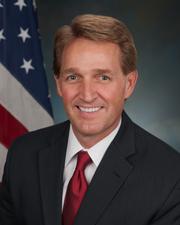 Sen. Jeff Flake (R-AZ)
Legislative Activity
Stay on top of the latest movement without scrolling through every action
Senate amendment agreed to: Amendment SA 2582 as modified agreed to in Senate by Voice Vote.
October 27, 2015
View full timeline
Senate amendment agreed to: Amendment SA 2582 as modified agreed to in Senate by Voice Vote.
October 27, 2015
Considered by Senate. (consideration: CR S7498, S7508-7509, S7520; text as modified: CR S7508-7509; text as further modified: CR S7520)
October 27, 2015
Amendment SA 2582 as modified agreed to in Senate by Voice Vote.
October 27, 2015
Considered by Senate. (consideration: CR S7430)
October 22, 2015
Considered by Senate. (consideration: CR S7374, S7404-7405)
October 21, 2015
Senate amendment proposed (on the floor): Amendment SA 2582 proposed by Senator Burr for Senator Flake to Amendment SA 2716.(consideration: CR S7334; text: CR S7334)
October 20, 2015
Amendment SA 2582 proposed by Senator Burr for Senator Flake to Amendment SA 2716. (consideration: CR S7334; text: CR S7334) To terminate the provisions of the Act after ten years.
October 20, 2015
Senate amendment submitted
August 4, 2015
Senate amendment submitted
August 4, 2015
Text
Modified
CYBERSECURITY INFORMATION SHARING ACT OF 2015--Continued

The PRESIDING OFFICER. Under the previous order, the time until 4

[[Page S7511]]

p.m. is equally divided in the usual form.
The Senator from Rhode Island.
Mr. REED. Mr. President, I wish to comment briefly on the
Cybersecurity Information Sharing Act that the Senate is considering.
Let me first commend the sponsors, Senator Burr and Senator Feinstein,
for their extraordinary work.
This bill will help ensure greater sharing of cyber threat
information, more rapidly and broadly, across industry and government.
As we have seen with large-scale attacks against the Federal Government
and companies such as Sony, there is an urgent need to start addressing
these breaches. While such legislation is not going to eliminate our
cyber security challenges, it should materially help to defeat and
deter cyber attacks and assist law enforcement in tracking down and
prosecuting cyber criminals. Information sharing will also assist the
intelligence agencies and law enforcement to detect and trace the
attacks originating from foreign actors, which is a crucial step in
holding other countries accountable.
Many of our citizens and corporations are understandably concerned
about the impact of information sharing on privacy. But we also must
recognize that rampant cyber crime is a monumental threat to the
privacy of the American people, and that sharing information about
these criminal acts cannot only protect privacy but also protect our
public safety and national security.
With respect to the specific privacy protections in the legislation
before us, the managers of this bill have come a long way toward
improving the balance between security and privacy protection,
especially the changes made to the base bill by the managers'
substitute.
A major area of concern was whether the government should be
authorized to use information shared under this bill to investigate or
prosecute a host of crimes unrelated to cyber security. Now the bill is
more narrowly tailored and focused on using information gathered under
this bill to go after crimes that are specifically related to cyber
security.
The managers' substitute also adds a requirement that the information
sharing procedures, required to be issued under this bill, include a
duty to notify individuals when the Federal Government shares their
personally identifiable information, or PII, erroneously.
The managers' substitute also includes an improved reporting
requirement that will show the number of notices sent because the
government improperly shared an individual's PII and the number of
cyber threat indicators shared automatically and, in addition, the
number of times these indicators were used to prosecute crimes.
So the managers' substitute has come a long way toward being more
protective of individual privacy, and I would like, once again, to
recognize Senators Feinstein and Burr's hard work here and their
willingness to listen to their colleagues. While I might personally
have set the balance slightly different in some places, which is why I
have supported some of the amendments before us, I think they have done
a significant job in improving the bill and providing privacy
protection.
I do want to draw my colleagues' attention to one important
additional fact here, which in some cases has been largely overlooked.
The cyber information sharing system established by this bill will
require Federal dollars to implement. Many of the agencies involved--
the Department of Homeland Security being the primary portal for shared
threat indicators--are funded on the nondefense discretionary side of
the ledger. This is an example of why I and many of my colleagues have
been urging for sequester relief for both defense and nondefense
spending--because we cannot defend our homeland without funding
nondefense agencies such as the Department of Homeland Security and a
host of other key Federal agencies. Indeed, I am encouraged that we are
close to voting on a budget solution that will provide 2 years of
sequester relief on a proportionally equal basis for defense and
nondefense spending, and that protects the full faith and credit of the
United States by taking the threat of default off the table until March
of 2017.
For this reason, I look forward to final passage of this legislation.
I once again commend the principal authors, Senator Burr and Senator
Feinstein, for their extraordinary effort.
I yield the floor.
The PRESIDING OFFICER. The Senator from Delaware.

Amendment No. 2581, as Modified

Mr. CARPER. Mr. President, I want to go back in time a little more
than 12, 13 or 14 years ago, to 9/11. One of the lessons learned by the
committee on which the Presiding Officer and I serve, now the Homeland
Security and Governmental Affairs Committee, was learned from former
Governor Tom Kean of New Jersey, cochair, along with former Congressman
Lee Hamilton from Indiana, former chair of the House Foreign Affairs
Committee. They were the cochairs of the 9/11 Commission. One of the
things they brought to our committee and to the Congress, after a lot
of work by a number of good men and women who served on that
commission, was the root causes for how that disaster occurred: How
could those four aircraft take down the Twin Towers, crash into the
Pentagon, and crash into a field in Shanksville, PA, instead of this
building right here? How could that have happened?
There are a number of reasons why it happened. But one of the reasons
why it happened is that we had stovepiped our intelligence services.
What the folks over at the FBI knew wasn't necessarily known or shared
with the Department of Homeland Security. What the folks at the
National Security Agency knew was not shared with either of the other
two agencies. What the Defense Information Agency knew or what other
agencies knew simply didn't get shared--stovepiped--because we did a
lousy job of sharing the real story, the full truth on what was being
plotted, what was going to come down and literally take thousands of
lives in one day and change in many ways our country--in profound ways
that still exist today. ``Stovepiping''--I have heard that word a
hundred times in hearings and before our committee and in talking to
folks in the 9/11 Commission. The legislation that we passed on the
heels of that disaster was designed to make sure we didn't end up
stovepiping again with intelligence information that might lead us to
avert that kind of disaster. So far, it seems to be working and is much
needed, and I think it has been helpful.
Today, I want to talk about a different kind of stovepiping that I am
afraid we may end up with--not to avert or block an aviation takeover
of an aircraft and disasters involving the aviation sector but a
disaster in cyber space in the face of cyber threats to our country.
We are working here today and will be voting later today on an
amendment or two and then on final passage of the Cybersecurity
Information Sharing Act. Again, just to remind everybody, the reason
why we are considering this is there needs to be a better sharing of
information when businesses come under cyber attack from those within
our country, outside of our country, cyber nations, and criminal
organizations. We need to do a better job of sharing that information--
business to business and business to government--and for the government
to share that information within the government to agencies that need
to know so we can respond to those attacks.
Shortly after the 9/11 Commission recommendations were enacted, one
of the things that we did was we stood up a new department called the
Department of Homeland Security. It is a civilian agency, as we know.
It is not the Department of Defense. It is not the Department of
Justice. It is not the FBI, and it is not the National Security Agency.
It is a civilian organization.
When the Department of Homeland Security was created, one of the
ideas behind it was that it would not be just a civilian operation, but
it would be a civilian operation that could receive, from businesses
and from other governmental entities, information relating to cyber
attacks. That information could come through a portal--think about it;
almost like a window--through which those threat indicators would be
reported. Those threat indicators would come through that portal at the
Department of Homeland Security. The Department of Homeland Security

[[Page S7512]]

would do, almost in real time, a privacy scrub to strip off from the
information--the threat indicators submitted from other businesses or
other government entities--Social Security numbers or other personally
identifiable information or information that just shouldn't go to other
Federal agencies or other businesses. They would strip it out--not in a
week, not in a day, not in an hour, not even, in many cases, in a
minute, but just like that--immediately--real-time privacy scrub.
As the Presiding Officer knows, we tried for years to be able to
enact legislation that incentivizes businesses that have been victims
of cyber attacks to share that information with one another, with other
businesses, and with the Federal Government. A bunch of them have been
reluctant to do it. Some of them have been reluctant to do it because
they don't want to get sued. If they disclose that they had a breach
and maybe their competitors didn't, how would that be used against
them? How could they be named in lawsuits if attacks occurred?
So in order to get them to be willing to share information, we had to
incent them. And the way we decided to incent them is to say: Share the
information. You don't have to worry if you share it with the
Department of Homeland Security through the portal established in this
civilian agency. Share it with the Department of Homeland Security, and
you have liability protection or, as it turns out, if you already
shared it previously, if it has been shared previously with the Federal
Government, you can share it again and still enjoy liability
protection. You can share it with companies that are victims of cyber
attacks, share it with their regulator, and still enjoy liability
protection.
What we want to do is to make sure companies and businesses that are
hacked don't just sit on the information, that they do something with
it. This is a saying we have on Amtrak: If you see something, say
something. If something happens to a business--a cyber attack
intrusion--we want them to share it so other businesses and other
Federal agencies can be prepared for it, look out for it, and stop it.
Where does this take me? This takes me to an amendment that we are
going to be voting on later this afternoon offered by one of our
colleagues, Senator Cotton. It would, I fear, risk revisiting
stovepiping--not the kind of stovepiping that led to the disaster of 9/
11 but stovepiping that could lead to cyber threats--threat indicators
shared with the Federal Government but not with the Department of
Homeland Security, which receives these threats and immediately
disburses them to other agencies that have a need to know. But what the
Cotton amendment would do is that it would say that a business that is
a victim of a cyber attack could share with the FBI, could share with
Secret Service, but wouldn't have to share with the Department of
Homeland Security.
The reason why in our legislation, which Senator Burr, Senator
Feinstein, I, and others have worked on, we have it going through the
Department of Homeland Security is because, more than any Federal
agency, they are set up to do privacy scrubs. That is one of the things
they do, and, frankly, they do it really well. Their job is to then
spread that information and share that information back to the private
sector, in some cases, and in other cases, just with relevant
agencies--NSA, FBI, Department of Justice, Treasury, whoever else needs
to know that information.
As part of the authors of the legislation, I join them in this. Our
fear is if the information isn't shared with the Department of Homeland
Security, which will then broadly share it in real-time and share that
information with those who need to know it, and if it ends up that the
FBI or, frankly, any other agency that doesn't have that ability to do
a great privacy scrub maybe, that doesn't have maybe the mission to
immediately share that information in real time to other relevant
players, then the news--the word about that cyber attack--could
literally stay at that agency--the FBI or the Secret Service, for that
matter. We don't want that to happen. We don't want to see that
information stovepiped in one agency. We want to make sure that it goes
to one agency that does the privacy scrub. We want to make sure the
agency that does the privacy scrub shares that information in real time
with relevant Federal agencies and the private sector.
I probably shouldn't pretend to speak for Senator Feinstein and
Senator Burr. They will be here to speak for themselves. But I know
they share my concerns about this legislation. I ask, on behalf of
them, and, frankly, for others of us who believe that this is a
dangerous amendment--and I don't say that lightly. We have worked
really hard. We have worked really well across the aisle--literally for
months now--to get to this point. To use a football analogy, we are not
just in the red zone passing this legislation; we are on the 10-yard
line, and it is first down and goal to go. Let's not muff the play.
Let's get the ball to the end zone. Let's pass this legislation. Let's
vote down the Cotton amendment, and let's go to conference. Let's go to
conference and provide the kind of protection against cyber attacks
that this country desperately needs and deserves.
I yield the floor.
The PRESIDING OFFICER. The Senator from West Virginia.

Carbon Regulations

Mrs. CAPITO. Mr. President, today I rise on behalf of West Virginian
workers, families, communities, and all hardworking Americans who will
bear the burden of these onerous carbon mandates. The bipartisan
resolution of disapproval, which I have introduced with my colleague
Senator Heidi Heitkamp from North Dakota and 47 other cosponsors, will
block EPA's greenhouse gas regulation targeting existing power sources.
I also strongly support Leader McConnell's companion resolution to
block the regulations targeting new power limits.
As I was thinking about the speech today and as I rise to give this
speech, I realize I have said many of these same words so many times
before. I have expressed the same frustrations and spouted off similar
statistics. What is the difference this time? The difference is we have
already seen the devastating effects and the callous nature of
regulatory overreach. We know what the new reality would be. The new
reality would be what we are facing with these new carbon regulations:
the reality of the families, the faces, and the hardships that we have
already endured; the thousands of layoffs in my State of West Virginia
that have already been issued; the jobs that have been lost and will
never come back.
Just this morning, nearly 200 West Virginia coal miners in Randolph
County were informed that their jobs will be gone by Christmas. Think
about how those families will spend their Christmas holiday. Then
consider how those realities will be magnified and felt throughout many
households across the country if these carbon mandates move forward--
the higher electricity bills that will result, the squeeze that already
is squeezing struggling middle-class families who are living on fixed
incomes, and the squeeze that those who live on fixed incomes will
feel. Our most vulnerable will bear the burden. Consider the far-
reaching effects these regulations will have on schools that are now
seeing their budgets shrink, home values that are now on the decline,
and fewer dollars that are available for public safety and law
enforcement.
It is reality that the policies emanating from this government--from
our government--are causing this destruction. This is not a natural
disaster. This is not a fiscal crisis. This is not an uncontrollable
event but a carefully crafted, precise, and very meditated assault on
certain areas of the country. These are policies that help some States
and truly hurt others, policies that target States like West Virginia
and North Dakota where we produce some of the most reliable and
affordable energy, and policies that are ripping the American dream
away from families in my State and communities. Our families want and
deserve healthy, clean air and water, and they want to live in a great
environment. But policies from Washington that pit one State against
another and prioritize certain communities and certain jobs over others
are bringing the livelihoods of many to a halt. On behalf of Americans
across the country, Members of Congress now have the opportunity to
express our concerns with these carbon mandates. We have an opportunity
to weigh in about whether these burdensome regulations should go into
effect.

[[Page S7513]]

I believe that a majority of my colleagues understand the need for
affordable and reliable energy, and that is why I am confident that
Congress will pass these resolutions and place this critical issue of
America's economic future squarely on President Obama's desk. With the
international climate negotiations in Paris scheduled for December, the
world is watching whether the United States will foolishly move forward
with regulations that will do virtually nothing to protect our
environment and will tie one hand behind our back economically. Even if
the President vetoes these resolutions--and we recognize the likelihood
that he will--passing them will send a clear message to the world that
the American people do not stand behind the President's efforts to
address climate change with economically catastrophic regulations.
I am pleased to be joined by several colleagues on the floor who
understand the need for affordable and reliable energy. I would like to
recognize Senator Heitkamp.
I ask unanimous consent to engage in a colloquy with my colleagues
for up to 30 minutes.
The PRESIDING OFFICER. Without objection, it is so ordered.
Ms. HEITKAMP. Thank you, Mr. President, and thank you to my great
colleague from the great State of West Virginia, a State that has been
powering America for many years--in fact, from the very beginning. My
thanks go to all of the great workers and coal miners in her State who
have added to our economic opportunity, not just for the people in West
Virginia but for the people of an entire region.
That is one thing we forget--that in America a great miracle happens
every day. We turn on a light switch and the lights come on. If that
doesn't happen or if it is too expensive to turn on that light switch,
we will not be the country that we are. With this regulation, I think
what we have done is cede the all-important role of electrical security
and energy security to an environmental agency that does not have the
experience or expertise to understand what it takes to get an electron
in the wire.
I am proud to stand today with my colleague Senator Capito and
introduce a bill to roll back the EPA rule on carbon emissions--that
rule which threatens the supply of abundant, affordable, and reliable
electricity in North Dakota. I pledge to register my displeasure
through multiple channels. This legislation today is the most public
way of expressing not just my frustration but the frustration and
concern of my State regulators and my State utilities.
Although this rule will have dramatic consequences across the
country, it unfairly targets North Dakota utilities. During the
original draft rule, North Dakota's allocation was 11 percent. This is
not something we were happy with given the extent of the jurisdictional
reach but something that people started rolling up their sleeves saying
if we have to reduce by 11 percent, how are we going to do it and how
are we going to meet this challenge? That is the North Dakota way, to
not only fight for our rights but also look at what the alternatives
are. Unfortunately, when the draft rule went from an 11-percent to a
45-percent reduction in the final rule, that was the straw that broke
the camel's back.
I am trying to do everything I can to push back against EPA's
burdensome powerplant rules to find workable solutions so North
Dakotans can continue to have low-cost, reliable electricity. This CRA
is one of the many different avenues I am taking to make sure that
North Dakota is treated fairly.
I want to talk about what is unique about North Dakota. In fact, a
lot of the generation that happens in North Dakota is generation that
is generated by rural electric co-ops. These co-ops own and operate
about 90 percent of the State's coal-based generation facilities, and
they provide electricity to rural areas that in the past other
utilities would not serve, not just rural areas in North Dakota but
rural areas all through the region. These are people at the end of the
line, as we call them, the very people that this rule will most impact
and that EPA and this administration failed to consider when they made
this final rule.
North Dakota's utilities are heavily invested in coal-based
generation for a good and historic reason. I think this is an important
point to make because a lot of people may say: Well, what is the
difference? You can fuel switch. But at the time our electric co-ops
built these generation facilities, they used coal because it was
against Federal law to use natural gas. The fuel use act made it
illegal to use natural gas for power generation, virtually forcing
these power companies to make the investment that they made in this
fuel source of coal. Now, after making billions of dollars of
investments to meet the mandates under the fuel use act and to meet the
numerous emissions standards that have been put forth by EPA, the
administration once again is straining these assets, causing them in
many cases to be stranded. If the administration were willing to pay
fair market value to strand these assets, then maybe we could have a
discussion, but I don't see that deal on the table. These utilities
built, modified, and retrofitted all at great cost and according to
Federal law at the time, and now they are threatening the very
existence of this generation.
These assets are not just critical to North Dakota. Our coal-based
generation provides dependable, affordable, reliable baseload
electricity to millions of people in the Great Plains with roughly 55
percent of electric power generated in North Dakota being shipped
outside our border.
When this final rule came out, I simply said that it was a slap in
the face to our utilities and our regulators. This final rule was so
vastly different from the rule that was proposed, it was almost
laughable that EPA said it wasn't in any way informed by any real input
or any real comment. How can you take a utility and a State from 11
percent to 45 percent and not reissue that rule? How can that be the
movement in the final rule?
I think this final rule is a rule that jeopardizes close to 17,000
good-paying jobs in my State. It provides power for rural communities
that otherwise would struggle for affordable, reliable baseload power.
We have some of the lowest power costs in the country because we have
some of the best utilities in the country, which are always looking out
for the consumer at the end of the line.
North Dakota has never stepped down from a tough challenge,
especially when the challenge is fair, the goal is attainable, and the
timeline is achievable, but that is not this rule. The goal is not
fair, the challenge is not fair, the goal is not attainable, and the
timeline is unachievable in my State--unachievable. That is not
anything the Clean Air Act ever anticipated--that we would set a goal
with no feasible or possible way of meeting that goal, given current
technology. Yet that is the position we are in.
At the end of the day, what matters most is making sure that our
utilities can do their jobs, making sure that when a North Dakotan or a
South Dakotan or someone from Wyoming or Colorado, where we deliver
power--and certainly those in Minnesota--reaches over to turn on that
light switch, regardless of the time of the day, that light comes on.
That is called baseload power. People who think this is easy, people
who think this is just switch fuels or switch technology, have never
sat in a boardroom as I have and listened to the challenges of putting
that electron on that wire.
I stand with my colleague from West Virginia and my colleague Joe
Manchin here on our side of the aisle saying enough is enough. This is
a problem we need to address. Maybe that is the difference in how we
look at this. This is an issue that we can tackle and achieve results
over time, but this rule is wrong. It is wrongheaded. It will, in fact,
cause huge disruption to the economy of my State and the economy of the
middle of this country. We have to do everything we can to prevent this
rule from becoming a reality.
Thank you for letting me join you, the great Senator from West
Virginia. We have two great Senators from West Virginia here.
I yield the floor.
The PRESIDING OFFICER. The majority leader.
Mr. McCONNELL. Mr. President, there is a war on coal in America--a
war on coal in America. The leader is the President of the United
States. A number of us were in the Senate in 2009 and 2010, and the
administration

[[Page S7514]]

couldn't pass their cap-and-trade proposal through the Senate. They had
60 votes in the Senate. The President and his party had 60 votes in the
Senate, but they couldn't pass the cap-and-trade proposal through this
body, so they decided they were going to do it anyway. They decided
they were going to do it anyway.
As the two Senators from West Virginia can attest, we have a
depression in central Appalachia, created not because of anything we
did here in Congress but because of the President's zeal to have an
impact worldwide on the issue of climate. I suspect that even if we
follow this path all the way to the end, this effort by the United
States would have about as much impact as dropping a pebble in the
ocean. Yet we are paying a real price for it here at home. Eastern
Kentucky looks like the Dust Bowl during the thirties--no jobs, no
opportunity, no future, not as a result of anything we passed through
the people's elected representatives but by this sort of arrogant,
singlehanded messianic goal to deal with worldwide climate.
Our options to stop it are quite limited. We do have the possibility
of the Congressional Review Act, but the weakness of that obviously is
that even though we can pass it with a simple majority, he is likely to
veto it.
We are here today to stand up for our people, the ratepayers of
America, and not only the ratepayers--90 percent of the electricity in
Kentucky comes from coal--but the communities that have been devastated
by this. I have never seen anything like it. I heard my parents talk
about what the Depression was like. It sounds and looks a lot like the
stories they told me about America in the 1930s.
This is a venture that will have no impact on the issue for which it
is being pursued but is having a devastating and current adverse impact
on the people we represent.
We have representatives from both parties here on the floor today
working toward overturning the administration's deeply regressive
energy regulations. These regulations are going to ship more middle-
class jobs overseas. I told my constituents last year: Coal has a
future; the question is, Does coal have a future in this country? The
Indians and the Chinese are not going to give up their future by not
using this cheap and abundant source of power. The Germans--one of the
greenest countries in Europe--are now importing coal. So coal has a
future. The question is, Does it have a future here after this
administration?
My folks can't even put food on the table. The ones who can find a
job somewhere are leaving. The population continues to decline.
As I said earlier, it is not going to have much of an impact on the
environment of our planet. This isn't going to do anything meaningful
to affect global carbon levels. It just seems that someone wants to be
able to pat themselves on the back for doing something even if they
accomplish hardly anything at all, except hurt a whole lot of
Americans. Higher energy bills and lost jobs may be trivial to some
folks out on the political left--not their jobs; they don't care--but
it is a different story for the middle-class Kentuckians whom I
represent.
So here we have on the floor Senators from both parties who are
saying it is time to take off the ideological blinders and instead
think about those who have already suffered enough over the past few
years. We have worked together to file bipartisan measures that would
overturn the administration's two-pronged regulations. I have joined
with Senator Heitkamp and Senator Capito on a measure that would
address one of those prongs, the one that pertains to existing energy
sources. Senator Manchin is here on the floor and joined me as I
introduced a measure that would address the other prong, the one that
pertains to new sources. These bipartisan measures together represent a
comprehensive solution. As I said, I am pleased to be joined here on
the floor by Senators from West Virginia and North Dakota. Senator
Daines from Montana is here--another important coal State. The chairman
of our Environment and Public Works Committee, Senator Inhofe, is here,
and some have already spoken and some will speak after me. I am proud
and pleased to be here on the floor with all of my colleagues standing
up for our aggrieved constituents who have been mightily abused by this
administration.
I yield the floor.
The PRESIDING OFFICER (Mr. Perdue). The Senator from West Virginia.
Mr. MANCHIN. Mr. President, first of all, I want to thank my
colleagues, Senator McConnell, Senator Capito, who is my colleague from
the State of West Virginia, Senator Daines, Senator Inhofe, and my good
friend Senator Heitkamp.
This is a bipartisan approach. Not often do we see a bipartisan
effort, a bipartisan colloquy on the floor of the Senate anymore, and
there should be because we all have the same interests. Basically, how
do we provide affordable, dependable, and reliable energy? That is what
this country was built on. We have defended this country by having
resources that we could use to basically defend ourselves, and that
resource has come from what the Good Lord gave us. Coal has been in
abundance in the United States of America. We have fought every war, we
have defended, we have energized, and we have built a middle class
unlike at any time in the history of this world.
So now it comes to the point where there is a group--basically the
ones on an ideological pathway--who says we can do it differently. If
someone came to me and said: We have this new great energy, and I am
sorry, West Virginia and North Dakota and Oklahoma and Montana, we have
this new energy--and maybe it is commercial hydrogen, which will be
water vapor--that is wonderful. We will figure a way. We will embrace
that. We will figure a way to make it. We will do something. We will
diversify. That is not the case. The case is simply this: This country
has depended and will depend--even by this administration's admission,
this country will depend on fossil fuel for at least the next three
decades. It is in the EIA report. They are going to have to have it.
Baseload, as the Senator from North Dakota said, is simply this:
something that will give us power 24/7, day and night, rain or shine.
There are only two things in the world that can do it: coal and
nuclear. Gas is coming on and gas will be a baseload when the
distribution lines and the pipelines are there to provide it. Right now
it is not, but it is coming on strong.
Just look no further than Japan. Japan was mostly moving toward
nuclear. Fukushima happens. When that happened, Japan had to change.
What did they do? They changed to coal. But they decided the new plants
they would build would be ultra super critical. That means 40 percent
efficiency, burning at the highest levels to reduce the emissions. They
are moving in technology ways.
Now, what does the plan that we are talking about and we have our
colleagues talking about--existing source, which means they can't
continue with what we have today, and new source, which means any new
plant has to be built to certain standards. Carbon capture
sequestration has not been proven commercially, not at one plant in
America. Yet these rules are based on using carbon capture
sequestration.
All we have said--some of us have said this: Why don't you at least
demonstrate that you can have that type of commercial operation and
that it can withstand 1 year under commercial load and show us those
are the new limits you want us to meet? That, to me, is reasonable.
Let me tell my colleagues this: If you were in the business of
producing power and you desired not to do that even though we had
technology, then you would have to close your plant. I understand that.
That is not the case. They can't show us technology and show us that it
has a commercial feasible pathway to be able to perform and provide the
energy we need. There is no way they can do it.
So I have said this: If it is unobtainable, it is unreasonable. That
is all. Don't expect me to do something that has never been done. If
the Federal Government says: Fine, we have $8 billion lying down at the
Department of Energy--$8 billion that hasn't been tapped--does that not
tell us something?
The private sector has not stepped up to take those types of loans
and to use those types of loans to find the new technology for the
future because they don't believe the administration wants

[[Page S7515]]

us to find any new technology that might be able to adhere to the
standards they have set.
So we sat back and we have done nothing. Then, on top of that, they
expect these plants, 30 years from now--if they are expecting to get
commercial power, electricity, fill the grid with power coming from
coal for the next 30 years--most of our plants average 50 years of age.
They can't produce the power they are going to produce--that we will
need for this country to have for 30 more years. An 80-year-old plant
just won't do it. So that means they come off the line, off the grid.
When that comes off the grid, what we call dependable, reliable, and
affordable energy goes away. It goes away.
I have said this: Someone needs to respectfully ask our President,
this administration, the EPA, the DOE: If for the next 90 days not
another ton of coal was delivered to a coal plant in America--not
another ton of coal because--and I have said this to the
administration. They have been very eloquent in basically telling the
American people: We don't like coal, we don't want coal, and we don't
need coal. If those were the facts, then make sure you tell the
American people, if they didn't have coal for 90 days, what the United
States of America would look like. Just tell me what it would look
like. Ask anybody what it would look like. The lives of 130 million
people would be in jeopardy tomorrow--130 million people. This system
could collapse. The east coast could be dark. Now, you tell me how you
are going to fill that in. And if you are not willing to be honest with
the American people and tell them that, don't make them believe there
is something that is not there, that you can run this off of wind and
solar.
We have a lot of wind in West Virginia, and we are proud of that. I
will give an example. My colleagues will remember the hottest days this
past summer, that very hot spell we had, 90 to 100 degrees. We have 17
acres of a wind farm on top of a beautiful mountain in West Virginia,
560 megawatts. We have a coal-fired plant sitting there, the cleanest
super-critical coal-fired plant on Mount Storm, 1,600 megawatts. Guess
how many megawatts of power the wind produced during the hottest times
of the summer when we needed the power. Two megawatts. Two. The wind
didn't blow. It was so hot and stagnant, it didn't blow. That poor
little coal-fired plant was giving it everything it had to try to
produce the power the Nation needed.
I am just saying the facts are the facts whether we like them or not.
So when this plan comes out and says that any new coal-fired plant
being built has to be--you can basically be assured they are not going
to build any. When they are saying existing plants have to meet certain
standards, they won't invest and try to hit a moving target.
So now what happens? For the 35 to 40 percent of the power you are
telling the United States of America, the people in this great country,
that we have--don't worry, we are going to take care of you, it is not
going to happen. We are not going to stand by and say we are not going
to fight for that. We are not only fighting for a way of life for West
Virginia, we are fighting for a way of life for this country.
This country depends on energy we have been able to produce. We have
always depended on our little State. North Dakota, now one of the best
energy-producing States we have in the country--Montana, Wyoming,
Oklahoma--we have been the heavy lifters. We will continue to work for
this great country. We just need a little help. That is all we are
asking for.
So I would say, ask the question: What would the country look like
tomorrow? The standards they are setting are basically unreasonable,
totally unreasonable, because they are unobtainable.
The impact is going to be devastating, basically. The system is going
to be to the point to where we can't depend on it, it is not reliable,
and we don't have the power of the future yet. Maybe our children or
grandchildren might see that. I hope so. But until the time comes where
we are going to transition from one to the other, make sure it is a
smooth transition. Make sure it is a dependable transition. Make sure
it is one that keeps this country the superpower of the world. If we
don't, I guarantee we will be the last generation standing as a
superpower saying that we are energy independent; we are not fighting
wars around the world basically for the energy this country needs. We
have the ability to basically take care of ourselves. We can be totally
independent with energy if we have an energy policy that works, but it
has to be realistic. This is not.
That is why I totally oppose this new power plan which is coming out.
It is a shame that we have to rely on the courts to protect something
we should be doing in the Halls of this Senate. It is a shame that the
courts have to step in to protect us.
With that being said, I yield the floor, and I thank my colleagues
for being here on this important issue.
The PRESIDING OFFICER. The Senator from Oklahoma.
Mr. INHOFE. Mr. President, first of all, I appreciate the fact that
my colleagues from West Virginia, North Dakota, Kentucky, and Montana--
all of us are getting together on this in a bipartisan way. I think it
is worth repeating, to make sure everyone understands where we are on
this, what a CRA is. The CRA is the Congressional Review Act. It is an
act that allows an elected person who is answerable to the public to
weigh in on these decisions that are made by the President--who can't
run again for office--and by the unelected bureaucrats who are
destroying this country.
As was pointed out by the Senator from Kentucky, I do chair the
committee called the Environment and Public Works Committee. On this
committee, we deal with these regulations. We have jurisdiction over
the EPA. It is interesting I would say that because we tried to get the
EPA to come in and testify as witnesses as to how the President plans
to move to the percentage of power that is going to be generated by the
year 2030 by renewables, and they won't testify because they don't have
a plan. They don't know how they are going to do it.
The CRA is significant because there are a lot of people in this case
who would be the liberals in this body who like the idea of being
overregulated, who like the idea of having the regulators run our
lives, and they are the ones who would love to go home when people are
complaining about the cost of all of these things and they can say:
Well, wait a minute. Don't blame us. That was a bureaucrat who did
that; that wasn't me.
Well, this forces accountability, and these guys don't like it. I can
assure you right now that we are going to give everyone an opportunity
to weigh in on what these issues are. They would much prefer to go home
and say: I know we are overregulating and I know it is destroying the
States--whatever the States happen to be--but it wasn't me, don't look
at me.
Now we are going to see who is responsible because what is going to
happen is we are going to have a vote. The vote is going to take place,
and I think our leader is correct when he says the President will
probably veto this. If the President vetoes it, it comes back for a
veto override, and then people will know who is for it and who is
against it. So I think a CRA has another great value. It forces
accountability by people who are answerable to the public.
On the issue we are discussing today, the interesting and the
consistent pattern we have is that what this President does is he gets
the things they tried to do through over--through legislation, and
those things that fail through legislation he tries then to do by
regulation.
Let me give you an example. Another issue--not the issue we are
talking about today--is the WOTUS issue, the waters of the United
States. Historically, it has been the States that have regulations over
the waters except for navigable waters. Well, of course, liberals want
everything in Washington. So 5 years ago a bill was introduced, and the
bill would have essentially taken the word ``navigable'' out so that
the Federal Government would have control over all the waters in my
State of Oklahoma and throughout America. Two of them introduced a
bill, one was Senator Feingold of Wisconsin and the House Member was
Congressman Oberstar from one of the Northern States. I don't know
which one it was. They introduced a bill to take the word ``navigable''
out. Not only did we overwhelmingly defeat the legislation, but the
public defeated the two of them in the next election.

[[Page S7516]]

Now the President is trying to do what he was not able to do through
legislation through regulation. The same thing is true--the Senator
from West Virginia is right when he talked about what they are trying
to do. It is very interesting when you look at this bill. We are
talking about the emissions of CO<inf>2</inf>. The first bill that was
introduced was in 2002. It was the McCain-Lieberman bill. We defeated
that. The next one was the McCain-Lieberman bill in 2005, and the third
one was the Warren-Lieberman bill in 2008. Then we had the Waxman-
Markey bill that we never even got to vote on because nobody was going
to vote for it.
So what they fail to be able to do legislatively, they are now trying
to do through regulations, and that is why a CRA is significant because
it does force accountability.
Let me make one other statement. This thing about Paris that is going
to take place in December. This is the big party that the United
Nations puts on every year. It is the 21st year they have done this. I
can remember when they did it in 2009. That was going to be Copenhagen.
Several people went over there at that time. President Obama was in the
Senate, Hillary was in the Senate, Pelosi was there, and John Kerry
went. They went over there to tell the 192 countries that were meeting
in Copenhagen--the same 192 countries that will be meeting in 2
months--went over to tell them we were going to pass cap-and-trade
legislation that year. That was 2009.
I went over after they had given their testimony there. I went all
the way over to Copenhagen, spent 3 hours, and came all the way back on
the next flight. I probably had the most enjoyable 3 hours I ever had
because I was able to talk to 192 countries and tell them they had been
lied to; that we are not going to be passing it. The same thing is
going on in December of this year.
By the way, let me just mention one thing that hasn't been said.
There are people out there listening to this who actually believe this
stuff, that the world is going to come to an end because of
CO<inf>2</inf> manmade gases. This is something we have been listening
to for a long period of time. I remember right before going to
Copenhagen in 2009--at that time the Administrator of the Environmental
Protection Agency was Lisa Jackson, an appointee by President Obama,
and I asked her this question on the record, live on TV. I asked: If we
had passed any of the legislation or the regulations that we are
talking about passing, would this have an effect of lowering the
CO<inf>2</inf> worldwide? She said--now keep in mind this was an Obama
appointee--by the way, Obama was President at that time when he went to
Copenhagen. She said: Well, no, it wouldn't reduce emissions worldwide
because it just pertains to the United States.
This isn't where the problem is. The problem is in India, it is in
China, it is in Mexico. The problem we would have there is, yes, we
might lower our CO<inf>2</inf> emissions in the United States. However,
those other countries will not, and it could have the effect of
increasing, not decreasing, CO<inf>2</inf> emissions because as we
chase our manufacturing base overseas to places they don't have any
restrictions, we would have the effect of increasing it.
So I am just saying I appreciate the fact we are all together on this
and making the necessary efforts to make people accountable. I think it
might surprise a lot of people as to who changes their mind on this
once they know they have to cast a vote and be accountable.
I applaud, certainly, my friends from West Virginia and the other
States that are involved in this. I think this is the right thing to
do. Let's keep in mind the Utility MACT--that is the maximum achievable
control technology--was the first shock to put coal under. At that time
we did a CRA, and we actually came within four votes of getting the
bill passed, and that was when Republicans were not a majority. I look
for some good things to happen, and I think we are doing what is right
and responsible.
I yield the floor.
The PRESIDING OFFICER. The Senator from West Virginia.
Mrs. CAPITO. Mr. President, I ask unanimous consent for additional
time so the Senator from Montana can join the colloquy. As he reminds
me, the Senator has the largest recoverable tonnage of coal in the
Nation.
The PRESIDING OFFICER. Without objection, it is so ordered.
Mr. DAINES. Thank you, Mr. President.
This administration is shutting down coal-fired powerplants in the
United States. I thank the Senator from West Virginia, Mrs. Capito, the
other Senator from West Virginia, Mr. Manchin, and we have Senator
Heitkamp here. We had Democrats and Republicans in colloquy talking
about what is going on with coal-fired plants and the Clean Power Plan
of this administration.
This is what is happening. It is killing good-paying jobs for union
workers, for pipefitters, for boilermakers, and tribal members in my
State with these so-called Clean Power Plan regulations. At the same
time, it is stifling investment that could lead to innovation to make
coal cleaner in the United States.
As I travel across Montana, I have heard Montanans describe the EPA
as--a rancher once told me it stands for ``Eliminate Production
Agriculture.'' A union member recently told me it stands for the
``Employment Prevention Agency.'' President Obama and his ``Employment
Prevention Agency'' continues to wage war on American energy, American
families, and on American jobs. This so-called Clean Power Plan is an
all-out frontal assault on affordable energy and good-paying union jobs
as well as tribal jobs. This will leave President Obama directly
responsible for skyrocketing energy bills, a loss of tax revenue for
our schools, teachers and our roads and the unemployment of thousands
of hard-working Americans. The President ignores the fact that more
than half of Montana's electricity comes from coal, as do thousands of
jobs and $120 million in tax revenue every year.
In fact, 40 percent of our Nation's energy comes from coal. When a
young person plugs their iPhone or their smartphone into the wall and
charges it, most likely it is being charged by coal.
In my hometown of Bozeman, we have a Tesla charging station at one of
our hotels. Elon Musk at Tesla did an amazing, innovative job creating
electric vehicles, but when they plug those Tesla vehicles into those
chargers, those Tesla vehicles in Montana are likely powered by coal.
The facts are that coal production in the United States is much safer
and less carbon intensive than coal from other nations. As had been
mentioned, this is a global challenge we must think about and address.
The Powder River Basin in Southeast Montana has coal that is among the
cleanest in the world. It has lower sulfur content and cleaner than
Indonesian coal. Shutting down U.S. coal will have a negligible impact
on global coal demand and global emissions. However, it will ultimately
make it more likely that less technologically advanced coal production
techniques will be used around the world.
This is the way to think about it. The United States consumes about
10 percent of the world's coal. Said another way, 90 percent of the
coal consumption in the world occurs outside the United States, and the
global demand for coal-fired energy will not disappear even if the
United States were to shut down every last coal mine and every last
coal-fired plant.
Again, individuals are entitled to their own opinions but not to
their own facts. Here are the facts. Coal use around the world has
grown about four times faster than renewables. There are 1,200 coal
plants planned across 59 countries. About three-quarters of them will
be in China and India. China consumes 4 billion tons of coal per year
versus the United States at 1 billion tons. China is building a new
coal-fired plant every 10 days, and that is projected to last for the
next 10 years.
In Japan--I used to have an office in Tokyo. My degree was in
chemical engineering, and I was part of a software company with offices
around the world. I remember the big earthquake that struck Japan--the
9.0 quake. The Fukushima nuclear reactors were disabled. How is Japan
dealing with that? They are building 43 coal-fired powerplants. By
2020, India may outbuild 2\1/2\ times more coal capacity as the United
States is about to use. So it is shortsighted and misguided to move
forward on an agenda that is going to devastate

[[Page S7517]]

significant parts of the economy. It is going to raise energy prices
and destroy union jobs and tribal jobs.
We are seeing that already in Montana. Earlier this month, in the
month of October, a customer of the Crow Tribe, the Sherco Coal plant
in Minnesota announced it needs to shut down two units. This cuts off a
significant portion of the customer base for Crow coal. Because the
Crow Tribe relies on coal-fired Midwest utilities for most of its non-
Federal revenue and for good-paying private jobs at the Absaloka Mine,
the unemployment rate on the Crow reservation today is in the high 40
percent. Without these coal mining jobs, that unemployment rate will go
to 80 to 85 percent.
Ironically, some of the first impacted by the Obama administration's
new regulations are those who can least afford it. You have heard it
from Senators on both sides of the aisle today. Under the final rule,
the Colstrip powerplant in Montana will likely be shuttered, putting
thousands of jobs at risk. We must take action. We need to stop these
senseless rules.
This past weekend I joined the Montana attorney general, Tim Fox, in
Helena to announce that Montana, along with 23 other States, has filed
a lawsuit against the Federal Government because of Obama's recent
decision. There are currently 26 States--the majority of the States in
this United States--through three different lawsuits that have
requested an initial stay on the rule.
As Leader McConnell mentioned in 2010, a Democratic-controlled
Congress could not pass these regulations. The people's House stopped
it, but now President Obama and the EPA are moving forward without the
people's consent.
I am thankful to partner with a bipartisan group of my colleagues,
Leader McConnell, Senator Capito, Senator Inhofe, Senator Manchin, and
Senator Heitkamp, who are speaking out and working to stop this harmful
rule. I am proud to stand and join them as a cosponsor of two
bipartisan resolutions of disapproval under the Congressional Review
Act that would stop the EPA from imposing the anti-coal regulation.
Coal keeps the lights on, it charges our iPhones, and it will
continue to power the world for decades to come. Rather than dismissing
this reality, the United States should be on the cutting edge of
technological advancements in energy development. We should be leading
the way in using clean, affordable American energy.
America can and should power the world. We can only do it if the
Obama administration steps back from the out-of-touch regulations and
allows American innovation to thrive once again. In summary, we need
more innovation, not more regulations.
Thank you, and I yield back my time.
The PRESIDING OFFICER. The Senator from West Virginia.
Mrs. CAPITO. Mr. President, I would like to thank my colleagues for
joining me in a colloquy, particularly the Senator from North Dakota,
who is cosponsoring the Congressional Review Act legislation with me on
existing coal-fired powerplants, and certainly my colleague from West
Virginia Senator Manchin. We have worked very well together in a
bipartisan way on these issues--Leader McConnell, Chairman Inhofe, and
Senator Daines from Montana.
I think we have presented a clear picture of the impact of these
rules. So I ask unanimous consent that any time spent in a quorum call
before the 4 p.m. vote series be charged equally against both sides.
The PRESIDING OFFICER. Without objection, it is so ordered.
Mrs. CAPITO. I yield the floor.
The PRESIDING OFFICER. The Senator from Florida.

Puerto Rico

Mr. NELSON. Mr. President, I want to talk about the financial crisis
that is going on in Puerto Rico. We have all heard about the current
situation that Puerto Rico finds itself in. They are suffering. They
are having trouble paying their bills and their economy is in shambles.
Some people have the attitude ``Well, that is not our problem,'' but
they are forgetting the fact that Puerto Rico is part of the United
States. It is a territory. It is not a foreign country. Puerto Ricans
are American citizens.
If a problem exists in Puerto Rico, it exists in the United States.
It is not something we can just ignore. It impacts the entire country.
If the economy continues to suffer in Puerto Rico, the people there
will just move to another part of the country. I want to repeat that.
If things are bad in Puerto Rico economically, they--Puerto Ricans--can
move to another part of the country. This is not immigration; this is a
move to the mainland. Many Puerto Ricans are leaving Puerto Rico
because of it is troubles.
Happily, many of the people who live on the island are moving to
Florida. They are adding to the diversity and immense fabric of Florida
that reflects the entire country, but our gain in Florida is Puerto
Rico's loss. There are more than 1 million people in Florida alone who
may have preferred to stay at home on the island with their friends and
their families. People who otherwise would be opening small businesses
or new doctors' offices in San Juan are opening them in Orlando. This
only hurts Puerto Rico's economic future.
We need to give Puerto Rico the tools it needs to get its economy
back on track. Puerto Rico cannot do that alone. Congress needs to
pitch in. I have joined a number of our colleagues--Blumenthal,
Schumer, and Menendez--in being a sponsor of the Puerto Rico Chapter 9
Uniformity Act. It fixes a glitch in the Federal bankruptcy law that
stops Puerto Rico's municipalities and public corporations from
restructuring their debt through the Federal bankruptcy court,
something that is law in all of the States. That is why we have a
bankruptcy law, but there is a glitch that you cannot do that in Puerto
Rico. That is simply unfair. The people of Puerto Rico should get equal
protection under the law.
Both the Finance Committee and the Energy and Natural Resources
Committee have held hearings in the past few weeks about the economic
crisis in Puerto Rico. Two of Puerto Rico's elected officials, Governor
Garcia Padilla and Congressman Pierluisi, have testified at these
hearings. Both said that Puerto Rican public corporations need access
to Chapter 9 debt restructuring.
It is this Senator's strong desire that we see them treated equally
under the law and that this legislation to fix this glitch comes to the
floor soon. We also need to help Puerto Rico's health care system. The
Medicaid Program in Puerto Rico serves nearly 1.7 million residents. It
is in terrible shape. In 2010, Congress passed the Affordable Care Act,
which provided Puerto Rico with a $5.4 billion one-time payment to
cover health care costs. That money is set to expire in 2019, but it
could even run out sooner.
Under Medicare Part D, Puerto Rican residents are being treated like
second-class citizens. They don't get the same financial support that
State residents get for prescription drug coverage. This has an effect
on their economy, stifling their ability to emerge from the crisis, not
to speak of the fact that they are not getting the health care other
American citizens have.
I remind you, Puerto Ricans are American citizens. So this kind of
treatment under Medicare flies in the face of the most basic American
value--equality. That is why several of us have joined Senator Schumer
on a bill to improve the way Puerto Rico is treated under Medicare and
Medicaid.
Last week, thankfully, the White House released a set of legislative
proposals to help Puerto Rico. Included in that list were some of the
bills I have mentioned here that I support. I urge our colleagues to
give this problem the attention it demands. We should move the
proposals that we can move in this legislative body. We should do it
with haste. There are more than 3\1/2\ million people in Puerto Rico.
They are U.S. citizens who, unlike most U.S. citizens, have no one to
represent them in this Chamber and only have a nonvoting delegate in
the House of Representatives. They have no voice here, but even with no
voice, there are some of us in this Chamber who will make sure that
their voice is heard. We cannot turn our backs on fellow Americans. By
the way, when it comes time to defend this country and our national
security, look at the percentage of Puerto Ricans who sign up for the
military. They are fellow Americans. I ask my colleagues to look deep
in their hearts

[[Page S7518]]

and find a way to come together to help the island of Puerto Rico, a
territory, our fellow American citizens, to get through this troubled
time.
I yield the floor.
I suggest the absence of a quorum.
The PRESIDING OFFICER. The clerk will call the roll.
The legislative clerk proceeded to call the roll.
Mr. NELSON. Mr. President, I ask unanimous consent that the order for
the quorum call be rescinded.
The PRESIDING OFFICER. Without objection, it is so ordered.

Budget Agreement

Mr. NELSON. Mr. President, since I see no one is waiting to speak, I
might offer a couple of comments about the proposed budget agreement.
We are still evaluating this, looking at the details, but first things
first. This seems to me to be something we should agree to. It
certainly gets us past this artificial debt crisis that would cause the
United States to go into economic cataclysmic fits.
If we do not raise the debt ceiling, America cannot pay its
obligations it has already incurred. It would be the first time the
U.S. Government went into default. That time has already run out, but
through extraordinary measures the Secretary of the Treasury has been
able to keep the cashflow going, but he is running out of all of his
tricks of the trade next week, November 3. That is the first thing it
would do most immediately.
The second thing it would do is it would get us over this budgetary
impasse of a budget that lays out the blueprint--for the flushing out
of that blueprint, which are the appropriations bills. So in the case
of the budget, what had been brought forth was a budgetary gimmick of
saying we were going to raise the amount of money we needed for
defense, but it was not going to meet this arbitrary budget cap that
had been set 3 years ago by the cuts across the board called the
sequester. But oh, by the way, we were going to increase that defense
spending a little more by creating an additional account over and above
what we spend overseas called the overseas contingency fund, OCO, and
therefore money was going to be supplied--the increases we need in
defense--with in fact not increasing the budgetary caps on spending.
Well, that was budgetary fakery. That was budgetary sleight of hand.
That was not budgetary truth. This agreement stops that for the next 2
years. Two years from now we will have to face the same thing and get
rid of this artificial cut across the board. That is no way of dealing
with trying to cut the budget. You ought to be cutting the budget with
a scalpel, not with a meat cleaver, where you come across the board on
every program.
Indeed, what this agreement does is it raises the caps on defense in
this first year $25 billion. It allows an OCO increase of $23 billion--
and that is considerably less than what had been proposed earlier.
Indeed, as you get into fiscal year 2017, it raises the budgetary caps
on defense by $15 billion, also a $23 billion OCO, or overseas
contingency fund, for the war effort over in Central Asia.
This is a good program, but the other thing this agreement corrects--
in the Republican budget, they had only raised money for defense
spending, and all the other needs of government that need to be
appropriated--nondefense discretionary spending--were kept artificially
low. If you are talking about grants from NIH, that was all being
limited. If you are talking about money for NASA as we get into the
program of going to Mars, all of that had been cut. If you are talking
about agricultural programs, all of that had been cut. No matter what
program--education, the environment, you go on down the list--all of
that had been cut.
This budget agreement that we will vote on hopefully in the next 2 or
3 days does, in fact, raise those budgetary caps for nondefense
spending as well as for defense spending. So where the caps were raised
in this first year of fiscal year 2016 by $25 billion for defense
spending, so too $25 billion for nondefense discretionary spending.
Likewise, in the next fiscal year, 2017, where the caps had been raised
$15 billion for defense spending, likewise, nondefense discretionary
and all those other needs of government, the same amount--$15 billion.
I will have more to say about this later, but while I have the
opportunity, I wish to commend to the Senate that I think it is
certainly in the interests off of our country to move forward and
approve this new budgetary agreement.
By the way, I might add as I close that an agreement has been
hammered out between the Republican and the Democratic leadership in
both Houses, along with the White House.
I yield the floor.
Mr. LEAHY. Mr. President, in today's digital age, many Americans live
their lives online. We communicate via email, use photo sharing and
social networking Web sites, store documents in the cloud, and access
our private financial and medical information through the Internet. The
amount of sensitive electronic data that we create and store on the
Internet is staggering and will only continue to grow. We know that
cyber security is an important component of protecting our critical
infrastructure. A cyber attack targeting the electric grid in the
Northeast, for example, could have dire effects during a cold Vermont
winter. I know that Vermonters care about cyber security, and Congress
must act responsibly to strengthen our ability to defend against cyber
attacks and breaches. But I also know that Vermonters care deeply about
their privacy and civil liberties, and I believe just as strongly that
whatever Congress does in the name of cyber security must not
inadvertently undermine the privacy and security of Vermonters and all
Americans.
For years, Congress has seemed singularly focused on the private
sector's desire for voluntary information sharing legislation. While
improving the flow of cyber threat information between the government
and private sector is a laudable goal that I support, it is not a
panacea for our cyber security problems. Information sharing alone
would not have prevented the major breaches of the past year, such as
the breach at the Office of Personnel Management, OPM, or the breaches
at Sony, Home Depot, or Anthem.
Narrowly tailored legislation to facilitate the sharing of technical,
cyber threat data could be beneficial, but the Senate Intelligence
Committee's bill lacks certain basic safeguards and threatens to
significantly harm Americans' privacy. That is why I have heard from a
number of Vermonters who oppose the bill and that is why consumer
advocacy organizations, privacy and civil liberties groups, and major
technology companies like Apple, Dropbox, and Twitter all vocally
oppose the bill. The technology companies know firsthand the importance
of ensuring our cyber security, and they oppose this bill because they
believe it does little to improve our cyber security and would
ultimately undermine their users' privacy.
For months, I have worked with Senator Feinstein to improve this
bill. She has been receptive to my concerns, and I appreciate that many
of the revisions that I suggested are now incorporated into the
managers' amendment. The managers' amendment now makes clear that
companies can only share information for cyber security purposes, which
is an improvement from the original legislation. It also prohibits the
government from using information shared by private companies to
investigate routine crimes that have nothing to do with cyber security.
And it removes a completely unnecessary and destructive new exemption
to the Freedom of Information Act, FOIA, which had the potential to
greatly restrict government transparency. These are significant
improvements, and I am thankful to Senator Feinstein for working with
me to incorporate them into the bill.
Unfortunately, the Senate Intelligence Committee's bill still has
major flaws. This bill overrides all existing legal restrictions to
allow an unprecedented amount of data--including Americans' personal
information--to flow to the government without adequate controls and
restrictions. It needlessly requires all information shared with the
government to be immediately disseminated to a host of Federal
agencies, including to the NSA. It fails to adequately require
companies to remove irrelevant personal information before sharing with
the government. The bill contains broad authorizations that allow
companies to monitor traffic on their networks with liability
protection and employ ``defensive measures'' that may

[[Page S7519]]

cause collateral harm to innocent Internet users. The bill also
continues to include another unnecessary FOIA exemption that will
weaken the existing FOIA framework.
Proponents of the bill have attempted to assuage many of these
concerns by arguing that sharing under this bill is voluntary, and if
companies do not want to share information with the government or use
the authorities in the bill, they do not have to. This bill may be
voluntary for companies, but it is not voluntary for consumers.
American consumers have no say on whether their information is shared
with the government and ends up in an NSA or IRS database. They may
have no recourse if a company needlessly monitors their Internet
activity or inappropriately shares their personal information with the
government.
Rather than limiting the dissemination of information in order to
protect the private and proprietary information of Americans and
American businesses, this bill goes in the wrong direction by giving
companies more liability protection and more leeway on how to share our
information. The most effective action Congress can take to improve our
cyber security is to pass legislation that requires companies to take
greater care of how they use and protect our data, not less. And we
should pass my Consumer Privacy Protection Act to require companies to
protect our personal information and help prevent breaches in the first
place. The cyber security legislation before us today does nothing to
address this very real concern, so I cannot support it. I fear that
this bill will significantly undermine our privacy, and I urge Senators
to vote against passage.
The PRESIDING OFFICER. The Senator from Arkansas.
Mr. COTTON. Mr. President, I ask unanimous consent to speak for up to
15 minutes.
The PRESIDING OFFICER. Is there objection?
Without objection, it is so ordered.

Amendment No. 2581, as Modified

Mr. COTTON. Mr. President, today I speak in support of the Cotton
amendment to the Cybersecurity Information Sharing Act. My amendment is
straightforward. It simply would provide liability protection to any
business or other private organization that shares cyber threat
indicators to the FBI or the Secret Service.
In its current form, the Cybersecurity Information Sharing Act would
require entities to submit these cyber threat indicators through a
portal created and run by the Department of Homeland Security in order
to receive liability protection. But there are also two exceptions that
would allow entities to receive liability protection outside the DHS
portal: first, if a submission was related to a previously shared cyber
threat indicator, and second, if the submitting entity is sharing
information with its Federal regulatory authority. But not every
private entity has a Federal regulatory authority, thank goodness, so
where a cable company can share with the FCC or an energy company can
go to the Department of Energy or FERC, other businesses are forced to
go to the DHS portal. Good examples are retailers such as JCPenney,
Walmart, Target, and Home Depot.
When the trade associations for two victims of the biggest cyber
attacks in recent memory--Target and Home Depot--are pleading for this
language, we should take notice and incorporate it. Anything else would
be unfair, inequitable, and unwise.
We ought to give these companies an alternative to the DHS portal.
One simple reason is that nobody knows what the portal will look like,
how it will function, or how much it will cost companies to interact
with it. The Federal Government, after all, doesn't have the best track
record for designing and deploying IT systems. Healthcare.gov was not
exactly a resounding success. One could easily imagine a company trying
to share a cyber threat indicator and getting an error message from the
portal, just as millions of Americans received when they tried to sign
up for ObamaCare.
In this case, regulated businesses can just go to their regulator.
Private and small businesses will be out of luck, though. This is the
primary reason my amendment has such strong private support.
Organizations such as the National Retail Federation, the chamber of
commerce, the National Cable & Telecommunications Association, and many
others support this commonsense amendment.
The second main reason that entities should be able to share directly
with the FBI and the Secret Service is that the bill is about promoting
collaboration between the government and the private sector, as the
National Security Council says that we should in this tweet: ``More
than any other national security topic, effective cybersecurity
requires the US gov't & private sector to work together.'' I agree.
As Director Comey recently told the Senate Intelligence Committee,
the FBI has redoubled its efforts to reach out to private businesses in
this area. This has paid dividends. And there is no entity in the
Federal Government that the private sector trusts more on cyber
security than the FBI. That is why Sony Pictures called the FBI when it
was hacked by North Koreans last year.
I also have to imagine that is the main reason the White House
endorsed my amendment over the weekend when they sent out this very
helpful tweet: ``If you are a victim of a major cyber incident, a call
to @FBI, @SecretService, or @DHSgov is a call to all.'' My goodness,
Susan Rice and I stand together in agreement that if you are a victim
of a cyber incident, you should be able to call the FBI, the Secret
Service, or the DHS. I thank the National Security Advisor and the
White House for their support for the concept behind my amendment.
I would also like to take a few moments to dispel a few myths about
this amendment. The first myth is that the Cybersecurity Information
Sharing Act creates a single portal at DHS for liability-protected
information sharing with the Federal Government and that the Cotton
amendment would create an unprecedented second channel.
This is false. The bill authorizes multiple liability-protected
sharing channels with the Federal Government, not just one, through a
broad exception to the DHS portal that permits certain regulated
businesses to engage in liability-protected sharing of cyber threat
information directly with any Federal regulators without requiring that
it first pass through DHS. The Cotton amendment simply provides the
same flexibility for businesses that already have established threat-
sharing relationships with the FBI or the Secret Service to maintain
their existing channels for sharing and not incur significant costs and
delays to establish new ones with DHS. My amendment is consistent with
this multichannel sharing approach.
The second myth is that my amendment would harm privacy as it would
allow the sharing of cyber threat indicators with the FBI and the
Secret Service and that the sharing with these agencies wouldn't happen
under the bill in its current form.
This is also false. Under the current version of the bill, if an
entity shares information through the DHS portal, the FBI and Secret
Service will receive it. My amendment doesn't change that or the
privacy protections in the bill. Both with and without my amendment,
the FBI and Secret Service will get cyber threat indicators.
The third myth is that the scrub DHS would have to conduct for
personally identifiable information is not as rigorous under my
amendment.
Again, this is not true. The Cybersecurity Information Sharing Act
requires all Federal entities receiving threat indicators to protect
privacy by removing personal information that may still be contained in
them before sharing with other entities. My amendment does not
eliminate or weaken any of the bill's privacy requirements, as the FBI
and Secret Service are required to protect privacy in the same way all
other Federal entities receiving threat indicators.
Finally, I simply want to note that the House-passed version of the
bill contains a nearly identical provision, and that bill passed with
overwhelming bipartisan support on a 307-to-116 vote.
To sum up, the Cotton amendment has overwhelming support in the
private sector, including companies that have been victims of cyber
crimes. It would lead to greater information sharing between the
private sector and the Federal Government. It preserves the privacy
protections in the bill. When it was included in the House bill, both

[[Page S7520]]

Republicans and Democrats voted yes. I therefore ask my colleagues on
both sides of the aisle to support this amendment.
I yield the floor.
I suggest the absence of a quorum.
The PRESIDING OFFICER. The clerk will call the roll.
The legislative clerk proceeded to call the roll.
Mr. BURR. Mr. President, I ask unanimous consent that the order for
the quorum call be rescinded.
The PRESIDING OFFICER (Mr. Lankford). Without objection, it is so
ordered.
Mr. BURR. Mr. President, what is the order of business?

Amendment No. 2552, as Further Modified

The PRESIDING OFFICER. Under the previous order, the question occurs
on amendment No. 2552, as further modified, offered by the Senator from
Delaware, Mr. Coons.
The Senator from California.
Mrs. FEINSTEIN. Mr. President, I wish to speak and urge a ``no'' vote
on amendment No. 2552, known as the Coons amendment.
This amendment essentially adds another layer of review to the bill's
current requirements. We worked this out in an earlier amendment with
Senator Carper. This amendment goes further, and it could prevent parts
of the government from quickly learning about cyber threats at machine
speed because it would require an additional privacy review for any
information going through the DHS portal.
The Carper amendment that I spoke about was adopted as part of the
managers' package, which made clear that the government should take
automated steps to ensure that the real-time information sharing system
can both protect privacy and allow for sharing at the speed necessary
to stop cyber threats. Because the Coons amendment will slow down
sharing via the DHS portal, I ask my colleagues to join me in voting
no.
The PRESIDING OFFICER. The Senator from Delaware.
Mr. COONS. Mr. President, I rise today to urge my colleagues to
support my amendment to make sure that this bill strikes the right
balance between privacy and security.
I respect the very hard work of Senators Burr and Feinstein and the
constructive amendment that my senior Senator Tom Carper added to the
managers' amendment. I do believe this bill has made significant
movement in the right direction. But I remain concerned, and my
amendment's purpose is to require that DHS review all cyber threat
indicators it receives and to remove personally identifying information
by the most efficient means practicable. It would not necessarily--
according to the amendment in the managers' package--be required that
DHS scrub, unless multiple agency heads unanimously agree on the
scrubbing process. My amendment's purpose is to simply ensure that
these privacy scrubs--done at machine speed, done in a responsible
way--protect citizen privacy and our security. I don't think we should
be forced to choose between those two.
I urge my colleagues to support my amendment.
The PRESIDING OFFICER. The question occurs on agreeing to amendment
No. 2552, as further modified.
Mr. BURR. I ask for the yeas and nays.
The PRESIDING OFFICER. Is there a sufficient second?
There appears to be a sufficient second.
The clerk will call the roll.
The legislative clerk called the roll.
Mr. CORNYN. The following Senators are necessarily absent: the
Senator from Texas (Mr. Cruz), the Senator from South Carolina (Mr.
Graham), the Senator from Kentucky (Mr. Paul), the Senator from Florida
(Mr. Rubio), and the Senator from Louisiana (Mr. Vitter).
The PRESIDING OFFICER (Ms. Ayotte). Are there any other Senators in
the Chamber desiring to vote?
The result was announced--yeas 41, nays 54, as follows:

[Rollcall Vote No. 289 Leg.]

YEAS--41

Baldwin
Bennet
Blumenthal
Booker
Boxer
Brown
Cantwell
Cardin
Coons
Daines
Durbin
Flake
Franken
Gardner
Gillibrand
Heinrich
Heller
Hirono
Klobuchar
Leahy
Lee
Markey
Menendez
Merkley
Moran
Murkowski
Murphy
Murray
Peters
Reed
Reid
Sanders
Schatz
Schumer
Shaheen
Stabenow
Sullivan
Tester
Udall
Warren
Wyden

NAYS--54

Alexander
Ayotte
Barrasso
Blunt
Boozman
Burr
Capito
Carper
Casey
Cassidy
Coats
Cochran
Collins
Corker
Cornyn
Cotton
Crapo
Donnelly
Enzi
Ernst
Feinstein
Fischer
Grassley
Hatch
Heitkamp
Hoeven
Inhofe
Isakson
Johnson
Kaine
King
Kirk
Lankford
Manchin
McCain
McCaskill
McConnell
Mikulski
Nelson
Perdue
Portman
Risch
Roberts
Rounds
Sasse
Scott
Sessions
Shelby
Thune
Tillis
Toomey
Warner
Whitehouse
Wicker

NOT VOTING--5

Cruz
Graham
Paul
Rubio
Vitter
The amendment (No. 2552), as further modified, was rejected.
The PRESIDING OFFICER. The Senator from North Carolina.
Mr. BURR. Madam President, I ask unanimous consent that the cloture
motion on S. 754 be withdrawn; that prior to the vote on adoption of
the Burr-Feinstein substitute amendment, the managers' amendment at the
desk be agreed to; and that following adoption of the substitute, the
bill be read a third time and the Senate vote on passage of the bill,
as under the previous order. I further ask that notwithstanding
adoption, the Flake amendment No. 2582 be modified with the technical
change at the desk.
The PRESIDING OFFICER. Is there objection?
Without objection, it is so ordered.
The amendment (No. 2582), as further modified, is as follows:

At the end, add the following:

SEC. 408. EFFECTIVE PERIOD.

(a) In General.--Except as provided in subsection (b), this
Act and the amendments made by this Act shall be in effect
during the 10-year period beginning on the date of the
enactment of this Act.
(b) Exception.--With respect to any action authorized by
this Act or information obtained pursuant to an action
authorized by this Act, which occurred before the date on
which the provisions referred to in subsection (a) cease to
have effect, the provisions of this Act shall continue in
effect.

Amendment No. 2581, as Modified

The PRESIDING OFFICER. Under the previous order, the question occurs
on amendment No. 2581, as modified, offered by the Senator from
Arkansas, Mr. Cotton.
The Senator from Arkansas.
Mr. COTTON. Madam President, I support this important bill, but I
want to strengthen it.
Under the bill, a business receives liability protection by reporting
threats to DHS or its regulatory agency, but many businesses,
especially retailers like Target or Home Depot, don't have a regulator;
thus, they must report to DHS. They have no choice. They must report to
DHS even if they have longstanding ties to the FBI, as did Sony
Pictures.
I contend that we should allow these businesses to choose between the
DHS, FBI, and Secret Service. Fortunately, the White House appears to
agree with my position. The National Security Council tweeted over the
weekend: ``If you are a victim of a major cyber incident, a call to
@FBI, @SecretService, or @DHSgov is a call to all.''
This amendment wouldn't undermine the single-point-of-reporting
concept behind this bill because there is already an exception for the
regulators, nor would it impair privacy rights because those rules
apply to the FBI.
Finally, I would note that the House-passed version of this bill
includes a nearly identical provision, and that got 307 votes.
Let's join together in a bipartisan fashion, adopt this amendment,
and strengthen the bill.
The PRESIDING OFFICER. The Senator from North Carolina.
Mr. BURR. Madam President, we are almost at the end. This is the last
amendment.
Unfortunately, I rise to ask my colleagues to vote against the
amendment of not only my colleague but a member of the Intelligence
Committee. This is a deal-killer. I will be very honest. This kills the
deal. One of the thresholds that we had to reach was the balance to
have one portal that the information goes through. This creates a new

[[Page S7521]]

portal. The White House is not in favor of it. Downtown is not in favor
of it because they understand what it does.
We are this close right now to a voluntary information sharing bill.
I can assure you that this is the first step. We have a ways to go. But
if you want to stop it dead in its tracks, support this amendment. If,
in fact, you want to get this across the goal line, then I would ask
you to defeat the Cotton amendment and let us move to passage of this
bill. Let us go to conference with the House.
I yield the floor.
The PRESIDING OFFICER. The question is on agreeing to the amendment,
as modified.
Mr. BURR. I ask for the yeas and nays.
The PRESIDING OFFICER. Is there a sufficient second?
There appears to be a sufficient second.
The clerk will call the roll.
The senior assistant legislative clerk called the roll.
Mr. CORNYN. The following Senators are necessarily absent: the
Senator from Texas (Mr. Cruz), the Senator from South Carolina (Mr.
Graham), the Senator from Kentucky (Mr. Paul), the Senator from Florida
(Mr. Rubio), and the Senator from Louisiana (Mr. Vitter).
The PRESIDING OFFICER. Are there any other Senators in the Chamber
desiring to vote?
The result was announced--yeas 22, nays 73, as follows:

[Rollcall Vote No. 290 Leg.]

YEAS--22

Boozman
Capito
Cornyn
Cotton
Fischer
Grassley
Inhofe
Isakson
Kirk
Lankford
McCain
McConnell
Perdue
Portman
Rounds
Sasse
Scott
Sessions
Shelby
Thune
Toomey
Whitehouse

NAYS--73

Alexander
Ayotte
Baldwin
Barrasso
Bennet
Blumenthal
Blunt
Booker
Boxer
Brown
Burr
Cantwell
Cardin
Carper
Casey
Cassidy
Coats
Cochran
Collins
Coons
Corker
Crapo
Daines
Donnelly
Durbin
Enzi
Ernst
Feinstein
Flake
Franken
Gardner
Gillibrand
Hatch
Heinrich
Heitkamp
Heller
Hirono
Hoeven
Johnson
Kaine
King
Klobuchar
Leahy
Lee
Manchin
Markey
McCaskill
Menendez
Merkley
Mikulski
Moran
Murkowski
Murphy
Murray
Nelson
Peters
Reed
Reid
Risch
Roberts
Sanders
Schatz
Schumer
Shaheen
Stabenow
Sullivan
Tester
Tillis
Udall
Warner
Warren
Wicker
Wyden

NOT VOTING--5

Cruz
Graham
Paul
Rubio
Vitter
The amendment (No. 2581), as modified, was rejected.
Mr. COTTON. I yield back all time.

Amendment No. 2749 to Amendment No. 2716

(Purpose: To improve the substitute amendment)

The PRESIDING OFFICER. Under the previous order, the managers'
amendment, No. 2749, is agreed to.
The amendment is printed in today's Record under ``Text of
Amendments.''

Vote on Amendment No. 2716, as Amended

The PRESIDING OFFICER. The question is on agreeing to the substitute
amendment No. 2716, as amended.
The amendment (No. 2716), as amended, was agreed to.
The bill was ordered to be engrossed for a third reading and was read
the third time.
The PRESIDING OFFICER. The Senator from North Carolina.
Mr. BURR. Madam President, I ask my colleagues for just the next 2
minutes to allow Senator Feinstein and me to thank our colleagues for
their help over the last several days as we have worked through the
cyber bill.
I thank my vice chairman, who has been beside me all the way, and I
thank Chairman Johnson and Ranking Member Carper for the input they
provided.
I want to say to committee staff who has worked night and day to get
us to this point and to members of the committee who worked diligently
for months to get this legislation enacted that I could not have done
it without you.
Now the work begins as we go to conference.
I turn to the vice chairman.
Mrs. FEINSTEIN. I thank you very much.
Madam President, I just want to say a personal word to Chairman Burr,
and maybe it is to everyone in this body. One of the things I have
learned from two prior cyber bills is that if you really want to get a
bill done, it has to be bipartisan, particularly a bill that is
technical, difficult, and hard to put together, and a bill where often
there are two sides. I thank you for recognizing this. We stood
shoulder to shoulder and the right things happened, and now we can go
to conference.
I also want to say that we did everything in this bill we possibly
could to satisfy what were legitimate privacy concerns. The managers'
package had 14 such amendments, and before that our staffs sat down
with a number of proposals from Senators and went over literally dozens
of additional amendments. So we took what we could.
When the chairman talks about the balance, what he means is that this
is the first time the chamber of commerce has supported a bipartisan
bill. This is the first time we had virtually all the big employers--
banks and retailers and other companies--supporting a bipartisan bill
because today everybody understands what the problem of cybersecurity
is much greater. So we stood shoulder to shoulder, and you all
responded, and I am very grateful.
There is still a lot of work to be done, but, Mr. Chairman, you and
your staff have been terrific. I would like to single a couple of them
out, if I might, in particular, Chris Joyner, Michael Geffroy, Jack
Livingston, Janet Fisher, John Matchison, and Walter Weiss.
I also want to thank Tom Carper, who has been working to get this
bill passed as much as anyone. He wrote one of the key changes in the
managers' package to improve privacy as information moves through the
DHS portal. He was supported by his chairman, Senator Johnson. He has
been a close partner throughout the process, and I thank him.
I also thank Gabbie Batkin, Matt Grote, and the other members of
Senator Carper's staff.
We had incredible support from our committee. It is a committee of
15--8 Republicans and 7 Democrats. I thank Senator Collins, who was
particularly concerned about the critical infrastructure of this
country, as well as Senators Mikulski, Whitehouse, King, Warner,
Heinrich, Blunt, Nelson, and Coats. I know they will help us push this
bill forward as we go to conference with the House.
I greatly appreciate the supporters of this bill outside the Senate,
to include the U.S. chamber of commerce and the associations that have
endorsed this bill, tech companies like IBM and Oracle, Secretary Jeh
Johnson at the Department of Homeland Security, and NSA Directors Keith
Alexander and Mike Rogers, and Lisa Monaco and Michael Daniel at the
White House.
On my staff, I would like to thank David Grannis, our staff director
on the minority side. David has been there for these previous cyber
bills, and it has proven to be a very difficult issue. David, you are a
10.
I also thank Josh Alexander. Josh has been our lead drafter and
negotiator and knows these cyber issues better than anyone. He has been
tireless on reaching agreement after agreement on this bill, and is, as
much as anybody, responsible for today's vote.
I would also like to thank my former cyber staffer Andy Grotto, as
well as Mike Buchwald, Brett Freedman, Nate Adler, and Nick Basciano.
Thank you all so very much.
Finally, I very much appreciate the work done by Ayesha Khanna in the
Democratic leader's office and Jeffrey Ratner at the White House.
We have the administration behind the bill, we have the Department of
Homeland Security behind the bill, and we have the editorial pages of
the Washington Post and the Wall Street Journal, as well as the chamber
of commerce, and most of the businesses of America.
So, Mr. Chairman, you did a great job, and thank you from the bottom
of my heart.
The PRESIDING OFFICER. The majority leader.
Mr. McCONNELL. Madam President, I just want to add my words of
congratulation to Chairman Burr and Ranking Member Feinstein. This is a

[[Page S7522]]

very complicated issue, as we all know. It has been around multiple
Congresses, and it took their leadership and coordination and
cooperation first to produce a 14-to-1 vote in the committee and then
this extraordinary success we have had out here on the floor. I know
all of us are extremely proud of the great work you have done.
Congratulations. We deeply appreciate the contribution you have made
to our country.
The PRESIDING OFFICER. The bill having been read the third time, the
question is, Shall it pass?
Mr. TILLIS. I ask for the yeas and nays.
The PRESIDING OFFICER. Is there a sufficient second?
There is a sufficient second.
The clerk will call the roll.
The bill clerk called the roll.
Mr. CORNYN. The following Senators are necessarily absent: the
Senator from Texas (Mr. Cruz), the Senator from South Carolina (Mr.
Graham), the Senator from Kentucky (Mr. Paul), the Senator from Florida
(Mr. Rubio), and the Senator from Louisiana (Mr. Vitter).
The PRESIDING OFFICER. Are there any other Senators in the Chamber
desiring to vote?
The result was announced--yeas 74, nays 21, as follows:

[Rollcall Vote No. 291 Leg.]

YEAS--74

Alexander
Ayotte
Barrasso
Bennet
Blumenthal
Blunt
Boozman
Boxer
Burr
Cantwell
Capito
Carper
Casey
Cassidy
Coats
Cochran
Collins
Corker
Cornyn
Cotton
Donnelly
Durbin
Enzi
Ernst
Feinstein
Fischer
Flake
Gardner
Gillibrand
Grassley
Hatch
Heinrich
Heitkamp
Hirono
Hoeven
Inhofe
Isakson
Johnson
Kaine
King
Kirk
Klobuchar
Lankford
Manchin
McCain
McCaskill
McConnell
Mikulski
Moran
Murkowski
Murphy
Murray
Nelson
Perdue
Peters
Portman
Reed
Reid
Roberts
Rounds
Sasse
Schatz
Schumer
Scott
Sessions
Shaheen
Shelby
Stabenow
Thune
Tillis
Toomey
Warner
Whitehouse
Wicker

NAYS--21

Baldwin
Booker
Brown
Cardin
Coons
Crapo
Daines
Franken
Heller
Leahy
Lee
Markey
Menendez
Merkley
Risch
Sanders
Sullivan
Tester
Udall
Warren
Wyden

NOT VOTING--5

Cruz
Graham
Paul
Rubio
Vitter
The bill (S. 754), as amended, was passed, as follows:

S. 754

Be it enacted by the Senate and House of Representatives of
the United States of America in Congress assembled,

SECTION 1. TABLE OF CONTENTS.

The table of contents of this Act is as follows:

Sec. 1. Table of contents.

TITLE I--CYBERSECURITY INFORMATION SHARING

Sec. 101. Short title.
Sec. 102. Definitions.
Sec. 103. Sharing of information by the Federal Government.
Sec. 104. Authorizations for preventing, detecting, analyzing, and
mitigating cybersecurity threats.
Sec. 105. Sharing of cyber threat indicators and defensive measures
with the Federal Government.
Sec. 106. Protection from liability.
Sec. 107. Oversight of Government activities.
Sec. 108. Construction and preemption.
Sec. 109. Report on cybersecurity threats.
Sec. 110. Conforming amendment.

TITLE II--FEDERAL CYBERSECURITY ENHANCEMENT

Sec. 201. Short title.
Sec. 202. Definitions.
Sec. 203. Improved Federal network security.
Sec. 204. Advanced internal defenses.
Sec. 205. Federal cybersecurity requirements.
Sec. 206. Assessment; reports.
Sec. 207. Termination.
Sec. 208. Identification of information systems relating to national
security.
Sec. 209. Direction to agencies.

TITLE III--FEDERAL CYBERSECURITY WORKFORCE ASSESSMENT

Sec. 301. Short title.
Sec. 302. Definitions.
Sec. 303. National cybersecurity workforce measurement initiative.
Sec. 304. Identification of cyber-related roles of critical need.
Sec. 305. Government Accountability Office status reports.

TITLE IV--OTHER CYBER MATTERS

Sec. 401. Study on mobile device security.
Sec. 402. Department of State international cyberspace policy strategy.
Sec. 403. Apprehension and prosecution of international cyber
criminals.
Sec. 404. Enhancement of emergency services.
Sec. 405. Improving cybersecurity in the health care industry.
Sec. 406. Federal computer security.
Sec. 407. Strategy to protect critical infrastructure at greatest risk.
Sec. 408. Stopping the fraudulent sale of financial information of
people of the United States.
Sec. 409. Effective period.

TITLE I--CYBERSECURITY INFORMATION SHARING

SEC. 101. SHORT TITLE.

This title may be cited as the ``Cybersecurity Information
Sharing Act of 2015''.

SEC. 102. DEFINITIONS.

In this title:
(1) Agency.--The term ``agency'' has the meaning given the
term in section 3502 of title 44, United States Code.
(2) Antitrust laws.--The term ``antitrust laws''--
(A) has the meaning given the term in section 1 of the
Clayton Act (15 U.S.C. 12);
(B) includes section 5 of the Federal Trade Commission Act
(15 U.S.C. 45) to the extent that section 5 of that Act
applies to unfair methods of competition; and
(C) includes any State law that has the same intent and
effect as the laws under subparagraphs (A) and (B).
(3) Appropriate federal entities.--The term ``appropriate
Federal entities'' means the following:
(A) The Department of Commerce.
(B) The Department of Defense.
(C) The Department of Energy.
(D) The Department of Homeland Security.
(E) The Department of Justice.
(F) The Department of the Treasury.
(G) The Office of the Director of National Intelligence.
(4) Cybersecurity purpose.--The term ``cybersecurity
purpose'' means the purpose of protecting an information
system or information that is stored on, processed by, or
transiting an information system from a cybersecurity threat
or security vulnerability.
(5) Cybersecurity threat.--
(A) In general.--Except as provided in subparagraph (B),
the term ``cybersecurity threat'' means an action, not
protected by the First Amendment to the Constitution of the
United States, on or through an information system that may
result in an unauthorized effort to adversely impact the
security, availability, confidentiality, or integrity of an
information system or information that is stored on,
processed by, or transiting an information system.
(B) Exclusion.--The term ``cybersecurity threat'' does not
include any action that solely involves a violation of a
consumer term of service or a consumer licensing agreement.
(6) Cyber threat indicator.--The term ``cyber threat
indicator'' means information that is necessary to describe
or identify--
(A) malicious reconnaissance, including anomalous patterns
of communications that appear to be transmitted for the
purpose of gathering technical information related to a
cybersecurity threat or security vulnerability;
(B) a method of defeating a security control or
exploitation of a security vulnerability;
(C) a security vulnerability, including anomalous activity
that appears to indicate the existence of a security
vulnerability;
(D) a method of causing a user with legitimate access to an
information system or information that is stored on,
processed by, or transiting an information system to
unwittingly enable the defeat of a security control or
exploitation of a security vulnerability;
(E) malicious cyber command and control;
(F) the actual or potential harm caused by an incident,
including a description of the information exfiltrated as a
result of a particular cybersecurity threat;
(G) any other attribute of a cybersecurity threat, if
disclosure of such attribute is not otherwise prohibited by
law; or
(H) any combination thereof.
(7) Defensive measure.--
(A) In general.--Except as provided in subparagraph (B),
the term ``defensive measure'' means an action, device,
procedure, signature, technique, or other measure applied to
an information system or information that is stored on,
processed by, or transiting an information system that
detects, prevents, or mitigates a known or suspected
cybersecurity threat or security vulnerability.
(B) Exclusion.--The term ``defensive measure'' does not
include a measure that destroys, renders unusable, provides
unauthorized access to, or substantially harms an information
system or data on an information system not belonging to--
(i) the private entity operating the measure; or
(ii) another entity or Federal entity that is authorized to
provide consent and has provided consent to that private
entity for operation of such measure.
(8) Entity.--
(A) In general.--Except as otherwise provided in this
paragraph, the term ``entity'' means any private entity, non-
Federal government agency or department, or State,

[[Page S7523]]

tribal, or local government (including a political
subdivision, department, or component thereof).
(B) Inclusions.--The term ``entity'' includes a government
agency or department of the District of Columbia, the
Commonwealth of Puerto Rico, the Virgin Islands, Guam,
American Samoa, the Northern Mariana Islands, and any other
territory or possession of the United States.
(C) Exclusion.--The term ``entity'' does not include a
foreign power as defined in section 101 of the Foreign
Intelligence Surveillance Act of 1978 (50 U.S.C. 1801).
(9) Federal entity.--The term ``Federal entity'' means a
department or agency of the United States or any component of
such department or agency.
(10) Information system.--The term ``information system''--
(A) has the meaning given the term in section 3502 of title
44, United States Code; and
(B) includes industrial control systems, such as
supervisory control and data acquisition systems, distributed
control systems, and programmable logic controllers.
(11) Local government.--The term ``local government'' means
any borough, city, county, parish, town, township, village,
or other political subdivision of a State.
(12) Malicious cyber command and control.--The term
``malicious cyber command and control'' means a method for
unauthorized remote identification of, access to, or use of,
an information system or information that is stored on,
processed by, or transiting an information system.
(13) Malicious reconnaissance.--The term ``malicious
reconnaissance'' means a method for actively probing or
passively monitoring an information system for the purpose of
discerning security vulnerabilities of the information
system, if such method is associated with a known or
suspected cybersecurity threat.
(14) Monitor.--The term ``monitor'' means to acquire,
identify, or scan, or to possess, information that is stored
on, processed by, or transiting an information system.
(15) Private entity.--
(A) In general.--Except as otherwise provided in this
paragraph, the term ``private entity'' means any person or
private group, organization, proprietorship, partnership,
trust, cooperative, corporation, or other commercial or
nonprofit entity, including an officer, employee, or agent
thereof.
(B) Inclusion.--The term ``private entity'' includes a
State, tribal, or local government performing electric or
other utility services.
(C) Exclusion.--The term ``private entity'' does not
include a foreign power as defined in section 101 of the
Foreign Intelligence Surveillance Act of 1978 (50 U.S.C.
1801).
(16) Security control.--The term ``security control'' means
the management, operational, and technical controls used to
protect against an unauthorized effort to adversely affect
the confidentiality, integrity, and availability of an
information system or its information.
(17) Security vulnerability.--The term ``security
vulnerability'' means any attribute of hardware, software,
process, or procedure that could enable or facilitate the
defeat of a security control.
(18) Tribal.--The term ``tribal'' has the meaning given the
term ``Indian tribe'' in section 4 of the Indian Self-
Determination and Education Assistance Act (25 U.S.C. 450b).

SEC. 103. SHARING OF INFORMATION BY THE FEDERAL GOVERNMENT.

(a) In General.--Consistent with the protection of
classified information, intelligence sources and methods, and
privacy and civil liberties, the Director of National
Intelligence, the Secretary of Homeland Security, the
Secretary of Defense, and the Attorney General, in
consultation with the heads of the appropriate Federal
entities, shall develop and promulgate procedures to
facilitate and promote--
(1) the timely sharing of classified cyber threat
indicators in the possession of the Federal Government with
cleared representatives of relevant entities;
(2) the timely sharing with relevant entities of cyber
threat indicators or information in the possession of the
Federal Government that may be declassified and shared at an
unclassified level;
(3) the sharing with relevant entities, or the public if
appropriate, of unclassified, including controlled
unclassified, cyber threat indicators in the possession of
the Federal Government;
(4) the sharing with entities, if appropriate, of
information in the possession of the Federal Government about
cybersecurity threats to such entities to prevent or mitigate
adverse effects from such cybersecurity threats; and
(5) the periodic sharing, through publication and targeted
outreach, of cybersecurity best practices that are developed
based on ongoing analysis of cyber threat indicators and
information in possession of the Federal Government, with
attention to accessibility and implementation challenges
faced by small business concerns (as defined in section 3 of
the Small Business Act (15 U.S.C. 632)).
(b) Development of Procedures.--
(1) In general.--The procedures developed and promulgated
under subsection (a) shall--
(A) ensure the Federal Government has and maintains the
capability to share cyber threat indicators in real time
consistent with the protection of classified information;
(B) incorporate, to the greatest extent practicable,
existing processes and existing roles and responsibilities of
Federal and non-Federal entities for information sharing by
the Federal Government, including sector specific information
sharing and analysis centers;
(C) include procedures for notifying, in a timely manner,
entities that have received a cyber threat indicator from a
Federal entity under this title that is known or determined
to be in error or in contravention of the requirements of
this title or another provision of Federal law or policy of
such error or contravention;
(D) include requirements for Federal entities sharing cyber
threat indicators or defensive measures to implement and
utilize security controls to protect against unauthorized
access to or acquisition of such cyber threat indicators or
defensive measures;
(E) include procedures that require a Federal entity, prior
to the sharing of a cyber threat indicator--
(i) to review such cyber threat indicator to assess whether
such cyber threat indicator contains any information that
such Federal entity knows at the time of sharing to be
personal information or information that identifies a
specific person not directly related to a cybersecurity
threat and remove such information; or
(ii) to implement and utilize a technical capability
configured to remove any personal information or information
that identifies a specific person not directly related to a
cybersecurity threat; and
(F) include procedures for notifying, in a timely manner,
any United States person whose personal information is known
or determined to have been shared by a Federal entity in
violation of this Act.
(2) Coordination.--In developing the procedures required
under this section, the Director of National Intelligence,
the Secretary of Homeland Security, the Secretary of Defense,
and the Attorney General shall coordinate with appropriate
Federal entities, including the Small Business Administration
and the National Laboratories (as defined in section 2 of the
Energy Policy Act of 2005 (42 U.S.C. 15801)), to ensure that
effective protocols are implemented that will facilitate and
promote the sharing of cyber threat indicators by the Federal
Government in a timely manner.
(c) Submittal to Congress.--Not later than 60 days after
the date of the enactment of this Act, the Director of
National Intelligence, in consultation with the heads of the
appropriate Federal entities, shall submit to Congress the
procedures required by subsection (a).

SEC. 104. AUTHORIZATIONS FOR PREVENTING, DETECTING,
ANALYZING, AND MITIGATING CYBERSECURITY
THREATS.

(a) Authorization for Monitoring.--
(1) In general.--Notwithstanding any other provision of
law, a private entity may, for cybersecurity purposes,
monitor--
(A) an information system of such private entity;
(B) an information system of another entity, upon the
authorization and written consent of such other entity;
(C) an information system of a Federal entity, upon the
authorization and written consent of an authorized
representative of the Federal entity; and
(D) information that is stored on, processed by, or
transiting an information system monitored by the private
entity under this paragraph.
(2) Construction.--Nothing in this subsection shall be
construed--
(A) to authorize the monitoring of an information system,
or the use of any information obtained through such
monitoring, other than as provided in this title; or
(B) to limit otherwise lawful activity.
(b) Authorization for Operation of Defensive Measures.--
(1) In general.--Notwithstanding any other provision of
law, a private entity may, for cybersecurity purposes,
operate a defensive measure that is applied to--
(A) an information system of such private entity in order
to protect the rights or property of the private entity;
(B) an information system of another entity upon written
consent of such entity for operation of such defensive
measure to protect the rights or property of such entity; and
(C) an information system of a Federal entity upon written
consent of an authorized representative of such Federal
entity for operation of such defensive measure to protect the
rights or property of the Federal Government.
(2) Construction.--Nothing in this subsection shall be
construed--
(A) to authorize the use of a defensive measure other than
as provided in this subsection; or
(B) to limit otherwise lawful activity.
(c) Authorization for Sharing or Receiving Cyber Threat
Indicators or Defensive Measures.--
(1) In general.--Except as provided in paragraph (2) and
notwithstanding any other provision of law, an entity may,
for a cybersecurity purpose and consistent with the
protection of classified information, share with, or receive
from, any other entity or the Federal Government a cyber
threat indicator or defensive measure.
(2) Lawful restriction.--An entity receiving a cyber threat
indicator or defensive measure from another entity or Federal
entity shall comply with otherwise lawful restrictions placed
on the sharing or use of such cyber threat indicator or
defensive

[[Page S7524]]

measure by the sharing entity or Federal entity.
(3) Construction.--Nothing in this subsection shall be
construed--
(A) to authorize the sharing or receiving of a cyber threat
indicator or defensive measure other than as provided in this
subsection; or
(B) to limit otherwise lawful activity.
(d) Protection and Use of Information.--
(1) Security of information.--An entity monitoring an
information system, operating a defensive measure, or
providing or receiving a cyber threat indicator or defensive
measure under this section shall implement and utilize a
security control to protect against unauthorized access to or
acquisition of such cyber threat indicator or defensive
measure.
(2) Removal of certain personal information.--An entity
sharing a cyber threat indicator pursuant to this title
shall, prior to such sharing--
(A) review such cyber threat indicator to assess whether
such cyber threat indicator contains any information that the
entity knows at the time of sharing to be personal
information or information that identifies a specific person
not directly related to a cybersecurity threat and remove
such information; or
(B) implement and utilize a technical capability configured
to remove any information contained within such indicator
that the entity knows at the time of sharing to be personal
information or information that identifies a specific person
not directly related to a cybersecurity threat.
(3) Use of cyber threat indicators and defensive measures
by entities.--
(A) In general.--Consistent with this title, a cyber threat
indicator or defensive measure shared or received under this
section may, for cybersecurity purposes--
(i) be used by an entity to monitor or operate a defensive
measure that is applied to--

(I) an information system of the entity; or
(II) an information system of another entity or a Federal
entity upon the written consent of that other entity or that
Federal entity; and

(ii) be otherwise used, retained, and further shared by an
entity subject to--

(I) an otherwise lawful restriction placed by the sharing
entity or Federal entity on such cyber threat indicator or
defensive measure; or
(II) an otherwise applicable provision of law.

(B) Construction.--Nothing in this paragraph shall be
construed to authorize the use of a cyber threat indicator or
defensive measure other than as provided in this section.
(4) Use of cyber threat indicators by state, tribal, or
local government.--
(A) Law enforcement use.--
(i) Prior written consent.--Except as provided in clause
(ii), a cyber threat indicator shared with a State, tribal,
or local government under this section may, with the prior
written consent of the entity sharing such indicator, be used
by a State, tribal, or local government for the purpose of
preventing, investigating, or prosecuting any of the offenses
described in section 105(d)(5)(A)(vi).
(ii) Oral consent.--If exigent circumstances prevent
obtaining written consent under clause (i), such consent may
be provided orally with subsequent documentation of the
consent.
(B) Exemption from disclosure.--A cyber threat indicator
shared with a State, tribal, or local government under this
section shall be--
(i) deemed voluntarily shared information; and
(ii) exempt from disclosure under any State, tribal, or
local law requiring disclosure of information or records.
(C) State, tribal, and local regulatory authority.--
(i) In general.--Except as provided in clause (ii), a cyber
threat indicator or defensive measure shared with a State,
tribal, or local government under this title shall not be
directly used by any State, tribal, or local government to
regulate, including an enforcement action, the lawful
activity of any entity, including an activity relating to
monitoring, operating a defensive measure, or sharing of a
cyber threat indicator.
(ii) Regulatory authority specifically relating to
prevention or mitigation of cybersecurity threats.--A cyber
threat indicator or defensive measure shared as described in
clause (i) may, consistent with a State, tribal, or local
government regulatory authority specifically relating to the
prevention or mitigation of cybersecurity threats to
information systems, inform the development or implementation
of a regulation relating to such information systems.
(e) Antitrust Exemption.--
(1) In general.--Except as provided in section 108(e), it
shall not be considered a violation of any provision of
antitrust laws for 2 or more private entities to exchange or
provide a cyber threat indicator, or assistance relating to
the prevention, investigation, or mitigation of a
cybersecurity threat, for cybersecurity purposes under this
title.
(2) Applicability.--Paragraph (1) shall apply only to
information that is exchanged or assistance provided in order
to assist with--
(A) facilitating the prevention, investigation, or
mitigation of a cybersecurity threat to an information system
or information that is stored on, processed by, or transiting
an information system; or
(B) communicating or disclosing a cyber threat indicator to
help prevent, investigate, or mitigate the effect of a
cybersecurity threat to an information system or information
that is stored on, processed by, or transiting an information
system.
(f) No Right or Benefit.--The sharing of a cyber threat
indicator with an entity under this title shall not create a
right or benefit to similar information by such entity or any
other entity.

SEC. 105. SHARING OF CYBER THREAT INDICATORS AND DEFENSIVE
MEASURES WITH THE FEDERAL GOVERNMENT.

(a) Requirement for Policies and Procedures.--
(1) Interim policies and procedures.--Not later than 60
days after the date of the enactment of this Act, the
Attorney General and the Secretary of Homeland Security
shall, in coordination with the heads of the appropriate
Federal entities, develop and submit to Congress interim
policies and procedures relating to the receipt of cyber
threat indicators and defensive measures by the Federal
Government.
(2) Final policies and procedures.--Not later than 180 days
after the date of the enactment of this Act, the Attorney
General and the Secretary of Homeland Security shall, in
coordination with the heads of the appropriate Federal
entities, promulgate final policies and procedures relating
to the receipt of cyber threat indicators and defensive
measures by the Federal Government.
(3) Requirements concerning policies and procedures.--
Consistent with the guidelines required by subsection (b),
the policies and procedures developed and promulgated under
this subsection shall--
(A) ensure that cyber threat indicators shared with the
Federal Government by any entity pursuant to section 104(c)
through the real-time process described in subsection (c) of
this section--
(i) are shared in an automated manner with all of the
appropriate Federal entities;
(ii) are only subject to a delay, modification, or other
action due to controls established for such real-time process
that could impede real-time receipt by all of the appropriate
Federal entities when the delay, modification, or other
action is due to controls--

(I) agreed upon unanimously by all of the heads of the
appropriate Federal entities;
(II) carried out before any of the appropriate Federal
entities retains or uses the cyber threat indicators or
defensive measures; and
(III) uniformly applied such that each of the appropriate
Federal entities is subject to the same delay, modification,
or other action; and

(iii) may be provided to other Federal entities;
(B) ensure that cyber threat indicators shared with the
Federal Government by any entity pursuant to section 104 in a
manner other than the real time process described in
subsection (c) of this section--
(i) are shared as quickly as operationally practicable with
all of the appropriate Federal entities;
(ii) are not subject to any unnecessary delay,
interference, or any other action that could impede receipt
by all of the appropriate Federal entities; and
(iii) may be provided to other Federal entities;
(C) consistent with this title, any other applicable
provisions of law, and the fair information practice
principles set forth in appendix A of the document entitled
``National Strategy for Trusted Identities in Cyberspace''
and published by the President in April, 2011, govern the
retention, use, and dissemination by the Federal Government
of cyber threat indicators shared with the Federal Government
under this title, including the extent, if any, to which such
cyber threat indicators may be used by the Federal
Government; and
(D) ensure there are--
(i) audit capabilities; and
(ii) appropriate sanctions in place for officers,
employees, or agents of a Federal entity who knowingly and
willfully conduct activities under this title in an
unauthorized manner.
(4) Guidelines for entities sharing cyber threat indicators
with federal government.--
(A) In general.--Not later than 60 days after the date of
the enactment of this Act, the Attorney General and the
Secretary of Homeland Security shall develop and make
publicly available guidance to assist entities and promote
sharing of cyber threat indicators with Federal entities
under this title.
(B) Contents.--The guidelines developed and made publicly
available under subparagraph (A) shall include guidance on
the following:
(i) Identification of types of information that would
qualify as a cyber threat indicator under this title that
would be unlikely to include personal information or
information that identifies a specific person not directly
related to a cyber security threat.
(ii) Identification of types of information protected under
otherwise applicable privacy laws that are unlikely to be
directly related to a cybersecurity threat.
(iii) Such other matters as the Attorney General and the
Secretary of Homeland Security consider appropriate for
entities sharing cyber threat indicators with Federal
entities under this title.
(b) Privacy and Civil Liberties.--

[[Page S7525]]

(1) Guidelines of attorney general.--Not later than 60 days
after the date of the enactment of this Act, the Attorney
General shall, in coordination with heads of the appropriate
Federal entities and in consultation with officers designated
under section 1062 of the National Security Intelligence
Reform Act of 2004 (42 U.S.C. 2000ee-1), develop, submit to
Congress, and make available to the public interim guidelines
relating to privacy and civil liberties which shall govern
the receipt, retention, use, and dissemination of cyber
threat indicators by a Federal entity obtained in connection
with activities authorized in this title.
(2) Final guidelines.--
(A) In general.--Not later than 180 days after the date of
the enactment of this Act, the Attorney General shall, in
coordination with heads of the appropriate Federal entities
and in consultation with officers designated under section
1062 of the National Security Intelligence Reform Act of 2004
(42 U.S.C. 2000ee-1) and such private entities with industry
expertise as the Attorney General considers relevant,
promulgate final guidelines relating to privacy and civil
liberties which shall govern the receipt, retention, use, and
dissemination of cyber threat indicators by a Federal entity
obtained in connection with activities authorized in this
title.
(B) Periodic review.--The Attorney General shall, in
coordination with heads of the appropriate Federal entities
and in consultation with officers and private entities
described in subparagraph (A), periodically, but not less
frequently than once every two years, review the guidelines
promulgated under subparagraph (A).
(3) Content.--The guidelines required by paragraphs (1) and
(2) shall, consistent with the need to protect information
systems from cybersecurity threats and mitigate cybersecurity
threats--
(A) limit the effect on privacy and civil liberties of
activities by the Federal Government under this title;
(B) limit the receipt, retention, use, and dissemination of
cyber threat indicators containing personal information or
information that identifies specific persons, including by
establishing--
(i) a process for the timely destruction of such
information that is known not to be directly related to uses
authorized under this title; and
(ii) specific limitations on the length of any period in
which a cyber threat indicator may be retained;
(C) include requirements to safeguard cyber threat
indicators containing personal information or information
that identifies specific persons from unauthorized access or
acquisition, including appropriate sanctions for activities
by officers, employees, or agents of the Federal Government
in contravention of such guidelines;
(D) include procedures for notifying entities and Federal
entities if information received pursuant to this section is
known or determined by a Federal entity receiving such
information not to constitute a cyber threat indicator;
(E) protect the confidentiality of cyber threat indicators
containing personal information or information that
identifies specific persons to the greatest extent
practicable and require recipients to be informed that such
indicators may only be used for purposes authorized under
this title; and
(F) include steps that may be needed so that dissemination
of cyber threat indicators is consistent with the protection
of classified and other sensitive national security
information.
(c) Capability and Process Within the Department of
Homeland Security.--
(1) In general.--Not later than 90 days after the date of
the enactment of this Act, the Secretary of Homeland
Security, in coordination with the heads of the appropriate
Federal entities, shall develop and implement a capability
and process within the Department of Homeland Security that--
(A) shall accept from any entity in real time cyber threat
indicators and defensive measures, pursuant to this section;
(B) shall, upon submittal of the certification under
paragraph (2) that such capability and process fully and
effectively operates as described in such paragraph, be the
process by which the Federal Government receives cyber threat
indicators and defensive measures under this title that are
shared by a private entity with the Federal Government
through electronic mail or media, an interactive form on an
Internet website, or a real time, automated process between
information systems except--
(i) consistent with section 104, communications between a
Federal entity and a private entity regarding a previously
shared cyber threat indicator to describe the relevant
cybersecurity threat or develop a defensive measure based on
such cyber threat indicator; and
(ii) communications by a regulated entity with such
entity's Federal regulatory authority regarding a
cybersecurity threat;
(C) ensures that all of the appropriate Federal entities
receive in an automated manner such cyber threat indicators
shared through the real-time process within the Department of
Homeland Security;
(D) is in compliance with the policies, procedures, and
guidelines required by this section; and
(E) does not limit or prohibit otherwise lawful disclosures
of communications, records, or other information, including--
(i) reporting of known or suspected criminal activity, by
an entity to any other entity or a Federal entity;
(ii) voluntary or legally compelled participation in a
Federal investigation; and
(iii) providing cyber threat indicators or defensive
measures as part of a statutory or authorized contractual
requirement.
(2) Certification.--Not later than 10 days prior to the
implementation of the capability and process required by
paragraph (1), the Secretary of Homeland Security shall, in
consultation with the heads of the appropriate Federal
entities, certify to Congress whether such capability and
process fully and effectively operates--
(A) as the process by which the Federal Government receives
from any entity a cyber threat indicator or defensive measure
under this title; and
(B) in accordance with the policies, procedures, and
guidelines developed under this section.
(3) Public notice and access.--The Secretary of Homeland
Security shall ensure there is public notice of, and access
to, the capability and process developed and implemented
under paragraph (1) so that--
(A) any entity may share cyber threat indicators and
defensive measures through such process with the Federal
Government; and
(B) all of the appropriate Federal entities receive such
cyber threat indicators and defensive measures in real time
with receipt through the process within the Department of
Homeland Security.
(4) Other federal entities.--The process developed and
implemented under paragraph (1) shall ensure that other
Federal entities receive in a timely manner any cyber threat
indicators and defensive measures shared with the Federal
Government through such process.
(5)  Report on development and implementation.--
(A) In general.--Not later than 60 days after the date of
the enactment of this Act, the Secretary of Homeland Security
shall submit to Congress a report on the development and
implementation of the capability and process required by
paragraph (1), including a description of such capability and
process and the public notice of, and access to, such
process.
(B) Classified annex.--The report required by subparagraph
(A) shall be submitted in unclassified form, but may include
a classified annex.
(d) Information Shared With or Provided to the Federal
Government.--
(1) No waiver of privilege or protection.--The provision of
cyber threat indicators and defensive measures to the Federal
Government under this title shall not constitute a waiver of
any applicable privilege or protection provided by law,
including trade secret protection.
(2) Proprietary information.--Consistent with section
104(c)(2), a cyber threat indicator or defensive measure
provided by an entity to the Federal Government under this
title shall be considered the commercial, financial, and
proprietary information of such entity when so designated by
the originating entity or a third party acting in accordance
with the written authorization of the originating entity.
(3) Exemption from disclosure.--Cyber threat indicators and
defensive measures provided to the Federal Government under
this title shall be--
(A) deemed voluntarily shared information and exempt from
disclosure under section 552 of title 5, United States Code,
and any State, tribal, or local law requiring disclosure of
information or records; and
(B) withheld, without discretion, from the public under
section 552(b)(3)(B) of title 5, United States Code, and any
State, tribal, or local provision of law requiring disclosure
of information or records.
(4) Ex parte communications.--The provision of a cyber
threat indicator or defensive measure to the Federal
Government under this title shall not be subject to a rule of
any Federal agency or department or any judicial doctrine
regarding ex parte communications with a decision-making
official.
(5) Disclosure, retention, and use.--
(A) Authorized activities.--Cyber threat indicators and
defensive measures provided to the Federal Government under
this title may be disclosed to, retained by, and used by,
consistent with otherwise applicable provisions of Federal
law, any Federal agency or department, component, officer,
employee, or agent of the Federal Government solely for--
(i) a cybersecurity purpose;
(ii) the purpose of identifying a cybersecurity threat,
including the source of such cybersecurity threat, or a
security vulnerability;
(iii) the purpose of identifying a cybersecurity threat
involving the use of an information system by a foreign
adversary or terrorist;
(iv) the purpose of responding to, or otherwise preventing
or mitigating, an imminent threat of death, serious bodily
harm, or serious economic harm, including a terrorist act or
a use of a weapon of mass destruction;
(v) the purpose of responding to, or otherwise preventing
or mitigating, a serious threat to a minor, including sexual
exploitation and threats to physical safety; or
(vi) the purpose of preventing, investigating, disrupting,
or prosecuting an offense arising out of a threat described
in clause (iv) or any of the offenses listed in--

[[Page S7526]]

(I) sections 1028 through 1030 of title 18, United States
Code (relating to fraud and identity theft);
(II) chapter 37 of such title (relating to espionage and
censorship); and
(III) chapter 90 of such title (relating to protection of
trade secrets).

(B) Prohibited activities.--Cyber threat indicators and
defensive measures provided to the Federal Government under
this title shall not be disclosed to, retained by, or used by
any Federal agency or department for any use not permitted
under subparagraph (A).
(C) Privacy and civil liberties.--Cyber threat indicators
and defensive measures provided to the Federal Government
under this title shall be retained, used, and disseminated by
the Federal Government--
(i) in accordance with the policies, procedures, and
guidelines required by subsections (a) and (b);
(ii) in a manner that protects from unauthorized use or
disclosure any cyber threat indicators that may contain
personal information or information that identifies specific
persons; and
(iii) in a manner that protects the confidentiality of
cyber threat indicators containing personal information or
information that identifies a specific person.
(D) Federal regulatory authority.--
(i) In general.--Except as provided in clause (ii), cyber
threat indicators and defensive measures provided to the
Federal Government under this title shall not be directly
used by any Federal, State, tribal, or local government to
regulate, including an enforcement action, the lawful
activities of any entity, including activities relating to
monitoring, operating defensive measures, or sharing cyber
threat indicators.
(ii) Exceptions.--

(I) Regulatory authority specifically relating to
prevention or mitigation of cybersecurity threats.--Cyber
threat indicators and defensive measures provided to the
Federal Government under this title may, consistent with
Federal or State regulatory authority specifically relating
to the prevention or mitigation of cybersecurity threats to
information systems, inform the development or implementation
of regulations relating to such information systems.
(II) Procedures developed and implemented under this
title.--Clause (i) shall not apply to procedures developed
and implemented under this title.

SEC. 106. PROTECTION FROM LIABILITY.

(a) Monitoring of Information Systems.--No cause of action
shall lie or be maintained in any court against any private
entity, and such action shall be promptly dismissed, for the
monitoring of information systems and information under
section 104(a) that is conducted in accordance with this
title.
(b) Sharing or Receipt of Cyber Threat Indicators.--No
cause of action shall lie or be maintained in any court
against any entity, and such action shall be promptly
dismissed, for the sharing or receipt of cyber threat
indicators or defensive measures under section 104(c) if--
(1) such sharing or receipt is conducted in accordance with
this title; and
(2) in a case in which a cyber threat indicator or
defensive measure is shared with the Federal Government, the
cyber threat indicator or defensive measure is shared in a
manner that is consistent with section 105(c)(1)(B) and the
sharing or receipt, as the case may be, occurs after the
earlier of--
(A) the date on which the interim policies and procedures
are submitted to Congress under section 105(a)(1) and
guidelines are submitted to Congress under section 105(b)(1);
or
(B) the date that is 60 days after the date of the
enactment of this Act.
(c) Construction.--Nothing in this section shall be
construed--
(1) to require dismissal of a cause of action against an
entity that has engaged in gross negligence or willful
misconduct in the course of conducting activities authorized
by this title; or
(2) to undermine or limit the availability of otherwise
applicable common law or statutory defenses.

SEC. 107. OVERSIGHT OF GOVERNMENT ACTIVITIES.

(a) Biennial Report on Implementation.--
(1) In general.--Not later than 1 year after the date of
the enactment of this Act, and not less frequently than once
every 2 years thereafter, the heads of the appropriate
Federal entities shall jointly submit and the Inspector
General of the Department of Homeland Security, the Inspector
General of the Intelligence Community, the Inspector General
of the Department of Justice, the Inspector General of the
Department of Defense, and the Inspector General of the
Department of Energy, in consultation with the Council of
Inspectors General on Financial Oversight, shall jointly
submit to Congress a detailed report concerning the
implementation of this title during--
(A) in the case of the first report submitted under this
paragraph, the most recent 1-year period; and
(B) in the case of any subsequent report submitted under
this paragraph, the most recent 2-year period.
(2) Contents.--Each report submitted under paragraph (1)
shall include, for the period covered by the report, the
following:
(A) An assessment of the sufficiency of the policies,
procedures, and guidelines required by section 105 in
ensuring that cyber threat indicators are shared effectively
and responsibly within the Federal Government.
(B) An evaluation of the effectiveness of real-time
information sharing through the capability and process
developed under section 105(c), including any impediments to
such real-time sharing.
(C) An assessment of the sufficiency of the procedures
developed under section 103 in ensuring that cyber threat
indicators in the possession of the Federal Government are
shared in a timely and adequate manner with appropriate
entities, or, if appropriate, are made publicly available.
(D) An assessment of whether cyber threat indicators have
been properly classified and an accounting of the number of
security clearances authorized by the Federal Government for
the purposes of this title.
(E) A review of the type of cyber threat indicators shared
with the appropriate Federal entities under this title,
including the following:
(i) The number of cyber threat indicators received through
the capability and process developed under section 105(c).
(ii) The number of times that information shared under this
title was used by a Federal entity to prosecute an offense
consistent with section 105(d)(5)(A).
(iii) The degree to which such information may affect the
privacy and civil liberties of specific persons.
(iv) A quantitative and qualitative assessment of the
effect of the sharing of such cyber threat indicators with
the Federal Government on privacy and civil liberties of
specific persons, including the number of notices that were
issued with respect to a failure to remove personal
information or information that identified a specific person
not directly related to a cybersecurity threat in accordance
with the procedures required by section 105(b)(3)(D).
(v) The adequacy of any steps taken by the Federal
Government to reduce such effect.
(F) A review of actions taken by the Federal Government
based on cyber threat indicators shared with the Federal
Government under this title, including the appropriateness of
any subsequent use or dissemination of such cyber threat
indicators by a Federal entity under section 105.
(G) A description of any significant violations of the
requirements of this title by the Federal Government.
(H) A summary of the number and type of entities that
received classified cyber threat indicators from the Federal
Government under this title and an evaluation of the risks
and benefits of sharing such cyber threat indicators.
(3) Recommendations.--Each report submitted under paragraph
(1) may include recommendations for improvements or
modifications to the authorities and processes under this
title.
(4) Form of report.--Each report required by paragraph (1)
shall be submitted in unclassified form, but may include a
classified annex.
(b) Reports on Privacy and Civil Liberties.--
(1) Biennial report from privacy and civil liberties
oversight board.--Not later than 2 years after the date of
the enactment of this Act and not less frequently than once
every 2 years thereafter, the Privacy and Civil Liberties
Oversight Board shall submit to Congress and the President a
report providing--
(A) an assessment of the effect on privacy and civil
liberties by the type of activities carried out under this
title; and
(B) an assessment of the sufficiency of the policies,
procedures, and guidelines established pursuant to section
105 in addressing concerns relating to privacy and civil
liberties.
(2) Biennial report of inspectors general.--
(A) In general.--Not later than 2 years after the date of
the enactment of this Act and not less frequently than once
every 2 years thereafter, the Inspector General of the
Department of Homeland Security, the Inspector General of the
Intelligence Community, the Inspector General of the
Department of Justice, the Inspector General of the
Department of Defense, and the Inspector General of the
Department of Energy shall, in consultation with the Council
of Inspectors General on Financial Oversight, jointly submit
to Congress a report on the receipt, use, and dissemination
of cyber threat indicators and defensive measures that have
been shared with Federal entities under this title.
(B) Contents.--Each report submitted under subparagraph (A)
shall include the following:
(i) A review of the types of cyber threat indicators shared
with Federal entities.
(ii) A review of the actions taken by Federal entities as a
result of the receipt of such cyber threat indicators.
(iii) A list of Federal entities receiving such cyber
threat indicators.
(iv) A review of the sharing of such cyber threat
indicators among Federal entities to identify inappropriate
barriers to sharing information.
(3) Recommendations.--Each report submitted under this
subsection may include such recommendations as the Privacy
and Civil Liberties Oversight Board, with respect to a report
submitted under paragraph (1), or the Inspectors General
referred to in paragraph (2)(A), with respect to a report
submitted under paragraph (2), may have for improvements or
modifications to the authorities under this title.

[[Page S7527]]

(4) Form.--Each report required under this subsection shall
be submitted in unclassified form, but may include a
classified annex.

SEC. 108. CONSTRUCTION AND PREEMPTION.

(a) Otherwise Lawful Disclosures.--Nothing in this title
shall be construed--
(1) to limit or prohibit otherwise lawful disclosures of
communications, records, or other information, including
reporting of known or suspected criminal activity, by an
entity to any other entity or the Federal Government under
this title; or
(2) to limit or prohibit otherwise lawful use of such
disclosures by any Federal entity, even when such otherwise
lawful disclosures duplicate or replicate disclosures made
under this title.
(b) Whistle Blower Protections.--Nothing in this title
shall be construed to prohibit or limit the disclosure of
information protected under section 2302(b)(8) of title 5,
United States Code (governing disclosures of illegality,
waste, fraud, abuse, or public health or safety threats),
section 7211 of title 5, United States Code (governing
disclosures to Congress), section 1034 of title 10, United
States Code (governing disclosure to Congress by members of
the military), section 1104 of the National Security Act of
1947 (50 U.S.C. 3234) (governing disclosure by employees of
elements of the intelligence community), or any similar
provision of Federal or State law.
(c) Protection of Sources and Methods.--Nothing in this
title shall be construed--
(1) as creating any immunity against, or otherwise
affecting, any action brought by the Federal Government, or
any agency or department thereof, to enforce any law,
executive order, or procedure governing the appropriate
handling, disclosure, or use of classified information;
(2) to affect the conduct of authorized law enforcement or
intelligence activities; or
(3) to modify the authority of a department or agency of
the Federal Government to protect classified information and
sources and methods and the national security of the United
States.
(d) Relationship to Other Laws.--Nothing in this title
shall be construed to affect any requirement under any other
provision of law for an entity to provide information to the
Federal Government.
(e) Prohibited Conduct.--Nothing in this title shall be
construed to permit price-fixing, allocating a market between
competitors, monopolizing or attempting to monopolize a
market, boycotting, or exchanges of price or cost
information, customer lists, or information regarding future
competitive planning.
(f) Information Sharing Relationships.--Nothing in this
title shall be construed--
(1) to limit or modify an existing information sharing
relationship;
(2) to prohibit a new information sharing relationship;
(3) to require a new information sharing relationship
between any entity and another entity or a Federal entity; or
(4) to require the use of the capability and process within
the Department of Homeland Security developed under section
105(c).
(g) Preservation of Contractual Obligations and Rights.--
Nothing in this title shall be construed--
(1) to amend, repeal, or supersede any current or future
contractual agreement, terms of service agreement, or other
contractual relationship between any entities, or between any
entity and a Federal entity; or
(2) to abrogate trade secret or intellectual property
rights of any entity or Federal entity.
(h) Anti-tasking Restriction.--Nothing in this title shall
be construed to permit a Federal entity--
(1) to require an entity to provide information to a
Federal entity or another entity;
(2) to condition the sharing of cyber threat indicators
with an entity on such entity's provision of cyber threat
indicators to a Federal entity or another entity; or
(3) to condition the award of any Federal grant, contract,
or purchase on the provision of a cyber threat indicator to a
Federal entity or another entity.
(i) No Liability for Non-participation.--Nothing in this
title shall be construed to subject any entity to liability
for choosing not to engage in the voluntary activities
authorized in this title.
(j) Use and Retention of Information.--Nothing in this
title shall be construed to authorize, or to modify any
existing authority of, a department or agency of the Federal
Government to retain or use any information shared under this
title for any use other than permitted in this title.
(k) Federal Preemption.--
(1) In general.--This title supersedes any statute or other
provision of law of a State or political subdivision of a
State that restricts or otherwise expressly regulates an
activity authorized under this title.
(2) State law enforcement.--Nothing in this title shall be
construed to supersede any statute or other provision of law
of a State or political subdivision of a State concerning the
use of authorized law enforcement practices and procedures.
(l) Regulatory Authority.--Nothing in this title shall be
construed--
(1) to authorize the promulgation of any regulations not
specifically authorized by this title;
(2) to establish or limit any regulatory authority not
specifically established or limited under this title; or
(3) to authorize regulatory actions that would duplicate or
conflict with regulatory requirements, mandatory standards,
or related processes under another provision of Federal law.
(m) Authority of Secretary of Defense To Respond to Cyber
Attacks.--Nothing in this title shall be construed to limit
the authority of the Secretary of Defense to develop,
prepare, coordinate, or, when authorized by the President to
do so, conduct a military cyber operation in response to a
malicious cyber activity carried out against the United
States or a United States person by a foreign government or
an organization sponsored by a foreign government or a
terrorist organization.

SEC. 109. REPORT ON CYBERSECURITY THREATS.

(a) Report Required.--Not later than 180 days after the
date of the enactment of this Act, the Director of National
Intelligence, in coordination with the heads of other
appropriate elements of the intelligence community, shall
submit to the Select Committee on Intelligence of the Senate
and the Permanent Select Committee on Intelligence of the
House of Representatives a report on cybersecurity threats,
including cyber attacks, theft, and data breaches.
(b) Contents.--The report required by subsection (a) shall
include the following:
(1) An assessment of the current intelligence sharing and
cooperation relationships of the United States with other
countries regarding cybersecurity threats, including cyber
attacks, theft, and data breaches, directed against the
United States and which threaten the United States national
security interests and economy and intellectual property,
specifically identifying the relative utility of such
relationships, which elements of the intelligence community
participate in such relationships, and whether and how such
relationships could be improved.
(2) A list and an assessment of the countries and nonstate
actors that are the primary threats of carrying out a
cybersecurity threat, including a cyber attack, theft, or
data breach, against the United States and which threaten the
United States national security, economy, and intellectual
property.
(3) A description of the extent to which the capabilities
of the United States Government to respond to or prevent
cybersecurity threats, including cyber attacks, theft, or
data breaches, directed against the United States private
sector are degraded by a delay in the prompt notification by
private entities of such threats or cyber attacks, theft, and
breaches.
(4) An assessment of additional technologies or
capabilities that would enhance the ability of the United
States to prevent and to respond to cybersecurity threats,
including cyber attacks, theft, and data breaches.
(5) An assessment of any technologies or practices utilized
by the private sector that could be rapidly fielded to assist
the intelligence community in preventing and responding to
cybersecurity threats.
(c) Additional Report.--At the time the report required by
subsection (a) is submitted, the Director of National
Intelligence shall submit to the Committee on Foreign
Relations of the Senate and the Committee on Foreign Affairs
of the House of Representatives a report containing the
information required by subsection (b)(2).
(d) Form of Report.--The report required by subsection (a)
shall be made available in classified and unclassified forms.
(e) Intelligence Community Defined.--In this section, the
term ``intelligence community'' has the meaning given that
term in section 3 of the National Security Act of 1947 (50
U.S.C. 3003).

SEC. 110. CONFORMING AMENDMENT.

Section 941(c)(3) of the National Defense Authorization Act
for Fiscal Year 2013 (Public Law 112-239; 10 U.S.C. 2224
note) is amended by inserting at the end the following: ``The
Secretary may share such information with other Federal
entities if such information consists of cyber threat
indicators and defensive measures and such information is
shared consistent with the policies and procedures
promulgated by the Attorney General and the Secretary of
Homeland Security under section 105 of the Cybersecurity
Information Sharing Act of 2015.''.

TITLE II--FEDERAL CYBERSECURITY ENHANCEMENT

SEC. 201. SHORT TITLE.

This title may be cited as the ``Federal Cybersecurity
Enhancement Act of 2015''.

SEC. 202. DEFINITIONS.

In this title--
(1) the term ``agency'' has the meaning given the term in
section 3502 of title 44, United States Code;
(2) the term ``agency information system'' has the meaning
given the term in section 228 of the Homeland Security Act of
2002, as added by section 203(a);
(3) the term ``appropriate congressional committees''
means--
(A) the Committee on Homeland Security and Governmental
Affairs of the Senate; and
(B) the Committee on Homeland Security of the House of
Representatives;
(4) the terms ``cybersecurity risk'' and ``information
system'' have the meanings given those terms in section 227
of the Homeland Security Act of 2002, as so redesignated by
section 203(a);
(5) the term ``Director'' means the Director of the Office
of Management and Budget;
(6) the term ``intelligence community'' has the meaning
given the term in section 3(4) of the National Security Act
of 1947 (50 U.S.C. 3003(4));

[[Page S7528]]

(7) the term ``national security system'' has the meaning
given the term in section 11103 of title 40, United States
Code; and
(8) the term ``Secretary'' means the Secretary of Homeland
Security.

SEC. 203. IMPROVED FEDERAL NETWORK SECURITY.

(a) In General.--Subtitle C of title II of the Homeland
Security Act of 2002 (6 U.S.C. 141 et seq.) is amended--
(1) by redesignating section 228 as section 229;
(2) by redesignating section 227 as subsection (c) of
section 228, as added by paragraph (4), and adjusting the
margins accordingly;
(3) by redesignating the second section designated as
section 226 (relating to the national cybersecurity and
communications integration center) as section 227;
(4) by inserting after section 227, as so redesignated, the
following:

``SEC. 228. CYBERSECURITY PLANS.

``(a) Definitions.--In this section--
``(1) the term `agency information system' means an
information system used or operated by an agency or by
another entity on behalf of an agency;
``(2) the terms `cybersecurity risk' and `information
system' have the meanings given those terms in section 227;
``(3) the term `intelligence community' has the meaning
given the term in section 3(4) of the National Security Act
of 1947 (50 U.S.C. 3003(4)); and
``(4) the term `national security system' has the meaning
given the term in section 11103 of title 40, United States
Code.
``(b) Intrusion Assessment Plan.--
``(1) Requirement.--The Secretary, in coordination with the
Director of the Office of Management and Budget, shall
develop and implement an intrusion assessment plan to
identify and remove intruders in agency information systems.
``(2) Exception.--The intrusion assessment plan required
under paragraph (1) shall not apply to the Department of
Defense, a national security system, or an element of the
intelligence community.'';
(5) in section 228(c), as so redesignated, by striking
``section 226'' and inserting ``section 227''; and
(6) by inserting after section 229, as so redesignated, the
following:

``SEC. 230. FEDERAL INTRUSION DETECTION AND PREVENTION
SYSTEM.

``(a) Definitions.--In this section--
``(1) the term `agency' has the meaning given that term in
section 3502 of title 44, United States Code;
``(2) the term `agency information' means information
collected or maintained by or on behalf of an agency;
``(3) the term `agency information system' has the meaning
given the term in section 228; and
``(4) the terms `cybersecurity risk' and `information
system' have the meanings given those terms in section 227.
``(b) Requirement.--
``(1) In general.--Not later than 1 year after the date of
enactment of this section, the Secretary shall deploy,
operate, and maintain, to make available for use by any
agency, with or without reimbursement--
``(A) a capability to detect cybersecurity risks in network
traffic transiting or traveling to or from an agency
information system; and
``(B) a capability to prevent network traffic associated
with such cybersecurity risks from transiting or traveling to
or from an agency information system or modify such network
traffic to remove the cybersecurity risk.
``(2) Regular improvement.--The Secretary shall regularly
deploy new technologies and modify existing technologies to
the intrusion detection and prevention capabilities described
in paragraph (1) as appropriate to improve the intrusion
detection and prevention capabilities.
``(c) Activities.--In carrying out subsection (b), the
Secretary--
``(1) may access, and the head of an agency may disclose to
the Secretary or a private entity providing assistance to the
Secretary under paragraph (2), information transiting or
traveling to or from an agency information system, regardless
of the location from which the Secretary or a private entity
providing assistance to the Secretary under paragraph (2)
accesses such information, notwithstanding any other
provision of law that would otherwise restrict or prevent the
head of an agency from disclosing such information to the
Secretary or a private entity providing assistance to the
Secretary under paragraph (2);
``(2) may enter into contracts or other agreements with, or
otherwise request and obtain the assistance of, private
entities to deploy and operate technologies in accordance
with subsection (b);
``(3) may retain, use, and disclose information obtained
through the conduct of activities authorized under this
section only to protect information and information systems
from cybersecurity risks;
``(4) shall regularly assess through operational test and
evaluation in real world or simulated environments available
advanced protective technologies to improve detection and
prevention capabilities, including commercial and non-
commercial technologies and detection technologies beyond
signature-based detection, and utilize such technologies when
appropriate;
``(5) shall establish a pilot to acquire, test, and deploy,
as rapidly as possible, technologies described in paragraph
(4);
``(6) shall periodically update the privacy impact
assessment required under section 208(b) of the E-Government
Act of 2002 (44 U.S.C. 3501 note); and
``(7) shall ensure that--
``(A) activities carried out under this section are
reasonably necessary for the purpose of protecting agency
information and agency information systems from a
cybersecurity risk;
``(B) information accessed by the Secretary will be
retained no longer than reasonably necessary for the purpose
of protecting agency information and agency information
systems from a cybersecurity risk;
``(C) notice has been provided to users of an agency
information system concerning access to communications of
users of the agency information system for the purpose of
protecting agency information and the agency information
system; and
``(D) the activities are implemented pursuant to policies
and procedures governing the operation of the intrusion
detection and prevention capabilities.
``(d) Private Entities.--
``(1) Conditions.--A private entity described in subsection
(c)(2) may not--
``(A) disclose any network traffic transiting or traveling
to or from an agency information system to any entity without
the consent of the Department or the agency that disclosed
the information under subsection (c)(1); or
``(B) use any network traffic transiting or traveling to or
from an agency information system to which the private entity
gains access in accordance with this section for any purpose
other than to protect agency information and agency
information systems against cybersecurity risks or to
administer a contract or other agreement entered into
pursuant to subsection (c)(2) or as part of another contract
with the Secretary.
``(2) Limitation on liability.--No cause of action shall
lie in any court against a private entity for assistance
provided to the Secretary in accordance with this section and
any contract or agreement entered into pursuant to subsection
(c)(2).
``(3) Rule of construction.--Nothing in paragraph (2) shall
be construed to authorize an Internet service provider to
break a user agreement with a customer without the consent of
the customer.
``(e) Attorney General Review.--Not later than 1 year after
the date of enactment of this section, the Attorney General
shall review the policies and guidelines for the program
carried out under this section to ensure that the policies
and guidelines are consistent with applicable law governing
the acquisition, interception, retention, use, and disclosure
of communications.''.
(b) Prioritizing Advanced Security Tools.--The Director and
the Secretary, in consultation with appropriate agencies,
shall--
(1) review and update governmentwide policies and programs
to ensure appropriate prioritization and use of network
security monitoring tools within agency networks; and
(2) brief appropriate congressional committees on such
prioritization and use.
(c) Agency Responsibilities.--
(1) In general.--Except as provided in paragraph (2)--
(A) not later than 1 year after the date of enactment of
this Act or 2 months after the date on which the Secretary
makes available the intrusion detection and prevention
capabilities under section 230(b)(1) of the Homeland Security
Act of 2002, as added by subsection (a), whichever is later,
the head of each agency shall apply and continue to utilize
the capabilities to all information traveling between an
agency information system and any information system other
than an agency information system; and
(B) not later than 6 months after the date on which the
Secretary makes available improvements to the intrusion
detection and prevention capabilities pursuant to section
230(b)(2) of the Homeland Security Act of 2002, as added by
subsection (a), the head of each agency shall apply and
continue to utilize the improved intrusion detection and
prevention capabilities.
(2) Exception.--The requirements under paragraph (1) shall
not apply to the Department of Defense, a national security
system, or an element of the intelligence community.
(3) Definition.--In this subsection only, the term ``agency
information system'' means an information system owned or
operated by an agency.
(4) Rule of construction.--Nothing in this subsection shall
be construed to limit an agency from applying the intrusion
detection and prevention capabilities under section 230(b)(1)
of the Homeland Security Act of 2002, as added by subsection
(a), at the discretion of the head of the agency or as
provided in relevant policies, directives, and guidelines.
(d) Table of Contents Amendment.--The table of contents in
section 1(b) of the Homeland Security Act of 2002 (6 U.S.C.
101 note) is amended by striking the items relating to the
first section designated as section 226, the second section
designated as section 226 (relating to the national
cybersecurity and communications integration center), section
227, and section 228 and inserting the following:

``Sec. 226. Cybersecurity recruitment and retention.
``Sec. 227. National cybersecurity and communications integration
center.

[[Page S7529]]

``Sec. 228. Cybersecurity plans.
``Sec. 229. Clearances.
``Sec. 230. Federal intrusion detection and prevention system.''.

SEC. 204. ADVANCED INTERNAL DEFENSES.

(a) Advanced Network Security Tools.--
(1) In general.--The Secretary shall include in the
Continuous Diagnostics and Mitigation Program advanced
network security tools to improve visibility of network
activity, including through the use of commercial and free or
open source tools, to detect and mitigate intrusions and
anomalous activity.
(2) Development of plan.--The Director shall develop and
implement a plan to ensure that each agency utilizes advanced
network security tools, including those described in
paragraph (1), to detect and mitigate intrusions and
anomalous activity.
(b) Improved Metrics.--The Secretary, in collaboration with
the Director, shall review and update the metrics used to
measure security under section 3554 of title 44, United
States Code, to include measures of intrusion and incident
detection and response times.
(c) Transparency and Accountability.--The Director, in
consultation with the Secretary, shall increase transparency
to the public on agency cybersecurity posture, including by
increasing the number of metrics available on Federal
Government performance websites and, to the greatest extent
practicable, displaying metrics for department components,
small agencies, and micro agencies.
(d) Maintenance of Technologies.--Section 3553(b)(6)(B) of
title 44, United States Code, is amended by inserting ``,
operating, and maintaining'' after ``deploying''.
(e) Exception.--The requirements under this section shall
not apply to the Department of Defense, a national security
system, or an element of the intelligence community.

SEC. 205. FEDERAL CYBERSECURITY REQUIREMENTS.

(a) Implementation of Federal Cybersecurity Standards.--
Consistent with section 3553 of title 44, United States Code,
the Secretary, in consultation with the Director, shall
exercise the authority to issue binding operational
directives to assist the Director in ensuring timely agency
adoption of and compliance with policies and standards
promulgated under section 11331 of title 40, United States
Code, for securing agency information systems.
(b) Cybersecurity Requirements at Agencies.--
(1) In general.--Consistent with policies, standards,
guidelines, and directives on information security under
subchapter II of chapter 35 of title 44, United States Code,
and the standards and guidelines promulgated under section
11331 of title 40, United States Code, and except as provided
in paragraph (2), not later than 1 year after the date of the
enactment of this Act, the head of each agency shall--
(A) identify sensitive and mission critical data stored by
the agency consistent with the inventory required under the
first subsection (c) (relating to the inventory of major
information systems) and the second subsection (c) (relating
to the inventory of information systems) of section 3505 of
title 44, United States Code;
(B) assess access controls to the data described in
subparagraph (A), the need for readily accessible storage of
the data, and individuals' need to access the data;
(C) encrypt or otherwise render indecipherable to
unauthorized users the data described in subparagraph (A)
that is stored on or transiting agency information systems;
(D) implement a single sign-on trusted identity platform
for individuals accessing each public website of the agency
that requires user authentication, as developed by the
Administrator of General Services in collaboration with the
Secretary; and
(E) implement identity management consistent with section
504 of the Cybersecurity Enhancement Act of 2014 (Public Law
113-274; 15 U.S.C. 7464), including multi-factor
authentication, for--
(i) remote access to an agency information system; and
(ii) each user account with elevated privileges on an
agency information system.
(2) Exception.--The requirements under paragraph (1) shall
not apply to an agency information system for which--
(A) the head of the agency has personally certified to the
Director with particularity that--
(i) operational requirements articulated in the
certification and related to the agency information system
would make it excessively burdensome to implement the
cybersecurity requirement;
(ii) the cybersecurity requirement is not necessary to
secure the agency information system or agency information
stored on or transiting it; and
(iii) the agency has taken all necessary steps to secure
the agency information system and agency information stored
on or transiting it; and
(B) the head of the agency or the designee of the head of
the agency has submitted the certification described in
subparagraph (A) to the appropriate congressional committees
and the agency's authorizing committees.
(3) Construction.--Nothing in this section shall be
construed to alter the authority of the Secretary, the
Director, or the Director of the National Institute of
Standards and Technology in implementing subchapter II of
chapter 35 of title 44, United States Code. Nothing in this
section shall be construed to affect the National Institute
of Standards and Technology standards process or the
requirement under section 3553(a)(4) of such title or to
discourage continued improvements and advancements in the
technology, standards, policies, and guidelines used to
promote Federal information security.
(c) Exception.--The requirements under this section shall
not apply to the Department of Defense, a national security
system, or an element of the intelligence community.

SEC. 206. ASSESSMENT; REPORTS.

(a) Definitions.--In this section--
(1) the term ``intrusion assessments'' means actions taken
under the intrusion assessment plan to identify and remove
intruders in agency information systems;
(2) the term ``intrusion assessment plan'' means the plan
required under section 228(b)(1) of the Homeland Security Act
of 2002, as added by section 203(a) of this Act; and
(3) the term ``intrusion detection and prevention
capabilities'' means the capabilities required under section
230(b) of the Homeland Security Act of 2002, as added by
section 203(a) of this Act.
(b) Third Party Assessment.--Not later than 3 years after
the date of enactment of this Act, the Government
Accountability Office shall conduct a study and publish a
report on the effectiveness of the approach and strategy of
the Federal Government to securing agency information
systems, including the intrusion detection and prevention
capabilities and the intrusion assessment plan.
(c) Reports to Congress.--
(1) Intrusion detection and prevention capabilities.--
(A) Secretary of homeland security report.--Not later than
6 months after the date of enactment of this Act, and
annually thereafter, the Secretary shall submit to the
appropriate congressional committees a report on the status
of implementation of the intrusion detection and prevention
capabilities, including--
(i) a description of privacy controls;
(ii) a description of the technologies and capabilities
utilized to detect cybersecurity risks in network traffic,
including the extent to which those technologies and
capabilities include existing commercial and non-commercial
technologies;
(iii) a description of the technologies and capabilities
utilized to prevent network traffic associated with
cybersecurity risks from transiting or traveling to or from
agency information systems, including the extent to which
those technologies and capabilities include existing
commercial and non-commercial technologies;
(iv) a list of the types of indicators or other identifiers
or techniques used to detect cybersecurity risks in network
traffic transiting or traveling to or from agency information
systems on each iteration of the intrusion detection and
prevention capabilities and the number of each such type of
indicator, identifier, and technique;
(v) the number of instances in which the intrusion
detection and prevention capabilities detected a
cybersecurity risk in network traffic transiting or traveling
to or from agency information systems and the number of times
the intrusion detection and prevention capabilities blocked
network traffic associated with cybersecurity risk; and
(vi) a description of the pilot established under section
230(c)(5) of the Homeland Security Act of 2002, as added by
section 203(a) of this Act, including the number of new
technologies tested and the number of participating agencies.
(B) OMB report.--Not later than 18 months after the date of
enactment of this Act, and annually thereafter, the Director
shall submit to Congress, as part of the report required
under section 3553(c) of title 44, United States Code, an
analysis of agency application of the intrusion detection and
prevention capabilities, including--
(i) a list of each agency and the degree to which each
agency has applied the intrusion detection and prevention
capabilities to an agency information system; and
(ii) a list by agency of--

(I) the number of instances in which the intrusion
detection and prevention capabilities detected a
cybersecurity risk in network traffic transiting or traveling
to or from an agency information system and the types of
indicators, identifiers, and techniques used to detect such
cybersecurity risks; and
(II) the number of instances in which the intrusion
detection and prevention capabilities prevented network
traffic associated with a cybersecurity risk from transiting
or traveling to or from an agency information system and the
types of indicators, identifiers, and techniques used to
detect such agency information systems.

(2) OMB report on development and implementation of
intrusion assessment plan, advanced internal defenses, and
federal cybersecurity best practices.--The Director shall--
(A) not later than 6 months after the date of enactment of
this Act, and 30 days after any update thereto, submit the
intrusion assessment plan to the appropriate congressional
committees;
(B) not later than 1 year after the date of enactment of
this Act, and annually thereafter, submit to Congress, as
part of the report required under section 3553(c) of title
44, United States Code--

[[Page S7530]]

(i) a description of the implementation of the intrusion
assessment plan;
(ii) the findings of the intrusion assessments conducted
pursuant to the intrusion assessment plan;
(iii) advanced network security tools included in the
Continuous Diagnostics and Mitigation Program pursuant to
section 204(a)(1);
(iv) the results of the assessment of the Secretary of best
practices for Federal cybersecurity pursuant to section
205(a); and
(v) a list by agency of compliance with the requirements of
section 205(b); and
(C) not later than 1 year after the date of enactment of
this Act, submit to the appropriate congressional
committees--
(i) a copy of the plan developed pursuant to section
204(a)(2); and
(ii) the improved metrics developed pursuant to section
204(b).

SEC. 207. TERMINATION.

(a) In General.--The authority provided under section 230
of the Homeland Security Act of 2002, as added by section
203(a) of this Act, and the reporting requirements under
section 206(c) shall terminate on the date that is 7 years
after the date of enactment of this Act.
(b) Rule of Construction.--Nothing in subsection (a) shall
be construed to affect the limitation of liability of a
private entity for assistance provided to the Secretary under
section 230(d)(2) of the Homeland Security Act of 2002, as
added by section 203(a) of this Act, if such assistance was
rendered before the termination date under subsection (a) or
otherwise during a period in which the assistance was
authorized.

SEC. 208. IDENTIFICATION OF INFORMATION SYSTEMS RELATING TO
NATIONAL SECURITY.

(a) In General.--Except as provided in subsection (c), not
later than 180 days after the date of enactment of this Act--
(1) the Director of National Intelligence and the Director
of the Office of Management and Budget, in coordination with
the heads of other agencies, shall--
(A) identify all unclassified information systems that
provide access to information that may provide an adversary
with the ability to derive information that would otherwise
be considered classified;
(B) assess the risks that would result from the breach of
each unclassified information system identified in
subparagraph (A); and
(C) assess the cost and impact on the mission carried out
by each agency that owns an unclassified information system
identified in subparagraph (A) if the system were to be
subsequently designated as a national security system; and
(2) the Director of National Intelligence and the Director
of the Office of Management and Budget shall submit to the
appropriate congressional committees, the Select Committee on
Intelligence of the Senate, and the Permanent Select
Committee on Intelligence of the House of Representatives a
report that includes the findings under paragraph (1).
(b) Form.--The report submitted under subsection (a)(2)
shall be in unclassified form, and shall include a classified
annex.
(c) Exception.--The requirements under subsection (a)(1)
shall not apply to the Department of Defense, a national
security system, or an element of the intelligence community.
(d) Rule of Construction.--Nothing in this section shall be
construed to designate an information system as a national
security system.

SEC. 209. DIRECTION TO AGENCIES.

(a) In General.--Section 3553 of title 44, United States
Code, is amended by adding at the end the following:
``(h) Direction to Agencies.--
``(1) Authority.--
``(A) In general.--Subject to subparagraph (B), in response
to a known or reasonably suspected information security
threat, vulnerability, or incident that represents a
substantial threat to the information security of an agency,
the Secretary may issue an emergency directive to the head of
an agency to take any lawful action with respect to the
operation of the information system, including such systems
used or operated by another entity on behalf of an agency,
that collects, processes, stores, transmits, disseminates, or
otherwise maintains agency information, for the purpose of
protecting the information system from, or mitigating, an
information security threat.
``(B) Exception.--The authorities of the Secretary under
this subsection shall not apply to a system described
subsection (d) or to a system described in paragraph (2) or
(3) of subsection (e).
``(2) Procedures for use of authority.--The Secretary
shall--
``(A) in coordination with the Director, establish
procedures governing the circumstances under which a
directive may be issued under this subsection, which shall
include--
``(i) thresholds and other criteria;
``(ii) privacy and civil liberties protections; and
``(iii) providing notice to potentially affected third
parties;
``(B) specify the reasons for the required action and the
duration of the directive;
``(C) minimize the impact of a directive under this
subsection by--
``(i) adopting the least intrusive means possible under the
circumstances to secure the agency information systems; and
``(ii) limiting directives to the shortest period
practicable;
``(D) notify the Director and the head of any affected
agency immediately upon the issuance of a directive under
this subsection;
``(E) consult with the Director of the National Institute
of Standards and Technology regarding any directive under
this subsection that implements standards and guidelines
developed by the National Institute of Standards and
Technology;
``(F) ensure that directives issued under this subsection
do not conflict with the standards and guidelines issued
under section 11331 of title 40;
``(G) consider any applicable standards or guidelines
developed by the National Institute of Standards and issued
by the Secretary of Commerce under section 11331 of title 40;
and
``(H) not later than February 1 of each year, submit to the
appropriate congressional committees a report regarding the
specific actions the Secretary has taken pursuant to
paragraph (1)(A).
``(3) Imminent threats.--
``(A) In general.--Notwithstanding section 3554, the
Secretary may authorize the intrusion detection and
prevention capabilities under section 230(b)(1) of the
Homeland Security Act of 2002 for the purpose of ensuring the
security of agency information systems, if--
``(i) the Secretary determines there is an imminent threat
to agency information systems;
``(ii) the Secretary determines a directive under
subsection (b)(2)(C) or paragraph (1)(A) is not reasonably
likely to result in a timely response to the threat;
``(iii) the Secretary determines the risk posed by the
imminent threat outweighs any adverse consequences reasonably
expected to result from the use of protective capabilities
under the control of the Secretary;
``(iv) the Secretary provides prior notice to the Director,
and the head and chief information officer (or equivalent
official) of each agency to which specific actions will be
taken pursuant to subparagraph (A), and notifies the
appropriate congressional committees and authorizing
committees of each such agencies within seven days of taking
an action under this subsection of--

``(I) any action taken under this subsection; and
``(II) the reasons for and duration and nature of the
action;

``(v) the action of the Secretary is consistent with
applicable law; and
``(vi) the Secretary authorizes the use of protective
capabilities in accordance with the advance procedures
established under subparagraph (C).
``(B) Limitation on delegation.--The authority under this
subsection may not be delegated by the Secretary.
``(C) Advance procedures.--The Secretary shall, in
coordination with the Director, and in consultation with the
heads of Federal agencies, establish procedures governing the
circumstances under which the Secretary may authorize the use
of protective capabilities subparagraph (A). The Secretary
shall submit the procedures to Congress.
``(4) Limitation.--The Secretary may direct or authorize
lawful action or protective capability under this subsection
only to--
``(A) protect agency information from unauthorized access,
use, disclosure, disruption, modification, or destruction; or
``(B) require the remediation of or protect against
identified information security risks with respect to--
``(i) information collected or maintained by or on behalf
of an agency; or
``(ii) that portion of an information system used or
operated by an agency or by a contractor of an agency or
other organization on behalf of an agency.
``(i) Annual Report to Congress.--Not later than February 1
of each year, the Director shall submit to the appropriate
congressional committees a report regarding the specific
actions the Director has taken pursuant to subsection (a)(5),
including any actions taken pursuant to section 11303(b)(5)
of title 40.
``(j) Appropriate Congressional Committees Defined.--In
this section, the term `appropriate congressional committees'
means--
``(1) the Committee on Appropriations and the Committee on
Homeland Security and Governmental Affairs of the Senate; and
``(2) the Committee on Appropriations, the Committee on
Homeland Security, the Committee on Oversight and Government
Reform, and the Committee on Science, Space, and Technology
of the House of Representatives.''.
(b) Conforming Amendment.--Section 3554(a)(1)(B) of title
44, United States Code, is amended--
(1) in clause (iii), by striking ``and'' at the end; and
(2) by adding at the end the following:
``(v) emergency directives issued by the Secretary under
section 3553(h); and''.

TITLE III--FEDERAL CYBERSECURITY WORKFORCE ASSESSMENT

SEC. 301. SHORT TITLE.

This title may be cited as the ``Federal Cybersecurity
Workforce Assessment Act of 2015''.

SEC. 302. DEFINITIONS.

In this title:
(1) Appropriate congressional committees.--The term
``appropriate congressional committees'' means--
(A) the Committee on Armed Services of the Senate;

[[Page S7531]]

(B) the Committee on Homeland Security and Governmental
Affairs of the Senate;
(C) the Select Committee on Intelligence of the Senate;
(D) the Committee on Commerce, Science, and Transportation
of the Senate;
(E) the Committee on Armed Services in the House of
Representatives;
(F) the Committee on Homeland Security of the House of
Representatives;
(G) the Committee on Oversight and Government Reform of the
House of Representatives; and
(H) the Permanent Select Committee on Intelligence of the
House of Representatives.
(2) Director.--The term ``Director'' means the Director of
the Office of Personnel Management.
(3) Roles.--The term ``roles'' has the meaning given the
term in the National Initiative for Cybersecurity Education's
Cybersecurity Workforce Framework.

SEC. 303. NATIONAL CYBERSECURITY WORKFORCE MEASUREMENT
INITIATIVE.

(a) In General.--The head of each Federal agency shall--
(1) identify all positions within the agency that require
the performance of cybersecurity or other cyber-related
functions; and
(2) assign the corresponding employment code, which shall
be added to the National Initiative for Cybersecurity
Education's National Cybersecurity Workforce Framework, in
accordance with subsection (b).
(b) Employment Codes.--
(1) Procedures.--
(A) Coding structure.--Not later than 180 days after the
date of the enactment of this Act, the Secretary of Commerce,
acting through the National Institute of Standards and
Technology, shall update the National Initiative for
Cybersecurity Education's Cybersecurity Workforce Framework
to include a corresponding coding structure.
(B) Identification of civilian cyber personnel.--Not later
than 9 months after the date of enactment of this Act, the
Director, in coordination with the Director of the National
Institute of Standards and Technology and the Director of
National Intelligence, shall establish procedures to
implement the National Initiative for Cybersecurity
Education's coding structure to identify all Federal civilian
positions that require the performance of information
technology, cybersecurity, or other cyber-related functions.
(C) Identification of noncivilian cyber personnel.--Not
later than 18 months after the date of enactment of this Act,
the Secretary of Defense shall establish procedures to
implement the National Initiative for Cybersecurity
Education's coding structure to identify all Federal
noncivilian positions that require the performance of
information technology, cybersecurity, or other cyber-related
functions.
(D) Baseline assessment of existing cybersecurity
workforce.--Not later than 3 months after the date on which
the procedures are developed under subparagraphs (B) and (C),
respectively, the head of each Federal agency shall submit to
the appropriate congressional committees of jurisdiction a
report that identifies--
(i) the percentage of personnel with information
technology, cybersecurity, or other cyber-related job
functions who currently hold the appropriate industry-
recognized certifications as identified in the National
Initiative for Cybersecurity Education's Cybersecurity
Workforce Framework;
(ii) the level of preparedness of other civilian and
noncivilian cyber personnel without existing credentials to
take certification exams; and
(iii) a strategy for mitigating any gaps identified in
clause (i) or (ii) with the appropriate training and
certification for existing personnel.
(E) Procedures for assigning codes.--Not later than 3
months after the date on which the procedures are developed
under subparagraphs (B) and (C), respectively, the head of
each Federal agency shall establish procedures--
(i) to identify all encumbered and vacant positions with
information technology, cybersecurity, or other cyber-related
functions (as defined in the National Initiative for
Cybersecurity Education's coding structure); and
(ii) to assign the appropriate employment code to each such
position, using agreed standards and definitions.
(2) Code assignments.--Not later than 1 year after the date
after the procedures are established under paragraph (1)(E),
the head of each Federal agency shall complete assignment of
the appropriate employment code to each position within the
agency with information technology, cybersecurity, or other
cyber-related functions.
(c) Progress Report.--Not later than 180 days after the
date of enactment of this Act, the Director shall submit a
progress report on the implementation of this section to the
appropriate congressional committees.

SEC. 304. IDENTIFICATION OF CYBER-RELATED ROLES OF CRITICAL
NEED.

(a) In General.--Beginning not later than 1 year after the
date on which the employment codes are assigned to employees
pursuant to section 203(b)(2), and annually through 2022, the
head of each Federal agency, in consultation with the
Director, the Director of the National Institute of Standards
and Technology, and the Secretary of Homeland Security,
shall--
(1) identify information technology, cybersecurity, or
other cyber-related roles of critical need in the agency's
workforce; and
(2) submit a report to the Director that--
(A) describes the information technology, cybersecurity, or
other cyber-related roles identified under paragraph (1); and
(B) substantiates the critical need designations.
(b) Guidance.--The Director shall provide Federal agencies
with timely guidance for identifying information technology,
cybersecurity, or other cyber-related roles of critical need,
including--
(1) current information technology, cybersecurity, and
other cyber-related roles with acute skill shortages; and
(2) information technology, cybersecurity, or other cyber-
related roles with emerging skill shortages.
(c) Cybersecurity Needs Report.--Not later than 2 years
after the date of the enactment of this Act, the Director, in
consultation with the Secretary of Homeland Security, shall--
(1) identify critical needs for information technology,
cybersecurity, or other cyber-related workforce across all
Federal agencies; and
(2) submit a progress report on the implementation of this
section to the appropriate congressional committees.

SEC. 305. GOVERNMENT ACCOUNTABILITY OFFICE STATUS REPORTS.

The Comptroller General of the United States shall--
(1) analyze and monitor the implementation of sections 303
and 304; and
(2) not later than 3 years after the date of the enactment
of this Act, submit a report to the appropriate congressional
committees that describes the status of such implementation.

TITLE IV--OTHER CYBER MATTERS

SEC. 401. STUDY ON MOBILE DEVICE SECURITY.

(a) In General.--Not later than 1 year after the date of
the enactment of this Act, the Secretary of Homeland
Security, in consultation with the Director of the National
Institute of Standards and Technology, shall--
(1) complete a study on threats relating to the security of
the mobile devices of the Federal Government; and
(2) submit an unclassified report to Congress, with a
classified annex if necessary, that contains the findings of
such study, the recommendations developed under paragraph (3)
of subsection (b), the deficiencies, if any, identified under
(4) of such subsection, and the plan developed under
paragraph (5) of such subsection.
(b) Matters Studied.--In carrying out the study under
subsection (a)(1), the Secretary, in consultation with the
Director of the National Institute of Standards and
Technology, shall--
(1) assess the evolution of mobile security techniques from
a desktop-centric approach, and whether such techniques are
adequate to meet current mobile security challenges;
(2) assess the effect such threats may have on the
cybersecurity of the information systems and networks of the
Federal Government (except for national security systems or
the information systems and networks of the Department of
Defense and the intelligence community);
(3) develop recommendations for addressing such threats
based on industry standards and best practices;
(4) identify any deficiencies in the current authorities of
the Secretary that may inhibit the ability of the Secretary
to address mobile device security throughout the Federal
Government (except for national security systems and the
information systems and networks of the Department of Defense
and intelligence community); and
(5) develop a plan for accelerated adoption of secure
mobile device technology by the Department of Homeland
Security.
(c) Intelligence Community Defined.--In this section, the
term ``intelligence community'' has the meaning given such
term in section 3 of the National Security Act of 1947 (50
U.S.C. 3003).

SEC. 402. DEPARTMENT OF STATE INTERNATIONAL CYBERSPACE POLICY
STRATEGY.

(a) In General.--Not later than 90 days after the date of
the enactment of this Act, the Secretary of State shall
produce a comprehensive strategy relating to United States
international policy with regard to cyberspace.
(b) Elements.--The strategy required by subsection (a)
shall include the following:
(1) A review of actions and activities undertaken by the
Secretary of State to date to support the goal of the
President's International Strategy for Cyberspace, released
in May 2011, to ``work internationally to promote an open,
interoperable, secure, and reliable information and
communications infrastructure that supports international
trade and commerce, strengthens international security, and
fosters free expression and innovation.''.
(2) A plan of action to guide the diplomacy of the
Secretary of State, with regard to foreign countries,
including conducting bilateral and multilateral activities to
develop the norms of responsible international behavior in
cyberspace, and status review of existing discussions in
multilateral fora to obtain agreements on international norms
in cyberspace.
(3) A review of the alternative concepts with regard to
international norms in cyberspace offered by foreign
countries that are prominent actors, including China, Russia,
Brazil, and India.

[[Page S7532]]

(4) A detailed description of threats to United States
national security in cyberspace from foreign countries,
state-sponsored actors, and private actors to Federal and
private sector infrastructure of the United States,
intellectual property in the United States, and the privacy
of citizens of the United States.
(5) A review of policy tools available to the President to
deter foreign countries, state-sponsored actors, and private
actors, including those outlined in Executive Order 13694,
released on April 1, 2015.
(6) A review of resources required by the Secretary,
including the Office of the Coordinator for Cyber Issues, to
conduct activities to build responsible norms of
international cyber behavior.
(c) Consultation.--In preparing the strategy required by
subsection (a), the Secretary of State shall consult, as
appropriate, with other agencies and departments of the
United States and the private sector and nongovernmental
organizations in the United States with recognized
credentials and expertise in foreign policy, national
security, and cybersecurity.
(d) Form of Strategy.--The strategy required by subsection
(a) shall be in unclassified form, but may include a
classified annex.
(e) Availability of Information.--The Secretary of State
shall--
(1) make the strategy required in subsection (a) available
the public; and
(2) brief the Committee on Foreign Relations of the Senate
and the Committee on Foreign Affairs of the House of
Representatives on the strategy, including any material
contained in a classified annex.

SEC. 403. APPREHENSION AND PROSECUTION OF INTERNATIONAL CYBER
CRIMINALS.

(a) International Cyber Criminal Defined.--In this section,
the term ``international cyber criminal'' means an
individual--
(1) who is believed to have committed a cybercrime or
intellectual property crime against the interests of the
United States or the citizens of the United States; and
(2) for whom--
(A) an arrest warrant has been issued by a judge in the
United States; or
(B) an international wanted notice (commonly referred to as
a ``Red Notice'') has been circulated by Interpol.
(b) Consultations for Noncooperation.--The Secretary of
State, or designee, shall consult with the appropriate
government official of each country from which extradition is
not likely due to the lack of an extradition treaty with the
United States or other reasons, in which one or more
international cyber criminals are physically present, to
determine what actions the government of such country has
taken--
(1) to apprehend and prosecute such criminals; and
(2) to prevent such criminals from carrying out cybercrimes
or intellectual property crimes against the interests of the
United States or its citizens.
(c) Annual Report.--
(1) In general.--The Secretary of State shall submit to the
appropriate congressional committees an annual report that
includes--
(A) the number of international cyber criminals located in
other countries, disaggregated by country, and indicating
from which countries extradition is not likely due to the
lack of an extradition treaty with the United States or other
reasons;
(B) the nature and number of significant discussions by an
official of the Department of State on ways to thwart or
prosecute international cyber criminals with an official of
another country, including the name of each such country; and
(C) for each international cyber criminal who was
extradited to the United States during the most recently
completed calendar year--
(i) his or her name;
(ii) the crimes for which he or she was charged;
(iii) his or her previous country of residence; and
(iv) the country from which he or she was extradited into
the United States.
(2) Form.--The report required by this subsection shall be
in unclassified form to the maximum extent possible, but may
include a classified annex.
(3) Appropriate congressional committees.--For purposes of
this subsection, the term ``appropriate congressional
committees'' means--
(A) the Committee on Foreign Relations, the Committee on
Appropriations, the Committee on Homeland Security and
Governmental Affairs, the Committee on Banking, Housing, and
Urban Affairs, the Select Committee on Intelligence, and the
Committee on the Judiciary of the Senate; and
(B) the Committee on Foreign Affairs, the Committee on
Appropriations, the Committee on Homeland Security, the
Committee on Financial Services, the Permanent Select
Committee on Intelligence, and the Committee on the Judiciary
of the House of Representatives.

SEC. 404. ENHANCEMENT OF EMERGENCY SERVICES.

(a) Collection of Data.--Not later than 90 days after the
date of enactment of this Act, the Secretary of Homeland
Security, acting through the National Cybersecurity and
Communications Integration Center, in coordination with
appropriate Federal entities and the Director for Emergency
Communications, shall establish a process by which a
Statewide Interoperability Coordinator may report data on any
cybersecurity risk or incident involving any information
system or network used by emergency response providers (as
defined in section 2 of the Homeland Security Act of 2002 (6
U.S.C. 101)) within the State.
(b) Analysis of Data.--Not later than 1 year after the date
of enactment of this Act, the Secretary of Homeland Security,
acting through the Director of the National Cybersecurity and
Communications Integration Center, in coordination with
appropriate entities and the Director for Emergency
Communications, and in consultation with the Director of the
National Institute of Standards and Technology, shall conduct
integration and analysis of the data reported under
subsection (a) to develop information and recommendations on
security and resilience measures for any information system
or network used by State emergency response providers.
(c) Best Practices.--
(1) In general.--Using the results of the integration and
analysis conducted under subsection (b), and any other
relevant information, the Director of the National Institute
of Standards and Technology shall, on an ongoing basis,
facilitate and support the development of methods for
reducing cybersecurity risks to emergency response providers
using the process described in section 2(e) of the National
Institute of Standards and Technology Act (15 U.S.C. 272(e)).
(2) Report.--The Director of the National Institute of
Standards and Technology shall submit a report to Congress on
the methods developed under paragraph (1) and shall make such
report publically available on the website of the National
Institute of Standards and Technology.
(d) Rule of Construction.--Nothing in this section shall be
construed to--
(1) require a State to report data under subsection (a); or
(2) require an entity to--
(A) adopt a recommended measure developed under subsection
(b); or
(B) follow the best practices developed under subsection
(c).

SEC. 405. IMPROVING CYBERSECURITY IN THE HEALTH CARE
INDUSTRY.

(a) Definitions.--In this section:
(1) Business associate.--The term ``business associate''
has the meaning given such term in section 160.103 of title
45, Code of Federal Regulations.
(2) Covered entity.--The term ``covered entity'' has the
meaning given such term in section 160.103 of title 45, Code
of Federal Regulations.
(3) Health care clearinghouse; health care provider; health
plan.--The terms ``health care clearinghouse'', ``health care
provider'', and ``health plan'' have the meanings given the
terms in section 160.103 of title 45, Code of Federal
Regulations.
(4) Health care industry stakeholder.--The term ``health
care industry stakeholder'' means any--
(A) health plan, health care clearinghouse, or health care
provider;
(B) patient advocate;
(C) pharmacist;
(D) developer of health information technology;
(E) laboratory;
(F) pharmaceutical or medical device manufacturer; or
(G) additional stakeholder the Secretary determines
necessary for purposes of subsection (d)(1), (d)(3), or (e).
(5) Secretary.--The term ``Secretary'' means the Secretary
of Health and Human Services.
(b) Report.--Not later than 1 year after the date of
enactment of this Act, the Secretary shall submit, to the
Committee on Health, Education, Labor, and Pensions of the
Senate and the Committee on Energy and Commerce of the House
of Representatives, a report on the preparedness of the
health care industry in responding to cybersecurity threats.
(c) Contents of Report.--With respect to the internal
response of the Department of Health and Human Services to
emerging cybersecurity threats, the report shall include--
(1) a clear statement of the official within the Department
of Health and Human Services to be responsible for leading
and coordinating efforts of the Department regarding
cybersecurity threats in the health care industry; and
(2) a plan from each relevant operating division and
subdivision of the Department of Health and Human Services on
how such division or subdivision will address cybersecurity
threats in the health care industry, including a clear
delineation of how each such division or subdivision will
divide responsibility among the personnel of such division or
subdivision and communicate with other such divisions and
subdivisions regarding efforts to address such threats.
(d) Health Care Industry Cybersecurity Task Force.--
(1) In general.--Not later than 60 days after the date of
enactment of this Act, the Secretary, in consultation with
the Director of the National Institute of Standards and
Technology and the Secretary of Homeland Security, shall
convene health care industry stakeholders, cybersecurity
experts, and any Federal agencies or entities the Secretary
determines appropriate to establish a task force to--
(A) analyze how industries, other than the health care
industry, have implemented strategies and safeguards for
addressing cybersecurity threats within their respective
industries;

[[Page S7533]]

(B) analyze challenges and barriers private entities
(notwithstanding section 102(15)(B), excluding any State,
tribal, or local government) in the health care industry face
securing themselves against cyber attacks;
(C) review challenges that covered entities and business
associates face in securing networked medical devices and
other software or systems that connect to an electronic
health record;
(D) provide the Secretary with information to disseminate
to health care industry stakeholders for purposes of
improving their preparedness for, and response to,
cybersecurity threats affecting the health care industry;
(E) establish a plan for creating a single system for the
Federal Government to share information on actionable
intelligence regarding cybersecurity threats to the health
care industry in near real time, requiring no fee to the
recipients of such information, including which Federal
agency or other entity may be best suited to be the central
conduit to facilitate the sharing of such information; and
(F) report to Congress on the findings and recommendations
of the task force regarding carrying out subparagraphs (A)
through (E).
(2) Termination.--The task force established under this
subsection shall terminate on the date that is 1 year after
the date of enactment of this Act.
(3) Dissemination.--Not later than 60 days after the
termination of the task force established under this
subsection, the Secretary shall disseminate the information
described in paragraph (1)(D) to health care industry
stakeholders in accordance with such paragraph.
(4) Rule of construction.--Nothing in this subsection shall
be construed to limit the antitrust exemption under section
104(e) or the protection from liability under section 106.
(e) Cybersecurity Framework.--
(1) In general.--The Secretary shall establish, through a
collaborative process with the Secretary of Homeland
Security, health care industry stakeholders, the National
Institute of Standards and Technology, and any Federal agency
or entity the Secretary determines appropriate, a single,
voluntary, national health-specific cybersecurity framework
that--
(A) establishes a common set of voluntary, consensus-based,
and industry-led standards, security practices, guidelines,
methodologies, procedures, and processes that serve as a
resource for cost-effectively reducing cybersecurity risks
for a range of health care organizations;
(B) supports voluntary adoption and implementation efforts
to improve safeguards to address cybersecurity threats;
(C) is consistent with the security and privacy regulations
promulgated under section 264(c) of the Health Insurance
Portability and Accountability Act of 1996 (42 U.S.C. 1320d-2
note) and with the Health Information Technology for Economic
and Clinical Health Act (title XIII of division A, and title
IV of division B, of Public Law 111-5), and the amendments
made by such Act; and
(D) is updated on a regular basis and applicable to the
range of health care organizations described in subparagraph
(A).
(2) Limitation.--Nothing in this subsection shall be
interpreted as granting the Secretary authority to--
(A) provide for audits to ensure that health care
organizations are in compliance with the voluntary framework
under this subsection; or
(B) mandate, direct, or condition the award of any Federal
grant, contract, or purchase on compliance with such
voluntary framework.
(3) No liability for nonparticipation.--Nothing in this
title shall be construed to subject a health care
organization to liability for choosing not to engage in the
voluntary activities authorized under this subsection.

SEC. 406. FEDERAL COMPUTER SECURITY.

(a) Definitions.--In this section:
(1) Covered system.--The term ``covered system'' shall mean
a national security system as defined in section 11103 of
title 40, United States Code, or a Federal computer system
that provides access to personally identifiable information.
(2) Covered agency.--The term ``covered agency'' means an
agency that operates a covered system.
(3) Logical access control.--The term ``logical access
control'' means a process of granting or denying specific
requests to obtain and use information and related
information processing services.
(4) Multi-factor logical access controls.--The term
``multi-factor logical access controls'' means a set of not
less than 2 of the following logical access controls:
(A) Information that is known to the user, such as a
password or personal identification number.
(B) An access device that is provided to the user, such as
a cryptographic identification device or token.
(C) A unique biometric characteristic of the user.
(5) Privileged user.--The term ``privileged user'' means a
user who, by virtue of function or seniority, has been
allocated powers within a covered system, which are
significantly greater than those available to the majority of
users.
(b) Inspector General Reports on Covered Systems.--
(1) In general.--Not later than 240 days after the date of
enactment of this Act, the Inspector General of each covered
agency shall submit to the appropriate committees of
jurisdiction in the Senate and the House of Representatives a
report, which shall include information collected from the
covered agency for the contents described in paragraph (2)
regarding the Federal computer systems of the covered agency.
(2) Contents.--The report submitted by each Inspector
General of a covered agency under paragraph (1) shall
include, with respect to the covered agency, the following:
(A) A description of the logical access standards used by
the covered agency to access a covered system, including--
(i) in aggregate, a list and description of logical access
controls used to access such a covered system; and
(ii) whether the covered agency is using multi-factor
logical access controls to access such a covered system.
(B) A description of the logical access controls used by
the covered agency to govern access to covered systems by
privileged users.
(C) If the covered agency does not use logical access
controls or multi-factor logical access controls to access a
covered system, a description of the reasons for not using
such logical access controls or multi-factor logical access
controls.
(D) A description of the following data security management
practices used by the covered agency:
(i) The policies and procedures followed to conduct
inventories of the software present on the covered systems of
the covered agency and the licenses associated with such
software.
(ii) What capabilities the covered agency utilizes to
monitor and detect exfiltration and other threats,
including--

(I) data loss prevention capabilities; or
(II) digital rights management capabilities.

(iii) A description of how the covered agency is using the
capabilities described in clause (ii).
(iv) If the covered agency is not utilizing capabilities
described in clause (ii), a description of the reasons for
not utilizing such capabilities.
(E) A description of the policies and procedures of the
covered agency with respect to ensuring that entities,
including contractors, that provide services to the covered
agency are implementing the data security management
practices described in subparagraph (D).
(3) Existing review.--The reports required under this
subsection may be based in whole or in part on an audit,
evaluation, or report relating to programs or practices of
the covered agency, and may be submitted as part of another
report, including the report required under section 3555 of
title 44, United States Code.
(4) Classified information.--Reports submitted under this
subsection shall be in unclassified form, but may include a
classified annex.

SEC. 407. STRATEGY TO PROTECT CRITICAL INFRASTRUCTURE AT
GREATEST RISK.

(a) Definitions.--In this section:
(1) Appropriate agency.--The term ``appropriate agency''
means, with respect to a covered entity--
(A) except as provided in subparagraph (B), the applicable
sector-specific agency; or
(B) in the case of a covered entity that is regulated by a
Federal entity, such Federal entity.
(2) Appropriate agency head.--The term ``appropriate agency
head'' means, with respect to a covered entity, the head of
the appropriate agency.
(3) Covered entity.--The term ``covered entity'' means an
entity identified pursuant to section 9(a) of Executive Order
13636 of February 12, 2013 (78 Fed. Reg. 11742), relating to
identification of critical infrastructure where a
cybersecurity incident could reasonably result in
catastrophic regional or national effects on public health or
safety, economic security, or national security.
(4) Appropriate congressional committees.--The term
``appropriate congressional committees'' means--
(A) the Select Committee on Intelligence of the Senate;
(B) the Permanent Select Committee on Intelligence of the
House of Representatives;
(C) the Committee on Homeland Security and Governmental
Affairs of the Senate;
(D) the Committee on Homeland Security of the House of
Representatives;
(E) the Committee on Energy and Natural Resources of the
Senate;
(F) the Committee on Energy and Commerce of the House of
Representatives; and
(G) the Committee on Commerce, Science, and Transportation
of the Senate.
(5) Secretary.--The term ``Secretary'' means the Secretary
of the Department of Homeland Security.
(b) Status of Existing Cyber Incident Reporting.--
(1) In general.--No later than 120 days after the date of
the enactment of this Act, the Secretary, in conjunction with
the appropriate agency head (as the case may be), shall
submit to the appropriate congressional committees describing
the extent to which each covered entity reports significant
intrusions of information systems essential to the operation
of critical infrastructure to the Department of Homeland
Security or the appropriate agency head in a timely manner.
(2) Form.--The report submitted under paragraph (1) may
include a classified annex.

[[Page S7534]]

(c) Mitigation Strategy Required for Critical
Infrastructure at Greatest Risk.--
(1) In general.--No later than 180 days after the date of
the enactment of this Act, the Secretary, in conjunction with
the appropriate agency head (as the case may be), shall
conduct an assessment and develop a strategy that addresses
each of the covered entities, to ensure that, to the greatest
extent feasible, a cyber security incident affecting such
entity would no longer reasonably result in catastrophic
regional or national effects on public health or safety,
economic security, or national security.
(2) Elements.--The strategy submitted by the Secretary with
respect to a covered entity shall include the following:
(A) An assessment of whether each entity should be required
to report cyber security incidents.
(B) A description of any identified security gaps that must
be addressed.
(C) Additional statutory authority necessary to reduce the
likelihood that a cyber incident could cause catastrophic
regional or national effects on public health or safety,
economic security, or national security.
(3) Submittal.--The Secretary shall submit to the
appropriate congressional committees the assessment and
strategy required by paragraph (1).
(4) Form.--The assessment and strategy submitted under
paragraph (3) may each include a classified annex.

SEC. 408. STOPPING THE FRAUDULENT SALE OF FINANCIAL
INFORMATION OF PEOPLE OF THE UNITED STATES.

Section 1029(h) of title 18, United States Code, is amended
by striking ``title if--'' and all that follows through
``therefrom.'' and inserting ``title if the offense involves
an access device issued, owned, managed, or controlled by a
financial institution, account issuer, credit card system
member, or other entity organized under the laws of the
United States, or any State, the District of Columbia, or
other Territory of the United States.''.

SEC. 409. EFFECTIVE PERIOD.

(a) In General.--Except as provided in subsection (b), this
Act and the amendments made by this Act shall be in effect
during the 10-year period beginning on the date of the
enactment of this Act.
(b) Exception.--With respect to any action authorized by
this Act or information obtained pursuant to an action
authorized by this Act, which occurred before the date on
which the provisions referred to in subsection (a) cease to
have effect, the provisions of this Act shall continue in
effect.

The PRESIDING OFFICER. The majority leader.

____________________