Madam Speaker, tomorrow starts an historic process as we move through the 9/11 Commission recommendations and other actions by this Congress in committee to try to address many of the terrorist…
Madam Speaker, tomorrow starts an historic process as we move through the 9/11 Commission recommendations and other actions by this Congress in committee to try to address many of the terrorist concerns and how we are going to handle those terrorist concerns with new legislation.
We have already taken many actions in this Congress, we have already taken many actions in the executive branch, but tomorrow we start a committee process where we are going to implement many other historic pieces of legislation.
Madam Speaker, I would now yield to my colleague the gentleman from Illinois (Mr. Shimkus) who is going to address a number of the aspects that we will be starting in our deliberations this week.
Madam Speaker, reclaiming my time, I thank the gentleman from Illinois (Mr. Shimkus). There are so many aspects to the 9/11 Commission report and all the many day-to-day activities in fighting terrorism that it is hard to even begin to fathom the number of issues that we have to deal with as we move through the committee process.
Before I continue, I want to make sure that I point out to the gentlewoman from Michigan that I meant no
offense by my Notre Dame tie, just because Notre Dame is the champion of Michigan this year, both Michigan and Michigan State. I actually wore my Notre Dame shirt after they lost to Brigham Young at a State park in Michigan when I thought we were in a dismal year. I am a Notre Dame hot dog regardless of the time.
I hope no offense was taken by this wonderful Fighting Irish tie.
Madam Speaker, I would like to talk about another aspect of the 9/11 Commission, but first I would like to say a little bit about how we got here.
I know there are some Members in this body over the next few days, and they have been saying it in the news media, that think that just because there was a commission that somehow we have now checked our voting cards at the door and we are supposed to adopt this report lock, stock and barrel.
I was one who actually opposed this commission at the start, because I was afraid it was going to be overly political. In fact, there were times in the commission hearings that I felt that. For example, in Dick Clarke's self-serving testimony, it became very critical and was more focused on attacking the President than trying to move forward. I felt that not addressing the values of the PATRIOT Act was something that was kind of a gross omission of something we have actually done that has worked extremely well in this country in helping thwart future terrorist attacks.
Overall, however, it is not only an excellent document, but one of the best written government reports you will ever read. It is actually interesting; it is compelling as it goes through the testimony. The fact remains, however, that it is the opinion of a few individuals.
Now, a number of those individuals served in Congress, not many but at least three; and all of them were from the other party. The Republicans appointed to the commission were largely executive branch people at the State or the Federal level. Each of them had their own biases as they came in and had their own committee backgrounds as they came.
So while they have many excellent recommendations, we have to now work through a committee process by elected representatives, people in the House and Senate, who have many other opinions in addition to this commission. But the one thing this commission absolutely accomplished was it forced us to deal with this yet this fall. And it kept the pressure up such that tomorrow we are actually starting markups in multiple committees to try to move through as many things as we can without moving so hastily that we make major mistakes.
One problem with just rushing to judgment in an area as comprehensive as telecommunications and border security and individual liberties and privacy and travel visas, and all sorts of, just an incredible number of issues potentially here, relations with individual countries around the world, how we reorganize defense intelligence, narcotics intelligence, border intelligence, domestic and international intelligence, how you put different bureaucracies together when we are still struggling in the Department of Homeland Security, it is unclear how we absolutely merge Defense intelligence, the CIA, and the FBI. Their cultures are even more pronouncedly different than the cultures that were merged inside DHS, which is taking quite a bit of time. Nevertheless, we need to continue to move ahead.
Let me reiterate one other thing. It is not as though Congress has not been doing anything, not only after 9/11 but before 9/11. On the Committee on Government Reform and Oversight, when I was vice chairman of the subcommittee that now Speaker Hastert chaired, we went over to Saudi Arabia after Khobar Towers. We heard from the counterintelligence people in many classified as well as public hearings about the increasing attacks on our military and our civilians around the world. Although they had not attacked us, although they had attempted to attack us at the World Trade Center, they had not successfully had a disaster like happened on 9/11. We were already moving to improve and to consolidate, but there was not as much consensus on how to do it.
Then, after 9/11, we went and wiped out terrorist bases in Afghanistan and deprived them of one of the major funding sources and routes to terrorism for al Qaeda through the Taliban. We moved into Iraq, which was not only attempting, if not absolutely having developed, weapons of mass destruction with which to attack us. They not only provided some tangential assistance to al Qaeda and other terrorist networks in ``the enemy of my enemy is my friend'' theory, but more directly were preparing to be an even bigger threat than al Qaeda itself.
Because we went into Iraq, Mohamar Qadafi decided he did not want to be in a spider hole, and all of a sudden he is fingering Pakistan, that they are providing him with nuclear parts. Then Pakistan moves over and provides some help to us.
As we now look at the potential terrorist nations of Iran and Korea, one of the questions we had when we looked at Iran was, where would you even base Americans. Until we moved into Iraq and Afghanistan and had a change in attitude at least of Pakistan, it was not clear how we would be able to deal with Iran.
So we have to take steps and look at this in a historical perspective of it was not like 9/11 occurred and nothing happened until there was a 9/11 Commission, they do a report, and suddenly there is panic. No, we have been dealing with this steadily and consistently.
My subcommittee, which predominantly deals with narcotics but also deals with immigration and all sorts of criminal justice things, and particularly on the border, spent 2 years focusing on our borders. We did multiple hearings and in July of 2002 issued this border report, which then we used partly as an information base as the Subcommittee on Infrastructure and Border Security of the Select Committee on Homeland Security was organized, because this was the first comprehensive document where we pulled together information on which border crossings are the major truck crossings, which ones are the major car crossings, where do individuals cross, where do we have multiple people putting pressure on our borders, and what things do we need to do to improve our security clearance systems, what things do we do to move the port security away from the U.S. but do the clearances farther out, whether it be Singapore or over in Europe at Rotterdam, for example. How can we preclear these things before they get to our borders?
It is fine to say we are going to add border patrol agents, but we are having trouble recruiting for the existing slots we have. What do we need to do internally to make sure we have an adequate supply of people who are willing to serve in the Department of Homeland Security, at the border and other things? How do we not lose other missions as we work on the border?
So there were a lot of things we were already progressing on at the legislative side. The executive branch has been working diligently to improve, for example, the border security. Let me give some examples related to border security.
It does not do any good to try to have all sorts of different approaches and have electronic systems that can talk to each other, and everybody wants to strengthen emergency response, and I am on the Subcommittee on Emergency Preparedness and Response of the Select Committee on Homeland Security, but that is all dealing with after disasters happen. The goal is to try to prevent a disaster from occurring. To do that, you have to make sure the terrorists do not get into our country; and when they come in, you have to make sure you have some means to track them.
This means that, A, we have to get our borders more secure, both north and south; B, we have to have information systems at the border that can identify the people and give us the ability to track them. That also means that if you are going to have an ID, and this is one of the things that will be moving through this week, you need to have some kind of thing that makes the identification secure.
If we do not have secure IDs, whether it is the U.S. visit program, whether it is from U.S. citizens, whether it is from noncitizens living in the United States, whether it is from people from Mexico or Canada or other countries that are coming in, we are only as safe as the ID
system they have. We are only as safe as our birth certificate system is.
If you can forge a birth certificate or a Social Security number and then get a legal ID, the whole system is broken. There is no tracking of money. It does not do us any good to have banking laws. It does not do us any good to have wiretap laws. It does not do us any good to be tracking people who have false IDs. So clearly, we have to get better systems of identification and more secure systems.
Secondly, we need to have machines that talk to each other. You cannot have somebody on the north border with one kind of machine over at the Detroit-Windsor crossing, and somebody with another kind of machine down there at the El Paso-Juarez crossing and find they cannot talk to each other; and if people cross different points, the machines cannot read the same information going into the same information bank.
If somebody gets on at an airport in Europe to come in and we want to pre-check them, and somebody is coming in at the Los Angeles airport and our systems cannot cross-check or read each other, what is the point of doing all this? So we have to have better integration. These will be expensive systems, and so we will have to make decisions on which ones will work, and we are testing.
This does not happen real fast. You do not walk into Wal-Mart and say, by the way, we would like 2,000 of these systems tomorrow. They are not there. We have to make some basic decisions, then you have to produce on those decisions, and that is the process we are working through.
We have a multitude of other things. I have two small companies in Angola, Indiana, that are part of the two largest companies that make the container seals. We talk about port security. One of the vulnerabilities we have to nuclear weapons, chemical, and biological weapons is port security.
When something comes into the Los Angeles area or into the New York area, the question is do we know for sure whether there are nuclear, chemical or biological weapons in that container before it blows up the city? The answer is, well, we are preclearing and we are checking the IDs and so on. But if the container seal can be broken, so what if the bill of lading matches? All they do is pull the little sealant loose, put something in, and replace it at whatever point we have precleared.
One of the problems we have, for example, is no international standards on these container seals. Well, why? Partly, bluntly put, China has taken intellectual property rights and are mass producing these seals and they do not want to have anybody check for international standards because what they are making is illegal because they stole somebody's license. So that means that most of the container seals being used right now, are actually pirated and there is no security or way to check to see if those container seals can be modified or changed, or whether the number of seals is out there or whether they have rigged the market where some are on the black market and somebody could change the container seals.
So we can do all this other stuff, but if the container is not sealed and does not have protection, it does not do any good. That is why we talk about layered security. You have preclearance. You even need eventually to move downstream from preclearance, because the things coming in from Singapore are coming in from China and India and other places. You then need to be able to check them on the ship. You need to know that the sealant is there. You need to check the people who are moving these things at the harbor where it is loaded, on the ship as it is moving through, in the harbor as it is unloaded, and on the train.
For example, some stuff comes from China to Singapore to Vancouver, British Columbia, crosses at North Dakota on a train, the seventh biggest crossing is in North Dakota, headed down to Chicago and the Midwest. If it gets precleared in Singapore, think how many places that container could be modified if we do not have checks and have a secured container. So there are lots of different small aspects of this.
Now, let me mention a couple of other things that are difficult. There is a lot of criticism about merging all the different agencies. I do not sit on the Subcommittee on Defense of the Committee on Appropriations, but I want to suggest that there are things that are unique in the different branches of government that make this harder than the simplistic let us consolidate everything.
There are some missions that are more military, some missions that are more antiterrorist. Let me give an example of a couple of other things, and this has been a very bitter controversy in the Committee on Homeland Security as we fight over jurisdiction, and there are reasons we are having fights for jurisdiction. For example, the Coast Guard. The Coast Guard is one of the major ways that we fight narcotics.
If you are from Alaska, the Coast Guard provides some narcotics protection and pipeline protection and harbor protection, but the number one thing is fisheries. If the Coast Guard is not guarding the international waters, the Russian trawlers, among other countries, would take the salmon that do a circular route and they would net those salmon and destroy the salmon industry in the United States. So to Alaska, it is a lot of fisheries.
On the Great Lakes when we think of the Coast Guard, we think to some degree homeland security, to some degree narcotics; but you think search and rescue. The same thing off Florida. It is fine to say I think that those boats ought to be focused on homeland security, but do not let the overturned sailboat people drown. Do not let the narcotics come in. There are multiple missions to the Coast Guard.
We hear all politics are local. No one wants to die. Obviously, if we have a nuclear bomb and we are all destroyed, jobs do not matter much. But ultimately, jobs are the number one local issue. So let us talk about the legacy customs department inside homeland security. Their number one priority is homeland security, but if they allow goods in, I remember one case when I was a staffer, there was a dumping case in Seattle where they were going to dump enough lawn mower motors below the cost of production. It would have put a major company in Indiana out of business. It would have taken 2 years of market.
The goal was to say you cannot illegally dump. If the Customs people had not stopped the ship from unloading, then the unemployment rate in that area would have soared and people would have said to the then- Congressman, it is jobs. How could you let this company go?
Partly in fighting on international customs questions, as well as narcotics questions, the Department of Homeland Security has duties beyond just homeland security. We cannot just by a broad statement of saying oh well, let us just do homeland security, forget there are many reasons that these agencies exist beyond just homeland security. For example, we do not want the FBI just to do homeland security and forget about racketeering, which may or may not be related to al Qaeda, but may in fact result in lots of different deaths in the United States or driving people out of business or terrorizing people. There are other functions for these agencies. This is not going to be worked out in 30 days, but a lot of it is.
What we are seeing is progress in trying to work out a national intelligence director, progress on some new international initiatives, progress on cutting off financial support to terrorists, and isolating different terrorists. There will be bills passed this week in parts of this package regarding border security, international cooperation, government restructuring, and first responders. Much of what is in this report will be moving. The parts that are not moving are things that we have internally through the elected process in the United States said do not make a mistake that is more costly even than the current system.
One other brief point, and then I want to conclude with some remarks on drugs and terrorism.
The weekend before last, I went with the gentleman from Florida (Mr. Weldon) and the gentleman from Arizona (Mr. Franks) to Russia. We went to the city of Beslan; and it was the most awful single experience that I have seen. In that school, 32 terrorists attacked a school on the second day of school. They came up on the school
yard and drove approximately 1,500 teachers, students, and parents into the school building. Apparently they had planted bombs earlier to go off in different parts of the school if they needed to. Initially, they pushed the kids in.
Immediately, the 22 people they felt most likely to resist, young men and male teachers, were killed and thrown out of a second story window. We were the first Americans. The gentleman from Colorado (Mr. Tancredo) went a couple days later, and he visited the people in the hospitals and said it was the most emotional experience he had been through because of the brutality of terrorists who seized children and shot them. Many parents were killed and the teachers were killed, and many of the kids were wounded with head wounds and different things as the parents tried to cover them up, and they could not get them covered. They deprived them of water and food for 3 days. At the site in this picture are all of the bottles of water, thousands of bottles of water, because those kids were deprived of water and if they complained, they shot them.
In this burned-out gym, the kids were crying. One man lost his wife and five children. The emotionalism, we felt it was important for us to stand with them. I have been to new graves, but never to a whole new graveyard, 300 some graves, mostly children spread over a big field. We felt it was important to say as Americans, and all of us broke down because it was so emotional.
This man, Speaker of the House, he had a 7-year-old son and a 10- year-old daughter inside. They put one of his children on the telephone. The boy said, ``Daddy, if you storm this, they are going to kill me and my sister.''
They stalled for a number of days. A bomb went off. A number of people got killed. They put his little boy on the telephone. Meanwhile kids, many were dead, some started to run out of the building. The terrorists started gunning down the children as they left. The parents outside decided to storm as well as the police outside, and they went in.
It was important for us as Americans to stand there and say, look, terrorism is evil wherever it occurs in the world, and we are in this fight together. This might have started as a local battle in Chechnya, but the proclaimed leader went to Afghanistan and he was trained by al Qaeda, and he came back a different man. Instead of fighting for freedom in Chechnya, he decide to murder children and parents and teachers and parent-volunteers in the second day of school, and to kill as many as 500, 600 kids.
Do you think Russia after having two planes go down and this school bombed, after hitting a theater, after hitting a subway, they do not understand the battle we are in right now? One of the things that the gentleman from Pennsylvania (Mr. Weldon) was talking to them about was having a homeland security conference over there and over here as we all look for new technologies to fight this battle because these crazed people who think they can do these suicide attacks on anybody at any time are a different breed. We have to take strong actions.
I want to make sure I make these points tonight that are the connections between narcotics and terrorism. I chair the narcotics committee and have for the last 4 years. And as the 9/11 Commission has pointed out and President Bush has pointed out, there are huge profits through drug trafficking that will continue to finance terrorism throughout the world. As President Bush pointed out in September 2001, ``The traffic in drugs finances the work of terror, sustaining terrorists. Terrorists use drug profits to fund their cells to commit acts of murder.''
Furthermore, as the U.S. steps up its efforts against more legitimate sources of funding, terrorist organizations will increasingly turn to drugs and similar illegal sources. As the 9/11 Commission has noted, the Federal Government, including DHS, must be able to adapt to these shifting strategies of the terrorists. ``Instead of facing a few very dangerous adversaries, the United States confronts a number of less visible challenges that surpass the boundaries of traditional nation- states and call for quick, quick imaginative, and agile responses.'' That is page 399.
Recognizing the central importance of stopping terrorist financing, the 9/11 Commission reported: ``Vigorous efforts to track terrorist financing must remain front and center in U.S. counterterrorism efforts. The government has recognized that information about terrorist money helps us to understand their networks, search them out, and disrupt their operations.'' Page 382.
The connections between drugs and terrorism are well-documented.
In Afghanistan, our subcommittee was told February 26, 2004, the State Department provided declassified information, which is just the tip of the iceberg, showing in Afghanistan two terrorist insurgent groups are financed by drug money and most likely are provided with logistical support by drug traffickers. Two other groups, al Qaeda and the IMU, probably receive at least logistical support from drug traffickers, and some reports suggest that they receive funds from drug trafficking as well.
Drugs and al Qaeda, in November 2002, Attorney General Ashcroft announced the arrest of three al Qaeda operatives who offered 600 kilograms of heroin and five metric tons of hashish in exchange for four Stinger shoulder anti-aircraft missiles.
With respect to terrorist groups in Colombia, the State Department has noted that the main terrorist organizations are heavily dependent on the funds derived from drug trafficking.
Worldwide, testimony before our subcommittee on May 11, 2004, Donald Semesky, DEA Chief of Financial Operations, stated that drug income is among the sources of revenue for some international terrorist groups, and the Department of Justice has highlighted links between groups and individuals under investigation for drug violations and terrorist organizations. In fact, 47 percent of the 36 foreign terrorist organizations identified and updated by the Department of State in October 2003 are on record with DEA as having possible ties to the drug trade.
Strong DHS action against drug trafficking is vital to overall efforts to stop the financing of terrorist activities. It was for this reason that Congress specifically provided that the primary mission of the Department included the responsibility to ``monitor connections between illegal drug trafficking and terrorism, coordinate efforts to sever such connections, and otherwise contribute to efforts to interdict illegal drug trafficking.''
For example, the Coast Guard, part of DHS, has seized a record 240,518 pounds of cocaine in fiscal year 2004, shattering the previous record of 138,393 pounds set in 2001. That is nearly double. That is $7.7 billion that will not go into the hands of the narcoterrorists.
Just this month, Federal agencies joined together to make a record seizure of an estimated 27 tons of cocaine on board three fishing vessels in the vicinity of the Galapagos Islands.
These record-breaking seizures, coupled with the record-breaking year, are an excellent example of what can be accomplished if DHS continues to improve intelligence-sharing and interagency cooperation.
As chairman of the Subcommittee on Criminal Justice, Drug Policy and Human Resources, I would like to highlight two provisions of the bill that we are doing this week that address the importance of stopping drug trafficking to homeland security.
The first strengthens and clarifies the role of the counternarcotics officer at the Department of Homeland Security. The second requires that drug enforcement activities be one of the benchmarks for relevant employee performance appraisals at DHS.
I proposed both of these reforms which will improve the Department's anti-drug efforts.
The two provisions promote two key objectives, to deprive terrorists of their means of financing their operations: first, strengthening the effectiveness of the Department's narcotics interdiction efforts; and, second, improving coordination and cooperation among the Department's subdivisions and between the Department and other agencies with counterterrorism missions. As the 9/11 Commission reported: ``We recommend significant changes in the organization of the government. Good people can overcome bad structures. They should not have to.''
The Counternarcotics Office at DHS, this proviso was added. This office was not in the original draft of the President's bill. Thanks to the gentleman from Illinois (Mr. Hastert), we were able to put this in the original reorganization of the Department of Homeland Security. This provision will modify that. The first provision, section 5025 of the Speaker's bill, and that could be changed, but that is where it is right now, would add a new section 878 to the Homeland Security Act of 2002, which created the new Department.
The new section replaces the current position of counternarcotics officer that was contained in the original 2002 act with an Office of Counternarcotics Enforcement headed by a director. At present, the counternarcotics officer, which we worked hard to get in, is nevertheless not actually an employee of DHS. Instead, he is a detailee employed by the Office of National Drug Control Policy, ONDCP. Furthermore, he has no authority to hire staff to assist him. The current law also fails to clearly define how the counternarcotics officer is to carry out his responsibilities. The new section 878 would rectify this problem by replacing the CNO with a director of counternarcotics enforcement, subject to Senate confirmation and reporting directly to the Secretary; assigning specific responsibilities to the new director, including oversight of DHS counterdrug activities and the submission of reports to Congress; and authorizing permanent staff assigned to an Office of Counternarcotics Enforcement as well as detailees from relevant agencies to assist the director.
In other words, we need a department with teeth. Quite frankly, there is no antidrug effort if we don't have legacy Customs, legacy Coast Guard, legacy Border Patrol fighting narcotics. We have no protection. Thirty thousand people died last year from narcotics, none from international terrorism, inside the United States. We have to remember, don't throw out the baby with the bath water and when we are doing reorganization, let us stay focused on multiple missions.
Secondly, the use of counternarcotics performance for certain DHS personnel evaluations. The second provision, section 5026 of the Speaker's bill, would add a new section 843 to the 2002 act, ensuring that employees involved in counternarcotics activities will be evaluated in part on the basis of such activities. It is vital that DHS encourage its law enforcement personnel to continue their efforts to stop illegal drug trafficking. Unfortunately, it is unclear whether drug enforcement is being given sufficient consideration by the department in developing its employee performance management system. A word search of the department's proposed new personnel rules, including those for performance management, 69 Federal Registry 8030-01, February 20, 2004 shows that the words ``narcotics'' and ``drugs'' do not appear at all. This, in the number one agency that is supposed to protect us.
New section 843 would require DHS to include as one of its criteria in a performance appraisal system for relevant employees performance of counternarcotics duties. In order to encourage such personnel to cooperate and coordinate efforts with other agencies, the new section also requires that this be a factor for consideration in performance appraisals as well.
I was hoping that we could address two things that are critical to our border efforts. One is, we have made some movement on and we are continuing to negotiate with the executive branch on what to do with the air marine division of the legacy Customs. The second is with the shadow wolves. If we cannot get control of the border at the Tohono O'odham or up on the north border in upstate New York where we have Indian nations on those borders and we cannot use creative things like the shadow wolves to do it, we have no protection on the border.
We held a hearing at Sells, Arizona, inside the Tohono O'odham nation. I asked one question of the Border Patrol. I said, when you see the cars go by here, are any of these people here for legitimate purposes? They said, no, we could stop any car and arrest anybody because all of them are pretty much here unless they are a member of the Tohono O'odham nation. What does that mean? It means that at the national park on the border there, we have had a ranger killed, they have closed down some of the best hiking trails in the United States. The day we held our hearing, the previous year they had, I think, 250 or 500 pounds of drug seizure the first 3 months of the year because other parts of the border were sealed off. They had something like 1,000 pounds. And the day of our hearing, when we had all these government officials there, they picked up a load of 300 pounds, 500 pounds, a load of 400 pounds, then got another load of 500 pounds. They took down more in one day while the Federal agents happened to be there for our hearing than they had in the previous 3 months, which was more by double the previous year.
It is an open border in parts of Arizona and Texas right now. And particularly where you have a nation that borders that and you have a functional group, you cannot be so rigid in DHS parliamentary guidelines that you cannot have some flexibility to keep inside these independent nations a group that was working and one of the only things that was working in that area. We need a similar thing up at the Indian nation on the north border in New York.
We are making lots of steps this week. There are many things that I and many other Members of this body would like to have in this bill, but it is an important step, and in fact we are moving with major legislation in multiple committees that will make our country even safer. We have made steady progress prior to 9/11, we have made dramatic progress since 9/11, and this week we are going to make even more dramatic progress working with this administration to make our country safer from terrorists.
Madam Speaker, I yield back the balance of my time.
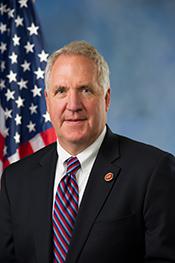 Rep. John Shimkus (R-IL)
 +3
+3