Mourning the passing of President Ronald Reagan and celebrating his service to the people of the United States and his leadership in promoting the cause of freedom for all the people of the world.
Legislative Activity
Stay on top of the latest movement without scrolling through every action
Motion to reconsider laid on the table Agreed to without objection.
June 9, 2004 • 2:53 PM
View full timeline
Introduced in House
June 8, 2004
Referred to the House Committee on Government Reform.
June 8, 2004
Consideration initiated by previous special order.
June 8, 2004 • 7:14 PM
Considered by previous special order. (consideration: CR H3793, H3794-3818)
June 8, 2004 • 7:14 PM
DEBATE - The House proceeded with two hours of debate on H. Res. 664 with additional time to be granted pursuant to a previous order of the House.
June 8, 2004 • 7:18 PM
EXTENSION OF DEBATE TIME - Pursuant to the order of the House of today and as the designee of the Majority Leader, Mr. Lewis of California requested an additional hour of debate to be equally divided and controlled on H. Res. 664.
June 8, 2004 • 9:34 PM
Considered as unfinished business. (consideration: CR H3829-3869)
June 9, 2004 • 10:45 AM
DEBATE - Pursuant to the order of Tuesday, June 8, 2004, the House proceeded with the remaining 3 hours of debate on H. Res. 664.
June 9, 2004 • 10:45 AM
The previous question was ordered pursuant to a previous order of the House.
June 9, 2004 • 2:26 PM
Passed/agreed to in House: On agreeing to the resolution Agreed to by the Yeas and Nays: 375 - 0 (Roll no. 231).(text: CR 6/8/2004 H3794)
June 9, 2004 • 2:53 PM
On agreeing to the resolution Agreed to by the Yeas and Nays: 375 - 0 (Roll no. 231). (text: CR 6/8/2004 H3794)
June 9, 2004 • 2:53 PM
Motion to reconsider laid on the table Agreed to without objection.
June 9, 2004 • 2:53 PM
Voting History
1 vote recorded • Roll call available
Floor Debate
24 membersWhat members said about H.Res. 664 on the floor
JL CC
CC TC
TC FRW
FRW CWS+19
Floor Debate
24 membersWhat members said about H.Res. 664 on the floor
Mr. Speaker, pursuant to the order of the House of today and as designee of the majority leader, I call up the resolution (H. Res. 664) mourning the passing of President Ronald Reagan and celebrating…
Mr. Speaker, pursuant to the order of the House of today and as designee of the majority leader, I call up the resolution (H. Res. 664) mourning the passing of President Ronald Reagan and celebrating his service to the people of the United States and his leadership in promoting the cause of freedom for all the people of the world, and ask for its immediate consideration.
Mr. Speaker, I ask unanimous consent that all Members may have 5 legislative days within which to revise and extend their remarks on the resolution under consideration.
Mr. Speaker, I yield myself such time as I may consume.
Mr. Speaker, through the years of having the opportunity to know President Ronald Reagan, one could go down many a pathway in recalling his greatness. My first recollection of Ronald Reagan, I can recall clearly I was lying on the living room floor, and he was giving this speech on behalf of Barry Goldwater. The remarks in that speech entitled, ``A Time For Choosing,'' never to forget, ``You and I have a rendezvous with destiny. We will preserve for our children this, the last best hope of man on Earth, or we will sentence them to take the last step into a thousand years of darkness.'' I will never forget rolling over on the floor and saying to my family, ``This guy ought to be Governor of California.'' And, by golly, just 2 years later, he was: Governor Ronald Reagan, elected in 1966 by the people of California.
Two years after that, a group of seven Republican freshmen legislators were invited to the Governor's home for a little dinner. They had a set of card tables in the living room, a couple sat down at one card table, I sat on an extra chair, and, lo and behold, the Governor sat down beside me. The gentleman from California (Mr. Waxman) may remember that I was a bit more brash in those days than I choose to be now.
And so almost immediately, I raised the subject of interest to me to the then-Governor Reagan. I asked him what he thought about preschool and child care. It did not take 30 seconds for me to begin to understand that I had asked the right question, for Governor Reagan knew an awful lot more about preschool and child care than I ever thought of knowing. He and Nancy had been thinking about this subject for some time. And indeed, as a result of that beginning point of working together in this very special area of education, the Child Development Act was signed in 1972 by Governor Reagan and became the first major State quality day care programming that included health components and education components and involved parental responsibilities as well.
The Governor was way ahead of the curve, as one might see; for some 25 years later, Washington discovered the importance of child care.
Another illustration of an interesting side of the Governor who by many was considered to be some way out there, far out on the right; but quickly those who would observe carefully recognized that this Governor was looking out for the benefit of all people of California and because of that, shortly he became very well known as an environmental Governor. He joined quickly with Governor Laxalt of Nevada, and together hand in hand they literally saved Lake Tahoe.
A leader way ahead of his time, it was my privilege to spend so much time in those early days with Governor Ronald Reagan. At another time in this evening's discussion I would like to spend a moment discussing with all of you my first experience with Governor Reagan when he became President of the United States.
Mr. Speaker, I reserve the balance of my time.
Mr. Speaker, I yield myself such time as I may consume.
President Reagan came to Washington at a moment when our country was in great malaise. Interest rates had risen as high as 21\1/2\ percent. Inflation was raging the country. Jobs were very, very difficult to come by. And in typical Ronald Reagan fashion, the President for whom the glass was always more than half full, he began setting forth policies that reduced interest rates, that impacted inflation, and created jobs. He set a stage for tomorrow that would lead us all to believe in America again and have new hope and opportunity within our country.
It is my privilege, Mr. Speaker, to yield 5 minutes to the gentleman from Missouri (Mr. Blunt).
Mr. Speaker, I yield 2 minutes to the gentleman from California (Mr. Gallegly).
Mr. Speaker, it is my honor to yield 6 minutes to the gentleman from California (Mr. Thomas), the chairman of the Committee on Ways and Means.
(Mr. THOMAS asked and was given permission to revise and extend his remarks.)
Mr. Speaker, it is a great honor to yield 6 minutes to the gentleman from California
(Mr. Rohrabacher), who served Ronald Reagan as a part of his staff before coming to Congress.
Mr. Speaker, I yield myself such time as I may consume.
Ronald Reagan became President in 1981 after an election in 1980. At that point in our history, our defenses had been reduced to such significant levels, all of us were concerned about the future of America's ability to defend itself. Indeed, there were great leaders who recognized the importance of building our defenses. Among those who have come here since President Reagan was with us is the gentleman from California (Mr. Cunningham).
Mr. Speaker, I yield 5 minutes to the gentleman from California (Mr. Cunningham).
Mr. Speaker, the eloquence of our colleagues from both sides of the aisle reflect the best of Ronald Reagan. His leadership indeed recognized that there was little partisanship when you were really working towards solving problems for America's people.
Mr. Speaker, it is my privilege to yield 3 minutes to the gentleman from California (Mr. Herger).
Mr. Speaker, it is my privilege to yield 5 minutes to the gentleman from California (Mr. Dreier), chairman of the Committee on Rules.
(Mr. DREIER asked and was given permission to revise and extend his remarks.)
Mr. Speaker, I yield 5 minutes to the gentleman from California (Mr. Issa).
(Mr. ISSA asked and was given permission to revise and extend his remarks.)
Mr. Speaker, it is my privilege to yield 4 minutes to the gentlewoman from Pennsylvania (Ms. Hart).
Mr. Speaker, I could not feel more strongly than I do about the gentlewoman's remarks. Indeed, one of the wonderful things that has happened in recent years in the House is the advent of young women like this stepping up to the plate, running for Congress, and making a big difference in the People's House.
It is my honor, Mr. Speaker, to yield such time as he may consume to the gentleman from Texas (Mr. Hall).
Mr. Speaker, we appreciate the comments of our colleague from Texas. I am reminded of that tragic day when Ronald Reagan, shortly after he became President in March of 1981, and the assassination attempt took place. As they rolled him on a gurney into the emergency room, he looked up and said to his wife, I guess I forgot to duck, honey. Ronald Reagan, a man who was always ready to try to calm down the other person and make sure they felt okay, our President.
Mr. Speaker, it is my pleasure to yield 5 minutes to the gentleman from Virginia (Mr. Goodlatte), the chairman of the Committee on Agriculture.
Mr. Speaker, I yield myself such time as I may consume.
Mr. Speaker, I very much appreciate my colleague from Texas joining with us in this discussion this evening of perhaps America's greatest President, Ronald Reagan. In his words, Ronald Reagan said, ``Some argue that we should encourage democratic change and right-wing dictatorships but not in communist regimes. Well,'' he said, ``to accept this preposterous notion, as some well-meaning people have, is to invite the argument that once countries achieve a nuclear capability, they should be allowed an undisturbed reign of terror over their own citizens. We reject this, of course.''
As Ronald Reagan rebuilt America, his defense budget designed to restrengthen our country's ability to defend itself, he stared down the Evil Empire and negotiated a nuclear arms treaty with Gorbachev. As two enemies became close friends, think of that, two enemies became close friends, Gorbachev was heard to say, Who would have thought it.
Mr. Speaker, I am pleased to yield 3 minutes to my colleague, the gentleman from Florida (Mr. Weldon).
Mr. Speaker, I yield 3 minutes to the gentleman from New York (Mr. Boehlert).
(Mr. BOEHLERT asked and was given permission to revise and extend his remarks.)
Mr. Speaker, I yield 5 minutes to the gentleman from Texas (Mr. Barton).
(Mr. BARTON of Texas asked and was given permission to revise and extend his remarks.)
Mr. Speaker, I appreciate my colleague yielding his time back, and now we know why he is chairman of the Committee on Energy and Commerce.
Mr. Speaker, I yield 3 minutes to the gentleman from Oregon (Mr. Blumenauer).
Mr. Speaker, it is my honor to yield 3 minutes to the gentleman from Nebraska (Mr. Osborne), my favorite coach.
Mr. Speaker, it is my pleasure to yield 5 minutes to the gentleman from Georgia (Mr. Gingrey).
(Mr. GINGREY asked and was given permission to revise and extend his remarks.)
Mr. Speaker, it is my pleasure to yield 5 minutes to the gentleman from Georgia (Mr. Linder).
Mr. Speaker, I yield 5 minutes to the gentleman from South Carolina (Mr. Wilson).
Mr. Speaker, I yield myself such time as I may consume.
Mr. Speaker, I thank the gentleman from South Carolina (Mr. Wilson) very much for those very eloquent comments. I am reminded of the fact that in very simple form, Ronald Reagan challenged the world on behalf of liberty, on behalf of peace. He had this remarkable relationship that developed over time with Mikhail Gorbachev. After he described the Evil Empire in straightforward terms, they began to communicate as leaders of two great countries. Indeed, together over time they reduced the nuclear threat by coming to agreement with one another.
It has been said earlier, but let me repeat the words of Ronald Reagan: ``Mr. Gorbachev, if you seek peace, if you seek prosperity for the Soviet Union and Eastern Europe, if you seek the liberalization, come here to this gate, open this gate. Mr. Gorbachev, tear down this wall.''
And indeed, within a couple of years, that wall came down. The East- West confrontation began to thaw; and between these two leaders, the world has seen a different kind of opportunity for peace. Today we face the challenge that involves the war on terrorism; and, indeed, that struggle is bound to last for years to come. It was the legacy of Ronald Reagan that laid the foundation for America to best be prepared to defend itself for liberty and for freedom.
Mr. Speaker, it is my privilege to yield 5 minutes to my colleague, the gentleman from California (Mr. Calvert).
Mr. Speaker, pursuant to the order of the House today and as the designee of the majority leader, I request an additional hour of debate on the resolution.
Mr. Speaker, I yield 2 minutes to the gentleman from Indiana (Mr. Chocola).
Mr. Speaker, I yield 5 minutes to the gentleman from North Carolina (Mr. Hayes).
(Mr. HAYES asked and was given permission to revise and extend his remarks.)
Mr. Speaker, I yield 5 minutes to the gentleman from California (Mr. Hunter), the chairman of the Committee on Armed Services, and I understand that somewhere in the building his son and his son's bride are wandering around. His son, Sam, was not born when the gentleman came to these Chambers, so because of family relations and otherwise, I now yield to him.
Mr. Speaker, I yield myself such time as I may consume.
Mr. Speaker, the gentleman from California (Mr. Hunter) reminds me of another time when Ronald Reagan was trying to bring together Republicans to form a majority. It was 1969, and there was a majority for approximately 2 years in the California lower house for the assembly, and Ronald Reagan was then Governor of California. He came into this room, and here were 41 members of the new majority sitting there in front of him. He is sitting at a table in front of us, his legs dangling from the table, he has argyle socks on.
He said, I was trying to think about what I should say to you all. We have not had a majority before. We have to govern, he said, and he said, it is possible from time to time we may disagree with each other as we go about making decisions on public policy.
As I was thinking about what to say to you, I was reminded of my father-in-law, who is a dentist. It seems he had this fellow sitting in the chair, and the guy had an abscessed tooth which had to come out. And my father-in-law began to put this needle in his jaw. About that time my father-in-law felt kind of a groping at the lower part of his abdomen. He looked down startled, and the fellow looked back up and said, we are not going to hurt each other, are we, Doc?
For those who knew Ronald Reagan, he would get just to the edge of color, but nonetheless, he knew how to make a point to bring people together in a very special way; a man never to be forgotten, recognizing how important it is that we work together.
Mr. Speaker, I yield 5 minutes to the gentleman from Texas (Mr. Hensarling).
Mr. Speaker, I yield 2 minutes to the gentlewoman from Illinois (Mrs. Biggert), Ronald Reagan's home State.
Mr. Speaker, it is my pleasure to yield 5 minutes to the gentleman from Mississippi (Mr. Wicker), a member of the Subcommittee on Defense of the Committee on Appropriations.
Mr. Speaker, before I proceed any further, pursuant to the order of the House of today and as the designee of the majority leader, I request an additional hour of debate on the resolution.
Mr. Speaker, I yield 2 minutes to the gentleman from Virginia (Mr. Goode).
Mr. Speaker, I yield such time as he may consume to the gentleman from Tennessee (Mr. Wamp).
Mr. Speaker, I yield myself such time as I may consume.
The gentleman from Tennessee, I must say, reminds me a bit of my own youth, for I was raised in a family where my father was a Republican, my mother was a Democrat. I was somewhat confused. But the gentleman reminds me of another thing. I remember as a student at UCLA having the chance to participate in a pre-Peace Corps people-to-people program. I was headed with a group of 11 other students on our way to India to talk about freedom and hope and opportunity.
During that time, I was really confused myself. Would I become a member of one of our great parties, the Democratic Party, or would I become a member of the Republican Party? It was amazing what that summer did. I made that decision for myself in the summer in India. Why? Because one of our great parties was of the view that maybe individuals in our society needed a little help, maybe individual people could not do it for themselves and government was a requirement. It was another of the great parties that thought the individual was critical, made a difference in our future, and if you apply your spirit, your talent, your energy within that party, the survival of the individual was the key. That is how I made my decision. The gentleman from Tennessee reminded me a lot of that tonight. It is a pleasure to be with him.
Mr. Speaker, it is my pleasure to yield such time as she may consume to my dear friend, the gentlewoman from Texas (Ms. Granger).
Mr. Speaker, I yield 4 minutes to the gentleman from Arizona (Mr. Franks).
Mr. Speaker, I yield 3 minutes to the gentlewoman from Tennessee (Mrs. Blackburn).
Mr. Speaker, I yield myself such time as I may consume.
Mr. Speaker, from the days I knew Ronald Reagan as Governor, and he was a key leader who sponsored early development of child care in our State, recognizing the importance of quality daycare in terms of the future of America's children, the environmental governor who saved Lake Tahoe, to the days that I had a chance to watch him rebuild America's strength by building our defense, he always was straightforward, candid with the American people.
And not so long ago he was heard to say: ``In closing let me thank you, the American people, for giving me the great honor of allowing me to serve as your President. When the Lord calls me home, whenever that may be, I will leave with the greatest love for this country of ours and eternal optimism for its future. I now begin the journey that will lead me into the sunset of my life. I know that for America there will always be a bright dawn ahead.''
God bless you, Ronald Reagan. To Nancy and their family, all of us share with you our prayers for our great President, Ronald Wilson Reagan.
Mr. Speaker, I yield back the balance of my time.
Mr. Speaker, pursuant to the previous order of the House, I call up the resolution (H. Res. 664) mourning the passing of President Ronald Reagan and celebrating his service to the people of the…
Mr. Speaker, pursuant to the previous order of the House, I call up the resolution (H. Res. 664) mourning the passing of President Ronald Reagan and celebrating his service to the people of the United States and his leadership in promoting the cause of freedom for all the people of the world, and ask for its immediate further consideration.
Mr. Speaker, I yield 4 minutes to the gentleman from Illinois (Mr. Hyde), the Land of Lincoln and the birthplace of Ronald Reagan, and the chairman of the Committee on International Relations.
Mr. Speaker, I yield 3 minutes to the gentleman from Wisconsin (Mr. Sensenbrenner), the distinguished chairman of the Committee on the Judiciary.
Mr. Speaker, I yield 2 minutes to the gentleman from Arizona (Mr. Hayworth).
Mr. Speaker, I yield 2 minutes to the gentleman from Minnesota (Mr. Gutknecht).
Mr. Speaker, I yield 4 minutes to the gentleman from California (Mr. Royce), the home State of our dearly departed President.
Mr. Speaker, I yield 2 minutes to the gentleman from the great State of our former, President, the gentleman from California (Mr. Radanovich).
Mr. Speaker, I yield 2 minutes to the distinguished gentleman from Georgia (Mr. Norwood).
Mr. Speaker, I yield 2 minutes to the gentleman from Indiana (Mr. Pence), a distinguished Member of this body, a true Reaganite.
(Mr. PENCE asked and was given permission to revise and extend his remarks.)
Mr. Speaker, I yield 1 minute to the distinguished gentlewoman from the State of Wyoming (Mrs. Cubin).
(Mrs. CUBIN asked and was given permission to revise and extend her remarks.)
Mr. Speaker, I yield 2 minutes to the distinguished gentleman from Florida (Mr. Miller).
Mr. Speaker, I yield 2 minutes to the distinguished gentleman from Pennsylvania (Mr. Platts).
Mr. Speaker I yield 2 minutes to the gentlewoman from Missouri (Mrs. Emerson).
Mr. Speaker, I yield 2 minutes to the distinguished gentleman from Texas (Mr. Thornberry).
(Mr. THORNBERRY asked and was given permission to revise and extend his remarks.)
Mr. Speaker, I yield 2 minutes to the distinguished gentleman from Maryland (Mr. Gilchrest).
Mr. Speaker, I yield 1\1/2\ minutes to the gentleman from Wisconsin (Mr. Green).
Mr. Speaker, I yield 1\1/2\ minutes to the distinguished gentleman from Texas (Mr. Burgess).
(Mr. BURGESS asked and was given permission to revise and extend his remarks.)
Mr. Speaker, I yield 2 minutes to the distinguished gentleman from Florida (Mr. Feeney).
(Mr. FEENEY asked and was given permission to revise and extend his remarks.)
Mr. Speaker, I yield 2 minutes to the gentleman from New Jersey (Mr. Garrett).
Mr. Speaker, I yield 2 minutes to the distinguished gentleman from Minnesota (Mr. Kline).
Mr. Speaker, I yield for the purpose of making a unanimous consent request to the gentleman from Alabama (Mr. Everett).
(Mr. EVERETT asked and was given permission to revise and extend his remarks.)
Mr. Speaker, I yield 2 minutes to the distinguished gentleman from the State of Washington (Mr. Hastings).
Mr. Speaker, I yield 3 minutes to the distinguished gentlewoman from the State of Florida (Ms. Harris).
Mr. Speaker, I yield 1\1/2\ minutes to the distinguished gentleman from Georgia (Mr. Isakson).
Mr. Speaker, I yield 2 minutes to the distinguished gentleman from Nevada (Mr. Gibbons).
(Mr. GIBBONS asked and was given permission to revise and extend his remarks.)
Mr. Speaker, I yield 2 minutes to the distinguished gentleman from Texas (Mr. Carter).
Mr. Speaker, I yield 2 minutes to the distinguished gentleman from Virginia (Mr. Forbes).
Mr. Speaker, I yield 2 minutes to the distinguished gentleman from South Carolina (Mr. Barrett).
Mr. Speaker, I yield 2 minutes to the distinguished gentleman from Florida (Mr. Lincoln Diaz-Balart).
Mr. Speaker, I yield 2 minutes to the distinguished gentleman from Michigan (Mr. Upton).
Mr. Speaker, I yield myself such time as I may consume.
The first time I met Ronald Reagan was the day I began work for him in the White House. We shook hands and exchanged pleasantries in the Oval Office. Of course, it is difficult to forget one's first meeting with the President of the United States, but what I particularly remember is how quickly he put me at ease. Of course, he told a joke.
Learning that I was a Harvard graduate, he told me the story of a friend of his who had graduated from Harvard Law School, had become a partner in a large firm but had lost his position due to a problem with drinking and drugs, and consequentially, in succession, he lost his wife, his family, his income, and even ran afoul of the law, being put in jail for shoplifting. But now he was out of jail. He had cleaned up his life and, most importantly, he had met a wonderful woman to whom he wished to propose marriage. But, and it was on this point that he asked the President's advice, he had not told this woman about his background for fear of losing her. So he asked the President, should I tell her that I went to Harvard?
I knew immediately where I stood. Two years later, I was with the President in the Oval Office, and I have a picture hanging on my desk of this moment, and I am sitting across from his desk, across from him, just the two of us. He has a big smile on his face, and I am about to burst out laughing because he was, of course, telling another joke.
It was a special privilege to travel with the President on Air Force 1, and what I particularly remember is the way the President came back to cheer up the staff, to regale us with stories and jokes. I was particularly fond of his amazingly authentic Irish brogue.
But I will not forget especially the last time I saw him as President. It was here in this Capitol. He had summoned us, the Republican Members, just days before the inauguration to give us a private valediction. No press, no public, just us. And he spoke from the Democratic sides of the aisle, from the rostrum on the left, a mistake I attributed to his lack of familiarity with House procedure. It was a mistake of mine, however. He knew exactly what he was doing. And as he described his political career, he described how I did not leave the Democratic Party, the Democratic Party left me; and he strode purposefully to this other rostrum to the delight of the Republican Members.
But what he told us that day rose far above party and partisanship. Because, of course, he saw a consistent thread throughout his career in his support for FDR, his campaigning for Harry Truman, his support and campaigning for Ike, and of course his own administration. A few moments after he finished here on the floor, we went to Statuary Hall and he mingled with the Members and we had a few private moments there. This was, of course, just a few feet from where in the rotunda later today his body will lie in repose. He did not tell me a joke at that time. Instead, after congratulating me on my recent election to Congress, something we had had the chance more exuberantly to celebrate after me and my new colleague, the gentleman from California (Mr. Rohrabacher), visited with him in the Oval Office in June, he told me never forget to trust the people who sent you here and always fight for the principles that you and I share.
It was the serious side of him because he was all about ideas. And while his humor, his gregariousness, his avuncularity has been much remarked upon in recent days, that was an important aspect of his leadership; but it does not tell us about the substance of his leadership, where he was taking the country. And it was the ideas that President Reagan brought to Washington that mattered most of all.
It is well known and much remarked upon that Ronald Reagan won the Cold War without firing a shot. He led the global movement to tear down the Berlin Wall. He led an economic renaissance at home by dramatically reducing the burden of taxes across the board, from a marginal rate of 70 percent down to 28 percent. But it is just as important to recognize the leading role that President Reagan played in supporting our country, such issues as the civil rights of women and men here at home.
President Reagan, of course, appointed the first woman to be ambassador of the United Nations. He appointed the first woman to be a Justice of the United States Supreme Court. He appointed the first woman to be Secretary of Transportation, the first Latina to be Treasurer of the United States.
On November 2, 1983, he made Martin Luther King's birthday a national holiday. He appointed the first African American chairman of the U.S. Civil Rights Commission, my good friend and great American, the late Clarence Pendleton. He extended the Voting Rights Act for a quarter century. He named the first Hispanic to the Cabinet, Lauro Cavasos, as Secretary of Education.
On August 10, 1988, he provided compensation to Japanese Americans who had been deprived of their civil liberties and their property during the infamous internment of World War II ordered by FDR.
Today, we can see the wisdom of President Reagan's policies from a distance. He appointed the first-ever Presidential Commission on AIDS and gave national direction to the effort to stop the spread of this terrible disease.
His was the statesmanship of a true leader. While fighting Soviet expansion in Africa, he fought apartheid and imposed sanctions on the racist Government of South Africa by executive order. He demanded as a condition of lifting those sanctions the release of Nelson Mandela. And yet he refused to declare economic warfare against the civilian population of that country, black, white, and all races as the United Nations had done in imposing its sanctions on Zimbabwe. So today, whereas Zimbabwe has become a living hell, an autocracy that has stripped away all pretense of law or property or personal safety, South Africa has a real democracy where all men and women can vote and where all are equal before the law.
In Central America, he prevented the Soviet Union from establishing a beachhead in our own hemisphere, and
likewise in Nicaragua. And throughout Central and South America and the Caribbean, just as in Central Europe and Asia, democracy grew and prospered.
Mr. Speaker, from that day in January of 1981, when President Reagan was sworn in, until last Saturday, the American people always knew where to look for a hero. President Reagan did great things not only for our country but for our world. Today, more than 1 billion people live in freedom because of his global leadership. In fact, all of the people of the world, those who enjoy the sweet blessings of liberty and those who still yearn for freedom, will always know where to look for a hero.
Mr. Speaker, I reserve the balance of my time.
Mr. Speaker, I yield 3 minutes to the gentleman from South Carolina (Mr. Brown).
(Mr. BROWN of South Carolina asked and was given permission to revise and extend his remarks.)
Mr. Speaker, I yield 2 minutes to the gentleman from Oklahoma (Mr. Cole).
(Mr. COLE asked and was given permission to revise and extend his remarks.)
Mr. Speaker, I yield 3 minutes to the gentleman from Indiana (Mr. Burton).
Mr. Speaker, there are few men in our history whose lives can be said to have changed the world. Ronald Reagan was one of those men. Ronald Reagan was an inspiration to me personally and politically.…
Mr. Speaker, there are few men in our history whose lives can be said to have changed the world. Ronald Reagan was one of those men.
Ronald Reagan was an inspiration to me personally and politically. In 1984, I was honored to head his reelection campaign in Oklahoma. I also served as chairman of the Oklahoma Republican Party during his Presidency. A favorite memory of mine is of a meeting with the President and Republican State party chairmen from the South at the White House in 1988. A 15-minute meeting turned into an hour-long treasure as he regaled us with one hilarious political story after another. Ronald Reagan loved politicians, he loved politics, and he loved public service.
I cannot claim to have known Ronald Reagan well. I was privileged to be with him on more than a few occasions. All the same, he changed my life and the lives of millions of others. He was a voice of faith, faith in America, faith in her people, faith in their future, and, most profoundly, faith in freedom.
Ronald Reagan inspired us to do great things. With him we accomplished much. It is for us to continue to build that shining city on a hill to which he so often referred. There is much yet to do. Ronald Reagan was my hero; but more importantly, he was an American hero. We mourn his passing, but we celebrate his life of achievement and patriotism.
Mr. Speaker, there are few men in our history and there will be few men in our future who live their lives in such a way that the world will be changed because of their existence. Ronald Reagan is one of those men. His dignity, character, strength and convictions will distinguish him in the pages of history and define him as one of the greatest presidents of the twentieth century. President Reagan was an inspiration to many and his optimism for America's future encouraged those across all party lines. He knew there was a brighter tomorrow through the path of strong values, hard work, tough decisions and perseverance. His leadership pulled America through the end of the Cold War, pushed the Soviet Union and the eastern Bloc onto the ``ash heap of history'' and restored the virtues of idealism and optimism to our country. He was a visionary who instigated the rebirth of conservatism and shaped the Republican Party into the governing national majority we see today.
Ronald Reagan was a source of inspiration to me both personally and politically. I was serving as Executive Director of the Oklahoma State Party when Reagan was elected. In 1984, I was honored to head his re- election efforts in Oklahoma. I also served as Oklahoma GOP Chairman during his presidency, so I had opportunities to meet and work with him.
Ronald Reagan had a magic that really appealed to people. A favorite memory is of a meeting with the president and Republican state party chairmen from the South in 1988. A 15 minute meeting turned into an hour-long treasure as he regaled us with one hilarious political story after another. His wit and humor are as fresh in my memory today as they were 20 years ago. I was privileged to see up close what so many Americans intuitively felt when watching him on television. He was an extraordinary man who lived life and enjoyed being with people. It is no wonder he was able to move thousands of people and mobilize them to support his efforts. It's a gift few of us have--and he had that magic in abundance.
Not only is Ronald Reagan a personal hero to me, his influence has shaped a generation of politicians. And by doing that he instilled the values that the Republican Party embraces today. Countless Republican officeholders got into elective politics because he fired their imagination. More profoundly, he showed that the institution of the presidency does work. We seldom remember that after the trials of Watergate and twenty years of failed or shortened administrations, some thought our country was too big for one man to govern, inspire and shape. No one, particularly those who worked with Ronald Reagan, question that today.
And let us not forget that he was a very effective politician whose drive to succeed and will to win were intense. He lost primary after primary in 1976 before coming back from the political graveyard in North Carolina, Texas and Oklahoma. Former Republican National Chairman Frank Farenkopf tells the story that on election day in 1984, the president was so far ahead in the polls that he and Ed Rollins cancelled a rally in Minnesota. He did not need to be bothered, they reasoned. After he won 49 states and only lost Minnesota by about 2,500 votes, the president liked to tease both of his advisors about their election day gaffe. It became a joke, but the president wanted Minnesota in his column.
Much has been made in recent days of Ronald Reagan's courage. We saw his physical courage when an assassin sought to take his life in early 1981. We saw it again when he confronted the ravages of Alzheimer's with grace, candor and sensitivity. But President Reagan also had the courage of his ideas and an ability to see the right path for his party and for is country.
One of Ronald Reagan's biographers, Edmund Morris, tells of his astonishment when he read the president's diaries from his time in office. He learned how many of the major and complex decisions of the Reagan Administration were made by the president, alone and in private. Ronald Reagan did not care, Morris recounts, who got the credit as long as his decisions were implemented and his goals for America came closer to realization. Recently Kiron K. Skinner and Marty Anderson's fine works detailed the depth and breath of Reagan's view of the world--a view he implemented in office.
In describing another great man at another time in history, Winston Churchill writes in his History of the English Speaking Peoples that Robert Peel was `` . . . the dominating force and personality in English politics . . .'' who ``whether in Opposition or in office . . . towered above the scene. He was not a man of broad and ranging modes of thoughts, but he understood better than any of his contemporaries the needs of the country and he had the outstanding courage to change his views in order to meet them.'' Robert Peel, Mr. Churchill added, saw the industrial revolution in Britain that made her the pre-eminent world power in the nineteenth century was driven not by the government but by private enterprise, by capital, by entrepreneurs, by a free people willing to take risks.
There are many differences between Robert Peel and Ronald Reagan. Mr. Peel split his party and destroyed a governing coalition to support Free Trade--a decision validated by history. As a governor and then as a president, Ronald Reagan united a party badly divided over ideas and led it out of the political wilderness. The Republican ascendancy in national government today is a direct result of his leadership. But in reading Winston Churchill's appraisal of Robert Peel's political biography. He was the dominating personality in American politics for a generation.
From the vantage of the early twenty-first century, it is hard to recall the mood of the country and its troubles at his election in 1980. Watergate, defeat in Vietnam, unrestrained Soviet adventurism, double digit inflation and interest rates, massive unemployment, an energy crisis, American hostages in Tehran, the end of the post-War U.S. domination of the global economy--all these combined to give some a sense America's best days were behind her; that perhaps free enterprise and freedom were not the answer; that we had to accept totalitarian communism as a legitimate and equally plausible alternative to our own way of life. Ronald Reagan rejected these ideas. He was optimistic about America, he believed the United States was ``a shining city on the hill'', a beacon of hope and freedom to the world. He understood communism was evil and free peoples must defend themselves against the darkness of tyranny and oppression. He saw a bright and prosperous future for all Americans, one where their work could carry them as far as they dared to dream. Looking back, we take all these things for granted, but Ronald Reagan was ridiculed by the intellectuals and so-called realists of his day. It took real courage to stand up for his beliefs to put them into practice, and to defend them from the faint of heart while they took root and blossomed. To paraphrase Mr. Churchill's assessment of Mr. Peel, Ronald Reagan understood his countrymen better than anyone else on the political stage. They needed leadership, he gave it and they loved him for it.
Like Mr. Peel, Ronald Reagan also had the courage to change his views. A New Deal Democrat, his partisan affiliation and ideological vantage point slowly shifted over time
from a liberal Democrat who believed in government intervention to a conservative Republican who trusted Americans and the people of the world to solve their own problems. As anyone who has even a passing understanding of Hollywood and it's cultural and political outlook knows, this was not an easy thing to do. Ronald Reagan learned about communists first hand when he battled to keep them out of the entertainment industry. Much of his later political success was based on a willingness to stand up to Soviet aggression. Yet, when a glimmer of light came through the darkness behind the Iron Curtain, President Reagan saw America's chance for victory through negotiation and began to talk to the Soviets and their leader, Mikhail Gorbachev. Many of his longtime supporters decried his decision and they did so with good reason because the Soviets historically did not negotiate in good faith. But the president had the courage and the vision to see the great opening and he took it. And, like so many times in the past, he was right. And we are better for it.
Mr. Speaker, like many Americans I cannot claim to have known Ronald Reagan well. I was privileged to be with him on more than a few occasions, but more often I watched him on television or read about him in the morning's newspapers with the rest of the country. All the same, he changed my life. And he changed the lives of millions around the world. His was a voice of faith. Faith in America, in her people, and in freedom. He inspired us to do great things. With him we accomplished much. Though he has gone to a better place, it is for us to continue to build that shining city on the hill. There is much yet to do. But Ronald Reagan's legacy and memory will inspire us in our task.
Mr. Speaker, I join today with others in the House in expressing deepest condolences to Nancy Reagan and the Reagan family on the passing of Ronald Wilson Reagan, the 40th President of the United…
Mr. Speaker, I join today with others in the House in expressing deepest condolences to Nancy Reagan and the Reagan family on the passing of Ronald Wilson Reagan, the 40th President of the United States of America, and in paying tribute to President Reagan as we remember his presidency and what he meant to our country and indeed to the world.
I deeply admired and respected President Reagan. I had the good fortune to run for the 10th District of Virginia seat in Congress in November 1980 when he was elected to his first term. Some called my victory then ``on Reagan's coattails.'' I have no doubt I'm in Congress today because of him.
I will always be grateful that after my two unsuccessful bids for Congress, Ronald Reagan led the ticket that I was on and I became a member of the Class of 1980.
As we remember President Reagan today, I have been moved by the outpouring of love and support we have been seeing over the past few days across our Nation and especially in California, where he served the Golden State as governor for two terms.
``Thank you, President Reagan. You made us proud again.''
That was the sentiment on one of the many posters and other mementos in memory of President Reagan placed outside the entrance to his presidential library in Simi Valley, California, the day after his death on June 5. And that sentiment could well sum up the legacy of President Reagan, who lost his 10-year battle with Alzheimer's disease at age 93.
He was the leader of our Nation when Americans needed to know and more importantly to believe that indeed it was ``morning again in America,'' and the best was yet to come for our great country--that we could be proud to stand up and be called an American. He made us feel good again. He gave us hope. He inspired us. He gave us optimism because he was an optimist.
And when we needed to be comforted at a time of our own Nation's mourning in the wake of the space shuttle Challenger disaster in 1986, he was there for us, speaking to us much like a father, telling us it would be all right: ``It's all part of the process of exploration and discovery. It's all part of taking a chance and expanding man's horizons. The future doesn't belong to the fainthearted; it belongs to the brave. . . . Nothing ends here; our hopes and our journeys continue.''
The June 7 edition of National Journal's Hotline headlined, ``Ronald Wilson Reagan,'' described Mr. Reagan's presidency well:
The optimism of Morning in America left little room for
mourning in America. So instead of grief, there is respect
for the man, celebration of his boldness, relief for his
widow, and memories of leadership with purpose, grace and
humor.
He literally disarmed his enemies aboard with his tenacity.
He gently disarmed his political enemies at home with his
modesty. If he was overestimated as an actor, he was
underestimated as a political leader. Because he never quite
fit in with official Washington, he stayed connected
inseparably with the people. And for an entire generation of
Americans, he defined the Presidency.
He dreamt, acted out, and embodied the American dream. He
was a leader. Those who agreed with his policies cherished
his principles. Those who doubted his capacities wondered at
his accomplishments.
Friend and foe have come to see him as an American icon,
whose light may forever shine from his city on the hill.
In many ways, President Reagan's profound conviction that every human being had the right to live in freedom inspired my work for humanitarian and human rights causes. While he didn't always outwardly show it, he was a man of deep faith. He said in a speech before the House of Commons in 1982: ``We must be staunch in our conviction that freedom is not the sole prerogative of a lucky few, but the inalienable and universal right of all human beings.''
I saw a poignant television news report from southern California on Sunday evening which also reminded me that another crucial part of his legacy belongs not only to America, but to the world. A woman was interviewed. She was holding a bouquet of flowers. Tears were streaming down her face.
She had a broken English accent and identified herself as a Russian emigrant. She said she had to come to the makeshift memorial outside the funeral home where President Reagan was resting because, ``I owe my life to President Reagan.''
I was also reminded of how President Reagan gave hope to the persecuted peoples of the world when I read an opinion article from the June 6 edition of The Jerusalem Post written by former Soviet political dissident Natan Sharansky. I will insert the entire text of that article for the Record. Mr. Sharansky wrote:
In 1983, 1 was confined to an eight-by-ten foot prison cell
on the border of Siberia. My Soviet jailers gave me the
privilege of reading the latest copy of Pravda. Splashed
across the front page was a condemnation of President Ronald
Reagan for having the temerity to call the Soviet Union an
``evil empire.''
Tapping on walls and talking through toilets, word of
Reagan's ``provocation'' quickly spread throughout the
prison. We dissidents were ecstatic. Finally, the leader of
the free world had spoken the truth--a truth that burned
inside the heart of each and every one of us.
Who will ever forget Ronald Reagan calling the Soviet Union ``an evil empire'' and his challenge to then-Soviet Premier Mikhail Gorbachev outside the Brandenburg Gate in Berlin: ``Mr. Gorbachev, tear down this wall.''
And who would ever have imagined the relationship President Reagan forged with Mr. Gorbachev which ultimately led to the fall of communism and indeed, the tearing down of the Berlin wall. Mikhail Gorbachev will honor that legacy of President Reagan by his attendance at Mr. Reagan's funeral service at the National Cathedral in Washington on Friday, June 11.
Ronald Reagan was a remarkable man and I believe will be remembered by history as one of the greatest presidents of our Nation. I will close by sharing his own words spoken in August 1992 about how he wanted to be remembered:
Whatever else history may say about me when I'm gone, I
hope it will record that I appealed to your best hopes, not
your worst fears, to your confidence rather than you doubts,
and may all of you as Americans never forget your heroic
origins, never fail to seek divine guidance, and never, never
lose your God-given optimism.
We thank God for the life of Ronald Wilson Reagan.
Republican Members who were elected in 1980 on the ticket
with President Reagan:
Wendell Bailey, Missouri; Cleve Benedict, West Virginia;
Tom Bliley, Virginia; Hank Brown, Colorado; Greg Carman, New
York; Gene Chappie, California; Dan Coats, Indiana; Jim
Coyne, Pennsylvania; Larry Craig, Idaho; Hal Daub, Nebraska;
Larry DeNardis, Connecticut; David Dreier, California; Jim
Dunn, Michigan; Bill Emerson, Missouri; T. Cooper Evans,
Iowa; Bobbi Fiedler, California; Jack Fields, Texas; Steve
Gunderson, Wisconsin; and Judd Gregg, New Hampshire.
James Hansen, Utah; Tommy Hartnett, South Carolina; Bill
Hendon, North Carolina; John (Jack) Hiler, Indiana; Duncan
Hunter, California; Gene Johnston, North Carolina;
John LeBoutillier, New York; Bill Lowery, California; Bill
McCollum, Florida; Bob McEwen, Ohio; Ray McGrath, New York;
David Martin, New York; Lynn Martin, Illinois; Guy Molinari,
New York; Sid Morrison, Washington; John Napier, South
Carolina; and Jim Nelligan, Pennsylvania.
Mike Oxley, Ohio; Stan Parris, Virginia; Clint Roberts,
South Dakota; Pat Roberts, Kansas; Hal Rogers, Kentucky;
Marge Roukema, New Jersey; Claudine Schneider, Rhode Island;
Clay Shaw, Florida; Mark Siljander, Michigan; Joe Skeen, New
Mexico; Albert Lee Smith, Alabama; Chris Smith, New Jersey;
Denny Smith, Oregon; David (Mick) Staton, West Virginia; Ed
Weber, Ohio; Vin Weber, Minnesota; Frank Wolf, Virginia; and
George Wortley, New York.
Mr. Speaker, I yield such time as he may consume to the gentleman from Georgia (Mr. Scott). Mr. Speaker, I yield such time as he may consume to the gentleman from Maryland (Mr. Hoyer). Mr. Speaker, I…
Mr. Speaker, I yield such time as he may consume to the gentleman from Georgia (Mr. Scott).
Mr. Speaker, I yield such time as he may consume to the gentleman from Maryland (Mr. Hoyer).
Mr. Speaker, I yield such time as he may consume to the gentleman from Louisiana (Mr. Alexander).
(Mr. ALEXANDER asked and was given permission to revise and extend his remarks.)
Mr. Speaker, I yield such time as she may consume to the gentlewoman from Texas (Ms. Jackson-Lee).
Mr. Speaker, I yield such time as he may consume to the gentleman from New York (Mr. Israel).
Mr. Speaker, I yield myself such time as I may consume.
Mr. Speaker, it is not just nostalgia that makes us remember President Ronald Reagan especially so fondly upon the occasion of his death. Politics, ideology, geography aside, there is a mark of leadership and charisma which undeniably stamps some men and women.
Ronald Reagan was one of those men whose leadership was felt by all who encountered him. When President Reagan first came to office, he quickly understood that enacting his economic agenda would require bipartisan support in Congress, which was under Democratic control, 242-192 and 1 absent. It took 52 bipartisan votes to enact anything, and President Reagan understood that.
I met with the President on several occasions as he sought to build that bipartisan coalition to pass his legislation. I met with President Reagan one on one in the Oval Office as well as in Air Force One, and for a second-termer in 1981 that was pretty tall cotton for a Jones County cotton farmer.
In 1981, I was just in my second term and was a member of the conservative Democratic forum better known as the Boll Weevils, the precursor to today's Blue Dogs. In the very first month Reagan was in office, he had to pass into law an increase in the debt limit, and so he invited me to meet with him. Now, mind you, this was the first major piece of legislation of the Reagan administration. In the past, prior to President Reagan's being elected, Republicans had always opposed increasing the debt limit. Republicans had denounced Democrats for voting to increase the debt limit. So here was the first Republican President in many years coming to ask conservative Democrats for support in passing this very thing into law, something members of his own party had opposed on many occasions in the past.
We had a lengthy talk. The twinkle in the eye that many of those who had known him much better from California were there, and we finally struck a deal. We had an understanding that if the President could deliver 100 votes from Republicans, then we would do our best to deliver the necessary Democratic votes. President Reagan more than held up his end of the bargain. He ultimately delivered 150 Republican votes. So in the spirit of bipartisanship and on a very tough issue, Reagan successfully secured the votes he needed, from Democrats and Republicans, and got the increase in the debt limit, just as he and we needed it.
I was proud to have several opportunities to work with the President in the months and years ahead to build bipartisan coalitions, especially on his economic agenda. I still proudly display a picture in my home in Abilene, Texas, of President Reagan signing the 1981 tax bill. I got one of the pens and one I treasure.
Reagan had very strong principles and very strong values. We know what they were. But he also understood that in order to govern, it was important to find a middle ground. And I was lucky enough to be in the middle of many of those compromises.
One of his greatest strengths was his ability to communicate, a skill that he used to great effect when courting votes in Congress. His courting of Members of Congress was the best of any President I have served with, and I have now been privileged to serve with five. If the Members can imagine a second-termer sitting in the Roosevelt Room in the White House talking about some issues with the President's Cabinet members and others and having the President walk in unannounced and put his hands on his shoulder; some telephone calls that we had many times when there was a vote and the President had to work the phones like no President that I have seen since, rounding up the votes, and he was very effective at doing that.
President Reagan's private and public demeanors was the same. What one saw was what one got. That is the mark of a great leader.
Ronald Reagan was a very decent man, and he understood how he could use his office to make a difference in countless lives. This aspect of his personality was always very clear to me
because it was this decency, this understanding of the power of the office that gave me the most rewarding opportunity I had to work with President Reagan.
The context was very personal. In May of 1983, I was contacted by the grandfather of Ashley Bailey, a baby girl in Abilene, Texas, who needed a liver transplant to survive. At that time organ donations and organ transplants were not as common as now, and the organ donation system was not organized to the extent it is today.
I spoke to President Reagan's folks about it to ask for his help in getting the baby girl a new liver. Shortly after receiving my letter, President Reagan used his weekly radio address to publicize Ashley's situation and encourage all Americans to fill out organ donor cards. He also called Ashley's mother, Annette.
Unfortunately, the President's plea did not result in finding a liver in time to save Baby Ashley, but it did end up saving the lives of dozens of other babies who needed liver transplants. President Reagan later started a national organ donor awareness program, which led to the designation of National Organ Donation Awareness Week every April. To this day I consider this one of the highlights of my 25 years in Congress.
Reagan knew how to disagree without being disagreeable, rise above politics, and these qualities, unfortunately, are rare today. President Reagan and House Speaker Tip O'Neill, the Massachusetts liberal, were good friends who got along very well during their years of service together. They never lost their philosophical convictions, and they never let those philosophical convictions hijack their understanding that America's democracy requires respect for all opinions and a practical determination to work out our differences for the good of the country.
President Reagan spoke of hope and a better tomorrow. He reminded us that we live in the greatest country in the world, and he made us believe it and believe in ourselves. He believed that we, as Americans, had a special duty to promote peace and freedom for the rest of the world. He always told us that for America, the best was yet to come.
It is good for all of us to remember Ronald Reagan's optimism, his kind-heartedness, and his cordiality. As we remember this great man this week, it would do us good to remember how we should behave today and in the future.
Mr. Speaker, I reserve the balance of my time.
Mr. Speaker, I yield myself such time as I may consume.
Mr. Speaker, tonight, certainly, our prayers go out to Nancy Reagan and to the Reagan family. And in the true spirit of the character that has been exemplified over and over by those that have known President Reagan tonight, I yield the balance of my time to my classmate and the gentleman from California (Mr. Lewis) to use in whatever manner he might see fit tonight.
Show 8 more
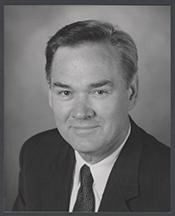
Mr. Speaker, I yield myself such time as I may consume. Mr. Speaker, the United States of America lost one of our giants with the passing last Saturday of our 40th President, Ronald Wilson Reagan. We…
Mr. Speaker, I yield myself such time as I may consume.
Mr. Speaker, the United States of America lost one of our giants with the passing last Saturday of our 40th President, Ronald Wilson Reagan.
We come together today and this week in Congress, Democrats and Republicans, to pay tribute to the man who played a primary role in ending our Cold War with the Soviet Union and who, as the Center for American Progress said earlier this week, projected ``a never-failing sense of optimism which restored faith in the American Presidency in a Nation still scarred by Vietnam and Watergate.''
The Los Angeles Times said this week, ``His sunny self-assurance, his insistence that there really were simple answers to difficult problems, his knack for actually making things happen, all were soothing changes for a country that had endured Vietnam, Watergate, a Presidential resignation, an energy crisis, double-digit inflation, and the seizing of American hostages in Iran in the course of one tumultuous decade.''
In particular, Mr. Speaker, we remember Ronald Reagan for standing firmly with Federal Reserve Chairman Paul Volcker in the early 1980s to drive down inflation and revive the economy, thus setting the stage for the prolonged American economic expansion of the early 1990s.
While President Reagan had deeply held core convictions, as a national leader he was also able to compromise and change directions when policies were not working. After instigating a large tax cut in 1981, for example, he later asked for tax increases to fight an exploding Federal deficit and tight monetary conditions. Without President Reagan's active support, the Gramm-Rudman-Hollings Act, which ultimately led to deficit reductions through imposition of pay-as-you- go rules, would never have become law.
President Reagan signed into law bills protecting 1.9 billion acres of wilderness in Washington State and Oregon. Known as a lifelong crusader against Communism, President Reagan combined military and diplomatic strength to develop a relationship with Soviet leader Mikhail Gorbachev that ultimately led to limits on nuclear weapons and the end of the Cold War.
The Washington Post recently said, President Reagan was able to win the respect of Europeans through his ``commitment to winning the Cold War and his willingness to work peacefully to bring about the demise of the Soviet Union.''
Even in times of failure and disappointment, President Reagan stood tall, and he won the respect of all. Following the disaster at the Marine barracks in Lebanon and the Iran contra scandal, President Reagan accepted responsibility saying, ``This happened on my watch'' and ``if there is to be blame, it properly rests here in this office and with this President. And I accept responsibility for the bad as well as the good.'' That was a quote from President Reagan, and I think that shows the measure of the man that President Reagan was.
In the twilight of his life, President Reagan again provided hope and inspiration for millions of Americans with his valiant battle, with the devoted support of his wife, Nancy, against the ravages of Alzheimer's disease. Mr. Speaker, my father is afflicted with this cruel and debilitating condition. I share the hope of Nancy Reagan and millions of others that expanded stem cell research will some day unlock new discoveries needed to treat successfully Alzheimer's disease, diabetes, Parkinson's disease, and cancer.
I respect, I greatly respect the religious convictions of those people who are concerned about the expansion of stem cell research, but I hope soon we will find some middle ground between the two extremes and enable us to go forward with this research which one day may save the lives of millions of Americans. One of the legacies of our 40th President will be that we worked together to find a way to join in harnessing this technology and promise. The potential human health and scientific benefits of stem cell research are simply staggering, and I hope that we can join and leave a legacy for President Reagan and for Nancy Reagan as well.
In conclusion, I reflect back on Ronald Reagan's last major public address, his speech to the 1992 Republican National Convention. He could have been speaking, though, to all Americans, Mr. Speaker, because he said, he closed with these words: ``My fellow citizens, I want you to know that I have always had the highest respect for you, for your common sense and intelligence, and for your decency. I have always believed in you and in what you could accomplish for yourselves and for others. And whatever else history may say about me when I am gone, I hope it will record that I appealed to your best hopes, not your worst fears; to your confidence rather than your doubts. My dream is that you will travel the road ahead with liberty's lamp guiding your steps and opportunity's arm steadying your way.''
I hope that we in Congress, Mr. Speaker, can come together for the American people for an agenda; and I truly believe that even though we have honest, good-faith differences between the parties, we can put aside some of the rancor, some of the partisanship, and work on the American agenda the way that Ronald Reagan wanted us all to do.
Mr. Speaker, I could think of no better way to remember the legacy of President Ronald Reagan than by those words that he gave.
Mr. Speaker, I reserve the balance of my time.
Mr. Speaker, I yield such time as he may consume to the gentleman from Maryland (Mr. Cardin).
(Mr. CARDIN asked and was given permission to revise and extend his remarks.)
Mr. Speaker, I reserve the balance of our time.
Mr. Speaker, I yield 3 minutes to the distinguished gentleman from Ohio (Mr. Ryan).
Mr. Speaker, I yield 1 minute to the gentleman from Arkansas (Mr. Ross).
(Mr. ROSS asked and was given permission to revise and extend his remarks.)
Mr. Speaker, I yield 3 minutes to the gentleman from Oregon (Mr. Wu).
(Mr. WU asked and was given permission to revise and extend his remarks.)
Mr. Speaker, I yield 2\1/2\ minutes to the gentleman from Illinois (Mr. Emanuel).
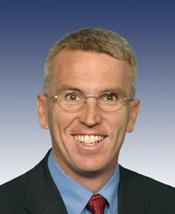
Mr. Speaker, I thank the chairman for yielding me this time for an opportunity to speak about a great American, a great statesman, a great leader for our Nation and for all of the free world. I will…
Mr. Speaker, I thank the chairman for yielding me this time for an opportunity to speak about a great American, a great statesman, a great leader for our Nation and for all of the free world.
I will submit my written statement for the Record, but I am honored to state just briefly how much I admired and how grateful I am for the service of President Ronald Reagan.
I am honored to say that the first vote I cast in a Presidential election as an 18-year-old freshman in college was in 1980 on behalf of Ronald Reagan. He turned the tide for our Nation at a difficult time in our Nation's history. He taught us to again believe in our Nation and believe in the principles for which our Nation stood and continues to stand this very day. He also reminded us to be grateful for the blessings we have as Americans.
My mom and dad showed me by example the importance of caring about our fellow citizens, and they taught me about community service and led me to an interest in public service.
Ronald Reagan furthered that interest and further inspired my desire to serve, first in the statehouse and now here in Congress.
On behalf of all of the people in the 19th Congressional District, I am honored to say, Mr. President, thank you on a job well done and on a life well lived. My deepest sympathies go to your family at this time of great loss. May God bless you and your family, and may God continue to bless the country which you so deeply loved, the United States of America.
Mr. Speaker, I rise to pay tribute to Ronald Wilson Reagan, our Nation's 40th President, a true statesman and patriot, a husband and father, and a Great American. I offer my sincerest condolences to Mrs. Reagan and the entire Reagan family. My prayers are with them in this time of mourning and remembrance.
When Ronald Reagan was elected President in 1980, America was facing a crisis. The crisis went deeper than the economic problems of double- digit inflation, rising unemployment, long gas lines, and threatening military actions of the Soviet Union. After Vietnam, Watergate, and the hostage situation in Iran, America actually began to experience a crisis of faith in itself. More than any other person, President Reagan helped us to overcome our doubts and remind us that America is, in fact, a ``shining city on a hill.''
Ronald Reagan was the eternal optimist, a believer in America's abilities, ideals, and innate goodness. His faith in the greatness of our Nation was perhaps best expressed when he said, ``In this land of dreams fulfilled where greater dreams may be imagined, nothing is impossible, no victory is beyond our reach, and no glory will ever be too great.'' Through his outlook and conviction, President Reagan restored America's confidence in itself.
As a result of Ronald Reagan's inspiring leadership as our President, the world changed dramatically. Economic stagnation was replaced with a dynamic economy. President Reagan challenged the Soviet Union to ``tear down this wall,'' and the Berlin wall came down. He saw a day when Eastern Europe would join the Free World, and it did. He stayed firm at Reykjavik and, for the first time, Russia and America stopped building, and started destroying, nuclear weapons.
Ronald Reagan understood the price of freedom. Forty years after D- day, and 19 years and 364 days before he passed away, President Reagan commemorated ``the boys of Pointe du Hoc'' who took the cliffs at Normandy for the Allies during World War II. He said:
The men of Normandy had faith that what they were doing was
right, faith that they fought for all humanity, faith that a
just God would grant them mercy on this beachhead or on the
next. It was the deep knowledge--and pray God we have not
lost it--that there is a profound moral difference between
the use of force for liberation and the use of force for
conquest. You were here to liberate, not to conquer, and so
you and those others did not doubt your cause. And you were
right not to doubt.
You all knew that some things are worth dying for. One's
country is worth dying for, and democracy is worth dying for,
because it's the most deeply honorable form of government
ever devised by man. All of you loved liberty. All of you
were willing to fight tyranny, and you knew the people of
your countries were behind you.
It is this understanding of history, this moral clarity, that helped Ronald Reagan to lead us to the freer world we have today. It is what helps to make President Reagan one of the giants of the 20th Century, along with his personal hero, Franklin Delano Roosevelt.
Six years ago, in commemoration of Ronald Reagan's 87th birthday, I had the pleasure of joining First Lady Nancy Reagan and Ambassador Jeane Kirkpatrick at the Reagan Library in California. I was there as an elected member of the Pennsylvania General Assembly. But I was there, most importantly, as an American citizen who was honored to pay tribute to and to express my deep gratitude to President Reagan for his tremendous service to our Nation. In my conversation with Mrs. Reagan that day, my message was simply one of thanks. Thanks to her and, through her, to President Reagan for their dedicated, hard-working and outstanding service to our great Nation and its citizens.
Ronald Reagan's service to others, his statesmanship, his love of country, and his unwavering commitment to the principles of freedom, liberty, and justice for which our Nation stands, were great examples for all of us fellow citizens to emulate. President Reagan was truly inspiring to countless citizens. His example helped to affirm my own commitment to the ideals of public service, to the ideals of giving back to one's Nation, and certainly helped to affirm my interest in serving the public office, including here in Congress.
I am greatly honored to join with fellow Americans in saying: Mr. President, thank you for a job well done and a life well lived. You will long be missed and never forgotten. God bless you and God bless this great Nation you loved so dearly, the United States of America.
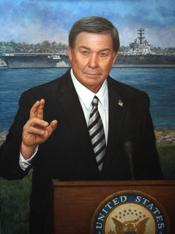
Mr. Speaker, I thank the gentleman from California (Mr. Lewis) for yielding me this time, and I want to thank my great friend also for not only helping to preside over this special tribute, but for…
Mr. Speaker, I thank the gentleman from California (Mr. Lewis) for yielding me this time, and I want to thank my great friend also for not only helping to preside over this special tribute, but for everything that he did in helping to lead the California delegation to be a source of strength for President Reagan when he put forth those monumental changes in the direction of our government.
I have listened to his statements and just now to the statement of the gentleman from North Carolina (Mr. Hayes), and many others, in talking about this wonderful American, Ronald Reagan; and I thought I might just
touch on a couple of the things he did in the way of national security.
We have short memories, Mr. Speaker; and President Reagan was not always popular, especially with the media and often with our European allies. I can remember in the 1980s, when he responded to the Soviet Union's ringing Western Europe with the SS-20 missiles and he started to move those Persian missiles and ground launch cruise missiles into Europe to offset the Soviet strength of their strategic programs and their intermediate range ballistic missiles that they were moving in. And there were massive demonstrations against Ronald Reagan and against those who supported him in Europe and lots of sniping by the press in this country.
And yet because of that strength and because he rebuilt national security, the Russians at one point, especially after the Reykjavik summit when he refused to give up the Strategic Defense Initiative, that is missile defense, the right of Americans to defend themselves against incoming ballistic missiles, after he did that, there was lots of hand-wringing among the elite media and lots of our European allies who said, there it goes, the last chance for peace, and lo and behold, the Russians picked up the phone and said, can we talk?
Ronald Reagan at that point started to negotiate with the Soviet Union, and not just to negotiate a peace, but to negotiate the disassembly of the Soviet empire, the tear-down of the Soviet empire, which is manifest today in numerous free states where once there was one state ruled by tyranny.
Mr. Speaker, I remember the gentleman from California (Mr. Lewis) was present as one of our senior members, and the gentleman from California (Mr. Herger) had not been elected yet, along with the gentleman from California (Mr. Thomas) and the gentleman from California (Mr. Dreier), and Bob Lagomarsino, and John Rousselot, and Chip Pashayan, and my colleague Bill Lowery, and Bobby Fever, new Republicans who had come in in the Reagan win of 1980, and the President invited us to Blair House. The President invited us to Blair House even while President Carter was still in the White House. We were standing in the foyer, celebrated this victory of our Commander-in-Chief-to-be because he had not been sworn in yet, and the President-elect came down the stairs, and he talked to us about being up on his ranch in Santa Barbara and killing an especially big rattlesnake the day before while he was cutting brush. We had a great time talking with the President-elect. After a while he said, I am tired, I am going to go upstairs and hit the hay. He said, you guys turn off the lights when you leave. He went right upstairs; we continued to have a good time. That represented that western hospitality, that great charm that Ronald Reagan had that brought so many people, attracted so many people, even people of very different political persuasion.
My son Sam was not even born in those days when we first came in. I remember the picture of the cowboy that the President drew for my other son Duncan, who is now a United States marine and deployed overseas.
I think the one thing that this President sold in boatloads was inspiration. He was great at inspiration. He realized a little secret, and that is this country runs on inspiration. Whether it is the markets or the economy or people deciding whether or not they are going to join the uniformed services, inspiration is the fuel that this country runs on, and that is something that Ronald Reagan had an endless supply of.
He was tough during the tough times. You have to have good endurance to be a good President, and he had great endurance. He was able to handle the difficult times, the times when he was not real popular, and outlast his critics. It has been kind of fun in the last couple of days to watch people who criticized him very severely to seem now to remember that he was not such a bad guy after all. Not only was he not such a bad guy, but he brought this country together as a family. He was, of course, the head of the family.
It is a time for us to mourn this President, but also to celebrate his great life and the big piece of this life that he gave to our Nation. I will never forget when I was first running for Congress, I was practicing law on behalf of a barbershop on the waterfront in San Diego. My dad came in and said, you can be a Member of Congress. He said, Ronald Reagan is running. He is going to run on a platform of national defense and jobs, and in San Diego that is the same thing. I said, what do I need to start running? He said, we need one thing; you need a picture with Ronald Reagan, and we are going to go up and get it, and we went up and got it in L.A. That launched my foray into politics. So many of us won that year who had no chance of winning because we were riding along with a guy named Ronald Reagan.
Let us take a message and a lesson from this great American and proceed ahead with optimism and with dedication to the idea that you get peace through strength. That was a trademark of Ronald Reagan's foreign policy. I think we are following it with this President. I think we need to stay the course and stay steady.
Mr. Speaker, I thank the gentleman from California (Mr. Lewis) for letting me say a few things.
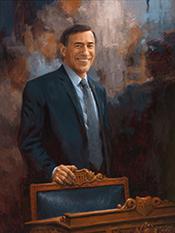
Mr. Speaker, on this second week of June, 17 years ago, President Ronald Reagan stood in the then-divided city of Berlin and called on Soviet President Mikhail Gorbachev to ``tear down this wall.''…
Mr. Speaker, on this second week of June, 17 years ago, President Ronald Reagan stood in the then-divided city of Berlin and called on Soviet President Mikhail Gorbachev to ``tear down this wall.'' Then, as perhaps now, critics did what they so often do. They cast aside the genuineness of his statement and, in fact, said that his speech was a publicity ploy. The Soviets and East Germans called it an infringement of East German sovereignty, an unwarranted meddling by the American President.
Two years later the wall came down.
Mr. Speaker, President Reagan was a leader with the foresight and strong conviction to get things done. He believed in America so much that he made America believe in itself again. He valued freedom, especially for those who had none. He understood that for America to be great, it first had to be good. He understood that America's problems, the malaise of the years preceding his Presidency, were simply America's not understanding how great it was and how great it could be.
Mr. Speaker, I was just a soldier during the period leading up to Mr. Reagan's becoming President Reagan, but I was a businessman starting a business from scratch when President Reagan came to office, and I recognized overnight that this was a special time to be an American, a time when we had a President who was saying that an American hero was somebody who took chances, who made a difference for the world, but particularly somebody who cared enough to work those extra hours and to care enough about his country.
Ronald Reagan knew America. He knew what was right about our Nation. What was right about our Nation and what was right about America would set the world in a better direction. Ronald Reagan led America, and the rest of the world became a freer place. Under his leadership we headed toward more than 400 million people in 27 countries finding a freedom they did not have. Today the soldiers of some of those democracies now fight side by side in Iraq and Afghanistan.
President Reagan showed us that our freedom and our determination can tear down walls.
Many Speakers will come here tonight, and they will talk of how profoundly President Reagan affected them, and I would be no different, but perhaps I can be slightly different tonight by saying that the only way to honor President Reagan's legacy is to take it to the next step. Today we are trying to do that for people in the Arab and Muslim world, and we have not finished that job. Today Communist China still denies rights to the people of its own country and is attempting to stifle the freedom and independence of Hong Kong. Today Cuba, to our south, is still a Communist nation, having little or no respect for the rule of law and for its people.
All of these and more need to be part of the American struggle because, Mr. Speaker, only if we determine that America's greatness will be in our willingness to set a course for the world in a positive way, not to dominate, but, in fact, to liberate, I think that is the legacy that Mr. Reagan would want.
And if I can take a personal liberty on behalf of Mrs. Reagan, I believe that continuing to look for a cure to the terrible illness that plagued President Reagan for his last 10 years of life and promote and continue stem cell research consistent with what this body has passed would also be a tremendous addition to the Reagan legacy.
I am determined to work for both of these, and I ask this body to take those steps to free those who were not freed under President Reagan, and to commit itself to the research to end the terrible illness that the Reagan family has suffered under for 10 long years.
Mr. Speaker, on this second week of June, 17 years ago, President Ronald Reagan stood in the then divided city of Berlin, and called on Soviet leader Mikhail Gorbachev to, ``tear down this wall.'' President Reagan's critics at home called his speech a publicity ploy. The Soviets and East Germans called it an infringement of East German sovereignty--unwarranted meddling by the American President. Two years later, the wall came down.
President Reagan was a leader with foresight and strong conviction. He believed in America--then he made America believe in itself again. He valued freedom--so he brought it to those who had none.
Through wise policies, force of will, and a kind demeanor, President Reagan conveyed strength and determination alongside reason and optimism to America and those who yearned for freedom behind the Iron Curtain. He never doubted what America could do--and he wouldn't let us doubt ourselves. When tragedy struck, he told us to move forward--and we listened.
Ronald Regan knew America. He knew what was right about our Nation, what was right for our Nation, and what America could set right in the world. Ronald Reagan led America and the rest of the free world against communism. When his work was finished, the free world had expanded by over 400 million people in 27 countries.
Today, soldiers from these new democracies fight side by side with Americans against the new enemies of freedom in Iraq and Afghanistan. President Reagan showed us that freedom can tear down walls. He reaffirmed for us that America is a force for good in the world, and that our proudest achievements will never come without criticism or sacrifice.
I never had the opportunity to meet Ronald Reagan, but knew him, like most Americans, as someone who had faith in our ability to
achieve great things for ourselves and the world.
Mr. Speaker, history will remember Ronald Reagan for bringing freedom to more people throughout the world than has ever been done before. The America and the world Ronald Reagan leaves behind is a better place because of him.
President Reagan, we still carry the confidence you gave our Nation and will never forget what we accomplished together. A grateful Nation thanks you.

Mr. Speaker, I thank the gentleman from Texas (Mr. Stenholm) for yielding me this time. I am particularly pleased that the gentleman from Texas is managing the time, because I think if Ronald Reagan…
Mr. Speaker, I thank the gentleman from Texas (Mr. Stenholm) for yielding me this time. I am particularly pleased that the gentleman from Texas is managing the time, because I think if Ronald Reagan were here, he would say, Charles Stenholm was one of those who stood with me on principle, who believed that we needed to get this country moving, and believed that we needed to have sound policy; and Charles Stenholm stood with me. And as the gentleman from California (Mr. Thomas) just related, for Ronald Reagan the concrete cracked again, frankly, when he viewed the program adopted and thought that perhaps some changes needed to be made.
Mr. Speaker, like every Member of this House, I offer my sincere condolences to the family and friends of former President Reagan, particularly, of course, his beloved wife, Nancy, and his children. What a wonderful example Nancy Reagan set for our country. Ronald Reagan and Nancy Reagan clearly loved one another deeply and cared for one another, and Nancy Reagan has shown extraordinary courage and fidelity not only throughout the course of their marriage but particularly in the course of Ronald Reagan's final illness.
Mr. Speaker, Ronald Reagan loved this Nation and served it with distinction; and he will ever be remembered for his humor, his grace, his irrepressible optimism which mirrored the American spirit and buoyed it in periods of difficulty.
The last decade, when this man who had lived life with such physical vigor slowly slipped away, was an especially cruel blow. However, let us be comforted today that he has been summoned to a far better place.
Having been elected to Congress just 4 months after he took office, and just 6 weeks after an assassin's bullet nearly claimed his life, I had a front-row seat during President Reagan's 8 years in Washington. He was a man I both liked and respected. I liked him for his warmth and for the respect that he accorded others, and I respected him for the honesty of his convictions and the intellectual integrity that he displayed in pursuing them.
After signing into law what was then the largest tax cut in American history in 1981, President Reagan had the fortitude to face fiscal reality, just as the gentleman from California (Mr. Thomas) reflected upon. His policies caused yawning deficits and spiraling debt, consequences that he subsequently tried to address, although not as successfully as I am sure he would have hoped. Without question, Ronald Reagan held strong ideological beliefs. But one of his real strengths was his willingness to put pragmatism above ideology, to make sure that his country had programs that were working.
I also remember him as a person who early in life committed to equality and justice for all, and later in life to the success of freedom and democracy around the world. I believed he was right in that endeavor, and like the gentleman from California (Mr. Lewis), supported his efforts to build up our defenses, to deploy those Persian and cruise missiles, to, yes, even provide for multiple warheads on the MX missile, and say to the Soviet Union, if you want to compete, we are prepared to compete; but we would rather seek peace together. And he had the courage to build up, and he had the courage to make peace.
While Democrats disagreed with and strongly opposed much of his domestic agenda, our political differences never hardened into paralyzing personal animosity on his side or on ours. We were blessed by the fact that we were led by two great Irishmen, Ronald Reagan and Tip O'Neill. They were friends. And they had a third friend, his name was Michel, Bob Michel, an extraordinary leader of this House. And they, together, believed that country was more important than partisanship and party.
For the most part, they worked together. On those matters that they disagreed on, they took their own separate ways. But when they could agree, they did. The Social Security reform of 1983 was probably the most stark example of that cooperative spirit. It was good for the country, it was good for Social Security, and they came together, worked together, and succeeded together.
That was due in great measure to the leadership styles and personalities of President Reagan and Speaker O'Neill. These two men, the most powerful political figures in our Nation in the 1980s, one a Republican, the other a Democrat, demonstrated to all Americans that our elected leaders could disagree politically without being disagreeable personalities or personally. They reminded all of us that cynicism and mean-spiritedness are inimical to American democracy, and that our real adversaries lie beyond our shores, not here.
The surest tribute that we can pay to Ronald Reagan today is to commit ourselves to recapture the generosity of spirit that always guided him. In a very real way, Ronald Reagan's life was the embodiment of the American Dream. Both President Reagan and President Clinton, like Harry Truman, gave credence to the promise that in America neither privileged birth nor economic advantage is necessary to enable one to become the President of the United States of America. It was, for them, and for millions to follow their example, the land of opportunity.
President Reagan's leadership renewed the conviction that the future would be better, better than the past, and that America's best days were still ahead. That is a philosophy that all of us should embrace and convey to our fellow citizens. I believe it is the case, Ronald Reagan believed it was the case, and may God bless his soul and comfort his beloved wife, Nancy.
Mr. Speaker, it is a blessing that Ronald Reagan did not die immediately after leaving office in 1989. In these last 16 years that we have had Ronald Reagan with us, it has given America a chance to…
Mr. Speaker, it is a blessing that Ronald Reagan did not die immediately after leaving office in 1989. In these last 16 years that we have had Ronald Reagan with us, it has given America a chance to take a look at who Ronald Reagan was and what he meant to our country. And now, with 16 years that have passed, we can look back and see what an enormous difference Ronald Reagan made not only to our lives as Americans but to the entire world.
Let me note that Ronald Reagan was 56 years old when I first met him, and that was when he was running for the first time for public office. He ran for public office for the first time when he was 56 years old. And all of these things we are talking about, a man who accomplished so much and changed the world for the better, happened after he was 56 years old. He had already had a successful life, a full career.
And he did come from a relatively poor family. I know his first job was being a lifeguard. That affected his way of looking at things his entire life. He saved 77 people's lives as a lifeguard. And having gotten to know him as President and also during his campaigns, I think he always had that consciousness, that he was there to save the day for the people who were in some type of a crisis.
He was a sports broadcaster, and he was a moderately successful film actor. But all of that seemed to be over when he was 50 years old. And then, when he was 56, he jumped into political life. Now, why did he do that? Because California was a mess in 1966.
And he came and stepped forward because he felt he had a contribution to make. He jumped into the political waters to save the day.
I was a youth volunteer in that first campaign, and I got to meet him personally, and it was one of the joys of my life.
Let me note that years later after I got finished with school, I became a journalist, and I covered Ronald Reagan's last 2 years as Governor as a journalist. I remember that he had a press conference one day, it was near the end of his term, where he was announcing the findings of his law and order task force. One of their findings was an expanded use of the death penalty. And just as I am now, I was then always trying to get to the heart of the matter and ask the tough questions, and I asked President Reagan, who was then Governor, well, how can you be in favor of expanding the use of the death penalty when you are a committed Christian? And, you know, he sat forward, and he leaned forward to the mike, he says, I take that question very seriously. I prayed about this, about using the death penalty more frequently and taking people's lives. I have sought help. I have read the scripture, and I have talked to other people about this, and I have come to the conclusion that if we are executing people for revenge, that it is inconsistent with the principles that Jesus Christ taught us, but if we are executing murderers in order to deter people from killing other human beings, we are doing it then to save people, to save innocent people, and that is totally consistent with Christianity.
At that point Evelle Younger who was the attorney general of the State, reaches over and grabs the mike and says, oh, this religious and philosophical stuff does not mean anything. The voters of this State voted for the death penalty, and they are going to get it. Well, my opinion of Ronald Reagan's sword, I knew that he was a man who did not take these things lightly, a man of strong conviction, but a man who deeply cared about people enough to think about it and to pray about decisions like this. He was not just a great communicator, and I worked for him as a speechwriter for 7 years in the White House. He was, yes, someone who understood the fundamentals of communication, but that is not what made him great. He was not the great communicator. He was America's great leader. He had ideals that helped direct his decisions.
We have heard about his strong convictions. We know today that most people with strong convictions are not very pleasant to be around. When they talk about people with philosophies, there is a saying that you cannot change somebody's mind, and he will not change the subject. Ronald Reagan was a person who taught me that you can have strong principles and have a solid philosophy, but be a pleasant person and care about people at the same time. It was that type of humane approach that permitted Ronald Reagan to capture the hearts of the American people and inspire us.
When our country was in such terrible peril economically and in retreat internationally, and our spirit had been destroyed, people were not even waving the American flag back in the late 1970s, Ronald Reagan dove into the political waters again to save the day. And he saved us. He was the lifeguard who saved us, and he saved the world.
Jim Bruelte, a political person in California, noted on D-Day the American soldiers liberated half of Europe. Ronald Reagan liberated the other half of Europe and did it without firing a shot.
We live in a more prosperous country, a safer country, and hundreds of millions of people now live in relative freedom than if he would not have been here. We are so grateful to Ronald Reagan for having dove in to save us, and he did. He saved America, and he saved us personally.
I am now 56 years old, the same age Ronald Reagan was when he first entered politics. I am so grateful that he spent those years of his life making this a better world for my children. I just had three children just 6 weeks ago today, and I am so grateful that he made it a better world for them.
Mr. Speaker, I was driving down to Corpus Christi last Saturday afternoon with my wife, Terry, and her daughter Lindsey and her cousin Jackie and Terry's family for a brief family vacation when my…
Mr. Speaker, I was driving down to Corpus Christi last Saturday afternoon with my wife, Terry, and her daughter Lindsey and her cousin Jackie and Terry's family for a brief family vacation when my staffer Andy Black called me on the telephone and said, Have you heard the news that President Reagan died this afternoon? And I said no, I have not heard that, but we immediately switched on the radio; and sure enough,
there was a news bulletin from California that President Reagan had passed away.
And so as we continued to drive down to Corpus, I began to reminisce about the President. My mind went back to the late 1970s when this country was mired in recession and interest rates were sky high and we had hostages in Iran and there was a spirit of pessimism that America could not be great anymore. And Governor Reagan came out of California and announced for the Presidency and said that there was hope, that not only could we be great again, but we would be great again. And that inspired me to campaign for him to be President of the United States in the 1980 election.
And the night that he won in November of 1980, I dusted off an old White House Fellows application and changed the date and signed it and mailed it in. White House Fellows is a program that takes young men and women from all over the country and puts them in positions to observe the workings of the Federal Government either in the White House or in the Cabinet agencies. The year that I applied there were about 1,600 applications, and I was fortunate enough to be one of like 15 or 16 that got selected.
I worked in the Department of Energy as a White House Fellow for Secretary of Energy James P. Edwards. The spring of 1982 the Secretary called me into his office and said, Joe, I am going over to the White House this afternoon for a Cabinet meeting. Would you like to go with me? I said, Mr. Secretary I would love to go with you. He said, There is one thing: you cannot say anything. You can only sit in the back of the room and listen. So I said, I promise.
So we went over to the White House, and they walked us into the Cabinet room, and I was seated directly behind Vice President Bush, who was seated directly across from President Reagan. The President came in from the Oval Office and shook hands with his Cabinet, and he reached over and got a handful of jelly beans out of a jar in the middle of the cabinet table and ate the jelly beans and asked if anybody wanted them.
Then he said, Gentlemen, what is the agenda for the day? And a Cabinet Secretary said it is the Caribbean Basin initiative and what to do about sugar quotas. The Secretary of Agriculture Jack Block raised his hand, he said, Mr. President, you have tasked me to try to help the American farmers and we are doing the best that we can, but sugar prices are low in the world market. And I think it would be disastrous for American farmers if you let more sugar into our country. And the President said, Thank you, Mr. Secretary.
Then the Secretary of State, I think it was General Haig, raised his hand and said, Mr. President, I am the Secretary of State and you have tasked me with creating this Caribbean initiative to help the emerging democracies in the Caribbean. Their largest export crop is sugar. It would really help my job as Secretary of State if you allowed more sugar to come into the United States. And the President said, Thank you, Mr. Secretary.
He said, Is there any other discussion? The rest of the Cabinet just sat there. The President said, Well, what we ought to do is take American wheat and Caribbean sugar and create cookies and create a cookie export, cookies for peace program maybe, to the Third World. The Cabinet chuckled about that; but he said, Really, I have heard what is best for the State Department and I have heard what is best for the Agriculture Department, now I want you gentlemen to tell me what is best for America. And there were no cameras and he really said that.
And I just was absolutely inspired when he said it. I was sitting directly across from him behind Vice President Bush. Of course, I had been told I could not say anything, but when the President said that, Gentlemen tell me what is best for America, it kind of jumped out from me, I said, Right. That is why I voted for you. And, of course, the Secretary of Energy was aghast that I had said something. But the President looked over and he looked around the Vice President, he looked at me with a twinkle in his eye, did not say anything, he just smiled. And I knew then that that is why the American people trusted him, because he wanted to do whatever the issue was, what was right for America.
So when I finished my White House Fellows program, I went back to Texas. And in 1984, John Tower announced that he was not going to run for the U.S. Senate, and Congressman Phil Gramm of the 6th district announced that he was going to run for the Senate and Joe Barton announced that he was going to run for the 6th district as a Republican. Because I wanted to be a part of the Reagan revolution in Washington.
I was very fortunate that I got elected that year. I primarily got elected because my entire campaign was Reagan-Gramm-Barton. And when people went to vote for President Reagan and Senator Gramm, they also voted for me.
So now as a senior member of the majority in the House of Representatives, I simply hope that I can do what little I can to help foster the Reagan vision for America, which is always do what is right for America.

Mr. Speaker, let me say at the outset I think it is extraordinarily appropriate that the gentleman, the former mayor of Simi, California, the home of the Ronald Reagan Library and what will be the…
Mr. Speaker, let me say at the outset I think it is extraordinarily appropriate that the gentleman, the former mayor of Simi, California, the home of the Ronald Reagan Library and what will be the final resting place for Nancy and Ronald Reagan, is presiding over this institution at this moment. I would also like to thank my friend, the true dean of our California congressional delegation, for yielding me this time.
A generation was inspired by Ronald Reagan is what we have been hearing, but it was really a generation and then some inspired by Ronald Reagan. The gentleman from California (Mr. Lewis) heard Ronald Reagan's speech in behalf of Barry Goldwater in 1964. Two years later, Ronald Reagan was elected Governor of California, and 2 years after that the gentleman from California (Mr. Lewis) was elected to the California State Assembly, serving 6 of the 8 years that Ronald Reagan was Governor of California. In fact, he is the only Republican Member here who did serve while Ronald Reagan was Governor of California. He went on to inspire many others. I am among them.
I was pleased this morning to be able to include in the Record very thoughtful remarks that were provided by a great American, George Shultz, who Sunday afternoon read his statement to me and I read it into the Record this morning, and I would like to commend it to my colleagues because it talks about the vision and the perspective that Ronald Reagan offered in a wide range of areas. Ronald Reagan made it very clear that the Republican Party is the party of ideas. We constantly hear about Ronald Reagan being the Great Communicator, but he had a message to communicate. Members on both sides of the aisle have talked about that message.
To me it embraced four very simple points: his commitment to a free economy, limited government, a strong national defense, and personal freedom. Those are the bases from which Ronald Reagan made his decisions on public policy issues, but he had those deeply rooted principles. And because they were so deeply rooted, he was able to communicate them extraordinarily well. Why? Because it came right from the heart. It came right from his heart.
We have heard a lot of very serious statements made about Ronald Reagan; but, of course, one of the most memorable things as people talked about his ability to communicate was his ability to communicate with that amazing sparkle, that twinkle in his eye. There were some wonderful things that he said that were able to, in fact, break the ice and really entertain all of us. Remember, it was Ronald Reagan who said, ``Hard work never killed anybody, but I figured, why take the chance?'' It was Ronald Reagan who after he had been hit by that bullet, right up Constitution here at the Washington Hilton when the statement was made to him shortly thereafter that the government was working as usual and he looked up and said, ``Why would that make me happy?''
There was, of course, his last speech which really stuck with me. It was on February 3 of 1994, and the Republican National Committee was having a dinner over here at the Pension Building, and Ronald Reagan was obviously quite elderly then, and the speech was delivered literally months before he wrote his famous letter in November of that year to the American people stating that he had Alzheimer's. So when he stood up at this meeting, I remember that Bill Clinton had been elected President of the United States the year before, and we as Republicans were gathering, we were poised to win our majority, and Ronald Reagan stood up without a great deal of strength as he got up for this speech.
He stepped up to the lectern, and he looked out at the audience, and he said, ``Well, I flew into town today to give this speech this evening, and as we came in, we circled the White House, and as I looked out the window, I looked down there, and there was everything just as I remembered it, the south lawn, the rose garden, David Gergen,'' who was at that moment working for President Bill Clinton. And we knew then that even though the President was obviously not in the most robust of health, that sparkle continued. He still had that amazing wonderful sense of humor.
I see my friend from San Diego Mr. Lowery here on the House floor. I was very pleased to, along with Bill Lowery and 51 others, be part of the Reagan Revolution. We came here to the House of Representatives, elected in November of 1980, and we made Ronald Reagan an honorary member of our class in 1980, and that is because he was leader of the revolution that brought all of us here and allowed us to vigorously pursue those goals that we shared in common.
We stand on his shoulders. George W. Bush stands on his shoulders. The similarities, to me, are so striking. The ``ism'' that Ronald Reagan stood up to was communism. The ``ism'' that George W. Bush is standing up to is terrorism. Ronald Reagan had broad, across-the-board tax cuts to stimulate economic growth. That is exactly what we have done. He did it in 1981. George W. Bush has started it in 2001. The party of ideas is strong and vibrant. It is doing extraordinarily well, and it is the vision that Ronald Reagan put forward.
And I thank my friend for taking this time, and I thank my colleagues on the other side of the aisle who are joining in this very important recognition of one of our Nation's greatest leaders.
Show 11 more
Mr. Speaker, like many Americans, I feel a real and personal sense of loss with the death of President Ronald Reagan. He was a great man and a great President, ranking in the top tier of all of our…
Mr. Speaker, like many Americans, I feel a real and personal sense of loss with the death of President Ronald Reagan. He was a great man and a great President, ranking in the top tier of all of our chief executives. He will be remembered as a pivotal historical figure; but, at the same time, many Americans feel as though they have lost a member of their family. Such was the unique character and legacy of Ronald Reagan, the President and the man.
My wife, Sally, and I each had the honor of serving as political appointees during the second term of the Reagan administration. We were down in the bowels of the bureaucracy, but proud to be working for and certainly inspired by President Reagan. With his optimism and his confidence in America, he inspired at least a generation of conservatives to be involved in public life and to advance the ideals for which he stood.
As important as his accomplishments domestically and internationally were, perhaps his most important success was to help the American people believe in themselves again. After the tumult of assassinations, Vietnam, Watergate, and malaise, Ronald Reagan came to remind us of the core values of the Founding Fathers and the special place that the United States has in the history of the world, that ``shining city on a hill.''
President Reagan was called The Great Communicator, but he said that what was truly great were the ideas he communicated. Those ideas were fundamental in the creation of the United States. As he noted in his farewell address, he communicated ``great things that came from the heart of a nation, from our experience, our wisdom, and our belief in the principles that have guided us for 2 centuries.'' Ronald Reagan brought out the best in us because he knew the best of us.
Our Nation was blessed to have been given Ronald Reagan, the President and the man.
Mr. Speaker, I believe that the accomplishments which cause Ronald Reagan to stand among our greatest Presidents can be traced to a set of fundamental beliefs to which he adhered throughout his political career.
One of them was strong, steadfast confidence in the American people. President Reagan knew that government must be limited so that the unlimited potential of individual Americans could be unleashed. He knew that when families were able to keep more of the money they earned, not just the family but the whole country would benefit. The result of his tax relief and restraint of government was the longest period of economic growth in the nation's history.
President Reagan also believed, with the signers of the Declaration of Independence, that freedom is a gift of God, intended for all peoples. In his speech to the British Parliament in 1982, which he viewed as among his most important, he said:
We must be staunch in our conviction that freedom is not
the sole prerogative of a lucky few, but the inalienable and
universal right of all human beings.
President Reagan was often underestimated. But, his clear words required clear thoughts, and those clear thoughts came from a clear vision and clear values, the articulation of which was refined over a lifetime of work. The amount of work and thought Ronald Reagan put into developing and expressing his views are only now becoming known, with the publication of some of the thousands of articles and letters written with his own hand.
He clearly believed that one must not be afraid to speak the truth, sometimes to the discomfort of his advisors. In the well-known speech in which he called the Soviet Union the ``focus of evil in the modern world'' he went on to urge his listeners and the country to
[S]peak out against those who would place the United States
in a position of military and moral inferiority. . . . I urge
you to beware the temptation of pride--the temptation of
blithely declaring yourselves above it all and label both
sides equally at fault, to ignore the facts of history and
the aggressive impulses of an evil empire, to simply call the
arms race a giant misunderstanding and thereby remove
yourself from the struggle between right and wrong and good
and evil.
Throughout his career of public service, Ronald Reagan did not remove himself from the struggle between right and wrong, good and evil. He engaged in that struggle, and he changed the course of history.
Before the British Parliament, President Reagan repeated the question asked by Winston Churchill in one of his wartime speeches: ``What kind of people do they think we are?'' President Reagan answered, ``Free people, worthy of freedom and determined not only to remain so but to help others gain their freedom as well.''
Being a ``free people, worthy of freedom'' and help[ing] others gain their freedom as well'' remains America's challenge. My hope is that we pursue those aims with the determination and spirit that Ronald Reagan displayed throughout his career.
A President whose basic political philosophy about the role of government continues to occupy center stage in our domestic debates more than a decade after he left office; a President who changed the course of world history and helped free millions of people from totalitarian bondage; a man who restored a nation's confidence in itself and continues to inspire defenders of freedom everywhere--
Quite a record. Quite a life.
Again, our Nation was blessed to have been given Ronald Reagan.
Mr. Speaker, I thank the gentleman for taking the leadership tonight. The previous speaker, the gentleman from Virginia (Mr. Goode), myself, and President Reagan all shared one thing in common as…
Mr. Speaker, I thank the gentleman for taking the leadership tonight. The previous speaker, the gentleman from Virginia (Mr. Goode), myself, and President Reagan all shared one thing in common as many do in this House and that is we used to be Democrats and we are Republicans. That brings me to what I want to share tonight, which is the change in the political landscape brought about by the life and service of Ronald Wilson Reagan; but I want to start by saying that I believe, and I think this honors his memory, that neither party has an exclusive on integrity or ideas, neither party always has it right or always has it wrong and the two-party system continues to serve our country extremely well.
I am proud of the first half of my life when I was a Democrat and proud of the second half of my life as a Republican, but the story in my life as a Southern conservative Democrat goes way back generations. My father's great great grandfather, Enoch Alldredge, served in the 19th century in the Alabama General Assembly for in excess of 40 years. My mother's great uncle Reuben Alldridge served in the 20th century in the Alabama General Assembly for a number of years, both very prominent political figures from the northern part of Alabama, all as Democrats. So I grew up honestly as a Southern conservative Democrat.
As a matter of fact, my first real memory of it all as a young person was watching my parents be involved in local campaigns and then, in the fall of 1976, going to Woolen Gym at the University of North Carolina at Chapel Hill as a 19-year-old freshman and voting for Jimmy Carter as President of the United States and then having my parents attend the inaugural in Washington here with Franklin and Emmy Haney, two of the biggest Democrats in the State of Tennessee and being proud that my parents were here and saluting the new President, Jimmy Carter.
But the years that followed in my formative years certainly gave me an opportunity and hope when I saw Ronald Reagan. I saw the malaise we were in. Let me say that Jimmy Carter has proven what a fine and outstanding man he is over these last 24 years since leaving office. It was a low point in our country's history, but he is a good and decent man; and frankly I will stand by that vote as a Democrat at that time, but over those next 4 years at the University of North Carolina, we saw a real low in our country's history and then all of a sudden there was a new day in 1980, and it seemed like someone came from the West and actually kind of showed us the hope and opportunity that you heard repeated on this floor over and over and over again.
I can remember as the campaign generated momentum in 1980 at UNC, my fraternity, the Sigma Nu house, got real energized about the campaign and by the convention when they had that strong conservative Governor from the West team up with maybe the best person on paper that had run in 100 years, George Herbert Walker Bush. It was like that did it. That sealed the deal. What a great team. And on election night in the fall of 1980 we loaded up in cars from UNC. It was Lee Ives and Tom Nesbit and Tony Floyd and Allen Miller and Lyn Thornburg and a group of us, and we drove to Washington, D.C. and we were here that night in 1980 when Ronald Reagan was elected President of the United States.
I was a Southern conservative Democrat who became a Republican. Our entire family shifted from our party identification over the hope, the opportunity, the fresh start that Ronald Reagan brought to the political process. That changed the political landscape in the United States of America, and it moved our country from what was more left of center to slightly right of center.
The Founding Fathers did not want things to change dramatically. This is like a big ship of state. If you turn it one degree, you arrive at a different destination. The country went from being left of center to right of center over the leadership, the strength and what I would say is the constancy of Ronald Reagan. He stood for something, and he simply articulated to this country what he stood for, and he never wavered. When people elect a President, they want a strong leader that can make a decision, that will stand his ground. When the wind blows, he stands firm. Ronald Reagan did that.
That is why the 8 years is a legacy beyond measure. As the previous speaker said, in our lifetime, the model, the great leader is Ronald Reagan. I salute him. He made a Republican out of me, and I have been in the House of Representatives as a Republican elected official for 10 years. I ran once and lost to get here, and I am proud of the whole story. I am very typical of a lot of Southern boll weevil conservatives that believed in that simple limited government, personal responsibility, traditional values, strong national defense, lower taxes, take care of yourself and your family first and your extended family, look to the government last, but do it with a smile on your face and love in your heart. He is like a father, a big brother, a great leader who we could trust and have confidence in. Today we remember a truly great American President, Ronald Wilson Reagan.
Mr. Speaker, I share with my colleagues a poem by Albert Carey Caswell. And to This End And to this end Approach Heaven, our True American Hero . . . America's finest of all true friends Rest now . .…
Mr. Speaker, I share with my colleagues a poem by Albert Carey Caswell.
And to This End
And to this end
Approach Heaven, our True American Hero . . . America's
finest of all true friends
Rest now . . . our Great American Patriot . . . as up to
Heaven your magnificent soul as so ascends.
And to this end
And oh, what to this our Country you have so been
With that, your warm smile and that thick brown hair . . .
and what your heart of gold has so meant.
And to this end
The promise, and your gift . . . the pride and the respect .
. . believing in us as if . . . as you'd begin
Bringing your Nation back to shore, our savior . . . rescuing
& seeing the light that others so ignored.
And to this end
Breaking down walls, hearing the children's calls . . .
wearing your heart on your sleeve
To believe . . . In God and Country, and in all of those
things which made us free . . . all in you we see.
And to this end
To dream . . . to start from nothing, as it would so seem
As was yours . . . this The Great American Dream . . . as is
this, our Nation's greatest of all themes.
And to this end
Returning and The Pride and The Respect . . . to America's
greatest of all assets
Her fighting Women & Men . . . her one true fine reason why
we all can dream, you'd not let us forget.
And to this end
As you brought the light, into that battle against the
darkness . . . this your courageous fight
As you have brought us hope, where there was none . . . as
your journey begun . . . for what was right.
And to this end
Yes, Ron . . . there are jelly beans up in Heaven my dear
friend
And to you, I so salute . . . this one's for you Gipper . . .
as the swollen tear drops so roll down my chin.
And to this end . . . ``Well, There You Go Again''
And now, and forever . . . whenever, I look into our flag . .
. I'll see your face
For such men of heart, such men of warmth & character &
grace, Heaven . . . so surely holds a place.
Mr. Speaker, people say that a truly great athlete is not only gifted himself, he makes those who play with him better. The same is true of President Reagan, who not only led the country, but restored America's confidence. He renewed our sense of America's goodness and America's greatness. And with that assurance, the American people achieved great things.
When Reagan came into office, America was demoralized. President Carter had even spoken of our ``malaise.'' Watergate and our defeat in Vietnam shook our self-confidence. We surrendered control over the Panama Canal which we had built.
The Soviet Union was at the height of its power and communism seemed to be on the march. After Vietnam fell to the communists, Cambodia followed. The Sandinistas took control in Nicaragua and communist insurgencies were under way in Ethiopia, Angola, and Mozambique. The Soviets invaded Afghanistan in 1979 and were in the process of suppressing the Solidarity movement in Poland.
At the same time, the Shah fell in Iran, and supporters of Ayatollah Khomenini held 52 Americans hostage for more than a year at our embassy in Tehran. Worse, the American military expedition to free them failed in the desert, with the crash of two helicopters and the death of eight servicemen.
The economic situation was just as dire. In 1980, inflation stood at 13.5 percent, and interest rates reached 21 percent. The turmoil in the Middle East sparked gasoline shortages. People waited for hours in line just to fill up their cars and worried about people stealing the gas out of their cars.
People lost their optimism. America no longer seemed special, or a world leader. It felt like the divine spark at the center of the American experiment had gone out.
It was Ronald Reagan who turned it around. He never lost faith in the American people. And he had enough optimism to restore our lost confidence and get America back on its feet.
He believed we could restore our economy--and we did. By 1990 the U.S. economy had grown by a third, or roughly the size of the entire German economy. And 35 million jobs were created.
He believed we could stand up proudly for American values around the world and stand up to the Soviet Union--and we did. It was President Reagan's resolve that halted the march of communism in Central America, and in Afghanistan. It was Reagan's resolve that nurtured the Solidarity movement in Poland, and gave heart to the dissidents of the Soviet bloc. Ultimately it was President Reagan's faith in American ideals that led to the fall of the Berlin wall and the liberation of Eastern Europe and the Soviet Union.
It was that leadership and vision for America that made Ronald Reagan special. Like FDR during the depression, he taught us that there was nothing to fear but fear itself. Like Winston Churchill during World War II, he spoke for an entire nation at a time of stress. It restored our confidence, and that made all the difference.
Let us remember Ronald Reagan. Let us remember what Ronald Reagan wanted for America. He wanted us always to be that shining city on a hill. And he wanted us to know that America's best days always lie ahead.
May God bless Ronald Reagan and Mrs. Reagan and may God bless America.

I thank the gentleman for yielding me this time, and I thank him for controlling the time tonight and affording us the opportunity even at this hour to pay tribute. Mr. Speaker, I too rise and join…
I thank the gentleman for yielding me this time, and I thank him for controlling the time tonight and affording us the opportunity even at this hour to pay tribute.
Mr. Speaker, I too rise and join so many of my colleagues on both sides of the aisle in paying tribute to Ronald Wilson Reagan, the 40th President of the United States. I agree with so much of what has been said here today and throughout the Nation in the past few days about the incredible legacy of Ronald Reagan and what he left to America and to the world. Ronald Reagan will always be larger than life to millions of people around the world who were freed from the shackles of Communism because he stood firm against what he so correctly called the Evil Empire. Ronald Reagan's determination and leadership forced an end to the Cold War. His philosophy of cutting taxes and easing Federal regulations brought about one of the largest periods of economic growth in American history. And his eternal optimism and hope for a brighter day lifted the spirits of a Nation.
Much has been said about Ronald Reagan's charisma, quick wit and ability to put people at ease. He was also blessed with a great asset for anyone in public life, a sense of timing. Whether it was one of his famous one-liners or the ability to do just the right thing at the right time, he always seemed to disarm a tough national press corps or defuse a difficult political issue.
Mr. Speaker, I had the privilege of witnessing an example of his instinctive timing and humor in 1980 in Mississippi when then-candidate Ronald Reagan and his wife, Nancy, came to the Neshoba County Fair in Philadelphia, Mississippi. The Neshoba County Fair is called Mississippi's largest house party and has been the premier gathering for political speeches during the hot Mississippi summers for more than a century. Ronald Reagan's visit was the first ever by a Presidential candidate to this most celebrated political event in my home State.
One of the issues that had surfaced in Mr. Reagan's Presidential campaign was the question of his age. He was 69 years old. Some questioned whether he might be too old for the job. At the Neshoba County Fair an incident occurred which could have potentially exaggerated the issue of his age. After Mr. Reagan's speech, a local craftsman, Gary Harkins of Mississippi, presented Mr. Reagan with a rocking chair. I am sure some of the candidate's advisers and staff were horrified to think of the prospect that the one image coming from this appearance was a picture of the 69-year-old former Governor sitting in a rocking chair. But without hesitation, Ronald Reagan sat down in the chair, grabbed his wife, Nancy, by the hand and pulled her onto his lap. They appeared at that moment to be the very picture of vitality and energy. The widely distributed photograph and film footage which followed went around the Nation and nobody seeing that image thought Ronald Reagan was too old to be President.
Mr. Reagan's quick thinking probably boosted his candidacy and dispelled doubts in the minds of some voters. The incident also changed the life of Greg Harkins, the craftsman who made the rocking chair and whose fledgling business was energized by his short encounter on the national stage. Mr. Harkins soon began receiving hundreds of requests for chairs from across
the Nation and around the world. His business is still going strong today nearly 25 years later, and Ronald Reagan provided the spark for that little bit of business success. Harkins was quoted recently as saying, ``What they did was give me a foothold on something that I can be able to carry on for the rest of my life.''
Mr. Harkins represents just one small example of how Ronald Reagan touched the lives of people in ways that are hard to quantify. We may not know all of their names or their unique stories, but his fellow citizens gained inspiration from Ronald Reagan's leadership and his attitude that it really was ``morning in America.''
Whether it was a young American answering a call to public service or becoming involved in the growing conservative movement or simply taking the initiative to exercise their rights and register to vote for the first time, Ronald Reagan energized many Americans to action. They followed him because they trusted this man of principled beliefs and because he captured their imagination, and they simply liked him.
Ronald Reagan, some people said, would be limited because he was only an actor. He was perhaps the best example of an actor turned politician; but he ended up being the real thing, the true article, the genuine American; and, Mr. Speaker, I believe he will be recorded as being the greatest President of our time.

Mr. Speaker, I thank the gentleman from California (Chairman Lewis) for yielding me this time and for undertaking this great opportunity to honor President Reagan. Asked in 1980 what Americans saw in…
Mr. Speaker, I thank the gentleman from California (Chairman Lewis) for yielding me this time and for undertaking this great opportunity to honor President Reagan.
Asked in 1980 what Americans saw in him, Ronald Reagan replied, ``Would you laugh if I told you that I think maybe they see themselves?'' Mr. Speaker, hardly would we laugh.
A few years ago I had an opportunity to visit Rancho del Cielo, President Reagan's beloved ``Ranch in the Sky.'' The home reflects the man. It does not feel like a museum; quite the opposite, with Nancy's and his TV trays still standing by their respective recliners, both facing the old black-and-white television. It seems they have just gone out for an afternoon ride and will return at any moment.
At purchase the ranch was a mere 600 square feet. Reagan labored diligently with his own hands to remodel and expand it. Even so, the only grand thing about it is the natural surroundings. Asked once to explain the ranch's almost magnetic appeal for him, Reagan replied with a quote from Psalms: ``I look to the hills from whence cometh my strength.''
Mikhail Gorbachev, Margaret Thatcher, and Queen Elizabeth were among the notables that he hosted there. Gorbachev is said to have been disappointed by the humble ranch, knowing the lavish palaces of European leaders. However, it is fitting that the place at which Reagan felt most at ease disarmed the world's dignitaries.
He always related best with the common man, yet he was far from ordinary. To the contrary, he lived an extraordinary life which had a profound impact on the landscape of our Nation and the greater span of human history.
He left us on the eve of the 60th anniversary of the D-Day liberation, and almost 20 years ago to the day of one of his most beloved speeches on the cliffs overlooking the beaches of Normandy. Looking out at faces wizened by time, calling them the ``boys of Point du Hoc,'' Reagan offered a compelling picture of how these young men, freedom's army, struck a death knell to the nazism and fascism which had a stranglehold on formerly-free Europe.
He extended this same moral clarity to the great conflict of his day, possessing a steadfast commitment not just to containing communism, but to transcend it, and transcend it he did.
Bursting on the national political scene during the 1964 Presidential campaign with his now famed ``A Time For Choosing'' speech, he spoke to a divided and searching Nation: ``You and I have a rendezvous with destiny. We will preserve for our children this, the last best hope of man on Earth, or we will sentence them to take the first step into a thousand years of darkness. If we fail, at least let our children and our children's children say of us, we justified our brief moment here. We did all that could be done.''
These words reflected his eternal optimism not just in America, this great experiment in self-governance, but in Americans.
In 1979, we were in the throes of a nationwide recession, the Soviets had invaded Afghanistan, and the hostage crisis in Iran dominated the nightly news. Yet Reagan saw us as a ``shining city on a hill,'' the hope of the world.
Reflecting on his death, may we find consolation in his own words spoken to a grieving Nation in the wake of the
Challenger disaster, whose crew perished on his watch. They, and now he, has ``slipped the surly bonds of Earth to touch the face of God.''
In his farewell address from the Oval Office, a place where he refused to remove his suit jacket out of a humble respect for the post he held, Reagan described how he envisioned the shining city he had invoked countless times. He went on to observe this of his time in office: ``We weren't just marking time. We made a difference. We made the city stronger, we made the city freer, and we left her in good hands. All in all, not bad, not bad at all.''
``Not bad'' reflects the modesty of the man, but not the magnitude of his accomplishments. In rebuilding the military and facing down the tyranny of communism, calling the Soviet Union the evil empire that it was, and calling on President Gorbachev, calling upon him to tear down the Berlin Wall, in restoring our faith in the free enterprise system through cutting taxes and encouraging innovation, and, most importantly, in raising our spirits, he made us proud to be Americans.
He set this Nation on a new course that still inspires us today. We have a right to dream great dreams, he said, because after all, we are Americans. Yes, Mr. President, we do see ourselves in you. We still dream great dreams of freedom and opportunity around the world. And I am honored to pay tribute tonight to President Reagan, the greatest President of the last century.
Mr. Speaker, I would like to thank the gentleman from California (Mr. Lewis) for his leadership tonight to pay tribute to the Gipper, President Ronald Reagan. Mr. Speaker, the world is grieving this…
Mr. Speaker, I would like to thank the gentleman from California (Mr. Lewis) for his leadership tonight to pay tribute to the Gipper, President Ronald Reagan.
Mr. Speaker, the world is grieving this week over the loss of a true American hero, President Ronald Wilson Reagan. Words cannot describe the admiration and respect that I have for this great man. He led a revolution for free enterprise, for victory of democracy over communism and for national political realignment.
For many Americans in mourning, including myself, Ronald Reagan was not just a good President, he was our President. He defined the honor and dignity of the office of the Presidency, and he lifted the spirit of a Nation with his hope and joyfulness that sprang from an abiding faith in God and deeply held belief in the American dream.
I am grateful to have lived the Reagan revolution as a foot soldier promoting his vision of a dynamic economy, creating jobs through tax cuts and free markets, his support of America's military to achieve success in liberating millions by victory in the Cold War, and his transformation of developing the Republican Party which today holds the majority of State legislative seats across America for the first time since 1952. He reinvigorated the Republican Party with optimism and vision.
He entered office during a time of doubt and despair and malaise, with the economy sputtering in a looming Cold War that threatened our families. With these seemingly insurmountable problems he faced, many critics underestimated the former California Governor. Yet President Reagan brought with him his conservative principles of individual freedom, limited government, personal responsibility, and peace through strength. He also brought an optimism that America's greatest days were ahead of us.
Proving all of his detractors wrong, President Reagan won the Cold War, spurred the economy to robust growth and restored our national confidence and patriotism. As author and former Presidential staffer Peter Robinson said recently, ``Ronald Reagan was great, because Ronald Reagan was right.''
His straightforward speeches began to change minds across America, and many became Reagan Democrats. Today in my home State, Republicans hold most statewide offices, a complete turnaround that has occurred throughout the South thanks to the leadership of Ronald Reagan.
He started a revolution where in 1980 Republicans in South Carolina held only 16 seats in the statehouse, and now there is a Republican supermajority of 76 out of 124 members. In the State senate, Republicans soared from three members in 1980 to now a supermajority of 27 of 46 members.
For 2 years I was honored to work in the Reagan administration as Deputy General Counsel to the Secretary of Energy Jim Edwards. I am a proud Reagan alumni association member, and in 1990, because of his efforts to win the Cold War and bring freedom to the oppressed people of the Soviet Union, I was asked by former Republican National Committee Chairman Lee Atwater to observe the first democratic elections in Bulgaria.
I saw firsthand the Reagan legacy of peace and freedom, as Central and Eastern Europe rose from the ashes of communism to become strong democracies and American allies. The people I have met over the years from Bratislava, Slovakia, to Novosibirsk, Russia, regard President Reagan as their own hero, a man who was unafraid to tell the truth about the evil empire.
While we mourn his passing, President Ronald Reagan will never be forgotten. Children will read for centuries to come about the ``Happy Warrior'' who helped liberate tens of millions from totalitarian communism and restored America's position in the world as ``the shining city on a hill.''
Democracy is more widespread today in the world than any time in history due to President Reagan's success of peace through strength.
We cannot help but be reminded of his legacy as America faces similar battles today against the oppression of terrorism, and his critics deride our President, much as they did President Reagan 20 years ago. America is under attack because we are a symbol of liberty in the world, and we must meet this challenge with the same courage and conviction that Ronald Reagan had.
As he said in the 1964 Goldwater campaign in what has simply become known as ``the speech'' and was earlier referenced by Chairman Lewis, ``You and I have a rendezvous with destiny. We will preserve for our children this, the last best hope of man on earth, or we will sentence them to take the last step into a thousand years of darkness.''
May God bless the Reagan family, God bless our troops, and may God continue to bless America.
Mr. Speaker, I rise today to add my voice to the chorus extolling the life of Ronald Reagan. On a similar occasion over a century ago, Lincoln said of Washington, ``How do you add glory to the sun?''…
Mr. Speaker, I rise today to add my voice to the chorus extolling the life of Ronald Reagan. On a similar occasion over a century ago, Lincoln said of Washington, ``How do you add glory to the sun?'' And I must confess, I feel same futility at trying to add my few words to a life and legacy that shines so bright.
Ronald Reagan came to the stage when it appeared that America was grasping at the complexities of modernity. Inflation, recession, and unemployment appeared permanent and the light of freedom appeared to be dim. Europe was enthralled with socialism and communism and the American exception was denounced as arrogant and on the edge of failure. Much like today, we were told what we needed was more government not less; higher taxation, not less; more regulation, not less. Reagan saw all of this and he smiled.
I was at his inauguration. When he said ``It is time for us to realize that we're too great a nation to limit ourselves to small dreams,'' my spine stiffened. I got goose bumps when he called out ``that peace is the highest aspiration of the American people. We will negotiate for it, sacrifice for it; we will not surrender for it, now or ever.''
From that day, I knew America was back. You see many people speak of the Reagan Revolution, I like to think of it as the Reagan restoration. Reagan restored our optimism, our belief in our ability to create, and the belief that God put man on this earth to be free and made America to prove it.
I was in Washington the day Reagan was shot. I held my breath and was glued to the TV. The humor, strength and courage that were Reagan's came through and, along with the rest of America, I laughed when he said ``honey, I forgot to duck.''
Ronald Reagan changed the paradigm. He changed America's foreign policy from one of benign containment to active confrontation and for the first time since communism began extending its sinister reach, we saw its hand pushed back, and that gave us hope.
Reagan confronted the evil he saw in the world and he did it without apology. He battled communism. He armed the resistance in Afghanistan; he sent troops to Grenada; Lebanon; and Pershings to Europe. In a courageous move he walked away from negotiations at Reykjavik. To the cries of the left and chattering classes he held firm to the belief that America never should and never would surrender her right to defend herself. Mikhail Gorbachev has said Reykjavik was the turning point. His strength broke the back of the Soviets.
Before the British Parliament, Reagan envisaged that the last pages of communism were being written and in those famous words predicted that totalitarianism would be consigned to the ``ash heap of history.'' He was derided. Yet few could know how prophetic his words would be, or how fast the fall would come.
In 1989, Soviet citizens voted for the first time. Pro-democracy demonstrations were held in Tiananmen Square. Lech Walesa was elected president of Poland. Shortly thereafter, the Eastern European Soviet Bloc closed the door on communism for democracy. In November, the Berlin Wall was opened and, as Reagan would have it, an anonymous German struck the first blow at tearing down wall. The following year, in free elections defeated the communist Sandinistas and the Soviet Union was dissolved. The light of freedom extended its reach.
Reagan has been so often called the Great Communicator, but I like to think about his time in office and his legacy in a different way. His victory was not of communication, but a triumph of content--the content of his ideas. He reignited the light of freedom. He cut taxes and regulation and in 8 years created 19 million jobs. He reminded us that the path to prosperity was one of individual freedom and personal responsibility. As Reagan has said, these were not his ideas, but they were American ideas. Reagan thought his revolution was ``more like the great rediscovery, a rediscovery of our values and our common sense.''
So, as we honor President Reagan let us remember his humility, his dignity, his kind words and most of all his courage. Let us honor the legacy of President Reagan with a renewed commitment to the exceptionalism that makes us American. Let us renew freedom's promise to those who live in oppressive tyranny. Let us renew our determination, our courage, and our strength. And let us renew our faith and our hope.
There are many who stand against freedom and peace. There are many who criticize and compromise, but let us honor Ronald Reagan by standing firm, with resolve, in this time of war.
We can do it. Why? As Reagan would say, ``After all, we are Americans.''
Mr. Speaker, we are all going to talk about President Reagan, Commander-in-Chief Reagan, leader of the free world Reagan. Some of us were privileged to know him in a different context. My friend from…
Mr. Speaker, we are all going to talk about President Reagan, Commander-in-Chief Reagan, leader of the free world Reagan. Some of us were privileged to know him in a different context. My friend from California (Mr. Lewis), the chairman, has talked about his relationship with him when he was Governor of California.
I knew him in a number of different contexts, and I was always amazed at one thing, and that was he was the same person regardless of the context in which you met him, worked with him and was led by him.
In 1974, I decided that I would run for public office. He was then in the last year of his governorship, and he decided to come to Bakersfield, and so I planned an event for the Governor. We decided that we would charge what seemed to be an appropriate amount, $25 a head, and almost 500 people came to see the Governor. I had no doubts about why they were coming.
We picked him up at the airport, and when we got in the car, he started quizzing me about me, and so I was visiting with him. But as we got closer, I said, well, do you want to take just a little time now so that you can get ready for the event? He said, Bill, if I am not ready now, 5 minutes will not make any difference.
He was always prepared. He was always on time, whether it was a minor event or if it was a debate with other leaders of the world.
And you see him in a bunch of different contexts and you say, well, of course, because he was a movie star and he is supposed to carry himself. And the point I want to make, if I do not make any other point, is he was that way because of who he was, not because of what he did. Because, frankly, if you tried to write a script and went to Hollywood on Ronald Reagan's life, you would last about 2 minutes in the room. Because people are willing to suspend belief, but not that much.
And what I like most about the juxtaposition of Ronald Reagan and his
career, which was kind of molded out of the context that he found himself in, was that the American people were wise enough, first of all to choose him as Governor of California for the traditional two terms, had he chosen to run for a third term he probably could have gotten elected; and the American people chose him for two terms as President, a now constitutionally limited period of time. Were it not for that constitutional limit, he may have been elected again.
And so when you watch people recognizing Ronald Reagan as they pass the casket, as they did in California, many people will have an individual memory, perhaps a general shared one, and perhaps a personal one. For me, Ronald Reagan's life means that any American can do anything any American wants to do. For Ronald Reagan, the public person, it means he made sure that he set up a structure which allows any American to do whatever any American wants to do; and his justification and enabling of that is, he would tell you, because I did.
You are going to hear him called the Great Communicator a lot. What you also need to know was he was a great compromiser. It can be put no more clearly than a comment he made when he was Governor of California, because he became Governor with an enormous debt at that time for the State of California. California did not have a withholding tax, and he needed to create a front load for money to solve the problem that he was facing. He had, however, made a statement earlier that his feet were in concrete over not having a withholding tax. Once he looked at the options in front of him and he realized he did not have any options other than instituting a withholding tax, having worked with the legislature, he then went to the microphone and said, ``That cracking sound you hear is the cement breaking away from my feet.''
And so when you wonder why Ronald Reagan could get along with so many different people in so many stages of life, whether small or great, it was because Ronald Reagan was the same person regardless of the job the American people gave him. He was always prepared, he was always on time, and he was a very, very sincere man. He was also quite smart, in ways that many people never understand.
So what I want to do tonight is to just share briefly the memoirs of someone who, if you are looking for an example, he certainly stands out, not just in what he did but the way in which he lived his life and the way in which he recognized his condition later in life and the way in which he concluded his life. All of us should pause and remember that he was an amazing, amazing person. He was an American.
Mr. Speaker, I thank the gentleman for yielding me the time. On an October evening in 1975, before he announced that he would seek the Republican nomination for President, Ronald Reagan addressed the…
Mr. Speaker, I thank the gentleman for yielding me the time.
On an October evening in 1975, before he announced that he would seek the Republican nomination for President, Ronald Reagan addressed the 20th birthday celebration of The National Review. It was an uplifting and humorous speech until the end, when he somberly quoted Whittaker Chambers. Two decades earlier, Chambers had written, ``It is idle to talk of preventing the wreck of Western civilization, it is already a wreck from within. That is why we can do little more now than snatch a fingernail of a saint from the wrack, or a handful of ashes from the fagots, and bury them secretly in a flower pot against that day, ages hence, when a few men begin again to dare to believe that there once was something else, that something else is thinkable, and need some evidence of what it was, and the fortifying knowledge that there were those who, at the great nightfall, took loving thought to preserve the tokens of hope and truth.''
Chambers spent 13 years in the service of the Soviet Union as a spy. He always believed that the world was engaged in a battle between the two great religions, communism and freedom. He believed that communism could not survive in a world where people believed in a higher power. Freedom, on the other hand, could not survive in a world where people did not. A nascent faith took hold in Chambers, and in 1937 he left communism for freedom. As he did so, he told his wife that he feared they were moving to the losing side.
This is what Ronald Reagan was thinking of in October of 1975. Communism was ascendant, and free people were losing their confidence, becoming fearful and timid of the future, and over the following 4 years, the Soviet Union increased its influence in 14 sovereign nations around the globe.
I was privileged to travel in his campaign plane in 1976 when he was in the Southeast, and in several meetings thereafter, with large numbers of people or small numbers of people, he always spoke less than anyone else in the room, enjoyed watching others have it out, and indeed, the next day he may not have remembered the name of everyone in the room, but he never forgot who he was. He never forgot who he was.
Michael Deaver tells a wonderful story about walking on a street with Ronald Reagan in 1978. By this time, he was easily recognized. A fellow kept inching close to him on the street wanting to say hello. Reagan saw him, looked over, reached out his hand and said hello. The man said, ``May I have your autograph, Mr. Milland?'' Reagan wrote Ray Milland on his paper and walked on. Michael Deaver said, ``Why didn't you tell him who you were?'' Reagan said, ``I know who I am. He wanted to meet Ray Milland.''
That was pure Ronald Reagan. He was not interested in making sure a stranger knew of his importance. He cared about making this one stranger happy.
Four years later he was President. He faced a military where one- third of our fleet was in dry dock, one-third of our planes could not fly for lack of spare parts. Our soldiers were practicing with pretend bullets. The economy had a 21 percent interest rate and a 14 percent inflation rate, and we were in trouble.
On January 20, 1981, President Reagan addressed these challenges and then said this: `` . . . together, with God's help, we can and will resolve the problems which now confront us.
``And, after all, why shouldn't we believe that? We are Americans.''
Over the next 8 years, his economic policies took an economy from $2.5 trillion to $5 trillion. Revenues to the Federal Treasury went from $519 billion to $1.054 trillion. We created 20 million new jobs, and on the foreign front Reagan was the first President since 1917 to ignore the bureaucracy and speak truth to evil. Eight years later the evil empire was crumbling, and the Cold War was over.
I always thought that the biggest missed opportunity of the past 60 years was to not have celebrated the end of the Cold War. Ronald Reagan deserved that, and now he takes his leave.
It has been a very difficult decade for Mrs. Reagan and the family, but for those of us who love freedom, we remember a man who dared to believe that there once was something else, that something else was thinkable. He gave us evidence of what it was in the fortifying knowledge that he would be there at the great nightfall to take loving thought to preserve the tokens of hope and truth, and he was there. Not a bad final act for a B actor from Dixon, not bad at all.

Mr. Speaker, this week millions of Americans and people around the globe mourn the loss of one of our Nation's greatest heroes, Ronald Reagan. From the time that he took the oath of office until he…
Mr. Speaker, this week millions of Americans and people around the globe mourn the loss of one of our Nation's greatest heroes, Ronald Reagan. From the time that he took the oath of office until he left the White House, few American Presidents ever enjoyed the popularity, support and love that Ronald Reagan engendered. He developed a special bond with the American people, and one can see from the tremendous outpouring of sympathy and support across our great Nation that that special bond still endures today.
More than any other person, President Reagan is responsible for winning the Cold War. He engaged his Communist adversaries in the battle of ideas and achieved victory by winning the war for the hearts and minds of people. In his heart he knew these people. He knew the Bulgarian student who was never allowed to read Thomas Jefferson. He knew the East German mother who wanted a better life for her children. He knew the Polish factory worker who longed to be free of Soviet subjugation.
One 65-year-old Czech who lived under the Soviet regime said, ``For us, Reagan was important because we knew he was really anti-Communist, emotionally anti-Communist. For us, he was a symbol of the United States' genuine determination to bring communism to an end.''
A Romanian man who was recently interviewed struggled to find the words to describe President Reagan's legacy,
and then he simply said, ``It is due to him that we are free.''
Thanks to Ronald Reagan's determined leadership, untold millions were liberated from Communist tyranny and from the palpable fear of nuclear annihilation.
America was fortunate to have Ronald Reagan. At a time when our country needed a hero, Ronald Reagan was able to rekindle the American spirit. He inspired us with his powerful words and unwavering optimism. He had a steadfast belief in the goodness of America. No amount of pessimism, strife or tragedy could discourage that thinking or blur his vision of America as a ``shining city on a hill.''
I was one of perhaps hundreds of thousands of people that had the privilege to shake the hand of the former President, look him in the eyes and thank him for all he did for America. Frankly, next to my marriage and the birth of my children, it was one of the most profound moments in my life. An earlier generation was inspired to public service by Barry Goldwater. Many in my generation were inspired to serve by Ronald Reagan.
A woman in Santa Monica recently stated, ``When I think of him, I think of America. What is that saying, American, like Mom and apple pie. He should be in that, too, because he represented what this country is all about.''
President Reagan was what this country is all about. He believed in the American dream. He believed in the power of free men and free markets. He championed less government, lower taxes and lifting regulation. He believed in our country's ability to produce boundless possibilities and limitless opportunity. His policies ushered in a new age of entrepreneurship and innovation, and led to one of the greatest economic expansions in our Nation's history.
We believed in President Reagan because he believed in us. He always saw the best in us, and he never stopped believing in the decency and ingenuity of the American people. He believed deeply in the strength of democracy and never lost hope of America realizing its ``rendezvous with destiny.''
Our Nation will deeply miss Ronald Reagan. Undoubtedly future generations of Americans will remember him among the pantheon of America's great leaders, among the names of Washington, Jefferson and Lincoln, but there will never be another President Reagan.
Let us remember his words the way he wished to be remembered: ``Whatever else history may say about me when I am gone, I hope it will record that I appealed to your best hopes, not your worst fears, to your confidence rather than your doubts. My dream is that you will travel the road ahead with liberty's lamp guiding your steps and opportunity's arm steadying your way.''
Mr. Speaker, today should serve more than just a memorial, it should serve as a reminder. As President Reagan also said, ``There is much work before us. Not easy tasks perhaps, but I would remind you, they are not impossible, because after all, we are Americans,'' and perhaps none more so than Ronald Reagan.
Mr. Speaker, first let me thank my dear friend and colleague, the gentleman from California (Mr. Lewis), for his leadership tonight in honoring such a wonderful man. President Ronald Reagan was a…
Mr. Speaker, first let me thank my dear friend and colleague, the gentleman from California (Mr. Lewis), for his leadership tonight in honoring such a wonderful man. President Ronald Reagan was a good man who became a great President. His leadership has inspired me throughout my career in public service, as I am sure Reagan inspired many folks presently serving in the public arena.
One of my favorite Ronald Reagan quotes comes from his 1986 State of the Union address, and I quote: ``Government growing beyond our consent had become a lumbering giant, slamming shut the gates of opportunity, threatening to crush the very roots of our freedom. What brought America back? The American people brought us back, with quiet courage and common sense; with undying faith that in this Nation under God the future will be ours, for the future belongs to the free.''
That is one of my favorite Reagan quotes for a number of reasons. First, it addresses one of the main reasons I switched parties. Like President Reagan, I began my career not as a Republican but as a Democrat; and, like Reagan, I switched parties because I felt that ``big government was slamming shut the gates of opportunity, threatening to crush the very roots of our freedom.''
Ronald Reagan's conservative principles, put into successful action, changed our Nation's attitude on the role of government and personal responsibility. Without President Reagan, there would not have been a bipartisan effort to reform welfare and end that vicious cycle of government dependency.
The other thing I like about this quote is that it reveals so much about the character of Ronald Reagan: his unbridled optimism, his belief in the American people, and his humbleness. He was too humble to take sole credit for the United States' return to greatness, even though had his measures failed he would have assumed the blame. Instead, he gave the credit to the American people, because he believed in the American people.
One of his favorite quotes was: ``There is no limit to what you can accomplish if you don't care who gets the credit.'' And he lived that quote on a daily basis.
One of the other things I admired about Ronald Reagan was his steadfast determination to stand up to communist aggression. Even though he knew such a determined view may not be popular, he never backed away from his firm belief that communism was wrong. In 1982, speaking before the British Parliament, Reagan said, and I quote: ``It is the Soviet Union that runs against the tide of history. It is the march of freedom and democracy which will leave Marxism-Leninism on the ash heap of history, as it has left other tyrannies which stifle the freedom and muzzle self-expression of the people.''
No truer words have been spoken. I believed it then, and I believe it now. We all saw Reagan's words validated when the Soviet Union fell apart shortly after President Reagan left office.
Finally, even when facing a devastating diagnosis, President Reagan still delivered the news with his typical optimism for America and his belief for the American people. On November 5, 1994, he wrote a letter to the American people announcing that he had Alzheimer's disease: ``In closing, let me thank you, the American people, for giving me the great honor of allowing me to serve as your President. When the Lord calls me home, whenever that day may be, I will leave with the greatest love for this country of ours and eternal optimism for its future. I now begin the journey that will lead me into the sunset of my life. I know that for America there will always be a bright dawn ahead.''
I do believe that the United States does face a bright dawn. And President Reagan and his leadership can take a large part of the credit for that fact. While I am saddened that President Reagan is no longer with us, I rejoice knowing that he has met his maker, and his maker is looking him in the eye and saying, President Reagan, the Gipper, you are a good and faithful servant.
He is now in a far better place. He is looking down on the country and the people that he loved. May God bless and protect America and the vision that was Ronald Reagan's for us and our future; that the freedom belong to the free.
Bill Text
2 versions available
        [Congressional Bills 108th Congress]
[From the U.S. Government Publishing Office]
[H. Res. 664 Engrossed in House (EH)]

In the House of Representatives, U.S.,

June 9, 2004.
Whereas President Ronald Reagan reminded us that our great Nation was founded
and built by people with great dreams and the courage to take great
risks;
Whereas President Reagan reminded his countrymen of the Nation's calling in
world history: ``From our forefathers to our modern day immigrants,
we've come from every corner of the earth, from every race and every
ethnic background, and we've become a new breed in the world. We're
Americans, and we have a rendezvous with destiny.'';
Whereas President Reagan championed freedom and democracy throughout the world,
bringing courage to millions of people suffering the bondage of tyranny
and oppression;
Whereas on June 12, 1987, President Reagan stood at the Brandenburg Gate, the
symbol of communism's brutal oppression, and demanded: ``General
Secretary Gorbachev, if you seek peace, if you seek prosperity for the
Soviet Union and eastern Europe, if you seek liberalization: Come here
to this gate. Mr. Gorbachev, open this gate! Mr. Gorbachev, tear down
this wall!'';
Whereas on November 9, 1989, the Berlin Wall was torn down, signifying the end
of the Cold War;
Whereas President Reagan, and his wife Nancy, brought dignity and respect to the
White House and dedicated their lives to promoting national pride and to
bettering the quality of life in the United States and throughout the
world;
Whereas on May 16, 2002, Congress bestowed the congressional gold medal in
recognition of their service to the Nation;
Whereas Ronald Reagan's eloquence united Americans in times of triumph and
tragedy;
Whereas on January 28, 1986, President Reagan comforted a grieving nation as
Americans mourned the death of seven American astronauts who ``slipped
the surly bonds of earth to touch the face of God'';
Whereas President Reagan spent the twilight of his life as he always lived,
leading a fight against Alzheimer's disease with faith, courage, and
dignity, with the greatest love for the Nation and eternal optimism for
its future;
Whereas by opening his heart to the Nation about his affliction with Alzheimer's
disease, President Reagan promoted greater awareness of this condition;
and
Whereas President Reagan appealed to the best hopes of the American people, not
their worst fears, and to their confidence rather than their doubts:
Now, therefore, be it
Resolved, That the House of Representatives--
(1) expresses its deepest appreciation for the profound public
service of President Ronald Reagan;
(2) expresses its condolences to Nancy Reagan and to Patti, Michael,
Ron, and the entire Reagan family;
(3) calls on the people of the United States to reflect on the
record of President Reagan during this national period of remembrance
and to remember always his encouraging words: ``We have every right to
dream heroic dreams.''; and
(4) directs the Clerk of the House of Representatives to transmit a
copy of this resolution to the family of President Reagan.
Attest:

Clerk.