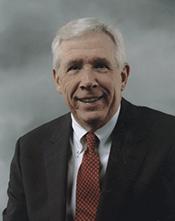
Remembering Congressman Bill Frenzel
Mr. Speaker, I rise today to pay tribute to our former colleague, Bill Frenzel of Minnesota, who passed away on November 17 at the age of 86. Bill served in the House for ten terms from 1971 to 1991. During his time on the Hill and upon…
Mr. Speaker, I rise today to pay tribute to our former colleague, Bill Frenzel of Minnesota, who passed away on November 17 at the age of 86.
Bill served in the House for ten terms from 1971 to 1991. During his time on the Hill and upon leaving Congress, he was a strong advocate for trade and economic growth.
So many of our colleagues did not have the privilege of serving with Bill. I respectfully submit this Washington Post article from November 19, 2014, on his passing.
Bill Frenzel, Minnesota Republican and Fiscal Authority, in U.S. House,
Dies at 86
Bill Frenzel, a Minnesota Republican who became a prominent
congressional authority on federal budget and international
trade issues during 20 years in the U.S. House of
Representatives, died Nov. 17 at his home in McLean, Va. He
was 86.
The cause was cancer, said a daughter, Pam Lindon.
Mr. Frenzel was an executive at his family's warehousing
operation and served in the Minnesota House of
Representatives before winning an open congressional seat in
1970. He represented his district in the Twin Cities suburbs
until 1990, when he declined to seek reelection.
By then he had become dean of the Minnesota delegation,
ranking Republican on the House Budget committee and an
influential member of the tax-writing Ways and Means
committee. On both sides of the aisle, he was admired for his
deeply researched positions on complicated fiscal matters.
``Loud and brainy, partisan and thoughtful, he puts his
stamp on every debate in which he participates,'' read his
profile in the Almanac of American Politics.
Among Mr. Frenzel's principal legislative interests were
promoting free trade and balanced budgets. He helped
negotiate the major 1990 deficit-reduction deal, a
significant achievement at a time when Mr. Frenzel had become
increasingly frustrated by what he described as the
Republican Party's ``seemingly permanent minority.''
Democrats ``think they were born to be kings,'' Congressional
Quarterly quoted him as saying, ``and that there's a servant
class, and that's the Republicans.''
In an effort to invigorate his party, Mr. Frenzel nominated
Newt Gingrich for party whip, a position that the Georgia
Republican won in 1989. Gingrich's fiery style contrasted
with Mr. Frenzel's more moderate one, but Mr. Frenzel said he
had concluded that the party ``needed to take some risks.''
In 1994--four years after Mr. Frenzel's retirement--
Gingrich led the GOP to recapturing control of the House. Mr.
Frenzel remained involved in public affairs, including in the
Democratic administration of Bill Clinton. Clinton tapped Mr.
Frenzel as an adviser on the North American Free Trade
Agreement, a centerpiece of the president's first-term
agenda, and tasked him with helping rally GOP support.
``I took a position up in the Rayburn Building and I think
I met with every member of the Republican caucus,'' Mr.
Frenzel told the Minneapolis Star Tribune. ``The idea was to
get the vote nailed down before you bring the bill to the
floor. Some of the members were difficult and slippery.'' He
continued, ``For instance, some of the members said, `We
don't think the Mexicans know anything.' We flew them to
Mexico City and had them meet with President [Carlos] Salinas
and his cabinet, who, of course, were all University of
Chicago PhDs and who bowled them over. That was very
effective.'' NAFTA was passed in 1993 and enacted the next
year.
Mr. Frenzel later served under George W. Bush, a
Republican, and Barack Obama, a Democrat, on advisory
commissions on Social Security and trade policy. He was a
guest scholar with the Brookings Institution think tank for
more than two decades and was a co-chairman of the Committee
for a Responsible Federal Government, both based in
Washington.
Years after he left office, he remained sought after for
his insider's perspective on politics.
``Republicans used to be interested in not running
continual rivers of red ink,'' he told the New York Times in
2012. ``If that meant raising taxes a little bit, we always
raised taxes a little bit. But nowadays taxes are like
leprosy and they can't be used for anything, and so
Republicans have denied themselves any bargaining power.''