Providing for consideration of the bill (H.R. 4663) to amend part C of the Balanced Budget and Emergency Deficit Control Act of 1985 to extend the discretionary spending limits and pay-as-you-go through fiscal year 2009.

Legislative Activity
Stay on top of the latest movement without scrolling through every action
Motion to reconsider laid on the table Agreed to without objection.
June 24, 2004 • 2:05 PM
View full timeline
Introduced in House
June 23, 2004
The House Committee on Rules reported an original measure, H. Rept. 108-566, by Mr. Hastings (WA).
June 24, 2004
Rule provides for consideration of H.R. 4663 with 1 hour of general debate. Previous question shall be considered as ordered without intervening motions except motion to recommit with or without instructions. Measure will be considered read. Specified amendments are in order.
June 24, 2004 • 8:00 AM
Placed on the House Calendar, Calendar No. 194.
June 24, 2004
Considered as privileged matter. (consideration: CR H4898-4908)
June 24, 2004 • 10:27 AM
DEBATE - The House proceeded with one hour of debate on H. Res. 692.
June 24, 2004 • 10:27 AM
Considered as unfinished business. (consideration: CR H4922-4923)
June 24, 2004 • 1:51 PM
On ordering the previous question Agreed to by the Yeas and Nays: 217 - 197 (Roll no. 302). (consideration: CR H4905-4908, H4922-4923)
June 24, 2004 • 1:56 PM
Passed/agreed to in House: On agreeing to the resolution Agreed to by recorded vote: 217 - 197 (Roll no. 303).(text: CR H4898)
June 24, 2004 • 2:05 PM
On agreeing to the resolution Agreed to by recorded vote: 217 - 197 (Roll no. 303). (text: CR H4898)
June 24, 2004 • 2:05 PM
Motion to reconsider laid on the table Agreed to without objection.
June 24, 2004 • 2:05 PM
Voting History
2 votes recorded • Roll call available
Floor Debate
22 membersWhat members said about H.Res. 692 on the floor
 DRO
DRO GG
GG JN
JN JMS
JMS LMS+17
Floor Debate
22 membersWhat members said about H.Res. 692 on the floor
Mr. Speaker, as the designee of the minority leader, I rise in support of the resolution. Mr. Speaker I yield myself 9 minutes. Mr. Speaker, this resolution is bringing to the House floor a debate on…
Mr. Speaker, as the designee of the minority leader, I rise in support of the resolution.
Mr. Speaker I yield myself 9 minutes.
Mr. Speaker, this resolution is bringing to the House floor a debate on how best to make this country stronger and more just. The distinguished gentleman from Texas has just said that this is about raising taxes. One of the worst problems that can happen to you in Washington D.C. is when you begin to believe your own baloney. That is not what this resolution is about.
The situation is very simple: we have a war. That war by next year will have cost us $250 billion. And the question is, how are we going to pay for it? We have two choices. One is to charge the bill mostly to our kids by raising the deficit, which is what is happening, and along with that making every American pay through the nose with less security for our homeland on our borders, in our ports, in our air ports, less security for veterans who are not receiving adequate health care, less educational opportunity for middle-class families because of budget squeezes, less health coverage for hundreds of thousands of children all over this country, less help for workers who are
out of work; or will we choose the other way, as this resolution seeks to do.
Will we choose to ask the most well-off 200,000 people in this country, less than 1 percent of all taxpayers, will we ask them to make the supreme sacrifice? Those who make more than $1 million a year, will you ask them to make the sacrifice of limiting their tax cut to $24,000 on average rather than the $120,000 average that they will otherwise get under the existing budget of this House? I think the answer is quite clear.
I plead fully guilty to wanting to see the most privileged and blessed people in this society accept a somewhat smaller tax cut in order to provide greater opportunity for others in society to get the basic requirements on education, health care, veterans health care, and the rest.
Now, this resolution is very simple. It raises over $18 billion by limiting the average size tax cut for persons who make more than $1 million a year to about $24,000 a year. That is what the average tax cuts will be for someone who makes between $500,000 a year and $1 million. We are asking those that make $1 million to live by that same amount. That is hardly an outrageous sacrifice.
We then use 25 percent of that money for deficit reduction. We use the remaining $14 billion to eliminate the real reductions in domestic appropriations that are contained in the President's budget. If this amendment is adopted, we will simply be adjusting education, health, veterans programs and all the rest by the amount that is equivalent to inflation plus population growth. That is all. We would get back to a standstill level on that score.
We put $3 billion into homeland security. Why? Because the Hart- Rudman Commission told us we have a need of $190 billion at the local level, and we have only met 15 percent of that need so far. We do it because only 13 percent of fire departments in this country are equipped to handle a full-blown hazardous material attack. We do it because only a tiny fraction of cargo in passenger planes is presently inspected for explosives. We do it because we have some 2,000 fewer people on the northern border protecting our border than the PATRIOT Act told us that we would have. We do it because only 20 of the most important 45 ports in America which ship goods into the United States have adequate inspection systems to make certain that there is not nuclear material or explosive material in ships that come to our shores.
We then put $1.3 billion into veterans health care so that we can cut the claims backlog of 327,000 veterans so that we can shorten the waiting time of veterans at VA hospitals, so that we can strengthen critical mental health services for returning veterans. We add $1 billion to military housing because more than 120,000 of military families in this country serve in lousy housing, and they deserve better.
We put $5.7 billion into education to close the gap between what this Congress promised it would provide local schools and what it is actually giving them. We put a billion and a half dollars into Title I so that 500,000 more poor kids and disadvantaged kids can get better instruction in reading and math.
We put $1.2 billion into special education so that local school districts will receive more help from the Federal Government to meet Federal mandates to educate every disabled child. We put $300 million in in order to help 400,000 more children receive adequate child care and after school care.
We put $2 billion in so that we can increase Pell grants to help those who otherwise could not afford to go to college. We want to increase the maximum grant by $450. Pell grants today pay only for 35 percent of the cost of instruction at a 4-year university. Twenty years ago they paid for 75 percent. Can we not do better than that?
Then we use $200 million to provide additional employment and training opportunities for people who have lost their jobs. We also address a number of other matters. We fund a number of other programs that are high priority programs, as demonstrated by the letters from the minority side as well as the majority side of this House to our own committee, asking that our committee provide funding for these programs.
So that is what we do, and I would ask support for this resolution, and I repeat the same thing that I said when I began. We have one choice. We can either pay for this war by shoving the bill to our kids and by cutting back on educational opportunities, cutting back on veterans health care, cutting back on decent housing for the military, squeezing dangerously our homeland security expenditures, or we can ask the most well-off, the most prosperous people in this country to share a little bit more of the load by limiting the size of their tax cut to $24,000 rather than the average $120,000 tax cut they would ordinarily get.
I believe the majority of those people are patriotic enough to say, ``Do it, we do not need that extra supersized tax cut as much as this country needs to have its fiber strengthened by providing the investments that I have just talked about.'' I would urge a ``yes'' vote for the resolution.
Mr. Speaker, I yield 4 minutes to the distinguished gentleman from New York (Mr. Rangel), the ranking member of the Committee on Ways and Means.
(Mr. RANGEL asked and was given permission to revise and extend his remarks.)
Mr. Speaker, I yield myself 30 seconds. Let me simply say, Mr. Speaker, that this is no less binding than is the budget resolution passed by the Republican majority.
Let me also say that we have heard a lot of concern about small business. I would like to see how many small businesses in each of our districts have profits of $1 million per owner to qualify under this bill.
Thirdly, we are not raising taxes; we are asking people who make $1 million a year or more to limit themselves to a $24,000, on average, tax cut, which is still 25 times as much as the average person in this country making $50,000 a year will get.
Mr. Speaker, I yield 1 minute to the gentlewoman from California (Ms. Pelosi), the distinguished minority leader.
Mr. Speaker, I yield 4 minutes to the distinguished gentleman from South Carolina (Mr. Spratt), ranking member of the Committee on the Budget.
(Mr. SPRATT asked and was given permission to revise and extend his remarks.)
Mr. Speaker, I yield 4 minutes to the distinguished gentleman from California (Mr. George Miller).
(Mr. GEORGE MILLER of California asked and was given permission to revise and extend his remarks.)
Mr. Speaker, could I inquire how much time is remaining.
Mr. Speaker, I yield 3\1/2\ minutes to the gentleman from Maryland (Mr. Hoyer), the distinguished minority whip.
Mr. Speaker, I yield 4 minutes to the distinguished gentleman from Texas (Mr. Edwards).
Mr. Speaker, I yield myself 10 seconds.
Mr. Speaker, despite the fiction we have just heard, you have to make $1 million a year profit in order to be covered by this. To suggest small businessmen are hurt by that is laughable.
Mr. Speaker, I yield 2 minutes to the distinguished gentleman from Pennsylvania (Mr. Fattah).
Mr. Speaker, I yield myself 30 seconds.
Mr. Speaker, again, despite all of the misinformation that we have just heard, the IRS has told us that fewer than six-tenths of 1 percent of all returns with small business income have incomes of more than $1 million. To suggest that this is even laying a glove on small business is a colossal red herring fiction.
Mr. Speaker, I yield myself 30 seconds.
The gentleman refers to one-third of the top bracket. This does not touch everybody in the top bracket. The top bracket is $319,000 or more. We do not touch anybody with an income of less than one million bucks, less than one million bucks. That is not $300,000. Do not try to bamboozle people.
Mr. Speaker, I yield myself 30 seconds.
Line 22 and line 23 of page 6: The only taxpayers that are affected are ``taxpayers with adjusted gross income above $1 million.'' Period.
Mr. Speaker, I yield 1\1/2\ minutes to the gentleman from Massachusetts (Mr. Olver).
(Mr. OLVER asked and was given permission to revise and extend his remarks.)
Mr. Speaker, I yield 1\1/2\ minutes to the gentleman from New York (Mr. Engel).
Mr. Speaker, I yield 5 minutes to the distinguished gentleman from New Jersey (Mr. Andrews).
(Mr. ANDREWS asked and was given permission to revise and extend his remarks.)
Mr. Speaker, I yield 30 seconds to the gentleman from Illinois (Mr. Emanuel).
Mr. Speaker, I yield myself the remainder of the time.
Mr. Speaker, this amendment is pure and simple about shared sacrifice, as the gentleman from Illinois has just indicated. What we are asking is that those lucky people in this country who make more than $1 million a year, that includes the one-half of 1 percent of small businessmen who make profits of over $1 million a year, we are asking them to accept a scaled-back tax cut so that they only get, on average, $24,000 in tax cuts. That is 24 times as large as someone will get if they make $50,000 a year.
And, instead, we are saying please, for the sake of the country, take a little bit smaller tax cut so that we have some room in the budget to strengthen protection on our borders, to strengthen protection in our ports, to strengthen protection at our airports, to provide stronger opportunities for education, to provide more civilized health care for our veterans, to provide better housing for our military personnel, to provide a little better shot at protecting the environment, to help local communities so that they do not have to lay off hundreds of thousands of kids from health care programs like SCHIP and Badger Care in my own State. This is an effort to see to it that we can enrich the many and enrich the few at the same time.
Trickle-down economics is what we have heard from our friends on the
other side of the aisle today. They say if you just give enough to the people at the top, eventually some will trickle down to people at the bottom.
My old friend Harvey Dueholm in the legislature used to describe it this way. He said trickle-down economics is the theory that if you just feed the horses enough oats, eventually some of it will filter down to the sparrows. Think about it. And vote ``yes.'' It is the fair, it is the right, it is the just thing to do.
Mr. Speaker, I thank the gentleman for yielding me this time. This is an important debate, Mr. Speaker, so I hope that Members are paying attention. The real power of the purse rests with us here, in…
Mr. Speaker, I thank the gentleman for yielding me this time.
This is an important debate, Mr. Speaker, so I hope that Members are paying attention. The real power of the purse rests with us here, in the people's House. I am proud of what we did through most of the 1990s. When we came here, when I was elected in 1994 and came here in the spring of 1995, I remember we had some meetings with some of the economists and people from the Congressional Budget Office. And we have to go back and remember what was happening in America. We were running deficits every year of $250 billion and more, and we can all point fingers and blame this and blame that; but at the end of the day, we were spending more than the taxpayers were sending in, and America wanted us to do something about this.
At one of the meetings we were at, we had some economists saying, if Congress does not get serious about balancing the Federal budget, that by the time my children got to be my age they would be paying an effective tax rate to the Federal Government of over 80 percent, just to pay the interest on the national debt.
Now, I come from a rural district, and I think most folks from rural communities understand this, because it really has been part of the rural ethic, particularly those who are farm families, to pay off the mortgage and leave the kids the farm. What we have been doing is we were literally selling the farm and leaving our kids the mortgage. We knew that it was not just bad public policy; it was fundamentally immoral.
So what we did is we began to limit the growth in Federal spending, and I am proud to report that from 1995 until the year 2000, the Federal budget was growing at a slower rate than the average family budget. That, combined with a fairly strong economy, we literally went from a $250 billion shortfall every year to a $250 billion surplus.
In fact, just 3 years ago, the Congressional Budget Office told us that we could look forward to surpluses in the Federal Treasury over the next 10 years of $5.4 trillion. Now, that same Congressional Budget Office today is telling us that we can look forward to deficits of $1.6 trillion over the next 10 years. The only thing we can really say about the Congressional Budget Office's forecasts is that they are both wrong.
What we do know that is right is that over the last several years we have allowed Federal spending to grow at a rate double what it grew through most of the 1990s. And part of the reason that happened is we allowed some of the budgetary rules to expire, the things that control the growth in Federal spending.
There was a farmer who told me several years ago, we were talking about the deficit, and he said, you know, the problem with you guys in Washington
is you do not quite get it. The problem is not that we are not sending enough money to Washington. The problem is you spend it faster than we send it in. He probably expressed it more accurately and more simply than any of us would like to admit.
What we want to do today, and this is an important event and these are important votes, we want to bring back some of the rules that controlled Congress with regard to spending. One of them is PAYGO. That means if you want to have a new program, you have to figure out a way to pay for it. And I do not think that is too much to ask. The other is setting up some spending caps.
Let me give some ideas why I think that is important. Over the last several years, we have passed some pretty good budgets, some very tough budgets here in the House of Representatives. Back in fiscal year 2002, for example, our budget resolution which we passed here in the House called for spending $661 billion in what we call discretionary spending. But by the time we were done negotiating with the Senate, we ended up spending $734.6 billion. Well, in the next year we said in the House budget resolution that we would agree to spend $759 billion in discretionary spending. But before the year was over, we actually spent $849 billion. Last year, our budget resolution called for spending $784.5 billion. But when all the numbers were in and the spending was done and the conference committees at last had concluded, the number actually was $873 billion.
Pogo was right. We have met the enemy, and he is us.
I think there was a certain amount of hubris that, well, we have done a pretty good job of balancing the budget over the 5- or 6-year period. We had actually paid down over a half trillion dollars of publicly held debt, and I think we began to think we did not need these budget rules any more. I am here to say that I think we were wrong, and we have to get back to some of those rules.
This is a very important debate. I support this rule. I know there will be people who will say, well, we did not get to offer our amendment, or this amendment was not made in order. But I think we are going to have a very vigorous debate over the next several hours on the rule and the bill. Mr. Speaker, I hope later I will have a chance to visit more about the rule and the bill.
Mr. Speaker, I want to respond to some of the things that our colleague the gentleman from South Carolina has just said. Much of what he said, I do not disagree with. But there is something I think we need to clarify for all of the Members. Even if we had a balanced budget last year and this year, we would have to raise the debt ceiling. That is something I think it is hard for many Members and frankly I think most Americans. They wonder how in the world can that be. It is kind of a complicated thing to explain but even in a very strong economy with surpluses, we would probably have to raise the debt ceiling. The reason is this. When money comes into the Social Security trust fund, there are only two things they can do. They can either pay benefits or they can buy government bonds. When they buy government bonds they in effect drive up the debt. I know that is hard for people to understand, so yes, we are going to have to raise the debt ceiling, but even if we were balancing the budget we would have to do that.
I would also like to at least remind Members that things did change a lot in this country on September 11, 2001. I think we all know that. We all have to be cognizant of that and it has changed the priorities of how we spend money. Is that an excuse to allow other Federal spending to be going up? No. And have we been a little too profligate with the Defense Department and homeland security? My opinion would be yes. We have allowed our emotions to get the better of us and we have just said, we will spend more money and maybe we will be safer. I am not sure that is the answer. I am not sure that having 50 guards at every airport entrance makes us all that much safer and that is an argument and a debate we should have.
The debate today is how much are we going to allow Federal spending to go up, and is there really a good reason to allow the Federal budget to grow at a rate twice the rate of the average family budget?
The numbers we were talking about, from 1995 until 2000, the Federal budget went up at an average rate of about 3.2 percent. Since that time, we have allowed the Federal budget to grow at a rate of 6.4 percent. That assumes that we will enforce the numbers that we passed in this year's House budget resolution and that is really what we are debating today; that is, it is one thing to pass a budget, it is another thing to make certain that we enforce the budget.
There will be two great issues we are going to discuss today that I think are important. First of all, are we going to enforce the budgets that we pass here in the House of Representatives? We are the keepers of the public purse. I think we ought to enforce that budget. The second thing we are going to debate today is changing the process by which we derive a budget. The process today all leans towards more spending. In fact, I think the Wall Street Journal did a beautiful editorial last week which really underscored that point. Everything we do here, and frankly that is what we do, is we spend the public's money, but all of the rules today tend to make it easier to spend more money. What we want to do is level the rules so that at least we have a counterbalance to all of that pressure to spend more money.
I might just say this. We all have different reasons, and some say it is the tax cuts, but I would remind people that we cut taxes in almost every year during the 1990s, and we did it under PAYGO and spending cap rules. It can be done. We just have to find offsets for those. And we did. In fact, most of the supplemental spending bills that we passed we found offsets for those. It can be done. It means making some tough choices, but I always remind my colleagues, our constituents did not send us here just to make the easy choices. They sent us here to make tough choices. We are going to make some tough choices today in terms of whether we really mean what we say about holding the line on Federal spending and whether or not we are going to level the playing field in terms of the rules by which we make our budgets. This is an important debate.
The debate about raising the debt ceiling is clearly an important debate, but I think we have to be clear. Even if we had a balanced budget, because of the surpluses coming in in the Social Security trust fund, we would still have to raise the debt ceiling.
Mr. Speaker, I would like to respond to some of the things that were just said.
First of all, I happen to believe that PAYGO rules ought to apply to tax cuts, too. But this is all about the politics of the possible, and we cannot get that done this year. So we can take this step this year, this day to begin to constrain Federal spending.
Let me also respond to something else. Our friends on the left cannot have it both ways. They cannot say, well, we need to invest in this program and that program and this program for people, and if we put more money into education, the argument is we will get it back ten- fold, but we do not want to pay any interest on that money. We cannot have it both ways. Fifty-five percent of what we will spend this year will be for what are called entitlement programs, and many of those entitlement programs were sold as investments in people. Now we are being told, but we get no return on that investment. This is just an expenditure, and it is lost forever.
So as we debate this, I know that people are going to come at this from different perspectives, but let us try to at least be honest with ourselves. We have a system right now, and the rules and the way the system works encourages more and more spending.
The debate today simply is about this: are we going to enforce the budgets that we pass here in the House and are we going to change the rules to give the taxpayers an even break? That is what the debate is about today. We can debate all of those other issues some other day. But we need support on both sides of the aisle to make certain that the American people understand that we are going to enforce the budgets we pass in the House.
We are the keepers of the public purse. We are going to enforce those budgets, and we are going to begin to amend the rules to make it more difficult to spend more than we take in.
Mr. Chairman, I yield myself such time as I may consume. Mr. Chairman, the most important job of the House Committee on the Budget which I have the honor of being the Chair is really twofold. First…
Mr. Chairman, I yield myself such time as I may consume.
Mr. Chairman, the most important job of the House Committee on the Budget which I have the honor of being the Chair is really twofold. First is to put together and pass in the House a responsible, realistic blueprint to guide the spending and revenue decisions for the Federal Government. We did that. We completed a budget over a month ago when this Chamber adopted the conference report for the budget for fiscal year 2005. Getting a budget is difficult enough. Now comes the second part of the job and that is to ensure that you stick to it. Getting the budget means that you have been able to get a majority of Members to agree on the levels for spending, on the levels for revenues and to bring together those very different ideas because, trust me, there is no such thing as a perfect budget by any stretch of the imagination. My good friend from Florida reminds me of that every once in a while.
But we do get a document that tries to mold and shape the hopes and
dreams and the budget priorities for the Nation in a document, and then we work to stick to it.
Since the gentleman from Florida came on the floor, the very distinguished chairman of the Committee on Appropriations, let me say something about the House and our ability to stick to that plan. We have passed budgets in years past that have been difficult. We have dealt with terrorist attacks. We have dealt with a downturn in the economy. We have dealt with the need to borrow resources to deal with emergencies we never managed. We had to deal with new priorities no one had ever heard of, new Departments like Homeland Security; and new initiatives such as a global war on terrorism, a war in Iraq, and a war in Afghanistan. And I have to tell the Members that in each one of those turns, committees have worked together in order to accomplish that. There is no doubt that once in a while committees will have difficulty coming to agreement on certain priorities and ideas; but once we do it, there is general agreement and effort to stick to it. And when we talk about sticking to it, the gentleman from Florida (Mr. Young), chairman of the Committee on Appropriations, and his committee have done an excellent job of sticking to it.
We have increased spending over the last number of years at a rate that has been unprecedented, in many respects because we have had unprecedented need, particularly in homeland security, national defense, intelligence, and emergencies that we have had to deal with. But even the nondefense or nonsecurity accounts have increased at an alarming rate, twice the rate of inflation. And so it is no wonder that Members will come to the floor from time to time, we saw that debate earlier today, and say, look, spending is out of control.
Unfortunately, we often focus far too much attention and energy on just what we call the discretionary appropriation accounts, the 13 bills that the chairman of the Committee on Appropriations has to shepherd not only through the House floor but also through the Senate and to final passage. That process has been difficult. We are behind in that process, and I have no doubt the chairman will remind me that having this discussion probably puts us even further behind.
But we are having this debate, nonetheless, because once we have a budget, we also want to make sure we stick to it. And that is why an enforcement bill has come to the floor.
I will definitely report to my colleagues that I would much rather have this debate after the other body had passed the conference report, but they are tied in knots over there across the rotunda on the other side of the Capitol. Politics, Presidential elections, all sorts of things are tying up all sorts of items in the other body, going to make it very difficult for us to pass budgets, appropriations, get judges confirmed, all sorts of a myriad of issues that make that difficult.
As a result of having some difficulty in spending and having difficulty in getting a budget through the other body, the third item which I want to bring up is huge increases in what we call mandatory spending through our Federal Government. Mandatory spending, as most of my colleagues know, are those spending initiatives which are on auto pilot, meaning we have passed a law to fund a program, and unless we change the law, the funding continues. Medicare is probably one of the best examples of that. We just had a huge change in Medicare to provide a first-ever prescription drug benefit for seniors. It costs a lot of money, though, and that has grown much faster as a result than even many of the discretionary accounts.
So as a result, there are Members who come to the floor frustrated by the increases in spending, frustrated because there are times when the budget is not followed, and thinking that if we change the process on how we achieve the budget or if we change the process on how we discuss appropriation bills, that will solve everything. And I am part of that camp from time to time.
But I must remind all of us before we start this debate that when everything is said and done here today, it still comes down to how we vote. One can blame the process. One can blame the budget. One can blame the Committee on Appropriations. One can blame individual Members. One can blame past administrations. One can blame current administrations. But no matter what one blames, they had better look in the mirror today before they come down here to vote on anything and realize that spending increases when Members vote to increase spending.
And already the appropriation bills that we have seen cross this floor have had huge majorities, huge majorities, for very valid increases, in defense and intelligence, other issues that have come before our body. Why? Because the need is there. So those Members who come to the floor today and say let us blame the process or let us blame the procedure or let us blame another committee also need to take their fair share of the responsibility for how the process runs.
I believe that we need discipline, and we need enforcement of a budget once we get it. That requires what we used to have in this body, and that is caps in PAYGO. Caps in PAYGO, statutory caps in PAYGO, I believe, are necessary because it gives the force of law to what we have done. It makes sure that all three entities, the President; the Senate, the other body; and the House, are all together when the discussion occurs on spending, when the discussion occurs on taxes, when the discussion occurs on mandatory or entitlement increases. It ensures that everybody is there because we are all in this together. We cannot do one without the other. We cannot say it is only the Congress's prerogative because the President has to sign the check, he has got to sign the bill if, in fact, that is what he agrees to.
But it starts here in a process called the budget, called the appropriations process, and called the authorization process. So in order for us to deal with this, we are asking that the body today consider capping spending at the rate we just passed in the budget resolution, and just for 2 years, do not bind another Congress, just for these 2 years, and to also for really the first time address mandatory spending and its out-of-control nature by applying what we used to apply and that is pay-as-you-go to entitlements or mandatory spending. We believe this will help us. It will not be the be all and end all because there are still emergencies; there are still other ways that Congress spends money outside of that process. But this is one of the ways that we found in the 1990s to help ensure that spending control could occur.
Members are going to come to the floor with different opinions, and I respect those opinions. There is no question that people have a variety of ideas on how we should do this. But I would ask each and every one of them to remember that this is about each and every one of us, as Members, what our priorities are and how we vote. We cannot give that to another process. Nothing we do here today given to another process will, in and of itself, stop the madness of increases in spending that have been what many Members believe are out of control. The only way, when everything is said and done, is to cast our vote to control spending, and that is done in the individual processes of the bills that we consider here on the floor.
So we believe this is a work product worth consideration. There will be amendments to consider changes in the budget process and the appropriations process in order to help get a handle on spending concerns and on mandatory spending. But as I say, when everything is said and done, we have got to have a budget, we have got to enforce it, and we have got to vote that way on each and every bill in order for spending to be controlled.
Mr. Chairman, I reserve the balance of my time.
Announcement by the Chairman Pro Tempore
Mr. Chairman, I yield 4 minutes to my friend, the gentleman from Florida (Mr. Young), the very distinguished chairman of the Committee on Appropriations.
Mr. Chairman, I yield 2 minutes to the gentleman from Ohio (Mr. Portman), a member of the Committee on the Budget.
Mr. Chairman, I yield the gentleman from Ohio 10 seconds.
Mr. Chairman, I yield 3 minutes to the gentleman from Pennsylvania (Mr. Toomey), a member of the Committee on the Budget.
Mr. Chairman, I yield 2 minutes to the gentleman from Florida (Mr. Putnam), a member of the Committee on the Budget.
(Mr. PUTNAM asked and was given permission to revise and extend his remarks.)
Mr. Chairman, I yield 2 minutes to the distinguished gentlewoman from Florida (Ms. Ginny Brown-Waite), a member of the Committee on the Budget.
Mr. Chairman, I yield 2 minutes to the gentleman from Florida (Mr. Feeney).
Mr. Chairman, I yield 2 minutes to the gentleman from Indiana (Mr. Pence).
(Mr. PENCE asked and was given permission to revise and extend his remarks.)
Mr. Chairman, I yield 2 minutes to the gentleman from Minnesota (Mr. Gutknecht), a member of the Committee on the Budget.
Mr. Chairman, I yield such time as he may consume to the gentleman from Alaska (Mr. Young), the chairman of the Committee on Transportation and Infrastructure, for the purpose of a colloquy.
Mr. Chairman, will the gentleman yield?
Mr. Chairman, the chairman is correct. This will, in no way, limit the decision of the conferees for H.R. 3550, the level of highway and transit firewalls. It will be determined consistent with the fiscal year 2005 budget resolution and the contingency procedure contained therein in the conference report on H.R. 3550.
In either case, this is consistent with the fiscal year 2005 budget resolution, and it allows not as a ceiling but a floor to that conference report.
Mr. Speaker, I yield myself 1 minute before I yield to the gentleman from Ohio. Mr. Speaker, I hear from Members on both sides of the aisle that this is really a waste of time today. It is kind of a…
Mr. Speaker, I yield myself 1 minute before I yield to the gentleman from Ohio.
Mr. Speaker, I hear from Members on both sides of the aisle that this is really a waste of time today. It is kind of a silly exercise. We ought to be having appropriation debate on the floor. We have got appropriations bill that are waiting in line with no prospect of getting them done on time this year, and yet we have got to do this.
I hear from some that this is really an exercise as a price to prevent obstructionism on the floor for consideration of appropriation bills, that if we do not debate that, somebody is going to obstruct the floor.
Regardless, let me say a couple of things. There is a budget. The House has deemed the budget. We await consideration in the other body of the budget, and this is a nonbinding resolution that we are about to talk about for the next couple of hours here instead of talking about appropriation bills, but I guess we are going to go through this exercise.
As the majority leader said, we are going to have some fun because we get to point out our differences, but let us just face it. This is a nonbinding, somewhat silly exercise, but we are going to go through the process and talk about the differences.
Mr. Speaker, in order to do that, I yield 5 minutes to the gentleman from Ohio (Mr. Portman), a member of the Committee on Ways and Means and a member of the Committee on the Budget.
Mr. Speaker, I yield 3 minutes to the gentleman from Florida (Mr. Mario Diaz-Balart), a member of the Committee on the Budget to continue the debate on the Democrat increase-taxes-and- spending proposal.
Mr. Speaker, I yield myself 30 seconds to read the last line of the bill. The minority leader may want to read page 5 of the resolution she just defended. It is not a tax increase? My goodness. What does ``changes in tax laws sufficient to increase revenues by $18 billion'' mean? I heard one time if it walks like a duck, it looks like a duck and quacks like a duck, it might be a duck. This is a tax increase.
Mr. Speaker, I yield 2 minutes to the gentleman from Texas (Mr. Brady), a member of the Committee on Ways and Means, to talk further about this Democrat tax increase resolution.
Mr. Speaker, to continue the debate on this small business job-killing bill, I yield 2 minutes to the gentleman from Texas (Mr. Hensarling), a member of the Committee on the Budget.
Mr. Speaker, I yield 4 minutes to the gentleman from New Jersey (Mr. Garrett), a member of the Committee on the Budget, to continue the debate on this more-money-solves-all-problems proposal.
Mr. Speaker, to continue our debate on this Democrat increased-taxes bill, I yield 4 minutes to the gentleman from Georgia (Mr. Burns).
Mr. Speaker, to continue our debate on this tax-increase, job-killing bill, I yield 5 minutes to the gentleman from Georgia (Mr. Kingston).
Mr. Speaker, I reserve the balance of my time.
Mr. Speaker, to continue the debate on the Democrat tax- increase proposal, I yield 2 minutes to the gentleman from Wisconsin (Mr. Ryan), a member of the Committee on Ways and Means.
Mr. Speaker, I yield 1 minute to the gentleman from Wisconsin (Mr. Ryan) to respond.
Mr. Speaker, we do not want to ``bamboozle,'' so I would yield 1 additional minute to the gentleman from Wisconsin (Mr. Ryan).
Mr. Speaker, will the gentleman yield?
Mr. Speaker, the point of this all is, this is a tax increase. They are admitting it. There were so many Members who came to the floor and said, oh, no, no, no, we are not really increasing taxes. But what the colloquy between the two gentleman from Wisconsin proves is, once and for all, this is a tax increase.
So if one wants to come to the floor today in the middle of an economic recovery and vote to increase taxes on small business, knock yourself out.
Mr. Speaker, I yield 1 minute to the gentleman from Michigan (Mr. Smith).
Mr. Speaker, I yield myself such time as I may consume.
Respectfully, because I know the Speaker is from New York, let me yield myself 30 seconds and say I think a lot of that money we borrowed was sent up to New York. So when the gentleman is talking about what happened and Alice in Wonderland, let me just remind the gentleman that we sent a lot of that to New York. We had a terrorist attack. I know the gentleman knows that, and he voted for it then, and he did not say a word about it then. He said send the money. We need it. Do whatever it takes. Now he comes to the floor and he says, gee, I guess we borrowed too much money.
Well, maybe we did, but the gentleman should have complained about it then.
Mr. Speaker, I yield 2 minutes to the gentleman from Kansas (Mr. Tiahrt).
Mr. Speaker, I yield 3 minutes to the gentleman from Connecticut (Mr. Shays), the vice chairman of the Committee on the Budget.
Mr. Speaker, I yield myself the balance of the time.
Mr. Speaker, that is the difference between Republicans and Democrats. It all comes down to who is doing the feeding of the oats. The government does not feed oats. That is not where the economic advantage of this country comes from. We do not pass out money to people here and say here is government money, we printed it, you get to have it. They get it from working. They get it from farming. They get it from taking risk. They get it from unlocking their door in the morning and letting in the public to their flower shop, to their shoe store, to their bank, to whatever it might be, unlocking that door and letting the energy and the economic engine of this country work.
That is what we want to continue: working. We do not want this to kill jobs. Just at the moment when we are increasing jobs, look what we have done. Yes, there was a downturn. In the aftermath of 9/11 and in the aftermath of the dot-com bubble busting and the aftermath of the Clinton recession, there is no question, look right here; that is what that is, that little downturn. But look how it is going back up.
And it is going up because the engine of America is working. It is not going up because of the chart on spending. When we increase spending in Washington, that does not drive the economy. That does not do anything except it spends money in Washington. What drives the economy are people in Wisconsin and Iowa taking a risk, building a business, employing people so that when they balance their checkbook around their kitchen table and they meet their obligations and pay for their kids' college and pay for health care and turn on the lights and pay for groceries, they can do it. It is not because, with all due respect to the gentleman from Wisconsin (Mr. Obey), we send them a check. Because that does not do anything.
The check they want to make is a paycheck, not a government check. Every single person in America wants a paycheck. And that is what we have done. We have created paychecks. Look what the spending side of this does. They are saying we are not spending enough in Washington. Look at all of this increase. Look at all of the debt that they are complaining about. And on top of all of that, they say, no, the problem is we are still not spending enough money in Washington. And the thing they misconnect is that that money in Washington came from somebody, a taxpayer.
Money does not start in Washington. Money starts in Iowa, in Wisconsin, across the country, in people's pockets, in small businesses. That is where it starts. And they want to take more of it, they want to kill those jobs, so that they can hand out more money, so that they in Washington can have the power. We do not want that to happen. We want the power to be around the kitchen tables of Iowa and Wisconsin. That is why we have opposed their big tax increases.
As far as the spending, the taxes, that is obvious those increases are ridiculous. But the increases in spending, one can always say we want to hand out more money in order to demonstrate our compassion. And we have told them about the increases in education, the increases in veterans, the increases in health care, the increases for the environment, for all sorts of programs, and to make sure our country was protected. But on top of that, they say, you know what, I think we can even be more compassionate. We are going to hand out money and tell people we care.
Well, quite honestly, I think it is time for to us start looking around for the waste. I believe that, instead of this debate on the floor today, what we should have done is had an appropriation bill come up. That is what we should have done. We should have started going through all the accounts and look for ways where the Federal Government is not spending that money as wisely as the people back home in Iowa and Wisconsin.
We do not want to kill jobs; we do not need to increase spending. We do not need a resolution like the Democrat proposal on the floor today to tax and spend and tax and spend and tax and spend and tax and spend more and more in Washington. This needs to be done around the kitchen tables of Iowa, not the committee tables in Washington.
Mr. Speaker, I hope Members vote against this ill conceived proposal.
Mr. Speaker, I object to the vote on the ground that a quorum is not present and make the point of order that a quorum is not present.
Mr. Chairman, I yield myself such time as I may consume. Mr. Chairman, the bill we have before us, H.R. 4663, the Spending Control Act of 2004, causes me to say to my friends across the aisle, and I…
Mr. Chairman, I yield myself such time as I may consume.
Mr. Chairman, the bill we have before us, H.R. 4663, the Spending Control Act of 2004, causes me to say to my friends across the aisle, and I cannot help but take a little jab at them, our Republican friends control the House, they control the Senate, they control the White House. Why can they not control spending? And will this bill make a difference?
I ask that question because there is a particular irony about this bill. This is a budget enforcement bill, but there is no budget to enforce. For the first time since 1974 when the Budget Act was first adopted, the party that controls both branches of the government, the Congress and the White House, is unable to get its act together and pass a budget. And now they propose new rules to the budget process if they cannot comply with the rules we have got.
This bill before us is hardly a consensus bill. There is a lot of dissension about it even as it comes to the floor. When it was filed, 28 amendments were filed with the Committee on Rules to change it. All but one of those amendments, which is my amendment, focused solely on spending as the source, the cause of the deficit that we are incurring today. We are supposed to have a deficit this year of over $521 billion. The prognosis has gotten a bit better, but it looks like it will be at least 430 to $450 billion, 1 year, a half trillion dollars. Only my substitute deals with the other side of the problem, and that is revenues.
Two rules of all the rules we will see today, two rules that stood the test of time, they have worked. They have helped us wipe out deficits. They did in the 1990s. One rule caps discretionary spending at fixed levels over the next 5 years. That was the rule that we put in effect in 1990, extended in 1993, and again in 1997; and it helped us balance the budget for the first time in 40 years. The other rule is what we call the pay-as-you-go rule, which requires us to pay as we go, that is, to offset new tax cuts and new entitlement increases by new revenues or by equal spending cuts so that they do not add to the deficit, pay-as-you-go, discretionary spending caps.
As I said, the base bill and all the amendments except mine focus entirely on spending and not at all on tax cuts as the source of the problem. Yet if we look at the period 2002 through 2011, the 10-year period that covers the first 4 years of the Bush administration, $2.3 trillion of our total fiscal reversal during that period has been caused by substantial tax cuts and related debt service; and that revenue deficit grows as tax cuts that expire are renewed and new tax cuts are adopted, as the Bush administration proposes and pushes for more.
This bill promises deficit reduction; but it ignores the elephant in the room, one of the chief causes now and well into the future, and that is the deficit in revenues.
Do we have a problem? You bet we have a problem. In the last 3 years of the Clinton administration, I remind everybody, we ran surpluses for the first time in 30 to 40 years. We paid off $400 billion in debt. In the first 4 years of the Bush administration, Congress has had to raise the statutory ceiling on the national debt three times, three times in 4 years, to accommodate President Bush's budget. Congress raised the ceiling by $450 billion in 2002; by $984 billion in 2003; and shortly, the process is already under way here, by $650 billion this year. In all of the last 4 years by $2.1 trillion in order to accommodate Mr. Bush's fiscal policy.
And these increases in the statutory debt ceiling are by no means over. They are part of a series. The Congressional Budget Office told us last March, when they examined the President's budget, that if we implemented, if we enacted that budget, the President's budget, we would have to raise the debt ceiling to $13.5 trillion in the year 2014. Not my number. It is the number of the Congressional Budget Office, which is a neutral, nonpartisan arm of the Congress.
So we have a problem; but this bill, unfortunately, does not deal with it. It takes off in pursuit of red herrings and Draconian solutions that will not work, if they were ever enacted; and I doubt they will be enacted. It trots out almost every budget process idea that has ever been thought of, but the two that have worked, the two rules that have worked so well that, as I said, we moved the budget from a deficit of $290 billion in 1992 to a surplus of $236 billion in 1998.
One is a double-edge PAYGO rule that requires both tax cuts and entitlement increases to be deficit neutral; and the other is discretionary spending caps over 5 years. They do not work unless you extend them out for some period of time. The caps in the base bill only go out for 2 years and are set to boot at unrealistically low levels. They are lower than the President's request, yet they provide more for transportation. I think the gentleman from Florida (Mr. Young) will tell you if he talks about the appropriations bind he is in right now, he cannot take much more reduction in the allocation of discretionary spending than we have already given him.
So we have got here a set of proposals that simply do not address the problem at hand, which is a substantial problem, except for one particular provision. All I am calling for and all I would recommend the House would do, but it would be a good day's work if we did it, is go back and reinstate the PAYGO rule, which worked so well in the 1990s; reinstate the 5-year spending caps, which worked so well in the 1990s; and then we can get to work on balancing the budget.
Mr. Chairman, I reserve the balance of my time.
Mr. Chairman, I yield 4 minutes to the gentleman from Maryland (Mr. Hoyer), the Democratic whip.
Mr. Chairman, I yield 10 seconds it the gentleman from Maryland (Mr. Hoyer).
Mr. Chairman, I yield 5 seconds to the gentleman from Ohio (Mr. Portman) to respond.
Mr. Chairman, I yield myself 10 seconds to remind the gentleman that we have 1.3 million fewer jobs today than we had on March 1, 2001 at the beginning of the Bush administration. First amendment, first recession since the end of the Second World War with that result.
Mr. Chairman, I yield 2\1/2\ minutes to the gentleman from Alabama (Mr. Davis).
Mr. Chairman, I yield 2 minutes to the gentleman from North Dakota (Mr. Pomeroy).
Mr. Chairman, I yield 2 minutes to the gentleman from Virginia (Mr. Wolf).
(Mr. WOLF asked and was given permission to revise and extend his remarks.)
Mr. Chairman, I yield 2 minutes to the gentleman from North Carolina (Mr. Price).
(Mr. PRICE of North Carolina asked and was given permission to revise and extend his remarks.)
Mr. Chairman, I yield 2 minutes to the gentleman from Virginia (Mr. Moran).
Mr. Chairman, I yield 1\1/2\ minutes to the gentlewoman from Nevada (Ms. Berkley).
Mr. Chairman, I yield 1\1/2\ minutes to the gentlewoman from California (Mrs. Capps).
(Mrs. CAPPS asked and was given permission to revise and extend her remarks.)
Mr. Chairman, I yield 1 minute to the gentleman from Wisconsin (Mr. Kind).
(Mr. KIND asked and was given permission to revise and extend his remarks.)
Mr. Chairman, I yield 2 minutes to the gentleman from Illinois (Mr. Emanuel).
Mr. Chairman, I yield 1\1/2\ minutes to the gentlewoman from Texas (Ms. Jackson-Lee).
(Ms. JACKSON-LEE of Texas asked and was given permission to revise and extend her remarks.)
Mr. Chairman, I yield the balance of our time, 1\1/2\ minutes, to the gentleman from Virginia (Mr. Scott).
Mr. Chairman, I rise to claim the time in opposition, and I yield myself such time as I may consume.
Mr. Chairman, like a lot of Members, many of the provisions offered here are matters of first impression. I have not seen this bill before, so I would like to ask either of the cosponsors a question about a critical provision of the bill for their clarification.
It is my understanding that this amendment would require that after each commission completes its review of an agency every 12 years, that agency would be abolished automatically, would be extinguished unless, within a year, Congress reauthorized the agency. Is that correct? Am I reading it correctly?
I yield to the gentleman from Texas.
You would have automatic abolition of an agency? It would simply sunset?
Mr. Chairman, reclaiming my time, I see the merit in having some sort of conscious, affirmative periodic review of the huge morass of agencies we have in the Federal Government; but I have some concern here that if a President disagreed with the Congress, you could have 289 Members of the House and 66 Members of the Senate who thought this agency should be reestablished, but the President could veto the bill that would reauthorize it; and, therefore, it would not come back into existence.
Mr. Chairman, I yield back the balance of my time.
Show 8 more
Mr. Speaker, I thank the gentleman from Washington for yielding me the customary 30 minutes, and I yield myself such time as I may consume. (Ms. SLAUGHTER asked and was given permission to revise and…
Mr. Speaker, I thank the gentleman from Washington for yielding me the customary 30 minutes, and I yield myself such time as I may consume.
(Ms. SLAUGHTER asked and was given permission to revise and extend her remarks.)
Mr. Speaker, early this morning the Committee on Rules passed a lopsided rule packed with Republican amendments. It is shocking that of the 19 amendments made in order, only one Democrat amendment and one bipartisan amendment are in order. Senior Democrats were shut out, while the rule makes the amendments of junior Members in order on the Republican side. The rule provides for one-sided debate on H.R. 4663. The House will be allowed to discuss and vote on Republican amendments, but Democratic ideas and amendments have been virtually excluded in the important debate on budget process reform.
Mr. Speaker, the question before us is whether or not the current budget process creates a product that embodies our budget policies and our priorities. The Federal Government has gone from having historic surpluses of $5.26 trillion to having historic deficits of $2.3 trillion. If we are unsatisfied with a budget, are policies or the budget process to blame? Should the budget process enforcement mechanism be policy neutral or should the process force or enable Congress to make policy decisions?
Earlier this spring, the Subcommittee on Legislative and Budget Process of the Committee on Rules held a series of hearings on these questions. The message that came out of the hearings seemed to be, I thought, that the budget process is not at fault. Its structural flaws in the budget process did not produce Federal budgets with massive debt. Instead, the budgets are products of policy choices. The issue is not the mechanisms we employ. The real issue is that people are now unhappy with policy choices made over the last 3\1/2\ years. This concern is bubbling up as criticism over the budget process, turning process, not policy, into the villain.
Since the adoption of the Congressional Budget Act of 1974, many reforms have been proposed and tried. Biannual budget, joint budget resolution, sequestration, caps on discretionary spending, caps on entitlement spending, pay-as-you-go requirements, constitutional amendments, and other ideas were part of previous discussions, and part, again, of the current budget reform debate. We all know that caps on discretionary spending and PAYGO requirements on mandatory spending and tax cuts, which is an important point, worked well in the 1990s.
The underlying legislation is fatally flawed in that it leaves future tax cuts unchecked and applies PAYGO only to mandatory spending. The historic deficits are in large part the product of the tax cuts, which primarily benefit the wealthiest Americans. The Congressional Budget Office has said that the $2.3 trillion deficit has been caused by the tax cuts and the associated debt services.
During the second subcommittee hearing, budget expert Stan Collender offered this advice: enacting a new budget process without first developing the consensus necessary to make it work will be perpetuating a political hoax. You will be promising results the process cannot possibly deliver, allowing the process to be used to justify policy changes that will not otherwise seem appropriate and allowing policymakers to hide behind both procedural votes that, at best, will be confusing and, at worst, completely indecipherable.
The body is sharply divided, Mr. Speaker; and there is no consensus on budget reform. This debate is not an academic exercise. Changes to the process will affect millions of Americans. Caps on mandatory spending will dramatically choke vital programs, like Medicare, Medicaid, veterans benefits and student loans. I urge my colleagues to oppose this rule so that all ideas, not just the majority suggestions, may be considered and debated.
Mr. Speaker, I reserve the balance of my time.
Mr. Speaker, I yield 30 seconds to the gentleman from Wisconsin (Mr. Obey).
Mr. Speaker, I yield 6 minutes to the gentleman from South Carolina (Mr. Spratt), who is the ranking member on the Committee on the Budget.
(Mr. SPRATT asked and was given permission to revise and extend his remarks.)
Mr. Speaker, I am pleased to yield 5 minutes to the gentleman from Texas (Mr. Stenholm).
(Mr. STENHOLM asked and was given permission to revise and extend his remarks.)
Mr. Speaker, I yield 3\1/2\ minutes to the gentleman from Illinois (Mr. Emanuel).
Mr. Speaker, I yield 2 minutes to the gentleman from Pennsylvania (Mr. Fattah).
Mr. Speaker, I yield 3 minutes to the gentleman from Tennessee (Mr. Tanner).
(Mr. TANNER asked and was given permission to revise and extend his remarks.)
Mr. Speaker, I am pleased to yield 3 minutes to the gentleman from New Jersey (Mr. Menendez).
Mr. Speaker, I yield myself such time as I may consume.
Mr. Speaker, I urge Members to vote ``no'' on the previous question. If the previous question is defeated, I will offer an amendment to the rule that will allow the House to vote on an important substitute amendment that was not allowed under the rule.
This substitute by the gentleman from Texas (Mr. Stenholm), the gentleman from Utah (Mr. Matheson), the gentleman from California (Mr. Thompson), the gentleman from Indiana (Mr. Hill), the gentleman from Kansas (Mr. Moore), and the gentleman from Tennessee (Mr. Tanner) would reinstate for 2 years the provisions of the Budget Enforcement Act.
It also provides for pay-as-you-go rules for legislation that increases the deficit, sets discretionary spending limits, and calls for a separate vote to consider legislation that would increase those discretionary spending limits or waive the PAYGO requirement.
It is certainly worthy of discussion and a vote in this debate on the House budget process. Unfortunately, the Republican leadership blocked this amendment, and it was voted down in the Committee on Rules early this morning on a straight party-line vote.
When asked why so few or no Democrat amendments were allowed, the Chair of the Committee on Rules said, Because we are the majority.
Mr. Speaker, there are few Members in this House who have worked as hard and long to improve the budget process and control the deficit, as has the gentleman from Texas (Mr. Stenholm); yet he was denied an opportunity after his thoughtful and responsible substitute. Three Republican substitutes were made in order under the rule and 15 other amendments, but the amendment of the gentleman from Texas (Mr. Stenholm) was arbitrarily denied.
It seems that every time we get on the floor to do a rule, the other side talks about how fair and balanced their rule is. Well, there is nothing fair and balanced about shutting out of the budget reform debate one of the House's experts on this matter. If one does not support the Stenholm substitute, one does not have to vote for it, but at least let it come before the House for a debate in an up-or-down vote.
I urge Members on both sides of the aisle to vote ``no'' on the previous question. Let me make it clear that a ``no'' vote will not stop the House from taking up the Spending Control Act and will not prevent any of the amendments made in order by the rule from being offered. However, a ``yes'' vote will preclude the House from consideration of the Stenholm substitute, a substitute that would add greatly to this process.
So do the right thing, please vote ``no'' on the previous question. Mr. Speaker, I ask unanimous consent to insert the text of the amendment into the Congressional Record immediately prior to the vote on the previous question.
Mr. Speaker, again, vote ``no'' on the previous question.
Mr. Speaker, I yield back the balance of my time.
Mr. Speaker, on that I demand the yeas and nays.
Mr. Speaker, I thank my chairman for allowing me to speak this morning, and it is true, this is a non-binding exercise. On the other hand, it is a very important debate, and it is a philosophical…
Mr. Speaker, I thank my chairman for allowing me to speak this morning, and it is true, this is a non-binding exercise. On the other hand, it is a very important debate, and it is a philosophical difference.
I appreciated the comments from my colleague from Wisconsin talking about the need to get the deficit down. I think what we have learned over the last couple of decades is the only way to get the deficit under control is to grow the economy and restrain spending. We learned it in the 1990s. We are relearning it now, and what is exciting to me is the fact that part of that, which is restraining spending, we are doing with regard to the budget and the budget that the House passed and based on the deeming resolution will keep our spending under control in the House this year. That is very important, keeping spending at about 4 percent, trying to keep it close to what the family budget is is extremely important.
Second, we are growing the economy, and there is an incredible story out there. It is probably the most underreported story of the year. The only economic indicator that is not improving right now is what we are hearing from the other side of the aisle about the economy. Jobs are increasing, fastest growth in 20 years. The unemployment rate is now 5.6 percent in this country, down from 6.3 percent. That makes it lower than the average unemployment in the vaunted 1990s, in the 1980s or the 1970s. People are going back to work.
Just last month, we created over 225,000 new jobs in this country. We have created over 1.4 million jobs in this country in the last 9 months. People are going to work, and not only are
jobs increasing but they are good jobs. Wages are going up. Wages are going up faster than they did in the 1990s. We are seeing actual take- home pay going up. We are seeing productivity high, inflation low, interest rates are low. We are seeing the economy that is the envy of the rest of the industrialized world.
Part of the reason for that, I believe a big part of it, is that this Congress has taken the right steps in terms of fiscal policy, keeping spending under control and growing the economy by smart tax relief that provides incentives for growth. That is what the Bush tax cuts were all about. That is what is under attack today.
If my colleagues are to vote for the gentleman from Wisconsin's (Mr. Obey) amendment, my colleagues are showing that they have a philosophical difference with that. Instead, my colleagues believe that just as the economy has turned, just as jobs are coming back, just as we have seen real growth and real wages, that we ought to be repealing the very tax relief that has led to that. I do not get that.
Here is a chart showing that today there are more Americans working than ever before. Employment is at a record high in May of 2004, 138.8 million people. Here is what unemployment would be without the tax relief that we passed in the last 3 years. Again, 5.6 percent unemployment today. Without the tax relief, we believe it would be over 7 percent. Now, what does that translate into? Over 2 million jobs. Over 2 million jobs.
I just think it is crazy that at the point at which we are turning the corner, we are bringing back jobs, things are going so well, that again the rest of the world is looking up and saying now America is the engine of economic growth again, that the people back home who punch a time clock every day are seeing their wages going up, that we would want to jeopardize that.
Increasing spending is, again, a philosophical divide. We can talk about whether we should be increasing spending within the allocation we have for homeland defense, intelligence and so on as we did yesterday on the floor of the House, but let me show my colleagues what would happen with the gentleman from Wisconsin's (Mr. Obey) amendment.
He said it is an increase in spending of about $14.2 billion next year. Well, over a 10-year period, that is $150 billion. Here is the spending increase that is in the legislation that is before us today or in the resolution before us. Again, we are not going to get the deficit under control unless we restrain that spending. Adding another $150 billion over 10 years is not the solution, $194 billion over 10 years. It is more than 150.
Now, let us talk about the tax increase. The tax increase, the gentleman from Wisconsin (Mr. Obey) said, is $18.9 billion in fiscal year 2005, and it is, but we have to take that over 10 years, too. Let us look at the 10-year number there. We are talking about individual income tax increases by $269 billion, over $250 billion over the next 10 years.
I know, again, we have a philosophical difference on who should be paying. Let me just make the point that if those tax returns that the gentleman from Wisconsin (Mr. Obey) talked about, that he wants to affect, over 75 percent of those tax returns have business income. Why is that? Because 90 percent of small businesses in this country are not C corporations. They are so-called pass-through entities. What does that mean? They pay taxes at the individual level.
So part of what my colleagues are doing, there is no free lunch around here. When they are saying they are going to go after the rich, who are they going after? They are going after a lot of businesses. These are the entrepreneurial businesses, the small businesses that are pass-through entities, so-called subchapter S companies, sole proprietors, LLC companies, partnerships that are creating the jobs out there.
Look, in our districts, it is not the large companies that are creating these net new jobs. It is these companies. It is the entrepreneurial companies that are taking a risk, that are pass-through entities. Ninety percent of small businesses pay taxes at the individual level. We are hitting them hard if we do this.
Again, let us not take this risk. Let us go back to what we know works. Let us restrain our spending. Let us grow this economy. Let us not go back to taxing and spending. That does not work. It is going to hurt our economy. It is going to hurt the very workers the gentleman from Wisconsin (Mr. Obey) said he would like to help.

Mr. Speaker, I thank the gentleman for yielding me this time and for his exceptional leadership in this House on behalf of America's working families. He is a champion for middle-class families in…
Mr. Speaker, I thank the gentleman for yielding me this time and for his exceptional leadership in this House on behalf of America's working families. He is a champion for middle-class families in our country, and once again that is reflected in the initiative that he has put forth today. Democrats are united behind the gentleman and his efforts.
As we all know, the budget should be a blueprint for meeting our obligations and moving forward as a country. But the Republican budget is a blueprint for disaster. Today, thanks to the gentleman from Wisconsin (Mr. Obey), we have an opportunity to have a real impact on the budget. We have a chance to correct some of the imbalance in the Republicans' distorted priorities.
This vote matters. Congress will choose between giving tax cuts to people making over $1 million a year or making critical investments in homeland security, education, our veterans, health care, and the environment.
Mr. Speaker, we all know, and it has been said over and over again on this floor, that our budget should be a statement of our national values. What is important to us as a country should be reflected in that budget. So I ask my colleagues, is it a statement of your values to give a tax cut, an additional tax cut to people making over $1 million per year and leaving children behind because they are not receiving the proper education? Would you rather give a tax cut to people making over $1 million a year or would you rather improve education by adding $1.5 billion for disadvantaged schools, putting us on a path for full funding of the No Child Left Behind?
If the Republican budgets had prevailed over a 10-year period, nearly $20 billion would have been spent on education, and they can see this. It is below the line for every year except fiscal year 2002, and it is just slightly above the line. Ask any economist, and certainly Bob Rubin would attest to this, educating the American people is the best investment that we can make, certainly from a humanitarian standpoint; but from a practical budgetary and fiscal standpoint nothing brings more money into the Treasury than educating the American people.
Early childhood, K through 12, higher education, post-grad, and life- time learning brings more money into the Federal Treasury than any tax cut or anything that you can name. And yet, and yet, the Republicans reject that, despite what it does for the growth of our country, what it does to bring money into the Treasury, and, instead, want to give tax cuts to people making over $1 million a year.
Is it a statement of my colleagues' values to give a tax cut to people making over $1 million a year instead of improving veterans health care and shortening waiting times at VA health care facilities? The Paralyzed Veterans of America call this bill vital. They call this bill vital because, instead of those tax cuts, it truly honors our veterans. We talk a lot about veterans on this floor and how we honor their service to our country, but we dishonor them if we say they do not get the proper priority they should have; that we do not value them in our budget.
Is it a statement of Republican values that in this time of uncertainty in terms of our homeland security to give a tax cut to people making over $1 million a year instead of improving our homeland security; adding $3 billion to give our first responders the equipment and training they need to increase security at our ports and at our airports? Most of the wealthy people I know who make over $1 million a year say they do not need the tax cut, and they would rather have investments in America's children and in America's security. They know that it comes to them at a cost to our society.
This bill is also fiscally responsible. What the gentleman from Wisconsin (Mr. Obey) has proposed would reduce the deficit by almost $5 billion. That would be about 25 percent of this money that comes from these people making over $1 million a year. He has investments in education, in veterans, in homeland security, in the environment, and a major investment in deficit reduction. What happened to the Republican deficit hawks? Have you become an endangered species?
Let us be clear. This bill does not raise taxes. The previous gentleman from Florida spoke about this raising taxes on every living being. If everybody he knows makes over $1 million a year, maybe that is the circle he travels in; maybe that is his awareness of society. But it simply ain't so. And the
gentleman is right, the speaker previous to him said ``there ain't no free lunch.'' There certainly is not. We should be paying as we go, and we will be addressing that in the substitute of the gentleman from South Carolina (Mr. Spratt) later.
But let us be clear that this does not raise taxes. It does make major investments in our education, health care, homeland security, and environment. It does reduce the deficit by nearly $5 billion, but it does not raise taxes. It halts a future tax cut, for those, again I keep repeating, making over, making over $1 million a year, and stopping the fiscally irresponsible giveaway of $19 billion next year to those who need it least.
And let us be equally clear, we would not spend one penny more than the Republicans would. We just spend it differently. They have passed an ill-conceived Medicare bill that will cost taxpayers $534 billion and which gives $149 billion in windfall profits to big drug companies. They have chosen to ignore a bipartisan approach to pay as you go.
Today, we see the stark difference between the two parties: Democrats are focused on the aspirations and the needs of all Americans; Republicans are solely focused on tax cuts for the wealthy few, many of whom, as I have said, realize that these tax cuts for them take a tremendous toll on society in general.
The gentleman from Wisconsin's bill is a fiscally sound bill that invests in the American people. I urge my colleagues to support this bill.
Mr. Speaker, by direction of the Committee on Rules, I call up House Resolution 692 and ask for its immediate consideration. Mr. Speaker, for the purpose of debate only, I yield the customary 30…
Mr. Speaker, by direction of the Committee on Rules, I call up House Resolution 692 and ask for its immediate consideration.
Mr. Speaker, for the purpose of debate only, I yield the customary 30 minutes to the gentlewoman from New York (Ms. Slaughter), pending which I yield myself such time as I may consume. During consideration of this resolution, all time yielded is for the purpose of debate only.
(Mr. HASTINGS of Washington asked and was given permission to revise and extend his remarks.)
Mr. Speaker, House Resolution 692 is a structured rule providing 1 hour of general debate equally divided and controlled by the chairman and ranking minority member of the Committee on the Budget. The rule waives all points of order against the bill and its consideration and makes in order only those amendments printed in the Committee on Rules report accompanying the resolution.
The rule further provides that the amendments printed in the report shall be considered only in the order printed in the report, may be offered only by a Member designated in the report, shall be considered as read, shall be debatable for the time specified in the report, equally divided and controlled by a proponent and an opponent, shall not be subject to amendment, and shall not be subject to demand for a division of the question in the House or in the Committee of the Whole.
Finally, the rule waives all points of order against the amendments printed in the report, except that upon adoption of an amendment in the nature of a substitute, only the last amendment printed in the report shall be in order. The rule provides one motion to recommit with or without instructions.
Mr. Speaker, as the only Member of the House serving on both the Committee on Rules and the Committee on the Budget, I have become increasingly convinced of the need for significant changes in the congressional budget process, particularly with respect to the spending side of the budget ledger. Enactment of H.R. 4663 would make major strides toward providing the House with the tools needed to enforce spending discipline in a time of unacceptable high Federal deficits.
Like many Members, I wish the bill reported went even further, but it is an important first step. For that reason, I am pleased that the Committee on Rules has made in order a long list of proposed amendments to provide the House with multiple opportunities to strengthen the base bill.
At the heart of the bill are proposals to reinstate spending caps on discretionary spending, consistent with the
levels set forth in the budget resolution, and a 2-year extension of the pay-as-you-go, or PAYGO, requirements for mandatory spending. It should be noted, Mr. Speaker, that this latter provision requires that bills increasing entitlement spending must be offset by reductions in other spending and not by raising taxes.
The bill also provides that any breach of either of these spending disciplines would result in automatic spending cuts known as ``sequesters.''
Finally, the bill takes the responsible approach to the sometimes legitimate need for ``emergency'' spending by permitting such measures only when they result from circumstances that are truly unanticipated, temporary, and are needed for the preservation of life, property, or national security. The bill also requires that future spending projections no longer assume that these one-time ``emergency'' spending levels will continue in future years.
Mr. Speaker, the congressional budget process was a badly needed reform back in 1974; and while it served us well in that time period, it can serve us better. This bill is an important step towards that goal; and, accordingly, I encourage Members to support both the rule and the underlying bill.
Mr. Speaker, I reserve the balance of my time.
Mr. Speaker, I yield 5 minutes to the gentleman from Minnesota (Mr. Gutknecht), a senior member of the Committee on the Budget and a leader in the budget reform process in the House.
Mr. Speaker, I reserve the balance of my time.
Mr. Speaker, I yield 5 minutes to the gentleman from Minnesota (Mr. Gutknecht).
Mr. Speaker, will the gentleman yield?
Mr. Speaker, I thank the gentleman for yielding. As the gentleman knows, I would respond to my friend from Texas, our committee has to make a lot of difficult decisions sometimes with the number of amendments that are brought in. Sometimes we have to make choices that are going to disappoint some Members. My friend from Texas has been here, and I confess that maybe he has been disappointed more than once.
Mr. Speaker, I yield 5 minutes to the gentleman from Wisconsin (Mr. Ryan), a member of the Committee on Ways and Means.
Mr. Speaker, I yield 6 minutes to the gentleman from Texas (Mr. Hensarling), a member of the Committee on the Budget and also a leader on budget reform.
(Mr. HENSARLING asked and was given permission to revise and extend his remarks.)
Mr. Speaker, I yield 2 minutes to the gentleman from Minnesota (Mr. Gutknecht).
Mr. Speaker, I am very pleased to yield 4 minutes to the gentleman from Florida (Mr. Young), the distinguished chairman of the Committee on Appropriations.
Mr. Speaker, I yield myself such time as I may consume.
Mr. Speaker, this is a serious issue, and it is one that needs to be debated as we can see by the debate that we have had here simply on the rule. We expect a more vigorous debate as the issues are presented and as amendments are offered.
Mr. Speaker, I urge a ``yes'' vote on the previous question.
Mr. Speaker, I yield back the balance of my time, and I move the previous question on the resolution.

Mr. Speaker, I thank the gentleman for yielding me this time. I think this is an incredibly important debate that this House needs to have today. Not only is it a critically important debate to have;…
Mr. Speaker, I thank the gentleman for yielding me this time.
I think this is an incredibly important debate that this House needs to have today. Not only is it a critically important debate to have; but, frankly, it reduces itself down to a very simple debate to have. Simple perhaps, not easy.
The simple proposition is this: Do we believe there should be any limit to government? It is a very simple proposition. Do we believe that there should be any limit to government whatsoever?
Many in this body do not believe it. Many do, however. Many know the struggles and challenges that families face. Some of us believe that it is time to protect the family budget from the Federal budget.
Since I have been alive, the Federal budget has grown seven times faster than the family budget when measured by median worker income. Seven times faster. I believe that is an unsustainable and unconscionable growth rate.
The government is now spending over $20,000 per American household for only the fourth time in the entire history of our Nation and for the first time since World War II. That figure is up from $16,000 per household just 5 short years ago, just 5 short years ago. This represents the largest expansion of the Federal Government in 50 years. At what point do we say enough is enough? I know the Founding Fathers believed in limited government. The question is do we believe in limited government?
There is going to be a bill. There are going to be a number of substitutes. There are going to be a number of amendments. But all of them are going to reduce down to two simple propositions: Should the family budget be protected from the Federal budget? Do we believe in limited government? And second of all, once we pass a budget, will we abide by that budget? Will we live by that budget like American families do each and every day? Because we cannot have unlimited government and unlimited opportunity.
Many of us believe strongly that we must have unlimited opportunity. It would be wonderful if all of this government spending magically turned into love and happiness and kindness; and, indeed, there is much great work done by the Federal Government. But, indeed, there is also much waste and much fraud and much abuse and much duplication. And I fear until we limit, limit, the growth of government, that this body will not take the steps necessary to protect the family budget from the Federal budget and root this out.
Up until recently, Medicare would routinely pay three, four, five times as much for a wheelchair as the VA did and had for years. Why? Because one would competitively bid and the other would not. The Department of the Interior maintains approximately 31,000 Web sites, almost one for every two employees. Does this meet the reasonableness test? I do not believe so.
In the last year of the Clinton administration, HUD spent over 10 percent of their budget, $3 billion, paying out payments to people who did not even qualify for the program. We spent over $800,000 for one toilet in one national park, and it did not even work.
My point is we are just scratching the surface here. When we begin to look at the 10,000 Federal programs spread across 500, 600 government agencies, we discover that they routinely waste 5, 10, 15, perhaps 20, percent of their taxpayer-funded budgets and have for years.
This money is not free. It is not ours. It belongs to the families of America. And when we take it away from their kitchen tables to fund our programs, what are we taking away from them? Maybe the opportunity for them to buy a computer, a home computer, to further the education of their children. Maybe it is that first downpayment on a home. Maybe it is a couple months of child care.
We must limit the size, the scope, the power, and the expense of the Federal Government. And this is what this legislation is all about. So no matter how many different ways people try to obfuscate it and try to make it confusing and cumbersome, it boils down to one simple proposition: Do we believe in limited government, or do we not believe in limited government? And that is why we need this rule for this very critical debate to go forward.
I know, from listening to the debate on the other side, what we will hear all day. We will hear about Draconian cuts in the budget. As I read the legislation, government is still going to grow under every single amendment. Government will still grow. All we are saying is that maybe, just maybe, the government budget should not grow faster than the family budget.
And we hear so much about how tax relief is causing these massive deficits.
Well, it is interesting, when we actually look at the numbers, and last year's budget, which was a 10-year budget, we had almost $27 trillion of spending compared to $350 billion of tax relief. Now, if we buy into the opposition's argument, that tax relief represents a government expenditure, if we do the math, we figure out that the tax relief is roughly 1.5 percent of the spending. We could take it all the way and make no dent in the challenge whatsoever.
I continue to be perplexed why people who talk so much about their concern for the deficit will focus all of their rhetoric on 1 percent of the challenge and ignore 99 percent of the challenge, which is on the spending side. And, by the way, tax relief is proven to be part of the solution and not part of the problem.
Mr. Speaker, this is called the Spending Control Act of 2004. The last time I looked, the Republicans control the House, Republicans control the Senate, and Republicans control the White House. So it…
Mr. Speaker, this is called the Spending Control Act of 2004. The last time I looked, the Republicans control the House, Republicans control the Senate, and Republicans control the White House. So it begs the question, why can they not control spending? Why do we need this piece of legislation to control spending?
As one looks at the bill and asks that question, another question arises: Why does this bill have nothing to do with revenues? Basically what this bill would do is affect discretionary spending for 2 years, not 5, and put in place a PAYGO rule, a pay as you go rule which applied to mandatory spending, entitlement spending increases but not to tax reductions.
Do we disagree on the problem before us? Absolutely not. We have got a problem. The best evidence of the problem was signaled this week when we had a defense appropriations bill in which was buried a provision that will increase the debt ceiling over the next several years by a substantial sum of money.
Let us look first at what has happened over the last several years on the watch of the Bush administration with respect to the debt that we have accumulated, the mountainous debt that we are building up now. The best indicator of that is where does the debt ceiling stand? There is a statutory ceiling on the amount of debt we can incur. When President Bush came to office, it was $5.95 trillion. Within a year, he had to increase that by $450 billion. Last year he had to increase it by, get this, $984 billion. The other day they increased it by $650 billion, to $8.74 trillion once it finally passes the Congress.
That is the record of the last 4 years, three increases in the debt ceiling in 4 years, from $5.9 trillion to $8 trillion and this is the bad news: It does not stop here. The Congressional Budget Office tells us looking at the President's budget out over the next 10 years, as they are required by law to do, that if we follow the policies laid down by the Bush administration, the debt of this country will grow in 2014 to $13.6 trillion. That is where the debt ceiling will have to be taken in order to accommodate their fiscal policies.
What does this bill propose with respect to this problem? As it turns out, very, very little. Before going any further, it is worth reminding everybody what happened in the 1990s. It can be done. If you put your shoulder to the wheel and the President supports it and the leadership of the Congress supports it, we can bring the deficit to heel. We did it in the 1990s. We went from a deficit of $290 billion at the end of fiscal year 1992 to a surplus of $236 billion in 1998. Just as a reminder from 1997 to 2000 on the watch of the Clinton administration, we reduced the debt of this country by $362 billion. If you added fiscal year 2001, which was basically the Clinton budget, we reduced the debt by more than $400 billion. What a fiscal reversal we have seen in the last 4 years.
What does this bill propose to do? Essentially it proposes to clamp down on that wedge of the budget called domestic non-homeland discretionary spending. That is, discretionary spending from which we have backed out international spending and from which we have backed out homeland security, because in both of those categories, they foresee substantial increases, but they are going to bring all the force of their efforts to bear on this wedge of the budget which constitutes 16 percent of the budget.
Let us ask the question, is this where the problem arises, in this segment called domestic non-homeland discretionary spending? This is what has happened over the last three fiscal years to that particular account: $383 billion in 2002, $382 billion in 2003, $383 billion in 2004. The problem does not arise here. But this is where they go for a solution. On the other hand, look what the solution is. The President proposes to take domestic non-homeland security resources down to $376 in 2005. That is a reduction of $7 billion. Actually it is hard to do but in truth, we have got a deficit this year of between $400 billion and $500 billion, you have only dented the problem once you have done it.
This is where the problem lies. If you want to look at spending, which this bill does not do, over the last 4 fiscal years, 90 to 95 percent of the increase in discretionary spending has occurred in defense, homeland security and our response to 9/11. But this bill ignores that particular aspect of the problem. And where is the rest of the problem? When the Bush administration held their tax cuts out to us and when they were passed, they told us this is the path that revenues will follow, between $1 trillion and $1.1 trillion. This is where revenues, income taxes, have actually gone over that period of time, largely responsible to their tax cuts.
And this is what has happened to spending generally. Spending generally has gone up in the Bush administration. Revenues have gone down. Spending, however, is still as we can see from this chart below the historic norm for the last 25 years. Revenues, on the other hand, are at an all-time low. Personal income taxes as a percentage of GDP are at their lowest level since the early 1950s. So revenues are low, spending is high, and this bill unfortunately
does nothing about the problem at hand.
Mr. Speaker, pursuant to the order of the House of June 22, 2004, I call up the resolution (H. Res. 685) revising the concurrent resolution on the budget for fiscal year 2005 as it applies in the…
Mr. Speaker, pursuant to the order of the House of June 22, 2004, I call up the resolution (H. Res. 685) revising the concurrent resolution on the budget for fiscal year 2005 as it applies in the House of Representatives, and ask for its immediate consideration.
Mr. Speaker, I yield myself such time as I may consume.
Mr. Speaker, I rise in strong and, frankly, enthusiastic opposition to this resolution. But I should add I rise in strong and enthusiastic support for its addition to the House calendar this week.
The resolution before us, bravely introduced by the gentleman from Wisconsin (Mr. Obey), crystallizes the debate in this country between Republicans and Democrats to a degree rarely witnessed in these days of homogenized, air conditioned, political discourse. And for this debate, I thank the gentleman from Wisconsin who, even in an election year, has the courage and confidence to know that vigorous partisan debates between conservatism and liberalism are all together good and healthy for American democracy.
What this resolution before us comes down to is two questions: First, are small business taxes in America too high or too low? And, second, does the Federal Government spend too much money or too little?
Now, if you pay attention, you will notice the proponents of this resolution will speak grandly about the needs for shared sacrifice and will assert that this resolution would only impact taxpayers earning more than $1 million in 2005. It is a clever debating trick, this impression that this tax increase will only get the idle rich to pay their fair share, but it is false. As proponents of this resolution no doubt know, 83 percent of the taxpayers fleeced by this resolution report business income.
Small businesses, Mr. Speaker, sole proprietorships, subchapter S corporations, partnerships, family farms, we are not just talking about the cast of ``Friends'' here. Instead, we are talking about the people, the entrepreneurs, the risk-takers, the opportunity makers who are creating the jobs that are fueling what is now, beyond dispute, a full- fledged economic recovery. Indeed, these are the exact same taxpayers for whom Democrats just last week proposed cutting taxes. I guess it is just another example of Democrats voting for something before they vote against it.
Mr. Speaker, this resolution is a direct punitive attack against the men and women of American small businesses, against the owners who have risked and invested to compete in the marketplace, against the managers who have generated the economic growth of the last 2 years, and against the new employees who have leapt at the opportunities those owners and managers have created.
Hiking taxes on those small businesses, farmers, doctors, and families would immediately stifle the economic recovery that we are now enjoying, a recovery it must be noted, that is already producing government revenues greater than would have been generated without the Republican tax relief this resolution is trying to undo.
How bad would it be? Estimates suggest damage in the neighborhood of 100,000 lost jobs, $11 billion in lost GDP, and $30 billion in lost family income in just the first 5 years. The 12-digit tax increase that is being proposed, therefore, would only serve to increase government revenues by $19 billion over the next 5 years, and thereby add to the deficits he says he wants to cut, add to them, in fact, by more than $82 billion in the same time frame.
And as if that is not enough, Mr. Speaker, this resolution, after gutting the economic expansion and failing to generate sufficient government revenue to meet our needs, would then go for the Triple Crown of fiscal suicide, massive spending increases.
I know Democrats often complain that Republicans try to cast them as just tax-and-spend liberals. Well, Mr. Speaker, this resolution only does two things, tax and spend. I would love to call them tax-cutting, fiscally-sound supply-siders, Mr. Speaker, but if a party wants to tax like Mondale, spend like Dukakis, and stagnate the economy like Carter, and the worst thing we call them is liberal, frankly, I think they are getting off pretty easy.
Mr. Speaker, the ideas at the very core of the proposal of the gentleman from Wisconsin (Mr. Obey), indeed at the core of the Democrat Party today, is that the government will be making more decisions, and individuals families and small businesses should be making fewer; that Washington should have more money and more power, and the American people, they should have less. That is what the Democrats believe is what this resolution would write into law, and that is why it must fail.
Now, while I thank the gentleman from Wisconsin (Mr. Obey) for bringing this, albeit bad idea, to the floor for debate, I must urge all Members to vote ``no'' and make sure American jobs, economic health, and fiscal security are protected from the bone-crushing futility of liberal economic incompetence.
Mr. Speaker, I reserve the balance of my time, the remainder of which is to be controlled by my designee, the gentleman from Iowa (Chairman Nussle).

Mr. Chairman, I support H.R. 4663, the Spending Control Act of 2004, because I believe those of us concerned about the effects of excessive government spending on American liberty and prosperity…
Mr. Chairman, I support H.R. 4663, the Spending Control Act of 2004, because I believe those of us concerned about the effects of excessive government spending on American liberty and prosperity should support any effort to rein in spending. However, I hold no great expectations that this bill will result in a new dawn of fiscal responsibility. In fact, since this bill is unlikely to pass the Senate, the main effect of today's vote will be to allow members to brag to their constituents that they voted to keep a lid on spending. Many of these members will not tell their constituents that latter this year they will likely vote for a budget busting, pork laden, omnibus spending bill that most members will not even have a chance to read before voting. In fact, last week, many members who I am sure will vote for H.R. 4663 voted against cutting funding for the National Endowment for the Arts (NEA). Last November, many of these same members vote for the greatest expansion of the welfare state since the Great Society. If Congress cannot even bring itself to cut the budget of the NEA or refuse to expand the welfare state, what are the odds that Congress will make the tough choices necessary to restore fiscal order, much less Constitutional government?
Even if this bill becomes law, it is likely that the provision in this bill allowing spending for emergency purposes to exceed the bill's spending caps will prove to be an easily abused loophole allowing future Congresses to avoid the spending limitations in this bill. I am also concerned that, by not applying the spending caps to international of military programs, this bill invites future Congresses to misplace priorities, and ignores a major source of fiscal imprudence. Congress will not get our fiscal house in order until we seriously examine our overseas commitments, such as giving welfare to multinational corporations and subsidizing the defense of allies who are perfectly capable of defending themselves.
Congress already has made numerous attempts to restore fiscal discipline, and none of them has succeeded. Even the much-heralded ``surpluses'' of the nineties were due to the Federal Reserve creating an economic boom and Congress continuing to raid the Social Security trust fund. The surplus was not caused by a sudden outbreak of fiscal conservativism in Washington, DC.
The only way Congress will cease excessive spending is by rejecting the idea that the Federal Government has the authority and the competence to solve all ills, both domestic and international. If the last century taught us anything, it was that big government cannot create utopia. Yet, too many members believe that we can solve all economic problems, eliminate all social ills, and bring about worldwide peace and prosperity by simply creating new federal programs and regulations. However, the well-intended efforts of Congress have exacerbated America's economic and social problems. Meanwhile our international meddling has failed to create perpetual peace but rather lead to perpetual war for perpetual peace.
Every member of Congress has already promised to support limited government by swearing to uphold the United States Constitution. The Constitution limits the Federal Government to a few, well-defined functions. A good start toward restoring Constitutional government would be debating my Liberty amendment (H.J. Res. 15). The Liberty amendment repeals the 16th amendment, thus eliminating the income tax the source of much of the growth of government and loss of individual liberty. The Liberty amendment also explicitly limits the Federal Government to those functions it is Constitutionally authorized to perform.
If Congress were serious about reining in government, it would also eliminate the Federal Reserve Board's ability to inflate the currency. Federal Reserve policy enables excessive government spending by allowing the government to monitorize the debt, and hide the cost of big government through the hidden tax of inflation.
In 1974, during debate on the Congressional Budget Reform and Impoundment Control Act, Congressman H.R. Gross, a libertarian- conservative from Iowa, eloquently addressed the flaws in thinking that budget process reform absent the political will to cut spending would reduce the size of government. Mr. Speaker, I would like to conclude my remarks by quoting Mr. Gross:
Every Member knows that he or she cannot for long spend
$75,000 a year on a salary of $42,500 and remain solvent.
Every member knows this Government cannot forever spend
billions beyond tax revenue and endure.
Congress already has the tools to halt the headlong flight
into bankruptcy. It holds the purse strings. No President can
impound funds or spend unwisely unless an improvident,
reckless Congress makes available the money.
I repeat, neither this nor any other legislation will
provide morality and responsibility on the part of Members of
Congress.
Show 11 more
Mr. Speaker, I come to the floor very disappointed because once again the majority has chosen not to allow the Blue Dogs to have our amendment considered. I would like to ask the gentleman from…
Mr. Speaker, I come to the floor very disappointed because once again the majority has chosen not to allow the Blue Dogs to have our amendment considered. I would like to ask the gentleman from Washington, why did his committee allow 19 amendments, most of which should be offered by the minority party, but are being offered by the majority party? Why did he not allow the Blue Dogs to have 5 minutes, 10 minutes, a simple up and down vote on our proposal?
I yield to the gentleman from Washington.
I take back my time from the gentleman. I appreciate the honesty in which he comes forward and with a straight face attempts to say why they denied us a chance. They can find time for 19 amendments, most of which are a joke. The rhetoric sounds good. The gentleman from Minnesota just spoke, there is a lot he and I can work together on. What we offered in our amendment is a chance to work together on something, but we are constantly denied and why? Because if they allowed our amendment on the floor, there is bipartisan support for it and it might have a chance to pass.
Any resemblance to democracy in this House is purely coincidental with the running of it by the current leadership in the House. Purely coincidental. I ask my colleague why they denied our amendment but allowed 19 others. We heard the answer.
The rule before us presents us with a false choice. Let me remind everyone, Republicans control the House, Republicans control the Senate, Republicans control the White House. The only thing Republicans cannot control is spending. Spending has gone up more in the last 3 years than in the previous 8. And when you talk about spending, I have been here 25 years. Spending has gone down by one-half of 1 percent as a percent of gross domestic product since I was elected in 1978. Revenue has gone down by 5 percent. That creates the deficits. I agree with the gentleman who just spoke a moment ago. Raising the debt ceiling would have to be done. But we should never raise it without putting a change in the manner in which our economic program is working that will just continue to have the debt ceiling going on as far as the eye can see. That makes no sense.
Some of us would like to work with you but we are constantly denied the opportunity to come before this body and have a vote. What we asked for is pay as you go that applies to both spending and to revenue. If you are going to spend more, you have got to cut someplace else. We agree with the President, President George W. Bush's spending limits for 2 years. We agree. There is no argument on spending. But there is an argument on deficits. And with all due respect, if you want to cut taxes, you have got to cut spending. Do not just talk about it. Do not just come and make the speeches we are going to hear all day today about how tough we are going to be on spending. You are in the majority. Anybody offering some of those amendments you are offering, you ought to be doing it. Nobody is keeping you from doing it. You have got the votes. You can do anything you want if you have got the votes. But what do you do?
You bring 19 amendments to the floor that you used to offer when you were in the minority party, and I agreed with you. I agreed with you on many of those. But now you are in the majority and I disagree with the manner in which you are running this House. But that is a right of the majority. All we asked for is a chance to have our idea debated and through the wisdom of, oh, well, you are going to disappoint some from time to time, there are folks on your side that agree with us and you deny them the right to vote with us.
That is shameful. Applying pay-as-you-go rules to tax cuts does not prevent Congress from cutting taxes, and do not say that over here. You know it is not true. It makes great sense, pleases a lot of folks, I suppose. But all it says is if we are going to reduce our revenues, we need to reduce spending by the same amount. Do it. Do not just come to this floor and spend 12 hours debating some of the silliest amendments that we could have if you are serious about doing something. If we really want to do it, let us do it like we did in 1990, like we did in 1997, when we had bipartisan support for doing something about the deficit.
The hand is still here on this side. I wish somebody over there would take it just once before this year is over.
Mr. Speaker, will the gentleman yield?
Mr. Speaker, I appreciate the gentleman's yielding, and I appreciate that fact, and I do not consider all of the amendments silly. I consider some of them very silly, but the one that I am agreeing with him on I do not consider silly.
Mr. Speaker, I thank the gentleman for yielding me this time. And I would like to say to the last speaker the hand was reached out on an amendment and the last speaker took the hand and that is why…
Mr. Speaker, I thank the gentleman for yielding me this time.
And I would like to say to the last speaker the hand was reached out on an amendment and the last speaker took the hand and that is why he and I have an amendment on the floor today on a very important item. So while all the minority's amendments were not made in order, there are a couple of amendments that were bipartisan that he and I have. And I hope that he does not count among the silly amendments the one that he and I have.
I yield to the gentleman from Texas.
Mr. Speaker, reclaiming my time, I appreciate the clarification.
Mr. Speaker, let me frame what this is all about. What are we doing here today? What we are trying to accomplish here today is to clean up this silly budget process we have here in Washington. All of us have different ideas on how to fix this system.
There are some differences in philosophies. We heard the gentleman talking about the PAYGO, their version of PAYGO, our version of PAYGO, that the basis of that philosophical difference is we do not believe fiscal discipline in Washington should come from tax increases. We believe fiscal discipline in Washington should come from spending cuts. And when we have the PAYGO system, much like what we have had in the past, history already shows that it puts a bias in the law for tax increases, not spending cuts.
So what we want to accomplish, because we believe this, we want the discipline, we want the inertia, we want the pressure to be on controlling spending, not raising taxes. There is the big philosophy difference.
But going down the road of the system we have here in Washington, Mr. Speaker, I would argue that we have this thing in place since 1974; and since 1974, Washington has had a horrible record of getting its handle on our budgets, when Republicans ran things and when Democrats ran things. For a while in the 1990s, we did a pretty good job, but since then we have not; and I would argue that.
We are doing well in many years, but when we look at a system, for example, that allows some appropriations to come to the floor, say, adding $50 million for a rain forest museum in Coraville, Iowa, and if we want to come to this floor and pass an amendment so that we can do so on behalf of our taxpayer constituents to say I do not think we should pay $50 million for a rain forest museum in Coraville, Iowa, I have an amendment to strike that proposal. We could pass that amendment. But by the rules of this institution from the 1974 Budget Act, that $50 million would have to be re-spent somewhere else in the Federal Government. It could not be saved. That is ridiculous. That is just one example of how crazy this budget system is that we have today.
Another crazy example of these rules is when we pass budgets, and we really work hard on passing these budget resolutions, as soon as we pass these budget resolutions, they amount to nothing more than mere guidelines. They are not actual, enforceable budgets. They do not take the force of law.
What we propose today, through an amendment and through a couple of substitutes, is that when we actually pass a budget here, it means something. We stick to it. We enforce it. It is honest. It is going to work. It is going to happen. That is not what happens today.
So we want to have a budget process that is done at the beginning of the budget process where the President signs it into law, and because the budget becomes law, it therefore is enforceable so that we can make sure we stick to the budget, that we plan the finances of this country so that we can factor in all the things we need to think about: the level of taxation, the level of debt, the deficits, getting ready for the baby boomer retirement, all of those things so that when we actually pass a budget, it works and it is enforceable. These are not really crazy ideas. These are commonsense ideas to bring common sense to a budget system that is broken.
I would challenge anyone to come to the floor and argue on behalf of this current budget system to say that this is the epitome of common sense, that this thing works right as it should. We have not changed this system since 1974. It is high time we changed it. We are going to have a lot of amendments to try to do that. We are going to have some big substitute votes on big bills to do that. This is the product of a collaborative work. It is a product of Democrats and Republicans. It is a product that needs to come to this floor. It is a product that needs to pass into law so that we bring common sense back to our budget process.

Mr. Speaker, it is unfortunate that we are forced to debate these very important topics within a nonbinding resolution, but the public ought to know that we are forced to debate these topics within a…
Mr. Speaker, it is unfortunate that we are forced to debate these very important topics within a nonbinding resolution, but the public ought to know that we are forced to debate these topics within a nonbinding resolution because of the corruption of the process by the Republican leadership in this House where we cannot debate these same items in the budget resolution.
Yesterday we saw that they would not face up to the debt limit extension, so they had to hide it in the defense bill to be added someday in the dark of night in some conference committee in the future. We have seen the corruption of legitimate debate and the exchange of ideas on the floor of the House. I do not know if the Republicans would really want the American public to know that over the last 10 years, the House Republicans have voted for $20 billion less in education spending than was finally appropriated by the Congress of the United States. I do not know if the Republicans really want in real debate the public to know that the House Republicans have decided that we will never have full funding of special education, special education that is very expensive for the school districts of this Nation, where school boards and superintendents and parents and children have come and lobbied this Congress and we have a bipartisan coalition to vote for full funding of special education.
But the Republicans will never get there. They have turned back the promises, they have turned back their votes of the past, they have decided they will add $1 billion a year to special education, and that means we will never get to the promise we made to this country of full funding. The gentleman from Wisconsin adds another $1.2 billion to that and in 6 years we would achieve the goal of full funding and take the pressure off those school districts to increase taxes at the lower level, but more importantly to be able to provide them the resources necessary for the education of those children with special needs.
I do not think the Republicans want to have a real debate about their position on the Pell grants that they have frozen over the last 3 years after the President of the United States promised that these young people would have access to a Pell grant to help them achieve their college education. But the Republicans do not really want to have a real up or down vote on increasing the Pell grants. Once again, they have promised to do that, they simply do not want to get caught voting against that promise, so they have us in a nonbinding resolution.
I do not think the Republicans want to get in a real vote on whether or not they are going to fully fund No Child Left Behind, where currently they are $29 billion behind the curve that they have promised America's schoolchildren, their parents, their families that they would provide because we have provided the most significant reforms in the last 35 years in Federal education policy.
What does that mean? That means that if they do not adopt this resolution, and it is nonbinding, that means that 500,000 low-income children will not get the academic assistance that they need. That means that over 350,000 children will not have access to afterschool care that they need where they get tutored and they get mentored and they get academic help. That means that thousands of teachers will not complete the process by which they become highly qualified teachers in the classrooms of our children. So another year goes by and thousands of more teachers enter the classroom without the professional development, without the credentials, without the certifications necessary to provide a first-class education to America's children.
The Republicans have so corrupted the process that they can continue to make the promises to the public that they are for full funding of No Child Left Behind, they are for increasing the Pell grants to $5,100, they are for full funding of special education, but they do not have to deliver on them because they hide their budget in a conference committee. It was due out here weeks, months ago, it has not been passed, so they deemed a budget, not a budget that they voted on, they just deemed a budget. What incredible dishonesty in the face of the needs of America's families and children to acquire a good education to participate to the full extent of their potential in the American society and in the American economy. What corruption. What dishonesty by the Republican leadership.
Mr. Speaker, I thank the gentleman for yielding me time. Mr. Speaker, I wanted to put in my comments on this very good debate here, and it is a debate that is good, because it shows clashing two…
Mr. Speaker, I thank the gentleman for yielding me time.
Mr. Speaker, I wanted to put in my comments on this very good debate here, and it is a debate that is good, because it shows clashing two philosophies: one of higher taxes for more spending, versus lower taxes for more private sector growth, more jobs through the private sector.
The proposal in front of us today is for a $270 billion tax increase over a 10-year period of time. So taxes would go up in a fashion like that, $270 billion; and the justification that we are hearing is so that we can spend more money.
But I want to say this as a fiscal conservative: if you look at what we have been doing since 1994, we have in fact been spending a lot of money, and, ironically, in the very areas where we are being accused of not spending enough.
But this is a Committee on the Budget chart, and it shows since 1994 how much our spending has in fact increased. We are being accused of not spending enough on education; but here is one education program alone, title I. Since 1999, it has gone up this much, nearly, I am going to guess, about $6 billion. The exact math is available, but I just want to show the chart to illustrate.
Pell grant funding, an important scholarship program, has increased in a similar fashion of about maybe $5 billion. The gentleman from Iowa can correct me if my quick, on-the-spot-math is wrong.
No Child Left Behind. The irony about No Child Left Behind, an important Bush initiative on education, is we hear a lot of critics say, you are not funding it. Yet look at No Child Left Behind. Growth in education under President Bush has increased 40 percent.
Special education, something that has a lot of bipartisan support, since 1999 we have gone from about $4 billion in spending to nearly $12 billion in spending. So where is the cut in education? There is not one to show.
Veterans programs. Often the liberals hide behind veterans programs and say, you are not spending enough. But here, again, since 1985 to 2004, budget authority has gone from $27 billion to $60 billion. The gentleman from New York (Chairman Walsh) and the gentleman from New Jersey (Chairman Smith) have worked hard to champion that and done it on a good bipartisan basis. Spending per veteran during that period of time has gone from $950 to $2,400. Veterans spending has in fact increased.
Another criticism we are getting is spending to combat terrorism has not increased. Here we are, from 2001, spending about $20 billion, to $87 billion today. So where are these cuts that we are suffering from? There are not any cuts.
Now, as I said, I am a fiscal conservative. I wish these charts did go in a different direction in many cases. I wish that I could honestly be accused of cutting a lot of government programs. Unfortunately, we failed in that. But the will of the House, the will of the Senate takes a long time for the process to go through. I am just saying that the spending cuts are not there.
But who do we propose to get the income from? We keep hearing about these big, bad, horrible people called millionaires in American society today. Let us examine who these millionaires are.
These millionaires, for the most part, are small business owners; people who are farmers, people who own bicycle shops, people who are contractors. They have $1 million in revenue, and therefore they are taxed in the 35 percent bracket. How many? Is that just a few? Hardly. It is 73 percent of them.
What about in the group that earns from $200,000 to $499,000? 68 percent. What about in the big bad group that grosses from $500,000 to $1 million? 76 percent. And $1 million in revenue and above, 82 percent of them are small business owners.
So what are we talking about doing? What we are talking about doing is beating up on the small employers out there, the folks who are turning this economy around.
Here we are looking at the job charts, what is happening in the economy. Right now we have nearly 140 million Americans working, the highest level in history. Yet we want to reverse that trend by killing the goose that is laying the golden egg, and that is the small business owner.
If you are for jobs, the correct vote on this is ``no.'' If you want to kill economic prosperity, if you want to kill
the small business employer, if you want to kill jobs, vote ``yes,'' because that is exactly what will happen.

Mr. Chairman, I offer an amendment. Mr. Chairman, I yield myself such time as I may consume. I rise today with my colleague the gentleman from Texas (Mr. Turner) to offer the elimination of obsolete…
Mr. Chairman, I offer an amendment.
Mr. Chairman, I yield myself such time as I may consume.
I rise today with my colleague the gentleman from Texas (Mr. Turner) to offer the elimination of obsolete agencies and Federal sunset amendment.
President Reagan once said, The closest thing to immortality on this earth is a Federal program. President Carter said, ``Too many Federal programs have been allowed to continue indefinitely without examining whether they are accomplishing what they were meant to do. The country's needs and priorities change, and we must assure that government programs change with them.'' That is why he supported a Federal sunset law.
Republicans and Democrats can agree together that our Federal Government is simply too wasteful. In a time of war and deficits, we need to make sure that every dollar counts.
A Federal sunset law is a proven and thoughtful way to balance obsolete Federal programs, eliminate duplication and hold every Federal agency accountable to taxpayers.
The sunset law creates a bipartisan, 12-member sunset commission, appointed half by the House and half by the Senate, half by Republicans and half by Democrats. It assigns an expiration date to every Federal agency and program. It requires them to justify their existence to taxpayers, not their value 50 years ago when they were created, but does it justify our precious tax dollars today.
The problem is that once a program is created Congress clones it again and again. The average Federal program duplicates five others. At last count, there were 64 separate welfare programs, over 100 different job training programs, and over 300 economic development programs stretched over 13 separate agencies. With our deficit so large, and Congress constantly scratching for resources to meet America's true priorities, can we afford this wasteful spending?
Best of all, under this Act, there are no sacred cows. Every agency is held equally accountable and must regularly prove to taxpayers that it deserves our precious tax dollars today. The days where Federal programs live to eternity whether they are needed or not will be over.
For the first time, we tell Federal programs to put up or shut up, produce or leave, and then Congress can invest those precious tax dollars in programs and people that succeed and not one dime for those that do not.
Successful programs thrive under sunset, and this program works. More than over half the States in America have sunset acts. In Texas, where I served in the legislature, they have thoughtfully eliminated some 44 programs and saved State taxpayers over a billion dollars. Results vary from State to State; but with a strong commitment, this can work well in the Federal Government as well.
Savings alone are not the only benefit. It is amazing how responsive agencies become in the years prior to sunset. Treating taxpayers promptly, fairly, and with respect becomes a key to their survival, just like in business, and just the way government should always treat our taxpayers.
Legislatively, sunsetting often causes agencies to hew much closer to legislative intent because they know they face a regular thorough examination in future years.
The Federal sunset amendment has strong support across the political spectrum. My Democrat colleague, the gentleman from Texas (Mr. Turner), who is at an important national security briefing as we speak, is a strong champion for this. We have support from everyone from Common Cause to American Conservative Union. We have broad support across the Members of Congress in this House. And in a recent national survey, over 77 percent of American taxpayers believe this would be helpful for cutting wasteful spending and spending our precious tax dollars where they belong.
This is a powerful tool. Let us set sunset on wasteful spending. We can do better.
Mr. Chairman, I yield such time as he may consume to the gentleman from Texas (Mr. Turner).
Mr. Chairman, will the gentleman yield?
Yes, the gentleman is correct.
Mr. Chairman, if the gentleman will continue to yield, in the States that have used that, yes, that is correct; but it has rarely happened. It has been the tool for Congress to come together on reviewing it. Yes, sir.
Mr. Chairman, I demand a recorded vote, and pending that, I make the point of order that a quorum is not present.
Mr. Chairman, I appreciate the gentleman yielding me time, especially since he knows that I disagree with his package. But he also is a fair player, because he understands that the Committee on Rules…
Mr. Chairman, I appreciate the gentleman yielding me time, especially since he knows that I disagree with his package. But he also is a fair player, because he understands that the Committee on Rules did not give the Committee on Appropriations any time under this rule. That is strange, inasmuch as the Committee on Appropriations will be affected more than any other committee in the House based on what happens here today. Even so, we were given no time under the rule. But I voted for the rule, just to keep the process going.
I want to say again, as I did earlier this morning, we need a budget. We need budget caps. And I have said that in defense of resolutions presented by the gentleman from Iowa (Mr. Nussle) on numerous occasions. As chairman, I need the budget caps to have the discipline in committee to keep spending from running wild. As a matter of fact, last year the Committee on Appropriations denied $18 billion worth of amendments that would have increased spending.
But I do not appreciate his package. I think we do need budget process reform, and I cannot describe everything that I think needs to be done in the 2 minutes I have left. What I suggest is in an amendment I offered but was not made in order by the Committee on Rules. What we need is a commission or committee, bipartisan and bicameral, of this Congress, to sit down and thoroughly study the problems and make a recommendation, without regard to politics, without regard to this person or that person or somebody else. This Committee would make a recommendation to the Congress as to what budget process will work.
Now, the one main reason that I am opposed to the budget process bill offered by the gentleman from Iowa (Mr. Nussle) is, first of all, it has multiyear caps. When it was first reported, it had 5-year multiyear caps with no numbers. No numbers. We were going to set 5-year caps, but with no numbers.
Well, as of last night, a decision was made to change that bill and make it 2-year caps with numbers. At one point I was promised that my committee could have some input into what those numbers would be. I did not hear what the numbers were until I read it in Congress Daily yesterday morning. I think that we deserved a little more consideration than that.
But the big concern is statutory caps, which is what this package presents. Statutory caps are different than caps set by a concurrent resolution. Statutory caps would bring the executive branch into the mix of setting a budget. That is not the role of the executive branch of government.
The Constitution provides for separation of powers. The Constitution gives the responsibility of spending, financial matters, to the Congress. The President gets his chance when the appropriations bills are sent to him and he has an opportunity to veto.
But statutory caps would mean that the executive branch, OMB, would be up here every day saying, no, we will not accept these caps, or we will veto these caps. That puts the executive branch in the driver's seat when it
comes to setting our budget caps, and that is just not right.
For that reason alone, I cannot support this package today, although I recognize my friend, the gentleman from Iowa (Mr. Nussle), has worked very hard. We do not have a budget this year. In the House we have a deemed budget, but the process did not work because the other body cannot get their act together on a budget.
The gentleman from Iowa (Mr. Nussle) has done a good job in getting that budget, and we are working under his budget. The gentleman has worked hard under difficult procedures; and he is right, the budget process needs to be changed. But it ought to be changed only after very serious thought and consideration.
I really am disappointed that the Committee on Rules did not make my amendment in order that would have created a bipartisan, bicameral committee or commission of this Congress to thoroughly study, and, in a serious, sincere way, recommend what our budget process ought to be.
I thank the gentleman from Iowa (Chairman Nussle) for the hard work he does and for the time he gave me. The gentleman has an extremely difficult job. I agree with the gentleman a lot of the time. Sometimes I do not; but we are still friends.
Announcement by the Chairman Pro Tempore
Mr. Chairman, will the gentleman yield?

Mr. Speaker, I thank my colleague from Rochester for yielding me this time. Mr. Speaker, I rise in strong support of the gentleman from South Carolina (Mr. Spratt) and the Democratic substitute. It…
Mr. Speaker, I thank my colleague from Rochester for yielding me this time.
Mr. Speaker, I rise in strong support of the gentleman from South Carolina (Mr. Spratt) and the Democratic substitute.
It would have made incredible common sense to deal with the budget reform before voting on the budget. But that kind of common sense regularly escapes the majority, and that is why there has been a 4- month impasse on their budget between the two Chambers, their party.
The truth is this Congress has been on a recess on dealing with the crisis that is facing the American people for the last year dealing with health care costs, college costs, and retirement savings problems. You are scared to be honest with the American people about the fact that you have been on a recess. But given how they feel about this Congress and given the fact that they have given you a failing grade so far, none of these Hail Mary passes is going to confuse them about where you are and what you have done in addressing their health care crisis, their college education crisis, and their savings crisis.
This bill ignores the advice of Chairman Greenspan, who said it would be a grave mistake to let go of the PAYGO budget rules. This bill even ignores the advice of the gentleman from Iowa, chairman of the Committee on the Budget, who said just 2 years ago the PAYGO rules contributed to obtaining the deficits. The chairman voted for those rules in 1997. That vote ensured that we made choices, lived within our means, and were accountable for what we do. Maybe with maturity over the last 2 years, he has decided to change his view on that. It is possible. Or maybe like the rest of us, he got the disease that is rampant in Washington
where one is firm in one's opinions, but very flexible on one's principles. That is a possibility too.
The 1990s were good economic times. We created 22 million jobs, raised income for all levels, had more access for the uninsured to health care. College was more accessible to more Americans, and savings were up. We balanced the budget and accumulated surpluses reaching nearly $300 billion. And what we did not do was say that every tax cut is good or every tax cut is bad. We made choices. We made choices on spending.
In the 1993 budget, we cut taxes for the middle class, and we also reduced spending. In 1997 we cut taxes for people earning $100,000 and, yes, gave them the first-ever $500-per-child tax cut. And we made choices by investing in children's health care, investing in the environment, investing in Medicaid, and also investing in people's retirement and strengthening our Social Security system.
But your economic plan has led to $3 trillion in additional debt, an annual budget deficit of $500 billion, 44 million Americans without health insurance, 2 million more middle-class families who have moved from the middle class to poverty, and the highest rate of foreclosures in the last 3 years on personal bankruptcy. You have turned your back on what worked in the 1990s.
And let me add one additional point. The majority party in the 1990 budget did not vote for it. It took Democratic votes that put us on the path to fiscal discipline. The majority party in 1993 contributed not a single vote that built on the 1990 agreement that also reduced the deficit and put us on the path to a balanced budget. You did not become a player in deficit discipline until 1997 with that agreement, which was the last yard.
So let us not rewrite history here. Some of us do not have a foggy memory of what happened in the 1990 agreement, the 1993 agreement. We made choices and difficult choices, and some sat on the sidelines and were really good critics.
Mr. Speaker, this so-called budget process bill says hands off when it comes to making the tough choices, and it says that we do not have the political courage to make those choices.
We must make choices when it comes to tax cuts and spending and be honest with the American people, but it takes both to deal with putting our fiscal house back in order.
This amendment, and furthermore any move that would raise taxes on American workers and businesses, is going to reverse the positive effects of the progrowth economic initiatives that this House…
This amendment, and furthermore any move that would raise taxes on American workers and businesses, is going to reverse the positive effects of the progrowth economic initiatives that this House passed just last year. Those initiatives were the largest tax relief since Ronald Reagan. The U.S. economy is strong, it is growing stronger, and it is proving that the Republicans' clear, comprehensive progrowth agenda is working for America.
This Republican-led Congress understands that the best way to expand the economy and further great jobs is simply to leave more money in the hands of the people who earned it.
Now, if the Democrats do not believe this, all they have to do is look at the negative effects that States such as California, the Democrats there have spent with the tax-and-spend policies, it has had on that State.
California's tax and regulatory structure crippled that State. In 1 month alone, California lost 21,000 jobs, more than any other State, more than the rest of the country combined. When you compare that to other States, the once invincible California economy was suffering from competitiveness crisis.
Simply this, when taxes are raised, businesses leave, and jobs and wages are lost, negatively affecting the economy.
This week in my home State of New Jersey, the Democratic Governor, Jim McGreevey, passed what he is calling the millionaire's tax, a tax increase on New Jersey taxpayers. It is set to increase the marginal tax rate by 41 percent, the fifth highest now in the country. It is really a Robin Hood-like grab Democratic Governor Jim McGreevey has taken from these taxpayers, money that the Federal tax relief measures that we passed before restored to them, that were put in place by this Republican Congress to spur the economy along.
The Democratic Governor, Jim McGreevey justified his scheme of this millionaire's tax by saying, ``I will only tax that which the rich have gotten back from the Bush tax cuts.''
Well, now the gentleman from Wisconsin wants to eliminate that Bush tax cut altogether. So I ask, when is enough enough? The Democrats really are speaking from both sides of this argument, and they have shown their true colors: if given an inch, they will take a mile.
The small business owners of New Jersey, they are the ones who have spurred on the economy, and it was due to the tax cuts initiative of last year. And now under this initiative in our own State, they would lose the State tax cuts, and now by the initiatives on the other side of the aisle, they would lose the Federal tax cuts as well.
So I say to the Democrats in my home State of New Jersey in Trenton, and the Democrats in Washington as well, I say stop killing the Nation's economic recovery. No more taxes.
Mr. Speaker, the Democratic Governor of New Jersey's, Mr. McGreevey, move to take away this tax savings will wreak havoc on the positive economic upswing that is occurring right now in my home State of New Jersey. As a matter of fact, the Center For Policy Research in New Jersey has shown that the tax cuts that we are talking about now will result in 28,000 jobs lost in the next 5 years, proving that this tax hike will only hurt the people of New Jersey.
Today, many of the new jobs that are created in New Jersey are by employers that were fleeing to the other States' higher tax levels. Businesses will flee now out of New Jersey, just as businesses fled out of California.
With this amendment on the other side of the aisle, we will now be raising taxes across the entire country, and the question will be, where are we telling businesses to flee to, then?
I would ask the sponsor of this amendment and Governor McGreevey, the Democrats in New Jersey as well, to take a look at the crippling effects that their policies have had in New Jersey and California and to say let us have some common sense to leave our economic recovery alone and let the people keep their own money. I urge my colleagues to vote against the amendment.

I thank the gentleman for yielding me time. Mr. Chairman, for the first time since 1974, it appears that Congress will not adopt a budget when the same political party controls the House, the Senate,…
I thank the gentleman for yielding me time.
Mr. Chairman, for the first time since 1974, it appears that Congress will not adopt a budget when the same political party controls the House, the Senate, and the White House. In other words, in 28 years we have not been in this position of not being able to pass a budget.
Why can the Republican majority not fulfill one of the most basic tests of effective government, adopting a budget? Because they cling to the fiction that we can rein in record deficits and runaway debt by applying pay-as-you-go budget rules to mandatory spending only. They do this as they preside over record budget deficits, and, just this week, trying to hide a $690 billion increase in the debt ceiling in the rule on the Defense appropriation bill.
As the New York Times stated this morning, applying PAYGO rules to spending, but not taxes, is ``like swearing off demon rum while continuing to binge on vodka martinis.'' Even some Republicans reject this dilution, to wit, four Members of the other body.
Earlier this year, my friend, the chairman of the Committee on Appropriations, whom I have so much respect for, speaking for our committee, but more, much more, importantly, speaking for fiscal responsibility, said, ``No one should expect significant deficit reduction as a result of austere, non-defense discretionary spending limits. The numbers simply do not add up.'' The chairman was right.
The fact is, we could eliminate all nondefense discretionary spending, and we would still be running deficits of more than $100 billion. That is how much we put our country into the red.
Perhaps the height of irony, perhaps the height of irony, is that just 7 years ago, in 1997, 193 Republicans voted for a pay-as-you-go affecting spending and revenues, or taxes. That included the gentleman from Illinois (Speaker Hastert), who voted for PAYGO affecting both; the majority leader, the gentleman from Texas (Mr. DeLay); the conference chairwoman, the gentlewoman from Ohio (Ms. Pryce); the chairman of the Committee on the Budget, the gentleman from Iowa (Chairman Nussle); and the chairman of the Committee on Ways and Means, the gentleman from California (Chairman Thomas). And the Bush administration itself endorsed pay-as-you-go rules affecting both revenues and expenditures in 2002, 2003, and 2004.
I have here next to me the language of the fiscal 2002 budget. I hope it is on the screen. The Bush administration endorsed it, as you can see, affecting both spending and tax legislation. In fact, I will quote. It states: ``The President also proposes to extend the PAYGO requirement for entitlement spending and tax legislation.''
Why? Because he knew you could not do what you say you can do. And for 3 years he stuck to that principle. This is the first year he has not.
I would hope that those who believe in fiscal responsibility would vote for this Democratic substitute, which would restore the original PAYGO rules adopted in 1990 that apply to mandatory spending and taxes as they were originally established on a bipartisan basis, as we did in 1997 when the gentleman from Iowa (Mr. Nussle) and I both voted for a balanced budget proposal, which, in fact, was very helpful in assuring that balance.
Mr. Chairman, I do not think we ought to let our majority colleagues get away with this charade. Do not let them preen as deficit hawks, as some of you perceive yourselves to be, and not apply discipline to both expenditures and revenues.
I tell my colleagues, it is oh, so easy. I have been in a legislative body for 35 years, and every year I have found it so easy to vote for tax reductions, but so difficult to vote for cuts in spending.
Let us have discipline. Vote for this substitute. Do not pretend your PAYGO has any effect.
Mr. Chairman, had I had the time, I would have simply asked, why did the gentleman vote for this in 1997?
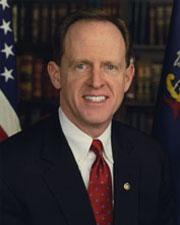
Mr. Chairman, let me just suggest to the gentleman from Maryland who raised the question about 1997, there is a big difference between imposing PAYGO on the revenue side in 1997 versus doing so…
Mr. Chairman, let me just suggest to the gentleman from Maryland who raised the question about 1997, there is a big difference between imposing PAYGO on the revenue side in 1997 versus doing so today, and the big difference is doing it in 1997 did not result necessarily in a big tax increase. Doing it today, as the minority party would like to do, would absolutely result in a huge tax increase because of the provisions in the Senate. That is a big difference. A huge tax increase versus not having a huge tax increase is a big difference.
Let me just say, I congratulate our chairman and the members of the committee who got this bill to this point on the floor. It is so important that we find a way to control and limit the growth in spending for a number of reasons, as this bill does, but I think that one of the main reasons is it is just so fundamentally important and incumbent upon us to be adopting policies that allow the American people to maximize economic growth and prosperity, opportunity for themselves, for their wages to grow and their standard of living to improve. That is what we ought to be all about.
Well, the empirical evidence is very clear that one of the greatest threats to that kind of prosperity comes from excessive government intervention in the economy. The government intervenes and threatens economic growth in lots of ways, but the two biggest ways that the government does that is through excessive government spending and excessive taxes.
On the spending side, I think we ought to acknowledge that on the margin, excessive growth spending results in less economic growth. That is what happens. It is because the government essentially misallocates capital.
Let us face it. When we are here in Washington spending money, what we are doing is allocating capital based on political needs. Members of Congress tend to vote to spend money on that which they think will help them get reelected. That does not make us bad people. That is the natural tendency of a represented body. That is what governments do. But what it means, this political self-preservation, what it ends up meaning is that the excess spending of other people's money, by the way, might maximize incumbent retention, but it certainly does not maximize economic growth. And I think that is what we ought to be all about here.
In fact, the tendency is forever more government spending. We see that now we are spending over 20 percent of GDP; whereas, just 3 years ago it was only 18 percent. We have got larger deficits now. The government is growing faster than the economy. All the things point in the same direction. We need some limits on spending growth. That is what this is all about.
Let us keep in mind that the caps that we have on discretionary spending in this bill, the PAYGO provision that we have on mandatory spending, there is no spending cuts. Nothing is cut. Frankly, I would like to cut some spending. I wish there were, but there is not.
And we all know that there is no guarantee that the caps will even hold. If we could get them passed and signed into law, you know, Congress usually has a way of busting the caps, but what they do and the important role that they can play is they help on the margin to provide a break on the rate of growth of spending, and that is what is so important.
I mentioned the other big way in which government intervention harms economic growth, and that is excessive taxes. And there is just no question. The evidence is overwhelming. And the good news is that when we have taken the measures of lowering the tax burden as we did, if we can make those tax cuts permanent, we can continue to enjoy the tremendous economic growth that is underway right now.
So I urge my colleagues to reject the Democratic substitute and support this underlying bill.
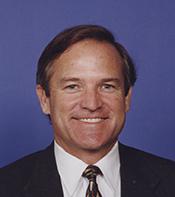
Mr. Speaker, the previous speaker has not listened to the debate. We are going to ask people making over $1 million a year to make a small sacrifice during this time of war. That is who is going to…
Mr. Speaker, the previous speaker has not listened to the
debate. We are going to ask people making over $1 million a year to make a small sacrifice during this time of war. That is who is going to pay for investment into America's future.
In Congress, our values are expressed more by our budget priorities than by our speeches. And the Obey resolution reflects American values far better than this year's Republican budget, and this is why: the Republican budget continues the same old status quo, a failed philosophy that has led to unprecedented deficits. That philosophy was expressed by the gentleman from Texas (Mr. DeLay), majority leader, on March 12, 2003: ``Nothing is more important in the face of war than cutting taxes.'' A direct quote.
That bizarre philosophy flies in the face of the basic American value of shared sacrifice during time of war. Can anyone imagine Franklin Roosevelt having stood here on December 8 of 1941 saying to the American people it is time to cut taxes, nothing is more important than that after Pearl Harbor? In World War II, fortunately, President Roosevelt did something different. He inspired all Americans to make sacrifices to support the war and our servicemen and -women, and it was the right thing to do.
Unfortunately, as we now face the war on terrorism, the Republican budget reflects the gentleman from Texas's (Mr. DeLay) flawed philosophy that tax cuts should trump sacrifice and services for veterans and military families during time of war. What is the result of this ideologically driven budget? First, the consequence is that this year's deficit is the largest deficit in American history. With massive unpaid-for tax cuts, we are borrowing billions of dollars to pay for the Iraqi war, and that means that young soldiers from my district at Fort Hood fighting in that war today will have to come home and help pay for it after the war is over. Billionaires living safely here at home, getting multimillion-dollar-a-year tax cuts while young soldiers have to fight for the war in Iraq and then pay for it. Where is the fairness in that?
To add insult to injury, the Republican budget pays for its tax cuts to the wealthiest 1 percent of Americans by reducing veterans health care and freezing military housing improvement programs. If the American people find out about this dirty little secret in the Republican budget, they will be outraged, as they should be. And as a representative of nearly 40,000 soldiers who fought in Iraq over the last 18 months, I am certainly outraged.
These are the facts: fact number one, the gentleman from New Jersey (Mr. Smith), Republican chairman of the Committee on Veterans' Affairs, has said it would take $2.5 billion of increased VA health care spending just to keep from having to reduce veterans health care services because of health care inflation.
Fact number two: The Republican budget underfunds present services for VA health care by $1.3 billion. That means real cuts to millions of real veterans.
Fact number three: several weeks ago, on the same day the House Republican leadership voted to give Members of Congress a tax cut, they pushed through a Defense authorization bill that will freeze the most important military housing improvement program in American history. Over 24,000 military families will not receive the new housing they deserve. No new housing for thousands of military families, while we get thousands in tax cuts, we Members of Congress. Where is the fairness in that? Where is the American value in that?
There is a better choice, a clear choice, a choice that reflects the true values of the American people. The Obey resolution will prevent cuts in veterans health care and will prevent cuts in military housing. It is the right thing to do for America.
Bill Text
2 versions available
        [Congressional Bills 108th Congress]
[From the U.S. Government Publishing Office]
[H. Res. 692 Reported in House (RH)]

House Calendar No. 194
108th CONGRESS
2d Session
H. RES. 692

[Report No. 108-566]

Providing for consideration of the bill (H.R. 4663) to amend part C of
the Balanced Budget and Emergency Deficit Control Act of 1985 to extend
the discretionary spending limits and pay-as-you-go through fiscal year
2009.

_______________________________________________________________________

IN THE HOUSE OF REPRESENTATIVES

June 24 (legislative day, June 23), 2004

Mr. Hastings of Washington, from the Committee on Rules, reported the
following resolution; which was referred to the House Calendar and
ordered to be printed

_______________________________________________________________________

RESOLUTION

Providing for consideration of the bill (H.R. 4663) to amend part C of
the Balanced Budget and Emergency Deficit Control Act of 1985 to extend
the discretionary spending limits and pay-as-you-go through fiscal year
2009.

Resolved, That at any time after the adoption of this resolution
the Speaker may, pursuant to clause 2(b) of rule XVIII, declare the
House resolved into the Committee of the Whole House on the state of
the Union for consideration of the bill (H.R. 4663) to amend part C of
the Balanced Budget and Emergency Deficit Control Act of 1985 to extend
the discretionary spending limits and pay-as-you-go through fiscal year
2009. The first reading of the bill shall be dispensed with. All points
of order against consideration of the bill are waived. General debate
shall be confined to the bill and shall not exceed one hour equally
divided and controlled by the chairman and ranking minority member of
the Committee on the Budget. After general debate the bill shall be
considered for amendment under the five-minute rule. The bill shall be
considered as read. All points of order against the bill are waived. No
amendment to the bill shall be in order except those printed in the
report of the Committee on Rules accompanying this resolution. Each
such amendment may be offered only in the order printed in the report,
may be offered only by a Member designated in the report, shall be
considered as read, shall be debatable for the time specified in the
report equally divided and controlled by the proponent and an opponent,
shall not be subject to amendment, and shall not be subject to a demand
for division of the question in the House or in the Committee of the
Whole. All points of order against such amendments are waived except
that upon adoption of an amendment in the nature of a substitute, only
the last amendment printed in the report of the Committee on Rules
shall be in order. At the conclusion of consideration of the bill for
amendment the Committee shall rise and report the bill to the House
with such amendments as may have been adopted. The previous question
shall be considered as ordered on the bill and amendments thereto to
final passage without intervening motion except one motion to recommit
with or without instructions.

House Calendar No. 194

108th CONGRESS

2d Session

H. RES. 692

[Report No. 108-566]

_______________________________________________________________________

RESOLUTION

Providing for consideration of the bill (H.R. 4663) to amend part C of
the Balanced Budget and Emergency Deficit Control Act of 1985 to extend
the discretionary spending limits and pay-as-you-go through fiscal year
2009.

_______________________________________________________________________

June 24 (legislative day, June 23), 2004

Referred to the House Calendar and ordered to be printed