Global Peacekeeping Operations Initiative Act of 2004

Legislative Activity
Stay on top of the latest movement without scrolling through every action
Star Print ordered on the bill.
June 14, 2004
View full timeline
Introduced in Senate
June 9, 2004
Sponsor introductory remarks on measure. (CR S6675)
June 9, 2004
Read twice and referred to the Committee on Foreign Relations.
June 9, 2004
Star Print ordered on the bill.
June 14, 2004
Floor Debate
21 membersWhat members said about S. 2514 on the floor
 KC
KC DN
DN PSS
PSS CJD
CJD MC+16
MC+16
Floor Debate
21 membersWhat members said about S. 2514 on the floor
Mr. President, this is, I believe, the worst budget this Chamber has considered perhaps in its history. It is radical, reckless, dangerous, and extreme. At a time of record budget deficits, it…
Mr. President, this is, I believe, the worst budget this Chamber has considered perhaps in its history. It is radical, reckless, dangerous, and extreme. At a time of record budget deficits, it proposes to cut revenues by over $1.3 trillion and increase spending by over $1.1 trillion, driving us deeper into deficits and debt.
It explodes deficits when we are at war, the cost of which is unknown, and right on the eve of the retirement of the baby boom generation which will dramatically increase the cost of Social Security and Medicare.
Make no mistake, the cost of the massive tax cuts in this budget explode at the very time the cost to the Government of the baby boom generation's retirement explodes. There can only be one result, and that is to drive this country off the cliff into deficits and debt on a scale and magnitude never seen in this country's history. That is not just irresponsible, it is wildly irresponsible.
This budget is not a document that represents a conservative approach to governance. It is radical and it is extreme. It says deficits do not matter, that taking virtually every penny of the Social Security trust fund surpluses to fund tax cuts for the wealthiest among us, is the priority for this Nation.
This budget flunks every test of fiscal responsibility and basic fairness. This budget proposes taking trillions of dollars raised from the payroll taxes of middle-class Americans, generated to support Social Security, and uses them to fund an income tax cut overwhelmingly for the benefit of the most wealthy among us.
The President's proposal, which this budget resolution seeks to support, would give a $90,000 tax reduction to those earning over $1 million a year and funds it by taking the payroll tax money of middle- class Americans to pay for it. To the extent it is not paid for by that mechanism, it borrows the money and charges the cost to future generations. That is class warfare of an extreme nature. It takes from the many to give to the few.
The proponents of this budget claim it contains a growth package. It does not. It contains a radical expansion of deficits and debt that can only undermine our long-term economic strength and security. Oh, yes, it will give a momentary and modest lift to the economy. But like the drug addict who gets a momentary high, it will be inexorably followed by the lows brought on by the deadweight of deficits and debt.
The best economists in America tell us that this budget proposal hurts long-term economic growth and threatens our economic security because it is all financed by borrowed money. It is a borrow-and-spend philosophy that doubles our gross national debt over the next decade, right before the baby boom generation retires. This is the time we should be paying down debt or prepaying the liability we all know is to come. Instead, this budget says: Forget about what we know is happening and what is about to happen; let's live for the moment and not worry about the future.
As bad as this budget is--and it is bad--the process that brought it here is even worse. I believe it represents an attack on the Constitution itself. Our Founding Fathers intended the Senate to be the place where a determined minority could slow down and perhaps even stop measures that the minority believed could damage our country. So the Senate adopted the right to unlimited debate and the ability to offer unfettered amendments. The budget process used in this conference report has never been done before and fundamentally denies Senators those basic rights. The process, called reconciliation, which restricts Senators' rights to debate and amend, has been twisted like a pretzel into something unrecognizable from what was intended.
Reconciliation was meant to provide a fast-track process to reduce deficits, and now it is being used to explode them. Understand that this budget says both bodies, under the reconciliation provisions, are instructed to cut taxes by $550 billion. If anybody believes this is a measure to cut taxes by $350 billion under reconciliation, that person is profoundly misled. The instruction says clearly: Cut taxes by $550 billion under these fast-track procedures that mean Senators are denied the basic protection of unlimited debate and amendment.
In the next breath, the Senate is told to forget that instruction because there will be a supermajority point of order in the Senate if it is followed. But in the conference committee, the higher tax cut can be adopted and come back to the Senate and be passed on a simple majority vote under special time limits and with restrictions on amendments that deny every Senator their most basic rights.
All this was made possible by a procedure never considered or debated in either body. This scheme was concocted in the conference committee without a single member of the minority present--not one. We were locked out. So four members of the Senate majority, with two members of the House majority, have constructed a procedure, never contemplated in either Chamber, which allows the special restrictions and limitations of reconciliation to apply to a tax cut that never passed this Chamber.
This stands the plain meaning of reconciliation on its head. No true reconciliation between the House and the Senate has ever occurred. There was no true meeting of the minds. So they conjured up a new point of order in the conference committee as a figleaf to hide their failure.
Colleagues should understand the extreme nature of what is being done. If a conference committee can add new provisions never debated or contemplated in either Chamber, and do so without the minority, where does it end? Could an abusive minority of the
majority, in a conference committee, decide that a supermajority point of order would apply to an individual Senator's right to offer an amendment? Could just a handful of Senators and House Members in a conference committee create a supermajority point of order against amendments on a particular subject? What is to prevent a minority of the majority in a conference committee from fundamentally altering the rights of individual Senators?
This way lies chaos and a descent into unconstitutional government. Mark my words, the Senate will live to regret this day. Unintended consequences, we have seen in the past, flow from very little things.
In 1975, a tax cut of $6 million was used as precedent for using the reconciliation process that was designed for deficit reduction. It was used as a pretext to allow tax cuts of over $1 trillion, tax cuts that have pushed us now into deep deficit and growing debt.
This is what has been agreed to in the conference committee. The reporting has been almost uniformly wrong.
They say the tax cut permitted is $550 billion. That is not true. The tax cut in this budget resolution is $1.3 trillion, and that does not count the associated interest costs. It is only one part of the tax cut which is $550 billion. That is the so-called reconciled amount. Those are the amounts that will move under special protection, that will restrict Senators' right to amend, restrict Senators' right to unlimited debate, fundamentally restrict the determined minority's ability to stop what they believe will damage this country in a fundamental way.
I hope anybody voting on this understands. If you vote for this budget resolution, you are voting for $1.3 trillion of tax cuts, of which $550 billion is reconciled, moving under special protection that fundamentally restricts the Senators' basic rights to amend and debate.
I am happy to yield.
The Senator is on to something very important. Really, this understates the cost of the tax cut. The tax cut that is in this resolution, $1.3 trillion, has an additional cost, the associated interest cost, because this is all borrowed money. That would be another about $300 billion.
So the total cost goes to $1.6 trillion--truly stunning when we are already at record budget deficits, when we are at war, the cost of which no one knows, and when we are on the eve of the retirement of the baby boom generation. So there can only be one result; that is, to dramatically explode deficits and debt.
Yes. I would be pleased to yield.
Record budget deficit.
Yes. We now estimate the budget deficit, under this budget resolution, will be between $500 and $600 billion for this year alone on a $2.2 trillion budget. Some have said these deficits are small. There is nothing small about them. They are massive. They are record. They are the biggest we have ever had in dollar amount.
If we look back to 2 years ago when we were told that we could expect--instead of deficits--nearly $6 trillion of surpluses, we now know, if we adopt what is before us, instead of $5.6 trillion of surpluses--if we adopt the budget resolution before us--we will have over $2 trillion of deficits over that same period.
It is the situation. And what is most stunning about it is that it is all done at the worst possible time: at a time we are at war, the cost of which none of us can know; and also on the eve of the retirement of the baby boom generation, a cost we do know because the number of people eligible for Social Security and Medicare are going to double.
And I believe this proposal is very clear. If this is adopted, this will head us in the direction of massive cuts in Medicare, in Social Security, and most of the rest of Government as we know it.
I think it is absolutely foreordained, if this is adopted, you will see proposals that will be cloaked in the soft language of reform which will hide deep cuts in Social Security, in Medicare, and all other parts of Government. You can really have no other outcome because you have record budget deficits now; and what this proposal is, is to cut taxes by $1.3 trillion, not counting the interest cost, to increase spending by $1.1 trillion over the so-called baseline, including the interest cost. What you are left with, then, is even deeper deficits, right on the brink of the retirement of the baby boom generation which starts in 2008, which we all know what it will lead to. And I will show, as we go through this presentation, where that leads.
I would be happy to answer my colleague by saying this: This process and this budget, to me, is totally disconnected from reality. In fact, I have never seen a greater disconnect with reality than is represented by this budget. Here we are, with record budget deficits, approaching $500 to $600 billion this year, and what we do is increase spending under this resolution, cut the revenue, plunging the country deeper into deficits, when we are at war, the cost of which we do not know, and when we are on the eve of the retirement of the baby boom generation.
Let me just say, this fiscal turnaround that we have seen--when people ask us, well, where did the money go? Here is where it went. Over the period in question, 36 percent went to the tax cuts--both those already passed and those proposed.
The second biggest reason for the disappearance of the surplus is the additional spending caused by the attack on the country and the war; that is, the increased defense spending and the increased homeland security spending.
The third biggest reason is that revenue is coming in below expectation, apart from the tax cut; that is, the tax cut is the biggest single reason. The third biggest reason--close to the second-- is that revenue is coming in below what was anticipated.
And the smallest reason, over the 10-year period, is the economic downturn at 9 percent.
The result of all this is that the budget before us--after many of the Members of this body pledged not to take Social Security for other purposes--this is the total amount of Social Security surplus over this period: $2.7 trillion.
This budget takes $2,698,000,000,000 from the Social Security trust fund surpluses and uses it for other purposes, uses it to fund the tax cut, uses it to pay for other things. This budget has deficits. Some have said they are small and short term. Here is what they are. They are not small, and they are not short term. This year we now anticipate a deficit on an operating basis of $558 billion, by far the biggest we have ever had. You see throughout the rest of the decade, we never get below $300 billion in deficits. Again, that is not counting Social Security, not taking Social Security and using it to pay for other things.
That is correct.
Let me just say, the Senator has put his finger on what to me is so stunningly irresponsible about this budget. If this money was not being taken and used for other purposes, the surplus money, it could then be used in one of two ways. It could be used to pay down debt that would better prepare us for what is to come, or it could be used, some portion of it, to prepay the liability of what we know is to come. That is what other countries are doing. Other countries, recognizing the same demographic time bomb, are taking the surpluses being generated now in their trust funds and are investing them or they are prepaying the liability.
Instead of paying down debt or prepaying liability, we are using the money for tax cuts and for other expenditures of government that leave us less capable to deal with what is to come.
That is a profound mistake, and we will live to regret it. And we will then face a circumstance in which we will be asked to make even more draconian reductions in the benefits of those programs, or drastic tax increases.
Let me say, the President told us 2 years ago his budget would pay down a record amount of national debt. He said:
We will pay off $2 trillion of debt over the next decade.
That will be the largest debt reduction of any country, ever.
He said then:
Future generations shouldn't be forced to pay back money
that we have borrowed. We owe this kind of responsibility to
our children and grandchildren.
I believe the President was absolutely right in saying that. But look at what is happening. There is no record paydown of debt. There is no paydown of debt. Instead the gross debt of the United States is exploding. From $6.7 trillion in 2003, instead of being virtually paid off, which he said would occur by 2008, we are nearly doubling the national debt just in this 10-year period. So the national debt would be $12 trillion at the end of 2013 if this budget is adopted, the plan that it contains.
The President this year told us:
This country has many challenges. We will not deny, we will
not ignore, we will not pass along our problems to other
Congresses, to other presidents and other generations.
In this very budget, what we see contained is a call for the biggest increase in the debt limit in the history of the country. They are asking for a $984 billion increase in the debt limit as part of this proposal. That is the biggest increase in the national debt in the history of America.
Yes, $984 billion. The previous record increase was under the previous President Bush, November of 1990, when they got a $915 billion increase in the debt limit. As you know, the House has different rules than the Senate. We will not conclude action on the debt limit here probably until sometime later. But that is what this budget resolution contemplates, an increase in the debt limit now of $984 billion, nearly a $1 trillion increase in the debt.
Under this budget proposal, they will probably have to come back as early as next year----
Late next year and ask for even more expansion of debt because this budget resolution is one constructed on deficits and debt. It is a testimony to deficits and debt. It can only get worse.
It is interesting, the effect on the rest of the budget. For example, the interest costs, we were told 2 years ago the interest costs to the Federal Government over this next decade would be $622 billion. Instead, because of the failed fiscal plan, the interest costs alone will be $2.3 trillion. That is an increase in interest costs of $1.7 trillion. Obviously, we have to pay it because we have borrowed it, and we owe it. But those are dollars that can't buy a
single tank. They can't buy a single weapons system. They can't buy a single airplane. They can't educate a child. They can't house the homeless. They can't do any of the other things the Federal Government has responsibility for. They can't pay down debt. Those are dollars that are just used to service the debt we are running up.
I am happy to.
The Senator is correct. We had actually been in the happy circumstance of not only running a balanced budget, but running a surplus. In fact, we had stopped the practice of taking Social Security trust fund surpluses to fund other functions of Government. It was critically important that we do that because we are getting close to the retirement of the baby boom generation.
Some of our colleagues say to us that, you know, deficits don't really matter anymore. What a profoundly wrong notion that is. Obviously, deficits matter. When the Federal Government is compelled to borrow money, that puts us into competition with others who want to borrow money, that drives up the cost of interest rates, and that slows the economy. That is why when I reviewed this budget, it is not an economic growth budget, it is a budget that will hurt long-term economic growth because of the deadweight of these deficits and debt. That is not just my opinion.
I will get to the point in the presentation where we talk about others who are economists who have been hired by the White House, by the CBO, to tell us the implications of what is being done; and what they have concluded is that this will hurt economic growth because it is all being financed by borrowed money.
What does that mean? When the Federal Government borrows money, we are in competition with the private sector, and that reduces the pool of societal savings. That is a dissavings. When you reduce the pool of societal savings, that reduces the amount of money available for investment and that hurts long-term economic growth.
It is not just this Senator who says that. Interestingly enough, the CBO is headed by a man chosen by our colleagues on the other side, who came directly from the White House. He has done seven long-term models looking at the effect of this budget. In four of the seven, he said deficits would be even worse as a result of this budget proposal. In three he found it would be better, but only on the assumption that Americans, over the next decade, would work harder in preparation for the massive tax increases that will inevitably flow from the adoption of this kind of a budget.
I hope people understand where this is all headed because it is as clear as it can be. Nobody can vote today and say they didn't know. Nobody can vote today and not have their record reviewed and have people look back and say these people led us down a path of deficits and debt that fundamentally weakened the country.
This is a chart from the President's own budget document. This comes from his analytical perspectives, page 43. This is his long-term outlook. We never escape from deficit under the President's plan-- never--according to his own estimates. In fact, we are in the sweet spot now. You can see that the deficits here are the smallest they are going to be. Yet these are record deficits. It may look like a small amount of red, but it is the most red we have ever experienced, and it is going to get worse. Under the President's own analysis of his plan, it gets worse because the cost of the tax cuts explode at the very time the cost of the Government explodes because of the retirement of the baby boom generation.
That is correct. If this were in dollar terms, I could not put it on a chart. The sea of red ink that would follow would not fit on any chart that I am allowed to use on the Senate floor.
What is interesting is that, right now, we would not be eligible to join the European Union because our deficit is in excess of what is required for a member state to join the European Union. We would be disqualified. We are headed for a circumstance in which we would not be qualified for decades to come.
The fundamental reason is contained on this chart, I say to my colleague. This, to me, is the single most important thing to understand. This chart shows the Social Security surplus, Social Security trust fund, the green bar. The blue bar is the Medicare trust fund. The red bar is the cost of the proposed and already-enacted tax cuts. What one can see is that right now we are running big surpluses in the Medicare and Social Security trust funds. In fact, the tax cuts right now, in this part of the time period, are less than the trust fund surpluses.
Look what happens when the baby boomers start to retire and those trust funds go cash negative. It is at the very time that the cost of the President's tax cuts explode. What does that do? That leads us into deep deficits and debt.
I don't want anybody to conclude from this that this Senator doesn't favor some tax cuts because I do. I think they are necessary right now to stimulate the economy, give lift to the economy. But we have to balance the need for short-term additional stimulus both by way of spending and tax cuts, with the long-term need to return to fiscal balance and to prepare for retirement of the baby boom generation.
What is being done here does neither because only 5 percent of the cost of the President's proposed tax cuts in the stimulus package are effective this year, when we need the stimulus, when the economy is weak. Ninety-five percent of the cost is in future years, when it is only going to explode deficits and debt. It will lead to a weakened economic position and will fundamentally alter this country's ability to meet its obligations.
Mr. President, I say to my colleague, what this means is not just numbers on a page, not just deficits, whether people care about deficits or not, they matter a lot to the functioning of the economy. They matter a lot to the ability of the United States to keep its obligations.
The implication of all this is much more direct. This is going to compel at a future time, according to the former Congressional Budget Office Director, massive cuts in benefits of Social Security and Medicare, massive tax increases, and massive debt. That can be the only outcome because none of this adds up in any serious way.
For those who say deficits do not matter, Chairman Greenspan of the Federal Reserve believes deficits matter. This is what he said in testimony before the Banking Committee, where my colleague is the ranking member:
There is no question that as deficits go up, contrary to
what some have said, it does affect long-term interest rates.
It does have a negative impact on the economy, unless
attended.
It is not just the view of the Chairman of the Federal Reserve, but the Committee for Economic Development, which is made up of some of the most prominent business leaders in the country, has looked at these budget proposals, and this is what their conclusion is:
No. 1, current budget projections seriously understate the problem;
No. 2, while slower economic growth has caused much of the immediate deterioration in the deficit, the deficits in later years reflect our tax-and-spending choices;
No. 3, deficits do matter;
And No. 4, the aging of our population compounds the problem.
The other day in the New York Times, some of our most able former colleagues and former members of administrations, both Republican and Democrat, put out this op-ed. This is former Senator Kerrey, former Senator Nunn, both Democrats, former Senator Rudman, a prominent Republican, Pete Peterson who was in the Cabinet of a Republican administration, Robert Rubin, former Secretary of the Treasury, and Paul Volcker, the distinguished former head of the Federal Reserve.
They asked the question:
Will Congress stand up for fiscal responsibility?
They said in this article:
Tax cuts are the primary focus of this year's budget
debate. To speed enactment, Congress is planning to use a
special fast-track procedure called reconciliation. While
determining the size of the tax cut to be given fast-track
protection in the budget is sometimes dismissed as a
procedural matter, it is not. Whatever its size, a tax cut
that receives this protection is almost certain to be enacted
in later tax legislation. Given the rapidly deteriorating
long-term fiscal outlook, neither proposal--
Neither the House nor the Senate proposal--
is fiscally responsible. It is illogical to begin turning
back toward balanced budgets by enacting a tax cut that will
only make the long-term outlook worse.
Furthermore, the proposed tax cuts are not useful for
short-term fiscal stimulus, since only a small portion would
take effect this year. Nor would they spur long-term economic
growth. In fact, tax cuts financed by perpetual deficits
will eventually slow the economy.
When our friends say this is a growth package, it is not a growth package. This is a package that undermines long-term growth. We have six of our most distinguished colleagues, former Senators and former members of the Cabinet, on a bipartisan basis telling us that is the case.
We do not have to just look to the Chairman of the Federal Reserve or former Cabinet members or former Senators; we can look at the people who have been hired by the White House to tell them the effect of their policies. This is what they said.
They showed that the policy being proposed will give a short-term bump, but after 2004, we will get less economic growth than if we did nothing. We would be better off to do nothing than to adopt this policy because it explodes deficits and debt. The deadweight of those deficits and debt will hurt long-term economic growth.
We have another distinguished economist, the head of Economy.com, who did this analysis of two competing proposals, what the Democrats proposed and what the President proposed. This is their conclusion.
The Democratic plan will give almost twice as much economic growth in 2003 and 2004 and not do the long-term harm of the President's proposal because we do not explode the deficits and debt in the way the President's plan and the budget plan before us does.
If we just want to look at reality, since we pursued this course, since we have gone to this notion of borrow and spend, here is what has happened. We have lost 2.6 million jobs.
I will be happy to yield.
I believe that is correct. I say to the Presiding Officer in response to my colleague, I really do not know what could be more clear. We do not need to just look at economists' projections. We can look at our own history.
We had this attempt in the 1980s to pursue the economic policy that is now being attempted. It did not end happily. It exploded the deficits and debt of the country. It quadrupled the national debt.
Then in the nineties, we took a different approach, the approach of balancing budgets, of investment in technology, of bringing down Federal spending, of raising revenue to balance budgets. What it kicked off was the longest economic expansion in our Nation's history. We turned deficits into surpluses, and we had the lowest unemployment rate in 30 years, the lowest inflation rate in 30 years, and the strongest period of business investment in our Nation's history.
That is a real-world example of two competing views of how to strengthen the economy. Now we are going back to the failed policy of the eighties and doing it at the worst possible time.
Then there was time, before the baby boomers started to retire. Now there is no time. The mistakes that are made now will be paid for by increased debt, by reduced benefits, by increased taxes. That is where we are headed.
And I would quote again our most distinguished colleagues warning us:
Congress cannot simply conclude that deficits do not
matter. Over the long-term, deficits matter a great deal.
They lower future economic growth by reducing the level of
national savings that can be devoted to productive
investments.
That is the argument I have been making this morning.
They raise interest rates higher than they would be
otherwise. They raise interest payments on the national debt.
They reduce the fiscal flexibility to deal with unexpected
developments. If we forget these economic consequences, we
risk creating an unsupportable tax burden for the next
generation.
I guess we are in this mode now where we live for the moment. I guess we do not worry or care about what we do now, how it affects the future. But we ought to. The lessons are clear. The warning signs are there.
Every Senator is going to be responsible for their vote. Every Senator can be held accountable in the future for what they did to either strengthen this country or to weaken it. Every Senator is going to have a very clear choice in a few hours: Do they support a budget that plunges us deeper into deficits and debt, or do they say it is time to pull back?
This is the economic record on job creation of administrations going back to President Eisenhower. Every one of them created jobs. This is the first one to lose private sector jobs in 50 years. If we look to public opinion, the American people are saying:
On the home front, Americans strongly agreed with the past
week's Senate action to
slash the President's proposed tax cut. Two in three
respondents--Republicans, Democrats and independents alike--
favored the Senate plan to reduce Bush's $726 billion tax cut
by more than half to help pay for the war, shore up Social
Security and reduce the deficit.
That is two-thirds of the American people sending us a message. I do not think we should do budgets based on polling, but I do think we ought to do it based on common sense, and common sense ought to tell us that exploding deficits and debt when we are at war, exploding deficits and debt when the baby boom generation is about to retire, exploding deficits and debt when we know it will harm long-term economic growth, is truly a fool's errand, and we will live to rue the day we made shortsighted decisions.
I yield the floor.
I yield whatever time he may consume to the Senator from Maryland.
Mr. President, I would like to go back to the editorial, the opinion piece that was in the New York Times written by three of our former colleagues: Senator Kerrey, Senator Nunn, Senator Rudman-- Senator Rudman, a Republican who was on the Budget Committee. Senator Nunn and Senator Kerrey took great interest in budget affairs here in the Senate. Also, Pete Peterson, the former Secretary of Commerce, Republican; former Secretary of the Treasury Robert Rubin; and the former head of the Federal Reserve, Mr. Volcker; warning us that what we are about to do here is not fiscally responsible.
They said in this article--and I want to read an extended version of this for my colleagues because I think it is critically important it be in the Record before we vote. They said:
The fiscal outlook is much worse than official projections
indicate. These projections assume that the tax cuts enacted
in 2001 will expire at the end of 2010. They also assume that
discretionary spending, the part of the budget that pays for
national defense, domestic security, education and
transportation, will shrink continuously as a share of the
economy. Neither of these assumptions is realistic.
Moreover, the official projections do not include the costs
of war and reconstruction in Iraq. And they ignore the
inevitable need to reform the alternative minimum tax, which
is not indexed for inflation and will apply to some 40
million households within 10 years--up from two million
today.
Let me just say with respect to the alternative minimum tax, boy, have a lot of people got a surprise coming. They think they are going to get a tax cut under this plan. But there is this little thing nobody talks about called the alternative minimum tax that only applies to 2 million taxpayers today. By the end of this period of the budget, it is going to apply to 40 million taxpayers. It costs $600 billion to fix. Not a dime of it is in this budget.
Under more realistic assumptions--
They go on to say in their opinion piece--
the deficit projections are cause for alarm. A recent study
by Goldman Sachs includes this forecast: if the president's
proposed new tax cuts are enacted, a Medicare prescription
drug benefit is approved, [which he has also proposed], the
A.M.T. is adjusted and appropriations grow modestly, the
deficits over the next 10 years will total $4.2 trillion--
That is double the amount I have been talking about in my assessment of this budget this morning--twice as much as what I have been warning my colleagues about--
even if the Social Security surplus is included.
It will be $4.2 trillion of deficits. In other words, if the Social Security trust funds are used to pay for other things, the deficit will be $4.2 trillion.
If [the Social Security trust fund] is not included, the
deficit would be $6.7 trillion.
That is just over the next decade.
Under these circumstances the ratio of publicly held debt
to gross domestic product climbs within 10 years to near 50
percent, from 33 percent just two years ago.
And all of this happens before the fiscal going gets tough.
Looming at the end of the decade is a demographic
transformation that threatens to swamp the budget and the
economy with unfunded benefit promises, like Social Security
and Medicare, of roughly $25 trillion in present value. Our
children and grandchildren already face unthinkable payroll
tax burdens that could go as high as 33 percent to pay for
these promised benefits.
They conclude:
It is neither fiscally nor morally responsible to give
ourselves tax cuts and leave future generations with an even
higher tax burden.
And yet tax cuts are the primary focus of this year's
budget debate.
Mr. President, in just a few hours we will vote on this budget. This will be a time of choice. This won't be a decision just for this year. This will put in place revenue hemorrhages and increased spending that will put us on a never ending escalator, going in just one direction-- straight down into deeper deficits, in deeper debt, right on the brink of the retirement of the baby boom generation. It will only escalate those trends, leaving us in a totally unsustainable position.
The tax cut that we are voting on is not what has been advertised, $350 billion in the Senate--oh, no. The tax cut in this plan, in this budget resolution that is before us, is $1.3 trillion; $550 billion reconciled to the Finance Committee, $725 billion provided elsewhere in the resolution--a tax cut of $1.3 trillion, with an additional interest cost of some $300 billion, for a total reduction in revenue of $1.6 trillion just over the next decade, when we are already in record budget deficits.
This is a proposal that borders on the preposterous. It borders on the absurd. I sometimes come to work thinking the Senate of the United States has become like Disneyland: It is all illusion here. It is totally detached from reality. It has all become the politics of sound bite. Substance has absolutely fallen by the wayside, and there is no serious concern where all this leads. But it is inevitable. This leads to massive deficits and debt that can only undermine the strength and security of this economy, that can only endanger the economic lives of the American people.
This is profoundly wrong, and I urge my colleagues to think--to think, to pause. I know there is a rush to judgment here. We are on a Friday afternoon right before a 2-week break. Members want to leave.
But what is going to be decided here has profound consequences for the future of our Nation; a $1.3 trillion tax cut--not paid for, not offset by spending reductions, but paid for by borrowed money and by looting the trust funds of Social Security and Medicare. That is what is about to happen here.
Virtually every economist has told us, when you take tax cuts like this and, instead of paying for them with spending reductions, you borrow the money, you weaken the economic vitality of this Nation. You take money out of the societal savings, the pool of societal savings, thereby reducing the money that is available for investment, thereby weakening the economic strength of our Nation.
That is exactly what our former distinguished colleagues are telling us. I repeat their concluding paragraph:
Congress cannot simply conclude that deficits don't matter.
Over the long term, deficits matter a great deal. They lower
future economic growth by reducing the level of national
savings that can be devoted to productive investments. They
raise interest rates higher than they would be otherwise.
They raise interest payments on the national debt. They
reduce the fiscal flexibility to deal with unexpected
developments [such as the terrorist threat on this country].
``Terrorist threat on this country''--that is not part of their op- ed. I add that because we all now know the devastation that something unanticipated can cause to this country.
If we forget these economic consequences, we risk creating
an insupportable tax burden for the next generation.
Now, I know, in politics, we often live for the next election and there is not too great a concern for the future. But, colleagues, I urge you to think carefully about the decision that is about to be made because it will have profound consequences for this Nation. I believe it will weaken our country, not strengthen it. I believe it will damage long-term economic growth, not improve it.
Does that mean that on this side we are against any tax reduction? No. I
would actually support more tax reduction in this year than the President proposes in order to give lift to the economy at a time of serious weakness. But, over the 10-year period, we simply cannot afford $1.3 trillion out of the revenue stream, when we are already in record deficit, and when we face the retirement of the baby boom generation, and we are at war, the cost of which is unknown.
I know the other side must believe it has the votes to pass this budget. We have had no role in it. We were locked out of the conference committee. Oh, we were invited to the first meeting, and never invited back. So this is a budget that was constructed in a conference committee that excluded the minority.
That is not the way the business of Congress is supposed to be done. There was not one member of the minority present when this scheme was hatched to come out here with a budget reconciliation number that suggests there is a different number in the Senate than in the House. In fact, both committees have been given an instruction of $550 billion for the reconciliation provision. But then, in a sleight of hand, the Finance Committee is told, there will be a supermajority point of order if you carry out the instruction you have been given.
Never been done before. Never been done before.
And when the package comes back from the conference committee, even though there never was a reconciliation, never was a working out or a meeting of the minds between the House and the Senate, the higher House number will still enjoy privileged protection on this floor.
That is a total perversion of the reconciliation process. And, my colleagues, it may benefit you today, it may hurt you tomorrow, because what goes around comes around. And the real victim is fiscal responsibility. The real victims are going to be those who are asked to pick up the tab for what we are going to be spending; the real victims are going to be those who have to shoulder the burdens that we all know are coming. And we are telling them: We are taking our money while the getting is good, and we are sticking you with the tab.
I guess that is the message that is going to come from this Senate today. I find it profoundly disappointing that is the way, apparently, the votes will fall, that it is OK to run up the tab, forget about the future, stick it to the kids. That is what this vote will be about.
I say, Mr. President, in response to my colleague, I believe this budget really is a triumph of ideology. And it is a sad--a sad--commentary on this body that we pass something that is this disconnected from reality.
At some point we are going to have to join together to try to dig out of this mess because this is going to damage the country in a profound way. I just hope that at some point reason returns.
This is not a conservative document. There is nothing conservative about this. This is radical and reckless and dangerous, and it should be defeated. We should go back, and we should restrain spending, and we ought to restrain our appetite for tax cuts. We ought to have the courage to stand up and tell the American people what we all know is true: That when this Nation is already facing record budget deficits, and we are at war--the cost of which we cannot know--and on the brink of the retirement of the baby boom generation, we simply cannot do everything they would like us to do.
We cannot have every spending program that they would like. We cannot have every tax cut that they would like and be responsible to the future. The result will be a weakened America, not a growth package. There may be a little bit more growth in the short term--not as much as if we had a more robust stimulus package--but, over time, the deadweight of those deficits and debt, because all of this is being borrowed--is all borrowed money--the deadweight of those deficits and debt suppresses economic growth, weakens our economy, reduces investment.
If you do not have investment, you cannot grow. You cannot have investment unless there are savings that are available to invest. When the Federal Government runs deficits, that reduces the pool of societal savings that are available to invest.
This is an economic package that simply cannot stand scrutiny.
I am happy to yield.
I would say to the Presiding Officer, in response to my colleague, it is truly a perverted result we have here. Aside from the substance of this budget, which I find appalling, the procedure is even worse. The procedure that was designed to provide a fast-track procedure to reduce deficits has now been seized upon to expand deficits. If that isn't standing history on its head, I don't know what is.
What they have done here is, they couldn't get a vote out of this Chamber to have a tax cut bigger than $350 billion. So what they did is, they went into a secret meeting in a room with the minority locked out, and they conjured up a scheme that says both committees are given an instruction, the tax committees, to cut taxes under these special fast-track procedures by $550 billion and another $725 billion on top of that outside of the fast-track procedures.
And with respect to those that are given the special protection, the $550 billion, the Senate Finance Committee is told, oh, wait a minute, there will be a supermajority point of order if you report anything more than $350 billion. But don't worry about that because when it goes to a conference committee between the House and the Senate, you can come back with the bigger number and still enjoy the protections, the special provisions of reconciliation that take away a Senator's fundamental right to debate and amend. That is what is happening here.
I say to my colleagues, we will rue the day this procedure is adopted. It has never been done before--never. What is going to happen here is going to fundamentally alter the Senate. The Senate was designed by the Founding Fathers to be different than the House of Representatives. It was designed to let a determined minority slow things down, to reconsider. But when it comes to reconciliation, forget it, because we have become just an extension of the House of Representatives. It will render the Finance Committee of the Senate irrelevant. All the Members of the Finance Committee should be aware of that. They are going to be irrelevant to this discussion because what is going to matter is what comes out of a conference with three or four people from both Chambers. They will come back here with whatever they decide. It will be an up-or-down vote, and a simple majority will pass it. And the fundamental role of the Senate is altered and diminished, and the strength of our Founding Fathers, the constitutional structure they created to protect this Nation, weakened. This is big stuff that is about to happen here. This is history-making stuff that is about to happen here. It is a dark day for this Chamber and for this country, in this Senator's view.
I yield the floor and suggest the absence of a quorum.
Mr. President, I ask unanimous consent that the order for the quorum call be rescinded.
While the Senator is waiting, I would like to show my colleagues what we have faced, what we were told would be the surpluses over the next decade. The Congressional Budget Office made their estimates 2 years ago, when they gave us a range of outcomes they said we could expect over the next decade. This is what they told us 2 years ago. They said this gray area were the possible outcomes, from least favorable to most favorable. They adopted as a prediction the midline. That is what told us we were going to have $5.6 trillion of surpluses over the next decade.
I showed this chart repeatedly back in 2001, when we were considering the tax cuts, and warned my colleagues that we should not count on any 10-year projection. Some of my colleagues said: You are being way too conservative. We won't have the midpoint of this range of possible outcomes; we will have much more than that because the tax cuts will produce more revenue.
That is the same song we are hearing now. They said: No, we won't have $5.6 trillion in surpluses; it will be much more than that because the tax cuts will kick off additional economic activity and that will bring us even more revenue.
Well, let's go back to a reality check and see what happened. This red line is what has happened. It is below the bottom of the projections that were made just 2 years ago. That is where we really are. We are not at the midpoint. We are not at the low point of the range of projections. We are below the bottom. All those who said if you just cut taxes, you get more money, that is dream world stuff. It didn't work. It didn't come close to working. They were wrong. They weren't just a little bit wrong, they were totally wrong. The result is deep deficits and debt that will burden this society for decades to come. That is the fact.
I thank the Chair and yield the floor.
Mr. President, we can debate economic theory for a long time. What is not open to debate is what has factually occurred. Let's go back. Two years ago, we were told this was the range of outcomes looking forward in terms of the budget surplus. The Congressional Budget Office and the President's Office of Management and Budget said they adopted the midpoint of this range. We are going to have $5.6 trillion of surpluses. Our friends on the other side said: Oh, no, it is going to be better than that because we are going to cut taxes; it is going to lead to bigger surpluses; it is not going to be the midpoint of the range of possible outcomes, it is going to be even better than that.
That was fantasy world stuff. We tried their approach. It failed. It did not even come close, not even hailing distance of what happened. Here is what happened. We wound up below the bottom of the range of projected outcomes with deficits and debt as far as the eye can see.
What is the answer of the other side? Let's do it again. Let's try it again. Let's dig the hole deeper. Let's run up more deficits, add more debt, and that will strengthen the country. Does anybody honestly believe that more deficits and more debt are going to strengthen the country when we are on the eve of the retirement of the baby boom generation that is going to explode the cost to the Federal Government, and these folks come forward with tax cuts that explode at the very same time when we are already in record deficit? I tell you, is there no common sense left?
Here is what our Congressional Budget Office, headed by their appointee, straight from the Council of Economic Advisers of the President of the United States, tells us if we adopt this proposal. He has done seven different models. He used their dynamic scoring, the idea that we are going to get more money if we cut the taxes. What did he find? In four of the cases, the deficits are even bigger. In three of the seven, the deficits are somewhat smaller, although all of them massive.
What does he say:
CBO estimates show lower deficits relative to so-called
static scoring only by assuming large tax increases beginning
in 2014.
Hello, is anybody listening? He is saying, all those who said the problem is they are not using dynamic scoring, they are not showing the positive effects of the tax cuts, if we just do that, we will see the deficits are not going to be so bad. So we turned it over to their guy, straight from the President's Council of Economic Advisers, and he comes back and says to us: Oh, no, the deficits are not going to be smaller, they are going to be bigger because of the deadweight of deficits and debt. You cannot take on all this borrowing and strengthen the country. You weaken the country.
Then he looked at three other possibilities. He ran three other models. Do you know what he said: Yes, the deficits could be somewhat smaller than would otherwise be the case, but that is on the theory that people are going to work harder over the next decade in preparation for the massive tax increases to come.
Let me repeat that: The only way the deficits are smaller than so- called static scoring is if you assume the American people are going to work harder in anticipation of the massive tax increases to come to deal with these deficits that are exploding out of control.
If anybody can seriously come out here and justify this proposal and these budgets, come on out, let's debate it. I do not see them. Where are they? Come on out here; let's debate. Let's debate what the effect of this budget is, $1.3 trillion of tax cuts on top of an initial $1.1 trillion of spending when we are already in record deficit on the eve of the retirement of the baby boomers, we are at war, a cost of which we do not know.
There is only one possible outcome: More deficits, more debt in a way that is totally unsustainable, and that will lead to massive cuts in Social Security and Medicare and all the rest of Government. That is what is coming next.
I would like to correct the record with respect to one thing the Senator from Pennsylvania said, I think inadvertently. The Budget Committee did report a budget last year. It did not come to the floor, but the Budget Committee did report a budget. The determination was made not to bring it to the floor. That determination was made because the Senate had a 10-year budget, the House had a 5-year budget. The Senate had used the more conservative OMB estimates. The House had used the more liberal OMB estimates.
It was very clear there would not be a reconciliation between the two.
I will be happy to yield in a moment.
The Senator, the ranking member of the Budget Committee, and I determined that we would bring a 2-year budget to the Senate. We did that. That required 60 votes to pass because it was not a product of the committee. We got 59 votes for that 2-year budget in the Senate; it required 60 votes.
The further facts are that we had all Democrats voting for it, we had 8 Republicans voting for it, including the ranking member of the Budget Committee, the ranking member of the Appropriations Committee, and others, but because we did not have 60 votes, it did not prevail.
It should also be known that the Appropriations Committee, on a unanimous vote, adopted the spending recommendation contained in the budget resolution passed in the committee. They adopted it on a unanimous vote.
Because of differences in the House, there was no final conclusion on most of the appropriations bills. They were held over to this year. And interestingly enough, the conclusion was a total that was within $2 billion of what we had proposed from the Budget Committee. So there was almost no difference--on over $700 billion of spending--almost no difference between what we proposed and what was ultimately passed in the early part of this year.
I am happy to yield.
I didn't make that determination. That was made in a higher pay grade than mine.
The budget we had done in the committee was a 10-year budget, and the budget in the House was a 5-year budget. We had used the more conservative CBO assumptions, and they used the Office of Management and Budget assumptions. We went to a 2-year budget because we thought that had the best prospects of securing the votes necessary to actually have a budget blueprint in the Chamber. We did get 59 votes. We did get a unanimous consent agreement from the appropriators to stick to that number.
For other reasons there was disagreement with House appropriators outside of the budget with respect to priorities.
I say to my colleague, no question, we would be better off to have a budget. That is a fundamental responsibility. It did not happen last year for lots of reasons. I have tried to enumerate some of those.
I personally am committed to the budget process. I think it is critically important. I agree with the Senator with respect to that observation.
The decision, it is fair to say, was a collective decision and probably was the wisest course given the circumstances we faced at the time.
We could ask the 41 who voted against the 2-year budget: Why did they fail to vote for what was a bipartisan budget proposal right here on the floor of the Senate that would have provided the budget blueprint? They had the chance; 59 Members voted for it, for a budget outline; 41 did not. The question ought to be directed to the 41 who voted no.
The Senator from North Dakota reclaims my time, and I say to the Senator from Pennsylvania, the Senator from Pennsylvania voted no. We had a 2-year budget. The Senator said he supported a 2-year budget; he voted no. The Senator had a chance last year to vote for a 2-year budget. He voted no; 59 Senators voted for it. We had an opportunity.
I will not yield until I finish. The Senator had an opportunity. Every Senator had an opportunity. And it is not the typical order to have a 1-year budget in the Senate. We deal with 5- year or 10-year budgets, not 1-year budgets.
Last year, in an attempt to achieve a budget on a bipartisan basis, we brought a 2-year budget to the floor. It was rejected; 59 Senators voted aye. It was a bipartisan vote; 41 voted no. They had their chance to have a budget, and they decided not to.
Mr. President, I suppose reasonable people could differ on what constitutes a budget for 2 years. The amendment that was offered last year was an attempt to adopt the budget that had been formed in the Budget Committee.
And what that amendment provided--and I have it before me now and the Senator is correct--was caps on spending.
It provided, for fiscal 2003, an overall amount for discretionary spending of $764,722,000,000. For the highway category, it provided $28.9 billion in outlays. For the mass transit category, it provided $1.445 billion. For the conservation spending category, it provided $1.922 billion.
It provided the framework--perhaps that is the best way to say it--of the budget that we had constructed in the committee. It was an attempt to give the appropriators the budget framework to go forward so they could do their work.
That is what the attempt was. I think it is fair to say it was not a full budget resolution. I would say that to my colleague. A full budget resolution is not a 2-year document. What the Budget Committee does with the full budget resolution is either a 5-year or a 10-year allocation of resources, both for taxing and spending. But it became evident we did not have the votes for that.
So what we tried to do was put in place this framework of a budget for 2 years, with caps set for 2 years, with the categories specified for the 2 years; but, more than that, to also provide an extension of pay-as-you-go provisions to include the budget enforcement mechanisms that were otherwise going to lapse and to provide the other elements that were important for the consideration of the individual decisions that the appropriators have to make.
I note my colleague from Massachusetts is here. He has asked for time. I yield 15 minutes to the Senator from Massachusetts.
Mr. President, I tried to be as frank and forthcoming as I could be. When the Senator says there were no categorizations, there were. I would be happy to enter it into the Record. It is not true to say there were not. There were.
You had the discretionary spending amount and the other elements that I described for the highway category, for the discretionary category. I don't know what the Senator is looking at.
Let me finish the thought and then I will be happy to yield.
Maybe we are looking at different things, but I offered an amendment to the Feingold amendment providing for these categories, providing for the discretionary amount, providing for these other categories. That appears in the Record as an amendment numbered 3916 to amendment No. 3915.
That is what I am discussing here.
I do yield 15 minutes to the Senator from Massachusetts. I am sorry. Would the Senator from Massachusetts withhold. The Senator from Pennsylvania wanted to ask a question. I am happy to yield to him.
Mr. President, perhaps it does no good to prolong this. But this was the chance we had to put in place the spending limits for last year and this. It was our chance to establish what a budget resolution does. A budget resolution outlines what are the resources available, and it was our best chance to put in place that structure, to have the Appropriations Committee know what was available to them. That vote was held.
I am happy to yield to the Senator from Massachusetts.
I have yielded to the Senator from Massachusetts for 15 minutes.
Mr. President, the Senator is correct on that. I have no interest in saying it is something it was not. The Senator is correct on that. But I would say to the Senator, this was our best chance to put in place a budget framework to give the Appropriations Committee an indication of what was available to them to spend and not to spend more than that and to put in place the pay-as-you-go restrictions and to put in place the other budget enforcement mechanisms so that the functioning of the Congress could go forward.
I understand the Senator, for whatever reason, decided to oppose that. I just say to him, that was our best chance of putting in place the framework for a budget. It didn't happen. All of us can take responsibility. I will take my share of responsibility. I regret very much that the budget that I took out of the committee didn't come
to the floor and we didn't have a chance to conclude action on it. I was pleased that we were able to get bipartisan agreement, at least with respect to that budget framework. I wish it would have passed. I think that would have been a good thing. But it did not.
I yield 15 minutes to the Senator from Massachusetts.
Mr. President, I am constrained to object. We hope to have agreement in the very near future, but apparently somebody needs to be contacted who has not yet been contacted. I say to my colleagues, I apologize. I thought we had agreement, but I am just informed we need to wait another few minutes before we can reach agreement.
I also need some time to wrap up, I say to my colleague, in maybe 10 minutes. Maybe we can work these all down in a way that fits within the time constraints.
Mr. President, I want to respond to something my colleague from Idaho indicated during his remarks when he stated that marriage penalty relief has been attacked as a tax cut for the wealthy. I know of no example of that. I do know that on our side, Democrats moved to accelerate that relief in 2001, but virtually every Republican voted against it.
I would be happy to have that vote printed in the Record at this time, so people can check the record and determine whether or not that allegation has merit or not. I ask unanimous consent that be printed in the Record.
I say to my colleague, as I indicated, we on this side moved to accelerate that relief in 2001. In fact, I offered the amendment.
All but two on your side voted against it.
Is the Senator seeking time?
I yield 10 minutes to the Senator from Illinois.
Mr. President, I thank the Senator from Illinois.
Does the Senator from Florida seek time?
Mr. President, I yield 12 minutes to the Senator from Florida.
Mr. President, I yield an additional few minutes to the Senator.
Mr. President, I thank the Senator from Florida, Mr. Nelson. He is a very valuable member of the Budget Committee. He has been steadfast and resolute on fiscal responsibility. As he has made clear, he does not believe this budget represents that. The truth is, it does not. This is a budget that is going to explode the deficits and debt of the United States at a time of already record deficits. It takes $1.3 trillion away in revenue and increases expenditures by $1.1 trillion. There can only be one result, and that is more red ink, more deficits, more debt, and a threatening of the economic security of the Nation.
How much time does my colleague from North Dakota need?
I yield 15 minutes to the Senator from North Dakota.
Mr. President, I ask unanimous consent that the Senate now proceed to the consideration of the conference report to accompany H. Con. Res 95, the concurrent budget resolution for fiscal year 2004.…
Mr. President, I ask unanimous consent that the Senate now proceed to the consideration of the conference report to accompany H. Con. Res 95, the concurrent budget resolution for fiscal year 2004.
Certainly.
Did the Senator say they have the intention of yielding most of their time?
I am happy to work with my colleagues to find a mutually agreed upon time for debate and for final passage. We have up to 10 hours, as my colleague knows. That would have us voting at 8 o'clock tonight. I hope we can reduce that. I will work with colleagues on both sides to make it mutually agreeable.
Mr. President, for the information of our colleagues, I urge our colleagues to stay in town today on this particular Friday before an April Easter recess. We have a vote on the Senate budget conference report, which we are now debating. We have a vote on the urgent DOD request, the war supplemental. That will be voted on today. I expect we will also have a vote on debt limit extension. Maybe that can be done by voice, maybe not. I urge colleagues to be here today.
Those are the three very important issues to be resolved today. We will try to work with all of our colleagues to expedite consideration of all three measures, and I will be happy to accommodate and yield time and work with people. We need to pass all three bills. I look forward to working with all involved Senators to come to the conclusion of all three bills.
Mr. President, I appreciate the comments of my colleague and friend from Nevada. I will bump that up to a higher level between the majority leader, minority leader, and my friends. It was my understanding it needs to be done this week before we left. I have not consulted with Treasury--the Secretary of the Treasury in the last week or so. It was my understanding it really needed to pass before the April break. Maybe that is not the case. It may be my friend from Nevada and others have done their tax returns and paid such enormous taxes that we are in great shape. There is usually an April bump in revenues. That is my main concern. We don't like being in the situation where we are borrowing funds from civil service retirements and so on, which has happened in the past, and may be happening now. I will be happy to bump that up to the majority and minority leaders. It was my understanding it needed to be done prior to our leaving for this break.
I yield the floor and suggest the absence of a quorum.
Mr. President, I ask unanimous consent that the order for the quorum call be rescinded.
Mr. President, as we begin the debate on the budget for fiscal year 2004, I will make a couple of comments. One, I compliment my colleague, Chairman Nussle, in the House. It has been a pleasure to work with him.
Passing a budget is never easy. I have been critical in the past, such as when last year we did not get a budget passed, but I have a better appreciation for how difficult it is. Particularly when we have a great big number of 51 on our side, it is not an easy job. So I compliment Chairman Nussle and thank him for his work and cooperation.
We had many hours working together trying to formulate a budget that would pass both the House and the Senate. It is a great deal easier said than done. We have come forward with a budget this year that accomplishes a lot of major objectives. We balance the budget. We balance the budget in 9 years, not 10. When we brought it before the Senate, it was balanced in 10 years, in 2013. Now we balance it by the year 2012.
It is a budget that allows and encourages growing the economy. The economy has not been growing. Frankly, we will never balance the budget if the economy is not growing. This budget allows and provides for a growth package.
This is a budget that will help us win the war on terrorism. We fully fund the President's request for national defense and homeland defense.
It includes the war supplemental that Congress is going to pass tonight. The Senate passed it a week ago, and we will end up passing it as well today. It fully funds homeland security and the President's request.
It also is a budget that allows us to modernize Medicare. We did not get that done last Congress. We should have, but we did not. Almost everybody says they are in favor of it, but because we did not have a budget, we did not have protection on the floor. We did not even have markup in the committee. We did spend some time on it on the floor, but we were not successful. This is a bill that says we will
spend up to $400 billion not just to provide a drug benefit but also to strengthen and improve Medicare, not just for the current beneficiaries but for future generations as well.
It is a budget that maintains spending discipline. It grows domestic nondefense discretionary, but barely--about 2.3 percent over 2003 levels before the supplemental. We limit spending with enforceable caps for the next 2 years.
Budgets are not easy. They are not pretty. The process is difficult. It is long. It is tedious. It is tough. It is not the easiest committee of which to be a member. I thank all members of the Budget Committee who helped us build this budget.
When we convened early this year, we had seven Budget Committee hearings. The President submitted his budget on February 3. We passed a large appropriations bill, the 2003 appropriations bill, on February 13. These were appropriations from the previous year. We did not get a budget last year, and we did not get appropriations last year.
Why did we not get the appropriations bills done? Because the House and the Senate were arguing what the appropriate level would be. There was never a budget, so this was not an agreement on how much we should spend. And because we did not have the agreement, we could not manage. It just did not work. And the Congress did not work. Last year was a very frustrating year, largely because we did not have a budget. In February of this year, we ended up passing last year's appropriations bill. Eleven of the thirteen bills passed in February. On March 7, CBO submitted the reestimate of the President's budget, and then on March 12 and 13, the Senate Budget Committee marked up the President's budget. We had 2 days of markup. We had 32 amendments considered, 23 rollcall votes, and we passed it out of the committee on March 13.
Then we had the longest consideration of the budget maybe in Senate history. I will have to look back, but we had 7 days of debate on the floor. The Budget Act provides for 50 hours, but we had 50 hours plus many more hours because we had a very extended number of rollcall votes. We had 81 amendments considered on the floor. Fifty-one were decided by rollcall votes, and 31 by voice votes which adds up to 82, including final passage.
We have had a challenging conference. We had a very challenging conference, after both the House and Senate passed a bill, because we had differing expectations of what could pass, particularly as it related to the growth package. The House wanted, and they passed, a growth package of $726 billion. The Senate passed a package of $350 billion. The Senate could not pass more than $350 billion, it looks like, and the House would not accept $350 billion. It is kind of hard to have reconciliation in a conference agreement if there are irreconcilable differences.
What did we do? Well, we were a little innovative and we came up with giving different instructions to the House and the Senate, certainly legitimate in parliamentary procedure. It has not been done before, so we gave an instruction to the House. The House has an instruction of $550 billion on the growth package. The Senate has an instruction of $350 billion on the growth package. The difference is to be decided by the conference. I think I know where the votes are. I will tell my friends and colleagues, I know Chairman Grassley very well. I expect that I will be a conferee, and we do not expect to bring a bill out of conference unless it will pass the House and the Senate. We want it to become law. We do not want to make political statements. We want to help the economy grow. That is our objective.
So hopefully we will have a budget and a growth package. I think it is more important to have a budget than even having a growth package. I think we have to have fiscal discipline. The budget amounts to $2.2 trillion. The growth package is somewhere between $350 billion and $550 billion over 10 years. Over 10 years, we are going to spend about $30 trillion. I think we have to have some management of that $30 trillion in the next 10 years.
If we did not pass a budget last year and we do not pass a budget this year, then we have really no budget. The former Director of the Congressional Budget Office said the budget process is dead. I called him and told him: I beg to differ with you, but if we were not successful in passing a budget this year, it would be dead. If we had 2 consecutive years and Congress did not pass a budget, then certainly it would be dead, for all practical purposes. There would be no budget enforcement. There would be no pay-go. There would be no rules against spending on extraneous measures. This budget has enforcement.
I will mention a couple of other things. We have inherited a very difficult thing. A lot of people are going to come to the floor today and they are going to decry how large these deficits are and say: Woe is me, how come we have all of these deficits? It is because of the tax cuts.
That is not actually factual. The fact is we have large deficits because revenues have declined dramatically--not because of tax cuts but because of the economy. Revenues fell 2 years ago, 1.7 percent. Last year, they fell 7 percent. Combined, that is about a 9-percent reduction in revenues in the last 2 years. Simultaneously, spending went up 12 percent; revenues went down 9 percent. Spending went up 12.2 percent, and we went from a surplus of $129 billion to a deficit of $159 billion in 1 year.
What caused that? A soft economy, a stock market collapsing. People will later say that is because of President Bush's policies. That is not correct. The NASDAQ fell 50 percent between March of 2000 and December of 2000, so the market started collapsing under President Clinton. I want to make sure people know where this collapse came from. Revenues started falling like a rock because the stock market started collapsing. Maybe the stock market had irrational exuberance going up, but it fell dramatically and that cut off revenues. A lot less capital gains, less personal income tax, and revenues declined to the Federal Government.
Also, we had something called a terrorist attack on the United States on September 11 in the year 2001. That has cost this economy and it has brought a lot of outlays to the Federal Government--outlays to respond to terrorism, outlays to protect us against terrorism, outlays to rebuild both New York and Washington, DC. As a result, outlays have gone up and expenses to the economy have been dramatic. It is hard to calculate how significant it has been.
So we have the confluence of several things. We already had a stock market declining dramatically, we had a soft economy, then we had September 11 on top of that, which has made revenues go down and expenditures go up.
What can we do? We have to show fiscal discipline. We have done that in this budget. Despite attempts by many to increase spending by over $1 trillion, we held the line on nondefense spending. It will only grow by a couple of percentage points. That is compared to spending that has been growing at dramatic increases in past years. The year before last, it was 12 percent alone in discretionary spending. When I talk about spending, sometimes we talk about discretionary and sometimes we talk about entitlements, but discretionary spending, the amount of money we control, had been increasing at enormous levels. We contained that growth. In nondefense, as I mentioned, spending growth has been limited to a couple of percentage points.
We do a couple other things. We reinstill discipline. We have caps on discretionary spending. We have enactment of changes. If you want to call something emergency, you have to have 60 votes. We prohibit advance funding which was done more often than it should have been, advance funding where you not only appropriate for the next fiscal year but maybe for the next couple of years. We prohibit that.
Let me mention a few more. Spending growth in 2004 will be 4 percent. Defense spending in 2004 is 2.4 percent in budget authority. The last 5 years it has been 7.6 percent; nondefense spending growth in 2004, 2.9 percent. The average was 7.9 percent. In defense, I mentioned we fully fund the President's request to fight the war on Iraq. We have included the war supplemental. We fully fund homeland security. That is an increase of 18.4 percent in 2004. We have a $3 billion increase over the President's request in 2000 for the Department of Education. Those are programs such as IDA, title I, No Child Left Behind. Veterans health
care is the largest increase ever, 14.7 percent. I have mentioned Medicare and our efforts there. We also have a pay-go point of order, to limit mandatory increases or revenue decreases in excess of those provided in the budget.
We did something else, and I want to make sure my colleague from North Dakota listens to this because we can work together on this. The House--to their credit, I would say--proposed hundreds of billions of dollars in savings in entitlements. The President did not propose those; we did not propose those. I had to think maybe we need to be looking at entitlements. We did not get that done in this budget when we had the opportunity. We did not do it. And I did not call for it to be done because I didn't think Congress was ready. I want Congress to get ready. I want the authorizing committees to start doing oversight.
We require in this resolution the House and the Senate authorizing committees to submit findings to the Budget Committee identifying instances of waste and fraud and abuse in programs within their jurisdictions. There are a lot. We have not had extensive oversight on a lot of programs in years, for whatever reason. Blame me, blame all of us; we need to do more. We are requesting and actually directing each of the committees to give us identified areas where they think we can make savings. Those need to be submitted by the authorizing committees by September 2 of 2003, and we will use those in the Budget Committee to develop future budget resolutions. We do not want to dictate to the authorizing committees, but we want to work with the authorizing committees to get real results, real savings, real oversight.
It bothers me a lot when we find out we have actually hundreds of billions of dollars estimated to be lost in errors or waste--in some programs it is 20 or 30 percent.
Regarding the earned-income tax credit program, I believe CBO did a study, and it was something like an error rate of close to 30 percent. That is not acceptable. We need to make sure Government is more efficient and more effective.
I look forward to the debate on this resolution. I hope our colleagues consider it vitally important to pass a budget. We will be grossly irresponsible if we do not. It is easy to throw stones and sticks and say I don't like this so we will just vote no. But, conversely, we have to govern. We considered alternatives, and they did not pass. I urge our colleagues to consider this budget. I urge Members to vote for final passage some time later this afternoon.
Mr. President, I ask unanimous consent that quorum calls be charged equally from now on during the course of the debate.
Mr. President, just a parliamentary inquiry: I would like to remind my colleagues the rules of the Senate are to address the Chair, ask questions through the Chair, not to have colloquies between two Senators.
I remind my colleagues, they need to ask questions through the Chair, and they need to ask questions and answer questions.
Mr. President, I want to give a little different vantage point
on some of these issues, and then maybe other colleagues will wish to speak.
I have heard kind of a continual part of the debate offered by our colleagues in opposition to this resolution that this is a terrible budget resolution. They say it is bad, worse, evil, preposterous, and absurd.
Wait a minute. At least we have a budget. Frankly, budgets are not easy. How much money are we going to spend, and how much are we going to tax? You always have a lot of people who want to spend more, maybe tax less, maybe tax more. I have heard a lot of comments that maybe we should be taxing a lot more. In the budget resolution, we assume the tax cuts we passed in 2001 would be continued in years 2011, 2012, and 2013. They would sunset at the end of 2010. I guess my colleague on the other side would like to have those tax cuts made tax increases in the years 2011, 2012, and 2013. That is about half of the tax cut that is in this bill. We need to do that. We need to address those tax cuts sometime between now and 2010. I doubt it is going to happen this year. If it does--I guess a bill could be offered and, if it is, it is debatable. I doubt that will be part of the tax bill that will be proposed under the reconciliation procedure.
In the President's proposed reconciliation growth package, he would like to have that happen quickly so we can get the economy moving. The economy is not moving very quickly. Some people presupposed that they knew exactly what was going to be in the tax bill. We tell the Finance Committee to cut up to $350 billion in the Senate. The House is $550 billion. We go to conference.
Most people count votes. I count votes around here. I think I know where the votes are going to be. I know Chairman Grassley pretty well. I doubt we will come back from conference with something we cannot pass in the Senate. We will make that decision probably 5 weeks from now, not today. I hope we do things to grow the economy. The economy is going down. It needs help. I will mention to our colleagues that our colleagues had a stimulus or growth package. Theirs was almost all spending; 75 percent was spending, with very little tax relief. I guess their idea of a growth package is to grow government.
Our idea is, wait a minute, let's contain the growth of Government and have some incentive to grow the economy. Historically, in the tax arena--I happened to be elected in 1980, so I go back to that point. In 1980, the Federal Government took in $517 billion, and the maximum personal tax rate per individual was 70 percent. Ronald Reagan was elected President, and 8 years later the maximum tax rate was 28 percent. If you listen to the dialog we just had, you would think revenues would have fallen. We reduced tax rates from 70 percent to 28 percent. That happened over the first several years of the Reagan administration.
In 1990, total revenues to the Federal Government almost doubled, from $517 billion to over a trillion dollars. So we cut tax rates dramatically. But guess what. Revenues went up. Then I looked back a little closer. Well, President Bush increased the rate from 28 percent to 31 percent in 1990. When President Clinton was elected in 1992, he raised the rate from 31 percent to 39.6 percent. I have heard discussion about all these ``massive'' tax cuts for the wealthy and benefits to the wealthy. So far, the wealthy, the higher income tax brackets, are reduced a great big 1 percentage point, from 39.6 to 38.6. That is all that happened. Evidently, they say that is the reason we have this enormous deficit, which is absurd.
What do we do on the lower income? We took lower income rates that were 15 percent and made those 10 percent and made that retroactive. Then we passed a $500 per child tax credit. That is law. Now it is $600. So we have done a lot of things for lower income, to make them basically not pay Federal income tax, some of which was retroactive, or pay a lot lower rate.
I keep hearing all this class warfare and that these deficits are caused by the tax cut, and some people don't like tax cuts and they want to have tax increases, I guess, in the outyears. But I don't think that will help the economy. Some of us want to help the economy.
I looked back and, historically, we have done some things in this body, with bipartisan support, that helped the economy. We reduced capital gains rates in 1997 over the objection of the Clinton administration. They eventually signed the bill. We reduced the rate from 28 to 27 percent and it helped create and foment a lot of growth.
If you look at total growth in revenues in the last several years, in 1998, 1999, and 2000, revenues exploded to the Federal Government--I think in part because we cut capital gains rates. So we can cut rates on occasion and it will help the economy. I am absolutely convinced that it had a great deal of economic stimulus when we cut the rates in 1997 and revenues exploded to the Federal Government. Unfortunately, in the last couple of years, revenues have declined a lot, mostly because the stock market has declined a lot.
So people talk about, wait a minute, we expected $5.6 trillion surpluses over the next 10 years. That was estimated by CBO. They were way wrong because the stock market had already started crashing. NASDAQ, which was exploding in the late nineties, declined by 50 percent between March of 2000 and December of 2000. CBO missed it. They didn't know what that would mean as far as projections. CBO did not forecast the terrorist attack on 9/11 and the disastrous impact that had on the economy and what that has caused in outlays.
I wanted to make a couple of those points. We need to grow the economy and we have a stimulus package that I believe will pass the Senate--and probably a comparable figure will pass the conference. It is a little bit more than our colleagues on the Democrat side wanted, except it is mostly on the tax side, not the spending side.
The other criticism is, wait a minute, this budget is so terrible. Well, at least it is a budget. It is critically important that we pass it. Last year, we didn't even have a budget on the floor of the Senate. One passed through the Budget Committee; my compliments to the chairman for that, but we didn't have a chance to even vote on the floor of the Senate. I think people can be pretty critical, but I think we need to be a little more reserved. It is important that we pass a budget.
I urge our colleagues to be mindful, if we do not pass a budget, one example would be: One could come up on a bill next week, and the bill might be a small authorization bill. Someone can offer an amendment to it and say: Let's spend $1 trillion on a new program, maybe it is prescription drugs or some other type of program that sounds really good. Let's spend hundreds of millions of dollars on education. Sounds good. Let's spend hundreds of millions of dollars--we could do all those things, and if we do not pass this budget today, there would be no 60-vote point of order. Spending would be running rampant. We would be totally out of control. We would have no caps on appropriated caps and no limit on the $2.2 trillion we are spending today, and there is no limit on the demand for Federal spending. It could get out of hand very easily. The only limitation we would have would be the potential threat of a Presidential veto.
We need to govern better than that, and we need to show some discipline. If we remember those 51 votes when we passed the budget resolution, there were countless amendments, almost all of which on the Democrat side were: Let's grow spending; let's increase spending. Deficits are not caused just on the revenue side, they are caused by spending more than we take in.
I wanted to make those points in response to our friends and colleagues on the other side.
I yield the floor.
Will the Senator yield for a question? If you count in the additional interest costs which would have to be incurred to do this tax cut because of the borrowing that would be necessary to fill the…
Will the Senator yield for a question?
If you count in the additional interest costs which would have to be incurred to do this tax cut because of the borrowing that would be necessary to fill the deficit gap created by the loss of revenues from the tax cut, what would the cost of this tax cut be?
It seems to me eminently reasonable that one also ought to factor in the interest costs associated because you have to borrow money in order to do the tax cut. Am I correct that we would have to borrow money in order to do the tax cut?
May I ask the Senator one more question about his chart before he puts it down?
There is all this focus about this $550 billion figure being the amount of the tax cut. But as I understand it, the $550 billion figure is only part of the tax cut that is in the budget resolution. This is the part that would proceed under the special procedures, the so-called reconciliation, which prevents extended debate in order to address the issue. The budget resolution provides $550 billion there, but it also provides an additional $725 billion in additional tax cuts. Now, they would have to go through the regular procedure, but, nevertheless, that is $1.3 trillion. And then you add the interest, and you are talking about $1.6 trillion tax cuts, at a time when we are in budget deficit.
I understand. In fact, I understand that the budget deficit for this year is now projected to be twice as much as it has ever been before--an absolute record budget deficit.
Will the Senator yield for a question on that chart?
In January of 2001, when this administration first came in, we were projecting out, over the 10-year time period, a surplus of $5.6 trillion. At the time, President Bush, and his Republican supporters, said: Well, we are going to run this huge surplus. We should do a tax cut because we don't want to be taking taxes just to build up a surplus.
Well, a lot of people said: Don't be so sure about that. Let's not rush into it. Why don't we pay down the debt some more? We are finally doing that.
No, no, they wanted to do this big tax cut because we had a projected surplus. Well, they did their tax cut. They rammed that through here.
Now we are projecting big deficits, and they want to do another big tax cut, even though they are projecting big deficits.
Whatever the fiscal situation is--big surpluses or big deficits--it makes no difference; they are bound and determined to do tax cuts for very wealthy people.
As I understand it, analysis of the President's tax proposal shows that almost 50 percent of the benefits of that tax cut go to the top 1 percent of the population. Almost 75 percent of it goes to the top 5 percent of the population.
So there is this absolutely zealous drive for big tax cuts for very wealthy people regardless of the Nation's fiscal situation and regardless of the fact that this proposal is going to drive us deeper into deficit and deeper into debt. Isn't that the situation?
Will the Senator yield for a further point?
The Senator made reference to the context in which we find ourselves. I am frank to tell you, I think this is a reckless budget resolution. I think the President's budget proposal was reckless. I think this resolution is reckless. As the very able Senator from North Dakota has pointed out, we are in a war, and we have not only the war costs but the reconstruction costs. We are about to do a supplemental of about $80 billion, most of it devoted to that purpose. And there is no one who contends that is anything other than the initial downpayment on the cost.
But, furthermore, we still have the worldwide battle against al-Qaida and
international terrorism. We have to confront the challenge of providing for homeland security. We have other threats around the world, to mention but one, North Korea.
No prudent person would give away their fiscal ability to deal with those situations the way this budget resolution does. It is extraordinary what this budget resolution is doing.
I ask my friend from North Dakota, isn't this an abject failure to reserve fiscal strength to deal with these pressing problems which we know are right there in front of us?
Will the Senator from North Dakota yield for a question about one of his charts?
I would like to go back to the previous chart. As I understand it, because of the tax cut and also because we are constrained to do these programs for the war and for homeland security, over this 10-year period we are going to be using $2.7 trillion from the Social Security trust fund to cover those costs; is that correct?
As I understand it, if we didn't do that, that $2.7 trillion would be in the Social Security trust fund to help us take care of the extra stress on the system that will come from the retirement of the baby boomers, this upsurge in people taking retirement, so that one needs to understand if you didn't do the tax cut or if you constrained some of these other programs, you wouldn't then be drawing down the Social Security trust fund and, therefore, it would be in a better position to address the extra stress that will come when the baby boom generation retires. Is that the connection one should be making here?
Will the Senator yield?
This budget conference report is seeking an increase in the debt limit of just under $1 trillion; is that correct?
If the Senator will yield further, until when is this additional $1 trillion increase in the debt limit supposed to last? Will they not come back at any point, or are they going to come back again and again seeking increases?
Oh, my.
Would the Senator yield on that point?
Mr. President, I would like to put a question to the Senator from North Dakota.
Mr. President, when this administration came into office, it was my recollection that the Federal budget was running a surplus. Therefore, there was not only no increase in Federal interest costs, but we were, in fact, year to year, reducing Federal interest costs and had done so for 2 or 3 years prior to President Bush coming into office; is that correct?
As I understand it, this chart shows the deficit as a percentage of the gross domestic product and it is almost 14 percent at this point out here; is that correct?
The European Union, when they made the economic agreement with respect to all the European Union countries, set as a requirement that the deficit that a country was running could not be greater than 3 percent of GDP; and countries had to go through a rigorous effort to get below the 3 percent of GDP figure as a deficit.
Yet what the President has given us, and what is reflected in this budget resolution as a first significant step in that direction, is a policy that is going to put the deficit as a percentage of GDP in the double figures. It will well exceed 10 percent.
I am struck in looking at that chart by the extent to which the cost of these tax cuts explodes, as the Senator says, in future years.
For instance, take the year 2023, this is all deficit. But all of this part of that deficit is from the explosion of the tax cut. The balance is from what happens in the trust funds for Medicare and Social Security. But this chart so clearly demonstrates that these tax cuts that are being talked about have built into them a tremendous expanded cost in future years.
It is extraordinarily dramatic because all of that is exploding tax cuts. We are being set on a path that is dooming us to large deficits and large debt.
Mr. President, will the Senator yield on that point?
My understanding is that the unemployment rate in the course of this administration has gone from 4 percent to almost 6 percent, and that the number of long-term unemployed, people out of work for more than 26 weeks, is now at almost 2 million people. Consumer confidence in the latest survey is at a 10-year low. So we are facing serious economic challenges.
Of course, the Senator suggested, as did the quote from our former colleagues, that you could do some effort to boost the economy this year and next year to try to bring us out of this situation, but the President's proposal does very little of that.
What the President's proposal does is put into place these exploding tax cuts out into future years that will significantly boost the deficit and the debt problem, rather than addressing the immediate challenge we have of trying to give a boost to the economy now. So not only does this budget proposal commit the Nation to a serious long-term fiscal problem, but it fails to do what needs to be done in the short term, in terms of trying to restore jobs and economic growth. I ask my colleague, is that not correct?
Mr. President, I thank the very able Senator from North Dakota, the former chairman of the Senate Budget Committee and now ranking member, for an extraordinarily perceptive opening statement with respect to this budget resolution.
The Senator from North Dakota has taken a long-term view of where the American economy is going and the challenges we face. He has assumed that role repeatedly, and I think it is extremely important that we not simply live for the moment and that someone point out the direction in which we are going and what the consequences will be.
The vote we are about to cast has consequences. It has consequences for today, tomorrow, and many years into the future. Members of the Senate need to fully appreciate the import of this decision.
I will speak a few minutes about equities in this budget resolution. What needs to be understood is that the whole driving thrust of this budget resolution is to put in place a large tax cut which, under the President's proposal, will go overwhelmingly to people at the very top of our income and wealth scale in this country.
The drive to do that is carried so far that my colleagues on the other side of the aisle are prepared to twist the procedures of this institution like a pretzel in order to push through their large tax cuts because they are encountering considerable resistance to them by people who are stopping and looking at them and saying this is not the responsible thing to do. Indeed, it is a reckless thing to do.
One of my colleagues looking at what they are trying to do said: It never occurred to me, I never thought I would see the day when they would be using these kinds of gimmicks in order to push their agenda.
This is no proper process. This is simply a twisting of process in order to try to get to this tax cut result.
Let's look at what the tax cut does and its implications. The budget, of course, sets all our national priorities. We make fundamental decisions within the budget: How much support we will provide for particular programs, what we will do on the tax side. Of course, the aggregate amount of the budget can have a profound effect upon our overall economy, not only this year but extending well into the future. The Senator from North Dakota very carefully and lucidly spelled out those large budget consequences, as is, of course, the responsibility of the leader on the Budget Committee to do.
We know the fiscal situation has deteriorated drastically since this administration took office. In January of 2001, when President Bush took office, the Congressional Budget Office was projecting a budget surplus over 10 years of $5.6 trillion. The President pointed to that surplus as a rationale for doing the 2001 tax cuts. Now, over that same period, the Congressional Budget Office is projecting a $2.1 trillion deficit, assuming that the President's tax proposals are adopted. This is a swing of $7.7 trillion in our fiscal position, a swing from a projected surplus of $5.6 trillion to a projected deficit of $2.1 trillion.
Yet facing this, the whole focus of this budget resolution has been whether to create room within it for another very large tax cut which the President is seeking. This is not going to be a growth package. In fact, there is hardly any stimulus in the President's proposal for this year or next year. Instead, this budget is going to drive us deeper into the deficit and debt hole. It is going to leave us with deficits projected out into the indefinite future. We are really mortgaging away our economic future. This is very bad macroeconomic policy.
In addition, within this budget our urgent national priorities are not being adequately addressed. There is not enough for homeland defense. We have a pressing health care problem in this country with regard to both the uninsured and prescription drug benefits for our senior citizens. We have an affordable housing crisis in which millions of working families cannot afford even a modest apartment in many high- cost cities. The mayors across the country are saying they are getting inadequate support to meet their responsibilities. Our first responders also have very large demands placed upon them. And instead of providing fully for education to give meaning to the Leave No Child Behind educational policy, we are focused on a tax cut proposal seeking to make sure no millionaire is left behind.
It must be understood that if you do these large tax cuts that benefit primarily wealthy people, you will not be able to support a number of programs which people all across the country are crying out for, and you will be boosting the deficit in a completely unreasonable fashion. There is no magic formula; it is all a question of balance. My own view is that a more sensible balance would be not to do these large tax cuts, and instead to strengthen some of these programs, and then to use the balance--most of the money--to hold down the deficit and not boost the debt and not commit the Nation down that path.
Let me talk about one other issue of fairness and equity. I want to note that in almost every previous instance when the Nation went to war, not only did we not cut taxes, we raised taxes in order to help pay for the war and meet its costs. There is a conference committee meeting at this very moment on the supplemental appropriations bill. We expect it to be somewhere in the vicinity of $80 billion, most of that directed to the Department of Defense for the costs of the war and some for reconstruction. It is obvious to everyone this is but a downpayment. No one is asserting this is anywhere near meeting what the full costs will be. So we know there is more to come.
That raises the question of whether this is the appropriate time to commit away significant resources for a tax cut to benefit wealthy Americans. As I said, analysis indicates that almost half of the benefits of the President's proposal would go to the top 1 percent, almost three-quarters to the top 5 percent. Is this the fair and equitable thing to do at the very time when the Nation is being rallied, as it should be, to support our men and women in the Armed Forces?
This is the time when we are talking about sacrifice, and it is appropriate we should be talking about sacrifice at a time like this because one cannot follow the events taking place now in Iraq without a deep appreciation of the sacrifice our fighting men and women are making and the risks they are taking every minute.
Let me ask this question: What sacrifice are those who are most favored in our society in terms of their economic position making at this critical juncture in our Nation's history? Not only are they not making a sacrifice, but indeed they are getting a very large tax cut which will place our economy in a more difficult position as we move into the future. What a sad commentary that these excessive tax cuts, which will contribute to deficits, which will build up the debt and the burden of paying the interest on that debt and, indeed, paying down that debt, will fall upon the fighting men and women when they return home and undertake their economic activities moving out into the future.
They are now being called upon to make a double sacrifice, the sacrifice of serving in the Middle East and the sacrifice when they return home of helping to pay off this debt that has arisen in large part because of these enormous tax cuts that are being given to those at the very top of our income
scale. Where is the fairness and the equity in this approach?
The Nation faces serious challenges. We have our men and women at this very moment in danger abroad. It is a time for all to sacrifice. What sacrifice here at home will the beneficiaries of the tax cut be making? This is such a sharp contrast with previous occasions when the Nation has gone into war. In most instances, not only did we not give a tax cut, recognizing we had to pay for the war, we, in fact, increased taxes in order to meet that burden.
At the beginning of World War II when Winston Churchill became Prime Minister, he told his nation, ``I have nothing to offer but blood, toil, tears and sweat.'' Our young men and women positioned in the Middle East are called upon to sacrifice even as we debate this budget resolution. There will be sweat, there will be tears, there will be toil, and there will be blood on their part. What sacrifice will be made by those who are the most well off in our society under this budget resolution? None whatsoever. In fact, not only are they making no sacrifice, but they are programmed to reap benefits, extensive benefits, at a time when the Nation is facing critical challenges. Should not those most advantaged be making their own sacrifice instead of seeking to reap a large economic benefit?
I urge the defeat of this budget resolution. I yield the floor.
I just note, the kids they are sticking it to are the ones who are fighting now in the Middle East. They are out there making a sacrifice now, and they are going to come home and be called upon to make a further sacrifice in order to carry this deficit and this increased debt.
And why are we having the deficit and the increased debt? In order to give a large, excessive tax break to very wealthy people. Where is the equity in that or the fairness in that? None whatever. None whatever.
But when you connect it all together, that is exactly what is happening. In order to give these large, excessive tax cuts, we are going to run these deficits and debt. And the burden on these young men and women who are there fighting, will be greatly increased, and they will have to pay it off over the rest of their lifetimes when they come home, having made that sacrifice.
Where is the sacrifice, in this budget resolution, on the part of those most advantaged in our society? Where is their sacrifice at this critical juncture in our Nation's history?
Not only is there no sacrifice, but they are reaping excessive benefits. This budget resolution ought to be defeated.
I thank the Senator for yielding.
Mr. President, as this presentation draws to a close, I ask unanimous consent to print in the Record a column by David Broder from March 23 entitled ``Cutbacks To Our Children.''
I want to quote a couple of paragraphs from the column:
Under the shadow of war with Iraq, the House and the Senate
last week fought a series of skirmishes over the federal
budget for next year. One big, overriding question was at
stake: Would President Bush and the Republican majorities in
Congress step up to the costs of battle, of homeland defense
and of national obligations at home, or would they pass the
costs on to future generations?
The answer, sadly, is that youngsters yet to be born will
see their choices limited and their prospects blighted by the
decision of today's politicians to press ahead with an
unaffordable tax cut even while the costs of war and
reconstruction make earlier spending estimates wildly
unrealistic.
The possible doubling of the national debt in the next
decade will drive up interest costs that must be paid every
year--billions of dollars that will not be available for
Social Security, Medicare or any of the myriad
responsibilities of the government here and abroad.
But the squeeze is not all prospective. Some dangerous
economies are being forced this year--cutbacks that will have
long-term damaging consequences for American society.
He then cites conversations he had with a number of attorneys general of the States, pointing out that cutting back on programs for young people will have disastrous consequences.
Once again, that is the connection that has to be made to giving these large tax cuts. I listened to my colleague from North Dakota as he talked about the procedure. I put a question to him. It strikes me as all a charade, is it not? As I understand it, we are going to pass a budget resolution that is going to have a tax cut figure in it. The Finance Committee in the Senate will be told they cannot reach that tax figure. They have to have the lower tax figure, as I understand it. But then when they go to conference to reconcile their tax figure with the higher House tax figure, let's say they settle at the higher tax figure, the House tax figure, the full amount, then they can bring it back to the Senate and that is protected under the special reconciliation procedures. Is that how it will work?
Mr. President, I thank my colleague from Kentucky. Very briefly, I had intended to offer an amendment at an appropriate time, most reluctantly, because it is unrelated to the subject matter at hand.…
Mr. President, I thank my colleague from Kentucky.
Very briefly, I had intended to offer an amendment at an appropriate time, most reluctantly, because it is unrelated to the subject matter at hand. But all my colleagues can relate to this frustration from time to time. When there is something you want to get done and you have few opportunities to get it done, you pick any vehicle coming along which might help you get it done. Recognizing that this was going to be one of the last funding measures to move along this year, I had intended at the appropriate time to offer an amendment that would have provided additional resources for the Help America Vote Act, on which my friend from Kentucky and Senator Bond and many others played a very critical role almost a year ago when it became the law of the Nation. In fact, October 29, 2003, will mark the 1-year anniversary of the day the President signed the legislation into law.
I am hopeful we can get the level of funding up to full in a timely manner. As all my colleagues must know, almost every Secretary of State, local election official, and legislative officer around the country are anxious for Congress to meet our obligations. The states can then get their election administration and technology up and running in the years 2004-2006 in a way that will be in compliance with the efforts made to pass the Help America Vote Act in the first place.
But my colleague from Kentucky, as he has done on numerous occasions, has persuaded me there may be a better opportunity and a better place to get this job done. So I wanted to take a moment out to express my appreciation. I thank him for his willingness to help me try to achieve these results in the coming weeks if at all possible.
To reiterate, I was prepared to offer an amendment to fully fund the Help America Vote Act, HAVA. Senators Corzine, Johnson, and Durbin had asked to cosponsor that amendment.
Why? Because now is the time to make our rhetoric a reality to live up to our promise of just 1 year ago to fully fund the new Federal requirements we imposed on the States for conducting Federal elections.
The President has recognized that Iraq and Afghanistan have many emergency needs, including the ability of those nations to establish democracies by conducting free and fair elections.
As a result, the administration request for the fiscal year 2004 Supplemental Appropriations for Iraq, Afghanistan and the Global War on Terrorism earmarked at least $35 million for voter registration and elections in Afghanistan.
I accept that priority. All countries must have the resources to establish and maintain their democracies and to administer and conduct elections for their citizens. The voice of the people, exercised at the polls, secures the future of any democracy, whether abroad or at home. And while I remain unconvinced that all of the funding in this bill is truly an emergency--such as for $3,000 computers or $50,000 dump trucks--when it comes to election funding, I will agree with the President. Funding to ensure the system by which a nation establishes and preserves a democracy is an emergency.
But if it is an emergency in Afghanistan, it can be no less of an emergency in America. The basic premise of a democracy is that every citizen must have an equal voice in the determination of its government. In this Nation, that voice is expressed through the equal opportunity to cast a vote and have that vote counted. If America is to be the example for emerging democracies, whether in Afghanistan, or Iraq or any other part of the world, then our system of giving our citizens an equal voice--our system of elections--must meet this test.
But what we learned in the elections of 2000 was that not all American citizens enjoyed an equal voice. In fact,
some citizens were denied a voice at all because of malfunctioning or outdated voting equipment, inaccurate and incomplete voter registration records, and allegations of voter intimidation and fraud.
A bipartisan group of members came together last Congress to change that and on October 29--almost exactly 1 year ago--President Bush signed into law the Help America Vote Act. At the signing ceremony at the White House, the President proclaimed:
[w]hen problems arise in the administration of elections, we
have a responsibility to fix them.
But rhetoric alone will not fix the problems. It will take leadership and funds, and that is what the Help America Vote Act provides--Federal leadership in the form of new minimum requirements that all States must meet in the conduct of Federal elections and $3.8 billion to fund the implementation of these requirements.
Some of these requirements must be in place in time for the Federal elections next year. But Congress has failed to provide the funds to the States to finance them.
All 50 States have begun the process of drafting the required State plans outlining how Federal funds will be used to meet the requirements. Many of the States have begun implementation of the new requirements; but, they require full funding of the promised Federal funds to complete implementation of some requirements by next year and have compliant voting equipment in place by the 2006 Federal elections.
Federal funding is the most critical key to nationwide implementation of this Act and may well govern the success and effectiveness of the new law.
Federal funding is crucial. Since the States are in key planning and implementation stages of HAVA, they are relying on Federal funds to make election reform a reality nationwide.
To help pay for election reforms and avoid an unfunded mandate on the States, HAVA authorizes a total of $3.9 billion over 3 fiscal years: $2.16 billion in fiscal year 2003; $1.04 billion in fiscal year 2004; and $660,000 in fiscal year 2005.
But in fiscal year 2003, Congress appropriated only $1.5 billion. Of that amount, $650 million has been distributed to all 50 States, the District of Columbia, Guam, Puerto Rico, the U.S. Virgin Islands and American Samoa.
I thank my colleagues for their support during the fiscal year 2003 appropriations process. In particular, I thank my two lead co-sponsors of HAVA and both major players in the appropriations process--Senator McConnell who was lead co-sponsor of election reform and Senator Bond who also co-sponsored HAVA and championed the anti-fraud provisions. I also thank Senator Stevens, chair of the Appropriations Committee and Senator Byrd, ranking member on Appropriations.
But the fact is, the fiscal year 2003 appropriation reflects a reality starkly different from our promise. As a result, the States have experienced a shortfall of over $660 million in the first critical year of funding under HAVA. Given the dire financial budget constraints faced by our States and counties, the shortfall in promised Federal support creates an unfunded mandate that is both unfair and unnecessary.
While the fiscal year 2004 Transportation, Treasury appropriations bill has not been completed in the Senate, I note that both the President and Congress has earmarked a mere $500 million for HAVA, a funding level that is half of what was authorized and is both inadequate and unacceptable.
According to the National Governors Association, the current financial health of State and local governments was at its lowest point since World War II last year and has worsened in the past 10 months.
Full Federal funding for HAVA is crucial to ensuring that the reforms that Congress overwhelmingly approved, on a broad bipartisan basis, and the President endorsed with his signature, are implemented. The very integrity of our elections, and consequently our democracy, hangs in the balance.
Surely, it cannot be argued that building ``taj mahal'' Iraqi prisons and market centers for the private sector in Afghanistan are more of an emergency than securing democracy in America.
We can do both. We must do both. But it is unacceptable to chose the reconstruction needs of Iraq and Afghanistan over the needs of our own democracy.
Full funding of HAVA is critical to our national credibility for fairness and accuracy in Federal elections. It is fundamental to the integrity of our democratic process.
The problem of Federal funding for HAVA can be solved by Congress today, now. The problem of Federal funding for HAVA can be solved right here in the context of the fiscal year 2004 Supplemental bill that we debate today.
I seek bipartisan support from my colleagues to help me strengthen democracy both abroad and at home--the same bipartisan support that lead 98 members of this Senate and 357 Members of the House to pass HAVA just 1 year ago; the same bipartisan support, and need, that encouraged President Bush to sign this legislation into law.
In order to make election reform a reality, and to live up to the promise we made to State and local officials to be a full partner in Federal elections, I intend to offer an amendment to this measure which will provide full funding for HAVA in an amount of $1.86 billion. This amount reflects the total authorization for the Federal partnership.
This effort is overwhelmingly supported by a bipartisan and powerful coalition of State and local election officials, in conjunction with all the major civil rights, disability, language minority, and other voter interest groups in the United States.
I thank each and every one of them for their strong support in passing HAVA and their continuing commitment to see that Congress makes good on its promise to be a full partner in Federal elections by fully funding the provisions of HAVA.
I ask unanimous consent to have printed in the Record a letter by the coalition, entitled ``Democracy Begins At Home: Fully Fund the Help America Vote Act.''
Any effort to fully fund HAVA is as much of an emergency as the needs presented in the bill before us for Iraq and Afghanistan and I am prepared to ask the Senate to support full funding of HAVA on the same emergency basis.
However, there are sufficient funds in the reconstruction portion of this bill which are of questionable emergency status that can be used to offset the entire cost of fully funding election reform. For example, $450 million from the public safety, national security and justice sector of this bill, including, $400 million in funds to construct 2 maximum security prisons of 4000 beds each at a cost of $50,000 per prison bed; and $50 million for witness protection at a cost of $1 million per Iraqi family.
There is $1.02 billion from the electrical sector, including $1 billion for the development and construct of thermal power stations-- which are more expensive than other forms of power generation and will take up to 3 years to construct; and $20 million for embedded consultants, building repairs and a master plan for the Iraqi Electricity Commission.
There is $37 million from the public works section, including funds for waste management that would pay for a portion of the proposed 2,000 dump trucks, at a cost of $50,000 per truck.
There is $353 million from the private sector development funds, including $200 million for an American-Iraq Enterprise Fund to be run by a private board of directors; $85 million for 5000 computers at a cost of $3000 per computer and basic and specialized computer training and teaching English as a second language to Iraqis; $25 million to modernize equipment and curriculum in vocational institutes; and $43 million subsidy to private employers for on the job training of new employees and the improvement of employment centers.
I close with a quote from the Coalition's letter:
No Civil Right Is More Fundamental to America's Democracy
than the Right to Vote. As Our Nation Spends Billions of
Dollars Helping to Promote Democracies Abroad, Congress
Simply Should Not Allow Doubts about the Legitimacy of Our
Electoral Process to Continue to Linger Here at Home.
I urge my colleagues to fulfill our commitment of last year to ensure the integrity of our Federal elections and
the very foundation of our democracy by fully funding the Help America Vote Act.
I commend Senator McConnell for his commitment to securing additional funds this year, and so I will withhold offering my amendment at this time.
Exhibit 1
Democracy Begins at Home--Fully Fund the ``Help America Vote Act''
September 29, 2003.
Dear Member of Congress: We, the undersigned organizations,
urge you to ensure that full funding for the Help America
Vote Act (P.L. 107-252) (``HAVA'') is included in the
upcoming supplemental appropriations for reconstruction
efforts in Iraq and Afghanistan. As you know, the Bush
administration has requested that Congress provide $21.4
billion for these reconstruction efforts. We ask that
Congress provide, at the same time, a mere fraction of that
amount for the purpose of strengthening our own democracy
here at home.
The Help America Vote Act was enacted with overwhelmingly
bipartisan support in order to prevent the many problems of
the 2000 election from ever happening again. Among its many
reforms, it places significant mandates upon states and
localities to replace outdated voting equipment, create
statewide voter registration lists and provide provisional
ballots to ensure that eligible voters are not turned away,
and make it easier for people with disabilities to cast
private, independent ballots.
To help pay for these reforms, HAVA authorizes a total of
$3.9 billion over three fiscal years, including $2.16 billion
for FY03 and $1.045 billion for FY04. To date, however, the
actual funding of HAVA has been woefully inadequate. So far,
only $1.5 billion of FY03 funding has been appropriated, and
$830 million of that amount has yet to reach the states
because the President has not nominated and the Senate has
not confirmed the members of the new Election Assistance
Commission. Additionally, only $500 million is currently
included in pending FY04 appropriations; once again, this is
a sum that falls well below what is needed for successful
implementation of HAVA. States and localities were assured by
Congress that this new law would not evolve into a set of
unfunded federal mandates. It is now time for Congress to
honor its commitment to the states and to the American public
at large.
Given the difficult fiscal circumstances facing state and
local governments, immediate and full funding of HAVA is now
needed in order to make essential progress before Election
Day in 2004. Without the strong leadership that HAVA promised
at the federal level, states and local governments simply do
not have the ability to complete implementation of the
important reforms that they are now required to make.
No civil right is more fundamental to America's democracy
than the right to vote. As our nation spends billions of
dollars helping to promote democracies abroad, Congress
simply should not allow doubts about the legitimacy of our
electoral processes to continue to linger here at home.
We thank you for your support of funding for the ``Help
America Vote Act,'' and we look forward to working with you
on this critical issue. Should you have any questions, please
contact Rob Randhava of the Leadership Conference on Civil
Rights at (202) 466-6058, Leslie Reynolds of the National
Association of Secretaries of State at (202) 624-3525, or any
of the individual organizations listed below.
Sincerely,
organizations representing state and local officials
National Association of Secretaries of State.
National Conference of State Legislatures.
Council of State Governments.
National Association of State Election Directors.
National Association of Counties.
National Association of Latino Elected and Appointed
Officials Educational Fund.
National League of Cities.
International City/County Management Association.
International Association of Clerks, Recorders, Election
Officials and Treasurers.
National Association of County Recorders, Election
Officials and Clerks.
civil rights organizations
Alliance for Retired Americans.
American Association of People with Disabilities.
American Civil Liberties Union.
American Federation of Labor--Congress of Industrial
Organizations.
Americans for Democratic Action.
Asian American Legal Defense and Education Fund.
Asian Law Alliance.
Asian Law Caucus.
Asian Pacific American Legal Center.
Association of Community Organizations for Reform Now.
Brennan Center for Justice at NYU School of Law.
California Council for the Blind.
Center for Governmental Studies.
Center for Voting and Democracy.
Common Cause.
Demos: A Network for Ideas & Action.
Disability Rights Education and Defense Fund.
Leadership Conference on Civil Rights.
League of Women Voters of the United States.
Mexican American Legal Defense and Educational Fund.
National Alliance of Postal and Federal Employees.
National Asian Pacific American Legal Consortium.
National Association for the Advancement of Colored People.
National Association of Protection and Advocacy Systems.
National Council of Churches.
National Council of La Raza.
Neighbor to Neighbor Action Fund.
Organization of Chinese Americans.
People For the American Way.
Project Vote.
Public Citizen.
The Arc of the United States.
United Auto Workers.
United Cerebral Palsy.
U.S. Action Education Fund.
U.S. Public Interest Research Group.
National Spinal Cord Injury Association.
National CURE (Citizens United for Rehabilitation of
Events).
American Foundation for the Blind.
National Industries for the Severely Handicapped.
Association of University Center on Disabilities.
American Council of the Blind.
Mr. President, I thank my colleague from Kentucky. I thank Senator Reid as well, the minority whip, Senator Stevens, and Senator Inouye for interrupting his prepared statement. I thank my colleagues.
I yield the floor.
Will the Senator yield? Mr. President, I ask unanimous consent that the vote on the adoption of the pending budget conference report occur at 4 p.m. today, with the time until then divided equally…
Will the Senator yield?
Mr. President, I ask unanimous consent that the vote on the adoption of the pending budget conference report occur at 4 p.m. today, with the time until then divided equally for debate.
Mr. President, I wish to speak on the conference report. I think it is important we put into perspective the debate we are having today. You heard a lot of talk, if you listened to this debate, about the potential danger of tax relief at a time like this in our economy. You heard a lot of talk about skyrocketing deficits and what is the responsibility or the cause of those deficits, and the circumstances around which this budget has been brought to the floor.
I wish to step back a bit and look at my personal experience in Congress as an example of what it is we are really looking at, what the perspective is with regard to this debate.
I ran for Congress in 1993. At that time, we had massive deficits, in the neighborhood of $200 billion, $300 billion, $400 billion, $500 billion, and had been having those deficits for years. I ran on a balanced budget platform. I argued for a lot of other issues, but one of the main issues I talked about was the need to balance our Federal budget. I got elected, got here to Washington, and have been involved in a debate over a budget each year since I served in Congress. Now I am in my 11th year.
In each year, what happens is, whoever is the leadership in Congress proposes a budget. The budget can be a 5-year budget, which is what we used to have, or a 10-year budget, such as the one before us. The important point to note about all these budgets is the year that counts, particularly with regard to spending, is the first year of the budget.
Yes, we are here talking about a 10-year budget, but next year we will be back in front of the Congress with a new budget, and the first year of that new budget will not necessarily be the same year, the same as the second year of this year's budget. In other words, we do not just adopt this 10-year budget and then go on from there and live with the budget constraints contained in each of those 10 years. We do a new budget every year. So what really counts is the first year of the budget. It is important for people listening to this debate to understand that dynamic in order to understand what is really being said by those who are arguing about what should be the policy of this budget.
It is true that with regard to tax relief, once tax relief is adopted, it is permanent until a Congress changes it, and it plays out for a period of years. But it is the spending side of the budget that gets changed, especially the discretionary spending side of the budget that gets changed and redone by Congress every year. You have to look very carefully at the spending proposal. What happens, frankly, is that those who want to see more Federal spending, those who want to see our economy basically nationalized, with the Federal Government controlling ever-increasing aspects of the economy and spending ever-increasing dollars, frontload the spending into that first year of the budget. Then they have very prudent spending patterns in the second through the tenth year of the budget or the second through the fifth year of the budget, knowing they can come back next year with a new first year and change the whole spending dynamic.
The debate we are in right now is just another aspect of the traditional debate we have been having in Washington for the last couple of decades between those who do not want to see tax relief and those who want to see tax relief, and between those who want to see the Federal spending increase versus those who want to hold spending down.
We have heard a lot of talk, as I have said, about budgets and deficits. There has been a lot of accusation made about who caused the deficit that we face. President Bush, as you know, when he first became President proposed major tax relief which this Congress adopted. It was adopted for a 10-year timespan and will expire at the end of 10 years from the day it was adopted in 2001, if it is not continued.
That tax relief has provided needed relief to the American people. That tax relief is today being attacked on this floor as a cause of the budget deficits when, in reality, I think most Americans are very well aware we have had dramatic increases in spending required by the attack on 9/11 by terrorists against our Nation and the significant increases in spending on homeland security, by the war in Iraq, and the increased spending for our national security that has been driven by the need to make sure we have the strongest military we can to protect and preserve our Nation against terrorists and rogue nations overseas.
We have seen spending increases in other categories that have been far beyond the growth of the economy. In the categories discussed by Senators on this floor today--education, health care, the environment-- spending has gone through the roof for very good reasons: the defense of the war on terrorism, the defense of our homelands, the defense of our Nation. Nevertheless, spending has skyrocketed at the same time the economy has collapsed. So we see revenue going down at a time when spending is going up. That is what is causing these deficits. It was not President Bush's tax relief.
We can argue about whether giving tax relief is going to actually in a dynamic economy strengthen revenues or reduce revenues, and I would like to talk about that a little bit in a minute. The fact is, wherever one comes down on that debate, the true core of the causes of the deficits we are dealing with right now was not the tax relief; it was the increases in spending and the collapse of the economy we have seen not only in the United States but across this globe.
There has been a lot of talk about the fact we really have an obsession with tax cuts. There is definitely a strong commitment on the part of many of us to obtain tax relief because we believe strongly that it is through proper management of the tax collection side of our budget that we will provide the economic stimulus to our Nation that is needed. But if there is an obsession on the one side for tax relief, then it must also be said there is an obsession on the other side with spending.
Those very Senators who stand on the floor and talk about the fact we cannot support increased tax relief, we cannot have more tax relief, are the very same ones who when we debated this budget in the Senate they proposed over 80 amendments. There were over 80 amendments that we dealt with. If we tally up the increased spending that was proposed in the bevy of amendments when we considered this budget, it was almost an additional trillion dollars of spending that was proposed.
This budget is a lean budget, but it is one that meets the needs of this Nation in the critical areas that we must address. Again, we are having that age-old battle between whether we should keep taxes low and, in fact, even reduce them further or whether we should keep taxes high and stop tax cuts from being made and allow previous tax relief to expire and thereby let taxes go up so we can sustain higher levels of Federal spending in the budget. That is what this debate is about.
If we do nothing, if we let the current law stay as it is and have no tax relief and have no additional spending, we will still see deficits in the neighborhood of $200 billion in the budget year 2004 we are working on. So, again, I think it is important to set the parameters.
If we look at the proposals of the one side who are now objecting to the President's tax relief, they also have a stimulus package. Their stimulus package, however, does not contain so much tax relief. It contains mostly spending, on the theory, apparently, that we can spend ourselves into prosperity by having the Federal Government put a massive focus on spending to strengthen our economy.
We simply disagree with that. Notably, the spending in this stimulus package is frontloaded. Recall what I talked about with regard to how these budgets work. It is the first year of the budget that we really have to focus on on the spending side, and the frontloaded spending in the alternative stimulus package that is proposed results in a deficit, if it were to be adopted, that is even higher than the deficit that is contained with the President's tax relief proposal in this budget. According to the analysis, the deficit would be $382 billion, but it would not be because of tax relief. It would be because of spending. That is the key difference, again, in the debate we are having today.
There has been some discussion about the fact that we did not get a budget last year, and why we did not get a budget. The Senator from North Dakota asked some of us who voted against what he calls a 2-year budget that was proposed last year, why we voted against it. Well, I will tell my colleagues, it was the same old debate. That proposal, though it was not actually a full-blown budget, was one which extended the caps and it extended the point of order for the budget points of order that we need as protection in this budget and had some increased spending in some categories. The spending
proposals were, once again, too high. They were far beyond what the President had proposed in his budget that was focused on building a path back toward balance.
The reason we voted against it was because we did not believe in the spending levels they had proposed. With regard to those important budget protections, the extended caps on the budget and the budget points of order and the like, we did later on adopt those and extend them into April of this year. It is those spending caps and budget points of order that this budget now proposes to put back into place.
There has also been some talk about whether the manner in which this budget is being brought forth with the reconciliation instructions, being different between the House and the Senate, is proper. Frankly, I have looked at it. As I see it, it is very straightforward. The reconciliation instructions provide for $550 billion of tax relief over the next 10 years. With regard to that proposed tax relief, it is very clear that with the current support in opposition to that proposal, the Senate cannot pass that kind of tax relief. So it is proposed in this budget reconciliation that the Senate committee cannot exceed $350 billion, as the Senate committee puts together the tax package contemplated by this budget, and the House committee cannot exceed the $550 billion. The reconciliation between those two numbers will occur when the tax committee in the House and the tax committee in the Senate write the actual detailed tax language and they seek, if those bills are passed, to conference those bills.
It is a very normal and standard approach, in my opinion, of bringing together the differences between the House and the Senate, letting that debate be resolved at a time when the House and the Senate have put the details to the tax packages.
As has been said many times, what we are adopting today is a budget. It creates a number for tax relief. It does not say what kind of tax relief will occur. There are proposals and I am going to talk about those proposals, but the budget that we are talking about allows the House and the Senate tax committees to write their own proposals. We do not know what they are likely to adopt--well, let me say we think we know what they are likely to focus on, but we do not know the details of how they will adopt it.
I will talk about the tax relief argument for a minute. It has been said again today, multiple times, that we are talking about tax relief for the wealthy. As I said, I have served in Congress now for over 10 years, and during each of those 10 years--the 6 years I served in the House and going on 5 years I have now served in the Senate--we have had debates over tax relief. We have had tax relief proposals of all different kinds, everything from proposals to reduce the income tax rates to proposals to eliminate the marriage tax penalty, to proposals for child tax credits, and so forth. Every single time that a proposal for tax relief has been made, since I have served in this Congress, it has been attacked as tax relief for the wealthy. Even the proposal to eliminate the marriage tax penalty was attacked as tax cuts for the wealthy.
Why? Because that is something that seems to work when people do not look at the details behind what kinds of tax relief are being proposed.
Well, what kind of tax relief is being proposed by the President? First, he is proposing that we accelerate the tax cuts that were put into place in 2001. That includes expansion of the 10-percent bracket, hardly a tax cut on the wealthy; acceleration of the 2006 rate schedule; acceleration of the 15-percent bracket; and an increase in the standard deduction for married filing jointly, hardly tax cuts for the wealthy; acceleration of the child credit increase, hardly tax relief for the wealthy; an increase in the AMT exemption amount. There is one where people from all different categories could get caught up in it but particularly I hear about this one from small business owners. I certainly hope all small business owners in America and others are not considered to be wealthy simply because they own their own business.
It also includes an increase in the expensing options for small businesses and other businesses, all businesses.
Mr. President, I have just been notified I can now make a unanimous consent request, and I will do so.
Maybe 5 minutes.
I do not expect to go more than another 5 minutes.
I am not authorized to make that agreement at this point. Should I forego making the unanimous consent request?
The point I was making is that the first thing the President was talking about doing was accelerating the tax relief that was implemented in 2001, tax relief which was attacked then for being a tax cut on the wealthy but certainly was not so.
The other thing the President has proposed is to make all of that tax relief permanent. That would be making the elimination of the marriage tax penalty permanent, making the elimination of the estate tax permanent, making the increase in the expansion of the 10-percent bracket and the other tax relief provided for all taxpayers in America permanent. These proposals benefit every taxpayer in America. On a percentage basis, they favor those in the lower income brackets far more than those in the upper income brackets.
The bottom line is, whether you use percentages or numbers, people can play with the numbers and say this is a tax cut for wealthy or middle income or whatever, but on a percentage basis these tax relief proposals benefit those in the lower income tax brackets more than any other bracket.
In order to facilitate our effort to conclude this debate at the 4 p.m. time, I will forego the remainder of my comments.
I conclude by pointing out this is another angle on the traditional debate we have virtually every year between those who want to see spending maintained and increased and those who want to see the Federal budget controlled and implement tax relief. The American people can see through these arguments. The American people understand the value and stimulus tax relief can provide to the economy of this Nation at a time when our economy dramatically needs the right kind of fiscal policy to be adopted by this Congress.
I yield the floor.
Will the Senator from North Dakota yield?
I believe what I said was that, as I had been here over 10 years, we debated that proposal several times and every time it has been debated it has been attacked as a tax cut for the wealthy. I can tell you from my own personal experience, that is the case. In fact, today it is part of the proposal being talked about and it is being attacked as a tax cut for the wealthy.
We will take a look at that and see why the vote was different.
Show 8 more

Mr. President, the budget that passed the Senate 2 weeks ago was not a good one. The budget which returned from conference today is much, much worse. It provides for far larger tax cuts--totaling…
Mr. President, the budget that passed the Senate 2 weeks ago was not a good one. The budget which returned from conference today is much, much worse. It provides for far larger tax cuts--totaling more than a trillion dollars. It provides less resources to meet our urgent domestic needs in education, in health care, and in homeland security. It relies on an unprecedented parliamentary gimmick in a desperate attempt to force a bigger tax cut through a reluctant Senate. The Republican leaders who controlled this conference had a single goal-- more and deeper tax cuts primarily benefitting the wealthiest taxpayers. This budget clearly shows that they are willing to sacrifice the well being of the American people and make a mockery of the budget process to achieve their goal. We should have the courage to reject it, and enact a responsible budget in its stead.
The conference report nullifies nearly all of the improvements which were made to the budget on the Senate floor. A majority of Senators reduced the size of the overall tax cut. The Republicans in conference raised it back up by $400 billion, from $857 billion to $1.23 trillion. A majority of Senators reduced the amount of tax cuts which could be fast-tracked under the reconciliation process to $350 billion. The Republicans in Congress are attempting to substantially increase that number through a parliamentary gimmick. On the floor, a majority of Senators voted repeatedly to provide additional resources for our top domestic priorities. The Republicans in conference eliminated most of those gains, reducing domestic spending this year by $7 billion. Less for education. Less for health care. Less for homeland security. A majority of Senators should now defeat this irresponsible conference report.
The manner in which the conference report deals with the size of the tax cut is particularly disturbing. It has been designed to maximize the amount of new tax breaks which can be fast-tracked through the Senate. The $350 billion limit on the amount the Finance Committee can report out under reconciliation is a sham. Under this budget resolution, when the tax bill returns from conference, it can provide for up to $550 billion in new tax breaks and still be protected by reconciliation. That is outrageous. Only 2 weeks ago, a bipartisan majority of Senators said $350 billion would be the limit. It was all the Nation could afford. In just 2 weeks, the number has grown by $200 billion. Why? Because the Republican leadership is desperately trying to save the President's ill-advised elimination of the tax on dividend income. That is not a tax cut to help working families and stimulate the economy. That is a tax boondoggle for the wealthy few. Half of all the tax benefits from the elimination or reduction of the dividend tax would go to the richest 1 percent of taxpayers, and 80 percent of the benefits would go to the wealthiest 10 percent of taxpayers. It is unaffordable. It is grossly unfair. No one can claim with a straight face that this is a moderate budget.
The impact on education is devastating. The Republican conferees cut $20 billion in education and training resources over the decade from the Senate passed budget. They stripped the Murray amendment which would have increased funding to make real the promise of No Child Left Behind. They stripped the Kennedy-Dodd-Collins amendment which would have increased the Pell grants of 4.8 million students struggling to pay higher tuition costs. To my constituents in Massachusetts this will mean a loss of $24 million in Pell aid. The Republican leaders who dictated this conference report ignored the education concerns of a bipartisan majority of Senators. And that same bipartisan majority should now reject this shameful budget.
The budget resolution before us actually reduces funding for the No Child Left Behind Act school reform and cuts over half a million children from after school programs. How can President Bush abandon his unequivocal promise of full funding for the school reforms required by the No Child Left Behind Act? That legislation was signed into law with great fanfare by the President just a year ago. But when the klieg lights go out and the bunting comes down and the cameras leave, the money isn't there. The Republican budget provides $8.9 billion less than we promised America's children. Six million children are being left behind.
On the floor of the Senate, we added an additional $40 billion to help the uninsured obtain health coverage. This was an expenditure which even the White House supported. But not the Republican conferees. They deleted it so there would be $40 billion more to finance their reckless tax cut scheme. Helping families get health care is obviously not a priority for them.
This budget has far less funding than is necessary to provide a meaningful prescription drug benefit for all seniors. It follows the administration's grossly unfair plan requiring the elderly to give up their family doctors and go into HMOs in order to obtain any real assistance with the cost of their drugs. Yet Republicans defeated amendments to increase the amount of money available for the prescription benefit and to make the benefit available to all seniors, not just those in HMOs. As a result, many seniors will continue to go without the medication they need every day to stay well.
The budget also contains the administration's plan to convert much of Medicaid into a block grant, reducing the long-term funding which is available to provide health care for the needy. The Republican block grant program would leave many innocent victims in its wake--sick and needy children and their parents, the disabled, and low-income workers and elderly. States are, in fact, being given a financial incentive to cut back coverage for those in need.
The administration plan would even abolish the highly successful CHIP program, which is providing five million children with a healthy start in life. CHIP would be rolled into the block grant, with no guarantee that all of these children would continue to receive health care coverage.
Budgets are the way a nation sets its priorities, and the priorities in this Republican budget are profoundly wrong for America. It fails to address the real problems of real families. It appears to have been drafted in a sound-proofed room so that the voices of working men and women, students and senior citizens could not be heard.
In the 2 years since President Bush took office, the well-being of American families has declined at an alarming rate. Ask most Americans how their lives have changed since President Bush took office, and they will tell you: declining job security; disappearing retirement savings; plummeting school budgets; rising college tuition; skyrocketing health care and prescription drug costs; Federal budget deficits threatening the future of Social Security and Medicare.
With the economy stagnating and continuing threats from terrorists, these are not normal times. Our responsibility in Congress is to pass a budget that meets the challenges of our time. Instead of more tax breaks for the wealthy, we should be concentrating on our national security and our economic security.
Surely, when our troops come home from Iraq, we want them to come home to a strong economy, with jobs that let them care for their families and save for a secure retirement. We want them to come home to better schools for their children, not schools facing drastic budget cuts, fewer teachers, and crowded classrooms. We want them to be able to afford health insurance, and know that their families will receive the quality health care they need.
This budget fails all these tests. It rejects the steps needed to restore the economy, and instead embraces ideologically rigid policies that have not worked and will not work. In 2001, President Bush pushed a $1.3 trillion tax cut through Congress that disproportionately benefits the wealthiest taxpayers. Now, at his urging, this Republican budget calls for an additional $1.3 trillion in tax cuts, even more heavily slanted toward the rich. That
is not the solution to the problems facing America's families. That is a strategy that will only add to their problems.
Huge numbers of working men and women have lost their job security. As layoffs mount, they live in fear of being the next to be let go. There are 2\1/2\ million fewer private sector jobs in America today than there were just 2 years ago. Those looking for a job are finding it increasingly difficult to obtain one. The number of long-term unemployed workers has increased by nearly 200 percent since President Bush took office.
Health insurance is becoming less and less affordable for millions of workers and their families. Over two million more Americans are without health insurance today than there were 2 years ago. One in ten small businesses which offered their employees health insurance in 2000 no longer do. The average cost of health insurance is rising at double digit rates--up by 11 percent in 2001 and another 12.7 percent in 2002--nearly four times the rate of inflation. The health care squeeze on working families is getting tighter and tighter.
The cost of higher education is rising beyond the reach of more and more families. The gap between the cost of college tuition and the tuition assistance provided by the Federal Government has grown by $1,900 in the first 2 years of the Bush administration. As a result, the number of worthy students being denied the chance to go to college is growing each year.
For millions of families, their retirement savings have seriously eroded in the last 2 years. The value of savings in 401(k) plans and other defined contribution plans has declined by $473 billion in the last 2 years. Many middle-aged workers who thought their retirements were secure are suddenly being forced to consider staying in the workforce longer and reducing their standard of living in retirement.
These are the realities American families face today. It is no surprise that consumer confidence has dropped more than fifty percent since President Bush took office.
To all these problems, the Bush administration has one answer--more and more tax cuts predominately benefitting the wealthiest taxpayers.
In this current situation, the most irresponsible action Congress could take would be to accept the proposal of the Bush administration to enact major new permanent tax cuts. Yet, that is what this budget resolution does. The combined cost of the President's plan to exempt dividend income from taxation, accelerate the tax cuts for the upper income brackets, and make the 2001 tax cuts permanent would be over $1.3 trillion in the next 10 years. The conference report provides full funding for this plan. It will lead to an immense increase in the deficit which would trigger an additional $300 billion in interest costs on the larger national debt. We cannot afford the loss of an additional $1.6 trillion from the Treasury. Temporary tax cuts to stimulate the economy are affordable, but the President's large, permanent tax breaks are not. If the Republican plan is adopted, the Federal Government will not have the resources to meet urgent domestic needs in education, in health care, and in homeland security. The Republican plan will raid the Social Security Trust Fund for $2.6 trillion over the decade, threatening the benefits of future retirees.
If Congress accepts the Republican budget resolution, the on-budget deficit will be nearly $4 trillion by 2013. More than three-quarters of that amount is directly attributable to the Bush tax cuts enacted in 2001 and the additional cuts proposed in 2003.
The impact these new tax cut proposals will have is clear from this budget. When the President says ``no'' to obviously-needed spending on urgent domestic priorities such as education and health care, he says the war on terrorism requires us all to tighten our belts. The burden of these sacrifices falls mainly on low and middle income individuals and families. Yet the President refuses to ask the wealthiest taxpayers to share the burden. In the midst of his repeated calls on others to sacrifice, he is advocating over $1.3 trillion in new tax breaks primarily for those with the highest incomes. Such a policy is wrong and unfair.
Under the President's ``economic growth'' package, households with annual income over $1 million would receive an average tax cut of nearly $90,000 each year. In contrast, households in the middle of the income spectrum would receive an average of less than $300 a year in tax benefits. Exempting dividend income from taxation will take $400 billion out of the Treasury over the next 10 years. Half of that enormous amount--$200 billion--will go directly into the pockets of the richest 1 percent of taxpayers. The White House apparently sees no need for the wealthiest taxpayers to share in the national sacrifice. It cannot be wartime for middle America but still peacetime for the rich.
Despite the enormous amount spent on tax cuts, this budget resolution still does not provide the kind of stimulus that is needed to get the economy moving, nor does it provide help to those who are hurting the most. Under the Republican plan, less than $40 billion of the $1.3 trillion in new tax cuts will go into the economy this year when a stimulus is needed--less than $40 billion. There is no extension of unemployment compensation benefits to help the long-term unemployed.
There is no aid to States and local communities which are struggling with an increased demand for the health care and human services they provide, at the same time their revenues have sharply declined. This budget will not help to bring an early end to economic stagnation.
A recent analysis of the President's proposal to eliminate the income tax on corporate dividends determined that it is one of the least effective forms of stimulus, generating less than a dime of stimulus for every dollar of Federal revenue lost. This is further proof that the Republican tax cut plan is not about stimulating a stagnant economy, it is about further enriching the already wealthy.
The Nation cannot afford the tax breaks in this Republican budget. The President's tax cut proposals must be scaled back substantially to a far more affordable level.
Which of these choices will make the American community stronger and better able to face the challenges of the future? The decision to pass more and more tax cuts for the richest among us is a decision to ignore America's greatest needs. Now is the time for Congress to bring our policies back into line with our national values. Rejecting this conference report would be a good start.
Unfortunately, most Congressional Republicans have made their choice. For them, bigger tax cuts have a higher priority than educating kids, providing a secure retirement for seniors, and making health care available and affordable to more Americans.
The priorities clearly revealed in this Republican budget are not the priorities of the American people. Their voices have been shut out of the room where the real decisions are being made. If Congress does not change this budget, the American people will change Congress next year.

Reserving the right to object. Reserving the right to object, I just had a chance to visit for a moment with the Senator from Nevada. I would like to be able to speak for 20 minutes between now and…
Reserving the right to object.
Reserving the right to object, I just had a chance to visit for a moment with the Senator from Nevada. I would like to be able to speak for 20 minutes between now and the time the vote occurs.
About 15 minutes.
Mr. President, I recall an article by David Broder some while ago. He is one of the thoughtful columnists in the Washington Post. I think perhaps he is considered the dean of thinkers in Washington, DC, who write regular columns. He said in the first sentence:
I am going to commit class warfare--not because I want to,
but because that is the only way I can describe what is
happening.
Let me not act as a volunteer to commit class warfare, but I will say some things that others who are in a habit of doing so will describe as class warfare. We have proposals to cut taxes before us. We have plans offered by those who support this budget that will say to those who make $1 million in income in this country that we want to give you an $80,000-a-year tax cut. That is what they are proposing if you are lucky enough to receive $1 million in annual income. And if you are, God bless you. I am sure you work hard for it. But if you are lucky enough to be in that category, the majority party plan says we think you should have an $80,000-a-year tax cut. If we say that, is that class warfare? Is that what it is called?
It seems to me it is logical for us to ask a question. When you are deep in debt, should you be talking about giving the most affluent in this country another tax cut? They got a very large tax cut 2 years ago. Should you talk about another one that will go largely to the most affluent in the country? I don't think so.
Let me go to the specifics. Everybody speaks in generalities. We use a lot of charts and we talk about the numbers on the charts. But we seldom go right to the resolution itself. We have a budget resolution before the Senate. It comes from a conference between the House and the Senate, which our side was not part of because the conference was not bipartisan. It was a conference of the Republicans in the House and in the Senate, deciding together what kind of a budget they wanted to bring to the House and Senate from that conference.
Let me describe what they brought to the floor of the Senate. Here is what they propose. Ask yourself: Is this Republican economics, is this conservative values, or a conservative doctrine? It is not a part of a conservative doctrine with which I am familiar.
On page 5, they say: (4) Deficits (on budget).--For purposes of the enforcement of this resolution, the amounts of the deficits (on-budget) are as follows:
Fiscal year 2003: $512 billion.
Fiscal year 2004: $558 billion.
Fiscal year 2005, $487 billion.
If I keep going to fiscal year 2013, there are very large budget deficits year after year after year.
Does anybody care about that around here? Is there anyone who calls themselves a conservative who is willing to stand up and say this matters? No. The only thing you hear is the chanting from the other side that says you know what this is, this is a growth plan.
Let me be the first to admit this is the financial fertilizer that promotes growth. The problem is it promotes growth in deficits and debt and nothing else. Even the nonpartisan Congressional Budget Office reviewed this nonsense and said this is not a growth plan. This isn't going to promote growth in the economy. Don't take it from me because I belong to a political party. Take it from the nonpartisan Congressional Budget Office. They say it is not a growth plan. Take it from 10 Nobel laureate economists. They say this is not a growth plan.
My colleague from Florida just described a bipartisan op-ed piece in the New York Times. Former Senators Kerrey and Nunn; former Senator Rudman; former Treasury Secretary Rubin; former Chairman of the Federal Reserve, Paul Volcker; former Commerce Secretary, Peter Peterson-- Republicans and Democrats alike--say this is not a growth plan. This is a serious problem for this country. We have people on the conservative side telling America let's spend money we do not have, often on things we don't need, and let's have the kids fighting the war come back and be saddled with the debt. This is fundamentally irresponsible.
It is not a surprise then I am not going to vote for the conference report. This does not make sense.
On page 5, for fiscal year 2003, they propose with this budget a $512 billion debt. Do you know what they will say? ``How on earth can you say that? We are not proposing $512 billion in debt.'' What they do is take the Social Security trust funds for that year and reduce this and say: Our debt is only in the $300 billion range. You can do that if you want to loot the Social Security trust fund and use those revenues for a purpose for which it is not intended. I guess you can do that, but how many people are you fooling in this country? What does the word ``trust'' mean? Is ``trust'' a forgotten word in this town, in this Chamber?
They are the ones who say in the budget on which we will be voting that they want $512 billion in debt for fiscal year 2003 and $558 billion in 2004, and on and on. In fact, what they are also saying on page 6 is very interesting. I would just love for one of them to stand up and say: Sign me up for this, count me in, I am a big cheerleader; in fact, bring some pom-poms to the floor. We believe we ought to double the national debt from $6 trillion to $12 trillion. Sign us up. In fact, put on some sweaters. Put the letters on the sweaters: We are for higher debt; we are for doubling the debt; we are for giving tax cuts mostly going to upper-income people to increase Federal indebtedness.
I would just like somebody to stand up and be honest about that. Just tell us that is what you are for. Instead, we get this nonsense: We are for a growth plan. Growth of what? The only thing you are growing is debt. Deny that. Then take a look at your resolution. Stand up with pages 5 and 6 and deny it. Do I hear anybody denying it? I guess not. I guess they understand page 5 and 6 is what they wrote because this was not a bipartisan conference. Democrats were not involved in writing this. It is what they wrote, page 5 and 6, let's double the Federal debt and decide it does not matter. I just do not understand this thinking.
This is a remarkable country. In the McCullough book about John Adams, he writes about how John Adams used to write back to Abigail when he was posted in Europe as they were forming this new country of ours. He would plaintively ask Abigail in his letters: Where is the leadership going to come from? Where will the leadership be to help create this new country of ours? Who will be the leaders?
Then he would say: There is really only us. There is just me, George Washington, Thomas Jefferson, Ben Franklin, Madison, Mason--just us, he would say. It turns out, with two centuries of hindsight, it was some of the greatest human talent ever assembled, and they created a remarkably strong democracy.
It is important from time to time to ask the same question John Adams asked: Where is the leadership? Where is the leadership going to come from? Who will stand up and say: Let me lead; let me make tough choices? Regrettably, we do not see many leaders say that. My colleague, Senator Conrad, is one of those leaders. There are precious few others.
Some of my colleagues who have stood up and fought valiantly to say this budget resolution will hurt this country, it will move this country deep
in to debt, are willing to assume some leadership in saying that, but there are not enough in the Senate who want to say: Let me assume some leadership. There is not enough here. I regret that.
This country is not going to move ahead by leaving some behind. In this plan, they say, we must increase defense spending, we must increase homeland defense spending, we must cut taxes deeply, and we will shrink all other domestic discretionary spending to pay for it. That is not a plan.
What we are seeing in Iraq today is something quite remarkable, something that makes all of us enormously proud, first of all, of what our soldiers have done to liberate the Iraqi people. But then it bothers us a lot to see this looting all over the country of Iraq. That is what happens when you do not have civil order in a country, when there is no civil authority and no government.
Government means essential functions. It means law enforcement. It means building schools and educating children. It means roads, providing for the common defense--that is what government is. So when people talk about let's just give very large tax cuts and we will just decide to shut everything else down, I say, yes, let's cut some spending, let's tighten our belts in the right way. But let's not decide in this country to provide a budget resolution to America that on page 5 and page 6 says at this moment in America when we are at war--the war in Iraq and the war against terrorism--when we have an economy that is sluggish, when we have so many difficulties, let's embark on an irresponsible fiscal policy that doubles the Federal debt and has budget deficits every year as far as the eye can see.
As John Adams would ask: Where is the leadership? Where is the leadership to move this country responsibly toward the future of economic opportunity and growth and hope?
When this war is over and the young men and women, sons and daughters of America, come home to their loved ones--and we hope and pray that is soon--we have to get about the business of taking care of business at home. We have an economy that is a mess. Those who make investments in our country, those who work for a living, those who build businesses-- all of them want to be American people who are confident about the future because our economy is all about confidence. If they are confident, then they do the activities that manifest that confidence. They take a trip, buy a car, buy a home, make a purchase, and the economy expands and new jobs are created. If they are not confident, they do exactly the opposite.
This budget document takes us toward deep Federal debt, and deeper Federal deficits year by year. This is not a document that is responsible. This is not a document that is a growth document. This is a document that takes America backward, not forward. None of us here would come to the Chamber of the Senate and say, Let's have higher income taxes. But at the very least we ought to decide we should not have very large tax cuts at a time when we are doubling the Federal debt, at a time when we are at war in Iraq and at war against terrorism.
The easiest lifting in American politics is by those who shuffle around saying: I am for tax cuts; it does not matter what the consequences are, I am for tax cuts. The consequences are, of course, to say let's do now what we want to do and have our kids pay for it. Let's have America's children bear the burden of the responsibility of this mistake. I think that is a horrible mistake. I wish very much I could come to the floor to support this budget. My colleague, Senator Conrad, made a persuasive argument earlier today. He used a great deal of charts.
Let me use two of them. I mentioned what is on page 5 and 6. Here is the chart on debt. That is where it is headed, from $6 trillion to $12 trillion. That is not my number, that is on page 6 of the budget resolution. That is not my number, that is what the Republicans are proposing. I do not mean that just because they are proposing this, I am saying this is irresponsible. It would not matter to me who proposed it. If my side was proposing it, I would say it is irresponsible. It is a fiscal policy that does not add up, and everybody in this room knows it.
There is debt every single year, unless you loot the Social Security trust fund. We can make a chart that is a little better than this if one takes the Social Security money and misuses it. But we keep the Social Security trust fund in a trust fund, where the word ``trust'' means something to everybody.
This is what we have for 10 years. One can paint a barn with this red ink. Red ink is all we see. It is not a growth plan. The only thing that grows in this plan is debt and deficits, and that is why I am going to vote no.
I appreciate the time my colleague has offered me to describe my strong feelings about what this budget will do to this country.
I yield the floor.

The good ranking member of our committee was going to allocate 10 minutes to me. For that to come from the senior colleague of my State, who not only can I call friend but also my senior Senator, my…
The good ranking member of our committee was going to allocate 10 minutes to me.
For that to come from the senior colleague of my State, who not only can I call friend but also my senior Senator, my mentor, I am very grateful. I find that as in most of the cases, his and my ideas are very similar, as he has just expressed so about this budget.
I want to start my remarks by telling a story. In 1978, I came to the House of Representatives and became a freshman member of the Budget Committee. Twenty-two years later, I come to the Senate, and I am a freshman Senator put on the Budget Committee.
In the second term I had in the House, we had a newly elected President, President Reagan. I felt that the President, having won a significant victory, was owed a certain deference with regard to his tax policy. On a very close vote, I was one of the handful of votes that allowed President Reagan to pass his budget in 1981, and his tax cut.
In a couple of months, I realized that I had made a mistake. I took to the floor of the House of Representatives and stated that I had made a mistake because what we had done was to cut the tax revenues so much so that the revenues were plummeting at the same time we were increasing expenditures of Government. Prior to the Reagan administration we were still running deficits, but it was about a $20 billion deficit, annual deficit--that is, $20 billion more that the Government was spending than it had coming in tax revenue--but if you look on a chart, what happened after that was the expenditures were going up and the revenues were coming down. And the annual amount of borrowing that the Government had to do was all the greater,
swelling the national debt, causing a huge expenditure for the Federal Government of annual interest on the additional amounts that we were borrowing each year. It was taking us into the economic ditch. We were in fiscal chaos. I will never forget one of my dear friends in the House, who shall remain nameless but who was one of the preeminent economic spokespeople of the time for the trickle-down, supply-side economics theory, stated--and I found it revealing--We do not worship at the altar of the balanced budget anymore.
Well, that was certainly true because in the decade of the 1980s, the annual deficit swelled to around $250 billion a year. The national debt doubled and tripled, and that big tax cut I said was a mistake in 1981 had to be undone--not once, not twice, but three times over the course of the decade of the 1980s--ultimately, into the 1990s. Then sounder fiscal minds prevailed. The budget was ultimately balanced to the point at which almost nirvana was achieved in the late 1990s and the year 2000. And lo and behold, here we were in a surplus.
Had we been fiscally conservative--let me repeat that statement--had we been fiscally conservative, we could have been good stewards of those surpluses, and we could have provided for the additional spending that clearly we were going to have to do, particularly in the defense of the country, even though we didn't know at the time that September 11 would happen. And we had the very real probability that we could pay off the national debt over the course of 10 or 12 years.
I tell that story because that is a personal story I have lived. It is a story of personal experience that I come to this Senate Chamber today to tell as to why I voted against this budget resolution when it came through the House and why I am going to vote against it today. Because it is not sound fiscal policy; it is not conservative fiscal philosophy. It is exactly the opposite. It is reckless fiscal policy when you drive revenues down, increasing expenditures, particularly in time of war and the kinds of occupational expenses that we are going to have to be expending, that we are already expending in Afghanistan, that we have been expending in Bosnia for 7 years, and how many years are we going to have to expend it in Iraq, which I support.
It brings us back to this mindless fiscal policy driving us into the economic ditch.
I say to the ranking member of the committee, I am just getting wound up. I know you have lots of others to talk.
I am just getting into my message, but you get the drift of my message. I know you want to allocate time to other folks. I will sum up.
I have always tried to conduct myself in public office looking to what is the workable solution, what is the commonsense solution. Most folks want Government to work, and they want their elected representatives to perform so that Government will perform and function well.
When you adopt fiscal policy such as this, driving the annual deficit higher and higher, when there is no prospect in the future anytime soon of bringing it into fiscal balance and getting close to a balanced budget. That just doesn't comport to common sense. You can do all of the legislative sleight of hand and fiscal ``now-you-see-it-now-you- don't,'' as has been done by this budget resolution, but that doesn't get away from the hard economic fiscal reality that we are going in the opposite direction.
Do I support tax cuts? Of course I do. In the first year, I voted for a version that went as high as $1.2 trillion over a 10-year period. What we passed was supposedly $1.35 trillion. But the reason I didn't vote for that was that we knew that wasn't accurate; that it was going to be closer to $2 trillion in tax cuts over 10 years.
Would I like to have those tax cuts? Of course, but every decision we make here has to be balanced as to how is it going to perform in the functioning of the economy. What you want is an economy that hums. You want an economy that functions, that is a robust economy.
We are going in the opposite direction, where we fall off revenues so much at the time of expenses going so high that it causes the markets to get shaky because people do not have confidence in the markets.
Mr. President, I will not take the time because so many others have such beautiful ways of expressing themselves and they want to speak and I want to hear. I will conclude by saying I love this Senate, and I love these Senators. I love the Senators on this side of the aisle, and I love the Senators on that side of the aisle.
The only disappointment I have had is when this place gets too partisan so it cannot work out a solution, and when this place gets too ideologically rigid so that you cannot find a consensus in the commonsense middle ground, and that is what is happening to us in this budget debate.
Someday we will learn because we will have to make Government function in the way that the people all across America want it to function.
I would venture that every single Member of Congress, on both sides of the aisle and both sides of the Capitol, can agree on one thing: We need to get the economy moving again.
Every priority that we speak about up here--whether it's health care, retirement security, national defense, battling terrorism or even cutting taxes--every one of our priorities is easier to achieve when the economy is booming.
The fundamental disagreement is on how we get the economy going again.
When talking about the economy, I tend to trust economists. But these tax cuts that are the centerprice of the administration's economic growth package, don't have a lot of fans among the Nation's economists. In fact, 450 economists, including 10 Nobel laureates, oppose his tax cuts because they won't create jobs or stimulate the economy. Meantime, the President was able to find just 13 who support his ``stimulus'' plan.
And still, here we are, ignoring not only the better judgment of experts, but ignoring a majority of Senators who were able to agree on a smaller tax cut package. Only 2 weeks ago, this body agreed to reduce the reconciled tax cut package from $726 billion to $350 billion. Yet, in 2 short weeks, the administration and the majority party have found a way to game the system of reconciliation to ram through a higher tax cut number against the collective will of the Senate and the budget process.
Over the years the budget process has endured many changes, but always with the intention of creating procedures that allowed Congress to be fiscally responsible as we plan for 10 years of spending priorities. The games that were played with the system this year have completely undermined the purpose of our budget process. As a result, we are in grave danger of plunging the country off a cliff into massive deficits and debt--threatening the education of our children, the financial security of our seniors, and the strength of the Nation.
Given all the uncertainty we face, this tax cut we're forcing through is irresponsible. If the economy doesn't improve, or it peacekeeping in Iraq takes longer than expected, or if we face another conflict or terrorist act, we're going to have to find a way to pay for it. Fiscal responsibility cannot be predicated on a hope that all goes right, it requires planning to ensure financial stability should anything go wrong.
This is no way to budget. We are not planning for the rainy days ahead. We're hoping that the economy gets going again. We're hoping that America doesn't have to defend itself again. We're hoping that homeland security costs don't mount or that more terrorists don't strike.
Meantime, unemployment is growing, there are more uninsured Americans, we're about to have more veterans, our schools are not receiving the funds they need, the baby boomers are retiring, and we're cutting taxes?
Sooner or later, we are going to have to pay for all of this or, more likely, our children will.
If any of these worst-case scenarios occur, we will have to raise taxes or we will have to cut programs such as Medicare and Social Security or we will have to keep up deficit spending.
No matter what, future generations are going to be forced to pay for the sacrifices we have refused to make.
Our budget process and sound fiscal policy have become the latest casualties of political expedience. This is not the time for a tax cut, and certainly not one this large.
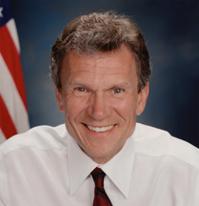
Mr. President, I appreciate this colloquy. The distinguished Senator from North Dakota did everything within his power to reach the bipartisan consensus required to achieve a budget last year. I give…
Mr. President, I appreciate this colloquy.
The distinguished Senator from North Dakota did everything within his power to reach the bipartisan consensus required to achieve a budget last year. I give him great credit for the efforts he made, in so many ways, to reach across the aisle, to find that bipartisan consensus throughout the year.
Unfortunately, we had very little response or help.
When we came to the conclusion, finally, that perhaps the best thing to do would be to move a 2-year budget resolution, as he correctly noted, we did get a bipartisan consensus on that but not enough to reach the 60 votes. Unfortunately, had the Senator from Pennsylvania chosen to support that resolution, we would have had the necessary 60 votes and hopefully worked out the remaining differences with our House colleagues in spite of the chasm that existed between their proposal and ours.
I appreciate very much the clarification made by the Senator from North Dakota. I again thank him for his efforts and the contribution he has made to this debate.
I also thank him for his earlier presentation to the Senate. My only regret is that more people could not have had the opportunity to see it. I think it is very instructive. I am inclined, almost, to go through the charts once again just because they are so good and they have such a compelling message, but I will leave that to our distinguished manager on budget matters. I appreciate very much the presentation he has made.
Mr. President, I come to the floor with sadness and with great regret at the position the Senate finds itself in today. I don't know that we have a clear indication whether the votes are there for this resolution. I hope we do not. But I assume our Republican friends would not come to the floor if they didn't have the votes.
I am troubled by this resolution for a number of reasons. First, I am troubled by the obsession with tax cuts that appears to be so much a part of the motivation behind the construction of this resolution, an obsession with tax cuts that led the majority leader of the House a couple of days ago--I guess it was last week--to say:
In the face of war, nothing is more important than cutting
taxes.
I have thought about that quote on so many occasions:
In the face of war, nothing is more important than cutting
taxes.
I assume by that he meant nothing in terms of the commitment we make to our military, nothing in terms of the commitment we make to homeland security, nothing in terms of the commitment we make to education, to the needs of people at every level.
So it is troubling to me, first, that this obsession with tax cuts articulated so succinctly by the House majority leader could be so much a part of this resolution. This obsession with tax cuts, as noted by the distinguished Senator from North Dakota, will cause us to experience deficits and accumulated debt unprecedented in this country. We are told, as a result of this resolution, we will see unified deficits exceeding $300 billion. We anticipate under this resolution there will be a $1.95 trillion increase in the accumulated debt for the period 2002 through 2011.
We began, 2 years ago in the 107th Congress, with a projected surplus of $5.6 trillion. We will now experience accumulated deficits of $1.95 trillion, leading us to a $7.6 trillion swing in our
fiscal circumstances in just 24 months. That, too, is unprecedented.
As the distinguished Senator from North Dakota noted, the ranking member of the Budget Committee, close to 40 percent of that swing is attributed to the tax cuts previously enacted or incorporated within this resolution. I don't know the degree to which we can calculate a direct connection between higher interest rates and the demise in our economy as a result of the fiscal problems we are likely to face if we adopt this resolution. But the deficits and the debt anticipated and actually outlined in this resolution present unprecedented and extraordinarily complex--in some ways, unimaginable--fiscal challenges as we look to the future over the next decade or so.
I suppose some would argue that the tax cuts of this magnitude could generate an economic recovery that could bring about an improvement in both the deficit and debt projections and the economy. We will hear that argument, I am sure, throughout the day.
But in a letter that addressed the President's economic stimulus package, 450 economists have said this package will not generate economic activity and will probably cause a loss of jobs. The CBO has actually reported that it is possible we could see a net decline in economic growth of just under 1 percent if the President's economic proposal, as it has been presented, goes into law.
There is no economic stimulus involved here. The CBO says it. Most of the major mainstream economists say it. Therefore, we can't be motivated by any expectation that economic stimulus somehow drives the need for these tax cuts.
On Wednesday, in the New York Times, there was an article coauthored by five public servants who, between them, helped pull our country out of four severe recessions in the last 30 years: former Secretary Robert Rubin, former Commerce Secretary Peter Peterson, former Senators Warren Rudman and Bob Kerrey, and former Chairman of the Federal Reserve Paul Volcker. This is what they had to say about the economic stimulus and the tax cuts incorporated in this particular resolution:
Given the rapidly deteriorating long-term fiscal outlook,
neither proposal is fiscally responsible. It is illogical to
begin the journey back towards balanced budgets by enacting a
tax cut that will only make the long-term outlook worse.
Furthermore, the proposed tax cuts are not useful for short
term fiscal stimulus, since only a small portion would take
effect this year. Nor would they spur long-term economic
growth. In fact, tax cuts financed by perpetual deficits will
eventually slow the economy. . . .
They lower future economic growth by reducing the level of
national savings that can be devoted to productive
investments. They raise interest rates higher than they would
be otherwise. They raise interest payments on the national
debt. They reduce the fiscal flexibility to deal with
unexpected developments. If we forget these economic
consequences, we risk creating an insupportable tax burden
for the next generation.
You can't be any more unequivocal, any more clear than that. Our best, most experienced minds in the country urge us, advise us, plead with us: Do not make this choice. Five percent of the tax cuts incorporated in the reconciliation package that we anticipate will be before us in a few weeks--5 percent of the total tax cuts assumed in this resolution will be realized this year: $61 billion, less than 1 half of 1 percent of our GDP.
Yet what do the economists tell us? The economists tell us: First, if you are going to have an economic stimulus package, do it now. Make it immediate. Make it broad based. Make sure it is fiscally responsible.
On those three counts, the tax cut legislation anticipated within this resolution all fail. So that leaves me with a third concern. The third concern is what it does to our national investment.
This resolution assumes a $168 billion cut in domestic investments over the course of the next 10 years. That means there will be cuts in homeland security, cuts in education, cuts in law enforcement, cuts in health care for veterans, cuts in infrastructure--cuts in all of those specific needs that make this country stronger.
I am troubled by that. I am troubled by the realization that, in part, I believe supporters of this resolution wish to reduce the flow of Federal funds to these investments for ideological rather than economic or fiscal purposes.
So, Mr. President, this is a very difficult day for our country, a day when we will commit to deficits unlike we have ever seen before, a day when, as a result of those deficits, we are likely to see economic circumstances get worse, not better, a day when, by the admission of those who support this resolution, we can anticipate dramatic cuts in the investments in those areas for which there is great need.
We have talked at length on the floor over the course of the last several months about homeland security and how badly our first responders need help and the importance of addressing the needs of the States as they confront their own immense fiscal challenges.
We have talked about the need for providing additional funding for the No Child Left Behind Act, how critical it is that we find a way to bridge the shortfall between the expectations and the unfunded mandates incorporated within that bill, and the reality that funding for these programs does not just materialize unless we appropriate it.
Serious problems with regard to law enforcement: As crime goes up, our investments in law enforcement, under this resolution, go down.
Problems in Medicaid for the States: The shortfall has never been greater. And the health concerns that nursing homes and hospitals are experiencing, all through rural America in particular, are commensurate with the shortfall that we find in this resolution.
So we can do better. While there are those who continue to talk about the budgets of last year, I think our focus now must be on the budget before us. And I think the first test legislation must pass before we support it ought to be: Do no harm. There is a lot of harm done in this resolution, and that is regrettable.
I hope our colleagues will think very carefully prior to the time they cast their vote. I will be casting a vote in opposition to the resolution. I urge my colleagues to join me.
I yield the floor.

Mr. President, I have sought recognition to comment about the pending budget resolution. I was very much impressed with the comment by the distinguished Senator from North Dakota who really…
Mr. President, I have sought recognition to comment about the pending budget resolution. I was very much impressed with the comment by the distinguished Senator from North Dakota who really questioned if anybody is listening. I think the answer to that question is generally no. The positions in this Chamber are really frozen. We are looking at a 50-50 vote to be broken by the Vice President, and, realistically, we are going through the motions of a debate.
Then the Senator from North Dakota says: Let's have a debate. We have been having a debate today. We have debates lots of days, but most of the time we talk right by each other. The proliferation of charts adds more confusion than clarity. I do not know that there are very many viewers on C-SPAN2 who even flick on their sets with the monotony of the kind of debates which we have in the Senate, which I would say is a blame attached universally on all sides and to all Members.
The one factor I think is most important is that we get a budget just to get a budget. We have a lot of argument about tax increase, no tax increase, what is the amount of the tax increase. An arrangement has been worked out really to sort of save face with all parties involved here so we could come to some terms and move on.
Last year, we did not have a budget. When the Democrats were in control of this Chamber, there was no budget resolution offered on the floor of the Senate, and I do not say that in a partisan way. I think too often there is debate and there are arguments which are partisan Democrats versus Republicans bickering, much to the dissatisfaction of the American people. But not having a budget resolution was very detrimental to the whole appropriations process where we could not curtail spending and have a discipline. For those who may be listening on C-SPAN2 or for a few people in the galleries, there are no Senators on the floor to listen, 60 votes are required to increase spending beyond the budget allocation if there is a budget.
Sixty votes are hard to come by, but if only 51 votes, or a majority of those present, are required, then spending goes up.
I visited Israel earlier this year, and the Palestinian Authority has a new finance minister. I was delighted to learn that the Palestinian Authority has a budget. I exchanged views with him that the Palestinian Authority had something the Senate did not have. The Senate did not have a budget. It was not reported out last year by the Budget Committee. It is vital we have a budget.
I yield the floor.
Mr. President, when the Senator from North Dakota says there was ``almost no difference,'' $2 billion, I respectfully disagree with him that that means ``almost no difference.'' Regrettably, around the Senate Chamber, and the House Chamber, we think $2 billion does not amount to very much.
The question I have for the Senator from North Dakota is in a context where the 2-year budget was turned down and there had been a 1-year budget prepared by the committee, as articulated by the Senator from North
Dakota who was the chairman last year and who specifies differences between the House and the Senate where there were different assumptions made and many differences; that is what a conference is about. If the Senate had passed a budget, having failed on a 2-year budget, and had gone back and brought to the floor a 1-year budget with differences, that is what a conference is about.
Why didn't the distinguished Senator from North Dakota, then-chairman of the Budget Committee, proceed to get a budget, take it to the House, and have a conference so we could have a budget?
Mr. President, my followup question is, Would the Senator from North Dakota identify who made the decision? The distinguished Senator from South Dakota is on the floor now. Was the decision made by Senator Daschle, the majority leader?
If I may proceed to question one step further. I think the Senator from North Dakota talked about apples and oranges. This body does not have to go to a 2-year budget, if it does not choose to, to produce the 60 votes when the customary practice is a 1-year budget.
I don't recollect with precision, but my instinct is that I supported the 2-year budget. I have supported votes to try to get this to conference to be resolved.
When the Senator from North Dakota says probably it was a wise decision, there is a lot of disagreement about that. I believe it is the duty of the majority party to bring a budget to the floor. I admire an effort to bring the 2-year budget. I think we ought to have a 2-year budget so we can spend more time on oversight, a subject sorely neglected. If that does not succeed, it does not take 59 votes to bring a 1-year budget to the floor. That is the duty of the party that controls the Senate.
When you talk about a majority of the appropriators agreeing to stick to the budget, or unanimous among the appropriators, that does not mean a whole lot because that does not bind the Senate to the figure.
I note the presence of the distinguished Senator from South Dakota on the floor. Might I inquire if the Senator from South Dakota would care to respond as to why we did not have a budget?
Mr. President, there has now been an opportunity to obtain the vote referenced by the Senator from North Dakota, and it was not a resolution for a 2-year budget at all. It was an amendment made by Senator Feingold which would set caps for 2 years. But that is not a 2-year budget resolution.
The idea of a 2-year budget resolution has been discussed widely in this body for many years and has been advocated by the distinguished Senator from New Mexico, Mr. Domenici, who chaired the Budget Committee for many years. It is a proposal that I have long supported.
I, frankly, did not remember any resolution for a 2-year budget coming to the floor when it was mentioned by the Senator from North Dakota. But if it had come to the floor, if there had been a resolution for 2 years, I would have supported it because of my longstanding sense that the Congress does an inadequate job of oversight, finding out what is happening in the executive branch, because we spend so much time on the budget and then on the appropriations process.
As chairman of the Subcommittee on Labor, Health and Human Services, and Education, it occupies months of time. So if it can be done in 2 years, then it would be a big savings.
But I recall very well when the Feingold amendment was offered. And there was a major effort by appropriators, significantly, to adopt it, which would set a cap. I refused to back that because I thought it was inappropriate to have a way out for the Budget Committee, which had not established a budget.
The budget law was passed in 1974, and for 27 years, this body has had a budget--until last year. And if the Budget Committee could avoid or evade its responsibility in coming up with a budget, and then have a simple cure by having an amendment offered which would set a cap, what motivation would there be for a budget?
To set a cap is not to have a budget resolution. A cap simply means what the total expenditure will be. It does not mean what the budget will allocate for various categories of expenditures.
We spend a protracted period of time in establishing a budget, and we have
many votes. In the last, during what we called a vote-a-rama, we voted dozens of times on specific amendments. So you do not have a budget resolution when you establish a cap.
I ask unanimous consent that the Record Vote Analysis be printed in the Record--this is compiled by the staff of the Republican Policy Committee--and that a similar document be printed in the Record, provided to me by the Senator from North Dakota, which repeats that the Feingold amendment establishes discretionary spending caps for fiscal year 2003 and fiscal year 2004, which is the same 2-year period.
And I conclude, Mr. President, by asking the Senator from North Dakota if establishing caps for 2 years amounts to a budget resolution for 2 years.
Very briefly, Mr. President, I frankly expected more from the Senator from North Dakota. When he says, and I read his words, adopt a budget formulated in the Budget Committee, there was nothing in the Feingold amendment about a budget formulated in the Budget Committee. When the Senator from North Dakota recites a long list of categories and then says they provide a framework, there were no categories in the Feingold amendment. There was no framework there. When the Senator from North Dakota says it was not a full budget resolution, he really ought to say there was no budget resolution at all because that is the fact.
Will the Senator yield for a question?
I discussed this informally with the Senator from North Dakota, and he handed me a vote, which I read from, which was the Feingold amendment which established caps for 2 years. The Conrad amendment had nothing to do with what the Senator from North Dakota handed me. But these will be in the Record, and people who read the Record can come to a conclusion themselves. I think there is absolutely no doubt not only that this is not a full budget resolution but that it is no budget resolution at all.
I yield the floor.
Mr. President, when the Senator from North Dakota said the amendment put in limits, he is correct. The Feingold amendment did seem to put in limits. When he says that is what a budget resolution does, he is correct also. A budget resolution does put in limits. But a budget resolution does much, much more. A budget resolution specifies categories. It is an elaborate document that specifies categories of expenditures, and that was not in the Feingold amendment.

Mr. President, I ask unanimous consent that the order for the quorum call be rescinded. Mr. President, I want to address the sense-of-the-Senate resolution on behalf of men and women in the Armed…
Mr. President, I ask unanimous consent that the order for the quorum call be rescinded.
Mr. President, I want to address the sense-of-the-Senate resolution on behalf of men and women in the Armed Forces offered by our distinguished Senator from Kentucky. I ask unanimous consent that I be listed as a cosponsor of the resolution.
Mr. President, I rise to give strong support to this and I want to say against the background--and the other day we had a similar matter before the Senate and I rose to address that. It was a technical problem, primarily, with that resolution. This one, which I have read carefully, in a very straightforward manner, recites the history of personal decorations and theater awards and, in particular, how these matters, throughout the military history of this country, have been actions taken by Presidents upon the recommendation of the senior officers of the Army, Navy, Air Force, Marine Corps, and, indeed, the Coast Guard. In this instance, this administration has moved to put in place those recognitions--most deserving, I would say-- of men and women who have gone to the farflung corners of the globe and accepted the risks, together with their families, of going to those areas for the cause of freedom and to protect the security interests of the United States of America.
That region of Iraq is very much in our hearts and minds every day. I have had the privilege, as have many in this body, to go there and visit with our troops. Likewise, I have had the privilege to go and visit with our forces in Afghanistan. Most recently, I went to Liberia, where the strike task force--largely composed of U.S. marines but under the control of a very fine Army officer--performed extraordinary duties on behalf of the people of Liberia, who have suffered a decade-plus of civil war turmoil. I could go on and on, but others are anxious to address this.
The point I wish to make is these decorations are proudly worn on the uniform of the men and women in the Armed Forces. They are coveted items of families for generations. In my office, I have proudly displayed the decoration earned by my father who volunteered as a young Army doctor in World War I to go to France where he served in the trenches. I remember as a young person of his telling stories to me about life in the trenches, the extraordinary devastation he witnessed, the loss of life, and the carnage. But there on the wall was his World War I Victory Medal. It had on it three bars of the three major conflicts. He was proud to wear it on the uniform of the United States when he saw service.
It is a carefully thought through process that we cannot award a separate medal for every conflict. We have to recognize the theater of operations. For example, in World War II, it was the European theater and it was the Pacific theater. There was a medal given to those in the continental limits in training commands. There were three basic theaters of operation, and then stars were awarded for the major conflicts in the theaters of Europe or the Pacific.
It is not a wise course of action to award a separate medal of decoration for each of the many theaters we are engaged in today. Rather, there should be just the principal decoration which, as we say in the final paragraph of this resolution, and I will read that:
It is the sense of the Senate that the Secretary of Defense
should, on an expedited basis, issue the necessary
regulations to implement these awards and ensure that any
person who renders qualifying service to the Armed Forces in
those phases of the Global War on Terrorism, including
Operation Iraqi Freedom, Operation Enduring Freedom, and
Operation Noble Eagle should promptly receive these awards.
That is a category of awards given primarily for Iraq and Afghanistan and contiguous areas where the men and women of the Armed Forces are serving actually in the front lines or, indeed, in a support phase.
I strongly urge the Senate adopt this amendment. I hope there are 100 votes in recognition of this course of action.
To those who, with the best of intentions, have recommended specific theaters, specific zones, such as Iraq, we then have to think of Afghanistan, we have to think of Liberia, although, fortunately, that was an operation that was successfully performed in a relatively short period of time. I could go throughout the world.
It is better there be theater-of-operations awards and individuals singled out. I know, for example, if I may say, when I was Secretary of the Navy and heavily involved in the subject of awards, I remember so much working with the father of the distinguished Senator from Arizona who was commander in chief of all military forces in the Pacific, ADM ``Jumpin'' Jack McCain. I remember him well. I learned a lot from him.
The Senator from Arizona will recall from his earlier experience how theater recognition is given and then the star to recognize those engagements in which one participated. That is a process carefully supervised by the senior military, primarily the Joint Chiefs of Staff.
I am quite interested in the views of the distinguished Senator from Arizona on this subject. I yield to the Senator.
Mr. President, the Senator is very correct in the recitation of the facts. I add one other perspective, and that is how well the Senator from Arizona understands with his distinguished career the identification of the families with the serviceperson, and should a special award be made for Iraq, think of the families of those who served in Afghanistan, particularly who lost life and limb. They would think: Why is not the sacrifice of our family in every respect equal to the sacrifice of the other families in the Iraqi situation?
Yesterday, or today, the Senator from Arizona and I took to the floor together in a similar colloquy to urge colleagues to let the system work because it is working and it is working in the traditions of our military.
It is working in a manner that is equitably recognizing the performance in this area.
Mr. President, no. Our committee does have jurisdiction over these matters. It was not brought to the attention of myself.
I saw momentarily the ranking member. I do not see him at the moment. To the best of my knowledge, he did not have knowledge of it aforehand.
I thank my colleague. I also add that, very importantly, one very good development resulted from the debate we had yesterday.
I was under the impression that the two declarations to which the distinguished Senator from Arizona made mention were actually in being. I am perhaps remiss. I thought that by now they were in being, but in fact when I went directly to the Office of the Secretary of Defense, and those involved in the process, I found this needed a little congressional incentive. That is the basic reason for this amendment that is laid down today. We have their attention now, and they are going forward with these decorations.
So for that reason, we must say to Senator Bingaman that that was a very fortunate development.
Mr. President, the Senator is correct.
The Senator is absolutely correct. As I said, we have brought this matter and the urgency of it to their attention, and that is one of the very positive results from the efforts of our colleagues on the other side and the initiative taken by the distinguished whip on this side in this amendment.
Mr. President, I thank our distinguished colleague. I have known the McCain family. I served with the Senator's father and have followed the distinguished Senator's career, and it stands in parallel to the finest careers of those who have served in this body in years past, today, and who will serve in the future, who have worn the uniform of this country. So I value greatly the views of the Senator from Arizona and I thank him.
I do not know. I fail to count the number of years. It is 30 plus. But I thank the Senator for his kind remarks. My career is so inconsequential in the U.S. military compared with his. I do believe I received the good conduct medal. To the best of my knowledge, the Senator never received that; did he?
I do not think the Senator was eligible then and he is not eligible now. I think it is likely the Senator will never be eligible.
Well, maybe we should cease this colloquy at this moment. I see others who perhaps would like to speak.
Again, we commend the distinguished Senator from Kentucky for his initiative on this matter. I was somewhat saddened yesterday that we had to have a division of views on what I believe was the best of intentions by the Senator from New Mexico. I think now this is an opportunity for us to shake hands on both sides and move on and resolve this matter.
I yield the floor.

Mr. President, the budget before the Senate, like the President's budget which it reflects, represents the wrong priorities: Too many ill-advised cuts in too many critical area to help pay for a tax…
Mr. President, the budget before the Senate, like the President's budget which it reflects, represents the wrong priorities: Too many ill-advised cuts in too many critical area to help pay for a tax cut which is too large, too inequitable, and which will worsen our fiscal situation without providing our economy the jump-start it needs.
The budget resolution that passed the Senate, while irresponsible, was a small improvement over the one reported from the committee. The Senate managed to make an irresponsible budget resolution slightly less irresponsible. The huge tax cuts the President proposed, a majority of which would go to upper income folks and which most economists agree would provide our economy with almost no jump-start that it so desperately needs, were scaled back some. But the conference report before the Senate today pushes us right back to where we started.
Notwithstanding our current record deficits, a war in Iraq and its expected aftermath, the full cost of which is not
yet known, and a baby boom generation that will soon retire in record numbers, the conference report contains tax cuts that total about $1.3 trillion over the next 10 years and, with the expected interest costs added in, $1.6 trillion.
As recently as January of 2001, the Office of Management and Budget projected a 10-year surplus of $5.6 trillion. Now we are back into a huge deficit hole and will be there for the foreseeable future. In fact, this conference report projects total deficits of $1.4 trillion over the next 10 years, including record deficits of over $300 billion this year and next.
The right type of small tax cuts could stimulate the economy by being effective in the short term and going to working families and small businesses who will spend the money now, instead of mainly going to the wealthiest among us who do not need tax cuts. Tax cuts that drastically worsen our long-term fiscal situation, that will not help out in the short term, and that would require cuts to many other priorities are not what our economy needs and not what our people are asking us to adopt.
How much money is going to whom in 2003? The President's tax cut proposal gives about half of the tax cuts to the wealthiest 5 percent of American taxpayers. People can try to put a different gloss on numbers, but there are two bottom lines: One bottom line is this proposal puts us deeper into a deficit ditch and pays for tax cuts mainly going to upper income folks by borrowing; the other bottom line is that the 2003 tax cut proposal of the President gives the wealthiest 5 percent about 50 percent of the money involved in these tax cuts.
Simple equity, as well as an economic stimulus, suggests if we are going to have tax cuts, they should be broad based, providing, for instance, every working family of four with an immediate tax cut of $1,200. That would be an economic stimulus. That would be equitable. That is not what is before the Senate.
There are a number of other things we ought to do in talking about equity and economic stimulus. We ought to extend unemployment benefits for those whose benefits have expired and were not previously extended. We ought to provide short-term incentives for businesses to invest immediately. We ought to provide some assistance to our struggling states for education, homeland security, Medicaid, and highway and other infrastructure improvements. Those measures would be better for our economy today, our fiscal situation in future years, and the many other challenges that lie ahead. They would also address today's problems today without passing the costs on to future generations. One symbol of those future generations are the men and women who now are putting their lives on the line for us in the war in Iraq. It seems to me unthinkable that when we welcome them home--hopefully with the parades and the welcome and the hugs they deserve--we would also tell them: By the way, the war you are fighting is going to be paid for by you and your kids, not by us; we are going to borrow money, not to pay for this war; we are going to borrow this money to pay for a tax cut that mainly goes to the wealthiest among us.
This approach in this budget is wrong on three counts. Number one, we should not be cutting taxes. We ought to be paying for the war now. Number two, if we are going to borrow money, if we have to borrow money for the war, we obviously should borrow it for the war, not for a tax cut. Finally, if there are going to be tax cuts, the tax cuts ought to go not only to those who need the tax cuts the most but those who will spend the money now, giving our economy the jump-start it needs.
We need a lift in this economy, not one that will kick in years down the road or will further explode the deficit, but a fiscally responsible lift that will kick in now. The job loss numbers released a week ago by the Labor Department reinforce the need for a stimulus plan that will create jobs now, in 2003, when we need it.
The proposed tax cuts are not only sharply slanted toward the wealthiest among us, they would do virtually nothing to assist our financially strapped States. As a matter of fact, the tax cuts as proposed may harm them. Just the proposed dividend tax provision alone would actually strip my home State of Michigan of over $100 million in revenue in 2004. And economists, including multiple Nobel Prize winners, agree the tax cut will not provide the boost that this economy needs.
I was also very disappointed to see the conference report excluded an amendment that I offered and that was adopted by the Senate in the budget resolution which we adopted.
The amendment to which I referred, which was adopted by the Senate, was aimed at closing down certain abusive tax haven loopholes. We would have taken the money which we would receive by closing down these abuses and applied half of it to the deficit, the other half going to education in areas where we are cutting education.
It is unconscionable to me that corporations, too many of them, have renounced their United States citizenship and opened phony offices in Bermuda from which they can then pretend that their businesses operate, keep doing their business here in the United States, using our police departments, our fire departments, our schools, and all of our other services--inverting, as it is called--getting the benefits of citizenship here but avoiding paying taxes.
People ask, how come revenues are going down? There are a lot of reasons why revenues are going down. One of them is the tax cuts which were adopted here which were proposed by President Bush. Obviously, a slowing economy has had an effect, too. But one of the other reasons we lost revenues is that we have too many corporations that are avoiding paying their fair share of taxes through a very large number of tax avoidance schemes.
We have seen some of these tax shelters. We have seen some of these special-purpose entities used by Enron and
others. We have seen a whole host of ways folks can avoid paying their fair share of taxes. It seems to me, in the middle of a war, the most unconscionable one of all is those corporations that renounce their citizenship and open up a fake office somewhere else in order to avoid paying taxes which they should be paying, and at the same time using our roads, our schools, our banks, our patent laws, our law enforcement, our fair trade laws, our workforce, and not contributing their fair share to pay for those benefits. It was really unfortunate that the conferees decided to strip this budget resolution of language that was aimed at closing down that particular loophole.
This budget emphasizes the wrong priorities. It burrows us deeper into the deficit ditch. It continues our reliance on the Social Security surplus. And it fails to provide the stimulus which is needed to improve our sputtering economy. It rises to a new level of irresponsibility and it should be defeated.
I yield the floor.

Mr. President, I reduced the time I requested because I know I have colleagues on the floor seeking recognition and we want to wrap this up in a timely way. Let me say to those following this debate,…
Mr. President, I reduced the time I requested because I know I have colleagues on the floor seeking recognition and we want to wrap this up in a timely way.
Let me say to those following this debate, one, the greatest Illinoisan of all times once said:
A speech the world will little note nor long remember.
I think the same can be said of this debate. The United States will little note nor long remember this debate on the Senate floor. But it will remember what happened today when we see the outcome. The outcome is going to be devastating for the economy of the United States for years to come.
The reason is, of course, America is preoccupied, as it should be, with the war in Iraq. We are so proud of the achievements of the men and women in uniform. We have watched every single day the wonderful unfolding of the change in Iraq, offering a new opportunity. I think the reason we are focused and so positive about the military accomplishment is we know the men and women involved in that decision showed both courage and vision.
Sadly, when it comes to the economy of the United States, the other party and the administration in the White House show political calculation and myopia. Instead of dealing with the real economic challenges of America in a sensible, fair, and evenhanded way, we have a Republican budget resolution which will be devastating. It will be devastating in creating the largest deficits in the history of the United States of America.
What happened to this Grand Old Party, this party of fiscal conservatism? Today, we find it is the party of record deficits and record debt. A party which once said, we don't want to leave a legacy to our children of debt, is in fact creating that debt with this budget resolution.
There are some things you can argue are beyond the control of the White House or anyone in Congress. One of those things is the cost of this war and the war on terrorism. I will gladly concede that those are things which could not be calculated 2 or 3 years ago and cannot be calculated today in terms of their cost. But the real problem with this budget resolution is this President's fixation with creating massive tax cuts for the wealthiest people in America. It is the age-old Republican answer to every single problem: When in doubt, cut taxes for wealthy people.
This is done in the belief that if the wealthiest people in America just had a little more money to spend, things would get so much better. We tried this. A little over 2 years ago, the President came in with the first round of his tax cuts for the wealthy, and he said: Just watch what happens.
We watched. The economy continues to plummet. We continue to lose jobs. In fact, if you look at the Bush record since the President took office: 2.5 million fewer private sector jobs under this President; long-term unemployment up 184 percent; over 2 million more Americans without health insurance; 1 in 10 small businesses has dropped health insurance for their workers; the average cost of health insurance rises by double digits; the gap between tuition and Federal student aid has grown $1,900 more under President Bush, retirement savings have been decimated, consumer confidence dropped by 51 percent, and the Bush budgets have turned a projected $5.6 trillion Federal surplus into a $2 trillion deficit.
How can one President in 2 years and 3 months have dealt such body blows to the American economy? He did it with the wrong policies, a policy of tax cuts for the wealthy that failed in the first round and will fail again. This budget resolution enshrines those tax cuts and says to our children and future generations: Get prepared to pay off this debt because we have to give tax breaks to wealthy people today.
My friend from Idaho says: Oh, that's just class warfare. I am reminded we were recently visited by Warren Buffett, one of the most wealthy men
in America. He said: If this is class warfare, I have something to report: My class is winning.
It certainly is, because if you look at the President's overall tax cuts, and the amount of money that average taxpayers can expect, look at these numbers: $265 for the typical taxpayer in tax relief; and yet for people with over $1 million, $88,873 on an annual basis.
Think about that for a moment. We are saying to the average taxpayer: We are going to give you a modest bicycle and some roller skates. We are saying, for the millionaires: You need a luxury car.
That is the idea of fairness and justice when it comes to the Republican side of the aisle.
Well, it has been absolutely devastating. When you take a look at it in terms of the Bush tax plan, nearly 50 percent of American taxpayers will receive less than $100. They just get the roller skates. The people who are millionaires end up with the luxury limos.
Is that what America is all about, particularly in time of war, when we have children from average, middle-income working families risking their lives for this Nation? Is this the best we can do? To offer a tax cut to the wealthiest people in this country? To say at this time of uncertainty about the cost of the war, and what we will need as a nation, that the best we can come up with is a plan from the White House to give tax breaks to the wealthiest people?
Take a look at this budget conference report and I will tell you what you will find. The Republican approach shortcuts education dramatically. The President passed No Child Left Behind. He said: We are going to help our schools move forward.
We need $9 billion, Mr. President, next year. Your budget provides $400 million--not nearly enough. While school districts face bankruptcy, States are deep in deficit, this administration cannot find the money for education. But it can find the money for tax cuts for wealthy people.
I will tell you, the No. 1 issue I find among families and businesses in Illinois--the No. 1 issue--is not this whole question of tax cuts; it is the cost of health insurance. This administration, in this budget, has done absolutely nothing to deal with the most serious problem that businesses and families face today--nothing. It is better, they believe, to give a tax cut to wealthy people than to deal with real issues that families and businesses face every single day.
You want to deal with tax cuts? Let me tell you one that I find overwhelmingly popular in my town meetings. The Senator from New York has suggested it, Mr. Schumer: a $12,000 deduction each year for college education expenses. Think about working families whose kids get into good schools and face tuition that they never would have dreamed of and debt that they couldn't imagine. Imagine if we could give them tax assistance, give them tax help: $12,000 deductibility.
But, no, the Republicans say that isn't the way to invigorate America. That isn't the vision of the future. Their vision is to make sure the wealthiest among us have more money to spend.
I don't get it. It is classic Republicanism, but it is a classic failure--a failure which over 2 years and 3 months has driven the American economy into the rut.
In my State, we have lost tens of thousands of manufacturing jobs, faced record unemployment rates, and this administration believes the way out of it is to provide tax cuts for the wealthiest people.
I salute the Senator from North Dakota. His leadership on this has been extraordinary. He and the Congressman from South Carolina, John Spratt, have spoken out in honest terms about what we face as a nation. Some of the things the Senator said during the course of the debate are not necessarily politically popular, but they are courageous and they show vision. That is what our military forces are doing in Iraq. That is what we should do here, nothing less. Instead, we are dealing with political calculation and kind of shortsightedness that we will pay for for many generations.
I will vote a resounding no on this budget resolution.
I yield the floor.
Show 10 more

Mr. President, I ask unanimous consent to engage in a colloquy with the Senator from Virginia. Mr. President, I say to my friend from Virginia that perhaps we should for a moment discuss what…
Mr. President, I ask unanimous consent to engage in a colloquy with the Senator from Virginia.
Mr. President, I say to my friend from Virginia that perhaps we should for a moment discuss what happened yesterday and what we are trying to do under the leadership and initiation of Senator McConnell.
Yesterday there was, as part of the $87 billion assistance package to Iraq, an amendment that was proposed which would have bestowed a specific decoration on those who fought in the Iraqi conflict. There was a provision also that prohibited others, those eligible for that medal, from being eligible for other decorations, as I understood it. Then that provision was voluntarily removed by the sponsor of the amendment. I ask my friend, isn't it a little appropriate to remember what happened?
On March 12, 2003--that was a number of months ago--the President of the United States, by Executive order, which is the proper and accepted methodology for this kind of designation of awards, established the Global War on Terrorism Expeditionary Medal to be awarded to service members who serve in military operations to combat terrorism on or after September 11, 2001, including, but not limited to, actions in Operation Enduring Freedom and Operation Iraqi Freedom, in such locations as Afghanistan, Iraq, the Republic of the Philippines, and elsewhere in Southwest Asia, in recognition of sacrifice and contribution.
In addition to that, in that same Executive order, the President established the service medal, the Global War on Terrorism Service Medal recognizing service in Operation Noble Eagle and the homeland defense mission against further terrorist attacks--for example, military duties here domestically--in providing security and much- needed service here.
In other words, isn't it the Senator's understanding there were two medals? That by Executive order, following the advice of senior military and civilian defense leaders, President Bush established two different medals for men and
women who have engaged in the war on terrorism since September 11?
I guess what I see coming from my colleague is, if we are going to make a specific award for Iraq, shouldn't the same award be bestowed in Afghanistan? In other words, in other areas? Wouldn't, at least in the President's Executive order, the expeditionary medal and the service medal cover service literally globally? I think we might have difficulty if you gave a specific medal for Iraq, which was a dangerous mission which entailed the loss and injury of brave young Americans, but also Afghanistan is being left out. I think that was the point the Senator from Virginia and I were trying to make yesterday.
Could I also point out to my colleague, this was also an argument, I think he would agree with me, to allow the executive branch to act in what has been, frankly, the executive branch's area of responsibility, and that is the designation of service medals, expeditionary medals, et cetera, including, by the way, higher awards which would be bestowed for acts of heroism and courage no matter where they fall. This is not the only medal of recognition available for a lot of these young men. But when we get into a bill which is legislation that is for the reconstruction of Iraq, and all of a sudden we come up with a great idea to designate a medal, we have to think these things through.
The Senator from Virginia is the distinguished chairman of the Armed Services Committee. Was this issue ever raised in the Armed Services Committee?
Again, I know the Senator from Virginia shares my admiration and appreciation for the Senator from New Mexico who proposed this amendment. In a good-faith effort, he wanted to recognize the service and sacrifice of those who had served. I appreciate that. But I would also caution my colleagues that it is probably best to explore what has been done and also what should be done by the committees of jurisdiction. Otherwise, we should not have committees of jurisdiction; we should all just come to the floor with our ideas as to how best to address issues.
I think the Armed Services Committee has a reputation, as one of the oldest committees in the Senate, of never shirking in its duty to address issues, including ones such as these.
Again, I thank the Senator from New Mexico for his desire and motivation to honor these brave young people.
I say to my friend, President Bush signed this Executive order on March 12. The way I count, that is 7 months ago. I am deeply disturbed that the Secretary of Defense has not acted to implement these regulations. I would like to tell my friend from Virginia that I still have people who work over in the Pentagon, who provide me from time to time with information--usually anonymously, for obvious reasons--but I have been told that these regulations have been on Deputy Secretary Wolfowitz's desk for 3\1/2\ weeks. That is not right. I know the Deputy Secretary of Defense is busy and I know the Secretary of Defense is busy, but I think we have every right to expect immediate action on this so that these men and women can go about receiving this recognition because they cannot until these papers are signed.
I yield to my friend from Virginia.
Could I mention to my friend from Virginia, too, as chairman of the Armed Services Committee, perhaps we should look at whether individual medals should be given for operations in Iraq, and perhaps individual decorations should be given for the conflict in Afghanistan, as two prime examples. Perhaps it is not sufficient to just have an expeditionary medal and a service medal.
I had hoped that if we had acted in order to separate those two conflicts from others, we would get input from the Secretary of Defense, that there would be proper consultation and hearing and scrutiny before the Senate Armed Services Committee before we acted.
I think the Senator from Virginia pointed out that if we only gave an Iraqi freedom medal, what about those in Afghanistan? Is there an Afghanistan freedom medal, too? No, that was not part of the proposal yesterday. That is why these things with noble motivation have to be thought through. I hope that with this sense-of-the-Senate resolution, which we will all vote on, we will send a message that we are all in support of the incredible importance of recognizing the service and sacrifice of the young men and women of our Armed Forces today.
Mr. President, I say to my good friend he fails to mention that I served under the distinguished Senator from Virginia when he held the position of Secretary of the Navy. I might say I served way under. Given the chain of command, there were probably at least seven or eight individuals who separated the two of us, but I certainly appreciate the honor and pleasure of having served under then-Secretary of the Navy Warner. I have appreciated the relationship we have enjoyed in the intervening 30 years.
I do not think I was ever considered for that.
If it was up to a vote of our colleagues, I doubt I would be eligible today.
I note the presence of the Senator from New Mexico. I hope he was able to hear our remarks concerning our appreciation for his motivation to honor these young men and women who have served and sacrificed. We look forward to and anticipate we will continue working together on this worthy cause.
I yield the floor.

Mr. President, I rise today to discuss the current situation in Iraq and the growing concern that many of my colleagues have expressed regarding our policies in this most volatile and dangerous…
Mr. President, I rise today to discuss the current situation in Iraq and the growing concern that many of my colleagues have expressed regarding our policies in this most volatile and dangerous region of the world.
Last October, I was one of 23 Members of this Senate who voted against a resolution to authorize the war in Iraq. Voting on a resolution to send our young men and women to war is one of the most difficult issues any politician has to face.
I voted against going to war for five main reasons.
First and foremost, I did not believe the administration had made a compelling case that attacking Iraq was in our vital national interest.
Second, I was not convinced that the classified information presented to the Senate offered conclusive evidence that Saddam Hussein provided a threat to the American people or that he would use weapons of mass destruction if he possessed them.
Third, I was not convinced that his regime was aligned with al-Qaida terrorists or was in any way involved with the September 11 attack on the United States.
Fourth, I did not see that the administration had presented a well- thought-out plan for dealing with postwar Iraq.
Finally, I believed that attacking Iraq when many of our closest allies and virtually all of the Nations in the region were opposed to it would cast the United States as the aggressor in this conflict and deal a terrible blow to our international reputation and prestige.
I was convinced that going to war under these circumstances would almost certainly sacrifice the almost near universal support and good will this Nation had gained following the terrorist attacks in New York and Washington. I regret today I still have many of the same concerns about the policy.
Having said that, the majority of my colleagues disagreed with me, and Congress approved an attack on Iraq. I know this is not to second- guess but only because it sets the stage for where we are today. The question for the Senate is what should the Congress do at this point? Our principal responsibility as Senators is to protect the people of this great Nation. Particularly, it is my belief we must fight for those who defend us. I have often said less than 1 percent of our population protects all the rest of us by wearing our Nation's uniform. I will say once again, I strongly believe it is our sacred duty to serve them. We simply must support the men and women willing to serve in harm's way.
Our forces fought gallantly in Operation Iraqi Freedom. Our military strategy proved to be effective in war even if the rationale for war and postwar strategy can be questioned. Our forces proved once again that they are the most effective fighting force in the world.
Today, more than 125,000 U.S. military personnel remain in Iraq. While
all of us would like to know how long they will stay and how long they will be needed, I am confident each and every one of my colleagues agree they deserve our support. To guarantee the support, we must ensure that we provide sufficient funding for our forces to be equipped and ready to meet the challenges they face in Iraq.
Many in this body question the administration's policy. They want to criticize the war because we have not yet found weapons of mass destruction. Our debate should not be focused on whether Saddam had weapons of mass destruction. Regardless of how we came to be in Iraq, I ask my colleagues what do we want to do now? Should we punish the administration for putting us in this position? I would only say in seeking to mete out punishment on those political leaders with whom we might disagree, we will most likely only punish our sons and daughters who have volunteered to risk their lives. That we cannot let happen.
The question we must ask at this moment is, How should we proceed? The cost of the ongoing war on terrorism is staggering. As has been mentioned often in the Senate, $87 billion is an enormous amount of money. Since September 11, the Congress has approved the supplemental defense funding in excess of $100 billion in response to the terrorist attacks on our Nation and for the operations in Afghanistan and Iraq. Moreover, because of these costs, coupled with the impact of large tax cuts, we no longer are running a surplus. Instead, we have a deficit estimated to exceed $500 billion.
I understand my colleagues' frustration and understand why they demand better accountability. In seeking solutions, they have argued we should not have to pay for the reconstruction of Iraq. They want Iraq to use its oil reserves to pay for its own infrastructure. I am all for Iraq paying as much as it can to rebuild its country, but realistically, it is not in any position today to do much of that.
So should we wait? I would argue no. Our sons and daughters are in Iraq and the conditions are not good. The infrastructure to support our military and Ambassador Bremer and his staff is not conducive to getting Iraq back on its feet. We cannot turn our backs on our men and women serving in that theater because we disagree with this war. But even more important, we want our forces to come home as soon as possible.
I can assure my colleagues of one thing: Our forces will be in Iraq a lot longer if we refuse to make the investment in that country's infrastructure.
Three weeks ago, Hurricane Isabel caused widespread power outage in the Washington, DC, area. For several days, many were without power and we complained. Let me say to my colleagues that was a minor inconvenience compared to what our forces face in Iraq. I know we were all grateful when we finally saw the Pepco truck in our neighborhoods. It was a real boost to our morale.
I can assure you our troops in Iraq are the strongest supporters of us putting up $20 billion to help get Iraq reconstruction started. For them, getting this money will be like seeing the Pepco truck finally enter their neighborhood.
This funding is not charity. The fastest way for us to get our sons and daughters home is to get Iraq back up and running. Congress approved this war, the Congress agreed it was worth the cost to rid the international community of Saddam Hussein. In reviewing this request, it is not a question of whether Saddam had weapons of mass destruction. It is not really relevant if Saddam was or was not linked to Osama bin Laden. It is not a question of whether this war was right or wrong for our country. Those issues will be debated next year as the country determines its next President and its next Congress. It does not matter how we voted last October. This October it is our responsibility to support the men and women in the military who are doing what we required of them.
I urge my colleagues to support the supplemental request to support our military forces to help end this conflict quickly and do all we can to get our sons and daughters home sooner.

Yes. I thank the Senator. Mr. President, the real priorities of the President and those who wrote this budget can be seen by comparing two numbers: The tax cuts authorized in this resolution total…
Yes.
I thank the Senator.
Mr. President, the real priorities of the President and those who wrote this budget can be seen by comparing two numbers: The tax cuts authorized in this resolution total $1.3 trillion over the next 10 years. Over the same 10 years, the Federal budget will run deficits totaling $1.4 trillion.
The priority of those supporting this resolution is crystal clear: tax cuts today, in exchange for an even higher mountain of debt that will be paid by our children and grandchildren.
So strong is the lust for tax cuts, the conference committee on the budget has gone so far as to develop an unprecedented gimmick by which the Senate and the House of Representatives will consider a portion of these tax cuts later in the year.
Under normal procedures, a conference report is to be a consolidated single resolution of all of its issues. We are presented with what is called a conference report, which has a dramatic difference between tax cut allowances in the House--$550 billion, over 10 years--and tax cuts allowed in the Senate--$350 billion.
The goal of the majority is to give the appearance of limiting tax cuts to the Senate-passed limit of $350 billion, while paving the way for fast-track tax cuts of $550 billion.
During the debate on the Senate's budget resolution a couple of weeks ago, I voted against any tax cut in the budget. Why? Because, in my judgment, they do not reflect our Nation's priorities.
This budget should seek to reduce the national debt. It should seek to strengthen and reform Social Security. It should seek sufficient funds to modernize the Medicare Program and add a meaningful prescription drug benefit. It should provide funds for programs the Federal Government has committed itself to which are so critical in the lives of our children.
This budget includes no adequate money for these priorities. It is laser like in its focus on tax cuts. The tax cuts allowed by this budget are not only irresponsible, they are misdirected. Although their advocates claim their purpose is to create jobs and stimulate economic growth, these tax cuts will not do the job. That is especially true of the proposed tax cut on stock dividends.
To truly stimulate the economy, any tax cuts should be targeted so they boost demand for consumer goods and services. Most economists agree that this is best achieved by directing the tax cuts to low- and middle-income families and small businesses.
I personally would prefer a short-term reduction in the payroll tax, paid for by general revenue, holding the Social Security and Medicare trust funds whole.
The tax cuts contemplated by this resolution are directed at upper income families who are the least likely to boost their purchases of goods and services.
We had a debate a few moments ago as to whether this was class warfare. That is in the eyes of the beholder. But one thing that it clearly is: It is intergenerational warfare.
It is warfare against children, with cuts in education, the failure to fund the No Child Left Behind Act, which we passed 2 years ago, cuts in childcare, cuts in women's, infant's, and children's health care.
The irony of this intergenerational warfare against children is that they will end up paying, during their adulthood, the cost of the deficits which we are adding today.
It is also intergenerational warfare against older Americans. Some would argue that this budget includes $400 billion for a Medicare prescription drug benefit. They know full well that $400 billion is inadequate to provide an affordable, comprehensive, universal prescription drug benefit for America's seniors.
Why do we know this? Last year, 52 Senators voted for a plan, which I had
offered, to provide to Medicare beneficiaries real drug benefits, with no gimmicks, no gaps, no hidden ``gotchas.''
With inflation and the change in demographics of the older population, such a benefit would now cost $619 billion over 10 years.
Limiting a prescription drug benefit to $400 billion means that 89 percent--89 percent--of Medicare beneficiaries, those who have elected to stay in the fee-for-service Medicare Program, will go without prescription drug coverage, unless they either have very low incomes or very high drug costs.
The only way to provide a drug benefit within this budget's framework is to limit the benefit to a relatively small number of Medicare beneficiaries.
If they should happen to live in an area that offers health maintenance organization coverage--and millions of our seniors do not-- Medicare beneficiaries will have no choice but to move into managed care plans because there is no other way that they will be able to access the lifesaving prescription drugs they need. It is wrong to force seniors to make this choice. It is irresponsible to approve a budget that ignores vital priorities such as modernizing the Medicare Program, securing Social Security's future, reducing the national debt, while promoting massive tax cuts for the wealthiest of Americans.
I urge my colleagues to take responsibility for our actions, to pay for our obligations now--not to pass a budget that promotes unaffordable tax cuts, tax cuts with consequences that will be felt now, particularly by children and older Americans, tax cuts with costs that will be passed on to future generations to pay.
Therefore, I shall vote no on this budget resolution and hope that we might have an opportunity later in the year to reconsider this misguided proposal.
I ask unanimous consent that an item which appeared in the New York Times of April 9, titled, ``No New Tax Cuts,'' which was authored by former Senators Bob Kerrey, Sam Nunn, and Warren Rudman, as well as Peter Peterson and Robert E. Rubin, and Paul A. Volcker be printed in the Record.
Mr. President, how much time would the Senator from Florida like?
Taking the position of the ranking member of the Budget Committee, I shall allocate 10 minutes to my colleague.
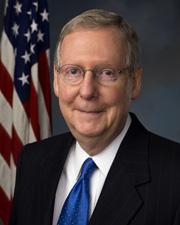
Mr. President, the Senator from Connecticut and I wanted to address the Senate just for a few moments on another matter. I yield the floor and suggest the recognition of the Senator from Connecticut.…
Mr. President, the Senator from Connecticut and I wanted to address the Senate just for a few moments on another matter. I yield the floor and suggest the recognition of the Senator from Connecticut.
Let me say to my friend from Connecticut that was a grand quest on which we were mutually engaged over a year ago to enact new election reform legislation, a major piece of civil rights legislation, along with Senator Bond and others. Both of us are committed to getting it fully funded and both of us agree the current supplemental appropriations is not the place to do it. But we are committed to trying to achieve that, and to achieve it soon, and at a more appropriate time.
I thank my colleague from Connecticut for not offering the amendment on this measure and pledge to work with him to achieve the goal we both desire.
Mr. President, we turn to discussion of the amendment currently pending before the Senate.
Today, we call on the Department of Defense to finalize regulations that will ensure that the Global War on Terrorism Medal, the medal that the Joint Chiefs of Staff picked and that the President has authorized for military operations, will be awarded on an expedited basis to the men and women of the Armed Forces of our country who serve in the global war on terrorism.
Recently, on this bill we dealt with an amendment that would have created a congressionally mandated medal when a medal already authorized by the President and recommended by the military was already in the works and awaiting final approval of the necessary regulations. That medal awaiting final approval is the Global War on Terrorism Expeditionary Medal. It can be awarded to all who serve in Operation Enduring Freedom and Operation Iraqi Freedom.
Our victories in the global war on terrorism would not have been possible without the dedication, the courage, and the service of the members of the U.S. Armed Forces and their coalition partners.
It is entirely appropriate that we recognize these brave men and women of the Armed Forces by awarding them service medals for personal bravery and other leadership actions and for their service in military operations abroad and for support operations at home and support operations overseas.
But the fact is, historically, the President has relied on senior military officers to recommend the personal and theater campaign medals.
Here, with the Global War on Terrorism Medal, that longstanding tradition was preserved with the Joint Chiefs of Staff and the combatant commanders, including GEN Tommy Franks, U.S. Army, former Commander of the U.S. Central Command, recommending the medal to be awarded.
Taking the advice of his senior military and civilian defense leaders, President Bush, by Executive Order 13289, on March 12 of this year, established the Global War on Terrorism Expeditionary Medal to be awarded to service members who served in military operations to combat terrorism on or after September 11, 2001, including, but not limited to, actions in Operation Enduring Freedom and Operation Iraqi Freedom, in such locations as Afghanistan, Iraq, the Republic of the Philippines, and elsewhere in Southwest Asia.
Now, that Executive Order by the President went beyond our men and women in the Armed Forces and much further than the recent, other medal amendment would have. It also established a Global War on Terrorism Service Medal, recognizing duty in Operation Noble Eagle and the homeland defense mission against further terrorist attacks and recognizing duty in support of military operations performed in areas that do not qualify for the Global War on Terrorism Expeditionary Medal.
We all know of the fine work that is going on to preserve our homeland security. We know of the efforts to guard our borders, hunt down terrorists, and screen our airports. We recognize those efforts with this amendment and the medal. But we bring focus and attention to all of the important support staff. Ask any soldier, ask any sailor, ask any airman, and each will tell you how important it is to have the right staff sending you the right stuff--having the right staff sending you the right stuff. Without a competent, capable, and talented support staff in the global war on terrorism, our men and women in the Armed Forces would not have the right tools for the job. Their lives would be at greater risk and so, too, would the freedom we cherish here at home. It is right that we recognize all that they provide for our soldiers, our sailors, and our airmen, as well as what they do for all of us.
Yet the implementing regulations for eligibility for both these medals have not been issued by the Secretary of Defense.
So today, what we will do, if my amendment is adopted, is we, in the Senate, will call upon the Secretary of Defense to complete action as soon as possible on implementing regulations so these awards can go to any person who renders qualifying service with the Armed Forces in those phases of the
global war on terrorism, including Operation Iraqi Freedom, Operation Enduring Freedom, and Operation Noble Eagle.
This amendment says the regulations providing for a medal already in the works, designed by soldiers and authorized by the President, should be implemented as soon as possible and, in doing so, should also recognize those who serve in Operation Noble Eagle and in support roles for our military abroad. These are the critical distinctions between the amendment before us now and the amendment that was considered 2 days ago.
Mr. President, I know Senator McCain and Senator Warner would also like to speak to my amendment. They are not in the Chamber at the moment but would like to speak. And I believe there is another Senator on our side of the aisle who would like to speak on this amendment as well.
So pending their arrival, I suggest the absence of a quorum.

Mr. President, I ask the Budget Committee chairman if he will yield for a question. As I said a few minutes ago, on our side there is real angst as to when we might finish this budget conference…
Mr. President, I ask the Budget Committee chairman if he will yield for a question.
As I said a few minutes ago, on our side there is real angst as to when we might finish this budget conference report. We have 5 hours on our side. At this stage, we have the intention of using most all of that time. I am wondering, from your perspective, how much of your time are you going to use? It is important for people who are bouncing around the country.
Using the time.
I thank the Senator.
Mr. President, if I may direct a question to the chairman, we are willing to work in any way possible to get the budget passed and the supplemental passed.
I think the Senator should be forewarned that I doubt very seriously if there will be a debt extension passed today. We spoke at some length a week ago with the majority leader. We will be happy to work with the leader on a freestanding bill. We need a day on that, but that doesn't mean 30 minutes or an hour. We have a number of people who have indicated to us that they want to offer amendments on the budget extension.
The majority leader is quoted in the press as saying he thinks we can do the supplemental and the budget resolution, but he doesn't think we can do the debt limit. I want the chairman to know we agree with the majority leader.
Mr. President, very briefly, if I may, I think every time a debt limit extension has come before the Congress, I have voted for it. I believe we have debts and we should pay them. I will likely vote for this one. But there are some people who don't think as I do and they want some time to talk on this.
The majority leader has the commitment of Senator Daschle and myself and Senator Conrad that we will work with them to get the debt limit extension passed. We need a little bit of time to do that.
Just on a personal note, I have been checking my banking on line every morning to see if my return is back. I am expecting that money to come back soon. It has been 4 weeks now and it is not here. I am a little disappointed.
Mr. President, if I could direct a question through the Chair to my friend, who is acting majority leader.
Could I have some indication how much longer the Senator from Idaho is going to talk? We may not be able to make the 4 time.
We have four speakers, and if the time is equally divided between now and 4, I am not sure we have enough time for all of our speakers.
I am wondering if the majority is going to use all of their time, if we decide to vote at 4, which will be beyond 15 minutes. Does the Senator think he would have authority to allow us to have another hour of that time and the majority have what remains?
Yes.
I yield 10 minutes to the Senator from Michigan.
Mr. President, I ask my friend to yield. I am rising for a unanimous consent request so Members have an idea when this will be concluded.
Mr. President, I have been in discussion with the majority, and I ask unanimous consent the vote on adoption of the pending budget conference report occur 2 hours from this time, and that Senator Levin be allowed to complete his statement on our side, and Senator Durbin would have 15 minutes, Senator Graham of Florida 15 minutes, Senator Feinstein 10 minutes, Senator Biden 10 minutes, and Senator Byrd 30 minutes.
I think it is totally appropriate.
We need to make sure we have enough time for the majority. If we do 2 hours, they would be limited, instead of 30 minutes, to 20 minutes. The only reason I say that is Senator Nickles, when he started today, said they would not need a lot of time. I know 110 minutes compared to 20 minutes is not very much.
If I could modify my request, I will try to pare down the time here. Let's make it 95 minutes here and 35 minutes on the other side.
I withdraw my request.

Mr. President, I really can't tell how long it is going to be. We haven't put any time limit on amendments today. I won't do it on this side. They wouldn't take them on the other side. There will be…
Mr. President, I really can't tell how long it is going to be. We haven't put any time limit on amendments today. I won't do it on this side. They wouldn't take them on the other side. There will be no time limit on these amendments: Senator Hollings has an amendment, Senator Hutchison has an amendment, and Senator Warner has an amendment. I think there is an amendment on the list for Senator Nickles. There are a series of Senators on this side who still have amendments that could be raised.
My understanding is that once we have measured about the same number of amendments presented by the other side so far today we would come back to our side of the aisle.
Mr. President, that may be the alternative because I have tried all day to speed up that side in terms of consideration of amendments--all day long now. I started at 11 o'clock this morning. We have just finished handling five amendments on that side of the aisle. We haven't had one from this side of the aisle yet. I don't think it is beyond fair to say Senators who notified me they want to bring up their amendments that it is time for us to bring up amendments on this side. We couldn't get any agreement on time over there. I don't know of any reason why we should have time agreements over here.
If the Senator wants to proceed with regular order, I am all for it. There are 16 amendments. We will be on those until midnight. Some of them may not be called up at all. But we can call them up, if the other side wants to do that.
I believe, in balance and fairness, we have been compelled to be balanced on this side now for 5 hours. I think we are now going to be on this side for about 4 or 5 hours.
Mr. President, I remember my good friend from Nevada saying just let things work out this morning at 11 o'clock when I tried to get the time; let things work out.
I don't know how long these amendments are going to take. I haven't seen them, either. I didn't see the ones either from that side this morning. You can't tell how long an amendment is going to take until you look at it and read it.
As a practical matter, I am asking the Senator from Nevada to do on their side exactly what we had to this morning--take the assurance that we are going to move as quickly as we can and turn to some of the amendments on this side for a while.
Mr. President, the Senator is correct in terms of the process. We still have a lot more than six amendments. We have a whole list of amendments, depending on what amendments are raised on that side. All I am asking for is balance and fairness in terms of what we allowed the other side to do in handling their amendments until now. If that means we have to go to regular order, I am prepared to call for regular order. If that is the case, I am saddened to hear my friend from Nevada say a gentlemen's agreement was made on the basis that the Democratic side of the aisle is allowed to call up amendments whenever they want and for how long they want but they want time agreements and assurances on our side. That isn't the agreement we made. That is not the gentlemen's agreement which I understand we made.
If the gentlemen's agreement is broken and we do not finish by tomorrow, we should know that right now. If that is the case, then I can assure the Senate that we will be back in session Saturday and we will be here Sunday. We are going to finish this bill this week. That word I took as a word of a Senator. All leadership agreed that we would finish this bill tomorrow to the best of our ability. I am still relying on that word.
Mr. President, I suggest we proceed with Senator Inouye.
Mr. President, I stepped off the floor. Just so I understand, it is my understanding that the distinguished Senator from Hawaii, the ranking member of the Appropriations Subcommittee on Defense, is…
Mr. President, I stepped off the floor. Just so I understand, it is my understanding that the distinguished Senator from Hawaii, the ranking member of the Appropriations Subcommittee on Defense, is going to speak for approximately 20 minutes. Senator Stevens indicated to me that there were two or three amendments on the majority side that they want to offer, and we have offered several amendments this morning. They wanted to, in effect, catch up. We want to reciprocate with amendments. Following that, we will offer an amendment. I don't know how many amendments the Senator from Alaska wants his side to offer prior to going back to our side. If we just had some idea so we can have our folks lined up here.
I would be happy to talk to the Senator off camera, so to speak. But we have a plan, if the Senator will approve. I will talk off camera momentarily.
Could Senator Stevens give us an idea of how long the work on your side is going to take so we can have an amendment lined up after that?
The only thing I would say is that everyone knows we have a lot more amendments than the other side. We have at this time I think still 29 or 30 amendments. It doesn't seem fair,
for lack of a better word, that the majority is going to get rid of basically all of their amendments leaving us with all of ours when we still have to finish this bill tomorrow. That is looking more remote all the time. I don't see how in the world we can do that under the guidelines. I apologize to my friend from Alaska for not being able to get a time agreement on one of the amendments. That is the only one. On the rest of them, we worked out time agreements.
I think, again for lack of a better word, in basic fairness we should have some idea about how long it is going to take on the other side until we are ready with amendments over here. Otherwise, I would have no alternative but just say go ahead with regular order and start offering the amendments that are already pending.
Mr. President, everyone here should know that this bill will not be finished tomorrow. Understand that it will not be finished tomorrow. If it is going to be 4 or 5 hours on amendments on the majority side when they have just a few amendments, this bill will not be finished tomorrow, period. Take however long they want. We have done everything to cooperate. There was one amendment that we didn't get a time agreement on, but we still finished that in a reasonable period of time.
I have the greatest affection, respect, and admiration for the distinguished manager of this bill. But to take 4 or 5 hours, that is 9 o'clock. To think we can finish this bill tomorrow is hallucinating. We can't do that.
There is a basic difference. If I may say, there are some people over here who really don't care much about this bill ever passing. That is the way the Senate is.
Senator Daschle has used his good office because of a gentlemen's agreement that he had with the manager of the bill and Senator Frist to move this along as quickly as possible. We are trying to do that. It is no one's fault, but one of the Senators had a medical problem that held us up for several hours before we were scheduled to vote. It seems there is always some problem here.
We have tried as much as we can to be responsible in our ability to move this bill.
Four or five hours--I just repeat, we can't finish this bill tomorrow. Everyone should understand that. That isn't done with any animosity. It just can't be done.
I understand the majority leader will be coming to the floor shortly to address our current legislative circumstances. I have become increasingly concerned about our ability to finish this bill. We…
I understand the majority leader will be coming to the floor shortly to address our current legislative circumstances. I have become increasingly concerned about our ability to finish this bill. We have noted that concern to the majority leader, as well as to the manager of the bill.
Our concern stems from really two issues: One, the unwillingness on the part of some to have votes on the pending amendments. I am told now there are eight or nine amendments that are pending, that have been offered and that have been set aside. Tomorrow is Friday. We wanted to have votes on all of those amendments. Yet for whatever reason, we have been unable to get to the votes.
The second issue is the issue involving the amendment to be offered by the Senators from Indiana and Wyoming, Mr. Bayh and Mr. Ensign. I am told, for whatever reason, many of our colleagues on the other side are unwilling to allow that amendment even to be brought up. If that is the case, obviously we are not going to be able to finish this bill. We can't have completion of the consideration of this legislation until that amendment has been offered and we have an opportunity to debate it and vote on it.
So, for whatever reason, we are stymied this afternoon at 5 o'clock with, I guess, some 30 amendments pending.
We had indicated all along we would make our best good-faith effort to try to finish this legislation. But I emphasized all the way through, this is going to take cooperation on both sides. I think we have cooperated in every sense of the word. We have laid down the amendments. I think most of the amendments that have been offered have been our amendments. We have laid them down. We have not in any way stalled consideration of this legislation.
Now we are here Thursday afternoon at 5 o'clock with nine amendments we are told we cannot have votes on, and one of them that cannot even be offered. So we are going to have to come to some understanding about how to proceed. I must say, with each passing hour the likelihood that we will be able to complete our work as we had hoped we could--by the end of the day tomorrow--dwindles and diminishes to a point where it will soon be nonexistent.
I call these concerns to the attention of my colleagues and ask we get some clarification about the schedule and about our ability to deal with these issues.
I yield the floor.

Mr. President, if the Senator will yield, I had an amendment with Senator Durbin. Are we ready for that amendment?
Mr. President, if the Senator will yield, I had an amendment with Senator Durbin. Are we ready for that amendment?

I yield 12 minutes to the Senator from Iowa.
I yield 12 minutes to the Senator from Iowa.
Bill Text
Latest available legislative text
        [Congressional Bills 108th Congress]
[From the U.S. Government Publishing Office]
[S. 2514 Introduced in Senate (IS)]

108th CONGRESS
2d Session
S. 2514

To authorize the transfer of funds for foreign countries to participate
in international peacekeeping or peace enforcement operations, and for
other purposes.

_______________________________________________________________________

IN THE SENATE OF THE UNITED STATES

June 9, 2004

Mr. Lugar introduced the following bill; which was read twice and
referred to the Committee on Foreign Relations

_______________________________________________________________________

A BILL

To authorize the transfer of funds for foreign countries to participate
in international peacekeeping or peace enforcement operations, and for
other purposes.

Be it enacted by the Senate and House of Representatives of the
United States of America in Congress assembled,

SECTION 1. SHORT TITLE.

This Act may be cited as the ``The Global Peacekeeping Operations
Initiative Act of 2004''.

SEC. 2. FINDINGS.

Congress makes the following findings:
(1) The need for effective peacekeeping troops has grown
worldwide, especially in Africa.
(2) Peacekeeping operations in Africa have grown from
24,000 peacekeepers in 2002 to 40,000 peacekeepers in 2004 and
immediate future requirements in Sudan and Burundi will
significantly increase the need for peacekeepers.
(3) Conflicts in Sierra Leone, Ethiopia/Eritrea, Cote
d'Ivoire, Liberia, Burundi, the Congo, and the Sudan have
devastated the continent and set back economic and social
progress for millions of Africans.
(4) African leaders, through the New Partnership for
Africa's Development, have placed solving conflicts and
managing post-conflict stabilization and reconstruction efforts
on the continent as among their highest priorities.
(5) The African Union recently signed a protocol outlining
its responsibility for peace and security on the continent and
highlighting the importance of the organization's continuing
partnership with the member states of the Group of Eight and
the rest of the developed world.
(6) The member states of the Group of Eight have had a
longstanding interest, expressed at both the Kananaskis and
Evian summits, in providing technical and financial assistance
to sustain and strengthen African peacekeeping capacity.
(7) The Group of Eight summit held in Sea Island, Georgia,
in June 2004, resulted in the members of the Group of Eight
pledging to train at least 75,000 international peacekeepers
over the next several years and develop a plan to provide
logistical support around the world.
(8) The United States has recognized the importance and
value of professional training of international peacekeepers
through several programs including the Africa Crisis Response
Initiative and the African Contingency Operations and Training
Assistance programs.
(9) The Global Peacekeeping Operations Initiative is a
significant United States contribution to fulfilling the
commitment of the Group of Eight and to supporting the
aspirations of African leaders as such leaders pursue peace and
prosperity on the continent.

SEC. 3. ASSISTANCE FOR FOREIGN COUNTRIES TO ENGAGE IN PEACEKEEPING
OPERATIONS.

(a) In General.--Notwithstanding any other provision of law, the
Secretary of Defense, with the concurrence of the Secretary of State,
may transfer funds to the Secretary of State to provide assistance to
military or security forces in a foreign country to enhance the
capability of such country to participate in an international
peacekeeping or peace enforcement operation.
(b) Types of Assistance.--Assistance provided under subsection (a)
may be used to provide equipment, supplies, training, or funding.
(c) Additional Authority.--The authority to provide assistance
under this section is in addition to any other authority to provide
assistance to a foreign country or the military or security forces of
such country.
<all>