Electric Transmission and Reliability Enhancement Act of 2003
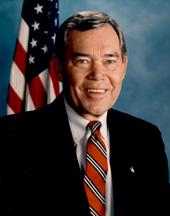 Sen. Craig Thomas (R-WY)
Legislative Activity
Stay on top of the latest movement without scrolling through every action
Committee on Energy and Natural Resources. Hearings held. Hearings printed: S.Hrg. 108-57.
March 27, 2003
View full timeline
Introduced in Senate
February 27, 2003
Sponsor introductory remarks on measure. (CR S2929-2931)
February 27, 2003
Read twice and referred to the Committee on Energy and Natural Resources. (text of measure as introduced: CR S2931-2935)
February 27, 2003
Committee on Energy and Natural Resources. Hearings held. Hearings printed: S.Hrg. 108-57.
March 27, 2003
Floor Debate
20 membersWhat members said about S. 475 on the floor



 +15
+15
Floor Debate
20 membersWhat members said about S. 475 on the floor
Mr. President, I ask unanimous consent that the order for the quorum call be rescinded. Mr. President, I rise once again to speak in support of the confirmation of Miguel Estrada, an exceptionally…
Mr. President, I come to the floor to talk about one of the things that is so important. Obviously, items connected with terrorism, the war in Iraq have to be dealt with. We have to deal with…
Mr. President, I come to the floor to talk about one of the things that is so important. Obviously, items connected with terrorism, the war in Iraq have to be dealt with. We have to deal with…
Now, Mr. President, on another issue that is of deep concern to me, I come also to raise questions about our commitment to homeland security. This is something I have come to this Chamber to address…
Madam President, one of our most important responsibilities as Senators is the confirmation of Federal judges. Federal judges are appointed for life, and they will be interpreting laws affecting the…
Show 8 more
Mr. President, I ask unanimous consent that the order for the quorum call be rescinded. Mr. President, today is the 12th day, as remarkable as that seems, that the Senate is debating this nomination…

Mr. President, I rise today to introduce two pieces of legislation that will improve the lives of our Nation's fishermen who are struggling to make a living on the sea. Fishing is more than just a…
Mr. President, I rise today with my colleagues Senator DeWine, Senator Feinstein, Senator Schumer, Senator Reed, Senator Mikulski, Senator Corzine, and Senator Levin to reintroduce the…

Mr. President, today I am sending to the desk a bill by myself and Senator Miller to amend the IRS Code. It is a bill to provide jobs and economic growth for our country. Mr. President, this bill…

Mr. President, today I am introducing important legislation to affirm Federal jurisdiction over the waters of the United States. I am pleased to have three members of the Environment and Public Works…

Mr. President, I rise today with my friend Senator Kennedy to introduce the ``Senator Paul Wellstone Mental Health Equitable Treatment Act of 2003.'' I have mixed emotions today, because, while we…
Mr. President, I am pleased to join today with Senators Warner, Lugar, Mikulski and Durbin in introducing legislation that would extend the legislative authority for the Martin Luther King, Jr.…

Mr. President, faced with uncertainties in electricity energy markets, turmoil in the Mideast, the need to cut back on the fossil fuel emissions linked to global warming, air pollution that…
Show 11 more

Mr. President, today, I am joined by Senators Breaux, Durbin, Leahy, Harkin and Johnson in introducing legislation to extend the current federal wind energy production tax credit, PTC, for an…

Mr. President, I rise today as the lead cosponsor of Senator Leahy's Omnibus Mercury Reduction Act of 2003 to ask support for our continued efforts to dramatically reduce mercury pollution that has…

Mr. President, I ask unanimous consent that the Committee on Armed Services be authorized to meet during the session of the Senate on Thursday, March 27, 2003, at 10 a.m., in open and possibly closed…
Mr. President, today I am introducing legislation, the Training for Realtime Writers Act of 2003, on behalf of myself and my colleagues, Senators Grassley, Kennedy, Cochran, Lincoln, Kerry, Bingaman,…

Mr. President, I am pleased to introduce a bill to correct an injustice in the tax code that harms citizens in every state of this great Nation. State and local governments have various alternatives…
Mr. President, I am pleased to once again be the lead Republican cosponsor of the ``Training for Realtime Writers Act''. This legislation that Senator Harkin and I are introducing today will provide…
Will the Senator yield for a question? The Senator is from the State of New Jersey. Of course, the State of New Jersey is very aware of the news that is put out in the New York Times and the…

Mr. President, I rise today to introduce the Protect America Scholarships Act of 2003. The Act will draw talented young people into professions that are vital to America's security and that are…
Mr. President, it is an honor to be here today with Senator Domenici to renew the battle in the Senate to end one of the most shameful forms of discrimination in our society discrimination against…

Mr. President, I rise today to introduce a bill to fairly assist injured Federal employees. This legislation will adjust Federal employees retirement computations to offset reductions in their…

Mr. President, the risks and health effects of mercury contamination continue to be serious and immediate. We have known about mercury pollution for many years. It remains one of, if not the last of,…
Bill Text
Latest available legislative text
        [Congressional Bills 108th Congress]
[From the U.S. Government Publishing Office]
[S. 475 Introduced in Senate (IS)]

108th CONGRESS
1st Session
S. 475

To reform the nation's outdated laws relating to the electric industry,
improve the operation of our transmission system, enhance reliability
of our electric grid, increase consumer benefits from wholesale
electric competition and restore investor confidence in the electric
industry.

_______________________________________________________________________

IN THE SENATE OF THE UNITED STATES

February 27, 2003

Mr. Thomas introduced the following bill; which was read twice and
referred to the Committee on Energy and Natural Resources

_______________________________________________________________________

A BILL

To reform the nation's outdated laws relating to the electric industry,
improve the operation of our transmission system, enhance reliability
of our electric grid, increase consumer benefits from wholesale
electric competition and restore investor confidence in the electric
industry.

Be it enacted by the Senate and House of Representatives of the
United States of America in Congress assembled,

SECTION 1. SHORT TITLE.

This Act may be cited as the ``Electric Transmission and
Reliability Enhancement Act of 2003.''

TITLE I--TRANSMISSION IMPROVEMENT

SEC. 101. OPEN NON-DISCRIMINATORY ACCESS.

Part II of the Federal Power Act (16 U.S.C. 824 et seq.) is amended
by inserting after section 211 the following:

``open access by unregulated transmitting utilities

``Sec. 211A. (a) Subject to section 212(h), the Commission may, by
rule or order, require an unregulated transmitting utility to provide
transmission services--
``(1) at rates that are comparable to those that the
unregulated transmitting utility charges itself, and
``(2) on terms and conditions (not relating to rates) that
are comparable to those under Commission rules that require
public utilities to offer open access transmission services and
that are not unduly discriminatory or preferential.
``(b) The Commission shall exempt from any rule or order under this
subsection any unregulated transmitting utility that--
``(1) sells no more than 4,000,000 megawatt hours of
electricity per year;
``(2) does not own or operate nay transmission facilities
that are necessary for operating an interconnected transmission
system (or any portion thereof); or
``(3) meets other criteria the Commission determines to be
in the public interest.
``(c) The rate changing procedures applicable to public utilities
under subsections (c) and (d) of section 205 are applicable to
unregulated transmitting utilities for purposes of this section.
``(d) In exercising its authority under paragraph (1) of subsection
(a), the Commission may remand transmission rates to an unregulated
transmitting utility for review and revision where necessary to meet
the requirements of subsection (a).
``(e) The provision of transmission services under subsection (a)
does not preclude a request for transmission services under section
211.
``(f) The Commission may not require a State or municipality to
take action under this section that constitutes a private business use
for purposes of section 141 of the Internal Revenue Code of 1986 (26
U.S.C. 141).
``(g) For purposes of this subsection, the term `unregulated
transmitting utility' means an entity that--
``(1) owns or operates facilities used for the transmission
of electric energy in interstate commerce, and
``(2) is either an entity described in section 201(f) or a
rural electric cooperative.''.

SEC. 102. FEDERAL AGENCY COORDINATION.

The Department of Energy shall be the lead agency for conducting
environmental review (for purposes of the National Environmental Policy
Act of 1969) of the establishment and modification of electric power
transmission corridors across federal lands. The Secretary of Energy
shall coordinate with Federal agencies, including Federal land
management agencies, to ensure the timely completion of environmental
reviews pertaining to such corridors and may set deadlines for the
completion of such reviews. For purposes of this section, the term
``Federal land management agencies'' means the Bureau of Land
Management, the United States Forest Service, the United States
Fish and Wildlife Service, and the Department of Defense. For purposes
of this section, ``Federal lands'' means all lands owned by the United
States except lands in the National Park System or the national
wilderness preservation system, or such other lands as the President
may designate.

SEC. 103. PRIORITY FOR RIGHTS-OF-WAY ACROSS FEDERAL LANDS.

Section 501 of the Federal Land Policy and Management Act of 1976
(43 U.S.C. 1761) is amended by adding the following new subsection at
the end thereof:
``(e) In administering the provisions of this title, the Secretary
of the Interior and the Secretary of Agriculture each shall give a
priority to applications for rights of way for electric power
transmission corridors.''.

SEC. 104. ELECTRIC RELIABILITY STANDARDS.

Part II of the Federal Power Act (16 U.S.C. 824 et seq.) is amended
by inserting the following new section at the end thereof:

``SEC. 215. ELECTRIC RELIABILITY.

``(a) Definitions.--For purposes of this section--
``(1) The term `bulk-power system' means--
``(A) facilities and control systems necessary for
operating an interconnected electric energy
transmission network (or any portion thereof); and
``(B) electric energy from generation facilities
needed to maintain transmission system reliability.
The term does not include facilities used in the local
distribution of electric energy.
``(2) The terms `Electric Reliability Organization' and
`ERO' mean the organization certified by the Commission under
subsection (c) the purpose of which is to establish and enforce
reliability standards for the bulk-power system, subject to
Commission review.
``(3) The term `reliability standard' means a requirement,
approved by the Commission under this section, to provide for
reliable operation of the bulk-power system. The term includes
requirements for the operation of existing bulk-power system
facilities and the design of planned additions or modifications
to such facilities to the extent necessary to provide for
reliable operation of the bulk-power system, but the term does
not include any requirement to enlarge such facilities or to
construct new transmission capacity or generation capacity.
``(4) The term `reliable operation' means operating the
elements of the bulk-power system within equipment and electric
system thermal, voltage, and stability limits so that
instability, uncontrolled separation, or cascading failures of
such system will not occur as a result of a sudden disturbance
or unanticipated failure of system elements.
``(5) The term `Interconnection' means a geographic area in
which the operation of bulk-power system components is
synchronized such that the failure of one or more of such
components may adversely affect the ability of the operators of
other components within the system to maintain reliable
operation of the facilities within their control.
``(6) The term `transmission organization' means a regional
transmission organization, independent system operator,
independent transmission provider, or other transmission
organization finally approved by the Commission for the
operation of transmission facilities.
``(7) The term `regional entity' means an entity having
enforcement authority pursuant to subsection (e)(4).
``(b) Jurisdiction and Applicability.--
``(1) The Commission shall have jurisdiction within the
United States, over the ERO certified by the Commission under
subsection (c), any regional entities, and all users, owners
and operators of the bulk-power system, including but not
limited to the entities described in section 201(f), for
purposes of approving reliability standards established under
this section and enforcing compliance with this section. All
users, owners and operators of the bulk-power system shall
comply with reliability standards that take effect under this
section.
``(2) The Commission shall issue a final rule to implement
the requirements of this section not later than 180 days after
the date of enactment of this section.
``(c) Certification.--Following the issuance of a Commission rule
under subsection (b)(2), any person may submit an application to the
Commission for certification as the Electric Reliability Organization
(ERO). The Commission may certify one such ERO if the Commission
determines that such ERO--
``(1) has the ability to develop and enforce, subject to
subsection (e)(2), reliability standards that provided for an
adequate level of reliability of the bulk-power system;
``(2) has established rules that--
``(A) assure its independence of the users and
owners and operators of the bulk-power system, while
assuring fair stakeholder representation in the selection of its
directors and balanced decisionmaking in any ERO committee or
subordinate organizational structure;
``(B) allocate equitably reasonable dues, fees, and
other charges among end users for all activities under
this section;
``(C) provide fair and impartial procedures for
enforcement of reliability standards through the
imposition of penalties in accordance with subsection
(e) (including limitations on activities, functions, or
operations, or other appropriate sanctions);
``(D) provide for reasonable notice and opportunity
for public comment, due process, openness, and balance
of interests in developing reliability standards and
otherwise exercising its duties; and
``(E) provide for taking, after certification,
appropriate steps to gain recognition in Canada and
Mexico.
``(d) Reliability Standards.--
``(1) The Electric Reliability Organization shall file each
reliability standard or modification to a reliability standard
that it proposes to be made effective under this section with
the Commission.
``(2) The Commission may approve by rule or order a
proposed reliability standard or modification to a reliability
standard if it determines that the standard is just,
reasonable, not unduly discriminatory or preferential, and in
the public interest. The Commission shall give due weight to
the technical expertise of the Electric Reliability
Organization with respect to the content of a proposed standard
or modification to a reliability standard and to the technical
expertise of a regional entity organized on a Interconnection-
wide basis with respect to a reliability standard to be
applicable within that Interconnection, but shall not defer
with respect to the effect of a standard on competition. A
proposed standard or modification shall take effect upon
approval by the Commission.
``(3) The Electric Reliability Organization shall
rebuttably presume that a proposal from a regional entity
organized on an Interconnection-wide basis for a reliability
standard or modification to a reliability standard to be
applicable on an Interconnection-wide basis is just,
reasonable, and not unduly discriminatory or preferential, and
in the public interest.
``(4) The Commission shall remand to the Electric
Reliability Organization for further consideration a proposed
reliability standard or a modification to a reliability
standard that the Commission disapproves in whole or in part.
``(5) The Commission, upon its own motion or upon
complaint, may order the Electric Reliability Organization to
submit to the Commission a proposed reliability standard or a
modification to a reliability standard that addresses a
specific matter if the Commission considers such a new or
modified reliability standard appropriate to carry out this
section.
``(6) The final rule adopted under subsection (b)(2) shall
include fair processes for the identification and timely
resolution of any conflict between a reliability standard and
any function, rule, order, tariff, rate schedule, or agreement
accepted, approved, or ordered by the Commission applicable to
a transmission organization. Such transmission organization
shall continue to comply with such function, rule, order,
tariff, rate schedule or agreement accepted, approved, or
ordered by the Commission until--
``(A) the Commission finds a conflict exists
between a reliability standard and any such provision;
``(B) the Commission orders a change to such
provision pursuant to section 206 of this part; and
``(C) the ordered change becomes effective under
this part.
If the Commission determines that a reliability standard needs
to be changed as a result of such a conflict, it shall order
the ERO to develop and file with the Commission a modified
reliability standard under paragraph (4) or (5) of this
subsection.
``(e) Enforcement.--
``(1) The ERO may impose, subject to paragraph (2), a
penalty on a user or owner or operator of the bulk-power system
for a violation of a reliability standard approved by the
Commission under subsection (d) if the ERO, after notice and an
opportunity for a hearing--
``(A) finds that the user or owner or operator has
violated a reliability standard approved by the
Commission under subsection (d); and
``(B) files notice and the record of the proceeding
with the Commission.
``(2) A penalty imposed under paragraph (1) may take effect
not earlier than the 31st day after the Electric Reliability
Organization files with the Commission notice of the penalty
and the record of proceedings. Such penalty shall be subject to
review by the Commission, on its own motion or upon application by the
user, owner or operator that is the subject of the penalty filed within
30 days after the date such notice is filed with the Commission.
Application to the Commission for review, or the initiation of review
by the Commission on its own motion, shall not operate as a stay of
such penalty unless the Commission otherwise orders upon its own motion
or upon application by the user, owner or operator that is the subject
of such penalty. In any proceeding to review a penalty imposed under
paragraph (1), the Commission, after notice and opportunity for hearing
(which hearing may consist solely of the record before the Electric
Reliability Organization and opportunity for the presentation of
supporting reasons to affirm, modify, or set aside the penalty), shall
by order affirm, set aside, reinstate, or modify the penalty, and, if
appropriate, remand to the Electric Reliability Organization for
further proceedings. The Commission shall implement expedited
procedures for such hearings.
``(3) On its own motion or upon complaint, the Commission
may order compliance with a reliability standard and may impose
a penalty against a user or owner or operator of the bulk-power
system, if the Commission finds, after notice and opportunity
for a hearing, that the user or owner or operator of the bulk-
power system has engaged or is about to engage in any acts or
practices that constitute or will constitute a violation of a
reliability standard.
``(4) The Commission shall establish regulations directing
the ERO to enter into an agreement to delegate authority to a
regional entity for the purpose of proposing reliability
standards to the ERO and enforcing reliability standards under
paragraph (1) if--
``(A) the regional entity is governed by an
independent, balanced stakeholder, or combination
independent and balanced stakeholder board;
``(B) the regional entity otherwise satisfies the
provisions of subsection (c)(1) and (2); and
``(C) the agreement promotes effective and
efficient administration of bulk-power system
reliability.
The Commission may modify such delegation. The ERO and the
Commission shall rebuttably presume that a proposal for
delegation to a regional entity organized on an
Interconnection-wide basis promotes effective and efficient
administration of bulk-power system reliability and should be
approved. Such regulation may provide that the Commission may
assign the ERO's authority to enforce reliability standards
under paragraph (1) directly to a regional entity consistent
with the requirements of this paragraph.
``(5) The Commission may take such action as is necessary
or appropriate against the ERO or a regional entity to ensure
compliance with a reliability standard or any Commission order
affecting the ERO or a regional entity.
``(6) Any penalty imposed under this section shall bear a
reasonable relation to the seriousness of the violation and
shall take into consideration the efforts of such user, owner,
or operator to remedy the violation in a timely manner.
``(f) Changes in Electricity Reliability Organization Rules.--The
Electric Reliability Organization shall file with the Commission for
approval any proposed rule or proposed rule change, accompanied by an
explanation of its basis and purpose. The Commission, upon its own
motion or complaint, may propose a change to the rules of the Electric
Reliability Organization. A proposed rule or proposed rule change shall
take effect upon a finding by the Commission, after notice and
opportunity for comment, that the change is just, reasonable, not
unduly discriminatory or preferential, is in the public interest, and
satisfies the requirements of subsection (c).
``(g) Reliability Reports.--The Electric Reliability Organization
shall conduct periodic assessments of the reliability and adequacy of
the bulk-power system in North America.
``(h) Coordination With Canada and Mexico.--The President is urged
to negotiate international agreements with the governments of Canada
and Mexico to provide for effective compliance with reliability
standards and the effectiveness of the Electric Reliability
Organization in the United States and Canada or Mexico.
``(i) Savings Provisions.--
``(1) The Electric Reliability Organization shall have
authority to develop and enforce compliance with reliability
standards for only the bulk-power system.
``(2) This section does not authorize the Electric
Reliability Organization or the Commission to order the
construction of additional generation or transmission capacity
or to set and enforce compliance with standards for adequacy or
safety of electric facilities or services.
``(3) Nothing in this section shall be construed to preempt
any authority of any State to take action to ensure the safety,
adequacy, and reliability of electric service within that
State, as long as such action is not inconsistent with any reliability
standard.
``(4) Within 90 days of the application of the Electric
Reliability Organization or other affected party, and after
notice and opportunity for comment, the Commission shall issue
a final order determining whether a State action is
inconsistent with a reliability standard, taking into
consideration any recommendation of the Electric Reliability
Organization.
``(5) The Commission, after consultation with the Electric
Reliability Organization, may stay the effectiveness of any
State action, pending the Commission's issuance of a final
order.
``(j) Regional Advisory Bodies.--The Commission shall establish a
regional advisory body on the petition of at least two-thirds of the
States within a region that have more than one-half of the electric
load served within the region. A regional advisory body shall be
composed of one member from each participating State in the region,
appointed by the Governor of each State, and may include
representatives of agencies, States, and provinces outside the United
States. A regional advisory body may provide advice to the Electric
Reliability Organization, a regional entity, or the Commission
regarding the governance of an existing or proposed regional entity
within the same region, whether a standard proposed to apply within the
region is just, reasonable, not unduly discriminatory or preferential,
and in the public interest, whether fees proposed to be assessed within
the region are just, reasonable, not unduly discriminatory or
preferential, and in the public interest and any other responsibilities
requested by the Commission. The Commission may give deference to the
advise of any such regional advisory body if that body is organized on
an Interconnection-wide basis.
``(k) Application to Alaska and Hawaii.--The provisions of this
section do not apply to Alaska or Hawaii.''.

TITLE II--ELIMINATION OF COMPETITIVE BARRIERS

Subtitle A--Provisions Regarding the Public Utility Holding Company Act
of 1935

SEC. 201. DEFINITIONS.

For the purposes of this subtitle:
(1) The term ``affiliate'' of a company means any company 5
percent or more of the outstanding voting securities of which
are owned, controlled, or held with power to vote, directly or
indirectly, by such company.
(2) The term ``associated company'' of a company means any
company in the same holding company system with such company.
(3) The term ``Commission'' means the Federal Energy
Regulatory Commission.
(4) The term ``company'' means a corporation, partnership,
association, joint stock company, business trust, or any
organized group of persons, whether incorporated or not, or a
receiver, trustee, or other liquidating agent of any of the
foregoing.
(5) The term ``electric utility company'' means any company
that owns or operates facilities use for the generation,
transmission, or distribution of electric energy for sale.
(6) The terms ``exempt wholesale generator'' and ``foreign
utility company'' have the same meanings as in sections 32 and
33, respectively, of the Public Utility Holding Company Act of
1935 (15 U.S.C. 79z-5, 79z-5b), as those sections existed on
the day before the effective date of this subtitle.
(7) The term ``gas utility company'' means any company that
owns or operates facilities used for distribution at retail
(other than the distribution only in enclosed portable
containers or distribution to tenants or employees of the
company operating such facilities for their own use and not for
resale) of natural or manufactured gas for heat, light, or
power.
(8) the term ``holding company'' means--
(A) any company that directly or indirectly owns,
controls, or holds, with power to vote, 10 percent or
more of the outstanding voting securities of a public
utility company or of a holding company of any public
utility company; and
(B) any person, determined by the Commission, after
notice and opportunity for hearing, to exercise
directly or indirectly (either alone or pursuant to an
arrangement or understanding with one or more persons)
such a controlling influence over the management or
policies of any public utility company or holding company as to make it
necessary or appropriate for the rate protection of utility customers
with respect to rates that such person be subject to the obligations,
duties, and liabilities imposed by this subtitle upon holding
companies.
(9) The term ``holding company system'' means a holding
company, together with its subsidiary companies.
(10) The term ``jurisdictional rates'' established by the
Commission for the transmission of electric energy in
interstate commerce, the sale of electric energy at wholesale
in interstate commerce, the transportation of natural gas in
interstate commerce, and the sale in interstate commerce of
natural gas for resale for ultimate public consumption for
domestic, commercial, industrial, or any other use.
(11) The term ``natural gas company'' means a person
engaged in the transportation of natural gas in interstate
commerce or the sale of such gas in interstate commerce for
resale.
(12) The term ``person'' means an individual or company.
(13) The term ``public utility'' means any person who owns
or operates facilities used for transmission of electric energy
in interstate commerce or sales of electric energy at wholesale
in interstate commerce.
(14) The term ``public utility company'' means an electric
utility company or a gas utility company.
(15) The term ``State commission'' means any commission,
board, agency, or officer, by whatever name designated, of a
State, municipality, or other political subdivision of a State
that, under the laws of such State, has jurisdiction to
regulate public utility companies.
(16) The term ``subsidiary company'' of a holding company
means--
(A) any company, 10 percent or more of the
outstanding voting securities of which are directly or
indirectly owned, controlled, or held with power to
vote, by such holding company; and
(B) any person, the management or policies of which
the Commission, after notice and opportunity for
hearing, determines to be subject to a controlling
influence, directly or indirectly, by such holding
company (either alone or pursuant to an arrangement or
understanding with one or more other persons) so as to
make it necessary for the rate protection of utility
customers with respect to rates that such person be
subject to the obligations, duties, and liabilities
imposed by this subtitle upon subsidiary companies of
holding companies.
(17) The term ``voting security'' means any security
presently entitling the owner or holder thereof to vote in the
direction or management of the affairs of a company.

SEC. 202. REPEAL OF THE PUBLIC UTILITY HOLDING COMPANY ACT OF 1935.

The Public Utility Holding Company Act of 1935 (15 U.S.C. 79a and
following) is repealed, effective 12 months after the date of enactment
of this Act.

SEC. 203. FEDERAL ACCESS TO BOOKS AND RECORDS.

(a) In General.--Each holding company and each associate company
thereof shall maintain, and shall make available to the Commission,
such books, accounts, memoranda, and other records as the Commission
determines are relevant to costs incurred by a public utility or
natural gas company that is an associate company of such holding
company and necessary or appropriate for the protection of utility
customers with respect to jurisdictional rates.
(b) Affiliate Companies.--Each affiliate of a holding company or of
any subsidiary company of a holding company shall maintain, and make
available to the Commission, such books, accounts, memoranda, and other
records with respect to any transaction with another affiliate, as the
Commission determines are relevant to costs incurred by a public
utility or natural gas company that is an associate company of such
holding company and necessary or appropriate for the protection of
utility customers with respect to jurisdictional rates.
(c) Holding Company Systems.--The Commission may examine the books,
accounts, memoranda, and other records of any company in a holding
company system, or any affiliate thereof, as the Commission determines
are relevant to costs incurred by a public utility or natural gas
company within such holding company system and necessary or appropriate
for the protection of utility customers with respect to jurisdictional
rates.
(d) Confidentiality.--No member, officer, or employee of the
Commission shall divulge any fact or information that may come to his
or her knowledge during the course of examination of books, accounts,
memoranda, or other records as provided in this section, except as may
be directed by the Commission or by a court of competent jurisdiction.

SEC. 204. STATE ACCESS TO BOOKS AND RECORDS

(a) In General.--Upon the written request of a State commission
having jurisdiction to regulate a public utility company in a holding
company system, and subject to such terms and conditions as may be
necessary and appropriate to safeguard against unwarranted disclosure
to the public of any trade secrets or sensitive commercial information,
a holding company or any associate company or affiliate thereof,
wherever located, shall produce for inspection books, accounts,
memoranda, and other records that--
(1) have been identified in reasonable detail in a
proceeding before the State commission;
(2) the State commission determines are relevant to costs
incurred by such public utility company; and
(3) are necessary for the effective discharge of the
responsibilities of the State commission with respect to such
proceeding.
(b) Effect on State Law.--Nothing in this section shall preempt
applicable State law concerning the provision of books, accounts,
memoranda, or other records, or in any way limit the rights of any
State to obtain books, accounts, memoranda, or other records, under
Federal law, contract, or otherwise.
(c) Court Jurisdiction.--Any United States district court located
in the State in which the State commission referred to in subsection
(a) is located shall have jurisdiction to enforce compliance with this
section.

SEC. 205. EXEMPTION AUTHORITY.

(a) Rulemaking.--Not later than 90 days after the date of enactment
of this Act, the Commission shall promulgate a final rule to exempt
form the requirements of section 203 any person that is a holding
company, solely with respect to one or more--
(1) qualifying facilities under the Public Utility
Regulatory Policies Act of 1978;
(2) exempt wholesale generators; or
(3) foreign utility companies.
(b) Other Authority.--If, upon application or upon its own motion,
the Commission finds that the books, accounts, memoranda, and other
records of any person are not relevant to the jurisdictional rates of a
public utility company or natural gas company, or if the Commission
finds that any class of transactions is not relevant to the
jurisdictional rates of a public utility company, the Commission shall
exempt such person or transaction from the requirements of section 203.

SEC. 206. AFFILIATE TRANSACTIONS.

Nothing in this subtitle shall preclude the Commission or a State
commission from exercising its jurisdiction under otherwise applicable
law to determine whether a public utility company, public utility, or
natural gas company may recover in rates any costs of an activity
performed by an associate company, or any costs of goods or services
acquired by such public utility company, public utility, or natural gas
company form an associate company.

SEC. 207. APPLICABILITY.

No provision of this subtitle shall apply to, or be deemed to
include--
(1) the United States;
(2) a State or any political subdivision of a State;
(3) any foreign governmental authority not operating in the
United States;
(4) any agency, authority or instrumentality of any entity
referred to in paragraph (1), (2), or (3); or
(5) any officer, agent, or employee of any entity referred
to in paragraph (1), (2), or (3) acting as such in the course
of such officer, agent, or employee's official duty.

SEC. 208. EFFECT ON OTHER REGULATIONS.

Nothing in this subtitle precludes the Commission or a State
commission from exercising its jurisdiction under otherwise applicable
law to protect utility customers.

SEC. 209. ENFORCEMENT.

The Commission shall have the same powers as set forth in sections
306 through 317 of the Federal Power Act (16 U.S.C. 825e-825p) to
enforce the provisions of this subtitle.

SEC. 210. SAVINGS PROVISIONS.

(a) In General.--Nothing in this subtitle prohibits a person from
engaging in or continuing to engage in activities or transactions in
which it is legally engaged or authorized to engage on the date of
enactment of this Act, if that person continues to comply with the
terms of any such authorization, whether by rule or by order.
(b) Effect on Other Commission Authority.--Nothing in this subtitle
limits the authority of the Commission under the Federal Power Act (16
U.S.C. 791a and following) (including section 301 of that Act) or the
Natural Gas Act (15 U.S.C. 717 and following) (including section 8 of
that Act).

SEC. 211. IMPLEMENTATION.

Not later than 12 months after the date of enactment of this Act,
the Commission shall--
(1) promulgate such regulations as may be necessary or
appropriate to implement this subtitle; and
(2) submit to Congress detailed recommendations on
technical and conforming amendments to Federal law necessary to
carry out this subtitle and the amendments made by this
subtitle.

SEC. 212. TRANSFER OF RESOURCES.

All books and records that relate primarily to the functions
transferred to the Commission under this subtitle shall be transferred
from the Securities and Exchange Commission to the Commission.

SEC. 213. EFFECTIVE DATE.

This subtitle shall take effect 12 months after the date of
enactment of this Act.

SEC. 214. CONFORMING AMENDMENT TO THE FEDERAL POWER ACT.

Section 318 of the Federal Power Act (16 U.S.C. 825q) is repealed.

Subtitle B--Provisions Regarding the Public Utility Regulatory Policies
Act of 1978

SEC. 215. PROSPECTIVE REPEAL OF SECTION 210.

(a) New Contracts.--After the date of enactment of this Act, no
electric utility shall be required to enter into a new contract or
obligation to purchase or to sell electric energy or capacity pursuant
to section 210 of the Public Utility Regulatory Policies Act of 1978
(16 U.S.C. 824a-3).
(b) Existing Rights and Remedies Not Affected.--Nothing in this Act
affects the rights or remedies of any party with respect to the
purchase or sale of electric energy or capacity from or to a facility
determined to be a qualifying small power production facility or a
qualifying cogeneration facility under section 210 of the Public
Utility Regulatory Policies Act of 1978 pursuant to any contract or
obligation to purchase or to sell electric energy or capacity in effect
on the date of enactment of this Act, including the right to recover
the costs of purchasing such electric energy or capacity.

SEC. 216. RECOVERY OF COSTS.

In order to assure recovery by electric utilities purchasing
electric energy or capacity from a qualifying facility pursuant to any
legally enforceable obligation entered into or imposed pursuant to
section 210 of the Public Utility Regulatory Policies Act of 1978 prior
to the date of enactment of this Act, of all costs associated with such
purchases, the Commission shall promulgate and enforce such regulations
as may be required to assure that no such electric utility shall be
required directly or indirectly to absorb the costs associated with
such purchases from a qualifying facility. Such regulations shall be
treated as a rule enforceable under the Federal Power Act (16 U.S.C.
791a-825r).

SEC. 217. DEFINITIONS.

For purposes of this subtitle, the terms ``Commission'', ``electric
utility'', ``qualifying cogeneration facility'', and ``qualifying small
power production facility'', shall have the same meanings as provided
in the Public Utility Regulatory Policies Act of 1978, and the term
``qualifying facility'' shall mean either a qualifying small production
facility or a qualifying cogeneration facility as defined in such Act.

TITLE III--MARKET TRANSPARENCY, ANTI-MANIPULATION AND ENFORCEMENT

Subtitle A--Market Transparency, Anti-Manipulation, and Enforcement

SEC. 301. MARKET TRANSPARENCY RULES.

Part II of the Federal Power Act is amended by adding after section
215 as added by this Act the following:

``SEC. 216. MARKET TRANSPARENCY RULES.

``(a) Commission Rules.--Not later than 180 days after the date of
enactment of this section, the Commission shall issue rules
establishing an electronic information system to provide the Commission
and the public with access to such information as is necessary or
appropriate to facilitate price transparency and participation in
markets subject to the Commission's jurisdiction. Such systems shall
provide statistical information about the availability and market price
of wholesale electric energy and transmission services to the
Commission, State commissions, buyers and sellers of wholesale electric
energy, users of transmission services, and the public on a timely
basis.
``(b) Information Required.--The Commission shall require--
``(1) each regional transmission organization or, where no
regional transmission organization is operating, each
transmitting utility to provide information about the available
capacity of transmission facilities operated by the
organization or transmitting utility; and
``(2) each regional transmission organization or broker or
exchange to provide aggregate information about the amount and
price of physical sales of electric energy at wholesale in
interstate commerce it transacts.
``(c) Definition.--For purposes of this section, the term `broker
or exchange' means any entity that matches offers to sell and offers to
buy physical sales or wholesale electric energy in interstate commerce.
``(d) Protection of Sensitive Information.--The Commission shall
exempt from disclosure information it determines would, if disclosed,
be detrimental to the operation of an effective market.''.

SEC. 302. MARKET MANIPULATION.

(a) Part II of the Federal Power Act is amended by adding after
section 216 as adding by this Act the following:

``SEC. 217. PROHIBITION ON FILING FALSE INFORMATION.

``It shall be a violation of this Act for any person willfully and
knowingly to report any information relating to the price of
electricity sold at wholesale, which information the person knew to be
false at the time of the reporting, to any governmental or non-
governmental entity and with the intent to manipulate the data being
compiled by such entity.

``SEC. 218. PROHIBITION ON ROUND TRIP TRADING.

``(a) Prohibition.--It shall be a violation of this Act for any
person willfully and knowingly to enter into any contract or other
arrangement to execute a ``round-trip trade'' for the purchase or sale
of electric energy at wholesale.
``(b) Definition of Round-Trip Trade.--For the purposes of this
section, the term `round trip trade' means a transaction, or
combination of transactions, in which a person or other entity--
``(1) enters into a contract or other arrangement to
purchase from, or sell to, any other person or other entity
electric energy at wholesale;
``(2) simultaneously with entering into the contract or
arrangement described in paragraph (1), arranges a financially
offsetting trade with such other person or entity for the same
such electric energy, at the same location, price, quantity and
terms so that, collectively, the purchase and sale transactions
in themselves result in no financial gain or loss; and
``(3) enters into the contract or arrangement with the
intent to deceptively affect reported revenues, trading
volumes, or prices.''.

SEC. 303. ENFORCEMENT.

(a) Complaints.--Section 306 of the Federal Power Act (16 U.S.C.
825e) is amended by--
(1) inserting ``electric utility,'' after ``Any person,'';
and
(2) inserting ``transmitting utility,'' after ``licensee''
each place it appears.
(b) Investigations.--Section 307(a) of the Federal Power Act (16
U.S.C. 825f(a)) is amended by inserting ``or transmitting utility''
after ``any person'' in the first sentence
(c) Review of Commission Orders.--Section 313(a) of the Federal
Power Act (16 U.S.C. 8251) is amended by inserting ``electric
utility,'' after ``Any person,'' in the first sentence.
(d) Criminal Penalties.--Section 316 of the Federal Power Act (16
U.S.C. 825o) is amended--
(1) in subsection (a), by striking ``$5,000'' and inserting
``$1,000,000'', and by striking ``two years'' and inserting
``five years'';
(2) in subsection (b), by striking ``$500'' and inserting
``$25,000''; and
(3) by striking subsection (c).
(e) Civil Penalties.-- Section 316A of the Federal Power Act (16
U.S.C. 825o-1) is amended--
(1) in subsections (a) and (b), by striking ``section 211,
212, 213, or 214'' each place it appears and inserting ``Part
II''; and
(2) in subsection (b), by striking ``$10,000'' and
inserting ``$1,000,000''.

Subtitle B--Refund Effective Date

SEC. 304. REFUND EFFECTIVE DATE.

Section 206(b) of the Federal Power Act (16 U.S.C. 824e(b)) is
amended by--
(1) striking ``the date 60 days after the filing of such
complaint nor later than 5 months after the expiration of such
60-day period'' in the second sentence and inserting ``the date
of the filing of such complaint nor later than 5 months after
the filing of such complaint'';
(2) striking ``60 days after'' in the third sentence and
inserting ``of'';
(3) striking ``expiration of such 60-day period'' in the
third sentence and inserting ``publication date''; and
(4) striking the fifth sentence and inserting in lieu
thereof: ``If no final decision is rendered by the conclusion
of the 180-day period commencing upon initiation of a
proceeding pursuant to this section, the Commission shall state
the reasons why it has failed to do so and shall state its best
estimate as to when it reasonably expects to make such
decision.''.
<all>