Mr. President, the Reuters news service is reporting that Saudi Arabia, and their Foreign Minister specifically, have said in the last day or so they have not been contacted by the Bush…
Mr. President, the Reuters news service is reporting that Saudi Arabia, and their Foreign Minister specifically, have said in the last day or so they have not been contacted by the Bush administration over OPEC's decision to cut oil production once again. As a result, today I am introducing a resolution urging the President communicate to OPEC that oil production be increased, and I intend next week to ask for its immediate consideration.
I am very troubled by the comments of the Foreign Minister of Saudi Arabia. In fact, what Reuters has reported is the Saudi Foreign Minister was asked whether the United States had expressed its disappointment over OPEC's cut in production and the Saudi Foreign Minister said at the time:
I didn't hear from this Bush administration. I'm hearing it
from you that they are disappointed.
This is very troubling. Up and down the west coast of the United States our constituents are getting mugged by high oil prices. We have to have an administration that is willing to put some heat on OPEC to step up oil production at a critical time, particularly as we move in this country to the high driving season. These high gasoline prices are devastating to consumers. They are going to be very harmful to our economy overall, particularly job production. It is consumer spending that is driving the Oregon economy, and if we continue to see our consumers shellacked with these high gasoline prices, it is going to be harder and harder for us to create family wage jobs and generate business growth.
I am hopeful my colleagues will support this resolution I am introducing today and which I am going to ask for immediate consideration of next week. The reason I am hopeful for such bipartisan support is this resolution, in terms of its substance, is identical to one introduced on February 28 of 2000, with our current Secretary of Energy, our friend Spencer Abraham, as one of the principal sponsors. Back then it was clear our colleagues thought it was important, particularly with influential Senators on the other side. Then the Senator from Michigan, Senator Abraham, also the chairman of the Finance Committee, Senator Grassley, Senator Santorum, and a number of our distinguished colleagues were cosponsors of that legislation. The feeling was then it was important to put some heat on OPEC. It was important to make it clear it was the position of the Senate that OPEC boost production.
Of course, that is what then-candidate George W. Bush said, that it was important to boost oil production. Yet with the comments of the Saudi Foreign Minister in the last day or so, I think it is very clear at best it is not a case of getting a full court press, in terms of this administration, on Saudi Arabia and on OPEC.
I will tell you, if ever there was an administration that had some bargaining chips to play with Saudi Arabia in terms of boosting oil production, it is certainly this administration. If you look at what happened after 9/11, in terms of people being helped out of the country, various issues with respect to declassifying Government documents, it is very clear Saudi Arabia has been treated pretty darned well by this administration. If ever there was an administration that had some bargaining chips to play in terms of trying to get OPEC to increase oil production, it is certainly this administration. Yet the Saudi Foreign Minister has said, just in the last day, he wasn't even contacted by the Bush administration with respect to oil production.
Let me also say there are some other troubling signs, and why I feel so strongly about the Senate next week passing the resolution I am introducing. When Secretary Powell was in Saudi Arabia about 2 weeks ago, he also had a chance to talk about the oil crunch and how it is so harmful to American consumers. The press release that came from the U.S. Information Agency--this is again another document coming from our Government--indicated the Secretary and the Crown Prince and Foreign Minister talked about a variety of subjects, terrorism and governmental reforms, but nothing was said about oil prices. What we have, and I have said this before, is OPEC is going to stick up for OPEC. OPEC is not going to stick up for the American consumer. If you think OPEC is going to stick up for the American consumer, then you think Colonel Sanders is going to stick up for the chickens. It is not going to happen. It is the job of our administration to stick up for the consumer, and when the Saudi Foreign Minister says he hasn't even been contacted, that he heard from reporters the administration was disappointed, that is not good enough. It is not good enough for my constituents where consistently we are paying some of the highest prices for gasoline in our country, where we faced anticompetitive practices like redlining and zone pricing for years. It is not good enough where you have a situation such as we have in Bakersfield, CA, where a very large refinery has been closed. They didn't even look for a buyer. There is a lot of oil in the area.
The American people are entitled to some answers. They are certainly entitled to an administration that does what then-Governor George W. Bush said was important, and that was to fight for the consumer, to push OPEC to increase production. Instead, what we learned from the Saudi Foreign Minister is the administration has essentially just sat on its hands.
I was following the remarks of the Senator from Kentucky a bit ago. He makes the point, and it is certainly one that makes sense to me, that what is good for then-President Clinton should be good for President Bush. What I say to my friend is the same principle ought to be applied when it comes to a Senate resolution on OPEC and high oil and gasoline prices.
I hope we will have a good debate in the Senate in the days ahead with respect to our policy as it relates to OPEC and oil production. A number of
our distinguished colleagues were there when this resolution was considered earlier: Senator Grassley, Senator Santorum, our current Secretary of Energy, a good friend of mine, Senator Abraham. I also note the distinguished Presiding Officer of the Senate, Senator Chafee, was also a cosponsor of that resolution.
I am hopeful we will be able to do as the Senator from Kentucky said and that is apply the same principle to this administration as was applied to the Clinton administration. Every administration ought to be pushing OPEC to increase oil production. We certainly ought to take action when the Saudi oil minister was saying he wasn't even contacted.
I ask unanimous consent to have printed in the Record the article from the Reuters news service. The title of this article is ``Saudi Says Not Heard From Bush Over OPEC Oil Cut.''
Mr. President, I will be back on the floor in the days ahead to talk about this critical question. It seems to me what is coming in this country on this oil issue is a perfect storm. The combination of the fact this administration is unwilling to push OPEC over its production cuts, the fact the Federal Trade Commission is unwilling to do anything about these anticompetitive practices or even investigate this refinery closure in Bakersfield, which has great implications for the west coast, all of these factors are coming together to create what I believe is a perfect storm for the gasoline consumer in this country. Given that consumer spending is what is driving our economy right now, we cannot afford to have these high gasoline prices continue or, as I fear, escalate to $3 a gallon.
We will continue to focus on the question of the Strategic Petroleum Reserve, swiping oil out of the private sector and squirreling it away into the Strategic Petroleum Reserve at a time when it already has a very high level and national security questions are being addressed. But that is not the focus of my comments today. The focus of my comments today is every Member of the Congress ought to be very troubled when the Saudi Foreign Minister says he wasn't contacted by the administration over these production cuts.
We ought to do as was done in 2000 when the Senate, led by a number of our distinguished colleagues on the other side of the aisle who moved ahead on a resolution to boost oil production by OPEC. We ought to do the same now and stand up for the American consumer.
I yield the floor.
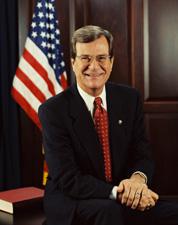 Sen. Trent Lott (R-MS)