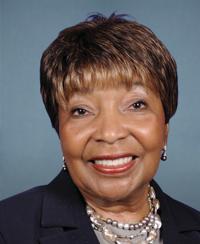
Mr. Speaker, before I begin, I just want to join my colleagues tonight, the gentlewoman from California (Ms. Matsui) and the gentleman from California (Mr. Honda) in reminding us of the terrible scar…
Mr. Speaker, before I begin, I just want to join my colleagues tonight, the gentlewoman from California (Ms. Matsui) and the gentleman from California (Mr. Honda) in reminding us of the terrible scar on our Nation's history: the internment of Japanese Americans. And I want to say to them that as an African American, as a person of color in our country, from California, that we join you in making sure that this body continues to remind the entire country that never again shall we allow such a gross violation of the human rights of any, any people in our country and throughout the world.
So thank you, Mr. Honda and Ms. Matsui, for once again allowing us to participate and reminding us of this great atrocity.
I want to also add tonight my voice to those of my colleagues in the Congressional Black Caucus in honoring an organization whose fight against the oppression and discrimination that all of us have felt in this country, whether we were directly victimized by it or not, it affected all of us, which gave birth to the modern-day civil rights movement, and that is the NAACP.
Today, this body unanimously passed H. Con. Res. 355, which was a bipartisan resolution honoring the National Association for the Advancement of Colored People on their 97th anniversary. This is the largest and the oldest civil rights organization in our country.
Late last night, we concluded Black History Month by commemorating this month with activities led by the Congressional Black Caucus Chair, our great leader, Chairman Mel Watt, on the floor. But it was very late last night, and I hope people had an opportunity to listen to the few Members who were here to talk about the glorious history of African Americans in America.
Today, in keeping with the ideals of Black History Month and the tradition of our ancestors, we must recommit ourselves to a plan of action. For generations, the NAACP has provided the blueprint for organizing the African American community and other communities, communities of color,
throughout our country to build these coalitions for success.
In December, the House unanimously adopted my resolution recognizing the 140th anniversary of the 13th amendment. The abolition of slavery in 1865 should have been, should have been, a new day for African Americans. Yet 40 years later, African Americans continued to fight the repression and discrimination. It was this continued frustration and pain that led to the birth of the modern civil rights movement.
In Ontario, Canada, in 1905, a group of African American leaders developed an action plan and launched the Niagara Movement. Emerging from the Niagara Movement the call was issued and diverse progressives formed the National Negro Committee, which soon developed into the NAACP. For almost 100 years, since that historic meeting, the National Association for the Advancement of Colored People has been the cornerstone of the social justice movement of minority communities.
Mr. Speaker, last year, Mr. Hilary Shelton, the Director of the NAACP's Washington Bureau, delivered a Black History Month speech to the Federal Aviation Administration, the following excerpt of which outlines the development of the NAACP.
From 1905 through 1910, an organization of African American
intellectuals led by W.E.B. Du Bois and calling for full
political, civil, and social and civil rights for African
Americans. This stance stood in clear contrast to the
accommodation philosophy proposed by Booker T. Washington in
the Atlanta Compromise of 1895, You see, the Niagara Movement
was the forerunner of the NAACP. In the summer of 1905, 29
prominent African Americans, including Du Bois, met secretly
at Niagara Falls, Ontario, and drew up a manifesto calling
for full civil liberties, abolition of racial discrimination,
and recognition of human brotherhood, a forerunner to the
United Nations U.N. Declaration of Human Rights. Subsequent
annual meetings were held in such symbolic locations as
Harpers Ferry, W.Va., and Boston's Faneuil Hall.
Despite the establishment of 30 branches and the
achievement of a few scattered civil-rights victories at the
local level, the group suffered from organizational weakness
and lack of funds as well as a permanent headquarters or
staff, and it never was able to attract mass support. After
the Springfield (ILL.) Race Riot of 1908, however, white
liberals joined with the nucleus of Niagara ``militants'' and
founded the NAACP the following year. The Niagara Movement
disbanded in 1910, with the leadership of Du Bois forming the
main continuity between the two organizations.
Dubois and the many other brave men and women of the
Niagara Movement to the reigns of the challenges of there day
to lead the Niagara movement and now the NAACP, we too must
rise up to take on the challenges of our generation.
Founded on February 12, 1909, the NAACP's diverse founders, Ida Wells-Barnett, W.E.B. DuBois, Henry Moscowitz, Mary White Ovington, Oswald Garrison Villiard, and William English Walling, understood the importance of organizing and motivating people. Currently headed by Julian Bond and the President and CEO, Mr. Bruce Gordon, the NAACP exemplifies a movement that has transcended race, class, and generations in the fight for equal rights for African Americans and all disenfranchised people.
The focus of the NAACP has always been working to build coalitions for equality and opportunity in the United States. However, they never forget to advocate for Africans throughout the Diaspora. In Washington, D.C., the NAACP's Legislative Bureau mobilizes communities on issues from the fiscal year 2007 budget shortfalls, to equal opportunity, to the importance of an independent judiciary and racial profiling. Every session, the NAACP's D.C. Bureau outlines what issues and legislation will impact minority communities both here in the United States and abroad. Their vigilance is a constant reminder of how much work there is to do.
Recently, the NAACP's priorities have been rebuilding the gulf coast in the wake of Hurricanes Katrina and Rita, and addressing disparity in wealth, housing, and basic social services. That is the tragedy that unfolded, that we witnessed and which was exposed as a result of this tragedy of Katrina and Rita.
Also, the NAACP is very committed to reauthorizing the Voting Rights Act, the culmination of a movement that took blood, sweat, tears, and lives, and the sacrifices of those who came before us. This is set to expire next year.
They are committed to reforming our prison system, where our country has the largest prison population in the world. This is especially important since six in ten of those persons are people of color.
So let me just congratulate the NAACP on the 97th anniversary of this institution, and I urge everyone to use this occasion to recommit themselves to the struggle for freedom, justice, and peace.
Washington Bureau, National Association for the
Advancement of Colored People,
Washington, DC, February 28, 2006.
Representative Barbara Lee,
House of Representatives,
Washington, DC.
Dear Representative Lee: On behalf of the National
Association for the Advancement of Colored People (NAACP),
our Nation's oldest, largest and most widely-recognized
grassroots civil rights organization, I am urging you, in the
strongest terms possible, to reject provisions in President
Bush's proposed budget for 2007 and instead pass a budget
plan that supports and encourages low- and middle-income
Americans. A Nation's budget reflects its priorities; our
willingness ability to care for the sick and elderly, educate
the young, protect our surroundings, respond to natural
emergencies and protect those less fortunate. The budget
proposal put forth by President Bush for fiscal year 2007
does not reflect the priorities of, nor does it serve the
governmental needs, the majority of Americans. Rather, the
President's proposal would benefit the wealthiest Americans
while short-changing low- and middle-income Americans and
saddling future generations with a debilitating deficit.
I urge you to demonstrate the necessary leadership skills
and to work with your colleagues to develop a budget proposal
that ensures that the basic needs of all our citizens are
met. This means rejecting the cuts in federal funding for
education, health care, job training, small business
promotion, the protection of our basic civil rights and
liberties and energy assistance. This also means rejecting
the President's proposed tax cuts, which have been proven to
mostly benefit only the wealthiest Americans and cripple our
ability to address some of the most basic needs of our
society while at the same time ballooning our deficit.
Although a majority of the Administration's proposed cuts
or program eliminations are problematic for the NAACP, we are
especially troubled by the provision in the budget to reduce
funding for the crucial work of the EEOC. The President's
budget for 2007 includes a cut in funding of the EEOC Budget
from $333 million to $323 million, most of which would be
taken from State and local operations. State and local
enforcement agencies handle about 42 percent of the total
Title VII caseload, yet, they are being asked to take 60
percent of the budget cut. Because enforcement of civil
rights laws is a key element of the strategic goals and
initiatives of the NAACP, we are especially troubled by these
proposals.
Again, on behalf of the millions of NAACP members and
friends of civil rights across this Nation I hope that you
will work hard to see that the values of supporting our
young, our ill and our elderly as well as those less
fortunate are addressed in this year's budget. I look forward
to working with you to ensure that the needs of all Americans
are met. Thank you in advance for your attention to the
concerns of the NAACP.
Sincerely,
Hilary O. Shelton,
Director.
 Rep. Jim Cooper (D-TN)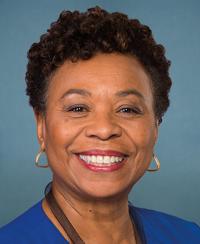



 +2
+2