Military Surviving Spouses Equity Act
Legislative Activity
Stay on top of the latest movement without scrolling through every action
Referred to the Subcommittee on Military Personnel.
March 14, 2005
View full timeline
Introduced in House
February 15, 2005
Referred to the House Committee on Armed Services.
February 15, 2005
Referred to the Subcommittee on Military Personnel.
March 14, 2005
Floor Debate
23 membersWhat members said about H.R. 808 on the floor
 JFT
JFT TC
TC DH
DH LMS
LMS SR+18
SR+18
Floor Debate
23 membersWhat members said about H.R. 808 on the floor
Mr. Chairman, I offer an amendment. Mr. Chairman, I yield myself 3 minutes. Mr. Chairman, I have an amendment that would adopt the recommendation of the Congressional Budget Office to restructure our…
Mr. Chairman, I offer an amendment.
Mr. Chairman, I yield myself 3 minutes.
Mr. Chairman, I have an amendment that would adopt the recommendation of the Congressional Budget Office to restructure our missile defense programs, specifically, the Ground-based Midcourse Defense System. The amendment would instruct the Secretary of Defense not to deploy any Ground-based Midcourse Defense System beyond the authorized systems that are now at Fort Greeley, Alaska and, the Vandenberg Air Force Base in California or any space-based interceptors of intercontinental ballistic missiles.
It would reduce funding for the research, development, test and evaluation for the defense agencies by $4,747,000,000.
Under the Congressional Budget Office's ``evolutionary alternative,'' the Department of Defense would fund the capabilities planned for the Ground-based Midcourse Defense System through 2007.
Money would continue to be provided to pursue upgrades to the elements of the ground-based missile defense initial defense capability, would continue testing its components and would explore other missile defense concepts.
But the savings on the midcourse missile defense under the Congressional Budget Office alternative would total $29 billion on a Department of Defense-wide basis through 2007.
I commend to my colleagues no less than seven reports released in the last 2 months critical of various aspects of the ballistic missile system, and I will introduce copies for the Record. Two of them are from the General Accountability Office, two from the Department of Defense's own Inspector General's Office, one from the Congressional Research Office, one from the Congressional Budget Office and one from the Pentagon's own Director of Operational Test and Evaluation.
All of them raise doubts about the feasibility of missile defense. And as a group they offer a damning indictment of the missile defense system that supposedly, but not actually offers the United States an initial defense capability.
The Center for Defense Information states in its analysis, changes are imperative. If the Missile Defense Agency continues in the same vein it has been, the United States will see itself saddled with a missile defense system that costs tens of billions, possibly hundreds of billions of dollars, yet provides no actual defense.
What is more, by diverting that money to an unfeasible system, the United States will miss out on the protection it could be getting from weapons systems that actually work.
Mr. Chairman, the moneys are important, of course, but having a false sense of security is dangerous. And not investing these moneys in needed security systems, systems to protect our space and domestic assets and for homeland security risk is criminally negligent.
The General Accountability reports note that if the Pentagon does not move away from its spiral development or acquisition policy where a system's progress is never held to any sort of accountability, has no defined parameters, the Department of Defense will continue to start more programs for more money and create the next set of case studies for future defense reform reviews.
Fielding systems that still are in early developmental cycles, rushing them into the field where they have very serious problems with every component, that is a recipe for disaster. Immature technologies are not perfected, integration of the systems is not happening, testing in real-life scenarios is lacking, information assurance controls that were built to the network are sadly out of date.
This report shows poor quality control, unreasonable, in fact outrageous, cost growth, and schedule slips and inferior performance.
An ``F'' for Missile Defense: How Seven Government Reports in Two
Months Illustrate the Need for Missile Defense To Change Its Ways
(By Victoria Samson, CDI Research Analyst)
A certain amount of optimism is required to successfully
guide a weapon system through its development to completion.
However, at a certain point, reality needs to poke through so
that program and service officials can make relatively
objective assessments. Is it working? Is it going to work? Is
it staying on budget and schedule? If not, can it get back on
track? And finally, the most difficult question to ask of a
program: Should it continue?
The multi-faceted missile defense program, currently the
Pentagon's golden child, has effectively avoided any and all
tough questions. Over $92 billion has been spent on missile
defense systems since the Ronald Reagan administration, to
little avail. While the architecture still has not been
finalized, the Missile Defense Agency (MDA) envisions a
system of systems, where there are ground-, sea-, and air-
based interceptors supported by a yet-to-be-built satellite
system, new X-band radars that are still being put in place,
and a command and control system that is not secure to
outside interference.
President George W. Bush announced in December 2002 that,
within two years, the United States would have deployed an
initial missile defense system that could defend the United
States against a limited ICBM attack. With that pressure from
above, MDA focused its efforts on the fielding interceptors
in Alaska and California the Ground-based Midcourse Defense
(GMD) system. As of writing, 13 interceptors have been
emplaced in missile silos. As well, MDA is working on a sea-
based interceptor that is carried on the Aegis ship, a sea-
based X-band radar that is slowly floating to its home port
in Alaska, a giant command and control module based out of
Colorado, a satellite network that could track enemy missiles
as they approach the U.S. homeland, and systems that are
geared toward providing defense against shorter-range
ballistic missiles (Theater High Altitude Area Defense
system, or THAAD, and the Patriot Advanced Capability PAC-3
system). In the long run, MDA is building a modified Boeing
747 airplane that would carry lasers in its nose and kinetic
kill vehicles which theoretically could obliterate multiple
targets.
MDA has been entrusted with a great deal of responsibility.
It has not lived up to its tasks. In the past two months, no
less than seven reports have been released that were critical
of various aspects of the Ballistic Missile Defense System
(BMDS). For clarity's sake, this analysis will focus largely
on MDA's flagship program, the GMD system, whose existence is
used to falsely claim that the United States has an initial
defensive capability against ICBMs. And to head off
allegations of bias, it must be noted that these reports were
written by non-partisan government agencies. Two reports by
the Government Accountability Office (GAO), two from the
Defense Department (DOD)'s own Inspector General's office,
and reports by the Congressional Research Service (CRS),
Congressional Budgetary Office ``(CBO), and the Pentagon's
Director, Operational Test & Evaluation (DOT&E) all raise
doubts about the feasibility of missile defense. As a group,
they offer a damning indictment of the missile defense system
that supposedly offers the United States an initial defensive
capability.
overshooting cost goals, falling short of planned achievements
Missile defense programs have featured prominently in two
recent reports by the GAO. The first, ``Assessment of
Selected Major Weapons Programs,'' examines the cost growth
of many Pentagon weapon systems. It notes, ``DOD often
exceeds development cost estimates by approximately 30 to 40
percent and experiences cuts in planned quantities, missed
deadlines, and performance shortfalls.'' The GAO points out,
``Programs consistently move forward with unrealistic cost
and schedule estimates, use immature technologies in
launching product development, and fail to solidify design
and manufacturing processes at appropriate points in
development.'' The missile defense system prides itself on
its ``spiral development'' or acquisition policy that is
constantly evolving, under which a system's progress is never
held to strictly defined parameters.
``Programs consistently move forward with unrealistic cost
and schedule estimates, use immature technologies in
launching product development, and fail to solidify design
and manufacturing processes at appropriate points in
development.''
The GAO takes this type of acquisition policy to task. In
fact, David Walker, comptroller-general of the United States,
warns that if the Pentagon doesn't move away from it, DOD
``will continue to start more programs than it can finish,
produce less capability for more money, and create the next
set of case studies for future defense reform reviews.''
The Missile Defense Agency (MDA) has argued that the
missile defense program needs the flexibility of spiral
development to allow it to mold itself to future threats and
to incorporate lessons learned while testing. Why other
Pentagon programs somehow manage to hold themselves
accountable and still meet evolving threats is never
discussed by MDA officials. Instead, MDA promotes the idea
that all possible missile defense candidate technologies will
be put through their paces, and eventually testing will prove
the winners and losers. Again, MDA has never stated at which
point it will definitively decide to drop a flagging program.
The closest it has come is in giving one of its programs
(Airborne Laser) what it calls ``knowledge parameters,'' in
an attempt to prove to critics that, despite outward
appearances, there is indeed progress toward development.
Another key part of spiral development is that weapon
systems will be fielded when they are still early in their
development cycles. The intent is that they can continue to
grow and presumably advance while providing some sort of
military utility. What ends up happening is that systems--
the Ground-based Midcourse Defense (GMD) system most
noticeably--are rushed out into the field even when there
are very serious problems with their components... or
indeed, are crucial elements to their architecture still
lacking. For example, the GMD interceptor suffered a
flight test failure in February 2005 due to poor quality
control by its contractor for the arm that holds the
missile up in its silo. In testimony to the Senate Armed
Services Committee on April 4, 2006, Obering acknowledged
this problem and stated that this component would be
replaced on the interceptors that have already been
fielded. Nonetheless, the $40 million missile as
originally designed continues to be built at a rate of one
every two months or so.
The GAO notes that weapon systems development programs
progress much better and keep costs lower if technology is
allowed to mature before being brought into a developmental
or initial operating system. GAO observes that program
acquisition unit costs for programs with mature technologies
increase by less than one percent over original cost
estimates, while the program acquisition unit costs for
programs with immature technologies increase by 27 percent
over the first full estimate.
The report goes on to review various weapon systems to
assess their level of technological maturity and cost growth.
The GMD system's ``concurrent testing and fielding efforts
may lead to additional design changes,'' warns the GAO, and
the program's ``prime contract could overrun its target cost
by as much as $1.5 billion. Boeing, GMD's prime contractor,
has already overrun its budget by $600 million as a result of
quality control issues. As what seems to be the standard for
missile defense, program officials differ from outsiders
about the program: while program officials rate GMD's needed
10 technologies as mature, the GAO differs, stating that
``four have not been demonstrated in an operational
environment and we believe that they cannot be considered
fully mature.'' And since the GAO's last assessment of GMD,
the program's planned budget through fiscal year 2009 (FY 09)
has risen by $2.9 billion, or 11.2 percent.
GMD's cost growth is bad enough, but as it turns out, the
United States is paying more and getting less than
anticipated. In another GAO report, the title says it all:
``Missile Defense Agency Fields Initial Capability but Falls
Short of Original Goals.'' MDA's accelerated development of
the GMD program in order to reach an initial capability by
the end of 2004 caused the agency to run over that portion of
its budget by $1 billion. For FY 05, GMD contractors had
exceeded anticipated costs by 25 percent. The GAO also took
to task the forced reliance by MDA upon spiral development
``[I]t allowed the GMD program to concurrently mature
technology, complete design activities, and produce and field
assets before end-to-end testing of the system--all at the
expense of cost, quantity, and performance goals.''
In addition, for the initial defensive capability stated as
the goal of the rapid fielding of the overall missile defense
network, MDA fell quite short of what it had hoped to have
accomplished. ``Compared to its original goals set in 2003,
MDA fielded 10 fewer GMD interceptors than planned, two fewer
radars, 11 fewer Aegis BMD missiles, and six fewer Aegis
ships,'' lists the GAO report. The United States has
officially fielded elements of the ballistic missile defense
system architecture, but these are really token efforts. Even
if the systems had proved themselves during testing and
development--which they have not--and even if they had all
their needed components at the ready--which they do not--this
system would be a feeble shadow of what planners had hoped
for.
Spiral development ``allowed the GMD program to
concurrently mature technology, complete design activities,
and produce and field assets before end-to-end testing of the
system--all at the expense of cost, quantity, and performance
goals.''
Another result of rushing the missile defense elements out
into the field is that workmanship has been shoddy, at best.
Poor quality control has been listed time and again as an
explanation for cost growth, schedule slips, and inferior
performance. The GAO report explains, ``According to MDA's
own audits, the interceptor's design requirements were
unclear and sometimes incomplete, design changes were poorly
controlled, and the interceptor's design resulted in
uncertain reliability and service life.'' The GMD interceptor
was not tested to ensure its parts could withstand the harsh
environment in space--which could result in catastrophic
failures after launch as the interceptors are supposed to
impact their targets outside the Earth's atmosphere. Further,
the failures of two recent flight tests--1FT-10 and 1FT-14--
were due to poor quality control procedures. The development
of some parts for the GMD interceptor has been so careless
that, according to the GAO, the parts in question would
have to be replaced and thus ``the interceptors will be
removed from their silos.'' Neither GAO nor MDA, has yet to
explain at what cost such repairs will have to be made.
Unfortunately, cost growth, schedule slips, and faulty
parts are not specific to missile defense programs. One can
see that easily in every branch of the Pentagon. Where the
missile defense program differs is in the extent of autonomy
and decision-making freedom given to MDA officials managing
the various pieces of the program. Given the pressure they
were under from President George W. Bush's December 2002
announcement that an initial capability would be in place by
the end of 2004, managers decided that the development and
fielding process required a speedier schedule to meet that
deadline. As a result, the GAO recounts, ``MDA officials told
us that because the agency was directed to field a capability
earlier than planned, it accepted additional risks.''
The agency was able to accelerate fielding because MDA
officials have been given unprecedented liberties with
acquisition planning and scheduling. They are further allowed
to shift around funding from one program element to another
as they see fit, under special rules set up by DOD. According
to the GAO, ``Compared with other DOD programs, MDA has
greater latitude to make changes to the BMDS [Ballistic
Missile Defense Program] program without seeking the approval
of high-level acquisition executives outside the
program.'' Because of this flexibility, while MDA does
inform Congress and DOD of funding rearrangements,
accountability is practically nil; instead, its version of
it has ``thus become broadly applied as to mean delivering
some capability within funding allocations.''
MDA is also free of requirements that all other major DOD
acquisition programs must undertake in regards to
establishing baseline estimates of cost, performance and
schedule. If other programs slip in meeting those
predetermined requirements, Pentagon and/or service managers
must alert Congress. If any program sees cost growth up to a
certain amount in one quarter, it is considered to have
suffered a so-called Nunn-McCurdy breach, which means DOD
must alert Congress of the problem. If the cost growth is
over 25 percent in a single quarter, DOD then must overhaul
and justify the offending program. The Ballistic Missile
Defense System, however, is exempt from these requirements.
MDA officials have much more flexible baselines for their
programs. MDA can avoid having to report programs' quarterly
cost growth simply by changing cost goals and estimates.
Also, MDA has the responsibility of deciding when it will
alert Congress to schedule slips or cost growths, since
``there are no criteria to identify which variations are
significant enough to report. Instead, MDA's Director, by
statute, has the discretion to determine which variations
will be reported.''
MDA officials do not have to hold themselves accountable to
any particular standard or report if certain achievements
have not been met. And Congress has, up to now, refrained
from complaining about its lack of oversight over the $10
billion dollar a year MDA budget.
Up to now, the only ``achievements'' reported by MDA have
been the flight test failures. The MDA has even stopped
announcing when it has emplaced new interceptors at missile
silos in Alaska and California. Ostensibly, this is because
of operational security needs, but in actuality, it is more
likely a move designed to avoid bad press as testing and
deployment goes forward.
Mr. Chairman, I yield 2 minutes to the gentlemen from New Jersey (Mr. Holt).
Mr. Chairman, I demand a recorded vote.
Madam Speaker, by direction of the Committee on Rules, I call up House Resolution 293 and ask for its immediate consideration. Madam Speaker, for the purpose of debate only, I yield the customary 30…
Madam Speaker, by direction of the Committee on Rules, I call up House Resolution 293 and ask for its immediate consideration.
Madam Speaker, for the purpose of debate only, I yield the customary 30 minutes to the gentlewoman from New York (Ms. Slaughter), pending which I yield myself such time as I may consume. During consideration of this resolution, all time yielded is for the purpose of debate only.
General Leave
Madam Speaker, I ask unanimous consent that all Members may have 5 legislative days to revise and extend their remarks on H. Res. 293.
Madam Speaker, on Tuesday the Rules Committee met and reported a rule for consideration of H.R. 1815, the National Defense Authorization Act for Fiscal Year 2006.
Madam Speaker, the rule is a structured rule providing for 1 hour of debate equally divided and waives all points of order against the rule. It provides that the amendment in the nature of a substitute recommended by the Committee on Armed Services now printed in the bill shall be considered as an original bill for the purpose of amendment and shall be considered as read and waives all points of order against the amendment. It makes in order only those amendments printed in the report of the Committee on Rules and provides that amendments shall be considered only in the order specified in the report, may be offered only by a Member designated in the report, shall be debatable for the time specified in the report, and shall not be subject to amendment. Additionally, it allows the chairman of the Committee on Armed Services to offer an en bloc amendment consisting of amendments printed in the report of the Committee on Rules and provides one motion to recommit, with or without instructions.
Madam Speaker, I rise today in support of the rule for H.R. 1815 and the underlying bill. This bill will enhance our security, increase the capabilities of our military, and improve the lives of the brave men and women who defend our country. Since September 11, 2001, our military has proven its mettle and validated its doctrine, plans, and programs during the ongoing war on terror.
Madam Speaker, I genuinely believe that the Committee on Armed Services has presented us with an outstanding bill that addresses many of the challenges our troops face on a daily basis. However, it is important to remember that this yearly authorization is at root an ongoing transformative process that occurs on an annual basis. This year we have taken important steps in the improvement and transformation of our existing forces during an era that is dangerous, demanding, and filled with challenges that our country neither anticipated nor prepared for during the 1990s.
To fully appreciate the significance of H.R. 1815, one must understand the four long-term challenges we seek to address in this legislation. The first long-term challenge stems from the procurement holiday that our government voluntarily took during the 1990s. In those years, neither the President nor the Congress funded the procurement needs of our Armed Forces. As one example, during the 1990s the ammunition accounts of our military were woefully underfunded. As a result, even after radically increasing the productivity of our ammunition plants in the last few years, we are still struggling to keep pace with our current and projected needs.
The same is true of equipment, which was neither acquired nor replaced in sufficient quantities during the years between the collapse of the old Soviet Union and the onset of the war on terror. As a result, our military is still dealing with the shortages of equipment and munitions that were created in the 1990s and that have yet to be fully resolved. This bill helps address these shortages.
Madam Speaker, the second long-term challenge we must address on a continual basis is related to the transformation of our military forces. With the passage of the Goldwater-Nickles reforms of 1986, our military began putting an increased emphasis on jointness. Over the years, increased jointness has generated different requirements for our forces. Those requirements demand procedural, bureaucratic, and technological changes within our Armed Forces. The principle of transformation has affected everything that our military does, from how we fight to how we deliver services to those who serve in our Armed Forces. Properly used, joint planning, procurement, and operations are an effective combat multiplier that creates the critical edge that our forces need to defeat our adversaries. However, transformation comes with a substantial cost. This is an issue we must address on an ongoing basis. H.R. 1815 does just that.
Madam Speaker, the third long-term challenge we face is the need to expand the size of our military. Over the past few years, it has become clear that we went much too far in downsizing our military forces after the end of the Cold War. To begin to address our manpower shortage, the Committee on Armed Services increased end strength by 10,000 soldiers for the Army and 1,000 Marines for the Marine Corps. This is on top of increases made in the last 2 years. It is also in addition to reforms allowing us to use a greater percentage of our military personnel in a combat capacity.
Unfortunately, even these steps are not enough for our long-term needs, but they are at least a start and responsive to the heavy demands we are placing on our military forces. Over the next several years, we will be forced to look more carefully at manpower needs and come up with a more realistic assessment of what is actually required. Still, H.R. 1815 is a good next step and one which we should support and build upon in the coming years.
The fourth long-term challenge faced by the military results from the global war on terror. This is not a conventional war. It is a generational war which will take decades to win. We need to remember this when approaching the needs of the military in the authorization and the appropriations process. Hence, I believe we took a wise and important step in this direction when we added $49 billion to the defense bill to offset a portion of the costs of this conflict next year. It is something that indicates our understanding of the long-term nature of the challenge we face.
Madam Speaker, H.R. 1815 is not a perfect bill; but it is a very, very good piece of legislation. We must remember that the National Defense Authorization Act moves us in the direction we need to go. For that, all of us should be grateful. Ultimately, this bill is not about programs, weapons, or research and development. It is about our soldiers and their ability to defend the United States.
Today, some may want to discuss issues that, however important, are superfluous to the war on terrorism and the long-term military challenges that we face. We owe it to the sons and daughters of America who are on a global battlefield in the war on terror
to address the real issues and challenges our military will confront today and tomorrow. This legislation is a step in a continuing process of enhancing our military capabilities in a dangerous world.
I would ask Members to support these prudent steps taken in this thoughtful and comprehensive piece of legislation. Madam Speaker, to that end, I urge support for the rule and the underlying bill.
Madam Speaker, I reserve the balance of my time.
Madam Speaker, I am pleased to yield such time as he may consume to the gentleman from California (Mr. Dreier), the chairman of the Committee on Rules.
(Mr. DREIER asked and was given permission to revise and extend his remarks.)
Madam Speaker, I am pleased to yield 3\1/2\ minutes to the gentleman from North Carolina (Mr. Hayes).
Mr. Speaker, may I inquire as to how much time is remaining.
Mr. Speaker, I reserve the balance of my time.
Mr. Speaker, I yield myself such time as I may consume.
Mr. Speaker, to my good friends on the other side, I would simply point out that most of the speakers are actually members of the authorizing committee and passed out this bill 61 to 1, had opportunities to offer those amendments at the committee level, presumably did so, and if they did so, were not successful, and still felt the bill was worthy of being sent on to the floor for further consideration.
In addition, the Rules Committee actually considered and has allowed 29 amendments, a majority of which are Democratic amendments. There is always going to be a judgment debate as to what should or should not be considered and how much time should be devoted in a process to any particular piece of legislation. So I respect the gentlewoman from California's opinion, but obviously we have a difference on this.
Mr. Speaker, I reserve the balance of my time.
I yield to the gentleman from Mississippi.
That is correct.
I am aware of that.
Reclaiming my time, I am also aware that the item the gentleman mentioned was actually stricken on the parliamentary question.
I would like to submit for the Record the chairman of the committee's letter to that effect and also the statement from CBO upholding that decision.
Committee on Armed Services,
U.S. House of Representatives,
Washington, DC, May 20, 2005.
Dear Armed Services Committee Colleague: This morning the
Congressional Budget Office informed me via letter (copy
attached), that the amendment agreed to during the
committee's mark-up of H.R. 1815, the National Defense
Authorization Act for Fiscal Year 2006, extending TRICARE
coverage to all reservists will result in additional direct
(or mandatory) spending. As a result, the inclusion of this
provision would cause the bill to exceed the mandatory
spending allocation provided under the Concurrent Resolution
on the Budget. Exceeding the mandatory allocation will cause
H.R. 1815 to violate the Congressional Budget Act and subject
the bill to a point of order against its consideration on the
House floor.
I have consulted the Chairman of the House Budget Committee
on this matter and he informs me that if the bill is brought
forward to the floor in violation of the Budget Act, he will
exercise his prerogative to raise the applicable point of
order and thus prevent its consideration on the floor.
Accordingly, after informing Mr. Skelton and the sponsor of
the amendment, I am exercising the authority granted to me by
the committee to remove this section in order to bring the
bill back into compliance with the Budget Act and eliminate
this impediment to its floor consideration. In summary, if
this action is not taken, a point of order will be raised and
sustained against the bill and its consideration will be
blocked.
Sincerely,
Duncan Hunter,
Chairman.
Attachment.
U.S. Congress,
Congressional Budget Office,
Washington, DC, May 20, 2005.
Hon. Duncan Hunter,
Chairman, Committee on Armed Services, U.S. House of
Representatives, Washington DC.
Dear Mr. Chairman: As requested by your staff, we are
sending you this letter containing our preliminary estimate
of a provision in H.R. 1815, the National Defense
Authorization Act for Fiscal Year 2006, as ordered reported
by the committee on May 19, 2005. The provision would provide
access to TRlCARE health insurance benefits for reserve
component personnel. Implementing that provision would have
significant effects on both spending subject to appropriation
and direct spending.
The provision would affect direct spending by increasing
mandatory expenditures in the Federal Employees Health
Benefits (FEHB) program. On a preliminary basis, CBO
estimates that enacting this provision would increase direct
spending for the government's share of FEHB premiums for
retirees by $5 million in 2006, $94 million over the 2006-
2010 period, and $269 million over the 2006-2015 period.
Under the provision, all reservists in the Selected Reserve
would be eligible to enroll in TRlCARE, the health insurance
system for the Department of Defense (DoD). Based on
information from DoD, CBO estimates that about 120,000
reservists work for the federal government. CBO expects that
some of these reservists who are currently enrolled in the
FEHB program would leave that program and enroll in the new
TRlCARE for Reservists program because the premiums would be
lower than for FEHB and the coverage would be more generous.
Generally, TRICARE premiums are lower because medical costs
are highly correlated with age--the average reservist is age
34 while the average for enrollees in the FEHB program
(including retirees) is closer to age 60.
Because the estimated health care costs for reservists
switching to TRICARE are likely to be lower than the average
per capita costs for all other enrollees in the FEHB program,
average costs for the FEHB program would rise, even though
its total costs would decline. Thus, CBO expects premiums for
the remaining enrollees in the FEHB program would rise to
cover the higher average cost. The government's share of
premiums for annuitants (about 72 percent) is direct
spending.
In addition to the direct spending effects, this provision
would affect spending subject to appropriation. CBO estimates
that implementing this provision would increase spending by
DoD for this new benefit by about $230 million in 2006, and
$4.6 billion over the 2006-
2010 period, assuming appropriation of the estimated amounts.
In addition, we estimate that spending for reservists in the
Coast Guard would increase by $2 million in 2006 and $46
million over the 2006-2010 period, assuming appropriation of
the estimated amounts. Finally, under this provision,
spending by the federal government for active workers in the
FEHB program would decline by an estimated $340 million over
the 2006-2010 period.
If you have any questions, the CBO staff contact is Sam
Papenfuss, who can be reached at 226-2840.
Sincerely,
Douglas Holtz-Eakin,
Director.
Mr. Speaker, I yield such time as he may consume to the gentleman from California (Mr. Hunter), the distinguished chairman of the Committee on Armed Services.
Mr. Speaker, I yield 2 minutes to the gentlewoman from California (Mrs. Capps).
Mr. Speaker, I yield myself such time as I may consume.
Mr. Speaker, today, in closing, I again want to draw the attention of the Members to the strengths of H.R. 1815. It takes many steps forward in reforming the procurement and acquisition systems, increasing end strength, and provides $49.1 billion in supplemental funds for the war on terror.
Mr. Speaker, I would also like to respond just briefly to some of the concerns expressed on the other side of the aisle. First, about the process by which the Committee on Rules operated.
I remind my good friends that this bill was again reported out of the House Committee on Armed Services by a vote that was nearly unanimous, only one dissent; that 29 amendments have been made in order; that the majority of those amendments are Democratic amendments; and that we will, obviously, have an additional opportunity to debate the full merits of the bill as we move forward. I think there is more than ample time for discussion and debate.
Second, on the Reservist health care issue. This is a difficult issue, to say the least. It is an emotional issue and an important issue. I would like to point out that under the leadership of the gentleman from California (Mr. Hunter), the Committee on Armed Services has made important progress in this particular area. It has extended the amount of time that members that are going to be deployed are eligible for TRICARE. It has extended the amount of time that those who are leaving service are able to enjoy the benefits of TRICARE. It has allowed additional time granted for time served in deployment and combat situations. So I think the Committee on Armed Services has expressed a continuous desire to keep looking at these issues.
I have personally visited with the gentleman from New York (Mr. McHugh), who is the subcommittee chairman responsible for this particular area; and he has assured me he wants to continue the progress that has been made over the last several years.
Again, I remind my good friends there were many opportunities when they were in the majority to address these type of issues. While we have been in the majority, we have addressed concurrent receipt in a step-by-step process that is moving us in the right direction. We have addressed survivor benefits in a step-by-step process moving us in the right direction. And now we are addressing the critical issue of health care as well. So I think important progress is being made on all these fronts, Mr. Speaker.
Finally, I would like to note that this legislation would not have been possible without much hard work on the part of the gentleman from California (Chairman Hunter); the gentleman from Missouri (Mr. Skelton), the ranking member of the committee; and the other subcommittee chairmen, and finally the members of the Committee on Armed Services themselves. As evidenced by their hard work, this is a bipartisan bill that the vast majority of the House should be able to agree is a good product. H.R. 1815 passed in the committee, again by a vote of 61 to 1. It deserves the same strong bipartisan support on the floor, as does its underlying rule.
Mr. Speaker, many today have complained about what they consider to be critical shortcomings in this legislation. No legislation is ever perfect; and as I said in my opening statement, the defense authorization specifically is more of an ongoing process than a final product. However frustrated some may be with particular aspects of H.R. 1815, it undoubtedly moves our military in the direction it needs to evolve and enhances the security of our country and the well-being of our men and women in uniform.
I would urge the Members on the other side of the aisle to consider carefully what a ``no'' vote would mean and say to our servicemen and - women in the field. Therefore, I once again urge my colleagues to support this rule and the underlying legislation.
Mr. Speaker, I yield back the balance of my time, and I move the previous question on the resolution.
Mr. Chairman, I offer amendments en bloc. Mr. Chairman, Mr. Baca's amendment requires the Department of Defense to study the scope of perchlorate contamination at formerly utilized defense sites. Mr.…
Mr. Chairman, I offer amendments en bloc.
Mr. Chairman, Mr. Baca's amendment requires the Department of Defense to study the scope of perchlorate contamination at formerly utilized defense sites.
Mr. Castle's amendment implements GAO's recommendations to cut down and award an incentive fee spending waste by requiring the Department to develop a strategy for linking incentives to specific outcomes such as meeting costs, schedule and capability goals. It also establishes guidance for improving the effectiveness of award and incentive fees, and ensures that appropriate approving officials are overseeing these decisions. The Department would be required to report to Congress on the status and effectiveness of these new standards.
The amendment offered by Mr. Davis is the defense access road amendment; and this program, which is known as the DAR program, currently allows DOD to pay for road projects made necessary by DOD actions, and this amendment would allow DOD to consider transit projects as part of DAR as well.
Mr. Schiff's amendment directs the Secretary of Defense to submit to Congress a series of regular reports on the threat to American personnel posed by IEDs, improvised explosive devices, as well as action being taken to interdict IEDs and to develop more effective active and passive countermeasures. The first report would be due 30 days after enactment, the subsequent reports every 90 days thereafter. Reports would be unclassified, with a classified annex if necessary.
Mr. Chairman, the committee supports these amendments, and let me just say with respect to the last amendment, that the committee works every day on the IED issue, and we communicate with DOD every day on operations and on the development of the countermeasure systems that we are currently undertaking to rush to the battlefield. So I very much appreciate the gentleman's concern. I think that IEDs, and I am sure he shares this concern, are an instrument of choice now by terrorists, and this is probably the most compelling challenge facing us in the warfighting theaters and in the global war against terror right now.
We work this issue every single day. We have got a new package of equipment that we are moving out, and we have added $109 million to this countermeasure fund this year. We are going to try to move that up, even if we have to move money out of the various services, and we are going to work this problem every day. So I invite the gentleman to work with us and work with our staff, and I think these reports will be value added to the process. I thank the gentleman from California for his work.
Mr. Chairman, I reserve the balance of my time.
Mr. Chairman, I yield myself such time as I may consume.
I thank the gentleman for his contribution, and let me just lay out some of things that we are doing because I think this area is so important for us. Included in the base bill, the gentleman from Missouri and myself and our great members of the committee on both sides of the aisle worked out, we added $109.7 million for jammers. Jammers are very important in this IED business because these improvised explosive devices are largely detonated remotely.
As the gentleman knows, few of them, some of them, are detonated by wires that are connected to detonators, and you may have an insurgent hiding 20, 30, 40, 50 yards from the roadside or from the dismounted U.S. military unit and he detonates it with a clacker or a detonation device in the style that has been utilized by militaries up to the last several years ago.
The other detonation device, and one that is now the device of choice, is a remote detonation, and that detonation
allows a person, the insurgent, to be many yards away, far away from the particular avenue that he is ambushing. In many cases, he does not even need to have a weapon. He may be lost in a crowd, and he waits for a convoy to line up on a particular lamp post or other object, and he blows this device, which may be a 152-millimeter artillery round by using this remote detonation capability. Without getting into the classified areas, there are a number of remote detonation capabilities, and what we are trying to do is to direct our countermeasures to be able to jam those detonations.
So we have put a lot of extra money in. The administration has a lot of money in, but we have put in more. We have been working on equipment packages with them, and the key is to move this stuff through the training ranges here, the testing ranges, quickly into the field; and I can assure the gentleman we are really going to be working on this. So I thank him so much for his focus on this important area, and we will work together.
Mr. Chairman, I reserve the balance of my time.
Mr. Chairman, I just want to say to my colleague from California that he has brought an excellent amendment to the floor here, and this is certainly something that does require action, justifies action by the Federal Government, and we totally support his amendment on this side.
Mr. Chairman, I yield back the balance of our time.
Mr. Chairman, I yield myself such time as I may consume. Let me offer the description of the amendments.
Mr. Chabot's amendment expresses a sense of Congress that the spouses of armed services members who have died between October 7, 2001, and November 23, 2003, should be permitted to have the option of assigning their SBP payments, their survivor payments, to their children.
Mr. Davis' amendment is another defense access road amendment. This amendment would allow DOD to consider transit projects, as well, as part of the DAR, the Defense Access Road program.
Mr. Ryan of Ohio's amendment authorizes $5 million for the High Altitude Airship program. The HAA is designed to be an uninhabited, long-endurance, platform for carrying forward-based sensors and a wide range of other BMD payloads that will enable continuous over-horizon communication. It would also provide wide-area surveillance and protection without interruption or the risk associated with manned aircraft. The offsets are $5 million from the Space Based Space Surveillance program, and this is another tool for sensor and surveillance capability.
The amendment offered by Ms. Slaughter requires the Department of Defense to include the number of disciplinary actions as part of the annual report on sexual assault in the military.
So those are brief definitions or descriptions of these amendments.
Mr. Chairman, I reserve the balance of our time.
Mr. Chairman, I yield such time as he may consume to the gentleman from Ohio (Mr. Chabot).
Mr. Chairman, will the gentleman yield?
Mr. Chairman, I want to thank the gentleman for bringing this to our attention. There are no more important citizens than those who defend our freedom and carry our flag; and right there with them are their family members.
I think this is an excellent amendment, and the committee supports it fully.
Mr. Chairman, I yield back the balance of my time.
Mr. Chairman, it is especially appropriate to be able to follow the gentleman from El Paso, Mr. Reyes, who was in my estimation the greatest Border Patrol chief in the history of our country. He did a tremendous job under very challenging odds.
I remember working with him long before he became a Representative in the most southern areas of Texas and then ultimately up in the El Paso area. One thing that challenged him and challenged us in San Diego in more recent times was tunneling. Of course, detection of tunnels is something that the military engages in every now and
then, and that is a good example of candidate technologies for sharing of technology between DOD and the Department of Homeland Security.
Likewise, surveillance sensors, it has always been a pleasure to go down with the gentleman from El Paso, go down to his district with Joint Task Force 6 and look at that interaction. And I really appreciate Mr. Dent coming up with this amendment that will move to mesh these technologies and make sure that when the American taxpayers pay for the development of something that will accrue to the benefit of our security, that it gets shared and gets moved across what is sometimes kind of a bright line between the military and the Department of Homeland Security.
You have done a great job and thank you for bringing this amendment to our attention. We support it fully.
Mr. Chairman, I move to strike the last word.
Mr. Chairman, I have a colloquy with the gentlewoman from Colorado (Mrs. Musgrave). I would yield to the gentlewoman for purposes of the colloquy.
Mr. Chairman, will the gentlewoman yield?
Mr. Chairman, I appreciate the gentlewoman's concerns. First, I strongly believe that DOD should make every effort to acquire property through fair-market value purchases from willing sellers. The use of eminent domain or unfriendly condemnation should only be used as a measure of last resort in cases of compelling national security requirements.
So I would be very pleased to work with the gentlewoman as a representative of the farmers and ranchers surrounding Pinon Canyon to ensure that the Army does not use eminent domain before exhausting all other options.
Secondly, I would note that the defense bill before us today contains a provision that makes sure that Congress has oversight of DOD plans to use eminent domain, as its application is a matter of great concern to all of us.
Finally, I would be happy to work with the Colorado delegation to talk to the Army and ensure that they are very forthcoming in discussing plans for the expansion of Pinon Canyon. Having a good relationship with our communities is an important obligation of the armed services, and they should certainly sit down with their elected representatives and discuss their plans and any issues that will concern the community.
I will be happy to help the gentlewoman on this issue.
Mr. Chairman, I want to thank the gentleman and the gentlewoman for their contribution here, and just assure them we are very interested in making sure that this equipment, some of which has been wearing out pretty quickly in the desert sand in the warfighting theaters, is maintained in excellent condition, both with our great in- house resources and our depots and with the private sector, so we use all of our resources in the U.S. to make sure we have got good, sound platforms.
The committee has no objection to the amendment. We thank you for adding it to the base bill.
Mr. Chairman, I yield myself such time as I may consume.
Mr. Speaker, in the Schakowsky amendment, the gentlewoman from Illinois provides for additional oversight and accountability of Department of Defense contractors deployed in Iraq and Afghanistan. It would make retroactive DOD regulations for contractors issued in October 2005 on previously issued contracts upon any extension brought about by an option.
It would implement a policy for conducting comprehensive background checks on foreign nationals hired by contractors operating outside of the U.S. and would also require a DOD Inspector General report on contractor overcharges and require that there are sufficient contracting officers assigned to oversee and monitor contracts in Iraq and Afghanistan.
The amendment offered by Mr. Jindal would require the Secretary of Defense in coordination with the Secretary of Homeland Security and State governments to develop detailed operational plans regarding the use of the Armed Forces to support activities of civil authorities known as Defense Support to Civil Authorities Missions.
The amendment that is offered by Mr. Lewis of Kentucky would provide that no more than 20 percent of a uniformed servicemember's paycheck can be garnished in a single pay period to recover overpayments that have occurred through no fault of the servicemember. That was always my contention.
It would also provide a 90-day grace period before overpayment recovery can begin from servicemembers who are wounded or injured or who incur an illness in a combat operation or combat zone.
Finally, the Mica amendment offered by the gentleman from Florida expresses the sense of Congress that the Department of Defense should provide compensation to American veterans who are captured while in service to the United States Armed Forces on the peninsula of Bataan or the island of Corregidor, survived the Bataan Death March during World War II and have not received previous compensation provided to other prisoners of war.
I might just say about that amendment, Mr. Chairman, these great Americans came back and met with many of us over the last several years, these great survivors of the Bataan Death March. And many of them, according to their testimony, were taken by ship after the death march in which many of them were killed, bayoneted, decapitated, otherwise killed; they were taken to Japan and in many cases were turned over to Japanese industry, including companies that are corporate giants today like Matsui and Mitsubishi. And these Japanese corporations took the Americans as slaves from the Japanese Government. They turned them over to them as POWs. And they put them in slave labor operations, in many cases involving mines, for example, that were considered to be unsafe for Japanese workers. They would push the Americans into those mines.
I can recall some of the Americans testifying when they came back and met with us on the Hill about the brutality that took place. The time one of our great survivors of the Bataan Death March from California had a rock fall on him in a cave-in in this unsafe mine that they were working in as slaves to these corporations, and his leg was crushed by a rock. And an American doctor who was also a POW operated on that Bataan Death March survivor with a single rusty razor blade and the anesthetic was to have the biggest guy in the POW camp knock him out before they did the operation, and then they used maggots to clean the wound. And that great American was back here testifying a couple of years ago to the U.S. Congress.
Those POWs sought redress from the corporations which had used them as slaves in their operations saying we want to be paid for this work that we performed as slave labor. The corporations resisted this mightily in a series of lawsuits. And I thought it was sad that the U.S. Government intervened on the opposite side, on the other side from the American POWs, claiming that the treaty that was signed after the war essentially eliminated any rights on behalf of the POWs other than the one dollar a day that they received as compensation for their POW status.
So those great Americans did not win. They ultimately faced summary judgments in American courts and received no compensation from these massive corporations. In fact, some of the biggest corporations in the world which when they enslaved these Americans were not nationalized by the Japanese Government, but in fact remain private corporations and developed a lot of their operations or carried on a lot of their operations using American slave labor.
So the lawsuits were quashed and these Americans, those that still survive, never got any redress. So I would just say that Mr. Mica's amendment particularly struck a cord with this member of the Armed Services Committee, and I would recommend that all these amendments be supported.
Mr. Chairman, I reserve the balance of my time.
Mr. Chairman, I thank the gentleman for yielding, and I will be brief.
But I just want to say about Sonny Montgomery, I miss Sonny Montgomery. I can still see him in the House Chamber, and I can see him in the Armed Services Committee where he sat with us, and I can see him walking into the prayer breakfast.
I am not a regular, but I happened to be there that morning, and he walked in when Floyd Spence was having a double lung operation. Sonny would read the casualty roll, just like a soldier, and he said I have got news about Floyd and a hush fell over the breakfast. There were about 30 Members there, Democrat and Republicans, and we thought he would tell us that Floyd Spence had passed away.
Sonny did kind of a double-take at his notes, and he said Floyd just got married. Apparently, he had gotten married coming out of this double lung transplant operation a few minutes afterwards, and lived many happy years after that.
But Sonny Montgomery was a spark of life in this Chamber. He was a great representative for the tradition of the military, Mr. National Guard. There is no question in the world you could posit to Sonny Montgomery and no statement you could make as a witness before the Armed Services Committee that it would not evoke from Sonny Montgomery, what would this mean for the National Guard? I do not care what the issue was, he managed to turn it into a Guard question.
What a great, great American. He served in World War II and had that great feeling for our military, and he is in tough shape right now.
But I have seen the gentleman's amendment to make this the Sonny Montgomery bill. How fitting and appropriate that we do that. Sonny is
still alive, and I know that we usually do this for Members that have passed on; but Sonny is still alive and I say, good, and let us do this. And I thank the gentleman from Mississippi for bringing this up.
Madam Speaker, I thank the gentleman from Oklahoma for yielding me the customary 30 minutes, and I yield myself such time as I may consume. (Ms. SLAUGHTER asked and was given permission to revise and…
Madam Speaker, I thank the gentleman from Oklahoma for yielding me the customary 30 minutes, and I yield myself such time as I may consume.
(Ms. SLAUGHTER asked and was given permission to revise and extend her remarks.)
Madam Speaker, we find ourselves here today debating the rule for next year's Defense authorization bill. But while we should be discussing ways to better support our hardworking men and women in uniform, we find ourselves revisiting a debate I had assumed we settled years ago. Buried within H.R. 1815 is section 574, a provision that would severely limit the participation of women in our military. To say that I am disappointed would be an understatement of enormous proportions.
Some will say that section 574 merely codifies existing military policy; but if this provision is passed, we will be sending an entirely different message, not just to the brave women currently serving our Nation throughout the world but to those who have made the ultimate sacrifice, those who have been wounded or even killed. We will be telling them and indeed their families, We have seen you at work defending freedom and liberty here at home and abroad and you aren't good enough. I cannot think of a more disgusting message to be sending our troops, especially in a time of war.
This year, the Subcommittee on Military Personnel has not held hearings, commissioned studies, or released reports on this important issue. In fact, we have not seen a shred of evidence that a problem even exists with the integration of women in the Armed Forces. Yet the religious right wing in this country, against the advice of our military leaders, has once again decided to bend the process of government to their political will and force this issue upon America without research, without fact, without debate, and without the benefit of the democratic process.
We are in the middle of a war, in Iraq and on terror. Now is not the time to be telling more than 20,000 women that we do not value their service, especially when you consider that we are having serious problems meeting our recruitment goals. What woman is going to join a military that treats them as if they are second-class citizens not worthy of respect and dignity? Last night in the Rules Committee we watched as the coalition of members who stand rightly beside our women in uniform were slapped down on a party-line vote by the majority in their attempts to approve the Skelton-Snyder amendment which would remove this ill-conceived provision from the bill. The Secretary of the Army and the Army Vice Chief of Staff wrote the Armed Services Committee voicing their strong opposition to this provision.
Likewise, we can have no real discussion on the future of America's defense without talking about the base realignment and closure process. I share the concern of many experts and many of my colleagues across the political spectrum when I say that we are a Nation at war. Now is not the time to be closing America's military bases.
Many experts are also concerned that we are overconsolidating our resources in too few locations, especially when the greatest threat to our security comes not from a massive invasion but from a sneak attack by a terrorist organization on a target of opportunity. Did we not learn after Pearl Harbor not to put everything in one place? Does it not make more sense to have our resources strategically placed across the country? Moreover, as record numbers of Guard and Reserve troops are dying in combat defending this country, the Defense Secretary's proposed BRAC list would ground a third of the Nation's Air National Guard and Reserve units and shutter hundreds of other armories and readiness centers across the country.
Many local leaders and homeland security specialists, including the National Guard Association of the United States, has said that the consolidation would hamper State responses to local emergencies and domestic terrorist threats.
Unfortunately, the DOD did not adequately take into account a military installation's value to homeland security when developing their criteria. For example, the Niagara Falls Air Reserve Station has been recommended for closure despite the fact that it is the closest base to three major United States cities and the two largest cities in Canada. The Guard and Reserves who train there assist the Department of Homeland Security in interrogating suspicious individuals detained at the northern border. Yet the Air Force proposes to reduce the Air Mobility Command by 54 percent in the Northeast, incapacitating homeland defense in a region which comprises 20 percent of the entire United States population. I understand this is also a problem for other major cities and population centers around the country.
That is why I offered an amendment last night that would have required the commission to evaluate bases for their homeland security value, but unfortunately it was voted down.
All of us know that recruitment is another major issue that we are facing today. We have a recruitment crisis in America and an Armed Forces already stretched way too thin. But the DOD wants to close bases that regularly exceed their recruitment goals for the Guard and military reserves, like Niagara Falls. We do not know what will happen to the large Guard and Reserve units who serve at bases recommended for closure. We know exactly where their equipment is headed, but even the Pentagon admits it does not know what is going to happen to our most valuable assets, and those are the people stationed at the bases.
But perhaps what is most troubling about the BRAC list that was submitted to the commission is that according to an Air Force BRAC spokesman, the extensive criteria used to evaluate the strategic military value of each base was not even adhered to by the Pentagon when compiling their closure list.
Instead, they used a collective judgment. I do not even know what ``collective judgment'' is supposed to mean, but I know that in Niagara, thousands of people are losing their jobs and are at risk at a base that is highly ranked in performing its duties, and one that has always been evaluated highly that is on the chopping block. This is unacceptable to me, and it should be unacceptable to this body.
This BRAC constitutes a complete reorganization of our military resources during a time of war with very little thought, doing untold damage to the National Guard and military Reserves, and does not consider the homeland security role.
But there are a lot of concerns about the Pentagon that we have that we will not talk about today because we did not get enough amendments approved.
Madam Speaker, I reserve the balance of my time.
Madam Speaker, I yield 4 minutes to the gentleman from Missouri (Mr. Skelton).
Madam Speaker, I yield 3 minutes to the gentlewoman from California (Ms. Matsui).
(Ms. MATSUI asked and was given permission to revise and extend her remarks.)
Mr. Speaker, I yield 3 minutes to the gentleman from Mississippi (Mr. Taylor).
(Mr. TAYLOR of Mississippi asked and was given permission to revise and extend his remarks and include extraneous material.)
Mr. Speaker, I yield 2 minutes to the gentleman from South Carolina (Mr. Spratt).
(Mr. SPRATT asked and was given permission to revise and extend his remarks.)
Mr. Speaker, I yield 2 minutes to the gentleman from Georgia (Mr. Lewis).
Mr. Speaker, I yield 1\1/2\ minutes to the gentlewoman from California (Mrs. Tauscher).
Mr. Speaker, I yield 2 minutes to the gentleman from Colorado (Mr. Salazar).
(Mr. SALAZAR asked and was given permission to revise and extend his remarks.)
Mr. Speaker, I yield 2 minutes to the gentleman from Georgia (Mr. Marshall).
Mr. Speaker, I yield 1 minute to the gentleman from Oregon (Mr. Blumenauer).
Mr. Speaker, I yield 1\1/2\ minutes to the gentleman from Colorado (Mr. Udall).
(Mr. UDALL of Colorado asked and was given permission to revise and extend his remarks.)
Mr. Speaker, I yield 1\1/2\ minutes to the gentlewoman from Georgia (Ms. McKinney).
Mr. Speaker, I reserve the balance of my time.
Mr. Speaker, I yield myself the balance of my time, and I urge Members to vote ``no'' on the previous question. If the previous question is defeated, I will amend the rule to allow three very important amendments that were offered to the Committee on Rules last night and defeated on party-line votes.
The first amendment is by the gentleman from Mississippi (Mr. Taylor) and would provide members of the selected reserves access to the TRICARE military health care program on a permanent basis for the duration of their service. The second amendment, by the gentleman from Georgia (Mr. Marshall), would provide eligibility for payment of both retired pay and veterans disability compensation for certain additional military retirees with compensable service-connected disabilities. The last amendment is by the gentleman from Colorado (Mr. Salazar) and would repeal the dependency and indemnity compensation offset from survivor benefit plans' surviving spouse annuities.
Let me make it clear that a ``no'' vote will not stop the House from taking up the authorization bill, but a ``yes'' vote will preclude the House from considering these three amendments critical to the debate of our national defense. I urge a ``no'' vote on the previous question.
Mr. Speaker, I ask unanimous consent to insert the text of the amendment immediately prior to the vote on the previous question.
Mr. Speaker, I object to the vote on the ground that a quorum is not present and make the point of order that a quorum is not present.
Mr. Speaker, I demand a recorded vote.
Mr. Chairman, I ask unanimous consent to claim the time in opposition, even though I am not opposed to the amendment as stated. Mr. Chairman, I yield myself such time as I may consume. Mr. Chairman,…
Mr. Chairman, I ask unanimous consent to claim the time in opposition, even though I am not opposed to the amendment as stated.
Mr. Chairman, I yield myself such time as I may consume.
Mr. Chairman, as a veteran of 26\1/2\ years of working with the Border Patrol, I understand and appreciate the necessity of Mr. Dent's amendment that requires close cooperation between the Secretary of Defense and the Secretary of the Department of Homeland Security.
More than ever today, post-9/11 and with the many different challenges that we face with the potential of another strike against our country, it is critical, it is imperative that we continue to urge both the Department of Defense and the Department of Homeland Security to do as much as possible to cooperate, share information, and provide a unified front and protection for our country.
This is a way of ensuring that we codify that cooperation by expressly putting it into the legislation that this cooperation take place. It is critical. It is vital; and based on my experience where there has been a tremendous amount of cooperation traditionally between the Department of Defense and agencies such as the Border Patrol, for Border Patrol operations on the border itself, I believe that this is a good amendment.
Mr. Chairman, I reserve the balance of my time.
Mr. Chairman, I yield myself such time as I may consume.
Building on the comments of my good friend and my chairman, I can attest to all of the cooperation, having spent 26\1/2\ years in the Border Patrol, to all of the cooperation since the creation of Joint Task Force 6, which was headquartered in my district, now Joint Task Force North. The number of projects and programs that the Department of Defense provides support to both State, local, and Federal agencies, and in specific consortium projects such as building roads, building infrastructure support such as strategic fencing in certain parts of the border area, that greatly acts as a barrier and as a force multiplier for our Border Patrol agents.
So there are many, many things that the Department of Defense is doing and has done that provide that kind of support to the Department of Homeland Security, formerly Border Patrol and INS.
I know in the next amendment we are going to be debating the issue of giving the Secretary the flexibility to send troops on the border, and I just want to state here in anticipation of leading the debate on that issue, as a Member that represents a border district, we do not need troops on the border. Sufficient support is already coming from the Department of Defense. The reality of this is there are other things that I will address at that time that we could be doing and that we should have done as a result of the law that we passed in 1986.
Mr. Chairman, I appreciate the opportunity to support Mr. Dent in his amendment.
Mr. Chairman, I yield back the balance of my time.
Mr. Chairman, I rise in opposition to the Goode amendment.
Mr. Chairman, I yield myself 1\1/2\ minutes.
Mr. Chairman, this is the amendment that I rise in opposition to that I was talking about in the previous conversation. Every year we debate this issue, irrespective of the cooperation that is ongoing, has been ongoing for many, many years from the Department of Defense, that provides technical expertise, that provides construction support, that provides technical support, that provides, even on a limited basis, operational specialized support on that border.
The reality of this amendment is that it is very expensive. It provides authority to the Department of Defense that already exists with the President of the United States should an emergency come up or an emergency exist. It is a bad idea because we need trained, experienced professionals on that border. That border is way too dangerous for us to be sending troops that are trained primarily for combat into a law enforcement situation, understanding that that capability is in reserve, because the President of the United States has that authority.
So I would hope that we would stop bringing these kinds of amendments, because they really are not useful and are counterproductive to our enforcement presence on the border.
I reserve the balance of my time.
Mr. Chairman, I yield 1 minute to my friend and former sheriff, who represents a border district, Congressman Ortiz.
(Mr. ORTIZ asked and was given permission to revise and extend his remarks.)
Mr. Chairman, it is now my pleasure to yield 1 minute to my colleague from Laredo, Congressman Cuellar, also representing a border district.
Mr. Chairman, it is very clear, every year we come to the floor and we talk tough about putting troops on the border. It is expensive. The Department of Defense already has that authority. The President can direct it at any time based on whatever situation he is made aware of.
One of the things that I would like to tell my colleagues is that we are often here talking about issues and about problems and providing solutions. One of the things, an observation that I will
make about us is that oftentimes we are very hypocritical about the things that we say versus the things that we do in the people's House.
In 1986, we passed employer sanctions to address the pull factor in the issue of illegal immigration and immigration reform. This Congress failed to fund employer sanctions, failed to fund the very vehicle that would have addressed the pull factor.
For the last 10 years that I have been in Congress, we have been debating troops on the border. I would say to my good friend from West Virginia, my good friend from Arizona, my good friend from California, if we are interested in controlling the border, if we are truly interested in doing a good job for the American people, then let's fund employer sanctions. And short of that, let's fund H.R. 98, which gives us a fraud-proof Social Security card and a system where employers would be accountable. You would eliminate the pull factor. We wouldn't need to have this useless debate on troops on the border.
Vote ``no'' on the Goode amendment.
Mr. Chairman, I demand a recorded vote.
I thank the gentlemen for yielding.
Mr. Chairman, I rise in opposition to this amendment in support of the committee's efforts to obtain effective and fully tested missile defense capabilities aimed at defeating real threats.
Today is not a time to be cutting funds from this critical program. I am particularly concerned about the restrictions the amendment would impose on the Aegis and THAAD theatre defense systems, because just this morning a THAAD interceptor was successfully launched against a simulated target.
Mr. Chairman, we cannot afford to slow down this important theater defense program. I urge my colleagues to support this committee's bipartisan approach and to defeat this amendment.
Mr. Chairman, I rise in opposition to the amendment and in support of the Committee's efforts to obtain effective, fully-tested missile defense capabilities aimed at defeating real threats.
H.R. 5122 redirects missile defense funding from longer range programs--such as the multiple kill vehicle--to near term needs, such as buying upgrades for the Patriot and Aegis interceptors that can protect our service members and allies today. It also places restrictions on developing improvements to the ground-based midcourse defense system until after it successfully intercepts two operationally realistic warheads, and it prevents any development of space-based interceptors.
While we might disagree about whether further adjustments or reductions are possible, I commend the subcommittee chairman for this good-faith effort to develop a bipartisan approach to missile defense.
The amendment before us today goes too far in radically restructuring missile defense programs. It would essentially freeze our missile defense capabilities at their current level and it would terminate numerous programs before we obtain useful information about whether they can improve our defenses against missiles launched by a rogue nation.
I am particularly concerned about the restrictions the amendment would impose on the Aegis and THAAD theatre defense systems. Just this morning a THAAD interceptor was successfully launched against a simulated target. We cannot afford to slow down this important theatre defense program.
I urge my colleagues to support the Committee's bipartisan approach and to defeat this amendment.
Show 8 more
Mr. Chairman, I yield 2 minutes to the distinguished gentleman from Kentucky (Mr. Lewis). Mr. Chairman, parliamentary inquiry. Is it in order to ask unanimous consent for an additional 2 minutes…
Mr. Chairman, I yield 2 minutes to the distinguished gentleman from Kentucky (Mr. Lewis).
Mr. Chairman, parliamentary inquiry. Is it
in order to ask unanimous consent for an additional 2 minutes beyond what has been allotted?
Mr. Chairman, I ask unanimous consent to enlarge the debate for both sides by 4 minutes.
Mr. Chairman, I yield 2 minutes to the distinguished gentleman from Louisiana (Mr. Jindal).
Mr. Chairman, I am proud to yield 2 minutes to the distinguished gentleman from Florida (Mr. Mica).
Mr. Chairman, I yield back my time.
Mr. Chairman, I offer an amendment.
Mr. Chairman, I yield myself such time as I may consume.
Mr. Chairman, I offer this amendment out of a sense of frustration. I was the prime author of the missile defense legislation in 1998, with our friend John Spratt, that passed the House with a veto-proof margin calling for a moving forward on missile defense. At the time of that debate and leading the debate, I said to our colleagues, as I committed to the Russians, that we would do joint missile defense in cooperation so as not to create any feeling that we were trying to achieve a strategic advantage over them.
In fact, the weekend before the vote, I took Don Rumsfeld, Jim Woolsey and Bill Schneider to Moscow, along with several of my colleagues from the other side of the aisle, to reassure the Russians that this was not about scoring a strategic advantage.
Unfortunately, Mr. Chairman, 2 years ago, this administration cancelled the only remaining program with the Russians on missile defense. That program, entitled RAMOS, had been attempted to be cancelled back in the 1990s, and Senator Levin joined with us in blocking that cancellation. By canceling the RAMOS program, we have sent a terrible signal to the Russian military and to their government at a time when we need to reinforce strategic cooperation with Russia.
I would argue that there is no country that could assist us in dealing with both North Korea and Iran more than Russia at this point in time, but continuing to send mixed signals like the cancellation of our cooperation on missile defense is entirely taking us in the wrong direction.
Now, General Obering, who is in charge of our Missile Defense Agency,
agrees with me. In fact, he had negotiated a contract over a year ago with the Russian General Balyuevsky to gain joint cooperation on missile defense. It was the policy office of the Secretary of Defense that cancelled that contract that had been negotiated by General Obering. To me, that was absolutely outrageous and wrong, but yet, it has still not been corrected.
Mr. Chairman, this amendment is simply designed to lay down a marker to this administration that we do have a need to work together with our Russian counterparts. They have assets that we can use. They have large, phased radar systems that can assist us in areas of the world that we cannot cover. They have the ability to provide targeting opportunities for us. They also have very sophisticated theater systems, including the S-400, the S-500 and the S-600, that we can work on jointly with them to learn the technologies and the techniques that the Russians have employed with their missile defense systems.
So, Mr. Chairman, I offer this amendment as a signal from the Congress, hopefully with bipartisan support, to the Pentagon and to the White House to get back on track, to do what the Congress mandated when we passed the Missile Defense Act back in 1998, and to begin and renew our cooperation, as General Obering has called for, with the Russians on missile defense cooperation, both at the theater level and at the strategic level.
I would ask that our colleagues on the other side would see fit to join with us in having this amendment be included as a part of our defense authorization bill.
Mr. Chairman, will the gentleman yield?
Mr. Chairman, I thank the gentleman for yielding, and I want to thank our colleagues and particularly Mr. Taylor and the chairman and ranking member for this tribute to our good friend, Sonny Montgomery.
When I first came to Congress as a junior Member, it was Sonny Montgomery who kind of took the freshman Members under his wing from both parties and kind of taught us the ropes of how to work on the committee in a bipartisan manner.
Sonny Montgomery is, in fact, a statesman. He was the kind of leader on defense and security issues that everyone followed and rallied around.
Time and again, we had bills where leadership, under both Democrat administrations and Republican administrations, would want clean bills with no significant amendments. It was always Sonny Montgomery with his Guard and Reserve package that would ensure at least one amendment, and usually it was strong bipartisan votes because of his commitment, as Chairman Hunter has outlined, to our Guard and Reserve.
Mr. Chairman, Sonny Montgomery also was the individual who authored the Montgomery GI bill and is responsible for the education of our young people.
So many have used that bill to go on to school, and it has had such a positive impact on the men and women that have served this country that Sonny's name is known by people far and wide in this Nation, not just because of his commitment to the Guard and Reserve, but to the continuing educational needs of our young people.
I had the pleasure of accompanying Sonny on my first codel to North Korea. He led the delegation into South Korea. We drove up to the DMZ. Sonny led the official delegation to bring back the first remains of Americans from the Korean War. He handled that responsibility with a great deal of pride and responsibility, as Sonny Montgomery did on a continuing and frequent basis in representing this Nation and our President, in receiving the first remains of American prisoners that had been found by the North Korean Government.
I would just add my name to the list of all our colleagues who have such high regard for Sonny Montgomery. He is a statesman, and the gentleman has done a great job in making sure that this bill is a lasting legacy to Sonny Montgomery's leadership.

Mr. Speaker I rise today to honor George Becker, a great union leader, great American, and President Emeritus of the United Steelworkers (USW). Not only has George been a dear friend of mine, but to…
Mr. Speaker I rise today to honor George Becker, a great union leader, great American, and President Emeritus of the United Steelworkers (USW). Not only has George been a dear friend of mine, but to working men and women everywhere. They owe him a debt of gratitude for the years of service he has given not only to the labor movement, but to his country.
Retirement as the USW's International Union President in 2001 did not change his goals nor dim his vision and resolve. He continued his advocacy during his service on the U.S. Trade Deficit Review Commission. He is still fighting in his capacity as Commissioner on the U.S. China Economic and Security Review Commission to give a voice to the concerns of workers in the industries affected by our exploding trade deficit with China.
I am sure my colleagues on the Congressional Steel Caucus will join me in expressing our good fortune to have worked in close association with a man who warned us years ahead of time that the American steel industry was on the brink of collapse after the Asian financial crisis in 1998. It was George Becker's persistence and foresight that created the joint union-industry alliance ``Stand Up for Steel'' that fought for fair steel trade policies before Congress and two Administrations to bring the relief necessary for the U.S. steel industry to restructure and consolidate.
I remember standing with USW President Becker among hundreds of steelworkers on Capitol Hill who helped win passage of H.R. 975 in the Spring of 1999, a bill I sponsored titled the `Stop Illegal Steel Trade Act' to impose a freeze on steel imports. The U.S. House of Representatives passed it 289 to 141, but the measure was subsequently defeated in the Senate on a procedural vote.
But the determined President Becker didn't stop fighting to save American steelworkers' jobs and the industry. He supported H.R. 808, the Steel Revitalization Act of 2001, to require a five year rollback of steel imports to pre-crisis levels, while providing assistance for retiree health care costs and establishing a $10 billion loan fund to finance steel industry modernization.
The Steelworkers Union president didn't stop at the legislative door of Congress, leading a national union-industry petition under the U.S. Foreign Trade Act to implement a Section 201 tariff on all steel imports that included a public hearing in my Congressional District of Northwest Indiana by the International Trade Commission. The ITC's investigation demonstrated the need for steel tariffs and President Bush implemented relief in 2002.
George Becker, a second-generation steelworker, rose through the ranks to become the sixth international president of the United Steelworkers (USW). He served seven years as the union's international president, elected in 1993 and 1997. He also was chair of the Labor Advisory Committee for Trade Negotiations and Trade Policy for the U.S. Department of Labor; during the Clinton Administration, he served on the President's Export Council and the U.S. Trade & Environmental Policy Advisory Committee.
He is a respected union organizer and strategist, and an internationally-known spokesman for industrial safety, workers' rights on the job and fair global trade.
Among his major accomplishments are:
Mergers with the United Rubber Workers (URW) in 1995, and the Aluminum, Brick and Glass Workers (ABG) in 1997, bringing 140,000 new members to the USW.
Launching the union's pioneering national Rapid Response Network to mobilize members and their local unions to personally contact their members of Congress and state legislatures with handwritten letters on bread & butter issues.
Establishing a USW Legislative Leadership Program in Washington, D.C., which provides member-activists with training in lobbying and political action.
On February 28, 2001, George Becker joined the ranks of one of the Labor Movement's more formidable legacies. He became
only the sixth past President of the United Steelworkers.
Born within a few yards of the Granite City Steel Mill in Illinois where he went to work at age 15, he lived and loved the life of a steelworker from his first day in an open hearth labor gang to the last day he served as International President.
His service to his country included a stint in the U.S. Marines toward the end of World War II and again during the Korean War, when he was drafted into the U.S. Army, owing to a critical shortage of light weapons infantry leaders.
USW President Becker is enjoying his 55th wedding anniversary this year with his wife Jane that began when he met her in the Ozarks of Missouri. They have three married sons and 14 grandchildren.
Mr. Speaker, I ask that you and my other distinguished colleagues join me in commending George Becker for his outstanding contributions to his union and his country. His commitment to improving the quality of life for working people everywhere is unparalleled, and he should be recognized and commended.
Mr. Chairman, I offer an amendment. The Acting Chairman: The Clerk will designate the amendment. Mr. Chairman, I rise today to ask support of my colleagues for this amendment that I am offering which…
Mr. Chairman, I offer an amendment.
The Acting Chairman: The Clerk will designate the amendment.
Mr. Chairman, I rise today to ask support of my colleagues for this amendment that I am offering which calls for the Secretary of Defense to include as part of the 2006 update of the Mobility Capability study, a comprehensive analysis of future air lift and sea lift mobility requirements.
This study would examine both the strategic and intratheater mobility requirements with full consideration of all aspects of the national security strategy, and will analyze low, medium, and high risk alternatives.
The new analysis will be delivered to Congress by February 4, 2007.
One would ask why this study is important. There has not been a study that examines our Nation's air lift requirements since prior to 9/11.
Contrary to past mobility studies, the most recent study analyzed only the capabilities of the current programmed airlift fleet, but it did not analyze the Nation's airlift requirements. There is a big difference between studying capabilities and studying requirements when prescribing future airlift force level recommendations.
DOD's definition of a military requirement is an established need justifying the timely allocations of resources to achieve a capability to accomplish approved military objectives, missions or tasks, all called operational requirements. Now translated into layman's terms, this means one cannot effectively allocate resources to achieve a given capability, in this case airlift resources, without first knowing what the requirement is.
In 2001, our airlift fleet requirements were at 54.5 million ton- miles per day. The question that this study asks and seeks to have answered is, what is the quantitative yardstick that describes the required airlift needs. Is 54.5 million ton-miles per day enough airlift? Do we need more? The mobility capability study alone does not give us this needed information.
As we are all aware, there have been significantly more requirements pressed upon our airlift fleet over the past 5 years. The world we live in has changed a great deal. For example, we know our Nation has been attacked by terrorists. We are engaged in an ongoing global war on terrorism. Hurricane Katrina had ravaged the gulf coast region, and we have repeatedly been summoned to help with global humanitarian efforts, particularly natural disasters such as the tsunami and earthquakes. All of these occurrences have called upon our Nation's airlift resources.
Furthermore, what concerns me the most is that there does not appear to be a comprehensive approach to addressing our Nation's future airlift demands.
Last February, the Pentagon released the Quadrennial Defense Review, QDR, the 20-year blueprint of our Defense Department needs and projections. Specifically, the QDR recommended the ability to swiftly defeat two adversaries in overlapping military campaigns with the option of overthrowing a hostile government in one.
However, in the 2001 strategy, the U.S. military was to be capable of conducting operations in four regions abroad, Europe, the Middle East, the Asian littoral and Northeast Asia. But the new plan states that the past 4 years demonstrated the need for U.S. forces to operate around the globe and not only in these four regions.
Whatever that scenario is, Mr. Chairman, clearly we need more air cargo planes, and we know this by experience too. Take the C-17, an air cargo plane, for example. This air cargo plane is being flown over 167 percent over the normal hours scheduled to deliver supplies to the war theaters where most planes cannot land, as well as the many humanitarian missions in which our country is engaged.
Since 9/11/01, the C-17 has flown 59 percent or about 358,000 additional miles more than was originally scheduled. The C-17 has been on the front line of the war in Iraq and Afghanistan. Eighty percent of our airlift missions in these battlefronts are done by the C-17.
Finally, Mr. Chairman, after only 15 years in commission, the C-17 fleet just recently reached its 1 millionth flying hour. The C-17, though, is just one example, but it is an excellent one and an excellent example of how much our Nation is relying on our airlift fleet.
This study will provide a basis for determining the future of our Nation's airlift fleet. This is about providing our military with the tools to succeed, and it is about fiscal responsibility, and most importantly, it is about national security.
I ask my colleagues to support this important amendment.
I reserve the balance of my time.
Mr. Chairman, I just want to say that this comprehensive analysis is critically needed for our military might, for our strength in doing those things that are asked of us with the airlift cargo; and it is not only fiscally responsible, but it is national security.
I ask support for the amendment.
Mr. Chairman, I yield back the remainder of my time.

Madam Speaker, I thank the gentlewoman from New York for yielding me this time, and I rise in strong opposition to the rule. To start with, the Committee on Rules made in order almost no amendments…
Madam Speaker, I thank the gentlewoman from New York for yielding me this time, and I rise in strong opposition to the rule. To start with, the Committee on Rules made in order almost no amendments that were of importance to the Democrats, including my amendment on women in the military.
Madam Speaker, in my opinion, the Committee on Rules has a duty to this institution and to each of us to create circumstances that will permit orderly consideration of legislation that is important to our country and also structured to the debate, so that we will have the opportunity to work our will on these important issues. Sadly, that is not the case.
Let me start with the most important issue, women in the military. Not only did the Committee on Rules not make my amendment in order, which would have stricken horrendous language and established a study; and by the way, my amendment was bipartisan in nature, along with my colleague, the gentleman from Arkansas (Mr. Snyder), the ranking member on the Subcommittee on Military Personnel of the Committee on Armed Services; the gentlewoman from New Mexico (Mrs. Wilson), and the gentleman from Illinois (Mr. Shimkus) from the other side of the aisle.
It was not only not made in order, but a brand-new amendment by our colleague, the gentleman from California (Mr. Hunter), was filed, not in a very timely fashion, and which we did not see for the first time until last evening. His amendment, which creates a time mechanism wherein any MOS or specialty changes for women will be notified to the Congress, also establishes a study. Should that amendment pass, that wipes out the onerous language that is presently in the bill.
This amendment, though, that the gentleman from California (Mr. Hunter) is offering, is camouflaged with other amendments, including a memorial to the USS Oklahoma and a veterans' preference amendment and one amendment dealing with missile defense. Further, it allows only 10 minutes of debate.
I think that is wrong. It is not an overstatement to say that the action by the Committee on Rules is not living up to its responsibility.
Let me give a bit of a history of the women in military. All of a sudden, with only hours' or a day's notice, an amendment was passed in the Subcommittee on Military Personnel of the House Committee on Armed Services. That amendment related to women in the military, and the military stated in a letter signed by Lieutenant General Campbell, and I will place it in the Record, that over 21,900 positions would have to be closed to women. To say it was wrong is an understatement.
That was wiped out by a second amendment in full committee. The second amendment was one that froze the specialties and did not allow full expansion of specialties or MOS's for the women and, furthermore, it was an attempt to codify 1994 language from Secretary Les Aspin, but it did not include all of the elements. That is the bill right now.
The new Hunter language, which I described a few moments ago, fortunately wipes that out. If the Hunter language passes, which is not necessarily artfully written, but if that passes, the women in the military can breathe easier. It is a victory for the women in the military and victory for national security.
Every person that wears the uniform of the United States of America has the respect of every one of us in this body. We thank them for their service. The women are putting their hearts, their souls, their professionalism, their careers on the line every time they put the uniform on every day, and I think it is wrong to have come up and challenged these women in what they do for our country in this fashion.
I would also like to mention that the rule failed to mention the Taylor amendment regarding TRICARE for Reservists.
Department of the Army,
Office of the Chief of Staff,
Washington, DC, May 17, 2005.
Hon. Ike Skelton,
Committee on Armed Services,
House of Representatives, Washington, DC.
Dear Representative Skelton: Sir, if the amendment to H.R.
1815, proposing to prohibit the assignment of female Soldiers
to Forward Support Companies (FSC) addressed only FSCs in
Heavy and Infantry Brigade Combat Teams and equivalent
elements of Stryker Brigades, a total of 21, 925 spaces
currently open for assignment to female Soldiers would be
closed.
We appreciate your interest in and support of our Soldiers
as we continue to fight the Global War on Terrorism.
Sincerely,
James L. Campbell,
Lieutenant General, U.S. Army,
Director of the Army Staff.

Mr. Speaker, I rise to voice my strong objection to this rule. It allows debate on some important amendments, but leaves out many more, some of them dealing with key issues that I believe the House…
Mr. Speaker, I rise to voice my strong objection to this rule. It allows debate on some important amendments, but leaves out many more, some of them dealing with key issues that I believe the House should have an opportunity to consider.
As a new member of the Committee on Armed Services, I am grateful to the gentleman from California (Mr. Hunter) for working with me on a number of provisions on the bill that are important to my State of Colorado.
But I am disappointed that the gentleman from California (Mr. Hunter) and the committee did not see it fit to work with Democrats on issues of additional importance to the Nation.
Last week, the Committee on Armed Services voted for the Taylor amendment to provide TRICARE to all Reservists on a permanent basis. But this language was removed due to budget constraints, and the Committee on Rules refused to make the Taylor amendment in order.
The Committee on Rules also precluded debate on the Spratt amendment to increase spending on nonproliferation programs, on the excellent Tauscher amendment on sharing reports on detainee treatment, and on an amendment I offered with my colleague, a bipartisan amendment to help former nuclear weapons workers in Colorado who are suffering from cancer related to exposure to radiation.
The rule also precludes debate on the Skelton-Snyder-Wilson-Shimkus amendment that should have been offered, another bipartisan amendment, to strike the provisions saying that any positions currently closed to women shall remain closed.
Many more amendments worthy of consideration were not made in order, Mr. Speaker.
My friend, the gentleman from Oklahoma (Mr. Cole) mentioned that in the committee the bill was voted out almost unanimously, but that does not mean that on the floor we cannot improve it. There are many of these amendments that should have been made in order.
For that reason, Mr. Speaker, I oppose the rule. It stifles debate and I cannot support it.
Mr. Speaker, I rise to voice my strong objection to this rule. It allows debate on some important amendments but leaves out many more, some of them dealing with key issues that I believe the House should have an opportunity to consider.
As a new Member of the Armed Services Committee, I am grateful to Chairman Hunter for working with me on a number of provisions in the bill that are important to me and my state of Colorado. But I'm disappointed that Mr. Hunter and the Committee didn't see fit to work with the Democrats on additional issues of importance to the nation and to the prosecution of the war in Iraq and Afghanistan.
I'm sure that the views of the Republican leadership of the Armed Services Committee influenced the deliberations of the Rules Committee and thus the final rule that was adopted. But it is the Rules Committee--not the Armed Services Committee--that determines which amendments are made in order.
Last week the Armed Services Committee voted for Representative Taylor's amendment to provide TRICARE to all Reservists on a permanent basis. But Chairman Hunter took the language out due to budget constraints, and the Rules Committee refused to make Mr. Taylor's amendment in order. The Rules Committee also precluded debate on Representative Spratt's amendment to increase spending on nonproliferation programs, on Representative Tauscher's excellent amendment on sharing reports on detainee treatment with Congress, and on an amendment I offered with my colleague Representative Beauprez to help former nuclear weapons workers in Colorado who are suffering from cancer and other conditions related to their exposure to radiation and other hazards.
The rule also precludes debate on an amendment to be offered by Representatives Skelton, Snyder, Wilson and Shimkus to strike the provision saying that any positions currently closed to women shall remain closed. Mr. Hunter will offer an amendment that waters down the provision slightly but combines it with other provisions, thus preventing a clean up or down vote on this very important issue.
Many more amendments worthy of House consideration were not made in order. This means that the bill we will debate today on the House floor will not address some of the key issues affecting our military and our policy in Iraq and Afghanistan.
Mr. Speaker, this rule stifles debate, and I cannot support it.
Madam Speaker, I thank the gentleman for yielding me this time. I rise today in support of the rule to provide consideration for the National Defense Authorization bill. This legislation focuses on…
Madam Speaker, I thank the gentleman for yielding me this time.
I rise today in support of the rule to provide consideration for the National Defense Authorization bill. This legislation focuses on force protection and personnel benefits for the soldiers and
airmen in my district at Fort Bragg and Pope Air Force Base. The ability to adequately execute the mission for which they are called and care for their families are the two issues that are second to none. I believe this legislation makes significant progress in these areas and will enable our men and women in uniform to continue to successfully win the war on terrorism.
My trip to Iraq just a few weeks ago, the third I have made, did nothing but reinforce my pride and confidence in our Nation's warfighters. These brave men and women serve with honor and distinction as they liberate a nation. Troops from the Eighth District of North Carolina have been at the tip of the spear that ended the dark reign of Saddam Hussein and continue to lead the way in post-conflict resolution in Iraq and Afghanistan.
This legislation, first and foremost, takes care of our most vital asset of our military: our people. It provides every serviceman with an across-the-board 3.1 percent pay raise and increases the force structure of the Army and the Marine Corps. It boosts the maximum amount of hardship-duty pay and increases the amounts paid for active duty and Reserve enlistments and reenlistments.
I am particularly happy that we are expanding the capacity of the military health care system to provide health care to service members and their families by requiring the reimbursement for services of mental health counselors without a referral from a primary care manager.
Additionally, I would like to mention the direct effects this legislation will have for the men and women at Fort Bragg. There is over $200 million for infrastructure and housing improvement, including $11.4 million more than was in the President's request for the Third Brigade Combat Team barracks complex. I worked hard to secure this funding because it will help improve the living conditions for our soldiers and support the Army's transformation to modularity.
Additionally, I am happy to support the funding for a new junior high school at Fort Bragg.
The National Defense Act also addresses another critical issue, that of fortifying the defense industrial base, ensuring that the Department of Defense purchases textiles that are made in America. My top two priorities are national security and economic security. There is seldom, if ever, a reason that these two goals should be considered mutually exclusive. I have vowed to always work and support and promote the U.S. manufacturing industry, but we must develop transparency within DOD to ensure that our troops are wearing uniforms made in America. I am hopeful that our colleagues in the other body will recognize the need to safeguard U.S. textile jobs and work with us through the conference process.
Madam Speaker, it is a gross injustice and misfortune that it took the tragedy of 9/11 to focus the public eye on the need for a more robust defense budget, but I feel that the legislation in front of us today will help our troops accomplish their mission. We are establishing a clear and strong course of support for our troops. I encourage my colleagues to send a message loud and clear to our soldiers, sailors, airmen, Marines and Coasties, that we will strongly support you and give you the resources necessary to perform the mission.
Madam Speaker, I urge a vote in favor of the rule, as well as the national defense bill.
The campaign began with shock and awe. At this point, it should be awe, admiration and appreciation for what these men and women are doing. Having been here for 7 years, the trend and support for our men and women in uniform has trended ever upward. That is where it should be.
As we look at this bill today, the way we can best thank our troops, show our love and appreciation for them, is to pass this bill and continue the upward trend that shows that we not only talk about our troops, but we do things that will make their lives better and show our appreciation.
I urge support for the rule and the underlying bill.
Mr. Speaker, in South Mississippi this morning, four families of National Guardsmen will be notified that their loved ones died yesterday in Iraq. Last Friday, as I visited Walter Reed, I had the…
Mr. Speaker, in South Mississippi this morning, four families of National Guardsmen will be notified that their loved ones died yesterday in Iraq.
Last Friday, as I visited Walter Reed, I had the opportunity to visit five Mississippians, three of whom are amputees, all of whom are National Guardsmen or Reservists.
As the gentlewoman from California just mentioned, over 40 percent of all the people serving in Iraq right now are Guardsmen and Reservists, and a disproportionately high percentage of the deaths and wounds have been received by them.
One way we tried to make it up to them for their supreme sacrifice to our Nation was to see to that those Guardsmen and Reservists who choose to can buy into the TRICARE health care coverage provided by our Nation to every
other member of the Armed Forces, the regular soldier to their right, the regular Marine to their left.
It was brought up in committee, and by a majority vote the Armed Services Committee voted to allow National Guardsmen and Reservists to buy into TRICARE. But somewhere between the committee and the Rules Committee, someone decided that there was mandatory spending involved. So the same Congress that has brought 21 bills to this floor that waived all budgetary rules, no matter how much it ran up the deficit, the same Congress that has added $2.2 trillion to the National debt in just 4 years, that decided Paris Hilton can inherit hundreds of millions of dollars without paying a penny in taxes, decided because there was $5 million mandatory spending, these National Guardsmen could no longer buy into that policy.
So we went to the Rules Committee. We showed the Rules Committee where the National Guard Association, the Military Officers Association of America, the Enlisted Association of the National Guard, the Adjutant Generals of every single State voted unanimously for this amendment. The Reserve Officers Association and the Fleet Reserve Association all endorsed this amendment. And yet the Rules Committee, in a straight party line vote, decided that National Guardsmen and Reservists cannot buy their health care.
The gentleman from Illinois (Mr. Hastert), the Speaker of the House, ignored the call of the adjutant general of Illinois and the 12,500 National Guardsmen in his State.
The gentleman from Texas (Mr. DeLay) ignored the call of his adjutant general and the 20,000 National Guardsmen in Texas.
The gentleman from Missouri (Mr. Blunt) ignored the call of his adjutant general and the 10,000 National Guardsmen from Missouri.
The gentleman from California (Mr. Dreier) ignored the call of his adjutant general and 20,400 National Guardsmen.
The gentleman from Florida (Mr. Putnam) ignored the call of 12,000 National Guardsmen. The list goes on.
The bottom line is, if these people are good enough to serve our Nation in Iraq, if they are going to die in disproportionately high numbers, if they are going to lose their limbs in disproportionately high numbers, do you not think this Congress could find the time to debate an amendment that has already passed the Armed Services Committee, and let every Member of this body decide whether or not those Americans who are serving our country in the Guard deserve the opportunity to buy health insurance for themselves and their families?
Mr. Speaker, I urge a ``no'' vote on the rule.
Committee on Rules
David Dreier, CA--Chairman; Lincoln Diaz-Balart, FL; Doc
Hastings, WA; Pete Sessions, TX; Adam Putnam, FL;
Shelley Moore Capito, WV; Tom Cole, OK; Rob Bishop, UT;
and Phil Gingrey, GA.
Louise McIntosh Slaughter, NY--Ranking Minority Member;
James P. McGovern, MA; Alcee Hastings, FL; and Doris
Matsui.
Mr. Speaker, will the gentleman yield?
Mr. Speaker, I had to leave the room briefly. It was my understanding, when I left the room, that the gentleman had mentioned that the bill had passed committee 61 to 1. Is that correct?
Is the gentleman aware that when the bill passed the committee, the amendment that provided TRICARE for every single Guard member and Reservist was a part of that bill?
Okay. I just want the gentleman to know that that 61 to 1 vote included that amendment.

Madam Speaker, I rise in strong support of this very fair and balanced rule that will allow us to deal with what is clearly the single most important issue that we address as a Federal Government and…
Madam Speaker, I rise in strong support of this very fair and balanced rule that will allow us to deal with what is clearly the single most important issue that we address as a Federal Government and as a Congress.
I want to begin by complimenting my very good friend, the gentleman from Oklahoma (Mr. Cole), for his great service to the United States of America, his superb management of this rule, and his commitment to our Nation's security. I also want to compliment the distinguished chairman of the Committee on Armed Services, as well as the ranking member, the gentleman from California (Mr. Hunter) and the gentleman from Missouri (Mr. Skelton), for their fine work and the
fact that they have worked together so well on a wide range of very important issues.
Madam Speaker, I also want to extend my congratulations to our commander in chief, George W. Bush, and our great Secretary of Defense, Donald Rumsfeld.
It is very clear that the United States of America over the past few years has gone through challenges the likes of which we have never in our Nation's history seen. Frankly, I believe that we are doing extraordinarily well.
The Defense Authorization bill that we are going to be considering today will create an opportunity for a free-flowing debate, a wide- ranging discussion on important issues that we face. Eighty-nine amendments were submitted to the Committee on Rules for consideration by 10 o'clock yesterday morning, and I am happy to say that of those 89 amendments, we have been able to take 29 of them and make them in order. Of those 29, 16 amendments were offered by Democrats that will be made in order, 13 will be offered by Republicans, and they will deal with the tough issues that we have faced.
Now, the issue that my friend, the gentlewoman from Rochester, New York (Ms. Slaughter), just raised is one which has been contentious, and I believe we have been able to come to a consensus on the issue. There was a great deal of stir over this question of women in combat and what exactly we were going to do.
The manager's amendment, Madam Speaker, throws out the provisions that the committee had, and it put into place a requirement that over a 60 legislative day period, the United States Congress will be involved in any kind of change in the policy of women in combat that will be on the horizon. Secretary Rumsfeld has made it very clear publicly that he does not support any kind of change, and I believe that the action that we will see in the passage of the manager's amendment will help to ensure that that will take place.
I also have to say, Madam Speaker, that we are in a position today where we have just gotten the report issued from the Base Realignment and Closure Commission, and we know that there are concerns that have come to the forefront from a number of our Members on the recommendations of the BRAC Commission. As we begin debate on this bill, we will allow for a wide-ranging discussion on the issue of base realignment and closure.
The gentleman from New Hampshire (Mr. Bradley) and the gentleman from Connecticut (Mr. Simmons), have a BRAC amendment that is made in order, so that we will be able to discuss that here.
Madam Speaker, the five most important words in the preamble of the U.S. Constitution are ``provide for the common defense.'' There is nothing that we do that is more important than providing for the common defense. Virtually every issue that we address can be handled by some other level of government, but local governments and State governments cannot provide for the common defense. That is why it is so important that we step up to the plate, have bipartisan support for this rule which will allow for free-flowing debate, and do everything that we can to ensure that we get a great Defense Authorization bill to the President of the United States.
Show 11 more

Mr. Chairman, I just want to say a few words about a compromise amendment that my colleagues and I in the Oregon delegation negotiated with the leadership of the House Armed Services Committee. Our…
Mr. Chairman, I just want to say a few words about a compromise amendment that my colleagues and I in the Oregon delegation negotiated with the leadership of the House Armed Services Committee.
Our amendment requires the Army to send a report to Congress within 60 days of enactment of this bill regarding the Chinook helicopter Reset program. The Reset program repairs and restores helicopters to their pre-combat deployment condition. The report requires the Army to explain its plan to reset all active duty and reserve component helicopters, including the timeline and cost for doing so.
The reason my colleagues and I offered our original amendment is because of a dangerous situation facing the Oregon National Guard. The Oregon National Guard is authorized to have six Chinook helicopters. One was destroyed on a mission. One is too old and will be turned in to the Pentagon. The other four need to go through reset after being deployed to combat zones.
Timely repairs and rehabilitation are essential to ensuring the Oregon National Guard has the equipment necessary for responding to public safety threats, including forest fires, as well as other state emergencies, homeland defense, and proficiency training.
Unfortunately, timely repairs are not happening today. Due to the influx of aircraft returning from overseas and in need of repair, the Army depots that generally perform this work are overstretched. As I understand it, the average time to get a helicopter repaired and returned to a unit is six months or longer.
I haven't seen the speech yet, but I've been told that Major General Pillsbury of the Army Materiel Command recently gave a speech at a conference lamenting how far behind the Army is on the Chinook RESET program.
According to a letter from the Army in March 2006, the Oregon National Guard will not get its helicopters back until November 2006. During the interim period, the Oregon National Guard will have to do without, which puts Oregon residents at-risk. That is not acceptable.
Congress, the Army and the National Guard Bureau must find a solution to this problem. One logical solution is for the Army to allow the Oregon National Guard to contract with a local private sector helicopter maintenance provider in order to help alleviate the backlog that would otherwise keep its Chinooks grounded for the next several months. One company in Oregon, Columbia Helicopters, believes it could get two Chinooks through the reset process by July, several months sooner than the Army. Such private sector involvement in the reset program is not unprecedented. Last year, the Army awarded Boeing a $40 million-plus contract to refurbish Apache helicopters under the reset program. And, Columbia Helicopters has already done this type of work for the Nevada National Guard, which had some discretionary money it spent on getting its helicopters repaired.
Letters in support of this public-private concept have been sent to the Army since February from myself, the Oregon National Guard, the Nevada National Guard, Governor Kulongoski of Oregon, Governor Kenny Guinn of Nevada, Senators Smith, Wyden, Ensign and Reid, and Reps. Hooley, Wu and Walden. Yet, the Army has not taken any action to expedite the reset of the Oregon helicopters.
Our amendment today puts the Army on notice that Congress is interested in this issue and is concerned about growing repair burden and backlog. Congress needs to ensure accountability by the Army for timely repairs. This amendment is a first step. I will continue to work with my colleagues in Oregon and on the committee to try to get the Army to step up and ensure the National Guard is adequately equipped and able to carry out its missions year-round.

Mr. Chairman, I rise to offer this amendment to help States all across the Nation deal with the dynamic affects of BRAC can have on their local communities. In my district alone we will incur the…
Mr. Chairman, I rise to offer this amendment to help States all across the Nation deal with the dynamic affects of BRAC can have on their local communities. In my district alone we will incur the single largest loss and gain in the most recent round of BRAC. We will have roughly 23,000 positions vacated out of DoD leased space in Arlington, Virginia and roughly the same number of jobs added to Fort Belvoir, Virginia.
While we give warm welcome to the additional jobs coming to Fort Belvoir we must ensure that we are able to continue to observe our smart growth principles. The transportation infrastructure in the vicinity of Fort Belvoir/Southern Alexandria sector is already overburdened and inadequate. It is important that DoD has a wide array of tools at its disposal in order to work with our local community to help absorb the affects of such a massive growth.
The Defense Access Road (DAR) program currently allows DoD to pay for road projects made necessary by DoD actions. My amendment would simply allow DoD to consider transit projects as part of the Defense Access Road program as well. It does not force DoD to enforce a blanket policy because I know each community has its own specific needs and a one size fits all is simply not appropriate. Some communities could use more roads and others could use buses.
Mr. Chairman, I know my district was not the only one effected by BRAC. My amendment is important to every State across the Nation that was affected by BRAC or any other DoD action that will significantly impact their local communities. I have already received a call from the North Carolina's Governor's office supporting this effort.
Mr. Chairman, in closing I would like to thank Chairman Hunter, Senator Warner, and Jim Moran for working with me to make this amendment a reality. I urge an ``aye'' vote.
Mr. Chairman, I rise to offer this amendment in an attempt to resolve deadlocked negotiations between the State of Virginia and the Army. For years now, the completion of the Fairfax County Parkway, a major parkway in my district, has been held hostage to complications with building through the Engineering Proving Ground. The Engineering Proving Ground was a former military airfield which has environmental concerns that are inherent of its history.
Empirical data has shown the Engineering Proving Ground is suitable for road construction. My amendment simply allows the State of Virginia and the Army the authority they need to negotiate a sensible and environmentally sound solution to complete the parkway. It allows the Army to enter into a special agreement with the State of Virginia. This agreement would authorize the State of Virginia to fund projects on the Engineering Proving Ground while allowing the Army to maintain control of the project.
I was Chairman of the Fairfax County Board back when we completed the largest section of the Fairfax County Parkway and was proud to see the road come to near completion. However, a number of years have gone by since and it is truly frustrating to all northern Virginians not to have the small portion of the parkway through the Engineering Proving Ground completed at this time.
In addition, due to the most recent round of BRAC, Northern Virginia will gain over 23,000 jobs in the Fort Belvoir area. This is equivalent to gaining four major bases--was the single largest BRAC addition in the country. Completing the Fairfax County Parkway is a critical step in setting the infrastructure we need to help assuage the welcome, but massive growth.
In closing I would like to thank Chairman Hunter, Senator Warner, and Jim Moran for working with me to make this amendment a reality. I urge an aye vote.

Mr. Chairman, I offer an amendment. Mr. Chairman, I yield myself such time as I may consume. First, I thank Chairman Hunter and the ranking member, Mr. Skelton, for their leadership on this very…
Mr. Chairman, I offer an amendment.
Mr. Chairman, I yield myself such time as I may consume.
First, I thank Chairman Hunter and the ranking member, Mr. Skelton, for their leadership on this very important piece of legislation.
I rise today to offer an amendment to title XIV to H.R. 5122 that would ensure that the Department of Defense and the Department of Homeland Security work together as part of a homeland defense-homeland security technology transfer consortium to facilitate the transfer of viable DOD technologies in order to enhance the homeland security capabilities of Federal, State, and local first responders.
The Department of Defense has been a leading developer of technology for years, and some of the innovations it has pioneered may have outstanding homeland security applications. These types of technologies include: unmanned aerial vehicles, UAVs; ground sensors which help authorities monitor activities over vast expanses of terrain; biometric identification technologies which can assist in the creation of tamper- proof identity cards; radiological detectors which can monitor the transport of nuclear and other potentially dangerous materials; and sophisticated surveillance equipment, examples of which include night vision goggles and microwave and infrared imaging gear.
While these technologies have been helpful to our warfighters overseas, the Federal, State and local agencies charged with protecting us here at home could also make good use of these kinds of products. Unfortunately, the process of transferring these technologies from the military to the civilian sector has been a bit slow.
As a member of the Homeland Security Committee, I would like first responders and other appropriate authorities to have quicker access to and to make good use of these technologies.
Accordingly, my amendment would provide for the creation of a homeland defense-homeland security technology transfer consortium that would facilitate this transfer. It specifically calls for the inclusion of the Department of Homeland Security, which is already in the process of developing and utilizing many of these technologies that I have just described.
Within this consortium, it also brings State and local first responders into the deliberative process. The consortium will be involved in integrating new technologies into appropriate first responder exercises, in promoting interoperability, and, of course, in identifying and developing those defense technologies that have the most promising applications for homeland security.
By facilitating these kinds of transfers, Federal, State, and local agencies can work better together and can function more efficiently and the homeland can be safer.
I thank Chairman Hunter and the ranking member, Mr. Skelton, for their leadership on this issue.
Mr. Chairman, I reserve the balance of my time.
Mr. Chairman, I yield such time as he may consume to the gentleman from California (Mr. Hunter), the distinguished chairman of the Committee on Armed Services.
Mr. Chairman, I yield myself such time as I may consume.
I thank everybody involved for their support for this amendment. Its interdisciplinary approach is most appropriate. This transfer technology consortium is long overdue. As has been stated several times already, there is so much technology coming out of the Department of Defense that needs to be shared with the homeland security. Of course, this will also make its way down to our first responders, State and local first responders.
Mr. Chairman, I yield back the balance of my time.
Mr. Chairman, we do not oppose the amendment. Mr. Chairman, I claim the time in opposition, and I yield myself such time as I may consume. Mr. Chairman, I rise in opposition to the amendment because…
Mr. Chairman, we do not oppose the amendment.
Mr. Chairman, I claim the time in opposition, and I yield myself such time as I may consume.
Mr. Chairman, I rise in opposition to the amendment because it would have a great negative impact on national security by severely curtailing or terminating programs that protect our country against rogue nations.
Simply put, now is not the time to gut our missile defense programs by slashing the Missile Defense Agency's budget in half, given the threats posed by such countries as North Korea and Iran.
This amendment would freeze in place both ground-based and the Aegis midcourse defense capabilities prior to finishing what we started with the Fort Greeley, Alaska, GMD installation. We have had tremendous success with the Aegis program. Six of the seven last intercept tests have been hits. Why in the world would you stop this now?
In addition, this amendment would kill the Airborne Laser and Kinetic Energy Interceptor boost phase defense programs, just when both promises are approaching significant milestones in 2008.
General Cartwright, Commander of STRATCOM, has repeatedly told me how important it is to stay the course with the Airborne Laser Programs, whose directed energy capability is of a critical importance to the Department of Defense. This amendment would kill the ABL program after more than $3 billion has been invested. It would be a tremendous waste of taxpayers' money not to go ahead and follow through with the ABL program to see how well it works.
The amendment cites the Congressional Budget Office report on long- term implications of current defense plans and alternatives. Let me repeat, ``and alternatives.'' The evolutionary alternative in this CBO report is neither a recommendation nor an endorsement by CBO of cutting MDA programs. This report simply looked at the impact of future defense budgets, of alternative options to meet hypothetical, hypothetical spending targets. The CBO, and this was confirmed this today by my staff, does not endorse or support this proposal. It was merely another option as part of funding a ``what if'' drill, an academic situation, if you will.
This amendment could drastically cut the budget of our missile defense. While we all understand the missile defense architecture is complicated and costly, long term, it is crucial in today's world if we will continue our primary national defense into the future.
There will never be a time to cut investments in our Nation's protection. That is what this does. I strongly encourage my colleagues to vote against this amendment.
Mr. Chairman, I reserve the balance of my time.
Mr. Chairman, before I yield to my friends on the other side, let me say that the gentleman is probably not aware of a missile which was deployed before it was finally finished, which the Israelis used.
Mr. Chairman, I yield 45 seconds to the gentleman from Texas (Mr. Reyes) who is on the Intel Committee and also on the Strategic Forces Committee that handles missile defense.
(Mr. REYES asked and was given permission to revise and extend his remarks.)
Mr. Chairman, let me now yield any time remaining to the gentleman from Alabama (Mr. Cramer) who is also very knowledgable about missile defense and also on the Intel Committee and the Appropriations Committee.

Mr. Chairman, I thank the gentleman for yielding me time. I want to begin by thanking Chairman Hunter and Ranking Member Skelton and their Armed Service Committee staffs for working with me to bring…
Mr. Chairman, I thank the gentleman for yielding me time. I want to begin by thanking Chairman Hunter and Ranking Member Skelton and their Armed Service Committee staffs for working with me to bring this amendment dealing with private military contractors to the floor. I really appreciate your help and that of your staff.
My amendment would provide for additional oversight and accountability of the Defense Department contractors deployed in Iraq and Afghanistan. Contractors compose the second largest force in Iraq after the U.S. military. This amendment does not attempt to make any statement on the decision to use contractors or about the wars in Iraq or Afghanistan.
Now that we are more than 3 years into the war in Iraq, this amendment is intended to give Members of Congress new tools so that we can exercise our oversight responsibilities on what has become a major component of our military and to clarify the role of contractors. We can all acknowledge that military contractors should require the same stringent accountability and oversight standards as the U.S. military. After all, private contractors often served side by side with our brave troops, and these same United States troops are often tasked to protect our contractors who are paid with billions of U.S. taxpayer dollars.
This amendment would help to provide increased accountability and oversight for our Defense Department contractors by, first, implementing a policy for conducting comprehensive background checks on foreign nationals hired by our contractors. We want to know who these individuals are and what their backgrounds are and if they are suitable for that role. It also prohibits the hiring of any person that has been convicted of a violent crime or a human rights violation.
Second, this amendment makes retroactive new Department of Defense rules for contractors on contracts that are already in existence or on any contract extension. For example, it makes perfectly clear that combatant commanders are in charge. It outlines carefully that relationship between combatant commanders and contractors so that there is a structure of command or part of the chain of command. The combatant commander decides whether or not they carry a gun, what uniform they would wear and that they have to respond to the combatant commander.
It also would say that anyone that is a contractor or an employee of a contractor must obey the laws of the host country, of international law and U.S. law.
Third, it requires a Department of Defense Inspector General report on contractor overcharges, requires that there are sufficient contracting officers assigned to monitor contracts in Iraq and Afghanistan.
I hope that in the future I can continue to work with Chairman Hunter and Ranking Member Skelton to address additional oversight issues regarding the use of military contractors. I also hope we will continue to consider the impact that utilizing contractors has on our military. And I would also like to consider additional means to make it easier for Members of Congress to see Defense Department contracts so we can better monitor them for signs of waste, fraud and abuse.
Again, I thank Chairman Hunter and Ranking Member Skelton. I appreciate your support and attention to this important issue.
Mr. Chairman, I offer an amendment. Mr. Chairman, I rise to protect and defend the U.S. soldiers who protect and defend us. I urge the House to pass my amendment calling for a comprehensive study on…
Mr. Chairman, I offer an amendment.
Mr. Chairman, I rise to protect and defend the U.S. soldiers who protect and defend us. I urge the House to pass my amendment calling for a comprehensive study on possible health effects on soldiers from exposure to depleted uranium.
I am a medical doctor. Like every doctor, I took an oath to use all my knowledge and skill to heal the sick. I was trained to listen to the patient and to use science, not conjecture, to make a diagnosis. I have been listening to soldiers, and I am greatly troubled.
We need to do a study on the effects of depleted uranium. My amendment includes a comprehensive study of the effects on our soldiers from exposure to DU, and also includes the children of our soldiers born after exposure.
I recognize there have been a number of studies done on this exposure, but they do not answer all the questions. There has been no comprehensive study of cancer rates in relationship to DU exposure in gulf war veterans.
The VA has a volunteer medical DU follow-up program that has been tracking about 60 veterans who signed themselves up for the study. These veterans were all friendly fire victims who have DU imbedded in their body, and I am heartened that the VA has been keeping track of them. But 60 veterans is not enough to catch cancers that have a rate of one in 1,000. This sample is not large enough to be statistically reliable.
There are about 900 gulf war veterans who have had level one or level two exposure to DU. We should be studying all of them and keeping track of all their health. There has been no comprehensive study of the Gulf War Syndrome in relation to exposure to DU. No definitive cause has been established for Gulf War Syndrome.
Presently, between 150,000 and 200,000 soldiers who served in Gulf War I could have Gulf War Syndrome. We need to study the possible relationship between depleted uranium and Gulf War Syndrome. Any link between these two or other negative health effects has not been conclusively established or refuted.
I urge my colleagues on both sides to stand with me and protect and defend the soldiers whom we send out to protect and defend us.
For me, this is a personal, not a political, quest. My professional life turned from medicine to politics after my service in the United States Navy during the 1960s when I treated combat soldiers returning from Vietnam. Back then, the Pentagon denied that Agent Orange posed any threat to soldiers who were exposed. Decades later, the truth began to emerge. Agent Orange harmed our soldiers; it made thousands sick and some died.
During all those years of denial, we stood by and did nothing while our soldiers suffered, and for me there can be no more Agent Orange. We have to think of that in terms of this DU. If DU poses no danger, we need to prove it statistically and with independent, scientific studies. If DU harms our soldiers, we all need to know it and act quickly, as any doctor would, to use all of our power to heal the sick. We owe our soldiers a full measure of the truth, wherever that leads us.
Mr. Chairman, I urge my colleagues to pass this amendment.
Mr. Chairman, I reserve the balance of my time.
Mr. Chairman, I yield back the balance of my time.
Mr. Speaker, I want to thank the gentleman from Oklahoma (Mr. Cole) for yielding me time and the Committee on Rules for their hard work on this bill, on the many amendments that they reviewed, took…
Mr. Speaker, I want to thank the gentleman from Oklahoma (Mr. Cole) for yielding me time and the Committee on Rules for their hard work on this bill, on the many amendments that they reviewed, took testimony on, and for their shaping of this package which will move the defense bill onto the floor here momentarily and allow us to do what it takes to make sure that the men and women of the Armed Forces, who are fighting in the war against terror in Afghanistan, Iraq, and other theaters around the world, will have the tools to get the job done.
Now, we have two considerations here. One consideration is to make sure that Members get their amendments heard and have their voices heard. The other consideration is to make sure we get a bill. And sometimes one of those considerations overbalances the other.
The worst thing that could happen is not to move this bill expeditiously through the House, move it quickly to conference, and provide the leadership not only for the base bill this year, but for the $49 billion that we have bolted onto the base package that, at the end of this fiscal year, will give our troops in Iraq and Afghanistan the force protection, the armor, the pay, the troop levels and all the other things that we need to carry out this mission.
So this is a crucial and critical bill, Mr. Speaker, and I appreciate the expeditious fashion that the committee has moved in.
This bill provides a 3.1 percent pay raise for our troops. We have increased pay 25 percent over the last 4 years. It provides many, many personnel benefits. It provides an expansion of family housing. It provides additional bonus flexibility for the services to continue to attract and recruit Americans to come into the armed services. And it gives our people additional warfighting capability, additional sensors, additional armor, additional munitions and weapons, all the tools that they need to get the job done.
At the same time, Mr. Speaker, we have put in some very important limitations on the costs of weapons systems. We see weapons systems costs going through the roof. We see a DDX program that now says it is going to cost $3 billion a ship. In a very businesslike way, we have analyzed these costs and the increases, and we have put in limitations and mechanisms that will allow us to control these costs. If we do not start bringing down the costs per ship, per aircraft, per big unit, we are not going to have enough of these systems to provide the coverage we need around the world.
Mr. Speaker, this is the most important of bills. It is a bill that goes to the very heart of our freedom, and that is the equipping and projection of our Armed Forces. I thank the Committee on Rules for doing a great job in packaging this bill in a way that we can move it expeditiously across the floor.
I thank the gentleman for his great work and his great work as a former member of the Committee on Armed Services, who is going to be coming back to see us and who sits in with us regularly.
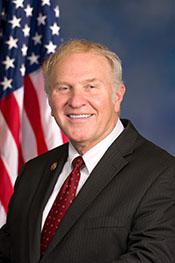
Mr. Chairman, I thank Chairman Hunter for his hard work, not just this year but over the years working on behalf of our men and women in uniform who serve us so well all around the globe. He, of…
Mr. Chairman, I thank Chairman Hunter for his hard work, not just this year but over the years working on behalf of our men and
women in uniform who serve us so well all around the globe. He, of course, is a Vietnam veteran himself and has seen action and knows exactly what he is talking about. I commend him for his work in this area.
In November of 2003, President Bush signed into law the National Defense Authorization Act of 2004. This legislation allowed spouses of active duty personnel killed after November 23, 2003, the option of signing their military survivor benefit plan, the SBP payments, over to their child or children so they could receive the payment without being subject to SBP dependency indemnity compensation, or DIC, the offset.
Unfortunately, this option is not currently available to spouses of soldiers killed from the time period beginning October 7, 2001, which was the start of operations in Iraq and Afghanistan, until November 23, 2003, when the legislation was actually passed. There are approximately 400 families who are adversely affected by this glaring omission.
One such family who lives in my district is Shauna Moore and her 3- year-old daughter, Hannah. Their loving husband and father, Army Sergeant Benjamin Moore, was fatally shot during a rifle-training exercise at Fort Hood, Texas, in February, 2003, while preparing for deployment to Iraq. It is through these unfortunate circumstances that I have had the chance to meet and talk with Shauna Moore and hear her story.
So today I am offering an amendment that expresses the sense of Congress that the widows and widowers of these 400 brave American soldiers who gave their lives in defense of our freedoms do not remain the forgotten few.
If accepted, I am hopeful that this amendment is the start of a process by which we may allow these 400 spouses and their families to obtain the option of assigning their SBP payments to their children, just as those whose spouses died after November 23, 2003, have been given the opportunity to do.
I believe this is the least we can do for families and people like Shauna and Hannah Moore who have already had to deal with the tragedy of losing a loved one. They should not be penalized solely because their loved one made the ultimate sacrifice protecting our country after the start of the Afghanistan and Iraq wars but before November 23, 2003, when that particular legislation passed. These are 400 families that should not be forgotten. I believe my colleagues will support this.
I yield to the gentleman from California.

Madam Speaker, I thank the gentlewoman from New York for yielding me this time. Our men and women in uniform are honorably serving this Nation on the ground in Iraq, Afghanistan, and many other…
Madam Speaker, I thank the gentlewoman from New York for yielding me this time.
Our men and women in uniform are honorably serving this Nation on the ground in Iraq, Afghanistan, and many other locations. But because of our commitments, our Armed Forces are relying even more heavily than usual on our National Guard and Reserves.
It is estimated that National Guard forces make up about half of the U.S. force on the ground in Iraq. With this in mind, it is truly disappointing that an excellent amendment by the gentleman from Mississippi (Mr. Taylor) was not made in order under this rule.
The Taylor amendment would give our Reserve and National Guard members full access to TRICARE, the health care insurance provided to those in our Armed Forces.
It is simply irresponsible for us to allow the families of 20 percent of Reservists and National Guardsmen to go without health care benefits.
Our National Guard and Reserves know that they can be called up for more than the usual 1 weekend a month, but they never would have expected their 1-year tours of duty to be extended well beyond that time frame. I am concerned that the civilian leadership of the military has forced us to lean so heavily on the Reserve and National Guard personnel.
These men and women serving in the National Guard and Reserves are responding to the unexpected; and now we, their government, need to respond in kind and not with a lot of platitudes. For all that these men and women are doing, we should be able to find the $1 billion necessary to provide them and their families with health care.
Offering every member of the National Guard and Reserves the ability to access health care coverage is a moral issue. Our treatment of our Reserve and Guard members is unacceptable. The Taylor amendment began to address it. I am truly saddened that at a time of great service and dedication on their part, we are quibbling about fully providing for our servicemen and -women.
The line between active and reserve personnel has already been blurred. Our Guard and Reservists need to be focused on fulfilling their missions. They should not have worries in the back of their mind about whether their spouse or their child is getting health care back home.
This provision, passed in full committee, deserves debate on the House floor. I encourage my colleagues to oppose this rule which will allow this amendment to be made in order. We should honor our servicemembers and give them the health care coverage they not only deserve, but are entitled to.
Mr. Chairman, I want to thank Chairman Hunter for his leadership in bringing this legislation before us today. I am proud to support the bill which reflects the superior commitment to all of those…
Mr. Chairman, I want to thank Chairman Hunter for his leadership in bringing this legislation before us today.
I am proud to support the bill which reflects the superior commitment to all of those defending the freedom of our Nation. I am certainly appreciative of being able to offer this amendment.
It is a little known fact in the civilian world that when a soldier is accidentally overpaid as a result of a military pay system error, the sum can be recouped in the form of a zero sum paycheck also known as ``no pay due.''
This is a problem long acknowledged by America's military community and service organizations and has been documented by numerous news organizations including ABC News, Army Times, and service organization publications.
Overpayments occur when the military's pay and personnel systems which are currently neither automated nor integrated with one another, do not accurately reflect a soldier's current status and are distressingly common when pay grade assignment or geographical changes are involved. Furthermore, while overcompensation can occur in small amounts over time, the full amount can be recouped by garnishing large portions of entire paychecks when over payment is detected.
The immediate and often unexpected financial burden this places on military families is in many cases overwhelming. Perhaps most disturbing is the common occurrence of ``no pay due'' for wounded soldiers. System failure to recognize cessation of combat pay or other allowances often results in continued compensation which then results in garnishment when the system catches up, all at a time when a wounded soldier's family is most vulnerable.
My amendment simply requires that no more than 20 percent of a soldier's paycheck can be garnished in one pay period to recover overpayment resulting from system error. It would also institute a 90- day grace period before recovery of overpayments can begin for wounded soldiers. This will ensure that families are not blind-sided by recovery of debt incurred as no fault of their own and often with no knowledge.
I ask for my colleagues to support this amendment which carries no cost and which does not seek to absolve debt, but merely to ease its recovery for our military families already serving so selflessly in defense of this Nation. I hope you will join me in lifting the burden of no pay due. Thank you. Our soldiers and their families deserve better.
Parliamentary Inquiry

Mr. Chairman, this is very simple. The Department of Defense says, Goode amendment, we don't need it. Under present law, the Homeland Security Secretary can call the Secretary of Defense and state…
Mr. Chairman, this is very simple. The Department of Defense says, Goode amendment, we don't need it.
Under present law, the Homeland Security Secretary can call the Secretary of Defense and state that, you know, he needs troops. It is very, very simple because under existing law, it says he can request of the Secretary of Defense assistance from the Armed Forces.
In fact, in 2002, the Secretary of Defense authorized such support on a reimbursable basis to organizations formerly components of the Department of Justice and Department of the Treasury and currently components of the Department of Homeland Security. So why do we want something else that we don't need?
Not only that, do you know that they will have to spend more money that the Department of Defense doesn't have to train?
Oppose this amendment, and when we come to the wall I would just hate for one day for the President of Mexico to come down and say, Mr. President, tear down this wall.
Our servicemen/women are spread too thin.
This is never a good idea, but certainly not in a time of war . . . to put soldiers in a new, civilian role . . . which has previously resulted in accidental deaths.
This damages our readiness.
I have been a law enforcement officer, and served in the Army. We are talking about two vastly different things--protecting the borders--and using the military in law enforcement.
This new war includes a host of fronts, including law enforcement for domestic interests related to terrorists who try to cross our borders.
I've led efforts for more border security: our investment should be in Border Patrol officers and detention beds to hold the OTMs--Other Than Mexicans--we now routinely release into the general population.
Even if we caught every single illegal immigrant crossing our border, we would still have no place to hold them, and we would be forced to release them--as we are doing now.
We should be focused on the need for professional law enforcement officers/intelligence associated with knowing who is coming across our borders . . . and providing funds to hold them.
Mr. Chairman, I rise to claim the time in opposition to the amendment; however, I do not intend to vote against the amendment.
I think this is a good amendment and we accept the amendment, Mr. Chairman.
I yield back the balance of my time.
Bill Text
Latest available legislative text
        [Congressional Bills 109th Congress]
[From the U.S. Government Publishing Office]
[H.R. 808 Introduced in House (IH)]

109th CONGRESS
1st Session
H. R. 808

To amend title 10, United States Code, to repeal the offset from
surviving spouse annuities under the military Survivor Benefit Plan for
amounts paid by the Secretary of Veterans Affairs as dependency and
indemnity compensation.

_______________________________________________________________________

IN THE HOUSE OF REPRESENTATIVES

February 15, 2005

Mr. Brown of South Carolina (for himself, Mr. Bartlett of Maryland, Mr.
Bradley of New Hampshire, Ms. Ginny Brown-Waite of Florida, Mr.
Calvert, Mrs. Christensen, Mr. Tom Davis of Virginia, Mr. Edwards, Mr.
Filner, Mr. Foley, Mr. Green of Wisconsin, Mr. Holt, Mr. Jenkins, Mr.
Jones of North Carolina, Ms. Kaptur, Ms. Kilpatrick of Michigan, Mrs.
McCarthy, Mr. Miller of Florida, Mr. Moran of Virginia, Mr. Reyes, Ms.
Linda T. Sanchez of California, Mr. Terry, Mr. Wolf, and Ms. Woolsey)
introduced the following bill; which was referred to the Committee on
Armed Services

_______________________________________________________________________

A BILL

To amend title 10, United States Code, to repeal the offset from
surviving spouse annuities under the military Survivor Benefit Plan for
amounts paid by the Secretary of Veterans Affairs as dependency and
indemnity compensation.

Be it enacted by the Senate and House of Representatives of the
United States of America in Congress assembled,

SECTION 1. SHORT TITLE.

This Act may be cited as the ``Military Surviving Spouses Equity
Act''.

SEC. 2. REPEAL OF DEPENDENCY AND INDEMNITY COMPENSATION OFFSET FROM
SURVIVOR BENEFIT PLAN SURVIVING SPOUSE ANNUITIES.

(a) Repeal.--Subsections (c), (e), and (k) of section 1450 of title
10, United States Code, and subsection (c)(2) of section 1451 of such
title are repealed.
(b) Effective Date.--The amendments made by subsection (a)--
(1) shall take effect on the later of October 1, 2005, and
the date of the enactment of this Act; and
(2) shall apply with respect to payment of annuities under
subchapter II of chapter 73 of title 10, United States Code,
for months beginning on or after that date.
(c) Recoupment of Certain Amounts Previously Refunded to SPB
Recipients.--(1) A surviving spouse who is in receipt of an SBP annuity
that is in effect before the date specified in subsection (b) and that
is adjusted by reason of the amendments made by subsection (a) and who
had previously received an SBP retired pay refund shall repay an amount
determined under paragraph (2). Any such repayment shall be made in the
same manner as a repayment under subsection (k)(2) of section 1450 of
title 10, United States Code, as in effect on the date of the enactment
of this Act.
(2) The amount of a repayment under paragraph (1) shall be the
amount that bears the same ratio to the amount of that refund as the
surviving spouse's life expectancy (determined in accordance with
standard actuarial practices) bears to the anticipated total duration
of the annuity (determined as the sum of such life expectancy and the
duration of the annuity already received).
(3) In this subsection:
(A) The term ``SBP annuity'' means an annuity under the
program established under subchapter II of chapter 73 of title
10, United States Code.
(B) The term ``SBP retired pay refund'' means a refund
under subsection (e) of section 1450 of title 10, United States
Code, as in effect before the date specified in subsection (b).
<all>