Providing for consideration of the bill (H.R. 4128) to protect private property rights.
Legislative Activity
Stay on top of the latest movement without scrolling through every action
Motion to reconsider laid on the table Agreed to without objection.
November 3, 2005 • 12:04 PM
View full timeline
Introduced in House
November 2, 2005
The House Committee on Rules reported an original measure, H. Rept. 109-266, by Mr. Gingrey.
November 2, 2005
It shall be in order to consider as an original bill for the purpose of amendment under the five-minute rule the amendment in the nature of a substitute recommended by the Committee on the Judiciary now printed in the bill.
November 2, 2005 • 8:57 PM
Placed on the House Calendar, Calendar No. 109.
November 2, 2005
Considered as privileged matter. (consideration: CR H9560-9562)
November 3, 2005 • 10:22 AM
DEBATE - The House proceeded with one hour of debate on H. Res. 527.
November 3, 2005 • 10:22 AM
The previous question was ordered without objection. (consideration: CR H9562)
November 3, 2005 • 10:38 AM
POSTPONED PROCEEDINGS - At the conclusion of debate on H. Res. 527 the Chair put the question on agreeing to the resolution and by voice vote announced that the ayes had prevailed. Mr. Gingrey demanded the yeas and nays and the Chair postponed further proceedings on agreeing to the resolution until later in the legislative day.
November 3, 2005 • 10:39 AM
Considered as unfinished business. (consideration: CR H9568)
November 3, 2005 • 11:56 AM
Passed/agreed to in House: On agreeing to the resolution Agreed to by the Yeas and Nays: 401 - 11 (Roll no. 563).(text: CR H9560)
November 3, 2005 • 12:04 PM
On agreeing to the resolution Agreed to by the Yeas and Nays: 401 - 11 (Roll no. 563). (text: CR H9560)
November 3, 2005 • 12:04 PM
Motion to reconsider laid on the table Agreed to without objection.
November 3, 2005 • 12:04 PM
Voting History
1 vote recorded • Roll call available
Floor Debate
24 membersWhat members said about H.Res. 527 on the floor
 FJS
FJS MW
MW GGM
GGM RC"
RC" JN+19
JN+19
Floor Debate
24 membersWhat members said about H.Res. 527 on the floor
Mr. Chairman, I yield myself such time as I may consume. Mr. Chairman, I rise in support of H.R. 4128, the Private Property Rights Restoration Act, overwhelmingly bipartisan legislation I introduced…
Mr. Chairman, I yield myself such time as I may consume.
Mr. Chairman, I rise in support of H.R. 4128, the Private Property Rights Restoration Act, overwhelmingly bipartisan legislation I introduced along with Agriculture Committee Chairman Goodlatte and Judiciary Ranking Member Conyers.
On June 23, the Supreme Court in a 5 to 4 decision in the case of Kelo v. City of New London transformed established constitutional principles when it held that the fifth amendment's public use clause permitted government to seize the private property of one small homeowner and to give it to a large corporation for a private business use.
As the dissent in that case made clear, under the majority's opinion: ``Any property may now be taken for the benefit of another private party. The government now has the license to transfer property from those with fewer resources to those with more. The Founders cannot have intended this perverse result.''
Reaction to the Kelo decision has united strong opposition from across the political, ideological, and socioeconomic spectrum. The NAACP and the AARP faulted Kelo's failing reasoning by stating: ``The takings that result from the Court's decision will disproportionately affect and harm the economically disadvantaged and, in particular, racial and ethnic minorities and the elderly.''
Representatives of religious organizations have also condemned the failed logic of the Kelo Court, stating: ``Houses of worship and other religious institutions are, by their very nature, nonprofit and almost universally tax exempt. These fundamental characteristics of religious institutions render their property singularly vulnerable to being taken under the rationale approved by the Supreme Court.''
Public reaction to the Kelo decision has also been swift and strong. The protection of private property rights is the number one issue that concerns Americans today, according to a Wall Street Journal/NBC News poll; and by an 11-to-1 margin, Americans say they oppose the taking of private property for private uses, even if it is for the public economic good.
According to an American Survey poll: ``Public support for limiting the power of eminent domain is robust and cuts across demographic and partisan groups.'' Even Justice John Paul Stevens, who authored the Court's 5 to 4 decision, recently acknowledged that if he were a legislator, he would oppose the results of his own ruling by working to change current law. That is what we are doing here today, working to change current law.
A week after the Supreme Court's now notorious Kelo decision, I introduced H.R. 3135, the Private Property Rights Protection Act, to help restore Americans' property rights the Supreme Court took away. On October 25, I introduced an even stronger version of the bill which we are considering today, which has benefited greatly from the contributions of Ranking Member Conyers, Ms. Waters, Mr. Goodlatte, and others, including Mr. Cannon and Mr. Flake.
H.R. 4128 helps restore the property rights of all Americans by establishing a penalty for States and localities that abuse their eminent domain power by denying those States and localities that commit such abuse all Federal economic development funds for a period of 2 years. Under this legislation, there is a clear connection between the Federal funds that would be denied and the abuse Congress is intending to prevent. If States and localities abuse their eminent domain power by using economic development as a rationale for a taking, they shall not receive Federal economic development funds that could contribute to similarly abusive land grabs.
I am very mindful of the long history of eminent domain abuses, particularly in low-income and often predominantly minority neighborhoods, and the need to stop it. I am also very mindful of the reasons we should allow the government to take land when the way in which the land is being used constitutes an immediate threat to public health and safety. I believe this bill accomplishes both goals.
The legislation contains an express private right of action to make certain that those suffering injuries from a violation of the bill will be allowed to access the State or Federal court to enforce its provisions and includes a fee-shifting provision, identical to those in other civil rights laws, that permits the recovery of attorney and other litigation fees to prevailing property owners. The legislation gives the States and localities the clear opportunity to cure any violation before they lose any Federal economic development funds by either returning or replacing the improperly taken property to the property owner.
H.R. 4128 also includes carefully crafted refinements of the definition of ``economic development'' that specifically allow the types of takings that, prior to the Kelo decision, had achieved a consensus as to their appropriateness. These include takings in which the public itself owns the property, where the property is used by a common carrier or public utility, and for related infrastructure like pipelines, and where the property is abandoned.
Finally, in order to facilitate State compliance with its terms, the bill will not become effective until the start of the first fiscal year following enactment of the legislation, nor would it apply to any project for which condemnation proceedings have begun prior to its enactment.
Mr. Chairman, I urge all of my colleagues to join me in supporting this vital bipartisan legislation that will protect the property rights of the most vulnerable in our society and limit the effect of the now notorious Kelo decision.
Mr. Chairman, I reserve the balance of my time.
Mr. Chairman, I yield 2 minutes to the gentleman from Texas (Mr. Smith).
Mr. Chairman, I yield 2 minutes to the gentlemen from Ohio (Mr. Chabot).
Mr. Chairman, I yield 2 minutes to the gentleman from Texas (Mr. Gohmert).
Mr. Chairman, I yield 1\1/2\ minutes to the gentleman from Georgia (Mr. Price).
Mr. Chairman, I yield 2 minutes to the gentleman from Alaska (Mr. Young).
Mr. Chairman, will the gentleman yield?
If unintended transportation consequences
are discovered, I would be happy to work with the gentleman from Alaska (Mr. Young) to fix them in conference.
Mr. Chairman, I yield 1\1/2\ minutes to the gentleman from Texas (Mr. Poe).
Mr. Chairman, I yield 1\1/2\ minutes to the gentleman from Nevada (Mr. Gibbons).
Mr. Chairman, I yield 1\1/2\ minutes to the gentleman from Texas (Mr. Hensarling).
Mr. Chairman, I yield 1\1/2\ minutes to the gentlewoman from Virginia (Mrs. Drake).
Mr. Chairman, I yield 2 minutes to the gentleman from Iowa (Mr. King).
Mr. Chairman, I yield 2 minutes to the gentleman from Arizona (Mr. Flake).
The answer is absolutely.
Mr. Chairman, I yield myself the balance of my time.
Mr. Chairman, very briefly, this bill attempts to do what the Federal Government can to reverse the impact of the Kelo decision, and the heart of this bill is to deny Federal economic development funds for 2 years to any States or locality that attempts to use its condemnation powers to take private land for essentially a nonpublic use purpose and to turn around and resell it to another private developer who will bring in more tax revenue.
We have heard time and time and time again on this floor during the last hour that this is wrong. But the Supreme Court has said that it is not wrong if a developer can convince a majority of one on a city council or local governing board to authorize the local attorney to go and commence condemnation actions. That is true if somebody has lived in a house for all their life and the city council puts them in the cross hairs; it is true for a church that has got a prime piece of property on the corner of a busy intersection that a developer wants to build a strip mall on; and it is true for someone who has run a small business in a prime area of town and has made a lot of money but does not pay a lot of property taxes because they have a small shop, and they can be put out of business even for a competition that wants to have a larger and, thus, more tax-yielding facility on that piece of property.
Everything I have said is wrong, and everything I have said can be done with the use of Federal economic development funds under the Kelo decision. What we need to do now is pass this bill to right this wrong.
And I would just remind the membership, Mr. Chairman, that the author of the majority opinion in Kelo, Justice John Paul Stevens, recently spoke to a local bar association in Nevada and said that if he was a legislator rather than a justice of the United States Supreme Court, he would have ruled the other way. So if Justice Stevens were sitting here as a representative in Congress today, he would be supporting this bill, too, and I think that is the reason why this bill should receive overwhelming support. We all should vote for it.
Mr. Chairman, I yield back the balance of my time.
Mr. Chairman, I submit the following jurisdictional letters of exchange for inclusion in the Congressional Record during floor consideration of H.R. 4128, the ``Private Property Rights Protection Act.''
House of Representatives,
Committee on Energy and Commerce,
Washington, DC, November 2, 2005.
Hon. F. James Sensenbrenner, Jr.,
Chairman, Committee on the Judiciary, House of
Representatives, Rayburn House Office Building,
Washington, DC.
Dear Chairman Sensenbrenner: I understand that you will
shortly bring H.R. 4128, as amended, the Private Property
Rights Protection Act of 2005, to the House floor. This
legislation contains provisions that fall within the
jurisdiction of the Committee on Energy and Commerce.
I recognize your desire to bring this legislation before
the House in an expeditious manner. Accordingly, I will not
exercise my Committee's right to a referral. By agreeing to
waive its consideration of the bill, however, the Energy and
Commerce Committee does not waive its jurisdiction over H.R.
4128. In addition, the Energy and Commerce Committee reserves
its right to seek conferees on any provisions of the bill
that are within its jurisdiction during any House-Senate
conference that may be convened on this or similar
legislation. I ask for your commitment to support any request
by the Energy and Commerce Committee for conferees on H.R.
4128 or similar legislation.
I request that you include this letter in the Congressional
Record during consideration of H.R. 4128. Thank you for your
attention to these matters.
Sincerely,
Joe Barton,
Chairman.
Mr. Chairman, I offer an amendment.
Mr. Chairman, I yield myself such time as I may consume.
Mr. Chairman, the manager's amendment simply makes clear that private roads and those that are open to the public, free or by toll, and flood control facilities are covered under the exceptions of the bill. It also includes a savings clause making clear that nothing in the legislation shall be construed to affect the Uniform Relocation Assistance and Real Property Acquisition Policies Act of 1970, which requires the Federal Government to pay the displacement costs of those adversely affected by the Federal Government's use of eminent domain.
The manager's amendment also incorporates into the bill's sense of congress section some language provided by the Resources Committee regarding the effect of the abuse of eminent domain on irrigation and reclamation projects and on public lands.
I urge my colleagues to support the improvements made by this manager's amendment.
Mr. Chairman, I reserve the balance of my time.
Mr. Chairman, I yield myself such time as I may consume.
Mr. Chairman this is a gutting amendment. It is a gutting amendment because it removes the constitutional hook that this Congress and the Federal Government have to prevent the abuses that have been sanctioned by Kelo, and that is the Federal funds that have been used for economic development.
The amendment strikes out all the penalty in the bill that would prevent the government officials from abusing eminent domain. No penalty, no tap on the wrist. We say you should not do it; but if you go ahead and do it, then you are not going to be penalized. Without these penalties in the bill, the government could take private property from one person and simply give it to a wealthy corporation. Because this amendment guts the entire bill, it ought to be opposed.
Under this legislation, there is a clear connection between the Federal funds that would be denied and the abuse that Congress is intending to prevent. The policy is that States and localities that abuse their eminent domain power by using economic development as a rationale for a taking should not be trusted with Federal economic development funds that could contribute to similarly abusive land grabs.
There is an entirely appropriate connection in the base bill between the Federal policy of protecting private property rights from eminent domain abuse and making sure that the Federal Government does not subsidize eminent domain abusers. The amendment should be defeated for these reasons.
Mr. Chairman, I reserve the balance of my time.
Mr. Chairman, I yield 1 minute to the gentlewoman from California (Ms. Waters).
Mr. Chairman, I yield myself the balance of the time.
Mr. Chairman, we do not know if the gentleman from New York's approach is constitutional. That has not been tried before, and it would be a case of first impression in the courts.
We know that the provision of denying Federal funds in the base bill is constitutional, because it was done by this Congress 20 years ago where we denied States transportation funds that did not raise the drinking age to 21. So the constitutional precedent was set 20 years ago in the transportation area. The base bill does that. The gentleman's amendment does not. That is why it ought to be rejected.
Mr. Chairman, I demand a recorded vote.
Mr. Chairman, I will claim the time in opposition, even though I am not opposed.
Mr. Chairman, I yield myself such time as I may consume.
Mr. Chairman, this amendment would help property owners by putting the burden of proof on the government to show that it is not abusing eminent domain by taking private property for a private use. It is a good amendment, and I support it.
I yield to the gentlewoman from California.
Mr. Chairman, I yield myself such time as I may consume.
Mr. Chairman, unlike the characterization that my friend from Virginia has made in this bill, this is a bill that is supported by the mainstream of Members of Congress. And how many times in anybody's congressional career would you see Jim Sensenbrenner and Maxine Waters supporting the same bill? That means that we have a very, very big tent of people who are supporting it, because it is the right thing to do.
The amendment should be defeated because it would gut the bill. Because it completely goes back to the definition of public purpose that the Supreme Court allowed this terrible miscarriage of justice to occur in the Kelo case.
The Kelo decision held that the term public use could actually mean a private use such that the government can take perfectly fine property from one person just to give it to another wealthier person. And the amendment would put back into the bill an exception for any public use, I would submit, as defined by a majority vote of the city council, which in the wake of the Kelo decision means a private use as well.
This amendment would put property owners everywhere back to where they were before the Kelo decision, and that is way behind the eight ball, subject to the mercy of a majority vote of their city council. The whole point of this legislation is to counter the Supreme Court's reading of public use in a way that includes private use as well, and the amendment guts the bill by allowing exceptions for private uses as well as public uses. Because this amendment is a giant step backwards in the protection of property rights, it should be soundly defeated.
With respect to the comments the gentleman made on the statute of limitations, yes, it is a long statute of limitations. Because the city has the time and the money to wait out the property owner simply by putting it on the shelf until the time expires. And we should have a longer statute of limitation, rather than a shorter one, so that the city cannot be tempted by the siren song of using its power and using its money to run roughshod over the owner of a piece of private property.
Mr. Chairman, I yield 1 minute to the gentlewoman from California (Ms. Waters).
Mr. Chairman, I yield the balance of my time to the gentleman from Virginia (Mr. Goodlatte).
Mr. Chairman, I yield myself such time as I may consume.
Mr. Chairman, this amendment must be defeated because it uses undefined terms that would gut this vital legislation designed to protect the property rights of all Americans from abuse of Government land grants.
The list of organizations that the gentleman from Ohio read off in support of his amendment shows why it ought to be defeated, if we want to stand up for the property rights of individual landowners.
The terms used in this amendment are broad in their scope; and, consequently, the amendment would subject just about any property owner in America to the threat of having their property taken by a government official willing to abuse the power of eminent domain to take property from one private citizen and give it to another wealthier developer.
The amendment would allow the taking profit for ``excessive land coverage,'' ``lack of ventilation,'' ``lack of light,'' and ``obsolescence,'' just to name a few. None of these terms are defined in the amendment, and each would be subject to tremendous abuse. No home in the country would be safe if a government official were allowed to use those concepts to take private property.
If a government bureaucrat thinks your porch is too big, they can take your whole house and all of your land under the amendment. If your barn has only one light bulb in it or no artificial light at all, then your barn and all of the farm land surrounding it could be confiscated by the government. Webster's Dictionary defines obsolete, which is one of the terms used in this amendment, as of a kind or style no longer current. Under the amendment, then, if the design of your house is out of fashion in the eyes of government officials, you could lose both your house and your property; and that is wrong.
The base bill already includes a reasonable exception that allows the government to take property when property is being used in a way that imposes an immediate threat to the public health and safety. And the base bill does absolutely nothing, absolutely nothing that prevents States and localities from enforcing public nuisance laws under its police powers and tearing down an unsafe building.
But the amendment goes much further in a way that threatens low- income and minority communities, and for that reason I join the NAACP in opposing this amendment. Listen to what actual practitioners in the field have to say about it. This is from the Institute for Justice, the public interest law firm that represented Suzette Kelo and the other New London homeowners who took their fight to keep their homes from being taken for private commercial development all the way to the Supreme Court.
The Institute for Justice states, ``In our experience litigating eminent domain cases all over the country, we have seen each of the terms in the amendment applied in such a way as to allow the use of eminent domain on perfectly normal residential and business neighborhoods. Dilapidation can mean that a building has chipped mortar or needs a new handrail. Obsolescence can be a single-family home that lacks three bedrooms, two full bathrooms and a two-car attached garage. Both overcrowding and lack of ventilation, light and sanitary facilities were routinely used during urban renewal to remove poor and minority communities from their neighborhoods. Deleterious land use can mean a combination of residences and businesses in a single area, even though many planners think that such neighborhoods are ideal. Time and time again, the terms found in this amendment have served as vehicles for the abuse of eminent domain for private commercial development''. From the Institute.
This gutting amendment should be defeated.
Mr. Chairman, I reserve the balance of my time.
Mr. Chairman, I thank the gentleman for yielding.
The amendment would simply make an exception for the taking of property that is categorized as a brownfield under Federal law, meaning it is a site that contains or is perceived to contain hazardous contaminants. I support the adoption of the amendment and commend the gentleman from California for introducing it.
Mr. Chairman, I thank the gentleman from Georgia for yielding.
What the Kelo decision has said is that the land that the house of God is built on belongs to Caesar and Caesar can go condemn the land that the house of God is built on to turn it to into a strip mall or hotel or whatever will bring in more tax base, and that is wrong.
The amendment that the gentleman from Georgia has offered simply states that the tax-exempt status of a religious or nonprofit organization cannot be used for a taking under the Kelo case. The amendment is a good one. It ought to be supported, and I am happy that he offered it.
Mr. Chairman, I am happy to accept the amendment because it requires the Federal Government agencies do whatever they need to do to come into compliance with the bill's prohibition on abuse of eminent domain. It is a good amendment, and I hope we accept it.
Mr. Chairman, I yield 2 minutes to the gentleman from Oregon (Mr. Blumenauer). Mr. Chairman, I yield 2\1/2\ minutes to the gentleman from Tennessee (Mr. Davis). (Mr. DAVIS of Tennessee asked and was…
Mr. Chairman, I yield 2 minutes to the gentleman from Oregon (Mr. Blumenauer).
Mr. Chairman, I yield 2\1/2\ minutes to the gentleman from Tennessee (Mr. Davis).
(Mr. DAVIS of Tennessee asked and was given permission to revise and extend his remarks.)
Mr. Chairman, I yield myself 5 minutes.
Mr. Chairman, I rise in very strong support of H.R. 4128.
I was one of those individuals who was shocked at the Supreme Court decision. On June 23, 2005, Kelo v. The City of New London, the Supreme Court held in a 5 to 4 decision that the city's use of eminent domain to implement its area's redevelopment plan aimed at invigorating a depressed economy was a public use satisfying the U.S. Constitution, even though the property would be turned over from private homeowners and businesses to private developers.
Never in my wildest imagination did I think there would be a Supreme Court ruling that would take private property and give it to private individuals for private use.
This decision was born out of what took place with the giant pharmaceutical company Pfizer. Pfizer built a plant next to an area called Fort Trumbull, and the city determined that someone else could make better use of the land than the people who actually lived there: the Fort Trumbull residents. The city handed over its power of eminent domain, that is, the ability to take private property for public use, to the New London Development Corporation, a private body; and that private body then exercised eminent domain to take the entire neighborhood for private development.
The Supreme Court decision is wrong, and I cannot see how any Member of the House of Representatives could support the taking of private property for private use. Someone spoke of this as being a pillar of democracy. It is a strong American value that we hold dear, and I do not think that we should not do something, exercise our power in this House to deny the Supreme Court decision to be used by all of these cities and redevelopment agencies and other entities. I believe that we have to protect the American people.
As a matter of fact, one Member came and said, well, you know, this is an isolated case. It is not. I have over 125 cases throughout the United States where cities and other entities, community redevelopment agencies, in those cities where they can give the eminent domain rights to private developers, such as they did in this Kelo decision, are taking people's private property.
What is more, many of these entities are trying to take private property, take homes and businesses to give over to the big-box developers who need a lot of land to put down these big-box shops.
I do not believe we can stand by and not do something. There are those who would argue that the Federal Government should not be involved. If not us, who will protect people? We know that you are getting lobbied, Members are getting lobbied by Members of city councils, even by mayors; but many of them are lying with these developers. They have relationships; money is changing hands. They are in bed with the very developers who want to take the private property for private development.
Again, we cannot afford to let this happen. What we do here today will help to slow down this taking of private property for private use. As far as I am concerned, the bill could have even been stronger because we have got a few exceptions in the bill that I question.
I wanted a pure bill with no exceptions. My chairman who worked so hard on this bill made a case for some takings for certain kinds of very, very important public use of private lands. And even though I am supporting the bill, I could support an even stronger bill because I think there should be no exceptions, none, zilch, zero, no exceptions. I do not believe in taking private property to give to someone else for private use to make money off of.
You will hear this described in any number of ways, the taking of private property to get rid of blight. Whose blight? By whose definition? The taking of private property by economic development. What kind of economic development? Who is going to make the money? Who is going to suffer?
Your home is your castle. And for those people who save their money and invest in their homes, raise their children, that home should be their castle in toto. That home should never be in jeopardy because some city government, some redevelopment agency decides that they want to take it. I do not care what for. The gentleman from Virginia (Mr. Scott) came and talked about the taking for ballparks. I disagree with that.
Mr. Chairman, I reserve the balance of my time.
Mr. Chairman, I yield 2 minutes to the gentleman from Virginia (Mr. Moran).
Mr. Chairman, I yield 2 minutes to the gentleman from New York (Mr. Nadler).
Mr. Chairman, I yield 2 minutes to the gentleman from New Jersey (Mr. Pallone).
Mr. Chairman, I yield 1 minute to the gentleman from Ohio (Mr. Kucinich).
Mr. Chairman, I yield 1 minute to the gentlewoman from Texas (Ms. Jackson-Lee).
Mr. Chairman, I yield myself such time as I may consume.
Mr. Speaker, as you can see, this is not a Democrat-Republican issue. The people who care about property rights, the people who respect homeownership, the people who believe that this is an important value are standing up for the citizens of this country. Folks who believe that somehow the government has a right to take private property for private use are standing on the side of the developers.
While I respect Members on both sides of the aisle, I have had some Members on this side of the aisle talk about what they have done for poor people, and you will hear people talk about what they do for minorities, that they are doing this to get rid of blight, to create better communities. Well, on this one, I would like to say to all of my would-be friends who are helping poor communities and minority communities, we do not need you on this one.
We need you to respect the right of those minorities and those poor people to hold on to whatever it is they own, whether it is a little, small business or whether it is a two-room shack or a one-room shack or whatever it is. It is theirs. They have a right to it. And no one, no mayor, no city council member, no one has the right to think they know better; that they can take that property for a private use.
I think it is unconscionable for anybody that is elected by the people to
undermine the people by supporting the taking of private properties for private use. I would hope even those Members who have been past mayors, who have been past city council members who agreed with the developers, indeed listen to this debate here on the floor today and agree that if we want to do anything to support the right of citizens to own property, we will support this bill.
Mr. Chairman, I yield the balance of my time to the gentlewoman from Nevada (Ms. Berkley).
Mr. Chairman, I am not opposed to the amendment, and I ask unanimous consent to claim the time in opposition.
Mr. Chairman, I yield myself such time as I may consume.
Mr. Chairman, I rise in support of the amendment offered by the gentleman from Wisconsin.
This amendment does not change the bill in any substantive way. Rather, this amendment seeks to clarify some of the exceptions that provide for the use of eminent domain for those uses that have traditionally been considered for a public purpose.
This amendment also enhances the sense of congress provision and points out that the bill does nothing to restrict the Federal Government from fulfilling its obligation under current law when it exercises eminent domain.
Most importantly, this amendment serves to reflect the bipartisan interests of the various committees that have been at the forefront of this issue, Agriculture, Resources and Judiciary. I am pleased that we have been able to work together on what I feel is an appropriate response to the Kelo decision.
I just want to say to Chairman Sensenbrenner, you know how strongly I feel about this issue. And while I offered some amendments in committee so that there would be absolutely no exceptions, I think that if we are able to pass this bill today we will have taken a giant step to stop what I think is a wrongheaded decision by the Supreme Court. So I am willing to certainly support the chairman's amendment, and if we have to continue to work on this issue to get to where I want to be with no exceptions, then I will look forward to working with the gentleman in the future on it.
Mr. Chairman, I yield back the balance of my time.
Mr. Chairman, I respectfully offer this statement against the amendment offered by the gentleman from New York. Essentially, this amendment eliminates the teeth of this bill: the denial of Federal funds for 2 fiscal years to those States and cities that have violated this act. The denial of Federal economic development funds should serve as a real deterrent for those States and cities that want to exercise eminent domain for development, that is, the taking of private property for private use. Without this provision, this bill will not be taken seriously, and the eminent domain abuses that many in this country are complaining about will continue.
I just waved before my colleagues a list of over 125 cases of the taking of private land for private use, or attempts to do that; and I think the bill that we have before us today will stop this kind of abuse of eminent domain.
Mr. Chairman, will the gentleman yield?
Mr. Chairman, I support this amendment also. I am tired of poor people and working people having to go and find lawyers and pay them. Who can afford $250 and $300 an hour? The average poor person certainly cannot. So you are right, let us put it on the entity that is trying to pull these tricks in the first place to take these properties away from these citizens.
So I support the amendment.
Mr. Chairman, I respectfully offer this statement against the amendment offered by the gentleman from Virginia (Mr. Moran).
Mr. Chairman, this amendment seeks to prohibit a taking of private property only when the taking's primary purpose is economic development, maybe for the parking lots he described.
I am fearful that such an amendment would create a loophole for States and cities, allowing them to take property in a manner that is inconsistent with this Act, by arguing that the economic benefits of the taking were incidental rather than primary.
Also, this amendment seeks to confine property owners to a 7-year period in which they must bring a suit under this Act. This means that an owner who has had his or her property taken better hope that the State or the city puts the property to use in 7 years. If a State or city takes property for a public purpose, sits on it for 8 years and then puts it to use for economic development, the owner has no recourse.
Mr. Chairman, I do not think that you can argue that the statute of limitations is too long. These people, citizens buy their homes, and they expect to live in them for life. They do not expect someone to come along and say that we have decided that we are going to give it to someone else, a developer to develop for private purposes to make money on.
So I would ask my colleagues to reject this amendment.
Mr. Chairman, I rise in strong opposition to the amendment offered by the gentleman from Ohio (Mr. Turner). This is the most dangerous of all the amendments that have been offered today.
We take up the Private Property Rights Protection Act today in an effort to provide all property owners with greater protections. The Turner amendment will essentially create a blight exception. By prohibiting the use of eminent domain for economic development in almost all instances except blight, we make blighted communities an easy target for States and cities.
This is why the NAACP supports this bill also. Too many of our communities, the minority, the elderly and the low-income have witnessed an abuse of eminent domain powers. Given this history of abuse, we would like all legislative responses to Kelo to be sensitive to that.
Historically and today, it has been too easy to characterize minority, elderly or low-income communities as blighted for eminent domain purposes and subject them to the will of the government. If legislative proposals contain language that could potentially excluding these communities from protection against eminent domain abuses, we have failed to be sensitive to the interests of this constituency.
These communities should be afforded the same rights and protections all homeowners, business owners, and other property owners will be afforded in a Federal policy response to Kelo.
Mr. Chairman, I claim time in opposition to the amendment.
Mr. Chairman, I claimed this time to raise some concerns about the amendment offered by the gentleman from California. I believe the gentleman from California and the gentlewoman from Texas have a sincere interest in furthering this Nation's development of brownfields, land that is difficult to expand because of environmental contamination. However, I believe that such development is already protected under the bill.
First, this bill will provide an exception for removing harmful uses of land
provided such uses constitute an immediate threat to health and safety. If land truly constitutes a brownfield, then it meets this exception.
Second, brownfields are often acquired by clearing title on, for example, old industrial property where ownership exchanged numerous times without proper recording. The bill creates an exception for clearing defective claims of title; and, again, brownfields would be protected.
Brownfields are also protected under the abandoned property exception that is in the bill. Owners often abandon these properties to escape liability. I am confident that there are sufficient protections in this bill for brownfields in question if an additional exception needs to be created.
We do not want cities to now use the brownfields label as an excuse to take private property and turn it over to a private business or developer. Worse yet, we do not want brownfields to become the modern- day blight exception.
You can see that we have heard requests for any number of exceptions, and if we stayed on this floor for 24 hours or 48 hours, more Members, perhaps, could think of reasons why you should take private land for private use. I maintain that if you want to package land or you want to acquire land, you have to work within the marketplace to do it. You have to go out, you have to find the owners, you have to negotiate market rates, you ``have'' to convince people it is for good uses. You have to work. And you have to engage in order to acquire land. You cannot simply come up with every excuse that is convenient to mayors and city council members and to developers to take people's private land.
If it is private, if it is owned, whether it is residence or business or ``vacant'' land, whatever, it belongs to somebody, somebody paid for it. They have a right to it. The government does not have the right to take it. And so I would simply be opposed to yet another request for an exception to this very good bill that is put forth to protect the citizens of the States.
I commend the chairman and those of us on both sides of the aisle for stepping forward in the manner that we have in a timely fashion to say no.
I have often criticized my friends on the opposite side of the aisle for accusing courts and the Supreme Court of creating law, of creating legislation. They did it on this one. They absolutely did. The Constitution simply says that you must compensate for the taking of land for public use.
We are not opposed to eminent domain for public use. I question it from time to time, but that is not what this is all about. This is about the taking of private land for private use.
Mr. Chairman, I reserve the balance of my time.
Mr. Chairman, I yield myself the balance of the time.
I respect the gentleman's request for yet another exception, but I oppose it. I think that the chairman and the framers of this legislation have been very responsible in the way that we have tried to advance a piece of legislation to protect the citizens of this Nation from a bad Supreme Court decision.
A lot of people may be inconvenienced by our bill, people who want to acquire property, people who want to take private property for a development, people who want to make money, people who will use any means necessary by which to gain property that they think will help to bring them additional profits. There are a lot of reasons why people will be inconvenienced by this bill.
The bottom line is we do not wish to continue to abuse and inconvenience, marginalize and deny property owners of this country. We feel that our number one responsibility is to the property owners. We are elected to represent our citizens in the best way possible. There is no better way to represent citizens than to say we stand with you in the ownership of the land that you have bought, that you have inherited, that you have invested in.
We know a lot of people may not like it. It may inconvenience some people. You may not be able to build that parking lot, you may not be able to develop that shopping center, but we stand with the people against those kind of inconveniences. We ask for a ``no'' on the gentleman's amendment.
Mr. Chairman, I offer an amendment. Mr. Chairman, I yield myself such time as I may consume. Mr. Chairman, I yield to the gentleman from Wisconsin (Mr. Sensenbrenner). Reclaiming my time, I rise to…
Mr. Chairman, I offer an amendment.
Mr. Chairman, I yield myself such time as I may consume.
Mr. Chairman, I yield to the gentleman from Wisconsin (Mr. Sensenbrenner).
Reclaiming my time, I rise to offer a modest amendment to ensure the Federal Government continues to work with local communities to promote and encourage brownfield redevelopment in America.
The bill has a list of exemptions that recognizes eminent domain is sometimes used for legitimate purposes. These exemptions in H.R. 4128 are not sufficient to address brownfield sites. While the bill is an important step to protect private property rights, it could have the unintended consequence of inhibiting redevelopment of brownfield sites.
My amendment corrects the oversight by adding brownfield redevelopment as specifically defined in the Small Business Liability Relief and Brownfield Revitalization Act of 2001. Owners of brownfield sites are frequently unwilling to sell them for fear of cleanup and cost of contamination they find. Eminent domain can often help break through legal and procedural barriers to the sale of the land.
To address this, local governments can take advantage of the liability protection in CERCLA for acquiring potentially contaminated sites ``through the exercise of eminent domain authority by purchaser or condemnation.''
Without using eminent domain as provided for in CERCLA, a local government would be held strictly liable for all costs and cleanup of polluted land as the owner and operator of the site.
I want to stress strongly that brownfield sites are not residential properties. They are abandoned, idle, or underused industrial and commercial facilities where expansion or redevelopment is complicated by real or perceived environmental contamination.
Let us make sure the cities have the tools they need to clean up brownfield sites. It is a reasonable amendment, and I ask for an ``aye'' vote.
I rise today to offer a modest amendment to ensure the Federal Government continues to work with local communities to promote and encourage Brownfields redevelopment in America.
Protecting Private Property Rights is Important
There is no question that the right to own private property is one of the cornerstones of American freedom.
Governmental regulatory takings are becoming more and more prevalent in today's society and Congress must do everything possible to ensure that lands acquired by private means are protected. As more and more Americans are working to purchase property and become homeowners, the threat of governmental takings must not overshadow the pursuit of the American dream.
The recent United States Supreme Court decision set the precedent that local governments may be afforded wide latitude in seizing property for land-use decisions. I strongly disagree with the implications of this decision. Private property has been the foundation of our society, and I believe it is unwise for government to deprive citizens of this most basic tenet of the American dream.
I am pleased that we have a bill before us today to respond to the Supreme Court's ill-advised decision. While the bill is an important step to protect private property rights, it could have the unintended consequence of inhibiting the redevelopment of Brownfields sites.
Bill's Exemptions Do Not Cover Brownfields
The bill has a list of exemptions that recognize that eminent domain is sometimes used for legitimate purposes. However, Brownfields redevelopment is not part of this list.
The current exemptions in H.R. 4128 are not sufficient to address Brownfields sites. Brownfields are not always ``abandoned'' and may not ``impose an immediate threat to health or safety.'' My amendment corrects this oversight by adding Brownfields redevelopment as specifically defined in the Small Business Liability Relief and Brownfields Revitalization Act.
Brownfields Redevelopment is Important
Experts estimate that the United States has more than 450,000 vacant or underused industrial sites as a result of environmental contamination caused by chemical compounds and other hazardous substances. These sites are known as Brownfields.
Brownfields represent more than just eyesores--they threaten our groundwater supply, cost our local communities jobs and revenue, and contribute to urban sprawl. Returning the nation's Brownfields sites to productive economic development could generate more than 550,000 additional jobs and up to $2.4 billion in new tax revenues for cities and towns.
We must not inhibit or stymie the ability of localities to responsibly exercise eminent domain authority for the redevelopment of Brownfield sites. The redevelopment of Brownfield sites has proven to revitalize distressed neighborhoods, while fostering economic growth, creating jobs, increasing local tax revenues, and reducing public service demands.
This amendment will ensure that the use of eminent domain to redevelop Brownfield sites will remain available.
Brownfields Pose Obstacles to Redevelopment that Sometimes Can Only Be
Overcome by Eminent Domain
Owners of Brownfield sites are frequently unwilling to sell them for fear of the cleanup costs of any contamination found. Eminent domain can often help break through legal and procedural barriers to the sale of the land.
To address this, local governments can take advantage of the liability protections in CERCLA for acquiring potentially contaminated sites ``through the exercise of eminent domain authority by purchase or condemnation.'' Without using eminent domain as provided for in CERCLA, a local government would be held strictly liable for all costs of cleaning up polluted land as an ``owner or operator'' of the site. As a result, local governments would be less likely to redevelop a Brownfield site.
By Promoting Brownfields Redevelopment, we are not throwing people out
of their homes
Brownfields are not Residential Properties. They are abandoned, idle, or under-used industrial and commercial facilities where expansion or redevelopment is complicated by real or perceived environmental contamination.
Cities will not be able to abuse the Brownfields exception
The Brownfields Revitalization Act creates a specific scientific standard for determining whether a former industrial site is a potential Brownfield site.
The real problem is that when a property is a Brownfield, it is in legal limbo. It is the ``possibility'' of contamination alone that results in the lack of redevelopment. The land might not be contaminated, but if the owners have reason to believe it might be, it will likely sit, unused.
Without the city's ability to exercise eminent domain, many contaminated properties that can be redeveloped would instead continue to impose heavy environmental, financial, and social burdens on communities.
Conclusion
We must give cities the opportunity to minimize urban sprawl and preserve existing green space by allowing communities to work with local developers and builders to utilize previously developed properties.
This amendment preserves the ability of cities to take ownership of Brownfields and work with their development community to design projects that utilize existing infrastructure.
Most importantly, it is estimated that up to $2.4 billion in new tax revenues can be generated through Brownfields redevelopment. Let's make sure cities have the tools they need to clean up Brownfields sites.
I urge my colleagues to support this crucial amendment to demonstrate that we support Brownfields redevelopment.
Mr. Chairman, I reserve the balance of my time.
Mr. Chairman, I yield 2\1/4\ minutes to the gentlewoman from Texas (Ms. Eddie Bernice Johnson).
Mr. Chairman, I yield myself the balance of my time.
The gentlewoman from California said a few things that I think I have to address. She said she believed this is included within the bill. It is not. The other thing she said is that the cities should work within the marketplace to acquire these properties.
The problem you have with cities doing that is without eminent domain that is provided for in CERCLA, a local government would be held strictly liable for all costs of cleanup of the polluted land as the owner-operator of the site. That is a complete different liability that the city would accept through eminent domain.
By not having eminent domain through CERCLA, a city then would not want to have a piece of property that was a brownfield because they then are accepting the total liability of the owner. This is going to shut down development in local communities. The problem we have with the bill, there is no immediate threat to health because, as you know, brownfields are usually fenced in. They are sites that are not being used. The owners generally do not want to know if they are contaminated because then they have to accept liability.
It is a reasonable amendment. I thank the chairman for accepting it.
Mr. Chairman, I yield back the balance of my time.
Mr. Chairman, I thank the gentleman for yielding. Mr. Chairman, I rise to oppose the legislation, which is the congressional response to the Supreme Court decision Kelo v. City of New London. By…
Mr. Chairman, I thank the gentleman for yielding.
Mr. Chairman, I rise to oppose the legislation, which is the congressional response to the Supreme Court decision Kelo v. City of New London. By enacting this legislation, we are undermining the States' rights and assuming the role of a city council. We should not change Federal law every time Members of Congress disagree with the judgment of a locality when it uses eminent domain for the purpose of economic development. We were elected to the United States Congress, not to local city councils.
Mr. Chairman, it is impossible for Congress to draw a bright line principle separating those cases in which economic development is appropriate for a particular area and when it is not. The Constitution does require that the taking be for public use. It is the role of a city council to weigh the needs of a particular community and consider when the government should use eminent domain.
Sometimes that might mean taking property for the purpose of economic development. Sometimes it may not. Sometimes we will agree with the judgment of the locality. Sometimes we will disagree.
I cannot think of a more fitting example of the quagmire this bill presents than the situation we have right here in Washington, D.C., where they are trying to build a baseball stadium. I find it ironic that, at the same time we are marking up the bill, Washington, D.C. is using eminent domain to build a baseball stadium.
The debate on this bill has already exposed the shortcomings of the legislation. For example, we found that if a stadium were built and owned by the city at taxpayer expense, it would clearly be allowed under the bill. On the other hand, if the owner offered to build a stadium at his own expense, that might not be allowed.
The bill requires public access to the stadium as ``a matter of right.'' Does that mean that the skyboxes must be put to public auction, or can the owner pick and choose which businesses can acquire rights to skyboxes?
Anybody who surveys baseball or football stadiums around the country will find all kinds of public and private and joint public-private ownership combinations. Could some use eminent domain, while others be prohibited from using eminent domain based on the fact that they want to limit access to skyboxes or how the title of the stadium is held?
Mr. Chairman, the World Trade Center and Lincoln Center in New York, the Baltimore Inner Harbor, even President Bush's baseball stadium in Houston, Texas, were all made possible by eminent domain takings for the purpose of economic development. And although we might agree or disagree with the wisdom of these projects, most would agree that they should not have been illegal. These are political decisions that ought to be left to the localities within the confines of their State legislature's parameters.
If Congress cannot leave eminent domain to the States, then we should focus on the real issues involved in eminent domain. We should require, for example, that just compensation should include replacement cost, not just technical appraisal value. We should require that relocation expenses be paid to owners and tenants.
As written, the bill does nothing to ensure that displaced individuals receive reasonable compensation for the replacement value and relocation expenses. The bill does nothing to ensure compensation for loss of goodwill of a business, nothing to ensure that due consideration is given for the length of time a family or business has been at a particular location. Nothing in the bill deals with the fact that the poor and minorities are usually the victims of eminent domain abuses. Let us put some protections in the bill so that those who are relatively weak politically can be protected from unfair use of eminent domain.
Mr. Chairman, I would like to place in the Record at this point letters from the National League of Cities, the National Conference of State Legislatures and the National Association of Housing and Redevelopment Officials.
Mr. Chairman, I believe that the decision-making power of eminent domain should remain at the State and local level and that congressional attempts to define when eminent domain is reasonable and when it is not will cause more problems than they solve. Therefore, I urge my colleagues to oppose the bill.
National League of Cities,
Washington, DC, October 27, 2005.
Hon. James Sensenbrenner,
Chair, House Judiciary Committee, Rayburn House Office
Building, Washington, DC.
Hon. John Conyers, Jr.,
Ranking Member, House Judiciary Committee, Rayburn House
Office Building, Washington, DC.
Dear Chairman Sensenbrenner and Ranking Member Conyers: The
National League of Cities (NLC) strongly opposes H.R. 4128,
the Private Property Rights Protection Act of 2005. NLC is
the country's largest and oldest organization serving
municipal government, with nearly 1,600 direct member cities
and 49 state municipal leagues, which collectively represent
more than 18,000 United States communities.
NLC acknowledges the spirit underlying this bill and does
not condone abuse of eminent domain power that violates state
law. However, NLC believes this bill, or any anti-eminent
domain bill pending in Congress, is unnecessary at this time
because of the ongoing actions of state legislatures and the
absence of direct evidence confirming that alleged abuses of
eminent domain authority
are of a national scope and scale that demand immediate
federal action.
Despite fearful rhetoric in the press, the Supreme Court's
decision in Kelo v. City of New London did not expand the use
or powers of eminent domain. The Kelo decision confirmed that
eminent domain, a power derived from state law, is not a one-
size-fits-all power. The Court declared that this power is
one best left to the states and their political subdivisions.
The Kelo Court, affirming federalism, did not preclude ``any
state from placing further restrictions on its exercise of
the Takings power.'' Approximately 30 states are already
reviewing or planning to review their eminent domain laws
during upcoming legislative sessions, with the majority
focused on just compensation and comprehensive planning
process modifications. Since June 2005, Alabama, Texas, and
Delaware enacted laws that tighten the application of eminent
domain power in each state.
NLC urges Congress to let state governments act on their
own eminent domain laws and not move forward with federal
legislation.
Many aspects of H.R. 4128, led by the proposed definition
at Section 8 of ``economic development,'' trouble NLC.
Economic development is a process, not the concrete act of
taking private property from A and giving it to B for a
``commercial enterprise carried on for profit.'' If enacted,
the bill could have the unintended consequence of preventing
hurricane-damaged communities from rebuilding. In those
communities, eminent domain may be necessary to assemble land
and help with negotiations associated with comprehensive
redevelopment plans. Implementing those comprehensive
redevelopment plans would ``increase tax revenue, tax base,
employment, or general economic health,'' violating the
bill's further definition of economic development.
Moreover, the bill at Section 2(b) grants final authority
to the appointed--not elected--judiciary to determine what
constitutes ``economic development.'' Curiously, this was an
important argument against the Kelo decision raised by
property rights activists.
The practical effects from this bill, including its loose
definition at Section 8 of ``Federal economic development
funds'' and its creation of a private right of action at
Section 4 that invites forum shopping, would not chill, but
rather freeze the process of economic development across the
country.
Eminent domain is a powerful tool for local governments--
its prudent use, when exercised in the sunshine of public
scrutiny, helps achieve a greater public good that benefits
the entire community.
Again, NLC opposes H.R. 4128 for the reasons stated in this
letter. Please weigh carefully the unintended consequences
from a rush to pass federal legislation in response to
unsubstantiated fears over the Supreme Court's decision in
Kelo v. City of New London.
Sincerely,
Donald J. Borut
Executive Director.
Mr. Chairman, I thank the gentlewoman for yielding me time. Mr. Chairman, the power of eminent domain should never be abused to take private property for the private benefit of another, and I agree…
Mr. Chairman, I thank the gentlewoman for yielding me time.
Mr. Chairman, the power of eminent domain should never be abused to take private property for the private benefit of another, and I agree with the concept of the bill, but it is very poorly drafted. It goes too far and not far enough.
It will permit many of the abuses and injustices of the past, while bankrupting State and local governments.
It would allow highways to cut through communities and all the other public projects that have historically fallen most heavily on the poor and powerless.
It does nothing to protect displaced renters. They get no compensation, no day in court, but absentee slumlords, they get their day in court.
It allows a taking to give property to a private party ``such as a common carrier, that makes the property available for use by the general public as of right.''
Does that mean a stadium? It seems to me that is privately owned. It is ``available for use by the general public as of right'' at least as much as a railroad; you can buy a seat. Does that mean a shopping center? You do not even need a ticket. So this would not even prevent the use of public domain, apparently, for sport stadiums and shopping centers.
The World Trade Center, on the other hand, could not have been built under this law. It was publicly owned, but leased as office and retail space.
Affordable housing, like the Hope VI program would be prohibited.
Local governments under this bill would risk all their economic development funding for 2 years, even for unrelated projects. The financial cloud this would place over all cities would ensure that they could never issue a bond, for any purpose, and companies doing business with the city would face the threat of bankruptcy.
If we really want to help property owners, we should give them the right to stop the taking before it happens. This bill makes them wait until after the condemnation and offers them no damages. People do not want to bankrupt their communities. They want to keep their homes. This bill does not do that. I will offer an amendment that will at least change this part of the bill and solve that problem.
A bill to prevent takings for improper purposes makes sense. It does not make sense to say that if the government makes a mistake, instead of giving private injunctive relief in advance to prevent that mistake to help the property owner, you put a cloud on the future finance of the State or city as they can never issue bonds for any purpose.
Let us protect property owners but not destroy our communities. We should do this right.
Mr. Chairman, I offer an amendment.
Mr. Chairman, I yield myself such time as I may consume.
Mr. Chairman, my amendment is very straightforward and, in my opinion, will better protect the rights of property owners than the way the bill is designed.
Under the bill, if the government takes your property for a prohibited purpose, you could sue, and if you win your lawyers get paid and your town gets bankrupted. You get no damages, and if you think the town will bulldoze the new downtown and rebuild your house, you are fooling yourself.
Instead, you should have the right, and my amendment grants you the right, to go to court and stop the government in the first place dead in its tracks. Americans do not want to bankrupt their towns; they want to keep their homes.
Keep in mind the economic threat the penalties of this bill would pose to every single State and local government in the country.
Any property owner under this bill could sue for 7 years after the conclusion of the condemnation proceeding, or at any time in the future if a public facility is later used for a private purpose.
This is an open-ended and catastrophic threat. No financial institution would underwrite a bond or extend any financing to a city or State because the risk is too great. No private company would take a public contract because the city could lose 2 years' funding in the future. If the current city administration does not want to use eminent domain for any improper purpose or, for that matter, any proper purpose, it will still have trouble floating bonds because maybe its successor 10 years from now will use eminent domain improperly, they will lose 2 years of all the Federal revenue, and they will not be able to repay the bonds. Therefore, the bond counsel now will instruct the people not to lend to the city. No bank would do business with a public contractor for the same reason.
This is absurd. We should protect our homes. The way to do that is to establish in this bill, as it does, a substantive right not to have eminent domain used against your home or property for the prohibited purposes, and then give you the right to enforce that by an injunction, with attorneys' fees paid in advance, that stops it. You do not need the ability of someone in the future to go to court and punish the city which does not even get the property owner help.
So my amendment would say no penalty for the State or city later, that is unnecessary, because we are granting you the right to get an injunction, a permanent injunction to stop the taking in the first place. That is the proper protection.
Mr. Chairman, I reserve the balance of my time.
Mr. Chairman, I yield myself such time as I may consume.
Mr. Chairman, this is not a gutting amendment. The constitutional basis for granting the injunction against the taking is the fact that the State is accepting Federal funds. The bill, on lines 12 through 15 on page 2, says clearly: ``if that State or political subdivision receives Federal economic development funds during any fiscal year in which it does so.'' That is the constitutional basis for saying, you cannot do certain kinds of takings as this bill prohibits and, if you do, you can establish penalties or injunctive relief.
All I am saying is, we are using the Federal jurisdictional hook that the chairman mentioned and instead of penalizing later, which does not help the homeowner who has lost his home, you say you can stop it now, get an injunction for stopping it now, because the State has agreed not to use its power in this way as a condition of taking Federal funds. There is well-established constitutional law that we can condition Federal funds on that.
That being the case, you can go into Federal or State court and get an injunction if you do my amendment. With the injunction, you do not have the taking, you do not have to worry about punishing anybody 10 years later, because there is no taking in the
first place. It is a much better protection for the property owner. We prohibit the taking. The court says you cannot do it. There is no constitutional problem with that.
It does not gut the bill because it says you do not have to punish what cannot have occurred. It cannot have occurred because the bill would now say you may not do it; and if you may not do it, the court will prohibit you from doing it, because we are establishing the right to go into court in advance and get an injunction against it.
So total protection of the property owner against the improper taking. You do not have to worry about fouling up the State or city's ability to float bonds or the State or city finances later; you do not punish all the citizens of the city because the mayor is paying off some campaign contributor with a private taking, just prohibit the mayor from doing so in the first place and enforce that by letting the property owner get an injunction, period.
Mr. Chairman, I reserve the balance of my time.
Mr. Chairman, I yield myself the remaining time.
Mr. Chairman, the fact is, this does not gut the bill, as the gentlewoman from California said. It takes out the penalty, but you do not need the penalty because you establish the right of the court and the duty of the court to stop it in the first place. There will be no private taking for the prohibited use because you give the rights to the landowner to get an injunction against it in the first place. It is a much better protection than worrying about punishing the city later. You do not have to punish the city because you protect against it in advance, 100 percent.
Show 8 more

Mr. Chairman, I yield myself such time as I may consume. I rise in strong support of the Private Property Rights Protection Act of 2005. I want to thank the Judiciary Chairman Sensenbrenner and…
Mr. Chairman, I yield myself such time as I may consume.
I rise in strong support of the Private Property Rights Protection Act of 2005. I want to thank the Judiciary Chairman Sensenbrenner and Ranking Member Conyers, as well as Agriculture Committee Chairman Goodlatte and Ranking Member Peterson, for their hard work in moving this legislation to the floor today.
I would also like to acknowledge and thank the Agriculture Appropriations Subcommittee Chairman Henry Bonilla for his strong leadership on this very important issue as well as the work of Chairman Pombo and Congresswoman Waters who have been steadfast in their advocacy for private property rights in light of the threat posed by the Kelo decision.
This legislation is a priority for farmers and ranchers and landowners across my home State of South Dakota. I am extremely pleased that the Agriculture Committee acted swiftly on the legislation originally introduced by the gentleman from Texas (Mr. Bonilla) and myself, the Strengthening the Ownership of Private Property, or STOPP Act, and that Chairman Goodlatte made reporting out the bill from the Agriculture Committee a priority.
I am equally pleased by the determined, thoughtful attention demonstrated by the Judiciary Committee and the collaborative approach taken as we put together the Private Property Rights Protection Act. It is important, commonsense legislation that deserves our attention.
As my colleagues know, the Supreme Court's decision in Kelo v. City of New London dealt a serious blow to the fundamental rights of property owners in the United States. The House overwhelmingly expressed its disapproval shortly after the decision by a vote of 365 to 33. This court ruling allows governments to take private property from one landowner and give it to another private individual so long as some economic development justification is given. In short, it means that governments can take your property and give it to someone else.
I have been impressed by the widespread support for the proposition that this decision requires prompt congressional action.
As I have said before, South Dakotans from all walks of life are outraged about the Supreme Court's Kelo decision. As I have repeatedly noted in previous discussions of the case and as noted by Chairman Sensenbrenner earlier today, even Justice John Paul Stevens, the author of the Kelo decision, has expressed the feeling that the use of eminent domain by the City of New London was unwise as a matter of policy. And I agree.
I am pleased to have been part of the effort to craft a good bipartisan response that addresses these policy shortcomings by discouraging State and local governments from arbitrarily taking land from private landowners and giving that land to another private party. I felt compelled to take a lead in this process because of the people I represent and my roots on my family's farm in South Dakota. South Dakota is a rural State, and our population's livelihood is deeply tied to the land. This is true for virtually all of the State's citizens, whether they live in town or whether they live on the farm.
Because of this, the belief in private property rights runs strong and deep, and everyone I have talked to back home on this matter has delivered the same message: Landowners should not be vulnerable to the whims of a government that decides to take their land and often their livelihood just to give it to someone else who the government decides would deliver more in tax revenues. I am pleased to say that many of my colleagues agree with this, which is why in the short term since its introduction, this act and other initiatives have garnered broad bipartisan support, because the legislation makes sense.
As many of you know and as Chairman Goodlatte was discussing, Chairman Bonilla and I, along with Chairman Goodlatte, drafted H.R. 3405 to provide a strong response to the Kelo decision. At the time we introduced the STOPP Act, other legislation which took a similar approach by withholding some Federal funds when eminent domain is used to facilitate a private-to-private transfer of property for economic development purposes left open the possibility that a creative community or State could essentially shift funds within its budget to render the Federal response less effective.
In the words of Bob Stallman, president of the American Farm Bureau, in his testimony before the Agriculture Committee: ``All of the Federal bills introduced thus far take this approach. The differences among them are the degree to which such funding is withheld. While we support all the approaches taken in these bills, H.R. 3405 seems to offer the most effective deterrent to abuses of eminent domain.''
The Private Property Rights Protection Act of 2005 incorporates the core components of the STOPP Act, namely, the withholding of all Federal economic development assistance for 2 years if communities choose to use eminent domain to take private property from one landowner and give it to another private individual for the purposes of economic development.
I think this development is a testament to the hard work of individuals like Chairman Bonilla, Chairman Goodlatte, Congresswoman Waters, Chairman Pombo, and others to define, develop, refine, and promote a strong commonsense approach to the situation presented by the Kelo decision.
As I have said, I am happy to have been a part of these important efforts, and I encourage my colleagues to join with me today in passing this important bill.
Mr. Chairman, I reserve the balance of my time.
Mr. Chairman, I yield for the purpose of making a unanimous consent request to the gentlewoman from California (Ms. Zoe Lofgren).
(Ms. ZOE LOFGREN of California asked and was given permission to revise and extend her remarks.)
Mr. Chairman, I yield 2 minutes to the gentleman from Colorado (Mr. Salazar).
Mr. Chairman, I yield 2 minutes to the gentleman from Georgia (Mr. Scott).
Mr. Chairman, I yield 2 minutes to the gentleman from Texas (Mr. Gene Green).
Mr. Chairman, let me just conclude by commenting in my remaining time on some of the testimony that we heard in Chairman Pombo's Committee on Resources, on which I also sit, about the compelling testimony of individuals, business owners, who have been victims of abuses of eminent domain for the purpose of a private-to- private transfer.
So not only have we heard these compelling stories from individuals, families who have been affected, both in cities and in the country, but we have also had good bipartisan work in drafting sessions, our legislative hearings, our markups, in the Agriculture Committee, in the Resources Committee, now the Judiciary Committee. The bill that is under consideration today, that has attempted to respond in the most effective way to a ruling, as I mentioned, that received strong disapproval from this body shortly after the Supreme Court's ruling and on which even the opinion's author and, as I understand, even another member of the court who recognized that this is something the legislatures should contend with. And that is precisely what we are doing today on the House floor.
Congress needs to take action. We need to take it immediately. Our hope is certainly that we can make this bill law in short order, because, as some of the testimony before the Resources Committee last week also indicated, certain municipalities and other local units of government moved quickly after the Supreme Court's decision in Kelo to exercise their eminent domain powers for purposes of economic development for a public purpose, public benefit, beyond the plain language of the United States Constitution that limits the eminent domain power to public use. This has been a broad trend for a number of years, culminating in the Supreme Court's decision in Kelo, that requires the action of this body.
I urge my colleagues to support final passage of this bill that is a well-crafted, careful, thoughtful attempt to address a serious problem for property owners across the country.
Mr. Chairman, I yield back the balance of my time.
Madam Speaker, by direction of the Committee on Rules, I call up House Resolution 527 and ask for its immediate consideration. Madam Speaker, for the purpose of debate only, I yield the customary 30…
Madam Speaker, by direction of the Committee on Rules, I call up House Resolution 527 and ask for its immediate consideration.
Madam Speaker, for the purpose of debate only, I yield the customary 30 minutes to the gentleman from Massachusetts (Mr. McGovern), pending which I yield myself such time as I may consume. During consideration of this resolution, all time yielded is for the purpose of debate only.
Madam Speaker, House Resolution 527 is a structured rule. It provides 90 minutes of general debate, with 60 minutes equally divided and controlled by the chairman and ranking minority member of the Committee on the Judiciary and 30 minutes equally divided and controlled by the chairman and ranking member of the Committee on Agriculture.
It waives all points of order against consideration of the bill. It provides that the amendment in the nature of a substitute recommended by the Committee on the Judiciary and now printed in the bill shall be considered as an original bill for the purpose of amendment, and shall be considered as read. It makes in order only those amendments that are printed in the Rules
Committee report accompanying the resolution. It provides that the amendments printed in the report may be considered only in the order printed, may be offered only by a Member designated in the report, shall be considered as read, debatable for the time specified in the report equally divided and controlled by the proponent and an opponent, shall not be subject to amendment, and shall not be subject to a demand for division of the question in the House or in the Committee of the Whole. This resolution waives all points of order against the amendments printed in the report, and it provides one motion to recommit, with or without instructions.
Madam Speaker, I rise today in full support of House Resolution 527 and the underlying bill, H.R. 4128, the Private Property Rights Protection Act of 2005. I would like, first, to express my personal pleasure in seeing this important piece of legislation come before the House for consideration.
Since the Supreme Court's now infamous Kelo decision, homes and small businesses across the country have been placed in grave jeopardy and threatened by the government wrecking ball.
Madam Speaker, I also want to take this opportunity to commend Representative Sensenbrenner, the distinguished chairman of the Judiciary Committee and the author of this legislation; Ranking Member Conyers; Representative Goodlatte, the chairman of the Agriculture Committee; and Ranking Member Peterson not just for the underlying bill, but also for the thorough and expeditious way in which the committees have moved to legislatively address this Kelo decision.
With a margin of only one vote, a very divided Supreme Court struck down over two centuries' worth of precedent and constitutional protections for property owners across this great Nation. In response to the deplorable Kelo decision, this body passed House Resolution 340 that I proudly sponsored along with 78 other Members from both sides of the aisle; and on June 30, 2005, we passed this resolution by a wide margin of 365 to 33.
Madam Speaker, the very last subparagraph of House Resolution 340 states: ``Congress maintains the prerogative and reserves the right to address, through legislation, any abuses of eminent domain by State and local government in light of the ruling in Kelo, et al v. The City of New London, et al.''
Well, Madam Speaker, the day of reform is at hand, and this Congress has an excellent opportunity to set the record straight and to reaffirm the traditional meaning of the fifth amendment that guarantees no private property shall be taken except for public use and with just compensation.
Accordingly, H.R. 4128 will prohibit State and local governments from taking property from one private party and giving it to another private party. If a court determines that a State or a local government violates this prohibition, that State or local government will become ineligible for Federal economic development funds for a period of 2 years.
Nevertheless, any government found in violation of this provision will have an opportunity to restore fully the private property owner in order to preserve Federal economic development dollars; and by ``fully,'' I mean completely restore to its original state prior to the government taking of this property. Additionally, this bill expressly prohibits the Federal Government from exercising its power of eminent domain for economic purposes. So not just the State and local governments, but the Federal Government, as well, is prohibited.
Madam Speaker, while the title of this bill, the Private Property Rights Protection Act, fits this legislation to a tee, one could also accurately call it the Private Property Rights Enhancement Act, for this bill will ensure that private property owners can take States and local governments to court in order to enforce the provisions of this act. And this bill also allows a prevailing property owner to recoup legal and expert fees for litigation involving the enforcement of this bill.
H.R. 4128 answers the call of almost every American and a diverse, expansive array of interest groups who have railed against the Kelo decision and its judicial encroachment on our rights. Listen to these, Madam Speaker: the National Association For the Advancement of Colored People, the NAACP; the American Association of Retired Persons, AARP; the American Farm Bureau; and various religious groups that include the Becket Fund for Religious Liberty are just a few of the organizations who stood up in the face of Kelo to fight for the rights of the disadvantaged who might lose their home, business, or yes, even house of worship to some well-connected developer's sweetheart deal.
These organizations have stood up for the rights of rural America which grows our food and sustains our country. They have stood up for the rights of our houses of worship that should not have to fear because God does not pay enough in taxes. Madam Speaker, I am proud to say that today we in this House stand with them in defense of the private property rights of every American.
In closing, Madam Speaker, I want to again express my gratitude that this House has the opportunity to consider such a fundamentally important and fundamentally just piece of legislation. By a one-vote margin, the Kelo decision ripped from the Constitution the private property rights of the fifth amendment, and we are going to put them back. Madam Speaker, I look forward to the discussion of this rule, and I urge my colleagues to support it and the underlying bill.
Madam Speaker, I reserve the balance of my time.
Madam Speaker, I will close the debate by again thanking both the Committees on the Judiciary and Agriculture for all the hard work in bringing this bill to the floor today. H.R. 4128 would restore the centuries-old protections guaranteed by the fifth amendment's takings clause. Property rights have been fundamental to the foundation of our society and have been one of the pillars that have supported our form of government and enabled our Constitution to endure the test of time. While it has only been 4 months since the Kelo decision, 4 months without these fifth amendment protections is 4 months too long; and one abuse of the eminent domain power is one abuse too many.
Therefore, Madam Speaker, following the passage in the House of Representatives today, I would encourage the other body to take up this legislation quickly and to pass it so that we can get it to the President's desk.
I also want to encourage all Members on both sides of the aisle to support this rule and the underlying bill. Let us get this done for the American people because it is simply the right thing to do.
Madam Speaker, I yield back the balance of my time, and I move the previous question on the resolution.
The previous question was ordered.
Madam Speaker, on that I demand the yeas and nays.

Mr. Chairman, I yield myself such time as I may consume. Mr. Chairman, I rise in strong support of this important piece of legislation. I want to thank Chairman Sensenbrenner for his leadership on…
Mr. Chairman, I yield myself such time as I may consume.
Mr. Chairman, I rise in strong support of this important piece of legislation. I want to thank Chairman Sensenbrenner for his leadership on this issue. I also appreciate the hard work of Congressman Henry Bonilla, who introduced the STOPP Act, legislation that passed out of the Agriculture Committee, and Ranking Member Peterson on the Agriculture Committee, as well as Ranking Member Conyers on the Judiciary Committee.
I especially want to thank my colleague from South Dakota (Ms. Herseth) who was the first Democrat to take a leading role on this issue in introducing the STOPP Act, and it is in part due to her leadership that we will have a very strong bipartisan vote on this legislation today.
Private ownership of property is vital to our freedom and our prosperity, and it is one of the most fundamental principles embedded in our Constitution. The Founders realized the importance of property rights when they codified the takings clause of the fifth amendment to the Constitution, which requires that private property shall not be taken for public use without just compensation.
This clause created two conditions to the government taking private property: that the subsequent use of the property is for the public and that the government gives the property owners just compensation.
However, the Supreme Court's recent 5-4 decision in Kelo v. City of New London is a step in the opposite direction. This controversial ruling expands the ability of State and local governments to exercise eminent domain powers to seize properties under the guise of economic development when the public use is as incidental as generating tax revenues or creating jobs, even in situations where the government takes property from one private individual and gives it to another private entity.
By defining public use so expansively, the Court essentially erased any protection for private property as understood by the Founders of our Nation. In the wake of this decision, State and local governments can use eminent domain powers to take the
property of any individual for nearly any reason. Cities may now bulldoze private citizens' homes, farms, and small businesses to make way for shopping malls or other developments.
For these reasons, I joined with Chairman Sensenbrenner to introduce H.R. 4128, the Private Property Rights Protection Act. This important piece of legislation represents a merger between two pieces of legislation, H.R. 3135, introduced by Chairman Sensenbrenner, and H.R. 3405, the STOPP Act, which I introduced along with the gentleman from Texas (Mr. Bonilla) and the gentlewoman from South Dakota (Ms. Herseth) and which passed the House Committee on Agriculture by a strong bipartisan vote of 40 to 1.
I am pleased that H.R. 4128 incorporates many provisions from the STOPP Act. Specifically, this new legislation would prohibit all Federal economic development funds for a period of 2 years for any State or local government that uses economic development as a justification for taking property from one person and giving it to another private entity. In addition, this new legislation would allow State and local governments to cure violations by giving the property back to the original owner. Furthermore, this bill specifically grants adversely affected landowners the right to use appropriate legal remedies to enforce the provisions of the bill.
H.R. 4128 also includes a carefully crafted definition of economic development that protects traditional uses of eminent domain, such as taking land for public uses like roads, while prohibiting abuses of eminent domain powers.
No one should have to live in fear of the government snatching up their home, farm, or business; and the Private Property Rights Protection Act will help to create the incentives to ensure that these abuses do not occur in the future.
I urge my colleagues to support this important piece of legislation.
Mr. Chairman, I reserve the balance of my time.
Mr. Chairman, I yield 3 minutes to the gentleman from Texas (Mr. Bonilla), the chairman of the Agriculture Appropriations Subcommittee and the author of the STOPP Act, which was passed out of the Committee on Agriculture.
Mr. Chairman, I yield 2\1/2\ minutes to the gentleman from Nebraska (Mr. Osborne).
Mr. Chairman, I yield 2 minutes to the gentleman from Indiana (Mr. Pence).
(Mr. PENCE asked and was given permission to revise and extend his remarks.)
Mr. Chairman, it is my pleasure to yield 2 minutes to the gentlewoman from North Carolina (Ms. Foxx), another member of the House Agriculture Committee.
Mr. Chairman, I am pleased to yield 1 minute to the gentlewoman from Ohio (Mrs. Schmidt), the newest Member of Congress, who is standing up on this important issue.
(Mrs. SCHMIDT asked and was given permission to revise and extend her remarks.)
Mr. Chairman, I yield myself the balance of my time.
Mr. Chairman, I would like to start by thanking some people who do not always get thanked, and that is the diligent, hard-working staff of the Agriculture Committee on both sides of the aisle, the Judiciary Committee on both sides of the aisle and my congressional office staff. They worked very, very hard on what I think is a comprehensive and carefully crafted piece of legislation.
We are going to begin to entertain some amendments, and some of those amendments could have a devastating impact, a gutting effect on this legislation, and I urge my colleagues to follow that debate closely and help us defeat amendments that would open this back up to the same kind of court misinterpretation that has been a problem here.
Finally, let me say that the United States Constitution protects private property rights as a fundamental right, and we need to make sure that we respond to a Supreme Court decision that has cast private property rights in America into question by passing this important legislation today.
Mr. Chairman, I yield back the balance of my time.
Mr. Chairman, I would say very quickly to the gentleman from Virginia, the majority that he mistrusts is about the business of protecting the minority that he values, because a private property owner facing eminent domain powers being used to take their property for private economic development purposes is very much alone, and he needs this kind of weight of authority behind him or her to protect their private property rights.
If the gentleman's amendment is adopted, it will reopen exactly the kind of confusing and controversial court decisions that we are about trying to address here today. The specificity in the bill is superior to the gentleman's amendment.
Mr. Chairman, will the gentleman yield?
Mr. Chairman, I thank the gentleman for yielding, and I am going to acquiesce with the chairman on the amendment, but I want to express some reservations.
It appears that it is the author's intention that nonprofit and religious organizations not be singled out by local governments due to their tax-exempt status alone. Is that correct?
Mr. Chairman, is it also the gentleman's intention that this provision would not trump the other provisions of the bill that provide additional protections to nonprofits by prohibiting takings from private entities for other economic development reasons to give to other private entities?
Mr. Chairman, to the extent that the language in the bill could be confusing in the amendment, would the gentleman be willing to work with the chairman of the Judiciary Committee and myself and others to ensure in conference that his intentions are accurately reflected in the amendment language?
I appreciate the gentleman's willingness to work with us; and, on that basis, we will support the amendment.
Mr. Chairman, I thank my good friend, the gentlewoman from California (Ms. Waters). I must rise to object to this bill. I think it is too broad. The period of time within which you can take legal…
Mr. Chairman, I thank my good friend, the gentlewoman from California (Ms. Waters).
I must rise to object to this bill. I think it is too broad. The period of time within which you can take legal action is too long, and in some specific cases it is too restrictive. It will be subject to the law of unintended consequences.
My views, I have to acknowledge, are formed by having been mayor of Alexandria, Virginia. We did at times use the power of eminent domain primarily to help lower-income people to restore blighted areas of the city. In those situations, the improvement of those rundown areas could not have happened without government intervention because the private sector simply was not willing to make the investment.
We were able to establish scattered site public housing throughout the city. We were able to achieve substantial economic improvements along the Alexandria waterfront which had been relegated to a place of neglect where only people of the lowest income lived. And now people of all incomes are able to take advantage of public use in these areas, and we have expanded the availability of affordable housing.
We could not have done it without this power. And, in fact, if our constituents did not like what we were doing, they had the ability to take us out of office through the normal democratic process. I understand that this is a power that can be abused, but that possibility does not warrant its elimination.
In fact, if you want it restricted, the proper place to do so is not at the Federal level. It is at the State and local level.
I have an amendment that will correct this bill so that it will not be subject to the law of unintended consequences. I intend to introduce that amendment shortly.
Mr. Chairman, I offer an amendment.
Mr. Chairman, I yield myself such time as I may consume.
Well, here we have those folks who are considered to be on the far left and those on the far right and those just left of center and those just right of center; everybody agrees that this bill should be passed. It reminds me of a comment or observation that Plato once made: ``The minority are oftentimes wrong, but the majority always are.''
Now, I can understand why we are reflexively doing this bill, but I cannot understand why we would make this bill so broad with such an interminably long period of time with which to take any grievance to the courts, that it will create unintended consequences which will cause very severe consequences and economic problems for localities all over our country.
We do not have one dictatorship at the local level of American government. Every single official at every single level of local government is elected, so all of them are responsible to the voters; and that is where this should be decided.
But I am going to suggest two changes that will be achieved by my amendment. They address the two major deficiencies of this bill: first, it is much too broad; and, secondly, the period of time within which a government can be sued is much too long.
The broad definition of ``economic development'' in section 8 includes a conveyance or lease of property that is ``to increase tax revenue, tax base employment, or general economic health.''
Unfortunately, practically every conveyance of condemned property can have at least an incidental or secondary purpose and effect of increasing taxes, creating jobs, or otherwise producing a positive economic impact, virtually everything that a local government may need to do even though that might not be the primary purpose of the taking.
So the bill has the potential of prohibiting virtually every taking which occurs as part of public-private partnerships that are not for economic development purposes at all, for example, the conveyance or lease of condemned property as part of a public-private partnership to a private entity that could be used for a waste-to-energy facility.
The processing of solid waste would be prohibited under this. Delivering recreational services in a public area, a public park. Supplying affordable housing. I could give you any number of examples that would have been precluded under this. Providing a parking facility in a downtown that is desperately needed in many communities.
These projects may well produce tax revenues, new jobs, a healthier economy, but that is not the primary purpose of these projects. Their primary purpose is simply to deliver a service that the local community needs and to do so by partnering with a private for-profit entity. Yet the broad language of the bill would prohibit virtually all such public-private partnerships.
My amendment addresses this problem by making clear that the bill reaches the conveyance or lease of condemned property definition only when the primary purpose of the transaction is the increase of taxes, jobs or economic benefits. That is a change that is very much needed to this legislation.
Secondly, the time to file suit under the bill is much too long. Under the bill, a cause of action must be brought no later than 7 years following the conclusion of condemnation proceedings and the subsequent use of such condemned property for economic development. So where you have a property that was condemned, say, next year, in 2006, and the owner believes its economic development use begins in 2011, the owner has until 2018, 12 years after the property's condemnation, to challenge its validity. In many cases, the statute could extend the right to sue for generations to come.
There is no need or reason to provide such a lengthy statute of limitations. The validity of a condemnation action has to be put to rest in some reasonable time; and the Judiciary Committee has, in other contexts, agreed with that principle.
The 7 years should be measured from the conclusion of the condemnation proceeding. At this time, a property owner knows whether his or her property has been taken, knows the reasons for the taking, and can judge whether the taking is subject to the bill's prohibition. My amendment would reduce the statute of limitations to 7 years from the end of the condemnation proceeding, not 7 years after the property's economic development.
Mr. Chairman, this bill needs additional clarification, and I do think this amendment would provide it. I have substantial problems with this bill. So I am reluctant to fix it, but I know it is going to pass. If it passes, it should be a bill that does not cause the kind of unintended consequences this bill will impose on every locally elected government.
Third, the bill defines ``economic development'' as conveying or leasing condemned property from one private party to another private party--but not from the condemning government to a private party. However, in the ``real world,'' many economic development projects involve the conveyance of condemned property from the condemning authority to a private person or entity--a project the bill does not reach. For instance, the bill would not reach the conveyance by a city or county of 10 acres of taken property to, say, the Marriott Corporation for the use as a convention center, even though the primary purpose of the conveyance is the production of increased tax revenue and jobs.
The amendment addresses this problem by including in the definition of ``economic development'' conveyances and leases from the condemning government to a private party. In addition, the bill makes some corresponding technical changes to the definition of economic development in light of the other changes I have just explained.
Mr. Chairman, to conclude, this bill is too broad, too unclear, and overreaching. I urge you to adopt this amendment.

Mr. Chairman, I appreciate the gentlewoman yielding me the time and permitting me to speak on this legislation. Mr. Chairman, I understand the frustration that we have heard on the floor, the…
Mr. Chairman, I appreciate the gentlewoman yielding me the time and permitting me to speak on this legislation.
Mr. Chairman, I understand the frustration that we have heard on the floor, the reaction to the Kelo decision which I personally looked at those circumstances. I was troubled in terms of what was proposed in that city.
But I am concerned that we have the big picture in mind, because we have been dealing with eminent domain for decades. We do not have a national crisis here. What we had was a State and local government that did not do their job appropriately.
The Supreme Court, appropriately, indicated that this was not a constitutional issue. There are tools. There are remedies.
I am a former local official. I dealt for years, as public works commissioner for the City of Portland, with things that dealt with redevelopment. We rarely if ever used eminent domain. The fact that it was there made a difference to be able to do things the public wanted.
I hope that Members reflect on the dangers of having the Federal Government rush into something that is appropriately the province of State and local affairs. Think about what the approach you are advocating here would have had on cleaning up Times Square. This was an area that for years was a center of violence and vice. Eminent domain was used to transform Times Square with the crime rate plummeting and change the face of that area.
There are communities around the country where this has been done. Look at the Roxbury neighborhood in Boston or look out the door here of the Capitol at Pennsylvania Avenue, where eminent domain was used in the 1960s and 1970s to reformulate the face of it.
I understand the sensitivity. We do not want it abused. But, for heavens sake, we should be careful before we rush in with a Federal solution which may have unintended consequences.
Mr. Chairman, the Supreme Court Ruling in Kelo v New London sparked many fears among citizens that their property was at risk of being taken away by the government. These fears, however, are unwarranted and stem from a fundamental misunderstanding of eminent domain.
Eminent domain is a power granted local governments by the Fifth Amendment. The Supreme Court decision in no way precluded the rights of States to place further restrictions on eminent domain and to more narrowly define public use. The court leaves these rights to local officials and citizens for public debate. In my experience as a local elected official, eminent domain was the absolute last resort, but it was an important tool to have if was absolutely necessary.
In the discussion on the House floor today, my colleagues failed to recognize the many benefits we experience thanks to eminent domain. Twenty years ago, Times Square was a notoriously dangerous neighborhood in New York City. Eminent domain was used to take 13 acres of land, condemning 56 lots and moving 404 tenants. The public-private redevelopment included a highly successful mixture of for-profit and non-profit theaters, retail facilities, hotels, and office buildings. What was once a blighted, unsafe neighborhood is now a safe and vibrant city center.
Connecting the U.S. Capitol and the White House, Pennsylvania Avenue is one of this country's most important thoroughfares. Fifty years ago, however, it was a street bordered by many problematic land uses and buildings that significantly detracted from its role in the life of Washington, D.C. and America. In 1972, Congress created the Pennsylvania A venue Development Corporation, which in turn exercised the power of eminent domain to revitalize this important avenue of American life.
This bill is a hasty political response to a narrow Supreme Court decision. I am concerned that it is overly broad and will have many unintended consequences for our States and communities and hamper their ability to build safer, healthier and economically secure neighborhoods. I urge my colleagues to defeat this bill and allow local governments to reform eminent domain laws in manners consistent with their communities' needs.
Miss McMORRIS. Mr. Chairman, I rise today to offer my support of H.R. 4128 the Private Property Rights Protection Act of 2005.
I am pleased the House of Representatives recognizes the importance of protecting private property rights, and clarifying legitimate takings by the Federal Government and discouraging takings for private development.
Without a doubt, I am a strong defender of private property rights. Uncompensated regulatory takings of private property have become an immense problem across our Nation. As Federal, State, and local regulations have increased in number and scope, property owners have increasingly found themselves unable to use their property and unable to recover the losses that result.
In Kelo v. City of New London, decided June 23, 2005, the Supreme Court ruled 5-4 that the city's condemnation of private property, to implement its area redevelopment plan aimed at invigorating a depressed economy, was a ``public use'' satisfying the U.S. Constitution--even though the property might be turned over to private developers. The majority opinion was grounded on Supreme Court decisions holding that ``public use'' must be read broadly to mean ``for a public purpose.''
This decision does not take into sufficient account the distinction between projects where economic development is only an instrumental or secondary aspect of the project, and those where economic development is the primary interest. I am concerned by this decision.
Our founding fathers believed so much in the sanctity and importance of private property that they felt it needed to be protected in the Constitution. However, due to the recent ruling, government officials can confiscate private property if they simply argue the local community will receive an economic benefit to do so. In fact, the Institute for Justice estimates that over 10,000 homes nationwide are in danger of being destroyed by aggressive local governments. Now officials can seize the homes of private citizens to generate more tax income to fuel big government spending programs.
Justice O'Connor had it right when she stated, ``under the banner of economic development, all private property is now vulnerable to being taken and transferred to another private owner, so long as it might be upgraded--given to an owner who will use it in a way that the legislature deems more beneficial to the public--in the process.''
Property rights are civil rights. There can be no individual freedom without the power of an individual to control their own autonomy through the free use of their own property. The Supreme Court's decision poses an immediate threat to that essential freedom, and the most likely victims will be the most vulnerable in our society if Congress does not act.

Mr. Chairman, I thank the distinguished gentlewoman for the time. I am very pleased to join my colleagues who are aware of the need to fix an issue that is broken. I join the chairman of this…
Mr. Chairman, I thank the distinguished gentlewoman for the time.
I am very pleased to join my colleagues who are aware of the need to fix an issue that is broken. I join the chairman of this committee and thank the gentlewoman for her leadership, and I am glad to be an original cosponsor.
Mr. Chairman, the reason we are on the floor today is that the Supreme Court, some would say rightly so, relied upon State law in Connecticut that allowed for the taking of private property for economic development. In essence, a public entity sanctioned private developers in taking private property for an economic enhancement. I am here to say that the fifth amendment's due process and the protection of property rights, to the extent that we protect those who cannot speak for themselves, should allow this Congress to fix the problem.
I am also concerned that this very tool will be utilized to go into communities, poor communities, and have them succumb, if you will, to untoward and unwelcomed investment or development without their input and without the opportunity to build communities that would embrace all economic levels.
The Kelo decision needs to be fixed by this Congress, and I welcome this legislation so that we can fix it and provide due process to all.
Mr. Chairman, I rise in support of the base bill before the Committee of the Whole today, H.R. 4128, the Private Property Rights Protection Act of 2005. It pleases me to join the Gentlemen, Chairman Sensenbrenner and Ranking Member Conyers in supporting this legislation, H.R. 4128, just as I was enthusiastic about co-sponsoring the resolution introduced by the Gentleman on the Floor of the House on June 30, 2005 that denounces the holding of the Supreme Court of the United States in Kelo v. City of New London.
The Supreme Court, with its five-member majority, made a wrong decision and ratified the unconstitutional acts of a local government, the City of New London, Connecticut.
The bill before this body rejects the act of the Supreme Court majority in giving these elected officials carte blanche to abuse the rights of the property owners in that case. Our highest court should stop the violation of constitutional rights. Our job is to address whether or not government can decide that there is a public purpose for a taking of private property and thereby make it so. There should exist better protection for the individual with less economic power--the individual that has only his or her land as an asset. The Framers of the Constitution were careful in addressing that issue, careful in the sense they wanted to make sure that the ruling powers that be could not come in and say, ``I am going to take your property.'' That was not what the Framers envisioned free America.
A recently published law journal note stated our dilemma quite well: ``But still more unsettling to many than the notion that property might be taken for an obvious general public benefit is the suggestion that this power might be used to transfer private property for another private owner's profit, along with all the traditional rights that permit sale, use, rental, disposition, and other choices of fee simple ownership. Seemingly, if property can be forcibly passed from one private owner to another, `public use' is a phrase with no meaning and no end.''
``If property can be forcibly passed from one private owner to another, `public use' is a phrase with no meaning and no end.'' This legislation allows us as legislators to draw a thicker line of demarcation between private property and property that is truly intended for public use. The threshold must be higher for the ownership rights of individuals to be usurped--when the underlying objective is merely to engorge the pockets of developers.
I would hope that my colleagues will support me in the amendment that the Rules Committee made in order Mr. Chairman, as No. 12. Kelo held ``economic development'' to be a ``public use'' under the Fifth Amendment's Taking Clause. The Takings Clause states that ``nor shall private property be taken for public use without just compensation.''
In the 1990's, a state agency declared that New London, CT was a ``distressed municipality'' after its unemployment numbers hit double the rate in the rest of Connecticut. The holding by the Supreme Court purported to defer to the city's judgment and that the development would be a ``catalyst to the area's rejuvenation.''
The land use situation in the areas most affected by Hurricane Katrina presents the situation that is most ripe for eminent domain takings under the guise of ``economic development.'' My amendment seeks to add the legislative intent to H.R. 4128 that the law seeks to put the people first even in the face of post-disaster reconstruction.
I thank the Chairman of the Committee on the Judiciary for his support of this amendment. It is critical that we continue the spirit of bi-partisanship that was started with the resolution disapproving the Kelo decision, of which I was an original co-sponsor, the Private Property Rights Protection Act of 2005, H.R. 3135.
New Orleans will be the center of a reconstruction project that will have a price tag in excess of $200 billion. Eminent domain will play a major role in the local governments' ability to assemble properties to carry out their plans--whether the residents like it or not. NAACP representative Hillary Shelton stated that ``the eminent domain process mostly targets racial and ethnic minorities because cities often want to redevelop areas with low property values and because minorities have less political clout and are less able to fight back.'' My amendment seeks to clarify that, in redefining the boundaries of the federal government's Taking power, unfair practices will not be tolerated and that the rights of property owners will be given the highest regard.
Mr. Chairman, I ask that the Committee colleagues support this amendment.
Mr. Chairman, I offer an amendment.
Mr. Chairman, I yield myself such time as I might consume.
Might I just for my colleagues read very briefly the language of this amendment, and I hope that we can join in a bipartisan manner in the spirit of this underlying legislation.

Mr. Chairman, I rise today in support of H.R. 4128, the Private Property Rights Protection Act of 2005. I was alarmed by the United States Supreme Court's 5-4 decision to allow private property to be…
Mr. Chairman, I rise today in support of H.R. 4128, the Private Property Rights Protection Act of 2005.
I was alarmed by the United States Supreme Court's 5-4 decision to allow private property to be seized in the name of ``economic development.'' On June 23, 2005, the Court ruled that the City of New London, Connecticut could seize a series of privately owned homes, offer the homeowners ``just compensation'' and re-sell those properties to private entrepreneurs as part of a city-approved plan aimed at raising the land value and increasing the city's tax base. The court justified the ruling by arguing that the city had the right to seize the private property under the ``public use'' clause of the United States Constitution's 5th Amendment. The 5th Amendment reads as follows:
No person shall be held to answer for a capital, or
otherwise infamous crime, unless on a presentment or
indictment of a Grand Jury, except in cases arising in the
land or naval forces, or in the Militia, when in actual
service in time of War or public danger; nor shall any person
be subject for the same offense to be twice put in jeopardy
of life or limb; nor shall be compelled in any criminal case
to be a witness against himself, nor be deprived of life,
liberty, or property, without due process of law; nor shall
private property be taken for public use, without just
compensation.
No one has ever denied the fact that in certain rare cases, a government (federal, state, or local) must exercise its Constitutionally limited power to seize land in order to complete a public project like a road, school, military base, or court house. That power is known as ``eminent domain.'' America's Founding Fathers acknowledged it as an unfortunate, but sometimes necessary, evil and it has historically been pursued in America with great reservation. According to a majority of the Court however, seizing private property in the name of ``public use'' does not necessarily mean that the property seized must be used for the public. Instead, the land seized could merely be used in the name of a ``public purpose.'' While the concurring justices never actually define what constitutes a ``public purpose,'' they write that the elected politicians on the local, state, and federal level are more than capable of making such determinations on their own. In this particular case, the ``public purpose'' happened to be a pharmaceutical research facility, a waterfront hotel, and a series of new commercial and residential buildings.
As a result of the Court's 5-4 ruling, any government body (city council, state assembly, Congress) with a good enough lawyer or simply a one vote majority can now take any citizen's private property, offer ``just compensation,'' and dispense with it as it sees fit. In other words, your property is now only your property so long as the government wants it to be.
John Adams once said, ``The moment that the idea is admitted into society that property is not as sacred as the Laws of God, and that there is not a force of law and public justice to protect it, anarchy and tyranny commence. Property must be sacred or liberty cannot exist.'' Allowing a man's property to be so easily taken at the whim of a legislative body represents a complete departure from the very core value upon which America was founded--your natural human right to your property. America's Founding Fathers considered property to be the one sacred right above all others. They knew that true freedom came not from a political declaration or a legislative promise but from the ability of each and every citizen to dispense with his property as he saw fit. Those who would take that right away often try to assure us that by surrendering the freedom to control the supposedly less important aspects of our lives, we shall somehow obtain freedom in the pursuit of higher values. I could not disagree more. The ability to control your own property, whether it be your home, your car, or even a simple trinket, is not simply some marginal aspect of life which can be separated from the rest. It is the means to express your values and strive for your dreams. It is the ability to offer shape to your highest ideals and reject those that conflict. In short, it is freedom.
Now the human right to property seems relegated to a mere afterthought. The Institute for Justice, which represented the New London residents in court, released a study showing some 10,000 cases between 1998 and 2002 where local governments in 41 states used or threatened to use eminent domain to take property from one private owner and give it to another. The New York State Supreme Court forced a man off of property his family had owned for more than a hundred years to make way for the new headquarters of The New York Times. Several cities in Ohio have already seized homes in the name of ``economic development''--be it a shopping mall or a new factory. And now the highest court in the land has confirmed that this is all completely legal.
The Kelo decision merely confirmed a depressing trend where those who think ``government knows best'' gain and property rights and therefore liberty yield. I believe that government which governs best is that which governs least. I believe in property rights and the rule of the written law that is the Constitution.
I am proud to support the Private Property Rights Protection Act of 2005. But this bill is merely a first step. The only truly effective way to stop these abuses of power is for every American citizen to remain vigilant in observing that every government official that has sworn an allegiance to uphold the written law of the Constitution remains true to his word. That fight however, begins here, today. I urge my colleagues to take the first step toward once again defending every American's basic human right to his or her property by voting for this important bill.

Mr. Chairman, I will vote for this legislation. The bill responds to the decision of the U.S. Supreme Court in the case of Kelo et al. v. New London et al., a case that involved the question of the…
Mr. Chairman, I will vote for this legislation.
The bill responds to the decision of the U.S. Supreme Court in the case of Kelo et al. v. New London et al., a case that involved the question of the scope of a local government's authority to use the power of eminent domain, and in particular whether local governments may condemn private houses in order to use the land for uses that are primarily commercial.
Earlier this year, I voted for a resolution expressing disapproval of that decision. I did so because it is my strong view that, as the resolution stated, ``State and local governments should only execute the power of eminent domain for those purposes that serve the public good . . . [and that for them to do otherwise] constitutes an abuse of government power and an usurpation of the individual property rights as defined in the fifth amendment.''
In voting for that resolution, I also noted my endorsement of its statement that ``Congress maintains the prerogative and reserves the right to address through legislation any abuses of eminent domain by State and local government.''
That is the purpose of this legislation.
The bill prohibits Federal agencies from using the power of eminent domain for the kind of economic development project that was involved in the Kelo case. It also would deny Federal economic development assistance to any State or local entity that uses its eminent domain authority in that way.
Specifically, the bill would penalize any State or local government that takes private property and conveys or leases it to another private entity, either for a commercial purpose or to generate additional taxes, employment, or general economic health. A State or local government found to have violated this prohibition would be ineligible for certain Federal economic development funds for 2 years, but could become eligible by returning or replacing the property.
The bill also would give private property owners the right to bring legal actions seeking enforcement of these provisions and would waive States' immunity to such suits.
This is strong medicine, but I think the prescription is appropriate.
I found persuasive the views of Justice O'Conner who, dissenting in the Kelo case, warned that the decision could make more likely that eminent domain would be used in a reverse Robin Hood fashion--taking from the poor, giving to the rich--and that ``The beneficiaries are likely to be those citizens with disproportionate influence and power in the political process, including large corporations and development firms.''
The bill is intended to make this less likely.
It does not do so by attempting to replace State and local authority with Federal law. I do not think the Constitution gives us that power, and it would not be right to do it even if we could.
Instead, it would require the States and local governments to decide whether they are prepared to sacrifice certain Federal assistance for 2 years as the price for exercising their authority in ways covered by the bill.
It is important to note that the bill would apply only to cases involving the taking of private property, without the consent of the owner, in order to conveyor or lease it to another private person or entity for commercial enterprise carried on for profit, or to increase tax revenue, tax base, employment, or general economic health.
Thus, the bill would not apply to the types of takings that have traditionally been considered appropriate public uses, and it also includes exceptions for the transfer of property to public ownership, to common carriers and public utilities, and for related things like pipelines. It includes exceptions for the taking of land that is being used in a way that constitutes an immediate threat to public health and safety and makes exceptions for incidental use of a public property by a private entity--such as a retail establishment on the ground floor in a public property; for the acquisition of abandoned property; and for clearing defective chains of title.
During the debate on the resolution about the Kelo decision, I noted that the States, through their legislatures or in some cases by direct popular vote, can put limits on the use of eminent domain by their local governments and that I thought this would be the best way to address potential abuses.
That is still my view, and I think the view of many Coloradans. Already, members of our State's legislature are acting to curb potential abuses in the use of the eminent domain power--an effort I support--and some have suggested that as a result there is no need for this bill.
I think there is some merit to that argument, and I have given careful consideration to the points made by some of its most thoughtful and respected proponents, such as Sam Mamet of the Colorado Municipal League, who are concerned about the potential that Congress could put unnecessary constraints on the ability of local governments to address the needs of our communities.
However, after careful consideration, I have concluded that Congress should act to provide an effective deterrent to abuse of eminent domain, while still allowing its use in appropriate circumstances. And I think this bill, while certainly not perfect, does strike a fair balance and deserves to be supported.
Show 11 more

Mr. Chairman, H.R. 4128, the ``Private Property Rights Protection Act'' is a timely response to the horrendous Kelo decision. I am supportive of this bill and call for its expedited passage. I want…
Mr. Chairman, H.R. 4128, the ``Private Property Rights Protection Act'' is a timely response to the horrendous Kelo decision. I am supportive of this bill and call for its expedited passage. I want to thank Chairman Sensenbrenner for his leadership on this issue and look forward to working with him and others to see this bill as it moves through the House and Senate.
Property rights are the heart of the individual freedom and the foundation for all other civil rights guaranteed to Americans by the Constitution. Without the freedom to acquire, possess and defend property, all other guaranteed rights are merely words on a page.
The Fifth Amendment holds that private property shall not be taken by the government for public use without compensation. These safeguards have been under assault for decades and until now, the typical victims were family farmers and ranchers in the West.
The Supreme Court's decision in the Kelo v. City of New London case to allow local governments to declare eminent domain in this case goes beyond compensation; it wholly perverts the intent of public use, and in so doing, may turn the American dream of home ownership into a nightmare. It has delivered the property rights assault from rural America right to the doorsteps of suburbia.
In New London, Connecticut, city planners essentially decided that evicting 15 homeowners from their homes was in the ``greater good'' as a ``public use'' for an office park and new condos. But the public, to be directly served in this case, was a private corporation. Whether they were newly wed couples in their first home or life-long residents who owned their homes outright, whether it is farmers and ranchers which have been on their land for generations or urban and suburban communities with the promise of fellowship, this appalling behavior cannot be tolerated any more. The Supreme Court's decision to allow local government to declare eminent domain turns the Fifth Amendment on its head. However, we cannot forget about rural America. Rural America has been fighting this fight for decades and deserves praise for their unshakable stance on protecting private property.
No longer will public use correctly be defined as a road, bridge, or hospital. Now it can be defined as an abstract good, such as increased tax revenue or economic development. Private property can now be taken at will by government and reallocated to another private entity if it runs afoul of a local bureaucrat's notion of public use and greater good. H.R. 4128 would greatly discourage this behavior and the total disregard for private property protections.
Fortunately, Congress maintains the power over the purse strings. We will act to minimize the effects of this ruling to the greatest extent possible. This bill will prevent States and localities from ever doing this again by withholding economic development funds. However, many States and local communities alike are recognizing the importance of private property rights and beginning to act to protect themselves from this decision. This will assist their efforts.
On the other hand, I do believe this legislation can be improved. Under this bill, if a State or locality takes property in violation of this legislation they will incur a 2 year prohibition of economic development funds. That is not long enough. We need to hold States and localities to a higher standard. By withholding Federal economic development funds for a longer period of time, if not permanently, States and localities will rethink the taking of private property, or remedy their previous egregious actions. They need to know there will be consequences. By withholding these funds for an extended period of time, if not indefinitely, they will understand the seriousness of our intentions.
We have a chance at real reform here and this legislation should be passed. Again, I would like to thank Chairman Sensenbrenner for bringing this to the Floor as quickly as you did and I look forward to working with you in every step of the process to see this commendable legislation enacted. I have been fighting these injustices since before I was elected to this body and will continue to do so in the future.
Mr. Chairman, as a fourth generation rancher, my life has been shaped by the traditions and values associated with proper stewardship of the land. Our Constitutional rights put property ownership of capital importance in the Fifth Amendment.
The right to own property is the backbone of our free-market system. With eminent domain becoming an expanding practice, a bipartisan approach bridging urban, suburban, and rural communities is necessary to uphold the rights of the individual.
The regulatory takings that have been plaguing America's family farmers and ranchers have now spread to suburban neighborhoods, as the decision in the Kelo v. City of New London made absolutely clear. Congress has an inherent responsibility to uphold the Constitution, and on the property rights of United States citizens, the Constitution is clear. The need for H.R. 4128 has never been greater.

Mr. Chairman, I offer an amendment. Mr. Chairman, I yield myself such time as I may consume. Mr. Chairman, the Supreme Court in Kelo v. City of New London went too far in allowing the taking of…
Mr. Chairman, I offer an amendment.
Mr. Chairman, I yield myself such time as I may consume.
Mr. Chairman, the Supreme Court in Kelo v. City of New London went too far in allowing the taking of private property for private development. Congress must take action to protect property rights of individuals. However, we must be careful not to prohibit traditional pre-Kelo justifications for eminent domain.
Mr. Chairman, my amendment enumerates harmful effects which constitute a threat to public health and safety. These harmful effects are traditional justifications for cities, municipalities and other governmental entities to acquire property to protect public health and safety. In fact, the list of harmful effects in my amendment includes elements from several State laws.
The amendment is derived from the State definitions from Wisconsin, the home of Chairman Sensenbrenner; Texas, the home of our President; Illinois, the home of our Speaker; Missouri, the home of Majority Leader Blunt; and Virginia, the home of Chairman Goodlatte.
I have also included an exception for brownfields in my amendment. Brownfields, which are contaminated properties, are a dangerous problem for cities and must be redeveloped to protect the current residents of these communities and also bring people back into our cities.
This amendment, in order to protect public health and safety, has been endorsed by the National Association of Home Builders, the International Council of Shopping Centers, the National Association of Industrial and Office Properties, the International Economic Development Council, the Building Owners and Management Association International, the Real Estate Roundtable, the American Institute of Architects, the American Planning Association, the National Association of Local Government Environmental Professionals, the United States Conference of Mayors, the International City County Management Association, and the National League of Cities.
This amendment, Mr. Chairman, is necessary. Without this amendment, our States will lose their pre-Kelo authority.
Mr. Chairman, I reserve the balance of my time.
Mr. Chairman, I yield myself such time as I may consume.
Mr. Chairman, wow, light bulbs burnt out, paint peeling, those are scary things that the chairman has said would be used for eminent domain. But not in America. That is not what the eminent domain pre- Kelo has been in America.
The 49 States who have definitions of harmful effects that are in this amendment are from States that have litigated over this issue and that have taken into consideration the issue of property rights, the issue of the property rights of individuals that live next to abandoned factories, the people who have children that are in neighborhoods that have property that is near them that has an impact on the public health and safety. The ability for them to enjoy their property and to enjoy it where they are living next to public health and safety threats are what the amendment would rise to.
It does not permit anybody to take any property because a light bulb is burned out. In fact, again it is based on 49 States and the exact language that is used by them in defining harmful effects. The chairman's own State's language includes, from Wisconsin, dilapidation, obsolescence, sanitation, light, air. These are not terms of burned-out light bulbs. These are issues where they rise to the level of a safety and health threat to the individuals of the communities, of the people whose properties are next to them. It is not Kelo.
We all believe that Kelo has gone too far and that an individual's property rights of his home should be protected. But similarly, the home that stands next to a property that is abandoned and is a health threat or the property that is next to a factory for which there are health and safety issues for a community needs to be addressed. Forty- nine States have passed legislation permitting eminent domain in public safety and health threats. Certainly we should acknowledge this and not take away from these communities the pre-Kelo rights of eminent domain.
Mr. Chairman, I reserve the balance of my time.
Mr. Chairman, I yield 45 seconds to the gentleman from California (Mr. Farr).
Mr. Chairman, I yield myself the balance of my time.
Mr. Chairman, in communities all across this country, there are buildings that represent a public health and safety threat to a community. Many times people drive by those buildings and they say to their elected officials, someone ought to do something about that. It is not a Kelo decision of saying we ought to have something better. It is saying that there is something damaging to our community and damaging to our neighborhoods.
Mr. Chairman, I demand a recorded vote.
Mr. Chairman, I am pleased the House of Representatives is again taking action to curb further abuse of eminent domain for economic development purposes. Ever since the infamous Kelo v. City of New…
Mr. Chairman, I am pleased the House of Representatives is again taking action to curb further abuse of eminent domain for economic development purposes. Ever since the infamous Kelo v. City of New London Supreme Court decision in June, Kansans have voiced their strong opposition to this ruling.
I agree fully with my constituents that governments should not be given the authority to transfer private land from one owner to another for economic development purposes. Securing the right of individuals to own and manage their own property is provided for in the U.S. Constitution. The Fifth Amendment states, ``nor shall private property be taken for public use without just compensation.''
Every constituent who talks with me about this issue strongly believes the Supreme Court went too far when it said that a government can transfer private land from one owner to another if the second owner will supposedly generate more tax revenue. The court's decision does not pass the common sense test.
The court's flawed reasoning is precisely what the original Supreme Court, warned against at its inception in 1789 when it called eminent domain a ``despotic power.'' Unfortunately, we have been forced to respond to the 2005 Supreme Court's decision with legislation to deter future land grabs by greedy local governments.
The Private Property Rights Protection Act of 2005, H.R. 4128, would deny federal economic development assistance to any State or local government that chooses to use the power of eminent domain for economic development purposes.
I strongly support H.R. 4128 and congratulate Chairman Sensenbrenner for his leadership on this important land-rights issue. I support the bill's passage and am hopeful the Senate will act quickly so we can get it to the President for his signature.
Americans have relied on constitutional protection against abusive land transfers from one person to another for more than two centuries. History reminds us that nations that disregard the rights associated with private property ownership disregard other fundamental rights of the citizenry.
We have recognized there are times when governments need to purchase private land to build a road or construct a school for use by the general public. Occasionally, this has to be done against a landowner's wishes. But our Founders believed only under extreme circumstances should property be taken from a land owner for the greater public good. The idea that a government would use its eminent domain power to take land from one private owner and transfer it to another land owner for economic development is an abuse of the public good definition.
H.R. 4128 will prohibit States and local governments from exercising eminent domain for
economic development, or for property that is subsequently used for economic development, if the State is a recipient of Federal economic development funds that fiscal year. If a State or local government is in violation of this provision, it would be ineligible for Federal economic development assistance for 2 fiscal years following a final judgment.
Many farmers in my district have expressed particularly how harmful this court ruling could be to them if a local government wants to take their land for development. Many farms have been in the same family for generations. Under the Supreme Court's ruling, a government could forcefully take all or a portion of the family farm so more tax revenue could be generated by a developer. This scenario is a real possibility that demands the Congress take action to prevent such an unjust land grab.
The same situation could arise for a house of worship or other non- profit organization. Entities that do not generate tax revenue are particularly vulnerable to land grabs by governments interested in generating more tax dollars.
Small businesses are also in support of this bill because it protects their property from being handed over to a larger company, or even a competitor. Small shop owners that may be struggling to survive would be an easy target for a local government. It is important we pass legislation that helps protect small businesses. H.R. 4128 does just that by alleviating the threat a local body could pose to small businesses when it comes to supposed economic development.
I look forward to seeing this bill passed and signed into law. Support for this bill is support for home owners, small businesses, farmers, ranchers, houses of worship and anyone who believes in private property rights.
Mr. Chairman, I rise today in support of H.R. 4128, legislation that would prohibit State and local governments that exercise eminent domain for economic development purposes from receiving federal…
Mr. Chairman, I rise today in support of H.R. 4128, legislation that would prohibit State and local governments that exercise eminent domain for economic development purposes from receiving federal funds.
John Adams once said ``Property must be secured or liberty cannot exist.'' I join my colleagues in taking action to secure private property rights.
The recent Supreme Court decision Kelo v City of New London eviscerated one of our most fundamental constitutional rights. This case dealt a serious blow to property rights and it is incumbent upon Congress, a co-equal branch of government, to remedy this erroneous decision.
Eminent domain, or the ``despotic power,'' as Justice William Patterson called it in 1795, is the power to force citizens from their homes and small businesses. The Members of the Constitutional Convention were cognizant to the possibility of abuse and that's why the Fifth Amendment provides the simple restriction and remedy: ``nor shall private property be taken for public use, without just compensation.''
The expansion of eminent domain began with the urban renewal movement in the 1950's and it continues today. A recent study by the Institute for Justice found nearly 10,000 cases from 1998 to 2002 of local governments in over 40 States using or threatening to use eminent domain to transfer home and properties from one private owner to another.
Simply put, this abuse has to stop!
Three months prior to the Kelo decision, lawmakers in my home state of Utah passed Senate Bill 184, preventing the exercise of eminent domain authority by redevelopment agencies, which otherwise has the power to transfer land from one private entity to another.
This legislation effectively took the matter out of the courts by placing a higher value on the private property rights of individuals than a city's desire to increase tax revenues.
Just as this legislation served as a wake-up call to redevelopment agencies throughout Utah, I believe the Kelo decision woke America up to the fact that over time, our property rights have quietly been eroded like a stream of water slowly erodes its bank. Fortunately, this erosion has not gone unnoticed by westerners or those they've sent to Washington to represent them.
Private property rights have long been held close to the heart by families and landowners in the Western United States and for good reason. Their farms and ranches have been their livelihood and part of our national heritage since the frontier was closed and the West was settled.
Today many westerners not only have to fight for their economic survival but also have to worry whether their property will be around for them to pass on to future generations. The Federal Government owns more than 50 percent of all land in the West and the population continues to grow.
I am Chairman of the Congressional Western Caucus, and one of our core principles is ``the necessity to protect private property.'' It is the Caucus' position that property rights are the foundation of a free society; that landowners should be compensated when their land is taken or when regulations deprive them of the use of their property.
In H.R. 4128, Chairman Sensenbrenner and the Committee have produced a bill that represents an important step towards revitalizing basic property rights in this country.
I also believe there is more that can be done to help stem the long- term trend away from property right protections. I, along with my western colleagues, plan to introduce a broad, comprehensive piece of property rights legislation in the near future that will restore much of what has been lost. We believe this bill, in addition to H.R. 4128, will help breathe life into the property rights movement.
The property rights issue is not a class issue. It's not a partisan issue. It's an issue that concerns every property owner in the United States. As Justice Sandra Day O'Conner said in her dissent, ``The specter of condemnation hangs over all property, nothing is to prevent the State from replacing any Motel 6 with a Ritz-Carlton, any home with a shopping mall, or any farm with a factory.''
I urge my colleagues to join with me in supporting H.R. 4128 to prevent further abuse of government power.
Madam Speaker, I thank the gentleman from Georgia (Mr. Gingrey) for yielding me the customary 30 minutes, and I yield myself such time as I may consume. (Mr. McGOVERN asked and was given permission…
Madam Speaker, I thank the gentleman from Georgia (Mr. Gingrey) for yielding me the customary 30 minutes, and I yield myself such time as I may consume.
(Mr. McGOVERN asked and was given permission to revise and extend his remarks.)
Madam Speaker, today I rise in support of the underlying legislation.
H.R. 4128, the Private Property Rights Protection Act, demonstrates that a bipartisan, collaborative effort can produce sound legislation. This bill is directly aligned with H. Res. 340, a resolution passed by this House on a vote of 365 to 33, which expressed Congress's disapproval of the Supreme Court's decision in the case of Kelo v. The City of New London.
In taking the next step, H.R. 4128 contains appropriate measures to ensure the protection of private property and addresses the potential for abuse under the power of eminent domain. By providing effective deterrents to abuse, H.R. 4128 protects the constitutional and legal rights of private property owners.
The majority in the Kelo decision found that the City of New London, Connecticut, could condemn and take property as part of its economic revitalization plan. Essentially, this decision grossly expanded the use of eminent domain as granted by the fifth amendment.
Madam Speaker, this decision legitimized an abuse of the fifth amendment, specifically, the takings clause. According to the Constitution, the government's taking authority over land that is restricted for public use. Expanding the government's ability to strong-arm private property, not necessarily for public use, sets a troubling precedent.
Thankfully, H.R. 4128 discourages States and localities from exploiting eminent domain. Overall, this legislation will prohibit State and local governments from receiving Federal economic development funding should they use eminent domain to seize land for private economic development purposes. Federal funding will be lost for 2 fiscal years if a court determines that eminent domain was used improperly.
Madam Speaker, Congress, through its spending powers, is authorized to impose policies on State and local governments through appropriations of Federal funds. In the case of eminent domain abuse, it is the duty of Congress to intercede to protect the property rights of all Americans.
Protecting the constitutional rights of our citizens should continue to be on the forefront of our concerns. Economic development is clearly crucial for every community in this country, but economic development can and must be achieved without compromising our constitutional rights.
I believe that the Kelo case was wrongly decided. Eminent domain
must not grant State and local governments the power to take private property away from one and give it to another, all in the name of economic development. Economic development takings are not necessarily in the essence of public use and, therefore, do not constitute the use of eminent domain.
As Justice Sandra Day O'Connor wrote in her dissent in the case: ``The specter of condemnation hangs over all property. Nothing is to prevent the States from replacing any Motel 6 with a Ritz-Carlton, any home with a shopping mall, or any farm with a factory.''
Madam Speaker, as Members of Congress, we all took oaths to uphold and defend the Constitution. By supporting this bill, Members are fulfilling their constitutional obligations.
This bill, Madam Speaker, is not perfect; but it is needed and it is necessary. I am pleased that the Rules Committee made amendments by our colleagues, Congressman Nadler and Congressman Watt, in order. They and other Members have real concerns with this bill, and their perspectives deserve to be debated and deserve an up-or-down vote.
Madam Speaker, while I would prefer an open rule and I, quite frankly, cannot understand why we do not have an open rule here, the Rules Committee did make all the germane amendments in order, so we are not going to object to this rule.
I have no further speakers. I urge my colleagues on both sides of the aisle to support the underlying bill and to support the rule, and let us move on and get this thing done.
Madam Speaker, I yield back the balance of my time.
Mr. Chairman, I yield myself 5 minutes. Mr. Chairman, I rise in support of the measure before us today, the Private Property Rights Act of 2005. I am pleased to join with my chairman, Mr.…
Mr. Chairman, I yield myself 5 minutes.
Mr. Chairman, I rise in support of the measure before us today, the Private Property Rights Act of 2005. I am pleased to join with my chairman, Mr. Sensenbrenner; the gentlewoman from California (Ms. Waters); and the gentleman from Virginia (Mr. Scott) in support of this measure.
This legislation was introduced in response to the Supreme Court's decision in Kelo in June of this year, which shocked most Americans because if State and local governments can transfer property from one private owner to another based on a judgment which will produce the most taxes and jobs, then, in essence, no one's property is safe. Increasingly, governments across the country are taking private property for public use in the name of ``economic development.'' Under the guise of economic development, private property is being taken and transferred to another private owner, so long as the new owner will use the property in a way that the government deems more beneficial to the public.
In fact, in Detroit, Michigan, we have faced the same kinds of issues that arose in the Kelo case. The infamous Poletown decision in the Michigan Supreme Court in 1981 allowed the City of Detroit to bulldoze an entire neighborhood, complete with 1,000 or more residences, 600 or more businesses, and numerous churches in order to give the property to General Motors for an automobile plant. This case set a precedent, both in Michigan and across the country, for widespread abuse of the power of eminent domain. In Detroit, eminent domain was subsequently used to make way for casinos.
Fortunately, the Michigan Supreme Court reversed its decision. Citizens in most other States, though, have not been afforded the same protection and have witnessed an increase in takings for economic development that has been rationalized in Kelo. As a result, a Federal legislative response to Kelo is warranted; and today I am pleased to say that we take up a response with friends on both sides of the aisle.
This act before us now will afford our citizens greater protections against governments' forced takings for private development. First, the State and local government will not be able to any longer exploit eminent domain for private development without consequence. Second, a more traditional view of public use is advanced so that we protect property interests as well as meet contemporary challenges. Third, we set an example for States and cities as to how our citizens' property rights must be protected.
Our measure before us is clear and states in no uncertain terms that State and local governments will lose economic development funding if they take someone's home or business for private commercial development.
Homeowners can also bring suit against those States and cities that want to continue violating their property rights. We are making the financial gains that come with replacing residential areas with commercial districts less attractive.
This legislation advances a more traditional view of public use. By restricting the use of eminent domain powers for economic development, we reserve those powers for projects that have traditionally been considered public use.
We can justify a State or city's takings when the taking is for a road, a school, a public utility, but we cannot agree with a State or city's takings when it is done for private uses like condominiums and shopping malls.
Mr. Chairman, I reserve the balance of my time.
Mr. Chairman, I yield 4 minutes to the gentleman from Virginia (Mr. Scott).
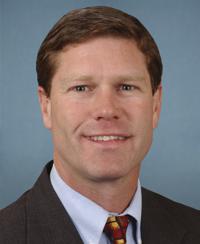
Mr. Chairman, I rise in support of the Eminent Domain Property Act offered by my colleague from Wisconsin, Chairman Sensenbrenner. This bipartisan-supported bill was introduced in response to the…
Mr. Chairman, I rise in support of the Eminent Domain Property Act offered by my colleague from Wisconsin, Chairman Sensenbrenner. This bipartisan-supported bill was introduced in response to the Supreme
Court's 5-4 decision in Kelo vs. City of New London, which condoned the use of eminent domain to take private property and transfer it to another private entity for the stated purpose of economic development.
Mr. Chairman, the Kelo decision put homeowners, small business owners, and farmers all across the country at risk of losing their property to this expansion of the government's eminent domain powers.
The Fifth Amendment of the U.S. Constitution allows local government to use eminent domain powers to condemn private property. The only requirement is that owners are given ``just compensation'' and that the land in question goes to a ``public use.'' Traditionally, the ``public use'' requirement in eminent domain cases allowed the local government to condemn property to build railroads, or bridges, or highways. But in a 1954 case, Berman v. Parker, the Supreme Court found that ``public use'' could include condemning blighted neighborhoods to build better ones as a means to raise more tax revenue. But, whereas the Berman case was predicated on the property being `blighted,' the Kelo decision goes further down the slippery slope and rests solely on whether the condemnation would improve tax revenues.
I would assert, as Justice Scalia did in the Kelo case, that any conceivable commercial development that replaces a church, house, or farm will produce more tax revenue, and that once condemned land is passed off to private developers, it is no longer going to ``public use.'' That is why I strongly believe Congress must act to limit States' eminent domain actions if the only requirement is that the proposed project improves the tax base.
The Eminent Domain Property Act of 2005 will prohibit the Federal Government from using eminent domain for private economic development and also prohibits States from using eminent domain for private economic development if the State receives any Federal economic development funding. A violation by any State will result with the State being ineligible for a Federal economic development for two years. By denying municipalities all Federal development funds when they abuse their eminent domain authority, H.R. 4128 provides a strong economic disincentive to prevent municipalities and local governments from taking private property for the purpose of private economic development.
Lastly, Mr. Chairman, my district in western Wisconsin is largely rural and dependent on the agricultural economy of its many small family farmers. As the sense of Congress portion of this legislation points out, the unfortunate truth is that agricultural lands are particularly vulnerable to the abuse of eminent domain power. Agricultural lands tend to have a lower fair market value than surrounding commercial and residential properties, making them a prime target for growing communities.
It is hard enough, for our struggling farmers who are facing softening commodity prices and weather related disasters, to also have to contend with losing their way of life so that others can have yet another shopping mall.
Mr. Chairman, I commend my colleague, Chairman Sensenbrenner on crafting this bipartisan legislation and I urge it's adoption and support.

Mr. Speaker, because the Republican-led Congress has not conducted any investigations of abuses by the Republican administration's decision to go to war in Iraq, and because the over 2,000 American…
Mr. Speaker, because the Republican-led Congress has not conducted any investigations of abuses by the Republican administration's decision to go to war in Iraq, and because the over 2,000 American soldiers have lost their lives and more than 15,000 have been wounded, therefore, pursuant to rule IX, I rise in regard to a question of privileges of the House, and I offer a privileged resolution.
Yes, I do, Mr. Speaker.
Mr. Speaker, I do not hear an objection to my motion.
Mr. Speaker, I will reiterate some of what I said in the motion to instruct.
For the past 2\1/2\ years since our country has gone to war, we have paid a big price for a bad policy based on faulty intelligence which was wrong, based on a false premise without proper planning and putting our young people at risk. In that period of time, that 2\1/2\ years, over 2,000 Americans have lost their lives. Every single one of them is precious to us, but, as the toll mounts, the grief does as well. Over 15,000 of our young people have lost their limbs, 15,000 have been injured, many of them permanently, many with loss of limb and sight, at a cost of over $250 billion, a quarter of a trillion dollars, to the taxpayer and just endless cost to our reputation in the world.
I think it begs the question, are we safer in America because of this war? What is this war doing to the preparedness of our troops? I think that the answer to both of those is negative, and I think it calls for an examination of what the intelligence was to get us there in the first place. Was it manipulated? Why was there no plan for us to go into Iraq, a post-war plan for after the fall of Iraq, as well as an exit strategy?
The American people love freedom for ourselves and for people throughout the world, but we have to examine what the cost of this war is and why even the Republican Department of Defense has said----
Mr. Speaker, I thought there was no objection and that we were just speaking on the resolution. Is that a mistake? My impression from what you said when you yielded to me was that there was no objection, and did I wish to speak on the motion.
Mr. Speaker, then I will just conclude by saying, can the Chair please explain why it is not in order to discuss on the floor of this House, of this great democratic institution, a situation where our young people are in harm's way, the death toll mounts, the injuries mount, the cost to the taxpayer mounts, the cost to our reputation mounts, and we have a cover-up Congress that will not investigate, will not ask any questions about the intelligence which was wrong, which got us into war in the first place and the lack of a plan providing for our troops, what they need to serve and to come home safely and soon? Why is that not in order on the floor of the House?
Mr. Speaker, is it not appropriate for a Member to speak on a point of order? Is it not appropriate for the gentleman from Wisconsin to be able to speak on a point of order that was lodged by the other side?
Mr. Speaker, I think it brings shame to the House for this Congress to be engaged in a cover-up when it comes to reviewing what is happening in Iraq, and I appeal the ruling of the Chair.
Mr. Speaker, on that I demand the yeas and nays.

Mr. Chairman, the bill before the House today is a good example of a legislative cure that is worse than the underlying disease. I want to say at the outset that there have been some very…
Mr. Chairman, the bill before the House today is a good example of a legislative cure that is worse than the underlying disease.
I want to say at the outset that there have been some very questionable uses of eminent domain. The fifth amendment to the Constitution clearly states that private property may not be taken except for public use, and then only after just compensation has been paid to the property owner. In many cases, the use of eminent domain is justified, but it is invariably controversial. I remember the controversy that attended the construction of the Walter Reuther Freeway in my home State during the 1960s and 1970s. Some communities were furious over the project, but there was no doubt in anyone's mind that the road served a clear public use.
Other uses of eminent domain are much more questionable. In Washington, as in so many other cities, a decision has been made to spend hundreds of millions of taxpayer dollars to build a new stadium for the benefit of Major League Baseball and the future owner of the Washington Nationals. Indeed, the District Government filed court papers the other day to seize $84 million worth of property from its current owners. Are stadium deals like this a legitimate public use? Evidently, they must be since the legislation before the House contains an exception that would seem to allow the use of eminent domain to build such facilities.
While lucrative stadium deals apparently enjoy protection under this bill, there is a blanket prohibition placed on the use of eminent domain for economic development purposes. States and localities that take land for private, for-profit projects or those designed to increase the tax base or employment stand to lose all their Federal economic development funding for 2 years. The penalty would extend to all economic development funds, even those going to meritorious projects that do not use eminent domain. The language of this legislation is so broadly written, and the penalties are so severe, that it will tie our cities and States in knots. Any use of eminent domain could conceivably trigger the overly broad penalties contained in this legislation. The potential liability facing cities and States that use eminent domain is open-ended and could extend for years or even decades into the future.
Land use planning is primarily a State and local function. Members of Congress frequently pay lip service to States' rights and local control, but this bill would overrule the limitations that many States have placed on eminent domain and land transfers to private entities for economic development purposes. In the case of my own State, in 2004, the Michigan Supreme Court limited the use of eminent domain by narrowly interpreting the State constitution's takings clause in County of Wayne v. Hathcock.
There is a lot of room for improvement in the use of eminent domain. Unfortunately, the legislation before the House is an unreasonable and unworkable solution.
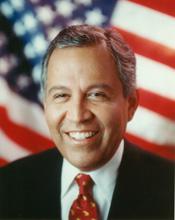
Mr. Chairman, I thank the chairman for yielding me this time. Mr. Chairman, this is a rare moment in this town when we have a major issue that has widespread bipartisan support. I want to thank the…
Mr. Chairman, I thank the chairman for yielding me this time.
Mr. Chairman, this is a rare moment in this town when we have a major issue that has widespread bipartisan support. I want to thank the gentlewoman from South Dakota, my original partner in this cause, who just spoke about this and gave a little history as to how we got this bill rolling several months ago; and also Chairman Goodlatte under whose jurisdiction
this bill originally fell, the STOPP Act that we filed, because so many of the programs that we are talking about here today that are funded come through the Agriculture Committee.
We would not have been able to come this far without this partnership with Ms. Herseth and Chairman Goodlatte; and I want to thank both of them, not just personally, but I know there are a lot of people out there that are very grateful for the support they have given this and have brought us to this day where we have a bill that, again, was reported out of the Agriculture Committee by a vote of 40 to 1 and then out of the Judiciary Committee with only three people voting against it. That is a profound statement across partisan lines in this Congress.
It also has widespread support among groups like the NAACP, the AARP, religious organizations, and the American Farm Bureau. I think people understood the impact this bill could have because it is very simple, Mr. Chairman. It says to communities that if they do not care about property rights, they are not going to get their money. No property rights, no money for 2 years. And that is going to make any local government or any State think long and hard before they take that first step toward trying to take someone's property for private gain.
This bill, of course, does not do anything to infringe on the community's rights and the constitutional history in this country of communities taking private property for public use, i.e., airports, roads, bridges, et cetera. It does not touch that at all. So I believe that is why we were able to come to this state. We have gone through the process, worked through regular order. We had our hearings. Attorneys scrubbed the bill. People asked questions, what if this happened, what if that happened. And we tried to address every issue that has come to us thus far.
Again, it is a great day when we have two committees coming together, two parties coming together. People from all over the country, whether they live in a rural area or whether they live in an urban area, have the same concern about property rights after the Kelo decision.
I look forward to a resounding victory today for the people of this country.
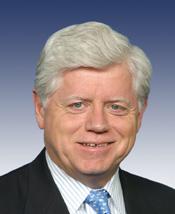
Mr. Chairman, I rise today sharing the concerns of my colleagues about the dangerous expansion of the eminent domain power and the Supreme Court's decision in Kelo v. City of New London. I firmly…
Mr. Chairman, I rise today sharing the concerns of my colleagues about the dangerous expansion of the eminent domain power and the Supreme Court's decision in Kelo v. City of New London. I firmly believe there need to be safeguards against the excessive and unfair use of the government's eminent domain power. Governors and State legislators across the country, including those in my home State of Connecticut, are currently grappling with this important issue. As a former State legislator, I understand that these issues are best reviewed and addressed at the local level. The Federal approach is overly broad and although well intentioned, falls short of protecting the communities it purports to protect.
Let me make my position clear, private property is one of the most fundamental rights our founding fathers safeguarded in the Constitution. Property rights deserve the utmost protection from governmental intrusion. As a lifelong resident of Connecticut, I am saddened by the Supreme Court's decision in the Kelo case and like many in Connecticut and across the country, feel vulnerable to the potential abuse of eminent domain authority. However, I do not feel this bill brings justice to communities or comprehensively secures property rights from the misuse of the local and State government taking authority.
By attempting to narrow the scope of eminent domain through broad and vague terms, Congress is assuming to identify what does and does not constitute a local public need--a job historically left to our towns, cities and States. These local municipalities would risk losing much- needed economic development funds should they exercise eminent domain authority that goes outside the ambiguous Federal standard set in this bill. Unfortunately, the people most affected by this punitive measure are not the local and city governments making the decisions or the ones at the bargaining table, it is individuals and families living in communities throughout the city, in neighborhoods that depend on federally funded economic development projects for decent housing and livable communities. These are the ones who will truly be penalized by this bill.
Eminent domain is a careful balance of protecting private rights and local public needs. This bill is not yet there. Because of the work still ahead of us, I am voting against this legislation today in the hope that these issues will continue to be addressed during conference with the Senate and that it will work to clarify these remaining questions.
Bill Text
2 versions available
        [Congressional Bills 109th Congress]
[From the U.S. Government Publishing Office]
[H. Res. 527 Engrossed in House (EH)]

H. Res. 527

In the House of Representatives, U.S.,

November 3, 2005.
Resolved, That at any time after the adoption of this resolution the Speaker
may, pursuant to clause 2(b) of rule XVIII, declare the House resolved into the
Committee of the Whole House on the state of the Union for consideration of the
bill (H.R. 4128) to protect private property rights. The first reading of the
bill shall be dispensed with. All points of order against consideration of the
bill are waived. General debate shall be confined to the bill and shall not
exceed 90 minutes, with 60 minutes equally divided and controlled by the
chairman and ranking minority member of the Committee on the Judiciary and 30
minutes equally divided and controlled by the chairman and ranking minority
member of the Committee on Agriculture. After general debate the bill shall be
considered for amendment under the five-minute rule. It shall be in order to
consider as an original bill for the purpose of amendment under the five-minute
rule the amendment in the nature of a substitute recommended by the Committee on
the Judiciary now printed in the bill. The committee amendment in the nature of
a substitute shall be considered as read. Notwithstanding clause 11 of rule
XVIII, no amendment to the committee amendment in the nature of a substitute
shall be in order except those printed in the report of the Committee on Rules
accompanying this resolution. Each such amendment may be offered only in the
order printed in the report, may be offered only by a Member designated in the
report, shall be considered as read, shall be debatable for the time specified
in the report equally divided and controlled by the proponent and an opponent,
shall not be subject to amendment, and shall not be subject to a demand for
division of the question in the House or in the Committee of the Whole. All
points of order against such amendments are waived. At the conclusion of
consideration of the bill for amendment the Committee shall rise and report the
bill to the House with such amendments as may have been adopted. Any Member may
demand a separate vote in the House on any amendment adopted in the Committee of
the Whole to the bill or to the committee amendment in the nature of a
substitute. The previous question shall be considered as ordered on the bill and
amendments thereto to final passage without intervening motion except one motion
to recommit with or without instructions.
Attest:

Clerk.