Relating to the free election in Iraq held on January 30, 2005.
Legislative Activity
Stay on top of the latest movement without scrolling through every action
Motion to reconsider laid on the table Agreed to without objection.
February 2, 2005 • 2:50 PM
View full timeline
Introduced in House
February 1, 2005
Referred to the Committee on International Relations, and in addition to the Committee on Armed Services, for a period to be subsequently determined by the Speaker, in each case for consideration of such provisions as fall within the jurisdiction of the committee concerned.
February 1, 2005
Committee on International Relations discharged.
February 2, 2005
Consideration initiated pursuant to a previous order.
February 2, 2005 • 11:36 AM
Considered pursuant to a previous order. (consideration: CR H303-310, H327)
February 2, 2005 • 11:37 AM
DEBATE - Pursuant to a previous order of the House, the house proceeded with with one hour of debate on H. Res. 60.
February 2, 2005 • 11:37 AM
The previous question was ordered pursuant to a previous order of the House. (consideration: CR H310)
February 2, 2005 • 11:37 AM
POSTPONED ROLL CALL VOTE - At the conclusion of debate on H. Res. 60 the Chair put the question of adoption of the resolution and by voice vote announced that the yeas had prevailed. Mr. Lantos demanded a recorded vote and the Chair postponed further proceedings until later in the legislative day.
February 2, 2005 • 11:38 AM
Considered as unfinished business. (consideration: CR H327)
February 2, 2005 • 2:39 PM
Passed/agreed to in House: On agreeing to the resolution Agreed to by the Yeas and Nays: 404 - 9, 3 Present (Roll no. 19).(text: CR H303-304)
February 2, 2005 • 2:50 PM
On agreeing to the resolution Agreed to by the Yeas and Nays: 404 - 9, 3 Present (Roll no. 19). (text: CR H303-304)
February 2, 2005 • 2:50 PM
Motion to reconsider laid on the table Agreed to without objection.
February 2, 2005 • 2:50 PM
Voting History
1 vote recorded • Roll call available
Floor Debate
21 membersWhat members said about H.Res. 60 on the floor
 JK
JK TLTD
TLTD EHN
EHN JDD+16
Floor Debate
21 membersWhat members said about H.Res. 60 on the floor
Mr. Speaker, I thank the gentleman for yielding me this time. I want to speak certainly in favor of the Solomon Amendment and remind my colleagues that it does not apply to institutions of higher…
Mr. Speaker, I thank the gentleman for yielding me this time.
I want to speak certainly in favor of the Solomon Amendment and remind my colleagues that it does not apply to institutions of higher education that have had a longstanding practice of pacificism based on historic religious grounds, and it exempts Federal student financial assistance from termination. But what it does do is allow students to look at career opportunities in the Army. And as the chairman of the Committee on Armed Services said, there are so many legal issues involved in the military today and to go beyond that, to let people look at careers in, I would say, intelligence as much as anything, homeland security, there is a great opportunity for students to go into.
But we are also seeing so much push-back really from a crowd that is basically anti-American and anti-conservative. Indeed, there are so many prejudices against everyday middle-class values on college campuses, and serving in the military and being pro-American just seems to be one of them.
Students at Wells College, for example, were ridiculed by their professors
if they supported the war in Iraq. At the University of Missouri, a professor, a science professor, offered extra credit for students to protest a speech given by conservative activist David Horowitz. At the University of Richmond, a professor called President Bush a moron in his class. And at the University of Oregon, students were labeled ``neo-Nazi'' for expressing their opinion that Trent Lott was the victim of a double standard. And examples go on and on.
Another statistic, the Foundation for Individual Rights in Education found that over 90 percent of well-known college campuses have speech codes intended to ban or punish politically incorrect, almost always conservative speech, and that campus funds are unequally distributed to left-wing groups as opposed to conservative groups by a ratio of 50 to one.
I think the judicial attack on the Solomon Amendment is just one of a series of a trend that is against, again, anything that is pro- American, pro-conservative, pro-traditional values. And so I would submit for the Record an article that was an opinion in the Wall Street Journal recently and then something on the academic bill of rights that I think also touches into this same subject.
The bill would express the continued support of Congress for the so- called ``Solomon law'' in title 10, U.S. Code, which improves DOD's ability to establish and maintain ROTC detachments and to ensure military recruiters have access to college campuses and students that is at least equal in quality and scope to that provided to other employers.
The bill would:
State Congress's resolve to achieve military personnel readiness through vigorous application of the ``Solomon law'' relating to equal access for military recruits to institutions of higher education, and express Congress's commitment to explore all options, including the use of its Constitutional power to appropriate funds, to achieve that equal access.
Express the Sense of Congress that the Executive Branch should aggressively challenge any decision impeding or prohibiting the operation of the ``Solomon law.''
Encourage the Executive Branch to follow a doctrine of non- acquiescene by not finding a judicial decision affecting one jurisdiction to be binding on other jurisdictions. The so-called ``Solomon law,'' section 983, title 10, U.S. Code, named for its original proponent Representative Gerald Solomon (R-NY), is based on the principle that if a college or university accepts federal funding it must permit military recruiters and/or ROTC access to campus and to students. Enacted first in 1994, and added to by Congress in 1996, 1999 and 2002, and 2004, the ``Solomon law'' prohibits some defense-related and other federal funding from going to colleges and universities that prevent ROTC access or military recruiting on campus.
The Solomon law: (1) does not apply to institutions of higher education that have a long-standing policy of pacifism based on historical religious grounds; and, (2) exempts federal student financial assistance from termination.
The U.S. Court of Appeals for the Third Circuit, on 29 November 2004, reversed a district court decision, which had upheld the Constitutionality of the ``Solomon law,'' by ruling that the ``Solomon law'' violated the 1st Amendment rights of free speech and association held by institutions of higher education. The Third Circuit remanded the case to the district court to enter a preliminary injunction against the enforcement of the ``Solomon law.''
The acting Solicitor General has announced his intention to petition the Supreme Court for a writ of certiorari to review the decision of the Third Circuit Court. The Government also filed a motion on 14 January 2005 with the Third Circuit Court seeking to stay the Court's mandate for a preliminary injunction against the enforcement of the ``Solomon law'' until the Supreme Court decides the Government's petition. The Third Circuit granted the stay on 19 January.
H. Con. Res. 36, in expressing continued support for equal access of military recruiters to institutions of higher education, makes the following points regarding the ``Solomon law'':
Under article I, Section 8, of the Constitution, Congress exclusively has the power to raise and support armies, provide and maintain a navy, and make rules for the government and regulation of the Armed Forces.
Military recruiting on university campuses is one of the primary means by which the Armed Forces obtain highly qualified new military personnel and is an integral, effective and necessary part of overall military recruiting. Efforts by colleges and universities to restrict or prohibit military recruiter access will have the harmful effects of increasing Federal spending to achieve desired recruiting outcomes and of compromising military readiness and performance. Such harm conflicts with Federal responsibilities to provide for the Nation's defense. Any reduction in the performance by the Armed Forces amidst the present national emergency declared by the President on September 14, 2001, operates against the national interest.
The Constitution gives Congress the power to regulate spending and in that role Congress has chosen over time to appropriate funds for a variety of Government programs to be provided to institutions of higher learning. However, these funds are not an entitlement to any college or university and can be provided subject to criteria and conditions set by Congress.
The ``Solomon law'' is a legislative safeguard that links Federal funding of educational institutions to the willingness of those institutions to abide by a rule of access by military recruiters to campuses and students that is at least equal in quality and scope that is provided to any other employer.
For the last several years, a growing number of university law schools and colleges of law have treated military recruiters in ways significantly different from the recruiters of other employers. As a result, military recruiters and the persons they seek to interview have been subjected to various degrees of official and unofficial harassment or ill treatment that is designed to make military recruiting difficult, or to frustrate its objectives. The underlying reason for this differing treatment is opposition to Federal law that prohibits military service by openly gay people--the so-called ``don't ask, don't tell'' law.
Given that opposition, it is imperative that the safeguards that the ``Solomon law'' provides not only for military recruiters, but also for ROTC, be maintained. Without such safeguards, grave harm to military recruiting will result as colleges and universities move to limit or deny access to campuses and students by representatives of the Armed Forces.
Academic Bill of Rights
background
Hiring Practices for Professors
Faculty hiring is controlled by more senior members of the
faculty itself:
As Conservative faculty forced to keep political views
quiet until they achieve tenure.
Usually hire those who agree with them,
Creates a perpetual cycle.
Creates an environment where Marxists, Post-Modernists,
etc. can still dominate in academic fields even while their
views have been discredited:
Numbers of Liberal Professors vs. Conservative Professors
The overall ratio of Democrats to Republicans at the 32
schools studied was more than 10 to 1 (1397 Democrats, 134
Republicans).
Not a single department at a single one of the 32 schools
managed to achieve a reasonable parity between the two main
political parties:
In the nation at large, registered Democrats and
Republicans are roughly equal in number.
The closest any school came to parity was Northwestern
University--Democrats outnumbered registered Republicans by a
ratio of 4-1.
Other Schools:
Brown--30-1
Bowdoin, Wellesley--23-1
Swarthmore--21-1
Amherst, Bates--18-1
Columbia, Yale--14-1
Pennsylvania, Tufts, UCLA and Berkeley--12-1
Smith--11-1
Other Schools had ZERO registered Republicans:
Williams--51 Democrats, 0 Republicans
Oberlin--19 Democrats, 0 Republicans
MIT--17 Democrats, 0 Republicans
Haverford--15 Democrats, 0 Republicans
Most students probably graduate without ever having a class
taught by a professor with a conservative viewpoint.
Not Just a Faculty Problem But A Campus-Wide Bias
For example, the University of Pennsylvania, Carnegie
Melon, and Cornell could not identify a single Republican
administrator.
In the entire Ivy League, there were only 3 Republican
administrators identified.
Impact on Students
Remarks belittling conservative ideas convey that these
views are not accepted on campus--Grading based on these
ideas reinforce this perception.
One student called a ``fascist'' for inviting Oliver North
to campus.
University of Oregon--Student labeled ``neo-Nazi'' for
expressing his opinion that Trent Lott was the victim of a
double standard.
University of Richmond--Professor called President Bush a
``moron'' in the classroom.
University of Missouri in Columbia--Professor offered extra
credit to protest a speech by David Horowitz.
Students at Wells College were ridiculed by professors for
their support on Iraq war and their views on feminism.
``It didn't take long to see how liberal it was after I
came here. The professors and the education I receive is
excellent, but the professors seem to use class as a
political soapbox,''--Kristy L. Hochenberger, a student at
Wells College.
Slogan circulated by Biology professor at Wells College--
``Lobotomies for Republicans: It's not just a good idea; it's
the law!''.
Many students conceal what they actually think in order to
protect their academic standing--a reality clearly at odds
with the educational mission of the university.
Nearly all distinguished doctoral programs rely on matching
students with professors who have compatible interests.
Preferential treatment shown to those with similar liberal
ideals.
Campus Guests, Speech Police and Commencement Speakers
Campus funds are unequally distributed to leftwing student
groups as opposed to groups with conservative agendas by a
ratio close to 50:1: These student groups are many times in
charge of hiring campus speakers.
The Foundation for Individual Rights in Education found
that over 90 percent of well-known college campuses have
speech codes intended to ban and punish politically
incorrect, almost always conservative, speech.
The ratio of commencement speakers on the left and right
was 226-15, a ratio of over 15:1: Commencement speakers are
selected through committees composed of administrative staff,
faculty, and students.
Twenty-two of the thirty-two schools surveyed did not have
a single Republican or conservative commencement speaker in
the entire ten years surveyed: Six of the remaining schools
invited only one Republican or conservative each, as compared
to 38 liberals or Democrats.
Haverford, Swarthmore and UCLA, which host multiple
speakers every year, did not feature a single Republican or
conservative speaker as balanced against 54 liberals and
Democrats.
Academic Bill of Rights
Recognizes that political partisanship by professors is an
abuse of students' academic freedom.
Designed to take politics out of the university curriculum:
Does not call for more classics in curriculum,
Reading lists should provide students with dissenting
viewpoints so they may form their own opinions.
Designed to protect the right of students to ``get an
education rather than an indoctrination'':
Should not make professors afraid of what they say,
We defend professors' right to say anything and forbids
administration from punishing them for their political
opinions,
Professors should always be open to dissenting opinions.
Unequal funding of student organizations which host guest
speakers is unacceptable: Calls for pluralism in selection of
guest speakers.
Learning environment hostile to conservatives is wrong.
There is a lack of ``intellectual diversity'' within
faculties on college campuses:
University should be ``inclusive'' to all viewpoints,
Without it, free exchange of ideas are impaired.
It is not our intention to suggest that there should be
quotas based on party affiliation in the hiring process at
universities:
We support removing all politics and political affiliation
from the hiring process,
It is our purpose to point out the gross imbalance of
liberal vs. conservative professors.
While nearly all university administrations devote
extraordinary resources to defend the principle of diversity
in regard to race and gender, none can be said to have shown
interest in the diversity of ideas.
Universities have the privilege of being separate from the
society they inhabit:
Society grants faculty protection from the influence of
outside politics,
With that privilege comes a responsibility by the faculty
to also safeguard the free exchange of ideas.
Correcting this should be the goal and an integral part of
educational policy under the Academic Bill of Rights.
[From the Wall Street Journal, Feb. 2, 2005]
Wisdom of Solomon--The Disgrace of Blocking Military Recruiters From
Campus
Don't ask. Don't tell. Having no desire to crash our e-mail
server, we'll save discussion of gays in the military for
another day. Rather, today's subject is lawyers in the
military. Surely Americans of all points of view can agree
that in an age of Guantanamo and Abu Ghraib, the military can
use the best attorneys it can get.
So it's a disgrace that some of the nation's law schools,
objecting to the Pentagon's ``discrimination policies,''
refuse to permit military recruiters to make their pitch on
campus, relegating them instead to unofficial off-campus
venues. Law students pondering their first career move can be
wined and dined by fancy firms that set up recruitment tables
at campus job fairs, but they have to stroll over to the
local Day's Inn to seek out the lonely military recruiter.
To put it another way, the same liberals who object that
the military includes too many lower-class kids won't let
military recruiters near the schools that contain students
who will soon join the upper-class elite. It's almost enough
to make us contemplate restoring the draft, starting with law
school students.
Needless to say, such scholastic shenanigans don't go down
well with Congress, which in 1994 passed the Solomon
Amendment, named for the late New York Republican, Gerald
Solomon. The law requires schools that receive federal funds
to provide equal access to military recruiters. Today, the
House is scheduled to vote on a resolution brought by Alabama
Republican Mike Rogers that would restate the House's support
for the Solomon Amendment. Something similar passed the House
and Senate by overwhelming margins last year and was
incorporated into the Defense Authorization bill.
The impetus for Mr. Rogers's move is a November ruling by
the federal appeals court in Philadelphia in favor of a group
of law schools and legal scholars that had contested the
Solomon law. The 2-1 opinion found that the Solomon Amendment
violates the schools' First Amendment rights to free speech
and association. Next stop is the Supreme Court, which is
expected to take the appeal that the Justice Department plans
to bring.
There are many peculiarities to this lawsuit, starting with
the fact that the group that brought it--the Forum for
Academic and Institutional Rights--declines to release the
names of the 26 law schools and faculties that belong to its
coalition. Some of the participants (New York University and
Georgetown, for example) have outed themselves since the suit
was brought in 2003, but others steadfastly maintain their
own don't-ask-don't-tell policy.
In any event, there should be no legal question about
Congress's right to put conditions on grants of federal funds
to universities. It does this all the time--including
requirements that colleges adhere to certain civil rights and
gender standards. With a few exceptions, universities have no
trouble going along and courts have no problem letting them.
If, as is likely, the Supreme Court overturns the appeals
court decision, that will be the end of it. Almost all
universities, public and private, take millions of dollars in
federal money that would be next to impossible to give up.
That's especially true of the elite schools, both public and
private. Still, it would be nice to think that the nation's
universities would welcome the military for reasons other
than the mercenary. Patriotism, perhaps?
Mr. Speaker, I yield myself such time as I may consume. Mr. Speaker, I rise in strong support of this resolution. I first want to commend the bipartisan leadership of this body for bringing this…
Mr. Speaker, I yield myself such time as I may consume.
Mr. Speaker, I rise in strong support of this resolution. I first want to commend the bipartisan leadership of this body for bringing this resolution to the floor.
Mr. Speaker, the votes are still being counted in Iraq, but it is already clear that democracy has won. The people of Iraq have cast their ballots in favor of freedom, including the right to choose their own leaders and their own fate.
We should not be surprised. We have seen people choose freedom over tyranny repeatedly during the past 15 years in country after country. But Iraqis voted in unprecedented circumstances, literally risking life and limb merely to exercise the privilege that most of us take for granted and many of us do not even exercise. Their courage inspires us, reinvigorating our own love for democracy and testifying to the power of freedom's call.
Mr. Speaker, I would like to have been a fly on the wall of those in power throughout the Arab world who watched the televised spectacle of Iraqis freely choosing their own leaders. We do not know yet who will lead the new Iraqi government, but we know that that government will be the sole representative of democracy in the halls of the Arab league. And we know that increasing numbers of Arab citizens in other Arab countries are already asking why their governments, with very limited exceptions, are chosen and perpetuated only at gunpoint.
The evident success of the election should boost the self-confidence of all concerned. Iraqis themselves organized the campaign and election. They monitored the vote, they secured the polling places, and now they are counting the ballots.
U.S. forces wisely situated themselves beyond the horizon of the polling places, but no one should lose sight of the fact that it was American and coalition soldiers who made this day possible because of their performance on
election day and for many days and weeks before.
Mr. Speaker, we must pay special tribute today to the bravery shown by our fighting men and women, to the commitment shown by our civilian personnel in Iraq and to the dedication and sacrifice shown by their families. I am proud that this resolution does just that.
We also acknowledge with respect those who have been wounded in the prosecution of this war, and we remember with the deepest sadness those who made the ultimate sacrifice.
Not the least of the gratifying developments on Sunday was the excellent manner in which the Iraqi armed forces acquitted themselves. We need to pay special tribute to General David Petraeus for his extraordinary work in training Iraq's military forces.
Mr. Speaker, I believe Sunday's election is an important milestone in the democratic development not only of Iraq but the entire Middle East. But it is also another battle won in the fight against the antidemocratic terrorists who opposed the election and continue their pernicious struggle. The impressive voter turnout, perhaps most impressive in the Sunni areas where antidemocratic intimidation was the most intense, is the surest sign that Iraqis as a whole are embracing the legitimacy of their new government and their new security forces.
But we must be realistic, Mr. Speaker. Democracy entails far more than a day at the polls. The major challenges are still ahead for Iraq. Can Iraqis ensure that all segments of their nation have the opportunity to be heard? Will they produce a fair and workable constitution leading to a durable democracy? Will they learn the art of compromise that will be essential to their success? Will they be moderate or will they dig in their heels on the difficult issues such as the role of religion or the disposition of the contested city of Kirkuk?
Building democracy in the Middle East will require immense patience. It surely is a multigenerational project. Even building democracy in just one nation, especially one with a complicated society such as Iraq's, is a long-term challenge. But for today, Mr. Speaker, let us recognize that the Iraqi people have just taken a first but vitally important step towards meeting that challenge, and let us affirm that they merit the admiration of all free peoples across the globe. And last, but hardly least, let us take pride in America's enormous contribution towards true Iraqi self-determination.
Mr. Speaker, I urge all of my colleagues to support this resolution.
Mr. Speaker, I reserve the balance of my time.
Mr. Speaker, I yield such time as she may consume to the gentlewoman from California (Ms. Pelosi); but before turning the microphone over to her, let me just say she has devoted her life to expanding the arena of freedom and democracy throughout the globe, and we are proud to have her represent us as our leader in this body.
Mr. Speaker, I yield 2\1/2\ minutes to the gentlewoman from California (Ms. Woolsey).
(Ms. WOOLSEY asked and was given permission to revise and extend her remarks.)
Mr. Speaker, I yield 3\1/2\ minutes to the distinguished gentlewoman from the District of Columbia (Ms. Norton).
Mr. Speaker, I am pleased and proud to yield the balance of our time to the distinguished gentleman from Maryland (Mr. Hoyer), the democratic whip, who has been a leader in the field of expanding the arena of freedom globally.
Mr. Speaker, before yielding back our time, may I just remind all of my colleagues and all of the American people that we have been debating three important policy resolutions with a degree of bipartisan unity that should fill us with pride and joy in the recognition of the fact that, despite all the commentary of deep divisions in this body, we stood together, Republicans and Democrats, supporting the same resolutions and the same policies.
Mr. Speaker, I yield back the balance of my time.
Mr. Speaker, on that I demand the yeas and nays.
Mr. Speaker, I appreciate the gentleman yielding me this time. I just want to say the comments by the gentleman from California (Mr. Lantos) are well taken; and it is because of his work, and…
Mr. Speaker, I appreciate the gentleman yielding me this time.
I just want to say the comments by the gentleman from California (Mr. Lantos) are well taken; and it is because of his work, and particularly his work to hold us together and work together on these issues, that that kind of bipartisan support for these resolution happens. So I commend the gentleman and thank him very much for his work and his willingness to work with us.
Mr. Speaker, I yield to the gentleman from Texas (Mr. Burgess) who came to the floor because he just returned from Iraq a couple of weeks ago and he has some very important things to say.
Mr. Speaker, reclaiming my time, I appreciate the gentleman from Texas entering the Prime Minister of Iraq's remarks into the Record. I think it is very appropriate to do at this time, particularly on this resolution.
Mr. Speaker, the central point of this resolution is the central point of America's foreign policy: that mankind is made more secure when tyranny is replaced by democracy. That is the story of the American revolution against the old world, Western Europe's liberation from Nazism, Eastern Europe and Central America's liberation from communism and despotism, and the Middle East's liberation from terrorism. The victory of human freedom over human oppression, of good over evil, Mr. Speaker, is why we are here.
Last Sunday morning, the people of Iraq showed the world that humanity's will to freedom knows no borders. When I first saw the news Sunday and saw an image of a woman in Najaf exiting her polling place alive and well with tears streaming down her proud, smiling face, I thought to myself, now, this, this is what Operation Iraqi Freedom was all about. But I was wrong. Sunday's election, Sunday's miracle of democracy, was about more than that.
I thought about the image of the elderly man in a wheelchair in Basra who, in his long years, saw revolution and war, tyranny and terror and, finally, with a joy only possible in a man who had known such pain, cast the first ballot of his life.
I thought of the image of the little girl with a ribbon in her hair, holding her mother's hand as hundreds of women in traditional hijab dress waited in line. Now, this little girl was not quite sure what was happening, only that the women knew it was important.
I thought of the image of the voters in Baghdad who ducked for cover as their polling place came under fire, yet whose lines never broke. There were bullets and bombs and mortar shells, yet their lines never broke.
These voters in Baghdad, not soldiers, but shopkeepers and homemakers, knew when they left for the polls in the morning that they might not come home. They knew that they were targeted, that their spouses would be, could be widowed and their children orphaned. Yet the lines never broke. A humble defiance of evil.
And that is when it hit me, Mr. Speaker. Just as on Sunday all free men and women were Iraqis and on Sunday the Iraqis were all free men and women. Sunday's elections are not just why we invaded Iraq. They were why we stormed Omaha Beach and took the Normandy cliffs. They are why we held Little Round Top and braved Valley Forge.
The lines that formed in Iraq on Sunday stretch not only around the world but back in time to the moment when 13 British colonies declared their independence. For the first time, at that moment, a nation declared itself endowed with an inalienable right to liberty, and in 228 years since, no nation, no nation, no people ever offered a chance at freedom refused it.
Against all odds and it seemed at times even against all hope, the Iraqi people, over 8 million of them, all marked by death by the terrorists, woke up Sunday morning and got into line.
Some people still do not get it. They still do not understand Concord and Lexington or Gettysburg or Bastogne or the Cold War, or even Flight 93.
They do not understand why those lines in Iraq never broke or that every man and woman who ever lived, fought, or died for freedom was standing in that line with them. They still do not know why we fight.
Last weekend that Iraqi woman in the photograph knew. After a lifetime of oppression she voted in humble defiance of evil, and then she broke down crying. And in those tears she is shedding along with the anguish of how many friends and children lost and how many wars and prisons are the hopes and dreams of all God's children who still yearn to be free.
Sunday's elections in Iraq were not an accomplishment; they were a miracle, a miracle made possible by the resilience of a liberated Iraq, the mercy of a loving God, and the moral courage of this Nation under God to stare evil in the face and make the devil blink. Eight million brave Iraqis struck terrorism a lethal blow on Sunday, replacing tyranny with democracy, and in doing so they made America and the world safer, for which it is altogether fitting and proper that we commend and thank them.
Despite the continued threat represented by terrorists and terrorism and despite the threat of disgraceful partisan rhetoric coming from many on the other side, Sunday's miracle in Iraq shows that the dead who died to free that nation have not died in vain and that even in the darkest recesses of violent oppression, all who would live in peace and liberty have yet reason to hope.
Mr. Speaker, I thank the gentleman for yielding me this time, and I thank him for always standing first and foremost for human rights here and around the world. I am not surprised that he would come…
Mr. Speaker, I thank the gentleman for yielding me this time, and I thank him for always standing first and foremost for human rights here and around the world. I am not surprised that he would come forward with the gentleman from Texas (Mr. DeLay) with this well- deserved and important resolution.
Mr. Speaker, there is nothing more gratifying to the American people than seeing people vote, and especially people vote for the first time. I feel what is happening in Iraq with great and moving nostalgia because it reminds me of the first African Americans who voted after the Civil War. It reminds me that this is the 40th anniversary of the Voting Rights Act of 1965 and what it meant for people in Alabama and Georgia to come to the polls for the first time. There is unanimous applause for the people of Iraq who risked their lives to come to the polls. They did not just vote. Many of them knew they were risking life and limb to vote.
They know, however, and we know where the risk was greatest, and that risk was greatest on the Armed Forces of the United States and their allies who made this right possible.
Mr. Speaker, I come forward to say that no people in our country more appreciate that vote on January 30 than the people in the District of Columbia. In the District of Columbia, lives were lost for the vote in Iraq. But these residents are the progeny of 2 centuries of District residents who have gone to war without a vote. Three of these young men who were on the frontlines in Iraq came to the House as the House opened and asked for the same vote for their families and for the residents of the District of Columbia as their service has given to the people of Iraq. They asked to start with the Committee of the Whole where we had the right to vote but the right was taken from us when the majority changed.
Listen to one of the young men: ``Two of my friends and I earlier this month asked for the return of the House vote of the Committee of the Whole our city won during the 103rd Congress . . . Think of what American leaders and citizens would say if one party were to nullify the legitimate vote of another party after the elections in Iraq.''
They asked to see the Speaker; the gentlewoman from California (Ms. Pelosi), leader of the Democrats. She saw him. The Speaker and a member of his staff were unable to see him. Senator Lieberman and I have reintroduced the No Taxation Without Representation Act.
Let me leave you with the words, finally, of one of these young men.
``I was prepared in Iraq for whatever came, including service in a border breach squad charged with clearing mines and anything else that got in the way to prepare the first troops to cross the border. That was my duty and I would do it again. However, our country also has an important obligation to those who serve and to other citizens. One of the most important obligations is to ensure every citizen that his representative will have a chance to vote before that citizen goes to war for his country.''
The third young man: ``My father served in the 101st Airborne in Vietnam and I am proud to follow him by serving my country in the same manner. I want equal treatment at home. I want the same voting representation in the House and Senate as other soldiers and as the Iraqi people have in their elections this month.''
Out of the mouths of young residents of the District of Columbia who are on the frontline. I will insert their statements and a statement concerning their service from the Washington Post in the Record.
Statement of Emory Kosh
First, my thanks to Congresswoman Norton and Senator
Lieberman for re-introducing the No Taxation Without
Representation Act. I also want to thank Mr. Shallal for his
moving words addressed to men and women like me who served in
Iraq and to D.C. residents. During the year I spent in Iraq,
I met and spoke with many Iraqi citizens, but Mr. Shallal is
the first Iraqi American I have met. His words have special
meaning to me and I thank him.
When I watch television and see people in Iraq and here in
the United States preparing
to vote in the Iraq elections for voting representation, I
think of my time in their country. I am proud that I had some
role in the voting rights Iraqis will get there on Sunday.
For that reason, I deeply appreciate that Mr. Shallal has
come not only to thank us, but to join us in the fight for
the same voting representation here in the Nation's capital.
Two of my friends and I earlier this month asked for the
return of the House vote in the Committee of the Whole our
city won during the 103rd Congress that was taken from us
when control of the Congress changed hands. Think of what
American leaders and citizens would say if one party were to
nullify the legitimate vote of another party after the
elections in Iraq. Our vote in the Committee of the Whole
represented the first step toward the goal of D.C. residents
as expressed in the No Taxation Without Representation Act.
We didn't intend to stop there when we asked that this first
step be taken, and we won't stop now. We will work with the
Congresswoman, the Senator, Mr. Shallal and our fellow
citizens until the full voting rights we fought for in Iraq
are also available here in our hometown.
Mr. Speaker, last week I missed two important votes relating to elections in the troubled Middle East. H. Res. 56 commends the Palestinian people for the free election held on January 9, 2005, and H.…
Mr. Speaker, last week I missed two important votes relating to elections in the troubled Middle East. H. Res. 56 commends the Palestinian people for the free election held on January 9, 2005, and H. Res. 60 relates to the election held in Iraq on January 30, 2005. I rise today to say that I would have voted ``yes'' on both H. Res. 56 and H. Res. 60.
On Sunday, January 30, millions of Iraqis voted in a free election for the first time in their lives. Many walked great distances and nearly all risked their lives to exercise this new right. Though I opposed the war, the election that took place in Iraq is something to be celebrated. In addition to commending the people of Iraq, I would like to commend our men and women in the armed services. Without their hard work and bravery in developing and executing a complex security plan, this most successful election would not have been possible.
Now that the people of Iraq have had a free election, we need to put our efforts into helping them find ways to defeat the insurgency, involve all religious and ethnic persuasions in the political process and ensure that the rights of minorities are protected as they continue to draft a Constitution.
In addition, it is important that the United States look toward developing an exit strategy. In reality, this should have been done before we initiated military operations. We need to continue to train and equip Iraqi security forces. In order to properly do this, we need to have an accurate assessment of the capabilities of those forces now.
The free election in Iraq was an achievement that cannot be understated. That said, we have a vested interest in a secure and democratic Iraq and while the election was an important milestone, we need to look ahead to a time when our work over there is done and our troops can come home.
Now, turning to the recent elections in the Palestinian Territories. I would like to commend Dr. Mahmoud Abbas on his election as the second President of the Palestinian Authority and the Palestinian people for making their voices heard. The elections on January 9 were conducted under difficult circumstances, including ongoing violence and a limited ability for candidates to campaign. Despite these challenges, an amazing 70 percent of registered voters turned out, according to Dr. Hana Nasir, head of the Palestinian Central Election Commission. The Palestinian people, political organizations, and presidential candidates all deserve praise for this significant step forward. Moreover, although voters in East Jerusalem experienced difficulties, elsewhere in the West Bank and Gaza Israel facilitated the election process. For this Israel also deserves commendation.
International observers--including some of our colleagues here--state that the elections were free and fair. Allow me to share a few key observations of the International Observer Delegation organized by the National Democratic Institute and the Carter Center.
The election was contested vigorously and administered
fairly. Election day was orderly and generally peaceful.
The process, organized in just 60 days in accordance with
the Palestinian Basic Law and under difficult circumstances
of the ongoing conflict and occupation, represents a step
forward for Palestinian democracy.
Seven presidential candidates competed in the election,
presenting Palestinians with a choice among distinct points
of view. . . . This is a tribute to the seriousness of the
political competitors and to the Palestinian people's desire
to respect political pluralism.
Following the death of Yasser Arafat, many predicted that the Palestinian Authority would crumble into complete chaos. In fact, Palestinian institutions proved more resilient, and the Palestinian people showed greater determination for peace and self-determination than many expected. Consequently, the transition of power from President Arafat to President Abbas stands as a model for the region to emulate.
Mr. Speaker, the Palestinian elections of January 9 were clearly a proud day for Palestinians and a very positive step forward in the effort to broaden the reach peaceful, civil interaction. It is a clear mandate for President Abbas to pursue his agenda of peaceful negotiations with Israel in order to establish a viable, sovereign, and independent Palestinian state. It is now incumbent on the United States and Israel to support President Abbas in his effort to consolidate power, to generate political and economic benefits for the Palestinian people, and to engage seriously in the negotiation of a peace settlement. The recipe for a final agreement has been apparent to most of us for some time. Now all the ingredients appear to be assembled. Those interested in creating peace have no reason or excuse not to move forward.
Show 8 more
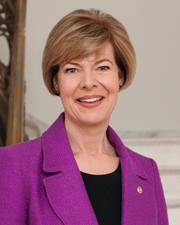
Mr. Speaker, I rise today in opposition to this resolution. In Wisconsin, our State laws provide protections from discrimination to people that go beyond what many other States and what the Federal…
Mr. Speaker, I rise today in opposition to this resolution.
In Wisconsin, our State laws provide protections from discrimination to people that go beyond what many other States and what the Federal Government have put into law. Such protections as nondiscrimination based on age, gender, marital status, membership in the National Guard and sexual orientation are a part of Wisconsin's nondiscrimination laws. Wisconsin has chosen to provide its citizens with these greater protections because we have decided that these are in the best interests of our citizens and are good public policy.
The University of Wisconsin in Madison has a history as a leader in social justice. It adheres to State laws and has tried to apply those laws appropriately across its campus. That has included the requirement that campus organizations, departments and campus recruiters adhere to State law. Yet Federal law has intervened to block enforcement of campus policy and State law in regard to military recruiters.
The Solomon amendment was passed by a previous Congress because students, like those at the University of Wisconsin, were having success in blocking recruiters from campus if they discriminate against lesbians or gays or bisexuals in violation of State law and campus policy.
Access to and use of campus facilities to recruit students for higher educational opportunities, employment or military service should be at the discretion of the institution. Of course, public institutions should not arbitrarily discriminate against any particular recruiter. Reasonable and legitimate criteria should be evenly applied to every recruiter. The Federal Government should not use Federal funding as a weapon to force noncompliance with State law or to create special rights for military recruiters.
I believe that the court made the correct decision in invalidating the Solomon amendment. I also believe that today's resolution is unnecessary. In fact, I believe that today's debate is the wrong debate. We should be looking at ways to strengthen our military and expand our resources for winning the fight against al Qaeda and other terrorist organizations.
Mr. Speaker, when will we have the debate about the harm caused by excluding so many qualified, skilled Americans from serving in our military simply because they are gay or lesbian? When will we have a debate about the waste of resources used to discharge fully trained personnel who are serving our country honorably? When will we have the debate about how much our fight against terrorism is hurt by the discharges of Arab linguists?
The resolution before us today makes vague reference to the costs to the military in having to arrange alternative recruitment strategies to meet its goals, but it does not mention the significant cost of Don't Ask, Don't Tell to our defense budget and to our national security. Since Don't Ask, Don't Tell took effect in 1993, approximately 10,000 military personnel have been discharged. That is a huge amount of training and experience that we have lost.
In a study of discharges between 1998 and 2003, University of Santa Barbara researchers found that, of 6,273 discharges, many were in critical specialties such as 88 linguists, including many Arabic speakers, 49 WMD experts, 90 nuclear power engineers, and 150 rocket and missile specialists. To compensate for some of these discharges, the Pentagon has been calling up members of the Individual Ready Reserve. The harm to our military readiness and the cost to our security caused by Don't Ask, Don't Tell is clear. Urging the administration to try to reinstate the Solomon amendment will in no way make our country safer.
Let there be no mistake. I strongly support our men and women in uniform. I want to take this opportunity to honor the men and women in our Armed Forces who have served and continue to serve in Iraq and to the many serving our country here and around the world. Their efforts allowed the Iraqi people to vote in a free election this week. Their bravery and dedication is something all Americans should admire and honor.
Mr. Speaker, there would be no clamor for a Solomon amendment if we simply allowed all qualified Americans to serve their country in uniform. Our country would be safer, our human resources would be greater, our country would be stronger if we treated all Americans equally, regardless of their sexual orientation. It is time to repeal Don't Ask, Don't Tell. It will make our military stronger and our country stronger.
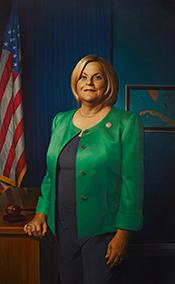
Mr. Speaker, pursuant to the previous order of the House, I call up the resolution (H. Res. 60) relating to the free election in Iraq held on January 30, 2005, and ask for its immediate consideration…
Mr. Speaker, pursuant to the previous order of the House, I call up the resolution (H. Res. 60) relating to the free election in Iraq held on January 30, 2005, and ask for its immediate consideration in the House.
Mr. Speaker, I ask unanimous consent that all Members may have 5 legislative days within which to revise and extend their remarks on H. Res. 60.
Mr. Speaker, I yield myself such time as I may consume.
Mr. Speaker, I rise in support of this important resolution relating to the free elections held in Iraq on Sunday, January 30. I commend the leadership for bringing this important measure to the floor at this time.
This past Sunday, freedom permeated from all corners of Iraq. Iraqis celebrated their vote. They reveled in it and embraced it. They clearly demonstrated to the terrorists and to the world the power of the human spirit. They showed the indomitable will of a free people anxious to exercise their rights as human beings and citizens. We witnessed women in this Arab nation taking their place as free individuals alongside men, their voices and their votes given equal weight.
The Kurdish people, who have been the victims of unspeakable human rights violations under Saddam Hussein's evil regime, at long last voted to take their well-earned, equal, respected place in a new Iraq. Both Shias and Sunnis, through the ballot box, were afforded an equal opportunity to exercise their rights and a role in their future government.
Some naysayers have focused on percentages and what ethnic group voted more than others. I, however, will always remember the images of the young and old Iraqis, of men and women of all backgrounds, proudly showing their ink-stained fingers, while hugging and waving to American soldiers in a show of gratitude.
I have never been prouder to have been an American and know that we have and will continue to contribute to make these images of hope possible. It is a testament to the power of freedom that as we commemorated the liberation of Auschwitz we finished that same week with elections in a country previously shackled with decades of tyranny.
It is a victory for those of us who believe that people throughout the Middle East are not just ready but enthusiastic for democracy. It is a victory for the principle that human rights are universal and not gifts bestowed to a select few.
However, our work is by no means complete. From Iran to Libya, from Saudi Arabia to Syria and beyond, much of the Middle East remains engulfed in oppression under the iron grip of dictatorships. Only by securing a decisive shift towards democracy across the region can the misery endured by the people of the Middle East be relieved.
Simultaneously, we must encourage those governments and populations in the region who have heeded the call for political and economic reform to expand those efforts, as they will surely ensure a prosperous future for their people and a more secure and stable world for us all.
Let us congratulate and commend the courageous Iraqis for defying the terrorists in going to the polls in huge numbers. Let us honor the brave men and women of our Armed Forces and all Iraqi security forces, officials and innocent civilians who have given their lives so that all Iraqis were given the opportunity to exercise a valuable, cherished freedom.
As the great communicator, former President Ronald Reagan, said on January 20, 1981, ``No weapon in the arsenals of the world is so formidable as the will and moral courage of free men and women.'' This was clearly evident in Iraq this past Sunday.
I urge my colleagues on both sides of the aisle to overwhelmingly support this resolution.
Mr. Speaker, I reserve the balance of my time.
Mr. Speaker, I am very proud to yield 3 minutes to the gentleman from Florida (Mr. Lincoln Diaz-Balart), the vice chair of the Committee on Rules.
Mr. Speaker, I am so proud to yield 2 minutes to the gentlewoman from Michigan (Mrs. Miller).
Mr. Speaker, I yield such time as he may consume to the gentleman from California (Mr. Royce), a member of the Committee on International Relations.
Mr. Speaker, I yield 3 minutes to the gentleman from Georgia (Mr. Kingston).
Mr. Speaker, I yield 3 minutes to the gentleman from Arizona (Mr. Franks).
Mr. Speaker, I ask unanimous consent that the gentleman from Oklahoma (Mr. Cole) be permitted to manage the balance of the time.
Mr. Speaker, this bill is ludicrous on its face. At a time when billboards, TV ads, radio spots, neighborhood recruiting offices, and slick brochures too numerous to count, flood our consciousness,…
Mr. Speaker, this bill is ludicrous on its face.
At a time when billboards, TV ads, radio spots, neighborhood recruiting offices, and slick brochures too numerous to count, flood our consciousness, this Sense of Congress resolution asserts that recruiting on college campuses is a necessary part of military recruitment.
According to this resolution, the Pentagon cares about cost- effectiveness; but the Pentagon has lost $2.3 trillion without explanation. It's been shameful in its award of no-bid contracts to insider corporations, and now, we're told that $9 billion of Iraq money has been ``lost.''
The thrust of this resolution is that it's cost effective and patriotic for the military to recruit on college campuses. Its supporters say that military recruiters ought to have the same access as businesses and corporations. But nowhere in this resolution is the one sure way to get good quality recruits ever mentioned. It's the tried and true way that businesses and corporations employ: they pay more.
In reality, the Pentagon already has access to every 18-year-old male in our country. This resolution is totally unnecessary, unwarranted, and completely fails to make a convincing case.
I urge a ``no'' vote on this resolution.
U.S. ``Loses'' $9bn in Iraq
Washington.--The U.S. occupation authority in Iraq was
unable to keep track of nearly $9bn it transferred to
government ministries, which lacked financial controls,
security, communications and adequate staff, an inspector
general has found.
The U.S. officials relied on Iraqi audit agencies to
account for the funds but those offices were not even
functioning when the funds were transferred between October
2003 and June 2004, according to an audit by a special US
inspector general.
The findings were released on Sunday by Stuart Bowen,
special inspector general for Iraq reconstruction.
The official who led the CPA, L Paul Bremer III, submitted
a blistering, written reply to the findings, saying the
report had ``many misconceptions and inaccuracies,'' and
lacked professional judgment.
Bremer complained the report ``assumes that western-style
budgeting and accounting procedures could be immediately and
fully implemented in the midst of a war''.
The inspector general said the occupying agency disbursed
$8.8bn to Iraqi ministries ``without assurance the monies
were properly accounted for''.
U.S. officials, the report said, ``did not establish or
implement sufficient managerial, financial and contractual
controls.'' There was no way to verify that the money was
used for its intended purposes of financing humanitarian
needs, economic reconstruction, repair of facilities,
disarmament and civil administration.
Pentagon spokesperson Bryan Whitman said on Sunday the
authority was hamstrung by ``extraordinary conditions'' under
which it worked throughout it mission.
``We simply disagree with the audit's conclusion that the
CPA provided less than adequate controls,'' Whitman said.
Turning over the money ``was in keeping with the CPA's
responsibility to transfer these funds and administrative
responsibilities to the Iraqi ministries as an essential part
of restoring Iraqi governance''.
The inspector general cited an International Monetary Fund
assessment in October, 2003 on the poor state of Iraqi
government offices. The assessment found ministries suffered
from staff shortages, poor security, disruptions in
communications, damage and looting of government buildings,
and lack of financial policies.
CPA staff learned that 8,206 guards were on the payroll at
one ministry, but only 602 could be accounted for, the report
said. At another ministry, U.S. officials found 1,417 guards
on the payroll but could only confirm 642.
When staff members of the U.S. occupation government
recommended that payrolls be verified before salary payments,
CPA financial officials stated the CPA would rather overpay
salaries than risk not paying employees and inciting
violence,'' the inspector general said.
The inspector general's report rejected Bremer's criticism.
It concluded that despite the war, ``We believe the CPA
management of Iraq's national budget process and oversight of
Iraqi funds was burdened by severe inefficiencies and poor
management.''
Mr. Speaker, issues like this one--first brought to our attention with a passion and eloquence only possible in a man like Jerry Solomon--provide our democracy a valuable service: They cut through…
Mr. Speaker, issues like this one--first brought to our attention with a passion and eloquence only possible in a man like Jerry Solomon--provide our democracy a valuable service: They cut through the fog of spin and force us to tell the American people exactly where we stand.
Pure and simple, this bills says our armed services--the Army, Navy, Air Force, Marines, Coast Guard, and National Guard--should have the same right to recruit at colleges and universities who receive federal funding as any other group.
Every year, thousands upon thousands of businesses, industries, non- profit groups, and even other colleges recruit underclassmen to sign up to become investment bankers and computer engineers or environmental lawyers or medical students.
And yet, some colleges--principally the elitist and elite colleges-- refuse to even allow military recruiters on their campuses.
Such policies are obnoxious in times of peace, but they are simply intolerable in times of war, and the equal access of our military recruiters to federally funded colleges and universities must be protected.
But that, Mr. Speaker, is the easy part.
The hard part is understanding why facilities and administrations of these colleges don't want military recruiters on their campuses.
Because, at bottom, their opposition to the presence of veterans at their schools is not about academic freedom, or civil liberties.
It's about them not liking the military, or the values our men and women in uniform represent.
It's about many of them preferring the company of people who blame the United States for 9/11--who compare the World Trade center victims to Nazis--to the company of a soldier or a sailor or an airman or a Marine.
It's about academia feeling more sympathy for terrorists than for the women and children they murder.
It's about a fundamental misconception about the purpose of a university--the professors are there for the students, Mr. Speaker, and not the other way around.
That our military makes our academia possible, and not the other way around.
Indeed, the right of tenured academics to be publicly insufferable exists only because of the sacrifices of our servicemen and women.
The least they could offer in return is a booth in the field house on career day.
Of course, men and women who have dodged bullets and held dying comrades in their arms don't take seriously people who live by the glib professional code ``publish or perish.''
But those elite campuses, who claim to educate our nation's best and brightest, who claim to train our leaders of the future: how can we possibly not allow military recruiters to have the right to talk to such students?
What profession, if any in our entire society, needs the opportunity to recruit the sharpest and broadest minds of every generation more than our armed forces?
America's armed services have molded great men from all walks of life, and when given brilliant men and women, they have produced legends.
How can we let such minds pass through our top colleges without even the chance that they might bump into a veteran recruiter who could change their life?
America in the future no doubt will need its brilliant businessmen and lawyers and poets, but what good can such genius do without brilliant admirals and generals to protect them?
Mr. Speaker, it's a shame this issue was ever forced on us at all, but the vote on this bill will help to clarify exactly what we each mean when we say we support the troops.
We'll finally see who among us really believes the military deserves more than just lip service from those of us they protect.
Votes like this, after all, remind us of one of the great blessings of American democracy: that unlike college professors, congressmen don't have tenure.
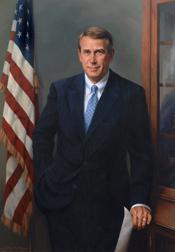
Mr. Speaker, let me thank my colleague for yielding me this time. Mr. Speaker, today I rise in strong support of this resolution, which shows our Nation's unwavering commitment to both higher…
Mr. Speaker, let me thank my colleague for yielding me this time.
Mr. Speaker, today I rise in strong support of this resolution, which shows our Nation's unwavering commitment to both higher education and providing a strong national defense. At no time in recent memory has our country placed more responsibility on the shoulders of our men and women in uniform. We are fighting a war on terrorism on multiple fronts, in Afghanistan and Iraq. And it is essential that if we are to be victorious in defending our freedom and protecting our homeland that we promote military service as an option to college students across the United States.
When this Congress passed and President Bush signed into law the No Child Left Behind Act, the bill made it easier for military recruiters to inform America's high school students about their options to serve their country, while also giving parents a choice about whether or not they want their sons and daughters to be contacted individually by military recruiters.
Now in this resolution we are reiterating the choices given to institutions of higher education. The Solomon Act, originally passed in 1995, grants the Secretary of Defense power to deny Federal funding to institutions of higher learning if they prohibit military recruitment on campus. This law recognizes the importance of having a capable, educated and well-prepared military, one that is ready to defend American liberties such as freedom of speech and higher education.
If we deny Armed Forces recruiters the opportunity to actively recruit in schools, we not only disrespect the sacrifices of military men and women who have made our freedom possible; we also rob our students of the valuable opportunities that military service can be to our Nation and what they can help provide. There is no reason not to allow the Nation's armed services to make their best case to college students and to do so in the same manner as private sector employers that colleges and universities seem to relish having on campus.
Denial of access and equality to military recruiters by colleges that receive Federal funds is an insult to the taxpayers who help subsidize higher education in this country. Many nations have mandatory military service for their citizens. We do not. The very core of our system of homeland security and national defense depends on young men and women deciding that they wish to serve our country.
Successful recruitment of the best officers in our military relies heavily on our military recruiters' access to the best and the brightest. And it seems a bit disingenuous for the elite institutions of higher education, such as Harvard, Yale, Stanford, Georgetown, and New York University, to condemn the lack of the wealthy and privileged in the ranks of our military while these schools deny their students the option of even hearing about a career in our United States military.
This resolution should not be politicized. It is a straightforward reaffirmation of our Armed Forces and our students. Congress does not force colleges and universities to accept Federal funding. If an institution of higher learning wishes to bar military recruiters from recruiting, it is free to do so. But Federal funding is not an entitlement and such institutions should not expect that decision to be endorsed and subsidized by the taxpayers of the United States. The resolution reaffirms our commitment to that principle.
And I want to commend the gentleman from California (Mr. Hunter) and I also want to thank the gentleman from Minnesota (Mr. Kline) for bringing this resolution to the floor and urge my colleagues to support it.
Mr. Speaker, I rise today in strong support of H. Con. Res. 36. This resolution expresses the continued support of Congress for the so-called Solomon Law, a critical piece of legislation originally…
Mr. Speaker, I rise today in strong support of H. Con. Res. 36. This resolution expresses the continued support of Congress for the so-called Solomon Law, a critical piece of legislation originally passed in 1994 which has helped ensure that military recruiters have equal access on our Nation's campuses.
We are debating this resolution today only because of a recent court decision that wrongfully struck down the Solomon Law. In November of last year, a closely divided U.S. Third Circuit Court of Appeals ruled that the Solomon Law violates first amendment rights to free speech and association.
The court sided with the plaintiff arguing that ``the Solomon Amendment requires law schools to express a message that is incompatible with their educational objectives, and no compelling governmental interest has been shown to deny this freedom.''
Mr. Speaker, I cannot disagree more with this assessment. In our post-9/11 world, our Nation's military deserves, at least the same access to institutions of higher education that any other major employer might enjoy. This is certainly a modest and I believe a reasonable request, especially if the college or university accepts Federal funds.
This is not about infringing free speech; it is about ensuring our military has access to our Nation's best and brightest at a time when we face enormous challenges abroad. This resolution expresses the continued support of Congress for the Solomon Law and would help ensure that military recruiters continue to have access to college campuses and students that is at least equal in quality and scope as that provided to any other employer.
This resolution would reaffirm the commitment of Congress to explore all options, including the use of its constitutional power to appropriate funds to achieve that equal access. In adopting this resolution, we would also be urging the executive branch to aggressively challenge any decision impeding or prohibiting the operation of the Solomon Law. Also, we would be encouraging the executive branch to follow a doctrine of nonacquiescence by not finding a judicial decision affecting one jurisdiction to be binding on any other jurisdiction.
Mr. Speaker, as we debate this resolution, it is important for us to remember that the Solomon Law and its legislative updates were not designed as one-size-fits-all mandates from Washington. In fact, the law is very flexible, and it fits the needs of nearly every public- funded institution in the country. For example, the Solomon Law does not apply to colleges or universities that have a long-standing policy of pacifism based on historical religious grounds, nor does it affect any Federal student aid or financial assistance.
Of course, as those of us who are here debating this issue are aware, this is not the first challenge to this law. Prior to the November circuit court decision, on repeated occasions lower courts have consistently upheld the constitutionality of the Solomon Law, arguing that it does not infringe on any institution's right to free speech or association.
While this recent court decision is unfortunate, it is not the end to the Solomon Law. A bipartisan vote here today in support of this legislation will help send a clear message to our courts that our military recruiters deserve equal access on all of our campuses. I thank the gentleman from California (Mr. Hunter) for his ongoing efforts on this issue, and I thank the gentleman from Minnesota (Mr. Kline) for managing this legislation.

I thank my good friend for yielding me this time. Mr. Speaker, I rise today in support of equal campus access for our military recruiters. Recently, a group calling itself Freedom For Academic and…
I thank my good friend for yielding me this time.
Mr. Speaker, I rise today in support of equal campus access for our military recruiters.
Recently, a group calling itself Freedom For Academic and Institutional Rights, FAIR, has decided that they disagree with what our military stands for; and, because of this, they have decided that the military no longer deserves access to our Nation's institutions of higher learning. They claim that granting military recruiters equal access to campuses would promote only a pro-military viewpoint and a pro-military recruiting message.
This is simply not true. The government is not asking campuses across America to endorse the war on terror, the President's policy or anything to do with the military. All we are asking for is that the military be afforded the exact same access as other organizations to the student body. That is it. That is all. Those who argue that giving equal access somehow constitutes an endorsement of the military are just plain wrong. Does giving equal access to other groups mean that each institution agrees with every idea that that organization may have? Of course not. I really think it is ridiculous to argue that point, but FAIR is arguing just that.
It is in everyone's interest to ensure that young people receive information, including military options, so they can make informed choices about their future after they finish their education. Just because a school disagrees with a career in the military, does that give them the right to deny information about that particular career to someone who might want to sign up? Is it right to deny access because you disagree with what someone says? How is that in keeping with the first amendment to the Constitution?
The position that FAIR and others have taken is nothing more than thinly veiled hypocrisy. They are masking their obvious hatred of our Nation's military by hiding behind the first amendment. I think it is wrong. I am not going to sit idly by while this so-called FAIR group trashes our military.
The Constitution in article 1, section 8, states that Congress shall have the power to raise and support armies, provide and maintain a navy and make rules for the government and regulation of the land and naval forces. It does not say that activist judges and institutions of higher education have the right to prevent Congress from going about its duty to raise and support the Armed Forces of these United States.
Were the members of the FAIR not aware that we were at war and that a state of national emergency has existed in this country since September 11 of 2001? I am sure they are happy to enjoy the rights afforded to them by the first amendment, but who allows them those rights? Perhaps they should reread the old Poem to a Soldier:
``It is the soldier, not the reporter, who has given us freedom of the press.
``It is the soldier, not the poet, who has given us freedom of speech.
``It is the soldier, not the campus organizer, who gives us freedom to demonstrate.
``It is the soldier who salutes the flag, who serves beneath the flag and whose coffin is draped by the flag who allows the protester to burn the flag.''
I urge all my colleagues to support this resolution to ensure that the military of these United States continues to have equal access to our Nation's finest young men and women.
Mr. Speaker, I thank the gentleman for yielding me this time. I would like to acknowledge the gentleman from Oklahoma (Mr. Cole) and his leadership. We had the opportunity to travel recently to Iraq,…
Mr. Speaker, I thank the gentleman for yielding me this time.
I would like to acknowledge the gentleman from Oklahoma (Mr. Cole) and his leadership. We had the opportunity to travel recently to Iraq, to Amman, and to Israel. Both Israel and Iraq have now passed through two very historic elections. I had the opportunity of speaking about the Palestinian election just recently.
Despite the fact, Mr. Speaker, that we have differences over our Nation's military action in Iraq, I supported the effort and will support the funding to accomplish the objectives. But I have made valid criticisms, as others have, of the administration's administration or execution of the policy. However, Mr. Speaker, I believe that all of us are united today, hopefully, in saluting the courageous Iraqi people who turned out to vote on Sunday. I know that every Member of the body commends the bravery and sacrifice of our men and women in uniform whose patriotism and professionalism made this important day possible.
We must hope that 50 years from now a future generation of Iraqis can look back at this election, this event, as a turning point in the history of their nation and as a victory for freedom over tyranny, for democracy over despotism.
After toiling under the boot of Saddam Hussein for decades and weathering a vicious terrorist insurgency over the last 2 years, the Iraqi people said no, no to intimidation, and yes to the most basic democratic right, the right to vote.
Sunday's election, Mr. Speaker, in which millions of Iraqis cast ballots, is a stunning repudiation of those who despise freedom and democracy. Zarkawi, that criminal leader of terrorist activity and insurgency in Iraq, said it accurately for the terrorists: They despise democracy. They despise freedom. They fear the decisions of free people. That is why they tried to intimidate the Iraqi people.
Having lived under the totalitarian Saddam Hussein regime all these years, however, the Iraqi people know that the insurgents offer nothing but further repression and violence.
Last Friday, Mr. Speaker, I had the privilege of visiting the out-of- country voting station in New Carrollton, Maryland, and watched as many of these Iraqis Diaspora cast their votes freely for the first time in their lives. The joy and pride on their faces and in their hearts had to move everyone with whom they spoke. It was a moving moment, it was an historic moment, and it was a poignant reminder to all of us that our rights, while God-given, must never be taken for granted; a reminder that the cost of protecting those freedoms is sometimes high, and we must honor those with the courage and commitment even for others across the sea to protect those rights in the realization that democracies and free people are safer for us here at home than the tyrannies that have prevailed in history.
Without question, Mr. Speaker, there are difficult days ahead. The truly hard work that remains in establishing a viable, stable democracy that is capable of maintaining internal order in Iraq is not finished by far. But today, today at least, Mr. Speaker, let us celebrate the courage of the Iraqi people and express our gratitude and pride in the bravery of our Armed Forces, our men and women in uniform who made that day possible.
Show 11 more
Mr. Speaker, I rise in opposition to this resolution. It may seem peculiar, but, frankly, I think that the military does not need this resolution. It is not broken out there. They are having the…
Mr. Speaker, I rise in opposition to this resolution. It may seem peculiar, but, frankly, I think that the military does not need this resolution. It is not broken out there. They are having the ability to recruit. Even despite the negative news from Iraq, the recruitment numbers are up for all the services.
What this resolution does is sort of breaks this feeling in America that democracy allows divergence of opinion and that the people that own the real estate should have a voice in who can visit that real estate. We do not have any nationally owned universities, yet this resolution requires equal access for all military recruiters at institutions of higher education. I think we are getting into a really slippery area here because you are going to create within those campuses huge debates that students are going to say, we don't like this stuff being jammed down our throats. We and the faculty and the trustees of a university ought to be able to decide who can visit our campus, as they do in all other things.
For example, here in Washington, D.C., Catholic University does not allow pro-abortionist recruiters to come and talk on the campus, and here you are going to require, regardless of what the issue should be, that military recruiters have to be allowed on campus. I think it is a very slippery slope. I do not think we need to go there, because the recruitment numbers are not down. I think the military has historically stood on its own feet to do very well in recruiting without getting Congress involved mandating that they have to be on campuses. I think you are going to have a negative reaction.
I would urge Congress very carefully to think about this and to vote ``no'' until we get a better thought on how we want to mandate democracy in this country.
Mr. Speaker, I come to the floor today in strong opposition to H. Con. Res. 36.
It is a standard practice for institutions of higher learning to include a non-discrimination policy as part of their mission. These policies affirm that they do not tolerate discrimination on any number of issues: race, sex, religion, age, disability, social class, and sexual orientation. These non-discrimination policies were created so that all people in our country have the opportunity to be an equal and respected member of higher education communities.
Unfortunately the military has established a discriminatory policy, Don't Ask Don't Tell. This policy unfairly excludes homosexuals from military service on the basis of their sexual orientation alone. For example, numerous military linguists who are critically needed in the Global War on Terrorism have been discharged under Don't Ask Don't Tell. Supporters of H. Con. Res. 36 say that denying military recruiters access to college campuses is a national security threat, but they are completely missing the big picture. The real national security threat is the Don't Ask Don't Tell policy that forces our military to discharge gay servicemen and servicewomen regardless of their job performance.
I strongly believe that the non-discrimination policies of colleges and universities should be respected and I urge my colleagues to vote against this resolution.

Mr. Speaker, I join my colleagues in offering strong support for H. Res. 60, commending the free election held in Iraq last Sunday, January 30, 2005. This historic event marked progress, hope, and…
Mr. Speaker, I join my colleagues in offering strong support for H. Res. 60, commending the free election held in Iraq last Sunday, January 30, 2005. This historic event marked progress, hope, and enthusiasm for the future of democracy in the Arab region.
Iraq held free elections for the first time in about 50 years. Millions of voters cast their ballots, and the death toll for the day was 45--lower than usual since the United States occupied the region.
I applaud this administration for the successful free elections held on Sunday under its auspices. An election with a turnout of nearly 60 percent is very encouraging for the Arab region. However, the fact remains that American troops have remained in occupation for 2 years, and the death toll continues to rise; therefore, we must proceed with caution. The positive momentum that has come from a successful election must be used as an opportunity to stop the bloodshed and the expenditure of tax dollars on this effort. I hope that the administration will use the positive momentum of this achievement as an opportunity to devise an exit plan for our troops.
Now that the election has taken place, the next step of restoring independence in Iraq is crucial and must be taken now. Along with 25 other original cosponsors, I joined Representative Lynn Woolsey to introduce H. Con. Res. 35, a measure to bring the troops home. It proposes to do this in a four-step process: (1) Development and implementation of a strategy to withdraw American troops from the region; (2) development and implementation of a reconstruction plan for the Iraqi civil and economic infrastructure; (3) creation of an international peacekeeping force composed of Iraqi leadership, neighbors in the Arab region, the United Nations, and the Arab League to keep Iraq secure; and (4) restoration of Iraqi officials as overseer of its internal affairs. This legislation will help restore independence in Iraq and will bring our troops home safe.
Since the beginning of the Iraq war in March 2003, 1,423 members of the United States military have died which includes 1,084 dead as a result of hostile action and 333 of non-hostile causes. Since May 1, 2003, when President Bush declared that major combat operations in Iraq had ended, 1,269 U.S. military members have died. More than 89 percent of United States casualties in Iraq have come after this announcement. The message as to our exit plan must be made clear to the Iraqi people, the American people, and to our troops.
Mr. Speaker, I support H. Res. 60, and I urge my colleagues to join me in the spirit of preserving democracy, in the spirit of instilling international trust and self-sufficiency, and in the spirit of keeping the American troops safe.
Mr. Speaker, I thank the ranking member for his very generous remarks and commend him in turn for his leadership and the determination and dedication that he has given to human rights throughout the…
Mr. Speaker, I thank the ranking member for his very generous remarks and commend him in turn for his leadership and the determination and dedication that he has given to human rights throughout the world and freedom throughout the world. Having just visited Auschwitz and having his own personal sad experience in the deprivation of freedom, he is an inspiration to all of us. I hope that the trip was not too painful for the gentleman from California (Mr. Lantos), but again his courage and his determination are a lesson to all of us, and I thank him.
Mr. Speaker, Sunday was a historic day for the people of Iraq. In the face of violence and threats, millions of Iraqis made it clear that they want the future of their own country decided by the ballot, not by the bomb or the bullet. Their willingness to risk their lives to vote is compelling evidence of the depth of their aspiration for self- determination. Their courage commands our admiration and our respect.
The bravery of our military personnel cannot be praised highly enough. Without their selflessness in the face of great danger, the election could not have been held. Every American is inspired by their courage, their patriotism, and the sacrifice they are willing to make for our country.
Iraqis have demonstrated their desire to take responsibility for their country's future. Our effort now should be to use the momentum created by the election to help them realize that goal. Iraq needs to be made more secure. Let us intensify our efforts to train the Iraqi Army that can provide that security. The sooner we transfer the responsibility for security of Iraq over to the Iraqis, the better.
Iraq's future depends on improvements to its economic infrastructure. Let us accelerate the reconstruction efforts that have lagged so badly and give Iraqis a larger stake in having those efforts succeed.
Iraq's political future depends on the involvement of all Iraqis in the political process. Let us redouble our diplomatic efforts with Iraq's neighbors to help create an environment in which Iraq includes those who have thus far felt excluded.
We know that Sunday's election was but a step on the road to a stable and secure Iraq. The American people, who have sacrificed so much for Iraq, are owed a clear explanation by the President of his plan to end our presence in Iraq and of the standards by which they can judge that plan. I hope that we will hear that plan tonight in the President's State of the Union address.
In congratulating the Iraqi people on their achievement, we also need to acknowledge that the election should signal the beginning of a change in our relationship with Iraq.
I thank the gentlewoman for yielding me this time. Mr. Speaker, insurgents in Iraq this weekend had vowed to wash the streets in blood. Yet, despite all their threats of people who were going to get…
I thank the gentlewoman for yielding me this time.
Mr. Speaker, insurgents in Iraq this weekend had vowed to wash the streets in blood. Yet, despite all their threats of people who were going to get killed and places that were going to be bombed, and indeed 43 people were killed, despite all that, voters turned out, of course, in record numbers because the election itself was a record.
One voter said on Sunday that each vote was a bullet in the heart of the enemy. We are defeating the terrorists in coming here, he said proudly, as he dipped his finger in the famous purple ink. This was done in over 30,000 polling places. And now the votes are being counted.
When we look at the turnout, nearly 60 percent, we are not really sure what the turnout officially is, but compare that to the United States presidential election just this November of a 60.7 percent voter turnout. Yet no one was threatened to be killed. That was the highest turnout in the United States of America in 38 years. Indeed, in my home county in Savannah, Georgia, Chatham County had a turnout of a mere 48 percent 2 years ago when we elected the Governor of Georgia.
So for them under these circumstances to have a 60 percent voter turnout, it is phenomenal; but it is also a huge statement on how badly people want freedom, how badly they want to throw off the shackles of oppression, and how they value the opportunity to vote.
The U.S. Marines said that watching voters go to the polls was a spectacular and a wonderful payoff of the magnitude of the well- visualized photo of their knocking down Saddam Hussein's statue 2 years ago in Baghdad. And the people who died, the 43 lives who are no longer with us, they should all be remembered along with the other heroes who made the day possible. We owe them a debt of gratitude.
It took the United States of America 7 years to fight the Revolutionary War to win its independence from Britain, and then it was not until 1789 that we threw out the Articles of Confederation and wrote our own Constitution. And yet we fought a Civil War since then and we have had lots of struggles and lot of amendments to our Constitution. Indeed, over 200 years later, we are still fighting and working on this experiment that we call democracy, representative democracy.
What the world needs to do right now is to support Iraq in this endeavor. It is time for folks around the globe to say this did serve as a referendum and a statement; now let us reach out and do what we can to help Iraq become independent.
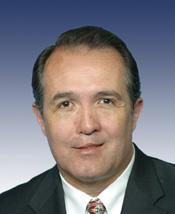
Mr. Speaker, only a few months ago, for the first time in history, ballot boxes were coming in from remote places like Khyber Pass in Afghanistan on the backs of mules. What a great time it is to…
Mr. Speaker, only a few months ago, for the first time in history, ballot boxes were coming in from remote places like Khyber Pass in Afghanistan on the backs of mules. What a great time it is to live in this world.
And last Sunday we saw free elections in a nation whose people have been crushed and oppressed since the days their country was called Babylon. We saw young men carrying old men to the polls. We saw one gentleman whose leg had been blown off by a terrorist bomb who said, I will crawl to vote if that is what it takes. And one of Saddam Hussein's former generals said, When I voted today, it felt so good inside, like I was free.
Mr. Speaker, the United States of America has been a leader in freedom, and we have now had the privilege of becoming the unipolar superpower of the entire world. No nation on Earth can actually challenge us in military, economic, or technological terms; and truly every nation sees America now as the flagship of humanity. This Nation now possesses a greater opportunity to promote freedom in the world than we have had since the Republic began.
But it is because we have had such great victories and opportunities that more than ever before we must be deeply humble and remind ourselves that we are only briefly the temporary stewards of this God- given greatest Nation in the history of humankind. And we only have a short time to fulfill our privileged and sacred mission of making America such a beacon of liberty that the light of freedom will some day fall across the faces of every person on this planet.
Last Sunday tells me, Mr. Speaker, that this is the generation who lives in the window of time where we can firmly set the world on that course. This is freedom's day, and we must seize it while we can. And while I do not often quote Shakespeare, he said, ``There is a tide in the affairs of men, which taken at the flood, leads on to fortune; omitted'' or delayed, ``all the voyage of their lives is bound in shallows and in miseries. On such a full sea, we now find ourselves afloat, and we must take the current when it serves or lose our ventures.''
Mr. Speaker, as we take this current to freedom, let us remember that the best leverage to maintain freedom's march in the world is to make sure that its foundations are secure beneath freedom's home; and then, Mr. Speaker, let us take this tide of freedom as it serves so that one day all generations will bask in this glorious sunlight of liberty just as it has now begun to dawn on the people of Iraq.
Mr. Speaker, I rise in support of our Armed Forces and in support of this nation's continued efforts to give it the additional strength and stability it needs to keep our men and women safe. The…
Mr. Speaker, I rise in support of our Armed Forces and in support of this nation's continued efforts to give it the additional strength and stability it needs to keep our men and women safe. The members of this House have joined their constituents in mourning the loss of life and injuries sustained in the course of America's war and subsequent occupation of Iraq for two years.
Since the beginning of the Iraq war in March 2003, 1,423 members of the U.S. military have died, which includes 1,084 as a result of hostile action and 333 of non-hostile causes. Furthermore, my District of Houston has experienced two deaths already since January; six deaths in 2004; five in 2003; and numerous injuries over the course of the nation's engagement.
No doubt, Mr. Speaker, I fully support the Armed Services. In the spirit of achieving the goal of attracting the best and brightest candidates for service, I join my colleague from California in advocating this legislation. However, we must support our troops in accordance with the U.S. Constitution and with respect for civil rights and fundamental freedoms that are the rubric of this nation.
When the House debated H.R. 3966, which would allow for the denial of federal funds for educational institutions unless military recruiters are provided access to the campuses of these institutions, I voted ``yes'' on passage of the measure with the understanding that no Constitutional contravention would result from its implementation.
The resolution that is before the House today, however, is controversial because the final disposition of underlying federal jurisprudence could play a major role clarifying the way we apply Constitutional principles to an act of Congress. The holding in Forum for Academic and Institutional Rights v. Rumsfeld tells us that we must be very careful in the way we regulate society so as not to violate fundamental rights. (390 F.3d 219 (3rd Cir. 2004)).
So, Mr. Speaker, I do support the intent of this legislation because I honor the men and women who serve in our Armed Services and who sacrifice their lives for us. However, I also support the upholding of the United States Constitution and the respect for jurisprudence, and I believe it seriously damages our commitment to the three branches of government to encourage the interference with judicial decisions before a final rendering of a final review by the U.S. Supreme Court.
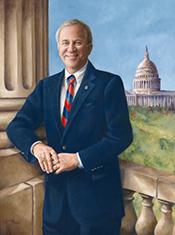
Mr. Speaker, I rise in full support of this resolution and urge my colleagues to support its passage. Asking the administration to appeal the third circuit is the right thing to do. What is happening…
Mr. Speaker, I rise in full support of this resolution and urge my colleagues to support its passage. Asking the administration to appeal the third circuit is the right thing to do. What is happening on some college campuses is deja vu for those of us who attended colleges in the 1960s and the 1970s. Back then too many college administrators lacked the courage to resist pressure from then what were called left- wing student groups and other professors to ban military recruiters from their campuses. As a result, students who sought military careers were denied equal access to careers of their choice and our schools became the centers for a wide range of nonsense courses.
The student protestors of the 1960s and 1970s and those of like mind are now the administrators and professors of colleges and universities all over the country. Clearly, they have neither changed their politics nor loathing for the American military. Even at a time when our servicemen and -women are encouraged to defeat the forces of tyranny and terror, they remain the same.
In denying military recruiters equal access to campuses such as Harvard Law School, college administrators violate the most basic principles of the right to associate and free speech they so profess is precious. Despite large numbers of conservative students attending their institutions, these liberals preach tolerance; however, these liberal administrators and professors have now become the most intolerant people I know.
The following quote is from a student typical of the attitude of many of these ivory bastions: ``The day my political science department hires a Republican and I am allowed to sit in a class without a number of snickers, jeers, and/or dirty looks when President Bush's name is even mentioned is the day I will admit there is progress on today's campus.''
Mr. Speaker, Congress did not ask for special access for military recruiters. We are asking for just equal access to groups such as those seeking support for such liberal causes as abortion rights, frivolous lawsuits, same-sex marriage, elimination of the right to private property, gun control, Orwellian Big Government. Mr. Speaker, once again activist judges have clearly overstepped their authority, and it is time for the administration to stand and say that the U.S. Court of Appeals for the Third Circuit was wrong in their ruling and please seek an appeal.
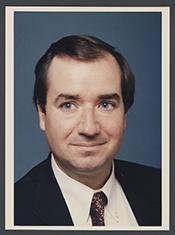
I thank the gentlewoman for yielding me this time. Mr. Speaker, I rise in strong support of this resolution celebrating the free elections held in Iraq this past weekend. I think it is important that…
I thank the gentlewoman for yielding me this time.
Mr. Speaker, I rise in strong support of this resolution celebrating the free elections held in Iraq this past weekend. I think it is important that the world watched as millions of Iraqis defied the edict of Zarkawi and other terrorist leaders, defied their edict not to participate and went forward to cast what for most was the first meaningful vote in their lives.
Thousands of Iraqis served as poll workers. There were thousands of observers, as this resolution notes. The
turnout exceeded all expectations. Iraqis of all backgrounds celebrated this milestone in the history of their country, but I believe it was a milestone for the Middle East and a milestone for the world. Tyrants and dictators would have people believe that democracy is a charade. Tell that to the Iraqis celebrating in the streets throughout Iraq. They rejected Saddam Hussein in a way that they had not had an opportunity to before, and they actually rejected him with an exclamation point in this election. What we saw was yet more evidence that the yearning to shape the political life of one's community and one's nation is universal. Freedom truly is a human aspiration.
Voting, as we have heard, is a step. The ballots have not yet been counted. A constitution needs to be drafted. Democracy, if it is going to work, must respect the interests of minorities. Otherwise, it is the tyranny of the majority.
In general, everyone wants their own rights respected. The challenge is to get people to respect the next person's rights. Kurdish rights must be protected, Sunni rights must be respected, and the rights of the Iraqi down the street must be respected. As President Bush has told the American people, this will be a long struggle. Iraq is very difficult terrain.
The stars of last weekend clearly were the Iraqi people. They put their lives on the line for a better future. Some were killed. But, make no mistake about it, there was a key supporting cast. Our Nation owes a debt of gratitude to the many members of our Armed Forces, our diplomats and other Americans in Iraq who are also risking their lives and in some cases sacrificing their lives to help Iraqis and also Americans.
We have a strong national interest in seeing Iraq become a success. If this happens, when the history of this era in Iraq is written, these men and women will be widely revered.
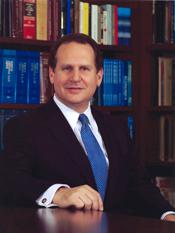
I thank the distinguished gentlewoman for yielding me this time. Mr. Speaker, I rise in strong support of this resolution brought forth by our majority leader and others commemorating, celebrating…
I thank the distinguished gentlewoman for yielding me this time.
Mr. Speaker, I rise in strong support of this resolution brought forth by our majority leader and others commemorating, celebrating the extraordinarily historic accomplishment of the Iraqi people last Sunday.
As our majority leader stated in a meeting where we were able to hear him speak just a few minutes ago, what we saw, what the world saw in Iraq on Sunday was more than an accomplishment. It was a miracle. But it was a miracle made possible by the leadership of President Bush and the Armed Forces of the United States and the coalition that have stood firmly for the security of a people who were oppressed for decades and who made it known to the entire world last Sunday that those thugs who seek to cloak themselves in some sort of sector of Islamist thought are nothing but a bunch of gangsters, thugs and gangsters who seek to intimidate through violence and through terror.
So the world was able to see on Sunday the gangsters and the thugs for what they are, a pathetic group dedicated to terror and intimidation. The world has seen and was able to see, by the courage of the millions and millions of Iraqis who, despite the threat to their own lives, stood in line and the lines refused to be broken. As our majority leader stated so eloquently in the meeting that we had, as I stated before, earlier today, the lines refused to break even when the bombs came and the attacks came and the injured were taken to hospitals and the dead were mourned. Yet the lines remained to demonstrate to the world that the Iraqi people not only seek but appreciate and will stand for their freedom and that the gangsters and the thugs are simply pathetic believers in violence.
I am a firm believer in the Bush doctrine. All people want to be free and all people deserve to be free. There are a handful of tyrannies in the world. Their day will soon come, also.
Just 90 miles from the shores of the United States there is a tyrant who for 46 years has oppressed a people, also through the same gangster tactics that these thugs in the Middle East use. Unfortunately, he has all the weapons, and his people are unarmed. His day will soon come as well.
This is a great day for history, for peace that we are celebrating today with this resolution by the gentleman from Texas (Mr. DeLay). That is why I so strongly support it.

Mr. Speaker, I yield 4 minutes to the gentleman from Alabama (Mr. Rogers), the sponsor of this concurrent resolution and a member of the Committee on Armed Services. Mr. Speaker, I yield 3 minutes to…
Mr. Speaker, I yield 4 minutes to the gentleman from Alabama (Mr. Rogers), the sponsor of this concurrent resolution and a member of the Committee on Armed Services.
Mr. Speaker, I yield 3 minutes to the gentleman from Texas (Mr. Conaway), a member of the Committee on Armed Services.
(Mr. CONAWAY asked and was given permission to revise and extend his remarks.)
Mr. Speaker, it gives me great pleasure to yield 4 minutes to the gentleman from Florida (Mr. Miller), my colleague on the Committee on Armed Services.
Mr. Speaker, I am pleased to yield 4 minutes to the gentleman from New York (Mr. Sweeney).
(Mr. SWEENEY asked and was given permission to revise and extend his remarks.)
Mr. Speaker, I yield 4 minutes to the gentleman from Ohio (Mr. Boehner), the chairman of the Committee on Education and the Workforce.
Mr. Speaker, I yield 2 minutes to the gentleman from California (Mr. Hunter), the distinguished chairman of the House Committee on Armed Services.
Mr. Speaker, I yield 3 minutes to the gentleman from Georgia (Mr. Kingston).
(Mr. KINGSTON asked and was given permission to revise and extend his remarks, and include extraneous material.)
Mr. Speaker, I yield 3 minutes to the distinguished gentleman from Indiana (Mr. Buyer), chairman of the Committee on Veterans' Affairs.
Mr. Speaker, I yield myself such time as I may consume.
In closing, I would just say that we have heard some discussion today about policies of the United States Armed Forces for a long time. Since its inception, there have been special policies applied to our military, the ability to impose nonjudicial punishment, the ability to restrict entry by those who are too tall or too short, the ability to order its members away from home and into combat and into harm's way. But the discussion today is not about those policies and should not be about those policies. The discussion today is about keeping our military, keeping our Armed Forces, the best trained, the best led, the best equipped in the world; and that means we need the ability to recruit the best and the brightest. This is about insisting that our military recruiters have equal access to America's universities and colleges.
I urge all of my colleagues to support this resolution.
Mr. Speaker, I yield back the balance of my time.
Mr. Speaker, on that I demand the yeas and nays.
Mr. Speaker, I rise in support of the amendment today out of a bit of a sense of confusion as to why we really need to revisit this issue one more time. It is odd that in a Nation at war that…
Mr. Speaker, I rise in support of the amendment today out of a bit of a sense of confusion as to why we really need to revisit this issue one more time. It is odd that in a Nation at war that institutions of higher learning would take steps to limit the Army and the Navy, the Marine Corps, Coast Guard and other services' access to their students. I wonder what they are afraid of as to why they would take this particular position.
They pride themselves on having the brightest in America at their universities, particularly the ones in question. As an aside, I was at a university in January, excuse me, in November, at freshman orientation and saw a couple of co-eds walking across campus that obviously have impaired reading skills because they were both smoking.
Nevertheless, I wonder what they are afraid of. Why are they afraid of the message of serving one's country, of doing one's duty. We can argue that the Federal Government should or should not be in a lot of different areas, but clearly national defense and raising an army is a mission of our Founding Fathers that none of us would argue with.
I guess the point I would like to make is that if these colleges and universities feel so strongly that their students should not participate in our military, then let us do it with honor and voluntarily turn back the Federal funding that supports many of the programs that they support through their universities.
I would call on them and if they are really serious about limiting this, they are afraid of what our recruiters might say, that our recruiters might ask their young men and women to serve their country, to place their lives on the line, as many of the men and women who today serve our country in those Armed Forces are doing every day in Iraq and Afghanistan and other places around the world that we do not necessarily know about, but nevertheless they are serving, why they are afraid of this message? Why they do not think their students should have access to that?
I rise in support of this resolution and would ask those universities that feel strongly about this to voluntarily send back all the Federal funding that they are currently getting and allow us to use those dollars in universities that are a little more in line with the issues that we are talking about today.
Bill Text
2 versions available
        [Congressional Bills 109th Congress]
[From the U.S. Government Publishing Office]
[H. Res. 60 Engrossed in House (EH)]

In the House of Representatives, U.S.,

February 2, 2005.
Whereas in April 2003, United States Armed Forces and other Coalition forces
liberated the people of Iraq from the dictatorial regime of Saddam
Hussein;
Whereas at the end of June 2004, an Interim Government of Iraq assumed sovereign
authority over Iraq;
Whereas the Interim Government of Iraq called an election for January 30, 2005,
to elect a Transitional National Assembly, which will choose Iraq's
Transitional Presidency Council, approve Iraq's other national leaders,
serve as a transitional legislature, and draft a permanent Iraqi
Constitution to be submitted to a referendum;
Whereas tens of thousands of Iraqis signed petitions nominating thousands of
candidates for seats in the Transitional National Assembly under rules
prescribed by the Independent Electoral Commission of Iraq;
Whereas thousands of Iraqis served as poll workers or observers;
Whereas a terrorist insurgency used murder and intimidation in a desperate but
ultimately fruitless attempt to prevent the people of Iraq from
exercising their right to choose their own leaders;
Whereas despite the efforts of Coalition forces and Iraqi security forces, a
regrettably large number of Iraqi election workers, political party
volunteers, security officials, candidates, and ordinary citizens
attempting to participate in the political process or who were merely
innocent bystanders were victimized by the insurgency, with some
individuals having been killed while attempting to vote;
Whereas millions of Iraqis nevertheless exercised their right to vote, despite
threats and actual violence directed against them;
Whereas Coalition forces, in cooperation with Iraqi security forces, continue to
provide security for the people of Iraq; and
Whereas a representative democracy is more than a way to settle disputes but,
most importantly, ascribes intrinsic value to every human being: Now,
therefore, be it
Resolved, That the House of Representatives--
(1) congratulates the people of Iraq, in particular those
individuals who participated in the political process as voters, poll
workers, observers, party workers, or candidates for the Transitional
National Assembly, for having taken part in the historic and inspiring
Iraqi election of January 30, 2005;
(2) expresses its thanks to the Interim Government of Iraq and the
Independent Electoral Commission of Iraq, Iraqi and Coalition security
forces, and the civilian United States and international partners of the
Government of Iraq for their tenacious efforts to create the conditions
in which a free election could be held;
(3) expresses its condolences to the families of those Iraqis who
perished while attempting to exercise their right to choose their
government or while protecting Iraqis who were doing so;
(4) congratulates the candidates who were elected to Iraq's
Transitional National Assembly which will be, when it is formed, the
newest democratically-elected legislature in the world;
(5) offers its continued support to the people and political
institutions of Iraq, including the Iraqi Transitional National
Assembly, as they deal with the consequences of decades of misrule by
the former regime of Saddam Hussein;
(6) expresses its gratitude to the United States Armed Forces for
their ongoing valiant service to their country and commitment to the
highest ideals and traditions of the people of the United States;
(7) expresses its gratitude to the families of United States Armed
Forces personnel, especially the families of those who have lost loved
ones in Operation Iraqi Freedom, and to Armed Forces personnel wounded
in the service of their country, for their sacrifices;
(8) reaffirms that--
(A) United States Armed Forces in Iraq will remain under the
full authority, direction, and control of their United States
commanders; and
(B) United States Armed Forces will possess all necessary
authority to fulfill their mission in Iraq effectively and to
provide for their operational safety;
(9) urges the people of the United States and other countries to
celebrate this latest step in the restoration of freedom to the people
of Iraq; and
(10) reaffirms that the world is safer when democracy replaces
tyranny.
Attest:

Clerk.