Mr. Speaker, I ask unanimous consent for Members to have 5 legislative business days to submit their statements for the Record. Mr. Speaker, this evening I rise, along with my distinguished…
Mr. Speaker, I ask unanimous consent for Members to have 5 legislative business days to submit their statements for the Record.
Mr. Speaker, this evening I rise, along with my distinguished colleagues, for the next hour, which shall be ours, to salute and to mark the 60th anniversary of the integration of the United States Armed Forces.
I rise today to celebrate this historic occasion as a step toward greater social justice for minorities and women alike, which shaped the road to equality within the United States and strengthened the very foundation and moral character of our great Nation.
On July 26, 1948, President Harry Truman signed executive order 9981, requiring the integration of the Armed Forces regardless of one's race, religion, or national origin.
President's Truman's brazen action back there in 1948 set the stage for later victories, including the Supreme Court's ruling in Brown vs. Board of Education, the Civil Rights Act, and the Voting Rights Act.
We are aware, Mr. Speaker, as our history attests, that the shared sacrifice of African Americans in the defense of our great Nation did not begin in 1948. Individuals such as William Williams, a Maryland fugitive slave, overcame the odds by enlisting as a private in the United States Army and defending Fort McHenry of Baltimore, Maryland in 1812. Countless others also served prior to the issuance of executive order 9981, including the Buffalo Soldiers of the 9th and 10th Cavalry Regiments, members of the Navy and Marine Corps' Stewards Branch, and the highly distinguished and honored Tuskegee Airmen. These brave servicemembers paved the way for minority men and women who proudly wear the uniform today. Sadly, back then, Mr. Speaker, they were often unseen, unnoticed, unappreciated, unapplauded and unsung, but today we pause to celebrate their lives and their contributions to our great Nation.
It is because of their sacrifices that I, along with the 42 other members of the Congressional Black Caucus, serve in the Congress of the United States today. It is through their sacrifices that I serve on the Board of Visitors at the Naval Academy, as a member of the House Armed Services Committee, and Chair of the Coast Guard and Maritime Transportation Subcommittee of the House Transportation Committee. As such, minorities have played a pivotal role in shaping this Nation's armed services, and I'm proud to say that this role continues today.
With the benefit of historical hindsight, we know that the sacrifice of brave Americans on the battlefield had to become a shared experience for America to truly move toward becoming ``one Nation, indivisible.'' Therefore, a segregated Armed Force could not be a foundation for an integrated society, nor could it truly offer ``justice for all.''
However, just as President George Washington initially refused to recruit African Americans in the American Revolutionary War despite the British welcoming the enlistment of minorities in 1775, President Truman's executive order was also met with much opposition by the Marine Corps and the Army. Consequently, this significant change and transition in racial policy took nearly 15 years before the executive order was fully implemented by all of the Armed Forces.
Because of President Truman's unyielding vigilance in ensuring the complete integration of the Armed Forces, all Americans today are more secure and remain free.
As we remember and honor the brave men and women of every race who have served our Nation, we should also remember those visionary leaders who gave to our Nation, including our colleagues, Representative Charles Rangel of New York, John Conyers of Michigan, Representative Bobby Rush of Illinois, Edolphus Towns of New York, Bobby Scott of Virginia, and so many others, the opportunity to share in that sacrifice which has preserved the America we all love so much.
We know that the transformation of our military has not been easily accomplished, and we honor those soldiers, sailors, airmen, guardsmen and women, and marines who, over the years, have challenged the status quo to do what is simply right.
All too often in our past, minorities in our Armed Forces have been forced to endure injustice and discrimination. All too often, promotions, choice assignments, and desired occupational fields have not been open to all on the basis of merit alone. Yet, the patriotism of our countrymen and women has kept the transformation and vision by President Truman alive.
Today, minorities continue to serve with distinction throughout our Armed Forces. Of the more than 1.8 million servicemembers who have participated in support of Operations Enduring and Iraqi Freedom, more than 20 percent have been minorities.
Mr. Speaker, it was just today that we congratulated Ensign DeCarol Davis for her selection as being the first African American and the first African
American woman to serve as valedictorian of a graduating class of the Coast Guard Academy. However, despite these advancements, minorities and women continue to be overlooked in being promoted fairly to Flag Officer rank or other leadership positions within the armed services. In fact, minorities remain over-represented in the enlisted ranks of our armed services, but clearly under-represented in the officer ranks.
African Americans constitute less than 6 percent of the general officers serving on active duty, amounting to merely 53 officers. And today, 60 years after executive order 9981, the Department of Defense still lacks a comprehensive plan and definition of diversity that can be applied Defense-wide.
Moreover, while the number of minorities and women admitted into the service academy has increased, reaching 24.1 percent of minorities for the graduating class of 2007 to 2011 at West Point and 22.7 percent of the United States Naval Academy, reports of the hate-inspired display of nooses at the United States Coast Guard Academy certainly demonstrate how much further we have to go as a Nation.
Mr. Speaker, we can do better. Not only can we do better, but we must do better. There is no excuse today for having one Four Star minority general officer, just as there was no excuse 60 years ago for the failure of the Army and the Marine Corps to immediately implement President Truman's noble orders of integration within the services.
That is why, together with Representatives Kendrick Meek, Hank Johnson and Kathy Castor, I successfully sponsored the ``Senior Military Leadership Diversity Commission'' amendment to the 2009 National Defense Authorization Act.
And I would be more than remiss if I did not say that our whip, Mr. Jim Clyburn of South Carolina, has made this entire cause of promotions within the ranks one of his major, major themes and something that he has worked on very, very hard, and I want to thank him for all of his efforts.
The commission that I spoke about a minute ago will study diversity within the senior leadership of the Armed Forces with the goal of enhancing the role of minorities and women. As I previously observed, Mr. Speaker, shared sacrifice and service to our Nation must be balanced by a fair and equitable sharing of responsibilities, opportunities and promotions.
For this reason, the commission's mission will be to evaluate and assess the opportunities for the advancement of minority and female members within the military branches as well as the challenge of retaining our Nation's best and brightest.
The Armed Forces continue to be a great career opportunity for the young men and women today. As a Nation, we have a compelling need to further increase the retention and recruitment of minority officers; yet as the co-chair of a task force on minority recruitment in the academies, and as a member of the Board of Visitors of the Naval Academy, I remain deeply concerned.
Mr. Speaker, this Nation's long march toward shared opportunity as well as shared sacrifice in the defense of America will continue, as it must. The security and the honor of America are at stake.
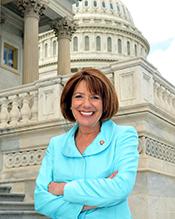
And with that, Mr. Speaker, I yield to my distinguished colleague, Ms. Watson of California.
I want to thank the gentlewoman for her strong comments.
And I also would note, Mr. Speaker, that throughout these presentations, I think you will hear a common theme, and that is that while minorities are enlisted in the military in the rank and file, there is a concerted effort on our part to make sure that they enter the ranks of officers. It's not enough to give your blood, your sweat, your tears. We want to see more of them in the officer ranks.
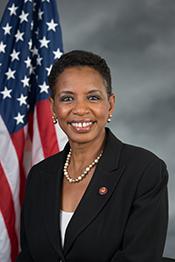
And with that, Mr. Speaker, I am very pleased to yield to the distinguished gentlewoman from Maryland, one of the newest Members of Congress. And she didn't hit the ground running,
she hit the ground flying. From the Fourth Congressional District, Congresswoman Donna Edwards.
I want to thank the gentlewoman for her statement.
Mr. Speaker, I will just take a moment to also salute the members of the Armed Services Committee from the Congressional Black Caucus, Congressman Kendrick Meek, who has worked very hard on these issues; and certainly Congressman Hank Johnson out of Georgia; and yours truly.
So in closing, Mr. Speaker, as all Americans are painfully aware, our history as a Nation has been a collage of contradictions, a struggle between discrimination and social justice, which has been repeatedly overcome by the power of patriotism and love for our Nation.
Jim Clyburn loves to tell the story, and many of us have heard these stories, where African American men and women have served many, many years in the military, and then when it came time for them to be promoted, they did not make the list. So after they had given much of their lives to their country, because they were not selected to move up as far as rank was concerned, then they had to leave. And that has happened to so many over and over and over again.
But no matter what, they still kept coming. On the one hand, many of them felt that they had not been treated fairly. But on the other hand, they still saluted the flag. They put up the flag every day. They did everything they knew how to be good patriots. Sometimes while they were being wonderful, wonderful patriots, they also found themselves in pain. So it was a dual situation for them, standing up for their country in some instances where they did not feel that their country always stood up for them. And you can hear those stories no matter where you go in any African American neighborhood throughout our country.
So going back to President Truman's executive order 9981, requiring the integration of the armed services prior to the Supreme Court's ruling in Brown versus Board of Education, the Civil Rights Act, and the Voting Rights Act is a testament to this shared struggle.
President Truman's executive order was essential to America's history and to his quest to truly offer justice for all. And that's what these soldiers were asking for, simply justice for all. They did not want anybody to do them any big favors. They simply wanted to have what was due them, an opportunity to lead.
And so, just as we eventually came together as a Nation to ensure the full implementation of the Executive Order 9981, I thank my colleagues for joining me and coming together as Members of Congress and celebrating the 60th anniversary of this momentous occasion.
And I would be more than remiss if I did not give credit to our staff who worked so hard on this special order, Miss Leah Perry, a very distinguished lawyer in her own right, and Miss Ca-Asia Shields, a young lady who is one of our fellows from the military services. And we're very, very pleased with the great work that they did for us.