Mr. Speaker, I move to suspend the rules and concur in the Senate concurrent resolution (S. Con. Res. 15) authorizing the Rotunda of the Capitol to be used on March 29, 2007, for a ceremony to award…
Mr. Speaker, I move to suspend the rules and concur in the Senate concurrent resolution (S. Con. Res. 15) authorizing the Rotunda of the Capitol to be used on March 29, 2007, for a ceremony to award the Congressional Gold Medal to the Tuskegee Airmen.
Mr. Speaker, I yield myself such time as I may consume.
Mr. Speaker, I urge adoption of Senate Concurrent Resolution 15, which would authorize the use of the Capitol rotunda on March 29, 2007, to present a Congressional Gold Medal to members of the Tuskegee Airmen.
With the passage of the Civilian Pilot Training Act of 1939, Tuskegee University, along with various civil rights groups and the black press, began an effort to transform Federal Government policies and procedures that excluded African Americans from pilot training programs.
In this initial phase, Tuskegee Institute, which had a proven civilian pilot training program and had a history of producing graduates with the highest of flight aptitude exam scores, was awarded a contract by the U.S. Army Air Corps to help train America's first black military aviators.
Between 1940 and 1946, nearly 1,000 black pilots were trained at Tuskegee University. This undertaking produced the unrivaled Tuskegee Airmen, who are credited with not losing a single bomber to enemy fire in more than 200 combat missions as air escorts, a record unmatched by any other fighter group.
The Tuskegee Airmen destroyed some 260 enemy aircraft. These brave men accumulated a total of 850 medals for their service and valor. Tuskegee University continues its legacy of leadership in aeronautics.
Today, it is the first and only Historically Black College or University to offer a degree in aerospace science
engineering. Since 1983, it has produced the largest number of black aerospace engineers of any institution in America.
In spite of the adversity and limited opportunities, African Americans have played a significant role in the U.S. Navy and military history. The Tuskegee Airmen overcame segregation and prejudice to become one of the most highly respected fighter groups of World War II.
So on March 29, 2007, the President of the United States will present the Congressional Gold Medal to the survivors expected to attend the ceremony, after which the medal will be given to the Smithsonian Institution and will be displayed in the future as appropriate.
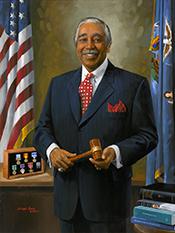
Last year, the House and Senate unanimously passed legislation brought to the floor by the Financial Services Committee to authorize the Congressional Gold Medal, which became Public Law 109-213. The bill had 310 cosponsors in the House and 77 in the Senate. Our colleague, the Honorable Charlie Rangel of New York, has worked tirelessly as the lead House sponsor of this legislation, and he has been the catalyst to ensure that these men got their rightful spot in history.
Since the House Administration Committee has jurisdiction over matters relating to the Smithsonian Institution, I am especially pleased that language was able to be worked out in the bill which would allow the Smithsonian to accept this historic medal on behalf of the American people and to display it as appropriate, including a location associated with the Tuskegee Airmen.
Mr. Speaker, I reserve the balance of my time
Mr. Speaker, I reserve the balance of my time.
On March 29 of this year, this Nation will give to its Americans, rightfully, the Congressional Gold Medal that they deserve
Mr. Speaker, I yield back the balance of my time.