Mr. Speaker, I move to suspend the rules and pass the bill (H.R. 187) to designate the Federal building and United States courthouse and customhouse located at 515 West First Street in Duluth,…
Mr. Speaker, I move to suspend the rules and pass the bill (H.R. 187) to designate the Federal building and United States courthouse and customhouse located at 515 West First Street in Duluth, Minnesota, as the ``Gerald W. Heaney Federal Building and United States Courthouse and Customhouse''.
Mr. Speaker, I yield myself such time as I may consume
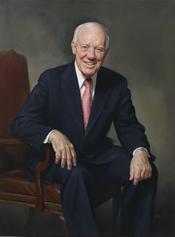
For me, today is a very fulfilling, as well as nostalgic, moment to move this bill to designate the Federal building and the U.S. courthouse and customhouse in Duluth for Judge Gerald W. Heaney.
He was appointed judge of the U.S. Circuit Court of Appeals for the Eighth Circuit on November 3, 1966. He took senior status in December 31, 1988; finally retired last August after 40 years on the bench. But that is only part of the story.
Gerald Heaney was born January 29, 1918, in Goodhue, a rural community in southeastern Minnesota. He grew up in a farming community, learned the values of rural America, went to my college which I attended many years later, College of St. Thomas, where he graduated and went on to the University of Minnesota where he got his law degree in 1941, but then started a new chapter in the life of Gerald Heaney.
He enlisted in the Army in World War II. He was trained as a United States Army Ranger, and he was on the landing craft at 6:30 in the morning on Omaha Beach in Normandy.
I interviewed Judge Heaney for the Library of Congress project on World War II veterans. They are attempting at the Library to get the personal views of those who participated in World War II, and he told this story:
``We were all herded into the landing craft. At 6:30 we arrived close to the beach. We could not quite get into the beach because of the obstacles that the Germans had placed under water and also had proximity bombs that would blow up ships. They were having trouble getting the vessels in, so they could not get to the beach, but they got into relatively shallow water. And the door went down on the landing craft, and the captain stood up and said, everyone ashore, and he was cut down by gunfire. And the first lieutenant stood up and said, everyone ashore, and he was cut down by gunfire. And then,'' said Judge Heaney, ``that left me, Second Lieutenant Gerald Heaney, in charge, and I looked up and said, we are not going out that door; everybody over the side.''
How many lives he saved we will never know, but they got into water that was too deep for them to touch the bottom. They tried to swim. They were sinking. They all cut off their backpacks loaded with their food and supplemental ammunition and made it to the shore.
I was privileged to be in the group of Speaker Hastert on the 60th anniversary of D-Day and stood at that beach, at that shoreline, and looked up at where the German gun implacements were located. It is an awesome crossfire site, fearsome.
Men were cut down right and left as they crawled and inched their way up. By 3:30 in the afternoon, they had made progress of just about a mile, circled around the German guns, which was their objective, and with hand grenades and other explosives, explosive packs, took out the German gun implacements, making that segment of the beach safer for more landings.
By then they were out of ammunition. Judge Heaney said, I said to my men, and there were only a few of us left, we will go back to the beach; they will have landed supplies, and we can be replenished. So they turned around, and he stopped and choked and said, and that is when I saw the carnage, thousands killed.
But they returned, got supplemental ammunition, went back up that beachhead, and their job was to then circle around La Pointe du Hoc, which is a straight, rocky cliff. Rangers are going to scale La Pointe du Hoc from below, and Heaney and his Ranger group were to distract the Germans, take out the gunnery and make it safe, and they did. They attacked. They took out powerful German machine gun implacements and long-range artillery.
For that heroism at La Pointe du Hoc, Judge Heaney was awarded the Silver Star, the second highest award our Government gives to our military personnel, but that was not the end. They continued all across France and into Germany.
By 1945, they had gotten to the Elbe, and there the British units, Russian units and American units met, but they postponed the formal meeting until the following morning where they would have a flag- raising ceremony. And as Judge Heaney said, he looked over, and the Russians had a flag, the British had a flag; he said, where is ours? They did not have a flag. No one had thought to bring a flag. They just fought their way courageously across Europe.
So Judge Heaney, Gerald Heaney, by then Captain Heaney, went into the village nearby and bought red, white and blue cloth and found seamstresses in the village who could sew that into an American flag with 48 stars at the time. He still has that flag. He brought it with him for the Labor Day celebration this year at Park Point in Duluth, and there was not a dry eye in the crowd.
That is the man, that is the courage, that is the strength. He went on to be appointed a U.S. circuit court judge by Lyndon Johnson, and displaying the same courage that he showed for his country in defense of liberty and freedom, he presided over the case to desegregate the St. Louis school system. He wrote the opinion and has written a book about not only the opinion, but the 20 years that he presided over the continuing desegregation of the St. Louis schools in his capacity as circuit court judge. It is entitled, ``Unending Struggle. The Long Road to an Equal Education in St. Louis,'' with Dr. Susan Uchitelle, who was a law clerk for Judge Heaney.
He writes, Our involvement in the St. Louis public school case over a period of 18 years convinced us that, after
having recused ourselves from further participation in the case, that we should write a history of education in St. Louis. Much has been written about education during the slave years, 1820 to 1865. No one has attempted to pull together the rich material written over the period from 1820 to the 1980s.
It is all compiled in this remarkable document of how one court case changed the lives of children, of generations of children, of an entire community, made life better for not only African Americans but all citizens living in St. Louis.
I know that as I have traveled to that city from time to time to meet people, Gerald Heaney is nearly revered. He is enormously respected. His courage and standing and his steadfastness, just as he pursued the German forces across France and Germany, he pursued justice in the name of all of our fellow citizens as a sitting judge.
It is most fitting that we should designate the courthouse where he spent a great deal of his office hours. Although his cases were heard in St. Louis, in the courthouse there, his office hours were in the Federal building and the courthouse and customhouse in Duluth, a venerable facility that was built during the Depression years and, like Judge Heaney's work, will withstand the test of time for generations to come.
Mr. Speaker, I reserve the balance of my time.
I want to say, once again, what a great privilege this is to author this legislation, bring it from the Committee on Transportation and Infrastructure, which I have the honor to chair, and bring it to the House floor and pay tribute to a truly great heroic American who served his country in war, in peace, on the bench and in the hearts of our fellow citizens.
In addition to my statement on the Floor today, I want to include in the Congressional Record this passage from ``Unending Struggle: The Long Road to an Equal Education in St. Louis'' by Judge Gerald W. Heaney and Dr. Susan Uchitelle:
Unless additional resources are provided to the St. Louis
public schools, they will fail, leading to a demand by some
parents for alternative educational opportunities. . .
Excellent public schools are essential in a democracy.
Experience has demonstrated that urban city schools educate
and will continue to educate most school-age children.
Moreover, public schools have an obligation to educate all
children--rich and poor, black, brown, and white, gifted or
special. Unless children are well educated and well trained,
they will be unable to take their place as full participants
in our vibrant democracy.
Segregated housing, a long history of discrimination in
education and employment, and the historic lack of
opportunity for African Americans to participate fully and
equally in all aspects of life make the task ahead a
challenging one.
This is but one simple passage from the works of Judge Heaney. I urge my colleagues to join me in supporting H.R. 187.
H.R. 187 is a bill to designate the federal building and United States Courthouse located at 515 West First St., Duluth, Minnesota as Judge ``Gerald W. Heaney Federal Building and United States Courthouse and Customhouse.'' Gerald Heaney was appointed Judge of the United States Court of Appeals for the Eighth Circuit on November 3, 1966. He took senior status on December 31, 1988, and retired on August 31, 2006, after over 40 years of distinguished service to his country and the citizens of Minnesota. I rise in strong support of this bill.
Judge Heaney was born on January 29, 1918 in Goodhue, a rural community in the southeastern part of Minnesota. As a child growing up in a farming community Judge Heaney learned the value of a close family, honesty, and hard work. These qualities have marked not only his personal life but also his life as a public servant. He was educated at the College of St. Thomas, St. Paul, and received his law degree from the University of Minnesota in 1941.
Gerry Heaney is a decorated WorId War II veteran. He was a member of the distinguished Army Ranger Battalion and participated in the historic D-Day landing at Normandy. He was awarded the Silver Star for extraordinary bravery in the battle of La Pointe du Hoc in Normandy. He also received a Bronze Star and five battle stars.
At the end of the war Judge Heaney returned home and entered private practice in Duluth. During that time he was instrumental in improving the state education system, and served on the board of regents for the University of Minnesota. He was instrumental in helping develop for the Duluth school system the same pay scale for both men and women.
In 1966 he was appointed by President Johnson to the Eight Circuit Court of Appeals. In that capacity he has been a champion in protecting the rights of the disadvantaged. He was devoted to making sure that every person had an equal opportunity for an education, a job, and a home. He firmly believes the poor, the less educated, and less advantaged deserve the protection of the Constitution.
As a hard working, well prepared, and fair minded jurist he left his legal imprimatur on school desegregation cases, bankruptcy law, prisoner treatment, and social security law.
His public service is discerned by industry, brilliance, and scholarly excellence. His compassion and dedication to those of us who are the most disadvantaged is unparalled.
Judge Heaney is most deserving of this honor. I ask my colleagues to join me in supporting this bill.
Mr. Speaker, I yield back the balance of my time.