Reserved for the Speaker.
Legislative Activity
Stay on top of the latest movement without scrolling through every action
Introduced in House
January 6, 2009
Floor Debate
24 membersWhat members said about H.R. 8 on the floor
 KB
KB EP
EP SHH
SHH DHNP+19
Floor Debate
24 membersWhat members said about H.R. 8 on the floor
Mr. Speaker, I yield myself such time as I may consume. I rise in opposition to this bill. Can you imagine working your whole life to keep your family farm or to build up a small business, and then…
Mr. Speaker, I yield myself such time as I may consume.
I rise in opposition to this bill.
Can you imagine working your whole life to keep your family farm or to build up a small business, and then when you die Uncle Sam swoops in and takes up as much as half of all you've spent a lifetime working for? That's what the death tax does. It is wrong, it is immoral, and in many ways un-American.
This was brought home to me early in my first term in Congress. I had a family nursery in Texas. They have three nurseries. The parents had created it and built it up. Two of the three kids were working in it that day, and they just sat down with a pen and paper. They showed me the value of their nursery, talked about the death tax, and worked it through. And the bottom line was that if they could take out enough insurance on their parents' deaths, and because they're out of debt, if they could go back to the bank and borrow enough money, they might be able to pay their death tax bill.
Think of what they're saying: If we make enough money off our parents' death and we can borrow enough money, the government might let us keep our family business. The government might let us keep our family business. That's why the death tax is wrong, and that's why it is in many cases, if not all, simply un-American.
Today we have a bill that is the result of hard work by my friend from North Dakota (Mr. Pomeroy), but I object because I believe we can do better.
Some say at the end of the day if this bill passes, it will only impact a few estates. But the truth is, when it passes, still, the number one reason family farms and small businesses will not be passed down to the next generation is the death tax; and the number one reason the fastest growing number of entrepreneurs, women, and minority-owned businesses will not be passed down to the next generation. And this is the first generation of wealth building. It will be the same death tax.
While it is fun to hear them talk about Bill Gates and Donald Trump and George Soros, the people most hurt by this tax are Bill the farmer or Donna the florist or George the funeral director, real people building wealth in our communities who oppose this death tax. These are not the aristocracies that are being referred to in this debate.
We are told that this bill will be permanent and provide certainty. Well, it does create a permanently high tax
rate and a permanently destructive tax rate; 45 percent is simply too high. And because, like the AMT, it is not indexed for inflation, it is certain to ensnare more and more family farms and small businesses in future generations. We have seen this play before. The alternative minimum tax was created to tackle and address only 100-plus of the wealthiest Americans in the United States, but because it wasn't indexed for inflation, today it would impact 24 million middle class Americans. We are going to see that same creep, those same small businesses and middle American families affected by this death tax in future generations.
We are told, and I think sincerely, that this is the best we can do as a Congress. I don't believe it is. I so much appreciate Mr. Pomeroy's efforts. I know a lot of the groups that make up the death tax coalitions that are working to eliminate the death tax or find a reasonable compromise. They appreciate what he is doing as well. But we have to do better. And don't take my word for it. If you listen to the groups most intimately damaged by the death tax, from our Farm Bureau to our National Federation of Independent Businesses, from our grocers and funeral directors, from local newspapers and other groups, they have not given support to this bill because it still leaves intact the third highest death tax rate in the developed world, and it damages them too greatly.
My thought is that rather than place on the floor, as Democrats did, unfortunately, a partisan bill that is supported by none of the groups most affected, that we ought to have offered a bill by the gentlewoman from Nevada (Ms. Berkley) and the gentleman from Alabama (Mr. Davis) and others that has the strong support of 49 national organizations and bipartisan support of the bill. Unfortunately, it was not allowed as an amendment to the bill and it would be ruled out of order as a motion to recommit, so we don't have an opportunity to come together as a Congress on this issue.
At this time, I reserve the balance of my time.
I yield myself 15 seconds.
I would point out that more and more Americans will be ensnared in the death tax because it is not indexed, like the AMT. And I would point out, we would not be here today if President Clinton had not vetoed the death tax repeal in 1999.
I yield myself an additional 15 seconds.
And I would further point out that polls consistently show 70 percent of Americans support the complete and full repeal of the death tax because it is un-American for this country to swoop in and take up nearly half of what you have spent a lifetime building up and wanting to hand down to your children and grandchildren.
With that, I yield 3 minutes to the distinguished gentleman from California (Mr. Herger) who has worked on the death tax issue as a senior member of the Ways and Means Committee.
Mr. Speaker, I yield 2 minutes to the lead Republican on the Small Business Committee, the gentleman from Missouri (Mr. Graves).
I yield myself, Mr. Speaker, as much time as I may consume.
I know Washington takes great delight in reading from comments from the very wealthy who, by the way, usually find loopholes by accountants and have whole planning teams to make sure they don't pay these taxes. But I like to listen to those who are actually struggling with these death taxes, our small businesses, our family farms and our local manufacturers who have got a lot of challenges.
I have a letter from the National Federation of Independent Business which has weighed in on almost every key issue dealing with the impact on small businesses and independent businesses. Like me, they do appreciate the work that Mr. Pomeroy has done on this issue. But just quoting from their letter: ``While well intentioned, H.R. 4154 is an incomplete solution. A $3.5 million exemption per person and a 45 percent rate do not provide adequate protection for many small businesses. In addition, the $3.5 million exemption is not indexed for inflation, meaning that protection from the estate tax will erode each year.''
Our manufacturing groups, for example, National Association of Manufacturers, in a letter they wrote, again, yesterday, say: ``The NAM, the National Association of Manufacturers, the Nation's largest industrial trade association representing small and large manufacturers in every industrial sector and in all 50 States, urges you to oppose H.R. 4154,'' the bill we have before us today.
``While NAM appreciates efforts to provide certainty by making estate tax rates permanent, we do not view a 45 percent rate or an exemption that is not indexed to inflation as efforts that will achieve significant reform.''
And finally, the American Farm Bureau Federation, again, family farmers all throughout this country are involved, again, in trying to help them keep those family farms, pass them down to the next generation, say that the current estate tax exemption is $3.5 million per person and the top tax rate is 45 percent under this bill. This exemption level is inadequate to protect our Nation's farms and ranches from estate taxes and causes financial burden of complicated and expensive estate tax planning.
It is clear while we may claim on this floor that this is a bill great for family farms and great for small businesses, and only taxing the wealthy, our family farms, our small businesses, our local manufacturing companies say it does not.
National Federation of
Independent Business,
Washington, DC, December 2, 2009.
Dear Representative: On behalf of the National Federation
of Independent Business (NFIB), the nation's leading small
business advocacy organization, I am writing to share our
views about H.R. 4154, the Permanent Estate Tax Relief for
Families, Farmers, and Small Businesses Act of 2009.
With the current estate tax law expiring after 2010, H.R.
4154 provides certainty to help small business owners plan
for the tax and maintains stepped-up basis. While well-
intentioned, H.R. 4154 is an incomplete solution. A $3.5
million exemption per person and a 45 percent rate do not
provide adequate protection for many small businesses. In
addition, the $3.5 million exemption is not indexed for
inflation, meaning that protection from the estate tax will
erode each year.
NFIB has always supported full repeal of the estate tax as
the one solution that will protect all small businesses from
this tax. Short of that, NFIB has supported H.R. 3905, a
bipartisan compromise bill which provides an exemption level
of $5 million per person and a rate of 35 percent. Much of
the cost of the estate tax occurs before the tax is levied
because the threat of the tax forces families to pay for
expensive estate planning to ensure their business stays with
the family. Such costs are a drain on the finances of many
already struggling small businesses, and relief along the
lines of H.R. 3905 would provide additional protection for
many small businesses.
NFIB is encouraged that the House of Representatives is
acting on this important small business issue by providing
long-term estate planning certainty. We look forward to
working with Congress to improve the legislation so that it
meets the needs of America's small businesses.
Sincerely,
Susan Eckerly,
Senior Vice President, Public Policy.
Yielding myself 15 seconds, I would like to submit for the Record a list of 49 organizations from family farmers to small businesses to local funeral parlors in support of Congresswoman Berkley's bill and amendment.
Family Business Estate Tax Coalition
American Farm Bureau Federation; American Foundry Society;
American Hotel & Lodging Association; American International
Automobile Dealers Association; American Rental Association;
American Wholesale Marketers Association; Associated Builders
and Contractors; AMT--Association for Manufacturing
Technology; Association of Equipment Manufacturers; Comporium
Group/Rock Hill Telephone Company; Financial Executive
International's Committee on Private Company Policy.
Food Marketing Institute; Heating, Airconditioning &
Refrigeration Distributors International; Independent
Community Bankers of America; Independent Insurance Agents &
Brokers of America; International Franchise Association;
Marine Retailers Association of America; Mason Contractors
Association of America; Mortgage Bankers Association;
National Association of Convenience Stores; National
Association of Manufacturers; National Association of
Wholesaler-Distributors.
National Automobile Dealers Association; National Beer
Wholesalers Association; National Cattlemen's Beef
Association; National Electrical Contractors Association;
National Federation of Independent Business; National Funeral
Directors Association; National Grocers Association; National
Lumber and Building Material Dealers Association; National
Newspaper Association; National Restaurant Association;
National Roofing Contractors Association.
National Small Business Association; National
Telecommunications Cooperative Association; National Utility
Contractors Association; Newspaper Association of America;
North American Die Casting Association; Plumbing-Heating-
Cooling Contractors--National Association; Policy and
Taxation Group; Printing Industries of America; S Corporation
Association; Society of American Florists; The Associated
General Contractors of America; The Bowling Proprietors'
Association of America.
At this time, I would like to yield 2 minutes to one of the outstanding members of the Ways and Means Committee, the gentleman from Illinois (Mr. Roskam).
The two questions we ought to ask ourselves when we consider this bill, besides the principle underneath it, which is should family farms and small businesses work their whole life, build up a nest egg and have Uncle Sam swoop in when they die and take up nearly half of it themselves, is this supported by the people whom you say it will help, and will this bill or can this bill become law?
As to the first case, it is not supported by the organizations that have worked the longest and the hardest on the death tax. And we have, again, 49 organizations who support a bipartisan compromise who unfortunately cannot support this bill, small businesses, family farms, local newspapers, local marketing groups, equipment manufacturers, local builders and auto dealers. We have local convenience stores and beer wholesalers, our cattlemen, just the people who make up the fabric of our local economies believe this bill will not help them and will not help them enough.
But the other thought is, will this bill become law? And the answer, unfortunately, is no. H.R. 4154 is dead on arrival in the Senate. Even if it squeaks through the House with whatever arm twisting must be done, it will be dead on arrival in the Senate. Earlier this year the Senate voted on a bipartisan basis for a far more generous estate tax relief package. The Lincoln-Kyl amendment to the Senate's budget resolution, which mirrors the Berkley-Brady amendment that was not allowed to be offered today, provides a considerably higher exemption and a more reasonable 35 percent rate.
It's very unlikely that the Senate is going to take a break from health care and other issues to pass a bill that they have serious concerns about, and especially because they have serious concerns as well about this PAYGO sham language that is attached. Also, recent press reports make clear that key Senators, even Democratic Senators, believe that this bill, H.R. 4154, is insufficient.
According to a December 22 article in the BNA, it's quoted that the House plan to make permanent the 2009 estate tax rate exemption levels falls far short of what is needed in the long run and quotes key Senators in that Chamber. So, I think our goal ought to be helping the people we say we're trying to help: family farmers and small businesses. And we ought to be pushing a bill forward that can be accepted by the Senate, make it to the President's desk, and provide that certainty that helps these people.
I reserve the balance of my time.
I yield myself as much time as I may consume.
We have short memories around here. While I know it's sort of popular to blame President Bush for everything from acid reflux to Tiger Woods' car accident, the truth of the matter is we wouldn't be here today if President Clinton had not vetoed the full permanent repeal of the death tax once and for all for America. A Republican Congress sent him that bill saying the only peace of mind we can give to family farmers and small businesses is to put this death tax to death. But because of his actions and irresponsible veto, today we see a high tax rate and low exemptions and real damage upon America's family farms and small businesses.
We talk about fiscal responsibility. I just heard some more rhetoric about that. Now, let me point out that while Republicans, unfortunately, in responding to the terrorist attacks of 9/11 and creating a Homeland Security Department, I believe, while well- intentioned in defense of this country, also spent too much money. And you can tell from these red bars how once that mistake was made, the deficit, year after year, went down. In the first year Democrats had control of Congress the deficit went from 162 to 459. It tripled in 1 year that House and Senate, they tripled the deficit. This year it is
almost nine times higher than when Republicans left
Congress.
So, when I hear a lecture on fiscal responsibility, after a $1.4 trillion deficit, a quarter of a trillion dollar unpaid bill 2 weeks ago for the doctor fix, an unprecedented spending spree, bailouts, and PAYGO rules that have less credibility than all the fake stimulus jobs we hear about, please, no lectures. And when you talk about statutory PAYGO, I'll remind Members how many violations of PAYGO have occurred. Two dozen of them in the last couple of years by this Congress, supposedly fiscally responsible.
And you know the way they got around it? In some cases they used the same PAYGO 25 different times. That's like mortgaging your house 25 times to
the bank as collateral. They used some PAYGO 10 different times. In fact, one time, to try to look like they balanced the bill, this Congress, on this floor, with this leadership, decreed that there will be no terrorist attacks for the next 5 years so that this bill can look like it was paid for.
So, please, no lectures on fiscal responsibility from a Congress and a White House that is ruining this country, driving us so deep into debt I don't know how our grandchildren will ever get out of it.
I think the main point today that I will refute as well is that this is the only option. The truth of the matter is that there is a bipartisan bill that has support of some 39 or so Members of this House, supported by so many of the groups, family farms, small businesses, local nurseries, home builders, and retail shops, that does have support in the House and in the Senate. That's the compromise that should be on the floor today. That's the way we make sure we help our family small businesses.
And let me tell you, too, whenever Washington says we're only going after a few of the wealthy, grab your pocketbooks because we've seen this run before. And the alternative minimum tax was supposed to tax 100 or so of the wealthiest Americans, as we just heard. Today that tax can grab almost 24 million Americans. We're going to see every year more and more family farms, more and more small businesses trapped, damaged, destroyed by this death tax unless this bill is voted down. And we have other options that really can help.
I reserve the balance of my time.
Mr. Speaker, I yield myself the balance of my time.
I would say while I disagree strongly with some of those assertions, I do very much appreciate the work that Mr. Pomeroy has done on this bill. It is an issue that concerns so many of us. I am hopeful we can still come together on a bipartisan compromise that can pass this House, and for many of us who have as our goal full and permanent repeal of the death tax, I hope someday to work with him on that as well.
I yield back the remainder of my time.
Mr. Speaker, I yield myself 3 minutes. I want to thank the Speaker, Leader Hoyer, and Chairman Rangel for bringing this bill to the floor today. The purpose of this bill is very straightforward:…
Mr. Speaker, I yield myself 3 minutes.
I want to thank the Speaker, Leader Hoyer, and Chairman Rangel for bringing this bill to the floor today.
The purpose of this bill is very straightforward: establish clarity and certainty in the Tax Code for the estate tax while exempting 99.7 percent of the estates in this country from this estate tax altogether.
The estate tax has changed 10 times in the last 11 years. Now, this has been a bonanza for the attorneys, the accountants, the planners, but it has been very unfortunate for the American people trying to make reasonable plans for their estates.
If recent history is bad, the next 2 years become completely absurd when it comes to the estate tax thanks to a law passed by Congress in 2001, estate tax repeal in 2010 replaced with a new capital gains tax that will impact many more farmers. In fact, for the 6,000 estates estimated to benefit from the tax change next year, 71,000 will find themselves with new tax obligations, this capital gains tax. Additionally, come 2011 the repeal goes away. In this Tax Code they repeal the repeal and we're back at a $1 million level for estates, $2 million joint, a 55 percent rate, the very rate it was in 2001.
There's going to be a lot of talk on the other side about how this law should go forward for the benefit of family farms. Let me tell you, the capital gains tax they are proposing for family farms is a catastrophe.
Let's say Grandma buys a farm at $100 an acre. It's now worth $2,000 an acre. She deeds it to you. She passes. You acquire the property. You go to sell the farm. You're going to pay capital gains tax under present law on all appreciated value over the $100-an-acre initial acquisition price. That's because under present law carryover basis is substituted for what we have under the existing framework, statutory basis.
Here's what the Farm Bureau said about carryover basis when it was considered some time ago, in 1979: carryover basis fosters an insidious bias against farmers and ranchers. And that's precisely what they would create.
Look at this. No estates with capital gains tax burden and 71,000 suddenly with capital gains burden under the law if we allow it to go into effect next year.
Another byproduct of this bill is to establish certainty once and for all on what the estate tax level is.
I yield myself an additional 30 seconds.
The 2009 level represents an exclusion from estate tax that is 75 percent higher than last year alone, where it went from $2 million up to $3.5 million. This chart shows who pays the tax and who doesn't under the 2009 law. You may not be able to see this little sliver. It's because it represents .25 of 1 percent. The estate tax goes away for 99.75 percent. That is almost perfection, about as close as this body is ever going to get. That's why we should vote for this bill and move it forward.
Mr. Speaker, I reserve the balance of my time.
Mr. Speaker, I just observe that the Tax Policy Center estimates that 100 farms or small businesses are estimated to be impacted by the estate tax under the 2009 levels across the entire country, and CRS has estimated that one-half of 1 percent of those may be in a position of having to liquidate something.
I yield 2 minutes to the gentleman from New Jersey (Mr. Pascrell).
I yield the gentleman an additional 30 seconds.
Mr. Speaker, I would just observe that the estate tax level last year was $2 million, this year $3.5 million, a 75 percent increase in the exclusion. Now, that is quite an index by anybody's measure.
I yield 2 minutes to the gentleman from Massachusetts (Mr. Neal), a member of the Ways and Means Committee.
The bill on the floor would establish the capital gains exclusion at $7 million for a couple. I don't think we've ignored the small guys one bit with this legislation.
I yield Mr. Blumenauer of Oregon 2 minutes.
Mr. Speaker, I would reference the earlier notation in the Farm Bureau that carry-over basis establishing this capital gains exposure falls particularly hard on family farms and ranchers.
With that, I yield my friend and colleague, Shelley Berkley from Las Vegas, 2 minutes.
I yield my friend and Ways and Means colleague from North Carolina (Mr. Etheridge) 2 minutes.
(Mr. ETHERIDGE asked and was given permission to revise and extend his remarks.)
I yield the gentleman 30 additional seconds.
Mr. Speaker, I am pleased to yield 1 minute to our distinguished majority leader, Mr. Hoyer.
Mr. Speaker, I yield myself such time as I may consume.
Mr. Speaker, let me begin by congratulating my friend, Mr. Brady. He has been entrusted to manage time on the bill. He's done a great job of it. For many years I've had a running debate with Mr. Hulshof who's no longer with us as he did not run for reelection last year. I think Mr. Brady has more than picked up the banner from Mr. Hulshof, and I commend him for a good discussion.
I do believe that he begins with a curious point. He attacks the Democrats for budget deficits while advocating a bill that would cost twice as much as the bill on the floor. Repeal of the estate tax would lose roughly half a trillion dollars over the next decade. That is well over double the cost of the bill before the House. Another thing about that bill that you did not hear one speck of discussion on from the Republicans in the debate today is this capital gains tax issue. Let me briefly recount it.
Right now, when someone inherits property under an estate, if they go on to sell it, the capital gains is on the value of the asset at the time it was inherited. If we don't act, the law that is on the books brings a different formula--it's called carryover basis. When you inherit property and go to sell it, you pay capital gains on everything over the value of the initial acquisition--the price grandma paid when she got the farm or what have you. The Farm Bureau has called this insidious relative to its impact on farms and small businesses. We make that problem go away, and it needs to go away.
I don't think it's right, responding to another point made by my friend, Mr. Brady, to blame Mr. Clinton for the estate tax. President Bush had 8 years of governing after Mr. Clinton. Six of those years Republicans controlled this Chamber. If they needed to do something, they certainly had time to do it. But what they left us is a mess that now needs to be attended to; because to have the estate tax repealed next year, have a capital gains tax come in instead of the estate tax, a capital gains tax that will hit 71,000 taxpayers. While the 6,000 get relief on the estate tax, 71,000 have new capital gains exposure and then have it all go back to the 2002 levels in the year after that; $1 million, $2 million joint, 55 percent rate. It makes no sense.
The bill on the floor achieves almost unanimous relief from the estate tax while making the rules very clear: 99.25 percent get excluded from the estate tax. Those estates, joint estates, over $7 million would continue to have the exposure--although they would obviously have the wherewithal to apply to that. The rate 45 percent only applies to assets over the $7 million. So in a taxable estate there is zero tax on the first $7 million, 45 percent over that. On average, that means you have got about an 18 percent rate, not nearly half as had been described by the other side.
In closing, I have a quote from a Washington Post editorial talking about this situation in today's paper. It says, ``In one of those fiscal time bombs left from the Bush administration, the estate tax, having gradually dwindled, is set to be eliminated entirely next year-- only to spring back to life, full-force, in 2011. Unless something is done, 2010 will be the year to throw Mama from the train, tax-free. This would be terrible policy, not to mention unkind to Mama.''
So I believe that we need to act. The bill before us is a reasonable resolution of this issue. I urge its adoption.
I reserve the balance of my time.
I yield back the balance of my time.
Mr. Speaker, I make a point of order under clause 10 of rule XXI. The motion increases the deficit for purposes of that rule.
Mr. Speaker, I move to table the appeal of the ruling of the Chair.
Mr. Speaker, I rise in opposition to the motion.
I commence my comments by offering to yield to the gentleman if he would like to discuss the
capital gains tax implications of the motion to recommit.
Reclaiming my time, that wasn't much of an answer, so let me make it a little more clear.
The bill would impose a new capital gains tax obligation. Six thousand people would get estate tax relief if full repeal goes into effect; 71,000 have a new capital gains tax laid upon them because carryover basis is established instead of the step-up basis.
In other words, if you inherit Grandma's farm, if Grandma paid $100 an acre for it and it's now worth $2,000 an acre, and you go to sell it, you have capital gains on all appreciated value over $100. That's not how the law works now. How the law works now, if you have property worth $2,000 an acre, that's your basis. There's no capital gains if you would sell it for $2,000 an acre. The Farm Bureau has said this falls particularly insidiously on farms and small businesses, the very people they claim to be helping.
The motion to recommit, unfortunately, brings what has been a pretty respectable debate into, I think, some of the same overblown rhetoric that has plagued this issue in the past. The estate tax has changed 10 times in 11 years. Now, isn't it time we provide some certainty to the American people, not just more of the uncertainty that they offer?
What's more, it's not just certainty. We make the estate tax go away for 99.75 percent of the people in this country, 99.75 percent. But that's not good enough for them. They'll hold out for that last few tenths of a percent even if it means laying a capital gains tax obligation on 71,000 families to achieve that end.
Mr. Speaker, I yield the balance of my time to the gentleman from Florida (Mr. Boyd).
I thank my friend, Mr. Pomeroy, the representative of the Ways and Means Committee, for yielding, and I want to thank him for his efforts in pursuing this bill and introducing this bill and effecting…
I thank my friend, Mr. Pomeroy, the representative of the Ways and Means Committee, for yielding, and I want to thank him for his efforts in pursuing this bill and introducing this bill and effecting the policy that currently exists in this country of a generous but fair provision for exemptions on estates. That exemption, as has been, I'm sure, debated today,
provides for $3.5 million for each spouse, or $7 million a family, for an exemption under the estate tax. However, what the Republican policy did was create a situation where there is no certainty, no ability to plan, and no confidence of what the tax policy will be in the coming years.
I, therefore, rise to support this bill which permanently extends estate tax relief to American families and which strikes a fair balance between what we owe to families, farmers, and small businesses, and what we owe to our country's fiscal future. This bill simply continues present law at current rates and exemptions. But it does not abolish the estate tax altogether, which I think would be a mistake. In fact, Teddy Roosevelt thought it would be a mistake. Teddy Roosevelt thought it would be a mistake because he did not want to see the constant accretion in just a few very wealthy people in America of the wealth of this country.
Abolishing the estate tax would add billions and billions to our deficit, as will happen next year if we do not pass this bill. And while a small number of wealthy families would benefit, the growth of our economy as a whole would suffer. So would vital programs on which millions of Americans rely. The estate tax also sets a limit on the concentration of inherited wealth from generation to generation. That's what Teddy Roosevelt, Republican President the early part of last century, thought was appropriate in American policy, which, at a time when this country's middle class is truly struggling, would make inequality even starker and more damaging to our country's social fabric.
That is why advocates of a dynamic economy have supported an estate tax for generations. When first proposing an estate tax, Theodore Roosevelt said, ``The man of great wealth owes a particular obligation to the state because he derives special advantages from the mere existence of government.''
And Bill Gates, along with Warren Buffett, one of the two wealthiest people in America, recently argued that the estate tax, ``puts a brake on the concentration of wealth and power, generates substantial revenue from those most able to pay, and encourages billions of dollars in charitable giving each year. The estate tax is not only fair,'' Bill Gates said, ``but an essential component of our Nation's economic dynamism.'' That's Bill Gates, who will, I think, be perceived by the American public as having probably the possibility of one of the largest estates.
Finally, it's important that this bill is permanent, and not a temporary fix. That guarantees families, farmers, and small businesses the certainty they need to plan ahead rationally. President Bush's estate tax policy, by contrast, gave the country anything but certainty. It phased out the estate tax, repealed it entirely for 2010, and then brought it back, at 2001 levels, for 2011. In other words, 3.5 today, zero tomorrow, and 1 in 2011. No accountant or estate planner is going to look you in the eye and say, Well, based upon that policy, I can give you some rational advice.
That was truly an irresponsible tax and fiscal policy brought to us, very frankly, by the minority party when it was in power. It made it impossible for families to plan with confidence for the future. It also hid the policy's true cost to our national budget. This bill can change that. It is in keeping with President Obama's pledge of a new honesty in budgeting.
I also want to point out that passing this bill is also an important step toward fiscal responsibility because attached to it is the House's support for statutory PAYGO, as it's affectionately referred to by some, me included. Now, let me say something about statutory PAYGO. My friends on the Republican side of the aisle are not for it. They're not for it because they wanted to make deep revenue cuts and didn't want to pay for them. They wanted my children to pay for them and my grandchildren to pay for them. And very frankly, that's who's going to pay for them. Those of us of my age are not going to pay for them because we incurred real debt by not paying for what we buy, and created extraordinary deficits over the last 8 years of the Bush administration.
As we know, the principle of paying for what we buy was central to turning record deficits of 1993, of 1992, of 1991, of 1990, and all of the years of the 1980s, turning record deficits into record surpluses. It was statutory PAYGO that allowed us to do that, along, obviously, with the extraordinary growth in the economy that occurred under an economic program put in place in 1993, for which none of my colleagues on the Republican side of the aisle voted. It can be an important step in our return to fiscal health today.
By passing this bill, we can also strengthen our commitment to pay for all new policies that reduce revenues or expand entitlements. In fact, I wish that this extension of estate tax relief were also paid for. It is not, of course. Why is it not paid for? Because we can't pay for it at a time when we are at great economic risk. We can't depress the economy. We need to stimulate our economy. But if we put in place PAYGO, we will give additional confidence to those who are prepared to invest their capital that we will continue to have sound fiscal policies.
It's unlikely that we will have the votes to pay for this extension of policies with bipartisan support. I choose to support the strongest version of PAYGO possible. That is the PAYGO provision in this bill. So, on the one hand, we bring in this bill estate planning rationality, substance, and confidence. And on the other hand, we adopt once again in this House the premise of statutory PAYGO, which got us to 4 years of surplus during the Clinton administration, the only 4 years of surplus in the lifetime of anybody in this Chamber.
I hope that the Senate will join the House in taking this essential first step out of America's deep fiscal hole. My friend, Mr. Brady, thinks that they will not. Perhaps he is correct. If he is correct, it will be unfortunate. My friend, I know, has been a proponent for the years he's been here, and some others have been, of going to zero, no estate tax. Very frankly, because of that position, we have not been able to reach compromise and, therefore, we find ourselves in this untenable position.
I urge all of my colleagues to support this bill, which makes a fair estate tax permanent, makes estate planning more reliable, and makes our commitment to fiscal discipline clear and unequivocal.
Mr. Speaker, I have a motion to recommit at the desk. Yes, in its current form. Mr. Speaker, this point of order shows the blatant inconsistencies the majority has set up with its own rules. On one…
Mr. Speaker, I have a motion to recommit at the desk.
Yes, in its current form.
Mr. Speaker, this point of order shows the blatant inconsistencies the majority has set up with its own rules. On one hand, clause 10 of rule XXI--known as the PAYGO rule--requires amendments, including those contained in motions to recommit like this one, to be budget neutral. On the other hand, clause 7 of rule XVI-- known as the germaneness rule--constrains our ability to offer pay-fors by requiring that they be related to the underlying bill.
These two rules are problematic in today's case because H.R. 4154 is drafted so narrowly that it is impossible to identify germane offsets. Thus, not surprisingly, the majority has stacked the rules of the House to try to make it impossible for the minority to offer its preferred approach. We saw that 2 weeks ago on the SGR fix and are witnessing it again today as the rules are being used to keep us from offering a full and permanent repeal of the death tax.
Ironically, the bill before us today, H.R. 4154, doesn't even meet the House's own PAYGO rules. That's right. That is because the budget resolution allows the chairman of the Budget Committee to simply reset the baseline to accommodate a certain amount of death tax relief.
Mr. Speaker, you are being asked to rule on whether this motion to recommit complies with PAYGO, but the base bill itself is not PAYGO compliant. It would increase the deficit by more than $230 billion. This begs the question, if it's appropriate for the majority to consider estate tax relief under H.R. 4154 without offsets, in violation of the spirit of PAYGO, then why is it now inappropriate, or out of order, for the minority to provide even more tax relief under their amendment?
I request that you overrule the point of order and allow the House to debate our alternative, which is complete repeal of the death tax.
Thank you, Mr. Speaker, for the opportunity be heard on the point of order.
Mr. Speaker, I appeal the ruling of the Chair.
Mr. Speaker, on that I demand the yeas and nays.
I am, in its current form.
H.R. 4154 would be better called the Permanent Estate Tax Increase for Families, Farmers, and Small Businesses Act. My second motion to recommit still addresses elimination of the death tax. As the Chair has just ruled, the sensible alternative, full permanent repeal of the death tax, is not allowable under the House majority's rules. Therefore, this second motion to recommit is drafted to meet the arcane, pro-tax increase PAYGO rules.
This motion continues the full elimination of the death tax for 2010, as currently scheduled and promised to the American people, and then extends that full elimination 1 additional year to 2011. Business or farm income was taxed when it was created, saved, invested, and spent. These assets were taxed annually with property taxes. They don't need to be taxed yet again upon death. While 2 years is shorter than many of us in the House would prefer, it's the only alternative left.
Colleagues, the flaws with H.R. 4154 are numerous, but in defense of their misguided bill the majority cries that certainty trumps the punitive 45 percent rate. But the Federal Government shouldn't be entitled to half or even one-third of your assets when you die. Make no mistake: the purpose of the inheritance tax is to erase all of an individual's net worth within three generations. Let me repeat that: the purpose of the inheritance tax is to erase all of an individual's net worth within three generations.
Enshrining a 45 percent punitive tax rate is bad policy, and the only thing worse than bad policy is permanent bad policy. I am sure the American people will be upset with the certainty of zero. Today the majority is working hard to bring new vigor to the old adage ``The only things in life that are certain are death and taxes.''
Let's remember that the unemployment rate is still high: 10 percent nationwide and more than 13 percent in my home State of Nevada. Recent estimates show that the full repeal of the tax would create 1.5 million jobs. Again, that's jobs created. Who knows how many jobs will be saved by eliminating the death tax.
Eliminating the death tax will also have several other positive effects on the economy. One recent study showed that eliminating the death tax will increase small business capital by over $1.6 trillion; eliminating the death tax will increase the probability of hiring by 8.6 percent; eliminating the death tax will increase payrolls by 2.6 percent; eliminating the death tax will expand investment by 3 percent; eliminating the death tax will create 1.5 million additional small business jobs; and eliminating the death tax will reduce the current jobless rate by almost 1 percent.
The American people know that the death tax punishes hard work by discouraging savings and investing, undermines job creation, and frankly contradicts the central promise of American life. They know the death tax is a jobs destroyer.
Colleagues, our Founding Fathers worked to ensure the rights of life, liberty and the pursuit of happiness. In addition, they fought, spurred largely by unfair taxation, to secure their rights to private property and the efforts of their work. They wanted a nation where one could work, think, produce, create, invent and prosper. This made our Nation different than all others at the time which created the tremendous engine of the American economy. What would they say about a government confiscating 45 percent of property earned over a lifetime?
Of the 56 signers of the Declaration of Independence, 18 were merchants or businessmen and 14 were farmers. Many lost their lives or family members, and at least 11 signers had their homes and property destroyed. In committing their ``lives, fortunes, and sacred honor'' as the Declaration of Independence reads, they sacrificed to ensure their heirs could keep what they earned. What would those who sacrificed so much say about a permanent 45 percent rate?
Congress made a promise to fully eliminate the death tax. The American people are sick and tired of broken promises from their government. Congress should keep this promise to the American people and do what it committed to do 8 years ago: allow the estate tax to expire in 2010 and extend that expiration to 2011.
Death should not be a taxable event. Support this motion and keep the death tax buried.
Mr. Speaker, I yield back the balance of my time.
Mr. Speaker, I would be happy to respond. If the gentleman is asking to refer this piece of legislation back to Ways and Means and the Budget Committee, I would be happy to do so so that we can discuss those issues.
Mr. Speaker, I demand a recorded vote.
Madam Speaker, I submit for the Record a copy of a letter signed jointly by myself and the Republican Leader, Mr. Boehner. It is addressed to President Obama. In it, we express our views on the…
Madam Speaker, I submit for the Record a copy of a letter signed jointly by myself and the Republican Leader, Mr. Boehner. It is addressed to President Obama. In it, we express our views on the limits of the ``pocket-veto'' power. I also submit a copy of the letters referenced therein.
Congress of the United States,
House of Representatives,
May 24, 2010.
Hon. Barack Obama,
The President, The White House,
Washington, DC.
Dear Mr. President: This is in response to your actions of
December 30, 2009, on House Joint Resolution 64, a short-term
continuing resolution of appropriations that was presented to
you on December 19, 2009. That measure was intended to
accommodate your review and approval of the regular
appropriations but was rendered unnecessary when you were
able to act swiftly on the regular appropriations. You
therefore decided not to approve the joint resolution.
Although you cited The Pocket Veto Case, 279 U.S. 655 (1929),
you returned the parchment to the House with a memorandum of
disapproval stating that you wanted to leave no doubt that
the joint resolution was being vetoed as unnecessary.
You acted on the joint resolution on the ninth day of the
10-day period during which you could approve it. The standing
rules of the House made the Clerk available to receive your
message. The House and Senate stood adjourned sine die but
with provision for reassembly of the first session and with
the certainty of reassembly for the second session of the
instant Congress. Thus, each body was in a position to
reconsider the vetoed measure in light of your objections,
either in the second session or even in the first session.
The circumstances surrounding the presentment and return of
House Joint Resolution 64 and the readiness of Congress to
reconsider the joint resolution in light of Presidential
objections compel us to question the assertion that a pocket
veto did or could have occurred. We think you agree that the
pocket veto and the return veto are available on mutually
exclusive bases and, therefore, during mutually exclusive
periods. We think you also should agree that the
constitutional concern that a measure not become law without
the President's signature when an adjournment prevents a
return veto does not arise when the President is able to
return the parchment to the originating House with a
statement of his objections. Accordingly, we believe that
your return of House Joint Resolution 64 with your objections
is absolutely inconsistent with this most essential
characteristic of a pocket veto, to wit: retention of the
parchment by the President for lack of a legislative body to
whom he might return it with his objections. Your successful
return of House Joint Resolution 64 establishes that you were
not prevented from returning it.
After an enrolled measure is presented for Presidential
approval, the parchment ultimately meets one of four ends. It
might be tendered to the Archivist by the President because
he signed it or allowed it to become law without his
signature. It might be referred to committee by the first
house to sustain a veto. It might be tendered to the
Archivist by the second house to override a veto. Or it might
be retained by the President because he ``pocketed'' it. If
the President returns a parchment to the Congress, then he
has not pocketed it, and it therefore is subject to
reconsideration. Either the Congress has prevented the
President from returning the parchment with a statement of
his objections or it has not. By returning the parchment a
President is admitting that he is not prevented from
returning it.
The House has treated your message of December 30, 2009, on
House Joint Resolution 64 as a return veto. On January 12,
2010, the message--comprising the parchment and your
memorandum of disapproval--was laid before the House. After
the memorandum was read, your objections were entered in the
Journal and the House obeyed the command of the Constitution
to ``proceed to reconsider'' the joint resolution. Rather
than immediately considering the ultimate question of
overriding or sustaining the veto, the House chose as its
first mode of reconsideration a postponement until January
13, 2010. On that day the House reconsidered the joint
resolution in light of your objections and voted by the yeas
and nays on the question of overriding or sustaining the
veto. The House sustained your return veto.
We enclose for your consideration copies of previous
letters to President George H. W. Bush, to President Clinton,
and to President George W. Bush, respectively dated November
21, 1989, September 7, 2000, and April 14, 2008. Those
letters from Speaker Foley and Leader Michel, from Speaker
Hastert and Leader Gephardt, and from the two undersigned,
respectively, expressed the profound concern of the
bipartisan leaderships over similar assertions of pocket
vetoes. We echo those concerns and urge you to give
appropriate deference to such judicial resolutions of this
question as have been possible.
Thank you for your attention to this matter.
Best regards,
Nancy Pelosi,
Speaker of the House.
John A. Boehner,
Republican Leader.
Show 8 more

Mr. Speaker, I rise in opposition to H.R. 4154, the Permanent Estate Tax Relief of Families, Farmers, and Small Businesses. I am worried sick that we have misplaced our priorities as Congress when we…
Mr. Speaker, I rise in opposition to H.R. 4154, the Permanent Estate Tax Relief of Families, Farmers, and Small Businesses. I am worried sick that we have misplaced our priorities as Congress when we are voting on legislation to permanently, not temporarily, extend a tax cut to the richest, top 1 percent, of all income earners when Congress has not passed a public works job program for the unemployed. We are sending 30,000 of America's finest young men and women off to war in Afghanistan at the estimated potential cost of $20 billion per year. Congress must pass a public works job program.
This bill has not been considered through regular order. This bill has had zero hearings, there have been no subcommittee or full committee mark ups by the House Ways and Means Committee.
We currently have more than 15 million unemployed Americans. The national unemployment rate is more than 10 percent. In the State of Michigan, we have a reported rate of more than 15 percent, and in the city of Detroit, the unemployment rate is more than 28 percent. These are the reported rates. As Chairperson of the Congressional Black Caucus during the 110th Session of Congress, from 2007 to 2008, I pushed to get a public works program. I also worked to get an aggressive summer jobs program in 2008. Both to no avail.
It would not be difficult to get a public works program done immediately. Working from the template that was established with the Civilian Conservation Corps, CCC, during the Depression era, updated by the Comprehensive Employment Training Act, CETA, we could insert language in one of the remaining Appropriations bills for consideration. Not only to get such a bill authorized, but appropriated as well. This would help hundreds of thousands, if not millions, get the best stimulus package there is--a job. The American people are begging Congress to do something to help them with employment. Private industry cannot do it alone. Our states and our cities do not have the resources to employ our people. It is up to Congress to make that happen. The Federal Government is the employer of last resort.
The President, just this week, will send 30,000 additional troops to Afghanistan. This troop build-up, in America's second longest war, is estimated to cost half a million dollars per servicemember, and an estimated $20 billion per year. These troops will be on the ground in Afghanistan in less than 3 weeks. Meanwhile, Congress will still have done nothing toward getting jobs for their parents, their siblings, or their neighbors through a public works jobs program.
I am proud of my vote in favor of the economic stimulus package, which has helped to delay our downward economic spiral. The abysmal unemployment rate, however, demands that Congress do more. An aggressive public works jobs program, with funding from the Federal Government going directly to cities and counties, providing jobs and training, focusing on infrastructure development and based on the successful Civilian Conservation Corps and Comprehensive Employment Training Acts, is what America wants and Americans need. Infrastructure investment has created more jobs, with fewer dollars, and with
less time than any other Recovery Act program. There are still 9,500 shovel-ready projects across the country that could get started in the next 120 days. An aggressive investment by Congress in a new Civilian Conservation Corps or Comprehensive Employment Training Act focused on infrastructure repair and improvement would create thousands of American manufacturing jobs, American construction jobs, American city and county government jobs, and American service sector jobs.
Why is the House of Representatives today pushing for a permanent extension at this time of this legislation, when the Ways and Means Committee asked for a temporary extension? Furthermore, the Senate has said that they will only consider a temporary extension--which, in these fiscally austere times, is certainly reasonable.
I am a supporter of our families, our farmers and our small businesses. I want our families, farmers, and small businesses to succeed. The timing for this permanent extension to the wealthiest 1 percent of all Americans, when we have more than 15 million Americans out of work, is wrong. I will continue to fight in Congress for a new, comprehensive public work jobs program that will get Americans, who want to work, back on the job.
Mr. Speaker, throughout our history, Americans have worked vigorously to achieve great success despite extraordinary hardships. Farmers have tilled the earth, inventors have exercised their…
Mr. Speaker, throughout our history, Americans have worked vigorously to achieve great success despite extraordinary hardships. Farmers have tilled the earth, inventors have exercised their ingenuity, builders have constructed, entrepreneurs have established businesses, and all made our nation even greater than the founding fathers envisioned. In the process of becoming successful, wealth is created. When a person successfully pursues a dream and wisely manages resources over a lifetime, the Federal Government should not punish those accomplishments by seizing a significant portion of what was intended to be passed along to family members upon death.
Due to burdensome death taxes, there are countless examples of families who have been forced to sell their business or purchase it back from the government. A business that has been in a family for generations can be lost overnight because of the death tax. And when a business leaves its family roots, there is a loss of pride in the fundamental traditions that helped make the business a success. This is not the legacy parents want to leave their children and grandchildren.
Growing up on a family farm, I understand the impending doom the death tax imposes. Instead of proudly teaching one's children and grandchildren how to work the land of their forefathers, farming families are instead focused on whether they can save enough to pay the death tax or literally, ``lose the farm.''
I am pleased to have worked with my colleagues in the House of Representatives to eliminate this tax. I strongly supported the Economic Growth and Tax Relief Reconciliation Act of 2001, EGTRRA. Under EGTRRA, the death tax and generation-skipping transfer tax are scheduled to be repealed effective January 1, 2010. However, the death tax will come back in full force on January 1, 2011, unless Congress takes action to extend or permanently repeal the tax.
Mr. Speaker, we don't need a reform to the Death Tax, we need full repeal. Under this legislation, the 0 percent tax death tax rate in 2010 will be raised by 45 percent. This is not the direction we should be moving in.
In both the 107th and 108th Congresses, the House passed legislation making the repeal permanent, but the Senate did not. In the 109th Congress, the House passed H.R. 8 that would have permanently repealed the estate tax. On June 8, 2006, the Senate held a cloture vote on a motion to proceed to consider H.R. 8. However, the vote of 57-41 fell three votes short of the 60 needed to consider the bill.
Instead of fully repealing the Death Tax, this Democrat majority deems it necessary to still tax almost half of an individual's estate upon their death.
The legislation before us today will keep the estate tax at its 2009 level, meaning the government gets 45 percent of a deceased person's estate valued over $3.5 million dollars instead of 0 percent as under the 2001 act.
Additionally, the $3.5 million exemption is not indexed for inflation. Similar to the Alternative Minimum Tax, the Death Tax will gradually affect more and more families and businesses than originally intended.
I have been a strong supporter of permanently ending the death tax throughout my career and will vigorously oppose this tax increase in the President's budget and the underlying bill before the House today.
This is not the legacy parents want to leave their children and grandchildren. This is not the legacy that this Congress wants to leave to its constituents. I unequivocally urge my colleagues to vote against this unjust tax scheme.
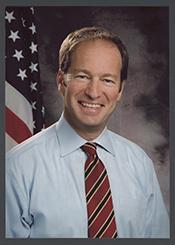
I thank the gentleman for yielding. I think the gentlelady made an excellent point highlighting the weakness of this bill. The gentlelady from Nevada pointed out that this is not indexed for…
I thank the gentleman for yielding.
I think the gentlelady made an excellent point highlighting the weakness of this bill. The gentlelady from Nevada pointed out that this is not indexed for inflation. Let's make no mistake: a characterization that someone else is kicking the can down the lane, this bill, in fact, kicks the can down the lane because if it's not indexed for inflation, then at the very least we are going to be knocking up against the alternative minimum tax problem that has so plagued this Congress over the past couple of years.
I heard, Mr. Speaker, a couple of minutes ago one of the folks on the other side of the aisle who is sort of characterizing things as folks weren't paying taxes. I want to put that into a context. Look, here is a little bit of a list. If you're running around the United States of America and doing any kind of economic activity, these are the taxes you're going to run into. You're going to be paying capital gains, you're going to be paying Federal income taxes, or unemployment taxes, or motor fuel taxes, or gift taxes, Medicare taxes, payroll taxes, property taxes, real estate transfer taxes, telecommunications taxes, sales taxes, self-employment taxes, Social Security taxes, State income taxes, tolls, bridges. You name it, you're going to be loaded up with taxes.
And so here is an opportunity for us to say, let's have a clear, good shot. As Representative Camp said a couple of minutes ago, death should not be a taxable event. Let's not act as if this accumulation over a period of years has not been taxed along the way.
So I think the National Association of Manufacturers accurately pointed out that it's not the tax burden alone that's the problem here. It's not simply the fact that it's not indexed for inflation. But the cumulative effect is, in fact, the problem because according to the NAM, $94,000 a year is spent on tax preparation and estate planning. I say let's lift the tax burden. Let's recognize the cumulative nature of taxes that people are paying. Let's not, with a straight face, try and say people aren't paying taxes, and let's vote against this bill.
Mr. Speaker, on December 3rd, 2009 I was unavoidably detained and missed rollcall vote No. 928. Had I been present, I would have voted ``aye''.
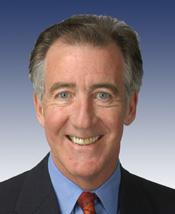
Mr. Speaker, if it were up to me, this would not have been done the way it is playing out today. I believe that this issue should be taken up in the context of tax reform, which the Ways and Means…
Mr. Speaker, if it were up to me, this would not have been done the way it is playing out today. I believe that this issue should be taken up in the context of tax reform, which the Ways and Means Committee and the House should visit next year, but it is what it is.
But the most important reminder here today for all of us is this: This is not the House of Lords. This is not about peerage. This is not about, in America, being born to any class or any race that offers superiority. This is not permanent wealth. This is not the argument that because of your last name, you ought to be entitled to a special privilege in what is the most egalitarian society that the world has known.
But the truth is that the extension that we are offering today takes us down the path to reform, and that is where I hope we end up. We need the certainty as to estate tax rules come
January 1. If we let the current rules expire, there will be estates that are harmed by a loss of step-up in basis. This pits the ultrarich--who, by the way, are the ones who seek repeal--against the moderately rich who we attempt to assist here in this step-up in basis.
But I want to quote Warren Buffett on the issue of estate tax. And, incidentally, he was cleverly left out by the other side as they ascribed responsibility for repeal of the estate tax. Warren Buffett said, ``Dynastic wealth, the enemy of a meritocracy, is on the rise. Equality of opportunity has been on the decline. A progressive and meaningful estate tax is needed to curb the movement of a democracy toward plutocracy.''
This body is a reflection of meritocracy in American society. It is unlike other legislative institutions in other parts of the world. You get here largely on merit.
I am going to close on the note on which I opened: This is not the way I would have done this, but I do think that Mr. Pomeroy has made a valiant effort to find some middle ground as we proceed to next year.
This legislation makes permanent the current estate tax rules that include a 45 percent rate and a $3.5 million exemption for individuals and $7 million for couples. It achieves a middle ground among the various proposals offered, and it helps allow for tax planning certainty.
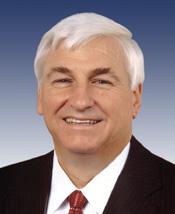
I thank the gentleman from North Dakota for yielding. I also thank Chairman Rangel for his work and also particularly the gentleman from North Dakota for his longtime dedication to resolving this…
I thank the gentleman from North Dakota for yielding. I also thank Chairman Rangel for his work and also particularly the gentleman from North Dakota for his longtime dedication to resolving this issue and making it fair and permanent for families who are trying to plan estates.
Mr. Speaker, I rise today to speak against the motion to recommit and in favor of H.R. 4154, the Permanent Estate Tax Relief for Families, Farmers, and Small Businesses Act of 2009. The bill before us creates permanent financial guidelines for the future of families, farmers, and small businesses across this country.
Due to the policy enacted in 2001 under the Republican leadership, financial planning for estates since then has been at best unpredictable, a crapshoot for now a decade. The leadership at that time had a chance to fix this problem because we had surpluses as far as the eye could see. But they failed to act, and by doing so, they failed hundreds or thousands of families in this country, despite, as I said earlier, a picture of record surpluses as far as the eye could see. Instead, a policy was created that set an unsustainable rate for political gain.
Congress can do better. We can provide some permanency. The leadership of this body, my Democratic colleagues and I, have chosen to solidify the future of American families by making these 2009 levels permanent.
Let's be clear. The motion to recommit provides the same sort of uncertainty for folks who are planning for their estates as was done in 2001. What the motion to recommit does is extend the zero tax rate for 1 year to the end of 2011, and then in 2012 it comes back just like it was in 2001. How in the world are families supposed to plan when they're sitting down with their lawyers and their accountants near the end of life, how in the world are they supposed to plan with those kinds of laws in place? It is heartily irresponsible.
So I would plead with you to defeat this motion, pass H.R. 4154. Let's send it to the Senate hooked with PAYGO and see if we can't get this country back on track economically and provide some certainty and permanency for the folks as they plan for their estates.
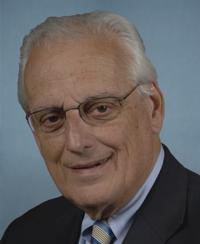
Mr. Speaker, I thank my friend, Mr. Pomeroy. I stand before you to support H.R. 4154. Some of my colleagues on the other side of the aisle want you to believe, and we have heard this before, that…
Mr. Speaker, I thank my friend, Mr. Pomeroy.
I stand before you to support H.R. 4154. Some of my colleagues on the other side of the aisle want you to believe, and we have heard this before, that everybody is going to pay an estate tax. If you listen to the rhetoric, and I am glad we are looking at the world. I am glad we are looking at the world, and we will find out on the health issue we are now 40th in terms of infant mortality. But let's look at the world. You are incorrect and it is very unfair when you claim that this is a tax for all Americans--it is not--and all family businesses. It is not. In fact, it is American to act on shared responsibility.
The Citizens for Tax Justice just recently made this very clear, December 2: It follows that it is reasonable to tax the transfer of enormous estates, most of which consist of income that was never taxed. That's what you are protecting, the folks that have estates that have never been taxed. You want to throw a shield over them to protect what you did protect in 2001, which you did protect in 2003. You want to protect it from one generation of superrich families so they can send it on to another group.
Since 1990s, opponents of the tax have even used the pejorative term ``death tax.'' But they are flat out wrong. The estate tax affects only estates of significant size--presently, right now, over $3.5 million for individuals and $7 million for couples.
The fact is that the estate tax is the most progressive tax in our Federal tax system. What you are suggesting is very regressive. Only the top 0.2 percent of the income earners paid all of the estate taxes collected.
If we do nothing, then 44,400 estates that are not currently subject to the estate tax will become targets. The point I want to make now is that many estates have paid no taxes. That is not shared responsibility.
Under our bill, only the top 7,600 estates in the country will be subject to the estate tax in 2011. The truth of the matter is that I don't know any working class American families that own estates worth over $7 million. It is insidious to infer anything different.

Mr. Speaker, I yield myself such time as I may consume. Mr. Speaker, death in and of itself should not be a taxable event. Death should not force the sale of family farms or the dissolution of small…
Mr. Speaker, I yield myself such time as I may consume.
Mr. Speaker, death in and of itself should not be a taxable event. Death should not force the sale of family farms or the dissolution of small businesses. The fear of death should not be a reason for an American to hire a battery of accountants and lawyers to find legal ways to reduce the bite of the estate tax. And after a long wait, we're about to realize that goal. Set in motion by a law passed by the Republican Congress earlier this decade, there will be no death tax in 2010. That's just 29 days away.
The bill before us, however, would resurrect the death tax next month and apply a 45 percent tax rate to estates above a $3.5 million exemption amount. The majority claims to be offering certainty to taxpayers, and I suppose in a way they are.
They are certainly repealing the hope of ever eliminating the death tax. They are replacing that with the certainty of a Federal tax rate that at 45 percent must be considered confiscatory. No American should have the Federal Government take nearly half of their net worth.
They're providing the certainty of an exemption that is not indexed for inflation, meaning that over time it is certain that more and more family farms and small businesses will be subject to this punishing tax. Just take a look at the AMT.
Mr. Speaker, one other thing that is certain about this bill is that it is unlikely to be approved before the end of the year. As we are all aware, the Senate is fully engaged in the health care debate. It is unlikely to break from that to consider this bill this month, particularly since a clear majority of the Senate has indicated its support for a far more equitable and bipartisan death tax relief measure.
We all understand that the current situation would benefit from a permanent solution, but this is not the right one, and I urge its defeat.
Mr. Speaker, I reserve the balance of my time, and I ask unanimous consent the remainder of my time be controlled by the gentleman from Texas (Mr. Brady).

Mr. Speaker, I rise today in support of H.R. 4152, the Permanent Estate Tax Relief for Families, Farmers, and Small Businesses Act of 2009. This is responsible legislation that would provide…
Mr. Speaker, I rise today in support of H.R. 4152, the Permanent Estate Tax Relief for Families, Farmers, and Small Businesses Act of 2009. This is responsible legislation that would provide permanent tax relief to middle-class families and family-owned businesses, while maintaining the estate tax for only the 7,600 wealthiest individuals nationwide, according to the Committee on Ways and Means.
H.R. 4152, the Permanent Estate Tax Relief for Families, Farmers, and Small Businesses Act of 2009 permanently would set the estate tax at the 2009 level. This would allow families and small businesses to have certainty about the rate of taxation on their estates and plan accordingly.
Currently the estate tax exemption is set at $3.5 million for individuals and $7 million for couples and with a maximum tax rate of 45 percent. Unless the House and the Senate take action, the estate tax is scheduled to enter 1 year of full repeal in 2010 followed by a return of the estate tax in 2011 with a drastically reduced exemption level and a much higher maximum rate of taxation. If we allow the estate tax to return to a $1 million exemption at a tax rate of 55 percent, 30,000 more American small businesses, farms, and families will be subject to the estate tax in 2011. Given the high property values in New Jersey, allowing the estate tax to revert to a million dollar exemption would hit my constituents especially hard.
Additionally, the legislation we are considering today would require all new spending to be paid for and not increase the debt by instituting pay-as-you-go budgeting as law. I support pay-as-you-go rules because fiscal discipline must always be a hallmark of our government. In the 1990s with pay-as-you-go as the law, we turned the massive deficits of the 1980s into a record surplus under President Clinton. Pay-as-you-go is only one tool, but it is a strong one to return our Nation back to fiscal stability.
I urge my colleagues to support this legislation.
Show 11 more
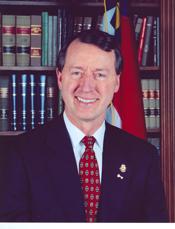
I thank the gentleman for yielding. And since I have been in this Congress, I have worked to extend the benefits with estate planning and raise exemptions for the last 12 years. The estate tax was…
I thank the gentleman for yielding.
And since I have been in this Congress, I have worked to extend the benefits with estate planning and raise exemptions for the last 12 years. The estate tax was never meant to affect the vast majority of Americans. Under H.R. 4154, only 25 of every 10,000 estates would be subject to estate tax.
By extending current law, this bill strikes a balance. It provides certainty for estate planning and prevents tens of thousand of estates from being subject to taxation while also being fiscally responsible.
Critically, this bill protects our small businesses and farmers. In my district in North Carolina, there are plenty of farmers that are ``land rich and cash poor'' that may be affected by the reach of the estate tax because their land and equipment are worth quite a bit, but their business may be barely getting by.
Many small businesses that form the backbone of our economy are the engine of job creation, and they face the same dilemma. Rather than worrying about the estate tax, these businesses need to focus on the growth and expansion that can improve our economy. This legislation will allow them to do just that.
Only 100 small businesses and farm estates would owe any estate tax in 2010 under these rules, according to the numbers I get.
Now, as a former small businesses owner, I also know that that provides certainty that is crucial for business planning. This is equally true for individuals who need to plan for the future of themselves, their children and their grandchildren. We should encourage the dreams of Americans who want to build wealth that they can leave to their children and grandchildren, but also it needs to be fair.
America is the land of equality of opportunity; and by making sure that 99.8 percent of estates are exempt from estate tax while encouraging that the fewer than 8,000 pay, this bill provides and preserves opportunity for all.
I encourage my colleagues to vote for it.

I appreciate the gentleman's courtesy as I appreciate his leadership on this issue. This is the culmination of a 12-year example of how not to create tax policy. I listened with interest to my good…
I appreciate the gentleman's courtesy as I appreciate his leadership on this issue.
This is the culmination of a 12-year example of how not to create tax policy. I listened with interest to my good friend from Texas say, you know, they can do better than this bill. Well, ladies and gentlemen, they had 12 years to do better. And what did the Republicans do? They didn't reform the inheritance tax. What they did is they established a 10-year gain where it was reduced a little bit each year until next year it disappears, and then they give it back to the American people at a $1 million level and 55 percent marginal rate. That is the best they could do.
And as my good friend from North Dakota pointed out, it's even worse than that because they would have 70,000, not 7,000, the top two-tenths of a percent, but 70,000 people who are the real small business, the entrepreneurs, be subject to a capital gains tax. And I will tell you that the tax itself is only the tip of the iceberg because it will be an accounting nightmare to go back and figure out what grandma paid or what Uncle Charlie paid for the asset. Some people will spend more time researching and on accountants than they will pay in the tax. That's the best that the Republicans could do.
What Mr. Pomeroy and our committee have done is to take generous levels, $3.5 million per person, and exempt below that the administrative nightmare of the capital gains tax. Is it a perfect solution? No.
But compared to the best that the Republicans could do for 12 years, it's night and day.
With all due respect, declaring one of my heroes, Teddy Roosevelt, who brought about the inheritance tax, as being un-American is an insult to the Republican Party who knows that the vast wealth in this country, you don't get to be a billionaire on a W2. So a lot of this money was never even taxed once. Let's get a grip. Let's pass this bill and move on.

Mr. Speaker, I thank the gentleman from North Dakota for yielding. The bill we are considering this afternoon is not my chosen option. While I will vote for this bill, I don't think it goes far…
Mr. Speaker, I thank the gentleman from North Dakota for yielding.
The bill we are considering this afternoon is not my chosen option. While I will vote for this bill, I don't think it goes far enough, nor is it a truly permanent solution.
Yesterday at the Rules Committee, I offered an amendment that would have raised the estate tax exemption and reduced the rate, creating a sensible, stable and, most importantly, a permanent framework to help families and businesses effectively plan for the burden of the estate tax.
This position is favored by a wide coalition of business and farm groups; and unlike the bill on the floor today, it is indexed for inflation. This is important, because without indexing, the estate tax will, like the alternative minimum tax, grow over time to cover more and more estates, eventually affecting many middle class Americans.
Philosophically, I don't think there should be an estate tax. There are few things in this world that you can do to avoid paying taxes. I think dying should be one of those things.
I introduced bipartisan legislation to alleviate the burden the estate tax creates for farms, businesses, and individuals. The legislation would have responsibly phased up the exemption to $5 million, $10 million for couples, and lowered the rate to 35 percent over the next 10 years to reduce the burden on those estates that still have an estate tax liability.
Given the current economic situation, even one job lost to the estate tax is too much. We need to encourage stability in every way possible. While the bill before us, in my opinion, is not a permanent solution, it is far better than a short-term patch. It ensures stability in the Tax Code and allows for estate planning. I believe it will free up resources currently used to plan for the estate tax.
I will vote for this bill, and I urge my colleagues to join me and do likewise.
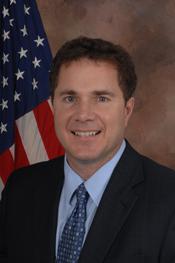
Mr. Speaker, today I stand in support of H.R. 4154, the Permanent Estate Tax Relief for Families, Farmers, and Small Businesses Act of 2009 because I understand the importance of protecting Iowa's…
Mr. Speaker, today I stand in support of H.R. 4154, the Permanent Estate Tax Relief for Families, Farmers, and Small Businesses Act of 2009 because I understand the importance of protecting Iowa's farms and small businesses. This bill helps ensure that these businesses are not downsized as they are passed from one generation to the next.
While I am supportive of the estate tax exemption of $3.5 million per person in the short term, I am frustrated that the bill does not adjust this amount for inflation. Earlier this week, I submitted an amendment to the Rules Committee to adjust the estate tax for inflation, but that amendment was not allowed to the House Floor. While the title of this bill indicates that it is a permanent fix, I worry that we will be right back in the same situation in a few years.
Do not let the estate tax go down the same path as the alternative minimum tax, AMT. The AMT was originally passed in 1969 as a measure to target 155 high-income households that were paying little or no income tax because of loopholes in the tax code at that time. However, because it was not adjusted for inflation, an increasing number of middle-class taxpayers have found themselves subject to this tax. Indexing the estate tax for inflation will help ensure that it does not have the unintended consequence of impacting middle-class families in the future.
As this bill continues through the congressional process, I urge my colleagues to adjust the estate tax for inflation so that it truly is a permanent fix.
I thank my friend and gentleman from Texas for all of the work he has done on this incredibly cruel tax. Mr. Speaker, far too many families have faced the grim prospect of selling the family farm or…
I thank my friend and gentleman from Texas for all of the work he has done on this incredibly cruel tax.
Mr. Speaker, far too many families have faced the grim prospect of selling the family farm or business in order to pay the taxes that are due when a loved one dies. My own cousins had to sell their farm that had been in our family since the early 1900s just to pay the death tax. Mr. Speaker, this is simply wrong.
Although it is encouraging that Congress is attempting to provide a long-term certainty about death tax rates, the bill before us falls far short of a stable solution for agriculture and small business. The proposed exemption is simply not enough to protect family farmers, especially with the high cost of land in California and other heavily populated States.
Worse yet, H.R. 4154 fails to index the exemption amount for inflation, thus guaranteeing a repeat of the alternative minimum tax disaster with more and more families facing the death tax in future years. That's why leading pro-agricultural groups like the California Farm Bureau and National Cattlemen's Association do not support this bill.
Mr. Speaker, this House has voted five times since 2001 to repeal the death tax entirely. In fact, no fewer than 65 members of the current Democrat majority have voted to fully repeal the death tax. It is time to end this unfair and cruel death tax once and for all.

Mr. Speaker, I rise in support of H.R. 4154, the ``Permanent Estate Relief for Families, Farmers, and Small Businesses Act of 2009.'' This bill will extend permanently the 2009 estate tax rules,…
Mr. Speaker, I rise in support of H.R. 4154, the ``Permanent Estate Relief for Families, Farmers, and Small Businesses Act of 2009.'' This bill will extend permanently the 2009 estate tax rules, which are estimated to affect only 1 in 500 estates. By allowing the estate tax to expire next year, we will be depriving the Federal Government of critically needed funds to finance, among other things, economic stabilization programs. Moreover, at a time when many working Americans are losing their jobs and finding it difficult to make ends meet, particularly in southeast Michigan, it strikes me as wholly unconscionable that the Congress should approve a tax cut for the wealthiest of the country's citizens. Furthermore, while I am ever cognizant of the effect of Federal policy on small businesses, I would remind my colleagues that, according to the Tax Policy Center, only 100 small business and farm estates in the entire Nation would owe any estate tax in 2010 if the 2009 rules were extended, and virtually none of them would have to be sold to pay the tax.
Thus, in my view, the bluster about the purported effect of this bill on farms and small businesses is unfounded. As such, I urge my colleagues to vote in favor of this bill, as I will.
Mr. Speaker, pursuant to House Resolution 941, I call up the bill (H.R. 4154) to amend the Internal Revenue Code of 1986 to repeal the new carryover basis rules in order to prevent tax increases and…
Mr. Speaker, pursuant to House Resolution 941, I call up the bill (H.R. 4154) to amend the Internal Revenue Code of 1986 to repeal the new carryover basis rules in order to prevent tax increases and the imposition of compliance burdens on many more estates than would benefit from repeal, to retain the estate tax with a $3,500,000 exemption, and for other purposes, and ask for its immediate consideration in the House.
Mr. Speaker, I ask unanimous consent that all Members may have 5 legislative days to revise and extend their remarks and insert extraneous material in the Record.
Mr. Speaker, I yield myself such time as I may consume.
I, along with Ways and Means Ranking Member David Camp, have asked the nonpartisan Joint Committee on Taxation to make available to the public a technical explanation of the bill. The technical explanation expresses the committee's understanding and the legislative intent behind this important legislation. It is available on the Joint Committee's Web site at www.jct.gov and is listed under document No.

Mr. Speaker, I rise in support of the Permanent Estate Tax Relief for Families, Farmers, and Small Businesses Act of 2009. If enacted into law, this legislation would permanently extend the estate…
Mr. Speaker, I rise in support of the Permanent Estate Tax Relief for Families, Farmers, and Small Businesses Act of 2009.
If enacted into law, this legislation would permanently extend the estate tax at its current 2009 top rate of 45 percent and exemption level of $3.5 million, $7 million for joint filers. In so doing, H.R. 4154 will provide needed certainty for families engaged in estate planning while significantly reducing the total number of estates subject to the estate tax relative to current law. This measure is consistent with both President Obama's FY 2010 Budget, as well as Congress's FY 2010 Budget Resolution--and importantly, today's rule incorporates statutory PAYGO into the underlying initiative, which will go a long way towards restoring our Nation's long-term fiscal discipline.
I urge my colleagues' support.
Mr. Speaker, I rise in opposition to the permanent extension of the 2009 estate tax. The American people have more pressing concerns. Our priority should be to create jobs, enact health reform, and…
Mr. Speaker, I rise in opposition to the permanent extension of the 2009 estate tax. The American people have more pressing concerns. Our priority should be to
create jobs, enact health reform, and extend unemployment insurance and COBRA assistance, not provide gifts for the wealthiest 7,000 Americans.
I favor a 1-year extension of current law, and then we can consider the estate tax in the context of all of the expiring Bush tax provisions. This provision should not be given priority over helping those who can't find affordable health coverage or have lost their home or their job.
Now is not the right time for this legislation. Let's pass a 1-year extension and get back to the issues that are truly important to the American people--creating jobs and assisting struggling families. I urge a ``no'' vote.
Mr. Speaker, on rollcall No. 928 I was unavoidably detained. Had I been present, I would have voted ``aye''.
Mr. Speaker, on rollcall No. 928 I was unavoidably detained. Had I been present, I would have voted ``aye''.
Mr. Speaker, on rollcall No. 928 I was unavoidably detained. Had I been present, I would have voted ``aye''.
Mr. Speaker, on rollcall No. 928 I was unavoidably detained. Had I been present, I would have voted ``aye''.
Bill Text
Legislative text isn't available for this bill yet.