Mr. Speaker, I move to suspend the rules and pass the bill (H.R. 1954) to implement the President's request to increase the statutory limit on the public debt. I yield myself such time as I may…
Mr. Speaker, I move to suspend the rules and pass the bill (H.R. 1954) to implement the President's request to increase the statutory limit on the public debt.
I yield myself such time as I may consume.
Mr. Speaker, last December, the President's own Fiscal Commission offered a plan to rein in our budget deficits and debt. While I did not support the final package--especially the tax increases it proposed--it did contain several meaningful suggestions for ways to get our Federal spending under control. Yet last February, when the President submitted his budget for 2012, he ignored their advice and provided no plan to rein in deficits and debt. Last month, Standard and Poor's downgraded the outlook for the U.S. credit rating because Washington appeared to have no plan to rein in our budget deficits and debt.
In recent weeks, many congressional Democrats were proving them right when over 100 of them called for an unconditional increase in the U.S. debt limit. They signed a letter calling on their colleagues to establish ``the Democratic position in favor of a clean extension of the debt ceiling,'' something Secretary Geithner has also repeatedly called for.
It's time to come clean with the American people about our deficits and debt. At over $14 trillion, our debt is as large as the entire U.S. economy and is putting the American Dream at risk for future generations. It has become an anchor on economic growth, costing us 1 million jobs at a time when the unemployment rate has not been this high for this long since the Great Depression.
Erskine Bowles, who chaired President Obama's Fiscal Commission and served as Chief of Staff to President Clinton, has said that the era of debt denial is over. While it doesn't appear that all of his Democrat colleagues have gotten the message, with today's vote this House will declare to the American people and to the credit rating agencies that business as usual in Washington is over. Not only is the era of debt denial over, but so is Washington's out-of-control spending.
Today, we are making clear that Republicans will not accept an increase in our Nation's debt limit without substantial spending cuts and real budgetary reforms. This vote, a vote based on legislation I have introduced, will and must fail. Now, most Members aren't happy when they bring a bill to the floor and it fails, but I consider defeating an unconditional increase to be a success because it sends a clear and critical message that the Congress has finally recognized we must immediately begin to rein in America's affection for deficit spending.
Research by international experts clearly demonstrates that spending reforms, not tax increases, are the most effective path to fiscal consolidation. That means that together we must look for responsible ways to tackle our runaway spending. And though it's difficult and not always popular, it requires us to deal with entitlement reforms that are the largest driver of America's deficits, including health care spending programs like Medicare.
We all know that failing to act and address our debt head-on would be very similar to defaulting on our debt. In both cases, we would experience a significant downgrade in our credit rating, which increases interest rates, making payments for things like a car and home loans more expensive. It would also increase the cost of imports, meaning higher gas prices. And it would make an already shaky economy even worse, leading to less job creation.
The greatest threat to the U.S. economy and to international financial markets would be simply increasing the debt limit without cutting a penny of spending. This vote makes clear that deficit reduction will be part of any bill to increase the debt limit and is a necessary part of this process.
A ``no'' vote today is a vote to put us on the path toward exactly what the markets and the American people are demanding, an America that is a strong, reliable, and secure financial investment for the future. I urge all my colleagues to vote ``no'' on this unconditional increase.
I reserve the balance of my time.
I continue to reserve the balance of my time.
I yield myself such time as I may consume.
I would just say during the 8 years of the Bush administration, the debt limit was raised seven times for a total of $5.365 trillion. According to the CBO, the Congressional Budget Office, the nonpartisan CBO, the scorer of President's Obama's fiscal year 2012 budget, the debt limit will have to be raised a total of $5.385 trillion during the 4 years he's President. So 8 years versus 4 years. That means that President Obama will have raised the debt limit at twice the pace that President Bush did.
I reserve the balance of my time.
I yield 2 minutes to a distinguished member of the Ways and Means Committee, the chairman of the Trade Subcommittee, Mr. Brady from Texas.
I yield 1\1/2\ minutes to a distinguished member of the Ways and Means Committee, the gentlewoman from Tennessee (Mrs. Black).
I yield the gentlewoman an additional 30 seconds.
I yield myself such time as I may consume.
I would say that the Medicare trustees have said that Medicare goes broke in 2024.
So if you support an unconditional debt limit increase, as 100 Democrats wrote to their leaders and asked to be made a position of the Democrat Caucus, that does nothing about preserving and protecting Medicare for the future.
No, I will not yield.
So I would say that by supporting an unconditional increase in the debt limit, as more than 100 wrote in a letter to their leaders, again, it would do nothing about preserving that program for the future.
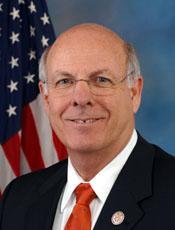
At this time I yield 1 minute to the gentleman from New Mexico (Mr. Pearce).
I yield myself such time as I may consume.
I am certainly concerned about the last 8 years, but I am more concerned about the last 2. I think we have got the third year in a row of trillion dollar deficits, a Presidential budget that doubled the debt in 5, tripled it in 10.
I quote from the Standard and Poor's report on the United States debt:
``Because very large deficits and rising government indebtedness and the path to addressing these is not clear to us, we have revised our outlook on the long-term rating to negative from stable.''
The path to addressing these is not clear. We think it absolutely essential that we not have an unconditional increase in the debt limit, that we have the spending reductions, that we have the structural reforms that we so desperately need in this country.
We have 110 Members of the other party who wrote a letter saying we want an unconditional increase in the debt; just keep spending. Don't bring in any spending reductions, don't bring any long-term reforms; just keep going the way we have been going.
Well, Standard and Poor's says that if we don't address this issue-- and what does that mean that ``we have revised our outlook on the long- term rating to negative from stable''? It means buying a house is more expensive; buying a car is more expensive. Certainly our ability to sell our bonds around the world will be very difficult to do and make it that much more expensive.
A downgrade in our debt limit would have the same impact as not increasing the debt limit at all. Financial markets would be disrupted, borrowing costs would skyrocket, the dollar would plunge, driving up the cost of imports like gasoline and causing higher inflation. It would wreak havoc on our economy.
Research Update: United States of America ``AAA/A-1+'' Rating Affirmed;
Outlook Revised To Negative
Overview
We have affirmed our ``AAA/A-1+'' sovereign credit rating
on the United States of America.
The economy of the U.S. is flexible and highly diversified,
the country's effective monetary policies have supported
output growth while containing inflationary pressures, and a
consistent global preference for the U.S. dollar over all
other currencies gives the country unique external liquidity.
Because the U.S. has, relative to its ``AAA'' peers, what
we consider to be very large budget deficits and rising
government indebtedness and the path to addressing these is
not clear to us, we have revised our outlook on the long-term
rating to negative from stable.
We believe there is a material risk that U.S. policymakers
might not reach an agreement on how to address medium- and
long-term budgetary challenges by 2013; if an agreement is
not reached and meaningful implementation does not begin by
then, this would in our view render the U.S. fiscal profile
meaningfully weaker than that of peer ``AAA'' sovereigns.
Rating Action
On April 18, 2011, Standard & Poor's Ratings Services
affirmed its ``AAA'' long-term and ``A-1+'' short-term
sovereign credit ratings on the United States of America and
revised its outlook on the long-term rating to negative from
stable.
Rationale
Our ratings on the U.S. rest on its high-income, highly
diversified, and flexible economy, backed by a strong track
record of prudent and credible monetary policy. The ratings
also reflect our view of the unique advantages stemming from
the dollar's preeminent place among world currencies.
Although we believe these strengths currently outweigh what
we consider to be the U.S.'s meaningful economic and fiscal
risks and large external debtor position, we now believe that
they might not fully offset the credit risks over the next
two years at the ``AAA'' level.
The U.S. is among the most flexible high-income nations,
with both adaptable labor markets and a long track record of
openness to capital flows. In addition, its public sector
uses a smaller share of national income than those of most
``AAA'' rated countries--including its closest peers, the
U.K., France, Germany, and Canada (all AAA/Stable/A-1+)--
which implies greater revenue flexibility.
Furthermore, the U.S. dollar is the world's most used
currency, which provides the U.S. with unique external
flexibility; the vast majority of U.S. trade flows and
external liabilities are denominated in its own dollars.
Recent depreciation of the currency has not materially
affected this position, and we do not expect this to change
in the medium term (see ``Apres Le Deluge, The U.S. Dollar
Remains The Key International Currency,'' March 10, 2010,
RatingsDirect).
Despite these exceptional strengths, we note the U.S.'s
fiscal profile has deteriorated steadily during the past
decade and, in our view, has worsened further as a result of
the recent financial crisis and ensuing recession. Moreover,
more than two years after the beginning of the recent crisis,
U.S. policymakers have still not agreed on a strategy to
reverse recent fiscal deterioration or address longer-term
fiscal pressures.
In 2003-2008, the U.S.'s general (total) government deficit
fluctuated between 2% and 5% of GDP. Already noticeably
larger than that of most ``AAA'' rated sovereigns, it
ballooned to more than 11% in 2009 and has yet to recover.
On April 13, President Barack Obama laid out his
Administration's medium-term fiscal consolidation plan, aimed
at reducing the cumulative unified federal deficit by US$4
trillion in 12 years or less. A key component of the
Administration's strategy is to work with Congressional
leaders over the next two months to develop a commonly agreed
upon program to reach this target. The President's proposals
envision reducing the deficit via both spending cuts and
revenue increases, and the adoption of a ``debt failsafe''
legislative mechanism that would trigger an across-the-board
spending reduction if, by 2014, budget projections show that
federal debt to GDP has not yet stabilized and is not
expected to decline in the second half of the current decade.
The Obama Administration's proposed spending cuts include
reducing non-security discretionary spending to levels
similar to those proposed by the Fiscal Commission in
December 2010, holding growth in base security (excluding war
expenditure) spending below inflation, and further cost-
control measures related to health care programs. Revenue
would be increased via both tax reform and allowing the 2001
and 2003 income and estate tax cuts to expire in 2012 as
currently scheduled--though only for high-income households.
We note that the President advocated the latter proposal last
year before agreeing with Republicans to extend the cuts
beyond their previously scheduled 2011 expiration. The
compromise agreed upon in December likely provides short-term
support for the economic recovery, but we believe it also
weakens the U.S.'s fiscal outlook and, in our view, reduces
the likelihood that Congress will allow these tax cuts to
expire in the near future. We also note that previously
enacted legislative mechanisms meant to enforce budgetary
discipline on future Congresses have not always succeeded.
Key members in the U.S. House of Representatives have also
advocated fiscal tightening of a similar magnitude, US$4.4
trillion, during the coming 10 years, but via different
methods. House Budget Committee Chairman Paul Ryan's plan
seeks to balance the federal budget by 2040, in part by
cutting non-defense spending. The plan also includes
significantly reducing the scope of Medicare and Medicaid,
while bringing top individual and corporate tax rates lower
than those under the 2001 and 2003 tax cuts.
We view President Obama's and Congressman Ryan's proposals
as the starting point of a process aimed at broader
engagement, which could result in substantial and lasting
U.S. government fiscal consolidation. That said, we see the
path to agreement as challenging because the gap between the
parties remains wide. We believe there is a significant risk
that Congressional negotiations could result in no agreement
on a medium-term fiscal strategy until after the fall 2012
Congressional and Presidential elections. If so, the first
budget proposal that could include related measures would be
Budget 2014 (for the fiscal year beginning Oct. 1, 2013), and
we believe a delay beyond that time is possible.
Standard & Poor's takes no position on the mix of spending
and revenue measures the Congress and the Administration
might conclude are appropriate. But for any plan to be
credible, we believe that it would need to secure support
from a cross-section of leaders in both political parties.
If U.S. policymakers do agree on a fiscal consolidation
strategy, we believe the experience of other countries
highlights that implementation could take time. It could also
generate significant political controversy, not just within
Congress or between Congress and the Administration, but
throughout the country. We therefore think that, assuming an
agreement between Congress and the President, there is a
reasonable chance that it would still take a number of years
before the government reaches a fiscal position that
stabilizes its debt burden. In addition, even if such
measures are eventually put in place, the initiating
policymakers or subsequently elected ones could decide to at
least partially reverse fiscal consolidation.
In our baseline macroeconomic scenario of near 3% annual
real growth, we expect the general government deficit to
decline gradually but remain slightly higher than 6% of GDP
in 2013. As a result, net general government debt would reach
84% of GDP by 2013. In our macroeconomic forecast's
optimistic scenario (assuming near 4% annual real growth),
the fiscal deficit would fall to 4.6% of GDP by 2013, but the
U.S.'s net general government debt would still rise to almost
80% of GDP by 2013. In our pessimistic scenario (a mild, one-
year double-dip recession in 2012), the deficit would be
9.1%, while net debt would surpass 90% by 2013. Even in our
optimistic scenario, we believe the U.S.'s fiscal profile
would be less robust than those of
other ``AAA'' rated sovereigns by 2013. (For all of the
assumptions underpinning our three forecast scenarios, see
``U.S. Risks To The Forecast: Oil We Have to Fear Is . . .,''
March 15, 2011, RatingsDirect.
Additional fiscal risks we see for the U.S. include the
potential for further extraordinary official assistance to
large players in the U.S. financial or other sectors, along
with outlays related to various federal credit programs. We
estimate that it could cost the U.S. government as much as
3.5% of GDP to, appropriately capitalize and relaunch Fannie
Mae and Freddie Mac, two financial institutions now under
federal control, in addition to the 1% of GDP already
invested (see ``U.S. Government Cost To Resolve And Relaunch
Fannie Mae And Freddie Mac Could Approach $700 Billion,''
Nov. 4, 2010, RatingsDirect). The potential for losses on
federal direct and guaranteed loans (such as student loans)
is another material fiscal risk, in our view. Most
importantly, we believe the risks from the U.S. financial
sector are higher than we considered them to be before 2008,
as our downward revisions of our Banking Industry Country
Risk Assessment (BICRA) on the U.S. to Group 3 from Group 2
in December 2009 and to Group 2 from Group 1 in December
2008 reflect (see ``Banking Industry Country Risk
Assessments,'' March 8, 2011, and ``Banking Industry
Country Risk Assessment: United States of America,'' Feb.
1, 2010, both on RatingsDirect). In line with these views,
we now estimate the maximum aggregate, up-front fiscal
cost to the U.S. government of resolving potential
financial sector asset impairment in a stress scenario at
34% of GDP compared with our estimate of 26% in 2007.
Beyond the short- and medium-term fiscal challenges, we
view the U.S.'s unfunded entitlement programs (such as Social
Security, Medicare, and Medicaid) to be the main source of
long-term fiscal pressure. These, entitlements already
account for almost half of federal spending (an estimated 42%
in fiscal-year 2011), and we project that percentage to
continue increasing as long as these entitlement programs
remain as they currently exist (see ``Global Aging 2010: In
The U.S., Going Gray Will Cost A Lot More Green,'' Oct. 25,
2010, RatingsDirect). In addition, the U.S.'s net external
debt level (as we narrowly define it), approaching 300% of
current account receipts in 2011, demonstrates a high
reliance on foreign financing. The U.S.'s external
indebtedness by this measure is one of the highest of all the
sovereigns we rate.
While thus far U.S. policymakers have been unable to agree
on a fiscal consolidation strategy, the U.S.'s closest
``AAA'' rated peers have already begun implementing theirs.
The U.K., for example, suffered a recession almost twice as
severe as that in the U.S. (U.K. GDP declined 4.9% in real
terms in 2009, while the U.S.'s dropped 2.6%). In addition,
the U.K.'s net general government indebtedness has risen in
tandem with that of the U.S. since 2007. In June 2010, the
U.K. began to implement a fiscal consolidation plan that we
believe credibly sets the country's general government
deficit on a medium-term downward path, retreating below 5%
of GDP by 2013.
We also expect that by 2013, France's austerity program,
which it is already implementing, will reduce that country's
deficit, which never rose to the levels of the U.S. or U.K.
during the recent recession, to slightly below the U.K.
deficit. Germany, which suffered a recession of similar
magnitude to that in the U.K. (but has enjoyed a much
stronger recovery), enacted a constitutional limit on fiscal
deficits in 2009 and we believe its general government
deficit was already at 3% of GDP last year and will likely
decrease further. Meanwhile, Canada, the only sovereign of
the peer group to suffer no major financial institution
failures requiring direct government assistance during the
crisis, enjoys by far the lowest net general government debt
of the five peers (we estimate it at 34% of GDP this year),
largely because of an unbroken string of balanced-or-better
general government budgetary outturns from 1997 through 2008.
Canada's general government deficit never exceeded 4% of GDP
during the recent recession, and we believe it will likely
return to less than 0.5% of GDP by 2013.
Outlook
The negative outlook on our rating on the U.S. sovereign
signals that we believe there is at least a one-in-three
likelihood that we could lower our long-term rating on the
U.S. within two years. The outlook reflects our view of the
increased risk that the political negotiations over when and
how to address both the medium- and long-term fiscal
challenges will persist until at least after national
elections in 2012.
Some compromise that achieves agreement on a comprehensive
budgetary consolidation program--containing deficit reduction
measures in amounts near those recently proposed, and
combined with meaningful steps toward implementation by
2013--is our baseline assumption and could lead us to revise
the outlook back to stable. Alternatively, the lack of such
an agreement or a significant further fiscal deterioration
for any reason could lead us to lower the rating.
Standard & Poor's will hold a global teleconference call
and Web cast today--April 18, 2011--at 11:30 a.m. New York
time (4:30 p.m. London time). For dial-in and streaming audio
details, please go to www.standardandpoors.com/cmlive.
Related Criteria And Research
Sovereign Credit Ratings: A Primer, May 29, 2008.
Ratings List
Ratings Affirmed; Outlook Action
United States of America (Unsolicited Ratings) (To--From)
Sovereign Credit Rating (AAA/Negative/A-1+) (AAA/Stable/A-
1+)
Ratings Affirmed
United States of America (Unsolicited Ratings) Senior
Unsecured (AAA)
United States of America (Unsolicited Ratings) Transfer &
Convertibility Assessment (AAA)
This unsolicited rating(s) was initiated by Standard &
Poor's. It may be based solely on publicly available
information and may or may not involve the participation of
the issuer. Standard & Poor's has used information from
sources believed to be reliable based on standards
established in our Credit Ratings Information and Data Policy
but does not guarantee the accuracy, adequacy, or
completeness of any information used.
Complete ratings information is available to subscribers of
RatingsDirect on the Global Credit Portal at
www.globalcreditportal.com. All ratings affected by this
rating action can be found on Standard & Poor's public Web
site at www.standardandpoors.com. Use the Ratings search box
located in the left column.
I reserve the balance of my time.
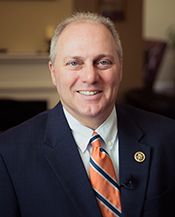
I yield 2 minutes to the gentleman from Louisiana (Mr. Scalise).
I yield myself such time as I may consume.
One hundred fourteen members of the other party signed a letter to the leader who just spoke and asked for an unconditional increase in the debt limit. I know that's not maybe a fact they want to acknowledge now, but it is so important that we have a clear path forward on this given what the rating agencies are saying about our debt. They're saying it's not clear how we are going to deal with our indebtedness.
It is so important that we set forward that when we address this issue, there are going to be the kind of spending reductions and structural reforms we need. That is going to have to be part of this discussion. We can't continue to have it clouded with this idea that we might have a debt limit increase without any of those. That's why it is so important to send this very strong signal today.
I hope all of the members of your party join me in voting ``no'' on this bill.
At this time, I yield 1 minute to the distinguished gentleman from Michigan (Mr. Huizenga).
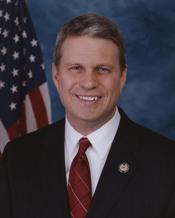
At this time, I yield 2 minutes to a distinguished member of the Ways and Means Committee, the gentleman from North Dakota (Mr. Berg).
Mr. Speaker, I reserve the balance of my time.
Not at this time.
Mr. Speaker, I have no further requests for time, and I reserve the balance of my time.
Mr. Speaker, I ask unanimous consent that all Members have 5 legislative days in which to revise and extend their remarks and to include extraneous material on H.R. 1954.
I yield myself such time as I may consume.
Last February, when the President submitted his budget for 2012, he did not provide any plan for reining in deficits and debt. The administration called for a clean increase in the debt limit, or an increase in the debt limit that was unconditional, one that had no spending reductions or structural reforms to try to address the problem that we face, and it assumed $2.4 trillion in borrowing authority, or an increase in the debt limit of about $2.4 trillion. One hundred fourteen Democrats have asked the leadership of their party for an unconditional vote on the debt limit.
My colleagues on the other side have been very reminiscent about the Bush years, and I would just say that, in 4 years, the debt under the Obama administration will exceed that of the Bush administration's in 8 years; or another way of putting that is the debt under this President is going up at twice the rate it did under President Bush.
So it is important that we send a clear signal that there is not going to be an unconditional increase in the debt limit and that we are serious about addressing our debt and deficit problems as a country. We've seen the signals that we've gotten from the financial markets, and we've heard what our constituents have said. It is very important that we bring the kinds of spending reductions and reforms to this debate that we need to, so I urge a ``no'' vote.
I yield back the balance of my time.
Mr. Speaker, on that I demand the yeas and nays.