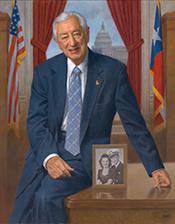
Mr. Speaker, I rise in support of H.R. 6633, a bill to designate the United States courthouse located at 101 East Pecan Street in Sherman, Texas, as the ``Paul Brown United States Courthouse''. Judge…
Mr. Speaker, I rise in support of H.R. 6633, a bill to designate the United States courthouse located at 101 East Pecan Street in Sherman, Texas, as the ``Paul Brown United States Courthouse''. Judge Brown was an outstanding Federal judge who passed away on November 26 after 21 years of distinguished service. Judge Paul Brown was my good friend, a respected judge, and beloved member of the Sherman, Texas community.
Judge Brown represented the finest qualities of jurisprudence. Hanging on his wall in the Sherman Federal Courthouse were Socrates' four qualities for a good judge--to hear courteously, to answer wisely, to consider soberly, and to decide impartially.
Judge Brown embodied all of these qualities, and he dispensed justice accordingly. He was highly regarded, well-respected, and was a role model for many.
Paul Brown was the youngest of a family of six raised on a farm near Pottsboro, TX. He graduated from Denison High School and although underage, he was able to get his parents' consent to join the U.S. Navy when World War II broke out. He served on a minesweeper in both the Atlantic and Pacific Theaters and as a part of the occupation forces in Japan. He was discharged as an Electrician's Mate 2nd Class in June 1946.
He returned to his studies and received a law degree in 1950 from the University of Texas before being recalled to active duty in the Korean war. He saw combat aboard a minesweeper which was sunk by mines, and he received an honorable discharge in December 1951.
Judge Brown worked as an assistant U.S. Attorney in Texarkana under U.S. Attorney William Steger--who would become his mentor, good friend, and eventually fellow colleague on the bench. He served as Assistant U.S. Attorney from 1953 to 1959, and then followed in Judge Steger's footsteps as U.S. District Attorney from 1959 to 1961.
While in Texarkana, Judge and married Frances Morehead, and the two returned home to Sherman, where he practiced law for a number of years. In 1985 Senator Phil Graham recommended him to President Ronald Reagan for a new judge's position created for the Eastern District of Texas, and he was confirmed that year. He held court in Beaumont, Paris, Sherman, and Texarkana, and as the caseload in Sherman grew, he eventually presided over the Sherman courthouse exclusively.
Premiere cases over the years included intellectual property, patent cases, and criminal cases precipitated by the bank and savings and loan failures of the 1980s and 1990s. In recent years he noted the increase in drug cases and expressed his regret that, in spite of all the efforts that have been made to prosecute drug dealers, the Nation is not making much progress in curtailing the use of drugs. No matter what type of cases came before him, Judge Brown always enjoyed the work and ran an efficient and orderly courtroom. His personal work ethic and judicial integrity were remarkable, and his reputation for punctuality is legendary.
As we near adjournment of the 112th Congress, I ask my colleagues to join me in celebrating the life of a great American, outstanding public servant, and respected jurist. This bill has the support of the Federal judges in the Eastern District, and I ask for your support of H.R. 6633, to designate the United States courthouse in Sherman, Texas, the ``Paul Brown United States Courthouse''.
The bill was ordered to be engrossed and read a third time, was read the third time, and passed, and a motion to reconsider was laid on the table.
General Leave