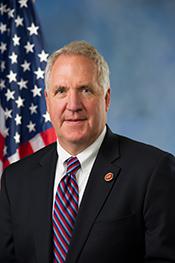
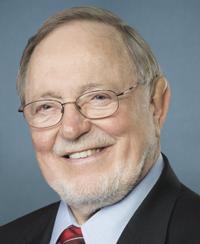
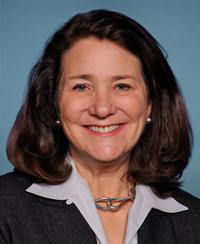
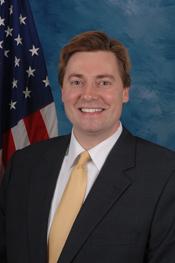
Mr. Speaker, I yield myself such time as I may consume. (Mr. SHIMKUS asked and was given permission to revise and extend his remarks.) Mr. Speaker, I rise today in strong support of the pending…
Mr. Speaker, I yield myself such time as I may consume.
(Mr. SHIMKUS asked and was given permission to revise and extend his remarks.)
Mr. Speaker, I rise today in strong support of the pending resolution, particularly with respect to the effect on jobs and the economy.
My colleagues on the other side are going to oppose this effort, claiming we are seeking to strip basic public health and safety protections. No one is in favor of hurting those in those areas, but that is not the purpose of us being here today.
We have had numerous hearings over the last couple of days on rules and regulations and how they hurt job creation. This gives power back to the committees to then do that, fine-tooth comb through rules and regulations and address what the President talked about in his State of the Union; where there are rules and regulations that don't make sense, we need to eliminate them, because we need to focus on job creation. We can't regulate existing businesses into the ground on the hope that better ones will come later. We must protect the jobs currently we have and open the doors for new businesses as well.
As the chairman of the Subcommittee on Environment and the Economy, I am particularly interested in the activities of the EPA. I am going to talk about three examples, one we heard yesterday in testimony.
United States Steel came before us and said imagine a regulation where we have to decrease the heat in the preparation of steel to comply with NOX, but as we move to EPA rules and regulations on greenhouse gasses we actually have to use the same process and heat
that process up. So U.S. Steel will be caught in a catch-22. Under one reg, they have to keep the heat low to comply with nitrous oxide regulations; on the other hand, in the same process, they have to heat it up to meet the greenhouse gas rules.
Now, what is a steel company going to do? They are going to move to China. You can't develop rules and regulations that cannot be complied with by existing known technologies, and that was just a perfect example.
Another one that I find, and a lot of these things not only hurt jobs, but they are going to hurt the environment. The example is the redefinition of used oil as a solid waste. Now, this sounds like, what are they talking about?
Many of us, and there are times when many of us, when we were young, we changed our own oil. We would get underneath the car, pull the plug and drain the oil. Fortunately, in today's world, you can take it to an auto repair shop, you can take it to maybe a parts store, and you can then recycle that used oil.
Not if the EPA has its say, because what they do in the redefinition of this is the only way you can dispose of this off-brand, off-used oil is to burn it. Oh, that is real great for the environment, burning the used oil. And what will the home do-it-yourselfer do? They are probably going to pour it on the ground. So EPA regs not only hurt job creation, but they have a great effect in hurting and harming the economy.
The next one, one of the issues we will address next week in the committee is coal ash byproducts. This is another one that is curious in which the EPA is trying to meddle in. Despite EPA's own testing and admittance that these coal byproducts do not qualify as hazardous waste based on their toxicity, EPA wants to label them as toxic material.
What does that mean? Any byproducts used will then be required to be disposed of in special landfills or dumps and not recycled. Coal ash can't go into concrete. Gypsum can't go into wallboard. Wallboard that has to be disposed of or you are going to remodel your home, what happens to that wallboard? The cost of doing business increases, and these all are things that hurt job creation.
We applaud President Obama in his State of the Union when he says there's too many regulations and we need to ease the regulatory burden. That's the importance of what we're doing here--one of the few things we agree on with the administration. And this will allow us committee by committee to go through the process and identify those hindrances and start to move legislation to address those.
With that, Mr. Speaker, I reserve the balance of my time.
I now yield 2\1/2\ minutes to the chairman of the Health Subcommittee, Joe Pitts.
It is business that creates jobs. Easing the regulatory burden helps create jobs.
Mr. Speaker, I would now like to yield 2 minutes to the gentlewoman from California, Congresswoman Bono Mack, who is the chairman of the Commerce, Manufacturing and Trade Subcommittee.
I yield the gentlewoman an additional 15 seconds.
Mr. Speaker, I yield 2\1/2\ minutes to the chairman of the Oversight and Investigations Subcommittee, Chairman Stearns.
(Mr. STEARNS asked and was given permission to revise and extend his remarks.)
Mr. Speaker, I yield myself such time as I may consume.
We don't care which administration created all these burdensome regulations. If they do not protect public health and harm job creation, we want to review them. I don't see what's the big damage of that, and every time you hear the word ``incentives'' you know what that means? Tax dollars. That means borrowing money from China to incentivize who knows what.
We want capital formation through the private sector to create jobs. The government can no longer do that.
I now yield 2 minutes to my colleague from Pennsylvania (Mr. Murphy), who is the vice chairman of my subcommittee.
Mr. Speaker, I want to share with my colleagues, we'll have a chance next week to vote on greenhouse gas regulations, which will kill jobs. Those bills are coming.
I yield 2 minutes to the gentlewoman from Tennessee (Mrs. Blackburn).
Mr. Speaker, I now yield 1\1/2\ minutes to my colleague from Ohio who is from the largest manufacturing district in the country, Mr. Latta.
Mr. Speaker, I yield 1\1/2\ minutes to the gentlewoman from Washington, Cathy McMorris Rodgers, the vice chairman of the Republican Conference.
Mr. Speaker, I yield 2 minutes to the gentleman from Houston (Mr. Olson) the former Navy fighter pilot.
Mr. Speaker, I now yield 2 minutes to one of our new colleagues from Colorado (Mr. Gardner).
Mr. Speaker, I yield myself such time as I may consume.
I'm glad my colleague talked about the Clean Air Act. The Clean Air Act was passed in the 1990s, and it identified six criteria pollutants. And we know a lot of what those are--nitrous oxide, sulfur dioxide, particulate matter. Carbon dioxide was never identified in the law. In fact, Chairman Emeritus Dingell said numerous times the Clean Air Act was never designed to regulate carbon.
Even as the EPA now moves in the direction of climate, they've changed the rules. They are not complying with the Clean Air Act because of their tailoring rule, thus picking winners over losers.
If we go down the road to regulate carbon, we raise the cost of creating jobs. Jobs move overseas. That's what the Waxman-Markey debate was last year. That's why the majority last year could not pass a bill to regulate carbon, because of the impact on jobs.
So why are we here?
We're not trying to end regulation. We're trying to make sure that there's an economic analysis on what occurs on jobs. What's the job impact?
Administrator Jackson, throughout the entire process, could not tell us. In fact, they only do it in silos and never the cumulative effect of what are the jobs lost based upon regulation.
What is the compliance cost?
We ought to know that because the more there is a requirement to comply with the rules and regulations when we're competing against China, who has no rules and regulations, we are less competitive, we lose jobs.
Is it so harmful to ask where's the benefit, a cost-benefit analysis of all these regulations?
So we'll get a chance. I know I was asked by the other side earlier in the debate, where is the legislation to affect rules and regulations that will create jobs?
Well, it's coming next week, and it's the greenhouse gas rules and regulations, which does not affect the Clean Air Act, which does not change, after all their portrayals on dirty air, it does
not affect a single criteria pollutant in the Clean Air Act.
Mr. Speaker, I reserve the balance of my time.
I was expecting a few Members, but I don't expect them to come now.
Mr. Speaker, I think this has been a great debate. And Diana DeGette is a great friend of mine. We've served here in the Chamber for a long time. And I think it's good for the public to understand that we can have strong disagreements without being disagreeable. And I'm probably one of the strongest, outspoken loudmouths on the committee. And I have been recently. But I think it's also good to know that we can continue, even on very controversial issues on life. She has very strong opinions, and I have very strong opinions. But Congresswoman DeGette has my respect, and she's a friend.
During last fall, businesses kept coming to me and saying, all we want to be is left alone. That's really part of this debate.
The Democrat majority, in fact, in the last 2 years, they had the whole shooting match. These are the same debates you had about us. You could have addressed the regulatory burdens on business, but you didn't. You had the House, you had the Senate, you had the Presidency. Not one bill to ease the regulatory burden.
So now the pendulum has shifted. We're into job creation. One of the burdens of job creation is excessive regulation. Businesses want to be left alone. There's too much uncertainty.
What have we done to bring to the floor to help provide certainty? We voted to repeal the health care law. If you want to talk to businesses, both large and small, one of the biggest things that has created uncertainty is Obamacare. And that was on the floor.
The second thing that created the most uncertainty is climate and a carbon tax, raising the cost. That's going to come to the floor.
So here are two major provisions passed in this Chamber, hurt jobs, we get a chance to address on the floor. And so this is an important exercise. We're going to be doing it in the committee. We've had four hearings in the committee on issues all around the regulatory burdens.
I gave you the example of U.S. Steel. Here they've got a NOX requirement so they keep the burners on low. But a carbon requirement would require that the burners are on high. How do they comply? I'll tell you how they comply. They move the steel mill to a country that does not have those regulations. Or we import it.
Should we look at these and address these? The answer is yes.
I see my colleague from Louisiana has shown up. If my colleague from Colorado doesn't mind, I yield the balance of my time to my colleague from Louisiana (Mr. Scalise).