To provide additional funds for programs relating to West Nile Virus and to fund the Mosquito Abatement for Safety and Health Act.
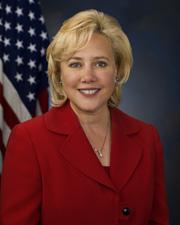 Sen. Mary L. Landrieu (D-LA)
Legislative Activity
Stay on top of the latest movement without scrolling through every action
Senate amendment submitted
September 10, 2003
View full timeline
Senate amendment submitted
September 10, 2003
Senate amendment proposed (on the floor): Amendment SA 1614 proposed by Senator Landrieu to Amendment SA 1542.(consideration: CR S11292-11293, S11308-11309; text: CR S11292)
September 10, 2003
Roll call votes on amendments in Senate: Motion to waive the Budget Act with respect to amendment SA 1614 rejected in Senate by Yea-Nay Vote. 46 - 49. Record Vote Number: 345.
September 10, 2003
Amendment SA 1614 proposed by Senator Landrieu to Amendment SA 1542. (consideration: CR S11292-11293, S11308-11309; text: CR S11292) To provide additional funds for programs relating to West Nile Virus and to fund the Mosquito Abatement for Safety and Health Act.
September 10, 2003
Point of order raised in Senate with respect to amendment SA 1614.
September 10, 2003
Motion to waive the Budget Act with respect to amendment SA 1614 rejected in Senate by Yea-Nay Vote. 46 - 49. Record Vote Number: 345.
September 10, 2003
Amendment SA 1614 ruled out of order by the chair.
September 10, 2003
Votes
1 roll call on this amendment
Text
Proposed
DEPARTMENTS OF LABOR, HEALTH AND HUMAN SERVICES, AND EDUCATION, AND
RELATED AGENCIES APPROPRIATIONS ACT, 2004

The PRESIDENT pro tempore. Under the previous order, the Senate will
resume consideration of H.R. 2660, which the clerk will report.
The legislative clerk read as follows:

A bill (H.R. 2660) making appropriations for the
Departments of Labor, Health and Human Services, and
Education, and related agencies for the fiscal year ending
September 30, 2004, and for other purposes.

Pending:

Specter amendment No. 1542, in the nature of a substitute.
Akaka amendment No. 1544 (to amendment No. 1542), to
provide funding for the Excellence in Economic Education Act
of 2001.
Mikulski amendment No. 1552 (to amendment No. 1542), to
increase funding for programs under the Nurse Reinvestment
Act and other nursing workforce development programs.
Kohl amendment No. 1558 (to amendment No. 1542), to provide
additional funding for the ombudsman program for the
protection of vulnerable older Americans.
Dodd amendment No. 1572 (to amendment No. 1542), to provide
additional funding for grants to States under part B of the
Individuals with Disabilities Education Act.
DeWine amendment No. 1561 (to amendment No. 1542), to
provide funds to support graduate medical education programs
in children's hospitals.
DeWine amendment No. 1560 (to amendment No. 1542), to
provide funds to support poison control centers.
DeWine amendment No. 1578 (to amendment No. 1542), to
provide funding for the Underground Railroad Education and
Cultural Program.
Harkin amendment No. 1580 (to amendment No. 1542), to
protect the rights of employees to receive overtime
compensation.
Schumer amendment No. 1598 (to amendment No. 1542), to
provide additional funding for programs under the Ryan White
Care Act.
Reed amendment No. 1595 (to amendment No. 1542), to provide
funding for home energy assistance needs under the Low-Income
Home Energy Assistance Act of 1981.
Reed amendment No. 1592 (to amendment No. 1542), to
increase funding for immunization services.
Reed amendment No. 1596 (to amendment No. 1542), to
increase funding for certain literacy, library, and museum
programs.
Corzine amendment No. 1602 (to amendment No. 1542), to
restore cuts in student aid.
Reid amendment No. 1603 (to amendment No. 1542), to
increase funding for certain education and related programs.

The PRESIDENT pro tempore. The Senator from Pennsylvania.
Mr. SPECTER. Mr. President, we are set to proceed with a series of
stacked votes at 9:45 a.m. There are a fair number of amendments which
have yet to

[[Page S11264]]

be offered. The distinguished ranking member and I are prepared to work
through those amendments expeditiously. It may be possible to
accommodate some of the Members in their requests.
The majority leader has again announced that upon completion of this
bill there will be no votes on Thursday or Friday, although the Senate
will be in session. When that word travels throughout the membership,
there is more incentive to complete this bill at an early time.
Yesterday we did have a productive day, starting at 5:15 p.m. We had
four rollcall votes. We debated six amendments on into the evening.
As I survey the sheet, if we have cooperation on all sides, it is
possible to move through this bill in an expeditious way and perhaps
finish this bill today sooner rather than later.
I thank the Chair, and I yield the floor.
The PRESIDENT pro tempore. The Senator from Iowa.
Mr. HARKIN. Mr. President, I understand we are going to start the
vote at 9:45 a.m.
The PRESIDENT pro tempore. The Senator is correct.
Mr. HARKIN. Mr. President, first, I thank the leadership on the other
side. I thank my colleague and the chairman of the appropriations
subcommittee, Senator Specter, for working out this arrangement. It is
one that reasonable minds and reasonable cool heads have agreed now we
are going to proceed ahead on a series of votes this morning.
I know there are some other amendments today. I see no reason why we
can't wrap up this bill this evening sometime, hopefully at a decent
hour anyway. I know there are a lot of other important amendments. I
wish to take a little bit of time to speak about the first amendment
that we will be voting on at 9:45.
Mr. GREGG. Mr. President, will the Senator yield for a question?
Mr. HARKIN. Without losing my right to the floor.
Mr. GREGG. Are we going to divide the time between proponents and
opponents of the amendment between now and 9:45? I understand there is
no time agreement. I would like to have 2 minutes in opposition to the
amendment.
Mr. HARKIN. I inquire of the Chair.
The PRESIDENT pro tempore. There is no previous order concerning
division of time. The time set for the vote is 9:45.
Mr. HARKIN. But there is no time set for dividing the time.
The PRESIDENT pro tempore. There is no agreement on dividing the
time.
Mr. SPECTER. Mr. President, I ask unanimous consent that the
intervening time be equally divided between both sides--whatever time
there is--to make a presentation.
The PRESIDENT pro tempore. There are 6 minutes remaining.
Mr. HARKIN. That sounds fair.
The PRESIDENT pro tempore. Without objection, it is so ordered. The
Senator from Iowa.

Amendment 1580

Mr. HARKIN. Thank you, Mr. President. The first vote will be on
overtime. I think it has been thoroughly debated. I think Senators know
what we are voting on in this amendment. I wish to make a few comments
to bring us up to the point of voting on this amendment.
Again, I do not see this in any way as any kind of a partisan vote.
It should not be. This affects workers no matter whether they are
Republicans, Democrats, Independents, or whatever. It does not make any
difference. This crosses all party lines.
What has happened, through the Department of Labor, is they came out
with these proposed changes in overtime rules and regulations. No
hearings were held, and now they say they do not have to have hearings.
The law does not mandate that they have to have hearings, but one would
think on a major issue such as this they would have gone out to the
public and they would have worked with Congress to reach some
reasonable agreement on modifying and updating Fair Labor Standards Act
regulations. But, no, they came out with these changes in a very
heavyhanded manner.
If one reads the proposed rules and regulations, they really do wipe
away the overtime pay protections for I don't know--the figures are all
over--8 million, 10 million, 6 million. I don't know what the proper
number is, but I can tell you it wipes out overtime pay protection for
millions of Americans who have it right now.
My amendment basically says no money can be expended to further
promulgate, publish, or enact these rules and regulations.
That does not mean the Department of Labor cannot come back at some
point and say we need to modify these. Maybe we need to throw out some
old terms.
As I pointed out, the Fair Labor Standards Act has been modified a
dozen times since 1938, but it has always been done sort of in
consultation with Congress, in an open fashion. That is the way it
ought to be done again, especially with something so sensitive as
overtime pay.
So this is our vote in which we can basically say no, we are not
going to move ahead with these; we are going to go back to the drawing
board. If they want to come up to the Congress, to the appropriate
authorizing committees in the House and the Senate, and try to work
something out, that is fine and we can do that.
In closing, last week the Senate unanimously passed this resolution
by Senator Hatch, expressing the sense of the Senate that October would
be National Work and Family Month. The resolution expressed the sense
of the Senate that reducing the conflict between work and family life
should be a national priority. We passed this last Friday unanimously.
Are we today going to vote to say we do not care about what we said;
what we are going to do is allow these rules and regulations to go into
effect which will take away the overtime pay protection for millions of
Americans?
Let's back up what we said last Friday with our votes this morning.
I yield the floor and reserve the remainder of my time.
The PRESIDENT pro tempore. The Senator has consumed his time.
Mr. LEVIN. Mr. President, I come to the floor today to speak in
support of the Harkin amendment regarding the Bush administration's
proposal to make regulatory changes to the Fair Labor Standards Act,
FLSA, of 1938. The Bush administration's assault on middle-income
white- and blue-collar workers continues with this latest proposal by
the Department of Labor, DOL. Under current law, the FLSA requires
employers to pay time and a half for overtime work except for some
narrow exemptions. Introduced this Spring with little public notice,
the DOL has proposed regulations that would disqualify potentially
millions of workers from the overtime protections afforded them under
the FLSA. Regulations proposed by the DOL on March 31 of this year
would make it easier for employers to reclassify their workers as
``executive,'' ``administrative'' or ``professional'' employees who are
not entitled to the overtime protections of the FLSA. According to the
Economic Policy Institute, more than 8 million workers could be
negatively affected by the Bush administration regulatory changes. This
is a frontal assault on the 40-hour work week.
The Harkin amendment would prevent the DOL from issuing any
regulation that disqualifies currently covered workers from the
overtime protections of the FLSA. The amendment would not prevent DOL
from making changes to overtime regulations that would benefit low-
income workers. There is simply no justification for stripping any
workers of their overtime rights and thus their statutory right to time
and a half. And the workers who would still be protected by the FLSA
would also receive a pay cut because employers would naturally shift
overtime assignments to the millions of workers no longer entitled to
overtime pay. In 2000, overtime pay accounted for about 25 percent of
the income of workers who worked overtime or about $161 a week. The
President's much-touted tax cut would give workers earning less than
$62,500 a tax cut of a $1.68 per week. This administration's overtime
proposal is just not worker or family friendly. It will result in
workers working more hours without overtime pay, undermining the 40-
hour work week. The DOL proposed regulations would deny overtime
protections not only to white-collar office workers, but also to many
manual and other union workers. Union workers would be forced to
negotiate for overtime protections that are now guaranteed by the FLSA.
The overtime exceptions would affect all

[[Page S11265]]

workers earning more than $65,000 as well as workers with certain
specialized training such as policemen, firefighters, paramedics, EMTs,
as well as other white-collar professionals such as secretaries,
bookkeepers, and paralegals.
Every facet of American industry will be affected by the proposed DOL
regulations. For example, assembly line and production workers at auto
manufacturing plants could lose overtime protection if they ``employ a
high-level of skill or training.'' Furthermore, factory workers making
up to $65,000 could lose overtime protection if they perform some
nonmanual office work and have at least one job duty that can be
characterized as ``executive,'' ``administrative'' or ``professional.''
Nonmanual office work seems to be a broad term that could encompass
many fairly routine workplace activities. Even a worker who at the end
of the day is required to document his or her workplace activities
might be swept in to the administrative exemption. Surely this was not
the intent of the FLSA.
At a time when we are asking more and more of our Nation's first
responders, the administration wants to eliminate their overtime pay. A
good example are the police officers responsible for the security of
the Capitol Complex. Many of these officers have consistently worked in
excess of 40 hours ever since September 11, 2001. Many of these
officers have spent long periods of time away from their family and
friends with their only consolation being overtime pay. How can
President Bush and Secretary Chao possibly tell law enforcement
officers across this Nation that they no longer deserve to be paid
overtime for their work?
Mr. President, we must do what is equitable for American workers.
Millions of workers depend on overtime pay to make ends meet. If the
administration really wants to help low-income workers, they will
support an increase in the Federal minimum wage to $6.65 an hour which
would benefit far more than the 1.3 million low-income workers which
DOL estimates will benefit from proposed changes. A vote for the Harkin
amendment is a vote for working families across America. I hope it will
receive a resounding ``yes'' vote.
Mr. LAUTENBERG. Mr. President, I rise in support of the Harkin
amendment to the Labor, Health and Human Services, and Education
appropriations bill for fiscal year 2004.
I proudly support this amendment because it would prevent the
administration from implementing any regulation that would take away
the overtime pay rights of American workers.
The Bush administration's hostility to this Nation's hard-working men
and women is shocking and frankly disappointing.
We all know this administration's performance on job growth: since
President Bush assumed office, he has pushed for three separate tax
cuts for the wealthy, yet he has not created a single net job.
Rather, the policies of President Bush have produced a loss of 3.1
million private sector jobs. The number of unemployed Americans has
risen from 6 million to over 9 million. Just last month, the Nation's
payroll lost 93,000 jobs.
Instead of working to put Americans back to work, the administration
has decided to ``modernize'' workplace regulations by eliminating
overtime pay for million of workers.
The Economic Policy Institute concludes that more than 8 million
workers would lose overtime protection. Even the conservative
Employment Policy Foundation estimates that 1.16 million workers would
lose their overtime pay.
The administration, however, claims that only 644,000 workers would
be negatively affected by its proposal.
Regardless of the losses estimated, the proposed regulation would
disqualify more workers from overtime protection, and there is simply
no justification for stripping any workers of their overtime rights.
Just yesterday, nursing home workers from my home state came to my
office and told me that they get paid between $7 and $10 per hour and
that they rely on overtime pay as an essential supplemental to their
low hourly pay.
The administration opposes an increase in the minimum wage which
would help millions of American workers, but it supports a proposal
that would decrease the take-home pay of millions of American workers.
Once again this administration has misguided priorities. We should be
doing all we can to improve the working conditions and the quality of
life of the American worker, not make it worse.
The 40-hour workweek was created in the Fair Labor Standard Act in
1938. We enacted this legislation because workers were being abused and
not properly compensated.
The FLSA became the bedrock of worker- and family-friendly
legislation because we recognized that after 40-hours of work, 8-hours
a day for 5 days, an employee should be paid time and a half for work
performed beyond 40 hours.
Today, the workers protected by the 40-hour workweek requirement are
the Nation's first responders and first-preventers like police officer,
nurses, and firefighters. Other protected workers include the millions
of administrative, technical, manufacturing, and restaurant workers who
are struggling to make ends meet.
We should protect the American workers. And, I urge my colleagues to
support the Harkin amendment.
Mr. SARBANES. Mr. President, I strongly support the Harkin amendment
to preserve overtime pay protections for millions of hard-working
Americans. The American work ethic, along with great skill and
ingenuity, has made the United States an economic world power.
Americans already log more hours on the job than workers in most other
developed countries around the world and I believe that those who have
long driven the American economy should be fairly compensated for their
work. However, the Bush administration has proposed new regulations
that would amend the Fair Labor Standards Act of 1938 and undermine
current law governing overtime pay.
The proposed Department of Labor regulations would raise the salary
level under which workers are eligible for overtime pay from $8,060 per
year to $22,100 per year. Raising this income threshold is an
inadequate adjustment, but it is a step in the right direction. Due to
the rising expenses facing working families, I recognize the need to
make more low-income workers eligible for overtime pay. The pending
amendment does not preclude the Department of Labor from issuing rules
that make such changes. Instead, it simply prohibits the Department of
Labor from taking away overtime protections for those who are currently
eligible under the Fair Labor Standards Act.
Under the Department of Labor's proposal virtually all employees who
earn $65,000 or more per year would be denied overtime pay protection
currently afforded under the Fair Labor Standards Act. Additionally, it
would allow employers to reassign middle-income workers, earning
between $22,100 and $65,000, to managerial roles, thereby depriving
them of overtime pay rights. The Harkin amendment would block this
reclassification.
Our economy is facing serious difficulties. What we need is
responsible economic policy that puts our economy back on track.
Instead, this administration has proposed massive tax cuts to benefit
the wealthiest among us, presided over the largest job loss in our
Nation's history, erased a large Federal surplus that it inherited, and
created a large and growing Federal deficit. Now the administration
proposes to amend a law that has protected American workers for over 60
years by taking away the overtime pay that many working families depend
upon to make ends meet.
The Department of Labor claims its proposal is necessary to
``clarify'' and ``update'' overtime rules for the 21st century economy.
However, consider some examples of the occupations currently eligible
for overtime pay that may be in jeopardy should the Department of Labor
go forward with this proposal: firefighters, law enforcement officers,
social caseworkers, medical assistants, and nurses. These workers are
performing vital functions in our society and should be compensated for
the long hours they put in to do their jobs.
The American people have spoken on this issue. The Department of
Labor has been flooded by public comments

[[Page S11266]]

that run overwhelmingly against the implementation of its proposal. The
American people are right. The number of individuals eligible for
overtime should be increased, not decreased. A responsible economic
plan would put more disposable income into the hands of working
Americans, not take it away.
I find the Department of Labor's proposal unwise and unfair, but very
much in keeping with this administration's failed economic policies
that seek to leave no millionaire behind while increasing the financial
burden on average Americans. Therefore, I urge my colleagues to support
the Harkin amendment.
Mr. BINGAMAN. Mr. President, I rise today in support of the Harkin
amendment related to proposed administration changes to overtime
regulations, and I am pleased to be a co-sponsor.
The Fair Labor Standards Act of 1938 established that--with only a
few specific exceptions--American workers were entitled to overtime
pay, meaning time and a half wages, for every hour worked beyond the
accepted 40-hour work week. The Fair Labor Standards Act was not passed
out of context. The legislation derived from the labor abuses that
occurred in the early 1900s. Furthermore, it was signed into law
because political and labor leaders at that time agreed that workers
should not be pushed beyond their breaking point. By making every hour
beyond 40 more expensive, the legislation discouraged employers from
assigning longer hours and rewarded employees for sacrificing their
personal or family time for their company. Workers could still work
longer hours if they chose to do so, or if they needed additional
income--many do so today--but they could not be required to do so by
their employers, and they could not be required to do so at the same
wage level they earned during their 40-hour work week.
I think this was a perfectly reasonable bargain to have made then,
and I think it is a perfectly reasonable bargain now. It is a form of
social contract--one of many made at the time that have extended to the
present because they make good rational sense. And I am strongly of the
view that it should not be broken at this time.
The Bush administration has recently proposed substantial regulatory
changes that dramatically alter this social contract, and the
underlying principles that form its foundation. Under the guise of
``flexibility'' for employees, it has decided to change the categories
that will classify a worker as eligible for overtime, and in doing so,
will vastly increase the number of employees that are exempt from
overtime pay. The Department of Labor has estimated that the proposed
changes will affect only 644,000 workers. But the Economic Policy
Institute has concluded that the numbers are significantly
miscalculated and the correct figure is closer to 8 million. This
includes everyone from police officers, no firefighters, to registered
nurses, to medical technicians, to floor supervisors in service
industries, to paralegals, to journalists--any number of individuals
that currently earn more than $22,100 per year.
Worse, many of these individuals are currently in professions that
are essential to national security or difficult to fill. In my State of
New Mexico, for example, the proposed regulations would have very
profound effects. According to an analysis undertaken by the New Mexico
Department of Labor, over 37,000 workers will lost overtime benefits as
a result of the proposed rule change. Many of these workers are in
professions that we need in the State and we may lost if salaries are
decreased--specialty fields like teachers, physical therapists, health
care technicians, first responders, and so on. For the life of me I
don't see why the Bush administration would be providing disincentives
for people to work in fields where we need them the most. Why are we
telling teachers, or nurses, or firefighters that we don't value the
extra time you put in on the job? In my State these folks are
frequently living on a shoestring as it is. How can the Bush
administration justify a policy that takes money away from them?
I have three specific problems with the proposed overtime
regulations. First, as I have mentioned previously, it pulls back from
the social contract made with American workers in the past. I don't
understand what has changed over the last few years to require that
overtime rules be altered, and I don't believe it is time to alter an
agreement that at its core is designed to allow Americans to be
rewarded for hard work and spend more time with their families.
Second, I think it's the wrong time for change. We have now some of
the worst economic conditions that we have seen in years in this
country. Levels of unemployment continue to climb, so much so that many
workers have simply given up looking for work. Why are we telling those
who have work at this time that they should get less for what they do?
Why are we telling these folks they have to take a pay cut? Why are we
taking money out of the pockets of these folks, money that these days
go to make ends meet, but can also go for mortgages, education, and
savings accounts?
Third, given the current record of the Bush administration on key
labor issues--be it outsourcing, minimum wage, FMLA, workplace
protections, or anything else--I am not convinced that it is time to
give it ``flexibility'' to apply regulations of any type that will
affect American workers. From what I have seen so far, I think the
administration has taken a very clear stance against the low- and
middle-income workers that form the very heart and soul of this
country, and I think it is time that we push back on these policies.
I think it is essential that we send an unequivocal message to the
Bush administration that we will not allow changes on the overtime
regulations to occur. I believe it is bad policy that will hurt working
Americans at a time when they need our support.
Mr. HATCH. Mr. President, I rise today to encourage my Senate
colleagues to support the Department of Labor's proposed changes to our
nation's overtime regulations. The amendment being offered by my friend
Senator Harkin to the 2004 Labor, Health and Human Services, and
Education appropriations bill would prohibit spending to implement the
Department of Labor's proposed regulations and, thereby, cripple the
Department in making these important changes. This is not a wise course
of action and I wish to voice my support today for the Department's
proposed regulations changes.
Before discussing the proposed regulations, I would like to take a
moment to address current overtime rules. As you may know, there have
been very few changes to the Fair Labor Standards Act's, FLSA, overtime
provisions since the early 1970s.
Under these outdated rules, most workers are only guaranteed time-
and-a-half overtime pay if they earn less than $155 per week. If they
earn more than $155 per week, then employers have to use a number of
complicated and confusing tests to decide if a particular worker's job
is ``executive, administrative, or professional,'' and must also use
complicated tests to determine if the worker's pay qualifies as a
``salary'' rather than an hourly wage.
Thus, if a job pays over $155 per week--$170 per week for
``professionals''--and the job is executive, administrative or
professional, and the worker's pay fits the official definition of a
``salary,'' then that particular worker is not eligible for overtime.
You can imagine the complexity and confusion that businesses have to
deal with when they try to determine which workers have to be paid
overtime and which do not.
The current rules mean that a restaurant manager or a factory shift
supervisor who is paid a salary of $300 per week would be ineligible
for overtime, since these kinds of work are generally considered
executive or administrative.
I want to discuss the proposed rules in some detail, as I believe
there is a great deal of misunderstanding about what they would do and
why they are necessary. The Department of Labor's proposed regulations
would raise the $155 per week test to $425 per week. That means that,
as a general rule, anyone earning less than $425 per week would
automatically be guaranteed to be eligible for overtime pay, regardless
of what kind of work they do.
Therefore, the Department of Labor's proposed rules will guarantee
overtime pay to both the restaurant manager and the shift supervisor I
mentioned above. The proposed regulations will be

[[Page S11267]]

a boon to lower-income salaried workers. The Department of Labor
estimates that its proposed rules will make 1.2 million more lower-
income workers eligible for overtime pay. They also estimate that 20
percent of salaried employees earn $425 per week or less, roughly
$21,000 per year.
The rules will also modernize the definition of ``executive,
administrative, or professional'' work to reflect better the realities
of today's workforce and to reduce the incomprehensible regulatory
definitions that businesses have had to interpret for the last 20
years. That means that workers who earn more than $425 per week will
find it easier to determine whether or not they qualify for overtime
pay, and it will reduce the number of lawsuits over the ``gray areas''
in current overtime regulations.
Further, the Department of Labor also proposes to allow salaried
employees' pay to be docked for full-day absences taken for
disciplinary reasons, such as sexual harassment or workplace violence.
Currently, only hourly workers' wages are subject to such discipline-
related pay deductions.
And finally, the proposed rules state that workers who earn more than
$65,000 per year will be ineligible for overtime pay if their job has
at least some duties that are ``executive, administrative, or
professional.'' Therefore, employers who have these kinds of highly
compensated workers will find it easier to make them ineligible for
overtime. The Department of Labor chose the $65,000 threshold because
roughly 20 percent of salaried workers earn $65,000 or more per year.
The Department chose to focus its energies on strengthening access to
overtime for the most vulnerable workers, a group that is unlikely to
include many workers whose salaries are in the top 20 percent.
I believe that the current overtime regulations are confusing and
outdated. They have created a maze of uncertainty for business owners,
who can be fined up to 3 years of back wages if they misinterpret the
overtime eligibility rules. The Department of Labor's proposed rules
will make over a million more lower-income workers eligible for
overtime while also creating clearer overtime eligibility rules for all
businesses to follow. The Department of Labor's rules would guarantee
overtime pay to the bottom 20 percent of salaried workers--some of the
most economically vulnerable people in our society--while at the same
time giving employers more freedom over how they compensate the top 20
percent of salaried workers.
These rules are part of this administration's broader agenda for
long-lasting, long-term wage growth. These clearer, simpler regulations
will increase the efficiency and productivity of American businesses.
And since higher productivity is the key to higher wages, I expect
these regulations to help increase the typical American's standard of
living.
I have received numerous letters from individuals and industry who
support these regulatory efforts by the Department of Labor. I believe
the Department has done an excellent job of researching the overtime
issue and preparing regulations that meet the needs of American
workers. I encourage all of my Senate colleagues to support these
regulations and vote against any amendments that would weaken or impede
these much-needed overtime regulation updates.
Mrs. CLINTON. Mr. President, I rise in strong support of the Harkin
amendment, which would prevent the Department of Labor from
implementing its regulation that would deny overtime pay to 8 million
Americans, including 450,000 New Yorkers. I am proud to be a co-sponsor
of this amendment and hope that my colleagues will join me in
supporting it with their vote this afternoon.
Many of us celebrated Labor Day with picnics, parades, and fanfare,
but for too many American workers, there was not much to celebrate at
all. Close to 10 million Americans are about to lose overtime
protection because this administration has decided to do the bidding of
its corporate donors instead of protecting the rights of overworked and
underpaid Americans.
The regulation being proposed by the Department of Labor unilaterally
removes entire classes of workers from overtime eligibility.
Paralegals, engineers, social workers--today rely on overtime. Tomorrow
these individuals will be forced to work longer hours for less pay.
An let's not forget our police officers, firefighters, and nurses--
individuals who regularly work overtime because they are on the front
lines of our homeland defense. Does anyone imagine that these dedicated
individuals will stop working overtime after this regulation goes into
effect?
I can assure you that the New Yorkers who tell me how this will
affect them do not think so. They know that when duty calls, they will
respond. They simply will not be compensated for their effort.
A nurse from Lancaster, NY, wrote to me recently to say, ``I assure
you that as a Health Care Professional I work many exhausting though
rewarding hours in my position. However, I feel strongly that being
forced to work overtime without appropriate compensation is an insult.
As a dedicated health professional, I find it impossible to leave my
patients untended.''
If the administration wants to help working families as they say they
do they can fight to expand access to overtime, to raise the minimum
wage, and to ensure that every working American can take a sick day to
recover from the common cold without fearing for their jobs.
Instead, this regulation would make unpaid overtime a household word
and make it easier for bad-faith employers to coerce other workers into
accepting time off instead of overtime pay.
I do not think the administration is unaware of the impact of what
they are proposing. If they were, they would not have proposed this
overhaul of the Fair Labor Standards Act under the cloak of secrecy,
without a single Congressional hearing, without a single public
hearing.
As many of my colleagues know, when the Clinton administration tried
to issue ergonomics regulations, Republicans in Congress attacked the
Labor Department for ``rushing to judgment'' because it held ``only''
27 days of public hearings. Twenty-seven days.
And from this administration, not even one.
Those who support the administration's regulation argue that
Democrats are overstating our case. They claim that the proposed
regulation will not have anywhere near the impact that independent
experts say it will.
But for the sake of argument, let's assume the Department of Labor's
impact analysis is absolutely accurate. The administration's own
analysis reveals that 644,000 workers will lose overtime pay. But that
is only the number of workers currently earning overtime pay who will
lose eligibility. For each worker earning overtime pay, there are
another four or five who are protected by the overtime provisions of
the Fair Labor Standards Act but do not currently work more than 40
hours a week. All of them--between 3.2 million and 3.8 million by the
Department of Labor's own estimates--will lose their overtime
protection under the proposed rule. Their employers will require many
of them to work longer hours because they will have no incentive not
to. It won't cost them a dime, but it will cost our firefighters, our
police officers, our nurses, and so many others in time away from their
families and money out of their pocket.
The Department of Labor's analysis goes on to state that the changes
in the education test alone will result in 44 percent of the ``learned
professionals'' losing their right to overtime pay. That is 44 percent
of those working in the fields of chemistry, biology, nursing,
engineering, accounting, and more. That is 440,000 cooks who would lose
their right to overtime pay.
That analysis assumes, and I quote, ``that six years of work
experience might be considered equivalent to a bachelor's degree''--
even without a day of higher education. But this assumption is not
grounded in the rule. In fact, the Department of Labor's rule requires
no minimum education standard. If employers decide that their employees
have the same skills as employees with college degrees, employers may
exempt those employees from overtime.
So a cook from Buffalo who has never attended a day of college can be
deemed an exempt professional and denied overtime.

[[Page S11268]]

The administration is taking away the bread and butter earnings
American families count on, and leaving them with crumbs.
Republicans in my State have crossed party lines to block this
regulation--and I applaud them for doing so. They know how many New
Yorkers rely on overtime pay--not as a luxury, as a necessity.
I recently received a note from John, New York City police officer,
who wrote to me to say ``police officers like myself are forced to do
overtime whether we like or not because we need the money to stay ahead
of our bills.'' John is not alone. Overtime compensation accounts for
25 percent of the total compensation of all workers who receive
overtime pay.
This issue is not trivial. At its very core, this issue is about our
American values of work and family. Workers stripped of their overtime
protection would end up working longer hours for less pay. That
translates into less time with their children, less time with their
parents, their spouses, less time to volunteer and contribute to the
fabric of our community. More work hours, for less pay, and less family
time--that is not the American way.
I urge my colleagues to vote in favor of the Harkin amendment.
Mrs. FEINSTEIN. Mr. President, today the Senate will be voting on an
amendment that is of vital importance to the working people of
California and indeed the Nation.
Earlier this year the White House proposed redefining the job
descriptions of millions of workers and thus eliminate their right to
overtime pay. Left alone, these rules will go into effect early next
year.
The Bush administration's proposal could wipe out overtime pay
protections and increase work hours for at least 8 million workers.
Losing overtime pay protections would also result in huge pay cuts for
many workers.
For more than 65 years we have maintained an appropriate balance
between family life and work life by forcing employers to pay certain
workers time and a half when those workers were required to work more
than 40 hours in a single week.
Thanks to Franklin Delano Roosevelt, this requirement has protected
the 40-hour workweek which has been a trademark of our economy for more
than six decades. And, as a result, our Nation's workers now have
greater dignity, better health, and a more appropriate balance between
work and family.
This is an issue of fairness. Our workers are more productive than
ever and yet the Bush administration believes it is necessary to
penalize those very individuals who have literally built this Nation.
The men and women who will be most hurt by the President's decision
will be the hourly workers who maintain our streets, ring up our
groceries, and respond to our calls to 911. Those hurt most will be
disproportionately women and minority. They will be mostly middle and
lower income. They will be struggling to make ends meet and they will
be worrying about paying the mortgage. They are, in fact, our neighbors
and friends.
Given the high unemployment rate and economic uncertainty that is
still smoldering in our economy, this is not the time to be making it
harder for our hardest workers. Rather, it is a time when we should be
helping all workers achieve fairness in the workplace.
Fairness in the workplace is good for business. It is well known that
by requiring companies to respect the 40-hour workweek, we encourage
businesses to hire additional workers. With unemployment above 6
percent, we should continue to encourage companies to maximize
employment while respecting the workforce they have.
I support Senator Harkin's amendment to stop the Department of Labor
from issuing any regulation that disqualifies workers from the overtime
protections of the Fair Labor Standards Act.
I think the amendment is fair and just.
Ms. MIKULSKI. I oppose President Bush's plan to deny overtime pay to
millions of workers. I am proud to cosponsor Senator Harkin's amendment
to protect overtime pay for 8 million American workers. Millions of
Americans depend on overtime pay to make ends meet and pay their
housing, food, and health care bills. Yet the Bush administration wants
to strip overtime protections for these hard-working men and women. I
thought in this country, the best social program was a job. I thought
in this country, we reward those who practice self-help.
Eight million workers would lose overtime protection under the new
Bush proposal. Who are these workers? They are nurses, firefighters,
policemen, secretaries, and social workers. These men and women work
hard to serve our communities. They protect us, and they help us when
we are in need. They deserve extra pay for their extra efforts.
If we do not stop the Bush proposal, workers will have to work long
hours for less money because they will no longer be eligible for
overtime pay. They might have to find a second job, because they will
not be able to count on overtime pay to make ends meet. They will spend
less time with their families but they will not get compensated. I
think that is outrageous.
America is facing a crisis in nursing. In Maryland hospitals, 12.6
percent of nursing jobs are vacant. They desperately need over 2,000
nurses. Nationwide, we will need about 2.8 million registered nurses by
the year 2020, but only about 2 million will be available. Nurses work
an average of 8.5 weeks of overtime each year, and 87 percent of
Maryland nurses work overtime just to make up for the shortage. If the
Bush proposal becomes law, nurses will have to work these same hours
for no extra pay. Hospitals will have to get by without enough nurses
to take care of patients. Lack of overtime pay will discourage young
nurses from entering the profession and experienced nurses from
staying. I worked hard to pass legislation to help eliminate the
nursing shortage. Changing the overtime rules would be a huge step
backwards.
The Bush plan would also deny overtime pay for our first responders:
our firefighters, policemen, and EMTs. Maryland has about 2,000
professional firefighters and 7,500 police. These men and women put
their lives on the line to keep us safe no matter what time it is or
how many hours they have worked already. When the Pentagon was on fire,
the firefighters in my own State of Maryland dashed across the Potomac
to help. They were there night and day. We say a grateful Nation never
forgets. We give our heros parades, but now some want to take away
overtime and make them work for free to protect the homeland. What a
thing to say to first responders and their families.
Every time a firefighter or police officer leaves their home, they do
not know when they will be home. They do not even know if they will be
home, and now the Bush administration is asking them to donate their
overtime. That is no way to show our appreciation. We need to protect
the protectors so that they can protect us. That means protecting their
overtime pay.
Nurses and first responders are just a few examples. The Bush
proposal would deny overtime pay for workers in many industries. It
would take money out of the pockets of hard working Americans and their
families unless we do something to stop it. I urge my colleagues to
vote to uphold overtime pay by voting for the Harkin amendment.
Mr. DOMENICI. Mr. President, I rise today in opposition to the
amendment offered by my colleague, Senator Harkin. The Harkin amendment
would prohibit the Department of Labor from pursuing a proposed rule to
modernize the Fair Labor Standards Act overtime regulations.
In 1938, Congress passed the Fair Labor Standards Act to protect the
lowest paid of our nations working population. The Fair Labor Standards
Act guarantees overtime pay for all employees who work over 40 hours in
one week, except for those employed in certain ``white collar'' jobs.
Unfortunately, the current regulations have not been revised since the
1950s and employers face serious challenges in trying to interpret this
law and classify modern jobs into categories created in a different
era. Consequently, what should be a simple test, has become a very
complex one with little certainty.
Thankfully, this past March, the Department of Labor proposed changes
that would update the regulations to reflect the realities of our 21st
century workplace. The purpose of these new

[[Page S11269]]

regulations is not, as many claim, to take away overtime pay from
hardworking Americans; nobody wants that to occur. The purpose of these
new regulations is to bring up to date overtime regulations so that
employers will be better able to understand their obligations and
comply with the law, and the Department of Labor will be better
equipped to more vigorously enforce the law.
If adopted, the Department of Labor proposal will guarantee overtime
pay for any employee making less than $22,100 per year ($425 per week)
regardless of the person's job duties. Current regulations only provide
guaranteed overtime for those making less than $8,060 per year ($155
per week). This is almost a 175 percent increase and will mean that an
additional 1.3 million employees nationwide will be guaranteed overtime
pay under the proposed changes. In my home state of New Mexico, the
Department of Labor estimates that enactment of this proposal would
automatically guarantee overtime pay for 10,000 additional workers, and
that these workers would receive $3,878,398 every year in additional
overtime pay.
The proposed regulations will not deny overtime pay to any workers
based on salary alone; in fact, they will make it easier to determine
which employees meet specific tests and thus qualify for ``exempt''
status. These exempt employees will continue to qualify for overtime
pay.
The proposed regulations will not affect employees paid pursuant to
the terms of collective bargaining agreements, thus unionized employees
will continue to have the right to bargain for overtime pay, regardless
of salary or job duties.
The proposed regulations will not affect the right to overtime for
non-white-collar workers such as police officers, firefighters or other
first responders. This fact has been acknowledged in a recent press
release from the Fraternal Order of Police.
Modernization and reform of the Fair Labor Standards Act regulations
has been on the Labor Department's regulatory agenda since the 1970s,
and both Republican and Democratic administrations have recognized that
the existing regulations simply do not comport with the realities of
the modern workplace. I therefore encourage my colleagues to vote
against this amendment, and support the modernization of the Fair Labor
Standards Act.
The Senator from New Hampshire.
Mr. GREGG. Mr. President, let us remember what is happening.
Basically, the Congress is trying to step into the middle of a
regulatory process, which is ongoing and has not reached a conclusion,
and short circuit it. Eighty thousand comments have been received
relative to these regulations. They have not been promulgated in final
form. In fact, I know the Department is aggressively reviewing those
comments, and I expect substantive changes in significant parts of the
regulatory proposal as it has been put forth. So it is premature to
step in at this time. It is not ripe. The matter is not before us at
this time.
If the regulations come down in a format that is unacceptable, we as
a Congress have the right to step forward and revoke those regulations,
as is occurring right now relative to the FCC rule that was promulgated
by that regulatory agency.
So we are stepping forward at the wrong time in the wrong place and
we are short circuiting the regulatory process in doing it in this
manner.
Secondly, what we have heard for the last few days and what we have
heard nationally from some of the promotional groups that advocate on
the other side of this issue is misrepresentation on the number of
people involved. They have been saying 8 million people will be
affected in a negative way.
That number is absolutely bogus. Of that number, 1.5 million are
part-time workers who will not be affected at all; 3.8 million of that
number are already exempt, so they will not be affected; 1.1 million
will be exempt under the proposal as it is being proposed, so they will
not be affected; and 800,000 are manual workers who will not be
affected in the first place. So 7.2 million of that alleged 8 million
people are off the table and are not going to be impacted. So what we
are talking about is 800,000 who may be affected by this regulation in
a negative way.
On the other side of the coin, let's recall that this regulation
raises the number at which people get and are guaranteed overtime.
Today in the workplace, if one makes $8,000, they get overtime. That is
not much money. Under this regulation, if one makes $21,000, they are
guaranteed overtime, no matter what their job description is. That
means it is going to empower 1.3 million people--this is a hard
number--1.3 million people who do not have it today will be getting
overtime under this regulation.
So there is a net win for America's workers. At least 500,000
American workers are going to come out winners in relationship to
American workers who may be impacted by this regulation, and that
800,000 number of people who might be impacted may not be impacted at
all because they may be union individuals and as a result their union
contracts may be negotiated over the overtime issue.
The fact is that we should allow this regulation, this process, to go
forward, allow these 1.3 million people who are going to be
enfranchised with the right to receive overtime to receive that
overtime, and not short circuit the process and leave these 1.3 million
people who would get overtime without the ability to receive this new
opportunity.
This is a proposed regulation. For the Congress to step forward at
this time is wrong.
The PRESIDENT pro tempore. All time has expired.
Mr. HARKIN. I ask for the yeas and nays.
The PRESIDENT pro tempore. Is there a sufficient second?
There appears to be a sufficient second.
The question is on agreeing to amendment No. 1580.
The clerk will call the roll.
The legislative clerk called the roll.
Mr. McConnell, I announce that the Senator from Oregon (Mr. Smith) is
absent because of a death in the family.
The PRESIDING OFFICER (Mr. Graham of South Carolina). Are there any
other Senators in the Chamber desiring to vote?
The result was announced--yeas 54, nays 45, as follows:

[Rollcall Vote No. 334 Leg.]

Akaka
Baucus
Bayh
Biden
Bingaman
Boxer
Breaux
Byrd
Campbell
Cantwell
Carper
Chafee
Clinton
Conrad
Corzine
Daschle
Dayton
Dodd
Dorgan
Durbin
Edwards
Feingold
Feinstein
Graham (FL)
Harkin
Hollings
Inouye
Jeffords
Johnson
Kennedy
Kerry
Kohl
Landrieu
Lautenberg
Leahy
Levin
Lieberman
Lincoln
Mikulski
Murkowski
Murray
Nelson (FL)
Nelson (NE)
Pryor
Reed
Reid
Rockefeller
Sarbanes
Schumer
Snowe
Specter
Stabenow
Stevens
Wyden

NAYS--45

Alexander
Allard
Allen
Bennett
Bond
Brownback
Bunning
Burns
Chambliss
Cochran
Coleman
Collins
Cornyn
Craig
Crapo
DeWine
Dole
Domenici
Ensign
Enzi
Fitzgerald
Frist
Graham (SC)
Grassley
Gregg
Hagel
Hatch
Hutchison
Inhofe
Kyl
Lott
Lugar
McCain
McConnell
Miller
Nickles
Roberts
Santorum
Sessions
Shelby
Sununu
Talent
Thomas
Voinovich
Warner

NOT VOTING--1

Smith

The amendment (No. 1580) was agreed to.
Mr. SPECTER. I move to reconsider the vote.
Mr. HARKIN. I move to lay that motion on the table.
The motion to lay on the table was agreed to.
Mr. HARKIN. I ask unanimous consent to add the following as
cosponsors of the amendment just voted on: Senators Landrieu,
Rockefeller, Levin, Bingaman, Cantwell, and Biden.
The PRESIDING OFFICER. Without objection, it is so ordered.

Amendment No. 1598

The PRESIDING OFFICER. There will now be 2 minutes evenly divided on
the Schumer amendment.
Mr. SCHUMER. Mr. President, this is a very simple amendment. It adds
$400 million to the Ryan White fund to deal with the problem of AIDS.
AIDS is spreading throughout our country. Many rural States that have
not experienced AIDS in the past are experiencing large increases. This
money

[[Page S11270]]

goes to reducing AIDS, the ADAP funding, to the early detection
centers, to the centers that develop prevention. If ever there was a
``stitch in time saves nine'' amendment, this is it.
This has broad bipartisan support in the Senate. I hope we will fund
it. This is not an ideological issue. No one disputes whether
Government should do this. It is not a question of whether the money is
needed. We all agree it is needed. I hope we can step to the plate and
support this modest increase so that Ryan White is appropriated at the
level that is needed.
Mr. NELSON of Florida. Mr. President, I rise to state my support for
Senator Schumer's amendment to increase funding for the Ryan White
Comprehensive AIDS Resources Emergency (CARE) Act.
The Ryan White CARE Act is the largest single source of Federal
funding dedicated to the care and treatment of people living with HIV/
AIDS in our Nation. This exceptional program provides funding for
primary health care and support services for people with HIV/AIDS who
lack health insurance and the financial resources to pay for their
care. Each year, CARE Act programs nationwide reach over half a million
individuals with or at risk for HIV.
The Centers for Disease Control and Prevention (CDC) estimate that
850,000 to 950,000 people are living with HIV and/or AIDS in the U.S.,
and of those people approximately one-third are not accessing proper
care and treatment. CARE Act programs are essential to extending care
to all those living with HIV/AIDS.
Recent reports indicate that the number of patients with HIV/AIDS is
increasing faster than the Federal funding. In my own State of Florida
that has meant that patients in need have had to delay getting care.
The number of people on the waiting lists has never been so widespread
or long-lasting.
According to a recent article in the Sun Sentinel, AIDS Project
Florida, Broward County's largest agency serving these individuals,
exhausted its July funds for medical care before the end of the month
and had to put newly diagnosed HIV patients on a waiting list to see a
doctor.
The same article tells us the situation is in Palm Beach County is no
better. The Comprehensive AIDS Program of Palm Beach County has had up
to three-dozen HIV patients waiting to see counselors at each of three
offices because of a rush of new clients--including some from Broward.
Ryan White CARE Act programs grant vital resources to communities
affected by this epidemic. This program's comprehensive scope not only
addresses a patient's health care needs, but also food supplies,
alternative medicine options, as well as transportation. We cannot
expect our communities to meet this growing need without increased
funds.
I urge my colleagues to join me in supporting Senator Schumer's
efforts to increase funding to this critical program.
Mr. SPECTER. Mr. President, I agree with the Senator from New York
about the importance of funding to fight HIV/AIDS, but we are funding
more than $2 billion for the Ryan White program. We have in the Senate
bill on AIDS some $14 billion-plus. We have on other Departments
funding some $4 million.
There has been a certification from the Director of HIV/AIDS that
this $2 billion is all that can be appropriately used. We raised a
point of order last night. I very much would like to have a larger
appropriation for this subcommittee to have more money on education and
health care and more money for HIV/AIDS, but we are constrained by the
budget resolution and by our allocation.
Therefore, I reluctantly oppose the amendment and have raised the
point of order. The waiver has been asked for. We are now ready to
vote.
The PRESIDING OFFICER. The question is on agreeing to the motion to
waive the Budge Act. The yeas and nays have been ordered. The clerk
will call the roll.
The bill clerk called the roll.
Mr. McCONNELL. I announce that the Senator from Oregon (Mr. Smith) is
absent because of a death in the family.
Mr. REID. I announce that the Senator from North Carolina (Mr.
Edwards) and the Senator from Connecticut (Mr. Lieberman) are
necessarily absent.
The PRESIDING OFFICER. Are there any other Senators in the Chamber
desiring to vote?
The yeas and nays resulted--yeas 44, nays 53, as follows:

[Rollcall Vote No. 335 Leg.]

YEAS--44

Akaka
Baucus
Bayh
Biden
Bingaman
Boxer
Breaux
Byrd
Cantwell
Clinton
Corzine
Daschle
Dayton
DeWine
Dodd
Durbin
Feingold
Feinstein
Graham (FL)
Harkin
Hollings
Inouye
Jeffords
Johnson
Kennedy
Kerry
Kohl
Landrieu
Lautenberg
Leahy
Levin
Lincoln
Mikulski
Murray
Nelson (FL)
Nelson (NE)
Pryor
Reed
Reid
Rockefeller
Sarbanes
Schumer
Stabenow
Wyden

NAYS--53

Alexander
Allard
Allen
Bennett
Bond
Brownback
Bunning
Burns
Campbell
Carper
Chafee
Chambliss
Cochran
Coleman
Collins
Conrad
Cornyn
Craig
Crapo
Dole
Domenici
Dorgan
Ensign
Enzi
Fitzgerald
Frist
Graham (SC)
Grassley
Gregg
Hagel
Hatch
Hutchison
Inhofe
Kyl
Lott
Lugar
McCain
McConnell
Miller
Murkowski
Nickles
Roberts
Santorum
Sessions
Shelby
Snowe
Specter
Stevens
Sununu
Talent
Thomas
Voinovich
Warner

NOT VOTING--3

Edwards
Lieberman
Smith
The PRESIDING OFFICER. On this vote the yeas are 44, the nays are 53.
Three-fifths of the Senators duly chosen and sworn not having voted in
the affirmative, the motion is rejected. The point of order is
sustained and the amendment falls.

Amendment No. 1595

The PRESIDING OFFICER. Under the previous order, there will be 4
minutes evenly divided for a motion to waive the Budget Act with
respect to the Reed amendment No. 1595. Who yields time?
The Senator from Rhode Island.
Mr. REED. Mr. President, I ask unanimous consent to add Senators
Cantwell, Murray, and Dodd as cosponsors of my amendment.
The PRESIDING OFFICER. Without objection, it is so ordered.
Mr. REED. Mr. President, I join Senator Collins in urging the
adoption of an amendment that would add $300 million to the LIHEAP
contingency fund. This fund will be available in cases of severe
weather or severe economic circumstances during this heating season and
next year's cooling season. We already know that residential natural
gas prices are scheduled to rise at least 15 percent. We also
understand poor economic times may force more people into requirements
to need this program. This is a vital program. This contingency fund
would be necessary so that States could meet the needs of heating for
seniors, for a whole range of people who need heat and need cooling in
the summertime in a hot climate. I urge all my colleagues to support
the amendment. The underlying bill does have $2 billion for the basic
grant program, but without this contingency funding, we will not have
the flexibility to respond to spikes in heating costs or in economic
downturns in different parts of the country.
I yield my remaining time to the Senator from Maine.
The PRESIDING OFFICER. The Senator from Maine.
Ms. COLLINS. Mr. President, I join my colleague from Rhode Island in
urging support for this amendment which would provide additional
emergency funding for the Low Income Home Heating Assistance Program.
When we experience huge spikes in the increase of home heating oil and
natural gas, it imposes an incredible hardship on our low-income
families and on our elderly who are living on limited incomes. We are
taking a prudent action by setting aside $300 million in emergency
funding in case this winter we experience the kinds of price
disruptions that create such hardships for our constituents. I urge my
colleagues to support the amendment.
Mr. VOINOVICH. Mr. President, I rise today as a cosponsor of the
Collins-Reed Low-Income Home Energy Assistance Program, LIHEAP,
amendment. This amendment will provide an additional $300 million for
LIHEAP.

[[Page S11271]]

Additional funding at this time is critical because of the crisis the
United States is facing with natural gas prices. Natural gas, pinched
by low inventories and a dearth of new drilling activity, has been
hovering in the United States at about $6 per million British thermal
units, MMBtu. This amount is roughly twice the historical norm. In
fact, we set records for natural gas prices this past spring and
summer. And there is no end in sight. Recently, Federal Reserve
Chairman Alan Greenspan stated that little prospect is seen for natural
gas prices to fall much in coming months.
These historic highs in natural gas prices should be a harbinger for
the winter. In fact, if we look to this past winter in anticipation of
what this nation should expect in terms of natural gas prices, the
outlook is grim. In fact, the utility company that provides my heating
in Cleveland has already acknowledged the fact that I can expect my
home heating costs to at least double this winter. In February of this
year, natural gas spot prices reached an historic high of over $18 per
MMBtu. To compare, the spot price in 2002 was $2.40 per MMBtu during
the same time period. That is a 650 percent increase over the previous
year.
Why are rising natural gas prices important for LIHEAP?
In Ohio, of the 235,000 households that receive assistance through
LIHEAP, 70 percent of them--or 162,500 households are heated by natural
gas. That means that 70 percent of LIHEAP recipients in Ohio will be
adversely affected by the rising cost of natural gas.
And who are LIHEAP recipients? In Ohio: two-thirds of the households
that receive LIHEAP assistance--160,000 households--are below 100
percent of the Federal poverty level; one-third are seniors; one-third
are disabled; and three-fourths of the households have children under
five years of age. LIHEAP provides crucial assistance to the least of
our brethren to help survive the most extreme weather conditions.
In Ohio, there is no doubt that home heating costs are going to rise
dramatically. The doubling of natural gas prices will not allow current
resources to provide adequate assistance for low-income seniors and
families. This is going to force folks on low- and fixed-incomes to
choose between heating their homes and paying for other necessities
such as food or medicine.
This is the environment laid before the Senate: the Nation is facing
some of the highest natural gas prices in history with no end in sight;
a soft economy has left an increased number of households in need of
assistance; and winter is quickly approaching.
So where does that leave us?
States, which receive LIHEAP funding from the Federal Government,
will not be able to adequately plan for the acute need that will
certainly occur. The National Energy Assistance Directors'
Association--the folks that run LIHEAP in the States--indicated, in a
letter dated September 4, 2003, that providing additional funds through
the regular FY2004 appropriations process is necessary to plan and
manage for the upcoming winter. If States cannot plan, then this in
turn leaves social service agencies, like the Council for Economic
Opportunity of Greater Cleveland and Catholic Charities, unable to
provide assistance at the local level. The bottom line is that low-
income households will be in dire straits when winter rears its head.
Inevitably, if we do not appropriate additional funding now, LIHEAP
funds will be depleted and a growing murmur will turn into a cry for
additional LIHEAP funds--then to be declared ``emergency funding.''
I believe all my colleagues here realize that, at some point, we will
have to increase LIHEAP funding. The question is whether we will do so
now through the regular FY2004 appropriations process, or through the
FY2004 supplemental.
The responsible action to take would be to increase LIHEAP funding
now. Besides being morally responsible, increasing funding now is
fiscally responsible. Natural gas prices will continue to rise as
demand will increase as colder temperature set in. It would be fiscally
irresponsible for the U.S. Senate not to appropriate additional funds
that would better help states and social service providers plan
assistance for low-income households. And while there is no doubt that
the U.S. Senate should appropriate additional funds for LIHEAP now, I
would be remiss if I did not take time and reflect on why there is the
need to do so.
This natural gas crisis is the result of environmental policies that
have driven up the use of natural gas in electricity generation
significantly while domestic supplies of natural gas have fallen. The
result is predictable, tighter supplies of natural gas, higher energy
prices and a financial strain on low-income households and a drain on
our economy. Not only will natural gas prices adversely affect the
least of our brethren, these exorbitant prices will also affect our
economy. The agricultural community, the steel and metal industries,
the chemical and polymer industries and the manufacturing community all
rely on natural gas and have seen their energy costs skyrocket. Ohio
companies are closing plants, laying off workers and moving their
production overseas due to these high energy prices. I recently met
with a group of manufacturers from Cleveland and was shocked when two
of them told me that they will be forced to move their operations
overseas unless something is done to give them some relief.
In order to deal with this natural gas crisis, we must enact
legislation that will increase domestic supplies of natural gas and
ensure that utilities will not be forced to fuel switch from coal to
natural gas for electricity generation.
I want to commend Majority Leader Frist and Chairman Domenici for
trying to pass a comprehensive energy bill that will increase domestic
supplies of natural gas, and I am currently working with Chairman
Inhofe to move President Bush's Clear Skies Initiative out of committee
to ensure that utilities will not be forced to rely solely on natural
gas. These two important pieces of legislation clearly show that there
is a fundamental disconnect happening here in Washington. Republicans
are trying to enact legislation that will address our natural gas
crisis, keep energy and home heating costs low and protect American
jobs. Democrats on the other hand are moving in exactly the opposite
direction.
Democrats are pushing legislation that will establish a Nationwide
cap on carbon emissions and their passage would force they utility
sector, that is now coal to generate over half of our Nation's
electricity, in my State of Ohio it is 85 percent, to rely solely on
natural gas for generation. Carbon-cap language that has been sponsored
by Senators Jeffords, Lieberman, and Carper, if enacted, will force our
utilities to fuel switch to natural gas, will significantly raise
energy prices and will cause thousands of jobs to be lost, particularly
in manufacturing States like Ohio.
Let me be clear, carbon-caps mean fuel switching. And fuel switching
means moving jobs and production overseas where there are less
stringent environmental programs and will actually increase global
levels of pollution and higher burdens on our poor and elderly.
The question we face is whether we should enact comprehensive and
balanced energy legislation and Clear Skies, which will help solve our
natural gas crisis, or rush into a short-sighted policy that will cap
carbon, shut down our economy, cost thousands of American jobs and move
manufacturing overseas?
The answer is clear. We need to pass the energy bill and Clear Skies.
And we need to move away from harshly ideological positions that
advance nothing other than the agenda of national environmental groups
who have made a carbon cap a political litmus test. There is an energy
crisis in America. Increasing LIHEAP funding is only a temporary
measure to help low-income households get by. If we do not enact a
comprehensive energy bill that balances our Nation's environmental and
consumption needs, we will be dooming not only low-income households,
but our economy as well.
I ask unanimous consent to print the letter I referenced in the
Record.
There being no objection, the material was ordered to be printed in
the Record, as follows:

[[Page S11272]]

National Energy Assistance

Directors' Association,

Washington, DC, September 4, 2003.
Hon. George V. Voinovich,
Hart Senate Office Building,
U.S. Senate, Washington, DC.
Dear Senator Voinovich: On behalf of the National Energy
Assistance Directors' Association, representing the state
directors of the Low-Income Home Energy Assistance Program
(LIHEAP), I am writing to urge you to consider providing $3.4
billion for LIHEAP for FY 2004. The increase in funds is
necessary in light of the continuing high prices for natural
gas and high unemployment rates.
Without the additional funding, states will not be able to
adjust benefit levels to account for rising natural gas
prices. The continuing tightness in natural gas supply has
placed very strong upward pressure on price that will keep
prices high and volatile into the winter heating season. The
Wall Street Journal cites that natural gas prices have risen
nearly 3 times the past decade's average. Federal Reserve
Chairman Alan Greenspan has also warned that continued high
natural gas prices are a serious problem that could
jeopardize the economy.
Additional funding would allow the states to provide
benefits to families who are unemployed as a result of the
continuing weakness in the national economy. Current program
funding levels are not sufficient to allow states to provide
adequate services to these families or support active
outreach programs. According to the U.S. Department of Labor,
there were more than two million Americans unemployed for
more than 26 weeks--up from 692,000 in 2001.
By providing these funds now, the states will be able to
quickly get the funds in place and to the working, disabled
and elderly families households that need them. Please feel
free to contact me if I can provide you with any additional
information.
Sincerely,
Mark Wolfe,
Executive Director.

The PRESIDING OFFICER. The Senator from Pennsylvania.
Mr. SPECTER. Mr. President, I believe low-income home energy
assistance is a vital program. I have fought for it during my entire
tenure in the Senate. Pennsylvania has a problem similar to Maine and
Rhode Island. We have in this budget $2 billion for LIHEAP. Last year
there was $1.7 billion in the regular account and $300 million in the
contingency fund. This year we improved it. We put all the money into
the regular account so you won't have to go to contingency to have the
extra $300 million spent if certain conditions arise. Had we left the
account as it was last year, perhaps this amendment would have been
obviated or perhaps whatever amount of money we would have put in there
would have been an increase. That is a constant occurrence in the
management of this bill.
I must tell you that it gets a little tiresome reading the newspaper
accounts in the Philadelphia Inquirer and other Pennsylvania papers
about how Senator Specter is voting against increases on important
discretionary programs. The fact is, we have funded this program more
generously than last year. Although the total figure is the same, $2
billion, we now have it all in the regular account so you don't have to
go to contingency in order to access the $300 million. I would like to
have a larger account for this bill to have more money for education,
more money for health, and more money for LIHEAP. I know the choice for
many people, especially senior citizens, is heat or eat. But we have a
budget resolution that this Senator-manager has to stay within the
limits. Therefore, I reluctantly have raised the point of order.
Mr. REED. Is there any remaining time on my side?
The PRESIDING OFFICER. Five seconds.
Mr. REED. Mr. President, this amendment is fully offset. And even
with the $2 billion, not all qualified individuals will receive the
funds.
The PRESIDING OFFICER. The question is on agreeing to the motion to
waive the Budget Act in relation to the Reed amendment No. 1595. The
yeas and nays have been ordered. The clerk will call the roll.
The legislative clerk called the roll.
Mr. McCONNELL. I announce that the Senator from Oregon (Mr. Smith) is
absent because of a death in the family.
Mr. REID. I announce that the Senator from North Carolina (Mr.
Edwards), the Senator from Florida (Mr. Graham), the Senator from
Massachusetts (Mr. Kerry), and the Senator from Connecticut (Mr.
Lieberman) are necessarily absent.
The PRESIDING OFFICER. Are there any other Senators in the Chamber
desiring to vote?
The yeas and nays resulted--yeas 49, nays 46, as follows:

[Rollcall Vote No. 336 Leg.]

YEAS--49

Akaka
Baucus
Bayh
Biden
Bingaman
Boxer
Breaux
Byrd
Cantwell
Clinton
Coleman
Collins
Corzine
Daschle
Dayton
DeWine
Dodd
Dorgan
Durbin
Feingold
Feinstein
Harkin
Hollings
Inouye
Jeffords
Johnson
Kennedy
Kohl
Landrieu
Lautenberg
Leahy
Levin
Lincoln
Lugar
McCain
Mikulski
Murray
Nelson (FL)
Nelson (NE)
Pryor
Reed
Reid
Rockefeller
Sarbanes
Schumer
Snowe
Stabenow
Voinovich
Wyden

NAYS--46

Alexander
Allard
Allen
Bennett
Bond
Brownback
Bunning
Burns
Campbell
Carper
Chafee
Chambliss
Cochran
Conrad
Cornyn
Craig
Crapo
Dole
Domenici
Ensign
Enzi
Fitzgerald
Frist
Graham (SC)
Grassley
Gregg
Hagel
Hatch
Hutchison
Inhofe
Kyl
Lott
McConnell
Miller
Murkowski
Nickles
Roberts
Santorum
Sessions
Shelby
Specter
Stevens
Sununu
Talent
Thomas
Warner

NOT VOTING--5

Edwards
Graham (FL)
Kerry
Lieberman
Smith
The PRESIDING OFFICER. On this vote, the yeas are 49, the nays are
46. Three-fifths of the Senators duly chosen and sworn not having voted
in the affirmative, the motion is rejected. The point of order is
sustained, and the amendment falls.

Amendment No. 1592

The PRESIDING OFFICER. There will now be 2 minutes equally divided on
a motion to waive the Budget Act with respect to amendment No. 1592
offered by Senator Reed of Rhode Island.
The Senator from Rhode Island.
Mr. REED. Mr. President, I ask unanimous consent that the following
Senators be added as cosponsors: Senators Lautenberg, Kerry, Clinton,
and Kennedy.
The PRESIDING OFFICER. Without objection, it is so ordered.
Mr. REED. I thank the Chair.
Mr. President, this amendment would add $50 million for the CDC
immunization program under section 317 of the Public Health Service
Act. My amendment is offset by using the same mechanism that the
chairman and ranking member utilized on $2.2 billion of the underlying
bill.
Immunization of children is one of the great hallmarks of our public
health system of the United States. It has had remarkable success.
Diseases such as polio that were terrifying America when I was a child
have been eradicated. We have to keep up this effort. This $50 million
will add to that effort to be sure we do not lose ground and that we
continue to immunize all our children. It is fully offset, and I urge
my colleagues to support the amendment.
Mr. BYRD. Mr. President, will the Senator yield?
The PRESIDING OFFICER. The Senator from West Virginia.
Mr. BYRD. Mr. President, will the Senator add my name as a cosponsor?
Mr. REED. Mr. President, I ask unanimous consent that Senator Byrd be
added as a cosponsor, and also Senator Durbin.
The PRESIDING OFFICER. Without objection, it is so ordered.
Mr. SPECTER. Mr. President, I concur that the immunization program--
vaccines--is vitally important, but I have to point out that we already
have in this bill almost $3 billion directed toward vaccines. We have
the vaccines for children under the one account in the Centers for
Disease Control, which currently has $1.145 billion. I suppose if we
added $50 million more to that sum, the Senator from Rhode Island would
still be asking for more money.
It seems no matter how much money we allocate to vaccines, more is
always needed--and I believe they are vitally important. Just this past
weekend, I visited the Centers for Disease Control to be sure they had
adequate capital resources and buildings to construct these vaccines.
No matter how much money we put in, there is always some additional sum
which is asked for.
I think the total of $3 billion--and right on top of the issue of the
Senator from Rhode Island, we have $1.145 billion--that is as good as
we can do with

[[Page S11273]]

the limitations of the budget resolution in the allocation of this
subcommittee.
The PRESIDING OFFICER. All time has expired. The question is on
agreeing to the motion. The yeas and nays have been ordered. The clerk
will call the roll.
The assistant legislative clerk called the roll.
Mr. McCONNELL. I announce that the Senator from Oregon (Mr. Smith) is
absent because of a death in the family.
Mr. REID. I announce that the Senator from North Carolina (Mr.
Edwards), the Senator from Florida (Mr. Graham), and the Senator from
Connecticut (Mr. Leiberman) are necessarily absent.
The PRESIDING OFFICER. Are there any other Senators in the Chamber
desiring to vote?
The yeas and nays resulted--yeas 47, nays 49, as follows:

[Rollcall Vote No. 337 Leg.]

YEAS--47

Akaka
Baucus
Bayh
Biden
Bingaman
Boxer
Breaux
Bunning
Byrd
Campbell
Cantwell
Carper
Clinton
Conrad
Corzine
Daschle
Dayton
Dodd
Dorgan
Durbin
Feingold
Feinstein
Harkin
Hollings
Inouye
Jeffords
Johnson
Kennedy
Kerry
Kohl
Landrieu
Lautenberg
Leahy
Levin
Lincoln
Mikulski
Murray
Nelson (FL)
Nelson (NE)
Pryor
Reed
Reid
Rockefeller
Sarbanes
Schumer
Stabenow
Wyden

NAYS--49

Alexander
Allard
Allen
Bennett
Bond
Brownback
Burns
Chafee
Chambliss
Cochran
Coleman
Collins
Cornyn
Craig
Crapo
DeWine
Dole
Domenici
Ensign
Enzi
Fitzgerald
Frist
Graham (SC)
Grassley
Gregg
Hagel
Hatch
Hutchison
Inhofe
Kyl
Lott
Lugar
McCain
McConnell
Miller
Murkowski
Nickles
Roberts
Santorum
Sessions
Shelby
Snowe
Specter
Stevens
Sununu
Talent
Thomas
Voinovich
Warner

NOT VOTING--4

Edwards
Graham (FL)
Lieberman
Smith
The PRESIDING OFFICER. On this vote, the yeas are 47, the nays are
49. Three-fifths of the Senators duly chosen and sworn not having voted
in the affirmative, the motion is rejected. The point of order is
sustained and the amendment falls.

Amendment No. 1572, As Modified

The PRESIDING OFFICER. The Senator from Connecticut.
Mr. DODD. Mr. President, I send a modification of an amendment of
mine to the desk. I believe I have a right to do that.
The PRESIDING OFFICER. Is there objection to the modification? The
amendment is modified without objection.
The amendment (No. 1572), as modified, is as follows:

On page 76, between lines 10 and 11, insert the following:
Sec.__. In addition to any amounts otherwise appropriated
under this Act for grants to States under part B of the
Individuals with Disabilities Education Act (20 U.S.C. 1411
et seq.), there are appropriated an additional $1,200,000,000
for such grants:
Customs User Fees.--Section 13031(j)(3) of the Consolidated
Omnibus Budget Reconciliation Act of 1985 (19 U.S.C.
58c(j)(3)) is amended by striking ``September 30, 2003'' and
inserting ``September 30, 2004''.

Mr. SPECTER addressed the Chair.
The PRESIDING OFFICER. Under the previous order, there are 2 minutes
equally divided for the vote on the motion to waive the budget
resolution.
The Senate will please come to order. The Senator from Pennsylvania.
Mr. SPECTER. Mr. President, on the modification, I do not anticipate
a problem, but I would like to have a chance to look at it. May I call
for the regular order? I can examine it when we vote next. The regular
order is to hear from the Senator from Rhode Island for a brief period
of time before we vote.

Amendment No. 1596

The PRESIDING OFFICER. That is the regular order. The Senator from
Rhode Island.
Mr. REED. Mr. President, I ask that Senator Daschle and Senator
Stabenow be added as cosponsors.
The PRESIDING OFFICER. Without objection, it is so ordered.
Mr. REED. Mr. President, this amendment would add funding for our
libraries and museums. We all understand in every part of this country
the vital role that libraries and museums play in education and culture
and in community spirit.
Many times President Bush is criticized by Members of Congress for
not living up to his expectations in terms of funding. But here is an
example where I am proposing to increase funding to the levels
President Bush requested in his fiscal year 2004 budget proposal to the
Senate.
For the Improving Literacy Through School Libraries program my
amendment would add $15.081 million to bring it up to the total of
$27.5 million that President Bush requested. For the Library Services
and Technology Act I request an additional $24.1 million to bring it up
to $171.48 million, the Bush total plus an additional $1.8 million
needed to double the minimum state allotment. For the Museum Services
Act I ask for $5.18 million to bring it up to the total suggested by
the President.
I believe we should support the President on this one and agree to
this amendment. It is fully offset.
Mr. SARBANES. Mr. President, I strongly support the Reed amendment to
increase funding for libraries and museums in the fiscal year 2004
Labor/HHS/Education appropriations bill. This amendment would bring
funding for library and museum programs in line with the President's
fiscal year 2004 budget requests, adding a total of $44.36 million in
funding.
I do not believe the value of libraries and museums can be
understated. State and local school districts are struggling with
funding cuts at the same time that they work to improve achievement and
accountability as required by the No Child Left Behind Act. Libraries
play a critical role in providing students and teachers the resources
they need to develop academically and professionally, which will
greatly help them meet the mandates of this legislation. Museums have
the potential to expand all of our lives and these cultural experiences
are even more important during economic down turns as they offer a free
or relatively affordable option to young people and families seeking a
diversion. An educational and culturally gratifying outing is an ideal
way to combine entertainment and enrichment. It is a most appropriate
time to provide adequate funding for our Nation's libraries and
museums.
This important amendment would increase funding for the Library
Services and Technology Act, LSTA, by $24.1 million to bring the new
total to $171.48 million. This increase in funding for LSTA would reach
the President's funding request of $169.6 million for library state
grants and library services to Native Americans, and provide the
additional $1.6 million needed to double the minimum state allotment as
included in both the Senate and House versions of the Museum and
Library Services Act of 2003. It would increase funding for the No
Child Left Behind Act-authorized Improving Literacy Through School
Libraries program by $15.081 million to reach the President's fiscal
year 2004 requested level of $27.5 million. This year, at the current
funding level of $12.4 million, the Department of Education has
estimated it will only be able to fund about 70 of the over 800
applications it received from needy school districts across the nation.
Finally, the amendment would increase funding for the Museum Services
Act by $5.182 million to reach the President's fiscal year 2004 funding
request of $30.28 million.
The success of our young people, especially those in low-income
neighborhoods, is dependent upon Congress providing the resources
required to educate them and enrich their lives. Throughout my career
in public service, I have worked closely with members of the Maryland
Library Association, colleges and universities, and others involved in
the library community throughout my State to strengthen libraries and
arts programs. I commend Senator Reed's consistent efforts to achieve
this goal by providing additional funding for our Nation's libraries
and museums. I urge my colleagues to vote for this amendment so that we
can enable libraries and museums to provide the unique and vital
services available to all Americans.
The PRESIDING OFFICER. The time of the Senator has expired. The
Senate will please come to order. The Senator from Pennsylvania.

[[Page S11274]]

Mr. SPECTER. Mr. President, the allocations for the Institute of
Museum and Library Services is obviously very important. We already
have a very substantial allocation, as specified in the principal
arguments last night. Here again, much as I would like to increase the
funding on this important line--and as I noted as a personal matter, my
sister, Shirley Specter Kety, is a professional librarian. I am going
to have a little problem at home over this because she is watching the
C-SPAN proceedings. But we have made as large an allocation as we can
under the Budget Act and the allocation for this subcommittee.
We already have $243 million in this account. Again, I wish we could
do more, but that is the best we can do. That is why I have raised the
point of order.
The PRESIDING OFFICER. The question is on agreeing to the motion. The
yeas and nays have been ordered. The clerk will call the roll.
The legislative clerk called the roll.
Mr. McCONNELL. I announce that the Senator from Oregon (Mr. Smith) is
absent because of a death in the family.
Mr. REID. I announce that the Senator from North Carolina (Mr.
Edwards), the Senator from Florida (Mr. Graham), and the Senator from
Connecticut (Mr. Lieberman) are necessarily absent.
The PRESIDING OFFICER. Are there any other Senators in the Chamber
desiring to vote?
The yeas and nays resulted--yeas 47, nays 49, as follows:

[Rollcall Vote No. 338 Leg.]

YEAS--47

Akaka
Baucus
Bayh
Biden
Bingaman
Boxer
Breaux
Byrd
Cantwell
Carper
Clinton
Collins
Conrad
Corzine
Daschle
Dayton
Dodd
Dorgan
Durbin
Feingold
Feinstein
Harkin
Hollings
Inouye
Jeffords
Johnson
Kennedy
Kerry
Kohl
Landrieu
Lautenberg
Leahy
Levin
Lincoln
Mikulski
Murray
Nelson (FL)
Nelson (NE)
Pryor
Reed
Reid
Rockefeller
Sarbanes
Schumer
Snowe
Stabenow
Wyden

NAYS--49

Alexander
Allard
Allen
Bennett
Bond
Brownback
Bunning
Burns
Campbell
Chafee
Chambliss
Cochran
Coleman
Cornyn
Craig
Crapo
DeWine
Dole
Domenici
Ensign
Enzi
Fitzgerald
Frist
Graham (SC)
Grassley
Gregg
Hagel
Hatch
Hutchison
Inhofe
Kyl
Lott
Lugar
McCain
McConnell
Miller
Murkowski
Nickles
Roberts
Santorum
Sessions
Shelby
Specter
Stevens
Sununu
Talent
Thomas
Voinovich
Warner

NOT VOTING--4

Edwards
Graham (FL)
Lieberman
Smith
The PRESIDING OFFICER. On this question, the yeas are 47, the nays
are 49. Three-fifths of the Senators duly chosen and sworn not having
voted in the affirmative, the motion is rejected. The point of order is
sustained and the amendment falls.

Amendment No. 1602

The PRESIDING OFFICER. There will be 2 minutes equally divided prior
to the vote with respect to the amendment of the Senator from New
Jersey.
Mr. CORZINE. Mr. President, my amendment is pretty simple. It
restores cuts to student aid by prohibiting the use of funds for
implementation of new regulations put out by the Department of
Education reducing the amount of Federal student aid that individuals
will receive. This is Federal aid, for Pell grants and subsidized
loans.
The Department of Education estimates these reductions in State and
local tax allowances in computing the expected family contribution
formula will eliminate Pell grants for 84,000 students across the
country; 49 out of the 50 States are impacted. It will cost $270
million in Pell grants. The ripple effect, using the same formula
throughout all State grants and private grants, could reach into the
billions of dollars. And I think all of you know, across the country
colleges are raising their tuitions. State and local taxes are going
up.
The PRESIDING OFFICER. The Senator's time has expired.
Mr. CORZINE. Mr. President, I urge my colleagues to vote for this
fully offset amendment.
Mr. CORZINE. Mr. President, I would like to make a few additional
comments beyond what I said last night about my student aid amendment,
No. 1602. In particular, I want to describe my intent as to how the
amendment would work.
The amendment says that the Department of Education cannot use any
funds to implement the May 30, 2003 updates to the State and local tax
allowances, to the extent that they would reduce aid for any student.
In effect, what the amendment means is that the Department must
republish its State and local tax allowance tables, and use the prior
allowances in all cases in which the prior allowances were higher,
which is the case for the vast majority of States and types of
students. There were a few cases where the Department got it right.
That is, they increased the State and local tax allowances for
independent students in a handful of States. And I don't want the
amendment to hurt those students.
That is why the amendment qualifies the prohibition on implementation
or enforcement of the May 30 updates by adding that the prohibition
applies ``to the extent that such implementation or enforcement of the
updates will reduce the amount of Federal student financial assistance
for which a student is eligible.''
I want to clarify that it is the Department's responsibility to make
sure this qualifier works by publishing new tables as I just described.
It is not intended that college aid administrators would have to figure
out which students would be hurt by the May 30 updates on a student-by-
student, case-by-case basis at the college level. That would be an
unnecessary, unwieldy and burdensome approach, and is not my intent.
The PRESIDING OFFICER. The Senator from Pennsylvania.
Mr. SPECTER. Mr. President, the amendment offered by the Senator from
New Jersey is a very complicated amendment which ought not to be
handled on an appropriations bill in an amendment to limit funding. It
ought to be submitted to the authorizing committee so the Secretary of
Education could be heard on this calculation as to scholarship benefits
and so the Secretary of the Treasury could be heard.
The Senator from New Jersey talked last night about a swing of
billions of dollars. This is affecting the flow of money for the
National Institutes of Health, which ought not to be affected. The very
document which he has cited, the Congressional Research Service study,
says this issue remains ``largely undetermined'' ``without substantial
and complex modeling.''
This is an amendment which ought not to be considered at this time. I
hope we will not have the traditional party-line vote, which we see all
the time invariably here.
The PRESIDING OFFICER. The Senator's time has expired.
Mr. SPECTER. Anybody who takes a look at this amendment would say,
fairly stated, it is too complicated to be discussed in 2 minutes after
an argument last night. It ought to go before the authorizing
committee.
The PRESIDING OFFICER. The Senator's time has expired.
Mr. SPECTER. Then I yield the floor.
The PRESIDING OFFICER. The question is on agreeing to the amendment
of the Senator from New Jersey. The yeas and nays have been ordered.
The clerk will call the roll.
The assistant legislative clerk called the roll.
Mr. McCONNELL. I announce that the Senator from Oregon (Mr. Smith) is
absent because of a death in the family.
Mr. REID. I announce that the Senator from North Carolina (Mr.
Edwards), the Senator from Florida (Mr. Graham), the Senator from
Massachusetts (Mr. Kerry), and the Senator from Connecticut (Mr.
Lieberman) are necessarily absent.
I further announce that, if present and voting, the Senator from
Massachusetts (Mr. Kerry), would vote ``yea.''
The PRESIDING OFFICER. Are there any other Senators in the Chamber
desiring to vote?
The yeas and nays resulted--yeas 51, nays 44, as follows:

[[Page S11275]]

[Rollcall Vote No. 339 Leg.]

YEAS--51

Akaka
Baucus
Bayh
Biden
Bingaman
Boxer
Breaux
Byrd
Cantwell
Carper
Chafee
Clinton
Collins
Conrad
Corzine
Daschle
Dayton
Dodd
Dorgan
Durbin
Feingold
Feinstein
Hagel
Harkin
Hollings
Inouye
Jeffords
Johnson
Kennedy
Kohl
Landrieu
Lautenberg
Leahy
Levin
Lincoln
Mikulski
Miller
Murkowski
Murray
Nelson (FL)
Nelson (NE)
Pryor
Reed
Reid
Rockefeller
Sarbanes
Schumer
Snowe
Stabenow
Voinovich
Wyden

NAYS--44

Alexander
Allard
Allen
Bennett
Bond
Brownback
Bunning
Burns
Campbell
Chambliss
Cochran
Coleman
Cornyn
Craig
Crapo
DeWine
Dole
Domenici
Ensign
Enzi
Fitzgerald
Frist
Graham (SC)
Grassley
Gregg
Hatch
Hutchison
Inhofe
Kyl
Lott
Lugar
McCain
McConnell
Nickles
Roberts
Santorum
Sessions
Shelby
Specter
Stevens
Sununu
Talent
Thomas
Warner

NOT VOTING--5

Edwards
Graham (FL)
Kerry
Lieberman
Smith
The amendment (No. 1602) was agreed to.
Mr. HARKIN. Madam President, I move to reconsider the vote.
Mr. GREGG. I move to lay that motion on the table.
The motion to lay on the table was agreed to.

Change Of Vote

Ms. MURKOWSKI. Mr. President, on rollcall vote No. 339 I voted
``nay.'' It was my intention to vote ``yea.'' Therefore, I ask
unanimous consent that I be permitted to change my vote since it will
not change the outcome of the vote.
The PRESIDING OFFICER. Without objection, it is so ordered.
(The foregoing tally has been changed to reflect the above order.)
The PRESIDING OFFICER (Ms. Murkowski). The Senator from New Hampshire
is recognized.
Mr. GREGG. Madam President, I ask unanimous consent that the next
amendments to be offered and debated be the following: Boxer,
afterschool, 30 minutes; Landrieu, 20 minutes; Durbin, No Child Left
Behind, 40 minutes; Durbin, teacher quality, 10 minutes equally
divided. I further ask consent that there be no second degrees in order
to the amendments prior to votes in relationship to the amendments,
and, further, that the votes occur in relationship to the amendments in
sequence beginning at a time determined by the majority leader after
consultation with the Democratic leader.
Mr. REID. Madam President, I ask the Senator from New Hampshire to
modify his request to allow the Senator from Connecticut, Mr. Dodd, to
speak for up to 15 minutes on the amendment that is now pending, the
IDEA amendment, and the Senator from Connecticut can take whatever time
he wishes, not to exceed 15 minutes, in opposition to that, after which
time there would be a voice vote.
Mr. GREGG. I have no objection, except that I will not be speaking in
opposition. I wish time to speak on the amendment, though.
The PRESIDING OFFICER. Without objection, it is so ordered.
Mr. REID. Madam President, if I could have the attention of the
Senate, we hope to be able to complete debate on these amendments by
around 2 o'clock, if the leaders wish to schedule the vote around that
time, to begin the series of votes, prior to the 3:15 matter.
The PRESIDING OFFICER. The Senator from Connecticut is recognized.

Amendment No. 1572, as Modified

Mr. DODD. Madam President, I call up amendment No. 1572.
The PRESIDING OFFICER. The amendment is now pending.
Mr. DODD. Madam President, I ask unanimous consent that in addition
to the listed cosponsors, Senator John Warner be added as a cosponsor
as well.
The PRESIDING OFFICER. Without objection, it is so ordered.
Mr. DODD. Madam President, I will now turn to my colleague from
Arkansas, Senator Pryor, for up to 5 minutes for him to discuss the
subject of the professional education amendment that is before us.
The PRESIDING OFFICER. The Senator from Arkansas is recognized.
Mr. PRYOR. Madam President, I rise today in support of Mr. Dodd's
amendment, as well as Mr. Jeffords' and Mr. Hagel's. I know Senator
Dayton, my seatmate here, has been a strong advocate of IDEA funding
and fully funding IDEA, and I want to mention Senator Dayton because he
is such a great advocate on this issue.
There is no commitment we can make, no investment we can make, no
service we can perform that is more important to the domestic well-
being of this country than to educate our children. It truly is an
investment in the future.
I quote a statement from Brown v. Board of Education of Topeka, KS,
in 1954:

When I say in these days it is doubtful that any child may
reasonably be expected to succeed in life if he is denied the
opportunity for an education, such an opportunity is a right
which must be made available on equal terms.

That is what IDEA is all about--providing a quality, equal education
to our children who are disabled.
This proposal by Senator Dodd will increase the funding for IDEA--
unfortunately, not up to the 40 percent threshold the Federal
Government committed to several years ago but, nonetheless, a sizable
increase in IDEA funding. I am very supportive of Senator Dodd and his
efforts.
I also believe that for 27 years, we have found excuse after excuse
to break our promise when it comes to IDEA. If it is not one thing it
is another. There is always some reason. There is always some
explanation. There is always a promise to do better next year. Senator
Dodd's leadership and this great amendment he is offering is getting us
closer to fulfilling our commitment and our promise this year in this
bill.
In 2003, we appropriated only 17.6 percent of the funding for IDEA.
We promised to fund 40 percent. We have never come close. In my State
of Arkansas, we have 58,000 disabled children who will benefit from
Senator Dodd's amendment.
Again, I thank him for his leadership and for his courage in standing
up on this issue. It is very critical for this country that we educate
our disabled children.
The last point I wish to make before I turn the floor back over to my
colleague from Connecticut is that when I was attorney general of my
State, many of the cases dealt with IDEA. Not in all cases, but in many
instances, the fundamental problem and the reason the State was being
sued was because we were not providing enough money and resources to
educate our handicapped children. Today, we are taking a step in the
right direction to do that.
I thank the Chair, and I yield back the remainder of my time to my
colleague from Connecticut.
The PRESIDING OFFICER. The Senator from Connecticut.
Mr. DODD. Madam President, I thank my colleague from Arkansas for his
eloquent comments and his support in this effort. He brings a special
knowledge and awareness to this issue, as we heard, as a result of his
experience as attorney general in Arkansas.
Like his colleagues, attorneys general around the country have
grappled with this issue. As he points out, almost 30 years ago, when I
first arrived as a new Member of Congress with my colleague from
Vermont--President Gerald Ford initiated the idea of the Education of
All Children Act--which included, of course, special education. He did
this to see to it that far more than 20 percent of special needs
children receiving services at the time would have an opportunity to
receive an education. Less than 20 percent of special needs children
were being educated 30 years ago.
As a result of the efforts of people such as Senator Pryor as
attorney general in his State, and now as a Member of this body, and
others over the years, we have increased the funding for special
education, and almost 6 million children across the country today who
are special needs children are getting help. Several hundred thousand
infants are getting help, and several hundred thousand preschoolers are
getting help, giving them a chance to maximize their potential.
Just this past Monday, I was at the Buttonball School in Glastonbury,
CT.

[[Page S11276]]

I wish all of my colleagues could have been there with me to see what
this remarkable school is doing. They have consolidated the special
education children and the services that they need and mainstream them
each day in their respective classes so they have an opportunity to
learn to the maximum extent possible. The affection and the dedication
of the teachers and assistants who work one on one, in many cases, to
see to it that these children have an opportunity to grow and prosper
is marvelous to see. I know it goes on in every State.
As I have said before, almost 30 years ago, we committed to provide,
at the Federal level, 40 percent of special education funding. To date,
we have only gotten up to about 17 percent of that funding. As a result
of the amendment I am offering today on behalf of myself, Senator
Jeffords, Senator Hagel, Senator Kerry, Senator Collins, Senator
Murray, Senator Coleman, Senator Bingaman, Senator Dorgan, Senator
Mikulski, Senator Pryor, from whom we just heard, Senator Lautenberg,
Senator Stabenow, Senator Leahy, Senator Johnson, Senator Clinton, and
Senator Warner, we are able to offer a $1.2 billion increase in special
education funding bringing us from a little more than 17 percent of
total cost to in excess of 21 percent. We are still 19 percent short of
where we need to be, but certainly this amendment is a major step in
the right direction.

If we increase our grants now with the money that is in the
amendment, plus what we are already offering, to the tune of $2.2
billion a year, as we promised, by the way, in the 2004 fiscal year
budget resolution, then over the next 7 years, we will meet our 40
percent commitment, and we ought to do so.
My hope is that we do not have to go through this every year; that we
will have these numbers included in the budget process.
I am anxious to hear--and I know he is going to address us in a
moment--from the Senator from New Hampshire about our ability to hold
this in conference. Obviously, we have to deal with the other body.
Previously, this body adopted language to increase funding for special
education, and the other body rejected it. My hope is that this year
will be different. I will be anxious to hear the level of commitment we
have to adopt this amendment, have it supported by the House of
Representatives and have it supported by the White House. No other
issue I can think of engenders as much support as this one does at the
local level. I don't care what State you are from, talk to a county
supervisor, talk to a mayor, a first select person, a city council
member, they will tell you that in the area of education they need
help. That is why Senator Jeffords has fought so hard over the years,
Senator Harkin, Senator Hagel--they have been the champions on this
issue to try and increase the level of funding for special education to
give these kids a chance.
I am delighted to hear my colleagues are going to accept the
amendment we have offered for the $1.2 billion increase, in addition to
what is in the bill. This is going to make a difference. This is the
way this body ought to be operating. We need not have to go through
these huge battles each year to bring these amendments up in order to
convince people that this is deserving of our collective support.
With the adoption of this amendment, we are going to make a huge
difference for an awful lot of people in the country. While there are a
lot of other programs I would have liked to have seen in this bill, all
of us can take some pride in the fact that we have done a good job on
behalf of special needs children, their families, and the communities
that wrestle every day to provide the resources to see to it they have
an opportunity to achieve.
A special thanks goes to Senator Jeffords of Vermont who has been a
champion in this area, and Senator Harkin who has been the leader over
many years on special needs children and special education efforts.
Senator Hagel has been tremendously helpful. Senator Collins, Senator
Coleman, as well as other colleagues over the years, have been
tremendous champions. Senator Murray from the State of Washington has
been a tremendous fighter on behalf of these children. Senator
Mikulski, Senator Bingaman, of course, Senator Dorgan, and many others
as well, I thank them for their efforts.
We are serving 5.4 million children, 200,000 infants, and 600,000
preschool children.
Madam President, I ask unanimous consent that a list of all 50
States, with the additional amounts of money that will become available
to them as a result of this amendment being adopted, be printed in the
Record.
There being no objection, the material was ordered to be printed in
the Record, as follows:

----------------------------------------------------------------------------------------------------------------
Dodd/Hagel/
FY2004 Senate      Jeffords FY2004
State                            FY2003 final       Appropriations     increase of $2.2
amount         Committee amount      billion over
FY2003 amount
----------------------------------------------------------------------------------------------------------------
Alabama.............................................        $143,066,000        $158,700,000        $178,923,000
Alaska..............................................          26,501,000          29,838,000          33,468,000
Arizona.............................................         132,563,000         149,252,000         167,414,000
Arkansas............................................          85,906,000          95,603,000         107,944,000
California..........................................         933,124,000       1,046,811,000       1,178,446,000
Colorado............................................         112,272,000         126,407,000         141,789,000
Connecticut.........................................         103,861,000         114,227,000         128,051,000
Delaware............................................          24,288,000          27,346,000          30,674,000
District of Columbia................................          12,212,000          13,750,000          15,423,000
Florida.............................................         479,525,000         530,376,000         596,151,000
Georgia.............................................         233,043,000         262,383,000         294,312,000
Hawaii..............................................          30,632,000          34,489,000          38,686,000
Idaho...............................................          41,226,000          46,416,000          52,064,000
Illinois............................................         393,134,000         435,094,000         489,367,000
Indiana.............................................         200,791,000         221,789,000         248,948,000
Iowa................................................          96,042,000         105,628,000         118,411,000
Kansas..............................................          84,072,000          93,293,000         105,220,000
Kentucky............................................         122,827,000         135,917,000         152,848,000
Louisiana...........................................         142,508,000         160,449,000         179,974,000
Maine...............................................          43,047,000          47,343,000          53,073,000
Maryland............................................         153,622,000         169,751,000         190,613,000
Massachusetts.......................................         223,317,000         245,605,000         275,328,000
Michigan............................................         308,119,000         342,792,000         387,640,000
Minnesota...........................................         149,337,000         164,529,000         185,076,000
Mississippi.........................................          92,158,000         103,760,000         116,387,000
Missouri............................................         178,701,000         196,536,000         220,321,000
Montana.............................................          28,125,000          31,490,000          35,519,000
Nebraska............................................          58,742,000          64,605,000          72,424,000
Nevada..............................................          49,853,000          56,129,000          62,959,000
New Hampshire.......................................          37,334,000          41,060,000          46,029,000
New Jersey..........................................         284,356,000         312,736,000         350,583,000
New Mexico..........................................          71,699,000          79,229,000          88,969,000
New York............................................         597,208,000         660,212,000         741,706,000
North Carolina......................................         235,924,000         260,564,000         293,542,000
North Dakota........................................          19,722,000          22,205,000          24,907,000
Ohio................................................         344,364,000         386,101,000         434,899,000
Oklahoma............................................         116,368,000         129,216,000         145,834,000
Oregon..............................................         100,991,000         112,110,000         126,494,000
Pennsylvania........................................         336,056,000         374,907,000         424,147,000
Puerto Rico.........................................          81,033,000          91,234,000         102,337,000
Rhode Island........................................          34,402,000          37,836,000          42,415,000
South Carolina......................................         137,797,000         153,708,000         172,926,000
South Dakota........................................          23,494,000          26,452,000          29,670,000
Tennessee...........................................         181,996,000         201,695,000         227,175,000

[[Page S11277]]

Texas...............................................         725,934,000         811,593,000         916,785,000
Utah................................................          81,887,000          92,196,000         103,416,000
Vermont.............................................          19,016,000          21,410,000          24,015,000
Virginia............................................         214,099,000         236,861,000         266,302,000
Washington..........................................         170,259,000         190,579,000         215,021,000
West Virginia.......................................          59,745,000          65,708,000          73,660,000
Wisconsin...........................................         163,780,000         181,384,000         204,153,000
Wyoming.............................................          19,949,000          22,461,000          25,194,000
-----------------------------------------------------------
State subtotals...............................       8,740,029,000       9,721,766,000      10,937,631,000
----------------------------------------------------------------------------------------------------------------

Mr. DODD. Madam President, the Dodd-Hagel-Jeffords amendment and the
money in the bill--$2.2 billion--raises considerably the amount of
money that will be available in each of the States as a result of our
efforts. I thank them for their efforts, and each Senator ought to know
there are going to be a lot more children, families, and communities
who are going to get needed help.
My hope is, of course, that we will keep this language in conference.
We tried over the years to do that. We now need Members of the other
body to stand up and say to their mayors, Governors, county
supervisors, and others: You have our support, and we are going to try
and do it each and every year between now and the year 2009 to complete
the obligation we made some three decades ago.
Madam President, I yield the floor and reserve the remainder of my
time. I see my colleague from New Hampshire who may want to address
this issue. I don't know if he does. If he does, maybe we can vote on
this and move on to other matters.
Mr. GREGG. Madam President, how much time remains?
The PRESIDING OFFICER. The Senator from New Hampshire has 15 minutes.
Mr. GREGG. And the Senator from Connecticut?
The PRESIDING OFFICER. There are 3 minutes 42 seconds remaining for
the Senator from Connecticut.
Mr. GREGG. Madam President, I rise to support the amendment offered
by the Senator from Connecticut, which I think is a good amendment.
Initially, the proposed amendment used advanced funding, which, in my
opinion, is inappropriate because it essentially aggravates the deficit
and tries to escape the budget discipline of our spending caps. The
Senator from Connecticut has modified his amendment to offset it so the
dollars being spent will be offset in an appropriate budgetary process
way that keeps this amendment within the budgetary caps and the
allocations of this committee.
Therefore, I can support it with enthusiasm because it is offset and
it is an appropriate amendment. In fact, I would have offered an
amendment as an alternative to his had he gone forward with the
advanced funding approach which would have accomplished the same goal
on funding but would have also accomplished the budgetary discipline
that we needed, which is now reflected in the amendment as offered.
I intend to work and be supportive of this amendment in conference,
although I do not chair this subcommittee. Obviously, that is Senator
Specter's role, and hopefully we can be successful in the House in
retaining this number. I think it is important, however, to reflect
this number in the context of what has been done in the past and how
aggressively we have tried to fund special education.
Trying to get special education funding up has been a priority of
mine since being in the Senate. When I arrived in the Senate, the
Federal Government was paying about 6 percent of the special education
costs of the local school districts in New Hampshire. The original
agreement under which the special education act was approved, the
Federal Government would pay 40 percent of the cost of special
education. So the Federal Government was coming nowhere near its
obligation. As a result, local communities in New Hampshire, through
their local property taxes, were having to pick up the responsibility
of the Federal Government relative to special needs children. We ended
up with special needs children being pitted against other children in
the school system, parents against parents competing for these
resources. It was totally unfair to the special needs child and to
their parents because they were being reflected as taking a
disproportionate share of the local property tax to benefit or to
address their educational needs because of the fact that the Federal
Government was not fulfilling its obligation.
I have aggressively pursued trying to increase special education
funding. As a result of that initiative, when we took back control of
the Senate in 1996, Senator Lott and Senator Specter took on this
cause. I like to think I encouraged them in that direction, but I think
they had that inclination anyway.
Significant progress in the area of increasing special education
dollars has been made since then. In fact, we have now gone from the
Federal Government paying 6 percent, after this bill, to over 20
percent of the costs of special education. It is on a path, especially
with this amendment, toward full funding of special education by the
year 2009, which is a commitment that many of us have made and tried to
reach.

It is also important to note that this effort was made pretty much
unilaterally by the energy and commitment of the Republican Congress at
that time. In fact, historically, the Clinton administration did not
send us an increase of any significance in special education funding
during its first 7 years in office. It was not until the last year in
office that the Clinton administration actually sent up an increase in
special education funding of any significance, and yet during the last
4 years of the Clinton administration we basically reallocated, within
the budget caps that we had at that time, money in the Republican
Senate and at that time the Republican House, and we significantly
increased the funding every one of those years.
In fact, there was over a billion dollars of increase each year
during that period of time. That was in large part due to the strong
commitment made by Senator Specter, who chaired this appropriations
subcommittee during that period. So I think it is important to put in
context the effort that has been made in educational funding by
President Bush and by the Republican Congress.
Since President Bush has come into office, he has maintained and
continued this effort that was started by the Republican Senate in
dramatic terms. This chart reflects it in very stark terms. During the
8 years of President Clinton's term, the increase for IDEA was about
$400 million in his proposed budgets. During the 3 years President Bush
has been in office, his increases in special education funding have
been over $3 billion, with the addition of funding this time in this
budget.
So every year since he has been in office, President Bush has asked
for and made a commitment to significant increases in special education
funding--over a billion dollars a year. If we want to put this in some
sort of statistical context, the average annual increase for special
education funding since President Bush has been has been $1.1 billion.
That is a 700-percent higher commitment--almost 770 percent--to special
education than occurred during the Clinton administration. So the
commitment by this administration has been there. In fact, this
administration has increased special education funding in just 3 years
by 53 percent. Special education is the single largest-growing function
of the Federal Government on a percentage basis. That is a strong, firm
commitment to special education.
This is another chart that shows it rather starkly. That commitment
has essentially been carried forward as a

[[Page S11278]]

result of a commitment made by President Bush and our party to this
very critical element of education.
Why are we so committed to special education? Well, there are
basically two reasons. One, because special needs children do have the
right to receive a quality education and, two, local taxpayers have the
right to be able to use their dollars to fund what they think is a
priority, not have to use their dollars to fund the Federal
responsibility in special education. So we are on a path, an aggressive
path, led by the President in his 3 years and by this Congress, toward
full funding of special education.
This amendment increases by $1,200,000,000, the $1 billion increase
which was already in the bill. That is an appropriate step. It also
almost assures that we will be on a path toward full funding and as a
result will do significant good in relieving local school districts of
the pressure which they are getting to fund special education and the
Federal role in special education.

Along with the funding issue, however, we have made a significant
commitment to trying to improve the quality and the actual terms of the
program. We have reported out of the Health, Education, Labor, and
Pensions Committee--which I have the good fortune to chair and on which
Senator Kennedy is the ranking member--a bill which basically reforms
the IDEA program, the special education program. It takes out a lot of
the input controls, it takes out a lot of the regulatory morass which
has been created over the years and refocuses the emphasis of special
education on the child, on output, on making sure the special needs
child is actually learning what we think is important and appropriate
to their skill levels, rather than spending all of our time on
consultants, on attorneys, and on highly structured plans which
inevitably end up with a lot more time being spent on paperwork than
time being spent directly on making sure the child can get ahead in
their school system.
This bill which we have reported out of committee also allows the
local school district to more effectively deal with the issues which we
hear most often have affected their ability to make the special need's
child experience in the school system constructive and useful. First,
the paperwork which I just mentioned, but also the issue of discipline,
where there were different standards of discipline for different
children and as a result there were inconsistencies and it was
difficult to maintain decorum in the classroom in some instances, we
have tried to address that issue.
Hopefully, to some degree, we have also taken out this very litigious
atmosphere that has been out there for far too long where actually in
some places such as Washington, DC, an entire cottage industry has been
created which essentially involves litigating all sorts of
miscellaneous technical points such as whether a 10-day time frame has
been made versus 11 days, creating very significant costs on the school
systems, which basically are drained off to lawsuits instead of going
to assisting children.

Significant progress is being made in the area of special education,
both on the policy side, where I think we have produced an excellent
piece of legislation which I hope will be passed by the full Senate
later this year, and also on the funding side. Year after year since
this President has taken office, we have dramatically increased the
amount of money flowing to special education. This amendment continues
that process. It raises the number by $1.2 billion.
I believe as we go through the appropriating process, it should be
funded within the budget caps, as this amendment does, but it does so
really in a manner which is consistent with the Republican effort and
this President's effort over his first 3 years in office. He has year
in and year out made the very substantive commitment to special needs
children that is appropriate and necessary for taking care of those
children and relieving local taxpayers of the burden of paying the
Federal share.
I support this amendment. I expect we will take it on a voice vote. I
reserve the remainder of my time.
The PRESIDING OFFICER. The Senator from Connecticut.
Mr. DODD. Madam President, I did not intend to have this become a
partisan discussion at all. Going back, as a member of the Budget
Committee, I offered I think the first such amendment in the Budget
Committee, along with Senator Lott. We lost on a tie vote back in the
Budget Committee in the early 1980s on special education, trying to get
the dollars up.
I am very grateful. The only reason we are getting this support now
is that obviously we have some key Republicans who are willing to help
us on this--Senator Hagel, principally, who has been a champion on this
issue for a number of years. Senator Collins, Senator Coleman, and
Senator Warner have been very helpful.
Let there be no illusions. We tried to get this. We can argue about
offsets and so forth, but the fact is, had I not been able to get some
Republican support, this amendment would have gone down. I do not make
that case because I think it takes both of us working together here.
But the reason we are back at this is that, back in the beginning of
2001, Senator Harkin, Senator Jeffords, and Senator Hagel offered
language to increase dollars for special education--in fact, they ended
up getting 100 votes here. The other body, led by the Republican
leadership, just wouldn't allow a vote to occur on this issue and the
President never had anything to say about it.
If we took the increases in the underlying bill, we would never get
near the 40 percent figure at which special education would become
fully funded.
The fact is, we have fought this battle especially hard over the last
2 years. We have gotten zero help from the White House and zero help
from the leadership in the other body. As a result, we are back again
this year making our case again.
I am very grateful for the bipartisan support we have on this. That
is the way we get these things done. We are prepared to vote on this,
accept a voice vote.
They don't want a rollcall vote. They only want a voice vote. I was
born at night, Madam President, but not last night. I know what that
usually means--it is so no one has to be on record here. We are just
going to have a vote and go along with this. It makes it a little
easier for the other body to reject it because we have not had a
recorded vote on it.
I accept that because I think if you can get something done, get it
done, whether it is by voice vote or recorded vote. If we are going to
get this done, let's get it done. Let's hope it stays in conference so
the real winners of this will be the children and the families and the
communities that need the help--not one party over another but people
who desperately need our help and support, children who are,
unfortunately, suffering from special education needs who will get some
help from their Federal Government.
Most of special education funding comes from local property tax
payers. We are just fulfilling an obligation we promised we would meet
30 years ago and we are coming only halfway there as a result of this
amendment.
I am grateful, again, for the support we have received. It is
unfortunate it has taken us this long. Senator Mark Dayton of Minnesota
offered a full funding amendment, which I supported, that would get us
there right away. Obviously, that did not make it. This is a partial
step in that direction. But Senator Dayton deserves a great deal of
credit for telling us all how important this issue is and how quickly
we ought to meet that obligation.
With that, I yield the remainder of my time. If we are going to have
a voice vote on it, let's have that voice vote and move on to other
business.
Mr. KERRY. Mr. President, I am a proud cosponsor of the Dodd-Hagel-
Jeffords amendment No. 1572 to H.R. 2660. I am also proud of the
Individuals with Disabilities Education Act and the 6 million disabled
children who this year have the keys to a brighter, more self-
sufficient future. But so too am I greatly disappointed in this
Congress and the President for breaking a promise for 28 straight
years.
In 1975, we made a deal with our State and local school boards. Give
our disabled children the education they deserve, we said, and we'll
pay 40 percent of the additional cost, no matter what it takes. An
expensive commitment? You bet. But without it, our values of fairness
and personal initiative are just words on a page.

[[Page S11279]]

In the nearly three decades since, tens of millions of Americans have
risen through the ranks of special education to become independent,
productive citizens. They go to college, get jobs, and pay taxes. Every
one of them a shining example of what can happen when people are
empowered.
Yet where they have fulfilled their promise, we have broken ours. We
carry just 18 percent of this noble burden on our broad shoulders. Our
States stagger under the heavy weight of the rest.
We have tried to correct this problem before. In 2001, this body
wisely passed a version of No Child Left Behind that was true to its
name.
We didn't mean ``no able-bodied child left behind''. We didn't mean
``no disabled child in private school left behind''. We meant that no
child--no child--would be denied the tools needed to succeed. That's
why we included--by a unanimous vote--full funding for IDEA.
Unfortunately, George Bush and his henchmen in the House of
Representatives had other ideas. They decided that our tax dollars were
better spent on corporate welfare and massive tax cuts for the
wealthiest Americans. This amendment would begin to right that wrong by
restoring the $1.2 billion for IDEA cut from the Budget Resolution. Use
the Republican forward-funding mechanism to pay for it. Get us back on
the road to full funding.
I know most of my colleagues recognize the desperate needs in special
education. But this amendment is about so much more than that. It's
about a principal made heart-sick by pitting one group of students
against another. It's about a mainstream teacher on the short end of
that equation who loses her job. It's about a mother and father who
just want their child to have a chance.
And right now, it's also about keeping a promise made to our most
vulnerable children. We must take a stand. We must pass the Dodd/Hagel/
Jeffords amendment on IDEA.
Ms. MIKULSKI. Mr. President, I rise in support of the Dodd-Jeffords
amendment. I am proud to support this amendment--the first step to
fully funding the Individuals with Disabilities Education Act, IDEA, in
8 years. This bill adds about $1 billion over last year's funding level
for IDEA. That may sound like a lot. But at that rate it will take at
least 30 years to get to full funding.
I think it is shocking that Congress passed tax breaks for
zillionaires while delaying help for those who need it most--the
children with special needs and their parents and teachers. This
amendment increases IDEA funding by another $1.2 billion, for a total
of $2.2 billion, on pace to full funding in 8 years. We must fully fund
IDEA to ensure that children with disabilities are receiving the
services they need to succeed with their classmates in public schools.
In 1975, Congress promised to pay 40 percent of the cost of special
education when it passed the Individuals with Disabilities Education
Act. Yet it has never paid more than 17.5 percent. That means local
districts must make up the difference, either by cutting from other
education programs or by raising taxes. I do not want to force States
and local school districts to forage for funds, cut back on teacher
training, or delay school repairs because the Federal Government has
failed to live up to its commitment to special education. That's why
fully funding IDEA is one of my top priorities.
Everywhere I go in Maryland, I hear about IDEA. I hear about it in
urban, rural, and suburban communities, from Democrats and Republicans,
and from parents and teachers. They tell me that the Federal Government
is not living up to its promise, that special education costs about 18
percent of the average school budget, that schools are suffering, and
the parents are worried.
Parents today are under a lot of stress, sometimes working two jobs
just to make ends meet, trying to find day care for their kids, and
elder care for their own parents. The Federal Government should not add
to their worries by not living up to its obligations. With the Federal
Government not paying its share of special education, these parents
have real questions in their minds: Will my child have a good teacher?
Will the classes have up-to-date textbooks? Will they be learning what
they need to know?
Parents of disabled children face such a tough burden already. School
should not be one of the many things they have to worry about,
particularly when the laws are already on the books to guarantee their
child a public school education. The bottom line is that the Federal
Government is shortchanging these parents by not paying its share of
special ed costs.
This bill will give local governments the resources they need to
improve education for all children. It will free up money in local
budgets for hiring more teachers, buying new textbooks and technology,
and repairing old school buildings. It will help the teachers who
struggle with teaching the toughest students. It will help students
with disabilities and their families by providing enough funding for
special education programs so parents can have one less thing to worry
about, and students get the opportunities they deserve.
Full funding of IDEA is essential. It will give disabled children a
chance to succeed in school and in life without shortchanging other
vital education programs. It will give parents peace of mind about
their children's education. I urge my colleagues to support this
amendment.
Mr. PRYOR. Mr. President, I rise today to support the efforts of Mr.
Dodd, Mr. Jeffords, and Mr. Hagel, to increase funding for the
education of disabled children.
I will also note that a few days ago, Senator Dayton offered an
amendment to increase Federal funding for the Individuals With
Disabilities Education Act to its full amount of 40 percent of excess
cost to local education agencies.
I was proud to support that effort, although it failed, and I want to
thank him for his tireless efforts on behalf of those who cannot always
help themselves. I was proud to support it if for no other reason than
to call attention to what is right and what is fair and to where our
priorities should lay.
There is no commitment we can keep, no investment we can make, no
service we can perform that is more important to the domestic well-
being of this country than educating our children.
By the same token, it doesn't do us any good to educate some while
leaving others behind. Instead of providing opportunity for all of our
children, we are closing doors. Instead of educating and shaping future
productive citizens and leaders, we are, in some cases neglecting those
who need our help the most. Those, who if we do not help now, will
surely revisit us in the future disguised as another societal problem--
ill prepared for life and solely dependent on the Government.
I quote, Mr. President: ``In these days, it is doubtful that any
child may reasonably be expected to succeed in life if he is denied the
opportunity of an education. Such an opportunity, is a right which must
be made available to all on equal terms.''
That excerpt comes from the decision of Brown v. Board of Education,
1954.
The amendment offered today by the distinguished Senators from
Connecticut, Vermont, and Nebraska remind us of our commitment to those
children who need our help the most, those children who have been left
out and left behind, those who have been denied this right.
They propose to raise funding for IDEA in the Labor-Health Education
appropriations bill by $1.2 billion to the budget authorized increase
of $2.2 billion.
This was a budget, incidentally, that we authorized only several
short months ago. The IDEA authorization, a bright spot in an otherwise
misprioritized budget, was agreed upon by a vast majority of this body.
Now we find ourselves taking a step back from that vote, from that
commitment. A vote, I am sure many of us trumpeted in our press
releases and in trips back home.
I realize that a lot has happened since we debated and voted on a
budget resolution. In the coming days, we will be looking at another
war supplemental, revenues are down, and deficits are soaring through
the roof.
We have many priorities and little money to meet them. These facts
are not lost on me. But, I also believe that for 27 years, we have
found excuse after excuse to break our promise. If it wasn't one thing
it was another. There

[[Page S11280]]

was always some reason, always some explanation and always a promise to
do better next year. We can start doing better by this Nation's
children this year, right here, right now with this vote.

This is a highly necessary step to continue us on the path toward
fully funding IDEA, toward fulfilling the promise made by this body 27
years ago. And I say continue because I recognize that we have
increased funding in recent years in this body. I recognize that the
level of funding we have provided to Part B of IDEA has increased by
over 200 percent since 1996. Even so, if you look at where we started
with this legislation, funding less than 7 percent of excess cost, we
have woefully shortchanged those whom we have sworn to protect. In
addition our current funding levels fail to keep pace with escalating
special education costs.
To listen to some of our colleagues speak about the ``revolutionary
increases'' and massive gains we have made in education funding and
special education funding in specific, one might think that we have
fulfilled those commitments.
But in the history of this legislation, appropriations have never
neared the 40 percent promise we made to our schools back in 1975. In
fact, in 2003, appropriations only funded 17.6 percent of the excess
cost to States. And this is at a time when we are asking our States to
shoulder more burdens than ever before. This year, the Economic Policy
Institute estimates that local communities and States will take on
approximately $10 billion in unfunded mandate, Federal special
education costs.
In my State of Arkansas, there are roughly 58,000 disabled children.
With adequate Federal funding to IDEA we can provide these children
more teachers, we can provide those teachers better training, we can
reduce class size, and we can create more efficiency in diagnostics. We
can do all this while alleviating the pressure to States and localities
not to mention lessening the tax burden on individual taxpayers.
Some of my colleagues might tell us we cannot afford to fund IDEA at
the levels it needs to be funded. I would say we can't afford not to.
If this is not a priority for us now, I ask if it will ever be?
It was once said by Hubert H. Humphrey that the moral test of
government is how that government treats those who are in the dawn of
life, the children; those who are in the twilight of life, the elderly;
and those who are in the shadows of life, the sick, the needy, and the
handicapped.
Well, this is a discussion about those in the dawn of their lives and
we in this body, we in government have an opportunity to save these
children from being cast in the shadows of life.
I am not sure if there is anyone in this body that disagrees to
whether or not IDEA works.
Prior to IDEA's passage, nearly half of all children with
disabilities were not allowed to enroll in public schools. The
remaining half were segregated in inadequate classrooms.
Today, over 6 million children with disabilities receive a free
appropriate public education, because of IDEA. Since IDEA was enacted,
the number of young disabled adults in college has tripled. The
disabled child dropout rate has decreased by more than 50 percent.
These are wonderful results. Imagine the results we could attain, if
we funded this legislation to the appropriate levels.
We made a commitment; we should keep it. I think we owe our children
that much. They reap the rewards or pay the price for the policies we
enact today. They are the ones who cannot defend themselves.
As I prepared to speak on this issue I read the debate that preceded
the passage of the `Education for All Handicapped Children Act,' in
1975. I tried to perhaps shed some light on the intent of Congress in
passing this legislation. Immediately I saw the importance members of
that distinguished body placed on funding special education.
In fact, Senator Javits from New York, a Republican, said ``Again, I
point out, Mr. President, that we have only appropriated $100 million
under the present law, part B of the Education of the Handicapped Act,
which authorizes $666 million yearly. Mr. President, this shows our
lack of the right priorities and our deficiencies.''
Senator Stafford, a Vermont Republican, said ``If enacted into law,
this bill will finally begin to bring to all the handicapped children
of our Nation what has always been their right--a free appropriate
public education.''
A beginning. Both of these distinguished Senators from the other side
of the aisle understood where we were, where we had to go, and how we
had to get there. They knew that we could do better by our children.
And so do Senators Dodd, Jeffords, Hagel, and Dayton.
I appreciate their leadership on this issue, and I wish to join them
in making sure that we do better by our children, and I urge my
colleagues to do the same.
The PRESIDING OFFICER. The Senator from New Hampshire has 3 minutes
remaining.
Mr. GREGG. Madam President, I yield the remainder of my time and I
urge the question.
The PRESIDING OFFICER. The question is on agreeing to the amendment,
as modified.
The amendment (No. 1572), as modified, was agreed to.
Mr. REID. Madam President, I move to reconsider the vote.
Mr. DODD. I move to lay that motion on the table.
The motion to lay on the table was agreed to.
The PRESIDING OFFICER. The Senator from Alabama.
Mr. SESSIONS. Mr. President, on behalf of the manager, I ask
unanimous consent that the previous agreement be modified so that
following the second Durbin amendment, Senator Ensign be recognized to
offer an amendment regarding afterschool; further, that there be 10
minutes equally divided for debate. I further ask unanimous consent
that following the last amendment on the previous list, Senator
Landrieu be recognized to offer an amendment relative to mosquitos;
again with 10 minutes equally divided in the usual form. Finally, I ask
unanimous consent that the remaining provisions of the agreement be
applicable to the Ensign and Landrieu amendments.
The PRESIDING OFFICER. Is there objection?
Mr. REID. Madam President, reserving the right to object, in effect,
following the Durbin amendment under the previous order that has been
entered, we will have the Ensign amendment and the Landrieu amendment,
and then the leader will set a time to vote after they debate those.
The PRESIDING OFFICER. That is correct.
Without objection, it is so ordered.
Mrs. BOXER. Madam President, I ask unanimous consent that the order
for the quorum call be rescinded.
The PRESIDING OFFICER. Without objection, it is so ordered.
Mrs. BOXER. Madam President, I will send an amendment to the desk. I
ask if I have 15 minutes to present this amendment. Is that accurate?
The PRESIDING OFFICER. That is correct.

Amendment No. 1609 To Amendment No. 1542

Mrs. BOXER. I send the amendment to the desk and ask for its
immediate consideration.
The PRESIDING OFFICER. The clerk will report.
The bill clerk read as follows:

The Senator from California [Mrs. Boxer], for herself and
Mr. Lautenberg, proposes an amendment numbered 1609.

Mrs. BOXER. I ask unanimous consent that the reading of the amendment
be dispensed with.
The PRESIDING OFFICER. Without objection, it is so ordered.
The amendment is as follows:

(Purpose: To provide additional funding for afterschool programs under
the Elementary and Secondary Education Act of 1965)

On page 76, between lines 10 and 11, insert the following:
Sec.  . In addition to any amounts otherwise appropriated
under this Act for afterschool programs carried out by 21st
Century Community Learning Centers under part B of title IV
of the Elementary and Secondary Education Act of 1965 (20
U.S.C. 7171 et seq.), there are appropriated an additional
$250,000,000 for such programs: Provided, That of the funds
appropriated in this Act for the National Institutes of
Health, $44,000,000 shall not be available for obligation
until September 30, 2004: Provided further, That the amount
$6,895,199,000 in section 305(a)(1) of this Act shall be
deemed to be $7,145,199,000: Provided further, That the
amount $6,783,301,000 in section 305(a)(2) of this Act shall
be deemed to be $6,533,301,000.

Mrs. BOXER. I ask if my colleague from Nevada would like to take some
time now for a consent request.

[[Page S11281]]

Mr. REID. No, I would just like to be added as cosponsor of the
Senator's amendment.
Mrs. BOXER. I would be proud to add Senator Reid as a cosponsor. I
make that request.
The PRESIDING OFFICER. Without objection, it is so ordered.
Mrs. BOXER. Madam President, as we look at the request for $87
billion, most of it for Iraq, I hope we will find it in our hearts to
look at the millions of children in our own country who are waiting to
get into afterschool programs.
When we passed the No Child Left Behind Act, we made a promise to our
children. I want to focus on that promise as it pertains to afterschool
programs.
This is a blowup of a little of the act itself.
It is the No Child Left Behind Act of 2001 that President Bush is
talking about everywhere he goes in the country but unfortunately is
underfunding.
It is very clear. It is in black and white. The No Child Left Behind
Act spelled out exactly what was supposed to be spent on afterschool
programs for our children. In the year 2002, we were supposed to spend
$1.250 billion; in 2003, we were supposed to spend $1.5 billion; and in
2004--the bill we are debating now--we were supposed to spend $1.750
billion.
If this were an exam that our children were giving us, we would fail
and fail miserably.
Afterschool is a great program. That is why this afterschool act
which is part of the No Child Left Behind Act was supported by both
sides of the aisle. It was written by myself and Senator Ensign. But I
have to say, as the author of this bill, that it saddens me greatly to
realize we are breaking our promises to children.
Let me show you how we have broken those promises. It is a sad
chapter in our history. I told you that the No Child Left Behind Act
calls for $1.7 billion this year. The Bush budget was $600 million. Not
only would he not fully fund the No Child Left Behind Act but he cut it
from the $1 billion level that is in the current bill before us. I
commend my colleagues for at least adding $400 million and getting it
up to level funding. The Boxer amendment doesn't even meet the
commitment of the No Child Left Behind Act. If it did, I would be
adding $750 million. But in an effort to win the votes of my
colleagues, I am asking for $2.25 million.
The No Child Left Behind Act says we should be spending $1.75
billion. The Bush budget, with only $600 million, throws thousands of
children out of coverage. The Senate bill comes to us with $1 billion,
and I am attempting to begin moving this funding to where it would
reach what the No Child Left Behind Act has promised. We are breaking a
promise to our kids. I want to translate this money into children so
that you see how we are not just talking numbers but we are in fact
talking about children.
In the Bush budget, if we had not changed the number in the No Child
Left Behind Act, 1.6 million fewer children than we promised would have
been covered. Under the Senate bill right now, 1.1 million fewer
children are covered. Even under my amendment, 800,000 fewer children
than we promised would be covered.
To put it another way, the No Child Left Behind Act was supposed to
cover 2.5 million children--our present children--after school.
Instead, the Bush budget would cover 850,000 kids; the Senate
appropriations committee, 1.4 million kids; and the Boxer amendment
would cover 1.7 million children.
Even though we are not going to fully cover the 2.5 million children
the act promised, at least we are moving up from where we are; 300,000
more children will be covered by the Boxer amendment.
The demand for afterschool care is great. According to the Department
of Labor, the parents of more than 28 million school-age children work
outside the home. According to the U.S. Census Bureau, as many as 15
million latchkey children go home to an empty house.
Where are our family values? You are a devoted mother, Madam
President. You know how important it is for the children to have
someone to be there when they come home from school. Yet we are
depriving millions of children whose parents can't afford to have a
babysitter there, who can't afford to enroll them in some private
afterschool program.
What does latchkey kids mean? They have a key, they let themselves
in, and they are on their own. The parents can't afford programs for
these children.
Mayors surveyed in six cities reported that only one-third of
children needing afterschool care were receiving it. And the need for
Federal help is growing.
In Minnesota, for example, State budget cuts are forcing schools and
community partners to scale back or cut after-school enrichment
programs.
This means that in Duluth, the Lincoln Park Youth Collaborative,
which unites the Lincoln Park School with such organizations as
Lutheran Social Service, the Boys & Girls Club, Duluth Family YMCA and
Neighborhood Youth Services, will be dissolved. Additionally the Boys &
Girls Club in Duluth is scaling back hours and activities.
Currently, more than 80 percent of the 665 students at Lincoln Park
School participate in one or more of these programs. How are people in
Duluth reacting? According to the Duluth New Tribune, they are afraid--
afraid that youth crime and violence will increase. And the children
are devastated, as Tylor, a Lincoln Park seventh grader put it, ``How
would they feel if they were kids and we were the ones taking the money
and they wouldn't have anything to do?''
We know that when our schools close down, their afterschool
programs--which is what is happening now because they are so short of
funding. It is very devastating to children. It is very devastating to
their families. And the teachers suffer because the kids are just not
what they were before. They are not ready for school. They don't have
mentors to teach them and to work with them one on one after school.
Afterschool care is not a luxury; it is a critical investment in our
children's future.
I want to show you a chart that shows juvenile crime. You might say
it is a no-brainer. But I think it is worth looking at an FBI chart.
What is it showing? Juvenile crime soars to its highest rate between
the hours of 3 and 6 p.m. It just goes way up as soon as school ends.
We all know this intuitively. But this is a FBI statistic.
What is happening is very clear. According to the National Center for
Juvenile Justice, children are more likely to be involved in crime,
substance abuse, and teenage pregnancies if they are left on their own
after school. We know from studies that these afterschool programs
work. They reduce crime. They reduce drug use. They reduce teenage
pregnancies.
We have studies done by Quantum Opportunities. We have researchers
from Columbia University and the American Health Foundation. They
compared five housing facilities without Boys & Girls Clubs to five
similar facilities with Boys & Girls Clubs. By the time the study was
concluded, housing facilities without the Boys & Girls Clubs had 50
percent more vandalism and they had 37 percent more drug activity.
It is no surprise then that law enforcement supports afterschool
programs. In a poll conducted by George Mason University, 86 percent of
police chiefs nationwide said that expanding afterschool programs will
greatly reduce youth crime and violence.
I will show you a quote from Sheriff Drew Alexander from Summit
County, OH--right from the heartland. This is what he said:

We can pay now for afterschool programs and invest in
success. Or we can plan to spend far more later on prisons
for our failures, and funerals for their victims.

When I first got into politics and into local government, those of us
who wanted to invest in things such as afterschool and early childhood
education had arguments with law enforcement. They didn't agree. They
said: We will get the criminal after the crime is committed.
They have changed dramatically. They are now on the front lines. They
are my best helper in helping to get back-to-school programs, which we
have enacted here. They have been my best helper in rounding up
votes. I hope they have been successful today. We are going to find out
later.

What is also remarkable is that while the administration cut
afterschool funding in half, throwing millions of children out of
afterschool programs,

[[Page S11282]]

another arm of the administration was saying in a paid-for
advertisement. This is an amazing paid-for advertisement from our
government: ``It's 3 p.m. Do you know where your kids are?''

Times have changed. Keeping kids off drugs means knowing
what they're up to. Especially after school. There are ways
to do it.

And they talk about various ways to keep your eye on your children.
This is remarkable. It comes from the Office of National Drug Control
Policy.
While the administration is spending money asking parents where their
kids are after school, on the other hand, with their red pencil they
are cutting the funding for afterschool. I don't know how this makes
any sense. I was fortunate enough to spend the month of August in my
home State. I went to a number of afterschool programs, as I have done
over the years. As a matter of fact, I have made 23 visits to
afterschool programs. I will show some of the pictures of the kids I
have seen in these afterschool programs.
Here is a picture from Sacramento Start. These kids are thoroughly
involved in work. They are playing a learning game. They are engrossed,
instead of being home alone, watching cartoons, or out on the street
getting into trouble.
Here is another picture from Sacramento Start. A mentor came in with
this huge alligator. All the kids are standing around in amazement.
There is not one disinterested look, not one idle face in the room. It
is so exciting what can be done and what is happening in California and
across this country in afterschool programs.
Here is an afterschool program at Sullivan Middle School in
Fairfield, CA. We call this program, which I visited, The Place To Be
After 3. These kids are shining. Walk in there and anyone will see they
feel proud of who they are and what they are doing. You can see from
the smiles on their faces. When you ask them why, and I do every time I
go to one of these programs, they say, ``We are safe. Kids ask us to do
things after school that are not good and we just say, 'We can't. We
are in afterschool programs.''' They come home; they have done their
homework; they can have family time. When mom and dad get home--or if
it is a single-parent household, they are exhausted. They have to make
dinner, make sure the child is bathed and ready for the next morning.
The bottom line is the child comes home, the homework is done, and they
can then bond with the parent.
It really works.
I will read some of what students have told me. One of L.A.'s best
students said:

The most important thing I learned was that anything I set
my mind to, I can do.

That is from a fifth grader at Hart Street Elementary School.
Another from Manchester Avenue Elementary School said when asked what
he most liked:

There are no strangers to harm us, because the teachers are
around.

From a fourth grader at Canoga Park Elementary School:

I know if I'm in trouble, I can turn around and they'll be
there for me.

And then a parent of a student:

My daughter has gone from the bottom 30% to the top 25%
after joining the LA Best afterschool program.

I ask unanimous consent to have printed in the Record other stories
of other children.
There being no objection, the material was ordered to be printed in
the Record, as follows:

Mauricio's Story, Los Angeles, CA

Mauricio was a first grader at Langdon Elementary School in
North Hills. He faced the strong possibility that he would be
involved with gangs, drugs and violence. Instead he became
one of the first participants in LA Best. Through LA Best, he
came into contact with police officers and tutors, who gave
him an alternative to gang life. He was so affected by the
program that he worked at LA Best's Langdon site through high
school and still volunteers as he works his way through
college. Selected to introduce Mayor Richard Riordan for the
Mayor's sixth State of the City address, Mauricio said: ``I
would never have imagined as a 6-year old that I would be
introducing the mayor . . . I saw a lot of young people doing
drugs and crime and dying, but today, I am the first member
of my family to attend college.'' Mauricio's plans to be a
teacher: ``Young people need someone to look up to and
someone to help them--I want to give them what people gave to
me.''
____

Jerry's Story, Los Angeles, CA

Although only 10 years old, Jerry was acting out in school,
hanging out with gang members and disobeying his parents. His
parents began to work with LA Best staff to ensure close
supervision of Jerry when he was on the playground. Family
counseling and increased emphasis on academics were also part
of a carefully developed plan for him. Soon Jerry was
involved in computer and geometry classes, the Science Club
and sports. He turned his negative behavior into a positive
and led his team to victory in several tournaments.
____

Kyrus Birckett's Story, Philadelphia, PA

In 4th grade, Kyrus started in an afterschool program in
Philadelphia. He was still in the program through high
school. Kyrus's mother was a single parent raising three
children and was grateful that her kids were somewhere safe
in the afternoons before she got home from work. The
afterschool program at Kyrus' school allowed him to work at a
day care center and to do peer mediation in school. He said:
``The afterschool program has made a huge impact on my life.
It's opened doors for me that have helped me learn, helped me
contribute to my community and helped me get into the college
of my choice . . .''
____

Vicki's Story, Morgantown, WV

Vicki's mom is a stay-at-home mom and a Marine Reservist.
After 9/11, her mom was called up to active service, leaving
Vicki nowhere to go after school but to an empty house.
Vicki's father reports that the afterschool program Vicki
attends, Kaleidoscope, has made a big difference in not only
her life but in the family's life as well.

Mrs. BOXER. I will wrap up right now by saying, we need to look
inside our hearts. We represent American children. They need our help.
These programs work. These programs deserve to be fully funded because
the President and the Congress passed the No Child Left Behind Act. To
freeze these programs for another year makes 3 years in a row.
How can I tell my kids that the kids in Iraq are more important than
them? I am going to do my part to help the kids in Iraq; I am doing my
part. I will do my part to help the kids in Afghanistan; I am doing my
part. But I will not walk away from doing my part for the children in
California and the children all across this country. I urge a ``yea''
vote on this amendment.
I yield the floor.
The PRESIDING OFFICER. The Senator from Louisiana.

Amendment No. 1610 to Amendment No. 1542

Ms. LANDRIEU. I believe under the unanimous consent I am in line to
offer an amendment and I send an amendment to the desk for its
immediate consideration.
The PRESIDING OFFICER (Mr. Hagel). Without objection, the pending
amendment is set aside. The clerk will report.
The bill clerk read as follows:

The Senator from Louisiana [Ms. Landrieu] proposes an
amendment numbered 1610.

Ms. LANDRIEU. Mr. President, I ask unanimous consent that the reading
of the amendment be dispensed with.
The PRESIDING OFFICER. Without objection, it is so ordered.
The amendment is as follows:

(Purpose: To increase funding for the promoting safe and stable
families program)

On page 61, between lines 14 and 15, insert the following:
Sec. __. (a) Promoting Safe and Stable Families Program.--
In addition to amounts otherwise appropriated under this Act
for the promoting safe and stable families program of the
Administration on Children and Families, there are
appropriated an additional $100,000,000 for the
Administration on Children and Families to fund such program.
(b) Independent Living Training Vouchers.--In addition to
amounts otherwise appropriated under this Act for independent
living training vouchers, there are appropriated an
additional $18,000,000 for such vouchers.
(c) Offset.--Of the funds appropriated under this Act for
the National Institutes of Health, $70,000,000 shall not be
available for obligation until September 30, 2004. The amount
$6,895,199,000 in section 305(a)(1) of this Act shall be
deemed to be $6,995,199,000, and the amount $6,783,301,000 in
section 305(a)(2) of this Act shall be deemed to be
$6,683,301,000.

Ms. LANDRIEU. I inquire of the Chair the time allotments for this
amendment.
The PRESIDING OFFICER. The Senator has 10 minutes on this amendment.
Ms. LANDRIEU. Let me be very brief before the Senator from California
leaves the floor to say I ask her to add me as a cosponsor to the
amendment just presented. She made a beautiful presentation, quite
compelling about why this Congress should step forward

[[Page S11283]]

and live up to the commitments we made in a bipartisan fashion with the
President of the United States to create and pass a landmark piece of
legislation. That only works if the funding is attached. The Senator
from California has been so eloquent, saying because the funding has
not been attached, it is questionable whether the whole act will work.
I commend the Senator and add my name as a cosponsor to her amendment.
I move on to describe my amendment, which is complementary but not on
the same subject. The amendment I send to the desk is equally as
important to Louisiana as the amendment presented by Senator Boxer,
which would have provided in Louisiana the opportunity for our
Governor, who is Republican--I am a Democrat, he is a Republican--and
our board of elementary and secondary education, made up of Democrats
and Republicans, her amendment would make it possible for the reformers
in our State, made up of members of both parties, to give opportunities
for children who find themselves in very difficult situations with no
place to go, both parents required to be working or choosing to work,
and children needing opportunities after school.
This amendment I have sent to the desk funds a similar program that
helps stabilize families but in a different way. It actually builds on
a bipartisan effort led on this side by the Senator from West Virginia,
Mr. Rockefeller, years ago, that recognized a failing in our foster
care system.
Let me give a minute of background, although the time is very short.
We actually have 570,000 children in foster care in the country; about
6,000 are in foster care in Louisiana. It is very unfortunate that
children find themselves in foster care at all. We would, of course,
like to have a child welfare system in this Nation where, first of all,
every child stays in the family to which they are born. We would love
for every child to be wanted and nurtured and loved and every family to
be strong enough to be able to nurture those children and bring them up
in a family environment, of course, educating them and sending them off
as we wish for our children whom we raise and for all the children in
America.
Unfortunately, that situation does not exist in every family for a
variety of reasons. Sometimes the parents are simply unable. In some
awful situations they are unwilling--drugs, alcohol, very dysfunctional
family situations sometimes cause children to be removed from those
families, placed into foster care, and then the system is supposed to
work.
We spend $8 billion a year on that system. And there are serious
efforts underway to reform that system.

This Senator is convinced we could serve families better, serve the
children better, promote adoption, promote family reunification,
prevent child abuse actually for less money if we designed this program
differently. And those efforts are in the works.
Recognizing this program needed so much reform and support, and
recognizing the difficulty because it is a very complex, huge Federal
program that has been developed over the last 30 years in pretty much
of a hit-and-miss kind of fashion, Senator Rockefeller came up with a
fabulous, excellent, effective bill several years ago called Promoting
Safe and Stable Families.
We passed the bill about 7 years ago. The bill basically says we
recognize we have this $8 billion Federal program that could work
better, and we are going to work on reforming it, but while we are
doing that, let's make sure we are doing everything we can to help
States and courts prevent children from going into the foster care
system--in other words, reducing child abuse; in other words, giving
families support at the front end, so that children do not go into
foster care, so we do not have almost 600,000 children having to be
taken away from their families and moved into a system, sometimes to
languish for years.
Then Senator Rockefeller and others--this was a bipartisan effort--
said: Let's create a program on the back end so that when these
children ``age out''--at that time it was 18; now it is 21--we give
them another step so they can become productive adults. Although they
have lost their families--many of the parental rights have been
terminated--because our system has failed them; they were not adopted--
at least let's give them a college education. That is Promoting Safe
and Stable Families.
I think the American people, whether they are liberal, conservative,
Democrat, or Republican, could most certainly understand the benefit of
spending a small portion of money to make sure the $8 billion we are
spending is being spent as wisely as possible, to prevent the
taxpayers, basically, from picking up the tab for a program that is not
working.
The fact of the matter is, this bill, even though the President
requested the program to be at a level of $504 million, for which he
should be commended--he has been criticized, and a great deal of that
criticism, actually, I believe, should be leveled in his direction. But
in this case, it is actually the opposite. The President put $504
million in his budget. I commend him for doing that. Yet this
underlying bill is shorting that program by over $100 million.
My amendment seeks to fully fund Promoting Safe and Stable Families
to the level President Bush requested. Again, that request was made
because Democrats and Republicans believe this program is a way, first,
to make sure the $8 billion taxpayers are spending right now is spent
in the appropriate ways, and making sure we have the flexibility given
to our States and local governments to prevent children from coming
into foster care. And that is done by supporting community-based
programs, time-limited family reunifications, and, in my opinion, most
importantly, promoting adoption and the support services that go along
with adoption.
Then, at the back end, this money would be given to States. It would
be very flexible. States can design their own programs. It is given to
the States in a very flexible way to make sure that if the system is
failing--and right now it is failing thousands and thousands of our
children--when the system takes their parents away, and then when the
system fails to provide another family for them, the least this
Congress could do, I would argue, for the most vulnerable children in
America--some of these children are poor, some of them are not, some of
them came from homes of middle-income families--the least we could do,
though, for this group of children who have no parents to advocate for
them, who have no family to advocate for them, is to fully fund the
education component this Congress wisely put in place that gives
children an opportunity, when they age out of foster care, to go on and
try to build a life, despite the difficulties they have, to stay out of
prison, to stay out of mental health hospitals. That is what this
amendment does.

In conclusion, this amendment, which adds about $100 million to the
underlying bill, would meet the President's request. It would fund the
authorization of Promoting Safe and Stable Families. It would attempt
to help the 1 million children last year in the United States who were
confirmed as victims of abuse and neglect. It would do it in a way
without Federal mandates, without Federal regulations, but would give
the money to the States and to our cities and to our local communities
to design these programs in the way they see fit.
In closing, Mr. President, let me just add some words from children
who have actually received the benefit of this program. Let's listen to
what they say in their own words about this program.
The first is written by Belinda J. from Juniata College in
Pennsylvania. She says:

There are not enough words to express my gratitude to you
for donating money to further my education. When I received
the award letter--

which this amendment would fully fund--

I was speechless and almost started to cry. All those years
I worked hard in school because I knew I wanted a career in
science. I had a dream and people like you--

speaking to the Members of Congress--

helped me fulfill that dream. Things still do not come easy
to me and I still face the same challenges that I had in
foster care, but your belief in me has helped keep me going
towards my goal. At this point in my life, I do not know if I
am going to be a doctor, a scientist or a forensic
investigator, but I do know whom to thank when I become one
of these.

[[Page S11284]]

This is a young woman who has no parents.
The PRESIDING OFFICER. The Senator's time has expired.
Ms. LANDRIEU. Mr. President, I ask unanimous consent for one
additional minute.
The PRESIDING OFFICER. Without objection, it is so ordered.
Ms. LANDRIEU. The program I am attempting to fully fund meets the
President's request. This is unlike some other amendments where the
President underfunded it and the committee did the same. We just simply
have not found the will to fund the program. This is a program the
President put in his budget at a $540 million level, and it is being
underfunded.
Mr. President, I ask unanimous consent that statements from other
individuals who have benefited from this program be printed in the
Record.
There being no objection, the material was ordered to be printed in
the Record, as follows:

In the three years that I've been involved with the OFA,
they have gradually been able to increase my scholarship to
help meet my financial needs, Thanks to Scholarship Sponsors
this year I received a $10,000 award which was substantially
higher than previous years. Last year I did housekeeping in
the morning, went to class in the afternoon, and worked at a
restaurant at night just to pay my college expenses. Working
two jobs and balancing school was really difficult. This
year, the scholarship made a huge difference in my life, I
only work 15 hours a week at one job. Because I work fewer
hours, I have more time to focus on my studies. With the help
of the Orphan Foundation and scholarship sponsors, I'll
graduate in the class of 2003.
Amy F.,
Northwestern University, IL.
____

First off, I am very proud of the recognition to receive
the OFA scholarship. I know that many applied and only a
select few students received the scholarship. The money was
used to pay for books, parking and miscellaneous school
expenses. I go to a community college and the books can be
more than the tuition.
Sam E.,
Cuesta Community College, CA.
____

My $3,000 scholarship from OFA literally kept me from
packing my bags and going home for a semester. I received the
news of the scholarship right before the University was going
to force me off of the campus. If it was not for your concern
and compassion for orphans, a lot of us would not have the
opportunity to go to school and expand their academic and
even social horizons. Again, I say thank you for supporting
orphans all over the country.
Laverne B.,
Howard University, DC.
____

Today I received a call from the financial aid office
telling me to come sign for a scholarship from OFA. I cried.
It has been so hard attending college for the past two years,
I have been doing 12 credits and working a full time job and
struggling to pay my bills too. So many times I have felt
like giving up and each year it only gets worse and more
expensive. But OFA has given me hope and a reminder that
people care. From the bottom of my heart I want to say Thank
you.
Jenny B.,
Tennessee Temple University.
____

It is impossible for me to elaborate on the impact your
gift has had in my life. Not only have you invested in my
education and future, but most importantly you have invested
in me. I can honestly say if it weren't for your financial
and emotional support, I would not be here at Gonzaga. By
investing in me, you believed in me and that gave me the
motivation to continue. There is no greater feeling than to
know someone believes in you.
Robert G.,
Gonzaga University, WA.
____

Ms. LANDRIEU. Mr. President, I will ask for a vote on this amendment
at the appropriate time. I hope the Congress will find a way to fund
this program, which saves us from foolishly spending the $8 billion we
are already spending, and to support programs such as this that do so
much good for the children in our country.
I thank the Chair.
The PRESIDING OFFICER. Who yields time?
Mr. SPECTER. Mr. President, I suggest the absence of a quorum.
The PRESIDING OFFICER. The clerk will call the roll.
The assistant legislative clerk proceeded to call the roll.
Mr. SPECTER. Mr. President, I ask unanimous consent that the order
for the quorum call be rescinded.
The PRESIDING OFFICER. Without objection, it is so ordered.
Mr. SPECTER. Mr. President, there is no doubt about the importance of
the program responding to a widespread perception of a crisis in the
Nation's child welfare system, that there has been an increased
caseload of the foster care system, and the program had no funding at
all in 2001. In 2002, the funding was slightly under $70 million. It
was a new program that year which is the reason there is zero under the
appropriation line for 2001. Starting off as a new program, it was
funded at slightly under $70 million, $69.986 million. In this fiscal
year of 2003, there was $29 million plus added, bringing the total to
$99.350 million. It would be highly desirable if we had the extra
funding to accommodate more money, but we are at the maximum level of
the allocation this subcommittee has from the budget resolution.
When the Senator from Louisiana asks for $18 million additional for
independent living training vouchers, that, again, is a program that I
would like to see funded at a higher level. The grave difficulty is
that the pleas the Senator from Iowa and I made as managers of the bill
on our allocation were not heeded, and we have made the distribution as
best we can.
It is with reluctance that I have to oppose the amendment offered by
the Senator from Louisiana. That is the essence of the situation.
How much time remains on the amendment on my side?
The PRESIDING OFFICER. Five and a half minutes.
Mr. SPECTER. I am prepared to yield that back, Mr. President, and
move to the next amendment.
The PRESIDING OFFICER. The Senator from Louisiana.
Ms. LANDRIEU. Mr. President, would the Senator object to giving me 2
minutes of his time to wrap up?
Mr. SPECTER. I will reclaim my 5 minutes so I may give the Senator
from Louisiana 2 minutes. If she is going to speak, I want to reserve
the remainder of the 3.
The PRESIDING OFFICER. The Senator from Louisiana.
Ms. LANDRIEU. Mr. President, I appreciate the chairman's comments. I
know how hard he and the Senator from Iowa have worked to keep this
budget within the limits established. As a member of the Appropriations
Committee, I am well aware of the process.
It seems as though the Republican leadership has allowed spending for
programs using an advance funding mechanism for the priorities they
believe are important; yet while saying they think this priority is
important, they refuse to accept amendments that basically use the same
offset. I want to make clear for the record that the funding for this
would come from the exact same provision that the chairman has used for
other programs in the health, welfare, and education bill. Yet it seems
when it comes to full funding for Leave No Child Behind or full funding
for a program the administration says it fully supports, there is all
of a sudden no money available.
Again, this has been one of the priorities of this administration.
Leave No Child Behind is something this administration speaks about on
a daily basis. Yet there are billions of dollars of shortage in funding
in that program. That is not just another Federal program. It was a
very important historic meeting of the minds on how to reform education
and how to give cities--whether it is Washington, DC, or New Orleans or
rural areas throughout the country--the resources they need to reform
public education. Also, upgrading foster care, promoting adoption,
making sure that every child has a family, a loving and stable home
because that is the fabric and essence of our society, again, we find
that the will is simply not there. That is what I wanted to say in
response.
I understand this amendment will not be accepted. I wanted to say
that it seeks the same sort of offset that other programs have in the
bill.
The PRESIDING OFFICER. The Senator from Pennsylvania.
Mr. SPECTER. Mr. President, I respect what the Senator from Louisiana
has offered. They are very important programs. We have funded them to
the maximum extent that we can, consistent with the allocation which we
have under the budget resolution. When the comment is made about
offsets, that is an effort on accounting procedures to put money back
into fiscal year 2003. But that doesn't address directly the budget
resolution or the allocation that this subcommittee has.

[[Page S11285]]

We are up to the full expenditure of $137.6 billion.
We are now prepared to turn to the first amendment by the Senator
from Illinois.
The PRESIDING OFFICER. The Senator from Illinois.

Amendment No. 1611 To Amendment No. 1542

Mr. DURBIN. Mr. President, I thank the chairman for calling on me and
allowing this unanimous consent request which gives me an opportunity
to present an amendment.
Most of us in the Senate joined President Bush in voting for No Child
Left Behind. When the President took office and said he wanted to make
a bipartisan commitment to change education in America, many of us took
him seriously and did our best to join him and passed legislation which
was historic because it established an obligation of local school
districts across America to test children to make certain that they
were making progress. It also included some penalties for those schools
that were not making progress, for fear that children, after a number
of years, would fall so far behind they would never have a chance. It
really created an incentive in one respect and a penalty in another
respect for those school districts where schools found children falling
further and further behind.
There were those who said that this focus on testing was excessive. I
shared their concerns but believed that it was an important element in
bringing our schools to a national standard of excellence. And there
were those who said this is expensive. If you have a child who is
struggling to keep up with the class, that child needs extra attention
and help. Tutoring, a helping hand, that child may need an afterschool
program, a summer program, that child may need a personal mentor or
teacher to help--all of those things were reasonable, but all of those
things were expensive.
The bill also said, we want to make certain the teacher standing in
front of the classroom is qualified to teach. If you hold yourself out
as a math or science or foreign language teacher, you need to have a
background. If you don't, the bill requires that these teachers go back
to school, pick up the necessary college credits to indicate that they
deserve a certification in that specialty.
So overall, this is a bill which has a good goal and one I supported.
No Child Left Behind was a bargain between the Federal Government and
the school districts. We were going to provide resources to the school
districts in exchange for reform, tough accountability provisions. And
consequences for failure were implemented.
In return, we pledged new investments of Federal money to pay for the
needed improvements. The Senate bill we are considering, this
appropriations bill, is more than $6 billion short of meeting our end
of the bargain under title I. We had a chance the other day when Robert
Byrd had an amendment saying let's keep our end of the bargain and
provide the $6 billion, and it was voted down.
So we have a mandate on school districts across America that is
unfunded--unfunded to the tune of $6 billion. I have here a chart,
which I will share with you, which Senator Byrd brought to the floor.
It shows, State by State, what each State will lose as a result of our
failure to fund No Child Left Behind as promised. Let's take one State,
for example.
In Nebraska, $24 million will be lost; money that was promised to
that State will not be coming for No Child Left Behind, but the
mandates and requirements will be coming. There is a $255 million
shortfall in my State of illinois. The total is $6 billion.
The Durbin-Schumer amendment that I am offering here prohibits the
Department of Education from imposing penalties on schools for failing
to meet the requirements of No Child Left Behind if we fail to fund it
as promised. Schools should not be penalized for not meeting
requirements of this unfunded mandate. This amendment does not repeal
or weaken the standards of No Child Left Behind. It does not affect
testing or measurement provisions. The tests will continue. So the
testing of students will continue. It provides schools with a 1-year
respite from corrective action when we fail to live up to our funding
commitment for title I. An identical amendment was supported a few
weeks ago in the House by 195 members.
When No Child Left Behind was signed into law, we pledged $18.5
billion to the States for this year to help them meet the tough
accountability standards. Without the extra funding provided by the
Byrd amendment, which was defeated, we are going to miss that target by
$6 billion. It means 6 million kids are being left behind by the Senate
appropriation--by the failure of the Bush administration and this
appropriation bill to keep our word.
In my State of Illinois, we are struggling with problems that many
States are facing. School districts across Illinois are laying off
thousands of teachers and support staff. Class sizes of 40 students are
found in some schools. Salaries are being cut for other school
employees. The Chicago public schools closed down two schools for teen
parents. Hamilton County closed two elementary schools. The
Carpentersville suburban school district cut 140 teaching positions.
Elgin Unit School District 46, already operating with 600 fewer
teachers because of cuts, will be forced to leave four recently built
schools vacant for the entire school year because it cannot afford to
staff them. Middle-school students in Gurnie must now pay $145 to play
a team sport and $60 to join the band or choir.
In Pennsylvania, the Mill Creek school board cut 30 positions,
including teachers, educational assistants, custodians, and athletic
staff. Yesterday the Pennsylvania State legislature announced an
education initiative funded at $610 million below the Governor's
request. This leaves Pennsylvania's 501 school districts with just $53
million--roughly $105,000 per district--to help students meet the
mandates of the Federal Government in No Child Left Behind.
The Philadelphia school district has had problems for years
attracting qualified teachers. At the end of last week, there were 109
vacancies out of 12,000 teaching positions--up from 67 vacancies last
week. This increase in teacher vacancies in Philadelphia is a result of
new hires not showing up for class on the day they were due to start.

In Tennessee, Montgomery County schools are laying off 30 bus
drivers. Rhea County teachers, administrators, and parents pleaded with
the local board of education to rehire two school nurses. A Nashville
elementary school principal, frustrated with the condition of 49 aging
windows at her school, smashed them herself in an attempt to force the
district to replace them.
In Massachusetts, the State is planning to eliminate tutorial
assistance to students who fail its MCAS test--which is required for
graduation--on the first try. More than 100 districts are charging
students a fee for school bus transportation, ranging from $25 to $850.
The list goes on. Of the most recent news reports of what school
districts are facing and the reality across America, one that just came
across my desk I think is particularly troubling. It comes from
Florida. The headline is, ``Law Lets Students Forego Senior Year.'' It
says:

Of all the ways attempted to free up space in Florida's
crowded classrooms, this one could be a dream come true for
high schoolers in a hurry: a diploma without a senior year.
Supporters of a law granting a high school diploma in just
three years said it will help curb crowding in Florida's
schools.

This is the reality of the state of funding for education across
America.
For us to impose a mandate on school districts in Illinois,
Pennsylvania, Nebraska, Tennessee, Massachusetts, and New York and not
provide the funding is, frankly, to put additional financial burdens on
these school districts, which we are not paying for.
Frankly, I think there is a way to address this in a sensible
fashion. If we are not going to provide 95 percent of the money we
promised for No Child Left Behind, then we should suspend the penalties
that will be imposed on school districts under No Child Left Behind.
The testing goes on, and the accountability goes on. But to say to
school districts that they have to assume the responsibilities of
paying the consequences of our failure to fund No Child Left Behind is
fundamentally unfair.
No Child Left Behind provisions that would be suspended under this
amendment include mandatory transportation to other schools in the
district

[[Page S11286]]

for students who wish to transfer--a very expensive undertaking,
particularly in large cities such as Philadelphia and Chicago;
supplemental tutoring, paid for by the district for students not
meeting State proficiency standards. We would like to see that, but we
should fund the bill as promised.
My colleagues should remember that Senator Dodd came to the floor,
and his concern was that No Child Left Behind would not be adequately
funded. He offered a bipartisan amendment, which we adopted as a final
part of the bill, which promised each and every year the exact amount
of money we would appropriate for No Child Left Behind. This year we
missed that target by $6 billion.
My amendment would also suspend corrective action which could include
one or more of the following: replacing school staff, implementing new
curriculum, appointing an outside consultant, or extending the school
day or year. Every one of these is a good idea. I voted for them. But
why in the world would we impose that corrective action on a school
district and not provide them the resources to take care of it, to
provide the tutors and outside consultants?

We also would suspend the mandated restructuring or alternative
governance, to reopen a school as a charter school, and replacing all
or a majority of the school staff.
I am asking my colleagues to listen to the families, the parents, the
schoolteachers, and administrators in their home States. You know what
you have heard. I have heard it as well. In school districts large and
small, they believe in reform. They will accept accountability. But
they ask us for the resources to help. At a time when school districts
across America are struggling to keep the doors open, struggling to
hire the teachers, crowding into classrooms because of State deficits
and local property tax problems, how can we in Washington, in our
infinite wisdom, decide we are going to impose new standards and costs
on these school districts and not pay for them? That is what we are
doing.
This is clearly an unfunded mandate. Frankly, I think the Bush
administration and this Congress made a promise. Unfortunately, the
President has not worked as ferociously for No Child Left Behind
funding as he has for other things, such as his tax-cut program. He has
not shown the same passion for providing school resources as he has for
many other elements of this budget.
Many of the people who now criticize this amendment claim the
authorized amounts for title I are not promises; they are just
suggestions. In many cases that is true, but it is not true on this
bill.
The Dodd amendment puts specific authorization levels into place for
each and every year--authorization levels we failed to meet with this
bill's appropriation. We have never done that before in education
bills. Traditionally, Congress only said we would appropriate such
amounts as may be necessary. The Dodd amendment locked in authorization
levels. In other words, we put those amounts in for a reason.
Not funding title I at the level we set is breaking our promise to
schools and families and children across the country. The difference
between what Congress agreed in 2001 it would cost to implement the
reforms in No Child Left Behind and what has actually been delivered to
schools is widening each year. If this bill passes, we are
shortchanging schools across America by $6 billion, but we are sending
them the full cost of the mandate--unfunded mandates on local schools
at the worst possible moment--in the midst of a national recession,
when State budgets are unable to provide the resources they need. It is
an unfunded mandate we should not be party to.
Many people have raised the question about the IDEA special education
funding. Well, would you suspend that mandate? I, frankly, hope we will
vote--and I think the amendment will be offered shortly--to fully fund
IDEA. That is a responsibility we should take on our shoulders. Many of
us said we believe in it. This bill doesn't fund it properly. I think
we can.
The administration's approach to funding IDEA, incidentally, for
school districts across America is totally unrealistic.
We just are not going to be able to fund it if we follow the
President's lead.
Since we cannot seem to find the money to pay for the reforms of No
Child Left Behind, I am offering this amendment that will alleviate
some of the pressures for schools until we live up to our promises.
The amendment prevents the Department of Education from penalizing a
school for failing to meet the requirements of No Child Left Behind
unless the authorized level of funding is provided. The mandate is yes
if the funding is yes. No mandate, no funding.
I voted for this law. I want it to work. But just as funneling money
into failing schools without accountability is unacceptable, so is
imposing new mandates without fully funding them.
The amendment does not repeal or weaken the standards contained in No
Child Left Behind. It is not a retreat in the face of reform. Schools
are serious about meeting their challenges, but they need the resources
to make it work.
When I talk with these teachers working hard to prepare children for
this test, they tell me: Senator, I can do well with a lot of kids in
my class, but some of them need extra special attention. These are kids
who have been transferred just recently into our schools, kids with
serious family problems, and kids who have had problems in their
classes last year.
These are situations which reflect the real world of classrooms
today. Yet by not funding title I in State after State, we fall $6
billion short of giving that teacher the resources he or she needs to
bring that child up to the appropriate level of testing competence.
My amendment does not affect the testing or measurement provisions of
No Child Left Behind. It does not change the requirement that all
teachers be highly qualified. My amendment would give schools a 1-year
respite from corrective action when we fail to live up to our funding.
The Democratic leader in the House of Representatives, Nancy Pelosi,
spoke on the floor when they considered a similar amendment, which had
198 votes in favor. She said:

This amendment presents the Chamber with a moment of truth
as to whether Congress is honest about its commitment to
education; whether or not it will honor its promise to
America's children contained in the No Child Left Behind Act.

We need to keep our word and demonstrate our commitment to reform not
just by talking tough and imposing new standards, but by giving our
schools and teachers the resources we promised, the resources we
authorized specifically for this year. When we fail to provide these
school districts those resources at this critical time, we are
shortchanging education across America. We are saying our Federal
brilliance, when it comes to education, that led to these mandates, is
much more compelling than the personal and local challenges which these
school districts are meeting every single day.
Whether I go to the rural areas of Illinois or the big city of
Chicago, I hear the same thing: Senator, it is a good idea. We will do
our best to make it work. We are prepared to face the challenge of No
Child Left Behind. But send us the resources you promised. Don't
mandate this No Child Left Behind Program without the resources to make
it work.
Mr. President, I ask that the amendment be stated by the clerk.
The PRESIDING OFFICER. The clerk will report the amendment.
The legislative clerk read as follows:

The Senator from Illinois [Mr. Durbin], for himself, Mr.
Schumer, and Mr. Dorgan, proposes an amendment numbered 1611
to amendment No. 1542.

Mr. DURBIN. Mr. President, I ask unanimous consent that the reading
of the amendment be dispensed with.
The PRESIDING OFFICER. Without objection, it is so ordered.
The amendment is as follows:

(Purpose: To prohibit funds appropriated in this Act from being used by
the Department of Education to enforce any requirement under section
1116 of the Elementary and Secondary Education Act of 1965, or to
implement penalties or sanctions under part A of title I of such Act,
if the amount appropriated to carry out such part A for fiscal year
2004 is less than $18,500,000,000)

At the end of title III (relating to the Department of
Education), insert after the last section (preceding the
short title) the following:
Sec. __. None of the funds made available in this Act may
be used by the Department

[[Page S11287]]

of Education to enforce any requirement under section 1116 of
part A of title I of the Elementary and Secondary Education
Act of 1965 (20 U.S.C. 6316), or to implement any penalty or
sanction applicable to a State, a State educational agency, a
local educational agency, or a school under such part A, if
the amount appropriated in this Act for the purpose of
carrying out such part A for fiscal year 2004 is less than
$18,500,000,000, as authorized to be appropriated for such
purpose in section 1002(a) of the Elementary and Secondary
Education Act of 1965 (20 U.S.C. 6302(a)). Nothing in this
section shall be construed to prohibit a State, a State
educational agency, a local educational agency, or a school
from implementing the requirements of section 1116 of such
Act.

The PRESIDING OFFICER. The Senator from Massachusetts.
Mr. KENNEDY. Mr. President, do we have a time agreement on this
amendment?
The PRESIDING OFFICER. Does the Senator from Illinois yield to the
Senator from Massachusetts?
Mr. KENNEDY. I am not asking the Senator to yield. When the Senator
from Illinois finishes, I would like to get recognition in my own
right.
Mr. DURBIN. Mr. President, how much time do I have remaining?
The PRESIDING OFFICER. The Senator from Illinois has 3 minutes
remaining.
Mr. DURBIN. I retain the reminder of my time.
The PRESIDING OFFICER. The Senator from Massachusetts.
Mr. KENNEDY. Mr. President, there is 20 minutes under the control of
the Senator from New Hampshire; am I correct?
The PRESIDING OFFICER. That is correct.
Mr. KENNEDY. Mr. President, will the Senator yield me 5 minutes?
Mr. GREGG. I yield to the Senator from Massachusetts such time as he
needs.
The PRESIDING OFFICER. The Senator from Massachusetts.
Mr. KENNEDY. Mr. President, there is no one in this body who believes
more deeply than I do in necessity of full funding of the No Child Left
Behind Act. I remember at the beginning of the debate on the No Child
Left Behind Act there were those who believed we were putting money
into communities without any direction and without accountability and,
therefore, we were not seeing results. And, there were those who
believed strongly that we ought to have reform. The No Child Left
Behind Act brought together both the reform and the resources.
I will continue to fight for increases in education resources, but
this amendment, I believe, moves this whole debate in the wrong
direction. Let me explain my view to the Members.
This amendment says:

None of the funds made available in this Act may be used by
the Department of Education to enforce any requirement under
section 1116 of part A. . . .

With what does section 1116(A) deal? It deals with new curriculum. It
deals with professional development. It deals with supplementary
services.
Let's just take those as an example. They would be emasculated by the
Durbin amendment. If we read further back in the Durbin amendment on
page 2, it says:

Nothing in this section shall be construed to prohibit a
State, a State educational agency, a local educational
agency, or a school from implementing the requirements of
section 1116 [of the No Child Left Behind Act].

This amendment makes education reform optional. It is not optional
today. There is $12 billion in funding for the title I education
program. What is not optional is that 10 percent of that will be used
for professional development; for training in struggling schools. The
Durbin amendment eliminates that as a requirement, $1.2 billion out of
the $12 billion eliminated in teacher training. $12 billion overall is
not adequate for title I, but the Durbin amendment eliminates $1.2
billion of that that is dedicated for better teachers. This amendment
makes that optional, means that it will just be there as a slush fund.
No. 2, the No Child Left Behind Act requires between 5 and 15 percent
of title I funding be spent on supplementary services, afterschool
instruction. That is $600 million to $1.8 billion that is being spent
today in supplementary services for the neediest children in this
country. That is wiped out by the Durbin amendment--eliminated.
The Durbin amendment eliminates any requirement that we are going to
have teacher training under title I--not the other teacher training in
the other titles but teacher training under title I--which many believe
is the most important training, because it is taking the title I
teachers who are in the classrooms and providing the neediest children
with the instruction to upgrade their skills.
We talk about afterschool programs and the President failing to
provide for afterschool. The Durbin amendment is eliminating more of
that kind of protection. It is unbelievable to me--unbelievable to me.
Third, we have under title I, 5 to 15 percent--again, $600 million to
$1.8 billion--that has to be used for upgrading curriculum and public
school choice. That was the essential part of the No Child Left Behind
Act. Let States and local communities develop the curriculum, let well-
trained teachers teach the curriculum, provide new examinations to find
out whether those children were being uplifted, and provide
supplementary services, which is extra tutoring for children who are
behind. Under the Durbin amendment, there is no assurance title I will
be used for these kinds of vital functions: Upgrading teacher
capability, upgrading the curriculum, and supplementary services. That
is $2 billion or $3 billion out of the $12 billion. That, to me, is a
slush fund.
I happen to be opposed to block grants. We have tried them, and they
did not work. Nonetheless, that is going to be the effect of this
amendment. Beyond that, it takes away the funding that exists in a
similar way for public school choice that will be available even today.
Mr. President, I yield myself another 2 minutes.
That is why the Citizens Commission on Civil Rights opposes the
Durbin amendment. That is why the Harvard Civil Rights Project, Chris
Edley, is opposed to the Durbin amendment. That is why the Education
Trust, which is a grassroots organization made up of minority parents,
is strongly opposed to the Durbin amendment. We need to have this
battle and struggle. I differ with my friend and colleague, the Senator
from New Hampshire, on the amounts and needs in the local schools and
the local community. I differ with him in terms of the national
priorities in getting additional funds. Even though we differ in those
areas, I agree with him that we cannot take a step backward now when we
are beginning to see progress made in these areas.
The final point I would like to make is, I am proud that in my State
of Massachusetts we have made very significant progress in the areas of
academic achievement and accomplishment. We basically started in a
bipartisan way almost 10 years ago. We are tested now with what they
call the MCAS. It is a very strenuous kind of test, similar to the
National Assesment of Education Progress test, which is a very rigorous
kind of test. After almost a 10-year period, what we have are the
results in Massachusetts. According to this recent Boston Globe
article, ``Scores show broad gains on MCAS. More Massachusetts high
school students passed the MCAS graduation test on their first attempt
and scores climbed in every grade, every subject, and every racial
group in statewide results released. About 75 percent of the class of
2005, or 52,000 students, passed both English and math portions of the
10th grade test. That was significantly better than the 69 percent of
students in the class of 2004 and 68 percent of the students in 2003.''
I will not take the time of the Senate to go into every kind of
subgroup by ethnicity, but Black, Latino, White, with disabilities,
limited English proficiency, regular education--the whole group has
moved up. That is because the State has effectively embraced the
identical kinds of requirements that are in the No Child Left Behind
Act.
The Durbin amendment steps us back from that kind of a commitment. We
ought to commit ourselves to the long road. We ought to get the
resources that are necessary. I believe the Durbin amendment is an
abdication of this institution to meet our responsibilities to ensure
that there is going to be an investment, even with the money we have,
in a way that makes a difference in terms of children's lives.
I reserve the remainder of my time.
The PRESIDING OFFICER. The Senator from New Hampshire.

[[Page S11288]]

Mr. GREGG. Mr. President, I ask the status of the remaining time
between the parties.
The PRESIDING OFFICER. The Senator from New Hampshire has 11 minutes,
50 seconds remaining. The Senator from Illinois has 3\1/2\ minutes
remaining.
Mr. GREGG. Mr. President, I begin by congratulating the Senator from
Massachusetts for an excellent statement. I agree with 90 percent of
what he has said. He is absolutely on the mark relative to what is
happening in No Child Left Behind. Progress is occurring.
We still have a debate, obviously, as to what the proper level of
funding is, but this bill was passed not as an issue of money but as an
issue of looking at the low-income child and recognizing that for
generation after generation we have left this child behind in our
school systems. We said enough is enough.
Under Senator Kennedy's leadership, and under President Bush's
leadership, we said it is time to say to the low-income child that when
they finish their education, when they step out of that classroom that
final day when they graduate, they are going to be able to compete for
the American dream because they are going to learn what they are
supposed to learn, they are going to learn what they need to learn. It
was a commitment we made as a Congress and as a country, and it was the
right commitment.
Now we have this type of amendment come forward, which is essentially
an attempt to put a stake through the heart of the essence of how
parents can figure out how to help their low-income children who are in
these school systems.
This amendment would have the practical effect of basically
eliminating the options which parents get under the No Child Left
Behind Act to give their child a better shot at the American dream. We
are talking about parents of low-income kids, by the way.
Supplemental services, what is that? Well, it is one of those terms
that is a big word. It is a confusing word. What it means is if someone
is a parent of a low-income child and their child is in a school that
is not working, that has not worked year after year, that has turned
out kids who have not been able to compete year after year, we are
going to give them the chance, as a parent, to take their child after
school, or maybe even during the schoolday if the school decides to
structure it that way, to get some remedial support in reading,
remedial support in math, things which will catch that child up so they
are no longer left behind.
The only way they are going to get some of these third and fourth
graders, who come into the school system undernourished, up to speed is
to give them this tutorial support. That is what this amendment would
kill. It would kill the opportunity of a parent who has a child in a
public school system, who knows that the public school next door or
down the road is doing a better job with kids like her kids, who knows
that if her child stays in the school in which they are presently
enrolled, that child is simply never going to catch up, but knows if
they can take them down the road a little way to another public school,
that child will have a chance at the American dream because they will
be taught what they need to know. It would kill the opportunity of that
parent to accomplish that. That is an inexcusable act, in my opinion,
of denying parents of low-income kids the opportunity to do something
about their children's right to a decent education.

The No Child Left Behind Act has, unfortunately, gotten caught up in
a lot of crosscurrents that deal mostly with the funding fight. There
is also an undercurrent of resistance from some of our professional
community that just does not want to be held accountable.
Unfortunately, what has happened over the years is that we have never
had a system where parents really could find out what was happening to
their children, especially low-income kids. They knew something was
wrong because there was produced child after child who could not
compete in our society, but they could never find out what was wrong.
Well, No Child Left Behind creates an atmosphere and a system which,
remember, is designed by the local school system--this is not a top-
down system. The Federal Government does not set the testing standards.
The Federal Government does not set the hurdles. It is set by the local
school systems. When those local school systems set their standards for
testing as to what a child in the third or fourth grade should know, at
that point that information becomes public. The parent gets an
opportunity to see it and find out what is happening to their child in
that school, and if they discover that their child is in a school that
year after year has failed to get their children to the level of
ability that has been set as the level by that school system, by that
community, of ability that a child should have at that grade level,
then the parent has the right to do something to correct it.
Under this bill, we have empowered the parent with tutorial support,
with public school choice, both of which would be killed under this
proposal, as would, as the Senator from Massachusetts so appropriately
pointed out, the funding for those programmatic initiatives which are
directed right at the low-income teaching community. Those teachers who
have a high number of low-income kids in their school systems need some
special skills in many cases to deal with those kids, especially
language skills. This amendment would eliminate the ability to fund
those programs.
I will touch base also on this whole question of, is there adequate
funding? Let me point out that this amendment is justified on the
grounds that Illinois is not getting enough money under No Child Left
Behind. That can be debated. But the fact is, Illinois is getting 36
percent more in dollars under No Child Left Behind for title I funding,
as a result of No Child Left Behind, than it would have gotten if we
had continued under the old law. They have received $813 million in
2003. They received $813 million. This was $213 million more than what
they would have received under the old law.

In fact, they have received so much money under No Child Left Behind,
it is really a prefunded event. It is not an unfunded mandate. They
have been receiving so much money that has been flowing into Illinois.
Under No Child Left Behind, there is presently $312 million of title I
funds which is unspent as of the end of the year 2002. It has not been
drawn down by the school systems yet in Illinois.
But that gets into the funding debate, which is really another
debate, not this debate. Debate about this amendment is about whether
or not you are going to eviscerate the basic purpose of the No Child
Left Behind law, which was to give low-income kids an opportunity to
learn at the level of their peers; and if they were not learning at the
level of their peers because their school systems were not delivering
the educational standards they needed, then to give their parents some
options to try to get them up to speed through tutorial choice or
public school choice.
So I join my colleague from Massachusetts in strongly opposing this
amendment and hope other Members will join us. I reserve the remainder
of the time.
The PRESIDING OFFICER. The Senator from Illinois has 3 minutes 30
seconds remaining.
Mr. DURBIN. And the other side?
The PRESIDING OFFICER. The Senator from New Hampshire has 4 minutes
45 seconds.
Mr. DURBIN. Mr. President, I just listened to the passionate
commitment of the Senator from New Hampshire to No Child Left Behind,
and it is no surprise. When he made the same speech on the floor on
behalf of the legislation, it was so compelling, I joined him and voted
for it. But I wonder, where was that passionate commitment to No Child
Left Behind when Robert C. Byrd of West Virginia offered an amendment
yesterday to pay for it?
Here is the rollcall. With the exception of my friend and colleague
from Massachusetts, those who were giving these passionate speeches
about No Child Left Behind had a chance yesterday to pay for it and
refused to do so. They refused to put the money down to pay for this
great, new idea, this new Federal mandate.
Lest you believe this is just an issue in Chicago, IL, in a place
called Concord, NH, on August 18 they released the State budget. They
have a problem.

[[Page S11289]]

The budget contains $1 in each--$1 in each--of the next 2 years for
State assessment tests. If the money is not found, and soon, to pay for
the next round of tests, the schools that are on the failing schools
list cannot get off it.
It tells me that New Hampshire and Nebraska, like Illinois, like
Massachusetts, and every State, are struggling to come up with
resources for education.
Mr. GREGG. Will the Senator yield for a question?
Mr. DURBIN. No, I will not. You have your own time.
If we had voted for the Byrd amendment, $19 million would have gone
to the State of New Hampshire. If we had joined Senator Kennedy voting
for it, the Massachusetts allocation would have been $129, and $250
million from my own State. So let me say to those passionately
committed to No Child Left Behind today, where were you yesterday?
Where were you on the Byrd amendment when you could have put the money
we promised into the bill?

To my friend Senator Kennedy, it is indeed painful. It was
unthinkable, when I ran for the Senate, that I would be in this
position of debating him on an education issue, but we do disagree.
What I am eliminating is the mandate. Each and every school district
in his State and my State can use the Federal funds for tutoring, for
teacher quality, for afterschool. The funds that are available can be
used. But the mandate is removed until we put an adequate amount of
money on the table.
Regarding his State of Massachusetts, he speaks about the MCAS score,
and he is proud of it. Yet the most recent report is this out of
Massachusetts. The State is planning to eliminate tutorial assistance
to students who fail the MCAS test, which is required for graduation,
on their first try. Massachusetts, as good a story as there is to be
told, is struggling, like the State of Louisiana and the State of
Nebraska and the State of New Hampshire and the State of Illinois. Yet
our mandates continue.
When I asked the head of the Chicago Public Schools System, his
position on it, he said:

I am prepared to implement No Child Left Behind. I am happy
to do it. But send me the resources to get it done.

And let me quote from a speech he recently gave in Chicago--Arne
Duncan, head of Chicago Public Schools:

I would much rather invest Federal dollars in tutoring
struggling students than transporting students outside their
neighborhood. I would much rather invest Federal dollars for
new schools and buy more buildings and help our teachers and
our principals become better educators.

What this professional educator is saying to us is: For goodness'
sake, if you are not going to fund the Federal mandate, don't impose it
on us. Let us respond to the emergencies we face every single day.
I urge our colleagues to listen to their educators at home and
support the amendment today.
Mr. KENNEDY. Mr. President, I yield myself 2 minutes.
I have difficulty in following the logic of the Senator from Illinois
saying, look, Massachusetts is eliminating the supplementary services
and, therefore, this is a crisis situation.
I want to get additional funds. But make no mistake about it. We have
section 1116 here. This is what his amendment does; it effectively
suspends 1116. That is taking, out of the $12 billion we have in title
I, $1.2 billion out of required teacher training.
You can say the States might still do it or local communities. We say
it is important enough that, of the $12 billion, at least 10 percent
has to be provided for that. We are saying between 5 percent and 15
percent is going to have to be spent in supplementary services--
required.
Not under the Durbin amendment. We require that. You vote for the
Durbin amendment and you are eliminating the requirement of $1.2
billion of required services today, that is required under that act,
under the Durbin amendment.
Under the existing 1116, there are requirements for the development
of new curriculum. That is eliminated. Under the Durbin amendment, you
are going to get $3 billion, what I call a slush fund. Senator Durbin
says local people can make up their minds and do a good job. We had
that battle. We know what works. We know you need well-trained
teachers. That is what 1116 provides. We know you need supplementary
services. That is what 1116 provides. We know you need the new
curriculum reform, and that is what 1116 provides.

At the end of his amendment, he says: Look, at the end of the day, if
the State wants to, they can--nothing in this section is to be
construed to prohibit a State.
As one who is committed to this, I don't want to see less money
committed to training teachers in struggling schools; I want to see
more. The Durbin amendment will mean less. I don't want to see less
assistance for supplementary services; I want to see more. Under the
Durbin amendment, you will get less.
The list goes on. Could I have 20 seconds?
Section 1116 is the heart and soul, in terms of the educational
reforms. That is why there is such strong support from the civil rights
community. I have listed the organizations in the civil rights
community that take strong exception, who agree with the Senator from
New Hampshire and myself and believe it is better to have these
resources committed to the neediest and poorest children, rather than
just giving a slush fund to the community.
Mr. GREGG. Mr. President, how much time do I have remaining?
The PRESIDING OFFICER. The Senator from New Hampshire has 2 minutes
remaining.
Mr. GREGG. Mr. President, again, I join with the Senator from
Massachusetts, agreeing with his comments. I want to go beyond that
because the Senator from Illinois has unfortunately misrepresented the
facts in New Hampshire. I hoped he would take a question on his time
since he used his time to misrepresent the facts, but since he did not,
I will try to correct the Senator from Illinois as to the facts in New
Hampshire.
Yes, the State budget did zero out the assessment money, but that has
nothing to do with this amendment. In fact, just the opposite. Under
the No Child Left Behind bill, the average cost of developing tests in
New Hampshire is $300,000. Under No Child Left Behind, the State of New
Hampshire receives $500,000 for every test it develops, at the various
grade levels. So the State actually makes $200,000, and the legislature
figured this out. That is why they zeroed it out, because they
realized, instead of an unfunded mandate, what they were getting was
more money than they needed to fund the test, and they intended to use
that money to fund other parts of the State budget, and right now that
is what the fight is about in New Hampshire. It has nothing to do with
unfunded mandates.
The Senator from Illinois, in his desire to bring New Hampshire into
the debate, appears to have misunderstood the position in New
Hampshire, and he misunderstood the entire issue also, because if his
position is that he is going to help the children of low-income parents
in this country with his amendment, he is absolutely wrong, because he
is taking away with his amendment the tools that the parents of those
children need, tools such as tutorial services, tools such as public
school choice, tools such as having teachers of title I students who
understand the special needs of title I students be trained properly.
He is taking away those tools with this amendment.
I certainly hope my colleagues in the Senate will join me and Senator
Kennedy, who has spent so many years on this issue, in voting down this
amendment.
Mr. President, I yield the remainder of our time.
The PRESIDING OFFICER. Who seeks recognition?
Mr. DURBIN. Mr. President, do I have any time remaining?
The PRESIDING OFFICER. The Senator has no time remaining.
Mr. SPECTER. Mr. President, I think we are ready to proceed with the
amendment by the Senator from Nevada.
The PRESIDING OFFICER. The Senator from Nevada.
Mr. SPECTER. Mr. President, may we go to the Senator from Illinois
for his amendment now?
Mr. ENSIGN. Mr. President, parliamentary inquiry: My understanding
was the order would be that the Senator from Illinois would proceed,
then myself, and then the Senator from Louisiana.
The PRESIDING OFFICER. The Senator from Nevada is correct.

[[Page S11290]]

Mr. DURBIN. Mr. President, I thank my colleague from Nevada.
Mr. President, what is the time allocation?
The PRESIDING OFFICER. Ten minutes equally divided.
Mr. DURBIN. Thank you very much.

Amendment No. 1613 To Amendment No. 1542

Mr. DURBIN. Mr. President, the amendment which I am offering, with
Senator Kennedy now having joined forces with me as well as Senator
Edwards and others in support, is an effort to provide money for
teacher quality in the No Child Left Behind Act; that is; to fund the
Federal mandate.
This bill cuts teacher quality grants by $84 million, eliminating
training for 20,000 teachers nationwide. The No Child Left Behind Act
raises the standard for students and requires school districts to close
the achievement gap between minority and nonminority students. It also
raises standards for teachers, mandating that all teachers are highly
qualified by the end of the 2005-2006 school year.
Research shows that teacher effectiveness is the single most
important factor that influences student achievement. It is more
important than the income of the student's family, for cumulative
expenditures or any other investment in the classroom.
Students assigned to high-quality teachers can gain a full grade
level of achievement of students over students in ineffective classes.
Nine out of 10 Americans believe that improving teaching is the most
important strategy for improving schools. Recent research links student
learning to having licensed teachers.
Researchers in Arizona State found that students with certified
teachers perform 20 percent better than assessments of those with
noncertified.
A study at Stanford found that States such as North Carolina,
Minnesota, Iowa, North Dakota, Wisconsin, and Maine that have
complement student achievement standards and investment in teacher
quality have higher achievement in reading and math.
The list goes on and on.
What we are saying with this amendment is that we need to find the
resources that we promised under the No Child Left Behind Act.
This amendment is going to provide greater teacher quality and
training that will help these students across America reach their
potential because they have competent and qualified teachers in the
classroom.
I hope my colleagues here who have had second thoughts about whether
they want to fund the No Child Left Behind Act will not have second
thoughts when it comes to teacher quality. Let us provide the resources
that are necessary to make the No Child Left Behind Act work and allow
teachers to have the competence in the classroom to succeed.
I withhold the remainder of my time and yield to the Senator from
Pennsylvania.
Mr. SPECTER. Mr. President, there is no doubt about the desirability
of teacher quality programs and training. We currently have in
education professional development $3.378 billion. This is
substantially more than the President's request.
Again, I would like to have more funds available from the budget
resolution and the allocation, but we simply do not have it.
Mr. President, how much time does the Senator from Illinois have
remaining?
The PRESIDING OFFICER. Two minutes thirty-eight seconds.
Mr. SPECTER. I am prepared to yield back my time. We are running on a
very tough time schedule trying to finish this bill today. If the
Senator from Illinois has nothing further to say--
Mr. DURBIN. I have very brief remarks and then I will conclude.
Let me make sure we understand exactly what this amendment does. I
have spoken to the issue of teacher quality. There is $325 million in
State grants for that purpose. I think this shows an increase in the
teacher quality commitment which is important for us to make sure the
No Child Left Behind Act succeeds. There is another $2 million for
training teachers in technology.
How many times have we visited the classroom as Senators and found
older teachers such as myself in age struggling to understand the new
technology? The bill before us zeros that out. There is no money for
preparing our teachers to use technology. This amendment adds $62
million, and $50 million for training teachers in math and science. It
increases the investment by $50 million to a total of $150 million.
I think this is an extremely high priority when you consider the
technical challenges facing us in this century. Finally, there is $12.1
million for school leadership which helps to recruit, train, and retain
principals and assistant principals. These are the people who have the
responsibility to make the school work.
I think this $450 million is money well spent--money that lets the No
Child Left Behind Act have a chance to succeed. To shortchange it,
unfortunately, will cause us to fall short of our promise and fall
short of the mark in improving education across America.
I yield the remainder of my time.
The PRESIDING OFFICER (Mrs. Dole). Does the Senator offer his
amendment?
Mr. DURBIN. Of course. I send an amendment to the desk.
The PRESIDING OFFICER. The clerk will report.
The legislative clerk read as follows:

The Senator from Illinois [Mr. Durbin], for himself, Mr.
Kennedy, Mr. Edwards, Mr. Bingaman, Mr. Lautenberg, and Mr.
Corzine, proposes an amendment numbered 1613 to amendment No.
1542.

Mr. DURBIN. Madam President, I ask unanimous consent that reading of
the amendment be dispensed with.
The PRESIDING OFFICER. Without objection, it is so ordered.
The amendment is as follows:

(Purpose: To provide additional funding for teacher quality programs
under the Elementary and Secondary Education Act of 1965 and the Higher
Education Act of 1965 and for the Mathematics and Science Partnerships
and the school leadership program under the Elementary and Secondary
Education Act of 1965)

On page 36, line 16, strike the period at the end and
insert ``: Provided further, That of the funds appropriated
in this Act for the National Institutes of Health,
$85,000,000 shall not be available for obligation until
September 30, 2004: Provided further, That in addition to
amounts otherwise appropriated under this Act for grants to
States under part A of title II of the Elementary and
Secondary Education Act of 1965 (20 U.S.C. 6601 et seq.),
there are appropriated an additional $325,000,000 for such
grants: Provided further, That in addition to amounts
otherwise appropriated under this Act for the Preparing
Tomorrow's Teachers to Use Technology Program under part B of
title II of the Higher Education Act of 1965 (20 U.S.C. 1041
et seq.), there are appropriated an additional $62,094,000
for such program: Provided further, That in addition to
amounts otherwise appropriated under this Act for the
Mathematics and Science Partnerships program under part B of
title II of the Elementary and Secondary Education Act of
1965 (20 U.S.C. 6661 et seq.), there are appropriated an
additional $50,000,000 for such program: Provided further,
That in addition to amounts otherwise appropriated under this
Act for the school leadership program under section 2151(b)
of the Elementary and Secondary Education Act of 1965 (20
U.S.C. 6651(b)), there are appropriated an additional
$12,500,000 for such program: Provided further, That the
amount $6,895,199,000 in section 305(a)(1) of this Act shall
be deemed to be $7,344,793,000: Provided further, That the
amount $6,783,301,000 in section 305(a)(2) of this Act shall
be deemed to be $6,333,707,000.''.

Mr. SPECTER. Madam President, there is no doubt about the quality or
priority of what the Senator from Illinois has offered. We have $3.378
in funding for educational professional development. I submit that this
is adequate, and is certainly all we can do within the budget
resolution.
I ask unanimous consent that this chart be printed in the Record.
There being no objection, the material was ordered to be printed in
the Record, as follows:

[[Page S11291]]

LABOR-HHS-EDUCATION APPROPRIATION BILL
[Resources Available Primarily for Educator Professional Development]
----------------------------------------------------------------------------------------------------------------
FY03
Programs                     FY04 Senate      FY04      conference      FY02         FY01
request       rept.      comparable   comparable
----------------------------------------------------------------------------------------------------------------
State Grants for Improving Teacher Quality.....   $2,850,000   $2,850,000   $2,930,825   $2,850,000   $2,108,000
Advanced Credentialing.........................        9,935  ...........        9,935       10,000        18500
Early Childhood Educator Professional                 14,902       15,000       14,902       15,000       10,000
Development...................................
Math and Science Partnerships..................      100,344       12,500      100,344       12,500  ...........
Troops to Teachers.............................  ...........       25,000       28,812       18,000  ...........
Transition to Teaching.........................       41,727       49,400       41,727       35,000       31,000
Preparing Tomorrow's Teachers to Use Technology  ...........  ...........       62,094       62,500      125,000
National Writing Project.......................       18,890  ...........       16,890       14,000       10,000
Civic Education................................       28,812       27,000       28,812       27,000       21,000
Teaching of Traditional American History.......      120,000      100,000       99,350      100,000       50,000
Special Education Personnel Preparation........       91,899       90,000       91,899       90,000       81,952
Teacher Quality Enhancement....................       89,415       90,000       89,415       90,000       98,000
School Leadership..............................       12,419  ...........       12,419       10,000            0
----------------------------------------------------------------
Total....................................    3,378,343    3,258,900    3,527,424    3,334,000    2,553,452
Percent................................         32.3  ...........           38  ...........  ...........
----------------------------------------------------------------------------------------------------------------
Note: Programs listed above specifically support professional development activities for educators. States and
school districts also use funding under the Title I Grants to LEAs program, Education Technology state Grant
program and English Language Acquisition State Grant program for professional development, but these funds
also support a range of other activities. According to the U.S. Department of Education at the President's
proposed funding levels for these programs, $814 million will be used under these state grant authorities on
educator professional development.

Mr. SPECTER. Madam President, I yield the remainder of my time so we
can proceed to the amendment by the Senator from Nevada.
The PRESIDING OFFICER. The Senator from Nevada.

Amendment No. 1585 To Amendment No. 1542

Mr. ENSIGN. Madam President, I ask that the pending amendment which
is currently before the Senate be temporarily set aside, and I call up
amendment No. 1585.
The PRESIDING OFFICER. Without objection, it is so ordered.
The clerk will report.
The legislative clerk read as follows:

The Senator from Nevada [Mr. Ensign] proposes an amendment
numbered 1585 to amendment No. 1542.

Mr. ENSIGN. Madam President, I ask unanimous consent that reading of
the amendment be dispensed with.
The PRESIDING OFFICER. Without objection, it is so ordered.
The amendment is as follows:

(Purpose: To provide an additional $100,000,000 to carry out the 21st
Century Community Learning Centers Program under part B of title IV of
the Elementary and Secondary Education Act of 1965)

At the end of title III, insert the following:
Sec. __. (a) The total amount appropriated, out of any
money in the Treasury not otherwise appropriated for fiscal
year 2004, to carry out the 21st Century Community Learning
Centers Program under part B of title IV of the Elementary
and Secondary Education Act of 1965, shall be $1,100,000,000.
(b) Each amount appropriated under this Act (other than
amounts appropriated for the Department of Education) that is
not required to be appropriated by a provision of law is
reduced by the uniform percentage necessary to reduce the
total amounts appropriated under this Act (other than amounts
appropriated for the Department of Education) by
$100,000,000.

Mr. ENSIGN. Madam President, this amendment would increase funding
for the 21st Century Community Learning Centers program by $100
million.
This amendment does not bust the budget or cut any other education
program in the budget. Rather, the amendment requires an across the
board cut in every other title of this appropriations bill. This
calculates to a point zero-zero-one-two-percent across the board cut.
I am committed to ensuring that our schools have the assistance they
need to make certain that our children leave the education systems as
well-rounded individuals.
The 21st Century Community Learning Centers in Nevada, and across the
country, work to create well-rounded individuals by partnering with
groups such as local YMCAs, local children's museums, the Girl Scouts,
Boys and Girls Clubs, and in Nevada, the City of Las Vegas, the
University of Nevada, the Clark County Health District, the Nevada
Youth Alliance, and America's Promise, just to name a few.
Last year 2,780 new applicants requested over $1.9 billion from this
program. Only 308 applications received approval and funding totaling
$206 million.
Currently in Nevada there are 6,750 children receiving services from
a 21st Century Community Learning Center in their neighborhood.
However, there are currently over 75,000 students eligible for this
program in Nevada alone.
The benefits of this program should go without saying. Not only do
children enrolled in these programs improve academically, but are also
less likely to become caught up in the juvenile justice system.
Accordinig to the Department of Education, children who regularly
attend high quality after-school programs have better peer relations
and emotional adjustment, better grades and conduct in school, more
academic and enrichment opportunities, spend less time watching
television, and have lower incidences of drug use, violence, and
pregnancy.
This makes sense considering that studies by the FBI have found that
the peak hours for juvenile crime and victimization are the hours after
school and before parents get home from work.
These important programs not only give students a place to go after
school, but use that time to give students assistance with their
homework, provide additional English lessons to students who do not use
English has their first language, and give these kids a safe place to
interact with their peers.
I ask my colleagues to not give up on the thousands of children
across America who may need a little extra help to succeed in school
and support this amendment.
Senator Boxer offered an amendment earlier on the very program on
which I am offering an amendment. Her amendment was for a larger
increase in the afterschool program but her amendment was not offset. I
totally support what she is trying to do. I believe very strongly in
afterschool programs.
I am offering a $100 million increase in the afterschool programs
compared to what is currently in the bill. I know that the chairman has
worked hard and has tried to get as much funding as he can. But as
somebody who grew up in a situation as a latchkey kid, afterschool
programs would have been very helpful to me. There are many, many
children out there today who need afterschool programs to keep them out
of the improper type of behavior that kids can engage in these days. It
is cheaper to invest in these children in these afterschool programs
than it is to spend the money when they get into trouble in the
juvenile halls and some of them end up going to prison. These are
wonderful programs.
I ask our colleagues to consider this amendment. I know we are trying
to stay within the budget. Ours does. It shifts some funding from one
place to another so we can provide this extra funding to get more kids
into the afterschool programs.
I yield the floor.
Mr. SPECTER. Madam President, there is no doubt about the value of
the afterschool programs. That has been recognized by the subcommittee
and we have put $1 billion in the program. This is $400 million more
than the President's request. Would we like to have additional funds?
Certainly we would, but we simply don't have it within our allocation.

[[Page S11292]]

The amendment offered by the Senator from Nevada with an across-the-
board cut would cut into many very important programs. There will be
fewer youth employment training centers, fewer NIH grants, fewer
dislocated worker trainees, fewer kids in Head Start, and fewer kids in
child care.
In the interest of time, I ask unanimous consent that this chart be
printed in the Record.
There being no objection, the material was ordered to be printed in
the Record, as follows:

The Ensign amendment has an across-the-board cut of
$100,000,000 (.0012%) to all programs except Education. This
would mean a cut of: -$1,201,000 (470 fewer youth Employment
Training jobs); -$1,080,000 (600 fewer Adult Training jobs);
-$1,718,000 (1,000 fewer Dislocated Worker trainees);
-$33,579,000 (100 fewer NIH grants); -$2,165,000 (1,000 fewer
people receive substance abuse treatment); -$526,000 (300
fewer people receiving mental health services); -$8,179,000
(1,200 fewer kids in Head Start); -$2,520,000 (600 fewer kids
in child care); -$685,000 (400,000 fewer meals served to
seniors); and -$10,236,000 (6,500 fewer Social Security
disability claims processed).

Mr. SPECTER. Madam President, we have structured this bill very
carefully and crafted it very carefully. While I appreciate the
interest of the Senator from Nevada, if we restructure it with these
across-the-board cuts, we will be digging into a lot of vital programs
which the subcommittee and the committee have carefully considered and
crafted on what we think is balanced.

I yield back the remainder of my time so we can move to the amendment
of the Senator from Louisiana.
The PRESIDING OFFICER. The Senator from Louisiana.

Amendment No. 1614 to Amendment No. 1542

Ms. LANDRIEU. Madam President, I send an amendment to the desk and
ask for its immediate consideration.
The PRESIDING OFFICER. The clerk will report.
The legislative clerk read as follows:

The Senator from Louisiana [Ms. Landrieu] proposes an
amendment numbered 1614 to amendment No. 1542.

Ms. LANDRIEU. Madam President, I ask unanimous consent that the
reading of the amendment be dispensed with.
The PRESIDING OFFICER. Without objection, it is so ordered.
The amendment is as follows:

(Purpose: To provide additional funds for programs relating to West
Nile Virus and to fund the Mosquito Abatement for Safety and Health
Act)

On page 61, between lines 14 and 15, insert the following:
Sec. __. (a) In General.--In addition to amounts otherwise
appropriated under this Act for programs relating to West
Nile Virus, there are appropriated an additional $25,000,000
for the Centers for Disease Control and Prevention to fund
such programs, of which $1,250,000 shall be set aside for
Indian tribes and tribal organizations, and there are
appropriated an additional $100,000,000 for the Centers for
Disease Control and Prevention to fund programs under the
Mosquito Abatement for Safety and Health Act (Public Law 108-
75), of which $5,000,000 shall be set aside for Indian tribes
and tribal organizations.
(b) Offset.--Of the funds appropriated under this Act for
the National Institutes of Health, $145,000,000 shall not be
available for obligation until September 30, 2004. The amount
$6,895,199,000 in section 305(a)(1) of this Act shall be
deemed to be $7,020,199,000, and the amount $6,783,301,000 in
section 305(a)(2) of this Act shall be deemed to be
$6,658,301,000.

Ms. LANDRIEU. Madam President, we have had a series of very important
amendments. The priorities of Members and their States are reflected in
each amendment that has been offered, and the amendments of Senator
Breaux, one of the cosponsors, Senator Daschle, Senator Johnson, and
others, is the same. This is a very important issue to our State and an
issue we hope we can find some redress to in this appropriations bill.
My amendment seeks to fund a new piece of legislation passed last
year with a great deal of fanfare because the situation is so obvious
relating to the West Nile virus sweeping the United States.
Because of this very frightening situation, the Congress acted
appropriately last year. Several Members joined together with States
that had been very hard hit to pass a new piece of Federal legislation
saying yes, the Federal Government should step to the plate and help
our States with treatment, with education for the population, with
prevention, and also with methods in place to basically kill the
mosquitoes and kill the dangerous larvae that create the situation.
There are a lot of serious issues. I don't mean to compare this in
any way with the degree of the heartbreak in which we engage in the war
in Iraq because that is such an international and extremely important
issue. Just to let the taxpayers know, to date we had 286 people die in
a war; we have had 246 people die in the United States of West Nile
virus. The small, modest amendment I am offering, which is only $100
million, to fully fund this program makes small grants available to the
States. This would help save lives, would help the country become more
aware of what individuals and communities can do to protect themselves.
Hopefully, with just a little bit of help from the Federal Government,
our States will step to the plate.
In 2002, we had 884 cases reported in Illinois. In that State alone,
64 people have died. In Michigan, we have had 614 positive cases of
West Nile and 51 people died as a result. My State has been hard hit.
In Louisiana we had 329 cases in 2002 and 25 deaths. Other States that
have registered high numbers of cases are Colorado, South Dakota, and
Louisiana for 2003. Mosquitos are not a new enemy in Louisiana. As a
low-lying swampy place, we have been battling this for literally
hundreds of years. However, they are more than a nuisance; they are
deadly. This is a very serious public health issue in the United
States.
The bill last year was passed with great fanfare, authorizing a very
simple, modest, but important Federal program to help give moneys to
local counties--in our State that would be parishes--to help with
mosquito abatement programs. It requires a local government match.
Without this money there will be no assistance for the State and local
governments to help with the West Nile virus and mosquito control. This
funding will make it possible for State and local jurisdictions to
develop and implement effective programs. I am proud to say Louisiana
has been a leader. Of course, for 300 years we have been fighting
mosquitos. We have a lot of experience. Many of the coastal States,
including North Carolina, have experienced difficulties, as well as
Alaska, I understand. It is interesting to note that it is not limited
to just the coastal States.
Again, the highest incidence is in Illinois, Michigan, and Ohio.
People are dying. This can be a fatal condition.
Madam President, my amendment seeks to fund the new but very
important program to help local governments deal with the West Nile
virus. I hope we find the resources in this budget to do so.
The PRESIDING OFFICER. The Democratic leader.
Mr. DASCHLE. Madam President, I will use a couple of minutes of
leader time to compliment the distinguished Senator from Louisiana for
her amendment. I am pleased to be a cosponsor. This is a particularly
difficult problem for many in the Upper Midwest. We now have more than
500 South Dakotans infected by West Nile and seven people have died.
Last week 41 cases were reported in 1 day in our State. That we had
only 37 cases last year versus over 500 is a sign of the dramatic
increase in the problem we are now experiencing. This is a very serious
health issue. Tribal populations, in particular, in South Dakota are
concerned about accessing the West Nile funding that is available. This
amendment contains a tribal set-aside which will help them to access
the funds directly from the CDC.
While the problem is particularly acute in South Dakota right now,
West Nile virus, as the Senator from Louisiana has pointed out, is a
national problem. Over 4,150 cases across the country have now been
identified, and nationwide more than 280 people have already died.
This situation is a national issue that deserves far more national
attention than the CDC has been able to give it so far. That is why the
amendment is so critical and that is why I am hopeful that, on a
bipartisan basis, we can support it this afternoon.
I yield the floor.
Mr. JOHNSON. Mr. President, today I join my colleagues Senators
Landrieu and Daschle in offering this West Nile Virus amendment to the
Labor-HHS appropriations bill. As many of you know, West Nile Virus has
returned

[[Page S11293]]

this mosquito season and has already impacted numerous states.
Particularly hard hit this year have been Colorado, Nebraska, Wyoming
and my home State of South Dakota. Last year, South Dakota only
experienced 37 human cases of West Nile, and this year that number has
already risen to 583 cases and 7 deaths, representing the highest per
capita rate in the Nation.
It is hard to believe that just a few short years ago West Nile Virus
had never even been heard of in this country, and this year the total
case count has climbed to almost 3000 and took the lives of many. In
just one year we learned that this illness could be transmitted not
only by mosquitoes, but through blood, tissues and even breast milk.
Our recent experiences with this illness and Severe Acute Respiratory
Syndrome are just two examples that should make us aware of how
critical it is that we be prepared to respond swiftly and effectively
to newly emerging infectious disease threats that now face our country
and our friends across the globe.
Over the last month, I have met with experts on this issue in South
Dakota, as well as CDC Director Dr. Julie Gerberding to try and get a
better handle on what is happening in my State and across the Nation
regarding this virus. What I have heard from the experts in South
Dakota is that our cities and counties are woefully underfunded and
ill-equipped to handle the pressing needs to get information to the
public and protect the public health from this threat. Community
understanding of the virus and how to combat it at the local level is
minimal, and State and Federal support is sorely needed.
I have also heard from people in Indian Country who have said that
fear is rampant on the reservations and that there is virtually no
money for public education and even less for mosquito abatement. Our
State lab capacity is fairly good, but turnaround time on tests takes
several days and the lab is not open 24 hours, 7 days a week. The
medical community has indicated that less than optimal lab testing
capabilities for West Nile has resulted in doctors ordering unnecessary
and costly tests and treatments.
For these reasons, it is important that we fund not only the newly
enacted Mosquito Abatement for Safety and Health or MASH Act, which
will provide local communities with funds for mosquito abatement, but
also provide CDC with additional funding under its existing authorities
for other public health activities in 2004. In South Dakota and I
imagine in other States, health departments, public health
professionals and the provider community are doing everything they can
to prevent and control this illness with resources available. However,
we can do better to help them improve public health infrastructure,
public education and increased lab capacities, which all mean better
West Nile prevention, surveillance and detection of an illness that has
challenged South Dakota's public health system and others around the
Nation.
Investing in these types of activities will allow us to prepare for
next year, when States like mine may experience an even worse outbreak
of the virus in South Dakota. In my discussions with Dr. Gerberding
last week, she indicated that experts believe that the virus will move
West, and has the potential to hit larger communities in California and
across the coast, which could present an even greater public health
challenge than what we have experienced in South Dakota this year.
I thank Senators Landrieu and Daschle for their work on this
amendment which will provide $100 million to fund the MASH Act, which
did not receive any funding in the President's budget nor in the
current bill on the floor. This amendment will also provide $25 million
for other West Nile public health-related grants to States through the
CDC to provide public education, information dissemination and basic
public health infrastructure. We have also included funding for tribal
set asides through these two appropriations which is so important to
our reservations that have been hit hard by West Nile this year with
little financial assistance.
The PRESIDING OFFICER. The Senator from Pennsylvania.
Mr. SPECTER. Madam President, there is no doubt about the seriousness
of the problem of West Nile. I made a trip to the Centers for Disease
Control on Saturday and took a look at their operation, took a look at
their charts, took a look at their projections as to where West Nile
had struck, the number of illnesses, the number of fatalities. However,
we are funding the Centers for Disease Control now at $5.760 billion.
It is true $1.100 billion is directed additionally for bioterrorism,
but that agency is extensively funded.
With respect to the allocation directly for West Nile, they have
$36.760 million in this bill. We have in NIH at least $40 million more,
for a total of $76 million. Here again, I would like to see additional
funding if we had the money.
When we talk about the funding for the mosquitos of $100,000, I went
over, in a lengthy visit at the Centers for Disease Control, their
priorities and their needs. That is a program just recently authorized.
There was no request by the administration. With the tremendous
constraints on the rest of the bill we did not fund it. However, I
believe we have adequately funded West Nile. And certainly we have
funded the Centers for Disease Control. So they are in a position to
allocate additional funds if they think it is necessary. But on this
phase of the record, I think our appropriations bill is adequate.

Madam President, I yield the floor.
The PRESIDING OFFICER. The assistant Democratic leader.
Mr. REID. Madam President, the manager of the bill is soon going to
offer a unanimous consent request to start a series of votes forthwith:
is that right?
Mr. SPECTER. That is correct, Madam President.
Mr. REID. Madam President, I say, while the Democratic leader is on
the floor, we on the minority side have said we are going to do
everything we can to finish this bill today. But we have just been
informed that starting at 3:15, there will be no votes for probably 2
hours. That is going to make it very difficult.
So I hope during this first vote, the two leaders can visit to see if
there is some way we can condense that time. Otherwise, it is going to
be very difficult to finish this bill at a decent hour tonight.
The PRESIDING OFFICER. The Senator from Pennsylvania.
Mr. SPECTER. Madam President, I support what the assistant Democratic
leader has had to say. We have six votes stacked now. We are going to
have quite a number of additional votes. There is a tempo around the
Senate of completing the bill. If we are to finish this bill tonight,
we are going to have to work through.
The PRESIDING OFFICER. The Senator from Alaska.
Mr. STEVENS. If the Senator yields, I, as chairman of the committee,
understand fully the necessity to have these votes and this momentum
continue. But in my time here in some 35 years, I have never seen the
unveiling of a statue for Statuary Hall be interrupted by a vote.
I suggest if we are going to have votes, we could stack a vote. It
only means stacking one vote to do that. But from the hour of 4:30 to
5:30, I believe the honor we are bestowing on the former Vice
President, by putting his bust in the Hall, should be respected. I hope
the managers of the bill will comply with tradition and allow that to
continue. It just merely means stacking a vote. If one, by chance, is
to be scheduled between 4:30 and 5:30, I urge that it be stacked beyond
the hour of 5:30.
The PRESIDING OFFICER. The assistant Democratic leader.
Mr. REID. Madam President, I say to my friend, the distinguished
chairman of the committee, we will work any way we can. I served with
Senator Quayle, Vice President Quayle, and want to make sure he
receives the honor to which he is entitled.
We also have a briefing upstairs, so it is not an hour we are
concerned about; it is 2 hours. We have an obligation on this side,
having told the manager of the bill and the majority leader we would
finish this bill tonight. I am just saying, it is going to be really
tough when we have 2 hours of basically doing nothing.
Mr. SPECTER. Madam President, I suggest we move to the next vote.

Amendment No. 1609

Madam President, the first vote is on the amendment offered by the
Senator

[[Page S11294]]

from California, Mrs. Boxer, on afterschool programs. This account has
$1 billion in it. It has an increase of some $400 million over and
above what the administration has requested.
Here again, if we had a larger allocation under the budget resolution
for this subcommittee, we could do more. But I think the appropriation
of $1 billion is realistic and reasonable within the constraints of the
subcommittee.
Therefore, I raise a point of order under section 504 of the
concurrent resolution that the pending amendment is in violation of the
Budget Act.
Mr. REID. Is the Senator talking about the Boxer amendment?
Mr. SPECTER. Yes.
Mr. REID. Madam President, under the applicable statutes, I move to
waive the budget point of order and ask for the yeas and nays.
The PRESIDING OFFICER. Is there a sufficient second?
There appears to be a sufficient second.
The yeas and nays were ordered.
Mr. SPECTER. Madam President, I ask unanimous consent that on the
subsequent votes, as we proceed through as many votes as we can
complete before 3:15, the votes be 10 minutes in duration.
The PRESIDING OFFICER. Without objection, it is so ordered.
Mr. SPECTER. I thank the Chair and call for the vote.
The PRESIDING OFFICER. The question is on agreeing to the motion. The
yeas and nays have been ordered. The clerk will call the roll.
The legislative clerk called the roll.
Mr. McCONNELL. I announce that the Senator from Oregon (Mr. Smith) is
absent because of a death in the family.
Mr. REID. I announce that the Senator from North Carolina (Mr.
Edwards), the Senator from Florida (Mr. Graham), the Senator from
Massachusetts (Mr. Kerry), and the Senator from Connecticut (Mr.
Lieberman) are necessarily absent.
I further announce that, if present and voting, the Senator from
Massachusetts (Mr. Kerry) would vote ``aye.''
The PRESIDING OFFICER. Are there any other Senators in the Chamber
desiring to vote?
The yeas and nays resulted--yeas 46, nays 49, as follows:

[Rollcall Vote No. 340 Leg.]

YEAS--46

Akaka
Baucus
Bayh
Biden
Bingaman
Boxer
Breaux
Byrd
Cantwell
Carper
Clinton
Conrad
Corzine
Daschle
Dayton
Dodd
Dorgan
Durbin
Ensign
Feingold
Feinstein
Harkin
Hollings
Inouye
Jeffords
Johnson
Kennedy
Kohl
Landrieu
Lautenberg
Leahy
Levin
Lincoln
Mikulski
Murkowski
Murray
Nelson (FL)
Nelson (NE)
Pryor
Reed
Reid
Rockefeller
Sarbanes
Schumer
Stabenow
Wyden

NAYS--49

Alexander
Allard
Allen
Bennett
Bond
Brownback
Bunning
Burns
Campbell
Chafee
Chambliss
Cochran
Coleman
Collins
Cornyn
Craig
Crapo
DeWine
Dole
Domenici
Enzi
Fitzgerald
Frist
Graham (SC)
Grassley
Gregg
Hagel
Hatch
Hutchison
Inhofe
Kyl
Lott
Lugar
McCain
McConnell
Miller
Nickles
Roberts
Santorum
Sessions
Shelby
Snowe
Specter
Stevens
Sununu
Talent
Thomas
Voinovich
Warner

NOT VOTING--5

Edwards
Graham (FL)
Kerry
Lieberman
Smith
The PRESIDING OFFICER. On this vote, the yeas are 46, the nays are
49. Three-fifths of the Senators duly chosen and sworn not having voted
in the affirmative, the motion is rejected. The point of order is
sustained, and the amendment falls.
The PRESIDING OFFICER. The Democratic leader.
Mr. DASCHLE. Madam President, I yield 1 minute to the distinguished
Senator from California from leader time.
The PRESIDING OFFICER. The Senator from California.
Mrs. BOXER. Madam President, I ask a minute of my colleagues' time to
call attention to this vote we just cast because I think sometimes we
go through the motions and we do not connect the dollar amounts to the
children.
We have just deprived 300,000 children in every one of our States of
afterschool care, after being told by law enforcement that it helps
solve crime problems, after being told by parents that it makes their
children happy, after learning from study after study that the kids do
better.
I think it is very sad, indeed, for the children of America to know
they will not have this afterschool opportunity that will keep them on
the right track when we are giving billions of dollars to the children
of Iraq and billions of dollars to the children of Afghanistan. Lord
knows, I want to help them, too. But how about the children of America
who were promised in No Child Left Behind that they would get
afterschool care?
This program has been flat-lined for 3 years in a row. It is a sad
day, and I hope we will reverse ourselves at a future date.
The PRESIDING OFFICER. The Senator from Pennsylvania.
Mr. SPECTER. Now we go to the Landrieu amendment.
The PRESIDING OFFICER. The Senator from Louisiana.

Amendment No. 1610

Ms. LANDRIEU. Madam President, there are fewer issues that bring
consensus to the table than the issue of adoption. We in this Congress
have worked in a bipartisan manner to help our families be stronger and
safer and to help children in foster care.
There are 570,000 children in foster care. This amendment allows us
to help them with $118 million to live up to the commitments we have
made to these children.
Madam President, 100,000 of them are orphans. We promised to help
25,000 who age out of foster care get a chance to go to college. These
children have no parents. We are their parents. If we do not help them
get to school, they are not going. That is what this amendment does.
We agree on adoption. We agree on improvements to foster care. Let us
vote to increase the funding. It is minuscule and inconsequential to
this budget, but it is of enormous importance to this group of people
and to these children.
The PRESIDING OFFICER. The Senator from Pennsylvania.
Mr. SPECTER. Madam President, there is no doubt about the
desirability of the program encompassed in the amendment by the Senator
from Louisiana. We already have in the account $100 million. I wish we
had more money, but that is the maximum we can do with the budget
resolution within the allocation. Therefore, with reluctance, I raise a
point of order under the Budget Act and the resolution and say that the
amendment by the Senator from Louisiana is not in order.
Ms. LANDRIEU. Madam President, I ask unanimous consent that the list
of States and the amounts of money that will be lost be printed in the
Record.
There being no objection, the material was ordered to be printed in
the Record, as follows:

PROMOTING SAFE AND STABLE FAMILIES PROGRAM ESTIMATED ALLOTMENTS AT
FY2003 ENACTED LEVEL AND FY2004 ADMINISTRATION-REQUESTED LEVELS
[Dollars in thousands]
------------------------------------------------------------------------
FY2003        FY2004
enacted      requested
appropriation    funding
level         level
------------------------------------------------------------------------
Alabama.....................................        $8,126       $10,112
Alaska......................................           803           999
Arizona.....................................         6,129         7,626
Arkansas....................................         4,792         5,963
California..................................        54,345        67,621
Colorado....................................         3,230         4,019
Connecticut.................................         3,452         4,295
Delaware....................................           751           935
District of Columbia........................         1,664         2,070
Florida.....................................        16,973        21,119
Georgia.....................................        12,613        15,695
Hawaii......................................         2,264         2,818
Idaho.......................................         1,179         1,467
Illinois....................................        16,215        20,176
Indiana.....................................         6,033         7,507
Iowa........................................         2,375         2,955
Kansas......................................         2,084         2,593
Kentucky....................................         6,721         8,363
Louisiana...................................        10,753        13,380
Maine.......................................         1,523         1,895
Maryland....................................         5,360         6,669
Massachusetts...............................         5,479         6,818
Michigan....................................        13,664        17,002
Minnesota...................................         3,947         4,911
Mississippi.................................         6,044         7,521
Missouri....................................         7,793         9,696
Montana.....................................         1,114         1,387
Nebraska....................................         1,676         2,086
Nevada......................................         1,277         1,589
New Hampshire...............................           745           926
New Jersey..................................         7,353         9,149
New Mexico..................................         3,575         4,448
New York....................................        27,804        34,596
North Carolina..............................         9,721        12,096
North Dakota................................           605           752
Ohio........................................        12,148        15,115
Oklahoma....................................         5,157         6,417
Oregon......................................         3,952         4,918
Pennsylvania................................        15,057        18,735
Rhode Island................................         1,608         2,000
South Carolina..............................         6,176         7,685
South Dakota................................           908         1,130
Tennessee...................................         9,126        11,356

[[Page S11295]]

Texas.......................................        31,891        39,682
Utah........................................         1,896         2,359
Vermont.....................................           725           902
Virginia....................................         6,748         8,397
Washington..................................         5,995         7,460
West Virginia...............................         3,836         4,773
Wisconsin...................................         3,976         4,947
Wyoming.....................................           488           607
Territories:
American Samoa............................           214           250
Guam......................................           401           483
Northern Mariana Islands..................           154           175
Puerto Rico...............................         7,799         9,706
Virgin Islands............................           317           378
Set-Asides:
Tribes....................................         5,037         7,050
State Court Improvement...................        13,279        16,599
Evaluation, Research and T&TA.............         9,279        12,599
---------------------------
Total.................................       404,350       504,978
------------------------------------------------------------------------
Source: Prepared by the Congressional Research from information provided
by the Department of Health and Human Services (FY2003 allocations)
and published in HHS budget justifications (FY2004 proposed
allocations).
Note: Numbers may not total due to rounding.

Ms. LANDRIEU. Madam President, pursuant to section 504(b)(2) of H.
Con. Res. 95, I move to waive section 504 of that concurrent resolution
for the purposes of the pending amendment. I ask for the yeas and nays.
The PRESIDING OFFICER. Is there a sufficient second?
There appears to be a sufficient second.
Mr. SPECTER. Madam President, the managers would like to have one
additional vote before people go to the meeting with Secretary Powell.
So I ask Senators to stay in the Chamber. If we are to finish this bill
today, we are going to have to move along with dispatch.
The PRESIDING OFFICER. The question is on agreeing to the motion. The
clerk will call the roll.
The assistant legislative clerk called the roll.
Mr. McCONNELL. I announce that the Senator from Oregon (Mr. Smith) is
absent because of a death in the family.
Mr. REID. I announce that the Senator from North Carolina (Mr.
Edwards), the Senator from Florida (Mr. Graham), the Senator from
Massachusetts (Mr. Kerry), and the Senator from Connecticut (Mr.
Lieberman) are necessarily absent.
I further announce that, if present and voting, the Senator from
Massachusetts (Mr. Kerry) would vote ``aye.''
The PRESIDING OFFICER. Are there any other Senators in the Chamber
desiring to vote?
The yeas and nays resulted--yeas 49, nays 46, as follows:

[Rollcall Vote No. 341 Leg.]

YEAS--49

Akaka
Baucus
Bayh
Biden
Bingaman
Boxer
Breaux
Byrd
Cantwell
Carper
Clinton
Collins
Conrad
Corzine
Daschle
Dayton
DeWine
Dodd
Dorgan
Durbin
Feingold
Feinstein
Harkin
Hollings
Hutchison
Inouye
Jeffords
Johnson
Kennedy
Kohl
Landrieu
Lautenberg
Leahy
Levin
Lincoln
Mikulski
Murkowski
Murray
Nelson (FL)
Nelson (NE)
Pryor
Reed
Reid
Rockefeller
Sarbanes
Schumer
Snowe
Stabenow
Wyden

NAYS--46

Alexander
Allard
Allen
Bennett
Bond
Brownback
Bunning
Burns
Campbell
Chafee
Chambliss
Cochran
Coleman
Cornyn
Craig
Crapo
Dole
Domenici
Ensign
Enzi
Fitzgerald
Frist
Graham (SC)
Grassley
Gregg
Hagel
Hatch
Inhofe
Kyl
Lott
Lugar
McCain
McConnell
Miller
Nickles
Roberts
Santorum
Sessions
Shelby
Specter
Stevens
Sununu
Talent
Thomas
Voinovich
Warner

NOT VOTING--5

Edwards
Graham (FL)
Kerry
Lieberman
Smith
The PRESIDING OFFICER. On this vote the yeas are 49, the nays are 46.
Three-fifths of the Senators duly chosen and sworn not having voted in
the affirmative, the motion is rejected. The point of order is
sustained and the amendment falls.
The Senator from Pennsylvania.
Mr. SPECTER. Madam President, may we proceed with the Durbin
amendment?

Amendment No. 1611

Mr. DURBIN. Madam President, like many Members of the Senate, I voted
in favor of No Child Left Behind, a bipartisan effort to bring
accountability to education, mandates on local school districts to test
kids, and if the test scores did not meet certain levels they would be
mandated to make necessary changes in the way they taught the children.
The understanding was we would provide resources to the school
districts to help them meet this challenge. This bill fails by $6
billion to provide the resources for the school districts.
My amendment says this: We will suspend the mandates. We require the
testing to continue so we know the progress being made by the students.
But unless and until we are ready to fund this bill as we promised, we
are suspending the mandates on the school districts to move children
within the school districts, and the other mandated requirements.
I say to my friends, when you go home and speak to the leaders in
school districts, they will tell you, as good an idea as this was,
Senator, you are not providing the funds. It is an unfunded Federal
mandate.
I hope if you have heard the same story from your local school
districts that are ready to work with us, ready to comply with No Child
Left Behind, you will join me in suspending these mandates until we
reach the funding level we promised under No Child Left Behind.
The PRESIDING OFFICER. The Senator from Pennsylvania.
Mr. SPECTER. I yield my time to the Senator from Massachusetts.
Mr. KENNEDY. Madam President, I will take 30 seconds and the Senator
from New Hampshire 30 seconds.
Madam President, I ask the membership just to read the amendment:

None of the funds made available may be used by the
Department to enforce section 1116.

Section 1116 requires, out of the $12 billion, 10 percent to be used
for training teachers for struggling schools. It requires 10 percent or
more to be used for supplementary services for children. It provides
flexibility for children in the poorest areas to have some choice for
public school choice.
It provides also about $800 million for new curriculum. Why in the
world do we want to have $3 billion of the $12 billion in a slush fund?
We know what works--good teachers, good curriculum, good supplementary
services. That was the bill that came out of our committee. That is
what this will undermine. Just read the last three sentences. It says
nothing in this section shall be construed to prohibit a State or local
agency from implementing. That is an option. It isn't a requirement.
I hope the amendment will be defeated.
The PRESIDING OFFICER. The Senator from New Hampshire.
Mr. GREGG. Madam President, I want to associate myself with Senator
Kennedy on this amendment. It is unfortunately ill conceived because
its practical effect would be to deny parents the empowerment tools
which we give them under the No Child Left Behind Act--specifically,
the tools to get tutorial services for their children if the school
they are in isn't working, and to get the opportunity to send their
children to other public schools if the school they are in isn't
working.
The No Child Left Behind Act was aimed at low-income children and
giving parents of low-income children the tools to educate those
children so they are not left behind.
The Durbin amendment would put a stake through the heart of the
essence of the No Child Left Behind Act.
Mr. DURBIN. Madam President, how much time is allocated under this
amendment?
The PRESIDING OFFICER. Ten minutes.
Mr. DURBIN. Ten minutes?
Mr. REID. No. Madam President, it is 1 minute.
The PRESIDING OFFICER. The Chair understands that there is an
agreement for 1 minute on each side.
Mr. DURBIN. How much has been consumed on each side?
The PRESIDING OFFICER. One minute.
Mr. REID. Madam President, I am happy to hear everybody speak. But
this whole system is flawed. If we are going to have 1 minute, I would
ask the Chair to hold to 1 minute. I went to the Republican side today:
Please have the

[[Page S11296]]

Chair stick to what the rules are. We want to try to finish this bill.
But these speeches are unending on both sides.
Mr. NICKLES. Regular order.
The PRESIDING OFFICER. The question is on agreeing to the amendment.
Mr. SPECTER. Madam President, I ask for the yeas and nays.
The PRESIDING OFFICER. Is there a sufficient second?
There is a sufficient second. The clerk will call the roll.
The legislative clerk called the roll.
Mr. McCONNELL. I announce that the Senator from Oregon (Mr. Smith) is
absent because of a death in the family.
Mr. REID. I announce that the Senator from North Carolina (Mr.
Edwards), the Senator from Florida (Mr. Graham), the Senator from
Massachusetts (Mr. Kerry), and the Senator from Connecticut (Mr.
Lieberman) are necessarily absent.
The PRESIDING OFFICER. Are there any other Senators in the Chamber
desiring to vote?
The result was announced--yeas 28, nays 67, as follows:

[Rollcall Vote No. 342 Leg.]

YEAS--28

Baucus
Boxer
Breaux
Byrd
Cantwell
Conrad
Corzine
Daschle
Dayton
Dorgan
Durbin
Feingold
Harkin
Hollings
Inouye
Jeffords
Johnson
Lautenberg
Leahy
Levin
Mikulski
Murray
Nelson (NE)
Reid
Rockefeller
Sarbanes
Schumer
Stabenow

NAYS--67

Akaka
Alexander
Allard
Allen
Bayh
Bennett
Biden
Bingaman
Bond
Brownback
Bunning
Burns
Campbell
Carper
Chafee
Chambliss
Clinton
Cochran
Coleman
Collins
Cornyn
Craig
Crapo
DeWine
Dodd
Dole
Domenici
Ensign
Enzi
Feinstein
Fitzgerald
Frist
Graham (SC)
Grassley
Gregg
Hagel
Hatch
Hutchison
Inhofe
Kennedy
Kohl
Kyl
Landrieu
Lincoln
Lott
Lugar
McCain
McConnell
Miller
Murkowski
Nelson (FL)
Nickles
Pryor
Reed
Roberts
Santorum
Sessions
Shelby
Snowe
Specter
Stevens
Sununu
Talent
Thomas
Voinovich
Warner
Wyden

NOT VOTING--5

Edwards
Graham (FL)
Kerry
Lieberman
Smith
The amendment (No. 1611) was rejected.
Mr. STEVENS. I move to reconsider the vote and I move to lay that
motion on the table.
The motion to lay on the table was agreed to.

Amendments Nos. 1544, 1560, 1578, 1558, And 1552, As Modified, En Bloc

Mr. STEVENS. Madam President, I have at the desk a series of
amendments that have been modified. I ask that these amendments be
modified and adopted. They are amendment No. 1544 by Senator Akaka;
amendment No. 1560 by Senator DeWine; amendment No. 1578 by Senator
DeWine; amendment No. 1558 by Senator Kohl; and amendment No. 1552 by
Senator Mikulski.
I ask unanimous consent they be modified.
The PRESIDING OFFICER. Without objection, it is so ordered.
Mr. STEVENS. I ask that the amendments be considered en bloc and
agreed to en bloc.
The PRESIDING OFFICER. The question is on agreeing to the amendments,
as modified.
The amendments, as modified, were agreed to, as follows:

Amendment No. 1544, as modified

At the end of title III, insert the following:
Sec. 306. In addition to any amounts that may be made
available under this Act to carry out the Excellence in
Economic Education Act of 2001 under subpart 13 of part D of
title V of the Elementary and Secondary Education Act of
1965, there are appropriated, out of any money in the
Treasury not otherwise appropriated, $2,000,000 to carry out
the Excellence in Economic Education Act of 2001.

Amendment No. 1560, as modified

On page 61, between lines 14 and 15, insert the following:
Sec._. To provide funding for poison control centers under
the Poison Control Enhancement and Awareness Act (42 U.S.C.
14801 et seq.), there are appropriated a total of
$23,854,000, including amounts otherwise made available in
this Act for such centers.

Amendment No. 1578, as modified

On page 76, between lines 10 and 11, insert the following:
Sec._. For necessary expenses for the Underground Railroad
Education and Cultural Program, there are appropriated
$2,235,000.

Amendment No. 1558, as modified

At the appropriate place insert the following:
Sec._. In addition to any amounts otherwise appropriated
under this Act under the heading of ADMINISTRATION ON AGING,
there are appropriated an additional $1,000,000: Provided,
That in addition to the amounts already made available to
carry out the ombudsman program under chapter 2 of title VII
of the Older Americans Act of 1965 (42 U.S.C. 3058 et seq.),
there are made available an additional $1,000,000.

Amendment No. 1552, as modified

At the appropriate place in title II, insert the following:

SEC.__. STUDIES CONCERNING MAMMOGRAPHY STANDARDS.

(a) Study by GAO.--
(1) In general.--The Comptroller General of the United
States shall conduct a study of the program established under
the Mammography Quality Standards Act of 1992 (section 354 of
the Public Health Service Act (42 U.S.C. 263b)) (referred to
in this section as the ``MQSA'') to--
(A) evaluate the demonstration program regarding frequency
of inspections authorized under section 354(g) of the Public
Health Service Act (42 U.S.C. 263b(g)), including the effect
of the program on compliance with the MQSA;
(B) evaluate the factors that contributed to the closing of
the approximately 700 mammography facilities nationwide since
2001, whether those closings were due to consolidation or
were a true reduction in mammography availability, explore
the relationship between certified units and facility
capacity, and evaluate capacity issues, and determine the
effect these and other closings have had on the accessibility
of mammography services, including for underserved
populations, since the April 2002 General Accounting Office
report on access to mammography; and
(C) evaluate the role of States in acting as accreditation
bodies or certification bodies, or both, in addition to
inspection agents under the MQSA, and in acting as
accreditation bodies for facilities in other States and
determine whether and how these roles affect the system of
checks and balances within the MQSA.
(2) Report.--Not later than 16 months after the date of
enactment of this Act, the Comptroller General of the United
States shall submit to the Committee on Health, Education,
Labor, and Pensions and the Committee on Appropriations of
the Senate and the Committee on Energy and Commerce and the
Committee on Appropriations of the House of Representatives a
report on the study described in paragraph (1).
(b) Study by the Institute of Medicine.--
(1) In general.--Not later than 30 days after the date of
enactment of this Act, the Secretary of Health and Human
Services shall enter into an agreement with the Institute of
Medicine of the National Academy of Sciences for the conduct
of a study and the making of recommendations regarding the
following:
(A) Ways to improve physicians' interpretations of
mammograms, including approaches that could be taken under
the MQSA without negatively impacting access to quality
mammography.
(B) What changes could be made in the MQSA to improve
mammography quality, including additional regulatory
requirements that would improve quality, as well as the
reduction or modification of regulatory requirements that do
not contribute to quality mammography, or are no longer
necessary to ensure quality mammography. Such reduction or
modification of regulatory requirements and improvements in
the efficiency of the program are important to help eliminate
disincentives to enter or remain in the field of mammography.
(C) Ways, including incentives, to ensure that sufficient
numbers of adequately trained personnel at all levels are
recruited and retained to provide quality mammography
services.
(D)(i) How data currently collected under the MQSA could be
used to improve the quality, interpretation of, and access to
mammography.
(ii) Identification of new data points that could be
collected to aid in the monitoring and assessment of
mammography quality and access.
(E) Other approaches that would improve the quality of and
access to mammography services, including approaches to
improving provisions under the MQSA.
(F) Steps that should be taken to help make available safe
and effective new screening and diagnostic devices and tests
for breast cancer.
(2) Report.--Not later than 15 months after the date on
which the agreement is entered into under paragraph (1), the
Institute of Medicine shall complete the study described
under such subsection and submit a report to the Secretary of
Health and Human Services, the Committee on Health,
Education, Labor, and Pensions and the Committee on
Appropriations of the Senate, and the Committee on Energy and
Commerce and the Committee on Appropriations of the House of
Representatives.
(3) Funding.--Of the amounts appropriated under this title
to the Office of the Secretary

[[Page S11297]]

of Health and Human Services for general departmental
management, $500,000 shall be made available to carry out the
study under this subsection.

Mr. STEVENS. I move to reconsider the vote and I move to lay that
motion on the table.
The motion to lay on the table was agreed to.

Amendment No. 1616 To Amendment No. 1542

Mr. STEVENS. Madam President, I offer an amendment on behalf of
Senators Collins and Feingold regarding funding for dental health and
ask unanimous consent for its immediate consideration.
The PRESIDING OFFICER. Without objection, it is so ordered. The clerk
will report the amendment.
The legislative clerk read as follows:

The Senator from Alaska [Mr. Stevens], for Ms. Collins, for
herself and Mr. Feingold, proposes an amendment numbered
1616.

Mr. STEVENS. Madam President, I ask unanimous consent that reading of
the amendment be dispensed with.
The PRESIDING OFFICER. Without objection, it is so ordered.
The amendment is as follows:

(Purpose: To provide additional funding for grants for innovative
programs to address dental workforce needs of designated dental health
professional shortage areas)

On page 49, line 21, insert before the period the
following: ``: Provided further, That of this amount,
$3,000,000 shall be made available to carry out section 340G
of the Public Health Service Act (42 U.S.C. 256g) (in
addition to other amounts appropriated under this title for
such purpose)''.
Mr. STEVENS. Madam President, I ask unanimous consent that the
amendment be adopted.
The PRESIDING OFFICER. Without objection, it is so ordered.
The amendment (No. 1616) was agreed to.
Mr. STEVENS. I move to reconsider the vote, and I move to lay that
motion on the table.
The motion to lay on the table was agreed to.

Amendment No. 1617 To Amendment No. 1542

Mr. STEVENS. Madam President, I send to the desk an amendment on
behalf of Senator Inhofe regarding impact aid and ask unanimous consent
for its immediate consideration.
The PRESIDING OFFICER. Without objection, it is so ordered. The clerk
will report the amendment.
The legislative clerk read as follows:

The Senator from Alaska [Mr. Stevens], for Mr. Inhofe,
proposes an amendment numbered 1617.

The amendment is as follows:

(Purpose: To provide additional funding for Impact Aid programs)

On page 63, line 2, strike ``$1,188,226,000, of which
$1,025,292,000'' and insert ``$1,193,226,000, of which
$1,030,292,000''.

Mr. STEVENS. Madam President, I ask unanimous consent that the
amendment be adopted.
The PRESIDING OFFICER. Without objection, it is so ordered.
The amendment (No. 1617) was agreed to.
Mr. STEVENS. I move to reconsider the vote, and I move to lay that
motion on the table.
The motion to lay on the table was agreed to.

Amendment No. 1618 To Amendment No. 1542

Mr. STEVENS. Madam President, I send to the desk an amendment on
behalf of Senator Wyden regarding an NIH report and ask unanimous
consent for its consideration.
The PRESIDING OFFICER. Without objection, it is so ordered. The clerk
will report the amendment.
The legislative clerk read as follows:

The Senator from Alaska [Mr. Stevens], for Mr. Wyden,
proposes an amendment numbered 1618.

The amendment is as follows:

(Purpose: To provide for a report on the availability and affordability
of products developed with public funding)

On page 61, between lines 14 and 15, insert the following:
Sec. __. Not later than 90 days after the date of enactment
of this Act, the Director of the National Institutes of
Health shall submit to the appropriate committees of Congress
a report that shall--
(1) contain the recommendations of the Director concerning
the role of the National Institutes of Health in promoting
the affordability of inventions and products developed with
Federal funds; and
(2) specify whether any circumstances exist to prevent the
Director from promoting the affordability of inventions and
products developed with Federal funds.

Mr. STEVENS. Madam President, I ask unanimous consent that the
amendment be adopted.
The PRESIDING OFFICER. Without objection, it is so ordered.
The amendment (No. 1618) was agreed to.
Mr. STEVENS. I move to reconsider the vote, and I move to lay that
motion on the table.
The motion to lay on the table was agreed to.

Amendment No. 1619 To Amendment No. 1542

Mr. STEVENS. Madam President, I send to the desk an amendment on
behalf of Senator Ensign regarding census data and ask unanimous
consent for its consideration.
The PRESIDING OFFICER. Without objection, it is so ordered. The clerk
will report the amendment.
The legislative clerk read as follows:

The Senator from Alaska [Mr. Stevens], for Mr. Ensign,
proposes an amendment numbered 1619.

The amendment is as follows:

(Purpose: To provide for annually updated educational agency level
census poverty data)

On page 62, line 6, insert ``annually'' after ``obtain''.
Mr. STEVENS. Madam President, I ask unanimous consent that the
amendment be adopted.
The PRESIDING OFFICER. Without objection, it is so ordered.
The amendment (No. 1619) was agreed to.
Mr. STEVENS. I move to reconsider the vote, and I move to lay that
motion on the table.
The motion to lay on the table was agreed to.

Amendment No. 1620 To Amendment No. 1542

Mr. STEVENS. Madam President, I send to the desk an amendment on
behalf of Senator Specter and ask unanimous consent for its
consideration.
The PRESIDING OFFICER. Without objection, it is so ordered. The clerk
will report the amendment.
The legislative clerk read as follows:

The Senator from Alaska [Mr. Stevens], for Mr. Specter,
proposes an amendment numbered 1620.

The amendment is as follows:

(Purpose: To provide an offset for additional spending)

At the end of title V, add the following:
Sec. __. (a) In General.--Amounts made available under this
Act for the administrative and related expenses for
departmental management for the Department of Labor, the
Department of Health and Human Services, and the Department
of Education shall be reduced on a pro rata basis by
$14,735,000.
(b) Limitation.--The reduction required by subsection (a)
shall not apply to the Food and Drug Administration and the
Indian Health Service.

Mr. STEVENS. Madam President, I ask unanimous consent that the
amendment be adopted.
The PRESIDING OFFICER. Without objection, it is so ordered.
The amendment (No. 1620) was agreed to.
Mr. STEVENS. I move to reconsider the vote, and I move to lay that
motion on the table.
The motion to lay on the table was agreed to.
Mr. STEVENS. Madam President, I state for the record, all of those
amendments were cleared by both Senator Specter and Senator Harkin as
managers of the bill.
I yield the floor.
The PRESIDING OFFICER. The Senator from New Mexico.

Amendment No. 1588 To Amendment No. 1542

Mr. BINGAMAN. Madam President, I ask unanimous consent to call up
amendment No. 1588 for consideration.
The PRESIDING OFFICER. Without objection, it is so ordered. The clerk
will report the amendment.
The legislative clerk read as follows:

The Senator from New Mexico [Mr. Bingaman], for himself,
Mr. Lautenberg, Ms. Cantwell, Mr. Baucus, Ms. Stabenow, Mr.
Levin, Mr. Durbin, and Mr. Pryor, proposes an amendment
numbered 1588.

Mr. BINGAMAN. Madam President, I ask unanimous consent that reading
of the amendment be dispensed with.
The PRESIDING OFFICER. Without objection, it is so ordered.
The amendment is as follows:

(Purpose: To increase funding for the Low Income Home Energy Assistance
Program)

On page 42, line 25, strike ``$2,000,000,000.'' and insert
``$3,000,000,000: Provided, That of the funds appropriated in
this Act for the National Institutes of Health,
$3,000,000,000 shall not be available for obligation until
September 30, 2004: Provided further, That the amount
$6,895,199,000 in section 305(a)(1) of this Act shall be
deemed to be $7,895,199,000: Provided further, That the
amount $6,783,301,000 in section 305(a)(2) of this Act shall
be deemed to be $5,783,301,000.''.

Mr. BINGAMAN. Madam President, this amendment is offered by myself
and Senators Lautenberg, Cantwell, Baucus, Stabenow, Levin, Durbin,
Pryor, Lincoln, Kennedy, Kerry, and Feinstein.
This is an issue that I think deserves a little more attention before
we complete action on this appropriations bill.

[[Page S11298]]

This an amendment that relates to LIHEAP, which is an acronym we use in
the Congress and in Washington to talk about the Low Income Home Energy
Assistance Program.
I ask unanimous consent that letters from the American Gas
Association, the Campaign for Home Energy Assistance, and the Southern
States Energy Board endorsing this amendment be printed in the Record
following my statement.
The PRESIDING OFFICER. Without objection, it is so ordered.
(See Exhibit 1.)
Mr. BINGAMAN. Madam President, this amendment, as I have proposed it,
would increase funding in the bill for the Low Income Home Energy
Assistance Program by $1 billion for this next fiscal year. The
amendment would bring the total funding for the LIHEAP State grants up
to $3 billion rather than the $2 billion that is provided in the bill.
These grants are allocated at the beginning of each fiscal year to
each of the 50 States and to the territories and Indian tribes on the
basis of a statutory formula.
Let me begin by saying, Senator Specter, the manager of this bill,
and Senator Harkin, the ranking member on the subcommittee, have
consistently championed the LIHEAP program in the appropriations
process. But it is clear they do not have room in this budget
resolution that was presented to adequately fund this program.
Obviously, the question is, Why did we adopt a budget resolution that
did not provide room? I certainly think that is where the mistake was
made and where I disagreed with many of my colleagues.
The amount of funding for LIHEAP that has been appropriated in the
past has been enough to help 15 percent of the households that are
eligible for that assistance. And as to those 15 percent, for the
families who are covered and actually have received that help, the
average grant they have received has covered about 10 to 25 percent of
their home energy costs.
We had an amendment earlier today by Senator Reed of Rhode Island and
Senator Collins of Maine on this very same issue--not on this exact
issue but on adding funds. They proposed to add $300 million to the
emergency funding available under the Low Income Home Energy Assistance
Program. Now my proposal is to add $1 billion to the core program--not
the emergency part of it but the core program.
I point out to my colleagues that 49 Senators voted for that
amendment as compared to 46 who voted against it, but the amendment
failed. And just for those who have not followed our procedure that
closely, why would an amendment fail when more Senators supported it
than opposed it? It failed because those Senators were not able to get
a full 60 votes which were needed to waive the Budget Act.
Well, the question is, Why did they need to waive the Budget Act for
that amendment? The amendment contained an offset so that it was not,
on a net basis, going to cost more, but we are advised that the offset
was not adequate to meet the Budget Act requirements. In fact, the
very underlying bill we are going to vote on, presumably later this
evening, violates the Budget Act as well.

So we have a situation where the majority of Senators present and
voting cannot prevail on an issue they believe is important because of
the Budget Act provisions we imposed on ourselves and with which I
strongly disagree.
LIHEAP funding has remained essentially level without adjustment for
inflation over the last 20 years. We all know the cost of energy to our
households around the country has increased very substantially. Now 60
percent of our homes are, in fact, heated by natural gas and, in fact,
cooled by that same energy source.
The Department of Energy predicts an average price delivered to the
consumer this year of $9.42 per thousand cubic feet for the cost of
natural gas. That $9.42 compares to $6.69 that the average consumer had
to pay in 1999.
Compared to last winter, which was a very tough winter for gas
consumers, the Energy Information Agency predicts costs will be at
least 10 to 15 percent higher this year.
The reason I am raising this issue and talking about it is that I
believe we will regret our decision to not provide additional funds for
the Low Income Home Energy Assistance Program when we get further into
this winter.
Forty-three of my colleagues in the Senate joined me in a bipartisan
letter to Chairman Specter and Ranking Member Harkin requesting that
this core Low Income Home Energy Assistance Program be funded at the
level of $3 billion for this next year. They have not been able to do
that.
We are faced with another winter heating season in which there is a
great potential for very high natural gas costs, very high heating oil
prices for consumers. There will be many low-income Americans who will
have great difficulty dealing with those increased prices.
The obvious question that will be asked of us and should be asked of
us is what is our plan to deal with the expected high costs of energy
this winter? Unfortunately, our answer is, we are going to maintain
level funding for LIHEAP. That is not an adequate answer. It is not an
adequate answer for this administration or for this Congress. For us to
say we are sorry, we couldn't do any better because the budget
resolution wouldn't let us, the budget resolution was voted on by a
majority of Senators, was approved by a majority of the Senators.
Clearly, the Senate shares the responsibility to find a solution to the
problem.

Exhibit 1

American Gas Association,

September 8, 2003.
Dear Senator: On behalf of the 191 members of the American
Gas Association who serve over 53 million consumers of
natural gas, I am writing in strong support of the Bingaman
and Reed-Collins amendments to increase funding for the Low
Income Home Energy Assistance Program (LIHEAP) during
consideration of the FY04 Labor, HHS and Education spending
bill.
The winter heating season is approaching and it is
imperative that funding for LIHEAP is increased. The LIHEAP
program is woefully under-funded, providing assistance to
approximately 4 million households, or only 15 percent of the
30 million households eligible for assistance. Yet demand for
energy assistance continues to grow due to high unemployment
levels, high energy prices and unpredictable weather
conditions.
According to the Bureau of Labor Statistics, the
unemployment rate in August remained extremely high at 6.1
percent. A total of 8.9 million people currently are
unemployed across the country. Job losses were seen in the
manufacturing sector, some travel-related industries, and in
the retail industry.
At the same time, according to the Energy Information
Agency (EIA), compared to last year, this year's energy
prices are 30 percent higher for natural gas, 60 percent
higher for heating oil, 25 percent higher for propane and 11
percent higher for electricity. The high energy prices are
due in large part to the unusually cold winter experienced in
various regions of the country this year, which increased
demand for home heating. Natural gas commodity prices
continue to bounce between $5.00 and $5.25 per mmbtu, and
natural gas storage inventories are 7.5 percent below the
five-year average.
The amendment proposed by Senator Bingaman would increase
LIHEAP funding to $3.0 billion, representing a $1 billion
increase over the $2.0 billion currently proposed in the FY04
Labor, HHS and Education spending bill. The Reed-Collins
amendment would provide an additional $300 million in
emergency LIHEAP assistance. Both of these amendments will be
extremely helpful in protecting low and fixed-income
individuals during the winter heating season, and also will
make available much needed cooling assistance next summer.
We urge you to recognize the impact the weak economy and
the high price of energy is having on low and fixed-income
energy consumers. Low-income energy assistance must be
increased dramatically before we find ourselves in a crisis.
We strongly urge you to support the Bingaman and Reed-Collins
amendments. If you have any questions, suggestions or
concerns, please contact me personally at (202) 824-7111.
Thank you for your consideration.
Sincerely,
David N. Parker,
President and CEO.
____

Campaign for

Home Energy Assistance,

Washington, DC, September 8, 2003.
Dear Senator: I am writing on behalf of the Campaign for
Home Energy Assistance to urge you to support the Bingaman
and Reed/Collins amendments to increase funding for the Low
Income Home Energy Assistance Program during consideration of
the Labor/HHS/Education Appropriations Bill for Fiscal 2004.
Senator Bingaman's amendment would increase baseline
funding LIHEAP (the ``regular'' allocations provided to the
states) from $2.0 billion to $3.0 billion. The Reed/Collins
amendment would add $300 million in

[[Page S11299]]

LIHEAP emergency funds that could be released at the
President's discretion.
Both amendments will be extremely helpful in protecting
low- and fixed-income individuals during the winter heating
season and also make available sorely needed cooling
assistance next summer.
Price volatility, temperature extremes and an unstable
economy have combined to create a ``perfect storm'' that has
hammered our nation's most vulnerable citizens.
Seniors, people with disabilities and the working poor have
been particularly hard hit. They generally carry a higher
energy burden than most American households, and, for those
people, the price tag has become dangerously unaffordable.
In testimony before a congressional committee this past
summer, Federal Reserve Chairman Alan Greenspan said he was
worried about the runup in natural gas prices, which have
doubled over the past year, and the impact higher prices
could have on the economy. Secretary of Energy Spencer
Abraham, meanwhile, has warned that the average residential
winter heating bill for a typical Midwest consumer could be
$915 next winter--a 19 percent increase over last year--if
prices continue to rise.
If the warnings of the Fed Chairman and Energy Secretary
are to be taken seriously, and we believe they must, an
increase in LIHEAP funding is absolutely essential to protect
millions of people living in or on the edge of poverty.
According to the Bureau of Labor Statistics, 8.9 million
Americans are currently unemployed. The August unemployment
rate was at 6.1 percent, as high as it has been in many
years. The Energy Information Agency, meanwhile, has reported
that energy prices are 30 percent higher for natural gas, 60
percent higher for heating oil, 25 percent higher for propane
and 11 percent higher for electricity compared with last
year.
We urge you to recognize the impact of this ``perfect
storm'' on those least able to cope with a higher energy
burden.
Even if energy prices were to decline and the economy were
to improve, LIHEAP would still be underfunded. Currently,
only about one out of every five households eligible for
benefits actually receives assistance. Many states regularly
run out of LIHEAP funds and are forced to limit benefits,
serve fewer eligible recipients or discontinue their programs
before the end of the heating season. In states where cooling
assistance is essential, programs also fall far short of the
need.
Please support the Bingaman and Reed/Collins LIHEAP
amendments to the Labor/HHS/Education Appropriations Bill.
Your leadership will help many low- and fixed-income
consumers through these difficult times. Thank you in advance
for your consideration. If you have any questions, please
contact me directly at 202-331-2962.
Respectfully,
David L. Fox,
Communications Director.
____

Southern Legislative Conference, The Council of State
Governments,
Atlanta, GA, September 5, 2003.
To: Members of the U.S. Senate.
Re: LIHEAP Amendment to Labor/HHS Appropriations.
From: Colleen Cousineau, Executive Director.

As the Fiscal Year 2004 Labor/HHS Appropriations bill is
brought to the floor of the Senate, the Southern Legislative
Conference of the Council of State Governments (SLC), a
bipartisan legislative organization representing the
interests of more than 1,200 state legislators, urges you to
support Senator Jeff Bingaman's amendment designed to
increase LIHEAP funding by $1 billion.
As you are aware, the Low Income Home Energy Assistance
Program (LIHEAP) is a federally-funded state administered
program that helps qualified needy Americans heat and cool
their homes. In light of unprecedented costs for natural gas,
and for other reasons, LIHEAP is being stretched beyond its
capacity to meet this challenge. Today, only 15 percent of
eligible Americans can be served by LIHEAP. In the face of
escalating energy costs, it seems certain even fewer
Americans will be helped--unless the Senate votes to increase
LIHEAP funding.
In its present form, LIHEAP is ill-equipped to respond to
the needs of our citizens unless Congress appropriates
additional funds for this critical program. Mr. Bingaman's
amendment does this, and closely conforms to the SLC's
recently unanimously-adopted LIHEAP policy position.
The SLC is pleased to endorse the Bingaman LIHEAP Amendment
to the 2004 Labor/HHS appropriations bill and urges each
Senator to vote for it.

Amendment No. 1588 Withdrawn

Mr. BINGAMAN. Madam President, in light of the fact that a 60-vote
majority would be required for me to prevail on my amendment and in
light of the fact that earlier amendment on a related issue by Senators
Reed and Collins could not gain more than 49 votes, I will not push for
a rollcall vote on my amendment at this time. I do call it to the
attention of my colleagues. I hope at some stage before we adjourn this
fall we are able to find a way to put additional funds into this very
important program so as to head off the very real hardship that is
going to be visited upon many of our citizens this winter.
Madam President, I withdraw the amendment.
The PRESIDING OFFICER. The amendment is withdrawn.
Mr. BINGAMAN. I yield the floor.
The PRESIDING OFFICER (Mr. Cornyn). The Senator from Georgia.
Mr. CHAMBLISS. Mr. President, I ask unanimous consent to speak as in
morning business.
The PRESIDING OFFICER. Without objection, it is so ordered.
(The remarks of Mr. Chambliss are printed in today's Record under
``Morning Business.'')
The PRESIDING OFFICER. The Senator from New York.
Mr. SCHUMER. Mr. President, I ask unanimous consent to speak as in
morning business.
The PRESIDING OFFICER. Without objection, it is so ordered.
(The remarks of Mr. Schumer are printed in today's Record under
``Morning Business.'')
The PRESIDING OFFICER. The Senator from Alaska.
Mr. STEVENS. Mr. President, I ask unanimous consent that there be 2
minutes of debate, equally divided, prior to each of the next three
votes.
The PRESIDING OFFICER. Is there objection?
Without objection, it is so ordered.
Mr. BYRD. Mr. President, I suggest the absence of a quorum.
The PRESIDING OFFICER. The clerk will call the roll.
The assistant legislative clerk proceeded to call the roll.
Mr. REID. Mr. President, I ask unanimous consent that the order for
the quorum call be rescinded.
The PRESIDING OFFICER. Without objection, it is so ordered.

Amendment No. 1603

Mr. REID. Mr. President, I have an amendment that is pending. Would
you give me the number of that amendment.
The PRESIDING OFFICER. The amendment is No. 1603.
Mr. REID. Thank you very much.
Mr. President, I don't think anyone would disagree that children are
the hope of every culture. They certainly are the hope of this culture
in our great country of America.
We look to our children and imagine a bright future for their sake.
This is true for every group in America and every subgroup in America.
It could not be more true for Latino Americans. Latinos are the
youngest demographic group in the entire country. They are the fastest
growing.
More than one-third of Latino Americans are under 18 years of age.
Many came here with nothing to their name. Many of them had no
education and some couldn't speak English. For these people, life is
what it is and sometimes there is no hope of improving. But one thing
that the Hispanic community does is work hard. They work hard in many
instances to make a simple living. Some of them clean our houses,
landscape our yards, wait on tables, park cars, make beds, and in other
places they harvest the food for our tables.
They don't complain about their lot in life, but they dream of better
opportunities for their children--our children--because children are
the hope of the future.
The great aspiration of Latino Americans, as all immigrants who come
to our country, is their children getting a good education.
We recognize that there is an unacceptable gap between the
achievement of Latino students and the overall student population. In
the State of Nevada, we have the fifth or sixth largest school district
in all of America, approaching 300,000 students. Thirty percent of the
kids in that school district are Hispanic. Large numbers of those
children in comparison to other ethnic groups don't graduate from high
school.
Some have asked why. All the reasons are not in but some of the
reasons are they are such hard-working people, the business community
recognizes that and, in many instances, entices them to work and not to
school by offering them jobs. They are young and impressionable, and a
job offers what appears to them to be a lot of money; as they proceed
through life, they continue to earn the same money as adults as they
earned when they were teenagers. They drop out of school for that
reason.

[[Page S11300]]

Also, most of the Hispanics in the State of Nevada come from Mexico.
Mexico does not have the tradition of public education we have, which
is another reason there are dropouts. Of course they do not have the
parental involvement as a result of their parents not being educated.
So there are a number of reasons. All the reasons are not in. I have
named a couple of the reasons these young boys and girls drop out of
high school much more quickly than other ethnic groups. We agree it
should be this Nation's policy to leave no child behind. This does not
say we leave no Caucasian child behind. This act does not say we leave
no Asian American behind. This act does not say we leave no African
American behind. No, this act says we leave no child behind no matter
their race, creed, or culture.
Now it is time to live up to those words and keep our promise. That
is why I offer this amendment, amendment No. 1603, the Hispanic
educational opportunity amendment to help Latino students achieve their
dreams. This amendment invests an additional $190 million in our
Nation's future by strengthening these programs.
I told my good friend, the Democrat manager, the amendment was $210
million--and it was, earlier--and we changed it for a number of
reasons. This is for Hispanic-serving institutions, migrant education,
high school equivalency programs, college assistance migrant programs,
local family information centers, bilingual education and Head Start
for children of migrant workers. These programs give Latino students a
step up the ladder of education so they can realize their aspirations.
The 252 Hispanic-serving institutions, which have at least 25 percent
Latino enrollment, are the main bridge between Hispanic opportunities
and higher education. Despite appropriations under title V, these
institutions still have not reached Federal funding parity with other
degree-granting institutions. This amendment adds $6.4 million to help
address this inequity.
The high school equivalency programs provide academic instruction,
counseling, computer-assisted teaching, and career awareness to migrant
students for the GED. The Senate's fiscal year 2004 Labor, HHS, and
Education appropriations bill slashes funding for these programs by 43
percent and eliminates 23 programs that achieved a combined GED
completion rate of 73 percent.
The proposed budget also cuts the College Assistance Migrant Program
by $400,000. CAMP, or the College Assistance Migrant Program, recruits
are talented migrant high school graduates, GED recipients, and they
mentor them through their first year of college. Before CAMP was
created, there was no record of a migrant child having completed
college. Since its inception, nearly 75 percent of all CAMP students
receive a college baccalaureate degree.
The existing HEP and CAMP programs serve approximately 15,000
students. Remember, for every one of these students we keep in school
or put through college, we save our country much money. It is estimated
that for every $1 we spend on the programs, we save the Government
upwards of $10 in justice costs, insurance costs, welfare costs. For
every child we keep in one of these programs, our country makes money.
Over the next 5 years, 170,000 migrant children will become eligible
for this program while 140,000 will qualify for CAMP. Funding for these
programs should be increased, not cut. That is why my amendment adds
$11 million for HEP programs and $1 million for CAMP.

We also need to make the Head Start Program available to more
children of migrant workers so they have a fighting chance to do well
in school. In the relatively small State of Nevada, we have hundreds of
migrant students. In Amargossa, in Nye County, they make up more than
half of the students. These children, many times, have very hard lives.
If any child ever deserved a head start in school, they do. Yet we have
not a single migrant Head Start Program in all of the State of Nevada.
About 20 percent of the State of Nevada is Hispanic. Nationally, only
19 percent of the eligible migrant children are served by Head Start.
The rest are left behind, even before they begin school, even though we
have a program that says Leave No Child Behind. We need to offer Head
Start to at least 10,000 migrant children. This amendment moves us
toward that goal.
We know that parental involvement is crucial to a child's success.
That is why the local family information centers were created by the No
Child Left Behind Act. These are community-based centers that provide
parents of title I students with information about their children's
schools so they can get involved in their education. It does much more.
An additional investment here of $13 million strengthens ties between
Latino families and the children's schools. We know parental
involvement is a success for the teachers and for the students. This
might seem like a lot of money, but it will save much more, as I have
stated, in the long run--almost 10 to 1. You do not have to be from
Nevada to bet on these odds.
One way this investment will pay dividends down the road is by
building a stronger labor force. Already, one-third of new workers who
join our labor force are Latino. In 20 years, it will be one-half.
These are the workers who will pay our taxes, build our roads, keep our
military strong, educate our grandchildren, protect our environment.
It is important we educate our grandchildren and our great
grandchildren and provide for our Social Security. Our own future will
depend upon the hopes, the aspirations, and the dreams of our Latino
neighbors. These programs might not seem that important to some, but to
the individuals involved, they provide greater opportunities for these
children. They give Latino Americans, their parents, but also all
Americans, a better chance for having a better society. They give these
boys and girls a chance for realizing their dreams and aspirations.
We had a vote similar to this earlier this week. We had the usual
performances on both sides of the aisle: Vote with me; vote with me; do
not vote with the minority; the vote might pass. We had three very
courageous Republicans crossing over the line and voting for these
young boys and girls: Senator Smith of Oregon, Senator Hutchison of
Texas, and Senator Domenici of New Mexico. I appreciate the courage and
their individualism, their independence, in voting for these young
people.
I yield the floor.
Mr. McCAIN. I suggest the absence of a quorum.
The PRESIDING OFFICER (Ms. Collins). The clerk will call the roll.
The assistant legislative clerk proceeded to call the roll.
Mr. SANTORUM. Madam President, I ask unanimous consent that the order
for the quorum call be rescinded.
The PRESIDING OFFICER. Is there objection?
Without objection, it is so ordered.
Mr. SANTORUM. Thank you, Madam President. I thank the Senator from
Arizona, who I understand has a legitimate concern about the way this
bill is proceeding, and I appreciate his indulgence in allowing me to
talk about an amendment.
Mr. REID. Could I ask my friend a question?
Mr. SANTORUM. I would be happy to yield to the Senator.
Mr. REID. We have a vote scheduled for 5:20. We may not be able to
have it now. You are going to speak probably until that time?
Mr. SANTORUM. Maybe not until that time, but no longer than that
time. I will certainly stop whenever we are ready to move forward with
any pending business.
Madam President, a couple months ago we had a very good debate, late
at night on the floor of the Senate, on the issue of AIDS in Africa. We
made a commitment in that authorization bill to follow through with the
President's plan, his announcement earlier this year to put forward $15
billion over the next 5 years to meet this scourge that is ravaging so
many countries in sub-Saharan Africa, the scourge of AIDS.
The President had the moral courage and provided leadership to the
world prior to the G-8 summit to come forth with a big commitment of
American dollars, of $15 billion over the next 5 years, to combat AIDS,
in terms of education, prevention, treatment, transmission--all of the
areas that are so important and were, frankly, being neglected by the
world community.
America had done a reasonable job in providing some funds--roughly $1
billion a year--toward this problem. The

[[Page S11301]]

President stepped up and said: No, that is not sufficient. We need to
do $15 billion over the next 5 years. The President made a budget
request that put us on the road to that. It was not $3 billion a year
for 5 years, but it was an aggressive increase in the amount of funding
the United States would provide.
Subsequent to his budget request, we passed an authorization bill
which said the following: that this country would come up with $10
billion in bilateral aid, through our agencies of the Federal
Government. We would be contributing money either directly to other
countries or to nonprofit, sometimes faith-based, organizations for
prevention, education, treatment, and other means of dealing with this
problem.
Unfortunately, in this bill, and in the foreign operations
appropriations bill, the combined amount of money for the accounts for
the President's AIDS initiative comes not to $3 billion but to a little
over $2 billion, $2.050 billion.
Now having said that, this is a tight budget year. And it is a
significant increase over the amount of money that was provided for
last year, which was an increase in last year's appropriations. So I do
not want to cast any aspersions on any of the appropriators for the
work they have done. They have provided a significant amount of
increase appropriate with the President's--close to, not exactly but
close to what the President originally suggested prior to his big AIDS
initiative.
I would suggest that what we need to do in the Senate is, to the best
of our ability, meet the expectations we set with respect to the
passage of the authorization bill a couple months ago--the expectations
of the world community, which in the G-8 summit responded generously
with contributions they were told would be matched by Federal dollars
to the tune of for every $2 of international contribution to the Global
Fund there would be a $1 contribution from the U.S. Government for up
to 1 billion of U.S. dollars going into the Global Fund.
To date, we have received roughly $700 million in commitments from
the international community, which means that to fund our match in this
bill we would need roughly $350 million. So for $700 million of
international commitment, $350 million--$1 for every $2 pledged--would
be necessary in either this bill or the foreign operations
appropriations bill.
I am happy to say in the two bills combined, there is $400 million
for the global fund earmarked for matching, and that is in anticipation
of some additional dollars being pledged by some other countries. There
are a couple of other very significant countries yet that have not
pledged, and I think with great foresight the members of the
Appropriations Committee put forward roughly $400 million to match the
anticipated contributions from the rest of the world.
So on that score, I would make the argument that the authorization
levels we had committed have been fulfilled. Some have suggested--in
fact, others who have offered an amendment on this subject suggested--
we need to appropriate $3 billion to meet our commitment of $3 billion
a year for 5 years. The commitment was $2 billion a year plus whatever
was necessary to match up to $1 billion.
It seems fairly obvious the match necessary is only going to be no
more than $400 million. So I would argue the $400 million that is in
these bills is sufficient to meet the commitment this country made,
this Senate made, and this President made in matching dollars from the
international community, which leaves us with the bilateral commitment.
The bilateral commitment was $2 billion in the authorization bill.
The President has said from the start that he was not going to start
out at $2 billion. He was going to start out at a lesser number and
ramp up as capacity was going to grow. I respect that. I know the
President is trying to stay within a very tight budget with respect to
both foreign and domestic programs, other than what would be considered
war-related expenditures. He came forward with a proposal for about
$1.6 billion.
The two bills dealing with AIDS funding come up to the level of $1.65
billion. So the combined amount, the 400 and 1.65 is $2.50 billion,
which is short of the authorization level by $350 million.
That $350 million would allow us to fully fund our $2 billion
commitment under the authorization. Again, I understand that the House
level is lower than that. I think it is important for us in the Senate
to come forth with a number that is closer to what the expectation was
when we put forward this authorizing legislation a couple months ago.
I am going to be offering an amendment a little later--because I told
Senator McCain that I would not be conducting any formal business, that
I would just be talking about my amendment--to transfer $350 million to
provide treatment and prevention programs to combat global HIV/AIDS. I
underscore this: I am trying to do this so we can win this with 50
votes, in case of so many Members missing, maybe 46 or 47 votes. I
would like to see this pass. I would like to see us make that
commitment. Two point four billion dollars does meet the commitment
that this Congress was put on the record for a couple months ago.
This is a rather big bill, almost a half-trillion-dollar piece of
legislation before us. What I am requesting my colleagues to do is to
support an across-the-board reduction of .0741, seven hundred forty-one
thousandths of a percent reduction in all other funding so we could
meet our commitment to the millions of people suffering in Africa and
the Caribbean from this scourge of AIDS. I know there are a lot of
people in the Chamber who don't like across-the-board cuts, thinking
they are a gimmick. I assure you, those agencies that have experienced
across-the-board cuts do not believe they are a gimmick. They are real.
They reduce the amount of money in their appropriated account, and they
have to deal with the consequences.
There are lots of programs that have received substantial increases
in funding that surely a seven-hundredths-of-a-percent reduction is not
going to have any kind of dramatic impact on them. But I assure you, a
$350 million commitment to providing treatment and prevention--one of
the programs that is underfunded in this legislation that Senator
DeWine has an amendment on is mother-to-child transmission. The money
provided in this bill is actually lower than what the President
requested.
We are doing a lot for people in America. I know there is a lot of
need in America. But I think when you compare the need in America to
the abject poverty and horrific health conditions in this area of the
world, I cannot imagine that any one of these organizations that are
providing help to those who are struggling here in this country,
through health problems or whether it is improving the quality of
education, that they wouldn't be willing to give seven-hundredths of a
percent of their dollars up to save hundreds of thousands of lives
across Africa.
That is what we are asking. I know it is not a popular thing to do.
It is probably easier to say we will just borrow the money or we will
advance fund or we will forward fund or backward fund or sideways fund,
do some other gimmick to get around the budget rules so we don't have
to count. It is important to put your money where your mouth is.
I don't think asking for a seven-hundredths of 1 percent across-the-
board reduction to provide the money for those in the most need of the
brother and sisters that we have in this world is too much to ask. I
ask my colleagues on this side of the aisle, those of you who voted for
the President's plan on HIV/AIDS, those of you who have just come back
from Africa--I know there are many Members who were in Africa over the
break who saw firsthand the tremendous human suffering that is going on
there as a result of this pandemic. Seven-hundredths of a percent to
provide the much needed medicine to treat those mothers suffering from
HIV/AIDS, to prevent the next orphan from occurring in Africa, to
prevent mother-to-child transmissions so we don't have children born
who will be orphans if the mothers don't get treatment and then they
themselves will contract AIDS--we can do something that is real,
tangible, that saves lives and improves the quality of the life of the
people and gives, more importantly, some hope to those who have no

[[Page S11302]]

hope. To a world that has in many respects turned their backs to this
problem, we will show here in the U.S. Senate that we are willing to
give up a little bit, a little bit across the board from programs that
may get us votes back home, seven-hundredths of a percent to provide
for those who have no voice in the Senate.
I know at 5:20 we were hoping to try to get some votes. We are
reaching that time, so I yield the floor.
The PRESIDING OFFICER. The Senator from Illinois.
Mr. DURBIN. Madam President, I ask an inquiry of Senator Reid of
Nevada. If he could tell me, I was going under the impression that we
would move to a vote at 5:20 and I would speak to the amendment which I
have pending, but if there is other information I should be aware.
The PRESIDING OFFICER. The Senator from Nevada.
Mr. REID. Madam President, the Senator from Arizona was concerned. He
had some questions. I have checked with the people on the majority. He
has no problem with our going ahead with the first vote. So I say to my
friend from Illinois, within a minute, the Chair will call the vote in
compliance with the order previously entered.
Mr. DURBIN. May I inquire of the Chair, is there a unanimous consent
agreement as to the time allocated to myself as sponsor of the
amendment and anyone in opposition to speak before the roll is called?
The PRESIDING OFFICER. There is an agreement for 2 minutes equally
divided before the vote on the amendment.
Mr. REID. I would say to the Chair, it is my understanding, also, we
are going to do a better job of enforcing the 1-minute rule.
The PRESIDING OFFICER. The Chair will be so advised.
The Senator from Illinois.
Mr. DURBIN. May I further inquire at this point if the amendment has
not been called, may I be recognized to speak, or is it time?

Amendment No. 1613

Mr. SANTORUM. Madam President, I ask unanimous consent that the
Durbin Amendment be the pending business.
The PRESIDING OFFICER. Without objection, it is so ordered.
There are now 2 minutes equally divided. Who yields time?
The Senator from Illinois is recognized.
Mr. DURBIN. Madam President, for those tortured souls who are
following this debate, understand what we have said about the
centerpiece of education reform in America, No Child Left Behind.
Yesterday, we said we were unwilling to provide the funds that we
promised to make No Child Left Behind work--unwilling to provide the
title I funds. We are going to undercut that funding by some $6 billion
so money will not be available to help tutor children who are not doing
well on tests.
In the previous amendment, I said if we are not going to provide the
funds, we should not mandate the school districts to comply with No
Child Left Behind, and that was defeated. So the Members of the Senate
said, despite the fact we have not funded No Child Left Behind, we are
going to enforce mandates on the school districts in America.
Now I give colleagues another chance. This says that when it comes to
teacher quality and mandates in No Child Left Behind, we will provide
the money we promised so that the teacher in the classroom is qualified
to teach. It is a $450 million amendment. I commend it to my
colleagues.
Mr. CRAIG. Madam President, the chairman of the committee has worked
hard to resolve this issue in the current legislation. We have $3.378
billion as it relates to teacher quality programs and the enhancement
thereof. This is a substantial increase. There is probably never
enough, but because of the caps and the allocations necessary, there is
more now than there ever has been.
I hope our colleagues will stand with the committee and chairman in
opposing the Durbin Amendment.
With that, I raise a point of order under section 504 of the
concurrent resolution on the budget for fiscal 2004 that the amendment
exceeds the discretionary spending limits in this specified section and
is not in order.
Mr. DURBIN. Madam President, pursuant to section 504(b)(2) of H. Con.
Res. 95, I move to waive section 504 of that concurrent resolution for
purposes of the pending amendment, and I ask for the yeas and nays.
The PRESIDING OFFICER. Is there a sufficient second?
There is a sufficient second.
The question is on agreeing to the motion.
The clerk will call the roll.
The legislative clerk called the roll.
Mr. McCONNELL. I announce that the Senator from Minnesota (Mr.
Coleman) and the Senator from Oregon (Mr. Smith) are absent because of
a death in the family.
Mr. REID. I announce that the Senator from North Carolina (Mr.
Edwards), the Senator from Florida (Mr. Graham), the Senator from
Massachusetts (Mr. Kerry), and the Senator from Connecticut (Mr.
Lieberman) are necessarily absent.
I further announce that, if present and voting, the Senator from
Massachusetts (Mr. Kerry) would vote ``yea.''
The PRESIDING OFFICER. Are there any other Senators in the Chamber
desiring to vote?
The yeas and nays resulted--yeas 43, nays 51, as follows:

[Rollcall Vote No. 343 Leg.]

YEAS--43

Akaka
Baucus
Bayh
Biden
Bingaman
Boxer
Breaux
Byrd
Cantwell
Carper
Clinton
Corzine
Daschle
Dayton
Dodd
Dorgan
Durbin
Feingold
Feinstein
Harkin
Hollings
Inouye
Jeffords
Johnson
Kennedy
Kohl
Landrieu
Lautenberg
Leahy
Levin
Lincoln
Mikulski
Murray
Nelson (FL)
Nelson (NE)
Pryor
Reed
Reid
Rockefeller
Sarbanes
Schumer
Stabenow
Wyden

NAYS--51

Alexander
Allard
Allen
Bennett
Bond
Brownback
Bunning
Burns
Campbell
Chafee
Chambliss
Cochran
Collins
Conrad
Cornyn
Craig
Crapo
DeWine
Dole
Domenici
Ensign
Enzi
Fitzgerald
Frist
Graham (SC)
Grassley
Gregg
Hagel
Hatch
Hutchison
Inhofe
Kyl
Lott
Lugar
McCain
McConnell
Miller
Murkowski
Nickles
Roberts
Santorum
Sessions
Shelby
Snowe
Specter
Stevens
Sununu
Talent
Thomas
Voinovich
Warner

NOT VOTING--6

Coleman
Edwards
Graham (FL)
Kerry
Lieberman
Smith
The PRESIDING OFFICER. On this vote, the yeas are 43, the nays are
51. Three-fifths of the Senators duly chosen and sworn not having voted
in the affirmative, the motion is rejected. The point of order is
sustained, and the amendment falls.
Mr. HATCH. Madam President, I move to reconsider the vote.
Mr. REID. I move to lay that motion on the table.
The motion to lay on the table was agreed to.

Amendment No. 1585

The PRESIDING OFFICER. Under the previous order, there are 2 minutes
evenly divided before the vote in respect to the Ensign amendment. Who
yields time?
The Senator from Nevada.
Mr. ENSIGN. I will be very brief. This amendment is adding $100
million for the afterschool programs. It is offset. We do a small
across-the-board cut; it will only be .012 percent for the programs. I
think any of the programs can take that. But in the process, we are
going to be helping a lot of kids who otherwise are going to be
becoming juvenile delinquents. We know the statistics. If you don't
have kids in the right activities, they get into trouble. If they are
sitting around with nothing to do, they get into trouble. Afterschool
programs are perhaps one of the best anticrime measures we can take. I
encourage my colleagues to support this amendment.
The PRESIDING OFFICER. Who yields time in opposition?
The Senator from Illinois.
Mr. DURBIN. Madam President, I say to my colleagues, be prepared.
This is the first of the across-the-board cut amendments. As good as it
sounds, afterschool programs, this is what this little cut will cost.
It will deny 92 grants for research at the National Institutes of
Health, it will take 1,134 kids out of the Head Start Program, it

[[Page S11303]]

will mean 6,494 households will not be served by LIHEAP, and 403,000
meals for seniors will not be served.
This is a get-well amendment for many of our colleagues who have
consistently voted against these education programs. Please, as good as
it sounds, don't cut these valuable resources for NIH and other
education programs to fund the afterschool programs as suggested by the
Senator from Nevada.
The PRESIDING OFFICER. The Senator from Pennsylvania.
Mr. SPECTER. May I say for the record I thought it was my prerogative
to oppose the amendment, but I would like to incorporate by reference
everything the Senator from Illinois said as if I had said it. He did a
good job.

____________________