Relative to the relocation of the U.S. Olympic Committee's principal office and national headquarters.
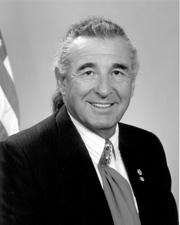 Sen. Ben Nighthorse Campbell (R-CO)
Text
Proposed
This amendment's own text couldn't be picked out of its Congressional Record passage, so the passage is shown in full.
UNITED STATES OLYMPIC COMMITTEE REFORM ACT
Mr. BURNS. Mr. President, I ask unanimous consent that the Senate
proceed to the immediate consideration of Calendar No. 237, S. 1404.
The PRESIDING OFFICER. The clerk will report the bill by title.
The legislative clerk read as follows:
A bill (S. 1404) to amend the Ted Stevens Olympic and
Amateur Sports Act.
There being no objection, the Senate proceeded to consider the
bill which had been reported from the Committee on Commerce, Science,
and Transportation, with amendments, as follows:
[Strike the parts shown in black brackets and insert the
parts shown in italic.]
S. 1404
Be it enacted by the Senate and House of Representatives of
the United States of America in Congress assembled,
SECTION 1. SHORT TITLE.
This Act may be cited as the ``United States Olympic
Committee Reform Act''.
SEC. 2. FINDINGS.
The Congress finds the following:
(1) There is a widespread loss of confidence in the United
States Olympic Committee.
(2) Restoring confidence in the United States Olympic
Committee is critical to achieving the original intent of the
Ted Stevens Amateur and Olympic Sports Act.
(3) Confusion exists concerning the primary purposes and
priorities of the United States Olympic Committee.
(4) The current governance structure of the United States
Olympic Committee is dysfunctional.
(5) The ongoing national corporate governance debate and
recent reforms have important implications for the United
States Olympic Committee.
(6) There exists no clear line of authority between the
United States Olympic Committee volunteers and the United
States Olympic Committee paid staff.
(7) There is a widespread perception that the United States
Olympic Committee lacks financial transparency.
SEC. 3. AMENDMENT OF TED STEVENS OLYMPIC AND AMATEUR SPORTS
ACT.
Except as otherwise expressly provided, whenever in this
Act an amendment or repeal is expressed in terms of an
amendment to, or repeal of, a section or other provision, the
reference shall be considered to be made to a section or
other provision of the Ted Stevens Olympic and Amateur Sports
Act (36 U.S.C. 220501 et seq.).
SEC. 4. GOVERNANCE OF THE UNITED STATES OLYMPIC COMMITTEE.
(a) In General.--The Act (36 U.S.C. 220501) is amended by
adding at the end the following:
``SUBCHAPTER III. GOVERNANCE
``Sec. 220541. Board of directors
``(a) In General.--The board of directors is the governing
body of the corporation and shall establish the policies and
priorities of the corporation. The board of directors shall
have the full authority to manage the affairs of the
corporation.
``(b) Structure of the Board.--
``(1) In general.--The board of directors shall consist of
9 elected members and the ex officio members described in
paragraph (3).
``(2) Elected members.--The elected directors, elected as
provided in subsection (g), are--
``(A) 5 independent directors, as defined in the
constitution and bylaws of the corporation;
``(B) 2 directors elected from among those nominated by the
Athletes' Advisory Council, who at the time of nomination
meet the specifications of section 220504(b)(2)(B) of this
title; and
``(C) 2 directors elected from among those nominated by the
National Governing Bodies' Council.
``(3) Ex officio members.--The ex officio members are--
``(A) the speaker of the assembly; and
``(B) the International Olympic Committee member or members
from the United States who are required to be ex officio
members of the executive organ of the corporation under the
terms of the Olympic Charter.
``(c) Terms of Office.--
``(1) Elected directors.--The term of office of an elected
director shall be 4 years. An individual elected to replace a
director who does not serve a full 4-year term shall be
elected initially to serve only the balance of the expired
term of the member that director replaces. No director shall
be eligible for reelection, except a director whose total
period of service, if elected, would not exceed 6 years. The
chair of the board shall be eligible to serve an additional 2
years as required to complete his or her term as chair.
``(2) Staggered terms.--Notwithstanding paragraph (1), of
the directors first elected to the board after the date of
enactment of the United States Olympic Committee Reform Act--
``(A) 2 of the directors elected under paragraph (2)(A)
shall be elected for terms of 2 years;
``(B) 3 of the directors elected under paragraph (2)(A)
shall be elected for terms of 4 years;
``(C) 1 of the directors elected under paragraph (2)(B)
shall be elected for a term of 2 years;
``(D) 1 of the directors elected under paragraph (2)(B)
shall be elected for a term of 4 years;
``(E) 1 of the directors elected under paragraph (2)(C)
shall be elected for a term of a term of 2 years; and
``(F) 1 of the directors elected under paragraph (2)(C)
shall be elected for a term of a term of 4 years.
``(3) Ex officio members.--The speaker of the assembly
shall serve as a non-voting ex officio member of the board
while holding the position of speaker of the assembly. An
International Olympic Committee member shall serve as an
ex officio member of the board for so long as the member
is a member of that Committee.
``(d) Voting.--
``(1) Elected members.--Each elected director shall have 1
vote on all matters on which the board votes, consistent with
the constitution and bylaws of the corporation.
``(2) Ex officio members.--Each voting ex officio member
shall have 1 vote on matters on which the ex officio members
vote, consistent with the constitution and bylaws of the
corporation, and the votes of the ex officio members shall be
weighted such that, in the aggregate, the votes of all voting
ex officio members are equal to the vote of one elected
director.
``(3) Tie votes.--In the event of a tie vote of the board,
the vote of the chair of the board shall serve to break the
tie.
``(4) Quorum.--The board may not take action in the absence
of a quorum, which shall be 7 members, of whom at least 3
shall be members described in subsection (b)(2)(A).
``(e) Chair of the Board.--The board shall elect 1 of the
members described in subsection (b)(2) to serve as chair of
the board first elected after the date of enactment of the
United States Olympic Committee Reform Act. The chair of the
board shall preside at all meetings of the board and have
such other duties as may be provided in the constitution and
bylaws of the corporation. No individual may hold the
position of chair of the board for more than 4 years.
``(f) Committees.--
``(1) In general.--The board of directors shall establish
the following 4 standing committees:
``(A) The Audit Committee.
``(B) The Compensation Committee.
``(C) The Ethics Committee.
``(D) The Nominating and Governance Committee.
``(2) Committee membership.--The Compensation Committee
shall consist of 3 board members selected by the board. The
Audit Committee, Ethics Committee, and Nominating and
Governance Committee shall each consist of--
``(A) 3 board members described in subsection (b)(2)(A),
selected by the board;
``(B) 1 board member described in subsection (b)(2)(B),
selected by the board; and
``(C) 1 board member described in subsection (b)(2)(C),
selected by the board.
``(3) Additional committees.--The board may establish such
additional committees, subcommittees, and task forces as may
be necessary or appropriate and for which sufficient funds
exist.
``(g) Nomination and Election.--
[[Page S11868]]
``(1) In general.--The nominating and governance committee
shall recommend candidates to the board of directors to fill
vacancies on the board as provided in the constitution and
bylaws of the corporation. For each vacancy that is to be
filled by a nominee of the Athletes' Advisory Council or the
National Governing Bodies' Council, the Athletes' Advisory
Council or the National Governing Bodies' Council shall
recommend 3 individuals to the nominating and governance
committee, which shall nominate 1 of the recommended
individuals to the board of directors.
``(2) Recusal of members eligible for re-election.--Any
member of the nominating and governance committee who is
eligible for re-election by virtue of serving for an initial
term of less than 2 years shall be recused from participation
in the nominating and recommendation process.
``(3) Board to elect members.--Except as provided in
section 4(c)(2) of the United States Olympic Committee Reform
Act, the board of directors shall elect directors from the
candidates proposed by the nominating and governance
committee.
``Sec. 220542. Assembly
``(a) In General.--
``(1) Forum function.--The assembly shall be a forum for
all stakeholders of the corporation. The assembly shall have
an advisory function only, except as otherwise expressly
provided in this chapter.
``(2) Voting on matters relating to the olympic games.--The
assembly shall have the right to vote on, and shall have
ultimate authority to decide, matters relating to the Olympic
Games. The board of directors shall determine whether a
matter is a question relating to the Olympic Games on which
the assembly is entitled to vote. The determination of the
board shall be final and binding.
``(3) Meetings.--The assembly shall convene annually in a
meeting open to the public. The board of directors may
convene special meetings of the assembly.
``(4) Annual budget.--The board of directors shall
establish an annual budget for the assembly, as provided in
the constitution and bylaws of the corporation. In
establishing the budget, the board of directors shall take
into account the interest of the corporation in minimizing
the costs associated with the assembly.
``(b) Structure of the Assembly.--
``(1) In general.--The assembly shall consist of--
``(A) representatives of the constituencies of the
corporation specified in section 220504 of this title (other
than former United States Olympic Committee members);
``(B) the International Olympic Committee's members for the
United States; and
``(C) not more than 3 individuals who have represented the
United States in an Olympic Games not within the preceding 10
years, selected through a process to be determined by the
board of directors in accordance with the constitution and
bylaws of the corporation.
``(2) Amateur athlete representation.--Amateur athletes
shall constitute not less than 20 percent of the membership
in the assembly.
``(c) Voting.--
``(1) Representatives of the national governing bodies.--
Representatives of the national governing bodies shall
constitute not less than 51 percent of the voting power held
in the assembly.
``(2) Amateur athletes.--Amateur athletes shall constitute
not less than 20 percent of the voting power held in the
assembly.
``(d) Speaker of the Assembly.--The speaker of the assembly
shall be a member of the assembly (who, as a member, is
entitled to vote) who is elected by the members of the
assembly for a 4-year term. An individual may not serve as
speaker for more than 4 years. The speaker shall preside at
all meetings of the assembly and serve as a non-voting ex
officio member of the board of directors as provided in
section 220541. The speaker shall have no other duties or
powers (other than the right to vote), except as may be
expressly assigned by the board of directors.
``Sec. 220543. Chief executive officer
``(a) In General.--The corporation shall have a chief
executive officer who shall not be a member of the board of
directors. The chief executive officer shall be selected by,
and shall report to, the board of directors, as provided in
the constitution and bylaws of the corporation. The chief
executive officer shall be responsible, with board approval,
for filling other key senior management positions as provided
in the constitution and bylaws of the corporation.
``(b) Duties.--The chief executive officer shall, either
directly or by delegation--
``(1) manage all staff functions and the day-to-day affairs
and business operations of the corporation, including but not
limited to relations with international organizations; and
``(2) implement the mission and policies of the
corporation, as determined by the Board.
``Sec. 220544. Whistleblower procedures and protections
``The corporation, through the board of directors, shall
establish procedures for--
``(1) the receipt, retention, and treatment of complaints
received by the corporation regarding accounting, auditing or
ethical matters; and
``(2) the protection against retaliation by any officer,
employee, director or member of the corporation against any
person who submits such complaints.
``Sec. 220545. Ethics and compliance
``(a) In General.--The ethics committee shall be
responsible for oversight of--
``(1) all matters relating to ethics policy and practices
of the corporation's employees, board members, and
volunteers;
``(2) officers or directors of a member organization
insofar as their activities relate to corporation business;
and
``(3) paid and volunteer leadership staff of a bid city
organization for activities that relate directly to the bid
city process.
``(b) Internal Ethics Officer.--
``(1) In general.--The board of directors shall employ and
fix the compensation of a chief ethics officer to implement
the ethics policy for the corporation.
``(2) Duties.--The ethics committee shall establish
policies and procedures to delineate the duties of the chief
ethics officer.
``(3) Line of authority.--
``(A) In general.--The chief ethics officer shall report to
the chief executive officer of the corporation.
``(B) Certain parties.--Notwithstanding subparagraph (A),
the chief ethics officer shall report to the ethics committee
whenever an alleged violation involves--
``(i) senior management or directors of the corporation;
``(ii) officers or directors of a member organization;
``(iii) a bid city; or
``(iv) the International Olympic Committee.
``(c) Ethics Policy.--The ethics committee shall establish
an ethics policy for the corporation, subject to the approval
of the board of directors, modeled upon the best practices
used in corporate and government offices. The policy shall
include--
``(1) a conflict of interest policy;
``(2) an anti-discrimination policy;
``(3) a workplace harassment policy;
``(4) a gift, travel reimbursement, honorarium, and outside
income policy;
``(5) a financial propriety policy, including a prohibition
on loans to corporation officers and employees;
``(6) a bid-city policy which includes a transparent and
objective set of criteria published in advance by which the
corporation will choose a United States city to submit a bid
to the International Olympic Committee for an Olympic games,
which adheres in all respects to the rules and ethics
guidelines of the Olympic Charter and the International
Olympic Committee, and which applies to the leaders and staff
of a city, or organizations representing a bid city, that
file an official bid with the corporation to host Olympic
games;
``(7) potential sanctions and penalties for violations of
the ethics policy, which may include removal from corporation
duties;
``(8) a procedure for reporting and investigating potential
ethics violations; and
``(9) procedures to assure due process for any individual
accused of an ethics violation, including--
``(A) a timely hearing before the ethics committee;
``(B) the right to be represented by counsel; and
``(C) access to all documentation and statements that would
be used in an ethics proceeding against that individual.
``(d) Written Statement Required.--All members of the
board, employees, and officers, directors of member
organizations, and leaders or representatives of United
States bid cities must sign a statement that they have read
the corporation's ethics policy and agree to abide by its
rules.
``(e) Ethics Committee Adjudication of Violations.--When
the ethics committee determines that an individual has
violated the corporation's ethics policy, it will report to
the Board and may make recommendations for action to be
taken.
``(f) Investigation, Reporting, and Review Procedures.--The
ethics committee shall establish a procedure for the prompt
review and investigation of ethics violations, and establish
regular reporting and review procedures to document the
number and types of complaints or issues brought to the
ethics committee and the ethics officer.
``(g) Outside Counsel.--The ethics committee may hire
outside counsel to conduct investigations, report findings,
and make recommendations.
``(h) Bid City Defined.--In this section, the term `bid
city' means 1 or more cities, States, regional organizations,
or other organizations that file an official bid with the
corporation to be chosen as the site nominated by the United
States to the International Olympic Committee to host an
Olympic Games.''.
(b) Transition.--The individuals serving as members of the
board of directors of the United States Olympic Committee on
the date of enactment of this Act shall continue to serve as
the board of directors until a board of directors has been
elected under subsection (c)(2) of this section.
(c) Initial Nominating and Governance Committee.--
(1) In general.--Until the initial board of directors has
been elected and taken office, the nominating and governance
committee required by section 220541(f) of title 36, United
States Code, shall consist of--
(A) 1 individual selected by the Athlete's Advisory Council
from among its members;
(B) 1 individual selected by the National Governing Bodies'
Council from among its members;
(C) 1 individual selected by the public-sector directors of
the United States Olympic Committee from among such directors
serving on the date of enactment of this Act;
[[Page S11869]]
(D) 1 individual selected by the Independent Commission on
Reform of the established by the United States Olympic
Committee in March, 2003, from among its members, who shall
chair the committee; and
(E) 1 individual selected by the Governance and Ethics Task
Force established by the United States Olympic Committee in
February, 2003, from among its members.
(2) Election of new board of directors.--The nominating and
governance committee established by paragraph (1) shall--
(A) elect an initial board or directors who shall serve for
the terms provided in section 220541(c)(2) of title 36,
United States Code; and
(B) elect 1 of the members described in section
220541(b)(2)(A) of that title to serve as chair until the
terms of the members elected under subparagraph (A) have
expired.
(d) Conforming Amendments.--
(1) Representation requirements.--Section 220504(b) is
amended--
(A) by striking ``representation of--'' and inserting
``representation on its board of directors and in its
assembly of--''; and
(B) by striking subparagraph (B) of paragraph (2) and
inserting the following:
``(B) ensure that--
``(i) the membership and voting power of such amateur
athletes is not less than 20 percent of the membership and
voting power of each committee, subcommittee, working group,
or other subordinate decision-making group, of the
corporation; and
``(ii) the voting power held by members of the board of
directors who were nominated by the Athlete's Advisory
Council is not less than 20 percent of the total voting power
held in the board of directors;''.
(2) Constitution and bylaws.--Section 220505(a) is
amended--
(A) by striking ``bylaws.'' and inserting ``bylaws
consistent with this chapter, as determined by the board of
directors. The board of directors shall adopt and amend the
constitution and bylaws of the corporation, consistent with
this chapter.'';
(B) by inserting ``the board of directors proposes and
approves by majority vote such an amendment and'' after
``only if''; and
(C) by striking ``publication,'' in paragraph (1) and
inserting ``publication and on its website,''.
(3) Ombudsman to report to board of directors.--Section
220509(b) is amended--
(A) by inserting ``the board of directors and'' in
paragraph (1)(C) after ``report to'';
(B) by striking ``corporation's executive director'' in
paragraph (2)(A)(i) and inserting ``board of directors'';
(C) by striking clauses (ii) and (iii) of paragraph (2)(A)
and inserting the following:
``(ii) The board of directors shall hire or not hire such
person after fully considering the advice and counsel of the
Athlete's Advisory Council.'';
(D) by striking ``corporation'' the first place it appears
in paragraph (2)(B) and inserting ``board of directors'';
(E) by striking ``to the corporation's executive committee
by either the corporation's executive director'' in paragraph
(2)(B)(ii) and inserting ``by 1 or more members of the board
of directors''; and
(F) by striking ``corporation's executive committee'' in
paragraph (2)(B)(iii) and inserting ``board of directors''.
(4) Eligibility requirements.--Section 220522(a)(4)(B) is
amended by striking ``corporation's executive committee'' and
inserting ``board of directors''.
(5) Chapter analysis.--The chapter analysis for chapter
2205 [of title 36, United States Code,] is amended by adding
at the end the following:
``SUBCHAPTER III. GOVERNANCE
``220541. Board of directors
``220542. Assembly
``220543. Chief executive officer
``220544. Whistleblower procedures and protections
``220545. Ethics and compliance''.
SEC. 5. REPORTS.
Section 220511 is amended--
(1) by striking so much of subsection (a) as precedes
paragraph (2) and inserting the following:
``(a) Biennial Report.--On or before the first day of June
of every other year, the corporation shall transmit
simultaneously to the President and to each House of Congress
a detailed report of its operations for the preceding 2
years, including--
``(1) annual financial statements--
``(A) audited in accordance with generally accepted
accounting principles by an independent certified public
accountant; and
``(B) certified by the chief executive officer and the
chief financial officer of the corporation as to their
accuracy and completeness;'';
(2) by striking ``4-year period;'' in subsection (a)(2) and
inserting ``2-year period;''; and
(3) by inserting ``free of charge on its website (or via a
similar medium that is widely available to the public), and
otherwise'' in subsection (b) after ``persons''.
SEC. 6. SENIOR OLYMPICS.
Notwithstanding section 220506(a) of title 36, United
States Code, the National Senior Games Association of Baton
Rouge, Louisiana, is authorized to use the words ``Senior
Olympics'' to promote national athletic competition among
senior citizens.
Mr. McCAIN. The amendment to the United States Olympic Committee
Reform Act of 2003, S. 1404, being offered by Senator Campbell permits
the new USOC board, together with the new USOC assembly, to determine
the location of the organization's headquarters. This amendment is
consistent with what is already in the USOC's Federal charter, which
currently allows the USOC to determine where in the United States the
organization's headquarters should be maintained.
To move the headquarters, the newly constituted board would first
determine whether it is in the best interest of the USOC to relocate
the headquarters. A unanimous vote by the board would be required to
refer the matter to the assembly for consideration, and then, only by a
three-fifths majority of the assembly could the USOC headquarters be
relocated.
Mr. STEVENS. Mr. President, I thank Senators McCain and Campbell for
their work on this important issue. My work on the Olympic Sports Act
began in the 1970s. I believe the reforms in our bill today are
necessary adjustments that will return the focus of the United States
Olympic Committee to our original intent--our American athletes!
The USOC Internal Taskforce and the Senate appointed Independent
Commission did excellent jobs in reviewing the problems and offering
solutions to the recent problems that have plagued the USOC. I thank
the USOC Taskforce and the Independent Commission on the United States
Olympic Committee for their hard work. S. 1404 includes many of the
suggested changes from both groups.
This is a good bill and I support all but one aspect of it. I cannot
support and will work to remove the section that gives special
consideration to the Senior Olympics. The only fundraising tool that
Congress gave the USOC was the exclusive rights to the name, seals,
emblems and badges of the USOC. The language that allows the Senior
Olympics to use the Olympic symbols without the USOC permission will
lead to the destruction of the fundraising ability of the USOC. Above
all, the use of these symbols should not be subject to being ``licensed
out'' by any entity but the USOC. I would have opposed this language in
committee but unfortunately I was chairing a Defense Appropriations
hearing when the language was offered. I will not hold up the passage
of this important legislation but will work to remove the language
creating a death knell to the USOC's ability to raise the funds
necessary to meet the objectives of our Nation ion international
competitions.
This is an important agreement on the location of the USOC
headquarters. Now this bill can go to conference, after which, with the
President's approval, it will become law and our American athletes can
focus all of their efforts on the 2004 Olympic Games.
I thank Senator McCain's Commerce staff for their hard work on this
issue. Especially Ken Nahigian and also Brian Feintech of Senator
Campbell's staff. Their hard work along with that of George Lowe on my
staff have insured that this important legislation is ready to move
forward.
Mr. CAMPBELL. Mr. President, I thank Senator McCain for his patience
and understanding in this matter and ask to be an original cosponsor of
this legislation.
The USOC was crying out for reform. There was the mismanagement of
funds, poor judgments, and frequent turnover of management. I would
like to recognize the USOC's internal efforts for reform. Reform has
been long overdue.
My opposition to this legislation was to protect not only my
constituents, but the USOC employees and athletes training in Colorado
Springs, CO, as well. Again and again, I have heard rumblings about
moving the headquarters of the USOC to another city, possibly New York
City. This would be a terrible mistake and I cannot and will not allow
this to happen.
The moving expenses would far outweigh the benefits of moving the
headquarters and I do not want another dime wasted on the governance
and management of the USOC. I cannot, and I do not think that we can
make it clear enough: the money raised is first and foremost for the
benefit and training of athletes, not for extra cushions on the chairs
of those sitting in offices with pretty views of skylines.
The costs to the State of Colorado must be recognized too. The
presence
[[Page S11870]]
of the USOC in Colorado Springs generates over $300 million per year in
revenue. My State cannot afford taking a hit like that now. To be
exact, the USOC generates $315.9 million a year for the Pikes Peak
Region; employs over 500 fund-raising staff; is home to 250 Olympic
hopefuls, resident athletes in various sports; provides about 4,800
jobs in the Colorado Springs area, directly and indirectly; and serves
about 38,000 tourists each year.
I would like to point out Colorado's own commitment to the United
States Olympic Committee. The Colorado State legislature passed law
allowing out-of-State doctors to practice medicine at the center
without having to pass a Colorado test for a medical license; passed a
law allowing out-of-State athletes at the training center to pay
instate college tuition so they could continue their education while
training; and created a check-off box on State income tax returns
allowing taxpayers to donate $1, which initially raised about $200,000
a year.
The argument that moving to a major metropolitan area to have better
access to marketing and mass media is completely invalid. NBC agreed to
pay $2.2 billion for U.S. television rights to the 2010 Winter Olympic
Games and the 2012 Summer Olympic Games. That deal includes a
sponsorship by NBC parent company, General Electric, which is based in
Connecticut. San Francisco-based VISA continues to support the Olympic
movement as does Bank of America, based in Charlotte, NC. Obviously,
the USOC is not having any problem securing media coverage or
sponsorships.
Lastly, I would like to point out Section 834 of Public Law 99-167,
passed during the 1st Session of the 99th Congress, in 1985. The
current home of the USOC used to be part of Ent Air Force Base in
Colorado Springs. Section 834 conveyed land that the USOC had been
leasing from the U.S. Air Force to the USOC under the conditions that
the property be used by the USOC solely for USOC activities and if it
is not used for that purpose, the property shall be repossessed by the
Government. This did not imply that the USOC could use it for a while
or use it only in part. If the USOC is not going to use it, then the
property should be given back to us.
Mr. BURNS. Mr. President, I ask unanimous consent that the committee
amendments be agreed to, the Campbell amendment be agreed to, the bill,
as amended, be read a third time and passed, and the motion to
reconsider be laid upon the table; and that any statements relating to
the bill be printed in the Record.
The PRESIDING OFFICER. Without objection, it is so ordered.
The committee amendments were agreed to.
The amendment (No. 1767) was agreed to, as follows:
On page 22, between lines 18 and 19, insert the following:
SEC. 6. RELOCATION OF HEADQUARTERS.
Section 220508 is amended--
(1) by inserting ``(a) In General.--'' before ``The
corporation shall''; and
(2) by adding at the end the following:
``(b) Relocation of Headquarters.--The corporation may not
relocate its principal office and national headquarters after
the date of enactment of the United States Olympic Committee
Reform Act unless--
``(1) the board of directors determines that relocation of
the principal office and national headquarters is in the best
interests of the corporation;
``(2) the board, by rollcall vote, agrees unanimously to
refer the proposed relocation of the principal office and
national headquarters to the assembly for its concurrence;
and
``(3) the assembly, by a vote of not less than three-fifths
of its members duly chosen and qualified, concurs in the
determination of the board.''.
The bill (S. 1404), as amended, was read the third time and passed,
as follows:
S. 1404
Be it enacted by the Senate and House of Representatives of
the United States of America in Congress assembled,
SECTION 1. SHORT TITLE.
This Act may be cited as the ``United States Olympic
Committee Reform Act''.
SEC. 2. FINDINGS.
The Congress finds the following:
(1) There is a widespread loss of confidence in the United
States Olympic Committee.
(2) Restoring confidence in the United States Olympic
Committee is critical to achieving the original intent of the
Ted Stevens Amateur and Olympic Sports Act.
(3) Confusion exists concerning the primary purposes and
priorities of the United States Olympic Committee.
(4) The current governance structure of the United States
Olympic Committee is dysfunctional.
(5) The ongoing national corporate governance debate and
recent reforms have important implications for the United
States Olympic Committee.
(6) There exists no clear line of authority between the
United States Olympic Committee volunteers and the United
States Olympic Committee paid staff.
(7) There is a widespread perception that the United States
Olympic Committee lacks financial transparency.
SEC. 3. AMENDMENT OF TED STEVENS OLYMPIC AND AMATEUR SPORTS
ACT.
Except as otherwise expressly provided, whenever in this
Act an amendment or repeal is expressed in terms of an
amendment to, or repeal of, a section or other provision, the
reference shall be considered to be made to a section or
other provision of the Ted Stevens Olympic and Amateur Sports
Act (36 U.S.C. 220501 et seq.).
SEC. 4. GOVERNANCE OF THE UNITED STATES OLYMPIC COMMITTEE.
(a) In General.--The Act (36 U.S.C. 220501) is amended by
adding at the end the following:
``SUBCHAPTER III. GOVERNANCE
``Sec. 220541. Board of directors
``(a) In General.--The board of directors is the governing
body of the corporation and shall establish the policies and
priorities of the corporation. The board of directors shall
have the full authority to manage the affairs of the
corporation.
``(b) Structure of the Board.--
``(1) In general.--The board of directors shall consist of
9 elected members and the ex officio members described in
paragraph (3).
``(2) Elected members.--The elected directors, elected as
provided in subsection (g), are--
``(A) 5 independent directors, as defined in the
constitution and bylaws of the corporation;
``(B) 2 directors elected from among those nominated by the
Athletes' Advisory Council, who at the time of nomination
meet the specifications of section 220504(b)(2)(B) of this
title; and
``(C) 2 directors elected from among those nominated by the
National Governing Bodies' Council.
``(3) Ex officio members.--The ex officio members are--
``(A) the speaker of the assembly; and
``(B) the International Olympic Committee member or members
from the United States who are required to be ex officio
members of the executive organ of the corporation under the
terms of the Olympic Charter.
``(c) Terms of Office.--
``(1) Elected directors.--The term of office of an elected
director shall be 4 years. An individual elected to replace a
director who does not serve a full 4-year term shall be
elected initially to serve only the balance of the expired
term of the member that director replaces. No director shall
be eligible for reelection, except a director whose total
period of service, if elected, would not exceed 6 years. The
chair of the board shall be eligible to serve an additional 2
years as required to complete his or her term as chair.
``(2) Staggered terms.--Notwithstanding paragraph (1), of
the directors first elected to the board after the date of
enactment of the United States Olympic Committee Reform Act--
``(A) 2 of the directors elected under paragraph (2)(A)
shall be elected for terms of 2 years;
``(B) 3 of the directors elected under paragraph (2)(A)
shall be elected for terms of 4 years;
``(C) 1 of the directors elected under paragraph (2)(B)
shall be elected for a term of 2 years;
``(D) 1 of the directors elected under paragraph (2)(B)
shall be elected for a term of 4 years;
``(E) 1 of the directors elected under paragraph (2)(C)
shall be elected for a term of a term of 2 years; and
``(F) 1 of the directors elected under paragraph (2)(C)
shall be elected for a term of a term of 4 years.
``(3) Ex officio members.--The speaker of the assembly
shall serve as a non-voting ex officio member of the board
while holding the position of speaker of the assembly. An
International Olympic Committee member shall serve as an ex
officio member of the board for so long as the member is a
member of that Committee.
``(d) Voting.--
``(1) Elected members.--Each elected director shall have 1
vote on all matters on which the board votes, consistent with
the constitution and bylaws of the corporation.
``(2) Ex officio members.--Each voting ex officio member
shall have 1 vote on matters on which the ex officio members
vote, consistent with the constitution and bylaws of the
corporation, and the votes of the ex officio members shall be
weighted such that, in the aggregate, the votes of all voting
ex officio members are equal to the vote of one elected
director.
``(3) Tie votes.--In the event of a tie vote of the board,
the vote of the chair of the board shall serve to break the
tie.
``(4) Quorum.--The board may not take action in the absence
of a quorum, which shall be 7 members, of whom at least 3
shall be members described in subsection (b)(2)(A).
[[Page S11871]]
``(e) Chair of the Board.--The board shall elect 1 of the
members described in subsection (b)(2) to serve as chair of
the board first elected after the date of enactment of the
United States Olympic Committee Reform Act. The chair of the
board shall preside at all meetings of the board and have
such other duties as may be provided in the constitution and
bylaws of the corporation. No individual may hold the
position of chair of the board for more than 4 years.
``(f) Committees.--
``(1) In general.--The board of directors shall establish
the following 4 standing committees:
``(A) The Audit Committee.
``(B) The Compensation Committee.
``(C) The Ethics Committee.
``(D) The Nominating and Governance Committee.
``(2) Committee membership.--The Compensation Committee
shall consist of 3 board members selected by the board. The
Audit Committee, Ethics Committee, and Nominating and
Governance Committee shall each consist of--
``(A) 3 board members described in subsection (b)(2)(A),
selected by the board;
``(B) 1 board member described in subsection (b)(2)(B),
selected by the board; and
``(C) 1 board member described in subsection (b)(2)(C),
selected by the board.
``(3) Additional committees.--The board may establish such
additional committees, subcommittees, and task forces as may
be necessary or appropriate and for which sufficient funds
exist.
``(g) Nomination and Election.--
``(1) In general.--The nominating and governance committee
shall recommend candidates to the board of directors to fill
vacancies on the board as provided in the constitution and
bylaws of the corporation. For each vacancy that is to be
filled by a nominee of the Athletes' Advisory Council or the
National Governing Bodies' Council, the Athletes' Advisory
Council or the National Governing Bodies' Council shall
recommend 3 individuals to the nominating and governance
committee, which shall nominate 1 of the recommended
individuals to the board of directors.
``(2) Recusal of members eligible for re-election.--Any
member of the nominating and governance committee who is
eligible for re-election by virtue of serving for an initial
term of less than 2 years shall be recused from participation
in the nominating and recommendation process.
``(3) Board to elect members.--Except as provided in
section 4(c)(2) of the United States Olympic Committee Reform
Act, the board of directors shall elect directors from the
candidates proposed by the nominating and governance
committee.
``Sec. 220542. Assembly
``(a) In General.--
``(1) Forum function.--The assembly shall be a forum for
all stakeholders of the corporation. The assembly shall have
an advisory function only, except as otherwise expressly
provided in this chapter.
``(2) Voting on matters relating to the olympic games.--The
assembly shall have the right to vote on, and shall have
ultimate authority to decide, matters relating to the Olympic
Games. The board of directors shall determine whether a
matter is a question relating to the Olympic Games on which
the assembly is entitled to vote. The determination of the
board shall be final and binding.
``(3) Meetings.--The assembly shall convene annually in a
meeting open to the public. The board of directors may
convene special meetings of the assembly.
``(4) Annual budget.--The board of directors shall
establish an annual budget for the assembly, as provided in
the constitution and bylaws of the corporation. In
establishing the budget, the board of directors shall take
into account the interest of the corporation in minimizing
the costs associated with the assembly.
``(b) Structure of the Assembly.--
``(1) In general.--The assembly shall consist of--
``(A) representatives of the constituencies of the
corporation specified in section 220504 of this title (other
than former United States Olympic Committee members);
``(B) the International Olympic Committee's members for the
United States; and
``(C) not more than 3 individuals who have represented the
United States in an Olympic Games not within the preceding 10
years, selected through a process to be determined by the
board of directors in accordance with the constitution and
bylaws of the corporation.
``(2) Amateur athlete representation.--Amateur athletes
shall constitute not less than 20 percent of the membership
in the assembly.
``(c) Voting.--
``(1) Representatives of the national governing bodies.--
Representatives of the national governing bodies shall
constitute not less than 51 percent of the voting power held
in the assembly.
``(2) Amateur athletes.--Amateur athletes shall constitute
not less than 20 percent of the voting power held in the
assembly.
``(d) Speaker of the Assembly.--The speaker of the assembly
shall be a member of the assembly (who, as a member, is
entitled to vote) who is elected by the members of the
assembly for a 4-year term. An individual may not serve as
speaker for more than 4 years. The speaker shall preside at
all meetings of the assembly and serve as a non-voting ex
officio member of the board of directors as provided in
section 220541. The speaker shall have no other duties or
powers (other than the right to vote), except as may be
expressly assigned by the board of directors.
``Sec. 220543. Chief executive officer
``(a) In General.--The corporation shall have a chief
executive officer who shall not be a member of the board of
directors. The chief executive officer shall be selected by,
and shall report to, the board of directors, as provided in
the constitution and bylaws of the corporation. The chief
executive officer shall be responsible, with board approval,
for filling other key senior management positions as provided
in the constitution and bylaws of the corporation.
``(b) Duties.--The chief executive officer shall, either
directly or by delegation--
``(1) manage all staff functions and the day-to-day affairs
and business operations of the corporation, including but not
limited to relations with international organizations; and
``(2) implement the mission and policies of the
corporation, as determined by the Board.
``Sec. 220544. Whistleblower procedures and protections
``The corporation, through the board of directors, shall
establish procedures for--
``(1) the receipt, retention, and treatment of complaints
received by the corporation regarding accounting, auditing or
ethical matters; and
``(2) the protection against retaliation by any officer,
employee, director or member of the corporation against any
person who submits such complaints.
``Sec. 220545. Ethics and compliance
``(a) In General.--The ethics committee shall be
responsible for oversight of--
``(1) all matters relating to ethics policy and practices
of the corporation's employees, board members, and
volunteers;
``(2) officers or directors of a member organization
insofar as their activities relate to corporation business;
and
``(3) paid and volunteer leadership staff of a bid city
organization for activities that relate directly to the bid
city process.
``(b) Internal Ethics Officer.--
``(1) In general.--The board of directors shall employ and
fix the compensation of a chief ethics officer to implement
the ethics policy for the corporation.
``(2) Duties.--The ethics committee shall establish
policies and procedures to delineate the duties of the chief
ethics officer.
``(3) Line of authority.--
``(A) In general.--The chief ethics officer shall report to
the chief executive officer of the corporation.
``(B) Certain parties.--Notwithstanding subparagraph (A),
the chief ethics officer shall report to the ethics committee
whenever an alleged violation involves--
``(i) senior management or directors of the corporation;
``(ii) officers or directors of a member organization;
``(iii) a bid city; or
``(iv) the International Olympic Committee.
``(c) Ethics Policy.--The ethics committee shall establish
an ethics policy for the corporation, subject to the approval
of the board of directors, modeled upon the best practices
used in corporate and government offices. The policy shall
include--
``(1) a conflict of interest policy;
``(2) an anti-discrimination policy;
``(3) a workplace harassment policy;
``(4) a gift, travel reimbursement, honorarium, and outside
income policy;
``(5) a financial propriety policy, including a prohibition
on loans to corporation officers and employees;
``(6) a bid-city policy which includes a transparent and
objective set of criteria published in advance by which the
corporation will choose a United States city to submit a bid
to the International Olympic Committee for an Olympic games,
which adheres in all respects to the rules and ethics
guidelines of the Olympic Charter and the International
Olympic Committee, and which applies to the leaders and staff
of a city, or organizations representing a bid city, that
file an official bid with the corporation to host Olympic
games;
``(7) potential sanctions and penalties for violations of
the ethics policy, which may include removal from corporation
duties;
``(8) a procedure for reporting and investigating potential
ethics violations; and
``(9) procedures to assure due process for any individual
accused of an ethics violation, including--
``(A) a timely hearing before the ethics committee;
``(B) the right to be represented by counsel; and
``(C) access to all documentation and statements that would
be used in an ethics proceeding against that individual.
``(d) Written Statement Required.--All members of the
board, employees, and officers, directors of member
organizations, and leaders or representatives of United
States bid cities must sign a statement that they have read
the corporation's ethics policy and agree to abide by its
rules.
``(e) Ethics Committee Adjudication of Violations.--When
the ethics committee determines that an individual has
violated the corporation's ethics policy, it will report to
the Board and may make recommendations for action to be
taken.
``(f) Investigation, Reporting, and Review Procedures.--The
ethics committee shall establish a procedure for the prompt
review and investigation of ethics violations,
[[Page S11872]]
and establish regular reporting and review procedures to
document the number and types of complaints or issues brought
to the ethics committee and the ethics officer.
``(g) Outside Counsel.--The ethics committee may hire
outside counsel to conduct investigations, report findings,
and make recommendations.
``(h) Bid City Defined.--In this section, the term `bid
city' means 1 or more cities, States, regional organizations,
or other organizations that file an official bid with the
corporation to be chosen as the site nominated by the United
States to the International Olympic Committee to host an
Olympic Games.''.
(b) Transition.--The individuals serving as members of the
board of directors of the United States Olympic Committee on
the date of enactment of this Act shall continue to serve as
the board of directors until a board of directors has been
elected under subsection (c)(2) of this section.
(c) Initial Nominating and Governance Committee.--
(1) In general.--Until the initial board of directors has
been elected and taken office, the nominating and governance
committee required by section 220541(f) of title 36, United
States Code, shall consist of--
(A) 1 individual selected by the Athlete's Advisory Council
from among its members;
(B) 1 individual selected by the National Governing Bodies'
Council from among its members;
(C) 1 individual selected by the public-sector directors of
the United States Olympic Committee from among such directors
serving on the date of enactment of this Act;
(D) 1 individual selected by the Independent Commission on
Reform of the established by the United States Olympic
Committee in March, 2003, from among its members, who shall
chair the committee; and
(E) 1 individual selected by the Governance and Ethics Task
Force established by the United States Olympic Committee in
February, 2003, from among its members.
(2) Election of new board of directors.--The nominating and
governance committee established by paragraph (1) shall--
(A) elect an initial board or directors who shall serve for
the terms provided in section 220541(c)(2) of title 36,
United States Code; and
(B) elect 1 of the members described in section
220541(b)(2)(A) of that title to serve as chair until the
terms of the members elected under subparagraph (A) have
expired.
(d) Conforming Amendments.--
(1) Representation requirements.--Section 220504(b) is
amended--
(A) by striking ``representation of--'' and inserting
``representation on its board of directors and in its
assembly of--''; and
(B) by striking subparagraph (B) of paragraph (2) and
inserting the following:
``(B) ensure that--
``(i) the membership and voting power of such amateur
athletes is not less than 20 percent of the membership and
voting power of each committee, subcommittee, working group,
or other subordinate decision-making group, of the
corporation; and
``(ii) the voting power held by members of the board of
directors who were nominated by the Athlete's Advisory
Council is not less than 20 percent of the total voting power
held in the board of directors;''.
(2) Constitution and bylaws.--Section 220505(a) is
amended--
(A) by striking ``bylaws.'' and inserting ``bylaws
consistent with this chapter, as determined by the board of
directors. The board of directors shall adopt and amend the
constitution and bylaws of the corporation, consistent with
this chapter.'';
(B) by inserting ``the board of directors proposes and
approves by majority vote such an amendment and'' after
``only if''; and
(C) by striking ``publication,'' in paragraph (1) and
inserting ``publication and on its website,''.
(3) Ombudsman to report to board of directors.--Section
220509(b) is amended--
(A) by inserting ``the board of directors and'' in
paragraph (1)(C) after ``report to'';
(B) by striking ``corporation's executive director'' in
paragraph (2)(A)(i) and inserting ``board of directors'';
(C) by striking clauses (ii) and (iii) of paragraph (2)(A)
and inserting the following:
``(ii) The board of directors shall hire or not hire such
person after fully considering the advice and counsel of the
Athlete's Advisory Council.'';
(D) by striking ``corporation'' the first place it appears
in paragraph (2)(B) and inserting ``board of directors'';
(E) by striking ``to the corporation's executive committee
by either the corporation's executive director'' in paragraph
(2)(B)(ii) and inserting ``by 1 or more members of the board
of directors''; and
(F) by striking ``corporation's executive committee'' in
paragraph (2)(B)(iii) and inserting ``board of directors''.
(4) Eligibility requirements.--Section 220522(a)(4)(B) is
amended by striking ``corporation's executive committee'' and
inserting ``board of directors''.
(5) Chapter analysis.--The chapter analysis for chapter
2205 is amended by adding at the end the following:
``SUBCHAPTER III. GOVERNANCE
``220541. Board of directors
``220542. Assembly
``220543. Chief executive officer
``220544. Whistleblower procedures and protections
``220545. Ethics and compliance''.
SEC. 5. REPORTS.
Section 220511 is amended--
(1) by striking so much of subsection (a) as precedes
paragraph (2) and inserting the following:
``(a) Biennial Report.--On or before the first day of June
of every other year, the corporation shall transmit
simultaneously to the President and to each House of Congress
a detailed report of its operations for the preceding 2
years, including--
``(1) annual financial statements--
``(A) audited in accordance with generally accepted
accounting principles by an independent certified public
accountant; and
``(B) certified by the chief executive officer and the
chief financial officer of the corporation as to their
accuracy and completeness;'';
(2) by striking ``4-year period;'' in subsection (a)(2) and
inserting ``2-year period;''; and
(3) by inserting ``free of charge on its website (or via a
similar medium that is widely available to the public), and
otherwise'' in subsection (b) after ``persons''.
SEC. 6. RELOCATION OF HEADQUARTERS.
Section 220508 is amended--
(1) by inserting ``(a) In General.--'' before ``The
corporation shall''; and
(2) by adding at the end the following:
``(b) Relocation of Headquarters.--The corporation may not
relocate its principal office and national headquarters after
the date of enactment of the United States Olympic Committee
Reform Act unless--
``(1) the board of directors determines that relocation of
the principal office and national headquarters is in the best
interests of the corporation;
``(2) the board, by rollcall vote, agrees unanimously to
refer the proposed relocation of the principal office and
national headquarters to the assembly for its concurrence;
and
``(3) the assembly, by a vote of not less than three-fifths
of its members duly chosen and qualified, concurs in the
determination of the board.''.
SEC. 7. SENIOR OLYMPICS.
Notwithstanding section 220506(a) of title 36, United
States Code, the National Senior Games Association of Baton
Rouge, Louisiana, is authorized to use the words ``Senior
Olympics'' to promote national athletic competition among
senior citizens.
Mr. McCAIN. Mr. President, I am pleased that the Senate has passed S.
1404, the United States Olympic Committee Reform Act of 2003. I thank
the cosponsors of this important legislation, Senators Stevens and
Campbell, for their passion for the Olympic movement and their
contribution to the reform of the United States Olympic Committee,
USOC. S. 1404 is intended to make significant improvements to the
governance structure of the USOC by vastly reducing the size of the
current board of directors and by creating an assembly of USOC
stakeholders. The bill is intended to allow the USOC to operate more
effectively within a more streamlined and transparent structure.
S. 1404 is the product of three Commerce Committee hearings held this
year in response to a series of embarrassing leadership and ethics
scandals that have plagued the USOC and distracted the organization
from its mission. The new board of directors, which would be the
primary governing body of the organization, would appoint a chief
executive officer to carry out the board's policies and run the
organization's day-to-day business operations. The board would defer to
the judgment of the assembly on matters relating specifically to the
Olympic Games.
While maintaining the representation and voting authority of athletes
and national governing bodies, this legislation also would provide
increased financial transparency to the USOC and establish whistle-
blower protection for its employees. The bill is designed to streamline
the USOC to allow a larger percentage of the revenue generated by the
organization to be allocated to support amateur athletes.
In addition, we have worked to make this bill comply with the charter
of the International Olympic Committee, IOC, and will continue to do
this. It is important to note that corporate governance in the United
States has changed dramatically over the past year, and these changes
are leading this country's private and public sectors to adopt higher
standards of responsibility and accountability. These same standards
should be applied to the USOC to ensure that the narrow agendas of
individual USOC constituencies are no longer paramount to the common
objectives of the organization. To accomplish this objective, we
propose that the USOC adhere to best corporate governance practices,
such as requiring that the newly constituted USOC board have at least a
majority of independent directors. In the end, the
[[Page S11873]]
newly reformed board would govern the day-to-day operations of the
USOC, and would be able to work with the IOC to address any concerns
that it might have regarding the USOC's operations.
The fast-approaching Olympic Games in Athens next summer, as well as
the ongoing bid by New York City to host the games in 2012, lend
urgency to this legislation, and I look forward quickly to resolving
any differences between the Senate and House measures. I urge my
colleagues to support this very important legislation.
____________________Legislative Activity
Stay on top of the latest movement without scrolling through every action
Senate amendment submitted
September 23, 2003
View full timeline
Senate amendment submitted
September 23, 2003
Senate amendment agreed to: Amendment SA 1767 agreed to in Senate by Unanimous Consent.
September 23, 2003
Senate amendment proposed (on the floor): Amendment SA 1767 proposed by Senator Burns for Senator Campbell.(consideration: CR S11870; text: CR S11870)
September 23, 2003
Amendment SA 1767 proposed by Senator Burns for Senator Campbell. (consideration: CR S11870; text: CR S11870) Relative to the relocation of the U.S. Olympic Committee's principal office and national headquarters.
September 23, 2003
Amendment SA 1767 agreed to in Senate by Unanimous Consent.
September 23, 2003