To direct the Administrator of the Environmental Protection Agency to conduct a review of all third party intentional human dosing studies to identify or quantify toxic effects.
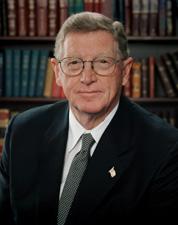 Sen. Conrad R. Burns (R-MT)
Legislative Activity
Stay on top of the latest movement without scrolling through every action
Senate amendment submitted
June 29, 2005
View full timeline
Senate amendment submitted
June 29, 2005
Senate amendment agreed to: Amendment SA 1068 agreed to in Senate by Yea-Nay. 57 - 40. Record Vote Number: 161.
June 29, 2005
Roll call votes on amendments in Senate: Amendment SA 1068 agreed to in Senate by Yea-Nay. 57 - 40. Record Vote Number: 161.
June 29, 2005
Senate amendment proposed (on the floor): Amendment SA 1068 proposed by Senator Burns.
June 29, 2005
Amendment SA 1068 proposed by Senator Burns. (consideration: CR S7552-7560; text: CR S7552) To direct the Administrator of the Environmental Protection Agency to conduct a review of all third party intentional human dosing studies to identify or quantify toxic effects.
June 29, 2005
Amendment SA 1068 agreed to in Senate by Yea-Nay. 57 - 40. Record Vote Number: 161.
June 29, 2005
Votes
1 roll call on this amendment
Text
Proposed
DEPARTMENT OF INTERIOR, ENVIRONMENT, AND RELATED AGENCIES
APPROPRIATIONS ACT, 2006

The PRESIDING OFFICER. Under the previous order, the Senate will
resume consideration of H.R. 2361, which the clerk will report.

[[Page S7552]]

The journal clerk read as follows:

A bill (H.R. 2361) making appropriations for the Department
of the Interior, Environment, and Related Agencies for the
fiscal year ending September 30, 2006, and for other
purposes.

Mr. BURNS. Mr. President, I ask unanimous consent that we proceed to
the regular order.
The PRESIDING OFFICER. Without objection, it is so ordered.

Amendment No. 1023

Under the regular order, the Boxer amendment is now pending. The
Senator from California.
Mrs. BOXER. Mr. President, what is the order? As I understand it,
Senator Burns will be offering an amendment, or has an amendment, and
there will be a vote on my amendment and his side by side. First, mine;
is my understanding correct?
Mr. BURNS. That is correct.
Mrs. BOXER. And then his.
The PRESIDING OFFICER. The vote will be on the Burns amendment first,
followed by the Boxer amendment.
Mrs. BOXER. The time is equally divided an hour a side to debate both
amendments; is that correct?
The PRESIDING OFFICER. That is correct.
Mrs. BOXER. Mr. President, I ask unanimous consent that any quorum
calls when placed be divided evenly.
The PRESIDING OFFICER. Without objection, it is so ordered. The Chair
notes that the Senator from Montana has not yet called up his
amendment.
Mrs. BOXER. I defer to him. I yield the floor.
Mr. BURNS. Mr. President, we do not have it yet.
The PRESIDING OFFICER. The Chair believes that the amendment is not
at the desk yet.
Mr. BURNS. Mr. President, I assure the Senator from California, I
know we have it somewhere, and I will find it.
Mrs. BOXER. That is reassuring.
Mr. BURNS. That is reassuring; isn't it? Everybody gets to read it--
that is different in the Senate. We have it.

Amendment No. 1068

Mr. BURNS. Mr. President, I send an amendment to the desk.
The PRESIDING OFFICER. The clerk will report the amendment.
The journal clerk read as follows:

The Senator from Montana [Mr. Burns], for himself, Mr.
Chambliss, and Mr. Inhofe, proposes an amendment numbered
1068.

Mr. BURNS. Mr. President, I ask unanimous consent that the reading of
the amendment be dispensed with.
The PRESIDING OFFICER. Without objection, it is so ordered.
The amendment is as follows:

(Purpose: To direct the Administrator of the Environmental Protection
Agency to conduct a review of all third-party intentional human dosing
studies to identify or quantify toxic effects)

On page 200, after line 2, add the following:
Sec.     . ( a) The Administrator of the Environmental
Protection Agency shall conduct a thorough review of all
third-party intentional human dosing studies to identify or
quantify toxic effects currently submitted to the Agency
under FIFRA to ensure that they:
(1) address a clearly defined regulatory objective;
(2) address a critical regulatory endpoint by enhancing the
Agency's scientific data bases;
(3) were designed and being conducted in a manner that
ensured the study was adequate scientifically to answer the
question and ensured the safety of volunteers;
(4) was designed to produce societal benefits that outweigh
any anticipated risks to participants;
(5) adhered to all recognized ethical standards and
procedures in place at the time the study was conducted; and
(6) are consistent with section 12(a)(2)(P) of the Federal
Insecticide, Fungicide, and Rodenticide Act and all other
applicable laws.
(b) The Administrator shall, within 60 days of the
enactment of this Act, report to the House and Senate
Committees on Appropriations; the Senate Committee on
Agriculture, Nutrition and Forestry; and the House Committee
on Agriculture on the results of the review required under
subsection (a) and any actions taken pursuant to the review.
(c) Within 180 days of the enactment of this Act, the
Administrator shall issue a final rule that addresses
applying ethical standards to third party studies involving
intentional human dosing to identify or quantify toxic
effects.

The PRESIDING OFFICER. Who yields time?
Mr. BURNS. Mr. President, I ask unanimous consent that the amendment
be set aside and that the Senator from California be recognized.
The PRESIDING OFFICER. Without objection, it is so ordered. The
Senator from California.

Amendment No. 1023

Mrs. BOXER. Mr. President, is it necessary to now call up amendment
No. 1023?
The PRESIDING OFFICER. That amendment is currently pending.
Mrs. BOXER. Mr. President, I think we are about to have a very
important debate about a very moral subject which deals with
intentional dosing of human beings, including children, with dangerous
pesticides. I say this is a moral issue. As a matter of fact, I believe
I can call my amendment a faith-based amendment because every major
religious organization in this country supports my amendment.
My amendment passed the House without a single dissenting vote. It
was by unanimous consent. I am shocked and stunned that we even have
opposition to this very simple amendment.
The amendment that was offered by my good friend, the Senator from
Montana, in my opinion and in the opinion of people who know about
ethics and science and pesticide testing, it is actually a very
dangerous amendment. It is offered as, I call it a CY amendment, cover
yourself amendment. You can vote for his amendment and then against
mine. If you look at his amendment, it is a step back to what is
happening currently. It is a dangerous amendment because we will push
through a new regulation that already has been condemned by, as I say,
every major religious organization in this country.
We will debate this for the next couple of hours, but I wanted to
make a statement in reaction to the President's speech last night.

President Bush's Speech

Mr. President, the President had every opportunity last night to lay
out his plan for success in Iraq. I had given a number of interviews
where I urged him to do that, and colleagues on both sides urged him to
do that. Instead, what we got was a defense of the status quo and
absolutely no mention of the need to be ready when our troops come
back, 13,000 plus, with horrific injuries, physical and mental--an
opportunity to say our troops will have everything they need when they
come home and every bit of equipment they need on the field in Iraq was
blown last night. And then there was no plan of how we are going to get
out of this thing, and a continuation of the myth that the war in Iraq
had something to do with
9/11, which it did not.
I looked back yesterday at the Department of State as they looked at
where al-Qaida was on September 11. Not one al-Qaida cell was in Iraq
on September 11. There were more al-Qaida cells in my home State of
California.
I am very sorry to see we are on that status quo and the daily news
continues with the disastrous effects of a policy that is not geared
toward success.

Amendment No. 1023

Mr. President, I am now going to talk about my amendment. I see the
Senator from Florida is here. At an appropriate moment, I will yield to
him. I want to lay out the general aspects of my amendment.
The amendment that I offer will simply say we need to take a timeout
in terms of the environmental protections action on accepting for
review and, in essence, condoning pesticide testing on human beings. We
need a timeout. Christy Todd Whitman thought we needed a moratorium.
She put one in place. Carol Browner, under President Clinton, put a
moratorium in place. But now the moratorium has lapsed and, shockingly,
EPA is considering and encouraging intentional dosing of human beings
with dangerous pesticides. This is not rhetoric. I am going to show the
charts and show the experiments.

What my friend and colleague is offering is a figleaf cover
amendment: Don't vote for Boxer, it actually does something; vote for
the Burns amendment which--listen to what it does--speeds up a
regulation that is already going through EPA that is downright
dangerous and involves testing of human beings, including newborn
babies--very ill newborn babies--pregnant women, and fetuses. That is
why every major religious organization in America has entered on the
side of the Boxer amendment and opposed to the Burns amendment.

[[Page S7553]]

I am going to show the actual language of the Boxer amendment. It is
exactly the language of the House-passed amendment:

None of the funds made available in this Act may be used by
the Administrator of the Environmental Protection Agency to
(1) accept, consider, or rely on third-party intentional
dosing human studies for pesticides; or
(2) to conduct intentional dosing human studies for
pesticides.
It is simply a straightforward timeout so that we can look
at the ethical, moral, and health issues surrounding the
current policy at the EPA.

As I said, Carol Browner, a Democrat, put that moratorium in place;
Christy Todd Whitman, a Republican, put that moratorium in place. But
now it has been allowed to lapse.
I recently released a staff report with Congressman Waxman that
reviewed 22 of the studies that EPA is currently looking at. I want to
tell you what we found after reviewing these studies.
We found that human testing of pesticide moratorium was allowed to
lapse by the EPA; that over 20 human dosing studies are currently being
reviewed by the EPA; and that the studies--and this is the most
important point, Mr. President--the studies routinely violate ethical
and scientific standards laid out in the Nuremberg Code, the
Declaration of Helsinki, the ``Common Rule,'' and the National Academy
of Sciences recommendations on human testing. In other words, we have
nothing in place that would guide these experiments.
I am going to show you one of these experiments that is being
reviewed by the EPA. So let's go to the UC San Diego study.
I care a lot about this because this happened in my State.
This is a study on chloropicrin. What is chloropicrin? It is a
fumigant. It is an active ingredient in tear gas, and it was a chemical
warfare agent in World War I.
I told you about chloropicrin. In the material safety data sheet
which is put out by the manufacturer, this is what it says about
chloropicrin which was given to UC San Diego students, and I will talk
about the dose they received.
Warning statements and warning properties, this is what it says:

Danger. May be fatal if inhaled or swallowed. Severe burn
follows liquid contact with eyes or skin. May cause severe
respiratory tract irritation. Causes eye and skin irritation.
Lachrymator--

This means it is the tear gas property--

poison may cause lung damage.

Chloropicrin was categorized as a category 1, which is the most toxic
due to acute lethality and severe irritation.
Let's look at how the students got these doses. They were paid $15 an
hour. They were told that this was not dangerous. They signed liability
waivers. This is all unethical, and nothing in the Burns amendment will
stop any of this and nothing in the Burns amendment addresses these
issues.
Here we can see the students receiving this dangerous fumigant
through this hose and breathing it in. This is right from the study:

Figure 10. Showing subjects sampling from two cones through
yokes that directed flow from the right cone into the right
nostril and from the left cone into the left nostril. The
subjects needed to decide whether they felt the chloropicrin
on the right or the left.

Do you want your daughter breathing in this dangerous chemical at
doses that are very large, which I will explain?
This is a picture of a young woman taking part in an experiment where
the chloropicrin dose was up to 1.2 parts per million. I want you to
remember 1.2 parts per million because this is the point. The workplace
safety standard for chloropicrin is .1 parts per million. This
experiment dosed these kids with 12 times higher than the average level
allowed in the workplace.
Let me repeat that. This experiment dosed these students with 12
times the level that is considered safe. And this is a recent
experiment. It ended in December of 2004.
I am going to show you what OSHA says you should wear when you are
exposed to chloropicrin at levels higher than .1, 12 times lower than
these students were dosed with. It requires a full-face plate
respirator or powered air purifying respirator with organic cartridge
to protect from the chemical, according to the manufacturer.
I have to say, what more of a moral issue can we be facing than
allowing these students to have chloropicrin pumped through their
nostrils at a rate 12 times higher than the safety level that OSHA, our
Federal Government, says is safe? What right do we have to allow that
to go on? Yet the Burns amendment will allow it to go on.
The only way to stop it is with the Boxer amendment, which is the
identical amendment to the House amendment where not even Tom DeLay,
who comes from the pesticide industry, registered a ``no'' vote.
How can we in the Senate, the most deliberative body in the land,
walk away from a simple moratorium on this kind of situation?
Let us look at the next chart. This next chart shows the 20 studies
under review since the moratorium was allowed to lapse. I could not
even pronounce all of these properly, but I will give a few of them.
Carbofuran, ethephon, amitraz, methomyl, oxamyl, malathion, and
chloropicrin was the top one.
It also shows the dates. These are all studies similar to this one.
Actually, in one study did they not have to swallow pesticide pills for
breakfast? That is a fact.
Because I am a member of the Environment and Public Works Committee,
as a result of that membership we demanded to see all of these studies.
They were being kept from the public and we now know these things are
going on.
In some studies subjects were harmed--for example, experiencing heart
arrhythmias; that is, an uneven heartbeat, a racing heart, and we now
know it was a result of that chemical that was being used. Many of the
studies had very misleading consent forms. Some described the pesticide
as a drug. In some studies adverse outcomes were dismissed. They said,
oh, they went to the hospital because they did not feel good, but it
had nothing to do with the dosing of the pesticide. Hard to believe.
Most of the studies had no long-term monitoring reviews and few were
large enough to be statistically valid. The deficiencies are
significant and widespread and that is why we need this moratorium on
this timeout to allow a set of standards to be developed that governs
the use of these studies. The development of sound standards is
critical, if the problems with human pesticide testing are to be
addressed.
At this point, I yield 8 minutes to the Senator from Florida.
The PRESIDING OFFICER. The Senator from Florida.
Mr. NELSON of Florida. Mr. President, I am delighted to join my
colleague from California. We have fought these battles before. We
fought one of these battles when unbelievably the EPA wanted to conduct
an experiment. They called it a study. It was a 2-year study they were
going to perform on infants in my State in Jacksonville, FL. This 2-
year study was going to expose those infants to pesticides. It was
going to be done with the inducement by getting the parents of the
infants to sign a contract of which over a 2-year period they were
going to be paid $970, were going to be given a T-shirt, were going to
be given other kinds of trinkets, and a certificate of appreciation in
return for children over that 2-year period being exposed to pesticides
that were going to be placed in the home.
Oh, by the way, guess which part of town this was going to occur in.
You guessed it. It was going to occur in the lower income and minority
sections of Jacksonville.
Senator Boxer and I got wind of it. Well, she got wind of it because
she was sitting on the committee having to do with the confirmation of
the head of EPA and she announced that, in fact, she was not going to
let the EPA nominee go through. Then she came to me and pointed out
that, in fact, this was occurring in Florida.
This was one of the brochures, if my colleagues can believe it, that
EPA was going to send out. As a matter of fact, they had already sent
it out in Jacksonville. They had gotten some 30 parents to already sign
up for this program. It states: You're a parent. Learn more about your
child's potential pesticide exposure. Am I eligible to participate?
Only 60 participants will be selected. To be selected, you must be a
parent of a child less than 3 months old or one between the ages of 9
and 12 months old.

[[Page S7554]]

Get this, in order to be eligible, one has to spray or have
pesticides sprayed inside their home routinely.
The ad states: Will I be compensated? Oh, of course. You will receive
up to $970 over the 2-year period. Your family will receive an official
framed certificate of appreciation, a CHEERS bib for your baby, a T-
shirt, a calendar, and a study newsletter. You will be allowed to keep
the video camcorder they are going to give to you to record this study
over the 2 years. You will be allowed to keep the video camcorder at
the end of the study provided you have completed all of the study
activities.
Can anyone believe this is going on in the United States of America
in the year 2005?
Well, we put a stop to it because Senator Boxer put a hold on the
nominee. I put a hold on the nominee. I had a conversation with the
nominee and I told the nominee I had no objection to the nominee. As a
matter of fact, I had heard awfully good things about the nominee. But
as a Senator from Florida, I certainly was not going to let that sort
of thing go on in my State and it should not be going on in any State.
All I wanted the nominee to do was to cancel that study.

What they did not tell the local Jacksonville Health Department was
that of the $9 million the study was going to cost, $2 million of the
$9 million was being supplied by the pesticide industry. Needless to
say, the Duval County Health Department did not like it when they found
that out.
This is the kind of stuff we have had to go through with regard to
human testing and it just should not be. So it is time to put it in
this bill. This is unlike pharmaceutical studies on humans that offer
the possibility that a human subject may benefit from the experiment.
The human testing of pesticides offers no therapeutic benefit, and
under this proposed rule EPA would be allowed to test on humans,
children, pregnant women, newborns, and infants.
This senior Senator from Florida has had a bellyful of this kind of
stuff to come in on the citizens of the State of Florida, and I want it
stopped. Any exposure of an infant child or a pregnant woman to a toxin
basically should be prohibited, even in doses that are not expected to
do any harm.
With the experience I have had in Jacksonville, it was simply
irresponsible for the EPA, whose very mission is to protect human
health and the environment, to have proposed such a study. The last
time I checked, I thought EPA stood for Environmental Protection
Agency. Well, then it needs to fulfill its challenge. It needs to
fulfill the goal of its name.
The happy ending to the story in Jacksonville was that we stopped it
because the nominee for the head of the EPA cancelled the study.
Senator Boxer and I lifted our hold and we send our great wishes to the
new administrator of the EPA for a successful administration.
We need to help the administrator of EPA have a successful
administration and we can do this with the Boxer-Nelson amendment.
I yield the floor.
Mrs. BOXER. Would the Senator please yield back his extra time to me?
Mr. NELSON of Florida. I certainly will.
Mrs. BOXER. I thank the Senator from Florida. He is a protector of
children, families, and the vulnerable of his State. His help on that
CHEERS program and getting that stopped was an enormous contribution.
Many times we do big things around here that deal with huge issues and
we do not know the impact of our work for a long time. When one works
for clean air, clean water, it takes a while.
I say to my friend from Florida, this is something he can be proud of
because we together, as a team, with the help of some of our colleagues
on the Environment and Public Works Committee, were able to use the
leverage each Senator has to force a cancellation of a program that was
intentionally dosing little children with pesticides, paying off their
parents who tended to be poor, giving the parents a video camera, and
subjecting these children to dangerous chemicals. So I think we have to
be proud that we saved some kids from this.
I want to say why my amendment is so crucial and why the Burns
amendment is so bad if one cares about protecting children and
families. The amendment I have offered with my colleague from Florida--
and, by the way, I ask unanimous consent that the following Senators be
added as cosponsors to this amendment: Senators Snowe, Collins, Nelson
of Florida, Clinton, Schumer, Obama, Jeffords, Kerry, Lautenberg, Reid,
and Levin.
The PRESIDING OFFICER. Without objection, it is so ordered.
Mrs. BOXER. I think my colleagues can see this is a bipartisan
amendment. We want to protect our children. This has nothing to do with
politics. We want to protect our families.
Here is what is happening. The Burns substitute, which he is going to
try to tell everyone is better than the moratorium, essentially
encourages the EPA to continue with their rulemaking. It says, go on,
hurry, finish it up, and it does nothing to stop any of the testing
that is going on right now. So it is a step back. It is a dangerous
step back.
Now, why do I say that? I will tell my colleagues about the EPA rule
that is coming at us if we do not stop this. This is straight from the
EPA. We are fortunate enough to have this information today.

The Agency has decided not to include any proposed
requirements relating to a Human Studies Review Board as
suggested in the National Academy of Sciences recommendation
6-2.

The National Academy of Sciences--we looked for it so that we have
ethical guidelines. The EPA has rejected the guidelines of the National
Academy of Sciences and the Burns amendment says, oh, go right ahead,
EPA, finish your regulations, and the Burns amendment makes no
reference to the NAS. This is more from the EPA:

The promulgation of rules prescribing such details
[establishment of the Human Studies Review Board] would
unnecessarily confine EPA's discretion . . .

So, in other words, they are admitting they are turning away the
guidelines of the National Academy of Sciences because they do not want
to be confined in doing what they do.
What do they want to do? When you find that out you will be rather
shocked. Are you ready for this? I say to my friend from Montana, if
this doesn't shake his confidence in his amendment, nothing will. This
is a bombshell that I am about to tell you.
The EPA is considering continuing a limited number of scientific
studies involving pregnant women--meaning they will be dosed with
pesticides, fetuses--meaning fetuses will be dosed with pesticides,
neonates of uncertain viability--and just for those of you who do not
know, neonates are newborn babies--of uncertain viability--meaning they
are ill; sick babies will be in these experiments, or nonviable
neonates--meaning newborns who may not make it. They are going to dose
them as well.
If we can't take a stand to protect the sickest of the newborn
babies, then we don't deserve to be here. If we are going to stand with
the pesticide companies against ill, very ill newborn babies, what are
we doing here? We don't belong here.
Let's see what some of the religious groups are saying. For those
people who want to have faith-based legislation, you are on the faith-
based legislation when you support the Boxer-Snowe-Nelson-Clinton-
Collins, et cetera amendment. This is the statement of the Leadership
of Diverse Faith Groups on human testing. It is signed by the National
Council of Churches and the Coalition on the Environment and Jewish
Life.

Our faiths teach us to protect the vulnerable among us and
to do so we need a moratorium on the use of human testing
data in the registration of pesticides, not another study or
report.

The Burns alternative is another study. But worse than that, the
Burns amendment encourages and orders the EPA to get their regulations
in place, regulations that, as I told you, allow testing on newborn
babies and fetuses and pregnant women and desperately ill newborns. Why
are we having a debate? Why aren't we all supporting a moratorium, a
timeout, just as Christie Todd Whitman did, just as Carol Browner did?
This is a bipartisan effort.
Unfortunately, we have to choose. Instead of walking down this aisle
together and saying we will not allow testing on pregnant women--can
you imagine testing pesticides on desperately ill newborn babies and
testing

[[Page S7555]]

pesticides on fetuses? I just can't imagine that that is what we are
going to do today by voting on the Burns amendment and telling EPA to
hurry up with their regulations instead of taking a timeout.
Let's look at some of the churches that are involved in supporting
the Boxer amendment. Let's take a look at the list of these churches
and these religious organizations. I will just read some of them: The
African Methodist Episcopal Church; the Alliance of Baptists;
Archdiocese of America; the Diocese of the Armenian Church; Christian
Church (Disciple of Christ); the Church of the Brethren; the Coptic
Church; the Evangelical Lutheran Church; Friends United Meeting; Greek
Orthodox Archdiocese of America; International Council of Community
Churches; Korean Presbyterian Church; Moravian Church in America,
Northern Province and Southern Province; National Baptist Convention of
America; National Baptist Convention, USA; Orthodox Church in America;
Polish National Catholic Church of America; Progressive National
Baptist Convention; Syrian Orthodox Church of Antioch; Ukrainian
Orthodox Church of the United States of America; United Church of
Christ; The United Methodist Church.
It goes on.
The reason I am reading this is this is very unusual to see a faith-
based amendment that deals with morality, to have so many of our
religious leaders supporting us and opposing the Burns amendment. Why
do we even have a debate? Certain things are right and certain things
are wrong. Yes, it is an issue of social justice. Who is going to step
up to the plate and offer up their newborn baby?
Let's take a look at that again, the statement about testing on
newborns. I think Senator Durbin is interested in this and said he
wanted to ask a question about it. The fact is, all of the religious
organizations have stepped up to the plate, in part, because of this.
This is EPA's own words.

EPA thinks it likely that it will continue a limited number
of scientific studies involving pregnant women, fetuses,
neonates [meaning newborns] of uncertain viability, or non-
viable neonates [in other words, desperately ill babies] in
the future.

It is hard to imagine how anyone in the Senate could vote for an
alternative which encourages the EPA to hurry up and produce their
regulation, when we can all come together as everyone did in the House
of Representatives and say: Time out, EPA. This is a moral issue.
Mr. DURBIN. Will the Senator from California yield for a question?
Mrs. BOXER. I will.
Mr. DURBIN. I direct the question through the Chair. Those tuning in
to this debate and starting to listen may not grasp what is at issue.
The way you described it to us yesterday in the Senate Democratic
caucus luncheon was that the Environmental Protection Agency is testing
the toxicity, or poisonous nature, of pesticides on human beings here
in the United States. Since this came to the attention of the House of
Representatives, they have said this is wrong; we don't want to
endanger anyone's life by testing them with pesticides, particularly
children, pregnant women, others--for that matter, any person. So they
decided to suspend, as I understand it, the authority of the EPA to go
forward with this testing.
An argument is being made on the floor today, by those opposing your
amendment, that we should go ahead and continue the testing? Is that
what is at issue?
Mrs. BOXER. That is the essence. You can put lipstick on it but
essentially the opposition is saying no to the Boxer amendment, and
let's just tell the EPA to look at ethical guidelines and consider them
and hurry up and issue a regulation.
Does it make any reference to the National Academy of Sciences, which
has very strict regulations? It doesn't make any reference to any of
the guidelines that are internationally recognized. So, in essence, the
Burns amendment is the status quo with a kicker that we continue these
studies and that, in essence, we say to the EPA: Hurry up with your
regulation.
Mr. DURBIN. If the Senator will further yield for a question through
the Chair, the photograph she displayed is the same one she brought
before us yesterday. It depicts two young people, a man and woman, who
are involved in some testing where they are inhaling pesticides to
determine what the physical impact would be if they have a certain
amount of pesticide in their system. Are you saying the Federal
Government is paying for this research, and is paying these people to
come forward and submit to this testing?
Mrs. BOXER. This test is being paid for by the pesticide maker, who
wants to say that they should be allowed to use more chloropicrin in
their pesticide. They have paid the University of San Diego to do this.
The EPA accepted that study. In other words, they are saying fine, we
are going to look at the results of that study.
It was Ronald Reagan who put a stop to looking at the tests that came
out of World War II. Because after World War II, we saw what was going
on with medical studies. Ronald Reagan was the one who said we are
going to stop this. We are not going to even look at these studies
because they are immoral.
What we are saying today is, it is immoral to take a young woman like
this--and tell her, by the way, she is not going to be harmed--make her
sign a waiver of liability so she cannot really recover if she is sick,
pay her $15 an hour because she is a student and probably needs the
money desperately, and not tell her what this other picture shows, the
man in the mask, that she is breathing chloropicrin at a rate 12 times
the rate that our Federal Government, our OSHA says is dangerous.
If you were to have a concentration of this chemical 12 times less
than what these kids are getting into their nostrils, into their lungs,
you need to wear this type of full-face plate respirator or powered air
purifying respirator with organic cartridge to protect from the
chemicals.
Mr. DURBIN. How long has this been going on?
Mrs. BOXER. That is the interesting question. Under Bill Clinton's
administration, in the late 1990s, Carol Browner, the Administrator of
EPA, stopped this kind of acceptance of these tests by the EPA.
Christie Todd Whitman agreed with her and stopped all of this and
said EPA is not going to look at these. It is immoral. It is wrong.
It is only recently that this moratorium was allowed to lapse and the
current Administrator--it is Leavitt, I think--started to accept these
studies. So it is very recent.
Remember, we had two EPA Administrators who had said no to this. Now,
suddenly we are back in the game of utilizing these studies and sending
a signal out to the scientific world: Go ahead and do these dosing
studies.
Mr. DURBIN. If the Senator will further yield for a question?
Mrs. BOXER. Yes.
Mr. DURBIN. We have people stationed at the borders between the
United States and Mexico who are testing fruits and vegetables that
come into our country. The Food and Drug Administration does this. The
U.S. Department of Agriculture is involved in this testing to determine
whether there is pesticide residue on apples and tomatoes, vegetables
and fruits that come in. And if there is just the slightest residue of
certain pesticides, we confiscate the shipment, stop the shipment from
coming into the United States for fear that just the slightest residue
of the pesticide or the fruits and vegetables may be a danger to public
health in America.

That is why it is so difficult for many of us who listen to this
debate to understand that at the same time another agency of our
Government, with the cooperation of a special interest group, the
pesticide industry, is actually testing concentrations of these same
pesticides on innocent people in America.
I think the Senator has gone on to say it is not just college
students standing and being paid $15. The testing reaches a level where
they are testing on fetuses and on neonates of uncertain viability?
Mrs. BOXER. Yes. Let me take back my time because the Senator from
New York is on schedule. I want to make sure she has time to speak. But
let me tell you this. The EPA's own words are that, in fact, they will
consider testing on these neonates and the rest.
Yes. This is immoral. I would like to tell you, the U.S. Conference
of Catholic Bishops, on their Web site, in 2005, say this:

[[Page S7556]]

We are very concerned about using humans for the direct
testing of pesticides under any conditions, particularly when
they will not receive any direct or immediate health benefit
but in fact may be harmed.

So we are not here testing pharmaceutical products that may help a
baby. We are here looking at harming a baby, harming a pregnant woman.
So the Boxer moratorium vote is very important.
Mr. President, how much time do I have remaining?
The PRESIDING OFFICER (Mr. Graham). The Senator has 18 minutes.
Mrs. BOXER. I will yield 8 minutes to my colleague from New York,
with an additional 2 minutes should she require it.
Mrs. CLINTON. Mr. President, I rise in strong, overwhelming support
for the Boxer amendment. I agree with my friend and colleague from
California that there should not be a single vote against this
amendment. As was done in the House, this amendment should pass
unanimously, and I hope at the end of this debate, led by the able
Senator from California, that will be the conclusion of all of our
colleagues, on both sides of the aisle.
This debate is not about whether pesticides can be useful. Pesticide
use has improved crop yields, has helped to control insect and other
pests. We can all agree on that.
I am sympathetic to the farmers that raised with me the concern they
have about how our current system works for testing pesticides. The
fact is, we ask our domestic farmers to comply with detailed pesticide
requirements. We have no similar controls on overseas farmers. That is
not fair. It does not keep our food as safe as it should be. That
should be addressed at a later time.
Let's put that aside. What we are talking about is pesticide testing.
Pesticides are inherently toxic. They have been linked to a broad range
of human health problems, including cancer, damage to the central
nervous system, interference with neural development, and the endocrine
system. Children are particularly vulnerable to the toxic effects of
pesticides.
This debate is about ensuring we protect our children and ourselves
from the adverse effects of pesticides that could be administered
through these testing programs. We need to ensure that any studies that
Congress sanctions are conducted in a safe and ethical manner.
The reason we are debating this, as amazing as it is to many who
might be watching, the administration is taking actions that undermine
the protection we should be able to count on against misuse of
pesticides and pursuing a path that leads to using testing regimens
which are ill thought out, poorly conceived, and immoral.
At the urging of the pesticide industry, the EPA has reversed a
moratorium on the consideration of studies in which humans are
intentionally dosed with pesticides. In addition, the administration
will soon propose a regulation that will greatly expand the funding and
use of such studies.
This amendment, which I am proud to cosponsor, simply says we need to
stop and take a much closer look at this issue before we continue down
this dangerous path. At the present time, the EPA is reviewing more
than 20 human pesticide studies. Many of them violate widely accepted
ethical standards for research involving human subjects.
Specifically, there were instances where those who conducted the
studies failed to obtain informed consent, inflicted harm on the human
subjects, dismissed adverse outcomes or failed to conduct long-term
monitoring.
That is not just my opinion. That is the conclusion of the National
Academy of Sciences, in a report issued in 2004, which found that the
EPA pesticide studies were in gross violation of ethical standards set
out in the Nuremberg Code, the Declaration of Helsinki, and the common
rule that guides medical research in our country.
In addition, the NAS concluded that pesticide manufacturers have
submitted to EPA intentional oral dosing studies involving humans in
order to justify the reduction or elimination of safety factors for the
regulation of certain pesticides in food residues.
To begin with, it is clear the EPA should not be using these flawed
studies in any way. That is one part of what our amendment would do:
Prohibit the EPA from using or relying on third-party human pesticide
studies. The amendment would also prohibit the EPA from funding such
studies.
The reason it is so important is in plain view in yesterday's news
report. According to them, the EPA is on the verge of issuing draft
regulations that open the floodgate for new EPA, Government-sponsored
studies involving human pesticide testing. These draft regulations are
in direct contradiction to the key recommendations made by the National
Academy of Sciences. For example, as my colleague from California has
pointed out, the draft rule reportedly legitimizes pesticide testing on
children, pregnant women, and newborns. It ignores recommendations for
the establishment of an independent ethics review board to evaluate
proposed studies on a case-by-case basis.
I don't see how any Member cannot be concerned about this regulation.
We are going to be monitoring it very closely. It is clear that in
addition to preventing the EPA from looking at human studies, we need
to prohibit the EPA from conducting and sanctioning human studies.
I point out that this issue goes much further than even what we are
discussing in the Senate. It has broad implications for how we protect
our children. Pesticide manufacturers want to push for human testing
because it may result in less stringent exposure standards. That
concerns me. The Food Quality Protection Act of 1996 tightened the
regulation of pesticide residues in food and specifically added more
stringent safety factors to account for the increased sensitivity of
infants and children. It also includes safety factors that apply to
animal tests but not to human tests.
The EPA is clearly headed in the wrong direction. We should work
diligently to make sure we pass the Boxer amendment. It is so important
to take a stand on this. We do not need another study. We know the EPA
has studied. They have looked at the National Academy of Sciences'
recommendations. It is clear we need to pass this immediately to send a
signal, joining with the House which passed such a prohibition, a
moratorium by unanimous consent, that this cannot go forward.
I urge my colleagues to reject the second-degree amendment, to pass
the Boxer amendment, and to take a stand against this kind of reckless,
immoral testing and sanctioning of testing on children, on infants, and
on all human subjects.
I thank my colleague for yielding me that time.
The PRESIDING OFFICER. The Senator from California.
Mrs. BOXER. Mr. President, before the Senator leaves, I thank the
Senator from New York who has always been such a credible voice for our
children and our families and for their health and well-being.
As she said, this should be what the younger generations calls a ``no
brainer.'' We need a timeout. We do not need to have the Burns
amendment passed, which will speed up the EPA regulation which allows
the testing of pesticides on newborn babies who are ill. It
specifically says ``ill newborn babies or near-death newborn babies.''
If we stand for something, we should stand with all the religious
organizations in this country that support the Boxer amendment and
oppose the Burns amendment.
I ask unanimous consent to be able to reserve the balance of my time
until the conclusion of Senator Burns's remarks and that the quorum
call not be counted against my side.
If I could explain to the Senator from Alaska, I only have about 5
minutes remaining, and I want to retain that time for when Senator
Burns concludes. He knows this. I don't think he has a problem with it.
The PRESIDING OFFICER. Without objection, it is so ordered.
Mrs. BOXER. I yield the floor, retain my remaining 9 minutes, and
wait for the conclusion of the debate.
Mr. BURNS. Mr. President, we better open up this morning and
characterize what the Burns-Chambliss-Inhofe amendment does compared to
what is being advocated by my friend from California.
Our amendment directs the administrator of EPA to conduct a thorough

[[Page S7557]]

review of all third-party intentional human dosage studies based on six
principles listed at the National Academy of Sciences in their February
2004 report. The National Academy report found that, in certain cases,
the societal benefits of such studies outweigh the risks.
This amendment also directs the administrator to issue a final rule
that addresses applying ethical standards to third-party studies
involving intentional human dosing to identify or quantify toxic
effects within 180 days of enactment of this act. In other words, they
have an open end now where they drag their feet as far as offering
reports to Congress.
By the way, I ask unanimous consent Senator Brownback of Kansas be
added as a cosponsor.
The PRESIDING OFFICER. Without objection, it is so ordered.
Mr. BURNS. Mr. President, we know we can use very emotional examples
to draw our attention to this issue. My first thought, I don't think
there is a chemical engineer or a scientist in this Senate. I can't say
that for sure, without having a degree in chemical engineering.
Nonetheless, we have to rely on reports. We also have to rely on
reports that are peer reviewed from many different sources.
What the Senator from California has brought to the Senate this
morning has a few flaws. First of all, they are quoting from a staff
draft of a study, and we do not know what the outcome will be. We do
not know what the final rule will look like. The administrator has not
even seen it, let alone made any recommendations to be agreed to. That
is No. 1.
Basically, the Senator's amendment prohibits the EPA from conducting
or accepting research involving intentional dosing of human subjects.
She referred to the CHEERS study. What is the CHEERS study? In the
CHEERS study, the agency proposed to monitor children's exposure to
pesticide in a specific population. That is what it is was for. The
proposed CHEERS study, developed by the Office of Research and
Development at EPA, was an observational and biomonitoring study and
not a dosing study. As a result, her amendment does not impact CHEERS
or any other similar type of study. I want that in the Record. We
should be very clear about that.
We are not chemists or chemical engineers. We are not scientists. All
of the warnings and all of the charts we have seen this morning are a
result of studies, be they EPA, through peer review or third-party
studies with peer review. We would not know this information had there
not been studies, third party or by the EPA. Her amendment is very
clear. It just says we stop testing.

So I ask my colleagues, on this issue: How do we know? How can we
find out? Because we need this information. Do we allow chemists or
chemical engineers to do this, with no backup, working for a private
corporation in the business of selling pesticides, fumigants,
herbicides, detergents, car washes, carpets, the padding on our chairs?
Everything we touch or we live with has a so-called chemical element to
it. Do we just take their word for it, those who are in the business of
selling these products? Unless there are third-party studies, with peer
review and EPA studies with the same standards of peer review, that
would be the case.
This is not like the testing of prescription drugs. Having no test on
chemicals, no information on chemicals that we use in the production of
food and fiber and shelter in this country is not a very good idea. It
is not a good idea. As I said, would we know about the warnings that
were used today had it not been for testing?
Senator Boxer's amendment is so far reaching that between 60 and 70
chemicals and 1,300 tolerances, or the allowable pesticide residue on
foods, would be affected. It would mean taking those reports, putting
them away, and never referring to them again. That does not make a lot
of sense. Not only is there the time, money, and effort involved, but
also some of the results we know of today we would not have known this
morning in order to make this debate.
For example, I have a letter from the American Mosquito Control
Association, which opposes this amendment offered by my good friend
from California. By the way, they support our amendment. I am going to
offer this letter in its entirety for the Record, but I want to read
one little paragraph that I think speaks to the essence of this debate.
I quote:

The emergence and spread of West Nile Virus in the United
States has re-emphasized the need for safe and effective
mosquito control strategies that reduce the risk of acquiring
this devastating disease. Personal protective measures such
as repellents figure prominently in these strategies--as do
federally-registered public health pesticides, when
indicated. This amendment, as written, will effectively cease
future research on alternatives to DEET and curtail sound,
ethical studies on the toxicology of public health
pesticides. The AMCA considers the availability of
scientifically sound and ethically-obtained toxicology data
to be essential in determining levels of risk from both
disease and the means used to control it.

Mr. President, I ask unanimous consent that the entire letter be
printed in the Record.
There being no objection, the material was ordered to be printed in
the Record, as follows:

American Mosquito

Control Association,

North Brunswick, NJ, June 24, 2005.
Dear Senator: I am writing on behalf of the membership of
the American Mosquito Control Association (AMCA) to express
our deep concern over the amendment Senator Barbara Boxer (D-
CA) recently introduced to the Department of the Interior,
Environment, and Related Agencies Appropriations Act, 2006.
As currently written, the amendment would prohibit research
studies having a profound effect on establishing safety and
toxicity profiles for a number of public health insect
repellents, which are listed as pesticides, In addition, it
would preclude the use of sound, ethically-derived data in
the registration of several pesticides utilized in protecting
public health. These studies are critical in evaluating
exposure levels and risk assessment. Without them,
extrapolations of risk could be unreliable, placing the
public at undue risk.
The sole testing procedure currently accepted by the U.S.
EPA (See: Product Performance Test Guidelines OPPTS
Sec. 810.3700. Insect Repellents for Human Skin and Outdoor
Premises, Public Draft. United States Environmental
Protection Agency. EPA 712-C-99-369, December 1999 requires
repellents be applied to humans to demonstrate efficacy.
Furthermore, the National Academy of Sciences (NAS), in a
report entitled, Intentional Human Dosing Studies for EPA
Regulatory Purposes: Scientific and Ethical Issues published
in February 2004 stated that such studies ``contribute
significant and useful knowledge for regulatory standard
setting and other forms of public protection,'' Indeed, the
NAS stated, ``[i]n some cases, intentional dosing of humans
may be the only way to obtain data needed to set regulatory
standards and protect public health''.
The emergence and spread of West Nile Virus in the United
States has re-emphasized the need for safe and effective
mosquito control strategies that reduce the risk of acquiring
this devastating disease. Personal protective measures such
as repellents figure prominently in these strategies--as do
federally-registered public health pesticides, when
indicated. This amendment, as written, will effectively cease
future research on alternatives to DEET and curtail sound,
ethical studies on the toxicology of public health
pesticides. The AMCA considers the availability of
scientifically sound and ethically-obtained toxicology data
to be essential in determining levels of risk from both
disease and the means used to control it.
Furthermore, members of the United States Armed Forces rely
extensively upon repellents and public health pesticides to
reduce risk to the various exotic vector-borne diseases to
which they are regularly exposed. Development of new
repellents is urgently needed to obviate the need for
broadcast pesticides to provide protection both here and
abroad. To the extent that repellent use is curtailed because
of acceptability issues, pesticide applications will have to
be increased to afford the same level of protection.
Any reduction of human/mosquito contact commensurately
reduces the risk of disease transmission. Newer, more
acceptable and effective mosquito repellents would both
protect humans while reducing environmental pesticide load.
Research on these critical control adjuncts requires human
subjects in order to assess their efficacy and safety.
Establishment of safety exposure parameters to these and
other chemicals that might contact human skin during their
approved application can only be reliably obtained through
research fully vetted through rigorous institutional review
boards specifically organized for those purposes. These are
already in place and are fully compliant with current laws
and regulations.
Protection of the health of the American public and the
environment is a core value of the AMCA. The provisions of
this amendment in a very real way conflict with this
important value. Indeed, the amendment neither promotes
public health and safety nor provides greater protection for
your constituents in any foreseeable tangible manner.
Therefore, the American Mosquito Control Association strongly
urges you to oppose the Boxer Amendment when the Senate
considers the FY06 Interior Appropriations bill in the near
future. Thank you for your

[[Page S7558]]

consideration and attention to this critical matter.
Sincerely,
Joseph M. Conlon,
Technical Advisor, American Mosquito Control Association.
Mr. BURNS. Studies of this kind on safety must move forward or we
will have a public health situation being created by the unintended
consequence of not performing those studies.
Now, if I have not convinced you to vote with me yet, I also have an
extensive list of pesticides that rely on human studies to determine
safe exposure levels for more than 50 crops grown in our States. In
fact, these pesticides, cited by Senator Boxer's and Representative
Waxman's June 25 study, have critical uses in 39 States. A few of these
States include: Arkansas, California, Florida, Georgia, Kansas,
Louisiana, Maine, Nebraska, Ohio, and West Virginia. I say to the
Presiding Officer, I am sorry, they did not mention South Carolina. But
these pesticides, for every State listed, are used in the production of
food and fiber for this country.
Now, I realize there are a lot of folks who do not really understand
agriculture maybe that much, but you have to understand the second
thing we do in this country every day--after we get up--is eat. For the
first thing we do, we have a lot of options. But the second thing we do
is eat.
The largest industry probably contributing to the GDP of California
is agriculture. If it is not the largest industry, I would be
surprised. Think about your brussel sprouts, strawberries, apples, dry
beans. Look at all your almond production, beats, peppers, celery,
cauliflower, pistachios. The list goes on and on of these chemicals,
these pesticides, these fumigants, these herbicides, all used in the
production of food and fiber for this country. It is pretty amazing.
Senator Chambliss and I are offering a reasonable alternative from
the amendment offered by the Senator from California. Our amendment is
plum simple. It directs the Administrator of the EPA to ``conduct a
thorough review of all third-party intentional''--``intentional''--
``human dosing studies'' based on the National Academy of Sciences
February 2004 report.
I think it is found in this book offered as a guideline. I will give
you the headings: ``The Four-Step Process of Human Health Risk
Assessment.'' Step one: ``Hazard Identification,'' ``Dose Response
Assessment,'' ``Exposure Assessment,'' and ``Risk Characterization.''
That is the guideline. Pretty simple--a little book. Anyone can order
it. Send me your check and $5 for handling for mail, and I will get it
out to you. But that is what it says.
We are directing the EPA to ``issue a final rule that addresses
applying ethical standards to third-party studies involving intentional
human dosing'' ``within 180 days of the enactment of this Act.''
We are putting them on a time line. We want to know. The public has a
right to know. Everyone involved wants to know. People who work on
allergies, many things that are normal in our everyday lives, want to
know: Quit dragging your feet. Let's have it. Let's get the report
because we think it is pretty important.
There are ethical standards established. They are already in place.
Let's get the final rule. That is what we are telling this Director.
That is what we are telling this agency--that we want to know--because
as policymakers, we do not want to get caught in this idea of an
unintentional consequence.
None of these warnings that we have on the label of our shirt or on
our detergent when we wash our dishes at night--none of those warnings
would be there had there not been extensive work in risk assessment and
public health at heart if those tests had not been carried out.
Since that standard is set, what we are saying now is not to proceed
just blindly down a path using no guidelines, but to write the rule
that allows policymakers to move forward with adopting the public's
attitude toward this issue.
And we can make a mistake. We usually base all our decisions on
history. As to the history of this, we study this without going blindly
off a cliff. We usually use history. If we monkey with it, if we take
part of it out, and that is not available to us either, or to the EPA,
or anybody else who is making a decision as to the reliability or the
safety of that particular product, then we have done an injustice to
the people who make the decisions. That seems pretty logical to this
nonscientist, nonchemist from the State of Montana.
Let's take the emotion out of it, and let's look at things as they
really are in the world around us. We do not touch anything, folks--we
do not leave the garage, we do not even get up in the morning, we do
not do anything in this environment around us where there are no
chemicals. Some of them are even added by man. But we live in that kind
of a world, with our relationship even with the Sun, the soil, and the
water. We live in a chemically reactive world. The more we know about
it, the more we know about our own environment and those steps we have
to take in order to protect it.
So what I and my colleagues are proposing in this Burns amendment is
that we proceed with standards and direct the EPA to make their rule
final and publish it in the Federal record for all to see--and all to
either uphold or criticize. That is all we are doing. It is pretty
straightforward. But we cannot just say: Stop, stop the clock. We
cannot do that. That is not fair to the American people. It is not fair
to the American consumer, and it is not fair to the folks who are
involved in producing food, fiber, and shelter for this country.
If you want more of your food to come from offshore, where there are
no tests, there is no way to regulate, then you just stop the process
because that is where it will be coming from, even with our tremendous
ability to produce for a society that we think is probably the
healthiest in the world.
I reserve the remainder of my time.
I yield the floor.
Mr. OBAMA. Mr. President, I rise today to speak in favor of the
amendment offered by Senator Boxer regarding the testing of pesticides
on humans. I am pleased to be a cosponsor of this amendment.
Unbeknownst to most of us, the Bush administration has quietly
rescinded a ban on the human testing of pesticides even though the EPA
is still developing guidelines for such testing. Instead of needlessly
exposing people to dangerous pesticides, the 1-year moratorium proposed
in this amendment is a reasonable solution until these guidelines are
completed.
Let us be clear. We are not talking about the testing of life-saving
medications. By definition, pesticides are designed to kill. They are
potential carcinogens and neurotoxins. We need guidelines to ensure
that human testing of these dangerous chemicals is limited and
monitored and that the subjects fully understand the risks they are
taking.
Who are the people being exposed to these chemicals? Typically they
are young, poor and minorities. Let me give you two examples:
In Florida, an EPA study offered low-income families $970 over 2
years if they let their babies be tested after their homes were sprayed
with pesticides. One can easily imagine a young mother trying to make
ends meet, trying to pay the rent and put food on the table, reading
that she can collect almost $1,000 if she allows her child to be
tested.
In another study last year, 127 young adults, mostly Asian and Latino
college students, agreed to be exposed to a suspected neurotoxicant for
$15 an hour. Some were exposed in a chamber for 1 hour for 4
consecutive days, while others had the chemical shot into their eyes
and nostrils at amounts 12 times the OSHA recommended levels. This
chemical, chloropicrin, has a history: It was used as a chemical
warfare agent in World War I. Yet the consent form for the 2004 study
did not disclose that fact; it simply said, ``We expect the discomfort
to be short-lived.''
All across America, there are college students working long hours so
they can stay in school and get a shot at the American dream. How
tempting it must be to pick up a handful of cash for letting a
scientist expose you to some chemical. You are healthy, you need the
cash, and you are probably not as wise as your parents would like you
to be, so you borrow a chance against your future health and sign up
for exposure. That is not the kind of government policy we want to be
encouraging.
All told, the EPA is considering data from 24 studies that tested
pesticides

[[Page S7559]]

on humans. Many of these studies are flawed, so the risks these people
undertook did not even contribute to a scientifically valid experiment.
Many of these studies failed to take the health complaints of the
subjects seriously, many failed to disclose the risk to the subjects,
and many failed to conduct long-term monitoring of the health effects
of the pesticides. All of these deficiencies should be addressed and
prevented from occurring again.
Sadly, we do not need to do this human testing. For years, the EPA
has worked with pesticide manufacturers and members of the science
community without relying on human testing. For years, the agency has
accomplished its goals through animal testing.
No one doubts that actual human health data, if properly collected
from a sufficient sample size, would be advantageous to know. But
sensible guidelines are needed to ensure that the benefits of any study
far outweigh the potential risks to the study participants.
The commonsense approach is to temporarily stop this testing, wait
for EPA to issue its guidelines, and safeguard the health of the human
subjects.
I thank the Senator from California for her commitment to this issue,
and I yield the floor.
I reserve the balance of my time and yield the floor.
The PRESIDING OFFICER. Who yields time? The Senator from California.
Mrs. BOXER. Mr. President, I yield myself 7 minutes and retain 2
minutes, if I may.
The PRESIDING OFFICER. The Senator is recognized for 7 minutes.
Mrs. BOXER. The Senator from Montana has, as he usually does, made a
very good presentation for his side. The only problem is he made a very
bad presentation about the amendment I had written. In criticizing it,
he is criticizing the Republican-run House of Representatives which
passed this same amendment without dissent, including the one and only
Congressman I know of who was an exterminator, Tom DeLay. So for all
the eloquence about pesticides, the one person who was involved in the
pesticide over there did not object.
And with all due respect to my colleague, I don't have to be lectured
about agriculture. I have been elected three times from my State.
Agriculture is an enormous source of pride to our State. I visited
thousands of acres of farmland. I want the Senator from Montana to
understand something about my State and my farmers. Not one of them
called and said: Oh, Senator Boxer, we want to dose babies and infants
and pregnant women and fetuses with pesticides. Not one. So let's set
the record straight. Maybe he heard from some of his farmers. Not one
called me.
Why? Because this is all scare tactics. They know we are testing
pesticides on animals. They know we are using computer modeling. They
know that research moves forward. I am one of the biggest proponents of
developing new pesticides.
Then he uses the scare tactics. My God, if we have this moratorium--
which, by the way, was put in place by Republican and Democratic
administrations in the past--we won't be able to fight West Nile virus.
Baloney. We are already using DEET. We know what to do. There are
continuing studies and modeling going on. So let's get rid of the scare
tactics.
I am offering a bipartisan amendment today that is the exact
amendment that passed the House without a dissenting vote. The only
people who don't like it are the pesticide makers. We have a chance to
take a stand for the health of our kids or with the pesticide makers.
That is just clear. We have a chance to take a stand with every major
religious organization in this country. I have the list of those. The
National Council of Churches, Jewish organizations, evangelical
Lutherans, the Catholic bishops, all weighed in. My amendment is a
faith-based amendment.
Then my colleague says: Let's not get emotional. Are we supposed to
walk in here and lose all of our feelings? Are we not supposed to have
emotion if we lose, for example, a constituent in the Iraqi war? If we
visit Walter Reed Hospital, as many of us have done, are we supposed to
check our emotions at the door when we are elected to the Senate? Let
me tell you how I feel when I read about the kind of testing they are
going to do which my colleague is endorsing with his amendment because
he is saying the EPA should hurry up and bring out their regulation. By
the way, he is wrong when he tells you it is a draft. It is a final
draft, and we have the proof that this regulation was about to go for
comment next week. So let's set the record straight.
Here is what my colleague supports. He supports an EPA regulation
that says there will be a limited number of scientific studies
involving pregnant women, fetuses, newborn babies of uncertain
viability or nonviable newborns. Imagine, dosing a fetus with
pesticides. Dosing a newborn baby. You want me to check my emotions at
the door? Sorry. I will not be here and allow a rule to go into effect
without doing everything in my power to stop it that is going to dose a
dying newborn baby with pesticides because some poor mother is
convinced to take $1,000 for it. This is just wrong. Why do you think
we have all of these churches opposing the Burns amendment and
supporting our amendment: We are appalled by the effort to go forward
with yet another report--that is the Burns amendment--that does nothing
to guarantee the well-being of the children and other vulnerable groups
who are being subjected to pesticides by the chemical industry. We need
a moratorium.
This moratorium was voted for without a dissenting vote in the House.
Now my colleague calls for a thorough review based on the National
Academy of Sciences standard.
There is not one mention of the National Academy of Sciences in his
entire amendment. Not only is there not one mention there, there is not
one mention of the Helsinki Accords. There is not one mention of any
protocol that has ever been recognized nationally or internationally in
his amendment. It is a general amendment. It is exactly what the EPA
wants because they have told us, they don't want to be hemmed in. They
don't want to have their options limited. They want to be able to dose
or accept studies that dose people with chemicals whenever they want to
and whoever these people are.
Here is what the EPA says they want: The promulgation of rules
prescribing such details would unnecessarily confine EPA's discretion.
Wonderful. My opponent is giving them that discretion by not referring
to any acceptable scientific guidelines.
Then my opponent defends the CHEERS program. I have never heard
anyone defend the CHEERS program. The CHEERS program was going to be
done on these babies. Pay their parents in poor areas, give them a cam
camera, tell them to continue dosing their homes with pesticides and
study the reaction of the children, when we already know it is
dangerous for kids to be exposed to pesticides. My esteemed friend--and
he is my friend--actually gets up and defends this program which no one
else in America has done. But it speaks to the purpose of his amendment
which is to move forward with a rule that would allow all of this.
My opponent says I am stopping all testing. False. The testing will
continue--animal testing, computer modeling. Do you know what Stephen
Johnson of the EPA has said about human testing? I think it is
important that Members know. He certainly doesn't agree with Senator
Burns because this is his quote:

We believe that we have a more than sufficient database,
through use of animal studies, to make licensing decisions
that meet the standard--to protect the health of the public--
without using human studies.
So my friend is contradicting Stephen Johnson, head of the EPA.
The PRESIDING OFFICER. The Senator has used 7 minutes.
Mrs. BOXER. I yield myself 1 more minute.
The PRESIDING OFFICER. The Senator is recognized.
Mrs. BOXER. The fact is the attack Senator Burns has made on my
amendment is false in every way. It is the same amendment as his
Republican friends supported over in the House without a dissenting
voice. It is the same policy that was put in place by Republicans and
Democrats. And then my friend says: Wouldn't it be a waste to throw
away studies, even if they did intentionally dose human beings? Ronald
Reagan was faced with that same

[[Page S7560]]

issue. His head of the EPA said there are certain times when you don't
accept studies because there is moral right and there is moral wrong.
That is why the Boxer amendment--supported by Senators Snowe and
Collins, Senators Clinton and Obama and Nelson and others--is so
important.
I ask unanimous consent to add Senator Corzine as a cosponsor of my
amendment.
The PRESIDING OFFICER. Without objection, it is so ordered.
Mrs. BOXER. To quote President Reagan's EPA, they said they would not
accept human dosing type of experiments from World War II because they
were ``morally repugnant.''
I reserve the remainder of my time.
The PRESIDING OFFICER. Who seeks time? The Senator from Montana.
Mr. BURNS. Mr. President, my amendment, to answer the National
Academy of Sciences point, the six quantifying objectives, as
mentioned, come from the book ``Intentional Human Dosage Studies for
the EPA, Respiratory Purposes, Scientific, and Ethical Issues.'' They
were taken from that book. The National Academy is found in the
amendment.
Again, we can characterize it any way we would like. I would just say
that we still base our decisions on history. This amendment is
paramount. And I understand, nobody likes the idea of human dosing. If
we could get around it, if there was any sure way we could get around
it, we would. I don't like it either. But nonetheless, as we talk about
this, we are holding up testing on the world around us. We cannot
afford to lose any time or information. We owe that to the American
people, to the consumer. We also owe it to the people who produce food
and fiber.
How much time is remaining on the other side?
The PRESIDING OFFICER. The Senator from California has 52 seconds
remaining.
Mr. BURNS. Mr. President, we have a vote coming up, and we probably
can get to that in the next 5 or 10 minutes, if that is OK with the
Senator from California.
Mrs. BOXER. Absolutely.
Mr. BURNS. If you want to close, I will make a short statement. Then
we will go to the vote.
Mrs. BOXER. Sure.
Mr. BURNS. I yield the floor.
The PRESIDING OFFICER. The Senator from California.
Mrs. BOXER. Mr. President, this debate is a tough debate because when
it comes to protecting the people of our country, there are going to be
feelings on either side. This is what it is about. The quote of James
Childress of the National Academy of Sciences, chairman of the panel,
who said: A lot of us were troubled by the dosing studies. And
personally my view is that the House amendment--that is what my
amendment is--was within the range of ethically justifiable responses.
The fact is, there is no mention directly of the National Academy of
Sciences in my colleague's amendment. My colleague's amendment is just
a ``cover yourself'' amendment. I call it a ``CY'' amendment.
People can think they are doing something, but here is what I need to
tell my colleagues: If they vote for the Burns amendment, they are
taking us back. They are telling the EPA to hurry up with their
regulations, regulations that we know will test pregnant women and
babies. Every major religious organization views this as a faith-based
debate, and the Boxer amendment is on the right side of that debate. I
hope Members will vote for the Boxer amendment.
I yield the floor.
The PRESIDING OFFICER. The Senator from Montana.
Mr. BURNS. Mr. President, I will recap. Our approach is a commonsense
approach. It just makes sense and logic that the information we need is
only found in the work that we do on the safety of pesticides,
fungicides, herbicides, all of that. It becomes very important to the
agricultural producers, but also it is more important to the safety of
our consuming public.
It has been a good debate. I yield the remainder of my time.
The PRESIDING OFFICER. The Senator from California.
Mrs. BOXER. Is my friend going to ask for the yeas and nays on both
his and my amendment, his first and then mine second?
Mr. BURNS. That is correct.
The PRESIDING OFFICER. The yeas and nays have not been ordered.
Mrs. BOXER. I ask for the yeas and nays on the Burns amendment and
the Boxer amendment.
The PRESIDING OFFICER. Without objection, the yeas and nays may be
requested on both amendments.
Is there a sufficient second?
There is a sufficient second.
The yeas and nays were ordered.
Mr. BURNS. Mr. President, I ask unanimous consent that there be 2
minutes of debate equally divided prior to the vote in relation to the
Boxer amendment.
Mr. BURNS. The Senator has 1 minute prior to the vote on her
amendment.
Mrs. BOXER. That is very good.
Mr. BURNS. I ask unanimous consent for that.
The PRESIDING OFFICER (Mr. Isakson). Without objection, it is so
ordered.
Mr. BURNS. I thank the Chair.
The PRESIDING OFFICER. The question is on agreeing to the amendment
of the Senator from Montana. The yeas and nays have been ordered.
The clerk will call the roll.
The assistant legislative clerk called the roll.
Mr. McCONNELL. The following Senators were necessarily absent: the
Senator from Utah (Mr. Bennett) and the Senator from Indiana (Mr.
Lugar).
Mr. DURBIN. I announce that the Senator from Connecticut (Mr.
Lieberman) is absent due to death in family.
The PRESIDING OFFICER. Are there any other Senators in the Chamber
desiring to vote?
The result was announced--yeas 57, nays 40, as follows:

[Rollcall Vote No. 161 Leg.]

YEAS--57

Alexander
Allard
Allen
Baucus
Bond
Brownback
Bunning
Burns
Burr
Byrd
Chambliss
Coburn
Cochran
Coleman
Conrad
Cornyn
Craig
Crapo
DeMint
DeWine
Dole
Domenici
Dorgan
Ensign
Enzi
Frist
Graham
Grassley
Gregg
Hagel
Hatch
Hutchison
Inhofe
Isakson
Kyl
Landrieu
Lincoln
Lott
Martinez
McCain
McConnell
Murkowski
Nelson (NE)
Pryor
Roberts
Santorum
Sessions
Shelby
Smith
Stevens
Sununu
Talent
Thomas
Thune
Vitter
Voinovich
Warner

NAYS--40

Akaka
Bayh
Biden
Bingaman
Boxer
Cantwell
Carper
Chafee
Clinton
Collins
Corzine
Dayton
Dodd
Durbin
Feingold
Feinstein
Harkin
Inouye
Jeffords
Johnson
Kennedy
Kerry
Kohl
Lautenberg
Leahy
Levin
Mikulski
Murray
Nelson (FL)
Obama
Reed
Reid
Rockefeller
Salazar
Sarbanes
Schumer
Snowe
Specter
Stabenow
Wyden

NOT VOTING--3

Bennett
Lieberman
Lugar
The amendment (No. 1068) was agreed to.
Mr. BURNS. Mr. President, I move to reconsider the vote, and move to
lay that motion on the table.
The motion to lay on the table was agreed to.

Amendment No. 1023

The PRESIDING OFFICER. There are now 2 minutes of debate equally
divided on the Boxer amendment.
Mr. BURNS. I yield to the Senator from California on her amendment.
She has 1 minute.
The PRESIDING OFFICER. The Senator from California.
Mrs. BOXER. Mr. President, if I could have Members' attention just
for one moment, I hope they will vote for this. The EPA is about to
utilize studies that will actually intentionally dose babies with
pesticides, pregnant women with pesticides, newborns with pesticides,
newborns of uncertain viability, meaning they might die, nonviable
newborns. We are talking about a policy that has won the condemnation
of every religious organization in this country who backed the Boxer
amendment.
The Boxer amendment passed without a single dissenting vote in the
House. If Members voted for Burns they can vote for Boxer. All we are
saying is we need a timeout to look at this immoral policy. That is why
we have

[[Page S7561]]

the Catholic bishops telling us that the intentional dosing of kids is
immoral and they are very concerned about it. That is why we have the
support of the National Council of Churches. If my colleagues ever
wanted to vote for a faith-based amendment, this is the amendment.
Stand on the side of the innocent, vulnerable kids and vote for the
Boxer amendment.
I yield the floor.
The PRESIDING OFFICER. The Senator from Montana.
Mr. BURNS. Mr. President, it just makes sense that we do not suspend
testing at all, as this amendment would do. It is bad logic to throw
aside almost over 20 reports that give us the history and the
institutional knowledge to complete the work for the safety of the
consumer and also the people who produce food, fiber, and shelter in
this country. I urge a ``no'' vote on this amendment.
I yield the floor.
The PRESIDING OFFICER. The question is on agreeing to amendment No.
1023. The yeas and nays have been ordered.
The clerk will call the roll.
The legislative clerk called the roll.
Mr. McCONNELL. The following Senators were necessarily absent: the
Senator from Utah (Mr. Bennett), and the Senator from Indiana (Mr.
Lugar).
Mr. DURBIN. I announce that the Senator from Connecticut (Mr.
Lieberman) is absent due to death in family.
The PRESIDING OFFICER (Mr. Burr). Are there any other Senators in the
Chamber desiring to vote?
The result was announced--yeas 60, nays 37, as follows:

[Rollcall Vote No. 162 Leg.]

YEAS--60

Akaka
Baucus
Bayh
Biden
Bingaman
Boxer
Byrd
Cantwell
Carper
Chafee
Clinton
Coburn
Collins
Conrad
Corzine
Dayton
DeWine
Dodd
Dorgan
Durbin
Ensign
Feingold
Feinstein
Graham
Harkin
Hutchison
Inouye
Isakson
Jeffords
Johnson
Kennedy
Kerry
Kohl
Landrieu
Lautenberg
Leahy
Levin
Lincoln
McCain
Mikulski
Murkowski
Murray
Nelson (FL)
Nelson (NE)
Obama
Pryor
Reed
Reid
Rockefeller
Salazar
Sarbanes
Schumer
Smith
Snowe
Specter
Stabenow
Talent
Thune
Warner
Wyden

NAYS--37

Alexander
Allard
Allen
Bond
Brownback
Bunning
Burns
Burr
Chambliss
Cochran
Coleman
Cornyn
Craig
Crapo
DeMint
Dole
Domenici
Enzi
Frist
Grassley
Gregg
Hagel
Hatch
Inhofe
Kyl
Lott
Martinez
McConnell
Roberts
Santorum
Sessions
Shelby
Stevens
Sununu
Thomas
Vitter
Voinovich

NOT VOTING--3

Bennett
Lieberman
Lugar
The amendment (No. 1023) was agreed to.
Mr. DORGAN. I move to reconsider the vote.
Mr. BURNS. I move to lay that motion on the table.
The motion to lay on the table was agreed do.

Amendment No. 1025

Mr. BURNS. Mr. President, by previous order, we move to the Dorgan
amendment No. 1025.
The PRESIDING OFFICER. The Senator is correct.
Mr. DORGAN. Mr. President, I ask for the regular order to consider
amendment numbered 1025.
The PRESIDING OFFICER. The amendment is pending.
Mr. DORGAN. Mr. President, let me describe the amendment. This
amendment is very simple. It does not require an elaborate explanation.
It provides additional resources, desperately needed resources to
particularly the Indian Health Service.
We have had a lot of discussion in the Senate in the last several
years about the Indian Health Service. We have a responsibility for the
health of Indians under trust responsibilities to the Federal
Government. The Federal Government also has a responsibility for health
care for Federal prisoners. It is interesting to note that the Federal
Government spends almost twice as much per person for health care for
Federal prisoners as it does to meet its trust responsibility per
person for American Indians.
If you travel to Indian reservations in this country, there is a bona
fide crisis in health care on reservations and in other areas as well.
Go to a reservation, and you will find a dentist practicing out of a
trailer house, a small trailer, for 5,000 people. That is the
dentistry. Go to a reservation and find half a dozen kids have
committed suicide recently. You will discover there is virtually no
mental health treatment available for those kids who end up taking
their lives.
There is such a desperate need to satisfy the obligation here for
health care for American Indians. We are so short of funding, it is
unbelievable. This amendment adds $1 billion to funding particularly
for Indian Health Service but also to the BIA to provide the other
services that are necessary on the reservations.
I have indicated we have a bona fide crisis in health care, housing,
and education on Indian reservations. Let me tell a story I have told
previously about a young girl named Tamara Demaris. Tamara was a 3-
year-old. I read about Tamra in a newspaper. I met with her and her
granddad. She was 3 years old and placed in foster care by a person who
was handling welfare cases and so on. The woman who was handling the
case was handling 150 cases. So this was a case of a 3-year-old child
who was put in a foster care situation. But the person did not check
out the home to which she was assigning the 3-year-old child. She was
working on 150 cases. So Tamara Demaris goes to this home. There is in
this home a drunken brawl and party. The aftermath of that drunken
brawl and party was this 3-year-old girl named Tamara had a broken
nose, a broken arm, and her hair pulled out at the roots.
This is a 3-year-old child. That was our responsibility. We did not
provide sufficient funds for available resources to check the foster
home in which they would put this little kid. The result is this little
kid is scarred for life.
I helped fix it on that particular reservation so that will not
happen now. But why did it happen? They do not have the resources. One
person handles 150 cases? That is unbelievable. A child gets injured,
badly. It is going on all across this country on Indian reservations.
Again, I have told my colleagues about a hearing I held in which a
young woman who had just assumed the job on an Indian reservation--this
was for child welfare--said on the floor of her office was a stack of
folders with allegations of child abuse, including sexual abuse of
children. She said they have not even been investigated. Those folders
sit there without an investigation because they do not have the
resources.
She broke down at the hearing and began to sob, began to cry. She
said: I have to beg and borrow to try to get a car to take a kid to a
clinic or take a kid to see a psychologist or get mental health
treatment. I don't have a vehicle, let alone the money to investigate
the cases in the files on the floor.
I could go on at great length about diabetes, about all of the issues
faced on these reservations.
My late colleague, Mickey Leland, with whom I traveled to many areas
of the world, was a great humanitarian. He died when his plane crashed
into a mountain in Ethiopia. He was a Congressman who worked with me
and others on hunger issues. Mickey Leland came to the three affiliated
tribes in North Dakota to hold a hearing.
This is what we discovered that day in the testimony about diabetes.
They do not have double, triple or quadruple the rate of diabetes of
the rest of the population; theirs was 10, 12 times the rate of the
rest of the population. It is a devastating situation on
Indian reservations. It means people are losing their legs, losing
their good health, losing their lives, sitting through dialysis in a
crowded room.

We have so many challenges to meet, and we are so far from meeting
them with the necessary resources. These are the first Americans. I am
talking about American Indians. They are the ones who greeted
Christopher Columbus. These books that say Columbus discovered
America--I am sorry, he was greeted by the American Indians, the first
Americans. Yet we are not meeting our trust responsibility.
I suggest now is the time simply to take the step and say, if we care
about health care, if we care about funding for these needs on Indian
reservations

[[Page S7562]]

in this country, let's do it. We have Third World conditions in some of
these areas. Sarah Swift talked about a grandmother who goes to bed,
lies down on a cot, and freezes to death. She freezes to death in this
country. This was a Native-American grandmother, an American-Indian
grandmother who at 35 below zero in the middle of the winter was living
in a house that had only plastic sheeting on the window. She froze to
death. One would think, if you read in the paper, it was a Third World
country. No, that wasn't. That was South Dakota. We have to do better.
That is the purpose of my amendment.
This amendment is paid for with $1 billion we take from the Federal
Reserve surplus funding. Most of my colleagues--perhaps none of my
colleagues know--in the Federal Reserve Board, there is an $11
billion--yes, I said it right--an $11 billion surplus fund. I call it
the rainy-day fund. They should not have it, first of all. The Federal
Reserve Board was created in the nineteen teens. We have a rainy-day
fund so that if they run out of money, they have some money--$11
billion. How do you run out of money when you actually create money,
for God's sake? The Federal Reserve Board does not need $11 billion.
Senator Reid and I had the GAO do an investigation of this back in
the 1990s. That was at a time when they had $4 billion to $5 billion.
Now they have $11 billion squirreled away. I say take less than one-
tenth of that and invest it in the health of America's first citizens,
citizens who now all too often are living in Third World conditions.
I will not describe at greater length the health challenges. I have
done it before in speeches in the Senate. I want one person to tell me
it does not matter that a young kid is lying in bed today on an Indian
reservation thinking of committing suicide, and tomorrow or the next
day they may find that young child hanging from the closet as they
found Avis Littlewind hanging from her closet after missing 90 days of
school. Her sister, by the way, committed suicide 2 years before. The
mental health services on that reservation did not exist to help these
kids.
The question is, Do we want to help these kids? Do we want to meet
our responsibility? Do we want to keep our promise and tell people this
matters? It does to me.
My hope is, with this amendment, my colleagues will finally decide to
do what is right and do what is necessary to invest in the things in
which we need to invest to say to the Native Americans: Your health
matters, too. Your education matters, too. Housing matters for you as
well. That is our obligation.
I recognize I have to make a motion to waive the applicable sections
of the Budget Act. The reason is because people with very small glasses
and very narrow breadth of thought have decided that $11 billion
sitting in a squirreled-away bank account as a rainy-day fund for the
Federal Reserve Board, a board full of people wearing gray suits,
living in a concrete building, squirreling away $11 billion--there are
some people with these tiny glasses who decided this $1 billion cannot
be used for this because it would violate the Budget Act.
I might observe, however, that on previous occasions in the Senate
other Members of the Senate have found a way to use a portion of this
in the normal process. So I suggest perhaps there is not a greater need
than doing what we should do for the children I have just described and
for those who are suffering, those who are living in poverty, those who
through no fault of their own are having a tough time. This would be a
great way to reach out our hand and say to them: You are not alone. Let
us help you up and out of this situation. Let us help improve your
lives.
When my colleague rises, I am sure in aggressive support of my
amendment, I will ask for a proper waiver of the Congressional Budget
Act.
I ask unanimous consent Senators Bingaman and Johnson be added as
cosponsors of my amendment.
The PRESIDING OFFICER. Without objection, it is so ordered.
Mr. BURNS. Mr. President, we have increased Indian Health Service
this year quite a lot at $135 million. I agree with my colleague from
North Dakota--it does not cover all the bases. It is one of the places
we have increased the funds in this year's budget and this year's
appropriation. Committees also provided $82 million over the
administration request for the Bureau of Indian Affairs.
The increase comes at a time when all other agency budgets in the
bill are not growing. In fact, many are declining. The EPA is reduced
by $144 million below their current year level. The Forest Service is
$648 million below theirs. The National Park Service is $51 million
below theirs. I mention these reductions saying we have done everything
this committee could do to channel more money into the places needed.
We did that with regard to the Indian Health Service.
There are seven reservations in my State. We are very much aware of
the shortcomings. We have one reservation we are trying to work awfully
hard with right now because there is a shortfall in health services. Of
course, we are trying to take care of that, protect the integrity of
the tribe and also their budgets and their expenditures. We are trying
to do that now. We have a real job on our hands as to how we balance
the act.
Right now, the offset the Senator from North Dakota has proposed is
not correct as CBO will not score that. This $1 billion, of course,
comes under another category.
Mr. DORGAN. Will the Senator yield?
Mr. BURNS. I will yield.
Mr. DORGAN. The Senator uses the acronym CBO; some call it the
Confused Budget Office. Is that the Congressional Budget Office or, on
this amendment, the Confused Budget Office?
Mr. BURNS. We will try the Congressional Budget Office.
Of course, there are other things that have entered into this. I have
often wondered why they always call it OMB, Office of Management and
Budget. I think maybe they call it OB. Nonetheless, we can kick that
around.
It does not score with the Congressional Budget Office.
The pending amendment, 1025, offered by the Senator from North
Dakota, increases the discretionary spending in excess of the 302(b)
allocation to the Subcommittee on Interior and Related Agencies of the
Committee on Appropriations. Therefore, I raise a point of order
against the amendment pursuant to section 302(f) of the budget.
Mr. DORGAN. Mr. President, pursuant to section 904 of the Budget Act
of 1974, I move to waive the applicable sections of the act for the
purpose of the pending amendment. I ask for the yeas and nays.
The PRESIDING OFFICER. Is there a sufficient second?
There is a sufficient second.
The yeas and nays were ordered.
Mr. BURNS. I ask unanimous consent this vote be set aside and we have
this vote immediately after the debate as to 1026, which is the
amendment of Senator Sununu to this act.
The PRESIDING OFFICER. Without objection, it is so ordered.
Mr. BURNS. I suggest the absence of a quorum.
The PRESIDING OFFICER. The clerk will call the roll.
The legislative clerk proceeded to call the roll.
Mr. BURNS. Mr. President, I ask unanimous consent that the order for
the quorum call be rescinded.
The PRESIDING OFFICER. Without objection, it is so ordered.
Mr. BURNS. Mr. President, I guess I have some time remaining. I yield
back that time.
We are awaiting the arrival of the manager of the Sununu amendment.
I suggest the absence of a quorum.
The PRESIDING OFFICER. The clerk will call the roll.
The legislative clerk proceeded to call the roll.

Amendment No. 1026

Mr. SUNUNU. Mr. President, I ask unanimous consent that the order for
the quorum call be rescinded.
The PRESIDING OFFICER. Without objection, it is so ordered.
Mr. SUNUNU. Mr. President, is my amendment the pending business?
The PRESIDING OFFICER. The Senator is correct. His amendment is the
pending business.
Mr. SUNUNU. I thank the Chair.
The PRESIDING OFFICER. Under the previous order, there is 30 minutes
evenly divided.

[[Page S7563]]

Mr. SUNUNU. Mr. President, we are preparing to vote on an amendment
that I think does justice to the taxpayers. It doesn't make any sense
to have a timber program that costs the taxpayers nearly $49 million
but yields less than $1 million in revenue. Unfortunately, that is the
situation we have in the Tongass. A significant portion of funding goes
to building roads that support the efforts of private timber companies.
I don't think it is too much to ask to simply require that those
companies pay the expense of the road building themselves and not ask
the taxpayers to provide that subsidy.
This is a straightforward amendment. It doesn't change any
designation on land. It doesn't create any new wilderness area. It
doesn't create any new roadless areas. It simply says for timber
operations to continue, the private timber firms must put up the money
to build the roads.
I am a strong supporter and will remain a strong supporter of a
multiuse concept for the national forests. It makes sense because they
are important places. They are places that should be able to be enjoyed
for recreation hunting or fishing or snowmobiling--and they have
economic uses as well. Where the taxpayers are concerned, where Federal
funds are concerned, we need to be a little bit more cautious,
especially in a time when we have $300 or $350 billion deficits.
Spending nearly $49 million, which was the tally in fiscal year 2004,
for a program that yields revenues of $800,000 doesn't make any sense.
I urge my colleagues to support the amendment, and I reserve the
remainder of my time.
The PRESIDING OFFICER. Who yields time?
The Senator from Alaska.
Ms. MURKOWSKI. Mr. President, it is interesting to stand before the
Senate this afternoon to discuss this amendment in the context of
fiscal responsibility. The amendment that is proposed by my colleague
from New Hampshire is about eliminating a subsidy for the timber
industry. But when we look to it, it is very specific. It is not the
elimination of subsidies for assistance throughout our National Forest
System. It is just specific as to one national forest, and that is the
Tongass, located in the State of Alaska. If, in fact, what we are
focusing on today is looking at cost cutting, looking at efficiencies,
looking at elimination of Federal funding in areas where it doesn't
make sense, should we not be looking at this amendment and its
application across the country? Wouldn't the supporters want to hold
timber programs in all national forests to the same standards to
eliminate subsidies and financial waste?
When we look at a list of our national forests, we have some 111
national forests spread across the country. Mr. President, 105 of the
111 national forests spend more on their timber programs than they
collect in their receipts. This is not just focusing on the Tongass
because it is way out of whack in terms of the costs that are expended
on the Tongass; 105 out of 111 of the national forests spend more on
their timber programs than they collect in receipts. What we have today
is an amendment that singles out the Tongass National Forest and no
other national forest in the country.
Let's continue with the fiscal argument and how this doesn't work as
it relates to the Tongass. According to the Forest Service, in fiscal
year 2004, it cost $6.05 per acre to manage the Tongass National
Forest, which is very comparable, if not more efficient, than most of
these other national forests for which we have the analysis.
Looking to the White Mountain National Forest in the State of New
Hampshire, to manage that forest on a per acre basis is $19.39. Again,
the Tongass cost per acre, in terms of management, is $6.05. Why aren't
we looking at what is happening in the White Mountain National Forest
in New Hampshire?
The Forest Service has in place in the Tongass a program that is
designed to produce 150 million board feet a year. Yet 238 million
board feet is on hold because of appeals and litigation. That is about
a year and a half of product that can't get to market because of
litigation. Seventy five percent of the costs associated with the
timber program in the Tongass are the result of NEPA appeals and
litigation. It is estimated that without these costs, the Tongass
timber program could produce on average of about a 13-percent profit
margin. So we recognize that we have some issues going on in the State
of Alaska, particularly in the Tongass, that we are not seeing outside.
We understand that the rate of litigation or the incidence of
litigation in the Tongass is four times that of litigation that goes on
with sales in any of the other national forests.
The economic argument, I contend, doesn't hold up. You can't separate
the economic argument from the frivolous lawsuit argument. The reason
the costs are so high is because of the lawsuits. You solve the lawsuit
problem and you solve some of the economic problem.
It is interesting. The same organizations that are all about this
amendment in trying to shut down any road activity in the Tongass are
the same people filing the lawsuits. The reality is that the Tongass
National Forest is singled out because it has been on the hit list of
environmental groups who really oppose all logging, specifically in the
Tongass.
I know my colleague's intention is not to change the status to
wilderness. It is not to shut down the timber industry. But, in fact,
that is what the impact of this amendment would be, to effectively shut
down the industry in the Tongass. It would put hundreds of Alaskans in
small rural communities out of work, communities that are dependent on
the timber industry for their survival. It would work to eliminate the
timber receipts that we receive in our schools that help educate our
kids. It would devastate the economy in southeast Alaska, an economy
that has already been so hard hit. We are looking at unemployment rates
so far above the national average and, in the Southeast, an average
that is absolutely unacceptable, 9 percent, 10 percent.
I understand it is not the intention of the Senator from New
Hampshire and the Senator from New Mexico to shut down the Tongass, but
that is what it is going to do.
If, in fact, we are going to talk about the fiscal side, if we are
going to look to the elimination of subsidies, it should not just be
about the Tongass. Let's take a look. Maybe we need to have hearings in
the Energy Committee's Subcommittee on Public Lands and Forests and
bring everybody together, put them at the table--the timber industry,
the communities, the taxpayer advocate groups, environmental groups.
Let's hear about it.
We have several colleagues who would like to speak on the amendment
this afternoon. Before I sit, it is important to correct the record.
Supporters of this amendment have said that the Tongass spent $49
million on its logging program in 2004. In fact, the correct amount
that was spent on the Tongass program in 2004 was $22.5 million. They
also say that the revenue on the Tongass in this same time period was
$800,000. In fact, it was $2 million. I want to make sure we have the
numbers straight as we are looking at this and where they are being
spent.
With that, Mr. President, I yield the floor.
The PRESIDING OFFICER. The Senator reserves the remainder of her
time. Who yields time?
Mr. SUNUNU. Mr. President, the issue here isn't the cost to manage a
national forest because we recognize national forests are special
places. We want to manage them. We want to operate them. We want to run
them for the enjoyment of people, and different forests are going to
have different requirements and different costs associated with that
management. Whether it is $1 an acre or $1,000 an acre, we want them to
be run in an efficient way. It is not about the cost of management. It
is not about the profitability of a timber program. As was pointed out,
most of the timber programs technically lose money on a profit-and-loss
basis. What it is really about is, in looking at those timber programs,
should the taxpayers pay for the costs of building the roads, or is
that a cost that should be borne by the private enterprise?
That is what this debate is about and the answer is no. Certainly, in
the case of the Tongass, that is an area where more money is being
spent to build more roads to benefit private companies with the least
return imaginable.
I yield 4 minutes to the Senator from New Mexico.

[[Page S7564]]

The PRESIDING OFFICER. The Senator from New Mexico.
Mr. BINGAMAN. Mr. President, I thank my colleague for yielding the
time.
I want to speak briefly in support of the Sununu amendment. This
amendment is simple. It is narrow. It is clear. It provides that none
of the funds appropriated in the bill can be used to plan or construct
new logging roads for private logging companies in the Tongass. Some
would say: Why single out the Tongass? How does that relate to my State
or the area of the country I represent?
I think we have to have a little context for this amendment. We are
debating an extremely tight budget for the Forest Service, one that
simply does not come close to meeting the needs of the National Forest
System. That is the reality that is being brought on by the growing
deficits and the resulting cuts in spending.
Let me give a few examples of the cuts that are found elsewhere in
this bill. This bill cuts the State and Private Forestry account by $87
million. That includes a 45-percent cut in critical funding to protect
communities from wildfires, leaving volunteer fire departments and
other responders underfunded and leading to greater risk to life and
property. This is made worse by a $353 million cut in the Federal
Wildfire Management account. It also includes a 30-percent cut in the
Forest Health Management account.
A program that rehabilitates and restores areas burned by wildfires
is cut in this budget by 84 percent. The bill cuts more than $180
million from the Capital Improvements and Maintenance accounts, which
fund the road construction and maintenance in the Tongass and in the
rest of the country. That account already is more than $10 billion in
the red. So that gives people some sense of the extreme cuts that are
taking place elsewhere in the Forest Service budget.
In stark contrast to that are the accounts used to support logging in
the Tongass National Forest. Rejecting the President's proposed cuts in
those accounts, this bill would increase funding for logging programs
in the Tongass. It takes money from the programs throughout the rest of
the country and puts it into the logging program in the Tongass.
That is why it is important that this amendment pass. We need to be
sure that taxpayer dollars are going where the most good can be done
for the public. It is no wonder that Taxpayers for Common Sense, the
National Taxpayers Union, Citizens Against Taxpayer Waste, and many
other organizations and businesses have objected to this program and
the funding that is being provided.
In February of this year, the Congressional Budget Office joined in
and proposed eliminating the Forest Service timber sales in Alaska and
elsewhere as a way to save taxpayers $130 million in 2006.
Mr. President, I believe this is a very meritorious amendment. I hope
my colleagues will support Senator Sununu and me on this. The Federal
deficit clearly is too high. It cuts critical programs in our States
too deep. Taxpayer money is too precious for us to spend it in this
way. This amendment would help correct that problem.
I yield the floor.
The PRESIDING OFFICER. Who yields time?
The Senator from Alaska is recognized.
Ms. MURKOWSKI. I yield 1 minute to the Senator from Nevada.
Mr. ENSIGN. Mr. President, I rise in opposition to this amendment. I
have found myself in similar situations as the Senators from Alaska,
with my State of Nevada being singled out and, for this reason, I am
very sympathetic to their concerns. I believe that we cannot
overemphasize the importance of this road funding to the people in
southeastern Alaska. Local lumber jobs in the Tongass have decreased
from 5,000 in 1990 to just a thousand today, putting a strain on the
surrounding communities. Furthermore, the price of lumber has
skyrocketed in the United States. My State is home to Las Vegas, which
is the fastest growing city in America. We have seen the cost of lumber
and other products soar.
I believe it is important to preserve funding for these roads so that
we can continue to have a reliable supply of lumber across the country.
I urge my colleagues to join with the Senators from Alaska in keeping
this small part of the Tongass accessible to development.
The PRESIDING OFFICER. The Senator from New Hampshire is recognized.
Mr. SUNUNU. Mr. President, it is always frustrating when different
people are working with different numbers. The suggestion was made that
the program costs about $22 million. I have here the Forest Service
budget submission for the coming fiscal year as well as data on fiscal
years 2004 and 2005. For this region's two forests, Chugach and
Tongass--there is no forest, paper, or timber program in the Chugach,
so we have two line items. One is forest products, $23.342 million. The
other is roads, $22.325 million. That adds up to more than $45 million
in their budget estimate for fiscal year 2005. If you look at fiscal
year 2004, forest products is $27.379 million and roads is $21.273
million. That adds up to nearly $49 million. And if you look at the
coming fiscal year, fiscal year 2006, the budget request for forest
products is $21.462 million and for roads it is $17.306 million. That
adds up to almost $39 million.
I ask unanimous consent this list be printed in the Record.
There being no objection, the material was ordered to be printed in
the Record, as follows:

[[Page S7565]]

[GRAPHIC] [TIFF OMITTED] TS29JN05.001

[[Page S7566]]

Mr. SUNUNU. Mr. President, I yield 4 minutes to the Senator from
Arizona.
Mr. McCAIN. Mr. President, I applaud the Senator for his courage in
taking on this issue. I have watched the Senator from Alaska, Senator
Murkowski, speak in a passionate and advocating fashion, and I admire
her knowledge of the facts and her advocacy. Unfortunately, I am
supporting the amendment. It offers Members an opportunity to vote for
the taxpayers' interests and put a halt to wasting their hard-earned
dollars for the construction of new roads in the Tongass National
Forest. The word ``new'' is key here because, according to the U.S.
Forest Service, the existing road system already allows loggers access
to more timber than the average annual cut in the Tongass for the past
3 years.
Not only do the existing roads--5,000 miles already bought and paid
for by taxpayers--offer access to more timber than the timber companies
can harvest, the Forest Service can't even sell the harvested timber at
rates to recoup the costs of road construction and timber sale
preparation.
So this program is a double insult to American taxpayers. Federal
funds are first used to construct Tongass roads and prepare the timber
sale and then the Forest Service sells that timber for a fraction of
the federal investment.
My colleagues from Alaska have argued that this amendment singles out
this national forest from all the rest and they are simply seeking
equal treatment for Alaska. The reason that this amendment recognizes
the Tongass is because it is the most consistently wasteful timber
sales program in the entire National Forest System.
While we can't fix the entire broken Forest Service timber sales
program today, we can fix this most egregious example of waste and
mismanagement of scarce Federal dollars and that is the Tongass.
The Forest Service website indicates that road building in the
Tongass is by far the most expensive in the National Forest System,
with construction costs of $150,000 per mile--remarkable. At the same
time, the existing Tongass roads already face a $100 million
maintenance backlog.
My colleagues from Alaska have not denied the fact that hundreds of
millions of taxpayer dollars have subsidized the unprofitable Tongass
timber program, but instead have made the extraordinary argument that
``the timber sales program on National Forests is not supposed to be
profitable''.
When Congress established the Forest Service as stewards of the
National Forests one hundred years ago, it was charged with the
management of these public lands for commercial, recreational, and
other purposes for the benefit of the American public. I'm sure no one
conceived of the situation in the Tongass which has been detrimental to
public interests for decades. Since 1982, taxpayers have provided more
than $850 million subsidizing the logging industry in the Tongass
National Forest alone. Between 1982 and 2002, cumulative losses for
Tongass timber sales reached $750 million, or an annual average loss of
$37 million.
In 2004, the Forest Service spent more than $48 million on the
Tongass timber program, but took in less than $800,000 from timber
companies. This amounts to a taxpayer subsidy of more than $160,000 per
logging job in the Tongass. Nice industry profit, but it is long past
time that we stop this.
Ironically, this program isn't even good for the Alaska economy.
While a few hundred loggers are benefiting at taxpayers expense, many
more Alaskan jobs that depend on recreation, small-scale logging, and
tourism-related industries are harmed by the extensive road building,
clear-cutting, and resulting degradation of water and wildlife
resources.
Perhaps that is why more than 1000 sporting and gun clubs as well as
local businesses have joined with taxpayer and conservation groups in
opposition to the construction of new roads in the Tongass and in
support of this amendment.
Every once in a while, a State or community has to go through a
wrenching change. It is time for a change in the Tongass National
Forest. I hope my colleagues will approve this amendment. Over time, I
hope it will prove beneficial to the State of Alaska.
The PRESIDING OFFICER. Who yields time?
Ms. MURKOWSKI. I yield a minute and a half to my colleague from
Idaho, with the balance of the time to be yielded to my colleague from
Alaska.
The PRESIDING OFFICER. The Senator from Idaho is recognized.
Mr. CRAIG. Mr. President, yesterday, our friend and colleague from
New Hampshire said this amendment is not about being a wild-eyed
environmentalist, but that it is about being fiscally responsible. So I
am going to take the fiscally responsible side of that argument and
say, let us open Pandora's box. I think this amendment does it. This
bill includes $254 million for State and private forestry assistance. I
doubt that New Hampshire gets any of that. It also includes $257
million for recreation, wilderness, and heritage management.
Should we not hold the recreational industry to the same standard we
are holding the logging industry--no subsidy and everybody who hikes
pay your own way? That is part of the argument. If we are going to hold
the Tongass Forest to the standards we would be holding it to in this
amendment, to cut the resources--what about the community action
programs? The Senator from New Mexico said he made the decision--are we
not going to invest in the community forestry program for the State of
New Mexico and the communities that benefit from that? Cut them all. If
that is the principle we apply here, cut them all. Eighty percent of
the timber sales on public lands in this country to supply our fiber
needs are now held up in the courts for legal action. Those are the
realities, while the timber pours in out of Canada and cuts jobs out
from rural America. That is exactly what is going on.
No, not a wild-eyed environmental logic, a fiscal logic; let's take
out the programs for recreation and wilderness and trail maintenance
and let the public pay their fair share.
Mr. SPECTER. Mr. President, I have sought recognition to discuss my
vote on the Sununu-Bingaman amendment No. 1026 to the Interior
appropriations bill for fiscal year 2006. I oppose the amendment due to
my concerns that it unfairly singled out one national forest in Alaska
instead of crafting a policy that may be implemented across the
national forest system.
The Sununu-Bingaman amendment would prohibit any funds in the bill
from being used to plan, design, study, or construct new forest
development roads in the Tongass National Forest for the purpose of
harvesting timber by private entities or individuals. I understand that
the Federal Government subsidizes timber programs in all 111 national
forests, including the Allegheny National Forest in Northwestern
Pennsylvania. While the amendment did not prohibit logging in the
Tongass, it would have created a special prohibition on new road
building for logging operations in that forest when compared to other
national forests.
If Congress is to craft rules pertaining to the Federal logging
program, it should be done in a more constructive manner than offered
today. The issues of road building, maintenance backlogs, and future
logging should be dealt with first by each national forest
individually, in the context of its management plan. Congressional
action should be a last resort. If Congress should reconsider the
Federal logging program, I urge the amendment's proponents to submit a
plan for consideration.
The PRESIDING OFFICER. The Senator's time has expired.
The Senator from Alaska is recognized.
Mr. STEVENS. Mr. President, if the other side has time left, I will
wait.
The PRESIDING OFFICER. The time is controlled by the Senator from New
Hampshire and the Senator from Alaska.
Who yields time?
Ms. MURKOWSKI. Mr. President, I think my colleague from Alaska will
allow the other side to go next, if that is OK with my colleague.
Mr. SUNUNU. I yield our remaining time to the Senator from Wisconsin.
Mr. FEINGOLD. Mr. President, I rise to express my support for the
Sununu-Bingaman Tongass amendment.
I support this amendment for one simple reason: it ends a fruitless
subsidy that costs taxpayers millions of dollars a year. Yes, I do want
to see the

[[Page S7567]]

rare Alaskan Tongass rainforest protected, but that is not what this
amendment does. Let me be very clear about this point. This amendment
does not place a prohibition on logging. It does, however, place a
prohibition on taxpayers footing the bill for logging.
Alaska's Tongass National Forest contains represents the biggest
block of intact old-growth forest in Alaska and is the largest intact
temperate rainforest in the world. Yet the Tongass is the Forest
Service's biggest money-losing timber program. Since 1982, over $850
million has been lost on Tongass logging as a result of subsidies,
uncompetitive bidding practices, and vastly undervalued timber sales.
We hear that this amendment will result in a loss of jobs. This
argument concerns me because I recognize the timber industry's role in
my home State of Wisconsin. Upon closer examination, though, I
understand that this year alone, U.S. taxpayers have spent $163,000 for
every direct timber job created by logging the Tongass. That is roughly
four times the average U.S. household income this year--and certainly
more than loggers in Wisconsin are getting paid in Federal dollars.
Something is wrong with this picture.
I support the Sununu-Bingaman amendment and urge my colleagues who
care about fiscal responsibility and care about the environment to do
the same.
I yield the floor.
The PRESIDING OFFICER. The Senator from Alaska is recognized.
Mr. STEVENS. It is unfortunate that some people don't read numbers
correctly. The Tongass land use plan, for instance, cost $13 million.
The Forest Service spends most of its money in Alaska on planning and
designing the roads and defending the lawsuits brought by the
environmental organizations that encouraged these Senators to bring
this amendment. As a practical matter, of the 17 million acres in the
Tongass, 676,000 acres--4 percent of the forest--is subject to
harvesting.
Some time ago, Congress decided the Forest Service should build the
roads in Alaska--not the private industry but the Forest Service--
because of fish and wildlife concerns, recreation concerns, and
concerns of those people who want access to the islands. There are no
roads here. The reason we have this problem is we don't have Federal
highway money in this area. The area is almost as big as New England.
The only roads built there are for access to timber development. The
study for those roads takes more money than building the roads. The
defense of the litigation takes more money than both. As a matter of
fact, 75 percent of the money spent in the Tongass is spent for
environmental concerns and defending the litigation that is brought
time and again against any contract to allow people to harvest timber.
Four times as many lawsuits are brought against timber sales in
Alaska than are brought in all the rest of the country.
This amendment does not cut a dime from the budget--not one dime. It
is not saving any money. It just says money cannot be spent in Alaska.
Where is it going to be spent? It is going to be spent in the other
National forests.
Mr. President, I will submit for the record a chart that shows that
in the Tongass in fiscal year 2004, only $3.6 million was actually used
in road support.
This is not a case of saving money. As a matter of fact, the Forest
Service's planning, designing, and construction of timber roads is for
the protection of the wildlife, the fish, and the scenic recreation
areas for residents and visitors.
I do believe Alaska's timber roads are more expensive because of the
environmental studies that must go on. They plan and design these areas
for years before we are allowed access to the timber. We do that,
again, to ensure the roads are designed properly.
This was a compromise with the environmental community. In years gone
by, the private industry did build the roads. The environmental
community did not like it. They said we couldn't do it unless we have a
plan and the Forest Service carries out that plan. It designs and plans
the roads and does all the environmental work that is not done in the
private sector. Actually, only 25 percent of the money is spent for
preparation and administration of these areas.
I do believe, unfortunately, that my friends are hiding the fact that
they are bringing an environmental amendment. This is not an amendment
to cut money. I challenge anyone to show it will save a dime. It will
not save one dime because it does not cut money from this budget.
This is not about spending. If it were, it would apply to all
forests. If Senators want to bring an amendment to reduce the budget,
to cut the money for road building, then that would be another matter.
The Tongass has a better monetary rate of return per dollar invested
than 13 national forests and the same monetary return as 17 of them.
Mr. President, I ask unanimous consent to print in the Record two
charts following my remarks.
The PRESIDING OFFICER. Without objection, it is so ordered.
(See exhibit 1)
Mr. STEVENS. Mr. President, this is not a fiscal amendment. This is
an amendment to require that no money be spent to plan, design, or
construct roads. What for? For timber development. But timber roads are
also built for forest management, for fish and wildlife protection, for
recreation. The people involved in the administration of fish and
wildlife laws use those roads. The hikers and campers use those roads.
The roads are built so pedestrians go across the bridges and do not go
across the bottom of the streams, as they used to. In the private
sector days, the Caterpillars used to go right through the streams,
damage the streams, damage the habitat for fish and wildlife, and we
changed that. The Forest Service plans and designs the roads, and we
construct bridges over every single little stream. We protect the
environment.
Now we are being accused of spending too much money because why? We
are protecting the environment and defending the lawsuits against the
environmental groups that bring them.
I urge the Senate to reject this amendment. As I say, it does not cut
a dime from the budget.

Exhibit 1

fy 2004 timber road costs: tongass national forest

CMRD Allocation: $19.04 million.
Timber Purchase Credit: $228,000.
Maintenance: $3 million.
Timber Road Support: $3.6 million.
The Tongass National Forest's monetary return per dollar
invested is 2 percent.

THIRTEEN NATIONAL FORESTS THAT HAVE MONETARY RETURNS LESS THAN THE
TONGASS'S
------------------------------------------------------------------------
Monetary
return per
State/Forest                          $ invested
(percent)
------------------------------------------------------------------------
California--Los Padres National Forest.....................            1
California--Mendocino National Forest......................            1
California--Six Rivers National Forest.....................            1
California--Plumas National Forest.........................            1
California--San Bernardino National Forest.................            1
Illinois--Shawnee National Forest..........................            0
Indiana--Hoosier National Forest...........................            0
Montana--Bitterroot National Forest........................            1
Nebraska--Nebraska National Forest.........................            0
New Mexico--Gila National Forest...........................            1
New Mexico--Lincoln National Forest........................            1
Ohio--Wayne National Forest................................            1
Tennessee--Land Between the Lakes NF.......................            0
------------------------------------------------------------------------

SEVENTEEN NATIONAL FORESTS THAT HAVE THE SAME MONETARY RETURN PER DOLLAR
INVESTED AS THE TONGASS--2
------------------------------------------------------------------------
Monetary
return per
Forest/state                          $ invested
(percent)
------------------------------------------------------------------------
Arizona--Apache-Sitgreaves.................................            2
Arizona--Coconino National Forest..........................            2
Arizona--Coronado National Forest..........................            2
Arizona--Prescott National Forest..........................            2
California--Cleveland National Forest......................            2
California--Modoc National Forest..........................            2
California--Sequoia National Forest........................            2
Georgia--Cattahochee-Oconee National Forest................            2
Kentucky--Daniel Boone National Forest.....................            2
New Mexico--Carson National Forest.........................            2
New Mexico--Cibola National Forest.........................            2
New Mexico--Santa Fe National Forest.......................            2
New Mexico--Tonto National Forest..........................            2
Nevada--Humboldt-Toiyabe National Forest...................            2
Oregon--Ochoco National Forest.............................            2
Tennessee--Cherokee National Forest........................            2
Utah--Manti-La Sal National Forest.........................            2
------------------------------------------------------------------------

The PRESIDING OFFICER. The Senator's time has expired.
Mr. SUNUNU. I ask for the yeas and nays.
The PRESIDING OFFICER. Is there a sufficient second?
There appears to be a sufficient second.

Vote on Amendment No. 1025

The PRESIDING OFFICER. Under the previous order, the question is on
agreeing to the motion to waive the Budget Act with respect to
amendment

[[Page S7568]]

No. 1025. The yeas and nays have been ordered. The clerk will call the
roll.
The assistant legislative clerk called the roll.
Mr. McCONNELL. The following Senator was necessarily absent: the
Senator from Utah (Mr. Bennett).
Mr. DURBIN. I announce that the Senator from Connecticut (Mr.
Lieberman) is absent due to death in the family.
The PRESIDING OFFICER (Mr. Sununu). Are there any other Senators in
the Chamber desiring to vote?
The yeas and nays resulted--yeas 47, nays 51, as follows:

[Rollcall Vote No. 163 Leg.]

YEAS--47

Akaka
Baucus
Bayh
Biden
Bingaman
Boxer
Byrd
Cantwell
Carper
Clinton
Coleman
Conrad
Corzine
Dayton
Dodd
Dorgan
Durbin
Feingold
Feinstein
Harkin
Inouye
Jeffords
Johnson
Kennedy
Kerry
Kohl
Landrieu
Lautenberg
Leahy
Levin
Lincoln
Mikulski
Murray
Nelson (FL)
Nelson (NE)
Obama
Pryor
Reed
Reid
Rockefeller
Salazar
Sarbanes
Schumer
Smith
Stabenow
Thune
Wyden

NAYS--51

Alexander
Allard
Allen
Bond
Brownback
Bunning
Burns
Burr
Chafee
Chambliss
Coburn
Cochran
Collins
Cornyn
Craig
Crapo
DeMint
DeWine
Dole
Domenici
Ensign
Enzi
Frist
Graham
Grassley
Gregg
Hagel
Hatch
Hutchison
Inhofe
Isakson
Kyl
Lott
Lugar
Martinez
McCain
McConnell
Murkowski
Roberts
Santorum
Sessions
Shelby
Snowe
Specter
Stevens
Sununu
Talent
Thomas
Vitter
Voinovich
Warner

NOT VOTING--2

Bennett
Lieberman

The PRESIDING OFFICER (Mr. Sununu). On this vote, the yeas are 47,
the nays are 51. Three-fifths of those Senators duly chosen and sworn
not having voted in the affirmative, the motion is rejected.
The point of order is sustained and the amendment falls.
Mr. STEVENS. Mr. President, I move to reconsider the vote and I move
to lay that motion on the table.
The motion to lay on the table was agreed to.

Vote On Amendment No. 1026

The PRESIDING OFFICER (Mr. Martinez). The question now is on agreeing
to amendment No. 1026. The yeas and nays have been ordered. The clerk
will call the roll.
The legislative clerk called the roll.
Mr. McCONNELL. The following Senator was necessarily absent: the
Senator from Utah (Mr. Bennett).
Mr. DURBIN. I announce that the Senator from Connecticut (Mr.
Lieberman) is absent due to death in family.
The PRESIDING OFFICER. Are there any other Senators in the Chamber
desiring to vote?
The result was announced--yeas 39, nays 59, as follows:

[Rollcall Vote No. 164 Leg.]

YEAS--39

Bayh
Biden
Bingaman
Boxer
Cantwell
Carper
Chafee
Clinton
Conrad
Corzine
Dayton
Dodd
Dorgan
Durbin
Feingold
Feinstein
Harkin
Jeffords
Johnson
Kennedy
Kerry
Kohl
Lautenberg
Leahy
Levin
McCain
Mikulski
Murray
Nelson (FL)
Obama
Reed
Reid
Rockefeller
Salazar
Sarbanes
Schumer
Stabenow
Sununu
Wyden

NAYS--59

Akaka
Alexander
Allard
Allen
Baucus
Bond
Brownback
Bunning
Burns
Burr
Byrd
Chambliss
Coburn
Cochran
Coleman
Collins
Cornyn
Craig
Crapo
DeMint
DeWine
Dole
Domenici
Ensign
Enzi
Frist
Graham
Grassley
Gregg
Hagel
Hatch
Hutchison
Inhofe
Inouye
Isakson
Kyl
Landrieu
Lincoln
Lott
Lugar
Martinez
McConnell
Murkowski
Nelson (NE)
Pryor
Roberts
Santorum
Sessions
Shelby
Smith
Snowe
Specter
Stevens
Talent
Thomas
Thune
Vitter
Voinovich
Warner

NOT VOTING--2

Bennett
Lieberman

The amendment was rejected.
Mr. BURNS. I move to reconsider the vote.
Mr. STEVENS. I move to lay that motion on the table.
The motion to lay on the table was agreed to.
Mr. BYRD. Mr. President, I ask unanimous consent that I may yield to
Senator Smith for a brief statement without losing my right to the
floor.
The PRESIDING OFFICER. Without objection, it is so ordered.
Mr. SMITH. Mr. President, I thank Senator Byrd. I will be very brief.
I ask unanimous consent that I be permitted to speak as if in morning
business.
The PRESIDING OFFICER. Without objection, it is so ordered.
(The remarks of Mr. Smith are printed in today's Record under
``Morning Business.'')
The PRESIDING OFFICER. The Senator from West Virginia.
Mr. BYRD. Mr. President, there is a crisis in the veterans health
care system. The VA has belatedly admitted it is desperately short of
cash and cannot make ends meet. What are the results? As a result, our
veterans are in real danger of being shut off from the medical care
they so urgently need and so rightly deserve. They are already
suffering the indignity and the physical toll of understaffed medical
facilities and dangerous delays in treatment. This is a shabby way to
treat America's veterans.
There are some who will say it is premature to add emergency funding
for the VA to this bill and that we need to wait for more data to be
collected and more numbers to be crunched. I say we have waited too
long already. We have been hearing since the beginning of the year of
the difficulties the current budget shortfall has caused the VA
hospitals and clinics around the country. Due to budget shortfalls at
the regional level, many of our local VA hospitals and clinics are
being forced to institute hiring freezes and having to spend money set
aside for equipment and maintenance on health care.
Let me give Senators one example. According to information gathered
by the Senate Committee on Veterans' Affairs, the Togus Veterans
Medical Center in Maine came up against a $14.2 million shortfall in
mid-January for this fiscal year. To reduce the budget gap to $7
million, the center has diverted funds intended for equipment and left
staff vacancies unfilled. The facility has not been able to purchase a
needed magnetic resonance imaging, MRI, machine due to the budget
shortfall.

That is just one example. The administration's plan to deal with the
current shortfall includes postponing $600 million worth of repairs and
equipment such as the MRI machine that the Togus Medical Center cannot
afford to provide to its clients. Sophisticated diagnostic and imaging
machines that produce MRIs, high-resolution X-rays, Sonograms, and CAT
scans are essential to the delivery of first-rate health care.
We cannot have first-class health care in an outdated facility with
second-class equipment. I am not willing to postpone fixing the roofs
of clinics or purchasing needed equipment, and the VA should not be
willing to do so either.
The people at the VA headquarters do not like to talk about these
problems. They would like us to believe that everything is just fine.
But from the stories many of us--many of us on both sides of the
aisle--are hearing from our own States, we know better. The doctors and
the nurses and the medical technicians in the field who are working in
these understaffed, underequipped facilities, also know better. And our
veterans--our veterans, the men and women who have put their lives on
the line; our veterans--who are bearing the brunt of the budget
shortfall know better, also.
The Department of Veterans Affairs continues to claim that it can
work around the budget shortfalls this year, but to do so, they will
have to rob Peter to pay Paul. By deferring spending for some items and
shuffling money around in other accounts, the VA is just pushing the
problem off into next year and compounding the difficulties already
facing the VA health care system. Even Secretary Jim Nicholson admits
that this is not a one-time problem. According to his testimony
yesterday before the Senate Veterans' Affairs Committee, the VA faces a
budget shortfall of about $1.5 billion--$1.5 billion, with a capital
``B''--in fiscal year

[[Page S7569]]

2006. Mind you, now, mind you, Mr. President, this is on top--this is
on top--of the $1-billion-plus shortfall the VA is experiencing this
year.
Senator Patty Murray warned of this shortfall 2 months ago. She was
right. She was right then and she is right now. One does not wait for
depth soundings to throw a lifeline to a drowning man, and we should
not wait for the administration to keep testing the water before we
throw a lifeline to our deserving veterans. The crisis in veterans'
health care is now--now--now--and the time to act is now, today.
The Murray-Byrd-Feinstein amendment addresses the current shortfall.
Our amendment provides $1.42 billion to restore the funding that the VA
has had to divert from current requirements to balance the books this
year and to provide a much needed shot of supplemental funding to the
VA's regional operations.
I understand that our colleague, Senator Larry Craig and others, as a
result of his Veterans' Affairs Committee hearing yesterday, intend to
offer a second-degree amendment to the Murray-Byrd-Feinstein amendment
today that would round up--or round off--the amount of 2005
supplemental funding for the VA from $1.42 billion to $1.5 billion. I
welcome Senator Craig's initiative. I hope we can come to an agreement
that the entire Senate can support. And I look forward, to cosponsoring
Senator Craig's modification.
Make no mistake about it, this amendment addresses only the
administration's shortfall for 2005, which is why we are designating
these funds as emergency funds. This will not solve the problem in
fiscal year 2006 or beyond. To address those problems, we call on the
administration--we call on the White House--to send up a 2006 VA budget
amendment immediately and to budget responsibly for veterans health
care in future budget requests.
But we cannot afford to wait until next year to address the immediate
shortfall in the 2005 VA budget. This is not business as usual. This is
not business as usual. The ability of the VA to deliver health care to
scores and more scores of veterans is at stake. I welcome my Republican
colleagues to the table. Come, sit down. Join us. I urge Senators on
both sides of the aisle--over to my right and those on my left--to do
the right thing for our Nation's veterans. The VA needs this money now.
The Senate has both the opportunity and the obligation to provide it
now. Let us not delay.
Mr. President, I yield the floor.
The PRESIDING OFFICER. Who yields time?
The Senator from Pennsylvania.

Amendment No. 1071 To Amendment No. 1052

Mr. SANTORUM. Mr. President, I call up a second-degree amendment that
is at the desk, the Santorum-Craig-Hutchison-Kyl amendment, and ask for
its immediate consideration.
The PRESIDING OFFICER. The clerk will report.
The legislative clerk read as follows:

The Senator from Pennsylvania [Mr. Santorum], for himself,
Mrs. Hutchison, Mr. Craig, Mr. Kyl, Mr. Frist, Mr. McConnell,
Mr. Talent, Mr. Thune, and Ms. Collins, proposes an amendment
numbered 1071.

Mr. SANTORUM. Mr. President, I ask unanimous consent that reading of
the amendment be dispensed with.
The PRESIDING OFFICER. Without objection, it is so ordered.
The amendment is as follows:

On page 1, line 2, strike the word ``Sec'' through page 1,
line 9 and insert the following:
Sec. 429. (a) From the money in the Treasury not otherwise
obligated or appropriated, there are appropriated to the
Department of Veterans Affairs $1,500,000,000 for the fiscal
year ending September 30, 2005, for medical services provided
by the Veterans Health Administration, which shall be
available until expended.

Mr. SANTORUM. Mr. President, this is the amendment that was just
referred to by my colleague from West Virginia. It is an amendment that
takes the level of funding in the underlying amendment up to $1.5
billion and has that money spread to where the need is the greatest
with respect to the problems and the shortages within the Veterans'
Administration. It leaves the Secretary the ability to make that
decision. We think that is vitally important, when there is a
shortfall, that the money goes to where it is most needed.
I would say that I do this on behalf of the Senate Republican
leadership. All of us in our meetings this week have been quite
dismayed by what was apparently bad management, bad forecasting over in
the Department of Veterans Affairs, as well as the problems of
communicating that information accurately to the Congress.
So as a member of leadership, we wanted to offer this amendment, in I
think very strong terms, to show our concern about the lack of
communication, about the problems that were going on in the Veterans'
Administration in the health care area. It is vitally important,
particularly at a time of war, when we have a lot of our men and women
who have been injured in that war moving over from the Department of
Defense health care facilities to the Veterans' Administration health
care facilities, that we get accurate information as to what the impact
of that is and that we can budget for it accordingly.
In fact, in April of this year, as the Senator from West Virginia
just alluded to, many of us on this side of the aisle voted against an
amendment by Senator Murray because of the understanding and assurances
by the Veterans' Administration that there was sufficient funding to
provide for veterans health care. We were in error. Senator Murray was
right. And I am not happy that we were put in a position to vote
against an amendment that, as we now find out, was needed. But we got
bad information.
So this is an attempt to rectify that situation. Let's hope it does
not happen again. It cannot happen again. I hope the fact that members
of the Republican leadership are on this amendment, as well as the
chairman of the Veterans' Affairs Committee, and the chairman of the
subcommittee of jurisdiction, Senator Hutchison, on the Appropriations
Committee, sends a very loud and clear message to the administration
that we like straight dealing when it comes to the issues of providing
quality health care to our Nation's veterans.
I congratulate our colleagues over in the House and the chairman of
the Veterans Affairs Committee over there, Congressman Buyer, for his
work in digging and getting some of this information to the fore.
I was at a VFW State convention a couple weeks ago, on June 17, and
was asked some pretty pointed questions about veterans health care and
was told that there were real problems in our State of shortages and
the shifting of moneys. And so that was a Friday. The following Monday
is when this hearing occurred--on June 20. Subsequently, as a result of
the input I was getting from veterans in that hearing, I sent a letter
to Secretary Nicholson last week expressing my, shall I say, deep
concern about this and about this shortfall of funding and about the
lack of candor on the part of the administration in telling us what was
going on with the funding of our veterans facilities.
Mr. President, I ask unanimous consent that letter dated June 24,
2005 be printed in the Record.
There being no objection, the material was ordered to be printed in
the Record, as follows:

U.S. Senate,

Dirksen Senate Office Building,

Washington, DC, June 24, 2005.
Hon. R. James Nicholson,
Secretary of Veterans Affairs, Department of Veterans
Affairs, Washington, DC.
Dear Secretary Nicholson: I write today to express my grave
concerns with Department of Veterans Affairs' fiscal year
2005 budget shortfall.
News of this shortfall is extremely disturbing in light of
your assurances that the Department of Veterans Affairs did
not need additional funding in fiscal year 2005 to care for
our nation's veterans. It was this assurance that influenced
me to oppose emergency supplemental funds for the Department
this spring.
Following the Senate's vote to reject these emergency
supplemental funds, my staff and I met with veterans
concerned about the immediate funding needs of the Department
of Veterans Affairs. During these meetings, I learned that
medical centers, because of financial constraints, had begun
shifting capital funds into health care accounts to maintain
health care services for veterans.
I am disappointed that the Department was not more
forthcoming about these financial constraints. Had the
Department been candid and transparent in its assessment of
financial needs during the current fiscal year, the outcome
of a recent Senate vote might have been very different.
So that we can be responsive to the health care needs of
veterans, I urge you to immediately begin working with the
White House, the Office of Management and Budget, and

[[Page S7570]]

Congress to address the funding shortfall impacting the
Department in fiscal year 2005. With the support of Chairman
Craig and Chairman Hutchison of the Senate Appropriations
Subcommittee on Military Construction and Veterans Affairs, I
am confident the Senate can address this shortfall.
In the future, when providing comment to Congress, I urge
you to be candid when asked for your personal views on
matters impacting the needs of the Department of Veterans
Affairs. There may be instances where you believe that the
Administration has erred or provided incomplete information.
We look to you to be the person who can inform Congress on
the needs of the Department and our nation's veterans.
I appreciate your consideration of this matter and please
know of my interest in working with you to address this
problem.
Sincerely,
Rick Santorum,
U.S. Senate.
Mr. SANTORUM. I expressed in this letter that I was disappointed the
Department was not forthcoming, and I was hopeful they would come
forward and let us know what was necessary, how much money was needed,
so we could then respond. And as I mentioned in the letter, I was
confident the Senate and the House would respond.
I think what you are seeing here today is my prognostication is
correct. We are going to respond, and we are going to respond with the
money they say they need.
Now, I would suggest that if you look at the analysis that Senator
Byrd provided for us as to where this money is coming from, some of it
was unanticipated and, potentially, you could argue was something that
could not have been forecasted or budgeted with the number of people
who are transferred from the Defense Department over to the VA as a
result of the conflict in Iraq and Afghanistan. But a lot of this was
simply just poor administration and not accurately forecasting the
utilization of the system.
I think we have to do a better job of understanding what the needs
are, what the demands are and have a better understanding of what the
budget should be and accurately reflect that budget in submissions to
the Congress.
So I know the chairman of the Veterans Affairs Committee in the
Senate, Senator Craig, has had those kinds of candid conversations with
the Secretary. I know all of us look forward to working cooperatively
with the new Secretary in making sure we can get the information we
need to be able to properly provide for the health care needs of the
veterans whom we have promised to serve.
Mr. President, I thank my colleagues for joining in putting this
amendment forward. I thank the Senator from Washington for her work and
for her diligence and early work in this area. I am glad we were able
to work together. Hopefully, we will work in a bipartisan way not just
to provide these resources but to make sure we get a better and more
accurate accounting of the cost of providing the care that our veterans
need here in America.

Mr. President, I yield the floor.

Mr. REID. Mr. President, this Monday all over America there will be
celebrations regarding the Fourth of July, our Independence Day. It is
a time that we celebrate our independence, but at this time in the
history of our country, we certainly must celebrate and salute our
veterans. Jim Nicholson is a veteran. I am sorry I didn't acknowledge
his service to the U.S. military in addition to his being the chair of
the NRC prior to his taking over the job as Secretary of the Department
of Veterans Affairs. I thank him personally for his service.
But I will not be lectured to about civility by the junior Senator
from Pennsylvania who has repeatedly disrespected veterans. Three times
he opposed funding for veterans, votes in committee and here on the
Senate floor.
I ask unanimous consent that his voting record be printed in the
Record.
There being no objection, the material was ordered to be printed in
the Record, as follows:

[[Page S7571]]

[GRAPHIC] [TIFF OMITTED] TS29JN05.002

[[Page S7572]]

[GRAPHIC] [TIFF OMITTED] TS29JN05.003

[[Page S7573]]

[GRAPHIC] [TIFF OMITTED] TS29JN05.004

[[Page S7574]]

Mr. REID. Now, with an election cycle upon us, he supports, under
pressure, voting for veterans. Talk about crass politics. The junior
Senator from Pennsylvania can't run from his record. He owes the
veterans more.
The PRESIDING OFFICER. The Senator from Washington.
Mrs. MURRAY. Mr. President, I have said throughout this debate--as I
spoke on the supplemental, as I have been out here on the floor many
times and in our committee--veterans are not a Republican issue; they
are not a Democratic issue; they are an American issue.
I think what you see happening on the floor this afternoon is exactly
to that point. I congratulate the Senator from Pennsylvania, as well as
the Senator from Idaho, Larry Craig, and the Senator from Texas, Mrs.
Hutchison, who have been working diligently with us in a nonpartisan
way to address a real need, and that is to take care of the men and
women who have served us so nobly in previous wars and in the current
conflicts in which we are engaged.
From my side, I thank Senator Byrd, who stood with me valiantly as we
have worked to provide the funds for the men and women who are serving
us overseas. I thank him for his leadership on this issue. I thank
Senator Akaka, ranking member on the Veterans Committee, who has worked
with us to make sure that on our side we are provided with accurate
statistics and are moving forward.
At the end of the day who win are the men and women who serve us. It
is a real tribute to this Senate that we are now standing here today
with the amendment offered by the Senator from Pennsylvania to add $80
million to our amendment, to now be providing $1.5 billion for veterans
services. We are here because we know when we ask men and women to
serve us overseas, we tell them we will be there for them when they
come home. What you see on the floor this afternoon is Republicans and
Democrats standing together shoulder to shoulder to say in this body,
we will be there for our men and women who serve us overseas.
There is going to be a lot of blame to go around. I have been asked:
How did you know 2 months ago when no one else did? I started working
with our veterans who are returning from Iraq and Afghanistan late last
year, beginning in January, and hearing the same stories that Senator
Santorum just talked about of how our VA facilities were turning vets
away, how there wasn't enough care, particularly for post-traumatic
stress syndrome.
I think we all know that in the conflict that is before us today in
Iraq, it being a 360-degree war where there is no front line to return
back from, we are going to see a number of our service men and women
increasingly needing that kind of care. We are also seeing that
facilities that have not been maintained well were counting on the
appropriations that we had this year. We are talking about veterans
from previous wars who are now turning 60 and needing more health care
being turned away. I think I began to look realistically at the numbers
from the VA and became concerned that their projections were not based
on the reality of what was occurring, which is why I offered my
amendment to the supplemental.
I especially pay tribute to Senator Larry Craig from Idaho. When
Senator Akaka and I offered the emergency supplemental bill, he was
given a letter from the VA that said: We don't need any money. This is
not a crisis. Our projections say that we are just fine.
So Senator Craig and others from the other side opposed us on that
amendment at that time. But Senator Craig said to me on the floor, if I
am proved wrong, I will stand with you to make sure we provide the
dollars for our veterans that are required. Since he was told by the
Veterans' Administration last Thursday that there is, indeed, a
shortfall of $1.5 billion or more--I hope it is not more, but at least
that much--he said that he would work with me, and he has kept to his
word. This is a real tribute to this country that we can come together
on an issue such as this, recognize that errors have been made, but it
is time to move on, time to provide the dollars.
I see Senator Hutchison from Texas who has been working with us as
well. I want my colleagues to know we are going to stand shoulder to
shoulder to meet this debt in front of us. I want to work with all of
you so we have the right projections for next year as Senator Hutchison
puts her 2006 appropriations bill together so we are not sitting here 6
months from now, a year from now, 2 years from now saying we were wrong
again. This has given us a tremendous opportunity to get it right. I
can't think of anybody it is more important to get it right for than
those who serve our country.
Mr. DURBIN. Will the Senator yield for a question?
Mrs. MURRAY. I am happy to yield.
Mr. DURBIN. I was in my office as I heard the Senator debating. I
would like to ask a question through the Chair. I am heartened by the
fact that this is such a strong bipartisan effort. I salute Senator
Craig, in particular, who joined us in the press conference as soon as
there was an announcement of this shortfall, and I salute your efforts
to bring this issue before the Senate which you have worked on
diligently for months.
You made a particular reference to post-traumatic stress disorder,
which is a concern I have within the Veterans' Administration. I would
like to ask you if you believe these additional funds will allow the
Veterans' Administration to put appropriate professional staff at
clinics and hospitals to deal with veterans not only from wars in the
past but currently coming home from Iraq and Afghanistan, as well as
family therapy for their families, if they are faced with this
disorder.

Mrs. MURRAY. I assure the Senator from Illinois that it is my
understanding that this money in the amendment that has been offered by
the Senator from Pennsylvania is specifically for medical services
provided by the Veterans Health Administration which does include
mental health services and post-traumatic stress syndrome.
Mr. DURBIN. I thank the Senator from Washington again. This is
something that is growing in intensity and seriousness. It has been
overlooked in previous wars. Our veterans have come home with scars
that are not visible but which are serious and affect their lives. I am
happy to hear the amendment by the Senator from Pennsylvania, as well
as the Senator from Washington, is going to address this important
challenge. I thank them for their leadership on both sides of the
aisle.
Mrs. MURRAY. Mr. President, I know there are a number of other
Senators who would like to speak. Certainly, I would like to yield to
the Senator from West Virginia. Let me say, again, that I appreciate my
colleagues on the other side of the aisle for coming together with us
right before the Fourth of July recess. I can't think of a better time
for all of us to send an American issue forward and to stand up for our
vets. I thank them for working with us.
The PRESIDING OFFICER. The Senator from West Virginia.
Mr. BYRD. Mr. President, I compliment the distinguished Senator from
Pennsylvania and the other Senators, including Senator Craig, for their
offering of this amendment. As I indicated earlier, I want to be a
cosponsor of the amendment, and I ask the distinguished Senator from
Pennsylvania if he would ask that I be included as a cosponsor.
Mr. SANTORUM. Mr. President, I ask unanimous consent that the Senator
from West Virginia be added as a cosponsor to the amendment.
The PRESIDING OFFICER. Without objection, it is so ordered.
Mr. BYRD. I thank the Senator.
Mrs. MURRAY. I ask unanimous consent to be added as a cosponsor as
well.
The PRESIDING OFFICER. Without objection, it is so ordered.
Mr. SANTORUM. I yield to the chairman of the subcommittee of the
Appropriations Committee that is responsible for the veterans
appropriations, Senator Hutchison, such time as she may consume.
The PRESIDING OFFICER. The Senator from Texas is recognized.
Mrs. HUTCHISON. Mr. President, I want to, first of all, read the
cosponsors of the amendment in the proper order. They are Senators
Santorum, Hutchison, Craig, Kyl, Frist, McConnell, Talent, Thune,
Collins, Murray, and Byrd. That is the order of everyone coming on
board. I so appreciate Senator Murray and Senator

[[Page S7575]]

Byrd also being cosponsors of this amendment. Frankly, all of us were
taken aback last week when we got this information, and we did come
together in a bipartisan way to try to address the issue very quickly.
That is why we are now trying to put an emergency amendment on the
vehicle that is on the floor today. We want to make sure the Veterans'
Administration has the money it needs and that it doesn't take from
other very essential accounts, such as maintenance or capital. We want
to have sound financial management as well as serving veterans needs.
It would be terrible to go into the next fiscal year, starting
October 1, in any kind of a deficit situation. My bill, the Veterans'
Administration and Military Construction Appropriations bill, was
scheduled to be marked up tomorrow. Clearly, when we heard that the
Veterans' Administration did have problems with its projections, we
decided to put that off until mid-July. I hope--and it is my
intention--by mid-July to have better information so that we will know
what the $1.5 billion will cover between now and October 1 and what is
going to be necessary for the 2006 budget, if anything, beyond the $1.5
billion. I will say that through the great cooperation of my ranking
member, Senator Feinstein, and the chairman and ranking member of the
full committee, which would be Senator Cochran and Senator Byrd, we
were able to get $1.3 billion above the allocation that we had
originally been given for veterans even before this happened. So
because of Senator Cochran, Senator Byrd, and Senator Stevens, we were
able to go forward with an extra $1.3 billion, knowing that the
Veterans' Administration has been called on more than any projections
would have anticipated. But today we are trying to now pass $1.5
billion over and above that $1.3 billion for 2005 purposes so that we
are in a sound financial situation.

The President, speaking last night, started reminding people why we
are in a war on terrorism and what it means to America and what it
means to our security. Part of the war on terrorism, part of any war
for freedom, is making sure that those Active-Duty and Reserve units
serving right now with boots on the ground know that if they are
injured, if they can no longer serve because they are injured, when
they leave the service they will be taken care of. That is part of our
responsibility as the stewards of our Government and certainly our
appropriations process.
As the chairman, along with my ranking member, Senator Feinstein, of
the committee that will be doing the appropriations for veterans, this
is an amendment that is very important. It is an emergency, and it will
take us into fiscal year 2006 so that we will not have any kind of
fiscal restraints. But we certainly are going to have to look at fiscal
year 2006 as we go down the road and work with the Veterans'
Administration and the OMB and our Democratic colleagues and our House
colleagues to make sure that we are not in any way shortchanging the
veterans.
I am pleased to work with Senator Santorum representing the
leadership on our side of the aisle, and Senator Murray and Senator
Byrd and the leaders on their side of the aisle to come together
through the second-degree amendment offered by Senators Santorum,
Hutchison, Craig, Kyl, Frist, McConnell, Talent, Thune, Collins,
Murray, and Byrd. This second-degree amendment will bring us in line,
and it will assure that the Veterans' Administration has the
flexibility to put this money where it is needed. That was a very
important part of the amendment.
Also, it is important we keep the projects that are in the pipeline.
There are veterans hospitals and clinics that are in the process of
beginning to be built. We certainly did not want those to be delayed
because the administration was having to use money for those purposes
instead for the operations of this year.
I am pleased to be a part of this amendment, pleased to work with the
Senator from Pennsylvania and the Senator from Washington and the
Senator from West Virginia, along with Senator Craig, who has done an
outstanding job as chairman of the Veterans' Affairs Committee. When we
started working on this issue a few days ago, both of us talked to
Secretary Nicholson. We talked to Josh Bolton at OMB to try to get the
best approach. It is still up in the air exactly where this will come
out. But I know we are working in a bipartisan way to do what is right
by our veterans, to work with the administration. I know it is our
President's clear commitment that we will assure there is no shortfall
in the Veterans' Administration. This emergency appropriation will make
sure that is the case.
I yield the floor.
The PRESIDING OFFICER. The Senator from West Virginia.
Mr. BYRD. Mr. President, I wish to thank the very distinguished
senior Senator from the State of Texas for her leadership, her
dedication. She is a member of the Appropriations Committee, a very
fine member. I thank her for her leadership, and I thank her for her
kind remarks today.
I ask unanimous consent that Senator Feinstein be added as a
cosponsor of the amendment that has been offered by the distinguished
Senator from Pennsylvania, Mr. Santorum.
The PRESIDING OFFICER. Without objection, it is so ordered.
Mrs. HUTCHISON. Mr. President, I am pleased about Senator Byrd's
comments and especially to have Senator Feinstein as a cosponsor of
this amendment. She has been a part of this process all through the
time we have wrestled with it. She has more veterans in her State than
all of us do, so it is quite appropriate for her, as one of the leaders
in this area, to be a cosponsor. I thank you.
The PRESIDING OFFICER. The Senator from Washington is recognized.
Mrs. MURRAY. Mr. President, I ask unanimous consent that Senators
Conrad and Mikulski be added as cosponsors to the original amendment.
The PRESIDING OFFICER. Without objection, it is so ordered.
Mrs. MURRAY. I yield to the ranking member on the Veterans Committee,
the Senator from Hawaii.
The PRESIDING OFFICER. The Senator from Hawaii is recognized.
Mr. AKAKA. Mr. President, I rise today to laud this bipartisan effort
to address the funding crisis in VA health care.
Yesterday, the Veterans Affairs Committee held a hearing on VA's
admission that it is more than $1 billion in the hole this year.
With this announcement, we have the long overdue realization that VA
hospitals and clinics are in crisis.
I think one of the lessons we can all take from this is: reach out to
VA nurses and doctors and reach out to the veterans service
organizations.
So many advocates have been bravely forthcoming about the desperate
financial picture in VA over the past 6 months.
I welcome the administration's admission that there is a shortfall.
But I caution that VA officials are not the only source of information.
By waiting for this revelation, we forced veterans to wait longer for
needed care and providers to go for months with substandard medical
equipment.
That said, I am delighted that we now have bipartisan recognition
that there truly is a problem at VA. Both sides of the aisle are now
working together to improve the quality of care for our Nation's
veterans.
We shared with the Budget Committee what was needed for next year.
This was based on early warnings from sources out in the field. And we
raised the funding issue twice on the Senate floor.
During the budget resolution debate in March, I offered an amendment
to increase VA's funding by $2.8 billion for next year. With the
support of my colleagues, I stood before this body and outlined the
case for a significant increase for VA.
But we were rejected because the administration claimed VA needed far
less.
Then, again, during the war supplemental debate in April--while VA
was beginning to see signs of a problem--we were denied in our efforts
to secure more funding for this year.
Again, this was due to the administration's failure to acknowledge
the plight that VA providers and patients were facing.
I do not believe that this is a scenario my colleagues would like to
repeat in the future. Waiting until VA

[[Page S7576]]

hits rock bottom and then taking action is simply not rational. We can
do better.
Clearly, we have been able to force this issue, and now we do not
have to wait for the administration. Let us move to fix the problem and
fulfill our obligation to our veterans.
Because at the very least, this crisis will result in deferred
maintenance, as VA is raiding capital accounts just to make ends meet.
And my colleagues familiar with the military know that deferred
maintenance puts troops in danger.
The same is true for veterans in need of health care. The purchase
and replacement of equipment directly impacts the quality of care
provided.
Raiding money for capital projects means that needed VA clinics are
in jeopardy. I remind my colleagues that there are more than 120 new
clinics waiting to be opened.
The list of jeopardized clinics includes locations in States where
rural access to health care is a serious issue--such as in Maine, North
Dakota, Texas, and 11 clinics in Tennessee alone.
In closing, I too appreciate the work that Senators Craig and
Hutchison and our other colleagues have done to tackle this problem. I
believe we have found a solution.
Mr. President, I yield the floor.
The PRESIDING OFFICER. Who yields time?
The Senator from Pennsylvania is recognized.
Mr. SANTORUM. Mr. President, I ask unanimous consent that Senator
Lincoln be added as a cosponsor to the amendment.
The PRESIDING OFFICER. Without objection, it is so ordered.
The Senator from Washington is recognized.
Mrs. MURRAY. Mr. President, we have a number of colleagues who wanted
to come and say a few words about this amendment and about service for
veterans. I urge them to come to the floor, because it is clear we are
ready to move at any time. If anybody has additional comments, please
come.
I have been out on the floor several times over the last several days
and I have expressed my anger at the Veterans' Administration for not
being up front and honest about the numbers in the projections, even
though it was clear to those of us looking at the numbers that we were
facing a very severe crisis in the VA. That was the reason I offered an
amendment for the Veterans' Administration on the emergency
supplemental. It is why I have repeatedly raised this issue throughout
the budget process, appropriations process, and throughout the last
several months.
I think it is very clear that those of us who have been out on the
ground talking to our veterans know this is a crisis. Yesterday, the VA
came before the Veterans' Committee. Senator Craig had a hearing and
had the Secretary before us. He was continuing to say we could fix this
problem today by taking money from construction and maintenance
projects that we had appropriated and allocated money for for 2005. I
think it is very clear that the Senate now shortly will be on record
saying we believe those maintenance projects need to go forward, that
those construction projects need to go forward, and the medical
equipment promised to our VA services needs to be in place. That is so
important.
I was in Iraq a couple months ago, and our service men and women from
Washington State met with me there. The very first question they asked
me was: Is my country going to be there for me when I get home? Will I
have health care?
I feel it is important that when we look our soldiers in the eye, we
answer them honestly. Today, with the Senate going on record with an
emergency supplemental to deal with this, we are going to be able to
say we are doing the best we can to make sure the services are there. I
urge the Veterans' Administration to do the same. I think it is
disheartening and disconcerting to all of us when we rely on the
Secretary and his agency to make sure they are honest about what the
numbers are and they are incorrect. We need that so we can do our job
in providing for our service men and women.
We are doing that with this amendment today. We all know there is
work to come, and with the 2006 budget and appropriations bill, we need
to have an honest assessment. We cannot continue to project a 2-percent
increase for veterans when we already know the number of men and women
coming back is much higher than that. We already know that the service
men and women, particularly from the Vietnam war, who are reaching the
age of 60, are increasingly accessing our veterans facilities. We
already know that the maintenance projects out there are critical. We
have to do the right thing. We have to make sure the funding is there.
Again, I commend Members on both sides of the aisle. I see the
Senator from Idaho, Senator Craig, is here. I take this opportunity to
thank him. He has been most generous in working with us, as we have
moved this issue forward because information given to him that was
erroneous at the time. He did give me his word that should things
change, he would be there to work with us. He has kept his word in an
admirable way, bringing the Secretary before the committee, working on
this amendment on the floor, and he is here to speak as well. I tell
him how much I appreciate his forthrightness and his willingness to
work with us to solve this dilemma.
We will be voting on the Santorum amendment, which adds $80 million
to our amendment that has $1.42 billion, making sure we have a total of
$1.5 billion to provide for our veterans services for the 2005 budget
and make sure we don't have to go into funds for other projects and put
them in a waiting line, which would be a disservice.
I urge our Democratic colleagues who want to speak to this amendment
to come to the floor as soon as they can. I thank my colleagues for
working with us, the House, and the White House to hopefully have a
supplemental in place before the July 4 recess.
I yield the floor.
Mr. SANTORUM. Mr. President, I will yield time to the chairman of the
Veterans Affairs Committee. I thank Senator Hutchison, whose principal
responsibility is the appropriations process. I thank her and her staff
tremendously for the work they have done. I thank Senator Craig and his
staff for the tremendous work they have done, in coming forward and
digging and getting the proper language for this amendment so we can
provide funding for this year and for next year, as it is needed, to
make sure we are providing the quality care our veterans deserve.

With that, I yield such time as he may consume to the Senator from
Idaho.
The PRESIDING OFFICER. The Senator from Idaho, Mr. Craig, is
recognized.
Mr. CRAIG. Mr. President, I thank Senator Santorum, a member of the
Republican leadership, a gentleman who has brought forth this
amendment, who recognized the problem that has very rapidly emerged in
the last several weeks with veterans health care.
At the outset--and I know a good deal has already been said and we
are collectively working on this issue--health care, as you know, is a
very dynamic entity. It is subject to a variety of forces that are not
as predictable as we would like to have them be in the normal budgeting
processes of Government.
The difficulty inside the Veterans' Administration today is health
care. That is the area that is consuming these large amounts of dollars
at this moment at a very aggressive rate, just like health care is
costing more everywhere around the United States, both public and
private.
We found in the last several weeks something that we didn't know a
month or two ago. It is something I wish we had known. I stood here on
the floor telling my colleagues one thing, both in a supplemental and
in amendments, as it relates to veterans' needs and, therefore,
veterans health care services that at that time was not true. It was a
frustration to me and an embarrassment. But that doesn't mean I
hunkered down or that anybody else did. It means we solve a problem,
because while we are dealing with a dynamic entity known as veterans
health care, we are first and foremost concerned about caring for
veterans and making sure they have access to the health care system we
have promised them, and that they are being provided the best care.

[[Page S7577]]

Having said all of that, we were talking about a 2006 budget, feeling
we had adequately resourced a 2005 budget. Here is what we didn't know,
and probably some have already talked about it; that is, the
peculiarity of the budgeting process inside our Government and inside
the second largest bureaucracy in Government, known as Veterans'
Administration--the difficulty of projecting a reasonable, contemporary
budget 18 months out from implementation.
We did not do it well. The Veterans' Administration did not do it
well. The actuarial organization that was doing it for the Veterans'
Administration and has a great reputation around the country did not
have a model that was feeding in all the right indices. So they were
looking at 2003 expenditure levels in veterans health care to project a
2005 budget and factored in about a 2.3- or 4-percent growth rate. That
is what we thought would work.
It did not work. It did not work for a lot of reasons. It did not
work because the model was probably wrong. It did not have all the
inflationary costs in that were needed. It did not foresee that in
2003, 2004, and 2005 we would invest nearly 10 percent more on an
annualized basis in the veterans health care system and that it would
improve it to the extent that it became a health care system of first
choice to veterans when to some it had been a health care system of
second choice.
You know the old adage: Build it and they will come. We did. We
improved it dramatically, and they came. They came in numbers that
could not be addressed effectively by the models. That is one part of
the problem.
Here is the other part of the problem: The 2003 numbers had no
reflection of Iraq, no reflection of Afghanistan, no reflection of
active service personnel who would find themselves substantially
injured in a way that they would have to seek the services of the
veterans health care system. That is something in the 30-plus-percent
range of these new figures.
The Veterans' Administration began to see this problem and did not
communicate it to us effectively and responsibly. Then they did their
midyear review. If you were going to graph this, you would have to
graph it as a spike. All of a sudden, they saw their numbers spiking
up. So that 2003 model of actuarial soundness of service at 2.3 percent
all of a sudden becomes a 5-plus percent, 5.3, 5.4. Some would say, 3
percent in big business is not a bad miss. But 3 percent in a nearly
$80 billion budget is big money.
When it comes to delivery of services, when it comes to the
improvement of services, and you have to curtail that to fund other
kinds of services, you have a problem. That is where we are today.
The Senator from Washington is absolutely right. Her view of it was
different than mine at the time. She saw a different picture and
proposed a different level of funding. I opposed her at the time,
believing the numbers I had were accurate. I was successful. But I did
tell her that if these numbers changed, if there were any indication of
change, I would be the first to tell her and we would be back solving
this problem. Why? We may disagree on some things, but we do all agree
on one thing, and that is that the service to America's veterans should
never be jeopardized and that we would stand united and bipartisan in
that effort.
Within 4 or 5 hours after I knew these numbers, I was visiting with
the Senator from Washington. The Senator from Texas, who has been an
active partner and is chairman of the Appropriations Subcommittee for
MILCON and Veterans Affairs, was engaged with us immediately, and we
began to try to figure out how to solve the problem.
Solving the problem is getting the best numbers we can get in as
factual a way as we can get them. I must tell you that all of us were a
little suspicious that we had not been told what we needed to be told
in a timely fashion. That is why I insisted and Secretary Nicholson
responded yesterday to the full committee with a very valuable hearing
in which a lot of these issues began to be laid out.
I must also tell you I believe the Secretary was every bit as
frustrated as we were. He is new on the job, but he is a very skilled
and successful businessman. If there is one thing he believes in, it is
getting the numbers right and being able to deal from a position of
truthfulness and understanding. You do not work that way in Government.
You sure do not work that way in business, and Secretary Nicholson
knows it. He was very forthright with us and very clear in what is
necessary.
Do we know at this moment exactly what the numbers ought to be? No,
we do not. The fair analysis is we do not, but we have a very good idea
of where they probably will be and what is most important at this
moment. As the agency borrows from one account and uses up another
account, we effectively replenish that so services do not go lagging in
certain areas.
As important is that the capital expenditure and the reinvestment in
equipment and health care-related services to our veterans stays on
schedule so the quality of health care to America's veterans does not
slip.
While we are figuring all of that out, and they are scrambling at
this moment--they, the Veterans' Administration, along with the Office
of Management and Budget--while they are scrambling to get the numbers
right, we are going to act. You can see by the character of what we are
doing now it is going to be bipartisan once again, and we are going to
stand united in behalf of America's veterans.

The Republican leadership understands that, the Democratic leadership
understands that, I as chairman of the Veterans' Affairs Committee
understand that, the ranking member, Senator Akaka, who has been on the
floor, clearly understands that, and certainly Senator Murray, who has
been a strong advocate for veterans, understands that.
I see the Senator from West Virginia on the floor, Mr. Rockefeller.
He, too, has been the same and, of course, Senator Kay Hutchison of
Texas, now chairman of the subcommittee that appropriates all this
money, understands it. It is why we want to speak in a united voice
today on behalf of America's veterans.
While that is going on, we have to figure out the rest of the story,
and that we will. It will be accurate, and we will make sure that
this--you never say ``never''--will not happen again. But I have had
conversations with the Secretary, and he is a very frustrated Secretary
at this moment to find out on his watch that the numbers are not right
and that what he was advocating has now slipped out from under him.
I am confident that he, working with his people, and the system will
not only come up with a better way to do the numbers, but we are going
to be insistent they come up with a better way to do the numbers. We
are going to be insistent they report to us, not on an annual basis,
but how about a quarterly basis, how about a quarterly analysis of
where the expenditure of this kind of money is, because it is big money
serving an awful lot of needy and worthy people, and we want to make
sure it sustains itself in the appropriate way.
We also understand the limited nature of the public resource. It is
not an endless system of money. We would expect efficiencies at the
Veterans' Administration. We would expect responsibility at the
Veterans' Administration. And what we do not expect and what we will
not have happen again is for them to quietly think they can spend the
money out and then, knowing they can come back to us and under the
argument of motherhood and responsibility to America's brave men and
women, we are going to fork over more money and never look back. This
is one chairman who will look back, who is going to demand that systems
are accurately accounted for, and that there is a reasonable and
responsible quarterly measurement of the resources expended and the
resources allocated.
As much as we owe to the veterans, we owe to the American taxpayers,
who have agreed to help these veterans, a similar kind of
responsibility and dedication to cost. That is not an unmanageable, an
unsolvable, or an unmergeable concept. That is what we are about here,
to deal with this in a direct way, and that we will. I think we are
going to see a very strong vote today in behalf of what we are
proposing.
The House is struggling with the numbers now. They may do something
differently. But in the end, we will come together.

[[Page S7578]]

Our language is specific in one form. It is specific in recognizing
that we do not have the exact figures yet. So we say the moneys that
this authorizes are to be expended in 2005 and 2006, and then the
chairman of the appropriations subcommittee and I and the ranking
member--all of us together--will look at the 2006 needs in light of
potential carryover that could come out of the appropriation we are
talking about here. We will bring those numbers together and, very
frankly, we will bring them together in a way that will cause the
Veterans' Administration to come forward on a quarterly basis to report
to us about their categories of expenditures and where they are in all
of this issue.
We have to know the numbers. They have to be accurate. Our cause to
serve America's veterans cannot be modified, nor will it be deterred.
But it has to be accurate and it needs to be responsible. I support
this amendment. I think it is the right thing to do now. It is now our
job to make sure the future is one that is clear, understandable to
all, and, most importantly, responsible both to the veteran and to
America's taxpayers.
Mr. President, I yield the floor.
The PRESIDING OFFICER. The Senator from Washington.
Mrs. MURRAY. Mr. President, I ask unanimous consent that Senators
Johnson, Kennedy, and Lincoln be listed as cosponsors.
The PRESIDING OFFICER. Without objection, it is so ordered.
Mrs. MURRAY. I yield to the Senator from West Virginia whatever time
he may use.
The PRESIDING OFFICER. The Senator from West Virginia is recognized.
Mr. ROCKEFELLER. Mr. President, I thank the floor manager, and I
thank the chairman of the committee who had a lot to say and who
operates the committee in a spirit which is very bipartisan and which
is aimed at trying to solve problems. I say that at the beginning of
every meeting and I say it here on the Senate floor.
I rise to support the Murray-Byrd amendment. It responds to a VA
funding shortfall that is in excess of $1 billion. I will get into that
in a moment.
What I have in my mind right now is about 5 days ago, I spent 2\1/2\
hours with 12 veterans, men and women who had come back from Iraq, one
from Afghanistan--one several years ago, most of them within the last
several months. They had sustained wounds and had healed some of those
physical wounds. But what was particularly stunning to me was the
degree of the psychological wounds, self-defined by them, after a
period of relaxing. It takes time for veterans to open up when somebody
with a dark suit and tie walks into their little circle. But they began
to talk about their problems. They would not talk about what they had
done because veterans do not do that. World War II veterans do not do
that, Vietnam veterans do not do that, Operation Iraqi Freedom veterans
do not do that. They talk about what hurts, the uncontrollable
violence. They talk about deep depression. They talk about having no
sense of the future. They talk about problems with their not being able
to communicate with their wives--all kinds of problems.
These were mostly guardsmen and reservists, but there were some
regular military. They were assembled at the Beckley, WV, Vet Center. I
sort of point that out because one of the secrets of treating veterans
in rural areas is you have to have Vet Centers near where veterans are.
They can't all be expected to make long journeys to distant major
veterans hospitals.
These folks at the Beckley Vet Center and other Vet Centers are about
to be overwhelmed. They are going to be more overwhelmed when the other
130,000 soldiers return home whenever they do. And of course some
soldiers will be returning to combat.
These soldiers had a very harsh and harrowing series of experiences
serving their country. Once discharged, they still faced problems. They
talked about difficulties in getting reimbursed. They all talked about
VA appointments being put off for a long time.
As I indicated, they were reluctant to talk at all. But when they did
talk, they made you very proud when they told you what they felt, not
necessarily what they had been through, which they usually decline to
do.
When our country called upon these brave West Virginians--and that
would apply to each and every State--to serve, they answered the call
of duty without question. In the case of Guard and Reserve, of course,
they are always ready to do that and have to make enormous sacrifices
to do that, often not being able to hold on to their jobs and retain
the benefits which they had.
When they come back to West Virginia, they deserve the full care and
support they have earned. Yet again, we just learned that our VA health
care is well over $1 billion short on funding this year. This is
outrageous, and it is shameful. Our veterans earned their VA health
care benefits through their distinguished service.
They should not be delayed or denied care because of mismanagement at
VA or OMB over poor budget models. This is where I disagreed a little
bit with the distinguished chairman of the committee. This is not just
about the Secretary of Veterans Affairs. This is not about the fact
that he is new on the job. The Veterans' Administration is second only
to the Pentagon in terms of the number of people who work there. If
they were using a 2002 model--and at one point the Secretary said they
were using the 2002 model, and then at another point he said the 2003
model--nevertheless it is a very old model. In 2002, we had not gone to
war.
All of these months have passed. What was the magic that did not
happen where VA or OMB management said, ``gee, if we are going to go to
war and we are sending all kinds of troops first to one combat zone in
one nation and then to another combat zone in another nation, and plus
there is the war on terrorism, what is going to happen with our
returning veterans?'' We have troops deployed all around the world and,
yet nobody in VA or OMB of figures there is going to be a surge in the
number of veterans we have to take care of so they do not change their
model.
Well, I am sorry, I do not care whether the Secretary has been there
for 6 years or 6 days, that does not work. It is the VA that has
professionals who have worked there for years who should be able to
adjust those models. That is no excuse whatsoever.
Yesterday, Secretary Nicholson testified that the VA had to borrow
money for current accounts to cover immediate health care needs for
this year, this year being 2005. Such borrowing would create at least a
$1.5 billion shortfall for next year, that being fiscal year 2006. But
the $1.5 billion is really at least $1.9 billion. We are not actually
going to vote on either of those numbers. I sort of wish we were
because of something which is not brought out but which I am going to
bring out. The VA assumes the President's VA budget, which includes at
least $400 million in health fees, will be collected from the
veterans--what? Wait a second.
Yes, the VA Secretary is still seeking to double the co-payments for
prescription drugs for veterans, and he is still supporting an
enrollment fee of at least $250 for some veterans. So, yes, there is a
shortfall, but then there is income VA expects but won't be collected,
the shortfall will be larger. I think that requires a very sharp
analysis on the part of the Veterans' Affairs Committee.
This Senator opposes such fees. I do not understand how that is done.
How does one take somebody who gives up their job potentially, for
example a National Guard member who works for the 130th Air Guard wing
in Charleston, WV, which has complete control over the evacuation of
the National Capital area, and then charge them for being able to get
health care after they serve in combat? That is not what Abraham
Lincoln wrote over the Veterans' Administration building.
So the VA budget is at least $1.9 billion short. Let that be
understood by my colleagues. Our Members have not been told that
amount, but that is because of the $400 million that VA assumes, but
Congress never tries to charge our veterans. We should understand that.
It is at least $1.9 billion if we fully respond to the health needs of
returning veterans.
I expect, frankly, it will be more than $1.9 billion. In fact, I
would say to the good Senator from the State of Washington that we
discussed higher figures in our Veterans Affairs' Committee meeting.
Experts who I immediately reject, because I reject their theory on
this,

[[Page S7579]]

suggest that up to 40 percent of our veterans will have psychological
wounds such as PTSD, post-traumatic stress disorder. I have yet to meet
with a single group of veterans who would put the figure at anything
less than 60 or 70 percent, and that is just post-traumatic stress
disorder. We are also talking about depression. We are talking about
schizophrenia. We are talking about uncontrollable violence. We are
talking about rage. We are talking about nightmares. We are talking
about people waking up sweating and screaming. This goes all the way
back to World War I, the science now proves.
These West Virginia veterans who typify veterans from around the
country return from Baghdad and Afghanistan, and they describe the
experiences of their colleagues, and I truly fear that VA mental health
care is going to cost a whole lot more than the two amendments that we
will both be voting on and voting for, I hope, this afternoon. My view
is that whatever the needs of our returning veterans are, they must be
met, particular right now during a time of war.
Finally, I am personally stunned by the fact that the
administration's budget experts and managers use these old models, and
did not warn or advise Congress until now. I will go right back to
that, their models did not fully estimate the effect of the war on VA
health care spending. Again, blaming a poor old model from 2002 or 2003
does not cut it in anybody's book. It is unsustainable as an argument.
As I say, the VA is second only to the Pentagon in the number of people
it has. A lot of those folks work on budgets. They know what models
are. They can come up with new models. They did not come up with new
models, and that is the point. Each time this year, VA officials have
testified they were confident of sufficient VA funding. That is what
they told the committee in February, in March and in April. They were
dead wrong. It is stunning. It is sad.
So we asked over and over whether they were prepared for the
returning troops, and we were told mission accomplished; they had
everything under control. Again, they were wrong. Our soldiers are
returning home and expecting the VA health care they were promised.
They are not going to be able to get it. The budget shortfall is
unconscionable, and our troops deserve better. We must pass this
amendment or any other amendments which raise this amendment. It will
still not be enough money, and it will only take care of the present
situation that we are in. We must ensure that such a significant
shortfall never--and I rarely say never''--happens again.
I am committed to fighting for our veterans. I believe that is the
duty of the Congress.
I yield the floor.
Mrs. FEINSTEIN. Mr. President, I want to start by thanking Senator
Murray and Senator Byrd for working tirelessly with me to try and find
a solution to the VA budget crisis that faces our Nation's veterans. I
very much appreciate their leadership on this issue.
During the emergency supplemental under Senator Murray's leadership
we brought this issue before the body and warned of the impending
crisis.
As we all know, at that point Secretary Nicholson sent a letter to
Chairman Hutchison stating that ``I can assure you that VA does not
need emergency supplemental funds in fiscal year 2005 to continue to
provide the timely, quality service that is always our goal.''
We now know this is not the case. Yesterday, Secretary Nicholson
testified before the Senate Veterans Affairs Committee and acknowledged
that in fact the VA is at least $1 billion short this year in veterans'
medical care.
The VA is resorting to shifting funds from capital accounts as well
as spending money budgeted as carry over for next year to make up the
shortfall. Additionally, the Secretary stated that the VA budget
request for next year is short by at least $1.5 billion.
As I have always stated, the care for our veterans should never get
tangled up in partisan gamesmanship. This is why we have been working
hard with our Republican colleagues to find a solution to this problem.
I am pleased that the modifying amendment would add an additional $80
million to help shore up this year's budget problems at the VA, and I
commend Senator Hutchison, my chairman on the Military Construction and
Veterans Affairs Appropriations Subcommittee, for her leadership and
commitment to the needs of America's veterans.
However, let us not forget that while the emergency funds that I hope
we will pass today helps solve the problem for this year, Secretary
Nicholson testified yesterday that the budget request for next year is
insufficient as well.
I am hopeful that the administration will take the necessary steps to
transmit to the Congress an amended budget which provides an accurate
estimate of the VA's needs for fiscal year 2006, and a realistic
blueprint for meeting those needs.
I look forward to working with Senator Hutchison, Senator Cochran,
Senator Byrd and my other colleagues on the Appropriations Committee to
make sure that we provide sufficient funding in 2006 to keep the VA
from being awash in red ink again next year.
Let me close by again thanking Senator Murray and Senator Byrd. Their
leadership has been instrumental in helping to solve this problem.
I also want to thank Senator Hutchison and Senator Craig for working
hard with us to try and ensure that veterans receive the care they
need.
Ms. SNOWE. Mr. President, Less than 3 months ago, Congress was
informed that the Department of Veterans Affairs would not require
emergency appropriations for the current fiscal year. The Senate acted
accordingly in supporting the existing appropriation. In the past week,
we have been informed that the VA now faces a budget shortfall of
approximately $1 billion.
Many of my colleagues are today discussing how we got here, and where
the fiscal projections went wrong. The failure to consider the needs of
returning veterans from Iraq and Afghanistan in forecasting
expenditures demonstrates a critical and inexcusable deficit in
planning. Some suggest a new means of budgeting the VA. These are vital
issues and they will undoubtedly be discussed as in the context of
future appropriations. However, what is most critical today is
addressing the immediate and pressing needs of our veterans. We simply
must maintain our commitment to those who have given so much in their
service to our country.
Secretary Nicholson had told us that the current budget shortfall
would be made up in two ways. The first would be to use approximately
$600 million from maintenance and capital expenditure accounts,
redirecting approximately half of such moneys to operating expenses.
According to the Secretary, new construction would not be affected. Yet
that leaves undone many pressing projects such as critical repairs and
renovations. In many cases, these projects cannot be wisely deferred.
The second means of addressing the shortfall would be to use
approximately $400 million from a carryover account. This approach
simply depletes resources and digs a deeper hole for the Department in
the next fiscal year.
The answer to this problem does not lie in amplifying the shortfall
in this fiscal year. We do not undertake emergency appropriations
lightly, but we simply cannot deplete resources, and fail to properly
budget for the needs of veterans. Those who have served us in the past,
and those who continue to serve today, must know that VA services will
not be disrupted. Thus I join my colleagues in supporting an emergency
appropriation for the Department of Veterans Affairs to ensure that our
veterans shall receive the timely services and support which they so
deserve.
The Department faces great challenges. As our veterans grow older,
their health care needs increase. The VA faces the same challenges in
managing health care costs which all of America faces, yet anyone who
has met a veteran with a service-connected injury or disability
understands the many additional needs which we must meet, especially in
light of the service of millions have given this country. Even today,
as over 130,000 stand in areas of conflict to promote liberty for
others, we must make clear that we will always stand by them, today,
and tomorrow.

[[Page S7580]]

Mr. KYL. Mr. President, I am pleased to join with Senator Hutchison,
Senator Craig, and others to offer this amendment responding to new
information about shortfalls in the fiscal 2005 budget for the
Department of Veterans Affairs.
Naturally, every Member of this body is distressed to learn that the
Department is in these fiscal straits and that the Department has made
the extent of the problem clear at this date late in the fiscal year.
I am pleased that the Appropriations and Veterans Affairs Committees
have moved so quickly to pursue the oversight we now urgently need to
determine: 1. How this could have occurred, and 2. what Congress and
the VA will need to do differently to ensure that we do not confront
shortfalls of this nature next year and thereafter.
But today, we will accomplish the even more urgent work of ensuring
that the necessary funds--$1.5 billion--are available on an emergency
basis for the current fiscal year so that there is absolutely no
deterioration in the quality of services and facilities for our
veterans.
I suppose it is inevitable that everything sooner or later becomes
the subject of partisan dispute in Washington, DC, but it is
disappointing that some have seen fit to make support for our veterans
a partisan weapon.
I hope the action we take today will go some distance toward
demonstrating that the irresistible temptation some feel to try to take
partisan advantage notwithstanding and that Congress stands united in
support of those who have served and sacrificed.
Mr. McCAIN. Mr. President, I will be necessarily absent for the later
part of the day as I will be attending the Oath of Office Ceremony at
the United States Naval Academy where my son is being sworn in as a
midshipman.
I want to express my strong support for the two amendments that will
be voted on today to address the unexpected and unacceptable funding
shortfall for Veterans Administration medical services. I strongly
endorse the two amendments that I am confident will be adopted
overwhelmingly. It is incumbent on the Congress and the administration
to continue to monitor the VA's funding situation closely and ensure
proper medical assistance is readily available to our deserving
veterans.
The PRESIDING OFFICER. Who yields time? The Senator from
Pennsylvania.
Mr. SANTORUM. Mr. President, first I ask for the yeas and nays on my
amendment.
The PRESIDING OFFICER. Is there a sufficient second?
There appears to be sufficient second.
The yeas and nays were ordered.
Mr. SANTORUM. Mr. President, I believe we are out of speakers, and we
are prepared to yield back time. So I would yield to the Senator from
Nevada, who I guess will wrap up debate, and then we can move on.
The PRESIDING OFFICER. The Senator from Washington.
Mrs. MURRAY. How much time do we have remaining on our side?
The PRESIDING OFFICER. The Senator has 15 minutes 29 seconds
remaining.
Mrs. MURRAY. I yield to the Senator from Nevada. I believe the
Senator from Colorado will be here for a couple of minutes. I will use
the last 2, and we will be done on our side.
I yield to the minority leader.
The PRESIDING OFFICER. The minority leader is recognized.

President Bush's Address to the Nation

Mr. REID. If the Presiding Officer would alert me when I have used 9
minutes.
The PRESIDING OFFICER. The Chair would be happy to.
Mr. REID. Mr. President, like many Americans, I listened carefully to
the President's Iraq speech last night. As I said in a letter to him
yesterday prior to his speech, his address to the Nation afforded him
an excellent opportunity to present to the American people his plan for
success, to discuss the costs and sacrifices that will be required in
the days ahead, and to assure our troops, active and retired, that he
is committed to doing everything he possibly can to see that they get
the services they have earned.
Unfortunately, I believe the President's address fell short on all of
those accounts, and I will have more to say in the days and weeks ahead
about the speech and the path forward in Iraq. But having said this,
there is one part of the President's address that bears directly on my
letter and the matters before the Senate right now. At the end of his
speech, the President called on Americans to find a way to thank the
men and women defending our freedom by flying a flag, sending letters
to our troops in the field, helping the military families down the
street, or going to the new Defense Department Web site. I think we owe
the men and women in uniform--of course we owe them flying flags,
mailing letters, and logging on to this new DOD Web site, but we owe
them far more than that.
I share and support the sentiment and will continue to make sure we
recognize the services and sacrifices of our military personnel and
their families. Although the President chose not to mention our
veterans in his address last night, as I suggested, I believe we have
an equally solemn obligation--I choose that word purposely--to
recognize their sacrifices and to thank them for their willingness to
defend our freedom. The amendments before us give us the opportunity to
do just that.
Just as the obligation is clear, so is the need. At the start of the
year, we knew that over 130,000 troops had returned home from Iraq and
Afghanistan. Analysts told us to expect that an additional 150,000
soldiers, sailors, and airmen would return in the months ahead. That is
why in January and February Democrats, led by Senators Murray and Byrd,
warned that the war in Iraq and the war on terror were generating
hundreds of thousands of new veterans who would soon swamp the existing
capacity of the VA health care system.
The Senator from Washington said this over and over again. She called
me during her campaign last October and indicated there was a problem.
After the election, she was concerned about the veterans, and we talked
several times about veterans. So I applaud and commend the Senator from
Washington for being so deliberate, so consistent and persistent in
these efforts.
In addition to that, we were warned that many of the soldiers had
suffered traumatic injuries that would require extended and intensive
care. When I say this, my mind goes back to last Thanksgiving when I
went to Bethesda and visited marines who had returned home with missing
limbs, some who had been damaged in other ways. But before I left they
asked me to go into the intensive care ward, and that is something that
I will never, ever forget, the pictures of those men. Thank goodness I
did not see any women. It would have been even more traumatic for me, I
am sorry to say. I still feel that. I could see my little daughter
there, which I did not--but it was very bad, terrible head injuries.
We had all these warnings, Democrats and independent veterans groups,
to conclude that the veterans health care system was massively
underfunded and unless drastic steps were taken immediately, tens of
thousands of veterans, men and women, would be denied access to the
health care this Nation owes them. Unfortunately, the Republicans
responded by denying a problem existed. The Senate addressed issues
that do not make a difference to most Americans. We worked for almost 2
months on something called the nuclear option, which was a way to try
to help five people the President wanted to be judges. Other matters
were just put to the side. Of course, this administration has wasted
day after day, week after week, month after month talking about
privatizing Social Security, but a problem does exist, and instead of
talking about those issues, we should have been talking about veterans
health care.
Keep in mind, the majority defeated Democratic efforts to provide our
veterans the health care and resources they so clearly and desperately
needed. At a time when hundreds of thousands of veterans were returning
home in need of health care, the Bush administration submitted a budget
request in February that did not contain a single dollar in additional
resources to care for the newest generation of veterans. The
administration budget was so out of step with reality that the head of
the VFW, Veterans of Foreign Wars, called it shameful. That is a quote,
``shameful.''
The national commander of AMVETS called it, ``woefully inadequate.''

[[Page S7581]]

What did our Republican colleagues in the Senate do with that
woefully inadequate and shameful budget? Did they support Democratic
efforts to support veterans benefits, needed additional benefits? No.
Did they support Democratic efforts to increase veterans funding on
other legislative vehicles? Did they make veterans a top priority of
this session of the Congress?
The answer to every one of those questions, unfortunately, is no, no,
no, no. While Senate Republicans found plenty of time to pursue issues
that didn't matter, and don't matter, to the American people--I have
named a few. We spent quite a lot of time on a matter that I don't
think mattered for most Americans, but some of the things we worked on
were intervening in the most private and personal decision a family can
make--they found no time for tens of thousands of soldiers who they
knew were coming home soon to a health care system that lacked
resources to meet their needs.
On three separate occasions this year Senator Murray and Senate
Democrats, led by Senator Patty Murray, asked the Senate to vote on
additional resources for the veterans health care system. On each
occasion, Senate Republicans, including the lead sponsor of one of the
amendments we will soon vote on, voted no: ``no'' to add additional
funding for our veterans, ``no'' to giving them the quality health care
they have earned, ``no'' to keeping our Nation's commitment to those
who have served.
Three strictly party-line ``no'' votes by the Republicans.
The response of the Bush administration was similar and similarly out
of touch. Rather than acknowledge there was a problem and addressing
the concerns raised by Democrats and outside groups, the Bush
administration initially chose a path of denial that ultimately
bordered on outright deceit.
In April, after Senator Murray offered an amendment on the emergency
supplemental to increase veterans health care funding by $1.9 billion,
VA Secretary Nicholson--by the way, his qualifications are he was
chairman of the national Republican Party. He is head of the veterans
benefits now--he said:

I can assure you that the VA does not need emergency
supplemental funds in fiscal year 2005 to continue to provide
the timely, quality service that is always our goal. . . . I
do not foresee any challenges. . . .

The PRESIDING OFFICER. The Senator has used 9 minutes.
Mr. REID. I will use leader time now for the rest of my remarks.
Continuing with Mr. Nicholson:

I do not foresee any challenges that are not solvable with
our own management decision capability.

The concerns raised by this head-in-the-sand statement were greatly
exacerbated yesterday. At a hearing before the Senate Veterans' Affairs
Committee, Veterans Affairs officials from the Bush administration made
two astonishing admissions. First, Mr. Nicholson acknowledged that
funding for veterans health care programs is short by at least $2.6
billion because the administration dramatically underestimated the
number of military personnel returning from Iraq and Afghanistan. This
is the latest example of how poorly the administration planned for and
prepared this Nation for what would be required in Iraq and the war on
terror.
Second, and even more troubling, VA Under Secretary Perlin testified
to Congress that at the same time Secretary Nicholson was assuring
Congress no additional resources were needed, the VA was already
dipping into reserve funds to meet its operational needs. And Secretary
Nicholson admitted that a management decision had been made in early
April--that is why I called what he said before ``deceitful''--made in
early April to also dip into capital funds to keep veterans health care
operations going.
What does this mean? Taking away from capital projects, hospitals
that need to be renovated and repaired, outpatient clinics that need to
be rebuilt. They were dipping into those funds when he was before
competent committees of this Congress not telling the truth, misleading
us, being deceitful.
Think about this for just a bit. The administration sends hundreds of
thousands of men and women, our troops, abroad to fight in Iraq and
elsewhere but says it didn't expect they would return home and need
health care services? The administration then fails to provide any
additional funds to address the health care needs of these soldiers
and, when pushed by Democrats, tells Congress no additional funds are
needed. And in the final act, the administration acknowledges that the
very time it was insisting no additional funds were needed, the VA was
tapping into reserve funds, and the VA Secretary had decided to pay for
day-to-day health care expenses by dipping into capital funds, which
would severely impact medical facilities across our whole country--
including, I might say, a major medical center that is needed in the
most rapidly growing veterans population of any place in America, in
Las Vegas, NV. Quite a performance.
Fortunately, today the Senate has a new day before it. At long last,
we have the administration and Senate Republicans acknowledging there
is a problem. And at long last, Senate Republicans are now willing to
join Senate Democrats to do something about it. Although Republican
support for our veterans has been long in coming, I welcome the 11th-
hour conversion. While the needs of our veterans were not enough to get
the attention of some of our colleagues on the other side of the aisle,
apparently the 2006 elections are.
Regardless of their motivation, we welcome their support. I only hope
the administration and Senate Republicans remain willing and eager to
join with us in the future to ensure that our troops--active and
retired--and their families, receive the respect and recognition they
deserve.
The PRESIDING OFFICER (Mr. Santorum). The Senator from Idaho.
Mr. CRAIG. Mr. President, I thought my comments on this issue had
concluded, but I feel the statements just made by the Democratic leader
deserve some response.
I will work very hard to sustain a calm tone and a bipartisan tone,
as has been the character of the debate on this issue up until just a
few moments ago when it took a dramatically partisan tone, tuned to the
November 2006 elections. To me, that is disappointing, at best, and it
is, at best, very misdirected.
To suggest that the Secretary of Veterans Affairs is only a party
chairman means that that minority leader has not even read his bio, nor
does he care to. So let me suggest that this Secretary of Veterans
Affairs is a 1961 graduate of the U.S. Military Academy at West Point,
he served 8 years on active duty as a paratrooper and Ranger-qualified
Army officer, then 22 years in the Army Reserves. While he was in the
Army Reserves, he finished his master's degree at Columbia University
in New York City and his law degree at Denver University.
It means that you have to be highly qualified to be ``just'' a party
chairman.
No, I am sorry, Democratic leader. This Secretary is highly qualified
to be Secretary.
I am disappointed, at best, and I hope my colleagues will join with
me in an overwhelming disappointment at a dramatically partisan
statement at a time when this chairman has worked in good faith to be
extremely bipartisan to resolve a problem.
The minority leader forgets that every year during the Clinton
administration they proposed to underfund the Veterans Affairs and
Veterans' Administration and we, in a bipartisan way, said ``no.'' And
every year since then, in the Bush administration, they funded it less
than the Congress did. And we said ``no,'' because we expected a higher
level of service than the budget crunchers down at OMB would admit;
Democrats and Republicans, that is the fact that the minority leader
has forgotten for the purpose of partisan politics.
Minority Leader Reid, I am highly disappointed. I will step back from
the level of anger. You have impugned the integrity of a brave
American, who is serving as Secretary of our Veterans' Administration,
and you have impugned my integrity as a Senator, and I am disappointed.
I yield the floor.
The PRESIDING OFFICER. The Senator from Washington.
Mrs. MURRAY. Mr. President, how much time is left?

[[Page S7582]]

The PRESIDING OFFICER. Five minutes and fifty seconds.
Mrs. MURRAY. The Senator from Colorado is here and would like to make
a statement. I ask if he could use 3 minutes, and I can use the
remaining time.
The PRESIDING OFFICER. The Senator from Colorado is recognized for 3
minutes.
Mr. SALAZAR. Mr. President, let me at the outset say that the problem
we are trying to deal with in the Senate is a matter of great
importance to our veterans. Let me also say I believe the Senate
Veterans' Affairs Committee has jumped on this problem to try to figure
out a way that we can move forward. I think the most important response
to this kind of crisis, where we are leaving so many veterans out of
the fold in America, given the kind of shortfall we are seeing in
health care, is that we acknowledge a problem, first of all; and,
second of all, once having acknowledged the problem, that we move to
fix the problem; and then, third, that we make sure that the problem
does not happen again.
What we are doing with today's amendment sponsored by Senator Murray
and Senator Byrd is fixing the problem for this year so we are able to
provide the health care services to which our veterans are entitled. It
is not good enough for us to support our troops in Iraq, as we all
should. It is also necessary--mandatory--for us to make sure that when
our troops return from Iraq or Afghanistan, we take care of them here
at home.
The Veterans' Administration and the budgets that they have proposed
have failed to do that because of the chronic underfunding that they
have put on the table. If you analyze the underfunding we are looking
at today, we potentially could be looking at a cut to veterans health
services of somewhere between 10 percent and 15 percent. This is a
problem which we need to address as a Congress for the years ahead as
well.
This amendment that Senator Murray and Senator Byrd have put forward
is a step in the right direction because it will help us fix a problem
for this year. I am a proud cosponsor of that amendment. I believe both
Senator Byrd and Senator Murray have done the right thing. I applaud
Senator Murray's leadership in the committee to raise this issue to the
attention of Senator Craig and the rest of the members of that
committee.

But it is also very important that the Veterans' Administration,
through Veterans Health, helps us figure out a way of avoiding this
problem in the future. We should not let our soldiers from Iraq and
Afghanistan down, and the only way we can do that is if we fix the
funding formulas and fix the assumptions that are currently made.
I yield the floor.
The PRESIDING OFFICER. The Senator from Washington is recognized. She
has 2 minutes and 15 seconds.
Mrs. MURRAY. Mr. President, as we wind up the debate, it would be
easy for me to stand here on the floor of the Senate--after months of
saying we need to address this issue, we need an emergency supplemental
and we are finally here--to say I told you so. But that is not how I
feel right now.
What I am thinking about at this point is my own father, who was a
veteran of World War II, one of the first soldiers into Okinawa, who
was injured, sent to Hawaii, was in the hospital there for 3 months,
and he went back to serve in Okinawa again and then was in a wheelchair
for most of my life before he passed away.
I am thinking of the men and women in the veterans' hospital in
Seattle WA, back in 1972 when I was a senior in college and I
volunteered at the veterans' hospital there during the Vietnam war,
working on the psychiatric ward with young men and women my age who
were returning from Vietnam and understanding what they were going
through, and then going back onto the street and the public not aware
of the sacrifice of these soldiers.
I am thinking of the young men and women I recently met in Iraq
serving us today, who were asking us: Will my country be there for me?
I can assure you none of those soldiers were saying: Will the
Republicans be there for me? Will the Democrats be there for me? They
were asking: Will we, as Americans, be there for them? With Democrats
and Republicans alike just about to vote for this amendment--that will
make the underlying amendment $1.5 billion with the amendment of the
Senator from Pennsylvania--what we can say is that this Senate stands
in full support of our soldiers, from previous conflicts as well as the
ones who are serving us today. I think that is a powerful message and
one of which I am very proud.
Mr. President, I yield the floor.
The PRESIDING OFFICER. The Senator from Pennsylvania is recognized.
Mr. SANTORUM. Mr. President, I thank the Senator from Washington
again, as I did earlier, for her work. I thank her also for the tone
and for the way she presented her case. I think it would express the
concern and frustration on both sides of the aisle about the problems
we are confronting and have confronted for many years in providing
adequate funding through administration after administration--at least
three I am aware of, three administrations I am aware of where the
administration has not properly funded veterans' health care in
particular. The Congress has always had to come and add more money.
This is nothing new. What is new in this case is that we have had to
come at a late time and add additional resources. I think it is
unfortunate.
As I said earlier, I was very critical of this administration for not
being more forthright and felt, as the Senator from Idaho suggested,
that when we cast our votes against the Murray amendment, we did so not
with the information we needed. The administration, justifiably, should
be criticized for that.
Unfortunately, the tone the Senator from Nevada took, the Democrat
leader, was not one of frustration that all were sharing but simply an
attempt to launch into a partisan attack which, given the nature and
tenor of what we have been working on, was very unfortunate. One of the
most unfortunate comments, which I hope the Senator from Nevada will
think better of and come back and correct the record, was to suggest
that ``the only qualifications of the Secretary of Veterans Affairs is
that he was chairman of the Republican National Committee'' is an
insult to the Secretary of Veterans Affairs and his service to this
country.
This is a man who is a West Point graduate who served 8 years in
active military and served tours in Vietnam. He earned the Bronze Star.
He earned the Combat Infantryman Badge, the Meritorious Service Medal,
and two Air Medals. This is not a man whose only qualification was he
was chairman of the RNC. He went on and served in the Reserves for 20
years, earned additional degrees, ran and started a business, and was
ambassador to the Holy See. This man has a lot more qualifications as
Secretary of Veterans Affairs than many prior Secretaries. I hope the
Senator from Nevada would reconsider his shot at this Secretary.
Do I have concerns about the information provided? Absolutely. Does
the Secretary have to come and have an accounting for what he said and
what he did in his short term now as Secretary? Absolutely. Has he been
called on the carpet in both the House and Senate? Absolutely. Will he
be over the next few months? Absolutely. But to take a shot at him
personally in such a partisan fashion is beneath the leader of the
Democrat Party. I hope the leader of the Democrat Party would show some
leadership in civility when it comes to addressing people who have
served this country honorably and continue to do their best.
I yield back the remainder of my time and ask the votes on the
Santorum and Murray amendments be stacked sequentially at a time so
designated by the leaders.
I ask that Senator Snowe be added as a cosponsor to the Santorum
amendment.
The PRESIDING OFFICER. Without objection, it is so ordered.
Mrs. MURRAY. I ask that Senator Corzine be added as a cosponsor to
the Murray amendment, as well.
The PRESIDING OFFICER. Without objection, it is so ordered.
Mrs. MURRAY. We will shortly vote on the Santorum amendment, then the
Murray amendment, as amended. I urge all of my colleagues to support
both amendments.
The PRESIDING OFFICER. Those votes will occur at a time to be
ascertained.

[[Page S7583]]

Mr. SANTORUM. I suggest the absence of a quorum.
The clerk will call the roll.
The assistant legislative clerk proceeded to call the roll.
Mr. DORGAN. Mr. President, I ask unanimous consent that the order for
the quorum call be rescinded.
The PRESIDING OFFICER. Without objection, it is so ordered.

Amendment No. 1059

Mr. DORGAN. Mr. President, my understanding is the next order of
business would be my amendment numbered 1059, and there is 10 minutes
per side?
The PRESIDING OFFICER. That is correct.
Mr. DORGAN. Mr. President, I ask to claim as much time as I may
consume from the 10 minutes. Perhaps we can move through this rather
quickly.
This relates to an issue I have already spoken to the Senate about on
two occasions. It relates to a soldier named Carlos Lazo. Carlos Lazo
escaped Cuba on a raft. He tried to escape once and was caught and put
in prison in Cuba. The second time he escaped on a raft, he got to this
country. His wife and children were not able to get out of Cuba. After
he got to this country, he subsequently joined the National Guard, and
went to Iraq on behalf of this country to fight in Iraq. Sergeant Lazo
received the Bronze Star for from his country for courage and bravery
in fighting in Iraq. He is now back in the U.S. from his service in
Iraq.
He has a son who has been quite ill in Cuba, so he wanted to go see
his sick son in Cuba. His Government, the U.S. Government, the
Government that he served by going to fight for freedom in Iraq, said:
No, you are not free to travel to Cuba to see your son. Why is that the
case? Because the President of the United States has created a new
regulation, and the regulation says you can only travel to Cuba once
every 3 years.
So this soldier, the soldier that wins the Bronze Star fighting for
this country in Iraq, is told he can't go to see his sick son because
he does not have the freedom to do that. He visited me and asked me
about it. I called Condoleezza Rice. She didn't call back, Bob Zoellick
her deputy did. I called the Secretary of the Treasury, Secretary Snow.
He did not call back. One of his underlings did. I called Karl Rove at
the White House. He called back, and later the Chief of Staff's office
called me and said that relative to Karl Rove's call, Bob Zoellick in
the State Department would handle it. And I have not heard back from
him. We talked once. He said he would call back, and I have not had the
call.
The question is this, Is there a humanitarian relief exception to the
travel ban for someone with a sick kid in Cuba, for a soldier to go see
his sick kid? The answer, according to the head of the Office of
Foreign Assets Control at Treasury, which runs this is, no, there is no
humanitarian relief. He said: We get calls from people who say my
mother is going to die in a few days, and we can't give them the
opportunity to go to Cuba to see them if they have traveled once before
in the 3-year period.
He said: I understand what you are saying, Mr. Senator, but we turn
them all down because we must.
I said: But you created the regulation. What on Earth are you
thinking about?
This soldier's story--and I have told the story about the woman that
distributed free Bibles in Cuba, who gets fined by her Government, the
U.S. Government, for doing it--this soldier's story begs out and
screams for attention by this Congress. So I have offered an amendment
that will provide for humanitarian circumstances under which Americans
can travel to Cuba to visit or care for a member of the person's family
who is seriously ill, injured, or dying; make funeral or burial
arrangements for a member of the individual's family.

I am just wondering who in this Chamber is going to stand up for this
soldier and this soldier's right. It is not just him, it is the others
who are applying who say their mother or father or child is dying and
now they are now being turned down by the Federal Government because
there is no humanitarian exception.
This is unforgivable. There ought to be a humanitarian exception. I
hope my colleagues will stand up for this soldier's rights. He fought
for freedom in Iraq and now doesn't have the freedom to see his sick
son? What can we be thinking about? Why do I need to go further?
I have spoken about this issue previously, but Sergeant Lazo
obviously comes to us because he has a selfish interest. It is in
seeing his sick son. That is a pretty good selfish interest as far as I
am concerned. Others have come to me. Joan Slote, who is in her
midseventies, took a bicycle trip in Cuba and got fined by her
Government. It is unbelievable what is going on.
I come to the Senate today only because I am persuaded from last
week's visit with Sergeant Lazo that this ought to stop. This Congress
ought to have the courage to stand up and do what is right. If we don't
have the courage to do this, we don't have the courage to object to
anything the White House does. This came from the White House. This is
all about politics. This rule that says Americans visit their family in
Cuba only once in three years is all about Florida politics. Everybody
in this Chamber knows it.
This amendment does not overturn the travel rule with Cuba. I happen
to think people ought to be able to travel to Cuba. I know Fidel Castro
pokes his finger in America's eye. The quicker we get rid of that
Government, the better. But the fact is, we will do that, it seems to
me, by allowing trade and allowing travel, just as we do with Communist
China and Communist Vietnam. But that is not the way this country deals
with Cuba because of Florida politics. We have decided that Sergeant
Lazo shall not be allowed to go see his sick child.
The question is, Will the Senate, will the men and women in the
Senate, have the courage and the good sense to cast the right vote and
say to Sergeant Lazo and others, If you have a member of your family
who is seriously ill, injured, or dying, you have a right to go see
them? We will give you the license to do that.
We have had vote after vote on these issues. The question today is
will we have enough Senators to decide to use a little common sense? If
you care about families--a lot of people are talking about profamily
these days--if you care about family, if you are profamily, cast the
right vote. Cast the right vote on this amendment.
My understanding is the Senator from Montana will have some time, as
well.
I reserve my remaining 3 minutes 50 seconds.
The PRESIDING OFFICER. The Senator from Montana is recognized.
Mr. BURNS. Mr. President, the Senator from North Dakota brings up a
good point on humanitarian needs. I don't know what the specifics are
in the case of the sergeant. I have a strong feeling toward the
sergeant. If he has family, and with the service to his country, I am
prone to find out why his permission to travel to that country under
these circumstances was denied. There must be something out there that
we do not know.
We have been reluctant in our dealings with Mr. Castro and Cuba.
Embargos and this type thing only hurt the people who are the average
citizens of a country. I have a feeling for this. However, there is an
objection to it. We will have a vote on it. I appreciate the Senator
from North Dakota bringing up this circumstance. We should look into it
and find out what the circumstance is behind it. There are some more
maybe pending that we do not know anything about. Nonetheless, we will
vote on this amendment.

Mr. President, I have no more comments on this. I reserve the
remainder of my time. There was a speaker to come to the floor, and he
has not arrived yet, so I yield the floor and reserve the remainder of
my time.
The PRESIDING OFFICER (Mr. Coburn). Who yields time?
The Senator from North Dakota.
Mr. DORGAN. Well, Mr. President, if we are going to use the other
time for someone who opposes the amendment, I would like to use my
several minutes to close the debate on this amendment. So I ask
unanimous consent to reserve my time.
The PRESIDING OFFICER. Without objection, it is so ordered.
Mr. BURNS. I suggest the absence of a quorum.
The PRESIDING OFFICER. The clerk will call the roll.
The assistant legislative clerk proceeded to call the roll.

[[Page S7584]]

Mr. ENSIGN. Mr. President, I ask unanimous consent that the order for
the quorum call be rescinded.
The PRESIDING OFFICER. Without objection, it is so ordered.
Mr. ENSIGN. Mr. President, I rise to oppose Senator Dorgan's attempt
to waive the rules of the Senate. All of us operate under the
constraints of the rules. The rules create a level playing field,
provide stability, and bind the Senate together. According to CRS,
similar attempts to waive the rules to legislate on appropriations
bills have been tried twice since 1989, and failed both times. There is
a good reason why the rules have not been successfully waived in recent
Congresses. If waiving the rules becomes the practice of the Senate,
just another tool for Senators, there will be chaos.
Many of my colleagues were Senators during times when authorizing on
appropriations was routine. Do we want to potentially go down this path
again? I think not.
Is my colleague seeking to waive the rules for a national emergency,
an emergency in his State, relief from a terrorist attack, or a wartime
emergency? No. He is seeking to waive the rules of the Senate to
overturn regulations on travel to Cuba.
The regulations targeted by Senator Dorgan's amendment do not
eliminate family travel. They simply limit the amount of times you can
travel to Cuba for family visits--once every 3 years; in case of
necessity--and limit it to visiting actual direct relatives. There used
to be a tremendous abuse of people vacationing in Cuba claiming to
visit their third uncle on their grandmother's side.
According to the State Department, the new regulations, which went
into effect in July 2004, have cost the Castro dictatorship up to $375
million in lost revenue. I believe this is a good thing. Most of the
money from travel, dollar stores, and hotels go directly to Cuba's
military.
Recently, great media attention has been given to the case of SGT
Carlos Lazo of Spokane, WA, who has two sons in Cuba. It is for cases
of this nature that U.S. law allows his sons to visit him in the United
States on a visitor's visa or to immigrate to the United States.
The proper statement for the Senate at this time is to go on record
to demand that Castro let these boys go so they can see their father.
I, for one, will do everything possible to see that his sons get here
and have been assured that our State Department will work to facilitate
this. The proper statement for the Senate is not to waive the rules of
the Senate to create chaos in this Chamber and let more money go to
subsidize Castro's repressive regime.
Mr. President, I yield the floor and yield back the remainder of our
time.
The PRESIDING OFFICER. The Senator from North Dakota.
Mr. DORGAN. Mr. President, it will be unbelievable to me if the
Senate buys this line that somehow waiving the rules creates chaos in
the Senate. That must be confusing appealing the ruling of the Chair
with waiving the rules. Waiving the rules does not create any chaos. It
simply says in this circumstance, with this set of facts, this Senate
says that soldier, who fought in Iraq and won a Bronze Star, ought to
have the right to see his sick kid. If this Senate cannot find that
common sense, then there is something wrong, something dreadfully
wrong.
So we are told: Well, why don't you have the kids come to the United
States. Did you forget the word ``sick''? We have a sick kid here,
among other things. But this is not about common sense; it is about
politics. It is about Florida politics. That is why a new regulation
went into effect that replaced the old one. And, by the way, the old
regulation did have a humanitarian exception. It did have a
circumstance where this soldier would have been able to go to Cuba to
see his sick son.
But when the President made it a new rule, a new regulation--only one
visit every 3 years--they eliminated all exemptions. It does not
matter. Your mother is dying on Saturday? Tough luck. A real
``profamily'' stand, as far as I am concerned. It seems to me there
ought to be a humanitarian exception.
Look, if I were doing what I wanted here, I would lift the travel
limitations completely. I am not doing that. I am providing a
humanitarian exemption to say that if a member of your immediate family
is seriously ill, injured, or dying, you ought to be able to get a
license to go see them 90 miles off the coast of Florida.
So if you want to come to the floor and decide we should not do this,
then, please, if you don't mind, call Sergeant Lazo tonight--I will
give you his telephone number--and tell him why you don't think he has
the freedom to see his sick kid. A guy who put on the uniform and
traveled halfway around the world to fight for this country does not
have the freedom to go see his sick child. There is something
fundamentally bankrupt with that thought process.
If this Senate does not have the backbone to stand up to the White
House on this--and, yes, it is the White House; that is who formed the
rule, a rule with no exemption at all, no humanitarian exemption--if we
do not have the backbone to stand up on this, I probably will not come
with another story like this, because if you cannot do it for this
soldier, you cannot do it for anybody. But it ought not just be this
soldier, it ought to be anybody who has a sick or a dying relative who
ought to have the right to go see them 90 miles off the coast of
Florida.
This is not rocket science. For all the times that people stand up
and talk about being compassionate, caring about the individual,
talking about freedom, for all of those occasions they talk about being
profamily, let's see it. Let's see it manifested on this vote, at this
time. Do not vote against this and say: Oh, it had something to do with
suspension, it had something to do with this, that, or the other thing.
This is simple. You cannot misunderstand this vote: Do you believe
this guy ought to have the right to see his sick kid or not? Do you
believe the American people ought to have the right to travel in
circumstances where one of their relatives is sick, injured, or dying?
If you do not, then vote against my amendment. But if you believe in
some common sense here, then, please, support this amendment. Send the
right message.
This does not eliminate the travel ban. It does provide the
humanitarian exemption that used to always exist and should exist
again.
I yield the floor.
The PRESIDING OFFICER. The Senator's time has expired.
Mr. BURNS. Mr. President, we have another speaker coming on our side
who is on his way.
In the meantime, Mr. President, I ask unanimous consent that I yield
time to Senator Kyl for the purpose of withdrawing his amendment.
Mr. DORGAN. Mr. President, I will support that request, but I want to
mention to my colleague from Montana that prior to going to the final
vote, I believe Senator Reid wishes time to speak. So I want to make
sure that is preserved prior to final passage.
The PRESIDING OFFICER. Without objection, it is so ordered.
The Senator from Arizona.
Mr. KYL. Mr. President, I thank the Senator from Montana.

Amendment No. 1050 Withdrawn

Mr. President, I first ask unanimous consent to withdraw amendment
No. 1050.
The PRESIDING OFFICER. Is there objection?
Without objection, it is so ordered.
Mr. KYL. Mr. President, let me explain briefly what the amendment is,
and why I filed it, and why we need to deal with that subject matter in
the future.
I have spoken with Senator Burns about this and have his agreement
that he will try to work with us to find a way around the problem that
the amendment was designed to resolve. I appreciate his cooperation in
that regard.
Actually, for several years I have discussed this on the floor. We
have had agreements in the past that the authorizing committees would
work with us to change the formula for the Clean Water Act. We have not
been able to get that done yet. So I am, once again, noting the fact
that under the EPA-funded study to determine the needs of the States--a
similar study which is used under the Clean Water Act--Arizona ranks
10th in terms of needs in the country, 10th out of all of the States.
In terms of the funding provided by the formula under this act,
Arizona

[[Page S7585]]

ranks 51st among the 50 States. Now, you may say: 51st? There are only
50 States. That is right. Actually, Arizona ranks behind Guam and
Puerto Rico. So here we have one of the fastest growing States, with
some of the greatest needs--according to the EPA, 10th in the country
in needs--and the formula puts Arizona worse than any other State in
the Union. That has to be fixed.
I believe my colleagues will understand if I say that in Arizona we
cannot allow this situation to continue any longer. So if my colleagues
do not like the formula we have put forward that would resolve this
issue, then I invite them to come forward with some other kind of
formula that would resolve the issue. But we are not going to very long
abide by a situation which has been going on now for years that
continues to put Arizona at the very bottom when our needs rank very
close to the top.
Again, I appreciate the commitments that have been made by the
distinguished chairman, the Senator from Montana, to try to work with
us to find a way around this. I do appreciate that this is primarily an
authorizing problem, so we will be talking to the authorizing chairmen
as well. My colleagues will hear more about this in the future. In the
meantime I have withdrawn the amendment that would fix this. But I hope
my colleagues will work with us in the future.
The PRESIDING OFFICER. The Senator from Montana.
Mr. BURNS. Mr. President, I thank the Senator from Arizona. There is
a larger problem on the Arizona River. We are all aware of it. It is
going to take a lot of us working together to deal with that river
because of population growth, especially in the wintertime, from Lake
Mead and going south. Arizona is only a little piece of that. But,
nonetheless, the Senator is very much interested in what happens all
the way down, for the simple reason that with Nevada, Arizona, and
California, it will take a lot of people working together to deal with
that problem. I appreciate the Senator's interest in that, and I do
pledge to work with the Senator on authorization.
Mr. President, I yield the floor to the Senator from Florida.
The PRESIDING OFFICER. The Senator from Florida is recognized.

Amendment No. 1059

Mr. MARTINEZ. Mr. President, I rise to speak against amendment No.
1059 which would attempt to change foreign policy toward Cuba in an
appropriations bill, which I think procedurally, as well as
substantively, is the wrong thing to do. I urge my fellow Senators to
vote ``no'' on this amendment.
The amendment would seek to unconditionally grant a concession to the
repressive Castro regime. This is a government and a country that
currently suppresses the human rights of its people. It has been on the
list of states that assist terrorism, consistently right there with
North Korea and other countries that are not particularly helpful to
our global war on terror.
Aside from that, this policy of travel consists as one leg or one
part of a more comprehensive travel policy toward Cuba that the United
States put in place under the leadership of our President about a year
and a half ago. It created some restrictions on travel. It limited
travel even among Cuban families.
I know this community well. I know it is a policy that is largely
supported by that community. I also would tell you that there is, in my
own life, the knowledge that the denial of family reunification is
something that for over 40 years the Cuban system has utilized as part
of their endeavor in order to control people.
I had lived in this country for 4 years, and during those 4 years of
separation from my mother and father--between the ages of 15 and 19--my
family was not able to travel here to visit me. They were not allowed
by the Cuban Government to at any point leave Cuba to visit.
The case of this brave soldier, whom I greatly respect and honor, Mr.
Lazo, who has served his country bravely in Iraq, has been brought up.
Let me say, specifically, on that case, this young man, who has sons in
Cuba, wishes to go to Cuba to visit his sons. It is understandable. He
has been there in the past 3 years. He wants to go again. His sons are
16 and 19.
We have asked Mr. Lazo if he would allow us to bring his children
here so they could visit here. One of them has had some illness.
Currently, he is not under medical care, but he has been recently. He
could certainly seek medical care here when he came, under his father's
auspices.
In addition to that, I believe it would be a nice thing for these
children to have an opportunity to visit in a free society and a free
country. That request, that offer, has been refused. For family reasons
or other reasons, he doesn't care to pursue that. He wants to go there.
I understand that. But I don't believe we can change the foreign policy
of the United States to suit one individual situation.

I am sympathetic to family travel. I am sympathetic to humanitarian
problems that may arise from time to time in people's families. I have
lived those in my own family and my own life. However, I believe the
policy of the United States, the law of the United States, ought to be
followed and that it would be wrong for us in this instance at this
time to change what is established foreign policy of our country,
established in terms of our relationship with Cuba, simply to take care
of this individual situation. I would like to think of how we might
work on a humanitarian travel policy that might even include Cuba
making concessions but that it would not be a unilateral concession to
this tyrannical government.
The PRESIDING OFFICER. The time of the Senator has expired.
Mr. BURNS. Mr. President, all time has expired.
The PRESIDING OFFICER. The Senator is correct.
Mr. BURNS. I suggest the absence of a quorum.
The PRESIDING OFFICER. The clerk will call the roll.
The legislative clerk proceeded to call the roll.
Mr. BURNS. Mr. President, I ask unanimous consent that the order for
the quorum call be rescinded.
The PRESIDING OFFICER. Without objection, it is so ordered.

Amendment No. 1046

Mr. BURNS. Mr. President, we have accepted amendment No. 1046 on both
sides. I ask unanimous consent that amendment be agreed to.
The PRESIDING OFFICER. Without objection, the amendment is agreed to.
The amendment (No. 1046) was agreed to.
The PRESIDING OFFICER. The Senator from Maryland.
Mr. SARBANES. Mr. President, I ask unanimous consent that the Senator
from Tennessee, Mr. Alexander, the Senator from Delaware, Mr. Carper,
and the Senator from Pennsylvania, Mr. Santorum, be added as cosponsors
to amendment No. 1046.
The PRESIDING OFFICER. Without objection, it is so ordered.
Mr. SARBANES. Mr. President, I express my appreciation to the
managers of the legislation for accepting this amendment. The amendment
provides for a study of the feasibility of designating the Captain John
Smith Chesapeake National Historic Watertrail as a national historic
trail. I was joined in this by my able colleague, Senator Mikulski, and
by the two Virginia Senators, Mr. Warner and Mr. Allen.
The year 2007--less than 2 years from now--marks the 400th
Anniversary of the Founding of Jamestown, the first permanent English
settlement in America.
The critical role that Captain John Smith played in the founding of
Jamestown and in exploring the Chesapeake Bay region during the years
1607 to 1609 was a defining period in the history of our Nation. His
contemporaries and historians alike, credit Smith's strong leadership
with ensuring the survival of the fledgling colony and laying the
foundation for the future establishment of our Nation.
With a dozen men in a 30-foot open boat, Smith's expeditions in
search of food for the new colony and the fabled Northwest Passage took
him nearly 3,000 miles around the Chesapeake Bay and its tributaries
from the Virginia capes to the mouth of the Susquehanna. On his voyages
and as President of the Jamestown Colony, Captain Smith became the
first point of contact for scores of Native American leaders from
around the Bay region. His relationship with Pocahontas is now an
important part of American

[[Page S7586]]

folklore. Smith's notes describing the indigenous people he met and the
Chesapeake Bay ecosystem are still widely studied by historians,
environmental scientists, and anthropologists.
The remarkably accurate maps and charts that Smith made of his
voyages into the Chesapeake Bay and its tributaries served as the
definitive map of the region for nearly a century. His voyages, as
chronicled in his journals, ignited the imagination of the Old World,
and helped launch an era of adventure and discovery in the New World.
Hundreds, and then thousands of people aspired to settle in what Smith
described as one of ``. . . the most pleasant places known, for large
and pleasant navigable rivers, heaven and earth never agreed better to
frame a place for man's habitation.'' Even today, his vivid
descriptions of the Bay's abundance still serve as a benchmark for the
health and productivity of the Bay.
With the 400th anniversary of the founding of Jamestown quickly
approaching, the designation of this route as a national historic trail
would be a tremendous way to celebrate an important part of our
Nation's story and serve as a reminder of John Smith's role in
establishing the colony and opening the way for later settlements in
the New World. It would also give recognition to the Native American
settlements, culture and natural history of the 17th-century
Chesapeake. Similar in historic importance to the Lewis and Clark
National Trail, this new historic watertrail will inspire generations
of Americans and visitors to follow Smith's journeys, to learn about
the roots of our nation and to better understand the contributions of
the Native Americans who lived within the Bay region.
Equally important, the Captain John Smith Chesapeake National
Watertrail can serve as a national outdoor resource by providing rich
opportunities for education, recreation, and heritage tourism not only
for more than 16 millions Americans living in the Bay's watershed, but
for visitors to this area. The water trail would be the first National
Watertrail established in the United States and would allow voyagers in
small boats, cruising boats, kayaks and canoes to travel from the
distant headwaters to the open Bay--an accomplishment that would
inspire today's explorers and would generate national and international
attention and participation. The Trail would complement the Chesapeake
Bay Gateways and Watertrails Initiative and help highlight the Bay's
remarkable maritime history, its unique watermen and their culture, the
diversity of its peoples, its historical settlements and our current
efforts to restore and sustain the world's most productive estuary.

This proposed trail enjoys bipartisan support in the Congress and in
the States through which the trail passes. The proposed trail has been
endorsed by the Governors of Virginia, Pennsylvania, Delaware and
Maryland. The measure is also strongly supported by The Conservation
Fund, Izaak Walton League, the Chesapeake Bay Foundation and the
Chesapeake Bay Commission.
But designating a new National Historic Trail is essentially a two-
step process. First, Congress must authorize the Department of Interior
to undertake a study of the national historic significance of the
proposed trail and the feasibility of designating such a trail.
National Historic Trails must meet 3 criteria: they must be nationally
significant; have a documented route through maps or journals; and
provide for recreational opportunities. Once the study is complete--
usually a 3-year process that involves public hearings and input--a
recommendation is submitted to the Secretary of Interior to designate
the trail and Congress must enact legislation to authorize the trail.
We hope to make up some of the time by the work that is already
underway by public and private sector organizations to document the
history of Jamestown and John Smith's travels.
However, unless we can get this provision enacted shortly, the Park
Service will be unable to complete the study and make recommendations
on the proposed trail in conjunction with that anniversary.
Mr. President, we hope to get this study done before the Jamestown
celebrations. In 2007, they are scheduled for celebrations at
Jamestown. It will be a big national event. The Captain John Smith
Watertrail is obviously very much connected to the Jamestown
settlement. It involves, of course, the Chesapeake Bay. We are very
hopeful this study will prove the feasibility of designating this water
trail. I am pleased to join with my colleagues in putting this idea
forward. Again, I thank the managers of the legislation for accepting
the amendment.
I yield the floor.
The PRESIDING OFFICER. The Senator from Virginia.
Mr. WARNER. Mr. President, may I commend my distinguished colleague
from Maryland and Senator Mikulski and others. The two Virginians and
the two Marylanders have joined together, and it is a very important
step to be taken in connection with a national commitment to the
recognition of the Jamestown period.
I wish we could in some way reduce this for the record, but we simply
can't do it. There is an excellent review in the National Geographic of
June of this year, on the whole area. It is something that I think an
inordinate number of Americans will be interested in reading about
because it goes to the very roots of the foundation of this great
Nation.
I thank the distinguished managers of the bill.
Come 2007, we will celebrate the 400th Anniversary of the founding of
Jamestown, the first permanent English settlement in the New World, as
well as the heroics of its first leader, Captain John Smith.
Lasting from 1607-1609, John Smith's historic 3,000-mile exploration
of the Chesapeake's main stem and tributaries made him the first
ambassador to the native peoples of the Chesapeake, allowing for the
exchange of cultural customs and material goods.
Along his journey, Smith noted the incredible bounty of the Bay,
writing that ``oysters lay thick as stones'' and fish were so prevalent
you could catch them ``with frying pans.''
What would this trail accomplish? It would allow Americans to retrace
the paddle strokes and footsteps of Captain Smith, to gain a better
understanding of the perils he and his fellow settlers faced during the
voyages they took to better understand the New World.
Ultimately, this proposed trail seeks to celebrate Captain Smith's
foresight, the founding steps of America, and the bounty of the
Chesapeake Bay. I urge my colleagues to join me in supporting this
feasibility study for the Captain John Smith Chesapeake National
Historic Watertrail.
The PRESIDING OFFICER. The Senator from Montana.
Mr. BURNS. Mr. President, we are ready to move. I would call for the
regular order under the previous order.
The PRESIDING OFFICER. The Senator from Maryland.
Mr. SARBANES. Parliamentary inquiry: Was the amendment agreed to?
The PRESIDING OFFICER. The amendment was agreed to.
Mr. SARBANES. I move to reconsider the vote.
Mr. WARNER. I move to lay that motion on the table.
The motion to lay on the table was agreed to.
Mr. BURNS. Mr. President, I ask unanimous consent that the Senate
proceed to a series of stacked votes in relation to the amendments in
the order they were offered, to be followed by third reading and a vote
on passage of the bill as provided under the previous order. I also ask
unanimous consent that there be 2 minutes between each vote.
The PRESIDING OFFICER. Without objection, it is so ordered.

Vote On Amendment No. 1071

The PRESIDING OFFICER. The question is on agreeing to the Santorum
amendment to the Murray amendment.
The yeas and nays have been ordered and the clerk will call the roll.
The legislative clerk called the roll.
Mr. McCONNELL. The following Senators were necessarily absent: the
Senator from Utah (Mr. Bennett), the Senator from Florida (Mr.
Martinez), and the Senator from Arizona (Mr. McCain).
Mr. DURBIN. I announce that the Senator from Connecticut (Mr.
Lieberman) is absent due to death in the family.

[[Page S7587]]

The PRESIDING OFFICER. Are there any other Senators in the Chamber
desiring to vote?
The result was announced--yeas 96, nays 0, as follows:

[Rollcall Vote No. 165 Leg.]

YEAS--96

Akaka
Alexander
Allard
Allen
Baucus
Bayh
Biden
Bingaman
Bond
Boxer
Brownback
Bunning
Burns
Burr
Byrd
Cantwell
Carper
Chafee
Chambliss
Clinton
Coburn
Cochran
Coleman
Collins
Conrad
Cornyn
Corzine
Craig
Crapo
Dayton
DeMint
DeWine
Dodd
Dole
Domenici
Dorgan
Durbin
Ensign
Enzi
Feingold
Feinstein
Frist
Graham
Grassley
Gregg
Hagel
Harkin
Hatch
Hutchison
Inhofe
Inouye
Isakson
Jeffords
Johnson
Kennedy
Kerry
Kohl
Kyl
Landrieu
Lautenberg
Leahy
Levin
Lincoln
Lott
Lugar
McConnell
Mikulski
Murkowski
Murray
Nelson (FL)
Nelson (NE)
Obama
Pryor
Reed
Reid
Roberts
Rockefeller
Salazar
Santorum
Sarbanes
Schumer
Sessions
Shelby
Smith
Snowe
Specter
Stabenow
Stevens
Sununu
Talent
Thomas
Thune
Vitter
Voinovich
Warner
Wyden

NOT VOTING--4

Bennett
Lieberman
Martinez
McCain
The amendment (No. 1071) was agreed to.
Mr. BURNS. I move to reconsider the vote.
Mr. BOND. I move to lay that motion on the table.
The motion to lay on the table was agreed to.

Amendment No. 1052, As Amended

The PRESIDING OFFICER. There is now 2 minutes of debate equally
divided on the Murray amendment.
The Senator from Washington.
Mrs. MURRAY. Mr. President, we are about to vote on the Murray
amendment, as amended. I remind all of our colleagues, this has been a
long road in coming to get to the point today where we stand as a
united body to make sure we provide the funds for our veterans that are
needed in this coming fiscal year.
As I said when we ended this debate, this is not a Republican issue;
this is not a Democratic issue; this is an American issue. It is the
right thing to do as we head into the Fourth of July recess to know
that we are providing the funds in an emergency supplemental to make
sure none of our members in the service from prior conflicts or the
wars today who are coming home will be denied the services they have
been promised.
This is a proud moment for the Senate. I want to work with my
colleagues now to make sure the House and the White House work with us
to expeditiously get these funds in place for our veterans.
I yield the floor.
The PRESIDING OFFICER. The Senator from Pennsylvania.
Mr. SANTORUM. Mr. President, this is, in a sense, the identical vote
we just cast. This is the Murray amendment, as amended by the Santorum-
Hutchison-Craig amendment. I encourage my colleagues to vote for this
amendment.
I again thank the Senator from Washington. As we said during the
debate, she was right and we got bad information. The Senator from
Idaho, the Senator from Texas, as well as cooperation on the other side
of the aisle, have gotten to the bottom of this. We have a lot more
work to do. This is a good first step, and I encourage an ``aye'' vote
on the amendment.
The PRESIDING OFFICER. The question is on agreeing to amendment No.
1052, as amended. The yeas and nays have been ordered. The clerk will
call the roll.
The bill clerk called the roll.
Mr. McCONNELL. The following Senators were necessarily absent: the
Senator from Utah (Mr. Bennett), the Senator from Florida (Mr.
Martinez), and the Senator from Arizona (Mr. McCain).
Mr. DURBIN. I announce that the Senator from Connecticut (Mr.
Lieberman) is absent due to death in family.
The PRESIDING OFFICER. Are there any other Senators in the Chamber
desiring to vote?
The result was announced--yeas 96, nays 0, as follows:

[Rollcall Vote No. 166 Leg.]

YEAS--96

Akaka
Alexander
Allard
Allen
Baucus
Bayh
Biden
Bingaman
Bond
Boxer
Brownback
Bunning
Burns
Burr
Byrd
Cantwell
Carper
Chafee
Chambliss
Clinton
Coburn
Cochran
Coleman
Collins
Conrad
Cornyn
Corzine
Craig
Crapo
Dayton
DeMint
DeWine
Dodd
Dole
Domenici
Dorgan
Durbin
Ensign
Enzi
Feingold
Feinstein
Frist
Graham
Grassley
Gregg
Hagel
Harkin
Hatch
Hutchison
Inhofe
Inouye
Isakson
Jeffords
Johnson
Kennedy
Kerry
Kohl
Kyl
Landrieu
Lautenberg
Leahy
Levin
Lincoln
Lott
Lugar
McConnell
Mikulski
Murkowski
Murray
Nelson (FL)
Nelson (NE)
Obama
Pryor
Reed
Reid
Roberts
Rockefeller
Salazar
Santorum
Sarbanes
Schumer
Sessions
Shelby
Smith
Snowe
Specter
Stabenow
Stevens
Sununu
Talent
Thomas
Thune
Vitter
Voinovich
Warner
Wyden

NOT VOTING--4

Bennett
Lieberman
Martinez
McCain
The amendment (No. 1052), as amended, was agreed to.

Amendment No. 1059--Motion to Suspend

The PRESIDING OFFICER. There is now 2 minutes of debate equally
divided on the motion of the Senator from North Dakota, Mr. Dorgan, to
suspend paragraph 4 of rule XVI to consider his amendment No. 1059.
Mr. DORGAN. Mr. President, I am not going to belabor the discussion.
I think all Members understand what this is. This vote will be on
whether we decide to provide a humanitarian relief piece in the
legislation that otherwise does not allow a soldier--who went to Iraq
to fight for America's freedom in Iraq, won the Bronze Star, and comes
back here to have the freedom--to go see a sick child in Cuba. Why?
Because there is no humanitarian relief in the regulation that was
passed by the President.
I am not going to go on at great length. I have spoken about this
three times. It is not just about this soldier but about others. When I
called down to the Treasury Department, they said: No, there is no
opportunity for this soldier to go see a sick child. In fact, we have
people calling here saying, My mother is going to die on Sunday
according to the doctor, and we say, Sorry you can't go. That is the
regulation. The new regulation says you get one visit in 3 years. If
you had that visit, no matter what is happening to your family in Cuba,
you can't go. Period. So this young man goes to Iraq, fights for his
country, wins the Bronze Star, and doesn't have the freedom to go see
his sick child in Cuba. That is wrong, and everybody in this Chamber
ought to know it.
Mr. NELSON of Florida. Mr. President, I rise to oppose suspending the
rules to take up the Dorgan amendment to revise rules on family travel
to Cuba.
I have always supported a strong economic embargo against Cuba, as
well as a ban on tourist travel to the island. I believe it is in our
national interest to keep the pressure on the Cuban dictatorship, and
not give Fidel Castro access to resources that make it easier for him
to oppress the Cuban people.
At the same time, how we treat Cuban-Americans during their moments
of family tragedy reflects on our character as a Nation. We should
ensure that our policy demonstrates compassion for these fellow
citizens in their moments of grief. I have many constituents who have
faced such wrenching circumstances in their lives.
Unfortunately, my colleague from North Dakota is proposing a fairly
significant change in U.S. foreign policy as part of an unrelated
appropriations bill. In order for us to take up the amendment, the
Senate would have to vote to suspend its own rules that ban legislating
on an appropriations bill.
I am not opposed to a debate about whether our current policies on
Cuban-Americans' ability to travel to see their relatives may be too
restrictive and whether they are in need of adjustments. But if we are
to have such a debate, my colleagues in the Senate deserve enough time
to consider fully such a major change in U.S. foreign policy. I would
be willing to work with my colleagues to try to fashion a proposal that
could gain broad support

[[Page S7588]]

and would go through the proper legislative process. But for now, for
the reasons I have stated, I must vote not to suspend the rules.
Mr. BURNS. Nobody can sum this argument better than the Senator from
Florida and the Senator from Nevada. I would say this: This is a change
in policy and regulation, and we should consider that.
I yield the remainder of my time.
The PRESIDING OFFICER. The question is on agreeing to the motion.
Mr. HATCH. I ask for the yeas and nays.
The PRESIDING OFFICER. Is there a sufficient second? There is a
sufficient second.
The clerk will call the roll.
The assistant legislative clerk called the roll.
The PRESIDING OFFICER (Mr. Coburn). Mr. President, on this vote, the
Senator from Florida, Mr. Martinez, is absent and would have voted nay.
If I were permitted to vote, I would vote yea. Therefore, I withhold my
vote.

____________________