To improve authorities to address urgent nonproliferation crises and United States nonproliferation operations.
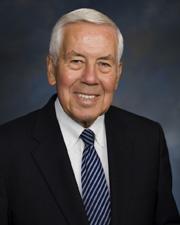 Sen. Richard G. Lugar (R-IN)
Legislative Activity
Stay on top of the latest movement without scrolling through every action
Senate amendment submitted
July 21, 2005
View full timeline
Senate amendment submitted
July 21, 2005
Senate amendment agreed to: Amendment SA 1380 agreed to in Senate by Yea-Nay Vote. 78 - 19. Record Vote Number: 200.
July 21, 2005
Roll call votes on amendments in Senate: Amendment SA 1380 agreed to in Senate by Yea-Nay Vote. 78 - 19. Record Vote Number: 200.
July 21, 2005
Senate amendment proposed (on the floor): Amendment SA 1380 proposed by Senator Lugar.
July 21, 2005
Amendment SA 1380 proposed by Senator Lugar. (consideration: CR S8640-8648, S8654-8657; text: CR S8640) To improve authorities to address urgent nonproliferation crises and United States nonproliferation operations.
July 21, 2005
Amendment SA 1380 agreed to in Senate by Yea-Nay Vote. 78 - 19. Record Vote Number: 200.
July 21, 2005
Votes
1 roll call on this amendment
Text
Proposed
NATIONAL DEFENSE AUTHORIZATION ACT FOR FISCAL YEAR 2006--Resumed

The PRESIDING OFFICER. The clerk will report the pending business.
The legislative clerk read as follows:

A bill (S. 1042) to authorize appropriations for fiscal
year 2006 for military activities of the Department of
Defense, for military construction, and for defense
activities of the Department of Energy, to prescribe
personnel strengths for such fiscal year for the Armed
Forces, and for other purposes.

Pending:

Warner Amendment No. 1314, to increase amounts available
for the procurement of wheeled vehicles for the Army and the
Marine Corps and for armor for such vehicles.

The PRESIDING OFFICER. The pending question is the Warner amendment.
Mr. WARNER. Mr. President, I see the distinguished majority leader.
My understanding is he wishes to lay down an amendment, for which I am
grateful. We would be happy to lay aside the pending amendment.
I yield the floor.
The PRESIDING OFFICER. The majority leader.
Mr. FRIST. Mr. President, I ask unanimous consent that the pending
amendment be laid aside.
The PRESIDING OFFICER. Without objection, it is so ordered.

Amendment No. 1342

Mr. FRIST. Mr. President, I send an amendment to the desk. Also, I
send to the desk a list of cosponsors of the amendment, and I ask
unanimous consent they be added as such.
The PRESIDING OFFICER. Without objection, it is so ordered. The clerk
will report the amendment.
The legislative clerk read as follows:

The Senator from Tennessee [Mr. Frist], for himself, and
others, proposes an amendment numbered 1342.

Mr. FRIST. Mr. President, I ask unanimous consent that reading of the
amendment be dispensed with.
The PRESIDING OFFICER. Without objection, it is so ordered.
The amendment is as follows:

(Purpose: To support certain youth organizations, including the Boy
Scouts of America and Girl Scouts of America, and for other purposes)

At the end of subtitle G of title X, insert the following:

SEC. 1073. SUPPORT FOR YOUTH ORGANIZATIONS.

(a) Short Title.--This Act may be cited as the ``Support
Our Scouts Act of 2005''.
(b) Support for Youth Organizations.--
(1) Definitions.--In this subsection--
(A) the term ``Federal agency'' means each department,
agency, instrumentality, or other entity of the United States
Government; and
(B) the term ``youth organization''--
(i) means any organization that is designated by the
President as an organization that is primarily intended to--

(I) serve individuals under the age of 21 years;
(II) provide training in citizenship, leadership, physical
fitness, service to community, and teamwork; and
(III) promote the development of character and ethical and
moral values; and

[[Page S8603]]

(ii) shall include--

(I) the Boy Scouts of America;
(II) the Girl Scouts of the United States of America;
(III) the Boys Clubs of America;
(IV) the Girls Clubs of America;
(V) the Young Men's Christian Association;
(VI) the Young Women's Christian Association;
(VII) the Civil Air Patrol;
(VIII) the United States Olympic Committee;
(IX) the Special Olympics;
(X) Campfire USA;
(XI) the Young Marines;
(XII) the Naval Sea Cadets Corps;
(XIII) 4-H Clubs;
(XIV) the Police Athletic League;
(XV) Big Brothers--Big Sisters of America; and
(XVI) National Guard Youth Challenge.

(2) In general.--
(A) Support for youth organizations.--No Federal law
(including any rule, regulation, directive, instruction, or
order) shall be construed to limit any Federal agency from
providing any form of support for a youth organization
(including the Boy Scouts of America or any group officially
affiliated with the Boy Scouts of America) that would result
in that Federal agency providing less support to that youth
organization (or any similar organization chartered under the
chapter of title 36, United States Code, relating to that
youth organization) than was provided during the preceding
fiscal year.
(B) Types of support.--Support described under this
paragraph shall include--
(i) holding meetings, camping events, or other activities
on Federal property;
(ii) hosting any official event of such organization;
(iii) loaning equipment; and
(iv) providing personnel services and logistical support.
(c) Support for Scout Jamborees.--
(1) Findings.--Congress makes the following findings:
(A) Section 8 of article I of the Constitution of the
United States commits exclusively to Congress the powers to
raise and support armies, provide and maintain a Navy, and
make rules for the government and regulation of the land and
naval forces.
(B) Under those powers conferred by section 8 of article I
of the Constitution of the United States to provide, support,
and maintain the Armed Forces, it lies within the discretion
of Congress to provide opportunities to train the Armed
Forces.
(C) The primary purpose of the Armed Forces is to defend
our national security and prepare for combat should the need
arise.
(D) One of the most critical elements in defending the
Nation and preparing for combat is training in conditions
that simulate the preparation, logistics, and leadership
required for defense and combat.
(E) Support for youth organization events simulates the
preparation, logistics, and leadership required for defending
our national security and preparing for combat.
(F) For example, Boy Scouts of America's National Scout
Jamboree is a unique training event for the Armed Forces, as
it requires the construction, maintenance, and disassembly of
a ``tent city'' capable of supporting tens of thousands of
people for a week or longer. Camporees at the United States
Military Academy for Girl Scouts and Boy Scouts provide
similar training opportunities on a smaller scale.
(2) Support.--Section 2554 of title 10, United States Code,
is amended by adding at the end the following:
``(i)(1) The Secretary of Defense shall provide at least
the same level of support under this section for a national
or world Boy Scout Jamboree as was provided under this
section for the preceding national or world Boy Scout
Jamboree.
``(2) The Secretary of Defense may waive paragraph (1), if
the Secretary--
``(A) determines that providing the support subject to
paragraph (1) would be detrimental to the national security
of the United States; and
``(B) reports such a determination to the Congress in a
timely manner, and before such support is not provided.''.
(d) Equal Access for Youth Organizations.--Section 109 of
the Housing and Community Development Act of 1974 (42 U.S.C.
5309) is amended--
(1) in the first sentence of subsection (b) by inserting
``or (e)'' after ``subsection (a)''; and
(2) by adding at the end the following:
``(e) Equal Access.--
``(1) Definition.--In this subsection, the term `youth
organization' means any organization described under part B
of subtitle II of title 36, United States Code, that is
intended to serve individuals under the age of 21 years.
``(2) In general.--No State or unit of general local
government that has a designated open forum, limited public
forum, or nonpublic forum and that is a recipient of
assistance under this chapter shall deny equal access or a
fair opportunity to meet to, or discriminate against, any
youth organization, including the Boy Scouts of America or
any group officially affiliated with the Boy Scouts of
America, that wishes to conduct a meeting or otherwise
participate in that designated open forum, limited public
forum, or nonpublic forum.''.

Mr. FRIST. Mr. President, this amendment deals with an issue I have
been working on with a number of Senators for a long period of time,
many months. It deals with an organization I have been involved with
for my entire life--myself and my three boys. The organization is the
Boy Scouts of America.
I am proud to offer the Support Our Scouts Act of 2005 as an
amendment to the Defense authorization bill. This legislation will
ensure that the Defense Department will continue to provide the Scouts
the type of support it has provided in the past, including jamborees on
bases.
Pentagon support for Scouts is currently authorized in U.S. law.
This bill also ensures Scouts have equal access to public facilities,
forums, and programs that are open to a variety of other youth
organizations and community organizations. Boy Scouts, like other
nonprofit youth organizations, depend on the ability to use public
facilities and to participate in these programs and forums. Why am I
offering this legislation? Since the Supreme Court decided Boy Scouts
of America v. Dale, Boy Scouts of America's relationships with
government at all levels have been the target of multiple lawsuits.
The Federal Government has been defending a lawsuit brought by the
ACLU aimed at severing the ties between Boy Scouts and the Departments
of Defense and HUD. The ACLU of Illinois claims that Defense Department
sponsorship violates the first amendment because the Scouts are a
religious organization. This is a red herring.
The Scouts are a youth organization that is committed to developing
qualities, such as patriotism, integrity, loyalty, honesty, and other
values, in our Nation's boys and young men. Part of that development is
asking them to acknowledge a higher authority regardless of
denomination.
We do this every day in the Senate when we open the Senate floor each
morning, when we take our oaths of office, when our young men and women
enlist in the Armed Forces--and the list goes on. Such acknowledgement
and respect is an integral part of our culture, our values, and our
traditions.
A decision was recently reached in this case. A U.S. district court
in Chicago ruled that Pentagon support of the Scouts violates the
establishment clause and, therefore, the Defense Department is
prohibited from providing support to the Scouts at future jamborees.
The timing of this ruling simply could not be worse. On Monday, July
25, thousands of Scouts from around the country will be arriving at
Fort AP Hill, close by, in Virginia. The event will draw 40,000 Scouts
and their leaders and many more proud families, moms and dads.
This latest ruling is part of a series of attempts to undermine
Scouting's interaction with government in America at all levels. The
effect of these attempts of exclusion at the Federal, State, and local
levels could be far-reaching. Already, it has had a chilling effect on
government relationships with Scouts, and it is the greatest legal
challenge facing Boy Scouts today.
The Support Our Scouts Act of 2005 addresses these issues. To begin
with, my amendment makes clear that the Congress regards the Boy Scouts
to be a youth organization that should be treated the same as other
national youth organizations.
Second, this bill asserts the view of the Congress that Pentagon
support to the Scouts at their jamborees, as well as similar support to
other youth organizations, is important to the training of our Armed
Forces. It contributes to--it does not detract from--their readiness.
Third, my amendment removes any doubt that Federal agencies may
welcome Scouts to hold meetings, go camping on Federal property, or
hold Scouting events in public forums at any level.
The Scout bill has been discussed with the Defense Department. While
it includes language that establishes baseline Pentagon support for
Scouting activities, it also offers the Secretary of Defense some
flexibility in its application.
Since 1910, Boy Scout membership has totaled more than 110 million
young Americans. Today, more than 3.2 million young people and 1.2
million adults are members of the Boy Scouts and are dedicated to
fulfilling the Boy Scouts' mission. This unique American institution is
committed to preparing

[[Page S8604]]

our youth for the future by instilling in them such values as honesty,
integrity, and character. Through exposure to the outdoors, hard work,
and the virtues of civic duty, the Boy Scouts has developed millions of
Americans into superb citizens and future leaders.
Today, there are more than 40 Members of the Senate and more than 150
Members of the House of Representatives who have been directly involved
in Scouting. I was a Boy Scout. As I mentioned, my three boys,
Harrison, Jonathan, and Bryan, all were Scouts as well. Scouting is a
great American tradition that has been shared by countless families
over many decades.
I believe this amendment will receive broad, bipartisan support in
both the Senate and the House. I believe we will pass it this year. It
currently has over 50 cosponsors in this body. I encourage others to
come and cosponsor this bill and to come to the floor and speak on
behalf of our Scouts.
I encourage Scout supporters--indeed, all Americans--to contact their
Senators and Representatives and ask them to support the Support Our
Scouts Act of 2005. I do urge all my Senate colleagues to vote for the
young boys and girls who are following in the worthy Scouting
tradition. A vote for this amendment will be a vote for them.
The PRESIDING OFFICER. The Senator from Virginia.
Mr. WARNER. Mr. President, I commend the distinguished majority
leader, and I associate myself with his remarks and this report.
I just looked at one thing, and the staff advised me that the terms
``Boy Scouts'' and ``Girl Scouts'' embrace what is known as the Cub
Scouts. I want to make sure my understanding is correct that was the
intention of our distinguished leader, because a lot of families are
very active in those organizations.
Mr. FRIST. Mr. President, I say to the Senator, indeed it is, Mr.
Chairman. The Cub Scouts badges and uniform is one I wore and, indeed,
my three boys wore, Harrison, Jonathan, and Bryan. It is that
introduction to Scouts that most of us first experience. Indeed, it is.
Mr. WARNER. Mr. President, I thank our distinguished leader. I, too,
have had a very modest career in the Scouts. I was sort of attenuated
when I left and joined the Navy in World War II. So I never attained
any special recognition. But I must say that the training that was
given to me helped me enormously in my early training in the military
because first you learned discipline, then you learned regimentation.
You learned the concept of sharing with others, the need to work with
your fellow Scouts. It is a magnificent organization. I am so glad you
have done this.
I also must say I have attended the rally in Virginia to which you
referred. I will never forget waiting, as one of the several speakers.
I was a most inconsequential speaker because a world-famous baseball
player attended. As far as the eye could see, there were clouds of
dust. They looked like the Roman legions marching in. Tens of thousands
of Scouts assembled at this rally, all carrying their banners, and the
parents were all seated under the trees watching this rally. It was a
spectacle to behold. It was a marvelous experience.
So again, Mr. President, I encourage other Senators to join our
distinguished leader in support of this legislation.
The PRESIDING OFFICER. The Senator from Tennessee is recognized.
Mr. ALEXANDER. Mr. President, I am an original cosponsor of Senator
Frist's legislation, which we call the Save Our Scouts Act of 2005. I
will take a minute to say to my colleagues why I think the bill is
important and why I am glad to be an original cosponsor. I grew up in
Maryville, TN, at the edge of the Great Smoky Mountains National Park--
then a town of about 15,000. Every Monday night, all year long, as soon
as I was 11 years old, we went down to the new Providence Presbyterian
Church at 7 p.m. for a meeting of Troop 88 of the Boy Scouts of
America. There wasn't a lot of nonsense. It started at 7 and was over
at 8. Our primary goal was to get organized for outdoor activities. At
least once a month--sometimes twice a month--we were away from the
church and were very active. Most often, we went into the Great Smoky
Mountains National Park. Sometimes we went down the road to the
Cherokee National Forest.
I can remember on several occasions when we went to the Oak Ridge
National Laboratory, which was a source of great wonderment to us that
close to the end of World War II. Sometimes we went to Knoxville to the
Tennessee Valley Authority, another government agency known worldwide.
We learned from that. I can remember several times we went to the Air
Force base, another Federal installation. There are a lot of State and
local government places we would go in Troop 88. Sometimes we met at
West Side Elementary School or Maryville High School. Sometimes we went
to the courthouse. I remember seeing a great attorney, Ray Jenkins,
waving a bloody wrench in his hand trying to convict a murderer as a
special prosecutor in a family dispute. I was cowering behind the jury
box watching this great lawyer carry on. We were there in a public
building. Sometimes we camped in the city parks. Sometimes we went to
the State parks.
My point is that all of these places we went in Troop 88, whether it
was the Great Smoky Mountains National Park, or any of the others I
mentioned, those are public places. Ever since the Supreme Court made
its decision in the Boy Scouts of America v. Dale case, the
relationship of the Boy Scouts of America with government at all levels
has been the target of multiple lawsuits. That is not just the case for
boys growing up in Maryville, TN.
For the last 25 years, our family has gone up to Ely, MN, on the
Canadian border. It is a million acres of territory that you have to
take a canoe into. It is very restricted wilderness area. It is the
center of one of the Boy Scouts' most important adventure outdoor
programs. Whether they are there in the winter, when it is 20 below, or
in July, when there are a lot of mosquitos, these young men learn to
take care of themselves outdoors.
Every year for as long as I can remember, the Boy Scouts have looked
forward to going to the jamborees, which are often held on Federal
property. It is often a highlight in the lives of these young men. They
look forward to it for several years. The adult scoutmasters go with
them.
Mr. President, it makes no sense whatsoever to restrict, in any way,
the Boy Scouts from using national parks, national forests, the Oak
Ridge National Laboratory, Air Force bases, State parks, and city
parks.
What do the Boy Scouts do? I tell you what it did for me. It tried to
build some character. I can still say the words: Trustworthy, loyal,
helpful, friendly, courteous, kind. There are 12 of them. I did not
always live up to them, but they were taught to me.
The Boy Scouts taught me about my country. I earned my God and
Country award before I got my Eagle Scout. It taught me about this
country and what it means to be an American. It taught me to love the
great American outdoors, which I have always kept and imparted to my
children because we spent almost every weekend in the Great Smoky
Mountains National Park or Cherokee National Forest.
I don't want the young men of the day and their volunteer leaders to
be kept out of the Great Smokies and the TVA and the schools and the
city parks. I don't want those volunteer leaders, who are small
business people in Maryville, TN, who work at the Alcoa plant--they
don't have the money or time to go to court to argue with people about
whether those young boys have a right to go there.
This is a very important piece of legislation. In this country today,
most people would say, when looking at our children, there is nothing
they need more than mentors, and the Boy Scouts, just like the Girl
Scouts, provide that. Look at our schools today. Our worst score of
high school seniors is in U.S. history. At least in the Boy Scouts you
learn something about the principles that unite us as Americans.
Our outdoors are under constant threat. In the Boy Scouts of America,
we are constantly building tens of thousands of young men who love the
outdoors, know how to take care of it, have an environmental ethic and
use that for the rest of their lives.
I am glad we have a majority leader who is a Boy Scout. I am glad we
have more than half the Senate who are cosponsors of this legislation.
I hope the result of this legislation will remove

[[Page S8605]]

any doubt that Federal agencies may welcome Boy Scouts to hold meetings
and go camping on Federal property, just as we did. And it says to
State and local governments that in denying equal access to the public
venues to scouts, they will risk some of their Federal funds if they
continue to do that.
The Boy Scouts of America is one of the preeminent valuable
organizations in this country, and I am proud to be an original
cosponsor of the Support Our Scouts Act of 2005.
I yield the floor.
Mr. WARNER. Mr. President, I wish to thank our distinguished
colleague from Tennessee. I listened carefully to his remarks. It did
evoke memories of this humble Senator when I had a rather inauspicious
career in the Boy Scouts. Nevertheless, they did a lot more for me than
I did for them.
I remember the jamborees. I can remember very well on our first
encampment filling a tick bag full of barn straw which we used for a
mattress. I was greatly impressed with that.
The PRESIDING OFFICER. The Senator from Oklahoma.
Mr. INHOFE. Mr. President, let me also join Senator Frist in this
legislation. I believe it is very significant. I spoke last April on
the Senate floor on behalf of this issue, and I am proud to do so again
with this amendment.
Sadly, since my previous speech, there has been a recent Federal
court ruling against the Pentagon's support for the National Boy Scout
Jamboree, which occurs every 4 years and attracts about 40,000 people.
It will be taking place on July 25.
In her decision, a Federal judge in Chicago ruled that a statute
permitting the military to lend support for the National Scout Jamboree
violates the establishment clause of the Constitution.
In short, the judge ruled that Pentagon funding is unconstitutional
because the Boy Scouts are a religious organization as it requires
Scouts to affirm a belief in God. I will speak more on this later.
However, it is clear to me that for more than 90 years, the Boy
Scouts have benefited our youth and helped produce some of the best and
brightest leaders in our country. I believe we must reaffirm our
support for the vital work they have done and continue to do. Like many
of my friends here, I was a Boy Scout many years ago.
As a result of the great work they do, I was pleased to be an
original cosponsor of S. 642, the Support Our Scouts Act of 2005, as
well as this amendment.
I had at one time considered introducing my own bill on this very
important matter. However, I was so pleased with the substance of this
bill that I was proud to add my name as a cosponsor, and I again thank
Senator Frist for his efforts on this issue.
As you may know, this bill, and now this amendment, address efforts
by some groups to prevent Federal agencies from supporting our Scouts.
This bill would remove any doubts that Federal agencies can welcome
Scouts and the great work they do.
Sadly, as the following excerpt from a July 20, 2005, Wall Street
Journal editorial demonstrates, these great organizations have come
under attack. The column from this respected publication explains that:

Because the Scouts require members to ``privately exercise
their religious faith as directed by their families and
religious advisors,'' the ACLU petitioned the court to
declare the organization ``theistic'' and ``pervasively
sectarian.'' Judge Blanche Manning didn't go quite that far
last month, but she did rule it an overtly religious
association because it ``excludes atheists and agnostics from
membership.'' She ordered the Army to expel the next Jamboree
from Fort A.P. Hill in 2010, by which time we trust the
Seventh Circuit Court of Appeals will have overturned her
decision.

I hope this unfortunate decision is overturned as well.
As Senator Frist has said, this legislation will specifically ensure
that the Department of Defense can and will continue to provide the
Scouts the type of support it has provided in the past. Moreover, the
Scouts would be permitted equal access to public facilities, forums,
and programs that are open to a variety of other youth or community
organizations.
It is enormously regrettable to me that the Scouts have come under
attack from aggressive liberal groups blatantly pushing their own
social agendas and become the target of lawsuits by organizations that
are more concerned with pushing these liberal agendas than sincerely
helping our youth.
Rather than protecting our religious freedoms, these groups are
clearly bent on discriminating against any organization that has faith
as one of its tenets.
Thus, today, the Federal Government continues to defend the lawsuit
aimed at severing traditional ties between the Boy Scouts and the
Departments of Defense and Housing and Urban Development.
What is more, Scouts have been excluded by certain State and local
governments from utilizing public facilities, forums and programs,
which are open to other groups.
It is certainly disappointing and, frankly frustrating that we have
reached a point where groups such as the ACLU are far more interested
in tearing down great institutions like the Boy Scouts than helping
foster character and values in our young men. I am tired of these
tactics. It is very disturbing to me that these groups unabashedly
attack organizations, regardless of the good they do or the support
they have from the vast majority of Americans, simply to further their
own subjective social agendas.
I, for one, am saddened that the Boy Scouts of America has been the
most recent target of these frivolous lawsuits. I reject any arguments
that the Boy Scouts is anything but one of the greatest programs for
character development and values-based leadership training in America
today.
We should seek to aid, not impede, groups that promote values such as
duty to God and country, faith and family, and public service and
sacrifice, which are deeply ingrained in the oath of every Scout. To
fail to support such values would allow the very fabric of America,
which has brought us to this great place in history, to be destroyed.
Today, with more than 3.2 million youth members, and more than 1.2
million adult volunteers, we can certainly say that the Boy Scouts of
America has positively impacted the lives of generations of boys,
preparing them to be men of great character and values. Remarkably, Boy
Scout membership since 1910 totals more than 110 million.
I am proud to report that in Oklahoma we have a total youth
participation of nearly 75,000 boys; and in Oklahoma City alone, we
have about 7,000 adult volunteers.
These young men have helped serve communities all over our State with
programs such as Helping Hands for Heroes, a program where Scouts help
military families whose loved ones are serving overseas. These young
men have cut grass, cleaned homes, taken out the garbage, and walked
dogs. What a great service for our soldiers, sailors, airmen, and
marines and their families. Our Boy Scouts have also served as ushers
and first-aid responders at the University of Oklahoma football games
for more than 50 years.
Notably, Scouts in my State have also shared a long and proud history
of cooperation and partnership with military installations in Oklahoma.
Furthermore, events, such as the National Jamboree, allow an
opportunity to expose large numbers of young Americans to our great
military in a time when fewer and fewer receive such exposure. I
believe this is a very good thing, and I will fight to see that it
continues.
Given all this, I hope my colleagues will join me in defending this
organization and others like it. We must not be afraid to support our
youth and organizations like the Boy Scouts that support them.
As the Wall Street Journal editorial that I mentioned previously
argued:

The values the Scouts embody are vital to the national good
and in need today, more than ever.

I agree and am proud to rise in support today and always for this
great cause.
Mr. President, I yield the floor.
<bullet> Mr. ALLARD. Mr. President, I rise today in support of the Boy
Scouts of America and the Support Our Scouts Act of 2005 amendment
being offered by majority leader Frist.
I support the Boy Scouts of America and its goals. I was fortunate to
be able to have most of the same experiences and training offered by
the Boy Scouts

[[Page S8606]]

as I grew up. My boyhood on a ranch in Walden, CO, offered me the
chance to develop the outdoor skills and nature appreciation that are
so much a part of Scouting. As a child I also learned much about
patriotism, community service, religion, political involvement and
civic responsibility--the intellectual development stressed by the Boy
Scouts. As a veterinarian I often served as an advisor to the Scouts on
a variety of issues relating to animal care and health. Americans all
over our Nation contribute and are touched by this great organization.
On July 25 through August 3, Boy Scouts from all over the Nation will
gather at Fort A.P. Hill in Virginia for their National Scout Jamboree.
This opportunity is time to celebrate scouting and the strong ideals it
instills in it's youth.
Boy Scouts of America, like other nonprofit youth organizations,
depend on the use of these public facilities for various programs and
forums. Boy Scouts of America have had a long and positive relationship
with the Departments of Defense and Housing and Urban Development. This
relationship has fostered responsible fun and adventure to the more
than 3 million boys and 1 million adult volunteers around the country.
However, since the U.S. Supreme Court decided Boy Scouts of America,
BSA v. Dale, the Boy Scout's relationships with Government has been the
target of frivolous lawsuits. Currently, State and local Governments
are actively excluding Boy Scouts from using public facilities, forums,
and programs. These are resources that are available to a variety of
other youth or community organizations. Today access by the Scouts has
been unfairly limited because of the Boy Scout's unwavering
acknowledgment of God.
As we fight to prevent court involvement from changing our founding
documents and other symbols of our national heritage we must also
support and protect the heritage of Boy Scouts of America. Citizenship,
service, and leadership are important values on which the Boy Scouts of
America was built. The ability of the Boy Scouts to instill young
people with values and ethical character must remain intact for future
generations. The Boy Scouts of America is a permanent fixture in our
culture and no court ruling can or should attempt to diminish their
rights to equal access.
This amendment's mission is to ensure that the Boy Scouts are treated
equally. I feel the Boy Scouts have been unfairly singled out. It is
important to guarantee their right to equal access of public
facilities, forums, and programs so that the Boy Scout of America can
continue to serve America's communities and families for a better
tomorrow.
Please join me in supporting the Boy Scouts of America and majority
leader Frist's Support Our Scouts amendment to the Defense
Appropriations bill.<bullet>
Mr. ENZI. Mr. President, I rise in support of amendment No. 1342, the
Support Our Scouts Act, offered by my distinguished colleague from
Tennessee, Senator Frist. The amendment was intended to be simple and
straightforward in its purpose, to ensure the Department of Defense can
continue to support youth organizations, including the Boy Scouts of
America, without fear of frivolous lawsuits. The dollars that are being
spent on litigation ought to be spent on programs for the youth. Every
time we see a group like the Boy Scouts, that will teach character and
take care of the community, we ought to do everything we can to promote
it.
This Saturday, over 40,000 Boy Scouts from around the Nation will
meet at Fort A.P. Hill in Virginia for the National Scout Jamboree.
This event provides a unique opportunity for the military and civilian
communities to help our young men gain a greater understanding of
patriotism, comradeship, and self-confidence.
Since the first jamboree was held at the base of the Washington
Monument in 1937, more than 600,000 Scouts and leaders have
participated in the national events. I attended the jamboree at Valley
Forge in 1957.
Boy Scouts has been a part of my education. I am an Eagle Scout. I am
pleased to say my son was in Scouts. He is an Eagle Scout. Boy Scouts
is an education. It is an education in possibilities for careers. I can
think of no substitution for the 6 million boys in Scouts and the
millions who have preceded them. There are dozens on both sides of the
aisle who have been Boy Scouts. I say it is part of my education
because each of the badges that is earned, each of the merit badges
that is earned, is an education. I tell schoolkids as I go across my
State and across my country that even though at times I took courses or
merit badges or programs that I didn't see where I would ever have a
use for them, by now I have had a use for them and wish I had paid more
attention at the time I was doing it.
I always liked a merit badge pamphlet on my desk called
``Entrepreneurship.'' It is the hardest Boy Scout badge to earn. It is
one of the most important ones. I believe small business is the future
of our country. Boy Scouts promote small business through their
internship merit badge. Why would it be the toughest to get? Not only
do you have to figure out a plan, devise a business plan, figure how to
finance it, but the final requirement for the badge is to start a
business.
I could go on and on through the list of merit badges required in
order to get an Eagle badge. There are millions of boys in this country
who are doing that and will be doing that. They do need places to meet.
They are being discriminated against. They are being told they cannot
use military facilities, even for their national jamborees.
These jamborees have become a great American tradition for our young
people, and Fort A.P. Hill has been made the permanent site of the
gatherings. But now the courts are trying to say that this is
unconstitutional.
It isn't just military facilities; it is Federal facilities. A couple
of years ago, we had an opportunity to debate this again on floor, and
it had to do with the Smithsonian.
Some Boy Scouts requested they be able to do the Eagle Scout Court of
Honor at the National Zoo and were denied. Why? The determination by
the legal staff of the Smithsonian that Scouts discriminate because of
their support for and encouragement for the spiritual life of their
members. Specifically, they embrace the concept that the universe was
created by a supreme being, although we surely point out Scouts do not
endorse or require a single belief or any particular faith's God. The
mere fact they asked you to believe in and try to foster a relationship
with a supreme being who created the universe was enough to disqualify
them.
I read that portion of the letter twice. I had just visited the
National Archives and read the original document signed by our Founding
Fathers. It is a good thing they hadn't asked to sign the Declaration
of Independence at the National Zoo.
This happens in the schools across the country. Other requests have
been denied. They were also told they were not relevant to the National
Zoo.
That is kind of a fascinating experiment in words. I did look to see
what other sorts of things had been done there and found they had a
Washington Singers musical concert, and the Washington premiers for
both the ``Lion King'' and ``Batman.'' Clearly, relevance was not a
determining factor in those decisions.

But the Boy Scouts have done some particular things in conservation
that are important, in conservation tied in with the zoo. In fact, the
founder of the National Zoo was Dr. William Hornaday. He is one of the
people who was involved in some of the special conservation movements
and has one of the conservation badges of Scouts named after him.
If the situations did not arise, this amendment would not come up.
But they do.
In 2001, I worked with Senator Helms to pass a similar amendment
requiring that the Boy Scouts are treated fairly, as any other
organization, in their efforts to hold meetings on public school
property. This amendment clarified the difference between support and
discrimination, and it has been successful in preventing future
unnecessary lawsuits. The Frist amendment is similar to the Helms
amendment and will help prevent future confusion.
Again and again, the Scouts have had to use the courts to assure that
they were not discriminated against. I am pretty sure everybody in
America recognizes if you have to use the courts to get your rights to
use school buildings,

[[Page S8607]]

military bases, or other facilities, it costs money. It costs time.
This amendment eliminates that cost and eliminates that time, to allow
all nationally recognized youth organizations to have the same rights.
The legal system is very important in the country but it has some
interesting repercussions. Our system of lawsuits, which sometimes are
called the legal lottery of this country, allow people who think they
have been harmed to try to point out who harmed them and get money for
doing that. It has had some difficulties for the Boy Scouts.
I remember when my son was in the Scouts their annual fundraiser was
selling Christmas trees. One of the requirements when they were selling
Christmas trees was that the boys selling trees at the lot had to be
accompanied by two adults not from the same family.
I did not understand why we needed all of this adult supervision. It
seemed as if one adult helping out at the lot would be sufficient. The
answer was, they have been sued because if there was only one adult
there and that adult could be accused of abusing the boys. Two adults
provided some assurance that a lawsuit would not happen.
The interesting thing is, it was just me and my son at the lot and we
still had to have another adult in order to keep the Boy Scouts from
being sued.
They run into some of the same difficulties with car caravans.
So the legal system of this country has put them in the position
where they are doing some of the things that they are doing. The legal
system of the country has caused some of the discrimination that is
done.
It is something we need to correct. This discussion of the Frist
amendment is timely. U.S. District Judge Blanche Manning recently ruled
that the Pentagon could no longer spend Government money to ready Fort
A.P. Hill for the National Boy Scout Jamboree. The Frist amendment
would assure that our free speech protections would also apply to the
Boy Scouts of America.
The Boy Scouts of America is one of the oldest and largest youth
organizations in the United States and the world today. The
organization teaches its members to do their duty to God, to love their
country, and serve their fellow citizens. The Boy Scouts have formed
the minds and hearts of millions of Americans and prepared these boys
and young men for the challenges they are sure to face the rest of
their lives. It is an essential part of Americana. I urge my colleagues
to join me in defending the Boy Scouts from constitutional
discrimination by supporting the Helms amendment.
The PRESIDING OFFICER. The Senator from Michigan.
Mr. LEVIN. Mr. President, we have no objection that I know of to this
amendment. It does not purport to limit the jurisdiction of a Federal
court in determining what the Constitution means. So we do not have any
objection to it.
The PRESIDING OFFICER. Is there further debate on the amendment?
The Senator from Virginia.

Amendment No. 1314

Mr. WARNER. Mr. President, in consultation with the majority leader
and the distinguished Senator from Michigan, as to the amendment by
Senator Frist, I ask unanimous consent that the amendment be laid aside
and that we return to my amendment No. 1314.
The PRESIDING OFFICER. Without objection, it is so ordered.
Mr. WARNER. On that matter, it is contemplated now that we will have
a vote in relation to the Warner amendment regarding the wheeled motor
vehicles, armored, today at 12:30.
The PRESIDING OFFICER. The Senator from Michigan.
Mr. LEVIN. Mr. President, we very strongly support the Warner
amendment. I ask unanimous consent that I be listed as a cosponsor of
the Warner amendment.
The PRESIDING OFFICER. Without objection, it is so ordered.
Mr. LEVIN. Mr. President, we understand there will be no second-
degree amendments to the Warner amendment now.
I also ask unanimous consent that Senator Kennedy be listed as a
cosponsor.
The PRESIDING OFFICER. Without objection, it is so ordered.
Mr. LEVIN. Mr. President, we are checking on Senator Bayh right now.
Mr. WARNER. I think it is important. Senator Bayh has been very
active on this issue.

Amendment No. 1314, as Modified

Mr. President, I send to the desk a modification to my amendment in
the nature of a technical modification. I believe it has been examined
by the other side. This modification identifies an offset of $445.4
million from the Iraqi Freedom Fund for this amendment.
The PRESIDING OFFICER. Without objection, it is so ordered.
The amendment, as modified, is as follows:

On page 303, strike line 3 and all that follows through
page 304, line 24, and insert the following:
(3) For other procurement $376,700,000.
(b) Availability of Certain Amounts.--
(1) Availability.--Of the amount authorized to be
appropriated by subsection (a)(3), $225,000,000 shall be
available for purposes as follows:
(A) Procurement of up-armored high mobility multipurpose
wheeled vehicles (UAHs).
(B) Procurement of wheeled vehicle add-on armor protection,
including armor for M1151/M1152 high mobility multipurpose
wheeled vehicles.
(C) Procurement of M1151/M1152 high mobility multipurpose
wheeled vehicles.
(2) Allocation of funds.--
(A) In general.--Subject to subparagraph (B), the Secretary
of the Army shall allocate the manner in which amounts
available under paragraph (1) shall be available for the
purposes specified in that paragraph.
(B) Limitation.--Amounts available under paragraph (1) may
not be allocated under subparagraph (A) until the Secretary
certifies to the congressional defense committees that the
Army has a validated requirement for procurement for a
purpose specified in paragraph (1) based on a statement of
urgent needs from a commander of a combatant command.
(C) Reports.--Not later than 15 days after an allocation of
funds is made under subparagraph (A), the Secretary shall
submit to the congressional defense committees a report
describing such allocation of funds.

SEC. 1404. NAVY AND MARINE CORPS PROCUREMENT.

(a) Navy.--Funds are hereby authorized to be appropriated
for fiscal year 2006 for the procurement accounts of the Navy
in amounts as follows:
(1) For aircraft, $183,800,000.
(2) For weapons, including missiles and torpedoes,
$165,500,000.
(3) For other procurement, $30,800,000.
(b) Marine Corps.--Funds are hereby authorized to be
appropriated for fiscal year 2006 for the procurement account
for the Marine Corps in the amount of $429,600,000.
(c) Navy and Marine Corps Ammunition.--Funds are hereby
authorized to be appropriated for fiscal year 2006 for the
procurement account for ammunition for the Navy and the
Marine Corps in the amount of $104,500,000.
(d) Availability of Certain Amounts.--
(1) Availability.--Of the amount authorized to be
appropriated by subsection (b), $340,400,000 shall be
available for purposes as follows:
(A) Procurement of up-armored high mobility multipurpose
wheeled vehicles (UAHs).
(B) Procurement of wheeled vehicle add-on armor protection,
including armor for M1151/M1152 high mobility multipurpose
wheeled vehicles.
(C) Procurement of M1151/M1152 high mobility multipurpose
wheeled vehicles.
(2) Allocation of funds.--
(A) In general.--Subject to subparagraph (B), the Secretary
of the Navy shall allocate the manner in which amounts
available under paragraph (1) shall be available for the
purposes specified in that paragraph.
(B) Limitation.--Amounts available under paragraph (1) may
not be allocated under subparagraph (A) until the Secretary
certifies to the congressional defense committees that the
Marine Corps has a validated requirement for procurement for
a purpose specified in paragraph (1) based on a statement of
urgent needs from a commander of a combatant command.
(C) Reports.--Not later than 15 days after an allocation of
funds is made under subparagraph (A), the Secretary shall
submit to the congressional defense committees a report
describing such allocation of funds.

SEC. 1404A. REDUCTION IN AUTHORIZATION OF APPROPRIATION FOR
IRAQ FREEDOM FUND.

The amount authorized to be appropriated for fiscal year
2006 for the Iraq Freedom Fund is the amount specified by
section 1409(a) of this Act, reduced by $445,400,000.

Mr. WARNER. Mr. President, I ask unanimous consent that Senator
DeWine and Senator Collins be added as cosponsors to the amendment.
The PRESIDING OFFICER. Without objection, it is so ordered.
Mr. WARNER. Mr. President, this amendment was debated yesterday. I
see other Senators seeking recognition. From my perspective, the debate
has been satisfied, unless there are other Senators.

[[Page S8608]]

Has the Chair ruled on the vote at 12:30? I ask unanimous consent
that the vote in relation to the Warner amendment No. 1314 regarding
wheeled vehicle armor occur today at 12:30 with no second-degree
amendments in order prior to the vote.
The PRESIDING OFFICER. Without objection, it is so ordered.
The Senator from Oregon.
Mr. WYDEN. Mr. President, I had approached the chairman to ask if I
could speak for a few minutes as in morning business and if it would be
possible at this time for me to speak for up to 10 minutes as in
morning business.
Mr. WARNER. I bring to the Senator's attention, we did have that
discussion. I didn't, at the time, recognize the imminence of the vote.
I see a colleague who does have an amendment in relation to the bill.
Therefore, I am hesitant to grant UC to go off the bill. Could I
inquire of the Senator from Oklahoma?
Mr. INHOFE. I respond to the distinguished chairman that I do have
three amendments that are prepared and I am ready to bring them up and
get them into the system. I also have two UC requests. If I could be
recognized for that purpose, I would appreciate that.
Mr. WARNER. Mr. President, are there other colleagues who wish to
address the Defense bill? Hopefully, we can accommodate our colleague
from Oregon. Let's determine, procedurally, the order in which matters
in relation to this bill should be brought up.
Ms. COLLINS. Mr. President, I inform the distinguished chairman that
I was seeking 8 minutes to speak on the underlying bill.
Mr. WARNER. I thank the Senator from Maine.
Mr. ALEXANDER. Mr. President, I inform the chairman I would like to
speak for 4 minutes on the Boy Scout amendment discussed, if time is
available after other Senators speak on the underlying bill.
Mr. WARNER. I thank the distinguished Senator from Tennessee. I bring
to his attention that that measure has been laid aside. It doesn't
preclude his speaking to it, but we will see what we can do.
I ask my colleagues on this side, the Senator from Oregon, do you
want 10 minutes or 8 minutes?
Mr. WYDEN. If the chairman could allow that, I would be appreciative.
Mr. WARNER. I wonder if the distinguished Senator from Oklahoma could
proceed, followed by the Senator from Maine, and then prior to the
vote, if you desire to do it before 12:30?
Mr. WYDEN. If that is at all possible. Perhaps I will ask unanimous
consent to speak for up to 10 minutes after the vote; would that be
acceptable?
Mr. WARNER. I would like to ask my colleague, the Senator from
Michigan, to concur in that UC, that following the vote, the Senator
from Oregon be recognized for a period of not to exceed 10 minutes, and
we will go off the bill for that purpose.
Mr. WYDEN. I thank the chairman.
Mr. LEVIN. We appreciate that.
The PRESIDING OFFICER. Without objection, it is so ordered.
Mr. LEVIN. I wonder if we could lock in an additional speaker. I ask
unanimous consent that immediately prior to the vote on the Warner
amendment at 12:30, Senator Kennedy be recognized for 5 minutes at
12:25.
The PRESIDING OFFICER. Is there objection?
Mr. ALEXANDER. Reserving the right to object, I would like to be in
the queue before 12:30.
Mr. WARNER. I assure you that you will have 5 minutes in that period
of time. If the Senator from Oklahoma could present his amendments,
followed by the Senator from Maine, the Senator from Tennessee, and
then Senator Kennedy.
The PRESIDING OFFICER. The Senator from Michigan.
Mr. LEVIN. Mr. President, I am afraid I didn't hear that request. Are
the speakers that have been identified speaking on the pending
amendment?
Mr. WARNER. Not the pending. In other words, I desire not to go off
the bill to accommodate our friend from Oregon. He has now been
accommodated. We are looking at a period of roughly 40 minutes to be
allocated among three Senators who wish to speak to matters in relation
to this bill and reserving at 12:25 that Senator Kennedy be recognized
for a period of 5 minutes.
Mr. LEVIN. I ask unanimous consent that we add to that request that
Senator Lautenberg then be recognized to offer an amendment immediately
after the speakers who have been identified.
Mr. WARNER. Mr. President, we will do our very best to at least
introduce an amendment at that time.
The PRESIDING OFFICER. Is there objection to Senator Lautenberg being
added at the end of the three previous speakers?

Mr. WARNER. Might I inquire as to the amount of time the
distinguished Senator from New Jersey might wish?
Mr. LAUTENBERG. I would like a half-hour evenly divided on the
amendment. We have 50 minutes left before a vote. If I might say, could
our distinguished colleague be accommodated immediately after the vote,
following the Senator from Oregon?
Why don't I just lay it down and take a couple minutes to talk about
it.
Mr. WARNER. Five minutes then.
Mr. LEVIN. He would just lay down an amendment prior to Senator
Kennedy speaking and then he would pick up after the vote.
Mr. WARNER. I have no objection.
The PRESIDING OFFICER. Without objection, it is so ordered.
The Senator from Oklahoma is recognized.
Mr. INHOFE. Mr. President, first, I thank the distinguished chairman
of the Senate Armed Services Committee for allowing me to offer these
amendments. I will stay within a timeframe that will allow other
speakers under the UC to be heard. I have three amendments I will be
bringing up.
I first ask unanimous consent that Senator Collins be added as a
cosponsor to amendment No. 1312 and that Senator Kyl be added as a
cosponsor to amendment No. 1313.
The PRESIDING OFFICER. Without objection, it is so ordered.

Amendment No. 1311

Mr. INHOFE. Mr. President, is it necessary to set aside the pending
amendment for me to offer my amendment?
The PRESIDING OFFICER. That is correct.
Mr. INHOFE. I ask unanimous consent that the pending amendment be set
aside, and I send an amendment to the desk, No. 1311, and ask for its
immediate consideration.
The PRESIDING OFFICER. Without objection, it is so ordered.
The clerk will report.
The legislative clerk read as follows:

The Senator from Oklahoma [Mr. Inhofe] proposes an
amendment numbered 1311.

Mr. INHOFE. Mr. President, I ask unanimous consent that reading of
the amendment be dispensed with.
The PRESIDING OFFICER. Without objection, it is so ordered.
The amendment is as follows:

(Purpose: To protect the economic and energy security of the United
States)

At the appropriate place, insert the following:

ECONOMIC AND ENERGY SECURITY

Sec. _. Section 721 of the Defense Production Act of 1950
(50 U.S.C. App. 2170) is amended--
(1) in subsection (b)--
(A) by redesignating paragraphs (1) and (2) as
subparagraphs (A) and (B), respectively;
(B) by striking ``The President'' and inserting ``(1) In
General.--The President'';
(C) by inserting ``, including national economic and energy
security,'' after ``national security'';
(D) by adding at the end the following new paragraph:
``(2) Notice and wait requirement.--
``(A) Notification of approval.--The President shall notify
the appropriate congressional committees of each approval of
any proposed merger, acquisition, or takeover that is
investigated under paragraph (1).
``(B) Joint resolution objecting to transaction.--
``(i) Delay pending consideration of resolution.--A
transaction described in subparagraph (A) may not be
consummated until 10 legislative days after the President
provides the notice required under such subparagraph. If a
joint resolution objecting to the proposed transaction is
introduced in either House of Congress by the chairman of one
of the appropriate congressional committees during such
period, the transaction may not be consummated until 30
legislative days after such resolution.
``(ii) Disapproval upon passage of resolution.--If a joint
resolution introduced under clause (i) is agreed to by both
Houses of Congress, the transaction may not be
consummated.'';
(E) in paragraph (1)(B) (as so designated by this
paragraph), by striking ``shall'';
(2) in subsection (d), by striking ``subsection (d)'' and
inserting ``subsection (e)'';

[[Page S8609]]

(3) in subsection (e), by striking ``subsection (c)'' and
inserting ``subsection (d)'';
(4) in subsection (f)(3), by inserting ``, including
national economic and energy security,'' after ``national
security'';
(5) in subsection (g)--
(A) by striking ``Report to the Congress'' in the heading
and inserting ``Reports to Congress'';
(B) by striking ``The President'' and inserting the
following: ``(1) Reports on determinations.--The President'';
(C) by adding at the end the following new paragraph:
``(2) Reports on considered transactions.--
``(A) In general.--The President or the President's
designee shall transmit to the appropriate congressional
committees on a monthly basis a report containing a detailed
summary and analysis of each transaction the consideration of
which was completed by the Committee on Foreign Acquisitions
Affecting National Security since the most recent report.
``(B) Content.--Each report submitted under subparagraph
(A) shall include--
``(i) a description of all of the elements of each
transaction; and
``(ii) a description of the standards and criteria used by
the Committee to assess the impact of each transaction on
national security.
``(C) Form.--The reports submitted under subparagraph (A)
shall be submitted in both classified and unclassified form,
and company proprietary information shall be appropriately
protected.''; and
(D) by striking ``of this Act'';
(6) in subsection (k)--
(A) by striking ``Quadrennial'' in the heading and
inserting ``Annual''; and
(B) in paragraph (1)--
(i) by striking ``upon the expiration of every 4 years''
and inserting ``annually'';
(ii) in subparagraph (A), by striking ``; and'' and
inserting a semicolon;
(iii) in subparagraph (B), by striking the period at the
end and inserting ``; and''; and
(iv) by adding at the end the following new subparagraph:
``(C) evaluates the cumulative effect on national security
of foreign investment in the United States.''; and
(7) by adding at the end the following new subsections:
``(l) Appropriate Congressional Committees Defined.--In
this section, the term `appropriate congressional committees'
means--
``(1) the Committee on Banking, Housing, and Urban Affairs,
the Committee on Armed Services, the Select Committee on
Intelligence, and the Committee on Appropriations of the
Senate; and
``(2) the Committee on Financial Services, the Committee on
Armed Services, the Permanent Select Committee on
Intelligence, and the Committee on Appropriations of the
House of Representatives.
``(m) Designee.--Notwithstanding any other provision of
law, the designee of the President for purposes of this
section shall be known as the `Committee on Foreign
Acquisitions Affecting National Security', and such committee
shall be chaired by the Secretary of Defense.''.

Mr. INHOFE. Mr. President, as a practical and timely step toward
addressing problems with China, I am introducing amendment No. 1311.
This amendment addresses the review process of foreign acquisitions in
the U.S. The review of controversial buys, such as the CNOOC, currently
falls to the Committee on Foreign Investment in the United States,
CFIUS. I will state this simply: CFIUS has not demonstrated an
appropriate conception of U.S. national security. I understand that
Representatives Hyde, Hunter and Manzullo expressed similar views in a
January letter to Treasury Secretary John Snow, the chairman of CFIUS.
Of more than 1,500 cases of foreign investments or acquisitions in the
U.S., CFIUS has investigated only 24. And only one resulted in actually
stopping the transaction. This lone disapproval, in February 1990,
occurred with respect to a transaction that had already taken place--it
took President George H.W. Bush to stop the transaction and safeguard
our national security.
Another example of CFIUS falling short is with Magnequench
International Incorporated. In 1995 Chinese corporations bought GM's
Magnequench, a supplier of rare earth metals used in the guidance
systems of smart bombs. Over 12 years, the company has been moved
piecemeal to mainland China, leaving the U.S. with no domestic supplier
of neodymium, a critical component of rare-earth magnets. CFIUS
approved this transfer. The United States now buys rare earth metals,
which are essential for precision-guided munitions, from one single
country--China.
Some experts believe that China's economic policy is a purposeful
attempt to undermine the U.S. industrial base and likewise, the defense
industrial base. Perhaps it is hard to believe that China's economic
manipulation is such a threat to our Nation. In response, I would like
to read from the book ``Unrestricted Warfare'', written by two PLA,
People's Liberation Army, senior Colonels:

Military threats are already no longer the major factors
affecting national security . . . traditional factors are
increasingly becoming more intertwined with grabbing
resources contending for markets, controlling capital, trade
sanctions and other economic factors.

I have outlined in my earlier speeches how China is a clear threat. I
believe it is. But I also believe that this threat can be addressed and
allow a healthy, mutual growth for both our countries. The CFIUS
process is at the heart of this issue. Chairman of the US-China
Economic and Security Review Commission, Dick D'Amato, stated this
morning that the CFIUS process is ``broken.'' This amendment is a step
toward fixing the problems, enabling the foreign review to carry out
its function and truly protect our national security.
First, it clearly charges the commission with measuring energy and
economic security as fundamental aspects of national security.
Second, it brings congressional oversight into the foreign investment
review process. After a 10-day review period, an oversight committee
chairman can extend the review period to 30 days. Congress then has the
option to pass a resolution of disapproval and thus stop an acquisition
harmful to our country.
Third, the amendment calls for a report on the security implications
of transactions on a monthly basis. There will also be a yearly report
to the proper congressional committees that will review the cumulative
effect of our sales with China.
The amendment also changes the name of the review mechanism to
reflect the national security focus that it should be emphasizing. The
new name would be Committee on Foreign Acquisitions Affecting National
Security, or CFAANS. Further, the designated chairman of the process
would become the Secretary of Defense, also reflecting the security
focus that the process should be based on.
The foreign investment review process is vital to providing for U.S.
security, particularly in relation to countries such as China. However,
it is in need of attention and changes no less drastic than I have
suggested here.
We are going to have to do something about the performance of this
organization. To do it, we will have to change the structure. I am
going to be recommending that the chairman of CFIUS no longer be the
Secretary of the Treasury but be the Secretary of Defense, since they
deal with very critical national security issues.

Amendment No. 1312

Mr. INHOFE. Mr. President, I ask unanimous consent that the pending
amendment be set aside, and I send amendment No. 1312 to the desk and
ask for its immediate consideration.
The PRESIDING OFFICER. Without objection, it is so ordered.
The clerk will report.
The legislative clerk read as follows:

The Senator from Oklahoma [Mr. Inhofe], for himself and Ms.
Collins, proposes an amendment numbered 1312.

Mr. INHOFE. I ask unanimous consent that reading of the amendment be
dispensed with.
The PRESIDING OFFICER. Without objection, it is so ordered.
The amendment is as follows:

(Purpose: To express the sense of Congress that the President should
take immediate steps to establish a plan to implement the
recommendations of the 2004 Report to Congress of the United States-
China Economic and Security Review Commission)

At the end of title XII, insert the following:

SEC. 1205. THE UNITED STATES-CHINA ECONOMIC AND SECURITY
REVIEW COMMISSION.

(a) Findings.--Congress finds the following:
(1) The 2004 Report to Congress of the United States-China
Economic and Security Review Commission states that--
(A) China's State-Owned Enterprises (SOEs) lack adequate
disclosure standards, which creates the potential for United
States investors to unwittingly contribute to enterprises
that are involved in activities harmful to United States
security interests;
(B) United States influence and vital long-term interests
in Asia are being challenged by China's robust regional
economic engagement and diplomacy;

[[Page S8610]]

(C) the assistance of China and North Korea to global
ballistic missile proliferation is extensive and ongoing;
(D) China's transfers of technology and components for
weapons of mass destruction (WMD) and their delivery systems
to countries of concern, including countries that support
acts of international terrorism, has helped create a new tier
of countries with the capability to produce WMD and ballistic
missiles;
(E) the removal of the European Union arms embargo against
China that is currently under consideration in the European
Union would accelerate weapons modernization and dramatically
enhance Chinese military capabilities;
(F) China's recent actions toward Taiwan call into question
China's commitments to a peaceful resolution;
(G) China is developing a leading-edge military with the
objective of intimidating Taiwan and deterring United States
involvement in the Strait, and China's qualitative and
quantitative military advancements have already resulted in a
dramatic shift in the cross-Strait military balance toward
China; and
(H) China's growing energy needs are driving China into
bilateral arrangements that undermine multilateral efforts to
stabilize oil supplies and prices, and in some cases may
involve dangerous weapons transfers.
(2) On March 14, 2005, the National People's Congress
approved a law that would authorize the use of force if
Taiwan formally declares independence.
(b) Sense of Congress.--
(1) Plan.--The President is strongly urged to take
immediate steps to establish a plan to implement the
recommendations contained in the 2004 Report to Congress of
the United States-China Economic and Security Review
Commission in order to correct the negative implications that
a number of current trends in United States-China relations
have for United States long-term economic and national
security interests.
(2) Contents.--Such a plan should contain the following:
(A) Actions to address China's policy of undervaluing its
currency, including--
(i) encouraging China to provide for a substantial upward
revaluation of the Chinese yuan against the United States
dollar;
(ii) allowing the yuan to float against a trade-weighted
basket of currencies; and
(iii) concurrently encouraging United States trading
partners with similar interests to join in these efforts.
(B) Actions to make better use of the World Trade
Organization (WTO) dispute settlement mechanism and
applicable United States trade laws to redress China's unfair
trade practices, including China's exchange rate
manipulation, denial of trading and distribution rights, lack
of intellectual property rights protection, objectionable
labor standards, subsidization of exports, and forced
technology transfers as a condition of doing business. The
United States Trade Representative should consult with our
trading partners regarding any trade dispute with China.
(C) Actions to encourage United States diplomatic efforts
to identify and pursue initiatives to revitalize United
States engagement with China's Asian neighbors. The
initiatives should have a regional focus and complement
bilateral efforts. The Asia-Pacific Economic Cooperation
forum (APEC) offers a ready mechanism for pursuit of such
initiatives.
(D) Actions by the administration to hold China accountable
for proliferation of prohibited technologies and to secure
China's agreement to renew efforts to curtail North Korea's
commercial export of ballistic missiles.
(E) Actions to encourage the creation of a new United
Nations framework for monitoring the proliferation of WMD and
their delivery systems in conformance with member nations'
obligations under the Nuclear Non-Proliferation Treaty, the
Biological Weapons Convention, and the Chemical Weapons
Convention. The new monitoring body should be delegated
authority to apply sanctions to countries violating these
treaties in a timely manner, or, alternatively, should be
required to report all violations in a timely manner to the
Security Council for discussion and sanctions.
(F) Actions by the administration to conduct a fresh
assessment of the ``One China'' policy, given the changing
realities in China and Taiwan. This should include a review
of--
(i) the policy's successes, failures, and continued
viability;
(ii) whether changes may be needed in the way the United
States Government coordinates its defense assistance to
Taiwan, including the need for an enhanced operating
relationship between United States and Taiwan defense
officials and the establishment of a United States-Taiwan
hotline for dealing with crisis situations;
(iii) how United States policy can better support Taiwan's
breaking out of the international economic isolation that
China seeks to impose on it and whether this issue should be
higher on the agenda in United States-China relations; and
(iv) economic and trade policy measures that could help
ameliorate Taiwan's marginalization in the Asian regional
economy, including policy measures such as enhanced United
States-Taiwan bilateral trade arrangements that would include
protections for labor rights, the environment, and other
important United States interests.
(G) Actions by the Secretaries of State and Energy to
consult with the International Energy Agency with the
objective of upgrading the current loose experience-sharing
arrangement, whereby China engages in some limited exchanges
with the organization, to a more structured arrangement
whereby China would be obligated to develop a meaningful
strategic oil reserve, and coordinate release of stocks in
supply-disruption crises or speculator-driven price spikes.
(H) Actions by the administration to develop and publish a
coordinated, comprehensive national policy and strategy
designed to meet China's challenge to maintaining United
States scientific and technological leadership and
competitiveness in the same way the administration is
presently required to develop and publish a national security
strategy.
(I) Actions to revise the law governing the Committee on
Foreign Investment in the United States (CFIUS), including
expanding the definition of national security to include the
potential impact on national economic security as a criterion
to be reviewed, and transferring the chairmanship of CFIUS
from the Secretary of the Treasury to a more appropriate
executive branch agency.
(J) Actions by the President and the Secretaries of State
and Defense to press strongly their European Union
counterparts to maintain the EU arms embargo on China.
(K) Actions by the administration to restrict foreign
defense contractors, who sell sensitive military use
technology or weapons systems to China, from participating in
United States defense-related cooperative research,
development, and production programs. Actions by the
administration may be targeted to cover only those technology
areas involved in the transfer of military use technology or
weapons systems to China. The administration should provide a
comprehensive annual report to the appropriate committees of
Congress on the nature and scope of foreign military sales to
China, particularly sales by Russia and Israel.
(L) Any additional actions outlined in the 2004 Report to
Congress of the United States-China Economic and Security
Review Commission that affect the economic or national
security of the United States.

Mr. INHOFE. In October of 2000, Congress established the United
States-China Security Economic Review Commission to act as a bipartisan
authority on how our relationship with China affects our economy and
industrial base and China's military and weapons proliferation. I have
read these recommendations. I have given four 1-hour speeches on the
floor of the Senate concerning the recommendations. I think it is
appropriate that we have those recommendations incorporated into the
Defense authorization bill under consideration at this time. My
amendment 1312 puts these recommendations into place that I have spoken
on before in the Senate Chamber.
As I said, in October of 2000 Congress established the U.S.-China
Security Economic Review Commission to act as the bipartisan authority
on how our relationship with China affects our economy, industrial
base, China's military and weapons proliferation, and our influence in
Asia. For the past 5 years the commission has been holding hearings and
issuing annual reports to evaluate ``the national security implications
of the bilateral trade and economic relationship between the United
States and the People's Republic of China.'' Their job is to provide us
in Congress with the necessary information to make decisions about this
complex situation. However, I fear their reports have gone largely
unnoticed.
In the most recent report, dated June 2004, the commission makes this
alarming opening statement:

Based on our analysis to date, as documented in detail in
our Report, the Commission believes that a number of the
current trends in U.S.-China relations have negative
implications for our long-term economic and national security
interests, and therefore that U.S. policies in these areas
are in need of urgent attention and course corrections.

As their report and recent news headlines show, China has continued
on an alarming course of expansion, in some aspects threatening U.S.
national security. I have found the recommendations in the commission's
2004 Report objective, necessary, and urgent, and I am introducing an
amendment to express our support for these viable steps. This amendment
expresses the sense of the Senate that: China should revaluate its
manipulated currency level and allow it to float against other
currencies. In the Treasury Department's recent Report to Congress,
China's monetary policies are described as ``highly distortionary and
pose a risk to China's economy, its trading partners, and global
economic growth.''
Appropriate steps ought to be taken through the World Trade
Organization

[[Page S8611]]

to hold China accountable for its dubious trade practices. Major
problem issues such as intellectual property rights have yet to be
addressed.
The U.S. should revitalize engagement in the Asian region, broadening
our interaction with organizations like ASEAN. Our lack of influence
has been demonstrated by the Shanghai Cooperation Organization recently
demanding that we set a pullout deadline in Afghanistan.
The administration ought to hold China accountable for proliferating
prohibited technologies. Chinese companies such as CPMIEC or NORINCO
have been sanctioned frequently and yet the Chinese government refuses
to enforce their own nonproliferation agreements.
The U.N. should monitor nuclear/biological/chemical treaties and
either enforce these agreements or report them to the Security Council.
The U.S.-China Commission has found that China has undercut the U.N.
many areas, undermining what pressure we've tried to apply on
problematic states such as Sudan or Zimbabwe.
The administration ought to review the effectiveness of the ``One
China'' policy in relation to Taiwan to reflect the dynamic nature of
the situation.
Various energy agencies should encourage China to develop a strategic
oil reserve so as to avoid a disastrous oil crisis if availability
should become volatile.
The administration should develop and publish a national strategy to
maintain U.S. scientific and technological leadership in regards to
China's rapid growth in these fields.
The Committee on Foreign Investment in the United States, CFIUS,
should include national economic security as a criterion for evaluation
and the chairmanship to be transferred to a more appropriate chair,
allowing for increased security precautions.
The administration should continue in its pressure on the EU to
maintain its arms embargo on China.
Penalties should be placed on foreign contractors who sell sensitive
military use technology or weapons systems to China from benefiting
from U.S. defense-related research, development and production
programs. The administration should also provide a report to Congress
on the scope foreign military sales to China.
And finally, we should provide a broad consensus in support of the
Commission 2004 Report's recommendations.
The U.S.-China Economic and Security Review Commission have done an
outstanding job providing us with a clear picture of a very complex and
serious situation. Unless our relationship with China is backed up with
strong action they will never take us seriously. We will certainly see
more violations of proliferation treaties. They will continue to
manipulate regional and global trade through currency undervaluation
and other unhealthy practices. They will develop unreliable oil sources
and energy alliances with countries that threaten international
stability. They will continue to escalate the situation over Taiwan,
raising the stakes in a game neither country can win. In today's world
we see how the unpaid bills of the past come back to haunt us in full;
ignoring these problems is unacceptable. As the China Commission
states,

We need to use our substantial leverage to develop an
architecture that will help avoid conflict, attempt to build
cooperative practices and institutions, and advance both
countries' long-term interests. The United States cannot lose
sight of these important goals, and must configure its
policies toward China to help make them materialize . . . If
we falter in the use of our economic and political influence
now to effect positive change in China, we will have
squandered an historic opportunity.

The U.S.-China Commission was created to give us in Congress a clear
picture about what is going on--they have done their job. Now let's do
ours.

Amendment No. 1313

Mr. INHOFE. Mr. President, I ask unanimous consent that the pending
amendment be set aside for the purposes of consideration of amendment
No. 1313 which I send to the desk.
The PRESIDING OFFICER. Without objection, it is so ordered.
The clerk will report.
The legislative clerk read as follows:

The Senator from Oklahoma [Mr. Inhofe], for himself and Mr.
Kyl, proposes an amendment numbered 1313.

Mr. INHOFE. Mr. President, I ask unanimous consent that reading of
the amendment be dispensed with.
The PRESIDING OFFICER. Without objection, it is so ordered.
The amendment is as follows:

(Purpose: To require an annual report on the use of United States funds
with respect to the activities and management of the International
Committee of the Red Cross)

At the end of title XII, add the following:

SEC. 1205. ANNUAL REPORT ON THE INTERNATIONAL COMMITTEE ON
THE RED CROSS.

(a) Annual Report Required.--Not later than 180 days after
the date of the enactment of this Act, and annually
thereafter, the Secretary of State shall, with the
concurrence of the Secretary of Defense and the Attorney
General, submit to Congress the activities and management of
the International Committee of the Red Cross (ICRC) meeting
the requirements set forth in subsection (b).
(b) Elements of Reports.--(1) Each report under subsection
(a) shall include, for the one-year period ending on the date
of such report, the following:
(A) A description of the financial contributions of the
United States, and of any other country, to the International
Committee of the Red Cross.
(B) A detailed description of the allocations of the funds
available to the International Committee of the Red Cross to
international relief activities and international
humanitarian law activities as defined by the International
Committee.
(C) A description of how United States contributions to the
International Committee of the Red Cross are allocated to the
activities described in subparagraph (B) and to other
activities.
(D) The nationality of each Assembly member, Assembly
Council member, and Directorate member of the International
Committee of the Red Cross, and the annual salary of each.
(E) A description of any activities of the International
Committee of the Red Cross to determine the status of United
States prisoners of war (POWs) or missing in action (MIAs)
who remain unaccounted for.
(F) A description of the efforts of the International
Committee of the Red Cross to assist United States prisoners
of war.
(G) A description of any expression of concern by the
Department of State, or any other department or agency of the
Executive Branch, that the International Committee of the Red
Cross, or any organization or employee of the International
Committee, exceeded the mandate of the International
Committee, violated established principles or practices of
the International Committee, interpreted differently from the
United States any international law or treaty to which the
United States is a state-party, or engaged in advocacy work
that exceeded the mandate of the International Committee.
(2) The first report under subsection (a) shall include, in
addition to the matters specified in paragraph (1) the
following:
(A) The matters specified in subparagraphs (A) and (G) of
paragraph (1) for the period beginning on January 1, 1990,
and ending on the date of the enactment of this Act.
(B) The matters specified in subparagraph (E) of paragraph
(1) for the period beginning on January 1, 1947, and ending
on the date of the enactment of this Act.
(C) The matters specified in subparagraph (F) of paragraph
(1) during each of the Korean conflict, the Vietnam era, and
the Persian Gulf War.
(c) Definitions.--In this section, the terms ``Korean
conflict'', ``Vietnam era'', and ``Persian Gulf War'' have
the meaning given such terms in section 101 of title 38,
United States Code.

Mr. INHOFE. Mr. President, this is a very simple amendment. We have
talked about some of the problems that have existed with the ICRC, the
International Committee on the Red Cross. I would like to make sure
people understand we are not talking about the American Red Cross.
There have been problems that have come up. My first concern is for the
American troops. The ICRC has been around since 1863 and has been there
for American soldiers, sailors, airmen, and Marines through two world
wars. I thank them for that good work they did. Likewise, I thank all
Americans for their military service to America. I did have occasion to
be in the Army. That was one of the best things that happened in my
life.
In my continuing preeminent concern for American troops, however, I
am compelled to note some concerns and pose some questions about the
drift in focus of the ICRC. In spite of some of the things that have
been very good that they have done in the past, there have been some
very serious problems. I think they need to be called to the attention
of the Senate and be made a part of this bill.
Specifically, the ICRC has engaged in efforts to reinterpret and
expand international law so as to afford terrorists and insurgents the
same rights and privileges as military personnel of

[[Page S8612]]

states party to the Geneva Convention. They have advocated, lobbied for
arms control, issues that are not within the organization's mandate,
and inaccurately and unfairly accused the United States of not adhering
to the Geneva Conventions when the ICRC itself has demonstrated
reluctance to ensure that the Geneva Convention protections are
afforded U.S. prisoners of war.
Neither the American Red Cross nor any other national Red Cross or
Red Crescent Society is consulted by the ICRC or is in any way involved
in the ICRC's policy decisions and statements. The Government has
remained the ICRC's single largest contributor since its founding in
1990. The Government has provided more than $1.5 billion in funding for
the ICRC. Congress should request from the administration and the GAO
an examination of how the ICRC spends the U.S. taxpayers' dollars to
determine whether the entire annual U.S. contribution to the ICRC
headquarters--in other words, the ICRC operations--is advancing
American interests.
Additionally, Congress should request that the State, Defense, and
Justice Departments jointly certify that the ICRC's operations and
performance have been in full accord with its Geneva Conventions
mandate. The administration strongly advocates for full transparency of
all ICRC documents relating to the organization's core and noncore
activities and the administration argues for a change in the ICRC
statute so as to allow non-Swiss officials to be a part of the
organization and directing bodies of the ICRC.
Indeed, I fear that the ICRC may be harming the morale of our
American troops by unjustified allegations that detainees and prisoners
are not being properly treated.
For example, an ICRC official visited Camp Bucca, a theater
internment facility for enemy prisoners of war that is, as of January
2005, being operated by the 18th Military Police Brigade and Task Force
134, near Umm Qasr in southern Iraq. As of late January 2005, the
facility had a holding capacity of 6,000 prisoners but only held 5,000.
These prisoners were being supervised by 1,200 Army MPs and Air Force
Airmen.
According to the Wall Street Journal, citing a Defense Department
source, the ICRC official told U.S. authorities, ``you people are no
better than and no different than the Nazi concentration camp guards.''
The ICRC and the State Department have confirmed that this ICRC
official is now transferred from the Iraq assignment in the wake of her
comment. Such a comment is obviously damaging to the morale of our
American troops and offended the soldiers and airmen present.
The Senate Armed Services Committee has now held 13 hearings on the
topic of prisoner treatment.
Sometimes we get bogged down in all the detail and we forget about
the overall picture, the big picture. And I'm shocked when I found,
only last Tuesday, from the Pentagon's report, that after 3 years and
24,000 interrogations, there were only three acts of violation of the
approved interrogation techniques authorized by Field Manual 3452 and
DOD guidelines.
The small infractions found were found by our own government,
corrected and now reported. In all the cases no further incidents
occurred. We have nothing to be ashamed of. What other country attacked
as we were would exercise the same degree of self-criticism and
restraint.
Most, if not all, of these incidents are at least a year old. I'm
very impressed with the way the military, the FBI, and other agencies
have conducted themselves. The report shows me that an incredible
amount of restraint and discipline was present at Gitmo.
Having heard a lot about the Field Manual 3452, I asked, ``Are the
DOD guidelines, as currently published in that manual, appropriate to
allow interrogators to get valuable information, intelligence
information, while not crossing the line from interrogation to abuse?''
The answer from Gen. Bantz J. Craddock, Commander of U.S. Southern
Command was, ``I think, because that manual was written for enemy
prisoners of war, we have a translation problem, in that enemy
prisoners are to be treated in accordance with the Geneva Conventions--
that doesn't apply. That's why the recommendation was made and I
affirmed it. We need a further look here on this new phenomenon of
enemy combatants. It's different, and we're trying to use, I think, a
manual that was written for one reason in another environment.''
Lt. Gen. Randall M. Schmidt, the senior investigating officer said,
``Sir, I agree. It's critical that we come to grips with not hanging on
a Cold War relic of Field Manual 3452, which addressed an entirely
different population. If we are, in fact, going to get intelligence to
stay ahead of this type of threat, we need to understand what else we
can do and still stay in our lane of humane treatment.''
Brig. Gen. John T. Furlow, the investigating officer, stated, ``Sir,
in echoing that, F.M. 3452 was originally written in 1987, further
updated and refined in 1992, which is dealing with the Geneva question
as well as an ordered battle enemy, not the enemy that we're facing
currently. I'm aware that Fort Huachuca's currently in a rewrite of the
next 3452, and it's in a draft form right now.''
It is clear that our military has humane treatment placed at the
forefront of their concerns.
At the same time I want to ask, ``What other country would freely
discuss interrogation techniques used against high-value intelligence
detainees during a time of war when suicide bombers are killing our
fellow citizens?
Why would we freely explain the limitations placed on our
interrogators, when we know that our enemy trains his terrorists in
methods to defeat our interrogations?
We're handing them new information on how to train future terrorists.
What damage are we doing to our war effort by parading these relatively
minor infractions before the press and the world again and again and
again while our soldiers risk their lives daily and are given no mercy
by the enemy?
Our enemies exploit everything we do and everything we say. Al-
Zarqawi, the other day, said to his followers, quote, ``The Americans
are living their worst days in Iraq now. Even Members of Congress have
announced that the u.S. is losing the war in Iraq.''
Let us stop demoralizing our troops. I say let us support our troops
in their continuing humane treatment of the detainees at Gitmo.
While we have done more than enough examining of ourselves, I believe
it is fair to pose some questions to others as well.
In this amendment, I am requesting, with my cosponsors, simply a
report to the Congress about activities of the ICRC.
In the past 15 years the United States has provided more than $1.5
billion dollars in funding to the ICRC. I would like to ask for some
accountability for the use of this money and a modicum of oversight.
For example, I think it is fair to ask:
``How is our money being spent?''
``What are the activities of the ICRC to determine the status of
American POW's/MIA's unaccounted for since World War II?''
``What are the efforts of the ICRC to assist American POW's held in
captivity during the Korean War, Vietnam War, and any subsequent
conflicts?''
``Has the ICRC exceeded its mandate, violated established practices
or principles, or engaged in advocacy work that exceeds the ICRC's
mandate as provided for under the Geneva Conventions?''
Please join with me in supporting this simple, fair request for such
a report.
I yield the floor.
The PRESIDING OFFICER. The Senator from Virginia is recognized.
Mr. WARNER. Mr. President, the Senator's amendment will be considered
on the floor in due time. But I assume that at least two of the
amendments involve another committee, the Banking Committee, other than
the Armed Services Committee; would I be correct in that?
Mr. INHOFE. I am aware that only one affects the Banking Committee.
The national security ramifications of the performance and the
functions of CFIUS are far greater than any banking function. I would
be happy to deal with the chairman of the Banking Committee and talk
about the proper jurisdiction.
Mr. WARNER. I thank the Senator. As to the other two amendments, is
it his judgment that they are solely within the jurisdiction?

[[Page S8613]]

Mr. INHOFE. That is my judgment.
Mr. WARNER. I accept that.
Mr. LEVIN. I wonder if the good Senator will also share the amendment
with the chairman and the ranking member in the Banking Committee,
both.
Mr. INHOFE. Yes, that is a fair request.
Mr. WARNER. Mr. President, at this time I believe our colleague from
Maine has an amendment.
The PRESIDING OFFICER (Mr. Graham). The Senator from Maine is
recognized.
Ms. COLLINS. Mr. President, I rise today in strong support of the
National Defense Authorization Act of 2006. This legislation authorizes
critical programs for our soldiers, sailors, airmen, and marines
serving our country around the world--programs such as those that
provide vital protective gear, military pay raises, and increased
bonuses and benefits, and the advanced weapons systems on which our
troops rely.
Let me thank and recognize the extraordinary efforts of our chairman
of the committee and the ranking member for putting together an
excellent bill. I commend Senator Warner and Senator Levin also for
their strong commitment to our Armed Forces, to making sure that our
military's needs are met.
This legislation authorizes $9.1 billion for essential shipbuilding
priorities, and it includes a provision to prohibit the use of funds by
the Navy to conduct a ``one shipyard winner-take-all'' acquisition
strategy to procure the next generation of destroyers, the DD(X). Not
only does this legislation fully fund the President's request for the
DD(X) program, but it also provides an additional $50 million for
advanced procurement of the second ship in the DD(X) class at General
Dynamic's Bath Iron Works in my home State of Maine. I am,
understandably, very proud of the fine work and the many contributions
of the skilled shipbuilders at Bath Iron Works to our Nation's defense.
The high priorities placed on shipbuilding in the Senate version of
the Defense authorization bill stand in stark contrast to the House
version of the Defense authorization. The House bill, unwisely and
regrettably, slashes funding for the DD(X) program, in contrast to the
President's budget. Moreover, it actually rescinds funding for the
DD(X) that was provided last year.
Just this week, in testimony before a House Armed Services
Subcommittee, the Chief of Naval Operations testified that the Navy
must have the next generation destroyer, the DD(X). Admiral Clark, in
what is undoubtedly one of his final, if not the final, appearances as
Chief of Naval Operations before his retirement, stated before the
subcommittee:

For the record, I am unequivocally in full support of the
DD(X) program. . . . The failure to build a next-generation
capability comes at the peril of the sons and daughters of
America's future Navy.

In response to the House addition of $2.5 billion to the shipbuilding
budget to buy two additional DDG Arleigh Burke-class destroyers in
fiscal year 2006, the CNO clearly stated, ``I have enough DDGs.'' It is
essential that we proceed with the DD(X) destroyer program.
The DD(X) will have high-tech capabilities that do not currently
exist on the Navy's surface combatant ships. These capabilities include
far greater offensive and precise firepower; advanced stealth
technologies, numerous engineering and technological innovations that
allow for a reduced crew size; and sophisticated, advanced weapons
systems, such as a new electromagnetic rail gun.
Unfortunately, instability and dramatic changes have held back the
progress on the DD(X) program. Initially, the Pentagon planned to build
12 DD(X)s over 7 years. To meet budget constraints, the Department
slashed funding and now proposes to build only five DD(X)s over 7
years, even though the Chief of Naval Operations has repeatedly stated
on the record before the Armed Services Committee, in both Chambers,
that the warfighting requirements remain unchanged and dictate the need
for the greater number--12 DD(X)s.

We have heard a lot about the cost growth in the DD(X) program and,
indeed, the increase in the anticipated cost of constructing these
vital destroyers is troubling to us all. But, ironically, one of the
primary drivers of cost growth in shipbuilding is instability. This
lack of predictability in shipbuilding funding only increases the cost
to our Nation's shipbuilders because they cannot effectively and
efficiently plan their workload. And, of course, ultimately, it
increases the cost to the American taxpayer.
The Congress and the administration should be trying to minimize
shipbuilding costs by ensuring a predictable, steadier, year-to-year
level of funding. Regrettably, that has not been done.
Mr. President, the key to controlling the price of ships is to
minimize fluctuations in the shipbuilding account. It is crucial that
we not only have the most capable fleet but also a sufficient number of
ships--and I add, shipbuilders--to meet our national security
requirements. Avoiding budget spikes affords more than ships; it
provides stability in Naval ship procurement planning and offers a
steady workload at our shipyards.
When budget requests change so dramatically from year to year, even
when the military requirement stays the same, shipbuilders cannot plan
effectively, and the cost of individual ships is driven upward. The
national security of our country is best served by a competitive
shipbuilding industrial base, and this legislation before us today
fully supports our Nation's highly skilled shipbuilding employees.
This important legislation also provides much-needed funds for other
national priorities. It includes an important provision that builds
upon my work and the work of other committee members last year and this
year to authorize an increase in the death gratuity payable to the
survivors of our military who have paid the ultimate price. It also
authorizes an increase in the Servicemembers' Group Life Insurance
benefit. Surely, that is the least we can do for our brave service men
and women.
This bill also improves care of our military by recommending a
provision that would strengthen and extend health care coverage under
TRICARE Prime for the children of an Active-Duty service member who
dies while on active duty.
This authorization bill is good for our Navy, good for our men and
women in uniform who are serving our country all around the world, and
I am pleased to offer my full support.
I yield the floor.
Mr. WARNER. Mr. President, I ask unanimous consent that Senators
Cantwell and Snowe be added as cosponsors to the amendment of the
Senator from Virginia.
The PRESIDING OFFICER. Without objection, it is so ordered.
Mr. WARNER. Mr. President, I want to make certain the Senator from
Virginia is added as a cosponsor to the Frist amendment now pending at
the desk.
The PRESIDING OFFICER. Without objection, it is so ordered.
Mr. WARNER. The distinguished Senator from Massachusetts, I believe,
under the UC is about to address the Senate.
The PRESIDING OFFICER. Under the unanimous consent agreement, the
Senator from New Jersey is to be recognized next, is my understanding.
Mr. WARNER. Mr. President, can we have a clarification?
Mr. KENNEDY. I understand my friend from New Jersey has a unanimous
consent request to make. I will be glad to yield.

Amendment No. 1351

Mr. LAUTENBERG. I thank the Senator from Massachusetts.
I send an amendment to the desk.
The PRESIDING OFFICER. Without objection, the pending amendment is
set aside.
Mr. LAUTENBERG. Mr. President, I understand I will be able to have
some time after the vote to discuss the amendment.
Mr. WARNER. Mr. President, that is very clear. The Senator from New
Jersey seeks up to how much time?
Mr. LAUTENBERG. If I can have 15 minutes.
Mr. WARNER. Can we enter into a time agreement equally divided?
Mr. LAUTENBERG. If we have time equally divided, then I ask the
Senator from Virginia to allow a half hour equally divided.

[[Page S8614]]

Mr. WARNER. Mr. President, I think we will have to enter into that
agreement later, but I will work toward that goal.
Mr. LAUTENBERG. With no second degrees possible.
I yield the floor.
Mr. WARNER. Is the amendment of the Senator from New Jersey now at
the desk?
The PRESIDING OFFICER. The clerk will report.
The legislative clerk read as follows:

The Senator from New Jersey [Mr. Lautenberg], for himself,
Mr. Corzine, Mrs. Clinton, and Mr. Feingold, proposes an
amendment numbered 1351.

Mr. LAUTENBERG. Mr. President, I ask unanimous consent that the
reading of the amendment be dispensed with.
The PRESIDING OFFICER. Without objection, it is so ordered.
The amendment is as follows:

(Purpose: To stop corporations from financing terrorism)

At the end of the bill, add the following:

TITLE XXXIV--FINANCING OF TERRORISM

SEC. 3401. SHORT TITLE.

This title may be cited as the ``Stop Business with
Terrorists Act of 2005''.

SEC. 3402. DEFINITIONS.

In this title:
(1) Control in fact.--The term ``control in fact'', with
respect to a corporation or other legal entity, includes--
(A) in the case of--
(i) a corporation, ownership or control (by vote or value)
of at least 50 percent of the capital structure of the
corporation; and
(ii) any other kind of legal entity, ownership or control
of interests representing at least 50 percent of the capital
structure of the entity; or
(B) control of the day-to-day operations of a corporation
or entity.
(2) Person subject to the jurisdiction of the united
states.--The term ``person subject to the jurisdiction of the
United States'' means--
(A) an individual, wherever located, who is a citizen or
resident of the United States;
(B) a person actually within the United States;
(C) a corporation, partnership, association, or other
organization or entity organized under the laws of the United
States, or of any State, territory, possession, or district
of the United States;
(D) a corporation, partnership, association, or other
organization, wherever organized or doing business, that is
owned or controlled in fact by a person or entity described
in subparagraph (A) or (C); and
(E) a successor, subunit, or subsidiary of an entity
described in subparagraph (C) or (D).
(3) Foreign person.--The term ``foreign person'' means--
(A) an individual who is an alien;
(B) a corporation, partnership, association, or any other
organization or entity that is organized under the laws of a
foreign country or has its principal place of business in a
foreign country;
(C) a foreign governmental entity operating as a business
enterprise; and
(D) a successor, subunit, or subsidiary of an entity
described in subparagraph (B) or (C).

SEC. 3403. CLARIFICATION OF SANCTIONS.

(a) Prohibitions on Engaging in Transactions With Foreign
Persons.--
(1) In general.--In the case of a person subject to the
jurisdiction of the United States that is prohibited as
described in subsection (b) from engaging in a transaction
with a foreign person, that prohibition shall also apply to--
(A) each subsidiary and affiliate, wherever organized or
doing business, of the person prohibited from engaging in
such a transaction; and
(B) any other entity, wherever organized or doing business,
that is controlled in fact by that person.
(2) Prohibition on control.--A person subject to the
jurisdiction of the United States that is prohibited as
described in subsection (b) from engaging in a transaction
with a foreign person shall also be prohibited from
controlling in fact any foreign person that is engaged in
such a transaction whether or not that foreign person is
subject to the jurisdiction of the United States.
(b) IEEPA Sanctions.--Subsection (a) applies in any case in
which--
(1) the President takes action under the International
Emergency Economic Powers Act (50 U.S.C. 1701 et seq.) or the
Trading with the Enemy Act (50 U.S.C. App.) to prohibit a
person subject to the jurisdiction of the United States from
engaging in a transaction with a foreign person; or
(2) the Secretary of State has determined that the
government of a country that has jurisdiction over a foreign
person has repeatedly provided support for acts of
international terrorism under section 6(j) of the Export
Administration Act of 1979 (as in effect pursuant to the
International Emergency Economic Powers Act (50 U.S.C. 1701
et seq.)), or any other provision of law, and because of that
determination a person subject to the jurisdiction of the
United States is prohibited from engaging in transactions
with that foreign person.
(c) Cessation of Applicability by Divestiture or
Termination of Business.--
(1) In general.--In any case in which the President has
taken action described in subsection (b) and such action is
in effect on the date of enactment of this Act, the
provisions of this section shall not apply to a person
subject of the jurisdiction of the United States if such
person divests or terminates its business with the government
or person identified by such action within 1 year after the
date of enactment of this Act.
(2) Actions after date of enactment.--In any case in which
the President takes action described in subsection (b) on or
after the date of enactment of this Act, the provisions of
this section shall not apply to a person subject to the
jurisdiction of the United States if such person divests or
terminates its business with the government or person
identified by such action within 1 year after the date of
such action.
(d) Publication in Federal Register.--Not later than 90
days after the date of enactment of this Act, the President
shall publish in the Federal Register a list of persons with
respect to whom there is in effect a sanction described in
subsection (b) and shall publish notice of any change to that
list in a timely manner.

SEC. 3404. NOTIFICATION OF CONGRESS OF TERMINATION OF
INVESTIGATION BY OFFICE OF FOREIGN ASSETS
CONTROL.

(a) Requirement for Notification.--The Office of Federal
Procurement Policy Act (41 U.S.C. 403 et seq.) is amended by
adding at the end the following new section:

``SEC. 42. NOTIFICATION OF CONGRESS OF TERMINATION OF
INVESTIGATION BY OFFICE OF FOREIGN ASSETS
CONTROL.

``The Director of the Office of Foreign Assets Control
shall notify Congress upon the termination of any
investigation by the Office of Foreign Assets Control of the
Department of the Treasury if any sanction is imposed by the
Director of such office as a result of the investigation.''.
(b) Clerical Amendment.--The table of contents in
subsection (b) of such Act is amended by adding at the end
the following new item:

``Sec. 42. Notification of Congress of termination of investigation by
Office of Foreign Assets Control.''.

SEC. 3405. ANNUAL REPORTING.

(a) Sense of Congress.--It is the sense of the Congress
that investors and the public should be informed of
activities engaged in by a person that may threaten the
national security, foreign policy, or economy of the United
States, so that investors and the public can use the
information in their investment decisions.
(b) Regulations.--
(1) In general.--Not later than 120 days after the date of
enactment of this Act, the Securities and Exchange Commission
shall issue regulations that require any person subject to
the annual reporting requirements of section 13 of the
Securities Exchange Act of 1934 (15 U.S.C. 78m) to disclose
in that person's annual reports--
(A) any ownership stake of at least 10 percent (or less if
the Commission deems appropriate) in a foreign person that is
engaging in a transaction prohibited under section 3403(a) of
this title or that would be prohibited if such person were a
person subject to the jurisdiction of the United States; and
(B) the nature and value of any such transaction.
(2) Person described.--A person described in this section
is an issuer of securities, as that term is defined in
section 3 of the Securities Exchange Act of 1934 (15 U.S.C.
78c), that is subject to the jurisdiction of the United Sates
and to the annual reporting requirements of section 13 of the
Securities Exchange Act of 1934 (15 U.S.C. 78m).

Mr. WARNER. Mr. President, I ask that the amendment now be laid aside
for purposes under the UC agreement so that the Senator from
Massachusetts may address the Senate, I believe for 5 minutes.
The PRESIDING OFFICER. The Senator is recognized for 5 minutes.

Amendment No. 1314

Mr. KENNEDY. Mr. President, I am delighted to join our chairman of
the Armed Services Committee and others in cosponsoring the chairman's
amendment. I commend him for his impressive leadership in bringing it
before the Senate as one of the first amendments on this extremely
important bill.
The amendment increases funding by $340 million for the Marine Corps
and $105 for the Army for more and better armored vehicles for our
troops in Iraq.
This issue has been divisive for far too long. All of us support our
troops. We obviously want to do all we can to see that they have proper
equipment, vehicles, and everything else they need to protect their
lives and carry out their missions.
More than 400 troops have already died in military vehicles
vulnerable to roadside bombs, grenades, and other notorious improvised
explosive devices.
Many of us have visited soldiers and marines at Walter Reed and
Bethesda

[[Page S8615]]

and seen the tragic consequences of inadequate armor. We want to ensure
that parents grieving at Arlington National Cemetery no longer ask,
``Why weren't more armored humvees available?''
It is scandalous that the administration has kept sending them into
battle year after year in Iraq without adequate equipment. It is
scandalous that desperate parents and spouses here at home have had to
resort to Wal-Mart to try to buy armor and mail it to their loved ones
in Iraq to protect them on the front lines. Secretary Rumsfeld has
rarely been more humiliated than on his visit to Iraq, when a soldier
had the courage to ask him why the troops had to scavenge scrap metal
on the streets to protect themselves. The cheer that roared out from
troops when he asked that question said it all.
We have been trying to make sure the Army and Marine Corps has had
the right amount of funding for vehicles for over 2 years. Last year,
we tried to get additional funding in committee and faced resistance,
but ultimately added money to the supplemental.
This past spring, we were successful in getting the Army $213 million
for uparmored humvees. That amendment was adopted, but it was a very
narrow vote.
The Marine Corps leadership clearly understated the amount and types
of ground equipment it needs. In April, we were told in a hearing that
based on what they knew from their operational commanders, the Marine
Corps had met all of the humvee requirements for this year, which was
398 uparmored humvees.
Less than a month later, the Inspector General of the Marine Corps
conducted a readiness assessment of the their ground equipment in Iraq.
One of the key findings was that the requirement for additional
upamored humvees would continue to grow. Based on that report and other
factors, the Marine Corps reversed itself and testified the need was
almost triple the original amount.
The inspector general's teams inspected many humvees in Iraq that had
been damaged by mines and other explosive devices. In nearly every
case, they found that the cabin was well protected despite significant
damage to the engine compartment wheels.

The inspector general also found that even with recommended changes,
including replacing damaged vehicles, the war will continue to take a
toll on the marines' equipment. Nearly all of its fighting gear is
ready for combat this year, they found but it would drop to less than
two-thirds by the middle of 2008. It has taken far too long to solve
this problem. We have to make sure we solve it now, once and for all.
We can't keep hoping the problem will somehow go away.
We have been told for months that the Army's shortage of uparmored
humvees was a thing of the past. In a letter last October, General
Abizaid said:

The fiscal year 2004 Supplemental Request will permit the
services to rapidly resolve many of the equipment issues you
mentioned to include the procurement of . . . humvees.

The Army could have and should have moved much more quickly to
correct the problem. As retired General Paul Kern, who headed the Army
Materiel Command until last November, said:

It took too long to materialize.

He said:

In retrospect, if I had it to do all over, I would have
just started building uparmored humvees. The most efficient
way would have been to build a single production line and
feed everything into it.

In April, GAO released a report that clearly identifies the struggles
the Pentagon has faced. In August 2003, only 51 uparmored humvees were
being produced a month. It took the industrial base a year and a half
to work up to making 400 a month. Now the Army says they can now get
delivery of 550 a month. The question is, Why did it take so long? Why
did we go to war without the proper equipment? Why didn't we fix it
sooner, before so many troops have died?
We need to get ahead of this problem. It is a tragedy for which our
soldiers are still paying the price for this delay. As Pentagon
acquisition chief Michael Wynne testified to Congress a year ago:

It's a sad story to report to you, but had we known then
what we know now, we would probably have gotten another
source involved. Every day, our soldiers are killed or
wounded in Iraq by IEDs, RPGs, small-arms fire. Too many of
these attacks are on humvees that are not uparmored, . . . We
are directing that all measures to provide protection to our
soldiers be placed on a top priority, most highly urgent, 24/
7 basis.

But 24/7 didn't happen even then until January this year. The plant
had capacity that the Pentagon never consistently used, as the plant's
general manager has said.
The delay was unconscionable. Without this amendment, the production
rate of uparmored humvees could drop off again later this year. That is
the extraordinary thing. We need to guarantee that we are doing
everything possible to get the protection to our troops as soon as
possible. We owe it to them, to their families here at home and to the
American people.
We have an opportunity now to end this frustration once and for all.
Our soldiers and marines deserve the very best, and it is our job in
Congress to make sure the Department of Defense is finally getting it
right. Too many have died because of these needless delays, but
hopefully, this will be solved by what we do in this bill.
The amendment contributes significantly to this goal, and I urge my
colleagues to support it.
Mr. WARNER. I will be happy to share my brief time for remarks with
my colleague. The Senator has joined our bill and I appreciate him
expressing confidence in this amendment of the Senator from Virginia. I
commend the Senator from Massachusetts, Mr. Kennedy, the Senator from
Indiana, Mr. Bayh, and many others who worked in this area of the up-
armoring of our military vehicles. But I must take issue with the
Senator's observations that in any way the Department of Defense is
open to criticism because it has been a constantly evolving
requirements issue before the combatant commanders.
When we look at this record in a careful manner, we will see that the
Department has responded very quickly to the communication from the
combatant commanders to adjust through the military departments,
primarily the Department of Army, the procurement of the necessary
equipment.
This Senator from Virginia and others are very conscious of the IED
problem. I just visited Quantico and looked at their research and
development facilities dealing with the IED question. Our committee
periodically, at least every 60 to 90 days, has the general in charge
of the overall responsibility of IEDs in the Department to brief us on
what are his needs and are they fully met financially and in every
other way.
I frankly think the record shows that the Department of Defense is
doing its very best for a quickly evolving and changing set of facts
requiring the addition of up-armored vehicles.
Mr. President, is the amendment the pending business for the purpose
of a vote at 12:30?
The PRESIDING OFFICER. It will be at 12:30.
The Senator from Michigan.
Mr. WARNER. I yield the floor.
Mr. LEVIN. Mr. President, let me also commend the Senator from
Massachusetts and the Senator from Indiana. They have been stalwarts in
terms of urging we address this armor question.
Our service men and women continue to die and suffer grievous wounds
in Iraq and Afghanistan, and by far the major casualty producer is the
roadside bomb or mine--what the military calls an improvised explosive
device or IED. The services are working to counter that threat through
a variety of means--better intelligence, innovative tactics, techniques
and procedures, the use of jamming devices, and of course, adding armor
to Army and Marine Corps HMMWVs and other trucks. On my recent visit to
Iraq, met with the Marines in Fallujah and viewed and discussed the
various levels of armor protection on their HMMWVs and the new armor
package for their heavy truck.
The armor issue is both a good news and a bad news story. The good
news is that in just over 2 years, the Army and Marine Corps have gone
from only a few hundred armored trucks to nearly 40,000 and 6,000
respectively. Many people have worked night and day to make that
happen, and we commend and thank them for doing so. Congress has

[[Page S8616]]

consistently provided all the funding requested and, in several
instances, has provided funding ahead of any request. In fact, the
fiscal year 2005 Defense emergency supplemental added $1.2 billion for
various force protection equipment, most notably for uparmored HMMWVs
and add-on armor for HMMWVs and other trucks. As of last month, all
known requirements for truck armor for Iraq and Afghanistan were
funded, and the Army and Marine Corps were on track to complete those
requirements for HMMWVs by July and September respectively, and for
other trucks by December of next year.
The bad news is that military commanders have been slow to recognize
the growing threat to thin-skinned HMMWVs and other trucks in Iraq and
Afghanistan and determined requirements for armored trucks slowly and
incrementally. For instance, in May of 2004, my staff sent me a memo
which said:

The current Central Command requirement for [up-armored
HMMWVs in Iraq and Afghanistan is 4454. This appears to be an
ever-increasing number over the last year, having been
increased from 253 to 1233 to 1407 to 2957 to 3142 to 4149 to
4388, and finally to 4454. We have no confidence that it will
not be increased again in the future.''

That was a prescient statement because over the next year, the
requirement for uparmored HMMWVs continued to increase--to 10,079 for
the Army and 498 for the Marine Corps. The story was similar for the
requirements to armor other Army and Marine Corps trucks. These
incremental increases in requirements have led to inefficient
acquisition and unnecessary delays in getting armored trucks for our
troops.
It has also caused a lot of confusion and some fingerpointing,
particularly between the Army and the Marine Corps on the one hand
O'Gara Hess, the company which produces the uparmored HMMWV, On the
other. A recent New York Times article reported that ``in January, when
it [referring to the Army] asked O'Gara to name its price for the
design rights for the armor, the company balked and suggested instead
that the rights be placed in escrow for the Army to grab should the
company ever fail to perform.'' With respect to the Marine Corps'
uparmored HMMWV requirement, the same article further reported that,
``asked why the Marine Corps is still waiting for the 498 humvees it
ordered last year, O'Gara acknowledged that it told the Marines it was
backed up with Army orders, and has only begun filling the Marines'
request this month. But the company says the Marine Corps never asked
it to rush.''
I questioned the Army Chief of Staff and the Commandant of the Marine
Corps on these issues in a hearing on June 30. I asked the Army Chief
of Staff for an answer for the record as to whether or not it was true
that the Army sought to purchase the design rights so that we could
produce the uparmored HMMWVs a lot more quickly and that the company
balked. I also asked the Commandant of the Marine Corps for an answer
for the record as to whether the Marine Corps ever asked O'Gara to rush
its order for uparmored HMMWVs. Just this morning, I received a formal
response from the Army on the design rights. The Marine Corps has
informally asserted that it did ask the company for accelerated
production.
In its defense, Armor Holdings, the parent company of O'Gara Hess,
has said that at the time of the Marine Corps' inquiry in September of
2004 relating to potential production of additional uparmored HMMWVs,
the company indicated its interest in and its ability to produce those
vehicles, and that as soon as the order was actually placed by the
Marines in February 2005, it began to work on and has already begun to
deliver those vehicles. What is still unclear is whether the Marine
Corps ever coordinated a request for accelerated production through the
Army's Tank Automotive and Armaments Command which handles all of the
contract actions for upamored HMMWVs, and if it did, why the company
was not issued a contract to increase the production rate over and
above the increase from 450 to 550 a month that the Army requested in
December of 2004.
With respect to the technical data package, TDP--the ``design
rights'' discussed in the New York Times article--the Army says it
requested, for informational purposes only, that O'Gara Hess submit a
cost proposal for procurement of the technical data package in order to
obtain a price for a TDP complete enough for any firm to manufacture
the current uparmored HMMWV. The company has argued that the TDP was
developed by Armor Holdings, with its own money, under its own
initiative; that a formal request was never made by the Army to
purchase that TDP as required under Federal Acquisition Regulations;
that the company responded to an informal e-mail inquiry to that effect
in January 2005 by offering to place the TDP in escrow and in so doing,
allow the Army instant access to the design information if the company
ever failed to meet the Army's request. In the company's view, it saw
no logic to the inquiry because it had met or exceeded every production
requirement and schedule, was ready and willing to produce more, and
consequently there was no need for the Army to obtain alternative
production sources.
What is not clear is why the Army would request the rights to the TDP
for the uparmored HMMWV in January 2005, since already contracted for a
the uparmored HMMWVs it planned to procure in fiscal year 2006--the
last year that it intends to procure uparmored HMMWVs as it moves to
implement its long-term armor strategy of procuring removable armor
kits. I am expecting further information from the Army and the Marine
Corps soon to clear up these matters.
This illustrates the continued confusion surrounding uparmored HMMWVs
that has frustrated so many of us in Congress.
Given this background, and in light of the uncertainty as to whether
requirements would continue to increase, the Senate Armed Services
Committee, in the markup of the fiscal year 2006 authorization bill,
added $120 million for the Army to continue to procure uparmored HMMWVs
or add-on armor for HMMWVs and other trucks, even though the known
requirements for Iraq and Afghanistan had been met with fiscal year
2005 emergency supplemental funding.
Now, however, it appears that the requirements have once again
changed. Central Command is currently considering a request from the
Southern European Task Force commander for additional uparmored HMMWVs
for Afghanistan. And the Marine Corps has decided to upgrade and
``pure-fleet'' all 2,814 Marine Corps HMMWVs in the CENTCOM area of
operations to the uparmored HMMWV configuration. Based on current, on-
hand quantities, the Marine Corps could be short 1,826 uparmored
HMMWVs.
To compound the potential problem, the Army plans to end all
production of the uparmored HMMWV as it ramps up the production of a
new HMMWV model with a heavier chassis that is ready to accept an
integrated, bolt-on/off armor kit. However, the fiscal year 2006
President's budget only funds 90 of these vehicles with the armor kit.
This would not appear to be a prudent approach, given the history to
date of ever increasing requirements for truck armor.
The pending amendment would do two things: it would add $340 million
to fund the 1,826 shortfall in the newest Marine Corps requirement for
uparmored HMMWVs, and it would add $225 million to the Army for truck
armor, an increase from the $120 million currently in the authorization
bill. That is enough for the Army to procure the add-on armor kits for
the 4,037 M1152 HMMWVs that will currently be fielded without armor in
fiscal year 2006. With this funding and these additional armor kits, by
the end fiscal year 2006 the Army will have fielded 16,768 HMMWVs with
the highest--Level 1--armor protection.
I whole-heartedly support this amendment and urge my colleagues to do
likewise. I also urge the Department of Defense to thoroughly review
Army and Marine Corps long-term truck armor strategies and ensure that
all requirements are identified in a timely manner, and that sufficient
funding is requested in a timely manner so that we can ensure our
troops get the equipment they need and deserve as quickly as possible.
Mr. President, to reiterate, lack of armor for our troops has been
truly one of the most discouraging elements of the Iraq war. Partly it
is because of what the Senator from Virginia said.

[[Page S8617]]

There has been a change in requirements along the way. Partly it has
been administrative failures along the way inside the Department.
Listen to a New York Times article that has a conflict between the
Army and Marines on the one hand and our producer, O'Gara Hess, on the
other hand. The New York Times article says:

In January, when the Army asked O'Gara to name its price
for the design rights for the Army, the company balked and
suggested instead that the rights be placed in escrow for the
Army to grab should the company ever fail to perform.

So we have the Army asking the manufacturer how much would it cost to
buy the design rights so we could have a second line, so we could have
a second source, we are short of armor. And the Army says they never
got the answer. The producer says it was never asked formally. In the
meantime, men and women are dying in Iraq because of that kind of
confusion.
So, yes, the requirements have changed, but there have also been
administrative failures as well.
Then the Marines say they asked the company to rush the orders. The
company denies it ever got the request to rush the orders.
Yes, the chairman is right, there have been changes in the
requirements, the numbers needed, but I am afraid the Senator from
Massachusetts is also right, that there have been some true failures
and incompetence in the administration of the armor program. The
differences in the conflicts that exist between the stories told by the
Army and Marines on the one hand and the company that produces the
humvees on the other, it seems to me, are evidence of those failures.
Mr. KENNEDY. Will the Senator yield for 30 seconds?
Mr. LEVIN. I will be happy to yield.
Mr. KENNEDY. I know the time has run out. I want to mention the
family of Mr. Hart, from Dracut, MA, who lost a son in Iraq. I remember
seeing the letter that his son wrote that said: Unless we get an up-
armored, I am not going to last very long. And 30 days later he was
killed. Mr. Hart has been tireless in trying to make sure other service
men and women in Iraq receive the kind of protection they need. I have
to mention his name associated with the increase in the protection for
American servicemen because here is an individual who has made an
extraordinary difference for our service men and women.
The PRESIDING OFFICER. The Senator from Michigan.
Mr. LEVIN. Mr. President, I think the vote is scheduled for 12:30. I
ask unanimous consent to proceed for 1 additional minute.
The PRESIDING OFFICER. Without objection, it is so ordered.
Mr. LEVIN. Mr. President, I wholeheartedly support this amendment. I
commend our chairman for it and urge our colleagues to support the
amendment. In addition to that, I hope the Department of Defense will
thoroughly review the Army and Marine Corps long-term truck armor
strategies so we can identify requirements in a timely manner,
sufficient funding be requested in a timely manner so we can assure our
troops that they will get the equipment they need and deserve in time
to meet the threat.
I know this Congress, under this chairman's leadership, has over and
over again told the Defense Department: We will give you every dollar
you need. There are no financial constraints when it comes to
supporting our troops.
We have told them that over and over again. It should not be
necessary to add this money, but it is. I wholeheartedly support it,
and I thank the chairman for his leadership.
I ask unanimous consent that Senator Bayh of Indiana, who I know is
trying to get to the floor to support this amendment because of his
leadership in this area, be added as a cosponsor of the amendment.
The PRESIDING OFFICER. Without objection, it is so ordered.
The Senator from Virginia.
Mr. WARNER. I believe the vote is in order at this time.
The PRESIDING OFFICER. That is correct. All time has expired.
The question is on agreeing to amendment No. 1314, as modified.
Mr. WARNER. I ask for the yeas and nays.
The PRESIDING OFFICER. Is there a sufficient second?
There appears to be a sufficient second.
The clerk will call the roll.
The assistant legislative clerk called the roll.
The result was announced--yeas 100, nays 0, as follows:

[Rollcall Vote No. 199 Leg.]

YEAS--100

Akaka
Alexander
Allard
Allen
Baucus
Bayh
Bennett
Biden
Bingaman
Bond
Boxer
Brownback
Bunning
Burns
Burr
Byrd
Cantwell
Carper
Chafee
Chambliss
Clinton
Coburn
Cochran
Coleman
Collins
Conrad
Cornyn
Corzine
Craig
Crapo
Dayton
DeMint
DeWine
Dodd
Dole
Domenici
Dorgan
Durbin
Ensign
Enzi
Feingold
Feinstein
Frist
Graham
Grassley
Gregg
Hagel
Harkin
Hatch
Hutchison
Inhofe
Inouye
Isakson
Jeffords
Johnson
Kennedy
Kerry
Kohl
Kyl
Landrieu
Lautenberg
Leahy
Levin
Lieberman
Lincoln
Lott
Lugar
Martinez
McCain
McConnell
Mikulski
Murkowski
Murray
Nelson (FL)
Nelson (NE)
Obama
Pryor
Reed
Reid
Roberts
Rockefeller
Salazar
Santorum
Sarbanes
Schumer
Sessions
Shelby
Smith
Snowe
Specter
Stabenow
Stevens
Sununu
Talent
Thomas
Thune
Vitter
Voinovich
Warner
Wyden
The amendment (No. 1314), as modified, was agreed to.
Mr. WARNER. I move to reconsider the vote.
Mr. LEVIN. I move to lay that motion on the table.
The motion to lay on the table was agreed to.
Mr. WARNER. Before the Senator from Oregon addresses the Senate, I
wish to speak for 2 minutes and thank colleagues for their strong
support of this amendment. We do not often get 100 votes. It was not
put up here in mind that there would be 100 votes. It is very
reassuring to send this strong messages to our Armed Forces and indeed
throughout the world that the Senate stands behind those measures which
will strengthen our ability to fight terrorism in the world.
At this point in time in the struggle against terrorism, not only
with our country but the coalition of nations, the type of weapons
being employed, while basic in nature, are lethal in nature, and it
requires the modification of our military equipment. This amendment
provides the funds to do it.
I thank my colleagues, and I yield the floor.
The PRESIDING OFFICER. The Senator from Oregon.

Judge John G. Roberts

Mr. WYDEN. Mr. President, in this Congress, no issue has riveted the
attention of the American people like the heart-wrenching circumstances
of the late Terri Schiavo. No issue has generated more public debate,
more heated controversy, or more passion than that tragedy. On the eve
of the Easter recess, I blocked the effort in this Senate to dictate
from the Senate a specific medical treatment in that end-of-life
tragedy.
I did that for two major reasons. First, I believe that under the
Constitution, the Founding Fathers intended for our citizens and their
families to have the privacy to decide these types of matters. Second,
under the Constitution, to the extent government has a defined role in
medical practice, it is a matter for the States and certainly not a
subject that should prompt Federal intrusion and meddling.
In my opinion, the events that unfolded in the Senate over Terri
Schiavo need to be remembered as the Senate begins the consideration of
the nomination of Judge John Roberts to serve as an Associate Justice
of the United States Supreme Court.
It is important for the Senate to reflect on those events because
while the Court ultimately did not take up the Schiavo case, it was not
for lack of effort on the part of those who read the Constitution very
differently than the intent of the Founding Fathers and longstanding
legal precedent prescribe.
I have come to the Senate today because I believe there will be many
more end-of-life cases presented to the U.S. Supreme Court. Current
demographic trends, the advancement of medical technologies, and
certainly the

[[Page S8618]]

passions this issue has generated ensure that the Court will be
confronted again and again with end-of-life issues.
Therefore, in my opinion, the Senate--under the advice and consent
clause--has an obligation to inquire into how Judge Roberts sees end-
of-life issues in the context of the Constitution.
I don't believe in litmus tests for Federal judges, but I intend to
weigh carefully Judge Roberts' judicial temperament in this regard.
Moreover, I have a longstanding policy, begun first with our
legendary Senator, Mark Hatfield, and continued with my good friend,
Senator Gordon Smith, that I will work in a bipartisan way to select
Federal judges from our State for the President's consideration.
Repeatedly, Oregon judges have been confirmed with whom I have
disagreed on a number of issues and with whom Senator Gordon Smith has
disagreed on a number of issues. I have put the ``no litmus test''
policy to work often here in the Senate. I want to make clear that I
hold to that principle today, but I will follow Judge Roberts' views on
end-of-life issues carefully as his nomination is considered.
My statement today is also not an attempt to tease out a preview of
how Judge Roberts might rule on end-of-life cases that come before the
Court. I do believe, however, that the Senate would be derelict, given
the importance of this issue, not to ask the nominee questions that
will shed light on how he interprets the Constitution as it relates to
end-of-life medical care.
End-of-life health care presents American families with immensely
difficult choices. In a country of 290 million people, our citizens
approach these choices in dramatically different ways. Their judgments
about end-of-life care often blend religion, ethics, quality-of-life
concerns, and moral principles together and as the Senate found out
this spring, these judgments are considered extraordinarily personal
and are passionately held.
What the Senate learned last spring in the Schiavo case is that the
American people want what the Constitution envisioned as their right--
just to be left alone. Privacy law is complicated, and surely Senators
have differing interpretations about the meaning of legal precedent in
this area but the American people spoke loudly last spring that they
considered the congressional action to mandate a specific medical
treatment for Terri Schiavo to be a gross overreach. I said at the time
that I agreed. I do not believe the Constitution should be stretched so
as to crowd the steps of the Congress with families seeking settlement
of their differences about end-of-life medical care. However, the U.S.
Supreme Court is another matter. That body will most definitely see
more such end-of-life appeals. That is why the views of Judge Roberts
on this issue are so important.

Even as the Constitution envisioned a wide berth for individuals to
decide these private matters, it also provides parameters if there is
to be any government involvement at all. Those parameters are guided by
the 10th amendment to our Constitution. The 10th amendment stipulates
that the powers not delegated to the United States--the Federal
Government--by the Constitution are reserved for the States.
Historically and correctly, that includes the determination of medical
practice within a State's own borders. There are few medical practice
decisions more wrenching than those at the end of life.
Once again, in the Schiavo case, the Congress sought to overstep its
constitutional bounds. What I want to know is whether Judge Roberts is
similarly inclined to stretch our Constitution or whether he will
consider end-of-life issues with respect for our hallowed Constitution
and the doctrine of stare decisis.
Finally, as we approach these issues, I make clear that I do not
intend to prejudge the outcome of the confirmation process, but ask
only that the Senate weigh carefully these important issues and that
questions about end-of-life care be posed to the nominee.
I look forward to learning about the nominee's views, not just on
end-of-life care, but on a variety of other critical matters and look
forward to the Judiciary Committee beginning its thorough and careful
evaluation in the days ahead. I have tried to make bipartisanship a
hallmark of my service in the Senate. I certainly intend to use that
approach as the Senate goes forward and considers the nomination of
Judge Roberts.
I yield the floor.
The PRESIDING OFFICER. The Senator from New Jersey is recognized.

Amendment No. 1351

Mr. LAUTENBERG. Mr. President, I have an amendment at the desk. This
amendment shuts down a source of revenue that flows to terrorists and
rogue regimes that threaten our security.
President Bush has made the statement that money is the lifeblood of
terrorist operations. He could not be more right. Amazingly, some of
our corporations are providing revenue to terrorists by doing business
with these rogue regimes. My amendment is simple. It closes a loophole
in the law that allows this to happen, that allows American companies
to do business with enemies of ours. This will cut off a major source
of revenue for terrorists. What we need to do is to starve these
terrorists at the source. By using this loophole, some of our companies
are feeding terrorism by doing business with Iran, which funds Hamas,
Hezbollah, as well as the Islamic Jihad.

I want to remind my colleagues that it was Iran that funded the 1983
terrorist act in Beirut that killed 241 United States Marines--241
Marines killed by Iranian terror--and yet we are currently allowing
United States corporations to provide revenues to the Iranian
Government. It has to stop.
So how do U.S. companies get around terrorist sanctions laws? Because
we have those laws that are supposed to prevent contact and opportunity
for those nations that support terrorism. The process is simple. These
companies run the Iranian operations out of a foreign subsidiary.
I have a chart here that shows the route that is taken to get these
funds to these companies that do business with Iran. The U.S.
corporation sets up a subsidiary, sets up a foreign subsidiary. They do
business directly with Iran. And again, support for Hezbollah and Hamas
is common knowledge with Iran.
Our sanctions laws prohibit United States companies from doing
business with Iran, but the law contains a loophole. It enables an
American company, a U.S. company's foreign subsidiaries, to do business
prohibited by the parent. As long as this loophole is in place, our
sanctions laws have no teeth. My amendment would close this loophole
once and for all. It would say foreign subsidiaries controlled by a
U.S. parent, American parent, would have to follow U.S. sanctions
laws--pretty simple.
The Iranian Government's links to terrorism are, as you know, Mr.
President, substantial. In addition to the 241 Marines who were
brutally murdered in their sleep in 1983 in Beirut, Iranian-backed
terrorists killed innocent civilians in Israel.
A constituent of mine, Sarah Duker, 22 years old, from the town of
Teaneck, NJ, was riding a bus in Jerusalem. The bus was blown up in
1996 by Hamas, and Hamas receives funding support from the Iranian
Government. We were able to create an opportunity for American citizens
to bring action against Iran, and they did that, and there was a
resolution of significant proportion that holds Iran responsible and
has them owing substantial sums of money to the victim's family. We
also have to worry, however, about providing revenue to Iran because of
its well-known desire--we see it now. It worries us all. We have all
kinds of conversations about what we do as Iran tries to build a
nuclear bomb and other weapons of mass destruction. Well, we don't want
to help them, we don't want to help provide revenues, opportunities for
them to continue this crazy pursuit.
The 911 Commission, which established the intelligence organization
reform, concluded in their report, and I quote:

Preventing the proliferation of WMD warrants a maximum
effort.

Everybody in our country shares that view. Allowing American
companies to provide revenue to rogue WMD programs is clearly not part
of a maximum effort.
Some think this is an isolated problem, but it is not. A report by
the Center for Security Policy says there is a large number of
companies doing business with Iran and other sponsors of terror. Think
about it. Here we have

[[Page S8619]]

130,000, 140,000 of our best young people over there fighting to bring
democracy to Iraq while Iran is funding terrorist activities, people
who come in there and help those who would kill our troops. The terror
they fund has killed hundreds of Americans. Iran continues to seek to
develop nuclear weapons, and yet American companies are utilizing a
loophole in the law in order to do business with the Iranian
Government. It is wrong but not yet illegal. And we want to make it
illegal. This amendment would change that.
It is inexcusable for American companies to engage in any business
practice that provides revenues to terrorists, and we have to stop it.
Here we have a clear view of what happens. We have a chance to stop it
with this amendment. I urge my colleagues to support the amendment and
close the terror funding loophole.
The PRESIDING OFFICER. The Senator from Virginia.
Mr. WARNER. Mr. President, on our side we will at an appropriate time
interject our opposition to this amendment. We have just gotten the
amendment, and it requires some further study. So until such time as I
get some additional material, I will have to defer my statement in
opposition.
Mr. LAUTENBERG. I hope my distinguished colleague and friend from
Virginia, without having a chance to do the examination he would like,
has not suggested opposition even though there hasn't been time for a
thorough review.
I know the distinguished chairman of the Armed Services Committee
very well, and we have visited sites of war, and he, like I, served in
World War II, and we are veterans. I hope I could encourage the Senator
from Virginia and colleagues across the aisle to join us to shut down
this loophole that permits American companies to do business indirectly
through sham corporations and to earn profits as there are attempts to
kill our young people. I hope the distinguished manager of the bill
would give us a chance to talk about the amendment and not register
opposition before having a chance to study it.
Mr. WARNER. Mr. President, as I said, in due course I will have
further to say. But again it comes down to separation of powers between
the executive and legislative branches, and given those situations--and
I respect my good friend's evaluation of the tragedy associated with
people in those lands and the potential for some dollars being funded
toward that purpose. But the President has to look at this situation
constantly, every day, 365 days a year. Situations change. And for the
Congress to lay on a blanket prohibition on Presidential power to
exercise his discretion of where and when and how to disrupt the flow
of dollars, as pointed out by my colleague from New Jersey, we are very
much hesitant to do that. So at the appropriate time I will have
further to say about this amendment.
Mr. LAUTENBERG. I thank the Senator from Virginia.
The PRESIDING OFFICER. The Senator from Michigan.
Mr. LEVIN. Mr. President, I commend our colleague from New Jersey for
this amendment. It is ironic--the person who is presiding at this
moment will understand this reference--that when it comes to Cuba, the
sanctions not only apply to companies that would deal with Cuba under
our law but also apply to their subsidiaries. And yet when it comes to
the subsidiaries of companies that are dealing with terrorism, which
have sanctions against them for different reasons, we don't cover the
subsidiaries. So with Cuba, the subsidiaries are covered when it comes
to sanctions, but when it comes to dealing with states that are on a
terrorist list where the President of the United States decides to
exercise his discretion to impose sanctions against a country and where
companies are not thereby allowed to do business with that country, we
don't cover the subsidiaries of the corporations, only the corporations
themselves.
It is not only a loophole which has been pointed out by my friend
from New Jersey, but it is a very inconsistent treatment. What the
Senator from New Jersey is saying is let's do the same for the
subsidiaries of corporations that deal with terrorist states and
terrorist organizations and groups as we cover subsidiaries that deal
with Cuba. I thank him for pointing out the loophole. If we are going
to be serious about our war on terrorism, we have to be serious about
providing sanctions against states that support terrorism. We have to
be serious about telling American companies they cannot deal with those
states or with those entities, and that we are truly serious. We have
to also tell companies when we say you may not deal with terrorist
states, you may not do business with terrorist states when the
President so determines, that we are also applying this to your
subsidiaries as well.
So it is an important amendment. We had a vote on a very similar
amendment I believe a year ago or so. It almost passed this body. I
think it came within one vote, and I hope that, given what we have seen
in the last year, we can only reinforce the point which the Senator
from New Jersey made in his amendment previously, that we can pick up
the additional votes this time and pass this very important amendment.
I commend him on it.
Mr. LAUTENBERG. I thank the Senator from Michigan.
The question is why we would want to protect the opportunity for an
American company to help fund terrorists directly and indirectly, those
who want to kill our people. If you ask the average person who are the
worst enemies America has, they would, I am sure, list Iran, North
Korea, among those that would develop weapons of mass destruction, and
we don't even want there to be the slightest opportunity for cash to
flow into their development of a weapons program based on the fact that
an American company is helping to fund the development of those
weapons.
Heaven knows what we are fighting in Iraq is a battle not against a
uniformed army, organized military, but against insurgents, terrorists,
and all one has to do is look at the death toll and see it continuing
to mount. We care mostly about Americans, but we also don't like to see
what happens in Iraq to infants and families. These terrorists bring
their violence into the country, ripping limbs off. I don't want to get
too detailed, but the horror that is brought from these insurgent
attacks is beyond description. And to permit--by the way, I will say
this--encourage American companies to do business with Iran is
outrageous. In the war the Senator from Virginia and I were in, anybody
who did business with the enemy would be pilloried, called traitors.
And here, because it is a loophole, there is a roundabout way of
getting these funds over there, we are saying, no, no, we don't want to
interrupt that process.
I hope my colleagues on both sides will say no to this practice, and
shut it down. The last thing we want to do in this room is abet and
help companies that do business in Iran because the profit is not worth
it. There is no way those profits can be enjoyed by shareholders, by
employees, anyone.
I thank the Senator from Virginia, and I thank my friend from
Virginia for being so patient in listening.
The PRESIDING OFFICER. The Senator from Virginia.
Mr. WARNER. Mr. President, it is always a pleasure to hear my old
friend and colleague in the Senate of so many years. At the appropriate
time I and others will put forth our case on this issue.
Mr. President, I ask unanimous consent that the Lautenberg amendment
be laid aside and that time be granted to our distinguished colleague
and very valued member of the committee, the Senator from Rhode Island,
Mr. Reed.
The PRESIDING OFFICER. Without objection, it is so ordered.
The Senator from Rhode Island is recognized.
Mr. WARNER. Mr. President, will the Senator kindly yield so I can
inform the Senate of the desire on behalf of this side of the aisle?
Mr. REED. Yes.
Mr. WARNER. I will wait to propound the unanimous consent request
until the other side responds. I am going to ask unanimous consent--but
I will wait until we get a response from the other side--that a vote on
or in relation to the Frist amendment No. 1342, regarding supporting
our Boy Scouts, and others, occur at 2:15 today, with no second-degree
amendments in order prior to the vote; provided further that there be 2
minutes equally divided for debate prior to the vote. So I

[[Page S8620]]

say there is the strong likelihood that request will be granted.
I thank the Senator for his courtesy.
Mr. REED. Mr. President, I thank the chairman.
The PRESIDING OFFICER. The Senator from Rhode Island.
Mr. REED. Mr. President, let me begin by commending Chairman Warner
and Senator Levin for the way they have brought this bill to the floor.
It is a collaborative effort, a collegial effort which has brought to
the floor a very good bill, which we hope can be improved by the
amendment process. But we begin, I think, in a position of great
strength and great unified support for our military forces across the
globe, these young and women who make us so proud and do so much to
protect our country.
I would like to step back for a moment and try to have an assessment
in the context of our deliberations today with respect to the Defense
authorization bill. It has been 28 months since the war in Iraq began.
It has been 26 months since President Bush declared ``mission
accomplished'' onboard the deck of the USS Abraham Lincoln. And it has
been almost 13 months since the sovereignty of Iraq was handed over
from the Coalition Provisional Authority to the people of Iraq.
It is time, I think, for an assessment. It is time for an assessment
in the context of our deliberations today with respect to this very
important legislation governing the conduct of our military forces
around the globe.
In October 2002, I was one of 23 Members of this body who voted
against the congressional authorization to use force against Iraq.
Regardless of how we voted that day, on this day we are united in
support of our forces in the field. We have to give them what they need
to do the job they were called upon to perform.
Back in October 2002, I was not convinced there were weapons of mass
destruction that could be used effectively by the Iraqis. I was also
concerned that our stay in Iraq would not be tranquil, that we would
not be greeted as liberators, but we would literally be sucked into a
swirling vortex of ethnic and sectarian rivalries, of ancient feuds, of
economic problems, of infrastructure problems, which I think should
have provided us a more cautionary view of our preemptive attack.
Again, despite our forebodings then, our mission now is to be sure we
provide the resources necessary for our soldiers and sailors and
marines and airmen and airwomen to carry the day for us.
What we have seen since that day, in my view, has been a series of
mistakes and errors by the administration in carrying out their
policies, and also an inability to recognize some of these mistake and
to take effective corrective action. I think this inability to
recognize what has gone wrong--to admit it and to correct it--still
acts to interfere with the successful implementation of our objectives
in Iraq.
One of the most glaring and most obvious aspects of our runup to the
war in Iraq is the fact that the American people were told one thing
and in reality it turned out to be something quite different. The
administration argued that Iraq posed an imminent threat to the Nation,
which we all know today is simply not true, and some of us then
believed was not true.

In his State of the Union to the American people in January 2003, the
President talked about Saddam Hussein seeking significant quantities of
uranium from Africa.
Those assertions proved unsubstantiated. In his address to the U.N.
Security Council, Secretary of State Powell claimed Iraq had seven
mobile biological agent factories. That, too, proved to be inaccurate.
In a February 2003 statement, President Bush stated:

Senior members of Iraqi intelligence and al Qaeda have met
at least eight times since the early 1990s. Iraq has sent
bomb-making and document forgery experts to work with al
Qaeda. Iraq has also provided al Qaeda with chemical and
biological weapons training.

Again, these assertions have not been substantiated in the
intervening days. Many leaders in the administration stated that Iraq
attempted to buy high-strength aluminum tubes suitable for nuclear
weapons production. These assertions also proved to be without major
substantiation.
Based on these statements by our Nation's leaders, the majority of
the Congress and the American people supported our operations in Iraq
in October 2002. But it was not long until these misstatements became
clearer to the American public.
The CIA sent two memos to the White House 3 months before the State
of the Union Address expressing doubts about Iraq's attempt to buy
yellowcake from Niger.
In 2002, the CIA produced a report that found inconclusive evidence
of links between Iraq and al-Qaida and was convinced that Saddam
Hussein never provided chemical or biological weapons to terrorist
networks.
Experts at the Department of Energy long disputed the assertion that
the aluminum tubes were suitable for nuclear weapons production.
The administration's use and misuse of prewar intelligence has caused
an upheaval in the intelligence community and made Congress, the
American people, and the world community skeptical of actions with Iraq
and other countries of concern.
I believe this mistake will take years to overcome. What it has done,
I think, is provide a sense of skepticism in the American public about
the justifications for our operations in Iraq. This skepticism has
slowly been eating away, as reflected in the polls, the view of the
American public as to the usefulness of our operations in Iraq. Once
again, what is heartening is the fact that this skepticism has not
translated into anything other than unconditional support for our
American soldiers and military personnel. That is critical to what they
do and critical to what we should be encouraging here.
We are now engaged in this war. People are skeptical and critical of
the premises advanced by the administration. But we must, in fact, stay
until the job is done, until a satisfactory outcome is achieved.
The military phase of Operation Iraqi Freedom was brilliantly
executed and a great success. It shows the extraordinary preponderance
of military power we can wield in a conventional conflict where we are
sending task forces of tanks and mechanized infantry against other
conventional military forces.
Perhaps, however, the most important part of the operation was not
defeating the enemy in the field but winning the peace in Iraq. That
larger task has not gone as well as we all had hoped. One reason is
because we did not plan for operations after our conventional success.
According to an article in the Philadelphia Inquirer, when a lieutenant
colonel briefed war planners and intelligence officials in March 2003
on the administration's plans for Iraq, the slide for the rebuilding
operation, or phase 4-C, as the military denotes it, read ``To Be
Provided.'' We went in with a plan to defeat the military force in Iraq
but no plan to occupy and reconstruct the country.

What makes this lack of a plan worse is that the experts knew and
told the Pentagon what to expect. The same Philadelphia Inquirer
article states there was a ``foot high stack of material'' discussing
the probability of stiff resistance in Iraq. A former senior
intelligence official said:

It was disseminated. And ignored.

There was ample planning done but not used. We have had, as all
military forces, contingency plans dating back many years for possible
operations in Iraq, including occupation operations. They were ignored.
There was a feeling--an erroneous feeling--we would be greeted as
liberators, that it would be basically a parade, rather than the
struggle we have seen today.
The results are clear as to this lack of planning. The insurgency
today is robust, and it continues to inflict damage not only against
American military personnel but also against Iraqis who are struggling
to develop a democratic country.
In May there were about 700 attacks against American forces using
IEDs, the highest number since the invasion of Iraq in 2003. The surge
in attacks has coincided with the appearance of significant advancement
in bomb design. This is not only a robust insurgency, it is a very
adaptable insurgency. They are learning as they fight, and that makes
them a formidable foe.
Improvised explosive devices now account for about 70 percent of
American casualties in Iraq. Recent U.S. intelligence estimates put the
insurgents'

[[Page S8621]]

strength at somewhere between 12,000 and 20,000. I would note that in
May 2003, insurgent strength was estimated to be about 3,000 persons.
So this is not the last gasp of the insurgency. This is an insurgency
that has momentum, has personnel, and increasingly has technical
sophistication.
As of today, July 21, 1,771 American soldiers have been killed, and
13,189 have been wounded. I say American soldiers. I will use that as a
shorthand for valiant marines, Navy personnel, Air Force personnel,
because every service has suffered in Iraq.
One of the reasons the insurgency may be stronger is because most of
the 300-mile border with Syria remains unguarded because of a lack of
sufficient troops, allowing insurgents and foreign fighters to freely
move back and forth between the countries. This insurgency is also
allowed to move freely within the country because there are
insufficient troops to break insurgent strongholds.
We have seen operations, very successful operations, such as the
tremendously valiant and skillful operations of marines reducing the
number of insurgents in Fallujah. But then at the end of the day, or
days later, Marine forces withdraw or pull back, and Fallujah again is
a source of at least incipient resistance to the central Government of
Iraq.
In addition, these insurgents continue to have ample ammunition
because it is estimated that even today approximately 25 percent of the
hundreds of munitions dumps have not yet been fully secured. I was
amazed, in my first trip to Iraq--one of five I have taken--to be up in
the area of operations of the 4th Infantry Division with General
Odierno, and also at the time with General Petraeus, then the commander
of the 101st, when they pointed out there were hundreds and hundreds
and hundreds of ammunition dumps unsecured by any military personnel,
international, American, or Iraqi.
If you want to know where all this ammunition and explosives are
coming from, well, it was there. It was stolen. It was diverted. It was
hidden away. And now it is being used against our soldiers.
To me, that is a glaring example of why we should have had more
troops on the ground at the beginning and, indeed, more troops on the
ground today. But that was not done.
Perhaps the most well-known consequence of undermanning is the abuses
at Abu Ghraib. It was a prison out of control, and one primary reason
was the lack of U.S. military personnel. In 3 weeks, the population of
this prison rose from 700 prisoners to 7,000. Yet the number of Army
personnel guarding these prisoners remained at 90 personnel.
As former CPA Administrator Paul Bremer stated in October 5, 2004:

The single most important change, the one thing that would
have improved the situation, would have been having more
troops in Iraq at the beginning of the war and throughout.

Subsequently, he might have modified or somehow explained this
comment, but I think that is an accurate assessment. On October 5,
2004, that was his assessment. Today, months after President Bush
declared the end of major combat operations and predicted that troop
levels would be at 105,000, over 138,000 troops are still stationed in
Iraq and are likely to be there for some time. I would argue that that,
in fact, is not sufficient force. When we cannot secure the borders,
when we cannot secure ammunition dumps, when we cannot do many things
that are central to stability in Iraq, then we need more forces on the
ground.
One of the more frustrating aspects of the administration's
unwillingness to adjust troop levels was that Congress was ready and
willing to help. You can't have additional forces on the ground in Iraq
unless you have additional forces in the Army and the Marine Corps, our
land forces. Senator Hagel and I first raised concerns about this issue
in October 2003. We offered an amendment to the fiscal year 2004
emergency supplemental to raise the end strength of the Active-duty
Army by 10,000. The amendment was passed by this body, but it was
dropped in conference, primarily because of the opposition of the
administration. Then again in 2004, Senator Hagel and I offered an
amendment to the fiscal year 2005 Defense authorization bill which was
passed by concerned Senators by a vote of 94 to 3. This amendment
raised Army end strength by 20,000 personnel and the Marines' end
strength by 3,000.
However, the President's budget request this year did not acknowledge
these end-strength increases. We will therefore try again. The bill
which we are presently considering authorizes an end strength of
522,400 personnel for the active Army, 40,000 more than the President
requested, and 178,000 active personnel for the Marines, 3,000 more
than requested. I hope, in fact, we might be able to augment even these
end-strength numbers.
In addition, I hope we can finally pay for these increased regular
soldiers not through supplemental appropriations but in the regular
budget itself. We are deluding ourselves to think that we can live for
the 5 or 10 years we will have a significant engagement in Iraq--and
that is roughly along the lines of even admissions by the Department of
Defense--unless we are prepared to have not a temporary fix to the end
strength but a permanent fix, paid for through the budget and not
through supplementals.
One other aspect, in addition to the notion of end strength and the
number of personnel on active duty, is how do we recruit and retain
these soldiers to maintain overall end strength. This issue is of acute
concern because unless we are able to attract new soldiers and Marines
and unless we are able to retain the seasoned veterans, we will no
longer have the kind of force we need.
When Senator Hagel and I first offered our amendment in October 2003
to increase end strength, there was a headline which said quite a bit.
Its words were, ``Another Banner Military Recruiting and Retention
Year.'' Back in 2003, we could attract soldiers, Marines to the
service, much more so than today. That was the time period to act. Not
only was the need obvious, but the means to obtain objective, willing
recruits were also much more evident.
Since the administration has refused to raise the numbers of troops
overall--and the number of troops in particular in Iraq--the Army has
been worn down by repeated deployments and a persistent insurgency.
Now, ironically, even if we raise end-strength numbers, it is going to
be very difficult for the Army to recruit these new soldiers. The Army
missed its February through March 2005 recruiting goals. In June, the
Army recruited 6,157 soldiers, 507 over their goal. However, the June
2005 goal was 1,000 fewer soldiers than the preceding year. One might
think that the goalposts were moved.
As of June 30, the Army recruited 47,121 new soldiers in the year
2005, but that is just 86 percent of its goal. General Schoomaker,
Chief of Staff, said the Army will be hard pressed to reach its goal of
80,000 Active-Duty recruits by the end of the fiscal year in September.
Despite the improvement in June, the Army has only 3 months left to
recruit soldiers; that is, it will have to recruit on an average of
11,000 soldiers a month, which is a target way beyond the expectation
of anyone. The June numbers were also not anywhere near the 8,086
recruits the Army brought in during January. This recruiting problem is
persistent, and it is causing extreme difficulty.
These are Active-Duty recruits. The Army National Guard also has its
challenges in recruiting. The Army National Guard is the cornerstone of
U.S. forces in Iraq. I am extraordinarily proud of my Rhode Island
Guard men and women. They have served with great distinction. During
the first days of the war, the 115th and the 119th military police
companies and the 118th military police battalion were in the thick of
the fight in Fallujah and Baghdad. Since that time, we have had our
field artillery unit, the 103rd field artillery unit, deployed. We have
had a reconnaissance unit, the 173rd, deployed. The 126th aviation
battalion, the Blackhawk battalion, has been deployed. They have done a
magnificent job. The Army National Guard, however, is also seeing the
effects of this operation and the strains are showing.
The Guard missed its recruiting goal for at least the ninth straight
month in June. They are nearly 19,000 soldiers below authorized
strength. The Army Guard was seeking 5,032 new soldiers in June, but
signed up roughly 4,300. It is more than 10,000 soldiers behind its

[[Page S8622]]

year-to-date goal of almost 45,000 recruits, and it has missed its
recruiting target during at least 17 of the last 18 months. Lieutenant
General Blum, Chief of the National Guard Bureau, said it is unlikely
that the Guard will achieve its recruiting goal for fiscal year 2005,
which ends September 30.

Today our Army is one Army. It is not an active force with reservists
in the background. A significant percentage of the forces today in Iraq
are National Guard men and women. We cannot continue to operate our
Army, not only to respond to Iraq but to other contingencies, if we do
not have a fully staffed National Guard and Reserves.
Looking at the Army Reserve, the story is the same. So far this year,
the Army Reserve has only been able to recruit 11,891 soldiers. Their
target is roughly 16,000. At this point, they are about 26 percent
short of their goal.
One Army recruiting official noted that since March, the Army has
canceled 15 basic training classes for the infantry at Fort Benning
because it did not have the soldiers, 220 to 230 of them for each those
classes. Now they will begin processing smaller classes of about 180 to
190.
Complementing the recruiting effort, of course, is the retention
effort. Retention is a ``good news'' story. Retention rates are high.
But they won't address certain key personnel vacancies which are being
discovered within the military.
From October 1 to June 30, the Army reenlisted about 53,000 soldiers,
6 percent ahead of its goal. At that pace, the Army would finish this
fiscal year with 3,800 troops ahead of the targeted 64,000. However,
that still is a 12,000-troop shortfall when you look at the recruiting
and retention numbers together.
One method the Army is using to maintain retention levels is the so-
called stop-loss procedure, where someone who might be able to leave
the service at the end of enlistment, if their unit is notified to go
to Iraq, they cannot leave during that notification period and during
that deployment period. That adds to retention a bit, but it is not
something that, over time, year in and year out, can be sustained.
So we have a situation now where our Army is deeply stressed, and
this stress is demonstrated very clearly in recruitment, very clearly
in making end-strength numbers which we are trying to increase.
The Army is also trying to deal with this issue of recruitment and
retention by looking at their standards. One of the dangers--and it
hasn't become manifest yet but it certainly has been in previous
conflicts--is that there is a huge effort or tension, if you will, to
reduce standards in order to get people to come in. I don't think that
has happened yet, but that is looming over the horizon. I think we have
to be conscious in this body to look carefully at the numbers, not just
in terms of how many soldiers enlisted but also that we are continuing
to maintain adequate quality within the forces. I think we are, but I
am afraid that continued pressure on the forces will force military
personnel to begin to look at ways they can attract forces by weakening
the criteria.
We are in a situation where we have to be very conscious of the
stress that is on the Army, and we also have to do more to support the
Army, particularly in recruiting and retaining. The Congressional
Research Service has determined that approximately 50 new incentives
have been signed into law since the United States invaded Iraq. These
are positive tools to enhance recruitment and retention. But while
these incentives are needed, we must acknowledge the cost the
Government is paying is a significant sum. We must pay that sum, but we
must recognize that this is an expensive proposition of recruiting
volunteers in a time of war.
The other aspect that we should be concerned about is the fact that
we have seen a situation in Iraq where now we are discovering shortages
of key personnel, complaints that the soldiers in the field, the units
in the field, were not fully resourced, had inadequate training, again,
most demonstrably the Abu Ghraib situation where the lack of resources
and training were singled out. What we have found though is that, going
back, no one seemed to be complaining--at least to us--about these lack
of resources.
One fear I have is that there essentially has been a chilling effect
by Secretary Rumsfeld with respect to advice flowing from the field
into the Pentagon and to him. The most notorious example of this might
be the treatment of General Shinseki, as we all recall. He was asked--
he did not volunteer--about the size of the force needed in Iraq. And
he said something on the order of several hundred thousand soldiers. He
was immediately castigated by the Secretary, who said his estimate was
far from the mark. Secretary Wolfowitz called the estimate outlandish,
and then, in his few remaining days in the Army, General Shinseki felt
shunned by the civilian leadership of the Pentagon. In fact, General
Shinseki's observation was more accurate than any of the plans being
advanced by the Secretary of Defense.
This aspect of criticizing professional officers who come forward
publicly at our request and give their professional opinion does not
create the kind of environment that is conducive to bringing forward
advice and to recognizing problems and to providing the kind of
leadership which is necessary.
It wasn't just limited to General Shinseki. The former Secretary of
the Army, Secretary Thomas White, defended the Army on several
occasions, disagreed with the Secretary. He was, for all intents and
purposes, cashiered. That sends a bad signal, and it has a chilling
effect. We are living with that chilling effect today, unfortunately.

Then again, as I mentioned, as we look at Abu Ghraib, that is one of
most serious issues we face here, this lack of resources, the lack of
training. All of that was not apparently diagnosed and reported in
adequate ways so it could be corrected in a timely way. We have seen
how this incident has caused tremendous implications in the Islamic
world. It has questioned our conduct. It has set us up for criticism,
and it has been--in terms I used with Secretary Rumsfeld when he
appeared before us--a disaster for us. Still, I don't think we have
fully accounted for what happened. I don't think we adequately
understand how techniques that were developed for use at Guantanamo,
which was deemed by the President to be not under the legal control of
the Geneva Convention, how those techniques might relate to Iraq which,
according to the President, was fully subject to the Geneva
Conventions. How did those techniques move from one area to another
area? It wasn't simply five or six individual soldiers; it was
something more than that. We have had several snapshots. We have had 12
reports, but they have looked at various pieces. I don't think we have
a comprehensive view of what happened.
More importantly, I think we have yet to be able to step back and
determine, in a careful and thoughtful way, what the rule should be. As
I talk to senior officers, one of their demands is: Give us clear
rules. Give us the policy. And that policy has to be produced not in
the secretive corridors of the Pentagon but here--and perhaps not here,
directly in the Congress, but through a commission that we can adopt
that will look at what happened, put all the pieces together and then
recommend what changes we must make so that we can conduct this war on
terror without sacrificing our principle dedication to international
laws and also without putting our troops in danger. Because
unfortunately what we do, even if it is the aberrant acts of a few
soldiers, could easily be emulated by others when our soldiers fall
into their hands. That would be terrible.
Now, there is another aspect of the problem. We can win a military
victory in Iraq, but unless we restore the country economically and
help them develop a viable political process, we will not succeed. The
reconstruction activities to date have been sadly lacking and lagging.
We have approximately $18.1 billion committed to the effort, but these
dollars have not been spent well or wisely. Most of the money is going
to what they call ``security premiums'' because of the instability in
Iraq.
My colleagues, including Senator Lautenberg, were talking about some
of the aspects of what appears to be excessive billing by our
contractors. And, of course, more and more attention is being paid to
the issue of corruption and bribery within the context of the Iraqi
economy. All of this suggests that we have a long way to go before we
can demonstrate to the Iraqi people those palpable benefits which I
believe

[[Page S8623]]

can help them and force their allegiance to their government more
quickly.
One of the areas of concern is oil production. There were those in
Washington, before the invasion, who said that within a few months we
will be pumping oil and it will be a profit center, it will pay for the
whole war, and we don't have to worry about anything. We are not nearly
paying for this war with the proceeds of Iraqi oil production.
The goal was to export a certain number, and we are falling short of
that number of barrels per day. Iraqi oil revenue will be $5 billion to
$6 billion short this year. That revenue pays for many things--
subsidies for petroleum in Iraq, food, civil service, and it pays for
infrastructure. Who is going to make up that shortfall? If we leave in
a situation when the Iraqis cannot generate enough money to pay their
own budget, what is going to happen to that country?
So we have huge economic problems. Another manifestation of the
economic problems of the Iraqi Government is electricity. It is the key
to stability. There are places in Baghdad today that are enjoying fewer
hours of electricity than they did under Saddam Hussein. As a result,
there are brownouts and blackouts. It is a direct reminder to the
people that things are not going so well. We need to get that situation
in order.
Now, as General Abizaid pointed out:

Military forces, at the end of the day, only provide the
shield behind which politics takes place.
Providing politics that are open, transparent, and
legitimate, we have been trying to do that.

There has been established a process to draft a constitution. We hope
by August 15, 2005, a draft is presented to the nation and can be voted
on by October 15. If the constitution is approved, a permanent
government can be elected by December 15 and take office by December
31, the end of this year. But it is a very difficult process. If you
look at the headlines today, Sunni members of the parliamentary
commission are at least temporarily boycotting it because of fears for
their safety. There are suggestions that some provisions of the
constitution would be difficult for us to support--they are heavily
allied with Islamic law, or they don't provide for a robust secular
sector in Iraq.
For all these reasons, we still have a long way to go in the
political process and the economic process that will provide us the
final means to leave the country, to take out significant military
forces.
There is one other aspect of the political process and of the
economic process, and that is the role not of our military forces but
of our State Department personnel. One of the things that struck me
when I was in Iraq last Easter was the comment by soldiers in the field
that they needed more State Department support, not in Baghdad but in
the field--Fallujah, Mosul, and those towns--to carry out the
reconstruction, provide political advice, and be the confidants and
advisers of Iraqi civilian officials. The sad story is that we don't
have enough State Department personnel outside of Baghdad to do these
jobs.
In Baghdad, the State Department authorized 899 positions but has
only filled 665. The State Department has then authorized 169 for the
rest of the country--in fact, I suggested that the level should be
higher--but only 105 of those have been filled. Iraq is short about 298
needed State Department personnel. These are the people who are doing
what is so critical at this juncture--providing political mentoring,
providing technical assistance, providing those resources that
complement military operations. Without them, military operations would
not ultimately be successful.
There are several reasons for this situation with the State
Department. First, the tour for State Department personnel in Iraq is
not 3 years, but 6 months or a year, so State is running through people
at a very rapid rate.
There is a general shortage of mid-level officers for the State
Department worldwide, and those are the officers who would be placed
outside Baghdad. They have the experience and expertise to operate
independently. The problem is opening up too many new posts. We have
situations in which new nations evolved. They have to be supported by
State Department personnel.
Secretary Powell did a great job in engaging new personnel to come to
the State Department, but these are entry level personnel, and the
midlevel, key midlevel personnel are inadequate in terms of numbers,
not in terms of skills or talents--certainly not that--but in terms of
numbers.
There is another obvious reason. It is very dangerous to be outside
the green zone in Iraq. All of these State Department personnel need to
be protected, and that is slowing down their ability to deploy into the
field.
I understand also there are incentives being considered by the State
Department to get more people there. However, unless we have a robust
complement of AID officials, State Department experts to help support
our military efforts, we will not be able to obtain a satisfactory
resolution in Iraq. I hope we can do more to do that.
This is a very perilous time in Iraq. Just this week, a Shi'a leader
stated that Iraq was slipping into civil war. If it does, then we will
have a terrible burden with our forces deployed in the midst of a civil
war. Some others have said there has been an incipient civil war for
months now and one of a more major characteristic ready to break out.
We do need to respond to these issues.
There is another policy impact with respect to Iraq, and that is the
impact on its other worldwide missions, like our ability to maintain
our successes in Afghanistan and keep open all options with regards to
North Korea and Iran.
The war in Iraq also has tremendous impact on our economy. We are a
great power, and that is a function of several components. One is
military power, but also economic power. If we are not able to support
and afford these efforts over the 5 years, 10 years, or more this
global war on terror is going to take place--and all observers see this
as a generational struggle, not an episodic one--then we are not going
to have the economic staying power.
Frankly, our economy is performing in a fitful fashion. We have a
huge fiscal deficit that is draining our ability to fund needed
programs--not just military programs but domestic programs also. We
have a huge current accounts deficit which, again, will come home one
day when those foreigners who are lending us money will ask for the
money back with interest. These economic forces will, I think, not
support indefinitely the kind of expenditures we need to protect
ourselves.
So along with reforming and strengthening our military, we have to
reform and strengthen our fiscal policies in the United States. We
cannot continue to spend in supplementals billions of dollars a year.
We have to recognize that and we have to take steps, and we have to
ultimately pay for this war.
It seems to me in this context illogical, if not absurd, to advancing
huge additional tax cuts at a time when we are struggling to conduct a
war. If that had been our attitude in World War II, we never would have
succeeded. We would have been bankrupt before 1945. At that time, we
responded, as we have in every major conflict. We asked all Americans
to share the sacrifice, not just those in uniform, but those on the
homefront, those who can help pay for the war, as well as those who are
fighting the war.
Yet today we are advancing two, in my mind, almost contradictory
proposals. We are going to stay the course in Iraq, we are going to
take a generation, if necessary, to defeat global terror, we are going
to do it not only with military resources, but we are going to have to
mobilize resources of the world to change the social and political
dynamics of countries across the globe, particularly Islamic
countries--all that very expensive--but, of course, we are going to cut
taxes dramatically. We have to decide in a very significant way whether
we can afford this dramatic contradiction. I don't think we can.
We have a great deal to do in the next few days with respect to this
legislation. I think it is important to get on with it. I hope not only
do we stay the course in Iraq, but we stay the course on this
legislation. The majority leader has suggested he is prepared to leave
this bill in midcourse to turn to legislation with respect to gun
liability immunity. That would, in my

[[Page S8624]]

view, be moving from the national interest to one very special self-
interest, the self-interest of the gun lobby.
We have soldiers in the field. We have sailors, marines, air men and
women who are risking their lives. I think they would like us to finish
our job before moving on to something else. I hope we don't move off
this bill. Stay the course on this legislation. We will have
amendments, debate them, hopefully we will adopt those to improve the
bill, and then we will send, I hope, to conference a good piece of
legislation of which we can be proud and, more importantly, that can
assist our soldiers, sailors, marines, and air men and women in the
field.
I yield the floor.
The PRESIDING OFFICER. The Senator from Virginia.
Mr. WARNER. Mr. President, I thank the Senator for his comments.
Senator Reed is an esteemed member of the committee.
I assure the Senator, I have been in consultation with our leadership
and presumably the Senator's leadership about this bill. We brought it
up with the understanding that there may be matters that require the
attention of the Senate, at which time we do not do anything but put it
aside for a brief period of time and then bring it up again. This is my
27th time I have had the privilege of being engaged in one level or
another the managing of the Defense bill. I can recall one time it took
us 4\1/2\ weeks to get it through. But it was a leadership decision and
the managers of our bill recognize from time to time we have to accede.
I am not here to try and prejudge what legislation may or may not be
brought up, but I assure the Senator, I am in total support of the
leader making those decisions.
Mr. REED. Mr. President, if I may respond, I appreciate not only the
leadership of the chairman, but also his incredible commitment to our
military forces. My point is very simple. I think we should finish this
bill. We have waited weeks to go on it. But I also point out that if
other matters come before the Senate, as Senators we have the full
right to use all of the procedures, we have the right to debate. I
would hate to be in a situation--and I hope that is not the case--where
if we attempt, let's say, next week to engage in extensive and
productive debate about a particular issue, we are not reminded that we
are holding up the Defense authorization bill; that no one will suggest
our ability to debate an issue which, frankly, is on the agenda not
through our desires but others', would somehow be interpreted as
slowing down our ability to respond to the needs of our soldiers,
sailors, marines, air men and women.
I am on record saying I would like to see us finishing this bill
without interruption, but if there is an interruption, then this Senate
and our colleagues have to have the right to fully debate any measure
that comes before the floor, and I don't think we should be--and maybe
I am anticipating something that will not evolve--be put in the
position of being hurried off the floor because the Defense bill has to
come back.
We have the bill before us now. I think we should stick to the bill.
Mr. WARNER. Mr. President, I thank my colleague. If the Senator
participated in many of these bills before--for example, tonight, I am
not being entirely popular with a number of individuals because I am
requesting of the leadership the right to go on into the night with
votes, as late as we can possibly go, and then tomorrow morning have
more votes and continue tomorrow. After the votes, presumably, if they
are scheduled in the morning, it may well be we will continue on the
bill with some understanding among Members that the votes we desire, as
a consequence of the other work on Friday, will be held on Monday some
time.
I assure the Senator from Rhode Island, I am working as hard as I can
to get this bill passed. I thank the Senator for his cooperation.
Mr. REED. I thank the Senator.
Mr. WARNER. Mr. President, I suggest the absence of a quorum.
The PRESIDING OFFICER. The clerk will call the roll.
The assistant legislative clerk proceeded to call the roll.
Mr. WARNER. I ask unanimous consent that the order for the quorum
call be rescinded.
The PRESIDING OFFICER. Without objection, it is so ordered.

Unanimous-Consent Request

Mr. WARNER. Mr. President, in concurrence with my distinguished
ranking member, I advise the Senate that we will have a vote on
amendment No. 1342, regarding supporting the Boy Scouts, occurring at
2:30, with no second-degree amendments in order prior to the vote;
provided further, there be 2 minutes of debate equally divided before
the vote.
Mr. LEVIN. Reserving the right to object, and I will not object, I
understand that is a delay being requested from 2:15 to 2:30, so that
everybody can understand.
Mr. WARNER. That is correct.
Mr. DURBIN. Reserving the right to object, is the Senator from
Virginia prepared to discuss the Frist amendment? I am reading it for
the first time. There is a section I would like to ask him about.
Mr. WARNER. I am prepared to discuss it.
Mr. DURBIN. Reserving the right to object, I call the attention of
the Senator to page 3. If the underlying purpose of this amendment is
to allow the Boy Scouts of America, or similar organizations, to have
their annual jamboree--which I understand they use military facilities
and continue to do so, and I have no objection to that. Could I ask the
chairman of this committee to please read with me on page 3, starting
with line 16, the paragraph that follows, and ask him if he would
explain this to me. As I read it, it says:

No Federal law shall be construed to limit any Federal
agency from providing any form of support for a youth
organization that would result in that agency providing less
support to that youth organization than was provided during
the preceding fiscal year.

As I read that, the Appropriations Committee could not appropriate
less money for a youth organization next year than they did this year
if we pass this permanent law. Is that how the Senator from Virginia
reads it?
Mr. WARNER. Mr. President, I thank my colleague for raising this
question. The distinguished Senator from Michigan discussed it with me
earlier. You have read it and you have interpreted it correctly. It is
to sustain the level of funding and activities that have been
historically provided by the several agencies and departments of the
Government heretofore.
Mr. DURBIN. I further ask--I have no objection to the Boy Scouts
gathering at a jamboree or using the facilities. I have no objection to
the appropriation of money for that purpose. But are we truly saying
that you could never, ever reduce the amount of money that was given to
them?
Mr. WARNER. I say to my good friend, that is the way the bill reads,
and there 60-some cosponsors who, presumably, have addressed that. I
brought it to the attention of the staff of the leader a short time ago
and indicated this, asking do I have a clear understanding, and the
Senator has recited the understanding that I have.
Mr. LEVIN. Will the Senator from Illinois yield for a question?
Mr. DURBIN. Yes.
Mr. LEVIN. I read this the same as the Senator from Illinois. It is
not just that there be no possibility ever of any agency reducing any
funding that goes to the Boy Scouts, which is the purported purpose of
this, but it is any youth organization because it says any form of
support for a youth organization. That means any youth organization,
including the Boy Scouts. As I read this, it would make it impossible
for any youth organization, no matter how bad it was managing its
books, no matter what there might be in terms of fraud and abuse--we
are talking about every single youth organization that gets funding
from the Federal Government, no matter what the reduction in the number
of members of that youth organization is, you could not reduce,
apparently, a grant from a Federal agency to any youth organization. I
think that goes way beyond the stated purpose of this amendment, which
is to protect the Boy Scouts, which I agree with and understand and
support.
Mr. WARNER. Mr. President, if I may say to my colleagues, in no way
does this bind the Appropriations Committee to exercise such discretion
as it may so desire in that level of funding. If it was brought to
their attention that there was malfeasance or inappropriate
expenditures at some point in

[[Page S8625]]

any program, they are perfectly within their authority to limit or
eliminate the funding altogether.
Mr. LEVIN. My reference was to any Federal agency, which means any
grant agency, not just Appropriations, which the Senator from Illinois
referred to, but any Federal agency, which means any agency that makes
any grant to any youth organization cannot reduce that grant, no matter
what the reason is, next year. That is the way I read this. It is so
overly broad, it ought to be modified or stricken or something.
I think all of us want to support the Boy Scouts and their jamboree,
using the facilities or the support of the Secretary of Defense and the
armed services, as they have done before, but this is way broader than
that.
Mr. WARNER. Mr. President, this issue was raised and the legal
counsel drew this up. I must say, you raise a point, but I am sure if
there are any improprieties associated with these programs, the
appropriators have full authority to curtail or eliminate the funding.
Mr. DURBIN. If I may say, I know the Senator has a pending unanimous-
consent request. I would like to amend that request to allow language
to be added to amend this particular section stating that if you have a
youth organization that is guilty of wasting or stealing Federal funds,
that youth organization is not automatically going to receive the same
amount of funds in the next year. That is malfeasance at its worst and
a waste of taxpayer dollars. I am sure the Senator from Virginia and
the Senator from Michigan and I don't want to be party to that.
If I may reserve the right to offer a second-degree amendment to that
section, I would be happy to allow the unanimous-consent agreement.
Mr. WARNER. Mr. President, what I suggest in the parliamentary
situation is that I withdraw the unanimous-consent request at this
time. In the interval, until we raise the question to vote again, the
Senator presumably will engage with the leader's office regarding these
concerns. So I withdraw the request at this time rather than amend it.
The PRESIDING OFFICER. The request is withdrawn.
Mr. WARNER. Mr. President, I ask unanimous consent that the order for
the quorum call be rescinded.
The PRESIDING OFFICER. Without objection, it is so ordered.
Mr. WARNER. Mr. President, the amendment--we call it generically the
Boy Scout amendment--offered by the distinguished majority leader is
being looked at in the full expectation that it can be resolved and
voted on at an appropriate time this afternoon. For the moment, I
believe the distinguished Senator from South Carolina and the Senator
from New York have an amendment, and I think we should proceed with
that debate.
The PRESIDING OFFICER. The Senator from Michigan.
Mr. LEVIN. Mr. President, I wonder if we could reach a time agreement
on this amendment to give everybody an idea as to time. We are hoping
it will be accepted. It is a terrific amendment. I am wondering if the
chairman might consider a time limit.
Mr. WARNER. Yes. I thank my colleague. In view of the fact that there
is a strong indication by myself and my distinguished ranking member
that it be accepted, can we reach a time agreement?
Mr. GRAHAM. Is 20 minutes OK?
Mr. WARNER. Equally divided between yourself and the Senator from New
York? Then I think 10 minutes for Senator Levin--let us assume that we
can do it in 30 minutes.
Mr. GRAHAM. Let us make it 30 minutes so that we can get everybody
in, equally divided. I believe Senator Leahy wants to speak on it.
Mr. LEVIN. Is Senator Leahy a supporter or opponent of the amendment?
Mr. GRAHAM. Supporter.
Mr. LEVIN. I do not know of any opposition.
Mr. GRAHAM. That would be great.
Mr. WARNER. I ask unanimous consent that the time agreement for the
amendment offered by the Senator from South Carolina and the Senator
from New York be 45 minutes, 30 minutes to the proponents, and 15
minutes reserved to the managers.
The PRESIDING OFFICER. Is there objection?
Without objection, it is so ordered.

Amendment No. 1363

Mr. GRAHAM. I send an amendment to the desk.
The PRESIDING OFFICER. Without objection, the pending amendment is
laid aside.
The clerk will report the amendment.
The assistant legislative clerk read as follows:

The Senator from South Carolina [Mr. Graham], for himself,
Mrs. Clinton, Mr. Leahy, Mr. Lautenberg, Mr. DeWine, Mr.
Kerry, Mr. Pryor, Mr. Reid, Mr. Coleman, Mr. Dayton, Mr.
Allen, Ms. Cantwell, and Ms. Murkowski proposes an amendment
numbered 1363.

Mr. GRAHAM. Mr. President, I ask unanimous consent that the reading
of the amendment be dispensed with.
The PRESIDING OFFICER. Without objection, it is so ordered.
The amendment is as follows:

(Purpose: To expand the eligibility of members of the Selected Reserve
under the TRICARE program)

At the end of subtitle A of title VII, add the following:

SEC. 705. EXPANDED ELIGIBILITY OF MEMBERS OF THE SELECTED
RESERVE UNDER THE TRICARE PROGRAM.

(a) General Eligibility.--Subsection (a) of section 1076d
of title 10, United States Code, is amended--
(1) by striking ``(a) Eligibility.--A member'' and
inserting ``(a) Eligibility.--(1) Except as provided in
paragraph (2), a member'';
(2) by striking ``after the member completes'' and all that
follows through ``one or more whole years following such
date''; and
(3) by adding at the end the following new paragraph:
``(2) Paragraph (1) does not apply to a member who is
enrolled, or is eligible to enroll, in a health benefits plan
under chapter 89 of title 5.''.
(b) Condition for Termination of Eligibility.--Subsection
(b) of such section is amended by striking ``(b) Period of
Coverage.--(1) TRICARE Standard'' and all that follows
through ``(3) Eligibility'' and inserting ``(b) Termination
of Eligibility Upon Termination of Service.--Eligibility''.
(c) Conforming Amendments.--
(1) Such section is further amended--
(A) by striking subsection (e); and
(B) by redesignating subsection (g) as subsection (e) and
transferring such subsection within such section so as to
appear following subsection (d).
(2) The heading for such section is amended to read as
follows:

``Sec. 1076d. TRICARE program: TRICARE Standard coverage for
members of the Selected Reserve''.

(d) Repeal of Obsolete Provision.--Section 1076b of title
10, United States Code, is repealed.
(e) Clerical Amendments.--The table of sections at the
beginning of chapter 55 of title 10, United States Code, is
amended--
(1) by striking the item relating to section 1076b; and
(2) by striking the item relating to section 1076d and
inserting the following:

``1076d. TRICARE program: TRICARE Standard coverage for members of the
Selected Reserve.''.

(f) Savings Provision.--Enrollments in TRICARE Standard
that are in effect on the day before the date of the
enactment of this Act under section 1076d of title 10, United
States Code, as in effect on such day, shall be continued
until terminated after such day under such section 1076d as
amended by this section.

Mr. GRAHAM. Mr. President, I will try to keep this very short. This
amendment is not new to the body. This is something that I have been
working on with Senator Clinton and other Members for a very long time.
It deals with providing the Guard and Reserves eligibility for military
health care.
As a setting or a background, of all the people who work for the
Federal Government, surely our Guard and Reserves are in that category.
Not only do they work for the Federal Government, sometimes on a very
full-time basis, they are getting shot at on behalf of the Federal
Government and all of us who enjoy our freedom. Temporary and part-time
employees who work in our Senate offices are eligible for Federal
health care. They have to pay a premium, but they are eligible. Of all
the people who deal with the Federal Government and come to the Federal
Government when they are needed, the Guard and Reserve, they are
ineligible for any form of Federal Government health care. Twenty-five
percent of the Guard and Reserve are uninsured in the private sector.
About one in five who have been called to active duty from the Guard
and Reserve have health care problems that prevent them from going to
the fight immediately.
So this amendment will allow them to enroll in TRICARE, the military
health care network for Active-Duty

[[Page S8626]]

people and retirees. Under our legislation, the Guard and Reserve can
sign up to be a member of TRICARE and have health care available for
them and their families. They have to pay a premium. This is not free.
This is modeled after what Federal employees have to do working in a
traditional role with the Federal Government. So they have to pay for
it, but it is a deal for family members of the Guard and Reserves that
I think helps us in three areas: retention, recruiting, and readiness.
Under the bill that we are about to pass, every Guard and Reserve
member will be eligible for an annual physical to make sure they are
healthy and they are maintaining their physical status so they can go
to the fight.
What happens if someone has a physical and they have no health care?
To me, it is absurd that we would allow this important part of our
military force's health care needs to go unaddressed, and it showed up
in the war. We have had problems getting people into the fight because
of health care problems. If we want to recruit and retain, the best
thing we can do as a nation is to tell Guard and Reserve members and
their families, if they will stay in, we are going to provide a benefit
to them and their families that they do not have today that will make
life better.
I ask unanimous consent that a USA Today article entitled ``Army
Finds Troop Morale Problems in Iraq,'' be printed in the Record.
There being no objection, the material was ordered to be printed in
the Record, as follows:

[From the USA Today]

Army Finds Troop Morale Problems in Iraq

(By Paul Leavitt)

A majority of U.S. soldiers in Iraq say morale is low,
according to an Army report that finds psychological stress
is weighing particularly heavily on National Guard and
Reserve troops.
The report said 54% of soldiers rated their units' morale
as low or very low. The comparable figure in an Army survey
in the fall of 2003 was 72%.
Soldiers' mental health improved from the early months of
the insurgency, and the number of suicides in Iraq and Kuwait
declined from 24 in 2003 to nine last year, the report said.
The assessment is from a team of mental health specialists
the Army sent to Iraq and Kuwait last summer.
The report said 13% of soldiers in the most recent study
screened positive for a mental health problem, compared with
18% a year earlier. Symptoms of acute or post-traumatic
stress remained the top mental health problem, affecting at
least 10% of all soldiers checked in the latest survey.
In the anonymous survey, 17% of soldiers said they had
experienced moderate or severe stress or problems with
alcohol, emotions or their families. That compares with 23% a
year earlier.
National Guard and Reserve soldiers who serve in
transportation and support units suffered more than others
from depression, anxiety and other indications of acute
psychological stress, the report said. These soldiers have
often been targets of the insurgents' lethal ambushes and
roadside bombs.

Mr. GRAHAM. This is a survey. It states: A majority of U.S. soldiers
in Iraq say morale is low, according to an Army report that finds
psychological stress is weighing particularly heavily on National Guard
and Reserve troops.
The last paragraph states: National Guard and Reserve soldiers who
serve in transportation support units suffered more than others from
depression, anxiety, and other indications of acute psychological
stress, the report stated. These soldiers have often been targets of
the insurgents' lethal ambushes and roadside bombs.
Last month and the month before last were the most deadly for the
Guard and Reserve since the war started. The role of the Guard is up,
not down. It is more lethal than it used to be, and families are being
stressed.
What we did last year, thanks to Chairman Warner, was a good start.
We provided relief for Guard and Reserve members who had been called to
active duty since September 11, and their families. If you were called
to active duty for 90 days since September 11 to now, you were eligible
for TRICARE for 1 year. If you served in Iraq for a year, you would get
4 years of TRICARE. The problem is, some people are going to the fight
voluntarily and don't meet that criteria. Two-thirds of the air crews
in the Guard and Reserve have already served 2 years in some capacity
involuntarily. They keep going to the fight voluntarily and their
service doesn't count toward TRICARE eligibility.
The bottom line is we have improved the amendment. We need to reform
it even more. We have reduced the amount of reservists eligible to join
this program to the selected Reserves. Since I am in the indefinite
Reserve status as a reservist, I am not eligible for this, nor should I
be. But if you are a selected Reserve under our amendment, you are
eligible for TRICARE. We have reduced the number of reservists
eligible. We have reduced the amount of premiums the Reserve and Guard
member would have to pay. We have reduced it from $7.1 billion to $3.8
billion over 5 years. We have made it more fiscally sound.
But the bottom line is for me, you cannot help these families enough,
and $3.8 billion over 5 years is the least we can do. What does it cost
to have the Guard and Reserve not ready and not fit to go to the fight?
What does it cost to have about 20 percent of your force unable to go
to the fight because of health care problems? This is the best use of
the money we could possibly spend. There is all kinds of waste in the
Pentagon that would more than pay for this, and our recruiting numbers
for the Guard and Reserve are not going to be met this year because the
Guard and Reserve is not a part-time job any longer. It is a real quick
ticket to Iraq and Afghanistan.
The people who are in the Guard and Reserves are helping us win this
war just as much as their Active-Duty counterparts, who are doing a
tremendous job. Their families don't have to worry about health care
problems; guardsmen and reservists do.
I have statements from the National Governors Association, the
National Guard Association of the United States, the Military Officers
Association of America, the Fleet Reserve Association, the Reserve
Enlisted Association, and the Air Force Sergeants Association that I
would like to submit for the Record, saying directly to the Congress:
This is a good benefit. If you will enact it, it would improve the
quality of life for our Guard and Reserve members and their families.
It will help recruiting and retention, and it is needed.
I ask unanimous consent to have those letters printed in the Record.
There being no objection, the material was ordered to be printed in
the Record, as follows:

National Governors Association,

Washington, DC, March 17, 2005.
Hon. Lindsey O. Graham,
U.S. Senate,
Washington, DC.
Hon. Hillary Rodham Clinton,
U.S. Senate,
Washington, DC.
Dear Senator Graham and Senator Clinton: The nation's
Governors join with you in your bipartisan legislative
efforts to improve healthcare benefits for members of the
National Guard and Reserves by allowing them to enroll in
TRICARE, the military healthcare system. We believe ``The
Guard and Reserve Readiness and Retention Act of 2005,'' will
improve readiness and enhance recruitment and retention.
The men and women in our National Guard and Reserves are
playing an increasingly integral role in military operations
domestically and around the world. Their overall activity
level has increased from relatively modest annual duty days
in the 1970s to the current integration, making up
approximately 40 percent of the current troop force in Iraq.
Surely these patriotic men and women deserve support for
complete health benefits for themselves and their families.
As our nation makes more demands on the National Guard and
Reserve, we must make every effort to keep their health
benefits commensurate with their service. We encourage your
colleagues to support this legislation, which will allow our
National Guard and Reservist members and their families the
opportunity to participate in the TRICARE program.
As Commanders-in-Chief of our nation's National Guard
forces, we look forward to working closely with you and other
Members of Congress to ensure that this legislation passes
during the first session of the 109th Congress.
Sincerely,
Governor Dirk Kempthorne,
Idaho, Lead Governor on the National Guard.
Governor Michael F. Easley,
North Carolina, Lead Governor on the National Guard.

[[Page S8627]]

____
National Guard Association

of the United States,

Washington, DC, July 21, 2005.
Hon. Lindsey Graham,
U.S. Senator,
Washington, DC.
Dear Senator Graham: I write today to express this
association's strong support for expanded TRICARE coverage
for Guardsmen and Reservists as included in the Graham/
Clinton amendment to the FY06 defense authorization bill. The
National Guard Association of the United States appreciates
the long-standing support from both sides of the Senate aisle
for equity in Guard and Reserve health care coverage and
believe your amendment reflects our collective commitment to
that coverage.
Whether a member of the Guard is attending monthly drill or
in combat in Iraq, that man or woman should have access to
this coverage. As the war on te1Tor continues, the line
between Guard member and active duty member has become
indistinguishable. The Secretary of Defense, has said
repeatedly, ``the War on Terror could not be fought without
the National Guard''. Battles would not be won, peace would
not be kept and sorties would not be flown without these
soldiers and airmen.
Over the past two years, the Senate has included a
provision in the defense authorization bill allowing a member
of the National Guard or Reserve, regardless of status, to
participate in the TRICARE medical program on a contributory
basis. This year, the United States Senate has another
opportunity to give TRICARE access to any member of the
National Guard who wishes to use TRICARE as their primary
health care provider, even when not in a mobilized status.
The National Guard Association of the United States urges
the United States Senate to adopt the Graham/Clinton
amendment and allow all members of the National Guard and
their families access to TRICARE coverage on a cost-share
basis, regardless of duty status.
Sincerely,

Stephen M. Koper,

Brigadier General, USAF, (Ret.),
President.
____

Military Officers

Association of America,

Alexandria, VA, July 15, 2005.
Hon. Lindsey Graham,
U.S. Senate,
Washington, DC.
Dear Senator Graham: On behalf of the nearly 370,000
members of the Military Officers Association of America
(MOAA), I am writing to express our deepest gratitude for
your leadership in securing needed legislation for America's
servicemembers. Your planned amendment to S 1082 that would
authorize permanent, fee-based TRICARE eligibility for all
members of the Selected Reserve is one of MOAA's top
legislative priorities for 2005.
Extending permanent cost-share access to TRICARE for all
Selected Reserve members will help demonstrate Congress's and
the nation's commitment to ensuring fair treatment for the
citizen soldiers and their families who are sacrificing so
much to protect America.
A few weeks ago, during a Fox News Channel interview, I was
asked what might be done to address Guard and Reserve health
care access problems being reported in the media. I said the
most important action right now is your legislative fix to
offer these families permanent and continuous health care
coverage, and that all Americans should ask their legislators
to support your effort.
In the meantime, MOAA has sent letters to all members of
the Senate requesting their vote in favor of your amendment.
MOAA is extremely grateful for all of your support on this
and other issues, and we pledge to work with you to do all we
can to secure your amendment's inclusion in the FY2006
Defense Authorization Act.
Sincerely,
Norbert R. Ryan,
President.
____

Fleet Reserve Association,

Alexandria, VA, May 31, 2005.
Hon. Lindsey O. Graham,
U.S. Senate,
Washington, DC.
Dear Senator Graham: The Fleet Reserve Association (FRA) is
pleased to offer its support for your amendment to S. 1082
that would authorize permanent, fee-based Tricare eligibility
for all members of the Selected Reserve. This will be a major
improvement to the temporary eligibility authorized by the
U.S. Congress last year.
FRA believes strongly that your amendment is the right way
to go. The Nation can ill afford to mobilize its reserve
forces in the war against terrorism, place them in an
indefinite period of active service then, offer them a health
care plan that does not encourage participation.
Recruiting and the retention of members of the Reserve
forces is becoming an increased challenge. The availability
of enrolling in a permanent health care plan that embraces
the family with comfort and assured assistance, not only
provides the reservist with ease of mind particu lady if he
or she is immediately ordered to or serving in a hazardous
duty zone.
FRA is assured that extending permanent cost-share to
Tricare for all selected Reserve members will help
demonstrate Congress's and the nation's commitment to
protecting the interests of our citizen soldiers, airmen,
sailors, Coast Guardsmen, and Marines who are sacrificing so
much to protect the United States and it citizens.
FRA encourages your colleagues to support your amendment.
Sincerely,
Joseph L. Barnes,
National Executive Secretary.
____

Reserve Enlisted Association,

Washington, DC, July 20, 2005.
Senator Lindsey Graham,
U.S. Senate, Washington DC.
Dear Senator Graham, I am writing on behalf of the Reserve
Enlisted Association supporting all Reserve enlisted members.
We are advocates for the enlisted men and women of the United
States Military Reserve Components in support of National
Security and Homeland Defense, with emphasis on the
readiness, training, and quality of life issues affecting
their welfare and that of their families and survivors.
REA supports the Graham/Clinton amendment to provide
TRICARE for all participating Reserve Component members. This
amendment ensures continuity of healthcare for the Reserve
Component member and their family. Currently it is difficult
to assess the health and mobilization readiness of Guard and
Reserve members because their medical records are scattered
between their civilian providers, their unit of attachment,
their mobilization unit, and their temporary duty location.
This same continuity of care would be extended to our
families which we anticipate will affect recruiting and
retention efforts.
We are dedicated to making our nation stronger and our
military more prepared and look forward to working together
towards these goals. Your continued support of the Reserve
Components is appreciated.
Sincerely,

Lani Burnett,

Chief Master Sergeant (Ret), USAFR,
REA Executive Director.
____

Air Force Sergeants Association,

Temple Hills, MD, February 26, 2005.
Hon. Lindsey Graham,
U.S. Senate, Washington, DC.
Dear Senator Graham, on behalf of the 132,000 members of
the Air Force Sergeants Association, thank you for
introducing S. 337, the ``Guard and Reserve Readiness and
Retention Act of 2005.'' This bill would provide a realistic
formula allowing members of the National Guard and Reserve to
receive retirement pay based upon years of service.
Importantly, it would allow members that qualify to receive
retirement benefits prior to age 60. As you know, the Guard
and Reserve are the only federal entities that do not receive
retirement pay at the time their service is complete. This
bill would help correct this injustice encountered by many of
our members.
We also applaud the provision to improve the healthcare
benefits for the members in the Guard and Reserve by allowing
them the option of enrolling in TRICARE on a monthly premium
basis, regardless of their activation status. These two
initiatives would go far to improve the morale, readiness,
and retention of our valuable reserve forces.
Senator Graham, we appreciate your leadership and
dedication to America's servicemembers and their families. We
support you on this legislation and look forward to working
with you during the 109th Congress.
Sincerely,
Richard M. Dean,
Excutive Director.

Mr. GRAHAM. We are building on what we did last year. This fight is
going to go on for a long time in Iraq and Afghanistan. We can't leave
too soon. The idea of having a smaller involvement by Guard and
Reserves is an intriguing idea, but it is not going to happen anytime
soon either. This benefit will help immeasurably the quality of life of
guardsmen and reservists, take stress off of them and their families,
and it is the least we can do as a nation who are being defended by
part-time soldiers who are really full in every capacity and die in
every bit the same numbers, if not greater, than their Active-Duty
counterparts.
I will yield the floor to Senator Clinton, who has been with us every
step of the way. We have made a great deal of progress. We are not
going to stop until this provision becomes law.
To my friends in the House, the House Armed Services Committee passed
this provision with six Republicans joining with the Democratic side of
the aisle to get it out of the committee and, through some maneuvering
on the floor, this provision helping the Guard and Reserve families was
taken out of the bill. There has been one vote after another in the
House where over 350 people have supported the concept.
To my friends in the House, I appreciate all you have done to help
the troops, but we are going to fight over this issue. This is not
going away. We are not quitting until we get it right for the Guard and
Reserves.

[[Page S8628]]

I yield the floor to Senator Clinton.
The PRESIDING OFFICER. The Senator from New York.
Mrs. CLINTON. Mr. President, I join my colleague from South Carolina.
He has been a tireless advocate for this legislation, and his passion
about the need to take care of our Guard and Reserve members is
unmatched. It has been an honor for me to work with him on this
important legislation.
Over 2 years ago, Senator Graham and I went over to the Reserve
Officers Association building to announce the first version of this
legislation. As he has just pointed out, we made some progress on
expanding access to TRICARE in the last Congress, but not nearly
enough. So our work is not done and we come, once again, to the floor
of the Senate urging our colleagues, on a bipartisan basis, to support
giving this important benefit to Guard and Reserve members and their
families.
Our amendment allows Guard and Reserve members the option of
enrolling full time in TRICARE. They do not have to take this option.
It is voluntary. But TRICARE is the family health insurance coverage
offered to Active-Duty military personnel. The change would offer
health care stability to families who lose coverage under employers'
plans when a family member is called to active duty, or to families--
and we have so many of them in the Guard and Reserve--who do not have
health insurance to begin with.
So, really, this amendment offers basic fairness to Guard and Reserve
members and their families. We have seen firsthand, those of us who
have been to Iraq and Afghanistan--as I have been with my colleague,
the Senator from South Carolina--the heroism and incredible dedication
that Guard and Reserve members have when they are called up to serve
our country. They are serving with honor and distinction, and we need
to reward and recognize that.
Senator Graham and I first started talking about this more than 2
years ago because in our respective States, we heard the same stories.
I heard throughout New York about the hardship being imposed on Guard
and Reserve members and their families, not because they didn't want to
serve their country--indeed, they were eager to go and do whatever they
could to protect and defend our interests--but because they didn't have
health insurance. Twenty-five percent of our Guard and Reserve members
do not, and when they showed up after being activated, 20 percent of
them were found not ready to be deployed.
We are talking about the three R's: recruitment, retention, and
readiness. Since September 11, our Reserve and National Guard members
have been called to duty with increasing frequency. In New York, we
have about 35,000 members of the Guard and Reserves. I have seen, in so
many different settings, their eagerness to do their job. But I have
also heard from them and their family members about the hardship of not
having access to health care. I think the broad support that we have
engendered for this amendment, from the National Guard Association, the
Reserve Officers Association, the Military Officers Association, really
speaks for itself.
It is important to note that this amendment is responding to a real
need. This is not a theoretical exercise. We know that lacking health
insurance has been a tremendous burden for Guard and Reserve members
and their families, and we in our armed services have paid a price
because of that lack of insurance in the readiness we should expect
from our members.
Mr. President, I am honored to join my colleague in this long fight
that we have waged. I hope we will be able to make significant progress
and have this amendment accepted and send a loud and clear message to
Guard and Reserve members and their families that we indeed not only
appreciate and honor their work, we are going to do something very
tangible to make it easier for them and their families to bear these
burdens.

The PRESIDING OFFICER. The Senator from South Carolina.
Mr. GRAHAM. I would like to acknowledge what Senator Clinton has done
on behalf of this amendment. Without her, I don't think we would be as
far as we are. She has been terrific. To Senator Warner, you and your
staff have been terrific to do what we did last year.
How much time do I have remaining?
The PRESIDING OFFICER. The Senator from South Carolina has 7 minutes
left.
Mr. GRAHAM. Mr. President, I ask unanimous consent to have 15 minutes
more because, what I would like to do is give Senator Coleman 4
minutes, Senator Leahy wants 4 minutes, and Senator Allen wants 4
minutes. I am not good at math--whatever we need to get that done.
Mr. WARNER. Mr. President, clarification: Did 7 go to 15? Which is
fine. You have 15 minutes, now, total, under your control.
Mr. GRAHAM. Thank you, Mr. Chairman, for all our assistance. I now
recognize Senator Coleman and yield him 4 minutes.
The PRESIDING OFFICER. The Senator from Minnesota.
Mr. COLEMAN. Mr. President, it gives me great pleasure to speak in
support of the amendment offered by my good friend, Senator Graham, who
has been relentless in his determination to secure a fair deal for our
Nation's reservists.
Our Nation's citizen soldiers are an integral part of the military.
They have been called upon to make big sacrifices, sacrifices many
didn't imagine when they signed up. Yet time and time again, they have
answered the call. Today, the National Guard and Reserve are on the
front line of the war on terror. They are on the front line in Iraq and
Afghanistan. I say proudly that Minnesota's Army National Guard leads
the Nation in recruiting and retention. We want to continue with that
high honor. It is something in which we take great pride.
But I can tell you that, in my conversations with Guard and Reserve
members around my State, the strains of mobilization are beginning to
have an effect. With the demands now being placed on the Guard and
Reserve, we are going to have to step up our support in order to
sustain the manpower we need for the future.
What I hear from reservists in my State consistently is that given
the rising cost of health care, the option of enrolling in TRICARE is
perhaps the most important thing we can do to help them and their
families.
Thanks to the tireless efforts of my good friend, Senator Graham, we
have made good progress in opening up access to TRICARE. But this
option ought to be available to all reservists. Every member of the
Guard and Reserve has signed up for the same risks, and they all made
the same commitment to defend our country.
This amendment is fundamentally about two things: The first is
fairness--fairness for people facing the same dangers as their Active-
Duty counterparts. In today's world, any new reservist can almost count
on being called to be there fighting in the war in Iraq and
Afghanistan. So in a sense, it is not that much different from signing
up for active duty to begin with. If reservists know they are going to
be putting themselves on the front lines just like an Active-Duty
soldier, we should be giving them the same benefits.
The second is national security. Our country needs a robust National
Guard and Reserve. We need them to be relevant, which means part of
military engagements overseas. In order to keep this invaluable cadre
of citizen soldiers, the least we can do is offer them the same health
care as we offer Active-Duty troops.
The poet, John Milton, said: ``They also serve, who only stand and
wait.'' There is not a lot of standing around for today's reservists,
but their value to the Nation is incredible.
The key to every endeavor, whether it is military, economic, or
personal, is using your resources wisely. The fact that the military
planners of the United States have a reserve force of such quality,
spirit, and readiness is our crucial advantage. As such, they deserve
every honor and support we give our active military. By protecting this
vital asset, we accelerate the march of freedom around the world.
I am pleased to support my colleague, Senator Graham, once again, and
I urge my colleagues to support this amendment.
I yield the floor.
The PRESIDING OFFICER. Who yields time?
Mr. GRAHAM. I yield 4 minutes to Senator Leahy, who has been chairman

[[Page S8629]]

of the Guard caucus, and who has championed this legislation. I am
honored to have him as a partner.
The PRESIDING OFFICER. The Senator from Vermont.
Mr. LEAHY. Mr. President, I thank the distinguished Senator for his
kind words. I do rise in support of the Graham-Clinton-DeWine-Leahy
amendment.
We have said it makes all members of the National Guard and Reserve
eligible to participate in the military's TRICARE program on a cost-
share basis. Basically, we are saying if the Guard and Reserve is out
there doing the work of the regular Army--and they are, as we all know,
increasingly, all the time--then they should have some of the same
benefits, especially medical benefits.
Our amendment goes to the readiness of our Reserve Forces. It is
certainly an important recruiting tool.
Few issues we are going to debate during consideration of this bill--
when we talked about readiness--could be as important as this issue.
The National Guard is making a spectacular contribution to the Nation's
defense. Everybody would acknowledge that it would be impossible to
fight the wars in Iraq and Afghanistan without the National Guard. Our
military reserves are carrying out all kinds of tasks, from combat
support to aerial convoy escort missions. When I talk with the
commanders in the field they tell me they don't know which ones are the
Guard, which ones are the regular forces. They are all doing the same
thing.
One difference is the National Guard has to also continue to provide
a ready force in case of natural disasters or another attack here at
home. In the war on terrorism, the National Guard and Reserve are a
21st century fighting force. But they are doing it with the last
century's health insurance. We want to bring it up to date. We want to
make sure that those who are fighting our wars, those who are defending
our Nation, are treated alike. That is all it is. We just want to make
sure they are treated the same.
Many members of our Guard and Reserve did not have access to
affordable health insurance when they were on civilian status, and then
in a moment's notice they may be called to answer the time-honored call
to duty. The GAO, the Government Accountability Office, reported in
2002 that at least 20 percent of the members of the Guard and Reserve
did not have health insurance--20 percent of the members of the Guard
and Reserve did not have health insurance. That means that there are
members of the Guard and Reserve who potentially are not as healthy as
we want them to be when we ask them to deploy.

Last year, we enacted a partial version of this amendment. It became
known as the TRICARE Reserve Select Program. The program ties
eligibility for gaining access to TRICARE--on a cost-share basis--to
service on active duty in a contingency. That was a step forward.
TRICARE was an important step forward, but it doesn't address the
health insurance needs before deployment. It doesn't address the
broader question of readiness of the force.
This amendment opens eligibility to any member of the Select Reserve.
As long as a reservist stands ready for deployment, he or she will be
able to participate in the program. It offers real, practical,
meaningful health to citizen soldiers, sailors, airmen, and marines. It
also is going to provide a meaningful recruitment incentive for the
Guard and Reserve. As we all know, they are struggling to meet
recruiting goals.
I am honored to be the cochair of the Senate National Guard Caucus.
As cochair, I believe that few defense personnel reforms are as needed,
as demonstrably needed and overdue as this health insurance initiative
for Guard and Reserve. It has been a high priority of each of the
members of our bipartisan coalition. Republicans and Democrats alike
agree the Guard and Reserve deserve to have available health insurance
the same as all others.
Mr. President, I yield myself 2 minutes from the time allotted to the
Senator from Michigan.
Mr. WARNER. No objection.
Mr. LEAHY. Mr. President, the GAO study commission exposed and
confirmed these glaring deficiencies. In this GAO study, I said it
appears to me we are sending our Guard and Reserve out to fight
alongside our regular forces, but they are doing it without the health
insurance protection our regular forces have. Well, the GAO study said
exactly what I thought was happening was happening. So it has been
heartening to work with my fellow Senators in remedying these problems.
I will continue to press forward until a full TRICARE program for the
Guard and Reserve is in place.
I will close with this. We are going to ask our Guard and Reserve to
do the same duties, face the same dangers, stand in harm's way in the
same way as our regular forces, and they ought to be treated the same
when it comes to medical care. It is a matter of readiness, it is a
matter of honesty, but most importantly it is a matter of simple
justice.
I yield the floor.
Mr. WARNER. Mr. President, I am happy to yield to the Senator from
South Carolina for the lineup of speakers.
Mr. GRAHAM. I would like to yield 4 minutes to the Senator from
Virginia, who was one of the original founders of this whole idea,
fighting before this became popular, and he has been a terrific
advocate for the Guard and Reserve. I yield 4 minutes.
The PRESIDING OFFICER. The Senator from Virginia.
Mr. ALLEN. I thank the Chair. I thank my good friend and colleague,
Senator Graham, for his tremendous leadership on Guard and Reserve
matters. Of course, he is the only active member of the Guard and
Reserve in this body, and so he understands what families and Guard
members are facing.
My experience goes back to the days when I was Governor and saw how
important our Virginia Guard troops were when there were times of
floods and hurricanes and natural disasters. I also remember visiting
many of our Guard troops in Bosnia who had been sent over there. I
remember welcoming back some of our Virginia Air Guard who were flying
in the no-fly zone in Iraq.
As Senator Coleman said earlier in this debate, and all of us
recognize, the Guard and Reserve are being called up more frequently
and for greater duration than ever before. In fact, when I was in Iraq
back in mid-February, there were some Guard troops I was meeting with
at Balad, and four or five of them actually had been in Bosnia. They
said: We remember when you were in Bosnia to visit as Governor. In
reality, the Guard and Reserve troops who are being called upon so much
in this war on terror are generally, compared to the Active Forces,
older and therefore more likely to be married and more likely to have
children.
So if we are going to retain and recruit Guard members and
reservists, we are going to need to show proper reasonable
appreciation. We need to address the pay-gap problem. On average, when
they get activated, they loose $368 a month, and Senator Landrieu,
Senator Graham, and several of us are working on this issue.
This measure on health benefits means a great deal to the Guard
members and their families. We did make some progress last year, but
nevertheless it wasn't as much--the passage of this measure was 75 to
25--as we thought it would be, and Senator Graham, like the rest of us,
is not going to be deterred. We are going to keep fighting, and it is a
fight that is worth fighting because it is important to show proper
appreciation with fair expansion of health care benefits which are so
important for Guard and Reserve families. This, in my view, will help
retain and recruit Guard members. I trust my colleagues will again
stand strongly with our Guard and Reserve troops and our families and
pass this very reasonable, logical legislation to provide health care
coverage to all the members of our Guard and Reserve.
I thank the Chair. I yield the floor.
The PRESIDING OFFICER. The Senator from South Carolina.
Mr. GRAHAM. At this time, Mr. Chairman, if I may, I yield to Senator
Thune, one of our newest members, 3 minutes. He has been a strong
advocate of this legislation.
The PRESIDING OFFICER. The Senator from South Dakota.
Mr. THUNE. Mr. President, I also compliment the Senator from South
Carolina for his leadership on this issue, and also the Senator from
New

[[Page S8630]]

York. I know they have worked together on this, but I will say that one
of the first issues that the Senator from South Carolina talked to me
about when I first arrived in the Senate was this very issue. It is
important for a lot of reasons, important in my State of South Dakota
because we have a number of people who have been called up. Over 1,700
of our National Guard men and women have served in the deployments to
Iraq and Afghanistan, and as I have traveled my State and attended many
of the events as they have been deactivated and come home, I looked
into the eyes of their children and their loved ones and assured those
people that the job they are doing is important to freedom's cause,
that the work they are doing is important in bringing freedom and
democracy to places such as Iraq and Afghanistan and thereby also
making our country more safe and secure.
It is important that we put in place the appreciation for the good
work that our guardsmen and reservists are doing and important that we
recognize that by offering them access to affordable health care. This
legislation is important because we do have a challenge as we go
forward with the continuing duration of the deployments, with the need
to call up our Guard and Reserve on a more frequent basis, to ensure
that we put the incentives in place so that we can recruit and retain
the men and women who continue to fill those very important roles.
And so I am happy to cosponsor this amendment to offer my support to
the Senator from South Carolina and to urge our colleagues on the floor
of the Senate to support this important legislation, to send a strong,
clear message to the men and women who are serving our country in the
Guard and Reserve that we support them. This is no longer a 1-weekend-
a-month, 2-weeks-a-year deployment. That is a thing of the past. The
longer deployments and the heightened responsibilities are taking an
unforeseen toll on the families and members of the Guard and Reserve.
If Congress is going to call on our Reserves to do more, we have a
responsibility to provide them with more. By offering TRICARE to Guard
and Reserve, we are helping to mitigate the effects of the burden we
are asking Guard and Reserve to shoulder in the war on terror. No
soldier should be deployed to fight for his country only to have his
thoughts consumed by the welfare of his family.
So I thank Senator Graham for his leadership on this issue. I
encourage my colleagues to support this amendment.
Mr. President, I yield the remainder of my time.
The PRESIDING OFFICER. The Senator from South Carolina.
Mr. GRAHAM. Mr. President, how much time do I have?
The PRESIDING OFFICER. Two minutes 30 seconds.
Mr. GRAHAM. I thank the Chair. Thanks to all Senators, and thanks to
the Guard and Reserve because we need them the most.
One of the problems that Guard and Reserve families have to face is
the lack of continuity of health care. If you are called back to duty,
you have health care. Once you are released from active duty, with its
health care program, you go back into the civilian health care network.
That means you have to change hospitals and doctors. If you are
experiencing a pregnancy, that means your hospitals may change, the
doctors may change because you bounce from one health care network to
the other.
This bill would provide a health care home for guardsmen and
reservists, taking stress off their families if they choose to join.
They never have to worry about bouncing from one doctor to one hospital
to the next. They would have a continuing network. The Guard and
Reserve have to pay a premium, unlike their Active-Duty counterpart. It
is not a free benefit. I think this is a fair compromise. At the end of
the day, this will help the Guard and Reserve.
I am proud of what we have done. I thank the chairman for his
willingness to work with us. Time will tell how we will do this, but I
am optimistic Congress is going to rise to the occasion to help these
men and women who risk their lives to protect our freedom.
Mr. KERRY. Mr. President, earlier this year I introduced legislation
to strengthen our military and enact a ``Military Family Bill of
Rights.'' One piece of that bigger agenda is providing TRICARE
eligibility to members of the National Guard and Reserve. Today I have
the pleasure of cosponsoring an amendment that would expand the
eligibility for TRICARE to members of the Selected Reserve. While this
amendment is only a start towards better policies for Americans in
uniform and their families, it is also an important step in supporting
our troops.
``Supporting the troops'' means paying attention to the needs of our
troops in the field and at home; understanding their lives both as
warriors fighting for the defense of their country and as parents,
brothers and sisters, sons, and daughters struggling for the prosperity
and happiness of their families.
As many as one in five members of the National Guard and Reserves
don't have health insurance. That is bad policy and bad for our
national security. When units are mobilized, they count on all their
personnel. But when a member of the National Guard or Reserve is
mobilized, and unit members fail physicals due to previously
undiagnosed or uncorrected health conditions because that servicemember
lacked health insurance, it disrupts unit cohesion and affects unit
readiness.
Under current practice, members of the National Guard and their
families are eligible for TRICARE only when mobilized and, in some
cases, upon their return from Active Duty. For some, that means they
lack continuity of care, having to switch healthcare providers whenever
their loved one is mobilized or returns home. This lack of continuity
is particularly difficult for individuals with special health care
needs, such as pregnant spouses or young children.
When we think of supporting our troops, we must remember that we also
have to support families. Investing in military families isn't just an
act of compassion, it is a smart investment in America's military. Good
commanders know that while you may recruit an individual soldier or
marine, you ``retain'' a family. Nearly 50 percent of America's
servicemembers are married today. If we want to retain our most
experienced servicemembers, especially the noncommissioned officers
that are the backbone of the Army and Marine Corps, we have to keep
faith with their families. If we don't, and those experienced, enlisted
leaders begin to leave, America will have a broken, ``hollow''
military.
Thus, TRICARE for members of the Select Reserve is not simply a new
``benefit'' but an issue affecting mission readiness. With our military
forces stretched as thin as they are due to the conflicts in Iraq and
Afghanistan, we need to rely on the Reserves to an even greater extent
than in the past. Indeed, at a time when the Guard and Reserve face
growing problems in recruiting and retention, extending TRICARE
coverage also has the potential to be a great recruiting tool.
We have a sacred obligation to keep faith with the men and women of
the American military and their families--whether they are on Active
Duty, in the National Guard or Reserves, or veterans. Today's amendment
is an important step.
The PRESIDING OFFICER. The Senator from Virginia.
Mr. WARNER. The distinguished ranking member and myself are prepared
to accept this amendment. But I want to talk just a bit about the
importance of what these two Senators, primarily the Senator from South
Carolina and the Senator from New York, have done. This is a very
significant piece of legislation. We laid the foundation last year and
had some incremental improvement, but this really carries the ball the
balance of the field and scores a touchdown in behalf of the men and
women in the Armed Forces and Reserve.
As the Senator from South Carolina has pointed out, this is not a
free benefit. There is going to be, I say to both of my colleagues, the
Senator from New York and the Senator from South Carolina, a reasonable
fee.
But if I could bring back a little personal experience, in 1950, I
was a member of the Marine Corps Reserve, having come up from the
enlisted ranks and gotten my commission. The Korean war sprung on us
totally without anticipation. I remember at the time

[[Page S8631]]

Truman was in office, and Louie Johnson was basically the Secretary of
Defense who disbanded the military. Suddenly we had to do a rapid
turnaround, and we had nowhere to go but to call up the Reserves. I was
just a young bachelor then. I was happy to go, but when I was in my
first training command in the fall of 1950 at Quantico in the first
special basic class, why, over half the class was married and had to
leave their families and everything and quickly return. Most of us had
been in World War II and gotten our commissions.
I simply point out that is another hidden element to this; that is,
when you are maintaining voluntarily the status of being in the Select
Reserve, you are subject to call at a late hour of the night to pack
your bags, leave your family, leave your job, and go. And if you look,
there are 1,142,000 members of the total Reserve, and the Select
Reserve is only 700,000. I mean, it is a significant number, but it is
that group of 700,000 that is subject to call on very short notice. And
that is ever present. It sometimes requires a problem with the
employer, to maintain that status knowing that valuable employee could
leave on less than 30 days' notice and the employer has to seek another
to fill the post, and so forth. So there is much to be said about
staying in.
I recall when I got back from Korea, I was finished my obligated
military service and could have cashiered out, but I stayed in the
Reserves another 10 or 11 years, to my recollection--I think it was 12
years. There were certain benefits that were an inducement to stay in
and, frankly, I enjoyed it enormously. I don't have a military career
of great consequence. I am certainly grateful for the opportunity to
serve, and I think this is a marvelous thing.
I would like to be listed as a cosponsor, as my distinguished
colleague from Michigan likewise, and we salute the two Senators who
pioneered this approach.
The PRESIDING OFFICER. Without objection, it is so ordered.
Mr. WARNER. In the beginning we had to look at the dollars and the
figures and balance it out.
As the Senator said, fight on. And we will be there, and each of
these Members will be by our side. I hope Members can walk out of that
conference some day with a sense of satisfaction and accomplishment.
I urge adoption of the pending amendment.
The PRESIDING OFFICER. The question is on agreeing to the amendment.
The amendment (No. 1363) was agreed to.
Mr. WARNER. I move to reconsider the vote.
Mr. DURBIN. I move to lay that motion on the table.
The motion to lay on the table was agreed to.
Mr. WARNER. I thank our colleagues.
We are open for further amendments. The Boy Scout amendment is being
reviewed. The Lautenberg amendment is, likewise, being reviewed on our
side. It will take the managers a few moments to advise the Senate as
to what the next matter will be.
Therefore, I suggest the absence of a quorum.
The PRESIDING OFFICER (Mr. Coleman). The clerk will call the roll.
The bill clerk proceeded to call the roll.
Mr. WARNER. Mr. President, I ask unanimous consent that the order for
the quorum call be rescinded.
The PRESIDING OFFICER. Without objection, it is so ordered.
Mr. WARNER. Mr. President, the Senator from Nevada has consulted with
the managers of the bill and desires to address the Senate in the
context of several amendments. We thank the Senator very much for his
participation.
The PRESIDING OFFICER. The Senator from Nevada.
Mr. ENSIGN. Mr. President, I ask unanimous consent that the pending
amendment be laid aside.
The PRESIDING OFFICER. Without objection, it is so ordered.

Amendment No. 1374

Mr. ENSIGN. Mr. President, I send an amendment to the desk.
The PRESIDING OFFICER. The clerk will report.
The bill clerk read as follows:

The Senator from Nevada [Mr. Ensign] proposes an amendment
numbered 1374.

Mr. ENSIGN. Mr. President, I ask unanimous consent that reading of
the amendment be dispensed with.
The PRESIDING OFFICER. Without objection, it is so ordered.
The amendment is as follows:

(Purpose: To require a report on the use of riot control agents)

On page 296, after line 19, insert the following:

SEC. 1205. REPORT ON USE OF RIOT CONTROL AGENTS.

(a) Statement of Policy.--It remains the longstanding
policy of the United States, as provided in Executive Order
11850 (40 Fed Reg 16187) and affirmed by the Senate in the
resolution of ratification of the Chemical Weapons
Convention, that riot control agents are not chemical weapons
but are legitimate, legal, and non-lethal alternatives to the
use of lethal force that may be employed by members of the
Armed Forces in combat and in other situations for defensive
purposes to save lives, particularly for those illustrative
purposes cited specifically in Executive Order 11850.
(b) Report Required.--
(1) In general.--Not later than 180 days after the date of
the enactment of this Act, and annually thereafter, the
President shall submit to Congress a report on the use of
riot control agents.
(2) Content.--The reports required under paragraph (1)
shall include--
(A) a listing of international and multilateral forums that
occurred in the preceding 12 months at which--
(i) the United States was represented; and
(ii) the issues of the Chemical Weapons Convention, riot
control agents, or non-lethal weapons were raised or
discussed;
(B) with regard to the forums described in subparagraph
(A), a listing of those events at which the attending United
States representatives publicly and fully articulated the
United States policy with regard to riot control agents, as
outlined and in accordance with Executive Order 11850, the
Senate resolution of ratification to the Chemical Weapons
Convention, and the statement of policy set forth in
subsection (a);
(C) a description of efforts by the United States
Government to promote adoption by other states-parties to the
Chemical Weapons Convention of the United States policy and
position on the use of riot control agents in combat;
(D) the legal interpretation of the Department of Justice
with regard to the current legal availability and viability
of Executive Order 11850, to include the rationale as to why
Executive Order 11850 remains permissible under United States
law;
(E) a description of the availability of riot control
agents, and the means to deploy them, to members of the Armed
Forces deployed in Iraq;
(F) a description of the doctrinal publications, training,
and other resources available to members of the Armed Forces
on an annual basis with regard to the tactical employment of
riot control agents in combat; and
(G) a description of cases in which riot control agents
were employed, or requested to be employed, during combat
operations in Iraq since March, 2003.
(3) Form.--The reports required under paragraph (1) shall
be submitted in unclassified form, but may include a
classified annex.
(c) Definitions.--In this section--
(1) the term ``Chemical Weapons Convention'' means the
Convention on the Prohibitions of Development, Production,
Stockpiling and Use of Chemical Weapons and on Their
Destruction, with annexes, done at Paris, January 13, 1993,
and entered into force April 29, 1997 (T. Doc. 103-21); and
(2) the term ``resolution of ratification of the Chemical
Weapons Convention'' means Senate Resolution 75, 105th
Congress, agreed to April 24, 1997, advising and consenting
to the ratification of the Chemical Weapons Convention.

Mr. ENSIGN. Mr. President, I ask unanimous consent that the pending
amendment be laid aside.
The PRESIDING OFFICER. Without objection, it is so ordered.

Amendment No. 1375

Mr. ENSIGN. Mr. President, I send an amendment to the desk.
The PRESIDING OFFICER. The clerk will report.
The bill clerk read as follows:

The Senator from Nevada [Mr. Ensign] proposes an amendment
numbered 1375.

Mr. ENSIGN. Mr. President, I ask unanimous consent that reading of
the amendment be dispensed with.
The PRESIDING OFFICER. Without objection, it is so ordered.
The amendment is as follows:

(Purpose: To require a report on the costs incurred by the Department
of Defense in implementing or supporting resolutions of the United
Nations Security Council)

On page 286, between lines 7 and 8, insert the following:

SEC. 1073. REPORT ON COSTS TO CARRY OUT UNITED NATIONS
RESOLUTIONS.

(a) Assignment Authority of Secretary of Defense.--The
Secretary of Defense shall submit, on a quarterly basis, a
report to the

[[Page S8632]]

congressional defense committees, the Committee on Foreign
Relations of the Senate, and the Committee on International
Relations of the House of Representatives that sets forth all
costs (including incremental costs) incurred by the
Department of Defense during the preceding quarter in
implementing or supporting any resolution adopted by the
United Nations Security Council, including any such
resolution calling for international sanctions, international
peacekeeping operations, or humanitarian missions undertaken
by the Department of Defense. Each such quarterly report
shall include an aggregate of all such Department of Defense
costs by operation or mission.
(b) Costs for Training Foreign Troops.--The Secretary of
Defense shall detail in the quarterly reports all costs
(including incremental costs) incurred in training foreign
troops for United Nations peacekeeping duties.
(c) Credit and Compensation.--The Secretary of Defense
shall detail in the quarterly reports all efforts made to
seek credit against past United Nations expenditures and all
efforts made to seek compensation from the United Nations for
costs incurred by the Department of Defense in implementing
and supporting United Nations activities.

Mr. ENSIGN. Mr. President, I thank both managers of the bill for
their indulgence. I look forward to speaking on the amendments later,
but I appreciate the ability to lay them down at this time.
Mr. President, I yield the floor.
The PRESIDING OFFICER. The Senator from Virginia.
Mr. WARNER. Mr. President, at this time my distinguished colleague
has a matter which he would like to bring to the attention of the
Senate.
The PRESIDING OFFICER. The Senator from Michigan.

Amendment No. 1376

Mr. LEVIN. Mr. President, I send an amendment to the desk and ask for
its immediate consideration.
The PRESIDING OFFICER. Without objection, the pending amendment is
set aside. The clerk will report.
The bill clerk read as follows:

The Senator from Michigan [Mr. Levin], for himself and Mr.
Kerry, proposes an amendment numbered 1376.

Mr. LEVIN. Mr. President, I ask unanimous consent that reading of the
amendment be dispensed with.
The PRESIDING OFFICER. Without objection, it is so ordered.
The amendment is as follows:

(Purpose: To enhance and extend the increase in the amount of the death
gratuity)

On page 159, strike line 20 and all that follows through
page 161, line 9, and insert the following:

SEC. 641. ENHANCEMENT OF DEATH GRATUITY AND ENHANCEMENT OF
LIFE INSURANCE BENEFITS FOR CERTAIN COMBAT
RELATED DEATHS.

(a) Increased Amount of Death Gratuity.--
(1) Increased amount.--Section 1478(a) of title 10, United
States Code, is amended by striking ``$12,000'' and inserting
``$100,000''.
(2) Effective date.--The amendment made by this subsection
shall take effect on October 7, 2001, and shall apply with
respect to deaths occurring on or after that date.
(3) Coordination with other enhancements.--If the date of
the enactment of this Act occurs before October 1, 2005--
(A) effective as of such date of enactment, the amendments
made to section 1478 of title 10, United States Code, by the
Emergency Supplemental Appropriations Act for Defense, the
Global War on Terror, and Tsunami Relief, 2005 (Public Law
109-13) are repealed; and
(B) effective immediately before the execution of the
amendment made by paragraph (1), the provisions of section
1478 of title 10, United States Code, as in effect on the
date before the date of the enactment of the Act referred to
in subparagraph (A), shall be revived.

Mr. LEVIN. Mr. President, the provisions in the fiscal year 2005
emergency supplemental appropriations bill increase the military death
gratuity from $12,400 to $100,000. The bill before us continues that
increase in the gratuity. The provisions, however, do not cover all
people on active duty. It only covers people who are killed in combat.
Our military leaders strongly, and I believe unanimously--our uniformed
leaders--believe the death of a military person who is on active duty
should be covered equally whether that person was killed in combat or
on his way to a training exercise.
They have testified in front of our committee very forcefully that
they believe the benefit which we have provided, the so-called military
death gratuity of $100,000--now as we provide in the bill to be made
permanent--should be applied equally to all persons on active duty.
The case of Marine LTC Richard Wersel, Jr., who had a fatal heart
attack while exercising 1 week after returning from his second tour of
duty in Iraq, perhaps says it all. This was an active-duty marine. He
had just come back from an extremely difficult and stressful
deployment. He had multiple deployments over 30 months. He had been
training indigenous troops to fight drug traffickers. As well, he had
two tours of duty in Iraq. But as his wife put it: Those multiple
deployments were the silent bullet that took her husband's life.
Under current law, the death gratuity which would go to the wife and
family would only be $12,400. Had the heart attack occurred while in
Iraq, the death gratuity would have been $100,000. In either case,
Colonel Wersel was serving his Nation, as he did very well throughout
his life. He was on active duty. The fact that he died a week after
returning from a second, stressful tour in Iraq should not cause his
surviving spouse to receive such a significantly smaller death
gratuity.
This is what the Assistant Commandant of the Marine Corps told the
Armed Services Committee at a hearing on military death benefits. He
said:

I think we need to understand before we put any
distinctions on the great service of these wonderful young
men and women who wear this cloth forward into combat,
training to go to combat or in tsunami relief, they are all
performing magnificently. I think we have to be very cautious
in drawing distinctions.

At another hearing, I asked General Myers, the Chairman of the Joint
Chiefs, for his views on whether the military death gratuity should be
the same for all members who die on active duty. His answer was:

I think a death gratuity that applies to all servicemembers
is preferable to one that's targeted just to those that might
be in a combat zone.

He said:

When you join the military, you join the military. You go
where they send you. And it's happenstance that you're in a
combat zone or you're at home. And I think we have in the
past held to treating people universally, for the most part,
and consistently. And that's how I come down on that.

That is what General Myers said.
The Presiding Officer well knows this because he has to deal with
these losses regularly back home in Minnesota. He pointed out earlier
today how many Reserve folks he has in Minnesota whom he supports.
No benefit--no benefit--can replace the loss of life of a soldier,
sailor, airman, or marine who gives his or her life in service to our
country. Every survivor would choose to have the servicemember alive
and healthy rather than any compensation our Government could provide.
But that does not mean our benefits should not be full and generous and
consistent; it is just a recognition that we cannot place a monetary
value on a life given in service to our Nation.
There is much more to be said about this issue. But, again, the
testimony of our senior uniformed military leaders, it seems to me, is
the most compelling testimony, in addition to the actual, tragic
situations we have, such as the one I read about a moment ago.
So I offer this amendment. Many of us have supported this amendment.
There have been many members of our committee and many Members of the
Senate who are not on the committee who I know very strongly support a
$100,000 death gratuity for all active-duty military deaths, not just
those who die in combat-related activity.
Mr. KERRY. Mr. President, I am happy to join the Senator from
Michigan in sponsoring this amendment. Earlier this year, we offered an
identical amendment to the fiscal year 2005 Emergency Supplemental
Appropriation Act, which passed the Senate with 75 votes but was
inexcusably dropped in conference. We need to rectify that wrong
because the death gratuity system created last spring, despite good
intentions, sells short people who deserve better: our soldiers and
military.
The issue is simple: when it comes to our men and women in uniform,
how do you draw the line between one death in one circumstance and
another death in another circumstance? I don't believe you can. The
existing law relies on the combat related special compensation
legislation to determine which personnel who die outside of combat
zones receive the increased death gratuity. It may seem sufficient, but
it is not.
Consider the case of Vivianne Wersel. Her husband, LTC Richard M.
Wersel,

[[Page S8633]]

U.S. Marine Corps, served 20 years and 6 months in the Marine Corps.
His last overseas assignment was with the Multinational Forces Iraq in
Baghdad. He served there as the plans chief for the Civil Military
Operations Directorate. In February of this year, just a week after
returning home, Lieutenant Colonel Wersel suffered a fatal heart attack
lifting weights in the gym at Camp Lejeune, NC.
If he had died 1 week earlier lifting weights in Iraq, his family
would have been eligible for the increased benefits. Because he died in
the United States, his sacrifice isn't properly honored, and his family
is left to a greater struggle.
This is what the uniformed leaders of the American military were
talking about when they testified before the Senate Armed Services
Committee earlier this year. It is time we listened to them. Let me
remind my colleagues what they said:
GEN Michael T. Moseley, U.S. Air Force, said:

I believe a death is a death and our servicemen and women
should be represented that way.

GEN Richard A. Cody, U.S. Army, said:

It is about service to this country and I think we need to
be very, very careful about making this $100,000 decision
based upon what type of action. I would rather err on the
side of covering all deaths than try to make the distinction.

And ADM John B. Nathman, U.S. Navy, said:

This has been about . . . how do we take care of the
survivors, the families, and the children. They can't make a
distinction; I don't believe we should either.

Vivianne Wersel certainly doesn't make that distinction. She and her
husband have two wonderful children. They have lived on 10 bases in the
last 15 years living the proud but challenging life of a Marine family.
They have made sacrifices for this country throughout Colonel Wersel's
career--supporting him in his missions wherever that took him. They
have missed their father for a long time not simply since his death.
They deserve better from us, who they sacrificed to protect.
For the survivors of our Nation's fallen heroes, much of life
remains, and though no one can ever put a price on a lost loved one, we
must be generous in helping them put their lives back together. Current
law doesn't work. We can change it. I urge my colleagues to support
this amendment.
The PRESIDING OFFICER. The Senator from Virginia.
Mr. WARNER. Mr. President, I wish to be made a cosponsor of this
amendment.
The PRESIDING OFFICER. Without objection, it is so ordered.
Mr. WARNER. Mr. President, I recall very vividly the testimony we
received from the whole group of the Joint Chiefs of Staff led by
General Myers. General Myers was very strong on this point. You
mentioned General Pace. Indeed, he was a leader on it. But, across the
board, our chiefs stepped up.
I say to the Senator, it is important this be done. We accept the
amendment and are ready to move when you are ready to move.
The PRESIDING OFFICER. Is there further debate?
If not, without objection, the amendment is agreed to.
The amendment (No. 1376) was agreed to.
Mr. LEVIN. I move to reconsider the vote.
Mr. WARNER. I move to lay that motion on the table.
The motion to lay on the table was agreed to.
Mr. WARNER. Mr. President, momentarily we will have another matter to
be brought to the floor. We are making progress. At the moment, I
suggest the absence of a quorum.
The PRESIDING OFFICER. The clerk will call the roll.
The bill clerk proceeded to call the roll.
Mr. WARNER. Mr. President, I ask unanimous consent that the order for
the quorum call be rescinded.
The PRESIDING OFFICER. Without objection, it is so ordered.
Mr. WARNER. I thank our distinguished colleague from Maine, who is
going to address a very important subject.
The PRESIDING OFFICER. The Senator from Maine.

Amendment No. 1377 to Amendment No. 1351

Ms. COLLINS. Mr. President, I ask unanimous consent that the pending
amendment be set aside.
The PRESIDING OFFICER. Without objection, it is so ordered.
Ms. COLLINS. I send an amendment to the desk.
The PRESIDING OFFICER. The clerk will report.
The bill clerk read as follows:

The Senator from Maine [Ms. Collins] proposes an amendment
numbered 1377 to amendment No. 1351.

Ms. COLLINS. I ask unanimous consent that reading of the amendment be
dispensed with.
The PRESIDING OFFICER. Without objection, it is so ordered.
The amendment is as follows:

(Purpose: To ensure that certain persons do not evade or avoid the
prohibitions imposed under the International Emergency Economic Powers
Act, and for other purposes)

In lieu of the matter proposed to be inserted, insert the
following:

SEC. __. PROHIBITION ON ENGAGING IN CERTAIN TRANSACTIONS.

(a) Application of IEEPA Prohibitions to Those Attempting
to Evade or Avoid the Prohibitions.--Section 206 of the
International Emergency Economic Powers Act (50 U.S.C. 1705)
is amended to read as follows:

``PENALTIES

``Sec. 206. (a) It shall be unlawful for--
``(1) a person to violate or attempt to violate any
license, order, regulation, or prohibition issued under this
title;
``(2) a person subject to the jurisdiction of the United
States to take any action to evade or avoid, or attempt to
evade or avoid, a license, order, regulation, or prohibition
issued this title; or
``(3) a person subject to the jurisdiction of the United
States to approve, facilitate, or provide financing for any
action, regardless of who initiates or completes the action,
if it would be unlawful for such person to initiate or
complete the action.
``(b) A civil penalty of not to exceed $250,000 may be
imposed on any person who commits an unlawful act described
in paragraph (1), (2), or (3) of subsection (a).
``(c) A person who willfully commits, or willfully attempts
to commit, an unlawful act described in paragraph (1), (2),
or (3) of subsection (a) shall, upon conviction, be fined not
more than $500,000, or a natural person, may be imprisoned
not more than 10 years, or both; and any officer, director,
or agent of any person who knowingly participates, or
attempts to participate, in such unlawful act may be punished
by a like fine, imprisonment, or both.''.
(b) Production of Records.--Section 203(a)(2) of the
International Emergency Economic Powers Act (50 U.S.C.
1702(a)(2)) is amended to read as follows:
``(2) In exercising the authorities granted by paragraph
(1), the President may require any person to keep a full
record of, and to furnish under oath, in the form of reports,
testimony, answers to questions, or otherwise, complete
information relative to any act or transaction referred to in
paragraph (1), either before, during, or after the completion
thereof, or relative to any interest in foreign property, or
relative to any property in which any foreign country or any
national thereof has or has had any interest, or as may be
otherwise necessary to enforce the provisions of such
paragraph. The President may require by subpoena or otherwise
the production under oath by any person of all such
information, reports, testimony, or answers to questions, as
well as the production of any required books of accounts,
records, contracts, letters, memoranda, or other papers, in
the custody or control of any person. The subpoena or other
requirement, in the case of contumacy or refusal to obey,
shall be enforceable by order of any appropriate United
States district court.''.
(c) Clarification of Jurisdiction To Address IEEPA
Violations.--Section 203 of the International Emergency
Economic Powers Act (50 U.S.C. 1702) is further amended by
adding at the end the following:
``(d) The district courts of the United States shall have
jurisdiction to issue such process described in subsection
(a)(2) as may be necessary and proper in the premises to
enforce the provisions of this title.''.

Ms. COLLINS. Mr. President, I rise to offer a second-degree amendment
to the amendment offered by the distinguished Senator from New Jersey,
Mr. Lautenberg. While I take a slightly different approach than my
colleague from New Jersey, I wish to be clear that my intent is very
similar to his; that is, to close loopholes in current U.S. law that
allow U.S. firms to do business in terrorist nations or nations that
are known to sponsor terrorism and are under U.S. sanctions.
Denying business investment to states that finance or otherwise
support terrorist activities, such as Syria, Iran, or Sudan, is
critical to the war on terrorism. The United States has had sanctions
in place on the Iranian Government for a long time and for good
reasons. These sanctions prohibit U.S. citizens and U.S. corporations
from

[[Page S8634]]

doing business in Iran, a nation known as a state sponsor of terrorism.
I fully support the use of these sanctions to deny terrorist states
funding and investment from American companies.
Currently, U.S. sanctions provisions in the International Emergency
Economic Powers Act prohibit U.S. companies from conducting business
with nations that are listed on the terrorist sponsor list. The law
does not specifically bar foreign subsidiaries of American companies
from doing business with terrorist-supporting nations, as long as these
subsidiaries are considered truly independent of the parent company.
There have, however, been reports that some U.S. companies have
exploited this exception in the law by creating foreign subsidiaries of
U.S. companies in order to do business with such nations. The
allegations are that these foreign subsidiaries are formed and
incorporated overseas for the specific purpose of bypassing U.S.
sanctions laws that prohibit American corporations from doing business
with terrorist-sponsoring nations such as Syria and Iran. There is no
doubt that this practice cannot be allowed to continue.
I supported Senator Lautenberg's amendment last year because it was
the only proposal before us to deal with this very real problem. The
Senator from New Jersey has been very eloquent in speaking about this
exploitation of the exceptions in the current sanctions laws. The
examples that we have heard, where American firms simply create new
shell corporations to execute transactions that they themselves are
prohibited from engaging in, are truly outrageous. Clearly, the law
does need to be tightened. But we need to be careful about how we go
about addressing this problem. I have long felt that while the Senator
from New Jersey is correct in his intentions, the specific language of
his amendment needs improvement.
We have worked very closely--my staff and I--during the past 6
months, with the administration to draft a proposal that closes the
loophole without overreaching. We must draft this measure in a manner
that gets at these egregious cases that are so outrageous without
overstepping the traditional legal notions of jurisdiction. Otherwise,
we may find ourselves harming the war on terror rather than helping.
Some truly independent foreign subsidiaries are incorporated under
the laws of the country in which they do business and are subject to
that country's laws, to that legal jurisdiction. There is a great deal
of difference between a corporation set up in a day, without any real
employees or assets, and one that has been in existence for many years
and that gets purchased, in part, by a U.S. firm. That foreign company
may even be an American firm with a controlling interest in that
foreign company, but under the law, it is still considered to be a
foreign corporation.
Senator Lautenberg's proposal requires foreign subsidiaries and their
parents to obey both U.S. and applicable foreign law at the same time,
even if they are in conflict. Not only does this complicate our
relations with other countries, it also puts U.S. subsidiaries of
foreign parent companies in danger of being subjected to other nations'
laws in retaliation. It also raises all sorts of questions when there
are conflicts in the two sets of laws. At a time when we are seeking
the maximum active foreign cooperation possible in the global war
against terrorism, exerting U.S. law over all foreign companies owned
or controlled by U.S. firms and their foreign operations seems to be an
imprudent and excessive move. The administration agrees.
Rather than simply declaring many foreign entities subject to U.S.
law regardless of their particular situation, my amendment would take
four strong steps to improve U.S. sanctions laws--specifically, the
International Emergency Economic Powers Act--without raising the
concerns that come forth if we take the approach recommended by Senator
Lautenberg.
First, my amendment would prohibit any action by a U.S. firm that
would avoid or evade U.S. sanctions. This would clearly prohibit the
creation of a new shell company for the purposes of evading U.S.
sanctions, a situation that has occurred and that we need to prevent.

Second, my amendment would prohibit American firms from ``approving,
facilitating or financing'' actions that would violate U.S. sanctions
laws if undertaken by a U.S. firm. This would prohibit any involvement
by a U.S. parent firm with an existing subsidiary that was engaged in a
transaction that violated the International Emergency Economic Powers
Act. In order to comply with the law, the U.S. parent firm would need
to be totally passive in any transaction. But if the American firm is,
in fact, approving the actions of that foreign subsidiary that is doing
business in a prohibited country or facilitating it in any way--that is
a pretty broad word--or financing those prohibited actions, that would
be a violation of our law.
Third, my amendment would increase the maximum penalties per
violation under the act from $10,000 to $250,000 for a civil violation
and from $50,000 to $500,000. For companies who think that the risk of
getting caught is worth it, they will need to think again because now
the penalties are sufficient that they have real bite.
Finally, our amendment would provide explicit subpoena authority to
obtain records related to transactions covered by the act. Right now,
there has been a difficulty in enforcing the sanctions in terms of
getting the information that is needed. This would provide subpoena
power.
Specifically, by increasing penalties and providing for explicit
subpoena authority, I believe my amendment results in a much stronger
sanctions regime but without invoking many of the concerns that have
been voiced with regard to Senator Lautenberg's amendment.
Again, I want to make clear that I think the goals of the Senator
from New Jersey and myself are very similar. The question is how to
craft a solution that addresses the problem without overreaching and
without causing the possibility of a foreign country retaliating
against the American subsidiaries of that country's firm.
I believe that my amendment is the right approach to this critical
problem. It will make clear that U.S. corporations cannot circumvent
U.S. law. They cannot set up phony shell corporations for the purpose
of evading the law. They can't direct a foreign subsidiary to do what
they are prohibited from doing under our laws. It will also greatly
strengthen and improve the enforcement of the law through the increase
in penalties and by vesting subpoena power. At the same time, my
approach is carefully crafted to avoid unintended consequences that
will harm our relations with our international allies.
I encourage my colleagues to support this balanced approach.
I ask for the yeas and nays on the Collins amendment.
The PRESIDING OFFICER. Is there a sufficient second?
There appears to be a sufficient second.
The yeas and nays were ordered.
The PRESIDING OFFICER. The Senator from New Jersey.
Mr. LAUTENBERG. Mr. President, I send an amendment to the desk.
I ask unanimous consent to withdraw the amendment I have just sent to
the desk.
The PRESIDING OFFICER. Without objection, it is so ordered.
The assistant Democratic leader.
Mr. DURBIN. Mr. President, if I might, through the Chair, address the
chairman of the committee. I have an amendment which I would like to
offer, but I don't want to step into a process or a queue that is
already established. I am not going to call up the amendment at this
moment. I merely want to speak to it and offer it and put it on the
list of amendments to be considered at a later time.
Mr. WARNER. Mr. President, we would like to accommodate the Senator.
My only inquiry is, we now have on the floor the two principals on this
important measure. If you wish, for a few minutes, to lay down an
amendment, I am sure we could do that. I would like to have this
important debate resumed.
Mr. DURBIN. I would say to the chairman, that is exactly what I would
like to do.
I ask unanimous consent that these two pending amendments be set
aside strictly for the purpose of introducing an amendment and speaking
no more than, say, 10 minutes and then, at that

[[Page S8635]]

point, I ask that we return to the pending order of business, the
Lautenberg amendment and the Collins amendment.
Mr. WARNER. I have no objection.
The PRESIDING OFFICER. Without objection, it is so ordered.

Amendment No. 1379

Mr. DURBIN. Mr. President, I send an amendment to the desk.
The PRESIDING OFFICER. The clerk will report.
The bill clerk read as follows:

The Senator from Illinois [Mr. Durbin] proposes an
amendment numbered 1379.

Mr. DURBIN. Mr. President, I ask unanimous consent that further
reading of the amendment be dispensed with.
The PRESIDING OFFICER. Without objection, it is so ordered.
The amendment is as follows:

(Purpose: To require certain dietary supplement manufacturers to report
certain serious adverse events)

At the end of subtitle C of title III, add the following:

SEC. 330. REPORTING OF SERIOUS ADVERSE HEALTH EVENTS.

(a) In General.--The Secretary of Defense may not permit a
dietary supplement containing a stimulant to be sold on a
military installation or in a commissary store, exchange
store, or other store under chapter 147 of title 10, United
States Code, unless the manufacturer of such dietary
supplement submits any report of a serious adverse health
event associated with such dietary supplement to the
Secretary of Health and Human Services, who shall make such
reports available to the Surgeon Generals of the Armed
Forces.
(b) Effect of Section.--Notwithstanding section 201(ff)(2)
of the Federal Food, Drug, and Cosmetic Act (21 U.S.C.
321(ff)(2)) and subsection (c)(3) of this section, this
section shall not apply to a dietary supplement that is
intended to be consumed in liquid form if the only stimulant
contained in such supplement is caffeine.
(c) Definitions.--In this section:
(1) Dietary supplement.--The term ``dietary supplement''
has the same meaning given the term in section 201(ff) of the
Federal Food, Drug, and Cosmetic Act (21 U.S.C. 321(ff)).
(2) Serious adverse health event.--The term ``serious
adverse health event'' means an adverse event that may
reasonably be suspected to be associated with the use of a
dietary supplement in a human, without regard to whether the
event is known to be causally related to the dietary
supplement, that--
(A) results in--
(i) death;
(ii) a life-threatening experience;
(iii) inpatient hospitalization or prolongation of an
existing hospitalization;
(iv) a persistent or significant disability or incapacity;
or
(v) a congenital anomaly or birth defect; or
(B) requires, based on reasonable medical judgment, medical
or surgical intervention to prevent an outcome described in
subparagraph (A).
(3) Stimulant.--The term ``stimulant'' means a dietary
ingredient that has a stimulant effect on the cardiovascular
system or the central nervous system of a human by any means,
including--
(A) speeding metabolism;
(B) increasing heart rate;
(C) constricting blood vessels; or
(D) causing the body to release adrenaline.

Mr. DURBIN. Mr. President, this is the Department of Defense
authorization bill, and included in here are funds for those base
exchanges where members of the Armed Forces and their families go to
buy the necessities of life. They turn there for groceries,
pharmaceuticals, and other needs for their families. The purpose of
this amendment is to make sure that the products sold at these base
exchanges across the United States and around the world are safe for
the military and the families who use the base exchanges.
I am particularly concerned about dietary supplements. Military
personnel are under tremendous pressure to be physically fit. The
conditions under which they work and train are harsh and demanding. A
supplement product can be attractive because it is marketed for
performance enhancement and weight loss. My amendment seeks to ensure
that these so-called health products sold at military stores are
monitored for safety.
At the outset, I want to say I have no quarrel with dietary
supplements like vitamins. I woke up this morning and, like millions of
Americans, took my vitamins in the hope that I will live forever. I
think that should be my right and my choice. I don't believe I should
need a prescription for vitamin C or multivitamins.
What is at issue are the dietary supplements that cross the line.
Instead of providing nutritional assistance, many of them make health
claims that, frankly, they cannot live up to. Finding many of these
products on a military base is easy. A 2004 report on dietary
supplements notes that a newly deployed U.S. Air Force base had eight
different dietary supplements stocked on the shelves that were marketed
for weightlifting and energy enhancements 5 months after it opened. Six
of these products contain the stimulant ephedra.
Most dietary supplements are safe and healthy, but there is a growing
concern about categories of dietary supplements that are being taken by
innocent people who think they are good and, in fact, they are not.
The Navy released a list of serious problems related to dietary
supplements recently. They included health events such as death, rapid
heart rate, shortness of breath, severe chest pain, and becoming
increasingly delusional. These are from over-the-counter dietary
supplements.
Unfortunately, most of the time these events are never reported. In
other words, the laws that govern prescription drugs and many over-the-
counter drugs do not apply to dietary supplements.
Let me show you a chart that I think illustrates that quite well.
Here are different categories of things you might buy at your
drugstore. You might buy prescription drugs through your doctor or
over-the-counter medications, such as cough medicine, or you might buy
dietary supplements. Metabolife is a popular version. The question is:
Are they all safe? The obvious answer is: Not by a long shot.
Prescription drugs are safety tested before being sold. Over-the-
counter medications are safety tested. Dietary supplements are not.
Does anybody test them to make sure that the claims on some of them--
for example, the claims that this is going to help with my cough or
that this is going to give me energy--has anybody tested these to make
sure they are effective for what they claim? Yes, when it comes to
prescription drugs, they are tested for efficacy before they are sold;
yes, for over-the-counter medications; but no, for dietary supplements,
the claims are not tested ahead of time. How about individual doses? If
a doctor tells you to take four tablets during the course of a day, how
well can you trust the dosage on the package to reflect what the doctor
recommended? Well, when it comes to prescription drugs, the FDA says,
yes, we test the dosage. It is the same with over-the-counter
medications. When it comes to these dietary supplements, vitamins,
nutritional supplements, there is no individual dosage control.
They have been fighting over this for almost 10 years. Finally, if
something goes wrong with a prescription drug--if you take it and you
get sick and you report it to the company that made the drug, do they
have to tell the Federal Government? Absolutely, when it comes to
prescription drugs. How about in the case of over-the-counter drugs?
You bet. If you get sick and call the maker of one of the drugs, they
are required by law to tell the FDA, and if it reaches a certain point,
they can be taken from the market. How about dietary supplements? What
if you take one, such as yellow jackets that contains ephedra and you
call the company and tell them you got sick, do they have a legal
requirement to report that to the Government? No. There is no legal
requirement, even if you are dealing with a situation where a dietary
supplement has killed a person.
That troubles me. I don't believe we should have any dietary
supplements being sold across America--certainly not at our military
base exchanges--that is sold in a situation where, if there is adverse
health consequence--death, stroke, heart attack, serious health
consequences--the manufacturer doesn't have to report it to the
Government.
That is basically what this amendment says: If you want to sell a
supplement containing a stimulant on a military base, be prepared to
report adverse events to the Federal Government. If you will not tell
us, the Federal Government, when people are dying or are seriously ill
because of your dietary supplement, you should not be selling them at
the exchanges.
Let me say a word about ephedra. It received a lot of headlines.

[[Page S8636]]

Mr. President, for the purpose of those who were following my
statement ever so closely and might have been interrupted and lost
their train of thought, let me return to that for a moment and tell you
what I am doing.
This amendment says you cannot sell dietary supplements containing
stimulants at military stores and base exchanges, unless the maker of
the dietary supplement agrees, under law, to notify the Government if
there are adverse events when somebody takes the supplement. In other
words, if you take a nutritional or dietary supplement and suffer a
heart attack or a stroke or someone dies and it is reported to the
manufacturer, this would require that the manufacturer notify the
Government.
Has that ever happened? Sadly, it has. The military bases took
ephedra off the shelves at the end of 2002 because, between 1997 and
2001, at least 30 active American military duty personnel died after
taking ephedra. After 7 years of effort, the FDA banned ephedra in
2004. The industry went to court and fought it--even though 150
Americans had died from this dietary supplement--and they won. In a
court in Utah, they determined that the Federal law, the Dietary
Supplement Health Education Act, DSHEA, didn't have the teeth to stop
the sale of ephedra as a dietary nutritional supplement. So today this
tells the story.
Nutrition centers, such as this one in the photo, in Cincinnati, OH,
are proclaiming ``ephedra is back.'' It certainly is. A member of my
staff decided to order 30 pills containing 200 milligrams each of
ephedra over the Internet from a post office box in Boonville, MO. You
can pick it up everywhere, even though it continues to be dangerous.
Why should we expose the men and women in our military to supplements
that have already taken the lives of at least 30 of our military
personnel and threatened scores of others? This amendment says we will
not. Unless you, as a manufacturer, are prepared to report adverse
events to the Federal Government, you cannot sell these products on
military bases.
In case people are wondering whether this little effort against
ephedra is my personal idea, ephedra, such as I am holding it here, has
already been banned for sale in Canada. As I am holding it here, it has
been banned for sale in many local jurisdictions. The American Medical
Association has said it is a dangerous supplement. We have seen sports
activities--one after the other--ban the use of ephedra. A Baltimore
Orioles pitcher died last year after taking it in an attempt to lose
weight. In my area of Lincoln, IL, in central Illinois, a great young
man, 16 years old, went to the local gas station--Sean Riggins was his
name--to buy some dietary supplement pills to get ready for a high
school football game. By the next morning, he was dead from a heart
attack.
I do not want to see that happen again. I certainly want to spare our
military personnel from having to face that.
I tried to move this amendment last year. Others came to the floor
and said: We can work this out. It never happened. The industry did
nothing. We have achieved nothing. We have to put this protection in
the law for our military personnel.
I close by asking unanimous consent that Senator Feinstein's name be
added as a cosponsor.
The PRESIDING OFFICER (Mr. CHAFEE). Without objection, it is so
ordered.
Mr. DURBIN. Mr. President, I also ask unanimous consent that letters
of support be printed in the Record.
There being no objection, the material was ordered to be printed in
the Record, as follows:

Letters of Support

My name is Kevin Riggins from Lincoln, IL. and I would like
to tell you my story. On Sep. 3, 2002, my wife and I lost our
son, 16 year old, Sean Riggins to a heart attack brought on
by the use of ephedra. Sean was a healthy, active student
athlete with no health problems overt or latent. Sean played
football, wrestled, and was a ``Black Belt'' in Tae Kwon Do,
and while he excelled in each sport, he and his teammates
strived for more. To ``enhance'' their performance in
football they began taking dietary supplements containing
ephedra. Because of the current FDA rules concerning dietary
supplements, or more precisely the lack thereof, my son lost
his life.
As you may or may not know, dietary supplement companies
fall under the Dietary Supplement Health and Education Act
(DSHEA) and NOT under the Food, Drug and Cosmetics Act. Under
DSHEA, supplement companies do not need a license to
manufacture these products, nor do they require a medical or
science professional to formulate and create said products.
As a result, there are numerous companies that are owned and
run by persons with no more than a high school diploma, in
fact, I know of at least 3 owners that have State and Federal
convictions for a variety of offenses including drug
possession and distribution. Imagine a high school graduate
convicted felon formulating the mixtures and dosages for
these products.
There are no good manufacturing processes set in place for
these companies, which means that dosage requirements and
contents are irrelevant due to the lack of standardization.
There are no requirements for adverse event reporting to
the FDA. If a supplement company receives a report that their
product injured someone, the company can and in certain cases
has thrown the AER away.
These are but a small sample of the problems with this
industry and that is why I support any and all efforts to
reign in these lawless companies.
As an honorably discharged decorated veteran, I applaud
requiring adverse event reports turned in by military members
to be reported to the FDA. Our soldiers, sailors and airmen
deserve this protection. They put themselves on the line and
tell our enemies ``you will not pass'', and for that we must
accord them every protection.
If I sound somewhat bitter, I am. If I sound driven and
committed to reigning in these types of corporations, I am. I
lost my son. You cannot know that pain, that emptiness, that
hole in your soul when you lose a child unless you have been
there, and I pray that none of you ever have to experience
that. Please, help our service men and women, my brothers and
sisters in arms. Pass this amendment. Let them know that
somebody gives a damn. Let me know somebody gives a damn. Let
Sean know.
Thank you.
Kevin S. Riggins.
____

My name is Debbie Riggins. My son, Sean, died of a heart
attack almost 3 years ago at age 16 due to ephedra. That day
changed my life forever. I still struggle with the memory of
that day; the moment I saw the life drift from the eyes of my
only child. As Sean started high school, he thought of what
he might want to do with his life. He considered a life in
the armed services. He never got that chance. He was robbed
of the chance to do many things.
Now it's time for the military to set an example to the
private sector; a chance to show the Nation that it truly
cares about the health and welfare of its troops. We are
asking the military to track and report adverse event reports
of their troops. Since the pharmaceutical companies have been
so lax and unprofessional in their reporting practices, many
events are either being diagnosed incorrectly or being swept
under the rug. The military should be an example for the rest
of the Nation. The armed services is a more controlled
environment and would thus be a more consistent reporting
base reflecting truer figures and facts.
It's already a tragedy when a family is informed that their
loved one has been killed in action but to later discover
that it was from an uncontrolled herbal supplement while they
were deployed is even worse. It's ``chemical warfare meets
friendly fire''.
Protect the service men and women as they protect us.
Debbie Riggins.
____

From: Hilary Spitz
Sent: Tuesday, July 19, 2005, 10:02 p.m.

On March 16, 2000, our lives forever changed. My daughter,
Hilary Spitz had worked midnights as a deputy sheriff for
Coles County. When she got home, we went shopping. I dropped
her off at home and left to go sign documents at the school
board office. My husband worked midnights also. They both
closed their respective doors. Soon after I arrived, Dr. Berg
received a call for me. I was told my daughter was in trouble
at home and an ambulance had been called. My husband had
heard our dogs barking and went to check on them. They were
scratching at Hilary's door and he could hear a horrible
wailing sound coming from her room. He burst in and found her
lying on the floor in a very violent seizure. He could not
get her to respond and quickly dialed 911. He physically had
to lay across her to keep her from hurting herself. Her feet
were bleeding from kicking the bed and dresser. When I
arrived home, I could hear her from the doorway. No one knew
what was wrong. When I arrived at the hospital, I was met at
the door by a nurse and told they were doing everything they
could for her and I could not go in. Soon after my family
arrived, we convinced them to let me in, maybe I could talk
to her. By that time, she was still unresponsive and
uncontrollable. No amount of medicine would calm her down.
They did all kinds of tests and eventually transferred her to
Carle Clinic. Her seizure lasted 13\1/2\ hours. It was
eventually determined that this was caused by an herbal diet
supplement that contained ephredra. She had taken 5 pills in
10 days. That wasn't even the amount that was suggested to
take. She was in a coma for 7 days. When she woke up, she had
no idea what had happened. Since that time, she has

[[Page S8637]]

had other health issues that have come up, but cannot be
linked directly to the ephedra seizure, but it seems strange
that they happened after that. But, since the seizure and the
hypoxic aftereffects, she is unable to work. She suffers from
depression, anxiety, sleeplessness, agitation, and sever
memory dysfunction. I am so grateful that she is here with
me. I wish she did not have the symptoms, but I am content
that she is alive. We continually live with her problems and
continually have to be with her. She was afraid to go to
sleep for a long time and had the light on in the bedroom
closet. Hilary lives with us and we help raise her 7 year old
daughter. If there is anything that we can do to keep this
horrible product off the market, we would be happy to discuss
this with you. We want to prevent anyone else from going
through this. Unfortunately, most people do not survive this.
Hilary is one of the lucky ones. It is just too bad that she
had to go through this.
Thank You, Michelle Skinlo.
____

Center for Science

in the Public Interest,

July 21, 2005.
Hon. Richard J. Durbin,
U.S. Senate, Washington, DC.
Dear Senator Durbin: The Center for Science in the Public
Interest (CSPI) wishes to commend you for introducing an
amendment to S. 1042 that would require manufacturers who
sell on military bases dietary supplements containing
stimulants to submit to the Food and Drug Administration
(FDA) reports of serious adverse health reactions relating to
such products. Serious reactions include death, life-
threatening conditions, hospitalization, persistent
disability or incapacity, and pregnancy-related effects.
Members of the armed forces are particularly at risk from
potentially harmful stimulants that are promoted for weight
loss and performance enhancement. Such claims ``are enticing
to soldiers [and other members of the armed forces] who are
trying to meet or maintain weight standards, improve physical
fitness test scores, or be competitive in specialized unit
requirements.''
Between 1997 and 2001, 30 active duty personnel died after
taking ephedra, the most widely used stimulant at that time.
As a result, the Marine Corps banned the sale of dietary
supplements containing ephedrine alkaloids at its
commissaries more than two years before FDA's nationwide ban
became effective on April 12, 2004. The other members of the
Armed Forces implemented their own bans soon thereafter.
Although replacements for ephedra, such as bitter orange,
usnic acid and aristolochic acid appear to present similar
risks, it may take years before FDA has amassed the data
necessary to ban or otherwise restrict the sale of these
and other stimulants. We, therefore, believe that, in the
interim, military personnel should be protected.
Passage of this amendment will also provide FDA with sorely
needed data to support restrictions on the sale of harmful
supplements. In July 2000, the General Accounting Office
concluded that:
``Once products reach consumers, FDA lacks an effective
system to track and analyze instances of adverse effects.
Until it has one, consumers face increased risks because the
nature, magnitude and significance of safety problems related
to consuming dietary supplements and functional foods will
remain unknown.''
Similarly, a report by the Office of Inspector General (IG)
of the Department of Health and Human Services, Adverse Event
Reporting for Dietary Supplements: An Inadequate Safety
Valve, concludes that ``FDA receives less than 1 percent of
all adverse events associated with dietary supplements''
under its voluntary reporting system. This under-reporting is
particularly problematic because, as the IG explained,
dietary supplements do not undergo premarket approval for
safety and efficacy, and the adverse event reporting system
is the FDA's primary means for identifying safety problems.
The IG, therefore, recommended that manufacturers be required
to report serious adverse health reactions to the FDA.
The most recent report by the National Academy of Sciences
Institute of Medicine underscores the necessity of passing
such legislation. As the report explained, ``[e]ven though
they are natural products, herbs contain biological and
chemical properties that may lead to rare, acute or chronic
adverse effects.'' Therefore, the IOM recommended that
Congress strengthen ``consumer protection against all
potential hazards'' and called for legislation to require
that a manufacturer or distributor report to the FDA in a
timely manner any serious event associated with the use of
its marketed product of which the manufacturer or distributor
is aware. Adverse event reports are an essential source of
``signals'' that there may be a safety concern warranting
further examination.
While we believe the FDA should be given new authority to
ensure that all supplements are safe before they are sold
regardless of whether they are sold at military
installations, and to promptly remove unsafe products from
the market, the measures in this bill are an important first
step towards evaluating the safety of dietary supplements now
on the market. We, therefore, believe that the legislation
should be enacted.
Sincerely,
Bruce Silverglade,
Director of Legal Affairs.
Ilene Ringel Heller,
Senior Staff Attorney.
____

American Osteopathic Association,

Washington, DC, July 20, 2005.
Hon. Richard Durbin,
Democratic Whip, U.S. Senate, Dirksen Senate Office Building,
Washington, DC.
Dear Senator Durbin: As President of the American
Osteopathic Association (AOA), I am pleased to inform you of
our support for the ``Make Our Armed Forces Safe and Healthy
(MASH) Act.'' We appreciate your willingness to offer this
provision as an amendment to the ``Fiscal Year 2006
Department of Defense Appropriations Act'' (H.R. 2863). The
AOA and the 54,000 osteopathic physicians it represents,
extends its gratitude to you for introducing this important
amendment.
The AOA continues to evaluate the impact of increased use
of dietary supplements and other ``natural'' products upon
the patients we serve. Over the past ten years we have seen a
steady increase in utilization of dietary supplements by
consumers. As a result, we are increasingly concerned about
the unregulated manner in which many of these products are
produced, marketed, and sold.
As evidenced by a 1999 study conducted by the U.S. Army
Research Institute for Environmental Medicine, the use of
dietary supplements is a significant health care issue for
American soldiers. A similar study conducted by the
Department of the Navy found that overall seventy-three
percent of personnel reported a history of supplement use,
with the number as high as eighty nine percent of Marines
reported using supplements. These studies demonstrate the
prevalence of these products among our men and women in
uniform.
The AOA believes that it would be beneficial for consumers
and physicians to have an increased understanding of the
potential serious side effects of dietary supplements. All
too often patients fail to inform their physician when they
use one or more of these products. This leads to potential
interactions with prescribed medications and may obscure an
accurate diagnosis of an underlying condition or disease. The
physical rigors of the military place soldiers at an even
greater risk of harm caused by dietary supplements that have
not been properly monitored.
The AOA supports the ability of the Food and Drug
Administration (FDA) to monitor dietary supplements. Your
amendment would take a significant step in ensuring the FDA,
and ultimately military personnel, physicians, and the
general public, become more knowledgeable with regard to
possible serious side effects of certain dietary supplements.
By requiring that the FDA receive serious adverse event
reports for dietary supplements sold on military
installations, a significant gap in knowledge about these
products and their effect on a person's health would be
closed.
On behalf of my fellow osteopathic physicians, I pledge our
support for your efforts to promote the health of American
soldiers by confronting the issue of dietary supplements and
the health of our armed services. Please do not hesitate to
call upon the AOA or our members for assistance on this or
other health care issues.
Sincerely,
Philip Shettle, D.O.,
President.
____

Consumers Union,

July 21, 2005.
Hon. Richard Durbin,
U.S. Senate, Washington, DC.
Dear Senator Durbin: Consumers Union, publisher of Consumer
Reports magazine supports your ``Make our Armed Forces
Healthy (``MASH'') amendment to the FY 2006 Department of
Defense Authorization bill. Your amendment would require
manufacturers that sell dietary supplements containing
stimulants on military installations to file reports of all
serious adverse events relating to the products (including
death, a life-threatening condition, hospitalization,
persistent disability or incapacity, or birth defects) with
the FDA.
Many members of the military invest a lot of time and
attention in their physical fitness. In addition to physical
training, some have turned to dietary supplements--including
those containing stimulants--believing they may increase
their performance. Unfortunately, use of such stimulants too
often results in harm. Prior to its action banning this
ingredient from herbal supplements on February 11, 2004, the
FDA had received at least 16,961 adverse event reports
relating to ephedra supplements, including reports of heart
attacks, strokes, seizures and fatalities. Consumer Reports,
however, continues to strongly urge people to avoid all
weight-loss and energy-boosting supplements, including those
that are now touted as ``ephedra-free.''
As reported in the January 2004 issue of Consumer Reports,
herbal supplements that are labeled `ephedra-free' are not
necessarily safer than ephedra. Many include similar central
nervous stimulants, such as synephrine-containing bitter
orange (citrus aurantium) that not only are structurally
similar to ephedrine, but also affect the body in similar
ways. Because there is no required pre-market safety
evaluation for those products, consumers have no assurance
that the problems experienced by ephedra users will not
continue with a switch to ephedra-free products.
We therefore commend you for crafting this amendment that
will better ensure that the military--and the broader
public--is informed about the potential harms that can

[[Page S8638]]

result from the use of these products. Thank you again for
your sponsorship.
Sincerely,
Janell Mayo Duncan,
Legislative and Regulatory Counsel.

Mr. DURBIN. Mr. President, I report to my colleagues that my
amendment has been endorsed by the American Medical Association, the
American Dietetic Association, the American Osteopathic Association,
Consumers Union, Center for Science in the Public Interest, the
American Society for Clinical Pharmacology & Therapeutics, as well as
two individuals, Michelle Skinlo of Mattoon, IL, mother of 31-year-old
Hillary Spitz, who had a seizure in 2000 and continues to suffer long-
term debilitation because of ephedra, and Kevin Riggins of Lincoln, IL,
father of 16-year-old Sean Riggins, a high school football player who
died after taking ephedra. The tragedy of these families does not need
to be replicated, certainly on the military bases, across America.
I urge my colleagues support my amendment.
Pursuant to my earlier request, I ask the amendment be set aside and
we return to the regular business.
The PRESIDING OFFICER. That is the regular order.
Mr. WARNER. Mr. President, I very much need to accommodate Senators
on both sides of the aisle with a short unanimous consent request.
Mr. DURBIN. I am happy to yield for that purpose.
Mr. WARNER. This is a matter the ranking member and I have worked on.
I ask unanimous consent that between the hours of 4:30 and 6:30
tonight the amendment by Mr. Lugar be brought up with 1 hour on each
side, with the hour in opposition under the control of Mr. Kyl, with a
rollcall vote immediately following.
The PRESIDING OFFICER. Without objection, it is so ordered.
Mr. LEVIN. Mr. President, to clarify that, regardless of what is
pending, at 4:30, we will move to the Lugar amendment, and we will vote
on that amendment at 6:30, and then return to whatever the pending
matters are.
Mr. WARNER. I thank the Senator. There are no second degrees.
Mr. LEVIN. Right.
Mrs. HUTCHISON. Mr. President, parliamentary inquiry:
I wanted to make time for the Hutchison-Nelson amendment to come
after Senator Durbin and before the 4:30 amendment.
Mr. WARNER. Mr. President, I want to engage the Senator from Maine
and the Senator from New Jersey. We have a unanimous consent request
from our colleague from Texas. Would the Senator from Texas repeat that
for the Senator from Maine.
Mrs. HUTCHISON. Mr. President, I was under the impression that
Senator Nelson and I would be able to offer our sense-of-the-Senate
amendment following Senator Durbin.
Mr. WARNER. Would the Senator from Maine advise the chairman as to
when you would resume your debate with the Senator from New Jersey?
Ms. COLLINS. Mr. President, I have offered a second-degree amendment.
I have asked for the yeas and nays on it. I believe that the floor
staff is trying to set up the vote on the alternative approaches. It
may well be appropriate for the Senator from Texas to go ahead while we
are considering those things.
Mr. WARNER. I thank our colleague.
Mr. LEVIN. Reserving the right to object, we have a lot of amendments
now that have been set aside. If the Senator from Texas is asking that
she could introduce a sense-of-the-Senate amendment and put it in order
and then it be set aside immediately and taken up at a later time, I
will have no objection. Because other amendments are waiting to be
disposed of, I could not agree that her amendment come ahead of other
amendments.
Mrs. HUTCHISON. Whatever is the pleasure of the chairman and ranking
member.
Mr. WARNER. I ask the Chair to restate the unanimous consent request
which we are ready to accede to on both sides.
The PRESIDING OFFICER. Consent has been granted for 2 hours of debate
on the Lugar amendment.
Mr. WARNER. Yes. The Senator from Texas can state her request.
Mrs. HUTCHISON. Mr. President, I ask unanimous consent that Senator
Nelson and I be able to offer our amendment following Senator Durbin
and before Senator Lugar's amendment is considered.
Mr. LEVIN. Reserving the right to object, my understanding of the
request is that immediately following Senator Durbin, the Senators from
Texas and Florida will be recognized simply to introduce a sense-of-
the-Senate amendment, which would then be set aside, and then we would
move at 4:30 as previously authorized, and any time remaining between
the time they offer and set aside that amendment would then go to the
Senator from Maine and the Senator from New Jersey to continue their
debate.
The PRESIDING OFFICER. Is there objection to the request? Without
objection, it is so ordered.
The Senator from Texas.

Amendment No. 1357

Mrs. HUTCHISON. Mr. President, I send an amendment to the desk and
ask for its immediate consideration.
The PRESIDING OFFICER. The clerk will report.
The legislative clerk read as follows:

The Senator from Texas [Mrs. Hutchison], for herself and
Mr. Nelson of Florida, proposes an amendment numbered 1357.

Mrs. HUTCHISON. Mr. President, I ask unanimous consent that the
reading of the amendment be dispensed with.
The PRESIDING OFFICER. Without objection, it is so ordered.
The amendment is as follows:

(Purpose: To express the sense of the Senate with regard to manned
space flight)

At the appropriate place, insert the following:

SEC. ------. SENSE OF THE SENATE REGARDING MANNED SPACE
FLIGHT.

(a) Findings.--The Congress finds that--
(1) human spaceflight preeminence allows the United States
to project leadership around the world and forms an important
component of United States national security;
(2) continued development of human spaceflight in low-Earth
orbit, on the Moon, and beyond adds to the overall national
strategic posture;
(3) human spaceflight enables continued stewardship of the
region between the earth and the Moon--an area that is
critical and of growing national and international security
relevance;
(4) human spaceflight provides unprecedented opportunities
for the United States to lead peaceful and productive
international relationships with the world community in
support of United States security and geo-political
objectives;
(5) a growing number of nations are pursuing human
spaceflight and space-related capabilities, including China
and India;
(6) past investments in human spaceflight capabilities
represent a national resource that can be built upon and
leveraged for a broad range of purposes, including national
and economic security; and
(7) the industrial base and capabilities represented by the
Space Transportation System provide a critical dissimilar
launch capability for the nation.
(b) Sense of the Senate.--It is the sense of the Senate
that it is in the national security interest of the United
States to maintain uninterrupted preeminence in human
spaceflight.

Mrs. HUTCHISON. Mr. President, I rise today with my colleague,
Senator Nelson of Florida, to offer an amendment expressing the sense
of the Senate regarding the critical nature of human spaceflight to
America's national security.
The day after the scheduled space shuttle launch was canceled last
week, there were two news items that were largely overlooked by many
who were focused on what might have caused the sensor failure which was
the basis for stopping the countdown to launch.
One of these was an announcement by the Chinese space agency that
they planned to launch their second manned spaceflight in October
aboard their Shenzhou spacecraft. The other was the announcement by the
Russian space agency that they were initiating full-scale development
of their clipper space vehicle, a small shuttle-like space vehicle
capable of taking several people into orbit, a sort of winged
supplement to their existing Soyuz launch vehicles.
Whether these announcements were calculated to remind the world that
the space shuttle and the United States do not represent the only
avenue by which humans can fly to space is debatable. My purpose in
mentioning them, however, is to remind my colleagues that space is not
the exclusive province of the United States, that there is increasing
interest among technically advanced nations of the world in developing
and maintaining the ability to conduct human spaceflight missions. Not
all of those nations share the same values and

[[Page S8639]]

principles as our country, and they may not have the same motivations
for advancing their independent capability for human spaceflight.
Space represents the new modern definition of the high ground that
has historically been a significant factor in defense strategy.
Virtually all of our military actions in recent years have made
dramatic use of space-based assets in conducting those important
operations in the course of pursuing national security and foreign
policy. Satellite targeting, surveillance and intelligence gathering,
use of radio frequencies and communications all result from our ability
to explore in space.
In recent years, we have witnessed a growing entrepreneurial interest
in developing access to space for humans and cargo. We recently passed
out of the Commerce Committee a NASA reauthorization bill which will
provide guidance for our space program at a critical time, a time when
we have multiple demands on limited resources.
During our consideration of this bill and during hearings, it became
clear that we must think of manned spaceflight in terms of national
security, as well as science and exploration. For these reasons, I
believe it is important that in the context of this Defense
authorization bill, we express the sense of the Senate that we
recognize the important and vital role of human spaceflight in the
furtherance of our national security interests, and that we reaffirm
our commitment to retaining our Nation's leadership role in the growing
international human spaceflight community of nations.
Great nations discover and explore. Great nations cross oceans,
settle frontiers, renew their heritage and spirits, and create greater
freedom and opportunity for the world. Great nations must also remain
on the front edge of technologically advanced programs to maintain
their security edge.
Today we recognize one such program. We have an international outpost
in space. We are on a path to establish a permanent presence on the
Moon. Let us stand united to recognize the inexorable link and
importance of human spaceflight in our national security.
I hope my colleagues will support this important statement that says
keeping our dominance in space is a matter of national security for our
country.
The PRESIDING OFFICER. The Senator from Florida.
Mr. NELSON of Florida. Mr. President, I join with my colleague, the
distinguished Senator from Texas, who serves as the Chair of our
Science and Space Subcommittee and of which I have the privilege of
being the ranking member. The timing of this amendment is propitious
because the problem on the shuttle has been found and the count will
start shortly. Next Tuesday morning at 10:39 a.m., if all goes as well
as we certainly hope, we will see the space shuttle launch into the
Florida sky after having been down for 2\1/2\ years after the mistakes
that should not have been made that took down Columbia, and that 18
years earlier had taken down Challenger.
We have a new leader, Michael Griffith, and he is doing a good job. I
can tell you that the team is ready and they have scrubbed this orbiter
and this stack as it has never been scrubbed before. Even though
spaceflight is risky business, they are ready to go. It is an
acceptable risk because of the benefits we gather from it.
What this amendment does--and I want to say a word about our two
colleagues who lead our Armed Services Committee who I think will
accept this amendment--it simply says: It is the sense of the Senate
that it is in the national interest of the United States to
maintain uninterrupted preeminence in human spaceflight.

Why? Why are we saying that? Because we could be in a posture that if
the space shuttle is shut down in 2010, which is the timeline, and if
we did not soon thereafter come with a new vehicle to have human access
to space, the new what is called the crew exploration vehicle, which
will be a follow-on--it may be in part a derivative of the shuttle
stack vehicle, but it will be more like a capsule harkening back to the
old days where you have a blunt end that has an ablative heat shield
that will burn off in the fiery heat of reentry--that if we don't watch
out and we have a hiatus between when we shut down the space shuttle
and when the new vehicle flies, one originally that was planned by NASA
to be 4 years, which meant it was going to be 6, 7, or 8 years, then we
don't have an American vehicle to get into space.
If that is not bad enough, who knows what the geopolitics of planet
Earth is going to be in the years 2011 to 2018. We may find that those
vehicles we rely on to get today, for example, to the space station,
when we are down with the American vehicle, may be aligned with
somebody else. That is why we want to make sure we have that other
vehicle ready about the time we shut down the space shuttle so we will
have human access to this international space station and reap the
benefits, once it is fully constructed, of all the experimentation and
the processing of materials we can uniquely do in the microgravity of
Earth's orbit.
That is the importance, in this Senator's mind, of this resolution.
Before I turn back to my colleague, I want to say a word about our
leadership on the Armed Services Committee, and I want the Senator from
Virginia to hear this. I want him to know what a great example he and
the Senator from Michigan set for the rest of us in the way these two
Senators work together so problems that could be so thorny are usually
ironed out, especially in dealing with such matters of great importance
to our country, such as the defense interests of our country.
The way they have worked this is nothing short of miraculous. I would
call them Merlin the Magicians. I thank them for the leadership they
have shown us.
I associate myself with remarks made earlier on the TRICARE amendment
for the Guard and Reserves. So often my colleagues have heard me speak
with such great pride about the Florida National Guard. They were first
into Iraq. They were in Iraq before the war started because they were
in there with the special operations troops. For us to give them the
health care through TRICARE is exceptionally important.
I yield the floor.
Mrs. HUTCHISON. Mr. President, I thank the distinguished Senator from
Florida. I am the Chair and he the ranking member on the Commerce
Subcommittee on Space and Science. I so appreciate the opportunity to
express this sense-of-the-Senate amendment. I hope my colleagues will
support it because I do believe that human spaceflight is as much a
part of our national security as anything we do. We see the preeminence
we have in our military because of precision-guided missiles, because
of the ability to execute surveillance and intelligence gathering to an
extent we never have been able to before we explored space and were
able to put satellites there.
The idea that we would consider a hiatus in our opportunities to put
humans in space is one that is unacceptable to me and to my ranking
member. We hope the sense-of-the-Senate amendment will be adopted to
acknowledge and assure that space exploration is shown to be a part of
our national security interests. It is essential that we not, in any
way, ever let our eye get off that ball, that we must have dominance in
space if we are going to keep our preeminence in national defense.
I thank the Chair.
Mr. NELSON of Florida. Mr. President, may I just make one further
comment? It is interesting at the very time we are talking about space,
we have America's true national hero on the Senate floor, a former
colleague of the Senate, John Glenn, who blazed the trail for
everybody. When he climbed on that Atlas rocket, he knew there was a
20-percent chance that it was going to blow up. Yet that is the kind of
risk that he took so that all of us in America that followed could have
these wonderful benefits.
I want to note the presence on the floor of former Senator Glenn.
(Applause.)
The PRESIDING OFFICER. The Senator from Michigan.
Mr. LEVIN. Mr. President, first let me say how delighted that I know
I am--I know every Member who is on the floor now is, and every Member
would be if they were on the floor--just taking a look at a dear friend
and a former colleague of ours who just walked on the floor. When John
Glenn

[[Page S8640]]

is in our presence, it lifts all of us. The way he lifted up this
Nation, he still provides a great lift to each and every one of us. And
his beloved wife and our beloved friend, Annie, does the same when she
is at his side. So it is great to see former Senator Glenn again.
I also want to thank Senator Nelson for his remarks. I must say we
are blessed--and I know Senator Warner feels the same way I do--that
the members of our committee work so well together, but we are
particularly blessed when we have members such as Bill Nelson of
Florida who fight for so many issues not just for Florida but for the
Nation.
He mentioned TRICARE. He has been on that issue as long as anybody I
can remember. As it happened, we passed that perhaps when he was not
even on the Senate floor today, but I know he has been a strong
supporter and his advocacy has made all the difference.
The PRESIDING OFFICER. The Senator from Virginia.
Mr. WARNER. Mr. President, I join my colleague in thanking former
Senator Glenn for coming back and joining the longstanding tradition of
the Senate, and a proper one. A former Senator is always welcome back
on the floor. There is the desk at which he sat these many years, and
as a member of the Senate Armed Services Committee.
I never heard about the blowup thing before, but I can say I have
seen the Senator sit in that chair and blow up this place many times in
his long distinguished career and fight for the things in which he
believed. We send the best to you, dear friend, and your lovely wife
Annie, and wish you well. Return many times.
Mr. LEVIN. If the chairman would yield, there is an issue on the
floor today, in addition to the pending sense-of-the-Senate resolution
about keeping men in space. We have a pending amendment that is going
to be offered by Senator Lugar that has to do with nonproliferation,
Nunn-Lugar, trying to make it possible for us to see if we cannot
reduce the threat of proliferation of weapons of mass destruction. I
think the Member of the Senate who probably pioneered in the effort to
prevent proliferation of weapons of mass destruction was John Glenn,
who happens to be on the Senate floor at this particular moment.
Senator Lugar is now here. Under our UC, he will be offering his
amendment. But the effort of Senator Lugar to try to control weapons of
mass destruction, to lock them up, to make sure that there are no loose
nukes, that Senator Nunn and so many others joined in, was actually a
subject which was very close to the heart and very much on the lips of
John Glenn when he was here as a Senator.
Mr. WARNER. Mr. President, at this point in time under the UC, there
is 2 hours equally divided between the distinguished Senator from
Indiana, Mr. Lugar, and Mr. Kyl, who will soon be on the floor, and
myself.
I would say to Senator Lugar, I find myself in a bit of an awkward
position at this time in opposition because I remember the breakfast
that Sam Nunn had in the Armed Services Committee office when the first
concept of Nunn-Lugar was adopted and how grateful all of us are for
the Senator's continued service in these many years ensuing to make
this very important program effective not only for this country, the
citizens of Russia, and the former Soviet Union but also the world. I
thank the Senator from Indiana.

Amendment No. 1380

The PRESIDING OFFICER. Under the previous order, the Senator from
Indiana is recognized to offer an amendment.
Mr. LUGAR. Mr. President, I thank my distinguished friend, John
Warner, for his very thoughtful comments about the origin of the
program and the initial bipartisan breakfast of Senators that in the
latter stages of the 1991 session made possible the cooperative threat
reduction legislation.
I am honored that Senator John Glenn and Annie are likewise
witnessing the program today, along with our distinguished colleagues,
Senator Warner and Senator Levin, who have meant so much to all of us
in formulating the defense policy.
I send an amendment to the desk on behalf of myself, Senators Levin,
Obama, Lott, Jeffords, Nelson of Florida, Voinovich, Dodd, Leahy,
Nelson of Nebraska, Murkowski, Kennedy, Chafee, Collins, Alexander,
Allen, Salazar, Hagel, DeWine, Reed, Dorgan, Mikulski, Biden, Stabenow,
Bingaman, Akaka, and Lautenberg, and ask for its immediate
consideration.
The PRESIDING OFFICER. The clerk will report.
The legislative clerk read as follows:

The Senator from Indiana [Mr. Lugar], for himself, Mr.
Levin, Mr. Domenici, Mr. Obama, Mr. Jeffords, Mr. Nelson of
Florida, Mr. Voinovich, Mr. Dodd, Mr. Leahy, Mr. Nelson of
Nebraska, Ms. Murkowski, Mr. Kennedy, Mr. Chafee, Ms.
Collins, Mr. Alexander, Mr. Allen, Mr. Salazar, Mr. Hagel,
Mr. DeWine, Mr. Reed, Mr. Dorgan, Mrs. Clinton, Ms. Mikulski,
Mr. Biden, Ms. Stabenow, Mr. Bingaman, Mr. Akaka, Mr.
Lautenberg, Mrs. Feinstein, and Mr. Enzi, proposes an
amendment numbered 1380.

Mr. LUGAR. Mr. President, I ask unanimous consent that the reading of
the amendment be dispensed with.
The PRESIDING OFFICER. Without objection, it is so ordered.
The amendment is as follows:

(Purpose: To improve authorities to address urgent nonproliferation
crises and United States nonproliferation operations)

On page 302, between lines 2 and 3, insert the following:

SEC. 1306. REMOVAL OF CERTAIN RESTRICTIONS ON PROVISION OF
COOPERATIVE THREAT REDUCTION ASSISTANCE.

(a) Repeal of Restrictions.--
(1) Soviet nuclear threat reduction act of 1991.--Section
211(b) of the Soviet Nuclear Threat Reduction Act of 1991
(title II of Public Law 102-228; 22 U.S.C. 2551 note) is
repealed.
(2) Cooperative threat reduction act of 1993.--Section
1203(d) of the Cooperative Threat Reduction Act of 1993
(title XII of Public Law 103-160; 22 U.S.C. 5952(d)) is
repealed.
(3) Russian chemical weapons destruction facilities.--
Section 1305 of the National Defense Authorization Act for
Fiscal Year 2000 (Public Law 106-65; 22 U.S.C. 5952 note) is
repealed.
(b) Inapplicability of other restrictions.--
Section 502 of the Freedom for Russia and Emerging Eurasian
Democracies and Open Markets Support Act of 1992 (Public Law
102-511; 106 Stat. 3338; 22 U.S.C. 5852) shall not apply to
any Cooperative Threat Reduction program.

Mr. LUGAR. Mr. President, I likewise would like to ask that Senator
Feinstein and Senator Enzi be added as cosponsors of the amendment.
The PRESIDING OFFICER. Without objection, it is so ordered.
Mr. LUGAR. Mr. President, my amendment is based upon S. 313, the
Nunn-Lugar Cooperative Threat Reduction Act of 2005, which I first
offered in November 2004 and reintroduced this January. It is focused
on facilitating implementation of the program and removing some of the
self-imposed restrictions that complicate or delay the destruction of
weapons of mass destruction. By self-imposed, I mean restrictions
imposed by our Government on our programs which bring about delay,
sometimes very severe delay, at a time that we take seriously the war
on terrorism, and the need, as a matter of fact, to bring under control
materials and weapons of mass destruction as rapidly and as certainly
as possible.
In essence, I am going to argue in various forms during the next few
minutes that the United States of America, contrary to almost all
common sense, imposes upon itself the need to examine year by year
specifically Russian cooperation, Russian money, whether moneys are
fungible; that is, moneys that are spent by the United States to work
with Russians to destroy weapons of mass destruction in Russia and
elsewhere, whether we are, in fact, serious about this.
If we came to a conclusion that for some reason the Russians had not
spent precisely the amount of money that we think they ought to spend,
does any Senator believe we at that point should stop taking warheads
off of missiles, should stop trying to get control of weapons of mass
destruction in the chemical and biological areas? Of course not. We
have constructed for 14 years an extraordinary situation in which from
time to time Senators, some of whom had come new to the floor, were not
here during the end of the Cold War or any of the Cold War for that
matter, and said simply: We are suspicious of Russians. We are not sure
we ought to be helping them at all. Why should they not destroy 40,000
metric tons of chemical weapons? Why should they not pay for it? They
made their bed. Let them sleep in it. In essence, if they do not
destroy it, that is their problem.

[[Page S8641]]

Long ago, as Senator Warner pointed out, we found it was our problem.
The 13,300 nuclear warheads were aimed at us, sometimes 10 warheads to
a missile--multiple reentry vehicles they were called. That is the
problem. We thought, as a matter of fact, for our safety, after a half
century, it was useful to work with Russians who came to visit with
Senator Nunn and with me and who asked for our help. They said: We have
a problem in Russia, but you have a problem, too. Those warheads are
aimed at your cities and they are still up there on the missiles, and
the tactical warheads are still out there, and privateers as the Red
Army breaks up could cart them off on flat bed trucks to Iran, Iraq,
Libya, wherever there is a market for them.
As a matter of fact, the Wall Street Journal helpfully published an
article about how one could take a missile out on a flat bed truck. So
this was not rocket science. Even at that time people were still
putting on stipulations.
Why does that matter? It matters because at the beginning of each new
budget year the President of the United States and various agencies
involved have to go through thousands of bureaucratic hours examining
all of the stipulations that have been added by some Member of the
House or Senate over the years to try to divine whether there has been
proper compliance.
At the end of the day, the law now states--and in fairness, the
Senate Armed Services Committee has provided--that there will be a
permanent waiver authority.
After all of these thousands of hours of bureaucratic hassling, the
President can finally say: Listen, we are in a war on terror. Let's get
on with it. But, apparently, the President would be hard-pressed to do
that before going through all the machinations.
I am just saying, it is time to take seriously weapons of mass
destruction, materials of mass destruction. It is time to get over the
thought that somehow or another the Russians may or may not be
cooperative because the fact is, it is our program, cooperation with
the Russians, that has brought about at this point some remarkable
results.
Let me recite some of those results. During the last 14 years, the
Nunn-Lugar program has deactivated or destroyed 6,624 nuclear warheads;
580 ICBMs; 477 ICBM silos; 21 ICBM mobile missile launchers; 147
bombers--these were the transcontinental bombers that could have
carried nuclear weapons across the oceans to us, and they have been
destroyed--789 nuclear air-to-surface missiles; 420 submarine missile
launchers; 546 submarine launched missiles; 28 nuclear submarines; 194
nuclear test tunnels.
Perhaps most importantly, Ukraine, Belarus, and Kazakhstan, who
emerged from the former Soviet Union situation as the third, fourth,
and eighth largest nuclear weapons powers in the world, all three are
now free as a result of the cooperative threat reduction program, the
so-called Nunn-Lugar program, of nuclear weapons.
This did not happen easily. In each of the years in which these
destructive efforts with regard to the former Soviet ICBMs and cruise
missiles and what have you came about, there had to be competitive
bidding conducted by the Department of Defense. In every year, this was
delayed because, once again, each of the stipulations added by a
Senator or Member of the House had to be examined and had to be met.
In some years, in the early parts of the program, waivers were not
available; waivers never occurred. The fiscal year ran out and nothing
happened in many programs. I find it incomprehensible why, at this
particular point in history, after 14 years of this experience, there
are still Members who would argue we still should go through the
thousands of hours of bureaucratic hassles every year, even if there is
a Presidential waiver at the end of the trail that says: Call it off.
Let's get on with the war on terror.
It seems to be almost a theological bent of some Members, who I
suspect have a feeling that anything involving Russians or recipients
of weapons of mass destruction or materials requires a whole lot of
examination before we take the active steps to work with them to
destroy the material.
In any event, I commend the chairman of the Armed Services Committee,
my friend, Senator Warner, and the ranking member, Senator Levin, for
the important legislative efforts they have made. They have been
steadfast in their support of the program throughout the years. They
played critical roles in the success of the program. This year they
have brought to the floor a bill that contains full funding for Nunn-
Lugar programs, some $415 million. They also embraced one of the most
important elements of my earlier bill, S. 313, namely the transfer of
authority from the President to the Secretary of Defense for approval
of Nunn-Lugar projects outside the former Soviet Union.
In 2003, Congress authorized the President to use up to $50 million
in Nunn-Lugar funds for operations outside the former Soviet Union. The
legislation requires the President to certify that the utilization of
the Nunn-Lugar funds outside the former Soviet Union will address a
dangerous proliferation threat or achieve a longstanding
nonproliferation opportunity in a short period of time.
President Bush used this authority to authorize the destruction of 16
tons of chemical weapons in Albania. Let me say the Albanian experience
is instructive, not only because good results occurred, but the very
circumstances require the Senate, it seems to me, to focus on the world
in which we live. Word came to officers in the Pentagon, in the
Cooperative Threat Reduction Program, from authorities in Albania last
year, 2004, that weapons of mass destruction were in Albania,
specifically chemical weapons of mass destruction. This was a surprise
to our authorities, quite apart from Members of this body. I was
privileged to accompany members of our Armed Forces and members of the
Albanian Armed Forces on a trip into the mountains outside of Tirana,
the capital city of Albania. Up in the mountains we came upon
canisters. We saw a number of them. As a matter of fact, by the time
the compilation was completed, 16 tons of chemical weapons, nerve gas,
were discovered in Albania.
We had a program, because we had adopted it a short time before, in
which we knew that $50 million might be allocated outside the former
Soviet Union. Obviously we were going to need that program. But the
dilemma immediately was that a number of signoffs was required. Members
will recall we were in an election year in 2004. We were able to get
signatures ultimately from the Secretary of State. It was very
difficult for people at the White House to accumulate the papers and
requirements for President Bush to sign off, but eventually he did. But
nevertheless, it was roughly a 60-day period from time of discovery.
In this particular instance, a $20 million program of neutralization
will eventually take care of that risk, and it is a very substantial
one. But my point is it will not be the last one.
I commend the Armed Services Committee for recognizing the need for
expedited review and decisionmaking when it comes to these emergency
situations. This may be an instance in the war against terror in which
we had success, and we had success beyond that. While we were up in the
mountains, the Albanian soldiers took us by sheds in which there were
79 Manpad missiles. As part of the good will of that expedition, they
agreed to destroy those in September of 2004, and they did so.
Furthermore, as another feature, the next day when we were out of the
mountains, in the office of the Minister of Defense of Albania, he
talked about his plans for a military academy, a modest beginning at
least of training of young officers, with one of the skills to be
required a facility in the English language. In essence, they wanted to
continue talking to us and continue working with us so there would be
fewer and fewer surprises.
I would contend in the war against terror we are going to have many
surprises and we better have very rapid responses. I thank the drafters
of the legislation we are considering today for their consideration of
this.
Let me say the problem of the overall situation in Russia remains as
confounding as before. It is a peculiar thought that some of the
programs of the Cooperative Reduction Program that occur in the
Department of State and Department of Energy do not have these
stipulations. They are literally a hangover from the first Nunn-Lugar

[[Page S8642]]

debates in 1981--people suspicious of Russia, still suspicious of
Russia, and believing, because they are exercising their suspicions of
the Russians, that somehow this has something to do with destruction of
weapons of mass destruction. We have to get over that and that is the
purpose of this debate today, to try to get on and try to understand
the world in which we live, including Russia.

The question finally is, what national security benefit do these so-
called certification requirements provide the American people? Do these
conditions I would advocate terminating make it easier or harder to
eliminate weapons of mass destruction in Russia--or elsewhere, for that
matter? Do the conditions make it more likely or less likely that
weapons are going to be eliminated? It would be hard to argue logically
that putting more and more conditions upon action help us in destroying
weapons and materials of mass destruction. They obviously hinder us. In
some years they stopped us for months. We did this to ourselves. We
continue to do it to ourselves, year after year.
Congress imposed an additional six conditions on construction of the
chemical weapons destruction program at Shchuch'ye, after imposing all
of the other conditions with regard to nuclear weapons in Russia. These
conditions include, No. 1, full and accurate Russian declaration on the
size of its chemical weapons stockpile. Experts have argued for 14
years over whether Russia has specifically 40,000 metric tons of
chemical weapons or something more or less, and we will be arguing
about it every year so long as we have a stipulation that we have to
have this argument. Some will claim that Russia has never made a full
declaration of all of it. But, nevertheless, it is not a good reason
for stopping the program, because we are dissatisfied with whether the
Russians have come clean on every pound--or ton, for that matter--when
there are 40,000 metric tons we know of that need to be destroyed.
No. 2, every year we have to talk about allocation by Russia of at
least $25 million--its equivalent in Russian currency--to chemical
weapons elimination. We also argue about whether Russia has developed a
practical plan for destroying the stockpile of nerve agents and whether
enactment of a law by Russia that provides for elimination of all nerve
agents at a single site is valid.
We have been arguing about the single site problem for quite a while.
We have at this point, I suspect, a general summation that probably
chemical weapons will be destroyed at three sites. I simply point these
things out because in order each year to start up the program, all of
these arguments must go back through the bureaucracy. Somebody must
certify that the Russians have, in fact, appropriated $25 million, that
they have made a full declaration--40,000 metric tons or more; that we
wish they would do it all in one place, and we are still arguing with
them over that.
In essence, what is the alternative? Let us say that for some reason
someone contends at the time Russians have 41,000 tons. Is this a good
reason to delay any destruction, any further security in our benefit?
Not at all. That is the essence of what we are talking about today--
stipulations that long ago were obsolete, were, if not a figment of
someone's imagination on the floor of the Senate, a deliberate,
provocative act to get an argument going with the Russians that could
never in fact be consummated. I suggest that some have said, well, at
worst the certification process is simply an annoyance; that by this
time in history we go through the process every year and the
predictable arguments are made, the thousands of hours are spent,
reports are filed, they are bumped up from one desk to the next, and
then ultimately at the end of the trail the President waives the whole
business and we get on with the program.
While well-intentioned, these conditions, in my judgment, seriously
delay and complicate constructive efforts to destroy weapons of mass
destruction.
I get back to this again. If the No. 1 security threat facing our
country is weapons of mass destruction, the security of those weapons,
the destruction of those weapons, we cannot permit delays in our
response.
I was interested last year, as I know you were, Mr. President, in a
very vigorous debate between President George Bush and our colleague,
Senator John Kerry of Massachusetts. But one thing on which the
President and Senator Kerry agreed was that the No. 1 national threat
was what we are talking about today: weapons of mass destruction,
proliferation of those into the hands of terrorists. They agreed this
is the essence of what all of our defense business is about,
ultimately. All I am suggesting is, given the urgency of this, the
illogic of delaying, deliberately delaying on our part,
bureaucratically, year after year, even if finally, as I say, at the
end of the day we give the President the right to waive the whole thing
and say, enough of this, get on with it--we must finally come to grips,
and this amendment does, and that is what the argument is about today--
to eliminate these barriers that are self-imposed and that I believe
are destructive to our national security.
Let me make a point. In 2002--to get the facts--the Bush
administration withheld certification for Russia because of the
concerns about chemical and biological weapons arenas. President Bush
recognized the predicament. The President said, How can we get out of
this predicament? And he requested waiver authority for the
congressionally imposed conditions. While awaiting a temporary waiver
to be authorized in law, the new Nunn-Lugar projects were stalled, and
no new contracts could be finalized from April 16, 2002, to August 9,
2002. This delay--and this is just 3 years ago--caused numerous
disarmament projects in Russia to be put on hold, including,
specifically, installation of security enhancements at 10 nuclear
weapons storage sites, initiation of the dismantlement of two strategic
missile submarines, 30 submarine launched ballistic missiles, and
initiation of the dismantlement of the SS-24 rail mobile and the SS-25
road mobile ICBMs and launchers--all of these deliberately delayed by
us. We did this ourselves. This is what these restrictions are about.
Clearly, these projects were in our national security interest at the
beginning of April and August when we finally got on with it. But they
were delayed because of self-imposed conditions and the bureaucratic
redtape that we have continually perpetrated year after year after
year.

The second period of delays began when the fiscal year started,
October 1, 2002--back into it all over again--with the expiration of
the temporary waiver that lasted only until September 30, 2002. Again,
U.S. national security suffered with the postponement of critical
dismantlement of security activities for some 6 additional weeks until
the Congress acted.
Unfortunately, the events of 2002, although they are fairly recent,
are reminiscent of what occurred in the years prior to that. They are
the rule. In some years, as a matter of fact, Nunn-Lugar funds were not
available for expenditure until more than half of the fiscal year had
passed and weapons of mass destruction slated for dismantlement awaited
the U.S. bureaucratic process. This means the program during those
times was denied funds for large portions of the year. The bureaucracy
continued to generate reams of paper and yet ultimately produced an
outcome that was never in doubt; namely, that it is in the national
security interest of our country to destroy weapons of mass destruction
in Russia and elsewhere.
Let me say, finally, Mr. President, this certification consumes not
only hundreds of man-hours in the Defense Department but in the State
Department, in the intelligence community, and the energy community.
Obviously the time could better be spent tackling the problems of
proliferation where, in fact, the materials are--where are the Albanias
of the future; identifying the next A.Q. Kahn in Pakistan and that
network, locating hidden stocks of chemical and biological weapons, as
many of us have attempted to do.
Mr. President, let me add as a personal thought, it is apparent, I
suspect, with the urgency with which I approach this that I take it
seriously, and I do, and I think a majority of Senators do. I plan to
visit Russia again in August, as I have each year for the last 14. I
plan to visit Ukraine. I hope to go to Azerbaijan. I hope to go to
other countries that I think might develop

[[Page S8643]]

during those trips. It has been my experience that while in Russia,
Russians came to me and asked would I like to visit Sevmash, Sevmash
being where the Typhoon submarines are. No American has been invited to
Sevmash. There have been no invitations to anyone to destroy six
Typhoon submarines. I said: Of course, I would like to go to Sevmash.
And I did go to Sevmash. Russians took pictures of submarines,
including one of me standing in front of a large Typhoon, and in due
course they sent the pictures to me. I must say, this was the best view
that our authorities had had of a Typhoon in some time.
Now, the fact is, it is cooperative threat reduction. There was no
particular reason for the Typhoons to come into play at that particular
moment, nor for other submarine programs on other occasions. But the
nature of the dialog, in fact, if there is engagement, has been to
bring about revelations and finally additional cooperation.
I make that point because the gist of all these controls is a
supposition that the Russians will be uncooperative, that they will
hide what they have, and in some cases they have. On another occasion,
I tried to get into a bioweapons situation and was denied that access.
They told us the Air Force plane could take off, but it would not be
able to land. In due course they changed their minds but not totally,
and I took this up with the Defense Minister in Moscow. He admitted
bureaucracy in Russia sometimes creates problems for him and for
Russians who want to be cooperative.
I mention these situations anecdotally because as far as I am
concerned there is a hands-on operation. This is something personal. I
have been there, I have seen, I have worked, and this is why, perhaps,
I become so infuriated with people who are determined,
bureaucratically, to block it, year after year to delay it, until
finally out of exasperation, we have adopted waivers so that somehow we
can get on with our own national security.
But this is the debate today. Those who want to get rid of the
bureaucracy and the stipulations will vote in favor of the Lugar
amendment, and those who want to keep all of this can vote against it,
and we will have an up-or-down vote because this is a critical national
security objective. I cannot put it more directly or more simply.
The delays have given on occasion, if there were those in Russia who
wished to hide whatever they have, an opportunity simply to blame the
United States for slow program implementation as we took the spotlight
off of failure on the other side with our friends in Russia. Therefore,
Mr. President, I am hopeful that this amendment will have very strong
support. I am grateful for Senators who have, in fact, cosponsored the
amendment as well as the original bill.
I would conclude by indicating that during my talk today, Senators
Rockefeller, McCain, Bennett, Lautenberg, Murray, and Schumer have all
asked to be added as cosponsors. I thank each of these Senators for
their cosponsorship.
I ask unanimous consent to have printed in the Record a letter from
Secretary Rice, and this follows direct questioning of the Secretary
during her confirmation about her support of this very objective we are
talking about today. And she does support what I want to do.
There being no objection, the material was ordered to be printed in
the Record, as follows:

The Secretary of State,

Washington, June 3, 2005.
Hon. Richard G. Lugar,
Committee on Foreign Relations, U.S. Senate.
Mr. Chairman: I am writing in response to your March 28
letter urging support for legislation that would repeal the
Cooperative Threat Reduction (CTR) certification
requirements.
During my confirmation hearings, I stated that flexibility
in administering these extremely important programs would be
most welcome, and that the Administration supports
legislation to remove the certification requirements for
provision of CTR assistance. The Administration believes that
these programs are extremely important to U.S. national
security and to building a cooperative security relationship
with Russia and the other states in Eurasia.
As a former student of the Soviet Union and of the Soviet
military, I can think of nothing more important than
proceeding with the safe dismantlement of the Soviet arsenal,
securing nuclear weapons facilities, and destroying their
chemical weapons. We will continue to press the Russians to
provide greater accountability for their chemical weapons and
for increased transparency of their biological weapons
program.
The Administration is also willing to consider other
alternatives to achieve flexibility in administering these
programs. One possible alternative is included in the April
7, 2005, Defense Department transmittal to Congress of its
national defense authorization bill and would renew
permanently the authority under which existing certification
requirements may be waived.
I greatly appreciate the leadership you have shown on these
important issues and look forward to working with you on
these programs.
Sincerely,
Condoleezza Rice.

Mr. LUGAR. Finally, I will submit additional letters that have come
from other officials of our Government, from the National Security
Council and the Department of Defense.
Mr. President, I yield the floor and reserve the remainder of my
time.
The PRESIDING OFFICER (Mr. Cornyn). The Senator from Virginia.
Mr. WARNER. I wish to commend my very dear and longtime friend,
Senator Lugar--as I said, I was here when this program was initiated--
and our esteemed former colleague, Sam Nunn, for their vision and work
in this very valuable program.
Through the Cooperative Threat Reduction Program the United States
has, since 1991, been providing assistance to states of the former
Soviet Union to help them eliminate and safeguard weapons of mass
destruction and related infrastructure materials. These programs helped
to eliminate large Cold War stockpiles and dangerous weapons that were
no longer needed. Today, this program is an important element in the
continuance of our strategy to keep weapons of mass destruction and the
know-how from falling into hands antithetical to the interests of those
who are trying to fight terrorism and preserve freedom.
When Congress first authorized the Cooperative Threat Reduction
Program, an important element of the authorizing legislation was the
inclusion of certain conditions that must be met before a country could
receive CTR assistance from the United States.
I was a key author of the Cooperative Threat Reduction Act of 1993,
which reauthorized the original Nunn-Lugar program. I was a strong
advocate of including the requirement that, for each recipient nation
of CTR funds, the President certify that the recipient nation is
committed to:
making substantial investment of its resources for dismantling or
destroying its WMD;
foregoing any military modernization program that exceeds legitimate
defense requirements and foregoing the replacement of destroyed WMD;
foregoing any use in new nuclear weapons of fissionable or other
components of destroyed nuclear weapons;
facilitating U.S. verification of any weapons destruction carried out
through the CTR program;
complying with all relevant arms control agreements; and
observing internationally recognized human rights, including the
protection of minorities.
I believe these conditions remain as relevant and important today as
they were in 1993. They provide the Congress and the public relevant
information about the countries that are to receive taxpayer-funded
assistance for eliminating and safeguarding weapons of mass
destruction. The conditions help provide us confidence that U.S. tax
dollars will be well spent in countries that are committed to right-
sizing their militaries, complying with arms control agreements,
providing transparency regarding how CTR assistance is used, and
respecting human rights.
These certification requirements do not impede the provision of CTR
assistance. For several years now, Congress has provided the President
with waiver authority so that even if one or more of the certifications
cannot be made for a particular country, the President may provide CTR
assistance to that country if he certifies it is in the national
interest to do so.
The current waiver authority will expire in September 2005. That is
why in this bill we have included a provision that would make permanent
the President's authority to waive, on an annual basis, the conditions
on provision of CTR assistance when he judges it is in the national
security interest to do so.
This provision for permanent waiver authority for the CTR programs
that is

[[Page S8644]]

in our bill is what was submitted in the President's budget request to
Congress. Only subsequently, on June 3, 2005, Secretary Rice wrote to
Senator Lugar stating that the Administration supports legislation to
remove the certification requirements for provision of CTR assistance.
Her letter went on to state that the administration is also willing to
consider alternatives including the OMB-cleared legislative request
from the Department of Defense for a provision to renew permanently the
authority under which existing certification requirements may be
waived. So the administration does not oppose the existing
congressionally-mandated certification requirements, so long as there
remains a waiver provision.
Senator Lugar's amendment would also repeal the conditions Congress
placed on the provision of CTR assistance to Russia for chemical
demilitarization activities. Those conditions were established in the
FY 2000 National Defense Authorization Act. They required the Secretary
of Defense to certify that Russia has:
provided a full and accurate accounting of its chemical weapons
stockpile;
demonstrated a commitment to commit $25 million annually to chemical
weapons elimination;
developed a practical plan for destroying its stockpile of nerve
agents;
agreed to destroy or convert two existing chemical weapons production
facilities; and
demonstrated a commitment from the international community to fund
and build infrastructure needed to support and operate the chemical
weapons destruction facility in Russia.
For several years the Congress decided not to support the provision
of CTR assistance for chemical weapons destruction in Russia. It was
precisely the inclusion of these conditions in the authorizing language
that persuaded the Congress to resume U.S. CTR assistance for this
important endeavor. These conditions relevant to the chemical weapons
destruction program in Russia also have a waiver provision, so that the
assistance can continue in the absence of certification if the
President deems it in the national interest.
I feel strongly that the eligibility requirements and conditions for
CTR assistance are entirely appropriate and should not be repealed.
They remain an important element in assuring the American taxpayer that
CTR dollars are being expended wisely and that the underlying aims of
the CTR program are in fact being embraced by the recipient countries.
This is essential to maintaining strong public support for CTR.
The waiver authority ensures that even in cases where a country does
not meet all the eligibility requirements, the President has the
authority to provide CTR assistance if it is in the national security
interest to do so.
I urge my colleagues not to support Senator Lugar's amendment to
repeal the conditions and eligibility requirements for the CTR program.
We all share the goal of supporting programs like CTR that can help
keep dangerous WMD, and technology and know how, from slipping out of
the countries of the former Soviet Union. I continue to believe that
the certification requirements are useful in helping to maintain public
confidence in the CTR program.
I say to my good friend, when we initiated these criteria, it was
done because the American public never fully quite understood how we
could require their tax dollars, which were so badly needed for schools
and medical needs and innumerable requirements in this country, be
given to countries which ostensibly, if they wanted to squeeze their
own budgets, might well obtain the funds to do it by themselves. But I
think it was right for this country to step forward. In the history of
this country beginning, really, with the Marshall Plan, we have gone to
the aid of other nations, and we have been the beneficiaries, as I
stated in my opening remarks, of the success to date of the Nunn-Lugar
program. But still it seems to me that we have an obligation on behalf
of the American taxpayers who continue to willingly give their dollars
to this important program to have in place certain criteria that must
be met in order for those dollars to leave our shores and go abroad.
Now, this year, in consultation with Senator Lugar and the Department
of State, we put in this bill the permanent waiver authority for the
President. And that was important. I think that cuts down on some of
the administrative problems and the time delays. But the fundamental
and compelling reason to have these criteria remain is for this
institution, the Congress of the United States, together with the
executive branch, to monitor expenditure of these funds and to have
that leverage to get reciprocal actions and assurances from those
countries to which our taxpayers' dollars go.
Mr. President, at this time I yield the floor.
The PRESIDING OFFICER. Who yields time?
Mr. WARNER. Mr. President, the time I put under the control of the
Senator from Arizona, Mr. Kyl.
The PRESIDING OFFICER. The Senator from Arizona.
Mr. KYL. Mr. President, it is with reluctance that I urge that
Senator Lugar's amendment be defeated. I say with reluctance because
the spirit with which he offers this amendment is in keeping with his
original concept, along with Senator Nunn, for providing assistance
from the United States to countries with weapons we want to see
eliminated, dismantled; primarily at that time the Soviet Union, now
Russia. Through the program which was adopted which bears his name,
Senator Lugar has helped not only to ensure the continued support for
the program, but on a personal basis I am aware he has traveled
frequently to these countries and personally participated in what he
calls the hands-on implementation of the program, and in his case it
has literally been hands on. So not only has he helped to sponsor the
legislation, seen to it it is implemented every year, expressed
frustration when delays have occurred--I have heard him do that--but he
has also gone to these countries and helped to see to it that it is
carried out in the proper way.
It is therefore understandable when he expresses frustration at the
fact that in the past the bureaucracy of the United States--and I am
sure there are other reasons for this, too--has resulted in delays in
making available funding for the program to be carried out in an
expeditious way. We have all seen that in different kinds of programs,
but it must be especially frustrating in this particular case.
It was at least partially in response to that that the committee has
offered a solution which is embodied in the bill which grants a
permanent waiver authority for the President so that this problem of
the past need no longer be a problem. In other words, the conditions
that have been established that Senator Warner referred to, conditions
for making the funds available for the dismantling of these weapons,
can and have been waived. They can be waived and they have been waived.
There is that authority in the law. But we go a step further in this
bill by granting that permanent waiver authority for the President so
that he doesn't have to rely anymore upon this slow-working bureaucracy
to get the reports prepared, to answer the questions of whether the
Russians have been cooperating fully, and all the other requirements
which I will allude to in a minute. That is no longer a requirement.

To some extent, I say with all due respect, this amendment is a
solution in search of a problem. Whatever problem existed in the past,
it should not exist in the future. In fact, the letter referred to from
Secretary Rice notes that one alternative to the solution, and the
problem that was discussed by Senator Lugar, is included in the April
7, 2005 defense transportation transmittal to Congress of the National
Defense authorization bill and would renew permanently the authority
under which existing certification requirements may be waived. That is
precisely what was included in the bill. I suspect all Members support
that.
The question is, Why do we need to go the step further and remove
what have been very important conditions to the granting of this money?
There are two reasons for these conditions, but before I discuss them,
let me state what they are so everyone knows what we are talking about.
The first set of these were actually instituted at least partially as a
result of Senator Warner's work in the authorizing legislation to make
sure that the American taxpayers knew that the money we would be
spending on this dismantlement would, in fact, be spent wisely. It

[[Page S8645]]

is, in fact, a justification for the expenditure of taxpayer funds.
But the conditions go further than that. What they do is tell a
country such as Russia, for example, that we care about what they are
doing; that, for example, we would not want to use our money to
dismantle one of their weapons if they are going to turn right around
and use their money and build a replacement. No one would want that to
occur. That would not make any sense. That is one of the conditions,
and it lets the Russians and others know that if they expect U.S.
taxpayer assistance, they have to do their part as well. That is only
reasonable.
Here are the conditions: that the President certify that the
recipient nation is committed to making substantial investment of its
resources for dismantling or destroying WMD. It should not be a one-way
street. It should not be just the obligation of the United States to
help other countries dismantle their weapons.
Second, forgoing any military modernization program that exceeds
legitimate defense requirements and forgoing a replacement of destroyed
WMD. That is what I referred to before. We would not want to be using
taxpayer dollars to help Russia, for example, dismantle an aged weapons
system, for example, only to see it use its money to replace that
system with one that is even more robust and more threatening. That,
obviously, is simply aiding the Russians in modernizing their forces.
Obviously, that is not what this program is about.
Three, forgoing any use of nuclear weapons of fissionable or other
components of destroyed nuclear weapons. This is a key component in
what Senator Lugar intended, and I am sure he agrees with this concept
that we do not want them taking fissionable material out of the weapons
we are destroying and putting them into a new weapon. That defeats the
entire purpose of the destruction program.
Four, facilitating U.S. verification of any weapons destruction
carried out in the CTR Program. Obviously, if we are spending our money
on dismantling these weapons, we have a right to at least do some
checking to see whether it was done. When we set out to do the job, did
it in fact get accomplished?
I know from stories I have heard or reports I have read that the
Russians--the Soviets before them--had an entirely different concept of
how this might work. They have whole cities devoted to their weapons
complex. One of their ideas was that U.S. money should be used to
provide assistance to the people in those cities who were dismantling
their primary means of making a living; we should provide them other
ways of making a living and relieve the suffering they might occasion
as a result of not having a job building these weapons anymore. That
represented the difference of opinion about how our taxpayer dollars
should be used and how the Russians saw it at the time.
Another condition: complying with all relevant arms control
agreements. Now, that ought to be a pretty minimal and bottom-line
requirement. If we are going to be doing business with a country and
providing taxpayer dollars to dismantle weapons, we want to make sure
they comply with the agreements they have signed on arms control.
Finally, observing internationally recognized human rights, including
the protection of minorities. This is not directly related to the
subject of the CTR, but it is something we have all agreed is an
important goal that the United States has and a way for us to remind
these countries that they need to be paying attention to this kind of
issue as well as the dismantlement issue.
These conditions are useful to continue to apply pressure to a
country such as Russia to do the right thing, to provide assurance to
the American taxpayer that our money is being spent appropriately, and
also to provide Congress with the kind of information we need to ensure
our continued support for the program. And they do, in fact, provide us
that confidence.

There has always been a waiver authority, and the President has
exercised that waiver authority because, as Senator Lugar noted in the
past, there have been delays in getting the certifications--that the
Russians have met these requirements, for example--delays which have
created problems in getting the resources to the country in time to do
the dismantlement that was planned. So the President exercised that
waiver authority.
The current problem is that the waiver authority will expire in
September of this year. That is one of the reasons we need to get this
bill passed, so the waiver authority that is granted in the bill--now
permanent authority that does not expire--will be the President's to
exercise in the future. That will largely obviate the problem that has
been discussed.
The problem is not the conditions. The conditions are perfectly
appropriate. Every Member would agree that there is nothing wrong with
the goals of these conditions. The problem is in the implementation of
the statute. That has apparently taken longer than it should have in
certain cases. It has resulted in people being able to delay the
program and perhaps not intentionally but at least unintentionally
delaying the program because the conditions have to be certified. That
is why the waiver has had to be used in order to get around the
problem.
As I said, when Secretary Rice responded to Senator Lugar's letter,
she noted that one of the alternative solutions to the one proposed by
Senator Lugar was this permanent waiver authority, which is what we
have included in this bill.
There is also a second very important aspect of this. We were having
a hard time in using the CTR assistance for chemical weapons
destruction in Russia. It was precisely because of that that conditions
were specifically inserted into the law, and I will get the citation in
a moment. But specifically, we added requirements for the CTR
assistance to the elimination of the chemical weapons, and this program
added conditions, and I will note for the record what those conditions
are; it added these conditions so that we could actually begin
providing assistance to add to the nuclear assistance the elimination
or destruction of the chemical weapons so that program could go forward
in Russia as well.
The eligibility requirements, the conditions for CTR assistance,
certainly no one would argue are inappropriate or should be repealed.
It simply is a question of whether they have been administered in a way
that has facilitated the implementation of the statute.
From my point, I think they do remain an important element in
assuring the American taxpayer that our dollars are being expended
wisely here as well. They are also important to maintain strong public
support for the program.
Again, I said that it is with reluctance I oppose the amendment
because of all the work Senator Lugar has done. No one is more keen to
ensure that this program can work in the future than Senator Lugar.
However, I also think we would probably all have to agree that the
conditions themselves are totally appropriate conditions; that with the
exception of human rights, they all pertain to the effectuation of the
program itself; that they do serve the purpose of ensuring that
countries such as Russia understand they have some obligations, and
also providing information to Congress that permit us from year to year
to continue to support the program. It is not the conditions themselves
that are the problem; it has been the implementation of the program.
And in the past, apparently, this has been a problem.
The waiver authority has solved these problems but on a temporary
basis. From now on, the President will have permanent waiver authority
if we pass this bill. I believe that should be a solution to the
problem that would be agreeable to all.
Now, there may be some who want to go further and eliminate these
conditions as well. I don't think that is necessary to make it work,
and I do think there would be a downside for the reasons I have
articulated.
That is why I oppose the amendment, and I hope that the committee's
mark, the bill we have before us, will be sustained when there is a
vote on this amendment.
The PRESIDING OFFICER. The Senator from Indiana.
Mr. LUGAR. Mr. President, let me respond directly. I do oppose the
conditions. The purpose of my amendment is to eliminate the conditions.
The reason I want to eliminate the conditions, and the Senator from
Arizona has simply

[[Page S8646]]

illustrated that in his recitation of them--for example, No. 5,
complying with all relevant arms control agreements. That is a work of
art every year for people to fathom whether the Russians have complied
with every one of those agreements. The question is, What if we decide
they have not? Is this, then, the reason we stop destroying Russian
warheads, missiles, submarines? Just stop cold because we say the
Russians, in our judgment--and there is usually a debate among those in
the Pentagon about this--have not got it quite right?
Even more, No. 6, observing internationally recognized human rights,
including the protection of minorities, I am not certain that almost
any Senate or administration official has ever come to a conclusion
that the Russians have been observing all internationally recognized
human rights for 14 years. Yet someone is still arguing we ought to
leave that on the statute books as a reason the bureaucrats in our
country ponder about the human rights conditions in Russia for as many
weeks and so forth until the President says: We have had enough, I
waive it, let's get on.
To suggest that it is extreme to leave these situations on the books,
it seems to me, is not at all logical given our own activity and the
fact that we are fighting a war on terror. This is not simply a grant
of inconsequential effort with regard to our security, it is the whole
ball game.
Or condition No. 4, facilitating U.S. verification of weapons
destruction carried out under the program. As a rule, we have had
pretty good fortune with the CTR people following through precisely
what has occurred but not in all instances. If you go to Russia and you
visit with our people on the ground, they will give you instances
immediately in which they are having trouble with Russian friends who
do not want to let them see what has occurred. Then we all argue, as
military and civilians, with our Russian friends that we really do need
to see these situations. We are on the ground and we have tried to work
it out. But back here, to make an evaluation that we have not seen all
of it and therefore we stop the music makes no sense at all at this
point in history.
On the conditions on the chemical business, they were not at all
helpful, to say the least. It is an ongoing process of getting
something done still, trying to get the international community's money
into it, trying to get the Russians over the threshold as the Duma.
This is hard work but back here not so hard to say we want to evaluate,
Are the Russians making a substantial investment? Well, what is
substantial? Sometimes people have put a figure on it--$25 million, I
mentioned in my speech. That was another stipulation. An allocation of
$25 million, someone came up with here. I am not sure how we know; we
are not able to audit the books.
We can make some judgments as to whether a substantial effort is
being made, but let's take the other case: The Russians make no
attempt. They say, We are bankrupt, and they were in the early years of
the program. Is that a reason why we do nothing, then? Do we just stop
the music and say, You are not making a reasonable allocation?
The old argument used to be called fungibility, the thought that
somehow if U.S. taxpayer money got into Russia and we worked to destroy
nuclear warheads, take them off the missile and so forth, the Russians
would not have to spend money doing that and therefore they would spend
it on something else of a nefarious nature. I am not sure that many
persons in the Russian military ever were excited about taking the
warheads off of the missiles, about destroying the missiles, about
destroying all the submarines, destroying the transcontinental bombers.
I don't think there was a wave of enthusiasm, people in the streets
demanding that their government do these things.
The fact is that cooperative threat reduction, as the Russian
generals told Sam Nunn, is something that is our problem, but it is
your problem because you folks in the United States have the
contractors, you have the money, you have the organization. These are
not funds donated in a United Way project to Russia. They are funds
largely spent with American contractors, American experts, American
people who take their time and at some risk to themselves have gone to
Russia, and now to other places, to dismantle dangerous weapons and try
to corral dangerous material in the benefit of all of us.
Because in another forum we would be having the speech: What happens
if al-Qaida gets their hands on even a few pounds of fissionable
material? What would have happened if even a small weapon had been on a
plane that went into the World Trade Center? Then we have briefings
from experts that show concentric circles of death and destruction, of
hundreds of thousands of Americans losing their lives. That is the
issue.
Anyone who is delaying this has to give some better reason for it
than at some point a Member of the House or Senate thought it might be
a good idea to ask the Russians what they are doing. Of course, that is
a good idea. Those of us who have been visiting with the Russians ask
it all the time and, as a matter of fact, have a very tough-minded
attitude, which they appreciate because they have the same feeling for
us.
But I am saying we have come to a time in which we have to understand
it is not useful to require that before Nunn-Lugar funds are spent each
year there be a symposium on how human rights are going in Russia and,
therefore, at the end of the day the President waives it and says: OK,
not so good, but, after all, American security is still what I am after
as Commander in Chief.
Let me reiterate. I think it is important to clean the books, to get
on with a program in which we understand, as Americans, we want to work
with Russians to destroy weapons of mass destruction every year without
delay. If the $415 million that is in this bill is appropriated,
ultimately--and I hope it will be--we want to be able to spend that
from October 1 onward. As has been pointed out, the waiver authority,
even as it is, dies September 30. What happens if for some reason there
is a conference hassle on the Department of Defense appropriations bill
apart from the authorization bill? Certainly that happens in the body,
and with the other body, from time to time. And when it has happened
before, the music stopped. We did it to ourselves. We cannot afford to
continue doing that.
Mr. President, I yield time to my distinguished colleague, the
ranking member of the Armed Services Committee, Senator Levin.
The PRESIDING OFFICER (Mr. Warner). The Senator from Michigan.
Mr. LEVIN. Mr. President, first, I thank the Senator from Indiana for
his intrepid, persistent, and determined, bulldogged leadership to try
to address the greatest threat this country faces which is the presence
of a weapon of mass destruction in the hands of a terrorist or
terrorist state. We are told over and over again--one commission after
another tells us--the greatest threat this Nation faces would be a
chemical, biological, or nuclear weapon in the hands of a terrorist or
terrorist state--``loose nukes,'' as they are sometimes called.
Yet, in the wonderful program we have called Nunn-Lugar, we have
impediments to the prompt spending of our money in order to secure or
destroy the weapons that threaten us. Why, in Heaven's name, we would
put any impediment in the way of addressing the greatest threat that
faces this country absolutely mystifies me.
We have six conditions that have to be certified to annually by the
President before this money can be spent to protect our Nation. Let me
take one of them. One of the conditions that has to be addressed and
met in a report is the President certify annually that each country is
meeting the following condition--one of the six--that the country is
foregoing any military modernization program that exceeds the
legitimate defense requirements of that country.
Now, why, in Heaven's name, we want to have some agency's employee
spending time looking at whether Kazakhstan or Uzbekistan or, yes,
Russia, in their entire military budget is spending any money on any
weapons system that, in our judgment, they do not need--and if we
cannot certify that, we cannot protect ourselves against destroying the
weapon of mass destruction that exists in Kazakhstan or Uzbekistan--why
would we want to tie our hands that way in order to address the
greatest threat that faces us? It is absolutely mysterious to me.

[[Page S8647]]

The great Senator from Indiana--I do not know if he went through each
one of these conditions. I know he went through some of them. And I am
not even sure how we could certify that Russia has forgone every single
military modernization program that exceeds their legitimate defense
needs. How could anyone certify that? Go through the entire Russian
defense budget and look at every single modernization program? I am not
even sure it is public. I am not sure ours are. I know ours are not all
public, by the way. We have classified programs. But the way the law
reads, we have to get the Presidential certification that there is no
Russian modernization program that exceeds their legitimate defense
needs.
We have to do that with every country--Uzbekistan, Kazakhstan,
Ukraine, Georgia, Azerbaijan, Albania--before we can secure or destroy
weapons, material, weapons of mass destruction, biological weapons,
chemical weapons, nuclear material that threatens us? We have to write
these endless reports, trying to certify that those conditions are met?
We are cutting off our nose to spite our face. What we are doing here
is, instead of trying to secure material or destroy material, we end up
securing reports, producing reports. How many of us have read those
reports, by the way? I am not sure how many have been filed because
they have to be waived every year if they are not written. But how many
of us would look through a report on every modernization program--if we
could figure it out--that Kazakhstan has before we destroy material
that threatens us that might exist in that country?

Now, these impediments to protecting our people against the greatest
threat we face actually make no sense anymore. We ought to get rid of
them instead of requiring an annual certification, involving people
writing these certifications, writing these reports rather than
effectively spending our resources in order to protect the American
people.
We say we have to be able to certify that Russia has accurately
declared the size of its chemical weapons stockpile. We cannot certify
that, verify it, because there is a great dispute over verification
between ourselves and Russia. They want to come in to certain places we
do not want them to come in, so they cannot verify certain things,
because we are not giving them access. We are not perfectly transparent
in terms of our own chemical production facility, for legitimate
reasons. But there is a dispute on transparency between us and Russia.
So that dispute, which is a legitimate dispute, which has not been
resolved yet--despite, let's assume, good-faith efforts on both sides--
the presence of that dispute means we cannot or the President cannot
make a certification that Russia has accurately declared the size of a
chemical weapons stockpile because we cannot get the verification
agreed to, again, because we will not provide access to our own
facility. That stops us from defending our people against chemical
weapons.
What is the goal here? Reports or security? If we can get our hands
on chemical weapons or biological weapons or nuclear material or
missiles and destroy them, why wouldn't we want to grab that
opportunity? Why would we want to put impediments in the way and
require reports or certifications to be made?
By the way, I think it is great if the reports can be made. I have no
problem with it, either. Senator Lugar mentioned, we raise these issues
all the time. But we should not attach these as conditions to our
taking action which is in our own interest. Churning away at reports
when it is in our national security to eliminate weapons of mass
destruction does not make sense to me. We have this process requiring
hundreds of man-hours of work by the State Department, the intelligence
community, the Pentagon, as well as other departments and agencies.
That time could be better spent tackling the proliferation threats that
face our country.
We should be spending all of our energies on interdicting WMD
shipments, all of our energies at identifying the next A.Q. Khan, all
of our energies on locating hidden stocks of chemical and biological
weapons. Instead, we have nonproliferation experts spending time
compiling reports and assembling certifications and waiver
determinations.
By the way, the majority of those reports is repetitive. They have
already filed reports in other formats. Yet we continue to require
that.
The President does not have to spend any of this money. If the
Executive decides they have questions and they are not going to spend
money, for whatever legitimate reason, fine. But we should not add to
their burdens. And we should not jeopardize the security of this Nation
by putting barriers in the way of taking action to secure or destroy
the most threatening material we face--chemical, biological, or nuclear
material.
I very strongly support the efforts of our good friend from Indiana,
who has been such a leader here. When Sam Nunn was here, it was Nunn-
Lugar. No one could take Sam Nunn's place. Senator Lugar, with the
support of many of us, including, may I say, our chairman, the
Presiding Officer--who has supported the amount of money for Nunn-
Lugar--without the support of the chairman of the committee, who is now
presiding over the Senate, we would not be able to get that amount of
money we have in this authorization. By the way, we are going to try to
increase that somewhat during the debate on this bill.
But that amount of money, which is requested, I believe, by the
administration, would not be there but for the Senator from Indiana,
but for the chairman of our committee, and but for the support many of
us on the Armed Services Committee have to address this absolutely most
dangerous threat this Nation faces.
I commend the Senator from Indiana, and I am proud to be a cosponsor
of his amendment.
I yield the floor.
The PRESIDING OFFICER. Who seeks recognition?
The Senator from Indiana.
Mr. LUGAR. Mr. President, may I inquire how much time is on either
side to be utilized?
The PRESIDING OFFICER. The Senator from Indiana has 5\1/2\ minutes
remaining.
Mr. LUGAR. Mr. President, let me take a moment to thank the
distinguished Senator from Michigan for his very strong words and,
likewise, to echo his commendation of you, as I do at this moment in
this debate.
Very clearly, each one of us has attempted to do our best in this
area. I am proud to have pictures of all of us in my office, standing
in front of missiles and explosives and all the elements that have
marked 14 remarkable years.
This entire program is counterintuitive. Those who looked at the half
century that preceded 1991, the breakup of the former Soviet Union,
would say: Here we are, two superpowers. A number of estimates were
wrong on all sides about the economy of Russia, maybe the economy of
our country or the relative strengths we had at that time. It was not
until several years later that we knew there were 13,300 warheads on
those missiles. We had estimates of that, but we now know that. We know
exactly how many have been taken off and how many are still to be taken
off, and how many missiles remain as vehicles, and how many submarines
remain. This is remarkable. This is a degree of cooperation that is
very substantial.
There are some elements that we still do not know. I would claim that
our Russian friends have been in denial on a good number of the
biological programs, while they would say they were not weapons
programs. They were something else dealing with livestock or other
elements. We have had differences, and I would say there are still four
situations in Russia in which none of us have had access. Therefore,
those who argue that there is no good reason to raise questions of the
Russians argue well. But my logic at the end of the day, even if the
Russians have not been forthcoming on these four biological situations
on which I have sought access, physically asked to go and may some day
be admitted, if for some reason they may find it useful to admit me,
that is not a good reason to delay for one week or one month or any
time the movement of the moneys, the programs, the contractors, the
American spirit that is working with a number of Russians in this
window of history that was miraculously opened.

[[Page S8648]]

I hope it will be open for a long time. I hope the cooperation with
Russia will continue so that we do have, together, access, and so do
other partners in the G8, in the so-called ``10 plus 10 over 10''
program. It is because we will need more time. We need to make certain
that we do not make mistakes, certainly the ones we can avoid. I am
suggesting today that we can avoid mistakes--and by eliminating these
conditions, we will at least remove one of them--and that we have then
an opportunity to continue to be forthcoming with the Russians in
asking them to work with us in their own interest.
Finally, when I was in vaults in which there are nuclear warheads
lying almost akin to bodies in a morgue, I noted little tablets at the
top of these which had Russian inscriptions. I asked: What is on those?
They said: This tells when the weapon was built. It gives a service
record. These weapons are not inert sporting guns' ammunition sitting
on a shelf. They require servicing. There is a chemical mixture going
on there that, without proper care, can lead to dire results. We don't
know, nor do the Russians, what the results are.
Therefore, down on the tab there is an estimate of the efficacy of
the weapon; that is, how long the warhead probably would work if it
were taken out of the vault and put back on a missile. Then you have
even a stranger estimate, and that is when it might become dangerous;
that is an event, a nuclear event in Russia with dastardly results for
Russians.
This is one reason why this is not totally counterintuitive. If you
still have thousands of these weapons in warhead form, you want to make
certain you have a partner who has some money and some expertise, and
you try to make sure you use that money on the oldest ones first before
you work out what is going to happen historically, something none of us
have thus far had the horror to find out.
This is serious business. We all take it that way. I appreciate the
spirit of the debate.
I yield the floor.
The PRESIDING OFFICER. Who seeks recognition?
Mr. LEVIN. Mr. President, I think Senator Lugar controls all of the
time on his side. I wonder if he might yield 4 minutes to the Senator
from Rhode Island. I don't know how long the Senator from Texas was
going to speak.
The PRESIDING OFFICER. The time in opposition is under the control of
the Senator from Arizona. But in his absence, the Senator from Texas is
in control of the time and has the authority to grant the time.
Mr. CORNYN. Mr. President, I have no objection to the Senator from
Rhode Island addressing the Senate.
Mr. LEVIN. This would be on Senator Lugar's time.
The PRESIDING OFFICER. The Chair understands the allocation of the
time.

Gun Industry Immunity

Mr. REED. Mr. President, let me thank Senator Lugar for his
commendable amendment and thank Senator Cornyn for allowing me to
proceed. I would like to speak to the possible procedural posture we
will be in next week.
We are now on the Defense authorization bill, which is critical to
providing resources to our service men and women who are engaged today,
as we speak, in a global war on terror. But tomorrow the majority
leader intends to file a cloture petition on the motion to proceed to
the gun industry immunity bill. That means on Tuesday morning we will
have a cloture vote, and the vote will present a stark choice for all
Senators. We can stay on the Defense bill and finish our work on behalf
of our soldiers, sailors, air men and women, or we can leave the
Defense bill for an undetermined period of time and move to a special
interest bill to give legal immunity to the gun industry.
If the Senate invokes cloture on the motion to proceed to the gun
industry bill next Tuesday, we will be on that motion for the next 30
hours. On Wednesday, when that time runs out, the majority leader would
then file another cloture petition on the bill itself. The Senate would
then spend the next 2 days on the immunity bill, and we would have
another cloture vote Friday. If the Senate invoked cloture on the bill
next Friday, we could face another 30 hours on the gun immunity bill,
pushing final passage until at least next Saturday and potentially
delaying passage of the Defense authorization bill until after the
August recess.
We face a situation where the majority is asking Senators to delay
consideration of a bill to support our troops, possibly for up to a
month, so that we can take up a bill to give a special interest gift to
the gun industry.
Senator Frist said this morning that lawsuits against gun
manufacturers like Beretta are the reason to take up this measure
because they provide small arms to the U.S. Army and the Department of
Defense. First, Beretta is a privately held corporation owned by an
Italian parent. There is no obligation for them to disclose their
finances. But their competitors, Sturm Ruger and Smith & Wesson,
continue to assure their shareholders in SEC filings that this
litigation is not having an adverse material effect on their financial
position. So I don't know how much credence we can give to that.
I believe we should stay on this bill, finish our obligation to our
service men and women, and then at some other time, take up this bill
because such a bill about immunity requires extensive debate. That is a
requirement that many Senators will not forgo.
I urge the majority leader to reconsider his proposal. I thank the
Senator from Texas and yield the floor.
The PRESIDING OFFICER (Mr. Lugar). The Senator from Texas.
Mr. CORNYN. Mr. President, with some reluctance, I rise to oppose the
amendment of the distinguished occupant of the chair, the senior
Senator from Indiana. But I feel a certain obligation, as the chairman
of the Emerging Threats and Capabilities Subcommittee, out of which
this particular portion of the bill emanated, to explain the reasons
why the bill contains these conditions that I believe are important and
which I will explain and which have existed in the bill as it has been
passed by the Congress since its inception.
The question that I would pose is, what has changed? What has changed
that now would lead this body to eliminate these important criteria
that have existed in the bill for lo these many years? I think it is
important, as a general matter, that there be some sort of reciprocal
obligation on the part of Russia for receiving more than $400 million
in American taxpayer money, potentially. I know there has been
discretion added to make sure that WMD located in other countries can
now be addressed by this Cooperative Threat Reduction Program. That is
a good thing. But certainly, while I appreciate the argument that
regardless of whether or not Russia complies with the conditions that
are required to be monitored under this Cooperative Threat Reduction
Program, I still do not believe that it is the best stewardship of the
American taxpayers' moneys for us to say: We don't care whether Russia
complies with their reciprocal obligations or not, and we are going to
give the money away anyway, albeit for a good purpose.
On balance, I am not persuaded that the burden to change the system,
as it has been since 1991, has been met, and I believe that we should
retain some way to monitor the progress of Russia, the recipient of
these funds, on these important criteria that have been set out in the
bill.
Of course, the Cooperative Threat Reduction Program has long been
providing assistance to states of the former Soviet Union to help
eliminate and safeguard weapons of mass destruction and related
infrastructure materials. These programs helped to eliminate large Cold
War stockpiles of dangerous weapons that are no longer needed. Today,
of course, this is an important element of our strategy to keep weapons
of mass destruction and know-how from falling into the hands of
terrorists. That is the reason why I applaud the senior Senator from
Indiana for his leadership in this important effort.
When Congress first authorized the Cooperative Threat Reduction
Program, an important element of the authorizing legislation was the
inclusion of the conditions which now this amendment seeks to
eliminate. These conditions must be met before a country can receive
Cooperative Threat Reduction assistance from the United States. These
conditions were retained

[[Page S8649]]

in the Cooperative Threat Reduction Act of 1993 which reauthorized the
original Nunn-Lugar program. That act included the requirement that for
each recipient nation of Cooperative Threat Reduction funds, the
President certify that the recipient nation is committed to the
following goals:
One, to making substantial investment of its resources for
dismantling or destroying its weapons of mass destruction; two,
forgoing any military modernization program that exceeds legitimate
defense requirements and forgoing the replacement of destroyed weapons
of mass destruction; three, forgoing any use in new nuclear weapons of
fissionable or other components of destroyed nuclear weapons;
facilitating U.S. verification of any weapons destruction carried out
under the Cooperative Threat Reduction Program; complying with all
relevant arms control agreements; and observing internationally
recognized human rights, including the protection of minorities.
I would certainly agree with the distinguished senior Senator from
Indiana that some of these are vague standards. For example, as he
pointed out, complying with all relevant arms control agreements or
observing internationally recognized human rights, including the
protection of minorities. But the fact that they are somewhat general--
some might say somewhat vague--does not mean that they are unimportant.
One of the important roles played by these criteria is that there be
some effort on the part of the Government to ascertain whether, in
fact, the old Soviet Union is, in fact, exercising good faith as part
of the Cooperative Threat Reduction Program. If, in fact, ultimately
the President decides, as authorized by this bill, to ultimately waive
the noncompliance of those criteria in the interest of our national
security, at least Congress and the Nation know that some assessment
has been made of the old Soviet Union's compliance with these criteria.
I think we would all agree that the information that is collected and
scrutinized is important in the interest of our national security and
in the interest of knowing that we have met our responsibility to see
that American tax dollars are spent as wisely and efficiently as
possible.
These conditions remain as relevant and as important today as they
were in 1993. They provide Congress and the public relevant information
about the countries that have received taxpayer-funded assistance for
this program. The conditions also help provide us confidence that U.S.
tax dollars will be well spent in countries that are committed to
right-sizing their militaries, complying with arms control agreements,
providing transparency with regard to Cooperative Threat Reduction
assistance, and respecting human rights. I do not understand how one
could argue that these conditions are unimportant or irrelevant to our
national security or that we ought to simply blind ourselves to the
recipient nation's compliance with these criteria in the interest of
pursuing our ultimate goal.
The truth is, we all agree in the ultimate goal of this important
program. But this provides us additional checks and balances and
information that is relevant, significant, and which I think
demonstrates that we are being good stewards of the American taxpayer
dollar while we pursue a safer and more secure world.

These certification requirements do not impede the provision of
cooperative threat reduction assistance. For years now, the Congress
provided the President with waiver authority, so that even if one or
more of the certifications cannot be made for a particular country, the
President may provide these funds if it is in our national interest to
do so, and that is appropriate.
One of the things this bill does is to make that temporary waiver
authority that had been conferred upon the President permanent, to
provide the kinds of flexibility that Secretary Rice said the President
and the administration wanted when it came to this program in her
letter of June 3, 2005, which has been previously referenced.
This provision for permanent waiver authority for cooperative threat
reduction programs in the bill provides the flexibility needed. It also
provides us the way to deal in a responsible fashion with the countries
that compose the former Soviet Union. I remember, of course, the famous
words of President Reagan when talking about negotiating with the
Soviet Union, where he said, ``trust, but verify.'' What these criteria
do in this cooperative threat reduction program is allow us to not just
trust but also to verify that these countries that were once the old
Soviet Union are worthy of our trust by allowing us to verify their
good faith compliance with this program.
The amendment of the senior Senator from Indiana would also repeal
conditions Congress placed on the provision of financial assistance to
Russia for chemical demilitarization activity. These conditions were
established in the fiscal year 2000 National Defense Authorization Act.
They required the Secretary of Defense to certify that Russia has
provided a full and accurate accounting of its chemical weapons
stockpile; demonstrated a commitment of $25 million annually to
chemical weapons elimination; developed a practical plan for destroying
its stockpile of nerve agents; agree to destroy or convert two existing
chemical weapons production facilities; finally, a commitment from the
international community to fund and build infrastructure needed to
support and operate the chemicals weapons destruction facility in
Russia.
Here again, these provisions would be effectively repealed by this
amendment which is proposed today by the distinguished Senator from
Indiana. They do not represent an impediment to the accomplishment of
the chemical demilitarization program because they may be likewise
waived in the end if the President deems that waiver in our national
interest. But no one, it seems to me, could in good faith argue that
these criteria are unimportant or irrelevant.
Indeed, each of these criteria demonstrate the reciprocal good faith
and responsibility of the recipient nations in accomplishing chemical
demilitarization, a goal that is the subject of an international treaty
that this country is a party to and one that is certainly in our
national interest to see accomplished.
For several years, Congress decided not to support the provision of
cooperative threat reduction assistance for chemical weapons
destruction in Russia. It was precisely the inclusion of these
conditions in the authorizing language that persuaded Congress to
resume assistance under the chemical threat--the Cooperative Threat
Reduction Program for this important effort of chemical
demilitarization.
These conditions relevant to the chemical weapons destruction program
in Russia also have a waiver provision, so that the assistance, as I
mentioned a moment ago, can continue in the absence of certification
if, in the end, the President deems it in the national interest. The
eligibility requirements and conditions for assistance are entirely
appropriate.
Mr. President, I believe the burden of proof on those who would
repeal it has not been met. They remain an important element in
assuring that the American taxpayer is being well served and that the
money is being spent appropriately and wisely on the underlying aims of
the Cooperative Threat Reduction Program that we all agree are a good
thing. This assurance to the American taxpayer and to the American
people that their money is being well spent is essential to maintaining
strong public support for this important program.
The waiver authority ensures that even in cases where a country
doesn't meet all eligibility requirements, the President has the
flexibility to provide this assistance if it is in the national
security interest to do so. This is all, in the end, that the
administration, through Secretary Rice's letter, has requested. So we
have accomplished that goal already, even before this amendment has
been proposed.
Mr. President, I urge my colleagues not to support this amendment
that would repeal the conditions and the eligibility requirements under
the Cooperative Threat Reduction Program. We all share the goal of
supporting programs like this that can help keep dangerous weapons of
mass destruction and technology and know-how from slipping out of the
countries that used to be the old Soviet Union.
I continue to believe that certification requirements are useful in
helping to maintain public confidence in

[[Page S8650]]

this important program, and I urge my colleagues to vote against the
amendment.
Mr. President, I yield the floor and suggest the absence of a quorum.
The PRESIDING OFFICER. The clerk will call the roll.
The assistant legislative clerk proceeded to call the roll.
Mr. LUGAR. Mr. President, I ask unanimous consent that the order for
the quorum call be rescinded.
The PRESIDING OFFICER. Without objection, it is so ordered.
Mr. LUGAR. Mr. President, the distinguished Senator from Texas has
yielded to me a minute of time, and I deeply appreciate that, so that I
have an opportunity to add as cosponsors to my amendment Senators
Conrad, Boxer, and Durbin.
Earlier, I mentioned the letters from Secretary Rice and, likewise,
one from the 9/11 Commission, in which the Commission summarized that
we believe that S. 313--the genesis of my amendment--is an important
step forward in protecting the United States in catastrophic
circumstances.
Mr. President, I suggest the absence of a quorum.
The PRESIDING OFFICER. The clerk will call the roll.
The assistant legislative clerk proceeded to call the roll.
Mr. LUGAR. Mr. President, I ask unanimous consent that the order for
the quorum call be rescinded.
The PRESIDING OFFICER. Without objection, it is so ordered.
Mr. LUGAR. Mr. President, I ask unanimous consent that Senator
Sarbanes be added as a cosponsor to the amendment.
The PRESIDING OFFICER. Without objection, it is so ordered.
Mr. LUGAR. I yield the floor and suggest the absence of a quorum.
The PRESIDING OFFICER. The clerk will call the roll.
The assistant legislative clerk proceeded to call the roll.
Mr. WARNER. Mr. President, I ask unanimous consent that the order for
the quorum call be rescinded.
The PRESIDING OFFICER. Without objection, it is so ordered.
Mr. WARNER. Mr. President, I ask the indulgence of all Senators. We
are about to vote, but I ask that we give consideration, at this point
in time, to an amendment that will be offered by the Senator from South
Dakota.
I yield the floor.
The PRESIDING OFFICER. The Senator from South Dakota is recognized.
Mr. THUNE. Mr. President, is there an amendment pending?
The PRESIDING OFFICER. There is.
Mr. THUNE. I ask unanimous consent that the pending amendment be set
aside.
The PRESIDING OFFICER. Without objection, it is so ordered.

Amendment No. 1389

Mr. THUNE. Mr. President, I have an amendment that I send to the
desk.
The PRESIDING OFFICER. The clerk will report.
The assistant legislative clerk read as follows:

The Senator from South Dakota [Mr. Thune] for himself, Mr.
Lieberman, Ms. Snowe, Mr. Lautenberg, Mr. Johnson, Mr. Dodd,
Ms. Collins, Mr. Corzine, Mr. Bingaman, and Mr. Domenici,
proposes amendment numbered 1389.

Mr. THUNE. Mr. President, I ask unanimous consent that the reading of
the amendment be dispensed with.
The PRESIDING OFFICER. Without objection, it is so ordered.
The amendment is as follows:

(Purpose: To postpone the 2005 round of defense base closure and
realignment)

On page 371, between lines 8 and 9, insert the following:

SEC. 2887. POSTPONEMENT OF 2005 ROUND OF DEFENSE BASE CLOSURE
AND REALIGNMENT.

The Defense Base Closure and Realignment Act of 1990 (part
A of title XXIX of Public Law 101-510; 10 U.S.C. 2687 note)
is amended--
(1) by adding at the end the following:

``SEC. 2915. POSTPONEMENT OF 2005 ROUND OF DEFENSE BASE
CLOSURE AND REALIGNMENT.

``(a) In General.--Notwithstanding any other provision of
this part, the round of defense base closure and realignment
otherwise scheduled to occur under this part in 2005 by
reasons of sections 2912, 2913, and 2914 shall occur instead
in the year following the year in which the last of the
actions described in subsection (b) occurs (in this section
referred to as the `postponed closure round year').
``(b) Actions Required Before Base Closure Round.--(1) The
actions referred to in subsection (a) are the following
actions:
``(A) The complete analysis, consideration, and, where
appropriate, implementation by the Secretary of Defense of
the recommendations of the Commission on Review of Overseas
Military Facility Structure of the United States.
``(B) The return from deployment in the Iraq theater of
operations of substantially all (as determined by the
Secretary of Defense) major combat units and assets of the
Armed Forces.
``(C) The receipt by the Committees on Armed Services of
the Senate and the House of Representatives of the report on
the quadrennial defense review required to be submitted in
2006 by the Secretary of Defense under section 118(d) of
title 10, United States Code.
``(D) The complete development and implementation by the
Secretary of Defense and the Secretary of Homeland Security
of the National Maritime Security Strategy.
``(E) The complete development and implementation by the
Secretary of Defense of the Homeland Defense and Civil
Support directive.
``(F) The receipt by the Committees on Armed Services of
the Senate and the House of Representatives of a report
submitted by the Secretary of Defense that assesses military
installation needs taking into account--
``(i) relevant factors identified through the
recommendations of the Commission on Review of Overseas
Military Facility Structure of the United States;
``(ii) the return of the major combat units and assets
described in subparagraph (B);
``(iii) relevant factors identified in the report on the
2005 quadrennial defense review;
``(iv) the National Maritime Security Strategy; and
``(v) the Homeland Defense and Civil Support directive.
``(2) The report required under subparagraph (F) of
paragraph (1) shall be submitted not later than one year
after the occurrence of the last action described in
subparagraphs (A) through (E) of such paragraph.
``(c) Administration.--For purposes of sections 2912, 2913,
and 2914, each date in a year that is specified in such
sections shall be deemed to be the same date in the postponed
closure round year, and each reference to a fiscal year in
such sections shall be deemed to be a reference to the fiscal
year that is the number of years after the original fiscal
year that is equal to the number of years that the postponed
closure round year is after 2005.''; and
(2) in section 2904(b)(1)--
(A) in subparagraph (A), by striking ``the date on which
the President transmits such report'' and inserting ``the
date by which the President is required to transmit such
report''; and
(B) in subparagraph (B), by striking ``such report is
transmitted'' and inserting ``such report is required to be
transmitted''.

Mr. THUNE. Mr. President, I ask that the amendment be set aside.
The PRESIDING OFFICER. Without objection, it is so ordered.
Mr. THUNE. Mr. President, this amendment to S. 1042 that would delay
implementation of the 2005 round of the Defense Base Closure and
Realignment. This amendment does not seek to nullify the Department of
Defense recommendations, nor does it seek to halt the work of the BRAC
Commission now well underway. Nor do I seek to block the presentation
of the BRAC Commission's final recommendations to the President. To the
contrary, I believe the BRAC commission to be an integral and
indispensable check on this process and I value their analysis and
demonstrated independence.
The amendment would essentially extend the congressional review
period for any final recommendations approved by the President until
certain conditions are first met. This proposed suspension of the ``45
day'' review period would thus delay ``implementation'' by the
Department of Defense until one year following the last condition is
met. These conditions center on certain events that are anticipated to
occur and which have potentially large or unforeseen implications for
our military force structure. Therefore, implementation of any final
BRAC recommendations should not occur until both the DoD and Congress
have had a chance to fully study the effects such events will have on
our basing requirements. I will say more about those conditions in a
moment.
But first, I want to make my position perfectly clear. I do not
oppose the BRAC process. The underlying purpose of BRAC, as written by
this body, is not only good for our armed forces, it is good for the
American taxpayer. We all want to eliminate waste and reduce redundancy
in the government. But when Congress modified the Base Realignment and
Closure law in December 2001, to make way for the 2005 round of base
closings, it failed to envision this country involved in a protracted
war involving stretched manpower resources, ever-evolving threats and
the burden of large overseas rotational deployments of both troops and

[[Page S8651]]

equipment. I do, therefore, question the timing of this round of BRAC.
The amendment identifies several principal actions that must occur
before final implementation of the 2005 BRAC recommendations. First,
there must be a complete analysis and consideration of the
recommendations of the Commission on Review of Overseas Military
Structures. The overseas base commission has itself called upon the
Department of Defense to ``slow down and take a breath.'' It cautions
that we should not move forward on basing decisions without knowing
exactly where units will be returned, and if those installations are
prepared or equipped to support units returning from garrisons in
Europe, consisting of approximately 70,000 personnel.
Second, BRAC should not occur while this country is engaged in a
major war and rotational deployments are still ongoing. We have seen
enough disruption of both military and civilian institutions due to the
logistical strain brought about by these constant rotations of units
and personnel to Iraq and Afghanistan without, at the same time,
initiating numerous base closures and the multiple transfer of units
and missions from base to base. This is simply too much to ask of our
military, our communities and the families of our servicemen and women,
who are already stretched and overtaxed. Frankly, our efforts right now
must be devoted to winning the global war on terrorism, not packing up
and moving units around the country.
Our amendment would delay implementation of BRAC until the Secretary
of Defense determines that substantially all major combat units and
assets have been returned from deployment in the Iraq theater of
operations, whenever that might occur.
Third, it seems counterintuitive and completely out of logical
sequence to attempt to review or implement the BRAC recommendations
without having the benefit of studying the Quadrennial Defense Review,
due in 2006, and its long-term planning recommendations. Therefore, the
amendment requires that Congress receive the QDR and have an
opportunity to study its planning recommendations as one of the
conditions before implementing BRAC 2005.
Fourth and Fifth: BRAC should not go forward until the implementation
and development by the Secretaries of Defense and Homeland Security of
the National Maritime Security Strategy; and the completion and
implementation of the Secretary of Defense's Homeland Defense and Civil
Support Directive--only now being drafted. These two planning
strategies should be key considerations before beginning any BRAC
process.
Finally, once all these conditions have been met, the Secretary of
Defense must submit to Congress, not later than one year after the
occurrence of the last of these conditions, a report that assesses the
relevant factors and recommendations identified by the Commission on
Review of Overseas Base Structure; the return of our thousands of
troops deployed in overseas garrisons that will return to domestic
bases because of either overseas base reduction or the end of our
deployments in the war; and, any relevant factors identified by the QDR
that would impact, modify, negate or open to reconsideration any of the
recommendations submitted by the Secretary of Defense for BRAC 2005.
This proposed delay only seems logical and fair. There is no need to
rush into decisions, that in a few years from now, could turn out to be
colossal mistakes. We can't afford to go back and rebuild installations
or relocate high-cost support infrastructure at various points in this
country once those installations have been closed or stripped of their
valuable capacity to support critical missions.
Frankly, some of the recommendations made by the Department of
Defense seem more driven by internal zeal to cut costs, than by sound
military judgment. Several recommendations involving the consolidation
of high value military air and naval assets at single locations seem to
violate one of the most basic tenets of national security--that of
ensuring strategic redundancy. Yes, the Cold War may no longer be a
factor in military basing requirements, but after 9/11 is there any
question in anybody's mind whether the threat to our country or our
military installations has diminished--particularly as rogue countries
and terrorist groups continue their quest for weapons of mass
destruction?
The GAO, in its report of July 1, 2005, has even questioned whether
this BRAC will achieve the savings that DoD contends it can achieve.
GAO calculates the upfront investment costs of implementing this BRAC
to be $24 billion and reveals that DoD's estimated savings of $50
billion NPV over 20 years is largely illusory--incorrectly claiming 47
percent of the savings from mi1itary personnel that are not eliminated
at all from the services, but only transferred to different
installations.
There are many questions I and many of my colleagues have about the
wisdom of the timing of this BRAC round and the prudence of some of its
recommendations and I will return to the floor to speak to many of
these as this amendment is considered. Again, I am not opposed to the
BRAC process. But I do question whether this is the right time to begin
a new round of domestic base closures and massive relocations of
manpower and equipment.
I, therefore, offer this amendment today and call upon my colleagues
to join us in this debate and support its passage.
Mr. President, I yield the floor.
The PRESIDING OFFICER. The Senator from Virginia.
Mr. WARNER. Mr. President, I thank the Senator for bringing this
amendment. There are some very distinguished cosponsors. It would be my
expectation to reply to the Senator in brief tonight following this
vote because I think some record should be made today. The Senator made
his statement on the side of the proponents, and I need time within
which to evaluate since I have just received this document, but I will
be prepared, following this vote, to make some reply, and I hope that
my colleague would likewise.
Mr. LEVIN. Would the chairman yield?
Mr. WARNER. Yes.
Mr. LEVIN. Now, I assume this amendment will be laid aside similar to
other pending amendments.
Mr. THUNE. That is correct.
Mr. LEVIN. I assume that in addition to the debate taking place
tonight on this amendment, it could also take place tomorrow, along
with a number of other amendments which at least will be debated
tomorrow. I hope this might be one of those amendments that could be
debated tomorrow, in addition to the comments that the chairman would
make.
Mr. WARNER. The Senator is correct. Given the importance of this
amendment and the interest in this amendment, I wish to lay down some
parameters tonight about my concerns.
Mr. LEVIN. I join in those concerns, and I agree that there should be
some response tonight.
Mr. WARNER. Would the Senator be available for further debate
tomorrow?
Mr. THUNE. If that is the chairman's wish, we could make that
arrangement.
Mr. WARNER. Perhaps we can discuss it.

Amendments Nos. 1390 through 1400, En Bloc

Mr. WARNER. I ask unanimous consent that the vote be delayed for a
few minutes because we have a series of amendments at the desk which
have been cleared by myself and the distinguished Senator from
Michigan. I ask unanimous consent that the Senate consider these
amendments en bloc, that the amendments be agreed to and the motions to
reconsider be laid upon the table.
I ask that any statements relating to any of these individual
amendments be printed in the Record.
Mr. LEVIN. We have no objection and support that.
The PRESIDING OFFICER. Without objection, it is so ordered.
The amendments were agreed to, as follows:

AMENDMENT NO. 1390

(Purpose: To increase the authorized number of Defense Intelligence
Senior Executive Service employees)

At the end of title XI, add the following:

SEC. 1106. INCREASE IN AUTHORIZED NUMBER OF DEFENSE
INTELLIGENCE SENIOR EXECUTIVE SERVICE
EMPLOYEES.

Section 1606(a) of title 10, United States Code, is amended
by striking ``544'' and inserting ``the following:
``(1) In fiscal year 2005, 544.
``(2) In fiscal year 2006, 619.
``(3) In fiscal years after fiscal year 2006, 694.''.

[[Page S8652]]

AMENDMENT NO. 1391

(Purpose: To provide for cooperative agreements with tribal
organizations relating to the disposal of lethal chemical agents and
munitions)

On page 378, between lines 10 and 11, insert the following:

SEC. 3__. CLARIFICATION OF COOPERATIVE AGREEMENT AUTHORITY
UNDER CHEMICAL DEMILITARIZATION PROGRAM.

(a) In General.--Section 1412(c)(4) of the Department of
Defense Authorization Act, 1986 (50 U.S.C. 1521(c)(4)), is
amended--
(1) by inserting ``(A)'' after ``(4)'';
(2) in the first sentence--
(A) by inserting ``and tribal organizations'' after ``State
and local governments''; and
(B) by inserting ``and tribal organizations'' after ``those
governments'';
(3) in the third sentence--
(A) by striking ``Additionally, the Secretary'' and
inserting the following:
``(B) Additionally, the Secretary''; and
(B) by inserting ``and tribal organizations'' after ``State
and local governments''; and
(4) by adding at the end the following:
``(C) In this paragraph, the term `tribal organization' has
the meaning given the term in section 4(l) of the Indian
Self-Determination and Education Assistance Act (25 U.S.C.
450b(l)).''.
(b) Effective Date.--The amendments made by subsection
(a)--
(1) take effect on December 5, 1991; and
(2) apply to any cooperative agreement entered into on or
after that date.

AMENDMENT NO. 1392

(Purpose: To provide for the provision by the White House
Communications Agency of audiovisual support services on a
nonreimbursable basis)

At the end of subtitle A of title IX, add the following:

SEC. 903. PROVISION OF AUDIOVISUAL SUPPORT SERVICES BY THE
WHITE HOUSE COMMUNICATIONS AGENCY.

(a) Provision on Nonreimbursable Basis.--Section 912 of the
National Defense Authorization Act for Fiscal Year 1997
(Public Law 104-201; 110 Stat. 2623; 10 U.S.C. 111 note) is
amended--
(1) in subsection (a)--
(A) in the subsection caption, by inserting ``and
Audiovisual Support Services'' after ``Telecommunications
Support''; and
(B) by inserting ``and audiovisual support services'' after
``provision of telecommunications support''; and
(2) in subsection (b), by inserting ``and audiovisual''
after ``other than telecommunications''.
(b) Effective Date.--The amendments made by subsection (a)
shall take effect on October 1, 2005, and shall apply with
respect to the provision of audiovisual support services by
the White House Communications Agency in fiscal years
beginning on or after that date.

AMENDMENT NO. 1393

(Purpose: To establish the United States Military Cancer Institute)

At the end of subtitle C of title IX, add the following:

SEC. 924. UNITED STATES MILITARY CANCER INSTITUTE.

(a) Establishment.--Chapter 104 of title 10, United States
Code, is amended by adding at the end the following new
section:

``Sec. 2117. United States Military Cancer Institute

``(a) Establishment.--(1) There is a United States Military
Cancer Institute in the University. The Director of the
United States Military Cancer Institute is the head of the
Institute.
``(2) The Institute is composed of clinical and basic
scientists in the Department of Defense who have an expertise
in research, patient care, and education relating to oncology
and who meet applicable criteria for participation in the
Institute.
``(3) The components of the Institute include military
treatment and research facilities that meet applicable
criteria and are designated as affiliates of the Institute.
``(b) Research.--(1) The Director of the United States
Military Cancer Institute shall carry out research studies on
the following:
``(A) The epidemiological features of cancer, including
assessments of the carcinogenic effect of genetic and
environmental factors, and of disparities in health, inherent
or common among populations of various ethnic origins.
``(B) The prevention and early detection of cancer.
``(C) Basic, translational, and clinical investigation
matters relating to the matters described in subparagraphs
(A) and (B).
``(2) The research studies under paragraph (1) shall
include complementary research on oncologic nursing.
``(c) Collaborative Research.--The Director of the United
States Military Cancer Institute shall carry out the research
studies under subsection (b) in collaboration with other
cancer research organizations and entities selected by the
Institute for purposes of the research studies.
``(d) Annual Report.--(1) Promptly after the end of each
fiscal year, the Director of the United States Military
Cancer Institute shall submit to the President of the
University a report on the results of the research studies
carried out under subsection (b).
``(2) Not later than 60 days after receiving the annual
report under paragraph (1), the President of the University
shall transmit such report to the Secretary of Defense and to
Congress.''.
(b) Clerical Amendment.--The table of sections at the
beginning of such chapter is amended by adding at the end the
following new item:

``2117. United States Military Cancer Institute.''.

AMENDMENT NO. 1394

(Purpose: To make available, with an offset, an additional $1,000,000
for research, development, test, and evaluation, Army, for the
Telemedicine and Advanced Technology Research Center)

At the end of subtitle B of title II, add the following:

SEC. 213. TELEMEDICINE AND ADVANCED TECHNOLOGY RESEARCH
CENTER.

(a) Additional Amount for Research, Development, Test and
Evaluation, Army.--The amount authorized to be appropriated
by section 201(1) for research, development, test, and
evaluation for the Army is hereby increased by $1,000,000.
(b) Availability of Amount.--Of the amount authorized to be
appropriated by section 201(1) for research, development,
test, and evaluation for the Army, as increased by subsection
(a), $1,000,000 may be available for Medical Advanced
Technology (PE #603002A) for the Telemedicine and Advanced
Technology Research Center.
(c) Offset.--The amount authorized to be appropriated by
section 101(4) for procurement of ammunition for the Army is
hereby reduced by $1,000,000, with the amount of the
reduction to be allocated to amounts available for Ammunition
Production Base Support, Production Base Support for the
Missile Recycling Center (MRC).

AMENDMENT NO. 1395

(Purpose: To make available, with an offset, $5,000,000 for research,
development, test, and evaluation, Navy, for the design, development,
and test of improvements to the towed array handler)

At the end of subtitle B of title II, add the following:

SEC. 213. TOWED ARRAY HANDLER.

(a) Availability of Amount.--Of the amount authorized to be
appropriated by section 201(2) for research, development,
test, and evaluation for the Navy, the amount available for
Program Element 0604503N for the design, development, and
test of improvements to the towed array handler is hereby
increased by $5,000,000 in order to increase the reliability
of the towed array and the towed array handler by
capitalizing on ongoing testing and evaluation of such
systems.
(b) Offset.--Of the amount authorized to be appropriated by
section 201(2) for research, development, test, and
evaluation for the Navy, the amount available for Program
Element 0604558N for new design for the Virginia Class
submarine for the large aperture bow array is hereby reduced
by $5,000,000.

AMENDMENT NO. 1396

(Purpose: To authorize $5,500,000 for military construction for the
Army for the construction of a rotary wing landing pad at Fort
Wainwright, Alaska, and to provide an offset of $8,000,000 by canceling
a military construction project for the construction of an F-15E flight
simulator facility at Elmendorf Air Force Base, Alaska)

On page 310, in the table following line 16, strike
``$39,160,000'' in the amount column of the item relating to
Fort Wainwright, Alaska, and insert ``$44,660,000''.
On page 311, in the table preceding line 1, strike the
amount identified as the total in the amount column and
insert ``$2,000,622,000''.
On page 313, line 4, strike ``$2,966,642,000'' and insert
``$2,972,142,000''.
On page 313, line 7, strike ``$1,007,222,000'' and insert
``$1,012,722,000''.
On page 326, in the table following line 4, strike
``$92,820,000'' in the amount column of the item relating to
Elmendorf Air Force Base, Alaska, and insert ``$84,820,000''.
On page 326, in the table following line 4, strike the
amount identified as the total in the amount column and
insert ``$1,040,106,000''.
On page 329, line 8, strike ``$3,116,982,000'' and insert
``$3,008,982,000''.
On page 329, line 11, strike ``$923,106,000'' and insert
``$915,106,000''.

AMENDMENT NO. 1397

(Purpose: To reduce funds for an Army Aviation Support Facility for the
Army National Guard at New Castle, Delaware, and to modify other
military construction authorizations)

On page 326, in the table following line 4, strike the item
relating to Los Angeles Air Force Base, California.
On page 326, in the table following line 4, strike
``$6,800,000'' in the amount column of the item relating to
Fairchild Air Force Base, Washington, and insert
``$8,200,000''.
On page 326, in the table following line 4, strike the
amount identified as the total in the amount column and
insert ``$1,047,006,000''.
On page 329, line 8, strike ``$3,116,982,000'' and insert
``$3,115,882,000''.
On page 329, line 11, strike ``$923,106,000'' and insert
``$922,006,000''.
On page 336, line 22, strike ``$464,680,000'' and insert
``$445,100,000''.
On page 337, line 2, strike ``$245,861,000'' and insert
``$264,061,000''.

[[Page S8653]]

On page 337, between lines 4 and 5, insert the following:

SEC. 2602. SPECIFIC AUTHORIZED ARMY NATIONAL GUARD
CONSTRUCTION PROJECTS.

(a) Camp Roberts, California.--Of the amount authorized to
be appropriated for the Department of the Army for the Army
National Guard of the United States under section
2601(1)(A)--
(1) $1,500,000 is available for the construction of an
urban combat course at Camp Roberts, California; and
(2) $1,500,000 is available for the addition or alteration
of a field maintenance shop at Fort Dodge, Iowa.

SEC. 2603. CONSTRUCTION OF FACILITIES, NEW CASTLE COUNTY
AIRPORT AIR GUARD BASE, DELAWARE.

Of the amount authorized to be appropriated for the
Department of the Air Force for the Air National Guard of the
United States under section 2601(3)(A)--
(1) $1,400,000 is available for the construction of a
security forces facility at New Castle County Airport Air
Guard Base, Delaware; and
(2) $1,500,000 is available for the construction of a
medical training facility at New Castle County Airport Air
Guard Base, Delaware.

AMENDMENT NO. 1398

(Purpose: Relating to the LHA Replacement Ship)

On page 18, beginning on line 20, strike ``and advance
construction'' and insert ``advance construction, detail
design, and construction''.
On page 19, beginning on line 10, strike ``fiscal year
2007'' and insert ``fiscal year 2006''
On page 19, between lines 18 and 19, insert the following:
(e) Funding as Increment of Full Funding.--The amounts
available under subsections (a) and (b) for the LHA
Replacement ship are the first increments of funding for the
full funding of the LHA Replacement (LHA(R)) ship program.

AMENDMENT NO. 1399

(Purpose: To provide for the transfer of the Battleship U.S.S. Iowa
(BB-61))

Strike section 1021 and insert the following:

SEC. 1021. TRANSFER OF BATTLESHIPS.

(a) Transfer of Battleship Wisconsin.--The Secretary of the
Navy is authorized--
(1) to strike the Battleship U.S.S. WISCONSIN (BB-64) from
the Naval Vessel Register; and
(2) subject to section 7306 of title 10, United States
Code, to transfer the vessel by gift or otherwise provided
that the Secretary requires, as a condition of transfer, that
the transferee locate the vessel in the Commonwealth of
Virginia.
(b) Transfer of Battleship Iowa.--The Secretary of the Navy
is authorized--
(1) to strike the Battleship U.S.S. IOWA (BB-61) from the
Naval Vessel Register; and
(2) subject to section 7306 of title 10, United States
Code, to transfer the vessel by gift or otherwise provided
that the Secretary requires, as a condition of transfer, that
the transferee locate the vessel in the State of California.
(c) Inapplicability of Notice and Wait Requirement.--
Notwithstanding any provision of subsection (a) or (b),
section 7306(d) of title 10, United States Code, shall not
apply to the transfer authorized by subsection (a) or the
transfer authorized by subsection (b).
(d) Repeal of Superseded Requirements and Authorities.--
(1) Section 1011 of the National Defense Authorization Act
for Fiscal Year 1996 (Public Law 104-106; 110 Stat. 421) is
repealed.
(2) Section 1011 of the Strom Thurmond National Defense
Authorization Act for Fiscal Year 1999 (Public Law 105-261;
112 Stat. 2118) is repealed.

AMENDMENT NO. 1400

(Purpose: To improve the management of the Armed Forces Retirement
Home)

At the end of subtitle D of title VI, add the following:

SEC. 642. IMPROVEMENT OF MANAGEMENT OF ARMED FORCES
RETIREMENT HOME.

(a) Redesignation of Chief Operating Officer as Chief
Executive Officer.--
(1) In general.--Section 1515 of the Armed Forces
Retirement Home Act of 1991 (24 U.S.C. 415) is amended--
(A) by striking ``Chief Operating Officer'' each place it
appears and inserting ``Chief Executive Officer''; and
(B) in subsection (e)(1), by striking ``Chief Operating
Officer's'' and inserting ``Chief Executive Officer's''.
(2) Conforming amendments.--Such Act is further amended by
striking ``Chief Operating Officer'' each place it appears in
a provision as follows and inserting ``Chief Executive
Officer'':
(A) In section 1511 (24 U.S.C. 411).
(B) In section 1512 (24 U.S.C. 412).
(C) In section 1513(a) (24 U.S.C. 413(a)).
(D) In section 1514(c)(1) (24 U.S.C. 414(c)(1)).
(E) In section 1516(b) (24 U.S.C. 416(b)).
(F) In section 1517 (24 U.S.C. 417).
(G) In section 1518(c) (24 U.S.C. 418(c)).
(H) In section 1519(c) (24 U.S.C. 419(c)).
(I) In section 1521(a) (24 U.S.C. 421(a)).
(J) In section 1522 (24 U.S.C. 422).
(K) In section 1523(b) (24 U.S.C. 423(b)).
(L) In section 1531 (24 U.S.C. 431).
(3) Clerical amendments.--(A) The heading of section 1515
of such Act is amended to read as follows:

``SEC. 1515. CHIEF EXECUTIVE OFFICER.''.

(B) The table of contents for such Act is amended by
striking the item relating to section 1515 and inserting the
following new item:
``Sec. 1515. Chief Executive Officer.''.
(4) References.--Any reference in any law, regulation,
document, record, or other paper of the United States to the
Chief Operating Officer of the Armed Forces Retirement Home
shall be considered to be a reference to the Chief Executive
Officer of the Armed Forces Retirement Home.
(b) Physicians and Dentists for Each Retirement Home
Facility.--Section 1513 of such Act (24 U.S.C. 413) is
amended--
(1) in subsection (a), by striking ``subsection (b)'' and
inserting ``subsections (b), (c), and (d)''; and
(2) by adding at the end the following new subsection:
``(c) Physicians and Dentists for Each Retirement Home
Facility.--(1) In providing for the health care needs of
residents under subsection (c), the Retirement Home shall
have in attendance at each facility of the Retirement Home,
during the daily business hours of such facility, a physician
and a dentist, each of whom shall have skills and experience
suited to residents of such facility.
``(2) In providing for the health care needs of residents,
the Retirement shall also have available to residents of each
facility of the Retirement Home, on an on-call basis during
hours other than the daily business hours of such facility, a
physician and a dentist each of whom have skills and
experience suited to residents of such facility.
``(3) In this subsection, the term `daily business hours'
means the hours between 9 o'clock ante meridian and 5 o'clock
post meridian, local time, on each of Monday through
Friday.''.
(c) Transportation to Medical Care Outside Retirement Home
Facilities.--Section 1513 of such Act is further amended--
(1) in the third sentence of subsection (b), by inserting
``, except as provided in subsection (d),'' after ``shall
not''; and
(2) by adding at the end the following new subsection:
``(d) Transportation to Medical Care Outside Retirement
Home Facilities.--The Retirement Home shall provide to any
resident of a facility of the Retirement Home, upon request
of such resident, transportation to any medical facility
located not more than 30 miles from such facility for the
provision of medical care to such resident. The Retirement
Home may not collect a fee from a resident for transportation
provided under this subsection.''.
(d) Military Director for Each Retirement Home.--Section
1517(b)(1) of such Act (24 U.S.C. 417(b)(1)) is amended by
striking ``a civilian with experience as a continuing care
retirement community professional or''.

Mr. WARNER. Mr. President, I move to reconsider the vote.
Mr. LEVIN. I move to lay that motion on the table.
The motion to lay on the table was agreed to.
Mr. BIDEN. Mr. President, for over 3 years, we have heard that our
most important national security priority is to ``keep the world's
deadliest weapons out of the hands of the world's most dangerous
people.'' One of the best ways to do that is to secure the world's
stocks of fissile material and to destroy such material that is no
longer needed for the nuclear weapons programs of the five accepted
nuclear weapons states.
The Cooperative Threat Reduction program, also known as the Nunn-
Lugar program, is an important mechanism for achieving this vital
objective.
For over a dozen years, Nunn-Lugar has funded the destruction of
Russian long-range ballistic missiles, nuclear warheads, and chemical
weapons, as well as improved security for Russia's nuclear and chemical
weapons. This program has furthered Russian compliance with bilateral
and multilateral arms control treaties, and it has done so with great
transparency. In short, Nunn-Lugar has been a consistent contributor to
our national security.
Experts report, however, that since 9/11, the pace of Nunn-Lugar
activities has fallen off. Fewer arms are being destroyed and there has
been a major delay in activities due to disagreements with Russia over
access to activities and liability protection for contractors
associated with the program.
Another major impediment to Nunn-Lugar activities has been the need
either to meet onerous certification requirements or to prepare an
annual report justifying Presidential waivers of those certification
requirements. This is a needless waste of resources.
Worse yet, the certification and waiver requirements often lead to
gaps of several months in the flow of funds to Nunn-Lugar projects.
Those projects are not undertaken out of the goodness of our hearts;
rather, they are designed

[[Page S8654]]

to improve our national security by lessening the risk that rogues or
terrorists will acquire weapons of mass destruction.
So, what is the point of requiring onerous certifications or waiver
reports? The only effect of those requirements is to slow the process
of improving our national security.
The truth is that the certification requirements were imposed by
people who questioned the wisdom of Nunn-Lugar in the first place. And
I cannot believe that anybody could doubt the usefulness of Nunn-Lugar
today, given its proven record of achieving U.S. objectives.
If we are serious, then, about ``keeping the world's deadliest
weapons out of the hands of the world's most dangerous people,'' the
time has come to pursue that goal more efficiently.
In particular, the time has come to stop putting roadblocks in the
way of the Nunn-Lugar program, as we use that program to secure and
destroy weapons of mass destruction that might otherwise fall into
``most dangerous'' hands.
The Lugar-Levin amendment will clear a major roadblock from the path
to national security. I urge all my colleagues to support it.
Mr. WARNER. Mr. President, at this time, I yield to the Senator from
Indiana.
Mr. LUGAR. I ask unanimous consent that Senators Landrieu, Sununu,
Bayh, Smith, and Carper be added as cosponsors to my amendment.
The PRESIDING OFFICER. Without objection, it is so ordered.
The question is on agreeing to the Lugar amendment.
Mr. WARNER. I ask for the yeas and nays.
The PRESIDING OFFICER. Is there a sufficient second?
There appears to be a sufficient second.
The yeas and nays are ordered.
The clerk will call the roll.
The legislative clerk called the roll.
Mr. McCONNELL. The following Senators were necessarily absent: the
Senator from Mississippi (Mr. Cochran) and the Senator from Tennessee
(Mr. Frist).
Mr. DURBIN. I announce that the Senator from California (Mrs. Boxer)
is necessarily absent.
I further announce that, if present and voting, the Senator from
California (Mrs. Boxer), would vote ``yea.''
The PRESIDING OFFICER (Mr. Allen). Are there any other Senators in
the Chamber desiring to vote?
The result was announced--yeas 78, nays 19, as follows:

[Rollcall Vote No. 200 Leg.]

YEAS--78

Akaka
Alexander
Allen
Baucus
Bayh
Bennett
Biden
Bingaman
Bond
Brownback
Burns
Byrd
Cantwell
Carper
Chafee
Clinton
Coburn
Coleman
Collins
Conrad
Corzine
Craig
Crapo
Dayton
DeWine
Dodd
Domenici
Dorgan
Durbin
Enzi
Feingold
Feinstein
Graham
Gregg
Hagel
Harkin
Hatch
Hutchison
Inouye
Jeffords
Johnson
Kennedy
Kerry
Kohl
Landrieu
Lautenberg
Leahy
Levin
Lieberman
Lincoln
Lott
Lugar
Martinez
McCain
McConnell
Mikulski
Murkowski
Murray
Nelson (FL)
Nelson (NE)
Obama
Pryor
Reed
Reid
Rockefeller
Salazar
Sarbanes
Schumer
Smith
Snowe
Specter
Stabenow
Stevens
Sununu
Thomas
Thune
Voinovich
Wyden

NAYS--19

Allard
Bunning
Burr
Chambliss
Cornyn
DeMint
Dole
Ensign
Grassley
Inhofe
Isakson
Kyl
Roberts
Santorum
Sessions
Shelby
Talent
Vitter
Warner

NOT VOTING--3

Boxer
Cochran
Frist
The amendment (No. 1380) was agreed to.
Mr. WARNER. I move to reconsider the vote and lay that motion on the
table.
The motion to lay on the table was agreed to.
The PRESIDING OFFICER. The Senator from Virginia.
Mr. WARNER. Now, Mr. President, while we will not have further
rollcall votes tonight, it is the intention of the managers to continue
tonight to first clear package of amendments that we have, and then
there may well be a lot of other Senators who want to discuss their
amendments.
The Senate will come in tomorrow at such hour as specified by the
leadership and there will be filed a cloture motion. Following that,
the managers will entertain further amendments and have debate on those
amendments. So we have made some progress. We still have a goal to
complete this bill as early as we can next week, working with our
leadership. But we will need the cooperation of Senators.
I again thank the Senator from South Dakota for bringing forth this
very important amendment on BRAC. There remains a very important
amendment by the distinguished Senator from Michigan and Mr.
Rockefeller and others. Perhaps the Senator from Michigan could give us
some timetable as to when the Senate could expect to have an
opportunity to debate that amendment.
The PRESIDING OFFICER. The Senator from Michigan.
Mr. LEVIN. Mr. President, we are attempting to find a time for that
amendment which fits not just the Senate schedule but a very important
personal need, which I think the Senator from Virginia is aware of, of
one of the cosponsors. We do have many amendments that we are going to
be offered tomorrow. Apparently there is no plan for votes tomorrow; is
that the Senator's understanding?
Mr. WARNER. Mr. President, my understanding is there will not be
votes tomorrow.
Mr. LEVIN. Although there will be no votes tomorrow, we nonetheless
are making an effort on this side, and I hope the chairman will do the
same on his side, to have people debate amendments, lay down
amendments, set them aside so we can vote on them next week. We are
doing that on this side.
The idea that a cloture motion is filed on this bill, to me, is
inappropriate. There is no filibuster of this bill. Everybody wants to
handle amendments as quickly as possible to this bill, and the idea
that there is a cloture motion filed on a bill where we are making
progress, where people are offering amendments, and we are disposing of
them, to me is inconsistent with what we have done as a body and should
be doing as a body.
The PRESIDING OFFICER. The minority leader.
Mr. REID. Mr. President, to the two managers of this bill, I have
said before and I say again, we could not have better managers. They do
things on a bipartisan basis. This is an important bill. I have from
this floor on other occasions this year talked about the need to go to
this bill. I still believe that. I think it is important that we do
this bill before we go home for the August recess. To think that
yesterday was opening statements--I think it was yesterday, was is not?
Yes. Today is Thursday. No votes tonight, no votes tomorrow, vote at 5
o'clock on Monday night--that is no way to legislate. To think that
cloture will be invoked on this bill, we are here working with
substantive amendments. We are not trying to slow things down, to stall
things. I am a supporter of the legislation that the leader wants to
bring up--not to jeopardize this bill. It is simply not fair.
I went to Walter Reed Monday. I saw lying in those beds men who are
disfigured; their lives have changed forever. It is hard to get out of
my mind's eye a young man there just turned 21 years old, blind in one
eye, can't hear except a little bit out of one ear. I talked to another
man lying there in bed; he was blown through the top of a Striker
headfirst, which indicates how his head was injured. He is going to
lose a leg.
We have to finish this bill. That is what we need to do. We have
spent as much as 5 weeks on this bill. Should we not be able to spend 5
days on it? We have had 1 day to legislate on it. As the distinguished
ranking member of the committee had indicated, we have lined up
amendments for tomorrow, substantive amendments that relate to the
subject matter of this legislation. We are ready to vote on them.
Monday we will have people here ready to offer amendments. I think it
is so unfair to people whom I visited at Walter Reed to not finish this
bill and to invoke cloture on it.
So we are faced with this proposition. We have basically had 1 day.
Cloture,

[[Page S8655]]

we will have a vote on it Monday. We have 1 day where we have votes.
And the votes we had today, we didn't need to have most of them. Two of
them were 100 to zero, or however many Senators we have here today.
They passed unanimously. We agreed not to have votes. ``Yes, we want to
have rollcall votes on them.'' Is it just to eat up time? My Democratic
Senators are going to be asked Tuesday morning to vote for invocation
of cloture on the Defense bill after they have had 1 day of debate, so
the hue and cry will be from the majority, the Democrats are holding up
the Defense bill. I want the Record to be spread with the fact that the
Democrats are not holding up anything on this bill. We wanted to move
to it months ago. It has been more than 2 months reported out of
committee.

Everyone knows here how I like the trains to run on time. I like this
place to be an orderly body to try to get things done. But this is not
the way to get things done. I am terribly disappointed. I have
expressed this personally to the majority leader. I told him what I was
going to come to the floor and say. But he is also going to have
criticism from others.
Moving off this, we have other things he has already indicated he
would do: No. 1, the Native Hawaiian bill that the Senators from Hawaii
have been waiting on for years to do. He has agreed, he has given us
his word that we would move to that this time. When is that going to
take place?
So I am terribly disappointed. I am terribly disappointed that we are
in a situation where we are going to move off this bill. I don't know
what legislation we could do that would be more important than the
safety and security and to give proper resources to the men and women
fighting all over this world in addition to giving them a pay raise.
Mr. President, I hope people will reconsider.
Mr. DORGAN. Will the Senator yield for a question?
The PRESIDING OFFICER. The Senator from Virginia.
Mr. WARNER. Mr. President, I wish to respond to our distinguished
minority leader. I accept full responsibility for the timing and the
management of this bill and making the decision that there would be no
more votes tonight. My leader has entrusted me with that power, and I
have so exercised it. I regret that it appears to the minority leader,
a very valued and dear colleague in this Chamber, that it is not a
proper course of action, but I accept that. We have a difference of
opinion.
The fact that we will not have votes tonight will not deter my
distinguished colleague and me as managers from continuing to work
through amendments. We will both be here throughout tomorrow. We could
stack a number of amendments which could be addressed on the afternoon
of Monday at such time as the two leaders determine it would be
appropriate.
As to the matter of cloture, again I accept full responsibility. This
is the 27th Armed Services bill I have been privileged to be involved
in. I believe that historically cloture is needed, particularly in the
last week when colleagues, understandably, on both sides of the aisle
have many matters of great interest to them and they desire to exercise
their rights to amend this bill and otherwise to get a decision by the
Senate as a body.
So I accept the responsibility. Whether we go ahead and as the
cloture ripens we go forward, that is a matter I will work on with my
leader in consultation. And if there is such progress made on a list of
amendments that remain, I would wish to take into consideration the
possibility we might not vote on it. But I feel I have to have that in
place to efficiently work and manage this bill in the interim period
between now and Tuesday morning.
But bottom line, I accept the responsibility. It is not that of the
distinguished majority leader.
THE PRESIDING OFFICER. The Democratic leader.
Mr. REID. Through the Chair to the distinguished southern gentleman--
he really is--the mere fact that we don't have votes tonight is the
least of my worries. I do say that we do more than 1 day. I would say
to the two managers of the bill, based on what the distinguished
chairman of the committee has said, from what I have heard, if we all
lay down a number of amendments, the Senator would be satisfied that we
have done enough on the bill that he would not have to seek the
invocation of cloture. I don't like that. I think this is one of the
bills where people should be able to offer amendments that they want
to, not only on this subject but others.
But I hope by tomorrow when the majority leader returns, we can have
a better understanding of what is expected of the minority. We
understand we are the minority, but we are a powerful minority and we
have rights, as the distinguished Senator from Virginia knows.
So again, I hope the two managers of the bill would follow the
suggestion of the distinguished Senator from Virginia as to what we
need to do to make you feel late in the session that we have done what
needs to be done where cloture does not have to be filed.
Mr. DORGAN. Will the Senator yield?
Mr. REID. I am happy to yield.
Mr. DORGAN. Mr. President, I am curious; my sense is that in years
past, we have on occasion had the Defense authorization bill on the
Senate floor for some significant length of time. The reason for that
is this bill is a very large bill, it has significant policy questions
engrained in it, and some are very controversial.
I observe, as did my colleague from Nevada, I have great admiration
for the Senator from Virginia. He provides real leadership, as does the
Senator from Michigan. I do hope we will not have cloture filed on this
bill.
I am going to debate an amendment that will be offered in the
morning. I will offer an amendment around lunchtime tomorrow, a
separate amendment. I am sure many of our colleagues have amendments
they wish to offer. I hope the opportunity for full debate will be
available because this area is so critically important.
If I might take another moment, the amendment tomorrow deals with, as
I understand it, the earth-penetrating bunker buster nuclear weapon,
the amendment I will offer with respect to the development of a Truman-
type commission to deal with contracting abuses--waste, fraud, and
abuse, massive abuses which I will describe tomorrow. These are
important issues. These are not small issues. They are big issues that
require and demand significant debate and consideration.
I hope we will take the time we need as a Senate to sink our teeth
into this bill, to improve on the wonderful work that has been done by
the chairman and the ranking member. I hope we can avoid cloture. I do
not believe it is necessary. I hope we will work through next week and
finish a Defense authorization bill that we can all be proud of, that
will strengthen and advance this country's efforts.
Mr. REID. I appreciate very much the statement of the Senator from
North Dakota.
Let me say one additional thing. If a cloture motion is filed on this
tomorrow, I have tentatively called a Democrat caucus for 5:45 Monday
night. I personally am going to ask my members to not invoke cloture.
We are doing a disservice to the people of this country and the men and
women in the military to not have the opportunity to try to improve
this bill. There are so many things that are left undone, some of which
have been named this evening, that I believe we would be remiss if we
did not fully debate this bill.
I say to my friend from Virginia--again, we are friends, and I say
this in the most underlined and underscored fashion--it is not fair. We
basically have spent today on the bill. We know what has happened
around here in recent years. Fridays and Mondays, not much happens. We
will try to change that. We just have not had an opportunity to spend
any time on this bill. I have not been here 27 years, but I have been
here 23 years. These Defense bills take a long time--certainly more
than 2 or 3 days. It is so unfair.
As I have indicated to those within the sound of my voice, I
understand the distinguished majority leader has a lot to do. The
Senator from Virginia is the wrong person to direct this to. We wasted
so much time on these five judges--I don't know how many weeks, but we
have been in session 94 days, and we have spent 31 days on judges. That
pretty much says it all.
Mr. KENNEDY. Will the Senator yield?

[[Page S8656]]

Mr. REID. I am happy to yield.
The PRESIDING OFFICER. The Senator from Massachusetts.
Mr. KENNEDY. As I remember, we spent 2 weeks of the Senate's time on
the bankruptcy legislation, which is basically special interest for the
credit card companies, and we spent 2 weeks on class action, which is
special interest legislation. That is 4 weeks. We are asked now to
spend less than a week debating the authorization for the fighting men
and women after we spent 2 weeks for the credit card companies and 2
weeks for class action that will benefit special interests. And now we
will be asked in less than 2 or 3 days to snuff off and silence debate
on the issues affecting the men and women of this country on the first
line of defense?
Mr. REID. I respond to my friend, add to that the 2 weeks and 2
weeks, add 31 legislative days on judges, and understand that wound up
being five people, three of whom are now judges, two of whom are not.
As I understand it, we have more than 400,000 men and women in the
military, not counting Guard and Reserve. They are entitled to as much
time as we spent on bankruptcy, as much time as we spent on class
action, and certainly as much as we spent on five people, every one of
whom had a job. They were not jobless.
There are more than 400,000 men and women, some of whom are out here
in a hospital, in a bed because they cannot walk--at that hospital
alone, there are more than 300 men and women who have lost limbs--and
they deserve more than 2 or 3 days of Senate time.
Mr. DURBIN. Will the Senator yield?
Mr. REID. I am happy to yield.
Mr. DURBIN. It is my understanding if we go through this with the
motion for cloture, it is the hope that we would spend the rest of next
week finishing this bill? Is that the game plan?
Mr. REID. If cloture is invoked on the underlying bill--certainly
people know the procedure around here better than I, but if cloture is
invoked Tuesday morning, say 11 o'clock, add 30 hours to that, and that
is when we would be finished.
Mr. DURBIN. And there would still be amendments? I ask through the
Chair, Members could still offer amendments?
Mr. REID. During the 30 hours. Technically, you can.
Mr. DURBIN. Germane amendments.
Mr. REID. Make sure that people understand this: The mere fact that
there are amendments that are valid postcloture does not mean they will
allow a vote on them.
Mr. DURBIN. We have all learned that bitter lesson.
Let me ask the Senator. It is not a carefully guarded secret that
part of the reason they want to move this bill off the Senate is so
they can bring to the floor the National Rifle Association bill on gun
manufacturers' liability before we leave for the August recess. So it
is not just a matter of cloture to move the DOD bill, the Department of
Defense bill, it is to make room and time for the National Rifle
Association, another special interest group, so that they have more
days to deliberate their bill than we may spend on this bill.
Mr. REID. Let me say to the distinguished Senator from Illinois in
response to the question, the majority leader has the right to pull
this bill. He can do that. He does not need to get cloture. Even though
I would not be happy with doing that, he could go ahead anytime he
wants to move off this bill and move to anything he wants to do because
they have more votes than we have. He could do that. But at least if he
did that, we could have an opportunity to complete this bill in an
orderly fashion, not cut off debate willy-nilly.
So the answer to my distinguished friend's question is yes, but what
it appears the majority wants to do is blame the minority for not
allowing the Defense bill to go forward, and it has nothing to do with
us. He has the right, today, to move off this and move on to gun
liability, native Hawaiians, estate tax, flag burning, and all the
other threats we have had around here.
Mr. DURBIN. Another question to the Senator from Nevada, and I think
I know the answer: Is there anything more important than finishing the
Department of Defense authorization bill in an orderly fashion when a
nation is at war and men and women are risking their lives, as the
Senator from Nevada noted?
Mr. REID. I say to my distinguished friend, we completed the Homeland
Security appropriations bill last week. That was a pretty important
bill because it protects our Nation. If we are not so inclined to help
the men and women who have signed up to represent us and defend this
country, this is not a good sign for this Senate. Therefore, I truly
believe there is nothing more important that we could be doing in this
Senate than finishing this bill in an orderly fashion. To think we will
have one normal voting day on this--that is what it will amount to--
before cloture is invoked. One day. Thursday. That is it because we do
not work around here on Mondays and Fridays.
Mr. DURBIN. I ask one last question of the Senator from Nevada. It is
my understanding today we have had two votes on this bill.
Mr. REID. We had one unanimous consent vote today on DOD and a vote
on the Lugar amendment. I thought there would be something on Boy
Scouts, but that never came to be, on an amendment offered by the
majority leader.
Mr. DURBIN. I might ask the Senator, it is my understanding there are
many amendments pending right now that we could debate.
Mr. REID. I believe there are six--I could be wrong, but something
like that.
Mr. DURBIN. I have one pending.
Mr. LEVIN. Thirteen amendments pending.
Mr. WARNER. I say to my colleagues, I accept the responsibility. I
listened carefully to these points. I suggest we all do our very best
between now and Tuesday morning to put together a record of
accomplishments to have the votes--they can be set up quite easily
tomorrow, tonight, Monday--and we will reassess this situation.
Clearly, with the representations that underlie your statements that
we need to move forward, with that momentum on that side, I would be
very happy to match it on this side. I assure you it will be
forthcoming. But I am not going to sit here and recount the number of
instances today I have worked with Senators on both sides of the
aisle--of which my distinguished colleague is aware--who, for various
reasons, could not do this or that. And I respect that. But we have had
a reasonable amount of work achieved today. So might I suggest at this
point in time that we have made our case with all points. I accept
responsibility. Let's go forward and see what we can achieve.
The PRESIDING OFFICER. The Senator from Michigan.
Mr. LEVIN. Mr. President, there is nobody in this body I would rather
work with than Senator Warner. We have had this relationship, which is
a very warm one, for as long as we have both been here, and we have
been here the same length of time.
I want to tell Senator Warner we are doing something unusual tomorrow
and Monday in an effort to address the amendments which people want to
offer. We are lining up people to speak on amendments, although they
cannot get votes. Traditionally around here, there has been great
resistance--and understandably--to offering amendments on one day if
you cannot get a vote on that day because people want votes to come
shortly after the debate so it will be fresh in people's mind.
We are making every effort to move this bill. We are having people
lined up. We have them for tomorrow. We have them for Monday. We are
willing, just in order to expedite consideration of this bill, to
debate the bill on a Friday, although the votes cannot occur until a
Tuesday. We are moving heaven and Earth. We are going out of our way to
bring up amendments. But it is utterly unfair that a cloture motion be
adopted which will cut off the opportunity of other Members to offer
amendments under this circumstance. We are not delaying it. We are
expediting this bill in every single way we know.
In terms of the question asked by a number of my colleagues, I cannot
remember a Defense bill that just had 1 day for votes. Typically, we
spend a good week on debate, maybe more--2 weeks, 3 weeks--on a Defense
authorization bill. The idea that the cloture is filed on the second
day to cut off debate on amendments seems to me unthinkable.

[[Page S8657]]

These are amendments aimed at improving this bill, strengthening this
bill. That is the motive. We all have the same goal. We may differ when
it comes to votes, but the motive is to strengthen this bill, to offer
greater support for the men and women in the military. The idea that
any one of those amendments might be cut off because technically they
are not germane--although they are relevant--seems to me unthinkable.
I hope, No. 1, we will make progress; No. 2, that the majority would
think about filing a cloture motion under these circumstances which
would deny an opportunity to strengthen a bill which is so important to
the men and women in the military.
Mr. WARNER. Now, Mr. President, the distinguished Senator from
Michigan and I have cleared amendments. I would like to do them. Then I
wish to entertain a colloquy with my colleague from South Dakota.
Perhaps I will undergo that colloquy at this time.

Amendment No. 1389

Again, the Senator has very cooperative in bringing this amendment to
the attention of the Senate. I have had a few minutes to go over it.
Let's see if we can, as best we are able, define certain parameters
with regard to the goals of this amendment and its impact on the
existing law. I ask unanimous consent to have printed in the Record a
detailed listing of the BRAC timeline.
There being no objection, the material was ordered to be printed in
the Record, as follows:

2005 BRAC TIMELINE
------------------------------------------------------------------------

------------------------------------------------------------------------
SECDEF sends initial selection criteria to  December 31, 2003
defense committees.
President submits proposed force            February 1, 2004
structure.a.
Sec/Def sends final selection criteria to   February 16, 2004
defense committees; publishes criteria in
Federal Register.
Criteria final, unless disapproved by Act   March 15, 2004
of Congress.
Congress receives interim report of         March 31, 2005
Overseas Basing Commission.b.
President transmits nine nominees for BRAC  NLT March 15, 2005
Commission to Senate for advice, consent
and confirmation.c.
SECDEF sends closure/realignment list to    NLT May 16, 2005
Commission and defense committees;
publishes in Federal Register.
GAO reviews DOD's list; reports findings    July 1, 2005
to President/defense committees.
Commission sends its recommendations to     NLT September 8, 2005
President.
President reviews Sec/Def's and             NLT September 23, 2005
Commission's list of recommendations and
reports to Congress.d.
Commission may submit revised list in       NLT October 20, 2005
response to President's request for
reconsideration.
Final date for the President to approve     November 7, 2005
and submit BRAC list to Congress (or
process is terminated)e.
Work of the closure/realignment Commission  April 15, 2006
is terminated.
------------------------------------------------------------------------
a SECDEF has option to submit revised force structure to Congress by Mar
15, 2005.
b Established by Congress in P.L. 108-132. Report date extended in PL
108-324.
c If President does not send nominations by required date, process is
terminated.
d President prepares report containing approval or disapproval.
e Congress has 45 days to pass disapproving motion, or list becomes law.

Mr. WARNER. We have completed the GAO reviews of the DOD list and
reported findings to the President and defense committees. That was
done July 1. We are in the process and the Commission is having a
series of hearings all across the country. The Commission sends its
recommendations to the President on September 8. Thereafter, the
President reviews the recommendations of the Secretary of Defense and
the Commission's list of recommendations and reports to the
Congress. That is September 23. Then the Commission may submit a
revised list in response to the President's request no later than
October 20. And the final date for the President to approve and submit
the BRAC list to the Congress, or the process is terminated, is
November 7. So that frames the current timetable.

Now, as I look over the Senator's--and I will go first to page 2, the
section entitled: ``Actions Required Before Base Closure Round.''

The actions referred to in subsection (a)--

And that is essentially the timetable I have recounted here--

are the following actions:
(A) The complete analysis, consideration, and, where
appropriate, implementation by the Secretary of Defense of
the recommendations of the Commission on Review of Overseas
Military Facility Structure of the United States.

I draw your attention to the word ``implementation.'' Now, this
report, if finished, will be released August 15. But the
implementation--I certainly have no facts before me at this time by
which I could even conjecture how long it would take the Secretary of
Defense to implement the recommendations of the Commission on Review of
Overseas Military Facility Structure of the United States. So there is
no determinate date at which time the provisions in (A) can be
estimated; is that correct?
Mr. THUNE. Mr. President, the first criteria that deals with the
Overseas BRAC Commission's findings and report would suggest that until
those recommendations, until the analysis is complete, until that
report has been carefully analyzed, and then ultimately it says
implemented, ``where appropriate,'' by the Secretary of Defense is the
condition to be met. It does not specify a specific date when that
happens.
I think the answer, through the Chair, to the chairman's question is
that the notion of having a domestic round of closures occur before
decisions are made with respect to the basing needs overseas and some
of the recommendations that have been brought forward by the Overseas
BRAC Commission--that process would be completed prior to the
implementation of the domestic BRAC recommendations.
Mr. WARNER. Mr. President, our colloquy is addressed through the
Chair. It is the word ``implementation.'' It could be that analysis
could be completed--consideration. But the ``implementation'' leaves an
indeterminate date for (A). I think we both agree on that point.
Going to the next point:

The return from deployment in the Iraq theater of
operations of substantially all (as determined by the
Secretary of Defense) major combat units and assets of the
Armed Forces.

Now, our President, I think quite wisely, and the Secretary of
Defense have avoided any reference to a timetable with respect to the
achieving of our goals in Iraq; namely, allowing that country to form
its government, to provide for itself that measure of security to
protect the sovereignty and, hopefully, law and order in that country,
at which time it is expected that our President and the coalition
leaders will make a determination as to the redeployment from the
theater in Iraq of substantially all of the major combat units. So that
clearly is a very difficult condition to meet in terms of when that
could be completed, that with even conjecture, we cannot anticipate
when that will be completed--unless you have facts that I am not aware
of.
The PRESIDING OFFICER. The Senator from South Dakota.
Mr. THUNE. Thank you, Mr. President. I appreciate the Chair giving me
an opportunity to respond to the question. I think what the Senator
from Virginia is asking is if there is a definitive timetable in the
amendment. The answer is no, there is not. This does not involve a
timetable. We are not suggesting in this amendment that there be any
timetable. All we are simply saying is that the Secretary of Defense
can determine at what point the return from deployment of personnel who
are stationed in Iraq as a result of some drawdown of the operation
there is substantial. That is a determination which, as you can see, we
leave to the Secretary of Defense.
Mr. WARNER. Well, it is the words ``return from deployment.'' That,
clearly, in the mind of this Senator, means all the major, as
determined by the Secretary of Defense, combat units. It is not
difficult for me to define what are major combat units. What I cannot
estimate in any way reasonably, and nor should I, because it would
impinge upon the President's decision--a correct one--not to try to set
a timetable. So anyway, I will move on. But that is a very
indeterminate condition, to me.
We then go to (C). Now, I am told that report is likely to be
finished by March of next year.
Then let's go now to (D):

The complete development and implementation by the
Secretary of Defense and the Secretary of Homeland Security
of the National Maritime Security Strategy.

Now, I can possibly conjecture or maybe even estimate when the
development would be completed by the two Secretaries, but I certainly
would not be able to determine, nor can anyone else, in my judgment,
when there would be implementation. So there is another open-ended
criteria. Am I incorrect?
The PRESIDING OFFICER. The Senator from South Dakota.
Mr. THUNE. I thank you, Mr. President.
I say to the Senator from Virginia, if you are looking for, again, a
specific timeline on this, I think these were probably condition (D)
and condition

[[Page S8658]]

(E) you were referring to. It may be more easily defined if you are
looking for a specific time, although I do not think that is specified
here. But these are conditions. These are not specific timelines. We
are not saying that the BRAC shall be delayed until March of 2006,
although with the QDR that becomes a little more clear.

But these are conditions in the same way that I think our military
leadership and the President have said the withdrawal from Iraq ought
to be condition-based. These are conditions that would have to be met
before the domestic BRAC recommendations would be implemented.
Mr. WARNER. What I am trying to convey, Mr. President, to my
distinguished colleague is that the criteria you have established for a
new timetable, which, again, is in a subsequent paragraph--that is in
paragraph (2) on page 4--and I read it--

The report required under subparagraph (F) of paragraph (1)
shall be submitted not later than one year after the
occurrence of the last action described in subparagraphs (A)
through (E) of such paragraph.

So you add possibly up to a year on a whole set of indeterminate
schedules up here. Now, I think I have made my point.
I want to put this question to the Senator. As our colleagues have
the opportunity--as we are now doing--to look at this and to either
determine how best they can vote to protect the interests of their
State and to protect the interests of the country, as we go through
this very difficult process of BRAC this is my fifth one. It is not
easy. I think they have to suddenly recognize the indeterminate
schedule, as laid out by this amendment, will hold in limbo the whole
BRAC process for, it could be, up to 2 years. I just throw the quick
estimate out of 2 years. That 2-year period poses a frightful situation
for the communities that will have had by that time the report of the
BRAC Commission, which will send its recommendations to the President
on September 8.
So this amendment does not stop that process going forward. I am
correct on that; am I not?
The PRESIDING OFFICER. The Senator from South Dakota.
Mr. THUNE. Mr. President, again, the Senator from Virginia is correct
in that the timeline you gave me, the current BRAC timeline, is not
impacted until the President would act and make the recommendation to
the Congress.
Mr. WARNER. That is fine. But on September 8, all the communities
would know what is final, what is decided by the Commission on the
President's original list that went up, which bases, facilities will be
closed, realigned, whatever the case may be. It is a wide spectrum of
decisions. Then they are subject to other additions, which they are in
the process of going through. And they are permitted by law.
So there it is: The BRAC Commission report is out, and these
communities have to now cope with the high probability, under this
amendment, were it to be adopted--2 years have lapsed. In the meantime,
how can they attract new business as a consequence of such facility,
the military they have? The businesses that are serving indirectly or
directly the military facilities in that community, do they decide to
put in new capital and continue to modernize their business to do their
responsible actions to support that facility?
You put a cloud of indecision and doubt over all the communities that
will be affected by this September 8 decision. And BRAC is onerous in
its own schedule right here. It is extremely hard. And now to take and
hold these communities, literally, in irons for a period of 2 years
until, if the amendment were adopted, certain adjustments might be made
in the final Presidential decision--I just find this amendment, with
all due respect to my good friend and colleague, who is a member of our
committee, as one that will impose on communities a very severe
hardship. I am not sure the Congress will want to do that. I say that
to you in all respect.
The PRESIDING OFFICER. The Senator from South Dakota.
Mr. THUNE. Mr. President, if I could respond to the very
distinguished chairman of our committee. And I do appreciate his
leadership on our committee. I appreciate his sensitivity to the impact
that these decisions are going to have on communities all across this
country.
But I would also submit that when the conditions are met, a timeline
should not be a prerequisite where national security is involved. This
is the exact same argument we are now making with respect to our
involvement in Iraq, that we cannot subscribe to a specific timeline.
It is a conditions-based approach that we are adopting there. This
would simply say that these are conditions that, when they are met,
would trigger that next step in the BRAC process, which ultimately is
the approval by this body. It comes back to the Congress.
The Congress would have an opportunity, then, after they have
evaluated the recommendations in the QDR, after they have gotten a
better handle on that and the Defense Department has had a chance to
review the recommendations with respect to overseas basing needs and we
have gotten a better idea about what our domestic needs are going to be
when these troops start returning to this country. I think those are
conditions for which at this point in time it is unwise for us to be
moving forward at this fast pace.
I would simply add what the Overseas Basing Commission in their
recommendations said; and that is, if the Congress moves too quickly on
domestic basing decisions, it could weaken our global posture and,
furthermore, that we need to proceed with caution. I believe that the
conditions we have included here are things that, as a Congress--as a
Member of the Senate--I would want to know before I make a vote on a
final list of recommendations.
Now, the Senator is correct, it is fair to say there will be
communities, after August 22, perhaps--which I think is when the markup
is--that will know whether they are on or off the list.
At the same time, what we are saying is, those communities may or may
not stay on that list. In fact, when the Congress has had an
opportunity to review some of these conditions that are included in
this legislation, they may decide not to vote in favor of those
recommendations. I don't think the door is closed, I say to the Senator
from Virginia, at the time when the list is approved by the BRAC
Commission and submitted to the President.
Mr. WARNER. One last point, and then perhaps the distinguished
ranking member would like to be engaged in this debate. One of the
aspects of the BRAC process that has always troubled this Senator is
the duty, beginning with the Governor of the State and the
congressional delegation, to encourage the communities, with their
support, to do everything they can to question such decisions as may be
made regarding installations within that State and the several
communities.
In doing so, they engage in those activities which are quite normal--
hire lobbyists, experts to come in and help them. That whole
infrastructure then essentially has to be kept in place for maybe up to
another 2 years at an enormous cost to these communities. I will argue
strenuously, when we get into further debate on the Senator's
amendment, that the amendment, no matter how well-intended, will
inflict on communities across this land affected by BRAC an unusual
punishment that certainly I do not believe any of us would want to do.
Therefore, I urge my colleagues to vote against this amendment.
Mr. THUNE. Will the Senator yield on that point?
Mr. WARNER. Yes.
Mr. THUNE. If I could make one comment, I understand what the
chairman is saying with respect to some of these communities. I think a
lot of these communities would welcome the opportunity to keep fighting
for a couple of years. I also know firsthand, because I have a
community that is involved, about the costs that are associated with a
long, drawn-out, protracted campaign. Many of these communities have
been in that process literally since the last round in 1995. Much of
that expense concludes when the BRAC makes its recommendation. For all
intents and purposes, what you are left with, once the recommendations
are out there, is final approval by the President and the Congress. My
assumption would be that in terms of the cost for consultants and all
the costs

[[Page S8659]]

associated with analyzing data and making presentations to the BRAC,
many of those costs are now sunk. Those are costs that are going to be
concluded, by the time August 22nd rolls around and these
recommendations are out there.
I hear what the chairman is saying. I don't think that is an issue
that many of these communities that are fighting to keep their bases
are most concerned with. I think they would welcome the opportunity to
keep the fight going.
Mr. WARNER. My last question on that point, there will be an enormous
amount of data generated, information and decisionmaking that will take
place should the Senator's amendment become law. Is he suggesting that
the communities then will have no participation in the deliberations as
to how that data may or may not affect the decision of the Secretary of
Defense regarding the prior decision of the Base Closure Commission and
how the Secretary of Defense is to advocate? I just cannot see this
amount of data and decision being made by all of these various
tribunals and organizations and that the communities just have to sit
there and fold their hands and let the executive branch go backwards
and forwards until the President then submits something to the
Congress.
Mr. THUNE. I am not sure I fully understand the question except that
it seems to me if what you are suggesting is that somehow they are
going to continue, once the BRAC Commission makes its final
recommendations, to have to appeal this to the Secretary of Defense, I
don't understand the process to work that way. Ultimately, what they
are left with is a decision by the President and final subsequent
approval by the Congress. It seems to me, once you get past this point
in the process, when August 22nd is reached and those recommendations
are made by the BRAC Commission, it then becomes a function of the
President.
What our bill would do is trigger the BRAC period moving forward,
going forward from the time the recommendations are submitted to
Congress, the 45-day period. So most communities would then be lobbying
members of their congressional delegation, if they are on the list, I
suspect, to vote no when that final vote would come.
Mr. WARNER. I understand that. But it seems to me, if you look at all
of the information, data, reports in A, B, C, D, E, and F, to me, in
fairness, the communities should have some involvement as to how that
information may or may not impact the decision with regard to their
community rendered by the BRAC Commission. I just can't see that
everybody is going to fold their hands. If you are going to delay it
for 2 years, some provision should be made to allow the active
participation, once again, by the communities after this massive amount
of data is brought into the public domain. I make that observation.
I yield the floor.
The PRESIDING OFFICER. The Senator from South Dakota.
Mr. THUNE. Mr. President, one final observation. My expectation would
be that if we get this, if there is a download of information as a
result of QDR and some of these other conditions that we impose, that
Congress would hold hearings. The public would have an opportunity,
through a congressional process, through their elected representatives,
to be heard on the subject that the conditions would address.
I yield the floor.
The PRESIDING OFFICER. The Senator from Michigan.
Mr. LEVIN. Mr. President, I, too, oppose the amendment for the
reasons which were set forth by the chairman. But, in addition, I have
some other thoughts about this process. Each one of our States has gone
through a tremendous period of anxiety. As it turns out, some of that
anxiety was well based because they are on the list. For those States
that did better than expected or better than their worst fears, it
seems to me this amendment will throw them right back into that state
of anxiety because by definition, this makes it more likely because of
the uncertainty that is injected. And because of the delay in the final
disposition, more States will be thrown right back into the position of
being very nervous and anxious as to whether their bases and their
facilities might be hit by a base-closing round. In other words, there
is no finality. It is a totally uncertain finish, not just 2 years.
We don't know when substantially all major combat units from Iraq
will be withdrawn. I would be very concerned that in addition to the
arguments which the Senator from Virginia made, we have many States
that hired consultants, that made major presentations, that now are
going to be put back into a state of limbo because they will then say:
Well, we are not going to know whether we are basically off the hook
for years, potentially many years. So those that breathe a sigh of
relief by this list or did better than their worst fears or better than
expected are now going to be put in a position where they are going to
have to say: This could go on for years. We better keep these
consultants on board. We better continue to be nervous about this for
some indefinite period of time.
There are many uncertainties that are created and a great degree of
pain that will be inflicted if we continue this process for some
unlimited period.
As I understand the Senator's amendment, he would complete the
process through the Presidential decision.
Mr. THUNE. The Senator from Michigan is correct.
Mr. LEVIN. That means that while the Senator sets forth arguments for
why all this information is essential before a congressional decision,
the Presidential decision would be made before all of this information
is available?
Mr. THUNE. That would be correct.
Mr. LEVIN. I think there is a deep illogic in that. To the extent you
would want to delay something so that Congress could have information,
which I think would be a mistake for the reasons given, to the extent
there is logic in that, the President should have the same information
before making his decision as the Congress arguably should have.
Again, for reasons given by Senator Warner and myself, I think it
would be a mistake to create the state of limbo which would result from
the adoption of this amendment. It also has that degree of illogic in
it as well.
Finally, I ask the chairman, so that we can get the precise position
of the administration on this, whether we could reasonably expect that
at least by Monday we could have a letter from the administration
relating to the specifics of this amendment. I know we have a general
position of the administration.
Mr. WARNER. What we do have already is a statement by the President
that any effort to delay or impede the BRAC process would lead to a
veto, with such clarity in my mind. By the way, an amendment, if I may
advise my good friend, quite similar to this amendment was considered
by the House and defeated by a vote of 112 for and 316 against, or
something.
I think our colleague should know if this ever got into the bill, the
President would have to veto the bill. We would have to start all over
again on the Defense bill. I don't know when we would do it. But
certainly if the House is any guide, it was thoroughly rejected.
Am I not correct in that?
The PRESIDING OFFICER. The Senator from South Dakota.
Mr. THUNE. If the Senator from Virginia would yield, the response to
your question is that you are correct. The House did have a vote on an
amendment. There was a BRAC amendment. But it was not this amendment.
It was an amendment that would essentially do away with or delay the
entire BRAC process. In other words, the BRAC Commission would not be
able, under the House amendment, to complete its work. This allows the
BRAC Commission to continue with their work product and respects the
BRAC process, but simply slows down the implementation of those
recommendations until these certain conditions are met.
And with respect to the question of the Senator from Michigan
regarding the so-called illogic of having the President weigh in on
this, frankly, this Senator would like to know this type of information
before we cast votes on whether we are going to close bases. I,
frankly, don't know, nor does anybody on the floor this evening, what
is in the QDR. I have some assumptions about that, but I happen to
believe we may be surprised by some of the findings, some of the
strategies that are going to be laid out when that

[[Page S8660]]

QDR comes out, and what some of the weapon systems needs are and what
some of the basing needs are. We are the elected representatives of the
people. We represent the people of our respective States. In my view,
we should be the ones who review this type of information before we
make votes on shuttering bases across the country. As a member of the
Armed Services Committee, and my chairman and distinguished ranking
member are here, I think we have a responsibility before we make
decisions of this consequence and this magnitude about bases that may
never be able to be opened again. Once we shut these things down, they
are shut down for good.
There are a lot of questions that remain unanswered about the QDR,
about basing needs overseas, about what our needs are going to be when
those troops start coming home from Iraq and Afghanistan from other
theaters.
I appreciate and respect the leaders of this committee on their
thoughts. I understand their opposition to this amendment. Frankly, I
would urge my colleagues who look at these issues and are concerned
about moving forward too quickly on decisions that have enormous and
major consequences, not only for the communities that are impacted but
for the national security of the United States of America, that without
having this kind of information, it seems to me at least that many of
the decisions are, at a minimum, very premature.
Mr. WARNER. Mr. President, I thank our colleague. We have had quite a
good debate. I am prepared to move on, subject to the views of my
colleague.
Mr. LEVIN. Mr. President, I think it is important that in addition to
getting the general views of the administration about the importance of
this BRAC process proceeding for the reasons they have set forth, the
language of this amendment be forwarded to them. I will give an example
of why.
As I understand it, one of the impacts of the amendment would be that
it would be difficult, if not impossible, for the Army to bring back to
the United States about 49,000 personnel and their families because
those relocations back to the United States are dependent upon certain
steps being taken as proposed in the BRAC process. We are leaving a lot
of people in limbo overseas, I believe--that is our conclusion--but I
would like to hear from the Defense Department as to the specific
ramifications of this kind of delay, in addition to the reasons they
have already given for opposing any delay or cancellation of the BRAC
process. So I agree with our chairman that they are very clear that
they would veto this bill if this kind of amendment passes.
But in terms of the argument on the amendment, there are practical
problems, in addition to the ones already raised by the Defense
Department, that they may want to raise if we get them the language. I
hope that over the weekend the chairman will forward the language to
the Defense Department.
Mr. WARNER. Rest assured, that will be done. I will prepare a letter.
The Senator from Michigan and I will be here tomorrow morning and
perhaps we can make a joint request outlining precisely what our views
are.
Mr. LEVIN. I hope the Senator from South Dakota, if available
tomorrow or Monday, if there is further debate on this amendment, might
be present or be able to listen to the debate so he could respond to
it.
Mr. WARNER. I anticipate that the reply from the administration would
be forthcoming on Monday. I think the Senator would be available to
debate this matter later in the afternoon.
Mr. THUNE. I will, and I welcome the opportunity to come to the floor
and speak to it as well.
Mr. WARNER. The Senator has a very distinguished list of cosponsors,
I might add.
Mr. LEVIN. And an even more distinguished list of opponents. Just
kidding. The hour is late.
Mr. WARNER. Mr. President, in great seriousness, referring to the
cosponsors, they are Senators Lieberman, Snowe, Lautenberg, Johnson,
Dodd, Collins, Corzine, Bingaman, and Domenici.
I stick by my words that it is a distinguished list of cosponsors.
Mr. THUNE. I thank the chair.
Mr. WARNER. Mr. President, the managers wish to advise the Senate
that we have accomplished a good deal today, and we will be fully in
business tomorrow, with the exception of rollcall votes. It is our hope
and expectation that we can go through a number of amendments and stack
those votes for a time to be decided by leadership.
Therefore, Mr. President, I think we can move off of the bill and do
such wrap-up as is necessary.
Mr. President, I suggest the absence of a quorum.
The PRESIDING OFFICER. The clerk will call the roll.
The legislative clerk proceeded to call the roll.
Mr. WARNER. Mr. President, I ask unanimous consent that the order for
the quorum call be rescinded.
The PRESIDING OFFICER. Without objection, it is so ordered.

____________________