To fully reinstate the pay-as-you-go requirement through 2010.
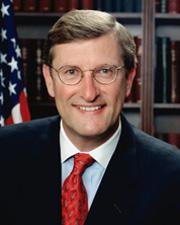 Sen. Kent Conrad (D-ND)
Legislative Activity
Stay on top of the latest movement without scrolling through every action
Roll call votes on amendments in Senate: Motion to waive the Budget Act with respect to amendment SA 2351 rejected in Senate by Yea-Nay Vote. 50 - 49. Record Vote Number: 283.
November 3, 2005
View full timeline
Roll call votes on amendments in Senate: Motion to waive the Budget Act with respect to amendment SA 2351 rejected in Senate by Yea-Nay Vote. 50 - 49. Record Vote Number: 283.
November 3, 2005
Considered by Senate. (consideration: CR S12291)
November 3, 2005
Point of order raised in Senate with respect to amendment SA 2351.
November 3, 2005
Motion to waive the Budget Act with respect to amendment SA 2351 rejected in Senate by Yea-Nay Vote. 50 - 49. Record Vote Number: 283.
November 3, 2005
Amendment SA 2351 ruled out of order by the chair.
November 3, 2005
Considered by Senate. (consideration: CR S12149, S12217-12219)
November 2, 2005
Senate amendment submitted
November 1, 2005
Senate amendment proposed (on the floor): Amendment SA 2351 proposed by Senator Conrad.
November 1, 2005
Amendment SA 2351 proposed by Senator Conrad. (consideration: CR S12095-12097; text: CR S12095) To fully reinstate the pay-as-you-go requirement through 2010.
November 1, 2005
Votes
1 roll call on this amendment
Text
Proposed
DEFICIT REDUCTION OMNIBUS RECONCILIATION ACT OF 2005

The PRESIDENT pro tempore. Under the previous order, the Senate will
resume consideration of S. 1932, which the clerk will report.
The legislative clerk read as follows:

A bill (S. 1932) to provide for reconciliation pursuant to
section 202(a) of the concurrent resolution on the budget for
fiscal year 2006 (H. Con. Res. 95).

The PRESIDENT pro tempore. Under the previous order, the time until 8
p.m. shall be divided between the Senator from New Hampshire, Mr.
Gregg, for 4\1/2\ hours and the Senator from North Dakota, Mr. Conrad,
for 5\1/2\ hours.

Recognition of the Majority Leader

The majority leader is recognized.

Schedule

Mr. FRIST. Mr. President, this morning we will immediately resume
debate on the deficit reduction package after a brief statement I have
to make.
Chairman Gregg opened debate on the bill yesterday and will be here
managing the bill this morning. Last week we entered an agreement which
divided the statutory time limit between 3 days, with all time expiring
on Wednesday at 6 p.m.
During today's session, Senators will be able to offer amendments.
However, votes on those amendments will be stacked to occur at a later
time. I will be working with the Democratic leader to determine the
best time for those votes to occur. I had hoped that we could dispose
of some of the proposed amendments with votes during today's session.
However, at this point, we have several scheduling conflicts, and we
may have to delay those votes until tomorrow. On Wednesday, we have
several Members attending the funeral of Rosa Parks, and we will need
to schedule votes to accommodate that service as well.
Having said that, this will be a very busy week. Senators will be
able to offer amendments after the expiration of time and that leads to
the so called vote-arama. I encourage Senators to offer their
amendments during the debate period so that we can limit the amendments
considered after time expires.
I do not believe the vote-arama is the most constructive use of the
Senate's time, and I believe most Members are frustrated with that
process--at least halfway through the vote-arama, as they express that
frustration directly to me and leadership. During those consecutive
votes, the Senate votes on amendment after amendment with very little
time and little explanation of the amendments.
So I hope we can do it in an orderly process over the next several
days. I do want Members to come to the floor early so we can show some
restraint when the 20 hours of debate time is complete.
Finally, I want to remind everyone that we will be considering the
appropriations conference reports as they arrive from the House. Once
the House has completed action and those conference reports become
available, we will address them. We have the Agriculture appropriations
conference report already, and we will be scheduling that for a vote
sometime this week.

Avian Flu

Mr. President, on another issue, I want to make a few comments.
Shortly, the President will begin to unveil his plan to prepare the
Nation against the threat of bird flu or avian flu, a potential for
initially an epidemic and then pandemic nobody was thinking very much
about a year ago.

I do thank the President for his bold and decisive leadership. He
recognizes the urgency for our Nation to take immediate action to
prepare for and to prevent the spread of such a pandemic and the impact
it would have on this Nation and, indeed, nations throughout the world.
Last night, the Secretary of Health and Human Services began briefing
people on the plan that will be laid out by the President today. He has
been discussing in meetings over the last several weeks the importance
of comprehensive organization at all levels of Government. It is not
just a Federal issue or a State issue or a local issue, it is all
three. The vertical integration of communication and response and
preparedness is complex, but it is something that we absolutely must
address. We would have to mobilize from

[[Page S12080]]

the very top vertically at the Federal, State, and local level in ways
that we never had to in the past.
The Secretary explained at the National Press Club last week all of
this using the analogy of a dry forest, that it takes only one little
spark to set a fire in a forest, and if we are close to where the spark
ignites, usually you can just stamp it out. But if it is allowed to
spread and it really goes beyond any size that can be contained, that
whole forest is left in smoldering ruins. I would simply add to that
analogy that in a forest you could have many different little sparks
which aggravate and increase the challenges to the system itself. If
you can isolate those sparks or that spark very quickly, you can stamp
out that potential for a pandemic, and ultimately you can save millions
of lives. That is why it is absolutely critical we think of the
response, of preparedness in this country. Indeed, this is a global
challenge, and we have to work with our partners throughout the world.
In fact, if you had to look at the likelihood of a pandemic and how
it starts, it would probably be in Asia or Southeast Asia, and
therefore we have a real obligation to address concerns in this country
as well as around the world.
In the Senate, we are working hard to develop a comprehensive
prevention and preparedness plan. We have now passed two separate
measures to increase the national stockpile of vaccines and the
antiviral drugs, drugs like Tamiflu. This month the HELP Committee, the
Health, Education, Labor, and Pensions Committee, passed a measure to
protect vaccine makers from the frivolous lawsuits that we absolutely
know discourage vaccine production and which, in part, has explained
why we have gone from several dozen vaccine manufacturers in this
country down to fewer than a handful. The bill that the HELP Committee
has addressed and passed out of committee also establishes a Biomedical
Advanced Research Development Agency, called BARDA, which would support
this bug or identifying what the etiology is, the bug that starts it,
all the way to creating a drug.
This agency, BARDA, would focus on the gaps that exist in the system
today. The agency would help researchers move from egg-based vaccine
manufacture--and right now for the avian flu you depend on millions and
millions and millions and millions and millions of eggs to grow this
vaccine, and today it does not make sense because you can with the
appropriate research target and focus, develop a cell manufacture that
doesn't require any eggs, that you could ramp up very quickly, in a
short period of time, and you don't have to worry about, yes, we are
going to have to have an egg-based vaccine, so where are all 20, 30, 40
million eggs, chicken eggs, that you need to cultivate this vaccine for
weeks and weeks and weeks?
It is the sort of effort that BARDA would focus on to incentivize, to
fill this gap in our system today.
In the 20th century, we have seen three outbreaks of avian flu, avian
bird flu. The worst of those occurred in 1918. A lot of people have
gone back to read about that Spanish flu. It is called Spanish flu,
though it probably started in this country in Kansas. Half a million
Americans died, somewhere between 40 and 50 million people worldwide.
And the people say why this bug, why this drug, why does it have to be,
why do you have to narrow that window and speed things up? If you look
back on the Spanish flu, in 24 weeks' time, more people were killed in
the world than have been killed by HIV/AIDS in 24 years. In 24 weeks,
more people died of the avian flu than in 24 years of HIV/AIDS. Speed,
efficiency, appropriate research and development, appropriate vaccine
production needs to be done rapidly, quickly.
Secretary Levitt warns that if the past is a prologue, we are long
overdue for a pandemic. If you look throughout history at pandemics,
you cannot only look at it on a regular basis but a periodic basis.
Worse yet, the current virus looks and acts more like the virus of 1918
than any of its other cousins that we have seen to date--if you come
back and analyze H5N1 and you compare it to the virus of 1918.
So what do you do? Americans look for leadership, look for bold
leadership, and we are seeing it from the President of the United
States. I pulled off my desk, as I was coming over, last month's
National Geographic, which asks the question: ``The next killer flu:''
And over in little letters here it says, ``Can we stop it?'' ``The Next
Killer Flu: Can we stop it?'' And the answer to that is, yes, we can,
using technology for research, bold leadership, Government resources,
private sector resources.

We know that H5N1 is spreading. Romania reported two bird cases
yesterday. Last week, Indonesia and Thai authorities reported new cases
of bird-human transmission. To date, avian flu has infected more people
and more poultry than any previous strain. In fact, over 160 million
birds have either died or been killed because of this avian flu in the
last year.
Since 2003, there have been 121 people confirmed to have avian flu
and half of them have died, 61 have died. That is a 50-percent
mortality. The Spanish flu in 1918 had a mortality of about 2.5
percent--2.5 percent--and in this country, less than that. We are
talking about a virus right now that has a mortality rate of 50
percent.
Last week, I met with Dr. Robert Webster, again, from St. Jude's
Children's Research Hospital, which is in Memphis, TN. He is one of the
leading authorities on H5N1. As he explains, there are 16 families of
avian influenza. That virus mutates billions of times a day. It is
constantly changing, which is why it is such a challenging opponent for
us. And with each of these changes in this mixing bowl of the virus
itself, the human-to-human transmission becomes more likely. If and
when it becomes a pandemic, we have no natural immunity. That is the
bad thing. It is not similar to the regular flu. If you have the flu
one year and you get it next year, you already have some antibodies
built up, but nobody in this room, nobody listening to me right now,
nobody has any natural immunity to this. So when you get hit, you get
sick very quickly, and of the people hit so far, one out of every two
died. Again, panic and paralysis, even talking about it, people get so
anxious.
The good news is there are things we can do in terms of prevention,
preparedness, stockpiling, educating our first responders and that,
indeed, is what the President will spell out. I look forward to hearing
more specifically about the President's plan. I urge my colleagues to
spend time studying the issue.
There is absolutely no reason to panic, but we do need to be
prepared, and today we are underprepared. Indeed, we have no higher
duty than to protect the health, the well-being, and the security of
the American people.
Mr. President, I yield the floor.
The PRESIDING OFFICER (Mr. Allen). The Senator from North Dakota.
Mr. CONRAD. Mr. President, the subject under discussion is the matter
before us entitled the ``Deficit Reduction Omnibus Reconciliation Act
of 2005.'' Big words that are meant to communicate, but it reminds me a
little of the old saying: You can't tell a book by its cover. If there
was ever a case of that, this is it. You need to know that this is a
book of many chapters. We need to read all of the chapters to know the
conclusion. I can assure you the conclusion is not deficit reduction.
No, this budget has nothing to do with deficit reduction. This budget
is all about increasing the debt and increasing the deficits.
Describing this package as deficit reduction is a little like the
blindfolded man describing an elephant by only touching its tail. The
blindfolded man might describe the elephant by just holding its tail as
small, long, and slick. Well, that is not the whole story. That is an
accurate description as far as it goes, but it misses the larger truth.
That is the case with describing this budget action as deficit
reduction. It is only the first chapter. You have to read all of the
chapters to get the full meaning. The truth is, this budget increases
the deficit and explodes the debt. That is the larger truth.
The budget that was enacted earlier this year actually increases the
deficit by $168 billion over the 5 years of its life. It does not
reduce the deficit. It increases the deficit. We would have less of a
deficit if we put the whole budget on cruise control, but that was not
the choice the majority made. They made a choice, consciously, to

[[Page S12081]]

write a budget that, even in the face of record deficits and massive
increases in debt, increases the deficits even further. I know it is
hard to believe, but that is the fact of the matter. The budgets that
have been written by our colleagues on the other side of the aisle
increase the deficits.
Budget reconciliation is a part of the overall budget process. Budget
reconciliation is special provisions, fast-track provisions that enjoy
special protection under the rules of the Senate. But remember, what we
are dealing with this week is the first chapter. The first chapter
contains spending cuts of $39 billion. But that is only part of the
package. The next chapter will have tax cuts of $70 billion. If you put
those two chapters together, you don't have a reduction of the deficit,
you have an increase in the deficit of over $30 billion.
Chapter 3 is the chapter our colleagues on the other side of the
aisle hope you will not read. Chapter 3 increases the debt of the
country by $781 billion. That is what this book is all about:
increasing the debt of the country when we have already taken on record
amounts of debt.
Back to chapter 1 and chapter 2. Chapter 1 cuts spending by $39
billion, but it is quickly followed by chapter 2 that cuts taxes $70
billion. The combined effect of chapters 1 and 2 is very clear. It is
not deficit reduction, not what is on the cover of the book; it is a
deficit increase, an increase in debt.
If we go back to what the President told us when he started us down
this course, he told us in 2001:

[W]e can proceed with tax relief without fear of budget
deficits, even if the economy softens.

That is what he told us. Look at what has happened. Now we can look
back and we can check the record and we can see whether the President
was right or was he wrong.
Back at the time in 2001 that the President proposed these massive
tax cuts, this was the outlook according to the Congressional Budget
Office and the administration. This was their outlook going forward, a
range of possible outcomes from a worst-case scenario to the best-case
scenario. They adopted the midline that told us we were going to
experience some $6 trillion of surpluses over the next 10 years.
But look what happened in the real world. Look what happened in
actuality. We didn't get the worst possible outcome under the
projections that were provided. We got way below the worst possible
outcome. This red line is what actually happened compared to the
projections, and instead of trillions of dollars of surpluses, what we
have are trillions of dollars of debt.
I can remember when we were having that debate. My Republican
colleagues told me when I warned them that you can't bet on this 10-
year forecast, that it is highly unlikely to come true, many of my
Republican colleagues told me: Kent, you are far too conservative.
Don't you understand, when we have these big tax cuts, we are going to
get even more revenue. We are not going to be at this midrange of
forecasts of possible outcomes; we are going to be well above it
because these tax cuts are going to generate much more revenue.
Again, now we can go back and check the record as to what actually
happened. We did not get some great boost. Instead what we got was an
ocean of red ink. Instead what we got were these massive deficits.
Previous Presidents have said that facts are stubborn things. Facts
are stubborn things. And the facts are that this fiscal policy has
taken us deep into the deficit ditch. Despite all of the President's
promises that would not occur, he was simply wrong.
The next year the President told us:

. . . [O]ur budget will run a deficit that will be small and
short-term. . . .

We can go back and check the record on that as well. He said that in
2002. Look what has happened since. The deficits have exploded. In
2003, we had what was then the largest deficit ever. In 2004, the
deficit got even bigger. In 2005, the deficit was the third largest we
have ever had. So, again, the President was simply wrong in his
prediction.

If we look at this from a historic vantage point and look back to
1980 and look at the outlays or spending of the United States and the
revenues, we see some very interesting things. This is all expressed as
a percentage of our gross domestic product, which is what economists
say is the best way to make these comparisons because it takes out the
effect of inflation and real growth. So we are comparing apples to
apples here.
Look what has happened. This is the spending line of the United
States. It was up over 23 percent of gross domestic product in the
previous Bush administration. Then we got to the nineties, and the
Democrats put in place a plan that led us to reduce spending, and each
and every year spending came down as a share of GDP.
In 2000, we had a change of administration, and here is what has
happened to spending. Spending has gone up. Spending has gone up, but
it is still well below where we were in the eighties and nineties.
These are facts.
Why did the spending go up? The spending went up largely for three
reasons. One, national defense; two, homeland security; three,
rebuilding New York and bailing out the airlines.
All of us supported on a bipartisan basis this increase in spending.
This was in response, obviously, to 9/11 and a national emergency. So,
yes, spending went up. Virtually all of it is accounted for by defense,
homeland security, and rebuilding New York and aid to the airlines.
Now we are at a place where spending is at about 20 percent of gross
domestic product. But look what happened on the revenue side of the
equation. Again going back to the eighties, we were at about 19 percent
of gross domestic product on revenue. We had a series of tax cuts then
that opened up deficits as spending was not reduced to make up the
difference. Then we got to the nineties and again we had a plan that
was put in place. Revenue increased every year until we actually got to
the circumstance in which we were running surpluses. For 2 years, we
not only ran surpluses, but we stopped using Social Security money for
other purposes.
Then in 2000, with the change of administration, a series of tax cuts
was put in place, and we experienced an economic slowdown and the
revenue side of the equation collapsed. Until last year, we had the
lowest revenue as a share of gross domestic product since 1959. We have
had an increase in this last year, but the forecasters are saying that
will level out going forward as a share of gross domestic product,
leaving us with this very large gap between spending and revenue and,
hence, ongoing massive deficits. That is the reality we find ourselves
in today.
The next year, in 2003, the President told us:

[O]ur budget gap is small by historical standards.

I think if you measure it fairly, what you find out is that is not
the case either. What the President has been focusing on is only the
deficit. The deficit this last year was $319 billion, but that isn't
what got added to the debt. What got added to the debt of the country
was not $319 billion, it was $551 billion. The largest part of the
difference is Social Security because last year, under the President's
plan, $173 billion of Social Security money was taken to pay for other
programs. That all gets added to the debt, but it is not counted in the
deficit calculation.
When you add in those items that were not counted in the deficit,
what you find is that the increase in the debt was, instead of the 2.6
percent that many have asserted, the actual difference between spending
and revenue, the actual difference in addition to the debt was 4.5
percent of gross domestic product, and that number is a danger sign.
Most economists say your deficits should not be above 2.5 percent of
GDP. The truth is, what got added to the debt last year was 4.5 percent
of GDP. In the European Union, you cannot be a member in good standing
if you run deficits in excess of 3.0 percent of GDP.
The big difference is what is happening with Social Security because
back in the eighties, the deficits had almost nothing to do with Social
Security. Social Security was running very small surpluses at the time.
In fact, if you go back to 1983, there was no Social Security money to
take to spend for other programs. There was no surplus in Social
Security. But look what has happened since. Social Security surpluses
have grown dramatically. This was intended, this was designed to
prepare for the retirement of the baby boom generation. The whole idea
was

[[Page S12082]]

to use these surpluses to pay down debt or to prepay the liability.
That is not what has been done.
Under the President's policy, all of this Social Security money is
being taken to pay for other programs. That is what is happening. All
of it is getting added to the debt, all of it has to be paid back, and
there is no plan to do it.
This is the difference between the eighties and now. In the eighties,
almost no Social Security funds were available to be taken to pay for
other items, now we have--just last year--$173 billion in that year
alone.
Over the next 10 years, under the President's plan, they are going to
take $2.4 trillion of Social Security money to pay for other things.
That is a dangerous course.
Now, the President told us just last year:

So I can say to you that the deficit will be cut in half over
the next 5 years . . .

All of his assertions so far have been proved wrong. Now he tells us:
Do not worry, we are going to cut the deficit in half over the next 5
years.
First, I do not think that is the appropriate test because we are in
the sweet spot of the budget cycle. This is the time when we should not
be running deficits at all because this is right before the baby
boomers retire, and we are running these massive surpluses in Social
Security. Those funds should have been used to either pay down debt or
prepay the liability. Instead, the money has been hijacked. The money
has been taken to pay for other things--digging a much deeper hole for
the future. So when the President says the deficit will be cut in half
over the next 5 years, that is not even the right test. This is not a
time when we should be running deficits at all.
Beyond that, if one pierces the veil on the President's claim that
the deficits are going to be cut in half, here is what they find out:
He got there by just leaving out things. He just left out war costs,
did not have any war costs in his budget past September 30 of this
year. Does anybody believe the war costs ended on September 30 of this
year? That is what the President's budget said.
He did not just leave out war costs, he left out the cost of dealing
with the alternative minimum tax. The alternative minimum tax, which is
the old millionaire's tax and is rapidly becoming a middle-class tax
trap. It costs $700 billion to fix. The President just left that out of
his budget.
The President wrote a 5-year budget instead of the 10-year budgeting
that used to be done because at the end of the fifth year, the cost of
his tax cut proposals explodes, driving us deeper into deficit and
deeper into debt. Apparently, he did not want to share that information
with the American people.
When one looks at the long-term outlook with those things added back
in that the President left out, what one sees is a slight improvement
in the deficit in the short term, but then it just explodes beyond the
5-year budget window. Why is that the case? Well, I have mentioned some
of the reasons.
The first reason is war costs. In the mid-session review, the
President had included $50 billion for ongoing military operations, but
the Congressional Budget Office tells us that $50 billion does not
begin to cover the real costs. They say the real cost is going to be
$333 billion. So the President has left out a big chunk of spending
that others say we will experience.
Second, by adopting a 5-year budget--it used to be 10-year budgets--
the President is hiding this fact: The cost of his tax cut proposals
explodes right beyond the 5-year budget window. Is this not
interesting? This dotted line is the end of the 5 years of the budget
proposal presented by the President. Look what happens to the cost of
his tax cut right beyond the fifth year. The cost of the President's
tax cut proposal explodes right beyond the end of the fifth year.
Maybe it should not be a surprise that the President switched from
10-year budgeting to 5-year because he would have had a very hard time
explaining how his plan will reduce the deficit when factoring in the
exploding cost of his tax cuts, the additional cost of war, and the
cost to fix the alternative minimum tax.
By the way, the pattern is much the same with the alternative minimum
tax. The alternative minimum tax, which virtually everyone says needs
to be reformed, the President did not put one thin dime in his budget
proposal to deal with that. According to the Congressional Budget
Office, it will cost $774 billion to fix. The President does not have
any of it in his budget.

Look at the pattern. Here again, the dotted line is the end of the 5-
year budget proposal of the President. Here is the pattern of costs of
fixing the alternative minimum tax. What happens if we do not fix the
alternative minimum tax? Well, here is what happens: In 2005, 3.6
million taxpayers were affected. If we fail to act, by 2010, 29 million
taxpayers will be affected. So people are in for a big surprise. They
thought they were going to get a tax cut? Instead, they are going to
get into the swamp of the alternative minimum tax: 3.6 million people
affected this year, 29 million affected 5 years from now if we fail to
act. It costs $770 billion to fix, and there is not one dime in the
President's budget to do it.
Here is what the President said in 2001 about the importance of
paying down debt. The President told us at the time:

. . . (M)y budget pays down a record amount of national debt.
We will pay off $2 trillion of debt over the next decade.
That will be the largest debt reduction of any country, ever.
Future generations shouldn't be forced to pay back money that
we have borrowed. We owe this kind of responsibility to our
children and grandchildren.

The President was right about one thing. We do owe that
responsibility to future generations, but he did not pay down any debt.
Instead, the debt has exploded. The budget that my colleagues on the
other side of the aisle passed and the budget that we are moving to
take final action on does not pay down any debt. It explodes the debt.
It takes the debt from $7.9 trillion now, and it increases it by more
than $600 billion a year each and every year of the life of this
budget--this after the President told us he is going to have maximum
pay-down of the debt. There has been no pay-down of the debt. He is
exploding the debt.
Every minute in 2005, the budget policies of our colleagues on the
other side of the aisle increased the national debt by over $1 million.
Every minute of every day, they have increased the debt by over $1
million.
What are the consequences of this fiscal failure? The consequences
are very clear. Foreign holdings of our debt have exploded. It took 200
years to run up $1 trillion of debt held by foreign countries and
foreigners. This President has doubled it in 4 years. We have gone from
$1 trillion of foreign holdings of our debt to $2 trillion. That is an
utterly unsustainable course. That is the outcome of the fiscal policy
of this administration. It is not conservative; it is reckless. This is
a policy of exploding our debt.
Who holds this debt? Well, I might add it is interesting that
President Bush did in 4 years what 42 Presidents took 224 years to do.
Forty-two Presidents ran up $1 trillion of external debt. This
President exceeded them in 4 years. This President ran up more debt
held by foreigners in 4 years than the other 42 Presidents combined in
the history United States. Let me repeat that. This President ran up
more debt held by foreigners in 4 years than 42 other Presidents ran up
in 224 years. That is a record of fiscal failure unmatched in the
history of this country.
They call themselves conservatives? Why, they should call themselves
borrowers because that is what they are doing. They are engaged in the
greatest borrow-and-spend spree in American history.
Who are we borrowing the money from? Increasingly, we are borrowing
it from foreigners, from foreign governments, from foreign investors.
Now we owe Japan over $684 billion. We owe China over $240 billion. We
owe the United Kingdom over $170 billion. My favorite, the Caribbean
Banking Centers, we owe the Caribbean Banking Centers over $100
billion. Where did they get their money? Anybody here do their banking
in the Caribbean? We owe them over $100 billion. This is conservative?
What is conservative about this? Some say this is strengthening the
country. How is that? How does it strengthen the country to borrow more
and more money from abroad?

This is all happening at the worst possible time--before the baby
boomers retire. We are facing a demographic tsunami, and here it is:
This is a depiction of the numbers of people in the

[[Page S12083]]

baby-boom generation. We have less than 40 million people who are
eligible for Social Security and Medicare now, and we are headed for 81
million. That changes everything. Instead of preparing for it, this
President has dug the hole deeper and deeper. There is nothing
conservative about what is being done.
Let us go back to the so-called budget reconciliation that is before
us today. The cover on the book says: Deficit Reduction. One has to
read the book. They have to read every chapter of the book to find out
the conclusion, and the conclusion has nothing to do with deficit
reduction. Oh, no. The first chapter cuts spending $39 billion, but the
second chapter cuts revenue $70 billion. So guess what: No deficit
reduction here. The deficit is increased, not reduced. Then one has to
read the third chapter of the book. What is found there? They are going
to increase the debt $781 billion--one of the biggest increases in our
national debt ever. If they get that increase, this President alone, in
the 4 years he has been in power so far, will have run up the debt by
$3 trillion.
In the next 5 years, he is going to run up the debt another $3
trillion. There used to be a TV show--what did they call it--the ``Six
Million Dollar Man''? We have the $6 trillion President because the
effect of his policies will be to run up the debt of this country by $6
trillion. That is truly stunning.
Here is the record. In 2002, debt was increased by $450 billion. In
2003, debt was increased by $984 billion. In 2004, it was increased by
$800 billion. Now our friends on the other side want to increase the
debt by $781 billion. That is a grand total of more than $3 trillion of
additional debt. We know that, if this budget is passed, they are going
to add another $3 trillion of debt over the next 5 years--a combined
total of this President's policies of $6 trillion. That is this
President's plan. Unfortunately, that is the plan of this Congress.

Don't take my word for it. This is a budget they euphemistically call
a deficit reduction plan. If this weren't so serious, this would be
very amusing. They place the title of ``Deficit Reduction'' on this
plan. Come on. Here is what this plan does according to their own
tables. Go and look in the conference report on the budget that was
done earlier this year by the majority party in the House and the
Senate. This is their conclusion about what is going to happen. This is
their conclusion. You see the debt going up every year by more than
$600 billion. That is their plan. If you look at the next 5 years, the
debt under their plan is going to increase by more than $3 trillion,
and they are out here with this book entitled ``Deficit Reduction
Act,'' and their plan increases the debt by $3 trillion over the next 5
years. Have words lost their meaning? They call this deficit reduction.
They are increasing the debt over $3 trillion, and they label this
deficit reduction. That is breathtaking.
Chapter 2 of this book is to extend certain tax benefits, tax cuts.
Many of those I support, but some of them are just overwhelmingly
directed at the most wealthy among us. If you look at chapter 1 being
written here, and chapter 1 being written over on the House side--by
the way, the House budget is very clear. It is going to cut food
stamps. It is going to cut Medicaid. The House bill takes from the
least among us so that they can give to those who have the most.
When I say ``give to those who have the most,'' let me talk about two
provisions that are in their tax plan. Extending dividends and capital
gains cuts will, on average, give a millionaire a tax break for 1 year
of over $35,000. Those earning less than $50,000 a year will get $6.
Those earning from $50,000 to $200,000 a year, on average, will get
$112. Those earning from $200,000 to $1 million a year will get, on
average, $1,480. Those earning more than a million dollars a year will
get $35,000 a year. It is a very interesting set of values. It is a
very interesting set of priorities, to cut Medicaid and cut food
stamps. This is not the Senate bill I am talking about. I am talking
about the House bill. The House bill cuts food stamps, cuts Medicaid,
cuts aid for those who are the least among us, takes the resources and
gives them to those who have the most.
I don't know in what Bible they read that. I have not read any Bible
that says the value ought to be take from those who have the least and
give to those who have the most. In fact, I don't know of any holy book
of any religion that says that is a value, that what we ought to be
doing is taking from those who have the least among us to give to those
who have the most among us. I don't know of any religion that has that
as a value.
I know our colleagues on the other side will say: Wait a minute here.
These tax cuts have fueled economic growth.
There are tax cuts that are helpful to economic growth. That is
undeniable and clear. In 2001, I supported a significant package of tax
cuts, tax cuts that the Congressional Budget Office told us would get a
large bang for the buck in terms of economic growth. Part of those were
included in the package. In fact, many of them were, and I supported
those.
But many of these provisions simply went too far in terms of their
cost and have pushed us over into a sea of red ink, massive deficits,
and massive debt. They simply went too far.
Here is the record on revenues as a share of gross domestic product.
In 2000, we were at a historic high. That is absolutely clear. Tax cuts
were justified in 2000. I didn't think the magnitude of the tax cuts
were justified, but clearly we needed tax cuts, partly to give lift to
the economy. My own proposal to our colleagues actually had more tax
cuts in the short term, much more than the President's plan, to give
lift to the economy because that made good economic sense. But they put
tax cuts on top of tax cuts on top of tax cuts and plunged revenue to
16.3 percent in 2004. That is the lowest it has been since 1959, and
far below the level of spending for which they have all voted. So the
result is red ink, massive red ink.
Here is what the Chairman of the Federal Reserve has said about
deficit-financed tax cuts, because that is what is going on here now.
We are borrowing the money to give tax cuts. From whom are we borrowing
the money? Increasingly, we are borrowing it from the Japanese, the
Chinese, Caribbean banking centers, to give tax cuts to the most
wealthy among us. Does that really make sense? Is that really
defensible? I don't think it makes any sense.
I am not alone. Chairman Greenspan, in his testimony before the
Budget Committee last year, said:

If you are going to lower taxes you should not be borrowing
essentially the tax cut. That over the long run is not a
stable fiscal situation.

Chairman Greenspan has it right. We should not be borrowing to
provide tax cuts, and we certainly should not be borrowing from foreign
governments and foreigners to finance tax cuts. We certainly should not
be borrowing more and more money from Japan and China and Caribbean
banking centers and who-all knows who else in order to finance these
tax cuts, driving us deeper and deeper into the deficit ditch before
the baby boomers retire.
About the baby boomers, that is not a projection. They are alive
today. They are going to retire. They are going to be eligible for
Social Security and Medicare. About all I hear from the other side is
they will cut Social Security, and they will cut Medicare in order to
fill in the difference. That is where this is all headed. Make no
mistake about it. Our colleagues on the other side of the aisle, their
full intention is to shred Social Security and to shred Medicare in
order to avert a fiscal disaster. We are headed for a train wreck. It
is just as clear as it can possibly be.
What have our colleagues done? They have come out with this very, I
would say misleading title on a book, saying it is a Deficit Reduction
Act. When you read all the chapters of the book, it is not a deficit
reduction proposal. It increases the deficit and explodes the debt.

Chapter 1, yes, they cut spending $39 billion over 5 years. Chapter
2, they cut revenue $70 billion over the same time. That increases the
deficit by $31 billion. But chapter 3, that is the one they do not want
you to read. You will not hear them talking about chapter 3 at all out
here because they do not want you to know about chapter 3. In chapter
3, they are going to increase the debt by $781 billion. This is after
they have already run up the debt over $2.5 trillion over the last 4
years. Now they are fixing to increase the debt another

[[Page S12084]]

$3 trillion over the next 5 years, and they are out here with a book
called ``Deficit Reduction.'' Oh, no, I don't think the American people
are going to buy that. I don't think the American people are going to
be fooled by that. I don't think the American people are going to
conclude that what this is about is reducing the deficit because it is
not.
The simple truth is, this budget plan increases the deficit and it
explodes the debt.
Mr. President, how much time do I have remaining?
The PRESIDING OFFICER. The Senator began with 5.5 hours, and he has
consumed 42 minutes. So it is approximately 4 hours 45 minutes,
approximately, remaining.
Mr. CONRAD. Mr. President, let me say that on our side we have
enjoyed working with the chairman of the committee very much. He is
absolutely professional and fair and his word is good. We have had a
very good working relationship on the Budget Committee. Obviously, we
have disagreements about policy, but on the committee we have tried not
to disagree in a disagreeable fashion. I have respect and admiration
for the chairman of the committee, and we are going to try to work
together to handle amendments in an expeditious and professional way so
the time is well used.
I yield the floor.
The PRESIDING OFFICER. The Senator from New Hampshire.
Mr. GREGG. Mr. President, let me echo the comments of the Senator
from North Dakota relative to his staff and himself. They are
extraordinarily professional. As he mentioned, we do have some
disagreements, but we do it in what I think is an appropriate way. We
discuss the policy. We disagree on policy. But it is never personal,
and there is always a cooperative spirit to try to do the business of
the Senate. I greatly admire his professionalism and his staff's
professionalism.
I understand the Senator from North Dakota has another 4 hours. I
regret we are not going to hear him speak for that entire period of
time because this last hour was certainly ``chartlizing''; not
scintillating but ``chartlizing.''
The Senator has made a number of points, some of which I actually
agree with but most of which I must say I find inconsistent with the
facts that are on the ground. With what do I agree? I agree with the
fact we are headed toward a fiscal problem of immense proportions
primarily driven by the fact that we have a tremendous baby boom
generation that is about to retire. Yesterday I spoke at some length
about that. That is why we need to initiate efforts to get under
control spending of the Federal Government, especially in the mandatory
accounts--mandatory accounts being those accounts which people have a
right to, simply because of their situation, whether it is a fiscal
situation or personal situation. They may be a former member of the
military--veterans benefits; they may be of a certain age; they may be
of a certain income.
The most significant mandatory programs which are facing us are, of
course, the entitlement programs benefiting retired individuals--Social
Security, Medicare, and Medicaid. The only way you can address retired
programs, mandatory programs, is through a reconciliation bill which is
what we have before us today, a deficit reduction bill, because you
have to change the law in order to accomplish changes in the ways those
bills are going to spend money over the years to come.
So the Republican Congress, the leadership and the membership, has
stepped forward with an aggressive proposal to try to do that. It is
the first time in 8 years that we have seen an effort to try to put
some brakes on the rate of spending on the mandatory side of the
Federal Government.
Thirty-five billion dollars, $35 billion original instruction, and
$30 billion is what the committees of the Senate have reported back in
deficit reduction initiatives in this bill which is before us today. It
cannot be discounted so casually, as the Senator from North Dakota has.
He has essentially said it is not a deficit reduction because there
will be a bill afterward that will give tax relief or it is not deficit
reduction because the debt goes up. The simple fact is that those are
inaccurate statements.
This bill, if you vote for it, will reduce the deficit by $39 billion
in its present form. That is a fact, a simple, incontrovertible fact.
There will be a tax relief bill that will follow this bill.
I wish to point out that my colleague from North Dakota--and he has
openly said this--is going to probably vote for a lot of the amendments
to that tax relief bill because they are good initiatives which need to
be done. As he mentioned, the AMT, as he mentioned--I am not sure he
mentioned it, but others have mentioned the State and local sales tax
deductibility or deductibility of certain education expenses which
teachers incur when they are trying to spend money on their classroom
or the savings credit--all of these--or the R&D tax credit which makes
us more competitive as a nation. The other side of the aisle is saying
all those taxes should be raised on all those people. Are they saying
that the 8 million people who fall under AMT should have their taxes
raised? Are they saying people in the United States who get to deduct
their sales tax should have their taxes raised? Are they saying that
teachers who buy crayons for the classroom should have their taxes
raised? Are they saying that small businesses, especially those that go
out and invest in opportunity and creativity by doing R&D expansion,
should have their taxes changed and raised? Maybe they are. Clearly, if
they are claiming that the next bill, the tax relief bill, is a bad
bill--that is what they are claiming because that bill is going to be
made up primarily of those initiatives.
We can get into a debate about dividends and capital gains, also.
What has generated the revenue in this country in the last few years?
We have seen one of the most dramatic expansions in revenue in this
country in the last 20 years and rate of growth of revenue as a result
of having cut taxes and given people more incentive to be creative, go
out and invest, create careers for people, and create economics to
create jobs.
This chart shows, as we have watched the tax cuts put into place,
that revenues have been jumping every year. Why? They are headed back
to the historical mean where they have been traditionally. They have
been jumping because people have had an incentive to go out and invest,
to create economic activity, to take risks, to create careers, create
jobs, and that is taxable activity which is coming back to the Federal
Government.
Sure, revenues have dropped dramatically, as many of the charts the
Senator from North Dakota pointed out show. But the drop in those
revenues was a function of two events which we had very little control
over: the bursting of the bubble of the 1990s, which was the largest
bubble in the history of world, bigger than the South Sea Bubble. It
was the Internet bubble, and it burst. Quite honestly, we should have
gone into a dramatic depression as nation as a result of that burst.
But because this President had the foresight to put into place a tax
credit on the productive side of the ledger, we did not see that
dramatic economic downturn. We saw a reduction, and that reduction
dropped revenues.
We were hit with 9/11. Never before has this Nation been hit with an
event like 9/11 where we lost thousands of people on our soil here in
the United States. Pearl Harbor, obviously, is a comparable. But the
civilian losses were overwhelming, and the economic loss was dramatic.
We were hit with a body blow to our economy. So that line went down
again.
We had the bursting of the bubble, compounded by the single largest
attack on our Nation certainly since Pearl Harbor, arguably exceeding
Pearl Harbor in many ways, and the economic impact forced the economy
down further. That is why the economy dropped. It wasn't the tax cuts
that dropped the revenue. The tax cuts have been shown to increase
revenues and will continue to increase revenues.
For the other side to take the position that anything else is
happening is wrong because the facts are clear. The revenues are going
up, and they are jumping dramatically back to the norm, 18 percent
gross domestic product for the revenue. A lot of that is a function of
tax relief which we will be seeing in the tax package which will be
coming here to extend those tax relief initiatives in the next bill.
But this bill

[[Page S12085]]

is about reducing the deficit by $39 billion, $35 billion being the
original instruction. It is a huge step in the right direction.
Now we should ask, I believe--and I think the Senator from South
Carolina is going to make this point rather dramatically--what is the
response from the other side of the aisle? The response from the other
side of the aisle, as I believe the Senator from South Carolina is
going to point out, is that their proposal is to spend more money. That
is their proposal for reducing the debt around here. They are going to
spend more money. That doesn't work.
Since January, they have proposed spending increases which have
exceeded or reached almost a half-trillion dollars in new programs, new
initiatives, which isn't too surprising because that is the philosophy
of the other side of the aisle. I don't think anyone takes that as a
surprise. On the other hand, where is their proposal to cut the
deficit, to reduce the debt, which the Senator from South Carolina
talks about?
We searched, and we found their proposal. Wow.
Here it is. Here is the Democratic proposal on the budget. They have
no budget. They haven't proposed a budget. Even when they were in the
majority, they didn't propose a budget. At least they didn't bring one
to the floor. They have no proposal at all to reduce the deficit or to
reduce the debt. They do have a lot of concerns about our proposal.
That is understandable because we wrote it. They didn't vote for it.
There was not one Democratic vote for our budget. You wouldn't expect
us to basically draft their language, but we are willing to take
proposals, if they have them, to reduce the debt, to reduce the
deficit, proposals which are constructive. But so far, there has been
no budget from the other side of the aisle.
There will be a lot of targeted amendments, I presume, to spend more
money, which will raise taxes on working Americans and on Americans
generally. But as a practical matter, their efforts to reduce the
deficit or reduce the debt are extraordinarily limited, especially
compared to what we have done.
This is the summary of what this bill does. It is not the tax bill.
This is not the tax relief bill. This is the debt reduction bill. It
reduces by $71 billion entitlement spending, and $32 billion of new
spending is put in place because we believed it was important to assist
certain groups and because it was fair. The vast majority or large
percentage of the $71 billion came from education accounts by reducing
the corporate subsidies for lenders. Rather than take all of that money
in deficit reduction, we believed a significant amount of that money--
about half--should flow back into student accounts to assist low-income
students in getting a college education. It is a good proposal. The key
to our Nation's capacity to compete is that we have creative and
productive people. That means you have to send people to college. We
have to help especially low-income kids get to college. This bill does
that to the tune of $11 billion. Maybe the other side is opposed to
that.
In addition, we want to make doctors more available to patients. We
want senior citizens, when they walk into a clinic or into their health
care area, to be able to see a doctor. We know that under the present
law, doctors are going to be cut by 4.5 percent in their spending, and
they are going to drop out of the Medicare system. The Finance
Committee decided to fix that and hold doctors harmless by essentially
freezing their pay rather than cutting it 4.5 percent. That is where
the money is.
But the net effect of this bill is a $39 billion reduction in the
deficit. You can say it is not much. I happen to think it is a lot. In
South Carolina, $39 billion is a lot of money. In Ohio, $39 billion is
a lot of money. In New Hampshire, $39 billion is a lot of money.
This bill is a lot of money put toward debt reduction. In my opinion,
we should be passing it and actually should be passing it on a
bipartisan basis because if the other side genuinely wants to reduce
the debt and reduce the deficit, they have to vote for this bill. This
is their opportunity.
I yield the floor to the Senator from South Carolina who will have a
lot of thoughts on this issue.
The PRESIDING OFFICER. The Senator from North Dakota.
Mr. GREGG. Mr. President, I suggest the absence of a quorum.
Mr. CONRAD. Mr. President, I have recognition.
The PRESIDING OFFICER. The Senator from North Dakota has the floor.
Mr. CONRAD. Mr. President, I understand the frustration of my
colleague because his party has given him an impossible task--to come
out and defend a budget plan that explodes the debt.
You notice there was not one comment by the Senator about the debt.
Here is why there was no comment about the debt. Here is what has
happened to debt under their watch. When President Bush took office,
the gross debt of the United States was $5.6 trillion. Each and every
year, the debt has gone up by $500 billion or $600 billion. In 2002, it
went up to $6.2 trillion, a $500 billion increase; in 2003, $6.8
trillion, it went up another $600 billion; the next year, $7.4
trillion, another $600 billion; the next year, $7.9 trillion, it went
up another $500 billion. Here is what it is slated to do under the
budget plan they have put in place.
The debt keeps going up, up, up, by $600 billion a year by their own
calculation, and they are out here touting that they have a deficit
reduction package. Excuse me. Have words lost their meaning? They are
out here talking about reducing the deficit, and their fiscal plan has
done nothing but explode the debt of our country from $5.7 trillion
when they took over and we are headed for over $11 trillion of debt by
the time they are done. And they are out here touting a plan of deficit
reduction. Come on. Come on. That doesn't pass the laugh test.
I understand the Senator from South Carolina was up here with a chart
the other day that he called the Democratic Spend-O-Meter chart. Let me
address that.
The Democratic Spend-O-Meter chart of the Senator from South Carolina
is a complete concoction. He claims that the Democratic amendments this
year would cost $470 billion. Absolute nonsense. Their Spend-O-Meter
ignores the fact that many of the Democratic amendments were offset. He
didn't count those offsets. In fact, because they included additional
deficit reduction, the net effect of all Democratic amendments on the
budget resolution would have reduced deficits by $57 billion.
Their Spend-O-Meter also double-counts the cost of some Democratic
amendments because they treat them as if they were a package instead of
offered individually. Some Democratic amendments covered the same
subject area as an earlier amendment and would never have been offered
if that earlier amendment had passed.
Their Spend-O-Meter also overstates the cost of Democratic amendments
by misleading and falsely assigning 5-year costs to 1-year amendments.
Most of these Democratic amendments were for only 1 year, but they have
taken them and made them into 5-year amendments.
Those weren't our amendments. That is your concoction. That is your
fabrication. That is not right.
Democratic amendments to the 2006 budget resolution would have
reduced the deficit by $57 billion. Republican amendments to the 2006
budget resolution actually worsened the deficit by $79 billion. That is
the real story of what happened earlier this year--net cost of GOP
amendments: $79 billion of additional red ink; net effect of Democratic
amendments: $57 billion of reduction in the deficit.
I also want to respond to the more general accusation that Democrats
just want to spend. I would like to remind my colleagues of the
record. Under the last Democratic administration, spending as a share
of the economy came down steadily year after year, falling from 22.1
percent of gross domestic production to 18.4 percent of gross domestic
production. During the term of the Democratic administration, spending
went down.

Now I will compare that to the time since the Republicans gained
control. Under our Republican friends, spending has gone from 18.4
percent of gross domestic production to 22.2 percent of gross domestic
production. Who are the big spenders? When we were in control, spending
went down. When they have been in control, spending has gone up.
That is not the end of the story. The bottom line is deficits. Here
is the difference in the deficit records of various

[[Page S12086]]

administrations going back to the Reagan administration. They were in
significant deficit the entire period of the Reagan administration. The
Bush administration, Bush 1, dramatically increased the deficits. Under
the Clinton administration, we pulled out of deficit and actually went
into surplus for 3 years. In fact, 2 of the 3 years we were actually
able to stop raiding Social Security trust funds.
Here is the deficit record under the second Bush administration: They
plunged us right back into deep deficits and massive increase in debt.
Now they have a budget plan that, by their own terms, by their own
calculations, increases the debt of the country by $3 trillion over the
next 5 years--and they are out here talking about reducing the deficit.
I suppose they can make the claim, but I don't think it will stand up
very well. I don't think it will stand up to much scrutiny because we
can look at the package--even this little package before the Senate
right now. The fact is, there are many chapters to this book. The first
chapter cut spending $39 billion. That is in the face of increasing the
debt by $3.4 trillion over the next 5 years. They talk about it being a
good start. I would say it is virtually no start. It is no start when
you consider the second chapter which will cut the revenue by $70
billion. The combined effect is to increase the deficit.
If anyone wonders, go to chapter 3 where they increase the debt in 1
year alone by $781 billion. And they call themselves fiscally
conservative? My goodness, that is conservative? That is not any
definition of conservative I have read anywhere.
Let's see what is happening to the debt under our friends. They came
in and it was $5.7 trillion and they have already run it up to $8
trillion. Here is what their budget proposal is doing now. If we adopt
the 5-year budget plan, they will have run the debt of the country from
$5.7 trillion to over $11 trillion. That is their record.
What are the results of these policies? The results of these policies
are to build a wall of debt. Every year, debt is going up $600 billion
a year under their budget plan. These are their numbers. Not my
numbers, their numbers.
What does that translate into? That translates into an increase of
debt by over $1 million a minute. That is the fact. That is what we are
talking about.
What is the result? The result is in 4 years, they have doubled the
debt held by foreign countries. U.S. debt held by foreign countries and
foreign investors has doubled. It took 224 years to run up $1 trillion
of foreign-held debt. In only 4 years, they have doubled it.
Here is the record, looking at the other 42 Presidents in American
history. It took them 224 years to run up $1 trillion of external debt.
This President has exceeded them in 4 years. This President has run up
over $1 trillion of foreign-held debt in his term: $1.05 trillion
versus 42 other Presidents, $1.01 trillion. It is pretty stunning what
has happened.
And the result? Here it is: We now owe Japan over $684 billion. We
owe China $248 billion. We owe the United Kingdom over $174 billion. We
owe the Caribbean Banking Centers over $100 billion. This strengthens
the country? How does that strengthen the country?
They do not want anyone to read chapter 3 of the book. No. They want
to talk about deficit reduction. It is a wonderful title, but it has no
relationship to the facts. The budget they have before the Senate does
not reduce any deficit. They increase the deficit. They explode the
debt. Under their own calculations they will increase the debt over the
5 years of this budget proposal by over $3 trillion. They have the
chutzpah to come out here and talk about deficit reduction.
Let's read the third chapter of their book. The third chapter
increases the debt limit of the United States in 1 year by $781
billion. And they are out here talking about deficit reduction? Come
on.
The chairman said accurately we did not present a budget. That is
exactly right, we did not present a budget. Why didn't we present a
budget? Because they are in control. They are in control of the White
House. They are in control of the Senate. They are in control of the
House. We first had to try to defeat their proposal. Only then would we
have had an opportunity or a chance to offer an alternative.
The first test was, can we defeat their budget? I tried my darnedest.
The chairman knows that. I tried very hard to defeat the budget
proposal they put before our colleagues because it exploded the debt by
their own calculations by more than $3 trillion over the next 5 years.
But I didn't succeed. They won. They passed their budget. If we could
have stopped them, if we could have defeated them, then an alternative
would have been in order and I would have been happy to offer an
alternative if we had a chance to prevail. There was no chance to
prevail. They won. The country lost, but they won. The country lost
because their budget did not reduce the deficit. It increased the
deficit and it exploded the debt.
By their own calculations, this 5-year budget they have put together
will increase the debt of our country by $3 trillion. That is a fact.
I yield the floor.
The PRESIDING OFFICER (Mr. Voinovich). The Senator from New
Hampshire.
Mr. GREGG. I yield such time as the Senator from South Carolina may
use.
Mr. SARBANES. Mr. President, could I inquire what the parliamentary
situation is.
The PRESIDING OFFICER. Time is controlled today between the Senators
from New Hampshire and North Dakota.
Mr. SARBANES. How much time is available to each side?
The PRESIDING OFFICER. The Senator from North Dakota has 4 hours 33
minutes. The Senator from New Hampshire has 4 hours 3 minutes.
Mr. SARBANES. I understand the Senator from New Hampshire has now
yielded to the Senator from South Carolina. Could I inquire, so I have
some idea of the sequencing, how much time the Senator from South
Carolina will be using?
Mr. DeMINT. Ten or 15 minutes.
Mr. GREGG. After the Senator from South Carolina speaks, I intend to
speak for 15 minutes and offer an amendment. Then it would be back to
your side for whatever time you wish to take, so about half an hour
from now.
Mr. SARBANES. Would it be possible to make an opening statement
before the chairman of the committee offers an amendment?
Mr. GREGG. I want to get the amendment in the queue. I will offer the
amendment and then I will let the Senator from North Dakota yield to
you for whatever you need for an opening statement--15 minutes?
Mr. SARBANES. Ten minutes.
Mr. GREGG. And then back to me to explain the amendment.
Mr. SARBANES. I thank the Chair.
The PRESIDING OFFICER. The Senator from South Carolina.
Mr. DeMINT. Mr. President, I thank the Senator for yielding.
I find the comments of the Senator from North Dakota very curious, if
not amusing. I find the opposition to this deficit reduction package
perplexing.
How can we come to the Senate and rail against deficits and, at the
same time, rail against spending cuts? Some of my colleagues have
gotten comfortable with voting against something before they vote for
it.
In 1993, when the Senate was considering mandatory spending
reductions much like we are considering today--only then it was $77
billion, about twice as much as we are considering cutting today--the
Senator from North Dakota supported it. Not only did he support it, he
took the lead in pushing for more spending cuts. To quote the Senator
from North Dakota:

I am one of those on the Democratic side who insisted on
more spending cuts . . . I did so because I believed very
strongly that we had to have more spending cuts to have
balance in this program . . . Madam President, we succeeded .
. . We got more spending cuts.

The Senator also said:

When we talk about there being too much spending, when we
talk about the Federal budget being out of control, Medicare
and Medicaid are part of the explanations.

And, again, in 1997, when the Senate was considering mandatory
spending reductions which totaled $107 billion, which is almost three
times what we are considering today, the Senator from North Dakota
supported it, too. Again, he not only voted for it but he called for
even more spending cuts.

[[Page S12087]]

Again, the Senator said:

I, too, am proud to have voted for the provisions that we
passed this morning that will finish the job of balancing the
unified budget . . . Frankly, I would have done more by way
of deficit reduction. I wish we had been more ambitious. I
wish we would have done more in the long-term reform of
entitlement programs, but that was not to be. That is for
another day.

This is all very confusing to me. How can the Senator be for spending
reductions in 1993, in 1997, but then oppose them today? I don't want
to make any assumptions, but this appears to be politically driven
because the only thing that has changed since 1993 and 1997 is the man
in the White House.
The Senator is correct that the Republicans are now in the majority.
But history will show that the Republicans in the majority in the 1990s
worked with President Clinton to cut the budget and balance the budget
over time.
Our country faces many difficult challenges. But my colleagues
continue to talk a good game while they obstruct at every turn. It
actually reminds me of an experience when I was a teenager taking
lifeguarding classes at a swimming pool. One of the parts of the final
test for that lifeguarding class was to swim to the bottom of the deep
end, pick up a concrete block, bring it back to the surface and then
swim to the other side of the pool. Every day when I get up in
Washington, DC, I feel I have to go down to the bottom of the pool and
pick up my Democratic colleagues and drag them across the pool.
On energy, while we hear rhetoric in the Senate blaming the President
for high energy prices, the Democrats vote en bloc to keep us from
developing the oil resources we have in this country. In a committee
meeting last week we wanted to build new refineries, modern,
environmentally safe refineries on old military bases, but the
Democrats voted en bloc to stop it.
I heard this morning from the Senator from North Dakota about
spending Social Security on other things. Yet when Republicans this
year proposed we stop spending Social Security on other things and save
it in Treasury notes, they en bloc came out against it.
The same thing is happening today on deficit reduction.
They say they want deficit reduction, but they are on the floor
speaking out against it. I find the comments coming from the other side
of the aisle very interesting. I keep hearing how ``we are opposed to
budget deficits,'' but this chart will show how they spend, spend,
spend.
If I could--and my colleague from North Dakota referenced some of the
amendments that we brought up last week, which they said were offset--I
think it is important, when we speak on the floor, we get our facts
straight. Because these are the amendments offered by the Democrats
that would increase the budget by over a half a trillion dollars, none
of which were offset. There were other amendments offered with some
offsets, but, as shown on this chart, this would increase the spending
and the deficit by over a half a trillion dollars.
If we look at it in total--since we are using some moving charts this
morning--if we want to be accurate--again, this gets back to the
concrete block analogy--we are trying to cut spending in this Senate,
which is only a third of what we did last time we went through this
same procedure, with Democratic support, yet amendments have been
offered that have taken this all the way up to the top of $500 billion
and beyond, with the new amendments that were offered last week.
It is important, as a nation, we address difficult issues in a sound,
fiscally responsible way. This bill before us this week is very modest,
with spending cuts that reduce no care to the poor; they are cutting
wasteful spending and fraud from Medicaid and other programs. This
should be an easy vote for every Member of the Senate. There is other
spending that we need to address. This bill should be easy.
I encourage all of my colleagues to set the rhetoric aside. Let's
leave the concrete block at the bottom of the pool and swim across it
together and get this done on behalf of the American people.
Mr. President, I thank the Chariman for this time and yield back.
The PRESIDING OFFICER. The Senator from New Hampshire.

Amendment No. 2347

Mr. GREGG. Mr. President, I send an amendment to the desk.
The PRESIDING OFFICER. The clerk will report.
The bill clerk read as follows:

The Senator from New Hampshire [Mr. Gregg], for Mr. Frist,
for himself and Mr. Gregg, proposes an amendment numbered
2347.

Mr. GREGG. Mr. President, I ask unanimous consent that reading of the
amendment be dispensed with.
The PRESIDING OFFICER. Without objection, it is so ordered.
The amendment is as follows:

(Purpose: To provide amounts to address influenza and newly emerging
pandemics)

At the appropriate place, insert the following:

SEC. __. ASSISTANCE TO COMBAT INFLUENZA AND NEWLY EMERGING
PANDEMICS.

(a) In General.--Out of any money in the Treasury of the
United States not otherwise appropriated in title VII, there
are appropriated $2,780,000,000 to enable the Secretary of
Health and Human Services to carry out the activities
described in subsection (c).
(b) Additional Amounts.--Out of any money in the Treasury
of the United States not otherwise appropriated in title III,
there are appropriated $1,174,000,000 to enable the Secretary
of Health and Human Services to carry out the activities
described in subsection (c).
(c) Activities.--From amounts appropriated under
subsections (a) and (b), the Secretary of Health and Human
Services shall utilize--
(1) $577,000,000 to intensify surveillance of influenza and
other newly emerging pandemics and outbreaks;
(2) $2,800,000,000 for the development and stockpiling of
antivirals and vaccines for influenza and other newly
emerging pandemics; and
(3) $577,000,000 to establish a seamless network of
Federal, State, and local authorities for preparedness
relating to influenza and other newly emerging pandemics.

Mr. GREGG. Mr. President, it is my understanding that at this point
the Senator from North Dakota is yielding time to the Senator from
Maryland, and it will be taken from the time of the Senator from North
Dakota. After the Senator from Maryland makes his statement, I will
reclaim the floor.
The PRESIDING OFFICER. The Senator from Maryland.
Mr. SARBANES. I thank the Chair.
Mr. President, I rise to speak on the measure before us. As we well
know, budgets are all about priorities. The budget resolution which was
passed earlier this year paved the way for the reconciliation
legislation which is now before us, legislation which I strongly
believe represents the wrong set of priorities for America.
I say this for two primary reasons. One is the adverse impact this
legislation will have on the Nation's soaring budget deficit; in
effect, what it does to the fiscal underpinnings of our economy. The
second very strong reason is the impact this legislation will have on
families all across the country.
I commend the able Senator from North Dakota, Mr. Conrad, for his
very effective leadership on this issue. He has been consistent
throughout in trying to bring a sense of fiscal responsibility to our
budget deliberations. His presentation earlier today has maintained
that strong commitment, as he set out the fiscal consequences of the
path on which we are proceeding.
The reconciliation process, which originated in the mid-1970s,
provides fast-track procedural protections for reconciliation bills,
which are supposedly designed to help achieve the goal of reducing
budget deficits. Regrettably, that goal has been absent from the
reconciliation process since 1997, which was the last time the Congress
considered a reconciliation bill that actually sought to bring down the
deficit. In fact, in recent years, the reconciliation process has been
used not to bring down the deficit but to cut taxes. So a process
designed to help reduce budget deficits has actually made our deficits
worse, significantly worse, by speeding through the Congress package
after package of excessive tax cuts.
This year's reconciliation process is no different. The budget
resolution, which passed on a party-line vote earlier this year,
provided fast-track procedural protection for both a spending bill and
a tax bill. Both were provided this protection under the reconciliation
process. So if one is to see the impact made on the deficit by the
reconciliation process, one has to take into account both of these
measures. Only one of the two is before us today. But the other is
scheduled to follow

[[Page S12088]]

next week. They constitute part of a package.
Now, the budget resolution, passed earlier in the year, required
various committees to make $35 billion in spending cuts. The effort to
implement that is reflected in the legislation before us today. That
same budget resolution required the Finance Committee to report a tax
bill that reduces revenues by $70 billion. So we have a requirement,
under the budget resolution now being implemented by this fast-track
procedure, of $35 billion in spending cuts which I understand is
actually coming in at $39 billion--and $70 billion in tax cuts.
The consequence of using this reconciliation process for both the
spending cuts and the tax cuts will be to increase the budget deficit
by more than $30 billion. So the reconciliation legislation, originally
designed for the purpose of budget deficit reduction, is not, in fact,
going to reduce the budget deficit; it is going to increase the budget
deficit. This bill is really about trying to make room for more tax
cuts, primarily benefitting the people at the very top of the income
and wealth scale.
When you look at the reconciliation instructions in the budget
resolution, on both the tax and spending sides, that conclusion is
inescapable. The reconciliation legislation is a clear example of a
fiscal policy that places a higher priority on tax cuts than on funding
needed services and reducing the deficit. To me, that is a misplaced
priority but, regrettably, one that has marked this administration.
Now, if the ranking member would yield for a couple of questions?
Mr. CONRAD. Yes, sir.
Mr. SARBANES. It is my understanding that when President Bush came
into office in 2001, the fiscal situation which he inherited was one
where we actually we were running a surplus in the Federal budget, if I
am not mistaken. We were projecting a surplus, over the next 10-year
period--2002 to 2011--of $5.6 trillion. I say to my colleague; is that
correct? That was the projection at the time?
Mr. CONRAD. That is correct.
Mr. SARBANES. Of course, these were projections. We recognize that.
But they were the best estimate that could be made. Over a 10-year
period, we were projecting a surplus of $5.6 billion. In fact, some
said we were paying down the debt too quickly, if the Senator will
recall?
Mr. CONRAD. Yes, they did. In fact, they were concerned we were going
to pay off too much debt.
Mr. SARBANES. As I understand it, today, after this series of
excessive tax cuts the President has pushed through, using this
reconciliation process--actually, I think, abusing it, not using it,
because it was designed to reduce deficits, not to increase deficits--
but using this fast-track procedure, the President and his allies in
the Congress have pushed through a series of excessive tax cuts.
So as I understand it, we are now in deficit, $317 billion for the
fiscal year that just ended, and we are facing projected deficits, over
the next 10 years, of $4.5 trillion; is that correct?
Mr. CONRAD. The Senator is correct. So we have had a swing from
projections of a $5.6 trillion surplus to more than a $4 trillion
deficit. That is a swing of $10 trillion.
Mr. SARBANES. Mr. President, I want to underscore what the very able
Senator from North Dakota has pointed out. This is an incredible
deterioration in the fiscal position of our Nation. We have gone, in
less than 5 years' time, from projecting a surplus of $5.6 trillion,
over a 10-year period, to a point where we are now projecting a deficit
of $4.5 trillion over a 10-year period. And as the able Senator points
out, that is a swing in our fiscal position of $10 trillion--$10
trillion in the wrong direction. It is incredible when one stops to
think about it.

Mr. CONRAD. I would say to the Senator, if I could, the situation is
even much worse. Why is it much worse? Because the deficits understate
what is happening to the debt.
Last year, for example, the deficit went up by something over $300
billion, but the debt went up by $551 billion. Most of the difference
is the money they are taking from Social Security. Last year, they
took, under the President's plan, $173 billion of Social Security money
and used it to pay for other things. It all gets added to the debt, but
none of it counts toward the deficit calculation.
Mr. SARBANES. Could I ask the Senator, who is holding this debt?
Mr. GREGG. Will the Senator yield for a question?
Mr. SARBANES. Certainly.
Mr. GREGG. As the Senator knows, I did yield to the Senator to make
an opening statement. The understanding was it would be for about 10
minutes. It has been about 15 now. I am wondering if the Senator is
planning on going on for an extended period of time.
Mr. SARBANES. If I could have 4 or 5 more minutes, I could draw to a
close.
Mr. GREGG. That would be great. I thank the Senator.
Mr. SARBANES. I thank the chairman.
Well, as was pointed out, rather than conserving the budget surplus,
which President Bush inherited, he has chosen to risk our fiscal future
through excessive tax cuts--tax cuts targeted to those who need them
the least. This reconciliation process before us will only continue
that pattern.
The reconciliation process is supposed to provide special protection
to measures to bring the deficit down, not to provide special
protection to a combination of measures, as we have here: some spending
cuts but greatly exceeded by tax cuts.
So the net result of the reconciliation measures to be considered
this week and next week will be an increase in the deficit of $30
billion. I don't know anyone who can contest that. It is pretty well
conceded.
The instructions made it clear from the outset there was to be $35
billion in spending cuts--and they have increased it a few billion--and
$70 billion in tax cuts. You put the two together, you have an increase
in the deficit of over $30 billion.
We are facing serious future challenges. The Senator from North
Dakota has been the leader in pointing out to us the need to consider
the baby boomers as they approach retirement age, the impact that will
have on the fiscal situation of the country, and how we can deal with
that in a balanced and equitable way. That discussion is not taking
place. Instead, we have this fast-track process in which the most
vulnerable amongst us are asked to make the sacrifices in terms of the
programs being cut, such as Medicaid and Medicare.
The New York Times, in an editorial on October 26, titled ``Stalking
the Poor to Soothe the Affluent,'' said:

Impoverished Americans are being set up as targets this
week in Congress's desperate attempt to find budget cuts
after four straight years of tax cuts for the affluent.

I ask unanimous consent that the editorial be printed in the Record
at the conclusion of my remarks.
The PRESIDING OFFICER (Mr. Sununu). Without objection, it is so
ordered.
(See exhibit 1.)
Mr. SARBANES. As I draw to a close, I just want to underscore what is
happening. I had put a question to the Senator from North Dakota and
there wasn't an opportunity to answer. Our debt is escalating at a
faster rate than the budget deficit, which compounds the situation. Who
is holding this debt? Who is buying this paper and, therefore, has
claims against U.S. citizens looking out into the future?
Mr. CONRAD. Increasingly, this debt is being held by foreign
countries and foreign investors. If you think about it, during the
President's watch so far, he has increased the debt from $5.6 trillion
to $7.9 trillion. That is a $2.3 trillion increase in the debt so far
under his watch. I keep urging my colleagues to understand that you
can't tell a book by its cover. This cover says it is deficit
reduction. That is just the first chapter. You have to read all the
chapters to conclude what is happening.
What is happening is, as the Senator has correctly described, the
first chapter is, cut a little bit of spending. The second chapter is,
cut even more revenue. The third chapter is--and this is the one they
really don't want people to read--increase the debt of the country by
$781 billion for 1 year. That will take the total up to over $3
trillion of added debt in just the 5 years that this President has been
in power. Who is holding the debt?
Increasingly, it is foreigners. This President has increased foreign
holdings of our debt by a trillion dollars. It

[[Page S12089]]

took 42 Presidents 224 years to run up a trillion dollars of external
debt. This President has more than doubled that amount in 4 years.
Mr. SARBANES. Mr. President, I close with this observation: In one of
his plays, Tennessee Williams has a character, Blanche Dubois, who
says: I have always depended on the kindness of strangers. That is what
is happening to the fiscal future of the United States of America. We
are becoming increasingly dependent on foreign nations, in many
instances central bankers, not individuals, central bankers buying our
debt, holding this paper, financing this deficit, underwriting this
debt. The United States, as a consequence, is losing a measure of its
strength and independence which only underscores the seriousness of the
situation we confront.
Mr. CONRAD. Well, we owe Japan over $680 billion.
Mr. GREGG. Mr. President, point of order: No question was asked by
the Senator from North Dakota. Is it correct to have an interchange of
this nature?

Mr. CONRAD. I interpreted a question from the Senator.
Mr. SARBANES. I asked the Senator who was holding the debt.
Mr. CONRAD. He had asked who was holding the debt, and this is who is
holding the debt.
Mr. GREGG. The Senator from North Dakota's response was not in
relationship to a question.
The PRESIDING OFFICER. The Senator from Maryland has the floor. He
may not ask questions of other Senators, but he may respond to
questions from other Senators.
Mr. CONRAD. I would be happy to ask the Senator from Maryland a
question, if he would yield for that purpose.
Mr. SARBANES. Certainly.
Mr. CONRAD. The Senator can see here the answer to the question he
posed to me. I would ask: Who is holding the debt?
Mr. SARBANES. As I look at the chart which the Senator has presented,
Japan has $684 billion of it; China, $248 billion--and that is rapidly
escalating, moving upwards very fast--the United Kingdom, $174 billion.
Caribbean banking centers are holding over $100 billion of our national
debt. This is a recipe for eventual disaster if we don't get this
situation under control. The budget reconciliation process ought not to
be used in such a way that the ultimate result is going to be an
increase in our deficit and a further runup of the debt.
I thank the chairman and the ranking member for this opportunity to
speak. I again commend Senator Conrad from North Dakota for the
effective and consistent leadership he has provided over the years in
addressing the important question of the fiscal underpinnings of our
national economy.
I yield the floor.

Exhibit 1

Stalking the Poor To Soothe the Affluent

Impoverished Americans are being set up as targets this
week in Congress's desperate attempt to find budget cuts
after four straight years of tax cuts for the affluent. House
Republicans propose harmful cuts in Medicaid access and
benefits, while forcing another 10 hours of work from welfare
families and giving states free rein to pile more draconian
reductions onto the most vulnerable citizens.
This gross political posturing does not even translate into
true savings. While imperiously proclaiming cuts of $50
billion over five years, Congressional leaders are determined
to fiddle more harmfully with the revenue half of the budget
and to pass an additional $70 billion in upper-bracket tax
cuts.
The proposals would have the federal government--supposedly
the protector of the neediest--give the states broad leeway
to restrict current benefits; to require co-payments by the
poor for medicine and for care by doctors and emergency
rooms; and to cut preventive care for children, who represent
half of the Medicaid roll. The food stamp program would
probably also be hit with a $1 billion cut, and even welfare
payments to elderly people who are sick would be crimped by
using federal bookkeeping tricks.
One particularly boneheaded proposal would severely cut the
funds for child support enforcement by $4 billion. This
program currently returns $4 in benefits from natural parents
for every dollar invested.
The proposals are so appalling that moderate Republicans
are even said to be considering a show of life on the floor.
In contrast, Senate Republicans are shaping cuts that would
spare the poor's Medicaid and other safety nets, while
finding savings in Medicare overpayments.
The Senate approach is obviously preferable, but it is also
rooted in the G.O.P.'s pre-election fiction that overspending
is the basic problem. The tax cuts should be scuttled and the
poor protected.

The PRESIDING OFFICER. The Senator from New Hampshire.
Mr. GREGG. Mr. President, I had, as a matter of courtesy, yielded the
floor so the Senator from Maryland could speak; he said for 10 minutes.
It has now been a half hour. Cooperation does help in this institution.
Cooperation also helps on bills such as this. The Senator from North
Dakota has taken considerable time to talk about the reduction in the
deficit in the 1990s and the fact that we went into surplus, claiming
it as an action of the Democratic Party. The deficit reduction which
occurred during that part, there was another player in that, and that
was the Republican Congress which essentially asked President Clinton
to pursue a course of a balanced budget. And with some reticence, the
final agreement was reached, and a balanced budget bill was passed. It
was passed in cooperation. There was cooperation from Republican
membership with a Democratic President.
It would be nice if we had that cooperation today from our Democratic
colleagues. I find it uniquely ironic that they have decided to oppose
a bill which reduces the deficit by $35 billion--that initially was the
demand; it was a proposal put forward; now it is up to $39 billion--on
the representation that, well, they can't support this bill because
there may be a later bill that gives tax relief. You can't have it both
ways. You can't claim you are for deficit reduction and for reducing
the debt and then vote against the one opportunity you are going to
have to do so. The one opportunity is this bill. This isn't a tax
relief bill. There are no tax relief proposals in this bill at all.
This is not a bill that in any way harms people of lower incomes.
In fact, the vast majority of the new spending in this bill is
directed specifically at low-income students and patients on Medicare
and assisting both of them. The Medicaid proposals in this bill were
crafted by the Finance Committee to make sure they focused on making
that program more efficient. It will actually, if the language in this
bill passes, have an impact on the pharmaceutical industry but not on
low-income individuals who benefit from Medicaid. In fact, because it
has significant expansion of the flexibility of Governors to deal with
Medicaid, most of the Governors you talk to, any that are sort of good
managers, are saying they can do a lot more. They are going to be able
to deliver a lot more Medicaid services to a lot more people as a
result of the language in this bill, even though it saves money in the
Medicaid accounts, because they are giving Governors more flexibility.
This is a bill which actually produces significant improvements in
the delivery of services in this country to low-income individuals,
especially those who want to go to college, those who are benefiting
from Medicare, and those who are benefiting from Medicaid. At the same
time, it reduces the deficit by $39 billion, or $35 billion if the
amendment I just offered happens to be passed.
To say that you are not going to vote for this bill because there may
be some bill coming down the road that gives tax relief to people is
not consistent, and then to argue that you are for deficit reduction on
top of that. This is your opportunity to vote for deficit reduction.
This is it. This is the only vote you are going to get--at least in
this exercise of reconciliation--to reduce the deficit. So vote for
this. And if you are not happy with the tax relief package, vote
against the tax relief package. Take the good, which you allegedly
claim you want, which is deficit reduction, and reject what you
consider to be bad, which is the tax relief package coming later.
Mr. SARBANES. Will the Senator yield for a question?
Mr. GREGG. No, I will not yield at this time.
The tax relief package to which they are opposed, which is coming
down the pike, which they allege is part of this package so they have
to vote against the debt reduction deficit reduction package, let's
talk about what is in that package potentially.
The alternative minimum tax: Something like 8 million people will be

[[Page S12090]]

added to the alternative minimum tax if we don't extend what is known
as the patch, if we don't exempt those people from being added to it.
That is a $30 billion item right there. The folks on the other side
want to vote against the tax reconciliation bill. They want to raise
taxes on 8 million people. They want to create a tax revenue of $30
billion by making the alternative minimum tax apply to middle-income
Americans. That is their choice.
The research and experimentation tax credit, the R&D credit, this is
the credit which allows entrepreneurs, especially small businesses, to
invest in R&D, which produces jobs, which makes our country more
competitive, which keeps jobs from going overseas, which gives people
careers. This is one of the most important tax initiatives in our Tax
Code because it increases economic activity and increases opportunity
and jobs. They want to vote against that one. Fine. Raise the taxes on
small business and entrepreneurs who want to do R&D. That is the second
largest item, $7 billion, that is going to expire in the next 2 years.
The deductibility of qualified credits, teachers' deductibility. We
talked about that before. When teachers go out and buy things for their
classrooms, they get a deduction for it. If they want to raise taxes on
teachers, go ahead, have a tax increase on teachers.
The deduction for State and local sales taxes: Which States benefit
from the deductibility of State and local taxes? Massachusetts,
Connecticut, New York, New Jersey, Illinois, California--those are the
high tax States. They are the ones with the highest sales taxes. How
many Republican Senators are there from those States? I don't think
there are any. But that is one of the items. They appear to want to
raise taxes on people in those States by making their sales tax not
deductible.
I have to tell you, I come from New Hampshire. We don't have a sales
tax or an income tax. If you want to eliminate the deductibility of
sales taxes, it is no skin off our nose. But I don't think it happens
to be that great a policy. But that appears to be the position that is
being taken here, if you listen to the other side as they excoriate the
package of proposals that is coming at us as a result of the
reconciliation process: First, the deficit reduction bill, the debt
reduction bill; second, the reconciliation bill on taxes, the majority
of which includes these right here. And these are the ones that are
expiring in the next 2 years.
Then the third is the debt ceiling, which is put under
reconciliation. Well, you know, we are at war. We had a downturn of
dramatic proportions as a result of the bursting of the Internet
bubble, and this country's expenses have gone up rather significantly
because of those two factors--especially the cost of the war. In fact,
if you look at discretionary spending, almost the entire increase is an
attempt to fight terrorism and protect our Nation. Now, it may be that
the other side of the aisle does not want to pay those bills, that they
think we should not do a debt increase. Well, if you do that, the
Federal Government defaults on its debt, chaos occurs in the
marketplace, and people's savings will be wiped out not only in the
United States but across the globe.
Maybe that is the fiscal position of the other side of the aisle. A
debt reduction bill is a technical step in the sense it increases our
ability to borrow the money. We are going to borrow the money because
we have the debts. It is like saying, when you get your credit card
bill, you are not going to pay it. Well, the practical implication of
not paying is you file bankruptcy. Maybe the other side's position is
let's file bankruptcy. It seems to be we should do nothing. However,
the rate at which that credit card is being charged--because this is
the only bill that does that. This is a deficit reduction bill. The $39
billion bill that is pending before us is a deficit reduction bill. So
if you are not going to vote for this bill, you have no credibility on
the issue of whether you are willing to cut the deficit or debt. It is
one separate bill.
Mr. SARBANES. Will the Senator yield.
Mr. GREGG. I will not yield. I yielded to the Senator for 30 minutes
when he asked for 10, and to tell you the truth, I don't think that was
consistent with the comity of the Senate.
Mr. SARBANES. Now, the Senator should yield on that point.
Mr. GREGG. No, I will not yield.
Mr. SARBANES. On questioning the comity of the Senate, the Senator
should yield on that point.
Mr. GREGG. I will not yield on that point.
The next item: The second point is how much money have we generated
from this tax cut. The tax cut has energized a significant increase in
revenue to us relative to the budget. We have seen a 14-percent
increase in 2005. We will see a 6-percent increase in 2006, and it is
projected that this will continue to go up significantly as we move
into the outyears. That is because as you reduce the tax rate on
working Americans, you significantly expand the revenue of the Federal
Government because people become more productive and they generate more
activity, which generates income to the Federal Government.
That has been proven over and over and over again. The tax cuts of
President Bush have shown that, the tax cuts of President Reagan showed
it, and the first person to show it in fairly definitive terms was
President John F. Kennedy, who put forth his tax cut which generated
significant revenues to the Federal Government.
We are seeing a dramatic expansion in the revenue activity of this
Government. To say anything else is inaccurate. Yes, the budget deficit
is $314 billion, but it was supposed to be $440 billion or $420
billion. We have generated $100 billion of reduction in the deficit and
almost all of it, almost all of it has been a function of new revenues
coming into the Federal Government. There has also been essentially a
freeze on discretionary spending, nondefense, which has been good, but
essentially all that revenue has come out of this, come out of the fact
that we cut taxes and we have generated more economic activity.
So when the argument is made that the tax cuts are inappropriate and
that we are generating cuts for wealthy individuals at the expense of
low-income individuals, it is just not consistent with the fact. The
fact is, this deficit reduction plan significantly reduces the deficit
but does it in a way that does not impact low-income individuals. In
fact, the new spending initiatives in this plan, which are fully paid
for by offsetting reductions, dramatically benefit low-income
individuals, especially those who are working, who are going to
college, and who are trying to benefit from Medicare.
Secondly, the tax provisions which will be coming in the next
exercise, which is independent of this exercise, are provisions which
are generally supported by most Americans. They are the deductibility
of the R&D tax credit, deductibility of education credits,
deductibility of savings credits, State and local taxes, sales taxes,
and, of course, the AMT fix. The tax revenues of this country are going
up dramatically on an annual basis, and they are projected to continue
to go up. So we don't have a problem that we are an undertaxed society.
We have a problem that we are not controlling spending.
The pending amendment which I sent to the desk is an amendment to
address the fact that we are confronting a very significant threat in
the world called avian flu. This Congress, this Senate, has tried to
address this issue a couple times, but we know the avian flu issue is a
ticking time bomb out there. Whether it is going to happen today or
whether it is going to happen--well, not today, obviously, but whether
it is going to happen within 12 months or 2 years or 5 years, we know
the threat should avian flu transfer from birds over to humans is huge
because we have a record to look to, which is the pandemics of the
early part of this century.
We need to get ready for it, and we all recognize it, and there is an
urgency to do that. It has been a bipartisan push to try to accomplish
that. So this amendment essentially takes some of the dollars which
have been saved in excess of the original reconciliation instruction
and applies those dollars to try to address the pandemic situation.
In trying to accomplish that, we have addressed what I think is a
significant need. In addressing the avian flu issue, it is more than
just a money issue. We

[[Page S12091]]

all know that. There has to be an incentive for the vaccine industry to
aggressively pursue some sort of cure to address not only avian flu but
avian flu as it mutates through various systems. That has not been
accomplished yet. But we know it will not be accomplished until we are
successful in standing up to the vaccine industry and making sure that
they have the resources to pursue an adequate treatment.

This amendment tries to accomplish that, and thus I have offered it.
At this point I yield the floor.
The PRESIDING OFFICER. The Senator from North Dakota.
Mr. CONRAD. Mr. President, I think the chairman of the Budget
Committee just summed up the position of his party when he said we have
to borrow the money because we have the debt. That is exactly right.
Their party has put us on a fiscal course to explode the debt. And when
the Senator talks about deficit reduction, which is on the cover of the
book of the matter that we are discussing today--it says deficit
reduction--it just doesn't have any credibility because it is part of a
package. The package is the budget that was passed earlier this year.
This reconciliation process we are going through now was authorized by
that budget. That budget didn't reduce any deficit; it increased the
deficit. Most seriously, it exploded the debt.
Well, here it is. The budget we are working to conclude increases the
debt by $3.4 trillion over the next 5 years. The spending cut they have
out here right now is $39 billion. By the way, they are about to reduce
that because the first amendment from our colleagues on the other side
is a spending amendment.
But let's look at the whole package, the whole package that our
colleagues have offered the country, have offered the Senate. If
doesn't reduce the deficit, it doesn't reduce the debt, it dramatically
expands the debt--not by my calculation but by their calculation. Here
is their calculation of the increase in the debt of their 5-year budget
proposal. They are going to run up the debt $3.4 trillion. This
spending out here over 5 years of $39 billion basically does not touch
it.
Now, my colleague had a whole list of possible tax cuts and said,
well, maybe we are for increasing the taxes on the American people, on
those various items. I support extension of many of those tax cuts, but
I believe they ought to be paid for. That is the way we used to do
business around here. We used to have a provision we called pay-go, and
if you wanted to increase spending or you wanted to have more tax cuts,
you could do it, but you had to pay for it. There is an old-fashioned
idea: pay for it. Our colleagues over here don't want to pay for
anything. They want every tax cut, they want every spending provision--
this increase in spending. They are in control. The spending they are
complaining about, they passed it. They control the Senate of the
United States. They control the House of Representatives. They control
the White House. Every dime of this spending that they are complaining
about, they passed--every dime of it. The President has not vetoed one
spending bill. Every dime of this spending they supported.
But here is what they did on the revenue side. This is what has
happened to the revenue. The revenue side of the equation collapsed,
and, yes, we have had an upkick in the last year, absolutely. The
Senator is correct. Revenue has increased in the last year. But look at
where it is. It is way below the historical level. The result of this
combination of their spending increases and their tax cuts has been to
explode the deficits. We have had in the last 3 years the largest
deficits in the history of the country. They have exploded the debt--
not by my calculation but by their own calculation and by the historic
record.
Look, when this President came in, the debt was $5.7 trillion. In 5
years he is going to have added $3 trillion, if this budget plan
passes. They ran up the debt another $551 billion for the last year
alone. They are going to increase the debt of this country in the 5
years of this Presidency by $3 trillion, and in the next 5 years they
are going to run it up another $3 trillion.
Now, facts are stubborn things. It is very interesting that my
colleague on the other side, when he put up the possible tax cuts they
are talking about, left this one out. You didn't see this. You didn't
see this one mentioned, the capital gains and dividends tax cuts. Here
is the distribution of those tax cuts, who gets them: Those earning
over $1 million a year will get, on average, a $35,000 tax cut. Those
earning less than $50,000 a year, this is what they get: $6--$6. That
is what my colleagues on the other side of the aisle think is a fair
distribution of the tax cuts--$6 for those earning less than $50,000 a
year, $35,000 for those earning over $1 million a year. And one of the
ways they reduce the cost of all this is to take from the least among
us.
Go look at what the House of Representatives is proposing by way of
their spending cuts. They are going to cut Medicaid, they are going to
cut food stamps, the things that go to the least among us so that they
can give additional tax cuts to those who have the most among us.
That is not a value that I have read in any Bible. My Bible does not
say take from the least among us to give to the most among us. I have
not seen that in any chapter of the Bible or, for that matter, in any
holy book. Virtually every religion--perhaps every religion--has as a
value that we help the least among us. We don't take from the least
among us to give to those who have the most. But that is exactly what
is before us in this proposal.
Again I say to my colleagues, you can't separate out the first
chapter of the book they have labeled deficit reduction; you have to
read the whole book. You have to read all the chapters. If you read the
chapters of this book, what you find is in chapter 1, they cut a little
bit of spending, in chapter 2 they cut even more revenue, and in
chapter 3, they explode the debt by $781 billion. And they call it
deficit reduction? Please.
If you look at the whole book, if you read the entire book, what you
find is they are going to increase the debt of our country by $3
trillion over the next 5 years. And they are out here talking about
deficit reduction? No, that dog won't hunt.
I rise to offer an amendment with Senator Nelson and Senator Feingold
to restore some budget discipline. We want to go back to the pay-as-
you-go rule that served this country so well in previous years. I thank
Senator Nelson and Senator Feingold for their leadership on this issue.
I see Senator Feingold is on the floor.
Our amendment is simple. It restores the original pay-go rules
preventing new mandatory spending and new tax cuts unless they are paid
for. My colleague talks about all the additional tax cuts he wants.
That is fine. I will support a lot of them, but we have to pay for
them. Otherwise, we are borrowing money from China, Japan, the
Caribbean Banking Centers, and all the rest to give tax cuts that, in
many cases, go predominantly to the wealthiest among us. What a bizarre
strategy that is.
The proposal we are making today eliminates a loophole in the current
pay-go rule which exempts tax cuts and spending increases that are
provided for in the budget resolution. We don't have to pay for them if
they are in the budget resolution. This huge loophole encourages
fiscally irresponsible behavior, which is exactly how I would
characterize the budget that is before us. It is fiscally
irresponsible--fiscally irresponsible to increase the debt by $3
trillion when we have already almost $8 trillion of debt. If people are
serious about fiscal discipline, this is their chance to prove it.
I would like to take a moment to remind my colleagues of the history
of pay-go and why it is important to reinstate the original pay-go
rule.
The rule was adopted in 1990 at a time when the Federal Government
was facing unprecedented deficits, just as we are today. Originally,
the pay-go rule created a 60-vote point of order against tax cuts and
mandatory spending that would increase the deficit. Tax cuts and
increased spending either had to be paid for or face a 60-vote point of
order. Back in the nineties, the budget discipline of pay-go helped us
turn record deficits into record surpluses. But the pay-go rule we have
now has lost its teeth. What we are left with is a pale reminder of
what pay-go used to be.
The current pay-go rule exempts all policies assumed in every budget
resolution. As a result of these changes,

[[Page S12092]]

the budget resolution this year advocated borrow-and-spend policies.
Here is what our current fiscal picture looks like: record budget
deficits as far as the eye can see; an ocean of red ink. That is where
we are now, and that is where we are headed.
In this year's budget, the majority paved the way for these
reconciliation bills that are before us now that will actually increase
the budget deficit. How? By shaving $39 billion of spending over 5
years, but then by cutting revenue $70 billion. The combined effect is
to increase the deficit by $31 billion, and we already have record
deficits. The whole idea of reconciliation was to provide fast-track
protection to deficit reduction. Now it has been hijacked, and they are
using these special provisions and special protections to increase the
deficit. It is a perversion of the process.
Federal Reserve Chairman Alan Greenspan opposes tax cuts that are
financed by increasing the deficit. Here is what he told Congress last
year.
Question from Congressman Spratt:

Let me ask you this. You said you were for extension of the
original pay-go rule, which would apply to tax cuts as well
as to entitlement increases. Does that mean you would advise
us that as we approach these sunsets and expirations in
existing tax cuts, that they be offset before the renewal be
passed?

Mr. Greenspan:

Yes, sir.

That is the answer the chairman was perhaps seeking. He wants to
extend these tax cuts. Many of them I do as well. But I want to pay for
them. That is what pay-go provides. Here is what the Fed Chairman had
to say on the question of restoring the original pay-go: ``Yes, sir,''
when asked a direct question if we should restore pay-go. Earlier this
year in testimony before the House Budget Committee, Chairman Greenspan
again reiterated his support for fully offsetting the costs of all tax
cuts:

If you're going to lower taxes, you shouldn't be borrowing
essentially the tax cut. And that over the long run is not a
stable fiscal situation.

That is what we are doing here: Put it on the charge card, run it up,
borrow the money. Where are we borrowing it? Increasingly we are
borrowing it from abroad. Under this President, we have increased our
debt held by foreign countries by over 100 percent. It took 42
Presidents 224 years to run up a trillion dollars of external debt.
This President has doubled it in 4 years. That is an utterly
unsustainable course.

Chairman Greenspan said before the House Budget Committee earlier
this year:

All I'm saying is that my general view is that I like to
see the tax burden as low as possible. And in that context, I
would like to see tax cuts continued. But, as I indicated
earlier, that has got to be, in my judgment, in the context
of a pay-go resolution.

That is what we are offering today, a pay-go resolution. You can have
more spending; you have to pay for it. You can have more tax cuts; you
have to pay for them. That is the budget discipline we had earlier in
the nineties, and it worked well in drawing us out of record deficits
and back into surplus.
In the past, the chairman of the Budget Committee has agreed with the
Fed Chairman's wise counsel. During the fiscal year 2002 supplemental
bill, the Budget chairman had this to say. This is Chairman Gregg:

The second budget discipline, which is pay-go essentially
says if you are going to add a new entitlement program or you
are going to cut taxes during a period, especially of
deficits, you must offset that event so that it becomes a
budget-neutral event that also lapses.

He went on to say:

. . . If we do not do this, if we do not put back in place
caps and pay-go mechanisms, we will have no budget discipline
in this Congress and, as a result, will dramatically
aggravate the deficit which, of course, impacts a lot of
important issues, but especially impacts Social Security.

The Budget Committee chairman was right then, and if he took the same
position now, he would be right now because the measure we are offering
is pay-go. If you want to have new spending, pay for it. If you want to
have more tax cuts, pay for them. That is critically important given
the fact that the deficits and debt are going up, up, and away under
this underlying budget resolution.
What we are offering today eliminates the pay-go loophole. The
current pay-go rule exempts all tax cuts and mandatory spending
increases assumed in any budget resolution, no matter how much they
increase deficits. Our proposal is to go back to what has worked in the
past. It is traditional pay-go. It says all mandatory spending and all
tax cuts that increase deficits must be paid for or they have to get a
supermajority vote of 60 votes.
Mr. President, I yield to my colleague from Wisconsin such time as he
may use.
The PRESIDING OFFICER. The Senator from Wisconsin is recognized.
Mr. FEINGOLD. Mr. President, I am very pleased to cosponsor the
amendment that will be offered by my good friend, the Senator from
North Dakota. There is no Senator more dedicated to a fiscally
responsible Federal budget and to restoring sound budget rules than
Senator Conrad. I have had the pleasure of watching him do his work,
now in his 13th year of leadership on this issue. He is an acknowledged
expert on the budget and the rules that govern its consideration.
You don't actually have to be a Kent Conrad to understand the pay-go
rule. As he said, it is very straightforward. It is a commonsense
requirement. Whenever Congress wants to spend money through
entitlements or the Tax Code, we have to pay for it. That rule, as he
pointed out in the past few minutes, has been an effective restraint on
the appetites of Congress and the White House, and it was absolutely
critical to our ability and success in balancing the Federal books
during the 1990s.
It is no coincidence that when this body stopped following that rule,
the bottom dropped out from under the budget. Four and a half years
ago, the Congressional Budget Office projected that in the 10 years
thereafter, the Government would run a unified budget surplus of more
than $5 trillion. Now we are staring at what is almost a mirror image
of that 10-year projection, except instead of healthy surpluses under
any reasonable set of assumptions, we are now facing immense deficits
and backbreaking debt.
This has to stop. Running deficits causes the Government to use the
surpluses of the Social Security trust fund for other Government
purposes rather than to pay down the debt and help our Nation prepare
for the coming retirement of the baby boom generation.

As Senator Conrad has noted, it isn't just the annual budget deficits
that are the problem, it is our debt. Every dollar we add to the
Federal debt is another dollar we are forcing our children to pay back
in higher taxes or fewer Government benefits.
As I noted before during the pay-go debates we have had over the
years, when the Government in this generation chooses to spend on
current consumption and to accumulate debt for our children's
generation to pay, it does nothing less than rob our children of their
choices, to which I think they should be entitled, just as we have
been. We make our choices to spend on our wants, but what we are doing
here is saddling them with the debts they must pay from their tax
dollars and their hard work, and that is not right.
That is why I am proud to join Senator Conrad in offering this
amendment to reinstate the pay-go rule. We need a strong budget
process. We need to exert fiscal discipline. When the pay-go rule was
in effect, that tough fiscal discipline governed the budget process.
Under the current approach, it is exactly the other way around. The
annual budget resolution determines how much fiscal discipline we are
willing to impose on ourselves and that, obviously, simply has not
worked.
When Congress decides it would be nice to create a new entitlement or
enact new tax cuts, and then adjusts its budget rules to assist those
policies, we are inviting a disastrous result. And that is exactly what
we have seen happen.
As I noted during the budget resolution, if you want to lose weight,
you set the total calories you are allowed to consume first, and then
you make the meals fit under that cap. It is not the other way around.
Imagine trying to lose weight by deciding what you want to eat first
and then setting the calorie limit to accommodate your cravings. If you
want to eat cake, fine; dial up the limit on your calorie intake. If
you want a couple of extra beers--which, of course, in Wisconsin

[[Page S12093]]

we are fond of--that is fine, too. Raise the calorie limit accordingly.
It may taste pretty good at the time but one will probably almost
certainly end up gaining weight, just like this Nation is racking up
debt.
Because this ill-advised diet is exactly how the current mutated
version of pay-go works, and we have seen the results, the debt we are
leaving our children and grandchildren that we will have has been
putting on massive amounts of weight. This amendment that the Senator
from North Dakota will offer would simply return us to the rule under
which Congress operated for the decade of the 1990s.
As the Chair well knows, it was instrumental in balancing the Federal
budget. Many of us lived under that rule, and we know how effective it
was. This amendment is a truth test. Our colleagues who are genuinely
serious about reducing the deficit and returning to a balanced budget
will vote for it.
A real pay-go rule by itself will not eliminate the annual budget
deficits and balance the budget, but we also know that we will never
get there without a real pay-go rule.
I, again, thank Senator Conrad for his leadership on this and the
other critical budget issues and I strongly urge my colleagues to
support his commonsense, time-tested amendment.
I yield the floor.
The PRESIDING OFFICER. The Senator from North Dakota.
Mr. CONRAD. Mr. President, I thank my colleague, Senator Feingold,
one of the most valued members of the Budget Committee, somebody who
has been absolutely consistent on these issues and who has tried over
and over to get the pay-go rules reinserted so we would have some
assistance in restoring budget discipline.
I told a reporter the other day I have never seen this town so
disconnected from reality as it is today. We have a measure before us
that they call deficit reduction in the first chapter when we all know,
if we read the whole book, it has nothing to do with deficit reduction.
It is explosion of debt. Because by the time we get to the third
chapter, what we find out is they are going to increase the debt by
$781 billion all the while they are talking about reducing the deficit.
It is like words have lost their meaning. It is as though, what is the
book, ``1984,'' George Orwell--war is peace, love is hate, deficit
reduction is deficit increase. This labeling ceases to have meaning
when people come out and say they are doing one thing, when they are
doing precisely the opposite thing.
It is going to be hard to fool people about this because people know
we have big deficits. The last three deficits are the biggest in our
history and people know the debt is increasing. They may not know the
exact numbers, but they know the debt is not going down; the debt is
going up. The hard reality is this budget package that is steaming
through is going to increase the debt of the United States by $3
trillion over the next 5 years and that is by their own calculations.
That is not my calculation. That is not the calculation of Senator
Feingold. That is their own budget document's calculation. It says they
are going to increase the debt $3 trillion. They are talking about over
the same period of time a $39 billion spending cut, which is chapter 1.
Chapter 2 is they cut the revenue $70 billion, so now they have
increased the deficit. Chapter 3, they are going to increase the debt
by $781 billion. That is just one year. The 5-year effect of their
budget, and this is all part of the package, is to increase the debt $3
trillion, and they are going to spend a week talking about how they are
reducing the deficit.
One of the best things we can do is restore the pay-go rules. Pay-go
rules say if one wants to spend more money, pay for it; want more tax
cuts, pay for them. That is a rule we ought to have. That is a rule we
used to have. That is a rule that helped. It was not the only thing
that worked, but it helped.
I hope very much that this body will adopt the pay-go provision we
are putting before them.
I yield the floor.
The PRESIDING OFFICER. The Senator from Wyoming.
Mr. ENZI. Mr. President, I have been listening to this debate, and my
least favorite part of being in the Senate is probably the floor debate
that we have because it is rhetoric. It is not the substance that we
ought to be debating on the Senate floor.
What we are talking about right now is an omnibus deficit reduction
reconciliation bill, and it has $39 billion worth of savings in it. One
can go ahead and talk about other legislation that will come up later
and add those in different directions and come up with different
numbers, but what we are talking about right now is deficit reduction.
We spent a lot of time and a lot of effort to get it that way. Much of
it is bipartisan, but we will not hear that kind of discussion on the
floor probably. One will from me because I want to give some credit to
the people who have worked with me on arriving at the biggest part of
this reconciliation package in a very bipartisan way.
Senator Kennedy is the ranking member on the HELP committee, and my
committee had responsibility for $13.65 billion in spending cuts over 5
years. We not only met that goal, we exceeded that goal. I want to say
a little bit about how we did it. We did it in several areas. One of
them is higher education. We provided more for kids going to college
while we also provided savings. In the pensions area, we reduced
potential outlays, and that saves money. In the area of FDIC reform, we
reduced outlays so that we had savings so that we could provide for
insurance for people at their retirement time that will aid
communities. I will talk about all of that as we go along. I would like
to begin by commending Leader Frist and Chairman Gregg for keeping the
budget reconciliation process on track this year. Our shared commitment
to meaningful deficit reduction is the reason that this package is on
the floor this week. The omnibus deficit reduction reconciliation bill
of 2005, which is S. 1932, is an ambitious step toward meaningful
deficit reduction.
The budget agreement that Congress approved in April requires eight
authorizing committees to produce $34.7 billion in spending cuts. As
chairman of the Committee on Health, Education, Labor, and Pensions,
that is a big bite of the apple, but it is not when it comes to the
budget spending. My committee received the largest reconciliation
instruction. It was $13.65 billion in spending cuts over 5 years. That
is nearly 40 percent of the overall target. I am pleased to report that
we exceeded that target and reported legislation with a net savings of
$16.4 billion over 5 years.
That is an additional $2.75 billion beyond HELP's reconciliation
target. So there is a significant amount of extra savings in the
health, education, labor, and pensions component of this package, title
VII, which I will discuss momentarily.
Now, 2 weeks ago, the HELP Committee reported a bipartisan bill that
garnered support from four Democrats, in addition to all of the
committee Republicans. We achieved this savings in several ways. One
was the Higher Education Act reauthorization. It has been held up for
some period of time because we are trying to identify proper funding
levels, and reform programs so that more people can get more training.
This will ultimately lead to students obtaining better skills,
resulting in fewer jobs being outsourced. It is not just a college age
situation. It is a college age-to-retirement situation and it includes
careers. We addressed that separately in the Workforce Investment Act
reauthorization. That separate bill passed 20 to 0 in the committee. So
it was unanimous and unanimously bipartisan.
I also mentioned that the HELP Committee passed a bipartisan pension
bill that garnered support from both sides of the aisle, but it was not
unanimous. I have to explain why. We also have to solve the pension
problem in this country so that people who have earned pensions get the
pensions. We have worked on a comprehensive pension package. In fact,
we passed a comprehensive pension package in the HELP committee and
then we merged it with a comprehensive pension reform bill from the
Finance Committee. We have to go through the process of getting that
bill through on the floor and then conferencing it with the House who
have yet a third version of the bill. I am hoping that we can do that
full package that way. But in that part of the process, when we were
doing that bill as a stand-alone bill, there was one

[[Page S12094]]

section in there that dealt with some hybrid forms of pension plans. I
had one person on one side of the aisle who did not think we had gone
far enough and one person on the other side of the aisle who thought we
had gone too far. So we had two dissenting votes on that whole package.
When we take the pension reconciliation to the floor, as we are doing
right now, we are not able to do the comprehensive pension package that
we had reported previously. We are limited to reducing the outlays,
which means increasing the fees. That would not be my preference for
the way to go. There is a little provision in there that says that if
we pass a complete reform, it will supersede what we are doing in
reconciliation. I am assuming, and am pretty sure, the dissenting votes
that we had when we worked the reconciliation package out of committee,
which was both a combination of the education package and the pensions
package, that the dissension was over having to raise fees in the
pension part of the package. Otherwise, if it had been, again, just a
stand-alone on the education part, I am pretty sure we would have had a
unanimous, bipartisan vote. But we did have people from both sides of
the aisle, in what I consider to be fairly significant numbers,
supporting this. Writing this package has been a challenging process
because it has required months of bipartisan negotiations. Spending
reconciliation bills involve tough choices, about which programs to
responsibly reform and how to reinvest subsequent savings, while still
meeting deficit reduction goals. I am pleased about the role that the
Health, Education, Labor, and Pensions Committee has played in this
process.

I would like to briefly walk through the Health, Education, Labor,
and Pensions title of the reconciliation bill. The HELP Committee's
title has two components, as I mentioned, one dealing with higher
education, the other with pensions. The higher education provisions in
the reconciliation legislation are similar to the comprehensive higher
education reauthorization bill that the HELP Committee agreed to
unanimously in September, as I mentioned.
In addition to exceeding our reconciliation target, the title VII of
the legislation provides additional benefits to students and
strengthens access to higher education. Now, I have to say that one of
the ways that we worked enthusiastically on doing this was when we were
doing the budget process and outlining how much had to be saved by the
various parts. First, in the pension area, we worked hard to come up
with a reasonable number that could happen without businesses being put
out of business. We wanted to do it so that people would be encouraged
to continue pensions. I think that we have done that.
In the education portion, I asked the chairman of the Budget
Committee if we could not work a little deal where if we saved more
than the $7 billion that we were required under the budget act to save,
if we could not have half of what we saved, with it really not starting
until we got to the $7 billion. We had to get to $7 billion but if we
got to $14 billion we would get half.
That gave us some incentive to look at what is actually happening in
the higher education area and see ways that we could save.
I appreciate the enthusiastic participation of everybody on the
committee and their staff because that is what allows these things to
happen.
I have to tell you that the largest part of this, of course, comes
from ending some corporate subsidies.
Title VII of the reconciliation bill reduces the deficit by $9.8
billion over 5 years. That is an additional $2.8 billion beyond the
committee's $7 billion higher education savings target.
This also provides over $8 billion in increased grant assistance for
low- and middle-income students, including $2.25 billion targeted to
juniors and seniors in college majoring in math and science subjects or
foreign language critical to national security. That is a junior-senior
package for low- and middle-income students that will, I hope, bridge
the gap that we are beginning to have with China and India on having
people who are technically capable of keeping our economy growing.
Again, I want to emphasize that is $8 billion of increased grant
assistance for low- and middle-income students. I don't think I used
the word ``rich'' students in there. Did I? No, low- and middle-income
students with a special target of math, science, and foreign languages
critical to national security. We have to do something in this country
to launch a greater interest in math and science if we are going to
maintain the economic edge that we have at the present time. Our kids
have to realize there is competition out there, that there are people
who want their jobs, that there are people out there who want to be the
employer of Americans, not the employee of Americans.
We have the $8 billion in increased grant assistance for low- and
middle-income students.
It also reduces borrower origination fees which will benefit the
students who finance some or part of their education through loans.
That is a cost of $1 billion.
It incorporates language to provide financial relief to students
impacted by Hurricane Katrina, including cancelling loans disbursed in
the 2005-2006 academic year to students in impacted areas. That is a
cost of $105 million.
Those are loans that could be difficult to use in light of the
hurricane. But it takes care of that part.
We have an interest in doing some other things and need to do some
other things with it yet.
But that is an outline of how cumulatively the higher education
reforms save approximately a net of $9.8 billion, bringing the total
deficit reduction in the package to $16.4 billion over 5 years.
I want to emphasize that those things are paid for that we talk about
there.
The second component of the HELP Committee title addresses premiums
to the Pension Benefit Guaranty Corporation, PBGC. The understanding
when the resolution was adopted in April was that an additional $6.65
billion in deficit reduction would be achieved through pension reforms.
It continues to be my hope that these savings can be accomplished in a
bipartisan fashion outside of reconciliation. In reconciliation,
however, we are in a position to only raise the PBGC premium instead of
also addressing the funding rule that will ultimately determine plan
solvency. In other words, this could drive more people into bankruptcy.
But it is the best that we can do under the rules we have under budget
reconciliation.
This legislation makes three changes to the current law that will
generate approximately $6.7 billion in savings over 5 years. Here is
how it does it.
It first increases the flat-rate premium paid by all single-employer
plans, and it increases it from $19 to $46.75 per participant and
indexes the increase to wage inflation.
Next, it raises the participant premium for multi-employer plans from
$2.60 to $8 immediately, and likewise indexes the increase to wage
inflation.
Third, it includes a new premium requiring companies to terminate
their defined benefit plans through bankruptcy to pay a premium of
$1,250 per participant for 3 years but only after the company
successfully emerges from bankruptcy.
Why did we do that third part? That should be a part of coming out of
bankruptcy--to repay some of the money that had to be potentially paid
out, and paid out during the time the company was going through
bankruptcy. But if we don't do that third part, what we were faced with
doing was going with the singly-employer plan, flat-rate premium going
from $19 to $59. We were able to keep it back at $46.75. Under the
comprehensive bill, again, which I prefer to do, but it is not an
option at this point in time, that would raise the premium to only $30
per participant. That is still a pretty significant rate, $19 to $30
per participant. And the reconciliation measure before us raises the
premium to $46.75 per participant.
There are savings under the comprehensive reform, but this meets the
requirements of getting to that $6.7 billion with the assurance that
PBGC will be able to meet its payments as people's retirements come up
who have been relegated to that system.
The short answer to why the premium was raised so high is we do not
have as many legislative options in reconciliation as we have outside
reconciliation. But it has to be done. This is one of the two to get it
done. None of us want this premium ultimately to

[[Page S12095]]

be enacted into law. Adopting a comprehensive reform will solve that
problem. But for now, the premium of $46.75 is the ``least bad'' option
that we face.
To be clear that this premium label will be reduced, the bill
language includes a special rule that the premiums contained in the
reconciliation bill shall not go into effect if comprehensive pension
reforms that accomplish the same savings are enacted before the end of
this year. It is a pretty tight timeline.
I would also like to address some of the additional titles in the
reconciliation package.

Two weeks ago, the Senate Banking Committee passed a budget
resolution package that included S. 1562, the Safe and Fair Deposit
Insurance Act of 2005. That is a bill that I introduced this year along
with Senators Johnson, Hagel, and Allard. S. 1562 gained the support of
a wide majority of Republicans and Democrats on the Banking Committee
before the markup. It is also supported by the Department of the
Treasury and the FDIC. I believe passing S. 1562 is crucial for the
healthy operations of our Nation's banks and credit unions. The current
FDIC system is in desperate need of improvement. Over the past 20
years, deposit insurance has been eroded by inflation and growing
deposits falling to the dangerously low levels we have today. S. 1562
would give the FDIC statutory authority to make the deposit insurance
fund healthy again, and in a way that accounts for the riskiness of
each of the institutions it insures.
This bill is very important to keep the retirement funds and savings
of Americans safe. In our rural towns and communities, depositors
depend upon their local credit union or their local bank to deposit
their hard-earned money. These financial institutions, in turn, lend
money to local businesses and invest in their communities. This
relationship benefits the customer, the institution, and the community.
My bill would ensure that this relationship can continue into the
future, adapting to changing economic cycles or unexpected crises.
I am also pleased the Senate Energy Committee included provisions to
meet its budget reconciliation target that allows for responsible
exploration in ANWR. With the energy crises our Nation faces, it is
imperative that we make the most of our domestic supply. Wyoming is
contributing dramatically to that supply but nothing like what could be
done with ANWR. ANWR is a world-class resource, and with proper
protections in place--and there are proper protections--we can recover
the resource without damaging the area.
While the ANWR provisions will help our Nation's energy crisis,
another rumored provision threatens to further burden consumers and
burden an important industry in my State. Fortunately, the Judiciary
Committee did not include a tax on explosives to meet their
reconciliation goal. Such a tax would have been extremely costly to the
mining industry and, in my view, did not make sense. The committee's
decision to use other methods to meet their reconciliation number
ensures that in this energy crisis consumers are not forced to pay even
more to heat their homes and keep on the lights.
I want to reiterate just a little bit that in this budget
reconciliation package the biggest part of the heavy lifting comes from
Health, Education, Labor and Pensions.
We worked in a bipartisan way to provide for higher education and
additional benefits for low- and middle-income students, and for
juniors and seniors in that low- and middle-income situation to provide
even more, if they will do math and science to meet some critical needs
for their country. We have taken care of pensions.
There are some important things in this bill that should not be
confused with other bills or other times. There are some very
significant things that can happen if we can get this done. They can
happen immediately for many of our college students.
I will work as much as possible to make sure that any savings that
come from education go to education.
I really think that is the way it has to be. That is the principle
under which my committee worked to make sure that we had the incentive
for savings.
In closing, I look forward to working with my colleagues this week
and in conference to complete work on this important legislation.
I yield the floor.
The PRESIDING OFFICER. Who yields time? The Senator from North
Dakota.

Amendment 2351

Mr. CONRAD. Mr. President, I ask unanimous consent to lay aside the
pending amendment and to call up my amendment on pay-go, which is at
the desk.
The PRESIDING OFFICER. Is there objection? Without objection, it is
so ordered.
The clerk will report.
The legislative clerk read as follows:

The Senator from North Dakota [Mr. Conrad], for himself,
Mr. Nelson of Florida, and Mr. Feingold, proposes an
amendment numbered 2351.

Mr. CONRAD. Mr. President, I ask unanimous consent that reading of
the amendment be dispensed with.
The PRESIDING OFFICER. Without objection, it is so ordered.
The amendment is as follows:

(Purpose: To fully reinstate the pay-as-you-go requirement through
2010)

At the end of title VI, insert the following:

SEC. __. PAY-AS-YOU-GO POINT OF ORDER IN THE SENATE.

(a) Point of Order.--
(1) In general.--It shall not be in order in the Senate to
consider any direct spending or revenue legislation that
would increase the on-budget deficit or cause an on-budget
deficit for any 1 of the 3 applicable time periods as
measured in paragraphs (5) and (6).
(2) Applicable time periods.--For purposes of this
subsection, the term ``applicable time period'' means any 1
of the 3 following periods:
(A) The first year covered by the most recently adopted
concurrent resolution on the budget.
(B) The period of the first 5 fiscal years covered by the
most recently adopted concurrent resolution on the budget.
(C) The period of the 5 fiscal years following the first 5
fiscal years covered in the most recently adopted concurrent
resolution on the budget.
(3) Direct-spending legislation.--For purposes of this
subsection and except as provided in paragraph (4), the term
``direct-spending legislation'' means any bill, joint
resolution, amendment, motion, or conference report that
affects direct spending as that term is defined by, and
interpreted for purposes of, the Balanced Budget and
Emergency Deficit Control Act of 1985.
(4) Exclusion.--For purposes of this subsection, the terms
``direct-spending legislation'' and ``revenue legislation''
do not include--
(A) any concurrent resolution on the budget; or
(B) any provision of legislation that affects the full
funding of, and continuation of, the deposit insurance
guarantee commitment in effect on the date of enactment of
the Budget Enforcement Act of 1990.
(5) Baseline.--Estimates prepared pursuant to this section
shall--
(A) use the baseline surplus or deficit used for the most
recently adopted concurrent resolution on the budget; and
(B) be calculated under the requirements of subsections (b)
through (d) of section 257 of the Balanced Budget and
Emergency Deficit Control Act of 1985 for fiscal years beyond
those covered by that concurrent resolution on the budget.
(6) Prior surplus.--If direct spending or revenue
legislation increases the on-budget deficit or causes an on-
budget deficit when taken individually, it must also increase
the on-budget deficit or cause an on-budget deficit when
taken together with all direct spending and revenue
legislation enacted since the beginning of the calendar year
not accounted for in the baseline under paragraph (5)(A),
except that direct spending or revenue effects resulting in
net deficit reduction enacted pursuant to reconciliation
instructions since the beginning of that same calendar year
shall not be available.
(b) Waiver.--This section may be waived or suspended in the
Senate only by the affirmative vote of \3/5\ of the Members,
duly chosen and sworn.
(c) Appeals.--Appeals in the Senate from the decisions of
the Chair relating to any provision of this section shall be
limited to 1 hour, to be equally divided between, and
controlled by, the appellant and the manager of the bill or
joint resolution, as the case may be. An affirmative vote of
\3/5\ of the Members of the Senate, duly chosen and sworn,
shall be required to sustain an appeal of the ruling of the
Chair on a point of order raised under this section.
(d) Determination of Budget Levels.--For purposes of this
section, the levels of new budget authority, outlays, and
revenues for a fiscal year shall be determined on the basis
of estimates made by the Committee on the Budget of the
Senate.
(e) Sunset.--This section shall expire on September 30,
2010.

Mr. CONRAD. Mr. President, I also ask unanimous consent that the
Democratic leader be recognized when the Senate reconvenes at 2 p.m.
The PRESIDING OFFICER. Without objection, it is so ordered.
Mr. CONRAD. Mr. President, I now yield 10 minutes to the Senator from

[[Page S12096]]

Florida, Mr. Nelson, who is a very important member of the Senate
Budget Committee. Senator Nelson has been one of the most consistent
Members on the Budget Committee, insisting on a return to fiscal
discipline. I very much appreciate his leadership on this pay-go
amendment, which is an attempt to restore the basic budget discipline.
The PRESIDING OFFICER. Does the Senator from North Dakota yield time
off general debate or the amendment?
Mr. CONRAD. I will yield time off the amendment.
The PRESIDING OFFICER. The Senator from Florida is recognized.
Mr. NELSON of Florida. Thank you, Mr. President.
As we judge this question of whether we have any fiscal sanity here,
I thought, in the old days, when I came here 27 years ago and was a
freshman member of the House Budget Committee, that fiscal conservatism
was that we tried to balance the budget and that we did so through the
very painful process of spending cuts and tax increases.
Yet we have been on a course since I came back to Washington 5 years
ago, having entered into a fiscal condition of this country where we
had a very healthy surplus, that is exactly the opposite. We have gone
on a course that calls for tax cuts and spending increases, and, ``va-
boom,'' suddenly the big surplus has vanished. We have a huge deficit
and a huge deficit that is projected for years into the future to add
to the national debt by some $5 trillion over the course of the next
decade.
Is it any wonder that some economic sectors of the economy are
getting a little shaky? I can tell you that the demands on spending are
not going to subside.
I just came back from Florida yesterday, from a very poor section of
Florida that got hit with winds clocked as high as 158 miles an hour
coming off of Lake Okeechobee at Belle Glade and Pahokee and South Bay.
And those communities are devastated. They need help in jobs. They need
help with infrastructure. They need help with trying to exist.

Yet we are facing a budget brought to the Senate today to cut social
programs in order to finance additional tax cuts. Something is wrong
with this picture. It is not bringing America back to the fiscally
conservative position of moving toward balancing the budget.
We had a fiscal year ending with a deficit of over $400 billion. We
are moving to a deficit in this fiscal year of over $300 billion and
all of that is adding to the national debt.
We have a budget that, in fact, is providing $39 billion in savings,
but next week we will consider a budget that is going to take away all
of those savings with $70 billion in tax cuts, for a net of $31 billion
more in debt. Is this the kind of fiscal policy we ought to be
conducting and an annual deficit that keeps going up and up, that took
us out of surplus, and is taking us into the red more and more with the
national debt? I don't think so.
I thank my former chairman and the ranking member, the distinguished
Senator from North Dakota, who says this Senator has been consistent in
saying exactly this. It seems it is wrongheaded and reverse
conservative economics.
When we look at where some of these spending cuts are coming from,
they are coming from student loans, $7 billion in cuts and increased
fees. By the way, I visited two of our State universities this past
weekend, visiting with the administration of two of the distinguished
universities in Florida. Florida tuition rates are going up. The
minority communities, particularly in Historically Black Colleges, are
having a very difficult time. They have dropping enrollment because
those students are not able to get the financial assistance. Is this
the equal opportunity society we want for America? I don't think so.
Why are we cutting student loans?
The ability of America to be competitive in the global marketplace
depends on us having an educated public. So we are adopting, if this
budget is passed, a policy that says we do not think student loans and
financial assistance are a priority. That is like the farmer who goes
out and eats his seed corn and then he doesn't have any corn the next
year to plant for the crop. This is not the kind of policy we should
have.
On the other side of the Capitol, the House has cuts in their budget
that will come to conference, and of course they will insist in
conference committee that their cuts prevail--food stamps, cut $844
million. They had $9.5 billion cut in Medicaid, the health care program
for the poor. Food stamps, the food program for the poor. Child support
enforcement, $5 billion cut in the House.
I thought we were in a society that wanted to encourage going after
deadbeat dads to support their children. Are we going to cut this
enforcement of child support? That is what is coming over from the
House. Federal foster care assistance; how many children do we have
today who need foster care? We need to promote adoption, but we do not
get all of the adoptions completed. There are children who need homes.
And we are going to cut that Federal support for foster care?
Somehow if we continue down the line of this kind of thinking, we are
continuing to push this country to a country of haves and have-nots.
That is not where we want to go. I am going to offer an amendment next
week when we have the tax section of this budget reconciliation to say
if we are going to have tax cuts, true fiscal conservatism, we are
going to have to pay for them. What the American people want, if we are
going to have spending increases and if we are going to have additional
tax cuts--which is the drop in revenue the American people want--is for
spending increases and tax cuts to be paid for. We have one right here.
It is Senator Conrad's amendment. We will have another one next week
and it will be my amendment. Let's start supporting some fiscal
conservatism around here.
I yield the floor.
The PRESIDING OFFICER. The Senator from North Dakota.
Mr. CONRAD. Mr. President, I thank the Senator from Florida for his
remarks. I thank him, as well, for his leadership. I have thought many
times I wish there were more Bill Nelson's in the Senate because he has
been a very strong voice on fiscal responsibility and in paying our
bills and not shoveling the debt off to our kids and not continuing
this policy of borrowing more and more money from abroad.
Is the Senator seeking recognition to respond?
Mr. ENZI. I was going to offer an amendment Senator Kennedy will want
to speak on. We are working here together.
Mr. CONRAD. Mr. President, parliamentary inquiry: At this point we
are on the pay-go amendment. It would require consent, would it not, to
lay aside the pending amendment?
The PRESIDING OFFICER (Mr. Allen). That is correct.
Mr. CONRAD. If I might say to my colleague, if we could go to Senator
Kennedy, he has only requested 5 or 10 minutes, and then at that point
we could consider the amendment.
Mr. ENZI. I have no problem.
Mr. CONRAD. Senator Kennedy is recognized for 10 minutes.
Mr. KENNEDY. Seven minutes is fine.
Mr. CONRAD. I yield 7 minutes or the time the Senator might consume.
The PRESIDING OFFICER. The Senator from Massachusetts.
Mr. KENNEDY. Mr. President, I commend the Senators from North Dakota
and from Florida, my colleagues, who have spoken so eloquently about
the fundamental challenge facing this Nation in terms of its
priorities. They have outlined in significant detail the choices before
this country. We will define the priorities this week and next week in
allocating scarce resources for this Nation. They have spoken very
clearly, effectively and convincingly. I intend to support their
leadership on the underlying legislation.
A few hours ago I had the opportunity with my friend and colleague,
the chairman of the Subcommittee on Appropriations for Labor, Health
and Human Services and Education, Senator Specter, to attend at NIH the
President's announcement of his program on the avian flu virus. This is
an issue which the Senate has also, appropriately, focused on.
We have had a number of colleagues very much involved in this debate,
led by my friend, the Senator from Iowa, Senator Harkin, including
Senator Obama from Illinois, Senator Reid

[[Page S12097]]

from Nevada, Senator Bayh from Indiana, and Senator Durbin from
Illinois. Others have been very much involved in this issue, including
the majority leader and others.
Last week, the Senate appropriated $7.9 billion to develop the
vaccines, antivirals, global detection system, surge capacity, and
other priorities necessary to protect the public health. The President
reiterated strong support for those efforts. Global detection is a high
priority; the ability to detect locally in the United States, a high
priority; the development of vaccines, a high priority; the development
of antivirals, a high priority; and cell research, a high priority, so
we can have an alternative in the development of vaccines as opposed to
research on eggs which have been used in the past.
We have, at last, a proposal by the administration on how we ought to
deal with the avian flu. I commend the leadership provided by the
chairman of our HELP Committee, Senator Enzi, and also Senator Burr,
who has been very involved and active in developing legislation,
including incentives to attract new investment into developing and
stockpiling antivirals and vaccines.
Hopefully, we will be able to work out a system by which those,
particularly the first responders, who take the vaccines or antivirals
and suffer adverse consequences will have some opportunity for
compensation. We also want to make sure the companies are going to
reproduce these products in ways which meet high standards, and we are
in the process of doing that.
Senator Enzi and Senator Burr have been working on this issue for
some time. We have all enjoyed working with them. We will all examine
carefully the details of the President's preliminary proposal. The
Senate is on record now, voting for $7.9 billion for these endeavors.
This has been an enormously important undertaking.
The President has talked about $7.1 billion; the Senate passed the
Harkin proposal for $7.9 billion; and Senator Gregg has offered $4.4
billion. The appropriations will have to be worked on through. Under
the leadership of Senator Harkin, the Senate has responded to this
challenge with a very effective downpayment. We certainly look forward
to working with the administration on the proposal we have just
received.
As we talk about priorities for this country, I also want to mention
the achievement of our Committee on Health, Education, Labor and
Pensions under the leadership of Senator Enzi. The bill we reported
significantly and dramatically increases need-based aid and other
benefits for students struggling to afford college. The bill includes
$11.5 billion in new funding for this purpose, and still meets the
reconciliation target for savings mandated by the Committee on the
Budget. The House did not follow that pattern.
The House did not follow the pattern of the Senate. But we will see
an increase from $4,050 to $4,500 in the maximum grant for Pell-
eligible students. That is an extraordinary achievement and
accomplishment. As one who has been out here, even recently, trying to
get an increase of $200 in the Pell grants, to know this is going to be
achieved--a $450 increase--is enormously important. Then there are the
additional kinds of programs that will provide some $1,500 on top of
that for Pell-eligible students studying math and science and high-need
foreign languages. It is really a downpayment, in a very important way,
in improving the nation and making the nation more competitive in math
and science.
So I certainly hope our colleagues will get a chance to examine
exactly what we did on the higher education proposals. There are some
items that I might have altered or changed, but I think the overall
results on this will be enormously important to students.
Mr. President, how many minutes do I have remaining?
The PRESIDING OFFICER. The Senator from Massachusetts has 15 seconds
remaining.
Mr. KENNEDY. Mr. President, I ask the Senator, may I have 2 more
minutes?
Mr. CONRAD. Mr. President, I am happy to yield an additional 2
minutes to the Senator.
Mr. KENNEDY. Finally, when we are talking about the substance of the
matter on education and what has been achieved, we also want to be very
conscious of the fact that some 370,000 children in the Gulf area--in
Louisiana, Mississippi, and Alabama--were displaced by the hurricanes.
We know there has been an enormous upheaval in these children's lives.
We have not, to this date, provided help and assistance to those
children and to the schools that are trying to educate those children.
I certainly hope in this reconciliation bill we have the opportunity
to provide a downpayment to help those children. We have listened to
the eloquence of the Senators from Louisiana, from all the Senators
from the gulf region, but particularly the Senators from Louisiana,
Mary Landrieu and David Vitter--others as well--on this issue. But I
would hope from the eloquence and the sense of need that has been
outlined on the floor, and in meetings that all of us have had with
Senator Landrieu and others about the needs of these children, that we
would somehow find the opportunity to provide help and assistance to
these children in this current legislation.
I see on the floor the former Secretary of Education, Senator
Alexander, who has fashioned and shaped and worked with us on a
proposal that can make an important difference to the children in that
region. I am very thankful to him, and to Senator Dodd, and of course
to our chairman, Senator Enzi, for all their work on this. I am very
hopeful we will have an opportunity, this week, to meet our
responsibilities to these children. These children did not know about
this hurricane. The hurricane affected children in public schools and
private schools. I think this is an urgent national challenge in a very
real way. When children are presented with that kind of a situation,
common sense, decency, and our values require us to provide help and
assistance to them. Our children and our schools cannot wait any longer
for the relief they so obviously and urgently need and deserve. I look
forward to working with our colleagues to address those particular
needs this week.
I thank my colleague, Senator Conrad, for yielding this time.
The PRESIDING OFFICER. The Senator from Wyoming.
Mr. ENZI. Mr. President, I ask unanimous consent to set aside the
pending amendment so I can offer an amendment.
The PRESIDING OFFICER. Is there objection?
Mr. CONRAD. Mr. President, reserving the right to object, and I will
not object, I do want to, for the record, indicate we have had a number
of requests that we move to delay the offering of this amendment. I
will not do that.
Senator Enzi has been a very responsible member of the committee. He
has every right to offer his amendment. The fact is, if he were delayed
at this point, he could offer his amendment later. So those who are
seeking to delay might force him into the vote-a-thon, but I believe
Senator Enzi, who has been a fully responsible member of the committee,
deserves his opportunity to offer this amendment, and I will not
object.
The PRESIDING OFFICER. Without objection, it is so ordered.

Amendment No. 2352

(Purpose: To provide elementary and secondary education assistance to
students and schools impacted by Hurricane Katrina and to lower
origination fees)

Mr. ENZI. Mr. President, I send an amendment to the desk.
The PRESIDING OFFICER. The clerk will please report.
The assistant legislative clerk read as follows:

The Senator from Wyoming [Mr. Enzi], for himself, Mr.
Kennedy, Mr. Alexander, and Mr. Dodd, proposes an amendment
numbered 2352.

Mr. ENZI. Mr. President, I ask unanimous consent that reading of the
amendment be dispensed with.
The PRESIDING OFFICER. Without objection, it is so ordered.
(The amendment is printed in today's Record under ``Text of
Amendments.'')
Mr. ENZI. Mr. President, I join my colleagues, Senator Kennedy,
Senator Alexander, and Senator Dodd, in offering an amendment to S.
1932, the Deficit Reduction Omnibus Reconciliation Act of 2005.
As chairman of the committee on Health, Education, Labor, and
Pensions, my committee received the largest reconciliation instruction
of $13.65

[[Page S12098]]

billion in spending cuts over 5 years. That is nearly 40 percent of the
overall target. I am pleased to report that we exceeded that target,
and reported legislation that will net $16.4 billion over 5 years. That
is an additional $2.75 billion beyond HELP's reconciliation target. So
there is a significant amount of extra savings in HELP's component of
this package--Title VII--which this amendment addresses.
This amendment ensures that extra savings generated from education
will be returned to education. Let me be clear, additional savings from
students should be returned to students, just as they are in the other
part of the reconciliation bill.
The amendment provides additional relief for students enrolled in
postsecondary education who take out Federal student loans to pay for
their education expenses. This amendment also addresses the elementary
and secondary education challenges faced by the 372,000 schoolchildren
displaced by Hurricane Katrina, their families, and the schools that
opened their doors to accommodate the thousands of displaced students.
I congratulate Senator Alexander for his tremendous work in this
area. He is in charge of the subcommittee that handles this area and
did a tremendous job of pulling together different people, different
opinions, different situations in coming up with a very comprehensive
amendment that would solve those issues. I have to say, he did that in
conjunction with Senators Kennedy and Dodd and myself. It was a very
bipartisan effort.
There are some very sticky issues in this area that needed to be
dealt with, and were dealt with, and it will take care of a significant
body of students that need some significant help to make sure they get
their education this year. We do not want kids in K through 12 out of
school. We want them in school. And when we are forcing them on to
other schools, we want to make sure that is taken care of, too.
First, I will discuss the additional relief for students enrolled in
postsecondary education. The Higher Education Act amendments that are
included in S. 1932 represent a significant boost in need-based grant
aid for our neediest postsecondary students. Also included is a
provision to relieve the fees that students pay to borrow under the
Federal student loan programs.
The amendment I am offering today provides significant benefits to
student borrowers, and makes Federal student loans more affordable. The
amendment would reduce even further those origination fees for
postsecondary students. The current fee of 3 percent would be reduced
to 2 percent. Origination fees were originally applied to help reduce
Federal spending on the guaranteed student loan program. It is time
that students stop paying these fees to ensure the program's solvency.
Reducing these fees for students will save dependent students up to
$500 dollars and will save independent and graduate students even more.
The average dependent student borrowing under the Federal Family
Education Loan program or the Direct Loan program currently pays
several hundred dollars in origination fees. Since the majority of
students capitalize these fees, they will also pay interest on these
fees for 10 years or more. Independent students could pay twice as
much.
Over the life of the student's loan, these fees and the interest paid
on them can add up to several thousand dollars, and they do not help
students pay for tuition. These fees do not make any difference on the
ability of students to afford college, and in many cases they only
represent additional expenses.
This amendment begins to phase out these fees. At the 6.8 percent
interest rate in the underlying higher education bill, this change
could save dependent students nearly $500 over the life of their loans.
Over $125 of that would be interest payments. With this amendment,
independent students could save more than $1,000 and graduate students
would save even more.
This amendment also addresses the elementary and secondary education
challenges faced by the 372,000 schoolchildren displaced by Hurricane
Katrina, their families, and the schools that opened their doors to
accommodate them.
This amendment includes provisions from the Hurricane Katrina
Elementary and Secondary Education Recovery Act, which is S. 1904, a
bipartisan compromise that accomplishes the common goal of providing
relief to support the instruction and services that the students
displaced by this terrible storm need in order to continue their
education, regardless of whether it is in a public or nonpublic school.
Over 300,000 students and their families were displaced by Hurricane
Katrina. Their lives were disrupted, and they have no sense of when
they will be able to return to their home communities. With this
amendment we will be providing one-time, temporary, emergency aid on
behalf of these students. All of us can agree that these displaced
students deserve help to continue their education under these
extraordinary circumstances caused by a disaster of unprecedented
scope.
According to the U.S. Department of Education, schools in 49 States
and the District of Columbia have opened their doors to help students
displaced by this storm. Nine States have received more than 1,000
displaced students. Texas has enrolled as many as 60,000 students. The
Houston independent school district alone enrolled 4,700 displaced
students, hired 180 new teachers, added 37 new bus route, and ordered
about 10,000 new textbooks to accommodate them. These statistics
represent just the tip of the iceberg in terms of the number of schools
that have accepted displaced students from the Gulf States.
Approximately 25 to 30 percent of these students were attending
nonpublic schools, and in their new communities the nonpublic schools
have opened their doors to these students.
These States and schools need realistic, fiscally responsible
assistance from the Congress to accommodate the students they have
taken into their education system. This amendment will provide the
relief necessary to support the instruction and other school services
the displaced students need regardless of the school they are
attending. Students will get the education services they need so that
they can return as quickly as possible to their home school district
without losing educational ground at a time when their lives have been
turned upside down.
Our top concern was to make sure that all displaced students
continued their education. School provides a sense of routine that is
important in assuring students that things will return to normal.
School provides them with access to a support system of friends and
teachers, which is invaluable as they and their families continue to
come to grips with the aftereffects of the storm. Some students are
already returning home as their schools reopen, but severe problems of
displacement do remain. Many schools will remain closed for the entire
school year.
This amendment does not make permanent changes to Federal education
laws. It is a one-time, temporary solution that sets aside ideological
differences to make sure children are not harmed unnecessarily by the
impact of this unprecedented disaster.
Developing this language was a difficult task, as we have limited
resources, but we are faced with an almost unlimited need. It provides
a comprehensive approach to address the needs of the hundreds of
thousands of students who have been displaced. It focuses on the
immediate needs of students with the expectation that they will return
home to their local school.
Let me describe what this amendment does. First and foremost, it
provides support for all displaced students, ensures accountability,
and is fiscally responsible. Children displaced by this storm do not
have the resources of their home communities to rely on for friends,
activities, learning opportunities, and stability. These resources will
assist students in their adjustment to new schools, new materials and
standards, new classmates, and new teachers.
The amendment provides for a restart fund for special school
reopening grants for school districts directly affected by the
hurricane. These grants are meant to supplement FEMA funding to ensure
the effective use of Federal funds. They can be used to repurchase
textbooks and instructional materials, establish temporary facilities
while repairs are being made, help reestablish the data that was
destroyed,

[[Page S12099]]

and pay salaries of teachers and other personnel who are working to
reopen these schools.
The largest portion of the funding under this amendment is focused on
easing the temporary transition of students into new schools, both
public and nonpublic, through one-time emergency aid. These funds will
be used to help defray the additional costs incurred as a result of
enrolling displaced students, and they can be used for purposes such as
supporting basic instruction, purchasing educational materials and
supplies, and helping schools temporarily expand facilities to relieve
overcrowding.
It provides assistance to schools in a nonideological and responsible
way. It is based on the number of students, public and nonpublic,
reported by local school districts to the State. The funding flows
through regular channels to local school districts and accounts
established on behalf of students attending nonpublic schools. The
amendment maintains public control of public money to ensure
accountability.
Quarterly payments are made based on the head count of the displaced
students temporarily enrolled in schools, with a maximum amount of
$6,000--$7,500 for students with disabilities--per displaced students,
or the cost of tuition, fees and transportation for nonpublic students,
for the four payments.
States apply for these funds and are required to establish income
eligibility criteria for aid on behalf of students in nonpublic
schools. Nonpublic schools must waive or reimburse tuition in order for
accounts to be established for their displaced students. Parents of
displaced students must clearly make the choice for their child to
attend a nonpublic school, and the nonpublic school must attest to the
use of funds and the numbers of displaced students in attendance.
Nonpublic schools shall use funds in secular and neutral ways, not for
religious instruction, proselytization, or worship. Displaced children
cannot be discriminated against on the basis of their race, color,
national origin, religion, disability, or sex.
The assistance provided through this amendment is temporary. It
sunsets at the end of this school year. This amendment is necessary
because of the extraordinary circumstances and the emergency nature of
this situation.
Through the savings in this reconciliation bill, we have the
opportunity not only to authorize programs that will serve the
thousands of children affected by Hurricane Katrina, but to defer the
costs required to meet their education needs. Investing these funds in
this way will meet an immediate need, but education is a longer-term
investment in the future of our country and its ability to compete in a
global economy. We must focus our efforts on ensuring that the
educational needs of the children affected by this unprecedented
emergency are addressed, and I believe that this amendment achieves
that goal.
I urge my colleagues to support this amendment, and support returning
additional education savings to the education needs of our students. I
urge my colleagues to support student access to postsecondary
education, which is critical to our ability to compete in the global
marketplace. I can think over no better investment in the future of our
students, businesses and Nation.
I ask unanimous consent that Senator Landrieu be added as a cosponsor
of the amendment.
The PRESIDING OFFICER. Without objection, it is so ordered.
Mr. ENZI. I yield the floor.
The PRESIDING OFFICER. The Senator from North Dakota.
Mr. CONRAD. Mr. President, when Senator Reid is recognized at 2 p.m.,
I yield him such time as he may consume.
I understand the Senator from Virginia has a motion at this time.
The PRESIDING OFFICER. The Senator from Virginia.

____________________