S.Amdt. 2889Senate109th Congress (2005-2007)
In the nature of a substitute.
Sponsored by 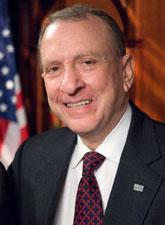 Sen. Arlen Specter (R-PA)
Submitted February 15, 2006
Text
Proposed
This amendment's own text couldn't be picked out of its Congressional Record passage, so the passage is shown in full.
STOP COUNTERFEITING IN MANUFACTURED GOODS ACT

  Mr. FRIST. Mr. President, I ask unanimous consent that the Committee
on the Judiciary be discharged from further consideration of H.R. 32
and that the Senate proceed to its immediate consideration.
  The PRESIDING OFFICER. Without objection, it is so ordered. The clerk
will state the bill by title.
  The bill clerk read as follows:

       A bill (H.R. 32) to amend title 18 United States Code, to
     provide criminal penalties for trafficking in counterfeit
     marks.

  There being no objection, the Senate proceeded to consider the bill.
  Mr. SPECTER. Mr. President, I want to take a moment to speak about
H.R. 32, the Stop Counterfeiting in Manufactured Goods Act of 2005,
sponsored by Representative Knollenberg and 59 House cosponsors. The
counterfeiting of goods bearing American held trademarks is an
important problem that I am committed to fighting, as reflected by my
sponsoring S. 1699, the Senate companion bill to H.R. 32, earlier this
year with Senator Leahy and Senators Alexander, Bayh, Brownback,
Coburn, Cornyn, DeWine, Durbin, Feingold, Feinstein, Hatch, Kyl, Levin,
Reed, Stabenow, and Voinovich.
  H.R. 32, the Stop Counterfeiting in Manufactured Goods Act of 2005
addresses a problem that has reached epidemic proportions as a result
of a loophole in our criminal code: the trafficking in counterfeit
labels. Criminal law currently prohibits the trafficking in counterfeit
trademarks ``on or in connection with goods or services.'' However, it
does not prohibit the trafficking in the counterfeit marks themselves.
As such, there is nothing in current law to prohibit an individual from
selling counterfeit labels bearing otherwise protected trademarks
within the United States.
  This loophole was exposed by the Tenth Circuit Court of Appeals in
United States v. Giles, 213 F.3d 1247 (10th Cir. 2000). In this case,
the United States prosecuted the defendant for manufacturing and
selling counterfeit Dooney & Bourke labels that third parties could
later affix to generic purses. Examining title 18, section 2320, of the
United States Code, the Tenth Circuit held that persons who sell
counterfeit trademarks that are not actually attached to any ``goods or
services'' do not violate the Federal criminal trademark infringement
statute. Since the defendant did not attach counterfeit marks to
``goods or services,'' the court found that the defendant did not run
afoul of the criminal statute as a matter of law. Thus, someone caught
redhanded with counterfeit trademarks walked free.
  H.R. 32 closes this loophole by amending title 18, section 2320 of
the United States Code to criminally prohibit the trafficking, or
attempt to traffic, in ``labels, patches, stickers'' and generally any
item to which a counterfeit mark has been applied. In so doing, H.R. 32
provides U.S. Department of Justice prosecutors with the means not only
to prosecute individuals trafficking in counterfeit goods or services,
but also individuals trafficking in labels, patches, and the like that
are later applied to goods.
  Congress must act expeditiously to protect U.S. held trademarks to
the fullest extent of the law. The recent 10-count indictment of four
Massachusetts residents of conspiracy to traffic in approximately $1.4
million of counterfeit luxury goods in the case of U.S. v. Luong et
al., 2005 D. Mass. underscores the need for this legislation. According
to the indictment, law enforcement officers raided self-storage units
earlier this year and found the units to hold approximately 12,231
counterfeit handbags; 7,651 counterfeit wallets; more than 17,000
generic handbags and wallets; and enough counterfeit labels and
medallions to turn more than

[[Page S1368]]

50,000 generic handbags and wallets into counterfeits. Although the
U.S. Attorneys Office was able to pursue charges of trafficking and
attempting to traffic in counterfeit handbags and wallets, they were
not able to bring charges for trafficking and attempting to traffic in
the more than 50,000 counterfeit labels and medallions. As such, these
defendants will escape prosecution that would have otherwise been
illegal if they had only been attached to an otherwise generic bag.
This simply does not make sense. Had the Stop Counterfeiting in
Manufactured Goods Act of 2005 been in effect at the time of
indictment, U.S. prosecutors would have been able to bring charges
against the defendants for trafficking and attempting to traffic in not
only counterfeit goods, but also counterfeit labels.
  As Assistant Attorney General Alice Fisher said:

       Those who manufacture and sell counterfeit goods steal
     business from honest merchants, confuse or defraud honest
     consumers, and illegally profit on the backs of honest
     American workers and entrepreneurs.

  This point is underscored by the Bureau of Customs and Border
Protection estimate that trafficking in counterfeit goods costs the
United States approximately $200 to $250 million annually. With each
passing year, the United States loses millions of dollars in tax
revenues to the sale of counterfeit goods. Further, each counterfeit
item that is manufactured overseas and distributed in the United States
costs American workers tens of thousands of jobs. With counterfeit
goods making up a growing 5 to 7 percent of world trade, this is a
problem that we can no longer ignore.
  To be sure, counterfeiting is not limited to the popular designer
goods that we have all seen sold on corners of just about every major
metropolitan city in the United States. Counterfeiting has a
devastating impact on a broad range of industries. In fact, for almost
every legitimate product manufactured and sold within the United
States, there is a parallel counterfeit product being sold for no more
than half the price. These counterfeit products range from children's
toys to clothing to Christmas tree lights. More frightening are the
thousands of counterfeit automobile parts, batteries, and electrical
equipment that are being manufactured and placed into the stream of
commerce with each passing day. I am told that the level of
sophistication in counterfeiting has reached the point that you can no
longer distinguish between the real and the counterfeit good or label
with the naked eye. However, just because these products look the same
does not mean that they have the same quality characteristics. The
counterfeit products are not subject to the same quality controls of
legitimate products, resulting in items that are lower in quality and
likely to fall apart. In fact, counterfeit products could potentially
kill unsuspecting American consumers.

  In addition to closing the ``counterfeit label loophole,'' the Stop
Counterfeiting in Manufactured Goods Act strengthens the criminal code
and provides heightened penalties for those trafficking in counterfeit
marks. Current law does not provide for the seizure and forfeiture of
counterfeit trademarks, whether they are attached to goods or not.
Therefore, many times such counterfeit goods are seized one day, only
to be returned and sold to an unsuspecting public. To ensure that
individuals engaging in the practice of trafficking in counterfeit
marks cannot reopen their doors, H.R. 32 establishes procedures for the
mandatory seizure, forfeiture, and destruction of counterfeit marks
prior to a conviction. Further, it provides for procedures for the
mandatory forfeiture and destruction of property derived from or used
to engage in the trafficking of counterfeit marks.
  When this legislation was sent over to the Senate from the House,
concerns were raised to Senator Leahy and myself about the language in
Section 2(bbb)(1)(B) of this bill pertaining to the forfeiture
authority of the U.S. Department of Justice. In focusing our attention
to this section, we discussed the scope of the facilitation language,
which parallels the drug and money laundering forfeiture language in 21
U.S.C. 853 and 18 U.S.C. 982, respectively, and how it might relate to
Internet marketplace companies, search engines, and ISPs. Specifically,
we were aware of concerns regarding the potential misapplication of the
facilitation language in Section 2(b)(1)(B) to pursue forfeiture and
seizure proceedings against responsible Internet marketplace companies
that serve as third-party intermediaries to online transactions.
  Mr. LEAHY. Mr. President, Section 2(b)(1)(B) authorizes U.S.
Attorneys to pursue civil in rem forfeiture proceedings against ``any
property used, in any manner or part, to commit or to facilitate the
commission of a violation of subsection (a).'' The intent of this
language is to provide attorneys and prosecutors with the authority to
bring a civil forfeiture action against the property of bad actors who
are facilitating trafficking or attempts to traffic in counterfeit
marks. The forfeiture authority in Section 2(b)(1)(B) cannot be used to
pursue forfeiture and seizure proceedings against the computer
equipment, website or network of responsible Internet marketplace
companies, who serve solely as a third party to transactions and do not
tailor their services or their facilities to the furtherance of
trafficking or attempts to traffic in counterfeit marks. However, these
Internet marketplace companies must make demonstrable good-faith
efforts to combat the use of their systems and services to traffic in
counterfeit marks. Companies must establish and implement procedures to
take down postings that contain or offer to sell goods, services,
labels, and the like in violation of this act upon being made aware of
the illegal nature of these items or services.
  It is the irresponsible culprits that must be held accountable. Those
who profit from another's innovation have proved their creativity only
at escaping responsibility for their actions. As legislators it is
important that we provide law enforcement with the tools needed to
capture these thieves.
  I say to Senator Specter, it is also my understanding that the U.S.
Sentencing Commission recently promulgated new Federal sentencing
guidelines to account for the changes in how intellectual property
crimes are committed. Could the Senator clarify for the record why we
have authorized the U.S. Sentencing Commission to further amend the
Federal sentencing guidelines and policy statements for crimes
committed in violation of title 18, section 2318 or 2320, of the United
States Code?
  Mr. SPECTER. I say to Senator Leahy, as the Senator is aware,
periodically Congress directs the Sentencing Commission to update the
Federal sentencing guidelines upon the periodic directive of Congress
to reflect and account for changes in the manner in which intellectual
property offenses are committed. The recent amendments to which you
refer were promulgated by the Sentencing Commission pursuant to the
authorization in the Family Entertainment and Copyright Act of 2005,
also known as FECA. These amendments to the Federal sentencing
guidelines, which took effect on October 24, 2005, address changes in
penalties and definitions for intellectual property rights crimes,
particularly those involving copyrighted pre-release works and issues
surrounding ``uploading.'' For example, these guidelines provide for a
25 percent increase in sentences for offenses involving pre-release
works. In addition, the Commission revised its definition of
``uploading'' to ensure that the guidelines are keeping up with
technological advances in this area.

  I would like to make it clear for the record that the directive to
the Sentencing Commission in section 3 of H.R. 32 is not meant as
disapproval of the Commission's recent actions in response to FECA.
Rather, section 3 covers other intellectual property rights crimes that
Congress believes it is time for the Commission to revisit.
Specifically, section 3 directs the Commission to review the
guidelines, and particularly the definition of ``infringement amount,''
to ensure that offenses involving low-cost items like labels, patches,
medallions, or packaging that are used to make counterfeit goods that
are much more expensive, are properly punished. It also directs the
Commission to ensure that the penalty provisions for offenses involving
all counterfeit goods or services, or devices used to facilitate
counterfeiting, are properly addressed by the guidelines. As it did in
response to the No

[[Page S1369]]

Electronic Theft Act of 1997 and FECA, I am confident that the
Commission will ensure that the Federal sentencing guidelines provide
adequate punishment and deterrence for these very serious offenses and
I look forward to the Commission's response to this directive.
  Mr. LEAHY. I say to Senator Specter, thank you for that
clarification. As you are aware, there has been overwhelming support
for this legislation. It has been very heartening to see such
overwhelming support for this important bill. Counterfeiting is a
threat to America. It wreaks real harm on our economy, our workers, and
our consumers. This bill is a tough bill that will give law enforcement
improved tools to fight this form of theft. The bill is short and
straightforward, but its impact should be profound and far reaching.
  Mr. SPECTER. At this point, I would like to take this opportunity to
thank Representative Jim Sensenbrenner, chairman of the House Judiciary
Committee, and Representative Joe Knollenberg for their leadership in
the House with regard to H.R. 32. In January of 2005, Representative
Knollenberg introduced H.R. 32 in the House. When the bill was in
committee, he fostered negotiations between the Department of Justice,
the U.S. Chamber of Commerce, and the International Trademark
Association to ensure that it passed the House. I would also like to
thank my colleague Senator Leahy, ranking member of the Senate
Judiciary Committee, and Senators Alexander, Bayh, Brownback, Coburn,
Cornyn, DeWine, Durbin, Feingold, Feinstein, Hatch, Kyl, Levin, Reed,
Stabenow, and Voinovich for their cosponsorship of S. 1699, the
companion legislation to H.R. 32. It is through the hard work of all of
these Members that we were able to achieve truly bipartisan support for
language that will ensure the protection of American-held trademarks.
  Mr. LEAHY. Some of our most important legislation is produced not
only when we reach across the aisle in the name of bipartisanship, but
when we work across Chambers and reach true consensus. I would also
like to thank Senators Alexander, Bayh, Brownback, Coburn, Cornyn,
DeWine, Durbin, Feingold, Feinstein, Hatch, Kyl, Levin, Reed, Stabenow,
and Voinovich for their cosponsorship of the Senate companion
legislation. Counterfeiting is a serious problem that does not lend
itself to a quick and easy solution. This legislation is an important
step towards fighting counterfeiting. I hope we can build on the
success of this law.
  Mr. LEAHY. Mr. President, I am pleased to join with Senator Cornyn in
another of our bipartisan efforts to improve the lives of Americans
through effective and efficient Government. The Protecting American
Goods and Services Act of 2005, which was passed unanimously out of the
Senate last November as S. 1095, is now part of a package that includes
the Stop Counterfeiting in Manufactured Goods Act, which I co-sponsored
with Senator Specter as S. 1699. The Protecting American Goods and
Services Act strengthens our ability to combat the escalating problem
of counterfeiting worldwide. In order to effectively fight intellectual
property theft, we need stiff penalties for counterfeiters and those
who are caught with counterfeit goods with the intent to traffic their
false wares. Ours is a short bill--indeed, it is only two pages long--
but it will have global implications in the fight against piracy.
  Counterfeiting is a growing problem that costs our economy hundreds
of billions of dollars every year and has been linked to organized
crime, including terrorist organizations. According to the
International Anti-Counterfeiting Coalition, counterfeit parts have
been discovered in helicopters sold to NATO, in jet engines, bridge
joints, brake pads, and fasteners in equipment designed to prevent
nuclear reactor meltdowns. The World Health Organization estimates that
the market for counterfeit drugs is about $32 billion each year.
  Several years ago, Senator Hatch joined me in sponsoring the Anti-
Counterfeiting Consumer Protection Act of 1996, which addressed
counterfeiting by amending several sections of our criminal and tariff
codes. That law made important changes, particularly by expanding RICO,
the Federal antiracketeering law, to cover crimes involving
counterfeiting and copyright and trademark infringement: Then, as now,
trafficking in counterfeit goods hurts purchasers, State and Federal
Governments, and economies at every level.
  Perhaps most disturbingly, the U.S. Customs Service reports that
terrorists have used transnational counterfeiting operations to fund
their activities: The sale of counterfeit and pirated music, movies,
software, T-shirts, clothing, and fake drugs ``accounts for much of the
money the international terrorist network depends on to feed its
operations.''
  Last year, as in years past, I worked with Senator Allen on an
amendment to the Foreign Operations bill that provides the State
Department with vital resources to combat piracy of U.S. goods abroad.
The bill we ultimately passed included $3 million for this important
purpose. Yet more work both at home and abroad remains. When you
consider that the economic impact of tangible piracy in counterfeit
goods is estimated to be roughly $350 billion a year and to constitute
between 5 percent and 7 percent of worldwide trade, a few million
dollars is a worthwhile investment.
  We have certainly seen how this form of theft touches the lives of
hard-working Vermonters. Burton Snowboards is a small company, whose
innovation has made it an industry leader in snowboarding equipment and
apparel. Unfortunately, knock-off products carrying Burton's name have
been found across the globe. Vanessa Price, a representative of Burton,
testified about counterfeiting at the Judiciary Committee's March 23,
2004, hearing on this topic. In addition to learning about the economic
costs of counterfeiting, I asked her after the hearing about the risks
posed to consumers by these goods. Her answer was chilling:

       In the weeks since my Senate testimony, I discovered a
     shipment of counterfeit Burton boots for sale through a
     discount sports outfit . . . After examining the poor quality
     of the counterfeit boots, we determined that anyone using the
     boots for snowboarding risks injury due to a lack of
     reinforcement and support in the product's construction.

  Customers and businesses lose out to counterfeiters in other ways,
too. SB Electronics in Barre, VT, has seen its capacitors reverse
engineered and its customers lost to inferior copycat models. Vermont
Tubbs, a furniture manufacturer in Rutland, has seen its designs
copied, produced offshore with inferior craftsmanship and materials,
and then reimported, so that the company is competing against cheaper
versions of its own products. And Hubbardton Forge in Castleton, VT,
has seen its beautiful and original lamps counterfeited and then sold
within the United States at prices--and quality--far below their own.
This is wrong. It is unfair to consumers who deserve the high quality
goods they think they are paying for, and it is unfair to innovators
who play by the rules and deserve to profit from their labor.
  This bill helps to combat this growing scourge.
  S. 1095 criminalizes the possession of counterfeit goods with the
intent to sell or traffic in those goods, and it expands the definition
of ``traffic'' to include any distribution of counterfeits with the
expectation of gaining something of value--criminals should not be able
to skirt the law simply because they barter illegal goods and services
in exchange for their illicit wares. Finally, the bill will criminalize
the importation and exportation of counterfeit goods, as well as of
bootleg copies of copyrighted works into and out of the United States.
  By tying off these loopholes and improving U.S. laws on
counterfeiting, we are sending a powerful message to the criminals who
belong in jail, and to our innovators.
  Mr. FRIST. Mr. President, I ask unanimous consent that the Specter
substitute at the desk be agreed to, the bill, as amended, be read the
third time and passed, the motion to reconsider be laid on the table,
and that any statements thereon be printed in the Record.
  The PRESIDING OFFICER. Without objection, it is so ordered.
  The amendment (No. 2889) was agreed to, as follows:

[[Page S1370]]

 (Purpose: To amend title 18, United States Code, to provide criminal
penalties for trafficking in counterfeit marks, clarify the prohibition
    on the trafficking in goods or services, and for other purposes)

       Strike all after the enacting clause and insert the
     following:

     SECTION 1. TRAFFICKING IN COUNTERFEIT MARKS.

       (a) Short Title; Findings.--
       (1) Short title.--This section may be cited as the ``Stop
     Counterfeiting in Manufactured Goods Act''.
       (2) Findings.--The Congress finds that--
       (A) the United States economy is losing millions of dollars
     in tax revenue and tens of thousands of jobs because of the
     manufacture, distribution, and sale of counterfeit goods;
       (B) the Bureau of Customs and Border Protection estimates
     that counterfeiting costs the United States $200 billion
     annually;
       (C) counterfeit automobile parts, including brake pads,
     cost the auto industry alone billions of dollars in lost
     sales each year;
       (D) counterfeit products have invaded numerous industries,
     including those producing auto parts, electrical appliances,
     medicines, tools, toys, office equipment, clothing, and many
     other products;
       (E) ties have been established between counterfeiting and
     terrorist organizations that use the sale of counterfeit
     goods to raise and launder money;
       (F) ongoing counterfeiting of manufactured goods poses a
     widespread threat to public health and safety; and
       (G) strong domestic criminal remedies against
     counterfeiting will permit the United States to seek stronger
     anticounterfeiting provisions in bilateral and international
     agreements with trading partners.
       (b) Trafficking in Counterfeit Marks.--Section 2320 of
     title 18, United States Code, is amended as follows:
       (1) Subsection (a) is amended by inserting after ``such
     goods or services'' the following: ``, or intentionally
     traffics or attempts to traffic in labels, patches, stickers,
     wrappers, badges, emblems, medallions, charms, boxes,
     containers, cans, cases, hangtags, documentation, or
     packaging of any type or nature, knowing that a counterfeit
     mark has been applied thereto, the use of which is likely to
     cause confusion, to cause mistake, or to deceive,''.
       (2) Subsection (b) is amended to read as follows:
       ``(b)(1) The following property shall be subject to
     forfeiture to the United States and no property right shall
     exist in such property:
       ``(A) Any article bearing or consisting of a counterfeit
     mark used in committing a violation of subsection (a).
       ``(B) Any property used, in any manner or part, to commit
     or to facilitate the commission of a violation of subsection
     (a).
       ``(2) The provisions of chapter 46 of this title relating
     to civil forfeitures, including section 983 of this title,
     shall extend to any seizure or civil forfeiture under this
     section. At the conclusion of the forfeiture proceedings, the
     court, unless otherwise requested by an agency of the United
     States, shall order that any forfeited article bearing or
     consisting of a counterfeit mark be destroyed or otherwise
     disposed of according to law.
       ``(3)(A) The court, in imposing sentence on a person
     convicted of an offense under this section, shall order, in
     addition to any other sentence imposed, that the person
     forfeit to the United States--
       ``(i) any property constituting or derived from any
     proceeds the person obtained, directly or indirectly, as the
     result of the offense;
       ``(ii) any of the person's property used, or intended to be
     used, in any manner or part, to commit, facilitate, aid, or
     abet the commission of the offense; and
       ``(iii) any article that bears or consists of a counterfeit
     mark used in committing the offense.
       ``(B) The forfeiture of property under subparagraph (A),
     including any seizure and disposition of the property and any
     related judicial or administrative proceeding, shall be
     governed by the procedures set forth in section 413 of the
     Comprehensive Drug Abuse Prevention and Control Act of 1970
     (21 U.S.C. 853), other than subsection (d) of that section.
     Notwithstanding section 413(h) of that Act, at the conclusion
     of the forfeiture proceedings, the court shall order that any
     forfeited article or component of an article bearing or
     consisting of a counterfeit mark be destroyed.
       ``(4) When a person is convicted of an offense under this
     section, the court, pursuant to sections 3556, 3663A, and
     3664, shall order the person to pay restitution to the owner
     of the mark and any other victim of the offense as an offense
     against property referred to in section 3663A(c)(1)(A)(ii).
       ``(5) The term `victim', as used in paragraph (4), has the
     meaning given that term in section 3663A(a)(2).''.
       (3) Subsection (e)(1) is amended--
       (A) by striking subparagraph (A) and inserting the
     following:
       ``(A) a spurious mark--
       ``(i) that is used in connection with trafficking in any
     goods, services, labels, patches, stickers, wrappers, badges,
     emblems, medallions, charms, boxes, containers, cans, cases,
     hangtags, documentation, or packaging of any type or nature;
       ``(ii) that is identical with, or substantially
     indistinguishable from, a mark registered on the principal
     register in the United States Patent and Trademark Office and
     in use, whether or not the defendant knew such mark was so
     registered;
       ``(iii) that is applied to or used in connection with the
     goods or services for which the mark is registered with the
     United States Patent and Trademark Office, or is applied to
     or consists of a label, patch, sticker, wrapper, badge,
     emblem, medallion, charm, box, container, can, case, hangtag,
     documentation, or packaging of any type or nature that is
     designed, marketed, or otherwise intended to be used on or in
     connection with the goods or services for which the mark is
     registered in the United States Patent and Trademark Office;
     and
       ``(iv) the use of which is likely to cause confusion, to
     cause mistake, or to deceive; or''; and
       (B) by amending the matter following subparagraph (B) to
     read as follows:

     ``but such term does not include any mark or designation used
     in connection with goods or services, or a mark or
     designation applied to labels, patches, stickers, wrappers,
     badges, emblems, medallions, charms, boxes, containers, cans,
     cases, hangtags, documentation, or packaging of any type or
     nature used in connection with such goods or services, of
     which the manufacturer or producer was, at the time of the
     manufacture or production in question, authorized to use the
     mark or designation for the type of goods or services so
     manufactured or produced, by the holder of the right to use
     such mark or designation.''.
       (4) Section 2320 is further amended--
       (A) by redesignating subsection (f) as subsection (g); and
       (B) by inserting after subsection (e) the following:
       ``(f) Nothing in this section shall entitle the United
     States to bring a criminal cause of action under this section
     for the repackaging of genuine goods or services not intended
     to deceive or confuse.''.
       (c) Sentencing Guidelines.--
       (1) Review and amendment.--Not later than 180 days after
     the date of enactment of this Act, the United States
     Sentencing Commission, pursuant to its authority under
     section 994 of title 28, United States Code, and in
     accordance with this subsection, shall review and, if
     appropriate, amend the Federal sentencing guidelines and
     policy statements applicable to persons convicted of any
     offense under section 2318 or 2320 of title 18, United States
     Code.
       (2) Authorization.--The United States Sentencing Commission
     may amend the Federal sentencing guidelines in accordance
     with the procedures set forth in section 21(a) of the
     Sentencing Act of 1987 (28 U.S.C. 994 note) as though the
     authority under that section had not expired.
       (3) Responsibilities of united states sentencing
     commission.--In carrying out this subsection, the United
     States Sentencing Commission shall determine whether the
     definition of ``infringement amount'' set forth in
     application note 2 of section 2B5.3 of the Federal sentencing
     guidelines is adequate to address situations in which the
     defendant has been convicted of one of the offenses listed in
     paragraph (1) and the item in which the defendant trafficked
     was not an infringing item but rather was intended to
     facilitate infringement, such as an anti-circumvention
     device, or the item in which the defendant trafficked was
     infringing and also was intended to facilitate infringement
     in another good or service, such as a counterfeit label,
     documentation, or packaging, taking into account cases such
     as U.S. v. Sung, 87 F.3d 194 (7th Cir. 1996).

     SEC. 2. TRAFFICKING DEFINED.

       (a) Short Title.--This section may be cited as the
     ``Protecting American Goods and Services Act of 2005''.
       (b) Counterfeit Goods or Services.--Section 2320(e) of
     title 18, United States Code, is amended--
       (1) by striking paragraph (2) and inserting the following:
       ``(2) the term `traffic' means to transport, transfer, or
     otherwise dispose of, to another, for purposes of commercial
     advantage or private financial gain, or to make, import,
     export, obtain control of, or possess, with intent to so
     transport, transfer, or otherwise dispose of;'';
       (2) by redesignating paragraph (3) as paragraph (4); and
       (3) by inserting after paragraph (2) the following:
       ``(3) the term `financial gain' includes the receipt, or
     expected receipt, of anything of value; and''.
       (c) Conforming Amendments.--
       (1) Sound recordings and music videos of live musical
     performances.--Section 2319A(e) of title 18, United States
     Code, is amended by striking paragraph (2) and inserting the
     following:
       ``(2) the term `traffic' has the same meaning as in section
     2320(e) of this title.''.
       (2) Counterfeit labels for phonorecords, computer programs,
     etc.--Section 2318(b) of title 18, United States Code, is
     amended by striking paragraph (2) and inserting the
     following:
       ``(2) the term `traffic' has the same meaning as in section
     2320(e) of this title;''.
       (3) Anti-bootlegging.--Section 1101 of title 17, United
     States Code, is amended by striking subsection (b) and
     inserting the following:
       ``(b) Definition.--In this section, the term `traffic' has
     the same meaning as in section 2320(e) of title 18.''.

  The bill (H.R. 32), as amended, was read the third time and passed.


____________________Legislative Activity
Stay on top of the latest movement without scrolling through every action
Floor
Latest Action
Senate amendment submitted
February 15, 2006
View full timeline
Floor
Senate amendment submitted
February 15, 2006
Floor
Senate amendment agreed to: Amendment SA 2889 agreed to in Senate by Unanimous Consent.
February 15, 2006
Floor
Senate amendment proposed (on the floor): Amendment SA 2889 proposed by Senator Frist for Senator Specter.
February 15, 2006
Floor
Amendment SA 2889 proposed by Senator Frist for Senator Specter. (consideration: CR S1369-1370; text: CR S1370) In the nature of a substitute.
February 15, 2006
Floor
Amendment SA 2889 agreed to in Senate by Unanimous Consent.
February 15, 2006