To clarify the treatment of out of scope matters in conference reports.
What it does: Rewrites page 3, line 9 through page 4, line 20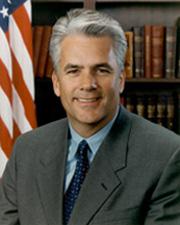 Sen. John Ensign (R-NV)
What it changes
1 change to S. 2349
Rewrites page 3, line 9 through page 4, line 20
ReplacesPrinted pageRemoves page 3, line 9 through page 4, line 20 of the printed bill. See that page
Inserted: (a) In General.--A point of order may be made by any Senator against consideration of a conference report that includes any new or general legislation, any unauthorized appropriation, or new matter or nongermane matter not committed to the conferees by either House. The point of order shall be made and voted on separately for each item in violation of this section.
Inserted: (b) Disposition.--If the point of order against a conference report under subsection (a) is sustained, then--
Inserted: (1) the matter in such conference report shall be deemed to have been struck;
Inserted: (2) when all other points of order under this section have been disposed of--
Inserted: (A) the Senate shall proceed to consider the question of whether the Senate should recede from its amendment to the House bill, or its disagreement to the amendment of the House, and concur with a further amendment, which further amendment shall consist of only that portion of the conference report not deemed to have been struck;
Inserted: (B) the question shall be debatable; and
Inserted: (C) no further amendment shall be in order; and
Inserted: (3) if the Senate agrees to the amendment, then the bill and the Senate amendment thereto shall be returned to the House for its concurrence in the amendment of the Senate.
Inserted: (c) Supermajority Waiver and Appeal.--This section may be waived or suspended in the Senate only by an affirmative vote of \3/5\ of the Members, duly chosen and sworn. An affirmative vote of \3/5\ of the Members of the Senate, duly chosen and sworn, shall be required in the Senate to sustain an appeal of the ruling of the Chair on a point of order raised under this section.
Inserted: (d) Definitions.--In this section:
Inserted: (1)(A) The term "unauthorized appropriation" means an appropriation--
Inserted: (i) not specifically authorized by law or Treaty stipulation (unless the appropriation has been specifically authorized by an Act or resolution previously passed by the Senate during the same session or proposed in pursuance of an estimate submitted in accordance with law); or
Show 5 more inserted paragraphsShow less
Inserted: (ii) the amount of which exceeds the amount specifically authorized by law or Treaty stipulation (or specifically authorized by an Act or resolution previously passed by the Senate during the same session or proposed in pursuance of an estimate submitted in accordance with law) to be appropriated.
Inserted: (B) An appropriation is not specifically authorized if it is restricted or directed to, or authorized to be obligated or expended for the benefit of, an identifiable person, program, project, entity, or jurisdiction by earmarking or other specification, whether by name or description, in a manner that is so restricted, directed, or authorized that it applies only to a single identifiable person, program, project, entity, or jurisdiction, unless the identifiable person, program, project, entity, or jurisdiction to which the restriction, direction, or authorization applies is described or otherwise clearly identified in a law or Treaty stipulation (or an Act or resolution previously passed by the Senate during the same session or in the estimate submitted in accordance with law) that specifically provides for the restriction, direction, or authorization of appropriation for such person, program, project, entity, or jurisdiction.
Inserted: (2) The term "new or general legislation" has the meaning given that term when it is used in paragraph 2 of Rule XVI of the Standing Rules of the Senate.
Inserted: (3) The term "new matter" means any matter not committed to conferees by either House.
Inserted: (4) The term "nongermane matter" has the meaning given that term when it is used in Rule XXII of the Standing Rules of the Senate.
Original wording
On page 3, strike line 9 and all that follows through page 4, line 20, and insert the following:
Read automatically from the Congressional Record. Check the original before relying on it.
As printed
SA 2981. Mr. ENSIGN (for himself and Mr. McCain) submitted an amendment intended to be proposed by him to the bill S. 2349, to provide greater transparency in the legislative process; which was ordered to lie on the table; as follows:
On page 3, strike line 9 and all that follows through page 4, line 20, and insert the following:
(a) In General.--A point of order may be made by any Senator against consideration of a conference report that includes any new or general legislation, any unauthorized appropriation, or new matter or nongermane matter not committed to the conferees by either House. The point of order shall be made and voted on separately for each item in violation of this section.
(b) Disposition.--If the point of order against a conference report under subsection (a) is sustained, then--
(1) the matter in such conference report shall be deemed to have been struck;
(2) when all other points of order under this section have been disposed of--
(A) the Senate shall proceed to consider the question of whether the Senate should recede from its amendment to the House bill, or its disagreement to the amendment of the House, and concur with a further amendment, which further amendment shall consist of only that portion of the conference report not deemed to have been struck;
(B) the question shall be debatable; and
(C) no further amendment shall be in order; and
(3) if the Senate agrees to the amendment, then the bill and the Senate amendment thereto shall be returned to the House for its concurrence in the amendment of the Senate.
(c) Supermajority Waiver and Appeal.--This section may be waived or suspended in the Senate only by an affirmative vote of \3/5\ of the Members, duly chosen and sworn. An affirmative vote of \3/5\ of the Members of the Senate, duly chosen and sworn, shall be required in the Senate to sustain an appeal of the ruling of the Chair on a point of order raised under this section.
(d) Definitions.--In this section:
(1)(A) The term “unauthorized appropriation” means an appropriation--
(i) not specifically authorized by law or Treaty stipulation (unless the appropriation has been specifically authorized by an Act or resolution previously passed by the Senate during the same session or proposed in pursuance of an estimate submitted in accordance with law); or
(ii) the amount of which exceeds the amount specifically authorized by law or Treaty stipulation (or specifically authorized by an Act or resolution previously passed by the Senate during the same session or proposed in pursuance of an estimate submitted in accordance with law) to be appropriated.
(B) An appropriation is not specifically authorized if it is restricted or directed to, or authorized to be obligated or expended for the benefit of, an identifiable person, program, project, entity, or jurisdiction by earmarking or other specification, whether by name or description, in a manner that is so restricted, directed, or authorized that it applies only to a single identifiable person, program, project, entity, or jurisdiction, unless the identifiable person, program, project, entity, or jurisdiction to which the restriction, direction, or authorization applies is described or otherwise clearly identified in a law or Treaty stipulation (or an Act or resolution previously passed by the Senate during the same session or in the estimate submitted in accordance with law) that specifically provides for the restriction, direction, or authorization of appropriation for such person, program, project, entity, or jurisdiction.
(2) The term “new or general legislation” has the meaning given that term when it is used in paragraph 2 of Rule XVI of the Standing Rules of the Senate.
(3) The term “new matter” means any matter not committed to conferees by either House.
(4) The term “nongermane matter” has the meaning given that term when it is used in Rule XXII of the Standing Rules of the Senate.
Legislative Activity
Stay on top of the latest movement without scrolling through every action
Senate amendment proposed (on the floor): Amendment SA 2981 proposed by Senator Lott for Senator Ensign.
March 29, 2006
View full timeline
Senate amendment proposed (on the floor): Amendment SA 2981 proposed by Senator Lott for Senator Ensign.
March 29, 2006
Amendment SA 2981 proposed by Senator Lott for Senator Ensign. (consideration: CR S2491-2493, S2506-2507; text: CR S2491-2492) To clarify the treatment of out of scope matters in conference reports.
March 29, 2006
Proposed amendment SA 2981 withdrawn in Senate. (consideration: CR S2506-2507)
March 29, 2006
Senate amendment submitted
March 9, 2006