To authorize appropriate action if the negotiations with the People's Republic of China regarding China's undervalued currency are not successful.
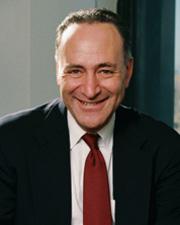 Sen. Charles E. Schumer (D-NY)
Legislative Activity
Stay on top of the latest movement without scrolling through every action
Senate amendment submitted
April 6, 2005
View full timeline
Senate amendment submitted
April 6, 2005
Roll call votes on amendments in Senate: Motion to table amendment SA 309 rejected in Senate by Yea-Nay Vote. 33 - 67. Record Vote Number: 86.
April 6, 2005
Senate amendment proposed (on the floor): Amendment SA 309 proposed by Senator Schumer.
April 6, 2005
Amendment SA 309 proposed by Senator Schumer. (consideration: CR S3243, S3249-3253; text: CR S3243) To authorize appropriate action if the negotiations with the People's Republic of China regarding China's undervalued currency are not successful.
April 6, 2005
Motion to table amendment SA 309 rejected in Senate by Yea-Nay Vote. 33 - 67. Record Vote Number: 86.
April 6, 2005
Votes
1 roll call on this amendment
Text
Proposed
FOREIGN AFFAIRS AUTHORIZATION ACT, FISCAL YEARS 2006 and 2007

The PRESIDING OFFICER. The Senator from Colorado.
Mr. SALAZAR. I ask unanimous consent to lay aside the pending
amendment.
The PRESIDING OFFICER. Without objection, it is so ordered.

Amendment No. 308

Mr. SALAZAR. I send an amendment to the desk.
The PRESIDING OFFICER. The clerk will report.
The assistant legislative clerk read as follows:

The Senator from Colorado [Mr. Salazar] proposes an
amendment numbered 308.

Mr. SALAZAR. I ask unanimous consent further reading be dispensed
with.
The PRESIDING OFFICER. Without objection, it is so ordered.
The amendment is as follows:

(Purpose: To increase the accountability and effectiveness of
international police training)

At the end of title VIII, insert the following:

SEC. 812. INTERNATIONAL POLICE TRAINING.

(a) Requirements for Instructors.--Prior to carrying out
any program of training for police or security forces through
the Bureau that begins after the date of the enactment of
this Act, the Secretary shall ensure that--
(1) such training is provided by instructors who have
proven records of experience in training law enforcement or
security personnel;
(2) the Bureau has established procedures to ensure that
the individuals who receive such training--
(A) do not have a criminal background;
(B) are not connected to any criminal or insurgent group;
(C) are not connected to drug traffickers; and
(D) meet the minimum age and experience standards set out
in appropriate international agreements; and
(3) the Bureau has established procedures that--
(A) clearly establish the standards an individual who will
receive such training must meet;
(B) clearly establish the training courses that will permit
the individual to meet such standards; and
(C) provide for certification of an individual who meets
such standards.
(b) Advisory Board.--The Secretary shall establish an
advisory board of 10 experts to advise the Bureau on issues
related to cost efficiency and professional efficacy of
police and security training programs. The board shall have
not less than 5 members who are experienced United States law
enforcement personnel.
(c) Bureau Defined.--In this section, the term ``Bureau''
means the Bureau of International Narcotics and Law
Enforcement Affairs of the Department of State.
(d) Annual Report.--Not later than September 30 of each
fiscal year, the Secretary shall submit to Congress a report
on the training for international police or security forces
conducted by the Bureau. Such report shall include the
attrition rates of the instructors of such training and
indicators of job performance of such instructors.

Mr. SALAZAR. Madam President, I rise in support of this amendment to
document the importance of making sure we have the right standards and
certifications with respect to training law enforcement and security
officers on missions around the world.
I speak to this amendment based on my experience as Colorado attorney
general where I sat as chairman of the peace officers standards and
training board for a period of 6 years. Working with my colleagues in
law enforcement, we developed a set of standards that made sure the
people we were recruiting into our police forces in the State of
Colorado were people who had been checked for criminal backgrounds and
would be able to serve. We also developed a set of standards with
respect to the training of these law enforcement officers. This
amendment creates those same standards and background checks with
respect to people being recruited into security forces to help with our
efforts around the world.
I understand the amendment I have offered will be considered by
Senator Lugar and others as we return to the Senate.
I yield the floor and I suggest the absence of a quorum.
The PRESIDING OFFICER. The clerk will call the roll.
The assistant legislative clerk proceeded to call the roll.

Amendment No. 284

Mr. DORGAN. Madam President, I ask unanimous consent that the order
for the quorum call be rescinded.
The PRESIDING OFFICER. Without objection, it is so ordered.
Mr. DORGAN. Madam President, yesterday I offered an amendment on
behalf of myself and Senator Wyden from

[[Page S3242]]

Oregon. I will now describe that amendment in some greater detail. I
know others, including my colleague from Oregon, will be here.
It is an amendment to terminate something called TV Marti, Television
Marti. It is spending money on something that does not work, spending
money we do not have on something that is not needed. Even waste, of
course, has a constituency in this town, so there will be those who
will oppose this amendment. I will describe why this is a tragic waste
of the American taxpayers' money.
This is a picture of an aerostat balloon called Fat Albert. Fat
Albert has a great history. Fat Albert has been used for a number of
things. At one point we had an aerostat balloon, Fat Albert, that got
loose of its mooring in Florida. Eventually, it lifted fishing boats
from the sea. They had to shoot it down. The Air Force had to shoot
down Fat Albert.
This is the aerostat balloon, along with a 20,000-foot tether cable
that broadcasts television signals into the country of Cuba to tell the
Cubans how good life is in America and to give the Cubans a straight
story.
We have spent $189 million on this program over a number of years
since 1989. Over 16 years we have spent nearly $200 million.
We have another program called Radio Marti. I don't propose that we
terminate funding for that because by and large the Cubans are
receiving signals from Radio Marti. Radio Marti is beneficial. I have
been to Cuba and talked to the Cubans. They can listen to commercial
stations from Miami, as well, and do. But Radio Marti gets its signals
to the Cuban people.
TV Marti, by contrast, has cost the American taxpayer since 1989 $189
million to broadcast television signals into Cuba that the Cuban people
cannot see because the Castro Government routinely jammed those
signals. In fact, for much of its existence, Television Marti was
broadcasting signals from 3 a.m. until 8 in the morning--again,
broadcasting signals the Cuban people could not see.
That, of course, is no barrier in this country. The 20,000-foot
tether on the aerostat balloon called Fat Albert sits up there in the
sky with the technicians. By the way, since they had to shoot one down
and since another one got loose and went over to the Everglades and
they had to round up this aerostat balloon and figure out a way to
catch it, since then they now have three different ways of
communicating with and controlling Fat Albert which I am sure is of
great comfort to the people who might be in the way of an aerostat
balloon that gets loose in this country.
Fat Albert is up there every day on the case, broadcasting television
signals to the Cuban people. And every day, the Cuban people see this--
this is a television screen in Cuba--they see snow, because Castro jams
the signals. So we have a program we pay for that doesn't work, that is
not needed, and we keep doing it year after year.
And this year, guess what. The President wants to double the funding.
Yes, that is true, a program that does not work, is unneeded, is
wasting the taxpayers' money, and the President's budget says, let's
double the funding.
Let me tell you what they did after they had this introduction of Fat
Albert. Fat Albert gets loose, goes over to the Everglades, it is kind
of a problem, and everyone is embarrassed about it. It is a worthless
program that sends signals no one can receive to the Cuban people, and
then they lose a balloon and they have all these embarrassing anecdotes
of the fact that they are spending money to broadcast a television
signal no one can receive, and so they decide they will do something
different.
October 10, 2003, in the Rose Garden, the administration announced
new ``get tough'' measures with Cuba which, among other things, said we
will stop using Fat Albert; we are not going to use an aerostat balloon
anymore. Now we are going to take Commando Solo, a C-130 Air National
Guard plane, special operations C-130 airplane called Commando Solo.
They are going to now broadcast television signals from Commando Solo.
The broadcast of TV Marti from Commando Solo commenced once a week
for a 4\1/2\ hour broadcast. They use the same technology the current
Fat Albert blimp uses. It broadcasts a signal from a high altitude
which then is jammed by the Castro Government. The Commando Solo cannot
overcome jammers in Havana, either. It can only reach areas if there
are areas where the Castro Government is not jamming.
Commando Solo is operated by the 193rd Special Operations Wing of the
Pennsylvania National Guard. It was designed for psychological warfare
in military situations. It has been used to broadcast television
messages in Panama, Desert Shield, Grenada, Desert Storm, Afghanistan,
and Iraq, largely areas where there has been combat that has occurred.
There are half a dozen of these airplanes that exist. They are a
precious military resource that is being used for what is now a
nonmilitary operation. So now instead of Fat Albert, or in addition to
Fat Albert, we have Commando Solo. There is no evidence, of course,
that the Cubans can receive a signal from Commando Solo, but we are
still pumping taxpayers' money into this folly.
The President's budget says we are spending $10 million a year. We
have been doing that for 16 years, and we understand this is a program
we do not need, a program that does not work, but we still want to keep
funding it and we want to actually enhance it. Now what we want to do
is go purchase a new airplane, go buy a new airplane for $8 million so
that it becomes the TV Marti airplane to broadcast signals the Castro
Government will jam and that the Cuban people cannot see.
If you sat around a smalltown cafe and talked about this, you would
not get one person in a million who would say, well, if we have
something that doesn't work, let's keep doing it; in fact, let's double
it. Let's do more of it. Almost everyone would say: Are you out of your
mind? What are you thinking about, funding something that does not
work? If it is clear it does not work, why does it take you 16 years to
decide it does not work? And if it does not work, why on Earth would
you suggest doubling the funding? Yet that is exactly what we have.

Now, we have people who will, I am sure, defend this, and they will
say: Well, do you know something? There are some Cubans who say they
have seen it. We have 19 million people in Cuba, somewhere in that
neighborhood. I think when the State Department talks about this, they
say: We have 250 sitings of people who actually have seen Television
Marti.
What they were doing is, they were interviewing people off the boats
coming from Cuba in order to see if they could get some evidence that
somebody was actually able to see something more than the snow on this
screen. They got such an embarrassingly small amount of testimony from
people who have said they could see this, they finally stopped asking
people. So now there are no surveys because it was too embarrassing to
get a survey completed that said this is a tragic, complete, total,
thorough waste of taxpayer money.
What we have is a bill on the floor of the Senate that promotes the
President's budget that says we will double funding for this program
that is a total waste from $10.3 million to $21.1 million in fiscal
year 2006. And the $10 million increase would go toward buying an
airplane that would transmit 4 hours of TV broadcast to Cuba each day
that would be jammed by the Castro Government and that would not be
able to be received by the Cuban people.
TV Marti says it could operate a secondhand, modest twin engine plane
for about $8 million. They would buy it for $8 million, and spend $2
million a year on the plane. There is not a shred of evidence--not a
shred of evidence--anywhere that this would put us in a different
position than now exists. The desire to use, for 16 years, an aerostat
balloon called Fat Albert, and then the desire to expropriate military
assets to send a highly specialized military plane, designed for
psychological warfare, up in the air to broadcast for 4 hours a week
signals the Cuban people cannot see--it is unbelievable.
It is one of these things that leads me to say, as I have from time
to time, that even waste has a strong constituency here in the
Congress. But from time to time you can see waste for what it is. This
is evident. It is clear. It is not about Republicans or Democrats. It
is about whether we want to spend money on something that does not

[[Page S3243]]

work. Do we want to continue to do that?
My colleague, Senator Wyden, and I say absolutely not. Let's finally,
finally, finally--after 16 years--have the courage to shut down a
program that is a total waste of the American taxpayers' money.
My colleague from New York wishes to, I think at this time, set aside
and offer his own amendment; and then we will continue the debate with
my colleague from Oregon immediately after the offering of the
amendment.
Let me at this time yield the floor.
The PRESIDING OFFICER. The Senator from New York.

Amendment No. 309

Mr. SCHUMER. Madam President, I ask unanimous consent that the
pending amendments be laid aside and that amendment No. 309, offered by
myself and the Senator from South Carolina, be called up.
The PRESIDING OFFICER. Without objection, it is so ordered.
The clerk will report the amendment.
The assistant legislative clerk read as follows:

The Senator from New York [Mr. Schumer], for himself, Mr.
Graham, Mr. Bayh, Mr. Bunning, Mr. Dodd, Mrs. Dole, Mr.
Feingold, Ms. Stabenow, and Mr. Kohl, proposes an amendment
numbered 309.

Mr. SCHUMER. Madam President, I ask unanimous consent that reading of
the amendment be dispensed with.
The PRESIDING OFFICER. Without objection, it is so ordered.
The amendment is as follows:

(Purpose: To authorize appropriate action if the negotiations with the
People's Republic of China regarding China's undervalued currency are
not successful)

On page 277, after line 8, add the following:

TITLE XXIX--CURRENCY VALUATION

SEC. 2901. NEGOTIATIONS REGARDING CURRENCY VALUATION.

(a) Findings.--Congress makes the following findings:
(1) The currency of the People's Republic of China, known
as the yuan or renminbi, is artificially pegged at a level
significantly below its market value. Economists estimate the
yuan to be undervalued by between 15 percent and 40 percent
or an average of 27.5 percent.
(2) The undervaluation of the yuan provides the People's
Republic of China with a significant trade advantage by
making exports less expensive for foreign consumers and by
making foreign products more expensive for Chinese consumers.
The effective result is a significant subsidization of
China's exports and a virtual tariff on foreign imports.
(3) The Government of the People's Republic of China has
intervened in the foreign exchange markets to hold the value
of the yuan within an artificial trading range. China's
foreign reserves are estimated to be over $609,900,000,000 as
of January 12, 2005, and have increased by over
$206,700,000,000 in the last 12 months.
(4) China's undervalued currency, China's trade advantage
from that undervaluation, and the Chinese Government's
intervention in the value of its currency violates the spirit
and letter of the world trading system of which the People's
Republic of China is now a member.
(5) The Government of the People's Republic of China has
failed to promptly address concerns or to provide a
definitive timetable for resolution of these concerns raised
by the United States and the international community
regarding the value of its currency.
(6) Article XXI of the GATT 1994 (as defined in section
2(1)(B) of the Uruguay Round Agreements Act (19 U.S.C.
3501(1)(B))) allows a member of the World Trade Organization
to take any action which it considers necessary for the
protection of its essential security interests. Protecting
the United States manufacturing sector is essential to the
interests of the United States.
(b) Negotiations and Certification Regarding the Currency
Valuation Policy of the People's Republic of China.--
(1) In general.--Notwithstanding the provisions of title I
of Public Law 106-286 (19 U.S.C. 2431 note), on and after the
date that is 180 days after the date of enactment of this
Act, unless a certification described in paragraph (2) has
been made to Congress, in addition to any other duty, there
shall be imposed a rate of duty of 27.5 percent ad valorem on
any article that is the growth, product, or manufacture of
the People's Republic of China, imported directly or
indirectly into the United States.
(2) Certification.--The certification described in this
paragraph means a certification by the President to Congress
that the People's Republic of China is no longer acquiring
foreign exchange reserves to prevent the appreciation of the
rate of exchange between its currency and the United States
dollar for purposes of gaining an unfair competitive
advantage in international trade. The certification shall
also include a determination that the currency of the
People's Republic of China has undergone a substantial upward
revaluation placing it at or near its fair market value.
(3) Alternative certification.--If the President certifies
to Congress 180 days after the date of enactment of this Act
that the People's Republic of China has made a good faith
effort to revalue its currency upward placing it at or near
its fair market value, the President may delay the imposition
of the tariffs described in paragraph (1) for an additional
180 days. If at the end of the 180-day period the President
determines that China has developed and started actual
implementation of a plan to revalue its currency, the
President may delay imposition of the tariffs for an
additional 12 months, so that the People's Republic of China
shall have time to implement the plan.
(4) Negotiations.--Beginning on the date of enactment of
this Act, the Secretary of the Treasury, in consultation with
the United States Trade Representative, shall begin
negotiations with the People's Republic of China to ensure
that the People's Republic of China adopts a process that
leads to a substantial upward currency revaluation within 180
days after the date of enactment of this Act. Because various
Asian governments have also been acquiring substantial
foreign exchange reserves in an effort to prevent
appreciation of their currencies for purposes of gaining an
unfair competitive advantage in international trade, and
because the People's Republic of China has concerns about the
value of those currencies, the Secretary shall also seek to
convene a multilateral summit to discuss exchange rates with
representatives of various Asian governments and other
interested parties, including representatives of other G-7
nations.

Amendment No. 284

Mr. SCHUMER. Madam President, I ask unanimous consent that the
amendment be laid aside and we return to the Dorgan amendment.
The PRESIDING OFFICER. Without objection, it is so ordered.
The Senator from North Dakota.
Mr. DORGAN. Madam President, I said 19 million Cuban people. I meant
11 million people who live in the country of Cuba.
Madam President, before I yield the floor so my colleague from Oregon
can have the floor, let me say again, I think we will have people come
to the floor and say: What do you mean ``a waste of money''? We have to
deal with the Castro government. We have to get tough. We cannot back
away.
I do not come to the floor to say anything good about the Castro
government. The Cuban people deserve to be free and deserve to have the
boot removed from their neck, the boot of oppression from a government
that does not allow that kind of freedom.
But let me say this: This country has stated as its purpose for a
long while with respect to China and Vietnam, both Communist countries,
that the road to progress toward democratic reform in those countries
is through trade and travel and engagement. We have believed that
fervently, Republicans and Democrats. We trade with Vietnam. We trade
with China. We travel to both countries. We believe that advances both
countries toward more human rights and better human rights.
It is only with Cuba we have this obsession--believing if we can
track down Americans who attempt to travel in Cuba, and slap them with
big fines, restrict travel, restrict trade, and somehow waste money on
things like TV Marti--it is only with Cuba we are obsessed with a
policy that does not work.
Fidel Castro has lived through 10 Presidents. The fact is, the
embargo this country slapped on Cuba is the best weapon he has to
continue in office, to continue his power in the Cuban government. He
says it is the 500-pound gorilla up North that has its fist around the
throat of the Cuban people. It would be much smarter, in my judgment,
to remove the travel restrictions and all the trade restrictions from
Cuba and do with Cuba as we do with China and Vietnam. The quickest way
to move Castro out of Cuba is through trade and travel and engagement,
and I believe that strongly.
But this amendment of ours does not address that. It addresses one
piece of this obsession with Cuba; and that is, the continued spending
of money for TV signals into the Cuban country that the Cubans cannot
see. It is one thing to do things that are wrong; it is another thing
to do things that are dumb. I understand somebody shooting themselves
in the foot. But after you have done it the first time, to take aim at
your foot the second time--there is something fundamentally wrong and
unsound about the thinking that allows you to do that. That is exactly
what we are doing.
I will yield the floor so my colleague from Oregon, who is a
cosponsor of this amendment, can speak.

[[Page S3244]]

The PRESIDING OFFICER. The Senator from Oregon.
Mr. WYDEN. Madam President, I tell my colleague, I am pleased to be
able to team up with him on this effort. Over the last few months, we
have been digging into a variety of areas where waste of taxpayers'
dollars has occurred.
I think Senator Dorgan has made the central argument with respect to
our amendment; that is, you do not get tough with somebody by wasting
money. In other words, we are going to have a fair amount of
discussion, I suspect, on this amendment about whether you are being
soft minded on Castro, or something of that nature, whether you agree
with Castro's political agenda.
What we are talking about is stopping foolishness with respect to
frittering away taxpayer dollars. As my colleague has said, what we are
faced with is a situation where Fidel Castro has jammed TV Marti's
airwaves since their conception. As a result, instead of feeding the
Cuban people a glimpse of honest television, what we have been feeding
the Cuban people is static and snow. Now, the snow on Cubans' TV
screens may be the only snow they get in Cuba, but I can assure you
this is about the most expensive snow we have seen on the planet.
What we want to do is protect the interests of taxpayers. We have
gone through Fat Albert. Now you have the question of the sequel to Fat
Albert, with the President having proposed slashing other programs,
particularly programs here at home. How do you argue that something
such as this ought to be preserved, that the use of taxpayers' dollars
in this area ought to be preserved, where everything here at home is on
the chopping block during a belt-tightening environment in Government?
TV Marti was intended to follow in the footsteps of Radio Marti,
providing Cubans access to balanced information from the outside world
so that Cubans living under Fidel Castro's regime would have a taste of
the freedom that Americans enjoy here at home.
We are willing to stipulate for purposes of this discussion and
debate we are having on the floor of the Senate that Radio Marti enjoys
a strong listening audience and successfully transmits news to Cubans
from the outside world. But the bottom line is, TV Marti has never come
close--never come close--to meeting the standards of Radio Marti. I
defy anybody to find a significant group of people in Cuba who see this
television.
As Senator Dorgan has mentioned, the process of surveying people,
which under normal circumstances would be a good way to determine the
extent of use, has now been hot wired so they do not even do the
surveys anymore because they are not going to get the results they want
to have. They want to have surveys that show a significant number of
people are getting this, and they cannot prove it. So if you cannot
prove it, you do not put out a survey that says: Oh, no viewers. You
sort of figure out a way to make the surveys disappear. That is
essentially what has happened.
Our discussions and examination, as we have pursued this issue over
the last few months in an effort to root out this waste, indicates
virtually nobody sees this. That is where we are now. So we are looking
at the prospect, after all of this waste of money--well over $100
million sunk into this static, this static and snow over the years--of
spending still more money.
Senator Dorgan and I believe it is time to draw a line in the sand
and say: Halt this waste. Halt this frittering away of the American
people's scarce dollars.

The President does have a new plan to circumvent the jamming. His
idea is to use military aircraft to broadcast TV Marti that way. We
have our folks, men and women from Alaska and North Dakota and Oregon,
and they are in harm's way today. So at a time when our troops are in
harm's way and face great peril around the world, we are talking about
transferring military assets that we need to protect their well-being
and the well-being of this country. I do not see how you can make the
case again that that is a wise expenditure at this time.
So I hope as the Senate debates the Dorgan-Wyden amendment, we can
make it clear that when programs such as Radio Marti work, we are
willing to make sure the United States plays an active role in trying
to make sure people have information, accurate, objective information,
on what freedom is all about. But where you are talking about waste,
where you are talking about funding programs that may make people say,
``oh, you're getting tough, you're getting tough on Castro,'' when in
fact you are wasting money, that is where the two of us are trying to
blow the whistle and prevent further efforts to throw taxpayers' money
at TV Marti, when there is no evidence it will work.
The money we have spent year after year goes, as I have said, to
finance some of the most expensive static, the most expensive snow in
the history of television screens. What we ought to be doing is making
sure that taxpayers' dollars are spent wisely. Here it could be used in
a whole host of other areas. It is our hope, and the purpose of this
amendment, to pull the plug on a program that does not work now, has
not worked in the past, and is not going to work in the future.
Mr. DORGAN. Madam President, I wonder if the Senator from Oregon will
yield for a question?
Mr. WYDEN. I am happy to yield.
The PRESIDING OFFICER. The Senator from North Dakota.
Mr. DORGAN. Madam President, I used a picture of Fat Albert, the
aerostat balloon. I will show that once again. Fat Albert was
fearlessly broadcasting television signals that no one could receive,
doing it for 16 years or so. And now, in order to continue broadcasting
signals no one can receive, we have expropriated the use of the
Pennsylvania Air National Guard's airplane called Commando Solo, one of
only a half a dozen ever made, used in Bosnia, used in Iraq, used in
Afghanistan, for very sophisticated electronic psychological warfare
purposes. That has been flying now for 4 hours a week, broadcasting
signals, without any evidence at all that the Cuban people can see
those signals.
So we have gone from Fat Albert to Commando Solo and now the next
step, to purchase a new airplane, to purchase a new airplane so TV
Marti has its own airplane to broadcast signals no one can see. Does it
sound a little goofy? It would in my hometown, if you told this story.
Sometimes there are people who serve here who think they know more than
anybody else, they can see over the horizon things others cannot see.
There is a broad common sense in this country that takes a look at
things like this. And wouldn't it be the case that in a small town cafe
in Oregon or a small town cafe in North Dakota or Alaska, people would
take a look at this and say: What on Earth are you thinking about,
spending money on something we don't need and doubling the funding for
something that doesn't work? Where have you been? What planet are you
living on?
Mr. WYDEN. I appreciate the Senator's question. It seems to me that
this is Government Waste 101. This is not complicated. Since its
inception in 1980, it appears that this particular program, TV Marti,
has had essentially no real Cuban viewership. We have been doing
everything we can to find anything resembling a current study, a
current report, any body of evidence which would indicate that there is
an actual market, a group of Cubans who see this.
As the Senator from North Dakota has indicated in his question, if
you go into a coffee shop in Alaska or North Dakota or Oregon, this
program doesn't pass the smell test. People are going to say: Look, we
don't like Castro. And this isn't a debate about whether you like
Castro. I have been studying this issue since my dad wrote a book about
the Bay of Pigs, the untold story. So like many of my colleagues, I
have been studying this issue for a long time. This is not a referendum
on whether you are going to be tough on Castro or whether you like
Castro. This is a referendum on whether we are going to allow millions
of dollars of Government waste to go forward. We have been doing it for
years. We should have pulled the plug some time ago. And yet, because
this program sort of masquerades under the title of being tough on
Castro, we just keep shoveling money at it.
I thank the Senator from North Dakota, who has spent a great deal of
time on it. I also want to come back to

[[Page S3245]]

a point the Senator from North Dakota touched on that is very
important. Personally, a lot of us would like to reexamine our policy
with respect to Cuba. That is not what this amendment is about. This
amendment is about one thing: whether we are going to sanction more
waste. This program doesn't pass the smell test. You wouldn't possibly
be able to explain it in a coffee shop.
My hope is that we support real programs, such as Radio Marti, that
are going to make a difference in terms of getting information to the
Cuban people about areas where there is waste and not continue to
fritter away scarce taxpayer resources.
I thank my colleague for giving me the time.
The PRESIDING OFFICER. The Senator from North Dakota.
Mr. DORGAN. The point I have not made is, we don't propose to spend
this money in other ways; we simply propose that we strike the funding
for TV Marti, a program that doesn't work, and thereby reduce the
Federal indebtedness. So we are not suggesting taking this money and
spending it in some other way. Get rid of this program that doesn't
work, that is unneeded, and thereby eliminate at least this small
amount of Federal indebtedness.
I yield the floor.
The PRESIDING OFFICER. The Senator from Florida.
Mr. MARTINEZ. Mr. President, I rise to speak in opposition to the
amendment. It is interesting that just a few minutes ago we were at the
other end of this building in the House of Representatives in a joint
session of Congress hearing from President Yushchenko speaking of
freedom and the value of freedom and the unique opportunity freedom
presents to a people. In order to ensure the ability of folks to raise
a family, to conduct their lives, to conduct free commerce, all of
these exciting things spark and begin with a flame of freedom. There is
no more important way in which the flame of freedom can be conveyed
than by information and communication.
We know that today the world of information transforms lives,
transforms people around this Earth. We also know that there are still
people across the world who do not have the opportunity to hear the
free and unfettered bits of information that we so take for granted.
Let me take a moment to describe for you a little bit about what Cuba
is like. Cuba is a country today where there is only one source of
information: the Cuban Government. Cuba is a country where anyone who
would dare to use the Internet without authorization from the Cuban
Government, without oversight by the Cuban Government, would have their
freedom threatened and taken away. In addition, we also know there is
within Cuba a tremendous and growing movement of folks who believe that
it is time for Cuba to be free as well and a dissident movement within
Cuba. Those people who dare to risk their lives and freedom each and
every day, those people who today suffer in Cuba's prison camps because
of their desire to seek freedom, those people are emboldened and
encouraged by what they can hear and see in the voices and sounds of
freedom.
For a long time the United States has had a long and valued tradition
of standing with people who are oppressed and suppressed. Mr.
Yushchenko spoke this morning eloquently of the words of Ronald Reagan
when he said ``tear down this wall'' and what a profound impact that
had in beginning the change that occurred in the eastern European
nations.
In addition to that, we know the words of Vaclav Havel, other leaders
of the ``Velvet Revolution,'' and also the people of Poland, Lech
Walesa. And they have said that without a doubt, the thing that made a
difference in their lives was Radio Free Europe. I have never heard any
one of these patriots of liberty of the modern day say in any public
setting that the difference was made for them in seeking freedom when
more tourists came and drank rum in their country or when they had the
opportunity to see foodstuff in stores that they couldn't buy. But I
have heard repeatedly said how valuable was the information and the
opportunity to pierce that government control over the people.
You see the control of information is not just about the exchange of
news and information, valuable as that is. It is about showing the
people who dare to rise in opposition to tyranny that the tyrannical
regime that controls their lives is not all powerful, is not
omnipresent, but that they, in fact, have the right and opportunity to
hear the message of freedom and liberty.
Let me talk specifically about TV Marti. The fact is that while we
might mock in commentary what happens with the TV Marti broadcast to
Cuba, I have a little different story. Around the time of my ascension
to the U.S. Senate, when I had this awesome and unique privilege, the
first Cuban American, the first person born in the island of Cuba to
ever have the honor to speak from this floor, to be a part of this
longest serving democratic institution in the history of mankind, the
people of Cuba were rightfully proud and excited by that moment.

I want to tell you that about the time of my taking my oath, I did an
interview for TV Marti. I spoke of my thrill and my pride and my hopes
and aspirations as I came to the Senate. That interview was broadcast
by Commando Solo. That interview was broadcast in the only way in which
they can pierce Castro's control over his people about information: by
flying this airplane over international waters in a way that can and
does, in fact, pierce Castro's blockade and jamming.
That information that got through that night, that interview was seen
by people in the hometown where I grew up, Sagua La Grande, Cuba. It is
a small city on the northern coast of Cuba where I had the joy of
growing up as a small child and where today there are people who still
remember me and my family, and where there were people who,
unbelievably to me, heard the broadcast and were able to communicate
through telephone and otherwise about what they had seen and heard on
TV that day, about the images of me taking my oath on this very floor,
about the images of me celebrating with other people who supported my
candidacy, who came from Florida, many of them Cuban Americans who rode
on a bus for 18 hours to come here and join with me and celebrate.
They joined with me here, but those people in Cuba had the
opportunity to see those images in my very hometown where I was born,
to see me take the oath of office from Vice President Cheney, President
of the Senate. That happened because of the Commando Solo flights. It
was a moving experience to the people in this little town, the people
who I know sometimes seem unimportant and are not very well known but
who, in fact, have the rare opportunity to see that blockade pierced.
So what is our hope? Our hope is we can expand that, that we can do
more of it, that we can transfer the technology we now have and the
ability to pierce the information blockade so that more and more people
can have this information. Too often we talk about an economic blockade
with Cuba. The greatest blockade that exists in Cuba, in the words of
some of Cuba's dissidents, is the blockade of the Cuban Government
against its own people, whether it be for economic opportunity, the
rights of the individual, or just to perceive and hear information that
comes across the airwaves.
I believe that while imperfect and while still a work in progress,
for us to turn our backs on those people in Cuba who depend today on
the little bit of information they can get through Radio and TV Marti
would be a step away from the long and proud tradition of this country
to stand by people who are oppressed. To harken back to the words of
President Bush, to the words he gave upon taking office for his second
term, if you are oppressed, we stand with you. If you seek freedom, we
will be by your side. That wave of democracy that President Bush has
begun in places such as the Middle East, that is the very hope that we
have.
The President's policy toward Cuba began on May 10 of last year. It
is a dynamic policy. It is not just about what we don't do; it is about
what we do, about the proactive measures such as the Commando Solo
flights, the opportunity for TV Marti to, in fact, be seen by the Cuban
people, the opportunity for us to help the dissident movements, for us
to proactively help the people of Cuba to remove the yoke of tyranny
from their backs.

[[Page S3246]]

I believe that when the facts are examined, we would also know that
the Interests Section Survey in Havana monitors the ability of the
Commando Solo flights to be seen by the Cuban people. There is no such
thing in Cuba as a Gallup poll or the ability to even speak freely
about what you watch on TV, but 16 percent of those surveyed responded
in the affirmative to the U.S. Interests Section in Havana that they
were, in fact, seeing TV Marti and that it reached an audience. It does
not cover the entire island. It doesn't cover as much as we would like.
But each and every day, we make more happen with it.
I am proud to be a supporter of the efforts of TV Marti, and I urge
my colleagues to defeat this amendment which would end the little
glimmer of light that is available to the people of Cuba today and that
otherwise would not be there for them.
I yield the floor.
The PRESIDING OFFICER. The Senator from Virginia.
Mr. ALLEN. Madam President, I ask unanimous consent to yield myself
such time as I may consume on this amendment by the Senator from North
Dakota.
The PRESIDING OFFICER. The Senator has that right.
Mr. ALLEN. Madam President, I rise to urge my colleagues to oppose
this amendment and continue to support our country's investment in
television broadcasting into Cuba. Otherwise known as TV Marti. The
Senator from North Dakota may be exaggerating, and folks get carried
away as well. He will say that this is not needed. This is needed.
There may be a question as to how effective the TV Marti signal is
getting in to Cuba.
Because we are talking about signals and broadcasts, let's make sure
we are sending the right signal here. Whether it is my good friend from
Oregon or whether my friend from North Dakota, we all, I would hope,
want to make sure we are standing strong on the ability of people who
are repressed and under the tyranny of Castro, to get information.
There are questions as to whether all the ways that we are trying to
get around the jamming and scrambling of signals by Castro's regime are
effective or not; however, it is a matter of our national interest that
we try to get information, objective information, to the people of
Cuba. It doesn't matter one's culture. All human beings, no matter
their background or culture, if given the choice, the opportunity, will
choose freedom. We have seen it with the Afghan people. We have seen it
with the people in Iraq. We are seeing it with the Lebanese rising up
to get the Syrian troops out. We have seen it with the Palestinians,
with the death of the corrupt terrorist Arafat. The same applies to the
people of Cuba, or anywhere else in the world. The Cuban people share
the desire that all human beings have, and that is a need to have
information and an opportunity to determine their own destiny.
I believe that Radio Marti and TV Marti can help promote freedom and
justice in Cuba. We all know the United States has sponsored television
and radio broadcasting in Cuba for almost 20 years. The effect of all
of that--and we can all try to find measurements. It is not as if you
can go around Cuba and do surveys. This is not allowed. Remember, this
is Castro's regime. If I want some evidence of a probative witness, I
am going to listen to the Senator from Florida, Mr. Martinez, who made
history, standing here as the first person ever born in Cuba to be
elected to serve in the U.S. Senate. He understands the impact of our
message to Cuba better than anybody or any statistics one would want to
put forth.
So while we understand it is very difficult to get into Cuba and make
sure of the effectiveness of TV or radio broadcasts, it is well known
that Radio Marti--and to the extent we can get TV Marti in--is looked
upon as an authoritative and reliable source of accurate, objective,
and comprehensive news for the Cuban people.
If this Congress were to eliminate TV Marti, we would be sending the
wrong message to the Cuban people. At a time when freedom is on the
march around the world, eliminating TV Marti would tell the Cuban
people--I suspect Castro would be getting his minions and fellow thugs
of that regime out to say the United States isn't going to bother. We
succeeded with jamming or scrambling the signals, saying the United
States doesn't want to worry about this. It would be a signal for him
to say that the United States is not committed to the cause of freedom
in Cuba. Of course, with his long history of repressing free speech and
the free flow of information and ideas in Cuba, this plays right into
Castro's hands.
Thomas Jefferson once said:

A free people [claim] their rights as derived from the laws
of nature, and not as a gift of their chief magistrate.

The sharing of information and free flow of ideas, and the foundation
of any free country is not to be something that is given or taken away
by the machinations of a dictator like Castro.
In my view, there are four pillars of a free and just society. This
is how I measure freedom myself for people if they are living in a free
and just society. The first pillar is freedom of religion, where
people's rights are not enhanced or diminished because of religious
beliefs; second, freedom of expression; third, private ownership of
property; fourth, the rule of law, where disputes are adjudicated
fairly and God-given rights are protected. The second pillar, freedom
of expression, is absolutely essential, where people are allowed to get
information and to think for themselves. To communicate not in a way
that is harmful, but the God-given rights of expression being
protected.
We have to support the opportunity of the people of Cuba to get
information. They are not going to get it from their Government. People
will say, gosh, we are having to use airplanes. There are different
ways you have to get at it. You cannot use balloons or a dirigible; you
cannot do it off of broadcasting. Why can't we use it the way everybody
else sees TV? It is because of that regime. Sometimes you have to be
more clever than some of the reptilian cutthroats that we are dealing
with. In my view, we ought to stand for the concept of freedom of
expression. We have seen it work and we have seen it on Radio Marti. I
hate wasting money, but there are certain things we need to do. This is
actually a less expensive way of advocating freedom, by using
technology--using extraordinary means, but still getting the message to
the people of Cuba, regardless of the obstacles that are established by
Castro's regime. I think we need to be providing news, commentary, and
promoting the open exchange of information and ideas in Cuba and
elsewhere to promote the cause of freedom.
To be effective in further opening communications and the sharing of
ideas throughout Cuba, Radio and TV Marti must continue to be broadcast
and should receive our country's support. I sincerely urge my
colleagues to oppose this amendment and stand with the Senator from
Florida, Mr. Martinez, but, most importantly, stand for the advancement
of freedom.
I yield the floor.
The PRESIDING OFFICER. The Senator from Florida, Mr. Nelson, is
recognized.
Mr. NELSON of Florida. Madam President, the business before us is the
Dorgan amendment, which strikes $21 million from the President's budget
and prevents the funds from being used for the broadcast of TV Marti.
You can say I have a parochial interest in this, being the senior
Senator from Florida, joining my colleague, Senator Martinez. Indeed,
we do have a parochial interest because we have quite a few Cuban
Americans who are citizens of our State. But the reason we should
defeat this amendment goes far beyond parochial interests, or any
interest of any particular group, for it strikes at what the heart of
America stands for in our promotion of freedom--freedom of speech,
freedom of assembly, freedom of the press--all of these freedoms that
we are privileged to have, protected by our Constitution, which
supposedly are protected under the Cuban Constitution, but have never
been protected.
This amendment sends the wrong message to the Cuban people at a time
when change is in the wind, when in fact change is occurring on the
island. This amendment would cut the entire budget for TV Marti.
It would also prevent the Broadcast Board of Governors from
purchasing a small aircraft that they will use to transmit the signals.
The aircraft is

[[Page S3247]]

equipped to broadcast both television and radio signals. Eliminating
this funding would also limit the U.S. radio broadcast operations.
Current broadcasting operations, including radio, are conducted from a
Department of Defense EC-130 Commando Solo aircraft. It is based,
interestingly, in Harrisburg, PA. It has to fly every Saturday all the
way from Pennsylvania down to the Florida Keys for its mission. It
makes a lot more sense for the Broadcasting Board of Governors to have
a smaller aircraft that is located close to Cuba, being more economical
and still having the same equipment.
This station and this money shows our commitment to the Cuban people
as they continue to suffer under a dictatorship that ignores human
rights and imprisons political dissidents. We simply should not be
turning our backs on Cubans at a time when the regime is beginning to
crack and a fledgling civil society is emerging.
Look, for example, at what has happened in the last couple of years.
The Senate has heard me speak many times on the floor about this very
brave Cuban named Oswaldo Paya and the Varela Project; where Cuban
citizens put their name on a petition to the Government. Interestingly,
this is under a process of the Cuban Constitution that said if you get
10,000 signatures--and they got well over that--that automatically an
issue goes to the Government. The petition calls for freedom of
expression, freedom of association, free enterprise, electoral reform,
and also calls for elections within 1 year.
Have those brave Cubans who stood up suffered reprisals and
intimidation by the Cuban security forces? You bet they have, and some
of them went to jail. And only because the international community
raised Cain were some of the dissidents released when, in fact, others
are still in jail. But they were brave, and they went ahead and signed
that petition that was generated by Oswaldo Paya. This type of
dissident action is supported and promoted through TV Marti.
Some say all of these signals have been jammed. They have been jammed
because they were either being transmitted from a stationary tower or
they were being jammed when they tried to start transmitting from a
satellite in the eastern Atlantic. This new airplane has only been
flying since the fall of last year. We have to give it a chance to see
if the signals are getting through. Now we will do it more economically
with the smaller aircraft.
I will give another example of what is happening on the island in
addition to the Varela Project. There are others in Cuba who are coming
together to create civil society groups advocating for basic human
rights and changes in the Cuban Government's structure. On May 20, next
month, these groups will come together for the first time ever in
Havana for a historic meeting to openly discuss and debate the future
of the island and a transition after the future death of Castro.
TV Marti has produced a series of TV programs, including a 10-part
series in which experts discuss a possible transition to democracy.
That needs to be out there to be received by the Cuban people.
These are just some of the historic changes that are occurring on the
island. These are the reasons that, maintaining our commitment to the
freedom-loving Cuban people, we need to continue to broadcast TV Marti
to Cuba.
I urge my colleagues to oppose this amendment. Senators, we need your
help. Senadores, necesitamos su ayuda.
I yield to my colleague from Florida.
Mr. MARTINEZ. Madam President, will the Senator yield for a question?
I wonder if the Senator has considered why the Cuban Government would
spend all the money and make all the effort that it takes for them to
jam these broadcasts. If it is not insignificant, if it is not
important, why does the Senator think the Cuban Government goes on day
after day jamming at great cost and expense each and every time we have
broadcasts to Cuba?
Mr. NELSON of Florida. Madam President, I say to my colleague from
Florida, the proof is in the pudding. Absolutely, the Castro Government
for years has continued to try to jam broadcasts, and the fact is that
we know the broadcasts of Radio Marti get through to the island.
Broadcasting by this airplane is a new means by which we can get the
transmission of TV Marti into the island. This clearly is what America
stands for.
I am going to close. I see the chairman of our Foreign Relations
Committee wanting to be recognized. I say to Chairman Lugar, when I was
17 years old, I was taken, representing the youth of America, to
Germany to broadcast over Radio Free Europe behind the Iron Curtain on
a broadcast that years later we found out, much beyond my little
broadcast, had a profound effect in bringing information to people who
were enslaved behind the Iron Curtain. That was effective.
I think this is going to be effective in Cuba behind that iron
curtain that enslaves those people on the island of Cuba.
Therefore, it is my hope, my prayer, that we will continue this
effort, particularly where there are the beginning signs of liberty
striking out all over the island.
I thank the chairman of the Foreign Relations Committee, the esteemed
Senator from Indiana, for the opportunity to speak on this amendment.
The PRESIDING OFFICER. The Senator from Indiana.
Mr. LUGAR. Madam President, there has been a good debate on this
amendment. It is an important amendment. I just wanted to make the
point, however, that we have reached a point in our bill where we are
going to have to move expeditiously; therefore, I move to table the
amendment and I ask for the yeas and nays.
The PRESIDING OFFICER. Is there a sufficient second?
Mr. DORGAN. Will the Senator yield?
The PRESIDING OFFICER. At this moment there is not a sufficient
second.
Mr. LUGAR. I yield to the distinguished Senator.
Mr. DORGAN. I simply wanted 5 minutes to respond to some of what has
been said. I have no objection at all to the vote.
The PRESIDING OFFICER. The Senator from Oregon.
Mr. WYDEN. Madam President, I would like an additional 5 minutes as
coauthor of the amendment.
The PRESIDING OFFICER. The Senator from Nevada.
Mr. REID. Madam President, the motion to table has been made. If we
did it 5 minutes, 5 minutes, and then the vote?
Mr. LUGAR. OK.
Mr. REID. I ask unanimous consent that the Senator from North Dakota
be recognized for 5 minutes, the Senator from Oregon for 5 minutes, the
Senator from Indiana for 1 minute, and then we vote on his motion to
table.
The PRESIDING OFFICER. Is there objection?
Without objection, it is so ordered.
The Senator from North Dakota.
Mr. DORGAN. Madam President, I regret that we have a disagreement on
the Senate floor, but I am not surprised. I would like to make a couple
of comments. First, those who have opposed this amendment apparently
have tried to win a debate we are not having. This debate is not about
nurturing the flame of freedom. It is not about resisting tyranny. All
of that is wonderful. I could stand here and tell a story about Vaclav
Havel on a late night on a street corner in Prague, Czechoslovakia,
hearing the Declaration of Independence for this country being recited
by someone in Czechoslovakia. I could tell a story about Lech Walesa
and what he did to light the flame of freedom in Poland, but I will not
do that. That is not what this debate is about.
My colleague from Florida, Senator Martinez, talked about how
important these television signals are and that is why the Castro
Government jams them each and every day. That is the point he made.
That is exactly the point I was making.
If, in fact, these are jammed--and they are--let me read the expert
from the U.S. Government. He says: Even though TV Marti is jammed, it
is well positioned to be an important instrument of U.S. foreign policy
or a crisis will occur on the island. Transmission to Cuba ``has been
consistently jammed by the Cuban government.'' That is a U.S. official
saying that. So we spend $10 million a year to send television signals
no one can receive in Cuba to a Fat Albert, the aerostat balloon, and

[[Page S3248]]

now we have decided we are going to Commando Solo, a C-130 specially
equipped.
By the way, there is no new technology here. I know several people
have said this is new technology. Nonsense. This is plain old-fashioned
waste of the taxpayers' money by now using a C-130 airplane to send
television signals into Cuba the Cubans cannot receive. This is the
same technology that is used by Fat Albert, the aerostat balloon. We
have been doing it for 16 years. We have wasted $189 million.
I support Radio Marti. I have been to Cuba. That gets through to the
Cuban people. I believe we ought to remove the embargo and allow trade
and travel to Cuba. That is the quickest way to get rid of Fidel
Castro, but that is not even the subject. The subject is will this
Congress, when they see colossal waste, fraud, and abuse, stand up and
decide to stop the spending?
When we talk about freedom, the question is this: Is there freedom
from waste, fraud, and abuse for the American taxpayer? Does that
freedom exist? If it does, will we decide to take that step in this
vote?
I started this morning by saying even waste has a constituency in the
Congress. It seems to me quite clear that we have had our colleagues
say: Well, this is not perfect. Not perfect? What do they mean, not
perfect? We broadcast television signals that the receivers cannot get
and spend $10 million a year, and now we are going to double funding
with the ``purchase of a small airplane''? Eight million dollars to buy
a new airplane now to broadcast signals the Cubans cannot receive? We
are going to double the funding? I am sorry. This is simply wasting the
taxpayers' money.
I am all for doing things that remove the boot of oppression from the
necks of the Cuban people, but I am not for wasting the taxpayers'
money. We have been told now by the opponents of this amendment that
this would send a bad message if we cease TV Marti, sending signals
they cannot receive. Stopping that would send a bad message. That is
the point of all of this, is it not?
Are we sending a message or are we not? The point of it all is we are
spending a lot of money believing we are sending a message that is
never received. Sending a message to someone who does not receive it,
sending a message by aerostat balloon or by a C-130 or by a new $8
million airplane to 11 million people who cannot see it is
fundamentally foolish.
Where is the freedom from waste, fraud, and abuse that the American
people ought to expect from this Congress? We will see whether that
freedom exists in the next 5 or 10 minutes.
I yield the floor.
The PRESIDING OFFICER (Mr. Isakson). The Senator yields.
The Senator from Oregon.
Mr. WYDEN. Mr. President, as we conclude with this amendment, I
particularly thank the distinguished chairman of the committee for this
extra time and get back to this question of what the amendment is
really all about. I do not quibble at all with the fact that this is a
laudable effort to promote freedom, as the Senator from Florida is
talking about, but I believe it has to be about more than effort; it
has to be about a result.
For example, something that strikes me as something that would be
very useful is to set up Internet Marti. We have seen, for example,
what happened in China. What really rattled the Chinese Government was
the presence of the Internet. As far as I can tell, they have been
struggling to block that out as well. They have not been able to do
that. But that is the kind of investment that would make sense to me.
I would be thrilled to work with the distinguished Senator from
Florida on wireless technology, for example. I have served on the
Commerce Committee. I have a great interest in technology. I think
there is a lot of potential as it relates to these kinds of concerns:
wireless technology, Internet Marti.
What brings us to the floor today is that we talk about the flicker
of freedom, which I am certainly for. As far as I can tell, the only
thing the Cuban people see flickering is all that static on TV. So I
hope we can save some money, which is the point of this amendment
Senator Dorgan and I have offered, and then counsel together on a
bipartisan basis through the chairman of the committee, Senator Lugar,
Senator Martinez, our friend Senator Nelson, on something that would be
practical. Sign me up for something like Internet Marti, something that
would be a well-targeted investment, would allow us to build on the
potential to cap other technologies, wireless technologies, Web-based
technologies. That is something that seems to me makes sense.
I hope my colleagues will approve this money, allow us to start
targeting these Government expenditures during a time of belt-
tightening in a more cost-effective way.
I urge the passage of the amendment, and I yield the floor.
The PRESIDING OFFICER. The Senator from Indiana.
Mr. LUGAR. Mr. President, the President of the United States has
directed deployment of aircraft with capability of transmitting radio
and television signals into Cuba. Thanks to the aircraft, plus Radio
and TV Marti, they are reaching parts of the island that were
previously unable to receive those signals. That is tremendously
important.
As oppressive as that regime is, the state exerts extensive
censorship. The Cubans are told only what the state wants them to know
and are denied the right to obtain accurate information on Cuba and the
world. We need to do all we can to open that up.
I appreciate the debate. It has offered avenues of constructive
criticism of the program, but the program needs to continue. It is
vital to our security and, we believe, the future of the Cuban people.
I renew my request for the yeas and nays.
The PRESIDING OFFICER. Is there a sufficient second?
There appears to be a sufficient second.
The question is on agreeing to the motion to table amendment No. 284.
The clerk will call the roll.
The legislative clerk called the roll.
The result was announced--yeas 65, nays 35, as follows:

[Rollcall Vote No. 85 Leg.]

YEAS--65

Alexander
Allard
Allen
Bayh
Bennett
Biden
Bond
Brownback
Bunning
Burns
Burr
Chafee
Chambliss
Clinton
Coburn
Cochran
Coleman
Collins
Cornyn
Craig
Crapo
DeMint
DeWine
Dole
Domenici
Ensign
Frist
Graham
Grassley
Gregg
Hagel
Hatch
Hutchison
Inhofe
Isakson
Kerry
Kyl
Lautenberg
Lieberman
Lott
Lugar
Martinez
McCain
McConnell
Murkowski
Nelson (FL)
Nelson (NE)
Reid
Roberts
Salazar
Santorum
Sarbanes
Schumer
Sessions
Shelby
Smith
Snowe
Specter
Stevens
Talent
Thomas
Thune
Vitter
Voinovich
Warner

NAYS--35

Akaka
Baucus
Bingaman
Boxer
Byrd
Cantwell
Carper
Conrad
Corzine
Dayton
Dodd
Dorgan
Durbin
Enzi
Feingold
Feinstein
Harkin
Inouye
Jeffords
Johnson
Kennedy
Kohl
Landrieu
Leahy
Levin
Lincoln
Mikulski
Murray
Obama
Pryor
Reed
Rockefeller
Stabenow
Sununu
Wyden
The motion was agreed to.
Mr. LUGAR. Mr. President, I move to reconsider the vote, and I move
to lay that motion on the table.
The motion to lay on the table was agreed to.
The PRESIDING OFFICER. The Senator from Indiana.
Mr. LUGAR. Mr. President, in a moment I want to ask the Chair to
recognize Senators Schumer and Graham for an amendment on Chinese
currency. Before I ask the Chair to do that, let me simply indicate
that the status of our bill is such that amendments that clearly fall
in the jurisdiction of the Finance Committee are going to be opposed
not only by that committee but by the so-called blue-slip process,
which means that our bill might not receive consideration on the floor
of the Senate or ultimately on the floor of the House.
So leaving aside the substance of whatever may be the merits of an
amendment, we are talking about an existential question for this bill
itself as to whether it survives or has the hope of doing so.
For that reason, I just want to advise Senators why, at the end of
about 40

[[Page S3249]]

minutes of debate, which I hope will be adequate for an exploration by
the proponents of what they wish to do, I will be moving to table, to
preserve really, this bill, the bill we are on. At that point I will
ask the support of the body to table the Schumer-Graham amendment,
whatever might be its merits, on the basis of jurisdiction.
We are going to have this problem two or three more times on
amendments that have been suggested by Senators. So I make that point
now, that will have to be the course of this chairman to preserve at
least some hope we will have an authorization bill at all at the end of
this process.
Having said all that, I am hopeful the Chair might recognize Senators
Schumer and Graham for a presentation of their amendment. And after
about 40 minutes, we will come to a conclusion.
The PRESIDING OFFICER. The Senator from Vermont.
Mr. LEAHY. Mr. President, before that, will the Senator yield? I had
spoken to the Senator from Indiana about perhaps taking 3 to 4 minutes
before they start on another matter. I ask unanimous consent, if I
might, to be recognized for not to exceed 4 minutes. I assure the
Senator it will not be beyond that.
The PRESIDING OFFICER. Is there objection?
Mr. LUGAR. Proceed.
The PRESIDING OFFICER. The Senator is recognized for 4 minutes.
Mr. LEAHY. Mr. President, I thank the senior Senator from Indiana for
his usual courtesy.
(The remarks of Mr. Leahy are printed in today's Record under
``Morning Business.'')

Amendment No. 309

The PRESIDING OFFICER (Mr. Sununu). The Senator from Kentucky.
Mr. BUNNING. Mr. President, I call up amendment 309.
The PRESIDING OFFICER. The amendment is pending.
Mr. BUNNING. Mr. President, I rise in strong support of the Schumer-
Graham, et al., amendment that would authorize actions in currency
negotiations with China. I have come before the Senate on a number of
occasions to speak about how strongly I feel against providing
permanent normal trade relations to China. The Chinese have been
systematically devaluing their currency, and they have been buying up
dollars. This is all done in a concerted effort to keep their goods
cheaper than United States goods.
This should come as no surprise to anyone who has followed how the
Chinese behaved over the years. China's human rights record, their
antagonism toward Taiwan, and the threat they pose to our own national
security have been well documented. These issues have been swept under
the rug as the Senate has given away its voice on our trade
relationship with the most populous nation on the globe. For me it
looks as though we are simply putting profits over people. That is
plain wrong.
Now we have a chance to correct that. The amendment before the Senate
will give the administration a real tool to deal with the Chinese. The
Chinese need our markets to sell their goods. If we take it away from
them, we will have their attention. Hopefully this amendment will show
the Chinese we are serious this time and that they need to play fair
and let the market set the value on their currency.
Those opposed to the amendment will talk as if the American economy
will be seriously harmed if we pass the amendment. I argue our economy
is already being harmed. We are losing manufacturing jobs as a direct
result of Chinese policies. The Chinese are killing what is left of our
domestic textile industry. Hopefully, the U.S. Trade Representative's
office will step in. It sounds as though they will. But we are
dangerously close to losing what few textile jobs we have left in
Kentucky, and I know other States are in the same boat.
For those who are not concerned about China's human rights, foreign
policy, and trade record, let's take another cold, hard look at the
facts. China operates one of the most oppressive regimes in the world,
brutalizing its own people and persecuting people of faith. China ships
weapons of mass destruction to terrorist states. China threatens other
freedom advocates such as Taiwan and snubs its nose at the
international community by occupying Tibet. China tried to buy access
to our Government through illegal campaign contributions and to
influence our elections.
The trade deficit with China has grown to record heights. For over a
decade, the supporters of free trade with China have been making the
arguments over and over again that China is changing, that things are
getting better, and that we will soon reap the benefits of free trade
with China. The facts prove them wrong. It has been over 10 years since
Tiananmen Square and the Chinese are still oppressing their own people.
They are still selling weapons to terrorists. They are still bullying
other nations and threatening Taiwan and United States interests in the
Pacific. Nothing is any different with China now. In fact, it might be
worse.
Those who say otherwise are fooling themselves. We are seeing a march
of freedom around the world--in Afghanistan, Iraq, the Orange
Revolution in the Ukraine, whose President addressed Congress today,
the Cedar Revolution in Lebanon, and other prodemocracy revolutions. We
have seen that the time of the oppressive regimes is coming to an end.
It is time to stop propping up the Communist government of Red China.
Vote for the Schumer-Graham, et al. amendment and tell the Chinese our
Government will no longer support tyranny. Vote for this amendment for
the sake of America's economy and our workers. Vote for this amendment
because it is the right thing to do.
I yield the floor.
The PRESIDING OFFICER. The Senator from New York.
Mr. SCHUMER. What is the status of the time?
The PRESIDING OFFICER. There is no time control.
Mr. GRAHAM. Will the Senator yield?
Mr. SCHUMER. I am happy to yield.
Mr. GRAHAM. We are trying to do the debate within 40 minutes. That
was our goal.
Mr. SCHUMER. No time limit, but we will try to keep it to 40 minutes.
Great.
I rise in strong support of this amendment of which my friend from
Kentucky is a cosponsor. The lead sponsor of this legislation is
Senator Graham as well as myself. What this legislation does is simple.
It says to the Chinese, enough already. It says to the Chinese that
their unfair trade policies have got to end. It says to the Chinese,
this is a shot across your bow. Reform because if you don't, there are
going to be dramatic consequences throughout the world, in our country,
and in your country as well.
The bottom line is very simple: The Chinese have enjoyed a huge trade
surplus with the United States, as this chart shows. Every year it gets
larger and larger and larger. Admittedly, some of that trade surplus is
due to the rules of free trade. But much of that trade surplus is
because the Chinese don't play fairly. They don't let our goods into
their country. I can tell you of company after company in New York that
cannot sell goods in China or can only sell the goods under certain
conditions that make it impossible for them to sell them.
The Chinese make no effort to prevent the ripping off of our
intellectual property. These are our crown jewels, the great
creativity, the great entrepreneurialness of the American business
community that is taken, and they shrug their shoulders. And worst of
all, the Chinese, despite the fact that they have tremendous advantages
by the rules of free trade, pile on unfair rules that violate free
trade.
At the top of that list is the fact that the Chinese peg their
currency abnormally low so that their exports get a 27-percent
advantage in the United States; our imports get a 27-percent
disadvantage when sold in China. Every tenet of free trade, if you
believe in it, says they should not peg their currency.
Senator Graham and I have foreborn. We were asked by the
administration last year: Let us negotiate. I agreed. Negotiating would
be better. But nothing happened. The Chinese give lipservice and don't
change their trade policies a jot.
What does this mean for America? It means a huge job loss.
We have suffered dramatically in manufacturing jobs, and now service
jobs and other jobs. It means we have a huge trade deficit. It means
the dollar

[[Page S3250]]

sinks to abysmally low levels, threatening our wealth. It creates chaos
in the whole world trading system. The euro and the yen bear the
pressure of the Chinese currency evaluation against the dollar.
We are fed up. This is a measure that should not have to be on this
floor. The Chinese should play by the rules once and for all. How can
we stand by as millions of American workers lose their jobs, as
thousands of American companies cannot compete fairly, as our country
as a whole has wealth drained from it?
The U.S.-China Commission, set up by this and the other body to try
to bring fair trade to China, believes this is the best way to go. The
list of manufacturers, business leaders, and labor leaders who support
this legislation is long and large. It is a bipartisan amendment.
Senator Graham and I have endeavored to pick up equal amounts of
support from each side of the aisle. No one seeks political advantage.
What we seek, rather, is fairness--fairness in trade, not in the sense
of saying we don't want free trade, but in the sense of playing by the
rules.
The Chinese do not play by the rules. We have talked and talked and
talked, as a nation, to them, with other nations of the world. We have
talked and talked to the Chinese until we are blue in the face. The
time for action is now. If not now, when? If not us, who? Millions of
American workers, thousands of American businesses, look to us to try
to set things right. Today, by passing the Schumer-Graham amendment, we
can do that. My guess is this would not have to become law. As soon as
it passes this body, the Chinese will actually start to negotiate in
earnest. But as long as they think all we do is wield words and do
nothing to prevent these practices from continuing year after year
after year, they will not budge. So it has come to this.
This amendment is probably one of the most important amendments we
will vote on this year in this session of the Senate. I urge my
colleagues to study it, to not put off the hour of decision, and to
support the Schumer-Graham amendment.
I yield the floor and reserve the remainder of my time.
The PRESIDING OFFICER. The Senator from South Carolina is recognized.
Mr. GRAHAM. Mr. President, first, I acknowledge that it has been a
pleasure to work with Senator Schumer and others to develop this
amendment. We have been involved in this effort for 2 years. We come
from different ends of the political spectrum on many issues, but we
found common ground here because we hear the comments, whether it is in
South Carolina or New York, from manufacturing entities and other
business people basically saying China has a business relationship that
we cannot compete with. The political dynamic here is real.
Senator Lugar explained how this amendment affects this bill. I want
to let him know I totally understand that. We are now basically running
out of options. As Senator Schumer said, whether this amendment becomes
law is probably not the point. The point is that the Chinese need to
understand where the Senate and House stand. The President spoke
numerous times about trying to get China to change the value of the
currency. Secretary Snow has been to China and brought up this topic.
There has been a begrudging movement in words but none in deeds. Talk
is literally cheap with the Chinese. Their money is cheaper and it is
having an effect on our economy and world relationships that need to be
met with decisive political action, because the truth is, for the last
decade we have had a very mixed message when it comes to China--both
Republicans and Democrats. The only thing the Chinese understand is
resolve. The one thing this country has had, when it comes to China in
terms of trade, is the lack of resolve.

No one is advocating building a wall around our country. China
presents a great opportunity for American business. What we are
advocating is allowing China to become part of the world community
under the same set of rules we all abide by. They are missing the mark
by miles. The money they are making off these trade agreements, where
they cheat, is not going into the hands of the everyday Chinese worker;
it is going into their military. If we had the same approach during the
Soviet Union era by having trade deals with the Soviet Union that would
be constantly violated, enriching the government, the Soviet Union
would never have collapsed.
China's Communist government is taking the benefit of these trade
deals and enriching their military and growing in economic and military
strength in the way that I think hampers freedom. It doesn't help
spread it. Here are the facts. Since March, 2002, the U.S. dollar has
fallen 30 percent against the euro. You know what that has done against
the yuan? Not one change. Thirty percent against the euro, but no
change against the yuan. They always create an advantage. When we
passed normal trading relations with China in 2001, the trade deficit
was $100 billion; today it is $160 billion--a 60-percent increase of a
trade imbalance since PNTR was passed.
Now, is our market access improving? There is a 5-percent increase of
American goods going to China. If you don't believe me and Senator
Schumer, and you think we are advocating a protectionist philosophy
that is antiquated and outdated in the 21st century, maybe you will
believe the U.S.-China Commission, which was authorized and empowered
by the Congress, the Senate and the House, to investigate China's
business dealings, their trade policies.
I ask unanimous consent to have this document printed in the Record.
There being no objection, the material was ordered to be printed in
the Record, as follows:

U.S.-China Commission Releases Findings and Recommendations on China's
WTO Record

The U.S.-China Economic and Security Review Commission has
released the official record of its two-day public hearing
held on February 3 and 4, 2005 in Washington, DC examining
China and the WTO: Assessing and Enforcing Compliance.
The hearing examined China's record of compliance to date
with its WTO commitments and explored options for using U.S.
trade laws and WTO mechanisms to address continuing trade
problems, including China's undervalued currency and weak
enforcement of intellectual property rights (IPR)
protections. The Commission heard testimony from senior
Administration officials, industry groups, labor
organizations, economists, and trade law experts, as well as
a bipartisan group of Members of Congress from both the House
of Representatives and the Senate.
There was a general consensus among the witnesses that
China remains in violation of its WTO obligations in a number
of areas impacting vital U.S. economic interests. Witnesses
highlighted China's undervalued currency and lack of IPR
protections and expressed the view that U.S. government
efforts to move China to address these serious problems have
not achieved satisfactory results. The hearing also dealt
with the application of U.S. trade remedies. The Commission
heard testimony that the Administration has not effectively
utilized available U.S. anti-dumping laws and China-specific
import safeguards to counter China's unfair trade practices.
``It has become increasingly clear that China is not
meeting key commitments it made when joining the WTO and that
our trade laws have to date been insufficient in addressing
these problems,'' said Commission Chairman C. Richard
D'Amato. ``In some cases our trade remedies need to be
enhanced, in other cases they have been woefully
underutilized. The end result has been a trading relationship
that is undermining important U.S. economic interests.''
In response to these concerns, the Commission has developed
a comprehensive set of recommendations to the Congress
designed to improve the use of U.S. trade remedies and to
move China toward more effective compliance with its WTO
commitments. A list of the Commission's recommendations is
attached.
The complete hearing record is available on the
Commission's web site at
www.uscc.gov.
Copies may be obtained
by calling the Commission at (202) 624-1407.

Addressing China's Currency Manipulation

The Commission recommends that Congress pursue the
following measures to move China toward a significant near-
term upward revaluation of the yuan by at least 25 percent.
Press the Administration to file a WTO dispute regarding
China's exchange rate practices. China's exchange rate
practices violate a number of its WTO and IMF membership
obligations, including the WTO prohibition on export
subsidies and the IMF proscription of currency manipulation.
Consider imposing an immediate, across-the-board tariff on
Chinese imports unless China significantly strengthens the
value of its currency against the dollar or against a basket
of currencies. The tariff should be set at a level
approximating the impact of the undervalued yuan. The United
States can justify such an action under WTO Article

[[Page S3251]]

XXI, which allows members to take necessary actions to
protect their national security. China's undervalued currency
has contributed to a loss of U.S. manufacturing, which is a
national security concern for the United States.
Reduce the ability of the Treasury Department to use
technical definitions to avoid classifying China as a
currency manipulator by amending the 1988 Omnibus Trade Act
to (i) include a clear definition of currency manipulation,
and (ii) eliminate the requirement that a country must be
running a material global trade surplus in order for the
Secretary of the Treasury to determine that the country is
manipulating its currency to gain a trade advantage.

Addressing Intellectual Property Rights (IPR) Violations

The Commission recommends that Congress urge USTR to
immediately file one or more WTO disputes pertaining to
China's violation of its WTO IPR obligations, particularly
China's failure to meet the requisite standards of effective
enforcement, including criminal enforcement.

Treating China as a Nonmarket Economy

The Commission recommends that Congress require that the
Department of Commerce obtain Congressional approval before
implementing any determination that a nonmarket economy such
as China has achieved market economy status. Congress should
ensure that China continues to be treated as a nonmarket
economy in the application of antidumping and countervailing
duties through 2016, as is explicitly permitted by China's
WTO accession agreement, unless China clearly meets the
statutory requirements for market economy status.

WTO Dispute Resolution

The Commission recommends that Congress establish a review
body of distinguished, retired U.S. jurists and legal experts
to evaluate the dispute resolution mechanism at the WTO. The
review body would consider all decisions made by a WTO
dispute settlement panel or appellate body that are contrary
to the U.S. position taken in the case. In each instance, a
finding would be made as to whether the WTO ruling exceeded
the WTO's authority by placing new international obligations
on the United States that it did not assent to in joining the
WTO. If three affirmative findings were made in five years,
Congress would be prompted to reconsider the relationship
between the United States and the WTO.

Enhancing the Effectiveness of U.S. Trade Remedies

The Commission recommends that Congress authorize
compensation to petitioners in the Section 421 safeguard
process for legal fees incurred in cases where the ITC finds
that market disruption has occurred but the President has
denied relief. Congress should also consider eliminating
presidential discretion in the application of relief through
Section 421 petitions or limiting discretion to the
consideration of non-economic national security factors.
The Commission recommends that Congress maintain the
Continued Dumping and Subsidies Offset Act of 2000 (CDSOA or
the ``Byrd Amendment''), notwithstanding the WTO's ruling
that the law is inconsistent with WTO requirements, and
accept any retaliatory tariffs that may ensue as the U.S. is
permitted to do under its WTO obligations. Congress should
press the Administration to seek explicit recognition during
the WTO's Doha Round negotiations of the right of WTO members
to distribute monies collected from antidumping and
countervailing duties to injured parties.
The Commission recommends that Congress clarify without
delay the authority of the Committee on the Implementation of
Textile Agreements (CITA) to consider threat-based petitions
for use of the China-specific textile safeguard negotiated as
part of China's WTO agreement.
The Commission recommends that Congress direct the
Department of Commerce to make countervailing duties
applicable to nonmarket economies to provide an additional
tool to combat China's use of government subsidies for its
exporters.
The Commission recommends that Congress repeal the ``new
shipper bonding privilege'' that has allowed many importers
of Chinese goods to avoid payment of antidumping duties.
Importers of goods subject to anti-dumping or countervailing
duties should be required to deposit in cash the amount of
any estimated applicable duty.

Countering China's Government Subsidies

The Commission recommends that Congress direct USTR and
Commerce to investigate China's system of government
subsidies for manufacturing, including tax incentives,
preferential access to credit and capital from financial
institutions owned or influenced by the state, subsidized
utilities, and investment conditions requiring technology
transfers. The investigation should also examine
discriminatory consumption credits that shift demand toward
Chinese goods, particularly as a tactic of import
substitution for steel, Chinese state-owned banks' practice
of noncommercial-based policy lending to state-owned and
other enterprises, and China's dual pricing system for coal
and other energy resources. USTR and Commerce should provide
the results of this investigation in a report to Congress
that assesses whether any of these practices may be
actionable subsidies under the WTO.

Mr. GRAHAM. What do they tell us? There was a general consensus among
the witnesses--they held 2 days of hearings--that China remains in
violation of its WTO obligations in a number of areas impacting vital
U.S. economic interests:

It has become increasingly clear that China is not meeting
key commitments it made when joining the WTO and that our
trade laws have to date been insufficient in addressing these
problems.

They lay out the problems: China currency manipulation, intellectual
property theft; treating China as a nonmarket economy; lack of
enforcement of U.S. trade remedies that are on the books; China
subsidies to businesses that are in violation to WTO.
We have had a very tepid response to China's cheating across the
board and we are paying a huge price. Many Americans are losing jobs
not because they are being outworked, or because the Chinese are
smarter, but because they are being cheated out of their jobs. One way
is that the Chinese have taken the value of their currency and
artificially suppressed it, creating a discount on every product coming
out of China to the detriment of American manufacturing and the world
community at large, and all we do is talk to China.
A lot of people are depending on us to do something about China in a
constructive fashion. Is this the best way to have done it? No. This is
the only way I know of, after 2 years, to get anybody's attention, our
attention or China's attention. We passed a sense-of-the-Senate
resolution in 2003 that was a compromise that Senator Schumer and I
made. OK, let's get the Senate on record. It was a sense of the Senate,
and no one objected that China is manipulating its currency in
violation of international norms and it costs Americans jobs. That was
2 years ago.
Last year, we were going to put it on the FSC/ETI bill. Everybody
said you are going to mess up the bill. So we had a colloquy with
Senator Grassley, who is a good friend, and we talked about holding
hearings and we talked about engaging China anew, because we didn't
want to mess up the bill by bringing this bill forward. That was over a
year ago. Not one thing has changed--not one hearing--and the problem
gets worse and worse. The balance of trade between us and China is
absolutely shameful. We are doing nothing about it other than talking.
Well, this amendment does something about it other than talking. Let
me tell you what the U.S.-China Commission said about currency
manipulation.

The commission recommends that Congress pursue the
following measures to move China toward a significant near-
term upward reevaluation of the yuan by at least 25 percent.

We look moderate compared to the United States-China Economic
Security Review Commission.

Consider imposing an immediate, across-the-board tariff on
Chinese imports unless China significantly strengthens the
value of its currency against the dollar or against a basket
of currencies.

The experts tell us the yuan is 15 to 40 percent below its true
market, causing havoc on American manufacturing.

Reduce the ability of the Treasury Department to use
technical definitions to avoid classifying China as a
currency manipulator. . . .

They have a list things for us to do. One is imposing an across-the-
board tariff. What I and Senators Schumer, Bunning, and others are
suggesting we do is put China on notice: In the next 6 months, allow
China to move toward reevaluation in a way that will help the American
economy, will make China a true, fair member of nations, and if they do
not act in the next 6 months in some significant way, then we will look
at the ability of this country to protect ourselves against a Communist
dictatorship that cheats. And if the Senate is not here to protect the
American worker against a Communist dictatorship that cheats, what the
heck are we here for?
I hope we will send a message to China they can understand because
apparently they do not understand what we are saying any other way.
I have enjoyed this experience working in a bipartisan fashion to
stand up for American business interests that are being cheated out of
jobs because of a Communist dictatorship that cheats and is building up
their military at our expense.

[[Page S3252]]

To the American manufacturing community, there are a million other
ways we can help. I talked with Governor Engler today. We are going to
do more domestically and internationally to level the playing field,
but this is a significant start. Will it solve all the problems? No.
Will this put China on notice as they have never been put on notice
before? Yes. And if we fail to adopt this message, we are also sending
a message to China. I am not sure that is a message the American worker
can stand having sent to China.
I yield the floor.
The PRESIDING OFFICER. The Senator from New York.
Mr. SCHUMER. Mr. President, I ask unanimous consent that all the
sponsors of the bill, S. 600--the amendment is identical to the bill--
be added to amendment No. 309.
The PRESIDING OFFICER. Without objection, it is so ordered.
Mr. SCHUMER. Further, I ask unanimous consent that Senator Durbin's
name be added as a cosponsor to this amendment.
The PRESIDING OFFICER. Without objection, it is so ordered.
Mr. SCHUMER. I yield to my colleague.
The PRESIDING OFFICER. The Senator from South Carolina.
Mr. GRAHAM. Mr. President, I ask unanimous consent that Senator Burr
be added as a cosponsor.
The PRESIDING OFFICER. Without objection, it is so ordered. Senator
Burr will be added as a cosponsor.
The Senator from New York.
Mr. SCHUMER. Mr. President, I would like a followup to some of the
comments the Senator from South Carolina has made in reference to our
legislation.
First, I will mention the cosponsors of this bill, in addition to
Senator Graham and myself, as well as Senator Bunning. They are:
Senator Reid, the minority leader, Senator Bayh, Senator Dodd, Senator
Burr, Senator DeWine, Senator Stabenow, Senator Mikulski, Senator
Johnson, Senator Kohl, and Senator Feingold, and there are others as
well. Senator Dole I know is a cosponsor as well on the main bill. Now
she is added to this amendment as well.
Mr. President, we have asked over and over again those who have said,
Don't do this amendment, we know your intention is good, but don't do
it, we have asked them over and over, What do we do? Secretary Snow
called Senator Graham and me and asked us not to do the amendment, give
them a chance to negotiate with the Chinese. That was over a year ago.
You may recall before he even set foot in China, as his plane was in
the air, the Chinese Government announced: Do not even try to negotiate
on this; we are not changing. We are going to keep pegging our
currency--which devalues our currency.
I sat down with a group of leading New York business people. It was
at the invitation of one of them who gathered the group of very bright
men in an effort to persuade me not to be for this amendment. After an
hour and a half, they all agreed it was the right thing to do because
we made the argument to them that day that if you believe in free
trade, you cannot have one of the largest trading countries abjectly
violating the rules. It does not work. It does not work for China, it
does not work for America, and it does not work for the rest of the
world.
If anyone doubts that the Chinese really play fair, let me mention
one little story, and this is the kind of thing that drives us crazy.
There is a company in Cortland, NY, called Marietta. Cortland has had
tough times. It is an industrial town. Smith Corona used to make
typewriters there. It obviously does not do that anymore. Buckbee-Mears
had a big ball bearing plant, and that closed. The one saving grace of
Cortland was Marietta, which kept growing.
Marietta makes a product we all use. They are the manufacturer of the
little soaps and little shampoos that you get when you go to hotels and
motels. The way Marietta gets its business, the chairman told me, is
that they go to the big hotel companies, such as Hilton, and they say:
You pick the color of the soap and the smell of the soap, and we will
make sure it is in every room. That is how they have Hilton and other
big companies as their customers.
Only one country does not allow Marietta to import its soap and its
shampoo--China. When the president called me and I visited the plant up
in Cortland, NY, 30 miles south of Syracuse, he told me that the
Chinese now do their own business in China. They are using that
protected market in China to compete with Marietta now in Southeast
Asia, in Europe, and soon in America.
I said: Why don't you file with the WTO?
He said: I will get an answer in about 8 years, and I will be out of
business.
Mr. President, I say to my colleagues, I could not agree more with
what Senator Graham said. We must do something. This is the best thing
to do. It is certainly a lot better than what we have been doing over
the last 2 years, which is absolutely nothing.
I urge, on behalf of free trade, on behalf of the world system that
really works, and on behalf of saying to countries, You have to play by
the rules to gain the benefits, you should not have a $162 billion
trade surplus and not play by the rules, I urge them to support the
amendment on which Senator Graham and I have worked so long and hard.
I yield the floor.
The PRESIDING OFFICER. The Senator from Alabama.
Mr. SESSIONS. Mr. President, I, too, believe in free trade, but I
share Senator Schumer's thoughts and Senator Graham's ideas. A great
nation such as China needs to understand it has moved to a different
level, that it sells an incredible amount of products to the United
States of America, and what they do with the value of their currency
impacts that trade.
What they have done is not sound policy. Because I believe in free
trade, I believe it is not even going to be good for China. It is
certainly not good for the United States today.
I do not want to be involved in telling a nation what their currency
ought to be. I know the Senator from New York and the Senator from
South Carolina do not believe they should, but this is reality.
We are not talking about theory. We moved beyond theory. It is jobs.
It is trade. It is a deficit trade that we have with China to an
extraordinary degree that continues to grow. So I thank the Senators
for their efforts, and I would be pleased to support their amendment.
The PRESIDING OFFICER. Who seeks time?
The Senator from South Carolina.
Mr. GRAHAM. I do not believe we have any more speakers on deck.
The PRESIDING OFFICER. The Senator from Indiana.
Mr. LUGAR. Mr. President, as I indicated at the outset of the debate,
as we asked recognition of the Senators who have spoken so eloquently
on this amendment, the issue before the Senate is the preservation of
the authorization bill itself that we are debating. The issue has been
often expressed, but let me mention it again, that the Finance
Committee claims jurisdiction of this item. They also have indicated,
both on the Senate and House sides, that they will prevent passage of
the authorization bill for the State Department and foreign assistance
if this item and, for that matter, several others that have been
included in prospective amendments are adopted as a part of this bill.
I will not debate the merits of the amendment on China. We have had a
hearing before our Foreign Relations Committee and delved into what is
clearly a very complex and important issue. I do know, however, that
even as we had the hearing for our own information and that of the
public, we understood the jurisdictional question. We have tried to
respect that. Therefore, on this amendment and on others that also are
clearly in the jurisdiction of the Finance or of other committees, I
feel compelled, for the sake of preserving this bill, to move to table
the amendment.
I ask for the yeas and nays.
The PRESIDING OFFICER. Is there a sufficient second?
There appears to be a sufficient second.
The yeas and nays were ordered.
The PRESIDING OFFICER. The Senator from New York.
Mr. SCHUMER. Mr. President, I suggest the absence of a quorum.
The PRESIDING OFFICER. The clerk will call the roll.

[[Page S3253]]

The assistant legislative clerk proceeded to call the roll.
Mr. LUGAR. Mr. President, I ask unanimous consent the order for the
quorum call be rescinded.
The PRESIDING OFFICER. Without objection, it is so ordered.
The question is on agreeing to the motion. The yeas and nays have
been ordered. The clerk will call the roll.
The assistant legislative clerk called the roll.
The result was announced--yeas 33, nays 67, as follows:

[Rollcall Vote No. 86 Leg.]

YEAS--33

Alexander
Allard
Baucus
Bennett
Bond
Brownback
Burns
Cantwell
Carper
Chafee
Cochran
Coleman
Collins
DeMint
Ensign
Feinstein
Frist
Grassley
Gregg
Hagel
Kyl
Lott
Lugar
McCain
McConnell
Murkowski
Murray
Nelson (NE)
Roberts
Smith (OR)
Stevens
Sununu
Wyden

NAYS--67

Akaka
Allen
Bayh
Biden
Bingaman
Boxer
Bunning
Burr
Byrd
Chambliss
Clinton
Coburn
Conrad
Cornyn
Corzine
Craig
Crapo
Dayton
DeWine
Dodd
Dole
Domenici
Dorgan
Durbin
Enzi
Feingold
Graham
Harkin
Hatch
Hutchison
Inhofe
Inouye
Isakson
Jeffords
Johnson
Kennedy
Kerry
Kohl
Landrieu
Lautenberg
Leahy
Levin
Lieberman
Lincoln
Martinez
Mikulski
Nelson (FL)
Obama
Pryor
Reed
Reid
Rockefeller
Salazar
Santorum
Sarbanes
Schumer
Sessions
Shelby
Snowe
Specter
Stabenow
Talent
Thomas
Thune
Vitter
Voinovich
Warner
The motion was rejected.
Mr. LIEBERMAN. Mr. President, I voted for Senator Schumer's and
Senator Graham's China currency amendment even though I prefer my own
legislation, S. 377, on this issue, which is consistent with our
international obligations. Nonetheless, I supported this amendment to
send a message to the administration that the time for action on
currency manipulation has come.
I acknowledge that if passed, this legislation may be disruptive to
our trade obligations. But as noted economist Fred Bergsten wrote in
the Financial Times on March 15, the world economy would suffer from a
rapid and precipitous decline in the U.S. currency. Such a shock could
drive up interest rates and curb U.S. growth to the detriment of all
our trading partners.
These risks are greatly exacerbated by the growing U.S. current
account deficit and the connected actions by some countries, including
China, that are blocking the orderly adjustment of the U.S. dollar by
their direct currency intervention. It is long past time for market
forces to be allowed to work and time for the administration to press
this issue. I note that if national security problems arise, the
President under the amendment has waiver authority.
Mr. LUGAR. Mr. President, I suggest the absence of a quorum.
The PRESIDING OFFICER (Mr. Martinez). The clerk will call the roll.
The assistant legislative clerk proceeded to call the roll.
Mr. LAUTENBERG. Mr. President, I ask unanimous consent that the order
for the quorum call be rescinded.
Mr. LUGAR. I object.
The PRESIDING OFFICER. Objection is heard.
The clerk will continue the call of the roll.
The legislative clerk continued with the call of the roll.
Mr. KENNEDY. Mr. President, I ask unanimous consent that the order
for the quorum call be rescinded.
Mr. LUGAR. I object.
The PRESIDING OFFICER. There is objection. The clerk will continue
calling the roll.
The legislative clerk continued with the call of the roll.
Mr. LUGAR. Mr. President, I ask unanimous consent that the order for
the quorum call be rescinded.
The PRESIDING OFFICER. Without objection, it is so ordered.
Mr. LUGAR. Mr. President, I ask the Senator from Massachusetts and
the Senator from New Jersey would they be in agreement that a 15-minute
presentation at this point would be possible, and then they would yield
to me? I make this request because we have an existential crisis with
the bill. Unless we solve it, we will probably not be continuing. This
is serious. I understand you have an important colloquy. If it can be
contained in 15 minutes, that would be fine.
Mr. LAUTENBERG. We appreciate the opportunity that the Senator has
given us.
Mr. KENNEDY. Could we ask then that the Senator from Indiana be
recognized after 15 minutes to take whatever action is necessary?
Mr. LUGAR. Yes. Mr. President, I ask unanimous consent to proceed as
has been mentioned.
The PRESIDING OFFICER. Is there objection?
Without objection, it is so ordered.
The Senator from New Jersey is recognized.

Independence Of The Judiciary

Mr. LAUTENBERG. Mr. President, I want to discuss the situation that
is developing, questioning the value of the separation of powers, about
whether one of the powers has rights that succeed the powers of the
other. Particularly, my subject now regards the judiciary and whether
it is a free, unencumbered judiciary, as it ought to be.
Mr. KENNEDY. Will the Senator from New Jersey be kind enough to yield
for a brief observation and question?
Mr. LAUTENBERG. Yes.
Mr. KENNEDY. Mr. President, the Senator from New Jersey is addressing
the Senate on a very important issue, the independence of the
judiciary. I think this is an important statement. Many of us have been
deeply concerned by statements that have been made recently by
Congressman Tom DeLay, who used the words, ``The time will come for men
responsible for this to answer for their behavior,'' in relationship to
the decision of the courts in the Schiavo case. The Senator from Texas
has also mentioned and talked about the judiciary in a similar vein
this week..
I ask unanimous consent that a New York Times editorial, regarding
these statements be printed in the Record.
There being no objection, the material was ordered to be printed in
the Record, as follows:

[From the New York Times, Apr. 6, 2005]

The Judges Made Them Do It

It was appalling when the House majority leader threatened
political retribution against judges who did not toe his
extremist political line. But when a second important
Republican stands up and excuses murderous violence against
judges as an understandable reaction to their decisions, then
it is time to get really scared.
It happened on Monday, in a moment that was horrifying even
by the rock-bottom standards of the campaign that Republican
zealots are conducting against the nation's judiciary.
Senator John Cornyn, a Texas Republican, rose in the chamber
and dared to argue that recent courthouse violence might be
explained by distress about judges who ``are making political
decisions yet are unaccountable to the public.'' The
frustration ``builds up and builds up to the point where some
people engage in'' violence, said Mr. Cornyn, a former member
of the Texas Supreme Court who is on the Senate Judiciary
Committee, which supposedly protects the Constitution and its
guarantee of an independent judiciary.
Listeners could only cringe at the events behind Mr.
Cornyn's fulminating: an Atlanta judge was murdered in his
courtroom by a career criminal who wanted only to shoot his
way out of a trial, and a Chicago judge's mother and husband
were executed by a deranged man who was furious that she had
dismissed a wild lawsuit. It was sickening that an elected
official would publicly offer these sociopaths as examples of
any democratic value, let alone as holders of legitimate
concerns about the judiciary.
The need to shield judges from outside threats--including
those from elected officials like Senator Cornyn--is a
priceless principle of our democracy. Senator Cornyn offered
a smarmy proclamation of ``great distress'' at courthouse
thuggery. Then he rationalized it with broadside accusations
that judges ``make raw political or ideological decisions.''
He thumbed his nose at the separation of powers, suggesting
that the Supreme Court be ``an enforcer of political
decisions made by elected representatives of the people.''
Avoiding that nightmare is precisely why the founders made
federal judgeships lifetime jobs and created a nomination
process that requires presidents to seek bipartisan support.
Echoes of the political hijacking of the Terri Schiavo case
hung in the air as Mr. Cornyn spoke, just days after the
House majority leader, Tom DeLay, vengefully vowed that ``the
time will come'' to make the judges who resisted the
Congressional Republicans' gruesome deathbed intrusion
``answer for their behavior.'' Trying to intimidate judges
used to be a crime, not a bombastic cudgel for cynical
politicians.
The public's hope must be that Senator Cornyn's shameful
outburst gives further

[[Page S3254]]

pause to Senate moderates about the threats of the majority
leader, Senator Bill Frist, to scrap the filibuster to ensure
the confirmation of President Bush's most extremist judicial
nominees. Dr. Frist tried to distance himself yesterday from
Mr. DeLay's attack on the judiciary. But Dr. Frist must carry
the militants' baggage if he is ever to run for president,
and he complained yesterday of ``a real fire lighted by
Democrats around judges over the last few days.''
By Democrats? The senator should listen to what's being
said on his side of the aisle, if he can bear it.

Mr. KENNEDY. Mr. President, I draw to the attention of the Senate
that today the Judicial Conference has asked the White House and the
Senate for $12 million to help protect judges from violence. When we
see leaders in Congress making statements which clearly have incited,
or threaten to incite, violence against judges, the same judges,
honorable men and women appointed to uphold America's laws and ideals,
who are living in fear of violence, we must be concerned.
The Judicial Conference is requesting $12 million to provide
protection for the American judiciary. What in the world is this
Congress and this Senate coming to? I think it is appropriate for the
leaders and other members in this body and the House to tone down their
rhetoric, and avoid the threats to the American judiciary. I think that
is absolutely unconscionable.
When you have the Judicial Conference asking for this, that indicates
where the judges themselves--made up of Republicans and Democrats--are
coming from. I intend to offer an amendment on the supplemental to
positively respond to their request and to get the $12 million. I am
interested if my friend from New Jersey would cosponsor that.
Mr. LAUTENBERG. Yes, I would be pleased to. Mr. President, I ask the
Senator from Massachusetts, why should we be surprised they ask for
more protection? We have seen atrocious assaults on members of the
bench and their families.
What we see is, I think, the beginning of a firestorm, and the
problem is that the fuel is being provided by comments made here and in
the other body.
I start off by reading from article III, section 1 of the U.S.
Constitution. It says:

The judicial Power of the United States, shall be vested in
one supreme Court, and in such inferior Courts as the
Congress may from time to time ordain and establish.

It is pretty clear to me. It says judicial power is vested in our
courts, not in the Congress. The Constitution gives the Senate a role
in the appointment of judges, and we are supposed to provide advice and
consent, not direction. But once a judge is seated on the bench, his or
her decisions are not subject to our approval.
The Founding Fathers, in their brilliance, set it up that way on
purpose. They wanted to make sure that court decisions would be based
on legal grounds, not political grounds. But today there is an
orchestrated effort to smear the reputation of the judiciary,
especially Federal judges. And the effort is being waged by Republicans
in Congress as a prelude to an attempt to change the rules for
confirming judicial nominations.
In order to justify this nuclear option, they are trying to paint
judges as ``activists'' and ``out of control.''
In reality, it is the leadership of this Congress that is out of
control and endangering the future of a fair court system.
In this Chamber on Monday, one of our colleagues said Americans are
becoming frustrated by the rulings of the judges--so be it; that is all
right, you can be frustrated as much as you want--but then he accused
the judges of making ``raw political or ideological decisions.'' That
was in the quote from our colleague's statement.
He went on to say:

I wonder whether there may be some connection between the
perception in some quarters, on some occasions, where judges
are making political decisions yet are unaccountable to the
public . . . that it builds up and builds up and builds up to
the point where--

Listen to this--

where some people engage in violence.

These are comments made by a Senator. The remarks are almost
unbelievable. Yet they echo the words last week of the House majority
leader. Speaking of the judges in the Schiavo case, the House majority
leader said:

The time will come for the men responsible for this to
answer for their behavior.

What does that imply? These are inflammatory words. They ignore the
fact that our Founding Fathers wanted judges to be insulated from
political pressure, and they are words that could easily incite
violence against judges.
On this past Sunday, a columnist in the hometown newspaper of the
House majority leader, the Houston Chronicle, wrote:

It is time for him to stop sputtering ill-tempered threats,
not only at the judiciary but also at the U.S. Constitution,
which he repeatedly has sworn to uphold.

There were two matters that made things worse, two recent episodes to
which the Senator from Massachusetts made reference involving violence
against judges and their families. In Chicago, a man fatally shot the
husband and the mother of a Federal judge who had ruled against him in
a medical malpractice suit. And in Atlanta last month, a man broke away
from a deputy, killed four people, including the judge presiding over
his rape trial. Is that what these people see? Is that what our
colleagues saw? Is that what the House majority leader saw, an
opportunity to take revenge on judges who make decisions with which
they disagree? What are we, some lawless nation where if you do not
like it, you kill the person who did it?

Were these judges who suffered terribly while performing their
official duties activists? Were they out of control?
The message being sent to the American people by the other side of
the aisle is not only irresponsible, but downright dangerous to our
Nation's judges.
Like the nuclear option, the goal here is to have judges make
political decisions rather than legal decisions. They are trying to
intimidate sitting judges, and they are trying to change Senate rules
to get bad judges on the bench.
I vow to fight this nuclear option, as well as these irresponsible
threatening statements. I do that for my family and for American
families across this country.
In my view, the true measure of democracy is how it dispenses
justice. In this country, any attempt to intimidate judges not only
threatens our courts but our fundamental democracy as well.
I note that a letter was sent out most recently by the distinguished
majority leader. It is dated March 31, 2005. He invites colleagues--it
says: ``Get a Fresh Perspective on Our Nation's''--this is on the
majority leader's stationery--``Get a Fresh Perspective on Our Nation's
Religious Heritage with a Special Tour of the U.S. Capitol'':

Dear Colleague: I am writing to invite you and your family
to a private tour of the U.S. Capitol Building with
WallBuilders' President, David Barton, on Monday, April 11,
2005. The walking tour will commence at my office--

And he identifies the location of his office and the time, and then
adds:

David Barton is the founder and President of WallBuilders,
a national pro-family organization which distributes
historical, legal, and statistical information, and helps
citizens become active in their local schools and
communities. He is an historian noted for his detailed
research into the studied the religious heritage of our
nation. Among some of the interesting facts made by Mr.
Barton:
The U.S. Capitol served as a church building for decades.
The first English-language Bible in America was printed and
endorsed by the United States Congress.
The original Supreme Court--composed of numerous signers of
the Constitution--began their sessions with ministers coming
in and praying for the Court, the jury, and their
deliberations.

The majority leader goes on to say:

You will also learn inspiring stories behind the faces,
paintings, and statues in the U.S. Capitol Building and view
original documents from George Washington and others . . .
which are depicted in artwork. . . .

I have read something of Mr. Barton's biography:

Mr. Barton intends to prove that the separation of church
and state is a myth, and that America's Founders intended for
the United States to be a Christian nation.

Does that mean those of us who are not Christian--whether Muslim,
Jewish, or some other religion--are not part of this great nation?
The majority leader is the one making this suggestion. Mr. President,
I ask unanimous consent that this letter be printed in the Record.

[[Page S3255]]

There being no objection, the material was ordered to be printed in
the Record, as follows:

U.S. Senate,

Washington, DC, March 31, 2005.

Get a Fresh Perspective on Our Nation's Religious Heritage With a
Special Tour of the U.S. Capitol

Dear Colleague: I am writing to invite you and your family
to a private tour of the U.S. Capitol Building with
WallBuilders' President, David Barton on Monday, April 11,
2005. The walking tour will commence at my office, S-230 of
the U.S. Capitol at 6:00 p.m. and conclude at 7:00 p.m.
David Barton is the founder and President of WallBuilders,
a national pro-family organization which distributes
historical,legal, and statistical information, and helps
citizens become active in their local schools and
communities. he is an historian noted for his detailed
research into the religious heritage of our nation. Among
some of the interesting facts covered by Mr. Barton:
The U.S. Capitol Building served as a church building for
decades.
The first English-language Bible in America was printed and
endorsed by the United States Congress.
The original Supreme Court--composed of numerous signers of
the Consititution--began their sessions with ministers coming
in and praying over the Court, the jury, and their
deliberations.
You will also learn inspiring stories behind the faces,
paintings, and statues in the U.S. Capitol Building and view
original documents from George Washington and others (some
that are over 400 years old) which are depicted in artwork
throughout the Capitol.
If you and your family would like to participate, contact
Brook Whitfield in my office at 202-224-0948 or

[email protected]
to RSVP. I look forward to
seeing you then.
Sincerely,
William H. Frist M.D.,
Majority Leader, U.S. Senate.

Mr. LAUTENBERG. Mr. President, I quote from this report:

Now Barton appears to be angling for a spot on the national
stage. He is touring the nation again, this time with
financial support from the Republican National Committee as
part of what is described as a larger get-out-the-vote
effort.
As he tours the country, Barton leads pastors in sessions
examining the role Christianity played in America's founding
and puts forth his usual shaky thesis. But Barton doesn't
stop there. Barton's not-so-subtle message is that America's
Christian heritage is at risk--and only voting Republican can
save it.

I want those who hear me across America to pay attention: ``Christian
heritage is at risk.'' That means that all the outsiders, all of those
who approach God differently but are people who believe in a supreme
being; people who behave and live peacefully with their neighbors and
their friends. No, this is being put forward as an attempt--a not too
subtle attempt--to make sure people understand that America is a
Christian country. Therefore, we ought to take the time the majority
leader offers us, as Members of the Senate, for a chance to learn more
about how invalid the principle of separation between church and state
is.
I hope the American public sees this plan as the spurious attempt it
is.
I ask my colleagues if they want to go to a Christian-only spokesman
who will tell us about how insignificant the separation between church
and state is. The question is fundamental to the Constitution. Are we a
country of laws? If we are, then we must respect the law and we must
hold the law free from threats.
How does it feel when one looks at the Federal judge in Chicago who
had her husband and her mother murdered because someone disagreed with
her legal decision? How do we feel about seeing this guy break loose in
Atlanta and kill the judge and a deputy? Senator Kennedy just mentioned
the fact that there was a $12 million request for security for judges
and courtrooms. I do not blame them. This is not some lawless country
where if a judge makes a decision he better run for his life; nor is it
Iraq, where those who are upholding the law are getting killed because
other people disagree with them. We should not stand for this.
I ask the majority leader to withdraw that invitation to tour the
U.S. Capitol with this man who says that this should be a Christian-
only country. How can he dare undermine the principles that are in our
brilliant Constitution that was written so many years ago? We are
entering a dangerous period, in my view.
The PRESIDING OFFICER. The time of the Senator has expired.
Mr. LAUTENBERG. I yield the floor.
The PRESIDING OFFICER. The Senator from Indiana.
Mr. LUGAR. Mr. President, work continues among a number of Senators
who are deeply interested, as I am, in the resolution and the amendment
ahead of us. For the moment it appears we ought to give more time to
this discussion. So I suggest the absence of a quorum.
The PRESIDING OFFICER. The clerk will call the roll.
The legislative clerk proceeded to call the roll.
Mr. SESSIONS. Mr. President, I ask unanimous consent that the order
for the quorum call be rescinded.
The PRESIDING OFFICER. Is there objection?
Mr. LUGAR. I object.
The PRESIDING OFFICER. The objection is heard. The quorum call will
be continued.
The legislative clerk continued to call the roll.
Mr. LUGAR. Mr. President, I ask unanimous consent that the order for
the quorum call be rescinded.
The PRESIDING OFFICER. Without objection, it is so ordered.
Mr. LUGAR. Mr. President, in a moment I am hopeful the Chair may
recognize the distinguished Senator from Connecticut, Mr. Dodd, for 10
minutes in which he will offer an amendment. On our side, we are
prepared to accept the amendment. Therefore, we will at least make some
progress while the other discussion continues.
The PRESIDING OFFICER. The Senator from Connecticut is recognized.

Amendment No. 318

Mr. Dodd. Mr. President, I send an amendment to the desk and ask for
its consideration.
The PRESIDING OFFICER. Without objection, the pending amendment is
set aside.
The clerk will report.
The bill clerk read as follows:

The Senator from Connecticut [Mr. DODD], for himself and
Mr. Lieberman, proposes an amendment numbered 318.

Mr. DODD. Mr. President, I ask unanimous consent that the reading of
the amendment be dispensed with.
The PRESIDING OFFICER. Without objection, it is so ordered.
The amendment is as follows:

(Purpose: To specify requirements under the Arms Export Control Act
applicable to the VHXX Executive Helicopter Program (also known as the
Marine One Presidential Helicopter Program).

At the end of subtitle B of title XXII, add the following:

SEC. 2239. APPLICABILITY OF ARMS EXPORT CONTROL ACT
REQUIREMENTS TO VHXX EXECUTIVE HELICOPTER
PROGRAM.

(a) Treatment as Cooperative Project.--The VHXX Executive
Helicopter Program (also known as the Marine One Presidential
Helicopter Program) shall be treated as a cooperative project
for purposes of the Arms Export Control Act (22 U.S.C. 2751
et seq.) as authorized under section 27 of that Act (22
U.S.C. 2767).
(b) Licensing and Notice Requirements.--
(1) In general.--Any licensing and notice to Congress
requirements that apply to the sale of defense articles and
services under the Arms Export Control Act shall apply to any
foreign production (including the export of technical data
related thereto) under the VHXX Executive Helicopter Program
without regard to any dollar threshold or limitation that
would otherwise limit the applicability of such requirements
to such production under that Act.
(2) Notice to congress.--Notwithstanding the treatment of
the VHXX Executive Helicopter Program as a cooperative
project for purposes of the Arms Export Control Act under
subsection (a), section 27(g) of that Act (22 U.S.C. 2767(g))
shall not be applicable to the program, and the notice
requirements of subsections (b) and (c) of section 36 of that
Act (22 U.S.C. 2776) shall be complied with in the issuance
of any letters of offer or licenses for the program as
required by paragraph (1).
(c) Limitation on Issuance of Licenses.--No license may be
issued under the Arms Export Control Act for any portion of
the VHXX Executive Helicopter Program, including research and
development and the sharing of technical data relating to the
program, until each participant in the program agrees, in
writing, not to enter into any contract, or otherwise do any
business, with any party who is subject to the jurisdiction
of a country that supports international terrorism for five
years after the date of the completion of the participation
of such participant in the program.
(d) Country That Supports International Terrorism
Defined.--In this section, the term ``country that supports
international terrorism'' means any country whose government
has repeatedly provided support for acts of international
terrorism for purposes of either of the provisions of law as
follows:
(1) Section 6(j) of the Export Administration Act of 1979
(50 U.S.C. App. 2405(j)).
(2) Section 620A of the Foreign Assistance Act of 1961 (22
U.S.C. 2371).

[[Page S3256]]

Mr. DODD. Mr. President, in order to move things along in time, I
appreciate the willingness of the distinguished chairman of the Foreign
Relations Committee to accept the amendment. It is very simple
amendment.
It says that foreign companies involved in developing the President's
Marine One helicopter must pledge in writing that they will not conduct
business with state-sponsors of terrorism during the contract and 5
years after it has been completed. Moreover, it provides that those
involved in building such technologies will be subject to at least the
same export licensing requirements as other defense projects built
jointly by the U.S. and foreign manufacturers, as governed by the U.S.
Arms Export Control Act.
The principle is clear, and hardly controversial. I am sure my
colleagues will agree that there are few more sensitive and more
important national security concerns than the safe transport of our
country's chief executive. But the aircraft we are talking about today
is far more than a mode of transportation. It will be outfitted with
some of the most advanced technology available to ensure secure
communications and easy maneuvering to avoid any possible threats from
the ground and air. As long as the President is in flight, this
aircraft will be a global nerve center, with critical information
constantly flowing in and essential decisions flowing out. This
aircraft needs to be safe and secure, and well-equipped to ensure
secure communications. For obvious reasons, the technology making this
happen needs to be protected at all costs.
We cannot afford to let America's enemies gain access to any of this
critically important technology. That is why companies involved in
developing Marine One cannot be allowed to have any relations with our
most dangerous adversaries. Such relations might present opportunities
for the sharing of designs or materials with state-sponsors of
terrorism.
Armed with such information, terrorists could learn about the
vulnerabilities of the Presidential helicopter, and attempt to
intercept critical communications or effectively target our President
from the air or from the ground.
My amendment also says that when it comes to this critically
important technology, there should be no chance that anyone wishing
America harm could gain access to our most sensitive secrets. When it
comes to this critical defense system, there should be no exceptions to
our export licensing.
It may come as a surprise to some that this amendment would even be
necessary, but it should not come as a surprise that Senator Lieberman,
my cosponsor on this amendment, and I are deeply concerned about what
could happen. But I am afraid that troubling reports have surfaced
about a European partner in the manufacturing team recently awarded the
contract to build Marine One. As many of my colleagues know, Agusta
Westland, an Italian-British consortium, was tasked with building this
helicopter's basic design as well as manufacturing approximately 30
percent of the aircraft's components, including the rotor blades to be
built in Yeovil, England, and the main transmission, to be constructed
in Cascina Costa, Italy.
Obviously, I have some local interests in this case. The Navy
selected the European/American team over the Connecticut-based, All-
American Sikorsky team which has administered the Marine One contract
for about 50 years. Truth be told, I believe that Sikorsky has a better
performing, more experienced aircraft team as well as a superior
design. But my concerns go beyond parochial interests, and even the
technical merits of the aircraft. I am gravely troubled about the
impact this contract award will have on the United States' ability to
stay competitive in the global helicopter industry. But more
importantly, I am deeply troubled that the European partner in the
winning contractor team is currently considering conducting business
with a sworn enemy of the United States--the Islamic Republic of Iran.
I have here a list of companies who recently attended an air show in
Kish, Iran, exhibiting their wares, and soliciting business from the
Iranian Government. Listed at number 50 on this list is Agusta Westland
as well as its parent company Finneccanica at number 52. We do not know
what they were marketing at their exhibits during the January 18-21
trade show, but it is surely the view of this Senator that no
government manufacturer of such sensitive technology as the U.S.
Presidential helicopter has any business even entertaining the idea of
doing business with state sponsors of terrorism such as Iran.
How can we allow the chance that a sworn adversary of the United
States like Iran could gain access to America's most sensitive defense
technologies? I know that my colleagues are keenly aware of the history
of Iran's government, dating back to the taking of American hostages in
1979 and the installation of a brutal fundamentalist dictatorship. But
let me be utterly clear about the threat that we are dealing with here.
We are talking about one of the three members of what President Bush
referred to as ``the Axis of Evil.'' This is how the State Department
described U.S. relations with Iran in its most recent Iran country
report:

As a state sponsor of terrorism Iran remains an impediment
to international efforts to locate and prosecute terrorists .
. . The U.S. Government defines its areas of objectionable
Iranian behavior as the following: Iranian efforts to acquire
nuclear weapons and other weapons of mass destruction; Its
support for and involvement in international terrorism; Its
support for violent opposition to the Middle East peace
process; and Its dismal human rights record.

President Bush himself referred to the threat posed by Iran in his
most recent State of the Union address, stating:

Today, Iran remains the world's primary state sponsor of
terror, pursuing nuclear weapons while depriving its people
of the freedom they seek and deserve.

Unclassified intelligence reports have attributed dozens of acts of
international terrorism to the Iranian government or surrogate
terrorist groups since the 1990s. One such Iranian surrogate is Islamic
Jihad, also known as Hezbollah, which publicly has claimed
responsibility for a number of attacks on innocent civilians throughout
the world from Argentina to Israel. And they continue to prosecute
attacks in Israel, and threaten instability in Lebanon.
Meanwhile, terrorists are moving in and out of Iraq and Afghanistan
across Iranian borders, attacking U.S. troops with either Tehran's
support or outright sponsorship. And today, as we entrust the security
of our President and our most sensitive national security secrets to a
major European subcontractor, we are facing the prospect of having such
a critical U.S. defense system shared with one of the America's gravest
adversaries.
The stakes could not be any higher. We cannot afford to allow
critical American technology to fall into the hands of terrorist
states. And we cannot allow those who wish us harm access to
information on any aircraft that would be carrying the President of the
United States.
For these reasons, I am offering this amendment which, I repeat,
addresses two critical concerns that I have raised here today:
First, my amendment forbids any company involved in building the
Marine One aircraft from conducting business with a state sponsor of
terrorism; second, it subjects the Marine One contract to standard
export controls governing joint U.S.-foreign defense programs, waiving
exemptions provided to companies from NATO countries.
I know that there are some who might object to this provision as
being too harsh on our allies, particularly since it eliminates waiver
protections pertaining to companies in NATO countries. But the honest
and sobering reality is that I am not proposing anything nearly as
drastic as what our NATO allies are currently doing in the conduct of
their own defense contracts.
Unlike the legitimate security concerns I have voiced here on the
floor today, our European friends are currently banning non-European
helicopter manufacturers from even competing for bids in their
countries, simply in order to protect their domestic defense industry.
As this chart demonstrates--in the market for medium lift helicopters,
the U.S. has been banned from even bidding for contracts with the
governments of the United Kingdom, France, Portugal, Norway, the
Netherlands, Sweden, Denmark, Finland, Germany, Italy, and Greece.

[[Page S3257]]

My amendment does not attempt to impose the same protectionist
measures that these countries have imposed. This measure is critically
important in safeguarding secrets that are fundamental to our Nation's
government. It will ensure that no person with access to our most
sensitive national security technologies has the opportunity to share
these critical secrets with those who would wish us harm. We are simply
standing up for the most sensitive security interests of our nation and
the safety of our President.
Anything less would be reckless and a dereliction of our duty as
Americans.
I merely point to this fact. Nothing in this amendment would suggest
we ought to keep them out of our own country, but we ought to be aware
that, while we are talking about free trade, in the European nations
themselves a United States firm cannot even get in the bidding process.
So there are other reasons why this amendment ought to be adopted.
I urge my colleagues to do so, and I thank the chairman of the
committee for supporting the amendment.
Mr. LUGAR. Mr. President, as I indicated at the outset, we are
prepared on our side to accept the amendment. Therefore, I urge its
adoption.
The PRESIDING OFFICER (Mr. Coburn). Is there further debate?
Without objection, the amendment is agreed to.
The amendment (No. 318) was agreed to.
Mr. DODD. Mr. President, I move to reconsider the vote.
Mr. LUGAR. I move to lay that motion on the table.
The motion to lay on the table was agreed to.
The PRESIDING OFFICER. The Senator from Virginia.
Mr. WARNER. Mr. President, this amendment has the effect of placing a
serious impediment, if not an absolute block, against the United States
proceeding to fulfillment of a contract entered into by the Department
of Defense--more specifically, the Navy Department having been the
executive agent on this contract--for the procurement of the
replacement helicopters commonly referred to as marine I. It is the
fleet that serves the President primarily and others associated with
the White House.
This contract was in negotiation for over a year. It was an open and
free competition. So far as I know there was no question raised against
the contract being awarded to the winning company, a U.S. company,
together with a consortium of overseas participants with, nevertheless,
the U.S. company being the lead company.
The amendment was drafted to the Arms Export Control Act and it is
intended to prevent the Navy from going forward with this acquisition
program. This is a matter that is clearly within the jurisdiction of
the Armed Services Committee. Normally, we consult committees before
acting.
I do not fault the distinguished chairman of the Foreign Relations
Committee. I think at the time this was done very hastily, it was not
clear to the staff and the chairman of the Foreign Relations Committee
that it was within the jurisdiction of the Armed Services Committee.
Otherwise, I would have come over to the floor earlier.
Now, the amendment having been adopted, I, together with my two
distinguished colleagues from New York, Senators Clinton and Schumer,
will address this matter tomorrow or during the course of the further
consideration of the Foreign Affairs Authorization Act. But I can
assure you, we will employ every parliamentary device available to us
to see that this matter is rectified because I think it was not done in
a manner that is consistent with what we normally do around here by way
of procedures. Secondly, I think it is detrimental to the whole
performance of the contracting and procurement responsibilities of the
Secretary of Defense.
So for the moment, for those interested in this contract, let it be
known there is a group of us who are going to have this reexamined and,
if necessary, take it to the full Senate for consideration before this
bill is finally acted upon.
I thank the Chair.
Mr. LUGAR. I am advised the distinguished Senator from Illinois has a
statement he would like to make at this time. I ask the Chair to
allocate 5 minutes to the Senator and then to recognize me following
that statement.
The PRESIDING OFFICER. Is there objection?
Mr. SESSIONS. Mr. President, I wonder if I might be recognized after
the distinguished chairman, Chairman Lugar.
Mr. LUGAR. I amend my request that after I am recognized, the
distinguished Senator from Alabama be recognized.
The PRESIDING OFFICER. Without objection, it is so ordered.
The Senator from Illinois.
(The remarks of Mr. Durbin are printed in today's Record under
``Morning Business.'')
Mr. LUGAR. Mr. President I ask that the Chair now recognize the
distinguished Senator from Alabama. I understand he will discuss
amendments but not offer them at this time.
The PRESIDING OFFICER. Without objection, it is so ordered. The
Senator from Alabama is recognized.
Mr. SESSIONS. Mr. President, I want to share some comments about a
matter which I became aware of recently. I think it is rather dramatic,
and it is a matter which this Senate should deal with.
The United Nations is planning to renovate the United Nations
Headquarters Building in New York. The New York Sun reports that they
are projecting to spend $1.2 billion to renovate that building. That is
a lot of money! But, frankly, I don't know what it takes to build a
building in New York, and neither do most folks. But there are some
people who do and we'll look to their opinions later.
It is a 30-story building. We own the real estate. It was modern
once, when it was built in 1953, and people thought it was avant garde
at the time. I have never been impressed with it, but it is an imposing
structure. The fact that we need to renovate that building may not be
disputable. It probably does need it, although it was renovated pretty
substantially in the 1970's. Equivalent in today's dollars, over $150
million was spent on it.
The current plan is for the United States to loan the money at a 5.5
percent interest, a somewhat realistic interest rate, whereas the U.N.
is holding out on accepting the offer. They probably would like a loan
at no cost. The GAO reported that was Annan's initial desire.
The United Nations, as we know, is notoriously wasteful in the
spending of its money. I wish that it weren't so, but it is a plain
fact. Their cost controls have never been good. The Oil-For-Food
Program that has been discussed so much lately is the biggest
boondoggle--fraud, really--in the history of the world. This U.N.
program is out of control. Waste of money under any circumstances is
not acceptable.
The United States, of course, pays about 20 percent of U.N. dues. We
are the largest dues-paying member of the United Nations. I believe we
pay a total of 22 percent of those dues. But regardless of that, UN
dues are funds that have been sent to the United Nations by nations all
over the world, and that money ought to be spent for good things with
good purposes, purposes consistent with the ideals and principles on
which the United Nations was founded--feeding the poor, improved
medical care around the world, aid for research and treatment, river
blindness, and peacekeeping missions.
We don't have enough money to handle all the missions we need to do
in the world, and the U.N. ought to do more. They do economic
development, infrastructure improvements, and democracy building, but
there is never enough money to do all of those things we should.
Surely, with all the potential beneficial projects in the world, there
is no room to waste money on a project, much less a project that would
build offices for bureaucrats.
Let me share this story with you, which is pretty shocking to me. The
$1.2 billion loan the United Nations wants is to renovate a building.
Some member of the United Nations, a delegate, apparently, from Europe,
had read in the newspaper in New York that Mr. Donald Trump, the
premier real estate developer in New York, the largest in New York by
far, who has his own television show now--had just completed the Trump
World Tower--not a 30-story building like the United Nations, but a 90-
story building, for a

[[Page S3258]]

mere $350 million, less than one-third of that cost. So the European
United Nations delegate was curious about the $1.2 billion they were
spending on the United Nations.
He knew he didn't know what the real estate costs are in New York.
So, he called Mr. Trump and they discussed it. Mr. Trump told him that
building he built for $350 million was the top of the line. It has the
highest quality of anything you would need in it.
They discussed the matter, and an arrangement was made for Mr. Trump
to meet Kofi Annan, Secretary-General, to discuss the concerns. The
European delegate was somewhat taken back at Trump's reaction because
he just didn't know how much it would cost. He had originally thought
Mr. Trump's figures that were printed in the paper were in error.
So according to Mr. Trump, who I talked to personally this morning,
they go meet with Mr. Annan, who had asked some staff member to be
there, and Mr. Trump is very outraged about this staffer. When the
European asked how these numbers could happen, Mr. Trump said the only
way would be because of incompetence, or fraud. That is how strongly he
felt about this price tag because he pointed out to me that renovation
costs much less than building an entirely new building. So he has a
meeting with Mr. Annan, and they have some discussion. And Mr. Trump
says these figures can't be acceptable.
He told me in my conversation this morning, he said: You can quote
me. You can say what I am saying. It has already been reported in the
newspapers. He said they don't know. The person who had been working on
this project for 4 years couldn't answer basic questions about what was
involved in renovating a major building. He was not capable nor
competent to do the job.
He was further concerned. He went and worked on it, and talked about
it, and eventually made an offer. He said he would manage the
refurbishment, the renovation, of the United Nations Building, and he
would not charge personally for his fee in managing it. He would bring
it in at $500 billion, less than half of what they were expecting to
spend, and it would be better.
He told me: I know something about refurbishment and renovations. I
do a lot of that, also. I know how to do that. Yet he never received a
response from the United Nations, which raised very serious concerns in
his mind about what was going on there.
Let me further note some comments in the New York Sun article of
February 4 of this year dealing with this subject. It starts off
quoting Mr. Trump in this fashion:

``The United Nations is a mess, and they're spending
hundreds of millions of dollars unnecessarily on this
project.'' And several other Manhattan real estate experts
agreed, saying that the space should cost a fraction of what
is being projected on a square foot basis.

In addition to this, by the way, after refurbishing their existing
building, there are plans to construct a 35-story, 900,000-square-foot
swing space over Robert Moses Park, plus a 100,000-square-foot
esplanade park, which the United Nations Development Corporation says
will be built into the East River. That has an additional price tag of
$650 million. But that is a separate issue because they are having some
additional problems with that, I understand, at this point.

An executive managing director at the commercial real-
estate firm Julien J. Studley Inc., Woody Heller, said a
thorough renovation of an office building would probably cost
between $85 and $160 per square foot.

I am still reading from that newspaper article.

Also from there, an executive vice president at Newmark,
Scott Panzer, said renovation prices could range between $120
and $200 per square foot.

From the article:

Mr. Panzer, who works with many corporations to redevelop
their buildings for future efficiency and energy cost
savings, put a price of $70 to $100 per square foot on
infrastructure upgrades. Those would include heating;
ventilation; air conditioning; replacing the central plant;
fenestration (specifically, switching from single-pane to
thermal-pane windows); upgrading elevator switch gears,
mechanicals, and vertical transportation; improving air
quality, and making security upgrades. On top of that amount,
another $50 to $100 per square foot would take care of the
inside office improvements.

Fifty dollars is a lot of money to renovate a room. Remember, this is
renovation, not building. You can probably build a building in Alabama
for $100 a square foot.

The chairman of the global brokerage at commercial real-
estate firm CB Richard Ellis, Stephen Siegel, said high-end
commercial renovation usually runs from $50 to $100 per
square foot. For a renovation that does not include new
furniture . . . [and this plan does not] but does provide for
improved heating, ventilation, and air-conditioning
equipment, as well as work on the building exterior, the cost
would be closer to the $100 end of the range, Mr. Siegel
said. Even accounting generously for upgrades that might be
peculiar to the U.N., Mr. Siegel added he would set $250 per
square foot as the absolute maximum.

Some in the industry have estimated, however, that the dimensions of
the U.N. headquarters building and total square footage in need of
refurbishment is probably actually less than 1.1 million square feet
,less than what they are saying, because it has been suggested that
they were counting the parking deck in the renovation and other parts
of the building that are not occupied. If you take out the parking deck
and these other areas, you get a different figure than the 2.5 million
they give you.
Using the U.N. figures, the capital master plan yields a square foot
cost of $452.71 for the renovation per square foot. That is
breathtaking and completely out of common sense. It is almost twice
what Mr. Siegel said would be the absolute maximum.
But that is not all. If you go back and take out the parking deck and
some of these other areas of the building that would not normally be
considered when you think of the square foot of renovation, let me tell
you what the figure comes to, and hold on to your hat: $1,100 per
square foot. According to Mr. Trump, this is three, four, maybe five
times the cost of this renovation, making this the most expensive
renovation in history. Mr. Siegel said the $1.2 billion cost estimate
was ``outrageous.'' This is a professional real estate man in New York
City. He said the cost of renovation would be nearly as much as the
price of putting up a new building, including the cost of land, and he
would set the cost of the land at $500 per square foot, but that is
already paid for in this case.
This is a big deal. A GAO report has looked at it. It assumes that
our Government will pay 22 percent of the $1.2 billion loan principal.
In other words, because we pay about that much percentage in our dues
to the U.N., we will pay 22 percent of the $1.2 billion paying the
principal back. The American taxpayers have a real interest in this.
There are some negotiations now. The administration is saying, you
ought to pay some interest. We want to be paid 5.5 percent. We will
loan you the money, but we want to be paid 5.5 interest. The U.N. is
holding out to accept our loan, perhaps Mr. Annan is holding out for a
loan with zero-interest.
We would like the U.N. to have good quarters. We would like them to
renovate if that is the right thing to do. However, the United Nations
has a responsibility not only to the United States, the largest
contributor, but to every single country that contributes to that
organization. Many of them are not wealthy. Many of them contribute
significantly to the U.N. They have a responsibility to use that money
wisely.

I am very concerned in light of the oil-for-food scandal and other
problems we have seen at the U.N. that we are heading down the road to
an incredibly wasteful adventure in New York. The U.S. Government ought
to do everything it can not only to protect our own treasury, but to
protect the U.N. Secretary, to make sure this boondoggle does not go
forward.
At some point legislation by this Congress needs to be passed to
allow, encourage, or require our leadership to demand strict accounting
of what is being spent, to demand that any construction or renovation
be done in a cost-effective way, to make sure there is no fraud, there
is no corruption, no kickbacks, and no abuses whatsoever in building
this building, and that every dollar of the U.N. is spent wisely and
carefully.
Those are my concerns. I thank the New York Sun for making a point in
this article. I thank Mr. Trump for his willingness to speak publicly.
He is pretty frank about it. Obviously, he is very concerned. He felt
this was not being handled in a wise way. He saw a

[[Page S3259]]

disaster on the horizon, and he was willing to speak out about it.
I yield the floor.
The PRESIDING OFFICER. The Senator from Nevada.
Mr. ENSIGN. Mr. President, I ask unanimous consent the pending
amendment be temporarily set aside.
The PRESIDING OFFICER. Without objection, it is so ordered.

Amendments Nos. 319, 320, 321, and 322, en bloc

Mr. ENSIGN. Mr. President, I ask unanimous consent I be permitted to
offer four amendments en bloc, and I send those four amendments to the
desk.
The PRESIDING OFFICER. Is there objection to considering the
amendments en bloc?
Without objection, it is so ordered.
The clerk will report.
The assistant legislative clerk read as follows:

The Senator from Nevada [Mr. Ensign] proposes amendments
numbered 319 through 322, en bloc.

Mr. ENSIGN. Mr. President, I ask unanimous consent the reading of the
amendments be dispensed with.
The PRESIDING OFFICER. Without objection, it is so ordered.
The amendments are as follows:

amendment no. 319

(Purpose: To encourage multilateral cooperation and authorize a program
of assistance to facilitate a peaceful transition in Cuba, and for
other purposes)

At the end of the bill, add the following:

TITLE XXIX--PEACEFUL TRANSITION IN CUBA

SEC. 2901. SHORT TITLE.

This title may be cited as the ``Cuba Transition Act of
2005''.

SEC. 2902. FINDINGS.

Congress makes the following findings:
(1) The Cuban people are seeking change in their country,
including through the Varela Project, independent journalist
activity, and other civil society initiatives.
(2) Civil society groups and independent, self-employed
Cuban citizens will be essential to the consolidation of a
genuine and effective transition to democracy from an
authoritarian, communist government in Cuba, and therefore
merit increased international assistance.
(3) The people of the United States support a policy of
proactively helping the Cuban people to establish a
democratic system of government, including supporting Cuban
citizen efforts to prepare for transition to a better and
more prosperous future.
(4) The Inter-American Democratic Charter adopted by the
General Assembly of the Organization of American States (OAS)
provides both guidance and mechanisms for response by OAS
members to the governmental transition in Cuba and that
country's eventual reintegration into the inter-American
system.
(5) United States Government support of pro-democracy
elements in Cuba and planning for the transition in Cuba is
essential for the identification of resources and mechanisms
that can be made available immediately in response to
profound political and economic changes on the island.
(6) Consultations with democratic development institutions
and international development agencies regarding Cuba are a
critical element in the preparation of an effective
multilateral response to the transition in Cuba.

SEC. 2903. PURPOSES.

The purposes of this title are as follows:
(1) To support multilateral efforts by the countries of the
Western Hemisphere in planning for a transition of the
government in Cuba and the return of that country to the
Western Hemisphere community of democracies.
(2) To encourage the development of an international group
to coordinate multilateral planning to a transition of the
government in Cuba.
(3) To authorize funding for programs to assist the Cuban
people and independent nongovernmental organizations in Cuba
in preparing the groundwork for a peaceful transition of
government in Cuba.
(4) To provide the President with funding to implement
assistance programs essential to the development of a
democratic government in Cuba.

SEC. 2904. DEFINITIONS.

In this title:
(1) Democratically elected government in cuba.--The term
``democratically elected government in Cuba'' has the meaning
given the term in section 4 of the Cuban Liberty and
Democratic Solidarity (LIBERTAD) Act of 1996 (22 U.S.C.
6023).
(2) Transition government in cuba.--The term ``transition
government in Cuba'' has the meaning given the term in
section 4 of the Cuban Liberty and Democratic Solidarity
(LIBERTAD) Act of 1996 (22 U.S.C. 6023).

SEC. 2905. DESIGNATION OF COORDINATOR FOR CUBA TRANSITION.

(a) In General.--The Secretary of State shall designate,
within the Department of State, a coordinator who shall be
responsible for--
(1) designing an overall strategy to coordinate
preparations for, and a response to, a transition in Cuba;
(2) coordinating assistance provided to the Cuban people in
preparation for a transition in Cuba;
(3) coordinating strategic support for the consolidation of
a political and economic transition in Cuba;
(4) ensuring program and policy coordination among agencies
of the United States Government in carrying out the policies
set forth in this title; and
(5) pursuing coordination with other countries and
international organizations, including international
financial institutions, with respect to assisting a
transition in Cuba.
(b) Rank and Status of the Transition Coordinator.--The
coordinator designated in subsection (a) shall have the rank
and status of ambassador.

SEC. 2906. MULTILATERAL INITIATIVES RELATED TO CUBA.

The Secretary of State is authorized to designate up to
$5,000,000 of total amounts made available for contributions
to international organizations to be provided to the
Organization of American States for--
(1) Inter-American Commission on Human Rights activities
relating to the situation of human rights in Cuba; and
(2) the funding of an OAS emergency fund for the deployment
of human rights observers, election support, and election
observation in Cuba as described in section 109(b) of the
Cuban Liberty and Democratic Solidarity (LIBERTAD) Act of
1996 (22 U.S.C. 6039(b)(1)).

SEC. 2907. SENSE OF CONGRESS.

(a) Sense of Congress Regarding Consultation With Western
Hemisphere.--It is the sense of Congress that the President
should begin consultation, as appropriate, with governments
of other Western Hemisphere countries regarding a transition
in Cuba.
(b) Sense of Congress Regarding Other Consultations.--It is
the sense of Congress that the President should begin
consultations with appropriate international partners and
governments regarding a multilateral diplomatic and financial
support program for response to a transition in Cuba.

SEC. 2908. ASSISTANCE PROVIDED TO THE CUBAN PEOPLE IN
PREPARATION FOR A TRANSITION IN CUBA.

(a) Authorization.--Notwithstanding any other provision of
law other than section 634A of the Foreign Assistance Act of
1961 (22 U.S.C. 2394-1) and comparable notification
requirements contained in any Act making appropriations for
foreign operations, export financing, and related programs,
the President is authorized to furnish an amount not to
exceed $15,000,000 in assistance and provide other support
for individuals and independent nongovernmental organizations
to support democracy-building efforts for Cuba, including
assistance for--
(1) political prisoners and members of their families;
(2) persons persecuted or harassed for dissident
activities;
(3) independent libraries;
(4) independent workers' rights activists;
(5) independent agricultural cooperatives;
(6) independent associations of self-employed Cubans;
(7) independent journalists;
(8) independent youth organizations;
(9) independent environmental groups;
(10) independent economists, medical doctors, and other
professionals;
(11) establishing and maintaining an information and
resources center to be in the United States interests section
in Havana, Cuba;
(12) prodemocracy programs of the National Endowment for
Democracy related to Cuba;
(13) nongovernmental programs to facilitate access to the
Internet, subject to section 102(g) of the Cuban Liberty and
Democratic Solidarity (LIBERTAD) Act of 1996 (22 U.S.C.
6032(g));
(14) nongovernmental charitable programs that provide
nutrition and basic medical care to persons most at risk,
including children and elderly persons; and
(15) nongovernmental charitable programs to reintegrate
into civilian life persons who have abandoned, resigned, or
been expelled from the Cuban armed forces for ideological
reasons.
(b) Definitions.--In this section:
(1) Independent nongovernmental organization.--The term
``independent nongovernmental organization'' means an
organization that the Secretary of State determines, not less
than 15 days before any obligation of funds to the
organization, is a charitable or nonprofit nongovernmental
organization that is not an agency or instrumentality of the
Cuban Government.
(2) Eligible cuban recipients.--The term ``eligible Cuban
recipients'' is limited to any Cuban national in Cuba,
including political prisoners and their families, who are not
officials of the Cuban Government or of the ruling political
party in Cuba, as defined in section 4(10) of the Cuban
Liberty and Democratic Solidarity (LIBERTAD) Act of 1996 (22
U.S.C. 6023(10)).

SEC. 2909. SUPPORT FOR A TRANSITION GOVERNMENT IN CUBA.

(a) Authorization of Appropriations.--In addition to funds
otherwise available for such purposes, there are authorized
to be appropriated such sums as are necessary to the
President to establish a fund to provide assistance to a
transition government in Cuba as defined in section 4(14) of
the Cuban Liberty and Democratic Solidarity (LIBERTAD) Act of
1996 (22 U.S.C. 6023(14)).

[[Page S3260]]

(b) Designation of Fund.--The fund authorized in subsection
(a) shall be known as the ``Fund for a Free Cuba''.
(c) Availability of Funds.--Amounts appropriated pursuant
to subsection (a) are authorized to remain available until
expended.

amendment no. 320

(Purpose: To amend chapter 118 of title 18, United States Code, to
prohibit foreign war crimes prosecutions of Americans)

At the end of title IV, add the following:

SEC. 405. PROHIBITION OF WAR CRIMES PROSECUTION.

(a) In General.--Chapter 118 of title 18, United States
Code, is amended by adding at the end the following:

``Sec. 2442. International criminal court

``(a) Offense.--Except as provided in subsection (b), it
shall be unlawful for any person, acting under the authority
of the International Criminal Court, another international
organization, or a foreign government, to knowingly indict,
apprehend, detain, prosecute, convict, or participate in the
imposition or carrying out of any sentence or other penalty
on, any American in connection with any proceeding by or
before the International Criminal Court, another
international organization, or a foreign government in which
that American is accused of a war crime.
``(b) Exception.--Subsection (a) shall not apply in
connection with a criminal proceeding instituted by the
government of a foreign country within the courts of such
country with respect to a war crime allegedly committed--
``(1) on territory subject to the sovereign jurisdiction of
such government; or
``(2) against persons who were nationals of such country at
the time that the war crime is alleged to have been
committed.
``(c) Criminal Penalty.--
``(1) In general.--Any person who violates subsection (a)
shall be fined not more than $5,000,000, imprisoned as
provided in paragraph (2), or both.
``(2) Prison sentence.--The maximum term of imprisonment
for an offense under this section is the greater of--
``(A) 5 years; or
``(B) the maximum term that could be imposed on the
American in the criminal proceeding described in subsection
(a) with respect to which the violation took place.
``(d) Extraterritorial Jurisdiction.--There is
extraterritorial jurisdiction over an offense under this
section.
``(e) Civil Remedy.--Any person who is aggrieved by a
violation under subsection (a) may, in a civil action, obtain
appropriate relief, including--
``(1) punitive damages; and
``(2) a reasonable attorney's fee as part of the costs.
``(f) Definitions.--In this section--
``(1) the term `American' means any citizen or national of
the United States, or any other person employed by or working
under the direction of the United States Government;
``(2) the term `indict' includes--
``(A) the formal submission of an order or request for the
prosecution or arrest of a person; and
``(B) the issuance of a warrant or other order for the
arrest of a person,

by an official of the International Criminal Court, another
international organization, or a foreign government;
``(3) the term `International Criminal Court' means the
court established by the Rome Statute of the International
Criminal Court adopted by the United Nations Diplomatic
Conference of Plenipotentiaries on the Establishment of and
International Criminal Court on July 17, 1998; and
``(4) the term `war crime' means--
``(A) any offense now cognizable before the International
Criminal Court; and
``(B) any offense hereafter cognizable before the
International Criminal Court, effective on the date such
offense becomes cognizable before such court.''.
(b) Clerical Amendment.--The table of sections in chapter
118 of title 18, United States Code, is amended by adding at
the end the following:

``Sec. 2442. International criminal court.''.

amendment no. 321

(Purpose: To ensure the independence of the Inspector General of the
United Nations)

On page 59, between lines 4 and 5, insert the following new
section:

SEC. 405. UNITED NATIONS OFFICE OF THE INSPECTOR GENERAL.

(a) Withholding of Portion of Certain Assessed
Contributions.--Twenty percent of the funds made available in
each fiscal year under section 102(a) for the assessed
contribution of the United States to the United Nations shall
be withheld from obligation and expenditure until a
certification is made under subsection (b).
(b) Certification.--A certification under this subsection
is a certification by the Secretary in the fiscal year
concerned that the following conditions are satisfied:
(1) Actions by the united nations.--
(A) The United Nations has met the requirements of
paragraphs (1) through (6) of section 401(b) of the Foreign
Relations Authorization Act, Fiscal Years 1994 and 1995
(Public Law 103-236; 108 Stat. 446).
(B) The Office of Internal Oversight Services has fulfilled
the directive in General Assembly Resolution 48/218B to make
all of its reports available to the General Assembly, with
modifications to those reports that would violate
confidentiality or the due process rights of individuals
involved in any investigation.
(C) The Office of Internal Oversight Services has an
independent budget that does not require the approval of the
United Nations Budget Office.
(2) Actions by the oios.--The Office of Internal Oversight
Service has authority to audit, inspect, or investigate each
program, project, or activity funded by the United Nations,
and each executive board created under the United Nations has
been notified in writing of that authority.

amendment no. 322

(Purpose: To ensure the United Nations maintains a no growth budget)

On page 11, line 15, striking ``There'' and insert the
following:
(1) Authorization of appropriations.--There
On page 11, between lines 23 and 24, insert the following:
(2) No growth budget.--Of the amounts appropriated pursuant
to the authorization of appropriations in paragraph (1),
$80,000,000 shall be withheld for each of the calendar years
2006 and 2007 unless the Secretary submits a certification to
the appropriate congressional committees for each such
calendar year that states that the United Nations has taken
no action during the preceding calendar year to increase
funding for any United Nations program without identifying an
offsetting decrease elsewhere in the United Nations budget
during that calendar year and that for such calendar years
the United Nations will not exceed the spending limits of the
initial 2004-2005 United Nations biennium budget adopted in
December, 2003.
Mr. ENSIGN. I yield the floor.

Amendments Nos. 290, 291, and 317, en bloc

Mr. SESSIONS. Mr. President, I ask unanimous consent the pending
amendments be set aside in order to offer three amendments en bloc.
The PRESIDING OFFICER. Without objection, it is so ordered.
Mr. SESSIONS. I call up amendments numbered 290, 291, and 317.
The amendments are as follows:

amendment no. 290

(Purpose: To require aliens to affirm certain oaths prior to admission
to the United States)

On page 110, between lines 4 and 5, insert the following:

SEC. 812. REQUIREMENTS FOR ADMISSION TO THE UNITED STATES.

(a) Requirement for Oath Prior To Obtaining Visa.--Section
222 of the Immigration and Nationality Act (8 U.S.C. 1202) is
amended by adding at the end the following new subsection:
``(i) Every alien applying for a nonimmigrant visa shall,
prior to obtaining such visa, swear or affirm an oath stating
that--
``(1) the alien shall adhere to the laws and to the
Constitution of the United States;
``(2) the alien will not attempt to develop information for
the purpose of threatening the national security of the
United States or to bring harm to any citizen of the United
States;
``(3) the alien is not associated with a terrorist
organization;
``(4) the alien has not and will not receive any funds or
other support to visit the United States from a terrorist
organization;
``(5) all documents submitted to support the alien's
application are valid and contain truthful information;
``(6) the alien will inform the appropriate authorities if
the alien is approached or contacted by a member of a
terrorist organization; and
``(7) the alien understands that the alien's visa shall be
revoked and the alien shall be removed from the United States
if the alien is found--
``(A) to have acted in a manner that is inconsistent with
this oath; or
``(B) provided fraudulent information in order to obtain a
visa.''.
(b) Requirement for Oath Prior to Admission.--
(1) In general.--The Secretary of Homeland Security or an
individual designated by the Secretary of Homeland Security
shall require an alien seeking admission to the United States
pursuant to a nonimmigrant visa to swear or affirm an oath
reaffirming all the information provided by the alien for the
purpose of obtaining the nonimmigrant visa.
(2) Administration of Oath.--The Secretary of Homeland
Security shall administer the oath required by paragraph (1)
to an alien in the United States prior to the admission of
such alien.
(3) False statements.--An alien who knowingly and willfully
makes a false statement in swearing or affirming the oath
required by paragraph (1) shall be subject to the penalties
imposed for making a false statement under section 1001 of
title 18, United States Code.
(4) Admission defined.--In this subsection, the term
``admission'' shall have the meaning given that term in
section 101(a) of the Immigration and Nationality Act (8
U.S.C. 1101(a)).

amendment no. 291

(Purpose: To strike the authority to provide living quarters and
allowances to the United States Representative to the United Nations)

Strike section 318.

[[Page S3261]]

amendment no. 317

(Purpose: To provide for accountability in the United Nations
Headquarters renovation project)

SEC. __. UN HEADQUARTERS RENOVATION.

(a) Limitation.--Notwithstanding any other provision of
law, no loan in excess of $600,000,000 may be made available
by the United States for renovation of the United Nations
headquarters building, located in New York, New York.
``(b) Reporting Requirement.--Any such loan shall be
contingent upon the satisfactory submission, by the
Secretary-General of the United Nations, of a report to
Congress containing a detailed analysis of the United Nations
headquarters renovation.

Mr. LUGAR. I suggest the absence of a quorum.
The PRESIDING OFFICER. The clerk will call the roll.
The assistant legislative clerk proceeded to call the roll.
Mr. DODD. Mr. President, I ask unanimous consent that the order for
the quorum call be rescinded.
The PRESIDING OFFICER. Without objection, it is so ordered.
Mr. DODD. Mr. President, I will send a copy of an amendment to the
desk, but I am not going to offer the amendment right now. I would like
to discuss what I would like to do at some point on a matter of
significance. I will send the amendment up to the desk and ask
unanimous consent to lay aside the pending amendment.
The PRESIDING OFFICER. Without objection, it is so ordered.
Mr. DODD. Mr. President, very briefly, I know we are about to maybe
have a more important matter come to the floor. I am going to keep my
eye on the chairman of the committee so he can let me know when I
should wrap up these comments.
The amendment that at some point I would like to offer, either on
this bill or another piece of legislation, deals with what I believe is
an extremely important issue about enhancing U.S. diplomatic and
strategic influence in the Western Hemisphere.
As many of my colleagues know, I have been a member of the Foreign
Relations Committee on the subcommittee dealing with Latin America for
the 24 years I have been in the Senate, either as the ranking member or
as the chairman of the subcommittee.
I am deeply concerned, as I know many of my colleagues are, that
while our attention is focused on other parts of the world, for obvious
reasons, there is a serious condition developing in Latin America that
deserves our attention.
The amendment I would be offering is quite simple. It would permit
nations in this hemisphere to receive international military and
educational training, so-called IMET training, assistance from the
United States.
My colleagues might say: Well, don't we do that? Haven't we been
doing that for years? The answer is yes. But it has been stopped in 11
countries in Latin America, along with economic support funds. The
reason is because these nations have not signed on to the so-called
article 98 agreement with the United States. The article 98 agreement
has to do with the American Service Members Protection Act. That is
because the administration is vehemently opposed to the International
Criminal Court, and any nation that does not protect American
servicemen from potentially being prosecuted under that act would have
the international military and educational training funds, along with
economic support funds, cut off entirely.
Now, again, I am not arguing at all about whether we ought to have
the American Service Members Protection Act. My colleagues have voted
for that. That is the law of the land. My concern is linking that
legislation with the international military and educational training
funds and economic assistance funds.
Let me tell you what has happened as a result of linking these up. We
used to have as many as 800 junior officers or senior officers from
Latin America come to the United States each year to go to our schools,
to learn about how we would conduct our military operations, to receive
the critical training that would make them more in tune with our
ideals, our values, as military officers.
As a result of this linkage we have now adopted, we now have zero
military personnel coming from these countries that I have already
mentioned, the 11 countries affected; the countries being Bolivia,
Ecuador, Peru, Venezuela, Brazil, Costa Rica, Paraguay, Uruguay,
Barbados, St. Vincent and the Grenadines, Trinidad, and Tobago.

To give you some idea, we used to have from Peru 172 young officers
come to the United States. Because of the linkage, we now have zero.
Uruguay sent 202. We now have zero. Venezuela, 73; Ecuador, 85--to give
you some idea in the last year or so, and on down the list.
I ask unanimous consent that the list of the number of people coming
from these countries on a roughly annual basis be printed in the
Record, if I may.
Mr. SCHUMER. Reserving the right to object.
The PRESIDING OFFICER. The Senator from New York.
Mr. SCHUMER. Mr. President, an amendment just passed without notice
to any of us that involves a dispute about a helicopter between New
York and Connecticut. I did not know of that amendment. Neither did
Senator Clinton. Neither did anybody else. So I have to object to this
until I see what it is. It was offered by my good friend from
Connecticut. I will serve notice, I will hold up this bill and sit here
until we deal with this in a fair way. This was a sneak attack. We knew
nothing about it. It was not debated. And it is not the right way to do
business around here.
Mr. DODD. Well, Mr. President----
Mr. SCHUMER. So I object to whatever the unanimous consent request
was until I see what it is.
The PRESIDING OFFICER. Objection is heard.
Mr. DODD. Mr. President, my point on this amendment is that with the
significant deterioration in the connections between our country and
these nations that have received in the past the international military
and educational training funds and the economic support funds, that we
find ourselves in a very precarious position with these countries and
the junior officers and senior officers who have come here for their
training. So the amendment, in effect, would delink these issues. It
does not overturn the American Service Members Protection Act; it just
delinks it.
Who is advocating this? SOUTHCOM, which is the military structure and
organization that has the responsibility for dealing with Latin
America, is a strong advocate of delinking these issues. In fact, in
today's Washington Times, the headline is ``U.S. 'hands tied' in South
America.'' I will quote from the article:

As the Bush administration tries to craft a new foreign
policy toward an increasingly belligerent Venezuela, Pentagon
and military officials say they cannot blunt that nation's
regional influence unless a law meant to protect U.S.
personnel from prosecution in the International Criminal
Court is changed.

The article goes on:

That law, the American Service Members Protection Act,
prohibits U.S. security assistance funds and most military
cooperation unless a country rejects the U.N.-backed ICC or
signs a bilateral immunity agreement with the United States.
. . .
Of the 22 nations in the world that are on the black list
[so-called]--they have ratified the ICC agreement and have
refused to grant the United States bilateral immunity--11 of
them are in Latin America.

I have listed them already.
So again, I will not go on at great length. I know there is a
possibility here of reaching an agreement on a matter that has held up
this bill. This amendment would delink these issues. I do not need to
emphasize the point. My colleagues should be aware of this.
There was a growing influence from the People's Republic of China in
Latin America, offering to spend billions of dollars in the region and
I presume, willing as well, to train military personnel. We do not want
to lose the tremendous opportunity we have had over the years to
maintain these relationships.
Again, I am not here to argue today the wisdom or lack of wisdom of
the American Service Members Protection Act. The only case I want to
make to my colleagues is, Should we be linking these IMET funds--that
is, the international military and educational training funds--and
economic support funds, which are critically important in Latin
America, with that legislation? I do not think we should. SOUTHCOM, our
military leaders, do

[[Page S3262]]

not think we should. Roger Noriega, with whom I do not always agree on
Latin American issues, thinks it is wrong to link the economic support
fund issues as well. So people who have strong credentials, if you
will, in opposing the International Criminal Court believe that linking
these issues in this region is not serving the interests of the United
States well at all.
At an appropriate time, in consultation with the chairman of the
committee and others, I would like to pursue this matter to see whether
my colleagues might agree that we might delink these issues. With that,
again, knowing there are other matters that can be dealt with, I won't
belabor the point.
I have some further comments I will make, but I will wait for the
appropriate time to do that so that my full statement can be read by
those who may be interested in this particular proposal.
I yield the floor.
The PRESIDING OFFICER. The Senator from Indiana.
Mr. LUGAR. Mr. President, let me respond briefly to the distinguished
Senator from New York. The amendment that was offered by the
distinguished Senator from Connecticut, as I indicated before he was on
the floor, we were prepared to accept. We presumed there was not
Democratic Party opposition to that; there were not members of the
committee on the floor. Senator Dodd is a member of the committee, and,
therefore, we acted in good faith, as we have to. We are trying very
hard to proceed amendment by amendment, depending upon Senators to be
on the floor, to be represented by their party officials and by their
staffs. So I am hopeful the distinguished Senator from New York and the
Senator from Connecticut may be able to agree on a course of action,
but from our standpoint, we believe the amendment was offered and
accepted legitimately and in due course.
I suggest the absence of a quorum.
The PRESIDING OFFICER. The clerk will call the roll.
The assistant legislative clerk proceeded to call the roll.
Mrs. CLINTON. Mr. President, I ask unanimous consent that the order
for the quorum call be rescinded.
Mr. LUGAR. I object.
The PRESIDING OFFICER. Objection is heard.
The clerk will continue calling the roll.
The assistant legislative clerk continued with the call of the roll.
Mr. GREGG. Mr. President, I ask unanimous consent that the order for
the quorum call be rescinded.
The PRESIDING OFFICER. Without objection, it is so ordered.

____________________