To increase funds made available for assessments of critical reservoirs and dams in the State of Hawaii.
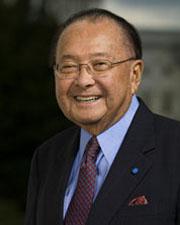 Sen. Daniel K. Inouye (D-HI)
Legislative Activity
Stay on top of the latest movement without scrolling through every action
Roll call votes on amendments in Senate: Amendment SA 3673 not agreed to in Senate by Yea-Nay Vote. 43 - 53. Record Vote Number: 109.
May 3, 2006
View full timeline
Roll call votes on amendments in Senate: Amendment SA 3673 not agreed to in Senate by Yea-Nay Vote. 43 - 53. Record Vote Number: 109.
May 3, 2006
Senate amendment not agreed to: Amendment SA 3673 not agreed to in Senate by Yea-Nay Vote. 43 - 53. Record Vote Number: 109.
May 3, 2006
Senate amendment proposed (on the floor): Amendment SA 3673 proposed by Senator Inouye.
May 3, 2006
Amendment SA 3673 proposed by Senator Inouye. (consideration: CR S3966-3967; text: CR S3966) To increase funds made available for assessments of critical reservoirs and dams in the State of Hawaii.
May 3, 2006
Amendment SA 3673 not agreed to in Senate by Yea-Nay Vote. 43 - 53. Record Vote Number: 109.
May 3, 2006
Senate amendment submitted
April 27, 2006
Votes
1 roll call on this amendment
Text
Proposed
MAKING EMERGENCY SUPPLEMENTAL APPROPRIATIONS FOR THE FISCAL YEAR ENDING
SEPTEMBER 30, 2006

The PRESIDING OFFICER. Under the previous order, the Senate will
resume consideration of H.R. 4939, which the clerk will report.
The legislative clerk read as follows:

A bill (H.R. 4939) making emergency supplemental
appropriations for the fiscal year ending September 30, 2006,
and for other purposes.

Pending:

McCain/Ensign amendment No. 3616, to strike a provision
that provides $74.5 million to States based on their
production of certain types of crops, livestock, and/or dairy
products, which was not included in the administration's
emergency supplemental request.
McCain/Ensign amendment No. 3617, to strike a provision
providing $6 million to sugarcane growers in Hawaii, which
was not included in the administration's emergency
supplemental request.
McCain/Ensign amendment No. 3618, to strike $15 million for
a seafood promotion strategy that was not included in the
administration's emergency supplemental request.
McCain/Ensign amendment No. 3619, to strike the limitation
on the use of funds for the issuance or implementation of
certain rulemaking decisions related to the interpretation of
``actual control'' of airlines.
Warner amendment No. 3620, to repeal the requirement for 12
operational aircraft carriers within the Navy.
Coburn amendment No. 3641 (divisions IV through XIX), of a
perfecting nature.
Vitter amendment No. 3627, to designate the areas affected
by Hurricane Katrina or Hurricane Rita as HUBZones and to
waive the Small Business Competitive Demonstration Program
Act of 1988 for the areas affected by Hurricane Katrina or
Hurricane Rita.
Vitter/Landrieu modified amendment No. 3626, to increase
the limits on community disaster loans.
Vitter modified amendment No. 3628, to base the allocation
of hurricane disaster relief and recovery funds to States on
need and physical damages.
Wyden amendment No. 3665, to prohibit the use of funds to
provide royalty relief for the production of oil and natural
gas.
Santorum modified amendment No. 3640, to increase by
$12,500,000 the amount appropriated for the Broadcasting
Board of Governors, to increase by $12,500,000 the amount
appropriated for the Department of State for the Democracy
Fund, to provide that such funds shall be made available for
democracy programs and activities in Iran, and to provide an
offset.
Salazar/Baucus amendment No. 3645, to provide funding for
critical hazardous fuels and forest health projects to reduce
the risk of catastrophic fires and mitigate the effects of
widespread insect infestations.
Vitter amendment No. 3668, to provide for the treatment of
a certain Corps of Engineers project.
Burr amendment No. 3713, to allocate funds to the
Smithsonian Institution for research on avian influenza.
Coburn (for Obama/Coburn) amendment No. 3693, to reduce
wasteful spending by limiting to the reasonable industry
standard the spending for administrative overhead allowable
under Federal contracts and subcontracts.
Coburn (for Obama/Coburn) amendment No. 3694, to improve
accountability for competitive contracting in hurricane
recovery by requiring the Director of the Office of
Management and Budget to approve contracts awarded without
competitive procedures.
Coburn (for Obama/Coburn) amendment No. 3695, to improve
financial transparency in hurricane recovery by requiring the
Director of the Office of Management and Budget to make
information about Federal contracts publicly available.
Coburn (for Obama/Coburn) amendment No. 3697, to improve
transparency and accountability by establishing a Chief
Financial Officer to oversee hurricane relief and recovery
efforts.
Menendez amendment No. 3675, to provide additional
appropriations for research, development, acquisition, and
operations by the Domestic Nuclear Detection Office for the
purchase of container inspection equipment for developing
countries, for the implementation of the Transportation
Worker Identification Credential Program, and for the
training of Customs and Border Protection officials on the
use of new technologies.
Murray (for Harkin) amendment No. 3714, to increase by
$8,500,000 the amount appropriated for Economic Support Fund
assistance, to provide that such funds shall be made
available to the United States Institute of Peace for
programs in Iraq and Afghanistan, and to provide an offset.
Conrad/Clinton amendment No. 3715, to offset the costs of
defense spending in the supplemental appropriation.
Levin amendment No. 3710, to require reports on policy and
political developments in Iraq.
Schumer/Reid amendment No. 3723, to appropriate funds to
address price gouging and market manipulation and to provide
for a report on oil industry mergers.
Schumer amendment No. 3724, to improve maritime container
security.
Murray (for Kennedy) amendment No. 3716, to provide funds
to promote democracy in Iraq.
Murray (for Kennedy) modified amendment No. 3688, to
provide funding to compensate individuals harmed by pandemic
influenza vaccine.
Cornyn amendment No. 3722, to provide for immigration
injunction reform.

[[Page S3938]]

Cornyn amendment No. 3699, to establish a floor to ensure
that States that contain areas that were adversely affected
as a result of damage from the 2005 hurricane season receive
at least 3.5 percent of funds set aside for the CDBG Program.
Cornyn amendment No. 3672, to require that the Secretary of
Labor give priority for national emergency grants to States
that assist individuals displaced by Hurricanes Katrina or
Rita.
Murray (for Byrd) amendment No. 3708, to provide additional
amounts for emergency management performance grants.
Domenici/Reid amendment No. 3769, to provide additional
construction funding for levee improvements in the New
Orleans metropolitan area, gulf coast restoration.

The PRESIDING OFFICER. Under the previous order, there will be 1 hour
for debate with 30 minutes under the control of the Senator of Oklahoma
and 15 minutes under the control of the Senator from California and 15
minutes under the control of the other Senator from California.
The Senator from Oklahoma is recognized.
Mr. COBURN. Mr. President, what is the pending business of the
Senate?
The PRESIDING OFFICER. The pending business is H.R. 4939.

Amendment No. 3641, Division XIX, Withdrawn

Mr. COBURN. I would resume where we were last night, if I could get
recognized on amendment No. 3641, division XIX.
The PRESIDING OFFICER. The Senator has that right, to speak to that
issue.
Mr. COBURN. I had planned on withdrawing that amendment, but I wish
to make one last point. California received $753 million in earmarks
last year. This amendment was to eliminate almost $11 million on levee
reconstruction. Seventy times that amount went to California in
earmarks. That is the problem.
I ask unanimous consent to withdraw this amendment.
The PRESIDING OFFICER. Without objection, it is so ordered.

Amendment No. 3817, Withdrawn

Mr. COBURN. Mr. President, I ask that the pending amendment be set
aside and amendment No. 3817 be called up.
The PRESIDING OFFICER. Is there objection? Without objection, it is
so ordered.
The clerk will report.
The assistant legislative clerk read as follows:

The Senator from Oklahoma [Mr. Coburn] proposes an
amendment numbered 3817.

Mr. COBURN. I ask unanimous consent that the reading of the amendment
be dispensed with.
The PRESIDING OFFICER. Without objection, it is so ordered.
The amendment is as follows:

(Purpose: To strike a provision relating to the Office of Job Corps)

Strike section 7017 (relating to the Office of Job Corps).

Mr. COBURN. Mr. President, I intend on withdrawing this amendment. I
wish to make a few points before I do so.
In the supplemental bill, the Job Corps receives a direction that the
Department of Labor can't manage it, can't use the resources to manage
it. There are documented errors and documented fraud within it. Mr.
President, section 7017 of the Emergency Supplemental would mandate
that Job Corps operate with less accountability. Specifically, the
language would make Job Corps the only program out of 100s to be
operated out of the Secretary's office with direct contracting
authority.

The Office of the Secretary of Labor does not have the staff or
resources to effectively manage and conduct oversight on the Job Corps.
The language of Section 7017 forbids the Secretary from shifting
oversight and management personnel from any other support office in the
Department of Labor. Secretary Chao is forbidden to utilize the same
oversight and management that every other program normally receives
from other support offices within the Department.
Section 7017 ignores recommendations from the Government
Accountability Office and the Inspector General that warn against the
dangers of waste, fraud, and abuse that will go undetected in the Job
Corps program when one office controls all aspects of a contract-
drafting, soliciting, bidding, and managing. The incestuous
relationship between the contractors who operate the Job Corp program
and the program officers operating the program will have no independent
oversight to guard against improper payments, improper use of
resources, fraudulent performance reporting resulting in fraudulent
salary bonuses, and non-compliant accounting and record keeping.
Secretary Chao is trying to clean up the Job Corps program so that it
effectively serves low income teenagers and young adults with a
residential job training program. The Job Corps program needs
accountability. According to the Office of Job Corps, the program
failed to have aggressive monitoring of performance data making
evaluations of the program's effectiveness unreliable. The Job Corps
contractors are reporting misinformation regarding the number of
students that successfully graduate or receive GEDs. The contractors
fail to report that almost 40 percent of the students who go through
the program fail to obtain a GED or diploma. This results in fraudulent
bonus increases to the contractor's pay. The program fails to report
that the median stay of a student at a Job Corps location is 8 months,
while it takes at least 12 months to successfully obtain a GED. The
program also fails to accurately report how many students successful
receive job placement into the skilled jobs for which the Job Corps is
supposed to equip the students. They fail to report that only 5 percent
of the graduating students are placed in apprenticeships for skilled
jobs. The contractors incorrectly consider job placement in unskilled
jobs and the military--(obtainable without a high school education)--as
benchmarks for success. This results in fraudulent bonus increases to
their pay.
Examples of mismanagement illustrated in past Inspector General
Reports include doctoring of program performance resulting in bonus
pay, unethical use of resources, lack of cost controls and resource
management. These examples makes the point for Secretary Chao--that the
Job Corps program is in desperate need for accountability and
oversight.
The September 30, 2005 Inspector General report, San Diego Job CORPS
Center: Student Attendance and Training Data Overstated, stated that
the number of vocational completions was overstated by over 50 percent.
Training records did not support that students had completed all the
vocation's tasks with an appropriate level of proficiency.
In the March 30, 2005 Inspector General report, Kittrell Job Corps
Center: Manipulation of Student Attendance and Training Records, the
Inspector General found that Kittrell managers manipulated student
attendance and training records to improve the center's reported
performance. Reported performance of high school diploma attainment and
job placements was also was not reliable. This unreliable data affected
Job Corps financially because reimbursed operating expenses and
incentive fees paid to contracted center operators are based on
reported performance.
In the 2001 independent auditor's report on the schedule of Job Corps
expenses for the Turner Job Corps Center, the Inspector General found
inadequate controls over payroll processing, that included hiring two
instructors without proper credentials and keeping inaccurate records
of leave. There was also lack of accountability over inventories of
consumable supplies, evidence that the center underreported medical and
dental expense, and the purchase of property and equipment that
Department of Labor did not approve prior to acquisition.
In the January 31, 2000 report entitled OIG Questions $1.3 Million of
Additional Costs Claimed by Contractor Report No. 18-00-003-03-370, the
Inspector General found that the contractor Will H. Hall & Son, Inc.
received an additional $2,365,622 due to delays at their construction
site. The Inspector General found that this contractor failed to
substantiate its claim that various events under the Department of
Labor's contract constituted compensable construction delays caused by
the Department of Labor. Certain amounts claimed were either double
counted as both direct and indirect costs, already covered under the
original firm fixed-price contract, or based on estimates instead of
actual costs incurred.
Section 7017 of the Emergency Supplemental will virtually guarantee
that we will see many more examples of

[[Page S3939]]

waste, fraud and abuse within the Job Corp program. Furthermore, why is
the Senate being asked to make a program change to a 40-year-old
program within an Emergency Supplemental bill? Why hasn't the
Department of Labor been consulted in making this unprecedented move
away from accountability? Why hasn't the Appropriations Committee or
the Committee on Health, Education, Labor, and Pensions held a single
hearing about this radical change to the Job Corps program?
Due to time constraints and my desire to move Senate business
forward, I ask unanimous consent to withdraw my amendment.
The PRESIDING OFFICER. Without objection, it is so ordered.
Mr. COBURN. Mr. President, I yield the floor.
Mr. COCHRAN. Mr. President, I suggest the absence of a quorum.
The PRESIDING OFFICER. The clerk will call the roll.
The assistant legislative clerk proceeded to call the roll.
Mr. MENENDEZ. Mr. President, I ask unanimous consent that the order
for the quorum call be rescinded.
The PRESIDING OFFICER. Without objection, it is so ordered.
Mr. MENENDEZ. Mr. President, what is the pending business before the
Senate?

Amendment No. 3777, as modified

The PRESIDING OFFICER. The pending business is amendment No. 3777, as
modified
Mr. MENENDEZ. I ask unanimous consent to add Senator Brownback as a
cosponsor to the amendment.
The PRESIDING OFFICER. Without objection, it is so ordered.
Mr. COCHRAN. I suggest the absence of a quorum.
The PRESIDING OFFICER. The clerk will call the roll.
The assistant legislative clerk proceeded to call the roll.
Mr. COCHRAN. Mr. President, I ask unanimous consent that the order
for the quorum call be rescinded.
The PRESIDING OFFICER. Without objection, it is so ordered.
Mr. COCHRAN. Mr. President, I know of no Senators seeking recognition
for discussing the amendment any further. The amendment has been
described by the distinguished Senator from New Jersey. The Senate is
well aware of its intent. These are funds that are being directed to
the situation in Darfur in the Sudan. There is a U.N. mission there
with responsibilities for helping to deal with the misery and
challenges to life that exist there.
I ask the author of the amendment if that is the purpose of the
amendment? It is money that would go for the purpose of supporting the
work of the U.N. mission in Darfur?
Mr. MENENDEZ. I thank the distinguished chairman for his inquiry. The
answer is yes, our effort is to ensure the ability of the U.N. work to
continue and to ultimately have the wherewithal when a peacekeeping
force is called for to be able to have that move forward so we can
hopefully end the genocide in Darfur.
Mr. COCHRAN. I thank the distinguished Senator for his explanation
and his description of the language.
I know of no requests for yeas and nays on the amendment. I suggest
we proceed to a voice vote.
Mr. LEAHY. Mr. President, on April 6, I spoke on the floor about the
humanitarian catastrophe in Darfur where more than 200,000 people have
perished from genocidal violence, hunger and disease. Today I rise to
strongly support the amendment offered by Senator Menendez to help meet
the emergency need for additional funding for peacekeeping in Darfur.
President Bush, this Congress, and the international community have
recognized the need for double the number of peacekeeping troops in
Darfur to stabilize the crisis and begin to lay the groundwork for a
resolution to this conflict. But the President has not requested the
funds to support additional troops. Rhetoric is cheap, but when the
issue is the survival of thousands of vulnerable people, words do not
suffice. The $60 million proposed by the Senator from New Jersey is the
minimum needed.
In addition to Sudan, there are 12 other U.N. peacekeeping missions
that face severe funding shortages in fiscal year 2006. The State
Department will be $383 million short in the next few months and will
have no alternative but to defer those bills into next year, which
creates a problem for our fiscal year 2007 appropriations process. The
President's inadequate budget request, which is supported by the
majority in Congress, ensures that we are perpetually behind in our
U.N. peacekeeping payments.
This supplemental does not fund a U.N. mission to Darfur, which is
what we all recognize is needed. Senator Menendez's amendment would at
least provide initial funding for such a mission. Nor does this bill
fund other U.N. peacekeeping missions in the Democratic Republic of the
Congo, Liberia, and Haiti.
The U.S. does not contribute troops to any of these missions. But by
not paying our share of peacekeeping dues on time the countries that
contribute the troops are less willing to do so.
The amount we pay is a tiny fraction of what we would have to spend
to deploy our own troops. The GAO recently found that it would ``cost
the U.S. about twice as much as the U.N. to conduct peacekeeping'', and
the U.S. only contributes 25 percent of the cost. That makes the
savings 8 times less--the U.N. is half as expensive and we only pay a
quarter of the costs. We are not prepared to put our troops into these
countries and the costs would be far higher to the U.S. if we did.
The fiscal year 2006 budget we passed last year under-funded the U.S.
dues for peacekeeping by $383 million. The U.S. has voted to expand the
troop level in the Democratic Republic of the Congo, yet our share is
underfunded by approximately $80 million in fiscal year 2006. Ensuring
a smooth transition after the recent presidential election in Haiti is
a stated priority of the administration, yet the peacekeeping mission
to Haiti is underfunded by at least $40 million. Liberia, Cote
d'Ivoire, and Kosovo are all underfunded in the next year by about $383
million.
So what happens when the U.S. or other donors do not pay or defer
their peacekeeping bills? The U.N. adjusts its bill paying to keep its
core missions running. And like anyone who hasn't been paid on time,
the U.N. pays those accounts which have immediate needs and defers
paying bills where creditors will grant it leeway. In the first half of
the year, the U.N. system is relatively flush with cash from other
countries' dues payments. It can and does shift from general accounts
into those with funding shortfalls. But by mid-year, if major
contributors are behind on their bill payments, the U.N. will resort to
other tactics like paying for equipment, travel, and short-term
logistical expenses while deferring payments to troop contributing
nations that tend to be more forgiving of late U.N. payments.
Nations that contribute troops to U.N. peacekeeping bear the primary
burden of covering for U.S. shortfalls to the U.N. peacekeeping
account. When the U.S. repaid its arrears to the U.N. under the Helms-
Biden deal, for example, the U.N. repaid fourteen to fifteen countries
for up to 3 years' worth of deferred troop contributing costs.
Additionally, the United States' lack of payment for peacekeeping in
the past has created significant resistance to U.S. efforts to change
assessment rates and enact reform at the U.N. During the Helms-Biden
era and before the U.S. committed to repaying its dues, the U.S. lost
seats on key U.N. governing bodies because of its arrearages.
Over the course of the last several years, the United States has
increasingly seen the need for U.N. peacekeeping. This has led to an
unprecedented demand for peacekeeping troops. If we want to continue to
increase this burden sharing arrangement, we need to pay troop
contributing nations--like Pakistan, India, and South Africa--for
services rendered. After all, they are putting their troops into harm's
way so United States troops don't have to.
We face a situation where commitments were made, funds are needed,
these countries are very unstable, and the commitment of U.S. troops is
not an option. We must pay our share so the U.N. can send peacekeepers
to Sudan, but also to support U.N. missions in other critical areas in
the world.
The PRESIDING OFFICER. The question is on agreeing to the amendment
3777, as modified.

[[Page S3940]]

The amendment (No. 3777), as modified, was agreed to.
Mrs. MURRAY. I move to reconsider the vote.
Mr. COCHRAN. I move to lay that motion on the table.
The motion to lay on the table was agreed to.
Mr. COCHRAN. Mr. President, I suggest the absence of a quorum.
The PRESIDING OFFICER. The clerk will call the roll.
The assistant legislative clerk proceeded to call the roll.
Mr. COCHRAN. Mr. President, I ask unanimous consent that the order
for the quorum call be rescinded.
The PRESIDING OFFICER. Without objection, it is so ordered.

Amendment No. 3612, as Modified

Mr. COCHRAN. Mr. President, I am pleased to bring to the attention of
the Senate several amendments that have been cleared on both sides of
the aisle.
First, I call up amendment No. 3612 on behalf of Mr. McConnell
regarding assistance for the West Bank in Gaza.
The PRESIDING OFFICER. Without objection, the pending amendment is
set aside and that amendment is called up.
The clerk will report.
The assistant legislative clerk read as follows:

The Senator from Mississippi [Mr. Cochran], for Mr.
McConnell, proposes an amendment numbered 3612.

Mr. COCHRAN. I ask unanimous consent the reading of the amendment be
dispensed with.
The PRESIDING OFFICER. Without objection, it is so ordered.
The amendment is as follows:

(Purpose: To provide a national security interest waiver on
prohibitions on assistance for the Office of the President of the
Palestinian Authority.)

On page 125, line 17, strike ``Prohibition'' and insert
``(a) Prohibition''.
On page 126, line 4, strike the quotation mark and the
period that follows.
On page 126, after line 4, insert the following:
``(b) Waiver Authority.--(1) The President may waive
subsection (a) with respect to the administrative and
personal security costs of the Office of the President of the
Palestinian Authority and for activities of the President of
the Palestinian Authority to promote democracy and the rule
of law if the President certifies and reports to the
Committees on Appropriations that--
``(A) it is in the national security interest of the United
States to provide such assistance; and
``(B) the President of the Palestinian Authority and the
President's party are not affiliated with Hamas or any other
foreign terrorist organization.
``(2) Prior to exercising the authority provided in this
subsection, the President shall consult with, and shall
provide a written policy justification to, the Committees on
Appropriations and the Committee on International Relations
of the House of Representatives and the Committee on Foreign
Relations of the Senate.''.

Mr. COCHRAN. There is a modification of the amendment at the desk.
The PRESIDING OFFICER. The amendment is so modified.
The amendment (No. 3612), as modified, is as follows:

On page 125, line 17, strike ``Prohibition'' and insert
``(a) Prohibition''.
On page 126, line 4, strike the quotation mark and the
period that follows.
On page 126, after line 4, insert the following:
``(b) Waiver Authority.--(1) The President may waive
subsection (a) with respect to the administrative and
personal security costs of the Office of the President of the
Palestinian Authority, for activities of the President of the
Palestinian Authority to promote democracy and the rule of
law, and with respect to independent agencies, if the
President certifies and reports to the Committees on
Appropriations that--
``(A) it is in the national security interest of the United
States to provide such assistance; and
``(B) the President of the Palestinian Authority, the
President's party, and independent agencies are not
effectively controlled by Hamas or any other foreign
terrorist organization.
``(2) Prior to exercising the authority provided in this
subsection, the President shall consult with, and shall
provide a written policy justification to, the Committees on
Appropriations and the Committee on International Relations
of the House of Representatives and the Committee on Foreign
Relations of the Senate.
``(c) Report.--Whenever the waiver authority pursuant to
subsection (b) is exercised, the President shall submit a
report to the Committees on Appropriations describing how the
funds will be spent and the accounting procedures in place to
ensure proper oversight and accountability.''.

The PRESIDING OFFICER. The question is on agreeing to the amendment.
The amendment (No. 3612), as modified, was agreed to.
Mr. COCHRAN. I move to reconsider the vote.
Mrs. MURRAY. I move to lay that motion on the table.
The motion to lay on the table was agreed to.

Amendment No. 3719, as Modified

Mr. COCHRAN. Mr. President, I call up amendment No. 3719 on behalf of
Mr. Biden and others regarding the Sudan.
The PRESIDING OFFICER. Without objection, the pending amendment is
set aside and the clerk will report the amendment.
The assistant legislative clerk read as follows:

The Senator from Mississippi [Mr. Cochran], for Mr. Biden,
for himself, Mr. DeWine, Mr. Brownback, and Mr. Leahy,
proposes an amendment numbered 3719.

Mr. COCHRAN. Mr. President, I ask unanimous consent that reading of
the amendment be dispensed with.
The PRESIDING OFFICER. Without objection, it is so ordered.
The amendment is as follows:

(Purpose: To provide that not less than $250,000 of the amount
appropriated for Diplomatic and Consular Programs assistance shall be
made available for the establishment and support of an office of a
special envoy for Sudan)

On page 88, line 7, insert after ``Provided,'' the
following: ``That of the funds available under this heading,
not less than $250,000 shall be made available for the
establishment and support of an office of a special envoy for
Sudan with a mandate of pursuing, in conjunction with the
African Union, a sustainable peace settlement to end the
conflict in Darfur, Sudan, assisting the parties to the
Comprehensive Peace Agreement for Sudan with implementation
of the Agreement, pursuing efforts at conflict resolution in
eastern Sudan, northern Uganda, and Chad, facilitating, in
cooperation with the people of Darfur and the African Union,
a dialogue within Darfur to promote conflict resolution and
reconciliation at the grass roots level, and developing a
common policy approach among international partners to
address such issues: Provided further,''.

Mr. COCHRAN. There is a modification of the amendment at the desk.
The PRESIDING OFFICER. Without objection, the modification is
included in the amendment.
The amendment (No. 3719), as modified, is as follows:

On page 88, line 7, insert after ``Provided,'' the
following: ``That of the funds available under this heading,
not less than $250,000 shall be made available for the
establishment and adequate support, including staffing and
travel, of the Office of the Presidential Special Envoy for
Sudan, with a mandate that shall include pursuing, in
conjunction with the African Union and other international
actors, a sustainable peace settlement to end the genocide in
Darfur, Sudan, assisting the parties to the Comprehensive
Peace Agreement for Sudan with implementation of the
Agreement, coordinating policy, making recommendations, and
pursuing efforts related to conflict resolution to bring
lasting stability to all areas of Sudan and the region,
including northern Uganda and Chad, facilitating, in
cooperation with the people of Darfur and the African Union,
a dialogue within Darfur to promote conflict resolution and
reconciliation at the grass roots level, and developing a
common policy approach among international partners to
address such issues: Provided further,''.

The PRESIDING OFFICER. Is there further debate on the amendment? If
not, the question is on agreeing to the amendment, as modified.
The amendment (No. 3719), as modified, was agreed to.
Mr. COCHRAN. I move to reconsider the vote.
Mrs. MURRAY. I move to lay that motion on the table.
The motion to lay on the table was agreed to.

Amendment No. 3823

Mr. COCHRAN. Mr. President, I call up amendment No. 3823 on behalf of
Mr. Leahy regarding Colombia.
The PRESIDING OFFICER. Without objection, the pending amendment is
set aside and the clerk will report the amendment.
The assistant legislative clerk read as follows:

The Senator from Mississippi [Mr. Cochran], for Mr. Leahy,
proposes an amendment numbered 3823.

Mr. COCHRAN. Mr. President, I ask unanimous consent that reading of
the amendment be dispensed with.
The PRESIDING OFFICER. Without objection, it is so ordered.
The amendment is as follows:

[[Page S3941]]

(Purpose: To provide urgent assistance to support the demobilization
process in Colombia)

On page 121, line 14 after ``That'' insert the following:
of the funds appropriated under this heading, not less than
$3,300,000 shall be made available for assistance for the
Peace and Justice Unit of the Colombian Fiscalia
notwithstanding section 599E of Public Law 109-102: Provided
further, That

The PRESIDING OFFICER. Is there further debate on the amendment? If
not, the question is on agreeing to the amendment.
The amendment (No. 3823) was agreed to.
Mr. COCHRAN. Mr. President, I move to reconsider the vote.
Mrs. MURRAY. I move to lay that motion on the table.
The motion to lay on the table was agreed to.

Amendment No. 3798

Mr. COCHRAN. Mr. President, I ask unanimous consent that it be in
order to call up and consider amendment No. 3798 on behalf of Mr.
Kennedy regarding the AmeriCorps Segal awards.
The PRESIDING OFFICER. Without objection, it is so ordered. The
pending amendment is set aside, and the clerk will report the
amendment.
The assistant legislative clerk read as follows:

The Senator from Mississippi [Mr. Cochran], for Mr.
Kennedy, proposes an amendment numbered 3798.

Mr. COCHRAN. Mr. President, I ask unanimous consent that reading of
the amendment be dispensed with.
The PRESIDING OFFICER. Without objection, it is so ordered.
The amendment is as follows:

(Purpose: To honor Eli Segal's contribution to AmeriCorps by providing
that the national service educational awards provided, from available
resources, to AmeriCorps members on completion of their terms of
service shall be known as ``Segal awards'')

At the end of title VII, insert the following:
Sec. ___. Any national service educational award described
in subtitle D of title I of the National and Community
Service Act of 1990 (42 U.S.C. 12601 et seq.), made with
funds appropriated to, funds transferred to, or interest
accumulated in the National Service Trust, shall be known as
a ``Segal award''.

The PRESIDING OFFICER. Is there further debate on the amendment? If
not, the question is on agreeing to the amendment.
The amendment (No. 3798) was agreed to.
Mr. COCHRAN. Mr. President, I move to reconsider the vote.
Mrs. MURRAY. I move to lay that motion on the table.
The motion to lay on the table was agreed to.

Amendment No. 3746

Mr. COCHRAN. Mr. President, I call up amendment No. 3746 on behalf of
Mr. Lieberman which makes a technical correction to the bill.
The PRESIDING OFFICER. Without objection, the pending amendment is
set aside and the clerk will report the amendment.
The assistant legislative clerk read as follows:

The Senator from Mississippi [Mr. Cochran], for Mr.
Lieberman, proposes an amendment numbered 3746.

Mr. COCHRAN. Mr. President, I ask unanimous consent that reading of
the amendment be dispensed with.
The PRESIDING OFFICER. Without objection, it is so ordered.
The amendment is as follows:

On page 167, beginning on line 7 strike ``,
notwithstanding'' and all that follows through ``(42 U.S.C.
5174)'' on line 9.

The PRESIDING OFFICER. Is there further debate on the amendment? If
not, the question is on agreeing to the amendment.
The amendment (No. 3746) was agreed to.
Mr. COCHRAN. Mr. President, I move to reconsider the vote.
Mrs. MURRAY. I move to lay that motion on the table.
The motion to lay on the table was agreed to.

Amendment No. 3699

Mr. COCHRAN. Mr. President, I call up amendment No. 3699 on behalf of
Mr. Cornyn regarding the distribution of CDBG funds.
The PRESIDING OFFICER. The amendment is currently pending.
Mr. COCHRAN. Mr. President, this amendment has been cleared on both
sides, and we urge its adoption.
The PRESIDING OFFICER. Is there further debate on the amendment?
The Senator from Washington is recognized.
Mrs. MURRAY. Mr. President, I ask unanimous consent that Senator
Nelson of Florida be added as a cosponsor.
The PRESIDING OFFICER. Without objection, it is so ordered.
Is there further debate on the amendment? If not, the question is on
agreeing to the amendment.
The amendment (No. 3699) was agreed to.
Mr. COCHRAN. Mr. President, I thank the Senate for its cooperation in
moving forward on this bill. As others may know, there have been two
amendments that I know of that were going to be debated and voted on
this morning which have been withdrawn. We are making good progress in
the consideration of Senators' amendments. If Senators have amendments,
this is the time now to let us know.
As you know, we are under cloture. We are not going to permit
nongermane amendments to be brought up. So there will be objections
made as a general proposition to accelerate the further discussion and
consideration of this bill. We hope to complete action on the bill
today. That certainly is possible with the fact that Senators are
proceeding to let us know about their amendments that are germane.
There is a list of amendments Senators have told us about that we
expect to be called up. This is the time to do that. So we urge
Senators to help us proceed on an orderly basis to complete action on
the bill today.
Mr. President, I suggest the absence of a quorum.
The PRESIDING OFFICER. The clerk will call the roll.
The assistant legislative clerk proceeded to call the roll.
Mr. BUNNING. Mr. President, I respectfully ask unanimous consent that
the order for the quorum call be rescinded.
The PRESIDING OFFICER. Without objection, it is so ordered.
Mr. BUNNING. Mr. President, I would like to make some remarks about
the supplemental appropriations bill now on the floor.
The PRESIDING OFFICER. The Senator is recognized.
Mr. BUNNING. Mr. President, I rise today to voice my opposition to
the emergency supplemental bill. It has, unfortunately, become routine
to see emergency spending bills on the floor. But I understand the
pressing need for this legislation to defend America from terrorism and
respond to one of the worst natural disasters in America's history.
These reasons are why we have emergency supplemental legislation in
the first place. I strongly support the President's $92 billion
request. His request includes essential funding to pay the men and
women serving in our Armed Forces in Iraq and Afghanistan. It also
provides the funding needed to restore damaged military equipment and
purchase new state-of-the-art technology.
For fiscal year 2007, we have budgeted for much of the cost of the
war on terror, but this emergency supplemental is important to provide
our American Armed Forces the additional funding they need today.
I want to stand shoulder to shoulder with the men and women serving
in Iraq and Afghanistan by supporting the defense portion of this
legislation. And I would like to roll up my sleeves and help the
Americans who were so devastated by Hurricane Katrina rebuild their
homes and communities. I believe strongly in these two missions, and I
will fight to ensure they are properly funded.

But today we are looking at legislation that has billions of dollars
of extra spending in nonemergency areas. In fact, it has everything but
the kitchen sink. As I read through the programs that will provide $20
million for oyster fishermen in New England and $4 million for erosion
control projects in California and Michigan, I am starting to believe
the kitchen sink must be in there, too, somewhere.
It saddens me to see in this legislation that States outside of the
gulf coast are trying to latch on to the people who suffered from last
year's hurricanes. Emergency spending should be just that--used for
emergency purposes. We should not just add in billions of dollars of
extra funding because this is a moving legislative vehicle.

[[Page S3942]]

The legislation before us includes some programs like the Community
Development Block Grant Programs which are funded significantly higher
than the President's request. While I support this program, I do not
think this emergency spending bill is the appropriate place to increase
overall funding for CDBG. I do not see the need to spend an extra
billion dollars and expand CDBG's scope beyond States affected by
Katrina.
The legislation further limits the CDBG money by requiring States to
spend nearly 20 percent on affordable rental housing. I believe it is a
mistake to take community planning decisions out of the hands of local
and State officials.
And there are other examples of States not affected by the hurricanes
trying to obtain emergency funding. Everyone who has had some form of
natural disaster in their State is trying to get a piece of the pie. I
do not want to diminish the tragedy of any disaster, but the Federal
budget process includes funding for these isolated events which were
never intended to be funded with emergency spending.
For example, there were a series of bad storms in California in 2002
that flooded Los Angeles roadways and flooded buildings with hail. The
legislation before us would provide $51 million for transportation
repairs--repairs that the State of California has already paid for.
That is right, this emergency bill contains money to repay States for
natural disasters that occurred years ago. This is unacceptable.
I have long supported congressionally directed projects and am
prepared to defend my projects in the fiscal year 2007 appropriations
bills. As a member of the Budget Committee, I can tell you firsthand
how important it is to set targets and plan ahead. That is how we
maintain accountability.
We need to remember that every dollar we spend in this supplemental
came from some hard-working American taxpayers. The American people
deserve a Government that is careful with their money. That is why I
will vote against this legislation.
I have also told the President I will support his veto of this
legislation if it passes Congress above his $92-plus billion request. I
believe we need to cut spending and work out a responsible plan that
meets the needs of the war on terror and rebuilding in the gulf coast
region.
I urge my colleagues to curb spending in this emergency spending
bill. I ask for them to consider their vote and what will happen if we
pass this legislation. I urge those who are on the fence or on the
border or about not to vote for this bill, not to vote for it but if
they do, to support the President's veto when it comes.
Thank you, Mr. President. I yield the floor and suggest the absence
of a quorum.
The PRESIDING OFFICER. The clerk will call the roll.
The assistant legislative clerk proceeded to call the roll.
Mr. KENNEDY. Mr. President, I ask unanimous consent that the order
for the quorum call be rescinded.
The PRESIDING OFFICER (Mr. Graham). Without objection, it is so
ordered.

Amendment No. 3688

Mr. KENNEDY. Mr. President, the Senator from Washington was kind
enough on a previous occasion to offer amendment No. 3688. I call for
the regular order.
The PRESIDING OFFICER. Without objection, the amendment is now
pending.
Mr. KENNEDY. I thank the Chair.
For any of my colleagues who had the chance last evening to look at
the national news, the story that led virtually all of the national
networks was the concern that our public health officials and worldwide
public health officials have, with regard to the dangers of an avian
flu pandemic. We listened to the Secretary of HHS talk about the
numbers of Americans who would be affected, some 2 million people. With
a pandemic, we would face the potential of closing down airlines,
closing airports, dangers in the workplace, health dangers.
This is something the Subcommittee on Bioterrorism and Public Health
Preparedness has been very concerned about, and I pay special
commendation to the chairman of our committee, Senator Burr, who has
had a series of hearings not only on the dangers of avian flu and flu
generally but also on the dangers of bioterrorism.
There are some very important common threats that come from
bioterrorism and from an avian flu danger. Obviously the first thing
that a nation has to do is to be able to detect these pathogens in
countries where they may be developing, and then, secondly, to detect
them here at home. That is why development and support for a public
health system is so important.
Then there is the challenge of containment, to try to contain any of
the dangers. And then, obviously, there is the treatment for
individuals who are affected. That can be treating individuals who are
affected or trying to provide a vaccine for individuals, so the dangers
to those individuals are minimized. These challenges all fall under the
rubric of the development of a national plan. I will come back to that
in a moment. We in the United States have not had that kind of
effective plan developed that would be necessary to deal with the
central challenge of a public health emergency.
This amendment I offer is a simple but vital amendment. It is a
linchpin in any kind of battle against the dangers of avian flu. That
is, if we are expecting our drug industry to be able to develop the
vaccines--and we have given a good deal of flexibility to the Food and
Drug Administration in these kinds of emergencies, to provide approval
to vaccines that might not have been and probably would not have been
given the kind of safety evaluations that other prescriptions drugs
would have taken through--we have to ask: Who is going to receive these
vaccines or treatments? Primarily, they will be individuals whom we
call first responders. What are they going to do? They are going to go
into the infected area and try to contain it.
It is one thing to invest hundreds of millions and billions of
dollars in developing the vaccines and treatments to minimize the
health impact of the dangers of avian flu, but if we are going to ask
first responders to go in and risk their lives, their health, and the
economic stability and security of their families, we ought to be
willing to say to these individuals: If you are going to get sick, and
you are going to lose your job, or if there is going to be danger to
your health as you serve as the frontline defenders for the rest of
society, then we are going to compensate you for the loss of income you
are going to have as a result of taking this vaccine. That is what this
amendment does. It provides for a compensation program for first
responders, the people on the front lines of a pandemic.
One can say: Is this necessary? All we have to do is look at history,
and we will find that when you do not have a compensation program, you
do not have volunteers willing to serve as first responders, and
willing to take on these challenges. This amendment protects our first
responders, and so it protects the rest of society as well. It is a
very limited amendment. That is the reason it is so important. You can
ask: Is this really an emergency? No one can look at the news last
night, and see the lead story on all three networks, saying there is a
real danger that is coming at you, and say we ought to treat this as
business as usual. That is why I believe this amendment is appropriate
to this supplemental.
The administration seems to be suffering from a condition that could
be called ``CDD,'' competence deficit disorder. Whether in Iraq or
Katrina or any other major crisis, the administration has been
incompetent, including the issue of dealing with avian flu. Our HELP
Committee has analyzed the administration's regular failure to prepare
for a flu pandemic, and today we are releasing a report showing that
they have failed to take the steps needed to see that America is ready
for this national challenge. They have failed to invest in the hospital
surge capacity, in needed information technology, and in the public
health surveillance and training programs that are needed for an
effective response.
The endless challenges outlined in the pandemic flu plan are a symbol
of the administration's failure. The preparations for avian flu have
been in such prolonged disarray that they are releasing their third new
plan this week. The Bush administration has known of the need for a
plan to prepare for a flu

[[Page S3943]]

pandemic since the day it took office. But 2001 came and went without a
plan, then 2002, 2003, 2004, and almost all of 2005, and still no plan.
In each of these years, the warnings of a potential pandemic grew
louder but were ignored.
This chart shows the warnings that have been offered by health
experts around the world. From May 2002, the World Health Organization:

Authorities must understand the potential impact and threat
of pandemic influenza.

This is from the GAO, November 2000:

Federal and State influenza plans do not address the key
issues surrounding the purchase and distribution of vaccines
and antivirals.

From the Institute of Medicine in 1992:

Policymakers must realize and understand the magnitude of
the influenza pandemic.

Then we had the series of flu outbreaks: December 2003, outbreak in
South Korea; outbreak in Vietnam, 2004; outbreak in 2006 of avian flu
in Britain. This chart shows all the outbreaks in the most recent
years.
What have other nations done on the pandemic? First, let's look at
other countries around the world that have developed a comprehensive
plan for the pandemic. In October 1997, we had a program by the
Japanese; Canada in February 2004; Czechoslovakia in April 2004;
February 2005, Hong Kong; March of 2005, Great Britain.
I will not include these plans in the Record, but let me show the
extent of the British pandemic flu program. I have illustrated this at
other times during similar discussions. Here is the Canadian plan.
These are enormously comprehensive programs. They are programs that
deal with rural areas, urban areas, training programs. And not only are
there programs, they are being implemented. Our strategy was issued in
November 2005, and it has remained incomplete since then. The
administration has sent a second plan to us now.
What is it basically that we are trying to do? We are trying to get a
comprehensive plan from the administration, a plan that has been
implemented. Let me show one other chart. This isn't just what I
believe. From the GAO report, November 2000:

Federal and State influenza plans do not address the key
issues surrounding the purchase and distribution of vaccines
and antivirals.

From June 2005:

The draft plan does not establish the actions the Federal
Government would take to purchase and distribute the vaccine
during an influenza pandemic.

This is from a GAO June 2005 report. That is the current situation.
Right now, we have in this legislation resources to pruchase the
vaccines in an emergency. But we do not have a compensation program. We
have a compensation program in name, but that is all it is. It is not
funded. Well, you can say we will try to find a way to fund it in the
future. Tell that to the downwinders out in Utah. Tell that to my
friend, Senator Hatch, who has been absolutely brilliant in terms of
looking after those individuals, whose lives were so affected by the
experiments with nuclear materials so many years ago. He, to his
credit, developed a compensation program. I welcomed the opportunity to
work with him to try to help these people whose health had been
absolutely destroyed by exposures, in the national interest, as we
developed various nuclear weapons.

Here is our majority leader, Senator Frist, who said:

Too many health care workers have been deterred from
receiving the smallpox vaccine--in part because of the
uncertainties about what would happen, and how they would
provide for themselves, if they suffered a serious adverse
reaction to the vaccine.

That states it as clearly and succinctly as one could possibly say
it. We do not have a guaranteed compensation program for pandemic flu
vaccines in this legislation or in any other place in our health care
system. This amendment provides a down-payment for the compensation
program. You can say: Well, why should we do that for this particular
program? All we have to do is look at other vaccine programs, other
public health programs, for swine flu, childhood vaccines, and, after
Congress acted, for smallpox. We had a compensation plan for people
injured by those experimental vaccines. But for the new ones, we only
have an empty sham of a compensation, with no funding.
So, Mr. President, that is what this amendment does. It provides some
$289 million for the development of that compensation program. It is
effectively the same kind of program that has been essential in the
past, and it is essential now if we expect our front-line responders to
be willing to take experimental vaccines and to risk their lives for
the common good of the community that may well be threatened by avian
flu or bioterrorism. Individuals who are well trained as front-line
responders ought to have the assurance that if they take an
experimental drug and they go out there to protect the public, if
something is going to happen to them, there will be a compensation fund
to compensate them for their health care needs and their immediate
needs, if that should turn out to be the case. Nothing more, nothing
less. That is essentially what this amendment does.
Mr. President, I see our floor managers here. I am glad to
accommodate whatever they would like. I would like to get a yea or nay
vote at some time. I know they have a full program. I ask for the yeas
and nays.
The PRESIDING OFFICER. Is there a sufficient second? There is a
sufficient second.
The yeas and nays were ordered.
Mr. COCHRAN. Mr. President, if the Senator will yield, I am checking
with the chairman and ranking member of the Appropriations Subcommittee
on Labor, Health and Human Services to see what the reaction is to the
amendment. They are having a hearing as we speak over in the
Appropriations Committee. So I feel obliged to get their advice and
counsel as to what response ought to be made, if any, to the Senator's
amendment. We have no objection to proceeding or to having a vote on
the amendment, but the Senate is entitled to know what the reaction
might be.
Mr. KENNEDY. That is fine and understandable. I will wait until we
hear from the chairman and ranking member. I don't intend to extend the
discussion. I think it is pretty understandable. I am glad to wait
until the leader lets us know when they want to address it and complete
action on it. I will be available.
Mr. COCHRAN. Mr. President, I thank the Senator very much for that
indulgence. If there are others who wish to offer amendments, I am
prepared to ask unanimous consent to temporarily lay aside the
amendment of the Senator from Massachusetts to permit other amendments
to be offered. I do ask unanimous consent for that.
The PRESIDING OFFICER. Without objection, it is so ordered.
The Senator from Louisiana.
Ms. LANDRIEU. I would like to offer two amendments and have a moment
to speak about two amendments that are germane.
The PRESIDING OFFICER. The Senator is recognized for that purpose.

Amendment No. 3750

Ms. LANDRIEU. Mr. President, I will bring up for a brief discussion
my amendment No. 3750.
The PRESIDING OFFICER. The clerk will report.
The legislative clerk read as follows:

The Senator from Louisiana [Ms. Landrieu] proposes an
amendment numbered 3750.

Ms. LANDRIEU. Mr. President, I ask unanimous consent that further
reading of the amendment be dispensed with.
The PRESIDING OFFICER. Without objection, it is so ordered.
The amendment is as follows:

(Purpose: To direct the Secretary of the Army to develop a
comprehensive plan for the deauthorization of deep draft navigation on
the Mississippi River Gulf Outlet and address wetland losses and other
issues relating to that Outlet)

On page 159, strike lines 1 through 10 and insert the
following:

$7,250,000, to remain available until expended: Provided,
That the Secretary of the Army, acting through the Chief of
Engineers, shall use $3,500,000 to develop a comprehensive
plan, at full Federal expense, that, at a minimum, will
deauthorize deep draft navigation on the Mississippi River
Gulf Outlet established by Public Law 84-455 (70 Stat. 65,
chapter 112) (referred to in this matter as the ``Outlet)'',
extending from the Gulf of Mexico to the Gulf Intracoastal
Waterway, and address wetland losses attributable to the
Outlet, channel bank erosion, hurricane and storm protection,
saltwater intrusion, navigation, ecosystem restoration, and
related issues: Provided further, That the plan shall

[[Page S3944]]

include recommended authorization modifications to the Outlet
regarding what, if any, navigation should continue, measures
to provide hurricane and storm protection, prevent saltwater
intrusion, and re-establish the storm buffering properties
and ecological integrity of the wetland damaged by
construction and operation of the Outlet, and complement
restoration of coastal Louisiana: Provided further, That the
Secretary shall develop the plan in consultation with the
Parish of St. Bernard, Louisiana, the State of Louisiana, the
Secretary of the Interior, the Secretary of Commerce, the
Administrator of the Environmental Protection Agency, and the
National Academy of Sciences: Provided further, That the
Secretary shall seek input, review, and comment from the
public and the scientific community on the plan: Provided
further, That the Secretary shall ensure that an independent
panel of experts established by the National Academy of
Sciences reviews and provides written comments on the
proposed plan: Provided further, That, not later than 1 year
after the date of enactment of this Act, the Secretary shall
submit an interim report to Congress comprising the plan, the
written comments of the independent panel of experts, and the
written explanation of the Secretary for any recommendation
of the independent panel of experts not adopted in the plan:
Provided further, That the Secretary shall refine the plan,
if necessary, to be fully consistent, integrated, and
included in the final technical report to be issued in
December 2007 pursuant to the matter under the heading
``investigations'' under the heading ``Corps of Engineers--
Civil'' of title I of the Energy and Water Development
Appropriations Act, 2006 (Public Law 109-103, 119 Stat. 2247;
Public Law 109-148, 119 Stat. 2814): Provided further, That
the amount provided under this heading is designated as an
emergency requirement pursuant to section 402 of H. Con. Res.
05 (109th Congress), the concurrent resolution on the budget
for fiscal year 2006: Provided further, That, of the amount
made available under this heading, $3,750,000 shall be
available only to the extent that an official budget request
for a specific dollar amount, that includes designation of
the entire amount of the request as an emergency requirement,
is transmitted by the President to Congress.

Ms. LANDRIEU. Mr. President, this amendment that I offer tries to
move forward a very difficult situation that we are faced with in
Louisiana about how to protect not just the New Orleans city proper but
the greater metropolitan area and parts of south Louisiana from
flooding in the future.
As you know, Mr. President, because you have been gracious enough to
be one of the Senators to go walk through the neighborhoods and see the
flooding, being a firsthand witness, it wasn't just the hurricanes,
Katrina and Rita, but it was the breaking of levee systems. Some of
those levees were long industrial canals that served this great port
which, together with the South Louisiana Port, is the largest port
system in America. Some of these levees were along the lake. Some of
them were along what we call the London Avenue Canal.
There was a project that was designed and structured by the Corps of
Engineers back in the 1930s and 1940s called the Mississippi River gulf
outlet. I think you actually stood on that levee, Mr. President, and
looked to see where that breach occurred. This avenue was thought--at
the time we built it and designed it, like so many large civil works
projects we have done in this Nation--to be a positive effort to help
expand the opportunities for the port for trade and commerce. For a
while, it did serve that purpose. But what has happened is that over a
decade, it has caused such erosion in the great expanse of marshland
that it was placed in--or the marsh was dredged through and created,
that it really is causing, according to everyone who has looked at how
the flooding occurred in our area, it is causing serious--not only
environmental--damage but is now a real threat to life and property.
So there has been an effort underway between port officials, parish
officials in St. Bernard, and the business community to try to come up
with a way to close the Mississippi River gulf outlet but to do it in a
way that protects the parish of St. Bernard primarily and the lower
ninth ward, as well as trying to give some period of time for the few
businesses that are along the gulf outlet to make arrangements to move.
My amendment would simply provide a de minimis $3.5 million for the
Corps of Engineers to develop a closure plan because the consensus at
home is that the Mississippi River gulf outlet, which is demonstrated
here on the map, which served at one time as a very important shipping
channel--it is significant that shipping has greatly diminished as its
threat to the environment has substantially increased. Because we have
not had the Federal or State resources to actually protect these
marshlands the way we should, this channel has become quite wide, much
wider than any of us had anticipated--even the Corps. And the
possibilities of flooding have been increased because the channel has
been expanded and these marshes have been eroding from many different
factors, not just this.
So this very modest $3.5 million would allow a study--a plan, not
really a study, because the studies are completed--and this will become
part of our overall protection system for this region. Again, the point
is that we are not just building levees to protect southern Louisiana
and southern Mississippi and other places. It is a combination of some
levees, some coastal restoration, and some smart navigation channel
work, or rework, that is integrated--much more of a sophisticated,
coordinated approach than in the past.
I offer this amendment by way of explanation to show that the studies
have been done. There has been a lot of evaluation of past storms. This
will allow the Corps to come up with a plan to close MRGO, provide for
shipping and good environmental restoration, and, most importantly,
protect St. Bernard Parish and the lower part of ward 9 in Orleans
Parish and New Orleans east from flooding in the future.
So that is the amendment.

Amendment No. 3752

Ms. LANDRIEU. Mr. President, I call up amendment No. 3752.
The PRESIDING OFFICER. The clerk will report.
The legislative clerk read as follows:

The Senator from Louisiana [Ms. Landrieu] proposes an
amendment numbered 3752.

Ms. LANDRIEU. I ask unanimous consent that further reading of the
amendment be dispensed with.
The PRESIDING OFFICER. Without objection, it is so ordered.
The amendment is as follows:

(Purpose: To direct the Secretary of Commerce to provide a grant to the
Port of New Orleans to mitigate increased costs resulting from the loss
of deep draft navigation access to certain facilities at the Port in
the aftermath of Hurricane Katrina)

On page 178, after line 21, add the following:

Economic Development Administration

For an additional amount for the mitigation of increased
costs resulting from the loss of deep draft navigation access
to certain facilities at the Port of New Orleans in the
aftermath of Hurricane Katrina, $8,500,000, to remain
available until September 30, 2007, to be provided by the
Secretary of Commerce, acting through the Assistant Secretary
for Economic Development, to the Port of New Orleans in the
form of a grant: Provided, That the Secretary shall
administer the grant under this section in accordance with
section 209 of the Public Works and Economic Development Act
of 1965 (42 U.S.C. 3149): Provided further, That the amount
provided under this heading is designated as an emergency
requirement pursuant to section 402 of H. Con. Res. 95 (109th
Congress), the concurrent resolution on the budget for fiscal
year 2006.

Ms. LANDRIEU. Mr. President, this amendment is a 1-year grant of $8.5
million to the Port of New Orleans to mitigate the increased costs
resulting from the loss of deep-draft navigation access to certain
facilities and ports. This is part B of this amendment. We worked to
create a plan to close this from large deep-draft vessels. They still
have access, obviously, through the inner harbor canal lock through the
GIWW. We still have to find a way to help offset some of the costs to
some of these companies that are located here as a transitional plan,
so that we can make these arrangements that the Corps is recommending
for safety of the port facilities and the people around it. That is
basically what amendment No. 3752 will accomplish.
As I have said before, this was created back many decades ago when we
didn't realize the environmental impact. It has caused not just
problems from Katrina and Rita, but it prompted a great deal of
flooding back in 1965 with Hurricane Betsy, one of the worst in this
region, well before Katrina and Rita. So we have known for a long time
that this had to be done.
With these two amendments, I believe the port can have some money for
the transition, the Corps can get the plans done to ready the closure,
and we will be well on our way to protecting a

[[Page S3945]]

great number of people at a minimal expense to the Federal Government
or to the local and State governments and having a great benefit for
shipping, the environment, and the community that lives along this
industrial channel.
I thank the chairman for the time to discuss the amendments. We will
follow his direction as to when these amendments come up for a vote. I
yield back my time.
The PRESIDING OFFICER. The Senator from Mississippi.
Mr. COCHRAN. Mr. President, to respond to the Senator's comments, in
looking at the list of amendments that are not germane, these two
amendments appear to be not germane postcloture and therefore not in
order. We are checking to see what the reaction is from the authorizing
committee. What that would amount to is this is an authorization that
has not been approved. The language amounts to an authorization of a
water project that has not been approved by the committee that has
legislative jurisdiction over the issues. So we are awaiting a response
and a reaction from the legislative committee to the amendments.

I suggest we move on to other amendments that may be in order. The
Kennedy amendment was temporarily laid aside so the Senator could
discuss her two amendments. Having done so, I think we can return to
the Kennedy amendment and then let the Senate work its will on that
amendment. The Senator from Massachusetts has asked for the yeas and
nays on his amendment, and we could proceed to a vote.
We were trying to get a reaction from the chairman of the
appropriations subcommittee having jurisdiction over the pandemic
influenza vaccine issue, the Labor, Health and Human Services
Appropriations subcommittee. They are having a hearing right now and we
haven't had a response to our inquiry about the reaction. We also think
the leaders are entitled to notice that this could be subject to a
recorded vote to get the reaction as to whether this is the time to do
that or if they are available to discuss it, if the leader wants to
discuss the issue. So awaiting those advices, I suggest the absence of
a quorum.
The PRESIDING OFFICER (Mr. Isakson). The clerk will call the roll.
The legislative clerk proceeded to call the roll.
Mr. COCHRAN. Mr. President, I ask unanimous consent that the order
for the quorum call be rescinded.
The PRESIDING OFFICER. Without objection, it is so ordered.
Mr. COCHRAN. Mr. President, I understand that two other amendments
have now been cleared for the consideration of the Senate.

Amendment No. 3713, As Modified

Mr. COCHRAN. Mr. President, I ask unanimous consent to call up
amendment No. 3713.
The PRESIDING OFFICER. Is there objection? Without objection, it is
so ordered.
The amendment is pending.
Mr. COCHRAN. Mr. President, this is an amendment that was offered
last evening by the distinguished Senator from North Carolina, Mr.
Burr. As I say, it has been cleared on both sides. I ask unanimous
consent the amendment be modified with the modifications at the desk.
The PRESIDING OFFICER. Without objection, it is so ordered.
The amendment, as modified, is as follows:

On page 238, line 23, strike ``Control and Prevention,
and'' and insert ``Control and Prevention, $5,000,000 shall
be for the Smithsonian Institution to carry out domestic
disease surveillance, and''.

The PRESIDING OFFICER. Is there further debate on the amendment, as
modified? If not, the question is on agreeing to the amendment, as
modified.
The amendment (No. 3713), as modified, was agreed to.
Mr. COCHRAN. Mr. President, I move to reconsider the vote.
Mrs. MURRAY. Mr. President, I move to lay that motion on the table.
The motion to lay on the table was agreed to.
Mr. COCHRAN. Mr. President, I now advise that we can call up an
amendment of Senator Kennedy regarding democracy in Iraq.

Amendment No. 3686, As Modified

Mr. COCHRAN. Mr. President, I call up amendment No. 3686, on behalf
of Senator Kennedy and others, regarding democracy in Iraq.
The PRESIDING OFFICER. Without objection, the pending amendments are
set aside.
The clerk will report.
The legislative clerk read as follows:

The Senator from Mississippi [Mr. Cochran], for Mr.
Kennedy, for himself, Mr. Biden, and Mr. Leahy, proposes an
amendment numbered 3686.

Mr. COCHRAN. Mr. President, I ask unanimous consent that the reading
of the amendment be dispensed with.
The PRESIDING OFFICER. Without objection, it is so ordered.
The amendment is as follows:

On page 126, between lines 12 and 13, insert the following:

UNITED STATES STRATEGY TO PROMOTE DEMOCRACY IN IRAQ

Sec. 1406. (a) Of the funds provided in this chapter for
the Economic Support Fund, not less than $96,000,000 should
be made available through the Bureau of Democracy, Human
Rights, and Labor of the Department of State, in coordination
with the United States Agency for International Development
where appropriate, to United States nongovernmental
organizations for the purpose of supporting broad-based
democracy assistance programs in Iraq that promote the long
term development of civil society, political parties,
election processes, and parliament in that country.
(b) The President shall include in each report submitted to
Congress under the United States Policy in Iraq Act (section
1227 of Public Law 109-163; 50 U.S.C. 1541 note; 119 Stat.
3465) a report on the extent to which funds appropriated in
this Act support a short-term and long-term strategy to
promote and develop democracy in Iraq. The report shall
include the following:
(1) A description of the objectives of the Secretary of
State to promote and develop democracy at the national,
regional, and provincial levels in Iraq, including
development of civil society, political parties, and
government institutions.
(2) The strategy to achieve such objectives.
(3) The schedule to achieve such objectives.
(4) The progress made toward achieving such objectives.
(5) The principal official within the United States
Government responsible for coordinating and implementing
democracy funding for Iraq.

Mr. COCHRAN. Mr. President, I send a modification to the desk.
The PRESIDING OFFICER. Is there objection to the modification?
Without objection, the amendment is so modified.
The amendment (No. 3686), as modified, is as follows:

On page 126, between lines 12 and 13, insert the following:

DEMOCRACY IN IRAQ

Sec. 1406. (a) Of the funds provided in this chapter for
the Economic Support Fund, not less than $104,500,000 should
be made available through the Bureau of Democracy, Human
Rights, and Labor of the Department of State, in coordination
with the United States Agency for International Development
where appropriate, to United States nongovernmental
organizations for the purpose of supporting democracy
assistance programs in Iraq that promote the long term
development of civil society, political parties, election
processes, the rule of law, reconciliation activities, and
parliament in that country: Provided, That the Secretary of
State shall consult with the Committees on Appropriations
prior to the initial obligation of funds made available under
this section on the uses of such funds: Provided further,
That of the funds made available under this heading, up to
$8,500,000 should be made available for the United States
Institute of Peace for programs in Iraq and Afghanistan.
(b) The President shall include in each report submitted to
Congress under the United States Policy in Iraq Act (section
1227 of Public Law 109-163; 50 U.S.C. 1541 note; 119 Stat.
3465) a report on the extent to which funds appropriated in
this Act support a short-term and long-term strategy to
promote and develop democracy in Iraq, including:
(1) A description of the objectives of the Secretary of
State to promote and develop democracy at the national,
regional, and provincial levels in Iraq, including
development of civil society, political parties, and
government institutions.
(2) The schedule to achieve such objectives.
(3) The progress made toward achieving such objectives.
(4) The principal official within the United States
Government responsible for coordinating and implementing
democracy funding for Iraq.

Mr. KENNEDY. Mr. President, as the senior Senator from Kentucky
knows, the Kennedy-Biden-Leahy amendment sets aside $104.5 million in
economic support funds in the supplemental for U.S. nongovernmental
organizations for democracy building programs that promote the long-
term development of civil society, political parties, election
processes, the rule of law, reconciliation activities, and parliament
in Iraq.

[[Page S3946]]

Currently, there are six nongovernmental organizations doing
excellent democracy work in Iraq under extremely difficult and
dangerous conditions. Our expectation is that $96 million of the funds
in our amendment would be allocated among the six organizations in the
following way to continue their work in Iraq:
IFES would receive $20 million. The International Research and
Exchanges Board would receive $6 million. The National Endowment for
Democracy would receive $10 million. The America's Development
Foundation would receive $16 million.
The National Democratic Institute and the International Republican
Institute would each receive $22 million. These funds would be in
addition to the $15 million that the administration has requested for
these activities in fiscal year 07.
In each case, the additional funds are intended to be used by the
organizations over the next 18 months to continue their current
operations. I understand that each organization will need to submit a
proposal to justify the use of funds before they can be made available.
Does the Senator from Kentucky agree with this allocation of funds?
Mr. McCONNELL. Yes, I do.
Mr. KENNEDY. Does the Senator from Vermont agree with this allocation
of funds?
Mr. LEAHY. Yes, I do. And I would add that the amendment also
provides that up to $8.5 million should be made available to support
the activities of the United States Institute of Peace in Iraq.
Mr. KENNEDY. Mr. President, I thank the senior Senator from Kentucky,
Mr. McConnell, and the Senator from Vermont for their assistance on
this amendment.
The amendment provides $104.5 million for American nongovernmental
organizations helping Iraqis to create the essential building blocks of
democracy. It is cosponsored by Senators Biden and Leahy.
Last year, Iraq passed several important milestones on the long road
to democracy. However, as important as the two elections and the
referendum on the constitution were, they were not decisive, and it is
far from clear that democracy is being firmly established in Iraq.
The process of building democratic institutions is different and
requires patience in developing effective governmental structures, a
genuine rule of law, political parties committed to peaceful means, an
active civil society, and a free press. Constructive international
engagement is essential as well in the case of Iraq. For a country as
heavily repressed as long as Iraq, democracy will take even longer to
take root.
It is far from clear, however, that the Bush administration has a
long-term strategy--or even a short-term strategy--to solidify and
continue the democratic gains that have been made so far.
American nongovernmental organizations such as the National
Democratic Institute, the International Republican Institute, the
National Endowment for Democracy, IFES, formerly known. as the
International Foundation for Election Systems, the International
Research and Exchanges Board and America's Development Foundation are
well respected in Iraq and throughout the world. Each has substantial
operations in Iraq, and their work is essential to the administration's
goal of building a stable democracy in Iraq.
Yet despite their success so far in helping to promote democracy and
the enormous risks their employees take by working in the war zone, the
administration has made no long-term commitment to provide funding
for their work in Iraq. Each organization operates on pins and needles,
never knowing when their funding for Iraq operations will dry up.

The American nongovernmental organization IFES has been in Iraq since
October 2003. It has provided technical assistance in each of Iraq's
elections so far, and it has been asked to provide such assistance for
regional and provincial elections scheduled for April 2007.
It is also preparing for a possible second referendum on the
constitution, and is assisting as well in the enactment and
implementation of legislation governing the operations of a new
election council for local elections.
Inexplicably, funding will run out in June, and the administration
has not yet committed any additional funds. None of the funds in this
supplemental spending bill are set-aside for it, and none of the meager
$63 million requested in the fiscal year 2007 budget for democracy-
building is intended for IFES either. Our amendment would provide $20
million to sustain its democracy work in Iraq for the next 18 months,
through the end of fiscal year 2007.
An independent media is also essential to a successful democracy. A
U.S. nongovernmental organization, the International Research and
Exchanges Board--IREX is working in Iraq to see that the Iraqi people
have independent, professional, high quality news and public affairs
information. To create an environment in which a free press can
flourish, it is also seeking to establish a legal, regulatory, and
policy environment that supports independent media.
IREX's funding for these important programs is also running out, and
it will be forced to close its operations this summer, which would pull
the rug out from under many struggling new press organizations in Iraq.
Our amendment would provide $6 million to sustain IREX's democracy work
in Iraq for the next 18 months.
In addition, the nongovernmental organization America's Development
Foundation provides essential aid to support and sustain civil society
in Iraq. ADF and its partner civil society organizations in Iraq have
provided training and assistance to thousands of Iraqi government
officials at the national, regional, and local level on issues such as
anticorruption, transparency, accountability, fiscal responsibility,
whistleblower protection, and the development of nongovernmental
organizations.
ADF wants to continue its work, but its funding will end in June.
USAID supports this work and has a contract pending, but it doesn't
have the resources to fulfill it. Our amendment provides $16 million to
sustain its work over the next 18 months. Similarly, the National
Endowment for Democracy has no clear sense of what the future holds for
them in Iraq.
Two of the endowment's core grantees--the Center for International
Private Enterprise and the Labor Solidarity Center in Iraq--have
important democracy promotion functions.
Since opening a regional office in Baghdad in October 2003, the
Center for International Private Enterprise has worked to build
capacity for market oriented democratic reform in Iraq. It has provided
training and grant support to approximately 22 Iraqi business
associations and chambers of commerce.
The Labor Solidarity Center works directly with Iraqi trade unions to
develop skills in strengthening independent and democratic trade
unions.
In addition, the endowment partners with 32 local organizations on
the ground in Iraq to promote and sustain civil society projects on
political development, raising awareness of women's rights, and
encouraging the free flow of information to Iraqi citizens.
The endowment wants to continue working directly with the Iraqi
people and be able to guarantee continuity in its democracy grants to
Iraqi organizations. But no funding is set aside in this bill or in the
fiscal year 2007 budget for its programs.
Our amendment provides $10 million to sustain the democracy programs
of the Center for International Private Enterprise, the Labor
Solidarity Center, and the Endowment for Democracy's local partners for
18 months. Similarly, the International Republican Institute and the
National Democratic institute--are doing truly impressive work in Iraq
under extraordinarily difficult circumstances.
The International Republican Institute programs in Iraq have focused
on three principal goals: development of an issue-based political party
system; establishment of the foundation for a more transparent and
responsive government; and the emergence of an active and politically
involved civil society.

The National Democratic Institute supports a number of democracy
programs in Iraq as well, with emphasis on political parties,
governance, civil society and women's rights. It has four offices in
Iraq to promote these essential

[[Page S3947]]

building blocks of strong democracy, and it works directly with Iraqi
partners and hundreds of local civic organization.
Both IRI and NDI want to continue to build these essential links
between the government and political parties, in order to enable the
government become more responsive and effective in addressing the needs
of Iraq's people.
Despite the impressive contribution of these two Institutes to
democracy in Iraq, neither is guaranteed steady future funding for its
programs. The administration's budget provides only $7.5 million for
each Institute--enough for just 2 months of operating expenses. Our
amendment provides an additional $22 million for each institute's
essential democracy programs in Iraq for the next 18 months.
The amendment also provides $8.5 million for the U.S. Institute of
Peace for its important work to promote reconciliation.
This amendment has broad support in the democracy community, and I
ask unanimous consent to print letters supporting it in the Record at
the end of my remarks.
The PRESIDING OFFICER. Without objection, it is so ordered.
(see exhibit 1.)
Mr. KENNEDY. Thousands of Iraqis are working hard, often at great
risk to themselves, to develop civic groups, participate in political
parties and election, and run for and serve in political office. The
dramatic pictures of Iraqis waving their purple fingers after voting in
past elections remind us of the enormous stakes.
Progress to avoid civil war and defeat the insurgency is directly
related to progress on democracy-building, and ongoing work on this
all-important issue must be a top priority.
We must be clear in our commitment to stand by these organizations
that are working on the front lines in the struggle for democracy in
Iraq every day. We also need to demonstrate to Iraqis and others that
we are committed to Iraq's long-term democratic development. We need a
long-term plan and a long-term strategy that is backed by appropriate
resources.
President Bush has called for patience in Iraq. He should heed his
own advice. He can't speak about having patience for democracy in Iraq,
and then cut funding for the groups that are assisting so capably in
its development.
Our financial commitment to the organizations at the forefront of the
democracy effort must be strong and unambiguous. By failing to
guarantee continuity for their programs, we send a confusing signal
that can only be harmful for this very important effort.
We are now spending more than $1 billion a week for military
operations for the war in Iraq. At this rate, it would take the
military less than one day to spend the $104.5 million provided in this
amendment for democracy promotion. Surely, we can commit this level of
funding for democracy programs over the next 18 months.
Regardless of whether we supported or opposed the war, we all agree
that the work of building democracy requires patience, skill,
guaranteed continuity, and adequate resources.
It makes no sense to shortchange Iraq's political development. We
need a long-term political strategy, and we must back up that strategy
with the needed resources, if we truly hope to achieve a stable,
peaceful and democratic Iraq.
Our amendment provides the resources necessary to ensure continuity
in these democracy programs in Iraq. I thank Senators McConnell and
Leahy for their hard work on this provision, and I am delighted that it
will become part of this legislation.

National Endowment for Democracy,

Washington, DC, April 24, 2006.
Hon. Ted Kennedy,
Russell Senate Office Building,
Washington, DC.
Dear Senator Kennedy: On behalf of the Board of Directors
of the National Endowment for Democracy, we are writing to
thank you for your commitment to creating a viable and
sustainable democracy in Iraq.
As you know; the National Endowment for Democracy received
the first of several awards from the Department of State in
February 2004 to support programs carried out by our four
core institutes, the International Republican Institute
(IRI), the National Democratic Institute (NDI), the Center
for International, Private Enterprise (CIPE), and the
Solidarity Center. In addition, NED directly funds local
Iraqi groups focusing on the promotion of women in the
democratic process, strengthening an independent media, and
increasing youth participation in the political process.
After our September 2006 Board meeting, NED will not be able
to maintain its current program in Iraq without renewed
funding.
Should funding for democracy programs in Iraq be available
for the remainder of Fiscal Year 2006 and into Fiscal Year
2007, the Endowment will facilitate the development of a
nationwide coalition of local groups that crosses geographic,
ethnic and confessional lines, which will advocate for
political tolerance, accountable governance, rule of law and
rational use of national resources. Also, NED will continue
to fund CIPE, which has a developed network of over 40
business associations and chambers of commerce. CIPE's
program will support Iraqis in building a platform for
moderate and market-oriented approaches in Iraq's political
process. Further, NED will provide funding to the Solidarity
Center to support local Iraqi trade unions in developing
policy platforms and advocating for labor legislation, and
working with the Iraqi oil unions to develop their capacity
to be a force for promoting transparency, anti-corruption,
and the rule of law in Iraq's largest economic sector.
The Endowment is committed to supporting the Iraqi people
in developing a democratic culture and creating institutions
that will promote individual rights and freedoms. This will
be a long-term endeavor, and we thank you for your continuing
support and dedication on this important issue.
Sincereely,
Vin Weber,
Chairman of the Board
Richard A. Gephardt,
Vice-Chair of the Board.
____

National Democratic Institute,

Washington, DC, April 25, 2006.
Hon. Edward Kennedy,
U.S. Senate,
Washington, DC.
Dear Senator Kennedy: I am writing to express our deep
appreciation for your commitment to long-term democracy
building efforts in Iraq. Your leadership in this issue has
allowed non-profit organizations such as NDI to continue to
help courageous Iraqis struggling for a more democratic and
open society. The long-term success of America's efforts in
Iraq will ultimately rest on our ability to empower these
Iraqis to overcome a long history of isolation, dictatorial
rule, and ethnic division.
With the support of Congress, the National Endowment for
Democracy, USAID, and the Department of State's Bureau for
Democracy, Human Rights, and Labor, NDI has, since 2003,
developed a sizeable program that works to strengthen civil
society, political parties, governing-institutions, and
women's political participation and leadership. With seven
offices throughout the country, NDI employs more than 200
Iraqi program staff and 30 full-time international staff from
Canada, Ecuador, Egypt, France, Serbia and the United States.
An additional 30 practitioners from the U.S. Canada, Eritrea,
the Netherlands, Spain, and the United Kingdom have regularly
visited Iraq to share expertise with their Iraqi
counterparts.
NDI's program works directly with Iraqis almost exclusively
outside the Green Zone to build the critical linkages between
Iraqi citizens and government that are necessary for long-
term legitimacy of, and participation in the country's new
democratic system. The Institute has trained more than 6,000
political party and 3,000 women activists, provided best
international practices on issues such as federalism and
human rights to key Iraqi decision-makers and the
Constitutional Drafting Committee, and helped more than 150
nascent NGOs deploy more than 30,000 election monitors for
the two national elections and constitutional referendum.
Many of the same NGOs have, with NDI support, led town hall
meetings for more than 300,000 Iraqis on the new constitution
and the workings of the parliament.
Building democratic institutions and processes, beyond
elections is a long-term proposition. In parts of Eastern
European alone, the United States, through organizations such
as NDI, continues to be engaged after the region's initial
transition 16 years ago. Iraq will likely require an even
longer international engagement. With the recent election of
the first parliament under a new constitution, the real work
in Iraq is just beginning. And, NDI remains committed to the
long-term democracy programs needed to meet this challenge.
Such a sustained commitment would not be possible without
continued U.S. government support; and the leadership and
vision that you and your colleagues have shown for ongoing
democracy promotion efforts is greatly appreciated by NDI and
other organizations involved in Iraq.
With best regards.
Sincerely,
Kenneth Wollack,
President.
____

International Research

and Exchanges Board,

Washington, DC, April 20, 2006.
Hon. Edward Kennedy,
U.S. Senate,
Washington, DC.
Dear Senator Kennedy: I am writing to thank you for your
strong support for democracy assistance in Iraq and your
efforts to ensure that this support from the United

[[Page S3948]]

States continues. IREX, a non-profit organization dedicated
to education, civil society, and media, has been working to
support Iraq's nascent independent media sector as part of a
USAID civil society project--the Iraqi Civil Society and
Independent Media Program.
We strongly believe that a vibrant and professional
independent media sector is crucial to a stable and
democratic Iraq. Capable Iraqi individuals and organizations
are working with U.S. support and risking their lives for the
sake of media freedom, but much work remains to be done.
However, our work is slated to end on June 30, 2006 due to
lack of funding for democracy initiatives. Key media
initiatives and successes supported by the U.S. Government
that face closure with an end of U.S. assistance, include:
The National Iraqi News Agency (
www.ninanews.com
), the
first independent commercial news agency in the Arab World.
After only 7 months, approximately 1500 NINA stories are
carried by more than 50 Iraqi media outlets each month. NINA
sets a standard of professionalism for the media sector and
has survived the effects of two bombings yet carried on its
work unimpeded.
Iraqis for Public Broadcasting is a group of dedicated
civil society and media professionals who have served as a
public watchdog to fight government and political
interference in the Iraqi Media Network. The group has
developed a new public broadcasting law that could help
develop IMN into the Arab world's first independent public
broadcaster.
The Iraqi Media Network, meant to be the public broadcaster
for Iraq, has been beset by attempts at political control of
its news and public affairs programming. IREX is one of the
few organizations that has been able to work inside IMN with
its journalism staff, assisting in development of programming
on the elections and the constitution, providing citizens a
forum for debate. IREX is currently advising IMN on two new
programs that will link the different regions of Iraq as a
contribution to building a sense of a democratic Iraqi
identity spanning ethnic and religious divides.
Training and support for journalists and media outlets
throughout Iraq will end. The program has provided training
to Kurds, Sunnis, Shiias, in many cases bringing the groups
together. Women have been a key target for the trainings.
We welcome and commend your ongoing commitment to democracy
assistance for Iraq, not only independent media development,
but also in other key components of democratic development
such as civil society, elections, political processes, and
labor and business development.
Sincerely,
Mark Pomar,
President.
____

IFES,

Washington, DC, April 13, 2006.
Hon. Edward Kennedy,
U.S. Senate,
Washington, DC.
Dear Senator Kennedy: On behalf of IFES and our experts
working on election related projects in Iraq, I am writing to
thank you for the thought and attention you have devoted to
sustaining a steady stream of funding for critical democracy
promotion activities in Iraq. As a non-profit organization
with an active presence in Iraq, we greatly appreciate your
efforts to highlight the democratic needs of the Iraqi people
for lawmakers and policymakers alike.
As you know, IFES has been involved with the
democratization process in Iraq since October 2003 when we
first conducted an assessment of the political situation
followed by the development of electoral scenarios and cost
models for Coalition Provisional Authority. Since September
of 2004, IFES has provided technical assistance to the
Independent Election Commission of Iraq (IECI), while at the
same time providing significant technical and material
support for the conduct of three electoral processes in the
country as part of the UN-led International Election
Technical Assistance Team (TEAT).
Helping democratic institutions find the strength and
creativity to work in hostile political environments is one
of the most difficult tasks in democracy assistance, but it
is a task with which we have experience and through which we
have achieved notable successes. Going forward, Iraqi
election organizers face a number of challenges surrounding
the creation of a new and permanent election management body
by the Council of Representatives, the design and
implementation of a new voter registration system, conduct of
local elections in April 2007, and post-election support for
possible referenda on the constitution and regional issues.
Our work in Iraq, which has merely begun, has given us a
unique, firsthand perspective on the post-invasion political
and electoral transition in Iraq. It is our strong view that
there has never been a more critical time to sustain and
strengthen Iraq's democratic process. Continued support for
our work after July 1, 2006, when IFES' current programming
is set to end, will help to ensure the future of a fair and
transparent electoral process in Iraq.
Your commitment and engagement on this matter is timely and
essential and we commend you for your sustained vision and
focus to promote not only our work, but that of other key
democracy promotion organizations.
Sincerely,
Richard Souderiette,
President and CEO, IFES.

The PRESIDING OFFICER. Is there further debate on the amendment, as
modified?
Hearing none, the question is on agreeing to the amendment, as
modified.
The amendment (No. 3686), as modified, was agreed to.
Mr. COCHRAN. Mr. President, I move to reconsider the vote.
Mrs. MURRAY. Mr. President, I move to lay that motion on the table.
The motion to lay on the table was agreed to.
Mr. COCHRAN. Mr. President, I suggest the absence of a quorum.
The PRESIDING OFFICER. The clerk will call the roll.
The legislative clerk proceeded to call the roll.
Mr. KENNEDY. Mr. President, I ask unanimous consent that the order
for the quorum call be rescinded.
The PRESIDING OFFICER. Without objection, it is so ordered.

Amendment No. 3688, as Modified

Mr. KENNEDY. I understand there is an understanding that we vote at
noontime and I have 1 minute remaining.
Mr. COCHRAN. Mr. President, the Senator is correct. It is the
intention the pending amendment be set aside so we can consider Kennedy
amendment No. 3688, as modified, upon which the yeas and nays have been
ordered. I ask unanimous consent that the Senator from Massachusetts be
recognized until the hour of 12 o'clock, at which time we will have a
vote.
The PRESIDING OFFICER. Without objection, it is so ordered.
Mr. KENNEDY. In the 45 seconds remaining, I indicate to the Members
of the Senate this amendment has the complete support of all the public
health officials and departments virtually across the country; the
public health community virtually universally appreciates and
understands the importance of this program. It does also have the
complete support of the first responders. If we want to do something
that is going to help to protect our first responders, in public health
emergencies and with the dangers of a pandemic, this is an amendment to
do so.
I thank the Chair.
The PRESIDING OFFICER. The Senator yields the floor. The question is
on agreeing to amendment No. 3688, as modified, on which the yeas and
nays were previously ordered.
The clerk will call the roll.
The legislative clerk called the roll.
Mr. DURBIN. I announce that the Senator from West Virginia (Mr.
Rockefeller) is necessarily absent.
The PRESIDING OFFICER. Are there any other Senators in the Chamber
desiring to vote?
The result was announced--yeas 53, nays 46, as follows:

[Rollcall Vote No. 107 Leg.]

YEAS--53

Akaka
Baucus
Bayh
Biden
Bingaman
Boxer
Byrd
Cantwell
Carper
Chafee
Clinton
Coleman
Collins
Conrad
Dayton
DeWine
Dodd
Dorgan
Durbin
Feingold
Feinstein
Harkin
Hatch
Inouye
Jeffords
Johnson
Kennedy
Kerry
Kohl
Landrieu
Lautenberg
Leahy
Levin
Lieberman
Lincoln
Menendez
Mikulski
Murray
Nelson (FL)
Obama
Pryor
Reed
Reid
Roberts
Salazar
Sarbanes
Schumer
Smith
Snowe
Specter
Stabenow
Talent
Wyden

NAYS--46

Alexander
Allard
Allen
Bennett
Bond
Brownback
Bunning
Burns
Burr
Chambliss
Coburn
Cochran
Cornyn
Craig
Crapo
DeMint
Dole
Domenici
Ensign
Enzi
Frist
Graham
Grassley
Gregg
Hagel
Hutchison
Inhofe
Isakson
Kyl
Lott
Lugar
Martinez
McCain
McConnell
Murkowski
Nelson (NE)
Santorum
Sessions
Shelby
Stevens
Sununu
Thomas
Thune
Vitter
Voinovich
Warner

NOT VOTING--1

Rockefeller

The amendment (No. 3688), as modified, was agreed to.
The PRESIDING OFFICER (Ms. Murkowski). The Senator from Delaware.

Amendment No. 3717

Mr. BIDEN. Madam President, I ask unanimous consent to set aside the
pending amendment and call up amendment No. 3717.
The PRESIDING OFFICER. Is there objection?

[[Page S3949]]

Mr. COCHRAN. Madam President, reserving the right to object, I do so
only for the purpose of checking to be sure that this is an amendment
that has not been made out of order because of the invocation of
cloture by the Senate.
Mr. BIDEN. Madam President, if I can respond to my colleague, I have
been told that the amendment is germane under cloture.
Mr. KENNEDY. Madam President, I move to reconsider the vote.
Mr. COCHRAN. I move to lay that motion on the table.
The motion to lay on the table was agreed to.
The PRESIDING OFFICER. Although it does not appear on our list at the
desk, after a review, it appears to be germane.
Mr. BIDEN. Madam President, I say to my friend from Mississippi, I do
not plan on speaking to it now. I was instructed to get it in line. I
will be back to speak to it. It relates to permanent bases in Iraq and
calls for no permanent bases in Iraq.
As the Chair says, it is germane, but I do not intend to call it up
right now.
Mr. COCHRAN. Madam President, continuing to reserve the right to
object, it is my understanding this amounts to legislation and may be
subject to a point of order. For that reason, authorization of basing
on a permanent basis in a foreign country--it is not an appropriation
of funds, as I understand it. It is strictly legislation and may very
well be subject to a point of order.
The PRESIDING OFFICER. It is the Chair's understanding it is a
limitation on the use of funds, which is not legislative.
Mr. COCHRAN. I withdraw my reservation.
Mr. BIDEN. I thank the Chair.
I assume unanimous consent was granted.
The PRESIDING OFFICER. Will the Senator suspend for just a moment
while we sort out the technical issues?
Mr. BIDEN. I apologize. I have been misinformed. I must call up,
first, amendment No. 3717, and second degree that amendment with
amendment No. 3855. That is my unanimous consent request.
The PRESIDING OFFICER. Without objection, it is so ordered.
Mr. BIDEN. I thank my friend from Mississippi.
I yield the floor.
The PRESIDING OFFICER. The clerk will report.
The legislative clerk read as follows:

The Senator from Delaware [Mr. Biden] proposes an amendment
numbered 3717.

The amendment is as follows:

(Purpose: To provide that none of the funds made available by title I
of this Act may be made available to establish permanent military bases
in Iraq or to exercise control over the oil infrastructure or oil
resources of Iraq)

On page 253, between lines 19 and 20, insert the following:

PROHIBITION ON USE OF FUNDS FOR CERTAIN PURPOSES IN IRAQ

Sec. 7032. None of the funds made available by title I of
this Act may be made available to establish permanent
military bases in Iraq or to exercise control over the oil
infrastructure or oil resources of Iraq.

Mr. COCHRAN. Madam President, I suggest the absence of a quorum.
The PRESIDING OFFICER. The clerk will call the roll.
Mr. COCHRAN. Madam President, I ask unanimous consent that the order
for the quorum call be rescinded.
The PRESIDING OFFICER. Without objection, it is so ordered.

Amendment No. 3855 to Amendment No. 3717

The PRESIDING OFFICER. The clerk will report the second-degree Biden
amendment.
The legislative clerk read as follows:

The Senator from Delaware [Mr. Biden] proposes an amendment
numbered 3855 to amendment No. 3717.

The amendment is as follows:
In lieu of the matter proposed to be inserted, insert the
following:
On page 253, between lines 19 and 20, insert the following:

Prohibition on Use of Funds for Certain Purposes in Iraq

Sec. 7032. None of the funds made available by title I of
this Act may be made available to establish permanent United
States military bases in Iraq, or to exercise United States
control over the oil infrastructure or oil resources of Iraq.

The PRESIDING OFFICER. The Democratic leader.

House Ethics Reform

Mr. REID. Madam President, at the beginning of this year, we found a
situation in Washington that was very uncomfortable. The Chair will
recall, as all members recall, the majority leader in the House of
Representatives had been convicted, within a period of a year, of three
ethics violations. He was under indictment. For the first time in 135
years, someone in the White House was indicted. The person in charge of
contracting, Mr. Safavian, was led away literally in handcuffs as a
result of his sweetheart deals with many people, including the infamous
Jack Abramoff.
We had many stories written about the K Street Project: If you were a
trade association or a business that wanted to hire a Democrat, you had
to get clearance from the K Street leaders. It was a situation that was
very uncomfortable for everyone, as it should have been.
The culmination of all of this was learning Duke Cunningham had taken
more than $2 million in bribes.
I try today to express my opposition and grave disappointment of the
lobbying and ethics reform bill that the House of Representatives is
expected to pass today. This is a bill pushed by the Republican
leadership in the House. It is simply not much of anything. This House
reform legislation is another example of the Orwellian world in which
my friends in the majority live, I am sorry to say, starting with the
President himself. Whatever he says, believe just the opposite.
The Clear Skies bill led to more pollution. The Healthy Forests
Initiative, clear-cutting the forests, is damaging our forests. The No
Child Left Behind Act has left millions of children behind. The Budget
Deficit Reduction Act increases the deficit. And now they are lobbying
the Accountability and Transparency Act, which has the potential to
wipe transparency out of the political process.
House Republicans have completely abandoned the idea of reforming
Washington. Instead, like a wolf in sheep's clothing, they are using
the cover of the word ``reform'' to advance blatant partisan changes to
campaign finance laws, changes that will hurt Democrats and help
Republican candidates in the coming elections.
Their approach to reform stands in sharp contrast to what we did on a
bipartisan basis. About a month ago, Republicans joined Democrats to
pass a lobbying reform bill, an ethics reform bill, the Honest
Government and Open Leadership Act. It was passed by a large margin.
The bill was based largely on a bill Democrats introduced the first
week of the session. The legislation the Senate passed was not as good
as the Democratic bill standing alone, but it was an improvement, a
tremendous improvement over the status quo and imposed needed reforms
so that Government serves the people, not the special interests. It was
the most significant change in lobbying ethics in this country in a
quarter of a century.
Unfortunately, the bipartisan commitment to reform we had in the
Senate has been completely abandoned in the House. Instead of passing a
substantive smart and tough bill as we did in the Senate, the House
Republicans have ignored the wishes of millions of Americans, gutted
all lobbying ethics reform from their legislation, and instead filled
it with partisan campaign finance measures that are intended to help
them in the coming election.
Essentially, they have opened the floodgates so they can pour money
into Republican campaigns. The McCain-Feingold legislation that passed
Congress and was signed by the President was important. It took away
from campaigns corporate money, soft money. It was a reform measure
that improved the political process in a significant way.
And this McCain-Feingold legislation, if the House measure is allowed
to become law, will have been corrupted. It seems House Republicans do
not believe they can convince the American people to send them back to
Washington if they play by the rules. So like their old leader, Tom
DeLay, they are seeking to change the rules in the middle of the game.
They are seeking to change the rules to influence the fall election.
Here is an example. The House bill aims to disable so-called 527
groups. These are groups that operate independently and apart from the
parties and bring more people into the political process. They fund
get-out-the-vote activities and help register voters, among other
things.

[[Page S3950]]

Notably, the House bill would not shut down spending by all
independent groups but only certain independent groups. No, the House
would leave Republican-leaning 501(c)6)trade associations free to raise
and spend money, soft money, corporate money, money over and above
McCain-Feingold spending limits. That is what this is about.
These trade associations, such as Americans For Job Security, spend
millions of dollars in ads to help elect Republican candidates. Nearly
every Republican Member of the Senate elected last cycle will benefit
by ads run by this group. Those ads were funded with soft money.
If the people who want to change the present campaign financing laws
want to do it, let's do it the right way: take a look at everything,
not just take out of the blue certain things they may not like such as
the 527s.
What about these 501(c)(6) organizations? You will not find trade
associations, though, mentioned in their bill, in the House bill. That
makes no sense. We know less about these Republican groups than we do
of 527 organizations. That is because 527s are required to disclose
donors and how they spend that money. There is no such requirement for
these trade associations.
Here is another even more significant example of the tricks House
Republicans are playing. The House bill repeals the critical limits on
national party giving to individual campaigns. Right now, the
Republican National Committee may only direct a limited amount of
funding to individual congressional and Presidential campaigns
according to a specified formula that is in the McCain-Feingold law.
The House would do away with these limits.
What would that mean? It would mean, instead of the limited amount of
money that is available now, thousands--hundreds of thousands--of
dollars could be given. It would mean that the Republican National
Committee could give unlimited amounts to candidates in this cycle and
to Presidential candidates in 2008. What we did in McCain-Feingold
improved the system. Now, if the RNC can give unlimited amounts to
candidates in this cycle and Presidential candidates in 2008, that is
no small matter when you consider the RNC has roughly $40 million on
hand right now.
This provision made its way into an amendment filed by Senator McCain
on lobbying reform we did in this body, an amendment which would weaken
that bill associated with his name. On his behalf, I say he did the
right thing: He never offered the amendment, never called up the
amendment, and the Senate bill remained clean of such rollbacks.
Democrats and Republicans alike have supported these restrictions
because they are critical to protecting our political process from
corruption in fact and in appearance. The authors of the last major
reform bill--Senators McCain and Feingold--in an amicus brief with the
court involving these limits called them ``essential . . . to maintain
the public's confidence in the integrity of our political system'' and
``indispensable to any [campaign finance] regulatory program.'' That is
what they said.
Without such limits, the Senators argued that ``the public's faith
and participation in the political process will continue to decline.''
That also is another quote. Such expenditures, they argued ``create at
least the perception that those who donate large sums to political
parties . . . may enjoy positions of `improper influence.'''
These were wise words by Senators McCain and Feingold. I think we all
should live by them.
In the wake of Abramoff, DeLay, and Cunningham, Americans are looking
for us to change course. The House bill will keep us headed in the
wrong direction. For that reason, Democrats will stand opposed.
If there is going to be an attempt to do campaign finance reform
above and beyond what was done with McCain-Feingold, then let's do it.
Let's have committee hearings. Let's have a bill reported to the Senate
and have a fair debate on what we need to do to clean this up, not just
take one particular aspect of it. The Congress must not ignore the
American people's desire to do a better job in ethics here in
Washington.
In January, when Americans across the country were crying for reform,
we took the lead and fundamentally changed the debate on ethics and
lobbying reform. I think it is commendable--as I have said here on the
floor on a number of occasions, Madam President--I think it is
commendable that we were able to pass this lobbying reform bill on a
bipartisan basis. Thanks to our work, on a bipartisan basis, we passed
some significant reforms that will ensure the Government of the people
focuses on the needs of the people.
It would be unfortunate to see these efforts sabotaged and ultimately
fail because the House majority has backed away from real reform and
instead has decided that this legislation should be a vehicle to
advance a partisan campaign finance agenda. If the trial of Tom DeLay
and prison terms for Jack Abramoff and Duke Cunningham do not convince
the Republican Party to clean up its act, Americans should begin to
wonder what will.
Mr. McCONNELL. Madam President, will the Senator yield for a
question?
Mr. REID. I would be happy to.
Mr. McCONNELL. I would like to ask my good friend, the Democratic
leader, if his concern here is that the House bill overruled what we
call the Colorado II decision in the Supreme Court, which basically
would allow political parties which are now restricted to raising 100
percent hard money to spend in coordination with the campaigns whatever
they choose to spend. Is that the complaint I hear from my good friend,
the Democratic leader?
Mr. REID. Madam President, I apologize, through the Chair, to my
friend. I do not know what Colorado II is. Is that what you said?

Mr. McCONNELL. What the Supreme Court held in Colorado II was that
the prohibition on parties spending above what we call the coordinated
amount remained intact and that parties could spend whatever they
wanted to as independent expenditures, meaning they could not consult
with the campaigns.
I was listening to my good friend, the Democratic leader, and I
understand he was decrying a provision in the House bill that, in
effect, overturned that Supreme Court decision and allowed the parties
to spend, in coordination with their campaigns, money beyond what is
called the coordinated. And the Senator from Nevada was suggesting that
was somehow, I gather, corrupting the process, if that money, which
could now be spent independently of the campaigns, was spent in
coordination with the campaigns.
Did I understand correctly?
Mr. REID. Madam President, through the Chair to my friend, the senior
Senator from Kentucky, your explanation of asking me a question points
out my problem with what the House is doing. I believe what we need is
to have reform legislation in the House comparable to what we did here
in the Senate. I think there are a number of us who would like to have
gone further than what we did, but I would be satisfied with that. But
for the House to call this lobbying and ethics reform is wrong. What
they have tried to do is reform campaign finance laws.
I say to my friend, if we are going to do a reform of campaign
finance laws, then what we should do is have the committees of proper
jurisdiction hear what changes they think should be made, with the
advocates of this, bring it to the floor, and have a debate.
As my friend indicated, talking about Colorado II, this is very
complicated stuff. And I think if we are going to reform a little piece
of it, let's look at it all. Let's look at how trade associations work.
Let's look at everything. I am happy to do that. But what I am not
happy to do is have the House call something lobbying and ethics reform
when it is campaign finance reform. That is my concern.
Mr. McCONNELL. Madam President, could I ask my friend one further
question?
Mr. REID. Of course.
Mr. McCONNELL. Is it still the position of the leader and the
majority of those on that side of the aisle that the position they used
to hold, which was that these so-called 527 groups should be treated
like political parties and therefore have their contributions kept like
a political party--that used to be the position of the majority of the
Democrats, that the 527 groups which operate like parties should be
treated like parties in terms of the contribution levels--I now gather
that my good friend and a number of his colleagues

[[Page S3951]]

on that side of the aisle have the opposite position, that somehow to
treat a 527 like a political party, and therefore cap contributions
like they are to parties, would somehow be a violation of free speech?
Is that the position now that the Democratic leader is taking?
Mr. REID. Madam President, every question the distinguished Senator
from Kentucky asked indicates how important it is to have a full,
complete process here in the Senate about campaign finance. Every
question he asks is more complicated than the last. Him asking me how
the Democrats stand on this issue is something I cannot answer. These
seats have changed back and forth since we took up McCain-Feingold.
I will say this: Having worked as a candidate prior to the passage of
McCain-Feingold and after it passed--as far as I am concerned, what
happened in 1998, when I had a very difficult race in Nevada with my
dear friend, the junior Senator from Nevada, John Ensign, we had a
tough election, a tough election. But in the little State of Nevada,
back in 1998, we did not have many people there. We are approaching 3
million there now. We did not have 2 million then. John Ensign spent
$10 million; Harry Reid spent $10 million. But the vast majority of the
money was corporate money. People could give us hundreds of thousands
of dollars. Now, that may not have corrupted John Ensign or corrupted
Harry Reid, but it is a process that does not look good, and it is
corrupting, it could corrupt an individual.
Having run in 2004--it was a good election--I went out and raised
money, as I did when I first started in this process. I would go to
somebody. They would give me whatever the limits were: $1,000, $2,000.
That limit would be printed, and everyone in the world knew what that
person did for an occupation, where they lived, how much money they
gave me. I felt so much better in 2004 than I did in 1998 because I did
not have to go around asking people for these corporate donations.
I have not talked to my friend, Senator Ensign, but I will bet you he
agrees with me because I do not think either one of us felt comfortable
with those huge corporate contributions that were coming into the State
of Nevada. The purpose of it: the Republicans ran vicious ads against
me. He had bad ads that were run against him.

I think the process is better. If we are going to change the McCain-
Feingold process, let's do it by looking at everything, not just 527s.
Let's look at trade associations. Let's look at State parties. Let's
look at this PAC situation where we have all these leadership PACs.
There are a lot of things we need to look at.
But what the House is doing--disguising campaign finance reform as
lobbying and ethics reform--is wrong. We did not do that here. And I
think that speaks well of John McCain. He had an amendment prepared. He
did not do it because he knows it would have corrupted McCain-Feingold.
I would assume that is why he did not offer it. It would have corrupted
the legislation we now have that we call McCain-Feingold, which I think
has improved the process. I am glad the Supreme Court ruled that it was
constitutional.
Now, I know my friend, the distinguished majority whip. He did not
like McCain-Feingold. He worked very hard against it. He did a good
job. He is a fine lawyer and a good advocate. He lost. Those of us who
supported McCain-Feingold won. And if we are going to change it, let's
have another fair fight like we had with McCain-Feingold, where my
friend from Kentucky can be on one side, I can be on the other. We may
even wind up on the same side.
But that is what kind of debate we should have, not what is happening
in the House now, disguising it as lobbying and ethics reform, and
really it is not.
The PRESIDING OFFICER. The majority whip.
Mr. McCONNELL. Madam President, just one final observation with
regard to this discussion in which the Democratic leader and I have
been engaged. And I am glad he is still on the Senate floor because I
would not want to say this with him not being here. I noticed that he
was glad the days of large corporate and individual soft money
donations were gone from parties. I wish he would be equally offended
by the fact that large donations are still available for the 527s. What
is good for the goose is good for the gander.
If large contributions--corporate and individual contributions--to
parties were outlawed because of the, ``corrupting potential'' of that,
it seems to me entirely inconsistent to argue that they should not be
eliminated from 527s.
I think the reason our good friends on the other side of the aisle
have had an epiphany about 527s is because they now believe these
activities are beneficial to them. So the consistency is something that
is hard to find in the course of this debate.
It will be interesting to see what the final House bill includes. To
simply allow political parties to spend money in coordination with the
candidates wearing their party label, it is hard to conclude it would
in any way corrupt the system.
Madam President, I yield the floor.
The PRESIDING OFFICER. The Democratic leader.
Mr. REID. Madam President, just one final comment.
I believe that if 527s are doing things that are wrong, maybe we need
to take a look at 527s but in conjunction with all the rest of the
things that happen in campaign finance. I have no problem with that--
but not 527s alone. If we want to look at trade associations and all
the other things, I am happy to do that, but let's not just single shot
one of these because there are a lot of other things that need to be
looked at at the same time.
The distinguished Senator from Kentucky and I have had longstanding
personal discussions off the Senate floor about campaign finance. We
have had them on the floor. As I have indicated already, I have the
greatest respect for how he feels. He is a real advocate for his
position.
I try to do the best I can for mine.
The PRESIDING OFFICER (Mr. Thune). The Senator from Illinois.
Mr. DURBIN. Mr. President, I had the good fortune early in my
political life to meet and work as an intern for Paul Douglas, a
Senator from Illinois from 1948 to 1966. He wrote several books about
ethics in government that are still widely quoted. I was fortunate to
meet him and then to meet a man who counted him as a mentor, Senator
Paul Simon. Both inspired me to do a few more things in my public life
than I might otherwise have done.
For instance, Paul Douglas had a rule in his office for staff that
they couldn't take anything they couldn't drink. I assume that meant
they could have an expensive drink at some local restaurant, but they
certainly couldn't take a meal or a gift or anything like that. He had
a personal rule that he wouldn't take a gift in his office that was
worth more than $2.50. I can recall some angry constituent who sent
Senator Paul Douglas a handmade, tooled leather belt with Paul Douglas'
name on it which he returned. I am sure the donor was offended, but
that was his rule. He made complete disclosure of his income and net
worth, as did Paul Simon. I have tried to follow their example.
We need meaningful ethics reform, but I agree with Senator Reid that
we also need to have a serious conversation about campaign financing.
They are related issues, but they are not the same. The issue we
decided to vote on in the Senate on lobbying and ethics reform was
timely and important. We know what happened. Mr. Jack Abramoff created
a scandal across Washington with the excesses in which he was involved.
He has pled guilty on some and is working with the Government, and
there may be further indictments and convictions as a result. At least
one Member of the House, Tom DeLay of Texas, was indicted and
ultimately resigned before his trial. Others in both political parties
are under suspicion.
Neither political party has a monopoly on virtue. I know honest and
hard-working people on both sides of the aisle. We should do our level
best to restore the confidence of America in the process and the people
who participate in it.
The effort now by some House Republicans to inject campaign finance
reform into this is a poison pill. They know if they can complicate the
issue, ultimately nothing will happen. We would like to see our
conference strictly set on lobbying and ethics reform.

[[Page S3952]]

My personal feeling--and it may only be mine; maybe a few others
share it--is that when it comes to campaign financing, we need to do
something dramatic, something that States have already proven can make
a significant difference. I am talking about public financing. I didn't
come to this idea quickly. In fact, I didn't like the idea when I was
first elected. I thought it was unconscionable that somehow we would
create a system of public financing that would finance some of the
strange and extreme candidates who appear from time to time. But I have
come to realize that unless and until we make a significant change in
the way we finance campaigns, we are not going to restore the integrity
of this institution and others. We are not going to restore the
confidence of the American people.
It is dangerous to walk the streets around the Capitol because of all
the traffic, all the visitors. It is even more dangerous during the
course of the day as Members of the House and Senate race to their
party headquarter buildings to make fundraising telephone calls, which
we have to do; it is the only way to raise the funds so that people of
modest means have a chance to compete in the campaign arena. It takes
more and more of our time and more time away from what we should be
doing on the floors of our respective Chambers. Public financing is an
appropriate way to address that. If we did it on a comprehensive basis,
we could have genuine reform.
Senator Reid of Nevada has said that is a worthy goal, campaign
finance reform, but let's do it the right way, not have something
parachuted into the conference committee by House Republicans as a
poison pill to real ethics reform. I will do everything I can to defeat
what is so-called ethics reform out of the House that does little or
nothing to clean up our act on Capitol Hill and tries to inject a
clearly political issue into this debate. We need to pass the kind of
reform that will restore confidence. Complicating it with campaign
finance reform is not the way to do it at this moment.
Let's do it the right way. Let's have hearings, deadlines. Let's
create a bill. I would like to join with other Senators, perhaps from
both sides of the aisle, to make sure public financing is part of the
debate.
I yield the floor and suggest the absence of a quorum.
The PRESIDING OFFICER. The clerk will call the roll.
The assistant legislative clerk proceeded to call the roll.
Mr. COCHRAN. Mr. President, I ask unanimous consent that the order
for the quorum call be rescinded.
The PRESIDING OFFICER. Without objection, it is so ordered.
Mr. COCHRAN. Mr. President, some housekeeping items have been cleared
on both sides.

Amendment Nos. 3618, 3619, 3714, and 3716, withdrawn

I ask unanimous consent to withdraw amendment No. 3618, the subject
of which was addressed by division II of Coburn amendment No. 3641.
I also ask unanimous consent to withdraw amendments numbered 3619,
3714, and 3716.
The PRESIDING OFFICER. Is there objection?
Without objection, it is so ordered.
Mr. COCHRAN. Mr. President, what is the pending business?

Amendment No. 3855

The PRESIDING OFFICER. The pending business is the second-degree
amendment of the Senator from Delaware to his first-degree amendment.
Mr. COCHRAN. I think we are ready to proceed to agree to that on a
voice vote.
The PRESIDING OFFICER. If there is no further debate on that
amendment, the question is on agreeing to the amendment.
The amendment (No. 3855) was agreed to.
Mr. COCHRAN. Mr. President, I move to reconsider the vote.
Mrs. MURRAY. I move to lay that motion on the table.
The motion to lay on the table was agreed to.
The PRESIDING OFFICER. The question is now on agreeing to the
underlying amendment, as amended.
The amendment (No. 3717), as amended, was agreed to.
Mr. COCHRAN. Mr. President, I move to reconsider the vote.
Mrs. MURRAY. I move to lay that motion on the table.
The motion to lay on the table was agreed to.
Mr. COCHRAN. Mr. President, we continue to make good progress. We
hope to complete action either this evening or tomorrow on the bill. It
could be, in consultation with the leader, possible to complete action
on the bill today and have a vote on final passage tomorrow if we are
going to go a little late this evening, but we don't anticipate a late
evening. We hope to be able to adjourn at a reasonable hour. With the
cooperation of Senators, we can do that.
We have cloture, which has been invoked, which limits amendments for
consideration to germane amendments. We have entered into colloquies
and we think some of these amendments are going to be withdrawn. We
hope if Senators have an intention of disposing of their amendments, if
they want a vote, now is a good time to come to the floor and make that
request known. We can dispose of those amendments.
We urge the cooperation of Senators, and if we get to some point, we
may offer amendments for Senators, if they are in order and pending and
have not yet been called up. As a matter of notice, we intend to press
ahead and complete action on the bill within a reasonable time. And we
will, with the cooperation of all Senators.
Mr. President, I suggest the absence of a quorum.
The PRESIDING OFFICER. The clerk will call the roll.
The assistant legislative clerk proceeded to call the roll.
Mrs. BOXER. Mr. President, I ask unanimous consent that the order for
the quorum call be rescinded.
The PRESIDING OFFICER. Without objection, it is so ordered.
Mrs. BOXER. Mr. President, I will take just a moment of the Senate's
time to thank a few people who worked hard to put together a colloquy.
This is a very important conversation between three Senators that deals
with the critical issue of the health of our soldiers who are coming
back from combat. So I will read this for the Record.
This colloquy is about a Comprehensive Casualty Care Center at the
San Diego Naval Medical Center, and this is the colloquy. It starts off
with myself saying:

I would like to thank the Senator from Alaska and the
Senator from Hawaii for their outstanding leadership on this
bill and especially for their commitment to providing care
for our Nation's combat-wounded servicemembers.
I understand that I have a commitment from both Senators
that they will work to ensure that $6.2 million in funding is
included in this bill for the establishment of a
Comprehensive Combat Casualty Care Center at the San Diego
Naval Medical Center.
This vitally important funding will ensure that for the
first time, combat-wounded servicemembers from the West
Coast--who have endured approximately 25 percent of all
casualties--will be able to receive treatment and recover
from their wounds closer to their home.
Since many of the most severely wounded require months of
treatment and rehabilitation, this will alleviate significant
hardship on our servicemembers and their families. No longer
will they have to travel to Texas or to the East Coast for
treatment.
This ``West Coast Walter Reed'' will be able to treat
approximately 200 patients per year, including 160 nonamputee
patients and 40 to 50 amputee patients. While I lament that
even one more servicemember will be wounded in combat, I look
forward to opening the center and to working with the Navy to
ensure that our servicemembers are afforded the very best
possible medical care.

That concludes my portion of this colloquy. I have been working with
the Navy on this matter since they explained to us that so many of our
west coast families have to be trekked all the way to the east coast
for rehabilitation for these very severe injuries. The rehab is very
intensive, and the whole family really needs to be included and
involved in it. So now it is going to be so much easier for these
active military from the State of Washington, from the State of Oregon,
and I believe from Alaska, Hawaii, and even some other States such as
Nevada that are east of California, to be able to avail themselves of
the best treatment. I believe the Navy has been so focused on this that
their dreams are becoming a reality. They are going to serve the
military from all the various branches who get injured. It isn't just
for the

[[Page S3953]]

Navy; it is for everyone who gets injured in a severe way and needs
this extended rehabilitation.
So Senator Stevens, at the end of my remarks, said:

The Senator from California is correct. She has my
commitment that I will work in conference to ensure that
these funds are provided for the Comprehensive Combat
Casualty Care Center.

Senator Inouye then said:

I too support the Senator's request. She has my commitment
that I will do my best to ensure funding is included in
conference.

I believe, after speaking with them--and I have spoken to Senators
Murray and Cochran about this--that this is something that just cries
out for funding because our people are hurting, and it doesn't help
them to be separated from their families and to have to make the trek
across the country to learn how to live with these very disabling
injuries. So we pray that the war will end soon. We pray that our
soldiers will be coming home soon. I myself am working to see that we
can begin redeploying troops immediately.
I think as the Iraqis move forward, this is a year of major
transition, and they need to prove that they want freedom as much as we
want it for them. They now have their government getting into place,
and I would like to see the end of these casualties. I know we all feel
that way. But we have to also be realistic in that we have to serve
those who are continuing to come back in great need of this kind of
help.
So, again, I hope all of my colleagues on both sides of the aisle
will support this effort. I look forward to working with all of you so
that we can tell the Navy that their hopes and dreams for this
Comprehensive Combat Casualty Care Center in San Diego at the Naval
Medical Center, will, in fact, be a reality. The $6 million we need is
a very small amount when you look at the overall size and scope of this
particular bill.
I yield the floor.
Mr. COCHRAN. Mr. President, I suggest the absence of a quorum.
The PRESIDING OFFICER. The clerk will call the roll.
The assistant legislative clerk proceeded to call the roll.
Mr. COCHRAN. Mr. President, I suggest the absence of a quorum.
The PRESIDING OFFICER. The clerk will call the roll.
The assistant legislative clerk proceeded to call the roll.
Mr. McCAIN. Mr. President, I ask unanimous consent the order for the
quorum call be rescinded.
The PRESIDING OFFICER (Mr. Sununu). Without objection, it is so
ordered.

Amendment No. 3616

Mr. McCAIN. Mr. President, I call up amendment No. 3616 and ask for
its immediate consideration.
The PRESIDING OFFICER. That amendment is now pending.
Mr. McCAIN. Mr. President, this amendment would strike $74.5 million
for grants to States based on their production of certain types of
crops, livestock, and dairy products, which were not included in the
administration's emergency supplemental request.
Let me point out again a statement of administration policy where it
says:

The administration is seriously concerned at the overall
funding level and the numerous unrequested items included in
the Senate bill that are unrelated to the war or emergency
hurricane relief needs.

Obviously, this and others have been put into this bill in a very
unacceptable fashion. It has been a longstanding policy in the Senate
to prohibit the practice of adding authorizing language to an
appropriations bill. Nevertheless, this bill includes a massive $3.94
billion agricultural assistance program. None of this funding under
this agricultural title is included in the administration's
supplemental request.
Interestingly, this nearly $4 billion add-on, title III of the
underlying bill--remember, this is a $4 billion add-on--received a one-
paragraph mention in the entire committee report accompanying the bill;
one paragraph to describe 31 pages of legislative language with a $4
billion price tag.
Let me read it for the benefit of my colleagues.

The committee recommends $3.944 billion for emergency
agriculture disaster assistance. These funds will help
farmers and ranchers in States affected by recent hurricanes,
drought, flood, wildfire and other natural disasters recover
from resulting production losses. These funds will also
assist in the removal of debris from watersheds in order to
minimize the threat of flooding from future storm events. In
addition, the funds will provide economic assistance to
producers to compensate for high energy costs relating to
agricultural production.

That last sentence is interesting. This will help farmers who have
high energy costs related to agricultural production. I wonder what we
are doing for the airlines, the trains, the American automobile owner,
any other industry in America. We aren't doing anything for them in
this emergency supplemental, but we are going to give the farmers
nearly $4 billion additional.
I am all for helping the appropriate farmers and other victims
battered by hurricanes, but the agricultural assistance added in this
bill is far more expansive than merely offering to help areas hit by
the 2005 hurricanes, and at least the limited report language doesn't
hide that fact. As my colleagues know, the USDA currently has a range
of disaster assistance programs, including crop insurance programs,
that are already available. Yet this bill is going to add nearly $4
billion on top of the existing programs. In my view, the agricultural
assistance funding is being used more as a vehicle to fill a voter wish
list than it is to meet the urgent needs of the victims of the 2005
hurricane season. Taxpayer dollars are being allocated for agricultural
subsidies and bailouts which in some cases have nothing to do with
hurricane recovery.
This recovery would strike an earmark which provides $74.5 million in
agricultural assistance for grants to States, based not on the
hurricane damage, not on any emergency, but based on their production
of ``specialty of crops, livestock and dairy products.''
Why is this necessary? Have the hurricanes wiped out the specialty
crop industry? What even is a specialty crop, and why does it need
$74.5 million of taxpayer funding? I hope that a specialty crop is a
money tree because that is what is going to be needed to pay for this
bill.
My colleagues may be interested to know that the bill defines
specialty crops as anything but wheat, feedgrains, oilseeds, cotton,
rice or peanuts--anything but. Why do we exclude those commodities from
receiving this funding? Is sugarcane made ineligible? Are my colleagues
aware that the USDA already has a specialty crop block grant program
which was authorized in 2004? Under the existing program, specialty
crops are defined as fruits, vegetables, tree nuts, dried fruits, and
nursery crops including floriculture. The program is funded at $17
million for the current fiscal year, and it provides for $100,000 for
each State that applies. Is there a problem with that program that I am
not aware of that gives it just cause to providing it with an emergency
supplemental appropriation to the tune of more than 1,000 percent above
its annual appropriation?
This bill provides $74.5 million that is to be used to award grants
based on ``the share of each State's total value of specialty crop,
livestock, and dairy production of the United States for the 2004 crop-
year, multiplied by $74.5 million. That means the more you produce, if
your crops have not been hit by a natural disaster or flooding
or drought, the more money you get. That is the polar opposite of what
the USDA disaster assistance programs are about.

Doesn't that fly in the face of what an emergency supplemental is
for? An emergency supplemental is supposed to be about addressing needs
and not about providing rewards for productivity. More importantly, why
is what obviously is designed to be a nationwide agricultural funding
assistance program, a program not requested by the administration,
singled out in the statement of administration policy as objectionable,
being included in a must-pass emergency spending bill that is supposed
to address the global war on terror and hurricane recovery?
My colleagues may be interested to know that under this legislation,
States can use the grant to ``promote the purchase, sale or consumption
of agricultural products.''
I am not making this up. I am not making this up. Under this
emergency supplemental bill, States can use the grant to ``promote the
purchase, sale, or consumption of agricultural products.'' Last week, I
mentioned that Federal dollars had been used to paint

[[Page S3954]]

salmon on airplanes. Maybe that $74.5 million will be used to paint
vegetables on airplanes or maybe a pretty flower.
Upon closer reading of the legislative language, I notice that the
bill actually creates a $100 million program for specialty crops. In
addition to the $74.5 million that this amendment addresses, it
provides for $25.5 million to make grants to ``the several States, the
District of Columbia and the Commonwealth of Puerto Rico, to be used to
support activities that promote agriculture.''
I would like to repeat that for my colleagues: ``$25.5 million to
make grants to the several States, the District of Columbia. . . .''
I admire and respect the District of Columbia enormously. I know of
no agricultural enterprise--well, maybe an illegal one, but I never
knew of an agricultural enterprise in the District of Columbia. But
they are going to be eligible for grants to be used to ``support
activities that promote agriculture.'' As I say, I am not making this
up.
I hope the sponsors of the legislation will correct me if I am wrong.
I would like to be corrected if I am wrong. I am confident they will.
But it appears that with respect to the $25.5 million funding, the bill
provides that all 50 States will each receive $500,000 of that money,
while Puerto Rico and the District of Columbia each will receive
$250,000. What specialty crops are grown in the District of Columbia?
What specialty crops are grown here? What kind of campaign should we
expect?
The funding is not needed. It should be noted that, according to OMB,
``In 2005, many crops had record or near record production, and the
U.S. farm sector cash receipts were second highest ever.'' Can an
unrequested $74.4 million grant program truly be sold as an urgent
emergency spending needed at this time? I know my colleagues have the
highest hopes for the success and safety of our troops and for the
speedy recovery of the hurricane-ravaged gulf. But when the American
people hear of these special interest riders, they are going to
question their priorities, and rightly so.
Again, I would like to refer to this poll. A 39-percent plurality of
Americans, in a poll the day before yesterday, say the single most
important thing for Congress to accomplish this year is curtailing
budgetary earmarks benefiting only certain constituents. This amendment
certainly fits that concern that Americans have.
I was going to come back and talk before we voted on this bill. I am
sure this amendment will be voted down, again, because others have that
are similarly outrageous. But I want to say, we are sending a very bad
message to the American people. I saw recent polls showing our approval
rating at around 22 percent. I am glad to see that there are now some
candidates who are running for office against pork barrel projects and
earmarks and museums, taking that out of highway funds.
They are sick and tired of seeing their children's futures mortgaged
by this rampant, out-of-control spending.
I will vote against this bill. When the President vetoes it, which I
am reasonably confident he will, I will vote to sustain his veto.
I believe that once the President vetoes this bill, the American
people will strongly support that veto and that the American people
will demand that we bring some kind of sanity to this system where, in
the name of recovery from hurricane damage, and in the name of funding
the war in Iraq, we spend billions--not millions, not hundreds of
millions but billions--on unwanted and unnecessary products.
I want to assure my colleagues that I will support anything to help
repair the damage caused by the hurricanes. I will do what is necessary
to spend my taxpayers' dollars to fight and win the war in Iraq, which
I still strongly believe is a noble cause, but I cannot go back to my
constituents in Arizona and say that this is anything but a shameful
exercise we are engaged in by taking their tax dollars in the name of
an emergency and spending them on those projects, many of which we have
discussed and debated at some length.
I ask for the yeas and nays on this amendment.
The PRESIDING OFFICER. Is there a sufficient second?
There is a sufficient second.
The yeas and nays were ordered.
Mr. McCAIN. Mr. President, I yield the floor.
The PRESIDING OFFICER. The Senator from Mississippi is recognized.
Mr. COCHRAN. Mr. President, there are some Senators who are in a
meeting with the Secretary of Defense and the Secretary of State. We
are not going to go to a vote right now because of that conflict with
some Senators. But we have an opportunity for those who want to speak
on this amendment or any other pending amendment that has not been
adequately discussed at this point.
Let me say with regard to the amendment of the Senator from Arizona
that I can remember in my State time and time again when we have had
severe weather disasters; wet-weather-related disasters. The pecan
growers, in particular, would inevitably have a difficult time making a
case for the losses they sustained when Federal disasters have been
declared and eligibility for Federal assistance had been promised
because it is not the kind of program crop, so-called, such as cotton,
rice, wheat, corn, that are traditionally supported by Federal
programs.
It almost takes someone at the local level who understands yield,
production, and how records are kept where the State governments are
much better situated in those States to have knowledge and
understanding of the crops and of the values of trees and the crops
they produce. Peaches is another example. In my part of Mississippi
where I grew up, we had a good many peach orchards. We had a good many
pecan orchards. And those who live in the rural areas of our State
traditionally depend upon these crops to help sustain them.
We are talking about not the kind of agriculture that produces
millions of dollars of income but small amounts of income to supplement
family needs. Workers in the area can move from orchard to orchard
volunteering to help harvest these crops.
I can remember as a young boy my grandparents who lived near Utica,
MS, would traditionally kind of let the word go throughout the
community that they were going to be picking up pecans on a certain
day. And some of the workers would come and pick up pecans and in
payment would get part of the pecans. They would get a part of the
harvest. That was the payment. Money was short.
We are not talking about wealthy landowners. We are talking about
subsistence production in many cases which will qualify for the
benefits under this title. If this amendment is approved, they won't
get anything.
These funds are going to the States so that at the local level a
determination can be made as to the amount of compensation and support
those who are disaster victims in these areas of agriculture are
entitled to receive.
I am hopeful the Senate will reject this amendment. I just spoke to
two parts of it--orchards and the pecan trees--because from my personal
experience I know a little bit about that.
But driving through my State after these disasters, I can testify to
the widespread damage to orchards, to pine forests on which people
depend for their livelihood.
In that part of the State where the storm's destruction was the
greatest, there is very little of the traditional large cotton
plantation areas. That is not that part of the State. That would be up
in the mid to northern part of the State along the Mississippi Delta.
That is where the heavy production of cotton is. It may be up in the
prairie area of northeast Mississippi and north central Mississippi.
Where this storm's destruction was the heaviest, there are a lot of
people who lost pecan orchards, trees, or peach orchards.
Dairy farms were seriously damaged, and dairy is included in this
part of the title. Beef cattle production and those things that are
grown to sustain those herds of cattle and to feed them were damaged
severely.
I am hopeful the Senate will understand that this is not something
that the committee made up, either. I am not making this up. These are
the facts as I saw them and that I can say to the Senate justify the
inclusion of these funds in this bill.
I urge the Senate to reject the amendment.
The PRESIDING OFFICER. The Senator from Washington.
Mrs. MURRAY. Mr. President, I rise to join the chairman of the
Appropriations Committee to oppose the amendment that has just been
offered. Our

[[Page S3955]]

specialty crop producers are confronted with a number of challenges
that threaten their viability and in some cases their ability to
survive. It is no secret that my State of Washington is a major
specialty crop State. We, in fact, rank No. 1 in the Nation in the
production of a number of specialty crops--from apples to pears to
cherries to raspberries to concord grapes, just to name a few of them,
with 250 other fruits and vegetables produced in Washington State. The
specialty crop industry represents a large segment of the agricultural
commodities which serve the economic backbone of my State and many
others.
Unlike row crops such as corn, soybeans, cotton, there is virtually
no support by the USDA for these fruits, and vegetable producers do not
have access to crop insurance for their crops. Specialty crop producers
have been hurt as the chairman of the committee enunciated.
There has been a lot more--from fires and droughts, hailstorms, and
wind. Our fruit and vegetable producers have faced some major
challenges during the last two years. These same industries have been
very hurt--and in some cases decimated--by the inflow of specialty
crops from overseas, as well as a lack of access to labor and pests and
diseases.
I believe there is a need to make the commitment to help growers in
all of our States and provide them with the assistance they desperately
need.
Many Americans don't realize that specialty crops represent 51
percent of all farm cash receipts in the United States. That is more
than $41 billion in annual farm value.
Although our fruit and vegetable industry is large, it is not larger
than other commodities. They have access to relatively little of the
overall agricultural disaster programs.
The section 32 grants to States to help specialty crops will help our
fruit and vegetable producers survive these difficult conditions.
Whether this is supporting research which is important, or promotion or
marketing that is critical, these funds will help our fruit and
vegetable farmers in business in every single State.
I think everyone in the Senate knows that the United States should
produce as much domestic food product as it can. And the $75 million
that is targeted by this McCain amendment to help keep our fruit and
vegetable producers in business is simply a modest investment, and it
is a commitment to keep our farmers in business in very difficult and
challenging times.
I urge my colleagues to make the commitment to support the specialty
crop farms and the farmers and the families who depend on it, and I
urge them to vote against the McCain amendment.
I yield the floor.
The PRESIDING OFFICER. The Senator from Louisiana.

Amendment No. 3728

Mr. VITTER. Mr. President, I ask unanimous consent that the pending
business be temporarily set aside and that we call up amendment No.
3728 for consideration, which has been ruled germane.
The PRESIDING OFFICER. Is there objection? Without objection, it is
so ordered.
The clerk will report.
The legislative clerk read as follows:

The Senator from Louisiana [Mr. Vitter], for himself, and
Ms. Landrieu, proposes an amendment numbered 3728.

Mr. VITTER. Mr. President, I ask unanimous consent that reading of
the amendment be dispensed with.
The PRESIDING OFFICER. Without objection, it is so ordered.
The amendment is as follows:

(Purpose: To provide for flood prevention in the State of Louisiana,
with an offset)

On page 165, line 19, strike ``$10,600,000,000'' and insert
``$10,400,000,000''.
On page 168, between lines 8 and 9, insert the following:

FLOOD PROTECTION, LOUISIANA

Sec. 2054. (a) There shall be made available $200,000,000
for the Secretary of the Army (referred to in this section as
the ``Secretary'') to provide, at full Federal expense--
(1) pumping capacity and other measures required to prevent
flooding associated with modifications to outfall canals in
Jefferson and Orleans Parishes, Louisiana;
(2) repairs, replacements, modifications, and improvements
of non-Federal levees and associated protection measures--
(A) in areas of Terrebonne Parish, and of Jefferson Parish
in the vicinity of Jean Lafitte; and
(B) on the east bank of the Mississippi River in
Plaquemines Parish, Louisiana; and
(3) for armoring the hurricane and storm damage reduction
system in south Louisiana.
(b) A project under this section shall be initiated only
after non-Federal interests have entered into binding
agreements with the Secretary to pay 100 percent of the
operation and maintenance costs of the project and to hold
and save the United States free from damages due to the
construction or operation and maintenance of the project,
except for damages due to the fault or negligence of the
United States or its contractors.
(c) The Secretary shall submit to Congress a report
detailing a modified plan to protect lower Plaquemines
Parish, Louisiana, from damage attributable to hurricanes
with a focus on--
(1) protecting populated areas;
(2) energy infrastructure;
(3) structural and nonstructural coastal barriers and
protection;
(4) port facilities; and
(5) the long-term maintenance and protection of the deep
draft navigation channel on the Mississippi River.
(d) Not later than 30 days after the date of enactment of
this Act, the Secretary shall offer to enter into a contract
with the National Academies to provide to the Secretary a
report, by not later than 90 days after the date of enactment
of this Act, describing, for the period beginning on the date
on which the individual system components for hurricane and
storm damage reduction was constructed and ending on the date
on which the report is prepared, the difference between--
(1) the portion of the vertical depreciation of the system
that is attributable to design and construction flaws, taking
into consideration the settling of levees and floodwalls or
subsidence; and
(2) the portion of that depreciation that is attributable
to the application of new storm datum that may require a
higher level of vertical protection in order to comply with
100-year floodplain certification and standard protect
hurricane.
(e) The amounts provided under this heading are designated
as an emergency requirement pursuant to section 402 of H.
Con. Res. 95 (109th Congress), the concurrent resolution on
the budget for fiscal year 2006.

Amendment No. 3728, as modified

Mr. VITTER. Mr. President, I ask unanimous consent that the amendment
be modified according to the technical modifications which I have
presented to the desk. These modifications do not change the scope of
the amendment.
The PRESIDING OFFICER. Is there objection? Without objection, it is
so ordered.
The amendment (No. 3728), as modified, is as follows:

(Purpose: To provide for flood prevention in the State of Louisiana,
with an offset)

At the appropriate place, insert the following:

FLOOD CONTROL AND COASTAL EMERGENCIES

For an additional amount for ``Flood Control and Coastal
Emergencies'', as authorized by section 5 of the Act of
August 18, 1941 (33 U.S.C. 701n), for necessary expenses
relating to the consequences of Hurricane Katrina and other
hurricanes of the 2005 season, $3,299,000,000, to remain
available until expended: Provided, That the Secretary of the
Army is directed to use the funds appropriated under this
heading to modify, at full Federal expense, authorized
projects in southeast Louisiana to provide hurricane and
storm damage reduction and flood damage reduction in the
greater New Orleans and surrounding areas; of the funds
appropriated under this heading, $200,000,000 shall be used
for section 2401; $530,000,000 shall be used to modify the
17th Street, Orleans Avenue, and London Avenue drainage
canals and install pumps and closure structures at or near
the lakefront; $250,000,000 shall be used for storm-proofing
interior pump stations to ensure the operability of the
stations during hurricanes, storms, and high water events;
$170,000,000 shall be used for armoring critical elements of
the New Orleans hurricane and storm damage reduction system;
$350,000,000 shall be used to improve protection at the Inner
Harbor Navigation Canal; $215,000,000 shall be used to
replace or modify certain non-Federal levees in Plaquemines
Parish to incorporate the levees into the existing New
Orleans to Venice hurricane protection project; and
$1,584,000,000 shall be used for reinforcing or replacing
flood walls, as necessary, in the existing Lake Pontchartrain
and vicinity project and the existing West Bank and vicinity
project to improve the performance of the systems: Provided
further, That any project using funds appropriated under this
heading shall be initiated only after non-Federal interests
have entered into binding agreements with the Secretary to
pay 100 percent of the operation, maintenance, repair,
replacement, and rehabilitation costs of the project and to
hold and save the United States free from damages due to the
construction or operation and maintenance of the project,
except for damages due to the fault or negligence of the
United States or its contractors: Provided further, That the
amount provided under this heading is designated as an
emergency requirement pursuant to section 402 of

[[Page S3956]]

H. Con. Res. 95 (109th Congress), the concurrent resolution
on the budget for fiscal year 2006.
For an additional amount for ``Flood Control and Coastal
Emergencies'', as authorized by section 5 of the Act of
August 18, 1941 (33 U.S.C. 701n), for necessary expenses
relating to those hurricanes and other disasters,
$17,500,000, to remain available until expended: Provided,
That the amount provided under this heading is designated as
an emergency requirement pursuant to section 402 of H. Con.
Res. 95 (109th Congress), the concurrent resolution on the
budget for fiscal year 2006: Provided further, That the
Secretary, acting through the Chief of Engineers, is directed
to use funds appropriated under this heading for the
restoration of funds for hurricane-damaged projects in the
State of Pennsylvania: Provided further, That the amount
shall be available for the projects identified above and only
to the extent that an official budget request for a specific
dollar amount, including a designation of the entire amount
of the request as an emergency requirement, is transmitted by
the President to Congress.

GENERAL PROVISIONS--THIS CHAPTER

Flood protection, Louisiana

Sec. 2401.(a) There shall be made available $200,000,000
for the Secretary of the Army (referred to in this section as
the ``Secretary'') to provide, at full Federal expense--
(1) removal of the existing pumping stations on the 3
interior drainage canals in Jefferson and Orleans Parishes
and realignment of the drainage canals to direct interior
flows to the new permanent pump stations to be constructed at
Lake Pontchartrain;
(2) repairs, replacements, modifications, and improvements
of non-Federal levees and associated protection measures--
(A) in areas of Terrebonne Parish; and
(B) on the east bank of the Mississippi River in
Plaquemines Parish, Louisiana; and
(3) for armoring the hurricane and storm damage reduction
system in south Louisiana.
(b) A project under this section shall be initiated only
after non-Federal interests have entered into binding
agreements with the Secretary to pay 100 percent of the
operation and maintenance costs of the project and to hold
and save the United States free from damages due to the
construction or operation and maintenance of the project,
except for damages due to the fault or negligence of the
United States or its contractors.
(c) The Secretary shall submit to Congress a report
detailing a modified plan to protect lower Plaquemines
Parish, Louisiana, from damage attributable to hurricanes
with a focus on--
(1) protecting populated areas;
(2) energy infrastructure;
(3) structural and nonstructural coastal barriers and
protection;
(4) port facilities; and
(5) the long-term maintenance and protection of the deep
draft navigation channel on the Mississippi River.
(d) Not later than 30 days after the date of enactment of
this Act, the Secretary shall offer to enter into a contract
with the National Academies to provide to the Secretary a
report, by not later than 90 days after the date of enactment
of this Act, describing, for the period beginning on the date
on which the individual system components for hurricane and
storm damage reduction was constructed and ending on the date
on which the report is prepared, the difference between--
(1) the portion of the vertical depreciation of the system
that is attributable to design and construction flaws, taking
into consideration the settling of levees and floodwalls or
subsidence; and
(2) the portion of that depreciation that is attributable
to the application of new storm data that may require a
higher level of vertical protection in order to comply with
100-year floodplain certification and standard protect
hurricane.
(e) The amounts provided under this heading are designated
as an emergency requirement pursuant to section 402 of H.
Con. Res. 95 (109th Congress), the concurrent resolution on
the budget for fiscal year 2006.

CHAPTER 5

DEPARTMENT OF HOMELAND SECURITY

Customs and Border Protection

SALARIES AND EXPENSES

For an additional amount for ``Salaries and Expenses'' for
necessary expenses related to the consequences of Hurricane
Katrina and other hurricanes of the 2005 season, $12,900,000:
Provided, That the amount provided under this heading is
designated as an emergency requirement pursuant to section
402 of H. Con. Res. 95 (109th Congress), the concurrent
resolution on the budget for fiscal year 2006.

CONSTRUCTION

For an additional amount for ``Construction'' for necessary
expenses related to the consequences of Hurricane Katrina and
other hurricanes of the 2005 season, $4,800,000, to remain
available until expended: Provided, That the amount provided
under this heading is designated as an emergency requirement
pursuant to section 402 of H. Con. Res. 95 (109th Congress),
the concurrent resolution on the budget for fiscal year 2006.

United States Coast Guard

OPERATING EXPENSES

(INCLUDING TRANSFERS OF FUNDS)

For an additional amount for ``Operating Expenses'' for
necessary expenses related to the consequences of Hurricane
Katrina and other hurricanes of the 2005 season, $90,570,900,
to remain available until September 30, 2007, of which up to
$267,000 may be transferred to ``Environmental Compliance and
Restoration'' to be used for environmental cleanup and
restoration of Coast Guard facilities in the Gulf of Mexico
region; and of which up to $470,000 may be transferred to
``Research, Development, Test and Evaluation'' to be used for
salvage and repair of research and development equipment and
facilities: Provided, That the amounts provided under this
heading are designated as an emergency requirement pursuant
to section 402 of H. Con. Res. 95 (109th Congress), the
concurrent resolution on the budget for fiscal year 2006.

ACQUISITION, CONSTRUCTION, AND IMPROVEMENTS

For an additional amount for ``Acquisition, Construction,
and Improvements'' for necessary expenses related to the
consequences of Hurricane Katrina and other hurricanes of the
2005 season, $191,844,000, to remain available until
expended: Provided, That such amounts shall be available for
major repair and reconstruction projects for facilities that
were damaged and for damage to vessels currently under
construction, for the replacement of damaged equipment, and
for the reimbursement of delay, loss of efficiency,
disruption, and related costs: Provided further, That amounts
provided are also for equitable adjustments and provisional
payments to contracts for Coast Guard vessels for which funds
have been previously appropriated: Provided further, That the
amount provided under this heading is designated as an
emergency requirement pursuant to section 402 of H. Con. Res.
95 (109th Congress), the concurrent resolution on the budget
for fiscal year 2006.

Federal Emergency Management Agency

ADMINISTRATIVE AND REGIONAL OPERATIONS

For an additional amount for ``Administrative and Regional
Operations'' for necessary expenses related to the
consequences of Hurricane Katrina and other hurricanes of the
2005 season, $71,800,000, to remain available until expended:
Provided, That the amount provided under this heading is
designated as an emergency requirement pursuant to section
402 of H. Con. Res. 95 (109th Congress), the concurrent
resolution on the budget for fiscal year 2006.

PREPAREDNESS, MITIGATION, RESPONSE, AND RECOVERY

For an additional amount for ``Preparedness, Mitigation,
Response, and Recovery'' for necessary expenses related to
the consequences of Hurricane Katrina and other hurricanes of
the 2005 season, $10,000,000, to remain available until
expended: Provided, That the amount provided under this
heading is designated as an emergency requirement pursuant to
section 402 of H. Con. Res. 95 (109th Congress), the
concurrent resolution on the budget for fiscal year 2006.

DISASTER RELIEF

For an additional amount for ``Disaster Relief'' for
necessary expenses under the Robert T. Stafford Disaster
Relief and Emergency Assistance Act (42 U.S.C. 5121 et seq.),
$10,400,000,000, to remain available until expended:
Provided, That the amount provided under this heading is
designated as an emergency requirement pursuant to section
402 of H. Con. Res. 95 (109th Congress), the concurrent
resolution on the budget for fiscal year 2006.

Mr. VITTER. Mr. President, I spoke to this amendment yesterday. I
will not speak to it again. I will simply underscore several things.
First of all, Senator Landrieu joins me in presenting this amendment
which goes to the essential levee and hurricane protection needs of the
greater New Orleans area.
Second, the entire amendment is offset. So this amendment does not
increase the spending in the bill by any amount--not one single penny.
Third, we believe this amendment is very important to make sure that
there are adequate funds for the essential levee hurricane protection
work which is at the heart of this bill.
We have many debates about what is at the periphery, but this type of
work is at the heart of this bill, and, of course, the President and
his leadership have made that clear.
Again, I went into the details of this amendment yesterday. I won't
go into them again. But I certainly hope in light of the fact that this
amendment does not increase the cost of the bill, the Senate can come
together and support Senator Landrieu and myself in passing this very
important amendment to ensure that the vital work going on right now
building up to the next hurricane season which starts in June can be
done, and that all necessary moneys are there for all those important
categories of work.
I believe my colleague from Louisiana would like to say a few words
in support.
I yield the floor.
The PRESIDING OFFICER. The Senator from Louisiana is recognized.

[[Page S3957]]

Ms. LANDRIEU. Mr. President, I thank my colleague from Louisiana. It
has been a pleasure to work with him, and of course the leadership of
the committee.
As the Senator has pointed out, it does not add any money to the
underlying bill, but it makes clear that there are four additional
projects that are very crucial to the comprehensive repairs that are
going on in the greater metropolitan area that simply need to be
included. That is really the essence of this amendment.
It does not add any money to the bill. It does not authorize anything
outside the scope. It has been ruled germane.
I again want to not only thank him for his good work but also
acknowledge the leadership of the administration which has in the past
few weeks come forward in terms of stepping up their leadership on this
levee repair and how crucial it is to our area.
I commend the administration for their support of the underlying bill
which is very substantial.
I yield the floor.
Mr. VITTER. Mr. President, in closing, I would also say that this
amendment has been cleared by the majority and minority managers of the
bill.
With that, I ask for a rollcall vote.
The PRESIDING OFFICER (Mr. Martinez). The yeas and nays are
requested.
Is there a sufficient second?
There appears not to be a sufficient second.
Mr. COCHRAN. Mr. President, I rise to simply advise the Senator that
I am told by staff that the authorizing committee has some concerns
with the amendment and would oppose proceeding to a vote on the
amendment at this time without the opportunity of discussing it with
other Senators.
That is the reason I didn't raise my hand to authorize the yeas and
nays. I have no objection to the yeas and nays being ordered, but I
didn't want us to proceed to a vote without the benefit of the advice
and counsel of the legislative committee that sent word they have some
concerns about the amendment. I don't know what the concerns are.
As I reminded the Senate a moment ago, there is a meeting with the
Secretary of Defense and Secretary of State. Some Senators are at that
meeting and I don't want to unnecessarily infringe on their interests
by having a recorded vote as they are meeting on subjects of this
legislation. This is a bill that funds the Department of Defense and
the Department of State with supplemental appropriations to help pay
for ongoing activities in the Middle East. This is a very important
subject for Senators to understand at this particular time.
I am sympathetic to their situation and think they should be able to
question the Secretaries about the use of funds in this bill and the
general situation in the area where we are fighting the war on terror
and trying to protect the security interests of our country.
Having said all of that, I don't want to slow down the Senate's
consideration of legislation, but I hope we would not proceed to a vote
on either the McCain amendment at this time or the Vitter amendment. We
can wait until a little later. We will be on the bill for the balance
of the afternoon. We hope to complete action on the bill at least by
tomorrow morning. We appreciate the cooperation of all Senators and
particularly those who are helping identify things that need to be
addressed in this bill because of the devastating disasters that
occurred in the southeast and the gulf coast region. They need the
money now. We are not trying to slow down the action on the bill. We
will not do that.
I thank the Senators from Louisiana for understanding and hope they
will not push for a vote right now.
The PRESIDING OFFICER. The Senator from Louisiana.
Mr. VITTER. If I could respond to the suggestions of the
distinguished chairman through the Chair, I have no objection to
scheduling this vote later in the day. I have been in a lot of contact
with the authorizing committee, its leadership and its staff. I will
continue to be in contact with them about issues contained in this
amendment. I have no objection to proceeding to a vote later in the
day.
I do wish to restate my call for a rollcall vote. I would be
perfectly amenable to any unanimous consent order to schedule the vote
later in the day as long as that vote is assured.
The PRESIDING OFFICER. The yeas and nays have been requested.
Is there a sufficient second?
There appears not to be a sufficient second.
The senior Senator from Louisiana.
Ms. LANDRIEU. I suggest to my colleague--and the chairman has been so
helpful on all of the amendments--would it be possible through the
Chair to request a specific time, or would the recommendation be to set
this aside and come back to it at a later time? We have been working
for quite some time on this. Would the Chair wish to set a time or
should we think about setting it aside and coming back at a later date?
We do not want to disrupt the proceedings taking place, as the Senator
outlined.
Mr. VITTER. Mr. President, I suggest the absence of a quorum.
The PRESIDING OFFICER. The clerk will call the roll.
The legislative clerk proceeded to call the roll.
Mr. BIDEN. Mr. President, I ask unanimous consent that the order for
the quorum call be rescinded.
The PRESIDING OFFICER. Without objection, it is so ordered.
Mr. BIDEN. Mr. President, I understand the chairman and the ranking
member have already accepted my amendment. I will speak to it very
briefly.
The amendment they have accepted is straightforward, clear, and
simple. It affirms that the United States will not seek to establish
permanent military bases in Iraq and has no intention of attempting to
control Iraqi oil.
I know that is self-evident. We all know that. We know that is not
our intention. The fact is, it is urban legend in Iraq, and our enemies
in Iraq are using it as a rationale for continued opposition to the
United States of America.
The Senate Appropriations Committee, in its report on the bill we are
considering, noted:

It's the current policy of the United States to establish
no permanent military bases in Iraq.

I commend the committee for this important finding. It is an
important message, as I said, to say not only to the Iraqis but the
whole world. The administration policy has been less clear thus far, so
hopefully it will be useful to the administration.
I am sure the American Ambassador to Iraq understands the importance
of the issue. In March he told Iraqi television stations that the
United States has ``no goal in establishing permanent bases in Iraq.''
But, unfortunately, the Ambassador's statement has been clouded by
mixed messages from senior administration officials in Washington.
To my knowledge, the President has never explicitly stated that we
will not establish permanent bases in Iraq.
On February 17, 2005, Secretary Rumsfeld told the Committee on Armed
Services:

We have no intention, at the present time, of putting
permanent bases in Iraq.

``At the present time'' caused a stir.
According to a recent survey, 88 percent of Sunni Arabs in Iraq
approve of attacks on American forces in part because they are
convinced that the Secretary's statement means that we do
have eventually a desire to have a permanent base in Iraq.

On February 15, 2006, at the Senate Foreign Relations Committee
hearing, my friend, the Senator from Massachusetts, asked Secretary
Rice:

Is it, in fact, the policy of the administration not to
have permanent bases in Iraq?

Rather than answering the simple one word, ``Yes,'' Secretary Rice
said during a 400-word exchange on the question:

I don't want to in this forum try to prejudice everything
that might happen way into the future.

Not a very reassuring message to our friends in Iraq. These mixed
messages are confusing also to the American people.
But here is the most troubling thing. They make it more dangerous for
our armed services, our men and women in Iraq on the ground. General
George Casey, the ground force commander in Iraq, told the Committee on
Armed Services last September:
Increased coalition presence feeds the notion of occupation.
According to an opinion poll conducted by a the Program on
International Policy Attitudes from the

[[Page S3958]]

University of Maryland in January 2006, 80 percent of the Iraqis
believe we do have plans to establish permanent military bases. And an
astounding 92 percent of the Sunni Arabs believe this to be true.
These widespread suspicions contribute to the violence against
American military personnel in Iraq, in my view. Why do Iraqis believe
we want permanent bases? Why do they think we should subject ourselves
to the enormous ongoing costs in Iraq? Do they think we want their
sand? No, I think they think we want their oil.
According to a 2004 Pew Charitable Trust international survey on the
American invasion of Iraq, all four Muslim states surveyed, including
Turkey, Pakistan, Jordan, and Morocco, expressed overwhelming suspicion
about the stated reasons for America's invasion of Iraq. Majorities in
each of the countries believe that control of Mideast oil was an
important factor in our invasion.
If you believe, as I do, that we need a regional strategy in Iraq to
tackle growing sectarianism, allaying these suspicions is critical. It
is critical to winning the battle for the hearts and minds of 1.2
billion Muslims in the world.
Those who have been to Iraq, as I have--and I know the men and women
in the Senate have--everyone here knows these rumors to be unfounded,
to be untrue. It is not our intention to control their oil. It also is
not who we are.
However, that is not what the people of the Muslim world think.
Before we quickly dismiss these fears as ludicrous, remember what the
Iraqis have been through in three decades: Three wars and a tyrannical
regime that turned paranoia into a way of life, turned neighbor against
neighbor, friend against friend, brother against brother.
And remember the longer history of Iraq in the region which is
ingrained in the Iraqi psyche: 400 years of British and Ottoman
occupation have, to put it mildly, led to certain suspicions about
foreign presence.
As CENTCOM Commander GEN John Abizaid testified before the Committee
on Armed Services last September:

We must make clear to the people of the region we have no
designs on their territory or resources.

The amendment of mine that has been accepted will have no detrimental
effect on the military operations of our Armed Forces in Iraq or their
ability to provide security for Iraqi oil infrastructure.
The U.N. Council Resolution 1546 recognizes that the American and
coalition forces are present in Iraq at the invitation of the Iraqi
Government and that their operations are essential to Iraq's political,
economic, and social well-being.
We are anxious for the day when Iraqis can take control of their own
destiny, but the Iraqis are suspicious of our intentions and growing
increasingly impatient. I have no illusions that a single amendment
will somehow change the dynamics of events on the ground, but I believe
we have a duty to proclaim and demonstrate through our deeds that we
have no intention whatever of either maintaining permanent Iraqi
military bases or controlling Iraqi oil.
If I may, I suggest what I proposed this past weekend, a third way on
dealing with Iraq. Right now, we have basically two alternatives. The
administration has a plan as to how not to lose but not one on how to
win. Some of my friends in both parties believe the answer is to figure
out how quickly we can pull out our forces. I want our forces out, but
I also want to leave behind a stable Iraq so we need not go back in
again.
Toward that end, I laid out a proposal. I want to make absolutely
clear what it is not. It is not a proposal to partition Iraq. As a
matter of fact, I respectfully suggest that the proposal I have laid
out, and signed on by Les Gelb and others, is, in fact, the only way to
avoid the partitioning of Iraq.
My fellow colleagues, we have gone from the major threat in Iraq
being the insurgency to the major threat in Iraq being sectarian
violence and a civil war. If you read the major press on Sunday, both
the Washington Post and the New York Times have articles from well-
respected reporters on the ground in Iraq saying that the nation is
dangerously careening toward partition.
My proposal is designed to avoid partitioning. I believe, in order to
be able to keep Iraq together and as a united government 5 years from
now, we must give them breathing room now--breathing room now. The fact
of the matter is, there is no plan on the administration's radar or
anyone else's, for that matter, to deal with disbanding the militia or
integrating the militia into the Iraqi military.
And, right now, a unity government--which is a necessary precondition
for what I am talking about--a unity government, without a plan as to
how to keep the Sunnis in the game, is one that is destined for
failure.
We have had two unity governments already, and they have gotten us,
quite frankly, nowhere. What makes anyone think because you no longer
have Ibrahim al-Jaafari, who was disliked by the rest of non-Shiite
Iraq, as prime minister that somehow the Sunnis are going to embrace a
highly centralized Government, politically controlled by the Shia, and
without any Sunni access to resources, and nothing being done about the
death squads and the militia coming out of the Sadr camp and the Badr
brigade, which has been trained, in part, by the Iranians? They are not
likely to sign on.
So the proposal I have laid out, which I will not bore my colleagues
with in detail, but I will submit for the Record, the proposal I have
laid out has five parts. I came to those conclusions based upon the
following assessment: Nothing I propose is in any way contradictory to
the existing Iraqi Constitution. Let me remind all my colleagues that
the Iraqi Constitution, voted on last year by the Iraqi people, calls
for the establishment--after a general election, which took place on
December 15--of an Iraqi Government.
Once the Iraqi Government is established--and it must be established,
now, by May 20--the Parliament will meet. The Iraqi Parliament will
meet, and they will appoint a committee to make recommendations on
amendments to the Constitution.
This process was made available because of the hard work of our
Ambassador to Iraq. When they voted on the Constitution, you may
remember, at the last minute, to save the deal, Zal was able to go out
and get the following caveat put into their Constitution: that it was
still able to be amended, particularly as it related to regionalism.
For the Sunnis feared, above all, that you would have these two
autonomous provinces with all the oil--north and south--and they would
be left without any resources in the middle and at the mercy of those
two regions. That is why the present Constitution in Iraq calls for the
possibility of amendment. And the amendments the administration has
been calling for, I have been calling for, and everyone else, are
amendments designed to get further Sunni buy-in. For everyone knows,
unless the Sunnis buy in, the insurgency will not stop. If the
insurgency is not quelled, continued sectarian violence will erupt. And
already the genie is out of the bottle.
What has happened now is sectarian violence and ethnic cleansing is
becoming a part of the political process in Iraq. In order to be able
to stem that, there is a necessity, in my view, to get Sunni buy-in.
Everything has changed on the ground since my first trip to Iraq,
right after Saddam's statue fell, with Dick Lugar and with our
colleague from Nebraska, Chuck Hagel.
At that time, the Sunni former Baathist insurgents believed, if they
resisted, they could drive America out, and they could once again take
control of the central government. They believed that Sunni domination,
as existed the previous decades, was again achievable.
The Shia thought there was no possibility of them being able to
dominate militarily, and they would have to be able to do that
politically.
And the Kurds saw themselves as a semiautonomous region not caring
much about anything else that happened as long as they maintained their
autonomy.
What has happened in the last couple years? Well, what has happened
in the last several months, when the mosque was blown up in the Shia
area, it unleashed--it unleashed--sectarian violence. It unleashed it
in a way that the

[[Page S3959]]

brigades of the existing militia began to wreak vengeance and havoc.
Every day you pick up the paper, what do you read about in Baghdad?
You read about 2, 12, 14, 50 Sunnis found bound and gagged and shot in
the head. You read of death squads.
On this floor, a year and a half ago, I warned that the police
department in Iraq was not being organized and was essentially becoming
a group of death squad people, dominated by the sectarian groups.
What has our military told us now? They told us just that, just that.
And what has happened now is our chief military guy on the ground,
General Casey, says we have to radically reform the police. And he
calls 2006: the year of the police. The year of the police--a tacit
acknowledgment they have been a vehicle of dividing Iraq in sectarian
ways rather than one of uniting Iraq.
Read today's papers--the New York Times, the Washington Post, the LA
Times. What are you reading? You are reading now that members of the
Iraqi Army are refusing to be deployed outside the areas from which
they come.
The election on December 15--and I came to this floor afterward--it
was heralded as this great democratic movement. What was it? Ninety
percent of the Iraqis who voted on December 15 for a new Iraq voted for
sectarian or ethnic parties. If you look at the results, it was a call
for, effectively, the thing we do not want--division and partition.
That is what it was. Only 10 percent of the votes cast in Iraq on
December 15 were for nonsectarian, nonethnic parties or candidates.
So much for this notion that there is this nonsectarian oasis that
exists in Iraq that we can now drink from in order to unite Iraq.

So I say to my colleagues, the proposal I have come forward with is,
I believe, the only reasonable way in which to guarantee there is not a
division of Iraq, that there is not partitioning. My proposal calls for
a strong central government controlling all of the revenues, all the
resources, all the oil revenues, controlling a united army, and in
charge of border security and foreign policy.
But what it does is what we did, in part, in Bosnia in the Dayton
Accords. It gives the sectarian areas breathing room. It does not
insist that the central government and the Parliament dictate to the
people in the Sunni area, for example, what their laws on marriage
should be, what their laws on divorce and property settlement would be,
any more than we allow the Federal Government to tell the people of
Mississippi or the State of Washington or the State of Delaware what
those laws would be. That is not division.
I remind everybody, what did we do? We won a Revolutionary War, but
we could not get a consensus among the 13 Colonies to have a strong,
united central Government, so we developed the Articles of
Confederation. It took us 13 years to have our Philadelphia moment. It
took us 13 years.
Let me go back to Bosnia and continue that analogy. The Dayton
Accords called for the establishment of a place called the Republika
Srpska. Remember, Serbians within Bosnia-Herzegovina had their own
republic, were allowed to keep their army, allowed to keep their
military, and three Presidents were elected under the Constitution--a
Serbian President, a Bosniak President, and a Croat President. That was
necessary to keep this place from splitting and splintering. There was
no possibility you would get them all on the same page, in the same
box, after the ethnic cleansing that had taken place.
What is happening now in Bosnia-Herzegovina? Now they are rewriting
their Constitution. The Republika Srpska is ready to give up their
status, give up their military, as well as move from three Presidents
to one. Why? They want to become part of Europe. They want to become
part of Europe and benefit economically. That is why we needed to give
them breathing room.
My proposal does not do a single thing that the existing Constitution
does not contemplate in Iraq. And my proposal requires--requires--as a
precondition the establishment of the very government that is being
established right now. But it goes beyond that. As our Ambassador said
to us, down at the White House, in the teleconference with the
President and about six Senators and the members of the war Cabinet of
the President--he said: Mr. President--I am paraphrasing--we first have
to establish this government. Then we need a program. The government
needs a program.
Essentially, what my proposal calls for are the outlines of a
program, a program whereby the Sunnis are guaranteed a piece of the
economic pie.
Now, people would say: Joe, why? And I have run this by at least a
half a dozen Iraqi leaders in Iraq--Sunni, Shia, and Kurds--and it
ranges from ``not sure'' to ``supportive.''
Why? What has changed? Here is what has changed. This is how the
ground has shifted. No. 1, there is now sectarian violence, and ethnic
cleansing is underway already now.
Secondly, the Sunnis no longer think there is any possibility of them
controlling the central government and all of Iraq any longer. They
have given up that notion. They know it is not possible. Some diehard
Baathists and terrorists still think that. But the vast majority of the
Sunni leadership knows that is not in the cards. That is not where they
were 8 months ago.
Now, what happened with regard to the Shia? The Shia now know they
can be the dominant political party in Iraq. But they have also figured
out, in the last 3 months--they have had, as we Catholics say, their
own epiphany. And what was their epiphany? It is that they know they
cannot control the insurgents. They know there is nothing they are
going to be able to do in the foreseeable future to keep their mosques,
the oil wells, and infrastructure from being blown up.
The Kurds. What has happened in the last 3 months with the Kurds? The
Kurds value, above all else, their autonomy. They really want
independence, but they value their autonomy. Why would they be part of
this deal to give up part of the revenues to guarantee the Sunnis have
revenues? A simple reason, folks: They have now decided there is no
possibility of them occupying Kirkuk and being independent in a country
that blows apart. Why? The Turks will take them out. The Turks will
take them out. The Turkoman, the Syrians, and others who live in
Kirkuk--the Turks will not allow the Kurds in Iraq to essentially have
an independent state if a civil war breaks out.
So they have all figured it out. But they do not know quite how to
fix it. You may say: Biden, isn't it presumptuous for you to tell them
how to fix it?
Quite frankly, every move forward of late has been from an American
initiative.
Well, I heard the White House criticize my plan, saying we ought to
let the Iraqis do it. Well, how do they explain the fact that the
President of the United States got on the phone and told the Iraqis:
``Jaafari is out''? How do they explain the fact of noninterference
with the Secretary of State, the Secretary of Defense getting on a
plane and going over to Iraq and saying: ``Jaafari is out''?
Do you call that meddling? I call it meddling, but a rational
meddling, a rational meddling for their own well-being and, long term,
ours.
And I might add, who was it that insisted that the Constitution, that
was clearly going to be voted on overwhelmingly, be amended at the last
minute to allow further amendment? Our Ambassador? He did it. Why? It
made sense in order to get the Sunnis into the election.
Because they were not ready to buy in if they knew this Constitution
was cast in stone. That is nice meddling.
What I am proposing does not even approach that. What I am proposing
is what everybody knows has to be dealt with in Iraq; and that is, you
have to figure a way that the Sunnis have some resources.
Now, if you are a Sunni, and you have been able to get a new
government here, where you get a few people who are in the government,
what do you think happens in a parliament, where 60 percent of the
parliament is dominated by the Shia when it comes to distributing
resources in the central government? Do you think you are going to get
many hospitals built in the Sunni region? Do you think you are going to
get many roads built? Do you think you are going to get many wells dug?
These folks are not stupid.

[[Page S3960]]

But if you guarantee them a rational piece of the economic pie--sort
of like revenue sharing--if you guarantee them something approaching 20
percent of the oil revenues, after the central government has paid for
all it needs to make them function, then, in fact, they know they have
the ability to provide for their own needs, and they are not going to
be left totally out in the cold. It is money distributed by a strong
central government.

I would add one other point. People ask: Why would the Sunnis and
Shia give up what they now control, all this oil? Why would they give
any guaranteed peace to the Sunnis? I will tell you why. Some of my
colleagues remember when Dick Lugar and I came to the floor and said
there would not be oil to pay for this war.
Why did we say that? We are not all that brilliant. Because we went
to the oil men, we went to Mr. Yergin from the Cambridge research
outfit that advises all the major oil companies in the United States.
He came and testified and said: You can't get oil out of the ground in
sufficient amount unless you invest $30 billion in the ground.
What does everybody agree to now? Everybody, including the
administration, says we have to invest $30 billion in the ground.
What is the next message coming from the oil industry worldwide? They
will not invest sufficiently in Iraqi oil unless there is a centralized
oil ministry with actual control and unless there is a reasonable
prospect of an end of the insurgency and the prospect of no civil war.
So why would the Shia give up part of their oil that is in the south?
There is no oil in the middle. It is in the north and the south. Why
would they give it up? Because they know with the investment, the oil
pie will be so much bigger. Although they would be giving up a little
bit with the Constitution, they will be getting considerably more
revenue. This is not rocket science. That is what this is about.
There are five pieces of the plan. If we are ready to go to something
else, I am happy to cease and desist.
Mr. COCHRAN. Mr. President, if the Senator will yield, we understand
the meeting with Senators and the Secretary of State and Secretary of
Defense is still going on. We are advised that a good time for the vote
on the McCain amendment would be about 3:30. You are getting wound up.
Mr. BIDEN. Well, I am. Although I may speak long, I speak seldom. But
this is very important to me and to our country. I want to make sure,
whether people agree or disagree with my proposal, they understand it.
And if they disagree, they know why they disagree. A lot are agreeing.
Here is the deal. There are two alternatives we have now been
offered. One side says we are going to keep things from getting worse,
where we have no strategy to make them better. The other side of the
equation says, things aren't going to get better so we better get our
troops out of there as quick as we can. Neither speaks to what I think
is our national interest and objective and they are dual: One, get the
troops out as rapidly as we can and leave behind as stable and
integrated country as possible. Because if we don't leave behind a
stable government, we are going to do exactly what I predict is going
to happen in Afghanistan. We are going to be back in Afghanistan. Read
today's paper. My argument is, we should be sending more forces rather
than less. Read the paper today. The paper today says our folks and the
Afghanis and others say the Taliban is about to occupy again the
Pashtun area, that the rural areas of southeastern Afghanistan are now
controlled by the Taliban and al-Qaida.
Hear me. If they are controlled by the Taliban and al-Qaida, mark my
words, that control will be consolidated because we left too soon, we
don't have enough resources there, and we didn't finish the job. I
don't want the same thing happening in Iraq. So just pulling troops
out, which I would love to do, pulling them out and trading a dictator
for chaos is no answer. Leaving them in without a plan to be able to
bring them out with a country left behind is also not a plan.
Here is the deal, five pieces to my proposal, all contemplated by the
present Constitution and all totally consistent with the establishment
of an integrated government. The first part of that plan requires that
there be strong central government control over revenues, border,
natural resources, and distribution of them. As part of that, we would
also do what the World Bank has done before: Have a World Bank
committee overseeing the distribution of resources, which we have done
in many countries, to guarantee transparency.
The second piece of this is a requirement that the Constitution be
amended, or theoretically it could be done by the Parliament, where the
Sunnis are guaranteed a portion of the oil revenues after the central
government has paid all its bills, as the Kurds would be and as the
Shia would be.
The third piece of this is, instead of doing what the administration
has done, which is in this budget cut off more economic aid to Iraq--I
find that amazing. We are ending economic aid, reconstruction aid in
Iraq. What is the plan for this democracy? We should, in fact, continue
economic aid to Iraq, which I am sure is hugely unpopular because it
has been so badly spent so far, but require a fundamental change in the
distribution of that aid away from megaprojects to small-bore projects.
We should, at the same time in part 3, be calling upon our erstwhile
partners who committed resources to Iraq to deliver them. And we should
have an altar call for our Arab friends in the gulf who are making
ExxonMobil look like a piker. They have plenty of money. And it is as
much in their interest to see civil war not break out, as it is in
ours.
All of that aid should be conditioned on one important thing: A
guarantee of human rights and women's rights. People say: Biden, we
know you wrote the Violence Against Women Act. What is the deal here?
The reason is not only is it morally the right thing to do, it is
essential for there to be any prospect of a democratic Iraq emerging in
the future, essential that women have rights and are protected. And the
condition upon the aid should be the guarantee and ability to oversee
not abusing the rights of women in their laws, in their provinces,
similar to our States, similar to the State of Delaware, the State of
Mississippi, as well as the fact that overall human rights be something
that is transparent.

The fourth piece of this plan calls for what I have been calling for,
for 2 years, I admit. Dr. Kissinger has been calling for it for a year
and three-quarters, Secretary Shultz has been calling for it. Secretary
Powell is calling for it. We need a regional conference. We need to get
all of Iraq's neighbors, such as we did in Afghanistan, get all of
Iraq's neighbors to essentially enter into an agreement not to meddle
in Iraq's affairs. People ask: Why would they do that? Why would Iran
do that, why would Turkey do that, why would the Arab neighbors do
that? A simple reason: The last thing any of them want is a civil war.
They say the Iranians might want a civil war. No. What the Iranians
want is what they have. What they have now is Americans being bled
financially and physically, with 10 or 12 divisions tied down. That is
what the Iranians want.
What they don't want is a civil war. You ask why? In Tehran, the
Government of Tehran and the clerics know that 75 to 80 percent of
their constituency hates them. They know they are incredibly unpopular.
You are sitting on top of an unpopular government, knowing that there
is not enough energy for there to be another revolt, another revolution
among the people. Do you want 17 million of your Shia Arab brothers--
and don't forget the Iranians are not Arab, they are Indo-European,
they are Persian--do you want 17 million of your Shia Arab brothers
learning how to fight and learning how to muster their physical
capability perhaps for the next year on your border while they are
engaging with 60 million of your Shia citizens who don't like you? I
guarantee you, the answer is ``no.'' They don't want that.
The Turks don't want a civil war. Civil war means the Kurds are going
to go their own way. The last thing the Turks want is the Kurds going
their own way. And for Lord's sake, the Arab Gulf States don't want a
civil war because they then begin to count their days. So it is in
everyone's interest.
How do you get this regional conference? I believe we can and I am
confident we will. Get the P5, the permanent 5 of the Security Council
to lay

[[Page S3961]]

down the parameters for a regional conference, get a U.N. Security
Council resolution passed calling for a regional conference on Iraq and
nonintervention. And then do what I have been calling for for 2 years,
set up a contact group made up of the regional and world powers who
will essentially police the deal--not send troops into Iraq, police the
deal--so that all those who sign on in the region do not interfere and
observe they are not interfering.
The fifth piece of my plan calls for a date to be announced, that by
the end of 2008, the majority of American forces will be redeployed.
There are two reasons for that. To give the U.S. military certainty, to
give them certainty to plan, for there is no possibility of them
pulling American forces out in 6 months or 8 months. I am not going to
presume to tell the military how long an orderly change in our presence
in Iraq would take and when it should take place. If it occurs sooner,
all the better.
But the second reason to state it is to let the Iraqis know, as
Democrats and Republicans and the President himself have acknowledged,
that as long as they think we are there forever, they are not about to
step up to the ball to make the hard decisions.
So I believe the only reasonable prospect of holding Iraq together,
to avoid partitioning, which could be a disaster, is to give the region
breathing room and incentive to stay in the deal.
I hope over time this will get a closer look. As Dr. Kissinger said,
and I spoke with him and Vice President Cheney in Philadelphia at the
World Affairs Council, when they asked Dr. Kissinger, after my speech
along these lines, what he thought, he said he thought the plan
warranted very close scrutiny. When I laid it out to Ash Carter, he
thought the plan was a good plan. When I laid it out to other people,
including former Republican and Democratic members of the foreign
policy establishment, it went from: Joe, is this partitioning? and once
explained that it wasn't, to not a bad idea, to fully embracing the
idea.
This is going to take a while. I remember when I came to this floor
in the early 1990s and to the shock and dismay of my colleagues called
for us lifting the arms embargo against the Bosnians and calling for
air strikes against the Serbs. My colleagues thought that was crazy.
I remember when I came back again, after meeting with Milosevic and
him having told people in a private meeting that when he asked me what
I thought about him, I told him I thought he was a war criminal and I
would spend my career seeing that he was tried as one, my colleagues
thought it didn't make sense. It took 3 years to convince the
administration we should move. It takes time. But they did move. We
didn't lose an American force. We stopped a genocide. We stopped the
dismantling of an entire region of the world, and we saved the lives of
at least a quarter of a million people.
We can do that again. Don't expect everyone to embrace this plan. I
realize it is strategically pretty broad. I realize it takes time to
digest. My fervent prayer is, I would love it if 6 months from now,
what I proposed proves not to be necessary because the Iraqis have
embraced and rallied around this new government, that the insurgency is
stopped, that we have not had continued ethnic cleansing, and that
there is a unified central government as is. I would be delighted,
delighted to stand on the floor and have people say: Told you, Joe. You
didn't need the scheme you laid out.
I pray God that is true. But I respectfully suggest to you it is not
likely to be true. We better have a plan B for pulling out American
troops precipitously without a plan, for keeping them in without a plan
is a disaster either way you look at it.
Mr. President, I ask unanimous consent that the speech I delivered
earlier this week at the World Affairs Council be printed in the
Record.

The Way Forward in Iraq: Avoiding Partition, Preserving Unity,
Protecting America's Interests

It's an honor to be back at the Philadelphia World Affairs
Council.
First, let me apologize to those of you confused by the
schedule. It shows me speaking this afternoon. Instead, you
get me to start your day. Look at it this way: things can
only get better. And they will, because I understand that
Vice President Cheney and Secretary Kissinger will be here
for lunch.
I'd like to focus on an issue that weighs heavily on our
national consciousness--Iraq.
I start from this hard truth: President Bush does not have
a strategy for victory in Iraq. His strategy is to prevent
defeat and to hand the problem off to his successor.
Meanwhile, the frustration of Americans is mounting so fast
that Congress might end up mandating a rapid withdrawal, even
at the risk of trading a dictator for chaos, and a civil war
that could become a regional war.
Both are bad alternatives.
Today, I will argue for a third way that can bring our
troops home, protect our fundamental security interests, and
preserve Iraq as a unified country.
I developed this plan with Les Gelb, the president emeritus
of the Council on Foreign Relations. It recognizes this new,
central reality in Iraq: a rising tide of sectarian violence
is the biggest threat to Iraq's future and to America's
interests. It is premised on the proposition that the only
way to hold Iraq together, and to create the conditions for
our troops to responsibly withdraw, is to give Shiites,
Sunnis, and Kurds room to breath in their own regions.
Let me tell you what our plan is not: it is not partition.
Let me tell you what our plan is: It is consistent with
Iraq's constitution. It is consistent with the new unity
government. And it is consistent with--in fact, it is
necessary to--the goal of keeping Iraq unified within its
existing borders and not a threat to its own people, its
neighbors, or to us.
I'd like to share the details of our plan with you.

The Current Situation

I was last in Baghdad on December 15th to observe the
elections. It was my sixth trip to Iraq. It was incredibly
moving to see Iraqis go to the polls.
I came back with a finger stained purple from the polling
ink. But I also returned with this warning: we must not, yet
again, prematurely declare, ``Mission Accomplished.'' Yes,
Iraqis voted by the millions, but who did they vote for?
Ninety percent cast their ballots for sectarian and ethnic
parties. Far from a democratic turning point, the elections
reflected Iraq's deepening fault-lines.
Here's where we are in Iraq: we can't lose on the
battlefield and the insurgents can't win as long as enough
U.S. troops remain. But, as both our Ambassador and our top
general in Iraq acknowledge, violence between the Shi'a and
Sunnis has surpassed the insurgency as the main security
threat. It is driving the country toward chaos and civil war.
Simply put, the sectarian genie is out of the bottle.
Ethnic militias increasingly are the law in large parts of
Iraq. They have infiltrated the official security forces.
Sectarian cleansing has begun in mixed areas, with tens of
thousands of Iraqis fleeing their homes in recent weeks.
Dozens of dead bodies turn up daily in Baghdad.
Meanwhile, Iraqis have less electricity, clean water,
sewage treatment and oil than before the war. Iraq's
government ministries are barely functional. Iraq looks more
like a failing state, not an emerging democracy.
There is no purely military answer to this slow but certain
downward spiral. With more troops and the right strategy, we
might have stopped the insurgency. But no number of U.S.
troops will stop a civil war. To prevent it, we need a
political solution. The national unity government in which
the President has put so much stock is necessary, but it is
not enough. We have had ``unity'' governments for three years
in Iraq. Yet sectarian violence has escalated.
What the Iraqis need now--and what this plan proposes--is a
genuine political way forward that, like our own Articles of
Confederation, gives Sunnis, Shiites, and Kurds the
confidence to pursue their interests peacefully in a unified
country. In fact, the central government this plan proposes
for Iraq would be even stronger than America's first
government. With time, we can hope they will come to their
own Philadelphia freedom.
At the same time, I believe we can't pull our forces out
precipitously, just as we can't keep them in Iraq
indefinitely. Withdrawing them too soon would open the door
to all out civil war that could turn into a regional war. It
also would leave parts of Iraq a haven for terrorists. That
would be disastrous for U.S. interests.
What our troops deserve--and what this plan proposes--is a
clear target date for redeployment that, coupled with a
political settlement, will allow us to leave Iraq with our
basic interests intact.

A Five Point Plan for Iraq

Ten years ago, Bosnia was drowning in ethnic cleansing and
facing its demise as a unified state. After much hesitation,
the United States stepped in decisively with the Dayton
Accords to keep the country whole by dividing it into ethnic
federations. We even allowed Bosniaks, Croats, and Serbs to
retain separate armies. With the help of U.S. troops and
others, Bosnians have lived a decade in peace. Now, they are
strengthening their common central government, and disbanding
their separate armies.
The Bush Administration, despite its profound strategic
misjudgments, has a similar opportunity in Iraq.
The idea is to maintain a unified Iraq by decentralizing it
and giving Kurds, Shiites, and Sunnis the room to run their
own affairs. The central government would be left in charge
of common interests. We would encourage Iraqis to accept this
formula with major sweeteners for the Sunnis, a military

[[Page S3962]]

plan for withdrawing and redeploying U.S. forces, and a
regional non-aggression pact. The plan has five elements:
1. One Iraq With Three Regions
The first element is to establish three largely autonomous
regions with a viable but limited central government in
Baghdad.
The central government would be responsible for border
defense, foreign policy, oil production and revenues. The
regional governments--Kurd, Sunni and Shiite--would be
responsible for administering their own regions.
The United States shouldn't impose this solution and we
don't have to because federalism is already written into
Iraq's constitution. In fact, the constitution creates a
limited central government and establishes a procedure for
provinces combining into regions.
Increasingly, each community will support federalism, if
only as a last resort. Until recently, the Sunnis sought a
strong central government because they believed they would
retake power. Now, they are beginning to recognize that they
won't. Their growing fear is Shi'a power in a highly
centralized state, enforced by sectarian militia and death
squads. The Shi'a know that they can dominate the government,
but they can't defeat a Sunni insurrection. The Kurds want to
consolidate their autonomy.
Some will ask whether this plan will lead to sectarian
cleansing. The answer is that it's already happening.
According to the Iraqi government, 90,000 people have fled
their homes since the February bombing of the Samarra mosque
for fear of sectarian reprisals. That's a rate of more than a
1,000 people a day. This does not include the tens of
thousands of educated Iraqis from the middle class who have
left the country.
We must build in protections to prevent more cleansing and
to improve security in the big cities, which the
Administration has failed to achieve. Baghdad would become a
federal zone, while densely-populated areas with mixed
populations would receive both multi-sectarian and
international police protection.
A global political settlement won't end the Sunni
insurgency, but it should help to undermine it. The Zarqawi
network would no longer have the sectarian card to play.
Sunni Nationalists and neo-Baathists would still be unhappy
but they would be easier to contain.
Similarly, while decentralization won't end the militia
problem overnight, it is the best way to begin rolling it
back. Right now, there is no plan to disband the militia.
Militias have so heavily infiltrated the security forces that
our training program is effectively making them better
killers. The regions can become magnets for the militia,
integrating them into local forces, and eventually into the
national force. Again, the constitution already provides for
security forces within the regions. There is nothing radical
in this proposal.
The Administration is focusing only on putting together a
unity government. But the ``unity'' government of the past
year wasn't able to govern or stop the violence. This one
offers little more promise. A much broader political
settlement that gives each community breathing space is the
best bet to prevent civil war and to keep Iraq intact.
2. A Viable Sunni Region With Shared Oil Revenues
The second element of the plan is to gain agreement for the
federal solution from the Sunni Arabs by giving them an offer
they can't reasonably refuse.
Basically, they get to run their own region. That's a far
better deal than the present alternatives: either being a
permanent minority in a centrally run government or being the
principal victims of a civil war.
As a major sweetener, we should press the Iraqis to write
into the constitution that the Sunnis would receive about 20
percent of all present and future oil revenues. That's
roughly proportional to their size. And it's far more than
they'd get otherwise, since the oil is in the north and
south, not the Sunni center. These revenues represent the
only way to make the Sunni region viable economically. If
Sunnis reject the deal, there is no guarantee they will get
any oil revenues.
The central government would set national oil policy and
distribute the revenues, which would reinforce each
community's interest in keeping Iraq intact. There would be
international supervision to ensure transparency.
Why would the Shiites and Kurds sign on? Petroleum experts
agree that the Iraqi oil industry will attract much more
desperately needed foreign capital if it is run as a unified
whole. Shiites and Kurds will get a slightly smaller piece of
a much larger pie. That's a better deal than they would get
by going it alone. Guaranteeing Sunnis a piece of this pie
will reduce the incentive of insurgents to attack the oil
infrastructure. That, too, would be good for everyone.
3. More Aid, But Tied To The Protection Of Minority And
Women's Rights
Third, instead of ending U.S. reconstruction assistance, as
the Bush Administration is doing, we should provide more. But
we should clearly condition aid on the protection of minority
and women's rights. The incompetence of the Bush
Administration's reconstruction program makes more
reconstruction money a hard sell. A new aid effort would have
to be radically different than the old one. For example,
instead of international mega-firms pocketing valuable
contracts, spending a huge chunk of each one on security, and
then falling short, Iraqis should be in the lead of small-
scale projects that deliver quick results.
The President also should insist that other countries make
good on old commitments, and provide new ones. He should
focus on the Gulf States. They're enjoying windfall oil
profits. They have a lot at stake in Iraq. They should step
up and give back.
But all future U.S. aid would be tied to the protection of
minority and women's rights, clearly and unambiguously. We
should insist other donors set the same standard. Aid would
be cut off in the face of a pattern of violations.
President Bush is now silent on protecting minority and
women's rights. If they are not upheld, there can be no hope
for eventual democracy in Iraq.
4. Maintain Iraq's Territorial Integrity And Engage Its
Neighbors
Fourth, this plan proposes that the United Nations convene
a regional security conference where Iraq's neighbors,
including Iran, pledge to respect Iraq's borders and work
cooperatively to implement this plan.
The neighbors may see decentralization as a plot to carve
up Iraq. But they have an equally strong interest in not
seeing Iraq descend into a civil war that could draw them
into a wider war. Engaging them directly can overcome their
suspicions and focus their efforts on stabilizing Iraq, not
undermining it.
The U.N. Security Council should precede the conference
with a call for the necessary declarations. The permanent
members of the Security Council should then sponsor and
participate in the conference to show a united international
front.
After the conference, Iraq's neighbors will still be
tempted to interfere in its weakened affairs. We need an on-
going mechanism to keep them in line. For two years, I've
called for a standing Contact Group, to include the major
powers, that would engage the neighbors and lean on them to
comply with the deal. I'm not alone. Former Secretaries of
State Kissinger, Shultz, and Powell have all called for the
same thing.
President Bush's failure to move on this front is
inexplicable. There will be no lasting peace in Iraq without
the support of its neighbors.
5. A Responsible U.S. Drawdown And A Residual Force
Fifth, the President should direct U.S. military commanders
to develop a plan to withdraw and re-deploy almost all U.S.
forces from Iraq by 2008. If the military can do it sooner
without precipitating a meltdown, so much the better.
Regardless, the President should make it clear that the
direction we're heading in is out, and no later than 2008.
We would maintain in or near Iraq a small residual force--
perhaps 20,000 troops--to strike any concentration of
terrorists, help keep Iraq's neighbors honest, and train its
security forces. Some U.S. troops and police would also need
to participate in a multinational peacekeeping force deployed
to the major multi-sectarian cities, as in the Balkans. Such
a force is now a non-starter with other countries, despite
their own interest in avoiding chaos in Iraq and the region.
But a political settlement, and their role in helping to
bring it about through a regional conference and Contact
Group, could change their calculus and willingness to
participate.
Right now, our troops are still necessary to prevent total
chaos. But unless the Iraqis see and believe we are leaving,
they will have little incentive to shape up. Redeployment is
also necessary because we can't sustain this large a force in
Iraq without sending troops back on fourth and fifth tours,
extending deployments, and fully mobilizing the Guard. That
would do serious long-term damage to our military.
A clear plan also would end the fiction the President keeps
repeating of a ``conditions based draw down.'' What
conditions justify the draw down of 30,000 troops since the
December elections? The situation has gotten worse.
President Bush's refusal to give clear direction leaves our
military unable to plan an orderly draw down. It also leaves
our troops, the Iraqis and the American people in the dark.
It's time to end the guessing. It's time for clarity, but
clarity with responsibility. Redeploying our troops over 18
months will allow the political settlement I've proposed to
take hold and prevent all-out civil war.

Redeeming Our Sacrifice

This plan for Iraq has its own risks. But this
Administration has left us with nothing but hard choices.
The choice I'm proposing may be the only way left to keep
Iraq intact and allow our troops to come home with our
fundamental security interests intact.
The choice I'm proposing can give all of us--Republicans,
Independents, Democrats, Americans--realistic hope that our
sacrifices in Iraq were not in vain.
Thanks for listening.

Mr. LAUTENBERG. Mr. President, I rise to support Senator Biden's
amendment to provide that none of the funds being appropriated in this
emergency supplemental appropriations bill may be used by the United
States to establish permanent military bases in Iraq. If we are serious
about finding ways to neutralize the insidious insurgency that has
killed over 2,400 American service men and women in Iraq, we must state
clearly, unequivocally, and without further delay that we do not

[[Page S3963]]

intend to remain in Iraq indefinitely. Permanent U.S. military bases
are a temptation for terrorists and would be a continuing symbol of
U.S. occupation.
The U.S. Ambassador in Iraq, Zalmay Khalilzad, said on March 24,
2006, that the United States ``has no goal of establishing permanent
bases in Iraq.'' Senior-level officials regularly promise that the
United States will not establish permanent bases in Iraq. But the facts
tell a different story.
General John Abizaid, the commander of U.S. troops in the Middle
East, testified before Congress earlier this year that he couldn't rule
out the possibility of permanent bases in Iraq. And according to the
Congressional Research Service, the Bush administration has requested
more than $1.1 billion for new military construction in Iraq, nearly
double what the United States has spent in Kuwait, Qatar, and the
United Arab Emirates combined. This very bill we are considering
includes $348 million for more base construction. This begs the
question, if the U.S. Government doesn't plan to occupy Iraq for any
longer than necessary, why are we spending billions of dollars to add
onto and build more bases?
At the end of March, Brigadier General Mark Kimmitt said, and I
agree, that ``we must . . . show that we will not become a permanent
force of occupation . . .''. Last month, Secretary of State Condoleezza
Rice conceded that the Bush administration had probably made
``thousands'' of ``tactical errors'' in Iraq. Let's not compound the
problem by establishing permanent bases in Iraq.
I say it again: if we are serious about finding ways to neutralize
the insidious insurgency in Iraq, we must convince the rest of the
world--especially the Muslim world--that we do not intend to remain in
Iraq indefinitely. Approving the amendment offered by the senior
Senator from Delaware will help us send that message. Therefore, I urge
my colleagues to support the Biden amendment to prohibit the United
States from building permanent military bases in Iraq.
I yield the floor.
The PRESIDING OFFICER. The Senator from Mississippi is recognized.
Mr. COCHRAN. Mr. President, there are two amendments that have been
cleared for consideration by the Senate.

Amendment No. 3605

Mr. President, I ask unanimous consent that it be in order to call up
and consider amendment No. 3605 on behalf of Mr. Lott regarding Armed
Forces retirement home.
The PRESIDING OFFICER. Is there objection?
Without objection, it is so ordered.
The clerk will report.
The assistant legislative clerk read as follows:

The Senator from Mississippi [Mr. Cochran], for Mr. Lott,
proposes an amendment numbered 3605.

Mr. COCHRAN. Mr. President, I ask unanimous consent that further
reading of the amendment be dispensed with.
The PRESIDING OFFICER. Without objection, it is so ordered.
The amendment is as follows:

(Purpose: To designate the Navy, acting through the Naval Facilities
Engineering Command, as the agent for all matters relating to the
construction of a new Armed Forces Retirement Home in Gulfport,
Mississippi)

On page 193, line 25, insert after ``Provided,'' the
following: ``That the Navy, acting through the Naval
Facilities Engineering Command, shall be the agent for all
matters with regard to the planning, design, construction,
and contract administration related to the construction of
the new Armed Forces Retirement Home: Provided further,''.

The PRESIDING OFFICER. Is there further debate on the amendment?
The question is on agreeing to the amendment.
The amendment (No. 3605) was agreed to.
Mr. COCHRAN. Mr. President, I move to reconsider the vote.
Mrs. MURRAY. I move to lay that motion on the table.
The motion to lay on the table was agreed to.

Amendment No. 3657

Mr. COCHRAN. Mr. President, I call up amendment No. 3657 on behalf of
Senator Leahy and others regarding international disaster and famine
assistance and hurricane relief.
The PRESIDING OFFICER. The clerk will report.
The assistant legislative clerk read as follows:

The Senator from Mississippi [Mr. Cochran], for Mr. Leahy
and Mr. Durbin, proposes an amendment numbered 3657.

Mr. COCHRAN. Mr. President, I ask unanimous consent that further
reading of the amendment be dispensed with.
The PRESIDING OFFICER. Without objection, it is so ordered.
The amendment is as follows:

(Purpose: To address a shortfall in funding for international disaster
and famine assistance)

On page 118, line 7, strike ``$136,290,000'' and insert in
lieu thereof ``$171,290,000''.

Amendment No. 3657, As Modified

Mr. COCHRAN. Mr. President, I send a modification to the desk.
The PRESIDING OFFICER. Is there objection to the modification?
Without objection, the amendment is so modified.
The amendment (No. 3657), as modified, is as follows:

(Purpose: To address a shortfall in funding for international disaster
and famine assistance and for hurricane relief)

On page 118, line 7, strike ``$136,290,000'' and insert in
lieu thereof ``$171,290,000''.
On page 117, line 25, strike ``$10,500,000'' and insert in
lieu thereof ``$22,500,000''.
On page 117, line 26, after ``That'' insert the following:
of the funds appropriated under this heading, $12,000,000
shall be made available for assistance for Guatemala for
relief and reconstruction activities related to Hurricane
Stan: Provided further, That
On page 126, line 12, after the period insert the
following:

(RESCISSION)

Sec. 1406. Of the funds appropriated under the heading
``Economic Support Fund'' that are available for assistance
for Egypt in Public Law 109-102 and under such heading in
prior Acts making appropriations for foreign operations,
export financing, and related programs, $47,000,000 are
rescinded: Provided, That such amount shall be derived only
from funds available for cash transfer assistance.

Mr. LEAHY. Mr. President, this amendment offered by myself, Senator
Durbin and Senator Wyden, provides an additional $35 million for famine
and disaster assistance for people in West Africa and in the Horn of
Africa who are suffering from severe drought and hunger.
In last year's supplemental we provided additional funding for this
purpose and according to USAID's Office of Foreign Disaster Assistance
it was extremely helpful.
The situation this year is no less dire. Additional funding for
famine and disaster assistance is required for the Horn of Africa where
15 million people are at risk and an additional 8 million people in
Ethiopia, Kenya, and Somalia face severe food and water shortages. To
put it another way, they are going to die if we and others don't do
more to help them.
In Ethiopia alone, more than 740,000 people urgently need water, and
more than 1.5 million children under five require immunizations against
disease.
The shortfall in this account also threatens to jeopardize USAID's
response to other emergencies in Africa. Humanitarian programs in
Uganda, the Democratic Republic of Congo, Burundi, and Cote d'Ivoire
face cuts in funding despite worsening circumstances.
In Cote d'Ivoire, 500,000 internally displaced persons face growing
hardship and insecurity. USAID does not have the resources to respond
to the increased needs of vulnerable people, especially women, and
children.
The situation in these countries is worse than pitiful. This
amendment will not solve the problem, but it will save lives and help
prevent the situation from getting even worse. It is what we need to do
to give the relief workers who are trying to get food, water and
shelter to these people the resources they need.
Mr. President, the devastation caused by Hurricane Stan did not
receive the attention that it should have by the Congress. That was
partly because it was overshadowed by the terrible earthquake in
Pakistan and by Hurricane Katrina.
Whole villages in Guatemala were buried by some 900 mudslides, 670
people died, 845 are missing, and 475,000 were directly affected. Many
of them lost their homes, their property and their livelihoods as a
result of Hurricane Stan. Most of the destruction occurred in one of
the poorest parts of

[[Page S3964]]

the country which is the source of the majority of Guatemalan
immigrants to the United States. Yet so far we have contributed only a
few million dollars.
My amendment provides an additional $12 million for assistance for
Guatemala for relief and reconstruction activities related to Hurricane
Stan. It is not as much as I wish we could provide, but I know that it
will help address the most urgent needs of people who are trying to
rebuild their lives.
I want to thank Senator McConnell for agreeing to accept this
amendment.
Mr. DURBIN. Mr. President, I rise in support of the amendment being
offered by my colleague from Vermont to provide much-needed emergency
assistance to sub-Saharan Africa and elsewhere through the Office of
Foreign Disaster Assistance.
Specifically, his amendment, which I am proud to cosponsor, would
increase humanitarian aid funds by $35 million.
The amendment has also now been modified to provide $12 million for
hurricane relief assistance to Guatemala, which I also support.
This supplemental is intended to meet emergencies. Well, many
countries in Africa especially face dire emergencies, and the money
provided in the Leahy amendment is desperately needed.
The United Nations reports that more than 8 million people are facing
a food crisis in the Horn of Africa--2 million people in Ethiopia alone
are facing critical food shortages.
The world has waited too long before, to respond to crises in
Ethiopia and elsewhere. Let's act now and not wait for the television
cameras to jar us into action.
The Bush administration has not requested additional funds in the
supplemental bill to meet this mounting crisis, despite the fact that
conditions in the region have worsened considerably in recent months.
Other regions are also facing emergency situations, most notably West
Africa, the Great Lakes region, and Chad.
And yet, in spite of these growing needs, the Office of Foreign
Disaster Assistance faces the prospect of having to slash the budgets
of lifesaving programs.
I want to focus on one example: the Democratic Republic of Congo.
I am told that in the Democratic Republic of Congo, critical U.S.
assistance budgets for this year may be cut in half.
In December, I visited the DRC, and I have to tell you, it is hard to
imagine a place in greater need.
However, budgetary pressures are forcing U.S. programs in the DRC to
collapse the depth and breadth of their efforts.
This means cutting food security programs, clean water, maternal and
child health care programs, and other efforts to address fundamental
human needs.
The DRC has been wracked by war for years.
Now, it finally sees some hope, but there are 2 million displaced
people there.
The Democratic Republic of Congo has long been called one of the
world's most neglected emergencies. Let's change that.
The situation in the DRC is just one of the humanitarian crises that
currently plague the continent of Africa.
But we can make a difference. We must not cut our disaster assistance
to countries like the Congo in half.
That kind of cut undermines everything we have been trying to do. It
would be a strategic mistake and a moral failure.
I call on my colleagues to support this additional emergency aid
offered by the Leahy amendment.
These supplemental funds are urgently needed and they will go a long
way toward providing relief to the millions of Africans and others in
the world who find themselves facing absolutely dire circumstances.
Mr. COCHRAN. Mr. President, this amendment is offset by a reduction
in foreign economic assistance.
The PRESIDING OFFICER. Is there further debate? The question is----
Mr. ENSIGN. Mr. President, reserving the right to object.
The PRESIDING OFFICER. The Senator from Nevada reserves the right to
object.
Mr. ENSIGN. Mr. President, may I ask the chairman of the committee,
is this an increase in funding in this bill?
Mr. COCHRAN. No, it is not. If the Senator will yield, as I
understand it, it shifts funds from a foreign economic assistance
account to an account to provide disaster assistance in Guatemala for
damages and expenses sustained in a hurricane.
Mr. ENSIGN. So this is no net increase in spending in the bill?
Mr. COCHRAN. My reading is that it transfers money from a foreign
economic assistance account to one that provides disaster assistance
for damages sustained in Guatemala as a result of a hurricane--
Hurricane Stan I think was the name of it.
Mr. ENSIGN. I have no objection.
The PRESIDING OFFICER. Is there further debate?
The question is on agreeing to the amendment.
The amendment (No. 3657), as modified, was agreed to.
Mr. COCHRAN. Mr. President, I move to reconsider the vote.
Mrs. MURRAY. I move to lay that motion on the table.
The motion to lay on the table was agreed to.
Mr. COCHRAN. Mr. President, I am advised that we are now prepared to
go to a vote on the McCain amendment. For that purpose, I ask for the
regular order.

Amendment No. 3616

The PRESIDING OFFICER. The McCain amendment No. 3616 is now pending.
The yeas and nays were previously ordered on the amendment.
The question is on agreeing to the amendment.
The clerk will call the roll.
The assistant legislative clerk called the roll.
Mr. McCONNELL. The following Senator was necessarily absent: the
Senator from Utah (Mr. Hatch).
Mr. DURBIN. I announce that the Senator from West Virginia (Mr.
Rockefeller) is necessarily absent.
The PRESIDING OFFICER. Are there any other Senators in the Chamber
desiring to vote?
The result was announced--yeas 37, nays 61, as follows:

[Rollcall Vote No. 108 Leg.]

YEAS--37

Alexander
Allen
Bingaman
Brownback
Bunning
Burr
Carper
Chafee
Coburn
Collins
Cornyn
Craig
DeMint
DeWine
Ensign
Enzi
Feingold
Frist
Graham
Gregg
Hagel
Inhofe
Isakson
Kyl
Lieberman
Lugar
McCain
McConnell
Murkowski
Nelson (NE)
Santorum
Sessions
Snowe
Sununu
Thomas
Voinovich
Warner

NAYS--61

Akaka
Allard
Baucus
Bayh
Bennett
Biden
Bond
Boxer
Burns
Byrd
Cantwell
Chambliss
Clinton
Cochran
Coleman
Conrad
Crapo
Dayton
Dodd
Dole
Domenici
Dorgan
Durbin
Feinstein
Grassley
Harkin
Hutchison
Inouye
Jeffords
Johnson
Kennedy
Kerry
Kohl
Landrieu
Lautenberg
Leahy
Levin
Lincoln
Lott
Martinez
Menendez
Mikulski
Murray
Nelson (FL)
Obama
Pryor
Reed
Reid
Roberts
Salazar
Sarbanes
Schumer
Shelby
Smith
Specter
Stabenow
Stevens
Talent
Thune
Vitter
Wyden

NOT VOTING--2

Hatch
Rockefeller

The amendment (No. 3616) was rejected.
Mrs. MURRAY. Mr. President, I move to reconsider the vote, and I move
to lay that motion on the table.
The motion to lay on the table was agreed to.
Mr. COCHRAN. Mr. President, I suggest the absence of a quorum.
The PRESIDING OFFICER (Mr. Martinez). The clerk will call the roll.
The assistant legislative clerk proceeded to call the roll.
Mr. LAUTENBERG. Mr. President, I ask unanimous consent that the order
for the quorum call be rescinded.
The PRESIDING OFFICER (Mr. Coburn). Without objection, it is so
ordered.

GASOLINE PRICES

Mr. LAUTENBERG. Mr. President, today, life in America is tough.
People are working very hard to make ends meet. In so many cases,
families have to earn two incomes to meet their basic needs: mom
working one shift, dad working another shift.
It is a mystery to me, and I am sure it is to so many people in our
country,

[[Page S3965]]

how it is that the inflation index is so modest when everything costs
more, whether it is milk, whether it is electric, whether it is
housing, whether it is prescription drugs, whether it is school,
whether it is college and university tuition.
I am reluctant to talk about my age, but since the days the
distinguished chairman of the Committee on Appropriations and I were in
college, the tuitions have become such an expensive proportion of a
family's income that it is hard to imagine how working people can get
their kids into college and not have them drowning in debt by the time
they finish.
That is life in America today. No matter where you turn, it costs
more. Look at ball game tickets. Look at theater tickets. Look at the
pleasant amenities, see how much they cost, and one can understand why
few people can afford to take advantage of these things. As a
consequence, most Americans agree that this Nation is headed in the
wrong direction. Who can blame them?
We saw the Government's bungling and ineptitude in response to
Hurricane Katrina. The administration's missteps in Iraq are costing
Americans dearly in lives and dollars, and gasoline prices are out of
control.
Gas prices have gone through the roof. This chart shows in December
of 2001, President Bush's first year in office, the national average
price of gas was $1.06 for regular gas, $1.25 for supreme gas. Now we
are at a much different point, $1.06 for regular has gone to $2.92,
almost a $1.85 increase in the price. That is almost a 200-percent jump
in price from 2001 when supreme was $1.25. Supreme now is $3.07.
It is unconscionable. The American people are upset. Members are
receiving e-mail messages, phone calls. Our constituents will tell
Members what they think of these prices.
Gas prices were low in 2001 when two oil men in the White House got
together with their friends and the oil industry. They convened a
secret task force to develop an energy policy. Then our friends, the
Republicans in the Congress, passed the so-called Energy bill which was
mostly a bunch of giant tax breaks for big oil and the wealthiest among
us. They did not construct that, but that is what happened.
What is the result of all this work by the Bush-Cheney administration
and the Republican majority in the Congress? The average price of
gasoline this week, as I said, is $2.92 for the lowest octane.
What is the Republican answer to this problem? How about this: Give
everyone a $100 tax rebate. Whoopee. What a celebration, 100 bucks. If
you have a 20-gallon tank in your car, you get 2.5 fills before using
your $100. In fact, the average family cost in gasoline today is up
$1,800. Everyone knows this is a silly idea when they hear it. With
gasoline prices at this rate, what is $100 going to do? Practically
nothing; $100 is not going to do anything as long as the Republican
Party is a subsidiary of big oil.
Here is an example. To pay for the $100 rebates, the Republican
Party, the Republican majority said they will close tax loopholes that
oil companies enjoy. But the oil companies said: Wait a minute, don't
get tough with us. So today we hear the Republicans have backed off
that plan, holding their heads in wonderment like scolded
schoolchildren.
We all know about the obscene retirement package that former
ExxonMobil CEO Lee Raymond received. His retirement package--get this--
was almost $400 million. When they recalculated his earnings over the
period of time he served, his average income was $145,000 each and
every day. How many people in this country earn over $145,000 a year,
no less per day? It is incomprehensible. And the public has been
justifiably outraged by this outlandish compensation package at the
expense of the American people.
Listen to what the now-ExxonMobil CEO Rex Tillerson said on the
``Today Show'' this morning. I heard it. He was asked if his company
would offer his fellow Americans some relief this summer and discount
gasoline prices. His answer was: ``We are in the business to make
money.'' He said that was his job.
I was CEO of a pretty big company, and I understand the business
world. But when you deal in a commodity you have to be cognizant of
your ethical and civic responsibilities to your country. Gasoline is
not some run-of-the-mill product. It is vital to our entire society. It
is critical. ExxonMobil is part of the American community and its
neighbors are suffering. Businesses and American families are having
real problems just affording gasoline. There are families who may
decide not to go to the doctor this week for a sick child. They may
postpone it. Small businesses are losing lots of money with higher fuel
costs.

Big oil needs to recognize the impact their commodity has on everyday
Americans' lives. Mr. Tillerson, the CEO of ExxonMobil, needs to
understand their special role in our functioning as a society.
And the Bush administration needs to stop acting helpless. President
Bush and Vice President Cheney often say: There is not much we can do
about high gasoline prices. I do not see it that way. There are things
they can do.
There is something we can do here. We can get tough with the Saudis
and get rid of their OPEC cartel. The OPEC oil cartel has one purpose--
to keep oil prices high by restricting exports or output. Their
activity is a blatant violation of the GATT agreement, the General
Agreement on Tariffs and Trade.
Not only is the President not getting tough with the Saudis, the
administration is pandering to them. A year ago, when gasoline prices
had already spiked well past $2 a gallon, the Saudi ruler visited the
President at his ranch in Texas. What we saw was not the President
getting tough but, instead, being very friendly, strolling through a
flower garden with the Saudi leader. It looked like a friendly
gathering, not a tough negotiation.
Then, last week, President Bush's Energy Secretary traveled to an
OPEC nation in the Middle East and praised the oil cartel. And this
week, with the Saudi Oil Minister here in DC, the administration is
putting down the red carpet and telling the Saudis and OPEC what a
great job they do.
What the President should do is tell the Saudis, point blank: Disband
your OPEC cartel or we will file a complaint against you in the World
Trade Organization.
Under international law, OPEC is an illegal cartel aimed at keeping
oil prices high. We need to force the Saudis and their friends to play
by the rules. And that means no cartel. Forget about it.
Mr. President, I say this: The next time the Saudis or one of the
countries in the cartel has a problem with a belligerent neighbor, they
should not dial 911 because there will not be anybody to answer that
phone, not if they continue the pattern of behavior they have started.
To the President: The American people have had enough. They want a
change in leadership in this country. We need leaders who will stand up
to the Saudis and the big oil companies. It is one of the only ways we
can get oil and gasoline prices under control.
We have to hunt for other sources of energy, for other ways to use
the energy. We are seeing it now in hybrid cars. We are seeing now that
in Brazil almost 75 percent of the people there are using an ethanol
mixture, saving substantial--substantial--amounts of oil. And we have
to be creative. We have the genius in this country. Why don't we turn
it loose and make sure they have the incentives, the economic
incentives, the market incentives to do those things that can save oil?
I do not hear anybody saying, I do not hear the President of the
United States saying--and I have not heard it in a long time--join in
the sacrifice. We are at war. Join in conservation. We do not have
enough. Help this country get through this crisis. And let the oil
companies know the American people are in charge, not they. But that
message is not sounded. The alarm is not rung. And that is the way life
is here.
I make this plea to the President of the United States and colleagues
here: Step up to the plate. Really take an action to get that price
reduced and not be satisfied with excuses like: Oh, that is the
marketplace. Baloney; that is what the American people will tell you.
They do not want to drain their limited resources out the window by
these outrageous prices for gasoline.

[[Page S3966]]

We have to work together. But the only way we are going to work
together is if there is some concerted leadership that says: Hey, we
have to get on to this problem, and not pretend this problem will kind
of go away by itself.
With that, I yield the floor.
The PRESIDING OFFICER. The Senator from Hawaii.
Mr. INOUYE. Mr. President, I ask unanimous consent to set aside the
pending amendment.
The PRESIDING OFFICER. Without objection, it is so ordered.

Amendment No. 3601

Mr. INOUYE. Mr. President, I call up amendment No. 3601 and ask for
its immediate consideration.
The PRESIDING OFFICER. The clerk will report.
The legislative clerk read as follows:

The Senator from Hawaii [Mr. Inouye] proposes an amendment
numbered 3601.

Mr. INOUYE. Mr. President, I ask unanimous consent that reading of
the amendment be dispensed with.
The PRESIDING OFFICER. Without objection, it is so ordered.
The amendment is as follows:

(Purpose: To provide assistance relating to assessments and monitoring
of waters in the State of Hawaii)

On page 253, between lines 19 and 20, insert the following:

ENVIRONMENTAL PROTECTION AGENCY

Sec. 7032. For an additional amount for ``Environmental
Programs and Management'', $1,000,000, to remain available
until expended, for assistance relating to assessments and
monitoring of waters in the State of Hawaii; Provided, That
the amount provided under this heading is designated as an
emergency requirement pursuant to section 402 of H. Con. Res.
95 (109th Congress), the concurrent resolution on the budget
for fiscal year 2006.

Mr. INOUYE. Mr. President, this amendment has been cleared by the
Parliamentarian as being germane. It has been discussed with the
leadership of the committee.
It provides $1 million to the Environmental Protection Agency for
assistance relating to assessments and monitoring of waters in the
State of Hawaii.
As some may be aware, the State of Hawaii sustained extraordinarily
heavy rains and flooding for more than 40 days and 40 nights, beginning
February 20, 2006, devastating many families and destroying public and
private property.
Unfortunately, on March 24, during this deluge, a Waikiki sewer line
ruptured, sending more than 48 million gallons of raw sewage into the
Ala Wai Canal, closing popular beaches in Waikiki.
The water quality of other beaches and streams on the Island of Oahu
was severely impacted by the sustained heavy rains that caused sewer
overflows and runoff of tremendous amounts of sediment and pollutants.
Sewer systems are designed to handle wastewater and very small amounts
of storm water that infiltrates into the pipe system.
During the continuous storm event, excessive amounts of water from
the surrounding area infiltrated into the pipe, and homeowners
discharged storm water into the sewer system. High bacterial levels
exceeded the recreational water quality standards and the State
Department of Health required beaches to be closed.
Mr. President, I hope the Senate will approve this amendment. I urge
the adoption of the proposed amendment.
The PRESIDING OFFICER. The Senator from Mississippi is recognized.
Mr. COCHRAN. Mr. President, I have been advised that the Senator from
Arizona, Mr. McCain, wants to speak on the amendment and is on his way
to the floor to do so. So awaiting his arrival, I suggest the absence
of a quorum.
The PRESIDING OFFICER. The clerk will call the roll.
The legislative clerk proceeded to call the roll.
Mr. INOUYE. Mr. President, I ask unanimous consent that the order for
the quorum call be rescinded.
The PRESIDING OFFICER. Without objection, it is so ordered.
Mr. INOUYE. Mr. President, I ask unanimous consent that the pending
amendment be set aside.
The PRESIDING OFFICER. Is there objection?
Without objection, it is so ordered.

Amendment No. 3673

Mr. INOUYE. Mr. President, I call up for its immediate consideration
amendment No. 3673.
The PRESIDING OFFICER. The clerk will report.
The legislative clerk read as follows:

The Senator from Hawaii [Mr. Inouye] proposes an amendment
numbered 3673.

Mr. INOUYE. Mr. President, I ask unanimous consent that reading of
the amendment be dispensed with.
The PRESIDING OFFICER. Without objection, it is so ordered.
The amendment is as follows:

(Purpose: To increase funds made available for assessments of critical
reservoirs and dams in the State of Hawaii)

On page 246, line 1, strike ``$500,000'' and all that
follows through line 8 and insert ``$1,400,000, to remain
available until expended, for assistance with assessments of
critical reservoirs and dams in the State of Hawaii,
including the monitoring of dam structures: Provided, That
the amount provided under this heading is designated as an
emergency requirement pursuant to section 402 of H. Con. Res.
95 (109th Congress), the concurrent resolution on the budget
for fiscal year 2006.''.

Mr. INOUYE. Mr. President, as I noted earlier, heavy rains, for more
than 40 days and 40 nights, devastated many families and destroyed
public and private property in the State of Hawaii.
On the Island of Kauai, besides the serious damage to agricultural
operations in these areas, the intensity and sustained nature of these
storms caused a breach of two important reservoirs. A breach sent water
and debris downstream at about 25 miles per hour and tore away homes
and blocked off the north side of the island, hampering emergency
services and assistance. In addition, floodwaters from the reservoir
compromised the downstream reservoir, which public officials have now
declared unstable and dangerous. These two reservoirs were built in the
1890s.
As a result of this failure, the only access to the northern part of
the island sustained severe damage to the roadway, embankments,
culverts, guardrails, and other structures. This damage was so great
that the highway was shut down for over a week.
The emergency supplemental already includes $500,000 for the U.S.
Geological Survey's Hydrologic Networks and Analysis Program for
assistance in conducting assessments of critical reservoirs and dams.
This amendment asks for an additional $900,000, which would make it
possible for the evaluation of critical reservoirs and dams throughout
the State of Hawaii. I urge the adoption of this proposed amendment. It
has been cleared by the Parliamentarian as being germane.
Mr. AKAKA. Mr. President, I rise to speak in favor of the amendments
offered by my colleague, the senior Senator from Hawaii, Dan Inouye, to
the fiscal year 2007 supplemental appropriations bill, H.R. 4939. I ask
that I be included as a cosponsor of both amendments.
I believe that we, as government leaders, should continue to provide
whatever forms of assistance are necessary to help the men, women, and
children left devastated by natural disasters such as Hurricane Katrina
and severe flooding that recently marred the islands of Kauai and Oahu
in my home State of Hawaii. Although the immediate crises have passed,
the long process of recovery has just begun. Now, more than ever, we
need to support the efforts of those engaged in the process of
rebuilding their communities.
I am pleased to see that the Senate Appropriations Committee has
included $33.5 million in the emergency supplemental for disaster
assistance in Kauai and Windward Oahu, and $6 million for sugarcane
growers in Hawaii whose crops were destroyed by the floods earlier this
spring. These funds will provide a great deal of assistance to the
citizens of my home State as they work to repair the damage to their
homes and businesses.
However, as my colleague eloquently explained, we need to go further.
His first amendment would provide $1.4 million to assess the security
and safety of critical reservoirs and dams in Hawaii, including
monitoring dam structures. This funding is crucial because the failure
of Kaloko Dam on Kauai led to the severe flooding and loss of life. The
other Inouye amendment would provide $1 million for environmental
monitoring of waters in and around Hawaii.

[[Page S3967]]

In March, I visited the hardest hit areas of our State and met with
victims, emergency responders, and State officials. The situation for
many of our residents is very grave. With hundreds of homes and
businesses damaged or destroyed, critical infrastructure crippled, and
days of search and rescue activities, the resources of our State have
been severely strained. Hawaii needs Federal assistance to recover from
the effects of the flooding, including restoring critical roadways,
helping farmers to salvage crops, and inspecting and repairing faulty
dams and flood control systems. It is clear that Hawaii will not be
able to mitigate the damages in the near future and that long-term
recovery efforts will require Federal assistance.
As my friend indicated, President Bush yesterday declared a major
disaster for Hawaii triggering the release of Federal funds to help the
people and communities recover. I stand in strong support of Senator
Inouye's amendments.
The PRESIDING OFFICER. The Senator from Mississippi.
Mr. COCHRAN. Mr. President, I am advised that the Senator from
Arizona also wants to speak to the amendment that has just been
offered. So unless there is someone else who seeks recognition at this
time, I suggest the absence of a quorum.
The PRESIDING OFFICER. The clerk will call the roll.
The legislative clerk proceeded to call the roll.
Mr. McCAIN. Mr. President, I ask unanimous consent that the order for
the quorum call be rescinded.
The PRESIDING OFFICER. Without objection, it is so ordered.
Mr. McCAIN. Mr. President, I thought maybe we had done enough pork
barreling for one bill, but apparently there is never enough around
here, never enough. I would ask the Senator from Hawaii, when is it
enough? Another $1.9 million, that is all, just $1.9 million. We are
already, for hurricane recovery, $7.7 billion above the President's
request; emergency agricultural disaster assistance, $3.9 billion above
the President's request; drought emergency assistance, $12.5 million;
port security enhancement, $650 million; general provisions, $36
million. It goes on and on and on.
We are going to do something else for the State of Hawaii so we can
win the war in Iraq and so we can respond to the hurricanes. One of
these amendments is to provide assistance relating to assessments and
monitoring of waters in the State of Hawaii--a million bucks for
assistance relating to assessments and monitoring of the waters in the
State of Hawaii, provided that the amount under this is designated an
emergency requirement. What is it that is going on in the waters of
Hawaii that designates it as an emergency?
Then we have a $900,000 earmark, all for Hawaii, for assistance with
assessment of critical reservoirs and dams in the State of Hawaii. I
know something about that. We have a few reservoirs and dams in my
State. I have yet to see an emergency that had to do with the war in
Iraq and hurricanes that required that, but we are going to give them
another $900,000. The sad thing about this is, they will probably get
it. I am going to force a recorded vote on both of these amendments,
but they will probably get it. Then in conference, there will be more
money for Hawaii. And then in the next appropriations bill, there will
be more money for Hawaii.
My constituents live in Arizona. A lot of us are getting sick and
tired of this--sick and tired, sick and tired.
I ask unanimous consent to ask for the yeas and nays on both
amendments and separate votes.
The PRESIDING OFFICER. Is there objection to a request for the yeas
and nays on both amendments at this time?
Without objection, it is in order to so request.
Is there a sufficient second?
There appears to be a sufficient second.
Is there further debate on amendment No. 3673? If not, the question
is on agreeing to amendment No. 3673.
The clerk will call the roll.
The legislative clerk called the roll.
Mr. McCONNELL. The following Senators were necessarily absent: the
Senator from Utah (Mr. Hatch) and the Senator from Wyoming (Mr.
Thomas).
Mr. DURBIN. I announce that the Senator from Delaware (Mr. Carper)
and the Senator from West Virginia (Mr. Rockefeller) are necessarily
absent.
The PRESIDING OFFICER (Mr. Martinez). Are there any other Senators in
the Chamber desiring to vote?
The result was announced--yeas 43, nays 53, as follows:

[Rollcall Vote No. 109 Leg.]

YEAS--43

Akaka
Baucus
Bayh
Biden
Bingaman
Boxer
Byrd
Cantwell
Clinton
Conrad
Dayton
Dodd
Dorgan
Durbin
Feinstein
Harkin
Inouye
Jeffords
Johnson
Kennedy
Kerry
Kohl
Landrieu
Lautenberg
Leahy
Levin
Lieberman
Lincoln
Menendez
Mikulski
Murkowski
Murray
Nelson (FL)
Obama
Pryor
Reed
Reid
Salazar
Sarbanes
Schumer
Stabenow
Stevens
Wyden

NAYS--53

Alexander
Allard
Allen
Bennett
Bond
Brownback
Bunning
Burns
Burr
Chafee
Chambliss
Coburn
Cochran
Coleman
Collins
Cornyn
Craig
Crapo
DeMint
DeWine
Dole
Domenici
Ensign
Enzi
Feingold
Frist
Graham
Grassley
Gregg
Hagel
Hutchison
Inhofe
Isakson
Kyl
Lott
Lugar
Martinez
McCain
McConnell
Nelson (NE)
Roberts
Santorum
Sessions
Shelby
Smith
Snowe
Specter
Sununu
Talent
Thune
Vitter
Voinovich
Warner

NOT VOTING--4

Carper
Hatch
Rockefeller
Thomas
The amendment (No. 3673) was rejected.
Mr. COCHRAN. I move to reconsider the vote.
Mr. ALLARD. I move to lay that motion on the table.
The motion to lay on the table was agreed to.
The PRESIDING OFFICER. The minority leader.
Mr. REID. Mr. President, I ask unanimous consent that I be allowed to
speak for up to 10 minutes.
The PRESIDING OFFICER. Is there objection?
Mr. McCAIN. I object. What is the regular order?
Mr. REID. I will use leader time, then, Mr. President.
The PRESIDING OFFICER. The Senator may use his leader time.
Mr. McCAIN. Reserving the right to object, why can't we go on with
the next vote, the regular order, I ask the distinguished Democratic
leader?
Mr. REID. Mr. President, I have the floor.
The PRESIDING OFFICER. The Democratic leader has the floor.
Mr. REID. Mr. President, I have been in the Senate a couple of
decades, and I have grown very fond of many people. There is no one in
the Senate for whom I don't have high affection. But I have to say at
the top of the list is a person whom I revere, a man by the name of Dan
Inouye from Hawaii.
Here is a man who has devoted his life to our country, and for
someone to come on the Senate floor--even though the person doing that
is my friend--and say what I believe are abusive things about Dan
Inouye is offensive to me and I think should be to the rest of the
Senate.
This is a bill which is extremely important to our country. It is an
emergency appropriations bill. Most of the money in this bill goes to
the wars in Iraq and Afghanistan and rightfully so. But there are other
emergencies that come up from time to time. The disaster of Katrina was
an emergency, but there are acts of God that take place.
One such act of God took place in Hawaii on the island of Kauai.
Rains lasted for 40 days and 40 nights, devastating that little island,
but in particular it broke a reservoir, killing seven people. Seven
people are dead.
Senator Inouye came to this Chamber and offered an amendment to have
an emergency appropriation part of this bill. That is what it is.
For my friend, the distinguished Senator from Arizona, about whom we
all care, to come and say to Senator Inouye, ``Have you no shame?''
``Have you no shame?''--to Dan Inouye, a Congressional Medal of Honor
recipient, on whom our country has bestowed the highest medal that can
be given to a person in the U.S. military for heroism. ``Have you no
shame?'' Dan

[[Page S3968]]

Inouye? The President declared that 40 days and 40 nights in Hawaii a
Presidential declaration of an emergency. Senator Dan Inouye was doing
his job, as any one of us would do if we had torrential rains hitting
our States.
We know how strongly John McCain feels about issues dealing with
appropriations, but this is beyond the pale. This is beyond the pale to
say to Dan Inouye: ``Have you no shame?''
I yield the floor.

Amendment No. 3601

The PRESIDING OFFICER (Mr. Coburn). The question is on agreeing to
amendment No. 3601 offered by the Senator from Hawaii. The yeas and
nays have been ordered. The clerk will call the roll.
The assistant legislative clerk called the roll.
Mr. McCONNELL. The following Senators were necessarily absent: the
Senator from Utah (Mr. Hatch) and the Senator from Wyoming (Mr.
Thomas).
Mr. DURBIN. I announce that the Senator from Delaware (Mr. Carper)
and the Senator from West Virginia (Mr. Rockefeller) are necessarily
absent.
The PRESIDING OFFICER. Are there any other Senators in the Chamber
desiring to vote?
The result was announced--yeas 51, nays 45, as follows:

[Rollcall Vote No. 110 Leg.]

YEAS--51

Akaka
Baucus
Bayh
Bennett
Biden
Bingaman
Boxer
Burns
Byrd
Cantwell
Clinton
Cochran
Conrad
Dayton
Dodd
Domenici
Dorgan
Durbin
Feinstein
Harkin
Hutchison
Inouye
Jeffords
Johnson
Kennedy
Kerry
Kohl
Landrieu
Lautenberg
Leahy
Levin
Lieberman
Lincoln
Menendez
Mikulski
Murkowski
Murray
Nelson (FL)
Obama
Pryor
Reed
Reid
Salazar
Sarbanes
Schumer
Specter
Stabenow
Stevens
Voinovich
Warner
Wyden

NAYS--45

Alexander
Allard
Allen
Bond
Brownback
Bunning
Burr
Chafee
Chambliss
Coburn
Coleman
Collins
Cornyn
Craig
Crapo
DeMint
DeWine
Dole
Ensign
Enzi
Feingold
Frist
Graham
Grassley
Gregg
Hagel
Inhofe
Isakson
Kyl
Lott
Lugar
Martinez
McCain
McConnell
Nelson (NE)
Roberts
Santorum
Sessions
Shelby
Smith
Snowe
Sununu
Talent
Thune
Vitter

NOT VOTING--4

Carper
Hatch
Rockefeller
Thomas
The amendment (No. 3601) was agreed to.
Mr. COCHRAN. Mr. President, I move to reconsider the vote.
Mrs. MURRAY. I move to lay that motion on the table.
The motion to lay on the table was agreed to.
The PRESIDING OFFICER. The Senator from Arizona.
Mr. McCAIN. I ask unanimous consent to speak for 2 minutes as in
morning business.
The PRESIDING OFFICER. Without objection, it is so ordered.
Mr. McCAIN. Mr. President, I would like to say that Senator Inouye
and I have been friends for many years. I believe the process we are
doing--obviously, when I see billions and billions of dollars added to
an emergency supplemental--is inappropriate and, of course, I in no way
would want to--in no manner would I want to offend my friend, Mr.
Inouye. If my remarks did so, I apologize for doing so.
I yield the floor.
The PRESIDING OFFICER. Who seeks time?
Mr. COCHRAN. Mr. President, I suggest the absence of a quorum.
The PRESIDING OFFICER. The clerk will call the roll.
The legislative clerk proceeded to call the roll.
Mr. COBURN. Mr. President, I ask unanimous consent the order for the
quorum call be rescinded.
The PRESIDING OFFICER (Mr. McCain). Without objection, it is so
ordered.
Mr. COBURN. Mr. President, I ask unanimous consent to speak for 10
minutes as in morning business.
The PRESIDING OFFICER. Is there objection? Without objection, it is
so ordered.
The Senator from Oklahoma is recognized for 10 minutes.

Offsetting Future Spending

Mr. COBURN. Mr. President, we are wrapping up the debate. It is
finished on this bill, and we are going to have votes in the morning.
I think we need to ask some questions. We have a supplemental bill.
Regardless of the amount of it, it is here. I think there is a real
question in the country, and there should be a real question for us, on
why we are doing a supplemental bill on the war which we know is
happening, and also on projects associated with Katrina and Rita that
we know are going to come through the authorization and the
appropriations process. I think we need to look at that as a Congress
and say why are we doing that, and be very honest about why we are
doing it.
The second point I would make is, in emergency legislation we have a
lot of things that really aren't emergencies. I think we as a body
ought to look at that and use self-discipline.
But the third point is, and this is the one I think the American
people are asking, we have a bill out here that is going to spend
somewhere between $94 billion and $108 billion of taxpayers' money, and
there was no attempt whatsoever to offset this spending--nothing. There
were attempts on the floor to change it, but there was no attempt to do
a rescissions bill. There was no attempt to look at the things where we
know there is wasteful spending. There was no attempt to look at some
of these things. This is a list of $54 billion in potential rescissions
that I bet we could agree on $10 billion or $11 billion of if everybody
knew the facts or the details. But we didn't do that. We didn't ask the
Appropriations Committee to do that. It was not asked of them to do
that. It is not their fault. They weren't asked to do it. That is the
question the American people ought to be asking. Where is the oversight
to see if everything is running well?
If you ask the American people: Do you think the Federal Government
is efficient, there is not going to be 1 or 2 percent that will say
yes. If you ask the American people: Do you think we could do it more
efficiently for less money, the vast majority of the American people
would agree with that. And that is probably true. If you ask Federal
employees, they will tell you that, too.
The question is, Why are we not doing it when we are spending money
we don't have? We ought to think about this the next time an emergency
supplemental comes around. We ought to make an effort to find the
offsets, and we ought to work together across party lines to say how do
we secure the things we want. Some of those are different. If you are
liberal or conservative, you may want different things. But if you are
going to secure the future for those programs that help individuals and
go a long way in securing what we need to do to make sure people have
an honest, even start in this country, things that are valuable in that
regard--whether it be the Food Stamp Program or Head Start or something
like that--we are going to run out of money for those.
In 9 short years, 81 percent of our budget is going to be consumed by
Medicare, Medicaid, Social Security, and interest. We should have the
discipline to start now to make the significant changes that we need to
make to be able to handle that emergency that is coming. The real
emergency is not right now. The emergency is going to happen starting
in 2009.
I just ask that we look at that and think about it. How do we answer
to the American public that we didn't try to trim any other type of
spending as we spend $104 billion?
With that, I yield the floor.
The PRESIDING OFFICER (Mr. Coburn). Who seeks recognition?
Mrs. MURRAY. Mr. President, I suggest the absence of a quorum.
The PRESIDING OFFICER. The clerk will call the roll.
The assistant legislative clerk proceeded to call the roll.
Mr. VITTER. Mr. President, I ask unanimous consent that the order for
the quorum call be dispensed with.
The PRESIDING OFFICER. Without objection, it is so ordered.
Mr. VITTER. Mr. President, I ask unanimous consent to call up
amendment No. 3819.
The PRESIDING OFFICER. Is there objection?

[[Page S3969]]

Mrs. MURRAY. Mr. President, I object.
The PRESIDING OFFICER. Objection is heard.
Mr. VITTER. Mr. President, I yield the floor.
Mrs. MURRAY. Mr. President, I suggest the absence of a quorum.
Mr. COCHRAN. Mr. President, I ask unanimous consent that the order
for the quorum call be dispensed with.
The PRESIDING OFFICER. Without objection, it is so ordered.
Mr. COCHRAN. Mr. President, I make a point of order en bloc against a
list of amendments on the grounds that they are not germane under rule
XXII. The amendments are as follows:
Warner amendment No. 3620; Vitter amendment No. 3628, as modified;
Wyden amendment No. 3665; Santorum amendment No. 3640, as modified;
Salazar amendment No. 3645; Vitter amendment No. 3668; Obama amendment
No. 3693; Obama amendment No. 3694; Obama amendment No. 3695; Obama
amendment No. 3697; Menendez amendment No. 3675; Conrad amendment No.
3715; Levin amendment No. 3710; Schumer amendment No. 3723; Schumer
amendment No. 3724; Cornyn amendment No. 3722; Cornyn amendment No.
3672; Byrd amendment No. 3708; Landrieu amendment No. 3750; and
Landrieu amendment No. 3752.
The PRESIDING OFFICER. Without objection, the point of order may be
made en bloc at this time.
Mr. COCHRAN. Mr. President, I raise a point of order against these
amendments, that they are not germane under rule XXII.
The PRESIDING OFFICER. The Chair sustains the point of order with
respect to all the amendments.
Mr. COCHRAN. All the amendments that I read?
The PRESIDING OFFICER. That is correct.
Mr. COCHRAN. My understanding is that the Chair sustains the point of
order.
The PRESIDING OFFICER. The Chair sustains the point of order on all
amendments.
Mr. COCHRAN. I thank the Chair.
Mr. President, I ask unanimous consent that when the Senate resumes
the supplemental appropriations bill tomorrow morning, the Senate
proceed to consider votes on or in relation to the following, with no
intervening action or debate or second-degree amendments:
Thune amendment No. 3705, and Vitter amendment No. 3728, as modified.
I further ask unanimous consent that the bill be read a third time
and the Senate proceed to a vote on passage with no intervening action
or debate; provided further that following passage, the Senate insist
on its amendments and request a conference with the House, and the
Chair then be authorized to appoint conferees on the part of the
Senate.
The PRESIDING OFFICER. Without objection, it is so ordered.
Mr. KOHL. The supplemental appropriations bill now pending before the
Senate includes nearly $4 billion in emergency agriculture assistance.
This assistance is necessary for farmers and ranchers to recover from
natural disasters that have occurred over the past year. This
assistance is not only related to the horrible storms that ravaged the
Gulf of Mexico coast last summer, but it also will be available for
producers across the country who have similarly suffered from floods,
storms, wildfires, drought, and other severe weather events.
Also included in this assistance package is a provision to provide
supplemental economic loss payments to producers of certain crops. The
primary purpose of this assistance is to help compensate for the impact
of high energy costs on agricultural producers. We must remember that
while many businesses can pass on increased costs of production to
consumers or other purchasers, the nature of the agriculture economy is
such that farmers and ranchers are very limited in their ability to
pass on such costs. Yet the costs of fuel, electricity, and other
energy inputs are a very large part of the overall costs of
agricultural production and when energy costs rise, as they have done
in recent months, they put farming and ranching operations all across
the country at risk. Unfortunately, the provision now in the bill does
not apply to dairy producers.
During consideration of this supplemental appropriations bill by the
Full Appropriations Committee, I pointed out to my colleagues that
dairy producers are suffering from high energy costs as are producers
of crops. I ask the chairman of the Appropriations Committee, Senator
Cochran, if he recalls the discussion we had on that topic at that
time.
Mr. COCHRAN. Yes. I say to the Senator from Wisconsin that I do
recall that discussion.
Mr. KOHL. It might be of interest to the chairman, and other
Senators, to share some information I have received from the USDA
Office of the Chief Economist on the question of how energy costs
affect various types of farming operations. I asked the Chief Economist
if he could provide the amounts that farmers pay for direct fuels
costs, electricity, and indirect energy costs such as those associated
with the production of fertilizer and chemicals. According to that
office, using the most recent year for which these amounts are
available, 2004, producers of so-called program crops, including wheat,
corn, feed grains, rice, cotton oilseeds, and peanuts, paid a total of
$9.9 billion for these sort of energy inputs. Of that total, corn had
the highest energy costs with $4.9 billion. Cotton producers came in
second at $1.7 billion. On the other hand, peanut producers paid $145
million for these same costs. The average energy cost for these seven
different commodities, by commodity, was $707 million.
However, I would like to point out to my colleagues that the energy
costs of dairy producers, as described by the USDA Office of the Chief
Economist, was $2.2 billion. While dairy production was not the highest
single commodity for energy costs, it did come in second and was three
times greater than the average. While these costs were high in 2004, we
all know what has happened, and is continuing to happen, to energy
costs since then.
I know the budget constraints that we face with regard to the pending
supplemental appropriations bill, and I am aware of the statement of
President Bush in regard to his views on spending. However, I would
like to ask the chairman of the Appropriations Committee for his views
on this subject. I hope he would be willing to work with me in
conference to ensure that in the event funds are provided for
supplemental economic assistance in a manner similar to what is
provided in the pending bill, that dairy producers will be able to
participate in a program to help compensate for the high energy and
other costs facing the agriculture sector.
Mr. COCHRAN. I thank the Senator from Wisconsin for expressing his
concerns and for providing the specific information regarding the
effect of energy costs on agriculture. The Senator is correct, we will
be under tremendous pressure in conference to limit the amount of
spending in this bill. We all know how important the farming economy is
to this country and how badly farm income is being impaired by high
energy costs. I would tell my friend from Wisconsin that I will work
with him, and other Senators, to make sure that all farmers are treated
fairly. The Senator's point about the costs affecting dairy producers,
along with the others he mentioned, is well taken, and I hope an
accommodation can be made to make sure all these farmers are treated
equitably.
Mr. KOHL. I thank the chairman.

Army Modularity Programs

Mr. SANTORUM. Mr. President, I would like to engage my colleague from
Alaska, Senator Ted Stevens, on a topic of importance to our Nation's
military and our industrial base. The issue of importance concerns
additional funding included by the House of Representatives for Bradley
fighting vehicles and Hercules improved recovery vehicles. The House
added $250 million for Bradley ODS vehicles and another $100 million
for Hercules vehicles.
Mr. STEVENS. As the Senator from Pennsylvania knows, I am keenly
aware that these are important modularity programs for our Nation's
Army.
Mr. SANTORUM. I want to thank the Senator from Alaska for his efforts
to address these and other Army programs in this supplemental
appropriations bill. I recognize that there are financial limitations
on what the Committee on Appropriations is able to do

[[Page S3970]]

with respect to addressing the Army's recapitalization needs.
Mr. STEVENS. I thank the Senator from Pennsylvania for his
observations on the realities of the appropriations process. Candidly,
there were more programs of need for the Army than there were resources
available to the committee. I am committed to working with conferees to
this bill in conference to try to address these two particular
programs.
Mr. SANTORUM. I thank my colleague for his remarks and I stand ready
to provide whatever assistance might be necessary to secure
supplemental appropriations funds for Bradley fighting vehicles and
Hercules improved recovery vehicles.

public housing energy costs

Mr. REED. Mr. President, I would like to engage in a colloquy with
the distinguished chairman and ranking member of the Transportation,
Treasury, Judiciary, and HUD Subcommittee of the Committee on
Appropriations.
As my colleagues know, rising home energy costs and high prices at
the pump are draining dollars out of our communities and the
pocketbooks of American families. This is money that could be spent on
school supplies, food and medicine, and retirement savings. The burden
of high energy prices is disproportionately felt by low-income and
working class consumers, who do not have the disposal income to meet
these expenses. The unanticipated increases in energy costs due to
Hurricanes Katrina and Rita at the beginning of the 2005/2006 heating
season have had a significant impact on the ability of local housing
agencies to effectively manage their public and section 8 housing
inventories.
Nationwide, approximately 3 million families receive public housing
or section 8 housing voucher assistance, which helps families pay for
housing costs, including utilities. In Rhode Island, public housing
provides homes for 16,000 households, 7,000 of whom are elderly or
disabled and 9,000 family members. The section 8 voucher program serves
an additional 16,000 residents, 3,300 who are elderly or disabled, and
12,173 family members. Public housing and the section 8 voucher
programs are important assets to communities and residents in Rhode
Island, making affordable housing available to many elderly, disabled,
and working families. In 2004, the average rent for a two-bedroom
apartment in the State was $1,121. The average income needed for this
rent is $45,000 per year, or $16.25 per hour. Teachers and librarians
earn only an average of $40,685 per year in Rhode Island. Half of all
Rhode Island residents cannot afford the rent on the average two-
bedroom apartment. The average hourly wage needed to afford a one-
bedroom apartment in the State is $14.05. A minimum-wage employee,
working full time, would be able to afford $351 in rent.
Public housing agencies pay utility bills, and vouchers include an
allowance for tenant-paid utilities. The Department of Housing and
Urban Development's (HUD) budget for fiscal year 2006 for both public
housing and section 8 vouchers did not contemplate the growth in energy
costs that we have seen since the gulf coast hurricanes of 2005. The
1.5-percent increase budgeted for utility payments is woefully
inadequate this year.
For approximately 80 percent of public housing units, the local
housing agency pays directly for utilities. The local agency cannot pay
increased utility bills by raising rents. In the remaining 20 percent
of public housing units, local agencies assist families, elderly, and
disabled persons to pay utility bills where these bills would tip
housing costs over 30 percent of income. HUD's public housing operating
fund budget, which pays for utilities, for fiscal year 2006
incorporated only a 1.5-percent increase for rising energy costs, a
level not close to the utility rate hikes experienced by local
agencies. In 2005, public housing agencies received just 89 percent of
the amount necessary to cover basic maintenance and operations, and in
fiscal year 2006, these agencies are expected to receive about 91
percent of necessary funding. Public housing agencies cannot absorb
these increases within their budgets or reserves. Without supplemental
funding, many agencies will be forced to again cut back on basic
maintenance and vital services to the elderly, disabled, and working
families they serve.
The section 8 voucher program is experiencing similar problems. About
20 percent of assisted families have utilities included within their
rental charges. For the remaining 80 percent, housing agencies provide
the family with a standard utility allowance based on energy
consumption for the housing unit where they live. HUD calculates the
annual increases in voucher funding and the amount that agencies are
permitted to pay on behalf of families for tenant-paid utilities based
on area housing cost estimates. Again, these calculations were
developed before' the recent increase in utilities. Housing agencies
are required to recalculate and increase utility allowances for
families whenever utility costs increase by 10 percent or more.
However, under the current ``budget-based'' method of funding vouchers,
no additional funding will be provided midyear to accommodate these
increased costs. The failure to provide additional funding to local
agencies for utility increases will create either greater rent burdens
for low-income families or force agencies to reduce the number of
families they assist within their limited budgets.

An example from my home State of Rhode Island is illustrative of what
public housing agencies are facing across the country. The Woonsocket
Public Housing Authority serves 1,300 families in public housing,
including 650 senior citizens. While the agency is authorized to serve
669 families with vouchers, the funding provided to the agency under
the budget-based voucher formula limits them to serving only 639
families. Woonsocket has previously undertaken many energy-saving
activities; however, utility costs for electricity increased 100
percent in November/December 2005 over the same months in 2004. Natural
gas increased 37 percent for the last 3 months of 2005. Utilities
costs, which were 30 percent of the operating costs, now have begun to
approach 40 percent and could go to 50 percent.
For this reason, I filed an amendment to H.R. 4939, the emergency
supplemental appropriations bill, to provide $493 million to public
housing agencies to address rising energy costs for the section 8
voucher program and public housing units. Unfortunately, the amendment
is not germane postcloture and will not receive consideration. Local
housing agencies are not able to absorb these costs and meet their
mission to ensure safe, decent, and affordable housing. I am
particularly worried that the problem will only be exacerbated as HUD's
fiscal year 2007 budget projects a 1.8-percent decrease in utility
costs. Rising energy costs will remain a pressing issue for American
families and our local communities, and they need our assistance. I
recognize the difficult budget constraints that the chairman and
ranking member face this year as they begin the fiscal year 2007
appropriations process. I hope the chairman and ranking member can work
with me to address the growing problem of rising energy costs on local
housing agencies as they begin work on the fiscal year 2007
Transportation, Treasury, Judiciary, and HUD appropriations bill.
Mr. BOND. Mr. President, local housing agencies in my State are also
facing these rising energy costs. The Housing Authority of Springfield
experienced a 28-percent increase in utility costs this winter during
the city's second warmest January and the warmest February in recorded
history. This utility increase represents an approximate 6-percent
increase in the public housing agency's operating budget. As the
Senator mentioned, many core programs within the subcommittee's
jurisdiction are facing deep cuts in the fiscal year 2007 budget
request, and at this point, I am not certain what our allocation will
be for the fiscal year. The Senator raises an important concern, and I
will take a serious look at how these unbudgeted costs may be addressed
so that local agencies can continue to manage their operations
responsibly.
Mrs. MURRAY. Mr. President, I would second what the chairman has just
stated about the budget constraints facing our subcommittee. I am
committed to working with the Senator from Rhode Island during the
fiscal year 2007 budget process to address these rising energy costs.
Mr. DURBIN. Mr. President, I would like to take this opportunity to
discuss

[[Page S3971]]

my fire grant amendment to the Iraq and Hurricane Katrina emergency
supplemental bill. Although there are procedural reasons why I cannot
offer this amendment at this time, it would provide an additional $100
million for firefighter assistance grants to address the 9/11
Commission's finding that Congress should give high priority to
providing funding for communications connectivity in high-risk areas.
We should implement the recommendations of the independent,
bipartisan 9/11 Commission and finally protect our ports and airports,
our borders and mass-transit systems, our chemical and nuclear power
plants, and our food and water supplies from terrorist attack. In July
2004, the 9/11 Commission submitted to Congress and the Nation a report
containing 41 recommendations on how to improve intelligence operations
and homeland security. In December 2004, Congress enacted the
Intelligence Reform Act, ``the 9/11 Act'', authorizing several of these
recommendations. However, we have failed to live up to the commitments
made in the 9/11 Act.
Almost every single one of the recommendations made in the 9/11 Act
on homeland security has been significantly underfunded. In addition,
there has been a severe lack of leadership and competency at the
Department of Homeland Security--culminating in the failed response to
Hurricane Katrina. On December 5, 2005, when the 9/11 Commission issued
its final report card, it gave the administration and Congress a series
of C's, D's, and F's on many areas in homeland security. These areas
include port security, border security, aviation security, chemical
plant security, and first responders. We should have an aggressive,
robust plan to secure our homeland, and this amendment would implement
one of the 9/11 Commission's recommendations.
In the 9/11 Commission's December 2005 report card, the
administration received an ``F'' on communications for first
responders. Indeed, Hurricane Katrina exposed that, 4 years after 9/11,
little progress has been made in creating a system where police, fire,
and emergency medical service departments can communicate with each
other. Homeland Security's fiscal year 2007 budget decreases first
responder and homeland security funding by $400 million, which affects
first responders across Illinois and throughout the Nation. Additional
Federal funds are needed to protect our investments in homeland
security preparation and response.
Last year, more than $25 million was awarded to Illinois fire
departments for equipment. Unfortunately, the fiscal year 2007 budget
reduces funding for the Fire Program from $545 million to $293 million.
This program provides equipment and training to fire departments in
Illinois and across the country to help them prepare and respond to
terrorist incidents. One way to assist firefighters is to make sure
that they have the necessary equipment that makes it possible for them
to communicate across departments and agencies.
In Illinois, STARCOM21 is the official statewide public safety two-
way radio system. It has been designed to serve State, local, and
Federal law enforcement agencies statewide by facilitating multi-agency
communication through radio interoperability. This important program is
part of a push by the Federal Government to address communication
problems experienced by first responders during national emergencies.
As part of its STARCOM program, Illinois has purchased and distributed
radios to 698 law enforcement agencies at a cost of $3,899,630, for an
average cost of approximately $6,000 each; 755 fire departments at a
cost of $4,531,580; and 212 emergency management, public health, and
other agencies at a cost of $1,272,882. This is a total of 1,665 radios
for $9.7 million. This is a little more than half of the universe of
public safety agencies in the State. Illinois would like to provide
additional radios to some of the larger cities--there are 10 cities in
Illinois with populations over 100,000 people--but Federal assistance
is required.
My amendment addresses the 9/11 Commission's recommendation that
first responders have interoperable communications equipment. My
amendment would provide an additional $100 million for interoperable
communications equipment so that first responders can respond to
natural disasters, terrorist attacks, and other public safety needs.
Fire grants are already used by some jurisdictions for the purpose of
obtaining communications equipment, and my amendment sets aside a pool
of funding to encourage more departments to do so. This is important to
help emergency responders field effective and reliable interoperable
communications equipment to respond to natural disasters, terrorist
attacks, and the public safety needs of America's communities.
The lack of interoperable communications for America's first
responders puts them and our communities in danger. Too many of our
police, fire, emergency medical services, and transportation officials
cannot communicate with each other, and our local departments are not
able to link their communications with State and Federal emergency
response agencies. A June 2004 U.S. Conference of Mayors survey found
that 94 percent of cities do not have interoperable capability between
police, fire, and emergency medical services, and 60 percent of cities
do not have interoperable capability with the State emergency
operations center. Almost half of the cities that responded to the
survey said that a lack of interoperable communications had made
response to an incident within the last year difficult. In November
2003, OMB testified before Congress that there is insufficient funding
in place to solve the Nation's interoperability problem, and it would
cost more than $15 billion to begin to fix the problem.
I appreciate Senator Stabenow's work on this issue and her
cosponsorship of this important amendment. This is such an important
issue for firefighters in Illinois and across the country that when
there is another opportunity, I intend to bring this amendment before
the Senate, and I hope that my colleagues will consider supporting it.
Mr. LEAHY. Mr. President, I am a cosponsor of amendment 3662 by my
friend from Wisconsin, Senator Feingold. His amendment, which would
have ensured continued support for the Office of the Special Inspector
General for Iraq Reconstruction, was ruled ``nongermane'' by the
Parliamentarian.
This is inexplicable and unfortunate. But the real travesty is that
the majority, which could simply agree to accept this amendment, would
prefer to hide behind the Parliamentarian's ruling and let it die.
By all accounts, with the exception of the snipes of some anonymous
Pentagon officials and their friends in the majority party who do not
want the colossal blunders of the Iraq reconstruction program exposed
to the light of day, the special inspector general has done an
excellent job under difficult and dangerous conditions.
He has uncovered numerous instances of waste and fraud--some,
shocking in their audacity--and there are dozens of investigations and
prosecutions under way.
There is another $1.6 billion for Iraq reconstruction in this
supplemental for precisely the same types of activities that have been
funded under the Iraq relief and reconstruction fund.
But in this bill they are funded under traditional foreign operations
accounts, not under the Iraq relief and reconstruction fund.
What this means is that, by not adopting the Feingold amendment, the
special inspector general will not have oversight of these funds.
Apparently the idea is for the State Department inspector general to
take over this responsibility. But that office has no people in Iraq,
no plan or budget to put people there, and no ability to do the job any
time soon. They have said so themselves.
This is nothing more than a transparent attempt to shut down the only
effective oversight of this massive reconstruction program which has
been plagued by mismanagement and fraud.
Projects have been poorly designed, grossly over priced, and many
will never be finished, while U.S. contractors such as Halliburton have
made off with huge profits.
We are told by our friends in the majority, acting on behalf of some
in the Pentagon and the White House who want to shut down the Office of
the Special Inspector General, that they just want to return to the
``regular order.'' That is their explanation for

[[Page S3972]]

turning this responsibility over to the State Department.
That is laughable. There is nothing that resembles the regular order
in this multibillion-dollar supplemental, none of which is paid for. In
one breath they argue that they cannot pay for the war through the
regular appropriations process because it is an extraordinary expense.
In the next breath they make the opposite argument to justify shutting
down the Office of the Special Inspector General.
If this were really about the regular order, the White House would
support the amendment by Senator Byrd to pay the cost of this war,
rather than continue to ignore the regular budget process and fund the
war off budget, leaving it to future generations to pay.
This is just another example of the hypocrisy of the President's
bankrupt fiscal policy, and of those who continue to defend it in
Congress. Use a figleaf to make it appear as if you support the regular
budget process when in fact you are weakening it. This also is the
latest example of the majority party's distaste and even disdain for
oversight and for the checks and balances in our system that are
supposed to root out corruption, waste, fraud and abuse and to make
government work better as government spends the taxpayers' hard-earned
dollars.
The special inspector general has a difficult job. His job is to find
the truth, and sometimes the truth is hard for government agencies to
accept. Sometimes they would rather not have the spotlight shined on
their mistakes.
But the special inspector general works for American taxpayers, not
for the Pentagon, and not for Halliburton.
The Feingold amendment would have ensured continued oversight of the
very programs the special inspector general was created to oversee. I
want to commend him for his attention to this issue and his effort to
protect American taxpayers. By using a technical sleight-of-hand
maneuver to prevent the Senate from voting on this amendment--a vote
they know they would lose--the majority has dealt a blow to oversight
of the shoddy, wasteful, and criminal failures of the Iraq
reconstruction program.
Mr. HARKIN. Mr. President, I am pleased that the Senate approved my
language to provide up to $8.5 million to the U.S. Institute of Peace
in the emergency supplemental appropriations bill. This funding would
allow USIP to continue critical democracy-building programs in Iraq and
Afghanistan.
This $8.5 million will continue funding vital programs that are
already in place on the ground in Iraq but that are in danger of
running out of money before the end of the summer. And I would like to
assure my colleagues that USIP has a plan on how to use every dollar of
this funding.
BG Donald Alston, our chief military spokesman in Iraq, has
acknowledged, and I quote, ``[The insurgency in Iraq] is not going to
be settled, the terrorists and terrorism in Iraq is not going to be
settled, through military options or military operations. It is going
to be settled in the political process.''
Right now, a critical player in advancing that political process in
Iraq is the U.S. Institute of Peace, a nonpartisan organization created
by Congress in 1984 to, among other duties, facilitate the resolution
of international disputes, train international affairs professionals in
conflict prevention, management, and resolution techniques, and
strengthen the education of emerging generations of young people in the
United States and in foreign zones of conflict.
USIP has embraced that mission in Iraq. U.S. Institute of Peace
personnel are doing a magnificent job of facilitating interethnic and
interreligious dialogue and conflict resolution. They are training
Iraqi leaders at the national and local levels in democratic processes
and rule-of-law programs. They bring unique experience and expertise in
building a democratic government and a robust civil society. And,
obviously, this is all the more critical today, as we acknowledge that
Iraq's future will be decided in the political arena, not on the field
of battle.
But there is a problem. The U.S. Institute of Peace is on the verge
of running out of funds for its operations in Iraq and Afghanistan, and
all of its ongoing programs in those countries will be halted in the
coming months if we do not provide a necessary infusion of funds in
this emergency supplemental.
Some other amendments to this bill have been criticized because they
do not pertain to Iraq or Afghanistan and because they are not
emergencies. That is definitely not the case in this situation. The
U.S. Institute of Peace is at the heart of our efforts to achieve a
political success in Iraq. And we are truly at an emergency juncture
where the institute will have to cease operations if it does not
receive supplemental funding.
For fiscal year 2004, USIP received $10 million in funding for its
operations in Iraq and Afghanistan. Those funds will be exhausted in a
matter of months. The Office of Management and Budget has proposed a
small increase for next fiscal year. But meanwhile, we face a crisis,
here and now, that will require a shutdown in USIP operations at
exactly the time when they are most urgently needed. The $8.5 million
infusion provided in the bill will allow those operations to continue
and, in some cases, to expand.
According to the Congressional Research Service, we are now spending
almost $6.4 billion a month in Iraq, overwhelmingly on combat
operations. It would be penny wise and pound foolish to refuse to allow
this modest $8.5 million infusion to allow USIP's all-important
democracy-building programs to go forward in Iraq and Afghanistan.
The U.S. Institute of Peace is active in Iraq and Afghanistan on
multiple fronts. It has created networks of organizations and
individuals committed to a peaceful, democratic outcome in Iraq. It has
engaged in successful outreach to the Sunni community and supported
participation of marginalized groups in the political process,
including minorities, women and the disabled.

In addition, the institute has trained hundreds of Iraqi officials in
conflict resolution and negotiation strategies, as well as provincial-
level government and civil society officials in conducting interethnic
dialogue. It has supported Iraqi civil society projects that promoted
intercommunal and interreligious tolerance, including a project with
the Iraqi Handicapped Association that brought together Iraqis of all
faiths and ethnicities to promote participation of Iraq's disabled in
the constitution process.
In my limited time, let me cite just three examples of the good work
that the institute is doing in Iraq:
Increasing regional stability. Iraq's neighbors have done little to
help stabilize the country. So the Institute of Peace facilitated a
series of groundbreaking informal dialogues among leading foreign
policy and national security figures from Iraq and each of its six
neighbors: Saudi Arabia, Jordan, Syria, Turkey, Iran and Kuwait. At
this meeting, participants identified and began to work on how to
address a number of challenges, including developing a regional
reconciliation process to overcome deepseated cultural and political
misconceptions and prejudices creating a broad-based effort to improve
security promoting effective government inside Iraq, and building
stronger economic ties.
Promoting Sunni engagement. Obviously, reaching out to Sunnis is
vital to dealing with the insurgency. In March 2006, the institute
convened a meeting of Sunni political leaders and legal scholars to
discuss the current constitution. Participants included Sunnis who
rejected the approved constitution but who nevertheless joined in
designing a strategy forward.
Creating a new generation of leaders. Almost half of the Iraqi
population is under the age of 21. Long-term peace and development
depends on this generation developing democratic values. To this end,
the institute supported the establishment of a student society at the
University of Babylon-Hilla. This society is designed to foster freedom
of expression and promote a culture of tolerance and respect for
citizens' rights among Iraqi youth. In 12 months, it disseminated
thousands of copies of student-produced newsletters--al-Iraqi--and held
a total of 21 debates on controversial and timely issues, such as the
role of Islam, federalism, unemployment and terrorism. The student
society has grown into the largest student organization on campus--
larger even than the Sadrist Islamic Student Union. The project is
galvanizing moderates and helping

[[Page S3973]]

marginalize militants, providing an essential counterbalance to
radicalization on campus.
Let me emphasize that this funding would also be used for programs in
Afghanistan. In that country, the institute has been hard at work
building programs that promote the rule of law. As I am sure that my
colleagues are aware, while much progress has been made in Afghanistan,
there is a very real danger that the drug lords and warlords have ruled
for decades will gain traction and undo U.S. success in installing a
democratic government. One way to combat that is through the
traditional mechanisms--councils of male village elders--that handle
over 90 percent of legal disputes. The Institute of Peace has partnered
with the Afghan Ministry of Justice in developing a strategy that will
enable the formal and informal legal systems to work together and
ensure that Afghans, in particular women and minorities, enjoy
protection of their rights. One tribal leader at an Institute of Peace
meeting said that his people want effective central government, but
that they have never had a government they can trust. The institute
aims to create the kind of legal system all Afghans can look to for
justice with confidence.
The bottom line is that all of this good work being carried out by
the U.S. Institute of Peace in Iraq and Afghanistan will come to a
crashing halt in the months immediately ahead if we do not provide this
infusion of $8.5 million on an emergency basis. The institute's
democracy-building efforts would end at exactly the time when they are
most urgently needed. That would be unconscionable. Millions of Iraqis
are putting their lives on the line because of their commitment to
building democracy. We need to keep faith with those courageous Iraqis
and their dream of a democratic Iraq.
Further, I would like to inform my colleagues that our U.S.
Ambassador, Zalamay Khalilzad, who is currently serving in Iraq, was a
member of the USIP board of directors from November 1999 to May 2001,
at which time he joined the National Security Council and had to leave
the board. Ambassador Negroponte who served in Iraq prior to Ambassador
Khalilzad called on USIP to assist him in calling together Iraqi
religious leaders, and they would all meet in USIP's Iraq office. I am
sure they would both join me in commending the work of the U.S.
Institute of Peace.
But before I finish my remarks I would like to take a few moments to
speak about the history of the U.S. Institute of Peace.
The U.S. Institute of Peace is a unique organization. Throughout our
long history, America has been proud of its strong, well-led military.
And this outstanding military leadership is no accident. It is possible
because we maintain prestigious, world-class military academies which
train some of the best and brightest minds in America in the art and
science of war.
But Americans also have a long history as a peace-loving people. Time
and again, we have brokered peace between warring nations, and we have
intervened to head off potential conflicts. The Institute of Peace
draws on this proud tradition and today makes a vital intellectual
investment in the art and science of peacemaking.
Today's Institute of Peace is the fruit of a dream and vision that
goes back to our Nation's Founders. Benjamin Banneker, often called
``the first black American man of science,'' and physician Benjamin
Rush, a signer of the Declaration of Independence, noted and lamented
the Constitution's failure to establish a Department of Peace to
balance the Department of War. In their correspondence with Thomas
Jefferson in 1792, Banneker and Rush envisioned a ``Peace Office''
which would be on an equal footing with the Department of War and would
be charged with promoting and preserving perpetual peace in the United
States.
George Washington also supported the establishment of a Peace Office.
And his support was not just casual. He believed that such an office
should be an essential pillar of the new Nation. When he died in 1799,
Washington's last will and testament bequeathed in perpetuity 50 acres
in Potomac County to be used ``toward the endowment of a university--
under the auspices of the general Government.'' This bequest was
intended to make possible the proper ``Peace Establishment'' that
President Washington had written about as early as 1783.
In a 1980 report, the Matsunaga Commission strongly recommended the
establishment of the United States Academy of Peace. In the course of
more than 70 meetings and hearings all across the United States,
Senator Matsunaga of Hawaii and other Senators surveyed the full range
of threats to world peace and explored ways to counter those threats.
After much thoughtful debate, a compromise was reached, and the
United States Institute of Peace Act was passed and signed into law by
President Ronald Reagan in 1984. A board was installed, and the
institute's first meeting was held in February 1986. Since that time,
the institute has done remarkable work in such disparate nations as
Afghanistan and Korea, Bosnia and the Philippines.
Today, at the direction of Congress, the Institute actively pursues
six interrelated activities: expanding society's knowledge about the
changing nature and conduct of international relations and the
management of international conflict; supporting policymakers in the
legislative and executive branches; facilitating the resolution of
international disputes; training international affairs professionals
from the United States and abroad in conflict prevention, management,
and resolution techniques; strengthening the education of emerging
generations of young people in the United States and in foreign zones
of conflict; and increasing public understanding about the nature of
international conflicts, as well as approaches to their prevention,
management, and resolution.
Mr. President, the USIP deserves our support.

____________________