To require a report on the feasibility of establishing a scholarship or fellowship program to educate future nuclear engineers at the postsecondary and postgraduate levels.
What it does: Adds SEC. 3121. EDUCATION OF FUTURE NUCLEAR ENGINEERS at the end of subtitle B of title XXXI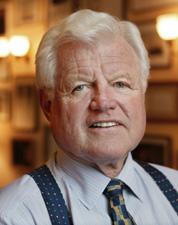 Sen. Edward M. Kennedy (D-MA)
What it changes
1 change to S. 2766 · shown in the bill's text
Adds SEC. 3121. EDUCATION OF FUTURE NUCLEAR ENGINEERS at the end of subtitle B of title XXXI
Adds a sectionIn S. 2766 · Placed on Calendar Senate
Effective as of January 6, 2006, and as if included therein as enacted, section 3101(a) of the National Defense Authorization Act for Fiscal Year 2006 (Public Law 109-163; 119 Stat. 3537) is amended by striking "$9,196,456" and inserting "$9,196,456,000".
Inserted: SEC. 3121. EDUCATION OF FUTURE NUCLEAR ENGINEERS.
Inserted: (a) Findings.--Congress makes the following findings:
Inserted: (1) The Department of Defense and the United States depend on the specialized expertise of nuclear engineers who support the development and sustainment of technologies including naval reactors, strategic weapons, and nuclear power plants.
Inserted: (2) Experts estimate that over 25 percent of the approximately 58,000 workers in the nuclear power industry in the United States will be eligible to retire within 5 years, representing both a huge loss of institutional memory and a potential national security crisis.
Inserted: (3) This shortfall of workers is exacerbated by reductions to the University Reactor Infrastructure and Education Assistance program, which trains civilian nuclear scientists and engineers. The defense and civilian nuclear industries are interdependent on a limited number of educational institutions to produce their workforce. A reduction in nuclear scientists and engineers trained in the civilian sector may result in a further loss of qualified personnel for defense-related research and engineering.
Inserted: (4) The Department of Defense's successful Science, Math and Research for Transformation (SMART) scholarship-for-service program serves as a good model for a targeted scholarship or fellowship program designed to educate future scientists at the postsecondary and postgraduate levels.
Inserted: (b) Report on Education of Future Nuclear Engineers.--
Inserted: (1) Study.--The Secretary of Energy shall study the feasibility and merit of establishing a targeted scholarship or fellowship program to educate future nuclear engineers at the postsecondary and postgraduate levels.
Inserted: (2) Report required.--The President shall submit to the congressional defense committees, together with the budget request submitted for fiscal year 2008, a report on the study conducted by the Secretary of Energy under paragraph (1).
Original wording
At the end of subtitle B of title XXXI, add the following:
Read automatically from the Congressional Record. Check the original before relying on it.
As printed
SA 4299. Mr. KENNEDY (for himself and Mr. Sessions) submitted an amendment intended to be proposed by him to the bill S. 2766, to authorize appropriations for fiscal year 2007 for military activities of the Department of Defense, for military construction, and for defense activities of the Department of Energy, to prescribe personnel strengths for such fiscal year for the Armed Forces, and for other purposes; which was ordered to lie on the table; as follows:
At the end of subtitle B of title XXXI, add the following:
SEC. 3121. EDUCATION OF FUTURE NUCLEAR ENGINEERS.
(a) Findings.--Congress makes the following findings:
(1) The Department of Defense and the United States depend on the specialized expertise of nuclear engineers who support the development and sustainment of technologies including naval reactors, strategic weapons, and nuclear power plants.
(2) Experts estimate that over 25 percent of the approximately 58,000 workers in the nuclear power industry in the United States will be eligible to retire within 5 years, representing both a huge loss of institutional memory and a potential national security crisis.
(3) This shortfall of workers is exacerbated by reductions to the University Reactor Infrastructure and Education Assistance program, which trains civilian nuclear scientists and engineers. The defense and civilian nuclear industries are interdependent on a limited number of educational institutions to produce their workforce. A reduction in nuclear scientists and engineers trained in the civilian sector may result in a further loss of qualified personnel for defense-related research and engineering.
(4) The Department of Defense's successful Science, Math and Research for Transformation (SMART) scholarship-for-service program serves as a good model for a targeted scholarship or fellowship program designed to educate future scientists at the postsecondary and postgraduate levels.
(b) Report on Education of Future Nuclear Engineers.--
(1) Study.--The Secretary of Energy shall study the feasibility and merit of establishing a targeted scholarship or fellowship program to educate future nuclear engineers at the postsecondary and postgraduate levels.
(2) Report required.--The President shall submit to the congressional defense committees, together with the budget request submitted for fiscal year 2008, a report on the study conducted by the Secretary of Energy under paragraph (1).
Legislative Activity
Stay on top of the latest movement without scrolling through every action
Senate amendment agreed to: Amendment SA 4299 agreed to in Senate by Unanimous Consent.
June 20, 2006
View full timeline
Senate amendment agreed to: Amendment SA 4299 agreed to in Senate by Unanimous Consent.
June 20, 2006
Senate amendment proposed (on the floor): Amendment SA 4299 proposed by Senator Levin for Senator Kennedy.
June 20, 2006
Amendment SA 4299 proposed by Senator Levin for Senator Kennedy. (consideration: CR S6117-6122; text: CR S6118) To require a report on the feasibility of establishing a scholarship or fellowship program to educate future nuclear engineers at the postsecondary and postgraduate levels.
June 20, 2006
Amendment SA 4299 agreed to in Senate by Unanimous Consent.
June 20, 2006
Senate amendment submitted
June 16, 2006