An amendment numbered 8 printed in Part B of House Report 111-219 to prohibit $400,000 from being used for the renovation of a vacant building for economic development by the City of Jal, New Mexico, and reduce the amount of the appropriate section by the same amount.
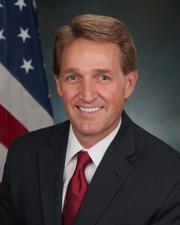 Rep. Jeff Flake (R-AZ)
Description
Amendment sought to prohibit $400,000 from being used for the renovation of a vacant building for economic development by the City of Jal, New Mexico.
Legislative Activity
Stay on top of the latest movement without scrolling through every action
House amendment offered
July 23, 2009
View full timeline
House amendment offered
July 23, 2009
House amendment not agreed to: On agreeing to the Flake amendment (A018) Failed by recorded vote: 125 - 310 (Roll no. 630).
July 23, 2009 • 6:13 PM
Roll call votes on amendments in House
July 23, 2009 • 6:13 PM
Amendment failed in Committee of the Whole
July 23, 2009 • 6:13 PM
House amendment offered/reported by : Amendment (A018) offered by Mr. Flake.(consideration: CR H8656-8657, H8670-8671; text: CR H8656)
July 23, 2009 • 4:12 PM
Amendment (A018) offered by Mr. Flake. (consideration: CR H8656-8657, H8670-8671; text: CR H8656)
July 23, 2009 • 4:12 PM
On agreeing to the Flake amendment (A018) Failed by recorded vote: 125 - 310 (Roll no. 630).
July 23, 2009 • 6:13 PM
Votes
1 roll call on this amendment
Text
Offered
TRANSPORTATION, HOUSING AND URBAN DEVELOPMENT, AND RELATED AGENCIES
APPROPRIATIONS ACT, 2010

The SPEAKER pro tempore. Pursuant to House Resolution 669 and rule
XVIII, the Chair declares the House in the Committee of the Whole House
on the State of the Union for the consideration of the bill, H.R. 3288.

{time}  1255

In the Committee of the Whole

Accordingly, the House resolved itself into the Committee of the
Whole House on the State of the Union for the consideration of the bill
(H.R. 3288) making appropriations for the Departments of
Transportation, and Housing and Urban Development, and related agencies
for the fiscal year ending September 30, 2010, and for other purposes,
with Mr. Snyder in the chair.
The Clerk read the title of the bill.
The CHAIR. Pursuant to the rule, the bill is considered read the
first time. The gentleman from Massachusetts (Mr. Olver) and the
gentleman from Iowa (Mr. Latham) each will control 30 minutes.
The Chair recognizes the gentleman from Massachusetts.
Mr. OLVER. Mr. Chairman, I yield myself such time as I may consume,
and hopefully that will be less than 5 minutes.
Mr. Chairman, it is my privilege and pleasure to present the fiscal
year 2010 Transportation, Housing and Urban Development, and Related
Agencies Appropriations bill to the House. This bill is the product of
many hours of hearings and briefings, always with bipartisan input and
excellent subcommittee member participation. I especially would like to
recognize the important contributions of my ranking member, Tom Latham,
in putting this bill together. And as with any healthy relationship, we
do not always agree, but I greatly appreciate his partnership, and his
input has made the bill better.
I also want to take a moment to recognize the hard work of staff,
specifically on the minority side, Dena Baron, David Gibbons, Allison
Fox and Doug Bobbitt; and on the majority side, Kate Hallahan, Laura
Hogshead, Dave Napoliello, Lisa Pena, Alex Gillen, Janine Scianna,
Andrew Burton and Blair Anderson. They have spent many late nights
putting this bill together, and we would not be here today without
their dedication.
There has been close communication and coordination between the
minority and the majority staffs throughout this process, and the bill
is better for that input.
Recognizing that today may be long, my remarks will be brief. This is
a nonpartisan bill, as bills related to transportation and housing
should be. It invests in our Nation's infrastructure during a
transformational period for both the Department of Transportation and
the Department of Housing and Urban Development. The bill provides
$123.1 billion in total budgetary resources, $48 million below the
President's budget request. Within Housing and Urban Development, this
bill recognizes that foreclosure rates remain high and the current
economic climate and weak job market have increased demand for
affordable housing. To that extent, this bill provides $47.1 billion
for HUD and targets most of the $1.6 billion increase over the
President's budget to programs that the previous administration
repeatedly attempted to reduce or zero out and thus have not kept up
with the need.
In contrast, Transportation is a budget in flux, largely covering
programs that are in transition with major surface and aviation
authorizations pending. The authorizing committees of jurisdiction in
both the House and Senate have either passed or begun marking up multi-
year legislation to reform and extend these important infrastructure
programs. In that regard, the bill includes $75.8 billion in
transportation infrastructure investments. That is $1.66 billion below
the President's request.
Last, I want to note that in supporting the transformations taking
place at each Department, this bill has emphasized investments in five
key areas: one, building healthy communities with environmentally
sustainable solutions; two, maintaining services in rural communities;
three, supporting vulnerable populations; four, investing in the
national infrastructure; and, five, ensuring transportation safety.
In conclusion, we worked hard to balance many competing needs to
produce a bill that reflects the bipartisan needs of transportation and
housing. I'm pleased with the product, and I urge Members to support
it.

[[Page H8605]]

[GRAPHIC] [TIFF OMITTED] TH23JY09.101

[[Page H8606]]

[GRAPHIC] [TIFF OMITTED] TH23JY09.102

[[Page H8607]]

[GRAPHIC] [TIFF OMITTED] TH23JY09.103

[[Page H8608]]

[GRAPHIC] [TIFF OMITTED] TH23JY09.104

[[Page H8609]]

[GRAPHIC] [TIFF OMITTED] TH23JY09.105

[[Page H8610]]

[GRAPHIC] [TIFF OMITTED] TH23JY09.106

[[Page H8611]]

[GRAPHIC] [TIFF OMITTED] TH23JY09.107

[[Page H8612]]

[GRAPHIC] [TIFF OMITTED] TH23JY09.108

[[Page H8613]]

[GRAPHIC] [TIFF OMITTED] TH23JY09.109

[[Page H8614]]

I reserve the balance of my time.
Mr. LATHAM. I thank the chairman and yield myself such time as I may
consume. Mr. Chairman, today is an important day in the House because
we are considering a bill that has far-reaching impacts on the
transportation infrastructure across all of our districts and on all of
our constituents in one way or another.

{time}  1300

For that reason alone, we should be considering this bill under an
open rule so that our constituents have some say in how their tax
dollars are being spent. Sadly, this is not the case.
Before I go any further, I want to tell the membership that I have
really enjoyed working with Chairman Olver, and look forward to
continuing to do so. While, like he said, we don't always agree on
everything, and especially the 25 percent increase in the allocation
over last year, but that fact does not take away my belief that he is
truly a devoted chairman who focuses on the resource needs of the
entities under the jurisdiction of this bill, and I very much want to
personally thank him for his consideration and kindness and working
together. It's been a real pleasure.
I also want to tell both the majority and minority staffs that I
sincerely appreciate their work throughout the process and commend them
for a job, I think, very well done. And I salute all of your many hours
that you put into the process, your forbearance in this often
dysfunctional environment. We couldn't do it without you. And again,
thank you on both sides of the aisle.
Mr. Chairman, as I said, the funding allocation for this bill for FY
2010 is 25 percent over the FY09 level. That is a huge increase, and
one for which we ought to have a number of perfecting amendment votes
as part of a serious debate, if for no other reason than to allow our
constituents to have some say in how those funds are spent. At some
point, it should start dawning on all of us that the reason we're
hearing a lot of noise about some of the spending that's going on is
that our constituents are waking up to the fact that they don't have a
say in these exercises.
Mr. Chairman, as the administration has said about this bill, ``these
infrastructure investments will help build a new foundation for long-
term economic growth to benefit the American people for years to
come.'' And I agree. If we are, indeed, making long-term infrastructure
investments, then the investors, or our constituents, should have a
say-so on how those investments are made.
One of my biggest concerns in this bill is that we do nothing to
address the coming situation with the highway trust fund that runs out
of money. At a point, we will have to bail out the fund with general
fund resources. I know that's not in our jurisdiction as such, but the
hour is getting late, and we should all be looking for the most
expeditious ways to make any contribution we can to provide the
resources that allow highway infrastructure and other transportation
programs to continue with some predictability.
I had an amendment to help the trust fund situation, as I mentioned
earlier today, in consideration of the rule. It would have transferred
$3 billion from the Rapid Rail appropriation to the trust fund, these
funds that will not be spent any time soon, while our highway trust
fund screams for additional resources.
The $3 billion are also funds that were not requested by the
administration for Rapid Rail, probably because the President knows
they could not be spent any time soon. Right now they are ``parked
funds,'' at a time when we do not need to be teeing up more resources
to be spent on something such as an infrastructure bank which, at this
point, is only a vague concept.
In the end, the amendment was not made in order, and I assume for
political reasons, unfortunately. Had it been made in order, it would
have given me some faith that the majority was serious about having a
genuine debate on this bill which, in turn, might have drawn a few more
supporters than might otherwise be the case.
I will offer a different amendment to strike the $3 billion, which
will take the Rapid Rail funding to the President's request. Let me
reiterate, that's the President's request. The $3 billion is over and
above that, and I believe the President's request was a reasonable
number.
It will also cancel the transfer authority to this unknown
infrastructure bank that has not been authorized. Without the absence
of any knowledge of where a Rapid Rail program will go or what the bank
will look like, or even if any submitted rail projects are feasible, we
simply do not need $3 billion of taxpayer money being set aside for
simply a concept.
Mr. Chairman, I would be remiss if I did not say that there are some
good points in this bill, absent a few billion unneeded dollars, to
make it a very attractive legislative product.
With respect to HUD, I only want to say that this bill fully meets
the government's obligation to renew all rental assistance, support the
homeless, increase support for low-income elderly and the disabled, and
provide additional rental assistance for veterans. But we cannot
continue to put forth resources that cannot be deployed in the near
term. We simply don't have the money.
And at this point, I thank you, and I reserve the balance of my time.
Mr. OLVER. Mr. Chairman, I yield 2 minutes to the gentlewoman from
California (Ms. Roybal-Allard) for a colloquy.
Ms. ROYBAL-ALLARD. Chairman Olver, I am honored to serve as a member
of the Transportation-Housing Subcommittee, and I thank the gentleman
for his leadership on the many housing and transportation challenges
facing our Nation.
I understand that among the elements of the Olver amendment is
additional funding for railroad research and development. As the
chairman is aware, our Los Angeles community suffered a tragic rail
accident when a commuter passenger train collided head on with a
freight train last year. It is widely believed that this accident could
have been averted and 25 lives saved had positive train control
technology been in operation on the system.
I would like to clarify that it is your intention that positive train
control is one of the technologies that is funded under the research
and development account.
Mr. OLVER. I thank the Congresswoman from California, and I share her
concern about the terrible accident in Los Angeles, as well as her
resolve to help prevent further accidents.
It is, in fact, my intention that the funding provided for railroad
research and development be available for positive train control
research and demonstration projects. I believe PTC is a necessary
addition to our national railroad system, and I thank the Congresswoman
for her leadership on this issue and keeping it in our attention.
Ms. ROYBAL-ALLARD. I thank the chairman for this clarification, and I
look forward to working with the gentleman on this and other issues as
the bill moves forward and we continue to address safety in all modes
of transportation. I appreciate the gentleman's tireless work and that
of the subcommittee staff on the many complex issues under this bill's
jurisdiction.
Mr. LATHAM. Mr. Chairman, I would like to yield 5 minutes to the
distinguished gentleman from Ohio (Mr. LaTourette), who has brought a
lot of knowledge and insight to the committee.
Mr. LaTOURETTE. I want to thank my good friend the chairman, and I
want to thank my good friend Mr. Latham from Iowa, a classmate from
1994.
I want to commend the chairman of the subcommittee, Mr. Olver, and
our ranking member, Mr. Latham, for putting together a good bill, both
on the transportation and the HUD side. There will be some criticism on
the floor today about how much money it spends, and let me just tell
you, as someone who spent 14 years on the Transportation and
Infrastructure Committee, as a Nation, we need to be embarrassed about
what we spend on transportation in this country.
If you look at the American Society of Civil Engineers, their report
that they come out with on an annual basis, a scorecard in terms of how
we're doing, if more Americans read that scorecard, they wouldn't put
their families in the minivan and take them on vacation and drive over
some of the bridges in this country.

[[Page H8615]]

The difficulty is going to occur later this year, and I have to say I
guess I'm disappointed in the administration saying that they're going
to kick the highway authorization bill down the road for 18 months,
which, coincidentally falls after the next midterm election.
But I have to tell you that it is, in fact, infrastructure which
creates jobs, and it's infrastructure which employs people in this
country. And as a Republican, I can tell you, if it hadn't been for
Dwight Eisenhower's vision on the national highway system, we would not
have been the envy of the world we are today.
But sadly, now we begrudgingly, in the 6-year reauthorization, carp
about spending $35 billion a year for the entire country. And the need,
I would suggest, Mr. Chairman, is far greater than that. And so, while
this bill does, in fact, spend more money, and some people may not like
the price tag, I think it's important.
I want to talk about two other things relative to the bill. The one
is passenger rail service. You know, I had the privilege of being the
chairman of the Railroad Subcommittee on Transportation, and we always
seemed to give Amtrak just enough money to fail.
And if you look at Amtrak, when they took over the passenger rail
service from Conrail, and we didn't want to be in the business anymore
and the freight lines didn't want to be in the business anymore, they
got bad track, bad rolling stock, bad management. And we sort of limp
along.
And I've had friends on my side of the aisle say, well, we can't give
them a billion dollars, what a big handout that is. Well, a billion
dollars is a lot of money, but the fact of the matter is that if this
country is ever going to move and restore passenger rail in this
country, it's going to have a price. And anybody that thinks that
passenger rail, as a societal prerogative, doesn't have to be
subsidized is nuts.
I mean, you go over and you look at the world-class systems in Europe
and in Asia. All of those countries have said for trips of 400 miles or
less, we want passenger rail to be competitive with travel by car. We
want passenger rail to be competitive with air travel, and they made
the significant investments to make that happen.
Anybody who has, and I've had the pleasure to travel with the
distinguished chairman of the Transportation and Infrastructure
Committee in Europe on trains like the TGV and the Chunnel and in Japan
on their high-speed rail. It goes over 200 miles an hour. The fact that
we have ignored that as a mode of transportation in this country should
be an embarrassment to the greatest country on Earth, and this bill
begins to make significant investments in that.
The stimulus package had $8 billion for high-speed rail. This bill
has an additional $4 billion. And I'll just tell you, I don't represent
a person in the Cleveland area that wouldn't say, if I could go 150,
180, 200 miles an hour from Cleveland to Chicago that I would, in fact,
do that.
And you want to talk about climate change. You know, the way to get
money around here this year is, if you put green in any legislation,
they give you money. But if you want to talk about climate change, I
believe the last time I checked, the statistic is 1 gallon of diesel
fuel can take 1 ton of cargo from Washington, D.C., to Boston,
Massachusetts. I don't know another mode of transportation that is that
fuel efficient. You get cars off the road, you get trucks off the road,
and you don't create the greenhouse gases that everybody is, in fact,
worried about.
Mr. OBERSTAR. Will the gentleman yield?
Mr. LaTOURETTE. I would be happy to yield to the chairman.
Mr. OBERSTAR. I thank the gentleman for yielding, Mr. Chairman, to
compliment the gentleman on his statement. I fully subscribe to the
wise words that he has expressed and to the history he's unveiled of
the evolution of passenger rail in this country. And the gentleman from
Florida (Mr. Mica), my partner on the Committee on Transportation and
Infrastructure--
The CHAIR. The gentleman's time has expired.
Mr. LATHAM. I would yield to the gentleman from Ohio 2 more minutes.
Mr. LaTOURETTE. I yield to the gentleman.
Mr. OBERSTAR. And we worked together with the gentleman from Ohio to
craft an Amtrak authorization bill that opens the door to private
sector investment, that creates a sustainable path for the future of
surface high-speed intercity passenger rail in this country, and with
the gentleman's leadership now, Mr. Chairman, on the Appropriations
Committee, we're going to advance that cause.
So I thank him for that forthright statement and am delighted that
he's continuing to be such a strong advocate, and I also take this
opportunity to thank my colleague on the committee, the gentleman from
Florida, for the partnership we've had in advancing the cause of high-
speed intercity passenger rail.
Mr. LaTOURETTE. I thank the chairman very much. And I would say that
if you really want to know about transportation, you talk to Jim
Oberstar of Minnesota. The man has written most of the books, and I've
learned so much of what I've learned in this Congress from sitting on
the other side of the aisle from him.

{time}  1315

I would only say the gentleman is going to be disappointed now
because I spent 14 years on his committee, on the authorizing
committee, and we always chafed at the appropriators who authorized on
appropriations measures. I've now gone over to the dark side, and I
think it's the most wonderful system in the world.
Mr. OLVER. Mr. Chairman, I yield 2 minutes to the gentleman from
Michigan (Mr. Levin) for a colloquy.
Mr. LEVIN. Mr. Chairman, section 412 of the bill provides that no
funds appropriated pursuant to this act may be expended by an
``entity'' unless that entity agrees to comply with the Buy American
Act.
The Buy American Act is part of a longstanding U.S. trade policy.
That policy requires reciprocity in Federal Government procurement.
Since 1979, the U.S. has agreed to open its procurement market to
countries that agree to open their procurement markets to U.S.
suppliers. That same policy requires the United States to not grant
access to countries that are unwilling to agree to open their
procurement markets to U.S. suppliers.
I believe that the intent of section 412 is to be consistent with
that policy. Its intent is not to expand the scope of the Buy American
Act, such as to cover businesses or other ``entities'' that may receive
funding under this appropriations bill and that are not currently
subject to the act. I also understand that section 412 is not intended
to create an inconsistency with our international obligations,
including our obligations under the WTO Agreement on Government
Procurement.
If I might, I will now yield to the chairman for clarification.
Mr. OLVER. The gentleman is correct. Section 412 will help to ensure
compliance with the Buy American Act. Because the intention is not to
apply the Buy American Act to new entities, it is consistent with our
international obligations.
Mr. LEVIN. I thank the chairman.
Mr. LATHAM. Mr. Chairman, I yield 5 minutes to the distinguished
ranking member of the Transportation and Infrastructure Committee, the
gentleman from Florida (Mr. Mica).
Mr. MICA. Thank you so much for the time, for the introduction and
for the opportunity to speak on this important Transportation and HUD
funding bill.
Mr. Chairman, first of all, I want to compliment Mr. Olver and Mr.
Latham, the two leaders of the appropriations subcommittee, on the
great job that they have done and for their efforts and for the efforts
of both staffs in addressing the transportation and infrastructure
needs of the Nation.
This is one of the most important bills that we will pass because
this job will actually put people to work. I can tell you--and my
colleagues and every one of you knows the statistics--that the national
unemployment is at 9.5 percent. In my State of Florida, we're at 10.5
percent. I have some counties in my district that are at 15 percent. We
have a problem. One of the ways to get people working and into jobs is
by building infrastructure, and we'll actually have something tangible
when we get done.
I do want to raise an issue that I have with the bill, but it is not
something that is the responsibility of the

[[Page H8616]]

authors of this legislation, Mr. Olver or Mr. Latham. They have been
most cooperative. We've had a great working relationship, myself as an
authorizer and the two of them as appropriators.
From time to time and in the past, there have been great battles--
I've seen some of them--about authorizing on an appropriations bill.
Now, I went to the Rules Committee, and I didn't get a chance to speak
on the rule, so I voted against its passage. I asked the Rules
Committee to pass an amendment that would have sped up the process by
which we could get these dollars out so that we could actually get
people working sooner rather than later. I know people have asked me
for bigger government programs and for more bailouts, but now they have
asked for an opportunity to work, and nothing has been harder hit than
transportation projects.
I've got one little quote here from the Secretary of Transportation
in Pennsylvania, who says that the unemployment rate for construction
workers there is 21 percent.
It's high all over the Nation, but we can get people to work. The
Rules Committee ruled out of order my amendment that would have sped up
the process for the consideration of transportation projects, both for
stimulus and also for this type of funding legislation.
Actually, I had my staff go through, and they just tabbed one section
of this, of legislating on appropriations bills. All of these tabs
represent legislating on an appropriations measure, but I don't raise
any questions about these. Some of this is probably fine. We've talked
together, and we agree on it.
What I'm concerned about is that the Rules Committee took the bill as
it stood, but failed to take my proposed amendment. They said I was
legislating on appropriations. My measure, again, would have sped up
the process. Don't think we can't do that. I stood here with Mr.
Oberstar the day that the bridge collapsed over the Mississippi River
in Minneapolis. We rebuilt that bridge in 437 days. Normally, the
process to rebuild that, if you went through all the normal hoops and
red tape and Federal requirements, would take 6-7 years. We can do the
same thing because we have a national emergency now, and we need to get
this transportation money that this good, well-intended and very
effective subcommittee is bringing forth. It's a good measure. They
work together in a bipartisan fashion.
What I'm saying is we need to get that money, the stimulus money,
out. We're having the same problem with our stimulus money, getting it
out. There is $48 billion under the Department of Transportation's
responsibility. So far, we have $771 million. Let me say the State
Transportation Departments across the country are doing their level
best. They're doing a great job getting that money out, but that's less
than $1 billion of $48 billion out.
There is a reason it's caught up in red tape. Let me take, not what a
Republican Governor said, but what, I believe, North Carolina Governor
Perdue said, which is that there is so much red tape that it's
discombobulating.
Now, just for the record--and I will give the Clerks the proper
spelling of ``discombobulating'' for the Record of the House--he said
it's irritating. That's Perdue.
Here is a little engineer in a county in Indiana. He said, ``I've got
an engineer full time, and just 'bout all he's doing is red tape every
day.''
The CHAIR. The time of the gentleman has expired.
Mr. LATHAM. I yield the gentleman from Florida 2 additional minutes.
Mr. MICA. Again, I want to take not just the Governor or the
Secretary of Transportation in Pennsylvania or the Governor of North
Carolina. Here is a county engineer in Elkhart County, Indiana who
says, I've got an engineer full time, and that's just 'bout all he's
doing is red tape every day, filling out forms, filling out forms.
So my proposal, had the Rules Committee accepted it, would have sped
up the process. I didn't come here to say we should roll over any
environmental requirements or regulations. What I said is we should
condense the process because this, my fellow Members of Congress, is a
national emergency. If you don't think it's a national emergency, go
back to your office, and find some of those letters from folks who are
pleading with Congress to help them find a job, to get people employed
in their families so they can pay their mortgages, so they can build
their dreams like we all want to do, but they're not able to do that,
and we're not able to get the money out because of the red tape and
constraints.
So, again, I regret that the Rules Committee rejected my proposal.
I'll be back here again.
Mr. OLVER. Will the gentleman yield?
Mr. MICA. Yes, I will always yield to the chairman.
Mr. OLVER. I thank the gentleman for yielding.
To finish this and to allow him to respond in some kind of way, I
would give the gentleman additional time, Mr. Chairman.
I just wanted to say that I can remember--and probably, if you think
about it a little bit, you can remember, too, because my memory is
probably a lot poorer than yours--times when this bill was brought to
the floor, and point of order after point of order to the level of
practically stripping half the bill away were made by your committee.
Well, maybe you weren't the chairman at that particular time, but a few
years ago, that sort of thing did happen.
The CHAIR. The time of the gentleman from Florida has again expired.
Mr. LATHAM. I yield the gentleman an additional 2 minutes.
Mr. OLVER. Furthermore, I would just simply say, of the $47 billion,
more than $21 billion has been obligated. Those expenditures are going
on. That's more than the amount that was intended to be obligated by
the end of the 2009 fiscal year. We're already obligating the money
into 2010, so it's getting out there pretty quickly. Though, I do have
great sympathy for the position that you're taking in that it takes far
too long, and I hope the authorizing will take care of that in a new
event.
Mr. MICA. I know what went on in the past with my committee and its
calling points of order on authorizing on an appropriations measure.
Let me say that I did not come to burn Rome. I came to help you build
Rome. I have no objection to these, and I did not object on any, but I
did object to my one. Here is 45 not being considered by the Rules
Committee, and your committee is not the Rules Committee.
Let me say this, too: We have obligated money, but you know, I can't
go back to my office and say, Mr. So-and-so or Madam So-and-so
Constituent, we've obligated money. It's not out there, so there isn't
that hope for a job. All I'm trying to do is get the money expedited so
we can get jobs going again.
Finally, let me tell you why it's important to get that money out
there now, folks. Listen to this. This is one American dollar. I can
tell you that, right now, you will get the best deal ever to do
infrastructure projects in the country.
The CHAIR. The time of the gentleman has again expired.
Mr. LATHAM. I yield the gentleman 1 additional minute.
Mr. MICA. My district secretary told me that bids are coming in 25 to
30 percent lower. Do you see this three-quarters of a dollar? I can get
a dollar's worth of construction now for three-quarters of a dollar. We
have American infrastructure on sale wholesale, and we should be
getting that money out in the interest of taxpayers and building that.
Heaven forbid, you know, it's not like some of these other programs
or like the bailouts. I didn't come here asking for a bailout. All I'm
asking for is something tangible, and that's what your subcommittee
provides so well for our Nation is something tangible--roads, bridges,
highways, transit systems--all of which we need across this land from
sea to shining sea. We're drowning in congestion. We don't have high-
speed rail systems like the Europeans, Asians and other people around
the world. So I don't mind spending it.
My dad used to say, ``It's not how much you spend, Son. It's how you
spend it.''
Mr. OLVER. Mr. Chairman, I yield 2 minutes to the gentleman from
Texas (Mr. Rodriguez), who is a member of the subcommittee.
Mr. RODRIGUEZ. Mr. Chairman, I rise today in strong support of H.R.
3288, the 2010 Transportation-HUD appropriations spending bill. In
particular, I want to express my support

[[Page H8617]]

for the passage of the rail funding within the bill that amounts to
about $4 billion.
I want to thank Chairman Olver for his leadership, and I want to
thank the Appropriations Committee for demonstrating their commitment
to passenger and high-speed rail by providing funding in this bill that
will enable urban, suburban and rural communities in America to be
connected by a system that will deliver safe, swift, efficient, and
economical travel across our Nation. The $4 billion provided in this
bill will support a competitive grant process. The Federal Railroad
Administration will oversee the grant application and award process.
For those who have concerns about the funding, I want to stress that
current demand for passenger rail exceeds available funds in the pre-
application process for passenger rail funding. Texas, for example, has
requested $3.1 billion; California has requested $21.6 billion; Nevada
has requested $12.5 billion. Overall, 40 locations throughout America
have requested in excess of $104 billion.
The fact of the matter is that $4 billion is only a small down
payment of investment in passenger rail. Texas desperately needs the
passenger and high-speed rail. Funding for high-speed rail will reduce
congestion and pollution. It will create jobs, and it will connect
America's communities. The San Antonio-Austin area is booming, and the
highways are congested. America's passenger rail system is terribly
underdeveloped and underfunded when compared to other nations, such as
France, Italy, China, and Japan.

{time}  1330

My colleagues in south Texas have joined me in supporting this bill,
and I ask for the support of this piece of legislation.
Mr. LATHAM. I reserve the balance of my time.
Mr. OLVER. Mr. Chairman, I yield 2 minutes to the gentlewoman from
California (Ms. Woolsey) for a colloquy.
Ms. WOOLSEY. I thank the chairman for all of your hard work on this
bill.
As the chairman knows, there is a project in my district named the
Sonoma-Marin Area Rail Transit project. We call it SMART. When fully up
and running, SMART will be a 70-mile passenger rail system that
connects 14 stations and runs right through the heart of my district.
This project is vital because it eases congestion on the major
transportation artery, Highway 101, by providing an alternative mode of
transportation. This is a very popular project, and actually, last
November, voters in my district passed a quarter-cent sales tax measure
by over two-thirds majority to raise money for SMART. So it has the
support of the community when a simple majority votes on a tax measure
like that.
Not only is SMART a train, but the project also includes 70 miles of
bike and pedestrian paths to run alongside the tracks, which
revolutionizes transportation in my district.
Unfortunately, while SMART received nearly $2 million in last year's
Transportation-HUD bill, there are no funds in this bill this year, and
it is my hope that as SMART moves into the New Starts process that the
chairman will work with me to support this important transportation
project.
Mr. OLVER. I thank the gentlewoman for bringing this matter to my
attention. This is a good project. I support it, and I will be glad to
work with the gentlewoman from California on this as it moves into the
New Starts process.
Ms. WOOLSEY. I thank the chairman.
Mr. LATHAM. I continue to reserve.
Mr. OLVER. Mr. Chairman, I yield 2 minutes to the gentleman from
Oklahoma (Mr. Boren).
Mr. BOREN. Mr. Chairman, thank you for your hard work on this
legislation and also your support for Indian country in Oklahoma for
many years.
I would like to bring to the gentleman's attention an inequity and an
inefficiency that currently exists within the Federal programs that
assist local transit agencies with their capital projects such as buses
and garages. Specifically, for alternative fuel transit buses, the
Federal share is 80 percent of the capital cost of a standard diesel,
plus 90 percent for the cost of vehicle-related compliance with the
Clean Air Act, often referred to as the incremental cost.
In short, blending the percentages, grantees may apply for an 83
percent Federal share of the total vehicle cost. This was based on the
policy that such buses contribute generally to cleaner air and
maintaining compliance with the Federal air quality standards.
I would like to ask the gentleman if I'm correct in stating that this
bill includes a provision that allows a 90 percent Federal share for
the entire cost of a biodiesel bus?
Mr. OLVER. Mr. Chairman, the gentleman from Oklahoma is correct.
Section 164 of this bill allows that.
Mr. BOREN. I understand that this biodiesel provision was included in
this and several past Transportation appropriations bills for air
quality and petroleum displacement reasons. However, I would like to
suggest to the chairman, there is no reason not to extend the same 90
percent of the total vehicle cost benefits offered to a biodiesel bus
to a natural gas bus. Natural gas-powered buses produce 22 percent less
greenhouse gases than comparable standard diesel buses, and they have a
proven track record of displacing imported petroleum.
It is my hope that the gentleman would be willing to work with me on
this issue to provide 90 percent of the total vehicle cost to natural
gas buses.
The CHAIR. The time of the gentleman has expired.
Mr. OLVER. I yield the gentleman 1 additional minute.
Mr. BOREN. That would help transit agencies accelerate the
replacement of existing diesel buses with new, fuel-efficient,
alternative fueled ones. This change would make a significant
contribution in America's strategy for energy independence and global
climate change.
Simultaneously, it would ensure clean air and the health of our
citizens, and contribute to the growth of our economy.
Mr. OLVER. I appreciate the gentleman's attention to this issue. I
understand that the House authorizing committee is examining this in
the context of their multiyear surface transportation reauthorization
bill. In the meantime, I will be happy to work with the gentleman from
Oklahoma to address this issue as we move forward in this process and
conference this bill with the Senate.
Mr. BOREN. I thank the chairman for his willingness to work with me
on this issue.
Mr. LATHAM. I continue to reserve.
Mr. OLVER. Mr. Chairman, I yield 2 minutes to the gentlewoman from
Texas (Ms. Jackson-Lee).
Ms. JACKSON-LEE of Texas. I thank the chairman very much and the
ranking member.
I rise to support the rule that has already passed and the underlying
bill.
Mr. Chairman, this is a very important step forward for the
infrastructure of America, covering transportation and housing, and
housing is part of infrastructure. It creates a holistic neighborhood.
I want to thank the committee for the Federal Transit Administration
$10.48 billion, which will impact the growing metro system as a New
Start. I am hoping as we move forward and metro in Houston is defined
as a New Start, we will also be able to use and continue to use those
stimulus dollars because we are in the process of creating jobs as we
speak.
I believe it is very important to support the high-speed, inner city
passenger rail grants. We in Texas are working very much on high speed
and believe that that is part of the transportation system of tomorrow.
I am also grateful for the airport modernization, safety and
efficiency grant of $3.5 billion representing Houston Intercontinental
Airport, one of the largest airports in the Nation, modernizing air
traffic control. Just recently, we met with our air traffic
controllers, and I would hope as we make our way through this
particular legislation we'll also focus on encouraging the FAA to be
able to work on the negotiations with the air traffic controllers for a
better quality of life, better work conditions.
I am grateful as well for the number of dollars being put in for
vouchers for homeless veterans, $75 million for homeless veterans;
10,000 of those veterans will be served, $1.3 million for low-income
housing. In addition, I'm delighted that we're working for more

[[Page H8618]]

affordable housing. We in the City of Houston are in great need, and
I've been working on affordable housing for a long time.
I hope in the dollars that are going to our communities we also will
be using them for what we call senior housing repair. In many of our
cities, our housing stock is enormously old. It impacts our seniors,
and they're in great need.
The CHAIR. The time of the gentlewoman has expired.
Mr. OLVER. I yield 15 seconds to the gentlewoman.
Ms. JACKSON-LEE of Texas. I thank the gentleman very much.
I have a large population of public housing--we call it housing
development--and I'm very grateful that $4.8 billion has been
implemented or used for that, $200 million above the President, $345
million above 2009 for maintenance and crime prevention and energy
costs, two very important aspects.
Let me just say by concluding I thank the gentleman for his work and
for his housing efforts.
Mr. LATHAM. I continue to reserve.
Mr. OLVER. Mr. Chairman, I yield 2 minutes to the gentleman from
California (Mr. Berman) for a colloquy.
Mr. BERMAN. I thank the chairman of the subcommittee, Mr. Olver, for
yielding to me to engage in a colloquy about the importance of ensuring
the fairness and objectivity of the FAA's curfew application process.
I am pleased to be joined by my good friend Mr. Schiff who, like me,
has many constituents who are greatly affected by nighttime operations
at Burbank airport.
Both Burbank Bob Hope Airport and Van Nuys Airport have been actively
studying nighttime flight curfews on Stage III aircraft. The Burbank-
Glendale-Pasadena Airport Authority has already submitted its completed
Part 161 application to the FAA requesting a nighttime curfew.
As both Mr. Schiff and I know, the FAA has been all-too-willing to
simply disregard the impact that nighttime flight operations have on
communities living by these airports. I have constituents whose sleep
is routinely disturbed by aircraft taking off or landing at all hours
of the night from Burbank and Van Nuys airports.
I look forward to working with the gentleman and the authorizing
committee in the future to ensure that the FAA gives fair consideration
to the concerns of those who must live with airport noise day in and
out.
I yield, if I may, to the gentleman from California (Mr. Schiff).
Mr. SCHIFF. I thank the gentleman from California for yielding.
I am pleased that for the first time in 17 years the FAA has deemed
the Part 161 nighttime curfew application officially complete. This is
a big step in the right direction and shouldn't be overlooked.
I strongly believe that Bob Hope Airport in Burbank, California, has
met the criteria for a curfew set by law and that a curfew would impact
a relatively small number of diverted flights while delivering
significant reductions in both the noise impact to surrounding
communities and the cost associated with sound mitigation.
However, I share my colleague's concern that the FAA has not been
serious about moving forward with mandatory curfews, despite
congressional intent when Part 161 was signed into law. I look forward
to working with Chairman Olver and the authorizing committee to ensure
that Part 161 has the meaning and credibility and that the process is
real and can lead to results.
The CHAIR. The time of the gentleman has expired.
Mr. OLVER. I yield the gentleman 1 additional minute, and would the
gentleman yield?
Mr. BERMAN. I certainly yield to the chairman.
Mr. OLVER. I appreciate the remarks of the two gentlemen about the
effects of airport noise on local communities and agree that the FAA
has a responsibility to adequately and objectively weigh the concerns
of those adversely impacted by nighttime takeoff and landings.
While I can't comment as to the specifics of the Burbank and Van Nuys
curfew studies, I agree that the Part 161 process must serve as a
credible and objective avenue for evaluating the merits of noise and
access restrictions.
Mr. BERMAN. Reclaiming my time, I thank the chairman very much.
Mr. LATHAM. I continue to reserve, please.
Mr. OLVER. Could I inquire how much time there is available?
The CHAIR. The gentleman from Massachusetts has 10\1/2\ minutes
remaining. The gentleman from Iowa has 8\1/2\ minutes remaining.
Mr. OLVER. Mr. Chairman, I yield 1 minute to the gentleman from Iowa
(Mr. Braley) for the purposes of a colloquy.
Mr. BRALEY of Iowa. Mr. Chair, first let me thank the gentleman from
Massachusetts for his hard work and dedication to moving our Nation
forward in the area of transportation and all the other issues he
tackles each and every day, including those he tackles with my
colleague from Iowa. This bill is going to help millions of Americans,
and I am pleased to support it.
I rise today in strong support of the Olver amendment to the
Transportation-HUD Appropriations Act. I'm pleased to have helped
secure an increase of $3 million in this amendment for the Federal
Railroad Administration's railroad research and development account.
This additional money could be used for any number of research
projects, including a biolubricants research study that was authorized
in the Rail Safety Improvement Act of 2008, as well as other authorized
activities.
The widespread use of biolubricants in the rail industry will help us
reduce our dependency on foreign oil and reduce our national addiction
to petroleum imports. If all industrial lubricants used annually in the
United States could be replaced with biobased versions, over 2 billion
gallons of petroleum per year would be replaced.

{time}  1345

I look forward to seeing the FRA workup with ag-based lubricant
testing facilities to see that this study is carried out.
The CHAIR. The time of the gentleman has expired.
Mr. OLVER. I yield myself 1 minute. I assure the gentleman from Iowa
that we will work together with the Federal Rail Administration to
implement the 2008 Authorization Act.
Mr. LATHAM. I have no additional speakers and, again, I want to
personally thank the chairman for his consideration and again say thank
you to the great staff that we have on both sides of the aisle. It's
been a real pleasure working with you. I appreciate it.
I yield back the balance of my time.
Mr. OLVER. I thank the gentleman from Iowa for his kindness and for
his hard work and I certainly, again, join him in thanking the very
fine staff who worked together very well in crafting this legislation.
It is a good bill. I believe it is a bill that deserves the support
of the vast majority of the Members of the Congress.
Ms. EDDIE BERNICE JOHNSON of Texas. Mr. Chair, I want to thank the
leadership of the Transportation Appropriations Subcommittee for their
work on this bill.
Our Nation's transportation system is at a crossroads. Now is not the
time to scale back funding efforts to address our country's
deteriorating infrastructure, worsening traffic congestion, poor air
quality, energy use, and investments in high speed rail. These issues
are all interrelated and will impact our economy, global
competitiveness, and sustainability. The appropriations bill before us
today is a good one; however, it represents a mere down payment towards
addressing the critical infrastructure needs of this country. In my
state, these needs are readily apparent.
The State of Texas has one of the most extensive surface
transportation networks in the world. Texas has more than ten thousand
miles of railtrack; more than three hundred thousand miles of roadway;
and more than fifty-thousand bridges--more than any other state in the
nation. Financing challenges, coupled with exploding population and
trade growth, are creating a perfect storm that is pushing Texas'
transportation network to its breaking point. In the absence of
increased funding and innovative policies, the weight of these
particular challenges will adversely impact the quality of life for my
constituents and citizens throughout the state.
It is imperative that we as a body focus our attention on investing
in a truly national transportation system in order to address the
impending infrastructure crisis. Our ports are not able to handle the
volume of freight entering the United States, railroads and highways
are overwhelmed with freight and delayed by bottlenecks, and intermodal
facilities need to be improved to facilitate greater efficiency. With

[[Page H8619]]

projected increases in imports over the next several decades, we have
but a small window to make infrastructure improvements to ensure
America is able to sustain its global competitiveness.
As I close, I would like to thank the subcommittee for including
funding in the bill for Dallas Area Rapid Transit (DART) and the
Interstate-30 Bridge Project in my congressional district. This funding
will help advance these noteworthy projects and improve mobility for my
constituents. I also want to thank the subcommittee for their inclusion
of high speed rail funding. Relative to other developed nations, the
United States ranks dead last with regards to developed high speed rail
corridors. The demand in Texas for high speed rail is great, and the
funding included in the bill will greatly aid high speed rail efforts
in my state.
Just last week, the Texas Department of Transportation announced
project requests to the U.S. Department of Transportation totaling $1.9
billion dollars under the American Recovery and Reinvestment Act
(ARRA). The high speed rail funding reflected in the bill is warranted
and it is my intent to oppose the amendment offered by the gentleman
from Iowa, Mr. Latham, aimed at reducing funding for this account.
I support H.R. 3288.
Mr. BLUMENAUER. Mr. Chair, the Department of Transportation estimates
that the Highway Trust Fund will run short of funds this August, and
that Congress will have to transfer $5-7 billion to it to avoid a
shortfall. This shortfall is occurring because the gas tax is becoming
obsolete. As vehicles become more fuel efficient, they increase the
demand on our transportation system, without contributing as much to
its maintenance. The current revenue system has lost 33% of its
purchasing power during the last 15 years, today generating only two-
thirds of the revenues needed to maintain current levels of investment.
Until we tie our transportation revenues to our transportation demands,
this situation will worsen.
Failure to adequately fund transportation infrastructure imposes huge
costs on American citizens and businesses:
Congestion costs urban Americans 4.2 billion hours and 2.8 billion
unnecessary gallons of fuel each year; expressed in dollar terms this
is $87.2 billion, or $757 per traveler.
Roughly 40,000 people every year are killed on our streets and
highways, with 2.5 million more injured, at a staggering annual
economic cost to society.
Higher transportation costs and higher inventory carrying costs--
partially attributable to an unreliable transportation system--have
pushed logistics costs to nearly 10% of GDP.
Failure to act puts America on hold, when we should be putting
America to work.
It is time we sought out innovative solutions to this challenging
problem. The Oregon Department of Transportation successfully tested a
model where they charged drivers for the number of miles they traveled
rather than the fuel they consumed. The test was convenient for
drivers, protected personal privacy, and proved easily administrable.
This concept was also highlighted by two blue ribbon commissions
established in the prior transportation authorization. The National
Surface Transportation Policy and Revenue Study Commission noted that a
vehicle miles traveled charge is ``the most promising alternative
revenue measure'' to our existing gas tax, while the National Surface
Transportation Infrastructure Financing Commission reported that ``a
charge for each mile driven . . . has emerged as the consensus choice
for the future.'' Both commissions found that this system was efficient
at raising revenue, closely linked system demand to revenues, and could
win broad public support.
My legislation calls on the Department of the Treasury to study the
viability of this revenue source in every State. While evaluating
mileage based revenue sources, Treasury will ensure the system protects
privacy and is simple to administer. It will also convene working
groups to address the most complex aspects of this transition,
including road use, demand management and climate change, and
technological needs. Finally, the bill creates a grant program to
ensure the necessary technology is available.
The condition of our national highway and transit systems and the
maintenance of our infrastructure, and the investments that we make in
these systems, touch the life of every American, strengthen our
economy, and protect our environment. I look forward to working with my
colleagues to pass this important legislation.
Mr. HOYER. Mr. Chair, I rise in strong support of the Fiscal 2010
Transportation, Housing, and Urban Development Appropriations Act. This
bill takes great strides to help the neediest Americans secure shelter
in trying economic times. It also makes important investments in strong
and user-friendly transportation systems, including our highways,
airports, passenger rail lines, and transit networks.
But I particularly want to thank Chairmen Obey and Olver for
including in this bill $150 million to fund vitally needed capital and
preventive maintenance improvements for the Washington Area
Metropolitan Transit Authority, in accordance with legislation we
passed last year authorizing $1.5 billion for WMATA over the next 10
years. It has long been clear that America's Subway deserves a strong
federal commitment. After all, it serves the millions of visitors who
come to visit our nation's capital, and it is the primary public
transportation system servicing the federal employees who keep our
government running. But with a ridership that continues to grow,
WMATA's General Manager made it clear that the system requires more
than $11 billion in capital improvements from 2011 to 2020 to keep
running. Without those funds, the system's aging infrastructure will
continue to deteriorate.
The bill includes language directing WMATA to use the funds to first
address immediate safety shortfalls identified by the National
Transportation Safety Board, which include, but are not limited to, the
improved crashworthiness of the agency's rail car fleet and the
maintenance and modernization of WMATA's signal and automatic train
control systems. The importance of those systems was vividly and
painfully demonstrated in last month's Metro crash, which took the
lives of nine commuters. For the sake of all those who rely on Metro,
we must ensure that its safety meets the highest standard.
I urge my colleagues to support this strong appropriations bill and
make clear our commitment to the efficiency and safety of America's
Subway.
Mr. GENE GREEN of Texas. Mr. Chair, I rise in strong support of this
bill that provides important funding for national priorities, as well
as regional projects including major projects in Harris County, TX we
have been working on for years. The bill makes needed investments in
transportation projects, housing projects, foreclosure prevention, and
numerous other priorities.
One of the most significant projects that was included because of the
benefits it will provide our district and the surrounding area is the
funding for Houston METRO. This was funding our office requested, was
in the President's requests, and was funded at $75 million each for the
North and Southeast Corridor Projects. FY2010 activities include final
design, land acquisition, and construction for the first segments on
these two lines.
Also included in the bill was $400,000 for the flyover connecting HWY
146 and Spur 330. While this is a fraction of what I requested, it
should allow additional design and planning on the project to begin.
Our district encompasses a significant portion of the hurricane-
threatened Gulf Coast of Texas. The State-mandated evacuation plan
calls for the 70,000 residents of Baytown to travel south on Highway
146 to Spur 330 and to turn north for travel to Interstate 10. There is
a direct connector from Spur 330 to I-10 westbound, however there is a
major pinch point at the intersection of Highway 146 and Spur 330. All
the evacuating residents must exit the main lanes and travel through
three signalized intersections before reconnecting with a limited
access highway.
Not only do these intersections create a bottleneck for evacuees,
they also make it difficult for local emergency personnel to cross
while preparing for and responding to an approaching emergency. All
areas south of Highway 146 are in the storm surge zone, making
evacuation mandatory, not voluntary. Our district also encompasses the
entire Houston Ship Channel area and the resulting threats associated
with these vital energy complexes. In addition to the evacuation
criticality of this flyover, the efficient and safe movement of
hazardous materials by the elimination of local traffic interaction
will benefit a large portion of the District. I look forward to working
with the Chairman in the future to ensure this critical project
receives additional funding.
There was also $200,000 included to acquire property along Buffalo
Bayou's East Sector to create park land for continued development of
the Buffalo Bayou greenway. The Buffalo Bayou Greenway Initiative
promotes the economic development of Houston's innercity. The project
has a major quality of life impact on not only the East End but on the
entire Houston region, and I am pleased the Committee continued to
provide federal funding to progress this ongoing effort. The project is
taking abandoned property that is no longer viable for industrial use
and transforming it into park space that is providing residents with
recreational and environmental education opportunities.
Mr. Chair, I fully support this bill that provides increased
resources for our nation's transportation needs, as well as
strengthening social safety nets for those most in need. I urge all my
colleagues to join me in supporting the passage of H.R. 3288.
Mr. OLVER. I yield back the balance of my time.
The CHAIR. All time for general debate has expired.

[[Page H8620]]

Pursuant to the rule, the bill is considered read for amendment under
the 5-minute rule and the bill shall be considered read through page
160, line 6.
The text of that portion of the bill is as follows:

H.R. 3288

Be it enacted by the Senate and House of Representatives of
the United States of America in Congress assembled, That the
following sums are appropriated, out of any money in the
Treasury not otherwise appropriated, for the Departments of
Transportation, and Housing and Urban Development, and
related agencies for the fiscal year ending September 30,
2010, and for other purposes, namely:

TITLE I

DEPARTMENT OF TRANSPORTATION

Office of the Secretary

salaries and expenses

For necessary expenses of the Office of the Secretary,
$102,556,000, of which not to exceed $2,631,000, shall be
available for the immediate Office of the Secretary; not to
exceed $986,000, shall be available for the immediate Office
of the Deputy Secretary; not to exceed $20,359,000, shall be
available for the Office of the General Counsel; not to
exceed $11,100,000, shall be available for the Office of the
Under Secretary of Transportation for Policy; not to exceed
$10,559,000, shall be available for the Office of the
Assistant Secretary for Budget and Programs; not to exceed
$2,440,000, shall be available for the Office of the
Assistant Secretary for Governmental Affairs; not to exceed
$25,520,000, shall be available for the Office of the
Assistant Secretary for Administration; not to exceed
$2,055,000, shall be available for the Office of Public
Affairs; not to exceed $1,658,000, shall be available for the
Office of the Executive Secretariat; not to exceed
$1,433,000, shall be available for the Office of Small and
Disadvantaged Business Utilization; not to exceed
$10,600,000, shall be available for the Office of
Intelligence, Security, and Emergency Response; and not to
exceed $13,215,000 shall be available for the Office of the
Chief Information Officer: Provided, That the Secretary of
Transportation is authorized to transfer funds appropriated
for any office of the Office of the Secretary to any other
office of the Office of the Secretary: Provided further, That
no appropriation for any office shall be increased or
decreased by more than 5 percent by all such transfers:
Provided further, That notice of any change in funding
greater than 5 percent shall be submitted for approval to the
House and Senate Committees on Appropriations: Provided
further, That not to exceed $60,000, shall be for allocation
within the Department for official reception and
representation expenses as the Secretary may determine:
Provided further, That notwithstanding any other provision of
law, excluding fees authorized in Public Law 107-71, there
may be credited to this appropriation up to $2,500,000, in
funds received in user fees: Provided further, That none of
the funds provided in this Act shall be available for the
position of Assistant Secretary for Public Affairs.

financial management capital

For necessary expenses for upgrading and enhancing the
Department of Transportation's financial systems, and
reengineering business processes, $5,000,000, to remain
available until expended.

office of civil rights

For necessary expenses of the Office of Civil Rights,
$9,667,000.

transportation planning, research, and development

For necessary expenses for conducting transportation
planning, research, systems development, development
activities, and making grants, to remain available until
expended, $14,733,000.

working capital fund

For necessary expenses for operating costs and capital
outlays of the Working Capital Fund, not to exceed
$147,569,000, shall be paid from appropriations made
available to the Department of Transportation: Provided, That
such services shall be provided on a competitive basis to
entities within the Department of Transportation: Provided
further, That the above limitation on operating expenses
shall not apply to non-DOT entities: Provided further, That
no funds appropriated in this Act to an agency of the
Department shall be transferred to the Working Capital Fund
without the approval of the agency modal administrator:
Provided further, That no assessments may be levied against
any program, budget activity, subactivity or project funded
by this Act unless notice of such assessments and the basis
therefor are presented to the House and Senate Committees on
Appropriations and are approved by such Committees.

minority business resource center program

For the cost of guaranteed loans for short-term working
capital, $342,000, as authorized by 49 U.S.C. 332: Provided,
That such costs, including the cost of modifying such loans,
shall be as defined in section 502 of the Congressional
Budget Act of 1974: Provided further, That these funds are
available to subsidize total loan principal, any part of
which is to be guaranteed, not to exceed $18,367,000. In
addition, for administrative expenses to carry out the
guaranteed loan program, $570,000.

minority business outreach

For necessary expenses of Minority Business Resource Center
outreach activities, $3,074,000, to remain available until
September 30, 2011: Provided, That notwithstanding 49 U.S.C.
332, these funds may be used for business opportunities
related to any mode of transportation.

payments to air carriers

(airport and airway trust fund)

(including transfer of funds)

In addition to funds made available from any other source
to carry out the Essential Air Service Program pursuant to 49
U.S.C. 41731 through 41742, $125,000,000, to be derived from
the Airport and Airway Trust Fund, to remain available until
expended: Provided, That, in determining between or among
carriers competing to provide service to a community, the
Secretary may consider the relative subsidy requirements of
the carriers: Provided further, That, if the funds under this
heading are insufficient to meet the costs of the Essential
Air Service Program in the current fiscal year, the Secretary
shall transfer such sums as may be necessary to carry out the
Essential Air Service Program from any available amounts
appropriated to or directly administered by the Office of the
Secretary for such fiscal year.

administrative provisions--office of the secretary of transportation

Sec. 101.  None of the funds made available in this Act to
the Department of Transportation may be obligated for the
Office of the Secretary of Transportation to approve
assessments or reimbursable agreements pertaining to funds
appropriated to the modal administrations in this Act, except
for activities underway on the date of enactment of this Act,
unless such assessments or agreements have completed the
normal reprogramming process for Congressional notification.
Sec. 102.  None of the funds made available under this Act
may be obligated or expended to establish or implement a
program under which essential air service communities are
required to assume subsidy costs commonly referred to as the
EAS local participation program.
Sec. 103.  The Secretary or his or her designee may engage
in activities with States and State legislators to consider
proposals related to the reduction of motorcycle fatalities.

Federal Aviation Administration

operations

(airport and airway trust fund)

For necessary expenses of the Federal Aviation
Administration, not otherwise provided for, including
operations and research activities related to commercial
space transportation, administrative expenses for research
and development, establishment of air navigation facilities,
the operation (including leasing) and maintenance of
aircraft, subsidizing the cost of aeronautical charts and
maps sold to the public, lease or purchase of passenger motor
vehicles for replacement only, in addition to amounts made
available by Public Law 108-176, $9,347,168,000, of which
$5,190,798,000 shall be derived from the Airport and Airway
Trust Fund, of which not to exceed $7,300,739,000 shall be
available for air traffic organization activities; not to
exceed $1,231,765,000 shall be available for aviation safety
activities; not to exceed $14,737,000 shall be available for
commercial space transportation activities; not to exceed
$113,681,000 shall be available for financial services
activities; not to exceed $100,428,000 shall be available for
human resources program activities; not to exceed
$341,977,000 shall be available for region and center
operations and regional coordination activities; not to
exceed $190,063,000 shall be available for staff offices; and
not to exceed $49,778,000 shall be available for information
services: Provided, That not to exceed 2 percent of any
budget activity, except for aviation safety budget activity,
may be transferred to any budget activity under this heading:
Provided further, That no transfer may increase or decrease
any appropriation by more than 2 percent: Provided further,
That any transfer in excess of 2 percent shall be treated as
a reprogramming of funds under section 405 of this Act and
shall not be available for obligation or expenditure except
in compliance with the procedures set forth in that section:
Provided further, That the Secretary utilize not less than
$17,084,000 of the funds provided for aviation safety
activities to pay for staff increases in the Office of
Aviation Flight Standards and the Office of Aircraft
Certification: Provided further, That not later than March 31
of each fiscal year hereafter, the Administrator of the
Federal Aviation Administration shall transmit to Congress an
annual update to the report submitted to Congress in December
2004 pursuant to section 221 of Public Law 108-176: Provided
further, That funds may be used to enter into a grant
agreement with a nonprofit standard-setting organization to
assist in the development of aviation safety standards:
Provided further, That none of the funds in this Act shall be
available for new applicants for the second career training
program: Provided further, That none of the funds in this Act
shall be available for the Federal Aviation Administration to
finalize or implement any regulation that would promulgate
new aviation user fees not specifically authorized by law
after the date of the enactment of this Act: Provided
further, That there may be credited to this appropriation as
offsetting collections funds received from States, counties,
municipalities, foreign authorities, other public
authorities, and private sources, including funds from fees
authorized under Chapter 453 of title 49, United

[[Page H8621]]

States Code, other than those authorized by Section
45301(a)(1) of that title, which shall be available for
expenses incurred in the provision of agency services,
including receipts for the maintenance and operation of air
navigation facilities, and for issuance, renewal or
modification of certificates, including airman, aircraft, and
repair station certificates, or for tests related thereto, or
for processing major repair or alteration forms: Provided
further, That of the funds appropriated under this heading,
not less than $9,500,000 shall be for the contract tower
cost-sharing program: Provided further, That of the funds
available under this heading not to exceed $500,000 shall be
provided to the Department of Transportation's Office of
Inspector General through reimbursement to conduct the annual
audits of financial statements in accordance with section
3521 of title 31, United States Code, and not to exceed
$120,000 shall be provided to that office through
reimbursement to conduct the annual Enterprise Services
Center Statement on Auditing Standards 70 audit: Provided
further, That none of the funds in this Act for aeronautical
charting and cartography are available for activities
conducted by, or coordinated through, the Working Capital
Fund.

facilities and equipment

(airport and airway trust fund)

For necessary expenses, not otherwise provided for, for
acquisition, establishment, technical support services,
improvement by contract or purchase, and hire of National
Airspace Systems and experimental facilities and equipment,
as authorized under part A of subtitle VII of title 49,
United States Code, including initial acquisition of
necessary sites by lease or grant; engineering and service
testing, including construction of test facilities and
acquisition of necessary sites by lease or grant;
construction and furnishing of quarters and related
accommodations for officers and employees of the Federal
Aviation Administration stationed at remote localities where
such accommodations are not available; and the purchase,
lease, or transfer of aircraft from funds available under
this heading, including aircraft for aviation regulation and
certification; to be derived from the Airport and Airway
Trust Fund, $2,925,202,000, of which $2,455,202,000 shall
remain available until September 30, 2012, and of which
$470,000,000 shall remain available until September 30, 2010:
Provided, That there may be credited to this appropriation as
offsetting collections funds received from States, counties,
municipalities, other public authorities, and private
sources, which shall be available for expenses incurred in
the establishment and modernization of air navigation
facilities: Provided further, That upon initial submission to
the Congress of the fiscal year 2011 President's budget, the
Secretary of Transportation shall transmit to the Congress a
comprehensive capital investment plan for the Federal
Aviation Administration which includes funding for each
budget line item for fiscal years 2011 through 2015, with
total funding for each year of the plan constrained to the
funding targets for those years as estimated and approved by
the Office of Management and Budget.

research, engineering, and development

(airport and airway trust fund)

For necessary expenses, not otherwise provided for, for
research, engineering, and development, as authorized under
part A of subtitle VII of title 49, United States Code,
including construction of experimental facilities and
acquisition of necessary sites by lease or grant,
$195,000,000, to be derived from the Airport and Airway Trust
Fund and to remain available until September 30, 2012:
Provided, That there may be credited to this appropriation as
offsetting collections, funds received from States, counties,
municipalities, other public authorities, and private
sources, which shall be available for expenses incurred for
research, engineering, and development.

grants-in-aid for airports

(liquidation of contract authorization)

(limitation on obligations)

(airport and airway trust fund)

For liquidation of obligations incurred for grants-in-aid
for airport planning and development, and noise compatibility
planning and programs as authorized under subchapter I of
chapter 471 and subchapter I of chapter 475 of title 49,
United States Code, and under other law authorizing such
obligations; for procurement, installation, and commissioning
of runway incursion prevention devices and systems at
airports of such title; for grants authorized under section
41743 of title 49, United States Code; and for inspection
activities and administration of airport safety programs,
including those related to airport operating certificates
under section 44706 of title 49, United States Code,
$3,000,000,000 to be derived from the Airport and Airway
Trust Fund and to remain available until expended: Provided,
That none of the funds under this heading shall be available
for the planning or execution of programs the obligations for
which are in excess of $3,515,000,000 in fiscal year 2010,
notwithstanding section 47117(g) of title 49, United States
Code: Provided further, That none of the funds under this
heading shall be available for the replacement of baggage
conveyor systems, reconfiguration of terminal baggage areas,
or other airport improvements that are necessary to install
bulk explosive detection systems: Provided further, That
notwithstanding any other provision of law, of funds limited
under this heading, not more than $93,422,000 shall be
obligated for administration, not less than $15,000,000 shall
be available for the airport cooperative research program,
not less than $22,472,000 shall be for Airport Technology
Research.

administrative provisions--federal aviation administration

Sec. 110.  None of the funds in this Act may be used to
compensate in excess of 600 technical staff-years under the
federally funded research and development center contract
between the Federal Aviation Administration and the Center
for Advanced Aviation Systems Development during fiscal year
2010.
Sec. 111.  None of the funds in this Act shall be used to
pursue or adopt guidelines or regulations requiring airport
sponsors to provide to the Federal Aviation Administration
without cost building construction, maintenance, utilities
and expenses, or space in airport sponsor-owned buildings for
services relating to air traffic control, air navigation, or
weather reporting: Provided, That the prohibition of funds in
this section does not apply to negotiations between the
agency and airport sponsors to achieve agreement on ``below-
market'' rates for these items or to grant assurances that
require airport sponsors to provide land without cost to the
FAA for air traffic control facilities.
Sec. 112.  The Administrator of the Federal Aviation
Administration may reimburse amounts made available to
satisfy 49 U.S.C. 41742(a)(1) from fees credited under 49
U.S.C. 45303: Provided, That during fiscal year 2010, 49
U.S.C. 41742(b) shall not apply, and any amount remaining in
such account at the close of that fiscal year may be made
available to satisfy section 41742(a)(1) for the subsequent
fiscal year.
Sec. 113.  Amounts collected under section 40113(e) of
title 49, United States Code, shall be credited to the
appropriation current at the time of collection, to be merged
with and available for the same purposes of such
appropriation.
Sec. 114. (a) Section 44302(f)(1) of title 49, United
States Code, is amended--
(1) by striking ``September 30, 2009,'' and inserting
``September 30, 2010,''; and
(2) by striking ``December 31, 2009,'' and inserting
``December 31, 2010,''.
(b) Section 44303(b) of such title is amended by striking
``December 31, 2009,'' and inserting ``December 31, 2010,''.
Sec. 115.  None of the funds appropriated or limited by
this Act may be used to change weight restrictions or prior
permission rules at Teterboro airport in Teterboro, New
Jersey.
Sec. 116.  None of the funds limited by this Act for grants
under the Airport Improvement Program shall be made available
to the sponsor of a commercial service airport if such
sponsor fails to agree to a request from the Secretary of
Transportation for cost-free space in a non-revenue
producing, public use area of the airport terminal or other
airport facilities for the purpose of carrying out a public
service air passenger rights and consumer outreach campaign.
Sec. 117.  None of the funds in this Act shall be available
for paying premium pay under 5 U.S.C. 5546(a) to any Federal
Aviation Administration employee unless such employee
actually performed work during the time corresponding to such
premium pay.
Sec. 118.  None of the funds in this Act may be obligated
or expended for an employee of the Federal Aviation
Administration to purchase a store gift card or gift
certificate through use of a Government-issued credit card.

Federal Highway Administration

limitation on administrative expenses

(including transfer of funds)

Not to exceed $413,533,000, together with advances and
reimbursements received by the Federal Highway
Administration, shall be paid in accordance with law from
appropriations made available by this Act to the Federal
Highway Administration for necessary expenses for
administration and operation. In addition, not to exceed
$3,524,000 shall be paid from appropriations made available
by this Act and transferred to the Department of
Transportation's Office of Inspector General for costs
associated with audits and investigations of projects and
programs of the Federal Highway Administration, and not to
exceed $285,000 shall be paid from appropriations made
available by this Act and provided to that office through
reimbursement to conduct the annual audits of financial
statements in accordance with section 3521 of title 31,
United States Code. In addition, not to exceed $3,220,000
shall be paid from appropriations made available by this Act
and transferred to the Appalachian Regional Commission in
accordance with section 104 of title 23, United States Code.

federal-aid highways

(limitation on obligations)

(highway trust fund)

None of the funds in this Act shall be available for the
implementation or execution of programs, the obligations for
which are in excess of $41,107,000,000 for Federal-aid
highways and highway safety construction programs for fiscal
year 2010: Provided, That within the $41,107,000,000
obligation limitation on Federal-aid highways and highway
safety construction programs, not more than $429,800,000
shall be available for the implementation or execution of
programs for transportation research (chapter 5 of title 23,
United States Code; sections 111, 5505, and 5506 of title 49,
United States Code; and title

[[Page H8622]]

5 of Public Law 109-59) for fiscal year 2010: Provided
further, That this limitation on transportation research
programs shall not apply to any authority previously made
available for obligation: Provided further, That the
Secretary may, as authorized by section 605(b) of title 23,
United States Code, collect and spend fees to cover the costs
of services of expert firms, including counsel, in the field
of municipal and project finance to assist in the
underwriting and servicing of Federal credit instruments and
all or a portion of the costs to the Federal Government of
servicing such credit instruments: Provided further, That
such fees are available until expended to pay for such costs:
Provided further, That such amounts are in addition to
administrative expenses that are also available for such
purpose, and are not subject to any obligation limitation or
the limitation on administrative expenses under section 608
of title 23, United States Code.

(liquidation of contract authorization)

(highway trust fund)

For carrying out the provisions of title 23, United States
Code, that are attributable to Federal-aid highways, not
otherwise provided, including reimbursement for sums expended
pursuant to the provisions of 23 U.S.C. 308, $41,846,000,000
or so much thereof as may be available in and derived from
the Highway Trust Fund (other than the Mass Transit Account),
to remain available until expended.

surface transportation priorities

For the necessary expenses of certain highway and surface
transportation projects, $125,700,000, to remain available
until expended: Provided, That the amount provided under this
heading shall be made available for the eligible programs,
projects, and activities identified under this heading in the
report accompanying this Act: Provided further, That a
project is an eligible project under this heading if the
project is eligible for assistance under title 23 or chapter
53 of title 49, United States Code: Provided further, That
funds provided under this heading shall be administered in
the same manner as if such funds were apportioned under
chapter 1 of title 23, United States Code, and the Federal
share payable on account of any program, project, or activity
carried out with funds made available under this heading
shall be determined in accordance with section 120(b) of
title 23, United States Code: Provided further, That
notwithstanding any other provision of law and the preceding
clauses of this provision, the Secretary of Transportation
may use amounts made available under this heading to make
grants for any surface transportation project otherwise
eligible for funding under title 23 or title 49, United
States Code.

administrative provisions--federal highway administration

Sec. 120. (a) For fiscal year 2010, the Secretary of
Transportation shall--
(1) not distribute from the obligation limitation for
Federal-aid highways amounts authorized for administrative
expenses and programs by section 104(a) of title 23, United
States Code; programs funded from the administrative takedown
authorized by section 104(a)(1) of title 23, United States
Code (as in effect on the day before the date of enactment of
the Safe, Accountable, Flexible, Efficient Transportation
Equity Act: A Legacy for Users); the highway use tax evasion
program; and the Bureau of Transportation Statistics;
(2) not distribute an amount from the obligation limitation
for Federal-aid highways that is equal to the unobligated
balance of amounts made available from the Highway Trust Fund
(other than the Mass Transit Account) for Federal-aid
highways and highway safety programs for previous fiscal
years the funds for which are allocated by the Secretary;
(3) determine the ratio that--
(A) the obligation limitation for Federal-aid highways,
less the aggregate of amounts not distributed under
paragraphs (1) and (2), bears to
(B) the total of the sums authorized to be appropriated for
Federal-aid highways and highway safety construction programs
(other than sums authorized to be appropriated for provisions
of law described in paragraphs (1) through (9) of subsection
(b) and sums authorized to be appropriated for section 105 of
title 23, United States Code, equal to the amount referred to
in subsection (b)(10) for such fiscal year), less the
aggregate of the amounts not distributed under paragraphs (1)
and (2) of this subsection;
(4)(A) distribute the obligation limitation for Federal-aid
highways, less the aggregate amounts not distributed under
paragraphs (1) and (2), for sections 1301, 1302, and 1934 of
the Safe, Accountable, Flexible, Efficient Transportation
Equity Act: A Legacy for Users; sections 117 (but
individually for each project numbered 1 through 3676 listed
in the table contained in section 1702 of the Safe,
Accountable, Flexible, Efficient Transportation Equity Act: A
Legacy for Users) and section 144(g) of title 23, United
States Code; and section 14501 of title 40, United States
Code, so that the amount of obligation authority available
for each of such sections is equal to the amount determined
by multiplying the ratio determined under paragraph (3) by
the sums authorized to be appropriated for that section for
the fiscal year; and
(B) distribute $2,000,000,000 for section 105 of title 23,
United States Code;
(5) distribute the obligation limitation provided for
Federal-aid highways, less the aggregate amounts not
distributed under paragraphs (1) and (2) and amounts
distributed under paragraph (4), for each of the programs
that are allocated by the Secretary under the Safe,
Accountable, Flexible, Efficient Transportation Equity Act: A
Legacy for Users and title 23, United States Code (other than
to programs to which paragraphs (1) and (4) apply), by
multiplying the ratio determined under paragraph (3) by the
amounts authorized to be appropriated for each such program
for such fiscal year; and
(6) distribute the obligation limitation provided for
Federal-aid highways, less the aggregate amounts not
distributed under paragraphs (1) and (2) and amounts
distributed under paragraphs (4) and (5), for Federal-aid
highways and highway safety construction programs (other than
the amounts apportioned for the equity bonus program, but
only to the extent that the amounts apportioned for the
equity bonus program for the fiscal year are greater than
$2,639,000,000, and the Appalachian development highway
system program) that are apportioned by the Secretary under
the Safe, Accountable, Flexible, Efficient Transportation
Equity Act: A Legacy for Users and title 23, United States
Code, in the ratio that--
(A) amounts authorized to be appropriated for such programs
that are apportioned to each State for such fiscal year, bear
to
(B) the total of the amounts authorized to be appropriated
for such programs that are apportioned to all States for such
fiscal year.
(b) Exceptions From Obligation Limitation.--The obligation
limitation for Federal-aid highways shall not apply to
obligations: (1) under section 125 of title 23, United States
Code; (2) under section 147 of the Surface Transportation
Assistance Act of 1978; (3) under section 9 of the Federal-
Aid Highway Act of 1981; (4) under subsections (b) and (j) of
section 131 of the Surface Transportation Assistance Act of
1982; (5) under subsections (b) and (c) of section 149 of the
Surface Transportation and Uniform Relocation Assistance Act
of 1987; (6) under sections 1103 through 1108 of the
Intermodal Surface Transportation Efficiency Act of 1991; (7)
under section 157 of title 23, United States Code, as in
effect on the day before the date of the enactment of the
Transportation Equity Act for the 21st Century; (8) under
section 105 of title 23, United States Code, as in effect for
fiscal years 1998 through 2004, but only in an amount equal
to $639,000,000 for each of those fiscal years; (9) for
Federal-aid highway programs for which obligation authority
was made available under the Transportation Equity Act for
the 21st Century or subsequent public laws for multiple years
or to remain available until used, but only to the extent
that the obligation authority has not lapsed or been used;
(10) under section 105 of title 23, United States Code, but
only in an amount equal to $639,000,000 for each of fiscal
years 2005 through 2010; and (11) under section 1603 of the
Safe, Accountable, Flexible, Efficient Transportation Equity
Act: A Legacy for Users, to the extent that funds obligated
in accordance with that section were not subject to a
limitation on obligations at the time at which the funds were
initially made available for obligation.
(c) Redistribution of Unused Obligation Authority.--
Notwithstanding subsection (a), the Secretary shall, after
August 1 of such fiscal year, revise a distribution of the
obligation limitation made available under subsection (a) if
the amount distributed cannot be obligated during that fiscal
year and redistribute sufficient amounts to those States able
to obligate amounts in addition to those previously
distributed during that fiscal year, giving priority to those
States having large unobligated balances of funds apportioned
under sections 104 and 144 of title 23, United States Code.
(d) Applicability of Obligation Limitations to
Transportation Research Programs.--The obligation limitation
shall apply to transportation research programs carried out
under chapter 5 of title 23, United States Code, and title V
(research title) of the Safe, Accountable, Flexible,
Efficient Transportation Equity Act: A Legacy for Users,
except that obligation authority made available for such
programs under such limitation shall remain available for a
period of 3 fiscal years and shall be in addition to the
amount of any limitation imposed on obligations for Federal-
aid highway and highway safety construction programs for
future fiscal years.
(e) Redistribution of Certain Authorized Funds.--
(1) In general.--Not later than 30 days after the date of
the distribution of obligation limitation under subsection
(a), the Secretary shall distribute to the States any funds
that--
(A) are authorized to be appropriated for such fiscal year
for Federal-aid highways programs; and
(B) the Secretary determines will not be allocated to the
States, and will not be available for obligation, in such
fiscal year due to the imposition of any obligation
limitation for such fiscal year.
(2) Ratio.--Funds shall be distributed under paragraph (1)
in the same ratio as the distribution of obligation authority
under subsection (a)(6).
(3) Availability.--Funds distributed under paragraph (1)
shall be available for any purposes described in section
133(b) of title 23, United States Code.
(f) Special Limitation Characteristics.--Obligation
limitation distributed for a fiscal year under subsection
(a)(4) for the provision specified in subsection (a)(4)
shall--

[[Page H8623]]

(1) remain available until used for obligation of funds for
that provision; and
(2) be in addition to the amount of any limitation imposed
on obligations for Federal-aid highway and highway safety
construction programs for future fiscal years.
(g) High Priority Project Flexibility.--
(1) In general.--Subject to paragraph (2), obligation
authority distributed for such fiscal year under subsection
(a)(4) for each project numbered 1 through 3676 listed in the
table contained in section 1702 of the Safe, Accountable,
Flexible, Efficient Transportation Equity Act: A Legacy for
Users may be obligated for any other project in such section
in the same State.
(2) Restoration.--Obligation authority used as described in
paragraph (1) shall be restored to the original purpose on
the date on which obligation authority is distributed under
this section for the next fiscal year following obligation
under paragraph (1).
(h) Limitation on Statutory Construction.--Nothing in this
section shall be construed to limit the distribution of
obligation authority under subsection (a)(4)(A) for each of
the individual projects numbered greater than 3676 listed in
the table contained in section 1702 of the Safe, Accountable,
Flexible, Efficient Transportation Equity Act: A Legacy for
Users.
Sec. 121.  Notwithstanding 31 U.S.C. 3302, funds received
by the Bureau of Transportation Statistics from the sale of
data products, for necessary expenses incurred pursuant to 49
U.S.C. 111 may be credited to the Federal-aid highways
account for the purpose of reimbursing the Bureau for such
expenses: Provided, That such funds shall be subject to the
obligation limitation for Federal-aid highways and highway
safety construction.
Sec. 122. (a) In General.--Except as provided in subsection
(b), none of the funds made available, limited, or otherwise
affected by this Act shall be used to approve or otherwise
authorize the imposition of any toll on any segment of
highway located on the Federal-aid system in the State of
Texas that--
(1) as of the date of enactment of this Act, is not tolled;
(2) is constructed with Federal assistance provided under
title 23, United States Code; and
(3) is in actual operation as of the date of enactment of
this Act.
(b) Exceptions.--
(1) Number of toll lanes.--Subsection (a) shall not apply
to any segment of highway on the Federal-aid system described
in that subsection that, as of the date on which a toll is
imposed on the segment, will have the same number of non-toll
lanes as were in existence prior to that date.
(2) High-occupancy vehicle lanes.--A high-occupancy vehicle
lane that is converted to a toll lane shall not be subject to
this section, and shall not be considered to be a non-toll
lane for purposes of determining whether a highway will have
fewer non-toll lanes than prior to the date of imposition of
the toll, if--
(A) high-occupancy vehicles occupied by the number of
passengers specified by the entity operating the toll lane
may use the toll lane without paying a toll, unless otherwise
specified by the appropriate county, town, municipal or other
local government entity, or public toll road or transit
authority; or
(B) each high-occupancy vehicle lane that was converted to
a toll lane was constructed as a temporary lane to be
replaced by a toll lane under a plan approved by the
appropriate county, town, municipal or other local government
entity, or public toll road or transit authority.
Sec. 123. (a) In the explanatory statement referenced in
section 129 of division K of Public Law 110-161 (121 Stat.
2388), the item relating to ``Route 5 Overpass and River
Center, St. Mary's County, MD'' in the table of projects for
such section 129 is deemed to be amended by striking ``
`Route 5 Overpass and River Center, St. Mary's County, MD''
and inserting ``Safety Improvements and Traffic Calming
Measures along Route 5 at St. Mary's County, MD''.
(b) In the explanatory statement referenced in section 186
of title I of division I of Public Law 111-8 (123 Stat. 947),
the item relating to ``US 422 River Crossing Complex Project,
King of Prussia, PA'' in the table of projects under the
heading ``Transportation, Community, and System Preservation
Program'' is deemed to be amended by striking ``US 422 River
Crossing Complex Project, King of Prussia, PA'' and inserting
``For closed loop signal control system and other
improvements for Trooper Road in Lower Providence and West
Norriton Townships, Montgomery County, PA''.
(c) In the explanatory statement referenced in section 186
of title I of division I of Public Law 111-8 (123 Stat. 947),
the item relating to ``Improving the West Bank River Front,
IL'' in the table of projects under the heading
``Transportation, Community, and System Preservation
Program'' is deemed to be amended by striking ``Improving the
West Bank River Front, IL'' and inserting ``East Bank River
Front and Bikeway Improvements, IL''.
(d) In the explanatory statement referenced in section 186
of title I of division K of Public Law 110-161 (121 Stat.
2406), as amended by section 129(d) of division I of Public
Law 111-8 (123 Stat. 947), the item relating to ``Repair of
Side Streets and Relocation of Water Mains resulting from
rerouting of traffic and reconstruction of 159th Street in
Harvey, IL'' in the table of projects under the heading
``Transportation, Community, and System Preservation
Program'' is deemed to be amended by striking ``Repair of
Side Streets and Relocation of Water Mains resulting from
rerouting of traffic and reconstruction of 159th Street in
Harvey, IL'' and inserting ``Intersection Improvements on
Crawford Avenue and 203rd Street in the Village of Olympia
Fields, IL''.
(e) In the explanatory statement referenced in section 129
of division K of Public Law 110-161 (121 Stat. 2388), the
item relating to ``Study Improvements to 109th Avenue,
Winfield, IN'' in the table of projects for such section 129
is deemed to be amended by striking ``Winfield, IN'' and
inserting ``Town of Winfield, City of Crown Point, Lake
County, IN''.
(f) In the explanatory statement referenced in section 186
of title I of division I of Public Law 111-8 (123 Stat. 947),
the item relating to ``Ronald Reagan Parkway (Middle and
Southern segments), Boone County, IN'' in the table of
projects under the heading ``Transportation, Community, and
System Preservation Program'' is deemed to be amended by
striking ``Boone County'' and inserting ``Hendricks County''.
(g) In the explanatory statement referenced in section 186
of title I of division I of Public Law 111-8 (123 Stat. 947),
the item relating to ``Onville Road Intersection and Road-
Widening Project, Prince William County, VA'' in the table of
projects under the heading ``Federal Lands'' is deemed to be
amended by striking ``Prince William'' and inserting
``Stafford''.
(h) In the explanatory statement referenced in section 186
of title I of division I of Public Law 111-8 (123 Stat. 947),
the item relating to ``U.S. 59/Alabama Grade Separation
Project, St. Joseph, MO'' in the table of projects under the
heading ``Interstate Maintenance Discretionary'' is deemed to
be amended by striking ``U.S. 59/Alabama Grade Separation
Project, St. Joseph, MO'' and inserting ``I-29 Interchange
Reconstruction in St. Joseph, MO''.
(i) In the explanatory statement referenced in section 186
of title I of division I of Public Law 111-8 (123 Stat. 947),
the item relating to ``Decking and Sidewalk Replacement on
the Central Avenue Overpass, South Charleston, WV'' in the
table of projects under the heading ``Interstate Maintenance
Discretionary'' is deemed to be amended by striking ``Decking
and Sidewalk Replacement on the Central Avenue Overpass,
South Charleston, WV'' and inserting ``General Interstate
Maintenance, WV''.
(j) In the explanatory statement referenced in section 125
of title I of division I of Public Law 111-8 (123 Stat. 928),
the item relating to ``Wapsi Great Western Line Trail,
Mitchell County, IA'' is deemed to be amended by striking
``Mitchell County'' and inserting ``Mitchell and Howard
Counties''.
(k) In the explanatory statement referenced in section 125
of title I of division I of Public Law 111-8 (123 Stat. 928),
the item relating to ``Highway 169 Corridor Project
Environmental Assessment, Preliminary Engineering and
Planning, Humboldt, IA'' is deemed to be amended by striking
``Corridor Project Environmental Assessment, Preliminary
Engineering and Planning, Humboldt, IA'' and inserting
``Construction, Humboldt and Webster Counties, IA''.
(l) In the explanatory statement referenced in section 125
of title I of division I of Public Law 111-8 (123 Stat. 928),
the item relating to ``Highway 53 Interchanges, WI'' is
deemed to be amended by striking ``Interchanges'' and
inserting ``Intersections''.

Federal Motor Carrier Safety Administration

motor carrier safety operations and programs

(liquidation of contract authorization)

(limitation on obligations)

(highway trust fund)

For payment of obligations incurred in the implementation,
execution and administration of motor carrier safety
operations and programs pursuant to section 31104(i) of title
49, United States Code, and sections 4127 and 4134 of Public
Law 109-59, $239,828,000, to be derived from the Highway
Trust Fund (other than the Mass Transit Account), together
with advances and reimbursements received by the Federal
Motor Carrier Safety Administration: Provided, That none of
the funds derived from the Highway Trust Fund in this Act
shall be available for the implementation, execution or
administration of programs, the obligations for which are in
excess of $239,828,000, for ``Motor Carrier Safety Operations
and Programs'', of which $8,500,000, is for the research and
technology program to remain available for obligation until
September 30, 2011, and $1,000,000 shall be available for
commercial motor vehicle operator's grants to carry out
section 4134 of Public Law 109-59: Provided further, That
notwithstanding any other provision of law, none of the funds
under this heading for outreach and education shall be
available for transfer: Provided further, That the Federal
Motor Carrier Safety Administration shall transmit to
Congress a report on March 30, 2010, and September 30, 2010,
on the agency's ability to meet its requirement to conduct
compliance reviews on high-risk carriers.

motor carrier safety grants

(liquidation of contract authorization)

(limitation on obligations)

(highway trust fund)

For payment of obligations incurred in carrying out
sections 31102, 31104(a), 31106, 31107, 31109, 31309, 31313
of title 49, United

[[Page H8624]]

States Code, and sections 4126 and 4128 of Public Law 109-59,
$310,070,000, to be derived from the Highway Trust Fund
(other than the Mass Transit Account): Provided, That none of
the funds in this Act shall be available for the
implementation or execution of programs, the obligations for
which are in excess of $310,070,000, for ``Motor Carrier
Safety Grants''; of which $212,070,000 shall be available for
the motor carrier safety assistance program to carry out
sections 31102 and 31104(a) of title 49, United States Code;
$25,000,000, shall be available for the commercial driver's
license improvements program to carry out section 31313 of
title 49, United States Code; $32,000,000, shall be available
for the border enforcement grants program to carry out
section 31107 of title 49, United States Code; $5,000,000,
shall be available for the performance and registration
information system management program to carry out sections
31106(b) and 31109 of title 49, United States Code;
$25,000,000, shall be available for the commercial vehicle
information systems and networks deployment program to carry
out section 4126 of Public Law 109-59; $3,000,000, shall be
available for the safety data improvement program to carry
out section 4128 of Public Law 109-59; and $8,000,000, shall
be available for the commercial driver's license information
system modernization program to carry out section 31309(e) of
title 49, United States Code: Provided further, That of the
funds made available for the motor carrier safety assistance
program, $29,000,000, shall be available for audits of new
entrant motor carriers.

administrative provisions--federal motor carrier safety administration

Sec. 135.  Funds appropriated or limited in this Act shall
be subject to the terms and conditions stipulated in section
350 of Public Law 107-87 and section 6901 of Public Law 110-
28, including that the Secretary submit a report to the House
and Senate Appropriations Committees annually on the safety
and security of transportation into the United States by
Mexico-domiciled motor carriers.

National Highway Traffic Safety Administration

operations and research

For expenses necessary to discharge the functions of the
Secretary, with respect to traffic and highway safety under
subtitle C of title X of Public Law 109-59 and chapter 301
and part C of subtitle VI of title 49, United States Code,
$131,736,000, of which $32,045,000 shall remain available
until September 30, 2011: Provided, That none of the funds
appropriated by this Act may be obligated or expended to
plan, finalize, or implement any rulemaking to add to section
575.104 of title 49 of the Code of Federal Regulations any
requirement pertaining to a grading standard that is
different from the three grading standards (treadwear,
traction, and temperature resistance) already in effect.

operations and research

(liquidation of contract authorization)

(limitation on obligations)

(highway trust fund)

For payment of obligations incurred in carrying out the
provisions of 23 U.S.C. 403, $108,642,000 to be derived from
the Highway Trust Fund (other than the Mass Transit Account)
and to remain available until expended: Provided, That none
of the funds in this Act shall be available for the planning
or execution of programs the total obligations for which, in
fiscal year 2010, are in excess of $108,642,000 for programs
authorized under 23 U.S.C. 403: Provided further, That within
the $108,642,000 obligation limitation for operations and
research, $26,908,000 shall remain available until September
30, 2011 and shall be in addition to the amount of any
limitation imposed on obligations for future years.

national driver register

(liquidation of contract authorization)

(limitation on obligations)

(highway trust fund)

For payment of obligations incurred in carrying out chapter
303 of title 49, United States Code, $4,000,000, to be
derived from the Highway Trust Fund (other than the Mass
Transit Account) and to remain available until expended:
Provided, That none of the funds in this Act shall be
available for the implementation or execution of programs the
total obligations for which, in fiscal year 2010, are in
excess of $4,000,000 for the National Driver Register
authorized under such chapter.

national driver register

For an additional amount for the ``National Driver
Register'' as authorized by chapter 303 of title 49, United
States Code, $3,350,000, to remain available through
September 30, 2011: Provided, That the funding made available
under this heading shall be used to carry out the
modernization of the National Driver Register.

highway traffic safety grants

(liquidation of contract authorization)

(limitation on obligations)

(highway trust fund)

For payment of obligations incurred in carrying out the
provisions of 23 U.S.C. 402, 405, 406, 408, and 410 and
sections 2001(a)(11), 2009, 2010, and 2011 of Public Law 109-
59, to remain available until expended, $619,500,000 to be
derived from the Highway Trust Fund (other than the Mass
Transit Account): Provided, That none of the funds in this
Act shall be available for the planning or execution of
programs the total obligations for which, in fiscal year
2010, are in excess of $619,500,000 for programs authorized
under 23 U.S.C. 402, 405, 406, 408, and 410 and sections
2001(a)(11), 2009, 2010, and 2011 of Public Law 109-59, of
which $235,000,000 shall be for ``Highway Safety Programs''
under 23 U.S.C. 402; $25,000,000 shall be for ``Occupant
Protection Incentive Grants'' under 23 U.S.C. 405;
$124,500,000 shall be for ``Safety Belt Performance Grants''
under 23 U.S.C. 406, and such obligation limitation shall
remain available until September 30, 2011 in accordance with
subsection (f) of such section 406 and shall be in addition
to the amount of any limitation imposed on obligations for
such grants for future fiscal years; $34,500,000 shall be
for ``State Traffic Safety Information System
Improvements'' under 23 U.S.C. 408; $139,000,000 shall be
for ``Alcohol-Impaired Driving Countermeasures Incentive
Grant Program'' under 23 U.S.C. 410; $18,500,000 shall be
for ``Administrative Expenses'' under section 2001(a)(11)
of Public Law 109-59; $29,000,000 shall be for ``High
Visibility Enforcement Program'' under section 2009 of
Public Law 109-59; $7,000,000 shall be for ``Motorcyclist
Safety'' under section 2010 of Public Law 109-59; and
$7,000,000 shall be for ``Child Safety and Child Booster
Seat Safety Incentive Grants'' under section 2011 of
Public Law 109-59: Provided further, That none of these
funds shall be used for construction, rehabilitation, or
remodeling costs, or for office furnishings and fixtures
for State, local or private buildings or structures:
Provided further, That not to exceed $500,000 of the funds
made available for section 410 ``Alcohol-Impaired Driving
Countermeasures Grants'' shall be available for technical
assistance to the States: Provided further, That not to
exceed $750,000 of the funds made available for the ``High
Visibility Enforcement Program'' shall be available for
the evaluation required under section 2009(f) of Public
Law 109-59.

administrative provisions--national highway traffic safety
administration

Sec. 140.  Notwithstanding any other provision of law or
limitation on the use of funds made available under section
403 of title 23, United States Code, an additional $130,000
shall be made available to the National Highway Traffic
Safety Administration, out of the amount limited for section
402 of title 23, United States Code, to pay for travel and
related expenses for State management reviews and to pay for
core competency development training and related expenses for
highway safety staff.
Sec. 141.  The limitations on obligations for the programs
of the National Highway Traffic Safety Administration set in
this Act shall not apply to obligations for which obligation
authority was made available in previous public laws for
multiple years but only to the extent that the obligation
authority has not lapsed or been used.

Federal Railroad Administration

safety and operations

For necessary expenses of the Federal Railroad
Administration, not otherwise provided for, $172,533,000, of
which $15,300,000 shall remain available until September 30,
2011.

railroad research and development

For necessary expenses for railroad research and
development, $34,145,000, to remain available until expended.

railroad rehabilitation and improvement financing program

The Secretary of Transportation is authorized to issue to
the Secretary of the Treasury notes or other obligations
pursuant to section 512 of the Railroad Revitalization and
Regulatory Reform Act of 1976 (Public Law 94-210), in such
amounts and at such times as may be necessary to pay any
amounts required pursuant to the guarantee of the principal
amount of obligations under sections 511 through 513 of such
Act, such authority to exist as long as any such guaranteed
obligation is outstanding: Provided, That pursuant to section
502 of such Act, no new direct loans or loan guarantee
commitments shall be made using Federal funds for the credit
risk premium during fiscal year 2010.

rail line relocation and improvement program

For necessary expenses of carrying out section 20154 of
title 49, United States Code, $40,000,000, to remain
available until expended.

capital assistance for high speed rail corridors and intercity
passenger rail service

To enable the Secretary of Transportation to make passenger
rail grants for capital projects as authorized under sections
26106 and 24406 of title 49, United States Code; the
acquisition of new rolling stock; and to enter into
cooperative agreements for these purposes, $4,000,000,000, to
remain available until September 30, 2015: Provided, That
$50,000,000 of funds provided under this paragraph are
available to the Administrator of the Federal Railroad
Administration to fund the award and oversight of financial
assistance made under this paragraph: Provided further, That
up to $30,000,000 of the funds provided under this paragraph
are available to the Administrator for the purposes of
conducting research and demonstrating technologies supporting
the development of passenger rail service that is expected to
maintain an average speed of 110 miles per hour or is
reasonably expected to reach speeds of at least 150

[[Page H8625]]

miles per hour, including the implementation of the Rail
Cooperative Research Program authorized by section 24910 of
title 49, United States Code: Provided further, That up to
$50,000,000 of the funds provided under this paragraph may be
used for planning activities that lead directly to the
development of a passenger rail corridor investment plan
consistent with the requirements established by the
Administrator or a state rail plan consistent with chapter
227 of title 49, United States Code: Provided further, That
the Secretary shall issue regulations covering application
procedures and grant criteria for the passenger rail grants
provided under this paragraph: Provided further, That the
Federal share payable of the costs for which financial
assistance is made under this paragraph shall not exceed 80
percent: Provided further, That in addition to the provisions
of title 49, United States Code, that apply to the passenger
rail programs funded under this paragraph, sections
24402(a)(2), 24402(f), 24402(i), and 24403(a) and (c) of
title 49, United States Code, shall also apply to the
provision of funds provided under this paragraph: Provided
further, That a project need not be in a state rail plan
developed under chapter 227 of title 49, United States Code,
to be eligible for assistance under this heading: Provided
further, That up to $5,000,000 of the funds provided under
this paragraph are available to the Administrator for the
purposes of implementing section 24316 of title 49, United
States Code: Provided further, That if legislation
authorizing a national infrastructure bank is enacted prior
to September 30, 2010, beginning on October 1, 2010, the
Secretary of Transportation may use up to $2,000,000,000, of
the amount appropriated in this paragraph to carry out such
legislation including by transferring funds to the
appropriate Federal agency to carry out the national
infrastructure bank: Provided further, That if legislation
enacting a national infrastructure bank is not enacted by
September 30, 2010, the Secretary may use an additional
$20,000,000 of the funds available under this paragraph for
the award and oversight of financial assistance made under
this paragraph; Provided further, That recipients of grants
under this paragraph shall conduct all procurement
transactions using such grant funds in a manner that provides
full and open competition, as determined by the Secretary, in
compliance with existing labor agreements.

operating grants to the national railroad passenger corporation

To enable the Secretary of Transportation to make quarterly
grants to the National Railroad Passenger Corporation for the
operation of intercity passenger rail, as authorized by
section 101(a) of the Passenger Rail Investment and
Improvement Act of 2008 (Division B of Pub. L. 110-432),
$553,348,000, to remain available until September 30, 2010:
Provided, That the amounts available under this heading shall
be available for the Secretary to approve funding to cover
operating losses for the Corporation only after receiving and
reviewing a grant request for each specific train route:
Provided further, That each such grant request shall be
accompanied by a detailed financial analysis, revenue
projection, and capital expenditure projection justifying the
Federal support to the Secretary's satisfaction: Provided
further, That the Secretary may retain up to one-half of one
percent of the funds provided under this heading to implement
the Operating Grants to the National Railroad Passenger
Corporation in fiscal year 2010: Provided further, That the
Corporation is directed to achieve savings through operating
efficiencies including, but not limited to, modifications to
food and beverage service and first class service: Provided
further, That the Inspector General of the Department of
Transportation shall report to the House and Senate
Committees on Appropriations beginning 3 months after the
date of the enactment of this Act and quarterly thereafter
with estimates of the savings accrued as a result of all
operational reforms instituted by the Corporation: Provided
further, That the Inspector General of the Department of
Transportation shall provide a report recommending to the
House and Senate Committees on Appropriations 180 days after
the date of the enactment of this Act on possible operational
reforms that could be instituted by the Corporation: Provided
further, That not later than 120 days after enactment of this
Act, the Corporation shall transmit to the House and Senate
Committees on Appropriations its Fiscal Year 2011 plan to
improve the financial performance of food and beverage
service and its plan to improve the financial performance of
first class service (including sleeping car service):
Provided further, That the Corporation shall report quarterly
to the House and Senate Committees on Appropriations on its
progress against the milestones and target dates contained in
its financial performance improvement plan provided in fiscal
year 2009 and quantify savings realized to date on a monthly
basis compared to those projected in the plan, identify any
changes in the plan or delays in implementing these plans,
and identify the causes of delay and proposed corrective
measures: Provided further, That the National Railroad
Passenger Corporation shall submit, in electronic format, to
the House and Senate Committees on Appropriations, a budget,
business plan and a 5-Year Financial Plan beginning with
fiscal year 2010, consistent with the provisions of section
204 of the Passenger Rail Investment and Improvement Act of
2008 (Division B of Pub. L. 110-432): Provided further, That
the budget, business plan and the 5-Year Financial Plan shall
also include a separate accounting of targets for the
Northeast Corridor; commuter service; long distance Amtrak
service; state-supported service; each intercity train route,
including Autotrain; and commercial activities including
contract operations: Provided further, That, these plans
shall be accompanied by a comprehensive fleet plan for all
Amtrak rolling stock which shall address the Corporation's
detailed plans and timeframes for the maintenance,
refurbishment, replacement, and expansion of the Amtrak
fleet: Provided further, That said fleet plan shall establish
year-specific goals and milestones and discuss potential,
current, and preferred financing options for all such
activities: Provided further, That the budget, business plan
and the 5-Year Financial Plan shall include a description of
work to be funded, along with cost estimates and an estimated
timetable for completion of the projects covered by these
plans: Provided further, That the Corporation shall provide
monthly reports in electronic format regarding the budget,
business plan, and 5-Year Financial Plan, which shall
describe the work completed to date, any changes to any plan,
and the reasons for such changes, and shall identify all sole
source contract awards which shall be accompanied by a
justification as to why said contract was awarded on a sole
source basis: Provided further, That the Corporation's
budget, business plan, 5-Year Financial Plan, and all
subsequent supplemental plans shall be displayed on the
Corporation's website within a reasonable timeframe following
their submission to the appropriate entities: Provided
further, That none of the funds under this heading may be
obligated or expended until the Corporation agrees to
continue abiding by the provisions of paragraphs 1, 2, 5, 9,
and 11 of the summary of conditions for the direct loan
agreement of June 28, 2002, in the same manner as in effect
on the date of enactment of this Act.

national railroad passenger corporation office of the inspector general

To enable the Secretary of Transportation to make a grant
to the National Railroad Passenger Corporation Office of the
Inspector General for auditing the operations and capital
expenditures of the National Railroad Passenger Corporation,
as authorized by section 101(b) of the Passenger Rail
Investment and Improvement Act of 2008 (Division B of Pub. L.
110-432), $19,000,000.

capital and debt service grants to the national railroad passenger
corporation

To enable the Secretary of Transportation to make quarterly
grants to the National Railroad Passenger Corporation for
capital grants supporting intercity passenger services as
authorized by section 101(c) of the Passenger Rail Investment
and Improvement Act of 2008 (Division B of Pub. L. 110-432),
$929,625,000, to remain available until September 30, 2010,
of which not to exceed $264,000,000 shall be for debt service
obligations as authorized by section 102 of that Act:
Provided, That in addition to the project management
oversight funds authorized under section 101(d) of that Act,
the Secretary may retain up to an additional one-half of one
percent of the funds provided under this heading to fund
expenses associated with implementing sections 208 and 212 of
that Act, including the amendments made by section 212 to
section 24905 of title 49, United States Code: Provided
further, That the Secretary shall approve funding for capital
expenditures, including advance purchase orders of materials,
for the Corporation only after receiving and reviewing a
grant request for each specific capital project justifying
the Federal support to the Secretary's satisfaction: Provided
further, That none of the funds under this heading may be
used to subsidize operating losses of the Corporation:
Provided further, That none of the funds under this heading
may be used for capital projects not approved by the
Secretary of Transportation or on the Corporation's fiscal
year 2010 business plan.

administrative provisions--federal railroad administration

Sec. 151.  The Secretary may purchase promotional items of
nominal value for use in public outreach activities to
accomplish the purposes of 49 U.S.C. 20134: Provided, That
the Secretary shall prescribe guidelines for the
administration of such purchases and use.
Sec. 152.  Hereafter, notwithstanding any other provision
of law, funds provided in this Act for the National Railroad
Passenger Corporation shall immediately cease to be available
to said Corporation in the event that the Corporation
contracts to have services provided at or from any location
outside the United States. For purposes of this section, the
word ``services'' shall mean any service that was, as of July
1, 2006, performed by a full-time or part-time Amtrak
employee whose base of employment is located within the
United States.
Sec. 153.  The Secretary of Transportation may receive and
expend cash, or receive and utilize spare parts and similar
items, from non-United States Government sources to repair
damages to or replace United States Government owned
automated track inspection cars and equipment as a result of
third party liability for such damages, and any amounts
collected under this section shall be credited directly to
the Safety and Operations account of the Federal Railroad
Administration, and shall remain available until expended for
the repair, operation and maintenance of automated track
inspection

[[Page H8626]]

cars and equipment in connection with the automated track
inspection program.
Sec. 154.  The Administrator of the Federal Railroad
Administration shall submit a report on April 1, 2010, and
quarterly reports thereafter, to the House and Senate
Committees on Appropriations detailing the Administrator's
efforts at improving the on-time performance of Amtrak
intercity rail service operating on non-Amtrak owned
property. Such reports shall compare the most recent actual
on-time performance data to pre-established on-time
performance goals that the Administrator shall set for each
rail service, identified by route. Such reports shall also
include whatever other information and data regarding the on-
time performance of Amtrak trains the Administrator deems to
be appropriate.
Sec. 155.  In the Explanatory Statement referenced in
division I of Public Law 111-8 under the heading Railroad
Research and Development the item relating to ``San Gabriel
trench grade separation project, Alameda Corridor, CA'' is
deemed to be amended by inserting ``Alameda Corridor East
Construction Authority Grade Separations, CA.''.
Sec. 156.  In the Explanatory Statement referenced in
division K of Public Law 110-161 under the heading Rail Line
Relocation and Improvement Program the item relating to ``Mt.
Vernon railroad cut, NY'' is deemed to be amended by
inserting ``Rail Line and Station Improvement and
Rehabilitation, Mount Vernon, NY.''.

Federal Transit Administration

administrative expenses

For necessary administrative expenses of the Federal
Transit Administration's programs authorized by chapter 53 of
title 49, United States Code, $97,478,000: Provided, That of
the funds available under this heading, not to exceed
$1,809,000 shall be available for travel: Provided further,
That none of the funds provided or limited in this Act may be
used to create a permanent office of transit security under
this heading: Provided further, That of the amounts made
available under this heading not to exceed $75,000 shall be
paid from appropriations made available by this Act and
provided to the Department of Transportation Office of
Inspector General through reimbursement to conduct the annual
audits of financial statements in accordance with section
3521 of title 31, United States Code: Provided further, That
upon submission to the Congress of the fiscal year 2011
President's budget, the Secretary of Transportation shall
transmit to Congress the annual report on new starts,
including proposed allocations of funds for fiscal year 2011.

formula and bus grants

(liquidation of contract authority)

(limitation on obligations)

(highway trust fund)

For payment of obligations incurred in carrying out the
provisions of 49 U.S.C. 5305, 5307, 5308, 5309, 5310, 5311,
5316, 5317, 5320, 5335, 5339, and 5340 and section 3038 of
Public Law 105-178, as amended, $8,852,000,000 to be derived
from the Mass Transit Account of the Highway Trust Fund and
to remain available until expended: Provided, That funds
available for the implementation or execution of programs
authorized under 49 U.S.C. 5305, 5307, 5308, 5309, 5310,
5311, 5316, 5317, 5320, 5335, 5339, and 5340 and section 3038
of Public Law 105-178, as amended, shall not exceed total
obligations of $8,343,171,000 in fiscal year 2010.

research and university research centers

For necessary expenses to carry out 49 U.S.C. 5306, 5312-
5315, 5322, and 5506, $65,670,000, to remain available until
expended: Provided, That $10,000,000 is available to carry
out the transit cooperative research program under section
5313 of title 49, United States Code, $4,300,000 is available
for the National Transit Institute under section 5315 of
title 49, United States Code, and $7,000,000 is available for
university transportation centers program under section 5506
of title 49, United States Code: Provided further, That
$44,370,000 is available to carry out national research
programs under sections 5312, 5313, 5314, and 5322 of title
49, United States Code.

capital investment grants

(including transfer of funds)

For necessary expenses to carry out section 5309 of title
49, United States Code, $1,827,343,000, to remain available
until expended, of which not to exceed $200,000,000 is for
section 5309(e) of such title: Provided, That $2,000,000,
shall be transferred to the Department of Transportation
Office of Inspector General from funds set aside for the
execution of contracts pursuant to section 5327(c) of title
49, United States Code, for costs associated with audits and
investigations of transit-related issues, including reviews
of new fixed guideway systems.

washington metropolitan area transit authority

For necessary expenses to carry out section 601 of Division
B of Public Law 110-432, $150,000,000, to remain available
until expended.

administrative provisions--federal transit administration

Sec. 160.  The limitations on obligations for the programs
of the Federal Transit Administration shall not apply to any
authority under 49 U.S.C. 5338, previously made available for
obligation, or to any other authority previously made
available for obligation.
Sec. 161.  Notwithstanding any other provision of law,
funds appropriated or limited by this Act under ``Federal
Transit Administration, Capital Investment Grants'' and for
bus and bus facilities under ``Federal Transit
Administration, Formula and Bus Grants'' for projects
specified in this Act or identified in reports accompanying
this Act not obligated by September 30, 2012, and other
recoveries, shall be directed to projects eligible to use the
funds for the purposes for which they were originally
provided.
Sec. 162.  Notwithstanding any other provision of law, any
funds appropriated before October 1, 2009, under any section
of chapter 53 of title 49, United States Code, that remain
available for expenditure, may be transferred to and
administered under the most recent appropriation heading for
any such section.
Sec. 163.  Notwithstanding any other provision of law,
unobligated funds made available for new fixed guideway
system projects under the heading ``Federal Transit
Administration, Capital investment grants'' in any
appropriations Act prior to this Act may be used during this
fiscal year to satisfy expenses incurred for such projects.
Sec. 164.  During fiscal year 2010, each Federal Transit
Administration grant for a project that involves the
acquisition or rehabilitation of a bus to be used in public
transportation shall be funded for 90 percent of the net
capital costs of a biodiesel bus or a factory-installed or
retrofitted hybrid electric propulsion system and any
equipment related to such a system: Provided, That the
Secretary shall have the discretion to determine, through
practicable administrative procedures, the costs attributable
to the system and related-equipment.
Sec. 165.  Notwithstanding any other provision of law,
unobligated funds or recoveries under section 5309 of title
49, United States Code, that are available to the Secretary
of Transportation for reallocation shall be directed to
projects eligible to use the funds for the purposes for which
they were originally provided.
Sec. 166. (a) In the explanatory statement referenced in
section 186 of title I of division K of Public Law 110-161
(121 Stat. 2406), the item relating to ``Broward County
Southwest Transit Facility'' in the table of projects under
the heading ``Bus and Bus Facilities'' is deemed to be
amended by striking ``Southwest'' and inserting
``Ravenswood''.
(b) The explanatory statement referenced in section 186 of
title I of division I of Public Law 111-8 for ``Alternatives
analysis'' under ``Federal Transit Administration-Formula and
Bus Grants'' is deemed to be amended by striking ``Hudson-
Bergen Light Rail Extension Route 440, North Bergen, NJ'' and
inserting ``Hudson-Bergen Light Rail Extension Route 440,
Jersey City, NJ''.
(c) Funds made available for the Phoenix Heavy Maintenance
Facility, Phoenix Dial-a-Ride facility, and the Phoenix
Regional Heavy Bus Maintenance Facility in Arizona through
the Department of Transportation Appropriations Acts for
Fiscal Years 2005 and 2008 that remain unobligated or
unexpended shall be made available to the East Baseline Park-
and-Ride Facility in Phoenix, Arizona.

Saint Lawrence Seaway Development Corporation

The Saint Lawrence Seaway Development Corporation is hereby
authorized to make such expenditures, within the limits of
funds and borrowing authority available to the Corporation,
and in accord with law, and to make such contracts and
commitments without regard to fiscal year limitations as
provided by section 104 of the Government Corporation Control
Act, as amended, as may be necessary in carrying out the
programs set forth in the Corporation's budget for the
current fiscal year.

operations and maintenance

(harbor maintenance trust fund)

For necessary expenses for operations, maintenance, and
capital asset renewal of those portions of the Saint Lawrence
Seaway owned, operated, and maintained by the Saint Lawrence
Seaway Development Corporation, $32,324,000, to be derived
from the Harbor Maintenance Trust Fund, pursuant to Public
Law 99-662.

Maritime Administration

maritime security program

For necessary expenses to maintain and preserve a United
States flag merchant fleet to serve the national security
needs of the United States, $174,000,000, to remain available
until expended.

operations and training

For necessary expenses of operations and training
activities authorized by law, $140,900,000, of which
$31,677,000 shall remain avaialble until September 30, 2010,
for salaries and benefits of employees of the United States
Merchant Marine Academy; of which $15,391,000 shall remain
available until expended for capital improvements at the
United States Merchant Marine Academy; and of which
$11,240,000 shall remain available until expended for
maintenance and repair of training ships at State maritime
academies.

ship disposal

For necessary expenses related to the disposal of obsolete
vessels in the National Defense Reserve Fleet of the Maritime
Administration, $15,000,000, to remain available until
expended.

[[Page H8627]]

maritime guaranteed loan (title xi) program account

(including transfer of funds)

For administrative expenses to carry out the guaranteed
loan program, not to exceed $3,630,000, which shall be
transferred to and merged with the appropriation for
``Operations and Training'', Maritime Administration.

administrative provisions--maritime administration

Sec. 175.  Notwithstanding any other provision of this Act,
the Maritime Administration may furnish utilities and
services and make necessary repairs in connection with any
lease, contract, or occupancy involving Government property
under the control of the Maritime Administration, and
payments received therefor shall be credited to the
appropriation charged with the cost thereof: Provided, That
rental payments under any such lease, contract, or occupancy
for items other than such utilities, services, or repairs
shall be covered into the Treasury as miscellaneous receipts.
Sec. 176.  Section 51314 of title 46, United States Code,
is amended in subsection (b) by inserting at the end ``Such
fees shall be credited to the Maritime Administration's
Operations and Training appropriation, to remain available
until expended, for those expenses directly related to the
purposes of the fees. Fees collected in excess of actual
expenses may be refunded to the Midshipmen through a
mechanism approved by the Secretary. The Academy shall
maintain a separate and detailed accounting of fee revenue
and all associated expenses.''.

Pipeline and Hazardous Materials Safety Administration

operational expenses

(pipeline safety fund)

For necessary operational expenses of the Pipeline and
Hazardous Materials Safety Administration, $19,968,000, of
which $639,000 shall be derived from the Pipeline Safety
Fund: Provided, That $1,000,000 shall be transferred to
``Pipeline Safety'' in order to fund ``Pipeline Safety
Information Grants to Communities'' as authorized under
section 60130 of title 49, United States Code.

hazardous materials safety

For expenses necessary to discharge the hazardous materials
safety functions of the Pipeline and Hazardous Materials
Safety Administration, $36,500,000, of which $2,699,000 shall
remain available until September 30, 2012: Provided, That up
to $800,000 in fees collected under 49 U.S.C. 5108(g) shall
be deposited in the general fund of the Treasury as
offsetting receipts: Provided further, That there may be
credited to this appropriation, to be available until
expended, funds received from states, counties,
municipalities, other public authorities, and private sources
for expenses incurred for training, for reports publication
and dissemination, and for travel expenses incurred in
performance of hazardous materials exemptions and approvals
functions.

pipeline safety

(pipeline safety fund)

(oil spill liability trust fund)

For expenses necessary to conduct the functions of the
pipeline safety program, for grants-in-aid to carry out a
pipeline safety program, as authorized by 49 U.S.C. 60107,
and to discharge the pipeline program responsibilities of the
Oil Pollution Act of 1990, $105,239,000, of which $18,905,000
shall be derived from the Oil Spill Liability Trust Fund and
shall remain available until September 30, 2012; and of which
$86,334,000 shall be derived from the Pipeline Safety Fund,
of which $47,332,000 shall remain available until September
30, 2012.

emergency preparedness grants

(emergency preparedness fund)

For necessary expenses to carry out 49 U.S.C. 5128(b),
$188,000, to be derived from the Emergency Preparedness Fund,
to remain available until September 30, 2011: Provided, That
not more than $28,318,000 shall be made available for
obligation in fiscal year 2010 from amounts made available by
49 U.S.C. 5116(i) and 5128(b)-(c): Provided further, That
none of the funds made available by 49 U.S.C. 5116(i),
5128(b), or 5128(c) shall be made available for obligation by
individuals other than the Secretary of Transportation, or
his or her designee.

Research and Innovative Technology Administration

research and development

For necessary expenses of the Research and Innovative
Technology Administration, $12,834,000, of which $6,036,000
shall remain available until September 30, 2012: Provided,
That there may be credited to this appropriation, to be
available until expended, funds received from States,
counties, municipalities, other public authorities, and
private sources for expenses incurred for training.

Office of Inspector General

salaries and expenses

For necessary expenses of the Office of Inspector General
to carry out the provisions of the Inspector General Act of
1978, as amended, $74,839,000: Provided, That the Inspector
General shall have all necessary authority, in carrying out
the duties specified in the Inspector General Act, as amended
(5 U.S.C. App. 3), to investigate allegations of fraud,
including false statements to the government (18 U.S.C.
1001), by any person or entity that is subject to regulation
by the Department: Provided further, That the funds made
available under this heading shall be used to investigate,
pursuant to section 41712 of title 49, United States Code:
(1) unfair or deceptive practices and unfair methods of
competition by domestic and foreign air carriers and ticket
agents; and (2) the compliance of domestic and foreign air
carriers with respect to item (1) of this proviso.

Surface Transportation Board

salaries and expenses

For necessary expenses of the Surface Transportation Board,
including services authorized by 5 U.S.C. 3109, $29,800,000:
Provided, That notwithstanding any other provision of law,
not to exceed $1,250,000 from fees established by the
Chairman of the Surface Transportation Board shall be
credited to this appropriation as offsetting collections and
used for necessary and authorized expenses under this
heading: Provided further, That the sum herein appropriated
from the general fund shall be reduced on a dollar-for-dollar
basis as such offsetting collections are received during
fiscal year 2010, to result in a final appropriation from the
general fund estimated at no more than $28,550,000.

General Provisions--department of Transportation

Sec. 180.  During the current fiscal year applicable
appropriations to the Department of Transportation shall be
available for maintenance and operation of aircraft; hire of
passenger motor vehicles and aircraft; purchase of liability
insurance for motor vehicles operating in foreign countries
on official department business; and uniforms or allowances
therefor, as authorized by law (5 U.S.C. 5901-5902).
Sec. 181.  Appropriations contained in this Act for the
Department of Transportation shall be available for services
as authorized by 5 U.S.C. 3109, but at rates for individuals
not to exceed the per diem rate equivalent to the rate for an
Executive Level IV.
Sec. 182.  None of the funds in this Act shall be available
for salaries and expenses of more than 110 political and
Presidential appointees in the Department of Transportation:
Provided, That none of the personnel covered by this
provision may be assigned on temporary detail outside the
Department of Transportation.
Sec. 183.  None of the funds in this Act shall be used to
implement section 404 of title 23, United States Code.
Sec. 184. (a) No recipient of funds made available in this
Act shall disseminate personal information (as defined in 18
U.S.C. 2725(3)) obtained by a State department of motor
vehicles in connection with a motor vehicle record as defined
in 18 U.S.C. 2725(1), except as provided in 18 U.S.C. 2721
for a use permitted under 18 U.S.C. 2721.
(b) Notwithstanding subsection (a), the Secretary shall not
withhold funds provided in this Act for any grantee if a
State is in noncompliance with this provision.
Sec. 185.  Funds received by the Federal Highway
Administration, Federal Transit Administration, and Federal
Railroad Administration from States, counties,
municipalities, other public authorities, and private sources
for expenses incurred for training may be credited
respectively to the Federal Highway Administration's
``Federal-Aid Highways'' account, the Federal Transit
Administration's ``Research and University Research Centers''
account, and to the Federal Railroad Administration's
``Safety and Operations'' account, except for State rail
safety inspectors participating in training pursuant to 49
U.S.C. 20105.
Sec. 186.  Funds provided or limited in this Act under the
appropriate accounts within the Federal Highway
Administration, the Federal Railroad Administration and the
Federal Transit Administration shall be for the eligible
programs, projects and activities in the corresponding
amounts identified in the explanatory statement accompanying
this Act for ``Ferry Boats and Ferry Terminal Facilities'',
``Federal Lands'', ``Interstate Maintenance Discretionary'',
``Transportation, Community and System Preservation
Program'', ``Delta Region Transportation Development
Program'', ``Rail Line Relocation and Improvement Program'',
``Rail-highway crossing hazard eliminations'', ``Alternatives
analysis'', and ``Bus and bus facilities''.
Sec. 187.  Notwithstanding any other provisions of law,
rule or regulation, the Secretary of Transportation is
authorized to allow the issuer of any preferred stock
heretofore sold to the Department to redeem or repurchase
such stock upon the payment to the Department of an amount
determined by the Secretary.
Sec. 188.  None of the funds in this Act to the Department
of Transportation may be used to make a grant unless the
Secretary of Transportation notifies the House and Senate
Committees on Appropriations not less than 3 full business
days before any discretionary grant award, letter of intent,
or full funding grant agreement totaling $500,000 or more is
announced by the department or its modal administrations
from: (1) any discretionary grant program of the Federal
Highway Administration including the emergency relief
program; (2) the airport improvement program of the Federal
Aviation Administration; (3) any grant or cooperative
agreement from the Federal Railroad Administration; or (4)
any program of the Federal Transit Administration other than
the formula grants and fixed guideway modernization programs:
Provided, That the Secretary gives concurrent notification to
the

[[Page H8628]]

House and Senate Committees on Appropriations for any ``quick
release'' of funds from the emergency relief program:
Provided further, That no notification shall involve funds
that are not available for obligation.
Sec. 189.  Rebates, refunds, incentive payments, minor fees
and other funds received by the Department of Transportation
from travel management centers, charge card programs, the
subleasing of building space, and miscellaneous sources are
to be credited to appropriations of the Department of
Transportation and allocated to elements of the Department of
Transportation using fair and equitable criteria and such
funds shall be available until expended.
Sec. 190.  Amounts made available in this or any other Act
that the Secretary determines represent improper payments by
the Department of Transportation to a third party contractor
under a financial assistance award, which are recovered
pursuant to law, shall be available--
(1) to reimburse the actual expenses incurred by the
Department of Transportation in recovering improper payments;
and
(2) to pay contractors for services provided in recovering
improper payments or contractor support in the implementation
of the Improper Payments Information Act of 2002: Provided,
That amounts in excess of that required for paragraphs (1)
and (2)--
(A) shall be credited to and merged with the appropriation
from which the improper payments were made, and shall be
available for the purposes and period for which such
appropriations are available; or
(B) if no such appropriation remains available, shall be
deposited in the Treasury as miscellaneous receipts: Provided
further, That prior to the transfer of any such recovery to
an appropriations account, the Secretary shall notify the
House and Senate Committees on Appropriations the amount and
reasons for such transfer: Provided further, That for
purposes of this section, the term ``improper payments'', has
the same meaning as that provided in section 2(d)(2) of
Public Law 107-300.
Sec. 191.  Notwithstanding any other provision of law, if
any funds provided in or limited by this Act are subject to a
reprogramming action that requires notice to be provided to
the House and Senate Committees on Appropriations, said
reprogramming action shall be approved or denied solely by
the Committees on Appropriations: Provided, That the
Secretary may provide notice to other congressional
committees of the action of the Committees on Appropriations
on such reprogramming but not sooner than 30 days following
the date on which the reprogramming action has been approved
or denied by the House and Senate Committees on
Appropriations.
Sec. 192.  None of the funds appropriated or otherwise made
available under this Act may be used by the Surface
Transportation Board of the Department of Transportation to
charge or collect any filing fee for rate complaints filed
with the Board in an amount in excess of the amount
authorized for district court civil suit filing fees under
section 1914 of title 28, United States Code.
Sec. 193.  Notwithstanding section 3324 of Title 31, United
States Code, in addition to authority provided by section 327
of title 49, United States Code, the Department's Working
Capital fund is hereby authorized to provide payments in
advance to vendors that are necessary to carry out the
Federal transit pass transportation fringe benefit program
under Executive Order 13150 and section 3049 of Public Law
109-59: Provided, that the Department shall include adequate
safeguards in the contract with the vendors to ensure timely
and high quality performance under the contract.
This title may be cited as the ``Department of
Transportation Appropriations Act, 2010''.

TITLE II

DEPARTMENT OF HOUSING AND URBAN DEVELOPMENT

Management and Administration

Executive Direction

For necessary salaries and expenses for Executive
Direction, $25,969,000, of which not to exceed $4,619,000
shall be available for the immediate Office of the Secretary
and Deputy Secretary; not to exceed $1,703,000 shall be
available for the Office of Hearings and Appeals; not to
exceed $778,000 shall be available for the Office of Small
and Disadvantaged Business Utilization; not to exceed
$727,000 shall be available for the immediate Office of the
Chief Financial Officer; not to exceed $1,474,000 shall be
available for the immediate Office of the General Counsel;
not to exceed $2,912,000 shall be available to the Office of
the Assistant Secretary for Congressional and
Intergovernmental Relations; not to exceed $3,110,000 shall
be available for the Office of the Assistant Secretary for
Public Affairs; not to exceed $1,218,000 shall be available
for the Office of the Assistant Secretary for Administration;
not to exceed $2,125,000 shall be available to the Office of
the Assistant Secretary for Public and Indian Housing; not to
exceed $1,781,000 shall be available to the Office of the
Assistant Secretary for Community Planning and Development;
not to exceed $3,497,000 shall be available to the Office of
the Assistant Secretary for Housing, Federal Housing
Commissioner; not to exceed $1,097,000 shall be available to
the Office of the Assistant Secretary for Policy Development
and Research; and not to exceed $928,000 shall be available
to the Office of the Assistant Secretary for Fair Housing and
Equal Opportunity: Provided, That the Secretary of the
Department of Housing and Urban Development is authorized to
transfer funds appropriated for any office funded under this
heading to any other office funded under this heading
following written notification to the House and Senate
Committees on Appropriations: Provided further, That no
appropriation for any office shall be increased or decreased
by more than 5 percent by all such transfers: Provided
further, That notice of any change in funding greater than 5
percent shall be submitted for prior approval to the House
and Senate Committees on Appropriations: Provided further,
That the Secretary shall provide the Committees on
Appropriations quarterly written notification regarding the
status of pending congressional reports: Provided further,
That the Secretary shall provide all signed reports required
by Congress electronically: Provided further, That not to
exceed $25,000 of the amount made available under this
paragraph for the immediate Office of the Secretary shall be
available for official reception and representation expenses
as the Secretary may determine.

administration, operations and management

For necessary salaries and expenses for administration,
operations and management for the Department of Housing and
Urban Development, $537,897,000, of which not to exceed
$76,958,000 shall be available for the personnel compensation
and benefits of the Office of Administration; not to exceed
$11,277,000 shall be available for the personnel compensation
and benefits of the Office of Departmental Operations and
Coordination; not to exceed $51,275,000 shall be available
for the personnel compensation and benefits of the Office of
Field Policy and Management; not to exceed $14,649,000 shall
be available for the personnel compensation and benefits of
the Office of the Chief Procurement Officer; not to exceed
$35,197,000 shall be available for the personnel compensation
and benefits of the remaining staff in the Office of the
Chief Financial Officer; not to exceed $89,062,000 shall be
available for the personnel compensation and benefits of the
remaining staff in the Office of the General Counsel; not to
exceed $3,296,000 shall be available for the personnel
compensation and benefits of the Office of Departmental Equal
Employment Opportunity; not to exceed $1,393,000 shall be
available for the personnel compensation and benefits for the
Center for Faith-Based and Community Initiatives; not to
exceed $2,400,000 shall be available for the personnel
compensation and benefits for the Office of Sustainability;
not to exceed $2,520,000 shall be available for the
personnnel compensation and benefits for the Office of
Strategic Planning and Management; and not to exceed
$249,870,000 shall be available for non-personnel expenses of
the Department of Housing and Urban Development: Provided,
That, funds provided under this heading may be used for
necessary administrative and non-administrative expenses of
the Department of Housing and Urban Development, not
otherwise provided for, including purchase of uniforms, or
allowances therefor, as authorized by 5 U.S.C. 5901-5902;
hire of passenger motor vehicles; services as authorized by 5
U.S.C. 3109: Provided further, That notwithstanding any other
provision of law, funds appropriated under this heading may
be used for advertising and promotional activities that
support the housing mission area: Provided further, That the
Secretary of Housing and Urban Development is authorized to
transfer funds appropriated for any office included in
Administration, Operations and Management to any other office
included in Administration, Operations and Management only
after such transfer has been submitted to, and received prior
written approval by, the House and Senate Committees on
Appropriations: Provided further, That no appropriation for
any office shall be increased or decreased by more than 10
percent by all such transfers.

Personnel Compensation and Benefits

public and indian housing

For necessary personnel compensation and benefits expenses
of the Office of Public and Indian Housing, $197,074,000.

community planning and development

For necessary personnel compensation and benefits expenses
of the Office of Community Planning and Development mission
area, $98,989,000.

housing

For necessary personnel compensation and benefits expenses
of the Office of Housing, $374,887,000.

office of the government national mortgage association

For necessary personnel compensation and benefits expenses
of the Office of the Government National Mortgage
Association, $11,095,000, to be derived from the GNMA
guarantees of mortgage backed securities guaranteed loan
receipt account.

policy development and research

For necessary personnel compensation and benefits expenses
of the Office of Policy Development and Research,
$21,138,000.

fair housing and equal opportunity

For necessary personnel compensation and benefits expenses
of the Office of Fair Housing and Equal Opportunity,
$71,800,000.

office of healthy homes and lead hazard control

For necessary personnel compensation and benefits expenses
of the Office of Healthy Homes and Lead Hazard Control,
$7,151,000.

[[Page H8629]]

Public and Indian Housing

tenant-based rental assistance

For activities and assistance for the provision of tenant-
based rental assistance authorized under the United States
Housing Act of 1937, as amended (42 U.S.C. 1437 et seq.)
(``the Act'' herein), not otherwise provided for,
$14,242,200,000, to remain available until expended, shall be
available on October 1, 2009 (in addition to the
$4,000,000,000 previously appropriated under this heading
that will become available on October 1, 2009), and
$4,000,000,000, to remain available until expended, shall be
available on October 1, 2010: Provided, That the amounts made
available under this heading are provided as follows:
(1) $16,387,200,000 shall be available for renewals of
expiring section 8 tenant-based annual contributions
contracts (including renewals of enhanced vouchers under any
provision of law authorizing such assistance under section
8(t) of the Act) and including renewal of other special
purpose vouchers initially funded in fiscal year 2008 and
2009 (such as Family Unification, Veterans Affairs Supportive
Housing Vouchers and Non-elderly Disabled Vouchers):
Provided, That notwithstanding any other provision of law,
from amounts provided under this paragraph and any carryover,
the Secretary for the calendar year 2010 funding cycle shall
provide renewal funding for each public housing agency based
on voucher management system (VMS) leasing and cost data for
the most recent Federal fiscal year and by applying the most
recent Annual Adjustment Factor as established by the
Secretary, and by making any necessary adjustments for the
costs associated with deposits to family self-sufficiency
program escrow accounts or first-time renewals including
tenant protection or HOPE VI vouchers: Provided further, That
none of the funds provided under this paragraph may be used
to fund a total number of unit months under lease which
exceeds a public housing agency's authorized level of units
under contract: Provided further, That the Secretary shall,
to the extent necessary to stay within the amount specified
under this paragraph (except as otherwise modified under this
Act), pro rate each public housing agency's allocation
otherwise established pursuant to this paragraph: Provided
further, That except as provided in the last two provisos,
the entire amount specified under this paragraph (except as
otherwise modified under this Act) shall be obligated to the
public housing agencies based on the allocation and pro rata
method described above, and the Secretary shall notify public
housing agencies of their annual budget not later than 60
days after enactment of this Act: Provided further, That the
Secretary may extend the 60-day notification period with the
written approval of the House and Senate Committees on
Appropriations: Provided further, That public housing
agencies participating in the Moving to Work demonstration
shall be funded pursuant to their Moving to Work agreements
and shall be subject to the same pro rata adjustments under
the previous provisos: Provided further, That up to
$150,000,000 shall be available only: (1) to adjust the
allocations for public housing agencies, after application
for an adjustment by a public housing agency that experienced
a significant increase, as determined by the Secretary, in
renewal costs of tenant-based rental assistance resulting
from unforeseen circumstances or from portability under
section 8(r) of the Act; (2) for adjustments for public
housing agencies with voucher leasing rates at the end of the
calendar year that exceed the average leasing for the 12-
month period used to establish the allocation; (3) for
adjustments for the costs associated with VASH vouchers;
or (4) for vouchers that were not in use during the 12-
month period in order to be available to meet a commitment
pursuant to section 8(o)(13) of the Act.
(2) $120,000,000 shall be for section 8 rental assistance
for relocation and replacement of housing units that are
demolished or disposed of pursuant to the Omnibus
Consolidated Rescissions and Appropriations Act of 1996
(Public Law 104-134), conversion of section 23 projects to
assistance under section 8, the family unification program
under section 8(x) of the Act, relocation of witnesses in
connection with efforts to combat crime in public and
assisted housing pursuant to a request from a law enforcement
or prosecution agency, enhanced vouchers under any provision
of law authorizing such assistance under section 8(t) of the
Act, HOPE VI vouchers, mandatory and voluntary conversions,
and tenant protection assistance including replacement and
relocation assistance or for project based assistance to
prevent the displacement of unassisted elderly tenants
currently residing in section 202 properties financed between
1959 and 1974 that are refinanced pursuant to Public Law 106-
569, as amended, or under the authority as provided under
this Act: Provided, That the Secretary may provide
replacement vouchers for all units that were occupied within
the previous 24 months that cease to be available as assisted
housing, subject to the availability of funds.
(3) $1,600,000,000 shall be for administrative and other
expenses of public housing agencies in administering the
section 8 tenant-based rental assistance program, of which up
to $50,000,000 shall be available to the Secretary to
allocate to public housing agencies that need additional
funds to administer their section 8 programs, including fees
associated with section 8 tenant protection rental
assistance, the administration of disaster related vouchers,
Veterans Affairs Supportive Housing vouchers, and other
incremental vouchers: Provided, That no less than
$1,550,000,000 of the amount provided in this paragraph shall
be allocated to public housing agencies for the calendar year
2010 funding cycle based on section 8(q) of the Act (and
related Appropriation Act provisions) as in effect
immediately before the enactment of the Quality Housing and
Work Responsibility Act of 1998 (Public Law 105-276):
Provided further, That if the amounts made available under
this paragraph are insufficient to pay the amounts determined
under the previous proviso, the Secretary may decrease the
amounts allocated to agencies by a uniform percentage
applicable to all agencies receiving funding under this
paragraph or may, to the extent necessary to provide full
payment of amounts determined under the previous proviso,
utilize unobligated balances, including recaptures and
carryovers, remaining from funds appropriated to the
Department of Housing and Urban Development under this
heading, for fiscal year 2009 and prior fiscal years,
notwithstanding the purposes for which such amounts were
appropriated: Provided further, That amounts provided under
this paragraph shall be only for activities related to the
provision of tenant-based rental assistance authorized under
section 8, including related development activities.
(4) $75,000,000 for incremental rental voucher assistance
for use through a supported housing program administered in
conjunction with the Department of Veterans Affairs as
authorized under section 8(o)(19) of the United States
Housing Act of 1937: Provided, That the Secretary of Housing
and Urban Development shall make such funding available,
notwithstanding section 204 (competition provision) of this
title, to public housing agencies that partner with eligible
VA Medical Centers or other entities as designated by the
Secretary of the Department of Veterans Affairs, based on
geographical need for such assistance as identified by the
Secretary of the Department of Veterans Affairs, public
housing agency administrative performance, and other factors
as specified by the Secretary of Housing and Urban
Development in consultation with the Secretary of the
Department of Veterans Affairs: Provided further, That the
Secretary of Housing and Urban Development may waive, or
specify alternative requirements for (in consultation with
the Secretary of the Department of Veterans Affairs), any
provision of any statute or regulation that the Secretary of
Housing and Urban Development administers in connection with
the use of funds made available under this paragraph (except
for requirements related to fair housing, nondiscrimination,
labor standards, and the environment), upon a finding by the
Secretary that any such waivers or alternative requirements
are necessary for the effective delivery and administration
of such voucher assistance: Provided further, That assistance
made available under this paragraph shall continue to remain
available for homeless veterans upon turn-over.
(5) $60,000,000 shall be for family self-sufficiency
coordinators under section 23 of the Act.

housing certificate fund

Unobligated balances, including recaptures and carryover,
remaining from funds appropriated to the Department of
Housing and Urban Development under this heading, the heading
``Annual Contributions for Assisted Housing'' and the heading
``Project-Based Rental Assistance'', for fiscal year 2010 and
prior years may be used for renewal of or amendments to
section 8 project-based contracts and for performance-based
contract administrators, notwithstanding the purposes for
which such funds were appropriated: Provided, That any
obligated balances of contract authority from fiscal year
1974 and prior that have been terminated shall be cancelled.

public housing capital fund

For the Public Housing Capital Fund Program to carry out
capital and management activities for public housing
agencies, as authorized under section 9 of the United States
Housing Act of 1937 (42 U.S.C. 1437g) (the ``Act'')
$2,500,000,000, to remain available until September 30, 2013:
Provided, That notwithstanding any other provision of law or
regulation, during fiscal year 2010 the Secretary of Housing
and Urban Development may not delegate to any Department
official other than the Deputy Secretary and the Assistant
Secretary for Public and Indian Housing any authority under
paragraph (2) of section 9(j) regarding the extension of the
time periods under such section: Provided further, That for
purposes of such section 9(j), the term ``obligate'' means,
with respect to amounts, that the amounts are subject to a
binding agreement that will result in outlays, immediately or
in the future: Provided further, That up to $15,345,000 shall
be to support the ongoing Public Housing Financial and
Physical Assessment activities of the Real Estate Assessment
Center (REAC): Provided further, That of the total amount
provided under this heading, not to exceed $20,000,000 shall
be available for the Secretary to make grants,
notwithstanding section 204 of this Act, to public housing
agencies for emergency capital needs including safety and
security measures necessary to address crime and drug-related
activity as well as needs resulting from unforeseen or
unpreventable emergencies and natural disasters, excluding
Presidentially declared emergencies and natural disasters
under the Robert T. Stafford Disaster Relief and Emergency
Act (42 U.S.C. 5121 et seq.), occurring

[[Page H8630]]

in fiscal year 2010: Provided further, That of the total
amount provided under this heading, $50,000,000 shall be for
supportive services, service coordinators and congregate
services as authorized by section 34 of the Act (42 U.S.C.
1437z-6) and the Native American Housing Assistance and Self-
Determination Act of 1996 (25 U.S.C. 4101 et seq.): Provided
further, That of the total amount provided under this
heading, up to $8,820,000 is to support the costs of
administrative and judicial receiverships: Provided further,
That from the funds made available under this heading, the
Secretary shall provide bonus awards in fiscal year 2010 to
public housing agencies that are designated high performers.

public housing operating fund

For 2010 payments to public housing agencies for the
operation and management of public housing, as authorized by
section 9(e) of the United States Housing Act of 1937 (42
U.S.C. 1437g(e)), $4,800,000,000.

revitalization of severely distressed public housing (hope vi)

For grants to public housing agencies for demolition, site
revitalization, replacement housing, and tenant-based
assistance grants to projects as authorized by section 24 of
the United States Housing Act of 1937 (42 U.S.C. 1437v),
$250,000,000, to remain available until September 30, 2011,
of which the Secretary of Housing and Urban Development shall
use $10,000,000 for technical assistance and contract
expertise, to be provided directly or indirectly by grants,
contracts or cooperative agreements, including training and
cost of necessary travel for participants in such training,
by or to officials and employees of the department and of
public housing agencies and to residents: Provided, That none
of such funds shall be used directly or indirectly by
granting competitive advantage in awards to settle litigation
or pay judgments, unless expressly permitted herein.

native american housing block grants

For the Native American Housing Block Grants program, as
authorized under title I of the Native American Housing
Assistance and Self-Determination Act of 1996 (NAHASDA) (25
U.S.C. 4111 et seq.), $750,000,000, to remain available until
expended: Provided, That, notwithstanding the Native American
Housing Assistance and Self-Determination Act of 1996, to
determine the amount of the allocation under title I of such
Act for each Indian tribe, the Secretary shall apply the
formula under section 302 of such Act with the need component
based on single-race Census data and with the need component
based on multi-race Census data, and the amount of the
allocation for each Indian tribe shall be the greater of the
two resulting allocation amounts: Provided further, That of
the amounts made available under this heading, $3,500,000
shall be contracted for assistance for a national
organization representing Native American housing interests
for providing training and technical assistance to Indian
housing authorities and tribally designated housing entities
as authorized under NAHASDA; and $4,250,000 shall be to
support the inspection of Indian housing units, contract
expertise, training, and technical assistance in the
training, oversight, and management of such Indian housing
and tenant-based assistance, including up to $300,000 for
related travel: Provided further, That of the amount provided
under this heading, $2,000,000 shall be made available for
the cost of guaranteed notes and other obligations, as
authorized by title VI of NAHASDA: Provided further, That
such costs, including the costs of modifying such notes and
other obligations, shall be as defined in section 502 of the
Congressional Budget Act of 1974, as amended: Provided
further, That these funds are available to subsidize the
total principal amount of any notes and other obligations,
any part of which is to be guaranteed, not to exceed
$18,000,000.

native hawaiian housing block grant

For the Native Hawaiian Housing Block Grant program, as
authorized under title VIII of the Native American Housing
Assistance and Self-Determination Act of 1996 (25 U.S.C. 4111
et seq.), $12,000,000, to remain available until expended:
Provided, That of this amount, $300,000 shall be for training
and technical assistance activities, including up to $100,000
for related travel by Hawaii-based HUD employees.

indian housing loan guarantee fund program account

For the cost of guaranteed loans, as authorized by section
184 of the Housing and Community Development Act of 1992 (12
U.S.C. 1715z-13a), $7,000,000, to remain available until
expended: Provided, That such costs, including the costs of
modifying such loans, shall be as defined in section 502 of
the Congressional Budget Act of 1974: Provided further, That
these funds are available to subsidize total loan principal,
any part of which is to be guaranteed, up to $919,000,000:
Provided further, That up to $750,000 shall be for
administrative contract expenses including management
processes and systems to carry out the loan guarantee
program.

native hawaiian housing loan guarantee fund program account

For the cost of guaranteed loans, as authorized by section
184A of the Housing and Community Development Act of 1992 (12
U.S.C. 1715z-13b), $1,044,000, to remain available until
expended: Provided, That such costs, including the costs of
modifying such loans, shall be as defined in section 502 of
the Congressional Budget Act of 1974: Provided further, That
these funds are available to subsidize total loan principal,
any part of which is to be guaranteed, not to exceed
$41,504,255.

Community Planning and Development

housing opportunities for persons with aids

For carrying out the Housing Opportunities for Persons with
AIDS program, as authorized by the AIDS Housing Opportunity
Act (42 U.S.C. 12901 et seq.), $350,000,000, to remain
available until September 30, 2011, except that amounts
allocated pursuant to section 854(c)(3) of such Act shall
remain available until September 30, 2012: Provided, That the
Secretary shall renew all expiring contracts for permanent
supportive housing that were funded under section 854(c)(3)
of such Act that meet all program requirements before
awarding funds for new contracts and activities authorized
under this section.

community development fund

For assistance to units of State and local government, and
to other entities, for economic and community development
activities, and for other purposes, $4,600,607,000, to remain
available until September 30, 2012, unless otherwise
specified: Provided, That of the total amount provided,
$4,166,607,000 is for carrying out the community development
block grant program under title I of the Housing and
Community Development Act of 1974, as amended (the ``Act''
herein) (42 U.S.C. 5301 et seq.): Provided further, That
unless explicitly provided for under this heading (except for
planning grants provided in the second paragraph and amounts
made available under the third paragraph), not to exceed 20
percent of any grant made with funds appropriated under this
heading shall be expended for planning and management
development and administration: Provided further, That
$65,000,000 shall be for grants to Indian tribes
notwithstanding section 106(a)(1) of such Act, of which,
notwithstanding any other provision of law (including section
204 of this Act), up to $3,960,000 may be used for
emergencies that constitute imminent threats to health and
safety.
Of the amount made available under this heading,
$151,000,000 shall be available for grants for the Economic
Development Initiative (EDI) to finance a variety of targeted
economic investments in accordance with the terms and
conditions specified in the explanatory statement
accompanying this Act: Provided, That none of the funds
provided under this paragraph may be used for program
operations: Provided further, That, for fiscal years 2008,
2009 and 2010, no unobligated funds for EDI grants may be
used for any purpose except acquisition, planning, design,
purchase of equipment, revitalization, redevelopment or
construction.
Of the amount made available under this heading,
$18,000,000 shall be available for neighborhood initiatives
that are utilized to improve the conditions of distressed and
blighted areas and neighborhoods, to stimulate investment,
economic diversification, and community revitalization in
areas with population outmigration or a stagnating or
declining economic base, or to determine whether housing
benefits can be integrated more effectively with welfare
reform initiatives: Provided, That amounts made available
under this paragraph shall be provided in accordance with the
terms and conditions specified in the explanatory statement
accompanying this Act.
The referenced statement of the managers under this heading
``Community Planning and Development'' in title II of
division K of Public Law 110-161 is deemed to be amended by
striking ``Custer County, ID for acquisition of an unused
middle school building'' and inserting ``Custer County, ID,
to construct a community center''.
The referenced statement of the managers under this heading
``Community Planning and Development'' in title II of
division I of Public Law 111-8 is deemed to be amended by
striking ``Custer County, ID, to purchase a middle school
building'' and inserting ``Custer County, ID, to construct a
community center''.
Of the amounts made available under this heading,
$150,000,000 shall be made available for a Sustainable
Communities Initiative to stimulate improved regional
planning efforts that integrate housing and transportation
decisions, and to challenge communities to reform zoning and
land use ordinances: Provided, That $100,000,000 shall be for
Regional Planning Grants to support the linking of
transportation and land use planning: Provided further, That
$40,000,000 shall be for Metropolitan Challenge Grants to
foster reform and reduce barriers to achieve affordable,
economically vital, and sustainable communities: Provided
further, That up to $10,000,000 shall be for a joint
Department of Housing and Urban Development and Department of
Transportation research effort that shall include a rigorous
evaluation of the Regional Planning Grants and Metropolitan
Challenge Grants programs: Provided further, That of the
amounts made available under this heading, $25,000,000 shall
be made available for the Rural Innovation Fund to address
the problems of concentrated rural housing distress and
community poverty: Provided further, That of the amounts made
available under this heading, $25,000,000 shall be made
available for the University Community Fund for grants to
assist universities in revitalizing their surrounding
communities, with special attention to Historically

[[Page H8631]]

Black Colleges and Universities, Tribal Colleges and
Universities, Alaska Native/Native Hawaiian Institutions, and
Hispanic-Serving Institutions: Provided further, That the
Secretary shall develop and publish guidelines for the use of
such competitive funds including, but not limited to,
eligibility criteria, minimum grant amounts, and performance
metrics.

community development loan guarantees program account

For the cost of guaranteed loans, $6,000,000, to remain
available until September 30, 2011, as authorized by section
108 of the Housing and Community Development Act of 1974 (42
U.S.C. 5308): Provided, That such costs, including the cost
of modifying such loans, shall be as defined in section 502
of the Congressional Budget Act of 1974: Provided further,
That these funds are available to subsidize total loan
principal, any part of which is to be guaranteed, not to
exceed $275,000,000, notwithstanding any aggregate limitation
on outstanding obligations guaranteed in section 108(k) of
the Housing and Community Development Act of 1974, as
amended.

brownfields redevelopment

For competitive economic development grants, as authorized
by section 108(q) of the Housing and Community Development
Act of 1974, as amended, for Brownfields redevelopment
projects, $25,000,000, to remain available until September
30, 2011: Provided, That no funds made available under this
heading may be used to establish loan loss reserves for the
section 108 Community Development Loan Guarantee program.

home investment partnerships program

For the HOME investment partnerships program, as authorized
under title II of the Cranston-Gonzalez National Affordable
Housing Act, as amended (42 U.S.C. 12721 et seq.),
$2,000,000,000, to remain available until September 30, 2012:
Provided, That funds provided in prior appropriations Acts
for technical assistance, that were made available for
Community Housing Development Organizations technical
assistance, and that still remain available, may be used for
HOME technical assistance notwithstanding the purposes for
which such amounts were appropriated.

self-help and assisted homeownership opportunity program

For the Self-Help and Assisted Homeownership Opportunity
Program, as authorized under section 11 of the Housing
Opportunity Program Extension Act of 1996, as amended (42
U.S.C. 12805 note), $85,000,000, to remain available until
September 30, 2012: Provided, That of the total amount
provided under this heading, $27,000,000 shall be made
available to the Self-Help and Assisted Homeownership
Opportunity Program as authorized under section 11 of the
Housing Opportunity Program Extension Act of 1996, as
amended: Provided further, That $53,000,000 shall be made
available for the second, third and fourth capacity building
activities authorized under section 4(a) of the HUD
Demonstration Act of 1993 (42 U.S.C. 9816 note), of which not
less than $10,000,000 may be made available for rural
capacity building activities: Provided further, That
$5,000,000 shall be made available for capacity building
activities as authorized in sections 6301 through 6305 of
Public Law 110-246.

homeless assistance grants

For the emergency shelter grants program as authorized
under subtitle B of title IV of the McKinney-Vento Homeless
Assistance Act, as amended; the supportive housing program as
authorized under subtitle C of title IV of such Act; the
section 8 moderate rehabilitation single room occupancy
program as authorized under the United States Housing Act of
1937, as amended, to assist homeless individuals pursuant to
section 441 of the McKinney-Vento Homeless Assistance Act;
and the shelter plus care program as authorized under
subtitle F of title IV of such Act, $1,850,000,000, of which
$1,845,000,000 shall remain available until September 30,
2012, and of which $5,000,000 shall remain available until
expended for rehabilitation projects with 10-year grant
terms: Provided, That not less than 30 percent of funds made
available, excluding amounts provided for renewals under the
shelter plus care program shall be used for permanent housing
for individuals and families: Provided further, That all
funds awarded for services shall be matched by not less than
25 percent in funding by each grantee: Provided further, That
for all match requirements applicable to funds made available
under this heading for this fiscal year and prior years, a
grantee may use (or could have used) as a source of match
funds other funds administered by the Secretary and other
Federal agencies unless there is (or was) a specific
statutory prohibition on any such use of any such funds:
Provided further, That the Secretary shall renew on an annual
basis expiring contracts or amendments to contracts funded
under the shelter plus care program if the program is
determined to be needed under the applicable continuum of
care and meets appropriate program requirements and financial
standards, as determined by the Secretary: Provided further,
That all awards of assistance under this heading shall be
required to coordinate and integrate homeless programs with
other mainstream health, social services, and employment
programs for which homeless populations may be eligible,
including Medicaid, State Children's Health Insurance
Program, Temporary Assistance for Needy Families, Food
Stamps, and services funding through the Mental Health and
Substance Abuse Block Grant, Workforce Investment Act, and
the Welfare-to-Work grant program: Provided further, That up
to $8,000,000 of the funds appropriated under this heading
shall be available for the national homeless data analysis
project and technical assistance: Provided further, That all
balances for Shelter Plus Care renewals previously funded
from the Shelter Plus Care Renewal account and transferred to
this account shall be available, if recaptured, for Shelter
Plus Care renewals in fiscal year 2010.

Housing Programs

project-based rental assistance

For activities and assistance for the provision of project-
based subsidy contracts under the United States Housing Act
of 1937 (42 U.S.C. 1437 et seq.) (``the Act''), not otherwise
provided for, $8,306,328,000, to remain available until
expended, shall be available on October 1, 2009, and
$393,672,000, to remain available until expended, shall be
available on October 1, 2010: Provided, That the amounts made
available under this heading are provided as follows:
(1) Up to $8,474,328,000 shall be available for expiring or
terminating section 8 project-based subsidy contracts
(including section 8 moderate rehabilitation contracts), for
amendments to section 8 project-based subsidy contracts
(including section 8 moderate rehabilitation contracts), for
contracts entered into pursuant to section 441 of the
McKinney-Vento Homeless Assistance Act (42 U.S.C. 11401), for
renewal of section 8 contracts for units in projects that are
subject to approved plans of action under the Emergency Low
Income Housing Preservation Act of 1987 or the Low-Income
Housing Preservation and Resident Homeownership Act of 1990,
and for administrative and other expenses associated with
project-based activities and assistance funded under this
paragraph.
(2) Not less than $232,000,000 but not to exceed
$258,000,000 shall be available for performance-based
contract administrators for section 8 project-based
assistance: Provided, That the Secretary of Housing and Urban
Development may also use such amounts for performance-based
contract administrators for the administration of: interest
reduction payments pursuant to section 236(a) of the National
Housing Act (12 U.S.C. 1715z-1(a)); rent supplement payments
pursuant to section 101 of the Housing and Urban Development
Act of 1965 (12 U.S.C. 1701s); section 236(f)(2) rental
assistance payments (12 U.S.C. 1715z-1(f)(2)); project rental
assistance contracts for the elderly under section 202(c)(2)
of the Housing Act of 1959 (12 U.S.C. 1701q(c)(2)); project
rental assistance contracts for supportive housing for
persons with disabilities under section 811(d)(2) of the
Cranston-Gonzalez National Affordable Housing Act (42 U.S.C.
8013(d)(2)); project assistance contracts pursuant to section
202(h) of the Housing Act of 1959 (Public Law 86-372; 73
Stat. 667); and loans under section 202 of the Housing Act of
1959 (Public Law 86-372; 73 Stat. 667).
(3) Amounts recaptured under this heading, the heading
``Annual Contributions for Assisted Housing'', or the heading
``Housing Certificate Fund'' may be used for renewals of or
amendments to section 8 project-based contracts or for
performance-based contract administrators, notwithstanding
the purposes for which such amounts were appropriated.

housing for the elderly

For capital advances, including amendments to capital
advance contracts, for housing for the elderly, as authorized
by section 202 of the Housing Act of 1959 (12 U.S.C.
1701(q)), as amended, and for project rental assistance for
the elderly under section 202(c)(2) of such Act, including
amendments to contracts for such assistance and renewal of
expiring contracts for such assistance for up to a 1-year
term, and for supportive services associated with the
housing, $1,000,000,000, to remain available until September
30, 2013, of which up to $872,000,000 shall be for capital
advance and project-based rental assistance awards: Provided,
That, of the amount provided under this heading, up to
$90,000,000 shall be for service coordinators and the
continuation of existing congregate service grants for
residents of assisted housing projects, and of which up to
$25,000,000 shall be for grants under section 202b of the
Housing Act of 1959 (12 U.S.C. 1701q-2) for conversion of
eligible projects under such section to assisted living or
related use and for substantial and emergency capital repairs
as determined by the Secretary: Provided further, That of the
amount made available under this heading, $20,000,000 shall
be available to the Secretary of Housing and Urban
Development only for making competitive grants to private
nonprofit organizations and consumer cooperatives for
covering costs of architectural and engineering work, site
control, and other planning relating to the development of
supportive housing for the elderly that is eligible for
assistance under section 202 of the Housing Act of 1959 (12
U.S.C. 1701q): Provided further, That amounts under this
heading shall be available for Real Estate Assessment Center
inspections and inspection-related activities associated with
section 202 capital advance projects: Provided further, That
up to $2,000,000 of the total amount made available under
this heading shall be for technical assistance to improve
grant applications and to facilitate the development of
housing for

[[Page H8632]]

the elderly under section 202 of the Housing Act of 1959, and
supportive housing for persons with disabilities under
section 811 of the Cranston-Gonzalez National Affordable
Housing Act: Provided further, That the Secretary may waive
the provisions of section 202 governing the terms and
conditions of project rental assistance, except that the
initial contract term for such assistance shall not exceed 5
years in duration.

housing for persons with disabilities

For capital advance contracts, including amendments to
capital advance contracts, for supportive housing for persons
with disabilities, as authorized by section 811 of the
Cranston-Gonzalez National Affordable Housing Act (42 U.S.C.
8013), for project rental assistance for supportive housing
for persons with disabilities under section 811(d)(2) of such
Act, including amendments to contracts for such assistance
and renewal of expiring contracts for such assistance for up
to a 1-year term, and for supportive services associated with
the housing for persons with disabilities as authorized by
section 811(b)(1) of such Act, and for tenant-based rental
assistance contracts entered into pursuant to section 811 of
such Act, $350,000,000, of which up to $214,000,000 shall be
for capital advances and project-based rental assistance
contracts, to remain available until September 30, 2013:
Provided further, That, of the amount provided under this
heading, $87,100,000 shall be for amendments or renewal of
tenant-based assistance contracts entered into prior to
fiscal year 2005 (only one amendment authorized for any such
contract): Provided further, That all tenant-based assistance
made available under this heading shall continue to remain
available only to persons with disabilities: Provided
further, That the Secretary may waive the provisions of
section 811 governing the terms and conditions of project
rental assistance and tenant-based assistance, except that
the initial contract term for such assistance shall not
exceed 5 years in duration: Provided further, That amounts
made available under this heading shall be available for Real
Estate Assessment Center inspections and inspection-related
activities associated with section 811 Capital Advance
Projects.

housing counseling assistance

For contracts, grants, and other assistance excluding
loans, as authorized under section 106 of the Housing and
Urban Development Act of 1968, as amended (12 U.S.C.
1701(x)), $70,000,000, including up to $2,500,000 for
administrative contract services, to remain available until
September 30, 2011: Provided, That funds shall be used for
providing counseling and advice to tenants and homeowners,
both current and prospective, with respect to property
maintenance, financial management/literacy, and such other
matters as may be appropriate to assist them in improving
their housing conditions, meeting their financial needs, and
fulfilling the responsibilities of tenancy or homeownership;
for program administration; and for housing counselor
training.

energy innovation fund

For an Energy Innovation Fund to enable the Federal Housing
Administration and the new Office of Sustainability to
catalyze innovations in the residential energy efficiency
sector that have promise of replicability and help create a
standardized home energy efficient retrofit market,
$50,000,000, to remain available until September 30, 2013:
Provided, That $25,000,000 shall be for the Energy Efficient
Mortgage Innovation pilot program, directed at the single
family housing market: Provided further, That $25,000,000
shall be for the Multifamily Energy Pilot, directed at the
multifamily housing market.

Other Assisted Housing Programs

rental housing assistance

For amendments to contracts under section 101 of the
Housing and Urban Development Act of 1965 (12 U.S.C. 1701s)
and section 236(f)(2) of the National Housing Act (12 U.S.C.
1715z-1) in State-aided, non-insured rental housing projects,
$40,000,000, to remain available until expended.

rent supplement

(rescission)

Of the amounts recaptured from terminated contracts under
section 101 of the Housing and Urban Development Act of 1965
(12 U.S.C. 1701s) and section 236 of the National Housing Act
(12 U.S.C. 1715z-1) $27,600,000 are rescinded.

payment to manufactured housing fees trust fund

For necessary expenses as authorized by the National
Manufactured Housing Construction and Safety Standards Act of
1974 (42 U.S.C. 5401 et seq.), up to $16,000,000, to remain
available until expended, of which $7,000,000 is to be
derived from the Manufactured Housing Fees Trust Fund:
Provided, That not to exceed the total amount appropriated
under this heading shall be available from the general fund
of the Treasury to the extent necessary to incur obligations
and make expenditures pending the receipt of collections to
the Fund pursuant to section 620 of such Act: Provided
further, That the amount made available under this heading
from the general fund shall be reduced as such collections
are received during fiscal year 2010 so as to result in a
final fiscal year 2010 appropriation from the general fund
estimated at not more than $9,000,000 and fees pursuant to
such section 620 shall be modified as necessary to ensure
such a final fiscal year 2010 appropriation: Provided
further, That for the dispute resolution and installation
programs, the Secretary of Housing and Urban Development may
assess and collect fees from any program participant:
Provided further, That such collections shall be deposited
into the Fund, and the Secretary, as provided herein, may use
such collections, as well as fees collected under section
620, for necessary expenses of such Act: Provided further,
That notwithstanding the requirements of section 620 of such
Act, the Secretary may carry out responsibilities of the
Secretary under such Act through the use of approved service
providers that are paid directly by the recipients of their
services.

Federal Housing Administration

mutual mortgage insurance program account

(including transfers of funds)

During fiscal year 2010, commitments to guarantee single
family loans insured under the Mutual Mortgage Insurance Fund
shall not exceed a loan principal of $400,000,000,000:
Provided, That for new loans guaranteed pursuant to section
255 of the National Housing Act (12 U.S.C. 1715z-20), the
Secretary shall adjust the factors used to calculate the
principal limit (as such term is defined in HUD Handbook
4235.1) that were assumed in the President's Budget Request
for 2010 for such loans, as necessary to ensure that the
program operates at a net zero subsidy rate, except that no
principal limit factor may be reduced below 60: Provided
further, That during fiscal year 2010, obligations to make
direct loans to carry out the purposes of section 204(g) of
the National Housing Act, as amended, shall not exceed
$50,000,000: Provided further, That the foregoing amount
shall be for loans to nonprofit and governmental entities in
connection with sales of single family real properties owned
by the Secretary and formerly insured under the Mutual
Mortgage Insurance Fund. For administrative contract expenses
of the Federal Housing Administration, $188,900,000, of which
up to $70,794,000 may be transferred to the Working Capital
Fund, and of which up to $7,500,000 shall be for education
and outreach of FHA single family loan products: Provided
further, That to the extent guaranteed loan commitments
exceed $200,000,000,000 on or before April 1, 2010, an
additional $1,400 for administrative contract expenses shall
be available for each $1,000,000 in additional guaranteed
loan commitments (including a pro rata amount for any amount
below $1,000,000), but in no case shall funds made available
by this proviso exceed $30,000,000.

general and special risk program account

For the cost of guaranteed loans, as authorized by sections
238 and 519 of the National Housing Act (12 U.S.C. 1715z-3
and 1735c), including the cost of loan guarantee
modifications, as that term is defined in section 502 of the
Congressional Budget Act of 1974, as amended, $8,600,000, to
remain available until expended: Provided, That commitments
to guarantee loans shall not exceed $15,000,000,000 in total
loan principal, any part of which is to be guaranteed.
Gross obligations for the principal amount of direct loans,
as authorized by sections 204(g), 207(l), 238, and 519(a) of
the National Housing Act, shall not exceed $20,000,000, which
shall be for loans to nonprofit and governmental entities in
connection with the sale of single-family real properties
owned by the Secretary and formerly insured under such Act.

Government National Mortgage Association

guarantees of mortgage-backed securities loan guarantee program account

New commitments to issue guarantees to carry out the
purposes of section 306 of the National Housing Act, as
amended (12 U.S.C. 1721(g)), shall not exceed
$500,000,000,000, to remain available until September 30,
2011.

Policy Development and Research

research and technology

For contracts, grants, and necessary expenses of programs
of research and studies relating to housing and urban
problems, not otherwise provided for, as authorized by title
V of the Housing and Urban Development Act of 1970 (12 U.S.C.
1701z-1 et seq.), including carrying out the functions of the
Secretary of Housing and Urban Development under section
1(a)(1)(i) of Reorganization Plan No. 2 of 1968, $50,000,000,
to remain available until September 30, 2011.

Fair Housing and Equal Opportunity

fair housing activities

For contracts, grants, and other assistance, not otherwise
provided for, as authorized by title VIII of the Civil Rights
Act of 1968, as amended by the Fair Housing Amendments Act of
1988, and section 561 of the Housing and Community
Development Act of 1987, as amended, $72,000,000, to remain
available until September 30, 2011, of which $42,500,000
shall be to carry out activities pursuant to such section
561: Provided, That notwithstanding 31 U.S.C. 3302, the
Secretary may assess and collect fees to cover the costs of
the Fair Housing Training Academy, and may use such funds to
provide such training: Provided further, That no funds made
available under this heading shall be used to lobby the
executive or legislative branches of the Federal Government
in connection with a specific contract, grant or loan.

[[Page H8633]]

Office of Lead Hazard Control and Healthy Homes

lead hazard reduction

For the Lead Hazard Reduction Program, as authorized by
section 1011 of the Residential Lead-Based Paint Hazard
Reduction Act of 1992, $140,000,000, to remain available
until September 30, 2011, of which not less than $20,000,000
shall be for the Healthy Homes Initiative, pursuant to
sections 501 and 502 of the Housing and Urban Development Act
of 1970 that shall include research, studies, testing, and
demonstration efforts, including education and outreach
concerning lead-based paint poisoning and other housing-
related diseases and hazards: Provided, That for purposes of
environmental review, pursuant to the National Environmental
Policy Act of 1969 (42 U.S.C. 4321 et seq.) and other
provisions of the law that further the purposes of such Act,
a grant under the Healthy Homes Initiative, Operation Lead
Elimination Action Plan (LEAP), or the Lead Technical Studies
program under this heading or under prior appropriations Acts
for such purposes under this heading, shall be considered to
be funds for a special project for purposes of section 305(c)
of the Multifamily Housing Property Disposition Reform Act of
1994: Provided further, That amounts made available under
this heading in this or prior appropriations Acts, and that
still remain available, may be used for any purpose under
this heading notwithstanding the purpose for which such
amounts were appropriated if a program competition is
undersubscribed and there are other program competitions
under this heading that are oversubscribed.

Management and Administration

working capital fund

(including transfer of funds)

For additional capital for the Working Capital Fund (42
U.S.C. 3535) for the maintenance of infrastructure for
Department-wide information technology systems, for the
continuing operation and maintenance of both Department-wide
and program-specific information systems, and for program-
related maintenance activities, $200,000,000, to remain
available until September 30, 2011: Provided, That any
amounts transferred to this Fund under this Act shall remain
available until expended: Provided further, That any amounts
transferred to this Fund from amounts appropriated by
previously enacted appropriations Acts or from within this
Act may be used only for the purposes specified under this
Fund, in addition to the purposes for which such amounts were
appropriated: Provided further, That up to $15,000,000 may be
transferred to this account from all other accounts in this
title (except for the Office of the Inspector General
account) that make funds available for salaries and expenses.

office of inspector general

For necessary salaries and expenses of the Office of
Inspector General in carrying out the Inspector General Act
of 1978, as amended, $120,000,000: Provided, That the
Inspector General shall have independent authority over all
personnel issues within this office.

transformation initiative

For necessary expenses for combating mortgage fraud,
$20,000,000, to remain available until expended.
In addition, of the amounts made available in this Act
under each of the following headings under this title, the
Secretary may transfer to, and merge with, this account up to
1 percent from each such account, and such transferred
amounts shall be available until September 30, 2012, for (1)
research, evaluation, and program metrics; (2) program
demonstrations; (3) technical assistance and capacity
building; and (4) information technology: ``Public Housing
Capital Fund,'' ``Energy Innovation Fund,'' ``Native American
Housing Block Grants,'' ``Native Hawaiian Housing Block
Grants,'' ``Revitalization of Severely Distressed Public
Housing,'' ``Brownfields Redevelopment,'' ``Section 108 Loan
Guarantees,'' ``Housing Opportunities for Persons With
AIDS,'' ``Community Development Fund,'' ``HOME Investment
Partnerships Program,'' ``Self-Help and Assisted
Homeownership Opportunity Program,'' ``Homeless Assistance
Grants,'' ``Housing for the Elderly,'' ``Housing for Persons
With Disabilities,'' ``Housing Counseling Assistance,''
``Payment to Manufactured Housing Fees Trust Fund,'' ``Mutual
Mortgage Insurance Program Account,'' ``General and Special
Risk Program Account,'' ``Research and Technology,'' ``Lead
Hazard Reduction,'' ``Rental Housing Assistance,'' and ``Fair
Housing Activities'': Provided, That the Secretary shall fund
each of the four general purposes specified above at not less
than 10 percent, and not more than 50 percent, of the
aggregate transferred amount.

General Provisions--Department of Housing and Urban Development

Sec. 201.  Fifty percent of the amounts of budget
authority, or in lieu thereof 50 percent of the cash amounts
associated with such budget authority, that are recaptured
from projects described in section 1012(a) of the Stewart B.
McKinney Homeless Assistance Amendments Act of 1988 (42
U.S.C. 1437 note) shall be rescinded or in the case of cash,
shall be remitted to the Treasury, and such amounts of budget
authority or cash recaptured and not rescinded or remitted to
the Treasury shall be used by State housing finance agencies
or local governments or local housing agencies with projects
approved by the Secretary of Housing and Urban Development
for which settlement occurred after January 1, 1992, in
accordance with such section. Notwithstanding the previous
sentence, the Secretary may award up to 15 percent of the
budget authority or cash recaptured and not rescinded or
remitted to the Treasury to provide project owners with
incentives to refinance their project at a lower interest
rate.
Sec. 202.  None of the amounts made available under this
Act may be used during fiscal year 2010 to investigate or
prosecute under the Fair Housing Act any otherwise lawful
activity engaged in by one or more persons, including the
filing or maintaining of a non-frivolous legal action, that
is engaged in solely for the purpose of achieving or
preventing action by a Government official or entity, or a
court of competent jurisdiction.
Sec. 203. (a) Notwithstanding section 854(c)(1)(A) of the
AIDS Housing Opportunity Act (42 U.S.C. 12903(c)(1)(A)), from
any amounts made available under this title for fiscal year
2010 that are allocated under such section, the Secretary of
Housing and Urban Development shall allocate and make a
grant, in the amount determined under subsection (b), for any
State that--
(1) received an allocation in a prior fiscal year under
clause (ii) of such section; and
(2) is not otherwise eligible for an allocation for fiscal
year 2010 under such clause (ii) because the areas in the
State outside of the metropolitan statistical areas that
qualify under clause (i) in fiscal year 2010 do not have the
number of cases of acquired immunodeficiency syndrome (AIDS)
required under such clause.
(b) The amount of the allocation and grant for any State
described in subsection (a) shall be an amount based on the
cumulative number of AIDS cases in the areas of that State
that are outside of metropolitan statistical areas that
qualify under clause (i) of such section 854(c)(1)(A) in
fiscal year 2010, in proportion to AIDS cases among cities
and States that qualify under clauses (i) and (ii) of such
section and States deemed eligible under subsection (a).
(c) Notwithstanding any other provision of law, the amount
allocated for fiscal year 2010 under section 854(c) of the
AIDS Housing Opportunity Act (42 U.S.C. 12903(c)), to the
City of New York, New York, on behalf of the New York-Wayne-
White Plains, New York-New Jersey Metropolitan Division
(hereafter ``metropolitan division'') of the New York-Newark-
Edison, NY-NJ-PA Metropolitan Statistical Area, shall be
adjusted by the Secretary of Housing and Urban Development
by: (1) allocating to the City of Jersey City, New Jersey,
the proportion of the metropolitan area's or division's
amount that is based on the number of cases of AIDS reported
in the portion of the metropolitan area or division that is
located in Hudson County, New Jersey, and adjusting for the
proportion of the metropolitan division's high incidence
bonus if this area in New Jersey also has a higher than
average per capita incidence of AIDS; and (2) allocating to
the City of Paterson, New Jersey, the proportion of the
metropolitan area's or division's amount that is based on the
number of cases of AIDS reported in the portion of the
metropolitan area or division that is located in Bergen
County and Passaic County, New Jersey, and adjusting for the
proportion of the metropolitan division's high incidence
bonus if this area in New Jersey also has a higher than
average per capita incidence of AIDS. The recipient cities
shall use amounts allocated under this subsection to carry
out eligible activities under section 855 of the AIDS Housing
Opportunity Act (42 U.S.C. 12904) in their respective
portions of the metropolitan division that is located in New
Jersey.
(d) Notwithstanding any other provision of law, the amount
allocated for fiscal year 2010 under section 854(c) of the
AIDS Housing Opportunity Act (42 U.S.C. 12903(c)) to areas
with a higher than average per capita incidence of AIDS,
shall be adjusted by the Secretary on the basis of area
incidence reported over a 3 year period.
Sec. 204.  Except as explicitly provided in law, any grant,
cooperative agreement or other assistance made pursuant to
title II of this Act shall be made on a competitive basis and
in accordance with section 102 of the Department of Housing
and Urban Development Reform Act of 1989 (42 U.S.C. 3545).
Sec. 205.  Funds of the Department of Housing and Urban
Development subject to the Government Corporation Control Act
or section 402 of the Housing Act of 1950 shall be available,
without regard to the limitations on administrative expenses,
for legal services on a contract or fee basis, and for
utilizing and making payment for services and facilities of
the Federal National Mortgage Association, Government
National Mortgage Association, Federal Home Loan Mortgage
Corporation, Federal Financing Bank, Federal Reserve banks or
any member thereof, Federal Home Loan banks, and any insured
bank within the meaning of the Federal Deposit Insurance
Corporation Act, as amended (12 U.S.C. 1811-1).
Sec. 206.  Unless otherwise provided for in this Act or
through a reprogramming of funds, no part of any
appropriation for the Department of Housing and Urban
Development shall be available for any program, project or
activity in excess of amounts set forth in the budget
estimates submitted to Congress.
Sec. 207.  Corporations and agencies of the Department of
Housing and Urban Development which are subject to the
Government Corporation Control Act, are hereby authorized to
make such expenditures, within the

[[Page H8634]]

limits of funds and borrowing authority available to each
such corporation or agency and in accordance with law, and to
make such contracts and commitments without regard to fiscal
year limitations as provided by section 104 of such Act as
may be necessary in carrying out the programs set forth in
the budget for 2010 for such corporation or agency except as
hereinafter provided: Provided, That collections of these
corporations and agencies may be used for new loan or
mortgage purchase commitments only to the extent expressly
provided for in this Act (unless such loans are in support of
other forms of assistance provided for in this or prior
appropriations Acts), except that this proviso shall not
apply to the mortgage insurance or guaranty operations of
these corporations, or where loans or mortgage purchases are
necessary to protect the financial interest of the United
States Government.
Sec. 208.  None of the funds provided in this title for
technical assistance, training, or management improvements
may be obligated or expended unless the Secretary of Housing
and Urban Development provides to the Committees on
Appropriations a description of each proposed activity and a
detailed budget estimate of the costs associated with each
program, project or activity as part of the Budget
Justifications. For fiscal year 2010, the Secretary shall
transmit this information to the Committees by November 15,
2009 for 30 days of review.
Sec. 209.  The Secretary of Housing and Urban Development
shall provide quarterly reports to the House and Senate
Committees on Appropriations regarding all uncommitted,
unobligated, recaptured and excess funds in each program and
activity within the jurisdiction of the Department and shall
submit additional, updated budget information to these
Committees upon request.
Sec. 210. (a) Notwithstanding any other provision of law,
the amount allocated for fiscal year 2010 under section
854(c) of the AIDS Housing Opportunity Act (42 U.S.C.
12903(c)), to the City of Wilmington, Delaware, on behalf of
the Wilmington, Delaware-Maryland-New Jersey Metropolitan
Division (hereafter ``metropolitan division''), shall be
adjusted by the Secretary of Housing and Urban Development by
allocating to the State of New Jersey the proportion of the
metropolitan division's amount that is based on the number of
cases of AIDS reported in the portion of the metropolitan
division that is located in New Jersey, and adjusting for the
proportion of the metropolitan division's high incidence
bonus if this area in New Jersey also has a higher than
average per capita incidence of AIDS. The State of New Jersey
shall use amounts allocated to the State under this
subsection to carry out eligible activities under section 855
of the AIDS Housing Opportunity Act (42 U.S.C. 12904) in the
portion of the metropolitan division that is located in New
Jersey.
(b) Notwithstanding any other provision of law, the
Secretary of Housing and Urban Development shall allocate to
Wake County, North Carolina, the amounts that otherwise would
be allocated for fiscal year 2010 under section 854(c) of the
AIDS Housing Opportunity Act (42 U.S.C. 12903(c)) to the City
of Raleigh, North Carolina, on behalf of the Raleigh-Cary,
North Carolina Metropolitan Statistical Area. Any amounts
allocated to Wake County shall be used to carry out eligible
activities under section 855 of such Act (42 U.S.C. 12904)
within such metropolitan statistical area.
(c) Notwithstanding section 854(c) of the AIDS Housing
Opportunity Act (42 U.S.C. 12903(c)), the Secretary of
Housing and Urban Development may adjust the allocation of
the amounts that otherwise would be allocated for fiscal year
2010 under section 854(c) of such Act, upon the written
request of an applicant, in conjunction with the State(s),
for a formula allocation on behalf of a metropolitan
statistical area, to designate the State or States in which
the metropolitan statistical area is located as the eligible
grantee(s) of the allocation. In the case that a metropolitan
statistical area involves more than one State, such amounts
allocated to each State shall be in proportion to the number
of cases of AIDS reported in the portion of the metropolitan
statistical area located in that State. Any amounts allocated
to a State under this section shall be used to carry out
eligible activities within the portion of the metropolitan
statistical area located in that State.
Sec. 211.  The President's formal budget request for fiscal
year 2010, as well as the Department of Housing and Urban
Development's congressional budget justifications to be
submitted to the Committees on Appropriations of the House of
Representatives and the Senate, shall use the identical
account and sub-account structure provided under this Act.
Sec. 212.  A public housing agency or such other entity
that administers Federal housing assistance for the Housing
Authority of the county of Los Angeles, California, the
States of Alaska, Iowa, and Mississippi shall not be required
to include a resident of public housing or a recipient of
assistance provided under section 8 of the United States
Housing Act of 1937 on the board of directors or a similar
governing board of such agency or entity as required under
section (2)(b) of such Act. Each public housing agency or
other entity that administers Federal housing assistance
under section 8 for the Housing Authority of the county of
Los Angeles, California and the States of Alaska, Iowa and
Mississippi that chooses not to include a resident of Public
Housing or a recipient of section 8 assistance on the board
of directors or a similar governing board shall establish an
advisory board of not less than six residents of public
housing or recipients of section 8 assistance to provide
advice and comment to the public housing agency or other
administering entity on issues related to public housing and
section 8. Such advisory board shall meet not less than
quarterly.
Sec. 213. (a) Notwithstanding any other provision of law,
subject to the conditions listed in subsection (b), for
fiscal years 2008 and 2009, the Secretary of Housing and
Urban Development may authorize the transfer of some or all
project-based assistance, debt and statutorily required low-
income and very low-income use restrictions, associated with
one or more multifamily housing project to another
multifamily housing project or projects.
(b) The transfer authorized in subsection (a) is subject to
the following conditions:
(1) The number of low-income and very low-income units and
the net dollar amount of Federal assistance provided by the
transferring project shall remain the same in the receiving
project or projects.
(2) The transferring project shall, as determined by the
Secretary, be either physically obsolete or economically non-
viable.
(3) The receiving project or projects shall meet or exceed
applicable physical standards established by the Secretary.
(4) The owner or mortgagor of the transferring project
shall notify and consult with the tenants residing in the
transferring project and provide a certification of approval
by all appropriate local governmental officials.
(5) The tenants of the transferring project who remain
eligible for assistance to be provided by the receiving
project or projects shall not be required to vacate their
units in the transferring project or projects until new units
in the receiving project are available for occupancy.
(6) The Secretary determines that this transfer is in the
best interest of the tenants.
(7) If either the transferring project or the receiving
project or projects meets the condition specified in
subsection (c)(2)(A), any lien on the receiving project
resulting from additional financing obtained by the owner
shall be subordinate to any FHA-insured mortgage lien
transferred to, or placed on, such project by the Secretary.
(8) If the transferring project meets the requirements of
subsection (c)(2)(E), the owner or mortgagor of the receiving
project or projects shall execute and record either a
continuation of the existing use agreement or a new use
agreement for the project where, in either case, any use
restrictions in such agreement are of no lesser duration than
the existing use restrictions.
(9) Any financial risk to the FHA General and Special Risk
Insurance Fund, as determined by the Secretary, would be
reduced as a result of a transfer completed under this
section.
(10) The Secretary determines that Federal liability with
regard to this project will not be increased.
(c) For purposes of this section--
(1) the terms ``low-income'' and ``very low-income'' shall
have the meanings provided by the statute and/or regulations
governing the program under which the project is insured or
assisted;
(2) the term ``multifamily housing project'' means housing
that meets one of the following conditions--
(A) housing that is subject to a mortgage insured under the
National Housing Act;
(B) housing that has project-based assistance attached to
the structure including projects undergoing mark to market
debt restructuring under the Multifamily Assisted Housing
Reform and Affordability Housing Act;
(C) housing that is assisted under section 202 of the
Housing Act of 1959 as amended by section 801 of the
Cranston-Gonzalez National Affordable Housing Act;
(D) housing that is assisted under section 202 of the
Housing Act of 1959, as such section existed before the
enactment of the Cranston-Gonzalez National Affordable
Housing Act; or
(E) housing or vacant land that is subject to a use
agreement;
(3) the term ``project-based assistance'' means--
(A) assistance provided under section 8(b) of the United
States Housing Act of 1937;
(B) assistance for housing constructed or substantially
rehabilitated pursuant to assistance provided under section
8(b)(2) of such Act (as such section existed immediately
before October 1, 1983);
(C) rent supplement payments under section 101 of the
Housing and Urban Development Act of 1965;
(D) interest reduction payments under section 236 and/or
additional assistance payments under section 236(f)(2) of the
National Housing Act; and
(E) assistance payments made under section 202(c)(2) of the
Housing Act of 1959;
(4) the term ``receiving project or projects'' means the
multifamily housing project or projects to which some or all
of the project-based assistance, debt, and statutorily
required use low-income and very low-income restrictions are
to be transferred;
(5) the term ``transferring project'' means the multifamily
housing project which is transferring some or all of the
project-based assistance, debt and the statutorily required
low-income and very low-income use restrictions to the
receiving project or projects; and
(6) the term ``Secretary'' means the Secretary of Housing
and Urban Development.

[[Page H8635]]

Sec. 214.  The funds made available for Native Alaskans
under the heading ``Native American Housing Block Grants'' in
title II of this Act shall be allocated to the same Native
Alaskan housing block grant recipients that received funds in
fiscal year 2005.
Sec. 215.  No funds provided under this title may be used
for an audit of the Government National Mortgage Association
that makes applicable requirements under the Federal Credit
Reform Act of 1990 (2 U.S.C. 661 et seq.).
Sec. 216. (a) No assistance shall be provided under section
8 of the United States Housing Act of 1937 (42 U.S.C. 1437f)
to any individual who--
(1) is enrolled as a student at an institution of higher
education (as defined under section 102 of the Higher
Education Act of 1965 (20 U.S.C. 1002));
(2) is under 24 years of age;
(3) is not a veteran;
(4) is unmarried;
(5) does not have a dependent child;
(6) is not a person with disabilities, as such term is
defined in section 3(b)(3)(E) of the United States Housing
Act of 1937 (42 U.S.C. 1437a(b)(3)(E)) and was not receiving
assistance under such section 8 as of November 30, 2005; and
(7) is not otherwise individually eligible, or has parents
who, individually or jointly, are not eligible, to receive
assistance under section 8 of the United States Housing Act
of 1937 (42 U.S.C. 1437f).
(b) For purposes of determining the eligibility of a person
to receive assistance under section 8 of the United States
Housing Act of 1937 (42 U.S.C. 1437f), any financial
assistance (in excess of amounts received for tuition) that
an individual receives under the Higher Education Act of 1965
(20 U.S.C. 1001 et seq.), from private sources, or an
institution of higher education (as defined under the Higher
Education Act of 1965 (20 U.S.C. 1002)), shall be considered
income to that individual, except for a person over the age
of 23 with dependent children.
Sec. 217.  Notwithstanding the limitation in the first
sentence of section 255(g) of the National Housing Act (12
U.S.C. 1715z--20(g)), the Secretary of Housing and Urban
Development may, until September 30, 2010, insure and enter
into commitments to insure mortgages under section 255 of the
National Housing Act (12 U.S.C. 1715z--20).
Sec. 218.  Notwithstanding any other provision of law, in
fiscal year 2010, in managing and disposing of any
multifamily property that is owned or has a mortgage held by
the Secretary of Housing and Urban Development, the Secretary
shall maintain any rental assistance payments under section 8
of the United States Housing Act of 1937 and other programs
that are attached to any dwelling units in the property. To
the extent the Secretary determines, in consultation with the
tenants and the local government, that such a multifamily
property owned or held by the Secretary is not feasible for
continued rental assistance payments under such section 8 or
other programs, based on consideration of (1) the costs of
rehabilitating and operating the property and all available
Federal, State, and local resources, including rent
adjustments under section 524 of the Multifamily Assisted
Housing Reform and Affordability Act of 1997 (``MAHRAA'') and
(2) environmental conditions that cannot be remedied in a
cost-effective fashion, the Secretary may, in consultation
with the tenants of that property, contract for project-based
rental assistance payments with an owner or owners of other
existing housing properties, or provide other rental
assistance. The Secretary shall also take appropriate steps
to ensure that project-based contracts remain in effect prior
to foreclosure, subject to the exercise of contractual
abatement remedies to assist relocation of tenants for
imminent major threats to health and safety. After
disposition of any multifamily property described under this
section, the contract and allowable rent levels on such
properties shall be subject to the requirements under section
524 of MAHRAA.
Sec. 219.  During fiscal year 2010, in the provision of
rental assistance under section 8(o) of the United States
Housing Act of 1937 (42 U.S.C. 1437f(o)) in connection with a
program to demonstrate the economy and effectiveness of
providing such assistance for use in assisted living
facilities that is carried out in the counties of the State
of Michigan notwithstanding paragraphs (3) and (18)(B)(iii)
of such section 8(o), a family residing in an assisted living
facility in any such county, on behalf of which a public
housing agency provides assistance pursuant to section
8(o)(18) of such Act, may be required, at the time the family
initially receives such assistance, to pay rent in an amount
exceeding 40 percent of the monthly adjusted income of the
family by such a percentage or amount as the Secretary of
Housing and Urban Development determines to be appropriate.
Sec. 220.  The Secretary of Housing and Urban Development
shall report quarterly to the House of Representatives and
Senate Committees on Appropriations on HUD's use of all sole
source contracts, including terms of the contracts, cost, and
a substantive rationale for using a sole source contract.
Sec. 221.  Notwithstanding any other provision of law, the
recipient of a grant under section 202b of the Housing Act of
1959 (12 U.S.C. 1701q--z) after December 26, 2000, in
accordance with the unnumbered paragraph at the end of
section 202(b) of such Act, may, at its option, establish a
single-asset nonprofit entity to own the project and may lend
the grant funds to such entity, which may be a private
nonprofit organization described in section 831 of the
American Homeownership and Economic Opportunity Act of 2000.
Sec. 222. (a) The amounts provided under the subheading
``Program Account'' under the heading ``Community Development
Loan Guarantees'' may be used to guarantee, or make
commitments to guarantee, notes, or other obligations issued
by any State on behalf of non-entitlement communities in the
State in accordance with the requirements of section 108 of
the Housing and Community Development Act of 1974: Provided,
That, any State receiving such a guarantee or commitment
shall distribute all funds subject to such guarantee to the
units of general local government in non-entitlement areas
that received the commitment.
(b) Not later than 60 days after the date of enactment of
this Act, the Secretary of Housing and Urban Development
shall promulgate regulations governing the administration of
the funds described under subsection (a).
Sec. 223.  Section 24 of the United States Housing Act of
1937 (42 U.S.C. 1437v) is amended--
(1) in subsection (m)(1), by striking ``fiscal year'' and
all that follows through the period at the end and inserting
``fiscal year 2010.''; and
(2) in subsection (o), by striking ``September'' and all
that follows through the period at the end and inserting
``September 30, 2010.''.
Sec. 224.  Public housing agencies that own and operate 400
or fewer public housing units may elect to be exempt from any
asset management requirement imposed by the Secretary of
Housing and Urban Development in connection with the
operating fund rule: Provided, That an agency seeking a
discontinuance of a reduction of subsidy under the operating
fund formula shall not be exempt from asset management
requirements.
Sec. 225.  With respect to the use of amounts provided in
this Act and in future Acts for the operation, capital
improvement and management of public housing as authorized by
sections 9(d) and 9(e) of the United States Housing Act of
1937 (42 U.S.C. 1437g(d) and (e)), the Secretary shall not
impose any requirement or guideline relating to asset
management that restricts or limits in any way the use of
capital funds for central office costs pursuant to section
9(g)(1) or 9(g)(2) of the United States Housing Act of 1937
(42 U.S.C. 1437g(g)(1), (2)): Provided, however, that a
public housing agency may not use capital funds authorized
under section 9(d) for activities that are eligible under
section 9(e) for assistance with amounts from the operating
fund in excess of the amounts permitted under section 9(g)(1)
or 9(g)(2).
Sec. 226.  No official or employee of the Department of
Housing and Urban Development shall be designated as an
allotment holder unless the Office of the Chief Financial
Officer has determined that such allotment holder has
implemented an adequate system of funds control and has
received training in funds control procedures and directives.
The Chief Financial Officer shall ensure that, not later than
90 days after the date of enactment of this Act, there is a
trained allotment holder for each HUD subaccount under the
headings ``Executive Direction'' and ``Administration,
Operations, and Management'' as well as each account
receiving appropriations for ``personnel compensation and
benefits'' within the Department of Housing and Urban
Development.
Sec. 227.  Payment of attorney fees in program-related
litigation must be paid from individual program office
personnel benefits and compensation funding. The annual
budget submission for program office personnel benefit and
compensation funding must include program-related litigation
costs for attorney fees as a separate line item request.
Sec. 228.  The Secretary of the Department of Housing and
Urban Development shall for Fiscal Year 2010 and subsequent
fiscal years, notify the public through the Federal Register
and other means, as determined appropriate, of the issuance
of a notice of the availability of assistance or notice of
funding availability (NOFA) for any program or discretionary
fund administered by the Secretary that is to be
competitively awarded. Notwithstanding any other provision of
law, for Fiscal Year 2010 and subsequent fiscal years, the
Secretary may make the NOFA available only on the Internet at
the appropriate government website or websites or through
other electronic media, as determined by the Secretary.
Sec. 229.  Prepayment and Refinancing.
(a) Approval of Prepayment of Debt.--Upon request of the
project sponsor of a project assisted with a loan under
section 202 of the Housing Act of 1959 (as in effect before
the enactment of the Cranston-Gonzalez National Affordable
Housing Act), for which the Secretary's consent to prepayment
is required, the Secretary shall approve the prepayment of
any indebtedness to the Secretary relating to any remaining
principal and interest under the loan as part of a prepayment
plan under which--
(1) the project sponsor agrees to operate the project until
the maturity date of the original loan under terms at least
as advantageous to existing and future tenants as the terms
required by the original loan agreement or any project-based
rental assistance payments contract under section 8 of the
United States Housing Act of 1937 (or any other project-based
rental housing assistance programs of the Department of
Housing and Urban Development, including the rent supplement
program under section 101 of the

[[Page H8636]]

Housing and Urban Development Act of 1965 (12 U.S.C. 1701s))
or any successor project-based rental assistance program,
except as provided by subsection (a)(2)(B); and
(2) the prepayment may involve refinancing of the loan if
such refinancing results--
(A) in a lower interest rate on the principal of the loan
for the project and in reductions in debt service related to
such loan; or
(B) in the case of a project that is assisted with a loan
under such section 202 carrying an interest rate of 6 percent
or lower, a transaction under which--
(i) the project owner shall address the physical needs of
the project;
(ii) the prepayment plan for the transaction, including the
refinancing, shall meet a cost benefit analysis, as
established by the Secretary, that the benefit of the
transaction outweighs the cost of the transaction including
any increases in rent charged to unassisted tenants;
(iii) the overall cost for providing rental assistance
under section 8 for the project (if any) is not increased,
except, upon approval by the Secretary to--

(I) mark-up-to-market contracts pursuant to section
524(a)(3) of the Multifamily Assisted Housing Reform and
Affordability Act (42 U.S.C. 1437f note), as such section is
carried out by the Secretary for properties owned by
nonprofit organizations; or
(II) mark-up-to-budget contracts pursuant to section
524(a)(4) of the Multifamily Assisted Housing Reform and
Affordability Act (42 U.S.C. 1437f note), as such section is
carried out by the Secretary for properties owned by eligible
owners ( as such term is defined in section 202(k) of the
Housing Act of 1959 (12 U.S.C. 1701q(k));

(iv) the project owner may charge tenants rent sufficient
to meet debt service payments and operating cost
requirements, as approved by the Secretary, if project-based
rental assistance is not available or is insufficient for the
debt service and operating cost of the project after
refinancing. Such approval by the Secretary--

(I) shall be the basis for the owner to agree to terminate
the project-based rental assistance contract that is
insufficient for the debt service and operating cost of the
project after refinancing; and
(II) shall be an eligibility event for the project for
purposes of section 8(t) of the United States Housing Act of
1937 (42 U.S.C. 1437f(t));

(v) units to be occupied by tenants assisted under section
8(t) of the United States Housing Act of 1937 (42 U.S.C.
1437f(t)) shall, upon termination of the occupancy of such
tenants, become eligible for project-based assistance under
section 8(o)(13) of the United States Housing Act of 1937 (42
U.S.C. 1437f(o)(13)) without regard to the percentage
limitations provided in such section; and
(vi) there shall be a use agreement of 20 years from the
date of the maturity date of the original 202 loan for all
units, including units to be occupied by tenants assisted
under section 8(t) of the United States Housing Act of 1937
(42 U.S.C. 1437f(t)).
Sec. 230.  No property identified by the Secretary of
Housing and Urban Development as surplus Federal property for
use to assist the homeless shall be made available to any
homeless group unless the group is a member in good standing
under any of HUD's homeless assistance programs or is in good
standing with any other program which receives funds from any
other Federal or State agency or entity: Provided, That an
exception may be made for an entity not involved with Federal
homeless programs to use surplus Federal property for the
homeless only after the Secretary or another responsible
Federal agency has fully and comprehensively reviewed all
relevant finances of the entity, the track record of the
entity in assisting the homeless, the ability of the entity
to manage the property, including all costs, the ability of
the entity to administer homeless programs in a manner that
is effective to meet the needs of the homeless population
that is expected to use the property and any other related
issues that demonstrate a commitment to assist the homeless:
Provided further, That the Secretary shall not require the
entity to have cash in hand in order to demonstrate financial
ability but may rely on the entity's prior demonstrated
fundraising ability or commitments for in-kind donations of
goods and services: Provided further, That the Secretary
shall make all such information and its decision regarding
the award of the surplus property available to the committees
of jurisdiction, including a full justification of the
appropriateness of the use of the property to assist the
homeless as well as the appropriateness of the group seeking
to obtain the property to use such property to assist the
homeless: Provided further, That, this section shall apply to
properties in fiscal year 2009 and 2010 made available as
surplus Federal property for use to assist the homeless.
Sec. 231.  The Secretary of the Department of Housing and
Urban Development is authorized to transfer up to 5 percent
of funds appropriated for any account under this title under
the heading ``Personnel Compensation and Benefits'' to any
other account under this title under the heading ``Personnel
Compensation and Benefits'' only after such transfer has been
submitted to, and received prior written approval by, the
House and Senate Committees on Appropriations: Provided,
That, no appropriation for any such account shall be
increased or decreased by more than 10 percent by all such
transfers.
Sec. 232.  The Disaster Housing Assistance Programs,
administered by the Department of Housing and Urban
Development, shall be considered a ``program of the
Department of Housing and Urban Development'' under section
904 of the McKinney Act for the purpose of income
verifications and matching.
Sec. 233.  FHA Loan Limits for fiscal year 2010. (a) LOAN
LIMIT FLOOR BASED ON 2008 LEVELS- For mortgages for which the
mortgagee issues credit approval for the borrower during
fiscal year 2010, if the dollar amount limitation on the
principal obligation of a mortgage determined under section
203(b)(2) of the National Housing Act (12 U.S.C. 1709(b)(2))
for any size residence for any area is less than such dollar
amount limitation that was in effect for such size residence
for such area for 2008 pursuant to section 202 of the
Economic Stimulus Act of 2008 (Public Law 110-185; 122 Stat.
620), notwithstanding any other provision of law, the maximum
dollar amount limitation on the principal obligation of a
mortgage for such size residence for such area for purposes
of such section 203(b)(2) shall be considered (except for
purposes of section 255(g) of such Act (12 U.S.C. 1715z-
20(g))) to be such dollar amount limitation in effect for
such size residence for such area for 2008. (b) Discretionary
Authority for Sub-Areas- Notwithstanding any other provision
of law, if the Secretary of Housing and Urban Development
determines, for any geographic area that is smaller than an
area for which dollar amount limitations on the principal
obligation of a mortgage are determined under section
203(b)(2) of the National Housing Act, that a higher such
maximum dollar amount limitation is warranted for any
particular size or sizes of residences in such sub-area by
higher median home prices in such sub-area, the Secretary
may, for mortgages for which the mortgagee issues credit
approval for the borrower during fiscal year 2010, increase
the maximum dollar amount limitation for such size or sizes
of residences for such sub-area that is otherwise in effect
(including pursuant to subsection (a) of this section), but
in no case to an amount that exceeds the amount specified in
section 202(a)(2) of the Economic Stimulus Act of 2008.
Sec. 234.  GSE Conforming Loan Limits for fiscal year 2010.
(a) Loan Limit Floor Based on 2008 Levels- For mortgages
originated during fiscal year 2010, if the limitation on the
maximum original principal obligation of a mortgage that may
be purchased by the Federal National Mortgage Association or
the Federal Home Loan Mortgage Corporation determined under
section 302(b)(2) of the Federal National Mortgage
Association Charter Act (12 U.S.C. 1717(b)(2)) or section
305(a)(2) of the Federal Home Loan Mortgage Corporation Act
(12 U.S.C. 1754(a)(2)), respectively, for any size residence
for any area is less than such maximum original principal
obligation limitation that was in effect for such size
residence for such area for 2008 pursuant to section 201 of
the Economic Stimulus Act of 2008 (Public Law 110-185; 122
Stat. 619), notwithstanding any other provision of law, the
limitation on the maximum original principal obligation of a
mortgage for such Association and Corporation for such size
residence for such area shall be such maximum limitation in
effect for such size residence for such area for 2008. (b)
Discretionary Authority for Sub-Areas- Notwithstanding any
other provision of law, if the Director of the Federal
Housing Finance Agency determines, for any geographic area
that is smaller than an area for which limitations on the
maximum original principal obligation of a mortgage are
determined for the Federal National Mortgage Association or
the Federal Home Loan Mortgage Corporation, that a higher
such maximum original principal obligation limitation is
warranted for any particular size or sizes of residences in
such sub-area by higher median home prices in such sub-area,
the Director may, for mortgages originated during fiscal year
2010, increase the maximum original principal obligation
limitation for such size or sizes of residences for such sub-
area that is otherwise in effect (including pursuant to
subsection (a) of this section) for such Association and
Corporation, but in no case to an amount that exceeds the
amount specified in the matter following the comma in section
201(a)(1)(B) of the Economic Stimulus Act of 2008.
Sec. 235.  FHA Reverse Mortgage Loan Limits for fiscal year
2010. For mortgages for which the mortgagee issues credit
approval for the borrower during fiscal year 2010, the second
sentence of section 255(g) of the National Housing Act (12
U.S.C. 1715z-20(g)) shall be considered to require that in no
case may the benefits of insurance under such section 255
exceed 150 percent of the maximum dollar amount in effect
under the sixth sentence of section 305(a)(2) of the Federal
Home Loan Mortgage Corporation Act (12 U.S.C. 1454(a)(2)).
This title may be cited as the ``Department of Housing and
Urban Development Appropriations Act, 2010''.

TITLE III

RELATED AGENCIES

Architectural and Transportation Barriers Compliance Board

salaries and expenses

For expenses necessary for the Architectural and
Transportation Barriers Compliance Board, as authorized by
section 502 of the Rehabilitation Act of 1973, as amended,
$7,200,000: Provided, That, notwithstanding any other
provision of law, there may be credited to this appropriation
funds received for publications and training expenses.

[[Page H8637]]

Federal Maritime Commission

salaries and expenses

For necessary expenses of the Federal Maritime Commission
as authorized by section 201(d) of the Merchant Marine Act,
1936, as amended (46 U.S.C. App. 1111), including services as
authorized by 5 U.S.C. 3109; hire of passenger motor vehicles
as authorized by 31 U.S.C. 1343(b); and uniforms or
allowances therefore, as authorized by 5 U.S.C. 5901-5902,
$23,712,000: Provided, That not to exceed $2,000 shall be
available for official reception and representation expenses.

National Transportation Safety Board

salaries and expenses

For necessary expenses of the National Transportation
Safety Board, including hire of passenger motor vehicles and
aircraft; services as authorized by 5 U.S.C. 3109, but at
rates for individuals not to exceed the per diem rate
equivalent to the rate for a GS-15; uniforms, or allowances
therefor, as authorized by law (5 U.S.C. 5901-5902)
$99,200,000, of which not to exceed $2,000 may be used for
official reception and representation expenses. The amounts
made available to the National Transportation Safety Board in
this Act include amounts necessary to make lease payments on
an obligation incurred in fiscal year 2001 for a capital
lease. Of the funds provided, up to $100,000 shall be
provided through reimbursement to the Department of
Transportation's Office of Inspector General to audit the
National Transportation Safety Board's financial statements.

Neighborhood Reinvestment Corporation

payment to the neighborhood reinvestment corporation

For payment to the Neighborhood Reinvestment Corporation
for use in neighborhood reinvestment activities, as
authorized by the Neighborhood Reinvestment Corporation Act
(42 U.S.C. 8101-8107), $133,000,000: Provided, That Section
605(a) of the Neighborhood Reinvestment Corporation Act (42
U.S.C. 8104(a)) is amended by adding at the end of the first
sentence, prior to the period, ``, except that the board-
appointed officers may be paid salary at a rate not to exceed
level II of the Executive Schedule'': Provided further, That
in addition, $63,800,000 shall be made available until
expended to the Neighborhood Reinvestment Corporation for
mortgage foreclosure mitigation activities, under the
following terms and conditions:
(1) The Neighborhood Reinvestment Corporation (``NRC''),
shall make grants to counseling intermediaries approved by
the Department of Housing and Urban Development (HUD) (with
match to be determined by the NRC based on affordability and
the economic conditions of an area; a match also may be
waived by the NRC based on the aforementioned conditions) to
provide mortgage foreclosure mitigation assistance primarily
to States and areas with high rates of defaults and
foreclosures primarily in the subprime housing market to help
eliminate the default and foreclosure of mortgages of owner-
occupied single-family homes that are at risk of such
foreclosure. Other than areas with high rates of defaults and
foreclosures, grants may also be provided to approved
counseling intermediaries based on a geographic analysis of
the Nation by the NRC which determines where there is a
prevalence of subprime mortgages that are risky and likely to
fail, including any trends for mortgages that are likely to
default and face foreclosure. A State Housing Finance Agency
may also be eligible where the State Housing Finance Agency
meets all the requirements under this paragraph. A HUD-
approved counseling intermediary shall meet certain mortgage
foreclosure mitigation assistance counseling requirements, as
determined by the NRC, and shall be approved by HUD or the
NRC as meeting these requirements.
(2) Mortgage foreclosure mitigation assistance shall only
be made available to homeowners of owner-occupied homes with
mortgages in default or in danger of default. These mortgages
shall likely be subject to a foreclosure action and
homeowners will be provided such assistance that shall
consist of activities that are likely to prevent foreclosures
and result in the long-term affordability of the mortgage
retained pursuant to such activity or another positive
outcome for the homeowner. No funds made available under this
paragraph may be provided directly to lenders or homeowners
to discharge outstanding mortgage balances or for any other
direct debt reduction payments.
(3) The use of Mortgage Foreclosure Mitigation Assistance
by approved counseling intermediaries and State Housing
Finance Agencies shall involve a reasonable analysis of the
borrower's financial situation, an evaluation of the current
value of the property that is subject to the mortgage,
counseling regarding the assumption of the mortgage by
another non-Federal party, counseling regarding the possible
purchase of the mortgage by a non-Federal third party,
counseling and advice of all likely restructuring and
refinancing strategies or the approval of a work-out strategy
by all interested parties.
(4) NRC may provide up to 15 percent of the total funds
under this paragraph to its own charter members with
expertise in foreclosure prevention counseling, subject to a
certification by the NRC that the procedures for selection do
not consist of any procedures or activities that could be
construed as an unacceptable conflict of interest or have the
appearance of impropriety.
(5) HUD-approved counseling entities and State Housing
Finance Agencies receiving funds under this paragraph shall
have demonstrated experience in successfully working with
financial institutions as well as borrowers facing default,
delinquency and foreclosure as well as documented counseling
capacity, outreach capacity, past successful performance and
positive outcomes with documented counseling plans (including
post mortgage foreclosure mitigation counseling), loan
workout agreements and loan modification agreements. NRC may
use other criteria to demonstrate capacity in underserved
areas.
(6) Of the total amount made available under this
paragraph, up to $3,000,000 may be made available to build
the mortgage foreclosure and default mitigation counseling
capacity of counseling intermediaries through NRC training
courses with HUD-approved counseling intermediaries and their
partners, except that private financial institutions that
participate in NRC training shall pay market rates for such
training.
(7) Of the total amount made available under this
paragraph, up to 4 percent may be used for associated
administrative expenses for the NRC to carry out activities
provided under this section.
(8) Mortgage foreclosure mitigation assistance grants may
include a budget for outreach and advertising, and training,
as determined by the NRC.
(9) The NRC shall report bi-annually to the House and
Senate Committees on Appropriations as well as the Senate
Banking Committee and House Financial Services Committee on
its efforts to mitigate mortgage default. Such reports shall
identify successful strategies and methods for preserving
homeownership and the long-term affordability of at-risk
mortgages and shall include recommended efforts that will or
likely can assist in the success of this program as well as
an analysis of any policy and procedures that failed to
result in successful mortgage foreclosure mitigation. The
report shall include an analysis of the details and use of
any post mitigation counseling of assisted borrowers designed
to ensure the continued long-term affordability of the
mortgages which were the subject of the mortgage foreclosure
mitigation assistance.

United States Interagency Council on Homelessness

operating expenses

For necessary expenses (including payment of salaries,
authorized travel, hire of passenger motor vehicles, the
rental of conference rooms, and the employment of experts and
consultants under section 3109 of title 5, United States
Code) of the United States Interagency Council on
Homelessness in carrying out the functions pursuant to title
II of the McKinney-Vento Homeless Assistance Act, as amended,
$2,400,000.

TITLE IV

GENERAL PROVISIONS--THIS ACT

Sec. 401.  Such sums as may be necessary for fiscal year
2010 pay raises for programs funded in this Act shall be
absorbed within the levels appropriated in this Act or
previous appropriations Acts.
Sec. 402.  None of the funds in this Act shall be used for
the planning or execution of any program to pay the expenses
of, or otherwise compensate, non-Federal parties intervening
in regulatory or adjudicatory proceedings funded in this Act.
Sec. 403.  None of the funds appropriated in this Act shall
remain available for obligation beyond the current fiscal
year, nor may any be transferred to other appropriations,
unless expressly so provided herein.
Sec. 404.  The expenditure of any appropriation under this
Act for any consulting service through procurement contract
pursuant to section 3109 of title 5, United States Code,
shall be limited to those contracts where such expenditures
are a matter of public record and available for public
inspection, except where otherwise provided under existing
law, or under existing Executive order issued pursuant to
existing law.
Sec. 405.  Except as otherwise provided in this Act, none
of the funds provided in this Act, provided by previous
appropriations Acts to the agencies or entities funded in
this Act that remain available for obligation or expenditure
in fiscal year 2010, or provided from any accounts in the
Treasury derived by the collection of fees and available to
the agencies funded by this Act, shall be available for
obligation or expenditure through a reprogramming of funds
that: (1) creates a new program; (2) eliminates a program,
project, or activity; (3) increases funds or personnel for
any program, project, or activity for which funds have been
denied or restricted by the Congress; (4) proposes to use
funds directed for a specific activity by either the House or
Senate Committees on Appropriations for a different purpose;
(5) augments existing programs, projects, or activities in
excess of $5,000,000 or 10 percent, whichever is less; (6)
reduces existing programs, projects, or activities by
$5,000,000 or 10 percent, whichever is less; or (7) creates,
reorganizes, or restructures a branch, division, office,
bureau, board, commission, agency, administration, or
department different from the budget justifications submitted
to the Committees on Appropriations or the table accompanying
the explanatory statement accompanying this Act, whichever is
more detailed, unless prior approval is received from the
House and Senate Committees on Appropriations: Provided, That
not later than 60 days after the date of enactment of this
Act, each agency funded by this

[[Page H8638]]

Act shall submit a report to the Committees on Appropriations
of the Senate and of the House of Representatives to
establish the baseline for application of reprogramming and
transfer authorities for the current fiscal year: Provided
further, That the report shall include: (1) a table for each
appropriation with a separate column to display the
President's budget request, adjustments made by Congress,
adjustments due to enacted rescissions, if appropriate, and
the fiscal year enacted level; (2) a delineation in the table
for each appropriation both by object class and program,
project, and activity as detailed in the budget appendix for
the respective appropriation; and (3) an identification of
items of special congressional interest: Provided further,
That the amount appropriated or limited for salaries and
expenses for an agency shall be reduced by $100,000 per day
for each day after the required date that the report has not
been submitted to the Congress.
Sec. 406.  Except as otherwise specifically provided by
law, not to exceed 50 percent of unobligated balances
remaining available at the end of fiscal year 2010 from
appropriations made available for salaries and expenses for
fiscal year 2010 in this Act, shall remain available through
September 30, 2011, for each such account for the purposes
authorized: Provided, That a request shall be submitted to
the House and Senate Committees on Appropriations for
approval prior to the expenditure of such funds: Provided
further, That these requests shall be made in compliance with
reprogramming guidelines under section 405 of this Act.
Sec. 407.  All Federal agencies and departments that are
funded under this Act shall issue a report to the House and
Senate Committees on Appropriations on all sole source
contracts by no later than July 31, 2010. Such report shall
include the contractor, the amount of the contract and the
rationale for using a sole source contract.
Sec. 408. (a) None of the funds made available in this Act
may be obligated or expended for any employee training that--
(1) does not meet identified needs for knowledge, skills,
and abilities bearing directly upon the performance of
official duties;
(2) contains elements likely to induce high levels of
emotional response or psychological stress in some
participants;
(3) does not require prior employee notification of the
content and methods to be used in the training and written
end of course evaluation;
(4) contains any methods or content associated with
religious or quasi-religious belief systems or ``new age''
belief systems as defined in Equal Employment Opportunity
Commission Notice N-915.022, dated September 2, 1988; or
(5) is offensive to, or designed to change, participants'
personal values or lifestyle outside the workplace.
(b) Nothing in this section shall prohibit, restrict, or
otherwise preclude an agency from conducting training bearing
directly upon the performance of official duties.
Sec. 409.  No funds in this Act may be used to support any
Federal, State, or local projects that seek to use the power
of eminent domain, unless eminent domain is employed only for
a public use: Provided, That for purposes of this section,
public use shall not be construed to include economic
development that primarily benefits private entities:
Provided further, That any use of funds for mass transit,
railroad, airport, seaport or highway projects as well as
utility projects which benefit or serve the general public
(including energy-related, communication-related, water-
related and wastewater-related infrastructure), other
structures designated for use by the general public or which
have other common-carrier or public-utility functions that
serve the general public and are subject to regulation and
oversight by the government, and projects for the removal of
an immediate threat to public health and safety or
brownsfield as defined in the Small Business Liability Relief
and Brownsfield Revitalization Act (Public Law 107-118) shall
be considered a public use for purposes of eminent domain.
Sec. 410.  None of the funds made available in this Act may
be transferred to any department, agency, or instrumentality
of the United States Government, except pursuant to a
transfer made by, or transfer authority provided in, this Act
or any other appropriations Act.
Sec. 411.  No part of any appropriation contained in this
Act shall be available to pay the salary for any person
filling a position, other than a temporary position, formerly
held by an employee who has left to enter the Armed Forces of
the United States and has satisfactorily completed his period
of active military or naval service, and has within 90 days
after his release from such service or from hospitalization
continuing after discharge for a period of not more than 1
year, made application for restoration to his former position
and has been certified by the Office of Personnel Management
as still qualified to perform the duties of his former
position and has not been restored thereto.
Sec. 412.  No funds appropriated pursuant to this Act may
be expended by an entity unless the entity agrees that in
expending the assistance the entity will comply with sections
2 through 4 of the Act of March 3, 1933 (41 U.S.C. 10a-10c,
popularly known as the ``Buy American Act'').
Sec. 413.  No funds appropriated or otherwise made
available under this Act shall be made available to any
person or entity that has been convicted of violating the Buy
American Act (41 U.S.C. 10a-10c).

The CHAIR. No amendment shall be in order except the amendments
printed in part A of House Report 111-219, not to exceed seven of the
amendments printed in part B of the report if offered by the gentleman
from Arizona (Mr. Flake) or his designee; not to exceed two of the
amendments printed in part C of the report if offered by the gentleman
from Texas (Mr. Hensarling) or his designee. Each amendment may be
offered only in the order printed in the report, shall be considered as
read, shall be debatable for 10 minutes equally divided and controlled
by the proponent and an opponent, and shall not be subject to a demand
for division of the question.
The proponent of any such amendment may modify its amendatory
instructions before the question is put thereon.
After disposition of the amendments specified in the first section of
House Resolution 669, the Chair and ranking minority member of the
Committee on Appropriations or their designees each may offer one pro
forma amendment to the bill for the purpose of debate, which shall be
controlled by the proponent.

Part A Amendment No. 1 Offered by Mr. Olver

The CHAIR. It is now in order to consider amendment No. 1 printed in
part A of House Report 111-219.
Mr. OLVER. Mr. Chair, I have an amendment at the desk.
The CHAIR. The Clerk will designate the amendment.
The text of the amendment is as follows:

Part A amendment No. 1 offered by Mr. Olver:
Page 2, line 13, after the first dollar amount, insert
``(reduced by $250,000)''.
Page 4, line 6, after the dollar amount, insert ``(reduced
by $3,000,000)''.
Page 8, line 9, after the dollar amount, insert
``(increased by $1,000,000)''.
Page 8, line 16, after the dollar amount, insert ``(reduced
by $1,000,000)''.
Page 38, line 7, after the first dollar amount, insert
``(increased by $250,000)''.
Page 43, line 3, after the dollar amount, insert
``(increased by $3,000,000)''.
Page 92, line 5, strike ``$4,600,607,000'' and insert
``$4,598,607,000''.
Page 93, line 12, strike ``$18,000,000'' and insert
``$16,000,000''.
Page 93, line 22, before the period insert the following:
``: Provided further, That none of the funds made available
under this heading may be used for the construction and
facility buildout of a multi-purpose complex at Indiana
University of Pennsylvania''.
Page 109, lines 3 and 4, strike ``, except that no
principal limit factor may be reduced below 60''.
At the end of the bill (before the short title), insert the
following:
Sec. 414.  None of the funds made available in this Act may
be used for first-class airline accommodations in
contravention of sections 301-10.122 and 301-10.123 of title
41, Code of Federal Regulations.
Sec. 415.  None of the funds made available in this Act may
be used to purchase a light bulb for an office building
unless the light bulb has, to the extent practicable, an
Energy Star or Federal Energy Management Program designation.

The CHAIR. Pursuant to House Resolution 669, the gentleman from
Massachusetts (Mr. Olver) and a Member opposed each will control 5
minutes.
The Chair recognizes the gentleman from Massachusetts.
Mr. OLVER. Mr. Chairman, this is a good amendment that makes a
handful of modest changes to the bill. It adds $250,000 for the
National Highway Traffic Safety Administration to develop safety
standards for the incorporation of alternative fuel technologies in
vehicles.
It increases the Federal Rail Administration's Railroad Research and
Development account by $3 million, which will allow the FRA to perform
multiple studies that were authorized in last year's rail safety bill.
It provides $1 million for the Federal Aviation Administration to
support commercial space activities.
This amendment includes two provisions championed by Representative
Cuellar from Texas and included in previous appropriations bills, one
that requires the use of energy-efficient bulbs in Federal buildings;
and the second, which precludes Federal employees from flying first
class.
Last, we have included a technical change to a provision that my
ranking member, Mr. Latham, has championed in order to ensure that the
Home Equity Conversion Mortgage program can be implemented without
Federal subsidy.

[[Page H8639]]

I reserve the balance of my time.
Mr. LATHAM. Mr. Chairman, I would ask for the time in opposition,
although I will not oppose his amendment.
The CHAIR. Without objection, the gentleman from Iowa is recognized
for 5 minutes.
There was no objection.
Mr. LATHAM. Let me just express my frustration in this amendment, and
they're all good projects. There are five amendments, all Democrat
amendments, all of substance, that we could have agreed on. But also,
looking through the list here: We have another four or five amendments
that we could have agreed on, of substance, and we will agree on.
Again, I go back to the fact that the Rules Committee, the process is
just totally out of whack, and the fact that while I don't oppose
these--actually, one of the projects that Mr. Braley referred to is
something that I started several years ago and has been very, very
successful as far as using soybean grease as far as lubricants on
railroads. It's been in practice now for several years.
It's the frustration I have that we couldn't have substantive
amendments made in order. We have five Democratic amendments put in
here, of substance, while we were denied that option. I think it is
extremely unfair and really brings shame upon this body and the process
that should be in place for all of our constituents to have their
Representatives here to decide and vote on amendments which would be of
importance to their districts and to the Members' constituents.
I just, again, express my total frustration with the Rules Committee.
I don't blame the chairman at all, but it's just the process has
totally fallen apart.
With that, I yield 2 minutes to the gentleman from Georgia (Mr.
Broun).
Mr. BROUN of Georgia. I thank the gentleman for yielding. Mr.
Chairman, I come before you today to protest this restrictive process.
Mr. Chairman, I have submitted a handful of very simple,
straightforward, and commonsense amendments to this body. This
arbitrary process of choosing which amendments are allowed to be
considered on the floor is unworthy of this institution and has damaged
the democratic process.
Is the majority leadership so afraid of making their Members vote
against such commonsense measures as cutting this bill by half a
percent that they wouldn't even allow debate?
I also submitted an amendment that would have prohibited any money in
this bill to be spent on bike paths. Mr. Chairman, maintaining bike
paths is clearly not a function of the Federal Government, and
especially in these tough economic times and an era of large deficits.
This is not an appropriate use of Federal funds and taxpayers'
dollars. At a time when our Federal Government is hemorrhaging money
and selling bonds to foreign countries like China just to be able to
keep the lights on, building bike paths is certainly a frivolous
expense that should be cut out of this bill. Unfortunately, this
amendment was not allowed to be debated.
The distinguished chairman of the Appropriations Committee has made
it known that he is conducting the appropriations process in this
restrictive manner in the interest of time. But, Mr. Chairman, that
argument does not make any sense.
The Constitution has mandated this body with a finite number of basic
responsibilities. Chief among those is allocating Federal dollars. If
we cannot spend more than 1 hour debating appropriation bills that
allocate hundreds of billions of dollars, then I would suggest that our
priorities, the ones that deserve time on this very floor, are
misplaced.
I urge my colleagues to vote ``no'' on this legislation and for the
majority party to turn the legislative process back to regular order.
Mr. OLVER. Could I inquire how much time there is remaining.
The CHAIR. The gentleman from Massachusetts has 3\1/2\ minutes. The
gentleman from Iowa has 2 minutes.
Mr. OLVER. Mr. Chairman, I yield 1 minute to the gentleman from
Tennessee (Mr. Cohen).
Mr. COHEN. I speak in favor of the manager's amendment. This is a
very important bill putting America back to work and working on
infrastructure and transportation systems that are so important to
America's economic vitality and growth. But also, rail transportation
is important. Rail is important in many ways, both in a commercial way
and in a passenger way.
This particular manager's amendment puts an additional $3 million
into the Federal Railroad Administration's Research and Development
account. It's certainly the hope of many Members that this will allow
for studies of high-speed rail, one of which will go from Little Rock
to Memphis, and other studies, so that we can have more high-speed rail
and less use of automobiles safe with the environment, and make
passenger traffic more available to more people at a more reasonable
cost.
Mr. LATHAM. Again, I just want to reiterate, these are good,
substantive amendments. All have merit. The frustration I have is that
all five are Democrat amendments, never even an opportunity. And there
will be several more Republican amendments here that we'll probably
agree on. I don't know why we couldn't do this. But it's frustration I
have with the process, and it's very concerning to me.
Mr. BRALEY of Iowa. Mr. Chair, I rise today in strong support of the
Manager's Amendment to the Transportation HUD Appropriations Act. I'm
pleased to have secured an increase of $3 million in this amendment for
the Federal Railroad Administration's (FRA's) Railroad Research and
Development Account. This additional money for FRA's Railroad Research
and Development Account could fund the Biodegradable Lubricants study
authorized in Division B: Section 405 of the Railroad Safety
Enhancement Act of 2008 as well as other feasibility studies authorized
in that bill, and I believe that a portion of this funding should go
towards the Biodegradable Lubricants study. This study will help reduce
our dependence on foreign oil and reduce our national addiction to
petroleum imports. If all industrial lubricants used annually in the
U.S. could be replaced with biobased versions, over 2 billion gallons
of petroleum per year would be replaced.
In performing this study, the National Ag-Based Lubricants Center
(NABL) at the University of Northern Iowa would be a perfect partner
for the Federal Railroad Administration. NABL's expertise and resources
in biobased lubricants is unmatched, and it is the only entity whose
primary mission is the research and testing of agricultural-based
lubricants. I thank the Chairman for including $3 million in additional
funding for the FRA's Railroad Research and Development account and I
look forward to seeing the Transportation HUD Appropriations Act signed
into law.
Mr. LATHAM. I will support the gentleman's amendment, and I yield
back the balance of my time.
Mr. OLVER. Mr. Chairman, I believe this is a good amendment, and I
would ask for its passage, and I yield back the balance of my time.
The CHAIR. The question is on the amendment offered by the gentleman
from Massachusetts (Mr. Olver).
The amendment was agreed to.

Part A Amendment No. 2 Offered by Mr. Hensarling

The CHAIR. It is now in order to consider amendment No. 2 printed in
part A of House Report 111-219.
Mr. HENSARLING. I have an amendment at the desk.
The CHAIR. The Clerk will designate the amendment.
The text of the amendment is as follows:

Part A amendment No. 2 offered by Mr. Hensarling:
Strike line 20 on page 87 and all that follows through page
88, line 12.

The CHAIR. Pursuant to House Resolution 669, the gentleman from Texas
(Mr. Hensarling) and a Member opposed each will control 5 minutes.
The Chair recognizes the gentleman from Texas.
Mr. HENSARLING. By any possible measurement whatsoever, spending is
out of control in the Nation's Capital. Already, this Democratic-
controlled Congress has spent $1.1 trillion on a government stimulus
plan costing every American household $9,810. That included $100
million for an after-school snack program, $10 million for urban
canals. The list goes on.
This Democratic majority in Congress has also passed an omnibus bill
costing $410 billion, weighing in at roughly $3,500 per American
household. That one included $150,000 for lobster research in Maine and
$143,000 to develop and expand a comprehensive online encyclopedia.

[[Page H8640]]

Now we know, once again, after the President's press conference last
evening, he and the Democrats in Congress will go forward on a
government-controlled health care plan that even the Congressional
Budget Office, appointed by Democrats, says will cost a minimum of a
trillion dollars. Again, costing every American household roughly
$9,000.
And what do we have for all this, Mr. Chairman? What do we have?
We now have the single largest Federal deficit that we have ever had
in our Nation's history. It crossed the trillion-dollar mark. There was
a time not too long ago we always talked in terms of billions; and now
it's trillions are rolling off the tips of our tongues.
The Federal debt, the Federal debt under this spending program will
triple, triple in the next 10 years. This Congress is on a trajectory
to create more debt in the next 10 years than in the previous 220.
We're borrowing forty-six cents on the dollar, mainly from the Chinese,
and sending the bill to our children and grandchildren.
Mr. Chairman, it is crushing not only to the next generation; it's
crushing job growth. Since the President has come into office, an
additional 2.6 million Americans have lost their jobs. At 9.5 percent,
we're looking at the largest unemployment that we've seen in a quarter
of a century. Enough is enough.
And so I want to take the President up on a challenge that he issued
to Congress just a couple of months ago. He said, ``If we're going to
rebuild our economy on a solid foundation, we need to change the way we
do business in Washington. We need to spend money wisely.''
The President went on to say, ``That starts with the painstaking work
of examining every program, every entitlement, every dollar of
government spending and asking ourselves: Is this program really
essential? Are the taxpayers getting their money's worth?'' Those are
the words of our President, Mr. Chairman.

{time}  1400

Mr. Chairman, today I just want to focus on one program, one program
out of an estimated 10,000 programs. It's called HOPE VI. Well,
according to OMB--and you can look at their Web site--this is the
program that has already accomplished its original objective. According
to OMB, HOPE VI ``has completed its goal of contributing to the
demolition of 100,000 severely distressed public housing units.''
Now, since achieving its original objective, OMB goes on to further
say, The program is more costly than other programs that serve the same
population. The program has accomplished its stated mission. And
furthermore, I am told--and I hope that the distinguished chairman can
shed some light on this. I'm told the program is sitting on almost $1
billion of unexpended balances.
I mean, we're shoving more money their way, Mr. Chairman, and they
can't even spend the money that they already have. It's time for us to
lead by example, terminate one program, and quit borrowing the money
from the Chinese and sending the bill to our children and
grandchildren.
I reserve the balance of my time.
Mr. OLVER. I rise to claim the time in opposition to the amendment.
The CHAIR. The gentleman from Massachusetts is recognized for 5
minutes.
Mr. OLVER. I rise in opposition to the amendment. The HOPE VI program
was launched in 1992 to allow the replacement of affordable housing
that had deteriorated and was determined to be uninhabitable. The
annual appropriations for about 10 years after that point were $500
million per year or thereabouts.
During that time, 25 to 30 applications were awarded each year, and
some of those programs went forward very expeditiously and some of them
did not move forward as expeditiously. But in at least the last 5
years, under the previous administration, each year the administration
attempted to rescind the appropriation that had been made the previous
year and then zero out the program for the year that we were
appropriating for, attempting not just to cripple but to terminate the
program.
Congress refused, because many communities still had projects for the
program, so we still had five or six projects per year, because the
appropriation was for several years, at least 5 years, was frozen
around $100 million or thereabouts per year. Now, it is my
understanding, at least, that what are--typically programs and projects
that had been afforded money under the program of HOPE VI took from 3
to 7 years and that would be used to complete. Some took longer.
During the past year, we have been able to get the Department of
Housing and Urban Development to spend special time, special effort,
through technical assistance and working with the organizations that
had the applications in, to go back and make certain that those that
had been awarded in 2002 and 2003 were moving forward. They made some
serious progress on that, but there is still need for this program.
At this point I yield 2 minutes to the gentleman from Massachusetts
(Mr. Frank), who is the chairman of the Authorizing Committee, because
so great is the need that the Authorizing Committee has been working on
that.
Mr. FRANK of Massachusetts. I thank my colleague who does an
excellent job in chairing the subcommittee.
While the author of this amendment and myself both serve on the
Financial Services Committee, I think I can say that on a bipartisan
basis over the years, the Financial Services Committee has shown a lot
of support for this program and for improving it.
The gentleman cites some unexpended balances, but here's the problem.
There's kind of a catch-22 here. If program money is spent too rapidly
and it is then spent inefficiently, there is criticism. What has
happened with HOPE VI is that in response to some legitimate criticism,
some controls were proposed to slow things down. This money ultimately
gets spent, but it gets spent in a way that is less likely to be
abused.
It is also the case that there is a kind of ``you lose either way''
argument made against public housing. Often the criticism is in that
public housing warehouses people in large projects that do not have the
capacity to provide a decent living environment. HOPE VI is an effort
to preserve the units, because we do have a shortfall for family public
housing in many parts in the country, not in all, but by redoing the
projects to remove the stigma that has attached. And if you get rid of
the HOPE VI program, you then abandon the notion that you are going to
go to existing public housing to try to make it more livable and less
concentrated.
Now, that's not an easy thing to do. We've been working, again, in a
bipartisan way on ways to improve that, to bring in other services, to
coordinate how you do it. But to simply shut the program off is, I
think, to say to the people who live in the public housing that was
built inappropriately--the residents didn't build it, society built it
and put them there.
It would say, We are abandoning any effort to improve the liveability
of where you are, and also then make them more vulnerable to criticism
and build opposition to the whole notion, when the alternative is to
make the living conditions better for the people in the surrounding
communities.
Mr. OLVER. I reserve the balance of my time.
The CHAIR. The gentleman from Texas has 1 minute remaining, and the
gentleman from Massachusetts has the option of closing.
Mr. HENSARLING. Thank you, Mr. Chairman.
Again, the President of the United States says, Start the painstaking
work of examining every program. Mr. Chairman, we have a program that,
number one, has achieved its mission; number two, it is now effective;
number three, it is duplicative of another program; number four, it has
at least 5 years of appropriations in the pipeline; number five, we are
looking at the single-largest deficit in the entire history of the
United States of America. We have the largest unemployment rate in 25
years.
Mr. Chairman, out of 10,000 Federal programs, if you won't terminate
one to quit borrowing money from the Chinese and sending the bill to
our children and grandchildren, if you won't terminate this program, I
mean, please, which one will you? Is there ever a point where you say,
Enough debt is enough? Is there ever a point where you finally conclude
that the

[[Page H8641]]

best housing program in America is a job? Let's create the jobs. Let's
not destroy the jobs. I urge adoption of the amendment.
I yield back the balance of my time.
Mr. OLVER. Mr. Chairman, just last fall this House passed
reauthorization legislation for HOPE VI and authorized for the first
year of that $750 million. The work of HOPE VI simply is not done. That
represents how much the demand is on the part of the membership of the
House.
Basically, what I would say here is that this work needs to continue.
There is much need for affordable housing in this country. The HOPE VI
program is not duplicated by anything else that I know of, and I would
urge that the amendment be defeated.
The CHAIR. The question is on the amendment offered by the gentleman
from Texas (Mr. Hensarling).
The question was taken; and the Chair announced that the noes
appeared to have it.
Mr. HENSARLING. Mr. Chairman, I demand a recorded vote.
The CHAIR. Pursuant to clause 6 of rule XVIII, further proceedings on
the amendment offered by the gentleman from Massachusetts will be
postponed.

Part A Amendment No. 3 Offered by Mr. Latham

The CHAIR. It is now in order to consider amendment No. 3 printed in
part A of House Report 111-219.
Mr. LATHAM. Mr. Chairman, I have an amendment at the desk.
The CHAIR. The Clerk will designate the amendment.
The text of the amendment is as follows:

Part A amendment No. 3 offered by Mr. Latham:
Page 44, line 8, after the dollar amount, insert
``(reduced by $3,000,000,000)''.
Page 45, line 21, strike ``Provided further,'' and all
that follows through the semicolon on page 46, line 8.

The CHAIR. Pursuant to House Resolution 669, the gentleman from Iowa
(Mr. Latham) and a Member opposed each will control 5 minutes.
The Chair recognizes the gentleman from Iowa.
Mr. LATHAM. I thank the chairman very much. This really is a very
simple amendment. I seek to bring the funding level for high-speed rail
back down to the President's request of $1 billion and strike the
transfer authority for the National Infrastructure Bank.
When the stimulus deal was announced by the President and the
Democrat leadership, we were told that the plan was to provide $8
billion for high-speed rail in the stimulus and another $1 billion a
year for the next 5 years. My amendment meets the President's goals and
his plans. We are just now embarking on this high-speed rail
initiative. The stimulus funds are still in the Treasury. They haven't
been spent, and there is little reason to dump another $3 billion on
top of an unspent $8 billion since the committee hasn't even had the
time to do any oversight at all in this area.
I know the chairman is going to reference that there is pent-up
demand for high-speed rail, and he is going to mention $100 billion in
grant applications. Are we really ready to embark on a $100 billion
endeavor on top of the million-, billion- and trillion-dollar endeavors
already under consideration? We don't even know if those grant
applications have any feasibility at all.
Second, this amendment would strike the transfer to the National
Infrastructure Bank. The administration requested $5 billion for a bank
in their budget requests, but it didn't include any authorizing
language at all. I know there are a few bills out there that would
authorize this, and those proposals should be considered in the regular
authorizing process. However, there is no bank today. There is no
authorized bank in which to put this money. I'm not opposed to the bank
idea, but I believe we should know what the activities and programs are
that we are paying for up front.
The bill before us gives authority to transfer $2 billion to the bank
on October 1, 2010, should the bank ever be authorized by that date.
Now, October 1, 2010, is actually in the 2011 fiscal year, and this
committee will have the opportunity to consider funding that bank
within the budget priorities for fiscal year 2011 under that 2011
allocation. There is absolutely no reason to do that now.
I did have an amendment to transfer the $3 billion to the highway
trust fund, but the Rules Committee was probably too worried that the
amendment may pass. However, without the transfer, this is still a good
amendment. Cutting an extra unrequested $3 billion from this account
still meets the President's request, his commitment, and would give me
good reason to support this otherwise pretty good bill.
I urge the adoption of my amendment. Again, I just want to make sure
people know that this is $3 billion on top of the $1 billion the
President requested, $2 billion of which is set aside--people talk
about this money going to high-speed rail. It's not going to go there.
This is set aside in a fund basically to be held so that just in case
this infrastructure bank is authorized, the money will go there. This
has nothing to do with high-speed rail. It has everything to do with
making this a bill that people can support.
I reserve the balance of my time.
Mr. OLVER. I rise to claim the time in opposition.
The CHAIR. The gentleman from Massachusetts is recognized for 5
minutes.
Mr. OLVER. First of all, I want to say that this high-speed rail, the
program for combined high-speed and intercity passenger rail, that is
the most important transportation initiative since the Eisenhower
Interstate Highway System, the National Defense Highway System of 50
years ago, which took a generation, basically, to build. It's not going
to happen quickly. It's going to take a period of time, there is no
question, but it is the most important initiative. There is pent-up
demand. There is a huge demand.
The first preapplication period for this bill brought in $100 billion
of applications for $8 billion that was in place there. If we do not
add significantly to that, as this bill does do, by adding $4 billion
to the $8 billion that is already there, then people will lose faith or
wonder, Are we in this seriously? Are we going to do high-speed and
intercity passenger rail, as had been proposed and put forward in the
recovery bill earlier or aren't we intending to do that?

{time}  1415

I think we must keep this momentum going, for if we lose it, then
that would be a very bad thing to have happen. There are applications
for more than 40 States in the union totaling a hundred billion
dollars. Some of those are going to be in construction later this year
or early next year. The actual final applications are due for the
smaller projects within a month. And within 2 months after that, they
are supposed to be in awards. So they are expected to be providing jobs
next year.
So I think that that is a very appropriate way to keep our public
momentum going toward passenger and intercity rail, high speed and
intercity passenger rail.
I reserve the balance of my time.
Mr. LATHAM. I will reserve at this time.
Mr. OLVER. How much time is left now?
The CHAIR. The gentleman from Massachusetts has 3 minutes. The
gentleman from Iowa has 1 minute. The gentleman from Massachusetts has
the right to close.
Mr. OLVER. I yield 1\1/2\ minutes to the gentlewoman from Florida
(Ms. Corrine Brown).
Ms. CORRINE BROWN of Florida. Today I rise to encourage my colleagues
to vote ``no'' on this amendment that would cut funds for high-speed
and passenger rail funding. Just 1 week ago, the Department of
Transportation announced that it received 278 preapplications for high-
speed and intercity passenger rail funds totaling $102 billion.
Northeastern States submitted 79 applications totaling $35 billion; the
South and Southeastern States 44 applications totaling $66 billion;
Northwestern States submitted 47 applications totaling $13 billion; and
the Western States submitted 108 preapplications totaling $38 billion.
Clearly, there is an increased demand for high-speed rail for the
future and transportation of America. It will provide more efficient
travel, increase U.S. jobs, reduce hydrostatic carbon emissions from
all transportation sources, increase economic competitiveness, and
reduce the dependence on foreign oil. And prove that freight lines

[[Page H8642]]

will also offer more effective freight service. But the $8 billion
provided in the American Recovery Act is just the beginning.
I urge my colleagues to vote ``no'' on this amendment.
Mr. LATHAM. I will reserve at this time.
Mr. OLVER. I yield 1\1/4\ minutes to the gentlewoman from Connecticut
(Ms. DeLauro).
Ms. DeLAURO. I rise in strong opposition to this amendment. It
eliminates $3 billion in high-speed rail funding for 2010, including
the $2 billion that could go to capitalize a much-needed infrastructure
bank if authorized. We need to look to improve our way of life, create
jobs, foster long-term economic growth, which we can do through an
infrastructure bank which is an independent entity, would consider a
broad range of infrastructure projects objectively, leverage hundreds
of billions of dollars in private capital to put toward rebuilding
America.
This is not a partisan issue. This past week the bipartisan National
Governors Association endorsed the concept of an infrastructure bank by
resolution. The U.S. Chamber of Commerce, labor groups strongly support
this effort. President Bush's transportation secretary, Mary Peters,
said there are upwards of $400 billion in private capital available
through pension funds, sovereign wealth funds.
To invest in our Nation's infrastructure, we need to harvest the
power of that private capital and in a smart way and in an effective
way in order for us to remain competitive in the 21st century.
I urge my colleagues to reject this amendment.
Mr. LATHAM. I yield myself the remainder of the time.
I will have to say I'm a little bit confused. First they're saying
that this is a cut to high-speed rail, and then the last speaker got up
here and said, Well, no, that money is not for high-speed rail, it's
for some program that hasn't even been authorized yet. I'm not quite
sure where we are here, because we're talking about spending the same
money two or three times. I would suggest to the gentlewoman from
Connecticut that there is no authorized bank. And by the language in
this bill, those dollars could not be transferred until the next fiscal
year, which means that the whole next year's cycle, if this bank is
authorized, if that money is needed, we can do that next year.
But to have this money sit in a slush fund basically and do nothing--
and everyone knows it's not going to go out the door, and the gentleman
from Massachusetts knows--my chairman, who I love dearly--but he knows
that I made this statement in committee. I'm not against high-speed
rail. As a matter of fact, I made the statement on two different
occasions that I think the $787 billion of stimulus money could have
had actually been well spent and we could have a national high-speed
rail system and actually accomplish something if we would have spent
all of that money in the stimulus just on high-speed rail. We would
have the Eisenhower Interstate Project. I'm not against it, but I'm
just saying to have this money sit here and do nothing when we've got a
critical issue, as far as the highway trust fund that needs funding
immediately, is simply wrong.
Let's save the money, let's make the bill acceptable to a lot more
people who can support it on a bipartisan basis.
I yield back the balance of my time.
Mr. OLVER. As the gentleman understands, the $4 billion is available
in this fiscal year for which we're appropriating only for high-speed
rail. And I hope that it will remain there.
I urge the defeat of the amendment so that we will keep the momentum
up and keep the building, the development of high-speed rail moving
forward as fast as possible.
Mr. HARE. Mr. Chair, I rise in strong opposition to this amendment.
I thank Chairman Obey and Olver for including $4 billion in this bill
to create a 21st Century passenger rail system that will strengthen the
economy by creating jobs, reducing congestion and improving mobility on
our nation's highways.
For every $1 billion invested in transportation, 35,000 jobs are
created. With our economy suffering from one of the worst recessions in
memory, this is the type of growth we should be promoting.
This money will help fund projects like the Chicago-Quad Cities-Iowa
City passenger rail line near my home town. This plan will benefit
businesses, leisure, and commuter travel, as well as positively impact
regional commerce. In the Quad Cities alone, this project is estimated
to create nearly 825 jobs and increase household income by almost $16
million.
The amendment before us slashes funding for high-speed and intercity
passenger rail and prohibits the transfer of monies to a National
Infrastructure Bank to fund the future modernization of our nation's
road and rail systems. This will thwart economic growth by killing
future jobs.
I strongly urge my colleagues to reject this amendment, and instead,
support growing our economy, improving mobility, and protecting the
environment.
Mr. BRALEY of Iowa. Mr. Chair, I rise today in opposition to the
Latham amendment, which could seriously jeopardize Iowa's effort to
bring passenger rail to the State. For the last two and a half years,
I've been a strong advocate for bringing rail service from Chicago to
Iowa, and this amendment cuts the very funds that will help make this
rail service a reality. This amendment could lead to a loss of Iowa
jobs, as well as reduced economic development opportunities throughout
the state.
Two new passenger rail routes that will provide significant public
and economic benefit are the lines from Chicago to the Quad Cities and
Chicago to Dubuque, Iowa. Both routes would open up large parts of
rural Illinois and eastern Iowa to huge economic growth and prosperity.
These routes would also provide vacation spots for residents of Chicago
in scenic Dubuque and Davenport, Iowa. The availability of passenger
rail heading west from Chicago could also help eliminate congestion at
O'Hare airport as many airline passengers fly regionally to the Quad
Cities, Dubuque and Des Moines. Bringing rail service to Iowa would
bring the opportunity to extend these Amtrak routes to Iowa City, Des
Moines, Waterloo, and other cities. Many travelers would then be able
to choose a train ride over the stress of the airport. Expanded
passenger rail service would help reduce our dependence on foreign oil
by encouraging the use of rail for travelers and decreasing the use of
gasoline. Both of these routes would provide new passenger
transportation through the heart of the country, bringing new
opportunities to many Midwestern cities, creating jobs, and providing
new transportation options for families and businesses. I can't support
a proposal that could put the future of these projects in doubt.
The CHAIR. The question is on the amendment offered by the gentleman
from Iowa (Mr. Latham).
The question was taken; and the Chair announced that the noes
appeared to have it.
Mr. LATHAM. Mr. Chairman, I demand a recorded vote.
The CHAIR. Pursuant to clause 6 of rule XVIII, further proceedings on
the amendment offered by the gentleman from Iowa will be postponed.

Part A Amendment No. 4 Offered by Mr. McHenry

The CHAIR. It is now in order to consider amendment No. 4 printed in
part A of House Report 111-219.
Mr. McHENRY. I have an amendment at the desk.
The CHAIR. The Clerk will designate the amendment.
The text of the amendment is as follows:

Part A amendment No. 4 offered by Mr. McHenry:
Page 46, line 21, after the dollar amount insert
``(reduced by $1,000,000)''.
Page 50, line 15, after the dollar amount insert
``(increased by $1,000,000)''.

The CHAIR. Pursuant to House Resolution 669, the gentleman from North
Carolina (Mr. McHenry) and a Member opposed each will control 5
minutes.
The Chair recognizes the gentleman from North Carolina.
Mr. McHENRY. Mr. Chairman, the Office of Inspectors General
throughout our government do a yeoman's task at providing oversight of
Federal spending, and I think it's important that these matters be
brought before the House.
Mr. Chairman, at a time when Congress is burning through
unprecedented amounts of taxpayer dollars, oversight and accountability
are of greatest importance. We need to know who's getting the money and
what it's being used for. As of the end of June, this Congress has
already spent $2.6 trillion, and we're on pace to have a $1.8 trillion
deficit this year--the largest in our Nation's history. The American
people know we're spending a lot of money in Washington. Whether they
like it or not is another question. But we need to make sure that we're
getting value for our dollar. Amtrak has recently benefited from this
unprecedented funding

[[Page H8643]]

by taking in $1.3 billion from the so-called stimulus bill in addition
to their annual appropriations of $1.4 billion.
This makes it all the more troubling to find out that in the course
of conducting his oversight activities, Amtrak's former inspector
general, Fred Weiderhold, was being misinformed, deceived, and
circumnavigated by lawyers and bureaucrats within his agency in his
effort to track down stimulus money. And the same day that a report
came out highlighting the ways in which Amtrak officials were
interfering with his job, Mr. Chairman, Inspector General Weiderhold
unexpectedly resigned. This raises many questions about the sudden
departure of a career official, particularly where there is political
pressure from the current administration for him to step down.
The Oversight and Government Reform Committee--of which I am a
member--is launching currently an investigation into this matter, which
occurred last month, and I look forward to seeing what comes out of
this investigation. The reason why I bring it before the House is so
that Members know what's happening with inspectors general across the
government.
However, it doesn't just stop with the Amtrak inspector general. His
resignation is only one of what seems to be a larger pattern of
inspector general purges throughout the Obama administration. Gerald
Walpin, the long-time inspector general for the Corporation of National
and Community Service, which overseas AmeriCorps, was fired in June
after his investigation into the use of grant funds for political
purposes turned up some disturbing information.
Judith Gwynne, the acting inspector general for the International
Trade Commission, was also fired last month, coincidentally right after
Senator Grassley of Iowa expressed concerns in a letter to the
International Trade Commission chairwoman about the potential agency
obstruction of Ms. Gwynne's investigations of contractors' activities.
Even Neil Barofsky, who is a special inspector general for the TARP--
or the bailouts--has expressed worry after Treasury Department
officials informed him that the Department had legal authority over his
office.
We need to make sure that we have proper oversight and accountability
of the funds that we're spending in this government. The American
people deserve comprehensive, around-the-clock oversight of spending.
That's why we have inspectors general. The administration's pattern of
undermining and removing oversight when it becomes politically
inconvenient makes this all more important to be brought to the
attention of the House.
And the reason why I rise today is under these limited rules that we
have on appropriations bills, it's very difficult to bring issues
before the whole House. And so that's why I speak today to make sure
that we have inspectors general throughout the government, not just in
Amtrak, that are able to do their job without political interference
from any administration or any outside forces.
So that's why I rise today, to make sure that I have this opportunity
to bring it before the House of Representatives and its Members.
I ask unanimous consent to withdraw my amendment.
The CHAIR. Without objection, the amendment is withdrawn.
There was no objection.

Part A Amendment No. 5 Offered by Mr. Schock

The CHAIR. It is now in order to consider amendment No. 5 printed in
part A of House Report 111-219.
Mr. SCHOCK. I have an amendment at the desk.
The CHAIR. The Clerk will designate the amendment.
The text of the amendment is as follows:

Part A amendment No. 5 offered by Mr. Schock:
Page 96, line 19, after the dollar amount, insert
``(reduced by $5,000,000)''.
Page 105, line 19, after the first dollar amount, insert
``(increased by $5,000,000)''.

The CHAIR. Pursuant to House Resolution 669, the gentleman from
Illinois (Mr. Schock) and a Member opposed each will control 5 minutes.
The Chair recognizes the gentleman from Illinois.
Mr. SCHOCK. Mr. Chairman, I yield myself as much time as I may
consume.
Our country continues to see a significant increase in foreclosures,
which are up 18 percent this January over last. Those figures continued
to rise the first quarter of 2009, with an additional 616,000
homeowners filing foreclosures. Over 25,000 of those foreclosure were
in my home State of Illinois alone. And now the percentage of subprime
loans in foreclosure has, for the first time ever, eclipsed 14 percent.
We have all heard about these ridiculous loans: ballooning adjustable
rates, reverse amortization, and interest-only mortgages which never
actually provide home ownership. These vehicles of financial ruin
usually have only one possible result for the homeowner: foreclosure.
And while it would be much too simplistic to place the blame for the
housing crisis at the feet of these irresponsible loans, they are
certainly the chief culprits. And while many programs have been enacted
to help victims who have fallen victim to these deceptive practices,
little has been done to ensure that this crisis does not happen again,
that future homeowners are not lured by irresponsible mortgages. It is
time we take some preventative action to make certain homeowners have
access to professionals which will assist them in understanding what
they are getting into, and hopefully not only delinquency but
ultimately foreclosure.
The amendment I am offering today is a simple transfer of funds, yet
will go great lengths to ensure that the American people have access to
additional necessary resources before purchasing a home.
Mr. OLVER. Will the gentleman yield?
Mr. SCHOCK. I will.
Mr. OLVER. I thank the gentleman for yielding.
I think the gentleman has found a very appropriate amendment. It
takes a small amount of money from a very large program to put into a
program that we have supported and I have supported strongly. I am
perfectly willing to accept the gentleman's amendment.

{time}  1430

Mr. LATHAM. I will join the chairman, and we will certainly be glad
to accept the amendment.
Mr. SCHOCK. I yield back the balance of my time.
The CHAIR. The question is on the amendment offered by the gentleman
from Illinois (Mr. Schock).
The amendment was agreed to.

Part A Amendment No. 6 Offered by Mr. Cao

The CHAIR. It is now in order to consider amendment No. 6 printed in
part A of House Report 111-219.
Mr. CAO. Mr. Chairman, I have an amendment at the desk.
The CHAIR. The Clerk will designate the amendment.
The text of the amendment is as follows:

Part A amendment No. 6 offered by Mr. Cao:
Page 152, line 17, strike ``bi-annually'' and insert
``quarterly''.

The CHAIR. Pursuant to House Resolution 669, the gentleman from
Louisiana (Mr. Cao) and a Member opposed each will control 5 minutes.
The Chair recognizes the gentleman from Louisiana.
Mr. CAO. Mr. Chairman, I rise today in support of amendment No. 6 to
the appropriations bill. I thank Chairman Olver and Ranking Member
Latham for their support and assistance.
Mr. Chairman, this amendment will require the Neighborhood
Reinvestment Corporation, also known as Neighborworks, to report to
Congress on a quarterly rather than biannual basis on their efforts to
mitigate mortgage defaults. Given the current concerns over the state
of the housing and financial markets and the outlay of taxpayer
dollars, it is imperative that we pass this amendment to strengthen
congressional oversight of this agency.
I'm not criticizing the good work that Neighborworks has done. In
fact, I appreciate their service to several projects in my district,
including a soft-second mortgage program and the Hoops for Homes
partnership with the New Orleans Hornets. However, given the size of
the corporation and the scope of its financial work, Neighborworks
should report to Congress more frequently to help us understand and
facilitate its efforts. The Constitution allows Congress to delegate
its ``power of the purse'' as it

[[Page H8644]]

pleases. However, we must do so with care and deliberation, no matter
how well-meaning the project. Congress needs to be balanced in its
commitment to repairing the housing market. Just as we are keeping
close watch over the expenditure of taxpayer funds in bailout money, we
need to keep the same watch over other Federal programs.
I encourage a ``yes'' vote on this amendment.
I reserve my time.
Mr. OLVER. Mr. Chairman, I claim the time in opposition, but I am not
opposed.
The CHAIR. Without objection, the gentleman from Massachusetts is
recognized for 5 minutes.
There was no objection.
Mr. OLVER. In fact, I am willing to accept the gentleman's amendment.
Mr. LaTOURETTE. Will the chairman yield?
Mr. OLVER. I'm happy to yield.
Mr. LaTOURETTE. I thank the distinguished chairman. We are also
pleased with the gentleman's amendment and are willing to accept it.
Mr. CAO. I yield back the balance of my time.
The CHAIR. The question is on the amendment offered by the gentleman
from Louisiana (Mr. Cao).
The amendment was agreed to.

Part A Amendment No. 7 Offered by Mr. Frelinghuysen

The CHAIR. It is now in order to consider amendment No. 7 printed in
part A of House Report 111-219.
Mr. FRELINGHUYSEN. Mr. Chairman, I have an amendment at the desk.
The CHAIR. The Clerk will designate the amendment.
The text of the amendment is as follows:

Part A amendment No. 7 offered by Mr. Frelinghuysen:
At the end of the bill, before the short title, insert the
following:
Sec. __.  None of the funds made available under this Act
may be used by the Federal Aviation Administration to
implement the New York/New Jersey/Philadelphia Airspace
Redesign project.

The CHAIR. Pursuant to House Resolution 669, the gentleman from New
Jersey (Mr. Frelinghuysen) and a Member opposed each will control 5
minutes.
The Chair recognizes the gentleman from New Jersey.
Mr. FRELINGHUYSEN. Mr. Chairman, I yield myself 1 minute.
I rise today to offer an amendment, along with my colleagues Leonard
Lance and Rush Holt of New Jersey and Eliot Engel of New York, that
would force the FAA to halt the implementation of its redesign of the
New York/New Jersey/Philadelphia airspace unless they immediately
address the issue of aircraft noise over our area. While the safety of
passengers, their travel time, and the needs of the airline industry's
survival is paramount, so is the right of the people on the ground, not
all of whom are air travelers themselves, who have a right to a quality
of life with a minimum exposure to aircraft noise overhead.
The FAA has never adequately addressed the issue of aircraft noise,
despite repeated congressional requests and statutory requirements to
do so, not only for our part of the country, but across the Nation, as
we have heard from various colloquies today. There were 13 lawsuits
seeking to block this redesign because of noise and other environmental
concerns. Members of Congress have proposed several studies that have
sought to find other solutions to improve the airspace. So, clearly,
there is support for putting this redesign on hold.
The CHAIR. The time of the gentleman has expired.
Mr. FRELINGHUYSEN. I yield myself another 30 seconds, Mr. Chairman.
Members of Congress have proposed several studies that have sought to
find other solutions to improve the airspace, so it is clear their
support for putting this redesign on hold. Mr. Chairman, despite the
fact that appropriations bills over many years that fund the FAA have
directed the FAA to address the issue of aircraft noise, the FAA has
turned a deaf ear to this issue. Maybe they will hear us this time.
And I reserve the balance of my time.
Mr. OLVER. Mr. Chairman, I claim the time in opposition.
The CHAIR. The gentleman from Massachusetts is recognized for 5
minutes.
Mr. OLVER. Mr. Chairman, the amendment that has been offered
prohibits the implementation of the New York airspace design which FAA
has worked on now for about 10 years, and it would appear from the
gentleman's language that it is on the basis of airport noise, not the
overhead noise, but rather the ground noise. Well, with airplanes
nowadays, each new sequence of airplanes is quieter than they were in
the past, at all levels and more efficient at all levels, whether
they're flying high or low or on the ground than had been previously
the case. But that is only one point here.
Many parts of this country have completed the redesign of the
airspace in their regions over the last several years. And why is that
important? Well, it is important because the national airspace is now
carrying 750 million passengers per year and is expected to be
increasing by 50 percent between now and 2025. Today, already, 40
percent of all flight delays in the national airspace system are part
of the New York area flights, both incoming and outgoing, which then
causes backups all over the country.
We know we are approaching gridlock in our air traffic control
system, which is based on a ground-based sight by radar system which is
technologically a half century old. It is really old technology. We
know we need to switch to a network satellite-based system for traffic
control much more quickly than the present estimate of the year 2025.
To do that, we must finish airspace redesign all over the Nation, but
particularly because of the congestion, the extensive congestion in the
New York area, particularly in the New York area. So the space design
and modern satellite-based traffic control allows planes to fly closer
together, higher up, on a direct path, save energy in the process, run
quieter because they can stay higher longer and be on the ground less
than previously was the case.
The added capacity is absolutely necessary and will finally reduce
delays in this most congested area by allowing the redesign benefits to
accrue from environmental purposes, reducing emissions. Benefits are
provided to the controllers because the new technology increases the
flexibility in routing and helps balance their workload, and this
amendment would delay the removal of congestion. It would prolong the
use of outdated, inefficient technology. It would put noise reduction
that is in the design process at bay, and it would delay the safe
expansion of our air traffic travel capacity.
We have to move on in this 21st century and develop the fully new
technology. This amendment should be defeated.
I reserve the balance of my time.
Mr. FRELINGHUYSEN. Mr. Chairman, I'm pleased to yield 1 minute to my
colleague from New Jersey (Mr. Holt).
Mr. HOLT. I thank my colleague, Mr. Frelinghuysen, for yielding time
to me. I certainly support what the chairman has done in this bill, and
I commend him for it. I'm not opposed to redesign of our airspace, but
I am opposed to FAA's current redesign plan. The FAA developed and
implemented the redesign without consulting key stakeholders, for
example, the National Air Traffic Controllers Association, who are the
primary users of these procedures.
Last year the FAA changed what is known as the ``dispersal headings''
for Newark and Philadelphia airports despite insufficient testing,
unpublished procedures and failing to train the pilots and controllers.
This led to frequent miscommunication between pilots and controllers,
planes steering off course and near-collisions.
This amendment would strike the funding for continuing the New York/
New Jersey/Philadelphia metropolitan airspace design to allow time for
the FAA, the National Air Traffic Controllers and other parties to work
together to develop a comprehensive, multilateral approach to improving
the system. Funding this project, going ahead as it is, is putting the
safety of our constituents at risk, not dealing properly with noise or
the efficiency of air travel. I urge my colleagues to support the
amendment.
Mr. FRELINGHUYSEN. I would like to yield time to Mr. Eliot Engel from
New York.

[[Page H8645]]

Mr. ENGEL. Mr. Chairman, I rise today in strong support of the
gentleman from New Jersey's amendment to restrict funding for the FAA's
ill-conceived New York/New Jersey/Philadelphia airspace redesign plan.
This plan was jammed down our throats with zero input from the
residents it harms the most. It would put an additional 200 to 400
flights a day over my constituents in Rockland County, New York, with
lots and lots of overhead noise, and the FAA won't even tell us how
much. They tried to do it without any kind of public hearing. They
tried to sneak it. They have been a bad player and have acted in bad
faith. There was no notification to myself or other elected officials
whose districts are affected. The residents have not had ample
opportunities to have their concerns and comments heard.
Landing at Newark Airport right over my communities is totally
unacceptable. The noise level will be increased and, again, FAA doesn't
tell us how much. I have let President Obama, Secretary LaHood and FAA
Administrator Babbitt know that I am totally opposed to this. I commend
the gentleman from New Jersey for this amendment. This plan must be
defeated. It is not going to serve anyone, certainly not our country.
Mr. OLVER. Mr. Chairman, I yield 1\1/2\ minutes to the gentleman from
Illinois (Mr. Costello) who is the chairman of the Aviation
Subcommittee of Transportation and Infrastructure.
Mr. COSTELLO. Mr. Chairman, I thank you for yielding.
Mr. Chairman, I rise in opposition to the amendment offered by my
friend from New Jersey. The amendment would prevent the FAA from
funding the implementation of the New York/New Jersey/Philadelphia
metropolitan airspace redesign. The FAA's airspace redesign efforts
will play a critical near-term role in enhancing capacity, reducing
delays, transitioning to more flexible routing and ultimately saving
money for the airlines and airspace users in fuel costs.
After 9 years of evaluation and a cost of over $53 million to the
taxpayers, the FAA announced that it would implement a new airspace
structure for the five major airports and several regional airports
serving the New York/New Jersey/Philadelphia metropolitan area in
September 2007.
Congestion and delays in this region ripple through the entire
aviation system and cause delays all throughout our entire national
airspace system. The FAA did extensive analysis and held more than 120
public meetings in five States throughout the environmental process.
Delay benefits are estimated to reach 20 percent by the year 2011
compared to the amount of delays the air traffic system would have
without the changes.
According to the FAA, one-half million fewer people will be exposed
to noise under this plan compared to no change at all. In July 2008,
the GAO issued a report on the airspace redesign and concluded the
FAA's methodology to assess operational and noise impacts was
reasonable.
Mr. Chairman, we must not delay the redesign project. We must
modernize our airspace and move forward with the NextGen Air
Transportation System.
Mr. FRELINGHUYSEN. Mr. Chairman, in closing, let me thank both
Chairman Olver and Mr. Latham, the ranking member, for a good bill. We
are just trying to perfect it. And let me just say to Mr. Costello, and
I thank him for his leadership on these issues, I got the $53 billion
through the appropriations process. And you would think that they could
at least recognize the high incidence of aircraft noise over New York
and New Jersey. This is a wake-up call to the FAA. We are not the only
States where redesign is about to happen. I do think people on the
ground have a right to let the FAA know, as they proceed with their
redesign plans, that aircraft noise does affect the quality of life for
Americans all around the Nation.
Mr. GARRETT of New Jersey. Mr. Chair, I rise in strong support for
the amendment offered by the gentleman from New Jersey, Mr.
Frelinghuysen, to require that the FAA restrict the use of any funding
for the implementation of the New York/New Jersey/Philadelphia
metropolitan area airspace redesign.
I have no issue with improving the quality of air travel; I agree
that flight delays are a serious problem, particularly at New York-area
airports. I simply want to ensure that a fair and appropriate balance
is reached between the quality of flight in the air and the quality of
life on the ground.
For many years now, I have fought the FAA on its current plan to
redraw the airspace over New York, New Jersey, and Connecticut. It
would redirect thousands of flights per year over the houses of many of
my constituents. This increased aircraft noise affects peoples daily
lives in many ways. It is more than a nuisance. Aircraft noise can
adversely affect children in schools; the elderly in nursing
facilities; and families in their homes. Additionally, these homes may
decrease in value as a result of this aircraft noise.
Proponents of the airspace redesign have long maintained that it is
necessary to redesign the airspace because a significant portion of the
delays in our national airspace derive from the tri-state area. We have
long maintained that redesigning the airspace in the way the FAA is
proposing would have very little effect on delays but would adversely
affect the lives of thousands of people.
There is still time for the FAA to achieve a balance in this process
between the needs of those in the air and those on the ground. This
amendment would force the FAA to delay implementation of the redesign
plan and find an alternative that would achieve a better balance
between competing interests. I strongly support the gentleman's
amendment, and urge its adoption.
Mr. FRELINGHUYSEN. Mr. Chairman, I yield back.
The CHAIR. The question is on the amendment offered by the gentleman
from New Jersey (Mr. Frelinghuysen).
The question was taken; and the Chair announced that the noes
appeared to have it.
Mr. FRELINGHUYSEN. Mr. Chairman, I demand a recorded vote.
The CHAIR. Pursuant to clause 6 of rule XVIII, further proceedings on
the amendment offered by the gentleman from New Jersey will be
postponed.

Part A Amendment No. 8 Offered by Mrs. Blackburn

The CHAIR. It is now in order to consider amendment No. 8 printed in
part A of House Report 111-219.
Mrs. BLACKBURN. I have an amendment at the desk.
The CHAIR. The Clerk will designate the amendment.
The text of the amendment is as follows:

Part A amendment No. 8 offered by Mrs. Blackburn:
At the end of the bill (before the short title) insert the
following:

TITLE V--FIVE PERCENT REDUCTION

Sec. 501.  Each amount appropriated or otherwise made
available by this Act that is not required to be appropriated
or otherwise made available by a provision of law is hereby
reduced by 5 percent.

The CHAIR. Pursuant to House Resolution 669 the gentlewoman from
Tennessee (Mrs. Blackburn) and a Member opposed each will control 5
minutes.
The Chair recognizes the gentlewoman from Tennessee.

{time}  1445

Mrs. BLACKBURN. Mr. Chairman, as I have said so often this year, I
rise in defense of the American taxpayer. And once again, we find
ourselves on the floor considering still more Federal spending. That
spending hasn't brought back the millions of lost jobs. Our
constituents are still asking, Where are the jobs? And as my colleagues
have promised me, they're going to continue to ask that question.
It hasn't promoted the economic growth that is so desperately needed.
What it has done, it has produced a deficit that will likely top $2
trillion this year. It has contributed to the largest Federal debt this
Nation has ever known. That is the debt that my grandchildren will have
to pay in missed opportunities and needless sacrifices.
Mr. Chairman, my amendment applies a 5 percent cut to this
appropriations bill. That is a 5 percent cut to programs whose spending
has increased by 146 percent over the last 3 years. That is 146 percent
over the last 3 years. That is a 5 percent cut to programs that have
already gotten $62 billion this year from the stimulus.
Mr. Chairman, I will shortly yield my time, but before I do, let me
preview what I am sure my distinguished colleague will say in objecting
to my amendment. He is likely to suggest that across-the-board cuts are
bad because they do all the careful bipartisan work that is necessary
to produce a good bill. And we know that everyone works hard on this
legislation. We appreciate that. But we know there is

[[Page H8646]]

more work that can be done in perfecting these bills.
He'll tell us that this bill has made tough choices already this
year, and respectfully, I disagree. How many hard choices have we
really made as a body when we have seen spending more than $14 billion
than was spent last year?
My esteemed colleagues may go through a litany of vital programs that
would be destroyed by a 5 percent across-the-board cut. What my
colleagues don't many times mention is that a 5 percent cut would allow
each of the programs to still grow by 11 percent from last year's
funding. And probably what we will hear is that this committee isn't
really spending that much more, if you don't count the stimulus
spending.
Now, all of these are things that we have heard this year during
these 5 percent debates, but, Mr. Chairman, I will say I do count that
stimulus spending. I count every penny we're spending because, indeed,
it is my grandchildren who are some day going to have to pay this money
back.
And with that, I reserve the balance of my time.
Mr. OLVER. Mr. Chairman, I claim the time in opposition.
The CHAIR. The gentleman from Massachusetts is recognized for 5
minutes.
Mr. OLVER. Mr. Chairman, the gentlewoman from Tennessee is quite
correct. I will claim that an across-the-board cut of the sort that has
been proposed in this amendment is the worst possible way that one can
do this sort of thing.
In my opening remarks, I pointed out that this legislation has some
$47 billion of appropriation for housing programs and that it's above
the President's request in that area because we are trying to fill the
gap for what has happened over the last 8 years of cuts in so many of
the housing investment programs. And let me just give you an example of
this.
One of the points I made in the opening was that one of the things we
were particularly trying to do in the very good housing parts of this
legislation was to support vulnerable populations. And so in
replacement of several years, 5 years in a row of cuts in elder housing
and in disabled housing, in tenant- and project-based assistance in our
PHA's major programs, we didn't always allow the cuts that the
administration had applied and had requested, and we usually, in fact,
didn't do that because people in here are concerned about what's going
on in the matter of people's lives. However, the cuts were made.
And I would like to just point out that if you go back to the year
2001 and use a 1 percent, a 1 percent per year inflationary factor to
each of those housing program investments that we would make, that
would bring you to a point $1.5 billion above where the present
legislation proposes in this bill.
So what I'm saying there is that an across-the-board cut of the sort
that has been suggested by the gentlewoman from Tennessee simply cuts
those places that we particularly wanted to put money into in order to
fill the gap that has been growing over a period of years, and it's the
wrong thing to do.
It would hurt our elders. It would hurt our people who are in
affordable housing in either the tenant- or the project-based systems.
It would cut Hope VI. It would cut the program for housing for people
with AIDS, the elder and disabled housing and CDBG. All of those were
programs that were deliberately reduced year after year or
recommendations made for a reduction, and, in fact, over time had been
reduced substantially compared with the '01 appropriation.
So this has particularly bad effects on those programs, particularly
the housing programs that have been well-funded in the bill that we
have before us.
I reserve the balance of my time.
Mrs. BLACKBURN. Mr. Chairman, I will simply point out that we have to
realize that this is taxpayer money, not government money, and what we
are hearing from the taxpayers of this great Nation is that spending is
out of control. A $1 trillion deficit is too much. A Federal debt that
is at record levels is too much spending. And taxpayers are telling us
they are tired of us spending money on programs they don't want. And
it's, as one of my constituents has said, that we are spending money
she hasn't made on programs that she doesn't want. And they are right
to speak out to us about this.
I will also point out that our States, which function under balanced
budget amendments, are great labs of experimentation in State
budgeting. Our States make across-the-board cuts. In making an across-
the-board cut in this appropriations bill, you would still have 11
percent growth in these programs. And that is significant because in
the last 3 years, as I said, this funding has increased 146 percent.
You have programs in this bill that received 62 billion additional
dollars through the stimulus, and a 5 percent cut would save the
American taxpayer $3.44 billion. That would be the savings that is
there.
We all know as we budget at the Federal level we use baseline
budgeting, and a good thing about making across-the-board cuts is that
it helps reset that baseline. And what we have seen with our Federal
budget, as we have had the additional spending with our stimulus, with
these additional appropriations, is those numbers are rising. And yes,
indeed, the taxpayers are reminding us they are going through the roof
and they are tired of that. They want the spending, the out-of-control
spending to stop.
Every year, taxpayers sit down and they write out their check to
Uncle Sam, and when they send that check in, they know they're delaying
their priorities.
I urge support of the amendment.
Mr. OLVER. I would just reiterate that while I'm not in favor of
cutting the bill that we have put forward, I think it is a good bill,
that this is by far the worst way that you could possibly do that, and
I would urge the defeat of the amendment.
I yield back the balance of my time.
The CHAIR. The question is on the amendment offered by the
gentlewoman from Tennessee (Mrs. Blackburn).
The question was taken; and the Chair announced that the noes
appeared to have it.
Mrs. BLACKBURN. Mr. Chairman, I demand a recorded vote.
The CHAIR. Pursuant to clause 6 of rule XVIII, further proceedings on
the amendment offered by the gentlewoman from Tennessee will be
postponed.

Part A Amendment No. 9 Offered by Mr. Burton of Indiana

The CHAIR. It is now in order to consider amendment No. 9 printed in
part A of House Report 111-219.
Mr. BURTON of Indiana. Mr. Chairman, I have an amendment at the desk.
The CHAIR. The Clerk will designate the amendment.
The text of the amendment is as follows:

Part A amendment No. 9 offered by Mr. Burton of Indiana:
At the end of the bill (before the short title), insert the
following:
Sec. __.  None of the funds made available in this Act may
be used by Amtrak to provide free alcohol.

The CHAIR. Pursuant to House Resolution 669, the gentleman from
Indiana (Mr. Burton) and a Member opposed each will control 5 minutes.
The Chair recognizes the gentleman from Indiana.
Mr. BURTON of Indiana. Well, first of all, I want to thank the Rules
Committee for making this amendment in order, and I don't think it's
controversial. I hope my colleague agrees with that.
Back in the summer of 2007, Amtrak was trying to get more passengers
on their luxury line, and so they decided that they would give people a
$100 coupon to get free alcohol on the trip. It was a way to try to
encourage ridership. Well, unfortunately, that didn't work, and 1 year
later the GrandLuxe line on Amtrak shut down, and they no longer have
used the $100 incentive by giving people $100 worth of alcohol to ride
the train.
And so what my amendment does is--very simply says that that will not
be included in any future Amtrak legislation, that we will no longer be
giving free alcohol as an incentive for people to ride the train. And I
might add, with all of the rail accidents we've had recently, it's
probably a darn good idea.
I reserve the balance of my time.
Mr. OLVER. I claim the time in opposition, though I am not opposed to
it and I will not oppose it.
The CHAIR. Without objection, the gentleman from Massachusetts is
recognized for 5 minutes.

[[Page H8647]]

There was no objection.
Mr. LATHAM. Does the gentleman yield?
Mr. OLVER. I will yield.
Mr. LATHAM. I rise in support of the amendment also.
Mr. BURTON of Indiana. Well, thank you very much.
You know, I learned one thing a long time ago, Mr. Chairman. When
you've got everything going the right way, you shut up. So with that, I
yield back the balance of my time.
Mr. OLVER. I yield back.
The CHAIR. The question is on the amendment offered by the gentleman
from Indiana (Mr. Burton).
The amendment was agreed to.

Part A Amendment No. 10 Offered by Mr. Jordan of Ohio

The CHAIR. It is now in order to consider amendment No. 10 printed in
part A of House Report 111-219.
Mr. JORDAN of Ohio. Mr. Chairman, I have an amendment at the desk.
The CHAIR. The Clerk will designate the amendment.
The text of the amendment is as follows:

Part A amendment No. 10 offered by Mr. Jordan of Ohio:
At the end of the bill (before the short title), insert the
following:
Sec. __.  Appropriations made in this Act are hereby
reduced in the amount of $20,050,000,000.

The CHAIR. Pursuant to House Resolution 669, the gentleman from Ohio
(Mr. Jordan) and a Member opposed each will control 5 minutes.
The Chair recognizes the gentleman from Ohio.
Mr. JORDAN of Ohio. Mr. Chairman, let me first say I appreciate the
work of the chairman and our ranking member. But what I also appreciate
is the fact that last week, for the first time in American history, our
deficit reached $1 trillion, and we are not through the fiscal year
yet, and some estimate that this could go as high as $2 trillion. So
what I bring before the body today is a very straightforward amendment.
It says let's take that first step in trying to get our fiscal house
in order. Let's take that, what I will call, modest first step. Let's
go back to where we were just 9\1/2\ months ago, before the stimulus,
before the omnibus, before all this ridiculous spending got ahold of
Congress. Let's go back to where we were just 9\1/2\ months ago and
let's live on that amount of money in this appropriation bill. After
all, there are all kinds of families, all kind of small business
owners, all kinds of American taxpayers who are doing just that.

{time}  1500

Now, just like in the amendment a little while ago that my colleague
from Tennessee offered, I am sure that the gentleman from Massachusetts
will be opposed to this one, and will stand up and say, Well, we can't
have this cut.
Again, remember, this is not a cut. This is taking us back to where
we were less than a year ago before we had done the stimulus and the
omnibus spending. As I indicated, it is exactly where a lot of
families--and maybe more importantly--a lot of small business owners
are functioning right now.
Mr. Chairman, I would reserve the balance of my time.
Mr. OLVER. Mr. Chairman, I claim time in opposition.
The CHAIR. The gentleman from Massachusetts is recognized for 5
minutes.
Mr. OLVER. Well, it sounds so simple, only 9\1/2\ months ago, but in
fact, of course, the funding level that has been proposed here would
take this bill back to the appropriated level for the fiscal year 2008.
We're talking about the year 2010. We're talking about a year starting
several months from now and going forward a year, and he's talking
about 9\1/2\ months ago being the end of that fiscal year, the end of
the 2008 fiscal year, and that was funding the year prior to that. So
it is really taking a step backward 2 years in the funding level.
As everybody knows, while we have had a bad economy, the inflation
level has stayed relatively low--that's true--but this kind of a
funding level, taking $20 billion out of this appropriation, then has
the effect of cutting a huge number of programs by an average of 16
percent for the next fiscal year. It is an unsustainable number for the
kinds of efforts that one needs to have in housing. As I've indicated,
for housing, there is growth in this. I agree there is growth in this
bill.
On the transportation side, the major point of growth is in the high-
speed rail program. The high-speed rail program is putting forward
money that actually will extend out over a series of years. It doesn't
all happen in the first year by any means at all. We all know that. It
creates jobs over a period of time in the building of that
infrastructure.
In the case of housing, again, if one tries to cut the housing
programs, it will be particularly bad for vulnerable populations, and
we should not do that.
I oppose the amendment, and I reserve the balance of my time.
Mr. JORDAN of Ohio. Mr. Chairman, I would just ask the question: How
bad does it have to get? Do we have to get to a $2 trillion deficit? Do
we have to get to a $3 trillion deficit? How bad does it have to get
before we can simply say this: Let's just hold the line. Let's just
quit making the problem worse. How bad does it have to get before we
can do something that every single family has had to do at some point
in their lives and that every single small business owner has had to do
at some point? How bad does it have to get before we can take the first
step--again, that modest first step?
Think about where we're heading. Over the next 10 years, with the
pace of spending we're at right now, the Federal debt is going to go to
$23 trillion. Now think about what it takes to pay that off. You first
have to balance the budget. Then you have to run a $1 trillion surplus
for 23 straight years, and that doesn't even count the interest, which
is now approaching $1 billion a day.
I offered a balanced budget. A few months ago, we voted on the
budget, which sets the context for this. I offered a balanced budget,
and we reviewed it. Our budget didn't balance until the last year,
until the 10th year of the budget window. We didn't balance until the
last year, and we were viewed as the radicals.
I go back home and talk to folks. In my district, they look at me,
and they say, Jordan, you big sissy. Balance it in 4 or 5 years. What
are you doing taking 10 years? That's the perspective the American
people have. Yet, here in Washington, we continue to spend and spend
and spend, and we can't even take that simple, modest first step of
saying, You know what? Let's just live on what we were living on 9
months ago. Let's start to get our fiscal house in order. Let's start
to do what the American people have to do all the time. That's all this
amendment does.
Mr. Chairman, I would yield back the balance of my time, and I would
urge a ``yes'' vote.
Mr. OLVER. There is no direction in the amendment, itself. It merely
says cut the total expenditure by $20 billion, which is one-sixth of
the sum total of the legislation. All I can do is say, if one were to
do that by one-sixth of the appropriation for affordable housing, for
our tenant- and project-based systems, we would be putting out 400,000
families. Yes, it's bad, but it's those low-income families who are
probably in the worst shape and in the most needy shape of all. I'm not
sure that we want to do that. I certainly don't want to see that
happen, and I hope the majority will not want to see that happen.
Let me just close by urging a ``no'' vote on this amendment. It is a
slash-and-burn kind of an amendment.
The CHAIR. The question is on the amendment offered by the gentleman
from Ohio (Mr. Jordan).
The question was taken; and the Chair announced that the noes
appeared to have it.
Mr. JORDAN of Ohio. Mr. Chairman, I demand a recorded vote.
The CHAIR. Pursuant to clause 6 of rule XVIII, further proceedings on
the amendment offered by the gentleman from Ohio will be postponed.

Part A Amendment No. 11 Offered by Mr. Neugebauer

The CHAIR. It is now in order to consider amendment No. 11 printed in
part A of House Report 111-219.
Mr. NEUGEBAUER. Mr. Chairman, I have an amendment at the desk.
The CHAIR. The Clerk will designate the amendment.
The text of the amendment is as follows:

Part A amendment No. 11 offered by Mr. Neugebauer:
At the end of the bill (before the short title), insert the
following:

[[Page H8648]]

TITLE IV

ADDITIONAL GENERAL PROVISIONS

Sec. 414. Appropriations made in this Act are hereby
reduced in the amount of $13,553,000,000.

The CHAIR. Pursuant to House Resolution 669, the gentleman from Texas
(Mr. Neugebauer) and a Member opposed each will control 5 minutes.
The Chair recognizes the gentleman from Texas.
Mr. NEUGEBAUER. Mr. Chairman, I rise today on a simple mission: to
help get some of the taxpayers' money back.
We passed an historic spending bill back in February, saddling our
children and our grandchildren with mountains of debt. We were told
that these funds would go towards projects that were targeted,
temporary and, most importantly, timely--referred to as ``shovel-
ready.'' Well, guess what, Mr. Chairman?
According to the White House's own Web site, recovery.gov, just 11
projects have been awarded by the Department of Transportation so far.
Just 11 projects. So we rushed out to spend $20-plus billion. We were
told we can't wait until we get through the normal appropriations
process. We've got to go spend this money right now so we can get it
out and so we can create the jobs. Let me tell you how reliable this
recovery.gov is.
Just this week, a military installation in my district was featured
on the Drudge Report for what appeared to be excessive amounts of
stimulus spending. It turns out that an error was, in fact, made by--
you guessed it, Mr. Chairman--the operators of recovery.gov. They
couldn't even enter a contract award correctly onto the Web site, which
is supposed to be the model of government transparency. This is just
one more example of how flawed this recovery process has been.
One of the things that astounds me is that we said we had to go out
and spend all of this money and that it was going to create jobs. Well,
the question is: Where are the jobs, Mr. Chairman? What we've seen
since we passed this recovery package is that people have lost their
jobs. Today, 14 million people are out of work; 9.5 percent of
Americans don't have jobs. Do you know what we're helping them do now?
We're saying, You know what? We know you don't have a job, and we know
you're having a hard time getting by. Do you know what we're going to
do? We're going to pile up mounds and mounds and mounds of debt so that
your children and grandchildren will have to work 25 hours a day just
to pay the debt.
Mr. Chairman, what this simple amendment does is say, You know what?
We were wrong. We thought we could spend this $21 billion. We needed to
get it out immediately. We found out we can't, so we're going to give
part of that money back. We're going to give $13 billion of it back.
Let me tell you the logic of what this bill does today. We said we
had to rush to get this $21 billion spent. What we're saying and what
we know is that now 13 projects and less than $1 billion of contracts
have been awarded. Do you know what we're going to reward the
government to do? We're going to say, Y'all did such a bad job of not
spending the $21 billion we gave you back in the spring that we're
going to reward you. We're going to give you another $21 billion of the
taxpayers' money. By the way, Mr. Chairman, it's $21 billion we don't
have. It's $21 billion we don't have.
So what we're going to have to do is not only give them another $21
billion, but we're going to have to borrow $21 billion from China or
from Japan or from some other country. It just doesn't make sense to
keep going down this path. Mr. Chairman, we have to stop that.
I reserve the balance of my time.
Mr. OLVER. I claim time in opposition.
The CHAIR. The gentleman from Massachusetts is recognized for 5
minutes.
Mr. OLVER. Mr. Chairman, this amendment is $13 billion. Therefore,
compared with what I call ``slash and burn,'' this is slash and burn a
little bit less than the previous one. Generally, there is no direction
as to how one might do it, and I'm left with the question of what kinds
of impacts this one might have.
I would point out that it would have an impact of now, not the 16
percent but only an 11 or 12 percent cut--roughly 11, I guess it would
be--on all of our transit programs, on the public transportation
programs that we fund and that move people around in as efficient a way
as they possibly can. It would have a similar effect on all of our air
traffic safety programs, on all of the efforts that we have to make in
order to have our airports and our air traffic controller systems
function appropriately. All of those things come from this kind of an
amendment. This would take us back to a freeze of the '09 levels, not
the '08 levels, which was the previous one, but it would be a freeze at
the '09 levels.
I oppose the amendment. I urge defeat of the amendment.
I reserve the balance of my time.
Mr. NEUGEBAUER. I dare to disagree with the gentleman. What we're
stopping from happening here is what we call in Texas ``double
dipping,'' because we gave them $21 billion from some of these same
programs less than 6 months ago. They've only spent 11 percent of it,
so I don't think we're cutting anything.
What we're saying is we're going to cut out the monkey business here.
We're not going to allow them to double dip, and we're going to give
that money back to the American people, Mr. Chairman. They're not even
going to spend this $21 billion probably in the next fiscal year.
They've spent only 11 percent since the inception of this bill. So
we're not cutting anything. We're just saying, Hey, you're having
trouble spending the first $21 billion. We'd like this $21 billion
back. If you want to bring it back in another appropriations bill,
we'll allow you to do that, but the problem is that we are accumulating
this huge debt. Our national debt is at $11.7 trillion. That's $37,000
for every American in this country.
In just a few months, I'm going to have my third grandchild. Do you
know what? I'm going to give that child a present or, I guess, the
government is going to give that child a present. I'm going to write a
letter and say, Your granddaddy was here to inform you that, on your
birthday, you owe $37,000 right out of the chute.
The American people are fed up with it. They want their money back.
We cannot allow these government agencies to double dip. They're not
spending the American taxpayers' money wisely. They're not creating
jobs, and they're sick and tired of it. They're fed up. If you really
want to make a mark in this Congress, vote for this amendment, and give
the American people their money back.
With that, I yield back the balance of my time.
Mr. OLVER. Mr. Chairman, the gentleman has just made an argument and
continues to make an argument about the level of debt.
In 1980, when President Carter left office, the national debt of the
country was about $1 trillion. Twelve years later, the debt of the
country had reached $4 trillion. It had quadrupled. It had quadrupled
in those 12 years. In the following 8 years, the debt went up again by
another $1.4 trillion, so that at the end of President Clinton's term,
the debt had gone up about one-third more, just slightly more than one-
third more. Then during the Presidency of the previous President, we
saw the debt go from $5.4 trillion to $10.5 trillion as he left office.
Then it went up almost double in just an 8-year period.
Now there is concern since we have been in a recession for more than
a year now, the first five quarters of which were clearly in the
previous administration with the housing crisis, a deep recession with
severe losses of jobs throughout the last year. They're continuing.
This is a deep recession, but this is not a time to be cutting our most
vulnerable people through this sort of action. This action is the wrong
action to take. We will grow out of this over time. I urge defeat of
the amendment.

{time}  1515

I yield back my time.
The CHAIR. The question is on the amendment offered by the gentleman
from Texas (Mr. Neugebauer).
The question was taken; and the Chair announced that the noes
appeared to have it.
Mr. NEUGEBAUER. Mr. Chairman, I demand a recorded vote.
The CHAIR. Pursuant to clause 6 of rule XVIII, further proceedings on
the

[[Page H8649]]

amendment offered by the gentleman from Texas will be postponed.

Part A Amendment No. 12 Offered by Mr. Stearns

The CHAIR. It is now in order to consider amendment No. 12 printed in
part A of House Report 111-219.
Mr. STEARNS. I have an amendment at the desk.
The CHAIR. The Clerk will designate the amendment.
The text of the amendment is as follows:

Part A amendment No. 12 offered by Mr. Stearns:
At the end of the bill (before the short title) insert the
following:
Sec. __.  Each amount appropriated or otherwise made
available by this Act that is not required to be appropriated
or otherwise made available by a provision of law is hereby
reduced by 25 percent.

The CHAIR. Pursuant to House Resolution 669, the gentleman from
Florida (Mr. Stearns) and a Member opposed each will control 5 minutes.
The Chair recognizes the gentleman from Florida.
Mr. STEARNS. Mr. Chairman, my amendment is a little bit like Mr.
Neugebauer's, pretty much straightforward. It freezes the
transportation spending in the Transportation-HUD appropriations bill
just simply at last year's level. Obviously with the economy
contracting and unemployment rising, it's not responsible to
drastically increase spending by almost $14 billion, and this
represents a 25 percent increase over our current levels. This funding
obviously does not even include the $62 billion that came from the
stimulus act.
So if the stimulus act funding is taken into account, even with the
25 percent reduction that I am proposing, funding for the Department of
Transportation and the Department of Housing and Urban Development
would receive an increase of $48 billion over last year. And that's, of
course, with the stimulus package.
So think about this. You have this bill. You have the stimulus
package, which adds additional money. So in a sense we're asking just
to freeze the spending level at 2009-fiscal year level.
You know, when you take a look at all the appropriations spending
combined, funding for programs within this bill will have increased 146
percent since the Democrats took over in the year 2007. This level of
spending is simply unsustainable in the light of the Nation's growing
deficits and the debt.
Now, there's a lot of good programs in this bill that I strongly
support, but increasing all these programs by 25 percent at a time when
we're drowning in debt and experiencing the worst economic crisis in
decades is simply unwise. For example, discretionary spending for the
Department of Transportation is increased by $4.5 billion, or 27
percent, including a 25 percent increase for the Office of the
Secretary and a whopping 1,384 percent increase for the Federal
Railroad Administration.
The Department of Housing and Urban Development also receives an
increase of $1.6 billion, or 3 percent, in discretionary spending,
including a 100 percent funding increase for the HOPE VI program. The
HOPE VI program, President Obama proposed that program to eliminate it.
So approving this huge increase without doing anything about the
budget disaster looming on the horizon obviously is only going to
magnify the problems for this country. Families across my congressional
district and across the country are having trouble. They are tightening
their belts during this tough economic time. They don't have the luxury
of an unlimited government credit card that allows them to simply throw
borrowed money at every single problem they face. Instead, they have to
set priorities and make tough spending decisions.
So I don't think it is too much to ask Congress to do the same thing,
and I say to my colleagues on that side, are your constituents getting
a 25 percent increase over the last year? I don't think so.
This Congress and President Obama continue to ignore the fact that
this reckless spending will bury our children and our grandchildren
under a mountain of debt. In fact, in a recent report, the nonpartisan
Congressional Budget Office warned that excessive spending proposed by
this administration and the Democrat leadership in Congress such as
contained in this bill, as a good example, will drive the Department-
to-GDP ratio from 41 percent to a staggering 71 percent. You know,
we're just doubling the national debt in 5 years. So we must hold the
line, attempt to hold the line on spending and make sound budget
choices that are sustainable and that do not rely on continued deficits
and borrowing.
Obviously, there's plenty of blame to go around, but here at this
point we have an opportunity to stand up. We have a lot of work to do.
I think this is a good amendment. I think we should start forward by
simply passing my amendment, by saying that we should hold the line
here and keep the spending under control.
I urge my colleagues to support this.
I reserve the balance of my time.
Mr. OLVER. Mr. Chairman, I rise in opposition to the amendment.
The CHAIR. The gentleman from Massachusetts is recognized for 5
minutes.
Mr. OLVER. I thank the gentleman for his amendment. The gentleman's
amendment is actually slash-and-burn sort of squared, essentially,
because it puts the whole pressure of the reduction--it's not as large
a dollar reduction--but it is all focused deliberately and directly
upon discretionary expenditure.
And of course, when the gentleman points out that he is strongly in
favor of a lot of the programs here, I'm sure that there are a few of
those programs that are discretionary programs, perhaps not all of
them, though I suspect that there are a fair number of programs that he
doesn't particularly like and that are mandatory programs as well.
So, again, we have here a very large cut in the budget that is
proposed by taking 25 percent out of the discretionary programs, and
the arguments would only be repetitious, and I don't mean to take
people's time.
I reserve the balance of my time.
Mr. STEARNS. Mr. Chairman, how much time do I have?
The CHAIR. The gentleman from Florida has 1 minute.
Mr. STEARNS. I would say to my colleague from western Massachusetts,
the beautiful country up there, you have in this bill, there's a 25
percent increase for the Office of Secretary.
I would ask my colleagues, are his constituents getting a 25 percent
raise in western Massachusetts, you know, running from Springfield up
to Deerfield across from Hatfield over to Amherst. I don't think
they're getting a 25 percent increase.
And if you look at the Federal Railroad Administration, it has a
whopping 1,384 percent increase. So I would ask my colleague to address
those two questions. Does he support a 25 percent increase for the
Office of Secretary, and does he support a whopping 1,384 percent
increase for the Federal Railroad Administration?
I reserve the balance of my time.
Mr. OLVER. We have in this legislation and in the Recovery Act
earlier this year, we have added enormous additional responsibilities
to both the Secretary of Transportation, our good former colleague,
very popular former colleague, now-Secretary Ray LaHood, in order to
administer those properly and do what they are told to do under the
Recovery Act, to get all of those moneys out and moving. For instance,
they have gotten some 300 applications thereabouts for the high-speed
rail moneys, the high-speed rail and inner city passenger rail
programs. You've got to have people to look at those programs, to
assess them, to decide which ones are the better ones, to move the
paperwork so that we will be able to actually have those projects out
where they're going to get people to work as quickly as it's possible
to do.
And the same thing is true for the Federal Rail Administration. The
Secretary's office has certain key responsibilities added to his. It is
not nearly as much as the increase of responsibilities that has been
given to the Federal Rail Administration, which is really where the
first monitoring and the first assessment and grading of all of the
projects that have come in is. It's an enormous program that is there,
but it is part of what was expected to have to happen in order to make
the high-speed rail and inner city passenger rail programs work.
So I have no apology whatsoever for additional administrative
assistance for making those things happen. If we

[[Page H8650]]

hadn't done that, we would have been killing the programs before they
even could even get started, and that was not the purpose of the
American Recovery Act in the first place.
And again, I reserve the balance of my time.
Mr. STEARNS. Mr. Chairman, I think the gentleman hasn't answered the
question: Why a 1,384 percent increase for the Federal Railroad
Administration?
Another question he hasn't answered is, why is he increasing 100
percent funding for the HOPE VI program, which the President of the
United States, your President, said he proposed to eliminate?
I reserve the balance of my time.
The CHAIR. The gentleman's time has expired.
Mr. OLVER. How much time do I have?
The CHAIR. The gentleman from Massachusetts has 1\1/2\ minutes.
Mr. OLVER. Well, I will simply say on that one that the President
actually proposed a totally new program which had not been authorized
at the $250 million level. We, instead, decided because it was not
authorized that we would leave it to authorization, and it was somewhat
similar. It was in some ways an expansion of the HOPE VI program and
alteration of the HOPE VI program, he would say quite significant
alteration of that program, for a $250 million program.
Instead, we put that money that he had requested into the HOPE VI,
which we had in this Chamber, perhaps without the gentleman's vote, we
had reauthorized last fall but hadn't been acted upon by the Senate. It
will be, again, acted upon by the House later this year, and there will
be a reauthorization, I would guess, within this year for the HOPE VI
program, and that's where the money has been placed.
I yield back my time.
The CHAIR. The question is on the amendment offered by the gentleman
from Florida (Mr. Stearns).
The question was taken; and the Chair announced that the noes
appeared to have it.
Mr. STEARNS. Mr. Chairman, I demand a recorded vote.
The CHAIR. Pursuant to clause 6 of rule XVIII, further proceedings on
the amendment offered by the gentleman from Florida will be postponed.

Part A Amendment No. 13 Offered by Mr. Turner

The CHAIR. It is now in order to consider amendment No. 13 printed in
part A of House Report 111-219.
Mr. TURNER. I have an amendment at the desk.
The CHAIR. The Clerk will designate the amendment.
The text of the amendment is as follows:

Part A amendment No. 13 offered by Mr. Turner:
At the end of the bill (before the short title), insert the
following:
Sec. __.  None of the funds made available in this Act may
be used to establish, issue, implement, adminster, or enforce
any prohibition or restriction on the establishment or
effectiveness of any occupancy preference for veterans in
supportive housing for the elderly that (1) is provided
assistance by the Department of Housing and Urban
Development, and (2)(A) is or would be located on property of
the Department of Veterans Affairs, or (B) is subject to an
enhanced use lease with the Department of Veterans Affairs.

The CHAIR. Pursuant to House Resolution 669, the gentleman from Ohio
(Mr. Turner) and a Member opposed each will control 5 minutes.
The Chair recognizes the gentleman from Ohio.
Mr. TURNER. Mr. Chairman, this amendment is a pro-veteran amendment
that would prohibit HUD funds from going toward enforcing regulations
against a veteran's preference in HUD financing or HUD-financed housing
that is built on a VA campus or is using a VA-enhanced use lease.
This issue came to light in the Third District of Ohio because of a
conflict between HUD rules and regulations and VA rules and
regulations. In Dayton, Ohio, the St. Mary's Neighborhood Development
Corporation has been attempting for several years to construct senior
housing on the campus of the Dayton VA Medical Center.
St. Mary's was able to obtain an enhanced-use lease from the VA to
construct the housing on the Dayton VA campus. They were also able to
obtain HUD section 202 funding that would allow for the financing of
the construction for low-income senior housing. So we have VA providing
the land and HUD providing funding, both VA and HUD agreeing that this
would be an excellent project to help us respond to homeless veterans,
to provide low-income housing for veterans, and also to respond to the
needs of seniors in the community.
However, HUD has previously asserted that St. Mary's may not be able
to use these critical dollars if the VA lease requires a specific
preference for veterans to occupy the proposed facility on the VA
grounds. HUD has prohibited a preference given to veterans housing in
this facility on the Dayton VA campus. The VA rules and regulations
require that the VA assert and request a preference for that housing to
be built on their campus.
This amendment seeks to solve this issue by prohibiting funds in the
bill to allow HUD to enforce their restriction against a preference for
veterans. This is good for seniors, and this is good for veterans.
I reserve the balance of my time.

{time}  1530

Mr. OLVER. Mr. Chairman, I claim time in opposition, though I am not
opposed.
The CHAIR. Without objection, the gentleman from Massachusetts is
recognized for 5 minutes.
There was no objection.
Mr. LATHAM. Would the gentleman yield?
Mr. OLVER. I would yield to the gentleman.
Mr. LATHAM. I certainly would support the gentleman's amendment also.
Mr. TURNER. I appreciate their support.
I'm happy to yield back the balance of my time.
Mr. OLVER. I yield back the balance of my time.
The CHAIR. The question is on the amendment offered by the gentleman
from Ohio (Mr. Turner).
The amendment was agreed to.

Part A Amendment No. 14 Offered by Mr. Rangel

The CHAIR. It is now in order to consider amendment No. 14 printed in
part A of House Report 111-219.
Mr. RANGEL. Mr. Chairman, I have an amendment at the desk.
The CHAIR. The Clerk will designate the amendment.
The text of the amendment is as follows:

Part A amendment No. 14 offered by Mr. Rangel:
At the end of the bill (before the short title), insert the
following:
Sec. __.  None of the funds made available in this Act may
be used to implement or enforce the requirement under section
12(c) of the United States Housing Act of 1937 (42 U.S.C.
1437j(c); relating to community service).

The CHAIR. Pursuant to House Resolution 669, the gentleman from New
York (Mr. Rangel) and a Member opposed each will control 5 minutes.
The Chair recognizes the gentleman from New York.
Mr. RANGEL. Mr. Chairman, I'm joined in this amendment by Mr. Frank
of Massachusetts, Ms. Waters of California, Mr. Watt of North Carolina;
and what it actually does is to prohibit the implementation of the
Public Housing Community Service requirement that those people who live
in public housing are required to put in a certain number of community
service hours.
Nowhere do we have where people who find themselves in public housing
have to be mandated to do certain hours of volunteer work. Indeed,
there's no funds available to enforce this mandate.
The housing authority in the city of New York and other housing
authorities around the country think this is a worthless addition and
vindictive that is put into the bill.
It does not require section 8 and other people who are recipients of
public housing to do this. We have been successful in having it
delayed. It should be repealed. We just have not got around to
reviewing the entire legislation.
It's not effective. It's not working. It's really an insult to people
who donated so much to their country and their community who find
themselves in need of housing subsidy, to be mandated, more or less, to
provide public service when those people who are able to do volunteer
work are doing it anyway.

[[Page H8651]]

So I reserve the balance of my time.
Mr. LATHAM. Mr. Chairman, I claim time in opposition.
The CHAIR. The gentleman from Iowa is recognized for 5 minutes.
Mr. LATHAM. The purpose of the service commitment was sound at the
time, and it still is. Residents were asked to participate in making
their community better, improve the social interaction, and provide
services for their communities including day care, education, after-
school monitoring, and facility management.
No one that is unable to participate is penalized, whether elderly,
students, working parents, or any other of a long list of exemptions
that are allowable under the law.
The intent is not to make people work for their money. It's to ensure
that those who live in the community participate in keeping it safe,
sanitary, affordable, and a vibrant community. This is what we ask of
ourselves and our neighbors.
For those who do participate, flexibility is the centerpiece of the
requirement. Residents have great flexibility over what service is
provided and when it's provided. Every attempt is made to ensure that
the services of the parent can be made to benefit the children or the
elderly citizens living in the authority.
Keep in mind, we're only talking about 8 hours a month. Eight hours a
month. This is not a hardship.
It has provided a great benefit to each housing authority where it's
been actively implemented. If this requirement is removed, those
services will be lost because every indication from the housing
authority leadership indicates that there are no funds to replace the
services now being provided by those residents.
One of the arguments I've heard is that it's hard on the PHAs to
administer the program. This is just ridiculous. Authorities receive
millions in Federal funds each year to administer Federal requirements,
and if the service is lost, I don't see anyone proposing to reduce the
administrative funds provided in this bill. PHAs receive funds for
federally required activities, and they should use them for those
purposes.
Frankly, I think it's a requirement that should stay in place and is
no more than what we all require of ourselves and our communities. When
I go home it would be pretty hard to explain to my voters that 8 hours
a month is just too great a burden to ask in order to ensure that their
investment in the well being of the people and property is sustained.
I reserve the balance of my time.
Mr. RANGEL. How much time do I have remaining?
The CHAIR. The gentleman has 3\1/2\ minutes remaining.
Mr. RANGEL. I yield 1 minute to the gentleman from Massachusetts (Mr.
Frank).
Mr. FRANK of Massachusetts. I thank the chairman of the Ways and
Means Committee for his leadership on this issue, which has been
sustained.
The question is not whether or not we should be working to see that
public housing residents require the skills, et cetera, that will help
them, but how to do it.
The community service requirement is a slapdash, honored in the
breach. It's a mandate resisted and resented by the people who have to
administer it. We have in the bill that we voted out of committee today
by a large vote, bipartisan vote, the reform of the voucher system,
which both the public housing and for vouchers includes the Moving to
Work program, which is a sophisticated and balanced way to do this and
provides funding for it.
Those who administer public housing want to do that. They want to
help people do this. But imposing on them the requirement to do work,
imposing on people who are already underfunded the obligation to
mandate whether every public housing resident is doing 8 hours of leaf
raking and snow shoveling doesn't help anybody. It advances nothing.
And it gets in the way of efficient administration.
We will do this the right way. And this is the wrong way, according
to everyone who has been involved in a serious way with it.
Mr. LATHAM. I would yield 2 minutes to the gentleman from Ohio (Mr.
LaTourette).
Mr. LaTOURETTE. I thank the chairman and I thank Mr. Latham for
yielding. I rise in opposition to this amendment. I was glad to hear
the chairman of the full Financial Services Committee address this
issue, because I was on that committee for 12 years. We've had this
debate, and it's lasted hours and hours and hours.
And I will just indicate I'm glad he's moving new legislation, but I
would note that two of the cosponsors of this amendment, the full
committee chairman and the subcommittee chairman in charge of this
particular issue, and if there's a problem with the service
requirement, I hope they're going to fix it. He said he has.
Secondly, on March 31 of this year, we passed the Edward M. Kennedy
Serve America Act, H.R. 1388. The President believes in community
service. I assume anybody that voted for the act believes in community
service. I know I did. And we are going to encourage community service.
As Mr. Latham indicated, this is 2 hours a week, 8 hours a month. I
would accept the argument that some have made on the other side that
this is taking a slap at people who are in a position to require public
assistance for housing; but I would suggest that when we are just
bailing everybody out, when we give billions of dollars to people on
Wall Street, over my objection, for horrible business decisions in the
subprime market and the securitization of mortgages, when we have given
billions of dollars to car executives, automobile executives who have
not reformed their business practices in 30 years and now find
themselves to be bankrupt, when we have bailed out people that
purchased homes they had no business purchasing because they could
never afford it based upon their means, I would suggest we go in the
direction not of removing this requirement, but let's put community
service on the Wall Street bankers.
Let's put it on the guys that run General Motors and Chrysler. Let's
put it on the people that have purchased homes and have thrust this
Nation into debt.
Mr. FRANK of Massachusetts. Would the gentleman yield?
Mr. LaTOURETTE. I'm happy to yield.
Mr. FRANK of Massachusetts. I must have misplaced the bill. Should I
look for a number that I hadn't seen? If the gentleman wants to do it,
why haven't you?
Mr. LaTOURETTE. I appreciate the gentleman's question. I would just
say since the majority resumed this 111th Congress, almost every rule
that's come to the floor has been closed.
Mr. FRANK. Would the gentleman yield again?
Mr. LaTOURETTE. I'd be happy to yield.
Mr. FRANK of Massachusetts. The gentleman offered a resolution to the
committee I chair. We passed it out unanimously. The gentleman knows he
has always gotten a fair hearing in our committee. But I can't listen
to what he doesn't say.
Mr. LATHAM. May I inquire as to how much time remains.
The CHAIR. The gentleman has 30 seconds remaining.
Mr. LATHAM. I would yield 30 seconds to the gentleman from Ohio.
Mr. LaTOURETTE. I would just say to the gentleman, I praised the
gentleman on the floor for voting that Resolution of Inquiry out 63-0.
I would also note that the distinguished majority leader of the House,
although you took that action more than 3 weeks ago, has yet to
schedule that bill for activity on the floor.
Mr. FRANK of Massachusetts. Would the gentleman yield? He wouldn't be
in charge of the other one. You and I can work it out. So come to me
about Wall Street and we'll make a deal.
Mr. RANGEL. I yield 1 minute to the gentleman from Massachusetts (Mr.
Capuano).
Mr. CAPUANO. Mr. Chairman, this isn't about community service.
Community service is something you do voluntarily, something you sign
up for. Indentured servitude is when you are told this is what you will
do because you are getting something from the government.
Now, if that's what you want to do, that's fine with me. I like the
idea of Wall Street people doing it. I also like the idea of little
children who are getting free lunches, let's get them to work. And
don't forget the senior citizens in senior housing. Let's get them

[[Page H8652]]

to work. They can do a lot. And let's not forget the farmers who get
agricultural subsidies to the tune of hundreds of thousands dollars.
Let's get them to work.
Not ask them, not encourage them. Let's demand it. And let's do it on
the basis of how much they earn. Because my guess is if you're talking
about poor people in public housing--first of all, I wouldn't vote for
8 hours a month, 8 hours a year, or 8 minutes in a year. It's
indentured servitude no matter how you slice it.
Now, I know early America was built on the back of indentured
servitude. I know that. Most of the ancestors of the people in room
were indentured. At one time in this country, about two-thirds of the
people in America were.
It's wrong. We stopped it. We can't let it go on today.
Mr. RANGEL. Mr. Speaker, I say this to my Republican friends that I
sincerely wish we had a better balance of parties in this House and in
this country. I sincerely wish that the things that we were debating
would not be the rich against the poor, but it would be what we could
do collectively to make this a stronger country, better educated,
better health care, things that we can do to secure us.
It would seem to me that when issues like this come up, that
America--you can bet your life--that the minority party, if it concerns
the poor, if it concerns people that need some help, if it concerns
health, if it concerns education, we can almost depend that they would
be walking lock-stock in opposition.
Some of the reasons that they give would appear to be meritorious.
But why is it that we always find the opposing party wanting to
penalize, wanting to punish, and wanting to show that they have no
compassion for those Americans who are less fortunate than themselves?
I do hope that we can find some middle ground, not just to punish the
Wall Street activists, which clearly that's rhetorical; but that we can
find some way that we can offer something so that the Republican Party
would be able to get rid of this terrible stigma they have somehow
thrust on them, that if it means compassion, if it means energy, if it
means giving a hand out and a hand up, that we can depend on their
support.
The CHAIR. The question is on the amendment offered by the gentleman
from New York (Mr. Rangel).
The amendment was agreed to.
The CHAIR. It is now in order to consider amendments printed in part
B of House Report 111-219.

Part B Amendment No. 1 Offered by Mr. Flake

Mr. FLAKE. Mr. Chairman, I have an amendment at the desk designated
as No. 1 in part B.
The CHAIR. The Clerk will designate the amendment.
The text of the amendment is as follows:

Part B amendment No. 1 offered by Mr. Flake:
At the end of the bill (before the short title), insert the
following:
Sec. __.  None of the funds in this Act under the heading
``Federal Aviation Administration--Grants-in-Aid for
Airports'' shall be available for the Terminal Replacement
project at Grand Forks International Airport in Grand Forks,
North Dakota, and the amount in the first proviso under such
heading is hereby reduced by $500,000.

The CHAIR. Pursuant to House Resolution 669, the gentleman from
Arizona (Mr. Flake) and a Member opposed each will control 5 minutes.
The Chair recognizes the gentleman from Arizona.
Mr. FLAKE. This amendment would prohibit $500,000 from going to the
Grand Forks International Airport in Grand Forks, North Dakota, and
would reduce the overall cost of the bill by a commensurate amount.
This is money going to an airport terminal. Yet we're told that the
funds that are being earmarked from this Airport Improvement Program
account of the bill, this is a widely used competitive grant program
that others can apply for grants from. The Competitive Grant Program
stipulates later that the funds can't generally be used for terminals
or terminal improvements.
So the biggest question here, I guess, is why in the world we're
designating money from this account that is an account for competitive
grants to be received by applicants, why we're designating it as an
earmark to an airport terminal that typically falls outside of the
purview of the funds in this account.
I hope the sponsor can illuminate on that subject.
And I reserve the balance of my time.

{time}  1545

Mr. POMEROY. Mr. Chair, I rise to claim time in opposition to the
amendment.
The CHAIR. The gentleman from North Dakota is recognized for 5
minutes.
Mr. POMEROY. I salute my colleague Mr. Flake for, once again, his
vigor in trying to raise questions relative to spending. Certainly,
these are public assets we're talking about, and it's a fine thing to
have a discussion in the full light of day here in the House of
Representatives for each and every line item, including a $500,000
issue that has been raised relative to the Grand Forks airport
terminal. I, as a Representative of Grand Forks, am proud to give the
details relative to what is an extremely important project for North
Dakota.
Airport improvement moneys in North Dakota typically run through the
North Dakota Aeronautics Commission. I would submit into the Record a
letter from the North Dakota Aeronautics Commission relative to their
support of this project as the first priority.
Mr. Flake has raised the question in terms of whether airport
improvement money raised is used for terminals. Most of it isn't, some
of it is. I have a chart here that shows about 12 percent, nearly 13
percent is used for terminals, and I would wager that nearly every
Member of the Chamber has some evidence of airport improvement grant
money being used for terminals.
Now, why would it be used for terminals when principally its
direction is elsewhere? Because each of us is encountering, in our
districts, situations where the terminals, frankly, get beyond repair
and must be attended to on a priority basis for the needs of the
general public. The conditions of this airport are truly, deeply
problematic. They involve issues of safety.
Under the present layout of the airport terminal relative to the
tower, a line of sight is actually blocked by virtue of how they're
forced to use the terminal. Believe it or not, the Grand Forks
International Airport is the 22nd busiest airport in the country. You
might think, How can that possibly be? Well, we're proud to host the
University of North Dakota pilot training programs under the John
Odegard School, one of the truly elite university-based pilot training
programs in the country, with enrollment well over 1,000 students. They
place a tremendous traffic burden on what would otherwise be a small
airport facility.
So safety issues really matter, especially considering the fact that
you have got a lot of inexperienced pilots doing their training at this
particular facility.
We have issues of public safety. Severe inundation of basement areas
resulting in everything from mold to threatened mechanical equipment,
sump pumps running around the clock. Again, for a fairly substantial
major facility, these are pitiful problems for a facility that
desperately need to be addressed.
We have security issues by the TSA screening equipment linked to
equipment in this basement area. We have ADA code deficiencies. One
might ask, Well, is there a cheaper thing you can do than build a new
terminal? A major renovation triggers addressing all of the ADA
deficiencies in the building. That involves a massive amount of money.
The Aeronautics Commission, the experts in North Dakota on this,
believed it was essential to address in this fashion. Passenger load
this year up 11 percent over '08. It is an airport that continues to
grow. It is a facility that needs to be done.
So I thank Mr. Flake, my friend, for giving me the chance to explain
these aspects of it. I stand here prepared to answer any questions the
gentleman may have.

North Dakota Aeronautic

Commission,

Bismarck, ND, Apr. 3, 2009.
Congressman Earl Pomeroy,
U.S. Senate,
Washington, DC.
Dear Honorable Congressman Pomeroy: The North Dakota
Aeronautics Commission has reviewed the 2010 FAA Airports
Improvement Program. In priority order, we ask that

[[Page H8653]]

the following airports be given strong consideration of FAA's
Discretionary Grants:
1. Grand Forks International Airport--Construct a two level
air passenger terminal capable of boarding jet and regional
aircraft. The building is designed for energy efficiency,
improved circulation of safety and security screening, and
future expansion if necessary. Total cost in 2010 is
$11,840,632 with FAA share at $9,264,744. The state share is
estimated at $500,000 and local share at $791,499.
2. Devils Lake Regional Airport--Construct Runway 13
extension, improve safety area, relocate perimeter road,
relocate Rwy 31 ILS system, and construct parallel taxiway.
In 2010, the total cost is $6,000,000 with FAA share at
$5,700,000. State and local share is $150,000 each.
3. Minot International Airport--Reconstruct Taxiway C and
purchase Snow Removal Equipment. In 2010, the total cost is
$2,152,631 with FAA share at $2,045,000. The state and local
share is $53,816 each.
4. Wahpeton Harry Stern Airport--Reconstruct Runway 15/33,
taxiways, apron and lighting system including safety area
improvements. In 2010, the total cost is $7,368, 421 with FAA
share is $7,000,000. The state and local share is $184,421
each.
These projects are ready to be constructed with the FAA
2010 allocations. We appreciate your support of FAA funding
for enhancing safety with these proposed improvements at
these North Dakota airports.
Sincerely,
Mark Holzer,
Interim Director.

I reserve the balance of my time.
Mr. FLAKE. I thank the gentleman for the explanation. I hope the
reason the airport is so busy is that so many people from North Dakota
are coming to Arizona in the wintertime at least, but, unfortunately,
they go back in the summertime.
I'm not questioning the need for renovations to the terminal. In the
research we did, we found there--they said, The terminal has serious
mold problems and other things that are a danger to employees and to
travelers. That is not what is the question here.
The question is--and we have this question with virtually every
appropriations bill that we now deal with--is that we appropriate money
to the various agencies, and we'll instruct them to establish a
competitive grant program to distribute the moneys to worthy
recipients. Then the folks at home in the municipal airports or States
or whatever district they're in will decide that they want to apply for
these funds, increasingly over the last couple of decades.
I'm not blaming Democrats. Republicans are just as guilty of this,
but we have earmarked those accounts that we have told the agencies to
establish. In this particular case, this earmark is taken from an
account that is supposed to be competitively offered, and grants are to
be awarded on a competitive basis on the basis of merit.
But what happens--and we talked about this a few weeks ago with
another big grant program, this one with regard to flood chrome
districts in the Homeland Security bill. The problem is the folks at
home in all of our districts want to apply for these moneys, and when
they apply for these moneys, they find that sometimes half of them or
75 percent or all of the moneys in that account are gone because
particular Members, largely on the Appropriations Committee or other
powerful Members, have gotten earmarks to take those funds before
anybody can apply for them.
Now, I would submit that if we don't like the way the agencies are
distributing this money, let's change it. Let's not grant them that
money. Let's do it differently. But let's not set up a competitive
grant program, an account at an agency, or instruct them to, and then
circumvent it ourselves. That, unfortunately, is what we see all too
much of, and that's what we have, it seems to me, an example of here.
I reserve the balance of my time.
Mr. POMEROY. The gentleman has stated his case well, but he's
shooting at the wrong target this time. I'm not going to stand here and
say every dollar in the appropriations process is perfectly directed.
Nothing is perfect. I believe that the steps that we have made--
certainly to address some of the concerns raised by my friend from
Arizona--have helped bring transparency to this process where all this
business is conducted in the full light of day.
I've got a problem with the appropriation at issue. It's not nearly
big enough. We saw $2 million. We have got $500,000 for a project that
is going to cost $22 million.
The CHAIR. The time of the gentleman from North Dakota has expired.
The gentleman from Arizona has 1\1/2\ minutes remaining.
Mr. FLAKE. I thank the Chair.
Like I said, I don't think the appropriations process--you can never
have a perfect process anywhere you go, but I would submit that when
you have literally thousands and thousands and thousands of
congressional earmarks, many of which are earmarking programs that we
have instructed the agencies--earmarking moneys that we've instructed
them to establish a competitive grant program for, then we have a
problem. If we don't like the way the agencies do it, let's change
that. We control it because we control the purse. But let's not run a
parallel program that turns into really a spoils system.
With that, I urge adoption of the amendment.
I yield back the balance of my time.
The CHAIR. The question is on the amendment offered by the gentleman
from Arizona (Mr. Flake).
The question was taken; and the Chair announced that the noes
appeared to have it.
Mr. FLAKE. Mr. Chairman, I demand a recorded vote.
The CHAIR. Pursuant to clause 6 of rule XVIII, further proceedings on
the amendment offered by the gentleman from Arizona will be postponed.

Part B Amendment No. 4 Offered by Mr. Flake

Mr. FLAKE. Mr. Chairman, I have an amendment at the desk, designated
as No. 4 of part B.
The CHAIR. The Clerk will designate the amendment.
The text of the amendment is as follows:

Part B amendment No. 4 offered by Mr. Flake:
At the end of the bill (before the short title), insert the
following:
Sec. __.  None of the funds provided in this Act under the
heading ``Department of Housing and Urban Development--
Community Planning and Development--Community Development
Fund'' shall be available for the Murphy Theatre building
renovation project of the Murphy Theatre Community Center,
Inc., in Wilmington, Ohio, and the aggregate amount otherwise
provided under such heading (and the portion of such amount
specified for Economic Development Initiative grants in the
second paragraph under such heading) are each hereby reduced
by $250,000.

The CHAIR. Pursuant to House Resolution 669, the gentleman from
Arizona (Mr. Flake) and a Member opposed each will control 5 minutes.
The Chair recognizes the gentleman from Arizona.
Mr. FLAKE. I thank the Chair.
This amendment would prohibit $250,000 in funding for the Murphy
Theatre Community Center, Inc. for building renovation, and it would
reduce the cost of the bill by a commensurate amount.
According to the sponsor's Web site, funding would go to the complete
renovation of the Murphy Theatre. The theater is a focal point of
downtown Wilmington, Ohio. It's 90 years old and has been in constant
use since it opened. It's now in need of major rehabilitation.
According to the Murphy Theatre Web site, the theater was built by
the shrewd Chicago Cubs owner Charles Webb Murphy in 1918, and ``When
he built the Murphy, he owned his hometown,'' it says. Mr. Murphy has
his name painted on the theater's rear large wall, enough to be seen
from the railroad tracks, and when the town druggist questioned the
town's financial viability, he was quoted as saying, ``Dan, that's not
an investment, that's a monument.'' That sounds like a great theater.
I think many districts and towns across this country have something
similar. The question here is, should the Federal taxpayers' moneys,
should the taxpayers in the State of Washington or Wisconsin or Arizona
or Alaska or elsewhere be sending their hard-earned tax dollars to
Washington to be earmarked to renovate a theater in Ohio?
With that, I reserve the balance of my time.
Mr. LaTOURETTE. Mr. Chairman, I rise to claim the time in opposition.
The CHAIR. The gentleman from Ohio is recognized for 5 minutes.
Mr. LaTOURETTE. Mr. Chairman, I want to yield as much time as he may
consume to my good friend and colleague from Dayton, Ohio, Mike Turner,
the sponsor of this particular provision in the law, to answer the
gentleman from Arizona's question.

[[Page H8654]]

Mr. TURNER. Thank you, Mr. LaTourette. I appreciate you yielding time
to me.
Wilmington, Ohio, is in my congressional district, and it has seen a
number of challenges over recent years. Of course, all across the
country we are all experiencing the economic downturn, but
specifically, in Wilmington, Ohio, they are experiencing the closure of
DHL's North American hub, which was located there. The closure of DHL's
operations will result in the loss of approximately 8,000 jobs, mainly
in Clinton and Highland Counties in my district.
As a result, the Ohio delegation has sought increased Federal
assistance to help the community as they recover from this economic
emergency. The Ohio delegation has been successful in acquiring Federal
dollars to help retrain former DHL employees and also help to create an
economic development plan to move the community forward with possession
of the Wilmington Airpark. Additionally, I have sought congressional
earmarked funding for Wilmington projects which are needed, especially
given their special economic circumstances.
The 91-year-old Murphy Theatre in Wilmington, Ohio, is both a local
landmark and a community center that still hosts a wide range of
events. The Murphy Theatre, which opened in 1918, was placed on the
National Register in 1982, and the Murphy Theatre soon became the
actual, as well as symbolic, heart of the downtown. The Murphy even
hosted a John Philip Sousa concert. Today the Murphy Theatre hosts an
average of 35 events a year, serving approximately 6,000 adults and
4,000 children.
Funding for this project will provide critical infrastructure
assistance to ensure the viability of this local landmark. In addition
to air conditioning and heating replacement, the Murphy Theatre needs
roof repair, new auditorium seating, and interior plasterwork repairs
from damage sustained from the leaky roof.
Wilmington hasn't the funds to perform even basic repairs to
stabilize the condition of this American landmark. This funding request
is vital to protect a historic treasure and also to ensure that it
continues to meet strong local demand as a community center for
entertainment and town activities.
Mr. Chair, I submit for the Record copies of letters in support of
the project from David Raizk, the mayor of Wilmington; Randy Riley, a
Clinton County commissioner; and Donny Mongold, the president of the
Murphy board of trustees.

The City of Wilmington,

Wilmington, Ohio, July 22, 2009.
Re Murphy Theatre Restoration Assistance--$250,000.
Hon. Michael Turner,
Longworth House Office Building,
Washington, DC.
Dear Congressman Turner: I am writing today in support of a
federal appropriation for $250,000 for the Murphy Theatre in
Wilmington, Ohio. For many years the historic Murphy Theatre
has struggled with the need to replace the HVAC system and
restore the building to modern standards. The Murphy Theatre
Board has done an excellent job at maintaining the facility
but are now at a point where major renovations must occur. In
the heart of the downtown business district, the Murphy
Theatre is one of our anchor businesses. This funding will
make it possible for the Murphy to serve that key role for
many generations to come and will help keep the heart of
downtown Wilmington vibrant for our citizens, visitors, and
other businesses.
Sincerely yours,
David L. Raizk,
Mayor.
____

Clinton County Commissioner,

Wilmington, Ohio, July 22, 2009.
Hon. Michael Turner,
Longworth House Office Building,
Washington, DC.
Congressman Turner: Thank you for all you do for our
community and especially for the work you are doing to obtain
funding for the Murphy Theatre in downtown Wilmington.
As you are aware, this classic old theatre is a central
fixture in our community. We see the Murphy Theatre as the
centerpiece in the redevelopment of our downtown core.
Unfortunately, because of the lack of air conditioning it
is often impossible to use the theatre in the summer and,
with the old system, it is very expensive to heat the
building in the winter.
With your help and with the assistance of others in
congress, we can solve this problem by allocating funds to
fix the heating and air conditioning system in this
beautiful, old theatre.
Preserving this historical theatre and improving it for
continued community use is a very appropriate use of the
$250,000 appropriation.
As always, please do not hesitate to contact me for more
information on this outstanding project.
Sincerely,
Randy Riley,
Commissioner.
____

The Murphy Theatre,

Wilmington, Ohio, July 22, 2009.
Mr. Joe Heaton,
Washington, DC.
Dear Mr. Heaton: The Murphy Theatre has been a historic
icon of our City since being built in 1918. Many decades of
folks have visited our theatre to watch movies, catch a live
stage performance, hold an important community meeting, watch
or participate in our annual Murphy community Christmas show
or watch a county school musical performance.
This beautiful Murphy Theatre is a vital part of our
community. We would like for future generations to enjoy the
theatre as well as the history which accompanies it.
The boiler system which heats the Murphy is some fifty plus
years old. It is old and unreliable, not to mention the high
cost to operate and maintain this worn out system. We are in
need of a new efficient updated heating and air system. Our
survival depends on replacing this boiler as well as needing
other capital improvements (i.e.; roof repair).
I respectfully request and highly support funding to help
us keep this vital historic icon alive and well in our
community for decades to come.
Thank you,
Sincerely,
Danny W. Mongold,
President, Murphy Board of Trustees.

Mr. Chair, this amendment by Mr. Flake will not save one Federal
dime. This community will lose important funding to support a local
landmark while they recover from the loss of over 8,000 jobs.
Mr. LaTOURETTE. I reserve the balance of my time.
Mr. FLAKE. I thank the Chair. I thank the gentleman for that
explanation. That sounds like a wonderful theater. As I mentioned, I
think we all have them in our districts.
My own hometown of Mesa a few years ago decided to construct a
theater, and it was a hard-fought process to get the local residents to
tax themselves to build this particular theater. That's as it should
be. If the community feels that it needs a theater and it needs to
renovate a theater, I think it falls on the local residents to decide,
because they are the ones, frankly, that benefit from that.
But we can't have a policy at the Federal level where we renovate
every theater across the country, particularly while we're running a
deficit that could hit $2 trillion this year. How many theaters out
there are in need of repair? How many districts are experiencing high
unemployment? I can tell you mine is. All of them out there are.

{time}  1600

At some point I think we have to decide that perhaps we can't fully
fund this account, which is for economic development initiatives. Now,
I won't make the case at all that this theater doesn't fall within the
purview of this program. There is nothing that could possibly not fall
under the purview of economic development initiatives. Whenever you
spend money anywhere, there is some economic benefit, if only fleeting.
So it fits well within the program, but I think it behooves us now to
say you know, maybe we ought to forego that. Maybe we ought to decide
we ought to change the 301(b)s and the 302(a)s and all of the numbers
so we do save money on this, so we do actually spend less this year
than we did last year, perhaps, because we're spending it elsewhere.
We cannot continue to spend money as we're spending money, and I
would submit this is a good place to start to say let's not fund some
of these renovations of theaters under the guise of economic
development that clearly anything could fall under and virtually every
district around the country could claim that they need. But we just
can't decide here in Congress we're going to fund that one and that one
but not that one. It doesn't make sense to do it that way.
Mr. LaTOURETTE. Can I ask how much time I have?
The CHAIR. The gentleman from Ohio has 2\1/2\ minutes remaining.
Mr. LaTOURETTE. Let me just say, the gentleman from Arizona, his
amendment in this case is misguided and it, in my mind, exercises
judgment that I hope not many in this House agree with.
Mr. Turner has stated the case. You know, this business about the
local

[[Page H8655]]

residents taxing themselves to build the theater. The local residents
of Wilmington, Ohio, don't have jobs anymore. DHL pulled out in a town
of, I think, 15,000; 8,000 of them lost their jobs. What are they
supposed to tax?
And also, if we are supposed to be elected--each of us represented by
the 700,000 people, well, then what are we doing here? Why don't we
just hand off the entire Federal budget and all of the decisions to the
President of the United States and his functionaries? Why do we have a
legislative branch? We have a legislative branch because we do have the
power of the purse, and we are local representatives closest to the
people that get put on the ballot every 2 years, the shortest term in
the United States Constitution, so people could keep an eye on us, and
if they don't like us, throw us out.
Well, Mike Turner is supposed to stand up for the people in
Wilmington, and the biggest need that he's found in Wilmington to fit
this bill is to renovate this theater, which he has described as the
heart and soul of Wilmington, Ohio, which has had its guts ripped out
by this economy. High school graduations take place in this theater. It
is a meeting place. The center of town. And if the duly elected
representative to the United States House of Representatives from that
area says that this is a need in this district, then by God, he should
do it and the Constitution authorizes it.
I urge a defeat of the amendment.
I yield back.
The CHAIR. The question is on the amendment offered by the gentleman
from Arizona (Mr. Flake).
The question was taken; and the Chair announced that the noes
appeared to have it.
Mr. FLAKE. Mr. Chairman, I demand a recorded vote.
The CHAIR. Pursuant to clause 6 of rule XVIII, further proceedings on
the amendment offered by the gentleman from Arizona will be postponed.

Part B Amendment No. 7 Offered by Mr. Flake

Mr. FLAKE. Mr. Chairman, I have an amendment at the desk designated
as No. 7 in part B.
The CHAIR. The Clerk will designate the amendment.
The text of the amendment is as follows:

Part B amendment No. 7 offered by Mr. Flake:
At the end of the bill (before the short title), insert the
following:
Sec. __.  None of the funds provided in this Act under the
heading ``Department of Housing and Urban Development--
Community Planning and Development--Community Development
Fund'' shall be available for the construction of the
Triangle Building by Alianza Dominicana, Inc., in New York,
New York, and the aggregate amount otherwise provided under
such heading (and the portion of such amount specified for
Economic Development Initiative grants in the second
paragraph under such heading) are each hereby reduced by
$250,000.

The CHAIR. Pursuant to House Resolution 669, the gentleman from
Arizona (Mr. Flake) and a Member opposed each will control 5 minutes.
The Chair recognizes the gentleman from Arizona.
Mr. FLAKE. I thank the Chair.
Let me just comment on the last amendment that was offered. The
gentleman mentioned that every Member here represents their own
district, and they should advocate for their own district. Pretty soon,
if that's the only standard we had, parochial interests would
completely take over.
It's like the debate we're having right now on the F-22 or on
military base closures. Virtually every Member here has a military base
in their district. That's why we had to, through the military base
commissions, take that out of the hands of Members, because we simply
couldn't shut down military bases when we needed to because there is a
process called ``log rolling'' in this case, where if you get some
money for a theater in your district, I'll take money for a baseball
field in mine. You won't challenge my spending, and I won't challenge
yours.
That happens all too frequently in this case, and that's why you
would hope that you have enough people who say, You know, I could get
money for a baseball field in my district, but by golly, that will make
us run a deficit that we can't sustain over time. And that's why I
would hope that you would have people here to make decisions and say we
can't fund every district in the country. So maybe we shouldn't have an
account that allows Members to simply earmark wherever they will.
I would submit that that applies to this as well. This amendment
would prohibit a quarter of a million dollars from going to Alianza
Domenicana, Incorporated, for a construction of a new headquarters in
Manhattan. According to the sponsor, these funds would be for a capital
grant toward the development of the Triangle Bridge, which is a 48,000,
six-story mixed use development currently being constructed that will
house for-profit business and nonprofit community services.
I reserve the balance of my time.
Mr. RANGEL. I rise to claim the time in opposition.
The CHAIR. The gentleman from New York is recognized for 5 minutes.
Mr. RANGEL. Thank you, Mr. Chairman.
Well, judging what the attitude of the gentleman from Arizona
believes is national, Federal, or something that should make us proud,
I am a little reluctant to debate with him because he has a different
idea than I and other Members have.
But I can tell you this: That in the great City of New York, we had
immigrants come from all over the world. We have Chinatown, we have
Little Italy, we have the Lower East Side, we have the Jewish
community. But we also have a place called Washington Heights, and in
my opinion, that's where the Statue of Liberty should be, because so
many groups came there, raised their kids there and moved to other
parts of the city and the country: the Irish, the Italians, Jews,
Catholics. But somehow the Dominican Republic is the last one that's
had its people come to New York and to America for a better way of
life. Unlike most ethnic groups, they didn't have their own Murphy
theater, they didn't have a place to go to. They didn't have museums,
they didn't have a cultural center. And so it was the community that
got together with the not-for-profits. We went to our mayor, we went to
our governor, and they came to me. So it was the city, the State and
the Federal Government that said, We should anchor a place of culture
where kids can go after school, where we have sports, gymnasiums,
poets, health care, and some place where the Dominicans can say that in
a great country and in a great city and in a great community, they had
a place anchored.
So they brought all of these not-for-profits together. We were able
to raise money from the private sector, the property was given to us by
the city, and we were very, very excited and hoped there would be a
place where every Member of Congress, when they have a chance to visit
the great city of New York, will say, Show me your city. And we'll take
you straight to Alianza Dominicana, and show you that this is the
quality of beauty, of culture, that we would hope that you would enjoy
as we have so many other centers and museums that we would attempt to
show off.
I would want my country and this Congress to be a part of that, and
that's why I proudly support this allocation for that purpose.
I reserve the balance of my time.
Mr. FLAKE. I thank the sponsor of the earmark.
But let me just say the problem with accounts like this, these
economic development initiatives, as I said, is a catch-all term and it
seems to act as an account that Members can simply earmark. But here's
what happens with the earmarking process. We're told in very
highfallutin terms all the time about how Members of Congress know
their districts better than those darn bureaucrats over in the
agencies. And I can show you here what happens when you have that
attitude. Apparently, only the powerful Members in this body--either
those who are on the Appropriations Committee, which makes up 14
percent of this body, just under 14 percent, or if you include chairmen
and ranking minority members--powerful committees in leadership. That
takes it up to just under 24 percent.
But if you look here, here's the appropriations process this year. We
have the numbers for all of the bills now, finishing with defense.
But if you look here in virtually every case, that small percentage
of under 25 percent takes the bulk--in some cases, in some bills up to
70 percent--of the dollar value of the earmarks.

[[Page H8656]]

And so this notion that Members know their districts best, that those
halfwit bureaucrats, they don't know what they're doing so we have to
earmark those funds because they won't allocate them on the basis of
merit, well, this is what occurs. This is what--I don't know how else
to refer to it--but a spoil system where the Appropriations Committee
and other powerful Members say this is where the dollar should go.
In this bill, I would commend those involved in this bill, 24 percent
of the body is only taking 46 percent of the dollar value of the
earmarks. That's the lowest total in any of the bills that we've dealt
with this year. Next week we will be dealing with the defense, where we
will be up to 58 percent.
So before we believe the rhetoric, it's just the Members working
their will here and every Member has a right to represent their
district, somebody would have to explain why certain Members get to
represent their districts so much better than other Members year in and
year out.
Again, as I said, if we don't like how the agencies distribute this
money, we should tell them they have to change it. But we can't simply
run a parallel program and say, All right. We're going to earmark these
dollars. And in this case, it sounds like a wonderful program in New
York. I'm not questioning the merits of it at all. I'm questioning why
we're doing it by earmark. Why doesn't that program, those involved
couldn't apply for the money and compete against those from across the
country who are doing the same, instead of going to a powerful Member
and saying, Here, will you earmark those dollars for us.
In many cases--it's not the case in this case--but in many cases, you
have competitive accounts and people will apply for a grant and not
receive it on a competitive basis. Those that are involved will say it
doesn't have the merit that others do. So then they will go to their
Member and say, Earmark these dollars. And we have some cases--not in
this bill--but some cases where the Member will earmark and go around
the system that we have told the agencies to create.
So, again, if we don't like how the agencies are doing it, let's
change it. Let's not run a parallel system like that.
I reserve the balance of my time.
Mr. RANGEL. I object to the amendment, and I yield back the balance
of my time.
Mr. FLAKE. I yield back the balance of my time.
The CHAIR. The question is on the amendment offered by the gentleman
from Arizona (Mr. Flake).
The question was taken; and the Chair announced that the noes
appeared to have it.
Mr. FLAKE. Mr. Chairman, I demand a recorded vote.
The CHAIR. Pursuant to clause 6 of rule XVIII, further proceedings on
the amendment offered by the gentleman from Arizona will be postponed.

Part B Amendment No. 8 Offered by Mr. Flake

Mr. FLAKE. I have an amendment at the desk, Mr. Chairman, designated
as No. 8 of part B.
The CHAIR. The Clerk will designate the amendment.
The text of the amendment is as follows:

Part B amendment No. 8 offered by Mr. Flake:
At the end of the bill (before the short title), insert the
following:
Sec. __.  None of the funds provided in this Act under the
heading ``Department of Housing and Urban Development--
Community Planning and Development--Community Development
Fund'' shall be available for the renovation of a vacant
building for economic development by the City of Jal, New
Mexico, and the aggregate amount otherwise provided under
such heading (and the portion of such amount specified for
Economic Development Initiative grants in the second
paragraph under such heading) are each hereby reduced by
$400,000.

The CHAIR. Pursuant to House Resolution 669, the gentleman from
Arizona (Mr. Flake) and a Member opposed each will control 5 minutes.
The Chair recognizes the gentleman from Arizona.
Mr. FLAKE. Mr. Chairman, this amendment would prohibit funding for
the City of Jal, New Mexico, for use in renovating a vacant building
and reduce the cost of the bill by a commensurate amount.
According to the sponsor's Web site, the building would be renovated
with funds in this bill. The building that would be renovated is a
former site of a junior high school which has sat vacant for a number
of years.
The purpose of the project is to replace the building's roof,
windows, doors, and upgrade its plumbing and electrical systems in
order to attract a private buyer. However, the sponsor's description of
the earmark says the city already has a buyer in mind--Louisiana Energy
Services, which already has declined to purchase the old school due to
its condition.
I reserve the balance of my time.
Mr. TEAGUE. Mr. Chairman, I claim time in opposition.
The CHAIR. The gentleman from New Mexico is recognized for 5 minutes.
Mr. TEAGUE. Mr. Chairman, I would like to thank the distinguished
chairman of the Appropriations subcommittee for yielding to me and for
working with me to invest in important projects in my congressional
district.
I rise today in opposition to the amendment that has been offered by
my colleague from Arizona. The amendment would strike an appropriation
of funds from the Economic Development Initiative at HUD that I worked
with my friend, the chairman of the subcommittee, to secure for the
community of Jal, New Mexico.
Although I'm opposed to the amendment, I am pleased that the
gentleman from Arizona has decided to offer it. The fact that he can
and does offer amendments like this, brings the focus of the House and
the Nation on certain projects, is exactly why this process has
integrity. And it's why I feel comfortable participating in it for the
benefit of my constituents in places like Jal, New Mexico.

{time}  1615

I am happy to defend and debate the merits of this project, and I
look forward to convincing a majority of my colleagues that this
amendment should be defeated.
Mr. Chairman, Jal, New Mexico, is tucked into the southeast corner of
my State and my congressional district. In fact, if it weren't for 5
miles and the grace of God, Jal would be sitting in Texas. It's a long
way from pretty much everything, a long way from the Finance Committee
of the State legislature in Santa Fe, and it's even farther from the
faceless bureaucrats who staff the Federal agencies in Washington, D.C.
If not for Jal's elected representation in Congress, no one in this
town would likely ever know the name of the place, or that it existed
at all. Mr. Chairman, that's my job, to put Jal on the map, to know the
priorities and the needs of communities like Jal and to work to address
them. If there is a problem in my district, it is my job to get to work
solving it.
So here is Jal's problem: the city of Jal owns the Burke Junior High
School building, which is a 40,000-square-foot building that was
utilized from 1968 to 1986 as the Jal Middle School. The building has
now been vacant for a number of years, and for the facility to be put
to use again, the city would need to replace the building's roof,
doors, windows and a complete upgrade of plumbing and electrical
systems.
This is what the EDI appropriation will fund. With the renovation of
the building, the city of Jal hopes to attract private industry to
town. Having a tenant in the building will create jobs in Jal and
increase the town's tax base. Projects like this are exactly why the
Economic Development Initiative was legislated in the first place, and
I'm proud to have sponsored this appropriation for Jal.
Mr. Chairman, I'm not going to stand by and hope that some faceless
bureaucrat looks kindly upon a place like Jal. I know the community's
needs. I know the problems. I was elected to stand up for places like
Jal, New Mexico, not hope that someone else does. Again, I thank the
gentleman from the Arizona for his principled and important
participation in this process. I urge my colleagues to reject this
amendment.
I reserve the balance of my time.
Mr. FLAKE. I should mention that this money is going to be used to
renovate this building. The sponsor already has a buyer in mind. I
mentioned Louisiana Energy Services, which already declined to purchase
the old

[[Page H8657]]

school due to its condition. LES is a subsidiary of URENCO, which is a
global nuclear fuel company and currently holds approximately one-
quarter of the world's share of uranium enrichment services. According
to the Web site, LES is working toward constructing the first-ever
centrifuge enrichment facility in the U.S., which would be based just a
few miles from Jal. The hope is, apparently, to renovate this facility
and then get this company to buy it. Now that is economic development,
I grant you, certainly, and then the proceeds apparently would go to
the city.
But that's just saying that we ought to give $400,000 to the city,
apparently. This isn't going to be used for a public purpose. It's
being sold off to a private company. Now, every city in this country is
hurting financially. I think we have established that. But here we had
it raised again that we are not going to rely on some faceless
bureaucrat. I'd forgotten the term always used, not ``feckless'' or
``hapless,'' but ``faceless'' bureaucrats. It seems strange to me that
we won't trust these faceless bureaucrats to distribute earmarks or
distribute Federal funding, but we will trust them with health care.
In the context of this debate, that's what seemed odd to me. But
given that, simply, if we don't like the way they're distributing
money, and we believe that this money should be distributed, and I
would question that, I would question the existence of this Economic
Development Initiative money that we have here, we probably ought to
get rid of it completely given the dire straits we are in financially
as a Federal Government.
But if we're going to have it, then we ought to ensure that the
agencies set up a program by which every jurisdiction in this country
has an equal opportunity to compete, and not just individual Members of
Congress, and as I explained before, in particular, powerful members on
the Appropriations Committee or those in powerful leadership positions.
That's not the way to distribute taxpayer money in this regard.
With that, I reserve.
Mr. TEAGUE. I thank the gentleman for his concerns. LES is a uranium
enrichment facility that currently employs about 2,000 people in the
Eunice-Hobbs-Jal area. It's a major employer and one of the biggest
employers in the area. The building and operation of the LES plant is
now about a $4 billion project, so its operations and its impact extend
across a few different communities in the area.
It's my understanding that Jal would like to attract LES to town,
possibly making use of the renovated Burke school. However, the
renovated school would be open for use by any number of companies. This
appropriation is a fine example of the community using the EDI program
to attract private investment.
I reserve my time.
Mr. FLAKE. How much time is remaining?
The CHAIR. The gentleman has 2 minutes remaining, and the gentleman
from New Mexico has 30 seconds remaining. The gentleman from Arizona
has the right to close.
Mr. FLAKE. Again I would say, what the Web site says is that the
buyer is likely to be this company, LES, a subsidiary of URENCO; and
that's fine. But we might as well be giving them the $400,000 and
allowing them to renovate it and then purchasing it, or giving the city
that much. And that's fine if that's what we decide to do. But this is
no way to distribute these kinds of moneys. This is no way to run a
program.
I would submit that when you have a deficit that may hit $2 trillion
this year, at some point, somewhere, sometime this body has to say
enough is enough. And if we can't keep a half million dollars from
going to a program like this, where are we going to start? Where are we
going to say enough is enough? Where are we going to say, we are going
to get this deficit under control and we are really going to go after
entitlement suspending now? If we can't do it here, where can we do it?
With that, I reserve.
Mr. TEAGUE. Once again, I appreciate the concerns of my colleague
from Arizona, and I would just ask my colleagues to vote in support of
Jal and all small communities in New Mexico and vote against this
amendment.
I yield back my time.
Mr. FLAKE. I yield back the balance of my time.
The CHAIR. The question is on the amendment offered by the gentleman
from Arizona (Mr. Flake).
The question was taken; and the Chair announced that the noes
appeared to have it.
Mr. FLAKE. Mr. Chairman, I demand a recorded vote.
The CHAIR. Pursuant to clause 6 of rule XVIII, further proceedings on
the amendment offered by the gentleman from Arizona will be postponed.

Part B Amendment No. 9 Offered by Mr. Flake

Mr. FLAKE. I have an amendment at the desk designated as No. 9 in
part B.
The CHAIR. The Clerk will designate the amendment.
The text of the amendment is as follows:

Part B amendment No. 9 offered by Mr. Flake:
At the end of the bill (before the short title), insert the
following:
Sec. __.  None of the funds provided in this Act under the
heading ``Department of Housing and Urban Development--
Community Planning and Development--Community Development
Fund'' shall be available for the Monroe County Farmer's
Market facility construction project of the Monroe County
Fiscal Court, and the aggregate amount otherwise provided
under such heading (and the portion of such amount specified
for Economic Development Intiative grants in the second
paragraph under such heading) are each hereby reduced by
$250,000.

The CHAIR. Pursuant to House Resolution 669, the gentleman from
Arizona (Mr. Flake) and a Member opposed each will control 5 minutes.
The Chair recognizes the gentleman from Arizona.
Mr. FLAKE. Mr. Chairman, this amendment would prohibit a quarter of a
million dollars in funding for the Monroe County Farmers' Market
facility construction and would reduce the cost of the bill by a
commensurate amount. The sponsor of this earmark says in his Web site
that ``these funds will be used to construct a new market facility that
will promote economic development and provide added benefits to the
local community.''
Farming is an important component of Kentucky's economy. According to
the Kentucky Department of Agriculture, Kentucky farmers sold nearly $5
billion worth of farm products in 2007 alone. Given the number of
farmers' markets throughout the State, that is not too surprising. The
Department of Agriculture's Web site shows that there are more than 100
farmers' markets currently up and running in the Commonwealth of
Kentucky. Nearly 200 vendors participated in these markets in 2008.
Farmers' markets in Kentucky appear to be both successful and
profitable.
So my question is why are we saddling the taxpayers with a bill for
construction of one more farmers' market? I have no doubt that this
farmers' market in Kentucky has seen a drop in business as a result of
the economy. Virtually every business across this country has. I also
think that we could find that these earmarks do benefit the
agricultural community there. That isn't any doubt.
The question again here is how do we choose? And why do we say, all
right, we're going to aid this one but not another one? And in
particular at a time like this, why are we taking money from the
taxpayers and then distributing it out as we see fit, rather than
allowing them to keep it themselves?
With that, I reserve.
Mr. LATHAM. I claim the time in opposition.
The CHAIR. The gentleman from Iowa is recognized for 5 minutes.
Mr. LATHAM. I would like to recognize the gentleman from Kentucky
(Mr. Whitfield).
Mr. WHITFIELD. I thank the gentleman for yielding. I rise to, not
surprisingly, oppose this amendment from the gentleman of Arizona. And
I might say to him that we all appreciate his concern, his dedication
and his commitment to fiscal responsibility. But I would also say that
even if we eliminated all earmarks of the legislative branch, it still
would not make any dent at all in our deficit and debt in this country.
And so I would ask the gentleman and simply suggest that let's look
at some more meaningful ways to deal with this issue. For example, I
think most Members would agree with you that the vast majority of
earmarks do probably go to appropriators rather

[[Page H8658]]

than nonappropriators. And I think many Members would be willing to
join you in an effort to try to change the House rules in some way and
maybe deal with that issue. I might also say that under the PAYGO rules
of this Congress and the last Congress, the 110th Congress, they waived
PAYGO rules enough times that the amount that they waived was $450
billion.
So I would ask the gentleman to join me in a resolution that I
introduced yesterday to simply say that if the PAYGO rules are waived,
that any Member of Congress has a right to raise a point of order and
have a vote on the waiving of the PAYGO rules. I think those are two
ways to more substantively address your concerns.
As far as Monroe County, Kentucky, let me just say this: Monroe
County, Kentucky, is a county of 11,000 people located in south central
Kentucky. It is primarily economically driven by agriculture and the
textile industry, except the textile industry has closed down over the
last 10 years or so. The unemployment rate in Monroe County right now
is 15 percent. The most important economic engine in Monroe County is
agriculture. And that's why I requested, at the request of the county
judge and the fiscal court and the mayor of the community coming to me
and asked for $250,000, to develop this farmers' exchange facility to
help the economic development in that area.
I might also point out that on September 16, 2008, the chairman of
the House Transportation and Infrastructure Committee, James Oberstar,
and U.S. Delegate Eleanor Holmes Norton presented a $2 million EDA
investment check to the Government of the District of Columbia to help
restore and upgrade the historic Eastern Market where farmers bring
their goods and people buy and sell them.
Now Monroe County does not have access to high-priced lobbyists.
There's not a lot of influence in Monroe County. So when they came to
me--and I don't get that many earmarks--I simply felt it was the proper
thing to do, to help this community overcome its high unemployment, to
try to stimulate the economy in a small way and to help the farmers in
that area. So I would urge and request that the Members vote to defeat
the gentleman from Arizona's amendment.
Mr. LATHAM. I reserve the balance of my time.
Mr. FLAKE. May I inquire as to the time remaining?
The CHAIR. The gentleman from Arizona has 4\1/2\ minutes remaining.
The gentleman from Iowa has 1 minute.
Mr. FLAKE. I'll make a note before I yield to the gentleman from
Utah. I recall that Eastern Market earmark for D.C., and I challenged
that one as well. We shouldn't have distributed that money either.
I yield 1\1/2\ minutes to the gentleman from Utah.
Mr. CHAFFETZ. With all due respect to my colleague, I'm sure that the
people of Monroe County are wonderful, beautiful people, and I wish
them nothing but the best. But to suggest that $250,000 doesn't matter
is fundamentally what is absolutely totally wrong with this
institution. We are $12 trillion in debt. We are spending $600 million
a day in interest, and the people of Utah and the people of Florida and
the people of Michigan should not pay to try to build up another Monroe
County Farmers' Market.
I opposed a parking lot, a $750,000 appropriation, for the city of
Provo in my district because I do not believe it's the fundamental and
proper role of government to try to transfer a group of shoppers from
one mall to another mall. I opposed in Utah a million-dollar
expenditure for the Shakespeare Festival because they wanted a new
lighting system. This is what is wrong with America.

{time}  1630

We have to say no to something. If we can't say no to a farmers
market, what in the world are we going to say no to? Time after time
after time the gentleman from Arizona has identified projects that
fundamentally have absolutely no, no Federal nexus. When is this body
going to stand up and take a stand and say, It's not our money; it's
the people's money? And we should not be spending Federal taxpayer
dollars on another farmers market if it's in my district, if it's in
Kentucky, no matter where it is.
Mr. LATHAM. I will yield the balance of my time to a colleague from
Ohio (Mr. LaTourette).
Mr. LaTOURETTE. Look, Ed Whitfield has been in this House since 1995.
He knows his district better than anybody that has spoken on this
amendment, and he's described a need in his area. And I would just
suggest that if this earmark thing was such a great idea and it really
captured the hearts and minds of the American people and would do
anything to reduce spending in a significant way, John McCain would be
President of the United States today and we would have had a different
budget resolution. We would have had different 302(b) allocations.
But again, to deny a Member of Congress the opportunity to identify
districts--and I'm not going to say faceless bureaucrats because I'm
with the gentleman from Arizona about this health care business. That's
a nonstarter for me. But I will tell you that to basically say we're
not going to spend the money, we're going to punt, we're not going to
do our jobs and represent other people and we're going to let President
Obama and his team spend all the dough, it's just wrong.
I urge defeat of the amendment.
Mr. FLAKE. The gentleman from Kentucky makes a wonderful point about
overall spending. Earmarks represent a small portion of Federal
spending, a very small portion. The problem is, as my colleague in the
Senate Dr. Coburn calls them, the gateway drug to spending addiction.
And the problem with earmarks is that when you load them up in bills,
you will support bills, both the majority and the minority, that you
would in no other case support.
Now, take for example, in 2005, we reauthorized the highway bill. In
that bill, it was a $285 billion multiyear authorization. We knew
because the chairman of the Appropriations Committee stood up at that
time and said, We don't have the money in this bill to fund what is
being authorized. We're going to run short. Sure enough, we've run
short. We had to transfer $8 billion into that bill just a while ago.
We were asked to transfer another $6 billion, and there will be more
and more.
But you know why that bill passed when everybody in this body knew
that we were spending money we didn't have? Because it had 6,300
earmarks in it, and nearly every Member of this body had some. And they
knew that if they didn't support it, they might get their earmarks
yanked out when it went to conference. That's the problem with this
body, and that's the problem with earmarks.
Earmarks are much greater than the sum of their parts. They force you
to support bills you would in no other case support simply because
you've got your earmarks in and you have to support that bill. And so,
that's the problem here.
And then year after year, we say, ``Well, they're only a small part,
and if we cut funding for this earmark, it won't cut funding for the
bill. It will just go somewhere else,'' when we could, if we wanted to,
simply lower the allocation for the bill by the amount that the
earmarks represent. But we don't do that so we can use the excuse later
that we can't get rid of these earmarks because it won't save any
money.
Well, I don't think the people across the country are buying that.
They've heard that song too much. We'll have a deficit this year that
might approach $2 trillion. We need to start somewhere, and I would
suggest we start here.
I yield back the balance of my time.
The CHAIR. The question is on the amendment offered by the gentleman
from Arizona (Mr. Flake).
The question was taken; and the Chair announced that the noes
appeared to have it.
Mr. FLAKE. Mr. Chairman, I demand a recorded vote.
The CHAIR. Pursuant to clause 6 of rule XVIII, further proceedings on
the amendment offered by the gentleman from Arizona will be postponed.

Part B Amendment No. 10 Offered by Mr. Flake

Mr. FLAKE. I have an amendment at the desk designated as number 10 in
part B.
The CHAIR. The Clerk will designate the amendment.
The text of the amendment is as follows:

[[Page H8659]]

Part B amendment No. 10 offered by Mr. Flake:
At the end of the bill (before the short title), insert the
following:
Sec. __.  None of the funds provided in this Act under the
heading ``Federal Highway Administration--Surface
Transportation Priorities'' shall be available for the
Millenium Technology Park project in New Castle,
Pennsylvania, and the amount otherwise provided under such
heading is hereby reduced by $500,000.

The CHAIR. Pursuant to House Resolution 669, the gentleman from
Arizona (Mr. Flake) and a Member opposed each will control 5 minutes.
The Chair recognizes the gentleman from Arizona.
Mr. FLAKE. Mr. Chairman, this amendment would prohibit the use of
$500,000 for the Millennium Technology Park in New Castle,
Pennsylvania, and would reduce the spending in the bill by the same
amount.
According to the sponsor's Web site, the money would be used to
design and construct the Millennium Technology Park, on which ground
was broken in 2006. The technology park was initiated by the Lawrence
County Economic Development Corporation to create ``new advanced job
opportunities by providing small to large forward-thinking companies
with prepermitted, shovel-ready sites.''
With that, I reserve the balance of my time.
Mr. ALTMIRE. Mr. Chairman, I claim the time in opposition.
The CHAIR. The gentleman from Pennsylvania is recognized for 5
minutes.
Mr. ALTMIRE. I thank the gentleman from Arizona for allowing me the
opportunity to come to the floor and discuss a project in my district
that I'm very proud of. This is a project that is on a border area
between Ohio and Pennsylvania.
The service region for the project, the coverage area for the
employment base, and the economic development opportunity spans nine
counties in two different States. And it's in an area of the country
that has suffered greatly with the loss of manufacturing jobs over the
past several decades, and it's in an area of the country that's trying
to retool itself and trying to gain traction with economic development
activities, especially in high tech fields, high technology
manufacturing.
It's in an area where there used to be heavy manufacturing, an
industrial site that has been reconfigured to play the role now across
nine counties of job growth. It's expected that when this project is
completed, it's going to create 2,500 jobs, and the money that we're
directing towards that project through this bill isn't in the absence
of community support. We have generated 18.7 million through the State
of Pennsylvania and through local community sources to fund this
project.
This is a project that's ongoing. As the gentleman from Arizona
points out, it was initiated in 2006, and the $500,000 that we're
talking about today specifically goes towards access roads. And the
Federal Government, as the gentleman knows, does play a role in
transportation funding. That's what this bill is all about.
So we're talking about a continuation of a project that was initiated
3 years ago, that's going to create 2,500 jobs, that's going to serve
nine counties across three States, and that's going to help continue
the rebirth of a region in the country that has suffered. I can think
of no better way to spend transportation money than on a project of
this sort.
And I reserve the balance of my time.
Mr. FLAKE. Again, we have here, this is money going to a technology
park. Where in the world is the Federal nexus there, I would ask. Why
is it that we're being asked, as taxpayers in California and New
Mexico, Arizona, New York, to pay for a technology park to attract
businesses in Pennsylvania? Under that kind of rubric, what wouldn't
qualify for money? Why wouldn't we just scatter money all over?
Apparently we have, with a $2 trillion deficit, but we can't continue
to do that.
One thing that these technology parks and money for them typically
does, they're usually called new business incubators, and what they
turn out to be incubators of is earmarks. In fact, this very project
received a $500,000 earmark 2 years ago, and my bet is that next year,
or the year after or so, there will be another earmark for the same
project because you can never have enough business for a district. No
Member of Congress will ever take the podium and say, Hey, I've got too
much business in my district. We don't need to construct another
technology park. We can't use another earmark. Please, no more.
It's going to continue to go and go and go. But where do we stop?
Where do we say enough is enough? We can't continue to put out money
this way.
I reserve the balance of my time.
Mr. ALTMIRE. I would say in response to the gentleman from Arizona,
the funding that we're talking about, again, is transportation funding,
and it's going to build access roads. The funding for the technology
park, 18.7 million, has already gone towards the park itself. We're
talking about the transportation component of that to build the roads.
And before I yield to the chairman of the committee, what I will say
is the gentleman holds up the chart that talks about the earmarks that
go to appropriators and people who've been in this House a long time.
Well, look, I'm a second-term Member. I'm not an appropriator, and I'm
not a chairman of a high-level committee, but I was elected to
represent the Fourth Congressional District of Pennsylvania. I was
elected to survey the need and to do everything I can to fight for my
constituents and to fight for my district.
And despite the fact that I'm not a chairman, despite the fact that
I'm not on one of the exclusive committees, I was able to convince the
committee to put this money in because this is a good use of taxpayer
funding. This is going to create jobs. This is going to grow the
economy in two States across nine counties.
And I would yield the remainder of my time to Chairman Olver.
Mr. OLVER. I thank the gentleman for yielding, and I thank you for
your careful defense of the job that you do as a Representative there
for New Castle, Pennsylvania.
I asked for the time because just a few minutes ago the gentleman
from Arizona had spoken about the distribution of earmarks and how it
seems to favor certain Members or committees, and I wandered over to
see, and I suspect that I and my ranking member are in trouble for the
nature of that chart.
But, as a part of your argument, the gentleman's argument, the
gentleman mentioned that maybe the Federal agencies can do a better job
of distributing funding more equitably. However, one really ought to
look a little bit at what has been the historical record and some
fairly recent historical record.
In fiscal 2007, we included no earmarks in this bill.
The CHAIR. The time of the gentleman has expired.
Mr. FLAKE. May I inquire as to the time remaining?
The CHAIR. The gentleman from Arizona has 2\1/2\ minutes.
Mr. FLAKE. I yield 30 seconds to the gentleman to finish his thought.
Mr. OLVER. I thank the gentleman. That was very kind of you.
In fiscal 2007, we included no earmarks in this bill and gave
complete discretion to the Secretary of Transportation. Remember, that
was the year that the majority tipped, but we still had the previous
President in place. The result of that was that the Secretary of
Transportation distributed over $1 billion of discretionary money to
five cities, to five places, five single places.
Mr. FLAKE. I thank the gentleman for making that point, and I have no
grief for faceless bureaucrats, believe me. I don't want them running
my health care. But if we don't like the way they're doing things,
let's change it. Let's not appropriate the money.
Frankly, this account from which these funds are drawn probably, in
my view, should not exist. I mean, economic development initiatives?
You can fit anything under that. And it's just an excuse to give out
money here from Congress or let the bureaucrats do it.
I'm not saying that we should give all of our money there and say
don't do it. If we don't like the way they do it, then set up a
structure and say, You have to do it by merit. And if we don't like the
way you've distributed it the following year and we can prove that you
did it on a basis that is not equitable, then we cut your funding
completely the next year.

[[Page H8660]]

That's what our purview is, not to say we don't like the way you do
it so we're going to set up a system by which the appropriators take
upwards of a low of 46 percent, appropriators and powerful Members,
when they represent only 24 percent of the body, and a higher limit of
70 percent.
Mr. OLVER. Would the gentleman yield another 30 seconds?
Mr. FLAKE. Fifteen.
Mr. OLVER. Well, if the gentleman would place all the earmarks funded
in this bill in '08 or '09 on a map and show where those had actually
gone, you'd find that the earmarks have been spread much more widely,
much more evenly among all 50 States and the territories than you would
find by the bureaucrats.
Mr. FLAKE. He makes the point exactly. We shouldn't appropriate this
money at all. This money for economic development should stay in the
hands of small business before it's taxed and let them do with it as
they will: cut their payroll tax, cut something else, leave it with
them. Don't take it and then distribute it by means of congressional
earmark or Federal bureaucrat fiat. I'm saying don't spend it that way.
But if we don't like how they do it, let's not create a parallel
program that is just as inequitable.
I yield back the balance of my time.
The CHAIR. The question is on the amendment offered by the gentleman
from Arizona (Mr. Flake).
The question was taken; and the Chair announced that the noes
appeared to have it.
Mr. FLAKE. Mr. Chairman, I demand a recorded vote.
The CHAIR. Pursuant to clause 6 of rule XVIII, further proceedings on
the amendment offered by the gentleman from Arizona will be postponed.

{time}  1645

Part B Amendment No. 11 Offered by Mr. Flake

Mr. FLAKE. Mr. Chairman, I have an amendment at the desk, a final
amendment.
The CHAIR. The Clerk will designate the amendment.
The text of the amendment is as follows:

Part B amendment No. 11 offered by Mr. Flake:
At the end of the bill (before the short title), insert the
following:
Sec. __.  None of the funds provided in this Act under the
heading ``Federal Highway Administration--Surface
Transportation Priorities'' shall be available for the
reconstruction of Rib Mountain in Wisconsin, and the amount
otherwise provided under such heading is hereby reduced by
$500,000.

The CHAIR. Pursuant to House Resolution 669, the gentleman from
Arizona (Mr. Flake) and a Member opposed each will control 5 minutes.
The Chair recognizes the gentleman from Arizona.
Mr. FLAKE. Mr. Chairman, this amendment would remove $500,000 in
funding for the reconstruction of Rib Mountain Drive in Wisconsin, and
it would reduce the cost of the bill by a commensurate amount.
I reserve the balance of my time.
Mr. OBEY. Mr. Chairman, I claim time in opposition.
The CHAIR. The gentleman from Wisconsin is recognized for 5 minutes.
Mr. OBEY. Mr. Chairman, I reserve the balance of my time.
Mr. FLAKE. Mr. Chairman, I reserve the balance of my time.
The CHAIR. The gentleman from Wisconsin has the right to close.
Mr. FLAKE. Mr. Chairman, doesn't the sponsor of the amendment have
the right to close?
The CHAIR. A member of the Appropriations Committee, if in opposition
to an amendment, has the right to close.
Mr. FLAKE. Oh, okay. All right. I should have known.
According to the sponsor of this earmark, the funds would go for
additional turn lanes, signals and a sidewalk on Rib Mountain Drive.
The certification letter for this earmark refers to this particular
stretch of road as the ``primary roadway in a commercial district,''
and it says that the project will ``enhance both safety and
efficiency.''
I have no doubt that it will do this. I have no doubt, but my
understanding is that the State of Wisconsin has a program where they
grant funding for programs like this, for projects like this on a
priority basis. Apparently, the State of Wisconsin didn't see this as a
priority or they would have funded it, or perhaps they did, but in
realizing there was a powerful Member here in Congress, felt they
didn't have to because the Federal taxpayer could pick up the tab.
So, here again, why are we paying for a roadway that doesn't serve an
interstate purpose? This is not part of the Interstate Highway System.
Again, here, it's a parochial interest, and I understand that, and the
Member will advocate fiercely for it and for his right to get that
earmark. Certainly, the Member, my good friend from Wisconsin, is in a
position to do that. The question is why. Why do we continue with a
program like this?
Let me show you this chart again. Here is the appropriations chart
for this year. We have all of the legislation that we have considered
so far. We have just shy of 24 percent of the Members of the House.
This includes the appropriators, who make up between 13 and 14 percent.
The leadership Members and ranking minority members and chairmen of
committees get a low of 46 percent in this bill and a high of 70
percent in the Financial Services bill.
This seems to be a pattern, and it's a pattern that stretches beyond.
Last year, I think there were similar spoils here. I understand that.
Members, when they're here longer, apparently understand their
districts better than Members who haven't been here as long, but it
begs the question: Why do we continue to do this? I always appreciate
when the chairman stands and says that earmarks grew under Republican
rule. They did, and that's something that will haunt us, I think,
forever, and as Republicans, it should. The chairman also says, when he
was chairman of the Appropriations Committee prior to the Republicans'
taking over in '94, there were no earmarks whatsoever in the Labor-HHS
bill, not one earmark. Tomorrow, we'll consider that bill. I think
there are well over 1,000 earmarks in that bill. There are over 1,000
earmarks in the bill today. There are well over 1,000 earmarks in the
defense bill that we'll consider later next week.
Just because Republicans ramped it up doesn't mean the Democrats have
to continue it this way. Some will make the case that we've cut down
the number and the dollar value. That's a good thing. Yet, when you go
from zero and say with pride ``there were no earmarks when I chaired
the committee before, and now there are only 1,000, and we should feel
good about that,'' there's something wrong with this picture.
Again, it's not just the money and the earmarks. It's not just that
we're spending on a local transportation project that should be funded
locally. It's that, when you get earmarks like this in a bill and when
you include 1,000 of them, you gather support for a bill that, in this
case today, increases overall spending by 13 percent, I believe, over
last year's bill. In a year when our deficit will approach $2 trillion,
we are here, saying that's okay. We'll have a big vote on this bill--
Republicans and Democrats is my guess--largely because there are so
many earmarks in this bill that people think ``I've got a little piece
of it, so I'm going to vote for the broader bill.'' That's what has
driven up spending under Republicans and Democrats alike.
When we lard up these bills with earmarks and pet projects, we grease
the skids for them to pass when we should stand up and say that we
cannot sustain this level of spending. Again, it's not just a Democrat
thing or a Republican thing. This body, as a whole, is guilty of it,
but earmarks are a large part of that, and we have to recognize it. You
can cloak it in whatever language you want with regard to
``representing my constituents,'' but every constituent is out there,
wanting money. I can tell you mine want to keep a lot more of theirs
rather than send it to Washington so Washington can decide, well, I'm
going to spend a little on a roadway in Wisconsin.
With that, I yield back the balance of my time.
Mr. OBEY. Mr. Chairman, the project under discussion is a
transportation project, and this is a transportation bill. Until 10
years ago, my State, Wisconsin, was a donor State to highway trust
funds, at one time getting just a 70-cents-on-the-dollar return on our
Federal gas taxes. As a delegation, we

[[Page H8661]]

fought like the devil for over 30 years to turn that around. We finally
have. Despite that fact and the changes we've been able to make,
Wisconsin, along with other Great Lakes States, still rank way down the
list--45th, 46th, 47th on its per capita return on Federal dollars.
In contrast, the gentleman's State, Arizona, does much better.
Compared to Arizona, for example, Wisconsin receives about $759 less
from the Federal Government per capita. Arizona does very well, for
instance, in Federal procurement dollars, getting about $866 per capita
more than Wisconsin. In grant programs, such as highway funds, Arizona
gets about $130 per capita more from the Federal Government than does
Wisconsin.
When I came to Congress, Wisconsin had 10 Members in the House.
Arizona, I believe, had 3. Arizona has had a huge growth in population
during the subsequent 40 years, and it has been financed, in very large
part, by Federal dollars. I don't remember how much the Central Arizona
Project cost, but it was billions. I think what the gentleman is
suggesting is, now that Arizona has got his, that he begrudges somebody
else trying to get pennies by comparison.
Let me point out that, in this bill, Arizona gets $13 million in
earmark funds. He says that Wausau, the community where this highway is
being repaired, is not on the interstate. Well, why on Earth should we
confine Federal responsibility only to communities lucky enough to be
on interstate roads? Why should we tell small rural towns, ``Sorry. Go
off in the corner. You don't have a right to participate in Federal
support''?
With respect to this particular project, we are trying to help the
community of Rib Mountain, part of the Wausau metropolitan area. We are
trying to fix some problems on that heavily traveled and congested
commercial corridor by adding turn lanes and a median traffic signal.
On July 4, two 15-year-old girls were hospitalized by an accident in
the very location where this road is to be modernized. I make no
apology whatsoever for trying to improve that situation.
I would also point out, if you want to talk about me, the
unemployment level right now in the Wausau area is well over 12
percent. The last time I checked, the unemployment level in Mesa was
7.3 percent.
The gentleman from Utah also was commenting on the previous earmark,
complaining about that fund. The unemployment level in Utah is 5.9
percent, less than half of what it is in my community. I don't see why
I should apologize for trying to get a few items for my district.
I would also note one other thing. If you want to talk about
earmarks, as the gentleman knows, they make up less than 1 percent of
the discretionary part of the Federal budget. I've never seen a
Congress change any President's budget by more than 3 percent. That 3
percent difference in congressional decisions versus Presidential
decisions is the difference between having a President and having a
King. I make no apology whatsoever for the Congress' trying to
occasionally exercise its responsibilities in terms of the power of the
purse.
I would also point out one other thing. If you take a look at the
real cause of the deficit, the gentleman goes after these very small
projects, and then suggests that they have a major impact on the
deficit. I don't know where the gentleman was when the previous
administration was turning $6 trillion in projected surpluses into a $1
trillion deficit. I don't know where the gentleman was when the
administration was spending $1 trillion on a misguided war in Iraq.
Those are the items that raise the cost of government. Those are the
items that add to the deficit. Those are the items that significantly
add to the debt. I make no apology for this project in that context.
I yield back the balance of my time.
The CHAIR. The question is on the amendment offered by the gentleman
from Arizona (Mr. Flake).
The question was taken; and the Chair announced that the noes
appeared to have it.
Mr. FLAKE. Mr. Chairman, I demand a recorded vote.
The CHAIR. Pursuant to clause 6 of rule XVIII, further proceedings on
the amendment offered by the gentleman from Arizona will be postponed.
It is now in order to consider amendments printed in part C of House
Report 111-219.

Part C Amendment No. 3 Offered by Mr. Hensarling

Mr. HENSARLING. Mr. Chairman, I have an amendment at the desk.
The CHAIR. The Clerk will designate the amendment.
The text of the amendment is as follows:

Part C amendment No. 3 offered by Mr. Hensarling:
At the end of the bill (before the short title), insert the
following:
Sec. __.  None of the funds provided in this Act under the
heading ``Department of Transportation--Federal Highway
Administration--Federal-Aid Highways (Limitation on
Obligations)'' shall be available for the Doyle Drive
Replacement project in San Francisco, California, and the
amount otherwise provided under such heading is hereby
reduced by $2,000,000.

The CHAIR. Pursuant to House Resolution 669, the gentleman from Texas
(Mr. Hensarling) and a Member opposed each will control 5 minutes.
The Chair recognizes the gentleman from Texas.
Mr. HENSARLING. Mr. Chairman, this is an amendment that would strike
a $2 million earmark requested by the Speaker of the House for the
Doyle Drive Replacement Project in San Francisco. Apparently, this
drive is owned and operated by the California Department of
Transportation, known as Caltrans, which acquired it in 1945 and which
charges tolls from vehicles coming across the Golden Gate Bridge.
According to the Web site, the money, among other things, would be
used to ``raise the original profile of the southbound lanes to
preserve the cultural landscape and retain the cultural relationship
between the upper and lower portions of the Presidio.''
It would ``reconfigure the Girard Road interchange to preserve the
Gorgas Avenue streetscape adjacent to the historic warehouses and to
improve views to the Palace of Fine Arts.''
Now, Mr. Chairman, I'm not here to tell you that all earmarks are
bad. I'm not even here to tell you that somehow this is a bad use of
somebody's money. I've never been a particular fan of the earmark
system, but I don't come here to debate that today. I've heard a number
of people say, ``Well, relative to the Federal budget, this is kind of
pennies and nickels.'' Well, yes, maybe it is. I hope, number one, I'm
never in Congress so long that I consider $2 million to be pennies and
nickels, but if it is, you know, and if you don't start saving those
pennies and nickels, how will you ever save the dollars?
Frankly, with the oppressive treatment we have at the Rules
Committee, the amendments that Republicans would offer that would save
billions of dollars somehow are never quite made in order.
So, Mr. Chairman, why is this important? I think it's important
because we need to take stock of where we are as a nation. Since
President Obama was elected, we have seen now the highest deficit we've
ever seen in our Nation's history. It's over $1 trillion. Mr. Chairman,
it's on its way to $1.8 trillion. That means, since the Democrats have
taken control of this House, the Federal deficit has increased tenfold.
The national debt is being tripled under their watch, under their
budget--tripled--with more debt in the next 10 years than in the
previous 220.

{time}  1700

So, yes, maybe $2 million is small relative to that, but Mr.
Chairman, again, if you don't change the culture of spending, how are
you ever going to change the spending?
And I wish the Speaker of the House was on the floor now. I would
pose a question to her that I've posed before. Early in her career when
she was in the minority, she said, It is just absolutely immoral,
immoral for us to heap those deficits on our children. And so I would
respectfully ask the Speaker of the House, if it's immoral to do it,
why are you doing it? This is $2 million, 2 million more dollars of
deficit that, according to the Speaker of the House, is immoral.
The Speaker also has said, prior to becoming the Speaker of the
House, I'd just as soon do away with all earmarks; you can't have
Bridges to Nowhere for America's children to pay for. I would
respectfully ask the Speaker of the House if she was on the floor

[[Page H8662]]

now, Madam Speaker, if you would just as soon do away with earmarks why
don't you lead by example and quit asking for them?
It appears in this appropriations cycle that she has requested
herself, or jointly with others, 30 earmarks worth $36 million.
According to Taxpayers for Common Sense, in the last appropriations
cycle, Mr. Chairman, Speaker of the House Pelosi ranked 16th out of 435
Members of Congress on the number of earmarks she requested.
Again, at a time of trillion-dollar deficits maybe there's time to
say ``no'' to one project today so we can say ``yes'' to our children's
future tomorrow.
I reserve the balance of my time.
Mr. OLVER. Mr. Chairman, I claim the time in opposition.
The CHAIR. The gentleman from Massachusetts is recognized for 5
minutes.
Mr. OLVER. Mr. Chairman, I rise in opposition to the amendment. Let
me make a few remarks about the general process and then about this
amendment, and then maybe I will even have a little bit more time.
As indicated in the report to this bill, the funding for earmarks on
the Transportation and HUD appropriations bill in 2010 has been cut to
50 percent of the 2006 levels. I would remind the gentleman that in the
2006 budget there was both a Republican majority in both branches and
the President of the United States as well.
Also, this year, Chairman Obey introduced new requirements to
continue our effort to ensure that the appropriations process is open,
transparent and worthy of the public's trust. As part of that, the
committee vetted each request with the agency under whose jurisdiction
an earmark would fall. Also, each request has been publicly disclosed
on Members' Web sites so everyone can know exactly what has been asked
by every Member and what ones are being funded.
I oppose the particular amendment here because the funds here, the $2
million of funds, are being used to replace Doyle Drive with a new
parkway connecting the Golden Gate Bridge and the Golden Gate National
Recreation Area. Federal funds would be used for project design work
and the right-of-way acquisition. Doyle Drive is the only link between
the San Francisco peninsula and Northern California counties, and is,
therefore, designated as a postdisaster recovery route.
Doyle Drive was built the year I was born and is reaching the end of
its useful life. The lack of shoulders and the absence of a dividing
median create dangerous operating conditions and often result in
serious accidents. The drive is ranked as the fifth-worst bridge in the
Nation and the worst in California on the measure of structural
insufficiency. 100,000 drivers, 18,000 transit riders use that Doyle
Drive every day. So for those reasons I think this is a very important
earmark.
Then I would like to comment, and I oppose, again, the amendment. I
would like then to use the rest of my time to point out something that
I did a little bit earlier, which was to point out that at the end of
the Carter administration there was $1 trillion of national debt. That
took us from the Presidency of President Washington all the way 190
years to 1980 to get $1 trillion of national debt. Twelve years later,
the national debt was over $4 trillion, more than four times, more than
quadrupled in that 12 years. That's the 12 years of the greatest debt
increase in the history of the country by any percentage-wise.
In the Presidency of President Clinton, the debt went up another one-
third, 33 percent, in that 8 years which is quite modest compared to
what it then went up during the previous administration, the years from
2001 through 2009. The debt during that period went up from $5.3
trillion--I think maybe I said 5.4 the last time I made this, hadn't
quite gone down that much--but in any case, it's gone up over $10
trillion by the end of the Bush administration. So that's another
doubling, the largest actual number of dollars of debt increase in
trillions of any kind but not the largest percentage. This was only a
doubling there.
And where the gentleman gets the idea that the debt will be a
tripling under the present President, I cannot imagine. It will take at
least seven more years for us to have any idea what the level of the
debt will be at the end of that time. He might be surprised, we might
all be surprised that it will be a good deal more modest than the kinds
of numbers that the gentleman is using today.
Mr. LATHAM. Would the gentleman yield?
Mr. OLVER. I would be happy to yield.
Mr. LATHAM. I just want to make the comment that, unlike Doyle Drive,
you have not come to the end of your useful life.
Mr. OLVER. I reserve the balance of my time.
The CHAIR. The gentleman's time has expired.
Mr. HENSARLING. Mr. Chairman, I certainly concur with the gentleman
from Iowa.
It was a fascinating history lesson that the gentleman from
Massachusetts provided us with, but here are the facts.
According to the Congressional Budget Office, which happens to be
appointed by Democrats, we have the largest deficit in the history of
the Nation at $1 trillion, 1.8 estimated at the end of the year, and it
is CBO that says that the 10-year budget will triple the national debt.
I would ask the gentleman, again, from Massachusetts if this funding
is so important, why isn't it paid for by the State of California, the
city of San Francisco, or how about those toll roads? And is it really
worth borrowing the money from the Chinese and sending the bill to our
children and grandchildren at this time? I think not.
I would urge adoption of the amendment.
I yield back the balance of my time.
The CHAIR. The question is on the amendment offered by the gentleman
from Texas (Mr. Hensarling).
The question was taken; and the Chair announced that the noes
appeared to have it.
Mr. HENSARLING. Mr. Chairman, I demand a recorded vote.
The CHAIR. Pursuant to clause 6 of rule XVIII, further proceedings on
the amendment offered by the gentleman from Texas will be postponed.

Part C Amendment No. 4 Offered by Mr. Hensarling

Mr. HENSARLING. Mr. Chairman, I have an amendment at the desk
designated No. 4.
The CHAIR. The Clerk will designate the amendment.
The text of the amendment is as follows:

Part C amendment No. 4 offered by Mr. Hensarling:
At the end of the bill (before the short title), insert the
following:
Sec. __.  None of the funds provided in this Act under the
heading ``Department of Transportation--Federal Highway
Administration--Surface Transportation Priorities'' shall be
available for the Philadelphia Museum of Art Transportation
Improvement Program in Pennsylvania, and the amount otherwise
provided under such heading is hereby reduced by $750,000.

The SPEAKER pro tempore. Pursuant to House Resolution 669, the
gentleman from Texas (Mr. Hensarling) and a Member opposed each will
control 5 minutes
The Chair recognizes the gentleman from Texas.
Mr. HENSARLING. Mr. Chairman, this is an earmark designated for the
Philadelphia Museum of Art, transportation improvement program, for
three-quarters of $1 million, I believe requested by the gentleman from
Pennsylvania, who is on the floor.
There is no doubt, Mr. Chairman, that the Philadelphia Museum of Art
is one of the great art museums in America. I've had the occasion to
visit it actually on two occasions I believe. Many in America recognize
the steps as the ``Rocky'' steps from the popular film ``Rocky.''
According to the sponsor's Web site, the earmark will be used for,
``Intermodal transportation improvement project to resolve pedestrian
and vehicular issues at the convergence of Kelly Drive, Spring Garden
Street, Art Museum Drive, Pennsylvania Avenue, and Fairmont Avenue.''
Sounds like a lot of avenues and streets coming together.
Again, Mr. Chairman, let's take stock of where we are: $1 trillion
deficit, the largest in America's history. It will increase tenfold in
just 2 years under this Democratic majority, a feat I do not believe
that has ever been achieved in our Nation's history.
According to the Congressional Budget Office, again, appointed by
Democrats, we will triple the national debt

[[Page H8663]]

in 10 years. More debt, more debt in the next 10 years, Mr. Chairman,
than in the previous 220. Again, don't take my word for it; ask the
Congressional Budget Office.
And so I have no doubt that this is a good use of money once again. I
have no doubt that this great art museum could use this money, but I
have a number of questions.
Number one, why is this a Federal responsibility? You know, why
didn't this money go to the Dallas Museum of Art? How about the Museum
of Modern Art in New York? How about the Art Institute in Chicago? How
about the Legion of Honor Museum in San Francisco? How about the
hundreds and hundreds, if not thousands, of other art museums in the
Nation, are they not equally deserving, Mr. Chairman?
And if this is a Federal responsibility, is it really a Federal
priority at a time when, under this Democratic majority, we now have
the highest rate of unemployment that we've had in a quarter of a
century--2.6 million more Americans unemployed since President Obama
took office? Maybe, maybe our priority ought to be to try to create
more jobs, and there are hundreds of thousands of small businesses,
including many in the Fifth Congressional District of Texas that could
benefit from that money and create jobs and preserve jobs.
And then, Mr. Chairman, if I concede the argument that somehow this
is not only a Federal responsibility but a Federal priority, again, is
it of equal priority to creating jobs? Is it of equal priority to the
money that goes to the National Institutes of Health for cancer
research? Is it of equal priority to setting up more rural clinics for
our veterans' health care? I think not.
And although, again, I have no doubt that this is a good use of
someone's funds, that at a time of $1 trillion deficit, at a time of
the worst unemployment we have had in 25 years, you know, it just
doesn't meet the test of the taxpayers and the struggling families in
this Nation.
And, again, if we don't say ``no'' to somebody's project today, we
cannot say ``yes'' to our children's future tomorrow.
And with that, I reserve the balance of my time.
Mr. BRADY of Pennsylvania. I rise in opposition to the amendment.
The CHAIR. The gentleman is recognized for 5 minutes.
Mr. BRADY of Pennsylvania. I rise in opposition to the amendment.
The gentleman from Texas does not seem to understand that this money
does not go to the art museum. The art museum is located in the city of
Philadelphia, and it benefits the entire region. This isn't private
property. It's a public street that runs around a city-owned building.
The contracts for this work will be let by Pennsylvania's
transportation department, administered by the city of the
Philadelphia, and this is already an approved TIP project.
The museum is located in one of the most dangerous high-traffic areas
in the city of of Philadelphia, where major roadways, as the gentleman
indicated, I-76, Martin Luther King Drive, Kelly Drive, Schuylkill
River Trails and the Ben Franklin Parkway converge. This area has
proven to be extremely dangerous for drivers and pedestrians alike.
Just a month ago, a father and son were struck by an SUV, critically
injuring them while biking on Martin Luther King Drive on the south
side of the art museum. Such accidents are frightening and common in
this area, as anyone who has visited the art museum can attest.
I requested funding for this earmark because it's vitally important
for the safety and well-being of my constituents, as well as the
millions of others who visit Philadelphia every year.
I fully support this amendment.
I reserve the balance of my time.
Mr. HENSARLING. Mr. Chairman, I certainly respect what the gentleman
says, and he says that clearly I don't understand aspects of the
project.
What he doesn't seem to understand is that the taxpayers in the Fifth
Congressional District of Texas, frankly, don't want to pay for his
transportation projects, and they have transportation needs of their
own.
If this is such a priority, why doesn't the Commonwealth of
Pennsylvania take it out of their share of the Federal Highway Trust
Fund? Why doesn't the State of Pennsylvania take it from their
taxpayers? Why doesn't the City of Philadelphia take it from their
taxpayers, or maybe the art museum has to charge a little bit more so
that the struggling taxpayers of the Fifth District of Texas and all
over America don't have to pay more in taxes or borrow more money from
the Chinese to help the art museum in Philadelphia.
I reserve the balance of my time.
Mr. BRADY of Pennsylvania. I yield 2 minutes to the gentleman from
Pennsylvania, City of Philadelphia (Mr. Fattah).

{time}  1715

Mr. FATTAH. I rise in opposition to this amendment, and to support my
colleague who has offered this very worthy project that's needed. The
Philadelphia Art Museum is the finest art museum anywhere in the world,
as far as I'm concerned, because I'm from the city of Philadelphia.
But I think we all know that it's critically important to invest in
these needed infrastructure repairs, and I'm very happy that the
committee saw fit to include this.
I'd hoped that we would at one point think about the real cost to our
taxpayers of these amendments that are being offered. I think we
probably have spent more than $750,000 on these amendments attacking
earmarks, when in fact this is 1 percent of the bill. Even if this
amendment passed, this money would not go against the deficit. This
money would go to be spent in some other way.
So the point here is this is a needed project. I support it. I thank
the chairman for including it. I thank my colleague from Philadelphia
for his very effective fight to get this included in this
transportation bill.
I think one thing that this amendment shows is that you're doing your
job and working hard. And it benefits, like you said, the entire
region.
I thank the gentleman for yielding time.
Mr. HENSARLING. Mr. Chairman, may I inquire how much time I have
remaining and who has the right to close.
The CHAIR. The gentleman from Texas has 15 seconds. The gentleman
from Texas does have the right to close. The gentleman from
Pennsylvania has 2\1/2\ minutes.
Mr. HENSARLING. I reserve the balance of my time.
Mr. BRADY of Pennsylvania. Mr. Chairman, I find it ironic that people
think the citizens of Philadelphia and of Pennsylvania don't pay
Federal taxes, but they do.
The reason why government was formed is to protect our citizens. So I
thank the gentleman for offering his amendment, to allow me to stand
here and represent my constituents, the constituents of the city of
Philadelphia, in my district, and also to be able to do my job to show
them I am bringing back resources to keep not only them safe, but to
keep the millions of visitors, the children, everyone that does visit
this art museum, keeping them safe. That's exactly what this funding
would do.
Again, I ask for a ``no'' vote on this amendment.
I yield back the balance of my time.
Mr. HENSARLING. Mr. Chairman, I will just point out to the gentleman
from Pennsylvania that, according to his own Web site, the recipient is
the Philadelphia Museum of Art, again, one of America's great art
museums.
But I don't want to borrow money from the Chinese to send the bill to
my children and grandchildren at a time of a trillion-dollar deficit.
Start saving the pennies and nickels and perhaps the dollars.
The CHAIR. The question is on the amendment offered by the gentleman
from Texas (Mr. Hensarling).
The question was taken; and the Chair announced that the noes
appeared to have it.
Mr. HENSARLING. Mr. Chairman, I demand a recorded vote.
The CHAIR. Pursuant to clause 6 of rule XVIII, further proceedings on
the amendment offered by the gentleman from Texas will be postponed.

Announcement by the Chair

The CHAIR. Pursuant to clause 6 of rule XVIII, proceedings will now
resume on those amendments printed in House Report 111-219 on which
further proceedings were postponed, in the following order:

[[Page H8664]]

Amendment No. 2 printed in part A by Mr. Hensarling of Texas;
Amendment No. 3 printed in part A by Mr. Latham of Iowa;
Amendment No. 7 printed in part A by Mr. Frelinghuysen of New Jersey;
Amendment No. 8 printed in part A by Mrs. Blackburn of Tennessee;
Amendment No. 10 printed in part A by Mr. Jordan of Ohio;
Amendment No. 11 printed in part A by Mr. Neugebauer of Texas;
Amendment No. 12 printed in part A by Mr. Stearns of Florida;
Amendment No. 1 printed in part B by Mr. Flake of Arizona;
Amendment No. 4 printed in part B by Mr. Flake of Arizona;
Amendment No. 7 printed in part B by Mr. Flake of Arizona;
Amendment No. 8 printed in part B by Mr. Flake of Arizona;
Amendment No. 9 printed in part B by Mr. Flake of Arizona;
Amendment No. 10 printed in part B by Mr. Flake of Arizona;
Amendment No. 11 printed in part B by Mr. Flake of Arizona;
Amendment No. 3 printed in part C by Mr. Hensarling of Texas;
Amendment No. 4 printed in part C by Mr. Hensarling of Texas.
The Chair will reduce to 2 minutes the time for any electronic vote
after the first vote in this series.

Part A Amendment No. 2 Offered by Mr. Hensarling

The CHAIR. The unfinished business is the demand for a recorded vote
on the amendment offered by the gentleman from Texas (Mr. Hensarling)
on which further proceedings were postponed and on which the noes
prevailed by voice vote.
The Clerk will redesignate the amendment.
The Clerk redesignated the amendment.

Recorded Vote

The CHAIR. A recorded vote has been demanded.
A recorded vote was ordered.
The vote was taken by electronic device, and there were--ayes 152,
noes 276, not voting 11, as follows:

[Roll No. 620]

AYES--152

Akin
Alexander
Bachmann
Bachus
Bartlett
Barton (TX)
Biggert
Bilbray
Bilirakis
Blackburn
Blunt
Boehner
Bono Mack
Boozman
Brady (TX)
Broun (GA)
Brown (SC)
Brown-Waite, Ginny
Buchanan
Burgess
Burton (IN)
Buyer
Calvert
Camp
Campbell
Cantor
Carter
Cassidy
Chaffetz
Coble
Coffman (CO)
Cole
Conaway
Cooper
Crenshaw
Culberson
Deal (GA)
Dreier
Duncan
Ehlers
Emerson
Fallin
Flake
Fleming
Forbes
Foster
Foxx
Franks (AZ)
Frelinghuysen
Gallegly
Garrett (NJ)
Gingrey (GA)
Gohmert
Goodlatte
Granger
Graves
Guthrie
Harper
Hastings (WA)
Heller
Hensarling
Herger
Hoekstra
Hunter
Inglis
Issa
Jenkins
Johnson (IL)
Johnson, Sam
Jordan (OH)
King (IA)
King (NY)
Kingston
Kirk
Kline (MN)
Kratovil
Lamborn
Lance
Latham
Latta
Lee (NY)
Lewis (CA)
Linder
Lucas
Luetkemeyer
Lummis
Lungren, Daniel E.
Mack
Manzullo
Marchant
McCarthy (CA)
McCaul
McClintock
McCotter
McHenry
McHugh
McKeon
McMorris Rodgers
Miller (FL)
Miller, Gary
Mitchell
Moran (KS)
Neugebauer
Nunes
Olson
Paul
Paulsen
Pence
Petri
Pitts
Polis (CO)
Posey
Price (GA)
Putnam
Radanovich
Rehberg
Reichert
Richardson
Roe (TN)
Rogers (KY)
Rogers (MI)
Rohrabacher
Rooney
Roskam
Royce
Ryan (WI)
Sanchez, Loretta
Scalise
Schmidt
Schock
Sensenbrenner
Sessions
Shadegg
Shimkus
Shuster
Simpson
Smith (NE)
Smith (TX)
Souder
Stearns
Sullivan
Teague
Terry
Thompson (PA)
Thornberry
Tiahrt
Wamp
Westmoreland
Whitfield
Wilson (SC)
Young (AK)
Young (FL)

NOES--276

Abercrombie
Ackerman
Aderholt
Adler (NJ)
Altmire
Andrews
Arcuri
Austria
Baca
Baird
Baldwin
Barrow
Bean
Becerra
Berkley
Berman
Berry
Bishop (GA)
Bishop (NY)
Blumenauer
Boccieri
Bonner
Bordallo
Boren
Boswell
Boucher
Boyd
Brady (PA)
Braley (IA)
Bright
Brown, Corrine
Butterfield
Cao
Capito
Capps
Capuano
Cardoza
Carnahan
Carney
Carson (IN)
Castle
Castor (FL)
Chandler
Childers
Christensen
Chu
Clarke
Clay
Cleaver
Clyburn
Cohen
Connolly (VA)
Conyers
Costa
Costello
Courtney
Crowley
Cuellar
Cummings
Dahlkemper
Davis (AL)
Davis (CA)
Davis (IL)
Davis (KY)
Davis (TN)
DeFazio
DeGette
Delahunt
DeLauro
Dent
Diaz-Balart, L.
Diaz-Balart, M.
Dicks
Dingell
Doggett
Donnelly (IN)
Doyle
Driehaus
Edwards (MD)
Edwards (TX)
Ellison
Ellsworth
Engel
Eshoo
Etheridge
Faleomavaega
Farr
Fattah
Filner
Fortenberry
Frank (MA)
Fudge
Gerlach
Giffords
Gonzalez
Gordon (TN)
Grayson
Green, Al
Green, Gene
Griffith
Grijalva
Gutierrez
Hall (NY)
Hall (TX)
Halvorson
Hare
Harman
Hastings (FL)
Heinrich
Herseth Sandlin
Higgins
Hill
Himes
Hinchey
Hirono
Hodes
Holden
Holt
Honda
Hoyer
Inslee
Israel
Jackson (IL)
Jackson-Lee (TX)
Johnson (GA)
Johnson, E. B.
Jones
Kagen
Kanjorski
Kennedy
Kildee
Kilpatrick (MI)
Kilroy
Kind
Kirkpatrick (AZ)
Kissell
Klein (FL)
Kosmas
Kucinich
Langevin
Larsen (WA)
Larson (CT)
LaTourette
Lee (CA)
Levin
Lewis (GA)
Lipinski
LoBiondo
Loebsack
Lofgren, Zoe
Lowey
Lujan
Lynch
Maffei
Maloney
Markey (CO)
Markey (MA)
Marshall
Massa
Matheson
Matsui
McCollum
McDermott
McGovern
McIntyre
McMahon
McNerney
Meek (FL)
Meeks (NY)
Melancon
Mica
Michaud
Miller (MI)
Miller (NC)
Miller, George
Minnick
Mollohan
Moore (KS)
Moran (VA)
Murphy (CT)
Murphy (NY)
Murphy, Patrick
Murphy, Tim
Murtha
Myrick
Nadler (NY)
Napolitano
Neal (MA)
Norton
Nye
Oberstar
Obey
Olver
Ortiz
Pallone
Pascrell
Pastor (AZ)
Payne
Perlmutter
Peters
Peterson
Pierluisi
Pingree (ME)
Poe (TX)
Pomeroy
Price (NC)
Quigley
Rahall
Rangel
Reyes
Rodriguez
Rogers (AL)
Ros-Lehtinen
Ross
Rothman (NJ)
Roybal-Allard
Ruppersberger
Rush
Sablan
Salazar
Sanchez, Linda T.
Sarbanes
Schakowsky
Schauer
Schiff
Schrader
Schwartz
Scott (GA)
Scott (VA)
Serrano
Sestak
Shea-Porter
Sherman
Shuler
Sires
Skelton
Smith (NJ)
Smith (WA)
Snyder
Space
Speier
Spratt
Stark
Stupak
Sutton
Tanner
Taylor
Thompson (CA)
Thompson (MS)
Tiberi
Tierney
Titus
Tonko
Towns
Tsongas
Turner
Upton
Van Hollen
Velazquez
Visclosky
Walden
Walz
Wasserman Schultz
Waters
Watson
Watt
Waxman
Weiner
Welch
Wexler
Wilson (OH)
Wittman
Wolf
Woolsey
Wu
Yarmuth

NOT VOTING--11

Barrett (SC)
Bishop (UT)
Boustany
Hinojosa
Kaptur
McCarthy (NY)
Moore (WI)
Perriello
Platts
Ryan (OH)
Slaughter

Announcement by the Chair

The CHAIR (during the vote). There are 2 minutes remaining on the
vote.

{time}  1743

Messrs. CAO, FILNER, TIM MURPHY of Pennsylvania, LEVIN, BERRY, Mrs.
NAPOLITANO, Mr. McDERMOTT, Ms. CASTOR of Florida, Messrs. ORTIZ,
GRIJALVA, BERMAN, ADERHOLT, and BAIRD changed their vote from ``aye''
to ``no.''
Messrs. NEUGEBAUER, THORNBERRY, CRENSHAW, TIAHRT, PETRI, EHLERS,
KIRK, PUTNAM, DREIER, KING of New York, and BURGESS changed their vote
from ``no'' to ``aye.''
So the amendment was rejected.
The result of the vote was announced as above recorded.
Stated against:
Ms. SLAUGHTER. Mr. Chair, on rollcall No. 620, had I been present, I
would have voted ``no.''

Part A Amendment No. 3 Offered by Mr. Latham

The CHAIR. The unfinished business is the demand for a recorded vote
on the amendment offered by the gentleman from Iowa (Mr. Latham) on
which further proceedings were postponed and on which the noes
prevailed by voice vote.
The Clerk will redesignate the amendment.
The Clerk redesignated the amendment.

Recorded Vote

The CHAIR. A recorded vote has been demanded.
A recorded vote was ordered.
The CHAIR. This is a 2-minute vote.
The vote was taken by electronic device, and there were--ayes 136,
noes 284, not voting 19, as follows:

[Roll No. 621]

AYES--136

Akin
Alexander
Austria
Bachmann
Bachus
Bartlett
Barton (TX)
Bilirakis
Blunt
Boehner
Bonner
Bono Mack
Boozman
Boustany
Brady (TX)
Bright
Broun (GA)
Brown (SC)
Buchanan
Burgess
Burton (IN)

[[Page H8665]]

Buyer
Calvert
Camp
Campbell
Capito
Carter
Cassidy
Chaffetz
Coffman (CO)
Cole
Conaway
Crenshaw
Culberson
Davis (KY)
Deal (GA)
Dreier
Duncan
Emerson
Fallin
Flake
Fleming
Forbes
Fortenberry
Foxx
Franks (AZ)
Frelinghuysen
Gallegly
Garrett (NJ)
Gingrey (GA)
Gohmert
Goodlatte
Gordon (TN)
Granger
Guthrie
Hall (TX)
Harper
Hastings (WA)
Heller
Hensarling
Herger
Herseth Sandlin
Hoekstra
Hunter
Inglis
Issa
Jenkins
Johnson, Sam
Jones
Jordan (OH)
King (IA)
Kingston
Kirk
Kirkpatrick (AZ)
Kline (MN)
Lamborn
Lance
Latham
Latta
Lewis (CA)
Linder
Lucas
Luetkemeyer
Lummis
Lungren, Daniel E.
Mack
Marchant
McCarthy (CA)
McCaul
McClintock
McCotter
McHenry
McKeon
McMorris Rodgers
Miller (FL)
Moran (KS)
Neugebauer
Nunes
Olson
Paulsen
Pence
Petri
Pitts
Posey
Price (GA)
Radanovich
Rehberg
Reichert
Roe (TN)
Rogers (KY)
Rogers (MI)
Rohrabacher
Rooney
Roskam
Royce
Ryan (WI)
Scalise
Schmidt
Sensenbrenner
Sessions
Shadegg
Simpson
Smith (NE)
Smith (TX)
Stearns
Thompson (PA)
Thornberry
Tiahrt
Tiberi
Westmoreland
Whitfield
Wilson (SC)
Wittman
Wolf
Young (AK)
Young (FL)

NOES--284

Abercrombie
Ackerman
Aderholt
Adler (NJ)
Altmire
Andrews
Arcuri
Baca
Baird
Baldwin
Barrow
Bean
Becerra
Berkley
Berman
Berry
Biggert
Bilbray
Bishop (GA)
Bishop (NY)
Blackburn
Blumenauer
Boccieri
Bordallo
Boren
Boswell
Boucher
Boyd
Brady (PA)
Braley (IA)
Brown, Corrine
Brown-Waite, Ginny
Butterfield
Cantor
Cao
Capps
Cardoza
Carnahan
Carney
Carson (IN)
Castle
Castor (FL)
Chandler
Childers
Christensen
Chu
Clarke
Clay
Clyburn
Coble
Cohen
Connolly (VA)
Conyers
Cooper
Costa
Costello
Courtney
Crowley
Cuellar
Cummings
Dahlkemper
Davis (AL)
Davis (CA)
Davis (TN)
DeFazio
DeGette
Delahunt
DeLauro
Dent
Diaz-Balart, L.
Diaz-Balart, M.
Dingell
Doggett
Donnelly (IN)
Doyle
Driehaus
Edwards (MD)
Edwards (TX)
Ehlers
Ellison
Ellsworth
Engel
Eshoo
Etheridge
Faleomavaega
Farr
Fattah
Filner
Foster
Frank (MA)
Fudge
Gerlach
Giffords
Gonzalez
Graves
Grayson
Green, Al
Green, Gene
Griffith
Grijalva
Gutierrez
Halvorson
Hare
Harman
Hastings (FL)
Heinrich
Hill
Himes
Hinchey
Hinojosa
Hirono
Hodes
Holden
Holt
Honda
Hoyer
Inslee
Jackson (IL)
Jackson-Lee (TX)
Johnson (GA)
Johnson, E. B.
Kagen
Kanjorski
Kaptur
Kildee
Kilpatrick (MI)
Kilroy
Kind
King (NY)
Kissell
Klein (FL)
Kosmas
Kratovil
Kucinich
Langevin
Larsen (WA)
Larson (CT)
LaTourette
Lee (CA)
Lee (NY)
Levin
Lewis (GA)
Lipinski
LoBiondo
Loebsack
Lofgren, Zoe
Lowey
Lujan
Lynch
Maffei
Maloney
Manzullo
Markey (CO)
Markey (MA)
Marshall
Massa
Matsui
McCollum
McDermott
McGovern
McIntyre
McMahon
McNerney
Meek (FL)
Meeks (NY)
Melancon
Mica
Michaud
Miller (MI)
Miller (NC)
Miller, Gary
Miller, George
Minnick
Mitchell
Mollohan
Moore (KS)
Moran (VA)
Murphy (CT)
Murphy (NY)
Murphy, Patrick
Murphy, Tim
Murtha
Myrick
Nadler (NY)
Napolitano
Neal (MA)
Norton
Nye
Oberstar
Obey
Olver
Ortiz
Pallone
Pascrell
Pastor (AZ)
Payne
Perlmutter
Perriello
Peters
Peterson
Pierluisi
Pingree (ME)
Platts
Poe (TX)
Polis (CO)
Pomeroy
Price (NC)
Putnam
Quigley
Rahall
Rangel
Reyes
Richardson
Rodriguez
Rogers (AL)
Ros-Lehtinen
Ross
Rothman (NJ)
Roybal-Allard
Ruppersberger
Rush
Ryan (OH)
Sablan
Salazar
Sanchez, Linda T.
Sanchez, Loretta
Sarbanes
Schakowsky
Schauer
Schiff
Schock
Schrader
Schwartz
Scott (GA)
Scott (VA)
Serrano
Sestak
Sherman
Shimkus
Shuler
Shuster
Sires
Skelton
Slaughter
Smith (NJ)
Smith (WA)
Snyder
Souder
Space
Speier
Stark
Stupak
Sullivan
Sutton
Tanner
Taylor
Teague
Thompson (CA)
Thompson (MS)
Tierney
Titus
Tonko
Towns
Tsongas
Turner
Upton
Van Hollen
Velazquez
Visclosky
Walden
Walz
Wamp
Wasserman Schultz
Waters
Watson
Watt
Waxman
Weiner
Welch
Wexler
Wilson (OH)
Woolsey
Wu
Yarmuth

NOT VOTING--19

Barrett (SC)
Bishop (UT)
Capuano
Cleaver
Davis (IL)
Dicks
Hall (NY)
Higgins
Israel
Johnson (IL)
Kennedy
Matheson
McCarthy (NY)
McHugh
Moore (WI)
Paul
Shea-Porter
Spratt
Terry

Announcement by the Chair

The CHAIR (during the vote). There is 1 minute remaining on the vote.

{time}  1746

Mr. CARSON of Indiana changed his vote from ``aye'' to ``no.''
So the amendment was rejected.
The result of the vote was announced as above recorded.

Part A Amendment No. 7 Offered by Mr. Frelinghuysen

The CHAIR. The unfinished business is the demand for a recorded vote
on the amendment offered by the gentleman from New Jersey (Mr.
Frelinghuysen) on which further proceedings were postponed and on which
the noes prevailed by voice vote.
The Clerk will redesignate the amendment.
The Clerk redesignated the amendment.

Recorded Vote

The CHAIR. A recorded vote has been demanded.
A recorded vote was ordered.
The CHAIR. This is a 2-minute vote.
The vote was taken by electronic device, and there were--ayes 116,
noes 313, not voting 10, as follows:

[Roll No. 622]

AYES--116

Adler (NJ)
Akin
Alexander
Altmire
Andrews
Arcuri
Bachus
Bartlett
Blackburn
Blunt
Boccieri
Bono Mack
Boren
Boustany
Brady (PA)
Brown-Waite, Ginny
Buchanan
Burgess
Buyer
Calvert
Campbell
Cantor
Carney
Cassidy
Clarke
Coffman (CO)
Cole
Conaway
Conyers
Dahlkemper
Delahunt
Doggett
Dreier
Edwards (TX)
Engel
Fattah
Forbes
Foxx
Frelinghuysen
Gallegly
Garrett (NJ)
Gerlach
Gohmert
Hall (NY)
Harper
Hensarling
Himes
Hodes
Holt
Issa
Jackson-Lee (TX)
Johnson (IL)
Jones
Kanjorski
King (IA)
Kingston
Kirk
Kissell
Kosmas
Kucinich
Lamborn
Lance
Latta
Lewis (CA)
Lucas
Lummis
Lungren, Daniel E.
Manzullo
Marchant
Massa
McCotter
McHugh
McKeon
McMorris Rodgers
Miller (FL)
Miller (NC)
Murphy (CT)
Murphy (NY)
Nunes
Pallone
Pascrell
Payne
Pitts
Platts
Posey
Price (GA)
Radanovich
Rehberg
Roe (TN)
Rothman (NJ)
Royce
Ryan (WI)
Scalise
Sensenbrenner
Sestak
Simpson
Sires
Slaughter
Smith (NE)
Smith (NJ)
Smith (TX)
Souder
Stearns
Terry
Thompson (PA)
Tierney
Tsongas
Turner
Visclosky
Walden
Wexler
Whitfield
Wilson (SC)
Wittman
Wolf
Young (FL)

NOES--313

Abercrombie
Ackerman
Aderholt
Austria
Baca
Bachmann
Baird
Baldwin
Barrow
Barton (TX)
Bean
Becerra
Berkley
Berman
Berry
Biggert
Bilbray
Bilirakis
Bishop (GA)
Bishop (NY)
Blumenauer
Boehner
Bonner
Boozman
Bordallo
Boswell
Boucher
Boyd
Brady (TX)
Braley (IA)
Bright
Broun (GA)
Brown (SC)
Brown, Corrine
Burton (IN)
Butterfield
Camp
Cao
Capito
Capps
Capuano
Cardoza
Carnahan
Carson (IN)
Carter
Castle
Castor (FL)
Chaffetz
Chandler
Childers
Christensen
Chu
Clay
Cleaver
Clyburn
Coble
Cohen
Connolly (VA)
Cooper
Costa
Costello
Courtney
Crenshaw
Crowley
Cuellar
Culberson
Cummings
Davis (AL)
Davis (CA)
Davis (IL)
Davis (KY)
Davis (TN)
Deal (GA)
DeFazio
DeGette
DeLauro
Dent
Diaz-Balart, L.
Diaz-Balart, M.
Dicks
Dingell
Donnelly (IN)
Doyle
Driehaus
Duncan
Edwards (MD)
Ehlers
Ellison
Ellsworth
Emerson
Eshoo
Etheridge
Faleomavaega
Fallin
Farr
Filner
Flake
Fleming
Fortenberry
Foster
Frank (MA)
Franks (AZ)
Fudge
Giffords
Gingrey (GA)
Gonzalez
Goodlatte
Gordon (TN)
Granger
Graves
Grayson
Green, Al
Green, Gene
Griffith
Grijalva
Guthrie
Gutierrez
Hall (TX)
Halvorson
Hare
Harman
Hastings (FL)
Hastings (WA)
Heinrich
Heller
Herger
Herseth Sandlin
Higgins
Hill
Hinchey
Hinojosa
Hirono
Hoekstra
Holden
Honda
Hoyer
Hunter
Inglis
Inslee
Israel
Jackson (IL)
Jenkins
Johnson (GA)
Johnson, E. B.
Jordan (OH)
Kagen
Kaptur
Kennedy
Kildee
Kilpatrick (MI)
Kilroy
Kind
King (NY)
Kirkpatrick (AZ)
Klein (FL)
Kline (MN)
Kratovil
Langevin
Larsen (WA)
Larson (CT)
Latham
LaTourette
Lee (CA)
Lee (NY)
Levin
Lewis (GA)
Linder
Lipinski
LoBiondo
Loebsack
Lofgren, Zoe
Lowey
Luetkemeyer
Lujan
Lynch
Mack
Maffei
Maloney
Markey (CO)
Markey (MA)
Marshall
Matheson
Matsui
McCarthy (CA)
McCaul
McClintock
McCollum
McDermott
McGovern
McHenry
McIntyre
McMahon

[[Page H8666]]

McNerney
Meek (FL)
Meeks (NY)
Melancon
Mica
Michaud
Miller (MI)
Miller, Gary
Miller, George
Minnick
Mitchell
Mollohan
Moore (KS)
Moran (KS)
Moran (VA)
Murphy, Patrick
Murphy, Tim
Murtha
Nadler (NY)
Napolitano
Neal (MA)
Neugebauer
Norton
Nye
Oberstar
Obey
Olson
Olver
Ortiz
Pastor (AZ)
Paulsen
Perlmutter
Perriello
Peters
Peterson
Petri
Pierluisi
Pingree (ME)
Poe (TX)
Polis (CO)
Pomeroy
Price (NC)
Putnam
Quigley
Rahall
Rangel
Reichert
Reyes
Richardson
Rodriguez
Rogers (AL)
Rogers (KY)
Rogers (MI)
Rohrabacher
Rooney
Ros-Lehtinen
Roskam
Ross
Roybal-Allard
Ruppersberger
Rush
Ryan (OH)
Sablan
Salazar
Sanchez, Linda T.
Sanchez, Loretta
Sarbanes
Schakowsky
Schauer
Schiff
Schmidt
Schock
Schrader
Schwartz
Scott (GA)
Scott (VA)
Serrano
Sessions
Shadegg
Shea-Porter
Sherman
Shimkus
Shuler
Shuster
Skelton
Smith (WA)
Snyder
Space
Speier
Stark
Stupak
Sutton
Tanner
Taylor
Teague
Thompson (CA)
Thompson (MS)
Thornberry
Tiahrt
Tiberi
Titus
Tonko
Towns
Upton
Van Hollen
Velazquez
Walz
Wamp
Wasserman Schultz
Waters
Watson
Watt
Waxman
Weiner
Welch
Westmoreland
Wilson (OH)
Woolsey
Wu
Yarmuth
Young (AK)

NOT VOTING--10

Barrett (SC)
Bishop (UT)
Johnson, Sam
McCarthy (NY)
Moore (WI)
Myrick
Paul
Pence
Spratt
Sullivan

Announcement by the Chair

The CHAIR (during the vote). There is 1 minute remaining on the vote.

{time}  1749

Mr. HALL of New York changed his vote from ``no'' to ``aye.''
So the amendment was rejected.
The result of the vote was announced as above recorded.

Part A Amendment No. 8 Offered by Mrs. Blackburn

The CHAIR. The unfinished business is the demand for a recorded vote
on the amendment offered by the gentlewoman from Tennessee (Mrs.
Blackburn) on which further proceedings were postponed and on which the
noes prevailed by voice vote.
The Clerk will redesignate the amendment.
The Clerk redesignated the amendment.

Recorded Vote

The CHAIR. A recorded vote has been demanded.
A recorded vote was ordered.
The CHAIR. This is a 2-minute vote.
The vote was taken by electronic device, and there were--ayes 181,
noes 252, not voting 6, as follows:

[Roll No. 623]

AYES--181

Aderholt
Adler (NJ)
Akin
Alexander
Altmire
Arcuri
Austria
Bachmann
Bachus
Bartlett
Barton (TX)
Bean
Biggert
Bilirakis
Blackburn
Blunt
Boehner
Bonner
Bono Mack
Boozman
Boren
Boustany
Brady (TX)
Bright
Broun (GA)
Brown (SC)
Brown-Waite, Ginny
Buchanan
Burgess
Burton (IN)
Buyer
Calvert
Camp
Campbell
Cantor
Capito
Carter
Cassidy
Castle
Chaffetz
Coble
Coffman (CO)
Cole
Conaway
Cooper
Crenshaw
Culberson
Davis (KY)
Deal (GA)
Dent
Diaz-Balart, L.
Diaz-Balart, M.
Donnelly (IN)
Dreier
Driehaus
Duncan
Ellsworth
Emerson
Fallin
Flake
Fleming
Forbes
Fortenberry
Foxx
Franks (AZ)
Frelinghuysen
Gallegly
Garrett (NJ)
Gerlach
Gingrey (GA)
Gohmert
Goodlatte
Granger
Graves
Guthrie
Hall (TX)
Harper
Hastings (WA)
Heinrich
Heller
Hensarling
Herger
Hoekstra
Hunter
Inglis
Issa
Jenkins
Johnson (IL)
Johnson, Sam
Jones
Jordan (OH)
King (IA)
King (NY)
Kingston
Kirk
Kirkpatrick (AZ)
Kline (MN)
Kratovil
Lamborn
Lance
Latta
Lee (NY)
Linder
Lucas
Luetkemeyer
Lummis
Lungren, Daniel E.
Mack
Manzullo
Marchant
McCarthy (CA)
McCaul
McClintock
McCotter
McHenry
McKeon
McMorris Rodgers
McNerney
Mica
Miller (FL)
Miller (MI)
Miller, Gary
Mitchell
Moran (KS)
Murphy (NY)
Murphy, Patrick
Myrick
Neugebauer
Nunes
Nye
Olson
Paulsen
Pence
Peters
Petri
Pitts
Platts
Poe (TX)
Posey
Price (GA)
Putnam
Radanovich
Rehberg
Roe (TN)
Rogers (AL)
Rogers (KY)
Rogers (MI)
Rohrabacher
Rooney
Ros-Lehtinen
Roskam
Royce
Ryan (WI)
Scalise
Schmidt
Schock
Sensenbrenner
Sessions
Shadegg
Shimkus
Shuster
Simpson
Smith (NE)
Smith (TX)
Souder
Stearns
Sullivan
Taylor
Terry
Thompson (PA)
Thornberry
Tiahrt
Tiberi
Upton
Walden
Wamp
Westmoreland
Whitfield
Wilson (SC)
Wittman
Young (FL)

NOES--252

Abercrombie
Ackerman
Andrews
Baca
Baird
Baldwin
Barrow
Becerra
Berkley
Berman
Berry
Bilbray
Bishop (GA)
Bishop (NY)
Blumenauer
Boccieri
Bordallo
Boswell
Boucher
Boyd
Brady (PA)
Braley (IA)
Brown, Corrine
Butterfield
Cao
Capps
Capuano
Cardoza
Carnahan
Carney
Carson (IN)
Castor (FL)
Chandler
Childers
Christensen
Chu
Clarke
Clay
Cleaver
Clyburn
Cohen
Connolly (VA)
Conyers
Costa
Costello
Courtney
Crowley
Cuellar
Cummings
Dahlkemper
Davis (AL)
Davis (CA)
Davis (IL)
Davis (TN)
DeFazio
DeGette
Delahunt
DeLauro
Dicks
Dingell
Doggett
Doyle
Edwards (MD)
Edwards (TX)
Ehlers
Ellison
Engel
Eshoo
Etheridge
Faleomavaega
Farr
Fattah
Filner
Foster
Frank (MA)
Fudge
Giffords
Gonzalez
Gordon (TN)
Grayson
Green, Al
Green, Gene
Griffith
Grijalva
Gutierrez
Hall (NY)
Halvorson
Hare
Harman
Hastings (FL)
Herseth Sandlin
Higgins
Hill
Himes
Hinchey
Hinojosa
Hirono
Hodes
Holden
Holt
Honda
Hoyer
Inslee
Israel
Jackson (IL)
Jackson-Lee (TX)
Johnson, E.B.
Kagen
Kanjorski
Kaptur
Kennedy
Kildee
Kilpatrick (MI)
Kilroy
Kind
Kissell
Klein (FL)
Kosmas
Kucinich
Langevin
Larsen (WA)
Larson (CT)
Latham
LaTourette
Lee (CA)
Levin
Lewis (CA)
Lewis (GA)
Lipinski
LoBiondo
Loebsack
Lofgren, Zoe
Lowey
Lujan
Lynch
Maffei
Maloney
Markey (CO)
Markey (MA)
Marshall
Massa
Matheson
Matsui
McCollum
McDermott
McGovern
McHugh
McIntyre
McMahon
Meek (FL)
Meeks (NY)
Melancon
Michaud
Miller (NC)
Miller, George
Minnick
Mollohan
Moore (KS)
Moore (WI)
Moran (VA)
Murphy (CT)
Murphy, Tim
Murtha
Nadler (NY)
Napolitano
Neal (MA)
Norton
Oberstar
Obey
Olver
Ortiz
Pallone
Pascrell
Pastor (AZ)
Payne
Perlmutter
Perriello
Peterson
Pierluisi
Pingree (ME)
Polis (CO)
Pomeroy
Price (NC)
Quigley
Rahall
Rangel
Reichert
Reyes
Richardson
Rodriguez
Ross
Rothman (NJ)
Roybal-Allard
Ruppersberger
Rush
Ryan (OH)
Sablan
Salazar
Sanchez, Linda T.
Sanchez, Loretta
Sarbanes
Schakowsky
Schauer
Schiff
Schrader
Schwartz
Scott (GA)
Scott (VA)
Serrano
Sestak
Shea-Porter
Sherman
Shuler
Sires
Skelton
Slaughter
Smith (NJ)
Smith (WA)
Snyder
Space
Speier
Stark
Stupak
Sutton
Tanner
Teague
Thompson (CA)
Thompson (MS)
Tierney
Titus
Tonko
Towns
Tsongas
Turner
Van Hollen
Velazquez
Visclosky
Walz
Wasserman Schultz
Waters
Watson
Watt
Waxman
Weiner
Welch
Wexler
Wilson (OH)
Wolf
Woolsey
Wu
Yarmuth
Young (AK)

NOT VOTING--6

Barrett (SC)
Bishop (UT)
Johnson (GA)
McCarthy (NY)
Paul
Spratt

Announcement by the Chair

The CHAIR (during the vote). There is 1 minute remaining on the vote.

{time}  1752

So the amendment was rejected.
The result of the vote was announced as above recorded.

Part A Amendment No. 10 Offered by Mr. Jordan of Ohio

The CHAIR. The unfinished business is the demand for a recorded vote
on the amendment offered by the gentleman from Ohio (Mr. Jordan) on
which further proceedings were postponed and on which the noes
prevailed by voice vote.
The Clerk will redesignate the amendment.
The Clerk redesignated the amendment.

Recorded Vote

The CHAIR. A recorded vote has been demanded.
A recorded vote was ordered.
The CHAIR. This is a 2-minute vote.
The vote was taken by electronic device, and there were--ayes 145,
noes 287, not voting 7, as follows:

[Roll No. 624]

AYES--145

Aderholt
Akin
Alexander
Austria
Bachmann
Bachus
Bartlett
Barton (TX)
Biggert
Blackburn
Blunt
Boehner
Bonner
Bono Mack
Boozman
Boustany
Brady (TX)
Broun (GA)
Brown (SC)
Brown-Waite, Ginny
Burgess
Burton (IN)
Buyer
Calvert
Camp
Campbell
Cantor
Capito
Carter
Cassidy
Chaffetz
Coble
Coffman (CO)
Cole
Conaway

[[Page H8667]]

Crenshaw
Davis (KY)
Deal (GA)
Diaz-Balart, L.
Diaz-Balart, M.
Dreier
Duncan
Emerson
Fallin
Flake
Fleming
Forbes
Foxx
Franks (AZ)
Gallegly
Garrett (NJ)
Gingrey (GA)
Gohmert
Goodlatte
Granger
Graves
Guthrie
Hall (TX)
Harper
Hastings (WA)
Heller
Hensarling
Herger
Hoekstra
Hunter
Inglis
Issa
Johnson (IL)
Johnson, Sam
Jones
Jordan (OH)
King (IA)
Kingston
Kirkpatrick (AZ)
Kline (MN)
Kratovil
Lamborn
Lance
Latta
Lee (NY)
Lewis (CA)
Linder
Lucas
Luetkemeyer
Lummis
Lungren, Daniel E.
Mack
Manzullo
Marchant
McCarthy (CA)
McCaul
McClintock
McCotter
McHenry
McKeon
McMorris Rodgers
Miller (FL)
Miller (MI)
Miller, Gary
Minnick
Moran (KS)
Myrick
Neugebauer
Nunes
Nye
Olson
Paulsen
Pence
Pitts
Poe (TX)
Posey
Price (GA)
Putnam
Radanovich
Rehberg
Roe (TN)
Rogers (AL)
Rogers (MI)
Rohrabacher
Rooney
Ros-Lehtinen
Roskam
Royce
Ryan (WI)
Scalise
Schmidt
Sensenbrenner
Sessions
Shadegg
Shimkus
Shuster
Smith (NE)
Smith (TX)
Souder
Stearns
Sullivan
Terry
Thompson (PA)
Thornberry
Tiahrt
Tiberi
Wamp
Westmoreland
Wilson (SC)
Wittman

NOES--287

Abercrombie
Ackerman
Adler (NJ)
Altmire
Andrews
Arcuri
Baca
Baird
Baldwin
Barrow
Bean
Becerra
Berkley
Berman
Berry
Bilbray
Bilirakis
Bishop (GA)
Bishop (NY)
Blumenauer
Boccieri
Bordallo
Boren
Boswell
Boucher
Boyd
Brady (PA)
Braley (IA)
Bright
Brown, Corrine
Buchanan
Butterfield
Cao
Capps
Capuano
Cardoza
Carnahan
Carney
Carson (IN)
Castle
Castor (FL)
Chandler
Childers
Christensen
Chu
Clarke
Clay
Cleaver
Clyburn
Cohen
Connolly (VA)
Conyers
Cooper
Costa
Costello
Courtney
Crowley
Cuellar
Cummings
Dahlkemper
Davis (AL)
Davis (CA)
Davis (IL)
Davis (TN)
DeFazio
DeGette
Delahunt
DeLauro
Dent
Dicks
Dingell
Doggett
Donnelly (IN)
Doyle
Driehaus
Edwards (MD)
Edwards (TX)
Ehlers
Ellison
Ellsworth
Engel
Eshoo
Etheridge
Faleomavaega
Farr
Fattah
Filner
Fortenberry
Foster
Frank (MA)
Frelinghuysen
Fudge
Gerlach
Giffords
Gonzalez
Gordon (TN)
Grayson
Green, Al
Green, Gene
Griffith
Grijalva
Gutierrez
Hall (NY)
Halvorson
Hare
Harman
Hastings (FL)
Heinrich
Herseth Sandlin
Higgins
Hill
Himes
Hinchey
Hinojosa
Hirono
Hodes
Holden
Holt
Honda
Hoyer
Inslee
Israel
Jackson (IL)
Jackson-Lee (TX)
Jenkins
Johnson (GA)
Johnson, E. B.
Kagen
Kanjorski
Kaptur
Kennedy
Kildee
Kilpatrick (MI)
Kilroy
Kind
King (NY)
Kirk
Kissell
Klein (FL)
Kosmas
Kucinich
Langevin
Larsen (WA)
Larson (CT)
Latham
LaTourette
Lee (CA)
Levin
Lewis (GA)
Lipinski
LoBiondo
Loebsack
Lofgren, Zoe
Lowey
Lujan
Lynch
Maffei
Maloney
Markey (CO)
Markey (MA)
Marshall
Massa
Matheson
Matsui
McCollum
McDermott
McGovern
McHugh
McIntyre
McMahon
McNerney
Meek (FL)
Meeks (NY)
Melancon
Mica
Michaud
Miller (NC)
Miller, George
Mitchell
Mollohan
Moore (KS)
Moore (WI)
Moran (VA)
Murphy (CT)
Murphy (NY)
Murphy, Patrick
Murphy, Tim
Murtha
Nadler (NY)
Napolitano
Neal (MA)
Norton
Oberstar
Obey
Olver
Ortiz
Pallone
Pascrell
Pastor (AZ)
Payne
Perlmutter
Perriello
Peters
Peterson
Petri
Pierluisi
Pingree (ME)
Platts
Polis (CO)
Pomeroy
Quigley
Rahall
Rangel
Reichert
Reyes
Richardson
Rodriguez
Rogers (KY)
Ross
Rothman (NJ)
Roybal-Allard
Ruppersberger
Rush
Ryan (OH)
Sablan
Salazar
Sanchez, Linda T.
Sanchez, Loretta
Sarbanes
Schakowsky
Schauer
Schiff
Schock
Schrader
Schwartz
Scott (GA)
Scott (VA)
Serrano
Sestak
Shea-Porter
Sherman
Shuler
Simpson
Sires
Skelton
Slaughter
Smith (NJ)
Smith (WA)
Snyder
Space
Speier
Stark
Stupak
Sutton
Tanner
Taylor
Teague
Thompson (CA)
Thompson (MS)
Tierney
Titus
Tonko
Towns
Tsongas
Turner
Upton
Van Hollen
Velazquez
Visclosky
Walden
Walz
Wasserman Schultz
Waters
Watson
Watt
Waxman
Weiner
Welch
Wexler
Whitfield
Wilson (OH)
Wolf
Woolsey
Wu
Yarmuth
Young (AK)
Young (FL)

NOT VOTING--7

Barrett (SC)
Bishop (UT)
Culberson
McCarthy (NY)
Paul
Price (NC)
Spratt

Announcement by the Chair

The CHAIR (during the vote). There is 1 minute remaining on the vote.

{time}  1755

So the amendment was rejected.
The result of the vote was announced as above recorded.

Part A Amendment No. 11 Offered by Mr. Neugebauer

The CHAIR. The unfinished business is the demand for a recorded vote
on the amendment offered by the gentleman from Texas (Mr. Neugebauer)
on which further proceedings were postponed and on which the noes
prevailed by voice vote.
The Clerk will redesignate the amendment.
The Clerk redesignated the amendment.

Recorded Vote

The CHAIR. A recorded vote has been demanded.
A recorded vote was ordered.
The CHAIR. This is a 2-minute vote.
The vote was taken by electronic device, and there were--ayes 166,
noes 267, not voting 6, as follows:

[Roll No. 625]

AYES--166

Aderholt
Akin
Alexander
Altmire
Austria
Bachmann
Bachus
Bartlett
Barton (TX)
Biggert
Bilirakis
Blackburn
Blunt
Boehner
Bonner
Bono Mack
Boozman
Boren
Boustany
Brady (TX)
Bright
Broun (GA)
Brown (SC)
Brown-Waite, Ginny
Burgess
Burton (IN)
Buyer
Calvert
Camp
Campbell
Cantor
Capito
Carter
Cassidy
Castle
Chaffetz
Coble
Coffman (CO)
Cole
Conaway
Crenshaw
Culberson
Davis (KY)
Deal (GA)
Dent
Diaz-Balart, L.
Diaz-Balart, M.
Donnelly (IN)
Dreier
Driehaus
Duncan
Ehlers
Emerson
Fallin
Flake
Fleming
Forbes
Fortenberry
Foxx
Franks (AZ)
Gallegly
Garrett (NJ)
Gingrey (GA)
Gohmert
Goodlatte
Granger
Graves
Guthrie
Hall (TX)
Harper
Hastings (WA)
Heller
Hensarling
Herger
Hoekstra
Hunter
Inglis
Issa
Johnson (IL)
Johnson, Sam
Jones
Jordan (OH)
King (IA)
King (NY)
Kingston
Kirk
Kirkpatrick (AZ)
Kline (MN)
Kratovil
Lamborn
Lance
Latta
Lee (NY)
Lewis (CA)
Linder
Lucas
Luetkemeyer
Lummis
Lungren, Daniel E.
Mack
Manzullo
Marchant
Marshall
McCarthy (CA)
McCaul
McClintock
McCotter
McHenry
McKeon
McMorris Rodgers
Miller (FL)
Miller (MI)
Miller, Gary
Minnick
Mitchell
Moran (KS)
Murphy (NY)
Myrick
Neugebauer
Nunes
Nye
Olson
Paulsen
Pence
Peters
Petri
Pitts
Poe (TX)
Posey
Price (GA)
Putnam
Radanovich
Rehberg
Roe (TN)
Rogers (AL)
Rogers (MI)
Rohrabacher
Rooney
Ros-Lehtinen
Roskam
Royce
Ryan (WI)
Scalise
Schmidt
Sensenbrenner
Sessions
Shadegg
Shimkus
Shuster
Smith (NE)
Smith (TX)
Souder
Stearns
Sullivan
Taylor
Terry
Thompson (PA)
Thornberry
Tiahrt
Tiberi
Upton
Wamp
Westmoreland
Wilson (SC)
Wittman
Young (FL)

NOES--267

Abercrombie
Ackerman
Adler (NJ)
Andrews
Arcuri
Baca
Baird
Baldwin
Barrow
Bean
Becerra
Berkley
Berman
Berry
Bilbray
Bishop (GA)
Bishop (NY)
Blumenauer
Boccieri
Bordallo
Boswell
Boucher
Boyd
Brady (PA)
Braley (IA)
Brown, Corrine
Buchanan
Butterfield
Cao
Capps
Capuano
Cardoza
Carnahan
Carney
Carson (IN)
Castor (FL)
Chandler
Childers
Christensen
Chu
Clarke
Clay
Cleaver
Clyburn
Cohen
Connolly (VA)
Cooper
Costa
Costello
Courtney
Crowley
Cuellar
Cummings
Dahlkemper
Davis (AL)
Davis (CA)
Davis (IL)
Davis (TN)
DeFazio
DeGette
Delahunt
DeLauro
Dicks
Dingell
Doggett
Doyle
Edwards (MD)
Edwards (TX)
Ellison
Ellsworth
Engel
Eshoo
Etheridge
Faleomavaega
Farr
Fattah
Filner
Foster
Frank (MA)
Frelinghuysen
Fudge
Gerlach
Giffords
Gonzalez
Gordon (TN)
Grayson
Green, Al
Green, Gene
Griffith
Grijalva
Gutierrez
Hall (NY)
Halvorson
Hare
Harman
Hastings (FL)
Heinrich
Herseth Sandlin
Higgins
Hill
Himes
Hinchey
Hinojosa
Hirono
Hodes
Holden
Holt
Honda
Hoyer
Inslee
Israel
Jackson (IL)
Jackson-Lee (TX)
Jenkins
Johnson (GA)
Johnson, E. B.
Kagen
Kanjorski
Kaptur
Kennedy
Kildee
Kilpatrick (MI)
Kilroy
Kind
Kissell
Klein (FL)
Kosmas
Kucinich
Langevin
Larsen (WA)
Larson (CT)
Latham
LaTourette
Lee (CA)
Levin
Lewis (GA)
Lipinski
LoBiondo
Loebsack
Lofgren, Zoe
Lowey
Lujan
Lynch
Maffei
Maloney
Markey (CO)
Markey (MA)
Massa
Matheson
Matsui
McCollum
McDermott
McGovern
McHugh
McIntyre
McMahon
McNerney
Meek (FL)
Meeks (NY)
Melancon
Mica
Michaud
Miller (NC)
Miller, George

[[Page H8668]]

Mollohan
Moore (KS)
Moore (WI)
Moran (VA)
Murphy (CT)
Murphy, Patrick
Murphy, Tim
Murtha
Nadler (NY)
Napolitano
Neal (MA)
Norton
Oberstar
Obey
Olver
Ortiz
Pallone
Pascrell
Pastor (AZ)
Payne
Perlmutter
Perriello
Peterson
Pierluisi
Pingree (ME)
Platts
Polis (CO)
Pomeroy
Price (NC)
Quigley
Rahall
Rangel
Reichert
Reyes
Richardson
Rodriguez
Rogers (KY)
Ross
Rothman (NJ)
Roybal-Allard
Ruppersberger
Rush
Ryan (OH)
Sablan
Salazar
Sanchez, Linda T.
Sanchez, Loretta
Sarbanes
Schakowsky
Schauer
Schiff
Schock
Schrader
Schwartz
Scott (GA)
Scott (VA)
Serrano
Sestak
Shea-Porter
Sherman
Shuler
Simpson
Sires
Skelton
Slaughter
Smith (NJ)
Smith (WA)
Snyder
Space
Speier
Spratt
Stark
Stupak
Sutton
Tanner
Teague
Thompson (CA)
Thompson (MS)
Tierney
Titus
Tonko
Towns
Tsongas
Turner
Van Hollen
Velazquez
Visclosky
Walden
Walz
Wasserman Schultz
Waters
Watson
Watt
Waxman
Weiner
Welch
Wexler
Whitfield
Wilson (OH)
Wolf
Wu
Yarmuth
Young (AK)

NOT VOTING--6

Barrett (SC)
Bishop (UT)
Conyers
McCarthy (NY)
Paul
Woolsey

Announcement by the Chair

The CHAIR (during the vote). There is 1 minute remaining on the vote.

{time}  1758

So the amendment was rejected.
The result of the vote was announced as above recorded.

Part A Amendment No. 12 Offered by Mr. Stearns

The CHAIR. The unfinished business is the demand for a recorded vote
on the amendment offered by the gentleman from Florida (Mr. Stearns) on
which further proceedings were postponed and on which the noes
prevailed by voice vote.
The Clerk will redesignate the amendment.
The Clerk redesignated the amendment.

Recorded Vote

The CHAIR. A recorded vote has been demanded.
A recorded vote was ordered.
The CHAIR. This is a 2-minute vote.
The vote was taken by electronic device, and there were--ayes 152,
noes 279, not voting 8, as follows:

[Roll No. 626]

AYES--152

Aderholt
Akin
Alexander
Austria
Bachmann
Bachus
Bartlett
Barton (TX)
Biggert
Blackburn
Blunt
Boehner
Bonner
Bono Mack
Boozman
Boustany
Brady (TX)
Bright
Broun (GA)
Brown (SC)
Brown-Waite, Ginny
Burgess
Burton (IN)
Buyer
Calvert
Camp
Campbell
Cantor
Capito
Carter
Cassidy
Castle
Chaffetz
Coble
Coffman (CO)
Cole
Conaway
Crenshaw
Culberson
Davis (KY)
Deal (GA)
Dent
Diaz-Balart, L.
Diaz-Balart, M.
Dreier
Duncan
Emerson
Fallin
Flake
Fleming
Forbes
Foxx
Franks (AZ)
Gallegly
Garrett (NJ)
Gerlach
Gingrey (GA)
Gohmert
Goodlatte
Granger
Graves
Guthrie
Hall (TX)
Harper
Hastings (WA)
Heller
Hensarling
Herger
Hoekstra
Hunter
Inglis
Issa
Jenkins
Johnson (IL)
Johnson, Sam
Jones
Jordan (OH)
King (IA)
Kingston
Kirk
Kirkpatrick (AZ)
Kline (MN)
Kratovil
Lamborn
Lance
Latta
Lee (NY)
Linder
Lucas
Luetkemeyer
Lummis
Lungren, Daniel E.
Mack
Manzullo
McCarthy (CA)
McCaul
McClintock
McCotter
McHenry
McKeon
Miller (FL)
Miller (MI)
Miller, Gary
Minnick
Moran (KS)
Myrick
Neugebauer
Nunes
Nye
Olson
Paulsen
Pence
Petri
Pitts
Poe (TX)
Posey
Price (GA)
Putnam
Radanovich
Rehberg
Roe (TN)
Rogers (AL)
Rogers (MI)
Rohrabacher
Rooney
Ros-Lehtinen
Roskam
Royce
Ryan (WI)
Scalise
Schmidt
Sensenbrenner
Sessions
Shadegg
Shimkus
Shuster
Smith (NE)
Smith (TX)
Souder
Stearns
Sullivan
Terry
Thompson (PA)
Thornberry
Tiahrt
Tiberi
Upton
Wamp
Westmoreland
Whitfield
Wilson (SC)
Wittman

NOES--279

Abercrombie
Ackerman
Adler (NJ)
Altmire
Andrews
Arcuri
Baca
Baird
Baldwin
Barrow
Bean
Becerra
Berkley
Berman
Berry
Bilbray
Bilirakis
Bishop (GA)
Bishop (NY)
Blumenauer
Boccieri
Bordallo
Boren
Boswell
Boucher
Boyd
Brady (PA)
Braley (IA)
Brown, Corrine
Buchanan
Butterfield
Cao
Capps
Capuano
Cardoza
Carnahan
Carney
Carson (IN)
Castor (FL)
Chandler
Childers
Christensen
Chu
Clarke
Clay
Cleaver
Clyburn
Cohen
Connolly (VA)
Conyers
Cooper
Costa
Costello
Courtney
Crowley
Cuellar
Cummings
Dahlkemper
Davis (AL)
Davis (CA)
Davis (IL)
Davis (TN)
DeFazio
DeGette
Delahunt
DeLauro
Dicks
Dingell
Doggett
Donnelly (IN)
Doyle
Driehaus
Edwards (MD)
Edwards (TX)
Ehlers
Ellison
Ellsworth
Engel
Eshoo
Etheridge
Faleomavaega
Farr
Fattah
Filner
Fortenberry
Foster
Frank (MA)
Frelinghuysen
Fudge
Giffords
Gonzalez
Gordon (TN)
Grayson
Green, Al
Green, Gene
Griffith
Grijalva
Gutierrez
Hall (NY)
Halvorson
Hare
Harman
Hastings (FL)
Heinrich
Herseth Sandlin
Higgins
Hill
Himes
Hinchey
Hinojosa
Hirono
Hodes
Holden
Holt
Honda
Hoyer
Inslee
Israel
Jackson (IL)
Jackson-Lee (TX)
Johnson (GA)
Johnson, E.B.
Kagen
Kanjorski
Kaptur
Kennedy
Kildee
Kilpatrick (MI)
Kilroy
Kind
King (NY)
Kissell
Klein (FL)
Kosmas
Kucinich
Langevin
Larsen (WA)
Larson (CT)
Latham
LaTourette
Lee (CA)
Levin
Lewis (CA)
Lewis (GA)
Lipinski
LoBiondo
Loebsack
Lofgren, Zoe
Lowey
Lujan
Lynch
Maffei
Maloney
Markey (CO)
Markey (MA)
Marshall
Massa
Matheson
Matsui
McCollum
McDermott
McGovern
McHugh
McIntyre
McNerney
Meek (FL)
Meeks (NY)
Melancon
Mica
Michaud
Miller (NC)
Miller, George
Mitchell
Mollohan
Moore (KS)
Moore (WI)
Moran (VA)
Murphy (CT)
Murphy (NY)
Murphy, Patrick
Murphy, Tim
Murtha
Nadler (NY)
Napolitano
Neal (MA)
Norton
Oberstar
Obey
Olver
Ortiz
Pallone
Pascrell
Pastor (AZ)
Payne
Perlmutter
Perriello
Peters
Peterson
Pierluisi
Pingree (ME)
Platts
Polis (CO)
Pomeroy
Price (NC)
Quigley
Rahall
Rangel
Reichert
Reyes
Richardson
Rodriguez
Rogers (KY)
Rothman (NJ)
Roybal-Allard
Ruppersberger
Rush
Ryan (OH)
Sablan
Salazar
Sanchez, Linda T.
Sanchez, Loretta
Sarbanes
Schakowsky
Schauer
Schiff
Schock
Schrader
Schwartz
Scott (GA)
Scott (VA)
Serrano
Sestak
Shea-Porter
Sherman
Shuler
Simpson
Sires
Skelton
Slaughter
Smith (NJ)
Smith (WA)
Snyder
Space
Speier
Spratt
Stark
Stupak
Sutton
Tanner
Taylor
Teague
Thompson (CA)
Thompson (MS)
Tierney
Titus
Tonko
Towns
Tsongas
Turner
Van Hollen
Velazquez
Visclosky
Walden
Walz
Wasserman Schultz
Waters
Watson
Watt
Waxman
Weiner
Welch
Wexler
Wilson (OH)
Wolf
Woolsey
Wu
Yarmuth
Young (AK)
Young (FL)

NOT VOTING--8

Barrett (SC)
Bishop (UT)
Marchant
McCarthy (NY)
McMahon
McMorris Rodgers
Paul
Ross

Announcement by the Chair

The CHAIR (during the vote). One minute remains on this vote.

{time}  1801

So the amendment was rejected.
The result of the vote was announced as above recorded.
Stated against:
Mr. McMAHON. Mr. Chair, on rollcall No. 626, I inadvertently voted
``present'', and I meant to vote ``no.''

Part B Amendment No. 1 Offered by Mr. Flake

The CHAIR. The unfinished business is the demand for a recorded vote
on the amendment offered by the gentleman from Arizona (Mr. Flake) on
which further proceedings were postponed and on which the noes
prevailed by voice vote.
The Clerk will redesignate the amendment.
The Clerk redesignated the amendment.

Recorded Vote

The CHAIR. A recorded vote has been demanded.
A recorded vote was ordered.
The CHAIR. This is a 2-minute vote.
The vote was taken by electronic device, and there were--ayes 108,
noes 327, not voting 4, as follows:

[Roll No. 627]

AYES--108

Akin
Bachmann
Bartlett
Bilbray
Blackburn
Blunt
Boehner
Boozman
Boustany
Brady (TX)
Bright
Broun (GA)
Buchanan
Burgess
Burton (IN)
Camp
Campbell
Cantor
Cassidy
Castle
Chaffetz
Coble
Coffman (CO)
Conaway
Cooper
Deal (GA)
Duncan
Ehlers
Flake
Fleming
Forbes
Foxx
Franks (AZ)
Garrett (NJ)
Gingrey (GA)
Goodlatte
Graves
Heller
Hensarling
Herger
Hoekstra
Hunter
Inglis
Israel
Issa
Jenkins
Johnson (IL)
Johnson, Sam
Jordan (OH)
Kind
King (IA)

[[Page H8669]]

Kingston
Kirk
Kline (MN)
Lamborn
Lance
Latta
Linder
Luetkemeyer
Lummis
Lungren, Daniel E.
Mack
Manzullo
Marchant
McCarthy (CA)
McCaul
McClintock
McCotter
McHenry
McMorris Rodgers
Miller (FL)
Minnick
Moran (KS)
Myrick
Neugebauer
Nunes
Olson
Pence
Petri
Pitts
Posey
Price (GA)
Rehberg
Roe (TN)
Rogers (MI)
Rohrabacher
Roskam
Royce
Ryan (WI)
Scalise
Schauer
Schmidt
Schock
Sensenbrenner
Sessions
Shadegg
Smith (NE)
Stearns
Sullivan
Terry
Thornberry
Tiberi
Upton
Walden
Wamp
Westmoreland
Wilson (SC)
Wittman

NOES--327

Abercrombie
Ackerman
Aderholt
Adler (NJ)
Alexander
Altmire
Andrews
Arcuri
Austria
Baca
Bachus
Baird
Baldwin
Barrow
Barton (TX)
Bean
Becerra
Berkley
Berman
Berry
Biggert
Bilirakis
Bishop (GA)
Bishop (NY)
Blumenauer
Boccieri
Bonner
Bono Mack
Bordallo
Boren
Boswell
Boucher
Boyd
Brady (PA)
Braley (IA)
Brown (SC)
Brown, Corrine
Brown-Waite, Ginny
Butterfield
Buyer
Calvert
Cao
Capito
Capps
Capuano
Cardoza
Carnahan
Carney
Carson (IN)
Carter
Castor (FL)
Chandler
Childers
Christensen
Chu
Clarke
Clay
Cleaver
Clyburn
Cohen
Cole
Connolly (VA)
Conyers
Costa
Costello
Courtney
Crenshaw
Crowley
Cuellar
Culberson
Cummings
Dahlkemper
Davis (AL)
Davis (CA)
Davis (IL)
Davis (KY)
Davis (TN)
DeFazio
DeGette
Delahunt
DeLauro
Dent
Diaz-Balart, L.
Diaz-Balart, M.
Dicks
Dingell
Doggett
Donnelly (IN)
Doyle
Dreier
Driehaus
Edwards (MD)
Edwards (TX)
Ellison
Ellsworth
Emerson
Engel
Eshoo
Etheridge
Faleomavaega
Fallin
Farr
Fattah
Filner
Fortenberry
Foster
Frank (MA)
Frelinghuysen
Fudge
Gallegly
Gerlach
Giffords
Gohmert
Gonzalez
Gordon (TN)
Granger
Grayson
Green, Al
Green, Gene
Griffith
Grijalva
Guthrie
Gutierrez
Hall (NY)
Hall (TX)
Halvorson
Hare
Harman
Harper
Hastings (FL)
Hastings (WA)
Heinrich
Herseth Sandlin
Higgins
Hill
Himes
Hinchey
Hinojosa
Hirono
Hodes
Holden
Holt
Honda
Hoyer
Inslee
Jackson (IL)
Jackson-Lee (TX)
Johnson (GA)
Johnson, E.B.
Jones
Kagen
Kanjorski
Kaptur
Kennedy
Kildee
Kilpatrick (MI)
Kilroy
King (NY)
Kirkpatrick (AZ)
Kissell
Klein (FL)
Kosmas
Kratovil
Kucinich
Langevin
Larsen (WA)
Larson (CT)
Latham
LaTourette
Lee (CA)
Lee (NY)
Levin
Lewis (CA)
Lewis (GA)
Lipinski
LoBiondo
Loebsack
Lofgren, Zoe
Lowey
Lucas
Lujan
Lynch
Maffei
Maloney
Markey (CO)
Markey (MA)
Marshall
Massa
Matheson
Matsui
McCollum
McDermott
McGovern
McHugh
McIntyre
McKeon
McMahon
McNerney
Meek (FL)
Meeks (NY)
Melancon
Mica
Michaud
Miller (MI)
Miller (NC)
Miller, Gary
Miller, George
Mitchell
Mollohan
Moore (KS)
Moore (WI)
Moran (VA)
Murphy (CT)
Murphy (NY)
Murphy, Patrick
Murphy, Tim
Murtha
Nadler (NY)
Napolitano
Neal (MA)
Norton
Nye
Oberstar
Obey
Olver
Ortiz
Pallone
Pascrell
Pastor (AZ)
Paulsen
Payne
Perlmutter
Perriello
Peters
Peterson
Pierluisi
Pingree (ME)
Platts
Poe (TX)
Polis (CO)
Pomeroy
Price (NC)
Putnam
Quigley
Radanovich
Rahall
Rangel
Reichert
Reyes
Richardson
Rodriguez
Rogers (AL)
Rogers (KY)
Rooney
Ros-Lehtinen
Ross
Rothman (NJ)
Roybal-Allard
Ruppersberger
Rush
Ryan (OH)
Sablan
Salazar
Sanchez, Linda T.
Sanchez, Loretta
Sarbanes
Schakowsky
Schiff
Schrader
Schwartz
Scott (GA)
Scott (VA)
Serrano
Sestak
Shea-Porter
Sherman
Shimkus
Shuler
Shuster
Simpson
Sires
Skelton
Slaughter
Smith (NJ)
Smith (TX)
Smith (WA)
Snyder
Souder
Space
Speier
Spratt
Stark
Stupak
Sutton
Tanner
Taylor
Teague
Thompson (CA)
Thompson (MS)
Thompson (PA)
Tiahrt
Tierney
Titus
Tonko
Towns
Tsongas
Turner
Van Hollen
Velazquez
Visclosky
Walz
Wasserman Schultz
Waters
Watson
Watt
Waxman
Weiner
Welch
Wexler
Whitfield
Wilson (OH)
Wolf
Woolsey
Wu
Yarmuth
Young (AK)
Young (FL)

NOT VOTING--4

Barrett (SC)
Bishop (UT)
McCarthy (NY)
Paul

Announcement by the Chair

The CHAIR (during the vote). One minute remains on the vote.

{time}  1804

So the amendment was rejected.
The result of the vote was announced as above recorded.

Part B Amendment No. 4 Offered by Mr. Flake

The CHAIR. The unfinished business is the demand for a recorded vote
on the amendment offered by the gentleman from Arizona (Mr. Flake) on
which further proceedings were postponed and on which the noes
prevailed by voice vote.
The Clerk will redesignate the amendment.
The Clerk redesignated the amendment.

Recorded Vote

The CHAIR. A recorded vote has been demanded.
A recorded vote was ordered.
The CHAIR. This will be a 2-minute vote.
The vote was taken by electronic device, and there were--ayes 105,
noes 328, not voting 6, as follows:

[Roll No. 628]

AYES--105

Akin
Bachmann
Bartlett
Barton (TX)
Bean
Bilbray
Blackburn
Bono Mack
Boustany
Bright
Broun (GA)
Burgess
Burton (IN)
Campbell
Cassidy
Castle
Chaffetz
Coble
Coffman (CO)
Conaway
Cooper
Deal (GA)
Ehlers
Fallin
Flake
Fleming
Fortenberry
Foster
Foxx
Franks (AZ)
Garrett (NJ)
Gohmert
Goodlatte
Graves
Hall (TX)
Harper
Heller
Hensarling
Hoekstra
Hunter
Inglis
Issa
Jenkins
Johnson (IL)
Johnson, Sam
Jordan (OH)
Kind
King (IA)
Kingston
Kirk
Kline (MN)
Lamborn
Lance
Lee (NY)
Linder
Luetkemeyer
Lummis
Lungren, Daniel E.
Mack
Manzullo
Marchant
McCarthy (CA)
McCaul
McClintock
McCotter
McHenry
McMahon
Miller (FL)
Minnick
Moran (KS)
Myrick
Neugebauer
Nunes
Nye
Olson
Paulsen
Pence
Petri
Pitts
Poe (TX)
Price (GA)
Roe (TN)
Rogers (MI)
Rohrabacher
Rooney
Roskam
Royce
Ryan (WI)
Scalise
Schauer
Sensenbrenner
Sessions
Shadegg
Shimkus
Smith (NE)
Souder
Stearns
Sullivan
Terry
Thornberry
Upton
Walden
Wamp
Westmoreland
Wilson (SC)

NOES--328

Abercrombie
Ackerman
Aderholt
Adler (NJ)
Alexander
Altmire
Andrews
Arcuri
Austria
Baca
Bachus
Baird
Baldwin
Barrow
Becerra
Berkley
Berman
Berry
Biggert
Bilirakis
Bishop (GA)
Bishop (NY)
Blumenauer
Blunt
Boccieri
Boehner
Bonner
Boozman
Bordallo
Boren
Boswell
Boucher
Boyd
Brady (PA)
Brady (TX)
Braley (IA)
Brown (SC)
Brown, Corrine
Brown-Waite, Ginny
Buchanan
Butterfield
Buyer
Calvert
Camp
Cantor
Cao
Capito
Capps
Capuano
Cardoza
Carnahan
Carney
Carson (IN)
Carter
Castor (FL)
Chandler
Childers
Christensen
Chu
Clarke
Clay
Cleaver
Clyburn
Cohen
Cole
Connolly (VA)
Conyers
Costa
Costello
Courtney
Crenshaw
Crowley
Cuellar
Culberson
Cummings
Dahlkemper
Davis (AL)
Davis (CA)
Davis (IL)
Davis (KY)
Davis (TN)
DeFazio
DeGette
Delahunt
DeLauro
Dent
Diaz-Balart, L.
Diaz-Balart, M.
Dicks
Dingell
Doggett
Donnelly (IN)
Doyle
Dreier
Driehaus
Duncan
Edwards (MD)
Edwards (TX)
Ellison
Ellsworth
Emerson
Engel
Eshoo
Etheridge
Faleomavaega
Farr
Fattah
Filner
Forbes
Frank (MA)
Frelinghuysen
Fudge
Gallegly
Giffords
Gingrey (GA)
Gonzalez
Gordon (TN)
Granger
Grayson
Green, Al
Green, Gene
Griffith
Grijalva
Guthrie
Gutierrez
Hall (NY)
Halvorson
Hare
Harman
Hastings (FL)
Hastings (WA)
Heinrich
Herseth Sandlin
Higgins
Hill
Himes
Hinchey
Hinojosa
Hirono
Hodes
Holden
Holt
Honda
Hoyer
Inslee
Israel
Jackson (IL)
Jackson-Lee (TX)
Johnson (GA)
Johnson, E. B.
Jones
Kagen
Kanjorski
Kaptur
Kennedy
Kildee
Kilpatrick (MI)
Kilroy
King (NY)
Kirkpatrick (AZ)
Kissell
Klein (FL)
Kosmas
Kratovil
Kucinich
Langevin
Larsen (WA)
Larson (CT)
Latham
LaTourette
Latta
Lee (CA)
Levin
Lewis (CA)
Lewis (GA)
Lipinski
LoBiondo
Loebsack
Lofgren, Zoe
Lowey
Lucas
Lujan
Lynch
Maffei
Maloney
Markey (CO)
Markey (MA)
Marshall
Massa
Matheson
Matsui
McCollum
McDermott
McGovern
McHugh
McIntyre
McKeon
McMorris Rodgers
McNerney
Meek (FL)
Meeks (NY)
Melancon
Mica
Michaud
Miller (MI)
Miller (NC)
Miller, Gary
Miller, George
Mitchell
Mollohan
Moore (KS)
Moore (WI)
Moran (VA)
Murphy (CT)
Murphy (NY)
Murphy, Patrick
Murphy, Tim
Murtha
Nadler (NY)
Napolitano
Neal (MA)
Norton
Oberstar
Obey
Olver
Ortiz
Pallone
Pascrell
Pastor (AZ)
Payne
Perlmutter
Perriello
Peters
Peterson

[[Page H8670]]

Pierluisi
Pingree (ME)
Platts
Polis (CO)
Pomeroy
Posey
Price (NC)
Putnam
Quigley
Radanovich
Rahall
Rangel
Rehberg
Reichert
Reyes
Richardson
Rodriguez
Rogers (AL)
Rogers (KY)
Ros-Lehtinen
Ross
Rothman (NJ)
Roybal-Allard
Ruppersberger
Rush
Ryan (OH)
Sablan
Salazar
Sanchez, Linda T.
Sanchez, Loretta
Sarbanes
Schakowsky
Schiff
Schmidt
Schock
Schrader
Schwartz
Scott (GA)
Scott (VA)
Serrano
Sestak
Shea-Porter
Sherman
Shuler
Shuster
Simpson
Sires
Skelton
Slaughter
Smith (NJ)
Smith (TX)
Smith (WA)
Snyder
Space
Speier
Spratt
Stark
Stupak
Sutton
Tanner
Taylor
Teague
Thompson (CA)
Thompson (MS)
Thompson (PA)
Tiahrt
Tiberi
Tierney
Titus
Tonko
Towns
Tsongas
Turner
Van Hollen
Velazquez
Visclosky
Walz
Wasserman Schultz
Waters
Watson
Watt
Waxman
Weiner
Welch
Wexler
Whitfield
Wilson (OH)
Wittman
Wolf
Woolsey
Wu
Yarmuth
Young (AK)
Young (FL)

NOT VOTING--6

Barrett (SC)
Bishop (UT)
Gerlach
Herger
McCarthy (NY)
Paul

Announcement by the Chair

The CHAIR (during the vote). One minute remains in this vote.

{time}  1807

So the amendment was rejected.
The result of the vote was announced as above recorded.

Part B Amendment No. 7 Offered by Mr. Flake

The CHAIR. The unfinished business is the demand for a recorded vote
on the amendment offered by the gentleman from Arizona (Mr. Flake) on
which further proceedings were postponed and on which the noes
prevailed by voice vote.
The Clerk will redesignate the amendment.
The Clerk redesignated the amendment.

Recorded Vote

The CHAIR. A recorded vote has been demanded.
A recorded vote was ordered.
The CHAIR. This will be a 2-minute vote.
The vote was taken by electronic device, and there were--ayes 124,
noes 310, not voting 5, as follows:

[Roll No. 629]

AYES--124

Akin
Austria
Bachmann
Bartlett
Bean
Biggert
Bilbray
Bilirakis
Blackburn
Blunt
Boehner
Bono Mack
Boozman
Boustany
Brady (TX)
Bright
Broun (GA)
Burgess
Burton (IN)
Campbell
Cantor
Cassidy
Castle
Chaffetz
Coble
Coffman (CO)
Conaway
Cooper
Deal (GA)
Dent
Duncan
Ehlers
Fallin
Flake
Fleming
Forbes
Fortenberry
Foster
Foxx
Franks (AZ)
Garrett (NJ)
Gingrey (GA)
Gohmert
Goodlatte
Graves
Guthrie
Hall (TX)
Halvorson
Heller
Hensarling
Herger
Hoekstra
Hunter
Inglis
Issa
Jenkins
Johnson (IL)
Johnson, Sam
Jordan (OH)
Kind
King (IA)
Kingston
Kirk
Kline (MN)
Lamborn
Lance
Latta
Linder
Luetkemeyer
Lungren, Daniel E.
Mack
Manzullo
Marchant
McCarthy (CA)
McCaul
McClintock
McCotter
McHenry
McMorris Rodgers
Mica
Miller (FL)
Minnick
Moran (KS)
Myrick
Neugebauer
Nunes
Olson
Paulsen
Pence
Petri
Pitts
Platts
Poe (TX)
Price (GA)
Putnam
Roe (TN)
Rogers (MI)
Rohrabacher
Rooney
Roskam
Royce
Ryan (WI)
Scalise
Schauer
Schmidt
Schock
Sensenbrenner
Sessions
Shadegg
Shimkus
Smith (NE)
Souder
Stearns
Sullivan
Taylor
Terry
Thornberry
Tiberi
Upton
Walden
Wamp
Westmoreland
Wilson (SC)
Wittman

NOES--310

Abercrombie
Ackerman
Aderholt
Adler (NJ)
Alexander
Altmire
Andrews
Arcuri
Baca
Bachus
Baird
Baldwin
Barrow
Barton (TX)
Becerra
Berkley
Berman
Berry
Bishop (GA)
Bishop (NY)
Blumenauer
Boccieri
Bonner
Bordallo
Boren
Boswell
Boucher
Boyd
Brady (PA)
Braley (IA)
Brown (SC)
Brown, Corrine
Brown-Waite, Ginny
Buchanan
Butterfield
Buyer
Calvert
Camp
Cao
Capito
Capps
Capuano
Cardoza
Carnahan
Carney
Carson (IN)
Carter
Castor (FL)
Chandler
Childers
Christensen
Chu
Clarke
Clay
Cleaver
Clyburn
Cohen
Cole
Connolly (VA)
Conyers
Costa
Costello
Courtney
Crenshaw
Crowley
Cuellar
Culberson
Cummings
Dahlkemper
Davis (AL)
Davis (CA)
Davis (IL)
Davis (KY)
Davis (TN)
DeFazio
DeGette
Delahunt
DeLauro
Diaz-Balart, L.
Diaz-Balart, M.
Dicks
Dingell
Doggett
Donnelly (IN)
Doyle
Dreier
Driehaus
Edwards (MD)
Edwards (TX)
Ellison
Ellsworth
Emerson
Engel
Eshoo
Etheridge
Faleomavaega
Farr
Fattah
Filner
Frank (MA)
Frelinghuysen
Fudge
Gallegly
Gerlach
Giffords
Gonzalez
Gordon (TN)
Granger
Grayson
Green, Al
Green, Gene
Griffith
Grijalva
Gutierrez
Hall (NY)
Hare
Harman
Harper
Hastings (FL)
Hastings (WA)
Heinrich
Herseth Sandlin
Higgins
Hill
Himes
Hinchey
Hinojosa
Hirono
Hodes
Holden
Holt
Honda
Hoyer
Inslee
Israel
Jackson (IL)
Jackson-Lee (TX)
Johnson (GA)
Johnson, E. B.
Jones
Kagen
Kanjorski
Kaptur
Kennedy
Kildee
Kilpatrick (MI)
Kilroy
King (NY)
Kirkpatrick (AZ)
Kissell
Klein (FL)
Kosmas
Kratovil
Kucinich
Langevin
Larsen (WA)
Larson (CT)
Latham
LaTourette
Lee (CA)
Lee (NY)
Levin
Lewis (CA)
Lewis (GA)
Lipinski
LoBiondo
Loebsack
Lofgren, Zoe
Lowey
Lucas
Lujan
Lynch
Maffei
Maloney
Markey (CO)
Markey (MA)
Marshall
Massa
Matheson
Matsui
McCollum
McDermott
McGovern
McHugh
McIntyre
McKeon
McMahon
McNerney
Meek (FL)
Meeks (NY)
Melancon
Michaud
Miller (MI)
Miller (NC)
Miller, Gary
Miller, George
Mitchell
Mollohan
Moore (KS)
Moore (WI)
Moran (VA)
Murphy (CT)
Murphy (NY)
Murphy, Patrick
Murphy, Tim
Murtha
Nadler (NY)
Napolitano
Neal (MA)
Norton
Nye
Oberstar
Obey
Olver
Ortiz
Pallone
Pascrell
Pastor (AZ)
Payne
Perlmutter
Perriello
Peters
Peterson
Pierluisi
Pingree (ME)
Polis (CO)
Pomeroy
Posey
Price (NC)
Quigley
Radanovich
Rahall
Rangel
Rehberg
Reichert
Reyes
Richardson
Rodriguez
Rogers (AL)
Rogers (KY)
Ros-Lehtinen
Ross
Rothman (NJ)
Roybal-Allard
Ruppersberger
Rush
Ryan (OH)
Sablan
Salazar
Sanchez, Linda T.
Sanchez, Loretta
Sarbanes
Schakowsky
Schiff
Schrader
Schwartz
Scott (GA)
Scott (VA)
Serrano
Sestak
Shea-Porter
Sherman
Shuler
Shuster
Simpson
Sires
Skelton
Slaughter
Smith (NJ)
Smith (TX)
Smith (WA)
Snyder
Space
Speier
Spratt
Stark
Stupak
Sutton
Tanner
Teague
Thompson (CA)
Thompson (MS)
Thompson (PA)
Tiahrt
Tierney
Titus
Tonko
Towns
Tsongas
Turner
Van Hollen
Velazquez
Visclosky
Walz
Wasserman Schultz
Waters
Watson
Watt
Waxman
Weiner
Welch
Wexler
Whitfield
Wilson (OH)
Wolf
Woolsey
Wu
Yarmuth
Young (AK)
Young (FL)

NOT VOTING--5

Barrett (SC)
Bishop (UT)
Lummis
McCarthy (NY)
Paul

Announcement by the Chair

The CHAIR (during the vote). One minute remains on this vote.

{time}  1810

So the amendment was rejected.
The result of the vote was announced as above recorded.
Stated for:
Mrs. LUMMIS. Mr. Chair, on rollcall No. 629, I was detained
unavoidably. Had I been present, I would have voted ``aye.''

Part B Amendment No. 8 Offered by Mr. Flake

The CHAIR. The unfinished business is the demand for a recorded vote
on the amendment offered by the gentleman from Arizona (Mr. Flake) on
which further proceedings were postponed and on which the noes
prevailed by voice vote.
The Clerk will redesignate the amendment.
The Clerk redesignated the amendment.

Recorded Vote

The CHAIR. A recorded vote has been demanded.
A recorded vote was ordered.
The CHAIR. This will be a 2-minute vote.
The vote was taken by electronic device, and there were--ayes 125,
noes 310, not voting 4, as follows:

[Roll No. 630]

AYES--125

Akin
Austria
Bachmann
Bartlett
Barton (TX)
Bean
Bilbray
Bilirakis
Blackburn
Blunt
Boehner
Bono Mack
Boozman
Boustany
Brady (TX)
Bright
Broun (GA)
Brown-Waite, Ginny
Burgess
Burton (IN)
Campbell
Cantor
Cassidy
Castle
Chaffetz
Coble
Coffman (CO)
Conaway
Cooper
Davis (KY)
Deal (GA)
Duncan
Ehlers
Emerson
Fallin
Flake
Fleming
Forbes
Fortenberry
Foxx
Franks (AZ)
Garrett (NJ)
Gingrey (GA)
Gohmert
Goodlatte
Graves
Hall (TX)
Halvorson
Harper
Heller

[[Page H8671]]

Hensarling
Herger
Hoekstra
Hunter
Inglis
Issa
Jenkins
Johnson (IL)
Johnson, Sam
Jordan (OH)
Kind
King (IA)
Kingston
Kirk
Kline (MN)
Lamborn
Lance
Latta
Linder
Luetkemeyer
Lummis
Lungren, Daniel E.
Mack
Manzullo
Marchant
McCarthy (CA)
McCaul
McClintock
McCotter
McHenry
McMorris Rodgers
Miller (FL)
Minnick
Moran (KS)
Myrick
Neugebauer
Nunes
Olson
Paulsen
Pence
Petri
Pitts
Platts
Poe (TX)
Price (GA)
Putnam
Roe (TN)
Rogers (MI)
Rohrabacher
Rooney
Roskam
Royce
Ryan (WI)
Scalise
Schauer
Schmidt
Schock
Sensenbrenner
Sessions
Shadegg
Shimkus
Smith (NE)
Souder
Stearns
Sullivan
Terry
Thornberry
Tiberi
Upton
Walden
Wamp
Westmoreland
Wilson (SC)
Wittman
Young (FL)

NOES--310

Abercrombie
Ackerman
Aderholt
Adler (NJ)
Alexander
Altmire
Andrews
Arcuri
Baca
Bachus
Baird
Baldwin
Barrow
Becerra
Berkley
Berman
Berry
Biggert
Bishop (GA)
Bishop (NY)
Blumenauer
Boccieri
Bonner
Bordallo
Boren
Boswell
Boucher
Boyd
Brady (PA)
Braley (IA)
Brown (SC)
Brown, Corrine
Buchanan
Butterfield
Buyer
Calvert
Camp
Cao
Capito
Capps
Capuano
Cardoza
Carnahan
Carney
Carson (IN)
Carter
Castor (FL)
Chandler
Childers
Christensen
Chu
Clarke
Clay
Cleaver
Clyburn
Cohen
Cole
Connolly (VA)
Conyers
Costa
Costello
Courtney
Crenshaw
Crowley
Cuellar
Culberson
Cummings
Dahlkemper
Davis (AL)
Davis (CA)
Davis (IL)
Davis (TN)
DeFazio
DeGette
Delahunt
DeLauro
Dent
Diaz-Balart, L.
Diaz-Balart, M.
Dicks
Dingell
Doggett
Donnelly (IN)
Doyle
Dreier
Driehaus
Edwards (MD)
Edwards (TX)
Ellison
Ellsworth
Engel
Eshoo
Etheridge
Faleomavaega
Farr
Fattah
Filner
Foster
Frank (MA)
Frelinghuysen
Fudge
Gallegly
Gerlach
Giffords
Gonzalez
Gordon (TN)
Granger
Grayson
Green, Al
Green, Gene
Griffith
Grijalva
Guthrie
Gutierrez
Hall (NY)
Hare
Harman
Hastings (FL)
Hastings (WA)
Heinrich
Herseth Sandlin
Higgins
Hill
Himes
Hinchey
Hinojosa
Hirono
Hodes
Holden
Holt
Honda
Hoyer
Inslee
Israel
Jackson (IL)
Jackson-Lee (TX)
Johnson (GA)
Johnson, E. B.
Jones
Kagen
Kanjorski
Kaptur
Kennedy
Kildee
Kilpatrick (MI)
Kilroy
King (NY)
Kirkpatrick (AZ)
Kissell
Klein (FL)
Kosmas
Kratovil
Kucinich
Langevin
Larsen (WA)
Larson (CT)
Latham
LaTourette
Lee (CA)
Lee (NY)
Levin
Lewis (CA)
Lewis (GA)
Lipinski
LoBiondo
Loebsack
Lofgren, Zoe
Lowey
Lucas
Lujan
Lynch
Maffei
Maloney
Markey (CO)
Markey (MA)
Marshall
Massa
Matheson
Matsui
McCollum
McDermott
McGovern
McHugh
McIntyre
McKeon
McMahon
McNerney
Meek (FL)
Meeks (NY)
Melancon
Mica
Michaud
Miller (MI)
Miller (NC)
Miller, Gary
Miller, George
Mitchell
Mollohan
Moore (KS)
Moore (WI)
Moran (VA)
Murphy (CT)
Murphy (NY)
Murphy, Patrick
Murphy, Tim
Murtha
Nadler (NY)
Napolitano
Neal (MA)
Norton
Nye
Oberstar
Obey
Olver
Ortiz
Pallone
Pascrell
Pastor (AZ)
Payne
Perlmutter
Perriello
Peters
Peterson
Pierluisi
Pingree (ME)
Polis (CO)
Pomeroy
Posey
Price (NC)
Quigley
Radanovich
Rahall
Rangel
Rehberg
Reichert
Reyes
Richardson
Rodriguez
Rogers (AL)
Rogers (KY)
Ros-Lehtinen
Ross
Rothman (NJ)
Roybal-Allard
Ruppersberger
Rush
Ryan (OH)
Sablan
Salazar
Sanchez, Linda T.
Sanchez, Loretta
Sarbanes
Schakowsky
Schiff
Schrader
Schwartz
Scott (GA)
Scott (VA)
Serrano
Sestak
Shea-Porter
Sherman
Shuler
Shuster
Simpson
Sires
Skelton
Slaughter
Smith (NJ)
Smith (TX)
Smith (WA)
Snyder
Space
Speier
Spratt
Stark
Stupak
Sutton
Tanner
Taylor
Teague
Thompson (CA)
Thompson (MS)
Thompson (PA)
Tiahrt
Tierney
Titus
Tonko
Towns
Tsongas
Turner
Van Hollen
Velazquez
Visclosky
Walz
Wasserman Schultz
Waters
Watson
Watt
Waxman
Weiner
Welch
Wexler
Whitfield
Wilson (OH)
Wolf
Woolsey
Wu
Yarmuth
Young (AK)

NOT VOTING--4

Barrett (SC)
Bishop (UT)
McCarthy (NY)
Paul

Announcement by the Chair

The CHAIR (during the vote). One minute remains in this vote.

{time}  1813

So the amendment was rejected.
The result of the vote was announced as above recorded.

Part B Amendment No. 9 Offered by Mr. Flake

The CHAIR. The unfinished business is the demand for a recorded vote
on the amendment offered by the gentleman from Arizona (Mr. Flake) on
which further proceedings were postponed and on which the noes
prevailed by voice vote.
The Clerk will redesignate the amendment.
The Clerk redesignated the amendment.

Recorded Vote

The CHAIR. A recorded vote has been demanded.
A recorded vote was ordered.
The CHAIR. This will be a 2-minute vote.
The vote was taken by electronic device, and there were--ayes 98,
noes 331, not voting 10, as follows:

[Roll No. 631]

AYES--98

Akin
Austria
Bachmann
Bean
Bilbray
Blackburn
Boehner
Bono Mack
Boustany
Bright
Broun (GA)
Burgess
Burton (IN)
Campbell
Cantor
Cassidy
Chaffetz
Coffman (CO)
Conaway
Cooper
Deal (GA)
Fallin
Flake
Fleming
Fortenberry
Foster
Foxx
Franks (AZ)
Garrett (NJ)
Gingrey (GA)
Gohmert
Goodlatte
Graves
Harper
Heller
Hensarling
Herger
Hoekstra
Hunter
Inglis
Issa
Jenkins
Johnson, Sam
Jordan (OH)
Kind
Kingston
Kline (MN)
Lamborn
Lance
Latta
Lee (NY)
Linder
Luetkemeyer
Lummis
Lungren, Daniel E.
Mack
Manzullo
Marchant
McCaul
McClintock
McCotter
McHenry
McMahon
Miller (FL)
Minnick
Moran (KS)
Myrick
Neugebauer
Nunes
Nye
Olson
Paulsen
Pence
Petri
Pitts
Poe (TX)
Price (GA)
Roe (TN)
Rogers (MI)
Rohrabacher
Rooney
Roskam
Royce
Ryan (WI)
Scalise
Schauer
Schmidt
Schock
Sensenbrenner
Sessions
Shadegg
Shimkus
Smith (NE)
Sullivan
Thornberry
Wamp
Westmoreland
Wilson (SC)

NOES--331

Abercrombie
Ackerman
Aderholt
Adler (NJ)
Alexander
Altmire
Andrews
Arcuri
Baca
Bachus
Baird
Baldwin
Barrow
Bartlett
Barton (TX)
Becerra
Berkley
Berman
Berry
Biggert
Bilirakis
Bishop (GA)
Bishop (NY)
Blumenauer
Blunt
Boccieri
Bonner
Boozman
Bordallo
Boren
Boswell
Boucher
Boyd
Brady (PA)
Brady (TX)
Braley (IA)
Brown (SC)
Brown, Corrine
Brown-Waite, Ginny
Buchanan
Butterfield
Buyer
Calvert
Camp
Cao
Capito
Capps
Capuano
Cardoza
Carnahan
Carney
Carson (IN)
Carter
Castle
Castor (FL)
Chandler
Childers
Christensen
Chu
Clarke
Clay
Cleaver
Clyburn
Coble
Cohen
Cole
Connolly (VA)
Conyers
Costa
Costello
Courtney
Crenshaw
Crowley
Cuellar
Culberson
Cummings
Dahlkemper
Davis (AL)
Davis (CA)
Davis (IL)
Davis (KY)
Davis (TN)
DeFazio
DeGette
Delahunt
DeLauro
Dent
Diaz-Balart, L.
Diaz-Balart, M.
Dicks
Dingell
Donnelly (IN)
Doyle
Dreier
Driehaus
Duncan
Edwards (MD)
Edwards (TX)
Ehlers
Ellison
Ellsworth
Emerson
Engel
Eshoo
Etheridge
Faleomavaega
Farr
Fattah
Filner
Forbes
Frank (MA)
Frelinghuysen
Fudge
Gallegly
Gerlach
Giffords
Gonzalez
Gordon (TN)
Granger
Grayson
Green, Al
Green, Gene
Griffith
Grijalva
Guthrie
Gutierrez
Hall (NY)
Hall (TX)
Halvorson
Hare
Harman
Hastings (FL)
Hastings (WA)
Heinrich
Herseth Sandlin
Higgins
Hill
Himes
Hinchey
Hinojosa
Hirono
Hodes
Holden
Honda
Hoyer
Inslee
Israel
Jackson (IL)
Jackson-Lee (TX)
Johnson (IL)
Johnson, E. B.
Jones
Kagen
Kanjorski
Kaptur
Kennedy
Kildee
Kilpatrick (MI)
Kilroy
King (NY)
Kirk
Kirkpatrick (AZ)
Kissell
Klein (FL)
Kosmas
Kratovil
Kucinich
Langevin
Larsen (WA)
Larson (CT)
Latham
LaTourette
Lee (CA)
Levin
Lewis (CA)
Lewis (GA)
Lipinski
LoBiondo
Loebsack
Lofgren, Zoe
Lowey
Lucas
Lujan
Lynch
Maffei
Maloney
Markey (CO)
Markey (MA)
Marshall
Massa
Matheson
Matsui
McCarthy (CA)
McCollum
McDermott
McGovern
McHugh
McIntyre
McKeon
McMorris Rodgers
McNerney
Meek (FL)
Meeks (NY)
Melancon
Mica
Michaud
Miller (MI)
Miller, Gary
Miller, George
Mitchell
Mollohan
Moore (KS)
Moore (WI)
Moran (VA)
Murphy (CT)
Murphy (NY)
Murphy, Patrick
Murphy, Tim
Murtha
Nadler (NY)
Napolitano
Neal (MA)
Norton
Oberstar
Obey
Olver
Ortiz
Pallone
Pascrell
Pastor (AZ)
Payne
Perlmutter
Perriello
Peters
Peterson
Pierluisi
Pingree (ME)
Platts
Polis (CO)
Pomeroy
Posey
Price (NC)
Putnam

[[Page H8672]]

Quigley
Radanovich
Rahall
Rangel
Rehberg
Reichert
Reyes
Richardson
Rodriguez
Rogers (AL)
Rogers (KY)
Ros-Lehtinen
Ross
Rothman (NJ)
Roybal-Allard
Ruppersberger
Rush
Ryan (OH)
Sablan
Salazar
Sanchez, Linda T.
Sanchez, Loretta
Sarbanes
Schakowsky
Schiff
Schrader
Schwartz
Scott (GA)
Scott (VA)
Serrano
Sestak
Shea-Porter
Sherman
Shuler
Shuster
Simpson
Sires
Skelton
Slaughter
Smith (NJ)
Smith (TX)
Smith (WA)
Snyder
Souder
Space
Speier
Spratt
Stark
Stearns
Stupak
Sutton
Tanner
Taylor
Teague
Thompson (CA)
Thompson (MS)
Thompson (PA)
Tiahrt
Tiberi
Tierney
Titus
Tonko
Towns
Tsongas
Turner
Upton
Van Hollen
Velazquez
Visclosky
Walden
Walz
Wasserman Schultz
Waters
Watson
Watt
Waxman
Weiner
Welch
Wexler
Whitfield
Wilson (OH)
Wittman
Wolf
Woolsey
Wu
Yarmuth
Young (AK)
Young (FL)

NOT VOTING--10

Barrett (SC)
Bishop (UT)
Doggett
Holt
Johnson (GA)
King (IA)
McCarthy (NY)
Miller (NC)
Paul
Terry

Announcement by the Chair

The CHAIR (during the vote). One minute remains in the vote.

{time}  1816

So the amendment was rejected.
The result of the vote was announced as above recorded.

Part B Amendment No. 10 Offered by Mr. Flake

The CHAIR. The unfinished business is the demand for a recorded vote
on the amendment offered by the gentleman from Arizona (Mr. Flake) on
which further proceedings were postponed and on which the noes
prevailed by voice vote.
The Clerk will redesignate the amendment.
The Clerk redesignated the amendment.

Recorded Vote

The CHAIR. A recorded vote has been demanded.
A recorded vote was ordered.
The CHAIR. This is a 2-minute vote.
The vote was taken by electronic device, and there were--ayes 105,
noes 329, not voting 5, as follows:

[Roll No. 632]

AYES--105

Akin
Austria
Bachmann
Bartlett
Bilbray
Blackburn
Blunt
Boehner
Bono Mack
Boozman
Boustany
Brady (TX)
Bright
Broun (GA)
Burgess
Burton (IN)
Campbell
Cantor
Cassidy
Castle
Coble
Coffman (CO)
Conaway
Deal (GA)
Duncan
Ehlers
Fallin
Flake
Fleming
Forbes
Fortenberry
Foxx
Garrett (NJ)
Gingrey (GA)
Gohmert
Goodlatte
Graves
Hall (TX)
Heller
Hensarling
Herger
Hoekstra
Inglis
Issa
Jenkins
Johnson (IL)
Johnson, Sam
Jordan (OH)
Kind
King (IA)
Kirk
Kline (MN)
Lamborn
Lance
Latta
Linder
Luetkemeyer
Lummis
Lungren, Daniel E.
Mack
Marchant
McCarthy (CA)
McCaul
McClintock
McCotter
McHenry
McMorris Rodgers
Miller (FL)
Minnick
Moran (KS)
Myrick
Neugebauer
Nunes
Olson
Pence
Petri
Pitts
Poe (TX)
Price (GA)
Roe (TN)
Rogers (MI)
Rohrabacher
Roskam
Royce
Ryan (WI)
Scalise
Schauer
Schmidt
Sensenbrenner
Sessions
Shadegg
Shimkus
Smith (NE)
Souder
Stearns
Sullivan
Terry
Thornberry
Tiberi
Upton
Walden
Wamp
Westmoreland
Wilson (SC)
Wittman

NOES--329

Abercrombie
Ackerman
Aderholt
Adler (NJ)
Alexander
Altmire
Andrews
Arcuri
Baca
Bachus
Baird
Baldwin
Barrow
Barton (TX)
Bean
Becerra
Berkley
Berman
Berry
Biggert
Bilirakis
Bishop (GA)
Bishop (NY)
Blumenauer
Boccieri
Bonner
Bordallo
Boren
Boswell
Boucher
Boyd
Brady (PA)
Braley (IA)
Brown (SC)
Brown, Corrine
Brown-Waite, Ginny
Buchanan
Butterfield
Buyer
Calvert
Camp
Cao
Capito
Capps
Capuano
Cardoza
Carnahan
Carney
Carson (IN)
Carter
Castor (FL)
Chaffetz
Chandler
Childers
Christensen
Chu
Clarke
Clay
Cleaver
Clyburn
Cohen
Cole
Connolly (VA)
Conyers
Cooper
Costa
Costello
Courtney
Crenshaw
Crowley
Cuellar
Culberson
Cummings
Dahlkemper
Davis (AL)
Davis (CA)
Davis (IL)
Davis (KY)
Davis (TN)
DeFazio
DeGette
Delahunt
DeLauro
Dent
Diaz-Balart, L.
Diaz-Balart, M.
Dicks
Dingell
Doggett
Donnelly (IN)
Doyle
Dreier
Driehaus
Edwards (MD)
Edwards (TX)
Ellison
Ellsworth
Emerson
Engel
Eshoo
Etheridge
Faleomavaega
Farr
Fattah
Filner
Foster
Frank (MA)
Frelinghuysen
Fudge
Gallegly
Gerlach
Giffords
Gonzalez
Gordon (TN)
Granger
Grayson
Green, Al
Green, Gene
Griffith
Grijalva
Guthrie
Gutierrez
Hall (NY)
Halvorson
Hare
Harman
Harper
Hastings (FL)
Hastings (WA)
Heinrich
Herseth Sandlin
Higgins
Hill
Himes
Hinchey
Hinojosa
Hirono
Hodes
Holden
Holt
Honda
Hoyer
Hunter
Inslee
Israel
Jackson (IL)
Jackson-Lee (TX)
Johnson (GA)
Johnson, E. B.
Jones
Kagen
Kanjorski
Kaptur
Kennedy
Kildee
Kilpatrick (MI)
Kilroy
King (NY)
Kingston
Kirkpatrick (AZ)
Kissell
Klein (FL)
Kosmas
Kratovil
Kucinich
Langevin
Larsen (WA)
Larson (CT)
Latham
LaTourette
Lee (CA)
Lee (NY)
Levin
Lewis (CA)
Lewis (GA)
Lipinski
LoBiondo
Loebsack
Lofgren, Zoe
Lowey
Lucas
Lujan
Lynch
Maffei
Maloney
Manzullo
Markey (CO)
Markey (MA)
Marshall
Massa
Matheson
Matsui
McCollum
McDermott
McGovern
McHugh
McIntyre
McKeon
McMahon
McNerney
Meek (FL)
Meeks (NY)
Melancon
Mica
Michaud
Miller (MI)
Miller (NC)
Miller, Gary
Miller, George
Mitchell
Mollohan
Moore (KS)
Moore (WI)
Moran (VA)
Murphy (CT)
Murphy (NY)
Murphy, Patrick
Murphy, Tim
Murtha
Nadler (NY)
Napolitano
Neal (MA)
Norton
Nye
Oberstar
Obey
Olver
Ortiz
Pallone
Pascrell
Pastor (AZ)
Paulsen
Payne
Perlmutter
Perriello
Peters
Peterson
Pierluisi
Pingree (ME)
Platts
Polis (CO)
Pomeroy
Posey
Price (NC)
Putnam
Quigley
Radanovich
Rahall
Rangel
Rehberg
Reichert
Reyes
Richardson
Rodriguez
Rogers (AL)
Rogers (KY)
Rooney
Ros-Lehtinen
Ross
Rothman (NJ)
Roybal-Allard
Ruppersberger
Rush
Ryan (OH)
Sablan
Salazar
Sanchez, Linda T.
Sanchez, Loretta
Sarbanes
Schakowsky
Schiff
Schock
Schrader
Schwartz
Scott (GA)
Scott (VA)
Serrano
Sestak
Shea-Porter
Sherman
Shuler
Shuster
Simpson
Sires
Skelton
Slaughter
Smith (NJ)
Smith (TX)
Smith (WA)
Snyder
Space
Speier
Spratt
Stark
Stupak
Sutton
Tanner
Taylor
Teague
Thompson (CA)
Thompson (MS)
Thompson (PA)
Tiahrt
Tierney
Titus
Tonko
Towns
Tsongas
Turner
Van Hollen
Velazquez
Visclosky
Walz
Wasserman Schultz
Waters
Watson
Watt
Waxman
Weiner
Welch
Wexler
Whitfield
Wilson (OH)
Wolf
Woolsey
Wu
Yarmuth
Young (AK)
Young (FL)

NOT VOTING--5

Barrett (SC)
Bishop (UT)
Franks (AZ)
McCarthy (NY)
Paul

Announcement by the Chair

The CHAIR (during the vote). There is 1 minute remaining on the vote.

{time}  1819

So the amendment was rejected.
The result of the vote was announced as above recorded.

Part B Amendment No. 11 Offered by Mr. Flake

The CHAIR. The unfinished business is the demand for a recorded vote
on the amendment offered by the gentleman from Arizona (Mr. Flake) on
which further proceedings were postponed and on which the noes
prevailed by voice vote.
The Clerk will redesignate the amendment.
The Clerk redesignated the amendment.

Recorded Vote

The CHAIR. A recorded vote has been demanded.
A recorded vote was ordered.
The CHAIR. This is a 2-minute vote.
The vote was taken by electronic device, and there were--ayes 105,
noes 329, not voting 5, as follows:

[Roll No. 633]

AYES--105

Akin
Austria
Bachmann
Bartlett
Bilbray
Blackburn
Boehner
Bono Mack
Boozman
Boustany
Brady (TX)
Bright
Broun (GA)
Burgess
Burton (IN)
Campbell
Cantor
Cassidy
Chaffetz
Coffman (CO)
Conaway
Cooper
Deal (GA)
Duncan
Ehlers
Fallin
Flake
Fleming
Foxx
Franks (AZ)
Garrett (NJ)
Gingrey (GA)
Goodlatte
Graves
Harper
Heller
Hensarling
Herger
Hoekstra
Hunter
Inglis
Issa
Jenkins
Johnson (IL)
Johnson, Sam
Jordan (OH)
Kind
King (IA)
Kingston
Kirk
Kline (MN)
Lamborn
Lance
Latta
Linder
Luetkemeyer
Lummis
Lungren, Daniel E.
Mack
Marchant
McCarthy (CA)
McCaul
McClintock
McCotter
McHenry
McMorris Rodgers
Miller (FL)
Minnick
Moran (KS)
Myrick
Neugebauer
Nunes
Olson
Paulsen
Pence
Petri

[[Page H8673]]

Pitts
Poe (TX)
Price (GA)
Radanovich
Roe (TN)
Rogers (MI)
Rohrabacher
Rooney
Roskam
Royce
Ryan (WI)
Scalise
Schmidt
Sensenbrenner
Sessions
Shadegg
Shimkus
Smith (NE)
Souder
Stearns
Sullivan
Terry
Thornberry
Tiberi
Walden
Wamp
Westmoreland
Wilson (SC)
Wittman

NOES--329

Abercrombie
Ackerman
Aderholt
Adler (NJ)
Alexander
Altmire
Andrews
Arcuri
Baca
Bachus
Baird
Baldwin
Barrow
Barton (TX)
Bean
Becerra
Berkley
Berman
Berry
Biggert
Bilirakis
Bishop (GA)
Bishop (NY)
Blumenauer
Blunt
Boccieri
Bonner
Bordallo
Boren
Boswell
Boucher
Boyd
Brady (PA)
Braley (IA)
Brown (SC)
Brown, Corrine
Brown-Waite, Ginny
Buchanan
Butterfield
Buyer
Calvert
Camp
Cao
Capito
Capps
Capuano
Cardoza
Carnahan
Carney
Carson (IN)
Carter
Castle
Castor (FL)
Chandler
Childers
Christensen
Chu
Clarke
Clay
Cleaver
Clyburn
Coble
Cohen
Cole
Connolly (VA)
Conyers
Costa
Costello
Courtney
Crenshaw
Crowley
Cuellar
Culberson
Cummings
Dahlkemper
Davis (AL)
Davis (CA)
Davis (IL)
Davis (KY)
Davis (TN)
DeFazio
DeGette
Delahunt
DeLauro
Dent
Diaz-Balart, L.
Diaz-Balart, M.
Dicks
Dingell
Doggett
Donnelly (IN)
Doyle
Dreier
Driehaus
Edwards (MD)
Edwards (TX)
Ellison
Ellsworth
Emerson
Engel
Eshoo
Etheridge
Faleomavaega
Farr
Fattah
Filner
Forbes
Fortenberry
Foster
Frank (MA)
Frelinghuysen
Fudge
Gallegly
Gerlach
Giffords
Gohmert
Gonzalez
Gordon (TN)
Granger
Grayson
Green, Al
Green, Gene
Griffith
Grijalva
Guthrie
Gutierrez
Hall (NY)
Hall (TX)
Halvorson
Hare
Harman
Hastings (FL)
Hastings (WA)
Heinrich
Herseth Sandlin
Higgins
Hill
Himes
Hinchey
Hinojosa
Hirono
Hodes
Holden
Holt
Honda
Hoyer
Inslee
Israel
Jackson (IL)
Jackson-Lee (TX)
Johnson (GA)
Johnson, E. B.
Jones
Kagen
Kanjorski
Kaptur
Kennedy
Kildee
Kilpatrick (MI)
Kilroy
King (NY)
Kirkpatrick (AZ)
Kissell
Klein (FL)
Kosmas
Kratovil
Kucinich
Langevin
Larsen (WA)
Larson (CT)
Latham
LaTourette
Lee (CA)
Lee (NY)
Levin
Lewis (CA)
Lewis (GA)
Lipinski
LoBiondo
Loebsack
Lofgren, Zoe
Lowey
Lucas
Lujan
Lynch
Maffei
Maloney
Manzullo
Markey (CO)
Markey (MA)
Marshall
Massa
Matheson
Matsui
McCollum
McDermott
McGovern
McHugh
McIntyre
McKeon
McMahon
McNerney
Meek (FL)
Meeks (NY)
Melancon
Mica
Michaud
Miller (MI)
Miller (NC)
Miller, Gary
Miller, George
Mitchell
Mollohan
Moore (KS)
Moore (WI)
Moran (VA)
Murphy (CT)
Murphy (NY)
Murphy, Patrick
Murphy, Tim
Murtha
Nadler (NY)
Napolitano
Neal (MA)
Norton
Nye
Oberstar
Obey
Olver
Ortiz
Pallone
Pascrell
Pastor (AZ)
Payne
Perlmutter
Perriello
Peters
Peterson
Pierluisi
Pingree (ME)
Platts
Polis (CO)
Pomeroy
Posey
Price (NC)
Putnam
Quigley
Rahall
Rangel
Rehberg
Reichert
Reyes
Richardson
Rodriguez
Rogers (AL)
Rogers (KY)
Ros-Lehtinen
Ross
Rothman (NJ)
Roybal-Allard
Ruppersberger
Rush
Ryan (OH)
Salazar
Sanchez, Linda T.
Sanchez, Loretta
Sarbanes
Schakowsky
Schauer
Schiff
Schock
Schrader
Schwartz
Scott (GA)
Scott (VA)
Serrano
Sestak
Shea-Porter
Sherman
Shuler
Shuster
Simpson
Sires
Skelton
Slaughter
Smith (NJ)
Smith (TX)
Smith (WA)
Snyder
Space
Speier
Spratt
Stark
Stupak
Sutton
Tanner
Taylor
Teague
Thompson (CA)
Thompson (MS)
Thompson (PA)
Tiahrt
Tierney
Titus
Tonko
Towns
Tsongas
Turner
Upton
Van Hollen
Velazquez
Visclosky
Walz
Wasserman Schultz
Waters
Watson
Watt
Waxman
Weiner
Welch
Wexler
Whitfield
Wilson (OH)
Wolf
Woolsey
Wu
Yarmuth
Young (AK)
Young (FL)

NOT VOTING--5

Barrett (SC)
Bishop (UT)
McCarthy (NY)
Paul
Sablan

Announcement by the Chair

The CHAIR (during the vote). There is 1 minute remaining on the vote.

{time}  1822

So the amendment was rejected.
The result of the vote was announced as above recorded.

Part C Amendment No. 3 Offered by Mr. Hensarling

The CHAIR. The unfinished business is the demand for a recorded vote
on the amendment offered by the gentleman from Texas (Mr. Hensarling)
on which further proceedings were postponed and on which the noes
prevailed by voice vote.
The Clerk will redesignate the amendment.
The Clerk redesignated the amendment.

Recorded Vote

The CHAIR. A recorded vote has been demanded.
A recorded vote was ordered.
The CHAIR. This is a 2-minute vote.
The vote was taken by electronic device, and there were--ayes 124,
noes 309, not voting 6, as follows:

[Roll No. 634]

AYES--124

Akin
Austria
Bachmann
Bartlett
Barton (TX)
Biggert
Bilirakis
Blackburn
Boehner
Bono Mack
Boozman
Boustany
Brady (TX)
Bright
Broun (GA)
Brown-Waite, Ginny
Buchanan
Burgess
Burton (IN)
Campbell
Cantor
Carter
Cassidy
Castle
Chaffetz
Coble
Coffman (CO)
Conaway
Cooper
Deal (GA)
Dent
Duncan
Ehlers
Fallin
Flake
Fleming
Forbes
Fortenberry
Foxx
Franks (AZ)
Garrett (NJ)
Gerlach
Gingrey (GA)
Goodlatte
Granger
Graves
Harper
Hastings (WA)
Heller
Hensarling
Herger
Hoekstra
Hunter
Inglis
Issa
Jenkins
Johnson (IL)
Johnson, Sam
Jones
Jordan (OH)
King (IA)
Kingston
Kirk
Kline (MN)
Lamborn
Lance
LaTourette
Latta
Linder
Luetkemeyer
Lummis
Lungren, Daniel E.
Mack
Marchant
McCarthy (CA)
McCaul
McClintock
McCotter
McHenry
McKeon
McMorris Rodgers
Mica
Miller (FL)
Minnick
Moran (KS)
Myrick
Neugebauer
Nunes
Olson
Paulsen
Pence
Petri
Pitts
Platts
Price (GA)
Radanovich
Roe (TN)
Rogers (MI)
Rohrabacher
Rooney
Roskam
Royce
Ryan (WI)
Scalise
Schmidt
Sensenbrenner
Sessions
Shadegg
Shimkus
Smith (NE)
Souder
Stearns
Sullivan
Terry
Thornberry
Tiahrt
Tiberi
Upton
Walden
Wamp
Westmoreland
Wilson (SC)
Wittman
Young (AK)

NOES--309

Abercrombie
Ackerman
Aderholt
Adler (NJ)
Alexander
Altmire
Andrews
Arcuri
Baca
Bachus
Baird
Baldwin
Barrow
Bean
Becerra
Berkley
Berman
Berry
Bishop (GA)
Bishop (NY)
Blumenauer
Blunt
Boccieri
Bonner
Bordallo
Boren
Boswell
Boucher
Boyd
Brady (PA)
Braley (IA)
Brown (SC)
Brown, Corrine
Butterfield
Buyer
Calvert
Camp
Cao
Capito
Capps
Capuano
Cardoza
Carnahan
Carney
Carson (IN)
Castor (FL)
Chandler
Childers
Christensen
Chu
Clarke
Clay
Cleaver
Clyburn
Cohen
Cole
Connolly (VA)
Conyers
Costa
Costello
Courtney
Crenshaw
Crowley
Cuellar
Culberson
Cummings
Dahlkemper
Davis (AL)
Davis (CA)
Davis (IL)
Davis (KY)
Davis (TN)
DeFazio
DeGette
Delahunt
DeLauro
Diaz-Balart, L.
Diaz-Balart, M.
Dicks
Dingell
Doggett
Donnelly (IN)
Doyle
Dreier
Driehaus
Edwards (MD)
Edwards (TX)
Ellison
Emerson
Engel
Eshoo
Etheridge
Faleomavaega
Farr
Fattah
Filner
Foster
Frank (MA)
Frelinghuysen
Fudge
Gallegly
Giffords
Gohmert
Gonzalez
Gordon (TN)
Grayson
Green, Al
Green, Gene
Griffith
Grijalva
Guthrie
Gutierrez
Hall (NY)
Hall (TX)
Halvorson
Hare
Harman
Hastings (FL)
Heinrich
Herseth Sandlin
Higgins
Hill
Himes
Hinchey
Hinojosa
Hirono
Hodes
Holden
Holt
Honda
Hoyer
Inslee
Israel
Jackson (IL)
Jackson-Lee (TX)
Johnson (GA)
Johnson, E. B.
Kagen
Kanjorski
Kaptur
Kennedy
Kildee
Kilpatrick (MI)
Kilroy
Kind
King (NY)
Kirkpatrick (AZ)
Kissell
Klein (FL)
Kosmas
Kratovil
Kucinich
Langevin
Larsen (WA)
Larson (CT)
Latham
Lee (CA)
Lee (NY)
Levin
Lewis (CA)
Lewis (GA)
Lipinski
LoBiondo
Loebsack
Lofgren, Zoe
Lowey
Lucas
Lujan
Lynch
Maffei
Maloney
Manzullo
Markey (CO)
Markey (MA)
Marshall
Massa
Matheson
Matsui
McCollum
McDermott
McGovern
McHugh
McIntyre
McMahon
McNerney
Meek (FL)
Meeks (NY)
Melancon
Michaud
Miller (MI)
Miller (NC)
Miller, Gary
Miller, George
Mitchell
Mollohan
Moore (KS)
Moore (WI)
Moran (VA)
Murphy (CT)
Murphy (NY)
Murphy, Patrick
Murphy, Tim
Murtha
Nadler (NY)
Napolitano
Neal (MA)
Norton
Nye
Oberstar
Obey
Olver
Ortiz
Pallone
Pascrell
Pastor (AZ)
Payne
Perlmutter
Perriello
Peters
Peterson
Pierluisi
Pingree (ME)
Poe (TX)
Polis (CO)
Pomeroy
Posey
Price (NC)
Putnam
Quigley
Rahall
Rangel
Rehberg
Reichert
Reyes
Richardson
Rodriguez
Rogers (AL)
Rogers (KY)
Ros-Lehtinen
Ross
Rothman (NJ)
Roybal-Allard
Ruppersberger
Rush
Ryan (OH)
Sablan
Salazar
Sanchez, Linda T.
Sanchez, Loretta
Sarbanes

[[Page H8674]]

Schakowsky
Schauer
Schiff
Schock
Schrader
Schwartz
Scott (GA)
Scott (VA)
Serrano
Sestak
Shea-Porter
Sherman
Shuler
Shuster
Simpson
Sires
Skelton
Slaughter
Smith (NJ)
Smith (TX)
Smith (WA)
Snyder
Space
Speier
Spratt
Stark
Stupak
Sutton
Tanner
Taylor
Teague
Thompson (CA)
Thompson (MS)
Thompson (PA)
Tierney
Titus
Tonko
Towns
Tsongas
Turner
Van Hollen
Velazquez
Visclosky
Walz
Wasserman Schultz
Waters
Watson
Watt
Waxman
Weiner
Welch
Wexler
Whitfield
Wilson (OH)
Wolf
Woolsey
Wu
Yarmuth
Young (FL)

NOT VOTING--6

Barrett (SC)
Bilbray
Bishop (UT)
Ellsworth
McCarthy (NY)
Paul

Announcement by the Chair

The CHAIR (during the vote). There is 1 minute remaining on the vote.

{time}  1825

So the amendment was rejected.
The result of the vote was announced as above recorded.

Part C Amendment No. 4 Offered by Mr. Hensarling

The CHAIR. The unfinished business is the demand for a recorded vote
on the amendment offered by the gentleman from Texas (Mr. Hensarling)
on which further proceedings were postponed and on which the noes
prevailed by voice vote.
The Clerk will redesignate the amendment.
The Clerk redesignated the amendment.

Recorded Vote

The CHAIR. A recorded vote has been demanded.
A recorded vote was ordered.
The CHAIR. This is a 2-minute vote.
The vote was taken by electronic device, and there were--ayes 109,
noes 326, not voting 4, as follows:

[Roll No. 635]

AYES--109

Akin
Bachmann
Bartlett
Barton (TX)
Bilbray
Bilirakis
Blackburn
Blunt
Boehner
Bono Mack
Boozman
Boustany
Bright
Broun (GA)
Burgess
Burton (IN)
Campbell
Cantor
Cassidy
Chaffetz
Coble
Coffman (CO)
Conaway
Cooper
Davis (KY)
Deal (GA)
Duncan
Fallin
Flake
Fleming
Forbes
Fortenberry
Foxx
Franks (AZ)
Garrett (NJ)
Gingrey (GA)
Goodlatte
Graves
Hall (TX)
Heller
Hensarling
Herger
Hoekstra
Hunter
Inglis
Issa
Jenkins
Johnson (IL)
Johnson, Sam
Jordan (OH)
King (IA)
Kingston
Kirk
Kline (MN)
Lamborn
Lance
Latta
Linder
Luetkemeyer
Lummis
Mack
Manzullo
Marchant
McCarthy (CA)
McCaul
McClintock
McCotter
McHenry
McKeon
McMorris Rodgers
Miller (FL)
Minnick
Moran (KS)
Myrick
Neugebauer
Nunes
Olson
Paulsen
Pence
Petri
Pitts
Posey
Price (GA)
Radanovich
Roe (TN)
Rogers (MI)
Rohrabacher
Roskam
Royce
Ryan (WI)
Scalise
Schauer
Schmidt
Sensenbrenner
Sessions
Shadegg
Shimkus
Smith (NE)
Stearns
Sullivan
Terry
Thornberry
Tiahrt
Tiberi
Walden
Wamp
Westmoreland
Wilson (SC)
Wittman

NOES--326

Abercrombie
Ackerman
Aderholt
Adler (NJ)
Alexander
Altmire
Andrews
Arcuri
Austria
Baca
Bachus
Baird
Baldwin
Barrow
Bean
Becerra
Berkley
Berman
Berry
Biggert
Bishop (GA)
Bishop (NY)
Blumenauer
Boccieri
Bonner
Bordallo
Boren
Boswell
Boucher
Boyd
Brady (PA)
Brady (TX)
Braley (IA)
Brown (SC)
Brown, Corrine
Brown-Waite, Ginny
Buchanan
Butterfield
Buyer
Calvert
Camp
Cao
Capito
Capps
Capuano
Cardoza
Carnahan
Carney
Carson (IN)
Carter
Castle
Castor (FL)
Chandler
Childers
Christensen
Chu
Clarke
Clay
Cleaver
Clyburn
Cohen
Cole
Connolly (VA)
Conyers
Costa
Costello
Courtney
Crenshaw
Crowley
Cuellar
Culberson
Cummings
Dahlkemper
Davis (AL)
Davis (CA)
Davis (IL)
Davis (TN)
DeFazio
DeGette
Delahunt
DeLauro
Dent
Diaz-Balart, L.
Diaz-Balart, M.
Dicks
Dingell
Doggett
Donnelly (IN)
Doyle
Dreier
Driehaus
Edwards (MD)
Edwards (TX)
Ehlers
Ellison
Ellsworth
Emerson
Engel
Eshoo
Etheridge
Faleomavaega
Farr
Fattah
Filner
Foster
Frank (MA)
Frelinghuysen
Fudge
Gallegly
Gerlach
Giffords
Gohmert
Gonzalez
Gordon (TN)
Granger
Grayson
Green, Al
Green, Gene
Griffith
Grijalva
Guthrie
Gutierrez
Hall (NY)
Halvorson
Hare
Harman
Harper
Hastings (FL)
Hastings (WA)
Heinrich
Herseth Sandlin
Higgins
Hill
Himes
Hinchey
Hinojosa
Hirono
Hodes
Holden
Holt
Honda
Hoyer
Inslee
Israel
Jackson (IL)
Jackson-Lee (TX)
Johnson (GA)
Johnson, E. B.
Jones
Kagen
Kanjorski
Kaptur
Kennedy
Kildee
Kilpatrick (MI)
Kilroy
Kind
King (NY)
Kirkpatrick (AZ)
Kissell
Klein (FL)
Kosmas
Kratovil
Kucinich
Langevin
Larsen (WA)
Larson (CT)
Latham
LaTourette
Lee (CA)
Lee (NY)
Levin
Lewis (CA)
Lewis (GA)
Lipinski
LoBiondo
Loebsack
Lofgren, Zoe
Lowey
Lucas
Lujan
Lungren, Daniel E.
Lynch
Maffei
Maloney
Markey (CO)
Markey (MA)
Marshall
Massa
Matheson
Matsui
McCollum
McDermott
McGovern
McHugh
McIntyre
McMahon
McNerney
Meek (FL)
Meeks (NY)
Melancon
Mica
Michaud
Miller (MI)
Miller (NC)
Miller, Gary
Miller, George
Mitchell
Mollohan
Moore (KS)
Moore (WI)
Moran (VA)
Murphy (CT)
Murphy (NY)
Murphy, Patrick
Murphy, Tim
Murtha
Nadler (NY)
Napolitano
Neal (MA)
Norton
Nye
Oberstar
Obey
Olver
Ortiz
Pallone
Pascrell
Pastor (AZ)
Payne
Perlmutter
Perriello
Peters
Peterson
Pierluisi
Pingree (ME)
Platts
Poe (TX)
Polis (CO)
Pomeroy
Price (NC)
Putnam
Quigley
Rahall
Rangel
Rehberg
Reichert
Reyes
Richardson
Rodriguez
Rogers (AL)
Rogers (KY)
Rooney
Ros-Lehtinen
Ross
Rothman (NJ)
Roybal-Allard
Ruppersberger
Rush
Ryan (OH)
Sablan
Salazar
Sanchez, Linda T.
Sanchez, Loretta
Sarbanes
Schakowsky
Schiff
Schock
Schrader
Schwartz
Scott (GA)
Scott (VA)
Serrano
Sestak
Shea-Porter
Sherman
Shuler
Shuster
Simpson
Sires
Skelton
Slaughter
Smith (NJ)
Smith (TX)
Smith (WA)
Snyder
Souder
Space
Speier
Spratt
Stark
Stupak
Sutton
Tanner
Taylor
Teague
Thompson (CA)
Thompson (MS)
Thompson (PA)
Tierney
Titus
Tonko
Towns
Tsongas
Turner
Upton
Van Hollen
Velazquez
Visclosky
Walz
Wasserman Schultz
Waters
Watson
Watt
Waxman
Weiner
Welch
Wexler
Whitfield
Wilson (OH)
Wolf
Woolsey
Wu
Yarmuth
Young (AK)
Young (FL)

NOT VOTING--4

Barrett (SC)
Bishop (UT)
McCarthy (NY)
Paul

Announcement by the Chair

The CHAIR (during the vote). One minute remains in this vote.

{time}  1828

So the amendment was rejected.
The result of the vote was announced as above recorded.
The CHAIR. The Clerk will read.
The Clerk read as follows:

This Act may be cited as the ``Transportation, Housing and
Urban Development, and Related Agencies Appropriations Act,
2010''.

The CHAIR. Under the rule, the Committee rises.
Accordingly, the Committee rose; and the Speaker pro tempore (Mr.
Weiner) having assumed the chair, Mr. Snyder, Chair of the Committee of
the Whole House on the state of the Union, reported that that
Committee, having had under consideration the bill (H.R. 3288) making
appropriations for the Departments of Transportation, and Housing and
Urban Development, and related agencies for the fiscal year ending
September 30, 2010, and for other purposes, pursuant to House
Resolution 669, he reported the bill back to the House with sundry
amendments adopted by the Committee of the Whole.
The SPEAKER pro tempore. Under the rule, the previous question is
ordered.
Pursuant to House Resolution 669, the question on adoption of the
amendments will be put en gros.
The question is on the amendments.
The amendments were agreed to.
The SPEAKER pro tempore. The question is on the engrossment and third
reading of the bill.
The bill was ordered to be engrossed and read a third time, and was
read the third time.

Motion to Recommit

Mr. LATHAM. Mr. Speaker, I have a motion to recommit at the desk.
The SPEAKER pro tempore. Is the gentleman opposed to the bill?
Mr. LATHAM. In its current form, I am.
Mr. OLVER. Mr. Speaker, I reserve a point of order.
The SPEAKER pro tempore. The gentleman reserves a point of order.
The Clerk will report the motion to recommit.
The Clerk read as follows:

Mr. Latham moves to recommit the bill H.R. 3288 to the
Committee on Appropriations with instructions to report the
same

[[Page H8675]]

back to the House forthwith with the following amendment:
Page 4, strike lines 11 through 16, and insert the
following:

TRANSPORTATION PLANNING, RESEARCH, AND DEVELOPMENT

For necessary expenses for conducting transportation
planning, research, systems development, development
activities, and making grants, to remain available until
expended, $10,233,000.
Page 7, strike line 16 and all that follows through line 23
on page 10, and insert the following:

Federal Aviation Administration

OPERATIONS

(AIRPORT AND AIRWAY TRUST FUND)

For necessary expenses of the Federal Aviation
Administration, not otherwise provided for, including
operations and research activities related to commercial
space transportation, administrative expenses for research
and development, establishment of air navigation facilities,
the operation (including leasing) and maintenance of
aircraft, subsidizing the cost of aeronautical charts and
maps sold to the public, lease or purchase of passenger motor
vehicles for replacement only, in addition to amounts made
available by Public Law 108-176, $9,335,798,000, of which
$5,190,798,000 shall be derived from the Airport and Airway
Trust Fund, of which not to exceed $7,300,739,000 shall be
available for air traffic organization activities; not to
exceed $1,231,765,000 shall be available for aviation safety
activities; not to exceed $14,737,000 shall be available for
commercial space transportation activities; not to exceed
$113,681,000 shall be available for financial services
activities; not to exceed $100,428,000 shall be available for
human resources program activities; not to exceed
$330,607,000 shall be available for region and center
operations and regional coordination activities; not to
exceed $190,063,000 shall be available for staff offices; and
not to exceed $49,778,000 shall be available for information
services: Provided, That not to exceed 2 percent of any
budget activity, except for aviation safety budget activity,
may be transferred to any budget activity under this heading:
Provided further, That no transfer may increase or decrease
any appropriation by more than 2 percent: Provided further,
That any transfer in excess of 2 percent shall be treated as
a reprogramming of funds under section 405 of this Act and
shall not be available for obligation or expenditure except
in compliance with the procedures set forth in that section:
Provided further, That the Secretary utilize not less than
$17,084,000 of the funds provided for aviation safety
activities to pay for staff increases in the Office of
Aviation Flight Standards and the Office of Aircraft
Certification: Provided further, That not later than March 31
of each fiscal year hereafter, the Administrator  of the
Federal Aviation Administration shall transmit to Congress
an annual update to the report submitted to Congress in
December 2004 pursuant to section 221 of Public Law 108-
176: Provided further, That funds may be used to enter
into a grant agreement with a nonprofit standard-setting
organization to assist in the development of aviation
safety standards: Provided further, That none of the funds
in this Act shall be available for new applicants for the
second career training program: Provided further, That
none of the funds in this Act shall be available for the
Federal Aviation Administration to finalize or implement
any regulation that would promulgate new aviation user
fees not specifically authorized by law after the date of
the enactment of this Act: Provided further, That there
may be credited to this appropriation as offsetting
collections funds received from States, counties,
municipalities, foreign authorities, other public
authorities, and private sources, including funds from
fees authorized under Chapter 453 of title 49, United
States Code, other than those authorized by Section
45301(a)(1) of that title, which shall be available for
expenses incurred in the provision of agency services,
including receipts for the maintenance and operation of
air navigation facilities, and for issuance, renewal or
modification of certificates, including airman, aircraft,
and repair station certificates, or for tests related
thereto, or for processing major repair or alteration
forms: Provided further, That of the funds appropriated
under this heading, not less than $9,500,000 shall be for
the contract tower cost-sharing program: Provided further,
That of the funds available under this heading not to
exceed $500,000 shall be provided to the Department of
Transportation's Office of Inspector General through
reimbursement to conduct the annual audits of financial
statements in accordance with section 3521 of title 31,
United States Code, and not to exceed $120,000 shall be
provided to that office through reimbursement to conduct
the annual Enterprise Services Center Statement on
Auditing Standards 70 audit: Provided further, That none
of the funds in this Act for aeronautical charting and
cartography are available for activities conducted by, or
coordinated through, the Working Capital Fund.
Page 12, strike lines 12 through 25, and insert the
following:

Research, Engineering, and Development

(AIRPORT AND AIRWAY TRUST FUND)

For necessary expenses, not otherwise provided for, for
research, engineering, and development, as authorized under
part A of subtitle VII of title 49, United States Code,
including construction of experimental facilities and
acquisition of necessary sites by lease or grant,
$180,000,000, to be derived from the Airport and Airway Trust
Fund and to remain available until September 30, 2012:
Provided, That there may be credited to this appropriation as
offsetting collections, funds received from States, counties,
municipalities, other public authorities, and private
sources, which shall be available for expenses incurred for
research, engineering, and development.
Page 38, strike lines 1 through 15, and insert the
following:

National Highway Traffic Safety Administration

OPERATIONS AND RESEARCH

For expenses necessary to discharge the functions of the
Secretary, with respect to traffic and highway safety under
subtitle C of title X of Public Law 109-59 and chapter 301
and part C of subtitle VI of title 49, United States Code,
$129,774,000, of which $32,045,000 shall remain available
until September 30, 2011: Provided, That none of the funds
appropriated by this Act may be obligated or expended to
plan, finalize, or implement any rulemaking to add to section
575.104 of title 49 of the Code of Federal Regulations any
requirement pertaining to a grading standard that is
different from the three grading standards (treadwear,
traction, and temperature resistance) already in effect.
Page 39, strike line 21 and all that follows through line 2
on page 40.
Page 42, strike lines 18 through 23, and insert the
following:

Federal Railroad Administration

SAFETY AND OPERATIONS

For necessary expenses of the Federal Railroad
Administration, not otherwise provided for, $168,770,000 of
which $15,300,000 shall remain available until September 30,
2011.
Page 44, strike line 1 and all that follows through line 13
on page 46, and insert the following:

CAPITAL ASSISTANCE FOR HIGH SPEED RAIL CORRIDORS AND INTERCITY
PASSENGER RAIL SERVICE

To enable the Secretary of Transportation to make passenger
rail grants for capital projects as authorized under sections
26106 and 24406 of title 49, United States Code; the
acquisition of new rolling stock; and to enter into
cooperative agreements for these purposes, $1,000,000,000, to
remain available until September 30, 2015: Provided, That
$50,000,000 of funds provided under this paragraph are
available to the Administrator of the Federal Railroad
Administration to fund the award and oversight of financial
assistance made under this paragraph: Provided further, That
up to $30,000,000 of the funds provided under this paragraph
are available to the Administrator for the purposes of
conducting research and demonstrating technologies supporting
the development of passenger rail service that is expected to
maintain an average speed of 110 miles per hour or is
reasonably expected to reach speeds of at least 150 miles per
hour, including the implementation of the Rail Cooperative
Research Program authorized by section 24910 of title 49,
United States Code: Provided further, That up to $50,000,000
of the funds provided under this paragraph may be used for
planning activities that lead directly to the development of
a passenger rail corridor investment plan consistent with the
requirements established by the Administrator or a state rail
plan consistent with chapter 227 of title 49, United States
Code: Provided further, That the Secretary shall issue
regulations covering application procedures and grant
criteria for the passenger rail grants provided under this
paragraph: Provided further, That the Federal share payable
of the costs for which financial assistance is made under
this paragraph shall not exceed 80 percent: Provided further,
That in addition to the provisions of title 49, United States
Code, that apply to the passenger rail programs funded under
this paragraph, sections 24402(a)(2), 24402(f), 24402(i), and
24403(a) and (c) of title 49, United States Code, shall also
apply to the provision of funds provided under this
paragraph: Provided further, That a project need not be in a
state rail plan developed under chapter 227 of title 49,
United States Code, to be eligible for assistance under this
heading: Provided further, That up to $5,000,000 of the funds
provided under this paragraph are available to the
Administrator for the purposes of implementing section 24316
of title 49, United States Code.
Page 62, strike lines 11 through 21, and insert the
following:

Pipeline and Hazardous Materials Safety Administration

OPERATIONAL EXPENSES

(PIPELINE SAFETY FUND)

For necessary operational expenses of the Pipeline and
Hazardous Materials Safety Administration, $18,968,000, of
which $639,000 shall be derived from the Pipeline Safety
Fund: Provided, That $1,000,000 shall be transferred to
``Pipeline Safety'' in order to fund ``Pipeline Safety
Information Grants to Communities'' as authorized under
section 60130 of title 49, United States Code.
Page 62, strike line 22 and all that follows through line
11 on page 63, and insert the following:

HAZARDOUS MATERIALS SAFETY

For expenses necessary to discharge the hazardous materials
safety functions of the Pipeline and Hazardous Materials
Safety Administration, $35,500,000, of which $2,699,000

[[Page H8676]]

shall remain available until September 30, 2012: Provided,
That up to $800,000 in fees collected under 49 U.S.C. 5108(g)
shall be deposited in the general fund of the Treasury as
offsetting receipts: Provided further, That there may be
credited to this appropriation, to be available until
expended, funds received from states, counties,
municipalities, other public authorities, and private sources
for expenses incurred for training, for reports publication
and dissemination, and for travel expenses incurred in
performance of hazardous materials exemptions and approvals
functions.
Page 65, strike line 19 and all that follows through line 8
on page 66, and insert the following:

Surface Transportation Board

SALARIES AND EXPENSES

For necessary expenses of the Surface Transportation Board,
including services authorized by 5 U.S.C. 3109, $27,032,000:
Provided, That notwithstanding any other provision of law,
not to exceed $1,250,000 from fees established by the
Chairman of the Surface Transportation Board shall be
credited to this appropriation as offsetting collections and
used for necessary and authorized expenses under this
heading: Provided further, That the sum herein appropriated
from the general fund shall be reduced on a dollar-for-dollar
basis as such offsetting collections are received during
fiscal year 2010, to result in a final appropriation from the
general fund estimated at no more than $25,782,000.
Page 78, strike line 6 and all that follows through line 7
on page 85, and insert the following:

Public and Indian Housing

TENANT-BASED RENTAL ASSISTANCE

For activities and assistance for the provision of tenant-
based rental assistance authorized under the United States
Housing Act of 1937, as amended (42 U.S.C. 143711 et seq.)
(``the Act'' herein), not otherwise provided for,
$13,911,000,000, to remain available until expended, shall be
available on October 1, 2009 (in addition to the
$4,000,000,000 previously appropriated under this heading
that will become available on October 1, 2009), and
$4,000,000,000, to remain available until expended, shall be
available on October 1, 2010: Provided, That the amounts made
available under this heading are provided as follows:
(1) $16,189,200,000 shall be available for renewals of
expiring section 8 tenant-based annual contributions
contracts (including renewals of enhanced vouchers under any
provision of law authorizing such assistance under section
8(t) of the Act) and including renewal of other special
purpose vouchers initially funded in fiscal year 2008 and
2009 (such as Family Unification, Veterans Affairs Supportive
Housing Vouchers and Non-elderly Disabled Vouchers):
Provided, That notwithstanding any other provision of law,
from amounts provided under this paragraph and any carryover,
the Secretary for the calendar year 2010 funding cycle shall
provide renewal funding for each public housing agency based
on voucher management system (VMS) leasing and cost data for
the most recent Federal fiscal year and by applying the most
recent Annual Adjustment Factor as established by the
Secretary, and by making any necessary adjustments for the
costs associated with deposits to family self-sufficiency
program escrow accounts or first-time renewals including
tenant protection or HOPE VI vouchers: Provided further, That
none of the funds provided under this paragraph may be used
to fund a total number of unit months under lease which
exceeds a public housing agency's authorized level of units
under contract: Provided further, That the Secretary shall,
to the extent necessary to stay within the amount specified
under this paragraph (except as otherwise modified under
this Act), pro rate each public housing agency's
allocation otherwise established pursuant to this
paragraph: Provided further, That except as provided in
the last two provisos, the entire amount specified under
this paragraph (except as otherwise modified under this
Act) shall be obligated to the public housing agencies
based on the allocation and pro rata method described
above, and the Secretary shall notify public housing
agencies of their annual budget not later than 60 days
after enactment of this Act: Provided further, That the
Secretary may extend the 60-day notification period with
the written approval of the House and Senate Committees on
Appropriations: Provided further, That public housing
agencies participating in the Moving to Work demonstration
shall be funded pursuant to their Moving to Work
agreements and shall be subject to the same pro rata
adjustments under the previous provisos: Provided further,
That up to $150,000,000 shall be available only: (1) to
adjust the allocations for public housing agencies, after
application for an adjustment by a public housing agency
that experienced a significant increase, as determined by
the Secretary, in renewal costs of tenant-based rental
assistance resulting from unforeseen circumstances or from
portability under section 8(r) of the Act; (2) for
adjustments for public housing agencies with voucher
leasing rates at the end of the calendar year that exceed
the average leasing for the 12-month period used to
establish the allocation; (3) for adjustments for the
costs associated with VASH vouchers; or (4) for vouchers
that were not in use during the 12-month period in order
to be available to meet a commitment pursuant to section
8(o)(13) of the Act.
(2) $103,000,000 shall be for section 8 rental assistance
for relocation and replacement of housing units that are
demolished or disposed of pursuant to the Omnibus
Consolidated Rescissions and Appropriations Act of 1996
(Public Law 104-134), conversion of section 23 projects to
assistance under section 8, the family unification program
under section 8(x) of the Act, relocation of witnesses in
connection with efforts to combat crime in public and
assisted housing pursuant to a request from a law enforcement
or prosecution agency, enhanced vouchers under any provision
of law authorizing such assistance under section 8(t) of the
Act, HOPE VI vouchers, mandatory and voluntary conversions,
and tenant protection assistance including replacement and
relocation assistance or for project based assistance to
prevent the displacement of unassisted elderly tenants
currently residing in section 202 properties financed between
1959 and 1974 that are refinanced pursuant to Public Law 106-
569, as amended, or under the authority as provided under
this Act: Provided, That the Secretary may provide
replacement vouchers for all units that were occupied within
the previous 24 months that cease to be available as assisted
housing, subject to the availability of funds.
(3) $1,493,800,000 shall be for administrative and other
expenses of public housing agencies in administering the
section 8 tenant-based rental assistance program, of which up
to $50,000,000 shall be available to the Secretary to
allocate to public housing agencies that need additional
funds to administer their section 8 programs, including fees
associated with section 8 tenant protection rental
assistance, the administration of disaster related vouchers,
Veterans Affairs Supportive Housing vouchers, and other
incremental vouchers: Provided, That no less than
$1,443,800,000 of the amount provided in this paragraph shall
be allocated to public housing agencies for the calendar year
2010 funding cycle based on section 8(q) of the Act (and
related Appropriation Act provisions) as in effect
immediately before the enactment of the Quality Housing and
Work Responsibility Act of 1998 (Public Law 105-276):
Provided further, That if the amounts made available under
this paragraph are insufficient to pay the amounts
determined under the previous proviso, the Secretary may
decrease the amounts allocated to agencies by a uniform
percentage applicable to all agencies receiving funding
under this paragraph or may, to the extent necessary to
provide full payment of amounts determined under the
previous proviso, utilize unobligated balances, including
recaptures and carryovers, remaining from funds
appropriated to the Department of Housing and Urban
Development under this heading, for fiscal year 2009 and
prior fiscal years, notwithstanding the purposes for which
such amounts were appropriated: Provided further, That
amounts provided under this paragraph shall be only for
activities related to the provision of tenant-based rental
assistance authorized under section 8, including related
development activities.
(4) $75,000,000 for incremental rental voucher assistance
for use through a supported housing program administered in
conjunction with the Department of Veterans Affairs as
authorized under section 8(o)(19) of the United States
Housing Act of 1937: Provided, That the Secretary of Housing
and Urban Development shall make such funding available,
notwithstanding section 204 (competition provision) of this
title, to public housing agencies that partner with eligible
VA Medical Centers or other entities as designated by the
Secretary of the Department of Veterans Affairs, based on
geographical need for such assistance as identified by the
Secretary of the Department of Veterans Affairs, public
housing agency administrative performance, and other factors
as specified by the Secretary of Housing and Urban
Development in consultation with the Secretary of the
Department of Veterans Affairs: Provided further, That the
Secretary of Housing and Urban Development may waive, or
specify alternative requirements for (in consultation with
the Secretary of the Department of Veterans Affairs), any
provision of any statute or regulation that the Secretary of
Housing and Urban Development administers in connection with
the use of funds made available under this paragraph (except
for requirements related to fair housing, nondiscrimination,
labor standards, and the environment), upon a finding by the
Secretary that any such waivers or alternative requirements
are necessary for the effective delivery and administration
of such voucher assistance: Provided further, That assistance
made available under this paragraph shall continue to remain
available for homeless veterans upon turn-over.
(5) $50,000,000 shall be for family self-sufficiency
coordinators under section 23 of the Act.
Page 85, strike line 21 and all that follows through line
14 on page 87, and insert the following:

PUBLIC HOUSING CAPITAL FUND

For the Public Housing Capital Fund Program to carry out
capital and management activities for public housing
agencies, as authorized under section 9 of the United States
Housing Act of 1937 (42 U.S.C. 1437g) (the ``Act'')
$2,244,000,000, to remain available until September 30, 2013:
Provided, That notwithstanding any other provision of law or
regulation, during fiscal year 2010 the Secretary of Housing
and Urban Development may not delegate to any Department
official other than the Deputy Secretary and the Assistant
Secretary for Public and Indian

[[Page H8677]]

Housing any authority under paragraph (2) of section 9(j)
regarding the extension of the time periods under such
section: Provided further, That for purposes of such section
9(j), the term ``obligate'' means, with respect to amounts,
that the amounts are subject to a binding agreement that will
result in outlays, immediately or in the future: Provided
further, That up to $15,345,000 shall be to support the
ongoing Public Housing Financial and Physical Assessment
activities of the Real Estate Assessment Center (REAC):
Provided further, That of the total amount provided under
this heading, not to exceed $20,000,000 shall be available
for the Secretary to make grants, notwithstanding section 204
of this Act, to public housing agencies for emergency capital
needs including safety and security measures necessary to
address crime and drug-related activity as well as needs
resulting from unforeseen or unpreventable emergencies and
natural disasters, excluding Presidentially declared
emergencies and natural disasters under the Robert T.
Stafford Disaster Relief and Emergency Act (42 U.S.C. 5121 et
seq.), occurring in fiscal year 2010: Provided further, That
of the total amount provided under this heading, $50,000,000
shall be for supportive services, service coordinators and
congregate services as authorized by section 34 of the Act
(42 U.S.C. 1437z-6) and the Native American Housing
Assistance and Self-Determination Act of 1996 (25 U.S.C. 4101
et seq.): Provided further, That of the total amount provided
under this heading, up to $8,820,000 is to support the costs
of administrative and judicial receiverships: Provided
further, That from the funds made available under this
heading, the Secretary shall provide bonus awards in fiscal
year 2010 to public housing agencies that are designated high
performers.
Page 87, strike lines 15 through 19, and insert the
following:

PUBLIC HOUSING OPERATING FUND

For 2010 payments to public housing agencies for the
operation and management of public housing, as authorized by
section 9(e) of the United States Housing Act of 1937 (42
U.S.C. 1437g(e)), $4,600,000,000.
Page 88, strike line 13 and all that follows through line
23 on page 89, and insert the following:

NATIVE AMERICAN HOUSING BLOCK GRANTS

For the Native American Housing Block Grants program, as
authorized under title I of the Native American Housing
Assistance and Self-Determination Act of 1996 (NAHASDA) (25
U.S.C. 4111 et seq.), $645,000,000, to remain available until
expended: Provided, That, notwithstanding the Native American
Housing Assistance and Self-Determination Act of 1996, to
determine the amount of the allocation under title I of such
Act for each Indian tribe, the Secretary shall apply the
formula under section 302 of such Act with the need component
based on single race Census data and with the need component
based on multi-race Census data, and the amount of the
allocation for each Indian tribe shall be the greater of the
two resulting allocation amounts: Provided further, That of
the amounts made available under this heading, $3,500,000
shall be contracted for assistance for a national
organization representing Native American housing interests
for providing training and technical assistance to Indian
housing authorities and tribally designated housing entities
as authorized under NAHASDA; and $4,250,000 shall be to
support the inspection of Indian housing units, contract
expertise, training, and technical assistance in the
training, oversight, and management of such Indian housing
and tenant-based assistance, including up to $300,000 for
related travel: Provided further, That of the amount provided
under this heading, $2,000,000 shall be made available for
the cost of guaranteed notes and other obligations, as
authorized by title VI of NAHASDA: Provided further, That
such costs, including the costs of modifying such notes and
other obligations, shall be as defined in section 502 of the
Congressional Budget Act of 1974, as amended: Provided
further, That these funds are available to subsidize the
total principal amount of any notes and other obligations,
any part of which is to be guaranteed, not to exceed
$18,000,000.
Page 90, strike lines 1 through 9, and insert the
following:

NATIVE HAWAIIAN HOUSING BLOCK GRANT

For the Native Hawaiian Housing Block Grant program, as
authorized under title VIII of the Native American Housing
Assistance and Self-Determination Act of 1996 (25 U.S.C. 4111
et seq.), $10,000,000, to remain available until expended:
Provided, That of this amount, $300,000 shall be for training
and technical assistance activities, including up to $100,000
for related travel by Hawaii-based HUD employees.
Page 91, strike lines 12 through 24, and insert the
following:

Community Planning and Development

housing opportunities for persons with aids

For carrying out the Housing Opportunities for Persons with
AIDS program, as authorized by the AIDS Housing Opportunity
Act (42 U.S.C. 12901 et seq.), $310,000,000, to remain
available until September 30, 2011, except that amounts
allocated pursuant to section 854(c)(3) of such Act shall
remain available until September 30, 2012: Provided, That the
Secretary shall renew all expiring contracts for permanent
supportive housing that were funded under section 854(c)(3)
of such Act that meet all program requirements before
awarding funds for new contracts and activities authorized
under this section.
Page 92, strike line 1 and all that follows through line 16
on page 95, and insert the following:

Community Development Fund

For assistance to units of State and local government, and
to other entities, for economic and community development
activities, and for other purposes, $4,450,000,000, to remain
available until September 30, 2012, unless otherwise
specified: Provided, That of the total amount provided,
$4,016,000,000 is for carrying out the community development
block grant program under title I of the Housing and
Community Development Act of 1974, as amended (the ``Act''
herein) (42 U.S.C. 5301 et seq.): Provided further, That
unless explicitly provided for under this heading (except for
planning grants provided in the second paragraph and
amounts made available under the third paragraph), not to
exceed 20 percent of any grant made with funds
appropriated under this heading shall be expended for
planning and management development and administration:
Provided further, That $65,000,000 shall be for grants to
Indian tribes notwithstanding section 106(a)(1) of such
Act, of which, notwithstanding any other provision of law
(including section 204 of this Act), up to $3,960,000 may
be used for emergencies that constitute imminent threats
to health and safety.
Of the amount made available under this heading,
$151,000,000 shall be available for grants for the Economic
Development Initiative (EDI) to finance a variety of targeted
economic investments in accordance with the terms and
conditions specified in the explanatory statement
accompanying this Act: Provided, That none of the funds
provided under this paragraph may be used for program
operations: Provided further, That, for fiscal years 2008,
2009 and 2010, no unobligated funds for EDI grants may be
used for any purpose except acquisition, planning, design,
purchase of equipment, revitalization, redevelopment or
construction.
Of the amount made available under this heading,
$18,000,000 shall be available for neighborhood initiatives
that are utilized to improve the conditions of distressed and
blighted areas and neighborhoods, to stimulate investment,
economic diversification, and community revitalization in
areas with population outmigration or a stagnating or
declining economic base, or to determine whether housing
benefits can be integrated more effectively with welfare
reform initiatives: Provided, That amounts made available
under this paragraph shall be provided in accordance with the
terms and conditions specified in the explanatory statement
accompanying this Act.
The referenced statement of the managers under this heading
``Community Planning and Development'' in title II of
division K of Public Law 110-161 is deemed to be amended by
striking ``Custer County, ID for acquisition of an unused
middle school building'' and inserting ``Custer County, ID,
to construct a community center''.
The referenced statement of the managers under this heading
``Community Planning and Development'' in title II of
division I of Public Law 111-8 is deemed to be amended by
striking ``Custer County, ID, to purchase a middle school
building'' and inserting ``Custer County, ID, to construct a
community center''.
Of the amounts made available under this heading,
$150,000,000 shall be made available for a Sustainable
Communities Initiative to stimulate improved regional
planning efforts that integrate housing and transportation
decisions, and to challenge communities to reform zoning and
land use ordinances: Provided, That $100,000,000 shall be for
Regional Planning Grants to support the linking of
transportation and land use planning: Provided further, That
$40,000,000 shall be for Metropolitan Challenge Grants to
foster reform and reduce barriers to achieve affordable,
economically vital, and sustainable communities: Provided
further, That up to $10,000,000 shall be for a joint
Department of Housing and Urban Development and Department of
Transportation research effort that shall include a rigorous
evaluation of the Regional Planning Grants and Metropolitan
Challenge Grants programs: Provided further, That of the
amounts made available under this heading, $25,000,000 shall
be made available for the Rural Innovation Fund to address
the problems of concentrated rural housing distress and
community poverty: Provided further, That of the amounts made
available under this heading, $25,000,000 shall be made
available for the University Community Fund for grants to
assist universities in revitalizing their surrounding
communities, with special attention to Historically Black
Colleges and Universities, Tribal Colleges and Universities,
Alaska Native/Native Hawaiian Institutions, and Hispanic-
Serving Institutions: Provided further, That the
Secretary shall develop and publish guidelines for the use
of such competitive funds including, but not limited to,
eligibility criteria, minimum grant amounts, and
performance metrics.
Page 96, strike lines 6 through 14.
Page 96, strike line 15 and all that follows through line 2
on page 97, and insert the following:

home investment partnerships program

For the HOME investment partnerships program, as authorized
under title II of the

[[Page H8678]]

Cranston-Gonzalez National Affordable Housing Act, as amended
(42 U.S.C. 12721 et seq.), $1,825,000,000, to remain
available until September 30, 2012: Provided, That funds
provided in prior appropriations Acts for technical
assistance, that were made available for Community Housing
Development Organizations technical assistance, and that
still remain available, may be used for HOME technical
assistance notwithstanding the purposes for which such
amounts were appropriated.
Page 97, strike lines 3 through 23, and insert the
following:

self-help and assisted homeownership opportunity program

For the Self-Help and Assisted Homeownership Opportunity
Program, as authorized under section 11 of the Housing
Opportunity Program Extension Act of 1996, as amended (42
U.S.C. 12805 note), $77,000,000, to remain available until
September 30, 2012: Provided, That of the total amount
provided under this heading, $27,000,000 shall be made
available to the Self-Help and Assisted Homeownership
Opportunity Program as authorized under section 11 of the
Housing Opportunity Program Extension Act of 1996, as
amended: Provided further, That $46,500,000 shall be made
available for the second, third and fourth capacity building
activities authorized under section 4(a) of the HUD
Demonstration Act of 1993 (42 U.S.C. 9816 note), of which not
less than $10,000,000 may be made available for rural
capacity building activities: Provided further, That
$3,500,000 shall be made available for capacity building
activities as authorized in sections 6301 through 6305 of
Public Law 110-246.
Page 98, strike line 1 and all that follows through line 2
on page 100, and insert the following:

homeless assistance grants

For the emergency shelter grants program as authorized
under subtitle B of title IV of the McKinney-Vento Homeless
Assistance Act, as amended; the supportive housing program as
authorized under subtitle C of title IV of such Act; the
section 8 moderate rehabilitation single room occupancy
program as authorized under the United States Housing Act of
1937, as amended, to assist homeless individuals pursuant to
section 441 of the McKinney-Vento Homeless Assistance Act;
and the shelter plus care program as authorized under
subtitle F of title IV of such Act, $1,793,715,000, of which
$1,788,715,000 shall remain available until September 30,
2012, and of which $5,000,000 shall remain available until
expended for rehabilitation projects with 10-year grant
terms: Provided, That not less than 30 percent of funds made
available, excluding amounts provided for renewals under the
shelter plus care program shall be used for permanent housing
for individuals and families: Provided further, That all
funds awarded for services shall be matched by not less than
25 percent in funding by each grantee: Provided further, That
for all match requirements applicable to funds made available
under this heading for this fiscal year and prior years, a
grantee may use (or could have used) as a source of match
funds other funds administered by the Secretary and other
Federal agencies unless there is (or was) a specific
statutory prohibition on any such use of any such funds:
Provided further, That the Secretary shall renew on an annual
basis expiring contracts or amendments to contracts funded
under the shelter plus care program if the program is
determined to be needed under the applicable continuum of
care and meets appropriate program requirements and
financial standards, as determined by the Secretary:
Provided further, That all awards of assistance under this
heading shall be required to coordinate and integrate
homeless programs with other mainstream health, social
services, and employment programs for which homeless
populations may be eligible, including Medicaid, State
Children's Health Insurance Program, Temporary Assistance
for Needy Families, Food Stamps, and services funding
through the Mental Health and Substance Abuse Block Grant,
Workforce Investment Act, and the Welfare-to-Work grant
program: Provided further, That up to $8,000,000 of the
funds appropriated under this heading shall be available
for the national homeless data analysis project and
technical assistance: Provided further, That all balances
for Shelter Plus Care renewals previously funded from the
Shelter Plus Care Renewal account and transferred to this
account shall be available, if recaptured, for Shelter
Plus Care renewals in fiscal year 2010.
Page 100, strike line 3 and all that follows through line
10 on page 102, and insert the following:

Housing Programs

PROJECT-BASED RENTAL ASSISTANCE

For activities and assistance for the provision of project-
based subsidy contracts under the United States Housing Act
of 1937 (42 U.S.C. 1437 et seq.) (``the Act''), not otherwise
provided for, $7,706,328,000, to remain available until
expended, shall be available on October 1, 2009, and
$393,672,000, to remain available until expended, shall be
available on October 1, 2010: Provided, That the amounts made
available under this heading are provided as follows:
(1) Up to $7,868,000,000 shall be available for expiring or
terminating section 8 project-based subsidy contracts
(including section 8 moderate rehabilitation contracts), for
amendments to section 8 project-based subsidy contracts
(including section 8 moderate rehabilitation contracts), for
contracts entered into pursuant to section 441 of the
McKinney-Vento Homeless Assistance Act (42 U.S.C. 11401), for
renewal of section 8 contracts for units in projects that are
subject to approved plans of action under the Emergency Low
Income Housing Preservation Act of 1987 or the Low-Income
Housing Preservation and Resident Homeownership Act of 1990,
and for administrative and other expenses associated with
project-based activities and assistance funded under this
paragraph.
(2) Not less than $232,000,000 but not to exceed
$258,000,000 shall be available for performance-based
contract administrators for section 8 project-based
assistance: Provided, That the Secretary of Housing and Urban
Development may also use such amounts for performance-based
contract administrators for the administration of: interest
reduction payments pursuant to section 236(a) of the National
Housing Act (12 U.S.C. 1715z-1(a)); rent supplement payments
pursuant to section 101 of the Housing and Urban Development
Act of 1965 (12 U.S.C. 1701s); section 236(f)(2) rental
assistance payments (12 U.S.C. 1715z-1(f)(2)); project rental
assistance contracts for the elderly under section 202(c)(2)
of the Housing Act of 1959 (12 U.S.C. 1701q(c)(2)); project
rental assistance contracts for supportive housing for
persons with disabilities under section 811(d)(2) of the
Cranston-Gonzalez National Affordable Housing Act (42 U.S.C.
8013(d)(2)); project assistance contracts pursuant to section
202(h) of the Housing Act of 1959 (Public Law 86-372; 73
Stat. 667); and loans under section 202 of the Housing Act of
1959 (Public Law 86-372; 73 Stat. 667).
(3) Amounts recaptured under this heading, the heading
``Annual Contributions for Assisted Housing'', or the heading
``Housing Certificate Fund'' may be used for renewals of or
amendments to section 8 project-based contracts or for
performance based contract administrators, notwithstanding
the purposes for which such amounts were appropriated.
Page 102, strike line 11 and all that follows through line
6 on page 104, and insert the following:

HOUSING FOR THE ELDERLY

For capital advances, including amendments to capital
advance contracts, for housing for the elderly, as authorized
by section 202 of the Housing Act of 1959 (12 U.S.C.
1701(q)), as amended, and for project rental assistance for
the elderly under section 202(c)(2) of such Act, including
amendments to contracts for such assistance and renewal of
expiring contracts for such assistance for up to a 1-year
term, and for supportive services associated with the
housing, $765,000,000, to remain available until September
30, 2013, of which up to $637,000,000 shall be for capital
advance and project based rental assistance awards: Provided,
That, of the amount provided under this heading, up to
$90,000,000 shall be for service coordinators and the
continuation of existing congregate service grants for
residents of assisted housing projects, and of which up to
$25,000,000 shall be for grants under section 202b of the
Housing Act of 1959 (12 U.S.C. 1701q-2) for conversion of
eligible projects under such section to assisted living or
related use and for substantial and emergency capital repairs
as determined by the Secretary: Provided further, That of the
amount made available under this heading, $20,000,000 shall
be available to the Secretary of Housing and Urban
Development only for making competitive grants to private
nonprofit organizations and consumer cooperatives for
covering costs of architectural and engineering work, site
control, and other planning relating to the development of
supportive housing for the elderly that is eligible for
assistance under section 202 of the Housing Act of 1959 (12
U.S.C. 1701q): Provided further, That amounts under this
heading shall be available for Real Estate Assessment Center
inspections and inspection-related activities associated with
section 202 capital advance projects: Provided further, That
up to $2,000,000 of the total amount made available under
this heading shall be for technical assistance to improve
grant applications and to facilitate the development of
housing for the elderly under section 202 of the Housing Act
of 1959, and supportive housing for persons with disabilities
under section 811 of the Cranston-Gonzalez National
Affordable Housing Act: Provided further, That the Secretary
may waive the provisions of section 202 governing the terms
and conditions of project rental assistance, except that the
initial contract term for such assistance shall not exceed 5
years in duration.
Page 104, strike line 7 and all that follows through line
14 on page 105, and insert the following:

HOUSING FOR PERSONS WITH DISABILITIES

For capital advance contracts, including amendments to
capital advance contracts, for supportive housing for persons
with disabilities, as authorized by section 811 of the
Cranston-Gonzalez National Affordable Housing Act (42 U.S.C.
8013), for project rental assistance for supportive housing
for persons with disabilities under section 811(d)(2) of such
Act, including amendments to contracts for such assistance
and renewal of expiring contracts for such assistance for up
to a 1-year term, and for supportive services associated with
the housing for persons with disabilities as authorized by
section 811(b)(1) of such Act, and for tenant-based rental
assistance contracts entered into pursuant to section 811 of
such Act, $250,000,000, of which up to $114,000,000 shall be
for capital advances and project-based rental assistance

[[Page H8679]]

contracts, to remain available until September 30, 2013:
Provided further, That, of the amount provided under this
heading, $87,100,000 shall be for amendments or renewal of
tenant-based assistance contracts entered into prior to
fiscal year 2005 (only one amendment authorized for any such
contract): Provided further, That all tenant-based assistance
made available under this heading shall continue to remain
available only to persons with disabilities: Provided
further, That the Secretary may waive the provisions of
section 811 governing the terms and conditions of project
rental assistance and tenant-based assistance, except that
the initial contract term for such assistance shall not
exceed 5 years in duration: Provided further, That amounts
made available under this heading shall be available for Real
Estate Assessment Center inspections and inspection-related
activities associated with section 811 Capital Advance
Projects.
Page 146, strike line 20 and all that follows through line
4 on page 47, and insert the following:

Architectural and Transportation Barriers Compliance Board

SALARIES AND EXPENSES

For expenses necessary for the Architectural and
Transportation Barriers Compliance Board, as authorized by
section 502 of the Rehabilitation Act of 1973, as amended,
$7,000,000: Provided, That, notwithstanding any other
provision of law, there may be credited to this appropriation
funds received for publications and training expenses.
Page 147, strike line 16 and all that follows through line
8 on page 148, and insert the following:

National Transportation Safety Board

SALARIES AND EXPENSES

For necessary expenses of the National Transportation
Safety Board, including hire of passenger motor vehicles and
aircraft; services as authorized by 5 U.S.C. 3109, but at
rates for individuals not to exceed the per diem rate
equivalent to the rate for a GS-15; uniforms, or allowances
therefor, as authorized by law (5 U.S.C. 5901-5902)
$95,400,000 of which not to exceed $2,000 may be used for
official reception and representation expenses. The amounts
made available to the National Transportation Safety Board in
this Act include amounts necessary to make lease payments on
an obligation incurred in fiscal year 2001 for a capital
lease. Of the funds provided, up to $100,000 shall be
provided through reimbursement to the Department of
Transportation's Office of Inspector General to audit the
National Transportation Safety Board's financial statements.
Page 148, strike line 9 and all that follows through line 8
on page 153, and insert the following:

Neighborhood Reinvestment Corporation

PAYMENT TO THE NEIGHBORHOOD REINVESTMENT CORPORATION

For payment to the Neighborhood Reinvestment Corporation
for use in neighborhood reinvestment activities, as
authorized by the Neighborhood Reinvestment Corporation Act
(42 U.S.C. 8101-8107), $133,000,000: Provided, That
Section 605(a) of the Neighborhood Reinvestment
Corporation Act (42 U.S.C. 8104(a)) is amended by adding
at the end of the first sentence, prior to the period, ``,
except that the board-appointed officers may be paid
salary at a rate not to exceed level II of the Executive
Schedule'': Provided further, That in addition,
$33,800,000 shall be made available until expended to the
Neighborhood Reinvestment Corporation for mortgage
foreclosure mitigation activities, under the following
terms and conditions:
(1) The Neighborhood Reinvestment Corporation (``NRC''),
shall make grants to counseling intermediaries approved by
the Department of Housing and Urban Development (HUD) (with
match to be determined by the NRC based on affordability and
the economic conditions of an area; a match also may be
waived by the NRC based on the aforementioned conditions) to
provide mortgage foreclosure mitigation assistance primarily
to States and areas with high rates of defaults and
foreclosures primarily in the subprime housing market to help
eliminate the default and foreclosure of mortgages of owner-
occupied single-family homes that are at risk of such
foreclosure. Other than areas with high rates of defaults and
foreclosures, grants may also be provided to approved
counseling intermediaries based on a geographic analysis of
the Nation by the NRC which determines where there is a
prevalence of subprime mortgages that are risky and likely to
fail, including any trends for mortgages that are likely to
default and face foreclosure. A State Housing Finance Agency
may also be eligible where the State Housing Finance Agency
meets all the requirements under this paragraph. A HUD-
approved counseling intermediary shall meet certain mortgage
foreclosure mitigation assistance counseling requirements, as
determined by the NRC, and shall be approved by HUD or the
NRC as meeting these requirements.
(2) Mortgage foreclosure mitigation assistance shall only
be made available to homeowners of owner-occupied homes with
mortgages in default or in danger of default. These mortgages
shall likely be subject to a foreclosure action and
homeowners will be provided such assistance that shall
consist of activities that are likely to prevent foreclosures
and result in the long-term affordability of the mortgage
retained pursuant to such activity or another positive
outcome for the homeowner. No funds made available under this
paragraph may be provided directly to lenders or homeowners
to discharge outstanding mortgage balances or for any other
direct debt reduction payments.
(3) The use of Mortgage Foreclosure Mitigation Assistance
by approved counseling intermediaries and State Housing
Finance Agencies shall involve a reasonable analysis of the
borrower's financial situation, an evaluation of the current
value of the property that is subject to the
mortgage, counseling regarding the assumption of the
mortgage by another non-Federal party, counseling
regarding the possible purchase of the mortgage by a non-
Federal third party, counseling and advice of all likely
restructuring and refinancing strategies or the approval
of a workout strategy by all interested parties.
(4) NRC may provide up to 15 percent of the total funds
under this paragraph to its own charter members with
expertise in foreclosure prevention counseling, subject to a
certification by the NRC that the procedures for selection do
not consist of any procedures or activities that could be
construed as an unacceptable conflict of interest or have the
appearance of impropriety.
(5) HUD-approved counseling entities and State Housing
Finance Agencies receiving funds under this paragraph shall
have demonstrated experience in successfully working with
financial institutions as well as borrowers facing default,
delinquency and foreclosure as well as documented counseling
capacity, outreach capacity, past successful performance and
positive outcomes with documented counseling plans (including
post mortgage foreclosure mitigation counseling), loan
workout agreements and loan modification agreements. NRC may
use other criteria to demonstrate capacity in underserved
areas.
(6) Of the total amount made available under this
paragraph, up to $3,000,000 may be made available to build
the mortgage foreclosure and default mitigation counseling
capacity of counseling intermediaries through NRC training
courses with HUD-approved counseling intermediaries and their
partners, except that private financial institutions that
participate in NRC training shall pay market rates for such
training.
(7) Of the total amount made available under this
paragraph, up to 4 percent may be used for associated
administrative expenses for the NRC to carry out activities
provided under this section.
(8) Mortgage foreclosure mitigation assistance grants may
include a budget for outreach and advertising, and training,
as determined by the NRC.
(9) The NRC shall report bi-annually to the House and
Senate Committees on Appropriations as well as the Senate
Banking Committee and House Financial Services Committee on
its efforts to mitigate mortgage default. Such reports shall
identify successful strategies and methods for preserving
homeownership and the long-term affordability of at risk
mortgages and shall include recommended efforts that will or
likely can assist in the success of this program as well as
an analysis of any policy and procedures that failed to
result in successful mortgage foreclosure mitigation. The
report shall include an analysis of the details and use of
any post mitigation counseling of assisted borrowers designed
to ensure the continued long-term affordability of the
mortgages which were the subject of the mortgage foreclosure
mitigation assistance.

Mr. OLVER (during the reading). Mr. Speaker, I ask unanimous consent
to dispense with the reading.
The SPEAKER pro tempore. Is there objection to the request of the
gentleman from Massachusetts?
Mr. ISSA. Objection.
The SPEAKER pro tempore. Objection is heard.
The Clerk will continue to read.
The Clerk continued to read.
Mr. LATHAM (during the reading.) Mr. Speaker, I withdraw the motion
to recommit.
The SPEAKER pro tempore. The motion to recommit is withdrawn.

Motion to Recommit

Mr. LATHAM. Mr. Speaker, I have a motion to recommit at the desk.
Mr. OLVER. Mr. Speaker, I reserve a point of order on the motion.
The SPEAKER pro tempore. The point of order is reserved.
Is the gentleman opposed to the bill?
Mr. LATHAM. In its present form, I am, yes.
The SPEAKER pro tempore. The Clerk will report the motion to
recommit.
The Clerk read as follows:

Mr. Latham moves to recommit the bill H.R. 3288 to the
Committee on Appropriations with instructions to report the
same back to the House forthwith with the following
amendment:
Page 4, line 16, after the dollar amount insert ``(reduced
by $4,500,000)''.
Page 8, line 3, after the dollar amount insert ``(reduced
by $11,370,000)''.
Page 8, line 13, after the dollar amount insert ``(reduced
by $11,370,000)''.
Page 12, line 19, after the dollar amount insert ``(reduced
by $15,000,000)''.
Page 38, line 7, after the first dollar amount insert
``(reduced by $1,962,000)''.

[[Page H8680]]

Page 39, strike line 21 and all the follows through line 2
on page 40.
Page 42, line 21, after the dollar amount insert ``(reduced
by $3,763,000)''.
Page 44, line 8, after the dollar amount insert ``(reduced
by Page $3,000,000)''.
Page 45, beginning on line 21 strike ``Provided further,
That if'' and all that follows through line 13 on page 46.
Page 62, line 17, after the first dollar amount insert
``(reduced by $1,000,000)''.
Page 62, line 25, after the dollar amount insert ``(reduced
by $1,000,000)''.
Page 65, line 23, after the dollar amount insert ``(reduced
by $2,768,000)''.
Page 66, line 8, after the dollar amount insert ``(reduced
by $2,768,000)''.
Page 78, line 12, after the dollar amount insert ``(reduced
by $331,000,000)''.
Page 78, line 20, after the dollar amount insert ``(reduced
by $198,000,000)''.
Page 81, line 9, after the dollar amount insert ``(reduced
by $17,000,000)''.
Page 82, line 10, after the dollar amount insert ``(reduced
by $106,200,000)''.
Page 85, line 6, after the dollar amount insert ``(reduced
by $10,000,000)''.
Page 86, line 1, after the dollar amount insert ``(reduced
by $256,000,000)''.
Page 87, line 19, after the dollar amount insert ``(reduced
by $200,000,000)''.
Page 88, line 17, after the dollar amount insert ``(reduced
by $105,000,000)''.
Page 90, line 5, after the dollar amount insert ``(reduced
by $2,000,000)''.
Page 91, line 17, after the dollar amount insert ``(reduced
by $40,000,000)''.
Page 92, line 5, after the dollar amount insert ``(reduced
by $150,607,000)''.
Page 96, strike lines 6 through 14.
Page 96, line 19, after the dollar amount insert ``(reduced
by $175,000,000)''.
Page 97, line 8, after the dollar amount insert ``(reduced
by $8,000,000)''.
Page 97, line 15, after the dollar amount insert ``(reduced
by $6,500,000)''.
Page 97, line 20, after the dollar amount insert ``(reduced
by $1,500,000)''.
Page 98, line 12, after the first and second dollar amounts
insert ``(reduced by $56,285,000)''.
Page 100, line 8, after the dollar amount insert ``(reduced
by $606,328,000)''.
Page 100, line 14, after the dollar amount insert
``(reduced by $606,328,000)''.
Page 102, line 20, after the dollar amount insert
``(reduced by $235,000,000)''.
Page 102, line 22, after the dollar amount insert
``(reduced by $235,000,000)''.
Page 104, line 20, after the dollar amount insert
``(reduced by $100,000,000)''.
Page 104, line 21, after the dollar amount insert
``(reduced by $100,000,000)''.
Page 147, line 1, after the dollar amount insert ``(reduced
by $200,000)''.
Page 147, line 24, after the first dollar amount insert
``(reduced by $3,800,000)''.
Page 148, line 22, after the dollar amount insert
``(reduced by $30,000,000)''.

{time}  1915

The SPEAKER pro tempore. Does the gentleman from Massachusetts
continue to reserve his point of order?
Mr. OLVER. I do not. I withdraw my point of order.
The SPEAKER pro tempore. The gentleman from Iowa is recognized for 5
minutes.
Mr. LATHAM. Mr. Speaker, I thank you very much. I want to wish the
Members a good evening. I'm sorry about the delay here.
Mr. Speaker, this motion to recommit is really quite simple. It
simply reduces the accounts that exceed the levels recommended in the
budget request back down to the President's proposed level. I'm quite
confident the funding levels proposed by the President are sufficient,
and frankly, if the higher levels of funding were required, the budget
request would have identified higher funding levels.
Let me say again that I would be a strong supporter of this bill if
the funding levels weren't so astronomically out of proportion with the
current reality. I hold a very positive view of Chairman Olver and
admire his thoughtful and fair approach to this bill, but a 25 percent
increase over the funding level of fiscal year '09 is absurd,
especially in the context of the huge sums of funding provided to the
Department of Transportation and HUD through the stimulus bill. This
bill would fund these agencies at $68 billion on top of the more than
$61.8 billion they received through the stimulus. How can these
agencies possibly spend through this funding in an efficient and
effective manner?
So in response to this reckless pattern, my motion would reduce the
bill's bottom line by cutting only those accounts that were funded over
and above the President's request. This motion to recommit saves the
U.S. taxpayers $5.4 billion.
I would ask for your support for this motion to recommit. I think in
today's fiscal climate, it is totally appropriate and is something that
we should do. This is about our kids and our grandchildren in the
future. And just to bring it back to the President's request, I don't
think this is something that is too much to ask from anyone.
I yield back the balance of my time.
Mr. OLVER. Mr. Speaker, I rise in opposition to the motion.
The SPEAKER pro tempore. The gentleman from Massachusetts is
recognized for 5 minutes.
Mr. OLVER. Mr. Speaker, I think it's quite ironic that the amendment
that's being offered is one to reduce the funding and conform the
funding to the President's request, but it's exactly what the now
minority has done year after year in rubber-stamping the President's
position. That's what's so ironic about it.
We, on the other hand, have taken an independent view with a very
good subcommittee, with some Members on the minority side who have
joined us on some of this and, in fact, have taken a position
substantially in support of the idea which is at the core of this
legislation that we are doing something more for vulnerable
populations.
Virtually everything that has been removed in reductions from this
bill is in those things, but not all of them, virtually all, in the
area of assistance for vulnerable populations. Let me just go down the
list.
We have section 8, tenant-based housing and section 8 project-based
housing, a total of a $798 million reduction, all of them back to the
President's requests. But the needs got greater from when the requests
were made because of what is happening, because there are more
homeless, because there are more people out of work than there were at
the time the request was made, in all good faith.
The Native American Block Grant for the poorest of the poor is
reduced by $105 million.
Elder housing, which we had raised by $235 million, and the housing
for the disabled people, which we had raised by $100 million, which, by
the way, all of this was taken through the full Appropriations
Committee and approved by the Appropriations Committee and sent to the
floor.
Homeless assistance has been reduced by $56 million.
The public housing operating fund has been reduced by $200 million.
The public housing authority's capital fund, reduced by $256 million.
The housing for people with AIDS, reduced by $40 million.
The HOME Program for affordable housing, rental housing, as well as
first-time homeownership is reduced by $175 million. All of these to
conform with the President's number.
Our committee and our Members feel very strongly that those
vulnerable populations need a little bit more under the circumstances
that we are dealing with at the present time, so we put it in, and
that's the way we voted today.
Now, beyond that, we have had a strong vote on the issue of high-
speed rail and the items related to it, a vote which was earlier today,
136 for an amendment to strike the very thing that is backing this
motion to 284 against, including 40 Members from the minority side who
voted with the majority on that issue.
Beyond that, we have the amendment which reduces the FAA's safety
positions in two different areas; one by removing 150 aviation
inspectors, which we went above the President's request, I think quite
legitimately, for aviation safety, and also 35 additional people that
we put in for rail safety. We've had some rail problems. We believe
that there are problems that needed to be dealt with.
So all of those things have been done. I think we should keep exactly
what we have done, the vote before, and reject this motion to recommit.
I yield time to the gentleman from Wisconsin.
Mr. OBEY. I thank the gentleman for yielding. I would urge a ``no''
vote on this. I simply think that we are entitled to ask one question:
Why on Earth, if we're supposed to take this motion seriously, were we
required to listen through the reading of a 55-page amendment, witness
it being withdrawn, and then have them introduce an amendment which is
virtually the same in an identical form?
The SPEAKER pro tempore. Without objection, the previous question is
ordered on the motion to recommit.
There was no objection.

[[Page H8681]]

The SPEAKER pro tempore. The question is on the motion to recommit.
The question was taken; and the Speaker pro tempore announced that
the noes appeared to have it.
Mr. LATHAM. Mr. Speaker, on that I demand the yeas and nays.
The yeas and nays were ordered.
The SPEAKER pro tempore. Pursuant to clause 9 of rule XX, the Chair
will reduce to 5 minutes the minimum time for any electronic vote on
the question of passage.
The vote was taken by electronic device, and there were--yeas 192,
nays 226, not voting 15, as follows:

[Roll No. 636]

YEAS--192

Aderholt
Adler (NJ)
Akin
Alexander
Austria
Bachmann
Bachus
Bartlett
Barton (TX)
Bean
Biggert
Bilbray
Bilirakis
Blackburn
Boehner
Bonner
Bono Mack
Boozman
Boustany
Brady (TX)
Bright
Broun (GA)
Brown (SC)
Brown-Waite, Ginny
Buchanan
Burgess
Burton (IN)
Buyer
Calvert
Camp
Campbell
Cantor
Cao
Capito
Carter
Cassidy
Castle
Chaffetz
Coble
Coffman (CO)
Cole
Conaway
Crenshaw
Culberson
Dahlkemper
Davis (KY)
Deal (GA)
Dent
Diaz-Balart, L.
Diaz-Balart, M.
Donnelly (IN)
Dreier
Ehlers
Ellsworth
Emerson
Fallin
Flake
Fleming
Forbes
Fortenberry
Foster
Foxx
Franks (AZ)
Frelinghuysen
Gallegly
Garrett (NJ)
Gerlach
Giffords
Gingrey (GA)
Gohmert
Goodlatte
Granger
Graves
Guthrie
Hall (TX)
Harper
Hastings (WA)
Heller
Hensarling
Herger
Hoekstra
Hunter
Inglis
Issa
Jenkins
Johnson (IL)
Johnson, Sam
Jones
Jordan (OH)
King (IA)
King (NY)
Kingston
Kirk
Kirkpatrick (AZ)
Kline (MN)
Kratovil
Lamborn
Lance
Latham
LaTourette
Latta
Lee (NY)
Lewis (CA)
Linder
LoBiondo
Lucas
Luetkemeyer
Lummis
Lungren, Daniel E.
Mack
Manzullo
Marchant
Markey (CO)
Marshall
McCarthy (CA)
McCaul
McClintock
McCotter
McHenry
McHugh
McKeon
McMorris Rodgers
McNerney
Mica
Miller (FL)
Miller (MI)
Miller, Gary
Minnick
Mitchell
Moran (KS)
Murphy (NY)
Murphy, Patrick
Murphy, Tim
Myrick
Neugebauer
Nunes
Nye
Olson
Paulsen
Pence
Perriello
Peters
Petri
Pitts
Poe (TX)
Posey
Price (GA)
Putnam
Radanovich
Rehberg
Roe (TN)
Rogers (AL)
Rogers (KY)
Rogers (MI)
Rohrabacher
Rooney
Ros-Lehtinen
Roskam
Royce
Ryan (WI)
Scalise
Schmidt
Schock
Sensenbrenner
Sessions
Shadegg
Shimkus
Shuler
Shuster
Simpson
Smith (NE)
Smith (TX)
Souder
Stearns
Sullivan
Taylor
Terry
Thompson (PA)
Thornberry
Tiahrt
Tiberi
Turner
Upton
Walden
Wamp
Westmoreland
Whitfield
Wilson (SC)
Wittman
Wolf
Young (AK)
Young (FL)

NAYS--226

Abercrombie
Ackerman
Altmire
Andrews
Arcuri
Baca
Baird
Baldwin
Barrow
Becerra
Berkley
Berman
Bishop (GA)
Bishop (NY)
Blumenauer
Boccieri
Boren
Boswell
Boucher
Boyd
Brady (PA)
Braley (IA)
Brown, Corrine
Butterfield
Capps
Capuano
Cardoza
Carnahan
Carney
Carson (IN)
Castor (FL)
Chandler
Childers
Chu
Clarke
Clay
Cleaver
Clyburn
Cohen
Connolly (VA)
Cooper
Costa
Costello
Courtney
Crowley
Cuellar
Cummings
Davis (AL)
Davis (CA)
Davis (IL)
Davis (TN)
DeFazio
DeGette
Delahunt
DeLauro
Dicks
Dingell
Doggett
Doyle
Driehaus
Edwards (MD)
Edwards (TX)
Ellison
Engel
Eshoo
Etheridge
Farr
Fattah
Filner
Frank (MA)
Fudge
Gonzalez
Gordon (TN)
Grayson
Green, Al
Green, Gene
Griffith
Grijalva
Gutierrez
Hall (NY)
Halvorson
Hare
Harman
Hastings (FL)
Heinrich
Herseth Sandlin
Higgins
Hill
Himes
Hinchey
Hinojosa
Hirono
Hodes
Holden
Holt
Honda
Hoyer
Inslee
Israel
Jackson (IL)
Jackson-Lee (TX)
Johnson (GA)
Johnson, E. B.
Kagen
Kanjorski
Kennedy
Kildee
Kilpatrick (MI)
Kilroy
Kind
Kissell
Klein (FL)
Kosmas
Kucinich
Langevin
Larsen (WA)
Larson (CT)
Lee (CA)
Levin
Lewis (GA)
Lipinski
Loebsack
Lofgren, Zoe
Lowey
Lujan
Lynch
Maffei
Maloney
Markey (MA)
Massa
Matheson
Matsui
McCollum
McDermott
McGovern
McIntyre
McMahon
Meek (FL)
Meeks (NY)
Melancon
Michaud
Miller (NC)
Miller, George
Mollohan
Moore (KS)
Moore (WI)
Moran (VA)
Murphy (CT)
Murtha
Nadler (NY)
Napolitano
Neal (MA)
Oberstar
Obey
Olver
Ortiz
Pallone
Pascrell
Pastor (AZ)
Payne
Perlmutter
Peterson
Pingree (ME)
Polis (CO)
Pomeroy
Price (NC)
Quigley
Rahall
Rangel
Reichert
Reyes
Rodriguez
Ross
Rothman (NJ)
Roybal-Allard
Ruppersberger
Ryan (OH)
Salazar
Sanchez, Linda T.
Sanchez, Loretta
Sarbanes
Schakowsky
Schauer
Schrader
Schwartz
Scott (GA)
Scott (VA)
Serrano
Sestak
Shea-Porter
Sherman
Sires
Skelton
Slaughter
Smith (WA)
Snyder
Space
Speier
Spratt
Stark
Stupak
Sutton
Tanner
Teague
Thompson (CA)
Thompson (MS)
Tierney
Titus
Tonko
Tsongas
Van Hollen
Velazquez
Visclosky
Walz
Wasserman Schultz
Waters
Watson
Watt
Waxman
Weiner
Welch
Wexler
Wilson (OH)
Woolsey
Wu
Yarmuth

NOT VOTING--15

Barrett (SC)
Berry
Bishop (UT)
Blunt
Conyers
Duncan
Kaptur
McCarthy (NY)
Paul
Platts
Richardson
Rush
Schiff
Smith (NJ)
Towns

Announcement by the Speaker Pro Tempore

The SPEAKER pro tempore. There is less than a minute remaining in
this vote.

{time}  1941

Messrs. MURPHY of Connecticut, CARNEY, Ms. PINGREE of Maine, and Mr.
TEAGUE changed their vote from ``yea'' to ``nay.''
Mr. TIM MURPHY of Pennsylvania changed his vote from ``nay'' to
``yea.''
So the motion to recommit was rejected.
The result of the vote was announced as above recorded.
The SPEAKER pro tempore. The question is on the passage of the bill.
Under clause 10 of rule XX, the yeas and nays are ordered.
This will be a 5-minute vote.
The vote was taken by electronic device, and there were--yeas 256,
nays 168, not voting 9, as follows:

[Roll No. 637]

YEAS--256

Ackerman
Adler (NJ)
Altmire
Andrews
Arcuri
Baca
Baird
Baldwin
Barrow
Bean
Becerra
Berkley
Berman
Berry
Bishop (GA)
Bishop (NY)
Blumenauer
Boccieri
Boren
Boswell
Boucher
Boyd
Brady (PA)
Braley (IA)
Bright
Brown, Corrine
Butterfield
Cao
Capps
Capuano
Cardoza
Carnahan
Carney
Carson (IN)
Castor (FL)
Chandler
Childers
Chu
Clarke
Clay
Cleaver
Clyburn
Coble
Cohen
Connolly (VA)
Conyers
Cooper
Costa
Costello
Courtney
Crowley
Cuellar
Cummings
Dahlkemper
Davis (AL)
Davis (CA)
Davis (IL)
Davis (TN)
DeFazio
DeGette
Delahunt
DeLauro
Diaz-Balart, L.
Diaz-Balart, M.
Dicks
Dingell
Doggett
Donnelly (IN)
Doyle
Edwards (MD)
Edwards (TX)
Ehlers
Ellison
Ellsworth
Engel
Eshoo
Etheridge
Farr
Fattah
Filner
Foster
Frank (MA)
Fudge
Giffords
Gonzalez
Gordon (TN)
Grayson
Green, Al
Green, Gene
Griffith
Grijalva
Gutierrez
Hall (NY)
Halvorson
Hare
Harman
Hastings (FL)
Heinrich
Herseth Sandlin
Higgins
Himes
Hinchey
Hinojosa
Hirono
Hodes
Holden
Holt
Honda
Hoyer
Inslee
Israel
Jackson (IL)
Jackson-Lee (TX)
Johnson (GA)
Johnson, E. B.
Kagen
Kanjorski
Kaptur
Kennedy
Kildee
Kilpatrick (MI)
Kilroy
Kirkpatrick (AZ)
Kissell
Klein (FL)
Kosmas
Kucinich
Langevin
Larsen (WA)
Larson (CT)
LaTourette
Lee (CA)
Levin
Lewis (GA)
Lipinski
LoBiondo
Loebsack
Lofgren, Zoe
Lowey
Lujan
Lynch
Maffei
Maloney
Markey (MA)
Massa
Matsui
McCollum
McDermott
McGovern
McHugh
McIntyre
McMahon
McNerney
Meek (FL)
Meeks (NY)
Melancon
Michaud
Miller (NC)
Miller, George
Mitchell
Mollohan
Moore (KS)
Moore (WI)
Moran (VA)
Murphy (NY)
Murphy, Patrick
Murphy, Tim
Murtha
Nadler (NY)
Napolitano
Neal (MA)
Oberstar
Obey
Olver
Ortiz
Pallone
Pastor (AZ)
Payne
Perlmutter
Perriello
Peters
Peterson
Petri
Pingree (ME)
Polis (CO)
Pomeroy
Price (NC)
Quigley
Rahall
Rangel
Reichert
Reyes
Richardson
Rodriguez
Ros-Lehtinen
Ross
Rothman (NJ)
Roybal-Allard
Ruppersberger
Rush
Ryan (OH)
Salazar
Sanchez, Linda T.
Sanchez, Loretta
Sarbanes
Schakowsky
Schauer
Schiff
Schrader
Schwartz
Scott (GA)
Scott (VA)
Serrano
Sestak
Shea-Porter
Sherman
Shuler
Sires
Slaughter
Smith (NJ)
Smith (WA)
Snyder
Space
Speier
Spratt
Stark
Stupak
Sutton
Tanner
Teague
Thompson (CA)
Thompson (MS)
Tierney
Titus
Tonko
Towns
Tsongas
Turner
Van Hollen
Velazquez
Visclosky
Walz
Wasserman Schultz
Waters
Watson
Watt
Waxman
Weiner
Welch
Wexler
Wilson (OH)
Wolf
Woolsey
Wu
Yarmuth
Young (AK)

[[Page H8682]]

NAYS--168

Aderholt
Akin
Alexander
Austria
Bachmann
Bachus
Bartlett
Barton (TX)
Biggert
Bilbray
Bilirakis
Blackburn
Boehner
Bonner
Bono Mack
Boozman
Boustany
Brady (TX)
Broun (GA)
Brown (SC)
Brown-Waite, Ginny
Buchanan
Burgess
Burton (IN)
Buyer
Calvert
Camp
Campbell
Cantor
Capito
Carter
Cassidy
Castle
Chaffetz
Coffman (CO)
Cole
Conaway
Crenshaw
Culberson
Davis (KY)
Deal (GA)
Dent
Dreier
Driehaus
Duncan
Emerson
Fallin
Flake
Fleming
Forbes
Fortenberry
Foxx
Franks (AZ)
Frelinghuysen
Gallegly
Garrett (NJ)
Gerlach
Gingrey (GA)
Gohmert
Goodlatte
Granger
Graves
Guthrie
Hall (TX)
Harper
Hastings (WA)
Heller
Hensarling
Herger
Hill
Hoekstra
Hunter
Inglis
Issa
Jenkins
Johnson (IL)
Johnson, Sam
Jones
Jordan (OH)
Kind
King (IA)
King (NY)
Kingston
Kirk
Kline (MN)
Kratovil
Lamborn
Lance
Latham
Latta
Lee (NY)
Lewis (CA)
Linder
Lucas
Luetkemeyer
Lummis
Lungren, Daniel E.
Mack
Manzullo
Marchant
Markey (CO)
Marshall
Matheson
McCarthy (CA)
McCaul
McClintock
McCotter
McHenry
McKeon
McMorris Rodgers
Mica
Miller (FL)
Miller (MI)
Miller, Gary
Minnick
Moran (KS)
Myrick
Neugebauer
Nunes
Nye
Olson
Paulsen
Pence
Pitts
Platts
Poe (TX)
Posey
Price (GA)
Putnam
Radanovich
Rehberg
Roe (TN)
Rogers (AL)
Rogers (KY)
Rogers (MI)
Rohrabacher
Rooney
Roskam
Royce
Ryan (WI)
Scalise
Schmidt
Schock
Sensenbrenner
Sessions
Shadegg
Shimkus
Shuster
Simpson
Smith (NE)
Smith (TX)
Souder
Stearns
Sullivan
Taylor
Terry
Thompson (PA)
Thornberry
Tiahrt
Tiberi
Upton
Walden
Wamp
Westmoreland
Whitfield
Wilson (SC)
Wittman
Young (FL)

NOT VOTING--9

Abercrombie
Barrett (SC)
Bishop (UT)
Blunt
McCarthy (NY)
Murphy (CT)
Pascrell
Paul
Skelton

Announcement by the Speaker Pro Tempore

The SPEAKER pro tempore (during the vote). Members are advised there
are 2 minutes remaining in this vote.

{time}  1948

So the bill was passed.
The result of the vote was announced as above recorded.
A motion to reconsider was laid on the table.

____________________