To express the sense of the Senate on consultation with State and local governments in the transfer to the United States of detainees at Naval Station Guantanamo Bay, Cuba.
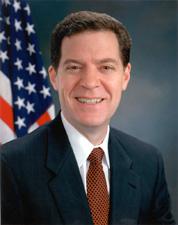 Sen. Sam Brownback (R-KS)
Legislative Activity
Stay on top of the latest movement without scrolling through every action
Roll call votes on amendments in Senate: Amendment SA 1140 as modified agreed to in Senate by Yea-Nay Vote. 94 - 0. Record Vote Number: 199.(text as modified: CR S5667)
May 20, 2009
View full timeline
Roll call votes on amendments in Senate: Amendment SA 1140 as modified agreed to in Senate by Yea-Nay Vote. 94 - 0. Record Vote Number: 199.(text as modified: CR S5667)
May 20, 2009
Senate amendment agreed to: Amendment SA 1140 as modified agreed to in Senate by Yea-Nay Vote. 94 - 0. Record Vote Number: 199.(text as modified: CR S5667)
May 20, 2009
Considered by Senate. (consideration: CR S5650, S5667-5669, S5687-5688)
May 20, 2009
Amendment SA 1140 as modified agreed to in Senate by Yea-Nay Vote. 94 - 0. Record Vote Number: 199. (text as modified: CR S5667)
May 20, 2009
Senate amendment submitted
May 19, 2009
Senate amendment proposed (on the floor): Amendment SA 1140 proposed by Senator Brownback.(consideration: CR S5602-5607; text: CR S5602)
May 19, 2009
Amendment SA 1140 proposed by Senator Brownback. (consideration: CR S5602-5607; text: CR S5602) To express the sense of the Senate on consultation with State and local governments in the transfer to the United States of detainees at Naval Station Guantanamo Bay, Cuba.
May 19, 2009
Votes
1 roll call on this amendment
Text
Modified
SUPPLEMENTAL APPROPRIATIONS ACT, 2009

The ACTING PRESIDENT pro tempore. Under the previous order, the
Senate will resume consideration of H.R. 2346, which the clerk will
report by title.
The assistant legislative clerk read as follows:

A bill (H.R. 2346) making supplemental appropriations for
the fiscal year ending September 30, 2009, and for other
purposes.

Pending:

Inouye-Inhofe amendment No. 1133, to prohibit funding to
transfer, release or incarcerate detainees detained at
Guantanamo Bay, Cuba, to or within the United States.
McConnell amendment No. 1136, to limit the release of
detainees at Guantanamo Bay, Cuba, pending a report on the
prisoner population at the detention facility at Guantanamo
Bay.
Cornyn amendment No. 1139, to express the sense of the
Senate that the interrogators, attorneys, and lawmakers who
tried in good faith to protect the United States and abide by
the law should not be prosecuted or otherwise sanctioned.
Brownback amendment No. 1140, to express the sense of the
Senate on consultation with State and local governments in
the transfer to the United States of detainees at Naval
Station Guantanamo Bay, Cuba.

Amendment No. 1133

The ACTING PRESIDENT pro tempore. Under the previous order, there
will be 2 hours of debate, equally divided and controlled between the
leaders or their designees, with respect to amendment No. 1133, with
the first 30 minutes under the control of the Republican leader, the
second 30 minutes

[[Page S5651]]

under the control of the majority leader, and the final 60 minutes
divided equally, with Senators permitted to speak for up to 10 minutes,
with the final 5 minutes under the control of the Senator from Hawaii,
Mr. Inouye.
The Senator from South Carolina.
Mr. GRAHAM. Thank you, Mr. President.
No. 1, I would like to associate myself with the comments of the
minority leader about Guantanamo Bay. It is a location that does
protect our national interests in terms of a location. It is probably
the best run military prison in the world. I have been there several
times.
To the guard force and those who are serving at Guantanamo Bay, in
many ways, you are the unsung heroes in this war because it is tough
duty. You have to go through a lot to be a member of the Guantanamo Bay
guard team.
They do a wonderful job. It is a very Geneva Conventions-compliant
jail, and there are some pretty bad characters down there who make life
miserable for our guard force. But those who serve at Guantanamo Bay do
so with dignity and professionalism. Their motto, I believe, is ``honor
bound.'' That certainly reflects upon them well.

The idea of the Congress saying we want to plan before we appropriate
money to close Guantanamo Bay makes a lot of sense to me. We see a
bipartisan movement here to make sure we know what we are going to do
with the detainees who are housed at Guantanamo Bay. The American
people should be rightly concerned about how we dispose of these
prisoners. Quite frankly, they are not common criminals accused of
robbing a liquor store; they are accused of being a member of al-Qaida
or allied groups that have taken up arms against the United States.
Their mission and their purpose is to destroy our way of life and to
put our allies and friends in the Mideast into the dark ages. So if you
do not want to go back to the dark ages in terms of humanity; if you
want young girls to grow up without having acid thrown in their face;
if you want a young woman to be able to have a say about the future of
her children in the Mideast, then we need to come up with a rational
policy regarding fighting al-Qaida and, once we catch them, how to
dispose of their cases and make sure they are not only fairly treated
but their mission and their goals are defeated and they do not return
to the fight.
We have seen in Iraq that there are Muslim populations that do not
want to be part of the al-Qaida agenda. Al-Qaida followed us to Iraq
because they understood if we were successful there in creating a
democracy in the heart of the Mideast, it would be a threat to their
agenda. Iraq has a way to go, but I am very proud of the Iraqi people.
They have come together. They are making political reconciliations.
Their army and police forces are getting stronger. The story of the
surge is that the Iraqi people joined with our forces and coalition
forces and delivered a mighty blow against al-Qaida. Al-Qaida is, quite
frankly, in the process of being defeated by the Iraqi people with our
help. Now the fight goes to Pakistan and Afghanistan. I cannot think of
a more noble cause than to take up arms and fight back against these
terrorists who wish the world ill, who will do anything in the name of
their religion to have their way, and who would make life miserable for
parts of this world and eventually make life miserable for us.
Imagine a caliphate being established in Baghdad, which was their
plan, to put the Mideast in constant turmoil. We would not be able to
travel freely in this world. We could not interact or do business with
the people in the Mideast. It is a very oil-rich region, so it is in
our national security interests to stand with moderate people in the
Mideast and other places where al-Qaida attempts to take over, and
fight back. But when we fight back, we don't have to be like them.
Quite frankly, if we are like them when we fight back, we will lose.
This is an ideological struggle. There is no capital to conquer.
There is no navy to sink or air force to shoot down. We cannot kill
enough of the terrorists to win the war. What we have to do is contain
them, fight them, and empower those who live in the region who want to
live in a different way, give them the capacity to defend themselves
and bring about a stable life in their countries. That is what we are
trying to do in Iraq. If we win in Iraq, we will have a democracy in
the heart of the Arab world that will be an ally to this country in
perpetuity. We will have replaced a dictator named Saddam Hussein, and
we will have a place where we can show the world that there are Muslims
who do not want to be governed by the al-Qaida agenda, and to me that
is a major win in the war on terror. Now we are in Afghanistan. We have
lost ground, but we are about to recapture that ground from the
Taliban, which are al-Qaida sympathizers and, quite frankly, allowed
them to operate in Afghanistan late in the last century and early in
this century to plan the attacks of 9/11.
So that is why we are fighting. That is why we are in this
discussion. That is why we are concerned about releasing these
prisoners within the United States, and that is why we are concerned
about Guantanamo Bay. We have every right and reason to be concerned as
to how we move forward.
I want to move forward. We need a plan to move forward. We should not
close Guantanamo Bay until we have a comprehensive, detailed, legal
strategy as to what we will do with these prisoners. Where we put them
is only possible if people know what we will do with them. So we have
to explain to the American people and our allies the disposition plan.
What are we going to do with these detainees? Then where you put them
becomes possible. Without what to do, we are never going to find where
to put them.
I do believe the President and our military commanders are right when
they say it is time to start over. It is a shame we are having to start
over, because Guantanamo Bay is a well-run jail. But as I mentioned
before, this ideological struggle we are engaged in, the enemy has
seized upon the abuses at Abu Ghraib, the mistakes at Guantanamo Bay,
and they use that to our detriment. They inflame populations in the
Mideast based on our past mistakes. Our commanders have told me to a
person that if we could start over with detention policy and show the
world that we have a new way of doing business--a better way of doing
business--it would improve the ability of our troops to operate in the
regions in question where the conflict exists; it would undercut the
enemy; it would help our allies be more helpful to us. Our British
friends are the best friends we could hope to have, and they have had a
hard time with our detainee policy. So we have every reason in the
world to want to start over, but the Congress is right not to allow us
to start over until we have a plan. The Congress, in a bipartisan
fashion, is absolutely right to keep Guantanamo Bay open until we have
a complete plan. I do believe this President understands how to move
forward with Guantanamo Bay.
The best way to move forward, in my opinion, is to collaborate with
the Congress, to look at the military commission system, which I think
is the proper venue to dispose of any war crimes trials. Remember,
these people we are talking about have been accused of taking up arms
against the United States. They are noncitizen, enemy combatants who
represent a military threat. Military commissions have been used to try
people such as this for hundreds of years. We did trials with German
saboteurs who landed on the east coast of the United States for the
purpose of sabotaging our industries. They were captured and tried in
military commissions. So there is nothing new about the idea of a
military commission being used against an enemy force.
I do think the President is right to reform the current commission.
I, along with Senator McCain, Senator Warner, and others--Senator Levin
particularly--had a bill that set up a military commission process that
received complete Democratic support on the Armed Services Committee,
and four Republicans. I think that document is worth going back to. The
ideas the President has put on the table about reforming the
commission, quite frankly, make a lot of sense to me.
So we do need to move forward. We do need to start over. If we could
start over with a new detention policy that is comprehensive, it would
help our war effort, it would help operations in the countries in
question and in the

[[Page S5652]]

Mideast at large, and it would repair damage with our allies. Quite
frankly, we have lost a lot of court decisions. It would give us a
better chance to win in court.
What do I mean by starting over? Come up with a disposition plan that
understands that the detainees at Guantanamo Bay represent a military
threat and apply the law of armed conflict in their cases. That means
we have to treat them humanely. The Geneva Conventions now apply to
detainees under Common Article 3 held at Guantanamo Bay based on a 2006
Supreme Court decision. We are bound by that convention because we are
the leader of the convention. We have signed up to the convention. As a
military lawyer for 25 years, I hold the Geneva Conventions near and
dear to my heart, as every military member does, because it will
provide protections to our troops in future wars. Yes, I know al-Qaida
will not abide by the conventions but, quite frankly, that is no excuse
for us to abandon what we believe in. When you capture an enemy
prisoner, it becomes about you, not them. They don't deserve much, but
we have to be Americans to win this war. There are plenty people in
this world who would cut your head off without a trial. I want to show
the world a better way. How we dispose of these prisoners can help us
in the overall ideological struggle.

What I am proposing is that we come up with a comprehensive plan that
will reform the military commissions and that the President come back
to the Congress and we have another shot at the commissions to make
them more due process friendly but we realize that the people we are
trying are accused of war crimes and we apply the law of armed
conflict.
I have been a military lawyer, as I said, for 25 years. The judges
and the jurors and the lawyers who administer justice in a military
commission setting are the same people who administer justice to our
own troops. It is a great legal forum. You have rights in the military
legal system. You get free legal counsel. Usually cost is not an
object. The men and women who wear the uniform who serve as judge
advocates take a lot of pride in their job. They are great Americans.
They are great officers. They believe in justice. We have seen
verdicts, and the few verdicts we have had at Guantanamo Bay indicate
that our juries are rational. Our military jurors do hold the
prosecution to the standards of proof and they balance the interests of
all parties. As I say, I have never been more impressed with the legal
system than within our military justice system. Military commissions
need to be as much like a court-martial as possible, but practicality
dictates some differences.
The one thing this body needs to understand is that it is illegal
under the Geneva Conventions to try an enemy prisoner in civilian
court. Why is that? You are afraid that civilian justice, jurors and
judges, will have revenge on their mind. They are not covered by the
Geneva Conventions. Participants in a military commission are covered
by the convention--every lawyer, every judge, every juror. They have an
obligation to hold to the tenets of the convention and any misconduct
on their part in a trial could actually result in prosecution to them
or disciplinary action, and that would not be true in the legal world.
So having these trials in a military commission setting is the proper
venue because they are accused of war crimes. Having the trials in
military commissions is consistent with the Geneva Conventions. It is a
world-class justice system. Quite frankly, it is the best place to
balance our national security interests.
But to the hard part. We can do that. We can reform the commissions.
Some of these detainees can be repatriated back to third countries in a
way I think is rational and will not hurt our national security
interests. But there is going to be a group of detainees--maybe half or
more--where the evidence is sound and certain that they are a member of
al-Qaida, but it is not of the type that you would want to go to a
criminal trial with. It may have third country intelligence service
information where the third country would not participate in a criminal
trial because it would compromise their operations. Some type of
evidence would be such that you would not disclose it in a criminal
trial because it would compromise national security. You have to
remember, when you try someone criminally, you have to prove the case
beyond a reasonable doubt. You have to share the evidence with the
defendant. You have to go through the rigors of a criminal prosecution.
Under a military commission people are presumed innocent, and that is
the way it should be. But I want America to understand that we are not
charging everyone as a war criminal; we are making the accusation that
you are a member of al-Qaida. In military law what you have to do if
you are accusing someone of being part of the enemy force is prove by a
preponderance of the evidence that you are, in fact, a part of the
enemy force.
So what I would propose is to set up a hybrid system. For every
detainee once determined to be an enemy combatant by our military or
CIA, there will be a process to do that, a combat status review
tribunal, and we need to improve that process--but you run each
detainee through that process and if the military labels them as an
unlawful enemy combatant, a member of al-Qaida, then we will do
something we have never done in any other war, and that is allow that
detainee to go into Federal court.
Under article 5 of the Geneva Conventions, status decisions are made
by the military, not by civilian judges. It is usually done by an
independent member of the military in an administrative setting. These
are administrative hearings. But this war is different. There will
never be an end to this war. We will never have a signing on the
Missouri as we did in World War II. I realize that. An enemy combatant
determination could be a de facto life sentence. So I am willing to
build in more due process to accommodate the nature of this war.
What I have proposed is that every detainee determined to be an enemy
combatant by our military would go to a group of military judges with
uniform standards where the Government would have to prove to an
independent judiciary by a preponderance of the evidence that the
person is, in fact, an enemy combatant, and if our civilian judges who
are trained in reviewing evidence agree with the military, that person
can be kept off the battlefield as long as there is a military threat.
About 12 percent of the detainees released from Guantanamo Bay have
gone back to the fight. The No. 2 al-Qaida operative in Somalia is a
former Gitmo detainee. It is true we put people in Gitmo, in my
opinion, where the net was cast too large and they were not properly
identified. You are going to make mistakes. What I want to do is have a
process that our Nation can be proud of: transparent, robust due
process, an independent judiciary checking and balancing the military,
but never losing sight that the goal is to make sure that the
determination of enemy combatant is well founded and, if it is, not to
release people back to the fight knowing they are going to go back and
kill Americans. That doesn't make us a better nation, to have a process
where you have to let people go when the evidence is sound and clear
they are going to go back to the fight. That does not make us a better
people. You do not have to do that under the law of armed conflict.
Let's come up with a new system that will give every detainee a full
and fair hearing in Federal court. If they are tried for war crimes,
put them in a new military commission, and every verdict would be
appealed to civilian judges. Let the trials be transparent. Balance
national security against due process. But never lose sight of the fact
that we are dealing with people who have taken up arms against the
United States. Some of them are so radical and their hearts have been
hardened so much, they are so hate-filled, it would be a disaster to
this country and the world at large to let them go in the condition
that exists today.

Where to put them. Mr. President, 400,000 German and Japanese
prisoners were housed in the United States during World War II, and 15
to 20 percent, according to the historical record, were hardened Nazis.
A hardened Nazi is at the top of the pecking order when it comes to
mass murder. The idea that we cannot find a place to securely house
250-plus detainees within the United States is not rational. We have
done this before. They are not 10 feet tall.

[[Page S5653]]

It is my belief that you need a plan before you close Gitmo, and when
you look at a new facility, it needs to be run by the military because
under the Geneva Conventions you cannot house enemy prisoners in
civilian jails.
I look forward to working with the President of the United States to
start over, but we need a plan to start over--a plan to try these
people, consistent with the law of armed conflict, in a military
commission that is reformed, that will administer justice fairly and
balanced and will realize that these people present a military threat.
We need a system to allow for keeping the detainees off of the
battlefield--who are committed jihadists--that will allow them to have
their day in court with an independent judiciary but also will allow a
process that will keep them off the battlefield as long as they are
dangerous. If the judges agree with the military on the enemy
combatant, you should have an annual review process to determine
whether they present a military threat. No one should be held without a
pathway forward, but no one should be released because you think this
is a crime we are dealing with.
If you criminalize this war and do not use the law of armed conflict,
you are going to make a huge mistake. There are countries that have
terror suspects in jail right now that are about to have to release
them because under criminal law you cannot hold them indefinitely.
Under military law, you can hold the enemy force off the battlefield if
they are properly identified as part of that force, as part of the
military threat. That has been the law for hundreds of years, and it
ought to be the law we apply. Where we put them is important, but what
we do with them is more important, how we try them and detain them.
We have a chance to show the world that there is a better way, a
chance to showcase our values. Yes, give them lawyers and put the
evidence against them under scrutiny. Put burdens on ourselves, make us
prove the case--not just say it is so, prove it in a court that is
appropriate for the venue we are talking about, appropriate for the
decisions we are about to make. Put that burden on us, and treat them
humanely because that is the way we are. That may not be the way they
are, but that is the way we are. That makes us better than they. The
fact that we will do all these things and they won't is a strength of
this Nation, not a weakness. Some people in the past have lost sight of
that. The fact that we give them lawyers and a trial based on the
evidence, not prejudice and passion, makes us stronger.
We will find a better way to do what we have been doing in the past.
We will find a way to close Gitmo, and we will come up with a new plan
because we are Americans and we are committed to our value system and
committed to beating this enemy.
I look forward to working with the Members of this body to come up
with a comprehensive disposition plan that will find a new way to try
these people, a new process to hold them off the battlefield, and
always operating within our values, which will allow our commanders the
chance to start over in the region. Every military commander I have
talked to said it would be beneficial to this country to start over
with detainee policy. They also understand that we are at war and we
need to have a national security system.
As to where we put them, there were six prison camps in South
Carolina during World War II. There is a brig near the city of
Charleston, a naval brig. It is not the location, because it is near a
population center. The place I have in mind is an isolated part of the
United States--if necessary--that will be run by the military, with a
secure perimeter, that will be operating within the Geneva Conventions
requirement, that will have a justice system attached to it, that will
be transparent and open where we can administer justice and reattach
our Nation to the values we hold so dear.
Part of war is capturing prisoners. That is part of war. We know what
the other side does when they capture a prisoner. Let the world know
that America has a better way, a way that will not only make us safe
but help us win this war.
In conclusion, the goal of this effort to start over is to undermine
the enemy's propaganda that has been used against us because of our
past mistakes, allow our allies to come join us in a new way forward,
and protect us against a vicious enemy that needs to be held off the
battlefield, maybe forever. Some of these people are literally going to
die in jail, and that is OK with me because I think the evidence
suggests that if we ever let them out, they would go back to killing
Americans, our friends, and our allies. I will not shed a tear. The way
to avoid getting killed or going to jail forever is, not to join al-
Qaida. If you have made that decision to do so, let it be said that
this Nation is going to stand up to you and fight back, within our
value system. Some of these people will never see the light of day, and
that is the right decision. Some of them can be released.
Let's have a process that understands what we are trying to do as a
nation. Make sure it is national security oriented, make sure it is
within our value system but also that everything we do is as a result
of a nation that has been attacked by these people. They have not
robbed a liquor store; they have tried to destroy our way of life. The
legal system I am proposing recognizes that distinction.
I yield the floor.
The ACTING PRESIDENT pro tempore. The Senator from South Dakota is
recognized.
Mr. THUNE. Mr. President, I rise to express my strong support for the
Inouye-Inhofe amendment and suggest to my colleagues that this should
not be a controversial amendment. In fact, I commend my colleagues on
the Democratic side for recognizing the futility of trying to put
funding in the bill that we are debating here without having a plan
with which to close Guantanamo Bay.
It seems to me, at least, that a lot have gotten up and argued that
having Guantanamo Bay open as a detention facility makes our country
less safe. I argue the contrary. That didn't exist prior to 9/11, and
we were attacked anyway. The people who want to attack us don't need an
excuse; they are going to attack us anyway. They are going to attack us
because they hate us and they hate our way of life and the things we
stand for and because that is what they do. They have hate in their
hearts. I believe we need to have a place where we can detain people
like that. It seems to me at least that the Guantanamo Bay facility
fits perfectly within the definition of what makes sense. It is a
state-of-the-art facility, a $200 million facility. Nobody has ever
escaped from it. It is a very secure facility. It is hundreds of miles
away from American communities.
One thing I point out to my colleagues is that we have already
expressed our view here in the Senate about whether these detainees
ought to be transferred somewhere here into American society and into
facilities in American communities and neighborhoods. In July of 2007,
we took a vote in the Senate, and by a vote of 94 to 3, the Senators
voted in favor of a resolution that would prevent these detainees from
coming here--being released into American society or transferred into
facilities in American communities and neighborhoods. Those in favor of
that resolution at the time included both the current Vice President of
the United States and the current Secretary of State.

My hope would be that this amendment offered by the Senator from
Oklahoma and the Senator from Hawaii will receive that same measure of
support that was accorded to the amendment adopted in the Senate in
July of 2007 by a vote of 94 to 3. This amendment should receive that
same measure of support.
As I noted last week in a speech on the floor, President Obama told
us, when he issued his January 22 Executive order to close Guantanamo,
that he would work with Congress on any legislation that might be
appropriate. Instead of consulting Congress, the President asked for
$80 million to close Guantanamo, with no justification or indication of
any plan.
I believe any plan to close Guantanamo that includes bringing these
terrorists into the United States is a mistake. We don't want the
killers who are held there to be brought here into our communities.
It is deeply troubling that not only does the Obama administration
wish to hold open the possibility that some detainees might be
transferred to facilities in American communities, it is

[[Page S5654]]

even considering freeing some of them into American society. These are
the 17 Chinese Uighers whose Combat Status Review Tribunal records were
deemed insufficient to support the conclusion that they are enemy
combatants but who cannot be returned to China because of fear that the
Chinese Government will torture or kill them.
At a press conference on March 26, ADM Dennis Blair, the Director of
National Intelligence, said this:

If we are to release them [the Uighers] in the United
States, we need some sort of assistance for them to start a
new life.

It is hard to believe that this administration is seriously
considering freeing these men inside the United States and, most
outrageous of all, paying them to live freely within American
communities and neighborhoods. The American people don't want these men
walking the streets of America's neighborhoods.
The American people don't want these detainees held in a military
base or a Federal prison in their backyard either. These are not common
criminals; these are hardened killers bent on the destruction of the
United States. They are resourceful, these people are innovative, and
they understand the strategic vulnerabilities of the United States and
how to exploit those very vulnerabilities. Who would have predicted
that this group of people would basically be able to steal a fleet of
planes and cause death and destruction on the scale and magnitude of
Pearl Harbor? It is hard to imagine a more dangerous set of
circumstances to put upon an American community.
Since President Obama seems set on a course to bring terrorists into
the United States, I strongly support the efforts of Senators Inhofe
and Inouye to introduce this amendment. The amendment would prevent any
funding in the bill from being used to transfer detainees held at
Guantanamo Bay to any facility in the United States or to construct,
improve, modify, or otherwise enhance any facility in the United States
for the purpose of housing any Guantanamo detainees.
If we must close Guantanamo Bay, it should not result in Americans
being less safe. Bringing these detainees to the United States would
make Americans less safe, and we should not do it.
Transferring these detainees would also stress the civilian
governments in the communities where the detainees would be placed.
They would be faced with overwhelming demands, from roadblocks to
identification checks, along with having the increased security
personnel necessary to deal with what is an obvious threat. The value
of homes and businesses would decline.
I can tell you that South Dakotans definitely don't want these
detainees in their State. I hope my support of the Inouye-Inhofe
amendment will help to ensure that they will not be transferred to
South Dakota or to anywhere else in the United States.
My view is that no Guantanamo detainee should be brought to this
country to be incarcerated and certainly should not be brought into the
United States and freed. The Senate has clearly spoken on that front,
as I said, by a vote of 94 to 3 on a resolution, in July 2007, that
detainees housed at Guantanamo Bay should not be released into American
society and not transferred stateside into facilities in American
communities and neighborhoods.
Guantanamo is secure. The facility is a $200 million state-of-the-art
prison. No one has ever escaped, and the location makes it extremely
difficult to attack. Best of all, it is located hundreds of miles from
American communities. If the President wants to close Guantanamo, he
must do so in a way that keeps America safe. In my view, America is
less safe if Guantanamo detainees are brought into the United States.
I appreciate the hard work of Senator Inhofe and Senator Inouye on
this issue. I hope when we have the vote today, my colleagues will
adopt this amendment with the same level of support that we adopted the
resolution back in July of 2007 by a vote of 94 to 3, stating very
clearly that it is the view of the Senate that these detainees should
not be brought into American communities, into American neighborhoods.
I would argue they ought to be held right where they are, in a place
that is safe, that is secure, that is state of the art, where they
receive the very best of treatment, where no one has ever escaped,
hundreds of miles away from American communities and neighborhoods.
I hope my colleagues will support this amendment.
I yield the floor. I suggest the absence of a quorum, and I ask
unanimous consent that the quorum call be charged equally to both
sides.
The ACTING PRESIDENT pro tempore. Without objection, it is so
ordered. The clerk will call the roll.
The bill clerk proceeded to call the roll.
Mr. DURBIN. Mr. President, I ask unanimous consent that the order for
the quorum call be rescinded.
The ACTING PRESIDENT pro tempore. Without objection, it is so
ordered.
Mr. DURBIN. Mr. President, it is my understanding that we are on the
supplemental appropriations bill at this point.
The ACTING PRESIDENT pro tempore. That is correct.
Mr. DURBIN. Mr. President, I want the record to show that I support
President Obama's supplemental request for the remainder of fiscal year
2009. This supplemental provides critical funding for military and
security efforts in Afghanistan, Pakistan, and Iraq. A small portion is
for international programs, including assistance to Jordan, one of our
important allies in the Middle East. Jordan is struggling with a huge
influx of Iraqi refugees that strains its national services and
particularly its water resources. Jordan has been a friend and ally,
and it is right that in the supplemental bill we give them a helping
hand because the war in Iraq has created a situation which we should
address in Jordan.
It also provides additional support to the Global Fund which partners
with other nations to tackle AIDS, tuberculosis, and malaria. I have
worked with my colleagues for years to provide adequate funding for the
Global Fund. I am glad this supplemental request from the Obama
administration continues critical food assistance to help meet urgent
needs of the world's poorest, which is also included. Funding is
provided to help stem the flow of drugs and violence across our border
in Mexico.
At home, the supplemental includes money to prepare and to respond to
a global disease pandemic, including the recent H1N1 virus. This $1.5
billion went through my subcommittee and is money well spent so the
President can have resources to respond quickly to any outbreak of
disease or pandemic; that we would have adequate money for
vaccinations, as well as providing medications, should people be
stricken. We are looking ahead, planning ahead, thinking ahead, hoping
the H1N1 will disappear from the world scene before the next flu season
but being prepared if it does not or if something else threatens us.
This bill also provides funds critical to helping President Obama
meet a key campaign promise--bringing an end to the war in Iraq. In
late February, President Obama made an important announcement to
thousands of marines at Camp Lejeune: bringing an end to the war in
Iraq. After only 5 weeks into office, he delivered on his major
campaign promise to end one of the longest wars in American history.
The President's plan is measured, thoughtful, and will bring an end
to this costly and unnecessary war. The supplemental also wisely shifts
resources to the real sources of the September 11 attacks on America--
Afghanistan. For too long, this war in Afghanistan did not receive
adequate civilian and military resources as they had been diverted to
the war in Iraq. The supplemental corrects this mistake.
It also focuses resources on Pakistan, a nuclear-armed nation
struggling with insurgents based in the border area with Afghanistan.
It provides pay and allowances to our brave men and women in the U.S.
military. These are some of the many important needs which deserve our
support.
The President should be commended for recently presenting a budget
for 2010 which moves away from repeated supplementals. This got to be a
habit around here. We didn't go through an orderly debate on the budget
about wars. Every time President Bush wanted money for a war, he said:
I am declaring this an emergency. It will not be considered in the
ordinary budget process. Here it is.
An emergency is defined as something unanticipated. After 5 or 6
years

[[Page S5655]]

of emergencies, you begin to realize you can anticipate next year we
are going to have another unanticipated emergency.
This President, President Obama, wants to change that so that we go
to an orderly budget process. This supplemental bill will be the last
of the requests, and I think it is one we should honor as he tries to
tackle some situations that were given to him when he took office just
a few months ago. The President inherited many challenges at home and
abroad, and I hope, on a bipartisan basis, we can help him address
them.
This supplemental appropriations bill will provide critical funding
for our troops in Afghanistan and Iraq, and I hope Congress passes it.
Unfortunately, my colleagues on the other side of the aisle have
decided to use this legislation to open a debate about the future of
Guantanamo. They have filed a number of amendments related to this
issue. I am sure it is not their intention, but these amendments will
have the effect of slowing down delivery of critical funding for our
troops. Nevertheless, it is their right to offer these amendments, and
though they are not germane to this legislation, they raise policy
questions which we can debate.
Senator Inouye, the chairman of the Appropriations Committee, has
offered an amendment, which has broad support on both sides of the
aisle, that will eliminate any funding in this bill for closing
Guantanamo and make clear that none of the funds in this bill can be
used to transfer Guantanamo detainees to the United States.
Here is the bottom line: There will not be any Guantanamo funding in
this bill. So for the Republicans to bring up a series of Guantanamo
amendments tells me they are more intent on raising an issue than on
responding to the critical need this supplemental addresses.
These amendments are also premature. President Obama has not yet
presented his plan for closing Guantanamo to the Congress and the
American people. When he does, we will have plenty of opportunity to
debate it. This bill, which will provide critical funding for our
troops, is not the right place for this debate. This is not the right
time. In fact, some of the amendments would have the effect of tying
President Obama's hands, preventing him from moving forward with the
closure of Guantanamo before he has even had the chance to present his
plan.
There is a great irony here. For 8 long years, Republicans opposed
congressional oversight of the Bush administration's counterterrorism
efforts. When Democrats in the minority during the Bush years would ask
for oversight by congressional committees so that we could get more
information about a variety of issues relative to terrorism, we were
told: No, the President has an important job to do and don't bother
him, Congress; leave him alone.

For 8 years, Republicans criticized Democrats who asked questions
about the misguided war in Iraq and controversial policies related to
interrogation, detention, and warrantless surveillance.
For 8 years, they claimed congressional oversight was nothing more
than micromanaging the important and critical work of the Commander in
Chief.
Now, after 8 long years, the Republicans are unwilling to give
President Obama a few short months to formulate and present a plan for
closing Guantanamo.
Let's take one example. The distinguished minority leader, Senator
McConnell, has offered an amendment that would require the President to
submit a detailed report to Congress on each detainee at Guantanamo
Bay, including a summary of the evidence against each detainee.
For many years, the Bush administration refused to provide Congress
with even a list of the names of the detainees at Guantanamo. They
claimed that a disclosure of those names would threaten national
security. I don't recall Senator McConnell or anyone from his side of
the aisle protesting this lack of disclosure by the previous
administration.
Yesterday, Senator McConnell said his amendment is designed to
prevent released Guantanamo detainees from getting involved in
terrorism. He said:

Recidivism is of great concern for those of us who have
oversight responsibilities here in Congress.

I do not recall Senator McConnell, or any other Republican,
protesting when the Bush administration, over the course of many years,
released hundreds of Guantanamo detainees, some of whom have actually
been involved in acts of terrorism since they were released.
So during the Bush years, while Guantanamo was churning hundreds of
detainees, some being released and returned to their countries, there
was not a whimper or a peep from the Republican side of the aisle. Now
that President Obama has said the days of Guantanamo are numbered, they
are coming in asking for detailed accounting of every single detainee.
It is clearly a double standard.
There is also concern that the McConnell amendment could taint
prosecutions of Guantanamo detainees by requiring the Obama
administration to turn over critical evidence to Congress. Imagine for
a moment that we gathered evidence that can be used successfully to
either detain or prosecute one of the detainees, and Senator McConnell
insists that it be shared with Members of Congress. Is that in the
interest of national security? I don't think so.
For 7 years after the 9/11 attacks, the Bush administration failed to
convict any of the terrorists who planned these attacks. At President
Obama's direction, career prosecutors are now reviewing the files of
each Guantanamo detainee and gathering evidence to determine if each
detainee can be prosecuted. Isn't that what we want, an orderly process
looking at each detainee to determine whether they are guilty of
wrongdoing, deciding whether they can be prosecuted, whether they
should be detained and doing this with the understanding that a lot of
the information is classified and most of it should be carefully
guarded so as not to jeopardize the prosecution?
The McConnell amendment would say: Let Congress take a look at each
detainee and all the evidence. That does not make sense, and I hope
Members of the Senate will reject it.
The last thing Congress should do is interfere with the efforts of
the Obama administration to gather evidence against terrorists that
could ultimately bring them to justice.
There is another amendment. Senator John Cornyn of Texas has an
amendment that has 18 detailed findings about the Bush administration's
use of abusive interrogation techniques, such as waterboarding.
Among other things, the Cornyn amendment claims these techniques
``accomplished the goal of providing intelligence necessary to defeat
additional terrorist attacks against the United States.'' To say the
least, we could debate that proposition for quite some time.
Former Vice President Cheney has been burning up the cable channel
airwaves in recent weeks. He claims waterboarding produced valuable
intelligence in the interrogation of al-Qaida leader Abu Zubaydah. But
back in 2004, Vice President Cheney also told us the Bush
administration had learned from interrogations at Guantanamo that the
Iraqi Government had trained al-Qaida in the use of biological and
chemical weapons. We now know there was no such link between al-Qaida
and Iraq. This was part of the justification for the invasion of Iraq,
and Vice President Cheney told us the interrogation at Guantanamo was
producing the information to confirm a link that never existed.
What about Abu Zubaydah? Just last week in the Judiciary Committee we
heard testimony from a former FBI agent who actually interrogated him.
He testified under oath in our committee that he obtained valuable
intelligence from Abu Zubaydah using traditional interrogation
techniques and that abusive techniques, such as waterboarding, are
``harmful, slow, ineffective, and unreliable.''
Senator Cornyn does not serve on the Intelligence Committee. I don't
know the basis for his claim that waterboarding produced intelligence
that prevented terrorist attacks. I do know the Intelligence Committee,
under Senator Dianne Feinstein's leadership, is now conducting a
detailed, thoughtful, and thorough investigation into the Bush
administration's detention and interrogation practices.

[[Page S5656]]

I have said publicly--others have said it as well, including the
majority leader, Senator Reid--that before we talk about creating an
outside commission, the Senate Intelligence Committee should be allowed
to do its work so Members of Congress can at least learn, through open
and classified information, what did happen. But Senator Cornyn can't
wait. Senator Cornyn wants to pass out ``get out of jail free'' cards
to the previous administration before we even have a thorough
examination of what happened.

One of the things the Intelligence Committee is reviewing is the
effectiveness of these techniques in obtaining useful intelligence. The
Senate is certainly not in a position today to go on record with
conclusions such as those in Senator Cornyn's amendment before the
Intelligence Committee even completes its investigation. It is not only
premature, it certainly is questionable as to whether we should be
engaged in this debate until their work is done.
I might remind Senator Cornyn, and those following this debate, that
the Intelligence Committee is a bipartisan committee. It works in a
bipartisan fashion. Senator Bond and Senator Feinstein and others can
continue to work together to come to good conclusions, to provide the
Senate with good evidence, before we jump at the Cornyn amendment,
which reaches conclusions not based on fact.
Senator Cornyn's amendment would also express the sense of the Senate
that no one involved in authorizing the use of abusive interrogation
techniques, such as waterboarding, should be prosecuted or sanctioned.
It is inappropriate for Congress to interfere in ongoing investigations
by the Justice Department.
During the Bush administration, political interference significantly
undermined the credibility and effectiveness of the Justice Department.
Attorney General Holder has pledged to restore the integrity and the
independence of that department.
There are two ongoing investigations into the Bush administration's
interrogation practices. One investigation is looking into the CIA's
destruction of evidence of interrogation videotapes. The other is an
investigation of Justice Department attorneys who authorized abusive
techniques such as waterboarding.
Here is the reality: Both of these investigations didn't begin under
President Obama. They began under the Bush administration. Both are
being conducted by Department of Justice attorneys. So the suggestion
that this is some partisan witch hunt is obviously false.
You wonder, with these two Department of Justice investigations
underway and with the Senate Intelligence Committee doing a thorough
investigation of this subject, why does Senator Cornyn want to come to
the floor and have the Senate go on record saying that nothing possibly
could have been done that was illegal or wrong? That would be the
height of irresponsibility, should we pass that amendment.
Decisions about whether crimes were committed should be made by
career prosecutors based on the facts and the laws, not political
considerations or statements made by Senators on the floor without
evidence to back them up. I urge my colleague from Texas to withdraw
his amendment and allow the Justice Department to do its work.
There is an organization which I like and respect very much called
Amnesty International. When you take a look at John Cornyn's amendment,
he would qualify for some amnesty award because he wants the Senate to
go on record offering amnesty when it comes to the interrogation of
detainees by not only--and let me go through the list--any person who
relied in good faith on those opinions at any level of our Government,
but also it includes Members of Congress who were briefed on the
interrogation program.
To offer this kind of a statement ahead of time, without any
gathering of evidence or fact, is, in my mind, an indication of how
nervous some people are on the other side of the aisle. We should let
this run its course in a professional manner. We shouldn't make a
political decision, and we should defeat the Cornyn amendment.
Several of my Republican colleagues came to the floor yesterday to
criticize President Obama's intention to close Guantanamo and argue it
should remain open. I listened carefully to their arguments, and,
frankly, there were enough red herrings to feed all the detainees at
Guantanamo.
One of my colleagues said President Obama wants to close Guantanamo
``to be more popular with the Europeans.''
Well, I know President Obama. I served with him. He was my colleague
in the Senate. His first interest is the United States and its safety.
But the safety of the United States also involves being honest about
what has happened. What happened at Abu Ghraib and what happened at
Guantanamo has sullied the reputation of the United States and has
endangered alliances which we have counted on for decades. President
Obama is trying to change that. By closing Guantanamo and responsibly
allocating those detainees to safe and secure positions, he is going to
send a message to the world that it is a new day in terms of America's
foreign policy.
The American people want to see that. They want a safer world and
believe that if the United States can work closely with our allies
around the world who are opposed to terrorism, we will be safer. That
is what President Obama is setting out to do. Some of those allies may,
in fact, be European. They may be African or Asian. They could be from
all corners of the Earth. But if they share our values and want to work
for common goals, President Obama wants to work with them.
GEN Colin Powell and many other military leaders have said for some
time that closing Guantanamo will make America safer. Experts say
Guantanamo is a recruitment tool for al-Qaida and hurts our national
security. That is why President Obama, like President Bush, Senator
John McCain, and many others, wants to close Guantanamo.
Some of my Republican colleagues argued that Guantanamo is the only
appropriate place to hold the detainees because ``we don't have a
facility that could handle this in the United States'' and American
corrections officers would ``have no idea what they are getting into.''
Well, I would say to my colleagues who made those statements that they
ought to take a look at some of our secured facilities in the United
States and they ought to have a little more respect for the men and
women who are corrections officers, who put their lives on the line
every single day to keep us safe and who make sure those who are
dangerous are detained and incarcerated.
The reality is, we are holding some of the most dangerous terrorists
in the world right now in our Federal prisons, including the mastermind
of the 1993 World Trade Center bombing, the ``shoe bomber,'' the
``Unabomber,'' and many others.
Senator McConnell said yesterday, ``No one has ever escaped from
Guantanamo.'' Well, that is true, to the best of my knowledge. But it
is also true that no prisoner has ever escaped from a Federal
supermaximum security facility in the United States.
In fact, the Bureau of Prisons is currently holding 347 convicted
terrorists. Is Senator McConnell going to come to the floor and say
they should be moved from these Federal correctional facilities because
they pose a threat to the United States being incarcerated in the
continental United States? I haven't heard that. But in his efforts to
keep Guantanamo open at any cost, he wouldn't even consider allowing a
detainee to be brought to the United States for trial and being held,
even temporarily, in any type of secure facility.
Republicans are criticizing the President, but the reality is, they
do not have a plan themselves to deal with Guantanamo. I assume, from
Senator McConnell's statements, he would leave it open. He doesn't care
about the impact this might have on the United States around the world.
If he has a plan to close it, I would like to hear it. I think he ought
to come forward and join with President Bush, join with President
Obama, join General Powell, join Senator McCain, Senator Graham, and
others who have said Guantanamo should be closed. Otherwise,
unfortunately, he is being critical of the President's intentions
without producing his own approach.
The Bush administration had many years to deal with Guantanamo, but
they didn't follow through. President

[[Page S5657]]

Obama has taken on the challenge of solving one of the toughest
problems his administration faces, beyond the state of our economy. The
President is taking the time to carefully plan for the closing of
Guantanamo, with the highest priority being the protection of America's
national security.
I urge my Republican colleagues to withdraw these Guantanamo
amendments. These amendments don't fit in the supplemental
appropriations bill. They tie the President's hands and keep him from
making the necessary decisions to keep us safe and to make sure
terrorists do not, in any way, threaten the United States. They also
slow down our efforts to provide critical funding for our troops in
Afghanistan and Iraq.

I hope when this matter comes before the Senate in the hours ahead,
my colleagues will read carefully and closely, particularly the
amendments by Senator Cornyn and by Senator McConnell. The amendment by
Senator Cornyn, which grants a sense-of-the-Senate amnesty to those who
were involved in interrogation techniques, is not consistent with a
nation that is guided by the rule of law. For that Senator to make
conclusions in his amendment that have not been supported by evidence
and fact should be grounds enough for us to reject his amendment.
I don't know where these investigations in the Department of Justice
or the Intelligence Committee will lead, but if we are truly sworn to
uphold the Constitution and the laws of our land, we should allow them
to run their course with the facts and law being honestly considered by
those different panels.
Senator McConnell's amendment, which asks for more detailed
information about detainees at Guantanamo than any Republican ever
dared ask under the Bush administration, could jeopardize the
prosecution of terrorists. Is that a good idea? It is certainly not. I
certainly hope my colleagues will join me in opposing the McConnell
amendment as well.
I yield the floor.
The PRESIDING OFFICER (Mr. Begich). The Senator from Virginia.
Mr. WEBB. Mr. President, I ask unanimous consent to speak with
respect to an amendment I have filed.
The PRESIDING OFFICER. Without objection, it is so ordered.
Mr. WEBB. Mr. President, I have filed an amendment to this
supplemental appropriations bill which is designed to put more
transparency and more measurable control factors into the way we are
spending these appropriations with respect to the situation in
Pakistan.
I would begin by saying I have a great deal of concern, as do many
Members of this body, with respect to the achievability of some of the
strategic objectives that have been laid out by the new administration.
We are still looking for clear and measurable end points to the
strategy itself. At the same time, I believe the new administration
deserves an opportunity to attempt to bring a greater sense of
stability into that region. It is a big gamble.
As I mentioned to General Petraeus when he was testifying, and as I
mentioned to other witnesses before the Armed Services and the Foreign
Relations Committee, the biggest gamble we face with respect to the
policies that have been announced in Afghanistan and Pakistan are that
we are basically allowing ourselves to be measured by unknowns, over
which we have no real control. In Afghanistan, this is very clear, when
we put as one of our objectives the creation of an Afghani national
army. I asked General Petraeus if he could tell me at what point in the
Afghan history has there ever been a viable national army, and the
answer is, except for a period of about 30 years when the Afghanis were
sponsored by the Soviets, there was no viable national army. And even
there it was not one you would measure in the same context of what we
are saying we are going to attempt to achieve. So that puts our success
in the hands of a rather speculative venture but one I hope we can
achieve in some form.
I would also point out an article in the New York Times today, which
points out there was a good bit of American weaponry ammunition found
in the aftermath of battle between the Taliban and American forces,
which shows there are munitions that were procured by the Pentagon that
now seem to be in the hands of the troops who are fighting against
Americans. I would point out that is not unusual for this region. When
I was Secretary of the Navy more than 20 years ago, one thing we were
seeing in the Persian Gulf, with the Iranian boghammers attempting to
attack our vessels, was that some of the rocket-propelled grenades that
were found in these boghammers actually could be traced back to weapons
we had given the Afghani anti-Soviet fighters in Afghanistan. It is a
common occurrence in this region.
The question is, How we can minimize those sorts of occurrences?
With respect to Pakistan, the situation is even more difficult.
We have very few control factors in Pakistan in terms of where our
money goes when we send it in or what happens to our convoys that go
through Pakistan on the way to Afghanistan. Eighty percent of the
logistical supplies that go to Afghanistan go by ground through
Pakistan. We cannot defend those convoys. We have had many occurrences
since last summer where they have been interrupted, where they have
been attacked, trucks have been destroyed, and other vehicles have been
stolen, et cetera.
In Pakistan there are a number of reputable observers who point out
that some elements in the Pakistani military, particularly in their
intelligence services, actually have continued to assist the Taliban.
Because of--No. 1, the vulnerability of our supply routes; No. 2, the
instability of the Government itself, obviously which we are attempting
to assist; and No. 3, the focus of Pakistan in terms of its principal
national security objectives as being India rather than Afghanistan
itself--that leads to a situation where we must have a measurable
source of control and accountability over the money we are going to
appropriate to assist the situation in Pakistan as it relates to
international terrorism, the future stability of Pakistan, and
attempting to defeat al-Qaida.
With all that in mind, I asked a series of questions last week in the
Armed Services Committee to Admiral Mullen, the Chairman of the Joint
Chiefs of Staff. This basically was the line of questioning. First, do
we have evidence that Pakistan is increasing its nuclear program in
terms of weapon systems, warheads, et cetera? Admiral Mullen gave me a
one-word answer--yes. I declined to pursue that answer because I didn't
believe that was the appropriate place to have a further discussion.
But I did say, and I believe now, this should cause us enormous concern
at a time when we are having so much discussion in this country about
the potential that Iran would obtain nuclear weapons, where Pakistan,
an unstable regime in a very volatile part of the region, not only
possesses nuclear weapons but is increasing its nuclear weapons
program.
I then asked Admiral Mullen: Can you tell me what percentage of the
$12 billion that has gone to Pakistan since 9/11 has gone toward its
defense measures related to India or to other areas that are not
designed to address directly the terrorist threat or the activities of
the Taliban? The answer was we do not know. No. We cannot measure those
with any degree of validity because of the opaqueness in the Pakistani
Government.
I then asked him: Do we have appropriate control factors, in terms of
where future American money will go? Secretary Gates indicated there
were improved control factors, but we do not have the control factors
in Pakistan as now exist even in countries such as Afghanistan, with
all the difficulties in that country.
With all of that in mind, I drafted a simple amendment. I hope this
can go into the managers' package. I believe all of us who are going to
step forward right now and attempt to assist the administration can
agree that what we should have is a simple statement from the Congress,
from the appropriators, that none of the funds we are appropriating
could be used for either of these two purposes--No. 1, to support,
expand, or in any way assist the development or deployment of the
nuclear weapons program of the Government of Pakistan; or, No. 2, to
support programs for which these funds in the appropriations act have
not been identified.

[[Page S5658]]

It is a very simple amendment. It simply says no money will go
directly or indirectly to assist Pakistan's nuclear weapons program;
No. 2, no money will be spent in any way other than the way we have
identified it in this program and that the President must certify this
and must come back every 90 days and recertify whether any funds have
been appropriated for those purposes.
I hope the managers of this bill can accept this amendment. If not, I
will seek a vote on the floor.
I yield the floor.

Amendment No. 1144

The PRESIDING OFFICER. The Senator from Georgia is recognized.
Mr. CHAMBLISS. Mr. President, I rise to speak about amendment No.
1144, the Protecting America's Communities Act, which I am offering to
H.R. 2346, the supplemental appropriation bill.
Before I begin my comments, I ask unanimous consent to add Senator
Coburn as an original cosponsor of S. 1071, which is a collateral
stand-alone bill, as well as a cosponsor to amendment No. 1144.
The PRESIDING OFFICER. Without objection, it is so ordered.
Mr. CHAMBLISS. Mr. President, this amendment amends immigration law
to prohibit any detainee held at Guantanamo Bay Naval Facility from
being transferred or released into the United States. It is a little
bit different from the vote we are going to be taking at 11:30.
There are over 240 terrorists in U.S. custody at the military
detention facility in Guantanamo Bay, Cuba. Let me just describe some
of the individuals who reside at Guantanamo. Khalid Sheikh Mohammed--or
KSM--is the self-proclaimed, and quite unapologetic, mastermind of the
9/11 attacks. KSM admitted he was the planner of 9/11 and other
planned, but foiled attacks against the U.S. In his combatant status
review board, he admitted he swore allegiance to Osama bin Ladin, was a
member of al-Qaida, was the military operational commander for all
foreign al-Qaida operations, and much more. KSM and four other
detainees, who are charged with conspiring to commit the terrible 9/11
attacks, remain at Guantanamo.
In addition, Gitmo uses Abd al-Rahim al-Nashiri who was responsible
for the October 2000 USS Cole bombing which murdered 17 U.S. sailors
and injured 37 others. Also residing a Gitmo are Osama bin Ladin's
personal bodyguards, al-Qaida terrorist camp trainers, al-Qaida
bombmakers, and individuals picked up on the battlefield with weapons
trying to kill American soldiers--our young men and women who
patriotically serve their country. The detainees at Guantanamo are some
of the most senior, hardened, and dangerous al-Qaida figures we have
captured.
These are exactly the type of individuals we hope never get past our
front lines and enter into the United States. However, as one of his
very first acts in January, President Obama ordered the closure of
Guantanamo, but 4 months later he still does not have a plan to
accomplish this. Officials in his administration have stated publicly
that some of these detainees could be brought to the U.S., and some
could even be freed into the United States.
The disposition of the detainees at Gitmo is not a new issue. Over
the past several years, the military has transferred the majority of
detainees held at Gitmo to other countries. However, the success of
these transfers is mixed at best. According to a Defense Intelligence
Agency report from December 2008, 18 former detainees are confirmed and
43 are suspected of returning to the fight after being released from
Guantanamo. This represents a recidivism rate of over 11 percent. Just
two months later this rate rose to 12 percent. These individuals do not
even represent the most serious and dangerous terrorists we have
captured. The most dangerous detainees remain at Gitmo. This data has
likely risen since December, but the Department of Defense refuses to
release the information under instructions from the administration. If
we start to release or transfer the most hardened terrorists left at
Gitmo, these numbers will only increase further.
One thing that is clear: we know that these detainees have remained
loyal to al-Qaida and Osama bin Ladin despite being captured and remain
a danger to our national security. We have statements from detainees
avowing it is their goal to kill Americans, claiming that they ``pray
every day against the United States.'' Al-Qaida searches every day for
operatives who can evade our enhanced security mechanisms in its quest
to commit another attack against our homeland. It is important to
remember that most detainees held at Guantanamo were captured on the
battlefields in Afghanistan or Iraq and were determined to be a threat
to our Nation's security. Whatever their ties to terrorists groups or
activities, these individuals should never be given the privilege of
crossing our borders, even if incarcerated. To do so would be nothing
short of an invitation for al-Qaida to operate inside our homeland. KSM
and other high value detainees at Gitmo are no different, and do not
conceal their intent to harm Americans if given the chance.

My amendment would prevent those terrorists at Gitmo from having that
chance. Article I, section 8 of the Constitution grants Congress the
right to ``establish a uniform rule of naturalization.'' The Supreme
Court has determined that the power of Congress ``to exclude aliens
from the United States and to prescribe the terms and conditions on
which they come in'' is absolute. My legislation capitalizes on the
clear and absolute authority of Congress to determine who enters our
borders by first adding to the list of those inadmissible to the United
States those detained at Gitmo as of January 1 of this year.
However, because Congress delegates to the executive branch parole
authority, this administration could still bring those terrorists
detained at Gitmo into the United States. Parole authority is granted
to the Attorney General to allow aliens, who are otherwise not
qualified for admission to the U.S., permission to enter our country on
a case-by-case basis--essentially a waiver for those otherwise
inadmissible. Although aliens paroled into the U.S. are not considered
``admitted'' for purposes of our immigration laws, they are within the
borders of our country and therefore become eligible to apply for
asylum or seek other legal protections.
To deal with this, my legislation also eliminates parole authority
for the executive branch as it pertains to those individuals detained
at Gitmo as of January 1, 2009. As such, there is no basis for
President Obama to allow these detainees to be transferred to U.S.
soil.
The Protecting America's Communities Act also provides protections
for American citizens in the event President Obama decides to try to
exercise some other authority to bring these Gitmo detainees to the
U.S., such as the authority granted to him via Article II of our
Constitution. Again, we know that if the detainees were transferred to
the U.S., they would seek legal protection under the generous legal
rights our Constitution grants our citizens. However, our courts and
our legal system were not established to try individuals detained on
the battlefield. Because of the nature of the global war on terror and
evidence gathered against them from the battlefield or through
intelligence, the detainees are unlikely to be suitable for prosecution
within the U.S. criminal courts. There is no ``CSI Kandahar'' in which
evidence picked up off the battlefield is carefully marked and the
chain of custody is observed.
There is too much at stake to grant the unprecedented benefit of our
legal system's complex procedural safeguards to foreign nationals who
were captured outside the United States during a time of war. Allowing
these terrorists to escape conviction--or worse yet, to be freed into
the U.S. by our courts--because of legal technicalities would tarnish
the reputation of our legal system as one that is fair and just.
Prohibiting the detainees from entering into the U.S., as the
Protecting America's Communities Act does, is one small step in the
right direction.
Further, if these individuals were to be brought to the U.S. by
President Obama to be tried on our Article III courts and not
convicted, the only mechanism available to our Government to continue
to detain these individuals would be via immigration law. However, the
current immigration laws

[[Page S5659]]

on our books are insufficient to ensure that these detainees would be
mandatorily detained and continued to be detained until they can
successfully be removed from our borders.
Although I am adamantly opposed to bringing any of these detainees to
the U.S., and I do not believe the President has independent authority
to do so, I believe we need legislation to safeguard our citizens and
our communities in the event they are brought here. To that end, my
legislation makes mandatory the detention of any Gitmo detainees
brought to the U.S.
It also strengthens and clarifies the authority of the Secretary of
the Department of Homeland Security to detain any of the Gitmo
detainees until they can be removed. This statutory fix is needed
because in 2001, the Supreme Court decided the case of Zadvydas v.
Davis, holding that unless there is a reasonable likelihood that an
alien being held by the Government will actually be repatriated to
their government within a given period of time, that alien must be
released and cannot be detained by the U.S. Government for more than 6
months.
We all know a major issue facing our country in dealing with those
folks detained at Gitmo is finding a country to take them. For example,
there are 17 Chinese Uighurs being held at Gitmo who have been cleared
for transfer to another country. However, the United States will not
send them back to China for fear they might be treated unfairly by the
Chinese Government. No other country to date is willing to take them.
Therefore, my legislation provides authority to the Secretary of
Homeland Security to continue to detain these individuals and provides
for a periodic review of their continued detention until they can
safely be removed to a third country.
In addition, my legislation prohibits any of those individuals
detained at Gitmo from applying for asylum in the event they are
brought here. Now, there are a number of other proposals to prohibit
funding from being used to transfer to or detain the Gitmo terrorists
in the United States--I am going to support those provisions--but those
are not permanent. Those will have to be renewed annually. Congress
would have to maintain this prohibition in all future spending bills.
Although I do believe this is a good short-term solution, and I
support those measures, I want to be confident that Congress does not
drop the ball in the future. We need a more permanent solution to this
problem, and the Protect America's Communities Act provides exactly
that.
I urge the President to develop a policy that would allow closure for
the families of the victims of 9/11 that will prevent terrorists from
stepping foot on U.S. soil and will keep them off the battlefield where
they will attempt to kill our men and women in future combats.
However, we cannot wait for the President to assure us that none of
these detainees will be brought to America. The stakes are too high,
and in order to maintain the highest degree of security and safety in
our country, we need to adopt the Protect America's Communities Act to
ensure that they never step foot inside of our Nation.
I yield the floor.
The PRESIDING OFFICER. The Senator from California.
Mrs. FEINSTEIN. Mr. President, I rise to give some views on
Guantanamo. I have had the privilege of serving with the distinguished
Senator who has just concluded his remarks on the Intelligence
Committee of the Senate. But I strongly disagree with him. I would like
to have the opportunity to make the case.
First of all, Guantanamo is not sovereign territory of the United
States. Under a 1903 lease, however, the United States exercises
complete jurisdiction and control over this naval base.
In December 2001, the administration decided to bring detainees
captured overseas in connection with the war in Afghanistan and hold
them there outside of our legal system. That was the point: To hold
these detainees outside of the U.S. legal system.
This was revealed in a December 2001 Office of Legal Council
memorandum by John Yoo of the Justice Department.
He wrote this:

Finally, the Executive Branch has repeatedly taken the
position under various statutes that [Guantanamo] is neither
part of the United States nor a possession or territory of
the United States. For example, this Office [Justice] has
opined that [Guantanamo] is not part of the ``United States''
for purposes of the Immigration and Naturalization Act . . .
Similarly, in 1929, the Attorney General opined that
[Guantanamo] was not a ``possession'' of the United States
within the meaning of certain tariff acts.

The memo concludes with this statement:

For the foregoing reasons, we conclude that a district
court cannot properly entertain an application for a writ of
habeas corpus by an enemy alien detained at Guantanamo Bay
Naval Base, Cuba. Because the issue has not yet definitively
been resolved by the courts, however, we caution that there
is some possibility that a district court would entertain
such an application.

This set the predicate for Guantanamo: Keep these individuals outside
of the reach of U.S. law, and set up a separate legal system to deal
with them.
Now, was this right or wrong? It was definitively wrong, because
since then the Supreme Court has rejected this position in four
separate cases.
First, in Rasul v. Bush in 2004, the court ruled that American
courts, in fact, do have jurisdiction to hear habeas and other claims
from detainees held at Guantanamo.
Second, in Hamdi v. Rumsfeld, also in 2004, the Court upheld the
President's authority to detain unlawful combatants, but stated that
this authority was not ``a blank check.'' In particular, the Court
ruled that detainees who were U.S. citizens, such as Yasser Hamdi, had
the rights that all Americans are guaranteed under the Constitution.
Third, in Hamdan v. Rumsfeld in 2006, the Court declared invalid the
Pentagon's process for adjudicating detainees and extended to
Guantanamo detainees the protection from cruel, inhuman, and degrading
treatment found in Common Article Three of the Geneva Conventions.
The administration responded by pushing through Congress the Military
Commissions Act. This legislation expressly eliminated habeas corpus
rights and limited other appeals to procedure and constitutionality,
leaving questions of fact or violations of law unresolvable by all
Federal courts. This happens nowhere else in American law. But this
Military Commissions Act was enacted in the fall of 2006.
That law was then challenged through the courts and overturned in the
final Supreme Court decision in this area, Boumediene v. Bush, decided
in 2008.
In Boumediene, the Supreme Court stated that the writ of habeas
corpus applied to detainees even when Congress had sought to take away
jurisdiction. It stated that detainees must be allowed access to
Federal courts so that a judicial ruling on the lawfulness of their
detention could be made.
Writing for the majority in the Boumediene decision, Justice Kennedy
wrote the following:

The laws and the Constitution are designed to survive, and
to remain in force, in extraordinary times. Liberty and
security can be reconciled; and in our system they are
reconciled within the framework of the law.

Several habeas petitions have been filed and reviewed in the DC
Circuit since the Boumediene decision, and that process is ongoing
today.
In sum, these four Supreme Court rulings make one thing exceedingly
clear: The legal rights of these detainees are the same under the
Constitution, whether they are kept on American soil or elsewhere.
Attempts to diminish or deny these legal rights have only served to
delay the legal process at Guantanamo Bay.
In fact, only 3 of the roughly 750 detainees held at Guantanamo have
been held to account for their actions.
One is David Hicks, an Australian. He pled guilty to charges and has
since been released by the Australian Government.
Salim Hamdan, Bin Laden's driver, was found guilty of providing
material support for terrorism by his military commission. He was
sentenced to 5.5 years, but having already served 5 years in
Guantanamo, he was released to Yemen in November of 2007.
Ali Hamza al Bahlul, a Yemeni who was al-Qaida's media chief, was
found guilty of conspiracy and providing material support for terrorism
in November of 2008. He refused to mount a defense on his own behalf
and was given a life sentence.
Today, there are approximately 240 detainees incarcerated at
Guantanamo.

[[Page S5660]]

In 2007, nearly 2 years ago, I introduced an amendment to the Defense
authorization bill to close Guantanamo Bay within 1 year and transition
all detainees out of that facility.
The amendment was cosponsored by 15 Senators. Unfortunately, it was
not allowed to come up for debate.
Within 2 days of his inauguration, President Obama issued an
Executive Order announcing the closure of Guantanamo within 1 year and
ordering a review of each detainee.
Let me say this: I believe closing Guantanamo is in our Nation's
national security interest. Guantanamo is used not only by al-Qaida but
also by other nations, governments, and individuals, people good and
bad, as a symbol of America's abuse of Muslims, and it is fanning the
flames of anti-Americanism around the world.
As former Navy General Counsel Alberto Mora said in 2008:

Serving U.S. flag-rank officers . . . maintain that the
first and second identifiable cause of U.S. combat deaths in
Iraq--as judged by their effectiveness in recruiting
insurgent fighters into combat--are, respectively the symbols
of Abu Ghraib and Guantanamo.

I deeply believe closing Guantanamo is a very important part of the
larger effort against terror and extremism. It is a part of the effort
to show that Americans are not hypocritical, that we do not pass laws
and then say that there is a certain group of people who are exempt
from these laws.
Detentions at Guantanamo have caused tension between the United
States and our allies--the allies we try to get to contribute more
forces and other support for the war in Afghanistan, and they are a
rallying point for the recruitment of terrorists.
So, closing it is a critical step in restoring America's credibility
abroad, as well as restoring the value of the American judicial system.
The executive branch task force responsible for ensuring that
Guantanamo closes within the year is reviewing the evidence on each of
the roughly 240 detainees to determine the following:
Who can be charged with a crime and be prosecuted; who can be
transferred to the custody of another country, like the 500 or so
detainees who have already left Guantanamo; who poses no threat to the
United States but cannot be sent to another nation; and, finally, who
cannot be released because they do pose a threat but cannot be
prosecuted, perhaps because the evidence against them is the
inadmissible product of coercive interrogations.
Let me be clear. No one is talking about releasing dangerous
individuals into our communities or neighborhoods as some would have us
believe.
The best option is to prosecute the terrorists who plotted,
facilitated, and carried out attacks against the United States.
Let's look at the record for a moment.
The United States has prosecuted individuals in Federal court for the
bombings of U.S. Embassies and the 1993 World Trade Center attack. It
has prosecuted individuals plotting to bomb airplanes, for attending
terrorist training camps, and for inciting violent acts against the
United States.
According to a report, ``In Pursuit of Justice: Prosecuting Terrorism
Cases in the Federal Courts,'' issued in May of last year, more than
100 terrorism cases since the beginning of 2001 have resulted in
convictions.
The individuals held at Guantanamo pose no greater threat to our
security than these individuals convicted of these crimes, who are
currently held in prison in the United States and are no danger to our
neighbors, to our communities. The Bush administration had estimated
that out of the 240 detainees at Guantanamo, 60 to 80 could be
prosecuted for crimes against the United States or its allies. Current
efforts to try these cases are ongoing.
In the event that detainees cannot be tried in Federal court or in
standard courts martial, the Obama administration has recently proposed
revisions to military commissions. This is an issue we are going to
have to look at very closely in the coming weeks.
Our system of justice is more than capable of prosecuting terrorists
and housing detainees before, during, and after trial. We have the
facilities to keep convicted terrorists behind bars indefinitely and
keep them away from American citizens.
The Obama administration will determine which civilian and military
facilities are best to accomplish these goals. One example is the
supermax facility in Florence, CO.
It is not in a neighborhood or community. It is an isolated supermax
facility. It has 490 beds. They are reserved for the worst of the
worst. This facility houses not only drug kingpins, serial murderers,
and gang leaders, but also terrorists who have already been convicted
of crimes in the United States.
There have been no escapes, and it is far, as I said, from America's
communities and neighborhoods, as are just about all the maximum and
supermax facilities.
This facility has housed terrorists such as Ramzi Yousef, the
mastermind of the 1993 World Trade Center bombing, and at least six of
his accomplices; Omar Abdel-Rahman, known as the ``Blind Sheikh,'' who
was behind a plot to blow up New York City landmarks, including the
United Nations; Richard Reid, the al-Qaida ``shoe bomber,'' who tried
to blow up an airliner in flight; four individuals involved in the 1998
bombings of Embassies of the United States in Kenya and Tanzania; Ahmed
Ressam, the ``Millennium Bomber,'' who was detained at the Canadian
border with explosives in his car as he was headed to the Los Angeles
airport; Iyman Faris, the al-Qaida operative who plotted to blow up
bridges in New York City; Jose Padilla, the U.S. citizen held for 3\1/
2\ years as an enemy combatant based on allegations that he had wanted
to detonate a dirty bomb inside the United States and was later
convicted of material support to terrorism; 9/11 conspirator Zacarias
Moussaoui; the ``Unabomber,'' Theodore Kaczynski; and Oklahoma City
bombers, one of whom is now deceased, Timothy McVeigh and Terry
Nichols.
These 20 are just an example of terrorists who have been or are being
held inside the United States.
So there is ample evidence that the United States can and, in fact,
does hold dangerous convicts securely and without incident.
As I said earlier, I believe that not all detainees can be
prosecuted.
The Bush administration had identified a second group of 60 to 80 who
could be transferred out of Guantanamo, if another nation could be
found that would accept them.
Again, the Obama administration is finding some success in moving
these detainees abroad.
Since January of this year, there have been stories indicating that
certain European nations may accept some of the detainees. A few days
ago, France accepted an Algerian detainee from Guantanamo. These
countries recognize that closing Guantanamo is in the best interests of
everyone, and are willing to be part of the solution. We sincerely
thank them.
Finally, let me address the third category of detainees, which
presents the thorniest problem.
The Executive Order Task Force will likely determine that there are
some detainees who can neither be tried, nor transferred, nor released.
Secretary Gates recently testified that there were 50 to 100 of these
detainees.
The President has the authority to detain such people under the laws
of armed conflict, and he very well may need to exercise that
authority. I would support his doing so.
In my view, this authority should be constrained and in keeping with
the Geneva Conventions. Detainees should only be held following a
finding by the executive branch that this action is legal under
international law.
These detainees should have the right to have a U.S. court review
this determination, much as the Boumediene decision guaranteed that
habeas petitions of detainees will, in fact, be heard. That judicial
determination should be reviewed periodically to determine whether the
detainee remains a threat to national security and should continue to
be detained.
In this, there is a protocol that I believe will stand court scrutiny
and enable the President to continue the detention of everyone who
remains a national security threat to the United States.
Guantanamo, despite all the rhetoric on this floor, has been a symbol
of abuse and disregard for the rule of law

[[Page S5661]]

for too long. Four Supreme Court decisions should convince even the
most recalcitrant of those among us; it is in our own national security
interests that Guantanamo be closed as quickly and as carefully as
possible.
The fact is, no Member of Congress wants to see, or advocates, the
reckless release of terrorists, or anyone who is a threat to our
national security, into our communities. It does not have to, and it
will not be done that way.
Of the 240 detainees at Guantanamo right now, some can be tried. Some
have been declared not to be enemy combatants. Others may need to be
detained in the future, but only in a way that is consistent with our
laws and our national security interests.
I believe we should close Guantanamo. I support the President in this
regard. This is a very important decision we are going to make. I very
much regret that this amount was in the supplemental bill without a
plan, and I think that is the key. The plan was not there. How would
the money be used? Nobody knew. So it fell smack-dab into the trap that
some want to spring throughout the United States: That this
administration or this Senate would release detainees into the
neighborhoods and communities of the United States.
As shown on this chart, this supermax facility is not in a
neighborhood or a community. Yes, we have maximum security prisons in
California eminently capable of holding these individuals as well, and
from which people do not escape.
I believe this has been an exercise in fear-baiting. I hope it is not
going to be successful because I believe American justice is what makes
this country strong in the eyes of the world. American justice is what
people believe separates the United States from other countries.
American justice has to be applied to everyone because, if it is not,
we then become hypocrites in the eyes of the world.
We should return to our values. One of the largest symbols of
returning to these values is, in fact, the closure of the facility at
Guantanamo Bay.
I thank the Chair and yield the floor.
The PRESIDING OFFICER. The Senator from Texas.
Mrs. HUTCHISON. Mr. President, how much time is remaining on our
side?
The PRESIDING OFFICER. There is 15 minutes 56 seconds.
Mrs. HUTCHISON. Mr. President, I ask unanimous consent that I be
notified after 10 minutes and that the approximately 6 minutes be
reserved for Senator Inhofe.
Mr. INHOFE. Mr. President, reserving the right to object--and I do
not think I will object--I did not hear the request the Senator made.
Will the Senator repeat it, please.
Mrs. HUTCHISON. It is to reserve the 10 minutes I had scheduled and
to reserve 6 minutes for you, I say to the Senator.
Mr. INHOFE. Mr. President, that 6 minutes would be immediately prior
to Senator Inouye's closing; is that right?
I do not object. I thank the Chair.
The PRESIDING OFFICER. Without objection, it is so ordered.
The Senator from Texas.
Mrs. HUTCHISON. Mr. President, I rise in support of the amendment to
prohibit funds from the supplemental being used for relocation of
Guantanamo Bay prisoners.
President Obama has asked for $100 million in the regular 2010
Defense appropriations bill for his proposal to close Guantanamo Bay.
As Congress considers that plan for 2010, it is reasonable for us to
ask the President to come to Congress with his plan so we can consider
the funding requirements as part of the normal oversight process. But
right now, I think it is clear, from all the debate we have heard, the
President does not have a plan. Instead, he is proceeding with a
decision to close Guantanamo Bay, even though there is no viable
alternative for the detainment of terrorist combatants.
On September 11, 2001, we know the United States peered into the face
of evil, when 19 foreign terrorists brought the violence of extremism
to our soil, claiming the lives of nearly 3,000 Americans.
That day changed the course of American history. In the 8 years
since, America has boldly waged the global war on terror in an effort
to prevent terrorism from ever reaching American shores again.
This conflict has presented our Nation with operational challenges
which we had not seen before. It is where to and how to detain captured
terrorists who are enemy combatants but do not represent legal
combatants of a country. They are not an organized military. They do
not have the honor code that any military of a country has. No. They
are terrorists. They do not have an honor code. Therefore, how and
where we detain them has been a unique situation for our country.
Included in the detainees at Guantanamo Bay is the self-confessed
mastermind of 9/11, Khalid Shaikh Mohammed. Since just after 9/11,
these enemy combatants have been at a prison facility that is a U.S.
Naval Base at Guantanamo Bay in Cuba. I have been there. Conditions are
good. Medical service and food is good. Customs of the combatants are
recognized and respected.
My colleagues are discussing Guantanamo, saying it is divisive. They
are talking about the whole issue of what is torture. I think it is
very important that we separate what is torture from detaining enemy
combatants who must be detained because they have information and
because they are either suspects or known terrorists or are self-
confessed terrorists who want to harm and kill Americans and our
allies.
So as we are discussing the issue of where they are detained, I think
we should put aside the issue of what is torture, which is a legitimate
issue for discussion but not in where these prisoners are housed. This
issue should be: Is this a secure facility? Are conditions clean? Does
it meet the standards of any American prison? Does it protect Americans
by holding the detainees in a secure place from which it would be very
difficult for them to escape?

One other point, because it has been brought out that we have secure
prisons in America. Well, there is a difference here because we are
putting these enemy combatants who do not have an honor code on
American soil, if that is the choice that is made, and we are also
allowing people from the outside to then start plotting for their
escape into America's neighborhoods.
I believe the President's initiative saying we would close Guantanamo
Bay within a year is premature, and I am extremely concerned that this
deadline, when there is no alternative and no plan for these dangerous
terrorists, is taking precedence over the plan that must be put forward
for the security of Americans.
There are five scenarios that have been outlined here on the floor
about what we would do with these detainees: hand them over to their
home countries for incarceration, transfer them to a neutral country,
transfer them to prisons in America, send them to U.S. facilities
abroad, or release them outright. Unfortunately, every one of these
options heightens the threat to the lives of Americans.
Let's talk about putting them in America. That is the worst of these
options. By taking this action, we allow people to plot the takeover of
a prison or the escape of these detainees, put them in cell phone range
where they could be talking to the outside. That would be the worst
option.
In 2007, the Senate voted 94 to 3 expressing its firm opposition to
any plans to release Guantanamo detainees into American society or to
house them in American facilities. So what about other countries? What
about putting them out into other countries? That, too, is very
dangerous. In January, it was reported that former Guantanamo detainee
Said Ali al-Shihri, who had been released into the custody of Saudi
Arabia, has subsequently resurfaced as a terrorist operative. Today, he
is one of the al-Qaida leaders in Yemen and is charged with planning
and executing acts of violence against the United States and its
allies. He is not the exception. According to the Pentagon, as many as
61 enemy combatants released from Guantanamo have since reconnected
with terrorist networks and renewed their commitment to destroying
America and our way of life. Even more frightening, these 61 former
prisoners came from the group of 500 who were deemed ``less dangerous''
and thus were released. That means the approximately 270 detainees
currently housed in Guantanamo represent the most nefarious of
prisoners.

[[Page S5662]]

Clearly, a viable alternative to Guantanamo has not been identified.
Expediting closure of this detention facility without absolutely
assuring that American lives would be safe, not endangered by this act,
would place misguided foreign policy goals above the protection of our
homeland and our people. Moreover, it signals a dangerous return to the
pre-9/11 mindset.
Before setting a deadline to close this facility at Guantanamo Bay--a
U.S. naval base where they have been secured and from which there have
been no escapes and no attempts to escape--before setting that
deadline, the American people must be assured that the transfer or
release of these detainees will not increase the risk to American
citizens at home or abroad. As it stands, the administration cannot
give that assurance today. We must require a plan before this order is
executed. Not doing so is a pre-9/11 mentality that we cannot afford to
adopt.
We must remember what happened on 9/11. We were complacent. We were a
people who never thought we would be attacked on our homeland by people
even within this society who were helping to plot this destruction. We
cannot go back to the mentality of ``everything is going to be OK and
we won't be attacked again.'' There are people in Guantanamo and all
over the world today who are plotting to undo the freedom in America
and the ability to live with diversity and in peace, and we must hold
up that flag of America and what it represents for the world. That is
what will make America good in the eyes of the world--not releasing
terrorists to harm other people and our allies.
The PRESIDING OFFICER. The Senator has used 10 minutes.
Mrs. HUTCHISON. Thank you, Mr. President. I yield the floor.
The PRESIDING OFFICER. The Senator from Oklahoma.
Mr. INHOFE. Mr. President, I wish to inquire how much time we have
before the Senator from Hawaii wraps it up.
The PRESIDING OFFICER. The Senator from Oklahoma has 5 minutes.
Mr. INHOFE. Mr. President, first of all, let me just say that on
February 2, I was in Guantanamo Bay. It was one of several trips I have
made down there. I wish to suggest that one of the trips I made was
right after 9/11. At that time, I did quite a bit of research to try to
understand why people have this obsession about closing Guantanamo. I
looked at the resources down there, and I couldn't figure it out. That
was several years ago. Now, as recently as 2 months ago, I still have a
hard time figuring that out.
I wish to suggest to my colleagues--and I have been listening to some
of those who are objecting to the action we are about to take today--
there cannot be a case at all that there are human rights abuses in
Guantanamo Bay.
Eric Holder, the new Attorney General, went down there just a short
while ago. He came back, and he witnessed the same thing I did--he was
down there about the same time--that during the recent visit, the
military detention facilities at Gitmo meet the highest international
standards and are in conformity with article 3 of the Geneva
Convention.
Then, on February 20, a short time after that, Vice Chief of Naval
Operations Admiral Walsh went down and issued a detailed report
following a 2-week review. I go down for 1 day at a time; he was down
there for 2 whole weeks with a whole team. The team conducted multiple
announced and unannounced inspections of all of the camps, in daylight
and at nighttime, keeping in mind that there are six different levels
of security down there, which is a resource we can't find in any of our
other installations to which we have access. Anyway, they talked to all
of the detainees in the yards and everyone else, and they found that
their conditions were in conformity with article 3 of the Geneva
Convention.
So this shouldn't even be controversial. This is something on which
we all agree.
I would suggest that we don't have any cases where people are being
neglected. Right now, they have better health care than they have ever
had before. There is a medical practitioner, a doctor, a nurse, for
every two detainees there. There is even a lawyer for each detainee who
is there. From their own statements to me, these individuals are eating
better, living better than they have at any other time of their lives.
The big problem is, if we did close it, we would have to do something
with these people. I heard one of the Senators who is on the opposite
side of this issue say a few minutes ago: Well, that is fine because
right now they are disposing of them.
They have only, in the last 3 months, found one place. It has dropped
down from 241 to 240. If that is a success story, I am not sure I
understand what success is.
The bottom line is, there are things down there that we can't
replicate anywhere else, and they are being well cared for.
One thing that hasn't been talked about enough is the existence of
the expeditionary legal complex that is in Gitmo. This took 12 months
to build. It cost $12 million. This is where they can have tribunals.
One of the things people say is: Well, they can be put into our
justice system.
We can't do that because these are detainees, and tribunals have a
different set of procedures they use and it has to be a special type of
a court that is set up. We do have that provision down there. We do
have that court that is set up. We are in the process of trying these
people.
So if you don't do this, there are a couple of choices--only three
choices--on getting rid of these people. One is, you either leave them
there and try them and try to adjudicate them or you can send them out
someplace. Well, we have already tried that. Countries won't receive
these people, and I can't blame them. The third choice would be to
somehow have them intermingled into our system here, set up in some 17,
as they suggested, places for them. So none of the options are good,
but this is one resource that has served America well. We have had it
since 1903.
I would ask my good friend, the senior Senator from Hawaii, if he
knows of any deal that America has that is better than this. It is
$4,000 a year. That is all it costs. So it is a resource we need to
keep, we have to keep.
The only argument I hear against it is: Oh, the Europeans don't want
them. Where are the Europeans? I am getting a little bit tired of
having them dictate what we do in the United States. What if they came
forward and said: You have to close the Everglades tomorrow. Would we
roll over and close the Everglades? No, we wouldn't. So I think there
are a lot of options out there, and this is the best option.
Quite frankly, I go a lot further than this amendment. I think we
need to keep this resource open. It has served us well in the past, and
it should serve us well in the future. I urge my colleagues to support
the Inouye-Inhofe amendment.
Mr. CARDIN. Mr. President, starting from his very first days in
office, President Obama has taken bold action to demonstrate to the
world that the United States will lead by example, particularly in the
area of protecting and promoting human rights. I am especially proud
that Congress is working with him to help restore faith in the United
States as a friend, ally, and leader in the global community. I believe
American leadership is still sorely needed in the world today. I am
privileged to chair the Helsinki Commission, which is one of the key
tools available to help this administration engage like-minded nations
who have made a common commitment to promoting democracy, human rights,
and the rule of law.
I want to make it clear that I fully support President Obama's
decision to close the detention facility at Guantanamo Bay, Cuba. In
recent years, no other issue has generated as much legitimate criticism
of the United States as the status and treatment of detainees at
Guantanamo Bay. Having said that, I think the amendment offered by the
chairman of the Appropriations Committee and the senior Senator from
Oklahoma to strip the Guantanamo funding from the underlying bill makes
sense. We are not ready to move forward just yet. Reviewing the status
of and transferring or releasing the detainees is an extremely
complicated matter. It wouldn't be appropriate for any Congress to give
any administration the funding to do this absent a detailed plan on how
to proceed. President Obama is working on such a plan

[[Page S5663]]

and I am confident he will provide it to Congress in a timely fashion,
at which point I am optimistic Congress will indeed provide this
administration with the funding it needs to close the detention
facility at Guantanamo Bay and begin to address the abuses and excesses
of the previous administration and repair our badly damaged reputation
abroad, which is critical to enlisting other nations in the continuing
struggle against global terrorism.
The PRESIDING OFFICER (Mrs. Gillibrand). The Senator's time has
expired.
The Senator from Hawaii is recognized.
Mr. INOUYE. Madam President, I rise today to discuss the Guantanamo
amendment which I offered along with Senator Inhofe. As all of my
colleagues know, the amendment would strip the funding from the
supplemental that was requested to begin the process of closing
Guantanamo.
Let me say at the outset that despite some of the rhetoric concerning
this issue, this amendment is not a referendum on closing Guantanamo.
Instead, it should serve as a reality check since, at this time, the
administration has not yet forwarded a coherent plan for closing this
prison.
In the committee markup, I included language which would have delayed
the obligation of funding for Guantanamo until the administration
forwarded such a plan. I also included provisions which would not have
allowed prisoners to be relocated to the United States or released if
they still pose a threat to our Nation. But after listening to the
debate and reading media reports, it became clear that this message was
not getting through. Rather than cooling the passions of those who are
justifiably concerned with the ultimate disposition of the prisoners,
the funding which remained in the bill became a lightning rod far
overshadowing its impact and dwarfing the more important elements of
this critically needed bill.
Instead of letting this bill get bogged down over this matter, as
chairman of the committee, I determined that the best course was to
eliminate the funds in question. The fact that the administration has
not offered a workable plan at this point made that decision rather
easy.
But let me be very clear: We need to close the Guantanamo prison.
Yes, it is a fine facility, state of the art, and I too have visited
the prison site. Yes, the detainees are being cared for, with good
food, good service, and good medical care. Our service men and women
are doing great work. But the fact is that Guantanamo is a symbol of
the wrongdoings that have occurred, and we must eliminate that
connection.

Guantanamo serves as a sign to many in the Arab and Muslim world of
the insensitivities that some under our command demonstrated at the Abu
Ghraib prison. It is a constant reminder that what we call ``enhanced
interrogation techniques'' is referred to nearly universally elsewhere
in the world as torture. Yes, we should not kid ourselves; the fact
that Guantanamo remains open today serves as a powerful recruiting tool
for al-Qaida.
We Americans have short memories, but that is not so in other
cultures. For example, when the Japanese Prime Minister visited
Yasukini shrine, which commemorates Japanese soldiers from World War
II, the Chinese were outraged. This controversy was for events that are
now more than 65 years old.
In Korea, the name of the dictator Toyotomi Hideyoshi is still
remembered today for the thousands of ears and noses which were cut off
Koreans and sent to him to prove to him how many Koreans his soldiers
had killed. That atrocity is still remembered today by millions of
Koreans, even though it occurred more than 400 years ago.
The dehumanizing photographs of detainees at Abu Ghraib are no longer
fresh in our minds, but that is not true in the Middle East, where the
populace remembers the degradation with disgust. When they think of
Guantanamo, they remember those photos. Those images are still crystal
clear to them. The wrongdoing has not been forgotten.
The closure of Guantanamo is a requirement for this country to help
overcome some of the ill will still felt by Muslims around the world.
To many, Guantanamo is considered an affront to the Muslim religion.
Stories of improper respect for the Koran by prison officials, even
though inaccurate, serve as a reminder to millions of Muslims that this
prison must be closed.
Many of our colleagues are justifiably concerned about how the
terrorists at Guantanamo will be handled. They deserve answers. But so
too we must begin planning to close this prison. That work needs to
begin soon for the good of our Nation and the men and women still
serving in harm's way.
It is up to the administration to fashion a plan that can win the
support of the American people and its congressional representatives.
As we approach the fiscal year 2010 budget, this will be a key element
of our continued review of this matter.
I support the amendment for the reasons I have stated and urge its
adoption.
I yield the floor.
The PRESIDING OFFICER. Under the previous order, the question is on
agreeing to the amendment No. 1131.
Mr. INOUYE. Madam President, I ask for the yeas and nays.
The PRESIDING OFFICER. Is there a sufficient second?
There is a sufficient second.
The clerk will call the roll.
The assistant legislative clerk called the roll.
Mr. DURBIN. I announce that the Senator from West Virginia (Mr.
Byrd), the Senator from Massachusetts (Mr. Kennedy), and the Senator
from West Virginia (Mr. Rockefeller) are necessarily absent.
The PRESIDING OFFICER. Are there any other Senators in the Chamber
desiring to vote?
The result was announced--yeas 90, nays 6, as follows:

[Rollcall Vote No. 196 Leg.]

YEAS--90

Akaka
Alexander
Barrasso
Baucus
Bayh
Begich
Bennet
Bennett
Bingaman
Bond
Boxer
Brown
Brownback
Bunning
Burr
Burris
Cantwell
Cardin
Carper
Casey
Chambliss
Coburn
Cochran
Collins
Conrad
Corker
Cornyn
Crapo
DeMint
Dodd
Dorgan
Ensign
Enzi
Feingold
Feinstein
Gillibrand
Graham
Grassley
Gregg
Hagan
Hatch
Hutchison
Inhofe
Inouye
Isakson
Johanns
Johnson
Kaufman
Kerry
Klobuchar
Kohl
Kyl
Landrieu
Lautenberg
Lieberman
Lincoln
Lugar
Martinez
McCain
McCaskill
McConnell
Menendez
Merkley
Mikulski
Murkowski
Murray
Nelson (NE)
Nelson (FL)
Pryor
Reid
Risch
Roberts
Sanders
Schumer
Sessions
Shaheen
Shelby
Snowe
Specter
Stabenow
Tester
Thune
Udall (CO)
Udall (NM)
Vitter
Voinovich
Warner
Webb
Wicker
Wyden

NAYS--6

Durbin
Harkin
Leahy
Levin
Reed
Whitehouse

NOT VOTING--3

Byrd
Kennedy
Rockefeller
The amendment (No. 1133) was agreed to.
Mr. INOUYE. I move to reconsider the vote, and I move to lay that
motion on the table.
The motion to lay on the table was agreed to.
Mr. FEINGOLD. Madam President, I voted in favor of the amendment
offered by Senator Inouye, No. 1133, because I believe it makes sense
for Congress to review the administration's plan to close Guantanamo
before providing funding. I continue to believe that President Obama
made the right decision to close Guantanamo, and I look forward to
reviewing his plan to do so. While closing Guantanamo may not be easy,
it is vital to our national security that we close this prison, which
is a recruiting tool for our enemies.
Mr. INOUYE. Madam President, I suggest the absence of a quorum.
The PRESIDING OFFICER. The clerk will call the roll.
The bill clerk proceeded to call the roll.
Mr. KERRY. Madam President, I ask unanimous consent that the order
for the quorum call be rescinded.
The PRESIDING OFFICER. Without objection, it is so ordered.
The Senator from Georgia.

Amendment No. 1144

Mr. CHAMBLISS. Madam President, I ask unanimous consent to
temporarily set aside the pending amendment and to call up my
amendment, No. 1144, which is at the desk.

[[Page S5664]]

The PRESIDING OFFICER. Is there objection?
Hearing no objection, it is so ordered.
The clerk will report.
The bill clerk read as follows:

The Senator from Georgia [Mr. Chambliss], for himself, Mr.
Isakson, Mr. Burr, and Mr. Coburn, proposes an amendment
numbered 1144.

The amendment is as follows:

(Purpose: To protect the national security of the United States by
limiting the immigration rights of individuals detained by the
Department of Defense at Guantanamo Bay Naval Base)

On page 7, line 25, strike the period at the end and insert
``and, in order for the Department of Justice to carry out
the responsibilities required by Executive Orders 13491,
13492, and 13493, it is necessary to enact the amendments
made by section 203.''

SEC. 203. IMMIGRATION LIMITATIONS FOR GUANTANAMO BAY NAVAL
BASE DETAINEES.

(a) Short Title.--This section may be cited as the
``Protecting America's Communities Act''.
(b) Ineligibility for Admission or Parole.--Section 212 of
the Immigration and Nationality Act (8 U.S.C. 1182) is
amended--
(1) in subsection (a)(3), by adding at the end the
following:
``(G) Guantanamo bay detainees.--An alien who, as of
January 1, 2009, was being detained by the Department of
Defense at Guantanamo Bay Naval Base, is inadmissible.''; and
(2) in subsection (d)--
(A) in paragraph (1), by inserting ``or (5)(B)''; and
(B) in paragraph (5)(B), by adding at the end the
following: ``The Attorney General may not parole any alien
who, as of January 1, 2009, was being detained by the
Department of Defense at Guantanamo Bay Naval Base.''.
(c) Detention Authority.--Section 241(a) of the Immigration
and Nationality Act (8 U.S.C. 1231(a)) is amended--
(1) by striking ``Attorney General'' each place it appears,
except for the first reference in paragraph (4)(B)(i), and
inserting ``Secretary of Homeland Security''; and
(2) by adding at the end the following:
``(8) Guantanamo bay detainees.--
``(A) Certification requirement.--An alien ordered removed
who, as of January 1, 2009, was being detained by the
Department of Defense at Guantanamo Bay Naval Base, shall be
detained for an additional 6 months beyond the removal period
(including any extension under paragraph (1)(C)) if the
Secretary of Homeland Security certifies that--
``(i) the alien cannot be removed due to the refusal of all
countries designated by the alien or under this section to
receive the alien; and
``(ii) the Secretary is making reasonable efforts to find
alternative means for removing the alien.
``(B) Renewal and delegation of certification.--
``(i) Renewal.--The Secretary may renew a certification
under subparagraph (A) without limitation after providing the
alien with an opportunity to--

``(I) request reconsideration of the certification; and
``(II) submit documents or other evidence in support of the
reconsideration request.

``(ii) Delegation.--Notwithstanding section 103, the
Secretary may not delegate the authority to make or renew a
certification under this paragraph to an official below the
level of the Assistant Secretary for Immigration and Customs
Enforcement.
``(C) Ineligibility for bond or parole.--No immigration
judge or official of United States Immigration and Customs
Enforcement may release from detention on bond or parole any
alien described in subparagraph (A).''.
(d) Asylum Ineligibility.--Section 208(a)(2) of the
Immigration and Nationality Act (8 U.S.C. 1158(a)(2)) is
amended by adding at the end the following:
``(E) Guantanamo bay detainees.--Paragraph (1) shall not
apply to any alien who, as of January 1, 2009, was being
detained by the Department of Defense at Guantanamo Bay Naval
Base.''.
(e) Mandatory Detention of Aliens From Guantanamo Bay Naval
Base.--Section 236(c)(1) of the Immigration and Nationality
Act (8 U.S.C. 1226(c)(1)) is amended--
(1) in each of subparagraphs (A) and (B), by striking the
comma at the end and inserting a semicolon;
(2) in subparagraph (C), by striking ``, or'' and inserting
a semicolon;
(3) in subparagraph (D), by striking the comma at the end
and inserting ``; or''; and
(4) by inserting after subparagraph (D) the following:
``(A) as of January 1, 2009, was being detained by the
Department of Defense at Guantanamo Bay Naval Base.''.
(f) Statement of Authority.--
(1) In general.--Congress reaffirms that--
(A) the United States is in an armed conflict with al
Qaeda, the Taliban, and associated forces; and
(B) the entities referred to in subparagraph (A) continue
to pose a threat to the United States and its citizens, both
domestically and abroad.
(2) Authority.--Congress reaffirms that the President is
authorized to detain enemy combatants in connection with the
continuing armed conflict with al Qaeda, the Taliban, and
associated forces until the termination of such conflict,
regardless of the place at which they are captured.
(3) Rule of construction.--The authority described in this
subsection may not be construed to alter or limit the
authority of the President under the Constitution of the
United States to detain enemy combatants in the continuing
armed conflict with al Qaeda, the Taliban, and associated
forces, or in any other armed conflict.

The PRESIDING OFFICER. The Senator from Massachusetts.
Mr. KERRY. Madam President, later today, or at some point in time,
with respect to the supplemental, there will be an amendment that will
seek to strike funds that have been put in this supplemental for the
purpose of providing additional loan money to the IMF. I would like to
talk about that for a moment because this is a proposal of the
President which has the bipartisan support of members of the Foreign
Relations Committee, and it has serious implications with respect to
the health of the world's economy. It also has serious implications
with respect to America's leadership.
Madam President, everybody understands that the United States of
America is not alone in wrestling with an economic crisis that is
global at this point. We all understand how it began. We understand the
implications of our own irresponsibility with respect to the regulatory
process and the greed and other excesses that drove what happened on
Wall Street and what has affected the lives of millions of Americans,
but it has also affected the lives of people around the globe. The fact
is, what started in the United States has now spread to countries
around the world, and it continues to reverberate beyond our financial
systems into all of our economies. The global economic crisis is in
fact seriously affecting emerging markets and developing countries, and
they are now experiencing severe economic declines and massive
withdrawals of capital.
We don't know yet where this crisis will end, but we know we do have
an ability to be able to address this crisis in various ways. One of
the most powerful instruments, one of the most powerful tools available
to the leaders of the governmental financial marketplace, is the IMF
itself. President Obama understood early on that our actions on the
global stage in response to this financial and economic crisis would be
a very important test of America's leadership. That is why in his first
major meeting abroad at the G-20 leader summit in London, the President
called for an expansion of the IMF's new arrangements to borrow. It is
often referred to just as the NAB--the new arrangements to borrow. The
President proposed expanding that up to about $500 billion in order to
help the world's economies avoid collapse.
This crisis of the last months has offered us a vivid illustration of
how the increasing interconnectedness of our global economic financial
system actually comes with a greater susceptibility to systemic risk.
The IMF contains risk, deals with risk, minimizes risk by serving as a
bulwark against rolling financial failures, and it addresses volatility
in the global financial system. The result of that is actually to help
everybody. The NAB is a contingency fund to which many countries
contribute, and today other countries are looking to the United States
to deliver on our earlier commitment.
Japan has committed $100 million, the European Community members have
already committed $100 billion, and may well commit up to $160 billion.
In the last few weeks, countries such as Canada, Switzerland, China,
South Korea, Norway, Australia, the Czech Republic, India, and others
have all offered commitments in the billions of dollars in order to
support the IMF. The President's promise helped to galvanize this
global response, and it is critical that we, the United States, having
galvanized this response, having helped to lead people to the watering
hole, now fulfill our obligations ourselves. We need to do our part,
and we need to approve the President's request for up to $100 billion
of authority. In fact, in terms of the budget authority here, this is
scored at about $5 billion. Why? Because this is a loan process, and it
is a loan process over which the United States continues to have input
and the ability, in fact, to help make decisions.
The reasons to support the President's request frankly go far beyond

[[Page S5665]]

the need of other countries at their moment of economic vulnerability.
A fortified IMF is in our interest also. There are real national
security concerns about the way this crisis could trigger a political
crisis around the world. It is, in fact, a crisis which has already
brought down the Governments of Iceland and several east European
countries. It has helped to spark riots in Europe and Southeast Asia,
and it will very likely be a driving political force for a long time to
come.
For all the volatility that we have seen, Madam President, we value
our investment in the IMF all the more for the things we have not seen.
The fund has been able so far to act swiftly to stave off balance of
payment crises in countries such as Pakistan. Obviously, whatever we
can do to avoid economic crisis in Pakistan right now is critical to
the survival of that democracy and to the ultimate success, we hope,
against the insurgencies the Government of Pakistan and the people of
Pakistan are fighting.
We are also seeing the steps taken by the IMF thus far are also
lending strong support to key U.S. allies, including Mexico, Poland,
and Colombia. These are vulnerable nations with very important American
interests at play. Successes obviously don't make headlines the same
way that failures do, but make no mistake; IMF financing has helped to
stabilize several potentially volatile situations in this crisis
already.
Madam President, I am not alone in warning of the security threat
that is posed by this crisis. Back in March, the Director of National
Intelligence, ADM Dennis Blair, testified before Congress about the
risks in front of our Nation. This is what he said:

The primary near-term security concern of the United States
is the global economic crisis and its geopolitical
implications.

That is a remarkable statement coming from a person who is in the
middle of struggling with potential dirty bombs and terrorism and
counterterrorism and the threat of al-Qaida in various parts of the
world. He nevertheless still emphasizes that the primary threat is a
global economic crisis, and I believe we need to understand the full
implications of it.
Madam President, I ask unanimous consent to have printed in the
Record a letter signed by 14 former National Security Advisers and
Secretaries of State, Defense, and Treasury, all urging us to move
expeditiously to live up to the President's commitment.
There being no objection, the material was ordered to be printed in
the Record, as follows:

The Bretton Woods Committee,

Washington, DC, May 14, 2009.
Dear Madam Speaker and Majority Leader Reid: We are writing
to express support for the Administration's request for
prompt enactment of additional funding for the International
Monetary Fund.
As you well know, the global economic crisis has had a
severe impact on emerging markets and developing countries.
As conditions deteriorate in these countries, they endanger
America's own growth along with U.S. jobs and exports. The
IMF is the best instrument to provide these countries with
the short term loans that will enable them to weather the
crisis.
At the April G-20 Leaders Summit, the President urged other
nations to provide additional resources for the IMF. The
legislation increases the size and membership in the New
Arrangements to Borrow--a contingency facility that will
permit continued international lending when the IMF's
existing resources are drawn down. The new agreement also
opens the way for greater participation by major emerging
market countries who will contribute for the first time to
this facility.
It is important to note that other governments are
providing more than 80% of the new funding required, and
Japan, China and countries in Europe have already approved
their new IMF contributions. As the global economic leader,
it is now incumbent on the United States to promptly to meet
its obligations.
A stronger and more responsive IMF is essential to the
restoration of confidence in the global economy and financial
system and thus to our own economic recovery. We urge
Congress to move expeditiously on the President's request.
Respectfully yours,
James A. Baker, III; Nicholas F. Brady; Frank C.
Carlucci; Henry Paulson; Lee H. Hamilton; Colin L.
Powell; Henry Kissinger.
Condoleezza Rice; W. Anthony Lake; Robert Rubin; Robert
McFarlane; Brent Scowcroft; Paul H. O'Neil; Paul A.
Volcker.

Mr. KERRY. Madam President, I emphasize that the signatures on this
letter come from both sides of the aisle, from respected public
servants and admired strategists, such as GEN Brent Scowcroft, Henry
Kissinger, Colin Powell, James Baker, Robert Rubin, Lee Hamilton, and
Paul Volcker. All of them urge us to complete the task of providing the
support funding for the IMF.
If there is one lesson we should take away from the worst impacts of
this global crisis, it is that we should never underestimate the
severity of these economic challenges or the urgency of tackling them
head on rather than deferring the tough decisions. The IMF needs a
robust contingency fund. Let me emphasize this is a contingency fund.
This is a fund that doesn't represent money that is transferred to the
IMF, and then they take on some spending spree, nor does it represent
money that goes to the IMF and is used for IMF expenses. This is a
direct loan program--loan only--and in the past the United States has
actually made money when we have made these loans.
The fact is that this financial crisis is still brewing. For example,
in central and Eastern Europe, in this part of the world where we saw
the Berlin Wall and a repressive Communist regime of Eastern Europe
crash down 20 years ago, we see the risk that if we don't act, it is
possible that the economies of Eastern Europe will come crashing down
too. Then we will replace an era of promise and progress in Eastern
Europe with one of soaring unemployment, instability, and a
retrenchment of the influence and ideals that we have been investing in
and helping those countries to put more permanently in place.
The IMF is the best channel for providing balance of payment
assistance to emerging and developing markets that are currently
suffering as a consequence of their economies and banking systems. In
some cases, political systems are collapsing around them. The
alternative to having a legitimate and robust IMF to deal with
countries at risk is, frankly, not a pretty one. IMF loans come with
strings attached, but they are mainly financial strings not strategic
strings.
As we balance the domestic and global demands of this crisis, we need
to be warned that in cutting corners for short-term savings, we risk
creating far greater costs down the road. As it stands now, the large
and urgent financing needs projected for emerging markets and
developing countries cannot be met from existing IMF lending reserves.
There is no cost-free, risk-free option, and lendings to the new
arrangements for borrowing allows us to leverage our contribution
toward a global capacity to manage economic risks. Managing those risks
benefits all of us.
The reasons to act, in fact, go well beyond foreign policy interests.
This is not a foreign policy issue. In fact, our domestic economic
interests are also vulnerable if we fail to stem economic crises in
other countries.
Why is that? Well, for a very simple reason. Expanding the IMF's NAB
resources is actually essential to our overall strategy for restoring
the health of the U.S. economy, for our exports, and it helps us to
secure U.S. jobs.
Some in America might take the short-term view. We have heard that
before. Some in America may try to appeal to the lowest common
denominator and say to people: Well, why on Earth are we sending money
to some fund that might, in fact, help a foreign country, when we ought
to be just focused on the bailout at home? Well, the reality is that is
a completely, totally false choice. The truth is, America's economic
recovery depends not just on our own stimulus package and on spending
here, and not just on fiscal and monetary policy and programs that
sustain domestic demand, but we also need to sustain demand abroad. We
sell to those countries. We have millions of Americans making products
that go to those countries and, in fact, those emerging markets in
developing countries have been, up until now, some of the best growth
opportunities for American investment and for American jobs to be able
to supply goods.
Economic growth abroad helps us to kick economic growth into gear at
home. That is why we need the IMF to help protect the markets we export
to and from which they import American products.

[[Page S5666]]

Let me just be specific about that. Between 2003 and 2008, U.S.
exports grew by 8 percent per year in real terms. Since 2000, our
exports show a 95-percent correlation to foreign country growth rates.
In large part, our economy was benefiting from the rapid growth of
other economies in other parts of the world. During that period, the
role of exports in driving American economic growth actually increased.
The share of all U.S. growth attributable to export growth rose from 25
percent in 2003 to almost 50 percent in 2007, and then almost 70
percent in 2008.
Now, unfortunately, our exports peaked in July of last year, and they
have been falling ever since then. Most of our partners are in
recession. In the first quarter of 2009, our real exports were 23
percent lower than in the first quarter of 2008.
Our export decline is now contributing to the recession in the United
States. With an export share in GDP of 12 percent, a 23-percent decline
of that share of GDP, if you sustain that 23 percent over the course of
the year it actually makes a negative contribution to the GDP of the
United States of 2.5 percent. In other words, if our domestic demand
were stagnant, our GDP would fall by nearly 3 percent. With that, we
lose a lot of jobs and a lot of the struggle to get our economy back
into gear just becomes that much more complicated and that much more
delayed.
Congress passed, and the President signed, a stimulus plan that is
designed to boost domestic demand. But if we fail to act, all the money
we have spent to stimulate our own economy could actually be offset
completely by the decline in exports.
We need to help these foreign countries lift themselves out of
recession. Our recovery now depends on many of these countries that are
now at risk. Some foreign countries can take care of themselves with a
stimulus of their own and in cleaning up their own banking sectors. But
many other countries, especially emerging market economies, have been
so hard hit that they need a helping hand.
Some countries have been cut off abruptly from capital markets and
shut out of the credit markets by the banking problems originating in
the United States and Europe. Let me give an example. We exported to a
lot of countries our notions about how one ought to bank and how you,
in fact, use banks to leverage and to go out and create jobs by
investing in businesses. The fact is that many banks in Western Europe
practiced that so effectively that they bought up banks in Eastern
Europe, and so banks in parts of Eastern Europe, when they stopped
lending, stopped lending because the banks in the western part of
Europe are taking care of their immediate home-based problems and their
capital problems, and the result is those eastern economies are
particularly hard hit. This crisis actually started with us, and it is
reverberating because of this and these systemic failures, and it will
hurt more if it reverberates back to us because we failed to help some
of those countries to hold up the export demand as well as to sustain
their political systems which we have invested in very deeply since the
end of the Cold War.
As countries recover, the United States is going to gain. We are
going to be spared the risk of an even more precipitous decline in our
exports, with greater job loss. In time, our export growth will resume
and people in export industries across our country are going to be able
to go back to work.
While we take part in a global effort to increase the NAB, we also
have to shore up our influence inside the IMF and give greater voice to
the emerging markets. The President is looking to increase by
approximately $8 billion America's quota subscription to the IMF. These
quotas actually determine how the IMF assigns voting rights, and it
decides on access to IMF funding. This increase in the U.S. quota is
part of a larger practice to address long overdue governance reform and
create greater legitimacy for the IMF.
It is also part of a two-way street. If we want major exporting
companies to step up and contribute for the first time to, amongst
other things, this expanded NAB facility, then we need to show that
they can have a larger voice in the IMF itself. It also makes certain
the United States can keep its current voting weight in order to
maintain our leadership in the IMF so we have the ability to shape the
future of the institution.
Before I finish, I would like to directly speak to two misconceptions
that I think are involved in the amendment that will seek to strike
this particular portion. The first is a very important point, and I
wish to emphasize it. I spoke about it a moment ago, but I really wish
to emphasize it.
The United States, in providing lending money to the New Arrangements
to Borrow, to the IMF, is not giving away money. We are not spending
money. This is a deposit fund. It goes into an account, and we get an
IMF interest-bearing asset in exchange for those funds. It actually can
turn out to be a good investment because, while we participate in the
IMF because of the enormous benefit it brings to the United States and
to the world in terms of emerging countries and their markets, in fact,
the United States has earned money historically on its participation in
the IMF. According to the Treasury Department's most recent report to
Congress, the fact is, we have been on the plus side. This is not a
payout, therefore, of the IMF; it is an exchange of assets. We put
assets in the fund, and we get an interest-bearing asset in exchange
for those funds. This is a particular arrangement that has worked out
very sufficiently for the U.S. Treasury in the past.
Second, let me be very clear on what is being asked here. The NAB,
the New Arrangements to Borrow, is a contingency fund to be used only
when other resources of the IMF are exhausted. The United States and
other members of the NAB have control over these funds, and the IMF
needs to get approval from the NAB providers in order to draw down on
these funds. So we have to think of this as an insurance fund over
which the United States continues to have control.
We have before us legislation to replenish the IMF's resources just
in time for it to be able to stand up and help fight this crisis. With
this money, the IMF will be able to help many countries revive their
economies. With this money, the IMF will be ready in case the crisis
deepens and creates more victims. With this money, America is able to
lead at a moment of crisis and keep the promise of the President and
help us to sustain the viability of emerging markets and countries,
which is vital in the context of the struggle against extremism and
religious fanaticism and terrorism, which we see has its prime targets
in places that are failing. The ability to be able to prevent that
failure is in the strategic as well as in the economic interests of our
country. The world is looking to us to keep our word.
I urge support for the request of the President.
The PRESIDING OFFICER (Mrs. Hagan). The Senator form Georgia is
recognized.

Amendment No. 1164

Mr. ISAKSON. Madam President, I ask unanimous consent that the
pending amendment be set aside and amendment No. 1164, which is at the
desk, be pending.
The PRESIDING OFFICER. Without objection, it is so ordered.
The clerk will report.
The bill clerk read as follows:

The Senator from Georgia [Mr. Isakson], for himself, Mr.
Dodd, Mr. Lieberman, and Mr. Chambliss, proposes an amendment
numbered 1164.

Mr. ISAKSON. I ask unanimous consent that the reading of the
amendment be dispensed with.
The PRESIDING OFFICER. Without objection, it is so ordered.
The amendment is as follows:

(Purpose: To amend the Internal Revenue Code of 1986 to expand the
application of the homebuyer credit, and for other purposes)

At the end of title V, insert the following:

SEC. 504. CREDIT FOR CERTAIN HOME PURCHASES.

(a) Elimination of First-Time Homebuyer Requirement.--
(1) In general.--Subsection (a) of section 36 of the
Internal Revenue Code of 1986 is amended by striking ``who is
a first-time homebuyer of a principal residence'' and
inserting ``who purchases a principal residence''.
(2) Conforming amendments.--
(A) Subsection (c) of section 36 of such Code is amended by
striking paragraph (1) and by redesignating paragraphs (2),
(3), (4), and (5) as paragraphs (1), (2), (3), and (4),
respectively.
(B) Section 36 of such Code is amended by striking ``FIRST-
TIME HOMEBUYER

[[Page S5667]]

CREDIT'' in the heading and inserting ``HOME PURCHASE
CREDIT''.
(C) The table of sections for subpart C of part IV of
subchapter A of chapter 1 of such Code is amended by striking
the item relating to section 36 and inserting the following
new item:

``Sec. 36. Home purchase credit.''.

(D) Subparagraph (W) of section 26(b)(2) of such Code is
amended by striking ``homebuyer credit'' and inserting ``home
purchase credit''.
(b) Elimination of Recapture Except for Homes Sold Within 3
Years.--Subsection (f) of section 36 of the Internal Revenue
Code of 1986 is amended to read as follows:
``(f) Recapture of Credit in the Case of Certain
Dispositions.--
``(1) In general.--In the event that a taxpayer--
``(A) disposes of the principal residence with respect to
which a credit was allowed under subsection (a), or
``(B) fails to occupy such residence as the taxpayer's
principal residence,

at any time within 36 months after the date on which the
taxpayer purchased such residence, then the tax imposed by
this chapter for the taxable year during which such
disposition occurred or in which the taxpayer failed to
occupy the residence as a principal residence shall be
increased by the amount of such credit.
``(2) Exceptions.--
``(A) Death of taxpayer.--Paragraph (1) shall not apply to
any taxable year ending after the date of the taxpayer's
death.
``(B) Involuntary conversion.--Paragraph (1) shall not
apply in the case of a residence which is compulsorily or
involuntarily converted (within the meaning of section
1033(a)) if the taxpayer acquires a new principal residence
within the 2-year period beginning on the date of the
disposition or cessation referred to in such paragraph.
Paragraph (1) shall apply to such new principal residence
during the remainder of the 36-month period described in such
paragraph as if such new principal residence were the
converted residence.
``(C) Transfers between spouses or incident to divorce.--In
the case of a transfer of a residence to which section
1041(a) applies--
``(i) paragraph (1) shall not apply to such transfer, and
``(ii) in the case of taxable years ending after such
transfer, paragraph (1) shall apply to the transferee in the
same manner as if such transferee were the transferor (and
shall not apply to the transferor).
``(D) Relocation of members of the armed forces.--Paragraph
(1) shall not apply in the case of a member of the Armed
Forces of the United States on active duty who moves pursuant
to a military order and incident to a permanent change of
station.
``(3) Joint returns.--In the case of a credit allowed under
subsection (a) with respect to a joint return, half of such
credit shall be treated as having been allowed to each
individual filing such return for purposes of this
subsection.
``(4) Return requirement.--If the tax imposed by this
chapter for the taxable year is increased under this
subsection, the taxpayer shall, notwithstanding section 6012,
be required to file a return with respect to the taxes
imposed under this subtitle.''.
(c) Expansion of Application Period.--Subsection (h) of
section 36 of the Internal Revenue Code of 1986 is amended by
striking ``December 1, 2009'' and inserting ``June 1, 2010''.
(d) Election to Treat Purchase in Prior Year.--Subsection
(g) of section 36 of the Internal Revenue Code of 1986 is
amended by striking ``December 1, 2009'' and inserting ``June
1, 2010''.
(e) Elimination of Income Limitation.--Subsection (b) of
section 36 of the Internal Revenue Code of 1986 is amended to
read as follows:
``(b) Dollar Limitation.--
``(1) In general.--Except as otherwise provided in this
subsection, the credit allowed under subsection (a) shall not
exceed $8,000.
``(2) Married individuals filing separately.--In the case
of a married individual filing a separate return, paragraph
(1) shall be applied by substituting `$4,000' for `$8,000'.
``(3) Other individuals.--If two or more individuals who
are not married purchase a principal residence, the amount of
the credit allowed under subsection (a) shall be allocated
among such individuals in such manner as the Secretary may
prescribe, except that the total amount of the credits
allowed to all such individuals shall not exceed $8,000.''.
(f) Effective Date.--The amendments made by this section
shall apply to residences purchased on or after the date of
the enactment of this Act.

Mr. ISAKSON. I know the Senator from Iowa wishes to speak, but first
I ask unanimous consent that Senator Dodd, Senator Lieberman, and
Senator Chambliss be added to the amendment.
The PRESIDING OFFICER. Without objection, it is so ordered.
Mr. ISAKSON. Madam President, this amendment is very simple. You
heard me many times come to the floor to talk about the housing tax
credit. The tax credit we finally amended to repeal the payback
provision of $8,000 for first-time home buyers has brought an
improvement in home sales of 40 percent at the entry level.
This amendment merely removes the means test of a maximum income of
$150,000 for a couple and $75,000 for an individual, and it removes the
means test that they have to be a first-time home buyer, which means
any home buyer buying a home for their principal residence would
receive an $8,000 tax credit and there would be no limitation to their
income to disqualify them.
I have always fought on this floor for a maximum tax credit of
$15,000, and I know how difficult that has been. But in the evidence of
what has happened with the current $8,000 with the means test, by
removing it I am confident we will have a significant improvement in
the housing market in America, which in turn will cause a significant
improvement in the economy of the United States of America, as happened
in 1968, 1974, 1981, 1982 and 1990 to 1991. Housing took America into a
recession, and it was only when it recovered that America began to come
out.
This improvement in that amendment, with this amendment, will be
better for the people of the United States of America and better for
our economy. I encourage my colleagues at an appropriate time to cast a
favorable vote.
I yield the floor.
The PRESIDING OFFICER. The Senator from Mississippi is recognized.

Amendment No. 1140, as Modified

Mr. COCHRAN. Madam President, I have a unanimous consent request that
has been cleared. I ask unanimous consent that the pending Brownback
amendment be modified with the changes at the desk.
The PRESIDING OFFICER. Without objection, it is so ordered.
The amendment, as modified, is as follows:

At the end of title III, add the following:
Sense of Senate.--It is the sense of the Senate that the
Secretary of Defense should consult with State and local
government officials before making any decision about where
detainees at Naval Station Guantanamo Bay, Cuba, might be
transferred, housed, or otherwise incarcerated as a result of
the implementation of the Executive Order of the President to
close the detention facilities at Naval Station Guantanamo
Bay.

The PRESIDING OFFICER. The Senator from Iowa is recognized.
Mr. HARKIN. Madam President, I wish to speak about the effort that
seems to be underway here now--and I guess we will be having some more
amendments this afternoon from the other side of the aisle--to prevent
the President from addressing a serious national security problem: the
continued operation of the detention center at Guantanamo Bay, Cuba.
It is long past time we close this facility. On May 23, 2007, almost
exactly 2 years ago, I introduced legislation to close that detention
center. Since that time, unfortunately, it has only become more
imperative that we act. It remains the case that there is simply no
compelling reason to keep the facility open and not to bring the
detainees to maximum-security facilities here in the United States.
This Nation has long been a beacon of democracy, a champion of human
rights throughout the world. Over the past 8 years, however, we have
repeatedly betrayed our highest principles. Torture was authorized in
direct violation of the law, and we intentionally put detainees beyond
the most basic rules of law, including secret tribunals where detainees
lacked opportunities to challenge their confinement and lacked
sufficient due process.
These errors are manifest in the detention center at Guantanamo Bay,
where the very purpose was to avoid providing legal safeguards that are
enshrined in our Constitution and the Geneva Conventions to detainees
and to prevent independent courts from reviewing the legality of the
administration's actions. That was the purpose of Guantanamo as a
detention center. Now that the Supreme Court has definitively ruled
that constitutional protections apply at Guantanamo, it truly serves no
purpose.
Closing the facility, however, does not just follow from a commitment
to our most cherished values and constitutional principles; rather,
closure is essential for our national security. As long as the
detention center at Guantanamo Bay is open, it remains a recruiting
tool for those who wish to do us harm and provides ammunition for our
enemies.

[[Page S5668]]

This is not just my view but is the view of military and foreign
policy officials. The Director of National Intelligence, Dennis Blair,
has said:

The detention center has become a damaging symbol for the
world . . . it is a rallying cry for terrorist recruitment
and harmful to our national security, so closing it is
important for our national security.

That is from Dennis Blair, our Director of National Intelligence.
Former Navy general counsel Alberto Mora has said:

There are serving U.S. flag-rank officers who maintain that
the first and second identifiable causes of U.S. combat
deaths in Iraq--as judged by their effectiveness in
recruiting insurgent fighters into combat--are, respectively,
the symbols of Abu Ghraib and Guantanamo.

Retired Air Force MAJ Matthew Alexander, who led the interrogation
team that tracked down Abu Mus'ab al-Zarqawi, the leader of al-Qaida in
Iraq, said:

I listened time and time again to foreign fighters, and
Sunni Iraqis, state that the number one reason they had
decided to pick arms and join al-Qaida was the abuses at Abu
Ghraib and the authorized torture and abuse at Guantanamo
Bay.

Let me repeat that. Matthew Alexander, a retired Air Force major who
led the interrogation team who tracked down the leader of al-Qaida in
Iraq said this.

I listened time and time again to foreign fighters, and
Sunni Iraqis, state that the number one reason that they had
picked up arms and joined al-Qaida was the abuse at Abu
Ghraib and the authorized torture and abuse at Guantanamo
Bay.

It cannot get much clearer than that. Colin Powell, Henry Kissinger,
Madeline Albright, James Baker, Warren Christopher have all called for
Guantanamo to be closed, as has Secretary of Defense Gates and Chairman
of the Joint Chiefs Admiral Mullen.
As former Secretary of State Colin Powell said:

Guantanamo has become a major, major problem . . . if it
were up to me, I would close Guantanamo not tomorrow but this
afternoon.

That was Colin Powell.
Indeed, even President Bush repeated time and time again his desire
to shut down Guantanamo, I am sure because of all the information that
was given to him by his Joint Chiefs of Staff and by his intelligence
services. So President Obama should be applauded for taking a step that
military and foreign policy officials insist will directly and
immediately improve our national security.
The President has set up a special task force to review the status of
the detainees remaining at Guantanamo and to make recommendations on
what to do with these individuals. The administration faces some
difficult decisions it inherited from the previous administration.
Guantanamo was conceived--Guantanamo as a detention center, I should
say, was conceived outside the law. And bringing detainees back into
our legal system, as the Supreme Court has rightly found necessary,
involves some very difficult policy issues.
I, myself, greatly look forward to the President's plan, and I will
judge it carefully. Closing Guantanamo and simply replicating the same
deficient legal process in the United States would be purely symbolic
and meaningless.
As the administration undertakes its review of the detainees at
Guantanamo and considers the most appropriate way to close the
facility, the last thing Congress should do is handcuff the President.
What I am hearing are some arguments on the other side of the aisle
basically saying, through these amendments they are offering,
Guantanamo Bay should remain open. That is the thrust of the
amendments: Guantanamo should remain open.
Make no mistake, if these amendments become law, the President's
ability to take the step that military and foreign policy officials--
Republicans and Democrats and Independents alike--have all said is
needed will be very difficult. It will be difficult for the President
to take the steps necessary to close Guantanamo Bay. Al-Qaida and those
who wish to cause us harm will continue to have a major recruiting tool
at their disposal.
I would not say this is the intention of the people offering those
amendments, but listen to what our intelligence officers have said and
what our military officers have said, that the biggest recruiting tool
for those in Afghanistan and the Taliban and al-Qaida is a continued
detention center at Guantanamo Bay.
So while it may not be the intention of those people offering the
amendments to have this as a recruiting tool for al-Qaida and the
Taliban, those who have been in our intelligence service tell us that
is, in fact, what is happening. It is the biggest recruiting tool for
those who wish to do us harm. While it may not be the intention of
those offering the amendments, that is what is going to be the
practical effect, if those amendments are adopted.
One other thing. President Obama's decision to close Guantanamo Bay
is already starting to pay some dividends. Countries such as Portugal
and Ireland have made offers to join Albania in accepting detainees who
cannot be returned to their home countries.
Just last week, France accepted Lakhdar Boumediene, an Algerian
suspected in a bomb plot against the Embassy of the United States in
Sarajevo. The assistance of our allies is critical. Yet to obtain that
assistance will only be more difficult if we, ourselves, are unwilling
to do what we ask our allies to do; that is, to accept detainees on our
own soil in secure detention facilities.
We say: Oh, no, we cannot take them here but, France, you can take
them and, Ireland, you can take them, and Portugal. They will say what
kind of fairness is there in that?
Indeed, I feel the statements and the arguments of many on the other
side of the aisle are simply to scare the American people, unduly scare
the American people, and spread this kind of fear and misinformation by
suggesting that closing the facility at Guantanamo Bay will somehow
mean the terrorists will be walking Main Street or, as the junior
Senator from Arizona claimed: Khalid Shaikh Mohammed and his partners
will be our neighbors--will be our neighbors if they are in secure
detention facilities.
This is the kind of language that rightfully gets Americans fearful
that they are going to be our neighbors. Well, the fact is, those
individuals who can be tried in Federal court can and will be
vigorously prosecuted. Federal courts have successfully prosecuted
terrorists in the past. In fact, between September 12, 2001, and the
end of 2007, 145 terrorists were convicted in American courts. How many
American people know that, that 145 were convicted in American courts.
Likewise, U.S. prisons are already holding some of the world's most
dangerous terrorists in the United States. Ramzi Yousef, the mastermind
of the 1993 World Trade Center bombing, is in jail in the United
States.
Zacarias Moussaoui, the 9/11 coconspirator, is in jail in the United
States; Richard Reid, the ``shoe bomber,'' in jail in the United
States. Several al-Qaida terrorists responsible for bombing Embassies
in Kenya and Tanzania are in jail in the United States.
The men, women, and military officials who run these facilities have
a proven track record. I ask those who are saying that Khalid Shaikh
Mohammed and his partners will be our neighbors, I ask them: Can you
point to any prisoner who has escaped from a Federal maximum security
facility? Point to one. Just point to one.
Well, we have no greater duty than to protect the American people.
That is the oath we all take. National security is our first job. In
this regard, the President is undertaking a process that will result in
the closing of a national stain on our character and a recruiting tool
for those who wish to do us harm.
He is taking a step our military and foreign policy officials make
clear will make us safer. The President should not be handcuffed and
should not be prevented from improving our national security, as the
other side in those amendments wish to do.
Finally, we must never forget that people around the world know we
are right and the terrorists are wrong. Of the 5 or 6 billion people
who live in the world, only a handful think the terrorists are right.
All the rest are on our side. They know we are right and the terrorists
are wrong.
If we wish to defeat the terrorists, therefore, we should remain
faithful to our ideals and our values. We will not win this war with
secret prisons, with torture chambers, with degrading treatment, with
individuals denied basic human rights.

[[Page S5669]]

Rather, we will win this by upholding our values and insisting on
legal safeguards that are the very basis of our system of Government
and democracy. It is time to close Guantanamo Bay. There is no reason
to keep it open and every reason, for our national security, to shut
its doors.
I yield the floor.
The PRESIDING OFFICER. The Senator from Tennessee.

Amendment No. 1173

Mr. CORKER. Madam President, I ask unanimous consent that the pending
amendment be set aside and that we call up amendment No. 1173.
The PRESIDING OFFICER. Without objection, it is so ordered.
The clerk will report the amendment.
The bill clerk read as follows:

The Senator from Tennessee [Mr. Corker], for himself, Mr.
Graham, and Mr. Lieberman, proposes an amendment numbered
1173.

Mr. CORKER. Madam President, I ask unanimous consent that the reading
of the amendment be dispensed with.
The PRESIDING OFFICER. Without objection, it is so ordered.
The amendment is as follows:

(Purpose: To provide for the development of objectives for the United
States with respect to Afghanistan and Pakistan)

On page 97, between lines 11 and 12, insert the following:

afghanistan and pakistan policy

Sec. 1121.  (a) Objectives for Afghanistan and Pakistan.--
Not later than 30 days after the date of the enactment of
this Act, the President, based on information gathered and
coordinated by the National Security Council, shall develop
and submit to the appropriate committees of Congress the
following:
(1) A clear statement of the objectives of United States
policy with respect to Afghanistan and Pakistan.
(2) Metrics to be utilized to assess progress toward
achieving the objectives developed under paragraph (1).
(b) Reports.--
(1) In general.--Not later than March 30, 2010 and every 90
days thereafter, the President, on the basis of information
gathered and coordinated by the National Security Council and
in consultation with Coalition partners as appropriate, shall
submit to the appropriate committees of Congress a report
setting forth the following:
(A) A description and assessment of the progress of United
States Government efforts, including those of the Department
of Defense, the Department of State, the United States Agency
for International Development, and the Department of Justice,
in achieving the objectives for Afghanistan and Pakistan
developed under subsection (a)(1).
(B) Any modification of the metrics developed under
subsection (a)(2) in light of circumstances in Afghanistan or
Pakistan, together with a justification for such
modification.
(C) Recommendations for the additional resources or
authorities, if any, required to achieve such objectives for
Afghanistan and Pakistan.
(2) Form.--Each report under this subsection may be
submitted in classified or unclassified form. Any report
submitted in classified form shall include an unclassified
annex or summary of the matters contained in the report.
(3) Appropriate committees of congress defined.--In this
subsection, the term ``appropriate committees of Congress''
means--
(A) the Committees on Armed Services, Appropriations,
Foreign Relations, Homeland Security and Governmental
Affairs, and the Judiciary and the Select Committee on
Intelligence of the Senate; and
(B) the Committees on Armed Services, Appropriations,
Foreign Affairs, Homeland Security, and the Judiciary and the
Permanent Select Committee on Intelligence of the House of
Representatives.

Mr. CORKER. Madam President, I ask unanimous consent that Senators
Lugar, Isakson, Collins, and Bennett be added as cosponsors to this
amendment.
The PRESIDING OFFICER. Without objection, it is so ordered.
Mr. CORKER. Madam President, I am pleased to offer this amendment
with my colleagues, Senator Graham of South Carolina and Senator
Lieberman. This amendment would basically do two things.
Today, we have before us a supplemental appropriations bill. A large
amount of the money in this bill is for our military operations and
other operations in Afghanistan and Pakistan. This amendment is being
offered without criticism. But, in fact, what we have today is a major
shift in our policies in Afghanistan and Pakistan. I doubt that there
is a person in this body who can clearly articulate what our mission is
in these two countries, to the standpoint of actually laying out
objectives.
I think many Senators were part of a luncheon we had 2 weeks ago
where, when the President of Afghanistan was asked what our mission was
in Afghanistan, he could not articulate in any way that was
comprehendible what our mission was in that country.
I do not offer those comments again in criticism. I realize there are
a lot of changes underway. I realize there is going to be a new general
on the ground; possibly it will take until August for that confirmation
to take place.
I realize this administration is working with many agencies in trying
to develop a plan that will be effective in this country. If one were
to listen to the state of the mission, one would think our mission is
very similar in Afghanistan to that of Iraq, minus actually having a
democratically functioning government.
I know all of us have had some concerns about some of the issues
within Government in both countries and where Government funding
actually ends up. So this is an amendment, a bipartisan amendment, that
is being put forth asking the administration to do two things: Asking
that we, in essence, all understand this policy so that, in fact, we
have a policy that is equal to the tremendous sacrifice our men and
women in uniform are putting forth on our behalf and do so daily.
First of all, the amendment would require the President to submit to
Congress a clear statement of objectives for Afghanistan and Pakistan
and the benchmarks that will be used to quantify progress toward
achieving those objectives.
Again, this is not tying their hands. There are no timetables that
say certain things have to happen by a certain time. This is, in
essence, asking the administration to lay out to us so we all know and
can articulate those and, hopefully, even our men and women in the
field can articulate these, to lay those out in a way by which we can
understand the benchmarks.
Then, secondly, it asks that they come before us and actually give us
quarterly updates, after a period of time, toward those objectives and
how they are actually progressing. I would hope that actually, at some
point, the managers of the bill might be able to even accept this by
unanimous consent because I cannot imagine why anybody in this body
would want to vote the billions and billions of dollars toward these
efforts that we rightfully are supporting today--do not get me wrong,
but I cannot imagine not wanting the administration to come back to us
with these benchmarks and these objectives so we all can measure our
progress there.
We have been there 8 years. Our men and women in uniform have given
and given and given; many have lost their lives, many have lost limbs.
It would seem to me that everyone in this body, regardless of which
side of the aisle they are on, would want to clearly understand what
our mission is there and our way of evaluating that.
I yield the floor.
The PRESIDING OFFICER. The Senator from Mississippi.
Mr. COCHRAN. Madam President, I suggest the absence of a quorum.
The PRESIDING OFFICER. The clerk will call the roll.
The bill clerk proceeded to call the roll.
Mr. LIEBERMAN. Madam President, I ask unanimous consent that the
order for the quorum call be rescinded.
The PRESIDING OFFICER. Without objection, it is so ordered.
Mr. LIEBERMAN. Madam President, I ask unanimous consent that the
pending amendment be set aside.
The PRESIDING OFFICER. Without objection, it is so ordered.

Amendment No. 1156

Mr. LIEBERMAN. Madam President, I call up amendment No. 1156.
The PRESIDING OFFICER. The clerk will report.
The assistant legislative clerk read as follows:

The Senator from Connecticut [Mr. Lieberman], for himself,
Mr. Graham, Mr. Begich, Mr. Thune, and Mr. Burris, proposes
an amendment numbered 1156.

Mr. LIEBERMAN. Madam President, I ask unanimous consent that reading
of the amendment be dispensed with.
The PRESIDING OFFICER. Without objection, it is so ordered.
The amendment is as follows:

[[Page S5670]]

(Purpose: To increase the authorized end strength for active duty
personnel of the Army)

At the end of title III, add the following:
Sec. 315. (a) Increase in Fiscal Year 2009 Authorized End
Strength for Army Active Duty Personnel.--Paragraph (1) of
section 401 of the Duncan Hunter National Defense
Authorization Act for Fiscal Year 2009 (Public Law 110-417;
122 Stat. 4428) is amended to read as follows:
``(1) The Army, 547,400.''.
(b) Increase in Permanent Active Duty End Strength Minimum
Level for Army Personnel.--Paragraph (1) of section 691 of
title 10, United States Code, is amended to read as follows:
``(1) For the Army, 547,400.''.
(c) Funding.--
(1) Military personnel, army.--The amount appropriated by
this title under the heading ``Military Personnel, Army'' is
hereby increased by $200,000,000, with the amount of such
increase to be available for purposes of costs of personnel
in connection with personnel of the Army on active duty in
excess of 547,400 personnel of the Army.
(2) Operation and maintenance, army.--The amount
appropriated by this title under the heading ``Operation and
Maintenance, Army'' is hereby increased by $200,000,000, with
the amount of such increase to be available for purposes of
costs of operation and maintenance in connection with
personnel of the Army on active duty in excess of 547,400
personnel of the Army.
(3) Limitation on availability.--Amounts appropriated by
paragraphs (1) and (2) shall be available only for the
purposes specified in such paragraph.
(4) Emergency requirement.--For purposes of Senate
enforcement, the amounts appropriated by paragraphs (1) and
(2) are designated as an emergency requirement and necessary
to meet emergency needs pursuant to section 403 of S. Con.
Res. 13 (111th Congress), the concurrent resolution on the
budget for fiscal year 2010.

Mr. LIEBERMAN. Madam President, I am very pleased to rise now to
offer this amendment on behalf of a bipartisan group: Senators Thune,
Begich, Graham, and Burris, all of us members of the Armed Services
Committee.
I take the floor today to speak on their behalf and mine for a
constituency that every Member of the Senate represents; and that is,
the men and women who serve in the U.S. Army.
On September 11, 2001, the Army's active-duty strength was just
480,000, after a decade in which we in Congress cut it nearly in half
after the Cold War ended.
In the wake of the terrorist attacks of September 11, many Members of
Congress urged a major expansion of the military and the Army for the
years of war that were clearly ahead. But, unfortunately, that did not
happen. We watched with growing concern as our soldiers--members of a
force too small for the missions we had assigned to them--served
through repeated deployments, heroically, but under increasing stress.
Finally, 3 years ago, the administration and Congress increased the
size of the active-duty component of the U.S. Army from 480,000--the
level on 9/11--to 547,400. That was to be realized over a period of
years.
In February of this year, the Army reached that goal well ahead of
the schedule that had been originally anticipated, fortunately, because
every man and woman who joined the Army is necessary and has been
critically necessary. So now we actually have 549,000 active-duty
soldiers.
Recall that I said the statutory end strength of the Army is 547,400.
So the Army now is literally at a strength greater than its current
authorization. This achievement expresses the patriotic commitment of
the American men and women who have answered the call of duty. In other
words, recruitments and reenlistments have been so high that there are
more people in the Army than the statutory end strength.
But there is still not enough. I will explain why.
Growing the force was clearly necessary to support our troops in the
Army, our soldiers who are bearing the major responsibility for the
wars we have been fighting in Iraq and Afghanistan. But these increased
numbers simply have not proved sufficient to relieve the continued
strain on our soldiers. That is what this amendment intends to do
during the remainder of this fiscal year, covered by this supplemental
appropriations bill.
I want to talk about dwell time. It is a term the military uses. What
is ``dwell time''? It is down time but not R&R time. It is time that is
spent back here at home in the bases, with the families, not just
recovering from the last deployment, but also, obviously, preparing and
training and upgrading for the next. And perhaps most significantly to
the men and women of the Army, it is precious time for our soldiers to
spend with their families.
Today, dwell time of members of the U.S. Army is about slightly more
than 1 to 1. That means for every year of deployment, they are back
home at the base, training, preparing, spending time with their family,
for a year--1 to 1.
General Casey said--and everybody in our military says--that is
simply inadequate; too much duty, too quickly, too much stress on our
men and women in the U.S. Army, in the military.
General Casey said he has the goal to get the ratio to 1 to 2--2
years at home for every 1 year out at war--and to do so by 2011. In
fact, he would like to take it higher than the 1 to 2--beyond that--
hoping that our conflicts we are in in Iraq and Afghanistan do not
require that many American military by that time.
Incidentally, the dwell-time ratio is particularly dire for a
category in our Army called ``enablers.'' They are involved as Army
aviators, engineers, people involved in intelligence, surveillance, and
reconnaissance work. They really are under dwell-time pressure.
As the Presiding Officer knows, the Obama administration is
implementing what I consider to be a very responsible strategy, and a
correct strategy, for drawing down our force in Iraq. But if you
combine the Iraq and Afghanistan wars, and the planned increase in Army
presence in Afghanistan, as we slowly decrease in Iraq, Army
deployments will actually increase for the rest of this year.
This is what General Casey, the Army Chief of Staff, said to the
Armed Services Committee the other day: It is a simple question of
supply and demand. If the supply of the Army stays only constant or
even goes down, and yet the demand--which is the increasing deployments
for at least the remainder of this year, and probably well into next
year--goes up, the dwell time--the time these soldiers of ours, heroes
of ours, have to spend away from the war zone back at base--will not
rise from the unacceptable level it is at now.
Our military leadership has made clear in public statements that
things are going to get worse before they get better.
Army Chief of Staff Casey recently warned that the number of deployed
soldiers will actually, as I said, rise through the rest of the year.
Admiral Mullen, Chairman of the Joint Chiefs of Staff, told the Senate
Armed Services Committee last week that the Army faces a ``very rough
time'' over at least the next 2 years before it reaches what Admiral
Mullen called the ``light at the end of the tunnel.''
Keep in mind, these predictions do not reflect or absorb the
possibility of a new crisis or new crises elsewhere in the world
outside of Iraq and Afghanistan--what such a crisis would place in the
way of additional demands on our soldiers--a possibility that recent
experience warns us to at least keep in mind as a possibility.
So we are in a situation now where we have a constant level of
soldiers on Active Duty, demand in the short term going up, and,
therefore, dwell time--time away from the battlefield--not rising. This
equation leads to strain and stress on our soldiers. Unfortunately,
there are facts that show this strain and stress. The Army is on track
this year to overtake the grim record of suicides of our Active-Duty
Army personnel that we saw last year, in 2008. The murder a week or two
ago of five soldiers by a fellow soldier in Baghdad was a devastating
example, I fear, of the stress on our deployed force. We hear
increasingly stories of the stress on the families back home. Any of us
who have visited military bases, spoken to the families, hear this
constantly as a growing appeal to do something to increase the dwell
time. The fact is, we are not, and that really does hurt.
I think we can say--as was said the other day at an Armed Services
Committee hearing by witnesses before us from the Defense Department
who were talking about all we are doing to improve the quality of life
of our men and women in uniform, including housing for their families,
health care, childcare, et cetera, et cetera--benefits--all true. So we
are improving the benefits to our men and women in the

[[Page S5671]]

U.S. Army, but so long as there are not enough of them, which there are
not today, the major factor of stress, which is how often, how many
times are they going to be sent back to Iraq and Afghanistan, or how
frequently, will not change. That is what this amendment aims to do
something about.
I wish to make clear what is obvious to everyone: that our Army is
not broken. This is the greatest--this is the next greatest generation
of the American military, performing with unbelievable skill, heroism,
resilience, agility, and personal compassion in Iraq and Afghanistan.
Our Army is not broken, but it is, as General Casey said the other day,
out of balance. Secretary of the Army Geren said--summarizing this part
of his testimony before the Armed Services Committee--the U.S. Army is
``busy, stretched, and stressed.'' And he is right. We have to give
those heroes in uniform some help, and the best help we can give them
is more people in uniform fighting alongside them.
Here is a strange twist. In the face of the current crisis in
manpower, the administration has been forced to effectively direct the
Army to not only stop growing but to actually shrink by the end of the
year as deployments overseas increase, dropping back from over 549,000
soldiers to the statutory limit of 547,400. In other words, this
supplemental appropriations bill closes a gap that existed in the
Army's ability to pay for the 547,400 they are entitled to, but they
are still over by 1,600 soldiers. Therefore, there is a guidance out
that directs the Army to take drastic measures to cut back; in fact,
reducing their recruiting goals this year by 13,000 soldiers, which the
Army knows it can meet, and cutting its retention goal by 10,000
troops, which the Army also knows it can meet. So here we have this
ironic--really worse than that--moment where we need more troops and
more soldiers and the Army is going to be forced to cut back.
I must tell my colleagues that I think it is going to be hard to
shrink the Army in this way by the end of this year because so many of
our troops are reenlisting, which is quite remarkable--so committed to
the cause, proud of their service, want to keep fighting for the United
States alongside the others in their unit. Obviously, some are affected
by the economy and the instability and difficulty in finding job
opportunities in the economy.
So I think it would be a terrible mistake to order the Army to cut
its ranks at this time, which would mean less dwell time for our
soldiers. That is why Senators Graham, Begich, Thune, Burris, and I
introduced this bipartisan amendment which would enable the Army to
maintain its current strength and continue to grow for the remainder of
this fiscal year as the Secretary of Defense determines. No compulsion
here.
Current law forces the Army to get smaller before the end of the
year. This amendment would say it can grow beyond the 547,400 within
the limit of the waiver that the Army has, and it provides the money to
do that, which is an additional $400 million for the remainder of this
fiscal year--frankly, a small price. It is a significant amount of
money, but when we think about the impact it will have on the lives of
just about every man and woman wearing the proud uniform of the U.S.
Army, it is more than worth it.
I wish to explain, while I have a moment and while I see no one else
on the Senate floor, that the amendment literally will increase the
minimum end strength for the Active-Duty Army from the statutory level
it is at now up to 547,400. When that point is reached, it gives the
Secretary of the Army a 2-percent waiver, and that means that working
with the Secretary of Defense, the Secretary of the Army could actually
raise the Army as high as 558,000 by the end of the fiscal year. I
don't expect that to be possible in the next few months, but it gives
that latitude and the money to back it up.
The second part of the amendment provides additional funds to help
the Army cover the immediate personnel shortfall it faces because of
the toll the ongoing conflicts are taking on the force.
If I may add just this final argument of reality. The Vice Chief of
Staff, Peter Chiarelli, told the Senate Armed Services Subcommittee on
Readiness last month that the Army has about 30,000 soldiers among that
current 549,000 who are, for one reason or another--three reasons,
actually--not available to meet the requirements of the Army, not able
to be directly involved.
For example, nearly 10,000 soldiers now either serve as Wounded
Warriors or support their recovery, while thousands more are not
deployable because of injuries they have suffered, often not in
conflict, but that are, nonetheless, though less severe, disabling
enough that they can't be deployed. So the truth is, there already is a
30,000-gap beneath the 549,000 that is on the books as actively
deployed.
The best way to honor the sacrifice and service of these soldiers
will be to ensure that their brothers and sisters in arms go to battle
with reinforcements who can take their place; to guarantee that the
Army can build those enabler units I talked about that the service
needs most now on the front lines in Afghanistan and Iraq--and both
battlefields are now beginning to compete for those uniquely trained
enablers; and to provide the Army leadership with the flexibility it
needs to have the manpower for the theater while giving our troops more
time at home.
I wish to go to two final questions. Would growing the force today
relieve the strain on the force when it matters most? And is this a
proposal we can afford? In terms of the first, we know the greatest
demand in the theater falls upon our most junior soldiers, such as the
Army's privates and specialists who face the most difficult dwell time
ratios in the force and keep going back and forth.
If we commit to growing the force now, these are the types of troops
we can recruit, train, and deploy in this time of greatest need, and we
can retain them. In short, if provided the additional personnel, the
U.S. Army can definitely use them and use them well.
In terms of the second question, of course, I am concerned about the
long-term costs of increasing the size of the force. The price of
military personnel has risen over the past decade because we better
recognize the service of our soldiers, and we are taking better care of
them. Nonetheless, I don't see how we can explain to our soldiers and
their families that we in Congress decided that we could not afford
reinforcements at a time when the force is so stressed under the strain
of war and still performing so brilliantly.
The Army is not broken, I wish to stress. It is out of balance, and
it needs our support to come into balance. This amendment would provide
the funds to give the Secretary of the Army and the Secretary of
Defense the option--not mandatory--to raise the number of Active-Duty
military personnel, from now until the end of this fiscal year, to a
level above--slightly above--the 547,400 now statutorily authorized.
I hope our colleagues on both sides of the aisle will join us in
giving this amendment unanimous support. I honestly think it is just
about the best thing we can do for the heroes of the U.S. Army who
serve us every day to protect our security and our freedom.
I thank the Chair. I suggest the absence of a quorum.
The PRESIDING OFFICER. The clerk will call the roll.
The assistant legislative clerk proceeded to call the roll.
Mr. GRAHAM. Madam President, I ask unanimous consent that the order
for the quorum call be rescinded.
The PRESIDING OFFICER. Without objection, it is so ordered.
Mr. GRAHAM. Madam President, I call up the Lieberman-Graham amendment
No. 1157.
The PRESIDING OFFICER. Is there objection?
Mr. LIEBERMAN. Objection.
The PRESIDING OFFICER. Objection is heard.
Mr. GRAHAM. Madam President, I will talk about the amendment, if I
may.
The PRESIDING OFFICER. The Senator is recognized for that purpose.
Mr. GRAHAM. Madam President, I wished to thank Senator Lieberman for
his leadership on this issue. We have been working together on what I
think is a very big deal for the American people in the overall war
effort. As many of you know, particularly our colleagues and the public
at large, we have had a discussion in this Nation about whether we
should release more

[[Page S5672]]

photos showing detainee abuse in the past.
The President of the United States has decided to stand for the
proposition that releasing these photos would jeopardize the safety of
our men and women serving overseas and Americans abroad, as well as
civilians serving in the war zones. He has indicated the photos don't
add anything to the past debate about detainee abuse. They are more of
the same. No new person is implicated. These photos, again, were taken
by our own folks, detailing abuse, and a lot of that has been dealt
with already and prosecuted.
The President, I think rightfully, has determined, after consulting
with his combat commanders, that if we release these photos, it would
not help us understand any more about detainee problems in the past
than we already know. But it would be a tremendous benefit to the
enemy. The enemy used these photos in the past to generate resentment
against our troops. It has been a propaganda tool. The President is
rightfully concerned that to release more photos would add nothing to
the overall knowledge base we have regarding detainee abuse, and it is
simply going to put American lives in jeopardy. I applaud the
President, who stood for our troops and men and women and the civil
servants overseas.
There are a lot of mysteries in this world, but there is no mystery
on what would happen if we release those photos. I can tell you, beyond
a shadow of a doubt, that if these photos get into the public domain,
they will inflame populations where our troops are serving overseas and
increase violence against our troops.
What we have done--Senator Lieberman and myself--is we came up with
an amendment that addresses the lawsuit before our judicial system
about the photos. This amendment says any detainee photos that are
certified by the Secretary of Defense, in consultation with others,
that would result in harm to our men and women serving overseas,
jeopardize the war effort, and put our troops in harm's way, with
Presidential approval, those photos cannot be released for a 5-year
period of time. To me, that is a reasonable compromise. It doesn't
change FOIA, in its basic construct, but it provides congressional
support to the President's decision that we should not release these
photos.
Senator Lieberman and myself have been to the theater of operations
many times. We have met with al-Qaida operatives who have switched
sides, basically, and they have told us firsthand how at prison camps
in Iraq, the Abu Ghraib photos were used in the past to recruit new
members to al-Qaida and generate resentment against our troops.
I applaud the President. This legislation will help the
administration in court. I thank Senator Lieberman, who, above all
else, puts his country and the security of our men and women ahead of
any political calculation. For that, I very much appreciate his
leadership and his friendship. I wish to recognize what he did.
The PRESIDING OFFICER. The Senator from Connecticut is recognized.
Mr. LIEBERMAN. Madam President, I thank my friend from South Carolina
for his kind words, first, but also for working together on this in a
bipartisan way. Senator Graham serves in the Senate, but he also serves
in the U.S. Air Force. When we travel with him, he usually remains
behind to do some time and be of service in the battle zones. That is
the kind of person he is. He is an extremely skilled lawyer.
We approached this trying to do what was right from a legal point of
view but also understanding what the President, to his great credit,
understood and expressed in the decision he has made on these photos.
These are old photos. They portray, I fear, behavior that is
unacceptable and, in fact, has been made illegal by the Detainee
Treatment Act and the Military Commissions Act, which Senator Graham
played the leading part in drafting. This behavior portrayed in the
pictures already has also been made illegal by Executive order of
President Obama. So what purpose is served by putting these pictures
out now? What good purpose? None. It is a kind of voyeurism, frankly,
to see the pictures just for the sake of seeing the pictures. Maybe in
a normal time that would be OK; it probably would be. Disclosure and
transparency are values our country, our Government, holds high. But
there is something different now, and this is what President Obama
recognizes. We are at war. When you are at war, you have to ask the
question the President asked General Petraeus, General Odierno, and
others: Will the public release of these pictures endanger America,
American military personnel, and American Government personnel serving
overseas?
The answer came back loud and clear: Yes, it will. So the President,
with strength and decisiveness, stepped onto what I am sure he knew was
politically controversial ground. He did what he thought was right for
the country as Commander in Chief. As Senator Graham said, we applaud
him greatly for that. We are at war, and you don't do the things when
you are at war that you might do at other times.
This proposal basically codifies into law the process President Obama
suggested in reaching the decision he made to fight the release of
these pictures.
Last week, the President made exactly the right decision as Commander
in Chief that will protect our troops in Iraq, Afghanistan and
elsewhere and make it easier for them to carry out the missions that we
have asked them to do.
After consulting with General Petraeus, General Odierno and others,
the President decided to fight the release of photographs that depict
the treatment of detainees in U.S. custody. Those photographs are the
subject of a Freedom of Information Act lawsuit filed by the American
Civil Liberties Union.
Last fall, the Second Circuit court of appeals ordered the release of
those photographs. Instead of appealing that decision to the Supreme
Court, government lawyers agreed to release the images as well as
others that were part of internal Department of Defense investigations.
I strongly believe that the President's decision to fight the release
of the photographs was the right one. Today, Senator Graham and I
introduced this amendment to H.R. 2346, the supplemental appropriations
bill for Iraq and Afghanistan, that will codify the President's
decision and establish a procedure to prevent the detainee photos from
being released.
Before the President decided to fight the Second Circuit decision,
Senator Graham and I sent a letter to the President making the case
that the release of the photographs serves no public good.
The behavior depicted in those photographs has been prohibited by
Congress in the Detainee Treatment Act and the Military Commissions Act
as well as by Executive orders issued by President Obama. Meanwhile,
the Department of Defense has investigated the allegations of detainee
abuse for the purpose of holding those responsible accountable.
We also know that the release of the photographs will make our
service men and women deployed overseas less safe. There is compelling
evidence that the images depicting detainee abuse at Abu Ghraib was a
great spur to the insurgency in Iraq and made it harder for our troops
to succeed in their mission there.
Now we learned valuable lessons from those pictures. And as I said,
Congress and this President have taken steps to prevent that abuse from
ever happening again.
But the same is not true about these pictures. These pictures depict
past abuses that have already been addressed and we know that the
release will only empower the propaganda operations of al-Qaida and
other Islamist terrorist organizations.
Even before 9/11, terrorist groups like al-Qaida recognized the
immense value of using propaganda to recruit and radicalize followers
around the world. Since 9/11, the al-Qaida propaganda operation has
only gotten more sophisticated. Should pictures like these be released,
we know that they will be circulated immediately on al-Qaida connected
Web sites and many other Web sites that readily post images just like
this.
And to be clear, it is not al-Qaida leadership we are worried about--
they are committed to destroying America regardless of what happens
with these photos. Rather it is the thousands of

[[Page S5673]]

young men--and some women--around the world who may not otherwise be
inclined to sympathize with or support al-Qaida but may change their
minds after seeing these photos. Those recruits are the ones that keep
al-Qaida and other Islamist terrorist groups vibrant and capable of
planning and executing attacks against us.
By introducing this legislation today, we do not condone the behavior
depicted in the photographs. We expect that those responsible for the
mistreatment of detainees will be held accountable. And that is exactly
what the Department of Defense has done with the internal
investigations it has conducted.
This bill--the Detainee Photographic Records Protection Act--would
establish a procedure just like the one that led to the President's
decision not to release the photos.
This legislation would authorize the Secretary of Defense, after
consultation with the Chairman of the Joint Chiefs, to certify to the
President that the disclosure of photographs like the ones at issue in
the ACLU lawsuit would endanger the lives of our citizens or members of
the Armed Forces or civilian employees of the U.S. Government deployed
abroad.
The certification would last 5 years and could be renewed by the
Secretary of Defense if the threat to American personnel continues.
Also, the language in the bill is clear that it would apply to the
current ACLU lawsuit that gave rise to the President's decision last
week.
Let me state clearly that we cannot become complacent about the stark
reality that we are still at war with enemies who continue to seek to
attack America and kill Americans. In the heated partisan environment
in Washington, we are unfortunately sometimes more engaged in finger
pointing and recriminations than being focused on defeating the vicious
determined enemy we face.
I applaud President Obama for the actions he has taken in the past
week on the photos and the military commissions and I believe that this
legislation will provide him with an important tool to assist him in
leading the war on terror.
Bottom line: I hope, again, this can be a bipartisan amendment, which
it is, but I hope it will be supported by Members across the aisles.
When we do that, we are all going to be saying we know we are at war
and that we have no higher responsibility than to protect the security
of our country and our military personnel, which would be endangered if
these pictures go out.
For a quick moment, I speak as chairman of the Homeland Security
Committee, which I am privileged to lead. These pictures will be a
recruiting device for al-Qaida and the rest of the terrorist ilk. These
pictures will go up instantaneously on jihadist terrorist recruiting
Web sites. Not just people elsewhere in the world but people in the
United States will be drawn to those Web sites and perhaps recruited
through these pictures into a life of terrorism, where the essential
target will be America and Americans. There is no reason to let that
happen, and this amendment will make sure, in an orderly and fair way,
that it doesn't happen while we are at war.
Again, I thank my friend from South Carolina. I gather we are waiting
for word on whether we can introduce the amendment soon.
The PRESIDING OFFICER. The Senator from South Carolina is recognized.
Mr. GRAHAM. Madam President, here is a closing thought. The President
understands very well, and I know Senator Lieberman does, and I think
we all understand we have some damage to repair. We have made mistakes
in this war. Detainee operations are essential in every war. Part of
war is to capture prisoners and how you dispose of them can help or
hurt the war effort. There have been times in the past where detainee
operations have hurt the war effort. We need to start over. That is why
we need to look at a new system to replace the one we have regarding
military commissions--but keep it in the military setting--and a way to
start over with basic detainee operations in a comprehensive manner.
But in repairing the damage of the past, you have to make sure you are
not creating future damage. If you release these photos, you will not
repair damage from the past, and you will not bring somebody to justice
that is in these photos whom we already don't know about. There will
not be a new person named. It is more of the same. So it doesn't
contribute to repairing the damage of the past, but it sure does create
damage for the future.
The one fact I am very aware of is that the young men and women
serving overseas today--soldiers, military members, and civilians--have
done nothing wrong. They should not pay a price for the people who did
something wrong in the past whom we already know about.
If you release these photos, Americans are going to get killed for no
good reason. That is why we need to pass this amendment--to help the
President defeat this lawsuit that would lead to violence against
Americans who are doing their job and have done nothing wrong. They
should not be punished for something somebody has done in the past,
which has already been addressed.
I suggest the absence of a quorum.
The PRESIDING OFFICER. The clerk will call the roll.
The assistant legislative clerk proceeded to call the roll.
Mr. GRAHAM. Madam President, I ask unanimous consent that the order
for the quorum call be rescinded.
The PRESIDING OFFICER. Without objection, it is so ordered.

Amendment No. 1157

Mr. GRAHAM. Madam President, it is my understanding that there is an
agreement we can bring up the amendment at this time. Therefore, I ask
unanimous consent to set aside the pending amendment and call up
amendment No. 1157 on behalf of Senator Lieberman, myself, and Senator
McCain.
The PRESIDING OFFICER. Is there objection? Without objection, it is
so ordered.
The clerk will report.
The assistant legislative clerk read as follows:

The Senator from South Carolina [Mr. Graham], for himself,
Mr. Lieberman, and Mr. McCain, proposes an amendment numbered
1157.

Mr. GRAHAM. Madam President, I ask unanimous consent that reading of
the amendment be dispensed with.
The PRESIDING OFFICER. Without objection, it is so ordered.
The amendment is as follows:

(Purpose: To provide that certain photographic records relating to the
treatment of any individual engaged, captured, or detained after
September 11, 2001, by the Armed Forces of the United States in
operations outside the United States shall not be subject to disclosure
under section 552 of title 5, United States Code (commonly referred to
as the Freedom of Information Act))

At the appropriate place, insert the following:

SEC. ___. DETAINEE PHOTOGRAPHIC RECORDS PROTECTION.

(a) Short Title.--This section may be cited as the
``Detainee Photographic Records Protection Act of 2009''.
(b) Definitions.--In this section:
(1) Covered record.--The term ``covered record'' means any
record--
(A) that is a photograph relating to the treatment of
individuals engaged, captured, or detained after September
11, 2001, by the Armed Forces of the United States in
operations outside of the United States; and
(B) for which a certification by the Secretary of Defense
under subsection (c) is in effect.
(2) Photograph.--The term ``photograph'' encompasses all
photographic images, whether originals or copies, including
still photographs, negatives, digital images, films, video
tapes, and motion pictures.
(c) Certification.--
(1) In general.--For any photograph described under
subsection (b)(1)(A), the Secretary of Defense shall submit a
certification, in classified form to the extent appropriate,
to the President, if the Secretary of Defense, in
consultation with the Chairman of the Joint Chiefs of Staff,
determines that the disclosure of that photograph would
endanger--
(A) citizens of the United States; or
(B) members of the Armed Forces or employees of the United
States Government deployed outside the United States.
(2) Certification expiration.--A certification submitted
under paragraph (1) and a renewal of a certification
submitted under paragraph (2) shall expire 5 years after the
date on which the certification or renewal, as the case may
be, is submitted to the President.
(3) Certification renewal.--The Secretary of Defense may
submit to the President--
(A) a renewal of a certification in accordance with
paragraph (1) at any time; and
(B) more than 1 renewal of a certification.
(d) Nondisclosure of Detainee Records.--A covered record
shall not be subject to--

[[Page S5674]]

(1) disclosure under section 552 of title 5, United States
Code (commonly referred to as the Freedom of Information
Act); or
(2) disclosure under any proceeding under that section.
(e) Effective Date.--This section shall take effect on the
date of enactment of this Act and apply to any photograph
created before, on, or after that date that is a covered
record.

Mr. GRAHAM. Madam President, Senator Lieberman and I have already
explained the need for this amendment. It will help the President win a
lawsuit that is moving through our legal system regarding the release
of photos of past detainee abuse. As I said, that will not help us to
learn more, and it will only put American lives at risk, as the
commanders have told the President. The Senate can avoid that by
passing this targeted amendment.
I hope we can get a large vote for this amendment.
I suggest the absence of a quorum.
The PRESIDING OFFICER (Mr. Bennet). The clerk will call the roll.
The assistant legislative clerk proceeded to call the roll.
Mr. KYL. Mr. President, I ask unanimous consent that the order for
the quorum call be rescinded.
The PRESIDING OFFICER. Without objection, it is so ordered.

Amendment No. 1147

Mr. KYL. Mr. President, I ask unanimous consent that the pending
business be laid aside so that I may offer amendment No. 1147.
The PRESIDING OFFICER. Without objection, it is so ordered. The clerk
will report.
The bill clerk read as follows:

The Senator from Arizona [Mr. Kyl], for himself and Mr.
Lieberman, proposes an amendment numbered 1147.

Mr. KYL. Mr. President, I ask unanimous consent that the reading of
the amendment be dispensed with.
The PRESIDING OFFICER. Without objection, it is so ordered.
The amendment is as follows:

(Purpose: To prohibit funds made available for the Strategic Petroleum
Reserve to be made available to any person that has engaged in certain
activities with respect to the Islamic Republic of Iran)

At the end of title IV, add the following:

prohibition on use of funds for the strategic petroleum reserve for
persons that have engaged in certain activities with respect to the
islamic republic of iran

Sec. 410.  None of the funds made available by this title
or any other appropriations Act for the Strategic Petroleum
Reserve may be made available to any person that has, during
the 3-year period ending on the date of the enactment of this
Act--
(1) sold refined petroleum products valued at $1,000,000 or
more to the Islamic Republic of Iran;
(2) engaged in an activity valued at $1,000,000 or more
that could contribute to enhancing the ability of Iran to
import refined petroleum products, including--
(A) providing ships or shipping services to deliver refined
petroleum products to the Islamic Republic of Iran;
(B) underwriting or otherwise providing insurance or
reinsurance for such an activity; or
(C) financing or brokering such an activity; or
(3) sold, leased, or otherwise provided to the Islamic
Republic of Iran any goods, services, or technology valued at
$1,000,000 or more that could contribute to the maintenance
or expansion of the capacity of the Islamic Republic of Iran
to produce refined petroleum products.

Mr. KYL. Mr. President, let me briefly describe what this amendment
does. The administration, as well as Members of Congress, have all been
recently saying some important things about our ability to influence
the actions of the country of Iran relative to their acquisition of a
nuclear capability. Let me quote a couple of these statements that I
think make a lot of sense.
Secretary Gates said:

The regional and nuclear ambitions of Iran continue to pose
enormous challenges to the U.S. Yet I believe there are
nonmilitary ways to blunt Iran's power to threaten its
neighbors and sow instability throughout the Middle East.

The Secretary said that at an Armed Services Committee hearing in
January of this year.
In March of this year, after an important NATO meeting, Secretary
Clinton said the following:

I know that there's an ongoing debate about what the status
of Iran's nuclear weapons production capacity is, but I don't
think there is a credible debate about their intention. Our
task is to dissuade them, deter them, prevent them from
acquiring a nuclear weapon.

I think we would all agree with these two sentiments. One way to
``dissuade'' Iran from pursuing this nuclear capability, as Secretary
Clinton put it, is to focus on the vulnerabilities of Iran and its
leaders to cause them to change their plans by putting significant
pressure on Iran and its leadership.
Where might those pressure points be? One of them that President
Obama talked about in his campaign was the fact that Iran imports about
40 percent of the refined gasoline and diesel that its citizens use. It
does not have an indigenous capability. That represents a vulnerability
since there are only a few companies, maybe five, that supply that
refined petroleum product to Iran. So one of the things we can do is to
ensure that those companies have to decide whether they want to do
business with Iran's $250 billion economy or our $13 trillion economy.
There is legislation pending that Senator Bayh, Senator Lieberman, and
I have introduced that would deal with that subject.
But there is another way that we can deal with it, and it is focused
on this legislation in front of us. That is how we spend U.S. money and
whether, in fact, we pay money to these companies.
It turns out that the answer is yes. For example, in January, the
Department of Energy announced its award of a contract to purchase 10.7
million barrels of crude oil for the Strategic Petroleum Reserve to two
companies, Vitol and Shell Trading. The total cost of these contracts
is $552 million. These two firms play a critical role in importing
gasoline to the Islamic Republic of Iran.
Despite protests from the Congress, the Department of Energy actually
completed those sales and the transfers of money in April of 2009. So
that is not a contract we can affect. That is half a billion dollars of
U.S. taxpayer money going to these two companies that do business
directly with Iran. We should stop doing that. What this amendment says
is that we are going to stop doing that with money that would be
ordinarily spent on companies such as Vitol and Shell Trading.

The Department of Energy has outstanding contracts to add 6.2 million
barrels of crude oil to the Strategic Petroleum Reserve with Shell
Trading and a company called Glencore, which also sells gasoline to
Iran. Last month, the Senate unanimously approved an amendment--it was
amendment No. 980 to S. Con. Res. 13--to the budget to prevent Federal
expenditures to companies doing business in the energy sector of the
Islamic Republic of Iran on the matter I spoke to before. So this would
be a complementary way for us to assure that Iran is not supported by
these companies. This amendment would make clear our opposition to the
use of taxpayer funds to pay to these companies that sell refined
petroleum products to Iran. We wouldn't be able to use American
taxpayer dollars, for example, to pay them to fill our Strategic
Petroleum Reserve. There are plenty of other companies that can do
that.
So if we are serious about confronting the Islamic Republic of Iran,
we have to use all the economic and diplomatic tools at our disposal to
focus pressure on that country and its leadership to cause them to stop
pursuing their plans to become a nuclear power. I think most of us
would agree that companies doing business with Iran should have to make
a choice: Do they do business, as I said, with our $13 trillion economy
or do they do business with Iran's $250 billion economy? This amendment
doesn't get to that larger issue, but it does at least say that we are
not going to spend taxpayer money with these five or so companies--some
of which we are currently doing business with--by buying their oil for
our Strategic Petroleum Reserve.
Mr. President, I am happy to answer any questions or have debate
about this amendment. If my colleagues are willing to accept it without
a vote, that is fine with me too. I think the important point is to get
this proposition established. I can't imagine there is a great deal of
controversy about this here in the body, but if anyone would like to
debate me about it, I would be happy to do that at this time or when
they are here.
Mr. President, I suggest the absence of a quorum.
The PRESIDING OFFICER. The clerk will call the roll.
The bill clerk proceeded to call the roll.

[[Page S5675]]

Mr. BROWN. Mr. President, I ask unanimous consent the order for the
quorum call be rescinded.
The ACTING PRESIDENT pro tempore. Without objection, it is so
ordered.

Amendment No. 1161

Mr. BROWN. I ask unanimous consent to set aside the pending
amendments and call up amendment No. 1161.
The ACTING PRESIDENT pro tempore. Is there objection?
Without objection, it is so ordered.
The clerk will report.
The legislative clerk read as follows:

The Senator from Ohio [Mr. Brown] proposes an amendment
numbered 1161.

Mr. BROWN. I ask unanimous consent the reading of the amendment be
dispensed with.
The ACTING PRESIDENT pro tempore. Without objection, it is so
ordered.
The amendment is as follows:

(Purpose: To require the United States Executive Director of the
International Monetary Fund to oppose loans and other programs of the
Fund that do not exempt certain spending by the governments of heavily
indebted poor countries from certain budget caps and restraints)

On page 106, between lines 14 and 15, insert the following:
Sec. 1303. (a) Exemption of Certain Government Spending
From International Monetary Fund Restrictions.--The Secretary
of the Treasury shall instruct the United States Executive
Director of the International Monetary Fund to oppose any
loan, project, agreement, memorandum, instrument, plan, or
other program of the Fund that does not exempt spending on
health care, education, food aid, and other critical safety
net programs by the governments of heavily indebted poor
countries from national budget caps or restraints, hiring or
wage bill ceilings, or other limits on government spending
sought by the Fund.
(b) Conforming Repeal.--Section 7030 of the Omnibus
Appropriations Act, 2009 (Public Law 111-8; 123 Stat. 874) is
amended by striking subsection (c) and redesignating
subsection (d) as subsection (c).

Mr. BROWN. Mr. President, I begin by thanking the senior Senator from
Mississippi for his good work and for his cooperation on bringing this
amendment forward. I rise to offer amendment No. 1161, which is
intended to ensure that the International Monetary Fund fulfills its
mission in a manner consistent with American values and American
objectives. This amendment would help ensure that the human cost of
this economic crisis is not exacerbated, is not made worse, by cuts to
nutrition and to health and to education programs.
Without a doubt, we are facing the greatest economic crisis in
decades, a crisis that has worldwide implications. Unemployment is up,
not just in my home State of Ohio or in the State of the Presiding
Officer, of New Mexico, but across this Nation and around the world. In
low-income countries, workers are toiling away for increasingly lower
wages and children are all too often going without health care, without
enough food, and with little education.
The World Bank estimates the global economic crisis will push an
additional 46 million people into poverty this year. If the crisis
persists, an additional 2.8 million children under 5 may die from
preventable and treatable diseases between now and 2015.
As governments across the globe find themselves in dire straits, the
IMF has stepped in to provide badly needed loans to countries in
trouble but often at the expense of social spending programs. In the
past, the IMF has loaned money to nations, often with the requirement
that these countries balance their budgets, cut spending and raise
interest rates. Of course, there is nothing wrong with balanced
budgets, but in an economic crisis such as the one we currently face,
how can the IMF ask countries to cut spending on education, on health
care, on nutrition, in order to undertake policies that might actually
cause more harm than good? The upshot of these policies is the world's
weakest and most vulnerable are the ones who suffer. The first items
cut from budgets are social spending programs. In fact, the IMF has
actually required that countries cap spending on health care and
education and nutrition.
If these conditions continue to be placed on countries receiving IMF
funds, our attempts to provide assistance to those in need will be
undercut, all in the name of fiscal responsibility. Let me be clear:
The purpose of this amendment is not to inhibit IMF lending. I
recognize the importance of the IMF and I recognize the role it will
play in stabilizing the global economy, but it is especially for this
reason we must be able to hold it accountable.
The administration's inclusion of IMF money in the supplemental
appropriation is an opportunity for us to make a statement to the
International Monetary Fund, to make sure that the money we loan to the
IMF is used for programs that do not adversely affect the most
vulnerable in the world. We must ensure the IMF doesn't force countries
to cut spending for health care or education or nutrition at the
expense of balanced budgets or shoring up central banks.
We must ensure that social spending--education, health care,
nutrition--is protected not only for humanitarian and moral reasons but
also for the long-term security and stability of those countries.
We must be able to hold the IMF accountable for its policies. We must
use our voice and our vote to reflect our commitment to education, to
the fight against global poverty, and to the welfare of workers
everywhere. That is what this amendment will accomplish.
I yield the floor.
The ACTING PRESIDENT pro tempore. The Senator from Arizona is
recognized.

Amendment No. 1188

Mr. McCAIN. Mr. President, amendment No. 1188 is at the desk. I ask
unanimous consent for its immediate consideration.
The ACTING PRESIDENT pro tempore. Is there objection to setting aside
the pending amendment?
Without objection, it is so ordered. The clerk will report.
The legislative clerk read as follows:

The Senator from Arizona [Mr. McCain], for himself, Mr.
Lieberman, Mr. Lugar, and Mr. Brownback, proposes an
amendment numbered 1188.

Mr. McCAIN. Mr. President, I ask unanimous consent that the reading
of the amendment be waived.
The ACTING PRESIDENT pro tempore. Without objection, it is so
ordered.
The amendment is as follows:

(Purpose: To make available from funds appropriated by title XI an
additional $42,500,000 for asssistance for Georgia)

At the end of title XI, add the following:
Sec. 1121. (a) Additional Amount for Assistance for
Georgia.--The amount appropriated by this title under the
heading ``Europe, Eurasia and Central Asia'' is hereby
increased by $42,500,000, with the amount of the increase to
be available for assistance for Georgia.
(b) Source of Funds.--
(1) In general.--The amount of the increase in subsection
(a) shall be derived from amounts appropriated or otherwise
made available by this title, other than amounts under the
heading ``Europe, Eurasia and Central Asia'' and available
for assistance for Georgia.
(2) Administration.--Not later than 30 days after the date
of the enactment of this Act, the Director of the Office of
Management and Budget shall--
(A) administer the reduction required pursuant to paragraph
(1); and
(B) submit to the Committee on Appropriations of the Senate
and the Committee of the House of Representatives a report
specifying the account and the amount of each reduction made
pursuant to the reduction required pursuant to paragraph (1).

Mr. McCAIN. Mr. President, I rise to offer an amendment that will
restore assistance to the Republic of Georgia, thereby fulfilling the
commitment the United States has made to that country.
Last year, following the Russian invasion of Georgia, and the
widespread destruction that took place throughout the country, the
United States pledged $1 billion in aid to Georgia. The move had wide
bipartisan support.
Thus far approximately three-quarters of the assistance has been
delivered to Tblisi. Now the administration has requested that final
step in fulfilling the U.S. pledge be incorporated into the
supplemental bill and requested the remaining $242.5 million in
assistance for Georgia.
The House measure includes this full funding. The Senate version, on
the other hand, provides only $200 million, which makes it available
not just for Georgia but other central Asian countries as well.
The amendment I am offering would move $42.5 million in existing
funds under the international affairs title of the bill to fulfill the
full amount of the American pledge. I would emphasize--I wanted to
heavily emphasize--that in

[[Page S5676]]

doing so, this amendment does not increase the top line of the State
Department budget by one penny, nor does it mean one penny more in
taxpayer expenditure. It is consistent with the administration's budget
request and with the promise that our Nation made to the Republic of
Georgia following last year's strife.
The Georgian Government has stated that it plans to devote the
assistance to projects that will address urgent requirements identified
by the World Bank's recent Joint Needs Assessment. These include
resettling internally displaced persons, rebuilding vital
infrastructure following last year's Russian invasion, strengthening
democratic institutions and law enforcement capabilities, and enhancing
border security.
In fulfilling our pledge, we have the opportunity not only to enhance
the stability of the democratic progress of Georgia but also to send a
clear message to the region that the United States will stand by its
friends. Such a signal is one of the utmost importance.
It has been just 8 months since the world's attention was riveted by
Russia's invasion. Following the violence, there was talk of sanctions
against Moscow. The Bush administration withdrew its submission to
Congress of a nuclear cooperation agreement with Russia, and NATO
suspended meetings of the NATO-Russia Council. That outrage quickly
subsided, however, and it seems that the events of last August have
been all but forgotten in some quarters.
A casual observer might guess that things returned to normal in this
part of the world and that war in Georgia was a brief and tragic
circumstance that has since been reversed. But, in fact, this is not
the case.
While the stories have faded from the headlines, Russia remains in
violation of the terms of the ceasefire to which it agreed last year.
Russian troops continue to be stationed on sovereign Georgian
territory. Thousands of Russian troops remain in South Ossetia and
Abkhazia, greatly in excess of the preconflict levels.
Rather than abide by the ceasefire's requirement to engage in
international talks on the future of the two provinces, Russia has
recognized their independence, signed friendship agreements with them
that effectively render them Russian dependencies, and have taken over
their border controls.
All of this suggests tangible results to Russia's desire to maintain
a sphere of influence in neighboring countries, dominate their
politics, and circumscribe their freedom of action in international
affairs.
Russian President Medvedev recently denounced NATO exercises in
Georgia, describing them as ``provocative.'' Yet these ``provocative''
exercises did not involve heavy equipment or arms and focused on
disaster response, search and rescue, and the like. Russia was even
invited to participate in the exercises, an invitation Moscow declined.
We must not revert to an era in which the countries on Russia's
periphery were not permitted to make their own decisions, control their
own political futures, and decide their own alliances. Whether in
Kyrgyzstan, where Moscow seems to have exerted pressure for the
eviction of U.S. forces from the Manas base, to Estonia, which suffered
a serious cyber-attack some time ago, to Georgia and elsewhere Russia
continues its attempts to reestablish a sphere of influence.
Yet such moves are in direct contravention to the free and open
rules-based international system that the United States and its
partners have spent so many decades to uphold.
So let's not forget what has happened in Georgia and the pledges we
have made to support a friend. I urge my colleagues to support this
amendment and stand by the Republic of Georgia in its continuing time
of need.
I want to emphasize again, the amendment does not increase the top
line of the State Department budget by one penny, nor does it mean one
penny more in taxpayer expenditures, consistent with the
administration's budget request, and with the promise that our Nation
made to the Republic of Georgia following last year's strife.
I suggest the absence of a quorum.
The ACTING PRESIDENT pro tempore. The clerk will call the roll.
The assistant bill clerk proceeded to call the roll.
Mrs. LINCOLN. Mr. President, I ask unanimous consent that the order
for the quorum call be rescinded.
The ACTING PRESIDENT pro tempore. Without objection, it is so
ordered.

Amendment No. 1181

Mrs. LINCOLN. Mr. President, I ask unanimous consent that the pending
amendment be set aside and I call up my amendment No. 1181.
The ACTING PRESIDENT pro tempore. Is there objection?
Without objection, it is so ordered.
The clerk will report.
The legislative clerk read as follows:

The Senator from Arkansas [Mrs. Lincoln] proposes an
amendment numbered 1181.

The amendment is as follows:

(Purpose: To amend the Federal Deposit Insurance Act with respect to
the extension of certain limitations)

At the appropriate place, insert the following:

SEC. __. EXTENSION OF LIMITATIONS.

(a) In General.--Section 44(f)(1) of the Federal Deposit
Insurance Act (12 U.S.C. 1831u(f)(1)) is amended--
(1) by redesignating subparagraphs (A) and (B) as clauses
(i) and (ii), respectively, and moving the margins 2 ems to
the right;
(2) by striking ``evidence of debt by any insured'' and
inserting the following: ``evidence of debt by--
``(A) any insured''; and
(3) by striking the period at the end and inserting the
following: ``; and
``(B) any nondepository institution operating in such
State, shall be equal to not more than the greater of the
State's maximum lawful annual percentage rate or 17 percent--
``(i) to facilitate the uniform implementation of federally
mandated or federally established programs and financings
related thereto, including--

``(I) uniform accessibility of student loans, including the
issuance of qualified student loan bonds as set forth in
section 144(b) of the Internal Revenue Code of 1986;
``(II) the uniform accessibility of mortgage loans,
including the issuance of qualified mortgage bonds and
qualified veterans' mortgage bonds as set forth in section
143 of such Code;
``(III) the uniform accessibility of safe and affordable
housing programs administered or subject to review by the
Department of Housing and Urban Development, including--

``(aa) the issuance of exempt facility bonds for qualified
residential rental property as set forth in section 142(d) of
such Code;
``(bb) the issuance of low income housing tax credits as
set forth in section 42 of such Code, to facilitate the
uniform accessibility of provisions of the American Recovery
and Reinvestment Act of 2009; and
``(cc) the issuance of bonds and obligations issued under
that Act, to facilitate economic development, higher
education, and improvements to infrastructure, and the
issuance of bonds and obligations issued under any provision
of law to further the same; and
``(ii) to facilitate interstate commerce generally,
including consumer loans, in the case of any person or
governmental entity (other than a depository institution
subject to subparagraph (A) and paragraph (2)).''.
(b) Effective Period.--The amendments made by subsection
(a) shall apply with respect to contracts consummated during
the period beginning on the date of enactment of this Act and
ending on December 31, 2010.

Mrs. LINCOLN. Mr. President, I will be very brief.
I, first of all, want to say a special thanks to Chairman Inouye and
the ranking member, my neighbor from Mississippi, Senator Cochran, for
their good work on this effort and really being thoughtful and timely
on that we need in this bill we have before us.
The amendment I am offering today deals with an emergency challenge
that is faced in our State of Arkansas. It is a specific problem just
to us, and we need the Senate's help to immediately address that issue.
Unfortunately, as a result of the economic challenges our Nation now
faces, these challenges are magnified for us in our State, and
immediate and emergency intervention is essential; otherwise, our
State's recovery will lag behind due to a lack of capital in our State
because of the circumstances we are experiencing, as I said, with an
unusual cap that is tied to the Federal rate. So we are working hard to
solve this problem in our State. We are asking our Senate colleagues to
work with us.
Mr. President, I ask unanimous consent that Senator Pryor be added as
a cosponsor to the amendment.
The ACTING PRESIDENT pro tempore. Without objection, it is so
ordered.
Mrs. LINCOLN. I thank the Acting President pro tempore.
Again, we look forward to being able to work with our colleagues to
meet this challenge our State, and our State

[[Page S5677]]

alone, faces. Again, I thank the chairman and the ranking member for
being able to work with us on this issue.
Mr. President, I suggest the absence of a quorum.
The ACTING PRESIDENT pro tempore. The clerk will call the roll.
The assistant bill clerk proceeded to call the roll.
Mr. RISCH. Mr. President, I ask unanimous consent that the order for
the quorum call be rescinded.
The ACTING PRESIDENT pro tempore. Without objection, it is so
ordered.

Amendment No. 1143

Mr. RISCH. Mr. President, I ask unanimous consent that the pending
amendment be set aside to call up my amendment No. 1143.
The ACTING PRESIDENT pro tempore. Is there objection?
Without objection, it is so ordered.
The clerk will report.
The legislative clerk read as follows:

The Senator from Idaho [Mr. Risch], for himself, Mr.
Cornyn, and Mr. Bond, proposes an amendment numbered 1143.

Mr. RISCH. Mr. President, I ask unanimous consent that the reading of
the amendment be dispensed with.
The ACTING PRESIDENT pro tempore. Without objection, it is so
ordered.
The amendment is as follows:

(Purpose: To appropriate, with an offset, an additional $2,000,000,000
for National Guard and Reserve Equipment)

At the appropriate in title III, insert the following:

National Guard and Reserve Equipment

For an additional amount for ``National Guard and Reserve
Equipment'', $2,000,000,000, to remain available for
obligation until September 30, 2010: Provided, That the Chief
of the National Guard Bureau and an appropriate official for
each of other reserve components of the Armed Forces each
shall, not later than 30 days after the date of the enactment
of this Act, submit to the Committee on Armed Services and
the Committee on Appropriations of the Senate and the
Committee on Armed Services and the Committee on
Appropriations of the House of Representatives a report on
the modernization priority assessment for the National Guard
and for the other reserve components of the Armed Forces,
respectively: Provided further, That the amount under this
heading is designated as an emergency requirement and as
necessary to meet emergency needs pursuant to sections 403(a)
and 423(b) of S. Con. Res. 13 (111th Congress), the
concurrent resolution on the budget for fiscal year 2010.

(rescissions)

(a) In General.--Of the discretionary amounts (other than
the amounts described in subsection (b)) made available by
the American Recovery and Reinvestment Act of 2009 (123 Stat.
115; Public Law 111-5) that are unobligated as the the date
of enactment of this Act, $2,000,000,000 is hereby rescinded.
(b) Exception.--The rescission in subsection (a) shall not
apply to amounts made available by division A of the American
Recovery and Reinvestment Act of 2009 as follows:
(1) Under title III, relating to the Department of Defense.
(2) Under title VI, relating to the Department of Homeland
Security.
(3) Under title X, relating to Military Construction and
Veterans and Related Agencies.
(c) Administration.--Not later than 30 days after the date
of the enactment of this Act, the Director of the Office of
Management and Budget shall--
(1) administer the rescission specified in subsection (a);
and
(2) submit to the Committee on Appropriations of the Senate
and the Committee on Appropriations of the House of
Representatives a report specifying the account and the
amount of each reduction made pursuant to the rescission in
subsection (a).

Mr. RISCH. Mr. President and fellow Senators, I come to the floor to
offer this important amendment. What this amendment does is simply
appropriates $2 billion to the National Guard and Reserve equipment
account. Mechanically, it does this by permitting the OMB to rescind $2
billion that has been previously appropriated in the stimulus package.
It exempts from the rescission funds related to the Department of
Defense, the Department of Homeland Security, and part of title X of
that bill relating to military construction and veterans and related
agencies. Otherwise, the OMB is directed to rescind $2 billion, which
is the amount authorized for the National Guard and Reserve equipment
account.
The reason for the amendment is that as our Guard units and Reserve
units have been asked to serve in Iraq and Afghanistan over recent
years, their equipment has been badly depleted. I have personal
experience with this, as our Guard unit from Idaho had been dispatched
to Iraq and spent time there. When they came back, a lot of their
equipment was necessarily left behind for the use of the Iraqis and for
the use of other American troops who were going to stay in Iraq. We
have in Idaho over a period of time gone through a process by which
some of this equipment has been replaced but not all. Obviously, this
amendment does not apply just to Idaho; it applies to all States, all
National Guard units, all Reserve units.
This is something that is badly needed. The National Guard certainly
performs a valuable service to the Governors of each of the States, to
the people of each of the States. This bill will help them get the
equipment that badly needs replacing back in the queue where it belongs
and back where it can be used by these Guard units and Reserve units.
Thank you, Mr. President.
The PRESIDING OFFICER (Mr. Burris). The Senator from Mississippi.
Mr. COCHRAN. Mr. President, I wish to compliment the distinguished
Senator from Idaho. He puts his finger on a problem that affects not
only Idaho but some other States as well, including my State of
Mississippi, where we have had a large number of National Guard and
Reserve officers, too--but his amendment goes directly to the National
Guard--deployed to the theater, engaged in serious and dangerous
operations in the theater, and we appreciate the fact that they are in
need of having equipment and weapons that are suitable for the tasks
and the challenges they face. It is a dangerous environment. This
amendment will help deal with that serious problem. I thank the Senator
for bringing it to the attention of the Senate.
Mr. RISCH. Mr. President, I thank the Senator. As has been pointed
out, this is a situation that a number of States face. It will not cost
any additional taxpayer dollars. It is a wise expenditure of taxpayer
dollars.
I note the absence of a quorum.
The PRESIDING OFFICER. The clerk will call the roll.
The assistant legislative clerk proceeded to call the roll.
Mr. KAUFMAN. Mr. President, I ask unanimous consent that the order
for the quorum call be rescinded.
The PRESIDING OFFICER. Without objection, it is so ordered.

Amendment No. 1179

Mr. KAUFMAN. Mr. President, I ask unanimous consent to set aside the
pending amendment for purposes of calling up an amendment.
The PRESIDING OFFICER. Is there objection?
Without objection, it is so ordered.
Mr. KAUFMAN. Mr. President, I call up amendment No. 1179.
The PRESIDING OFFICER. The clerk will report.
The assistant legislative clerk read as follows:

The Senator from Delaware [Mr. Kaufman], for himself, Mr.
Lugar, and Mr. Reed, proposes an amendment numbered 1179.

Mr. KAUFMAN. Mr. President, I ask unanimous consent that the reading
of the amendment be dispensed with.
The PRESIDING OFFICER. Without objection, it is so ordered.
The amendment is as follows:

(Purpose: To ensure that civilian personnel assigned to serve in
Afghanistan receive civilian-military coordination training that
focuses on counterinsurgency and stability operations)

On page 71, between lines 13 and 14, insert the following:
(g) Training in Civilian-Military Coordination.--The
Secretary of State, in consultation with the Secretary of
Defense, shall seek to ensure that civilian personnel
assigned to serve in Afghanistan receive civilian-military
coordination training that focuses on counterinsurgency and
stability operations, and shall submit a report to the
Committees on Appropriations and Foreign Relations of the
Senate and the Committees on Appropriations and Foreign
Affairs of the House of Representatives not later than 90
days after the date of the enactment of this Act detailing
how such training addresses current and future civilian-
military coordination requirements.

Mr. KAUFMAN. Mr. President, I ask unanimous consent to modify the
amendment, and I send the modification to the desk.
Mr. COCHRAN. Mr. President, I suggest the absence of a quorum.
The PRESIDING OFFICER. The clerk will call the roll.
The assistant legislative clerk proceeded to call the roll.

[[Page S5678]]

Mr. KAUFMAN. Mr. President, I ask unanimous consent that the order
for the quorum call be rescinded.
The PRESIDING OFFICER. Without objection, it is so ordered.
Mr. KAUFMAN. Mr. President, I am grateful to the chairman and ranking
member for their work on this critical bill.
I am happy to be joined by Senators Lugar and Reed in introducing an
amendment to ensure that civilians deployed to Afghanistan receive
training that cultivates greater civilian-military unity of mission and
emphasizes the importance of counterinsurgency and stability
operations.
Last month, I had the distinct privilege of traveling with Senator
Reed to Afghanistan, Pakistan, and Iraq to visit our troops and assess
regional developments and challenges.
During the trip, it was abundantly clear that we must build greater
unity of mission between civilians and military in order to meet our
growing needs in the region.
In Iraq and Afghanistan, we are engaged in a four-stage process of
fighting insurgency by shaping the environment, clearing insurgents
with military power, holding the area with effective security forces
and police, and building through a combination of governance and
economic development.
As we increase our military commitment and civilian capacity in
Afghanistan, we must ensure that all U.S. personnel have the tools they
need to succeed in this increasingly difficult mission.
In addition to sending 21,000 additional troops and trainers to
Afghanistan, President Obama recently announced that we will send
hundreds of civilians from the State Department, USAID, and other
agencies to partner with the Afghan people and government in promoting
economic development and governance.
These civilians will continue to work in tandem with the military in
stabilizing Afghanistan and should therefore train in tandem to prepare
for their deployment.
When surveyed, civilians serving in Afghanistan have confirmed that
joint training with the military was the single most effective
preparation. This sentiment underscores the urgency of this amendment,
and highlights the critical need for increased joint training so we can
meet current and future needs in Afghanistan.
Integrated training, specifically for military and nonmilitary
personnel participating in provincial reconstruction teams, PRTs, is
ongoing, and the next course will be held later this month at Camp
Atterbury in Indiana.
Still, this training will include only about 25 nonmilitary personnel
from State and USAID, and it is not scheduled to recommence for 9
months, after many of our brave men and women have already left for the
region.
Especially given the increased need, this 9-month training cycle is
woefully inadequate. We do not have 9 months to wait and we should not
risk sending civilians to Afghanistan without the training they need to
be safe, secure, and effective.
We must therefore increase the frequency of training programs, such
as the one at Camp Atterbury and we also must ensure this training
includes a greater focus on counterinsurgency and stability operations.
The military challenges we are facing today are unlike conventional
wars of the past. I strongly agree with the assessment of leading
defense experts that we must better prepare to win the wars we are in,
as opposed to those we may wish to be in.
According to Secretary Gates, this will require ``. . . a holistic
assessment of capabilities, requirements, risks, and needs'' which will
entail, among other things, a rebalancing of our defense budget.
This also includes changing the way we prepare U.S. personnel for
their mission, as reflected by the creation of the Counterinsurgency
Academy in Kabul, where more civilians should train in greater numbers
with the military once they are in Afghanistan.
An increased focus on counter-
insurgency reflects the fact that we must undergo a military
rebalancing to be better prepared to face an asymmetric threat.
Thanks to the leadership, vision, and integrity of Secretary Gates,
General Petraeus, and others, we have moved in that direction, and we
must continue along this path.
That is why I strongly support this supplemental, which contains
increased funding for mine resistant ambush protected vehicles, or
MRAPS, and other equipment to counter unconventional threats like
improvised explosive devices. Such equipment is critical to advancing
our security goals in Afghanistan and Iraq.
But most importantly, it provides needed defenses for our troops, so
that we can keep our brave men and women out of harm's way in Iraq and
Afghanistan.
It is in this same vein that we must also take every opportunity to
prepare our civilians better. Increased civilian-military training
focused on counter-
insurgency and stability operations is essential to meeting this goal,
and that is why I urge my colleagues to join Senators Lugar, Reed, and
me in supporting this amendment.
Mr. President I appreciate the chairman and ranking member's
assistance on this amendment, as well as the guidance I have received
from Senator Leahy.
I yield the floor and suggest the absence of a quorum.
The PRESIDING OFFICER. The clerk will call the roll.
The assistant legislative clerk proceeded to call the roll.
Mr. MARTINEZ. Mr. President, I ask unanimous consent that the order
for the quorum call be rescinded.
The PRESIDING OFFICER. Without objection, it is so ordered.
Mr. MARTINEZ. Mr. President, I ask unanimous consent that I be
allowed to speak for 5 minutes as in morning business.
The PRESIDING OFFICER. Without objection, it is so ordered.

Cuban Independence Day

Mr. MARTINEZ. Mr. President, for Americans, Independence Day is the
day we celebrate our freedom and the ideals on which our Nation was
founded.
Today is a special day for Cubans who won their formal independence,
with help from the United States, 107 years ago today. Today is
independence day in Cuba, which serves as a reminder that there are
those still struggling to exercise their fundamental rights, having
spent the past 50 years under the repressive rule of a one-family
regime.
Last month, 17 peaceful Cuban activists wrote to President Obama,
noting that:

A great majority of Cubans . . . desire profound democratic
change in Cuba. The shining example of the civil rights
movement in the United States is a beacon of hope so that
full dignity for each Cuban can be restored. We want to
determine our future through a democratic process.

His administration has taken actions with the well-being of Cubans in
mind.

While I appreciate the President's willingness to address some of the
challenges facing the Cuban people, I also ask that he consider
implementing policies that will empower the Cuban people, not empower
the regime.
Wholesale change in Cuba won't come from Washington. It can only come
from Havana. The Cuban people will not truly be free until all
prisoners of conscience are freed from prison.
Additionally, the regime must end the practice of harassing and
detaining those who exercise their fundamental human rights.
The Cuban people are also entitled to freedom of the press, freedom
to assemble, and freedom to worship. Finally, the Cuban people must be
given the right to freely choose who governs them and how they will be
governed.
On the day we recognize Cuba's independence from Spain 107 years ago,
we should also recognize the Cuban people's right to independence from
the repressive regime that currently denies them these fundamental
freedoms.
Mr. President, 107 years ago, as the United States and those freedom
fighters in Cuba who struggled mightily for more than a quarter of a
century, by that time, to free themselves from the yoke of colonialism,
the United States and Cuba, after freeing Cuba from Spain, sat together
to form the new Cuban Republic. And 107 years ago on a day like today,
the United States ceded to the Cuban people their right to be an
independent nation.
It is amazing how nurtured and closely bound the history of our
Nation is with the history of the nation that saw

[[Page S5679]]

my birth. It is with that in mind that this unique role and the fact
that only a very small body of water, called the Florida Straits,
separates us, has created this entangled web of history between these
two nations that have so much been a part of my life.
As we look to the future, it is right that we continue to be the
greatest single beacon of hope, as these dissidents expressed to
President Obama, for those in Cuba who look for freedom, who look for
the opportunity to have a democratic government they can elect.
Today the Cuban people continue to be ruled by the tyrannical hand of
two brothers who seized power in 1959 on January 1. That is a long time
ago. Since that day until today, there has not been a legitimate
election, there has never been the opportunity for the Cuban people to
freely express themselves without the fear of repression or political
prison.
Today there are dozens of Cuban people who are in prison merely for
expressing the ideas that this country has so nurtured over the time of
its existence--freedom, democracy, and rule of law. It is with that
hope that today I have come to the Senate floor to commemorate this
very important date on the calendar in history that intertwines Cuba
and the United States.
Mr. President, I yield the floor.
Mr. COCHRAN. Mr. President, I suggest the absence of a quorum.
The PRESIDING OFFICER. The clerk will call the roll.
The assistant legislative clerk proceeded to call the roll.
Mr. NELSON of Florida. Mr. President, I ask unanimous consent that
the order for the quorum call be rescinded.
The PRESIDING OFFICER. Without objection, it is so ordered.

Amendment No. 1155

Mr. NELSON of Florida. Mr. President, Senator Landrieu and I have
filed an amendment that we hope the Appropriations Committee will
accept for $2 million to be appropriated, set aside for the Consumer
Product Safety Commission.
You would wonder why a sum of money of that size compared to the
scope of the appropriations bills out here would need to have direction
to the Consumer Product Safety Commission. Of course, I wonder the same
thing because they have a budget that is certainly much more robust
than it has been in the past as a result of the Consumer Product Safety
Commission authorization bill we passed last year. Nevertheless, we
have an emergency that has arisen with regard to a consumer product for
which the Safety Commission Acting Chairman has said they do not have
enough money. So Senator Landrieu and I are offering this amendment.

Let me tell you what this consumer threat is. On or about the years
2004-2005, because of the high demand for construction in the aftermath
of two very active hurricane seasons--2004 and 2005--as a matter of
fact, we had four hurricanes just in my State of Florida within a 6-
week period. Those four hurricanes covered up the entire State. Then,
of course, you remember the active hurricane season of 2005, which
ended in the debacle in New Orleans, with Hurricane Katrina and hitting
the Mississippi coast. Then along came Hurricane Rita, which also hit
the Texas coast as well as Louisiana.
In the aftermath of that, of course, there was a lot of construction.
One of the essential items in construction, even in the State of the
esteemed ranking member of the Appropriations Committee, is something
known as drywall because you put up the studs in a unit--let's say a
home--and you put drywall on it, and that makes the walls.
Drywall is usually made with gypsum, which is mined and produced in
America. It is actually a byproduct of the mining of phosphate. On the
outside of the gypsum they put something like a cardboard-thick paper,
and that becomes a drywall sheet that actually is the facing of a wall.
But because there was such a demand for this drywall in the aftermath
of those hurricane years, they started importing from China something
known as Chinese drywall.
Well, we think Chinese drywall is in as many as 100,000 homes in this
country. Just in my State, the State of Florida, it may be in 36,000 to
50,000 homes.
Here is what is happening. People who live in homes with Chinese
drywall are getting sick. First of all, if you enter the home--as I
have, in several homes in Florida--there is a pungent kind of smell
that is something like rotten eggs. For this Senator, whose respiratory
system is very sensitive to any of these things, once I was in there
for 5 or 10 minutes, suddenly I found my respiratory system choking up.
When you talk to these people whose homes have this Chinese drywall,
sure enough, that is what is happening. But that is not what is only
happening. Normally, copper tubing--whether it is part of the plumbing
or whether it is part of an air conditioner--as it gets old, it gets
green. The bright shiny copper turns green. Not so in a home with
Chinese drywall. It starts turning black and crusty, and it starts
deteriorating the coils on an air conditioner.
Mr. President, this is no kidding. Some of those houses I visited
have had to replace the coils in the air conditioner three times.
Or what about the house outside of Bradenton, FL, that I went to,
where just a month before the elderly couple had gone on a trip to
Cozumel, Mexico, where they had bought for the wife a silver bracelet.
They brought it back. It had been in the house a month, and it had
turned completely black. So, obviously, you can see that something has
happened.
What about going into the bathroom? You have a mirror in the bathroom
and, suddenly, you start seeing the reflective part of the mirror start
chunking off.
What about the kids who have respiratory problems and their
pediatrician is telling the parents: Get that child out of the house.
Well, where do they go?
I visited one single mother. She took her child and moved in with her
mother. But she is still paying the mortgage payments. What about that
other family down the street who did not have family close by? They had
to move out and rent a place. But they are still, because their
mortgage company will not work with them, having to pay the mortgage in
order not to lose their house.
What about the poor homebuilder? The poor homebuilder is having
trouble enough as it is in the economy we are in with the sale of
houses going down. The poor homeowner asks: Who is responsible for
this? And maybe the homebuilder is not even around because they might
have gone bust because of the economy. So who does the poor homeowner
turn to?
Well, I can tell you, a lot of those homeowners are turning to their
elected officials.
The sad thing is we have people in dire need, and all of the pleas to
the Consumer Product Safety Commission--which, by the way, drug their
feet 2 and 3 years ago on defective toys coming in from China--they say
even though they have the legal authority--and they do--to impound this
stuff, to freeze the assets of the distributing company of this stuff--
they have the authority under existing law to stop the importation of
this Chinese drywall--they have refused thus far to do anything about
it.
Now, they did do this: They got with the EPA and the EPA did a test.
The EPA is releasing that test result, I believe, today. That test
result is showing that when they compared Chinese drywall to American
drywall--in the first chemical composition test--the difference from
American drywall is that the Chinese drywall contains sulfur; thus, the
smell of rotten eggs; strontium, which is some derivative, possibly, of
some kind of nuclear process; and elements found in acrylic paint.
Those are the results thus far.
Thus, we come to the amendment of Senator Landrieu and myself for $2
million to the Consumer Product Safety Commission to go to the next
test--which will take most of that $2 million--and that is, to subject
the Chinese drywall to conditions one finds in a house--and now we are
finding it in about 20 States, not just in the South--subjecting it to
the conditions of humidity and the heat of the summer to see what gases
are emitted so that doctors can analyze this stuff as to how it is
affecting the health of our people.
If you are a homeowner with this Chinese drywall, this is no little
emergency. The least we can do, even though the CPSC has drug its feet,
is to give them the resources to go to

[[Page S5680]]

that next step and make this additional test so we know what we are
dealing with to protect the health of our people.
Mr. President, I yield the floor.
Mr. COCHRAN. Mr. President, I suggest the absence of a quorum.
The PRESIDING OFFICER. The clerk will call the roll.
The legislative clerk proceeded to call the roll.
Mrs. HUTCHISON. Mr. President, I ask unanimous consent that the order
for the quorum call be rescinded.
The PRESIDING OFFICER. Without objection, it is so ordered.

Amendment No. 1189

Mrs. HUTCHISON. Mr. President, I rise to talk about an amendment I
have filed, amendment No. 1189. I am told the Democrats will object to
my asking that it be pending, but I am going to talk about it. I hope
very much I will have the opportunity to offer this amendment in
regular order. As a right of a Senator, I hope that will be given. I
don't know why it is being objected to, but I would very much like to
speak on it. I hope I am not going to be prohibited from the
opportunity to offer it, since I am on the floor in a timely manner
trying to offer an amendment, as we have been asked to do.
The amendment I hope to call up is amendment No. 1189. It is an
amendment to try to help those automobile dealers that have been
notified, particularly by Chrysler, with a deadline of June 9, and told
they are going to have to shut their doors of those dealerships by June
9. They were given 3 weeks' notice.
The President's task force on the auto industry has taken
unprecedented steps to negotiate with each of the affected stakeholders
to bring General Motors and Chrysler closer to sustainable viability. I
know Members of this body sincerely appreciate the enormity of their
task; however, there are many growing concerns with their actions. The
group that has arguably taken the biggest hit by their negotiations is
the auto dealers.
Auto dealers are some of the biggest and best employers in our
Nation, in small towns across my State and every State. Many of them
are the largest employers in their entire counties. Auto dealers run a
tough business. They assume a lot of risk. They purchase the vehicles
from the manufacturer. Each dealer is forced to move their product in
order to make payroll, to cover overhead, to pay property taxes, or
close their doors, all of which is no cost to the manufacturer. These
are all dealer expenses.
While I understand that if an auto dealer is forced to close their
doors because the dealer is unable to make the business profitable, of
course, we can understand that would be the choice of the dealer and
they would be closed. But I don't understand why General Motors or
Chrysler would arbitrarily shut down thousands of operating and
profitable dealers across our country.
The Treasury Department has back-pedaled from any involvement in the
decision to shut down auto dealers across the Nation. A recent Treasury
press release states:

As was the case with Chrysler's dealer consolidation plan,
the task force was not involved in deciding which dealers or
how many dealers were part of GM's announcement.

An earlier press release from the Treasury said:

The sacrifices by the dealer community alongside those of
auto workers, suppliers, creditors, and other Chrysler
stakeholders are necessary for this company and the industry
to succeed.

I don't think that is any kind of help for our dealers that are
taking the risk and the responsibility for all the costs of their
dealership.
Before the closing announcements were made, another Treasury press
release regarding Chrysler Fiat, on April 30, says:

It is expected that the terminated dealers will wind down
their operations over time and in an orderly manner.

However, Chrysler, in their notification to close 789 dealers on May
14--last Thursday--has given dealers until June 9 to wind down. That is
just over 3 weeks--3 weeks. Chrysler determined that an orderly wind-
down--an orderly manner--to sell all their inventory, sell all their
parts, get rid of all their special equipment--3 weeks.
My amendment simply states that no funds shall be expended from the
Treasury to an auto manufacturer which has notified a dealership that
it will be terminated without providing at least 60 days for that
dealership to wind down its operations and sell its inventory. Sixty
days, that is what we are asking for.
We are not asking that any decisions be changed. It is not our place
to do that. However, we are saying that with all the taxpayer dollars
that are going into the automobile manufacturers, the road kill here is
the auto dealer and they have done nothing that would be
unbusinesslike. They have taken the risks. They employ people in the
community. They pay the taxes in the community. Sometimes they are the
largest employer in the community. Yet they are given 3 weeks to close
down their operations. If we are going to help anyone in this country
without one taxpayer dollar going into it, it should be these auto
dealers, by giving them 60 days to have an orderly process to close
down their operations.
I wish we could go further. I disagree with the decision to
arbitrarily close down profitable auto dealers. I wish to give my
colleagues an example. There is a town in my State called Mineral
Wells. In that town of less than 20,000 people is Russell Whatley, a
Chrysler dealer, whose family has owned his dealership for 90 years. It
is the oldest dealership in Texas. Russell doesn't sell 1,000 cars a
year, but he has been profitable. He actively supports his community.
He has actively supported many employees. What is it going to save
Chrysler to close Mr. Whatley's profitable dealership in Mineral Wells?
I can't even imagine, but it isn't my decision to make. However, I am
going to say that I do think Mr. Whatley deserves 60 days to have the
orderly process that Treasury itself said they would expect from the
auto manufacturers.
I am worried about Mineral Wells when Mr. Whatley's dealership is
closed, just as I am worried about communities all over this country
with dealerships that are going to be arbitrarily closed. If they have
3 weeks to sell their inventory, what is that going to do to them and
to the people who have to go out and find jobs? I don't think it is
right. I think we should pass my amendment.
The reason I am offering it on this bill is because this is a bill
that is going to go through quickly, and this is a deadline that is
coming very fast. If we can let those dealers know they are going to
have 60 days, at least, for the orderly processing of their closures, I
am told by dealers this will help them immensely in that process, and
it will not cost the taxpayers one dime--not one dime.
I hope we will pass this amendment. I hope the majority will allow
this to be brought up in the regular order. I was told when I came to
the floor that I would have the opportunity to offer this amendment and
get into the line for a record vote. I hope that will be done, because
we don't have much time to help these dealers. With all the money we
are putting into the automobile manufacturers, and all of the help we
are giving to others affected by that industry, the ones who have been
left out are the auto dealers.
I hope that giving them 60 days--2 months--to shut down a business
that may have been in place for 25, 30, or 90 years is the least we can
do in these troubling times. We are taking some very different
positions that we have never taken as a Senate because these are tough
times, and sometimes that is necessary. But this is the least we can do
in fairness to a business that has done nothing to produce cars that
won't sell. It has done nothing that has caused any of the financial
problems of General Motors, and I think they deserve a break that will
not cost the taxpayers a penny.
I am going to be here, and I will ask the majority to allow amendment
No. 1189 to become pending right after the votes that will occur very
shortly.
Mr. President, I have another amendment, and it is an amendment that
I hope will help all of the hospitals in this country that are giving
medical care on an emergency basis to illegal immigrants in our country
get some reimbursement from the Federal Government for those costs.
We have had in place funding--called section 1011 funding--for 5
years. I am only trying to extend this program so that all of the
States that deal with

[[Page S5681]]

the growing problem of taxpayer dollars--that the hospitals that have
to absorb these costs will be able to recoup some of those costs from
the Federal Government. The program provided $200 million over 5 years
to help hospitals and doctors recoup these costs. It was not 100
percent reimbursement, I assure you.
In my State of Texas, we had about $600 million in uncompensated care
in 1 year, and we were able to obtain $50 million in reimbursement.
That was a little bit of help that helped many of the hospitals make
it. These are eligible for any hospital in America. I hope we will be
able to pass an amendment on this bill to alleviate that situation.
I am told that the Finance Committee is objecting to this amendment
because it is in their jurisdiction. You know, I think it is incumbent
upon the Finance Committee to work with me on this very important issue
for all the States in our country, because this is a Federal problem,
and it should not be put on the local communities to foot the bill for
emergency care that they are required by Federal law to give, but not
get reimbursement from the Federal Government.
I hope the Finance Committee will agree to work with me on that. I
urge the majority to allow amendment No. 1189, which is filed and has
no objections, that I know of, to be in the next set of votes.
I yield the floor.
The PRESIDING OFFICER. The Republican leader is recognized.
Mr. McCONNELL. Mr. President, I suggest the absence of a quorum.
The PRESIDING OFFICER. The clerk will call the roll.
The legislative clerk proceeded to call the roll.
Mr. McCONNELL. Mr. President, I ask unanimous consent that the order
for the quorum call be rescinded.
The PRESIDING OFFICER. Without objection, it is so ordered.
Mr. McCONNELL. Mr. President, would the regular order bring back
amendment No. 1136?
The PRESIDING OFFICER. It would.

Amendment No. 1136, As Modified

Mr. McCONNELL. Mr. President, that is an amendment of mine, and I
send a modification to the desk.
The PRESIDING OFFICER. The regular order has been called for.
The Senator has a right to modify the amendment at this time.
The amendment, as modified, is as follows:

At the end of title III, add the following:
Sec. 315. (a) Reports Required.--Not later than 60 days
after the date of the enactment of this Act and every 90 days
thereafter, the President shall submit to the members and
committees of Congress specified in subsection (b) a report
on the prisoner population at the detention facility at Naval
Station Guantanamo Bay, Cuba.
(b) Specified Members and Committees of Congress.--The
members and committees of Congress specified in this
subsection are the following:
(1) The majority leader and minority leader of the Senate.
(2) The Chairman and Ranking Member on the Committee on
Armed Services of the Senate.
(3) The Chairman and Vice Chairman of the Select Committee
on Intelligence of the Senate.
(4) The Speaker of the House of Representatives.
(5) The minority leader of the House of Representatives.
(6) The Chairman and Ranking Member on the Committee on
Armed Services of the House of Representatives.
(7) The Chairman and Vice Chairman of the Permanent Select
Committee on Intelligence of the House of Representatives
(c) Matters To Be Included.--Each report submitted under
subsection (a) shall include the following:
(1) The name and country of origin of each detainee at the
detention facility at Naval Station Guantanamo Bay, Cuba, as
of the date of such report.
(2) A current summary of the evidence, intelligence, and
information used to justify the detention of each detainee
listed under paragraph (1) at Naval Station Guantanamo Bay.
(3) A current accounting of all the measures taken to
transfer each detainee listed under paragraph (1) to the
individual's country of citizenship or another country.
(4) A current description of the number of individuals
released or transferred from detention at Naval Station
Guantanamo Bay who are confirmed or suspected of returning to
terrorist activities after release or transfer from Naval
Station Guantanamo Bay.
(5) An assessment of any efforts by al Qaeda to recruit
detainees released from detention at Naval Station Guantanamo
Bay.
(6) For each detainee listed under paragraph (1), a threat
assessment that includes--
(A) an assessment of the likelihood that such detainee may
return to terrorist activity after release or transfer from
Naval Station Guantanamo Bay;
(B) an evaluation of the status of any rehabilitation
program in such detainee's country of origin, or in the
country such detainee is anticipated to be transferred to;
and
(C) an assessment of the risk posed to the American people
by the release or transfer of such detainee from Naval
Station Guantanamo Bay.
(d) Additional Matters To Be Included in Initial Report.--
The first report submitted under subsection (a) shall also
include the following:
(1) A description of the process that was previously used
for screening the detainees described by subsection (c)(4)
prior to their release or transfer from detention at Naval
Station Guantanamo Bay, Cuba.
(2) An assessment of the adequacy of that screening process
for reducing the risk that detainees previously released or
transferred from Naval Station Guantanamo Bay would return to
terrorist activities after release or transfer from Naval
Station Guantanamo Bay.
(3) An assessment of lessons learned from previous releases
and transfers of individuals who returned to terrorist
activities for reducing the risk that detainees released or
transferred from Naval Station Guantanamo Bay will return to
terrorist activities after their release or transfer.
(e) Form.--Each report submitted under subsection (a), or
parts thereof, may be submitted in classified form.
(f) Limitation on Release or Transfer.--No detainee
detained at the detention facility at Naval Station
Guantanamo Bay, Cuba, as of the date of the enactment of this
Act may be released or transferred to another country until
the President--
(1) submits to Congress the first report required by
subsection (a); or
(2) certifies to the members and committees of Congress
specified in subsection (b) that such action poses no threat
to the members of the United States Armed Forces.

Mr. DURBIN. Mr. President, I suggest the absence of a quorum.
The PRESIDING OFFICER. The clerk will call the roll.
The legislative clerk proceeded to call the roll.
Mr. DURBIN. Mr. President, I ask unanimous consent that the order for
the quorum call be rescinded.
The PRESIDING OFFICER. Without objection, it is so ordered.

Amendment No. 1136

Mr. DURBIN. Mr. President, one of the amendments which is being
discussed and has been filed by the minority leader, Senator McConnell
of Kentucky, relates to detainees at Guantanamo. I am hoping we will
have an opportunity to debate this amendment because I think it is an
important amendment, and I hope colleagues will pay close attention to
it. It is not an amendment which is casual or inconsequential. It is an
amendment which could have a very negative impact on our treatment of
detainees who are guilty of crimes or involved in terrorist activities.
It is interesting that Senator McConnell has brought this amendment
before the body to be considered. It appears that when President Bush--
the previous President--announced that he was closing Guantanamo, we
didn't have this rush to the microphones on the Republican side of the
aisle and objecting. In fact, I don't recall any objection from their
side of the aisle when President Bush made that recommendation.
It is also interesting that during the years the Guantanamo Detention
Facility has been open the requests that are being made now of this
President were not made of the previous President. All the suggestions
that perhaps there would be release of detainees from Guantanamo who
may cause harm in some part of the world, those suggestions weren't
made under the previous President.
Literally hundreds of detainees at Guantanamo have been released by
President Bush in the previous administration. It was found that many
of them were either brought in with no charges that could be proved or
once investigation of the evidence was commenced, they learned there
was nothing that could be established. They were released and returned
to countries of origin and other places around the world--hundreds of
them in that case. I don't recall a single Republican Senator, or any
Senator for that matter, coming to the floor and objecting to the
release of those hundreds of detainees from Guantanamo by President
Bush. It happened. They did not object.
But now there is a new President and a new approach by the Republican
side of the Senate. Senator McConnell has come forward with a proposal
that calls on the President--not the Attorney General but the
President--to provide detailed information about every detainee at
Guantanamo--information which has never been requested by previous
Senators and the previous administration.
I will make an exception to what I just said. At one point, when the
Bush administration was asked for the names of the detainees and their
countries of origin, the Bush administration objected and said it could
compromise national security to release their

[[Page S5682]]

names. That was the only request made. It was denied.
Now come the Republicans, with the new Obama administration, with a
brandnew outlook, and they want to know everything about the detainees.
It is a long amendment. It goes on for five pages and a lot of detail
here about the detainees at Guantanamo. Basic information--name and
country of origin, and it goes on for quite a while. Most of it, I
think, may be salutary and wouldn't have a negative impact, but there
is one paragraph in particular which I think is dangerous. It is a
request for information in the McConnell amendment of the President of
the United States, and let me read what the request is. It is a request
for ``a current summary of the evidence, intelligence, and information
used to justify the detention of each detainee listed under paragraph
(1) at Naval Station Guantanamo Bay.''
Paragraph (1) refers to all the detainees in custody at Guantanamo.
So what Senator McConnell is asking for is a summary of the evidence,
intelligence, and information justifying detention. This could
compromise a prosecution of a detainee. It could put us in a position
where someone who truly is dangerous cannot be prosecuted because of
this request for information by Senator McConnell.
Senator McConnell wants, I guess, 535 Members of Congress to have a
chance to read through the evidence, intelligence, and information
about each detainee. Well, some of that may be classified; some may
not. Even the information that is classified may leak, with 535 Members
of Congress and other staff people. Do we want to run the risk of
jeopardizing the prosecution of someone who is a danger to the United
States to satisfy the curiosity of a Senator? I don't think so.
Secondly, once this has been presented, if Senator McConnell has his
way, then there is a very real possibility that should someone--a known
terrorist--be brought to the United States, or any other place for
trial under the laws of the United States, they could, in fact, ask--as
they do in ordinary criminal cases--for the presentation of all the
evidence the State has against them, which would include this document,
which would include not only the evidence, intelligence, and
information, but quite possibly the work product of the prosecutors who
are holding this detainee.
We could not only compromise his prosecution, we could end up with a
``not guilty'' of someone who is dangerous to the United States simply
to satisfy the curiosity of a Senator who files this amendment. I think
that goes too far. I can't believe that it is in the best interests of
the safety of this country for us to allow this McConnell amendment to
pass and to require the President to provide to Senator McConnell a
current summary of the evidence, intelligence, and information used to
justify the detention of each detainee.
Why? Why in the world would we want to compromise any attempt at
prosecution? We don't want to do that. Men and women--career
prosecutors--are currently reviewing each of these cases to determine
whether we can go forward with prosecution. The record of the previous
administration is not very good when it comes to prosecuting these
detainees. President Obama has said he wants to put that behind us and
to deal with these people on an honest basis.
I have listened to the statements that have been made on the floor by
the Republican Senators who have come forward with amendments. Many of
them clearly want to keep Guantanamo open forever. They talk about a
$200 million state-of-the-art facility in glowing terms. Well, I have
been there, and I have seen it. I have seen the men and women in
uniform who toil there each day under tough climate conditions. It gets
pretty hot down there. I know they are working hard for their country.
But I think they know, and we know, that continuing Guantanamo is going
to continue to deteriorate the reputation of the United States around
the world--not because of what our soldiers and sailors and military
have done there, but simply because it has become a symbol that is
being used by terrorists around the world to recruit enemies against
the United States.
That is why President Bush called for the closure of Guantanamo, and
that is why President Obama has done the same thing. Yet the Republican
platform now seems to be ``Guantanamo forever.'' They have built this
platform on fear--fear that somehow this administration would be so
negligent that it would release terrorists into the United States, into
the communities and neighborhoods of this country. Nothing could be
further from the truth. Not this President, or any President I can
recall of either political party, would ever find themselves in a
position to jeopardize the safety of this country by releasing
detainees who would be dangerous to the United States.
But this fear mongering is what has been the basis for their position
on the other side of the aisle when it comes to the security of the
United States.
Those who are arguing that we cannot safely hold a terrorist in the
prisons of America--that is the argument; don't let a detainee from
Guantanamo ever be considered for a jail or prison of the United
States--have overlooked the obvious. Currently, we have 208 inmates in
the Bureau of Prison facilities of the United States who are sentenced
to international terrorism--208 already there; 66 U.S. citizens, 142
non-U.S. citizens. In addition to that, 139 inmates in our U.S. Bureau
of Prisons have been sentenced for domestic terrorism; 137 U.S.
citizens and 2 non-U.S. citizens. Do the math. That is 347 people who
have been convicted of terrorism, international and domestic, currently
being held in the prisons of the United States.

Do I feel less safe in Illinois--in Springfield or Chicago--because
of that? No, because I know they are being held by professionals in
facilities that have a record of safely holding these individuals.
The other side suggests if we put one of these Guantanamo detainees
in a U.S. prison, they will be on the street in a heartbeat. I can't
imagine that. That is not going to happen. The President wouldn't let
it happen. Our Bureau of Prisons wouldn't let that happen either.
Then there is this other aspect. If we decided at some point to
prosecute a Guantanamo detainee in the courts of the United States for
a crime, some of the language that has been brought to us by the
Republicans would make that impossible. You know why. Well, one
amendment by the Senator from Georgia, Mr. Chambliss, would not allow
the Attorney General to bring that person from Guantanamo Naval Station
into the continental United States. The amendment prohibits that. We
couldn't even bring them in to try them for a crime, couldn't even
bring them in to hold them accountable in a court of law for terrorism.
Another amendment says we can't hold these prisoners in any U.S.
prison facility. How do we try a person in the United States and not at
least, when they are not in trial, hold them in some prison facility?
That is just common sense. The person is dangerous. They are, of
course, detained in a secure facility during the course of the trial.
Some of the Republican amendments would make that impossible.
I don't understand what they are headed to. I think they want to keep
this Guantanamo facility, as we have known it, open forever, without
resolution of the people who are there. That is fundamentally unfair. I
have said on the floor of the Senate before, and it is worth repeating,
that there are people being held at Guantanamo for whom there are no
charges. I know one person in particular who is being represented by a
pro bono lawyer in Chicago. This man has been held for 7 years at
Guantanamo. Originally, he was from Gaza in the Middle East. There was
a report that he was dangerous. With that report, he was arrested,
taken to Guantanamo, and held. After 6 years, he was notified there
were no charges against him; he would be free to go if he could figure
out where to go. And that has been the problem. He has been waiting for
a year for permission to return to Gaza. He is now 26 years old. From
the age of 19 to 26 he has been sitting in Guantanamo. Guantanamo
forever? For him, it must feel like forever.
It is about time that we mete out justice. For those being held
unfairly, they should be released. For those where there are no
charges, we should acknowledge that and return them as quickly and
safely as possible. For those who are a danger to the United States, we
should continue to detain

[[Page S5683]]

them so they never pose a hazard to our country. For those who can be
tried, let's try them before our courts of law.
President Obama is going through that arduous, specific process now
on each one of these detainees. While his administration is working to
clean up this mess that he inherited from the previous administration,
the Republicans in the Senate are doing everything they can to block
his way and make it impossible for him to resolve the situation at
Guantanamo.
I would say the McConnell amendment, page 3, paragraph (2), is a
dangerous amendment. It is an amendment that could compromise the
ability of the United States of America to prosecute those who could be
a danger to our country. Why would we possibly do that?
I urge my colleagues, if I am not given the authority under the rules
of the Senate to strike that paragraph, to oppose this amendment.
Mr. President, I yield the floor, and I suggest the absence of a
quorum.
The PRESIDING OFFICER. The clerk will call the roll.
The assistant legislative clerk proceeded to call the roll.
Mr. DURBIN. Mr. President, I ask unanimous consent the order for the
quorum call be rescinded.
The PRESIDING OFFICER (Mr. Bennet). Without objection, it is so
ordered.
Mr. DURBIN. Mr. President, what is the business pending before the
Senate?
The PRESIDING OFFICER. The McConnell amendment No. 1136.

Amendment No. 1199 to Amendment No. 1136

Mr. DURBIN. I have sent an amendment to the desk. I ask the clerk to
report the amendment.
The PRESIDING OFFICER. The clerk will report.
The bill clerk read as follows:

The Senator from Illinois [Mr. Durbin] proposes an
amendment numbered 1199 to amendment No. 1136.
On page 3, strike lines 1-4 and insert the following:
(2) A current summary of the evidence, intelligence, and
information used to justify the detention of each detainee
listed under paragraph (1) at Guantanamo Bay.

Mr. DURBIN. Mr. President, I suggest the absence of a quorum.
The PRESIDING OFFICER. The clerk will call the roll.
The bill clerk proceeded to call the roll.
Mr. DURBIN. Mr. President, I ask unanimous consent the order for the
quorum call be rescinded.
The PRESIDING OFFICER. Without objection, it is so ordered.

Amendment No. 1199 Withdrawn

Mr. DURBIN. Mr. President, I would like to withdraw the pending
amendment I just filed.
The PRESIDING OFFICER. The amendment is withdrawn.
Mr. DURBIN. Mr. President, I suggest the absence of a quorum.
The PRESIDING OFFICER. The clerk will call the roll.
The bill clerk proceeded to call the roll.
Mr. McCAIN. Mr. President, I ask unanimous consent that the order for
the quorum call be rescinded.
The PRESIDING OFFICER. Without objection, it is so ordered.

____________________