To express the sense of the Senate on consultation with State and local governments in the transfer to the United States of detainees at Naval Station Guantanamo Bay, Cuba.
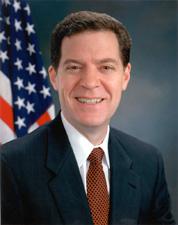 Sen. Sam Brownback (R-KS)
Legislative Activity
Stay on top of the latest movement without scrolling through every action
Roll call votes on amendments in Senate: Amendment SA 1140 as modified agreed to in Senate by Yea-Nay Vote. 94 - 0. Record Vote Number: 199.(text as modified: CR S5667)
May 20, 2009
View full timeline
Roll call votes on amendments in Senate: Amendment SA 1140 as modified agreed to in Senate by Yea-Nay Vote. 94 - 0. Record Vote Number: 199.(text as modified: CR S5667)
May 20, 2009
Senate amendment agreed to: Amendment SA 1140 as modified agreed to in Senate by Yea-Nay Vote. 94 - 0. Record Vote Number: 199.(text as modified: CR S5667)
May 20, 2009
Considered by Senate. (consideration: CR S5650, S5667-5669, S5687-5688)
May 20, 2009
Amendment SA 1140 as modified agreed to in Senate by Yea-Nay Vote. 94 - 0. Record Vote Number: 199. (text as modified: CR S5667)
May 20, 2009
Senate amendment submitted
May 19, 2009
Senate amendment proposed (on the floor): Amendment SA 1140 proposed by Senator Brownback.(consideration: CR S5602-5607; text: CR S5602)
May 19, 2009
Amendment SA 1140 proposed by Senator Brownback. (consideration: CR S5602-5607; text: CR S5602) To express the sense of the Senate on consultation with State and local governments in the transfer to the United States of detainees at Naval Station Guantanamo Bay, Cuba.
May 19, 2009
Votes
1 roll call on this amendment
Text
Proposed
SUPPLEMENTAL APPROPRIATIONS ACT, 2009

Mr. REID. Mr. President, I ask unanimous consent that the Senate
proceed to Calendar No. 63, H.R. 2346, the Supplemental Appropriations
Act, and that once the bill is reported, Senator Inouye be recognized
to call up the substitute amendment which is at the desk and is the
text of the Senate committee-reported bill, S. 1054; that the
substitute amendment be considered and agreed to; the bill, as amended,
be considered as original text for purpose of further amendments; and
that no points of order be waived by virtue of this agreement.
The PRESIDING OFFICER (Mr. Kaufman). Without objection, it is so
ordered.
Mr. REID. Before Senator Inouye is recognized, let me say to the
Senate, this is one of the most crucial pieces of legislation we will
deal with this entire Congress. It involves funding of the troops in
Iraq and Afghanistan. We wish to make sure everyone who has any concern
about any provision of this bill has the opportunity to try to change
it any way they want. We want to get this done as quickly as possible.
We want to make sure everyone has the opportunity to do what they
believe is appropriate. Finally, what I wish to say is, we are very
fortunate, as a Senate and a country, to have the two managers of this
bill. I have stated many times my affection and admiration for Senator
Inouye. He is a person whom the history books have already written
about. Not only is he a heroic person in the fields of war but also in
the fields of legislation. His colleague, Senator Cochran, is a person
who has wide respect on both sides of the aisle. He is someone I have
traveled parts of the world with. I have been working with him for a
quarter of a century. He has been here longer than I have, but that
doesn't take away from the fact that I recognize what a good Senator he
is and how fortunate are the people in Mississippi to have him working
on this legislation and all other matters. He is someone I can go to
and there is no flimflam with Cochran. He tells you: I can't help you,
here is what I want you to do. I think we will be well served during
this debate.
The PRESIDING OFFICER. The Republican leader.
Mr. McCONNELL. Mr. President, I say to my good friend the majority
leader, I understand he has laid down an amendment to be offered by the
chairman of the Appropriations Committee, our good friend from Hawaii,
and Senator Inhofe related to Guantanamo. I am pleased the majority has
recognized that the President's policy of putting an arbitrary deadline
on the closing of Guantanamo is a mistake. A first step toward moving
us in the direction of getting a new policy is to prevent funding in
this bill or any other bill from being used for the purpose of closing
Guantanamo. What we need to remember is that Guantanamo is a $200
million state-of-the-art facility. It has appropriate courtrooms for
the military commissions we established a couple years ago at the
direction of the Supreme Court. No one has ever escaped from
Guantanamo.
We need to think, once again, about the rightness of the policy of
closing this facility. It presents an immediate dilemma. Among the 250
or so people who are left there now are some of the most hardened
terrorists in the world, people who planned the 9/11 attacks on this
country. We know how the Senate feels about bringing them to the United
States. We had that vote 2 years ago. It was 94 to 3 against bringing
these terrorists to the United States. What we need is to rethink the
policy of closing this facility. If our rationale for closing it is to
be more popular with the Europeans, I must say we don't represent the
Europeans. We represent the people of the United States. We have a
pretty clear sense of how the people in this country feel about
bringing these terrorists to the United States.
I congratulate our good friends in the majority. They are heading in
the right direction. We know the President on national security issues
has shown some flexibility in the past. For example, he changed his
position on releasing photographs of things that occurred at Abu
Ghraib. He changed his position on the using of military commissions
and has now rethought that and opened the possibility that maybe
military commissions established by the previous administration and
this Congress are a good way to try these terrorists. He rethought his
position on Iraq and moved away from an arbitrary timeline for
withdrawal. We know he has now ordered a surge in Afghanistan led by
the same people who orchestrated and led the surge in Iraq which was so
successful. So the President has demonstrated his ability to rethink
these national security issues.
I am confident and hopeful he will now, getting this clear message
from both the House and the Senate on the appropriations bill, begin to
rethink the appropriateness of an arbitrary timeline for the closing of
Guantanamo.
I fully intend to support this amendment. I hope all Members of the
Senate will. I thank Senator Inouye and Senator Cochran, who is here,
for their leadership on this bill. I particularly thank Senator Inhofe,
who has been one of our leaders on this subject for a long time and
reminded everyone today that he was down at Guantanamo not too long
after 9/11 and has been there a number of times. I have been there
myself. We all know it is a state-of-the-art facility in which the
detainees are appropriately and humanely treated.
With that, Mr. President, I yield the floor.
The PRESIDING OFFICER. The majority leader is recognized.
Mr. REID. Mr. President, I have never known John McCain or certainly
President Bush to base their foreign policy on how the Europeans felt.
Certainly, President Obama also bases his not strictly on how the
Europeans feel about anything he does. I agree with President Bush and
John McCain that Guantanamo should be closed. And we Democrats believe
that President Obama is following the direction of others who have laid
out the fact that it should be closed.
The decision to close Guantanamo was the right one. Guantanamo makes
us less safe. However, this is neither the time nor the bill to deal
with this. Both Democrats and Republicans agree. The Democrats, under
no circumstances, will move forward without a comprehensive,
responsible plan from the President. I believe that is bipartisan in
nature. I think the Republicans agree with that. And we will never
allow terrorists to be released into the United States. That is what
this is all about.
I think this is the best way to approach this. I think the President
will come up with a plan. Once that plan is given to us, then we will
have the opportunity to debate his plan. Now is not the time to do it.
The PRESIDING OFFICER. The Republican leader is recognized.
Mr. McCONNELL. Mr. President, I will add that both President Bush and
Senator McCain indicated they would like to close Guantanamo but never
suggested a specific time for doing it. The reason for that is they
were confronted with the realities of this decision. If there were a
specific timeline, it was difficult to figure out what to do with the
detainees.
In addition to that, this administration--at least the Attorney
General--has indicated there is a possibility they are going to allow
some of the Chinese terrorists, the Uighars, to be released in the
United States not in a prison. In other words, presumably they would be
walking around in our country. So this issue is not totally behind us.
Again, I congratulate our friends on the other side for their
movement on this issue. All these problems have not yet been solved. We
all want to protect the homeland from future attacks. We know
incarceration at Guantanamo has worked. No one has ever escaped from
Guantanamo.
We know what happened when you had a terrorist trial in Alexandria,
VA. Ask the mayor of Alexandria. The Moussaoui trial--it made their
community a target for attacks. When they moved Moussaoui to and from
the courtroom, they had to shut down large sections of the community.
It raises all kinds of problems if you bring a terrorist to U.S.
soil, about whether they are going to be granted, in effect, more
rights by having the

[[Page S5590]]

Bill of Rights apply to them in a Federal court system than a U.S.
soldier tried in a military court. There are lots of very complicated
issues, which led both Senator McCain, who is fully able to speak for
himself on this issue, and President Bush to never put a specific
timetable for closure. That is the difference between their position
and the position of the President.
Having said that, the President has demonstrated, as I said earlier,
a lot of flexibility on these national security issues. I am hopeful he
will continue to work his way in the direction of a policy that will
keep America safe.
Mr. President, I yield the floor.
The PRESIDING OFFICER. Under the previous order, the Senate will
proceed to the consideration of H.R. 2346, which the clerk will report.
The bill clerk read as follows:

A bill (H.R. 2346) making supplemental appropriations for
the fiscal year ending September 30, 2009, and for other
purposes.

The PRESIDING OFFICER. The Senator from Hawaii.
Mr. INOUYE. Mr. President, I wish to thank both leaders of the Senate
for their gracious remarks.
Today, the Senate will begin to consider the request for supplemental
appropriations for fiscal year 2009. As we all know, the President has
requested $84.9 billion in new budget authority, first, to cover the
costs of ongoing operations in Iraq and Afghanistan, and it includes
funds for the supporting costs to those operations, and to prepare for
natural disasters, including wildfires and the swine flu. In addition,
last Tuesday, the administration requested proposals to increase the
borrowing power of the International Monetary Fund. This proposal would
cost $5 billion under the scoring of the Congressional Budget Office.
After reviewing the President's request, the proposals made by the
committee and included in the recommendation before you total $91.3
billion, $1.3 billion above the President's estimate. This amount is
$5.4 billion below the measure just passed by the House. I would point
out that the House did not consider the $5 billion request for the IMF
by the administration.
The President requested funding in four basic areas: national
defense, international affairs, protection against swine flu, and
funding in response to natural disasters, all of which I will briefly
discuss.
The President's request included $73.7 billion for items under the
jurisdiction of the Defense Subcommittee. The committee has provided
$73 billion for this purpose. The remaining $700 million was requested
for programs that more appropriately are funded by other subcommittees,
such as Military Construction; Commerce, Justice, State; and Homeland
Security. So in this mark, we recommend transferring these funds to the
relevant subcommittees.
I would note there are several differences between the specific items
requested and the amounts recommended by the committee. For example,
the committee recommended $1.9 billion to cover the costs of higher
military personnel retention and other necessary personnel bills.
We provide an additional $1.55 billion for the purchase of the all-
terrain MRAP vehicle and $500 million for equipment for our National
Guard and Reserve forces. The committee also addressed the readiness
needs of the Navy and provides for an increase in the enhancement of
our intelligence surveillance and reconnaissance capabilities.
For the Department of State and other international affairs funding,
including the IMF, the committee recommends $11.9 billion, nearly the
same as the amount requested. The committee recommendation is similar
to that requested, but I would note that additional funding has been
allocated for Jordan and for the Global AIDS Program within the overall
total.
For military construction, the committee is recommending $2.3
billion, about the same as that sought by the administration.
The committee has recommended $1.5 billion, as requested, for the
swine flu, and has worked with the administration to identify the best
allocation of these resources among the relevant Federal agencies.
Funding of $250 million is recommended for fighting wildfires, and
$700 million is provided for international food assistance under PL-
480.
The committee has responded to damage caused by natural disasters by
adding nearly $900 million to the amount requested for damage from
flooding in the Midwest and in response to Hurricane Katrina.
Each subcommittee was tasked with reviewing the President's request
in their jurisdiction and recommending funding both for items in the
request and other items necessary to meet legitimate emergency needs.
The vice chairman, Senator Cochran, and I also offered each
subcommittee the opportunity to recommend earmarks or other
nonemergency increases so long as the costs were offset within existing
funding.
As the Senate considers this bill, I would point out that under the
budget resolution, any item which seeks to add funding to the bill will
be subject to a Budget Act point of order unless it is offset.
This is an important bill which responds to the requirements of our
men and women in uniform and to members of our population who have been
ravaged by natural disasters. It also seeks to protect our people and
our country with funding to deter wildfires and the swine flu, in
addition to terrorists.
This is a good bill. It is necessary to deal with a myriad of
problems. We should act expeditiously to pass it, get it to conference,
and on to the President for his signature. Therefore, I join my leaders
in urging my colleagues to help us attain quick passage of this very
important measure.
Mr. President, I yield to the vice chairman of the committee.
The PRESIDING OFFICER. The Senator from Mississippi.
Mr. COCHRAN. Mr. President, I am pleased to join the distinguished
chairman of the Committee on Appropriations in presenting to the Senate
the fiscal year 2009 supplemental appropriations bill. This bill
includes funding to combat violent extremism in Iraq and Afghanistan,
and supports other emergency requirements both at home and abroad.
This bill includes funding for the men and women in the Armed Forces
and our diplomatic corps, and gives them the resources necessary to
carry out the missions assigned to them by our Government.
I commend the distinguished chairman for moving this bill in a timely
manner to ensure that our service men and women have the resources they
need while still allowing time for the Senate to carefully consider the
bill.
I hope this year we can complete action on the supplemental in time
to avoid putting the Secretary of Defense in a position where he is
compelled to postpone acquisitions or transfer funding between
accounts, and take other inefficient steps to maintain the flow of
resources to our troops in the field.
This bill contains several important initiatives that will strengthen
our military's ability to prosecute its mission and improve the overall
readiness of our forces. Several of these priorities were identified by
the Department of Defense but were not included in the President's
request. We were able to fund these additional needs while staying
within the overall spending level requested by the President for
Defense programs.
The bill contains more than $18 billion for military pay and
benefits, including $1.9 billion to cover shortfalls not requested by
the administration. The bill also includes funding for continued
operations, equipment repair and replacement, and enhanced support to
wounded warriors and military families.
The bill contains $4.2 billion for mine resistant ambush protected
vehicles. This recommendation is $1.5 billion more than the
administration's request and will help speed the delivery of an ``All
Terrain'' version of the vehicle to Afghanistan where harsh terrain
challenges the mobility of our forces.
The committee also recommends $332 million above the President's
request to fund urgent requirements identified by the Secretary of
Defense's Intelligence, Surveillance, and Reconnaissance Task Force.
These funds will be used to procure additional sensors, platforms, and
communication systems that are critical for finding and neutralizing
al-Qaida and insurgent forces.
To maintain the readiness of our forces, the bill includes an
additional $246 million above the President's request for the Navy's P-
3 surveillance aircraft. These planes are not only used

[[Page S5591]]

for maritime patrol, but also to support Army and Marine ground forces
in Iraq and Afghanistan. The funds will allow the Navy to procure wing
kits needed to address structural fatigue issues that have led to the
grounding of many of these aircraft.
The committee also recommends $190 million above the President's
request for ship depot maintenance to address damage done to three Navy
vessels during recent mishaps. These repairs are truly unforeseen
emergencies, and the funds in this bill will help ensure these ships
return to the operational fleet as soon as possible.
Although the President's request did not include funding in the
National Guard and Reserve equipment account, the committee recommends
$500 million. Currently there are over 140,000 National Guard and
Reserve personnel activated. This funding will help ensure those
personnel have the resources necessary to perform their duties. These
funds will be used to procure equipment for National Guard and Reserve
units to be used to support combat missions and taskings from State
Governors.
The Defense title also contains $400 million for the Pakistan
Counterinsurgency Capability Fund. This new initiative proposed by the
President is intended to bolster efforts to eliminate terrorist
safe havens in the rugged border region of Pakistan and Afghanistan. I
understand the legitimate concern raised by Senators who believe that
such a program should be administered by the Department of State, but I
believe the needs of the commanders on the ground warrant short-term
funding for the Defense Department until this program can be
effectively transferred to the State Department.

While this supplemental is predominantly focused on American efforts
abroad, I am pleased that the bill also responds to emergencies here at
home. The bill includes several provisions to aid in my State's ongoing
recovery from Hurricane Katrina, including funding to restore the
federally owned barrier islands that serve as the first line of
protection for the Mississippi coastline. These islands were
significantly diminished by Katrina, and according to a Corps of
Engineers' study their restoration will go a long way toward mitigating
future damage.
I greatly appreciate the bipartisan manner in which the chairman
worked with me and other members on our side in crafting this bill. He
and his staff have been very open to requests, even while producing a
bill that adds very little to the top-line amount requested by the
President.
In this bill, Chairman Inouye made a sincere effort to respond to
security concerns at Guantanamo Bay without denying outright the
resources requested by the President to analyze and implement closure
of the facility. I understand, however, that the funding and language
relating to Guantanamo remain controversial. I anticipate these matters
will be thoroughly discussed and that several Senators are likely to
propose amendments.
Senators may also have amendments relating to the International
Monetary Fund. The bill reported by the committee includes language
sought by the President to expand the United States commitment to the
IMF. This request was submitted only a week ago, and there was very
little time prior to the committee markup in which to consult with the
relevant authorizing committees and other experts. I am not aware that
there have been Senate hearings on this request. I look forward to
further discussion of this important subject, but wish to express my
concern that the manner in which this request has been presented could
endanger the timely enactment of this supplemental. I hope that is not
the case.
I would like once again to thank the Senator from Hawaii for the
manner in which he has put this bill together. I look forward to
working with him to get the bill to the President in a timely fashion,
and to beginning work in earnest on the regular fiscal year 2010
appropriations bills. We have a busy summer ahead of us.
I urge my colleagues on the Republican side who may have amendments
to the supplemental to contact us so that we can make efficient use of
the Senate's time.
Mr. President, I know the Senator from Oklahoma wants to make a
comment. I will yield first, though, to the distinguished chairman.
The PRESIDING OFFICER. The Senator from Hawaii.

Amendment No. 1131

(Purpose: In the nature of a substitute)

Mr. INOUYE. Mr. President, I send an amendment to the desk on behalf
of Senator Cochran and myself and ask for its immediate consideration.
The PRESIDING OFFICER. The clerk will report.
The bill clerk read as follows:

The Senator from Hawaii [Mr. Inouye], for himself and Mr.
Cochran, proposes an amendment numbered 1131.

(The amendment is printed in today's Record under ``Text of
Amendments.'')
The PRESIDING OFFICER. Under the previous order, this amendment is
adopted and is considered as original text, with no points of order
being waived.
Mr. INHOFE. Mr. President, will the Senator yield?
Mr. INOUYE. Mr. President, I am pleased to yield.

Amendment No. 1133

Mr. INHOFE. Mr. President, I am a little confused as to where we are.
I have an amendment I do want filed. It is amendment No. 1132 at the
desk right now. I say to the senior Senator from Hawaii that it is
essentially the same thing as the wording of an amendment he will be
bringing up.
My request of the Senator--and I cleared this with the Senator from
Mississippi--is that I be the first cosponsor on his amendment so that
it would be the Inouye-Inhofe amendment.
Mr. INOUYE. No question about that. Is it the pending amendment at
this moment, the Inouye-Inhofe amendment?
Mr. INHOFE. Mr. President, I can clarify this. I had sent my
amendment to the desk, which we don't plan to take up, but I wanted it
filed because we have a number of cosponsors who, I am sure, will want
to join me in cosponsoring the Inouye amendment, since it is the same
amendment.

Amendment No. 1133

The PRESIDING OFFICER. The clerk will report the amendment.
The bill clerk read as follows:

The Senator from Hawaii [Mr. Inouye], for himself and Mr.
Inhofe, proposes an amendment numbered 1133.

The amendment is as follows:

(Purpose: To prohibit funding to transfer, release, or incarcerate
detainees detained at Guantanamo Bay, Cuba, to or within the United
States)

Strike section 202 and insert the following:
Sec. 202. (a)(1) None of the funds appropriated or
otherwise made available by this Act or any prior Act may be
used to transfer, release, or incarcerate any individual who
was detained as of May 19, 2009, at Naval Station, Guantanamo
Bay, Cuba, to or within the United States.
(2) In this subsection, the term ``United States'' means
the several States and the District of Columbia.
(b) The amount appropriated or otherwise made available by
title II for the Department of Justice for general
administration under the heading ``salaries and expenses'' is
hereby reduced by $30,000,000.
(c) The amount appropriated or otherwise made available by
title III under the heading ``Operation and Maintenance,
Defense-Wide'' under paragraph (3) is hereby reduced by
$50,000,000.

The PRESIDING OFFICER. The Senator from Hawaii.
Mr. INOUYE. Mr. President, this amendment has been discussed rather
fully by our two leaders.
I now yield to Senator Inhofe.
The PRESIDING OFFICER. The Senator from Oklahoma.
Mr. INHOFE. Mr. President, I thank the Senator for yielding.
First of all, I heard the dialogue going back and forth on the
amendment and the positions taken several times in statements made, and
there are several people in this Chamber who want to close Guantanamo
Bay.
Let me make it very clear: I have never had any intentions of wanting
to close it. I keep asking: What would be the reason someone would want
to close an asset that we have that can't be replaced anywhere else? My
feeling was since there was no answer to that, and since this is one of
the few good deals, I say to both the distinguished chairman and
ranking member of the Appropriations Committee: Have you ever had a
better deal than this?
It costs us $4,000 a month, the same price it cost us back in 1903,
and it is a great $200 million facility. It has facilities to try these
cases. They have the expeditionary legal complex there,

[[Page S5592]]

which they don't have anyplace else. So if you close that down, you
couldn't have the tribunals. Somehow they might end up being--I am
talking about the terrorists--in our court system, in which case the
rules of evidence are different.
So for any number of reasons, and because everyone who goes down
there--and I am talking about even Al-Jazeera the media goes down and
comes back and shakes their heads and wonders why we would want to
close it.
So I want to go on record that I want to go further than just not
funding Guantanamo, but also what we are going to be doing with some
245 detainees. Hopefully, we can end this discussion about closing an
asset that has served us very well for a number of years.
So I wholeheartedly support the Inouye amendment, which is the same
language I had in my amendment. I think that will pretty much
accomplish what I wish to accomplish.
The PRESIDING OFFICER. The Senator from Mississippi.
Mr. COCHRAN. Mr. President, I ask unanimous consent that the Senator
from Alabama, Mr. Shelby, be added as a cosponsor to this amendment.
The PRESIDING OFFICER. Without objection, it is so ordered.
Mr. INOUYE. Mr. President, I suggest the absence of a quorum.
The PRESIDING OFFICER. The clerk will call the roll.
The bill clerk proceeded to call the roll.
Mr. INHOFE. Mr. President, I ask unanimous consent that the order for
the quorum call be rescinded.
The PRESIDING OFFICER. Without objection, it is so ordered.
Mr. INHOFE. Mr. President, let me do this, if it is all right with
the Senator from Hawaii. There are apparently several people wanting to
come down and speak on this bill, and I think Senator Durbin is going
to be coming down. So while we are waiting, instead of sitting in a
quorum call, let me mention that on my bill we had Senators Barrasso,
Brownback, DeMint, Johanns, Roberts, Thune, Vitter, Sessions, Cornyn,
Coburn, Hutchison, and Bennett, I believe, who all wanted to be or were
cosponsors of my amendment.
Since this is the same amendment, they also requested that--some of
them wanted to come down and speak on behalf of this amendment. So if
it is acceptable, we could wait until they get down here. Until they
do, I wish to perhaps elaborate a little bit more about what is
existing there right now in terms of any problems.
A lot of times people are talking about maybe this is perceived by
Europeans, or somebody else, to be an institution that sometimes is
perhaps guilty of or accused of torturing detainees. Let me assure my
colleagues that has never happened. There has never been a case of
waterboarding.
Most of the people who have come back--including Eric Holder, the
Attorney General--came back with a report that the conditions and the
circumstances under which these detainees exist are probably better
than any of our Federal courts. Right now, there is one doctor for
every two detainees, and they are giving them treatments they never had
before. I have been down there numerous times only to find out that
their treatment--the food they are eating and all of that--is actually
better than they had at any other time during their lifetimes.
So it is very difficult to look at a suggestion such as this. Seeing
where this, to me, is the only place in the world where they actually
are set up to handle these types of detainees, the suggestion was made
that perhaps they wanted to--they were looking for 17 places in the
continental United States to put these detainees. My view at that time
was that we would end up having 17 targets for terrorism.
One of those places they suggested was in my State of Oklahoma at
Fort Sill. So I went down to Fort Sill to look at the detainee facility
there. Sergeant Major Carter, who is in charge of it, said to me:
Senator, why in the world would they close down Guantanamo?
She said: I have been there on two different tours and there is no
place that can handle detainees better. Besides that, there is a court
system there where they can actually conduct tribunals, and there
certainly is not in Fort Sill, OK.
So in support of what we are doing with this amendment, some 27
States now have expressed themselves that they don't want to have these
detainees, any of them, in their States. We are talking about State
legislatures. So that is over half of the State legislatures that are
saying they wouldn't want to do that.
So I think if we have an asset, if we have something that is working,
we are in a position to keep detainees there. Some of them have to be
there for a long period of time. The only choice would be to keep them
there or to try them. If you try them and there is no way of disposing
of them after the trial, they would have to go back.
Right now, of the 245 detainees, there are 170 of them whose
countries would not take them back. So you have to ask the question:
What would we do with them?
So the bottom line is this: It is a state-of-the-art prison. People
are treated right. They have proper medical care. They have better food
than most of them have ever had before. Besides that, some of these are
the Khalid Sheikh Mohammed-type of individuals whom we want to be sure
don't get in the wrong court system where something could happen to
them.
So of the 240 detainees now, 27 are members of al-Qaida's leadership
cadre, 95 lower level al-Qaida operatives, 9 members of Taliban's
leadership cadre, 92 foreign fighters--that is 38 percent of all of
them--and 12 Taliban fighters and operatives. These people are tough
guys. We are going to have to do something with them. So I do support
the Inouye-Inhofe amendment.
I yield the floor.
The PRESIDING OFFICER. The Senator from Illinois.
Mr. DURBIN. Mr. President, I wish to speak to the pending amendment.
The PRESIDING OFFICER. The Senator is recognized.
Mr. DURBIN. Mr. President, I want to commend the chairman of the
Appropriations Committee, Senator Inouye, for this amendment he has
offered. President Obama is formulating a plan in terms of the future
of the Guantanamo Bay detention facility and any appropriation at this
moment would be premature. We should wait until the administration
submits that plan and then try to work to implement that plan on a
bipartisan basis.
What I find incredible are the Members of the Senate who are coming
to the floor and basically suggesting that the Guantanamo detention
facility should stay open indefinitely; that there is no reason to
close Guantanamo. I don't understand that thinking. Wasn't it President
Bush of the Republican Party who called for closing Guantanamo? I
thought he did. In fact, he did. I don't recall the Republican Senators
standing up at that point and objecting when President Bush said that
was his goal, to close Guantanamo.
Mr. INHOFE. Will the Senator yield?
Mr. DURBIN. No, I will yield when I am finished.
When President Obama was elected, he made it clear that we were going
to have a clean break from some of the policies of the past and we were
going to try to reestablish America's position in the world--a position
of leadership and respect. I think that is a goal Americans heartily
endorse, both political parties and Independents as well. The results
of the November 4 election last year indicate that.
When President Obama took office and said that the Guantanamo Bay
detention facility would be phased out over a 1-year period of time,
when he said we were going to do away with some of the interrogation
techniques that had become so controversial, I felt it was a statement
of principle and it was, practically speaking, important for our Nation
to do.
Arthur Schlesinger, Jr., a historian who died a couple of years ago,
wrote histories of the United States beginning with the age of Jackson
through F.D.R. and John F. Kennedy. Before he died, he said:

No position taken has done more damage to the American
reputation in the world--ever.

The tragic images that emerged from Abu Ghraib and the stories that
came out afterwards, unfortunately, left an impression in the minds of
people around the world that was mistaken--an impression that we were
not a caring, principled people.

[[Page S5593]]

I think President Obama's decision to move forward toward the closing
of the Guantanamo Bay detention facility was the right decision, but it
wasn't just President Obama who came to that conclusion. Closing the
Guantanamo Bay detention facility is an important national security
priority for our Nation. Many national security and military leaders
agree that closing Guantanamo will make us safer.
Let me give a few examples: General Colin L. Powell, the former
Chairman of the Joint Chiefs of Staff and former Secretary of State
under President Bush, Republican Senators John McCain and Lindsey
Graham, and former Republican Secretaries of State James Baker, Henry
Kissinger, and Condoleezza Rice.
The two most vocal supporters of keeping Guantanamo open are former
Vice President Dick Cheney and talk show host Rush Limbaugh. With all
due respect, when it comes to the national security of the United
States of America, I will side with Colin Powell and John McCain over
Vice President Cheney and Rush Limbaugh.
According to experts, Guantanamo Bay, unfortunately, has become a
recruiting tool for al-Qaida that is hurting America's security.
Let me give one example. Retired Air Force MAJ Matthew Alexander led
the interrogation team that tracked down Abu Musab al-Zarqawi, the
leader of the al-Qaida operation in Iraq, and this is what he said:

I listened time and again to foreign fighters, and Sunni
Iraqis, state that the number one reason they decided to pick
up arms and join al-Qaida was the abuses at Abu Ghraib and
the authorized torture and abuse at Guantanamo Bay. . . .It's
no exaggeration to say that at least half of our losses and
casualties in that country have come at the hands of
foreigners who joined the fray because of our program of
detainee abuse.

This is not a statement that comes out of some leftwing publication.
It is a statement by a retired Air Force major, Matthew Alexander.
I visited Guantanamo Bay in 2006. I left proud of the good job our
soldiers and sailors were doing there. They are being asked to carry a
heavy burden of the previous administration's policies.
For many years, President Bush announced publicly that he wanted to
close the Guantanamo detention facility, and there were no complaints
from the Republican side of the aisle when President Bush made that
suggestion. But President Bush didn't follow through.
Now President Obama has taken on the challenge of solving this
problem that he inherited from the Bush administration.
I listened here as the previous speaker talked about the dangerous
people at Guantanamo. There is no doubt that some of them are dangerous
and have to be regarded as such, and releasing them would not be in the
best interest of the security of the United States. But having said
that, since Guantanamo was opened initially, the Bush administration
released literally hundreds of detainees who were brought there, many
of whom were later determined by the Bush administration not to be any
threat or guilty of any wrongdoing. They were sent back to their
countries of origin or to other countries that would receive them.
One particular case I am aware of involves a young man who was from
Gaza. He was turned over as a suspected terrorist and sent to
Guantanamo. He was sent there at the age of 19. He languished in
Guantanamo for 6 years, never being charged with any wrongdoing. Just
last year, his attorney was given a communication by our Government
that said: We have found no evidence of wrongdoing by this man who is
your client, and he is free to leave as soon as we can determine which
country will accept him. A year and 3 months have passed since then. He
still sits in Guantanamo. He came there at the age of 19; he is now 26.
Is that justice in America? Is that an outcome we applaud? Do we want
to keep Guantanamo open so he can continue sitting there year after
year? Of course not. We want to detain those who are dangerous and
bring to trial those who can be charged with criminal wrongdoing. We
want to release those who are innocent and of no harm to the United
States.
The President is taking the time to carefully plan for the closure of
Guantanamo in a way that will protect our national security. One thing
is eminently clear, and it is almost painful for me to have to say the
words on the Senate floor, and if anybody suggests otherwise, I cannot
imagine they would do it in good faith, but I will say them anyway.
This President of the United States will never allow terrorists to be
released in America.
This President has set up three task forces to review interrogation
and detention policies and conduct an individualized review of each
detainee who is currently held at Guantanamo. These task forces are
staffed by career professionals with extensive experience in
intelligence and counterterrorism. They will make recommendations on
how to close Guantanamo and what our interrogation and detention
policies should be. We should give these national security experts the
time to conduct a careful review and make their recommendations.
The Obama administration's approach is in stark contrast to the
previous administration, where policies were made by political
appointees with no background in counterterrorism. They ignored
concerns expressed by FBI agents and military personnel with years of
experience in dealing with al-Qaida.
When the President issued his Executive order, Republican Senators
John McCain and Lindsey Graham said:

We support President Obama's decision to close the prison
at Guantanamo, reaffirm America's adherence to the Geneva
Conventions, and begin a process that will, we hope, lead to
the resolution of all cases of Guantanamo detainees.

That is a responsible statement. I applaud my Republican colleagues
for stepping up and acknowledging that this President is trying to do
the right thing. It doesn't benefit the debate for people to come here
and create a specter of fear, that somehow this President--or any
President--would be party to releasing dangerous people into the United
States.
Last week, Senator Lindsey Graham said:

I do believe we need to close Guantanamo Bay. I do believe
we can handle 100 or 250 prisoners and protect our national
security interests, because we had 450,000 German and
Japanese prisoners in the United States. So this idea that
they cannot be housed somewhere safely, I disagree.

But some Republicans have decided to turn Guantanamo into a political
issue on the floor. Some have even gone so far as to claim the
President wants to release terrorists into the United States. This is
an absurd, offensive, and baseless claim.
Our colleagues on the other side of the aisle are criticizing the
President, but the sad reality is that they have no plan to deal with
the Guantanamo problem.
Richard Clarke, President George W. Bush's first counterterrorism
chief, said the following last week:

Recent Republican attacks on Guantanamo are more desperate
attempts from a demoralized party to politicize national
security and the safety of the American people.

Let me address one specific claim--that transferring Guantanamo
detainees to U.S. prisons will put Americans at risk.
Last week, Philip Zelikow, who was the Executive Director of the 9/11
Commission and counselor to Secretary of State Condoleezza Rice,
testified before the Judiciary Committee. Mr. Zelikow told me that it
would be safe to transfer Guantanamo detainees to U.S. facilities and
that we are already holding some of the world's most dangerous
terrorists in the United States.
Here are a few examples of those currently being held in American
prisons: Ramzi Yousef, the mastermind of the 1993 World Trade Center
bombing; 9/11 conspirator Zacarias Moussaoui; Richard Reid, the so-
called shoe bomber; and numerous al-Qaida terrorists responsible for
bombing the U.S. Embassies in Kenya and Tanzania.
If we can safely hold these individuals, I believe we can also safely
hold Guantanamo detainees. I don't know if this will be part of the
President's recommendation or plan. We are still waiting for that.
I should make it clear in this debate that no prisoner has ever
escaped from a U.S. Federal super-maximum security facility.
President Obama inherited this Guantanamo problem from the previous
administration. Solving it will require leadership and difficult
choices, and it will take some time.

[[Page S5594]]

I think the decision by Senator Inouye to remove this money from the
supplemental is the right decision. The supplemental covers the next 4
months. During that period of time, the President will come out with
his plan, and we can work forward from there.
The President is showing that he is willing to lead and make hard
decisions. I urge my Republican colleagues to pay close attention to
their colleagues, Senators McCain and Graham, who I think have been
reasonable in discussing this issue. We should not play politics with
national security.
Give the Obama administration a chance to present their plan for
closing Guantanamo. As Colin Powell, John McCain, and many others have
said, closing Guantanamo is an important step toward restoring American
values and actually making America a safer country.
I yield the floor.
The PRESIDING OFFICER. The Senator from Nebraska is recognized.
Mr. JOHANNS. Mr. President, I rise today to commend President Obama
on his recent decision to continue military commissions at Guantanamo
Bay. I think the decision shows the President's realistic assessment of
the value of the commissions. Resuming them will also ensure that
justice will be brought to the suspected terrorists currently awaiting
the commission. The President has also shown an invigorating commitment
to winning the war in Afghanistan, and he has resisted brash decisions
to exit Iraq before the security situation has been fully stabilized.
However, today, I must temper my comments with an admonition. The
President needs to reverse his order to close Guantanamo Bay. We are
all familiar with the President's Executive order. It was signed in the
first hours of his Presidency. It announced the closure of the prison
within 1 year. To say the Executive order is short on detail is an
understatement. We have learned that the Justice Department is
reviewing the cases of the individual detainees and that the President
would like to move the detainees somewhere else. That is really all the
Executive order tells us.
About 240 detainees are now being held at Guantanamo Bay. The
administration claims that not every detainee is a terrorist and that a
few are kept at Guantanamo simply because other countries are very slow
to accept them. Well, let me tell you, in my judgment, that speaks
volumes about the character and the fitness for society of these
detainees. Other countries are literally dragging their feet in
accepting them. In April, the President of France famously agreed to
accept one detainee. A number of countries, such as Germany and
Lithuania, have only said they will consider accepting detainees,
despite the Attorney General's round-the-world tour to ask our allies
to accept more.
Let's assume the administration's projection that only half of the
detainees there would be considered terrorists. Well, that is 120
terrorists who would be brought to facilities on our soil; 120
terrorists who would entice their brothers in arms worldwide to make
every effort to break them out or at least wreak havoc on places where
they are jailed; 120 terrorists whose trials and hearings will cause a
community to virtually lock down every time they have to be transported
from point A to point B.
Last Friday, I had the opportunity to actually go to Guantanamo and
visit the prison. Having seen the facilities, I am more confident than
ever that we should keep Guantanamo operating.
On my visit, I saw firsthand the treatment detainees receive there.
The facilities there rival any Federal penitentiary. Detainees receive
three meals per day that adhere to cultural dietary requirements.
They stay in climate-controlled housing with beds. It was a warm day
when we were there. Their housing is air-conditioned. They have
flushing toilets and had all of the hygiene items we would use, such as
toothbrushes, toothpaste, soap, and shampoo. They have the opportunity
to worship uninterrupted. They are provided prayer beads, rugs, and
copies of the Koran. The Muslim call to prayer is observed in the camps
five times a day, followed by 20 minutes of uninterrupted time to
practice their faith. In fact, we happened to be there during the call
of the prayer, and the camp literally shuts down to allow them to have
that time. They have access to satellite TV and a library with more
than 12,000 items in 19 languages, including magazines, DVDs, and
Arabic newspapers. I will bet their big-screen television--really
state-of-the-art television--is bigger than most in the average home in
America.
Most remarkable, though, is the medical care provided to detainees at
Guantanamo. Most people don't realize this, but detainees receive the
same quality of medical care as the U.S. servicemembers who guard them.
They have access to medical care anytime they need it, and there is a
two-to-one detainee-to-medical-staff ratio. They get preventive care,
such as vaccinations and cancer screenings. In addition to routine
medical care, detainees have been treated for preexisting medical
conditions, even to the extent of receiving cancer treatment or
prosthetic limbs. This is likely better treatment than they would
receive in their home countries.
The courtroom constructed at Guantanamo was designed specifically to
deal with military commissions. I am a lawyer myself, and I have to
tell you that I have never seen anything like this. To say that it is
state of the art is to understate the quality of that courtroom. I will
tell you that I am convinced there is not another courtroom anywhere in
the world with better equipment than what we have installed at
Guantanamo.
To top it all off, earlier this year, the Vice Chief of Naval
Operations reviewed conditions at Guantanamo and issued a report that
the detainees' confinement conformed to the Geneva Conventions. Despite
public perception, no detainee has ever been waterboarded at
Guantanamo.
Why would we throw away a $200 million, state-of-the-art facility
just to meet an artificial deadline in 2010 that I think really
originated from an uninformed campaign promise?
These are very dangerous people being held at Guantanamo. These are
not a couple of teenagers who robbed a corner convenience store. There
are 27 members of al-Qaida's leadership cadre currently housed at the
prison, plus 95 lower level al-Qaida operatives, which combined is
about half the prison population at Guantanamo. There are also scores
of Taliban members and foreign fighters.

There was a survey that was done awhile back--it was released in
April--and it indicated that 75 percent of Americans oppose releasing
Guantanamo detainees in the United States, while only 13 percent
support that. I am willing to bet the numbers opposing the transfer of
prisoners to the United States would skyrocket even higher, although
that is hard to imagine, if you told people that the terrorist
detainees would be held in a prison near their town. But if moved to
the United States, they have to be near some town.
The President submitted an $80 million funding request for the
detainees to be transferred, despite having no plan outlining their
destination. Fifty million dollars of the President's funding request
would go to the Department of Defense to actually transfer the
detainees from the prison. But we don't know where. This lack of a plan
and lack of transparency deeply disturbs me.
Alarmingly, two of the sites on U.S. soil that some speculate would
house transferred detainees are at Fort Leavenworth, KS, or the
supermax facility in Colorado. Both facilities are within 250 miles of
the Nebraska border. That alarms me and my constituents. That is why I
sent a letter to Attorney General Holder on April 23 requesting a
personal briefing before any decision is made to move current
Guantanamo detainees within 400 miles of Nebraska's borders.
But simply being notified that detainees are about to be transferred
won't suffice. That amounts to telling the passengers to hold on before
the bus crashes. It is for these reasons that I believe we should deny
funding to transfer detainees and in fact not close the prison at
Guantanamo. It is for these reasons that I support S. 370, the
Guantanamo Bay Detention Facility Safe Closure Act of 2009, introduced
by the senior Senator from Oklahoma.
The bill prohibits Federal funds from being used to transfer any
detainees out of Guantanamo to any facility in

[[Page S5595]]

the United States or its territories. It also prohibits any Federal
funds from being used for the construction or enhancement of any
facility in the United States in order to house any detainee. Finally,
it prohibits any Federal funds from being used to house or otherwise
incarcerate any detainee in the United States or its territories. It
will keep our communities safe by preventing terrorists from being
thrust into our cities and towns.
I will close by reminding Senators that in 2007, the Senate voted 94
to 3 to express its opposition to moving Guantanamo detainees to U.S.
soil or releasing them into American society. President Obama's
Executive order to close the prison at Guantanamo demonstrates his
intention to ignore the will of the Senate and the American people.
Despite an overwhelming vote, the administration apparently still plans
to bring terrorist detainees from Guantanamo near our communities.
I hope we have the opportunity to once again address this issue.
There is a pending amendment which I support. But I also urge the
President to reconsider his decision to close the prison. I encourage
my colleagues to support the amendment that is before this body to deny
funding for closing the prison.
I look forward to a robust debate on this issue as we delve into this
very important matter. Amendments will be offered. I think this is the
most important issue we are going to face in a long time. Action to
close the prison and move these people here is unacceptable. It is
unthinkable to the American public. We must yield to their collective
wisdom and hear their call. Anything else would be a grave mistake.
Mr. President, I yield the floor.
The PRESIDING OFFICER. The Republican leader.

Amendment No. 1136

Mr. McCONNELL. Mr. President, I wish to say a few words about an
amendment I am about to offer that relates to the President's Executive
order of January 22 on the disposition of detainees at Guantanamo.
As part of that Executive order, a so-called detainee task force was
created for the purpose of reviewing the records of detainees to
determine whether they should be released. It is my view that any
information obtained by this task force should be made readily
available to the appropriate chairman and ranking members of the
committees of jurisdiction. So the amendment I am about to send to the
desk establishes a reporting requirement that would require the
administration to provide a threat assessment of every detainee held at
Guantanamo. This threat assessment, which could be shared with Congress
in a classified report--remember, this would be in a classified report
only--would indicate the likelihood of detainees returning to acts of
terrorism. It would also report on and evaluate any threat that al-
Qaida might be making to recruit detainees once they are released from
U.S. custody.
Many of the remaining 240 detainees at Guantanamo are from Yemen,
which has no rehabilitation program to speak of, and Saudi Arabia,
which has a rehab program, but which, frankly, hasn't been very
successful at keeping released detainees from rejoining the fight even
after they go through this rehabilitation program. The recidivism among
released detainees is of great concern to those of us who have
oversight responsibilities here in Congress. So according to my
amendment, the President would have to report to Congress before--I
repeat, before--releasing any of the detainees at Guantanamo. More
specifically, the administration would have to certify that any
detainee it wishes to release prior to submitting this report poses no
risk--no risk--to American military personnel stationed around the
world.
This is a simple amendment that reflects the concerns of Americans
about the dangers of releasing terrorists either here or in their home
countries where they could then return to the fight. Until now, the
administration has offered vague assurances it will not do anything to
make Americans less safe. This amendment says that Americans expect
more than that. Americans want the assurance that the President's
arbitrary deadline to close Guantanamo by next January will pose no
risk to our military servicemembers overseas.
I know there is an amendment pending at the desk, so I ask unanimous
consent that it be set aside and that my amendment be sent to the desk.
The PRESIDING OFFICER. Without objection, the clerk will report.
The legislative clerk read as follows:

The Senator from Kentucky [Mr. McConnell] proposes an
amendment numbered 1136.

Mr. McCONNELL. I ask unanimous consent that the reading of the
amendment be dispensed with.
The PRESIDING OFFICER. Without objection, it is so ordered.
The amendment is as follows:

(Purpose: To limit the release of detainees at Guantanamo Bay, Cuba,
pending a report on the prisoner population at the detention facility
at Guantanamo Bay)

On page 31, between lines 3 and 4, insert the following:
Sec. 315. (a) Reports Required.--Not later than 60 days
after the date of the enactment of this Act and every 90 days
thereafter, the President shall submit to the members and
committees of Congress specified in subsection (b) a report
on the prisoner population at the detention facility at
Guantanamo Bay, Cuba.
(b) Specified Members and Committees of Congress.--The
members and committees of Congress specified in this
subsection are the following:
(1) The majority leader and minority leader of the Senate.
(2) The Chairman and Ranking Member on the Committee on
Armed Services of the Senate.
(3) The Chairman and Vice Chairman of the Select Committee
on Intelligence of the Senate.
(4) The Speaker of the House of Representatives.
(5) The minority leader of the House of Representatives.
(6) The Chairman and Ranking Member on the Committee on
Armed Services of the House of Representatives.
(7) The Chairman and Vice Chairman of the Permanent Select
Committee on Intelligence of the House of Representatives
(c) Matters To Be Included.--Each report required by
subsection (a) shall include the following:
(1) The name and country of origin of each detainee at the
detention facility at Guantanamo Bay, Cuba, as of the date of
such report.
(2) A current summary of the evidence, intelligence, and
information used to justify the detention of each detainee
listed under paragraph (1) at Guantanamo Bay.
(3) A current accounting of all the measures taken to
transfer each detainee listed under paragraph (1) to the
individual's country of citizenship or another country.
(4) A current description of the number of individuals
released or transferred from detention at Guantanamo Bay who
are confirmed or suspected of returning to terrorist
activities after release or transfer from Guantanamo Bay.
(5) An assessment of any efforts by al Qaeda to recruit
detainees released from detention at Guantanamo Bay.
(6) For each detainee listed under paragraph (1), a threat
assessment that includes--
(A) an assessment of the likelihood that such detainee may
return to terrorist activity after release or transfer from
Guantanamo Bay;
(B) an evaluation of the status of any rehabilitation
program in such detainee's country of origin, or in the
country such detainee is anticipated to be transferred to;
and
(C) an assessment of the risk posed to the American people
by the release or transfer of such detainee from Guantanamo
Bay.
(d) Form.--The report required under subsection (a), or
parts thereof, may be submitted in classified form.
(e) Limitation on Release or Transfer.--No detainee
detained at the detention facility at Guantanamo Bay, Cuba,
as of the date of the enactment of this Act may be released
or transferred to another country until the President--
(1) submits to Congress the first report required by
subsection (a); or
(2) certifies to the members and committees of Congress
specified in subsection (b) that such action poses no threat
to the members of the United States Armed Forces.

The PRESIDING OFFICER. The Senator from Hawaii.

Amendment No. 1137

Mr. INOUYE. Mr. President, I ask unanimous consent that the pending
amendment be set aside to allow me to call up a technical amendment,
which I send to the desk.
The PRESIDING OFFICER. Without objection, the clerk will report.
The legislative clerk read as follows:

The Senator from Hawaii [Mr. Inouye] proposes an amendment
numbered 1137.

The amendment is as follows:

(a) In General.--Unless otherwise designated, each amount
in this title is designated as being for overseas deployments
and other activities pursuant to sections 401(c)(4) and
423(a) of S. Con. Res. 13 (111th Congress), the concurrent
resolution on the budget for fiscal year 2010.

[[Page S5596]]

(b) Exception.--Subsection (a) shall not apply to the
amount rescinded in section 308 for ``Operation and
Maintenance, Air Force''.

Mr. INOUYE. Mr. President, this technical amendment clarifies the
treatment of a rescission proposal included in the bill, and has been
cleared by both sides.
The PRESIDING OFFICER. Is there further debate?
Mr. INOUYE. Mr. President, I suggest the absence of a quorum.
The PRESIDING OFFICER. The clerk will call the roll.
The assistant bill clerk proceeded to call the roll.
Mr. MARTINEZ. Mr. President, I ask unanimous consent the order for
the quorum call be rescinded.
The PRESIDING OFFICER. Without objection, it is so ordered. The
Senator from Florida is recognized.
Mr. MARTINEZ. The issue before the Senate includes the question of
Guantanamo, and I know there has been some recent activity on this
legislation.
Addressing this issue, the Federal Government has no higher
responsibility than ensuring the safety and security of every American.
Since 9/11, our Nation has taken a number of steps to safeguard us from
the threat of terrorism, including the development of a facility to
detain enemy combatants at U.S. Naval Station Guantanamo Bay.
Over the course of our campaign against terrorism, that detention
facility came under harsh scrutiny; doing great harm to our stature
around the world.
In June of 2005, I told a group of newspaper editors that the
detention facility at U.S. Naval Station Guantanamo Bay had become a
lightning rod for global criticism, and at some point a country has to
reexamine the cost-benefit ratio of operating a facility that has such
a poor public face.
As a lawyer, I noted that it wasn't very American to be holding
people indefinitely with no system in place to process and grant review
of the detention and some form of due process.
Suspected enemy combatants had essentially become akin to POWs; but
because of the unique nature of the ongoing war on terror, they could
not be released.
What I knew then, and what I know now is that though many wanted to
close Guantanamo--a view that would eventually be shared publicly by
President Bush and both candidates for President Senators John McCain
and Barack Obama--we did not have a good plan for how to legally
advance beyond that wish.
So we had an idea--to close Guantanamo--but no good path to achieve
that without endangering Americans.
The world has changed since 2005.
Since then, a military commission system was established, prisoners
were processed; the trying of unlawful enemy combatants began; trials
concluded; and in some cases former Guantanamo Bay detainees were
convicted of their charges, while others were acquitted and released.
But now, we have gone from the rhetoric of the campaign to the very
real pronouncement by the President that Guantanamo shall be closed
down by January 2010.
I agree, we need to close Guantanamo, but not before we have a
concrete plan in place that holds captured enemy combatants accountable
for their actions, while also not endangering the American public.
President Obama's Director of National Intelligence, Admiral Dennis
Blair clearly laid out that:

The guiding principles for closing the center should be
protecting our national security, respecting the Geneva
Conventions and the rule of law, and respecting the existing
institutions of justice in this country.
I also believe we should revitalize efforts to transfer
detainees to their countries of origin or other countries
whenever that would be consistent with these principles.
Closing this center and satisfying these principles will
take time, and is the work of many departments and agencies.

So again, we have the idea that we can all agree on, but in practice
there is no plan; there is no clear path to achieving these goals.
When choosing a path, we need to act very carefully and consider this
decision in the context of our ability to continue processing prisoners
under the Military Commissions Act; we need to consider whether and how
habeas corpus would apply to detainees transferred to U.S. facilities;
and we need to know the implications of trying Gitmo detainees in
Federal Court.
Today, some 240 individuals are held at Gitmo's detention center.
Of these, eighty detainees potentially face prosecution for war
crimes before Military Commissions at Guantanamo and two individuals
have already been convicted of war crimes before the Commissions.
These Commissions were created by Congress under the Detainee
Treatment Act and the Military Commissions Act as a means for
prosecuting the unique type of enemy we confront in this new type of
warfare.
But then came the Supreme Court's opinion in Boumediene v. Bush.
In that opinion, authored by Justice Kennedy on behalf of the five-
member majority, the Court did something that has never been done in
the history of our Nation.
The Court extended the constitutional writ of habeas corpus to
foreigners detained in foreign lands.
That means the Court extended to foreign terror suspects detained at
Guantanamo Bay the same constitutional rights and privileges that U.S.
citizens enjoy in U.S. courts.
Seizing on this unprecedented constitutional interpretation, the
lawyers of several Gitmo detainees quickly filed motions in Federal
district courts seeking to have their clients brought into the U.S.,
and in some cases, asked that their clients be released or ``paroled''
onto the streets of American cities and communities.
This is the world we live in given the Court's decision in
Boumediene--a world in which foreigners, who have been trained at
terrorist camps in Afghanistan, have been granted the right to be
released onto the streets of American cities.
It was against this backdrop that President Obama decided on his
first day in office to halt further Military Commission trials and to
mandate the closing of Gitmo by January of next year.
Let's be clear about what we are dealing with here.
These detainees are not accused of shoplifting; they are not accused
of robbing a bank; they are not accused of organizing a single or
double homicide.
They are accused of working as unlawful enemy combatants with the aim
of killing as many Americans as they can kill, most of them completely
committed to their goal, they are ``irreconcilables.''
We are still in the midst of a global war on terror against an enemy
bent on attacking Americans wherever and whenever it can. There is no
question that this war is unprecedented. There is no question we face
unique and difficult choices. But one thing is very clear: We should
never allow alleged enemy combatants to enter or be released in the
United States. No court, civilian or military, should ever be asked to
decide whether the foreign terrorist trainee before it is ``safe
enough'' to be brought into the United States and released into our
streets. The American people deserve greater protections from us than
that would warrant them, and we must remember that their personal
safety and our national security is our No. 1 priority.
Guantanamo is a world-class facility that is well-suited for the
unique circumstances of the global war on terror. Even Attorney General
Holder has declared the facility to be ``well run'' and noted that
Gitmo personnel conduct themselves in an appropriate way. I myself have
visited there, and I understand what he is saying, because it is a good
example of a fine detention facility. It is good that the military
commissions were working and were achieving fair results and may be
coming back.
For example, Salim Hamdan, Osama bin Laden's personal driver and body
man, was convicted of providing material support to al-Qaida and
sentenced to a mere 5\1/2\ years by a jury of military officers. This
result demonstrates the effectiveness and the type of justice provided
by the military commissions. This is why they should resume immediately
at the only venue in the world that has been built to facilitate them,
and that is the facility at Gitmo.
One thing I do want to make clear as we continue to have debate over
the facility's future, I remind my colleagues that when we talk about
Gitmo's future, we are referencing the detention center, not the U.S.
Naval Station at Guantanamo Bay. That naval base is

[[Page S5597]]

the landlord to the detention center, but it also serves as a vital
base for our Navy and is a key strategic place.
The overall facility is the U.S. Naval Station providing fleet
support, ship replenishment, and refueling for the U.S. Navy and also
for the Coast Guard as well as allied and friendly nations. It is a key
processing center for Haitians and Cubans seeking asylum. The U.S.
Naval Station at Guantanamo Bay is home to more than 8,500 active-duty
servicemembers and their families and civilian support contractors.
We cannot lose sight of the important role the base plays in our
national security, and the continued need for infrastructure
improvements and enhancements, all that have absolutely nothing to do
with the detention facility. As we continue to debate the facility's
future, I want to underscore the importance of making a thoughtful and
careful decision rather than one that may be what is expedient, for the
moment.
We need a plan on how to move forward given the considerations I have
discussed today. So I hope as the discussion goes forward, we will put
the interests and the safety of the American people first. I know the
portion of this bill before us which dealt with the Guantanamo facility
and the allocation of $80 million to close down the facility may be
removed from the bill or considered in a different form. I would be
encouraged if we are not at the moment funding the closing of this
facility until we have a game plan in mind of what we are going to do
with the facility and the detainees who are there.
We still have not addressed what we are going to do between now and
January of 2010. There still is no plan. There still is no future for
what will happen to the 240 detainees who currently reside at the
detention facility at the United States Naval Station in Guantanamo,
Cuba.
I yield the floor.
The PRESIDING OFFICER (Mr. Begich.) The Senator from Alabama.
Mr. SHELBY. Mr. President, I rise today to support and thank the
distinguished chairman of the Appropriations Committee, the Senator
from Hawaii, for his amendment to strike the Guantanamo Bay funding in
the supplemental bill before us.
Last week in the Appropriations Committee which he chairs, I raised
this issue at the markup with the intent to strike the funding for the
Department of Justice. At the behest of the chairman and ranking
member, I did not offer the amendment which I intended to offer today.
This supplemental, as reported out of the Appropriations Committee,
fulfilled the Department of Justice request originally for $30 million
to fund the President's reckless campaign promise to shut down the
Guantanamo Bay detention facility and determine the fate of the 241
terrorists being held there.
I also believe that funding for the Department of Justice to carry
out the President's Executive order is just the beginning of efforts to
begin the investigations of U.S. officials who interrogated terrorists
who killed or attempted to kill American citizens.
In a Department of Justice hearing before the Appropriations
Subcommittee on May 7, I asked the Attorney General if he knew about or
sanctioned any of the renditions that occurred when he served as the
Deputy Attorney General during the Clinton administration. He said he
did, but could not provide specifics and would get back to the
committee with a response. We are still waiting for that response.
Yesterday, in following up with that, I sent a letter to the Attorney
General following up on many of the unanswered questions left after the
hearing.
Mr. President, I ask unanimous consent that the letter be printed at
this point in the Record.
There being no objection, the material was ordered to be printed in
the Record, as follows:

U.S. Senate,

Washington, DC, May 18, 2009.
Hon. Eric Holder,
Attorney General, Department of Justice,
Washington, DC.
Dear Attorney General Holder: I am writing to follow up on
some of the issues raised during your hearing before the
Senate Appropriations Subcommittee on Commerce, Justice,
Science, and Related Agencies on May 7, 2009. Below are a
number of questions posed during the hearing, as well as some
additional questions I have relating to a potential criminal
investigation of U.S. officials who drafted the legal
opinions upon which the CIA based its interrogation program,
and who actually participated in the interrogation of
detainees. Also included are questions relating to the
disposition of Guantanamo Bay detainees. Your immediate
response would be greatly appreciated.
1. During your tenure as the Deputy Attorney General of the
United States, 1997 to 2001, did you know that President
Clinton approved of and actively engaged in the practice
known as rendition? Did you or anyone in the Department of
Justice express a legal opinion on, participate in, or
approve any rendition? What actions did you take to ensure
any such rendition complied with United States or
international law? What actions did you take to ensure that
any interrogations of any such individuals rendered by the
United States were conducted by the receiving country in a
manner consistent with United States or international law?
Did you or anyone on your behalf ever determine whether any
useful intelligence was obtained from any such individuals
rendered by or on behalf of the United States? Did you or
anyone on your behalf ever attempt to determine how that
information was obtained and whether any such individuals
rendered by or on behalf the United States was subjected to
any treatment that would violate United States or
international laws?
2. In an exchange with Senator Alexander during the hearing
you mentioned an Office of Professional Responsibility (OPR)
inquiry into the work of the attorneys who prepared the
Office of Legal Counsel (OLC) memoranda regarding
interrogation. It has been reported that the OPR report
criticizes the competence of the authors of the memoranda.
a. Has the OPR. prior to this review. ever reviewed legal
opinions drafted by the OLC? If so, please explain in detail,
including whether any such review involved intelligence
matters or the President's war powers?
b. Presuming the OPR reviewed the legal opinions of the OLC
regarding the CIA's interrogation program, please describe,
in detail, the standards of review applicable to any such OPR
review. Also, provide a copy of any standards of conduct or
any other Department of Justice policy guidance regarding the
conduct of attorneys used by the OPR in its reviews. What
conclusions did OPR reach in any such review?
c. How many attorneys currently work in the Office of
Professional Responsibility? Do any of them have expertise in
constitutional law, intelligence matters, treaty compliance,
and/or separation of powers? If so, please provide detailed
information regarding each attorney's individual expertise in
these areas. Is the OPR seeking outside guidance in any of
these areas? If so, please provide specific information on
these individuals or sources.
d. Did any of the personnel in the OPR work on cases or
policies arising from our government's response to the 9/11
attacks? If so, please provide the names of these
individuals.
3. Attorney General Mukasey and Deputy Attorney General
Filip were presented with a draft of an OPR report near the
end of the Bush Administration. This was after more than four
years of investigation and thousands of dollars in taxpayer
funds being expended. Press reports have suggested that
Mukasey and Filip rejected the idea that OLC attorneys should
be subject to sanctions.
a. Please explain why you have decided to overrule Attorney
General Mukasey's decision. Also, please provide the
Committee with all instances, if any, where an incoming
Attorney General has reversed the decision of his or her
predecessor regarding a recommendation by the OPR.
b. News reports suggest that the OPR will criticize the
Bybee memorandum that argues that the anti-torture statute
cannot interfere with the President's constitutional
authorities. Did the OPR ever investigate the opinions of the
Clinton Justice Department to determine if it claimed that
the President's constitutional authorities would allow him to
act in violation of Acts of Congress? If not, why not? If so,
please provide those opinions.
c. Does the OPR report address whether the interrogation
methods used actually produced useful intelligence? If not,
why not? If so, please list all U.S. Government personnel
interviewed by the OPR to make such a determination.
4. The provision of accurate legal advice regarding the
conduct of intelligence operations will necessarily entail
the consideration of not only many types of activities, but
also very difficult legal issues. On many occasions,
reasonable attorneys may disagree on whether such activities
are consistent with or violate United States or international
law. The investigation, and possible sanctioning, of
attorneys for the provision of legal advice in areas of law
that are less than clear will absolutely have a chilling
effect on their ability to provide accurate legal opinions.
Faced with sanctions, attorneys will undoubtedly choose to
stay well within the law. Intelligence operations will then
he unnecessarily limited falling well short of what the
Congress and the President may be prepared to sanction. With
this in mind, won't risk aversion driven by chilled legal
advice recreate the bureaucratic attitude that contributed to
our inability to detect and stop the 9/11 attacks?
5. Do you believe the President has the legal authority to
bring terrorists, former

[[Page S5598]]

terrorists or anyone who has received terrorist training into
the United States and release them into our communities? If
so, please provide a copy of that authority?
6. In your testimony before the Committee you stated that
with ``regard to the release decisions that we will make, we
will look at these cases on an individualized basis and make
determinations as to where they can appropriately be
placed.'' What are the criteria on which you will base a
decision to place an individual currently being held in
Guantanamo in the United States? Please be more specific than
the general guidance given in the President's Executive
Order.
Thank you for your immediate attention to these matters.
Sincerely,
Richard Shelby.

Mr. SHELBY. Mr. President, renditions and interrogations were carried
out on Attorney General Holder's watch, when he was the Deputy Attorney
General. I have serious concerns that the Attorney General could
eventually be leading investigations and prosecutions against U.S.
officials who carried out the very same actions he approved during his
time as Deputy Attorney General.
Yet the Executive orders failed to include any investigation of his
role in approving renditions of detainees and terrorists that occurred
during his previous tenure at the Justice Department.
To go back in time, the first terrorist attack on the World Trade
Center occurred on February 26, 1993. We later saw the bombings of the
USS Cole, the embassies in Africa, and Khobar Towers take place before
the second attack on the World Trade Center.
Many of the terrorists who committed these acts were trained in the
very same camps as the terrorists held at Guantanamo Bay. When I asked
the Attorney General if the Government had the legal authority to admit
someone who had received terrorist training into the United States, he
would not answer the question directly. He indicated he would not
release anyone who he thought was a terrorist in the United States--who
he thought.
All of the detainees being held at Guantanamo Bay, I believe, are
terrorists. Does anyone but the administration and the Attorney General
believe anything to the contrary? I think it is misguided to close a
facility housing terrorists when there is no plan. All of the prisoners
housed at Guantanamo Bay are terrorists. Terrorists attacked our Nation
and killed our citizens and pose a threat still today to our national
security.
We should not, I believe, let this Attorney General or anyone else
brand these terrorists as victims worthy of living in the United States
of America, nor should we follow the plans of the Director of National
Intelligence, Dennis Blair, who suggested that terrorists be provided
with a taxpayer-funded subsidy to establish a new life here in America.
Until we are clear about Attorney General Holder's role in renditions
and interrogations prior to 9/11, and what this administration is
proposing to do with these terrorists once Guantanamo is closed, I
believe it is premature to provide this funding.
I again commend the chairman for his actions today and I believe the
Senate is on the right track. I hope we stay there.
I yield the floor.
Mr. INOUYE. Mr. President, I suggest the absence of a quorum.
The PRESIDING OFFICER. The clerk will call the roll.
The assistant legislative clerk proceeded to call the roll.
Mr. CORNYN. I ask unanimous consent that the order for the quorum
call be rescinded.
The PRESIDING OFFICER. Without objection, it is so ordered.

Amendment No. 1139

Mr. CORNYN. Mr. President, I have conferred with the bill managers,
the distinguished chairman of the Appropriations Committee and the
distinguished ranking member. I have an amendment I would like to call
up. I ask unanimous consent to set aside the pending amendment, and I
send an amendment to the desk and ask for its immediate consideration.
The PRESIDING OFFICER. Is there objection?
Mr. INOUYE. I object momentarily.
The PRESIDING OFFICER. Objection is heard.
The Senator from Hawaii.
Without objection, the clerk will report the amendment.
The assistant legislative clerk read as follows:

The Senator from Texas [Mr. Cornyn] proposes an amendment
numbered 1139.

Mr. CORNYN. I ask unanimous consent that reading of the amendment be
dispensed with.
The PRESIDING OFFICER. Without objection, it is so ordered.
The amendment is as follows:

(Purpose: To express the sense of the Senate that the interrogators,
attorneys, and lawmakers who tried in good faith to protect the United
States and abide by the law should not be prosecuted or otherwise
sanctioned)

At the appropriate place, insert the following:

SEC. __. SENSE OF THE SENATE.

(a) Findings.--Congress finds the following:
(1) In the aftermath of the September 11, 2001 attacks,
there was bipartisan consensus that preventing further
terrorist attacks on the United States was the most urgent
responsibility of the United States Government.
(2) A bipartisan joint investigation by the Select
Committee on Intelligence of the Senate and the Permanent
Select Committee on Intelligence of the House of
Representatives concluded that the September 11, 2001 attacks
demonstrated that the intelligence community had not shown
``sufficient initiative in coming to grips with the new
transnational threats''.
(3) By mid-2002, the Central Intelligence Agency had
several top al Qaeda leaders in custody.
(4) The Central Intelligence Agency believed that some of
these al Qaeda leaders knew the details of imminent plans for
follow-on attacks against the United States.
(5) The Central Intelligence Agency believed that certain
enhanced interrogation techniques might produce the
intelligence necessary to prevent another terrorist attack
against the United States.
(6) The Central Intelligence Agency sought legal guidance
from the Office of Legal Counsel of the Department of Justice
as to whether such enhanced interrogation techniques,
including one that the United States military uses to train
its own members in survival, evasion, resistance, and escape
training, would comply with United States and international
law if used against al Qaeda leaders reasonably believed to
be planning imminent attacks against the United States.
(7) The Office of Legal Counsel is the proper authority
within the executive branch for addressing difficult and
novel legal questions, and providing legal advice to the
executive branch in carrying out official duties.
(8) Before mid-2002, no court in the United States had
interpreted the phrases ``severe physical or mental pain or
suffering'' and ``prolonged mental harm'' as used in sections
2340 and 2340A of title 18, United States Code.
(9) The legal questions posed by the Central Intelligence
Agency and other executive branch officials were a matter of
first impression, and in the words of the Office of Legal
Counsel, ``substantial and difficult''.
(10) The Office of Legal Counsel approved the use by the
Central Intelligence Agency of certain enhanced interrogation
techniques, with specific limitations, in seeking actionable
intelligence from al Qaeda leaders.
(11) The legal advice of the Office of Legal Counsel
regarding interrogation policy was reviewed by a host of
executive branch officials, including the Attorney General,
the Counsel to the President, the Deputy Counsel to the
President, the General Counsel of the Central Intelligence
Agency, the General Counsel of the National Security Council,
the legal advisor of the Attorney General, the head of the
Criminal Division of the Department of Justice, and the
Counsel to the Vice President.
(12) The majority and minority leaders in both Houses of
Congress, the Speaker of the House of Representatives, and
the chairmen and vice chairmen of the Select Committee on
Intelligence of the Senate and the Permanent Select Committee
on Intelligence of the House of Representatives received
classified briefings on the legal analysis by the Office of
Legal Counsel and the proposed interrogation program of the
Central Intelligence Agency as early as September 4, 2002.
(13) Porter Goss, then-chairman of the Permanent Select
Committee on Intelligence of the House of Representatives,
recalls that he and then-ranking member Nancy Pelosi
``understood what the CIA was doing'', ``gave the CIA our
bipartisan support'', ``gave the CIA funding to carry out its
activities'', and ``On a bipartisan basis . . . asked if the
CIA needed more support from Congress to carry out its
mission against al-Qaeda''.
(14) No member of Congress briefed on the legal analysis of
the Office of Legal Counsel and the proposed interrogation
program of the Central Intelligence Agency in 2002 objected
to the legality of the enhanced interrogation techniques,
including ``waterboarding'', approved in legal opinions of
the Office of Legal Counsel.
(15) Using all lawful means to secure actionable
intelligence based on the legal guidance of the Office of
Legal Counsel provides national leaders a means to detect,
deter, and defeat further terrorist acts against the United
States.
(16) The enhanced interrogation techniques approved by the
Office of Legal Counsel

[[Page S5599]]

have, in fact, accomplished the goal of providing
intelligence necessary to defeating additional terrorist
attacks against the United States.
(17) Congress has previously established a defense for
persons who engaged in operational practices in the war on
terror in good faith reliance on advice of counsel that the
practices were lawful.
(18) The Senate stands ready to work with the Obama
Administration to ensure that leaders of the Armed Forces of
the United States and the intelligence community continue to
have the resources and tools required to prevent additional
terrorist attacks on the United States.
(b) Sense of Senate.--It is the sense of the Senate that no
person who provided input into the legal opinions by the
Office of Legal Counsel of the Department of Justice
analyzing the legality of the enhanced interrogation program,
nor any person who relied in good faith on those opinions,
nor any member of Congress who was briefed on the enhanced
interrogation program and did not object to the program going
forward should be prosecuted or otherwise sanctioned.

Mr. CORNYN. May I inquire, my amendment is currently the pending
amendment?
The PRESIDING OFFICER. The Senator is correct.
Mr. CORNYN. I thank the Chair.
Mr. President, my amendment calls for an end to the poisonous
environment of recriminations and second-guessing and even threats of
prosecution that have overtaken the debate about detention and
interrogation policy in the aftermath of September 11, 2001. This
amendment expresses the sense of the Senate that neither the lawyers
who offered good-faith legal advice regarding the legality of
interrogation techniques, nor any person who relied in good faith on
that legal advice, nor any Member of Congress who was briefed
beforehand on these enhanced interrogation techniques and who did not
object should be prosecuted or otherwise sanctioned. This is,
obviously, a sense of the Senate, but I think it is important that the
Senate's will be determined and recognized on such a sensitive and
important topic.
I know it is hard for us to remember now what it was like in the days
following 9/11. Believe it or not, there was a broad bipartisan
consensus that America and all Americans, including Congress, should
work aggressively within the law to detect, deter, and indeed to defeat
further terrorist attacks. Responding to this consensus, patriotic
Americans in our intelligence service; namely, the Central Intelligence
Agency, the administration, and Congress did everything within our
legal power to protect the country from a follow-on terrorist attack.
We recall the horrible day when we saw two airplanes fly into the
World Trade Center in New York. But it is not beyond the realm of
concern that, indeed, the same terrorists who effected those horrible
attacks, killing 3,000 Americans, roughly, on that day, would use some
more effective weapon of perhaps a nuclear, biological, or chemical
nature. So we know our intelligence officials and the administration
and Congress were acutely aware of the environment in which they were
acting.
Our intelligence officials believed they could produce actionable
intelligence by using some enhanced interrogation techniques, including
one that is performed as part of training on some of our own U.S.
military personnel; that if the Office of Legal Counsel at the
Department of Justice determined this was a legal way for them to gain
actual intelligence, perhaps, just perhaps, it could generate
intelligence which would allow the Central Intelligence Agency and our
military forces to defeat any follow-on terrorist attacks.
It is worthwhile to remember, as my sense-of-the-Senate resolution
does, that after the Central Intelligence Agency asked whether these
enhanced interrogation techniques were, in fact, lawful, the Office of
Legal Counsel, which is the authoritative branch that provides legal
advice to the executive branch and the U.S. Government, was asked to
render an opinion on whether use of these enhanced techniques,
including waterboarding, was, in fact, legal. In fact, after much input
and consultation within the executive branch and the lawyers for
various parts of the executive branch discussed and interpreted what
the constraints of the law were under both international as well as
domestic laws, they concluded that under specific guidelines and
limitations, it would be lawful for the Central Intelligence Agency, in
questioning known al-Qaida leaders, to use this technique in order to
gain intelligence that would perhaps save many more lives in the
future.
We know how controversial this turned out to be, but it is important
to remember that at the time, it did not prove to be so controversial.
In fact, after the CIA asked for permission to use these enhanced
techniques, we know the Office of Legal Counsel rendered legal opinions
authorizing the use of these techniques under certain limitations. And
then, in fact, leadership here in Congress was briefed on those
techniques. Specifically, under these circumstances, as the sense-of-
the-Senate resolution points out, not only would the Speaker of the
House of Representatives be briefed but also the majority and the
minority leaders in both Houses of Congress, as well as the chairman
and ranking member of both the House Intelligence Committee and the
Senate Select Committee on Intelligence. That would have been back in
2002--of course, much closer in proximity to the horrible events of
2001--when, no doubt, Members of Congress and members of the executive
branch were thinking: What can we do to prevent further terrorist
attacks against the United States?
One of the things that we have heard in the days since these opinions
out of the Office of Legal Counsel have been controversial is that some
lawyers have different opinions from those rendered by the lawyers at
the Office of Legal Counsel. I can tell my colleagues, as a lawyer
myself for 30 years, what lawyers do best is disagree with one another.
There is nothing unexpected about that. But we should not turn
disagreements between lawyers into witch hunts and into pursuing good-
faith rendition of legal opinions as well as intelligence officials
relying on those opinions in order to try to protect our country.
One distinguished law professor testified to the Judiciary Committee
last week:

To ratchet-up simple disagreement with the legal analysis
of a prior administration into the claim that such analysis
was beyond the pale of legitimate legal analysis, and
therefore should be investigated and punished, is to be
engaged in a mild form of legal neo-McCarthyism.

Mr. President, I was not in Washington, DC, on September 11, 2001. I
was in my home in Austin, TX, when I saw these terrible images of these
planes flying into the World Trade Center. But one of the images I
remember in the aftermath of those attacks was of the Members of
Congress, of both parties, joined together on the Capitol steps singing
``God Bless America.''
In the aftermath of that day, Americans, at least for a time, were
united in our determination that it would not happen again. That is why
it is particularly sad to see the bitter political divisions of the
present being invoked to condemn the good-faith actions of the past and
to hear calls to prosecute not only the intelligence officials in the
CIA but also prior administration officials and, indeed, the Congress
who answered the call when the American people demanded with one voice
that we keep them safe.
If we want to be able to look back at our detention and interrogation
policies, and learn what worked and what did not, we need to try to
maintain our sense of perspective and objectivity and fairness and be
respectful of both the circumstances under which these officials
reached these opinions and the reliance the intelligence officials and
other high Government officials had upon those legal opinions in
deciding what they could and could not do. Indeed, who would question
their use of all legitimate means to gain actual intelligence that may
indeed have saved American lives? We cannot learn together from our
past successes or failures while recklessly accusing one another of
crimes while criminalizing policy differences.
In the end, this sense-of-the-Senate resolution is an appeal to a
sense of decency. We should be united in our commitment to liberty,
justice, and security under the law.
The American people want unity and not partisan prosecutions or
sanctions imposed against those officials who were simply trying, to
the very best of their ability, to do their job and to keep the
American people safe. This amendment says, in the end, that the Senate
agrees with that proposition. I

[[Page S5600]]

would ask for the support of all my colleagues.
Mr. President, I yield the floor.
I suggest the absence of a quorum.
The PRESIDING OFFICER. The clerk will call the roll.
The assistant legislative clerk proceeded to call the roll.
Mr. ROBERTS. Mr. President, I ask unanimous consent that the order
for the quorum call be rescinded.
The PRESIDING OFFICER. Without objection, it is so ordered.
Mr. ROBERTS. Mr. President, today, those of us who have strongly
insisted that no terrorist currently in Guantanamo Bay should or will
be transferred to the United States, I think, have won a big victory.
I am going to be very frank about it. Faced with an embarrassing
defeat, and listening to the American people, the Democratic leadership
has accepted an amendment offered by Senator Jim Inhofe of Oklahoma,
myself, and many others that prohibits the use of Federal funds to
transfer or locate any Gitmo terrorist to the United States.
This is an important, commonsense victory for the security of our
country and more especially for Fort Leavenworth, KS. Following
President Obama's decision to close Gitmo at the end of this year,
there has been much speculation about moving terrorists to Leavenworth,
especially in the press, and even on the Senate floor. I responded with
remarks several weeks ago: ``Not on my watch.''
The problem is that while we have prohibited the use of funds to
transfer terrorists to the United States, the Obama administration
still has proposed no plan to meet their own January deadline. That
does remain a challenge, and it means that while we won a victory
today--no funds--it seems to me we must remain vigilant to make sure
future plans do not include locations in the United States, including
Leavenworth.
There are simply too many security risks and the possibility of
negative impacts on our Kansas citizens and the Intellectual Center of
the Army at Fort Leavenworth to even consider moving terrorists to
Kansas.
I hope President Obama and his team designated to come up with a plan
can come to the realization that closing Gitmo actually poses new
problems in terms of security and logistics and legal issues.
Now that we are all on the same page, let's find a better answer and
one that does not endanger Leavenworth, KS, or any other community in
the United States.
I also wish to associate myself with the remarks of the distinguished
Senator from Nebraska, Mike Johanns, who I think summarized the whole
situation very well. I wish to thank Senator Inhofe for persevering. I
wish to thank my dear friend and colleague, the distinguished Senator
from Hawaii, Mr. Inouye, for his leadership in this regard.
But during this debate, and for some time, it seems to me we have
seen a change in how those who are incarcerated at Gitmo are now being
defined and described in the media, in the administration and, as a
consequence, by some Americans.
I understand there is a poor perception of Guantanamo Bay. I think
that is a fact we all realize. We heard another Senator from the other
side of the aisle describe that in detail--as a matter of fact,
ascribed all the problems to the Bush administration. But I do not
think that is relevant. To say there are no terrorists there, to say
there are not even enemy combatants there, is doing a disservice to us
all by trivializing the crimes committed by the men at Guantanamo Bay.
I ask you, when did we start making terror politically correct? This
same question was asked by Daniel Pearl's father, Judea Pearl, in an
article that ran in the Wall Street Journal this past February. It is
called: ``Daniel Pearl and the Normalization of Evil.'' I think every
Senator and every American should read it, more especially in regard to
this debate on where we locate these terrorists.
As you may know, and we should all remember, Daniel Pearl was the
American journalist who was captured and beheaded--beheaded--on a video
by the ``nonterrorist, nonenemy combatant'' Khalid Shaikh Mohammed in
2002--beheaded by Khalid Shaikh Mohammed, who is actually sitting at
Guantanamo Bay right now.
Listen to what Judea Pearl, a respected professor at UCLA, has to say
about that act of terror on his son:

Those around the world who mourned for Danny in 2002
genuinely hoped that Danny's murder would be a turning point
in the history of man's inhumanity to man, and that the
targeting of innocents to transmit political messages would
quickly become, like slavery and human sacrifice, an
embarrassing relic of a bygone era.
But somehow, barbarism, often cloaked in the language of
resistance, has gained acceptance in the most elite circles
of our society. The words ``war on terror'' cannot be uttered
today without fear of offense. Civilized society, so it
seems, is so numbed by violence that it has lost its gift to
be disgusted by evil.

Well, this Senator remains disgusted by evil. I am disgusted by those
who target innocent civilians as they spew their hatred. I refuse to
adopt what Danny's father calls ``the mentality of surrender.'' And
that is weaved throughout this debate in regard to what happens to
these terrorists.
It is not too late. We can all refuse to surrender to the idea that
terrorism is somehow a tactic, to refuse to believe it is an acceptable
tool of resistance.
There is still time for Americans to remember that there are men at
Guantanamo who cannot be released and most certainly should not be on
American soil.
Mr. President, I yield back.
The PRESIDING OFFICER (Mrs. Shaheen). The Senator from Connecticut.

Credit Card Reform

Mr. DODD. Madam President, I wish to speak off the bill. I know my
colleagues are talking about the supplemental appropriations bill. But
I wish to take a few minutes, if I could, with the permission of the
managers of the legislation, to talk about the credit card legislation
that passed this morning. I did not have the opportunity, given the
time constraints, to express some brief thoughts about the passage of
that legislation.
So I rise to thank my colleagues. By an overwhelming vote of 90 to 5,
this body voted earlier today to adopt the credit card reform
legislation. I am very grateful to my colleagues. I am grateful to
Senator Shelby, my cochair, if you will, the former chairman of the
Banking Committee, for his work.
Obviously, this was a bipartisan effort, with a vote of 90 to 5. The
final conclusion was one that was embraced by an overwhelming majority
of our colleagues. I thank them for that.
Twenty years ago, many of my colleagues who are still in this Chamber
will recall how we stood to try to get the credit card industry to
respond to some of the activities that began then. In those days, they
were not quite as pernicious as they have become. But, nonetheless, you
could see the handwriting on the wall as to where these issuers were
headed. We did not engage as effectively then as we probably should
have. We said then that too many of these companies were starting to
cross a line, starting to engage in abusive, deceptive, and misleading
practices that were trapping their customers into far more debt than
certainly they, the customers, ever agreed to.
But that was more than two decades ago, and since that time, we have
all seen what has happened across our Nation: penalty fees that are
increasingly common, for infractions that are increasingly ridiculous--
for paying by phone or by e-mail or by check, which are ways you get
penalized today; anytime, any reason under contracts, where interest
rates could be raised that can turn a few hundred dollars of obligation
into a lifetime of debt; disclosures that you need a microscope to read
and a lawyer's degree to understand.
For too long, credit card companies have resorted to tactics that
drive families deeper and deeper and deeper into debt.
Well, today the Senate let them know that those days are coming to an
end. I am grateful to my colleagues for their votes.
I wish to take a few minutes to thank fellow Senators and staff who
have worked diligently to help me improve this legislation.
As I mentioned earlier, Senator Shelby of Alabama played an important
role, and I am grateful to him for agreeing to work on this bill. It
came out of the committee on an 11-to-12 vote--the narrowest of
margins. It was after that time that we worked to develop a bipartisan
bill.

[[Page S5601]]

In all, I believe this was an inclusive process--striking a very good
balance that ensures we provide tough protections for consumers while
making sure to maintain the flow of credit into our economy that is so
essential to our long-term economic recovery.
I wish to thank Senators Carl Levin of Michigan and Claire McCaskill
of Missouri, who led the charge to restrict overlimit fees and
deceptive marketing of free credit reports.
Senator Bob Menendez of New Jersey has been a champion from the very
beginning on issues impacting young people--requiring credit card
companies to consider consumers' ability to pay when issuing credit
cards, increasing protections for students against aggressive credit
card marketing, and more transparency in affinity arrangements between
credit card companies and universities.
With respect to affinity cards and protection of students, I also
wish to thank Senator Casey of Pennsylvania, Senator Feinstein of
California, Senator Corker of Tennessee, and Senator Grassley of Iowa
for their leadership as well.
Let me also thank several of our colleagues with whom we worked to
include protections regarding small business--Senator Ben Cardin of
Maryland, Senator Johanns of Nebraska, and Senator Mary Landrieu of
Louisiana. They strove mightily to include a study and report on the
use of credit cards by small businesses.
Senator Olympia Snowe of Maine worked with our Senate colleague from
Louisiana to include the establishment of a Small Business Information
Security Task Force in this legislation.
Several additional measures were included at the behest of my
colleagues that I think strengthen the legislation.
Senator Charles Schumer of New York authored the provision to scale
back abuses on prepaid gift cards, and that provision is now included
in the bill that passed. Senator Dan Akaka of Hawaii wisely suggested
we seek a clarification of the certification process for credit
counselors--something I believe will prove extremely valuable given the
clear need for greater financial literacy among consumers.

Senator Susan Collins of Maine, with my colleague, Senator Lieberman
of Connecticut, asked that we include provisions to prevent money
laundering through the use of what they call stored value cards which
are being increasingly used by drug cartels to smuggle money across our
borders. I am happy we were able to include those provisions in the
bill as well.
My colleagues from California and New Hampshire, Senator Feinstein
and Senator Gregg, worked with us to include a study and report on
emergency PIN technology that would allow banking customers to signal
for help when forced to withdraw cash from ATMs.
Another study and report on which we worked with Senator Kohl of
Wisconsin to include is on the marketing of products such as debt
cancellation agreements, which some have long argued are of
questionable benefit to consumers.
Finally, I wish to thank the President of the United States,
President Obama, for stepping up and stepping in, and for using the
bully pulpit of his Presidency to help us gain public awareness of
these issues as well.
As we cross the finish line today and the House considers what we
have sent them, I believe the victory will not be, of course, for our
President or for the Congress or for the authors of this legislation or
even for the Members I have mentioned in these remarks. Truly the
victory will be for people such as Don and Samantha Moore of Guilford,
CT, and their three daughters; or Kristina Jorgenson of Southbury CT;
and Phil Sherwood, a member of the city council, of New Britain, CT.
All of these constituents of mine came to me with stories about how
they had seen abuses by the credit card industry.
In the case of Don and Samantha Moore: 40 years of credit card
allegiance, one 3-day-late payment resulted in an increase from 12 to
27 percent in interest rates and reducing their credit limit from
$32,000 to $4,000. They run a small business. It probably put them out
of business--just for being 3 days late for the first time in 40 years.
In the case of Kristina Jorgenson in Southbury: She watched her rates
go from 5 percent to 24 percent for being 3 days late--the first time
ever--in a credit card payment. One of those days was a Sunday, by the
way. She had taken out the credit card debt to pay off her student
loans. They charged her because of the retroactive fees, the 24
percent, making it almost impossible for her to ever meet those
obligations. To meet that criteria, she dipped into her individual
retirement account which she had saved. She was in retirement and she
has now cut that retirement down to 45 percent of its value in order to
pay off the credit card debt. Three days late, one time, 5 percent to
24 percent. Phil Sherwood didn't do anything at all. He paid his bills
every month, never a day late, and watched his rates skyrocket, he and
his wife.
These stories I tell could be repeated over and over all across the
country. More than 70 million accounts in one 11-month period,
affecting one out of four families, saw interest rates skyrocket. For
the life of me, I don't quite understand what the industry was thinking
of, having just overreached time and time again. But as a result of the
bill we passed today by the vote I mentioned, we have made significant
inroads into the kind of practices the people I mentioned here were
afflicted with.
Unfortunately, it doesn't happen overnight. The bill has a period of
time before the new restrictions go into effect. I would have liked to
have had a much shorter period, but these bills require compromise, and
they don't become the fulfillment of the wishes of any one Member of
this body. It requires working with each other and, as a result of that
effort, we ended up with a longer period of time than I liked but,
nonetheless, less than the official period of the Federal Reserve
Board's regulations, which would be a year and a half from now.
So American consumers have a responsibility. That needs to be said
over and over. But they also have rights, and those rights ought to be
that they can count on a contract they enter into. I know of no other
contractual relationship, whether it is purchasing a home, buying an
automobile or an appliance, where the one party can virtually
unilaterally change the terms of the contract. Yet that goes on every
day with credit card issuers.
Madam President, 20 to 25 percent of students now have over $7,000 in
credit card debt--25 percent of our student body at the university and
collegiate level. The average college graduate owes over $4,000, a
major factor of some students dropping out of school.
The average family in our country, with credit cards, now has what
they call revolving debt--the bulk of which is credit card debt--well
in excess of $10,000 per family. So, clearly, with those kinds of
obligations and debts, something needed to be done. That is what we
have done with this legislation.
So the industry has obligations. Consumers have the right not to be
taken to the cleaners, and they have a right to expect that they will
be treated fairly when they enter into a contractual agreement; that
they won't be the only ones required to uphold their end of the
bargain. Certainly, consumers have a right not to live in fear that a
clause buried in the fine print of their credit card contracts might
someday be their financial undoing, and they should have a right to
trust that their child won't be saddled with debt before they have
turned 21.
Standing up for those families and their children and forcing those
rights is what this legislation was designed to do, and we accomplished
that goal.
So I wish to thank my colleagues again for their efforts, their
diligence, their commitment to ensuring that we pass a strong bill that
will benefit consumers across the country.
I wish to thank majority leader Harry Reid, and I wish to thank the
minority leader, the Republican leader. Harry Reid provided the time
and space for the consideration of this bill which would not have
happened if the leadership didn't decide to make that time available
for something as complicated as this, with many different ideas that
were brought to the table. I wish to thank the floor staff that is here
for their work, both the majority and minority side as well. They were
very patient. It has been over 2 weeks now.
We dealt with the housing bill last week, and now the credit card
bill this

[[Page S5602]]

week, and they had to put up with me for 2 straight weeks on the floor
of this Chamber. I am very grateful to them. I wish to thank my staff
as well.
Linsey Graham, who is on the Banking Committee staff, has done a
magnificent job over the years and in working on this legislation. Amy
Friend, Charles Yi, Colin McGinnis, along with other members of the
staff, but they were the principal ones who spent long hours and nights
over the weekends over the past several weeks to pull this legislation
together.
Bill Duhnke and Mark Oesterle of Senator Shelby's staff as well
worked very hard, and I am very grateful to them.
I wish to thank the staff here as well. Certainly, the majority
leader's staff, Gary Myrick and Randy Devalk, who did a great job, and
I thank them. I can't say enough about Lula Davis and about Tim
Mitchell. Trish Engle and Jacques Purvis did a wonderful job. I thank
them. I thank David, as well, on the minority staff. They were just
wonderful.
I tried their patience, I know, on more occasions than I care to
remember, but without their involvement over these past several days we
would not have been able to achieve this accomplishment today. That
also includes Joe Lapia and Brandon Durflinger, Meredith Mellody and
Esteban Galvan as well from the cloakroom staff who worked so hard.
I am sure I have left some people out, and I apologize if I have done
so in thanking them for their work. But all of these people in their
own way contribute to what happens here. They don't often get
mentioned. Those of us who have the right to speak in this Chamber are
the ones who are seen and heard, but I want my constituents and people
in this country to know there are people every day whose names you will
never know, whose faces you will never see, who contribute mightily to
the products that get produced in this body. It takes cooperation on
the part of all of us, regardless of where we come from, what party
affiliation we are, what ideological leanings we may have. They are
wonderful, remarkable people who give their time and their professional
careers to this institution and who make these kinds of events and
these kinds of results achievable.
So I thank them all, and I thank all of my colleagues again.
I look forward to a day in the hopefully not too distant future when
President Obama will sign this legislation into law.
I yield the floor.
Mr. INOUYE. Madam President, I suggest the absence of a quorum.
The PRESIDING OFFICER. The clerk will call the roll.
The bill clerk proceeded to call the roll.
Mr. BROWNBACK. Madam President, I ask unanimous consent that the
order for the quorum call be rescinded.
The PRESIDING OFFICER. Without objection, it is so ordered.

Amendment No. 1140

Mr. BROWNBACK. Madam President, I have an amendment that I wish to
call up at the desk. I wish to note that the chairman of the committee
has been very good to work with me on getting this called up.
The PRESIDING OFFICER. The clerk will report.
The bill clerk read as follows:

The Senator from Kansas [Mr. Brownback] proposes an
amendment numbered 1140.

Mr. BROWNBACK. Madam President, I ask unanimous consent that the
reading of the amendment be dispensed with.
The PRESIDING OFFICER. Without objection, it is so ordered.
The amendment is as follows:

(Purpose: To express the sense of the Senate on consultation with State
and local governments in the transfer to the United States of detainees
at Naval Station Guantanamo Bay, Cuba)

At the end of title III, add the following:
Sec. 315. (a) Findings.--The Senate makes the following
findings:
(1) In response to written questions from the April 30,
2009, hearing of the Committee on Appropriations of the
Senate, the Secretary of Defense stated that--
(A) in order to implement the Executive Order of the
President to close the detention facility at Naval Station
Guantanamo Bay, Cuba, ``it is likely that we will need a
facility or facilities in the United States in which to
house'' detainees; and
(B) ``[p]ending the final decision on the disposition of
those detainees, the Department has not contacted state and
local officials about the possibility of transferring
detainees to their locations''.
(2) The Senate specifically recognized the concerns of
local communities in a 2007 resolution, adopted by the Senate
on a 94-3 vote, stating that ``detainees housed at Guantanamo
should not be released into American society, nor should they
be transferred stateside into facilities in American
communities and neighborhoods''.
(3) To date, members of the congressional delegations of
sixteen States have sponsored legislation seeking to prohibit
the transfer to their respective States and congressional
districts, or other locations in the United States, of
detainees at Naval Station Guantanamo Bay
(4) Legislatures and local governments in several States
have adopted measures announcing their opposition to housing
detainees at Naval Station Guantanamo Bay in their respective
States and localities.
(b) Sense of Senate.--It is the sense of the Senate that
the Secretary of Defense should consult with State and local
government officials before making any decision about where
detainees at Naval Station Guantanamo Bay, Cuba, might be
transferred, housed, or otherwise incarcerated as a result of
the implementation of the Executive Order of the President to
close the detention facilities at Naval Station Guantanamo
Bay.

Mr. BROWNBACK. Madam President, I wish to thank my colleague, the
chairman of the committee, for allowing this to be brought up.
Obviously, people can object to different things, but he is allowing
this to be brought up.
It is a very simple amendment. It is germane as far as the Guantanamo
Bay issue. Basically, what it says is, the Department of Defense needs
to consult with local communities and States before they locate these
detainees in a State or locale in the United States. I think that is
something all of us would basically agree to--that this is something
that should be done. This is a very contentious issue. It is obviously
a very contentious issue in my State, having been mentioned a number of
times as a possible site for detainees.
People in the community of Leavenworth, KS, and people across the
State of Kansas, including former Governor Sebelius, now Cabinet
Secretary, sent a letter to the Department of Defense saying we can't
handle the detainees at Leavenworth, the military disciplinary barracks
that are there.
So what I hope is that at some point in time we could vote on this
amendment and send that clear message to the administration and the
Department of Defense that before any of these things are considered,
State and local officials are consulted because, obviously, on security
issues, we are going to have to do a lot of cooperation. If these
detainees are moved anywhere into the continental United States--
anywhere into the United States--they are going to have to be dealt
with.
Further, I wish to speak about the Inouye-Inhofe amendment. Last
week, on Friday, I led a congressional delegation of four Members to
view the facility at Guantanamo Bay. I would urge all of my colleagues
to go and look at the facility. It is really an extraordinary piece of
real estate which the Navy has used for many years, but it is also an
extraordinary facility where we have invested several hundred million
dollars into this mission. They built it up over a period of time. They
have security that is being provided.
The conclusion I came away with is that Guantanamo Bay is a highly
specialized detention system for hundreds of terrorists, and
replicating it would be enormously difficult, expensive, and
unnecessary. I think my view represents the views of the colleagues of
mine who went on the trip with me. I would urge people to go.
Attorney General Holder has gone and said it is a well-run facility.
I would urge President Obama to go and to look at the facility
firsthand. What they have put in there is a very specialized facility
to handle a very difficult situation.
I know it has an image issue around much of the world. But an image
issue is one thing. The practicality of dealing with the prisoners we
have there, the detainees, is another. This is a specialized facility
for handling them. I found they were able to handle dangerous
detainees. I found that how they were being handled was quite fair.
I think we should treat detainees fairly, humanely, according to the
conventions, and they are being treated as such. But to transfer the
detainees to the United States, we don't have a facility that could
handle this. I question whether we could get a locale that

[[Page S5603]]

wants to handle the detainees in the United States. It would also delay
the justice of the military commissions operating. We have constructed
a courtroom at Guantanamo, at the cost of several million dollars,
which is completely secure, which is ready to start the military
commission trials. It has a video streaming system in it that is
completely secure, so that witnesses can be interviewed around the
world into this courtroom setting. It is set up and ready to go.
Now that the President has gone forward with some adjustments in the
military commission process, it would delay the process further if you
required this military commission facility to be constructed somewhere
else in the United States or around the world. It would delay it in the
setup and in the movement of these detainees to other places around the
world.
There is a second key point I want to make, which is that when you
look at the situation at Guantanamo Bay and meet with the military
personnel who are handling it--who I think are doing an excellent job--
they point out clearly that the members of al-Qaida who are there
continue the battlefield in the prison. They talk about various things
that are being done, a number of which--I will not mention some here--
are quite difficult to deal with among our military personnel. Our
people look at the detainees as continuing the battlefield in the
prison.
Do we want to bring that into the prison system in the United
States--a continuation of the battlefield into the prison system here?
I don't think so. We are not set up to handle that. We need to consider
that issue. The practical issue here is what we do with the detainees,
which is a difficult problem for us. They are not in the criminal
system in the United States, nor should they be. They are not enemy
combatants, as far as representing a foreign country.
We are going to have to figure out our way through it. I invite the
administration to talk with Members in opposition to closing it. We
shouldn't have an artificially specific date to close Guantanamo Bay,
when we don't have an alternative set up. We don't have a system set up
for how we are going to handle the detainees we are going to try. It
makes better sense to not have this arbitrary timeline set and for us
to work together on how we are going to work our way through this, and
we should work together in a bipartisan fashion. I think we can do it.
I support the Inouye-Inhofe amendment. It is appropriate and I think it
represents where most U.S. citizens are.
I close by congratulating and thanking our military personnel who
work at Guantanamo Bay. I think they are doing an outstanding job under
very difficult circumstances. It is a tough setting they are working
in. It is a tough issue we are dealing with. I think they are doing a
good job. I think we are going to have to detain these people for some
time because too many are answering the battlefield again. They even
continue it in incarceration. There is no reason to think they wouldn't
continue it if they are allowed to get back onto the battlefield. I
look forward to votes on my amendment and others.
I yield the floor.
The PRESIDING OFFICER. The Senator from Arizona is recognized.
Mr. McCAIN. Madam President, I will make a few remarks about what is
perhaps the most contentious issue in this supplemental funding bill,
and that is the issue we have been discussing throughout the day, and
that is how to handle the United States detention facility at
Guantanamo Bay, Cuba.
In the last few days, we have seen a flurry of amendments relating to
this issue, some Republican and others from Democrats. Indeed, it seems
that this issue has overshadowed the necessary focus on the ongoing
wars in Iraq and Afghanistan and the way forward in each. I am afraid
this bipartisan expression of concern and surge of legislative activity
has a single cause: the decision by President Obama in one of his first
acts after his inauguration to announce that he would close Guantanamo
Bay 1 year after taking office, without presenting a plan for the
disposition of the prisoners there. By announcing Guantanamo's closure
without first conducting an in-depth review of the difficult issues
posed by the Guantanamo detainees, we are left today arguing over the
wisdom of shuttering the prison in the absence of any plan for what
comes next.
With the administration unable to propose and seek support for a
comprehensive plan that encompasses all aspects of detainee policy, the
Congress has been understandably reluctant to fund the closure of
Guantanamo as the President requested in this supplemental. In fact,
the Democratic chairmen of the Appropriations Committee in both the
House and Senate have now stripped funding for closing Guantanamo from
their respective supplemental funding bills. The Senate majority leader
now says his party will not proceed in the absence of a comprehensive
plan for Guantanamo's closure.
It didn't have to be this way. During the past election, I too
supported closing Guantanamo and pledged to do so. I continue to
believe it is in the interest of the United States of America to close
Guantanamo. But all policymakers must understand how essential it is to
gain the trust of the American people on this sensitive national
security issue. We cannot simply proceed without explaining to the
American people what the plan is for how these prisoners will be
handled in a way that is consistent with American values and protective
of our national security. The American people deserve a detailed
explanation of what will take place the day after Guantanamo is closed,
and they must be certain their Government will execute its most
fundamental duty, which is to keep America and its citizens safe.
When the President announced his decision last Friday to restart
military commissions to try Guantanamo detainees for war crimes, I
applauded that decision. I have long believed that military commissions
should be the chief venue for trying alleged war crimes violations
committed by Guantanamo detainees. There is no doubt that the
coordination, complexity, and massive scale of the 9/11 attacks that
left over 3,000 innocent people dead constitute war crimes. There is
also no doubt that al-Qaida and its supporters were then, and continue
to be today, committed to the destruction of our values and our way of
life and our values in a fashion that bears no resemblance to the acts
of common criminals.
But while I applauded the President for restarting military
commissions, I also pointed out that the President's overall
decisionmaking on detainee policy has left more questions than it has
provided answers. The numerous unresolved questions include: where the
Guantanamo inmates will be held and tried; how we will handle those who
cannot be tried but are too dangerous to release; how we will deal with
the prisoners held at Bagram Air Base in Afghanistan, some of whom were
captured off the Afghan battlefield.
I point out to my colleagues--and most of them know, and many
Americans know--that we have already had the experience of around 10
percent of those detainees who were released return to the battlefield.
One of them is a high-ranking al-Qaida operative in southern
Afghanistan and another in Pakistan. So this is a real threat.
The lack of a comprehensive, well-thought-out plan led to a
predictable political backlash to any movement on Guantanamo. Instead
of unifying Americans behind a plan that keeps us safe and honors our
values, the administration's course of action has unified the
opposition to moving forward--and move forward we must. National
security issues of this dimension require more than announcements and
future promises. They require full detailed explanations of a proposed
course in order to gain the support of the American people and their
elected leadership in Congress. That is what will be required for
success in closing the prison at Guantanamo Bay.
I know we will hear arguments during this debate that we should deny
funding to close Guantanamo until we see a plan on what to do with the
detainees, and we will also probably see amendments to deny detainees
any sort of entry or asylum into the United States, whether it is for
trial, post-trial incarceration, long-term preventive detention, or
administrative detention pending deportation. We will

[[Page S5604]]

do the best we can to deal with these issues, with the information from
the administration that is available to us.
I look forward to working with my colleagues on both sides of the
aisle on this issue. But most important, I again say to the President
that I will work with him to forge a bipartisan solution to this very
difficult problem that faces all of us. I urge again that we address
all the detainee policy issues in a comprehensive fashion and lay out a
plan that will keep us safe and honor our values. I strongly believe a
comprehensive plan will lead to success, while a piecemeal approach,
without addressing the legitimate concerns of the American public and
Congress, will continue to divide us.
I yield the floor.
Mr. INOUYE. Madam President, I suggest the absence of a quorum.
The PRESIDING OFFICER. The clerk will call the roll.
The legislative clerk proceeded to call the roll.
Mr. BENNETT. Madam President, I ask unanimous consent that the order
for the quorum call be rescinded.
The PRESIDING OFFICER. Without objection, it is so ordered.
Mr. BENNETT. Madam President, I rise to thank the chairman of the
full committee, along with the ranking member, for their wisdom with
respect to the money allocated for Guantanamo Bay and the prison there.
I want to make a few comments with respect to the prison at Guantanamo
Bay.
I have visited the prison at Guantanamo Bay. I led a CODEL--for those
watching on television, that means a congressional delegation--of
myself, members of the House, and, on this occasion, I took some
members of the European Parliament. That is interesting, because when
we came back and held a press conference to report what we had found,
members of the European Parliament on the CODEL said, ``We cannot
participate in this press conference.'' I said, ``Why?'' They said,
``If we told the truth about what we saw at Guantanamo, we could not go
home to Europe. The animosity toward Guantanamo in Europe is so strong
that if we told the truth about how good things are down there, we
would be attacked politically in Europe and we would lose our seat in
the European Parliament.''
I said: Well, I don't want you to lose your seats in the European
Parliament. I won't ask you to participate. But we did hold a press
conference, and one of those who did participate said: I wish the
prisons in my district back home were as good as the prison in
Guantanamo.
Let me describe what we found in Guantanamo, not with respect to how
well the prison was designed or how well the prison was administered
but who the prisoners are, or, as they are appropriately called, the
detainees.
If you talk to the detainees, every one of them is a goat herder
picked up by accident by the American troops when they were in
Afghanistan or in Iraq or wherever it was. None of them had any
connection with al-Qaida at all. This was all a huge mistake.
I have been in the storeroom where they keep all of the items that
were taken from these detainees when they were picked up. The question
arises: What is a goat herder doing with hundreds of dollars of
American money in $100 bills? What is a goat herder doing with
sophisticated explosive equipment in his back sack? What is a goat
herder doing with forged passports and other information and
documentation? Maybe these people are not all goat herders. Maybe these
people really are connected with al-Qaida, just based on what they
found.
I have watched an interrogation take place at Guantanamo by closed-
circuit television. The interrogation room is one which has stuffed
furniture, pleasant surroundings. The detainee, to be sure, has irons
on his legs so that he cannot leave his chair where he is sitting. They
are not tying him directly to the chair, but he couldn't get up and
walk out. But he is sitting on the chair, and the interrogator is
sitting across the room in another chair, and they are having a
pleasant conversation.
You say: What kind of an interrogation is this? The interrogation is
a conversation, and it goes on for an hour, an hour and a half. Then
next week there is another conversation that goes on for an hour, an
hour and a half, 2 hours, whatever it might be. Out of those
conversations, little items begin to slip from the mouth of the
detainee. The interrogator is able to take those items and piece them
together, and pretty soon, after a few weeks or maybe a month or two,
the interrogator knows that goat herder A has just identified goat
herder B as an explosives expert high in the level of al-Qaida. Then,
based on that information, when goat herder B is in for his
interrogation, there is a conversation, and another thing starts to
slip. Over a period of months, a pattern of information emerges that
makes it possible to identify who is what and where in the whole al-
Qaida operation.
Understand, the interrogation is not Soviet style to try to beat a
confession out of anybody. It is to find out information that can be
used in the war against terror. This information is painstakingly put
together over a period of time. Pretty soon, the pattern emerges, and
the interrogators begin to understand who these people are, what their
relationship to each other may be, and what their role was out on the
battlefield.
One of the things I had not realized until I got there was that as a
result of this process, the determination has been made with respect to
hundreds of these detainees that they are no longer dangerous, they no
longer have any information we need, they are no longer in a position
to be dangerous to the United States. When that determination is made,
they are released.
Hundreds of the detainees at Guantanamo have been released. Many of
them have showed up again on the battlefield. Indeed, some of them have
been killed by American troops on the battlefield as they have been
fighting back, which means the interrogators who decided they were no
longer dangerous made a mistake. It turns out they really were
dangerous, they really were connected at a higher level than we were
able to determine through the interrogator, and they had fooled the
interrogator into believing they were innocent bystanders who somehow
did not belong there, and they got released and found their way back to
Afghanistan, back to the battlefield. Some of them whom we knew well
enough from their time in Guantanamo identified on the battlefield were
shot and killed by American forces in firefights where they were
attacking Americans.
One of the things they do at Guantanamo--``they'' being the
detainees--is to make every effort to communicate with each other and
create conspiracies within the prison. Conspiracies to do what?
Conspiracies to create incidents that will create international outrage
against the United States.
Two weeks before we arrived there, there was one such incident. I had
not seen it in the American newspapers. I was told that it was reported
in the American newspapers but only in passing. When we got the details
from the guards and the administrators of the prison describing the
specifics of what had happened, I realized that the story in the
American newspapers was very sketchy.
Over a period of months, the detainees conspired together to create
an incident in the area that was part of the exercise facility. They
planned it very carefully. They worked together. They complied with all
of the rules in the prison that would allow them greater freedom
because as the commandant of the prison said to us: I don't have very
many sticks; I only have carrots.
To get people to cooperate, if they abide by the rules they lay down,
we give them greater freedom, we give them greater opportunities. So
these people would comply in every way until they could get to a
circumstance where they could talk to each other, be on the exercise
field, and hatch their plan.
Finally, this is what they did. They put up some screens in the form
of clothing or some kind of cover so that the guards, for a short
period of time, could not see what they were doing in this room. In
that period of time, they pulled down the fluorescent tubes from the
light fixtures in the ceiling so that they could use them as weapons.
At the same time, they covered the floor with a variety of liquids,
their purpose was to make the floor as slippery as possible. Then when
the guard came in to see what was going on because the screens had gone
up, as he walked in, suddenly he was standing on liquids that were
slippery so that he couldn't

[[Page S5605]]

get his footing very well, and they were attacking him with the
fluorescent tubes as weapons, trying to create a significant incident.
Fortunately, he was able to keep his footing. He was able to pull out
his weapon. He was able to gain control of the situation, and the rest
of the guards were alerted fast enough to come in before it turned into
serious injury. But the American guard came very close to serious
injury.
Their hope was, as nearly as the interrogators could figure out, to
provoke the Americans into killing one of them. Their hope was to
create a circumstance where there would be a death in Guantanamo that
would create a worldwide outcry of outrage against the brutal Americans
in this prison and thereby make their political point.
There were many other examples which were given to us of attacks on
the guards by the prisoners in circumstances, again, that are not
appropriate to discuss in this setting but that are thoroughly
disgusting and outrageous in terms of the violation of the person of
the guards involved.
On one occasion where it was particularly outrageous, it was a young
woman who had joined the Navy and was in her first assignment doing her
best to patrol up and down an aisle between the cells. In this case,
the cells had screens on them through which items could be thrown. They
were thrown at her and in her face.
Their commanding officer said to her: Go take a shower and take the
afternoon off, to recover from this horrendous kind of experience for
her.
She said: I will take the shower, I will get a clean uniform, but I
will come back. I will not let them intimidate me to say I can no
longer walk my patrol.
That is the kind of valor and integrity we have from the Americans
who are there policing these people.
I could go on about other things we discovered. The primary health
care problem the detainees have in Guantanamo is obesity. They are fed
so well and they have no control on how much they eat; they can use
whatever they want from the food as they come into the commissary. The
doctors and the nurses who are there to take care of them say we have a
problem of overweight with every one of them. They have never had this
much food available to them in their lives.
They are all looked after. Many of them came with significant health
care problems off the battlefield, and it is the American medical corps
that has made them well and whole.

Why do I dwell on all of this about the nature of the prisoners?
Because I am sympathetic with those Americans who say: We don't want
these people in our prisons. And indeed we don't--not because of a
``not in my backyard'' syndrome, but guards who are trained to deal
with the kinds of prisoners who show up in American prisons now are not
prepared to deal with people who are potential suicides to make a
point, people who will deliberately provoke the guard in the hope that
they will get killed or seriously injured in order to make an
international incident. This is not your average automobile stealer.
This is not even your average drug dealer. This is someone who has a
political agenda and sees the prison in America as the stage on which
that agenda can be acted out. To put that prisoner into an American
prison where they are going to be rubbing shoulders with other convicts
who have absolutely no idea what they are getting into and call upon
guards to deal with them who have no idea what they are getting into is
seriously not a good idea.
Where do you keep people like this? You keep them in a facility that
is designed to deal with them. You keep them with guards who are
trained to deal with them. And you use the facility to get the
information they can give you to be helpful in the war on terror. That
is what the prison at Guantanamo was built to become, and that is what
it is.
If the President of the United States now decides that keeping
Guantanamo open is a political embarrassment with other countries in
the world and it becomes necessary for us in our diplomacy to close
Guantanamo, I say that is his decision. The Constitution gives him the
responsibility of foreign affairs, and I will respect that decision.
But as a Member of the Congress, I don't want to fund that decision
until I know what he has in mind as an alternative place to put them.
The idea of breaking them up and scattering them around the United
States and letting them go to ordinary prisons--be they Federal, State,
or local--in the United States is to ignore who they are and ignore
what they can do and ignore the challenge they represent to law
enforcement and penitentiary personnel in America's existing
prisons. So that is why I applaud the chairman in his decision to say
we are going to put this off. We are going to delay the time when
Guantanamo will be closed until we have a logical place to put them.

Because right now, if you want to describe the logical place to put
these prisoners at this time, in this particular struggle with al-Qaida
and the rest of the terrorists, the logical place is where they are
right now. If it means keeping Guantanamo prison for an extra year or
an extra 2 years or whatever it takes to get an intelligent
alternative, I say, let's do that. Because the intelligent alternative
does not exist at the moment.
I hear no plans being drawn to create it in the future. I think we
owe it to those Americans who would otherwise have to deal with it if
the U.S. Navy doesn't, to say we are not going to turn them over to you
until you have a legitimate and well-thought-out plan as to the way to
deal with it.
It is for that reason, again, that I congratulate the chairman and
the committee on the decision to withhold this funding until such a
plan has been made available to us.
I yield the floor, and I suggest the absence of a quorum.
The legislative clerk proceeded to call the roll.
Mr. HATCH. Madam President, I ask unanimous consent that the order
for the quorum call be rescinded.
The PRESIDING OFFICER. Without objection, it is so ordered.
Mr. HATCH. Madam President, I, again, rise to express my concerns
regarding the closure of the Guantanamo Bay Detention Center. The
closure of this Nation's only secure strategic interrogation center
puts our Nation at risk.
I am uncompelled by the Obama administration's legal and policy
reasons to justify closing Guantanamo within the next 8 months.
Currently, there is no suitable replacement for Guantanamo. This $200
million facility is secure and is a state-of-the-art facility.
Moreover, it is located away from population centers and staffed by
trained military personnel. Guantanamo has no equal within the
continental United States.
On March 19, 2009, it was reported by the Wall Street Journal that
Attorney General Eric Holder made reference to the idea that the
Department of Justice would bring some of the detainees to this country
and release them. The Attorney General's statement that he is open to a
policy of outright release of terrorists brought to the United States
is disturbing, coming as it does from the senior administration
official charged with executing this plan. It also does not dispel my
grave concerns about closing Guantanamo Bay.
Indeed, the manner in which this closure has been orchestrated has
provided few details and little assurance about how this facility will
be closed within the next 8 months and what will be the superior
alternative to Guantanamo.
Of the approximately 240 detainees remaining at Guantanamo, 174 of
them received or conducted training at al-Qaida camps and facilities in
Afghanistan. There is direct evidence that 112 participated in armed
hostilities against U.S. or coalition forces. Furthermore, 64 of these
remaining detainees either worked for or had direct contact with Osama
bin Laden, and 63 of the remaining detainees had traveled to Tora Bora.
In 2001, the Tora Bora cave complex became the fallback position for
the Taliban and was believed to be the hideout for Osama bin Laden. Not
just anyone could gain access to these caves. We have gone through
these particular features. There were 174 who received training in al-
Qaida camps in Afghanistan; 112 participated in armed hostility with
the U.S. or coalition forces; 64 worked for or had contact with Osama
bin Laden; 63 traveled to Tora Bora.

The administration has stated that they will bring the Chinese
Uighurs to

[[Page S5606]]

the United States for the sole purpose of releasing them. All 17
Uighurs have demonstrable ties to the East Turkistan Islamic Movement,
the ETIM, a designated terrorist organization since 2004. The ETIM made
terrorist threats against the 2008 Beijing Olympics, and, regardless of
previous terrorist activity, any member of this organization would be
ineligible to enter the United States, pursuant to Federal immigration
law, let alone be allowed to roam this country.
One of the trainers for these Chinese nationals was Hassan Mahsun, an
associate of Osama bin Laden. The Uighurs traveled to Afghanistan by
using al-Qaida resources. They were also lodged in al-Qaida safe houses
and terrorist training facilities. This alone is indicative that these
terrorists were vetted and respected enough to be allowed access to al-
Qaida havens.
Title 8, section 1182 of the United States Code defines inadmissible
aliens. Under this law, any alien who has engaged in terrorist activity
or is a representative of a terrorist organization is ineligible to
enter the United States. The ``Guantanamo'' Uighurs have certainly met
this definition, but to completely address this argument, I want to
take this analysis one step further. The law also states that ``any
alien who has received military-type training from or on behalf of any
organization that, at the time the training was received, was a
terrorist organization, is ineligible to enter the country.''
That is what this says:

In general any alien who has received military training as
identified in section 2339 D(c)(1) of title 18, from or on
behalf of any organization that, at the time training was
received, was a terrorist organization as defined in clause
VI.

I also would like to point out that my esteemed colleague from the
Judiciary Committee, Senator Sessions, has brought this statute to the
attention of the Attorney General. My colleague has asked for the
reasoning behind the Justice Department's assertion that the Uighurs
could be foisted upon unsuspecting American communities as Chinese
citizens in need of asylum. The Justice Department's opinion that
terrorists can be brought to this country for the purposes of
nondetention is preposterous. It is another example of this
administration's propensity to leap before it looks--to rush headlong
into making policy without carefully analyzing what the unwanted
byproducts or consequences of that policy will be. I am interested in
hearing the Justice Department's legal reasoning for justifying this
transfer.
Three weeks ago, while in Germany, Attorney General Holder described
the closure of Guantanamo as ``good for all nations.'' He argued that
anger over the prison has become a ``powerful global recruiting tool
for terrorists.'' With all due respect to the Attorney General, neither
he nor anyone else in this administration has yet demonstrated a strong
analytic understanding of what is motivating terrorist recruitment.
Furthermore, terrorist organizations did not appear to face a shortage
of recruits for violent jihad prior to the media frenzy on the
Guantanamo facility. Jihadists are ideologically motivated. In fact,
corroborated evidence obtained from interviews and interrogations of
detainees at Guantanamo has revealed that 118 of the remaining
detainees in custody were recruited or inspired by a terrorist network.
Therefore, closing Guantanamo in the next 8 months is simply not going
to be a ``silver bullet'' and solve the problem of recruitment to
violent jihad.
For this and other reasons, I am simply not willing to trade
Guantanamo for the possibility of trying to appease and become more
popular with our critics living in foreign countries. Popularity is an
inappropriate and extremely mushy measure of policy soundness. Many of
our foreign critics would like our nation to abandon its support for
Israel. Of course we wouldn't. If our Nation's popularity abroad is our
primary concern, wouldn't we have to consider that option? I know this
Senator will never consider that, irrespective of what our foreign
critics say or what the contemporary media or oversensitive diplomats
suggest.
If the administration follows its timeline, as I have said before,
Guantanamo will be closed in 8 months. Any detainees left in custody at
the end of that time will be transported to the United States. I think
it bears repeating that this transport will be from a secure, state-of-
the-art facility--one that is already operational and fully staffed
with trained military personnel. Relocation of these detainees to the
United States would require agencies like the U.S. Marshal Service, FBI
and the Bureau of Prisons--BOP--to divert assets and manpower from
essential programs and facilities to secure these detainees.
It is worth noting that the Bureau of Prisons does not have enough
space available to house these detainees in high-security facilities.
BOP officials have previously stated that they consider these prisoners
a ``high security risk.'' As such, they would need to house them in a
maximum-security facility. The BOP has 15 high-security facilities.
These installations were originally built to hold 13,448 prisoners, yet
they currently house more than 20,000 high-security inmates. So it
doesn't take a rocket scientist to see that the BOP cannot receive
these Guantanamo detainees. The Bureau's high-security facilities are
already woefully overcrowded by nearly 7,000 inmates.
Look at the current population, the yellow bar graph. The blue one is
the total rated capacity. We have enough people in these high maximum
security prisons that they are overfilled now. Yet they want to put
these high-risk terrorists--somewhere. They certainly can't be in these
high-risk facilities.
Moreover, it does not appear to be fiscally smart to shutter a
functional $200 million facility that has no equal domestically. Why
would the Federal Government transfer detainees from a secure military
facility located on an island that is isolated from populous areas to a
domestic military installation? Why should we make the Marshal Service
or the Bureau of Prisons jump through hoops to recreate or replicate
the proven effective model of a detention facility that Guantanamo has
become.
A few weeks ago President Obama asked his Cabinet to find ways to
save $100 million from the Federal budget. However, the President's
Defense Supplemental contained $80 million for the closure of
Guantanamo. The administration had no plan on how to spend that $80
million and had not identified a replacement that is superior to
Guantanamo. Fortunately, the House of Representatives addressed this
flawed plan or lack of a plan, and correctly stripped the $80 million
out of the Defense Supplemental. Since 1903, we have been paying rent
to Cuba for the use of Guantanamo Bay. This amount is less than $5,000
a month. Despite this, the administration insists on closing Guantanamo
and spending millions of taxpayer dollars without a defined plan. That
is ludicrous.
In February, a Department of Defense report determined that
Guantanamo far exceeds any detention facility here in the United
States. This report also found that the facility is in compliance with
Common Article III of the Geneva Convention. I am sure I need not
remind my colleagues, many of whom have visited Guantanamo as I have,
that this facility has the capability to accommodate a trial, provide
health care and securely house some of the most dangerous terrorists
ever captured.
Sadly, the epitaph of the Guantanamo Bay Detention Facility was
written the day the executive orders to close it were signed. Despite
not having a process to close Guantanamo, the administration is
determined to do it anyway. Therefore, Guantanamo will be closed in 8
months--not because its current conditions violate the Geneva
Convention, but because of a slanderous campaign by the media to paint
Guantanamo as a symbol of injustice. Unfortunately, some of my
colleagues have drank the Kool-Aid and bought into this canard. Let me
remind my colleagues that Common Article III of the Geneva Convention
requires that prisoners of war not be held in civilian prisons and
should not be tried in civilian courts.
Guantanamo is still an asset to this country. I don't see how anyone
who is honest about the matter can characterize it any other way,
especially when there is not a sufficient replacement located
domestically to meet the Justice Department's needs. It is my fervent
hope that the President and the Attorney General will reconsider their

[[Page S5607]]

ill-considered plan to close Guantanamo and recognize the obvious--that
a $200 million dollar facility that is already operational and in
compliance with international treaties should not be shuttered and
closed.
Mr. President, I yield the floor.
I suggest the absence of a quorum.
The PRESIDING OFFICER. The clerk will call the roll.
The assistant legislative clerk proceeded to call the roll.
Mr. INOUYE. Madam President, I ask unanimous consent that the order
for the quorum call be rescinded.
The PRESIDING OFFICER. Without objection, it is so ordered.

Amendment No. 1137

Mr. INOUYE. Madam President, I ask unanimous consent that the pending
amendment be set aside and that the Senate return to the consideration
of amendment No. 1137. This technical amendment has been cleared by
both sides.
The PRESIDING OFFICER. Without objection, the amendment is pending.
Is there further debate? If not, the question is on agreeing to the
amendment.
The amendment (No. 1137) was agreed to.
Mr. INOUYE. Madam President, I suggest the absence of a quorum.
The PRESIDING OFFICER. The clerk will call the roll.
The assistant legislative clerk proceeded to call the roll.
Mr. REID. Mr. President, I ask unanimous consent that the order for
the quorum call be rescinded.
The PRESIDING OFFICER (Mr. Udall of Colorado.) Without objection, it
is so ordered.
Mr. REID. Mr. President, I ask unanimous consent that on Wednesday,
tomorrow, May 20, after any statements of the leaders, the Senate
resume consideration of H.R. 2346 and Inouye amendment No. 1133; that
there be 2 hours of debate equally divided and controlled between the
leaders on that amendment or their designees, with the time allocated
as follows: The first 30 minutes under the control of the Republican
leader, the second 30 minutes under the control of the majority leader,
and the final 60 minutes divided equally, with 10-minute limitations,
with the final 5 minutes of time under the control of Senator Inouye;
that upon the use of this time, the Senate proceed to vote on the
Inouye amendment with no amendment in order to the amendment.
The PRESIDING OFFICER. Without objection, it is so ordered.

Cloture Motion

Mr. REID. Mr. President, I send a cloture motion to the desk.
The PRESIDING OFFICER. The cloture motion having been presented under
rule XXII, the clerk will report the motion.
The assistant legislative clerk read as follows:

Cloture Motion

We, the undersigned Senators, in accordance with the
provisions of rule XXII of the Standing Rules of the Senate,
hereby move to bring to a close debate on H.R. 2346, the
Supplemental Appropriations Act of 2009.
Harry Reid, Christopher J. Dodd, Charles E. Schumer, Mark
Begich, Mark L. Pryor, Richard Durbin, Patty Murray,
Tom Harkin, Edward E. Kaufman, Claire McCaskill,
Michael F. Bennet, Mark Udall, Jeanne Shaheen, Carl
Levin, Jack Reed, Sheldon Whitehouse, Daniel K. Inouye.

Mr. REID. Mr. President, I ask unanimous consent that the mandatory
quorum also be waived.
The PRESIDING OFFICER. Without objection, it is so ordered.

____________________