To prohibit the use of funds to carry out any project or site-specific location identified in the committee report unless the project is specifically authorized or to carry out an unauthorized appropriation.
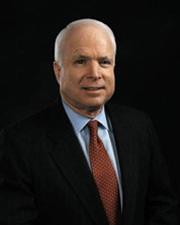 Sen. John McCain (R-AZ)
Legislative Activity
Stay on top of the latest movement without scrolling through every action
Senate amendment not agreed to: Amendment SA 1814 not agreed to in Senate by Yea-Nay Vote. 25 - 72. Record Vote Number: 243.
July 28, 2009
View full timeline
Senate amendment not agreed to: Amendment SA 1814 not agreed to in Senate by Yea-Nay Vote. 25 - 72. Record Vote Number: 243.
July 28, 2009
Senate amendment proposed (on the floor): Amendment SA 1814 proposed by Senator McCain to Amendment SA 1813.(consideration: CR S8177-8181; text: CR S8177)
July 28, 2009
Roll call votes on amendments in Senate: Amendment SA 1814 not agreed to in Senate by Yea-Nay Vote. 25 - 72. Record Vote Number: 243.
July 28, 2009
Amendment SA 1814 proposed by Senator McCain to Amendment SA 1813. (consideration: CR S8177-8181; text: CR S8177) To prohibit the use of funds to carry out any project or site-specific location identified in the committee report unless the project is specifically authorized or to carry out an unauthorized appropriation.
July 28, 2009
Amendment SA 1814 not agreed to in Senate by Yea-Nay Vote. 25 - 72. Record Vote Number: 243.
July 28, 2009
Senate amendment submitted
July 27, 2009
Votes
1 roll call on this amendment
Text
Proposed
ENERGY AND WATER DEVELOPMENT AND RELATED AGENCIES APPROPRIATIONS ACT,
2010--Continued

The ACTING PRESIDENT pro tempore. The Senator from Ohio is
recognized.
Mr. BROWN. Mr. President, I ask unanimous consent to speak as in
morning business.
The ACTING PRESIDENT pro tempore. Without objection, it is so
ordered.

Health Care Reform

Mr. BROWN. Mr. President, I come to the floor today, as I will in the
next few weeks fairly often, to share letters with my colleagues in the
Senate and the people of this country, letters I have gotten from
people in Ohio. I have letters today from a woman in Clermont County,
Cincinnati; a lady in Lake County, Cleveland; a gentleman from Lake
County also; and a gentleman from Columbus. I want to read these
letters because this is really what the health insurance debate is all
about. It is partly about preexisting conditions and exclusivity and
gateway and exchange and public option--all those terms we all throw
around. But what this debate is really about is people who are hurting
because of the health insurance situation in this country. We know it
is broken. We know we need to fix it. These are real people I want to
discuss, people my office has talked to and I have talked to in some
cases, people, for instance, like Lee Parks, whom I sat next to at
Medworks in Cleveland this weekend. She was helping people with intake,
people without insurance. They had some 1,500 people who came by
without insurance. They needed dental care, eye care, medical care.
There were several hundred volunteers, as I said, like Maria Parks and
her husband Lee, who came and worked with us on health issues. Let me
share some of these letters.
This is Wes from Columbus:

I am a 42 year old single male, small business owner. I had
been able to make sure that I have health insurance up until
March of 2007. It was then that Anthem raised my premium by
40 percent to $725 a month.
I had to decide whether to pay for the insurance or to
continue to put money into my business. I chose the business,
since without it I wouldn't have had access to insurance
anyway. Since then I have tried to get coverage, but because
of my 3 spinal surgeries, 2 sinus surgeries, and a
prescription, NO ONE will cover me.

He capitalizes ``no one.''

Ohio has something called ``open enrollment'' which is a
joke. Each month a different insurance company has legally to
accept anyone who has pre-existing conditions. BUT, the way
they keep people away is by making the rates so high.

We know that is what the insurance companies do. That is why we
wanted the public option.

In 2008 Aetna quoted me a rate of $26,000 a year for
coverage.

This is a small business owner. He says:

That is over half of my pre-tax income.

He said:

It's clear to me I will never get coverage under the
present system.

Margaret, from Amelia, OH, writes:

I am a 61-year-old woman who has oral cancer. I worked in a
law firm in Cincinnati for over 27 years, as the records
manager. I've had four recurrences of cancer, and so far have
been very lucky, but the doctor has said it will be back . .
. and will get progressively worse. I'm worried about the
pain, disfigurement and death, but right now--

She has oral cancer, she says--

I am most worried that I will be unable to work following
surgery or treatments and lose my job and health insurance.

So she loses her job, she loses her insurance. We know that happens
to so many people.

In 4 years I will be on Medicare but the cancer is coming
back within months, now, not years. My husband is several
years older and will probably be retired before I could get
Medicare.

She writes:

Do you really want a truck driver on the road in his late
sixties?

Her husband.

I am worried that we will lose the house and everything
we've worked for.

This is a letter from a woman from Lake County:

I am 80 years old and have several health problems making
it necessary to take 8 prescription drugs. Last year I fell
into the donut hole.

This was the President Bush privatization of Medicare. It provided a
prescription drug benefit, sort of--a good one for some people. But it
was a bill, as you remember, written by the drug companies and written
by the insurance companies at the betrayal of the middle class in this
country.
She writes:

I fell into the donut hole by July, and only made it
through the rest of the year due to the doctor giving me
samples. . . .
My son had been diagnosed with rheumatoid arthritis several
years ago. The insurance he had with his employer agreed to
allow the treatments with remicade.

Remicade is that very expensive biologic drug that costs tens of
thousands of dollars a year for which there is no generic substitute,
for which there is no way to get the price down.

[[Page S8164]]

Then [my son] changed jobs and his new insurance would not
allow the remicade, but would allow the use of humira, if my
son would co-pay $1,000 per treatment--every other month. . .
. That was almost more than his salary. He is barely making
out.

That is the reason we need generic biologic reform, the reason we
need a health insurance reform plan.
The last letter I will share today is from Thomas, from Lake County.

My name is Tom Zidek. I work for the United Steelworkers
Union. Today I received information from one of the companies
I represent that Kaiser is requesting a 30 percent increase
in premiums next year.

This company has received another quote from Anthem, and ``Anthem's
increase will be 15 percent for next year.''
He then goes on and tells me about his son who has Down's syndrome,
has had open heart surgeries. His wife has cancer, and the medications
she takes, according to Medco, cost approximately $5,000 to $6,000 a
month.

As I said, me and my wife have good healthcare but earlier
this year we were both concerned that we might lose our jobs.

He has worked for 36 years in the steel industry. He, along with
millions of other workers, he tells us, middle-class families, played
by the rules, and this is what happened.
These letters are four of hundreds that we get, many of us, every
single day. I have had more calls and letters and e-mails this week
about health care than any other week in my whole Senate career, my
whole House career, for the last 18 years; more letters on health care,
on this subject, than total letters I have gotten in any other week
since I have been in the Congress. This is so serious. It is absolutely
a necessity that we work on this. People who say go slow need to
understand there are 14,000 Americans every single month losing their
health insurance. Many of them live in my State. We need action.
I yield the floor.
I suggest the absence of a quorum.
The ACTING PRESIDENT pro tempore. The clerk will call the roll.
The legislative clerk proceeded to call the roll.
Mr. DORGAN. Mr. President, I ask unanimous consent that the order for
the quorum call be rescinded.
The ACTING PRESIDENT pro tempore. Without objection, it is so
ordered.

china human rights

Mr. DORGAN. Mr. President, I wish to make a very brief statement
while we are awaiting Members of the Senate to come and offer
amendments. Senator Bennett and I have been very patient. We have a
good many amendments filed, so we are waiting for our colleagues to
come offer those amendments on the underlying appropriations bill. But
I wish to take a couple of minutes while we are waiting, to offer a
brief statement.
I am Chairman of the Congressional-Executive Commission on China. The
Commission examines human rights and rule of law developments in China.
I would like to talk for a moment about these issues and some
developments in China that concern me a great deal.
I want to discuss the increasing harassment of human rights lawyers
in China, which this Commission had reported on in great detail. Some
have been disbarred, and their law firms have been closed. Others have
been physically harassed or beaten. What do these lawyers share in
common? The tenacity and courage to take on politically sensitive
cases.
I wish to say a few words about China's most famous human rights
lawyer, a very courageous man named Gao Zhisheng.
It is 174 days now since Mr. Gao was last seen taken from his bed by
more than 10 men. His captors, apparently the ``national defense'' unit
of China's public security agency according to the renowned China
expert Jerome Cohen, had threatened to kill the young lawyer during
previous detentions that were marked by horrific torture. What was his
transgression? Why is he in trouble with the Chinese authorities? He
agreed to take politically sensitive cases as a lawyer, and represented
some of the most vulnerable people in China. He sought to use the law
in China to battle corruption, to overturn illegal property seizures,
to expose police abuses and defend religious freedom in China.
In October of 2005, Gao wrote an open letter to President Hu and
Premier Wen detailing the torture of Falun Gong practitioners by
authorities. A month later, the authorities shut down his law firm and
revoked his license to practice law.
In 2006, he was convicted of ``inciting subversion of state power,''
and was placed under ``home surveillance'' which was harsher than
prison, for Gao and his family.
In 2007, public security officers abducted him again. He was brutally
tortured for 50 days. His abduction was prompted by the publication of
an open letter he wrote to us in the U.S. Congress.
Think of that. A lawyer in China wrote an open letter to us, Members
of the Congress. In it, he alleged widespread human rights abuses in
China and described the government's treatment of him and his family.
His captors called him a traitor. They warned him he would be killed if
he told anyone about being abducted and tortured.
Once released, he was placed again under ``home surveillance''. His
family faced constant police surveillance and intimidation. His
daughter, barred from attending school, lost hope as a young girl. The
treatment became so brutal the family finally decided that their very
survival depended on their escaping from China.
But Gao was too closely monitored and could not think of leaving
without placing his family at great risk because he was monitored 24
hours a day. He did not want to be in a situation where he would leave
his family at even greater risk.
So in January of this year, Gao's wife, 6-year-old son, and teenage
daughter were smuggled out of China and into the United States. This is
a photograph of Gao, his wife Geng He, his son, and his daughter. This
photograph depicts a beautiful family living in China, Mr. Gao and his
family, a lawyer who practiced law in support of the most vulnerable in
China. As a result, he ran afoul of the Chinese Government.
Mr. Gao disappeared 174 days ago, has not been seen or heard from
since. After his family fled China, Gao was abducted once again from
his home and no one has seen him alive. We know his situation is
extremely grave. I have met with his wife. I have spoken about this on
the floor of the Senate previously. His wife came to Washington, DC,
and was in the balcony when I and other colleagues spoke about the
plight of Mr. Gao.
Of course, he may have been killed. The Chinese Government has not
let anyone know his whereabouts or given access to him despite repeated
appeals by U.N. agencies, by our government, by foreign governments,
NGOs, and the media. The Chinese Government has signed and ratified
many international agreements, human rights agreements, that would
require it to come clean about Mr. Gao.
I have written to the Chinese Ambassador to the United States, and
received a letter back from him that was a nonanswer. I call on the
Ambassador again to answer the questions: Where is Mr. Gao being held?
Is Mr. Gao alive? What is the Chinese Government doing to this poor
soul who had previously been tortured simply because he ran afoul of
the state by speaking out and practicing law on behalf of those who are
vulnerable in China?
We call on the Chinese Government to give us information about Mr.
Gao, to allow him access to a lawyer and to his family and to publicly
state and justify the grounds for his continued abuse. The right to
speak freely and to challenge the government, all of these are
enshrined in the constitution in China. Yet it appears the Chinese
Government and the Communist Party seem intent on upholding the
violation of these rights in the case of Mr. Gao.
What has the Chinese Government done to Mr. Gao? How do they justify
it? When will they allow his family to see him? The government's
continued refusal to produce Mr. Gao makes this case resemble those of
the ``disappeared'' in Latin American dictatorships.
American law has the practice of habeas corpus. It is the legal
action through which a person can seek relief from the unlawful
detention of themselves or another. I am aware of nothing similar to
America's habeas corpus that exists in Chinese legislation or

[[Page S8165]]

legal practice. But the U.N. Convention Against Torture, which China
ratified almost 20 years ago, obligates it to come clean about Gao.
I urge the government of China to disclose his whereabouts and
justify the grounds for his continued detention. Once again, this is a
photograph of a very courageous man, a very courageous Chinese lawyer,
who has been incarcerated and tortured and now has been apparently
abducted, perhaps killed. We do not know. I call on the Chinese
Government to tell us what has happened to Mr. Gao.
Mr. Gao's family and Mr. Gao's wife continually await word now 174
days after their father and husband--this courageous lawyer in China
was abducted. Having been abducted before and having been tortured
before, they worry very much about the safety of their husband and
their father. My hope is that our government, and other governments can
expect some word soon from the Government of China about the
whereabouts and the well-being of Mr. Gao.
I yield the floor and I suggest the absence of a quorum.
The PRESIDING OFFICER. The clerk will call the roll.
The assistant bill clerk proceeded to call the roll.
Mr. CASEY. Mr. President, I ask unanimous consent that the order for
the quorum call be rescinded.
The PRESIDING OFFICER. Without objection, it is so ordered.
Mr. DORGAN. Will the Senator yield?
Mr. CASEY. I yield.
Mr. DORGAN. I ask unanimous consent that morning business statements
during the consideration of this bill be limited to 10 minutes.
The PRESIDING OFFICER. Without objection, it is so ordered.
Mr. CASEY. Mr. President, I ask unanimous consent that I be permitted
to speak for up to 10 minutes as if in morning business.
The PRESIDING OFFICER. Without objection, it is so ordered.

Health Care

Mr. CASEY. Mr. President, I rise to speak of an issue that has
dominated a lot of the time and attention--appropriately so--of this
Senate, of the Congress overall, and the American people. Of course,
that is health care.
We have heard so far a vigorous debate but, in my judgment, a debate
that has not had nearly enough facts on the table. Some of those facts,
of course, are the facts as they relate to what is in the legislation.
Right now, what is before the Senate is one bill, the Health,
Education, Labor, and Pensions bill, which came out of our committee. I
am a member of that committee. It came out a few weeks ago with 13
Democrats voting for it, 10 Republican Senators voting against it.
We await anxiously the deliberation, further deliberation and the
markup and the amendments which will lead to a vote in the Finance
Committee. We do await that with a lot of anticipation. That will cause
further debate and properly so. But I rise to speak on two or three
topics as they relate to where we are now.
One is the question of the ``cost of doing nothing,'' the cost of
staying on the same road, the status quo, because that is one choice
for the American people. The other path is the path of change and
reform, standing and working with President Obama to create the kind of
stability the American people should have a right to expect from their
health care system.
That stability should relate to and is framed by a number of
important considerations--certainly stable cost. Too many Americans,
even though they have coverage, see the costs going up all the time,
and they cannot afford to pay them. Whether they are in a family or
whether they are running a small business, we need to give them,
through this legislation, stable costs going forward into the future.
We also need to make sure we have stability as it relates to quality.
Millions, tens of millions of Americans, are covered by a health care
plan from a health insurance company but are not getting the kind of
quality that they deserve. That is a real indictment of our system.
Strong as it is in some other areas, it is pretty weak in some of our
quality indicators.
Thirdly, I think we want to make sure we ensure stable choices. The
American people have a right to expect, at the end of the road of this
legislation, when it is sent to the President--I sure hope we can get
there; I think we can--that the President will be able to sign a bill
that has a sense of stability as it relates to choices.
Why is it the American people should not be given choices not only
from a menu of private options but also be given the opportunity for a
public option--not a public option that is vague and overreaching but a
public option that has the same rules, that every insurance company has
to develop a plan. In other words, that the plan will be solvent, that
the plan will be self-sustaining. All those features would be part of
the public plan.
But the threshold question still is: Do you want change? Do you want
to stay on the road we have been on, the status quo? I speak about the
people of Pennsylvania, but I also know these numbers I will cite have
a national implication as well.
If we do nothing, if we stay on the path we are on--now it is 2009--
by 2016, according to one report, by the New America Foundation, here
is what happens in Pennsylvania if we do nothing, if we stay on the
road that is called the status quo, the do-nothing, let's not change
road.
Here is the result from page 86 of the report.

By 2016, Pennsylvania residents will have to spend nearly
$27,000 or close to 52 percent of median household income to
buy health insurance for themselves and their families. This
represents a 93 percent increase over 2008 levels and the
sixth highest premium cost in the country.

I have not found yet, and I do not think I ever will find, a family
in Pennsylvania, rich, middle income or poor who will walk up to me and
say: You know what, you should not do anything about health care.
Everything is fine. We should stay on the road we are on. When it comes
to 2016, my family and I can afford to spend 52 percent of our income
on health care.
I do not think we are ever going to find anyone in Pennsylvania or
America who will be able to make that statement because no one can
afford that.
But make no mistake about it, that is the path we are on right now as
it relates to the cost to families across the country. Here is another
segment of this report on the same page--again, as it relates to
Pennsylvania.

People seeking family health insurance through their
employers in Pennsylvania will have to contribute--

Meaning by 2016--

more towards premiums than residents of all but one state.

The people of Pennsylvania

will also experience the second greatest percent change in
their premiums contributions nationwide. By 2016, people in
Pennsylvania seeking family coverage through their employer
will contribute almost $9,000 to the cost of the premium.

To be exact about it, we are talking about a premium increase from
$3,510 in 2008 to $8,830, almost $9,000, for health care. I don't think
I will run into anybody in Pennsylvania or America who says: Let's stay
where we are. Everything is wonderful. Don't pass any bill. Don't worry
about getting it done. We can afford to stay on the path we are on.
In a word, that leads to, if anything, instability for a family, the
inability to make ends meet for a small business. That is the road we
are on right now. At some point in this debate, there are going to be
people in the Senate and House Members across the way who will have to
decide which team they are on. In my judgment, there are two teams: the
reform and change team President Obama has developed and the set of
policies behind that or the ``let's not change, everything is OK, let's
stay on the road we are on and let's stay with the status quo.''
In my judgment--and I know the people of Pennsylvania pretty well--
people will support change, because the road we are on now is a road to
ruin when it comes to our economy, when it comes to the bottom line of
families and small businesses.
Every week, 44,230 people lose their health insurance. That is
unsustainable. We can do all kinds of positive things in our economy.
We can talk about creating jobs and doing all of the actions we hope to
do to build a strong economy, but when we are a country where 44,230
people every week lose health insurance coverage, we are all in
trouble.

[[Page S8166]]

For Pennsylvania, between January of 2008 and December 2010, a little
less than 3 years, 178,520 people are projected to lose health care
coverage. Again, I don't think we can stay on the road we are on right
now.
Let me share some thoughts about the other debate on cost. What I
have outlined is the cost of doing nothing. The cost of doing nothing
is very high. In fact, it is unsustainable, if we are to have economic
growth and families and small business stability. Two or three quick
examples of ways the Senate HELP Committee bill, the Health Choices
Act, helps to bend the so-called cost curve to bring costs in line over
time.
In 2000, the Institute of Medicine conducted a comprehensive study of
the economic cost to society of the uninsured, arising from poor health
and shorter lifespans. An update of that study by the New America
Foundation estimates that the economic loss is now up to $207 billion a
year. By contrast, the CBO recently, when analyzing the House bill,
said that it would cost some $202 billion in 2019--not today, 2019--
less than the savings to the economy from covering the uninsured.
The bottom line is, we are spending currently per year $207 billion
in terms of the cost resulting from poor health and shorter lifespans.
One doesn't have to be a math major to cost that out over 10 years.
Just add the zero. It is entirely possible from this formulation that
if we are losing $207 billion to poor health and shorter lifespans as a
result of the uninsured, we are talking over 10 years about $2 trillion
by that estimate.
We can choose to stay on the road we are on, which means we lose more
than $200 billion every year because of what is happening to the lives
of people who don't have health insurance. It is not free. By one
estimate, every person pays about $1,000 a year because others are
uninsured. The idea that if we cover more people somehow that is going
to cost people money, it is already costing people money today.
I argue we should abandon the idea of doing nothing. We should
abandon and not even discuss the idea of staying on the road we have
been on. The road we are on right now means people in Pennsylvania will
pay more than half their income to health care, will continue to be
part of the loss of revenue of over $200 billion each and every year.
And finally, small businesses won't be able to make ends meet with
those kinds of numbers.
We will continue to talk about costs and how we can reduce cost. That
is an essential item and priority in this debate. But we also have to
talk about what is happening to people right now and what is the cost
of doing nothing. The cost of doing nothing is far too high for any
American and, candidly, for any country to sustain. We cannot stay
where we are now. We have to bring about change. I believe we will do
that this year, if we choose to be on the right team in this debate.
I suggest the absence of a quorum.
The PRESIDING OFFICER (Mr. Udall of Colorado). The clerk will call
the roll.
The assistant bill clerk proceeded to call the roll.
Mr. DORGAN. I ask unanimous consent that the order for the quorum
call be rescinded.
The PRESIDING OFFICER. Without objection, it is so ordered.
Mr. DORGAN. While we are waiting for colleagues, some of whom will be
offering amendments, I wanted to describe briefly an amendment I am
going to offer.
Let me describe an executive order that was established by President
Clinton in 1993. That executive order was titled ``Deficit Control and
Productivity Improvement in the Administration of the Federal
Government.'' Essentially what the President did in 1993 was require
Federal agencies to delineate between their program costs and their
overhead costs or general administrative costs. He wanted to begin
cutting overhead or administrative costs.
The first thing a business will do, by and large, to deal with a
downturn in business, is to begin tightening their belt on
administrative or general overhead expenditures. We can't yet do that
with Federal agencies, because there is no distinction between program
costs and administrative or general overhead costs. The minute you
propose any reduction, they say: OK, what you are doing is you are
trying to cut these programs.
President Clinton issued an executive order in 1993 that required
Federal agencies to separate out and report their administrative and
general and administrative overhead expenditures versus program costs.
Almost none of the agencies complied. So I began discussing with my
colleague Senator Coburn legislation that we have since introduced. We
may be an odd couple; we have different records on some issues, though
not all. In any event, we decided to introduce legislation that would
reinstate the requirements of the 1993 executive order, but in this
circumstance make it stick and then, ultimately, begin a reduction in
overhead expenditures.
The first step of that is to get the information with each of the
major Federal agencies on what is general and administrative overhead
expense and what are their program expenditures.
Let me give you some examples of administrative waste that are real
head scratchers.
When the Transportation Security Agency was first created some years
ago, they had to hire airport screeners. That gave rise to some
unbelievable overhead costs in trying to recruit. We held a hearing on
this. They had 20 recruiters begin a 7-week stay at the Wyndham Peaks
Resort and Golden Door Spa in Telluride, CO, a luxury resort hotel with
an 18-hole golf course. After 7 weeks, the recruiters had hired a total
of 50 people. On some days only one or two applicants showed up, but
they hung in there. They also, as I began to investigate that, had
recruiters show up at the Waldorf Astoria to interview people; the
Manele Bay Hotel in Lanai, HI; Hawk's Cay Resort in the Florida Keys.
They were recruiting people and having a grand time of it, and in the
end they spent $700 million in this manner.
A couple years later TSA spent $1 million on an awards banquet. They
hired a party planner for $85,000, three balloon arches for the party
for $1,400, seven cakes for $1,800, and $1,500 for three cheese
platters. That is some cheese.
I don't mean to pick on the TSA alone. Fore example, the Bureau of
Indian Affairs spent $28,000 to send 14 of its most senior staffers to
a 4-day Tony Robbins motivational seminar. Overhead? It seems to me it
is not overhead anybody ought to be supportive of. The participants in
that seminar were trained on how to ``shed excess weight quickly and
enjoyably,'' and how to ``reignite the passion in your physical
relationship.'' They were also asked to walk on hot coals with minimal
training. The $28,000 from the Bureau of Indian Affairs could have paid
the annual salary of a fifth grade school teacher at an Indian school.
A week or two ago, the Bureau of the Public Debt at the Treasury
announced it would hire a consultant to teach employees how to be funny
in the workplace. The consultant was going to teach staff through the
use of cartoons. I pointed out that there is very little funny to the
taxpayers about the public debt. They scrapped that. In fact, I got a
fairly upset letter from the cartoonist who bid the project.
My point is, there is fat in government agencies, especially the big
agencies that have grown and have never had to trim overhead and
general administrative expenses.
That brings me back to the Clinton order of 1993 that has never been
complied with by Federal agencies, a Presidential order that directed
certain things for which there has been no action. Senator Coburn and I
introduced S. 948 with the objective of reviving that executive order
and having the information by which to begin trimming back some or belt
tightening some with the Federal agencies on overhead expenditures. I
will not offer that bill in its entirety as an amendment to this
legislation, but I will instead offer an amendment that represents a
first step, which is that the Federal agencies will identify their
overhead and general and administrative expenses, separately from
program expenses. We need to know and should know.
My hope is, once we do know that information, we will be able to at
least initiate some belt tightening because with the kind of Federal
budget deficit we have--deficits are growing; I think they are
unsustainable and very dangerous for our country--we need to be

[[Page S8167]]

tightening our belt in a wide range of areas.
The legislation we have introduced would begin to accomplish that.
But in order to accomplish that, the first step must be to get the
understanding of what the separate expenditures are of general
administrative expenses and overhead expenses. So I will be offering
that amendment as we go along.
We will be here apparently for a longer period of time, and at some
appropriate moment, I will offer that amendment and hope for its
inclusion in this legislation.
Mr. President, I yield the floor, and I suggest the absence of a
quorum.
The PRESIDING OFFICER. Will the Senator withhold his request?
Mr. DORGAN. Mr. President, I will be glad to withhold my request.
The PRESIDING OFFICER. The Senator withholds.
The Senator from Illinois.
Mr. BURRIS. Mr. President, I ask unanimous consent to speak as in
morning business.
The PRESIDING OFFICER. Is there objection?
Without objection, it is so ordered.
Mr. BURRIS. Thank you, Mr. President.

Health Care Reform

Mr. President, as the national debate over health care reform rages
on, some complain about the inherent inefficiencies of government
programs. Some are frightened by the prospect of Washington bureaucrats
deciding what treatment people receive. But these skeptics always fail
to mention the massive inefficiencies--and widespread denial of
coverage--that is already present in the private market.
Private insurance companies are accountable to two groups: their
customers and their shareholders. The competing interests of these two
groups make for a dangerous tightrope walk for insurers. Paying off too
many claims, or keeping insurance premiums too low, may lower profits
and anger investors. Paying off too few claims, or raising premiums too
high, could cause consumers to choose a different plan--if one is
available.
The problem is that consumers do not have options. In the past
decade, we have seen unprecedented consolidation in the insurance
industry. We have seen over 400 corporate mergers involving health
insurers over the past 13 years.
Mr. President, 94 percent of the Nation's insurance markets are now
considered ``highly concentrated,'' meaning they pose antitrust
concerns. These localized monopolies stack the deck against consumers
because there is no longer real competition or choice.
The result? At the beginning of this decade, the five largest
insurers increased their profit margins by at least 50 percent, and two
of those companies increased margins by over 100 percent.
It is not surprising that, as the cost of Medicare skyrocketed over
the past decade, the price of health care insurance has increased at an
even faster rate. While companies raise premiums, they also work on
devious new ways to deny claims.
Many insurers have created barriers to delay and limit care.
Preauthorization requirements and burdensome, unnecessary paperwork
mean that health care providers spend more time dealing with insurance
industry redtape and less time treating their patients. Whole
industries have sprung up around finding ways to deny insurance claims.
One insurance company boasted that they are ``Managing the Spiraling
Cost of Health Care.'' The company claims that their efforts can
``reduce paid claims costs by up to 10% without changing benefits or
making claim system upgrades.'' This means taking advantage of
consumers by denying claims based on mere technicalities.
Any of my colleagues who believe insurance companies should decide on
treatment options has never gone through the pain of a coverage denial.
All of the extra paperwork and administration required to deny claims
actually costs a good bit of money. And that cost is passed directly--
it is passed directly--on to the consumer.
What some people do not want to tell you is that government programs
are actually much more efficient, not less. Administrative costs for
government insurance programs, including Medicare, Medicaid, and
TRICARE, are around 5 percent. Private costs are as high as 30 percent
in the individual market, 23 percent in the small group market, and
12.5 percent in the large group market.
These numbers speak for themselves. The insurance industry has become
distracted by their desire to maximize profits at the expense of those
who need care. We cannot stand by and watch as the American people are
taken advantage of, especially in a time of need when someone's health
is on the line.
That is why I am proud to support a public plan that will complete--
compete--with private insurers. This option would provide a low-cost
alternative to the private market, bringing back competition and
choice. It would press insurers to end their abusive practices and high
profit margins, and would help eliminate redtape at the same time.
No one would be forced to change insurance plans. No one would face
higher premiums. And no one would need to fear that their coverage
would be denied by a corporate giant for a few extra dollars' worth of
profits. A robust public option would help make insurance available to
those who do not have it, increase efficiencies, and reduce costs for
every American.
The time to act is now. We must not let another year go by without
meaningful reform. I urge my colleagues to join me in supporting a
strong public option. The time is now. It has been 50, 60, almost 70
years that we have been working on this program for health insurance
for all Americans. It is time we get it done.
Thank you, Mr. President. I yield the floor.
The PRESIDING OFFICER. The Senator from Connecticut.
Mr. DODD. Mr. President, I want to take a few minutes, if I may, as
in morning business.
Are we in morning business?
The PRESIDING OFFICER. We are on the bill.
Mr. DODD. Mr. President, I ask unanimous consent to speak as in
morning business.
The PRESIDING OFFICER. Without objection, it is so ordered.
Mr. DODD. I thank the Presiding Officer.
Mr. President, let me take a few minutes, if I may, on the subject
that I know is the preoccupation of many of us, even if you are not on
one of the committees. The discussion about health care is, obviously,
the dominant debate that is occurring here and in our Nation. I know
our colleague from the State of Montana, Senator Baucus, along with
Senator Grassley, is working in the Finance Committee.
As many of my colleagues, I know, are aware, I was asked to fill in
for Senator Kennedy, who is struggling with his own battles with brain
cancer, as the acting chair of the Health, Education, Labor, and
Pensions Committee. We completed, as most of my colleagues are aware,
our efforts about 2 weeks ago on our portion of the health care debate
dealing with prevention, with quality, with workforce issues, with the
fraud and abuse allegations in the Medicare, Medicaid systems, as well
as coverage questions. The rest is left to the Finance Committee. At
the end of that process, the goal is to marry these two pieces of
legislation together in one bill.
So we made that effort. We spent about 5 weeks with over 23 sessions,
and considered nearly 300 amendments in that process. In fact, we
agreed to about 160 of my fellow colleagues' amendments from the
Republican side--good amendments, I might add. Some were technical, but
many were substantive, which I think added to the value of the bill.
While it did not turn out to be a bipartisan bill in terms of the
votes that were cast, if you can define at least one definition of
``bipartisan'' to be that the bill itself reflected the contribution of
ideas from all people, then to that extent this bill is a bipartisan
bill. But we are obviously waiting until the Finance Committee
completes its process. I realize people want us, as they should, to
have a deliberate process, one for which we can say at the conclusion
we did our very best, that we evaluated the situation as well as we
could and came up with the best ideas we could to move forward.

It has been 70 years, as most people know, since we adopted the
health care system we have in our country. Every

[[Page S8168]]

President, from both political parties, and every Congress, since the
1940s, has grappled with this issue unsuccessfully. Obviously, we
passed Medicare and Medicaid and the SCHIP program and other ideas that
I think have contributed to a large extent to the health care system we
have today. But certainly the overall reforms in the system to move
from a sick care system to a truly health care system have defied
resolution.
So we are at it once again to see if we cannot defy the odds and do
that which no other Congress and no other government has been able to
do for more than 65 years; and that is, to come up with an answer that
will give people primarily a sense of confidence, a sense of stability,
to take away the uncertainty that many people feel about the present
health care system.
Most of us, of course, in this country have health care insurance. A
lot of those who are insured are underinsured. They have to pay a lot
of out-of-pocket expenses or have very high deductibles, and so a lot
of what they may face in terms of a health care crisis has to be paid
for out of their own pockets. Their insurance coverage does not cover
them. Others, of course, have no insurance at all. The numbers vary,
but I think most agree the number hovers around 45 million people who
are uninsured. There are about 25 million or 30 million who are
underinsured in the country.
But, again, I state, most people have a plan they think is pretty
good and they do not want the government or anyone else fooling around
with it. So the first principle is to say: Leave well enough alone that
which is working well. If you like your doctor, if you like your
hospital, if you like your coverage, leave that alone. We are not out
to change, nor should we, part of a health care system that works.
What we are trying to do is fix that which does not work, that which
is costing us more than any other nation on the face of this Earth on a
per capita basis--some $2.5 trillion a year. How do we increase access?
How do we improve the quality of health care? And how do we make this
affordable so people do not end up paying more and more costs in
premiums? Of course, how do we provide that sense of confidence, that
sense of stability, that sense of certainty that a plan will be there,
Lord forbid, if I need it, if my spouse, my child, or I need that kind
of health care coverage to pay for that unexpected accident, that
unexpected illness that could afflict every family.
It is at that moment, that critical moment, that you want to make
sure what you have will not put you into economic ruin, because all of
a sudden the fine print excludes the very kind of coverage which you
would anticipate based on the policy you have had for years. Or you
find yourself in a situation where even if it does, it limits the
amount you can receive to pay for that hospitalization or that care.
Those stories go on every single day. People want that notion that:
If you are going to change this, if you are going to reform this, the
thing I am looking for more than anything else is that I will have the
confidence of knowing that policy I have is not going to bankrupt me in
costs and will be there when I need it. That, more than anything else,
is what we are talking about.
The problem, of course, is while we are waiting to do this--and,
again, I emphasize that doing it right is certainly very important. I
would like to think in our committee, while we did not get unanimous
support at the end of it, we listened to every one of our 23 Members in
that committee, over 5 weeks. There was extensive debate and discussion
over all of these issues. So we have gone a long way, I think, in that
process.
But while we are waiting, there is a cost to all of this. Let me
point out what has happened in terms of the numbers. Mr. President,
14,000 people every day in our Nation lose their coverage. Again, that
may be due to job loss, that may be because all of a sudden the plan
they have does not cover the circumstances they are in. Since we have
passed our bill in the HELP Committee 3 weeks ago, 182,000 of our
fellow citizens have lost their health insurance. And 14,000 people do
every day--again, through no fault of their own: job loss, as I say, or
discovering that a policy did not cover the events they thought it
covered and they find themselves in this situation.
While we are talking about doing this slowly, and waiting a while to
get it done, it is important, I think, for those of us here who have
great health care coverage--if you are a Member of the Senate, if you
are a Member of the Congress, we have a Cadillac health care plan for
every one of us and our families, as do Federal employees. I certainly
welcome that. It is reassuring. It certainly gives you that sense, as a
Member of Congress, that you have a stable, certain plan in place if
you are unfortunate enough to be hit with a health care crisis.

I merely make that point because, as I say, a lot of our fellow
citizens do not have that same sense of certainty and that same sense
of confidence about their health care. Of course, if they are faced
with a health care crisis, we also know what can happen. We now know
that 62 percent of the bankruptcies in our country that have been
occurring over the last several years are health care crisis related. I
might point out, which I think may surprise some people, that 75
percent of that 62 percent are people with health insurance. It wasn't
the person without health insurance who got caught with a tremendous
health care cost and had no means to pay for it and thus went into
bankruptcy. Seventy-five percent of those people actually had health
care coverage. Fifty-four percent of the foreclosures in our Nation are
related to a health care crisis as well. As I say, 10,000 homes today
will receive a foreclosure notice.
So while we are waiting here and trying to get this right--and we
should--it is important to be mindful that while we are comfortable
about being assured that we have the coverage, millions of our fellow
citizens do not have that same sense of certainty and confidence they
would like to have as well, the certainty and confidence that they are
not going to get wiped out by rising premium costs to pay for someone
else, despite the fact that today most families write a check for about
$1,100 a year as part of their health insurance to cover the uninsured
who show up in emergency rooms--the uncompensated care, as it is
called. That is $1,100 a year, on the average, for a family, a check
they have to write because in our country, if you show up in an
emergency room and you need health and care, I think virtually every
medical facility in our country takes you in and they will treat you.
They will care for you in that moment of an emergency, but it doesn't
come free of charge. The costs of that are borne by those who pay the
premiums for their own coverage, and the pricetag per health insurance
policy, on average, is $1,100 a year. That is a tax we pay today as a
result of not having a more comprehensive health care system in our
Nation. So those 182,000 people who have now lost their health care in
the last 2 weeks, and the 14,000 who will lose it today, some I presume
will show up in an emergency room because of a condition or a tragedy
that befalls them. They will get health care under the status quo we
have today. They will get health care, but the rest of the country will
pay for it one way or the other. We have to change that. You cannot
bankrupt the country by having a system that fails to provide for the
coverage as well as the cost of these matters on the present system we
are living under. It will not be sustainable, in my view.
So these numbers are real. They happen every day. The longer we delay
in getting this done, these numbers will mount. So it is important to
not do so recklessly, to not do it at such a speed that we don't know
what we are doing, but we need to keep in mind that as we move along in
this process, it does not come without a cost to those out there who
find themselves in that free-fall, that terrible feeling--that terrible
feeling that if something happens, I can't take care of my family.
The PRESIDING OFFICER. The Senator has reached his 10 minutes.
Mr. DODD. If I may, I will ask unanimous consent to proceed for 1
additional minute.
The PRESIDING OFFICER. Without objection, it is so ordered.
Mr. DODD. Again, there are stories of people in my State, as I know
there are all across this country, who are losing this. I was going to
tell the story of Mrs. Carrasco in Hartford, CT. She now

[[Page S8169]]

skips her examinations, such as her colonoscopy and others things,
because they are not paid for under her policy. Several months ago, she
said she had an infection but didn't go to the doctor because she was
afraid it would cost too much. Again, doesn't go and the problems can
get worse.
Another woman in Connecticut, by the name of Theresa, has a cluster
of autoimmune disorders including rheumatoid arthritis and connective
tissue disease. Because she doesn't have health insurance, she doesn't
see the doctor. Those problems are going to get worse and she is going
to show up and the cost goes up. So stability in terms of what we have,
making sure the cost of these premiums doesn't outstrip the ability of
working families to meet them, is certainly a great challenge before us
as well as improving the quality of care for all Americans.
Lastly, I would just say I spent a good part of Saturday this last
weekend at the Manchester Memorial Hospital in Manchester, CT, looking
at their new ICU unit as well as meeting with hospital personnel. It is
remarkable what small hospitals do all across our country and how well
they serve the people in keeping down costs and increasing quality.
Many of our hospitals do. Our providers are truly good Samaritans in
case after case after case. The nurse practitioners, the doctors, and
others who support the health care professions do a remarkable job
every single day. But we need more primary care physicians, we need
more nurses, if we are going to meet the demands of a growing
population who has coverage. But we truly need to reform this system;
leave in place that which works, fix that which doesn't. That is the
goal the President has laid out for us.
That is our collective responsibility. I am confident we can do it.
If we will sit down with each other and work through this process, we
can achieve that result to bring that level of stability and certainty
that people want when it comes to their health care needs.
With that, I yield the floor.
The PRESIDING OFFICER. The Senator from Delaware.

Amendment No. 1841

Mr. CARPER. Mr. President, I wish to return to the underlying bill.
Senator Voinovich and I have offered an amendment, and I think it is
No. 1841. I am not going to call up the amendment now, but I wish to
talk a little bit about it.
As the chairman and our colleagues know, we receive in this country
probably 20 percent of the electricity that we consume from nuclear
powerplants. All those nuclear powerplants were built several decades
ago. We have about 104 in all. A number of them are 40 years old. They
were licensed for 40 years and the utilities that own those powerplants
have to come back to the Nuclear Regulatory Commission and ask for an
extension, if you will, on the life of a license. They are asking for
20-year extensions.
The Nuclear Regulatory Commission has many jobs and one of those is
to make sure the 104 nuclear powerplants that are in operation are
operating safely every day. I like to say if it isn't perfect, make it
better, to create a culture of safety and to make sure we don't have
mistakes and errors that can cause great havoc.
In addition to that, the Nuclear Regulatory Commission is charged
with--these nuclear powerplants are approaching the end of their
license, their 40-year license, and so they apply for extensions. The
Nuclear Regulatory Commission has to go through with the utilities that
own the plant the relicensure process. Add on to that, the Nuclear
Regulatory Commission has now, I think, 18 applications to build 28 new
nuclear powerplants in this country in the decades to come. Add to
that, there are a number of new designs for nuclear powerplants that
the Nuclear Regulatory Commission has to say grace over, to evaluate,
to wrap their brains around and to understand how they would work and
whether they would work safely for 40, 60 years. In short, the Nuclear
Regulatory Commission has a lot on its operate plate, which is a good
thing.
Nuclear power provides, among other things, electricity for 20
percent of our Nation's households and businesses and so forth, but it
also provides electricity that is carbon free. The emissions from
nuclear powerplants do not include carbon dioxide, do not include
sulfur dioxide, do not include nitrogen dioxide, which bothers our
breathing apparatus; does not include mercury which leads to brain
damage in unborn children. Nuclear powerplants don't put any of that
into the air. They don't contribute to the problems of global warming.

In order to make sure they are doing their job and the folks at
nuclear plants and utilities are doing what they need to do to provide
safe nuclear power, the NRC has had to hire extra people. They have
hired, I think, in the last year or two or three, about 1,000 extra
people. They have them spread out at different locations. The Nuclear
Regulatory Commission is interested in trying to consolidate as many of
those people as they can for management purposes. I think it makes a
lot of sense. Senator George Voinovich of Ohio, who has helped me at
one time or another, and I have helped him, to lead the Senate
Subcommittee on Clean Air and Nuclear Safety--we believe it makes sense
for the Nuclear Regulatory Commission to collocate many of their
employees going forward.
We want to make sure, and we seek to do it with the language in
amendment No. 1841, that the NRC can use the language within the bill
and for employee costs and other expenses to be able to get this
collocation process underway and provide additional spaces if they are
needed for an additional 1,000 employees. So my hope is our colleagues
will adopt this amendment.
I would also say the Nuclear Regulatory Commission does a competition
with, I think, every other Federal agency. It is a competition we don't
hear a lot about, but the competition is for the recognition of best
federal agency to work for, best for employees, best for their
families, and for the last two or three years, the Nuclear Regulatory
Commission has been selected as the very best place for Federal
employees to work. They do important work. They work hard. But they
also work in an environment where the employees feel it is good for
their life--not only their professional life but also their families
too. They have asked for this help from us and Senator Voinovich and I
are pleased to lend our support and we hope our colleagues will join us
in supporting amendment No. 1841.
With that being said, I note the absence of a quorum.
The PRESIDING OFFICER. The clerk will call the roll.
The assistant legislative clerk proceeded to call the roll.
Mr. DORGAN. Mr. President, I ask unanimous consent that the order for
the quorum call be rescinded.
The PRESIDING OFFICER. Without objection, it is so ordered.
Mr. DORGAN. Mr. President, we are waiting to try to see if we can
have a vote on an amendment that has been offered. We, again, would ask
colleagues to come and offer their amendments. We have been patiently
waiting, Senator Bennett and I, to see if we could get amendments
debated and voted upon.
I have a photograph I wish to show on another matter. I ask unanimous
consent to speak as in morning business for 5 minutes.
The PRESIDING OFFICER. Without objection, it is so ordered.

Electrocution Deaths in Iraq

Mr. DORGAN. Mr. President, at 8:30 p.m. on January 2 in 2008, fellow
special forces soldiers found SSG Ryan Maseth on the floor in the
bathroom at a security forces building in Baghdad, Iraq. His mother
Cheryl Harris was originally told, when she was informed her son had
died, that perhaps he had been in the shower with a radio and had been
electrocuted. He clearly had been electrocuted when he was found
unresponsive in January of last year.
But Cheryl Harris, she wanted to get to the bottom of this, and she
would not let this drop. I held two hearings on this subject. We
discovered that Kellogg, Brown, and Root had been in charge of fixing
widely reported problems at the shower facility where Sergeant Maseth
had been electrocuted, and had failed miserably.
Well, this week we obtained an inspector general's report, which
shows that there were 230 electrical shocks of American soldiers in
facilities in Iraq because they weren't wired properly. Kellogg, Brown,
and Root was the contractor, and they failed miserably. In

[[Page S8170]]

fact, they were awarded $83 million in award fees, bonuses, for
excellent work, which we now know was improper. They hired third
country nationals who could not speak good English and didn't know the
standards and, in many cases, didn't even do basic grounding of the
wiring. We know that Staff Sergeant Maseth was electrocuted. We know
there was a young man power-washing a Humvee who was electrocuted. We
know that the U.S. Army criminal investigation is now investigating a
number of these circumstances.
But when I held the hearings, there was denial all around by Kellogg,
Brown, and Root; no, we did great work, they said. By the Pentagon, the
Defense Department; no, things were fine, they initially said. It turns
out that wasn't the case. We had to ultimately get an inspector general
to give us the facts. It is not only on this case. The same thing
happened on contaminated water brought to the military bases in Iraq. I
held two hearings. The Pentagon denied that KBR had provided unsafe
water to our troops. Kellog, Brown and Root--Halliburton, rather, in
that case, denied it. But I asked the inspector general to investigate,
and they confirmed it. Nonpotable water that was more contaminated than
raw water from the Euphrates was sent to our soldiers at bases in Iraq.
These are two inspector general reports. Inspector General, U.S.
Department of Defense. There are two of them. They tell us what has
been the result of improper wiring of facilities in Iraq. ``In the
remaining 9 cases,'' they say, talking about electrocutions, not about
the 230 electrical shocks--I am talking about the nine who died. ``In
the remaining 9 cases, we determined that individuals were killed by
improper grounding or faulty equipment. The equipment malfunctions
could have related to whether equipment maintenance complied with
proper electrical standards, or whether the respective chain of command
acted responsibly in protecting servicemembers. As of June 30, 2009,
five of those nine cases remained under criminal investigation.''
Until I did the hearings, these were largely unknown. Even when I did
the hearings, KBR insisted that it had done nothing wrong.
In the case of SSG Ryan Maseth, specifically, let me read from the IG
report:

An engineering evaluation of the failed pump [this is a
pump that serviced the building] determined that insulation
on the internal wires melted, causing a short to the metal
pump housing. Failure to ground the pump and improper
grounding of the building electrical system allowed the metal
pump housing and water distribution pipes in the building to
energize.

This says this soldier was electrocuted while taking a shower because
contractors didn't do their job. It is not me saying that. I had
hearings in which people working for that contractor showed up at the
witness table and said: We worked next to people who didn't know what
they were doing, and it subjected these soldiers to great risk.
As I indicated previously, in the Department of Defense, for this
work, which we now know was shoddy work and improper work that put
soldiers' lives at risk, for that work, this contractor got $83 million
in bonus awards. It is unbelievable to me that this sort of thing goes
on.
I think there are some in the Pentagon, in the chain of command, and
certainly contractors, who have a lot to answer for. This Congress
ought to insist upon it.
This mother of this soldier, Cheryl Harris, wasn't going to let this
drop. Good for her. That is why I held these hearings to determine what
is the truth, because we didn't get the truth from the people who
talked to the mother of the soldier who died. In the hearings,
witnesses who previously worked in Iraq told us that the KBR's wiring
was improper. Now we get the truth from the IG report. We should not
have to wait for the IG to confirm these things.
I would think the U.S. Defense Department would search more
aggressively for the truth than anyone because it was their soldiers
who were put at risk. Regrettably, the Defense Department has not
pursued this with the zeal you would have hoped for. It doesn't matter
whether it was the sodium dichromate case, where soldiers were exposed
to the risks of cancer because of the water brought to the bases, which
was more contaminated than raw water from the Euphrates. There were
four or five cases. The contractor said it did nothing wrong in each
case, and the Pentagon by and large said that KBR had done nothing
wrong; but the inspector general said that the problems were real, and
documented how the contractor had failed, and the Defense Department
had failed to hold the contractor accountable.
This Congress deserves better than that from the Defense Department,
the taxpayers deserve better, and a mother such as Cheryl Harris should
not have had to wonder whether her son was in mortal danger through the
mere act of taking a shower.
Mr. President, I yield the floor.
The PRESIDING OFFICER. The Senator from Oregon is recognized.

Health Care Reform

Mr. WYDEN. Mr. President, I want to take a few minutes this afternoon
to discuss the recent developments on the health care issue and
particularly with Senator Bennett on the floor, my friend and
colleague, and the effort to make sure health care reform is
bipartisan. Also, Senator Baucus and Senator Grassley on the Finance
Committee, on which I serve, are putting in killer hours now in an
effort to come up with a bipartisan approach in the health care area.
I wanted to take a few minutes and talk about a particularly
important part of the health care debate, and that is what the middle
class is looking for in terms of health care reform. I think when you
talk about middle-class folks, most of whom have health care coverage,
they are looking for a way to be wealthier, they are looking for a way
to be healthier, and they want to make sure that if they leave their
health care coverage, or their coverage leaves them, they can get
portable coverage.
Perhaps as much as anything, middle-class folks want choice. They
understand--and this is a matter that Senator Bennett and I have talked
about often--that if you are going to come up with a health care reform
effort that is going to save money, create incentives for people to
stay healthy and services to offer prevention, and coverage that is
portable, you have to give everybody the chance to choose those kinds
of health care plans and those services.
The President, to his credit, has made the matter of guaranteeing
choice--what I have put up here on the chart--President Obama has said
that is one of his bedrock principles for health care reform. The
President has said every American must have the freedom to choose their
plan and their doctor. He clearly is on target when he talked about
choice being one of the best ways to hold health care costs down,
reward people for staying healthy and getting coverage that is
portable.
For example, every Member of Congress has the capacity to choose a
plan that is more affordable for them. When the sign-up period comes in
the beginning of each year, you get a menu of various health services,
and you want to choose the one that is the most economical for you, the
one that rewards you for staying healthy. All Members of Congress have
the opportunity to do that. The President is absolutely right in saying
that choice ought to be a bedrock principle of health care reform.
Clearly, that is what middle-class folks in Colorado, Utah, and Oregon
are looking for; they want to make sure they have choices. Frankly,
they wish to have as many choices as we have in the Congress.
So Americans want these kinds of choices. But for too many of our
citizens, under the health care reform bills that are now being
considered in the Congress, lots of people won't have the kinds of
choices that Members of Congress have, or any choice at all. There are
proposals in the Senate to create what is known as firewalls, to keep
people from being able to go to what is a ``farmer's market''--they are
called insurance exchanges--where people could get these kinds of
choices, and these exchanges are to be created in the reform
legislation.
As odd as it sounds, Congress is going to be creating these insurance
exchanges, designed to help people shop around for their insurance, but
then limit who can shop at these exchanges.

[[Page S8171]]

If you have coverage, for example, and somebody in the government says
you ought to consider it affordable, you ought to like it, you are not
going to be able to go to this ``farmer's market,'' this exchange, and
shop for a plan that is better for you and your family. You aren't
going to be able to enjoy more choices; you aren't going to be in a
position to get more for your health care dollar. You aren't going to
be able to get an affordable package, because only some people will be
allowed at these exchanges.
I think everybody ought to be able to shop for their health care
insurance like Members of Congress do today, and like our esteemed
colleague Senator Kennedy called for in a very fine essay last week.
I have been able, working with colleagues, to come up with a way to
do that. I call it the Free Choice proposal. Our Free Choice proposal
lets workers who like what they have keep it. But it also lets workers
who don't like what they have choose other plans. Half of those
fortunate enough to have employer-sponsored insurance today don't have
any choice of health plans at all. Think about that. Most Americans
don't have the capacity to choose, like we can here in the Congress.
Unfortunately, under the health care reform plans that are being
considered in the Congress, we are still going to leave millions and
millions of Americans without a choice of health services and health
care plans. Under our Free Choice proposal, everybody who has employer
coverage is going to have new choices. They can certainly keep what
they have. But if they choose, they can take what their employer now
pays for their insurance and go to the ``farmer's market'' and buy a
plan that is a better fit for them and their families.
It also gives employers more options. If the insurer isn't going to
sell them an affordable plan, the employer could then take the whole
group to the exchange and get a discount.
What the distinguished Senator from Utah and I have been talking
about these many months is something that would give more clout to
workers and more clout to employers on day one. It would give employers
and workers the ability to save money at the get-go, largely through an
old-fashioned concept that is about as American as we have, which is
choice and freedom, and the ability, when you shop wisely, to benefit
financially and, particularly, our employer approach, where the
employer could take the worker to the exchange on day one and get a
discount. That the employer could get a discount is one that, in my
view, is going to give employers the bargaining power in negotiating
with insurers that they don't have today.
This is a proposal we can do without making any adjustments to the
Tax Code. The independent analysis Senator Bennett and I got a few days
ago indicates we could save consumers $360 billion over the next
decade. Those are savings to our people. Those are savings in the
health care system. It is an approach that is very much in line with
what the President has identified as a bedrock principle for health
reform.
I have talked about the value of choice, particularly this August in
Colorado, North Dakota, and around the country being able to tell all
middle-class people they are going to have more choices. But what I
think is particularly useful about the Free Choice proposal, it is one
of the pathways to getting more affordable coverage because once you
have these choices, just like Members of Congress--if at the beginning
of the year the Senator from Colorado does not like one particular
plan, he can go to one of the other plans that is a better fit for him
and his family. We are talking about using the same principles that
have worked for Members of Congress for many years.
I believe that middle-class folks, as they try to sort through this
debate, are going to be looking at a handful of fairly straightforward
principles. They are going to want to be wealthier, they are going to
want to be healthier, they are going to want coverage they can take
with them from job to job.
We have had 7 million people laid off since this recession; 3 million
of them do not have health care. What happens to them is they go into a
program called COBRA. COBRA is the only Federal program named after a
poisonous snake. Given how hard it is for people to afford that
coverage and all the bureaucracy for employers and employees, we can do
better by both workers and employers. Let's make coverage seamlessly
portable. Senator Bennett and I have included that in our Free Choice
proposal. On day one, more choices for the middle class. On day one,
the opportunity to save money. If you don't like the first plan, choose
one of the other plans. On day one, coverage that is portable. That is
what I think middle-class folks are looking for.
That kind of market competition is what the Congressional Budget
Office has scored as actually producing savings in the private sector,
not in 10 years, not in 15 years, but in a matter of 2 or 3 years. It
actually bends the cost curve downward without exploding the debt and
the deficit.
I hope my colleagues on the Finance Committee and here in the Senate
and on the HELP Committee--I had a very constructive conversation about
the Free Choice proposal with Chairman Dodd recently. I hope colleagues
will see this is an approach that can win bipartisan support.
The guarantee of choice is a bedrock principle in President Obama's
agenda. For the middle class who is asking now how this is going to
work, this is the path that is going to let middle-class people be
wealthier, healthier, and protected when they lose their job or if they
want to get another opportunity. I am very hopeful that this bedrock
principle of President Obama's agenda for fixing health care can win
the support of colleagues on both sides of the aisle because I think
that is the pathway to responding to the question middle-class people
are asking all over this country today: How we are going to make this
work for them?
I hope colleagues who have additional questions about it will see my
friend from Utah or me. We will be happy to discuss it with them
further.
Mr. President, I yield the floor.
The PRESIDING OFFICER. The Senator from Utah.
Mr. BENNETT. Mr. President, I know we are on the bill. As the manager
on the Republican side, I want to stay on the bill, but, my colleague
from Oregon having raised the issue with respect to the consumer choice
and our proposal, I ask unanimous consent that I can proceed as in
morning business in order to respond.
The PRESIDING OFFICER. Without objection, it is so ordered.
Mr. BENNETT. Mr. President, I am grateful to Senator Wyden for the
leadership he showed here and the tenacity with which he has pursued
all of these issues. As I have sat here and listened to the various
interventions in morning business about health care, I found the common
theme that I want to comment on with respect to it. I think Senator
Wyden's comments helped me frame this theme.
The theme I have heard over and over again from speakers has been: We
can't stay where we are. And then the argument has been framed: We
either have to move ahead with the President's program or stay where we
are. As Senator Wyden has indicated, there are other alternatives
besides moving ahead with the President's program and staying where we
are.
I would like to draw this analogy that I hope will help us understand
at least this Republican's position. I won't try to speak for all
members of my party, although I think many of them would be sympathetic
with what I am about to say.
Let's assume your neighbor's house is on fire. This is a serious
problem. Your neighbor comes to you and says: My house is on fire. Lend
me your garden hose so I can put the fire out.
And you say: My garden hose isn't long enough to reach the fire.
You don't understand, your neighbor says, my house is on fire. There
are children in the house. There are women in the house. They will die
if you don't put out the fire. Lend me your garden hose.
I respond or you respond: I understand there are children in the
house. I understand allowing the house to burn down is a tremendous
mistake. But my garden hose won't reach. We need a different garden
hose if we are going to put out the fire.
No, no, no, the fire is reaching now, it is down, it has destroyed
the top stories, it is getting down to the bottom

[[Page S8172]]

stories; people are fleeing. Give me your garden hose or you are a
terrible person.
And you respond: I will be happy to give you a garden hose that would
work, but the garden hose I have right now will not solve your problem.
We need that kind of an understanding here.
I am not a Republican who says: I defend the present system. I
listened to the speeches being made about how terrible the present
system may be, and I say I agree with them absolutely. I listened to
the letters being read from home States that say: I was denied coverage
by an insurance company bureaucrat. I lost my job and I lost my
coverage. These are tragic, and I agree they are tragic, and I agree
something ought to be done about it. It is just that, in my opinion,
the President's garden hose will not reach. In my opinion, the
President's garden hose will not only not put out the fire but, to
stretch the analogy beyond all credulity, will make it worse. We heard
about people who are being denied coverage under the present system.
People will be denied coverage under the President's system.
If we look at other countries that have adopted similar public plans
of the kinds we are talking about, we are going to see people whose
coverage is denied again and again. Indeed, the comment was made about
Senator Kennedy and the brave battle he is putting on against his
problem. If he lived under the single-payer coverage of other
countries, he would be denied coverage because of his age. We don't
want that in America. We don't want people like that to be denied
opportunities.
Senator Wyden and I have worked as hard as we can--back to the
analogy--to create a garden hose that will reach, to create a garden
hose that will, in fact, put out the fire, solve the problems, and
change the present system.
I thank the Senator from Oregon for making it clear that there are
alternatives to the present system that are not necessarily the bills
that are coming out of the two committees.
I am not going to embarrass my friend from Oregon by insisting that
he take the same position I take with respect to the bills that are
coming out of the two committees, but together we have formed a
solution that we think will solve the problem, we think will put out
the fire, we think will turn down the cost curve. And we have now a
growing chorus of voices of people who are saying: You know, Wyden-
Bennett looks as if it will work; why don't we try it.
The only question I am asking here is, Why don't we try it? So far,
neither committee has been willing to look at the details of what we
are talking about. All we are asking is that they do so because we are
convinced that when they do, they will come to the conclusion that our
garden hose will, in fact, put out the fire and it will do it more
cheaply and more efficiently than the proposals that are before us.
Again, Mr. President, I thank my colleague from Oregon for his
leadership and his tenacity in going forward with this proposal. I am
honored to be associated with him in this effort. I agree with all of
the speeches that have been made that the present system is not
acceptable. I hope we can get together and solve the problem in a truly
effective and bipartisan fashion.
I yield the floor.
The PRESIDING OFFICER (Mr. Kaufman). The Senator from Oregon.
Mr. WYDEN. Mr. President, I wish to take an additional minute. I
thank my friend from Utah.
What is striking about this debate is the opportunity to bring both
sides together. As I outlined the Free Choice approach and the pathway
to savings for middle-class folks--portable coverage, incentives for
prevention--it could work its way into a variety of different bills
that are being considered. Obviously, Senator Bennett and I feel very
strongly about our legislation, the Healthy Americans Act, but I was
very pleased with the discussion I had the other night over dinner with
the distinguished Senator from Connecticut, the chairman of the HELP
Committee, who has some good ideas as well.
What I hope we will do, what Senator Bennett and I have sought to do
lo these many months, is focus on some bedrock principles. I cited the
three that have been important to President Obama: the question of
holding down costs, ensuring choice, maintaining quality.
I believe--Senator Bennett and I have worked together on this--that
our approach with Free Choice in particular making sure we don't have
all these firewalls that would prevent choice for millions of Americans
would--would actually reward Americans for shopping wisely.
I was very glad that both Chairman Baucus, who said he would look at
our Free Choice proposal, and Chairman Dodd, the same openness at
looking at our proposal, captured that this would be a way to carry out
the President's agenda for addressing the questions middle-class people
are talking about all over the country.
Obviously, Senator Bennett and I--and I am very pleased the
distinguished Senator from Delaware has joined us. He is certainly a
veteran of the Senate and what it takes to come up with bipartisan
coalitions. I am very pleased to be on the floor with two good friends
who know a lot about health care and what it takes to build bipartisan
coalitions.
What I wanted to do was to say that in addition to our legislation,
which we obviously feel strongly about, this concept of Free Choice and
making sure you reward individuals, as we do in so many areas of
American life, could really pay off quickly for middle-class people in
terms of savings and access to quality health care.
I am very hopeful that as we go into these last couple of weeks
before the recess--and we have offered this proposal to Chairman
Baucus, the chairman of the committee on which I serve--Democrats and
Republicans can come together so that before the August recess, we will
have at a minimum identified some ideas.
Our Free Choice proposal is just one that will allow us through the
month of August to show middle-class people that we are serious about
their concerns.
Right now they are trying to sort this debate out. Suffice it to say,
they see a lot of arguing in Washington, DC. They hear a lot of the
discussion about health care, which almost sounds like gibberish when
you listen to all the technical lingo. If we can come back with ideas
such as Free Choice and say: Look, middle-class people, you and your
family can be part of a system that is very similar to what my family
enjoys--and it has paid off for my family at the beginning of the year
when I was choosing a plan that is more economical for me, or rewards
prevention--then we get behind proposals that bring Democrats and
Republicans together. I point out this is one area that the budget
office has indicated will actually score substantial savings--not in
10, 12, 14 years from now, but in the second year after it is fully
implemented.
I thank my colleague from Utah for all his support and counsel.
I yield the floor.
Mr. BENNETT. Mr. President, I suggest the absence of a quorum.
The PRESIDING OFFICER. The clerk will call the roll.
The bill clerk proceeded to call the roll.
Mr. DORGAN. Mr. President, I ask unanimous consent that the order for
the quorum call be rescinded.
The PRESIDING OFFICER. Without objection, it is so ordered.
Mr. DORGAN. Mr. President, Senator Bennett and I are similar to the
Maytag repairman in the old commercials, waiting for someone to come
and offer amendments. Many have been filed. No one, apparently, has
come to the floor to offer amendments.
I would not be surprised if at some point down the road someone will
say: Well, we did not get enough chance or opportunity to offer
amendments. Of course, in these intervening hours, there has been
plenty of opportunity for someone to show up to offer amendments.
We had intended and hoped to have a vote at 4:30 on a relatively
noncontroversial amendment. But for the last hour or so, we have been
waiting, on a noncontroversial amendment, for a staff person to contact
the Senator who is apparently not able to be contacted to tell us
whether the Senate can vote on a noncontroversial amendment.
Such is the life of the Senate, a place where no one has ever been
accused of

[[Page S8173]]

speeding. We only ask, having been here now yesterday and today,
Senator Bennett and I only ask, having put together this bill that
funds all of our energy and water issues, if there are Senators who
wish to offer amendments--and many have been filed--they would come
here and decide to offer them because we will not have floor time for
the entire week this week. We are not going to be able to be on the
floor. The time does not exist to allow us to be here all week.
Those Senators who wish to offer amendments are, it seems to me,
going to find very little sympathy from me, and I hope from other
Members of the Senate, if they at some point down the road say: Well,
we did not have an opportunity. They have had plenty of opportunities.
It is they have chosen not to come to the floor to offer amendments.
It may be they feel the amendments do not have merit or are not very
important or whatever. But if they do have merit and are important--I
assume some do--I would hope they would come soon and give us the
opportunity to entertain amendments and discuss them, debate them and
have votes on them so we can move this appropriations bill along.
I yield the floor.
The PRESIDING OFFICER. The Senator from Rhode Island is recognized.
Mr. WHITEHOUSE. Mr. President, I ask unanimous consent to speak as in
morning business for up to 15 minutes.
The PRESIDING OFFICER. Without objection, it is so ordered.

Health Care

Mr. WHITEHOUSE. I would let the distinguished floor manager and the
distinguished Senator from Utah know that if someone does come to the
floor and wishes to do their thing with an amendment, please feel free
to give me the high sign and I will conclude my remarks and allow the
business of the floor to proceed. I do not wish to keep anybody from
offering an amendment, if they have one.
But I did wish to take the time to talk for a minute about our health
care system because I think people across the country are, right now,
finding our dialogue in the Senate a bit confusing about health care,
and they are starting to wonder what is going on. In particular,
particularly for those who have insurance: What does this mean for me?
Why is this important for me that the Senate be doing this work? I
already have insurance. What do I stand to gain from all this?
There are a great number of things Americans stand to gain from all
this. But the issue I wish to focus on today is improvements in our
delivery system. It is important for Americans who are listening to
realize that the personal experiences so many of them have had are not
unique. If you have had a loved one in the hospital and you have felt
constrained to stay with that loved one through their illness in the
hospital, if you have felt you could not leave them alone in that
hospital for fear that something might go wrong, some drug might be
misadministered, some call might go unanswered, if you feel that way,
if you have had that experience, you are not alone.
That is an extraordinarily common experience. If you have felt you
missed an opportunity for the prevention of illness, nobody told you
that you should have had this test, nobody told you this was a health
consequence of something you were doing, that is an experience
Americans have across this country.
If you have had to ferry by hand your health records from place to
place or if, similar to many Rhode Islanders, you have been rushed up
for emergency specialty care in Boston and your paper records did not
come with you and you have been in real peril in a Boston emergency
room as they try to redo the tests they did not have access to because
you did not have a comprehensive electronic health record, you are
similar to many Americans.
The consequences of that, of those problems, are renown throughout
the health care system. The problems they cause are real ones. There
are 100,000 Americans who die, who lose their lives every single year
because of completely avoidable medical errors, most of them hospital-
acquired infections. That is intolerable. That is a plane crash a day.
Yet it is the status quo in the existing health care system.
We have the worst health care outcomes of essentially any civilized
developed country we compete with. The worst. Even though we pay twice
as much per person for our health care than most of them, we have worse
outcomes. That is the status quo of our health care system. The
Economist magazine has reported that the health information technology
infrastructure that supports our health care sector is the worst of any
American industry, except one, the mining industry.
That is not very reassuring, not in an industry where the
possibilities for technology are so great, and where at the detection
end and where at the treatment end, we are at the technological cutting
edge of the world, but you get back to that back office and there you
are with that paper record and no way to cross-reference for drug
interactions.
We are at a primitive stage with our health information
infrastructure. That is the status quo of our health care system.
Everybody, I suspect, has had the experience themselves or of a loved
one who becomes sick unexpectedly who turns to their insurance company,
the insurance company they have been writing those big checks to year
after year, only to find out that when you turned to that insurance
company in your hour of need, they turned on you, they turned against
you.
They tried to figure out a way to get you off coverage. They tried to
talk you out of the coverage and the treatment your doctor has
indicated. They fought with your doctor about whether they would pay
it. For many people, the experience is not just of being the patient,
the experience of being the spouse or the family member or the loved
one of the patient who has to cope, who has to become the person who
answers the deluges of mail, who makes the call after call after call,
who waits through dial tones and through the voice mail and the voice
messages to try to get to somebody to approve procedures the doctor has
said you need. That is the status quo of our health care system--
millions of Americans told by their own insurance companies: Forget it.
We are not going to pay for the treatment your doctor says you need.
The major reason American families go into bankruptcy right now is
because of health care expense. It is not just the uninsured. These are
insured families who find their coverage limits have been reached, who
find the insurance company has found a loophole, who find they have
exceeded, in terms of all the peripheral costs of durable medical
equipment and other things that might not be covered, but it is more
than they can bear to get by and they are struggling to get by and they
are dropped into bankruptcy; the most prominent reason American
families go into bankruptcy.
That is the status quo of our health care system. Those can all be
better. We can revolutionize all those areas. We can revolutionize the
quality of care and the safety of Americans when they are in the
hospital.
We can improve our health care outcomes so we are the pride of
developing nations, and not the lagger. We can improve so we do not
have the worst health information technology of any American sector. We
can eliminate denials of care by insurers for preexisting conditions.
We can provide adequate supports to Americans so bankruptcy is not a
common symptom of illness in this country.
The problem is, if we do not do anything about those existing
problems, they are all going to accelerate. They are all getting worse.
What do we have to look forward to? Well, we have to look forward to a
$35 trillion Medicare liability, and we do not have $35 trillion to
spend.
That is a future liability. It is coming toward us. The people who
are going to cause it are alive right now. They are not going anywhere.
They are getting older every day. Time is not going to stop. And they
are getting sicker every day because it is never going to happen that
older people are healthier than younger people.
There is a tsunami of health care costs bearing down on us. Just the
Medicare slice of it is a $35 trillion liability for our country, and
we do not have the $35 trillion. So it is either going to wreck us or
we are going to have to take some very smart, very aggressive measures
now to reduce those costs.

[[Page S8174]]

If we do nothing, a family in Rhode Island in the year 2016--that is
not too far from now; that is 7 years from now--a family in Rhode
Island making $52,000, which is a pretty good income, a family making
$52,000 will spend more than half their income on health care. By as
soon as 2016, a Rhode Island family making $52,000 will spend more than
half their income on health care.
We use the word ``unsustainable'' around here. We are headed to where
it is impossible for regular families to get health care. It is bad
enough now, and it is getting worse. We have to act to stop it from
getting worse.
We have pretty close to lost our car industry. People used to say:
What is good for GM is good for America. It was the emblematic American
company. It is gone. It is in bankruptcy, and it is gone. It is now
coming back out of bankruptcy, but it had to be swept through a
bankruptcy. The catastrophic effect on our country of the loss of those
jobs in the Midwest and then through the secondary providers across the
country is a very real problem, and it is being felt in large part
because those cars were so burdened with health care costs.
If you go to Starbucks, there is more health care money in your
coffee than there is coffee bean money. In those cars, there was more
health care money than steel. The cost of health care per car was
greater than the cost of steel per car. It is pretty hard to compete
with Volvos and the Lexus and cars from places where they have a
national health care system and the price of the health care is not
buried in the cost of the car. It put our workers at a terrible
disadvantage. That is only getting worse, and our manufacturing sector
has enough problems without continuing to load health care costs on to
it. If we can't get the message from the collapse of the auto industry,
we are missing some very loud--indeed deafening--signals.
Our last Comptroller General warned that this health care mess will
sink our ship of state. He phrases it as a national security issue to
get this right. He left the job to go and spread the word around the
country warning us of what is coming.
Not only is it bad now, it stands to get a lot worse. Here is the
opportunity and the tragedy of this: It is that so much of this is
waste. One recent voice on this subject is a former Cabinet member from
the last administration. Paul O'Neill was the Secretary of the Treasury
of the United States. He is no fool. He is a sensible and thoughtful
man. He ran, for years, Alcoa, one of America's biggest corporations.
He has extreme business experience. He also ran something called the
Pittsburgh Regional Health Initiative which looked at improving the
quality of care of hospitals in the Pittsburgh area. He was a leader in
all of this. He knows his health care issues well. Here is what he
wrote recently: There is $1 trillion of annual waste in the health care
system that is associated with process failures. A trillion dollars a
year--even by Washington standards that is a big number. That is a
target that is worth shooting for. That is a target that we shoot for
hard in the legislation we are putting forward.
If we take a look at the President's own Council of Economic Advisers
recent report, on July 9, a few weeks ago, they put out the report on
the economic case for health care reform. They looked at the health
care system from two measures: one, if you compare to it foreign
countries and look at their gross domestic product share and
extrapolate from that, what we could get our costs down to if we were
sensible and thoughtful and didn't have such a wasteful health care
system and, second, to look at the variation among the States, from
State to State, from region to region, even as the recent article by
Atul Gawande said, the differences within a State, between McAllen, TX
and El Paso, TX.
If you look at those, that gives you another means of calculating
what you could get the costs down to. If you could get the waste out of
the system, efficiency improvements in the U.S. health care system
potentially could free up resources equal to 5 percent of U.S. GDP.
From the Council of Economic Advisers, that is over $700 billion a
year. Maybe it is a trillion, maybe it is $700 billion. Per year that
is a big number.
Looking at the internal discrepancies, they note:

[It] should be possible to cut total health expenditures by
about 30 percent without worsening outcomes [which] would
again suggest that savings on the order of 5 percent of GDP
could be feasible.

Again looking at the calculation two separate ways, coming to the
same number, $700 billion a year. The problem is, it will take some
executive administration to get there. It is not easy. You don't just
make your decision, flip up or down the light switch, it goes on, and
you don't have to worry about it. This isn't like the sniper who lines
up his shot, pulls the trigger, and the projectile goes. This is a
problem where you are like the pilot landing in rough weather. You have
to continue to steer through it. You have to continue to seek the
savings. As the market adapts, you have to adapt with it. It takes
executive leadership and administration to make this happen. That means
the Congressional Budget Office can't score it. All they can say is
that it promises a ``large reduction'' in American health care costs.
But they can't score it.
So the American public, with a lot of misinformation out there, has
been beguiled into believing that what we are doing won't save money.
We are determined to save money doing it. The Medicare system and the
American health care system and the American economy will fail if we
don't save money doing this. The target is as big as $700 billion to $1
trillion a year.
Our health care system has been described memorably as a ``carnival
of waste.'' It is time to bring the carnival to an end and give
Americans the health care they deserve.
There are a couple of pretty sensible ways to do this. The
administration has focused on all of them. The first is, as I said
earlier, health information infrastructure. Why should every American
not have an electronic health record? Why, when you go to McDonald's,
should the checkout person have a more robust health information
infrastructure backing them up and connecting to inventory and
connecting to sales than your doctor does? It makes no sense. We could
save enormous sums if we had a national health information
infrastructure--secure, confidential, reliable, interoperable. So if
you went to get a lab test, it went into your record. If you went to
the emergency room, it went into your record. If you stayed at the
hospital, it went into your record. If you saw a specialist, it went
into your record. All of your practitioners would know what was going
on in your care. The more complex and chronic your conditions, the more
valuable that would be. We don't have that now. It is the worst of any
American industry except the mining industry.
Quality improvement: In Michigan, there was a fascinating project,
called the Keystone Project, where they went into the intensive care
units in Michigan--not all of them but a great number of them--with
process reforms in the intensive care units to reduce respiratory
problems from not being elevated, to reduce line infections from
catheters and from blood lines. The effect of that was, in 15 months,
to save 1,500 lives and $150 million just in one State and not even all
the intensive care units. It proves the proposition that quality
improvement can save money and lives.
Prevention is obviously the same. We will be on the floor shortly to
debate Judge Sotomayor's nomination. She has lived with diabetes since
she was a child. She has taken good care of herself so she had not
created a lot of cost for the health system, but many people who don't
manage their disease well, who don't get the prevention they need, end
up with amputations, blindness, long and unnecessary hospital stays.
There are areas where, by investing in prevention, we can save
fortunes.
Why don't we do this then? Why don't we have electronic health
records on every doctor's desk for all Americans? Why don't we have
every intensive care unit participating in a Keystone-type quality
initiative? Why doesn't every community health center have a robust
diabetes prevention program? It has to do with the bizarre economics of
our health care system. Because the same thing is true for all three
entities. If you are a doctor and you want to put electronic health
record systems in for your patients, if

[[Page S8175]]

you are a hospital and you want to improve the quality of care in your
intensive care unit and put in a program that will do that, if you are
a community health center that wants to invest in prevention to help
the diabetic population stay healthy, you face the exact same
predicament: The investment you have to make is 100 percent out of your
pocket. The risk of the investment is 100 percent on your neck. The
administrative burden is 100 percent on you. The hassle of it is 100
percent yours. All of the costs are on the desk of the doctor, on the
desk of the hospital administrator, on the desk of the community health
center. But the benefits from the electronic health record, the
benefits and the savings from the quality improvement, the savings and
the benefits from the prevention don't find their way back to that same
desk. They go off to Medicare. They go off to the insurance industry.
They connect to the patient in better care, but investment doesn't get
the reward.

The basic principle of American capitalism, which is the connection
between risk and reward, has been broken in the American health care
system. That is one of the things we get after in this bill. We could
have electronic health records for every American, our hospitals and
doctors highly motivated to pursue all the quality initiatives that
will improve the quality of our care while it lowers the cost and
avoids unnecessary hospitalizations and delays and infections, and so
forth, and we could have the best prevention program in the country,
but we have to make it work for people. That is part of what we are
about in this health care reform.
I will continue to explain why it is important that we reform our
health care system and what the average American will gain from it.
Today I focused on the elements of why delivery system reform can be
improved. But every American will see that in their lives, their
parents' lives, and in their children's lives. When we look back to
where we are today from where we can be and where, with President
Obama's leadership, we will be, we will look back and ask: My God, how
could we have been living that medieval setup? Look how good it is now.
That is our goal. That is our purpose. That is the promise of health
care reform.
I yield the floor and suggest the absence of a quorum.
The PRESIDING OFFICER. The clerk will call the roll.
The assistant bill clerk proceeded to call the roll.
Mr. VOINOVICH. Mr. President, I ask unanimous consent that the order
for the quorum call be rescinded.
The PRESIDING OFFICER. Without objection, it is so ordered.

Amendment No. 1841

Mr. VOINOVICH. Mr. President, since there is no further debate on
amendment No. 1841, I ask for its adoption.
The PRESIDING OFFICER. The question is on agreeing to amendment No.
1841.
The amendment (No. 1841) was agreed to.
Mr. VOINOVICH. Mr. President, I suggest the absence of a quorum.
The PRESIDING OFFICER. The clerk will call the roll.
The assistant bill clerk proceeded to call the roll.
Mr. DURBIN. Mr. President, I ask unanimous consent that the order for
the quorum call be rescinded.
The PRESIDING OFFICER. Without objection, it is so ordered.
Mr. DURBIN. Mr. President, I ask unanimous consent to speak as in
morning business.
The PRESIDING OFFICER. Without objection, it is so ordered.

Health Care Reform

Mr. DURBIN. Mr. President, this is an important bill, the Energy and
Water appropriations bill. It is one of the 12 or 13 appropriations
bills we have during the course of the year to prepare for spending in
our new fiscal year, which starts October 1. Senator Dorgan and Senator
Bennett are shepherding this bill on the floor.
Meanwhile, in another room, not far from here, at least six
Senators--maybe more--are meeting trying to work out the details of a
piece of legislation that could literally affect every person living in
America. It is the question of health care reform. It is an interesting
issue because it has been tried before. Previous Presidents--Theodore
Roosevelt; Harry Truman; certainly, Bill Clinton--have tried their best
to change the health care system in America to make it a system that is
stable, secure, so people know what it will cost, what it will cover,
and know, ultimately, they can have quality care available when they
need it for themselves or their family.
The simple fact is, in America health care has become extremely
expensive. We spend more per person in America--twice as much per
person--as the nearest nation on Earth. So we are spending a lot of
money. And people see it, because the cost of health insurance premiums
is going up much faster than their income, and they worry about it.
Many of the folks whom I talk to back in Illinois worry whether next
year there will be an increase in their hourly wage that will be
completely consumed by increases in health insurance premiums. And they
add, incidentally: Senator, that new health insurance plan is not an
add-on. It usually covers less than the one before--the situation where
preexisting conditions will eliminate coverage for things that are
critically important for individuals; where folks find when they reach
a certain age the cost of the health insurance premiums goes up so
high.
There are battles that go on between doctors and hospitals and
insurance companies about whether they will actually cover something--
cases we have seen in Illinois and around the country, where folks
thought they had some insurance and guarantee that health insurance
covered their medical procedure only to find later it did not.
Many people who are out of work today are realizing for the first
time in their lives they do not have the protection of health
insurance. Some of them, with limited savings, battered by the recent
stock market, wonder if tomorrow's accident or diagnosis will wipe out
everything they have ever saved. That is the reality of the uncertainty
and instability of our health care system today. People are looking for
stable coverage they can count on; if they get sick today, that they
will be covered tomorrow. They can look, as well, for the kind of
stable costs they can afford--even when they have lost a job--to make
sure there is health insurance to protect their families. And they want
to preserve their right to choose their doctor and hospital to give
them the best care in this country.
The obvious question is, can we reach that goal? And the obvious
answer is, only with the political will of this Senate, with
Republicans working with Democrats. I hope we can do this. I hope we
can find a bipartisan way to this solution.
President Obama has made it clear it is his highest priority--to
improve health care for America and its citizens, and it is his highest
priority when it comes to our deficit. A lot of people say: Well, if
you are going to spend a trillion dollars on health care reform, think
twice. Well, we should think twice because we are facing deficits and a
national debt that has grown dramatically over the last 7 or 8 years.
But the fact is, untouched, our health care system over the next 10
years will cost us more than $30 trillion. If spending a half a
trillion dollars over that period of time can change the system for the
better, start bringing in practices that bring down overall costs, it
is money well invested and money well spent.
First, we have to try to wring out of the system the fraud that goes
on. All of us know what is happening here. There are some health care
providers in America who are capitalizing on a system that rewards
doctors and hospitals for piling on the procedures, for piling on the
expensive pharmaceuticals and medical devices. There is little or no
reward for good health outcomes. The reward for a physician and someone
who is using our system today is to do more, spend more. Well, that
should not be our goal. Our goal should be quality health care for
everyone. It should not be a system of fee for service that rewards and
incentivizes spending that does not result in good health care.
There are a lot of people who have come to the Senate in committee
and otherwise to express their opinions about what will work and what
will not. The Congressional Budget Office has been called on from time
to time to

[[Page S8176]]

ask whether these health care reform bills will actually save money.
Testimony about the status quo is obvious. If we continue the way we
are going, it is going to be a bad outcome. We know if we do not change
this current system, it will become so expensive the average family
will not be able to afford to pay the premiums. If we do not change the
abuses in health insurance, we are all vulnerable to preexisting
conditions and new costs and discrimination against people based on
their gender, where they live. That has to change.
We know there are ways to save money within our system. One of them
relates to preventive care, wellness strategies. There is not enough of
that today. A man by the name of Steve Burd is the CEO of Dominicks and
Safeway, and he has a program for his management employees where he
creates a financial incentive for them to take care of themselves and
to get healthier. It is voluntary for those who want to participate.
They come forward. They get examined. If they find they are overweight,
they set a goal to reduce their weight. If they find their cholesterol
is too high, they set a goal to reduce their cholesterol; the same
thing with blood pressure, and the management of diabetes.
If they meet these goals, if they show they are changing their
lifestyles--they quit smoking; they are getting healthier--they get a
financial reward. For the business, the reward is lower health care
premiums.

We need to have wellness strategies in America. Some of the problems
we are facing are problems that will cost us dramatically in years to
come. The incidence of diabetes among our children today is alarming.
If it does not stop, if we will not deal with the issues of obesity and
diabetes and other related issues, believe me, we cannot enact enough
laws and put enough money into a health care system that does not deal
with this.
We also have to realize the health records and medical records need
to be put on computers so they can be exchanged between health care
providers. These electronic records can reduce the number of mistakes
that are made, improve the care that is given to individuals, and save
us money.
We also need to take a look at chronic diseases--I mentioned
diabetes--and make certain there is an incentive there for wellness and
for preventive care before people reach terrible stages in that disease
that costs dearly and can be compromising to their health and maybe
even their life.
So if we can come together with a system of health care that provides
stable coverage that you can count on, stable costs that you can
afford, and quality that strives for excellence, and the kind of choice
every American family wants, then the outcome of the meeting, not far
from here, of these Senators will be one that America can cheer.
Fortunately, the President has invested his political capital in this
effort. He has told all of us this is the most important single thing
he is working on and wants to achieve. He is prepared to spend his
time, obviously, and his political capital to achieve it. It is our job
as elected officials to respond to this national need. For many of us
this may be a once in a political lifetime opportunity to change health
care in America for the better.
It is the job of those in government to consider its budgetary
impact. But some of them are not charged with coming up with a
solution. We have to look beyond the budget in some respects to the
long-term benefit. The President has said we are going to pay for
everything we do. But the long-term benefit, for example, of preventive
care may be difficult to measure today. We know it is going to be an
ultimate benefit to our country. Most of the savings in health care may
not be reflected in the Federal budget. The savings will accrue to the
people of this Nation, though, to give them the peace of mind they have
health care they can count on that will be there when their family
desperately needs it.
We have to make certain this is part of our charge here, and this is
the time to do it. I hope the Senate Finance Committee, before we leave
in about 10 days or 11 days, can produce a bill. And I hope the House
of Representatives can pass one, and then, when we return, we will come
to the floor of the Senate and work together in a bipartisan fashion to
pass it. I am certain it will require compromise by all of us. I have
my idea of what health care reform should look like, and I am sure
others do as well. But in the spirit of good faith, we can come
together and make a difference and provide the kind of health care
reform and changes that will give people peace of mind across America--
a stable and secure health care system that continues to make this
great Nation on Earth a nation of healthy individuals and families.
Mr. President, I yield the floor.
The PRESIDING OFFICER. The Senator from Hawaii.
Mr. REID addressed the Chair.
The PRESIDING OFFICER. The majority leader is recognized.
Mr. REID. Mr. President, could I ask my distinguished friend if he
would yield for a minute to call up an amendment?
Mr. INOUYE. Please do so.

Amendment No. 1846 To Amendment No. 1813

Mr. REID. Mr. President, there is an amendment at the desk, No. 1846.
I ask it be reported.
The PRESIDING OFFICER. The clerk will report.
The assistant bill clerk read as follows:

The Senator from Nevada [Mr. Reid], for himself and Mr.
Ensign, proposes an amendment numbered 1846 to amendment No.
1813.

Mr. REID. Mr. President, I ask unanimous consent that reading of the
amendment be dispensed with.
The PRESIDING OFFICER. Without objection, it is so ordered.
The amendment is as follows:

(Purpose: To modify provisions relating to the Department of the
Interior)

Beginning on page 26, strike line 1 and all that follows
through page 32, line 14, and insert the following:
Sec. 206.  Section 208(a) of the Energy and Water
Development Appropriations Act, 2006 (Public Law 109-103; 119
Stat. 2268), is amended--
(1) in paragraph (1)--
(A) by redesignating clauses (i) through (iv) of
subparagraph (B) as subclauses (I) through (IV),
respectively, and indenting the subclauses appropriately;
(B) by redesignating subparagraphs (A) and (B) as clauses
(i) and (ii), respectively, and indenting the clauses
appropriately;
(C) by striking ``(a)(1) Using'' and inserting the
following:
``(a) Action by Secretary.--
``(1) Provision of funds.--
``(A) In general.--Using'';
(D) in subparagraph (A) (as so redesignated)--
(i) in the matter preceding clause (i) (as so
redesignated), by inserting ``or the National Fish and
Wildlife Foundation'' after ``University of Nevada'';
(ii) in clause (i) (as so redesignated), by striking ``,
Nevada; and'' and inserting a semicolon;
(iii) in clause (ii)(IV) (as so redesignated), by striking
the period at the end and inserting ``; and''; and
(iv) by adding at the end the following:
``(iii) to design and implement conservation and
stewardship measures to address impacts from activities
carried out--

``(I) under clause (i); and
``(II) in conjunction with willing landowners.''; and

(E) by adding at the end the following:
``(B) National fish and wildlife foundation.--
``(i) Date of provision.--The Secretary shall provide funds
to the National Fish and Wildlife Foundation pursuant to
subparagraph (A) in an advance payment of the available
amount--

``(I) on the date of enactment of the Energy and Water
Development and Related Agencies Appropriations Act, 2010; or
``(II) as soon as practicable after that date of enactment.

``(ii) Requirements.--

``(I) In general.--Except as provided in subclause (II),
the funds provided under clause (i) shall be subject to the
National Fish and Wildlife Foundation Establishment Act (16
U.S.C. 3701 et seq.), in accordance with section 10(b)(1) of
that Act (16 U.S.C. 3709(b)(1)).
``(II) Exceptions.--Sections 4(e) and 10(b)(2) of the
National Fish and Wildlife Foundation Establishment Act (16
U.S.C. 3703(e), 3709(b)(2)), and the provision of subsection
(c)(2) of section 4 of that Act (16 U.S.C. 3703) relating to
subsection (e) of that section, shall not apply to the funds
provided under clause (i).''; and

(2) in paragraph (2)--
(A) in the matter preceding subparagraph (A), by striking
``paragraph (1)(A)'' and all that follows through
``beneficial to--'' and inserting ``paragraph (1)(A)(i), the
University of Nevada or the National Fish and Wildlife
Foundation shall make acquisitions that the University or the
Foundation determines to be the most beneficial to--''; and
(B) in subparagraph (A), by striking ``paragraph (1)(B)''
and inserting ``paragraph (1)(A)(ii)''.
Sec. 207.  Section 2507(b) of the Farm Security and Rural
Investment Act of 2002 (43

[[Page S8177]]

U.S.C. 2211 note; Public Law 107-171) is amended--
(1) in paragraph (1), by striking ``or'' at the end;
(2) in paragraph (2), by striking the period at the end and
inserting ``; and''; and
(3) by adding at the end the following:
``(3) for efforts consistent with researching, supporting,
and conserving fish, wildlife, plant, and habitat resources
in the Walker River Basin.''.
Sec. 208. (a) Of the amounts made available under section
2507 of the Farm Security and Rural Investment Act of 2002
(43 U.S.C. 2211 note; Public Law 107-171), the Secretary of
the Interior, acting through the Commissioner of Reclamation,
shall--
(1) provide, in accordance with section 208(a)(1)(A)(i) of
the Energy and Water Development Appropriations Act, 2006
(Public Law 109-103; 119 Stat. 2268), and subject to
subsection (b), $66,200,000 to establish the Walker Basin
Restoration Program for the primary purpose of restoring and
maintaining Walker Lake, a natural desert terminal lake in
the State of Nevada, consistent with protection of the
ecological health of the Walker River and the riparian and
watershed resources of the West, East, and Main Walker
Rivers; and
(2) allocate--
(A) acting through a nonprofit conservation organization
that is acting in consultation with the Truckee Meadows Water
Authority, $2,000,000, to remain available until expended,
for--
(i) the acquisition of land surrounding Independence Lake;
and
(ii) protection of the native fishery and water quality of
Independence Lake, as determined by the nonprofit
conservation organization;
(B) $5,000,000 to provide grants of equal amounts to the
State of Nevada, the State of California, the Truckee Meadows
Water Authority, the Pyramid Lake Paiute Tribe, and the
Federal Watermaster of the Truckee River to implement the
Truckee-Carson-Pyramid Lake Water Rights Settlement Act
(Public Law 101-618; 104 Stat. 3289);
(C) $1,500,000, to be divided equally by the city of
Fernley, Nevada, and the Pyramid Lake Paiute Tribe, for joint
planning and development activities for water, wastewater,
and sewer facilities; and
(D) $1,000,000 to the United States Geological Survey to
design and implement, in consultation and cooperation with
other Federal departments and agencies, State and tribal
governments, and other water management and conservation
organizations, a water monitoring program for the Walker
River Basin.
(b)(1) The amount made available under subsection (a)(1)
shall be--
(A) used, consistent with the primary purpose set forth in
subsection (a)(1), to support efforts to preserve Walker Lake
while protecting agricultural, environmental, and habitat
interests in the Walker River Basin; and
(B) allocated as follows:
(i) $25,000,000 to the Walker River Irrigation District,
acting in accordance with an agreement between that District
and the National Fish and Wildlife Foundation--
(I) to administer and manage a 3-year water leasing
demonstration program in the Walker River Basin to increase
Walker Lake inflows; and
(II) for use in obtaining information regarding the
establishment, budget, and scope of a longer-term leasing
program.
(ii) $25,000,000 to advance the acquisition of water and
related interests from willing sellers authorized by section
208(a)(1)(A)(i) of the Energy and Water Development
Appropriations Act, 2006 (Public Law 109-103; 119 Stat.
2268).
(iii) $1,000,000 for activities relating to the exercise of
acquired option agreements and implementation of the water
leasing demonstration program, including but not limited to
the pursuit of change applications, approvals, and agreements
pertaining to the exercise of water rights and leases
acquired under the program.
(iv) $10,000,000 for associated conservation and
stewardship activities, including water conservation and
management, watershed planning, land stewardship, habitat
restoration, and the establishment of a local, nonprofit
entity to hold and exercise water rights acquired by, and to
achieve the purposes of, the Walker Basin Restoration
Program.
(v) $5,000,000 to the University of Nevada, Reno, and the
Desert Research Institute--
(I) for additional research to supplement the water rights
research conducted under section 208(a)(1)(A)(ii) of the
Energy and Water Development Appropriations Act, 2006 (Public
Law 109-103; 119 Stat. 2268);
(II) to conduct an annual evaluation of the results of the
activities carried out under clauses (i) and (ii); and
(III) to support and provide information to the programs
described in this subparagraph and related acquisition and
stewardship initiatives to preserve Walker Lake and protect
agricultural, environmental, and habitat interests in the
Walker River Basin.
(vi) $200,000 to support alternative crops and alternative
agricultural cooperatives programs in Lyon County, Nevada,
that promote water conservation in the Walker River Basin.
(2)(A) The amount made available under subsection (a)(1)
shall be provided to the National Fish and Wildlife
Foundation--
(i) in an advance payment of the entire amount--
(I) on the date of enactment of this Act; or
(II) as soon as practicable after that date of enactment;
and
(ii) except as provided in subparagraph (B), subject to the
National Fish and Wildlife Foundation Establishment Act (16
U.S.C. 3701 et seq.), in accordance with section 10(b)(1) of
that Act (16 U.S.C. 3709(b)(1)).
(B) Sections 4(e) and 10(b)(2) of the National Fish and
Wildlife Foundation Establishment Act (16 U.S.C. 3703(e),
3709(b)(2)), and the provision of subsection (c)(2) of
section 4 of that Act (16 U.S.C. 3703) relating to subsection
(e) of that section, shall not apply to the amount made
available under subsection (a)(1).

Mr. REID. Mr. President, we all know that the most courteous man in
the entire Senate is Senator Inouye, and I apologize for calling upon
him for him to use his courtesy again on my behalf. I appreciate it
very much.
(The remarks of Mr. Inouye and Mr. Akaka are printed in today's
Record under ``Morning Business.'')
Mr. INOUYE. I suggest the absence of a quorum.
The PRESIDING OFFICER. Will the Senator withhold?
Mr. INOUYE. Yes.
The PRESIDING OFFICER. The Senator from Arizona.

Amendment No. 1814

Mr. McCAIN. Mr. President, I ask unanimous consent that the pending
business be set aside to call up amendment No. 1814 which is at the
desk.
The PRESIDING OFFICER. Without objection, it is so ordered.
The clerk will report.
The legislative clerk read as follows:

The Senator from Arizona [Mr. McCain] proposes an amendment
numbered 1814 to amendment No. 1813.

The amendment is as follows:

(Purpose: To prohibit the use of funds to carry out any project or
site-specific location identified in the committee report unless the
project is specifically authorized or to carry out an unauthorized
appropriation)

On page 68, between lines 15 and 16, insert the following:
Sec. __. (a) None of the funds appropriated under this Act
may be used to carry out--
(1) any project or site-specific location identified in the
committee report accompanying this Act unless the project is
specifically authorized; or
(2) an unauthorized appropriation.
(b)(1) In this section, the term ``unauthorized
appropriation'' means a ``congressionally directed spending
item'' (as defined in rule XLIV of the Standing Rules of the
Senate)--
(A) that is not specifically authorized by law or Treaty
stipulation (unless the appropriation has been specifically
authorized by an Act or resolution previously passed by the
Senate during the same session or proposed in pursuance of an
estimate submitted in accordance with law); or
(B) the amount of which exceeds the amount specifically
authorized by law or Treaty stipulation (or specifically
authorized by an Act or resolution previously passed by the
Senate during the same session or proposed in pursuance of an
estimate submitted in accordance with law) to be
appropriated.
(2) For purposes of paragraph (1), an appropriation is not
specifically authorized if the appropriation is restricted or
directed to, or authorized to be obligated or expended for
the benefit of, an identifiable person, program, project,
entity, or jurisdiction by earmarking or other specification,
whether by name or description, in a manner that is so
restricted, directed, or authorized that the appropriation
applies only to a single identifiable person, program,
project, entity, or jurisdiction, unless the identifiable
person, program, project, entity, or jurisdiction to which
the restriction, direction, or authorization applies is
described or otherwise clearly identified in a law or Treaty
stipulation (or an Act or resolution previously passed by the
Senate during the same session or in the estimate submitted
in accordance with law) that specifically provides for the
restriction, direction, or authorization of appropriation for
the person, program, project, entity, or jurisdiction.

Mr. McCAIN. Mr. President, this amendment is very simple. It would
prohibit funds from being spent on any of the hundreds of earmarks
listed in the committee report that accompanies this bill--I emphasize,
that are listed in the committee report, not part of the basic
legislation. It would prohibit those funds from being spent on any of
the hundreds of earmarks unless that project is specifically
authorized.
As we all know, committee reports do not have the force of law. They
are meant to serve as explanatory statements for what can often be
complicated legislative bill text. Unfortunately, around here
Appropriations Committee reports now are treated as

[[Page S8178]]

if they were law and are routinely loaded up with millions, if not
billions, of dollars in unrequested, unauthorized, unnecessary,
wasteful earmarks.
When Congress establishes its funding priorities, it should do so
decisively, without cause for subjective interpretation or reference to
material outside the bill passed by Congress and signed into law by the
President. These funding priorities should have the binding force of
law subject only to the President's veto power. Yet here we are again,
with a committee report that contains 622 ``congressionally directed
spending items''--that is a great name: congressionally directed
spending items--totaling over $985 million. None of these projects were
requested by the administration. Many of them were not authorized or
competitively bid in any way. No hearing was held to judge whether
these were national priorities worthy of scarce taxpayer dollars, and
they are in the bill for one reason and one reason only: because of the
self-serving prerogatives of a few select Members of the Senate, almost
all of whom serve on the Appropriations Committee. Sadly, these Members
chose to serve their own interests over those of the American taxpayer.
Earlier this year, in response to criticism about the number of
earmarks in the Omnibus appropriations bill, one of the Senators stood
on the floor and proclaimed:

Let me say this to all the chattering class that so much
focuses on those little, tiny, yes, porky amendments: The
American people don't really care.

If the American people don't really care, then on behalf of the
American people, I suggest we remove some of the ``little, tiny,
porky'' items that are listed in this report. Here are just a few:
There is $1 million for the Bayview Gas to Energy Project in Utah. My
colleagues and people who pay attention to these processes will know
that almost every one of these projects has a location. Again, usually
they are located in the home State of a member of the Appropriations
Committee. So $1 million for the Bayview Gas to Energy Project in Utah.
I have never heard of the Bayview Gas to Energy Project. I have never
heard a thing about it. I have never read about it. I am sure that
maybe it is known in Utah, but I have no way of knowing whether it is a
worthwhile project or not. The most important thing: Are there other
gas to energy projects in other parts of the country? Maybe so. Maybe
not. These are earmarked.
We have $500,000 for the Ben Franklin Technology Partners in
Pennsylvania--the Ben Franklin Technology Partners in Pennsylvania.
From the reading of that, I have not a clue, nor would anyone else
know, what the Ben Franklin Technology Partners is all about.
We have $600,000 for biodiesel blending in Wisconsin; $1 million for
the Black Hills State Heating and Cooling Plant in South Dakota;
$250,000 for a gas heat pump cooperative training program in Nevada;
$1.5 million for the genetic improvement of switchgrass, not in South
Carolina but in Rhode Island; $1 million for a high-speed wind turbine
noise model with suppression in Mississippi; $5 million for an offshore
wind initiative in Maine; $2 million for the Algae Biofuels Research in
Washington; $750,000 for the Algae to Ethanol Research and Evaluation
in New Jersey; $1.2 million for the Alternative Energy School of the
Future in Nevada--the Alternative Energy School of the Future. We have
$6 million for the Hawaii Energy Sustainability Program, Hawaii; $6
million for the Hawaii Renewable Energy Development Venture, Hawaii;
$2.25 million for the Montana Bioenergy Center of Excellence, Montana;
$10 million for the Sustainable Energy Research Center in Mississippi.
My colleagues may get a little thread that runs through this:
Mississippi, Nevada, South Dakota, Utah, et cetera--it goes on and on.
We have $10 million for the Sustainable Energy Research Center,
Mississippi; $450,000 for the Vermont Energy Investment Corporation in
Vermont; $1.2 million for the Hydrogen Fuel Dispensing Station, West
Virginia; $1.25 million for the Long Term Environmental and Economic
Impacts of the Development of a Coal Liquefaction Sector in China, West
Virginia; $1 million for the Alaska Climate Center, Alaska; $5 million
for the Computing Capability, North Dakota; $1 million for the
Performance Assessment Institute in Nevada; $1 million for the New
School Green Building in New York.
It goes on and on. There are 22 pages worth, and my colleagues might
be interested at some of the innovative names and may be interested in
trying to find out what those projects are. You won't find an
explanation in the report.
So let me be clear on one point. I don't question the merits of these
projects. There is no way to find out what the merits are. Many of them
may be very worthy of Federal funds. If that is the case, one should
wonder, if they are national priorities in desperate need of scarce
Federal funds, why they haven't been authorized by a congressional
committee. Why haven't we had a single hearing to talk about the
desperate need for a hydrogen fuel dispensing station in West Virginia?
If genetically improved switchgrass was such an imperative at this time
of economic crisis, why was the funding not requested by the
administration?
I just wish to point out again, contrary to popular belief, contrary
to what members of the Appropriations Committee will continue to tell
us, earmarking funds in an appropriations bill is not the way the
Congress has operated historically.
It is similar to any other evil--it has grown, grown, and grown
larger every time, just about. After various scandals, it has leveled
off or decreased some, but after the scandal dies down, the earmarks
return. Yes, 9,000 of them were in the Omnibus appropriations bill and,
of course, the stimulus package as well.
So there was a time when earmarks were nonexistent, or at least very
rare. Guess what. We didn't have $1.8 trillion worth of deficit for the
year. I am proud to have served in the House with a man by the name of
Congressman William Natcher, chairman of the House Appropriations
Subcommittee on Labor, Health, and Human Services. He prevented
earmarks in his committee. I am sorry there are not more William
Natchers still in the Congress of the United States.
Citizens Against Government Waste has tracked the growth of earmarks
since 1991. According to Citizens Against Government Waste, in 1991,
there were 546 earmarks, totaling $3.1 billion. In 2008, there were
11,106 earmarks, totaling $17.2 billion. That is an increase of 337
percent in 17 years.
Obviously, it is not pleasant for my colleagues from the
Appropriations Committee, and it is not particularly pleasant for some
of my other colleagues, for me to come down here to, day after day,
year after year, fight against these earmarks and porkbarrel projects.
The fact is, they have bred corruption. It wasn't inadequate disclosure
requirements that led Duke Cunningham to violate his oath of office and
take $2.5 million in bribes in exchange for doling out $70 million to
$80 million of taxpayers' funds to a defense contractor. It was his
ability to freely earmark taxpayer funds without question.
So here we are with a $1.8 trillion deficit and 22 pages of earmarks,
most of which have a State earmark next to them so there is no
competition, there is no revealing of the details of the project and,
meanwhile, we have places being raided by the FBI around the country
due to the allegations that criminal activity has taken place, which
can be traced back to this earmark porkbarreling process.
I don't expect to win this vote, but I intend to keep up this fight
until such time as the American people rise and demand that we exercise
some kind of fiscal discipline. I will tell my colleagues on the
Appropriations Committee the reason why I think the chances are better
and better, because they are having trouble staying in their homes,
educating their kids, and the unemployment rate is now 9.5 percent and
predicted to go higher.
The present President of the United States campaigned and said he
would change the culture in Washington. One of my deep disappointments
is that the President has not fulfilled his commitment to go line by
line, item by item, in every appropriations bill and not allow this
porkbarreling earmark practice to continue. The American people will
not stand for it forever.
I ask for the yeas and nays.

[[Page S8179]]

The PRESIDING OFFICER. Is there a sufficient second?
Mr. BENNETT. Senator Dorgan is temporarily away.
Mr. McCAIN. Mr. President, do we have the yeas and nays?
The PRESIDING OFFICER. At the moment, no.
Mr. BENNETT. I am sure there will be a sufficient second when Senator
Dorgan has returned.
Mr. McCAIN. I thank the Senator.
The PRESIDING OFFICER. The Senator from Utah is recognized.
Mr. BENNETT. Mr. President, I listened with interest to the statement
by Senator McCain. I rise with some responses to the comments he has
made, which I hope will clarify the situation. Senator McCain, the
ranking member on the Armed Services Committee, serves with great
distinction and has helped manage that bill on the floor. In the
Defense authorization bill, which he helped manage, there are specific
authorizations for every defense program, and there is a Defense
authorization bill that passes every year.
If, indeed, we had a similar situation with respect to those items
under the jurisdiction of this appropriations bill, I would be more
supportive of the position Senator McCain has taken with respect to the
provisions of the bill. However, this is not a defense bill and not
every department authorizes, each and every year, the same way the
Department of Defense does.
Indeed, this is not the way Congress intended the Department of
Energy to operate. When the Department of Energy was organized in 1977,
making it one of the more recent departments, its organic statute
provided broad authorities to support a diverse research and
development mission with the goal of energy independence. This is not a
project-based account and, therefore, it doesn't receive annual
authorization.
Recently, there has been more attention on energy, which has resulted
in two Energy bills in the past 4 years. But you need to go back 13
years, before the 2005 bill, to find another Energy bill passed by
Congress. Obviously, the organic statute creating the Department
anticipated that there would be an organic authorization for these
items, and they would be handled in the appropriations bills. If we
passed Senator McCain's amendment, it would eliminate any discretion of
this subcommittee or of the Congress itself, for that matter, to make
changes in the Department of Energy's budget priorities for spending
plans. The Appropriations Committee would, therefore, become a
rubberstamp for the administration's budget. Since we do not pass
something like the Defense authorization bill, and there is no
corresponding authorization bill for the Department of Energy, we would
simply take the President's proposal and pass the money to support it,
and I do not believe that is acceptable.
Senator McCain ran through a list of projects for which he had little
or no patience because he said he did not understand them, and they
struck him as being projects that possibly had questionable merit. I
have a list of projects that were funded by the administration out of
the blanket authority the Congress gave the Secretary in what we call
the Stimulus Act. We passed the Stimulus Act without any specific
earmarks. We simply said: Here is your money and you get to decide how
it is spent. Congress will not intervene. I voted against the stimulus
bill for a variety of reasons, but we now have the announcements from
Secretary Chu as to the specifics of the wind program funding awards.
To quote Senator McCain in his comments about the earmarks in this
bill: ``It may be that every one of these projects is legitimate and
every one of them has merit.'' But this is the way the administration
hands out money compared to the way the Congress hands out money.
The Mountain Institute, Inc., in Morgantown, WV, overcoming barriers to
wind development in Appalachian coal country, $99,000; the West
Virginia Division of Energy, in Charleston, WV, overcoming the
challenges in West Virginia, $100,000; in Austin, TX, $118,000 to fund
solutions for wind developers and bats; for the board of trustees of
the University of Illinois in Champaign, IL, studying ``are flying
wildlife attracted to, or do they avoid wind turbines?''; Kansas City
University in Manhattan, KS, the environmental impact of wind power
development on population biology on greater prairie chickens; Texas
Tech University in Lubbock, TX, an assessment of lesser prairie chicken
population distribution in relation to potential wind energy
development; Western Ecosystems Technology, Inc., in Cheyenne, WY,
$100,000 to study greater sage and sage grass telemetry for the Simpson
Range Resource area; finally, in Kalamazoo, MI, the Western Michigan
University receives $99,933 to study genetic approaches to
understanding the population level impact of wind energy development on
migratory bats.

These, as I say, may all be very worthwhile items. I don't think they
are any more worthwhile items than the items we put in our bill. I say
to those in support of the McCain amendment, if the McCain amendment
passes, you take away from the Congress the right to determine how this
money is spent and you turn it over to the President entirely and let
him or his administration decide. It does not mean the money will be
saved; it simply means the money will be spent in the way the
administration wants it rather than in the way Members of Congress want
it. The last time I read the Constitution, article I of the
Constitution gives the power of the purse to the Congress and says
Congress shall determine how much money shall be raised and how much
money shall be spent, and that is what the Congress has done. It has
given an organic statute to the Department of Energy, and then it
allows the Congress, under that statute, to come up with the specifics
of how the money is spent.
The Senator talked about report language not being binding in the
bill. The bill, by legislative language, incorporates the specific
projects in the report by reference. Therefore, it does become binding.
If we pass the amendment Senator McCain has proposed, it would have a
devastating impact on the Department's environmental cleanup
requirements. These are cleanup programs that receive annual
authorization for cleaning up sites and projects under the Defense
Authorization Act. But it also has similar authorization on sites that
are outside the Defense Department.
Included in this nondefense category are ongoing cleanups in the
following places--and I will repeat that again: ongoing cleanups. These
are not new starts or projects that have come out of nowhere; these are
items that are going forward, that have been authorized by past
Congresses, under the organic statute of the Department of Energy:
Paducah, KY; Portsmouth, OH; Moab, UT; Oak Ridge National Laboratory,
in Tennessee; Idaho National Laboratory, in Idaho; Brookhaven National
Laboratory, in West Valley, NY; Santa Susana, in California; Hanford,
WA; Argonne National Laboratory, in Illinois; Los Alamos National
Laboratory, New Mexico.
If I might focus on the one in Moab, UT, this is a cleanup of a
uranium site, where there was a uranium plant during the boom times,
when we were mining uranium as rapidly as we could, processing that,
and we left behind tailings that have been judged as being damaging.
These tailings are very close to the Colorado River. Indeed, the
Senator's own State of Arizona is downstream from this tailing site.
By appropriating this money in this bill in a manner that would be
outlawed by the Senator's amendment, we are accelerating the cleanup
process in this time of economic difficulty, adding more jobs, more
activity, and, quite frankly, lower prices, as contractors are anxious
to gain work and will bid lower than they would otherwise; it is the
logical thing to do. It would be dropped from the bill if we proceeded
with the Senator's amendment.
For these reasons, I think the Senator's amendment would be a
mistake. I urge my colleagues to vote it down.
Mr. President, I yield the floor.
Mr. AKAKA. Mr. President, I suggest the absence of a quorum.
The PRESIDING OFFICER. The clerk will call the roll.
The assistant legislative clerk proceeded to call the roll.
Mr. DORGAN. Mr. President, I ask unanimous consent the order for the
quorum call be rescinded.
The PRESIDING OFFICER. Without objection, it is so ordered.
Mr. DORGAN. Mr. President, Senator Bennett and I have discussed the

[[Page S8180]]

McCain amendment. Senator McCain has offered his amendment. I will
speak briefly in opposition to the amendment. I believe Senator Bennett
also has spoken. We are prepared to have a vote at 6 o'clock. I ask
unanimous consent the Senate proceed to a vote on the McCain amendment
at 6 o'clock. I further ask consent that no second degrees be in order.
The PRESIDING OFFICER. Is there objection?
Mr. DORGAN. Mr. President, let me withhold for a moment.
I ask my unanimous consent request be considered.
The PRESIDING OFFICER. Is there objection?
Without objection, it is so ordered.
Mr. BENNETT. Mr. President, I ask for the yeas and nays on the McCain
amendment.
The PRESIDING OFFICER. Is there a sufficient second?
There is a sufficient second.
The yeas and nays were ordered.
Mr. DORGAN. Mr. President, in response to Senator McCain's amendment,
he has come to the floor to talk about legislative-directed spending.
We have some disagreements on that subject. I respect the opinions of
Senator McCain on some of these issues. I disagree, however, with the
proposition that somehow what is in a President's budget, that is the
recommendation of a President in the President's budget, has any
greater import than the recommendations of Senators about what kind of
projects have merit.
The Constitution of this country provides that the President proposes
and Congress disposes. The power of the purse is here. It is the
Congress that raises the funds and it is the Congress that is
responsible for the expenditure of those funds.
There has been a lot of discussion about ``earmarks.''
Congressionally directed spending is spending that has been
dramatically reformed. We have substantially reduced the number of
projects in this bill.
By the way, I indicated when I began discussing the bill that Senator
Bennett and I have brought to the floor, talking about the number of
earmarks the President has requested, a very large number of earmarks
are in the President's request about what he believes we should pursue
with respect to projects and how they should be funded. We have agreed
with him in most cases, disagreed in a few cases, and in those areas
where we have disagreed, we have not funded that which the President
has requested because we didn't think it appropriate to fund it. We
have in other cases funded other proposals that have come to us from
Senators that have, we believe, more merit.
I do not believe the executive branch always gets it right and the
congressional branch or legislative branch never gets it right. I think
somewhere between represents the best of what both can offer. That is
why we have preserved a substantial majority of what President Obama in
his budget to the Congress has requested.
If you look back in history you will see there are a good many
examples of projects that started out as legislative-directed spending,
or funding, that have had major national implications. In 1873,
Congress appropriated funds for the Indian police to keep order and
prohibit illegal liquor traffic on Indian reservations. That was
through a congressional add-on or earmark. Only later, then, were
Indian tribal police forces and court systems authorized and included
in the President's budget. But it was Congress that initiated the law
enforcement approach that appropriated funds for Indian police.
In 1883, the U.S. Navy began moving from wooden to steel ships. That
came as a result of a decision by the Congress. The Congress said we
want to move from wooden to steel ships. That was appropriated in the
Naval Service Appropriations Act. It directed the Navy to construct two
steel steam cruising vessels from funds appropriated but not required
for repairing wooden ships.
In 1943, the National School Lunch Program was established through a
$50 million earmark in the 1944 Agriculture Appropriations bill. Of
course, that turns out to have been a wonderful idea. The school lunch
program is a remarkable success.
In 1987, it was the Congress that earmarked funding to what was
called gene mapping, which later became the Human Genome Project. That
didn't come from some bureaucrat or somebody down in an executive
agency who said, You know what we should do, let's begin mapping human
genes. Instead, it came from here, in the Congress. In fact, former
Senator Domenici had a lot to do with that. So Congress originated the
Human Genome Project. Guess what. We now have the first owners manual
for the human body. It is changing everything about medicine. That
didn't come because somebody in the executive branch said let's do
that. That came because someone on the floor of the Senate here said
let's do this because it has merit.
These are only a few examples of things that represent substantial
progress as a result of ideas that come from the Congress. Despite what
you hear from opponents of that sort of thing, if you got rid of all of
the ideas that came from the Congress about how to spend money in the
Energy and Water bill, we would still be spending the same amount of
money because what we spend in this subcommittee is up to the
allocation given us by the Budget Committee. The Budget Committee says
here is what is going to be spent. That decision is made by the Senate.
Then an appropriation, called a 302(b) allocation, I should say, goes
to this subcommittee and that is what we allocate. That is what we
decide we will have to spend.
If we did not do that, then that money goes down to an agency and
someone in the Federal agency says here is what we are going to spend
it on. So eliminating all of the legislative-directed funding would not
reduce the Federal budget deficit at all. I know that is claimed but it
is simply not the case. It just is not the case.
Let me also say the issue of legislative-directed funding is
something we have dramatically transformed. No. 1, we have cut the
amount of legislative-directed funding requests in half. By requests I
am talking about those that made it into the bill. We have cut it by
half. We got rid of half of it because I think it went way too far, so
we cut it back by 50 percent. Second, every single request has to now
be publicly disclosed and every single piece of legislative-directed
funding that is in this bill is described by who asked for it, how much
it is, and what its purpose is.
As I indicated before, what we are doing in this bill is investing in
improving this country's infrastructure, improving and investing in
this country's energy future and putting people to work, doing things
that will pay dividends for decades to come. That is what this
subcommittee does. This is not some routine subcommittee, this is the
subcommittee that funds the substantial amount of energy projects and
research in this country that will have implications for decades.
This is the subcommittee that funds all of the water projects--the
dams, the harbors, the navigation, all of those issues that are so
important to this country's water development and water conservation.
So this is not some routine kind of expenditure, this is an investment
that will create substantial jobs in the future. It will transform our
energy future, in my judgment.
I described earlier the importance of the national laboratories we
fund, the science laboratories, the energy laboratories, the weapons
laboratories that represent the repository of the most breathtaking,
cutting-edge, world-class research in so many different areas. All of
that is done in this subcommittee.
I am pleased to have spent time with Senator Bennett. We Republicans
and Democrats on this committee worked through a lot of requests,
requests from President Obama, from his team, about how they want to
fund a wide range of issues and requests from our colleagues.
I would say Secretary Chu had requested a number of research hubs he
wanted to do, kind of a transformation in the Department of Energy. We
decided to proceed with three of those hubs. It makes sense to us to
begin to try moving down that road in a range of areas where you
provide real focus on specific areas of energy and research into those
areas.
If the McCain amendment were to be agreed to, my understanding is
they would be considered not authorized and therefore not allowed. That
doesn't make any sense to me. There has been, for a long period of
time, general authorization for the programs in the Department of
Energy. We routinely have

[[Page S8181]]

never authorized every year that which we are doing here. We fund
programs that generally have been ongoing within the larger framework
of the authorization of the Department of Energy.
I very much oppose the McCain amendment. I respect our colleague,
Senator McCain. He is a good legislator. We have come to disagreement
on this subject. I hope my colleagues will join myself and Senator
Bennett in defeating the amendment.
I yield the floor and suggest the absence of a quorum.
The PRESIDING OFFICER (Mrs. Shaheen). The clerk will call the roll.
The bill clerk proceeded to call the roll.
Mr. DORGAN. Madam President, I ask unanimous consent that the order
for the quorum call be rescinded.
The PRESIDING OFFICER. Without objection, it is so ordered.
The question is on agreeing to the amendment No. 1814.
The yeas and nays have been ordered.
The clerk will call the roll.
The bill clerk called the roll.
Mr. DURBIN. I announce that the Senator from West Virginia (Mr.
Byrd), the Senator from Massachusetts (Mr. Kennedy), and the Senator
from Maryland (Ms. Mikulski) are necessarily absent.
The PRESIDING OFFICER. Are there any other Senators in the Chamber
desiring to vote?
The result was announced--yeas 25, nays 72, as follows:

[Rollcall Vote No. 243 Leg.]

YEAS--25

Barrasso
Bayh
Bunning
Burr
Chambliss
Coburn
Corker
Cornyn
Crapo
DeMint
Enzi
Feingold
Graham
Grassley
Inhofe
Isakson
Johanns
Kyl
Lugar
Martinez
McCain
McCaskill
Risch
Thune
Vitter

NAYS--72

Akaka
Alexander
Baucus
Begich
Bennet
Bennett
Bingaman
Bond
Boxer
Brown
Brownback
Burris
Cantwell
Cardin
Carper
Casey
Cochran
Collins
Conrad
Dodd
Dorgan
Durbin
Ensign
Feinstein
Franken
Gillibrand
Gregg
Hagan
Harkin
Hatch
Hutchison
Inouye
Johnson
Kaufman
Kerry
Klobuchar
Kohl
Landrieu
Lautenberg
Leahy
Levin
Lieberman
Lincoln
McConnell
Menendez
Merkley
Murkowski
Murray
Nelson (NE)
Nelson (FL)
Pryor
Reed
Reid
Roberts
Rockefeller
Sanders
Schumer
Sessions
Shaheen
Shelby
Snowe
Specter
Stabenow
Tester
Udall (CO)
Udall (NM)
Voinovich
Warner
Webb
Whitehouse
Wicker
Wyden

NOT VOTING--3

Byrd
Kennedy
Mikulski
The amendment (No. 1814) was rejected.
Mrs. MURRAY. Madam President, I move to reconsider the vote.
Mrs. BOXER. I move to lay that motion on the table.
The motion to lay on the table was agreed to.

Amendment No. 1862 to Amendment No. 1813

The PRESIDING OFFICER. The Senator from Tennessee.
Mr. ALEXANDER. I ask unanimous consent to set aside the pending
amendment so I may call up an amendment.
The PRESIDING OFFICER. Is there objection?
Mr. DORGAN. I suggest the absence of a quorum.
The PRESIDING OFFICER. The Senator from Tennessee has made a
unanimous consent request. The Senator from Tennessee has the floor.
Is there objection to the request?
Mr. DORGAN. Reserving the right to object, has the Senator provided
copies of the amendment to our side?
Mr. ALEXANDER. I have provided it to the desk. I guess the answer is
no, but I will be happy to do so.
Mr. DORGAN. If the Senator from Tennessee will visit with me just
briefly, I object for the moment so I may take a look at the amendment.
The PRESIDING OFFICER. Objection is heard.
The Senator from Tennessee still has the floor.
Mr. ALEXANDER. Madam President, if the manager of the bill is
congenial with my idea of going ahead and talking about the amendment
while he considers the terms, I will see that he has a copy.
Mr. DORGAN. Madam President, why don't we ask the Senator to proceed
to discuss the amendment, and let's look at the language.
Mr. ALEXANDER. I thank the Senator from North Dakota for his
courtesy, and I will ask that my staff get copies of the amendment to
Senator Dorgan.
I am offering today the auto stock for every taxpayer amendment. This
is an amendment I and a number of other Senators, including Senators
Bennett, Kyl, and McConnell, have introduced before. It basically would
require the Treasury to distribute to all Americans who pay taxes on
April 15 all of the government common stock in the new General Motors
and Chrysler within 1 year following the date of emergence of General
Motors and Chrysler from bankruptcy proceedings. In addition, General
Motors, we are glad to say, has now emerged from bankruptcy
proceedings, so the amendment becomes very timely.
The amendment would prohibit the Treasury from using any more TARP
funds to bail out GM or Chrysler, and it would require that the
Secretary of the Treasury and his designee have a fiduciary
responsibility to the American taxpayer to maximize the return on their
investment as long as the government holds stock in these companies.
This is the best way to get the auto companies out of the hands of
Washington bureaucrats and politicians and into the hands of the
American people in the marketplace where the companies belong.
There is a great deal of sentiment on the Democratic side as well as
the Republican side about this. I know Senator Nelson of Nebraska had
introduced legislation along the lines of finding a way to move the
stock of auto companies out of the hands of government and into some
other hands as quickly as possible, taking the very sensible notion
that the job of the U.S. Government is not to operate automobile
companies in the United States. And Senator Thune, Senator Corker, and
Senator Johanns all have offered amendments to that effect.

I would like to suggest to my colleagues that this amendment, which I
hope we have a chance to consider, is the most responsible way to take
the taxpayers' investment in General Motors and Chrysler, maximize the
return on the investment, get it out of Washington, DC, so we
politicians are not tempted to meddle with it, and get it back out in
the hands of the American people in the marketplace. It will create a
sort of ``Green Bay Packers'' fan base for Chevrolets and whatever else
General Motors decides to produce.
Most Americans know that in the National Football League there are a
lot of teams who have a lot of loyalty, but the Green Bay Packers have
more loyalty than most. One reason is that the fans own the team. In
this case, the taxpayers would own General Motors and the taxpayers
would own Chrysler or at least part of it. They would own 60 percent of
General Motors and about 8 percent of Chrysler. That would give about
120 million Americans who pay taxes on April 15 a few shares in General
Motors and Chrysler. And it might make them a little more interested in
the next Chevrolet, and produce a little consumer interest.
That is not the best reason to do this. The most important reason to
do this is that the American people, by overwhelming margins,
understand what I think most of us understand: that the federal
government has no business trying to run a car company. We do not know
anything about running car companies. Yet, if we own it, we cannot keep
our hands off of it. We have seen many examples of this on both sides
of the aisle, I may say.
I started giving out car czar awards a few weeks ago. I gave the
first one to the distinguished Congressman from Massachusetts who
called the president of General Motors and said to him: Don't close a
warehouse in my congressional district. And, lo and behold, the
warehouse was not closed. Well, the Congressman said he was only doing
what any Congressman would do about a warehouse in his district. I
think he is right about that. But the problem is, the Congressman owns
part of the company. He happens to be the chairman of the House bailout
committee--the Financial Services Committee--in addition to that. So it
creates a political incestuousness that we need to end.

[[Page S8182]]

Now, lest my colleagues on the other side think I am trying to pick
on Democratic car czars, I had to give the second car czar award to
myself because, lo and behold, General Motors came around visiting the
delegations of Michigan, Indiana, and, yes, Tennessee to try to see
where they might build a plant for small cars. Now, what was I to do,
as a Senator from Tennessee and as the Governor who helped recruit
Saturn to Spring Hill, TN, 25 years ago? I got with Senator Corker, and
we got with the Governor, and we had a meeting in my office, and we met
with the General Motors executives, and we put our best case forward.
Of course, we own 60 percent of the company. I counted up that there
are about 60 committees and subcommittees in the House and the Senate
that conceivably could have jurisdiction over General Motors and
Chrysler and could hold hearings about the color of their cars and why
they are buying a battery for the Chevy Volt in South Korea when they
could be buying it from Tennessee, or why they do not make a car that
is this big or that big or that many miles per gallon. Or what about
the dealers? That has been a matter of great concern in the Congress.
There is legislation pending that would overrule whatever the
management's decision on dealers is. You name it, we have a reason to
meddle. And most of us have been meddling.
So what do we have here? We have these chief executives of major
companies for which we have now paid almost $70 billion of taxpayers'
money for 60 percent of the stock in General Motors and 8 percent in
Chrysler. And what do these CEOs do? They are reduced to the status of
some assistant secretary, driving their congressionally approved hybrid
cars from Detroit to Washington to testify. They dare not fly in an
airplane or we would want to know what kind of airplane they are flying
in. So they come to Washington. They testify all day before the
committee. Of course, they have to get prepared for that, which takes
some time. Then they turn around and drive back home. My question is,
How many cars did they design that day? How many cars did they build
that day? How many cars did they sell that day while they are up here
talking to all of their distinguished owners--Senators, Congressmen--
all of us who are here in Washington, DC?
Now, we are well meaning, and they are well meaning. But my point is,
the chief executives are never going to be able to succeed if we are
constantly meddling in their business. So this amendment would make
sure we move the ownership of stock from the government in Washington,
DC, into the marketplace. Madam President, I see the manager of the
bill. I would be glad to yield to him for a moment, if I could retain
the floor.
Mr. DORGAN. Madam President, if Senator Alexander would yield?
Mr. ALEXANDER. Madam President, I would like to be able to reclaim my
time.
Mr. DORGAN. Yes, without the Senator losing his right to the floor.
We think the way we would like to proceed is for the Senator from
Tennessee to go ahead and offer his amendment and then finish his
statement, after which we will go into a period of morning business,
for not more than 10 minutes for each presentation. I believe Senator
Kaufman has morning business.
So the point is, Senator Bennett and I have discussed it, and we feel
it appropriate for the Senator from Tennessee to offer the amendment at
the end of his discussion, after which we will go into morning
business.
Mr. ALEXANDER. Madam President, I thank the Senator for his courtesy.
And I see the Senator from Delaware. I will take just a few more
minutes, if I may, to explain the amendment.
So the reasons for doing this, to summarize, is that all of us seem
to say--the President has said he does not want to micro-manage the
auto companies. But if we own the companies, it is kind of hard for him
not to do that. He fired the president of General Motors. His
representatives are appointing the board. The President himself called
the mayor of Detroit and seemed to get on the side of the issue of
where the General Motors headquarters would be--in Warren, MI, or in
Detroit. He has an Auto Task Force, whose business it is to pay a lot
of attention to how these companies are running. There is a pay czar
over in the White House whose job it is to check on the pay of certain
executives in General Motors and Chrysler.
It is hard for me to see how General Motors and Chrysler--with all
they have to do and the challenges they have ahead of it--how they are
going to compete with Honda and Nissan and Toyota and Ford, which
posted a big profit. If General Motors is spending a large percent of
its time responding to meddlesome questions and directives by its
majority owner, the U.S. Government.
I am not the only one who thinks that. According to the Nashville
Tennessean, an AutoPacific survey reports that 81 percent of Americans
polled ``agreed that the faster the government gets out of the
automotive business, the better.''
Ninety-five percent disagreed ``that the government is a good
overseer of corporations such as General Motors and Chrysler.'' Ninety-
three percent disagreed ``that having the government in charge of (the
two automakers) will result in cars and trucks that Americans will want
to buy.'' According to a Rasmussen Poll done in June, 80 percent
believe the government should sell its stake in the auto companies to
private investors ``as soon as possible.'' According to the Wall Street
Journal on June 18, 70 percent of those surveyed said ``they had
concerns about federal interventions into the economy, including Mr.
Obama's decision to take an ownership stake in General Motors Corp.''
But I do not think that is news to any of us. I think almost every
Member of Congress understands that General Motors and Chrysler would
be better off if we did not own them.
So that leaves the remaining question: What is the best way to get
the stock from where it is in the government to where it needs to be,
which is in the marketplace?
There have been a variety of good proposals made. I mentioned Senator
Nelson's proposal, Senator Corker's, and Senator Thune's. But I would
argue that a straight, simple stock dividend, which is what I am
proposing, is the simplest and most effective way to accomplish this
job. It is called a ``corporate spinoff,'' in corporate terms, or a
spinout. It is a new entity formed by a split from a larger one.
It often happens with very large companies. It usually happens when a
major company--in this case, the U.S. Government--has a subsidiary--in
this case, General Motors and Chrysler--which has very little to do
with the business of the major company. Well, surely operating a car
company is not the main business of the U.S. Government, which has a
lot on its plate, when we go from health care, to climate change, to
energy, to the budget, et cetera.

Examples of corporate spinoffs are pretty familiar to us. Procter &
Gamble did a spinoff with Clorox in 1969. In other words, Procter &
Gamble owned Clorox. Procter & Gamble declared a stock dividend. It
gave its shareholders shares in Clorox, and Clorox and Procter & Gamble
were severed. Time Warner did a spinoff with Time Warner Cable in March
2009. Time Warner stockholders received a pro rata share of Time Warner
Cable common share stock. That is the same idea I am proposing here
today. Then PepsiCo did a spinoff with its restaurant business--KFC,
Pizza Hut, and Taco Bell in 1997. This is also something familiar.
PepsiCo shareholders each received 1 share in the new restaurant
company for every 10 PepsiCo shares they held.
The idea of Americans owning stock is not a new idea in the United
States. Fifty-one percent of families hold stocks in publicly traded
companies directly or indirectly. And many big companies have many
shareholders.
Several of us Congressmen and Senators were on a phone call with
Fritz Henderson, the General Motors chief executive officer, several
weeks ago. The question came up about, what is the government going to
do with all this GM stock after the bankruptcy? Mr. Henderson made very
clear that was not his decision, it was the Treasury's decision to
make. But he said this is a ``very large amount'' of stock and that the
orderly offering of those shares to establish a market might have to be
``managed down over a period of years.''
Well, if the government in Washington holds the shares of General
Motors and Chrysler for a ``period of years,'' I cannot think of
anything that will make it less likely that General

[[Page S8183]]

Motors will succeed because we will be meddling every single day, and
GM will never have time to design, build, and make cars. Instead, the
government could declare a stock dividend within the next few months,
which should be relatively easy to do because we have the names and the
accounts of the 120 million people who pay taxes on April 15. The
principle here is: they paid for it, they might as well own it. So if
the taxpayers own it, and that is good for them, and if getting rid of
the stock from the government is good for the government and good for
General Motors--just like creating a fan base of 120 million Americans
who might be interested in the next Chevy, like Green Bay Packers fans
are interested in the next quarterback--then, it seems to me this is a
very wise idea.
I have talked with a number of corporate lawyers and bankruptcy
lawyers and securities lawyers. I have discussed it with Governors. I
have discussed it with financial officials. And I have talked about it
with average Americans who are not happy about the fact that the
government owns 60 percent of General Motors. They all think this stock
distribution is a good idea.
I am afraid some of my colleagues think: Well, he is just making a
point. He is just being facetious. I am not. We need to get rid of this
stock. We almost all agree with that. It will take us years to do it if
we sell it just in an orderly way over a period of time. The single
best familiar way to get the stock out of the hands of the government
and into the hands of the marketplace is a stock dividend. Give the
stock to the people who have now paid almost $70 billion for it--the
120 million people who pay taxes on April 15--and let's get this
economy moving again.
Not many weeks ago, a visiting European auto executive said to me,
with a laugh, that he was in Washington, DC, which he referred to as
``the new American automotive capital: Washington, DC.'' Well, it would
be a little humorous if it were not so sad. None of us like the fact
that we are in the situation we are in. But to give General Motors and
Chrysler a chance to succeed, let's get our auto companies out of the
hands of Washington, DC, and back into the marketplace. And the sooner
the better. The amendment I offer will achieve that purpose.

At this point, I wish to once again ask unanimous consent to set
aside the pending amendment and call up my amendment No. 1862.
The PRESIDING OFFICER. Without objection, it is so ordered.
The clerk will report.
The legislative clerk read as follows:

The Senator from Tennessee [Mr. Alexander] proposes an
amendment numbered 1862 to amendment No. 1813.

Mr. ALEXANDER. Madam President, I ask unanimous consent that the
reading of the amendment be dispensed with.
The PRESIDING OFFICER. Without objection, it is so ordered.
The amendment is as follows:

(Purpose: To limit disbursement of additional funds under the Troubled
Asset Relief Program to certain automobile manufacturers, to impose
fiduciary duties on the Secretary of the Treasury with respect to
shareholders of such automobile manufacturers, to require the issuance
of shares of common stock to eligible taxpayers which represent the
common stock holdings of the United States Government in such
automobile manufacturers, and for other purposes)

On page 68, between lines 15 and 16, insert the following:

SEC. ___. RESTRICTIONS ON TARP EXPENDITURES FOR AUTOMOBILE
MANUFACTURERS; FIDUCIARY DUTY TO TAXPAYERS;
REQUIRED ISSUANCE OF COMMON STOCK TO TAXPAYERS.

(a) Short Title.--This section may be cited as the ``Auto
Stock for Every Taxpayer Act''.
(b) Prohibition on Further TARP Funds.--Notwithstanding any
provision of the Emergency Economic Stabilization Act of 2008
(12 U.S.C. 5201 et seq.) or any other provision of law, the
Secretary may not expend or obligate any funds made available
under that Act on or after the date of enactment of this Act
with respect to any designated automobile manufacturer.
(c) Fiduciary Duty to Shareholders.--With respect to any
designated automobile manufacturer, the Secretary, and the
designee of the Secretary who is responsible for the exercise
of shareholder voting rights with respect to a designated
automobile manufacturer pursuant to assistance provided under
title I of the Emergency Economic Stabilization Act of 2008
(12 U.S.C. 5201 et seq.), shall have a fiduciary duty to each
eligible taxpayer for the maximization of the return on the
investment of the taxpayer under that Act, in the same
manner, and to the same extent that any director of an issuer
of securities has with respect to its shareholders under the
securities laws and all applicable provisions of State law.
(d) Required Issuance of Common Stock to Eligible
Taxpayers.--Not later than 1 year after the emergence of any
designated automobile manufacturer from bankruptcy protection
described in subsection (f)(1)(B), the Secretary shall direct
the designated automobile manufacturer to issue through the
Secretary a certificate of common stock to each eligible
taxpayer, which shall represent such taxpayer's per capita
share of the aggregate common stock holdings of the United
States Government in the designated automobile manufacturer
on such date.
(e) Civil Actions Authorized.--A person who is aggrieved of
a violation of the fiduciary duty established under
subsection (c) may bring a civil action in an appropriate
United States district court to obtain injunctive or other
equitable relief relating to the violation.
(f) Definitions.--As used in this section--
(1) the term ``designated automobile manufacturer'' means
an entity organized under the laws of a State, the primary
business of which is the manufacture of automobiles, and any
affiliate thereof, if such automobile manufacturer--
(A) has received funds under the Emergency Economic
Stabilization Act of 2008 (12 U.S.C. 5201 et seq.), or funds
were obligated under that Act, before the date of enactment
of this Act; and
(B) has filed for bankruptcy protection under chapter 11 of
title 11, United States Code, during the 90-day period
preceding the date of enactment of this Act;
(2) the term ``eligible taxpayer'' means any individual
taxpayer who filed a Federal taxable return for taxable year
2008 (including any joint return) not later than the due date
for such return (including any extension);
(3) the term ``Secretary'' means the Secretary of the
Treasury or the designee of the Secretary; and
(4) the terms ``director'', ``issuer'', ``securities'', and
``securities laws'' have the same meanings as in section 3 of
the Securities Exchange Act of 1934 (15 U.S.C. 78c).

Mr. ALEXANDER. Madam President, I believe that concludes my remarks
and I yield the floor.
The PRESIDING OFFICER. The Senator from Delaware.
Mr. KAUFMAN. Madam President, I ask to speak as in morning business
for 20 minutes.
The PRESIDING OFFICER. Without objection, it is so ordered.
Mr. KAUFMAN. I ask unanimous consent to be followed by Senator Brown.
The PRESIDING OFFICER. Without objection, it is so ordered.

____________________