To prohibit the use of appropriated funds for the Des Moines Art Center in the State of Iowa.
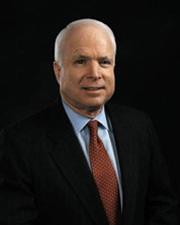 Sen. John McCain (R-AZ)
Legislative Activity
Stay on top of the latest movement without scrolling through every action
Senate amendment proposed (on the floor): Amendment SA 2461 proposed by Senator McCain.(consideration: CR S9636-9637, S9642, S9645-9646; text: CR S9636)
September 22, 2009
View full timeline
Senate amendment proposed (on the floor): Amendment SA 2461 proposed by Senator McCain.(consideration: CR S9636-9637, S9642, S9645-9646; text: CR S9636)
September 22, 2009
Senate amendment not agreed to: Amendment SA 2461 not agreed to in Senate by Yea-Nay Vote. 27 - 70. Record Vote Number: 291.
September 22, 2009
Roll call votes on amendments in Senate: Amendment SA 2461 not agreed to in Senate by Yea-Nay Vote. 27 - 70. Record Vote Number: 291.
September 22, 2009
Amendment SA 2461 proposed by Senator McCain. (consideration: CR S9636-9637, S9642, S9645-9646; text: CR S9636) To prohibit the use of appropriated funds for the Des Moines Art Center in the State of Iowa.
September 22, 2009
Amendment SA 2461 not agreed to in Senate by Yea-Nay Vote. 27 - 70. Record Vote Number: 291.
September 22, 2009
Senate amendment submitted
September 21, 2009
Votes
1 roll call on this amendment
Text
Proposed
DEPARTMENT OF THE INTERIOR, ENVIRONMENTAL, AND RELATED AGENCIES
APPROPRIATIONS ACT, 2010--Continued

Mr. REID. Mr. President, what is the matter before the Senate?
The PRESIDING OFFICER. Amendment No. 2456 offered by Senator Carper.

Amendment No. 2494

Mr. REID. I ask unanimous consent that the amendment be set aside,
and at this time I call up amendment No. 2494.
The PRESIDING OFFICER. Without objection, it is so ordered.
The clerk will report.
The legislative clerk read as follows:

The Senator from Nevada [Mr. Reid] proposes an amendment
numbered 2494.

Mr. REID. I ask unanimous consent that the reading of the amendment
be dispensed with.
The PRESIDING OFFICER. Without objection, it is so ordered.
The amendment is as follows:

(Purpose: To provide for an evaluation of the aquifers in the area of
the Jungo Disposal Site in Humboldt County, Nevada)

On page 240, between lines 13 and 14, insert the following:

SEC. 423. JUNGO DISPOSAL SITE EVALUATION.

Using funds made available under this Act, the Director of
the United States Geological Survey shall conduct an
evaluation of the aquifers in the area of the Jungo Disposal
Site in Humboldt County, Nevada (referred to in this section
as the ``site''), to evaluate--
(1) how long it would take waste seepage (including
asbestos, discarded tires, and sludge from water treatment
plants) from the site to contaminate local underground water
resources;
(2) the distance that contamination from the site would
travel in each of--
(A) 95 years; and
(B) 190 years;
(3) the potential impact of expected waste seepage from the
site on nearby surface water resources, including Rye Patch
Reservoir and the Humboldt River;
(4) the size and elevation of the aquifers; and
(5) any impact that the waste seepage from the site would
have on the municipal water resources of Winnemucca, Nevada.

Mr. REID. Mr. President, I offer this amendment to address a crisis
affecting Native Americans served by the Indian Health Service's Schurz
Service Unit in Nevada.
This amendment to H.R. 2996, the Interior, Environment and Related
Agencies Appropriations Act, would direct the Indian Health Service to
use any unobligated contract health service funds from fiscal year 2009
to pay the Service's obligations to private health providers who have
treated Nevadans. The Service's Schurz Service Unit administers
contract health funds for thousands of eligible Indian beneficiaries
who receive care from the Fallon Tribal Health Center, Reno-Sparks
Health Center, Pyramid Lake Health Center, Walker River Paiute Health
Clinic, and other tribal health clinics and stations.
I understand that it may difficult to coordinate care and referrals
where the

[[Page S9636]]

Indian Health Service administers contract health funds and the tribes
enter Federal contracts or compacts to provide all other health
services. But this arrangement does not relieve the Indian Health
Service of its responsibilities--to provide timely responses and
communications between patients, primary physicians, private health
providers and specialists; to ensure that proper procedures and payment
schedules are followed at the Indian Health Service Unit or the Phoenix
Area Office or by the State of Nevada and private providers; and to
complete payments and reimbursements in a timely and business-like
manner. At the Schurz Service Unit, these responsibilities have not
been fulfilled, and individuals have suffered because they have been
denied care or decided not to seek care because they could not pay for
the service.
This amendment would provide immediate relief for some of the
problems identified by the Indian Health Board of Nevada, tribal
leaders, and private health providers. It would direct the Indian
Health Service to pay outstanding contract health obligations incurred
by the Schurz Service within 90 days of enactment of this bill.
Briefly, these obligations cover debts that the Indian Health Service
has approved and date from fiscal years 2000, 2005, 2006, 2007, 2008
and 2009. The oldest obligations, those before October 1, 2008, total
less than $1.4 million, while the current fiscal year includes more
than $5 million in outstanding bills. There are hundreds of providers
who have not been paid for services rendered--services that the Indian
Health Service has determined should be paid.
In my home State, Native Americans rely on private and community
health providers for a range of services. These providers are critical
components in our Indian communities' network of health care. And,
unlike other Indian Health Service Units in the Phoenix Area Office,
there are no Indian Health Service hospitals in Nevada and Nevada's
Indians are expected to travel to the Phoenix Indian Medical Center to
be treated for serious health care problems. We must work with private
providers so they continue to serve IHS-eligible patients and prevent
further erosion of the health care network serving some of our most
vulnerable citizens.
I will continue to fight for our Native Nevadans and health providers
who are valued members of Indian country's health care team. This
amendment does both, by helping the Indian Health Service deal with a
critical problem at the federally operated service unit in Schurz and
by honoring its obligations with our private care providers. And I
believe that by directing this one-time payment, the Indian Health
Service, working with tribes and health providers, will be able to
implement necessary procedural and structural changes to better
coordinate care and manage contract health funds for fiscal year 2010.
Mr. President, I ask unanimous consent to set aside the amendment for
Senator McCain.
The PRESIDING OFFICER. Without objection, it is so ordered.
The Senator from Arizona.

Amendment No. 2461

Mr. McCAIN. Mr. President, I ask unanimous consent that amendment No.
2461 be called up and the pending business be set aside.
The PRESIDING OFFICER. Is there objection?
Without objection, it is so ordered.
The clerk will report.
The legislative clerk read as follows:

The Senator from Arizona [Mr. McCain] proposes an amendment
numbered 2461.

Mr. McCAIN. Mr. President, I ask unanimous consent that the reading
of the amendment be dispensed with.
The PRESIDING OFFICER. Without objection, it is so ordered.
The amendment is as follows:

(Purpose: To prohibit the use of appropriated funds for the Des Moines
Art Center in the State of Iowa)

On page 135, line 2, insert before the period at the end
the following: ``: Provided, That none of the funds made
available under this Act may be used for the Des Moines Art
Center in the State of Iowa''.

Mr. McCAIN. Mr. President, this amendment would simply prohibit the
use of funds for the Des Moines Art Center in Des Moines, IA--just one
of the 308 earmarks contained in this bill which total $246 million.
This earmark is like most other earmarks posing as a national spending
priority. Many of these earmarks were not authorized and were not
competitively bid in any way, and no hearing was held to judge whether
these are worthy of scarce taxpayers' dollars.
Every summer we hear news of major wildfires destroying people's
homes and businesses across the country. According to the National
Interagency Fire Center, over 5.5 million acres of land were scorched
this year so far. Spending bills such as this one are vitally necessary
for fire suppression activities and forest health programs--programs
that save lives and property. As we look for ways to pay for the
escalating cost of wildfires, we must also address the mixed messages
we are sending to taxpayers about our spending priorities.
Buried in the committee report, as usual, is a $200,000 earmark for
historic preservation needs at the Des Moines Art Center in Iowa. I am
all for preserving our Nation's historic buildings, but good intentions
or not, the process of earmarking is how appropriators steer taxpayers'
dollars to pet projects that wouldn't otherwise win a grant competition
or pass a prioritization formula. They are placed above more deserving
projects simply because of their ``connections'' in Washington.
According to an article in the Des Moines Register dated August 27,
2009, entitled ``Look Out Below: Des Moines Art Center is Adding Space
Underground,'' the Art Center is embarking on a $7.5 million capital
improvement project which includes building a $3.5 million basement
level ``storage addition and a new glass elevator.'' The Art Center
raised this money as part of its ongoing $34 million fundraising
campaign launched in 2005.
The multimillion dollar underground addition will double as a ground
level ``green roof,'' says the art center's director Jeff Fleming:
``People can walk on it without even knowing it's a roof . . . a great
space for outdoor gatherings.''
The article also notes that the art center will gladly name the new
addition to whichever benefactor closes out their $34 million
fundraising campaign.
Americans are hurting. The unemployment rate is nearly 10 percent.
The deficit is estimated to be $1.6 trillion for this year, and the
projected 10-year deficit jumped from $7.1 trillion to $9 trillion, et
cetera, et cetera. Obviously, it might be nice if we started thinking
about the future of America and the future generations who are going to
pay the tab for our continued spending.
I am offering this amendment on behalf of taxpayers who will
rightfully question what makes the Des Moines Art Center a national
spending priority. Why is the Des Moines Art Center allowed to bypass
the proper procedures for determining historic preservation spending?
Why can't the Des Moines Art Center cough up $200,000 from its $7.5
million capital improvement project? Why can't they address this
$200,000 need in their $34 million fundraising campaign?
I urge my colleagues to support this amendment.
I spent, as did many of my colleagues, the last few days at home in
Arizona, traveling around my State. When this issue of earmarking and
porkbarrel spending is brought up, there is a visible reaction.
Americans are sick and tired of it. Sooner or later, while those who
continue to vote for and support this unnecessary, unneeded porkbarrel
spending while we have a 10-year $9 trillion deficit, Americans are
going to rise up in an even more vociferous fashion than they are
today.
I believe what is going on around the country is not just the issue
of health care. What is going on around the country is people are sick
and tired of this unbridled spending in porkbarrel and earmark projects
which have bred corruption here in our Nation's Capital. They figured
it out. They have had enough of it.
I ask my colleagues to vote in support of this amendment, being aware
that those on the Appropriations Committee will probably vote to turn
down this amendment even though it is only a $200,000 unnecessary
spending project. So do so. You have done it in the past. I am going to
continue, and the American people are going to continue, to demand some
kind of accountability for this outrageous, out-of-control spending
which has mortgaged future

[[Page S9637]]

generations of Americans and, believe me, at least in the State of
Arizona, they are sick and tired of it.
Mr. President, I ask for the yeas and nays on this amendment at a
time to be determined by the majority leader.
The PRESIDING OFFICER. Is there a sufficient second?
There appears to be.
The yeas and nays are ordered.
The Republican leader is recognized.
Mr. McCONNELL. Mr. President, I ask unanimous consent to proceed as
in morning business.
The PRESIDING OFFICER. Without objection, it is so ordered.

Health Care Reform

Mr. McCONNELL. Mr. President, I rise to call my colleagues' attention
to a truly disturbing development in the health care debate. A
colleague of ours--a colleague of ours--has called for an investigation
into a major health care company because this company informed its
customers of its concerns about health care legislation that this
colleague of ours introduced. Let me say that again. A colleague of
ours has called for an investigation of a major health care company
because this company disagreed with a bill our colleague introduced.
As a result, the Federal Government has now told all companies that
provide Medicare Advantage to stop communicating with their clients
about the effects of that legislation. Let me say that again. The
Federal Government has now told these companies to stop communicating
with their clients about the effects of a piece of legislation that is
before us, even telling them what they can and cannot post on their Web
sites. This gag order, enforced through an agency of the Federal
Government at the request of a Senator, is wrong.
It started when a company based in my hometown of Louisville, KY--
Humana--had the temerity in the eyes of some of our colleagues to
explain to its customers that if Medicare Advantage is cut, as the
chairman's mark requires, it may reduce benefits which, of course, is a
commonsense conclusion.
This is America, the United States of America. Citizens, either as
individuals or grouped together in companies, have a fundamental
right--a fundamental right--to talk about legislation they favor or
oppose in this country.
This is the core of the first amendment's protections of speech.
Unfortunately, this is part of a troubling trend of efforts to dismiss
the concerns raised by the American people over the past few months.
Over the summer, we saw American citizens who raised concerns about
the health care proposals before Congress dismissed--utterly
dismissed--as somehow un-American by leaders in Congress. That is bad
enough, but using the full weight of the Federal Government's
enforcement powers to stifle free speech should trouble all Americans--
and all of us--even more. We cannot allow government officials to
target individuals or companies because they do not like what they say.
The latest effort to squelch free speech raises several serious
questions.
Is this what we have come to as a country; that an individual or
company can no longer factually advocate their position on an
incredibly important public policy issue? Is this what we have come to
in America?
Shouldn't customers have a right to know the potential impact of a
congressional action?
Is this what we believe as a Senate; that this body should debate a
trillion-dollar health care bill that affects every single American
while using the powerful arm of the government to shut down speech?
Is this how citizens and companies can expect to be treated if health
care reform passes; that any health provider that disagrees with a
powerful Senator will be subject to an investigation and a gag order
for disagreeing with a powerful Senator?
How is this any different than what the Washington Post and the New
York Times have done in lobbying for a reporter shield law? Would we
stand by if the Judiciary Committee asked the FBI to investigate the
media for taking positions on pending legislation with which we do not
agree? Of course not.
Humana is headquartered in my hometown of Louisville, and, yes, I
care deeply about its 8,000 employees in Kentucky. But this gag order
now applies to all Medicare Advantage providers. Shut up, the
government says. Don't communicate with your customers. Be quiet and
get in line.
I remind my colleagues that I have spent a good part of my career
defending the first amendment rights of people to criticize their
elected officials, including me. I would make the same argument if this
were a company based in San Francisco or Helena, MT, or Chicago.
The right to free speech is at the core of our democracy. Free
citizens have a first amendment right to petition their government for
a redress of grievances. This gag order on companies such as Humana and
those in all our States, in my view, is a clear violation of that right
and it is wrong.
Employers who warn their customers about the effects of legislation
are not the ones who should be getting warnings. They are not the ones
who ought to be getting warnings. Senators who threaten first amendment
rights are the ones who should be getting the warnings.
I yield the floor.
The PRESIDING OFFICER. The Senator from Tennessee is recognized.
Mr. ALEXANDER. Mr. President, before the Republican leader leaves, I
congratulate him for his statement. Over the years, he has been a
consistent defender of first amendment rights, even for a great many
Americans with whom he disagreed. Senator Byrd, who is the
constitutional conscience of the Senate, often encourages Senators to
carry with us a little pocket version of the Constitution.
I am reading the first amendment to the Constitution, which the
Senator from Kentucky spent a great deal of his career defending:

Congress shall make no law--
No law--

respecting an establishment of religion, or prohibiting the
free exercise thereof; or abridging the freedom of speech, or
of the press, or of the right of people peaceably to
assemble, and to petition the Government for a redress of
grievances.

I ask the Senator through the Chair whether, as he understands the
first amendment to the Constitution, it would be clearly
unconstitutional for us to pass a law that would tell a major health
care company that if they objected to a piece of legislation by
informing their customers of its consequences that there would be some
penalty?
Mr. McCONNELL. Mr. President, I say to my friend from Tennessee, he
is absolutely correct. There are two obvious violations of the first
amendment here. One is the right to speak freely and the other is the
right to petition Congress for a redress of grievances.
Here you have an industry, the health insurance industry, at least
one company of which is communicating with its customers the truth
about this legislation and being threatened by a powerful Senator and a
government agency to shut up.
Mr. ALEXANDER. Mr. President, as I understand it from reading it in
the newspapers some of the big drug companies are lined up with the
Obama administration with the Democratic health care bill. I wonder
what the Republican leader would think if some Republican Senator
called one of the big drug companies and said: You are going to suffer
serious consequences or even went to one of the agencies of government
and caused them to tell a big drug company that because of their
speeches and remarks, they were going to suffer some consequences.
Mr. McCONNELL. Mr. President, once again, I say to my friend from
Tennessee, to call an agency of the government for the purpose of
implementing a gag order against a company that is speaking freely
about the impact of legislation on its business and its employees is an
astonishing thing to behold in the United States of America.
I assume the particular industry the Senator from Tennessee is
talking about, which has been out running millions of ads in support of
what the administration is trying to do, is not getting such threats.
Mr. ALEXANDER. I assume, Mr. President, that the big drug companies
that are running ads against Republican Senators for questioning the
health care reform bill, they have a right to do that. I know what is
happening in Memphis is people are seeing the ads and calling me and
telling me: Continue to oppose what is going on. But that is part of
our system.

[[Page S9638]]

I congratulate the Republican leader for bringing to the attention of
all his colleagues this action.
Mr. McCONNELL. I thank my friend from Tennessee. I yield the floor.
Mrs. FEINSTEIN. Mr. President, I ask unanimous consent that the
Senator from Delaware be permitted to speak in morning business not to
exceed 5 minutes.
The PRESIDING OFFICER. Without objection, it is so ordered.
The Senator from Delaware is recognized.

First State Robotics

Mr. KAUFMAN. Mr. President, imagine a robot that could play ball.
Imagine a robot that could actually pick up a ball from the ground,
hold on to it, and then, when the time is right, successfully toss it
to another robot. Finally, imagine that this robot was built by a group
of high school students.
I recently met an extraordinary group of students who turned this
vision into reality. As part of Delaware's Miracle Workers robotics
team, students designed and built this robot to compete in the For
Inspiration and Recognition of Science and Technology, for FIRST,
national robotics competition.
The FIRST Program was founded in 1989 by inventor Dean Kamen to
inspire young people to pursue careers in science, technology,
engineering, and math, or STEM. Since that time, FIRST has grown
significantly. In 2008, drawing from the support of thousands of
volunteers and mentors, sponsorships from some of the world's largest
and smallest companies, educational institutions, and the Federal
Government, FIRST introduced nearly 160,000 students from all 50 States
and 37 countries to the joys of problem solving and engineering.
In Delaware, participating students spent an entire school year
building their robot, which is taller than some humans, decorated in
green and black, and even wearing a bow tie. The first half of the year
the team was dedicated to learning the basics of engineering,
programming, and project management. The remainder of the year was
slated for designing, building, testing, and refining the robot for
competition. Students worked in specific subteams, including
electrical, programming, mechanical, fundraising, publicity, scouting,
3-D animation, Web team, and more. Students engaged with adult
volunteers--many of them engineering professionals--who helped train
and mentor the team.

Incredibly, these types of programs are not just for those in high
school. Delaware's First State Robotics organization oversees several
other programs and provides engineering experience for students from
prekindergarten through college. First State Robotics aims to inspire
in young people, schools, and communities an appreciation for science,
engineering, and technology.
The results are remarkable. Ninety-seven percent of First State
Robotics participants have attended college, with 82 percent pursuing
degrees in science and engineering. Many have earned credits at a local
community college for their participation in the program, and several
have earned scholarships applicable toward higher education.
Communities also benefit from these programs. Participating students
take part in book drives, blood drives, and mentoring. They give robot
demonstrations in local schools and community events to promote
recruitment and education.
It is clear that First State Robotics is having an incredible impact
on students. Alumni of the program are more interested in pursuing
careers in the sciences and engineering, and they are involved with
their communities as volunteers. Many graduates say that participating
in First State Robotics was the most positive and rewarding experience
of their lives, and through these experiences they decided to pursue
further study of engineering.
We must continue to encourage today's students to become tomorrow's
engineers by highlighting and promoting programs such as First State
Robotics. It is through comprehensive programs such as these that
students learn that engineering can be a path to making a difference.
Through hands-on activities, students participating in First State
Robotics are given the opportunity to learn that engineers, such as the
Presiding Officer, are the world's problem solvers, do make a
difference in people's lives and quality of life, and can help us reach
the goal of clean water, lifesaving cures for cancer and disease, clean
renewable energy, affordable health care, and environmental
sustainability.
The national FIRST Program shows how important it is that the
American people, the Federal Government, and industries united to
support STEM initiatives. These educational programs will lead us not
only to new frontiers in health, energy, technology, and security but
to new jobs and, ultimately, a sustainable economic recovery.
I know that if given the opportunity, a new generation of engineers
and scientists will lead us into the new frontiers, and many FIRST
alumni have already done so.
I commend the students of First State Robotics and dedicated mentors
for their shining examples of the miracles of engineering.
I yield the floor and suggest the absence of a quorum.
The PRESIDING OFFICER. The clerk will call the roll.
The assistant bill clerk proceeded to call the roll.
Mrs. FEINSTEIN. Mr. President, I ask unanimous consent that the order
for the quorum call be rescinded.
The PRESIDING OFFICER (Mr. Udall of Colorado). Without objection, it
is so ordered.
Mrs. FEINSTEIN. Mr. President, I compliment the Senator from
Delaware. He did go 5 minutes.
I believe Senator Barrasso has an amendment he wishes to offer.
The PRESIDING OFFICER. The Senator from Wyoming.

Amendment No. 2471

Mr. BARRASSO. Mr. President, I wish to speak on amendment No. 2471.
On Friday, September 11, the Washington Times ran a front-page story
on an issue titled ``Forest Fire Aid Allotted to DC, Western States
Feel Burned.''
That is about right. The story talks about the U.S. Forest Service
plans to spend $2.8 million of wildland fire management funds in the
District of Columbia. This is ridiculous, it is outrageous, and we
should not stand for it.

Mr. President, just to read the first paragraph:

Even with forest fires raging out west, the U.S. Forest
Service this week announced it will spend nearly $2.8 million
of forest firefighting money in Washington--a city with no
national forests and where the last major fire was probably
lit by British troops in 1814.

The article continued:

The vast majority of the money--$2.7 million--is going to
Washington Parks & People, which sponsors park festivals and
refurbishes urban parks in the Washington area.

Mr. President, in Wyoming, we have over 9 million acres of national
forest land. There are seven national forests in our State. We face
many management challenges in those forests. The agency struggles to
meet its basic responsibilities. Over 1 million acres are infested with
mountain pine beetle in Wyoming. That is just one species of beetle--a
species that has killed over 1 million acres of trees. The devastation
stretches well beyond the horizon in many places. And where the beetle
infestation is at its worst--in the Medicine-Bow National Forest--the
affected acres have doubled between 2007 and 2008. The problem is
severe. It is growing exponentially, and we are facing extreme risk of
wildland fire in Wyoming.
So when the U.S. Forest Service recommended $500 million and received
that amount of money for Wildland Fire Management in the stimulus
package, one would think maybe the agency would use those funds to
combat threats to forest health in its lands nationwide. One would
think that maybe we would see some real results on the ground in
Wyoming and in the State of Colorado. Instead, Wyoming was awarded zero
dollars in the first round of U.S. Forest Service projects under the
stimulus, and only after the congressional delegation and the Governor
of Wyoming appealed to the Department of Agriculture were funds awarded
for forest projects in Wyoming. Meanwhile, the agency wants to spend
$2.8 million on wildland fire in Washington, DC?

[[Page S9639]]

The people and forest communities in my State deserve better, and the
people of America demand better. Wyoming boasts incredible wildlife
populations, unique ecosystems, and breathtaking views. Over half the
land in Wyoming is public land. One can see rangelands, alpine forests,
glacial basins, and desert landscapes in Wyoming. We host millions of
visitors every year who will enjoy Wyoming's wilderness.
The District of Columbia is not under threat of wildland fire. In
fact, the government's National Interagency Fire Center defines what
qualifies as a wildland fire--and DC does not qualify. Clearly, the
District should not receive wildland fire management funds. The U.S.
Forest Service should not spend vital funds for wildfire fighting and
for prevention in Washington, DC.
I have introduced this amendment with a number of other Senators from
the West. Senator Kyl and Senator Ensign and Senator McCain are
cosponsoring, and we want to make sure the U.S. Forest Service is not
wasting management opportunities. We will not stand by and watch our
State's burn when resources are available to prevent that, and I would
ask all Senators to support this amendment.
Mr. President, at this time, I ask unanimous consent to set aside the
pending business and call up amendment No. 2471.
The PRESIDING OFFICER. Is there objection?
Without objection, it is so ordered. The clerk will report the
amendment.
The bill clerk read as follows:

The Senator from Wyoming [Mr. Barrasso], for himself, Mr.
Kyl, Mr. Ensign, Mr. McCain, Mr. Risch, and Mr. Crapo,
proposes an amendment numbered 2471.

The amendment is as follows:

(Purpose: To prohibit the use of wildland fire management stimulus
funds in the District of Columbia)

On page 240, between lines 13 and 14, insert the following:

SEC. 423. PROHIBITION ON USE OF WILDLAND FIRE MANAGEMENT
STIMULUS FUNDS IN THE DISTRICT OF COLUMBIA.

Notwithstanding any other provision of law, none of the
funds made available under the American Recovery and
Reinvestment Act of 2009 (Public Law 111-5; 123 Stat. 115)
for wildland fire management shall be used in the District of
Columbia.

The PRESIDING OFFICER. The Senator from California.
Mrs. FEINSTEIN. Mr. President, I thank the Senator from Wyoming. He
has a very good point and a very good amendment. This was not the
intention of the Interior part of the stimulus bill. It is not the
intention of this bill. Therefore, I think the amendment of the Senator
from Wyoming is completely in order. It has been called up, and our
side is prepared to accept it.
The PRESIDING OFFICER. The Senator from Tennessee.
Mr. ALEXANDER. Mr. President, I want to congratulate the Senator from
Wyoming on his vigilance. There is no Senator--certainly on this side
of the aisle, and I suspect not in this Chamber--who gets up earlier,
works harder, or keeps in closer touch with what is going on in Wyoming
and in this country than Senator Barrasso, and he is exactly right on
this issue.
The chairman, Mrs. Feinstein, the Senator from California, has made
fighting wildfires a major part of her effort this year. She and the
administration have included within this appropriations bill the
firefighting money that usually is set aside for emergency
appropriations. So that money needs to be spent correctly, as it should
be. I think Senator Barrasso and the other Senators who cosponsored it
are exactly right, and I agree with the chairman of the subcommittee
that it is a good amendment.
Mrs. FEINSTEIN. So we will accept it, Mr. President.
The PRESIDING OFFICER. Is there further debate on the amendment?
If not, the question is on agreeing to the amendment.
The amendment (No. 2471) was agreed to.
The PRESIDING OFFICER. The Senator from Wyoming.
Mr. BARRASSO. Mr. President, I thank the chairman and Senator
Alexander for their gracious reception and acceptance of this amendment
in the Chamber with that resounding voice vote in support of the
amendment.

Amendment No. 2472

Mr. President, I also filed amendment No. 2472, and I wish to speak
on that amendment at this time.
Mrs. FEINSTEIN. Mr. President, is the Senator calling up that
amendment?
Mr. BARRASSO. I am not at this point.
Mr. President, I have serious concerns about the recent Interior
Secretarial Order No. 3289. This order will incorporate climate change
into all decisionmaking at the Department of the Interior.
Although I commend the Secretary for attempting to address this
issue, I have concerns that we are getting the cart before the horse.
Congress has not passed a climate change bill. Yet sweeping regulations
are being proposed by the Secretary of the Interior. These regulations
put into question the future and past land management agreements
regarding oil and gas development, renewable energy development,
recreational use, and wildlife protection.
Under these rules, a dark cloud is placed over all existing
agreements regarding these activities. In addition, all pending
decisions regarding both energy development and recreational use will
also be put on hold indefinitely. All this will occur through
regulations that did not have the approval or the consent of the
American people.
I would ask my colleagues, no matter where they stand on the issue of
climate change, to vote for this amendment. We need to get the order
right. First, a climate change bill that has the public's approval;
then after that is voted upon, and if approved, let the regulatory
process at the agency level begin. That is what my colleagues are
voting on if they vote for this amendment.
So I urge adoption of the amendment at the point when it is called
up.

Amendment No. 2473

Mr. President, I also filed amendment No. 2473, and I will also speak
on that at this time. That amendment would prevent the Environmental
Protection Agency's endangerment finding from going into effect until
the EPA grants the petition of the U.S. Chamber of Commerce to have an
on-the-record, trial-like hearing on the scientific data behind the
EPA's endangerment finding.
The chamber petitioned the EPA for a trial-like hearing on the
scientific data behind the endangerment finding before an
administrative judge or EPA official. The chamber stated in their
petition that:

An endangerment finding would give rise to the most far-
reaching rulemaking in American history. Before embarking on
that long, costly process, the EPA ought to do everything
possible to assure the American people of the ultimate
scientific accuracy of its decision.

The on-the-record proceeding would be a great opportunity for EPA to
ensure transparency. This administration claims to be the most
transparent administration in history. What better opportunity to
demonstrate this by authorizing the chamber's petition. The
administrative proceeding is allowed by law. It will be a short on-the-
record proceeding. To deny this request is an admission by the EPA that
their work on endangerment can't stand scrutiny. This should be a
concern for all Americans at this point.

Amendment No. 2474

Mr. President, I would like to move on to another amendment which I
have filed--amendment No. 2474--and I will speak on it at this point.
This amendment would require the Environmental Protection Agency
inspector general to complete an investigation into the treatment of
Dr. Alan Carlin by his superiors at the Environmental Protection
Agency. Under this amendment, the endangerment finding could not
proceed until the investigation is completed.
Dr. Alan Carlin and a colleague prepared a 98-page analysis arguing
that the EPA should ``take another look'' at the EPA's scientific data
behind the endangerment finding that carbon dioxide is a threat to
public health. According to a report by Kimberly Strassel with the Wall
Street Journal, a senior EPA official suppressed this detailed account
of the most up-to-date science on climate change.
These reports raise serious questions about the process behind and
the substance of the EPA's proposed finding that greenhouse gases
endanger public

[[Page S9640]]

health and welfare. On August 21, Inside Washington Publishers reported
that the EPA is considering scrapping the National Center for
Environmental Economics' role in scientific analysis. Well, this would
essentially eliminate the EPA office that Dr. Carlin has worked in for
years.
In an editorial in the Washington Times, the paper stated:

This attempt to marginalize a true whistleblower smacks of
insincerity . . . and . . . its implications for economic and
environmental policy are dangerous.

This is an administration that claims to put a premium on
transparency and openness. Their actions to date have demonstrated
neither. My colleague, Senator Thune, has requested an inspector
general's investigation into this matter. I believe the investigation
should be conducted and completed before the EPA proceeds further with
endangerment.
So, Mr. President, at this time I ask unanimous consent to set aside
the pending business and call up amendment No. 2474.
Mrs. FEINSTEIN. I object.
The PRESIDING OFFICER. Objection is heard.
Mr. BARRASSO. Mr. President, I am very concerned by what I am seeing
today. My effort in offering this amendment is to promote transparency
and good government. Dr. Carlin, a 38-year veteran of the EPA, wrote a
report critical of the EPA's process behind the endangerment finding.
He said the EPA relied solely on outside sources for their science. He
also pointed out that the scientific data they are relying on is 3
years old.
The EPA tried to quash his report. Dr. Carlin's boss warned Carlin to
drop the subject altogether. He was told:

With the endangerment finding nearly final, you need to
move on to other issues and subjects. I don't want you to
spend any additional EPA time on climate change. No papers,
no research etcetera, at least until we see what EPA is going
to do with climate.

Mr. Carlin was ordered not to have any direct communication with
anyone outside his small group at EPA on the topic of climate change
and was informed that his report would not be shared with the agency
group working on that very topic. To not even allow the Senate to have
a vote to decide whether to investigate this matter looks like
political expediency. It is wrong and it should concern all of those
who claim to care about transparency.
Mr. President, I yield the floor.
The PRESIDING OFFICER. The Senator from California.
Mrs. FEINSTEIN. Mr. President, I want to make clear that it would be
my intent, should the other two climate change amendments be called up,
to object to them. However, this has nothing to do with the
distinguished Senator, whom I respect enormously. It does have
something to do with putting climate change on this bill.
Mr. President, I suggest the absence of a quorum.
The PRESIDING OFFICER. The clerk will call the roll.
The bill clerk proceeded to call the roll.
Mr. DeMINT. Mr. President, I ask unanimous consent that the order for
the quorum call be rescinded.
The PRESIDING OFFICER. Without objection, it is so ordered.
Mr. DeMINT. Mr. President, I would like to talk about an issue that
is very important to our country. It involves our food supply and it
involves thousands of jobs. While it may appear to affect just one
State, the input we are getting from around the country is that this is
very much a national issue.
I have an amendment to address it which I would like to discuss. This
amendment, I believe, if we would take the time, we could find
agreement. It addresses a major problem in the State of the Senator
from California, but it also addresses a problem that affects the
Nation's food supply by allowing us to focus on balancing jobs, the
economy, and food with environmental laws.
As the chairman knows, there is a major water problem in California's
Central Valley. Some very narrowly interested environmental groups have
used the Endangered Species Act to shut off water to a region that
produces 13 percent of the Nation's food supply. The result has been
devastating. The land is dry, crops have been destroyed, and tens of
thousands of jobs--tens of thousands of people are out of work. A
recent University of California, Davis, study found that up to 40,000
jobs will be lost by the end of this year. In one city, the
unemployment rate has reached 40 percent.
This is certainly a local water crisis, but it has also become a
national issue. The problem has been the subject of several national
television programs, and people across the country are beginning to
realize that this problem on the west coast could touch us all in the
form of higher food prices if we don't address it. It is also another
precedent that affects my State, as environmentalists have really swung
the balance away from good economy and jobs to something that seems
much more radical to us--the development of our port in South Carolina,
the passage of ships. And you see development all over the country
being affected. So we need to focus on this issue in this bill. This is
a good place for the amendment.
It is almost impossible to overstate the value of California's
agriculture to the Nation's economy, most of which is produced--most of
the food supply we are talking about--right in the Central Valley. This
region provides the lion's share of California's crops, which account
for, and I want to stress this, 94 percent of America's tomatoes, 93
percent of our broccoli, 89 percent of our carrots, 86 percent of our
garlic, 78 percent of our lettuce, 90 percent of our strawberries, and
88 percent of our grapes, just to name a few. We can hardly say this is
the issue of one State. This is a national issue that we need to
address.
People are also coming to realize that if we do not begin to bring a
measure of balance back to our environmental laws, special interest
groups and activist courts will be able to use this statute and others
to destroy thousands of jobs at a time when our country is in
recession.
I thank the chairman of the subcommittee for her work on this issue.
The senior Senator from California has been a leader. She has pledged
to work with the Department of Interior to find a solution, and she
recently called for an independent review of the science underlying the
two biological opinions that created this manmade drought.
My amendment today is very simple and represents a modest and
balanced approach. It turns the water back on for 1 year to provide
time for all leaders at the local, State, and Federal levels to find a
long-term solution.
It will also give farmers the predictability they need to plan for
next year's crops. They can't make the loans and get the seeds and plow
the fields if they know in December the water will be turned off again
and won't be turned back on until after July. One cannot farm with that
type of unpredictability.
I know there are those who say there is no problem because the pumps
are currently on. But those pumps are set to shut off in December,
leaving Central Valley farms dry as planting season comes around.
My amendment has precedent. In fact, the last time this environmental
provision was waived was in 2003, when water was turned off in New
Mexico. That time the Senate voted unanimously for a bill that included
a complete waiver of ESA for 2 years, which was even more aggressive
than what I am proposing today.
I know this is a very important issue to the Senator from California.
I hope she will support my amendment. I know many people are working on
long-term solutions, but we need to do something now. The provision in
the bill to study this is likely to take 2 years. We are likely to lose
another 2 years of farm products as well as thousands of jobs in the
Central Valley. This is not something I have made up on my own. A
number of groups, farm groups in California, as well as the National
Cotton Council of America, the Tulare County Farm Bureau, Fresno County
Farm Bureau, Kings County Farm Bureau, Families Protecting the Valley,
Westland Water District--I have a whole page of large groups that
involves many jobs and families in California and across the country
supporting this amendment which won't cost taxpayers anything but will
actually create jobs, put people back to work, and expand the Nation's
food supply.
We cannot allow a judge or radical environmental group to cut off
water

[[Page S9641]]

to people who are producing the Nation's food supply. My amendment
would address this in a very reasonable way. I call on the Senator from
California to work with me in support of this amendment.
I ask unanimous consent to set aside the pending amendment and send
my amendment to the desk.
The PRESIDING OFFICER. Is there objection?
Mrs. FEINSTEIN. I object.
The PRESIDING OFFICER. Objection is heard.
Mrs. FEINSTEIN. After the Senator completes his remarks, I would like
the opportunity to say why.
The PRESIDING OFFICER. The Senator from South Carolina.

Motion to Recommit with Amendment No. 2500

Mr. DeMINT. Mr. President, I am disappointed I was unable to offer
the amendment. Certainly it relates to the underlying bill. Since there
are so many people and jobs across the country depending on us doing
something quickly, I send a motion to the desk.
The PRESIDING OFFICER. The clerk will report the motion.
The bill clerk read as follows:

The Senator from South Carolina [Mr. DeMint] moves to
recommit the bill H.R. 2996 to the Committee on
Appropriations of the Senate with instructions to report the
same back to the Senate forthwith with the following
amendment No. 2500:
At the appropriate place, insert the following:
None of the funds made available by this Act may be used by
the Secretary of the Interior to restrict, reduce, or
reallocate any water, as determined in--
(1) the biological opinion published by the United States
Fish and Wildlife Service and dated December 15, 2008; and
(2) the biological opinion published by the National Marine
Fisheries Service and dated June 4, 2009.

Mr. DeMINT. Mr. President, I thank the Senator from California. I
look forward to more discussion, because I know there are many people
in the Senate concerned about the same issue. There may be better ways
to resolve the problem. I am certainly open to work with anyone. This
is an immediate problem. We cannot continue to spend trillions of
dollars of taxpayer money to create jobs while we allow government
agencies to shut down jobs and jeopardize food supply. We need to be
able to act as a body to solve some small problems instead of what we
are doing here, which is to totally revamp the health care system or
major changes that do not address the problems right in front of our
face. I encourage my colleagues to consider this. Let's debate it and
discuss it. I believe we can come up with a solution.
The PRESIDING OFFICER. The Senator from California.
Mrs. FEINSTEIN. Mr. President, I am rather surprised about this. I
don't think anyone in my State or in this body has spent as much time
as I have on water in the State of California. The motion offered by
the Senator from South California surprises me since no one from
California has called, written, or indicated they wanted this on the
calendar. No one has indicated to me, as chairman of the committee, in
all of the time Senator Alexander and I have been working on this bill
that this is what they wanted. In fact, what this would do is prohibit
the Secretary of Interior from expending appropriate funds to restrict,
reduce, reallocate water supplies from the Central Valley Project and
the California State Water Project under biological opinions issued by
the Fish and Wildlife Service of the United States and the NOAA
fisheries.
The Senator from South Carolina is venturing into a very complicated
area. This would prohibit the approval on two gates. It would prohibit
work on the intertie where water is now being transferred from one
system, State-run, to Federal and back and forth based on need, water
transfers in the hundreds of thousands of acre-feet. It would prohibit
Interior from working on the Bay Delta Conservation Plan. It would
prevent Federal agencies from working on water quality issues in the
delta.
What is the delta? The delta is a large inland body of water in
northern California. It is the drinking water for 16 million people. It
is the source of water, some of which trickles down to southern
California. The Metropolitan Water district, for example, in Los
Angeles uses between 800,000 acre-feet and a million acre-feet a year
of this water. Jurisdictions all over the State use some of this water.
The agriculture community uses 80 percent of the water in the delta.
There are enormous endangered species issues in the delta, the death of
certain kinds of fish, the nonnative species of fish, deteriorating
levees that when they deteriorate, the peat soil drifts into the water
and creates all kinds of problems for treatment and would likely
collapse in the instance of a major earthquake.
What is happening is a whole effort to restore the delta, to develop
a management plan for the delta, how to rebuild it, how to shore it up,
and also whether in fact there should be some conveyance around the
delta to bring some of the water south. This is a very hot issue in
California. It is not a hot issue in South Carolina, trust me.
It is interesting to me that groups go to the Senator from South
Carolina instead of to the chairman of the committee for something
which is preemptive and would handcuff the Secretary of Interior. The
Secretary of the Interior has appointed his No. 2 person, David Hayes,
to handle western water. David Hayes has been in California. He has
solved many problems. He came with me in August to a meeting in the
southern Central Valley to discuss these problems and say what the
Department was prepared to do about them.
On September 30 of this month, the Interior Secretary is holding a
meeting to announce what actions he is going to take on 2 Gates, on the
intertie, on water transfers. I don't understand why we would want to
handcuff the Secretary of the Interior by saying no money can go for
any of these things, that water has to be released to the Central
Valley with no controls on it. This makes no sense to me.
I see a series of letters that have come in from people I have talked
with. I know there is a problem with the biological opinions. There are
30 lawsuits against the biological opinions. I understand that. To that
end, I have been asked to put $750,000 in this bill to allow the
National Academy of Sciences to come in and do an overarching but
quick, within 6 months, look at the biological opinions and either say
the opinions are founded in sound science or they are not. That is in
the heart of this bill.
The ranking member has agreed to put this money in this bill for that
purpose. Along comes something now which would totally handcuff the
Secretary of Interior, which would mean no permits to move water
between the California aqueduct and the Central Valley Project and back
and forth and no permits for 2 Gates, two of the emergency solutions
that have been put forward.
If this passes, we can be sure there will be court action, and we
will most likely be enjoined. To my view, it makes no sense. We need
the help of Interior. I have asked the Department of Interior, in terms
of Federal agencies, to take the lead in dealing with California water.
A specific person has been designated, the No. 2 person in the
Department, David Hayes. A whole process has been entered into now for
the administration, through the Secretary of Interior, to begin to put
its hands on the problem and deal with it.
I cannot support legislation that says: Go ahead and release water,
regardless of endangered species, regardless of any court that might
come down on top of you and say stop. I can't do that. It isn't
responsible to do so.
It is interesting to me--and I am looking at some of the letters--the
people who I meet with, whose phone calls I respond to, who have never
called and said: Look, this is what we need.
I don't quite understand what is going on here. That is the reason
for my objection. I am not going to put the State of California and the
bay delta in the threat of another lawsuit. We have enough already.
Water is a huge, complicated, and difficult issue. No one cares more
about it than I do or has tried harder to sort out the problems.
In a way, this is a kind of Pearl Harbor on everything we are trying
to do, which is to work together to put Interior in the lead, not to
handcuff Interior. That is the reason I objected to the amendment.
I understand on the motion there will be a vote. I urge a no vote.
I suggest the absence of a quorum.
The PRESIDING OFFICER. The clerk will call the roll.

[[Page S9642]]

The bill clerk proceeded to call the roll.
Mr. HARKIN. Mr. President, I ask unanimous consent that the order for
the quorum call be rescinded.
The PRESIDING OFFICER (Mr. Kaufman). Without objection, it is so
ordered.

Amendment No. 2461

Mr. HARKIN. Mr. President, I rise in opposition to the amendment
offered by the senior Senator from Arizona. The amendment by Senator
McCain singles out one instance of congressionally directed funding
that I had included in the bill now before us, fiscal year 2010
Interior appropriations. The Senator claims this earmark, which
provides $200,000 in funding for repair and renovation of the historic
Des Moines Art Center, is somehow inappropriate and should be removed
from the bill. Well, it comes as no surprise that I strenuously
disagree.
First of all, as a constitutional matter, I take issue with the
premise underlying the Senator's amendment--the idea that Congress has
no business directing the expenditure of Federal moneys to earmarks,
that there is something inherently wrong or evil in this traditional
practice, and that only the executive branch should determine where
Federal moneys are spent. Well, I beg to differ.
The Constitution, article I, section, 9, expressly gives Congress the
power of the purse. The executive branch can't spend one nickel unless
this Congress gives it the authority to do so. Over the centuries, over
the last couple hundred years, we have given to the executive branch
the authority to make budgets, spend money on different things through
all the different departments and agencies, but if Congress wanted to,
we could take it all back. We could take it all back because the
Constitution gives Congress the sole power to spend money.
What is more, compared to executive branch individuals, Members of
Congress have a much better understanding of where and how Federal
funds can be spent most effectively in their respective districts and
States, and that is certainly the case with the earmark in question.
I assume the Senator from Arizona doesn't know a lot about the Des
Moines Art Center. Well, let me explain it for the Record. The Des
Moines Art Center encompasses three nationally significant buildings,
two of which have been listed on the National Register of Historic
Places since 2004. One of these buildings was designed by the famous
architect, Eliel Saarinen, and another by the world renowned I.M. Pei.
These buildings are architectural gems but, unfortunately, they have
suffered from deterioration over the years.
So I secured the modest funding in this earmark--$200,000--for the
specific purpose of replacing windows that were causing inconsistent
temperatures and high condensation, resulting in damage to the
building's plaster, the wood paneling, and the floors. There is nothing
the least bit wasteful or frivolous about these renovations. In fact,
they will create jobs and put people to work.
I also wish to point out that this funding is awarded through an
authorized program called Save America's Treasures. This program was
established within the National Park Service to protect:

America's threatened cultural treasures, including historic
structures, collections, works of art, maps and journals that
document and illuminate the history and culture of the United
States.

Money for the program is awarded both competitively through grants
and through congressionally designated funding.
Over the years, the Save America's Treasures Program has helped to
protect many important buildings and artifacts across our country.
There is no question that the Des Moines Art Center is both worthy and
in urgent need of this modest funding. The buildings of the center, as
I said, are architectural masterpieces. They contribute mightily to
making Iowa's capital city a livable, attractive urban center with a
lively cultural scene.
Bear in mind that the Des Moines Art Center is a cultural institution
in the State of Iowa, drawing hundreds of thousands of visitors not
only from Iowa but from around the United States and from all over the
world every year. In the last 12 months, the center has served nearly
half a million people. School kids from all over our State come into
Des Moines in buses from their schools out in the countryside, out in
the small districts, to go to the art center to see these magnificent,
wonderful works of art and the buildings themselves.
I wish to emphasize that in terms of fundraising for renovations and
operations, the art center and the Des Moines community are more than
pulling their own weight. The center currently is in the midst of a $34
million fundraising campaign. However, only $7.5 million of that is for
capital and building improvement. The remaining $26.5 million is for
the center's operating endowment. That allows the art center to be free
and open to the entire community all year-round. Moreover, the $200,000
in Federal funds will leverage $1.9 million in public and private
challenge grants--not a bad leveraging of Federal dollars.
The fact is, the Des Moines Art Center is struggling to meet its
fundraising targets in any and all ways possible, including in
relatively modest increments. The center has received $275,000 from
Polk County--that is the county encompassing our capital city of Des
Moines. They received $25,000 from the city of Des Moines. At this
point, the center has exhausted their private fundraising options. So
the $200,000 grant from the Federal Government, along with the
additional $1.9 million that it will leverage, is critical to meeting
the center's goal of renovation.
I appreciate this opportunity to share with our colleagues my reasons
for including this earmark in the bill before us. I am proud of this
congressionally directed funding. It would go to a worthy and urgent
public purpose.
I believe the effort by Senator McCain to remove this money from the
bill is misguided, and I urge my colleagues to vote against the McCain
amendment.
Mr. President, I yield the floor and suggest the absence of a quorum.
The PRESIDING OFFICER. The clerk will call the roll.
The assistant bill clerk proceeded to call the roll.
Mrs. FEINSTEIN. Mr. President, I ask unanimous consent that the order
for the quorum call be rescinded.
The PRESIDING OFFICER. Without objection, it is so ordered.
Mrs. FEINSTEIN. Mr. President, earlier while I was arguing the
opposite side of the question of the DeMint amendment which is now
before this body, I mentioned that there were 30 lawsuits pending
against the biological opinions having to do with the bay delta. The
number is actually 13. I apologize. I wish to have the record
corrected. Thirteen is enough.
I yield the floor. I suggest the absence of a quorum.
The PRESIDING OFFICER. The clerk will call the roll.
The assistant bill clerk proceeded to call the roll.
Ms. COLLINS. Mr. President, I ask unanimous consent that the order
for the quorum call be rescinded.
The PRESIDING OFFICER. Without objection, it is so ordered.

Amendment No. 2498

Ms. COLLINS. Mr. President, I call up amendment No. 2498 and ask for
its immediate consideration.
The PRESIDING OFFICER. Is there objection?
Without objection, it is so ordered.
The clerk will report the amendment.
The assistant bill clerk read as follows:

The Senator from Maine [Ms. Collins] proposes an amendment
numbered 2498.

Ms. COLLINS. Mr. President, I ask unanimous consent that further
reading of the amendment be dispensed with.
The PRESIDING OFFICER. Without objection, it is so ordered.
The amendment is as follows:

(Purpose: To provide that no funds may be used for the administrative
expenses of any official identified by the President to serve in a
position without express statutory authorization and which is
responsible for the interagency development or coordination of any
rule, regulation, or policy unless the President certifies to Congress
that such official will respond to all reasonable requests to testify
before, or provide information to, any congressional committee with
jurisdiction over such matters, and such official submits certain
reports biannually to Congress)

At the appropriate place, insert the following:

[[Page S9643]]

FUNDING LIMITATION

Sec. _. None of the funds made available by this Act or any other Act
may be used for the administrative expenses of any official identified
by the President to serve in a position without express statutory
authorization and which is responsible for the interagency development
or coordination of any rule, regulation, or policy unless--

(1) the President certifies to Congress that such official
will respond to all reasonable requests to testify before, or
provide information to, any congressional committee with
jurisdiction over such matters; and
(2) such official submits a report biannually to each
congressional committee with jurisdiction over such matters,
describing the activities of the official and the office of
such official, any rule, regulation, or policy that the
official or the office of such official participated or
assisted in the development of, or any rule, regulation, or
policy that the official or the office of such official
directed be developed by the department or agency with
statutory responsibility for the matter.

Ms. COLLINS. Mr. President, I rise today to call up an amendment to
ensure that the so-called czars appointed by this administration can be
held accountable to Congress and to the American people.
The effective functioning of our democracy is predicated on open
government, on providing a transparent process for the people we serve.
It cannot instill trust and confidence in its citizenry unless
government fosters accountability. It is against that backdrop I raise
my concerns regarding the administration's appointment of at least 18
new czars to manage some of the most complex issues facing our country.
I am not talking about traditional offices within the office of the
President. I am not talking about, for example, the position of his
Chief of Staff or the position of his press secretary. Similarly, I am
not talking about officials who have responsibility to coordinate
policy across agency lines that are specifically established in law. A
good example of that is the Director of National Intelligence. That is
a position that was established by Congress and whose head is nominated
by the President and confirmed by Congress. So I am not talking about
those officials either.
What I am talking about are new positions not created in law that
have been established and which have significant policy
responsibilities, or so it seems. Part of the problem here is we don't
know exactly what the responsibilities are. As I, along with several of
my colleagues, including the ranking member of this subcommittee,
Senator Alexander, recently expressed in a letter to the President, I
am deeply troubled because these czars fail to provide the
accountability, transparency, and oversight necessary for our
constitutional democracy.
The creation of czars within the Executive Office of the President
and elsewhere in the executive branch circumvents the constitutionally
mandated advise and consent role our Founding Fathers assigned to the
Senate. They greatly diminish the ability of Congress to conduct
meaningful oversight to hold officials accountable for their actions,
and it creates confusion about which officials are responsible for the
government's policy decisions.
For example, Nancy-Ann DeParle, an individual for whom I have great
respect, is the health policy czar within the White House. Kathleen
Sebelius is the Secretary of Health and Human Services. So who is
making policy when it comes to health care? Who do we hold accountable?
Well, we know we can call the Secretary of Health and Human Services
before us to testify in open session at public hearings, but most
likely we cannot call Ms. DeParle before us to testify, even though she
has been great about coming up for private meetings.
Senators Alexander, Bond, Crapo, Roberts, and Bennett joined me in
writing to the President to raise these important issues. We have
identified at least 18 czar positions where reported responsibilities
may be undermining the constitutional oversight responsibilities of
Congress or the express statutory assignments of responsibility to
other executive branch officials.
Again, to be clear, I do not consider every position identified in
various media reports to be problematic. Positions that are established
by law or are subject to Senate confirmation, such as the Director of
National Intelligence, the Homeland Security Advisor, and the Chairman
of the Recovery Accountability and Transparency Board do not raise the
same concerns about accountability, transparency, and oversight.
Furthermore, we all recognize that Presidents are entitled to rely on
experts to serve as senior advisers. But those czar positions within
the Executive Office of the President and in some executive agencies
are largely insulated from effective congressional oversight. Many of
the czars appointed by this administration seem either to duplicate or
dilute the statutory authority and responsibilities that Congress
already has conferred upon Cabinet level officers and other senior
executive branch officials.
Indeed, many of these new czars appear to occupy positions of greater
responsibility and authority than some of the officials who come before
us for Senate confirmation. Whether in the White House or elsewhere,
these czar appointments are not subject to the Senate's constitutional
advise and consent role. Little information is available concerning
their responsibilities and authority. There is no careful Senate
examination of their character and qualifications. We are speaking here
of some of the most senior important positions within our government.
The appointment of so many czars has muddied the waters, causing
confusion and risking miscommunication going forward. We need to know,
with clarity: Who is responsible for what? Who is in charge--the czar
or the Cabinet official? Who can the Congress and the American people
hold accountable for government policies that affect their lives?
For these reasons, I offer an amendment that would prevent any more
Federal funds from being made available for the administrative expenses
of czars until two key conditions are met. I don't think these
conditions are unreasonable. I don't think they are difficult for the
President to meet, but they would make a real difference.
First, the amendment I am proposing would require the President to
certify to Congress that every one of these positions will respond to
reasonable requests to testify before or provide information to any
congressional committee with jurisdiction over the matters the
President has assigned to that individual.
Second, our amendment would require every czar to issue a public
written report twice a year to these same congressional committees.
This report would include a description of the activities of the
official and the office, any rule, regulation, or policy that the
official participated in the development of, or any rule, regulation,
or policy that the official directed be developed by the department or
agency with statutory responsibility for the matter.
This amendment would represent a significant step toward establishing
an oversight regime for these positions that would provide the
transparency and accountability our Nation expects from its leaders.
Beyond the specific requirements of this amendment, in the letter we
sent to the President we implored the President to consult carefully
with Congress prior to establishing any additional czars or filling any
existing vacancies for these positions.
We stand ready to work with the President to address the challenges
facing our Nation and to provide our country's senior leaders with the
authority, accountability, and legitimacy necessary to do their jobs.
If there are problems, then the administration should come to us. We
can work on revamping organizational structures to help eliminate those
problems, but we must eliminate the serious problems with oversight,
accountability, transparency, and vetting that are associated with the
proliferation of these czars.
I urge my colleagues to support what I think is a very reasonable
approach to this difficult issue.
Mr. President, I thank the Chair.
The PRESIDING OFFICER. The Senator from Tennessee.
Mr. ALEXANDER. Mr. President, I wish to congratulate the Senator from
Maine for her leadership on this issue. She has shown great respect for
the President's authority under the Constitution. We all respect that.
He has the right to appoint his own advisers, period, and to take their
advice and, as

[[Page S9644]]

a result, assert some executive privilege. And we don't inquire into
that. He is entitled to that.
But under the Constitution, article II, section 2, states that the
Cabinet officers and other appointments of significant policy positions
should be appointed by the advice and consent of the Senate.
It is true a number of Republican Senators have raised a question
about the 18 new czars appointed by President Obama who are not
confirmed by the Senate, all of whom are new. They didn't exist before.
This large number of new senior positions is of great concern.
Senator Collins, in her letter of September 14 to the President--
written with great respect, signed by Senator Bond, Senator Crapo,
Senator Roberts, Senator Bennett, and myself--basically made the
argument she just made. She acknowledged the President's authority
under article II to appoint his advisers and to be the leader of the
country. But in terms of these specific responsibilities, the letter
asks for information about the responsibilities of these 18 new czars;
of how they were picked and how they were examined and whether they
would be willing to testify before us.
In her remarks, Senator Collins pointed out if we have a Health
Secretary and a health czar, who is in charge? If we have an Energy
Secretary and an energy czar, who is in charge? Those are the big
issues before us. Health care is nearly 20 percent of the economy. We
have town meetings all over the country about it. Right after that
comes energy and climate change, and those are going to be a massive
issues for our country. So it is important for us to know who is in
charge so they can testify before the Congress and so we can effect
their appropriations if we should choose to do so.
The main point I want to underscore is the fact that this is not just
a concern on the Republican side of the aisle. The senior Senator in
the Senate, and the senior Democrat--the President pro tempore--is
Robert C. Byrd. Sometimes we call him the constitutional conscience of
the Senate. Senator Byrd was the first Member of this body to raise
questions about the czars. I am sure he would have done it if there had
been a Republican President--he probably has many times before--but he
also did it even though there is now a Democratic President.
I think it is important to reflect upon what he said in his February
23 letter to President Obama. Senator Byrd said:

As presidential assistants and advisers, these White House
staffers are not accountable for their actions to the
Congress, to cabinet officials, and to virtually anyone but
the President. They rarely testify before congressional
committees, and often shield the information and decision-
making process behind the assertion of executive privilege.
In too many instances, White House staff have been allowed to
inhibit openness and transparency, and reduce accountability.

In speaking about the lines of authority between these new White
House positions--these czars--and their executive branch counterparts,
the Secretaries, Senator Byrd said this to the President:

Too often, I have seen these lines of authority and
responsibility become tangled and blurred, sometimes
purposely, to shield information and to obscure the decision-
making process.

Senator Byrd went on to say:

As you develop your White House organization, I hope you
will favorably consider the following: that assertions of
executive privilege will be made only by the President, or
with the President's specific approval; that senior White
House personnel will be limited from exercising authority
over any person, any program, and any funding within the
statutory responsibility of a Senate-confirmed department or
agency head; that the President will be responsible for
resolving any disagreement between a Senate-confirmed agency
or department head and the White House staff; and that the
lines of authority and responsibility in the administration
will be transparent and open to the American public.

Not only Senator Byrd, but Senator Lieberman, who is the chairman of
the committee on which Senator Collins is the ranking Republican, has
expressed his willingness to hold hearings on this issue. Senator
Feingold of Wisconsin, a Democratic chairman of the Subcommittee on the
Constitution, has written to the President expressing his
concern. Senator Feingold says:

The Constitution gives the Senate the duty to oversee the
appointment of Executive officers through the Appointments
Clause in Article II, section 2. The Appointments Clause
states that the President: ``shall nominate and by and with
the advice and consent of the Senate, shall appoint
ambassadors, other public ministers and consuls, judges of
the Supreme Court, and all other Officers of the United
States, whose appointments are not herein otherwise provided
for, and which shall be established by law.

Senator Feingold goes on to say:

This clause is an important part of the constitutional
scheme of separation of powers, empowering the Senate to
weigh in on the appropriateness of significant appointments
and assisting in its oversight of the Executive branch.

Senator Feingold and Senator Byrd and Senator Collins, and several of
us who signed Senator Collins' letter, and Senator Vitter of
Louisiana--we all respect the President's authority to be the President
and to appoint his Cabinet members and other executive branch officers.
But we expect that those officers, the people who are actually setting
the policy and running the departments, should be accountable to those
of us in the Senate because the Constitution says so.
As a practical matter, we all know in Washington most people in the
executive branch measure their power by the number of inches they are
from the President of the United States. In the White House, most of
the scurrying around at the beginning of an administration is to see
who can get the office closest to the Oval Office. So it is always an
issue about the amount of power that begins to accumulate in the White
House. When it begins to take away accountability and authority and
responsibility and create confusion about whether the Cabinet
Secretaries have the authority, that is the time that we begin to cross
the constitutional line.
That is what Senator Byrd talked about in February, what Senator
Feingold talked about last week, and what Senator Collins is talking
about today. I congratulate her on her amendment. I think it is
constructive. I think it is respectful to the President. It
acknowledges his role in the Constitution, but it reiterates the
importance of the role of the Senate in accountability and in
transparency. I look forward to supporting her amendment.
The PRESIDING OFFICER. The Senator from California is recognized.
Mrs. FEINSTEIN. Mr. President, I listened to the comments of the
ranking member, the Republican manager of the bill. I agree with
everything he said. I have great respect for the Senator from Maine. I
find this amendment reasonable and our side is prepared to accept it.
Mr. President, I suggest the absence of a quorum.
The PRESIDING OFFICER. The clerk will call the roll.
Mr. ISAKSON addressed the Chair.
Mrs. FEINSTEIN. Mr. President, we have one issue up right now, and
then we will be happy to call on the Senator from Georgia. I know he
has an amendment. I will ask unanimous consent that directly following
disposal of the amendment of the Senator from Maine we turn to the
Senator from Georgia.
The PRESIDING OFFICER. Without objection, it is so ordered.
The Senator from Maine is recognized.
Ms. COLLINS. Mr. President, I suggest the absence of a quorum for
just one moment.
The PRESIDING OFFICER. The clerk will call the roll.
The bill clerk proceeded to call the roll.
Ms. COLLINS. Mr. President, I ask unanimous consent the order for the
quorum call be rescinded.
The PRESIDING OFFICER. Without objection, it is so ordered.
Ms. COLLINS. Mr. President, I ask unanimous consent that the Senator
from Georgia, Mr. Isakson, and the Senator from Louisiana, Mr. Vitter,
be added as cosponsors of the amendment.
The PRESIDING OFFICER. Without objection, it is so ordered.
Ms. COLLINS. Mr. President, I thank the chairman of the subcommittee,
the Senator from California, and the Senator from Tennessee for their
kind comments.
I urge adoption of the amendment.
Mrs. FEINSTEIN. To understand this correctly, the intention is to
take this by unanimous support. However, there is one thing that needs
to be checked

[[Page S9645]]

on. The clerks will do that, if the Senator from Maine is agreeable. In
the meantime, we will proceed with the Senator from Georgia? Hearing no
objection, I yield to the Senator from Georgia.
The PRESIDING OFFICER. The Senator from Georgia is recognized.

Amendment No. 2504

Mr. ISAKSON. I ask unanimous consent we set aside the pending
amendment and call up amendment No. 2504.
The PRESIDING OFFICER. Without objection, it is so ordered. The clerk
will report.
The bill clerk read as follows:

The Senator from Georgia [Mr. Isakson] proposes an
amendment numbered 2504.

Mr. ISAKSON. I ask further reading of the amendment be dispensed
with.
The PRESIDING OFFICER. Without objection, it is so ordered.
The amendment is as follows:

(Purpose: To encourage the participation of the Smithsonian Institution
in activities preserving the papers and teachings of Dr. Martin Luther
King, Jr., under the Civil Rights History Project Act of 2009)

On page 219, line 5, before ``and including'', insert the
following: ``of which $5,000,000 may be made available to the
Secretary of the Interior to develop, in conjunction with
Morehouse College, a program to catalogue, preserve, provide
public access to and research on, develop curriculum and
courses based on, provide public access to, and conduct
scholarly forums on the important works and papers of Dr.
Martin Luther King, Jr. to provide a better understanding of
the message and teachings of Dr. Martin Luther King, Jr.;''.

Mr. ISAKSON. First, I thank the chairman for the courtesy of allowing
me to call up the amendment at this time and appreciate the courtesy of
the Senator from Maine. I have requested in appropriations the
designation which is included in this amendment which says the
Secretary may--underline the word ``may''--appropriate $5 million to
Morehouse College for the purpose of the curation and the care of the
Martin Luther King, Jr., papers in Atlanta, GA, for the civil rights
museum of history.
Briefly, not to belabor the point, a number of years ago, as you may
know, the family of Martin Luther King put up the King papers for
auction to the highest bidder. A number of people in the State of
Georgia and the city of Atlanta determined that those papers belonged
to the world and raised $32 million amongst themselves to buy the
papers to protect them forever for posterity. An issue came up in the
U.S. House of Representatives to appropriate that money, and it didn't
happen. Without those bidders, those papers would have gone to the
highest bidder. Whether or not it would have remained in the public
purview for posterity no one knows. But we do know because of the
people and the mayor of Atlanta, Shirley Franklin, the distinguished
Representative of our State, had the courage and fortitude and
foresight to raise the money, and those papers are now under protection
for the people of the world.
The money is being raised to build the civil rights museum, and it
will start in the not too distant future at Centennial Park in Atlanta.
It will house the papers of Martin Luther King, but there are 10,000
exhibits within the papers of Dr. King. Therefore, Morehouse College
has been designated to be the curator and protector of those papers,
much as our archivists in the country do for the great historical
documents of the United States. This money would go to assist Morehouse
College as the curator to protect those papers, which will be in the
public domain forever.
I appreciate very much the distinguished chairman allowing me to
offer the amendment. I hope at the appropriate time it will be adopted.
I think it is an important contribution to the history of our country
and future of civil rights and the world.
I yield the remainder of my time. I suggest the absence of a quorum.
The PRESIDING OFFICER. The clerk will call the roll.
The bill clerk proceeded to call the roll.
Mrs. FEINSTEIN. Mr. President, I ask unanimous consent that the order
for the quorum call be rescinded.
The PRESIDING OFFICER. Without objection, it is so ordered.

Amendment No. 2504, as Modified

Mrs. FEINSTEIN. I ask unanimous consent that Isakson amendment No.
2504 be modified with the changes that are at the desk, which are
technical amendments.
The PRESIDING OFFICER. Without objection, it is so ordered. The
amendment is so modified.
The amendment as modified is as follows:
On page 219, line 5, before ``and including'', insert the
following: ``of which $5,000,000 may be made available to the
Secretary of the Interior to develop, in conjunction with
Morehouse College, a program to catalogue,preserve, provide
public access to and research on, develop curriculum and
courses based on, provide public access to, and conduct
scholarly forums on the important works and papers of Dr.
Martin Luther King, Jr. to provide a better understanding of
the message and teachings of Dr. Martin Luther King, Jr.;''.

Mrs. FEINSTEIN. I suggest the absence of a quorum.
The PRESIDING OFFICER. The clerk will call the roll.
The bill clerk proceeded to call the roll.
Mrs. FEINSTEIN. Mr. President, I ask unanimous consent that the order
for the quorum call be rescinded.
The PRESIDING OFFICER. Without objection, it is so ordered.
Mrs. FEINSTEIN. Mr. President, I ask unanimous consent that at 5:45
p.m. today, the Senate proceed to vote in relation to the following
amendments and motion; that prior to each vote there be 2 minutes of
debate, equally divided and controlled in the usual form; that no
amendments be in order to the amendments or motion prior to the vote;
that after the first vote in the sequence, the succeeding votes be
limited to 10 minutes each: McCain amendment No. 2461, DeMint motion to
recommit, and Reid amendment No. 2494.
The PRESIDING OFFICER. Is there objection?
Mr. ALEXANDER. Mr. President, reserving the right to object, that
would be the Reid amendment as modified?
Mrs. FEINSTEIN. Right.
Mr. ALEXANDER. No objection.
The PRESIDING OFFICER. Without objection, it is so ordered.
Mrs. FEINSTEIN. I suggest the absence of a quorum.
The PRESIDING OFFICER. The clerk will call the roll.
The bill clerk proceeded to call the roll.
Mrs. FEINSTEIN. I ask unanimous consent that the order for the quorum
call be rescinded.
The PRESIDING OFFICER. Without objection, it is so ordered.

Amendment No. 2494, as Modified

Mrs. FEINSTEIN. Mr. President, I ask unanimous consent that the Reid
amendment No. 2494 be modified with the change at the desk and that
once the amendment is modified, it be agreed to, as modified, and the
motion to reconsider be made and laid upon the table.
The PRESIDING OFFICER. Without objection, it is so ordered. The
amendment is agreed to, as modified.
The amendment (No. 2494), as modified, was agreed to, as follows:

On page 240, between lines 13 and 14, insert the following:

SEC. 423. JUNGO DISPOSAL SITE EVALUATION.

Using funds made available under this Act, the Director of
the United States Geological Survey may conduct an evaluation
of the aquifers in the area of the Jungo Disposal Site in
Humboldt County, Nevada (referred to in this section as the
``site''), to evaluate--
(1) how long it would take waste seepage (including
asbestos, discarded tires, and sludge from water treatment
plants) from the site to contaminate local underground water
resources;
(2) the distance that contamination from the site would
travel in each of--
(A) 95 years; and
(B) 190 years;
(3) the potential impact of expected waste seepage from the
site on nearby surface water resources, including Rye Patch
Reservoir and the Humboldt River;
(4) the size and elevation of the aquifers; and
(5) any impact that the waste seepage from the site would
have on the municipal water resources of Winnemucca, Nevada.

Mrs. FEINSTEIN. I suggest the absence of a quorum.
The PRESIDING OFFICER. The clerk will call the roll.
The bill clerk proceeded to call the roll.
Mr. McCAIN. Mr. President, I ask unanimous consent that the order for
the quorum call be rescinded.
The PRESIDING OFFICER. Without objection, it is so ordered.

Amendment No. 2461

Mr. McCAIN. Mr. President, I ask that we proceed to the regular
order.

[[Page S9646]]

The PRESIDING OFFICER. The Senator from Arizona is recognized.
Mr. McCAIN. Mr. President, I believe the regular order is that I am
allowed 1 minute. Is that correct?
The PRESIDING OFFICER. That is correct.
Mr. McCAIN. Thank you, Mr. President.
This amendment strikes an earmark of $200,000 for the Des Moines Art
Center in Iowa. The center just began a $7.5 million capital
improvement project. It is time we got serious.
I yield the remainder of my time.
The PRESIDING OFFICER. The Senator from California.
Mrs. FEINSTEIN. Mr. President, I join Senator Harkin in urging a
``no'' vote. I think he argued quite eloquently on the floor.
I yield my time, and we can go straight to the vote.
The PRESIDING OFFICER. The question is on agreeing to the amendment.
The yeas and nays have been previously ordered.
The clerk will call the roll.
The bill clerk proceeded to call the roll.
Mr. DURBIN. I announce that the Senator from West Virginia (Mr. Byrd)
is necessarily absent.
I also announce that the Senator from Arkansas (Mrs. Lincoln) is
absent due to a death in the family.
The PRESIDING OFFICER (Mrs. Shaheen). Are there any other Senators in
the Chamber desiring to vote?
The result was announced--yeas 27, nays 70, as follows:

[Rollcall Vote No. 291 Leg.]

YEAS--27

Barrasso
Bunning
Burr
Chambliss
Coburn
Corker
Cornyn
Crapo
DeMint
Ensign
Enzi
Feingold
Graham
Gregg
Hutchison
Inhofe
Isakson
Johanns
Kyl
LeMieux
Lugar
McCain
McConnell
Risch
Sessions
Thune
Vitter

NAYS--70

Akaka
Alexander
Baucus
Bayh
Begich
Bennet
Bennett
Bingaman
Bond
Boxer
Brown
Brownback
Burris
Cantwell
Cardin
Carper
Casey
Cochran
Collins
Conrad
Dodd
Dorgan
Durbin
Feinstein
Franken
Gillibrand
Grassley
Hagan
Harkin
Hatch
Inouye
Johnson
Kaufman
Kerry
Klobuchar
Kohl
Landrieu
Lautenberg
Leahy
Levin
Lieberman
McCaskill
Menendez
Merkley
Mikulski
Murkowski
Murray
Nelson (NE)
Nelson (FL)
Pryor
Reed
Reid
Roberts
Rockefeller
Sanders
Schumer
Shaheen
Shelby
Snowe
Specter
Stabenow
Tester
Udall (CO)
Udall (NM)
Voinovich
Warner
Webb
Whitehouse
Wicker
Wyden

NOT VOTING--2

Byrd
Lincoln

The amendment (No. 2461) was rejected.

Motion to Recommit

The PRESIDING OFFICER. There is now 2 minutes of debate prior to a
vote in relation to the DeMint motion to recommit.
The Senator from California.
Mrs. FEINSTEIN. Madam President, both Senators from California, as
well as the managers of this bill, urge a ``no'' vote on the DeMint
amendment.
What this amendment would do is essentially prohibit the Secretary of
the Interior from expending appropriated funds to restrict, reduce or
reallocate water supplies from the Central Valley Project and the
California State Water Project. In essence, South Carolina is telling
California how to handle its water issues.
To handcuff the Secretary of the Interior will essentially prohibit
transfers between the State and the Federal water projects, which
transfers are being done to facilitate additional water to go to a very
needy farm belt in the great Central Valley of California. To put a
prohibition on the Secretary to use any of the funds in this budget to
reallocate or transfer this water is a mistake.
I urge a ``no'' vote, and I move to table.
The PRESIDING OFFICER. There is still time remaining. The Senator
from South Carolina.
Mr. DeMINT. Madam President, this issue shines a spotlight on the
utter stupidity of what this body does so often. Lawsuits cut off water
to one of the most fertile farming communities in our country that
supplies 13 percent of our food supply. About 40,000 people are now out
of work because of this arbitrary lawsuit. Now President Obama has
declared it a disaster area so we can spend more taxpayer money to bail
out the small businesses we are putting out of business.
All this amendment does is restrict the use of funds to cut off water
to the farmers in California that affect this whole Nation. It is not a
California issue, it is an American issue. It makes no sense in a
recession to put people out of work and to arbitrarily, with no good
science involved here, cut off water from the farmers of America.
I have a list of farm bureaus throughout California, the National
Cotton Council, and people all over this country who are saying enough
is enough. Let us use some common sense. Please support this motion.
The PRESIDING OFFICER. Time has expired.
The majority leader.
Mr. REID. Madam President, this will be the last vote of the evening.
I will file cloture tonight on this bill and, hopefully, we can move
immediately to the Defense appropriations bill.
Mrs. FEINSTEIN. Madam President, I move to table this motion to
recommit, and I ask for the yeas and nays.
The PRESIDING OFFICER. Is there a sufficient second? There appears to
be.
The clerk will call the roll.
The legislative clerk called the roll.
Mr. DURBIN. I announce that the Senator from West Virginia (Mr. Byrd)
is necessarily absent.
I also announce that the Senator from Arkansas (Mrs. Lincoln) is
absent due to a death in the family.
The PRESIDING OFFICER. Are there any other Senators in the Chamber
desiring to vote?
The result was announced--yeas 61, nays 36, as follows:

[Rollcall Vote No. 292 Leg.]

YEAS--61

Akaka
Alexander
Baucus
Bayh
Begich
Bennet
Bingaman
Boxer
Brown
Burris
Cantwell
Cardin
Carper
Casey
Collins
Conrad
Dodd
Dorgan
Durbin
Feingold
Feinstein
Franken
Gillibrand
Hagan
Harkin
Inouye
Johnson
Kaufman
Kerry
Klobuchar
Kohl
Landrieu
Lautenberg
Leahy
Levin
Lieberman
McCaskill
Menendez
Merkley
Mikulski
Murray
Nelson (NE)
Nelson (FL)
Pryor
Reed
Reid
Rockefeller
Sanders
Schumer
Shaheen
Snowe
Specter
Stabenow
Tester
Udall (CO)
Udall (NM)
Voinovich
Warner
Webb
Whitehouse
Wyden

NAYS--36

Barrasso
Bennett
Bond
Brownback
Bunning
Burr
Chambliss
Coburn
Cochran
Corker
Cornyn
Crapo
DeMint
Ensign
Enzi
Graham
Grassley
Gregg
Hatch
Hutchison
Inhofe
Isakson
Johanns
Kyl
LeMieux
Lugar
McCain
McConnell
Murkowski
Risch
Roberts
Sessions
Shelby
Thune
Vitter
Wicker

NOT VOTING--2

Byrd
Lincoln

The motion to table was agreed to.
Mrs. FEINSTEIN. I move to reconsider the vote.
Mr. ALEXANDER. I move to lay that motion on the table.
The motion to lay on the table was agreed to.
The PRESIDING OFFICER. The Senator from Louisiana.
Mr. VITTER. Madam President, I ask unanimous consent to set aside the
pending amendment and call up amendment No. 2454.
Mrs. FEINSTEIN. Madam President, I object.
The PRESIDING OFFICER. Objection is heard.
The Senator from Louisiana.

Motion to Recommit with Amendment No. 2508

Mr. VITTER. Madam President, I find this very frustrating. As I
understand it, the Chair who is handling the bill on the floor is not
objecting personally but on behalf of Senator Nelson of Florida. I find
it frustrating because this is a completely germane amendment to the
bill. It is a limitation amendment which is completely germane to the
bill. I don't think there is any reasonable argument that something so
directly pertinent and germane should not be open for discussion and
vote on the Senate floor.
I think, quite frankly, it is unreasonable for Senator Nelson to
block an amendment in this way. Having been

[[Page S9647]]

forced to do this, I now send to the desk a motion to recommit with
instructions so that this amendment can be considered and heard in that
manner.
The PRESIDING OFFICER. The clerk will report the motion.
The legislative clerk read as follows:

The Senator from Louisiana [Mr. Vitter] moves to recommit
the bill, H.R. 2996, to the Committee on Appropriations of
the Senate with instructions to report back the same to the
Senate forthwith with the following amendment No. 2508.

Mr. VITTER. Madam President, I ask unanimous consent that the reading
of the amendment be dispensed with.
The PRESIDING OFFICER. Without objection, it is so ordered.
The amendment is as follows:

(Purpose: To prohibit the use of funds to delay the implementation of
the Draft Proposed Outer Continental Shelf Oil and Gas Leasing Program
2010-2015)

On page 240, between lines 13 and 14, insert the following:

SEC. 423. PROHIBITION ON USE OF FUND TO DELAY DRAFT PROPOSED
OUTER CONTINENTAL SHELF OIL AND GAS LEASING
PROGRAM 2010-2015.

None of the funds made available by this Act shall be used
to delay the Draft Proposed Outer Continental Shelf Oil and
Gas Leasing Program 2010-2015 issued by the Secretary of the
Interior under section 18 of the Outer Continental Shelf
Lands Act (43 U.S.C. 1344).

Mr. VITTER. Madam President, I will be happy to explain the substance
of this amendment. Again, I am forced to file this motion to recommit
simply to have this germane, relevant amendment heard and voted on with
regard to the bill.
What does the amendment do? The amendment is very straightforward. It
simply says:

None of the funds made available by this Act shall be used
to delay the Draft Proposed Outer Continental Shelf Oil and
Gas Leasing Program from 2010-2015 issued by the Secretary of
the Interior under section 18 of the Outer Continental Shelf
Lands Act.

We all know we face enormous energy needs in this country. That
became particularly acute and particularly obvious last summer when the
price at the pump went through the roof and rose to $4 a gallon for
gasoline. At that time, people rightly became enraged that we were not
doing more to control our own destiny and our own energy future. People
started demanding that Congress act, that Congress do something with
regard to oil and gas and other energy resources we have right here at
home.
That is when the petition began: Drill here, drill now. That is when
every Member of this Congress was deluged with calls and e-mails and
letters saying: Let's get ahold of our own destiny and produce that
energy which we have right here at home.
In that time period last year, Congress heard that message loudly and
clearly. So for the first time in years, the moratorium on offshore oil
and gas production was lifted by Congress, and President Bush similarly
lifted a more limited executive moratorium on offshore production. So
those barriers and those hurdles were finally lifted because of the
demands of the American people, when the American people said very
loudly, very clearly: This is ridiculous. We have resources here at
home. We have domestic energy. Let's use that domestic energy rather
than being held hostage by foreign powers. That was real progress. That
was moving, certainly, in the right direction.

The problem is, the new administration and the new Secretary of the
Interior have made it clear that--despite all of those actions, despite
all of that clear communication by the American people, despite
Congress taking that historic action of lifting the moratorium, despite
the previous administration lifting the executive moratorium--they are
not in any hurry and they are not going to take any action in the near
future to move forward with the 2010 to 2015 offshore planning area and
lease sales.
So what, unfortunately, Secretary Salazar has said pretty clearly is
he is not going to take action in the foreseeable future to actually
move forward with that going after domestic production and domestic
resources. That is really a shame because, while the price at the pump
has stabilized somewhat from last summer, and that is a good thing, the
need--particularly the medium- and long-term need--is still there. Over
the next 20 years, U.S. demand for energy is only going to grow. It is
particularly going to grow as we get out of this recession and come
back into a more normal economy. Overall, it is expected to grow at an
annual rate of 1.4 percent. That is going to demand more energy. We
need to conserve. We need to develop new technology. We need to develop
new energy sources. But that need is still going to grow, so that short
term we will have increased demand for the types of energy we use.
We have enormous potential right here at home. The question which
this amendment poses is, are we going to tap that potential or are we
going to use the resources we have so that we cannot be held hostage
any longer by hostile foreign powers.
According to conservative estimates from MMS, there are about 288
trillion cubic feet of natural gas and 52 billion barrels of oil in the
OFC, off the lower 48 States. That is an enormous amount of energy as
yet untapped. That is enough oil to maintain current production for 105
years. That is enough natural gas to maintain production for 71 years.
That is enough oil to produce gasoline for 132 million cars and heating
oil for 54 million homes for 15 years. It is enough natural gas to heat
72 million homes for 60 years or to supply current industrial and
commercial needs for 28 years or to supply current electricity
generating needs for 53 years. Further, the MMS reports that the waters
off Alaska's coast hold about 27 billion barrels of oil and 132
trillion cubic feet of natural gas. That is in addition to all of the
potential, all of the resources I was just talking about.
Make no mistake about it, we need to move to a new energy future. We
need to develop new technology. We need to develop new sources of
energy. But we need a bridge to get to that future, and certainly
current fuels--oil and natural gas, particularly natural gas, which is
a relatively clean-burning fuel--are an absolutely vital bridge to get
to that future.
The American people are scratching their heads. We have enormous
needs, particularly the need to build an energy bridge to a new,
exciting energy future. The good news is we have enormous domestic
resources that can help get us there, particularly natural gas. So why
are we not matching those two things that should match up so well? The
American people demanded that last summer. Because of their loud and
clear voice, they got dramatic action out of Congress, lifting the
moratoria. The problem is, the new administration and the new Secretary
of the Interior are simply saying: We are not in any hurry to get
there. We are not going to lift a finger to actually move forward with
the concrete work that needs to be done.
That is really inappropriate. That is ignoring the clear clarion call
of the American people. So, again, that brings us to my amendment,
amendment No. 2454, which my motion to recommit would add to the bill.
It simply says:

None of the funds made available by this Act shall be used
to delay the draft proposed Outer Continental Shelf Oil and
Gas Leasing Program for 2010-2015 issued by the Secretary of
the Interior under section 18 of the Outer Continental Shelf
Lands Act.

The American people have spoken: Drill here, drill now; build an
important bridge to the future. No, it is not the future, but it is a
necessary bridge to get us there. Let's adopt that common sense of the
American people. Let's respond to that clear call of the American
people dating back to last summer. Let's pass this clear limitation
amendment, perfectly germane to this bill, so we can move forward with
developing our domestic energy resources right here at home to build a
more stable energy future.
I yield my time.
Mr. THUNE. Madam President, last summer President Bush signed into
law a $50 billion foreign aid--HIV/AIDS--bill. Included as part of the
PEPFAR bill was a $2 billion authorization that I, and a bipartisan
group of Senators, worked to include that focused on the critical
public safety, health care, and water needs in Indian country. All of
the Senators who worked to include this provision in the final package,
including now Vice President Biden and Secretary of State Clinton,
recognized that there are great needs internationally, but that we have
equal or maybe even greater needs here at home on our Nation's
reservations.
The final PEPFAR bill created a $2 billion 5-year authorization,
beginning

[[Page S9648]]

in fiscal year 2009, for the emergency fund for Indian safety and
health. Over the 5-year authorization, $750 million could be spent on
public safety, $250 million on health care, and $1 billion for water
settlements. The need for increased funding in these three areas cannot
be underestimated.
Nationwide, 1 percent of the U.S. population does not have safe and
adequate water for drinking and sanitation needs. On our Nation's
reservations this number climbs to an average of 11 percent and in the
worst parts of Indian country to 35 percent. The Indian Health Service
estimates that in order to provide all Native Americans with safe
drinking water and sewage systems in their home they would need over
$2.3 billion.
The heath care statistics are just as startling. Nationally, Native
Americans are three times as likely to die from diabetes compared to
the rest of the population. In South Dakota, 13 percent of Native
Americans suffer from diabetes. This is more than twice the rate of the
general population, where only 6 percent suffer from diabetes. On the
Oglala Sioux Reservation in my home State of South Dakota, the average
life expectancy for males is 56 years old. In Iraq it is 58, in Haiti
it is 59, and in Ghana it is 60--all higher than right here in America.
In South Dakota, from 2000 to 2005, Native American infants were more
than twice as likely to die as non-Native infants.
Tragically, there are also great needs in the area of public safety
and justice. One out of every three Native American women will be raped
in their lifetime. According to a recent Department of Interior report,
tribal jails are so grossly insufficient when it comes to cell space,
only half of the offenders who should be incarcerated are being put in
jail. That same report found that constructing or rehabilitating only
those detention centers that are most in need will cost $8.4 billion.
The South Dakota attorney general released a study last year on
tribal criminal justice statistics and found homicide rates on South
Dakota reservations are almost 10 times higher than those found in the
rest of South Dakota. Also, forcible rapes on South Dakota's
reservations are seven times higher than those found in the rest of
South Dakota.
There is no better example of these public safety issues as Standing
Rock Sioux Tribe, which is located on the North and South Dakota
border. In early 2008, the Standing Rock Sioux Reservation had six
police officers to patrol a reservation the size of Connecticut. This
meant that during any given shift there was only one officer on duty.
One day, the only dispatcher on the reservation was out sick. This left
only one police officer to act both as a first responder and also as
the dispatcher. This directly impacted the officer's ability to patrol
and respond to emergencies, and prevented him from appearing in tribal
court to testify at a criminal trial.
Later in the year, I was able to work with my Senate colleagues and
the Bureau of Indian Affairs to bring additional police officers to the
Standing Rock Sioux Reservation through Operation Dakota Peacekeeper.
This effort increased the number of officers working on the reservation
from 12 to 37. This operation, which was a success, was only possible
because the Bureau of Indian Affairs was able to dramatically increase
the number of law enforcement officials on the reservation during the
surge. And this dramatic increase in officers was only possible because
the Bureau had been given additional public safety and justice funds in
2008.
Since its enactment last year, I have been working with my colleagues
to ensure that the emergency fund for Indian safety and health is
funded as quickly as possible. Earlier this spring, 13 of us sent a
letter to the chairman and vice chairman of the Appropriations
Committee asking that the committee increase the allocations in three
different bills, including the Interior appropriations bill that we are
debating today. As a result of that letter, the allocations in both the
Energy and Water Development and Interior appropriations bills were
increased by $50 million each, for a total of $100 million.
While this funding increase is a positive sign, neither subcommittee
directed this additional funding into the emergency fund as requested.
Instead, the Energy and Water Development Subcommittee divided the
additional funding up between a variety of water settlement projects,
and the Interior Subcommittee provided $25 million for public safety
construction and $25 million for ``public safety and justice programs
as authorized by the PEPFAR Emergency Fund.''
While I am pleased to see that there has been a $100 million increase
in funding for Native American public safety and water projects, I
think more could be done if we deposited funds directly into the
emergency fund, which would be allocated to the areas of greatest need.
The emergency fund, unlike general appropriations, is needed because
the fund allows the relevant Federal agencies to spend the additional
resources in those places where there are actual emergencies. It would
allow agencies, like the Bureau of Indian Affairs, to begin additional
operations, like Operation Dakota Peacekeeper, and bring immediate
solutions to parts of our nation that are most in need.
That is why I filed my amendment, amendment No. 2503, today. I have
filed an amendment that would simply transfer the $50 million increase
in public safety and public safety construction funding into the
emergency fund. While I do not intend to seek a vote on this amendment
today, I am committed to continuing to work in a bipartisan manner for
the much needed funding for the emergency fund. Toward that end, I am
encouraged by the discussions I have had with several of my colleagues
who are willing to continue this effort.
Mr. CONRAD. Mr. President, I rise to offer for the Record the Budget
Committee's official scoring of H.R. 2996, the Department of the
Interior, Environment, and Related Agencies Appropriations Act for
fiscal year 2010.
The bill, as reported by the Senate Committee on Appropriations,
provides $32.1 billion in discretionary budget authority for fiscal
year 2010, which will result in new outlays of $19.7 billion. When
outlays from prior-year budget authority are taken into account,
discretionary outlays for the bill will total $34.3 billion.
The Senate-reported bill matches its section 302(b) allocation for
budget authority and is $5 million below its allocation for outlays. No
points of order lie against the committee-reported bill.
I ask unanimous consent to have printed in the Record a table
displaying the Budget Committee scoring of the bill.
There being no objection, the material was ordered to be printed in
the Record, as follows:

H.R. 2996, DEPARTMENT OF THE INTERIOR, ENVIRONMENT, AND RELATED AGENCIES
APPROPRIATIONS ACT, 2010
[Spending comparisons--Senate-reported bill (in millions of dollars)]
------------------------------------------------------------------------
General
purpose
------------------------------------------------------------------------
Senate-Reported Bill:
Budget Authority.......................................       32,100
Outlays................................................       34,273
Senate-Reported Bill Compared To:
Senate 302(b) allocation:
Budget Authority...................................            0
Outlays............................................           -5
House-Passed Bill:
Budget Authority...................................         -200
Outlays............................................           85
President's Request:
Budget Authority...................................         -225
Outlays............................................          35
------------------------------------------------------------------------
NOTE: Table does not include 2010 outlays stemming from emergency budget
authority provided in the 2009 Supplemental Appropriations Act (P.L.
111-32).

The PRESIDING OFFICER. The Senator from California is recognized.

____________________