To ensure that organizations promoting competitive and non-competitive sporting events involving individuals with disabilities may receive direct and indirect assistance to carry out national service programs.
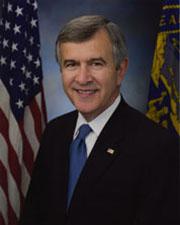 Sen. Mike Johanns (R-NE)
Legislative Activity
Stay on top of the latest movement without scrolling through every action
Senate amendment agreed to: Amendment SA 693 as modified agreed to in Senate by Unanimous Consent.(text as modified: CR S3772)
March 25, 2009
View full timeline
Senate amendment agreed to: Amendment SA 693 as modified agreed to in Senate by Unanimous Consent.(text as modified: CR S3772)
March 25, 2009
Considered by Senate. (consideration: CR S3745, S3772)
March 25, 2009
Amendment SA 693 as modified agreed to in Senate by Unanimous Consent. (text as modified: CR S3772)
March 25, 2009
Senate amendment submitted
March 24, 2009
Senate amendment proposed (on the floor): Amendment SA 693 proposed by Senator Johanns to Amendment SA 687.(consideration: CR S3648-3649; text: CR S3648)
March 24, 2009
Amendment SA 693 proposed by Senator Johanns to Amendment SA 687. (consideration: CR S3648-3649; text: CR S3648) To ensure that organizations promoting competitive and non-competitive sporting events involving individuals with disabilities may receive direct and indirect assistance to carry out national service programs.
March 24, 2009
Text
Modified
NATIONAL SERVICE REAUTHORIZATION ACT--Continued

The PRESIDING OFFICER. The Senator from Texas.
Mr. CORNYN. Mr. President, I ask unanimous consent that Senator Reed
from Rhode Island be recognized first, for up to 5 minutes, and then I
be recognized, following him, for up to 10 minutes.
The PRESIDING OFFICER. Without objection, it is so ordered.
The Senator from Rhode Island.
Mr. REED. Mr. President, I rise in strong support of H.R. 1388, the
Serve America Act. I particularly commend Senator Mikulski for her
leadership on this very important initiative. She has done more than
anyone to bring this bill to the floor and it being on the verge of
successful passage. I say thank you, Madam Chairwoman as well as
Senators Kennedy, Hatch, and Enzi for your excellent work on this bill.
This bipartisan legislation reauthorizes the National and Community
Service Act for the first time since 1993. It strengthens our
commitment to the importance and value of national and community
service for individuals of all ages.
I was pleased the American Recovery and Reinvestment Act that was
signed into law last month included $154 million for AmeriCorps State
and national programs and AmeriCorps VISTA. This funding is estimated
to engage 13,000 additional individuals in service to their
communities. In his address to Congress last month, President Obama
encouraged ``a renewed spirit of national service for this and future
generations'' and called for quick congressional action on the
legislation we seek to pass today.
There are a variety of ways to serve your country. You can serve in
the Armed Forces, as I did, or you can serve in your community, as so
many Americans are doing today. More than ever, being a good citizen
means not only working hard and providing for one's family but also
being an engaged and contributing member of the community, and
particularly to those most in need in your community.
We make ourselves better by engaging in service that gives back to
our communities and makes our society better, through teaching,
mentoring and tutoring children, cleaning up rivers and streams,
building housing for the homeless, and addressing the medical needs of
the ailing, to name a few endeavors that are so critical.
The AmeriCorps, Learn and Serve America, and Senior Corps programs
have greatly benefitted my State. Rhode Island has a proud tradition of
service and was one of the first States to embrace the AmeriCorps
program. More than 14,000 Rhode Islanders participated in those
programs last year.
Participants in these programs are given an opportunity to learn as
well as an opportunity to serve. In the act of serving their community,
participants often make a difference in their own lives--developing
their own knowledge, skills, character, and self-esteem, and
incorporating an ethic of civic responsibility for the rest of their
lives.

[[Page S3756]]

As a cosponsor of this legislation, I am particularly pleased that
this bill includes changes I advocated to maximize Rhode Island's
funding through the AmeriCorps and Learn and Serve programs. The Serve
America Act includes a statutory small State minimum for the AmeriCorps
and Learn and Serve formula programs for the first time. It also
includes a provision I authored to ensure that small, innovative
AmeriCorps programs such as those found throughout Rhode Island get
their fair share of competitive grant funding. Additionally, I am
pleased that this legislation includes changes I sought to encourage
volunteers to focus on helping low-income individuals find affordable
housing.
This is legislation that is important. It is critical. It lives up to
our highest traditions as a nation; that is, to be something more than
one who enjoys their rights but also who discharges their
responsibilities through service to the community and the Nation. I
urge passage.
The PRESIDING OFFICER. The Senator from Texas.

The Budget

Mr. CORNYN. Mr. President, I am a member of the Budget Committee.
Senator Conrad is our chairman. Senator Gregg is our ranking member. As
the Senate knows, this week we will be taking up the President's
proposed budget, and I want to speak for a few minutes about that
subject.
Yesterday I had the opportunity to speak to a number of students who
were here because they want to make sure Congress continues to provide
them an opportunity to study at our Nation's community colleges. I am a
strong believer in the role of community colleges as a less expensive
yet outstanding opportunity to earn a good education, but it being also
a part of our workforce development and training, where industry can
come in and match up a curriculum to train people to perform jobs for
which they can receive well-paying salaries.
But yesterday these community college students, of course, were here
to talk about the issues that are on their mind. They heard from Dr.
Jill Biden and Secretary Duncan, among others. I appreciate how eager
they were to learn what is going on here in Washington. Indeed, I bet
there are a lot of people who would like to know what is going on here
in Washington.
I encouraged them to learn about the issues and express their views.
I told them that as far as I can tell, their generation will bear the
consequences of the reckless spending this Congress is engaged in, in a
budget that simply spends too much, taxes too much, and borrows too
much.
Students will ultimately end up--after they finish their education
and enter the workforce--paying those higher taxes under this proposed
budget. This proposed budget calls for $1.4 trillion in additional net
taxes over the next 10 years.
Students are trying to figure out how these higher taxes will
actually impact the opportunities they will have as they enter the
workforce. Some of these taxes will hit these students at the toughest
time; that is, right as they enter their first job.
We know the engine of job creation in America is our small
businesses. In fact, of those small businesses that employ between 10
and 500 employees--which are the principal job creators in our
country--50 percent of them will experience higher tax rates because
many of them are not incorporated. They are sole proprietorships. They
are partnerships. They are subchapter S corporations, where the income
actually flows through and is reported on an individual tax return.
So it is not true to say these will only affect the rich. Indeed,
these taxes will affect the very job engine that creates the jobs we
ought to be worried about retaining and indeed creating more of.
I also talked to these students about how they will feel the impact
of higher energy costs on their electric bill. You may wonder what I am
talking about. Well, we all care about the environment. As a matter of
fact, I reject the notion of people who actually say: Well, we care
about the environment, and you do not care. I think we all care about
the quality of the air we breathe, the quality of the water we drink. I
cannot imagine someone who does not.
These students, though, I think are understandably skeptical of the
complex and unproven cap-and-trade scheme the President's budget wants
to import from Europe, which will actually ultimately increase the cost
of energy, including electricity. That is why some people have called
it a national sales tax on energy, if, indeed, this complex and
unproven cap-and-trade plan is passed as part of the President's
budget.
Then there is the issue of the caps placed on charitable deductions
for taxpayers who take advantage of that tax break when they contribute
money to good and worthy purposes. Many community college students
receive scholarships from foundations that are funded by charitable
contributions. As a matter of fact, charitable giving is one of the
things that is part of our Nation's great tradition of voluntarism--
something Alexis de Tocqueville called ``public associations''--things
you do not get paid for but things that people do because they think it
is the right thing to do and they have the opportunity to do in our
great country.
This budget would actually cap charitable contributions, which will
actually reduce the tax incentive for individuals to contribute money
to good causes such as the Tyler Junior College Foundation in Tyler,
TX. The foundation is understandably concerned that raising taxes
without increasing the charitable tax deduction will limit their
ability to offer as many scholarships in future years.
So these tax increases will, in effect, limit the opportunities for
these community college students, including folks in my State, in east
Texas, in Tyler, TX.
Then there is the issue of raising taxes generally and spending.
These students know Congress is already spending a whole lot of their
money because it is all borrowed money. In fact, we have spent more
money since this Congress convened this year than has been spent for
the Iraq war, the war in Afghanistan, and in Hurricane Katrina
recovery. We have done that already. And this budget calls for doubling
the debt in 5 years and tripling the debt in 10 years.

These students, understandably--because they are going to be the ones
we are going to look to to pay that money back or bear that tax
burden--should be concerned and, indeed, they are concerned that so
much money is being spent so recklessly. In fact, it is impossible for
me to imagine it will be spent without huge sums of money actually
being wasted.
We have already seen evidence of that. In the stimulus bill--the
President said he wanted on his desk in short order, which was rushed
through the Senate and through the Congress--$1.1 trillion, including
the debt and interest on the debt--we found out, once we passed the
next bill, which was a $410 billion Omnibus appropriations bill, that,
lo and behold, Congress had actually doubly funded 122 different
programs in the bill. We acted with such haste, with such little care,
with such little deliberation, that we found out we doubly funded 122
programs.
Indeed, we found out in recent days that in the conference report on
the stimulus bill, there was a provision stuck in the conference report
that protected the bailout bonuses for the executives of AIG. Then, of
course, there was the understandable uproar over that. That is what
happens when a bill is printed and circulated at 11 o'clock at night,
on a Thursday night, and we are required to vote on it in less than 24
hours the next day. That is not the kind of transparency, that is not
the kind of accountability, that is not what will actually give people
more confidence in their Government-elected officials. To the contrary.
There is another provision in this omnibus bill that has essentially
started a trade war with Mexico, something that causes me grave
concern.
So as we consider the President's $3.6 trillion budget proposal, we
should remember the lessons of the past 2 weeks: spending so much
money, so quickly, can lead to unintended consequences, to say the very
least, but the biggest consequence of this budget is the amount of debt
we are accumulating. I have already talked about it a minute.

[[Page S3757]]

But, of course, we were shocked, and I think even the President and
the administration were shocked, by the Congressional Budget Office,
the nonpartisan office which evaluates financial matters for Congress,
which said the President's budget will actually create deficits
averaging nearly $1 trillion a year for the next decade.
I mentioned the fact that it would double the debt in 5 years, triple
it in 10 years. The Congressional Budget Office said the size of the
national debt as a percentage of the economy will become the highest
since the years after World War II.
So these students who start college this year will see their share of
the national debt grow from $19,000 per student to more than $36,000
per student after graduation from a 4-year program. By 2019, their
share of the debt will grow to more than $55,000 per person. Can you
imagine, with the money they have to borrow to fund their education,
with their credit card debt--and I do not know any student who does not
have sizable credit card debt--we are going to heap $55,000 in
additional debt on these students. That is a tough way to start out
your life after school as you start your first job. Today's college
students will ultimately have to pay back the debt, as well as the
generations that succeed them. All bailouts, one way or another, will
come out of their pocket.
I urge my colleagues to understand the impact on this younger
generation of a budget that taxes too much, spends too much, and
borrows too much. Because of our actions, the next generation will
either have to raise more taxes or cut programs that are necessary or
lower their standard of living.
I know from my parents, members of the ``greatest generation,'' the
one thing they aspired to more than anything else was that my brother
and my sister and I would have a better life, more opportunities, more
freedom, a better standard of living than they did. And they were
willing to sacrifice for that, and sacrifice they did. But it seems to
me the sacrifices we are calling for today are all on our children and
grandchildren, and none upon the present generation.
The President says he wants to make hard decisions. But I do not see
any hard decisions in this budget. All I see is more borrowing, more
taxing, and more spending, and that is exactly the wrong way we ought
to be headed.
Mr. President, I thank the Chair and yield the floor.
The PRESIDING OFFICER. The Senator from Michigan.
Ms. STABENOW. Mr. President, I ask unanimous consent to speak as in
morning business.
The PRESIDING OFFICER. Without objection, it is so ordered.
Ms. STABENOW. Mr. President, we know our planet is in danger, and
later this year we will be debating a climate bill to address our
environmental challenges. I am glad to see my colleagues from the other
side of the aisle are doing their part for the environment by recycling
15-year-old talking points on the budget.
President Bush left us a terrible mess: high unemployment, high
deficits, millions without health care. I am referring to the first
President Bush and the mess inherited by President Bill Clinton. One of
my colleagues at the time said Clinton's budget would ``destroy the
economy.'' Well, I think everyone knows the Clinton years did not
destroy the economy. In fact, they created about 22 million new jobs.
Let's look at some of the newspaper headlines from back then. First
of all, just this week, Politico's banner headline was: ``GOP Warns
About Budget Hardball.'' That is what we have been hearing on the
floor--hardball, people coming down time after time attacking President
Obama's budget.
But back in 1995, we heard the same thing: ``GOP Plan for Budget to
Take No Prisoners.''
In 1993: ``GOP's Politics of No.'' Sound familiar? GOP's politics of
no.
In 1993: ``One-Word Vocabulary Hobbles GOP. Republicans Grouse as
Senate Takes Up Budget Bill.'' You could recycle and, in fact, that is
what they are doing, every single one of these comments and every
single one of these headlines.
The American people voted for change last November. They are tired of
all of this. They are tired of the nay-saying, the doom and the gloom.
They deserve better than a Republican repeat, and that is,
unfortunately, what is happening: a Republican repeat, same old
politics, same old politics of no, slow-walking, filibustering; same
old policies; every problem should have a tax cut for the wealthy. That
is what got us into this mess.
We hear the same old thing from our colleagues on the other side of
the aisle. We hear no to health care reform and the budget, no to
creating 3.5 million new jobs through the recovery plan. We hear no to
increasing oversight of our financial sector. We hear no to extending
unemployment for those most in need. Certainly, in my great State of
Michigan the answer has been no. To a commonsense budget that provides
middle-class tax cuts and will cut the deficit in half in 4 years, what
do we hear? No.
The budget we are working on now focuses on the real problems
affecting American families, the things that people sit down with their
families and struggle over every day. The Obama budget invests in
America's future by focusing on jobs, by focusing on health care, by
focusing on energy independence, and education. That is what our
families are concerned about as they are trying to juggle what to pay
first amidst the crisis they feel today.
This is a budget we need to do right now. We need to move past the
politics of no and start working together to do what is right for
American families. I urge my colleagues to look past the next election
cycle and to pass this budget to get America back on track again.
I thank the Chair. I yield the floor.
The PRESIDING OFFICER. The Senator from Tennessee.

Amendment No. 688

Mr. CORKER. Mr. President, I rise to speak regarding amendment No.
688, the Crapo-Corker amendment. I say to the Senator from Michigan,
this is an opportunity for us all to say yes.
This is an amendment that is very important to people all across the
country. What this amendment does is it gives the FDIC the ability to
have a line of credit that today is at $30 billion, and it gives them a
line of credit up to $100 billion. The FDIC was put in place in 1991
when banking assets in our country were at $4.5 trillion. Today, bank
assets in our country total almost $14.7 trillion. We have an FDIC
today that is hamstrung because of the financial crisis in which we
find ourselves. So this amendment would raise that line of credit from
$30 billion, which is an ancient establishment, to $100 billion.
Secondly, what it would do is give the FDIC--with certain signatures
required from the Fed, from the Treasury, from others--access to a $500
billion line of credit in the event they need it to seize an
institution to protect depositors. So this does two things.
To make this relevant to people who will be voting on this amendment,
hopefully, this afternoon, I think all of my colleagues know the FDIC
has just put in place a special assessment. My guess is every person in
this body has heard from community bankers and regional bankers and
even larger establishments about this special assessment.
I know in Tennessee, many of the community banks actually would have
to spend an entire quarter's earnings to pay this special assessment.
So by doing what we are doing in this amendment, we actually give the
FDIC time to amortize that special assessment over a number of years
which will cause it to be far more palatable for community bankers, in
particular, who have had nothing whatsoever to do with the financial
crisis in which we find ourselves.
Secondly--and I think this ought to be equally important to people
here--this gives the FDIC the ability to move into an organization
quickly and to seize it to protect depositors' accounts.
I know right now the fund is running thin. My guess is that could
affect--and actually the FDIC has lobbied for this--this might affect
future actions if they don't feel as though they have the resources
necessary to go into an organization to do the things they need to do
to make sure depositors are protected.
This action is action for which I would imagine we could almost get
unanimous support. As a matter of

[[Page S3758]]

fact, my guess is we could voice vote this. As a matter of fact, I hope
that will occur this afternoon.
In the past, this legislation has been held hostage to what is called
the cram-down provision. The cram-down provision has been before this
body. It was defeated overwhelmingly. Numbers of Democrats thought it
was bad legislation. There have been a few Senators who have tried to
attach cram-down to this legislation that we will be voting on this
afternoon and tried to extort action on cram-down by virtue of holding
this very good piece of policy at bay.
It is my hope this afternoon that we will do something that is very
important, especially to community bankers across the country but also
to depositors to make sure we have the ability to protect them: that
the FDIC has the ability to move quickly. Move aside from extortionary
politics and move toward doing something that is good for our country,
good for community bankers, and certainly very good for depositors all
across this country.
Mr. President, I thank you for this time. I yield the floor.
The PRESIDING OFFICER. The Senator from North Dakota.
Mr. DORGAN. Mr. President, first, I wish to say with respect to the
Serve America Act, let me compliment the committee chair and the
ranking member. This is a good piece of legislation. I am proud to
support it. I also wish to say I have an amendment I hope we will be
able to accept by voice this afternoon. It is the amendment that calls
for a tribal liaison to the Corporation of National and Community
Service in order to keep Indian tribes in this country fully involved
in this process.
Some of the highest rates of unemployment in this country exist
within Indian tribes. The opportunity to participate in, for example,
the National Committee Service Program would be very important. So I
know this amendment is supported by the chair and the ranking member,
and I hope we can accept it by voice vote at some point this afternoon.
Mr. President, I would inform Senator Mikulski that I wanted to
describe to my colleagues something that is happening in our State as I
speak, and I wanted to do so in morning business so it doesn't
interrupt the flow of the debate over this bill. So I ask unanimous
consent to speak as in morning business to describe the flooding threat
that is occurring in my State at this moment.
The PRESIDING OFFICER. Without objection, it is so ordered.
(The further remarks of Mr. Dorgan are printed in today's Record
under ``Morning Business.'')
The PRESIDING OFFICER. The Senator from Maryland is recognized.
Ms. MIKULSKI. Mr. President, later this afternoon we are going to be
voting on the Crapo amendment, No. 688, to increase borrowing authority
for the FDIC. I will not be supporting the Senator's amendment even
though I agree there is much about the policy in the amendment that I
agree with. It might be a good idea, but it is in the wrong place.
The bill pending before the Senate is the national service bill. It
is the result of bipartisan, bicameral work--very complicated
bipartisan, bicameral negotiations--on which we have strong support
from a range of Senators and strong support from the administration.
Introducing contentious housing and economic issues into this debate
would jeopardize the bipartisan support we have on this bill and could
wreak havoc in the conference we will be facing with the House. We
don't want to be in havoc with the House. It is one thing to be
negotiating assertively, representing a Senator's viewpoint with the
House on national service and what is the best, most prudent, and
affordable way to do it, but if we have to carry over to the House an
amendment dealing with FDIC and insurance--that really belongs on
another bill.
I encourage our colleague, Senator Crapo, to withdraw the amendment.
I really would not like to reject the idea, but that is the Banking
Committee's jurisdiction. As I understand it from the chairman and
ranking member of the Banking Committee, this is a substantive issue
they intend to take up in their committee.
I say to my colleagues on both sides of the aisle, if Senator Crapo
insists upon a vote, that we really not pass his amendment. For all of
those who think the policy has merit, I don't dispute that. But that is
for another forum. That is for a Banking Committee forum. That should
be hashed out in the Banking Committee, and then recommendations would
be brought to the respective caucuses of both the Democrats and
Republicans so that we can have a substantive discussion.
I must say that to increase the borrowing authority of the FDIC from
$30 billion to $100 billion should not be done on a shoot-from-the-lip.
That is what this amendment is, all due respect to my colleague. Just
kind of dumping it on national service is a shoot-from-the-lip
amendment. I think it deserves more caution and consideration. We are
talking about raising the borrowing authority by $70 billion just when
everybody is saying: Hey, Obama is taking on too much. I think we are
taking too much on in an amendment with the national service bill.
I say to my colleague, please withdraw your amendment. If you insist
upon a vote, I am afraid I will have to oppose you in a very vigorous
way. Perhaps, if done appropriately through the Banking Committee and
it comes before the Senate in the regular order, I might be in the
``aye'' column.
So when we do vote on that, that is the category I will be in. As I
understand it, we will be voting on that amendment this afternoon.
There is still time for the Senator to come over and withdraw his
amendment. I say this in the most respectful way because I know how
strongly he feels about it. He has a lot of expertise on that, and I
would like to see that expertise channeled to the right place, at the
right time, with the right amendment, on the right bill.
Mr. President, I yield the floor and suggest the absence of a quorum.
The PRESIDING OFFICER. The clerk will call the roll.
The legislative clerk proceeded to call the roll.
Ms. MIKULSKI. Mr. President, I ask unanimous consent that the order
for the quorum call be rescinded.
The PRESIDING OFFICER. Without objection, it is so ordered.
Ms. MIKULSKI. Mr. President, I ask unanimous consent that at 3 p.m.,
the Senate resume consideration of amendment No. 688; that if a budget
point of order is raised against the amendment and a motion to waive
the applicable point of order is made, that immediately thereafter the
Senate proceed to vote on the motion to waive the point of order.
The PRESIDING OFFICER. Is there objection?
Without objection, it is so ordered.
The Senator from Arizona is recognized.
Mr. KYL. Mr. President, President Obama has said he wants to
encourage ``a renewed spirit of national service for this and future
generations.'' I submit that we can all agree on the value of promoting
voluntarism. Volunteers are essential to the survival of many
charitable organizations in America. But I believe S. 277 diminishes
the true spirit of volunteering, first, by providing taxpayer-funded
benefits such as monthly stipends and housing to participants--this
financial support for volunteers will cost over $5 billion, which is a
lot of money for volunteering--and secondly, by redefining volunteering
as a taxpayer-funded political exercise in which Government bureaucrats
can steer funding to organizations they select.
In the past, service organizations mandated by the Government have
not been constrained from providing funds to organizations with
political agendas, and this bill is no different. While the Mikulski
substitute amendment to the bill adds a limited constraint, the
political direction of the bill is still apparent. It attempts to
direct resources to five newly created corps--three that aim to
influence health care, energy and the environment, and education; that
is, groups that reflect the key aspects of President Obama's domestic
agenda. For instance, the bill would allocate funds to a newly created
Clean Energy Corps in which participants would improve energy
efficiency in low-income households. All well and good, but the bill
would also require the Clean Energy Corps to consult with energy and
labor and the Environmental Protection Agency. Among the activities of
the new Clean Energy

[[Page S3759]]

Corps would be reducing carbon emissions. How reducing carbon emissions
can be achieved by volunteers has not been made clear. Is this, in
fact, an attempt to create federally subsidized ``green jobs'' in areas
already served by other Government programs or traditionally served by
State, local, and private community service organizations?
Another problem with the bill is its failure to eliminate programs
that are not working. Current national service programs being funded,
such as Learn and Serve and the AmeriCorps National Civilian Community
Corps, have not been successful. On its Web site, expectmore.gov, which
provides a database of Federal program performance results, the Office
of Management and Budget has categorized both of these programs as not
performing and ineffective.
Finally, there are the costs associated with the programs. The
Congressional Budget Office estimates that the costs this year will top
$1 billion and will cost another $5.7 billion from 2010 to 2014 to
expand the program from the current 75,000 participants to 200,000
participants by 2014.
There is ample reason to conclude that these programs are not worth
another $5.7 billion. I realize we have gotten to the point where $1
billion does not mean what it once did. But S. 277 would saddle
taxpayers with another multimillion dollar bill at a time when we
should be cutting back, not finding new ways to spend.
The spirit of voluntarism is alive and well in America. I see it in
my own State of Arizona. Could we agree that maybe there is one area of
our society in which we do not have to add more Government? I think
volunteering to help our neighbors might be a good place to start.
Mr. President, I suggest the absence of a quorum.
The PRESIDING OFFICER. The clerk will call the roll.
The legislative clerk proceeded to call the roll.
Mr. DODD. Mr. President, I ask unanimous consent that the order for
the quorum call be rescinded.
The PRESIDING OFFICER. Without objection, it is so ordered.
Mr. DODD. Mr. President, very briefly, I gather Senator Mikulski has
already addressed this point, but I see my very good friend from Idaho,
Mr. Crapo, here as well, the author of the amendment. I commend him for
it. I know this is going to sound awkward because there is going to be
a procedural issue we are going to vote on shortly.
My colleague should understand the procedural differences should not
reflect substantive differences at this point. We agree with what he is
trying to achieve. There is an issue here involving a budget point of
order, as well as a determination, I know, by the authors of this
bill--Senator Mikulski, Senator Kennedy, Senator Hatch, Senator Enzi,
the principal authors--to try to achieve a bill that can move quickly
dealing with national service.
But the underlying amendment by Senator Crapo is one that I think is
universally supported--there may be some who disagree, but I do not--
that this has a lot of merit and we need to deal with it in conjunction
with other matters, with which my colleague from Idaho is very
familiar, dealing with the FTC, some safe harbor provisions from
Senator Martinez dealing with the foreclosure issue, and several other
points as well. We are trying to include these as an overall package
which we are working on and hopefully can complete maybe before the
recess. I don't want to commit to that but certainly quickly because
there is a sense of importance to these matters.
I want my colleagues to know, particularly my friend from Idaho, that
supporting a motion dealing with a budget matter here is not a
reflection of the substance of his amendment.
We talked privately about this issue, but I wanted to say so publicly
as well, and that as chairman of the committee of jurisdiction, we will
move as quickly as we possibly can to deal with this and related
matters.
Again, I wish my colleagues to know that as well, but that is the
rationale behind this particular moment.
Again, I thank my colleague from Idaho for raising this important
issue. He is a valued member of the committee and made a very
worthwhile suggestion, certainly one we will, in my judgment,
incorporate as part of this larger package.
Mr. President, I yield the floor.
The PRESIDING OFFICER. The Senator from Idaho.
Mr. CRAPO. Mr. President, I thank my committee chairman, Senator
Dodd, of the Banking Committee for his comments. I appreciate our
working relationship and the commitment he made on not only this issue
but a number of issues of importance facing our financial institutions
and the reform we need to deal with in Congress. I look forward to
working with him on that matter.
I also thank Senator Mikulski for her patience as we brought this
issue up on her bill. I truly do appreciate her patience and her
understanding. I understand what the procedure is going to be and what
the votes are going to be in a few minutes. I recognize that. I do
realize we have a procedural issue here, but we also have a very
critical financial issue.
As Senator Dodd has so well stated, this is an issue on which we have
broad bipartisan agreement. I appreciate his commitment to work with us
in an expeditious manner so that we can get this legislation put into
law as soon as possible. There is an urgency. It is not an emergency
yet and we have a little bit of time to deal with it, but there is an
urgency. I appreciate Senator Dodd's recognition of that and his
willingness to work with us on this issue.
Mr. President, I yield the floor.
The PRESIDING OFFICER. The Senator from Nevada.
Mr. ENSIGN. Mr. President, I wish to ask the manager of the bill if I
may bring up a couple of my amendments. We gave the amendments to her
staff about 4 hours ago. I was recently informed I was not going to be
able to get those amendments up and pending. The majority leader of the
Senate asked us to get amendments up. I cleared my schedule to make
sure I could come over and get my amendments up. Now I am told by
Senator Mikulski's staff that there would be objection to getting any
more amendments pending.
Ms. MIKULSKI. Mr. President, I say to my colleague from Nevada, there
seems to be some confusion about this matter. We do want to address his
amendments. We have been working on his side trying to queue up those
amendments. Perhaps during this vote he and I can talk. I think there
was confusion about where there are some roadblocks. Let's talk during
the vote.
Mr. ENSIGN. I appreciate that.
The PRESIDING OFFICER. The Senator from Tennessee.
Mr. CORKER. Mr. President, I wonder if I may have permission to ask
the Senator from Connecticut a question.
Mr. President, I stepped in after the dialogue was taking place on
the floor. My understanding is that the Crapo amendment that actually
is part of the original bill--that you are very much a part of and have
allowed--is going to come up in an expeditious manner. I wonder if we
have a commitment from the chairman, whom I respect and certainly enjoy
working with very much, that it come up unattached to a cram-down so
that we don't have the extortion of that issue being attached to this.
I didn't hear that, so I wanted to know if that was also part of the
commitment.
Mr. DODD. Mr. President, I appreciate my colleague from Tennessee
having very good ears in all of this. I can't dictate what all is going
to be included in the amendment. My colleague, of course, is aware that
there are a number of our colleagues who are very interested in the
cram-down--as you call it--provision dealing with the bankruptcy law
and primary residences. So I cannot give the assertion that a final
package will or will not include that. That will largely depend on how
these negotiations proceed.
That is the reason we are not prepared today to go forward with this
proposal, along with others as part of this package. And I know there
are strong feelings on both sides of that question in this Chamber. So
I know I have been asked to give that assertion, which I cannot give,
obviously, any more than I could give an assertion that other pieces
Members are interested in would be excluded or included at a moment
like this.
What I have said to my colleague--and I will repeat to my good friend

[[Page S3760]]

from Tennessee, with whom I enjoy a very good relationship--is that
this is a very important matter my friend has raised. I agree with him
on the substance of it. It needs to be done expeditiously. It is a
serious issue. There are others, dealing with the Federal Trade
Commission and others, which need to be a part of a package that our
bankers--particularly our community bankers--are very interested in.
I also know there are strong feelings about the cram-down provisions.
But as I have said to my colleague from Idaho and others, I cannot
today stand here and dictate the outcome of a matter on which there are
strong feelings and opinions in this Chamber. We will deal with that as
we normally do, through the normal process, one way or the other.
At this particular moment, given the fact that we need to deal with
this in a more complete fashion, there is a budget point of order on
this matter and, clearly, the authors of this bill, the pending matter,
would like to move this matter without having extraneous material added
to it. So for all those reasons, I will be supporting the motion of the
Senator from Maryland so we can move along with the matter. But that is
the answer to the question of my good friend from Tennessee.
Mr. CORKER. Mr. President, if I could have just 30 seconds, I
certainly thank the Senator from Connecticut and, again, will certainly
work with him. I might add that the strong feelings that are felt sort
of go in this manner: that there is unanimous or overwhelming support
for this particular provision, and this body is very divided on this
other issue. So it does, in effect, keep us from having a very good
policy that is very much supported from becoming law.
It is broken down by the fact we have tremendous dissension in this
body--or let me say this: a difference of opinion in this body--over
the cram-down issue. But that is stating the obvious, and I am sure the
American public understands that.
I yield the floor.
The PRESIDING OFFICER. The Senator from Idaho.
Mr. CRAPO. Mr. President, I ask unanimous consent that Senator
Chambliss be added as a cosponsor of the Crapo amendment.
The PRESIDING OFFICER. Without objection, it is so ordered.
Under the previous order, the question is on agreeing to amendment
No. 688 offered by the Senator from Idaho, Mr. Crapo.
Ms. MIKULSKI. Mr. President, I make a point of order that the pending
amendment violates section 302(f) of the Congressional Budget Act of
1974.
Mr. CRAPO. Mr. President, I move to waive the applicable provisions
under the Budget Act with respect to my amendment, and I ask for the
yeas and nays.
The PRESIDING OFFICER. Is there a sufficient second?
There is a sufficient second.
The yeas and nays were ordered.
Ms. MIKULSKI. Mr. President, what is the order, a vote or a quorum?
The PRESIDING OFFICER. A quorum is in order if someone suggests the
absence of a quorum.
Mr. CRAPO. Mr. President, I suggest the absence of a quorum.
The PRESIDING OFFICER. The clerk will call the roll.
The assistant legislative clerk proceeded to call the roll.
Mr. REID. Mr. President, I ask unanimous consent that the order for
the quorum call be rescinded.
The PRESIDING OFFICER. Without objection, it is so ordered.
The question is on agreeing to the motion to waive the Budget Act in
relation to the Crapo amendment, No. 688. The yeas and nays have been
ordered.
The clerk will call the roll.
The assistant legislative clerk called the roll.
Mr. DURBIN. I announce that the Senator from Massachusetts (Mr.
Kennedy) is necessarily absent.
Mr. KYL. The following Senator is necessarily absent: the Senator
from Wyoming (Mr. Enzi).
The PRESIDING OFFICER (Mr. Merkley). Are there any other Senators in
the Chamber desiring to vote?
The yeas and nays resulted--yeas 48, nays 49, as follows:

[Rollcall Vote No. 110 Leg.]

YEAS--48

Alexander
Barrasso
Baucus
Bennett
Bond
Brownback
Bunning
Burr
Cantwell
Chambliss
Coburn
Cochran
Collins
Corker
Cornyn
Crapo
DeMint
Dorgan
Ensign
Feingold
Graham
Grassley
Gregg
Hatch
Hutchison
Inhofe
Isakson
Johanns
Kyl
Lincoln
Lugar
Martinez
McCain
McCaskill
McConnell
Murkowski
Nelson (NE)
Risch
Roberts
Sessions
Shelby
Snowe
Specter
Tester
Thune
Vitter
Voinovich
Wicker

NAYS--49

Akaka
Bayh
Begich
Bennet
Bingaman
Boxer
Brown
Burris
Byrd
Cardin
Carper
Casey
Conrad
Dodd
Durbin
Feinstein
Gillibrand
Hagan
Harkin
Inouye
Johnson
Kaufman
Kerry
Klobuchar
Kohl
Landrieu
Lautenberg
Leahy
Levin
Lieberman
Menendez
Merkley
Mikulski
Murray
Nelson (FL)
Pryor
Reed
Reid
Rockefeller
Sanders
Schumer
Shaheen
Stabenow
Udall (CO)
Udall (NM)
Warner
Webb
Whitehouse
Wyden

NOT VOTING--2

Enzi
Kennedy
The PRESIDING OFFICER. On this vote, the yeas are 48, the nays are
49. Three-fifths of the Senators duly chosen and sworn not having voted
in the affirmative, the motion is rejected, the point of order is
sustained, and the amendment falls.

Amendment No. 715 to Amendment No. 692

The PRESIDING OFFICER. The Senator from Nevada.
Mr. ENSIGN. I ask for the regular order concerning the Baucus
amendment and I send a second-degree amendment to the desk.
The PRESIDING OFFICER. The clerk will report.
The assistant legislative clerk read as follows:

The Senator from Nevada [Mr. Ensign] proposes an amendment
numbered 715 to amendment No. 692.

Mr. ENSIGN. I ask unanimous consent that reading of the amendment be
dispensed with.
The PRESIDING OFFICER. Without objection, it is so ordered.
The amendment is as follows:

(Purpose: To clarify that nonprofit organizations assisted under the
Nonprofit Capacity Building Program include certain crisis pregnancy
centers, and organizations that serve battered women or victims of rape
or incest)

On page 2, line 20, insert before the period the
following: ``which shall include crisis pregnancy centers,
organizations that serve battered women (including domestic
violence shelters), and organizations that serve victims of
rape or incest''. These organizations must be charities
within the meaning of the United States tax code.

Mr. ENSIGN. Mr. President, this is a very simple amendment. The
Baucus amendment wants to pay legal fees for some of these
organizations that are volunteer organizations. Sometimes these
organizations have significant legal fees. What my amendment says is,
even though the bill doesn't specifically exclude any organizations, I
wish to make sure that several of these organizations or types of
organizations are able to be included and eligible for some of those
legal fees. In my amendment, it points out things such as crisis
pregnancy centers, battered women shelters, rape crisis centers,
various organizations that are specifically geared toward helping
women. I wished to make sure that somewhere down the line somebody at
an administrative level doesn't exclude somebody because they have a
different political philosophy. We want to make sure the people in
these organizations are included. These are people, obviously, from
both sides of the political aisle whom we have included in our
amendment. I urge its adoption.
The PRESIDING OFFICER. The Senator from Maryland.
Ms. MIKULSKI. Mr. President, we can appreciate this amendment and the
thrust behind it.
I suggest the absence of a quorum.
The PRESIDING OFFICER. The clerk will call the roll.
The assistant legislative clerk proceeded to call the roll.
Ms. MIKULSKI. I ask unanimous consent that the order for the quorum
call be rescinded.
The PRESIDING OFFICER. Without objection, it is so ordered.
Ms. MIKULSKI. Mr. President, the Ensign amendment would make an
unnecessary and divisive change to the bipartisan amendment offered by
Senators Baucus and Grassley. The Baucus-Grassley amendment would
create

[[Page S3761]]

a nonprofit capacity building program. It would fund a grant program to
provide education opportunities to small charities, primarily designed
for those in rural areas. The education opportunities would teach
charities how to manage finances and fundraise effectively, how to
accurately file complicated tax forms, adopt new computer technologies
or even plan a long-term budget. Capacity in rural communities, such as
I see in my own areas, do need help. I think the Grassley-Baucus
amendment has merit. In the Baucus-Grassley amendment, there is no
limitation on the types of charities that can access these training
programs. Therefore, the amendment of the Senator from Nevada is
unnecessary.
Support for the Baucus-Grassley amendment is quite broad. The
National Council of Nonprofits, the Independent Sector, and the
Alliance for Children and Families have voiced their strong support for
this amendment. I urge colleagues to oppose the Ensign amendment.
I wish to also comment on his desire to include crisis pregnancy
centers. That is a broad definition. I am not sure what he means by a
crisis pregnancy center. There are those that are ones with a
particular philosophical viewpoint as compared to broad pregnancy
information. These centers are already covered by language in the
current bill. The amendment is not needed. There is a question about
adding that explicit language. I urge Members not to adopt the Ensign
second-degree amendment. It is unnecessary and unneeded and would cause
quite an intense negotiation with the House when we go to conference.
The whole idea of the way we have been working so faithfully on a
bipartisan and even bicameral basis is to not to have a long conference
so we are able to move the national service bill to signing by the
President so it could be included in this year's appropriations. By
adding the Ensign second degree, this would result in jeopardizing the
passage of the bill.
I urge defeat of the Ensign amendment and would so recommend to my
colleagues.
I suggest the absence of a quorum.
The PRESIDING OFFICER. The clerk will call the roll.
The assistant legislative clerk proceeded to call the roll.
Mrs. SHAHEEN. I ask unanimous consent that the order for the quorum
call be rescinded.
The PRESIDING OFFICER. Without objection, it is so ordered.
Mrs. SHAHEEN. I ask unanimous consent to set aside the pending
amendment so my amendment No. 712 can be called up for consideration.
The PRESIDING OFFICER. Is there objection?
Mr. THUNE. Reserving the right to object, I would also ask, as part
of that agreement, that I have an amendment that also be made pending
as part of the request of the Senator from New Hampshire.
Ms. MIKULSKI. I object.
The PRESIDING OFFICER. Objection is heard.
The Senator from Maryland.
Ms. MIKULSKI. Mr. President, we didn't know the Senator had an
amendment. We need to have a copy of the amendment. If we could have a
copy, we would be willing to discuss it.
Mr. THUNE. I would be happy to make it available to the distinguished
manager of the bill.
I suggest the absence of a quorum.
The PRESIDING OFFICER. The clerk will call the roll.
The assistant legislative clerk proceeded to call the roll.
Ms. MIKULSKI. I ask unanimous consent that the order for the quorum
call be rescinded.
The PRESIDING OFFICER. Without objection, it is so ordered.
Ms. MIKULSKI. Mr. President, if I may say to the Senator from South
Dakota, we are looking at his amendment to see if there is something we
can accommodate. Would it be agreeable to him if the Senator from New
Hampshire offered a bipartisan amendment that she and the other Senator
from New Hampshire are offering? She will offer it and speak briefly,
understanding that the Senator had sought recognition before she did.
Mr. THUNE. Let me ask through the Chair, so the understanding would
be that the amendment of the Senator from New Hampshire would become
the pending amendment?
Ms. MIKULSKI. Yes.
Mr. THUNE. Is there any understanding beyond that about amendments
offered by Members on our side, mine included?
Ms. MIKULSKI. It is a matter of expediting the time. We are reviewing
your amendment, which is a sense of the Senate. We are viewing it from
not only a policy standpoint but with this arrangement of discussing
issues with the House. It is more of a time management issue than a
content issue.
I ask unanimous consent that upon completion of the offering of the
amendment by the Senator from New Hampshire, the Senator from South
Dakota's amendment be pending.
Mr. THUNE. I thank the Senator from Maryland. I withdraw my
objection.
The PRESIDING OFFICER. The Senator from New Hampshire.

Amendment No. 712 to Amendment No. 687

Mrs. SHAHEEN. I ask unanimous consent to set aside the pending
amendment so amendment No. 712 can be called up for consideration.
The PRESIDING OFFICER. Without objection, it is so ordered.
The clerk will report.
The assistant legislative clerk read as follows:

The Senator from New Hampshire [Mrs. Shaheen], for herself
and Mr. Gregg, proposes an amendment numbered 712 to
amendment No. 687.

Mrs. SHAHEEN. I ask unanimous consent that reading of the amendment
be dispensed with.
The PRESIDING OFFICER. Without objection, it is so ordered.
The amendment is as follows:

(Purpose: To provide that an Education Corps may carry out activities
that provide music and arts education and engagement)

In section 122 (a)(1)(B) of the National and Community
Service Act of 1990, as amended by section 1302 of the bill,
insert at the appropriate place the following:
``(__) providing skilled musicians and artists to promote
greater community unity through the use of music and arts
education and engagement through work in low-income
communities, and education, health care, and therapeutic
settings, and other work in the public domain with citizens
of all ages;''.

Mrs. SHAHEEN. Mr. President, I appreciate your assistance in moving
this amendment forward and certainly appreciate the Senator from South
Dakota and, of course, the Senator from Maryland for helping me move
forward with this amendment.
I bring this amendment forward on behalf of my colleague from New
Hampshire, Senator Gregg, and myself. The Shaheen-Gregg amendment would
simply add to the menu of activities that can be included in the
Education Corps. It would include musicians and artists to promote arts
in education. That, very simply, is the amendment.
I would also like to speak briefly to the pending legislation, S.
277, the Serve America Act. I want to begin by commending my
colleagues, Senator Kennedy and Senator Hatch, for their leadership in
working on this legislation and bringing it forward and, of course,
Senator Mikulski and Senator Enzi for their work in making sure the
discussion on this bill can go forward, so hopefully we can pass this
legislation this week.
This Serve America Act clearly embodies the spirit of America--a
spirit that calls on all of us to give back to our country and to work
together to build a nation that can continue to offer endless
opportunity to generations to come.
This bill could not come at a more critical time in our Nation's
history. More and more people need help getting by in this tough
economic climate, while more and more of even the most generous among
us have less and less to contribute to charitable activities. That is
what makes this legislation so special. It has nothing to do with
status, with background, with privilege or circumstance. Every American
is equal in their ability to give of themselves and their time. As
Martin Luther King said so eloquently: Every American can be great
because every American can serve--to paraphrase what he said a little
bit. The Serve America Act encourages voluntarism at every stage of
life--from students, to full-time workers, to senior citizens.
Throughout American history, the compassion of our people has gotten
us

[[Page S3762]]

through the most difficult of times. That spirit exists today in
communities across America, and the Serve America Act taps into the
strong desire of Americans to do their part to help our country recover
and prosper.
No deed is too small. While the average American may not be able to
save struggling banks from financial crisis, they can help a family to
weatherize their home so they can save money on their heating or
cooling bills. They can mentor a child so that child can reach his or
her greatest potential, so they can hopefully go to college and compete
in this global economy.
The Serve America Act will usher in a new era of service and civic
engagement in our country, where we can solve our most difficult social
challenges by using entrepreneurial spirit to bring about social
change. It will build upon great success stories in voluntarism, such
as AmeriCorps, by increasing the numbers of volunteers involved in
volunteer programs nationwide from 75,000 to 250,000.
It also creates several new volunteer organizations with missions in
specific areas of national deed, including a Clean Energy Corps. While
Congress works to position America as a leader in clean energy and
energy efficiency, this group of volunteers will enhance our efforts by
encouraging efficiency and conservation measures in communities and
neighborhoods. It is an idea that makes so much sense. In New
Hampshire, I know volunteers stand ready, for example, to make homes
more energy efficient, or work to preserve our State's many parks,
trails, and rivers for future generations to enjoy.
As Governor of New Hampshire, I saw firsthand the difference that
programs such as AmeriCorps and other volunteer programs can make. Plus
Time New Hampshire is one of those programs. It provides afterschool
help to vulnerable students who would otherwise go home to empty
houses. And New Hampshire's City Year program has been successful in
decreasing the high school dropout rate.
I just point out that City Year was started by a New Hampshire
native, Alan Khazei, who, with some of his friends from Harvard, was
able to start a wonderful program that has now expanded across the
country.
One young volunteer in New Hampshire for City Year, Jennifer Foshey,
volunteered at Hampton Academy through the City Year program. During
her year of service, she worked with sixth grade boys who were
struggling academically and failing most of their classes. Jennifer
provided one-on-one academic support, individual mentoring, and
encouraged these students to get involved in extracurricular
activities.
Because of her hard work, the boys' grades improved dramatically, and
one of them joined the community service afterschool club Jennifer ran.
He was later quoted in the school paper as saying:

There are kids in our neighborhoods that need help, and
it's our job to help them.

There could not be a better testament to the ripple effect programs
such as City Year that are supported in this legislation have in our
communities.
I have long been an advocate for national service because I have seen
the power of these volunteers--power not only to help those in need but
to empower citizens and strengthen communities. There is no question
that the Serve America Act expands opportunities for all Americans to
become involved in service in a wide range of areas of need.
Today, this amendment I offer will further extend the work of the
service corps by offering opportunities for skilled musicians and
artists to expand educational opportunity, promote greater community
unity, and bridge cultural divides through the use of music and arts
engagement.
The Serve America Act is so important to those in New Hampshire and
across the country. I am very pleased and honored to join with Senators
Kennedy, and Hatch, and Mikulski, to cosponsor such an important piece
of legislation that invests in new, innovative solutions to our
Nation's most persistent social problems, and I urge my colleagues to
join me in support of the Serve America Act. I hope they will also
support the amendment Senator Gregg and I are offering.
Mr. President, I yield the floor.
The PRESIDING OFFICER. The Senator from Maryland.
Ms. MIKULSKI. Mr. President, I thank the Senator from New Hampshire,
along with her colleague, the senior Senator, Mr. Gregg, for offering
this amendment. It does make sure that service programs in the
Education Corps are also allowed to incorporate art and music. We in
the committee on both sides of the aisle support this. We support it
both for content reasons and process reasons.
In the area of process, what the Shaheen-Gregg amendment does is
actually incorporate art and music as eligible for funding, as do our
colleagues in the House. So it puts it in symmetry with the House. This
is what we like. It is when we are out of symmetry with the House that
we do not like it. This makes it a high note for art and music.
Second, we know that for many of our boys and girls, the involvement
in art and/or music can have a profound impact on, No. 1, school
attendance--they really want to come to school to follow their passion;
No. 2, it also seems to have a particularly positive effect in the area
of behavior for special education children. Special education children
seem to have a real affinity in engaging in music and art activity and
often by the enrollment in those activities.
What we see in our public schools is that art and music programs have
been the first on the budget block when it comes to the reduction of
funds. Having talented young people come in with this kind of approach
can really help school attendance, help with behavior problems in
schools, and also unlock a talent in a child.
If a child grows up, as I see in Baltimore in that show called ``The
Wire''--where neighborhoods that are so drug saturated that there is
constant police activity, and the informants become the wire--the
children of those communities are so terribly disadvantaged. The
teachers work under such Spartan circumstances that AmeriCorps being
able to come in could change lives--could actually change lives.
The Shaheen-Gregg amendment is an excellent concept to add to our
Education Corps. We, under normal circumstances, would accept it, but
we understand a vote will be required. But when they call my name, I am
going to be in the ``aye'' column.
Mr. President, I yield the floor.
I suggest the absence of a quorum.
The PRESIDING OFFICER. The clerk will call the roll.
The bill clerk proceeded to call the roll.
Mr. THUNE. Mr. President, I ask unanimous consent that the order for
the quorum call be rescinded.
The PRESIDING OFFICER. Without objection, it is so ordered.

Amendment No. 716 to Amendment No. 687

Mr. THUNE. Mr. President, I ask unanimous consent that the amendment
I have at the desk be called up and made pending.
The PRESIDING OFFICER. Is there objection to setting aside the
pending amendment?
Without objection, it is so ordered.
The clerk will report the amendment.
The bill clerk read as follows:

The Senator from South Dakota [Mr. Thune] proposes an
amendment numbered 716 to amendment No. 687.

Mr. THUNE. Mr. President, I ask unanimous consent that reading of the
amendment be dispensed with.
The PRESIDING OFFICER (Mr. Udall of Colorado). Without objection, it
is so ordered.
The amendment is as follows:

(Purpose: To express the sense of the Senate regarding the Federal
income tax deduction for charitable giving)

At the appropriate place, insert the following:

SEC. --. SENSE OF THE SENATE.

(a) Findings.--The Senate finds the following:
(1) President John F. Kennedy said, ``The raising of
extraordinarily large sums of money, given voluntarily and
freely by millions of our fellow Americans, is a unique
American tradition . . . Philanthropy, charity, giving
voluntarily and freely . . . call it what you like, but it is
truly a jewel of an American tradition''.
(2) Americans gave more than $300,000,000,000 to charitable
causes in 2007, an amount equal to roughly 2 percent of the
gross domestic product.
(3) The vast majority of those donations, roughly 75
percent or $229,000,000,000, came from individuals.
(4) Studies have shown that Americans give far more to
charity than the people of any other industrialized nation--
more than

[[Page S3763]]

twice as much, measured as a share of gross domestic product,
than the citizens of Great Britain, and 10 times more than
the citizens of France.
(5) 7 out of 10 American households donate to charities to
support a wide range of religious, educational, cultural,
health care, and environmental goals.
(6) These charities provide innumerable valuable public
services to society's most vulnerable citizens during
difficult economic times.
(7) Congress has provided incentives through the Internal
Revenue Code of 1986 to encourage charitable giving by
allowing individuals to deduct income given to tax-exempt
charities.
(8) 41,000,000 American households, constituting 86 percent
of taxpayers who itemize deductions, took advantage of this
deduction to give to the charities of their choice.
(b) Sense of the Senate.--It is the sense of the Senate
that Congress should preserve the full income tax deduction
for charitable contributions through the Internal Revenue
Code of 1986 and look for additional ways to encourage
charitable giving rather than to discourage it.

Mr. THUNE. Mr. President, President John F. Kennedy said:

The raising of extraordinarily large sums of money, given
voluntarily and freely by millions of our fellow Americans,
is a unique American tradition. . . . Philanthropy, charity,
giving voluntarily and freely . . . call it what you like,
but it is truly a jewel of an American tradition.

In 2007, Americans gave more than $300 billion to charitable causes,
an amount equal to roughly 2 percent of the gross domestic product. The
vast majority of those donations, roughly 75 percent, or about $229
billion, came from individuals who willingly gave their hard-earned
dollars for causes greater than their own.
Studies have shown that Americans give far more to charity than the
people of any other industrialized nation. In fact, relative to the
size of our economy, Americans gave more than twice as much as the
citizens of Great Britain and 10 times more than the citizens of
France.
We should be proud of this tradition. Congress should continue to
support the 70 percent of all American households that donate to
charities to support a wide range of religious, educational, cultural,
health care, and environmental goals. These charities provide
invaluable public service to society's most vulnerable citizens during
difficult economic times. In many cases, these services go above and
beyond what any conceivable Government program could provide.
For years, Congress has provided incentives through the Internal
Revenue Code to encourage charitable giving by allowing individuals to
deduct income given to tax-exempt charities. Over time, 41 million
American households have taken advantage of this deduction to give to
the charities of their choice.
Unfortunately for these generous families and individuals, President
Obama and his administration have proposed, as part of their budget
outline, reducing the allowable deduction for charitable giving.
According to one study, President Obama's proposal would reduce
charitable donations by as much as $8 to $16 billion per year.
Particularly in a time when many charities are already struggling on
account of the economic downturn, these entities do not need a change
in the Tax Code that would further discourage charitable giving. These
organizations that educate our children, care for the sick and the
poor, and facilitate religious opportunities should not have to pay the
price for additional spending on new Federal programs, as is proposed
in the administration's budget.
Over the past several days, this proposal has been criticized by
Republicans and Democrats, large companies and small companies,
universities and churches, constituents and charities of all shapes and
sizes. Therefore, I have offered an amendment to H.R. 1388, the
national service bill, which is before the Senate right now, which
would express the ``sense of the Senate that Congress should preserve
the full income tax deduction for charitable contributions through the
Internal Revenue Code of 1986 and look for additional ways to encourage
charitable giving rather than to discourage it.''
Americans have a proud tradition of voluntarily giving to those who
are in need. Even in these tough economic times, when there is great
temptation to save any earned income for better days, families and
individuals continue to support our charities. I believe Congress
should continue to support those who voluntarily make that sacrifice,
and I hope my colleagues will, when this amendment comes up for a vote,
support it.
I also point out that a Washington-based coalition of 600 different
nonprofit groups opposes this measure and has characterized it as a
further disincentive to giving in challenging economic times. It is
hard enough, with the economy being in the condition it is these days,
people and charitable organizations trying to rely heavily on
volunteers and voluntary giving to make ends meet, but it makes it even
more complicated when we put policies in place that discourage that.
I wouldn't suggest for a minute that anybody who makes a contribution
to a charitable organization does that because of the tax treatment
only, but I do believe there is an interaction between our tax policy
and charitable giving, and that it definitely affects the amount of
those gifts. So rather than dialing back the tax treatment we provide
to those who make charitable contributions, in my view, we ought to be
encouraging more of that. Certainly the administration's proposal,
which would take away the favorable tax treatment for those above
certain income categories, is going to cost those organizations who
rely heavily upon charitable giving an enormous amount of additional
dollars they would receive.
I hope my colleagues would find their way to support my amendment and
express the sense of the Senate that we ought not be going down that
path, that we ought to retain the current tax treatment that we have
for charitable giving, particularly in a time when the economy is
struggling and many people, many organizations that rely on that type
of giving, are struggling to make ends meet.
I ask that my colleagues, as they consider this particular issue, in
light of the underlying bill that does make available new monies for
government programs, also give consideration to all of those charitable
organizations out there and all of those individuals across this
country who, out of the goodness of their hearts, have contributed
mightily to make the good causes that are served by these charities
move forward.
Mr. President, I yield the floor.
The PRESIDING OFFICER. The Senator from Maryland.
Ms. MIKULSKI. Mr. President, if I could comment on the Thune
amendment, it is a sense of the Senate that Congress and Federal law
should continue the current tax deduction rate of 35 percent, and we
understand the thrust of the argument behind the Senator's sense of the
Senate. I wish to comment both on process and on content. This is a
Finance Committee and a Budget Committee matter; this is not a national
service matter, though I can see why the Senator would say that,
because the uniqueness of America is that we have always had these
great public-private partnerships. In fact, so many of the AmeriCorps
volunteers will work exactly in the nonprofits that benefit from the
charitable giving. Boys and Girls Clubs would be an example of that
type of work.
Now, the budget will be on the floor of the Senate next week. Why is
that not the right place for the Senator to offer his amendment, not
only as to the sense of the Senate, but to actually make a change? The
President has recently proposed to limit the tax benefits of itemized
deductions for those in the top two income brackets--to limit it to 28
percent. So in the President's budget we will be considering, there is
the change in tax deduction rates from 35 percent to 28 percent. Next
week is the right time for not only a sense of the Senate but actually
direct action. I actually hope that the Senator from South Dakota would
consider withdrawing his amendment and dealing with it on the budget
when the budget is before us next week.
We believe that the President's proposal would retain a generous
benefit. There still would be a tax deduction equal to 28 cents on the
dollar for every dollar contributed to charity. Less than 10 percent of
the taxpayers who do claim a charitable deduction are in that 35-
percent category the Senator from South Dakota has outlined. We believe
these taxpayers, fortunate enough to be doing well, and who also wish
to do good, will continue to give, even if it is at a 28-percent rate.

[[Page S3764]]

I could debate the substance, but I would prefer that the substantive
debate come from the Budget Committee members and the Finance Committee
members who have poored over this. No one on either side of the aisle
wants to limit charitable giving or penalize people for giving. We
understand that this is exactly what we need during these tough times.
I believe this amendment should be debated and voted on in the budget
bill, but if it is going to be here, again, I will have to oppose it,
not necessarily on substantive grounds, though. I will support the
President's budget.
We are proud of the tradition we have with giving. We should
encourage people to keep on giving. One of the ways we do that is
through an itemized deduction for charitable giving. I think both sides
of the aisle agree on that. We very much support the idea of an
itemized deduction for charitable giving. Both sides of the aisle agree
on that. Certainly I do. But what the Senator's amendment misses is
that all Americans give, all Americans who itemize deductions as well
as Americans who don't. In fact, CRS says that only 30 percent of
taxpayers claim a deduction for charitable giving. Yet we know that
many more than 30 percent of taxpayers give to charity. In fact, the
independent sector the Senator has quoted has a study that indicates 89
percent of households in America give in some charitable way. Isn't
that wonderful. I mean isn't that fantastic. So many taxpayers make
charitable contributions, even though they are not getting a tax
benefit at all.
So to place the national service bill in one more quagmires with the
House--because when we send this over, it means that national service
will not only be conferenced by our counterpart in the Education and
Labor Committee, but it is going to have to go to the Finance
Committee--excuse me, their Ways and Means Committee. Once again,
because of a sense of the Senate, we are going to be put in a quagmire,
when the Senator wants to deal with the policy of 35 percent versus 28
percent, and he would have that opportunity on the budget debate.
I disagree with this amendment not only because it is bad policy, but
it is absolutely the wrong place to bring this up. I am going to oppose
this sense of the Senate and I encourage the Senator from South Dakota,
who has many excellent points to be made, that he bring it up on the
budget bill.
So I oppose the amendment based on process as well as on substantive
grounds.
Mr. President, before I yield the floor, I note that the Senator from
Oregon is standing. May I inquire what the purpose of his statement
will be--because the Senator from Louisiana has been waiting to offer
an amendment. Did the Senator wish to speak on the Thune amendment?
Mr. MERKLEY. No. I am going to return to morning business, so I will
defer.
The PRESIDING OFFICER. The Senator from Louisiana.

Amendment No. 717 to Amendment No. 687

Ms. LANDRIEU. Mr. President, I so appreciate the Senator from
Maryland for managing this important bill and the Senator from Utah,
both of whom have done an excellent job, along with Senator Kennedy's
guidance and support during the times he could be with us to move this
bill, because it has been a great work of many Members of this body,
both Democrats and Republicans. Of course, Senator Enzi has also been a
great leader in this effort. It is such a timely and important subject
as Americans are searching amidst all of the difficulties faced in the
economic climate and uncertainty on the international front.
Americans are realizing the importance of loved ones and family. They
are realizing the importance of the community that is around them. For
better or worse, even though we are a great travel destination--and I
do want to encourage people to continue traveling as they can,
particularly to places such as New Orleans and Louisiana that see a
number of visitors--I think Americans are turning a little bit more
inward and want to spend more time with their families and right at
home in their communities.
So this bill is timely because it basically calls America to come
together, and it recognizes that some of our greatest assets are not
just our money--which is fleeting, as we can tell these days. I
remember my father used to tell me when I was growing up, he said: The
easiest thing for me to give you, sweetheart, is a $20 bill, even
though we didn't have a lot of them floating around the house, but the
hardest thing for me to give you is my time. That is what this bill
calls for. This bill calls for us to give our time and our talents. God
has given us all an equal amount; we all get 24 hours in a day. A life
is made by how people spend that time, either serving themselves,
worshiping idol gods, or spending their time on the things that matter.
I think this bill has such significance for us as a Nation now as we
think about how to revitalize our service programs, update them,
modernize them, particularly in light of the fact that we have so many
healthy seniors, men and women who have achieved unimaginable success,
different than many generations in the past. They find themselves at a
great point in their life, in their late sixties or early seventies,
very healthy, or even mid fifties. They are retiring and want to serve.
So I think this is an excellent bill.
Mr. President, I come to the floor only to again congratulate the
leaders and offer an amendment that gives a slight twist to a piece of
this that I think is very important. I know a lot of great work has
gone on. The amendment I wish to call up is amendment No. 717.
The PRESIDING OFFICER. Is there objection to setting aside the
pending amendment?
Without objection, it is so ordered.
The clerk will report the amendment.
The bill clerk read as follows:

The Senator from Louisiana [Ms. Landrieu] proposes an
amendment No. 717 to amendment No. 687.

Ms. LANDRIEU. Mr. President, I ask unanimous consent that the reading
of the amendment be dispensed with.
The PRESIDING OFFICER. Without objection, it is so ordered.
The amendment is as follows:

(Purpose: To add a foster care program to the national service corps
programs)

On page 92, strike line 1 and insert the following:
``(H) A program that seeks to expand the number of mentors
for youth in foster care through--
``(i) the provision of direct academic mentoring services
for youth in foster care;
``(ii) the provision of supportive services to mentoring
service organizations that directly provide mentoring to
youth in foster care, including providing training of mentors
in child development, domestic violence, foster care,
confidentiality requirements, and other matters related to
working with youth in foster care; or
``(iii) supporting foster care mentoring partnerships,
including statewide and local mentoring partnerships that
strengthen direct service mentoring programs.
``(I) Such other national service programs

Ms. LANDRIEU. Mr. President, I wish to take a minute to explain the
amendment. I understand both Senators managing have looked at this and
both their staffs have looked at it as well. It is a slight change to
the mentoring portion of this bill dealing with children at risk.
If you think of America having 300 million people, about a third of
those would be children. So we have about 100 million children in
America, I guess between the ages of zero and 18 or 21. That is a lot
of kids to care for. We as a nation are trying to do our best as
individual parents and families and communities. However, there is a
special group of children--and I am going to take a minute more--there
is a special group of children who are actually our children. All of
these 100 million are ours theoretically. But definitely--and not in
theory, but in actuality there are 500,000 children--as the Senator
from Maryland knows very well because her career started as the only
social worker, I think, in this body--500,000 children who are in
foster care actually are children of the government, of the State, of
our national and State governments. We are primarily responsible as a
government for their care, their welfare, and their education.
So my amendment is quite simple. It adds a provision for a mentoring
program for this special group of children, foster children who
sometimes spend a few years there--sometimes a long time,
unfortunately. Despite our great efforts to make foster care temporary,
we know there are barriers for reunification or adoption. We are trying
to work through those barriers. But we have some extraordinary, I say
to my colleagues Senator Hatch and Senator

[[Page S3765]]

Mikulski, some extraordinary pilots underway in this country.
In States such as California, where Governors Gray Davis and Arnold
Schwarzenegger joined to support this program, there are promising
results coming back about foster children in elementary and high
schools who have mentors of their same age. We have always had
grandparent mentoring, and that is very effective, where seniors are
mentoring children. But, as you know, if you have teenagers, as I do,
sometimes teenagers don't like to listen to adults. But teenagers will
listen to their peers.
This is a great opportunity to have mentors from colleges and high
schools coming to mentor our children who are in foster care. I will
submit for the Record--because my colleague is going to speak--some
exciting results.
I ask unanimous consent that a list of these results be printed in
the Record.
There being no objection, the material was ordered to be printed in
the Record, as follows:

98 percent of the foster children in this program have
stayed in school.
There has been a 50 percent drop in teen pregnancy among
the foster youth.
There has been a 1.7 year increase in academic progress per
year.
50 percent increase in turning in assignments and homework.
100 percent in taking state standardized tests.
The program is now testing the students every 8 weeks to
measure achievement.
In about 80 percent of the cases, there has been evidence
of increase in grades within the first 8 months.

Ms. LANDRIEU. Mr. President, that is basically the substance of my
amendment. It doesn't add a special corps, but it is an amendment that
says when we care for children in need, let's look especially at foster
care children and promote those kinds of mentorship programs that we
know work and that can make a difference.
Of all the children in America, I say to the Senator from Maryland,
these children really need our focus, our attention, our love and our
support. I understand this amendment can be taken up at any time that
is appropriate for the managers.
The PRESIDING OFFICER. The Senator from Maryland is recognized.
Ms. MIKULSKI. Mr. President, this is not only a good amendment, it is
a fantastic amendment. I really compliment the Senator from Louisiana
not only for the amendment but for her steadfast commitment to children
in foster care, and also children in need of adoption--not only the
cute, cuddly infants but the older children and the children who are
handicapped. The Senator has also been a leader in the international
field, working on a bipartisan basis.
This amendment is fantastic because it will help more foster children
get the social and academic mentoring they need. It doesn't create a
new corps. We are going to put it under AmeriCorps and leave it to the
flexibility of government at the local level to do this in a way that
coordinates with their departments of human services.
It is true there are 500,000 children in foster care in this country.
When I started out my career as a social worker, after I graduated from
college, I worked for Associated Catholic Charities. I was a foster
care worker, so I know this up close and personal. I was also a home
worker, so I know it personally.
When I was in my twenties, I often worked with children being cared
for by nuns in group homes. The nuns themselves were in their forties,
fifties, or older. They were sweet, caring, and compassionate. We could
not do it without them. But those young preteens and adolescents needed
different kinds of help.
I organized women I graduated with at my Catholic college, and we did
hair-dos and curlers and lipstick with them and the kinds of things
young girls needed to do. I was once in that age group myself. But
those preteen girls were transitioning to womanhood. My classmates and
I helped them, and it increased their interest in school, their
interest in working with the sisters. When those girls were ready to
leave the group home, either to go out into the world or to return to
their parents, they were in a better place because of the nuns and
their loving care and the work of Catholic Charities, and because of
what the volunteers did.
I think what the Senator is offering is going to make a difference. I
look forward, when we have the vote, to supporting it.
Our colleague from Oregon has been waiting to offer a very compelling
speech, which I eagerly await to hear. I yield the floor.
The PRESIDING OFFICER. The Senator from Oregon is recognized.
Mr. MERKLEY. Mr. President, I ask unanimous consent to speak as in
morning business.
The PRESIDING OFFICER. Without objection, it is so ordered.

Defense of the American Home

Mr. MERKLEY. Mr. President, I rise today to call on my colleagues,
and indeed upon all Americans, to rally to the defense of the American
home.
Sometime soon, within the next few weeks, this esteemed Chamber will
be taking up this issue. So this seems to be an appropriate time to
reflect on how to improve our policies for promoting homeownership.
There is nothing that characterizes the American dream better than
owning your own home. The homeowner is the king--or queen--of his or
her castle. You decorate and remodel it to suit your own taste and
style. You are your own landlord; no one can tell you what you can or
can't do. You fence the yard so you can finally have a dog. You put in
a skylight because you want more light. You plant tiger lilies and
hyacinth in the yard because they are the most beautiful flowers in the
world. You create a stable and nurturing environment for raising your
children.
In your own home you control your own destiny.
Moreover, it is through home ownership that you secure your financial
destiny. By and large, everything you buy in life loses value quickly--
your car, your furniture, your clothing. But not so with your home. The
family home is, for most families, the biggest nest egg they will build
in their lifetime.
At a minimum, owning a home--with a fair mortgage--locks in and caps
your monthly housing expenses. That is a great deal compared to
renting, where rents go up and up over the years.
In addition, your monthly payments steadily pay off your mortgage,
you own an increasing share of your home, and the bank owns less.
You can look down the road and see the possibility of owning your
home free and clear before you retire, making it possible to get by
decently in your golden years. To make the deal even better, your home
appreciates in value. The home you bought for $80,000 in 1980 might be
worth $250,000 in 2010. In many cases, it might be that appreciation,
that growing home equity, that enables you to travel a bit during
retirement, or that enables your son or daughter to afford to go to
college.
So homeownership really is a magical part of the American dream--
opening the door to our aspirations and building our financial
fortunes. Thus, you would expect that our leaders would do all they
could to protect and advance homeownership.
Unfortunately, however, I am here today to say that we really haven't
done such a good job. In fact, all too often this past decade, we have
allowed the great American dream of homeownership, to turn into the
great American nightmare. We can and must do better.
What has gone wrong? In short, almost everything.
Most fundamentally, we have abused one of the most amazing
inventions, one of the most powerful wealth building tools, we have
ever seen: The fully amortizing mortgage.
Let's turn the clock back 77 years to the Great Depression. Before
1932, house loans were normally 50 percent loan to value with 3- to 5-
year balloon payments. This worked fine as long as a family could get a
new loan at the end of 3 to 5 years to replace the old loan. With the
crash of our banking system in 1929, however, replacement loans were no
longer available. Thus, as balloon payments came due, millions of
families lost their homes.
The solution was the fully amortized mortgage, which eliminated the
challenge of replacing one's mortgage every 3 to 5 years, thereby
insulating families from frozen lending markets. Indeed, the Roosevelt
administration's decision to help millions of families replace their
balloon loans with fully amortized loans was a major factor in ending
the Great Depression and putting our national economy back on track.

[[Page S3766]]

This system of amortized mortgages worked very well for over half a
century. But in recent years, we have allowed two developments that
have deeply damaged the stabilizing power of the amortizing mortgage
and helped produce our current economic crisis. Those two factors are
tricky mortgages and steering payments.
One tricky mortgage, for example, was the teaser loan--sometimes
called the ``2-28'' loan. In this loan, a low introductory rate
exploded to a much higher rate after 2 years. In many cases, the broker
knew that the family could never afford the higher rate, but the broker
would persuade the family that the mortgage presented little risk since
the family could easily refinance out of the loan at a later date. This
argument was misleading, of course, since the family was locked into
the loan by a sizable prepayment penalty.
Another tricky mortgage was the triple-option loan, in which a family
could make a month-to-month choice between a low payment, a medium
payment, or a high payment. What many families didn't understand,
however, was that the low payment could only be used for a limited
period before the family was required to make the high payment, which
the family couldn't afford.
These tricky loans, however, would probably not have done much
damage, because their use would have been rare--except for a second
major mistake; namely, we allowed brokers to earn huge bonus payments--
unbeknownst to the homeowner--to steer unsuspecting homeowners into
these tricky and expensive mortgages.

These secret steering payments turned home mortgages into a scam. A
family would go to a mortgage broker for advice in getting the best
loan. The family would trust the broker to give good advice because,
quite frankly, they were paying the broker for that advice. The payment
to the broker was right there, fully listed and disclosed by law, on
the estimated settlement sheet.
But what the borrower didn't realize was that the broker would earn
thousands of bonus dollars from the lender--so called ``yield-spread
premiums''--if the broker could convince the homeowner to take out a
tricky expensive mortgage rather than a plain vanilla 30-year mortgage.
This scam has had a tremendous impact. A study for the Wall Street
Journal found that 61 percent of the subprime loans originated in 2006
went to families who qualified for prime loans. This is simply wrong--a
publicly regulated process designed to create a relationship of trust
between families and brokers, but that allows payments borrowers are
not aware of that stick families with expensive and destructive
mortgages.
It is difficult to overstate the damage that has been done by these
tricky loans and secret steering payments.
An estimated 20,000 Oregon families will lose their homes to
foreclosure this year.
Nationwide, an estimated 2 million families will lose their homes
this year and up to 10 million over the next 4 years.
In every single case, the foreclosure is a catastrophe for the
family. Each foreclosure is a shattered dream. The family has lost its
financial nest egg. It has lost the nurturing environment the parents
created for the children. The family has lost its dream of building a
foundation for retirement. And don't doubt for a second the stress that
this catastrophe places on the parents' marriage, or on the children,
multiplying the damage.
The foreclosure is also a catastrophe for the neighborhood, because
an empty foreclosed home can lower the value of other homes on the
street by $5,000 to $10,000.
The foreclosure is, in addition, a catastrophe for our financial
system. A lender often loses half the value of the property by the time
it has been publicly auctioned. And as we now know all too well,
foreclosures undermine the value of mortgage securities and mortgage
derivatives, damaging the balance sheets of financial institutions in
America and throughout the world and throwing our banking system and
global economy into chaos.

That frozen lending and economic chaos, of course, further hurts our
families. Oregon's unemployment rate has gone from 6 percent to 11
percent in just 5 months, nearly doubling the number of Oregon families
out of work, and unemployment, in turn, drives additional foreclosures.
How did we let this happen? This fiasco is, first and foremost, the
consequence of colossal regulatory failure. Let me count the ways.
First, in 1994, Congress required the Federal Reserve Board to
prohibit mortgage lending practices that are abusive, unfair or
deceptive. That was a very good law. But for 14 years, the Fed sat on
its hands, failing to regulate abusive and deceptive practices such as
teaser loans, prepayment penalties, and steering payments.
Second, in 2002, after the State of Georgia adopted comprehensive
mortgage reform legislation, the Comptroller of the Currency, John
Hawke, overturned the Georgia reforms and banned all States from making
such reforms affecting federally chartered institutions. This action
made it difficult for States to pass reforms covering State-chartered
lenders as well, since such action generated the powerful argument that
it would create an unfair disadvantage for State-chartered banks. I can
testify to this firsthand because that is exactly what happened when
last year, as Speaker of the Oregon House, I worked to pass such
mortgage reforms in Oregon. As a former attorney of North Carolina
summarized it, the Office of the Comptroller of the Currency ``took 50
sheriffs off the job during the time the mortgage lending industry was
becoming the Wild West.''
The third failure was in 2004. The Securities and Exchange Commission
exempted the five largest investment banks from its leverage
requirements. This dramatically amplified the funds available to the
banks to purchase mortgage-backed securities, funding a tsunami of
subprime loans. Let's take a look at a chart.
We see that impact in 2004, when subprime loans, which had been at a
relatively stable level, grew dramatically and suddenly. To make it
worse, the Securities and Exchange Commission failed to regulate credit
default swaps, which became a $50 trillion industry, that contributed
to the appeal of mortgage-backed securities by insuring those
securities against failure.
The fourth failure was in the Office of Thrift Supervision. That
office was asleep at the switch. The office failed to halt risky
lending practices that doomed numerous thrifts. An inspector general's
report after the failure of NetBank in September of 2007 concluded that
the Office of Thrift Supervision ignored warning signs about the bank's
risky lending. OTS continued to snooze, however, while numerous thrifts
failed, including IndyMac, Washington Mutual, and Countrywide.
The fifth failure. While Fannie Mae and Freddie Mac set standards
limiting their purchase of subprime mortgages, they nevertheless poured
fuel on the subprime fire by investing in subprime securities, thereby
driving the financing of the subprime market.
Taken together, these five circumstances composed a colossal failure
of regulation. Even Alan Greenspan, former Chair of the Fed who
prominently advocated that banking practices should not be regulated
because Wall Street, in its own long-term interest, would regulate
itself, now renounces that philosophy.
I say to my friends and colleagues, what a mess. Congress got it
right in 1994, when it asked the Fed to prohibit mortgage lending
practices that were abusive, unfair, and deceptive. But Congress shares
the responsibility for not following up aggressively when the Fed
failed to act on this requirement.
The result is that home ownership has suffered and our national
economy is in deep trouble. So now is the time for us to honestly
assess the damage and to repair the damage as best we can. It is time
to end the deception and abuse in Main Street mortgages and in Wall
Street mortgage securitization.
The American dream of home ownership, with all that it means for the
quality of life of our families, depends on our effective action.
To repair the damage, we need to support aggressive efforts to enable
families trapped in subprime mortgages to negotiate modifications to
those mortgages. President Obama and his team have taken many steps in
the right direction on this issue, but we

[[Page S3767]]

need to monitor the progress and help pave the way for success.
If mortgage modifications fail due to the extraordinary difficulty of
connecting borrowers to lenders in a market where the loan has been
sliced and diced into 100 pieces, we need to support the ability of
bankruptcy judges to operate as an arbitrator to adjust the terms of
the loan. We grant this power to judges for loans for yachts, loans for
vacation homes for our more privileged citizens. Certainly, ordinary
citizens should have the same recourse for a far more important
possession--the family home.
Consider the experience of Lisa Williams, who spoke at a mortgage
foreclosure summit I hosted in Oregon last month. Lisa spoke about the
lengths to which she went to get in touch with someone to help her
renegotiate her loan. She would call and call her bank and never get
through or she would be put on hold for more than an hour at a time or,
on the rare occasion that she did get through, she could not reach
anyone in a position of authority to talk with her. Five months ago,
despite her innumerable and consistent efforts, she lost her home. An
aggressive loan modification program or a last resort--and I stress
``last resort''--bankruptcy arbitration would have saved Lisa's home
and, looking forward, would save the homes of millions of other
American families.
We also need to restore the same guidelines to Wall Street--cap
excessive leverage, regulate credit default swaps, prevent the creation
of firms too big to fail, end regulator shopping, and evaluate and
control systemic risks.
Finally, we need to end deceptive and abusive mortgage practices. The
regulations adopted by the Federal Reserve last year are a decent
start. It is time for us to make sure teaser loans, triple option
loans, and secret steering payments never again haunt American
families.
I say to my friends and colleagues, I end this appeal as I started
it. Let us rally to the defense of the American home. We will have that
chance when we consider legislation in the near future addressing
mortgage practices. As we prepare to do our thoughtful best to craft
mortgage and housing policy that will strengthen our American families,
we might do well to consider the advice of President Franklin
Roosevelt, since it was, indeed, Roosevelt who steered us out of the
Nation's last enormous housing crisis.
Roosevelt, speaking in his April 2, 1932, radio address entitled
``The Forgotten Man,'' declared:

Here should be the objective of Government itself, to
provide at least as much assistance to the little fellow as
it is now giving to large banks and corporations.

Mr. President, I suggest the absence of a quorum.
The PRESIDING OFFICER. The clerk will call the roll.
The legislative clerk proceeded to call the roll.
Ms. MIKULSKI. Mr. President, I ask unanimous consent that the order
for the quorum call be rescinded.
The PRESIDING OFFICER. Without objection, it is so ordered.
Ms. MIKULSKI. Mr. President, I compliment the Senator from Oregon. I
understand it is his very first speech he has given on the Senate
floor; is that correct?
Mr. MERKLEY. That is correct.
Ms. MIKULSKI. Well, how wonderful, I say to the Senator from Oregon,
his very first speech was important because it was about home ownership
and how we have to make sure the American dream continues to be within
reach for most Americans, that they are able to afford a home and have
the jobs that pay those wages, and that when they go to buy a home, the
rates are reasonable, that they are not a victim of a scam or scum.
I would like to say, if that is his first speech, I am looking
forward to hearing many more and working with him on access to the
American dream--home ownership, the opportunity to pursue a higher
education, and to either own a business or have a job that pays a
living wage. Senator Merkley is a welcome addition to the Senate.
Speaking, I know, on behalf of those who have been here a while, that
was a great speech, and we look forward to many more.
The PRESIDING OFFICER. The Senator from Oregon.
Mr. MERKLEY. Mr. President, I simply thank the Senator from Maryland
and look forward to working with her.
I suggest the absence of a quorum.
The PRESIDING OFFICER. The clerk will call the roll.
The legislative clerk proceeded to call the roll.
Mr. BROWNBACK. Mr. President, I ask unanimous consent that the order
for the quorum call be rescinded.
The PRESIDING OFFICER. Without objection, it is so ordered.
Mr. BROWNBACK. Mr. President, I ask unanimous consent to speak as in
morning business for up to 15 minutes.
The PRESIDING OFFICER. Without objection, it is so ordered.
The Senator from Kansas.

Nomination of Christopher Hill

Mr. BROWNBACK. Mr. President, I thank my colleagues for the
opportunity to speak now on a critical issue that is facing us. There
are a number of nominations coming before this body. We need to move
forward on a lot of these nominations and move forward aggressively.
There is one I wish to talk about with my colleagues, one about which I
am deeply concerned. We held a hearing today on the nominee for the
ambassadorship to Iraq.
Christopher Hill has been nominated to serve as Ambassador to Iraq.
This is our most important diplomatic post in that region, arguably the
most important diplomatic post to the United States in the world today.
While it is important we have an Ambassador in place as soon as
possible, what is most important is that we get the right person in
place.
The next Ambassador to Iraq faces a daunting array of issues, such as
preserving Iraq's fragile security, the drawdown of our troops, Arab-
Kurdish tensions, oil distribution, and Iranian aggression, to mention
a few.
Quite simply, the stakes could not be higher for the administration
to find the right person to conduct our diplomacy in Baghdad and that
region.
In providing our advice and consent to the President, our duty is to
ensure that his nominee for this most sensitive and complicated post
will not only carry out faithfully the policies of the administration
but also will implement the laws of this country.
Moreover, the nominee should have a strong track record of diplomacy,
forthrightness, professionalism, and achievement to bolster his or her
credibility with the American people, with the Iraqi people, and the
numerous regional actors. And in this respect, Mr. President, I
regretfully say that I do not believe Ambassadors Hill's career in the
Foreign Service reflects the needs we have for this position in Iraq or
this country. I think his record and his actions fall short of the
qualifications we need. I want to articulate why I believe that, and
therefore I will be objecting to his nomination as we move forward.

Let me begin by saying that I do not deny that Chris Hill is an
experienced negotiator. He negotiated Bosnia in the 1990s and then
negotiated North Korea for some period of time. But negotiation is only
one component of diplomacy. In addition to being able to converse with
foreign actors, we also expect our diplomats to respect the chain of
command, to work closely with colleagues in the State Department, the
Department of Defense, and all other relevant agencies, and we expect
our Ambassadors to respect the laws of the United States expressed by
statute and through proper oversight. But in his role as Assistant
Secretary of East Asia and Pacific Affairs, as well as head of the U.S.
delegation to the six-party talks, too often Ambassador Hill found that
key officials and the law got in the way of his agenda. He found that
sidelining those officials and ignoring congressional will was
expedient, if not acceptable. I regret to have to say that. Such
behavior establishes a precedent that can only hamper his efforts to
coordinate the immensely complicated U.S. Government effort in Iraq,
and that brings me to the focus of my concerns and the specific
dealings I had--and extensive they were--on human rights in North
Korea, where these troubling aspects of Chris Hill's diplomatic conduct
all come together.
I have a picture next to me here that is a very lamentable one from
North Korea. It is a kindergarten in North Korea, and you can see the
starving children who are there. This was during the late 1990s when
there was starvation taking place in North Korea,

[[Page S3768]]

and the North Korean Government was not asking for assistance or
support and the people were dying of starvation. The human rights
situation is deplorable in North Korea. I believe it is the worst in
the world, and that is saying something given some of the other actors
that exist.
Let me start by reminding my colleagues of all of this--the situation
in North Korea. North Korea is ruled by a totalitarian regime rigidly
controlled by a single dictator, Kim Jong Il. Human rights in North
Korea do not exist. The state regulates all aspects of individual life,
from food ration, to speech, to employment, to travel, and even to
thought. Under Kim Jong Il's watch, millions of North Korean citizens
have perished from starvation, while thousands of others have died
during imprisonment in the regime's extensive political system and
gulags.
I will show a picture here of the location of one of the prison
camps--or a number of prison camps in Russia. I have given a speech,
and I have pointed this out. Google Earth has made witnesses of us all.
Now you can see these on Google Earth.
North Korean defectors have testified about the conditions in these
camps. Prisoners face torture, hard labor, starvation, forced abortion,
infanticide, public executions, chemical and medical experimentation on
prisoners, and gas chambers. They experience detention without judicial
process, and family members of dissenters, including children and the
elderly, are also shipped to the gulag as part of the policy of guilt
by association. It is thought that over 400,000 people have died in the
gulags over the years, and currently there are 200,000 North Korean
prisoners in the gulag system.
I want to read to you an account from the Washington Post about the
only known living escapee from a North Korean gulag, and Mr. President,
I ask unanimous consent to have the full article printed in the Record.
There being no objection, the material was ordered to be printed in
the Record, as follows:

[From the Washington Post, Dec. 15, 2008]

Three Kernels of Corn--The State Department Has More Pressing Concerns
Than a Modern-Day Gulag.

We tend to think of concentration camps as belonging in
history books, but Shin Dong-hyuk reminds us of the uglier
truth. Mr. Shin, who is 26, was born in such a camp in North
Korea and lived there until he escaped in 2005. He is, in
fact, the only person known to have made a successful escape
from one of that nation's prison camps, which hold an
estimated 150,000 to 200,000 people.
Mr. Shin's story, which Post reporter Blaine Harden
movingly recounted in an article last week, was horrifying on
a couple of counts. The casual, routine brutality of the
camps is, as the article noted, almost unfathomable. Part of
Mr. Shin's finger was cut off as punishment for accidentally
dropping a sewing machine in the factory of the camp where he
was held. He bears scars from the torture of being,
essentially, roasted over a charcoal fire. When he was 14, he
watched as his mother was hanged and his brother shot to
death, ostensibly for trying to escape. In a memoir, he
writes of the ``lucky day'' when he found, in a pile of cow
dung, three kernels of corn that he was able to wash off and
eat.
It's horrifying, on another level, that only 500 people in
South Korea, where Mr. Shin lives, have bought his book. Many
Koreans don't want to hear about human rights abuses in the
north; they're worried that the Communist regime might
collapse and leave the more prosperous south with a costly
burden of rehabilitation. And South Korea isn't alone in
tuning out the horrors. The United States is more concerned
with containing North Korea's nuclear ambitions. The State
Department's stunning lack of urgency was captured in a
recent statement from its assistant secretary for Asia,
Christopher R. Hill: ``Each country, including our own, needs
to improve its human rights record.'' Japan is focused on
Japanese citizens abducted forcibly to North Korea. China
doesn't want instability across its border.
Mr. Hill's larger point is that the United States should be
practical in relations with the north and not simply denounce
abuses so that America can feel good about itself. We support
his efforts to negotiate with the regime. It's worth noting,
though, that last week the north yet again backtracked on a
nuclear-related agreement it had made and Mr. Hill had
vouched for. It will continue to honor such agreements, or
not, based on a reading of its own interests, not on whether
its negotiating partners do or don't speak honestly. We think
there's an inverse relationship between a regime's
trustworthiness on any subject and its propensity to abuse
its own people. We also believe that it should not be left to
the lone escapee from North Korea's gulag to speak out about
its horror.
High school students in America debate why President
Franklin D. Roosevelt didn't bomb the rail lines to Hitler's
camps. Their children may ask, a generation from now, why the
West stared at far clearer satellite images of Kim Jong Il's
camps, and did nothing.

Mr. BROWNBACK. Mr. President, here is the quote I want to read from
the article about Shin Dong-Hyuk:

. . . his finger was cut off as punishment for accidentally
dropping a sewing machine in the factory of the camp where he
was held. He bears scars from the torture of being,
essentially, roasted over a charcoal fire. When he was 14, he
watched as his mother was hanged and his brother shot to
death, ostensibly for trying to escape. In a memoir, he
writes of the `lucky day' when he found, in a pile of cow
dung, three kernels of corn that he was able to wash off and
eat.

This was from the full piece from the Washington Post that I have had
printed in the Record.
Here is an aerial picture of what one of the camps looks like. This
is camp 18--and you can get these off Google Earth--and the execution
site within this camp. Imagine if during World War II and the Holocaust
we had these kinds of pictures and this sort of knowledge. Would we say
we want to really do something about this or would we not? I think all
of us would say: Well, absolutely. We would want to be very vocal about
this. We would want to be addressing this issue if we knew it took
place. Well, this is happening today. It happened during Chris Hill's
watch in that position, it happened during the six-party talks, and he
didn't address it and he didn't work on it.
The desperate situation has caused tens of thousands of North Koreans
to risk their lives and their families' lives to flee across the border
into China, seeking food, shelter, and livelihood. But the Chinese
Government blocks international access and aid to these refugees,
leaving them helplessly exposed to severe exploitation, particularly in
the form of sex trafficking. The refugees also face repatriation if
caught by Chinese authorities, which for most of them means automatic
imprisonment, torture, or execution once returned to North Korean
officials.
As Holocaust-survivor and Nobel laureate Elie Wiesel said, the North
Korean regime ``. . . is responsible for one of the most egregious
human rights and humanitarian disasters in the world today.''
I want to quickly show two satellite photos showing the prison
barracks of two camps, one in North Korea and the other in Auschwitz.
Now, my point is not to say these situations are the same--they are
not--but, rather, that there are similarities, and people should know
this kind of evil still exists in the world today. I want people to
look at this prison situation. This is one of the camps--and again,
this is from Google Earth--one of the prison camps in North Korea. Then
I want to hold up here as well a picture of Auschwitz. I ask people to
look at the similarity of these situations and of these settings. I
know when I first saw this, I thought, this is really eerie, that these
look alike this much. Now, I am not saying these are the same
situations. What I am saying is we continue to have this evil in the
world. We continue to have thousands of people killed in a gulag system
in 2009. This continues to happen in the world.
Mr. President, as you may recall, the Congress sought to address this
horrifying situation back in 2004 with the North Korean Human Rights
Act. This was passed and signed into law in October of that year. The
Senate even passed that bill by unanimous consent--a proud day in the
history of this body as we strengthened the moral fibers of this
Nation. The purpose of that law, as defined in its introduction, was to
promote respect for and protection of fundamental human rights in North
Korea; to promote a more durable humanitarian solution to the plight of
North Korean refugees; to promote increased monitoring, access, and
transparency in the provision of humanitarian assistance inside North
Korea; and to promote the free flow of information into and out of
North Korea.
Let me also read aloud the very first section of title I of that act.
It says this:

It is the sense of Congress that the human rights of North
Koreans should remain a key element in future negotiations
between the United States, North Korea, and other concerned
parties in Northeast Asia.

So this is a statement to the six-party talks--to our negotiators--
that

[[Page S3769]]

human rights should remain a key element in future negotiations. This
was in 2004. Mr. President, 4\1/2\ years have transpired since the
passage of this legislation. During that time, the issue of North
Korean human rights quite simply has been subordinated, ignored, cast
aside, and indeed swept under the carpet, in complete contradiction of
the law of this country and against our Nation's most basic moral
obligations and against the witnesses that we are that it is taking
place even as we see it.
In all the bluster and dealmaking over the past few years, our
negotiators have failed to exert any serious effort to address this
dire issue. In fact, the situation has only worsened, according to any
independent benchmark. And the individual responsible for this account
during this period of time is Ambassador Chris Hill, who, according to
the Washington Post Editorial Board, displayed a ``stunning lack of
urgency'' to deal with human rights and, according to the Washington
Times, ``deliberately minimized focus on the bleak human rights
record.'' This is the nominee to be the Ambassador to Iraq--the most
important account for us, I believe, in the world.
The cochair of the Congressional Human Rights Caucus, Frank Wolf,
agreed, stating in a recent letter to Hill that he is concerned with
Hill's ``marginalization and utter neglect of human rights.''
Just 1 year ago, Chris Hill himself said the following, asked about
the human rights situation in North Korea:

Each country, including our own, needs to improve its human
rights record.

In the face of the most horrific and ongoing human rights catastrophe
in the world and instructed by Federal statute to address it,
Ambassador Hill instead saw fit to associate the record of Kim Jong Il
with that of the United States of America.
Some have said that the policies implemented by Ambassador Hill were
merely the articulation of the Bush administration, but this is not the
case. I spoke several times directly with President Bush about North
Korean human rights. I know his passion for it and his real commitment
to addressing the issue. He proudly signed the North Korean Human
Rights Act and then again its reauthorization last year. He appointed a
good, qualified man in Jay Lefkowitz as the Special Envoy for North
Korean Human Rights. But somewhere between the Oval Office and the six-
party negotiation room, the message got lost. On this, we have strong
evidence that the broken link was Ambassador Hill.
First, at his nomination hearing this very morning, Ambassador Hill
admitted that on at least one occasion he exceeded his instructions by
meeting bilaterally with the North Korean Government. This went against
the clear public position of the President. He explained this by saying
he had to ``call an audible.'' This was in testimony this morning. But
to others, this looks like a freelancing diplomat. When it comes to
working in a country with neighbors such as Iran and Syria, the stakes
are too high to have diplomacy run anywhere other than by the Secretary
of State and the President.
We also know from a number of sources that Ambassador Hill used his
position to sideline key officials in the administration who were
charged with addressing the human rights situation in North Korea. One
of these individuals was Jay Lefkowitz, who struggled during his entire
tenure as Special Envoy for Human Rights in North Korea to gain tracks
and support for his efforts among the East Asian Bureau and the team
led by Hill.
Mr. President, I ask unanimous consent to have printed in the Record
a letter I sent, and was sent back in answer by Jay Lefkowitz today,
where we asked him if was he ever invited to the six-party talks--ever.
There being no objection, the material was ordered to be printed in
the Record, as follows:

U.S. Senate,

Washington, DC, March 25, 2009.
Mr. Jay P. Lefkowitz, P.C.,
Kirkland & Ellis LLP, Citigroup Center, New York, NY.
Dear Jay: Christopher Hill testified today before the
Senate Foreign Relations Committee. In response to a question
by Senator Lugar, he failed to specifically address whether
he invited you to participate in the Six Party Talks to
address North Korean human rights. As you recall, in his
testimony before the Senate Armed Service Committee on July
31, 2008, he promised to invite you to participate in all
future negotiation sessions, without qualifying the nature of
those sessions.
Based on my knowledge of the situation, I believe he
violated his commitment. Can you please respond to me as to
whether or not Christopher Hill or anyone acting on his
behalf invited you to the Six Party Talks subsequent to July
31, 2008?
I look forward to your swift reply, and appreciate your
cooperation in this matter.
Sincerely,
Sam Brownback,
U.S. Senator.

Dear Senator Brownback: At no point during my tenure as
Special Envoy for Human Rights in North Korea, either before
or after July 31, 2008, did Chris Hill or anyone acting on
his behalf invite me to participate in any Six Party Talks.
Jay.

Mr. BROWNBACK. Mr. President, this is what Mr. Lefkowitz says in his
response to my letter:

Dear Senator Brownback: At no point during my tenure as
Special Envoy for Human Rights in North Korea, either before
or after July 31, 2008, did Chris Hill or anyone acting on
his behalf invite me to participate in any Six Party Talks.

This is the Special Envoy for Human Rights to North Korea.
Another key official cut out of the loop by Hill was former
Ambassador to Japan, Tom Schieffer. The Washington Post reported in
2007 that Ambassador Schieffer received assurances from the
administration that he could tell the Japanese Government that North
Korea would not come off the terrorism list until the abduction issue
that was central to the Japanese had been resolved. But Ambassador
Schieffer found out later that Chris Hill had cut a deal ignoring that
pledge and, without advance notice or information from Ambassador Hill,
had to backtrack--our Ambassador to Japan--and try to mollify our
stalwart ally, Japan, whose Government felt upset and betrayed.
Finally, at least one senior intelligence officer has said Ambassador
Hill sidetracked and bypassed procedures designed to inform the
intelligence community of the substance of his discussions with the
North Koreans.
Such conduct in the course of negotiations should give serious pause
to those concerned about the sensitivity of diplomacy in Iraq and in
the Middle East at this time.
In addition to this undiplomatic conduct with respect to his
executive branch colleagues, Ambassador Hill has a disturbing track
record of evasiveness, and I believe dishonesty, in dealing with
Congress. In statements made for the record in congressional testimony,
Ambassador Hill made promises that he did not, could not, or had no
intention to keep.
Regarding the prospect of normalization with North Korea, Ambassador
Hill assured a skeptical House Foreign Affairs Committee in February
2007 that improvement in human rights would be part of any deal struck
with North Koreans. But 1 year later, Ambassador Hill indicated to a
reporter that normalization could proceed before such things took
place. He stated:

Obviously we have continued differences with North Korea,
but we can do that in the context of two states that have
diplomatic relations.

On the issue of human rights last year, before the Senate Armed
Services Committee, I asked Ambassador Hill whether he would invite the
Special Envoy for Human Rights to all future negotiation sessions. His
answer, and I quote it directly:

I would be happy to invite him to all future negotiating
sessions with North Korea.

That answer was given without qualifiers.
Mr. President, I ask unanimous consent to have the relevant portion
of that committee transcript from July 31, 2008, printed in the Record.
There being no objection, the material was ordered to be printed in
the Record, as follows:

The North Korean Six-Party Talks and Implementation Activities

Hearing before the committee on armed services, united states senate,
july 31, 2008

Senator Brownback. I want to, because my time will be
narrow here: will you state that the Special Envoy will be
invited to all future negotiating sessions with North Korea?
Ambassador Hill. I would be happy to invite him to all
future negotiating sessions with North Korea.
Senator Brownback. Thank you.
Mr. Ambassador, you noted this earlier, that there are
political gulags and concentration camps in North Korea. Will
you

[[Page S3770]]

state that any prospect of normalization with North Korea is
contingent upon the regime shutting down the political gulags
and concentration camps?
Ambassador Hill. I can say to you, Senator, that we will
definitely raise these issues as an element of the
normalization process. I'm not in a position at my level to
state to you today what the specific conditions of
normalization were, but they will be raised as part of that
and clearly, we will be looking for more satisfactory answers
on this.
Senator Brownback. Mr. Ambassador, the Illinois delegation
in total in a letter dated in 2005--noted the abduction of
Reverend Kim Dong Shik, who's a U.S. citizen, and his wife is
an Illinois resident, children U.S. citizens. I'm going to
enter this letter in the record. It's from the Illinois
delegation. They have said they would not support any
normalization with North Korea until his abduction is dealt
with.
[The information referred to follows:]

Mr. BROWNBACK. Mr. President, I already entered the note I received
from the Special Envoy saying he was never invited, but there is
another case--one I know is of great concern to the ranking member of
the House Foreign Affairs Committee, Ms. Ros-Lehtinen--where Chris Hill
told a reporter that he had no recollection of receiving a letter from
and had provided no response to the spouse of Rev. Kim Dong-Shik, a
U.S. permanent resident and father of a U.S. citizen, who was kidnapped
in North Korea in 2000.
Yet a photo obtained by the media showed Mr. Hill receiving this from
the Congresswoman herself.
On the issue of nuclear disarmament, Ambassador Hill also misled
Congress. During his February 2007 testimony, Hill insisted that North
Korea must disclose ``all'' of its nuclear programs, and specified that
``All means all, and this means the highly enriched uranium program as
well.''
But when the North Koreans' belated declaration of nuclear activity
did not even mention their uranium program, even when there were
reports that the documents themselves that they gave us had traces of
uranium on them, Ambassador Hill still insisted on rewarding the North
Korean regime with delistment from the terrorism list.
On dealing with proliferation, later that year before the House
subcommittee, Ambassador Hill said:

Clearly, we cannot be reaching a nuclear agreement with
North Korea if at the same time they are proliferating. It is
not acceptable.

Yet only months later, Hill reached just such an agreement before
Congress had a chance to answer key questions about North Korea's
alleged nuclear proliferation to Syria, taking place during Hill's own
negotiations.
What all this shows is a disturbing pattern by Ambassador Hill to
tell Congress one thing, and then do another.
Congressional testimony is not a formality. It is not a venue for
executive officials to parrot what Members of Congress want to hear--
regardless of whether such parroting reflects reality.
Rather, congressional hearings provide a means to reassure the
American people that their tax dollars are being spent wisely, and
their interests are being preserved.
In this case, we had a right to know that the tens of millions of
dollars worth of heavy fuel oil sent to Kim Jong Il, and the other
serious concessions Ambassador Hill was handing over, were at least
going to improve our national security, if not help end the oppression
of the North Korean people.
And in that respect, I would like to address the substance of
Ambassador Hill's deals with the North Korean regime. The record can be
summarized by stating the concessions that both sides obtained through
the negotiations.
First, Ambassador Hill is credited with a victory in bringing the
North Koreans back to the table in 2005. But in doing so, he admits to
exceeding his instructions to avoid bilateral talks with the regime.
Second, Hill oversaw and managed a complicated process that involved
Russia, China, South Korea, and Japan, in addition to the U.S. and the
DPRK.
Neither of these gains in process provided us with concrete evidence
of progress on denuclearization, despite the fact that the North
Koreans traded them for substantial material gain from our side.
Ambassador Hill did obtain a declaration of nuclear activities from
the regime. But as noted earlier, this declaration was half a year
overdue and so incomplete as to render it useless. The declaration
provided no confirmation of the number of bombs that were made, no
admission or information on the uranium program, and nothing on
proliferation. It was a radioactive set of documents of dubious worth.
Additionally, Ambassador Hill was able to get the DPRK to implode the
cooling tower at Yongbyon. But according to many analysts, the step was
mostly a symbolic gesture in that North Korea is still able to run its
plutonium reactor, just with more environmental consequences.
In exchange for these minimal gains in process and symbolism, the
concessions we forked over were substantial. Tens of millions of
dollars worth of heavy fuel oil were shipped over to supply the regime
with ``energy assistance,'' ostensibly so that it could continue to
carry out its policies of belligerence and oppression.
Congress was asked to pass legislation waiving Glenn amendment
sanctions against North Korea. These sanctions were designed to
prohibit assistance to states that detonate illegal nuclear weapons,
and were automatically triggered when DPRK tested a nuclear bomb in
2006. We gave them a pass on that.
We delisted the DPRK from the list of state sponsors of terror,
despite their failure to account for the Japanese abductees and U.S.
permanent resident Reverend Kim Dong-Shik, not to mention their failure
to even slightly diminish the terror they inflict upon the North Korean
people.
We removed sanctions pursuant to the Trading with the Enemy Act, and
facilitated the transfer of money to the regime that otherwise should
have been confiscated by the Treasury Department under financial
regulations for nuclear proliferators.
We looked the other way on the role that the DPRK played in
constructing a nuclear reactor in Syria, choosing instead to plow ahead
with the negotiations.
What is worse, after we gave up so much leverage, the DPRK is now
just as hostile and dangerous as ever. Next week the regime plans on
launching a ballistic missile over Japan that could reach the outskirts
of the United States, a provocative act of the gravest significance.
And to push the limits of our tolerance even further, on March 17,
North Korean border guards abducted two American journalists--Laura
Ling and Euna Lee--and reports indicate that since their capture they
have been subjected to ``intense interrogation.''
Taken all together, this is an unfortunate legacy for Ambassador
Hill. Broken commitments to Congress, freelancing diplomacy,
disregarding human rights, and giving up key leverage to the DPRK in
exchange for insubstantial gestures.
Such things have harmed our national security and ignored our moral
obligations, a legacy ill-suited for the next Chief of Mission to Iraq.
I will conclude not with my own words, but with the words of Rabbi
Abraham Cooper, associate dean of the Simon Wiesenthal Center, who
wrote a piece for the Korea Times last month, which I will ask to be
included in the Record.

By exclusively pursuing the nuclear tail around the six-
party table, we have contributed to the horrible suffering of
the people of North Korea and degraded the United States'
long-standing commitment to fundamental human rights.
Like the inmates of the Soviet Gulag or the Nazi
concentration camps of the 1930s, about 200,000 to 300,000
hapless victims in North Korean camps wait for help. Our
silence to these and other outrages is perhaps Pyongyang's
greatest victory to date. We want them to dispose of fearsome
weapons--they want our silence. And too often, we have
acquiesced.''

Mr. President, I do not acquiesce to this nomination.
I now ask unanimous consent the full article by Rabbi Abraham Cooper
be printed in the Record.
There being no objection, the material was ordered to be printed in
the Record, as follows:

Clinton Strikes Blow for North's Human Rights

(By Rabbi Abraham Cooper)

Give Hillary Clinton her due. Her first overseas foreign
policy trip as secretary of state pits her against an
adversary, North Korean leader Kim Jong-il, who over the last
16 years effectively took both the Clinton and Bush
administrations to the cleaners.

[[Page S3771]]

Despite profoundly different worldviews, the United States
has played pretty much the same cards at the six-party table.
The main goal: securing a nuclear-defanged North Korea.
``Complications,'' like human rights, were effectively
sidelined. Incredibly, some ``Korean experts'' are pushing
hard for Secretary Clinton to pursue the same approach.
Nuclear deal, uber alles. They still imagine that North
Korea has the same objectives as we do: that Pyongyang wants
to seek benefits for their starving people, that it wants to
advance economically, and that it pursues political
objectives because of nationalistic fervor.
And, most dangerously, some experts dismiss the regime's
missile-rattling as merely a means to attract attention and
extract a higher price when they eventually give up their
nuclear bargaining chips. The operative assumption is that
they, like us, ultimately want to succeed in achieving a
negotiated agreement.
But in pursuit of the prize, we have ignored Pyongyang's
statements that they will never compromise on military
objectives and will never relent on its nuclear program.
We have failed to recognize that the North Koreans leverage
the process of negotiations to get benefits, while using any
pretext to avoid fulfilling verifiable agreements on the
issues that trouble the rest of the world.
If this process also degrades our alliances with Japan and
South Korea and stymies the advance of good relations and
China, their true objectives--putting us and our regional
friends in a difficult position--will have been achieved . .
. again.
By exclusively pursuing the nuclear tail around the six-
party table, we have also contributed to the horrible
suffering of the people of North Korea and degraded the
United States' long-standing commitment to fundamental human
rights.
Like the inmates of the Soviet Gulag or the Nazi
concentration camps of the 1930s, about 200,000 to 300,000
hapless victims in North Korean camps wait for help.
Every day, they are forced to renounce their very humanity.
How else to survive when prison guards threaten to chop off a
child's hand to force a confession from a parent?
Why doesn't that guard, or those who've run gas chambers or
performed experiments on political prisoners, have any reason
to fear punishment under international law?
Our silence to these and other outrages is perhaps
Pyongyang's greatest victory to date. We want them to dispose
of fearsome weapons--they want our silence.
And too often, we have acquiesced. For the past two years
we have let Japan go it alone in its fight to bring back
citizens who were abducted by North Korea, kidnapped as they
walked the streets of their hometowns in Japan.
As many as 80 Japanese are estimated to have been taken
against their will to North Korea, where they are forced to
train North Korean spies, enter arranged marriages and serve
other interests of the Kim Jong-il regime. Kim himself
admitted to 13 abductions.
In our eagerness to obtain that elusive agreement in which
we imagine North Korea might divest itself of a bargaining
chip it has devoted decades to develop at great expense, we
sacrifice our own commitment to human rights.
The logic of doing so was never stated more vapidly than in
the written statement of a private witness at last week's
hearing before the House Foreign Affairs Committee: ``Japan
will continue to be part of the problem rather than part of
the solution when it comes to engaging North Korea, despite
being one of our most important allies. By allowing the
abduction of a handful of its citizens decades ago to
dominate all policy considerations when it comes to the
North, Tokyo has become irrelevant at the nuclear talks,''
the statement said, implying that being part of a negotiating
process should outweigh a nation's interest in the rights of
its own citizens. Thankfully, Hillary Clinton disagrees.
Secretary Clinton's visit to Asia is extremely important.
So far, she's been making it clear that we are willing to
negotiate with North Korea, but at the same time, by meeting
with the families of some of the abductees, she is signaling
that the United States will no longer abandon them or our
fundamental values.

Mr. BROWNBACK. I yield the floor.
The PRESIDING OFFICER. The Senator from Maryland is recognized.
Ms. MIKULSKI. Mr. President, I ask unanimous consent that at 5:15
p.m. today, the Senate resume consideration of the Ensign second-degree
amendment, No. 715, and that the amendment be modified with changes at
the desk and there be 2 minutes of debate equally divided and
controlled in the usual form prior to a vote in relation to the
amendment; that upon the use of that time, the Senate proceed to a vote
in relation to the amendment; that upon the disposition of amendment
No. 715, as modified, the Baucus-Grassley amendment, No. 692, as
amended, if amended, be agreed to and the motion to reconsider be laid
upon the table, and that the Senate then resume consideration of
amendment No. 693 and that the amendment be modified with the changes
at the desk; that once modified, the amendment be agreed to, as
modified, and the motion to reconsider be laid upon the table; that the
Senate then resume consideration of amendment No. 717, and that the
amendment be agreed to and the motion to reconsider be laid upon the
table, and that no amendments be in order to any of the amendments
covered in this agreement prior to a vote in relation thereto.
The PRESIDING OFFICER. Without objection, it is so ordered.
The amendment (No. 715), as modified, is as follows:

On page 2, line 20, insert before the period the following:
``which shall include crisis pregnancy centers, organizations
that serve battered women (including domestic violence
shelters), and organizations that serve victims of rape or
incest''.

Ms. MIKULSKI. Mr. President, I suggest the absence of a quorum.
The PRESIDING OFFICER. The clerk will call the roll.
The bill clerk proceeded to call the roll.
Ms. MIKULSKI. Mr. President, I ask unanimous consent that the order
for the quorum call be rescinded.
The PRESIDING OFFICER (Mr. Nelson of Florida). Without objection, it
is so ordered.

Amendment No. 715, as modified

Ms. MIKULSKI. What is the pending business?
The PRESIDING OFFICER. There is now 2 minutes equally divided before
a vote on amendment No. 715, as modified.
Ms. MIKULSKI. Which is the Ensign second-degree amendment?
The PRESIDING OFFICER. That is correct.
Ms. MIKULSKI. Thank you. As I understand it, the Senator from Nevada
does not wish to speak.
Mr. ENSIGN. I yield back my time.
Ms. MIKULSKI. I will comment that the Ensign amendment would make an
unnecessary, divisive change to the bipartisan amendment offered by
Senators Baucus and Grassley. Senators Baucus and Grassley create a
nonprofit, capacity-building program that would fund grant programs to
provide technical assistance to small charities: how to manage
finances, accurately file tax returns, et cetera.
There is no limitation in the Baucus-Grassley amendment on the type
of charities that can access these training opportunities. Therefore,
the Senator from Nevada's amendment is unnecessary.
Therefore, I move to table the Ensign amendment and ask for the yeas
and nays.
The PRESIDING OFFICER. Is there a sufficient second?
There appears to be. The question is on agreeing to the motion. The
clerk will call the roll.
The bill clerk called the roll.
Mr. DURBIN. I announce that the Senator from Massachusetts (Mr.
Kennedy) is necessarily absent.
Mr. KYL. The following Senator is necessarily absent: the Senator
from Wyoming (Mr. Enzi).
The PRESIDING OFFICER. Are there any other Senators in the Chamber
desiring to vote?
The result was announced--yeas 56, nays 41, as follows:

[Rollcall Vote No. 111 Leg.]

YEAS--56

Akaka
Baucus
Bayh
Begich
Bennet
Bingaman
Boxer
Brown
Burris
Byrd
Cantwell
Cardin
Carper
Collins
Dodd
Dorgan
Durbin
Feingold
Feinstein
Gillibrand
Hagan
Harkin
Inouye
Johnson
Kaufman
Kerry
Klobuchar
Kohl
Landrieu
Lautenberg
Leahy
Levin
Lieberman
Lincoln
McCaskill
Menendez
Merkley
Mikulski
Murray
Nelson (FL)
Pryor
Reed
Reid
Rockefeller
Sanders
Schumer
Shaheen
Snowe
Stabenow
Tester
Udall (CO)
Udall (NM)
Warner
Webb
Whitehouse
Wyden

NAYS--41

Alexander
Barrasso
Bennett
Bond
Brownback
Bunning
Burr
Casey
Chambliss
Coburn
Cochran
Conrad
Corker
Cornyn
Crapo
DeMint
Ensign
Graham
Grassley
Gregg
Hatch
Hutchison
Inhofe
Isakson
Johanns
Kyl
Lugar
Martinez
McCain
McConnell
Murkowski
Nelson (NE)
Risch
Roberts
Sessions
Shelby
Specter
Thune
Vitter
Voinovich
Wicker

[[Page S3772]]

NOT VOTING--2

Enzi
Kennedy

The motion was agreed to.

Amendments Nos. 692, 693, as Modified; and 717

The PRESIDING OFFICER. Under the previous order, the following
amendments are agreed to: Amendments Nos. 692, 693, as modified, and
717. The motions to reconsider those votes are considered made and
tabled.
The amendments (Nos. 692 and 717) were agreed to.
The amendment (No. 693), as modified, was agreed to, as follows:

On page 115, line 15, strike ``1 percent'' and insert ``2
percent''.
On page 115, line 20, strike ``$10,000,000'' and insert
``$20,000,000''.
On page 213, after line 21, insert the following:
(b) Amendment.--Subtitle F of title I is further amended by
inserting after section 184 the following:

``SEC. 184A. AVAILABILITY OF ASSISTANCE.

``A reference in subtitle C, D, E, or H of title I
regarding an entity eligible to receive direct or indirect
assistance to carry out a national service program shall
include a non-profit organization promoting competitive and
non-competitive sporting events involving individuals with
disabilities (including the Special Olympics), which enhance
the quality of life for individuals with disabilities.''.

The PRESIDING OFFICER. The majority leader.

Cloture Motion

Mr. REID. Mr. President, we have made progress on this legislation. I
appreciate very much the hard work of Senator Mikulski and appreciate
the cooperation we have received on this side of the aisle. We are
going to work through more amendments tomorrow--if, in fact, there are
other amendments. It is my understanding the Thune amendment is one we
will vote on. We will not do that tonight. We will do it in the morning
at a convenient time for everyone. I am going to file cloture tonight.
I hope it is not necessary that we vote to invoke cloture. We should
not have to invoke cloture on a bill such as this. This is a bill that
is unquestionably bipartisan. We have given hours and hours of time for
people to offer amendments, to speak on the bill, speak on the
amendments. As everyone knows, this is our last weekend prior to the
Easter recess and next week is going to be a real difficult week. They
always are when we do the budget. So it would be a good idea if we
could finish tomorrow so people could go back to their States and do
what they need to do before the difficult week we have next week. But
if we can't finish this, we will have to vote for cloture and either
the Republicans will allow us to move the vote up to Thursday or we
will have to do it Friday morning. That means if people want to
continue being difficult--and I am confident that will not be the
case--then we would have to finish this on Saturday. We have to finish
this legislation before Monday. We have to start on the budget Monday.
There is 50 hours of statutory time. That time has to start running
Monday. We will come in at an early time on Monday to get that going.
I had a small conversation today with Senator Gregg. He has an idea
of how many amendments the Republicans wish to offer. This is one of
those times when we have to look forward to what we have next week.
I send a cloture motion to the desk on the substitute amendment.
The PRESIDING OFFICER. The cloture motion having been presented under
rule XXII, the clerk will report the motion.
The legislative clerk read as follows:

Cloture Motion

We, the undersigned Senators, in accordance with the
provisions of rule XXII of the Standing Rules of the Senate,
hereby move to bring to a close debate on the Mikulski
substitute amendment No. 687 to H.R. 1388, a bill to
reauthorize and reform the national service laws.
Harry Reid, Barbara A. Mikulski, Patrick J. Leahy, Daniel
K. Akaka, John F. Kerry, Jeff Bingaman, Russell D.
Feingold, Carl Levin, Jon Tester, Robert P. Casey, Jr.,
Benjamin L. Cardin, Jeanne Shaheen, Roland W. Burris,
Sheldon Whitehouse, Robert Menendez, Kirsten E.
Gillibrand, Patty Murray.

Mr. REID. I ask unanimous consent that the live quorum not be
necessary.
The PRESIDING OFFICER. Without objection, it is so ordered.

cloture motion

Mr. REID. I send a cloture motion to the desk.
The PRESIDING OFFICER. The cloture motion having been presented under
rule XXII, the clerk will report the motion.
The legislative clerk read as follows:

Cloture Motion

We, the undersigned Senators, in accordance with the
provisions of rule XXII of the Standing Rules of the Senate,
hereby move to bring to a close debate on H.R. 1388, a bill
to reauthorize and reform the national service laws.
Harry Reid, Barbara A. Mikulski, Patrick J. Leahy, Daniel
K. Akaka, Jeff Bingaman, Joseph I. Lieberman, Russell
D. Feingold, Carl Levin, Jon Tester, Robert P. Casey,
Jr., Benjamin L. Cardin, Jeanne Shaheen, Roland W.
Burris, Sheldon Whitehouse, Robert Menendez, Kirsten E.
Gillibrand, Patty Murray.

Mr. REID. Mr. President, I ask unanimous consent that the mandatory
quorum be waived.
The PRESIDING OFFICER. Without objection, it is so ordered.
Mr. REID. Mr. President, for the knowledge of all Senators, there
will be a briefing here tomorrow, in the Visitor Center in the closed
hearing room, dealing with Afghanistan. There is going to be a report
come out from the White House tomorrow. Ambassador Holbrooke will be
here to brief all Senators. I wish we could have given everyone more
notice. I didn't know about it until 4 o'clock today. I am sorry about
that. I know attendance may not be perfect because at 12 noon, there is
going to be a series of votes in the Budget Committee. There will also
be a series of votes at 3:30 tomorrow afternoon in the Budget
Committee. What we accomplish on the floor, we are going to work around
these votes that come from the Budget Committee. I would hope we could
wrap up this bill right after that briefing, which will end at 5
o'clock tomorrow afternoon.
The PRESIDING OFFICER. The Senator from Maryland.
Ms. MIKULSKI. Mr. President, I believe we can wrap up this bill. I am
not aware of many more amendments on our side of the aisle. We will be
able to come to closure on ours, I believe, even before noon tomorrow,
acknowledging what will happen in the Budget Committee. So we would
like to be able to move expeditiously.
I would hope we would not have to be in session late on Friday or on
Saturday. And, in fact, I would suggest that Members go home to their
communities and volunteer. There is always some good work to be done.
This is about national service. We have heard about the good 'ol
platoons all over America. There are communities that need our help
more than they need long-winded speeches on the Senate floor. So let's
do some heavy lifting in the Senate, and let's do some heavy lifting in
our communities. But let's bring this bill to an end tomorrow night.
I really want to thank my colleague, Senator Hatch, for the excellent
cooperation he and his staff have given us, along with Senator Enzi,
who I know continues to be snowed-in in Wyoming. We do not want to be
snowed-in in the Senate. We have now filed cloture. Let's get this bill
done.
Mr. President, questions have been raised about the intent of section
1705 giving the chief executive officer authority to delegate specific
programmatic authority to the States. In particular, strong concerns
have been raised that corporation officials would use this authority to
eliminate the State offices of the corporation and adversely impact the
operation of VISTA and the Senior Corps.
The committee intends that the chief executive officer will use this
authority judiciously to improve the operation of the all of the
corporation's programs by using a consultative process that includes
all of the stakeholders in the affected programs. The committee expects
the corporation to continue the staff from State offices at an
operational level that is at least equal to the current one.
Mr. DORGAN. Mr. President, I rise today to speak on my amendment that
has been offered to the Serve America Act. I would first like to thank
my colleague, Senator Murkowski, for offering this amendment on my
behalf. She is a cosponsor to this amendment along with a number of my
other colleagues, including Senators Bingaman, Johnson, and Barrasso.
My amendment will accomplish two things: First, it will designate a
permanent Strategic Advisor for Native American Affairs at the
Corporation

[[Page S3773]]

for National and Community Service. And second, it will ensure that
Indian Tribes remain eligible to compete for national service grants.
I want to applaud the Corporation for National and Community Service
for recognizing the need for a tribal liaison over the past year. That
office has helped make tribal communities more aware of the
opportunities that the Corporation offers.
Making this position permanent will further increase tribal community
in all national service programs. In addition, the office would collect
information on challenges to tribes to better address tribal program
needs.
The amendment places the designation of this position under the
duties of the chief executive officer of the Corporation for National
and Community Service and would greatly help to develop and enhance
programming to address the unique needs of Indian tribes.
The second part of this amendment would ensure that tribal
governments remain eligible for nationally competitive grants. Existing
law allows tribes to compete for funds with states and national
nonprofit organizations. The bill as currently written would remove
tribal eligibility to compete for these grants. My amendment merely
maintains existing law, and acknowledges Indian tribes as eligible
entities for these competitive grants.
As my colleague from Alaska noted, many of the proposed Corps in this
act address the very issues which are most critical in Indian Country.
Grants under the activities and indicators of the Education, Healthy
Futures, Clean Energy, Veterans and Opportunity Corps would provide
many volunteers from tribal organizations, States, and national
nonprofits numerous opportunities to work on reservations.
My hope is that the Corporation will continue to encourage the use of
these Corps on Indian reservations though the proposed strategic
adviser for Native American affairs in a way which will help tribal
communities and individuals.
American Indians have the lowest level of educational attainment of
any racial or ethnic group in the United States. Only 13.3 percent of
Native Americans have an undergraduate degree, compared to the national
average of 24.4 percent. Volunteers in the Education Corps who offer
their time as mentors and tutors in Indian Country could help improve
these numbers for our First Americans.
Moreover, the Health Futures Corps could assist with volunteers for
individual American Indians who need help obtaining health services or
navigating the health care system. The Clean Energy Corps might
facilitate volunteers for Indian Country to assist with weatherization
of homes on Indian reservations. The Veterans Corps is able to send
volunteers to work with American Indian families who have a family
member deployed overseas. Finally, the Opportunities Corps could
provide volunteers to increase financial literacy in Indian communities
where this assistance is desperately needed.
In addition, organizations who participate in the national service
programs, such as the Boys and Girls Club, are active through these
national service programs in Indian Country and they provide a much
needed positive environment where Native American youth can go to
celebrate their culture and community.
I would like to reiterate how important these national service
programs are to Indian Country and thank the Corporation for National
and Community Service for recognizing that importance. I urge my
colleagues to support this amendment to the Serve America Act.

____________________