Mr. Speaker, I rise today to honor, recognize and celebrate the anniversary of his birth on the 16th of August and to praise Marcus Garvey for his seminal contribution to the civil rights movement.…
Mr. Speaker, I rise today to honor, recognize and celebrate the anniversary of his birth on the 16th of August and to praise Marcus Garvey for his seminal contribution to the civil rights movement.
Marcus Garvey, born in rural St. Ann's Bay, Jamaica rose from the humblest of beginnings to attain international stature. He brought African nationalism and pride to the oppressed African-American community. In doing so, he challenged mainstream white America and predominant racist stereotypes. The passion and fervor with which the African-American community responded to Marcus Garvey's arrival indicated the boiling energy and pride that existed but without leadership. Marcus Garvey provided that leader, took pride in his skin color, and demanded that others do the same. In doing so, he energized a generation of African-Americans and laid much of the groundwork for the civil-rights movement.
In 1914, Garvey formed the Universal Negro Improvement Association (UNIA) and the African Communities League (ACL) while studying in England. In doing so, Garvey sought ``to work for the general uplift of the Negro peoples of the world.'' At its peak, in 1922-1924, Garvey's movement encompassed over 8 million proud followers. Through the hundreds of UNIA chapters throughout the world and the newspaper Negro World, Garvey encouraged and worked for economic success and political influence for his followers. He urged people of African descent to create their own businesses and to wield the influence that accompanies personal wealth. He refused the notion that African-Americans could not succeed as entrepreneurs in the mold of Rockefeller and Carnegie. Such notions were novel and exciting for oppressed minorities around the world.
In what would prove to be a fatal mistake, Mr. Garvey organized a steamship company called ``Black Star Line.'' Garvey designed his company to realize his dream of a powerful African nation built on the foundations of black culture and independence. The fundamental principle of Garvey's repatriation to Africa movement was one of pride. He wanted people of African descent to celebrate themselves and raise their culture to international prominence. Garvey awakened, energized and cultivated the modern nationalist movements that eventually opposed European colonial domination and began African self-determination.
Garvey sought to combat the racism and the stigma of black skin that had seeped into the culture of his own people. He made black dolls for black children and called for separate black institutions under black leadership. Mr. Garvey's pride and his activism threatened white America, and J. Edgar Hoover quickly took notice. After failing to uncover any evidence of subversion, Marcus Garvey was arrested and convicted of mail fraud relating to ``Black Star Line.'' His sentence was eventually commuted, and Garvey was deported to his native Jamaica.
Considering that Marcus Garvey spent only 10 of his 52 years in the United States, his impact on our culture was phenomenal. The ideas that Mr. Garvey espoused were not necessarily phenomenal in their originality, but Mr. Garvey's charisma and rhetorical excellence forced not only African-Americans, but mainstream America, to listen to his message. While I encourage my colleagues to reexamine H. Con. Res. 74, exonerating Marcus Garvey, I've risen today so that Mr. Garvey's legacy and his contributions to racial equality are not forgotten.
I would like to share with you an Op-ed that I wrote in March of last year in support of H. Con. Res. 74.
In 1987, the centenary of Marcus Garvey's birth when I
first introduced legislation to exonerate the great civil
rights leader, the New York Times cited a study of J. Edgar
Hoover's role in Garvey's prosecution:
``Hoover saw the blacks and the reds as a larger
conspiracy. The new Negro movement, which Garvey symbolized,
Hoover saw as a terrible threat to the American way.''
Even then, in 1987, Hoover remained a near sacrosanct
figure in Washington, not yet fully exposed as a bully who
wielded the power of the nation's preeminent law enforcement
organization. Today, the late former director of the FBI is
widely discredited as a power-hungry blackmailer of U.S.
presidents and a hateful bigot and slanderer of Martin Luther
King who shied away from prosecuting organized crime while
doing everything in his power to intimidate and undermine
leaders of civil rights aniti-war movements of the 1960's.
As Hoover's reputation declines--a pending bill in the U.S.
House of Representatives would strike his name from FBI
headquarters in Washington--Garvey's is rising. Last year's
PBS documentary on Garvey placed his name among the giants of
American 20th century Black history.
Marcus Garvey was one of America's great Black leaders and
in the early 1920's he was wrongfully prosecuted and
imprisoned on charges of mail fraud. It is time high time
that the Congress of the United States of American recognizes
this injustice and clear his name.
Born in St. Ann's Bay, Jamaica, August 17, 1887, Garvey
epitomized the strength and pride of the people of the
Caribbean. Garvey was virtually self-taught, reading
voraciously from his father's extensive library. By 1910, and
when residing in Kingston, he quickly established himself as
a spellbinding orator and political organizer.
Garvey's philosophy and accomplishments challenged the
myths of inferiority that demeaned people of African heritage
in the 1920s. When lynching of Black men was commonplace,
when house burning by Southern Klansmen and northern rioters
were routine when theories of white supremacy were acceptable
and notions of equality subversive, Marcus Garvey preached
racial pride and economic independence.
He raised more than one million dollars from thousands of
investors in the United States, the Caribbean, Africa and
Europe to establish the Universal Negro Improvement
Association (UNIA) and his well-known Black Star Line
steamship company. The Black Star Line was established to
purchase ships to initiate trade with and evenutually carry
New World Blacks to Africa. Indeed, one of Garvey's most
important legacies was his internationalism, his recognition
that the struggles of the Black people of America were linked
by blood and history to the quests for independence by people
of color around the world.
Garvey's success inevitably drew suspicion of an ambitious
J. Edgar Hoover, who ordered the surveillance and
infiltration of Garvey's UNIA. When evidence of subversion
failed to turn up, Garvey was indicted on a business offense.
Garvey's trial was a mockery of justice. The charges were
confused, the evidence flimsy, and the judge biased. To make
matters worse, Garvey insisted on defending himself.
In 1923, Garvey was convicted of mail fraud and sentenced
to five years in prison. His appeals to higher courts were
promptly denied. Numerous petitions for Presidential pardons
signed by thousands of the very people whom he was accused of
defrauding-were rebuffed.
Garvey's prosecution was one of this nation's great
miscarriages of justice. This fact has been well documented
by Prof. Robert
Hill, editor of the Garvey papers at UCLA, historian John
Henrik Clark and others.
Yet, the government has held firm in its conviction that
Garvey was a ``menace,'' as he was described by the young J.
Edgar Hoover, who made Garvey one of his first targets, as
FBI director. Among his last was Martin Luther King, a
philosophical successor to Garvey, who was branded a
``communist,'' wiretapped and hounded by the aging Hoover.
It may be difficult to comprehend today, but in the racial
climate of the 1920's, Garvey success was his greatest
liability. At a time when Black people were stigmatized as
intellectually inferior--and were economically more
disadvantaged than today accomplishments of the magnitude
achieved by Garvey were immediately and almost universally
dismissed as fraudulent. But as Garvey's mystique has grown,
so too has our understanding of the wealth of his
contributions and his historical importance as the
trailblazer for the great civil rights leaders who followed.
In the United States, where he lived for 10 of his 53
years, Garvey inspired hundreds of thousands of Black
American supporters with hope for a better future. Today, he
stands out in the pantheon of Black America's greatest and
most controversial leaders. But in the records of the U.S.
Department of Justice and the Federal Courts, Garvey remains
ex-convict number 19359.
Almost 75 years ago, Marcus Garvey was released from
Atlanta Federal Penitentiary, his sentence commuted by
President Calvin Coolidge. Deported to his native Jamaica,
Garvey died 13 years later, and entered history as that
nation's preeminent hero. As a role model to millions of
common people in the Americas and the Third World, he would
inspire the independence movements that liberated colonial
Africa.
Despite the harassment and the weakness of the evidence
against him, Garvey's prosecution may have been inevitable in
the 1920's. But by unbiased standards, the charges were not
substantiated and his conviction was not justified. We cannot
overturn the verdict but we can prove that times have changed
and that we now know better.
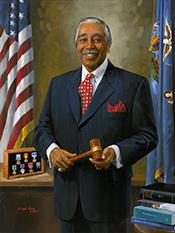 Rep. Charles B. Rangel (D-NY)