Craig Recreation Land Purchase Act
Legislative Activity
Stay on top of the latest movement without scrolling through every action
Placed on the Union Calendar, Calendar No. 388.
September 7, 2004
View full timeline
Introduced in House
October 30, 2003
Referred to the House Committee on Resources.
October 30, 2003
Sponsor introductory remarks on measure. (CR E2189-2190)
October 31, 2003
Referred to the Subcommittee on Forests and Forest Health.
November 3, 2003
Subcommittee Hearings Held.
June 17, 2004
Committee Consideration and Mark-up Session Held.
July 14, 2004
Ordered to be Reported (Amended) by Unanimous Consent.
July 14, 2004
Subcommittee on Forests and Forest Health Discharged.
July 14, 2004
Reported (Amended) by the Committee on Resources. H. Rept. 108-644.
September 7, 2004
Placed on the Union Calendar, Calendar No. 388.
September 7, 2004
Floor Debate
24 membersWhat members said about H.R. 3427 on the floor
 CHS
CHS TL
TL RP
RP SF
SF MES+19
Floor Debate
24 membersWhat members said about H.R. 3427 on the floor
Madam Chairman, first of all, I commend the gentleman from Illinois (Mr. Hyde) for crafting an outstanding piece of legislation. As we all know, he guided and shepherded through this body landmark…
Madam Chairman, first of all, I commend the gentleman from Illinois (Mr. Hyde) for crafting an outstanding piece of legislation. As we all know, he guided and shepherded through this body landmark legislation on AIDS which would not have been written into law without his effective leadership. I also thank the gentleman for including so many provisions which I proposed either as amendments or as base text.
In particular, including an amendment on refugees I offered along with the gentleman from California (Mr. Berman) that increases refugee protection monies by $310 million over 2 years, and my bill called the Belarus Democracy Act. This legislation which is embodied now into the text of the bill, would provide for effective help to civil society, human rights promotion, and democracy promotion in Belarus; the victims of torture which gets a modest but necessary increase in the U.N. Voluntary Fund for Victims of Torture; and there are many others.
This is a consensus bill in many ways, but there are some points of divergence. The gentleman from New York (Mr. Crowley) has put into the bill by a very narrow vote, an amendment that seriously and fundamentally weakens America's core anti-coercion law which says no funding goes to any organization that supports or participates in the management of a coercive population control program.
We in this Congress do not make the determination as to whether or not a group gets population control money. We set the standard. It is then left to the executive branch which relies on all relevant information to make a finding. Last year, Secretary Powell made that finding and said that the PRC has in place a regime of severe penalties on women who have unapproved births and that this regime plainly operates to coerce pregnant women to have abortions in order to avoid the harsh penalties.
``UNFPA's support of and involvement in China's population planning activities allows the Chinese government to implement more effectively its program of coercive abortion,'' Secretary Powell said.
I say to my colleagues, this debate is all about coercion. I would hope that my friends who support abortion would realize that coercion, whether it be forced sterilization or forced abortion, is an unconscionable act; and when it is done with impunity by the Chinese government with their partner, the U.N. Population Fund, we need to disassociate ourselves from that kind of activity. We need to stand with the oppressed, not with the oppressor, and the friends of the oppressor. We need to stand with the victims.
I urge my colleagues to support an amendment that I will be offering, cosponsored by the gentleman from Minnesota (Mr. Oberstar) and the gentleman from Illinois (Mr. Hyde), that would strike this language from the bill. I would hope that we would stand with the women of China who are being oppressed by their government and with their partners in these crimes against humanity, the U.N. Population Fund. I urge Members to vote for our amendment.
Madam Chairman, I am pleased that Title XV of the State Department authorization bill incorporates key provisions of the Belarus Democracy Act of 2003, which I sponsored earlier this year. The State Department's annual Country Reports on Human Rights Practices report on Belarus states that the Belarusian regime's ``human rights record remained very poor and worsened in several areas.'' Thanks to Alexander Lukashenka--aptly cited by The Washington Post as ``Europe's last dictator''--Belarus has the worst human rights record in Europe today. The Helskinki Commission, which I Chair, as well as the Organization for Security and Cooperation in Europe including its Parliamentary Assembly, the United Nations, the Council of Europe, the European Union and other international entities have all chronicled the appalling state of human rights and democracy in a country located in the heart of Europe. Belarus already borders NATO. In just a few years, Belarus will border the European Union.
The Lukashenka regime has blatantly and repeatedly violated basic freedoms of speech, expression, assembly, association and religion. The independent media, non-governmental organizations (NGOs) and democratic opposition have all faced harassment. Indeed, in the last few months, his war against civil society has intensified--resulting in the closure of non-governmental organizations, independent media outlets and Western-funded media support groups, such as Internews Network group, an international organization that helps develop independent media in countries in transition.
Just last week, the Lukashenka regime denied continuation of the accreditation of the International Research and Exchanges Board (IREX), an American organization that has implemented a variety of assistance programs in Belarus for years, including programs that helped the struggling independent media. Last week, they ordered the closure of the Minsk bureau of Russian NTV television. Just a few weeks ago, Lukashenka closed down the National Humanities Lyceum, a highly respected school promoting the study of the Belarusian language and culture. There are growing, legitimate fears that Lukashenka is aiming to remove Belarus from its vestiges of democracy dissent.
In October, Lukashenka signed into law the most restrictive religion law in Europe. Independent journalists have been sentenced to ``corrective labor'' for their writings. There are credible allegations of the Lukashenka regime's involvement in the disappearances of leading opposition figures and a journalist. Here in Washington and at various OSCE Parliamentary Assembly meetings, I've had occasion to meet with the wives of the disappeared, Victor Gonchar, Anatoly Krasovsky, Yuri Zakharenka, and Dmitry Zavadsky. These meetings have been heart- wrenching. The cases of their husbands--who disappeared in 1999 and 2000 and are presumed to have been murdered--are a stark illustration of the climate of fear that pervades in Belarus.
On the security front, reports of arms deals between the Belarusian regime and rogue states, including Iraq and North Korea, continue to circulate. Lukashenka and his regime were open in their support of Saddam Hussein.
One of the primary purposes of this initiative is to demonstrate U.S. support for those persevering to promote democracy and respect for human rights in Belarus despite the onerous pressures they face from the anti-democratic regime. Necessary assistance is authorized for democracy-building activities such as support for non-governmental organizations, independent media--including radio and television broadcasting to Belarus--and international exchanges.
The bill also encourages free and fair parliamentary elections, conducted in a manner consistent with international standards--in sharp contrast to the 2000 parliamentary and 2001 presidential elections in Belarus which flagrantly flaunted democratic standards. As a result of these elections, Belarus has the distinction of lacking legitimate presidential and parliamentary leadership, which contributes to that country's self-imposed isolation. Parliamentary elections are scheduled to be held in 2004, and we should encourage those who seek to create the laws and environment conducive to a free and fair election.
In addition, the Executive Branch is encouraged to impose sanctions against the
Lukashenka regime and deny high-ranking officials of the regime entry into the United States. U.S. Government financing would be prohibited, except for humanitarian goods and agricultural or medical products. The U.S. Executive Directors of the international financial institutions would be encouraged to vote against financial assistance to the Government of Belarus except for loans and assistance that serve humanitarian needs.
Madam Chairman, we are seeking to help put an end to the pattern of clear and uncorrected human rights violations by the Lukashenka regime and are hoping this will serve as a catalyst to facilitate Belarus' integration into democratic Europe. The Belarusian people deserve to live in a society where democratic principles and human rights are respected and the rule of law is preeminent. The Belarusian people--who have endured so much both under past and current dictatorships--deserve our support as they work to overcome the legacy of the past and develop a genuinely independent, democratic country.
In addition, Madam Chairman, in keeping with this authorization for the Department of State, I want to express my appreciation for the work of the Department in bringing needed attention to the concerns about ongoing anti-Semitism, an age-old plague that still haunts many countries in the OSCE, including our own. I have sought to identify effective responses to this troubling phenomenon, including the introduction of the resolution, H. Con. Res. 49 which passed last month.
Last month, I joined Mayor Rudy Giuliani and Congressman Hastings in Vienna for an OSCE conference specifically focused on anti-Semitism. Having the OSCE itself take up this important cause is significant. In fact, the idea was first raised in the May 2002 hearing of the Helsinki Commission and also suggested in the resolution condemning anti- Semitism I presented at the Berlin Parliamentary Assembly meeting last summer. I offered a similar resolution week before last at the Rotterdam OSCE PA meeting. Both resolutions passed the Assembly unanimously. While the OSCE Parliamentary Assembly has actively denounced anti-Semitic acts, I give great credit to the State Department for making the Vienna Conference a reality. Notably, one initiative emerging from the Vienna Conference was a pledge by our German friends to hold a follow-up meeting in Berlin next year to focus on anti-Semitism. I hope this meeting will rally the troops from Europe, the U.S., and Canada to say in one voice ``never again.''
Finally, Madam Chairman, I was pleased to learn of Senator Voinovich's amendment to the Senate's State Department reauthorization bill requiring the Annual Report on International Religious Freedom to include specific coverage of anti-Semitism. The amendment calls for the report to cover ``acts of anti-Semitic violence that occurred in that country'' and ``the response of the government of that country to such acts of violence.'' Importantly, the amendment would mandate the report to chronicle ``actions by the government of that country to enact and enforce laws relating to the protection of the right to religious freedom with respect to people of the Jewish faith.'' I think this is a worthwhile idea and hope it will be enacted into law.
Madam Chairman, I offer an amendment cosponsored by the gentleman from Minnesota (Mr. Oberstar) and the gentleman from Illinois (Mr. Hyde) to strike the Crowley language in the State Department bill under consideration.
Madam Chairman, I yield myself such time as I may consume.
Madam Chairman, just 10 months ago a sweeping, comprehensive reiteration of China's Draconian population control program went into effect in all of China. Sadly, the new law is as harsh, brutal, and violent as ever. Lest anyone be deceived that Beijing is somehow easing up on coercive population control, it is all there in the new law, the infamous one-child-per-couple policy, the crippling fines on those women who attempt to resist, and severe punishment to those women who have a child without explicit government permission.
Since 1979, the U.N. population fund has been the chief apologist for China's coercive one-child-per-couple policy. By its words and by its actions, the UNFPA has chosen to partner with those who oppress women. The UNFPA has funded, provided crucial technical support and, most importantly, provided cover for massive crimes of forced abortion and involuntary sterilization. Tens of millions of children have been slaughtered, their mothers robbed of their children by the state. The UNFPA has aggressively defended this barbaric policy that makes brothers and sisters illegal and makes women the pawns of population control cadres.
One terrifying consequence of China's policy is the disproportionate number of girl murders. According to the State Department's Country Reports on Human Rights Practices in China, currently there may be as many as 100 million more men than women, clearly a direct result of the one-child-per-couple policy.
Time and again, Madam Chairman, the officials at the UNFPA have defended the indefensible. The former executive director of the UNFPA, Nafis Sadik, said, ``China has every reason to feel proud of and pleased with its remarkable achievements made in its family planning policy. The country could offer its experience and social expertise to help other countries.'' God forbid. Let them export the one-child-per- couple policy which relies on coercion to achieve its ends? I hope not! On CBS ``Nightwatch,'' the executive director of the UNFPA said, ``The UNFPA firmly believes, as does the government of the People's Republic of China, that their program is a total voluntary program.'' Madam Chairman, that is unmitigated nonsense and that is a lie.
UNFPA Beijing representative Sven Burmester said and I quote, and please listen to this. This is the U.N.'s man in Beijing:
``China has had the most successful family planning policy in the history of mankind.'' That does not sound like a criticism of coercion or involuntary or forced abortion. That sounds like a partner defending a fellow partner gushing with praise. Of course it ``works,'' and of course the Chinese program is ``successful.'' Coercion works every day of the week.
Forced abortion, I would remind my colleagues, was construed to be a crime against humanity at the Nuremberg war crimes tribunal. It is no less of a crime today as it is practiced by China with its partners in that crime, the UNFPA.
Madam Chairman, having failed the important review required by the Kemp-Kasten anticoercion law, the gentleman from New York (Mr. Crowley) today is now attempting to gut, to weaken, to rig the 18-year-old Kemp- Kasten law by requiring that it only be operative if an organization ``knowingly and intentionally'' advances or expands coerced abortion or forced sterilization. If we adopt the Crowley language, enforcement of the current anticoercive law would be dead. Clearly, the whole idea behind this is that the money will flow to the UNFPA unfettered because with this standard, the weakened standard, there is little doubt that the money will flow.
U.S. investigators, if we adopted this language that is in the underlying bill, would now be required to investigate UNFPA personnel and ascertain their knowledge and their intent: What did they know and when did they know it? Given UNFPA's deplorable track record of denying that coercion even exists in China, it would be nearly impossible to prove intent. Even the hard-liners in China, in the government, deny coercion or any knowledge of coercion or intent to compel abortions.
I have made three human rights trips to China. I met with the head of China's population control program, Peng Peiyun. Madame Peng Peiyun told me over and over in that lengthy conversation that there was no coercion in China and then she backed that up by citing UNFPA's participation in the program and UNFPA's public statements where UNFPA leaders have defended and said there is no coercion in China. For the past 24 years, again despite overwhelming evidence to the contrary, UNFPA has declared China's program to be, quote, purely voluntary, free of coercion and a model to be emulated by other countries. Let us not forget that proving intent, this weakening standard offered by the gentleman from New York, is usually the stuff of criminal prosecutions, not grant-making.
I would point out to my colleagues, also, if we applied the misguided Crowley standard to any other human rights standard, human trafficking or religious persecution, we would seriously undercut, even destroy, our efforts to mitigate these abuses around the world.
Crowley sets a dangerous precedent in human rights law.
Let me just point out to my colleagues I am the prime sponsor of the Trafficking Victims Protection Act of 2000. Pursuant to that law, Secretary Powell recently placed 15 countries on what we call the tier 3 sanctions list. Those sanctions will soon be imposed. Nowhere in the statute do we require
the Secretary of State to divine the intent of the officials or whether or not they knowingly engaged in these human rights abuses. To give the oppressors that out, that escape clause, would be a gross betrayal of the victims.
In like manner, I respectfully submit we betray the victims of forced abortion and forced sterilization, millions of Chinese women, millions of Chinese children, when we give the oppressors or the friends of the oppressors this engraved invitation to continue denying and obfuscating the truth and, of course, enabling this kind of carnage to go on.
I ask Members to support the Smith-Oberstar-Hyde amendment.
Madam Chairman, I reserve the balance of my time.
Madam Chairman, I yield myself 40 seconds.
I just want to point out to my colleagues that the State Department and Secretary of State Colin Powell relied on many sources to make their determination, and Secretary Powell made this comment in his letter of finding: ``Regrettably, the PRC has in place a regime of severe penalties on women who have unapproved births. This regime plainly operates to coerce pregnant women to have abortions in order to avoid the penalties and therefore amounts to a program of coercive abortion.'' He pointed out ``UNFPA's support of, and involvement in, China's population planning activities allows the Chinese government to implement more effectively its program of coercive abortion.''
Every dollar, Madam Chairman, that does not go to the UNFPA the Secretary of State has said in writing he wants to reprogram to family planning and to maternal healthcare initiatives elsewhere around the world.
Madam Chairman, I reserve the balance of my time.
Madam Chairman, I yield 2 minutes to the distinguished gentleman from Pennsylvania (Mr. Pitts).
Madam Chairman, I yield myself 15 seconds to remind my colleagues that we provide almost half a billion dollars in family planning monies that go to Haiti, that go to Nicaragua, that go to El Salvador. We provide government-to-government and through nongovernmental organization support. And the money that does not go to the UNFPA will be reprogrammed dollar-for-dollar for these kinds of services.
Madam Chairman, I yield 2 minutes to the distinguished gentlewoman from Virginia (Mrs. Jo Ann Davis).
Madam Chairman, I yield 2 minutes to the distinguished gentleman from Missouri (Mr. Akin).
Madam Chairman, I yield 2 minutes to the gentleman from Indiana (Mr. Pence), my good friend and colleague.
(Mr. PENCE asked and was given permission to revise and extend his remarks.)
Madam Chairman, I yield 2 minutes to the gentleman from Iowa (Mr. King.)
Madam Chairman, I yield myself 30 seconds.
Madam Chairman, presumably the gentleman from California (Mr. Lantos), the gentleman from Pennsylvania (Mr. Greenwood) and virtually everybody in this Chamber opposes the tyrannical forced abortion policy of China, but not the UNFPA. Let me say that again, not the United Nations Population Fund.
Their representative has called this the most successful family planning policy in the history of mankind. They call it voluntary when it is not. They aid and abet this cruel policy in many, many tangible ways.
The State Department has it right. In the 32 counties as well as in the rest of China, when a woman gets pregnant and the baby is out of ``plan'', in other words, an illegal pregnancy--an illegal child--she faces Draconian fines of up to 6 years of salary. That is what compels the abortion. Desperate, with nowhere to turn, she aborts the child to avoid those fines. I urge support for Smith-Oberstar-Hyde amendment.
Mr. Chairman, we have one final speaker to close debate on my side.
Mr. Chairman, I yield our remaining time to the gentleman from Illinois (Mr. Hyde), the distinguished chairman of the Committee on International Relations, to close debate for our side.
Mr. Chairman. I yield myself such time as I may consume. I rise in strong support of H.R. 1950, the foreign relations authorization bill for fiscal years 2004 and 2005 as it was reported out of…
Mr. Chairman. I yield myself such time as I may consume.
I rise in strong support of H.R. 1950, the foreign relations authorization bill for fiscal years 2004 and 2005 as it was reported out of committee. Mr. Chairman, this is an excellent bill; and I am proud to have cosponsored it with my good friend, the gentleman from Illinois (Mr. Hyde), the chairman; and I want to pay public tribute to his extraordinary leadership of the Committee on International Relations.
Mr. Chairman, every single item that our committee deals with represents the daily menu of all our international and domestic media: Iraq, Afghanistan, Iran, the Middle East, Pakistan, Colombia, North Korea, China, Russia, Cuba, NATO, Europe, Africa. They are all part of this legislation, and our committee and its staff deserves commendation for being able to deal with these issues in a bipartisan fashion.
I am very pleased that our bill fully funds the administration's request for the State Department and contains many of the provisions that Secretary of State Colin Powell has requested to help him better manage the Department of State. I want to commend Secretary Powell for his effort to strengthen what has traditionally been one of our Nation's greatest resources, our diplomatic corps. I am pleased to say, Mr. Chairman, that under the authority provided in our bill, the Secretary's diplomatic readiness initiative will reach its final goal of putting 1,158 new professional American diplomats in place to serve our country across the globe.
I am also very pleased to be joining my good friend from Illinois in a continuing effort to make sure that we reduce as rapidly as possible the period of time in which our embassy employees are left in compounds and facilities that are vulnerable to terrorist attack. To support this, our bill provides over $1.3 billion over the next 2 years for security upgrades at our embassies in all parts of the world.
Our bill also contains a number of critical foreign policy initiatives that will give our State Department the tools it needs to promote and protect our national security interests in an increasingly complex world.
I am very pleased to have had the chance to work with the gentleman from California (Mr. Dreier), our distinguished Committee on Rules chairman, in crafting one such measure, the International Leadership Act of 2003, which has been folded into this bill. Mr. Chairman, the Leadership Act is designed to give our diplomats the tools they need to ensure that America once again punches at its weight class at the United Nations.
Our legislation achieves this by creating a Democracy Caucus to support the United States at the United Nations by directing our President to use his influence to reform U.N. rules, so that rogue regimes cannot gain leadership positions, and by providing new training to make our diplomats more effective in multilateral diplomacy. As my colleagues well know, Mr. Chairman, just a couple of years ago, the United States was removed from the U.N. Human Rights Commission, a body we founded; and Libya was put in charge of that commission, a theater of the absurd if we ever saw one.
I am pleased, Mr. Chairman, that with the leadership of the gentleman from Illinois (Mr. Hyde) and our colleague, the gentleman from New York (Mr. Ackerman), on a historic measure, we succeeded in making provisions for offering significant assistance to a new and democratic Palestinian state if performance benchmarks can be reached, including a total cessation of terrorism and the establishment of a transparent, democratic, and independent judiciary and Palestinian government responsive to its people.
An important provision to our bill was added by the gentleman from New York (Mr. Crowley). His provision reverses the administration's harmful
and highly political decision to withhold U.S. funding from the United Nations Population Fund. The administration's move came after its own hand-picked investigative team concluded that there was no evidence that the population fund would be involved in any way in coercive family planning in China. The gentleman from New York's (Mr. Crowley) measure will help the population fund to demonstrate that voluntary family planning is the only humane and effective way for China to control its population explosion.
I know, Mr. Chairman, that this provision will be debated later today, and I strongly urge all of my colleagues to support the committee position on this matter.
Another important initiative included in our bill is the International Free Media Act of 2003. It will help the State Department to encourage the development of sources of accurate, objective reporting in societies which are currently polluted by messages of propaganda and hate in state-controlled media, such as the media in Egypt. I am particularly pleased that this initiative includes a new $15 million fund to support independent and ethical journalism across the globe.
Our bill also contains the Missile Threat Reduction Act of 2003, which is designed to confront the alarming spread of offensive ballistic missiles for launching nuclear, chemical, and biological warheads. This measure commits the United States to seeking a new international mechanism to restrict the trade in missiles. It strengthens United States sanctions against those who trade in missiles, and it provides assistance to countries which agree to destroy their missile arsenals.
The bill also recognizes the United States' vital interests in promoting Afghanistan's transition from chaos, civil war, and disorder to an increasingly prosperous and democratic state. To prevent the spiral downward, the bill directs the President to ensure that there is adequate security along major transportation routes in Afghanistan and urges him to expand the international security assistance force.
I am also pleased, Mr. Chairman, that our bill authorizes all funds necessary to pay our assessed dues upon reentry to UNESCO, the United Nations Educational Scientific and Cultural Organization. Full funding is critical, Mr. Chairman, if we are to fulfill the President's commitment of last year to rejoin this most important international organization. When UNESCO was founded at the end of the Second World War, its motto was, ``Since war begins in the minds of men, it is in the minds of men that the defenses of peace must first be constructed.'' Never was this statement more appropriate and timely than it is now; and our rejoining UNESCO will demonstrate that, far from being unilateral, we want to accept our full responsibility as a cooperative member of the international community.
I am disappointed, Mr. Chairman, that the rule for our bill has struck out the amendment sponsored by my friend from New Jersey (Mr. Menendez) which addresses global climate change, a very real and immediate threat to our national security, an issue that has been neglected far too long.
Finally, Mr. Chairman, I would like to note that later today we will be debating an amendment to be offered by the gentleman from Illinois (Mr. Hyde) and me authorizing the President's Millennium Challenge Assistance Initiative and the proposal to dramatically expand our Peace Corps. This amendment will dramatically improve the ability of the United States to help the least fortunate on this planet and to promote a world where hope thrives and the despair that leads to support for international terrorism vanishes.
I want to thank the chairman of our committee, my good friend, the gentleman from Illinois (Mr. Hyde), for working with me and all of the other members of our committee in crafting an excellent bill. Virtually every element of this bill has the support of both Republicans and Democrats, and this is in large part due to the statesmanlike leadership of the gentleman from Illinois. I want to commend our distinguished chairman and thank him for the open, collegial, and witty manner in which he has brought this bill through the committee and he will bring it through this House.
Mr. Chairman, we are considering this legislation at a pivotal moment in global history. We are engaged in intense diplomacy on every continent, with opportunities to solve long-festering disputes and crises in Levant, in Iraq, in the Eastern Mediterranean, in Liberia and the Democratic Republic of Congo, in Afghanistan, in Colombia, and in scores of other places.
It is in the midst of this critical conflict against the forces of terror and Islamic fanaticism that our bill will make a major contribution to building a safe, secure and more democratic world. I believe that enactment of our legislation will leave a lasting legacy towards solving all of these disputes and crises, and I urge all of my colleagues to support it.
Mr. Chairman, I reserve the balance of my time.
Mr. Chairman, I am delighted to yield 3 minutes to the gentleman from New Jersey (Mr. Menendez), my good friend, the distinguished ranking Democratic member of the Subcommittee on the Western Hemisphere.
(Mr. MENENDEZ asked and was given permission to revise and extend his remarks.)
Mr. Chairman, I yield 2 minutes to the gentleman from American Samoa (Mr. FALEOMAVAEGA), and I ask unanimous consent that during the period of time I am making a presentation at the Committee on Resources, the gentleman from American Samoa (Mr. Faleomavaega) may control the time on this side and yield it to others.
Madam Chairman, I thank the gentleman for yielding me this time.
I rise in strong opposition to the amendment. I am second to no one in this body in my criticism of China's horrendous human rights record, including its population control policies. But the U.N. funds program in China is specifically designed to demonstrate the effectiveness of voluntary family planning programs free of coercion and free of quotas. In fact, for over three decades the U.N. fund has helped couples in scores of countries around the globe, avoiding unwanted pregnancies through voluntary family planning programs that fully respect individual rights.
Today, 99 percent of U.N. funds, and let me repeat, 99 percent of the funds are spent outside of China. But this amendment ignores 99 percent of the programs and cuts off our contribution solely over China. If this amendment should pass, more unwanted children will come into the world, and more unnecessary abortions will occur.
I strongly urge my colleagues to oppose the amendment.
Mr. Chairman, yes, I do.
Mr. Chairman, I yield myself such time as I may consume.
First, I want to commend my good friend and colleague, the gentleman from Illinois (Chairman Hyde), for the power and integrity of his convictions. The Millennium Challenge Account would not have been possible without his leadership and commitment to a bipartisan approach to international poverty reduction.
The Millennium Challenge Account, as conceived by the President and crafted by the Committee on International Relations, marks the beginning of a revolution in U.S. international development assistance by recognizing the importance of democratic rule, good governance, and human rights. In achieving sustainable levels of economic growth and social development, the MCA creates the political and economic linkages critical to reducing poverty and to achieving progress.
At the same time, the MCA removes the Cold War-era strategic calculus from the development assistance equation. Each potential recipient of our assistance is to be judged on its own merits, based on their commitment to progress and our commitment to the political, economic, social, and humanitarian value of development assistance.
Finally, the MCA implicitly endorses a critical aspect of our approach to combatting international terrorism. Although the administration has not focused on this point, modern terrorism of the kind that struck our Nation on September 11 is fueled in part by the desperation and hopelessness that pervades much of the developing world. The MCA provides new hope, and as such, represents a powerful antidote to terrorism and other forms of violent conflict that have stalled the developing world.
Mr. Chairman, when the Committee on International Relations held its first meeting on the MCA, I expressed a range of concerns about various aspects of the administration's initial proposal. I am pleased to say that the legislation included in this amendment has addressed satisfactorily each of my earlier concerns, and the Hyde-Lantos amendment before us has my very strong support.
The administration's initial proposal relegated USAID, the most capable agency within our government in administering international assistance, to a bit part in managing this massive account. Our bipartisan amendment restores USAID to its rightful role by providing its administrator with a seat and a vote on the Millennium Challenge Corporation's board of directors. Together with the interagency coordination that our amendment requires, this improvement promises to strengthen the MCA considerably.
Our bipartisan amendment also addresses my earlier concerns about the rigid application of strict eligibility criteria by mandating congressional and societal consultations on the finalization of criteria. By providing for an annual reevaluation process and by authorizing limited assistance to those countries on the cusp of eligibility, our legislation safeguards against the inherently arbitrary nature of mechanically selecting qualified states.
Mr. Chairman, the Hyde-Lantos MCA amendment will not single handedly eradicate poverty, nor will it place the United States in the same company as Denmark, Norway, and the Netherlands, the global leaders in this field, in terms of per capita levels of development assistance; but our legislation will renew our commitment to poor, but striving, countries in our common fight against hunger and despair.
Speaking as someone who as a youth experienced both tremendous deprivation and the bounty of American generosity, I can testify to the profound influence that U.S. assistance can have on shaping the perceptions of foreign nations of our great country.
Mr. Chairman, allow me to conclude by addressing the reauthorization of the Peace Corps, which is also included in this amendment. It is fitting that we consider the Millennium Challenge Account and the Peace Corps jointly because both are critical to enhancing U.S. international development assistance.
Since President Kennedy first deployed the Peace Corps in 1961, the program's 168,000 volunteers, men and women, young and old, have made an immeasurable contribution to reducing poverty and promoting American values literally all over the globe. Reauthorizing this inspirational initiative is clearly in our national interests and in the interests of reducing poverty and restoring hope across the globe.
Two of our colleagues deserve special recognition for bringing the Peace Corps reauthorization before us. The gentlewoman from Minnesota (Ms. McCollum), a new, but invaluable, member of our committee, and the gentleman from California (Mr. Farr), a former Peace Corps volunteer himself, were instrumental in crafting this amendment; and I am deeply indebted to both of them.
Mr. Chairman, today this Chamber has the opportunity to reauthorize the Peace Corps and to establish the Millennium Challenge Account. Both initiatives offer the best hope to defeat international poverty and international terrorism, and I strongly urge all of my colleagues to support the Hyde-Lantos amendment.
Mr. Chairman, I am very pleased to yield 2 minutes to the gentleman from California (Mr. Farr), my good friend and colleague and a former Peace Corps volunteer.
Mr. Chairman, will the gentleman yield?
Mr. Chairman, I am fully aware of the gentleman's excellent amendment, and I support his efforts in enhancing our capability to provide post-conflict reconstruction assistance.
The legislation of the gentleman addresses the importance of providing a coherent strategy in the provision of assistance to postconflict reconstruction in countries and regions. In today's world, we are continually faced with humanitarian disasters, wars and other crises, and enhancing our capability in providing reconstruction assistance in times of such crises is a vital and necessary goal that we must achieve.
I want to commend my friend for proposing this very useful approach.
Mr. Chairman, I am delighted to yield 1 minute to the gentleman from New Jersey (Mr. Payne), the distinguished ranking member of our Subcommittee on Africa.
(Mr. PAYNE asked and was given permission to revise and extend his remarks.)
Mr. Chairman, I offer an amendment. The Chairman. The Clerk will designate the amendment. Mr. Chairman, I yield myself such time as I may consume. Mr. Chairman, this is an amendment that denies all…
Mr. Chairman, I offer an amendment.
The Chairman. The Clerk will designate the amendment.
Mr. Chairman, I yield myself such time as I may consume.
Mr. Chairman, this is an amendment that denies all funding for the American Community Survey. And if anyone has been listening to the debate early on, the Census has come up numerous times already, and much of what I have to propose here has in many ways has been debated. But I do want to bring it up one more time dealing specifically with the American Community Survey.
One of the reasons why it came to my attention is just recently I received this survey in the mail here in my temporary residence in Virginia. It is rather intimidating and it is rather threatening when you receive this in the mail. And I have the envelope here and right up on the front they have warned me. They said ``The American Community Survey form enclosed. Your response is required by law.''
This was the second time. Evidently, I missed it the first time, so the second time around I have been threatened by the census police that I better jolly well fill it out or the police will be knocking on the door. And that does happen because I have known other individuals who have not filled out the long form, and they come to the door, the police are there deciding they want this information.
It was stated earlier in the discussion about the census that this was certainly the law of the land. The law of the land is very clear that the Congress gave the authority; the Census Bureau certainly does not do this on its own. We, the Congress, gave it the authority to do this. But it just happens to be an authority that we had no right to give. We have no right to give this authority to meddle into the privacy of American citizens.
Article 1, section 2 of the U.S. Constitution mandates a national census every 10 years. I am in support of that, and I vote for funding for a national census every 10 years for the sole purpose of congressional redistricting. But, boy, this is out of hand now. We are talking about hundreds of millions of dollars and it is perpetual. The argument earlier was, we have to have to survey continuously because we save money by spending more money. Ask people a lot of questions, personal questions about bathrooms and incomes and who knows what.
This survey I have got here, here is a copy of it. It is called the American Community Survey. And it says the Census Bureau survey collects information about education, employment, income, housing for the purposes of community uses so that they can do community economic planning.
How did we ever get involved in all of this? It is almost sacred now that we fund these programs and they are going to be perpetual, perpetual meddling in the personal lives of all American citizens, 24 pages here.
I got to wondering, I did not fill it out the first one. I got the second one, and they are threatening me. I know I
did not vote for it, but you who did means, you are ready to send the census police out to get me.
I am getting worried about this. I mean, what is the penalty? So I looked it up, and it is not insignificant. Do you know what my colleagues have done and threatened me with? A $1,000 penalty for every question I do not answer. Wow, that is scary stuff. I had a friend that he did not answer the long form, after a couple of requests, the census police came and knocked on his door and said you better, you better answer all these questions or you are going to be penalized.
So that is the kind of thing that we do and everybody talks about all these wonderful advantages, but it is stuff we do not need. I mean, if we want this information, if people need this information in the communities, they ought to get it themselves. This whole idea that we have to collect all this information for the benefit of our communities to do all this economic planning, I mean, it is just so much more than we need, and we are not talking about 10 or $15 million. We are talking about hundreds of millions of dollars, and it is not just every 10 years.
It is continuous with this perpetual threat, you tell us what we want to know and we are going to put it into the record, and if not, for every question you do not answer, we can fine you $1,000 if you do not tell us your age and where you work and how far you have to go to work and how long it takes you to go to work.
I mean, this is way too much of Big Brother. Let me tell my colleagues, I think the American people cannot be very happy with all this meddling.
So my proposal is let us at least get rid of the American Community Survey, which is the ongoing nuisance that we put up with, and limit what we do here to what the Constitution has told us we can do and what we should do, and that is, count the people every 10 years for the purpose of redistricting. But big deal, who cares. For all we do around here, how often do we really pay attention to the details of the Constitution?
So I ask my colleagues to support this amendment and cut this funding.
Mr. Chairman, I yield myself such time as I may consume.
(Mr. PAUL asked and was given permission to revise and extend his remarks.)
Mr. Chairman, what this amendment does is it denies funding to the Department of Justice to prosecute doctors for prescribing legal drugs.
The reason I bring this up is to call attention to the Members of a growing and difficult problem developing in this country, and that is, that more and more doctors now are being prosecuted by the Justice Department under the laws that were designated for going after drug kingpins, for illegal drug dealers; but they are using the same laws to go after doctors.
It is not one or two or three or four. There are approximately 400 doctors who have been prosecuted, and I know some of them, and I know they are good physicians; and we are creating a monster of a problem. It does not mean that I believe that none of these doctors have a problem. As a physician, I know what they are up against and what they face, and that is, that we have now created a system where a Federal bureaucrat makes the medical decision about whether or not a doctor has prescribed too many pain pills. I mean, that is how bureaucratic we have become even in medicine; but under these same laws that should be used going after kingpins, they are now being used to go after the doctors.
As I say, some of them may well be involved in something illegal and unethical; and because I still want to stop this, this does not mean I endorse it, because all the problems that do exist with some doctors can be taken care of in many different ways. Doctors are regulated by their reputation, by medical boards, State and local laws, as well as malpractice suits. So this is not to give license and say the doctors can do anything they want and cause abuse because there are ways of monitoring physicians; but what has happened is we have, as a Congress, developed a great atmosphere of fear among the doctors.
The American Association of Physicians and Surgeons, a large group of physicians in this country, has now advised their members not to use any opiates for pain, not to give adequate pain pills because the danger of facing prosecution is so great. So the very people in the medical profession who face the toughest cases, those individuals with cancer who do not need a couple of Tylenol, they might need literally dozens, if not hundreds, of tablets to control their pain, these doctors are being prosecuted.
Now, that is a travesty in itself; but the real travesty is what it does to the other physicians, and what it is doing is making everybody fearful. The other doctors are frightened. Nurses are too frightened to give adequate pain medications even in the hospitals because of this atmosphere.
My suggestion here is to deny the funding to the Justice Department to prosecute these modest numbers, 3 or 400 doctors, leave that monitoring to the States where it should be in the first place, and let us get rid of this
idea that some bureaucrat in Washington can determine how many pain pills I, as a physician, can give a patient that may be suffering from cancer.
I mean, this is something anyone who has any compassion, any concern, any humanitarian instincts would say we have gone astray; we have done too much harm; we have to do something to allow doctors to practice medicine. It was never intended that the Federal Government, let alone bureaucrats, interfere in the practice of medicine.
So my suggestion is let us take it away, take away the funding of the Justice Department to prosecute these cases, and I think it would go a long way to improving the care of medicine. At the same time, it would be a much fairer approach to the physicians that are now being prosecuted unfairly.
And let me tell you, there are plenty, because all they have to do is to be reported that they prescribed an unusual number of tablets for a certain patient, and before you know it, they are intimidated, their license is threatened, their lives are ruined, they spend millions of dollars in defense of their case, and they cannot ever recover. And it is all because we here in the Congress write these regulations, all with good intentions that we are going to make sure there is no abuse.
Well, there is always going to be some abuse. But I tell you there is a lot better way to find abusive doctors from issuing pain medication than up here destroying the practice of medicine and making sure thousands of patients suffering from the pain of cancer do not get adequate pain medication.
Mr. Chairman, I offer amendment No. 9.
Mr. Chairman, I yield myself such time as I may consume.
This amendment denies funds to UNESCO, and it is an amendment that is identical to what I brought up last year and got a recorded vote on and had a debate on last year.
Last year, I brought it up because we were just getting back into UNESCO. President Ronald Reagan, in 1984, had the wisdom of getting us out of UNESCO because of its corrupt nature, not only because it had a weird, false ideology, contrary to what most Americans believed, but it was also corrupt. He had the wisdom to get us out of it, yet last year we were put back in UNESCO, and I was hoping that we would not fund it.
Last year, the Congress approved $60 million for this purpose, which was 25 percent of UNESCO's budget. Does that mean we have 25 percent of the vote in UNESCO? Do the American people get represented by 25 percent? How much do we get out of it? What is the American taxpayer going to get? The American taxpayer gets a bill, that is all. They do not get any benefits from it.
And there is one part of UNESCO that is particularly irritating to me, and it is called the Cultural Diversity Convention. This is an organization that actually is very destructive and will play havoc with our educational system. It also attempts to control our education through the International Baccalaureate Program, and that, too, introduces programs and offers them to our schools. It is not forced, but there are already quite a few schools that have accepted these programs.
Now, let me just give my colleagues an idea of the type of philosophy they are promoting, but what we as the Congress promote with what the American taxpayers are paying for. Here it is:
``The international education offers people a state of mind, international mindedness. We are living on a planet that is becoming exhausted. And now listen to this, this is what the U.N. UNESCO people are saying about education in the various countries, including ours. Most national educational systems at the moment encourage students to seek the truth, memorize it and reproduce it accurately.'' Now, one would think that is not too bad of an idea. ``The real world is not this simple,'' so says UNESCO. ``International education has to reconcile this diversity with the unity of the human condition.''
I mean, if those are not threatening terms about what they want to do, and yet here we are funding this program and the American taxpayers are forced to pay for it. Now, there are a few of us left in the Congress, I see a couple on the floor tonight, that might even object to the Federal Government telling our States what to do with education, and of course there is no constitutional authority for that. We have the Leave No Child Behind, but it looks like everyone is going to be left behind before we know it.
But here it is not the Federal Government taking over our Federal education system; this is the UNESCO, United Nations, taking over our educational system. It does have an influence. Sure, it is minimal now, but it will grow if we allow this to continue.
So I ask my colleagues to please vote for my amendment, and I sure hope they allow a vote on this amendment. It was permitted last year, so it surely would be permitted this year.
Mr. Chairman, I reserve the balance of my time.
Mr. Chairman, how much time do I have?
Mr. Chairman, I yield myself the balance of my time and conclude with another statement from a director of UNESCO, who further explains exactly what they are up to. He said in June that ``the program remains committed to changing children's values so they think globally rather than in parochial national terms from their own country's viewpoint''. So if we talk about an attack on national sovereignty starting at the lowest level through an educational system, it is right here.
The chairman, obviously, is not very enthusiastic about this. But my job as a representative is not to follow what other people tell me. My job is to read these bills and to know what they say
and to represent my district. Because somebody asks us to finance this and our instincts tell us there is something very sinister about this, I would say that that is not a very strong reason to oppose this amendment.
Mr. Chairman, I thank the gentleman for yielding me time.
Mr. Chairman, I, too, am a physician from Texas, but I have a little different opinion about Marinol. No doctor that I know of ever prescribes Marinol.
I think marijuana is a helpful medical treatment for the people who have intractable nausea. I would like to point out this is not something strange that we are suggesting here. For the first 163 years of our history in this country, the Federal Government had total hands off, they never interfered with what the States were doing. They interfered only after 1938 through tax law. So this is something new.
The States' rights issue is almost a dead issue in the Congress, but we ought to continue to talk about it, and I am delighted somebody has brought this up.
But if you do have compassion and care for patients, they ought to have a freedom of choice. I think that is what this is all about, freedom of choice.
I would like to point out one statistic. One year prior to 9/11 there were 750,000 arrests of people who used marijuana; there was one arrest for a suspect that was committing terrorism.
Now, that, to me, is a misdirected law enforcement program that we could help address here by at least allowing the States to follow the laws that they already have on the books.
Mr. Chairman, I offer an amendment. Mr. Chairman, I yield myself such time as I may consume. (Mr. FARR asked and was given permission to revise and extend his remarks.) Mr. Chairman, the purpose of…
Mr. Chairman, I offer an amendment.
Mr. Chairman, I yield myself such time as I may consume.
(Mr. FARR asked and was given permission to revise and extend his remarks.)
Mr. Chairman, the purpose of this amendment is very straightforward. In simple terms, the Farr-Rohrabacher-Hinchey-Paul amendment prohibits the use of funds in the bill from preventing States that have medical marijuana laws from implementing them.
As a result, the States have medical marijuana laws on the books they can implement, regulate and enforce them, just like now. States that do not have medical marijuana laws on the books remain subject to the overarching Federal law.
This amendment does not stop law enforcement officials from prosecuting illegal use of marijuana. This amendment does not encourage the use of marijuana. This amendment does not encourage the use of drugs in children. This amendment does not legalize any drugs. This amendment does not change the classification of marijuana. This amendment is recognized as States' rights to oversee the medical scope of practice of doctors in their States, to prescribe drugs as doctors see as necessary for medical conditions.
Today's Los Angeles Times points out that the Justice Department's medical marijuana war seems increasingly out of step with the whole country. Last fall, the Supreme Court upheld a lower court ruling barring Federal officials from prosecuting doctors for their recommendations.
Just 2 weeks ago, the United Methodist Church, the Presbyterian Church, the Evangelical Lutheran Church in America and other mainstream religious groups supported doctors' rights to prescribe pot as a when- all-else-fails treatment for the seriously ill. The best way to thwart casual use of this drug is to let doctors prescribe it in closely circumscribed and regulated ways such as the States do.
Now, there are nine States that have passed these laws. The voters are speaking, and they are doing it more in every State. Just recently Vermont. Alaska, California, Colorado, Hawaii, Maine, Nevada, Oregon, Vermont, and Washington have enacted State medical marijuana laws. Because of these State laws, thousands of patients are able to alleviate their pain and suffering without fear of arrest by State or local authorities.
The threat of arrest by Federal agents, however, still exists. In the past, the Federal Government has impeded research on medical use of marijuana, even though thousands of patients have testified, explained, and acknowledged that it helps relieve some of the debilitating symptoms, such as nausea, pain, loss of appetite associated with serious illness.
Despite Federal admonitions against marijuana, the American people support medical marijuana and pretty overwhelmingly. Most national polls show the support around 70 percent.
This amendment is not necessarily about the actual medical purpose of marijuana, though I know scores of doctors have attested to marijuana's medical benefits. In States where medical marijuana is legal, thousands of licensed physicians have recommended marijuana to their patients. This amendment is not about legalizing drugs, though some will argue that it should be.
No. What this amendment is about is States rights. In so many areas we trust States rights. And I think of us here in the United States Congress. We allowed States to draw our district boundary lines.
We allow States to set the fee we have to pay to run for office. We allow the States to create the primary procedures for getting elected to Congress. We allow the States to fashion Medicaid packages. We allow States to license doctors to practice. We trust the States to do what is best for their residents of that State. When it comes to health care policy or palliative care, the care of alleviating pain, nine States of the United States have determined that it is appropriate public policy to allow the use of marijuana as a prescribed treatment.
If Congress respects States rights in so many other areas, why does it not respect it with regard to medical marijuana?
Mr. Chairman, this amendment would prevent the Federal Government from interfering with state medical marijuana laws. It would end the DEA raids on medical marijuana patients and caregivers who are acting in accordance with state law. It would not--let me repeat--it would not prevent the DEA from arresting individuals who are involved in marijuana-related activities unconnected to medical use.
Here is the simple question posed by this amendment: Should the Federal Government arrest individuals who are trying to alleviate their own suffering or the suffering of others in compliance with state law?
I am only too familiar with the tension between DEA law enforcement and state and locally-sanctioned marijuana cooperatives in California. On September 5, 2002 in Santa Cruz, California--my district--dozens of heavily armed DEA agents stormed into the home of Valerie and Mike Corral where the cooperative garden of the Wo/Men's Alliance for Medical Marijuana (WAMM), a medical marijuana hospice, is tended by collective members. They destroyed 167 plants, which would have been distributed--free of charge--to more than 200 seriously and terminally ill WAMM members. Although the Corrals did not resist, the agents pointed loaded rifles to their heads, forced them to the ground, and handcuffed their hands behind their backs. The DEA agents kept them handcuffed in their home for 4 hours before taking them 30 miles to the Federal courthouse in San Jose where they were eventually released without being charged. Meanwhile, Federal agents handcuffed the Corral's over-night guest, Suzanne Pfeil, a WAMM member who was disabled by polio, and detained two other members, one with AIDS and a caregiver. Pfeil happened to be sleeping when the raid occurred. Despite the fact that her leg braces and crutches were in plain sight, the agents demanded she stand, which she was unable to do with her hands cuffed. Pfeil's blood pressure shot up and she experienced chest pains. Agents then refused to call an ambulance. All this pain, confusion and fear--yet WAMM was operating with the full knowledge and consent of state and local authorities.
Many people who oppose medical marijuana say that there is only anecdotal evidence of its effectiveness. But these anecdotes cannot be simply dismissed; they are the stories of real people who are suffering. Just this morning in Roll Call, there was a powerful example of this. Talk show host Montel Williams discussed his struggle to live with excruciating pain caused by multiple sclerosis. Montel Williams, a former Marine and decorated naval officer, who made anti-drug PSA's for the White House drug czar's office, explained in this article that marijuana is the ``only'' drug that allows him to function on a day-to- day basis. Now if he is using marijuana with his doctor's advice and is following state law, why on earth should we waste Federal resources trying to prevent him from alleviating his own pain? And taking it a step further, if someone else is growing that marijuana for him and is following state law why should we take that medicine away from him by interfering with the grower?
The answer most opponents of this amendment will give is that marijuana simply is not a medicine. But this had become an absurd claim. First of all, both the Netherlands and Canada have enacted medical marijuana laws, with marijuana available at pharmacies in the Netherlands. In the United States, nine states have medical marijuana laws that allow doctors to recommend marijuana to their patients. And in those states, hundreds of doctors have recommended marijuana to thousands of patients.
Even our Federal Government has acknowledged the therapeutic benefits of marijuana. In 1999, the National Academy of Sciences' Institute of Medicine conducted a study funded by the White House Office of National Drug Policy. The principle investigator from the study said upon its completion, ``We concluded that there are some limited circumstances in which we recommend smoking marijuana for medical use.'' An even stronger endorsement came from the DEA in 1988. Then, Administrative Law Judge Francis Young, after an exhaustive, 2-year study of marijuana, called for its rescheduling on the grounds that ``marijuana, in its natural form, is one of the safest therapeutically active substances known to man.'' He concluded, even 60 years ago, that marijuana offered a ``currently accepted medical use in treatment.''
Over the past year, medical marijuana has gained even wider acceptance. It has been endorsed by the American Nurses Association, whose 2.6 million members care for the Nation's most seriously ill patients; by the United Methodist Church, the Nation's third largest religious denomination; by the New York and Rhode Island Medical Societies; and by many other health care organizations. Other longtime supporters of medical marijuana include the New England Journal of Medicine, the American Bar Association, and the American Public Health Association.
Do opponents of this amendment honestly believe the American Nurses Association, the New York State Medical Society, United Methodist Church, the Episcopal Church, and others are supporting this issue because they hope to legalize marijuana for all purposes? Of course that isn't the reason. These organizations support legal access to marijuana for medical purposes because they know one simple fact: it helps sick people.
Other opponents of this amendment say that they will not support medical marijuana until more research is complete. The problem is that the Federal Government has effectively blocked research. To cite just one example, in July 2001, the University of Massachusetts applied to the DEA for a license to manufacture marijuana for medical research. This is the same kind of license a company called GW Pharmaceuticals applied for in England a few years ago. While GW Pharmaceuticals has now concluded Phase III trials and is nearing market approval for its marijuana spray, the DEA--3 years later--has not even bothered to deny the University of Massachusetts' license. Of course, they have not granted it, either. They have just let the application sit in limbo.
Antoher application to the Federal Government, requesting permission to import just 10 grams of marijuana for research has languished for 10 months. Does our government think 10 grams of marijuana is going to increase the drug problem in this Nation? Of course not. The Federal goal seems to be to purposely to block research that would prove--or disprove, once and for all--that marijuana has therapeutic benefits.
But let's assume for a minute that all of the obstacles to research were suddenly removed. That does not get us past the immediate question: Should the Federal Government, over the course of the next year, while research is proceeding, arrest patients and caregivers who are complying with state law in order to alleviate their own suffering or the suffering of others?
Another objection raised by opponents of this amendment is that passing it would send the wrong message to children. It would make children think that marijuana is not dangerous. Let me tell you something. Children know how dangerous marijuana is already. Allowing seriously ill patients to use it will not change that. And associating the use of marijuana with AIDS and chemotherapy is not likely to increase its appeal. On the other hand, if you deny cancer, AIDS, and MS patients the opportunity to use this drug to alleviate their pain-- while permitting the medical use of powerful addictive drugs like vicodin and oxycontin--the only message you are sending to children is that you are intellectually dishonest and completely lacking in compassion.
The truth is, where medical marijuana is legal, there has been no increase in marijuana
use among teens. In fact, in my home state of California, teen use of marijuana has dropped 34 percent among 7th graders, 44 percent among 9th graders, and 21 percent among 11th graders since the California medical marijuana initiative passed in 1996. The same Institute of Medicine study described earlier noted, ``there is no evidence that the medical marijuana debate has altered adolescents' perceptions of the risks associated with marijuana use.'' Listen closely today to hear whether opponents of this amendment back their warning about sending the wrong message to children with any evidence demonstrating that medical use has caused a change in attitude about recreational use; I doubt there will be any with any scientific weight.
Mr. Chairman, this amendment is reasonably drafted and built on scientific evidence, judicial review, and medical studies. It reflects the grass roots demand and legislative will of nine of our United States. It is time for Congress to recognize the powerful dynamics of this issue and adopt my amendment.
Mr. Chairman, I reserve the balance of my time.
Mr. Chairman I yield 3 minutes and 15 seconds to the gentleman from California (Mr. Rohrabacher).
Mr. Chairman, I yield 1 minute to the gentleman from Texas (Mr. Paul).
Mr. Chairman, I have a parliamentary inquiry.
Mr. Chairman, I thought the author of the amendment has the right to close.
Mr. Chairman, I yield 1 minute to the gentlewoman from California (Ms. Woolsey).
Mr. Chairman, I yield myself the balance of my time.
Mr. Chairman, I would like to respond to the comment of the gentleman from Virginia (Mr. Wolf). I am going to read here that in the State of California, teen use of marijuana has dropped 34 percent among seventh graders, 44 percent among ninth graders and 21 percent among eleventh graders since the California medical marijuana initiative passed in 1996.
Also, I would like to point out that this is not such a radical amendment. It only affects the States that have State laws, that have the enforcement. We have not heard from law enforcement opposing this. We have heard from the American Nursing Association, the United Methodist Church, the New York Medical Society, the Rhode Island Medical Society, the New England Journal of Medicine, the American Bar Association, the American Public Health Association and the Episcopal Church. They all support this amendment.
Mr. Chairman, I demand a recorded vote
Mr. Chairman, I rise in opposition to the amendment offered by the gentleman from Texas, Mr. Paul. This amendment would have the practical effect of putting doctors above the law. It would prevent…
Mr. Chairman, I rise in opposition to the amendment offered by the gentleman from Texas, Mr. Paul. This amendment would have the practical effect of putting doctors above the law. It would prevent the federal government from taking action against a doctor who abused his privilege of issuing prescriptions for controlled substances, including addictive and dangerous drugs like Oxycontin. While I have great respect for doctors, and I know that the vast majority of them are honest, law-abiding and motivated solely by their concern for their patients, we can't exempt them from our drug laws.
First, there is no evidence that the federal government is ``persecuting'' doctors for prescribing pain killers. Last year, in fiscal 2003, only 50 doctors nationwide were arrested for illegal prescriptions. That is only five one-thousandths of one percent (.005%) of all the doctors who have DEA licenses to write prescriptions. No one can seriously argue that the DEA is engaging in some kind of campaign to stop doctors from writing prescriptions for pain killers.
Second, the tiny number of physicians who were arrested were not arrested just because they prescribed pain medication. They were arrested because they abused the public trust and the clear standards of the profession set by their peers. These were essentially drug dealers hiding behind a white coat. They used their professional status to obtain sexual favors, drugs, and money.
Last year, six doctors were arrested for trading drug prescriptions for sex. Twenty-three doctors were arrested for writing prescriptions in exchange for money, four doctors were arrested for issuing prescriptions in exchange for other illegal drugs, and seventeen were arrested for writing prescriptions to obtain drugs to feed their own drug habits. (I am attaching a listing of those arrests, provided by the DEA, to my statement for the Record.)
Let's take a look at some examples. Dr. Bernard Rottschaefer was convicted last March for writing 153 illegal prescriptions for painkillers; five women testified that he demanded sex in exchange for those prescriptions, usually for Oxycontin. Another doctor wrote them in the dressing room of an adult nightclub, and another issued prescriptions for sex, firearms, lawn and farm equipment, and labor on his personal property. I don't think anyone in this House would want to give people like that a blanket immunity from the law.
Now, it may be argued that the amendment would only prohibit enforcement when drugs are prescribed ``for the purpose of relieving or managing pain''. But this distinction is meaningless--because anyone who uses a narcotic can argue that it is to relieve pain. When dealing with problems like drug trafficking and abuse, we can't just rely on the word of drug dealers and addicts. Instead, current law already recognizes a reasonable judge of the conduct of doctors--the professional standards set by their peers. I would like to note that the American Medical Association, the largest professional organization in the country representing doctors, has itself refused to support this amendment--precisely because it would immunize the few bad apples who abuse their professional trust.
In closing, I'd like to point out that this amendment would seriously undermine our goal of reducing Oxycontin and other prescription drug abuse. As President Bush stated in the National Drug Control Strategy for 2004, the problem of prescription drug abuse is a growing threat that needs to be addressed. The misuse of prescription drugs was the second leading category of illicit drug use after marijuana, with an estimated 6.2 million Americans having used prescription drugs for nonmedical, illegal purposes. Oxycontin was abused in 2002 at a rate ten times higher than in 1999. Abuse by high school seniors of Vicodin is more than double their use of cocaine, ecstasy or methamphetamine. Meanwhile, Internet pharmacies (which frequently rely on illegal prescriptions), ``doctor shopping'' and other illegal drug diversion tactics are presenting new challenges to law enforcement and the community. Those few doctors who contribute to this problem must be held accountable for their actions. I urge my colleagues to oppose this amendment.
DEA Arrests of Physicians--Fiscal Year 2003
summary
Prescriptions in exchange for sexual favors--6;
prescriptions in exchange for drugs--4; prescriptions for
money--23; obtaining drugs by fraud/personal abuse--17. Note:
50 arrests reported for Fiscal Year 2003 which includes 2
separate arrests of the same physician.
physicians of note
Two physicians, Dr. H and Dr. S, maintained medical
practices specializing in the treatment of chronic pain.
While both physicians treated some legitimate pain patients,
they both also practiced outside the scope of legitimate
medical practice by prescribing OxyContin for other than
legitimate medical reasons. These illegal activities led to
their investigation and subsequent arrests. Two individuals
died from overdoses of the OxyContin prescribed by one of the
physicians. One physician has been convicted of conspiracy to
distribute controlled substances. The other physician is
awaiting trial.
prescriptions in exchange for sexual favors
Dr. R--Pittsburgh--provided prescriptions for controlled
substances in exchange for sex. Date opened: 4/16/01; date of
arrest: 6/3/03; conviction date: pending; charges: unlawful
distribution of Oxycodone, Fentanyl, & Xanax.
Dr. W--Washington--wrote prescriptions to female members of
motorcycle gangs in exchange for sex. Date opened: 6/10/03;
date of arrest: 6/10/03; conviction date: 1/14/04; charges:
unlawful distribution of Percocet.
Dr. D--St. Louis--wrote prescriptions in exchange for sex,
firearms, lawn and farm equipment and labor on his personal
property. Date opened: 4/12/00; date of arrest: 11/25/00;
conviction date: pending; charges: unlawful distribution of
Mr. Chairman, first, do not let any Member kid themselves; if you cannot enforce a Federal law, you do not have a Federal law. This would eliminate our ability to enforce marijuana laws in States that have passed this.
My friend from California alluded to a very sad case in the State of California. When we as Members use phrases like ``medical marijuana'' and responsible officials imply that drugs like marijuana are medical, tragedies like this happen.
Irma Perez, age 14, the late Irma Perez, was overdosing on Ecstasy. Her friends had heard that marijuana was medical, and instead of getting her to a doctor, where they said she would have been saved, they gave her marijuana on top of her Ecstasy and she died.
When we have silly debates like this, quite frankly, we bear responsibility. Yesterday, in Ohio, six people died, including a family of four, two adults and two children, when a young person on marijuana and alcohol collided into a truck that hit two other vehicles and killed six people.
If you have medical marijuana laws, like has happened in a court case in the State of Oregon, drug testing laws for truck drivers have been thrown out. It is now being appealed higher, but it is not even clear that you can be assured that our congressional drug testing law for truck drivers will stand up, given the way the courts are interpreting this.
In California, we have a doctor that has given 348 patients under this medical marijuana, including for anxiety and restless leg syndrome. In Oregon, we have a doctor who gave it to 4,000 people over the last few years. We have another doctor in California who uses it, we actually had this person at our hearing, for ADD and hyperactivity, even though she admitted she has no evidence that it worked for those things, but she felt it would make them feel better.
You either believe you have an FDA or you do not have an FDA. We hear about all kinds of other things that FDA cracks down on. Either you have a national FDA or you do not have an FDA.
Furthermore, just last week in Oakland, California, they pulled over a group of guys with about 66 pounds of marijuana. They said it was for medicinal purposes. They found where it was coming from, and they found a warehouse. In this warehouse, they found millions of dollars of marijuana where the people started fleeing, and then these advocates of medical marijuana in California said, Oh, it was so medical.
The person who owned the building had already been busted for transporting illegal drugs. He had lost his license as a pawnbroker. But, no, this was medical marijuana. Some estimate that up to 90 percent of the cases, this is the pro-medical marijuana cases, of marijuana use in California, would be classified as medical.
That is why we have letters, and I will include these in the records, from the Community Antidrug Coalition, and Dr. Dean, who coordinates these efforts, says he opposes it; the Fraternal Order of Police; the Partnership for a Drug-Free America, who plead on behalf of the drug treatment and prevention groups in America to oppose this; the Drug- Free America Foundation; and the U.S. Department of Justice, which is concerned that they will not be able to enforce any drug laws if we do not allow the Federal Government to enforce.
We need to defeat this amendment because it is the wrong message to our youth, it is the wrong message to our law enforcement, it is the wrong message to our drug treatment people, it is the wrong message to the people in the streets of their neighborhoods trying to reclaim their often crime-ridden neighborhoods from drug dealers and addicts in their areas, and it is, quite frankly, unconstitutional.
We fought a Civil War over nullification. States do not have the right. If we can have States nullify an existing Federal law, then on what grounds can this not happen under the same precedent, a lack of enforcement on environmental laws, of civil rights laws, of the Americans with Disabilities Act, of any law? Because once a State can nullify a Federal law by saying, We cannot enforce it, you do not have a Federal system.
This is an amendment fraught with difficulties and should be overwhelmingly defeated by both sides for a multitude of reasons.
Mr. Chairman, I include for the Record the letters referred to earlier in my statement.
Community Anti-Drug
Coalitions of America,
Alexandria, VA, July 1, 2004.
Hon. Mark Souder,
House of Representatives, Subcommittee on Criminal Justice,
Drug Policy and Human Resources, Rayburn House Building,
Washington, DC.
Dear Mr. Chairman: On behalf of the 5,000 coalition members
that Community Anti-Drug Coalitions of America (CADCA)
represents, I am writing to strongly urge you to oppose an
amendment to be offered by Representative Maurice D. Hinchey
(D-NY) to the Commerce, Justice, State, Judiciary and Related
Agencies FY 2005 Appropriations bill which would effectively
prohibit enforcement of Federal law with respect to use of
``medical'' marijuana. I strongly urge you to oppose this
amendment not only because marijuana is an illegal, addictive
Schedule I drug, with no medicinal value, but also because
this sends the entirely wrong message to the youth of
America.
Marijuana is not a harmless drug: it is the most widely
abused illicit drug in the nation. According to the Substance
Abuse and Mental Health Services Administration's Treatment
Episode Data Set, approximately 60% of adolescent treatment
cases in 2001 were for marijuana abuse. Research shows that
the decline in the use of any illegal drug is directly
related to its perception of harm or risk by the user.
Advertising smoked marijuana as medicine sends the wrong
message to America's youth--that marijuana is not dangerous.
Congressman Hinchey's amendment goes even further by removing
the ability of law enforcement officials to enforce Federal
law. The efforts of the drug legalization movement, to
promote the myth of ``medical'' marijuana and to stifle the
efforts of law enforcement agencies to enforce Federal law
severely dilutes the prevention efforts that community anti-
drug coalitions across America are undertaking to communicate
marijuana is dangerous, it has serious consequences, and is
illegal.
Congressman Hinchey's amendment is offered under the guise
of compassion towards seriously ill patients, when in reality
it is a ``Trojan horse'' to legalize marijuana. To date, the
FDA has not approved nor has it found any medicinal value in
smoked marijuana, which is why it remains a Schedule I
controlled substance. Furthermore, in the States that have
legalized marijuana for so-called ``medicinal'' purposes,
seriously ill, elderly patients are not the only patients
receiving marijuana--children are also. At a hearing before
your Subcommittee on Criminal Justice, Drug Policy and Human
Resources, Dr. Claudia Jensen, of Ventura, California,
testified that she prescribes marijuana as medicine for
adolescents under her care who have been diagnosed with
Attention Deficit Disorder (ADD). In a policy statement from
the American Academy of Pediatrics stating their opposition
to the legalization of marijuana, they state that ``Any
change in the legal status of marijuana, even if limited to
adults, could effect the prevalence of use among
adolescents.'' What kind of a message are the youth of
America receiving when doctors willingly give children
marijuana--it tells children that marijuana is not a
dangerous drug.
Mr. Chairman, I strongly urge you to help us protect our
nation's youth and oppose any and all amendments limiting the
enforcement of the Federal law pertaining to marijuana use.
Thank you for considering my views.
Sincerely,
Arthur T. Dean,
Major General, U.S. Army, Retired,
Chairman and CEO.
Show 8 more
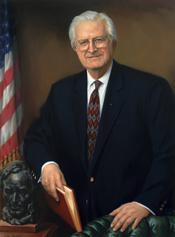
Mr. Chairman, I yield myself such time as I may consume. Mr. Chairman, I rise in support of H.R. 1950, the Foreign Relations and Security Assistance Bill. Mr. Chairman, this bipartisan bill, which is…
Mr. Chairman, I yield myself such time as I may consume.
Mr. Chairman, I rise in support of H.R. 1950, the Foreign Relations and Security Assistance Bill. Mr. Chairman, this bipartisan bill, which is co-sponsored by my good friend, the gentleman from California (Mr. Lantos), authorizes the funding and activities of the Department of State for 2 fiscal years, 2004 and 2005. This bill is focused on authorities necessary to operate the State Department and its overseas facilities. In addition, it includes a modernization of the defense trade and security assistance authorities and missile proliferation policy and laws.
The accounts covered in this bill are funded at or above the President's fiscal year 2004 budget request. The President's request for these accounts is approximately $14.3 billion. The total authorization for this bill, including the State Department operation accounts and the security assistance provisions for fiscal 2004, is $15.2 billion. The increases will fund additional refugee assistance, international broadcasting and a more robust public diplomacy program.
The proposed amount for fiscal 2005 is approximately the same as that of fiscal 2004 with some modest percentage increases for typical cost- of-living adjustments. A significant portion of these increases reflect the need to improve the effectiveness of our public diplomacy programs and our international broadcasting as well as to strengthen our democracy-building programs overseas.
H.R. 1950 also incorporates the Public Diplomacy Bill, H.R. 3969, the Freedom Promotion Act of 2002, that was approved by the House during the last
Congress. The provisions in this act are focused on enhancing the role of public diplomacy in our foreign policy and specifically place the responsibility for the formulation and execution of these programs on the Secretary of State. These provisions also authorize funding for student and other exchanges, as well as for a number of other public diplomacy programs, with a focus on countries with predominantly Muslim populations.
H.R. 1950 includes a much-needed reorganization of the decision- making process of our international broadcasting efforts. It would authorize $657 million for fiscal year 2004 and $651 million for fiscal 2005 for the Broadcasting Board of Governors, which is responsible for the Voice of America, Radio Free Europe, Radio Liberty, Radio Free Asia, and Radio/TV Marti.
It also includes the request from the Broadcasting Board of Governors regarding the establishment of a separate grantee to run the New Middle East Television and Radio Network. This new network will add 24 hours a day TV and radio broadcasts to the Middle East and thereby greatly contribute to an enhancement of our efforts to combat the misinformation and propaganda that contribute to the rising anti- American sentiment in the region.
Construction, maintenance, and security for our 260 embassies, consulates and various other posts around the world continue to be a top priority. To that end, we have fully funded the State request in that area while also encouraging the establishment of a cost-share program. This cost-sharing program is designed to collect funds from each agency that has staff stationed at a U.S. embassy or consulate.
These funds will be used to supplement the construction costs of new facilities.
At the appropriate time, I intend to offer an amendment that will add H.R. 2441, the Millennium Challenge Account Authorization and Peace Corps Expansion Act of 2003, to this bill. Recently reported by the Committee on International Relations, this bill advances the President's foreign assistance initiative and enjoys bipartisan support. In March of last year, President Bush proposed the further expansion of United States foreign assistance through the establishment of the Millennium Challenge Account, now known as MCA. He did so in a revolutionary manner, by proposing a new and additional assistance program only for those countries that meet certain standards of respecting human rights, investing in the future of their people and promoting economic opportunity and freedom.
With this proposal, the President has issued a challenge to help those less fortunate, the poorest of the poor, to promote universal human rights and values around the world, and be part of the spread of democracy and freedom worldwide.
This legislation also includes a provision I authored more than a decade ago known as the Foreign Aid Effectiveness Act. This provision requires the President to describe the actual results of U.S. foreign assistance relative to the goals and to identify the most and the least successful foreign assistance programs.
The Millennium Challenge Account Act authorizes 3 years of funding, $1.3 billion in fiscal 2004, $3 billion in fiscal 2005, and $5 billion in fiscal 2006.
The President, in his State of the Union address January 2002, announced his goal of doubling the size of the Peace Corps by 2007. As the U.S. fights global terrorism, extremism and forces which are inimical to our way of life, we can and must fight on many fronts to protect our interests, promote our values and provide hope to captive, destitute and vulnerable people across the globe.
This legislation makes amendments to the Peace Corps Act in support of the goal announced by the President of doubling the number of Peace Corps volunteers to 14,000 by the year 2007. It authorizes a gradual expansion of the budget of the Peace Corps from $366.8 million in fiscal 2004 to $499.4 million in fiscal 2007.
Since its establishment in 1961, more than 168,000 volunteers have served in 136 different countries throughout the globe. Currently, there are approximately 7,000 volunteers in 70 different countries.
I very much appreciate the bipartisan cooperation and leadership that we have received from the gentleman from California (Mr. Lantos), the ranking Democrat on this committee, in developing this legislation; and I hope we can continue this bipartisan approach on the floor today.
Mr. Chairman, I reserve the balance of my time.
Mr. Chairman, I am pleased to yield 3 minutes to the distinguished gentleman from California (Mr. Cox).
Mr. Chairman, I yield 4 minutes to the gentleman from Indiana (Mr. Burton).
Madam Chairman, I yield 3 minutes to the gentleman from New Jersey (Mr. Smith).
Madam Chairman, I yield 3 minutes to the gentleman from Nebraska (Mr. Bereuter).
(Mr. BEREUTER asked and was given permission to revise and extend his remarks.)
Madam Chairman, I have no further requests for time, and I yield back the balance of my time.
Mr. Chairman, I thank the gentleman from New Jersey (Mr. Smith) very much for yielding me time.
I really do not know where to begin. We have all agreed that the Chinese population control program is coercive and, therefore, violative of human rights. We ought to stay a thousand miles away from anything that facilitates that. And yet this money that we give to the population control fund facilitates the Chinese program.
Now, what no one has mentioned today is the law in China. The population and family planning law which was adopted a couple of years ago has
some chilling phrases in it. Citizens who give birth to a child in violation of Article 18 of this law may be ordered to pay a premium to a fund. Yes, they are ordered to pay a premium triple the yearly income which forces an abortion, coerces an abortion. And guess who enforces the Chinese population law? The People's Liberation Army, the Chinese People's Liberation Army enforces their population law.
Now, I listened very carefully to criticisms that the countries are going to be denied family planning. We are the largest spender on the globe, in the galaxy for family planning, and nobody will be denied anything. It just does not go through the U.N. You know the U.N. That is the organization that supplanted us on the Commission for Human Rights with Libya.
Now, if you think it is important for us to worry about the population of Mexico, as one of the late speakers did, I can understand a Mexican listening to that and saying, who are they to worry about our population?
I am out of time. I just want to say I am just getting wound up, but that is the way it goes. I hope you support the Smith amendment.
Mr. Chairman, I offer an amendment.
Mr. Chairman, I yield myself such time as I may consume.
I rise today to offer amendment No. 2, which includes the text of H.R. 2441, the Millennium Challenge Account Authorization and Peace Corps Expansion Act of 2003.
The Millennium Challenge Account is based on the revolutionary idea that countries must be accountable for their actions, be responsible for developing and advancing their own plans of progress, and must show results in order to receive economic assistance from the American taxpayer. The Peace Corps Expansion Act supports the President's vision that he described in this Chamber during his 2002 State of the Union address to double the number by the year 2007 of Peace Corps volunteers serving their Nation overseas.
Many U.S. assistance programs have not achieved results over the years. Some assistance has allowed corrupt leaders to amass personal fortunes and remain in power beyond the will of the citizenry. Other aid has allowed leaders and governments to abdicate responsibility for effective governance and pursue detrimental, self-destructive, or personally self-enriching policies. Other assistance has gone to consultants or middlemen with little results to show in the end.
These failures of the past should not lead us to turn our backs on the developing world. Just the opposite. Now is the time for American leadership and for America to recognize through its aid those countries that respect the rights of citizens, promote democracy, and encourage economic freedom and prosperity. However, we need to demonstrate what works and what does not, and we need to hold accountable those governments and leaders who do not choose the right path of reform.
The President's proposal is the first serious attempt to address the fact that existing U.S. development assistance programs have consistently failed to meet their stated goals. Despite decades of economic aid, many Nations are poorer now than they were before first receiving development assistance. The President's proposal is enthusiastically supported by the relief and development nongovernmental community, as well as by the Heritage Foundation, the Wall Street Journal, and other organizations that have previously assailed foreign assistance as wasteful, inefficient, and ineffective.
The U.S. must be more selective in aid distribution if the assistance is to be effective and a positive contributor to development. As proposed by the President and included in the legislation before us today, MCA assistance will reward only those recipients who
willingly adopt good policies and institutions. Of the 70-or-so countries currently eligible for development assistance, it is possible that only 10 countries will meet the strict criteria stipulated by the President and endorsed in this bill.
At the funding levels proposed, this may mean a very high level of assistance for MCA-eligible countries. The administration believes this will create a competition among cusp countries which may accelerate reforms and the adoption of good policies. This amendment endorses this approach.
The President's proposal for a Millennium Challenge Account deserves our support. We should embrace the idea of increasing U.S. economic assistance but only to those countries that demonstrate a commitment to human rights, democratic ideals and practices, and investment in people.
H.R. 2441, reported favorably by the Committee on International Relations, is truly a bipartisan bill that supports two of the President's key foreign policy initiatives and has more than 70 cosponsors. The work of the gentleman from California (Mr. Lantos), the ranking member on this committee, has been indispensable; and I congratulate and thank him, and I urge my colleagues to support the Hyde-Lantos amendment, which incorporates the text from H.R. 2441.
Mr. Chairman, I reserve the balance of my time.
I yield 3 minutes to the gentleman from Wisconsin (Mr. Green).
Mr. Chairman, I am pleased to yield 2\1/2\ minutes to the distinguished gentlewoman from Florida (Ms. Harris).
(Ms. HARRIS asked and was given permission to revise and extend her remarks.)
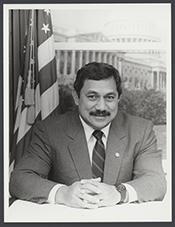
Mr. Chairman, I rise today in strong support of H.R. 1950, the Foreign Relations Authorization Act for fiscal years 2004 and 2005. At this time, I want to commend both our chairman, the gentleman…
Mr. Chairman, I rise today in strong support of H.R. 1950, the Foreign Relations Authorization Act for fiscal years 2004 and 2005. At this time, I want to commend both our chairman, the gentleman from Illinois (Mr. Hyde), and our senior ranking member, the gentleman from
California (Mr. Lantos), of the House Committee on International Relations for their outstanding leadership in bringing to the floor the State Department reauthorization bill which has strong bipartisan support.
This bill includes an historic measure offering recognition to a Palestinian state if performance benchmarks can be reached; increases U.S. capacity at the United Nations, where rogue regimes are increasingly trying to hijack the agenda; initiates a new effort to promote free media abroad; and provides the State Department with tools to confront the alarming spread of ballistic missiles.
Mr. Chairman, this bill also includes three amendments which I offered during full committee markup on May 7, 2003, three of which were accepted by unanimous consent and have now been included in the full text of H.R. 1950.
One amendment expresses a sense of Congress relating to the Soviet nuclear tests in Kazakhstan and calls for the Secretary of State to establish a joint working group with the government of Kazakhstan to assist in assessing the environmental damage and health effects caused by Soviet nuclear tests Semipalatinsk.
The other amendment requires the State Department to prepare and transmit to Congress a report that contains a description of the extent to which the government of Pakistan has closed all known terrorist training camps operating in Pakistan and Pakistani-held Kashmir, has established serious and identifiable measures to prohibit the infiltration of Islamic extremists across the line of control into India, and has ceased the transfer of weapons of mass destruction, including any associated technologies, to any third country or terrorist organization.
The third amendment authorizes certain sums to allow qualified indigenous inhabitants of Latin America to pursue post-secondary and graduate studies in our Nation's colleges and universities. I feel very strongly that education is the key to the salvation of the indigenous inhabitants of the Western Hemisphere.
At the appropriate time, it is my intention to give strong support to an amendment offered by the gentlewoman from Guam (Ms. Bordallo) which authorizes the transfer of allowances to residents of the insular areas who are members of the U.S. Foreign Service, just as it is done in the case of the residents of several States.
Madam Chairman, I rise today in strong support of H.R. 1950, the Foreign Relations Authorization Act for Fiscal years 2004 and 2005. At this time, I want to commend both our Chairman Mr. Hyde and the Ranking Member Mr. Lantos of the House Committee on International Relations for their outstanding leadership in bringing to the floor a State Department Reauthorization bill which has strong bipartisan support.
This bill includes an historic measure offering recognition to a Palestinian state if performance benchmarks can be reached, increases U.S. capacity at the United Nations where rogue regimes are increasingly trying to hijack the agenda, initiates a new effort to promote free media abroad and provides the State Department with tools to confront the alarming spread of ballistic missiles.
This bill also includes three amendments which I offered during full committee markup on May 7, 2003, both of which were accepted by unanimous consent and have now been included in the full text of H.R. 1950. One amendment expresses a sense of Congress relating to Soviet nuclear tests in Kazakhstan and calls for the U.S. Secretary of State to establish a joint working group with the Government of Kazakhstan to assist in assessing the environmental damage and health effects cause by Soviet nuclear testing in Semipalatinsk, Kazakhstan.
The other amendment requires the State Department to prepare and transmit to Congress a report that contains a description of the extent to which the Government of Pakistan has closed all known terrorist training camps operating in Pakistan and Pakistani-held Kashmir, has established serious and identifiable measures to prohibit the infiltration of Islamic extremists across the Line of Control (LoC) into India, and has ceased the transfer of weapons of mass destruction, including any associated technologies, to any third country or terrorist organization.
The third amendment authorizes a certain sum of funds to allow qualified indigenous inhabitants of Latin America to pursue postsecondary and graduate studies in our nation's colleges and universities. Over the years, Mr. Chairman I feel very strongly that education is the key to the salvation of the indigenous inhabitants of the Western Hemisphere.
At the appropriate time, Mr. Chairman, it is also my intention to give strong support to an amendment that will be offered by my colleague from the territory of Guam, Ms. Bordallo, which authorizes the transfer of allowances to residents of the insular areas who are members of the U.S. Foreign Service--just as it is the case with residents of the several states.
At this time, I want to thank Chairman Hyde and Ranking Member Lantos for supporting this amendment during full committee markup and including it in H.R. 1950. Simply put, their support was critical to passage of this amendment and I want to thank the gentleman from Illinois and the gentleman from California for taking a stand on this important issue at a time when few were willing to do so.
What many do not know is that this amendment came before the House Committee on International Relations on the very day that Deputy Secretary Richard Armitage arrived in Pakistan to begin high-level diplomatic discussions and I commend Chairman Hyde and Ranking Member Lantos for doing the right thing despite the political pressure they received to set this amendment aside. I also thank the 49 members of the International Relations Committee, both Republican and Democrat, who passed this amendment by voice vote without any objection.
I also want to commend President Bush for his leadership on this issue. Now that President Bush has made this issue popular with his recent announcement that he would also like to place conditions on Pakistan's funding, I am hopeful that the Senate will also support our efforts to make Pakistan live up to its promises.
Congressman Pallone also deserves special recognition for the work he is doing to make Pakistan accountable. I thank the gentleman from New Jersey for his relentless commitment to monitor the steps Pakistan is taking to bring about democracy and for fully supporting the measures of this bipartisan amendment which has already been included in the text of H.R. 1950.
Like my colleagues, I am appreciative of Pakistan's post-September 11 assistance in the war against terrorism. Nevertheless, tensions in the region are rising and I know I am not alone when I say I have deep reservations about U.S. policy in South Asia. Once again, I want to reiterate that I believe Pakistan should be commended for assisting the U.S. in its efforts to hunt down Al Qaeda and Taliban fugitives and for allowing the U.S. military to use bases within its country.
But I cannot turn a blind eye to the fact that Pakistan has not closed all known terrorist training camps operating in Pakistan. I cannot turn a blind eye to the fact that Pakistan has not prohibited the infiltration of Islamic extremists across the Line of Control into Indian Kashmir. I cannot turn a blind eye to the fact that General Musharraf promised Deputy Secretary Armitage that infiltration would cease and it has not.
Since 1989, more than 50,000 men, women and children have died in the Kashmir dispute and since September 11 Islamic militants from Pakistan have crossed the Line of Control and claimed the lives of innocent men, women and children--not once, not twice, but three times, committing egregious acts of cross-border terrorism on each and every occasion.
On the other hand, India has not crossed the Line of Control since 1972. In fact, India has exercised incredible restraint in not waging full-scale war to defend itself against these terrorist acts. Although I believe we are fortunate that neither country has yet resorted to the use of nuclear weapons, we also should be very concerned that both Pakistan and India test fired short-range ballistic missiles on March 26 of this year which incidentally (or not) was the same day that Prime Minister Jamali said that Pakistan and China will enhance their defense ties.
On May 15, 2003, 8 days after the International Relations Committee unanimously voted in favor of my amendment, Pakistan's third highest ranking government official, Foreign Minister Khurshid Kasuri, requested an appointment to meet with me. We had a meaningful dialogue and he gave me his personal assurances that Pakistan is interested in creating a roadmap for peace to resolve the Kashmir dispute.
I believe Kashmir is one of the most important issues that must be resolved in order to establish peace in the Asia Pacific region. India and Pakistan have fought two wars over Kashmir in the past 50 years and came very close to the brink of nuclear war less than 2 years ago. In December of 2001, both countries amassed nearly one million soldiers along their common border and had the U.S. not intervened it was feared that India and Pakistan's dispute over Kashmir could have led to the first use of nuclear weapons sine World War II.
As the Ranking Member of the Subcommittee on Asia and the Pacific and as the
only Asia Pacific American serving on both the Subcommittee and the full Committee on International Relations, I am deeply concerned about cross-border terrorism and the threat of nuclear proliferation in the Asia Pacific region. Any threat to regional stability puts our soldiers at risk and some have argued that this situation may become as dangerous as the Israeli-Palestinian conflict.
This is why I am pleased that H.R. 1950 includes a provision which requires the State Department to report to Congress about the progress that is being made to resolve the India-Pakistan dispute. I believe this legislation is necessary and given the seriousness of this situation, I urge my colleagues to support H.R. 1950.
Madam Chairman, I reserve the balance of my time.
Madam Chairman, I yield 2\1/2\ minutes to the gentlewoman from California (Ms. Lee).
Madam Chairman, I yield 1\1/2\ minutes to the gentleman from New York (Mr. Israel).
Madam Chairman, I yield 1\1/2\ minutes to the gentleman from New York (Mr. Crowley).
Madam Chairman, I yield 1\1/2\ minutes to the distinguished gentleman from Oregon (Mr. Blumenauer), a member of the Committee on International Relations.
Madam Chairman, I yield 1 minute to the gentleman from New Jersey (Mr. Pallone).
Madam Chairman, I yield 1 minute to the gentlewoman from Texas (Ms. Jackson-Lee).
(Ms. JACKSON-LEE of Texas asked and was given permission to revise and extend her remarks.)
Madam Chairman, I yield myself such time as I may consume. I would like to again express our deepest appreciation to the distinguished chairman of the Committee on International Relations and also the senior ranking member not only for the outstanding job that they have done in bringing this legislation to the floor but in the spirit of bipartisanship that we are able to bring to this general debate for consideration of the Members of this body and, more importantly, the fact that we have allowed the general Members of this body the opportunity to offer amendments. This is the spirit of bipartisanship and the way democracy should operate. Again, I thank the good chairman of our committee.
Madam Chairman, I yield back the balance of my time.
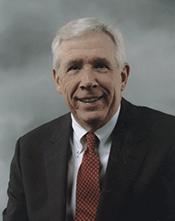
Mr. Chairman, I ask unanimous consent that the remainder of the bill through page 108, line 22, be considered as read and printed in the Record and open to amendment at any point. Mr. Chairman, I…
Mr. Chairman, I ask unanimous consent that the remainder of the bill through page 108, line 22, be considered as read and printed in the Record and open to amendment at any point.
Mr. Chairman, I move to strike the last word.
Mr. Chairman, I would urge any Members, following up what the gentleman from Wisconsin (Mr. Obey) said, any Members that have amendments, we have been here since noon and we are waiting on them, so I would urge them, if they are listening, to come to the floor and offer the amendments so we can move the process along. So if Members can hear and are available, we would encourage them to come so amendments could be offered.
Amendment Offered by Mr. Pitts
Mr. Chairman, I rise in support of the amendment. I want to thank the gentleman for offering it.
This really follows the principle that was used during the Carter administration and during the Reagan administration by keeping lists. Therefore, if you happen to be going to a country, when you go to China you are able to check to see that X and Y have been tortured, so when you meet with government officials, you can raise those cases. This is the way it was done in the Carter administration and in the Reagan administration.
This is a very good amendment, and I thank the gentleman for offering it, and I rise in strong support of it. I urge that we accept it.
Mr. Chairman, I rise in opposition to the amendment.
Mr. Chairman, I yield myself such time as I may consume.
I rise in opposition. The census is one of the oldest civic functions of our Nation. Article I of the U.S. Constitution requires enumeration of the population every 10 years. The census is the largest peacetime mobilization of our government personnel.
The American Community Survey is designed to replace the long-form portion for future decennial censuses, therefore leaving only the short-form portion.
Many Americans found that filling out the long-form survey to be burdensome, and many said this contributed to the declining response rate of the long form, therefore costing the American taxpayer more money to have census takers returning to the nonresponding households.
The Committee on Government Reform and the Committee on Appropriations have worked to ensure that the Census Bureau has the necessary funding to carry out its mission and to ensure that for 2010 there will only be a short form census.
The question of constitutionality of the American Community Survey is not new. On April 4, 2002, the General Accounting Office responded to the vice-chairman of the Committee on Government Reform's request for an opinion. The GAO stated, ``Census clearly has authority to conduct the ACS.'' There is sufficient legal authority.
If we do not fund the ACS, we will ensure we have a two-form census in 2010, which will cost an additional $4 million for the taxpayer.
Mr. Chairman, I yield back the balance of my time.
Mr. Chairman, I offer an amendment.
Mr. Chairman, I yield myself such time as I may consume.
I rise in support of the amendment. We worked with the gentleman from New York (Mr. Serrano), the ranking member, on this amendment. It restores the microloan program. We are in agreement, and I ask that the amendment be approved.
Mr. Chairman, I yield back the balance of my time.
Mr. Chairman, would it be possible to reclaim my time?
Mr. Chairman, how much time is remaining?
Mr. Chairman, I yield 3 minutes to the gentleman from New York (Mr. Serrano).
Mr. Chairman, I yield 2 minutes to the gentleman from Massachusetts (Mr. Olver).
(Mr. OLVER asked and was given permission to revise and extend his remarks.)
Mr. Chairman, I claim the time in opposition, and I yield myself such time as I may consume. At this point I just want to say that my mom died of cancer, my father died of cancer, and I would have done anything to help them, and OxyContin can make a big difference. But there has been a lot of abuse. There have been a lot of doctors that have been doctor factories that are just prescribing this.
There were some in my area, and I have seen families that have been devastated in southwest Virginia. I understand what the gentleman from Texas (Mr. Paul) is saying, but in southwest Virginia, in the rural areas down in Lee County, there is probably not a family that has not been impacted by the abuse of prescriptions. So it is a balance.
I understand the gentleman, being a doctor, how he feels, but there are cases where there is tremendous abuse. That is why I think we have to keep monitoring this.
Mr. Chairman, I make a point of order against the amendment because it proposes to change existing law and constitutes legislation in an appropriation bill and therefore violates clause 2 of Rule XXI.
The rule states in pertinent part: ``An amendment to a general appropriation bill shall not be in order if changing existing law. The amendment imposes additional duties.''
So I ask for a ruling of the Chair.
Mr. Chairman, I claim the time in opposition to the amendment, and I yield myself such time as I may consume.
Mr. Chairman, when we had a vote on the floor, the gentleman from Illinois (Mr. Hyde) offered the amendment to not join UNESCO. I supported the amendment. I did not believe that we should have joined UNESCO. The decision was made by the Bush administration. Also, on that vote, if my memory serves me, I was on the losing side. I think it may have been Lantos v. Hyde. I voted with the gentleman from Illinois (Mr. Hyde), and we were on the losing side. History will have to check the exact timing of that vote.
The bill includes $71.9 million for the U.S. share of funding for membership in UNESCO, and I have had serious questions about UNESCO. UNESCO was rife with corruption and problems. The Bush administration, who wanted to join, has a very good and a very tough ambassador, a kind of a no-nonsense person. I have met her and think highly of her. The President announced 2 years ago at the United Nations, and I remember seeing the speech, that the U.S. would rejoin UNESCO. The First Lady, Mrs. Bush, addressed the UNESCO plenary session in Paris, France, last year.
The U.S. withdrew from UNESCO in 1984 when the organization was rife with corruption and anti-Western bias, and I think the current ambassador, I have spoken to her, is going to make sure they do not go back to the corruption and anti-Western bias. It was mismanaged, and she has pledged that she would stay after that.
Since that time, they have undergone reforms and the current leadership is committed. They say it stands for fundamental human rights and democratic principles; and participation in the UNESCO, many say, will allow us to be engaged as international partners in a number of issues. This year, the U.S. was elected to the UNESCO legal committee, the intergovernmental biotechnics committee, and other committees.
I think now, although I do tend to agree with the gentleman, I think it is a fact and I think he raises some very, very valid points, but to strike funding for UNESCO just after the Bush administration has joined, just after President Bush's wife, Mrs. Bush, has spoken at a plenary session, I think would send a wrong message. So I reluctantly rise in opposition to the amendment out of respect to the Bush administration, having been on the losing side.
But we are going to watch this. We are going to watch and see what UNESCO does, and I am glad this issue was raised by the gentleman from Texas (Mr. Paul). But in light of the vote on the floor and in light of the Bush administration request and the President's speech, and in light of the First Lady attending and addressing the plenary session, I would ask defeat of the amendment.
Mr. Chairman, I yield back the balance of my time.
Mr. Chairman, I demand a recorded vote.
Mr. Chairman, I claim the time in opposition to the amendment.
Mr. Chairman, I yield myself such time as I may consume.
A similar amendment was offered on DHS, and it failed by a vote of 148 to 259, so we are back to exactly the same thing. SCAAP funds are not available to States that violate current law, and the Justice Department tells us the gentleman's amendment would have no impact.
I understand what the gentleman is trying to do. In the State of Virginia, we have a program where our State police are basically deputized to in essence enforce the immigration laws. But it is like Don Quixote. So what I would recommend the gentleman to do, and I mentioned this to the gentleman from Iowa (Mr. King) earlier, the gentleman and the gentleman from Iowa (Mr. King) and others ought to sit down with the administration, with the Department of Justice and also with the Department of Homeland Security and fashion a regulation in that sense. I think there are other ways of doing this. I think you are just sort of coming up against it. My sense may be wrong. Maybe the 148 will go to 152, I do not know.
But I think the gentleman really wants to be successful and do something. However, the Department of Justice says the Tancredo amendment would have no effect on those who receive SCAAP grants. I am not going to take a lot more time, but I would urge the gentleman, and I will be glad to help the gentleman set up a meeting with BICE and with the Department of Homeland Security and the Department of Justice to see how to do this. But since it does nothing and says nothing and is in essence the same amendment I believe was offered on homeland security, I think the gentleman from Kentucky (Mr. Rogers) defeated by 148 for and 259 against, for that reason I urge a ``no'' vote on the amendment, and offer to work with the gentleman, BICE, and the gentleman from Iowa (Mr. King) to set up a meeting.
I yield to the gentlewoman from Texas.
Mr. Chairman, I yield 2 minutes to the gentleman from New York (Mr. Serrano).
Mr. Chairman, I yield to the gentleman from New York (Mr. Serrano) 30 seconds.
Mr. Chairman, I yield myself 1 minute.
Mr. Chairman, I rise in strong opposition to this amendment. This is a bad amendment. It will be bad for the country.
Marijuana is the most abused drug in the United States. According to the Department of Health and Human Services, more young people are now in treatment for marijuana dependency than for alcohol or for all other legal drugs combined. The amendment does not address the problem of marijuana abuse and possibly, perhaps probably, makes it worse by sending a message to young people that there can be health benefits from smoking marijuana.
In testimony before the Committee on Government Reform, the DEA provided an example of how marijuana trafficking is occurring under the guise of medicine. And there is so much more I could say, and we have the gentleman from Indiana (Mr. Souder) here and the gentleman from California (Mr. Ose). This is not a good amendment. The message that this sends to the young people is absolutely wrong. This was overwhelmingly defeated the last time it came up. I urge defeat of the amendment.
Mr. Chairman, I reserve the balance of my time.
Mr. Chairman, I yield 1 minute to the gentleman from Texas (Mr. Burgess).
Mr. Chairman, I yield 1 minute to the gentleman from Georgia (Mr. Burns).
Mr. Chairman, I yield 1 minute of the 3 minutes to the gentleman from California (Mr. Ose)
Mr. Chairman, who has the right to close?
Mr. Chairman, I yield the balance of my time to the gentleman from Indiana (Mr. Souder).
Mr. Chairman, I move that the Committee do now rise.
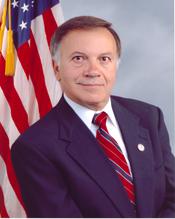
Mr. Chairman, I offer an amendment. Mr. Chairman, I yield myself such time as I may consume, and I rise once again this evening to propose an amendment similar in some respects to one I have proposed…
Mr. Chairman, I offer an amendment.
Mr. Chairman, I yield myself such time as I may consume, and I rise once again this evening to propose an amendment similar in some respects to one I have proposed in the past and different in others, that is to say, it is similar in that it does this: It says we have a law on the books, it was passed in 1996, and the law says that all States and localities therein are prevented from impeding the flow of information to the Immigration and Naturalization Service. The successor agency is, of course, BICE. They are also prevented by the law from actually stopping any information from coming from the old INS and now BICE.
That is what the law says. It is there, on the books, and every single time I offer this amendment the other side gets up and starts arguing the law as to whether or not we should have the law, why it should be in place, would we not be better off without a law? But that is not the purpose of my amendment, of course, to repeal the law. It is to enforce the law. That is all I ask.
We are a body that makes laws. We should, of course, also encourage the enforcement of those laws or we should repeal them. That is what we should be doing here. It is, I suggest, quite inappropriate in a way for us to pass laws and then essentially tell the country and the people out there that we should wink at them; pretend they do not exist; pretend they are really not on the books, because enforcing them would be problematic from certain standpoints, especially politically.
Now, what kind of message does that send every time we do this? But every time there is a vote against my amendment, that is essentially what we are saying, that even though we have laws on the books, we will ignore them.
My amendment is designed to prevent those local governments from obtaining SCAAP funding if they violate the law. That is it. If they are in line with the law, doing what the law requires of them to do, no problem. Presently, the law does not have any sort of mechanism that would suggest we are enforcing it. There is no penalty, and so we have got cities, counties, that are in fact violating the law. They are doing that with impunity. We should not allow that to continue. We should either repeal the law if we do not like it, or we should have some sort of mechanism to enforce it.
I have proposed time and time again that we should try and enforce the law. That is all this amendment does.
If State and local governments violate the Federal law and pass sanctuary policies that encourage illegal aliens to come here, why should any American taxpayer be asked to absorb these costs? That is what we are doing. SCAAP funds are funds that we provide to cities and counties for the purpose of reimbursing them for the costs of keeping people in their prisons who are here illegally. They are illegal aliens, and there are costs involved.
On the one hand, we have counties submitting bills to the Federal Government for the incarceration of some of these folks, but on the other hand refusing to provide that information to the Bureau of Immigration Control and Enforcement, BICE. They want the money for what they say they are putting out for enforcement of the law, but then they refuse to actually give that information to BICE. It is not a situation that is sustainable and certainly not one that we should countenance. We should at least say if you are not going to abide by the law of the land that requires you to provide this information, you cannot get the money from the SCAAP funds. That is all it is.
Again, I know we are going to get into this argument about whether or not we should have the law on the books. That is a different argument. Let us just argue whether or not once we have the law on the books we should not try to enforce it.
Mr. Chairman, I reserve the balance of my time.
Mr. Chairman, I yield 1 minute to the gentleman from California (Mr. Rohrabacher).
Mr. Chairman, I yield myself such time as I may consume.
Once again I keep thinking when I hear these arguments that somehow we have not gotten the point across of what exactly this is doing. I wish we had a big sign that said: This is the law and this is my amendment. This is the law that is on the books. This is not debatable at this point, or at least it is not part of my amendment.
If the gentleman does not like the fact that we have a law on the books saying that the people of the cities and counties should help, or let me put it this way, there is a law that says that
they should not actively oppose our attempts to actually enforce immigration law, that is what it is. It does not require anything. It does not require deputization of more people or to get them involved with the actual immigration enforcement. It just says you cannot take an action that prevents the flow of information or the acceptance of information. That is it. That is the law that is on the books. What we are trying to do is assess a penalty.
The idea that local law enforcement, they do not want this because somehow people will not come forward, the reality is this, their task is to enforce the law also. They take an oath to do that, just as we do. Here we sit debating as to whether or not we should enforce a law we have already passed. That is the bizarre nature of this debate. It has nothing to do with immigrant bashing or any of the other stuff that gets brought up in this discussion.
It has to do with whether or not the law on the books should be enforced. It is a simple measure that should not be clouded with all of the kind of rhetoric and epithets that are thrown around every time we start to debate this. It is the law. Should we have it? If we should not, let us repeal it. As long as it is there, let us enforce it.
Mr. Chairman, I yield 2\1/2\ minutes to the gentleman from California (Mr. Rohrabacher).
Mr. Chairman, I yield myself such time as I may consume.
Mr. Chairman, this is a difficult issue, because I want to respond to my friend, my colleague's advice and his willingness to work on this issue, and that is a strong allure, because number one, I know he is a gentleman of great integrity, and I do want to do more than just simply make a statement to, as he said, be a Don Quixote. I do want to in fact move this issue forward; and if that is the best way to do it, then perhaps what I will do is withdraw this amendment, but I will do so only after I once again state that it is important for this body to make laws and then enforce them.
We call ourselves a Nation of laws ruled by law. There is only one way we can actually prove that. It is to stop this ridiculous winking at the laws we make. Enforce them or repeal them. That is all I ask, and that is what I hope that we will do. And I will work with the gentleman and take him up on his offer.
Mr. Chairman, I withdraw my amendment.
amendment no. 6 offered by Mr. Farr
Mr. Chairman, I rise in strong support of the Tancredo amendment. The gentleman from Colorado (Mr. Tancredo) stands in front of us today, as he has in the past, as a strong voice to try to gain the…
Mr. Chairman, I rise in strong support of the Tancredo amendment. The gentleman from Colorado (Mr. Tancredo) stands in front of us today, as he has in the past, as a strong voice to try to gain the attention and support of Members of Congress towards a problem that we refuse to deal with. This Congress is refusing to deal with one of the greatest threats to the well-being of our people. In California, our education system is going down. The health care available to our people is being diluted and people are dying because of this. Our criminal justice system is breaking down. People are being murdered because we are not dealing with this issue. The issue, of course, is illegal immigration. We have to do something about it.
In this case, the gentleman from Colorado (Mr. Tancredo) is simply saying the cities or States that will not help us enforce the laws that already exist, they should not be getting government money in the name of that enforcement.
If we do not handle this situation, our people are going to pay an even heavier price. I can see a day when the Social Security system totally falls apart because we have not dealt with this issue. It is a disgrace that Congress is refusing to act upon this. At least support this issue which is very reasonable.
Mr. Chairman, let us note we are not talking about legal immigrants. Over a million people are permitted in this country legally every year. We can be very proud of that. In fact, the people most concerned about illegal immigration in this country are the million legal immigrants every year who obey the rules and stand in line and who we are slapping in the face by permitting millions of illegals to come into our country.
Trying to blur the distinction between legal and illegal is not an honest way of presenting the case. The bottom line is we are only talking about illegal immigration. We are not talking about local crime. I am not in favor of having the local judiciary to enforce criminal matters that are made criminal by the Federal Government. I am, however, in favor of the Federal Government presiding over its constitutional authority and obligation to control immigration policy in this country. And if States and cities want money from the Federal Government concerning illegal immigration and the incarceration of illegal immigrants, they will have to go along and enforce that Federal law because immigration is the rightful authority of the Federal Government.
Mr. Chairman, let me just note this. We can make light of the fire that has swept through Chicago and destroyed homes and natural disasters. This is not a natural disaster that is befalling our people, and it is not funny. The fact is our health care system is breaking down in California and people are losing their lives. It is breaking down in other parts of the country. Our criminal justice system is breaking down. People are being murdered. Our citizens are losing their lives because we refuse to deal will illegal immigration.
The Social Security System could fall apart in 10 years if this illegal immigration continues to overwhelm us. What are we doing? Why are we permitting our children to go into our educational institutions to have a diluted education? This is ridiculous.
Mr. Chairman, today I call for a broad coalition of my colleagues to support the Hinchey-Rohrabacher amendment to H.R. 4754, introduced by the gentleman from California (Mr. Farr).
Over the past 8 years, 10 States have adopted laws that decriminalize the use of marijuana for medical purposes. These States have passed these laws to allow the use of marijuana to relieve intense pain that accompanies several debilitating diseases, including AIDS, cancer, multiple sclerosis, and glaucoma. In seven of these States, such as my own State of California, these laws were adopted by a direct referendum of the people.
The Federal Government, however, has made it nearly impossible for these States to implement their own laws, the laws that the people voted for. The DEA has conducted numerous raids on homes of medical marijuana users, prosecuting patients who were using marijuana in accordance with State law to relieve intense pain and other symptoms caused by a variety of illnesses. Despite these State laws, the Justice Department is working overtime to put sick people and those who would help them in jail.
It is time for the Federal Government to respect the rights of individual States to determine their own health and criminal justice policies on this matter. A growing movement of Americans from conservative to liberal is calling for the Federal Government to keep its hands off the States that wish to allow their citizens to use marijuana for medical purposes. In my State, the people have spoken overwhelmingly. Both Republican and Democrat counties voted for medical freedom. Our new Governor, Arnold Schwarzenegger, has made it clear in regard to the Federal Government's interference with California's medical marijuana policy in his message to Washington, and what is it? It is ``Hasta la vista, baby.'' Even more poignant, Tom McClintock, Arnold's leading conservative opponent in the recent recall election, has spoken out even more strongly against the Federal interference with California's medical marijuana laws. The Governor of Maryland also, our former Republican colleague, Robert Ehrlich, has signed Maryland's new medical marijuana law and has lobbied Members of Congress on this issue.
As a conservative, I am increasingly troubled by the federalization of criminal law that has occurred in recent years. It seems that more and more crimes are being declared to be Federal crimes. While sometimes this is appropriate, for example in immigration law, which is a federally mandated issue by our Constitution, but criminal justice constitutionally is the domain of the State and local government. This is especially true when the people of these many States determine by their own vote the policy concerning this specific personal behavior.
It is time for the conservatives and liberals to join together in calling for the Federal Government to keep its hands off. Liberals, moderates, and conservatives should unite in order to protect the freedom of our people. This is a freedom issue, and it is also a humanitarian issue. We should make sure that the local people have a right to determine if the doctors in their community, and that is what we are talking about, the doctors are able to prescribe marijuana for people who are suffering from AIDS and suffering from cancer and other types of diseases. This is not fair, and it is not humane to go the other way; and it is un-American to centralize this type of criminal justice matter in the hands of Federal bureaucrats rather than the people who vote in our specific communities.
Madam Chairman, I rise today to speak in strong support of the Foreign Relations Authorization Act for fiscal year 2004 and 2005. I commend the gentleman from Illinois (Mr. Hyde) and the gentleman…
Madam Chairman, I rise today to speak in strong support of the Foreign Relations Authorization Act for fiscal year 2004 and 2005. I commend the gentleman from Illinois (Mr. Hyde) and the gentleman from California (Mr. Lantos) for putting together such a strong bipartisan bill.
This bill increases funding for State Department activities and specifically increases funding for security for members of our Foreign Service and at the embassies where they work.
This increase is so important because of the continued terrorist threat against our Nation's embassies abroad. This bill also addresses the Quartet's road map and sets certain conditions that must be met before the United States can agree to a Palestinian state. With what looks like a potential end of the intifada, the Palestinians must prove that they can protect the security of Israel and her people before they be rewarded with statehood.
Another provision requires a report on democracy in the Western Hemisphere that my good friend, the gentleman from Massachusetts (Mr. Delahunt), included during the markup in the Committee on International Relations. I believe this report will show Congress and the administration the needs of our long neglected neighbors to the south. The United States needs to increase engagement with the Western Hemisphere to ensure that our neighbors continue on the path to durable democracy. I believe this is a strong bipartisan bill, if it remains intact, that deserves the support of all my colleagues.
Madam Chairman, I ask unanimous consent that the gentleman from Pennsylvania (Mr. Greenwood) be allowed to control half of the time in opposition to the Smith amendment and be able to yield that time to others as he sees fit.
Madam Chairman, I yield myself 2 minutes.
Madam Chairman, the provisions the gentleman seeks to strike does not promote abortion, forced sterilization or any of the other horrible things opponents of UNFPA say it will do. Madam Chairman, the underlying Crowley-Lee provision funds the U.N. Population Fund, UNFPA, in its work in over 141 countries to provide for child and maternal health, child survival, HIV/AIDS prevention, and family planning.
Nearly 600,000 women die each year from causes related to pregnancy. Ninety-nine percent of those women are in the developing world. Many of these deaths could be prevented through maternal care and through family planning to space those pregnancies.
The President has finished up a 5-day, five-country tour in Africa where he talked about democracy and economic opportunity, but what he did not talk about were the empowerment and equality of women. When women have the ability and access to contraception to plan their families, their economic livelihoods improve. In Bangladesh, I saw UNFPA working with women in the garment industry, educating them without contraception and showing women how limiting their births can improve their economic situation. In Malawi, I saw UNFPA work with a rural birth assistant, providing clean razor blades to cut the umbilical cord, soap and kerosine for a lantern to help rural women deliver their babies safely.
Let me say what I have not seen, what UNFPA is not doing. UNFPA does not provide for abortion. I want to remind my colleagues that no U.S. funding can go to any group that provides for abortions. The gentleman from Illinois (Chairman Hyde) passed his amendment in 1984, and he knows it is still the law today. UNFPA does not engage in coercion of any kind.
Opponents will say that this provision will gut human rights and will say that UNFPA has been engaged in China. In fact, the Bush administration, which at first supported UNFPA by requesting $25 million for UNFPA and funding UNFPA's work in Afghanistan, abruptly changed course when it refused to release $34 million in funding, citing UNFPA's work in 31 counties in China.
Madam Chairman, I reserve the balance of my time.
Madam Chairman, I yield 1 minute to the gentleman from California (Mr. Lantos), ranking member of the House Committee on International Relations.
Madam Chairman, I yield 1 minute to the gentlewoman from California (Ms. Lee), the cosponsor of this amendment.
Madam Chairman, I yield 1 minute and 15 seconds to the gentlewoman from New York (Mrs. Lowey).
Madam Chairman, I yield 1 minute to the gentlewoman from New York (Mrs. Maloney), a leader on this issue.
Madam Chairman, I yield 30 seconds to the gentlewoman from California (Ms. Solis).
Madam Chairman, I yield 30 seconds to the gentlewoman from California (Mrs. Capps).
Mr. Chairman, I yield 30 seconds to the gentleman from Ohio (Mr. Kucinich).
Mr. Chairman, I will reserve the right to close.
Mr. Chairman, I yield 1 minute to the gentleman from Ohio (Mr. Ryan).
Mr. Chairman, before closing, I yield 30 seconds to the gentlewoman from Colorado (Ms. DeGette).
Mr. Chairman, I yield myself the remaining time.
I will close by just saying that I have enormous respect for the authors of this amendment, the gentleman from New Jersey (Mr. Smith), the gentleman from Illinois (Mr. Hyde), and the gentleman from Minnesota (Mr. Oberstar).
The gentleman from New Jersey (Mr. Smith) has a stellar record when it comes to the issue of human rights, and I applaud him for that. We just simply do not agree on this issue.
If I believed that or any part of my body believed or my soul believed that the UNFPA was engaged in any form of forced abortion anywhere in the world, I would be the first person supporting their amendment. I just do not believe that to be the case.
I have seen the benefit of UNFPA in the world. I have been to Africa. I have been to Asia. I have been to Bangladesh and India and China. I have seen the abuses in China, and I do not agree with them. I do not agree with China on just about anything, but that does not mean we should gut a program that has worked all around this world to save lives.
Let me just say this in closing. Dr. Nafis Sadik, the former executive director of UNFPA, said, ``Any form of coercion is completely unacceptable, on practical as well as ethical grounds. Coercion is a violation of human rights. Although it is every country's sovereign right to determine its own policy, that right does not extend to coercive practices. The assumption behind coercion, that women are inferior, incapable of independent decision making, not to be trusted, are also those that undermine sustainable development.''
The choice is really clear. If you support family planning, you will oppose the Smith-Oberstar-Hyde amendment.
Mr. Chairman, I yield back the balance of my time.
Mr. Chairman, I demand a recorded vote, and pending that, I make the point of order that a quorum is not present.

Mr. Chairman, will the gentleman yield? Mr. Chairman, I thank the distinguished gentleman for extending his offer in helping the gentleman from Colorado (Mr. Tancredo) on his amendment. I think the…
Mr. Chairman, will the gentleman yield?
Mr. Chairman, I thank the distinguished gentleman for extending his offer in helping the gentleman from Colorado (Mr. Tancredo) on his amendment.
I think the gentleman has made a very clear point about the Tancredo amendment. I rise to oppose it because it is a law that is already in force; but more importantly when it comes to local and State governments and first responders and people dealing with homeland security, it is threatening to deny them funds because of some inadvertence that might occur as relates to Federal immigration laws.
We recognize what the laws are in this land. We recognize the responsibilities of Federal law enforcement on immigration issues. But if we begin to start cutting resources from local communities, we can be assured that national security will be jeopardized, and that is what the Tancredo amendment does. It makes communities less safe.
Let me say, for those of us who come from very diverse communities, it is particularly difficult for the police to establish relationships that are the foundation of successful police work if the impression is that resources are going to be cut if they do not do the work of the Federal Government. That means they are going to create an atmosphere of fear and intimidation and an attitude that anyone who has a different surname or looks differently is under the scrutiny of local law officials.
I would hope that this amendment would not be supported, and of course recognize that in the exploitation possibilities you also have the potential of criminals exploiting the fear of immigrants by forcing local law enforcement authorities to be immigration officials. I would hope that this amendment would not be supported. It has been defeated, as the gentleman from Virginia (Mr. Wolf) said earlier, earlier in the year, in the homeland security legislation.
I can tell Members it makes it very difficult for communities who are working toward better relationships with our immigrant communities. Might I say to my colleagues, this is not the way to enforce immigration laws. The way to do it is to have real immigration reform that will help secure the homeland and balance the rights of individuals within this country. I think we can do that by not having this amendment which then would further divide Federal and local officials by cutting funds which are so desperately needed for homeland security.
Mr. Chairman, I rise in opposition to Representative Tom Tancredo's amendment to the Commerce, Justice, and State Appropriations Act for FY2005. The effect of this amendment would be to enact a provision from the CLEAR Act (H.R. 2671) and its Senate counterpart (S. 1906). These bills compel State and local police officers to become Federal immigration agents by denying them access to Federal funds they are already receiving if they refuse these additional duties. Specifically, the Tancredo amendment would deny funds to any State or local government that limits disclosure of immigration status.
We count on State and local governments and law enforcement authorities as first responders when national security is threatened. Since 9/11, they have taken on significant new duties and are facing dwindling resources. Further cutting their resources is not going to help enhance national security, and, in fact, the Tancredo provision could make our communities less safe.
In immigrant communities, it is particularly difficult for the police to establish the relationships that are the foundations for successful police work. Many immigrants come from countries in which people are afraid of police, who may be corrupt or even violent, and the prospect of being reported to the immigration service would be further reason for distrusting the police.
In some cities, criminals have exploited the fear that immigrant communities have of all law enforcement officials. For instance in Durham, NC, thieves told their victims--in a community of migrant workers and new immigrants--that if they called the police they would be deported. Local police officers have found that people are being robbed multiple times and are not reporting the crimes because of such fear instilled by robbers. These immigrants are left vulnerable to crimes of all sorts, not just robbery.
Many communities find it difficult financially to support a police force with the personnel and equipment necessary to perform regular police work. Having State and local police forces report immigration status to the Bureau of Immigration and Customs Enforcement, ICE, would be a misuse of these limited resources.
ICE also has limited resources. It does not have the resources it needs to deport dangerous criminal aliens, prevent persons from unlawfully entering or remaining in the United States, and enforce immigration laws in the interior of the country. Responding to every State and local police officer's report of someone who appears to be an illegal alien would prevent ICE from properly prioritizing its efforts.
Local police can and should report immigrants to the immigration service in some situations. The decision to contact the immigration service, however, should be a matter of police discretion.
I urge you to vote against this amendment.

Madam Chairman, I rise in strong support of H.R. 1950, and I commend the gentleman from Illinois (Mr. Hyde) and the gentleman from California (Mr. Lantos) for crafting and presenting this important…
Madam Chairman, I rise in strong support of H.R. 1950, and I commend the gentleman from Illinois (Mr. Hyde) and the gentleman from California (Mr. Lantos) for crafting and presenting this important legislation to the House for action.
Of course, a key goal of foreign relations authorization bills are to provide the best and most secure service to American citizens traveling and working overseas. Indeed, when lax security and dilapidation at U.S. overseas facilities contribute to U.S. vulnerability to attacks and subsequent American deaths, this country suffers.
Please recall the reaction to the tragic 1998 embassy bombings in Nairobi and Dar es Saalam. All Americans shared a sense of pain, grief and outrage at these senseless acts of terrorism. While not all attacks on U.S. overseas missions can be averted, Congress must provide the appropriate tools to improve the ability of the State Department to guard against disasters like these.
On many occasions, Secretary of State Colin Powell has articulated embassy security as a key priority for the State Department. Additionally, this Member is a long-time supporter of increased embassy security. In fact, in this legislation the funding level reflects a commitment to embassy security by allocating over $1.653 billion in fiscal year 2004 and $1.784 billion in fiscal year 2005 for ongoing embassy security construction and maintenance. This is an important additional step for both the administration and for Congress which now must work together to ease restrictions which for
many years have significantly slowed the construction of new embassies and consulates.
Furthermore, this Member is particularly pleased that the gentleman from Illinois (Mr. Hyde) will offer an amendment to provide the initial authorization for the Millennium Challenge Account. On March 14, 2002, President Bush proposed the MCA, which would provide additional U.S. aid for fiscal year 2006 to poor countries to be used for social sector improvements such as agriculture, health, education, and the environment. The President's concept underlying these proposals is clear. Countries that rule justly, invest in their people and encourage economic freedom will receive U.S. assistance.
The amendment which the chairman will offer is nearly identical to H.R. 2441, the free-standing legislation offered by the gentleman from Illinois (Mr. Hyde). This Member is a cosponsor of that legislation.
Secondly, an amendment he will offer today will establish a Millennium Challenge Corporation, MCC, an entity which would be authorized to provide development assistance grants to eligible countries. Also, the MCC would work with national local organizations, government and nongovernment organizations within eligible countries to develop specific multi-year development goals.
Finally, the amendment includes a provision which this Member requested to ensure that agricultural development would be among the areas on which the MCA focuses.
Madam Chairman, this Member has had a long-standing interest and experience in seeking to construct efficient, innovative ways to deliver humanitarian assistance, especially in agriculture. I support the amendment offered by the gentleman from Illinois and the legislation and urge all Members to support it.
Indeed, if a country cannot feed itself, that country's prospects for political, economic, and societal stability are greatly endangered. Educating children and treating adults for communicable diseases simply produces few results if the efforts are directed people who do not have to eat.
Agricultural development programs which gather supplies of good seed, build breeding livestock herds, construct basic irrigation systems and viable roads to markets, provide microcredit, and establish rural electric infrastructure do not require vast resources. However, such programs to build subsistence farming capacity do require a clear commitment from the U.S. Government and technical assistance gleaned from the incredible human resources found within American land grant colleges and universities, the NGO and cooperative communities, and the private sector.
Previously, in 1985, this Member drafted a successful amendment to the 1986 Farm Bill which required that, for the first time, a small portion of 1 percent of the funds from the Food for Peace program could be directed toward what is now the Farmer-to-Farmer program. Originally implemented as a pilot program operating only in Central America and the Caribbean, Farmer-to-Farmer has gained support from skeptics, including the USAID, who believed that the concept was too simply to be effective. The simple approach has worked and, in fact, has been extended to Africa, Asia, South America, and the Newly Independent States of the former Soviet Union (NIS).
Madam Chairman, some people within the Washington Beltway have expressed similar concerns about the MCA. This Member sincerely hopes that 18 years from today, the MCA proves to be as successful as the Farmer-to-Farmer program in assisting the world's poor people.
In conclusion, this Member encourages his colleagues to vote for the Hyde amendment regarding the MCA and for final passage of H.R. 1950.
Show 11 more
Mr. Chairman, I join the gentleman from Virginia (Mr. Wolf) in strong support. This is an issue that the chairman has been very strong on. We all are. The whole situation, however, brings up a…
Mr. Chairman, I join the gentleman from Virginia (Mr. Wolf) in strong support. This is an issue that the chairman has been very strong on. We all are.
The whole situation, however, brings up a question, and I ask the gentleman not to take this as a sarcastic statement; I just need clarification. Does this include any ordering of torture used by a government near to us, like our own government, or is this just for foreign governments?
I yield to the gentleman from Pennsylvania.
But it would be any foreign government official? I know this sounds like some sort of a sarcastic comment, but I am really trying to get to the bottom of this. Are you only applying this to foreign governments, or could this, in fact, be a question of our own government if, in fact, somebody ordered torture on some people in recent times?
Reclaiming my time, the gentleman does open up an issue which is greater perhaps than what he intended to do, but the possibility exists that if the State Department did its job properly, and in this case it probably will not, we will never get to the bottom of the issue of who ordered torture on some people that we may be dealing with in this country. But, nevertheless, I think it is a great thought and a great idea, and I support it.
Mr. Chairman, let me first clarify something. Am I correct in that there has been a mix-up here and I am no longer allowed to strike the last word on a pro forma basis?
Mr. Chairman, I should have read the small print.
Mr. Chairman, I just want to thank the chairman for this amendment. This amendment is one that committee members and other Members had asked for, and it is important that we move ahead on it.
We had a long discussion before on the 7(a) loan, and we passed an amendment. We needed to take care of this one which we already had agreed on in order to really move ahead the support that we put forth for the SBA and for the various loans, and so I am a full supporter, and I thank the chairman for bringing it forward.
Mr. Chairman, I would like to tell the gentleman from California that he left out in blaming immigrants the Chicago fire and the San Francisco earthquake, which they probably were also responsible for.
It is amazing in 2004 we continue this immigrant-bashing situation. The fact of life is the gentleman read off a list of things that are falling apart in California somehow because people are not being reported or because local police departments are not engaging in activities that local police departments do not want to engage in.
We had 24 discussion before, and it is a simple issue. Local law enforcement does not want to be involved in this issue. Regardless of what we like to see here and how much we would like to bash these folks, local law enforcement does not want to do it. Let me try to say once more why, because no one seems to be paying attention to this issue.
Local law enforcement wants to be able to have a person, regardless of their immigration status, come to them and report a crime, come to them and participate in solving a crime. If they now feel that the local police officer, the local sheriff, has been deputized, if you will, as an immigration officer, we are never going to get any help from the local community.
Now, one issue is the fact that we may have people in this country who are not here with documents. That is one issue. But since they are here, what are we going to do, ignore them, ignore their ability to help us and solve a local crime, ignore their ability to help us be involved in the community?
My God, we talk so much here about how much we want to help local law enforcement and how we stand for them and how much money we want to give them, and now we want to burden them with a situation that they, I repeat for the last time, do not want to be involved with. This amendment should be defeated for what it is, a Latino outreach program that will fail miserably.
Mr. Chairman, the gentleman from California knows me well and knows I was not being funny when I mentioned the fact that the gentleman left out the Chicago fire and the San Francisco earthquake. My point was that the gentleman is blaming immigrants for everything that is wrong in this country. The fact of life is that that is what we do, and the fact of life is that sometimes we look at people who bash immigrants on a daily basis, and then when an amendment comes before us, we cannot believe that it is anything else. But more of the same, which is immigrant bashing, that is what it is. That is what it looks like, that is what it smells like, and that is how I see it.

Madam Chairman, I rise in strong opposition to this amendment and in support of funding for UNFPA. The language this amendment's sponsors are trying to strike is simple. It says that no U.S. funds go…
Madam Chairman, I rise in strong opposition to this amendment and in support of funding for UNFPA.
The language this amendment's sponsors are trying to strike is simple. It says that no U.S. funds go to UNFPA if it directly supports coercive abortion and involuntary sterilization. That is in the bill.
My colleagues may argue that we devote enough to bilateral international family planning programs, that UNFPA is unnecessary. I say that while USAID reaches families in 58 countries, UNFPA reaches 141. In which of the 83 countries in question are there women whom we do not want to help?
My colleagues may argue that our bilateral programs are comprehensive
and UNFPA's is merely repetitive. I point to UNFPA's recent study on obstetric fistula. UNFPA is helping countries in sub-Saharan Africa to fix this terrible problem; USAID, to date, has done nothing.
My colleagues may argue that the language in question today waters down current law. I say that it clarifies current law, maintaining its strength while ensuring it cannot be misinterpreted in order to cut off funding to life-saving programs.
Madam Chairman, our refusal to fund UNFPA simply makes no sense. We do not champion human rights by cutting off UNFPA. What we do is prevent women from understanding what their rights are. We do not save women from coercive practices by cutting off UNFPA. We do, however, destroy an organization that is often the only place women can go to for basic medical and reproductive health care.
Please vote against this amendment.
Madam Chairman, I rise in opposition to this amendment, which would strike common-sense foreign policy from this bill.
The language in question here is simple--it says that no U.S. funds can go to UNFPA if it directly supports or participates in coercive abortion and involuntary sterilization. It codifies the notion that respect for human rights and individual choice are critical components of our identity as Americans, and they should be essential parts of our foreign assistance program.
The language in question fixes an egregious error in current law, an ambiguously-written, overly broad provision that allows politics--not sound policy--to decide where our foreign aid dollars go. Current law has prevented U.S. funding from reaching UNFPA programs since 2001-- deeply injuring an organization that saves the lives of the poorest of the poor women and children around the world.
My colleagues may argue that it is enough that we devote hundreds of millions of dollars to bilateral international family planning programs. I say that while USAID reaches families in 58 countries, UNFPA reaches families in 141 countries. In which of the 83 countries in question are there women whom we don't want to help?
My colleagues may argue that our bilateral programs are comprehensive, eliminating the need for UNFPA's repetitive programs. I point to UNFPA's recent study on obstetric fistula, a debilitating result of unattended childbirth that affects more than 2 million women in Africa alone. UNFPA is providing technical and programmatic assistance to countries in sub-Saharan Africa with the will to fix this horrific problem; USAID, to date, has done nothing.
My colleagues may argue that the language in question today waters down current law. I say that it merely clarifies current law, to ensure it cannot be misinterpreted in order to cut off funding to life-saving programs around the world.
Our continued refusal to fund UNFPA should embarrass us, because it simply makes no sense. We do not champion human rights by cutting off UNFPA--we all know that you can't solve problems by attacking the problem-solvers. What the withholding does is prevent women from understanding what their rights actually are.
We do not save women from coercive practices by cutting off UNFPA. We do, however, destroy an organization that, in many countries, is the only place women can turn to for medical care and basic contraceptive products. The only point we make by zero funding UNFPA is that we do not care about the world's most vulnerable women. And that does not adequately reflect what the American people--and even the sponsors of this amendment--feel.
I urge my colleagues to oppose this amendment. Let's put politics aside and allow common-sense, basic human decency, and the merit of UNFPA's work dictate our foreign policy.
Madam Chairman, I yield myself 2 minutes. Madam Chairman, since 1969 when the program was developed with the help of the United States of America, United Nations Family Planning Fund has met an…
Madam Chairman, I yield myself 2 minutes.
Madam Chairman, since 1969 when the program was developed with the help of the United States of America, United Nations Family Planning Fund has met an incredible need. That need is that in developing countries in Africa and Asia and Central and South America, throughout the world, women find themselves hopelessly enmeshed in poverty without access to healthcare and without access to family planning services; and the result of that, as the gentleman from New York (Mr. Crowley) said, they have more pregnancies than they can bear physically. They have more children than they can feed, and their children are condemned to another cycle of poverty. United Nations Family Planning Agency in 160 countries meets that need so women around the world have access as Americans do.
The gentleman from New Jersey (Mr. Smith) wants to cut that program in half with this amendment, and the gentleman from New Jersey (Mr. Smith) wants to make sure that in 159 of those countries access to this service is cut because in one country, China, something terrible happens and that is coercive abortions. But when the President sent his team over there to China to find out what UNFPA's role was, they said we find no evidence that UNFPA has knowingly supported or participated in the management of a program of coercive abortion or involuntary sterilization in the PRC. In fact, it is the UNFPA that is the most effective organization in preventing that from happening, in getting the Chinese to move towards education, to move towards contraception, and away from coercive practices.
If we support the amendment, what we do is we cut off that funding not only to the agency that is trying to enlighten Chinese family planning programs, but we cut it off to 159 other countries, none of whom uses money for anything coercive nor for abortion at all.
Madam Chairman, I yield 2\1/2\ minutes to the gentlewoman from Connecticut (Mrs. Johnson).
Madam Chairman, I yield 2 minutes to the gentleman from Maryland (Mr. Hoyer).
(Mr. HOYER asked and was given permission to revise and extend his remarks.)
Madam Chairman, I yield myself 10 seconds to note that the Stanford University professor who was just quoted, Steven Mosher, was kicked out of Stanford in the 1980s for academic fraud and misappropriation of university funds.
Madam Chairman, I yield 30 seconds to the gentlewoman from New York (Mrs. Maloney).
Madam Chairman, how much time remains?
Madam Chairman, I yield 1\1/2\ minutes to the gentleman from Illinois (Mr. Kirk).
Mr. Chairman, I yield 30 seconds back to the gentleman from New York (Mr. Crowley).
Mr. Chairman, I yield myself the balance of my time.
Mr. Chairman, this is one of those days when I stand on the floor and wonder what it is that we are fighting about because our values are so common in so many ways.
Every one of us agrees not a penny of this money should go for abortions, and it does not. Everyone agrees that the policy of coerced abortion is an abomination. It is horrible.
The gentleman from New Jersey came to the floor with an amendment that said if this administration finds that UNFPA is engaged in helping coerced abortions to occur, we would get a 100 percent vote for it. If he said that, the funding to China or the UNFPA would stop. That is not what he has done.
What he has done is similar to in the movies when the bad guys come to town and somebody did something they did not like, so they line them up and they shoot them up.
The Smith amendment lines them up and shoots them all. It shoots them in Haiti. It shoots the program down in Nicaragua, throughout Africa, throughout Asia, throughout the world. All of the good that the gentleman says he supports he cuts in half with his amendment. Because, despite the fact that this administration said we find no evidence that the UNFPA has knowingly supported or participated in the management of coercive abortions, he suspects that perhaps there is an inkling that they do.
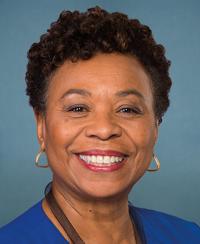
Madam Chairman, first, let me thank the gentleman for yielding. I rise today in support of the State Department authorization bill and also in support of the Millennium Challenge Account and Peace…
Madam Chairman, first, let me thank the gentleman for yielding.
I rise today in support of the State Department authorization bill and also in support of the Millennium Challenge Account and Peace Corps amendments. I thank the gentleman from Illinois (Mr. Hyde) and the gentleman from California (Mr. Lantos) for working on a bipartisan basis once again to ensure broad support for this bill.
Together we were able to craft language examining, for example, the impact of U.S. loan policy on Haiti and its ongoing humanitarian crisis and calling for the participation of small and minority-owned businesses within the MCA account. Small and disadvantaged businesses represent a very vital economic engine in this country yet too often have very little chance to participate in foreign assistance programs, so I am very pleased that we were able to ensure that they will play a role in the Millennium Challenge Account.
My two amendments are included in this bill, and once again I thank the gentleman from Illinois (Mr. Hyde) and the gentleman from California (Mr. Lantos) for their support.
I would like to highlight two aspects of this bill which represents real progress in foreign policy, family planning and global climate change. First, through the Crowley-Lee amendment, the bill restored U.S. funding to vital United Nations family planning programs. This measure helps provide health care to and prevents abortions to the world's poorest women. Failure to provide family planning costs the lives of women and children. It is really just that simple. This also is a common-sense measure that prevents HIV and AIDS.
I strongly oppose the Smith amendment and would urge my colleagues oppose stripping out this important health care provision. The bill we passed out of committee also declared that it was the sense of the Congress and that the United States should demonstrate international leadership in mitigating global warming. The Committee on Energy and Commerce, however, refused to take up the responsibility of leadership and removed this global climate change measure. If we refuse to lead, we will be left behind technologically while we continue to contribute disproportionately to the world's pollution and global warming.
The Committee on Rules has joined the Committee on Energy and Commerce in this conspiracy of silence by refusing to allow a vote on the Menendez amendment on climate change.
Also, I am disappointed that the Committee on Rules did not make in order my amendment to advance democracy in fair and free elections on Haiti. But, on balance, it is a bill which I urge my colleagues to support. I thank the gentleman from Illinois again for this bipartisan bill.
Madam Chairman, I rise today in strong opposition to the Smith amendment to deny basic, urgently needed health services to poor women living in over 141 countries around the globe. This dangerous amendment would strip the amendment that we successfully offered on a bipartisan basis in committee to restore UNFPA funding.
UNFPA saves the lives of women and their children. It prevents abortions, and it provides basic HIV/AIDS prevention services.
Madam Chairman, an overwhelming majority of this House voted for and the President recently signed into law an HIV/AIDS initiative. UNFPA funding is yet another important source of funding in the fight against the deadly pandemic and should be supported. Every day UNFPA is fighting the spread of HIV and AIDS and is saving the lives of hard-to- reach women in hard-to-reach places all around the world.
Finally, for those who are trying to turn this debate into a debate about abortion, let me clarify once more, not one single penny of UNFPA funds goes towards abortion. The Crowley-Lee amendment included in the bill strengthens the fact, and that is the reality. I urge a no on the Smith amendment.
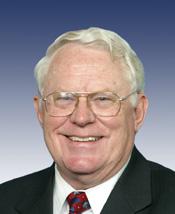
Mr. Chairman, I offer an amendment. Mr. Chairman, I yield myself such time as I may consume. Mr. Chairman, first of all, I want to commend the gentleman from Virginia (Mr. Wolf) on his leadership in…
Mr. Chairman, I offer an amendment.
Mr. Chairman, I yield myself such time as I may consume.
Mr. Chairman, first of all, I want to commend the gentleman from Virginia (Mr. Wolf) on his leadership in the human rights issues around the world. It is because of his leadership on these issues that I offer my amendment.
Mr. Chairman, the human rights organizations that have produced myriad accounts of torture in detention facilities and prisons around the globe, our own State Department in the annual Country Reports, the Human Rights sections, reports on the use of torture in each nation covered by the report, and our Congress has passed the Torture Victims Relief Act of 1998 to fund recovery programs for victims of torture, both in the United States and abroad.
Men, women, even children have endured torture at the hands of government officials around the world. Although it is difficult to find exact figures, Amnesty International estimates that 117 countries worldwide still practice torture.
My amendment provides $25,000 for the State Department's Bureau of Democracy, Human Rights and Labor to compile and publish a list of foreign government officials who order the use of, are involved in, or engage in torture as defined by the United Nations
against torture and other cruel, inhumane and degrading treatment or punishment.
I have had the privilege but heart-wrenching experience of hearing about torture from firsthand accounts of the victims, from a woman in North Korea to firsthand reports in Egypt. We remember one case in Al Qush where a government official, in order to find a criminal, arrested and tortured many of the 1,100 Coptics in order to find someone to confess committing the crime.
In China, there are numerous reports of Tibetan Buddhists, Falun Gong members, house church pastors and congregants, democracy activists who spent time in prison reform camps where they endured torture by communist officials. A recent account, Pastor Gong Shengliang, who may die in prison because of the effects of torture, is ongoing.
In May of last year, the Washington Post detailed a story of Concei da Silva who was brutally tortured in Angola. While in prison, officials hung him upside down, his veins were slashed, chunks of flesh were carved out of his chest with a machete, electricity applied to parts of his body, teeth removed. Awful things have happened.
In Latin America, terrible stories of torture. Sister Dianna Ortiz has spoken out strongly regarding her horrible kidnapping torture at the hands of the Guatemalan security forces.
The torture is horrifying, deeply affecting victims' lives. And those responsible for these crimes should be brought to justice. Unfortunately, in many countries the perpetrators will not be punished for their crimes as torture is systemic.
I and many of my colleagues strongly believe that publicizing the names of those involved in torture, government officials, can help in the campaign to end the use of torture by government officials; and I urge my colleagues to support this amendment that provides $25,000 to the Bureau of Democracy, Human Rights and Labor to compile and maintain a public list of individuals involved in torture.
Mr. Chairman, I reserve the balance of my time.
Mr. Chairman, will the gentleman yield?
The gentleman knows that our policy is not to torture. Our system is progressing in the light of day with the investigations and the prosecution of torture, but this would apply to any government officials who use torture.
We do not specify, we do not say ``foreign.'' We specify that the State Department compile a list of any government officials who use torture.
Mr. Chairman, I yield back the balance of my time.
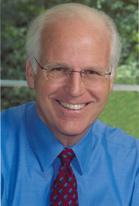
Mr. Chairman, I rise in support of H.R. 1950, the Foreign Relations Authorization Act for Fiscal Years 2004 and 2005. In particularly, I would like to comment on Section 273: Staffing at Diplomatic…
Mr. Chairman, I rise in support of H.R. 1950, the Foreign Relations Authorization Act for Fiscal Years 2004 and 2005. In particularly, I would like to comment on Section 273: Staffing at Diplomatic Missions.
As Chairman of the Committee on Government Reform's Subcommittee on National Security, Emerging Threats, and International Relations, I have held several hearings on rightsizing the U.S. presence overseas.
Rightsizing the U.S. presence overseas is the process of putting the right people with the right skills in the right places. It is first and foremost about keeping U.S. personnel safe, but it is also about successfully manning the diplomatic front in the war against terrorism. Under-skilled personnel running visa lines in sensitive countries, personnel handling communications without necessary language skills, or a lack of staff to handle workloads hurt diplomatic readiness and a key part of the war on terrorism: our nation's relationships with its allies. Moreover, rightsizing involves every government agency with a presence overseas, not simply the Department of State.
The war on terrorism, increased AIDS funding in Africa and the Caribbean, the new Millennium Challenge Account program, changes to the U.S. entry-exit rules, and a greater emphasis on foreign affairs all promise to increase the workloads of overseas missions, and place greater pressure on chiefs of mission to right-size staff.
At our request, the General Accounting Office (GAO) has pursued and continues to pursue the rightsizing issue in concert with the Office of Management and Budget (OMB). GAO created a rightsizing framework consisting of three factors: physical and technical security of facilities and employees, mission priorities and requirements, and cost of operations. In addition, OMB has included rightsizing as part of the President's Management Agenda and begun using Europe as a test case for the GAO framework.
Section 273 calls on chiefs of mission to assist in the rightsizing process by evaluating the necessity of all staff positions under their authority, even those from other Executive Branch agencies. This language was included at my request and reflects a small but important part of the oversight work the Subcommittee has conducted. Section 273 brings us closer to giving the managers of U.S. embassies and consulates overseas, the chiefs of mission, the tools they need to effectively administer their posts and carry out U.S. foreign policy.
Mr. Chairman, I rise in opposition to this harmful amendment.
Cutting funds to the United Nations Population Fund will prevent vital assistance for poor women and children in developing countries. UNFPA's programs help families prevent unwanted pregnancies, undergo childbirth safely, avoid STDs including HIV/AIDS, and combats violence against women. I cannot understand how, in good conscience, a member could vote to cut these programs.
I believe we must support UNFPA and its family planning initiatives because world population continues to grow out of control. In 1960, there were 3 billion people that lived on this Earth. Today, there are 6 billion people; and in 40 years, without worldwide family planning services, it will rise to nearly 9 billion. The UNFPA responds to this growth by assisting the world's poorest countries in formulating population policies and strategies. Overpopulation threatens not only the world's political stability, but our global environment as well.
As a former Peace Corps volunteer, I can attest to the substantial contributions international family programs make to economic development, higher living standards and improved health nutrition.
We need to defeat the Smith/Hyde amendment.
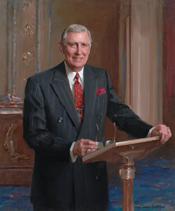
Mr. Chairman, I want to thank the chairman, the gentleman from Illinois (Mr. Hyde) and the gentleman from California (Mr. Lantos) for agreeing to include in this bill an en bloc amendment that deals…
Mr. Chairman, I want to thank the chairman, the gentleman from Illinois (Mr. Hyde) and the gentleman from California (Mr. Lantos) for agreeing to include in this bill an en bloc amendment that deals with a very important subject that I have been concerned with for some time.
As chairman of the Committee on Government Reform for the past 6 years, we held a number of hearings on the issue of child abductions by spouses of American women and men who have taken the children who are in the custody of their mother or father here in the United States to other countries never to be seen again or heard from again by their parents. The most egregious offender of this is Saudi Arabia. They have been complicitous in allowing fathers of children born here in the United States of American mothers to come over here, kidnap the children, take them to Saudi Arabia, and the mother never sees her children again, never talks to her children again, and it is a tragic, tragic situation.
In some cases, Mr. Chairman, there have been cases where a mother went over to Saudi Arabia to get her kidnapped children, took them to the American embassy and was turned away. She was turned away. She was actually put out on the street, she was arrested, her children went back to the father who had kidnapped them, and one of them was 12 years old and she was married off at 12 years old. These are tragic things that have occurred to American children who have been kidnapped to Saudi Arabia, and the mothers have had to live with that for years and years and years, maybe for the rest of their lives.
So I have talked to Secretary of State Colin Powell about this. He has agreed to take steps to remedy the situation, and now Chairman Hyde and Ranking Member Lantos have agreed to an en bloc amendment which will give the State Department the tools necessary to help fight this terrible, terrible tragedy that has been occurring mainly in Saudi Arabia in the Middle East but also in other countries throughout the world.
What the amendment does is it extends to the State Department powers to deny visas to the extended family of abductors, and that includes the spouse, the child, the parent, the grandparent, the aunt, the uncle, the brother, the sister, half-brother, half-sister, cousin, stepbrother, stepsister, nephew, and niece of the person who did the kidnapping. In other words, the extended family of the kidnapper would not be allowed to get visas if the State Department so chose to deny them visas.
I think that is a giant step in the right direction. It puts a lot of pressure on the kidnapper to bring those children back to American to their mother or to the rightful parent. It also requires the State Department to submit an annual report to Congress regarding the measures that they have taken on international child abduction on a country-by-country basis so Congress will be made aware of what is being done to bring these children home to their rightful parent.
It also requires the State Department to send notices regarding child abduction cases to countries where they are believed to be abducted to.
And, finally, this requires the Secretary of State to set forth guidelines on how our Department of State personnel treat abducted persons who seek sanctuary. As I said, there have been cases in the past where our State Department employees at our foreign embassies have not treated these people properly. I believe that is not going to happen in the future.
So I thank Colin Powell, our Secretary of State, for agreeing to work on this; and I especially thank Chairman Hyde and Ranking Member Lantos. They are doing the Lord's work.
Mr. Chairman, I thank the gentleman for yielding me this time and for all his work and cooperation, and I rise to speak on some of the positive elements of this bill. This bill includes my amendment…
Mr. Chairman, I thank the gentleman for yielding me this time and for all his work and cooperation, and I rise to speak on some of the positive elements of this bill.
This bill includes my amendment on Iran's program to develop nuclear weapons and is particularly relevant given recent developments in Iran. Iran continues to claim that its nuclear research program's only goal is to promote peaceful activities. Last week, however, Iran confirmed that it had successfully tested its mid-range missile, the Shahab-3, which can reach Israeli soil. And last month, the International Atomic Energy Agency stated Iraq has secretly processed nuclear material. Iran continues its game with the IAEA over signing the new nuclear safeguards protocol. Iran is a country with huge oil and natural gas reserves and clearly does not need nuclear power for its energy consumption.
My amendment, as incorporated in this bill, therefore, calls on the International Atomic Energy Agency to ensure that Iran's nuclear program is used only for peaceful purposes and urges the United States representatives to the IAEA to help develop guidelines for early identification of any Iranian noncompliance with the Nuclear Non- Proliferation Treaty. And, finally, Iran should sign and ratify the new nuclear safeguards protocol to this treaty.
While I commend the gentleman from Illinois (Mr. Hyde) and the gentleman from California (Mr. Lantos) on pursuing the Millennium Challenge Account, I am concerned that this initiative ignores the majority of the desperately poor in Latin America and the Caribbean. The initiative launched in Mexico will not contribute a dollar to the poor in the Mexican state of Chiapas. Two hundred million citizens in Latin America and the Caribbean earn under $2 a day, 100 million live on less than $1 a day, and yet these poorest of the poor in our own hemisphere will not qualify for assistance under the Millennium Challenge Account.
I look forward to seeing the Kolbe amendment, which is similar to the one that I proposed, to see if we can move some of those countries forward; and, in the absence of that look, I forward to working with the committee to see what we are going to do about our neighbors here in our own hemisphere, if we are concerned about health care, immigration, and biodiversity.
Lastly, I want to salute the leadership of the committee for incorporating the minority recruitment efforts. The State Department has had the worst record of all of the Federal Government. Our State Department must look like America. It must also have the diversity of thought that makes America great. The State Department shows our face to the rest of the world, and we should bring the synergies of people from different backgrounds to focus on American diplomacy. If the State Department is to make progress, minorities must have a seat at the table.
So, Mr. Chairman, as I said at the beginning, this bill has a number of positive components, but I am concerned that my Mexico and climate change amendments were stripped from the bill; that the Millennium Challenge Account hopefully moves closer to helping the people of the Western Hemisphere; and, finally, I look forward to the success of certain amendments to improve this product. I thank the distinguished ranking member for all his help in trying to make it an even better bill.

Mr. Chairman, I thank the gentleman for yielding me this time, and I rise in strong support of the foreign relations and security assistance bill. I want to thank the chairman of the committee and…
Mr. Chairman, I thank the gentleman for yielding me this time, and I rise in strong support of the foreign relations and security assistance bill. I want to thank the chairman of the committee and also the ranking member for including in its entirety in this legislation the Global Internet Freedom Act.
Today, many governments are attempting to restrict individual freedoms by blocking the most powerful tool ever created for the free exchange of ideas throughout the world. In the hands of free people, the Internet may represent the greatest threat to tyranny ever invented. That is why many repressive regimes are trying to prevent people from using the Internet.
The Global Internet Freedom Act included in this legislation will give millions of people around the world the opportunity to outwit the dictators, the power to get around the repressive regimes that are attempting to silence them and, perhaps most importantly of all, the power to protect themselves from reprisals from these vicious governments.
Many outlawed regimes have been aggressively blocking access to the Internet with technologies such as firewalls, filters and black boxes. They monitor their citizens' activities on the Internet. They keep track of who is saying what, and they punish those who exercise free speech on line.
Last month, according to Human Rights Watch, Chinese web publisher Huang Qi, after enduring a 3-month detention, was sentenced to 5 years in prison for the crime of subversion. What was he publishing? The on- line equivalent of our milk carton ads. He created a Web site in which people could share information about missing friends or family members, and he actually helped rescue several young girls who had been abducted and sold into marriage. But because his site also criticized the government's failure to deal with these human needs, he now spends his days in prison.
In Cuba, dissidents and opposition journalists are prohibited from using the Internet.
In Burma, only those with official permission from the military government can use the Internet.
In North Korea, Kim Jung Il has sealed off his population from the outside world. Of course, Kim Jung Il thinks of himself as a computer buff; and the Associated Press has recently reported he has issued an edict making computer education mandatory. But outside of those classrooms, there will be no connection to the outside world. Because, for a dictator, the top priority is keeping ideas about freedom and democracy away from the computer screens of impressionable young minds.
That is why the Global Internet Freedom Act, now included in this bill, is so important. The Act will require the United States to develop and implement a global strategy to combat state-sponsored and state-directed Internet jamming and the persecution of those who use the Internet.
Mr. Chairman, for the sake of freedom and human rights in the 21st century, I strongly urge my colleagues to support this legislation, and I support the leadership and commend the leadership of the gentleman from Illinois (Mr. Hyde) and the gentleman from California (Mr. Lantos) for bringing this bill to the floor.
Madam Chairman, as we vote on H.R. 1950, the Foreign Relations Authorization Act of FY2004 and FY2005, I want to draw the attention of my colleagues to an important omission in this bill. Section 303…
Madam Chairman, as we vote on H.R. 1950, the Foreign Relations Authorization Act of FY2004 and FY2005, I want to draw the attention of my colleagues to an important omission in this bill.
Section 303 of the Foreign Relations Authorization purports to establish an Office of Ombudsman in the Department of State. However, this bill did not create this office. Congress created this office in P.L. 100-204. Congress passed this legislation over 15 years ago based on its findings that (1) the effectiveness and efficiency of the Department of State is dependent on the contributions of its Civil Service and Foreign Service employees; (2) the contribution of the Department's Civil Service employees has been overlooked in the management of the Department and greater equity of promotion, training, and career enhancement opportunities should be accorded to them and (3) the goal of the Foreign Service Act of 1980 was to strengthen the contribution made by the Department's Civil Service employees by creating a cadre of experienced specialists and managers to provide essential continuity.
Created with the Congressional findings in mind, the office of Ombudsman was given the mission to ensure that civil service concerns are identified and properly weighed by decision-makers, make recommendations to management, and work with affected parties to correct or alleviate systemic problems that adversely affect civil service employees, and provide guidance and counseling to employees on work and career-related matters. Additionally, the Ombudsman was given the responsibility of advising the Secretary of State and senior department management on civil service issues to ensure the ability of civil service employees to contribute to the achievement of the Department's foreign affairs responsibilities. Under the original legislation, the Ombudsman reported to the Secretary of State, and participated in all management council meetings to assure that the concerns of civil service employees are presented.
Additionally, the original legislation assured that civil service employees would not be disproportionately affected by reduction in force or other actions which reduce the department's workforce.
Under the rubric of ``establishing'' the office of Ombudsman, the bill before us today eviscerates the office as established by Congress. It gives the Secretary discretion to determine the involvement of the Ombudsman in the senior-level meetings, eliminates the office's focus on civil service employees, and removes the requirement that the burden of personnel reductions not be disproportionately imposed on civil service employees.
Madam Chairman, section 303 of H.R. 1950 destroys the work of a previous Congress without rhyme or reason. It is clear that our civil service employees are a valuable asset. Our national security depends on the work of civil service employees in the Department of State. If we remove the protections afforded by this office, we are sending a clear and unmistakable message that we are no longer concerned about preserving the protections we have afforded them. We must reconsider this ill-advised provision.
Mr. Chairman, I thank the gentleman for yielding me time. Mr. Chairman, I rise in absolute, 100 percent opposition to this amendment. I have listened to the arguments of my friends from Texas and my…
Mr. Chairman, I thank the gentleman for yielding me time.
Mr. Chairman, I rise in absolute, 100 percent opposition to this amendment. I have listened to the arguments of my friends from Texas and my friend from California in one case and my friend from California in the other, and I have to say that their argument on States' rights is a unique application as it relates to so-called ``medical marijuana.'' But I have not yet heard a single bit of testimony dealing with whether or not there is any medical value to the application of marijuana in this case.
Now, the so-called phrase ``medical marijuana'' is a misnomer. It was invented by the people who passed the proposition in California that, frankly, hoodwinked the voters of California into voting in favor of it. But I just want to run through a couple of things here.
The FDA looks at all sorts of prescription drugs and pharmacological treatments, and they have looked at marijuana, and by and large, we have deferred to the FDA on all these analyses. But, all of a sudden, when it comes to so-called ``medical marijuana,'' the FDA is no longer competent. But I do want to enter into the Record that the FDA, in fact, did look at marijuana as a medical substance and found absolutely no value whatsoever to its use.
Now, the FDA has, in fact, looked at Marinol, in which the active ingredient in so-called ``medical marijuana'' is present, THC, and has approved that for use in treating nausea and pain and the like, and it is readily available by prescription, a true prescription, from a doctor.
Let us dwell for a minute in California, which I am familiar with, on this so-called ``medical marijuana'' and the facade that people go through to obtain it.
First of all, the referendum requires that a doctor issue a so-called prescription. However, the doctor refuses to issue a prescription on a prescription form for so-called medical marijuana. They write it on a piece of blank paper, because the doctors know that it is not a prescription, it is a facade perpetrated upon the people of California that this has any medical qualities whatsoever.
Now, my friend from Indiana is going to share with you the story of a tragic occurrence in San Francisco, and I am not going to jump the gun on him, because this is absolutely heartbreaking, what he is going to tell you. But I do want to tell you, that incident is not singular in nature.
The fact of the matter is we have children, young people across this country, watching you and me and our peers across this country as it relates to the use of so-called medical marijuana, and if you think for one minute that they are going to turn a blind eye to our acquiescence, that just because it happens to be a little bit difficult to tell people ``No, you are not going to be able to smoke dope,'' just because it happens to be a little bit difficult to tell people that, that we are going to roll over and pass this prohibition on funds, just begs the imagination about what leadership really constitutes.
Bill Text
2 versions available
        [Congressional Bills 108th Congress]
[From the U.S. Government Publishing Office]
[H.R. 3427 Reported in House (RH)]

Union Calendar No. 388
108th CONGRESS
2d Session
H. R. 3427

[Report No. 108-644]

To authorize a land conveyance between the United States and the City
of Craig, Alaska, and for other purposes.

_______________________________________________________________________

IN THE HOUSE OF REPRESENTATIVES

October 30, 2003

Mr. Young of Alaska introduced the following bill; which was referred
to the Committee on Resources

September 7, 2004

Reported with an amendment, committed to the Committee of the Whole
House on the State of the Union, and ordered to be printed
[Strike out all after the enacting clause and insert the part printed
in italic]
[For text of introduced bill, see copy of bill as introduced on October
30, 2003]

_______________________________________________________________________

A BILL

To authorize a land conveyance between the United States and the City
of Craig, Alaska, and for other purposes.

Be it enacted by the Senate and House of Representatives of the
United States of America in Congress assembled,

SECTION 1. SHORT TITLE.

(a) Short Title.--This Act may be cited as the ``Craig Recreation
Land Purchase Act''.
(b) Definitions.--For the purposes of this Act, the following
definitions apply:
(1) City.--The term ``City'' means the City of Craig,
Alaska.
(2) Secretary.--The term ``Secretary'' means the Secretary
of Agriculture.

SEC. 2. AUTHORIZATION FOR CONVEYANCE.

(a) In General.--If the City tenders all right, title, and interest
of the City in and to the land described in subsection (b) to the
Secretary not later than 6 months after the date the City receives the
results of the appraisal conducted pursuant to section 4, the Secretary
shall accept such tender.
(b) Land Description.--The land referred to in subsection (a) is as
follows:
(1) The municipal land identified on the map entitled
``Informational Map, Sunnahae Trail and Recreation Parcel and
Craig Cannery Property'' and dated August 2003.
(2) Lots 1 and 1A, Block 11-A, as identified on the City of
Craig Subdivision Plat, Craig Tideland Addition, Patent # 155
(Inst. 69-982, Ketchikan Recording Office), dated April 21,
2004, consisting of approximately 22,353 square feet of land.
(3) The portion of Beach Road eastward of a projected line
between the southwest corner of lot 1, Block 11, USS 1430 and
the northwest corner of lot 1, Block 11-A, as identified on the
City of Craig Subdivision Plat, Craig Tideland Addition, Patent
# 155 (Inst. 69-982, Ketchikan Recording Office), dated April
21, 2004, consisting of approximately 4,700 square feet of
land.

SEC. 3. ACQUISITION OF LAND BY THE CITY OF CRAIG.

(a) Use of Funds for Land Acquisition.--Funds received by the City
under section 2 shall be used by the City for the purchase of the land
shown on the map entitled ``Wards Cove Property,'' dated March 24,
1969.
(b) Cost of Land; Equalization of Value.--The purchase of land by
the City under subsection (a) shall be for an amount equal to the
appraised value of the lands conveyed to the Secretary by the City,
except that the Secretary and the City may equalize the values by
adjusting acreage or by payments not to exceed $100,000.

SEC. 4. APPRAISAL.

Prior to any conveyance under this Act, the Secretary shall--
(1) conduct an appraisal of the land identified for
conveyance by the City, in accordance with and conforming to
the most current versions of the Uniform Appraisal Standards
for Federal Land Acquisitions, Uniform Standards of
Professional Practice, and U.S. Forest Service Appraisal
Directives; and
(2) notify the City of the results of the appraisal.

SEC. 5. MANAGEMENT OF CONVEYED LAND.

Land received by the Secretary pursuant to this Act shall be--
(1) included in the Tongass National Forest; and
(2) managed in accordance with the laws, regulations, and
forest plan applicable to the Tongass National Forest.

SEC. 6. AUTHORIZATION.

There are authorized to be appropriated--
(1) to the Forest Service for the reconstruction of the
Sunnahae Trail $250,000; and
(2) such other sums as are necessary to carry out this Act.

Union Calendar No. 388

108th CONGRESS

2d Session

H. R. 3427

[Report No. 108-644]

_______________________________________________________________________

A BILL

To authorize a land conveyance between the United States and the City
of Craig, Alaska, and for other purposes.

_______________________________________________________________________

September 7, 2004

Reported with an amendment, committed to the Committee of the Whole
House on the State of the Union, and ordered to be printed