Expressing the sense of the House of Representatives that the Ninth Circuit Court of Appeals ruling in Newdow v. United States Congress is inconsistent with the Supreme Court's interpretation of the first amendment and should be overturned, and for other purposes.
Legislative Activity
Stay on top of the latest movement without scrolling through every action
Motion to reconsider laid on the table Agreed to without objection.
March 20, 2003 • 10:57 AM
View full timeline
Introduced in House
March 6, 2003
Referred to the House Committee on the Judiciary.
March 6, 2003
Referred to the Subcommittee on the Constitution.
March 6, 2003
Reported by the Committee on Judiciary. H. Rept. 108-41.
March 18, 2003
Placed on the House Calendar, Calendar No. 13.
March 18, 2003
Mr. Sensenbrenner moved to suspend the rules and agree to the resolution.
March 19, 2003 • 11:36 AM
Considered under suspension of the rules. (consideration: CR H1976-1981)
March 19, 2003 • 11:37 AM
DEBATE - The House proceeded with forty minutes of debate on H. Res. 132.
March 19, 2003 • 11:37 AM
At the conclusion of debate, the Yeas and Nays were demanded and ordered. Pursuant to the provisions of clause 8, rule XX, the Chair announced that further proceedings on the motion would be postponed.
March 19, 2003 • 12:14 PM
Considered as unfinished business. (consideration: CR H2137)
March 20, 2003 • 10:49 AM
Passed/agreed to in House: On motion to suspend the rules and agree to the resolution Agreed to by the Yeas and Nays: (2/3 required): 400 - 7, 15 Present (Roll no. 77).(text: CR 3/19/2003 H1976-1977)
March 20, 2003 • 10:57 AM
On motion to suspend the rules and agree to the resolution Agreed to by the Yeas and Nays: (2/3 required): 400 - 7, 15 Present (Roll no. 77). (text: CR 3/19/2003 H1976-1977)
March 20, 2003 • 10:57 AM
Motion to reconsider laid on the table Agreed to without objection.
March 20, 2003 • 10:57 AM
Voting History
1 vote recorded • Roll call available
Floor Debate
23 membersWhat members said about H.Res. 132 on the floor
 FRW
FRW JES
JES DRO
DRO RP
RP ADW+18
Floor Debate
23 membersWhat members said about H.Res. 132 on the floor
Mr. Chairman, I yield myself 10 minutes. I am pleased to begin consideration of H.R. 2799, the Departments of Commerce, Justice, State, the Judiciary and related agencies appropriations bill for…
Mr. Chairman, I yield myself 10 minutes.
I am pleased to begin consideration of H.R. 2799, the Departments of Commerce, Justice, State, the Judiciary and related agencies appropriations bill for fiscal year 2004. This bill provides funding for programs whose impact ranges from the safety of people in their homes and communities, to the conduct of diplomacy around the world, to predicting the weather from satellites in outer space. The bill before the House today reflects a delicate balance of needs and requirements. We have drafted what I consider a responsible bill for fiscal year 2004 spending levels for the Departments and agencies under the subcommittee's jurisdiction. We have had to carefully prioritize the funding in this bill and make hard choices about how to spend scarce resources.
The bill before the House today recommends a total of $37.9 billion in discretionary funding, which is $700 million above the enacted level for fiscal year 2003 and $237 million above the President's request. For the Department of Justice, the bill provides $20.15 billion in discretionary funding, which is $1.15 billion above the request.
The bill includes funding for Federal law enforcement agencies to perform traditional law enforcement duties and fight terrorism. The bill also provides more than $1 billion above the request to support State and local law enforcement crime-fighting efforts. It includes $4.64 billion for the Federal Bureau of Investigation, an increase of $424 million above fiscal year 2003 and the same as the President's request. This funding will support almost 2,500 new agents and analysts in the FBI to improve counterterrorism and counterintelligence efforts and to continue fighting violent crime, drugs, corporate fraud, and cybercrime.
The bill includes $80 million for high-priority FBI technology needs and funding above the request for language translation and training programs. $2.16 billion is provided for the Drug Enforcement Administration, an increase of $237 million above fiscal year 2003 and $57 million above the comparable request to fight drug crime. The amount includes a transfer of the interagency crime and drug enforcement program under the DEA to consolidate drug law enforcement efforts, $25 million to establish a drug intelligence fusion center to allow agencies to share realtime investigative data, and funding above the request to support 939 new positions, including 434 new DEA and FBI agents. $3.5 billion is provided for proven State and local law enforcement crime-fighting programs, which is $1.2 billion above the request.
When combined with funding provided in the homeland security bill, the committee is providing more than $2 billion above the request for State and local crime control and domestic preparedness funding. The bill restores funds for programs that were proposed to be eliminated, including $500 million for the Byrne formula program, $400 million for the local law enforcement block grant program, and $400 million for
Mr. Chairman, I reserve the balance of my time.
Mr. Chairman, I yield back the balance of my time.
Mr. Chairman, I move to strike the last word.
I yield to the gentleman from Virginia.
Mr. Chairman, reclaiming my time, I absolutely am. These are provisions that have been carried before. The gentleman is the new chairman of that committee. Before we do that next year, we will sit down with the gentleman.
Mr. Chairman, I thank the gentleman for bringing these to our attention and for not striking.
Mr. Chairman, there was an analysis of the FCC's travel paid for by non-Federal sources. They found that agency officials took more than 2,500 industry-sponsored trips between May of 1995 and February of 2003, costing $2.8 million. Each of the current commissioners took trips. One commissioner took 44 trips during that time frame, including trips to Las Vegas, Hawaii, and London.
When the issue came out, a member of the FCC staff said that it was because the Committee on Appropriations did not fund their travel. That is not accurate. And as a result of that, we wanted to do this.
One commissioner, who has only been a commissioner since July of 2001, took 12 trips valued at over $14,000. One career employee took 104 trips valued at $150,000, including to France, Japan, Singapore, the United Kingdom, and Sweden. That means the regulatees are paying for the trips of the regulator.
So the reason we are putting this in, I would say to my friend from Michigan, was that when this study came out, the FCC said the reason they had to do this was because they were not being adequately funded, which was not accurate and, therefore, they are adequately funded to travel. I think from a public interest point of view, to allow one person to take 104 trips valued at almost $150,000 to France, Japan, Singapore, the United Kingdom,
and Sweden was why the subcommittee did that from a public policy point of view.
Mr. Chairman, I move to strike the last word, and I yield to the gentleman from Virginia (Mr. Tom Davis), my good friend.
Mr. Speaker, reclaiming my time, we will do that, I can assure the gentleman.
Mr. Chairman, I move to strike the last word.
Mr. Chairman, I yield to the gentleman from Illinois (Mr. Manzullo) about an amendment that we are prepared, when we go to conference, to make sure it is not in the bill, which is what he desired. Since his time has passed, and in fairness to others who missed that time, rather than going back, and there may be an objection, I just want to assure the gentleman from Illinois (Mr. Manzullo) that what he is offering, working with the gentleman from New York (Mr. Serrano), we will accept that amendment and strike it when we go to conference, in fairness to the gentleman.
Mr. Chairman, I yield to the gentleman from Illinois (Mr. Manzullo).
Reclaiming my time, I will do that and work with the gentleman from New York (Mr. Serrano); and in order to protect the gentleman's interests, we will do that.
I yield to the gentleman from New York.
Mr. Chairman, I thank the gentleman.
Mr. Chairman, I move to strike the last word.
Mr. Chairman, I yield to the gentleman from Michigan (Mr. Ehlers).
I yield to the gentleman from Vermont.
I yield to the gentleman from Wisconsin.
I continue to yield to the gentleman from Wisconsin.
Mr. Chairman, reclaiming my time, other Members have been in this situation. The gentleman from Illinois (Mr. Manzullo) missed the opportunity and could not offer an amendment. The gentleman from Indiana (Mr. Pence) missed the opportunity and could not offer an amendment, as did the gentleman from Illinois (Mr. Shimkus). And I think there were several over on that side. And once you have told them that they have missed their opportunity, to do this now, in essence, I would have to go back.
Also, there are a large number of other amendments that are subject to a point of order.
Mr. Chairman, I move to strike the last word, and I yield to the gentleman from Indiana (Mr. Pence).
(Mr. PENCE asked and was given permission to revise and extend his remarks.)
Mr. Chairman, reclaiming my time, if I may, as the gentleman knows, under Helms-Biden, which passed in the year 2000, the contribution level was reduced from 25 percent to 22 percent.
Mr. Chairman, I yield to the gentleman from Illinois (Mr. Shimkus).
Reclaiming my time, I share the gentleman's concerns, particularly with regard to one of the countries mentioned, Romania, but as the gentleman knows, the President's request proposed the elimination or reduction to broadcasted nations that have either entered or are on the road to joining the European Union or have been invited into NATO.
And the International Broadcasting Bureau has additional money because the President's request prioritized money to the Middle East and the Muslim world, including Southeast Asia, to bolster the efforts of the war on terrorism.
So we do have report language to require the Broadcasting Board of Governors to closely monitor the situation in those countries and inform the committee of any changes that would alter the priorities.
But I understand what the gentleman is saying.
Mr. Chairman, I move to strike the last word.
The gentleman from California (Mr. Issa) is supposed to be here, but in the interim, just to briefly discuss the issues.
The bill provides, as people know, the funding for the programs whose impact ranges from the safety of people in their homes and community diplomacy. The overall bill today recommends a total of $37.9 billion in discretionary funding, which is $700 million above the enacted level of fiscal year 2003 and $237 million above the President's request.
For the Department of Justice, the bill provides $20.15 billion in discretionary funding, which is $1.15 billion above the request. The bill includes funding for Federal law enforcement agencies to perform traditional law enforcement duties and fight terrorism. The bill also provides more than $1 billion above the request to support State and local law enforcement crime-fighting efforts. That has been an issue that a lot of people have been deeply concerned about.
It provides $4.64 billion for the Federal Bureau of Investigation, an increase of $424 million above fiscal year 2003 and the same as the President's request. This will result in more than 2,500 new agents and analysts at the FBI to improve counterterrorism and counterintelligence and continue the fight on crime, drugs, corporate fraud and cybercrime.
Also, there is $80 million for high-priority FBI technology needs and funding above the request for language translation.
Mr. Chairman, I yield to the gentleman from California (Mr. Issa).
Reclaiming my time, I thank the gentleman from California (Mr. Issa) for bringing this matter to our attention. We are confident that the Department of Justice will soon resolve the issue, and I will continue to work with the gentleman to make sure this happens.
Mr. Chairman, I move to strike the last word.
Before I recognize the gentleman from Mississippi (Mr. Wicker), let me say I thank the gentleman from Wisconsin (Mr. Obey) and the gentleman from New York (Mr. Serrano) for the comment.
To the gentleman from Vermont (Mr. Sanders), we have been very fair. In fact, we have been very fair to every Member in the House, on both sides of the aisle; and I think the gentleman from Wisconsin's (Mr. Obey) points are well taken. There are other amendments that have not been made in order, and I am not going to get into a debate. If the gentleman wants me to yield, I will yield to him; but I think we have been fair, and I did just want to thank the gentleman from Wisconsin (Mr. Obey), and I want to thank the gentleman from New York (Mr. Serrano) for the comments.
I yield to the gentleman from Mississippi.
Mr. Chairman, reclaiming my time, I want to thank the gentleman for his comments on the importance of the Police Corps. I have heard from several other Members on this issue, and I know that many of our colleagues would agree with the gentleman about the role this program has had in helping to provide an exceptional level of training for our Nation's police force.
I support the program. It is a good program, and I will work with the gentleman and the Senate to ensure the program is well funded in the conference.
Mr. Chairman, I thank the gentleman very much for his comments.
Mr. Chairman, I rise in opposition to the gentleman's amendment.
The bill includes $71.4 million for the United States to join UNESCO. There was a vote, I believe, in the last Congress whereby this issue was voted on. I believe it was offered by the gentleman from Illinois (Mr. Hyde). This was an initiative that President Bush announced last year. The U.S. withdrew from UNESCO in 1984 when the organization was rife with corruption and an anti-Western bias. The organization was mismanaged and was not working with regard to the national interest. Since that time, the Bush administration believes that the organization has undergone a number of reforms and the current leadership is committed to sustaining these gains and is committed to fundamental human rights and democratic principles. The Bush administration believes that participation in UNESCO will allow them to be engaged with the international partners on a host of critical issues.
Therefore, I would urge my colleagues to stand with the Bush administration on this initiative and reject the gentleman's amendment.
Mr. Chairman, I move to strike the last word.
We have a position from the Justice Department, and I will read a portion for Members. It says that ``The Justice Department asked the United States Supreme Court to reaffirm the right of Americans to recite voluntarily the Pledge of Allegiance. Two decisions of the Supreme Court have said without qualification that the Pledge is constitutional.'' And I, as I am sure most Members of this body are, am opposed to what the Court ruled and agree with what the Justice Department is saying here.
Two decisions of the Supreme Court have said without qualification that the Pledge is constitutional. No Justice has expressed any other views. Schools across America and hundreds of thousands of school children have relied on the Supreme Court's repeated assurance as they have started their day with the Pledge.
And they go on to say, and I agree, ``Our religious heritage has been recognized and celebrated for hundreds of years in a National Motto, 'In God we trust,' the National Anthem, the Declaration of Independence, and Gettysburg Address. As the Court has ruled again and again, our government and people can acknowledge the important role religion has played in America's foundation, history and character.
``The Justice Department,'' they go on to say, ``will vigorously defend our Nation's heritage and our children's ability to recite the Pledge.'' And I believe that Attorney General Ashcroft will do that.
The concern of the amendment is, and I will submit the full statement of the Justice Department in the Record, they end by saying this: ``Consideration of this legislation at this point would probably be premature. Congress,'' they say, ``should consider whether the Supreme Court should be given the opportunity to review the Ninth Circuit's decision without intervening legislation complicating its analysis and the procedural posture of the case. For example, part of the government's case before the Court involves demonstrating that there is real harm to the Ninth Circuit's ruling.'' And this is the case. ``So if the Ninth Circuit's ruling is gutted legislatively, the Justice Department might find it harder to make that claim and could strengthen the hands of our opponents' efforts to diminish or eliminate the Federal Government's role in defending the Pledge of Allegiance.
``Also, if the Justice Department prevails in the Supreme Court, there is a chance that opponents might try to construe this statutory language as limiting the Federal Government's ability to spend funds in a manner consistent with the Supreme Court ruling.''
I do not agree with the Court's ruling, and I understand, and I was with my colleague here, but I certainly do not want to do anything in this bill that does, as Justice Department said, if it is gutted legislatively, the Justice Department might find it harder to make that claim and could diminish the strength of the hands of the opponents' efforts to diminish or eliminate the Federal Government's role in defending the Pledge of Allegiance.
I think to do this on a legislative appropriations bill, we really have to go with the Justice Department, and I am going to rely on Attorney General Ashcroft to fight the Ninth Circuit's case and not do something that might, even though the meaning is good, work against the other way and result in something taking place that I certainly do not want to take place, the gentleman from Indiana (Mr. Hostettler) and frankly, I do not think this House wants to take place; and I oppose the amendment.
The Justice Department asked the United States Supreme Court to reaffirm the right of Americans to recite voluntarily the Pledge of Allegiance. Two decisions of the Supreme Court have said without qualification that the Pledge is constitutional. No Justice has expressed any other view. Schools across America, and hundreds of thousands of school children, have relied on the Supreme Court's repeated assurances as they have started their day with the Pledge.
Our religious heritage has been recognized and celebrated for hundreds of years in the National Motto (``In God we trust''), National Anthem, Declaration of Independence, and Gettysburg Address. As the Court has ruled again and again, our government and people can acknowledge the important role religion has played in America's foundation, history and character. The Justice Department will vigorously defend our Nation's heritage and our children's ability to recite the Pledge.
The Newdow case was about whether the inclusion of the phrase ``under God'' in the Pledge of Allegiance violates the Establishment Clause of the First Amendment. Newdow sued both the United States and the Elk Grove School District to have the Pledge declared unconstitutional. The Ninth Circuit held that the Pledge is unconstitutional when its voluntary recitation is led by teachers in public elementary schools.
On April 30, 2003, the Justice Department joined the Elk Grove School District and asked the Supreme Court to overrule the 9th Circuit (Newdow has also sought to overrule the 9th Circuit for an even broader invalidation of the Pledge). The latest filling by the Justice Department was on July 14, 2003. Some time in October, we will know whether the Supreme Court has decided whether or not to take the case.
Consideration of this legislation at this point would probably be premature. Congress should consider whether the Supreme Court should be given the opportunity to review the 9th Circuit's decision without intervening legislation complicating its analysis and the procedural posture of the case. For example, part of the government's case before the Court involves demonstrating that there is a real harm to the 9th Circuit's ruling. So, if the 9th Circuit's ruling is gutted legislatively, the Justice Department might find it harder to make that claim and could strengthen the hands of our opponents' efforts to diminish or eliminate the Federal government's role in defending the Pledge of Allegiance.
Also, if the Justice Department prevails in the Supreme Court, there is a chance that opponents might try to construe this statutory language as limiting the Federal government's ability to spend funds in a manner consistent with the Supreme Court ruling.
Mr. Chairman, I move to strike the last word.
Mr. Chairman, I completely agree with the gentleman from Wisconsin (Mr. Obey), completely; and I would ask Members to vote against the Hinchey amendment. The Hinchey amendment would weaken the bill and we would end up with exactly what the gentleman from Wisconsin (Mr. Obey) said.
This is an issue of values. This is an issue of values that Members on both sides of the aisle have to deal with. I know that there have been powerful lobbyists and interests that have been hired in this town to work against what the gentleman from Wisconsin (Mr. Obey) is doing, and in essence they would come down here and ask you to probably support the Hinchey amendment. But it is an issue of values.
Many times there is such garbage on these TV shows that a locality cannot preempt them, ``The Millionaire,'' ``The Bachelor,'' ``The Bachelorette.'' They do not cover the issues with regard to the famine in Africa or issues like that. The gentleman from Wisconsin (Mr. Obey) is right.
I would ask Members on my side of the aisle, this is an issue of values. If you look at those concerned with the expansion in allowing one network, one network that may not very well repeat and have our values, be able to do this, what the gentleman from Wisconsin (Mr. Obey) said is exactly right. So I just second it. He said it better than anyone could.
I urge Members to defeat the Hinchey amendment, because it would do exactly what the gentleman from Wisconsin (Mr. Obey) said.
Mr. Chairman, I yield myself such time as I may consume. Mr. Chairman, I would like to start off where the gentleman from Virginia (Mr. Wolf) left off, and that is thanking both staffs for the work…
Mr. Chairman, I yield myself such time as I may consume.
Mr. Chairman, I would like to start off where the gentleman from Virginia (Mr. Wolf) left off, and that is thanking both staffs for the work they have done. This is a difficult bill. It is a bill that at times is loved by many and at times either disliked or feared by some.
So the staff, as we all know, day after day and night after night, put together the work that they do. The gentleman from Virginia (Mr. Wolf) has mentioned some names, and I want to just reinforce those names and thank both the majority staff and the minority staff for the work they do.
On my staff I would like to pay special tribute to Rob and David for the fact that they just, as the gentleman from Virginia (Mr. Wolf) said, in a relentless way never give up in making sure that things are done properly; and on my staff, Lucy, Nadine, Pete, and everyone else who is back in the office and works towards making this the product that it is to date.
I would also like to join my chairman in thanking the gentleman from Florida (Chairman Young) for his leadership and his understanding and the gentleman from Wisconsin (Mr. Obey), my ranking member, for the support he gives us in allowing us to go forward with this particular bill.
But this could not be done, none of this, if we did not have the kind of support that we have from the gentleman from Virginia (Mr. Wolf), who is such a shy guy that he actually left the floor so he would not hear me praise him, but he is back.
When we look at the way that we handle politics in this country, when we look at the way we legislate in this country, it is assumed by many people, especially in the media, that if we come from different parts of the country and if we have different political
philosophies that we will never get along and never work together. The gentleman from Virginia and I may be living proof that if we believe in fairness and honesty in dealing with each other, we can in fact work together; and I am here to thank him publicly for taking a very difficult, I believe and our side believes, allocation and meeting to a large extent the needs that our side had and the concerns that we had. He was able to reallocate dollars, to move dollars around, and to do it understanding that in order to have a bill that has bipartisan support, as I am sure this one will be at the end of the day, we do that by understanding the needs that he has and the needs that I have, which are representative of both sides of the aisle.
So I want to thank the gentleman for understanding that and for working with us on this.
The process, as I say, was fair and a fair distribution of very limited resources. I have to compliment the chairman especially for some of the work that we did such as the fully funded Federal Bureau of Investigations, FBI, which has been involved in a great part of our war against terrorism and has needed our support and has received our support.
On the other hand, because the FBI is engaged in the war on terrorism, it has unfortunately, unfortunately and I hope only temporarily, turned away from some of its other duties in the past, such as the fight on drugs. It is not fighting the drug war the way it used to in the past. And for that reason, I am also happy with the fact that we were able to fully fund and go $43 million above the President's request for the Drug Enforcement Administration, the DEA, to make up for the FBI's deemphasizing on illegal drugs.
The Office of Justice Programs, OJP, this bill restores $1.2 billion for key State and local law enforcement grant programs including Byrne grants, $650 million dollars; the local law enforcement block grant, $400 million; State Criminal Alien Assistance program, $400 million. In addition, those cultural and science and education organizations such as UNESCO and others that we deal with in the international community have been fully funded; and we, in fact, in some of these can once again join these organizations to play our role in the international community.
The international organizations, also, that handle peacekeeping and that are involved in peacekeeping efforts throughout the world, that has been fully funded at the request of $1 billion and $550 million respectively. Worldwide security programs, full funding of the request at $1.5 billion.
The Legal Services Corporation, I want once again to thank the chairman for caring for some of the issues that so many Members care for, and the Legal Services Corporation, LSC, is one of them. In the past, we were forced to come to the House to try to amend the bill to bring it back to last year's funding. The chairman has chosen in his tenure as chairman of the committee to make sure that we do not do that, that the bill is dealt with in committee, the agency is dealt with in committee, and in fact, this year with $10 million above the President's request; and I thank him for that.
Obviously, as we have said before, it has been a difficult allocation, and therefore there are some issues that are still pending and that are difficult. The most important one is the Community Oriented Policing Service, the COPS hiring program, which is underfunded this year. It has been funded properly in the past. It continues to be an important program, and part, Mr. Chairman, of what we are doing here today is hoping that with our support of this bill and our continuing working together with the chairman in a bipartisan fashion that as this bill goes to conference, some of the issues that are still not properly addressed will be addressed. I am confident that the COPS program enjoys a bipartisan constituency both here and in the Senate that will allow it to get the kind of dollars that it needs.
There are, and I can go on, some other issues that still need to be addressed, but on the whole, this bill, I believe, merits our support and this approach merits our support.
I am also happy at the fact that a key amendment that was important to all of us is in the bill, is protected by the rule and, I think, makes a serious statement about the bipartisan effort in our committee.
As I said before, I fully support this bill, and I would hope that at the end of the day, both sides of the aisle see it as the gentleman from Virginia (Chairman Wolf) and I do and give it their full support.
Mr. Chairman, I reserve the balance of my time.
Mr. Chairman, I yield 5 minutes to the gentleman from Wisconsin (Mr. Obey), the ranking member, the gentleman that I said gives us the kind of support that we need on our side to function.
Mr. Chairman, I yield back the balance of my time.
Mr. Chairman, will the gentleman yield?
Mr. Chairman, we would agree with the chairman and be committed to doing that.
Mr. Chairman, I move to strike the last word.
For my part, I would like to comment on what the gentleman from Wisconsin (Mr. Obey) said. We take our responsibilities seriously. We have a chairman, we have a ranking member of a subcommittee, and we have a chairman and a ranking member of the full committee. Our intent at all times is to look out for our side, for our needs for the American people, and for the committee package and product in general.
We run into situations like we had today where the schedule was changed, where time ran against us, and we try to do the best possible work that we can do. But I think it would be unfair and perhaps improper to suggest that everyone somehow was involved in trying to keep one amendment or one change or one person from speaking, because that is not true and that is not the case.
What we have here today is the fact that we have a bill that deals with a lot of issues that we need to get out of the House. We have a bill that has a time in terms of making sure that these issues are spoken about prior to the August recess, so we can send the proper message to the State Department and the Justice Department and the embassy security people and the FBI and DEA and all the other people that we deal with. We are trying to accommodate everyone.
Members have to understand that there is one request that I make, and, listen, I get as angry as everybody else about things that happen around here, but one request, and that is, as the ranking member of a subcommittee, and my colleagues know that I am working on a bill for the last 6, 7, 8, 9 months, and this is from the beginning of the session, it is not too much to ask that 2 or 3 days before today to let me know what is going on so I can play my role in being protective, not giving me a general idea, but give me some specifics as to where we are going.
We have a unanimous consent statement and we have to live by it. But, please, let us do one thing, and this is where I join the gentleman from Wisconsin (Mr. Obey) strongly today. The gentleman from Virginia (Mr. Wolf) is a fair man, and nothing he does is done improperly, and I want to make that clear.
I yield to the gentleman from Wisconsin.
Mr. Chairman, reclaiming my time, let me just add to the statement of the gentleman from Wisconsin (Mr. Obey), this staff that we see around us, and this is not buttering anybody up, works 24-7, especially during the appropriations period, which for us starts in January with over 20-odd hearings. All I am asking as a ranking member, for both sides, is to give us the specifics a few days before. That is what the gentleman from Wisconsin (Mr. Obey) asked for and that is all that we need so that we can be supportive to Members' needs.
I yield to the gentleman from New York.
Reclaiming my time, Mr. Chairman. We have an agreement on the floor, and we should live with that agreement.
Mr. Chairman, I move to strike the last word.
Mr. Chairman, first of all, I would like to make one technical request, and that is at certain times when the chairman speaks, someone should turn up the mike so we can hear ourselves.
Mr. Chairman, I yield to the gentleman from New York (Mr. Engel).
Reclaiming my time, I thank the gentleman from New York (Mr. Engel), my brother, his comments. We understand his frustration,
but his last comments were correct. As this bill goes along and continues to go into conference, it is the intention of both the chairman and I to continue to work on those areas that are deficient in the hope that they could grow as they should.
Mr. Chairman, I move to strike the last word.
I just want to say to my friend and gentleman from Vermont that I do not think anyone here is discussing the merits of the issue. At the risk of using an old phrase since September 11, perhaps since September 12, everybody on the Committee on Appropriations knows that I have made a career, if you will, of denouncing the abuses on civil liberties in this country. I think the gentleman knows that. I think all Members who have come in contact with me know that. I have become a broken record on the issue of what is happening to us as a Nation in terms of our civil liberties.
We are not discussing that at this very moment. We have a problem. We are charged with the responsibility of getting a bill through the House that, in addition to dealing with this particular issue that the gentleman speaks to, also deals with the security of our embassies overseas; that pays the salaries of the men and women who do the fighting against drugs in this country; and that goes across the way in putting together the kind of legislation that we call the Commerce, Justice, State, Judiciary and related agencies bill.
If nothing else is accomplished today, and it does look, as the gentleman from Wisconsin (Mr. Obey), the ranking member, has said, like we are heading towards a very difficult rule coming out of the committee, if nothing else happens today, I think it is important for the gentleman from Vermont to know that nothing on this side, and I do not believe anything in the gentleman from Virginia's (Mr. Wolf) behavior had anything to do with the desire to shut down the discussion of civil liberties. I will never be part of that. On the contrary, I would fight for time to be involved in that fight.
This is about a process, a process that some people, somehow, did not become part of, did not alert us about, did not ask us to be involved in, to be of assistance; and now we have come to this point. I understand that.
In the past, I have engaged in behavior that says we have to get things done; but just for the record, this ranking member, this Member from New York, would never participate in an action to shut down a discussion on civil liberties because that, to me, is the strongest issue as ranking member of this committee; and I will not rest till I undo the harm that has been done to the people in this country. This was about a process, not about a shutting down of discussion.
Mr. Chairman, reclaiming my time, I just want to clarify something that the gentleman, my brother from New York, said. It was not that a majority wanted something and a small group stopped it. It was that we had a unanimous consent. And by virtue of its being unanimous consent, one could argue that it was the majority that made that decision, fair or unfair as it was.
And it was not the attempt of anyone here, not the gentleman from Wisconsin (Mr. Obey), not I, to shut anyone down.
Mr. Chairman, I move to strike the last word.
I rise in opposition to the amendment. I think it is one of those issues where, instead of removing ourselves from involvement, we should be doing just the opposite and, that is, involving ourselves even more. UNESCO aims to promote peace and security through facilitating collaboration among member states in the areas of education, science, and culture. The following is a list of UNESCO's areas of activity and an example of its work in each area:
In the area of education, for instance. UNESCO promotes literacy and in post-Taliban Afghanistan by providing schooling materials and assisting with the reconstruction of institutions. In communication and information, it promotes press freedom and independent media in Afghanistan and Bosnia-Herzegovina. In the area of culture, it has encouraged countries to sign the World Heritage Convention to protect sites of cultural significance within their borders. In natural sciences, it provides assessment of ocean conditions and resources for preservation. In social and human sciences, it promotes research and developing educational materials on HIV/AIDS. So many different organizations throughout the world, from the arts, to scholars, to religious organizations support our involvement in UNESCO again.
The President has made a crucial first step toward U.S. reentry to
UNESCO by including $71 million for U.S. dues in his 2004 budget request. The State Department authorization bill currently authorizes this request and ``such sums as may be necessary'' to pay U.S. dues to UNESCO. Not only will this allow us this involvement but my understanding is that by doing it now, we get a seat on the board which then would allow us to move programs and behavior in UNESCO to our liking and to our needs. I rise in support of the gentleman from Virginia's comments of the President's request and desire to reenter UNESCO and in opposition to the amendment.
Mr. Chairman, I move to strike the requisite number of words.
Mr. Chairman, I rise to do something that I have not done in 29\1/2\ years. And I know that got everybody's attention. What could I possibly have not done in 29\1/2\ years?
Well, 29\1/2\ years is how long I have known the gentleman from New York (Mr. Hinchey). We were elected to the State assembly as so-called ``Watergate Babies'' in 1974. And I can still recall that that December when we first went up to Albany, nearly froze to death in typical Albany weather, I think I just lost a few Albany votes, and began a friendship that has lasted all this time.
Of that 29\1/2\ years I have never either privately nor in a public forum spoken in disagreement with anything he has said or proposed. And technically, at the expense of sounding like a politician, technically I do not disagree with him.
I do not disagree with the intent of his amendment. If it was up to me, the Obey amendment would have been far-reaching. But I disagree with his amendment today for the reasons that the gentleman from Michigan (Mr. Dingell) and others have expressed. Because it is my understanding now, as I understand this issue and the politics of this issue, that his desire to do the right thing would jeopardize that which is in the bill already and that which we have accomplished.
Now, I told you a couple of seconds ago that it is the first time I have disagreed with him. So I hope that he, as my brother, that he understands that this is not the easiest statement for me to make. But I know how much he believes in this issue. I know how much the gentleman from Wisconsin (Mr. Obey) believes in this issue. I know how much I believe in this issue. And I know how much we have accomplished.
I have to tell you that I was in shock at the bipartisan vote in committee for the Obey amendment. I was pleased. I was joyous. But I was shocked.
I know that people who oppose this language, people out there in the industry who are opposed to what we are about to do in this bill, are trying to figure out how to undo it. And I am convinced, as so many have said today, that the Hinchey amendment will allow many to get off supporting what we have done and, in fact, find a reason or an excuse to back off.
And so it is for that reason that I risk his slight wrath momentarily as I look over those 29\1/2\ years and promise the gentleman that I probably will never disagree with him again, but I have to rise in opposition to this amendment at this time; and I would hope that Members see it that way and vote against it.
Mr. Chairman, let me simply say that I will be supporting this bill, and I appreciate the approach taken by the subcommittee chairman in putting the bill together. He has, I think, been most fair and…
Mr. Chairman, let me simply say that I will be supporting this bill, and I appreciate the approach taken by the subcommittee chairman in putting the bill together. He has, I think, been most fair and balanced in dealing with all of the pressures that were on him, and he has certainly been fair with us.
Let me say, however, having said that, that I think the allocation provided to this subcommittee was totally inadequate. And as the House by now has come to understand, I have had a series of amendments trying to limit the size of the tax cut which will be going to people who make more than $1 million a year in order to free up some additional investments in programs such as education, health care and the like.
We tried to do the same thing on this bill, but again, the Committee on Rules refused to make that amendment in order. And so we will not be able to offer and have considered by the House the amendment that would have used a tiny portion of those revenue resources to folks who make over $1 million a year in order to fund a number of law enforcement activities that we thought were very important.
I do want to mention one provision which is in this bill, which was adopted on a bipartisan basis in the committee, which I am very pleased about. As I think most Members know, there is considerable controversy about just how much of the Nation's airwaves ought to be owned by the media giants of this country.
The existing regulations had provided that no single corporation could own television stations that reached more than 35 percent of the national audience. The FCC, the Federal Communications Commission, in my view ill-advisedly, changed that to increase the percentage of national viewership that could be reached by a single corporate entity in the broadcasting business to 45 percent.
There is a great deal of consternation about that across the country, and I think that consternation is rooted in the fact that the public is beginning to understand that five media conglomerates, Viacom, Disney, AOL Time Warner, Newscorp and General Electric now control a 70 percent share of homes that are watching during prime time.
There are 91 major cable networks, 80 percent of which are owned by the same media conglomerates. Cable news networks are all owned by AOL Time Warner (CNN), Newscorp (Fox News), and General Electric, which is MSNBC and CNBC. The top 20 Internet news sites are also largely owned by the same media giants.
So, in my view, that is a severe threat to democracy. I am pleased that the committee adopted on a 40 to 25 vote the amendment that would assure that we would return to the initial 35 percent limit, rather than expanding it to the 45 percent limit that the FCC tried to foist on the country.
I want to make clear, this amendment does not go beyond television ownership. It does not get into issues such as cross-ownership between newspapers and television. I personally wish it did, because I do not like any of it. But the fact is that we have to be disciplined in deciding how much we can choose to take on at the same time without losing the whole argument.
So we have chosen to confine ourselves to this, the most egregious portion of the FCC rules, in an effort to protect local values, in an effort to protect local diversity of media voices.
I am very pleased that the committee has taken this position, and I would hope very much that the House would
stand behind it as we move to conference with the Senate.
Mr. Chairman, will the gentleman yield?
Mr. Chairman, I thank the gentleman for yielding.
Anybody who knows me knows that I am not interested in promoting the Republican agenda. I think that is a safe assumption on both sides of the aisle. But I want to say that I want to defend the subcommittee chairman in this instance.
What happened today is that the schedule for these bills was changed suddenly, with the support of both sides of the aisle, and I appreciate the fact that the change was made. I think it was helpful. So this bill was brought up instead of the Foreign Operations bill. That meant that for us to proceed, we needed to have a unanimous consent agreement on the scope of amendments that would be considered by the House so that Members would have some idea of what the schedule would be.
So what happened is that our staff, understanding what we were trying to do, put together their understandings of what the amendments were, and that was included in the UC agreement.
The gentleman indicated that he had an amendment which is not in order under the rules and needed to be changed somewhat. My understanding is that he asked the gentleman from Virginia to agree to a unanimous consent request. The gentleman from Virginia, in essence, said I cannot do that for you without doing it for other people because then we unravel the whole UC agreement. I think the gentleman from Virginia, under the circumstances, was correct.
Now, I happen to support the content of the Sanders amendment, but I have stood on this floor and I have stood in the whip's meeting, and I have stood in the Democratic Caucus, and I have said to people time and time again, if you want us to protect your amendments, please at least give us adequate notice so that we can try to find ways to do that.
We cannot anticipate, Mr. Chairman. We cannot anticipate all of the amendments that Members want to offer if we have not been given enough lead time ourselves so we can work with those Members.
Mr. Chairman, will the gentleman continue to yield?
Mr. Chairman, I thank the gentleman.
Even when we do get notice, sometimes we screw up, and we may have screwed up in a couple of instances today. But all I can say to each and every Member is, we try to cooperate
on both sides of the aisle in protecting Members.
We protected three amendments from this side of the aisle today, with which I fundamentally disagree, and there are a number of other amendments that I do not think should be here either; but we put them all in because that is what we thought the universe was.
With respect to the Sanders amendment, all I can say to the gentleman is, if the gentleman had come to the committee and given us enough time to work with him, we probably could have worked this out. But I fully understand why the gentleman from Virginia thinks that he had to object. He is trying to be fair to both sides, and I think the gentleman owes us notice if he expects us to try to protect his amendments.
Let me say, Mr. Chairman, that the gentleman from Vermont indicated that he turned on the television set and discovered the schedule had been changed. I discovered that the schedule had been changed in the middle of the rule vote just minutes before the change was made. The clock runs as fast for managers of the bill on both sides of the aisle as it runs for any other Member.
So what we tried to do was to take the specific amendments that we knew of and tried to protect them. I know of several other instances in which general amendments had been described to me, but about which I knew nothing in terms of specific content.
We cannot protect concepts; we have to know what the specific amendments are. And that is why I repeat, if Members want us to protect their rights, and we have an obligation to protect their rights, they owe us the consideration of talking to us enough ahead of time so that when the schedule changes, nobody gets trapped. We cannot help if we do not know in time to help.
There are concurrent responsibilities. I think the Committee on Appropriations on both sides of the aisle meets those responsibilities pretty doggone well. I think we try to protect the interests of Members pretty doggone well. We need more of your help than we are getting sometimes if we are going to do that. That is all I want to ask.
If you want an amendment protected, you cannot come up to us 5 minutes before the bill is going to come up on the floor and say, ``I have an amendment, how about it?'' It has to be checked out, it has to be staffed out, and it has to be checked with the Parliamentarian.
Mr. Chairman, I move to strike the last word.
Mr. Chairman, I understand that shortly the gentleman from Vermont (Mr. Sanders) will be offering yet another motion to have the committee rise. Before that happens, I just want to make one point.
I recall last week when the gentleman from Vermont was sitting here on the floor, and I was kidding him about how it is that the only Socialist in the House has been able to pass more amendments to appropriations bills the past 2 years than any other Member. And he told me if I wanted to have a similar success rate, I should listen more to him. And perhaps I should.
And I want to point out that last week I worked with him and the committee worked with him and we were able to restructure an amendment that he had on weatherization so that the committee wound up accepting the amendments adding, I believe, $15 million to that appropriation. That happened because there were no procedural surprises, and we had the time to work out that amendment.
The schedule that we worked on today has been sort of a surprise to everybody. The gentleman from Virginia (Mr. Wolf) did not know that his bill was going to come up before the Foreign Operations bill. I did not. Those decisions were made in a rather disorderly fashion because we are trying to accommodate each other in the last week of the session.
I regret the fact that the amendment that the gentleman wants to offer is out of order, but I would simply point out that I have a personal track record of trying to work with the gentleman in trying to facilitate his amendments.
I think the committee has tried, in general, to help Members, whether they agree with their amendments or not, to see that they have an opportunity to have them discussed before the House. But in this instance we have now had two votes and shortly, apparently, are going to have a third because the gentleman is upset because somehow either the House or the committee is seen as being to blame for the fact that the gentleman filed last night an amendment which he knew was out of order.
And I, for the life of me, do not understand why the gentleman from Virginia (Mr. Wolf) or I or the gentleman from New York (Mr. Serrano) or anyone else on the committee should be held responsible for the fact that the gentleman filed an amendment which he knew to be out of order when he filed it.
I would like to accommodate the gentleman as often as we can, but I do not think the House ought to be held at bay because the gentleman made a mistake in drafting his amendment.
I yield to the gentleman from Vermont.
Mr. Chairman, if I can take back my time to correct that, on two occasions in the past 3 or 4 years, I myself have tried to correct amendments; and I have been denied that opportunity.
I would, but I want to make sure it is a correct point. Go ahead. I yield.
Mr. Chairman, I would simply say, with all due respect to the
gentleman, the content of his amendment is not in question. I support the amendment. I would like to see the House vote on it, but the gentleman from Virginia is in a position where if he makes an exception to a unanimous consent agreement entered into for one Member, then he has to do it for everyone else; and the fact is that the gentleman himself, if he wanted the amendment considered, had some obligation to the House to have the amendment printed in a form that he knew was in order. He knew that the amendment was not in order when he filed the amendment.
I am sorry, but everyone else knew it. I assume he knew it, too.
So, Mr. Chairman, we are obviously going to grind to a halt; and I am afraid that as a result of that, we will wind up going up to the Committee on Rules and adopting a far more limiting amendment which I do not believe we ought to do because I do not believe in shutting down the minority like that. But I do think you have to have some sense of responsibility on the part of all parties, including those who belong to no political party in this House, if we are going to make our way through this week; and with all due respect to the gentleman, who I regard as a friend and have a great deal of affection for, I do not believe that it is fair to hold the House hostage because the gentleman drew an amendment that was not in order.
Mr. Chairman, I thank the gentleman for yielding to me.
I think I heard the gentleman say this, but I want it repeated again so it is clear. Is the gentleman saying that this amendment would not interfere in any way with any existing patents with respect to stem cells?
I appreciate the gentleman's clarification.
Mr. Chairman, I rise in opposition to the amendment.
Mr. Chairman, I would like to explain to the House what is at stake this afternoon. The Federal Communications Commission has recommended a number of changes in ownership patterns for media across the country. One of the changes was to raise from 35 percent to 45 percent the percentage of the national TV audience that could be reached by any one media conglomerate. Another part of the FCC ruling would have expanded opportunities for cross-ownership of media outlets all around the country, so that newspapers could own even more television stations than is the case today.
I oppose everything the FCC did, but the problem is that you have to make an intelligent judgment about how much you can bite off and win. The fact is that the Committee on Appropriations adopted my amendment in committee by a 40 to 25 bipartisan vote, and that amendment essentially rolled back the Federal Communication Commission's decision with respect to the national cap on ownership.
It did not go the next step, and I hope we do not try to go the next step today in the form of the Hinchey amendment. I favor the substance of it very much, I am totally opposed to cross-ownership. I do not think a newspaper ought to be able to own a single TV station in the country, and vice versa. I believe in the widest possible diversity of opinion.
But the fact is that today, even in the committee approach, we are taking on the media giants of this country; and when you do that, you had doggone well better win, and we will not win if the Hinchey amendment is passed. The Hinchey amendment is not intended to be so, but it is a killer amendment. It will load up the camel, and it will break the camel's back.
What I think we ought to do is stick to the judgment the committee made and win that one and tie that one down first. We are in a terrible situation today, where five media conglomerates control a 70 percent share of homes that watch during prime time; 80 percent of the major cable owners are owned by the same media conglomerates; and we need to see to it that we do not allow that situation to get any worse.
The problem with this amendment is that if it passes, we will not be able to get enough votes on this bill to demonstrate to the White House that they should not veto the bill because of this provision; and I do not think the House wants to do that if it is interested in protecting local news values.
The reason I want to protect local news values is because I think that local owners are the only ones who are likely on occasion to preempt national network programming. And believe you me, if you want to see some examples of the kind of programming that I do not think we want in some of our communities, all you have to do is take a look at what happened in radio. In radio, the Congress totally deregulated a few years ago, and what do we have? We have total lack of the ability of local people to have control over news or to have any real say in their programming. No nationally owned television station has ever preempted a network TV program; only locally owned stations have sometimes done so.
I do not have anything against networks but I think we need diversity I think we need diversity of decision making, and that is why I sponsored the amendment that the committee adopted, with the support of the gentleman from Virginia and others.
If we adopt the Hinchey amendment, we will in essence ruin our ability to win what we have won so far, and I do not think that is a wise thing to do. I am not interested in symbolic statements here today. I want to win. I want to see to it that we roll back the FCC provision on national ownership. If the Hinchey amendment is adopted, we will not be in a position to do it, because this bill will get many fewer votes than it otherwise would have gotten, it will send the wrong message to the White House, and the net result will be that we will be crippled in conference in terms of trying to hold the provision in the committee bill. So I urge defeat of the Hinchey amendment.
Mr. Chairman, I offer an amendment. The Clerk will designate the amendment. Mr. Chairman, my amendment is very simple and clear. It is to strike the funds for UNESCO. We have been out of UNESCO since…
Mr. Chairman, I offer an amendment.
The Clerk will designate the amendment.
Mr. Chairman, my amendment is very simple and clear. It is to strike the funds for UNESCO. We have been out of UNESCO since 1984, since President Reagan took us out of UNESCO, and the proposal now is that we rejoin. And this strikes the funding, which I think is a good idea.
UNESCO was started with a bad idea. It became very corrupted, and it was almost unanimous that we get out of UNESCO in 1984, and actually I see no reason for us to rejoin.
Let me just mention a few things that UNESCO is involved in. They came across, when we were in there, as being very anti-American, certainly anti-freedom, and certainly anti-first amendment. UNESCO's main function is to mettle in the education affairs of individual neighborhoods, nations, by proposing global school curriculums; something that we hardly need.
In one of the publications put out from UNESCO it describes rather well what their intentions are. The publication is called Toward World Understanding. Let me just quote from that.
``One of the chief aims of education today should be to prepare boys and girls to take an active part in the creation of a world society. As long as the child breathes the poisoned air of nationalism, education and world mindedness can produce only rather precarious results. As we have pointed out, it is frequently the family,'' the family, it says, ``that infects the child with extreme nationalism. The schools should, therefore, use the means described earlier to combat family attitudes.''
Now, that is coming from a publication put out by UNESCO and states one of their goals. And I might just remind my colleagues of who the founding director general was, and that happened to have been Sir Julian Huxley. Huxley helped to write some of the goals set in the UNESCO, and he happens to be a believer in eugenics, but let me just quote from him what he thought this organization should do.
He says, ``The general philosophy of UNESCO should be a scientific world humanism.'' And those words have not been changed; they still exist in these documents. They have not repealed that concept.
He goes on to say, ``In its education program, it can stress the ultimate need for world political unity and familiarize all people with the implications of the transfer of full sovereignty from separate nations to a world organization.'' They are rather explicit in what the goal of UNESCO is through the educational process.
``It is also to help the emergence of a single world culture, even though it is quite true that any radical eugenic policy could not be passed now,'' they say, ``in time, the world will become ready for it.''
So I warn my colleagues about rejoining UNESCO, believing very sincerely that it is not in our interest. It costs us a lot of money. It does not represent the goals and the culture and the beliefs of Americans. We did get out because it represented us badly, and here we are about to get back into UNESCO. I urge support for my amendment.
Mr. Chairman, I move to strike the requisite number of words.
Mr. Chairman, let me mention once again that the amendment strikes all the funding for UNESCO. We have been out of UNESCO since 1984. President Reagan took us out of UNESCO, and that was a very popular move. The argument now is that UNESCO has made some reforms and therefore we should get back in. But their goals have not changed. I have already mentioned some of the goals of UNESCO, and they are not beneficial to us and they do not represent American ideals; it is an attack on American sovereignty. But during these 18 years since we have been out of UNESCO, it has only been the last year or two where they have talked about reforms. So over all these years, nothing has been done.
But more importantly, it is the goals of UNESCO. For instance, UNESCO's position on international taxation is that they would like to impose an international tax. If that is what the people want, if that is what the Congress wants, then you vote against my amendment. But if you think it is a bad idea for the U.N. and UNESCO to be leveling a worldwide tax, then you vote for my amendment.
I do not think the American people want that. I think the American people do not want to sacrifice their sovereignty and they would like not to have the United Nations and UNESCO interfering in our curricula. We have enough problems ourselves here to allow our States and our local communities to manage their schools with the interference of the Federal Government. And now here we are talking about an international organization designing a curriculum for our schools. Their goals are not American. Their goals are internationalist. I quoted just a little while ago from one of their pamphlets that says they do not even believe in nationalism, that it was a bad thing, that it was a result of families teaching children bad things, to believe in nationalism.
I do not believe that. I have not come around to that belief. Being a member in a world community does not mean that you have to sacrifice your sovereignty. Being a member of a world community means that we should get along with people, that we should not be fighting with people, we should be trading with people; but that does not imply the necessity of having an international government. This is what is implied here. In this day and age we go to war under U.N. resolutions; but here our children are going to war with the education system by the United Nations dictating to us educational standards.
But they do other things as well. UNESCO, for instance, has been fully supportive of the United Nations Population Fund in its assistance to China's brutal, coercive population control program. That is part of UNESCO. I do not believe the majority of the Members of Congress really believe that is a good expenditure. And you cannot control the money once it gets to UNESCO, believe me. We send the money, we send a larger amount of money than anybody else, we lose control of it and they do these things that I think are illegitimate as far as our Constitution is concerned.
UNESCO has designated already 47 U.N. biosphere reserves in the United States covering more than 70 million acres without congressional consultation. This project has led to the confiscation of private lands and restrictions. Because we do go along with the restrictions, it is somewhat like following WTO mandates. They come back with regulations and mandates, and we accommodate them by rewriting our tax laws. In the same way, they are moving in, with radical environmentism that originates from UNESCO and it filters into our grade schools as well as our kindergartens. UNESCO effectively bypasses congressional authority to manage Federal lands, including places like the Everglades, and it is done without congressional approval.
UNESCO's World Heritage Convention has taken treasured American public monuments to be designated world heritage sites. This is a movement away from the concept of national sovereignty. This means that there will not be control by the American people through their Representative. That makes every single one of us less significant, not only in the issue of war but now in the issue of schools and taxation. Yes, it moves slowly, it is not overwhelming; we still have a lot of control, but we are losing it gradually. And we do know that even those who objected to the war in Iraq would have been quite happy if only the United Nations would have passed a resolution that permitted us to go to war. I do not like that kind of a world. The only oath of office I take is the oath to the U.S. Constitution and UNESCO does not conform to that oath.
Mr. Chairman, I demand a recorded vote.
Mr. Chairman, will the gentleman yield? Mr. Chairman, I do not ascribe venal intent on the part of the gentleman from New York (Mr. Serrano) or the chairman. This was switched at the last moment. But…
Mr. Chairman, will the gentleman yield?
Mr. Chairman, I do not ascribe venal intent on the part of the gentleman from New York (Mr. Serrano) or the chairman. This was switched at the last moment.
But given the idea that a UC is supposed to be something that is done by a consensus, and it is clear there were Members on that side that were shut out, Members on this side, including myself, and the gentleman from Vermont wants to make a technical correction, if the true intent was to create a consensus decision on limiting time, something that I support, perhaps the best way to do this is to do this: Now that everyone is on notice, have the committee rise, in the Committee of the Whole, and simply do a new UC.
Mr. Chairman, I thank the distinguished ranking member of the subcommittee and the full committee for the work they have done on this bill. We stand ready to pass this appropriation bill that contains an egregious error that not only runs counter to a majority in this Congress, but it runs counter to the views of the Attorney General.
The Attorney General, when asked about the COPS program during his confirmation hearing, said, ``Let me say that I think the COPS program has been successful. The purpose of the COPS program was to demonstrate to local police departments that if you put additional people, feet on the street, that crime will be affected and that people will be safer and more secure. We believe that the COPS program demonstrated that conclusively.'' That was June 5, 2003, not at his confirmation hearing.
Well, in addition to Mr. Ashcroft, 224 Members of this body have signed on to legislation that I and others are cosponsoring to reauthorize the COPS program. The COPS program, quite literally, gets the Federal Government off the sidelines in the war against crime, the war against terrorism, and hires police officers in all our communities. This bill that we are about to pass contains zero money, zero dollars and zero cents, for the most important component, which is the hiring component.
There are a few dollars to keep the COPS office up and running to administer the last remaining contracts that are out there, but let us keep in mind what it is that the program has already accomplished: 110,000 cops are on the beat in more than 12,000 communities.
And this is the most democratic, with a small ``d'', of programs in that it is spread almost equally throughout the country. More than 82 percent of the grants under the COPS program have gone to departments serving populations of 50,000 persons or less. Three hundred communities around this country now have police departments that did not even have them until the COPS program was put into place.
Well, not only do those of us in Congress believe in this program, at least those 224 of us who have cosponsored the reauthorization of the COPS program, but the Fraternal Order of Police, the International Association of Police Chiefs, the International Brotherhood of Police Officers, the National Association of Police Organizations, the National Sheriffs Association and on and on.
This is our opportunity to fund that program. This is our chance to say that in addition to supporting it and cosponsoring the legislation, we also want to provide the funding for it.
Mr. Chairman, I have the strange suspicion that despite the great success of this program, despite the fact that every day our leaders are standing up and saying that homeland security begins in our hometowns, despite the fact that every day we have a red, a yellow, a fuchsia, a teal alert telling our officers at home they better be on alert, we are eliminating perhaps the most successful anticrime program in the history of the Federal Government. And, today, in this bill, we do precious little to breathe life into it.
I had intended to offer an amendment to move a few dollars, not a lot, but a few dollars into the spending program for the hiring of additional COPS police officers. It had the support of some of my colleagues on both sides of the aisle who were going to offer the amendment with me.
Let me say there is more that we should do than just reinstitute the hiring program. We should respond to some of my colleagues, particularly on the Republican side of the aisle, who
have had criticism of the program. They said that it provided hiring funding, and then it gradually faded away and some departments did not want to hire any more officers. That is why my reauthorization bill would allow them to use the funds under the COPS program to backfill existing officers.
Secondly, my amendment and the reauthorization bill, would it be passed, would allow them to invest in technology, in police scanners, surveillance devices, and the like.
This is one of those instances that, unfortunately, are not too uncommon in this body, where a majority, a strong majority of Members feel that something should be done and a small minority of Members prevent it from being done. This was our opportunity to do it, and I would have liked the opportunity to offer it.
I should point out that my colleague, the gentleman from New York (Mr. Serrano), is a cosponsor of the bill to reauthorize it; my colleague, the gentleman from Wisconsin (Mr. Obey), a cosponsor of the bill to reauthorize the COPS program. And were we to have the opportunity to have a hearing, a debate, and a vote on it in the Committee on the Judiciary, I am quite certain it would pass.
Our colleagues on the other side of this building, in the other body, they too have demonstrated their support for it. They have more than 50 cosponsors there as well.
Let this bill be heard. Let the COPS program live to see another day. This is neither a Republican nor a Democratic initiative. Police officers, I would point out, tend to in many, many cases be Republican voters. But that is not what this is about. This is about a program that worked, that had the misfortune of having President Clinton's name in front of it.
Show 8 more

Mr. Speaker, last week Colorado experienced a very heavy snowstorm--in fact, it was a blizzard in many areas. This was good news for our state, which has been suffering from a serious drought.…
Mr. Speaker, last week Colorado experienced a very heavy snowstorm--in fact, it was a blizzard in many areas. This was good news for our state, which has been suffering from a serious drought. However, it seriously interfered with travel. As a result, I was unable to be present for votes on several measures. Had I been present, I would have voted as follows:
On rollcall No. 65, H. Con. Res. 26--Condemning the punishment of execution by stoning as a gross violation of human rights--I would have voted ``yes.''
On rollcall No. 66, H.R. 868--Nicaragua Property Dispute Settlement Act of 2003--I would have voted ``yes.''
On rollcall No. 67, H. Res. 109--Urging passage of a resolution addressing human rights in North Korea at the 59th session of the United Nations Commission on Human Rights, and calling on the Government of North Korea to respect and protect the human rights of its citizens--I would have voted ``yes.''
On rollcall No. 68, H.R. 314--Mortgage Servicing Clarification Act (Royce Financial Services)--I would have voted ``yes.''
On rollcall No. 69, H.R. 417--Cibola Wildlife Refuge Boundary Correction--I would have voted ``yes.''
On rollcall No. 70, H.R. 699--To direct the Secretary of the Interior to conduct a comprehensive study of the Rathdrum Prairie/Spokane Valley Aquifer, located in Idaho and Washington--I would have voted ``yes.''
On rollcall No. 71, the Sherman amendment to H.R. 975 (bankruptcy bill), I would have voted ``no.''
On rollcall No. 72, the Nadler amendment in the nature of a substitute to H.R. 975 (bankruptcy bill), I would have voted ``yes.''
On rollcall No. 73, the Jackson-Lee motion to recommit H.R. 975 (bankruptcy bill), I would have voted ``yes.''
On rollcall No. 74, passage of H.R. 975 (bankruptcy bill), I would have voted ``no.''
On rollcall No. 75, on approving the Journal, I would have voted ``no.''
On rollcall No. 76, H.R. 1307--To amend the Internal Revenue Code of 1986 to provide a special rule for members of the uniformed services in determining the exclusion of gain from the sale of a principal residence and to restore the tax exempt status of death gratuity payments to members of the uniformed services, and for other purposes-- I would have voted ``yes.''
On rollcall No. 77, H. Res. 132--Expressing the sense of the House that the 9th Circuit Court of Appeals ruling in Newdow v. United States Congress is inconsistent with the Supreme Court's interpretation of the first amendment and should be overturned, and for other purposes--I would have voted ``present.''
I would have voted that way because I am not a lawyer and have not studied the relevant decisions of the Supreme court--and so I do not think it would be appropriate for me to say that the cited decision of the Court of Appeals is inconsistent with those decisions.
Last year, I voted in favor of a related (but not identical) resolution. However, as I said at that time, I did so not because I necessarily agreed that the Circuit Court's decision is ``inconsistent with the U.S. Supreme Court's First Amendment jurisprudence'' as that resolution said, but because I agreed that ``the Ninth Circuit Court of Appeals should agree to rehear'' the matter, as that resolution also stated.
I am proud to recite the Pledge of Allegiance because I personally consider it as being neither a prayer nor a religious practice and so think its recitation is not a religious exercise but instead a verbal expression of support for our country. However, obviously not everyone shares my view. And, as I said last year, I am not prepared to conclude that the author of the Ninth Circuit decision--a long-serving judge originally appointed by President Nixon--was clearly wrong as a matter of law, even though as I understand it another appeals court, in a similar case, has ruled differently. So, I definitely think the issue needs to be resolved by the Supreme Court.
On rollcall No. 78, the Hill (Blue Dog) substitute to the budget resolution, I would have voted ``yes.''
On rollcall No. 79, the Toomey (Republican Study Committee) substitute to the budget resolution, I would have voted ``no.''
On rollcall No. 80, the Cummings (Black Caucus/Progressive Caucus substitute to the budget resolution, I would have voted ``no.''
On rollcall No. 81, the Spratt (Democratic) substitute to the budget resolution, I would have voted ``yes.''
On rollcall No. 82, on passage on H. Con. Res. 95 (the budget resolution), I would have voted ``no.''
On rollcall No. 83, passage of H. Con. Res. 104--expressing the support and appreciation of the Nation for the President and the members of the Armed forces who are participating in Operation Iraqi Freedom--I would have voted ``yes.''
I would have done so because although I have disagreed with the way the President has handled the diplomatic events leading up to war, it is now time for us all to support our brave men and women in uniform who are charged with carrying out this mission and to pray for their success and safe return home. We all hope for a swift resolution with minimal casualties--among our troops and Iraqis as well. And we must do more to protect ourselves at home. I am confident that the United States and our allies will win the war. That will not be the end, but the beginning of the more difficult task of securing the peace. Congress must commit to providing aid to rebuild Iraq and the Administration must work to repair relationships with our allies. We will need them and the rest of the international community in our corner to rebuild Iraq, bring stability to the Middle East, and win the war on terrorism.

Mr. Speaker, I move to suspend the rules and agree to the resolution (H. Res. 132) expressing the sense of the House of Representatives that the Ninth Circuit Court of Appeals ruling in Newdow v.…
Mr. Speaker, I move to suspend the rules and agree to the resolution (H. Res. 132) expressing the sense of the House of Representatives that the Ninth Circuit Court of Appeals ruling in Newdow v. United States Congress is inconsistent with the Supreme Court's interpretation of the first amendment and should be overturned, and for other purposes.
Mr. Speaker, I ask unanimous consent that all Members may have 5 legislative days within which to revise and extend their remarks and include extraneous material on House Resolution 132.
Mr. Speaker, I yield myself such time as I may consume.
Mr. Speaker, today we will consider House Resolution 132, which expresses the sense of the House of Representatives that the Ninth Circuit Court of Appeals' recent ruling in Newdow v. United States Congress is inconsistent with the Supreme Court's interpretation of the first amendment and urges the Attorney General to appeal its decision.
We are here today because the United States Court of Appeals for the Ninth Circuit continues to get it wrong.
On February 28, 2003, as our country continued preparations for what is now an impending war to defend the values upon which our great Nation is founded, the Ninth Circuit refused to rehear the case of Newdow v. U.S. Congress. In Newdow, a three-judge panel of the Ninth Circuit Court of Appeals ruled that the voluntary, voluntary recitation of the Pledge of Allegiance by public school students violates the first amendment because it includes the phrase ``one Nation under God.'' In addition, on February 28, the three-judge panel amended its June 2002 ruling and held that the Elk Grove, California, school district policy of opening each school day with the voluntary recitation of the Pledge of Allegiance to the Flag ``impermissibly coerces a religious act'' on the part of those students who choose not to recite the Pledge and, thus, violates the Establishment Clause of the first amendment.
This second preposterous ruling by the most-often reversed appellate court in the Nation impels us to come to the House floor again to voice our profound disagreement. House Resolution 132 expresses the sense of the House that the phrase ``one Nation, under God'' should remain in the Pledge of Allegiance and that the Ninth Circuit Court of Appeals ruling in Newdow v. U.S. Congress is inconsistent with the Supreme Court's interpretation of the first amendment.
It also urges the Attorney General of the United States to repeal the Ninth Circuit's ruling and urges the President to nominate and the Senate to confirm Federal circuit court judges who will interpret the Constitution consistent with the Constitution's text. House Resolution 132 also encourages school districts across the Nation to continue reciting the Pledge daily and praises the Elk Grove School District for its defense of the Pledge of Allegiance against this specious constitutional challenge.
Since the Pledge of Allegiance is not a prayer nor a statement of religious faith, the recitation of the Pledge is not a religious exercise. Rather, it is a patriotic exercise in which one expresses support for the United States of America and pledges allegiance to the flag, the principles for which the flag stands, and to the Nation. To conclude otherwise is to ignore clear precedent from the Supreme Court.
If this latest ruling is allowed to stand, schoolchildren at every public school in nine States, a total of 9,600,000 students, will be prohibited from reciting the pledge. Furthermore, the constitutionality of the voluntary recitation by public school students of numerous historical and founding documents such as the Declaration of Independence, the Constitution, and the Gettysburg Address has been placed into serious doubt. When one considers how this decision distorts Establishment Clause jurisprudence, the importance of appointing judges who will interpret the Constitution consistent with its text becomes clear.
Congress has consistently supported the Pledge of Allegiance by starting each session of the House with its recitation. The House reaffirmed its support for the Pledge when, on June 27, 2002, it adopted House Resolution 459, which I introduced, by a vote of 416 to three. The House should do the same with House Resolution 132 today.
I am proud to serve as an original cosponsor of this measure, and I urge my colleagues to support it.
Mr. Speaker, I reserve the balance of my time.
Mr. Speaker, I yield 1 minute to the gentleman from Texas (Mr. Carter).
Mr. Speaker, I yield 4 minutes to the gentleman from Ohio (Mr. Chabot), the chairman of the Subcommittee on the Constitution.
Mr. Speaker, I yield 3 minutes to the gentleman from California (Mr. Ose), who represents the area that includes the Elk Grove Unified School District, which is the district from which this case arose.
Mr. Speaker, I yield 1\1/2\ minutes to the gentleman from Oklahoma (Mr. Lucas) to get back to debating the Pledge of Allegiance and the Newdow ruling.
Mr. Speaker, I yield 1\1/2\ minutes to the gentleman from Arkansas (Mr. Boozman).
Mr. Speaker, I have no further speakers and am prepared to yield back if the gentleman from Massachusetts will do the same.
Mr. Speaker, I yield back the balance of my time.
Mr. Speaker, on that I demand the yeas and nays.
Mr. Chairman, I move to strike the requisite number of words. (Mr. TAUZIN asked and was given permission to revise and extend his remarks.) Mr. Chairman, I rise in opposition to the amendment. Mr.…
Mr. Chairman, I move to strike the requisite number of words.
(Mr. TAUZIN asked and was given permission to revise and extend his remarks.)
Mr. Chairman, I rise in opposition to the amendment.
Mr. Chairman, I rise in strong opposition to the backward thinking amendment that would reinstate antiquated local media ownership limitations. Republicans have long been awaiting a time to deregulate, since 1984, in fact; and the commission action on June 2 modifies all of its media ownership rules to comply with the Telecommunications Act of 1996, an act we all agreed upon, and the Court's interpretation of that act.
The FCC proceeding represents, in fact, the culmination of a deregulatory effort that had its birth in the Reagan administration. This amendment would stop in its tracks the reasonable deregulation of the new rules. It would bring back the outdated rules of the past.
In fact, under one interpretation of the Hinchey amendment, it would roll back existing exemptions that have been granted by the FCC over many years. Under one interpretation, for example, the exception that has been granted for satellite stations, where a station can own in joint ownership an unmanned TV station that is a satellite in a rural area, that exception would be rolled back and TV stations serving rural communities in America would have to shut down.
Under some interpretations of this amendment, assignments that have been made that were grandfathered for many years would be rolled back and companies would have to divest ownership they currently have in stations. In fact, under this amendment, the provisions of the FCC for so-called short-form assignments, what happens when companies reorganize themselves, would considerably be rolled back; and as a result, there could be divestitures argued under this amendment.
So this backwards-thinking amendment has the potential of even going back and undoing exemptions that have been granted by Democratic FCCs over the years to accommodate such things as the public interest requirements when a station goes bankrupt, becomes defunct, and has to be picked up by some other station.
Let me right the misconception that has been before this body and, unfortunately, pervaded the hearings at the Subcommittee on Appropriations. There are 1,340 television stations in America. Guess how many Viacom owns? The answer is 39; 2.9 percent. Guess how many Fox owns? The answer is 37, or 2.8 percent. Guess how many NBC owns? Twenty-nine, 2.2 percent. ABC owns 10, eight-tenths of one percent. In fact, if you combine all the network ownership of television stations, it comes to about 115, which is less than 10 percent of all the stations operating in America. You would think that the networks own them all, 90 percent of them, to hear the rhetoric around this debate.
The new rules that have been adopted by the FCC replace the old newspaper-broadcast-radio-TV cross-ownership rules, with the new set of rules that allow for different and targeted regulatory treatment, depending upon the market size.
It is a size system of regulation, replacing the old autocratic and, in many cases, arbitrary rules.
The new rules would allow economies of scale to be achieved on the local level, while ensuring a diversity of voices would be preserved by permitting, for the first time, common ownership of multiple stations in the largest markets or expanding the markets where duopolies are, in fact, permitted. But importantly, while it allows them to do this in the larger markets, it does not allow that to occur in the smaller markets. In fact, 73 markets enjoy no duopoly deregulatory relief whatsoever because they are the smaller markets in America. The FCC's extension record shows that co-owned stations competed more effectively with cable and satellite, improved the quality of the second station, and transitioned to digital quicker. All things said, the benefits flow to the public.
Remember, television stations do not compete against one another alone. They compete against pay-per-view cable and pay-per-view satellite; and if we weaken the capacity of over-the-air broadcast television to reach Americans economically and efficiently, we kill off one of the most important video outlets in America; and, therefore, we hurt, not help, over-the-air broadcasting.
Moreover, the amendment would prevent new markets from enjoying the clear localism and diversity public interest benefits. The commission found that their new rules will promote localism, because they increase the capacity of these stations to survive against these other important competitors.
The administration supports the FCC, and has urged Members to oppose efforts to roll back these rules that ensure that our Nation's free, over-the-air broadcasters can effectively compete against all of these new pay services. If all we want is pay services, the Hinchey amendment will take us there.
Mr. Chairman, I move the Committee do now rise. Mr. Chairman, I demand a recorded vote. Mr. Chairman, I move to strike the last word. Mr. Chairman, I move to strike the requisite number of words. Mr.…
Mr. Chairman, I move the Committee do now rise.
Mr. Chairman, I demand a recorded vote.
Mr. Chairman, I move to strike the last word.
Mr. Chairman, I move to strike the requisite number of words.
Mr. Chairman, I ask unanimous consent to have 2 minutes to address the House.
Mr. Chairman, will the gentleman yield?
Mr. Chairman, I thank my friend.
First, I want to apologize to my friends for forcing them to vote. I have never done this before. It is not my style.
I had an amendment at the desk dealing with an issue of deep concern to tens of millions of Americans and, I think, a majority of the Members of this body, and that is to make an important change to the USA PATRIOT Act so that the FBI is not given carte blanche to go into our libraries or our book stores with no probable cause.
Now, I understand that there are Members who may disagree with that notion. I would tell my colleagues that we have 129 cosponsors, conservatives, liberals, progressives, and the support of the American Library Association, the American Book Sellers Association. What is disturbing me very much is the possibility that this important issue, and both sides of the issue, will not be allowed to be debated this afternoon in this legislation.
Mr. Chairman, I brought forth an amendment which is at the desk. We needed to make, upon advice from the Parliamentarian, some minor modification. I asked the chairman of the committee to give us unanimous consent to make a minor modification so that we could debate both sides of this issue, one of the most important civil liberties problems facing the United States of America, and the chairman refused that courtesy.
So let me be very clear. The American people have a right to read without the FBI looking over their shoulder. The American people have a right to have that issue debated on the floor, and I intend, with my colleagues, to do everything I can to make certain that that occurs.
Mr. Chairman, in terms of the gentleman from Wisconsin (Mr. Obey), what I would say with regard to his asking us to give notice, I did not have warning. I turned on the television and found this bill on the floor of the House. Nobody gave us warning this bill was coming to the floor of the House.
Second of all, this is a legislative body. I know the gentleman from Virginia (Mr. Wolf) is a fair man, and if other people have missed their amendments, presumably because this bill has moved so fast, maybe we should give them a chance to have their amendments discussed and debated. That is what we are supposed to do.
This is an enormously important issue. Let us have that debate. Let us have those votes.
But I have to tell my colleagues that on an issue of this importance, I am going to be fighting for it, and I am not going to give up. We are going to have a vote on this.
Mr. Chairman, I move that the Committee do now rise.
Mr. Chairman, let me review the situation and set the facts right.
Number one, historically, it has been my experience, and I think the experience of many Members, that when one files an amendment, when it is placed in the Congressional Record, that, in every instance that I can recall, when one asks for unanimous consent to make a minor modification, that unanimous consent is granted.
If the gentleman would allow me to make the point.
Mr. Chairman, the reality here is that throughout this country today, over 100 cities and towns have spoken out, including three States, with deep concern about various aspects of the U.S.A. PATRIOT Act. For many people, conservatives and progressives, the decline of civil liberties in this country and the ability of the FBI to go into libraries and bookstores is an issue of enormous concern. It is beyond my comprehension why that issue cannot be debated on the floor of the House.
Maybe my amendment would win. We have 130 cosponsors. Maybe it would lose, but when we talk about the democracy, how can we not debate an issue of enormous consequence regarding civil liberties, and that has been my simple request.
Mr. Chairman, if the gentleman will yield, no, that is not correct.
Mr. Chairman, I thank the chairman for yielding, and I think the problem, Mr. Chairman, is when the gentleman indicates that other people are also impacted negatively by this process. It suggests that the process we worked on today, or that my colleague and others engaged in, was a faulty process. It is not my intention to bring this body to a halt, and I will not ask for another motion to rise; but I must say, nobody should be happy that the American people are not going to have a debate on one of the most important constitutional issues facing this country. This process was very, very faulty; and I think it is unfortunate that that occurred.
Mr. Chairman, I move to strike the requisite number of words. Mr. Chairman, I rise as a cosponsor of the Hinchey amendment. The FCC's decision of June 2 to loosen the rules on concentrated media…
Mr. Chairman, I move to strike the requisite number of words.
Mr. Chairman, I rise as a cosponsor of the Hinchey amendment. The FCC's decision of June 2 to loosen the rules on concentrated media ownership will lead to fewer voices controlling more of the news we watch, read, and listen to. It will undermine our access to the independent, unbiased local information that matters to our communities.
Last week, as the gentleman from Wisconsin (Mr. Obey) and the gentleman from Virginia (Mr. Wolf) have stressed, the Committee on Appropriations took an important step in voting on a bipartisan basis to suspend changes to the national TV ownership cap, a key part of the media ownership rules the FCC voted to relax on June 2.
The Hinchey-Price-Inslee amendment would finish the job by suspending the two remaining rules that the FCC weakened: the newspaper-broadcast cross-ownership rule and the local TV multiple ownership rule, which would open the way for more duopolies and even triopolies in owning and controlling local media.
These amendments, together, are the appropriations equivalent of H.R. 2462, introduced by the gentleman from Vermont (Mr. Sanders) and cosponsored by a bipartisan group of 88 Members.
Restoring the previous rules is essential to preserving localism, diversity, and competition on our airwaves, standards basic to a vibrant democracy.
Mr. Chairman, the richness and diversity of community life in America has been recognized by observers since Tocqueville as one of our country's abiding strengths. The broadcast media emerged in the 20th century as critical in relating individuals and groups of individuals to each other and to the world beyond.
The term ``media'' suggests a linkage beyond the locality to the worlds of politics and economics and entertainment and culture; but it also suggests communication within and across a locality or a region, whereby isolated consumers of media have their identities as members of the community strengthened, their knowledge increased, their participation enhanced.
If the day comes, and I am afraid it is fast approaching, when local media are merely a conduit for nationally generated information and entertainment, or when a single or few companies monopolize broadcasting in most local communities, we will have lost a critically important component of community life.
There are those who say that the presence of 200 options on cable or satellite television renders the public interest criterion of diversity a moot concern. They could not be more wrong. It is competition among local broadcasters in offering news and public affairs, weather, sports and other programming that produces the kind of diversity and the kind of audience engagement that enhance community life.
The Hinchey-Price amendment also concerns concentrated power and influence. This concentration has already gone too far in radio. I cannot imagine why we would want to take television down the same path.
Regardless of one's political views, it is unsettling to hear of Cumulus Media banning a vocal group from the play list of all of its outlets on political grounds.
Then there is the example of a prominent Raleigh media executive who owns a Fox affiliate. He has been able to reject some network ``reality'' shows as inappropriate. He wonders with good reason whether the managers of Fox-owned and -operated stations would have that same discretion to respect community standards.
Mr. Chairman, in the history of media policy, there has never been a moment when the public was more engaged than they are right now. A recent poll demonstrates that half of Americans are well aware of this media concentration issue; and of those who follow the issue closely, 70 percent are opposed to the new FCC rules, while only 6 percent are in favor.
Our constituents see this issue quite clearly: this is big media companies and their allies in government squaring off against the public interest. The question is, how do we see it, and to whom will Congress listen?
Mr. Chairman, it is time to stand against an FCC decision that was taken with scant public input and in defiance of the public interest.
Colleagues, let us not get diverted by convoluted, tactical second- guessing. If Members favor the substance of our amendment and if they oppose the substance of the FCC decision, they should stand up for what they believe.
I ask my colleagues to reaffirm the core values of our country's media policy--localism, competition and diversity--and to support the Hinchey-Price amendment.
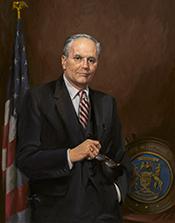
Mr. Chairman, I move to strike the requisite number of words. (Mr. DINGELL asked and was given permission to revise and extend his remarks.) Mr. Chairman, I begin by expressing my great affection and…
Mr. Chairman, I move to strike the requisite number of words.
(Mr. DINGELL asked and was given permission to revise and extend his remarks.)
Mr. Chairman, I begin by expressing my great affection and respect for the authors of this amendment. They are fine men. On substance, they are right. I agree with them on what it is they had to say.
But they ignore one basic fact; and I want to speak to my colleagues on this side of the aisle particularly, and that is that the perfect good is the enemy of the good.
If we want to get some relief and we want to see to it that we do something to protect diversity of broadcasting, support the committee bill as it now is; and I will tell my colleagues why.
Very shortly, my good friend, the gentleman from North Carolina (Mr. Burr), and I will be making a major effort to bring to the floor of the House a piece of legislation which will address much more than the 35 percent, 45 percent limit. If my colleagues want to effectively address that matter, then I urge them to vote against the Hinchey amendment, not because it is bad, but because it is counterproductive in terms of achieving the purpose that it seeks to produce, and the result will be that we will lose the effect of the Obey amendment in delaying the going into place of the provisions of the order of the FCC with regard to television.
I have a long history, I would tell my colleagues, of having opposed the attempts of the FCC to constantly expand the ownership and the control by
certain broadcasters of the media, the spectrum, and the minds of the public. This is bad. It is dangerous. But I would also tell my colleagues that if we want to do it, then we must do this thing right. The Obey amendment enables us to begin to put a hold on the unwise actions of the FCC and to move us forward towards accomplishing the purpose which we really have of seeing to it that the interests of all of the people in the great national resource, the spectrum, is protected for the benefit of all.
The amendment offered by my good friend, the gentleman from New York, will have the practical effect of driving away most of the supporters of this legislation, particularly those who are active in the industry. There are better than 600 local broadcasting stations which support this, including Cox, Hearst Argyle, and Post-Newsweek, because they recognize that this amendment is in the interests of diversity in the use of the spectrum. It is supported by Consumers Union, Common Cause, the Christian Coalition, the American Family Association, Morality in Media, the National Education Association, the National PTA, the National Association of Black-Owned Broadcasters, and Children Now.
I would remind my colleagues who are in such haste to address this to work with those of us who have dealt with these questions over the years; and I would remind them of the wonderful story that is told of the two bulls, the young bull and the old bull. The young bull said, there is a bunch of cows down at the bottom of the pasture; let us run down and get one. The old bull said, son, let us walk down and get them all.
My advice is, follow the distinguished gentleman from Wisconsin. Let us proceed in an orderly fashion. We have better than 170 sponsors on legislation that will really do the job. I urge my colleagues to support us so that we can address this matter in that way. That is the way that the matter should be dealt with. Let us get them all. Let us not lose because we have blown an opportunity because we overreached, we reached beyond our grasp, and we defeated ourselves by the enthusiastic desire to do good in a way which was counterproductive.
I say with regret and with respect and affection for my friend from New York, defeat the amendment. Let us go forward to a better conclusion to the problem by the device of passing real legislation later on. The best that the House can do today is simply to hold up through a 1-year limitation on expenditure in this legislation. My prayer to my colleagues is let us leave ourselves in a situation where we have a chance of winning and getting this through not only conference with the Senate, through the House, but also to address the practical problem of seeing to it that we get the bill signed into law.
Mr. Chairman, I urge the defeat of the Hinchey amendment.
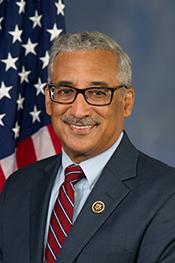
Mr. Speaker, I thank the gentleman for yielding time to me. Mr. Speaker, I come from a State that has a long tradition in supporting religious freedom. In fact, it was Thomas Jefferson who wrote the…
Mr. Speaker, I thank the gentleman for yielding time to me.
Mr. Speaker, I come from a State that has a long tradition in supporting religious freedom. In fact, it was Thomas Jefferson who wrote the Virginia statute for religious freedom which precedes the first amendment to our Constitution.
House Resolution 132 is totally gratuitous, as it will do nothing to change the underlying law. This is because we are dealing with constitutional issues that cannot be altered by resolution. If the judicial branch ultimately finds the Pledge or the motto to be constitutional, then nothing needs to be done; on the other hand, if the Court ultimately finds it to be unconstitutional, then no law that we pass can change that.
Mr. Speaker, I believe the reasoning of the majority opinion in the case was sound. In the case, the appellate court applied three different tests which have been applied in the last 50 years in Supreme Court jurisprudence in evaluating establishment clause cases. One test was whether the phrase ``under God'' in the Pledge constitutes an endorsement of religion. The majority opinion says that it was an endorsement of one view of religion, monotheism, and therefore was an unconstitutional endorsement.
Another test was whether individuals were coerced into being exposed to a religious message, and the majority concluded that the Pledge was unconstitutional because young children who are compelled to attend school ``may not be placed in the dilemma of either participating in a religious ceremony or protesting.''
Finally, the court applied the Lemon test, part of which holds that a law violates the Establishment Clause if it has no secular or nonreligious purpose. For example, cases involving a moment of public silence in public schools, some of those laws have been upheld if the law allows silent prayer as one of many activities which can be done in silence; but courts have stricken laws in which a moment of silent prayer is added to existing moments of silence because that law has no secular purpose.
The court concluded, if the 1954 law, which added ``under God'' to the existing Pledge, had no secular purpose, it was, therefore, unconstitutional.
It is interesting to note the reasoning of the dissent in the Newdow case. The important operative language in the dissent was the following: ``Legal world abstractions and ruminations aside, when all is said and done, the danger that `under God' in our Pledge of Allegiance will tend to bring about a theocracy or suppress someone's belief is so minuscule to be de minimis. The danger that the phrase represents to our first amendment's freedoms is picayune at best.''
Unfortunately, Mr. Speaker, our actions in enacting H. Res. 132 may cause the courts to review the sentiments behind ``one Nation, under God'' because, if the courts look at the importance we apparently affix to the phrase by passing yet another resolution before the judicial branch has even entered final judgment, this attention diminishes the argument that the phrase has de minimis meaning and increases the constitutional vulnerability of the use of that phrase in the Pledge. While one Federal appeals court rejected a call to rehear the controversial ruling that struck down the recitation of the Pledge due to its religious content, the fact remains that this issue is still alive and well; and every resolution we pass chips away at the de minimis argument.
Furthermore, Mr. Speaker, the court may look at this very resolution, understand the Lemon test, and find that today's exercise has no secular purpose and, therefore, adds to the constitutional vulnerability of the Pledge.
Finally, Mr. Speaker, to quote from an editorial that appeared in the Christian Century, a nondenominational Protestant weekly, puts this matter in perspective: ``To the extent `under God' has real religious meaning, then it is unconstitutional. The phrase is constitutional to the extent that it is religiously innocuous. Given that choice, I side with the Ninth Circuit. The government should not link religion and patriotism.''
Mr. Speaker, for those reasons I believe we should reject this resolution.
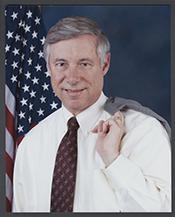
Mr. Chairman, I make a point of order. Mr. Chairman, on page 81, ``Federal Communications Commission, salaries and expenses,'' I believe that it is an authorization on an appropriations bill. It is…
Mr. Chairman, I make a point of order.
Mr. Chairman, on page 81, ``Federal Communications Commission, salaries and expenses,'' I believe that it is an authorization on an appropriations bill. It is not authorized.
Yes.
Mr. Chairman, will the gentleman yield?
No. I think enough has been said.
Mr. Chairman, the final proviso under the heading ``Federal Trade Commission salaries and expenses,'' page 84, line 15 through 85, line 3 of the bill violates clause 2 of rule XXI of the rules of the House prohibiting legislation on appropriations bills.
This provision bans commissioners and employees of the FTC to accept payment or reimbursement of a non-Federal entity for travel and related expenses, and would apply towards travel to a convention, conference, or meeting. The only exception provided for in the bill is if the person or corporation paying is an organization exempt from taxation pursuant to 501(c)(3) of the IRS code of 1986.
In short, this language clearly constitutes legislation on an appropriations bill in violation of clause 2, rule XXI of the rules of the House, because it changes current law, and I insist on my point of order.
Mr. Chairman, I move to strike the requisite number of words.
I too rise in strong opposition to the Hinchey amendment. I ask my colleagues about where they might have been in 1975. I know I had graduated from the University of Michigan and was on my way to Washington to work for a Congressman, David Stockman. Think about where you were, maybe sitting in your living room back in 1975. You might have been watching the ``Mod Squad'' for the first time or maybe the third season of ``M.A.S.H.'' In fact, someone told me that Strom Thurmond was only in his first or second term.
The original newspaper-broadcast ownership rules were adopted in 1975, at the same time when there was little cable penetration, if any, no local cable news channels, few broadcast stations, and no Internet. The rule was based on market structure that bears almost no resemblance to the current environment.
Without a doubt, there have been dramatic changes in the media marketplace since 1975 when the rule was adopted by the commission. When the rule was first adopted, there were 7,785 radio stations. There were 952 TV stations, three broadcast networks, cable television systems served 13 percent of television households, and direct broadcast satellite, DBS, providers were nonexistent, and the Internet was commercially not available.
Today, there are more radio stations, 12,900; 1,600 full-powered TV stations; 2300 low-powered TV stations; 230 Class A TV stations; four major broadcast networks, along with other emerging broadcast networks; and today, cable TV systems serve almost 80 percent of the television households across the country.
As required by law, the FCC factored the status of the current marketplace into the new rules. In addition to noting the dramatic transformation of the marketplace, it also noted that this type of business combination does advance the goals of localism and diversity.
A key study relied upon by the FCC for these rules found that broadcasters co-owned by newspaper companies provided more than 50 percent more local news and public affairs broadcasting of better quality than nonbroadcast network-owned stations, unaffiliated with a newspaper publisher.
I think about my own hometown. As I walk up to the post office in St. Joe, Michigan, there are almost a dozen different newspaper stands, whether it be the Wall Street Journal, the Detroit News, the Detroit Free Press, the local Herald Palladium, the South Bend Tribune, USA Today, and more. WGN owns the Chicago Tribune and Channel 9, which is broadcast over the air. The South Bend Tribune owns the local CBS affiliate in South Bend, Channel 22. The case has not been made that the local ownership has hurt the delivery of fair reporting by those news organizations.
The Hinchey amendment would take us back to 1975 when the media marketplace was a much different place. It is working today. I urge my colleagues to defeat the Hinchey amendment.
Show 11 more
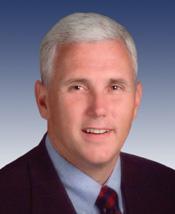
Mr. Chairman, as my colleagues are aware, I had an amendment that would have been considered today that I am also offering today as freestanding legislation regarding the United Nations Reassessment…
Mr. Chairman, as my colleagues are aware, I had an amendment that would have been considered today that I am also offering today as freestanding legislation regarding the United Nations Reassessment Act of 2003, which would call for a conclusion of Congress, a sense of Congress, that the representative of the United States to the U.N. would seek an agreement to lower the assessment level of the United States for the regular budget of the United Nations when the U.N. Committee on Contributions considers the scale of assessments for member nations for the period 2004 through 2006.
Many Americans may not be aware, Mr. Chairman, that the United States' today's current percentage assessment to the United Nations' regular budget contribution spans fully 22 percent of the overall fund. Germany, another member of the Security Council, pays 9.8 percent; France, 6.5 percent; and China, just 1.5 percent of the regular budget contributions.
As we look at the extraordinary percentage that American taxpayers pay in the regular budget contributions of the U.N., I think it is important that we reflect on the history of recent events and that we think carefully about the months immediately preceding Operation Iraqi Freedom.
Some, even on the floor of this Chamber, Mr. Chairman, have said that during that period of time the President failed to lead America. They have said that diplomacy failed. But I, and I believe many millions of Americans, Mr. Chairman, believe that in fact the U.N. failed at that critical moment in history, not so much to take the will of the American people seriously, as to take itself seriously. There are 16 separate resolutions of the United Nations, over a period of a decade, challenging and cajoling and urging and attempting to enforce the unanimous decisions of the U.N. Security Council against the nation of Iraq; and again and again and again, the United Nations failed to take itself seriously.
And then, last fall, the Security Council, including Germany and France and Russia, unanimously adopted U.N. Resolution 1441, which required that Iraq immediately disclose the possession of all weapons of mass destruction and armaments in violation of previous resolutions; also, that Iraq would not only disclose those armaments, Mr. Chairman, but would submit to the destruction of those armaments, or it would face what were described as ``serious consequences.''
When history beckoned, Mr. Chairman, the U.N. failed. And as a result, the United States of America was required to lead a coalition of the willing to depose this tyrant, the mass graves which in Iraq speak volumes about the rightness of our cause.
President Kennedy, in referring to the United Nations as our last best hope in an age where the instruments of war have far outpaced the instruments of peace, challenged America in his first inaugural address to pledge our support to prevent the United Nations from ``becoming merely a forum for invective.''
As I pursue this legislation today, apart from my amendment, I want to assure my colleagues that it will be my aim not that we would abandon the United Nations, but that we would choose the opportunity on this day and future days to send a message by sending less American taxpayer dollars to
the United Nations; to send a message that we expect more of the United Nations; to truly make it a place that is the last best hope for mankind and not, as President Kennedy so prophetically stated, a forum for invective against our people and our intentions as we strive to confront tyranny in the world.
I thank the chairman for yielding and allowing me to comment on the United Nations Reassessment Act, and I look very much forward to working with the committee and my colleagues as we reconsider what the American taxpayers are being asked to provide to an institution that so woefully failed history in these recent days.
Mr. Chairman, I move to strike the requisite number of words. (Mr. BURR asked and was given permission to revise and extend his remarks.) Mr. Chairman, I rise in opposition to the amendment. Clearly…
Mr. Chairman, I move to strike the requisite number of words.
(Mr. BURR asked and was given permission to revise and extend his remarks.)
Mr. Chairman, I rise in opposition to the amendment. Clearly this is an issue that probably deserves more debate than it will receive here. But I have also, like the gentleman from Virginia (Mr. Boucher), my good friend from the committee, want to go back to the past, 1995, when for the first time since 1935, we thought it was time to update our telecommunications laws in this country. Hard to believe that we could go for so long believing that technology or society did not force us to review it, but we learned then just how politically difficult change was.
We made some bold changes, and because of that many of us receive the benefits of it today. We now have almost unlimited channels on cable. It is new competition. We have an array of new products through telecommunications that are the direct result of 1995 and congressional action.
One additional piece of the 1996 Telecommunications Act, though, was that we mandated that the FCC every 2 years would look at it. We never wanted to play this catch-up game again.
Now, let me make this clear for my colleagues: In the current appropriations bill we have already rolled back from 45 to 35 the ownership cap. So the Hinchey amendment is not about 45 to 35. It is about everything else that was in the FCC rule. When we talk about cross-ownership, you need not look very far; as the gentleman from Florida (Mr. Stearns) said, there are 40 news companies that were grandfathered or received waivers that they concurrently have cross- ownership.
In Tampa, Florida, you can find an outlet where Media General owns a TV station and a newspaper. It is a model of what every other person who potentially gets into dual ownership should look like. It brings value to the community, and they have lived up to the waiver that they were granted. There are benefits to the FCC rule.
I believe that it was important, it was essential that we roll back from 45 to 35 the network ownership cap, if for no other reason than there was not a compelling reason on their part why it should be raised. But I felt strongly in 1995, when the gentleman from Massachusetts (Mr. Markey) and I came to this floor and, in partnership, we rolled it then from 50 percent out of committee back to 35 percent after the committee decided to raise it in 1996 Telecom Act from 25 to 35.
And it has worked pretty good. And the balance is correct. And we have got the right checks and balances between independent stations.
We spend a lot of time on the definition of localism. I have heard a lot of people mention localism today. I am not sure they had the in- depth debate that we did about what does it mean, really, localism.
Well, the independent stations have the ability, and we made sure in that act to look at the networks and say, I am not going to air that because there is no value to the community that I serve. If we tip the balance a little bit, will we dilute it enough that they will not have guts enough to do it? I believe so. But to get there, you cannot do it if you pass the Hinchey amendment.
I plead with my colleagues, if we want to roll back from 45 to 35, vote against the Hinchey amendment. The FCC does great work. It does not mean that we will always agree with everything they do. But understand that they have to do it because this Congress told them to do it every 2 years. They are obligated to review so that we do not wait 50 years again before we update our laws in this country as it relates to everything that they have oversight on.
Let me once again urge my colleagues, if Members support the rollback from 45 to 35, vote against the Hinchey amendment because it is a poison pill to our ability to maintain 35 percent for network ownership.
Mr. Speaker, I rise in opposition to this resolution. I rise in opposition because it is wrong in its principles, it is wrong on the stated findings, it is wrong on its facts. Let me just go through…
Mr. Speaker, I rise in opposition to this resolution. I rise in opposition because it is wrong in its principles, it is wrong on the stated findings, it is wrong on its facts. Let me just go through them.
First of all, people may very well, everybody has the freedom to disagree with a court decision. All of us have the right to get up and say that. I do not think it is the role of Congress to say that a court decision is wrong. If we disagree as a body with a court decision, then pass a law if it is a question of statutory interpretation, or propose a constitutional amendment if it is a question of constitutional interpretation. That is our role.
The role of the judiciary is, to quote Chief Justice Marshall, to say what the law is. They say what the law is, and we say what the law should be. It is not our role to tell the court it is wrong; it is our role to change the law if we think so. To pass a resolution which has no power except perhaps the power to intimidate judges is wrong and a violation of our constitutional role.
Secondly, this states as fact that recitation of the Pledge of Allegiance to the flag, including the phrase ``one Nation under God,'' is a patriotic act, not an act or statement of religious faith or belief. It certainly is a patriotic act, but it certainly is a statement of religious faith and belief when you say ``one Nation under God.''
The only way you can get around that conclusion is to say, as the dissenting opinion in the court said, that the phrase ``under God'' is minor, it is de minimis, it does not mean anything. But that is a sacrilege. Since when is God minor? Are we really going to say in this Chamber that God is minor; that belief in God is a minor question, so minor as to not to be worthy of notice?
That is the only ground on which we could say that asking schoolchildren, in the context of a group recitation of a pledge in a classroom, is not a prayer and an affirmation of belief and a religious conviction. To say that God is minor and ``under God'' means nothing, I do not think we want to say that. I certainly hope we do not want to say that. Yet, if we say it means something, then the Pledge of Allegiance with that phrase in it is a statement of a religious belief, or at least a statement of a belief in God.
There are religions in this country, Shintoism, Hinduism, that do not believe in one God. There are people who are atheists. It is factually a wrong statement. It says, as a statement of fact, that the court's ruling in this case is inconsistent with the Supreme Court's interpretation of the first amendment. That is demonstrably wrong, and the Supreme Court will say so.
First, the Supreme Court for the last 40 years in its jurisprudence on school prayers has said that we cannot ask schoolchildren to recite a prayer or a belief in God in the classroom setting, even if we allow the dissenters to walk out of the room; but that is exactly what asking them to say the Pledge of Allegiance with that phrase ``under God'' is. It is exactly consistent with the Supreme Court's last 40 years of jurisprudence and rulings on the school prayer cases. It is, in effect, the school prayer, that as long as you ask schoolchildren to say ``one Nation under God.'' It has all the same pros and cons; and many disagree with the Supreme Court's decisions, but those were its decisions.
In the name of religious liberty, in the name of the separation of powers, in the name of religion, to say that God is not minor, we ought not to pass this resolution and let the Supreme Court uphold or overturn the Court of Appeals decision in Newdow. After that we can worry about a constitutional amendment, which I would propose, and some Members may want to propose. But at this point it is not our function to be correcting a court.
Mr. Chairman, I offer an amendment. Mr. Chairman, on June 26, 2002, in Newdow v. U.S. Congress, a three-member panel of the Ninth U.S. Circuit Court of Appeals ruled that a California school…
Mr. Chairman, I offer an amendment.
Mr. Chairman, on June 26, 2002, in Newdow v. U.S. Congress, a three-member panel of the Ninth U.S. Circuit Court of Appeals ruled that a California school district's policy and practice of voluntary recitation of the Pledge of Allegiance was unconstitutional claiming that the use of the phrase ``one nation, under God'' violates the establishment clause of the first amendment to the Constitution. In February of this year, the Ninth Circuit, the full Ninth Circuit effectively upheld the decision of the three-judge panel.
Mr. Chairman, the founders of the United States set up a brilliant system of government consisting of three separate branches with unambiguous roles. The Congress legislates, the President executes, and the courts judge. However, as in any organization of institutions with potentially competing interests, one institution would be constructed to be the weakest. Alexander Hamilton made it very clear that the framers had relegated the judiciary to this distinction when he said in Federalist No. 78: ``It proves incontestably that the judiciary is, beyond comparison, the weakest of the three departments of power and it proves that as from the natural feebleness of the judiciary, it is in continual jeopardy of being overpowered, awed or influenced by its coordinate branches.''
Hamilton laid out how practically this so-called feebleness manifests itself under what he referred to as the ``plan of the convention,'' or what we call today the Constitution of the United States of America, when he said once again in Federalist No. 78: ``The judiciary has no influence over either the sword or the purse, no direction either of the strength or of the wealth of the society and can take no active resolution whatever.
``It may truly be said to have neither force nor will, but merely judgment, and must ultimately depend upon the aid of the executive arm for the efficacy of its judgments.''
As Hamilton pointed out, the legislative branch controls the purse strings of this government, and the plan of the Convention set that out in article 1, section 9, when the Constitution states: ``No money shall be drawn from the Treasury but in consequence of appropriations made by law,'' which is the case for our being here today, Mr. Chairman.
When the legislative branch, that is, the Congress, believes the judicial branch to be in error, the Congress may refuse to fund actions to enforce the court's judgment by the executive branch agency that would execute those judgments or, in Hamilton's words, ``depend on the arm of the executive for the efficacy of its judgments.''
Specifically, the U.S. Marshals Service, an agency of the Department of Justice, executes and enforces all lawful writs, processes, and orders of the U.S. district courts, the U.S. courts of appeal, and the Court of International Trade, according to 28 U.S.C. 566(C), and I highlight that it enforces all lawful writs, orders, and processes.
I, Mr. Chairman, along with many of my fellow Members of Congress, believe the judgment in Newdow v. U.S. Congress to be in error. This was evidenced by the overwhelming support of H. Res. 132 on March 12, 2003. This resolution expressed the sense of the House of Representatives that the Newdow ruling is inconsistent with the first amendment and should be overturned. That is why, Mr. Chairman, I am offering this amendment to the FY 2004 Departments of Commerce, Justice, and State, the Judiciary, and Related Agencies Appropriations Act.
Mr. Chairman, I ask that my colleagues would say ``no'' to the decision of the Ninth Circuit Court of Appeals and support my amendment to stop the enforcement of that ludicrous decision.
Mr. Chairman, I demand a recorded vote.
Mr. Speaker, I rise in support of House Resolution 132 expressing the sense of the House that the Ninth Circuit Court of Appeals ruling in Newdow v. United States Congress is inconsistent with the…
Mr. Speaker, I rise in support of House Resolution 132 expressing the sense of the House that the Ninth Circuit Court of Appeals ruling in Newdow v. United States Congress is inconsistent with the Supreme Court's interpretation of the first amendment.
It is clear that the ninth circuit's amended Newdow ruling contradicts any reasonable interpretation of the first amendment. In a long line of cases, the Supreme Court has interpreted the establishment clause as prohibiting not only compelled participation in religious activity in public schools, but even voluntary religious devotional activity if, under the circumstances, children feel coerced to participate.
These cases, however, were based upon the fact that the activity at issue involved compelled participation in prayers and devotional exercises, as in the cases of School District of Abington Township v. Schemp and Engle v. Vitale; or the practice of graduation prayers at issue in Lee v. Weisman.
In fact, the questionable activity in these cases occurred either just before or just after the recitation of the Pledge. In its review of these cases, however, the court not only failed to question the practice of the voluntary recitation of the Pledge by schoolchildren, but instead explicitly limited its holding to the prayer or devotional exercise.
To have applied these cases to the facts in the Newdow case was incorrect because the Pledge is clearly not a religious statement or prayer; thus, its recitation is not a religious exercise. It is a historical fact that our Nation's founding principles were based upon the Founding Fathers' deeply held religious views. The Pledge of Allegiance simply refers to this fact.
The reasoning and holding of the ninth circuit in Newdow turns historical fact, as well as Supreme Court precedent, on its head. Either the judges were incapable or were unwilling to make this distinction.
Those who do not share the beliefs expressed in the Pledge or those who do not wish to pledge allegiance to the flag have a right to refrain from its recitation. This was recognized by the Supreme Court in the 1943 case of West Virginia Board of Education v. Barnett, in which the mandatory recitation of the Pledge of Allegiance was held unconstitutional under the first amendment's free speech clause.
Indeed, it is a cornerstone of the religious faith that the Founding Fathers held dear that no man can force another to say or believe that which their conscience will not allow. I would hope that no court would issue a ruling that tramples upon this right. However, the ninth circuit in Newdow simply ignored Supreme Court precedent and essentially gave those who do not wish to recite the Pledge, and who possess the right to refrain from reciting the Pledge, a heckler's veto over those who do wish to recite the Pledge.
This ruling also places the ninth circuit in direct conflict with the Seventh Circuit Court of Appeals which, in Sherman v. Community Consolidated School District, held that a school district's policy allowing for the voluntary recitation of the Pledge of Allegiance in public schools does not violate the establishment clause of the first amendment.
I believe that this clearly incorrect first amendment interpretation, as well as the split in the circuits created by the Newdow ruling, warrants an appeal by the Attorney General and Supreme Court review.
I urge my colleagues to approve this resolution so, during this time of international conflict in which our young men and women may be hours away from going to war to fight for those values based upon which our Founding Fathers gave birth to this very Nation, our youngest Americans, our children, may pledge their allegiance to those same values.
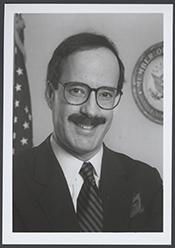
Mr. Chairman, will the gentleman yield? Mr. Chairman, I absolutely agree with everything the gentleman from Vermont said. I support what he is trying to do about the PATRIOT Act. I do not very often…
Mr. Chairman, will the gentleman yield?
Mr. Chairman, I absolutely agree with everything the gentleman from Vermont said. I support what he is trying to do about the PATRIOT Act.
I do not very often get up to complain about procedure here, but I want to just express my frustration in being a member of the Committee on Energy and Commerce, the authorizing committee. I had an amendment that I was going to introduce. As of 8 p.m. last night, we did not see a bill, so there was no way we could draft the amendment. And then this morning, with the UC agreed to, it effectively cut out members of the Committee on Energy and Commerce that had a bill that deals with our committee that had an amendment.
I just find it very, very frustrating that this UC was done, and had I been on the floor I would have objected.
Mr. Chairman, I thank my friend from New York (Mr. Serrano) for yielding to me and at least giving me the opportunity to air my amendment and some of the grievances.
As I said before, I have no desire to frustrate colleagues; but a lot of us here are very frustrated over the quick change that was made with the unanimous consent and our inability now even to ask to strike the last word. The gentleman from New York (Mr. Serrano) is one of my best friends. We have served together. We come from the same town.
I just want to say that my frustration is that last night at 8 p.m. this bill had not been introduced. A copy was not available to start the process of review or drafting of amendments. This morning we had the text of the bill on line, but not the accompanying report. And now we have a unanimous consent to limit amendments to ones that were preprinted in the Record, which for Members not on Appropriations is impossible, unless it is a simple limitation or ``to strike'' amendment.
I have an amendment which would move money from the National Telecommunication and Information Administration to the Public Telecommunication Facilities, Planning and Construction Program, which is called TFPC. Both of these are under the jurisdiction of the Subcommittee on Telecommunications and the Internet of the Committee on Energy and Commerce, on which I sit. As a courtesy to the authorizing committee members, I believe we should have an opportunity to review the bill and offer amendments.
Even more troubling is that the Committee on Appropriations has provided $1.3 million more for NTIA than the President requested, while cutting PFTP by $40 million.
My amendment would simply move $1,310,000 to the PFTP from the NTIA. And I think the whole House should have an opportunity to vote on what the priorities for funding in this bill are.
I feel very strongly about public television. That is what my amendment would have done. I would like to have had the opportunity to be able to voice that and to have a vote. That is not going to happen; and in a desire for expediency, we have thwarted the democratic process. I share the frustration of my colleague from Vermont and other colleagues who do not have the opportunity.
Again, as a member of the authorizing committee, the Committee on Energy and Commerce, I believe that what went on here was wrong and should not happen again.
I thank the gentleman from New York (Mr. Serrano) for giving me the ability to voice these problems on the House floor, and I would hope that as we negotiate this bill and continue to negotiate with the other House and the bill comes back that we will increase money for public television, we will increase money for the PFTP. And I would hope that on both sides of the aisle they look at that and can find more money for the very worthwhile programs of public television. I thank my colleague.
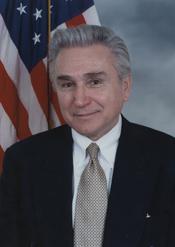
Mr. Chairman, I offer an amendment. Mr. Chairman, this government, our government, derives its just power from the consent of the governed. Those words form the basic founding principle of this…
Mr. Chairman, I offer an amendment.
Mr. Chairman, this government, our government, derives its just power from the consent of the governed. Those words form the basic founding principle of this Nation: The government derives its just powers from the consent of the governed.
But in order for the governed to give their consent, they must be informed. It must be not an ignorant consent. It must be an informed consent. It must be a consent based on knowledge and accurate information and a multiplicity of voices and the opportunity for everyone to be heard. The marketplace of ideas in this country shall not be shut down. Otherwise, we lose the basic founding principle of our country.
But, unfortunately, the Federal Communications Commission in its decision on June 2 has gone a long way to doing precisely that, shutting down the marketplace of ideas. What they did was to weaken the rules governing cross-ownership of the media, newspapers, television, radio. What the FCC has done very quietly without any public hearings outside of Washington except for one, which they held in Richmond, Virginia, they have passed a rule which will shut down the ability for people to understand what is going on in this country.
We need to restore the previous rules, and we have an opportunity in this bill, through this amendment, to do precisely that in the next fiscal year. Restoring the previous rules is essential to preserving localism, diversity, and competition in our airwaves, standards that are needed for a vibrant democratic republic.
The FCC's decision, if we allow it to go forward, will permit one company to own the local newspaper, local television station, including the most popular, and several of the top local radio stations in any single market. It paves the way for one company to dominate a local community's flow of information.
The rule change makes it much more likely that a company based hundreds or even thousands of miles away will control a community's information and whatever information gets into that community.
Only large companies have the resources to purchase and operate a newspaper, TV stations, and radio stations. Competition, diversity of voices, and local control are at stake if this rule is allowed to stand.
The FCC's decision will allow broadcast television to be highly concentrated in the vast majority of markets as defined by the Merger Guidelines of the U.S. Department of Justice and the Federal Trade Commission.
Before the FCC changed the rules, one company could own two TV stations, or duopolies, in a single market as long as at least eight independent voices remained. This restricted duopolies to sizable markets. If the new rules are allowed, 95 percent of Americans could see duopolies in their media markets. These changes will greatly reduce the number of independent and local voices, and in many instances they will completely eliminate those independent voices. Democracy requires the widest possible dissemination of information, yet these new rules will restrict access to diverse voices.
This amendment that is offered by myself, the gentleman from North Carolina (Mr. Price) and the gentleman from Washington (Mr. Inslee) would prevent the FCC from implementing its misguided decision and would leave in place the media ownership rules that have protected localism, diversity, and competition in our media, as well as preserving the basic principles of this democratic republic. We have an opportunity here to correct a mistake, a huge bureaucratic error, that works against the best interests of the vast majority of the people in this country.
I offer this amendment, and I ask for the Members' support.

Mr. Chairman, this Member rises to express his support for H.R. 2799, a bill making appropriations for the Departments of Commerce, Justice, State and the Judiciary for FY 2004. In particular, this…
Mr. Chairman, this Member rises to express his support for H.R. 2799, a bill making appropriations for the Departments of Commerce, Justice, State and the Judiciary for FY 2004. In particular, this Member would like to thank the distinguished gentleman from Virginia (Mr. Wolf), Chairman of the Subcommittee and the distinguished gentleman from New York (Mr. Serrano) for their hard work under difficult budget circumstances.
As a member of the House Caucus to Fight and Control Methamphetamine, this Member strongly supports the inclusion of $60 million for Methamphetamine Enforcement and Clean-Up, otherwise known as the ``hot spots'' program. These funds are critical in State and local efforts to combat the scourge of methamphetamine that is sweeping across our country.
This Member also appreciates the Subcommittee's commitment to Nebraska's efforts to fight a growing plague in Nebraska--the manufacture, trafficking and abuse of methamphetamine. The Nebraska State Patrol will continue the work began with the $500,000 appropriation from FY 2003, with an emphasis on funding for the cleanup of clandestine labs. In 1999, approximately 37 labs were discovered in Nebraska. By 2002, the problem had increased exponentially to 372 which in turn has placed a huge burden on Nebraska law enforcement. The Nebraska State Patrol will also use the funds for the State crime lab to investigate methamphetamine cases and to continue a drug treatment program for methamphetamine addicts.
Furthermore, this Member is pleased that $615 million is included in the bill for the popular and vital Byrne grant program. This appropriation is a top priority for Nebraska law enforcement. The Byrne grant program is critical in crime fighting efforts--and especially helpful to Nebraska law enforcement in fighting crimes related to drug use. Clearly, methamphetamine alone is the driving force behind the increase in crime in Nebraska.
The bill also includes important funds for the Juvenile Accountability Block Grants (JAIBG). These funds have been used throughout the State, and specifically assisted Douglas, Sarpy, and Lancaster counties in developing juvenile drug courts. Almost 50 young people have graduated from the drug courts over the last two years. In addition, Douglas and Lancaster counties have also utilized funds to develop computerized information systems and local graduated sanctions programs.
An additional program of importance to Nebraska law enforcement is the Regional Information Sharing Systems (RISS) program. This Member is pleased that funds are provided for this program. Nebraska is part of the regional Mid-States Organized Crime Information Center (MOCIC). The RISS program provides Nebraska law enforcement with a secure nationwide state-of-the-art information sharing system that uses web technology, allowing officers to access criminal activity information around the country in real time. Additional services include, but are not limited to, analytical assistance, high-tech surveillance equipment loans, intelligence publications, investigative funds, computer forensics and specialized training. As members of the MOCIC, many law enforcement agencies in Nebraska are able to share critical crime-fighting information that these agencies would otherwise not be able to access. As today's criminals become more mobile and technologically advanced, law enforcement's demands for RISS services continues to grow.
Mr. Chairman, in conclusion, this Member urges his colleagues to support H.R. 2799.
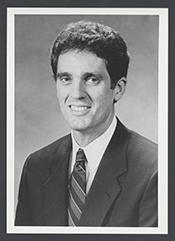
Mr. Chairman, I offer an amendment. Mr. Chairman, technology proceeds at a rapid rate, bringing great benefits to humankind from treatments of disease to greater wealth and greater knowledge of our…
Mr. Chairman, I offer an amendment.
Mr. Chairman, technology proceeds at a rapid rate, bringing great benefits to humankind from treatments of disease to greater wealth and greater knowledge of our world. However, sometimes technology can be used to undermine what is meant to be human, including the exploitation of human nature for the purpose of financial gain.
Several weeks ago, at a meeting of the European Society of Human Reproduction and Embryology in Madrid, Spain, it was reported that scientists had created the first male-female hybrid human embryos. The researchers transplanted cells from male embryos into female embryos and allowed them to grow for 6 days. This research was universally condemned as unnecessary and unethical.
Reuters reported that one member of the European Society condemned this research, saying there are very good reasons why this type of research is generally rejected by the international research community. Furthermore, the scientists who created these she-male embryos reportedly want to patent this research.
It is important that we, as a civilized society, draw the line where some rogue scientists fail to exercise restraint. Just because something can be done does not mean that it should be done. A patent on such human organisms would last for 20 years. We should not allow such researchers to gain financially by granting them an exclusive right to practice such ghoulish research.
Long-standing American patent and trademark policy states that human beings at any stage of development are not patentable, subject to matters under 35 U.S.C. section 101. Though current policy would not issue patents on human embryos, Congress has remained silent on this subject. Though this amendment would not actually ban this practice, it is about time that Congress should simply reaffirm current U.S. patent policy and ensure there is not financial gain or ownership of human beings by those who engage in these activities.
This amendment simply mirrors the current patent policy concerning patenting humans. The Patent Office has, since 1980, issued hundreds of patents on living subject matter, from microorganisms to nonhuman animals. It does not issue patents on human beings nor should it. Congress should reaffirm this policy, and this amendment simply accomplishes this by restricting funds for issuing patents on human embryos, human organisms.
Congress should speak out, and I encourage my colleagues to support this amendment.
I would like to add, Mr. Chairman, that this has no bearing on stem cell research or patenting genes, it only affects patenting human organisms, human embryos, human fetuses or human beings.
I yield to the gentleman from Wisconsin.
Reclaiming my time, Mr. Chairman, I would respond that, no, it would not. And I recognize that there are many institutions, particularly in Wisconsin, that have extensive patents on human genes, human stem cells. This would not affect any of those current existing patents.
The Patent Office policy is not to issue these patents, and there never has been one. The Congress has been silent on this issue. I am trying to put us on record that we support the Patent Office in this position that human life in any form should not be patentable.
Mr. Chairman, I yield back the balance of my time.
Mr. Chairman, I rise to state my disappointment with and strong opposition to this bill. It is one thing to make government more lean; it is another thing to cut jobs year in and year out at…
Mr. Chairman, I rise to state my disappointment with and strong opposition to this bill.
It is one thing to make government more lean; it is another thing to cut jobs year in and year out at facilities all over the country--not because there is fat to cut at these facilities, but because the Subcommittee allocation simply doesn't provide enough money to go around.
Under the bill as it stands, important scientific facilities in my district in Colorado--the National Institute of Standards and Technology and the National Oceanic and Atmospheric Administration-- will see approximately 200 jobs lost, maybe more. NOAA's labs in Boulder will see a cut of 40 percent in funding in FY2004--that's nearly cutting its budget by half in one year! I don't have as precise information on NIST, but I am told NIST stands to lose roughly 300 jobs between its labs in Maryland and Colorado--fully 10 percent of its staff.
The bill doesn't fund mandatory cost-of-living increases for both NIST and NOAA--so funds for these increases come out of programs and out of the salaries of workers who are left without jobs. Further, the bill does not include funding for safety, maintenance and major repairs required at NIST's campus in Colorado. Without quality laboratory facilities, NIST cannot provide the standards and measurement support industry requires. The bill includes just two-thirds of base funds for NOAA's Space Environment Center in Colorado, which suffered similar shortfalls last year.
Perhaps most insulting of all--the bill would provide no funds for NOAA's facility in Colorado to pay its $4.5 million in rent. Conferees cut out funding for the rent in last year's bill at the last minute-- which is maybe more understandable, as we all know that sometimes odd things happen in conference in the middle of the night. But this cut is far more egregious. It is one thing when programs are trimmed back--it is another when cuts in a bill literally take the clothes off our employees' backs. NOAA is a Federal agency. How can the Federal Government not pay its rent? How is NOAA supposed to meet this shortfall? Its workload remains the same, but NOAA's resources and workforce are getting progressively smaller.
I thought our goal is to create jobs! This bill will put hundreds of Federal employees out of work!
And the bill hurts the private sector too. It cuts by two-thirds the Manufacturing Extension Program, which assists thousands of small and medium-sized manufacturers across this country. This bill entirely eliminates the Advanced Technology Program, which helps small high-tech start-up companies bring research results to the proof-of-concept stage.
With manufacturing jobs being lost every month and high-tech companies struggling, now is not the time to turn our backs on the manufacturing community and our small high-tech entrepreneurs.
So, Mr. Chairman, I must completely oppose this bill. Unless the bill is greatly improved in conference, it will continue a pattern of bleeding these agencies dry--agencies that do so much to support our Nation's economy and the public's well-being. As the bill stands, it does not deserve the approval of the House.
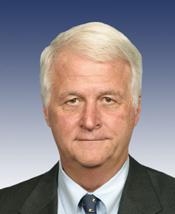
Mr. Speaker, I yield myself such time as I may consume. Mr. Speaker, judges certainly should not be immune from criticism. I mean, healthy debate on the merits of judicial decisions is an important…
Mr. Speaker, I yield myself such time as I may consume.
Mr. Speaker, judges certainly should not be immune from criticism. I mean, healthy debate on the merits of judicial decisions is an important feature of our democracy. But there is a difference between legitimate criticism and overt pressure that threatens judicial independence.
Like all Americans, Members of Congress are free to criticize judicial decisions with which we disagree. Our collective voice should be heard on matters of profound constitutional significance as we, too, are guardians of the Constitution. In fact, I joined most of my colleagues in voting for a resolution during the last Congress that was referenced by the chairman that expressed disapproval of this very decision on the Pledge of Allegiance and urged that it be overturned.
However, I intend to vote present on this current resolution because it does not stop at expressing disapproval; it goes further, in a way that I believe would set an unwise and dangerous precedent.
It is one thing to urge the judicial branch to use the normal process of appellate review to correct an erroneous decision. It is quite another to imply that judges who issue unpopular decisions in particular cases are unfit for office.
Unfortunately, that is what H.R. 132 does. It not only expresses disapproval of the court's reasoning in the Newdow case, but it states that the President should nominate and the Senate should confirm Federal circuit court judges who interpret the Constitution consistent with the Constitution's text.
By linking future nominations to a particular ruling with which the proponents disagree, the resolution sends a not-so-subtle message to sitting judges, and in particular to potential nominees, that they had better tailor their constitutional views to those of the congressional majority if they wish to be confirmed. That, I submit, goes far beyond our appropriate constitutional role.
The Framers of the Constitution recognized that an independent judicial branch is an essential guarantor of liberty in any democracy. To understand this, one need only observe those nations with a weak judiciary that is subservient to the political branches. Invariably such nations are democracies in name only. Those who profess fidelity to the Constitution must take
great care not to chip away at the independence of the judiciary on which our liberty depends. For that reason, this resolution ought to be rejected.
Mr. Speaker, I reserve the balance of my time.
Mr. Speaker, I yield such time as he may consume to the gentleman from New York (Mr. Nadler).
Mr. Speaker, I yield 5 minutes to the gentleman from Virginia (Mr. Scott), a member of the Committee.
Mr. Speaker, I yield 5 minutes to the gentlewoman from Texas (Ms. Jackson-Lee), a member of the Committee on the Judiciary.
(Ms. JACKSON-LEE of Texas asked and was given permission to revise and extend her remarks.)
Mr. Speaker, I have no additional speakers, and I reserve the balance of my time.
Mr. Speaker, I yield back the balance of my time.
Bill Text
3 versions available
        [Congressional Bills 108th Congress]
[From the U.S. Government Publishing Office]
[H. Res. 132 Engrossed in House (EH)]

In the House of Representatives, U.S.,

March 20, 2003.
Whereas on June 26, 2002, the Ninth Circuit Court of Appeals, in Newdow v.
United States Congress (292 F.3d 597; 9th Cir. 2002) (Newdow I), held
that the Pledge of Allegiance to the Flag as currently written to
include the phrase, ``one Nation, under God'', unconstitutionally
endorses religion, that such phrase was added to the pledge in 1954 only
to advance religion in violation of the establishment clause, and that
the recitation of the pledge in public schools at the start of every
school day coerces students who choose not to recite the pledge into
participating in a religious exercise in violation of the establishment
clause of the first amendment;
Whereas on February 28, 2003, the Ninth Circuit Court of Appeals amended its
ruling in this case, and held (in Newdow II) that a California public
school district's policy of opening each school day with the voluntary
recitation of the Pledge of Allegiance to the Flag ``impermissibly
coerces a religious act'' on the part of those students who choose not
to recite the pledge and thus violates the establishment clause of the
first amendment;
Whereas the ninth circuit's ruling in Newdow II contradicts the clear
implication of the holdings in various Supreme Court cases, and the
spirit of numerous other Supreme Court cases in which members of the
Court have explicitly stated, that the voluntary recitation of the
Pledge of Allegiance to the Flag is consistent with the first amendment;
Whereas the phrase, ``one Nation, under God'', as included in the Pledge of
Allegiance to the Flag, reflects the notion that the Nation's founding
was largely motivated by and inspired by the Founding Fathers' religious
beliefs;
Whereas the Pledge of Allegiance to the Flag is not a prayer or statement of
religious faith, and its recitation is not a religious exercise, but
rather, it is a patriotic exercise in which one expresses support for
the United States and pledges allegiance to the flag, the principles for
which the flag stands, and the Nation;
Whereas the House of Representatives recognizes the right of those who do not
share the beliefs expressed in the pledge or who do not wish to pledge
allegiance to the flag to refrain from its recitation;
Whereas the effect of the ninth circuit's ruling in Newdow II will prohibit the
recitation of the pledge at every public school in 9 states, schooling
over 9.6 million students, and could lead to the prohibition of, or
severe restrictions on, other voluntary speech containing religious
references in these classrooms;
Whereas rather than promoting neutrality on the question of religious belief,
this decision requires public school districts to adopt a preference
against speech containing religious references;
Whereas the constitutionality of the voluntary recitation by public school
students of numerous historical and founding documents, such as the
Declaration of Independence, the Constitution, and the Gettysburg
Address, has been placed into serious doubt by the ninth circuit's
decision in Newdow II;
Whereas the ninth circuit's interpretation of the first amendment in Newdow II
is clearly inconsistent with the Founders' vision of the establishment
clause and the free exercise clause of the first amendment, Supreme
Court precedent interpreting the first amendment, and any reasonable
interpretation of the first amendment;
Whereas this decision places the ninth circuit in direct conflict with the
Seventh Circuit Court of Appeals which, in Sherman v. Community
Consolidated School District (980 F.2d 437; 7th Cir. 1992), held that a
school district's policy allowing for the voluntary recitation of the
Pledge of Allegiance to the Flag in public schools does not violate the
establishment clause of the first amendment;
Whereas Congress has consistently supported the Pledge of Allegiance to the Flag
by starting each session with its recitation;
Whereas the House of Representatives reaffirmed support for the Pledge of
Allegiance to the Flag in the 107th Congress by adopting House
Resolution 459 on June 26, 2002, by a vote of 416-3; and
Whereas the Senate reaffirmed support for the Pledge of Allegiance to the Flag
in the 107th Congress by adopting Senate Resolution 292 on June 26,
2002, by a vote of 99-0: Now, therefore, be it
Resolved, That it is the sense of the House of Representatives that--
(1) the phrase ``one Nation, under God,'' in the Pledge of
Allegiance to the Flag reflects that religious faith was central to the
Founding Fathers and thus to the founding of the Nation;
(2) the recitation of the Pledge of Allegiance to the Flag,
including the phrase, ``one Nation, under God,'' is a patriotic act, not
an act or statement of religious faith or belief;
(3) the phrase ``one Nation, under God'' should remain in the Pledge
of Allegiance to the Flag and the practice of voluntarily reciting the
pledge in public school classrooms should not only continue but should
be encouraged by the policies of Congress, the various States,
municipalities, and public school officials;
(4) despite being the school district where the legal challenge to
the pledge originated, the Elk Grove Unified School District in Elk
Grove, California, should be recognized and commended for their
continued support of the Pledge of Allegiance to the Flag;
(5) the Ninth Circuit Court of Appeals ruling in Newdow v. United
States Congress has created a split among the circuit courts, and is
inconsistent with the Supreme Court's interpretation of the first
amendment, which indicates that the voluntary recitation of the pledge
and similar patriotic expressions is consistent with the first
amendment;
(6) the Attorney General should appeal the ruling in Newdow v.
United States Congress, and the Supreme Court should review this ruling
in order to correct this constitutionally infirm and historically
incorrect holding; and
(7) the President should nominate and the Senate should confirm
Federal circuit court judges who interpret the Constitution consistent
with the Constitution's text.
Attest:

Clerk.