Madam Speaker, while the Nation has been watching the Presidential campaign and the events in Iraq, the Republicans in the House have been moving forward with an agenda to bring jobs back into…
Madam Speaker, while the Nation has been watching the Presidential campaign and the events in Iraq, the Republicans in the House have been moving forward with an agenda to bring jobs back into America.
Now, we have seen a lot of economic success over the last year. Just as a reminder, back in 1999 we had the first hit to our then strong economy when we had the tech bubble burst. We had a lot of technical industries lose a great deal of value. The NASDAQ, which typically has tech companies as the companies that trade on that exchange, the value of that exchange dropped dramatically to less than half. So the tech bubble burst.
Then in 2000 we had the beginning of the recession towards the end of the year. Technically, it started in the end of 2000 prior to President Bush being sworn into office. That had an impact on our economy.
Then, of course, there was the events of September 11, when terrorists took our own technology and turned it into a weapon and attacked the Pentagon and Washington, D.C., and tore down the World Trade Center, killing nearly 3,000 people. That had a dramatic impact on our economy.
It was not any policy of the Republican administration. It was not any policies that came out of the Republican House. It was events that occurred, as I just discussed, beyond the circumstances of Congress. Those events, though, have turned around since we passed tax relief.
Tax relief has been very beneficial to the American economy because people can only do one of three things when
they get a little money in their pocket through tax relief.
Number one, they can spend it. When they spend money, that is a demand for goods. That means there are more goods being sold in the economy and a demand for more jobs.
Number two, they can save the money. That makes money available for home mortgages. And, as we know, now we have the largest expansion of home sales we have ever had in our economy; and now minorities in America have a higher percentage of home ownership than ever before in the history of our Nation. If they save money, that is good for building homes.
Third, they can invest money into the stock market, which is capital for companies to invest in their business to hire more people and invest in jobs.
So after the President asked for tax relief and it was initiated in the House of Representatives and then passed to his desk for his signature, we started to see a turnaround in the United States economy. We have had 1.5 million new jobs since last August. We have today more people working in America than ever before in our Nation's history, and the average salary for all workers in America is higher than it has ever been in the history of our country.
So this has been very good for our economy to have tax relief, and we are starting to see the strength of our economy growing and blooming. And yet with all that good news, we can do better. We found out that there have been problems, barriers to bringing jobs into America. These barriers were not created in the boardrooms of America. They were not created by the CEOs of America or the managers or owners of small business, and it was not created by the employees themselves, either.
These barriers have been created by Congress over the last generation. Good intentions found their way into regulations and laws that have hurt our economy and prevented us from bringing jobs back into America. So the House Republicans have devised a plan called Careers for the 21st Century. That plan is a plan to remove the barriers that employees and small businessmen and employees, employers, both, face every day they go to work.
We are going to try to remove those barriers. In fact, we have been very active. As of today, we have passed 24 pieces of legislation from the House of Representatives. We have started with taking these eight issues that are barriers, divided into eight issues the barriers, and then we took them a week at a time.
We started out by addressing health care security. We passed legislation that will help reduce the cost of health care in America by some common-sense reforms.
We then moved on to reduce the bureaucratic red tape in America. We made significant progress.
We then went on to life-long learning so we would have an experienced and well-trained workforce so when these jobs came to America we would have people to take those jobs.
The next week we went on to energy self-sufficiency. It is very important and appropriate, because we are now facing close to $2 a gallon for gasoline, and we are having high cost for natural gas. It is time we change our energy policy so we can create about 7 or 800,000 jobs in America, plus bring down the cost of energy, and that in turn will allow us to attract more jobs into America. So we passed energy self-sufficiency and security.
We then moved on to spurring innovation and talked about how important it is to have solid research and development and how important it is to be innovative here in America. We have a long history of innovation that starts back during the Revolutionary War. The idea of the principles, the virtues, the values we have in this country enhance our ability to come up with good ideas and take those good ideas and put them into practice by manufacturing goods and selling those goods both here and overseas. It is these virtues and values we talked about and how we can continue to spur innovation through research and development.
This week we dealt with trade fairness and opportunity, very important issues as far as opening up new markets so that we can create more jobs by exporting.
Then we will go on next week to tax relief and simplification. Tax relief is so important, but simplification is also important. It helps us do the job more quickly and not waste money on preparing taxes. That money can be diverted to creating more jobs.
We will then come back in September and deal with Indian lawsuit abuse.
Going back to trade fairness and opportunity, why is it so important for us to address this issue? If you look at the recent history in this country, we have had lot of problems in opening up markets overseas. If you look at the trade agreements that we have had recently, it was during the Reagan administration that we finally got a free trade agreement with Israel back in 1985. Then we did not have any agreement until we finally got an agreement with Canada in 1988, again in the Reagan administration.
Then we moved on to Mexico in through the NAFTA agreement, and that was done in 1994 under the Clinton administration. And since then we have been able to get a free trade agreement with Jordan, with Singapore, with Chili, and today we passed from the House an agreement for free trade between Australia and America.
These types of agreements are very important because they open up markets for small companies. One of these success stories in America is a guy that lives in Wichita, Kansas. His name is Leon Trammel. Leon traveled around overseas and he saw a very real need and figured out a way to satisfy that need.
Many of the countries import grain or export grain. That grain has to be taken off the ship and put into some kind of storage container or it would have to be taken out of a storage container and put on to a ship. If it was an open conveyor belt to go between those two objects, the ship and the containment facility or the milling operation, if it was open to the environment, it was subject to environmental risk from rain and dust. It would be part of that, and he has figured out a way to convey grain or any other substance in a clean fashion by encasing these conveyor belts and using a century old principle of elevating these conveyor belts on a sheet of air. Much like you have on air hockey game that you can find at your local arcade.
Well, Leon took that, put it into practical application, and he has been able to take that technology all over the globe. He has used it in Norway, China, in Asia, as well as in America, Canada and Mexico. So he has been able to benefit from these free trade agreements that we have set into place.
Now, why is it important we have free trade agreements? Why does it mean something when we open up these markets? Here is a comparison of existing barriers on the sale of manufactured goods in foreign markets.
If you look at America, our levels are about 4.3 percent as an average for incoming goods. We put a tariff on that, a tax. It helps us with our Federal budget, but it is a tax that comes in, and it is an opportunity for us to attract goods and services into America.
But if you compare that to other parts of the world, we have Pakistan that has nearly 50 percent tariff. Now, how are we going to be able to export goods into Pakistan when we have that big of a barrier to overcome in just the amount of money that goes towards paying fees to Pakistan? As a result, they have a very weak economy. They should change that and open up the goods for trading.
Saudi Arabia has an almost 12\1/2\ percent tariff; Thailand near 15 percent. India has a 32 percent tariff. Their economies suffer from that, and it keeps us from exporting goods and services to them. It is important we negotiate these trade agreements so we can have lower trade fees for exports, and that allows us to more easily access their markets.
When they can open up the markets, as in South Korea, which has about 7\1/2\ percent, we can have people in small companies around the United States that can then trade with these countries.
There is a small company in Wichita, Kansas, called LP Technologies, Incorporated. The president is Samuel Lee. It is just a small company of eight employees, but their markets are Taiwan and Korea. They sell measuring and monitoring equipment for the communications industry. Their sales last
year were $1.8 million. Now, it does not seem like a lot in the scheme of things, but when you realize that four out of five jobs in Kansas are small employers like this, being able to start a whole lot of these small businesses is very good for our economy. It puts people to work and allows them to have their dreams come true and export agreements, free trade agreements are the things that open up that kind of a market.
Now what happens when you do not have a free trade opportunity? A good example is Creekstone Farm Premium Beef in Arkansas City. Now, Creekstone used to export meat to Japan and to South Korea, and then we had a cow come in from Canada that had BSE or mad cow disease. We were able to isolate that cow and it did not get into our meat markets, and we now have had measures put in place in Canada so that they can prevent this from happening again, but America has the safest meat supply in the world. There is no problem there, but yet Japan and South Korea were worried about it so they have closed their export markets.
What that meant to Creekstone is they have already laid off about 60 people. The 750 employees that are there now are cut back from a 5-day work week to a 4-day work week. We are trying to open up the markets by allowing some voluntary screening. That is being blocked by USDA right now, but as an example of closing markets, it means that we close down jobs in America. By opening up markets, we are going to open up jobs in America. So Creekstone is currently suffering from that. We are in the process of trying to change that environment.
Another success story, though, is a couple of Americans who came over from China as a result of the Tiananmen Square incident. Both of them have some experience in aerospace parts manufacturing, and they have some contacts in China through their families, but the company's name is Mid-American Supply Corporation and Tom Tian is the president.
They are a wholesaler of aircraft parts to the Chinese aircraft industry. They export to China. They exported $2.4 million worth of goods in fiscal year 2000. They came about with this idea that took advantage of open markets in China, and they went over there and created a company, and now they are very successful. It is another successful small business. These types of small businesses are very important for our economy.
Trade correctly spurs the economy, and it creates jobs by expanding markets for American business. We know all too well that economic and market changes brought about by trade do displace workers from specific jobs, but rather than turn to a trade barrier, which only slows our economy and leads to lower productivity and living standards, we are committed as House Republicans to preparing American workers for changes in ensuring higher paying and higher quality jobs for them by embracing free and fair trade opportunities.
We have had some people who have resisted change, trying to cling on to old jobs in America, and instead of looking forward, they sort of look backward. I think a good example is the railroad.
United Transportation Union was very hesitant to release firemen from off the engine on the railroad, the engines that pull the freight cars. If you think about it, we had firemen that were initially put on the engines of railroads so that they could shovel the coal into a furnace which then heated the water. That created steam which propelled the engine and pulled the cars down the track. Well, when they went from those old coal-burning engines and wood-burning engines that created steam and they went to a diesel engine that created electricity by turning a generator, which is what it works like today, there was no longer a need for somebody to shovel coal or throw wood into a furnace, but yet they insisted on keeping firemen on the engine, riding on the front of the train, and there was no need for it.
So years and years went by, even decades, and my brother-in-law works on the railroad now. He is a conductor on the railroad, and when he first started they still had firemen. Then they let the firemen go because there was no need for them. It was an inefficient job. Those guys have gone out, many of them have been retrained, and they are off learning new jobs and becoming more productive in America with productive jobs.
So we cannot look backwards. We need to make sure that we continue our productivity.
One way of ensuring it is to ensure that we have open trade agreements so that we will become more efficient, that we will prepare our work force for new technologies and we will be innovative and move forward.
The trade possibilities are endless. As President Bush said, look at it this way, America's got 5 percent of the world's population. That means that 95 percent of the potential customers are in other countries. Even if a great level of protectionism were implemented, low-tech jobs would still be replaced by technology or shifted to lower wage locations and overtime.
I think another good example is our agriculture environment here in America. If you go back to when I was just a young kid out on a farm, we had probably six families that were farming the ground that my grandfather owned. If you take those six families and look at them over the years, they gradually moved on to other things. My grandfather, and then later on my father, bought larger and larger equipment. They became more and more productive. Their crop yields increased, and yet their expense costs for labor went down.
So they went from having horses being involved in the agricultural process to having huge tractors that pulled eight-row and larger equipment. Well, the American farmer has become more and more productive and that productivity has ensured lower food costs. In fact, in America, we pay the lowest percentage of our income on food of any of our trading partners in the world. So it is very important that we continue to move forward with productivity as a way of having a strong economy.
There has been a lot of study on this issue, people who have looked into this and saw what impact there would be if we did not have trade, what impact there would be if we had more trade, and how important it is for us to open new markets. Ana Isabel Erias, from the Heritage Foundation, said, ``Goods and services flowing across borders foster new ideas and allow U.S. producers to learn about the markets from the failure and success of trading products. As they learn more, they are able to innovate and remain competitive.''
That is part of why America needs to support free trade, because it moves us forward. It does not collapse around us, but it moves us forward. The Heritage Foundation went on to say, ``Free trade allows the U.S. to specialize in goods and services that American workers produce more efficiently than the rest of the world, and at the same time free trade allows domestic producers to shop around the world for the least expensive inputs they can use for their production, which in turn allows them to keep their cost of production down, without sacrificing quality.''
So I think it is very important that we keep this concept of free trade moving forward. We have other countries that we need to open up markets in, and especially for our agricultural community, especially for aerospace products, and especially for these new technologies we are currently developing. It is important because that brings jobs into the country.
I have another chart that I want to move on to. This one talks about a geographic distribution of U.S. exports and imports from 1990 to 2002. Now, if we look at the top part of these, it looks like an eye test. The group of countries here, Canada, the European Union, Japan, and other advanced economies, in 1990 they used to make about 63.1 percent of our total exports. Today, or in 2002, that dropped slightly to 57.6 percent of our exports. On imports, the advanced economies consist of 58.7 percent of imports in 1990. By 2002, that dropped six points to 57.2.
But when we look at the developing countries, in 1990, that only consisted of 19.9 percent of our exports. By 2002, that had grown to 37 percent. Imports in 1990 from the developing countries was 36.1 percent. That has grown to 41.7 percent. So that is a very good indication of why we need to open up markets in developing countries and why
we need to look at some of these countries that have these high trade barriers and to negotiate those down to where they are closer to where ours are. That will help us export goods and develop new markets and bring jobs into America.
The four pieces of legislation that were included in this week's trade and fairness opportunity block of bills consisted of H.R. 4759, which was the United States-Australia Free Trade Agreement Implementation Act. That is going to allow us to open up markets in Australia and allow us to compete with agricultural goods and airplanes, like those airplanes made in Wichita, Kansas, the air capital of the world. It will be good for our economy.
We also passed H.R. 3463, which was the State Unemployment Tax Act Dumping Prevention Act. That allowed us to watch these companies that are trying to avoid State unemployment tax and bring them back in. This makes this unemployment tax system fairer to the other employers in the State and fairer to the employees who may have to suffer some unemployment at some time while they are being retrained. It brings these employers into line with other companies that they are competing with.
Then we passed H. Res. 705, urging the President to resolve the disparate treatment of direct and indirect taxes presently provided by the World Trade Organization.
And the last one we passed was H. Res. 576, urging the government of the People's Republic of China to improve its protection of intellectual property rights.
As we all know, the intellectual property rights have been greatly violated in China. We want them to crack down on that because it means that our developing ideas, our art, our books, our pharmaceutical advancements are protected by patents, and we want them to acknowledge that.
So these four bills have been added to the 20 bills we passed before with previous legislation in the eight categories. We have passed the first five categories, that included 20 bills, and these four add to that to make a total of 24.
Again, we started out with health care security, under the eight issues that are contained in the Careers For A 21st Century in America. We helped lower the cost of health care in America to make ourselves more competitive. Then we addressed bureaucratic red tape termination to cut down the bulk of paperwork that we have here that prevents us from expanding our economy. We then went on to lifelong learning so that we would have a trained workforce for these new jobs. We then dealt with energy self-sufficiency and security.
We moved on the following week to spurring innovation through research and development. This week, we dealt with trade fairness and opportunity. Next week we will be on tax relief and simplification. And then, in September, we are going to address the issue of ending lawsuit abuse.
These issues are barriers to bringing jobs back into America. Congress created this environment and the Congress is addressing that environment, changing it so that we can open markets, so that we can bring back workers into America and have a stronger economy. This will mean that our kids and our grandkids will have the opportunity to start the businesses they want to start or get the jobs that they want.
It has been a good program that we have dealt with here on the floor of the House. We hope that we can get it to the President's desk for signature, all 24 of these bills. We will continue this effort until we find the relief that is necessary to bring more jobs back into America.
We have heard a lot of people complain about outsourcing of American jobs. The problems that they are facing that cause outsourcing are these eight issues that Congress has created, and it is time we change that environment.
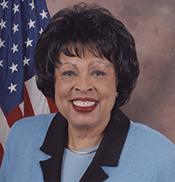 Rep. Diane E. Watson (D-CA)


 +1
+1