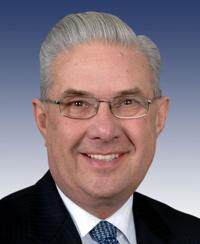
Mr. Speaker, I am pleased to rise today in support of H. Res. 703, a resolution offered by my colleague Representative John Peterson, congratulating my alma mater, The Pennsylvania State University,…
Mr. Speaker, I am pleased to rise today in support of H. Res. 703, a resolution offered by my colleague Representative John Peterson, congratulating my alma mater, The Pennsylvania State University, on 150 years of service and commending Pennsylvania's designation of the university as Pennsylvania's sole land-grant institution.
As a native Pennsylvanian, I was proud to attend Penn State and earn my undergraduate there in 1961. I also met someone there who would become the most important person in my life--a fellow Penn State student named Carolyn Stover who accepted my proposal to be my wife.
We have many fond memories of our time together at Penn State, strolling together past Old Main, and our dates to the Creamery, enjoying the best ice cream in the world--bar none.
Mr. Speaker, you may not know the tradition of the Creamery. It all started in 1892, when Penn State became the first American institution of higher education to establish collegiate-level instruction in ice cream manufacture, a program that has helped make the university an internationally recognized center for research in frozen confections.
Penn State without question has had an outstanding 150 years as one of the finest land grant institutions in the Nation. Its list of achievements is long and impressive. It was the first institution of higher education in the country to offer undergraduate degrees in industrial engineering, fuel science, and turf grass science. Its strong and varied undergraduate program draws students from across the country and the world.
Penn State's graduate programs also are impressive. It's supply chain/logistics, industrial/manufacturing engineering, materials engineering, nuclear engineering, agricultural engineering, higher education administration, administration/supervision, vocational/ technical education, counseling services, ceramics, and rehabilitation counseling graduate programs rank among the Nation's top ten, according to U.S. News and World Report. Penn State's medical, law, and business graduate programs are also stellar.
It is important to note that one in every eight Pennsylvanians with a college degree, one in every 720 Americans, one in every 50 engineers, and one in very four meteorologists are alumni of Penn State.
Penn State is an institution that not only trains the mind, but the body as well. The Nittany Lions are known throughout the intercollegiate sports world for its outstanding teams. Penn State's football team is synonymous with gridiron excellence. Coach Joe Paterno is a football legend, and became the all-time leader in wins in college football in 2001. Penn State also fields quality teams in cross- country, women's volleyball, and gymnastics, just to name a 3 few. The Penn State athletic tradition is robust, and the university has garnered an impressive 56 national team championships in its history.
Penn State's scholar/athletes have impressive academic credentials: the university graduated 80 percent of its scholar/athletes from the entering class of 1996--1997 within six years, compared to a national average of 62 percent for scholar/athletes at all Division I NCAA institutions. Penn State maintains an emphasis on education and athletics that is to be envied.
Penn State's history is full of accomplishments and its future is full of promise. I will insert for the record a list of 50 ways Penn State has shaped the world. This is just a fraction of the ways the students, faculty, staff and all those associated with Penn State have helped to make our Nation and the world a better place.
The education I received at Penn State and the relationships I developed--the most important of which was meeting my future wife-- helped shape my life and the public service path I pursued. Carolyn and I, both proud Penn State alumni, congratulate the university on its sesquicentennial, and look forward to celebrating Penn State's future accomplishments.
50 Ways Penn State Has Shaped the World
Since its founding in 1855, Penn State and its people have
been leaving their mark on the world. From the viewing of the
first atom, to the leading roles played by alumni in Desert
Storm, Penn Staters have had a profound impact on the world
and are leaving a legacy of contribution.
1. American Literature--Fred Lewis Pattee, who joined the
faculty in 1894, became the first in the Nation to hold the
title of Professor of American Literature, a field then
considered a minor subdiscipline of English literature. He
helped make Penn State one of the earliest centers for
American literature studies.
2. Animal Nutrition--In the early 1900s Professor Henry
Armsby used a respiration calorimeter to try to determine the
net energy value of food--that is, the portion of food energy
that an animal used to produce milk or meat. His experiments
attracted worldwide interest and helped to develop livestock
feeds of higher nutritive value.
3. Architectural Engineering--Penn State offers America's
oldest continuously accredited (since 1936) curriculum in
this field. It introduced the curriculum in 1910 to provide
``liberal training in both the aesthetic and construction
sides of architecture.''
4. Art Education--Penn State became an international center
for art education when Austrian-born Viktor Lowenfeld joined
the faculty in 1946. Lowenfeld was the most influential art
educator of the 20th century and wrote the field's dominant
book, Creative and Mental Growth, based on his pioneering
work in psychology and the art of the visually impaired.
5. Artificial Insemination--Over a 30-year period beginning
in 1946, dairy scientist John Almquist perfected commercially
viable artificial insemination techniques for dairy cattle.
His research has led to more than $600 million worth of
increased food production and cost savings worldwide.
6. Artificial Organs--A heart-assist pump developed by
medical and engineering faculty in 1976 to prolong the lives
of cardiovascular patients was the first surgically
implantable, seam-free, pulsatile blood pump to receive
widespread clinical use. It led to the Penn State Heart, the
only artificial heart approved by the U.S. Food and Drug
Administration.
7. Astronauts--Four Penn Staters have flown in space:
alumni Paul Weitz, Robert Cenker and Guion S. Bluford Jr.
(the first African-American astronaut, who flew on the space
shuttle Challenger in 1983), and Assistant Professor of
Kinesiology James Pawelczyk.
8. Astronomy--Penn State, with the University of Texas,
operates the Hobby-Eberly spectroscopic survey telescope, the
largest instrument of its kind in the world, which measures
individual wavelengths of light to reveal information about
stars, galaxies, and other deep-space phenomena.
9. Atom First ``Seen''--In 1955, physics Professor Erwin
Mueller became the first person to ``see'' an atom, using a
field ion electron microscope of his own invention. The
device was a landmark advance in scientific instrumentation
that allowed a magnification of more than 2 million times.
10. Best-Selling Authors--Vance Packard (The Hidden
Persuaders, The Status Seekers) earned his degree from Penn
State in 1936. Jean Craighead George, a member of the class
of 1941, authored the Newberry Award-winning children's book,
Julie of the Wolves.
11. Cinema--Penn State alumnus Julius Epstein won an Oscar
for his screenplay for the classic Humphrey Bogart film,
``Casablanca.'' Character actor Ed Binns, class of 1937,
received critical praise for supporting roles in such box
office favorites as ``Patton'' and ``Fail Safe.''
12. Commercial Television--Penn State alumni who have made
their mark in television include Carmen Finestra, an
executive producer and writer for the hit ABC-TV comedy
``Home Improvement,'' Jonathan Frakes (Commander Will Riker
on the hit television series ``Star Trek: The Next
Generation''), and writer and director Stanley Lathan
(``Cagney and Lacey,'' ``Remington Steele'' and ``Sanford and
Son'').
13. Correspondence Courses--In 1892, Penn State became the
first American college or university to offer correspondence
courses in agriculture, an initiative that was followed by
national expansion of correspondence instruction in many
technical fields.
14. Diesel Engineering--One of the world's first academic
research programs in diesel engineering began at Penn State
in 1923. Discoveries in such areas as supercharging and
scavenging helped to bring about today's fuel-efficient and
powerful engines.
15. Discovering Planets--Alexander Wolszczan, professor of
astronomy and astrophysics, discovered the existence of three
planets orbiting outside of our solar system--the first
scientist to do so.
16. Driver Education--Amos Neyhart taught America's first
classes for driver education teachers at Penn State in 1936,
three years after he began the Nation's first driver
education course at nearby State College High School.
17. Engineers Everywhere--One in 50 professionally licensed
engineers in the U.S. is a Penn State graduate.
18. Environmentally Correct--Polymer scientist Bernard
Gordon III developed a biodegradable plastic that, with the
assistance of water, disappears in two years. Early tests
indicate that molecular weight of the polymer reduces as
water is added, and at 120 degrees to 140 degrees Fahrenheit,
the material falls apart in three days.
19. Environmental Stress--The Noll Physiological Research
Center, established in 1963, was the Nation's first academic
research center dedicated to studying human tolerance to
heat, cold and other environmental stresses, and served as
the prototype for similar labs worldwide.
20. Family Doctors--Penn State's Milton S. Hershey Medical
Center in 1967 became the Nation's first medical school to
establish a department of family and community medicine on
the same level as traditional medical specialities. It also
introduced a residency in the field, thus foreshadowing a
renewed emphasis Nationwide on family practitioners.
21. First AG Degrees--Penn State was the first American
institution to confer baccalaureate degrees in agriculture,
in 1861.
22. Geraniums--Penn State researchers developed the world's
first commercially successful geranium grown from seed, the
Nittany Lion Red.
23. Greek Leadership--With 56 fraternities and 29
sororities, Penn State has the largest number of Greek
organizations of all colleges and universities in the
country.
24. Heavy Water--Penn State physicist Ferdinand Brickwedde
in 1931 produced the world's first measurable amount of
deuterium, a hydrogen isotope needed to make ``heavy
water''--an essential ingredient in basic atomic research.
25. Ice Cream--In 1892 Penn State offered America's first
collegiate instruction in ice cream manufacture, followed
soon after by a pioneering ``short course'' program that
has helped to make the University an international center
for research in frozen confections. Ice cream gurus Ben &
Jerry got their start from a correspondence course in ice
cream making from Penn State.
26. Industrial Engineering--The world's first baccalaureate
curriculum in industrial engineering was introduced at Penn
State in 1908.
27. Management Education--Established in 1915 as one of the
nation's first continuing education programs for business and
industry, Penn State's management education classes boosted
Pennsylvania's economy by tailoring instruction to thousands
of clients statewide in such fields as time management,
employee motivation and leadership, and served as models for
similar efforts nationally.
28. Materials Research--In 1960, Penn State established the
nation's first interdisciplinary curriculum in solid state
technology and in 1962, created one of the first
interdisciplinary research laboratories, which has since won
international acclaim in materials synthesis,
electroceramics, diamond films and chemically bonded
ceramics.
29. Mathematics--Mathematician Haskell Brooks Curry's
research in the 1950s into the foundations of mathematics,
especially his development of combinatory logic, later
found significant application in computer science,
particularly in the design of programming languages.
30. Meteorologists--One in every four meteorologists in the
United States is a Penn State graduate.
31. Minority Enrollment--Among more than 100 colleges and
universities in Pennsylvania, Penn State ranks second in the
enrollment of African Americans and graduates more of these
students than any other institution in the Commonwealth.
32. Mushroom Research--In the 1920s, Penn State became the
first land-grant college to initiate a comprehensive mushroom
research program. Researchers developed improved composts and
production practices that were adopted by growers worldwide
and also helped Pennsylvania retain its leadership as the No.
1 source of domestic mushrooms.
33. Music--Fred Waring, nationally beloved choral leader
(``The man who taught America how to sing'' ) and founder of
The Pennsylvanians, was a Penn Stater. So is Grammy Award-
winning singer, songwriter and pianist Mike Reid (``Stranger
in the House,'' ``Lost in the Fifties Tonight'' ).
34. Nobel Prize--Stanford University biochemist Paul Berg,
a member of Penn State's class of 1948, won a Nobel Prize in
1980 for his study of the biochemistry of nucleic acids.
35. Nuclear Reactor--Penn State in 1955 became the first
university to be issued a federal license to operate a
nuclear reactor, which it continues to use for studies in the
peaceful uses of atomic energy and the training of nuclear
industry personnel.
36. Pacemaker--A surgeon and two engineers at Penn State
perfected the world's first long-life, rechargeable heart
pacemaker.
37. Penn Staters Everywhere--Penn State has more than
466,000 living alumni. One in every 720 Americans, and one in
every 70 Pennsylvanians, is a graduate of Penn State.
38. Personality Tests--In 1931, psychologist Robert
Bernreuter began refining his ``Bernreuter Personality
Inventory,'' a pioneer multiphastic test of traits that
became the standard by which other personality tests were
measured and is still used worldwide for counseling and
personnel selection.
39. Petroleum Research--In the 1920s, Penn State
researchers began pioneering investigations that identified
the components of crude oil, leading to significant
improvements in the refining process and the development of
today's widely used lubricants that can withstand extremes of
heat and cold.
40. Playwrights--The hit Broadway play ``Give'em Hell,
Harry,'' based on the life of President Harry Truman and
authored by Penn State alumnus Samuel Gallu, was made into a
critically acclaimed motion picture. So was Penn Stater John
Pielmeier's ``Agnes of God,'' which received three Academy
Award nominations.
41. Progesterone--Pioneer steroid chemist Russell Marker's
work in synthesizing the hormone progesterone in the 1930s
laid the foundation for the birth control pill and such
medical applications as cortisones and various hormone and
steroid therapies.
42. Public Television--The first national conference of
educators and broadcasters was held at Penn State in 1952 and
urged the Federal Communications Commission to set aside
licenses for noncommercial use. The FCC responded favorably,
thus providing the regulatory basis for today's system of
public television stations.
43. Pure Food--Pennsylvania's and the Nation's pure food
laws stem partly from the work of pioneer chemist William
Frear, who in the early 1900s analyzed foods for government
agencies and headed an expert committee whose recommendations
shaped the landmark Pure Food and Drug Act of 1906.
44. R Values--This widely adopted standard of heat
resistance, used to measure the insulating properties of such
materials as fiberglass and window glass, was developed by
Everett Shuman, who in the 1960s headed Penn State's Building
Research Institute.
45. School Administrators-- One out of every four senior
school administrators in Pennsylvania is a graduate of Penn
State.
46. Science, Technology, and Society--In 1969-70, Penn
State established the Nation's first interdisciplinary
program in science, technology and society. Its integrative
courses addressing critical issues in these areas served as a
model for similar programs at many other universities.
47. Telecommunications--Penn State alumnus Charles
Krumreich invented the telephone jack. More than a billion of
his patented Jack-11 square plastic plugs are used worldwide
for telephones, modems, and fax machines.
48. Toymaker--Herman Fisher, co-founder and longtime
chairman of the board of Fisher Price, one of the Nation's
largest toymakers, graduated from Penn State in 1921.
49. Visionary Educator--Evan Pugh, Penn State's first
president (1859-64), was among the first nationally
recognized advocates of adding science, agriculture and
engineering to traditional collegiate studies.
50. Weather Prediction--Meteorologist Hans Panofsky
conducted fundamental work at Penn State (1952-82) that led
to a new understanding of atmospheric turbulence, air
pollution, ozone depletion and planetary atmospheres, and was
among the first to apply computer analysis to weather
prediction.