Foreign Relations Authorization Act, Fiscal Year 2004
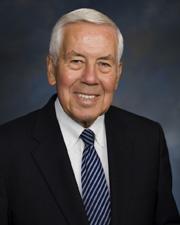 Sen. Richard G. Lugar (R-IN)
Legislative Activity
Stay on top of the latest movement without scrolling through every action
Returned to the Calendar. when the motion to proceed to H.R. 2861 was agreed to. Calendar No. 77.
November 11, 2003
View full timeline
Committee on Foreign Relations ordered to be reported an original measure.
April 9, 2003
Introduced in Senate
April 24, 2003
Committee on Foreign Relations. Original measure reported to Senate by Senator Lugar under authority of the order of the Senate of 4-11-2003. With written report No. 108-39.
April 24, 2003
Placed on Senate Legislative Calendar under General Orders. Calendar No. 77.
April 24, 2003
Measure laid before Senate by unanimous consent. (consideration: CR S9086-9089, S9090-9111)
July 9, 2003
Considered by Senate. (consideration: CR S9162-9215)
July 10, 2003
Returned to the Calendar. when the motion to proceed to H.R. 2861 was agreed to. Calendar No. 77.
November 11, 2003
Floor Debate
18 membersWhat members said about S. 925 on the floor



 +13
+13
Floor Debate
18 membersWhat members said about S. 925 on the floor
Madam President, I ask unanimous consent that the reading of the remainder of the amendment be dispensed with. Madam President, the reason I was happy to have the clerk read the first three findings…
Mr. President, today, as Ranking Democrat on the Committee on Small Business and Entrepreneurship, I join the Committee's Chair, Senator Olympia Snowe in introducing a three-year reauthorization bill…
Mr. President, I thank Senator Lugar for his outstanding leadership on this bill and on the issues of foreign affairs. He has done a fabulous job, as has Senator Biden, the ranking member. I also…
I ask unanimous consent that the pending amendment be set aside. I send an amendment to the desk on behalf of Senator Reid of Nevada and Senator Daschle. Mr. President, I ask unanimous consent that…
Mr. President, I am pleased to join Chairman Lugar in presenting the Foreign Relations Authorization Act for fiscal year 2004. As the chairman has described, we will soon submit a substitute…
Show 8 more
Madam President, I send a substitute amendment to S. 925 to the desk. Madam President, I ask unanimous consent that the reading of the amendment be dispensed with. Madam President, today the Senate…

Mr. President, I rise today to introduce the ``Small Business Administration 50th Anniversary Reauthorization Act of 2003,'' a bill to reauthorize the U.S. Small Business Administration, SBA, and its…
Madam President, I suggest the absence of a quorum. Mr. President, I commend the distinguished Senator from Wisconsin for his extraordinary leadership as subcommittee chairman and ranking member over…
Mr. President, I send to the desk a packet of agreed-upon amendments. I will enumerate those amendments and after enumerating them ask that they be adopted en bloc to Amendment No. 1136. I so ask…
I announce that the Senator from Florida (Mr. Graham), the Senator from Massachusetts (Mr. Kerry), the Senator from Connecticut (Mr. Lieberman), and the Senator from Georgia (Mr. Miller) are…

Mr. President, 10 minutes and 5 minutes for Senator Harkin. Mr. President, I ask unanimous consent to set aside the pending amendment. Mr. President, I call up amendment No. 1165. Mr. President, I…

Mr. President, I rise today to introduce a bill with Senator Ensign to ensure that Title I funds are directed towards instructional services to teach low-income students. Title I provides assistance…
Mr. President, I rise in support of the amendment offered today by Senator Boxer to repeal the global gag rule. We take up this debate once again during the consideration of the State Department…
Show 11 more

Mr. President, I ask unanimous consent that the order for the quorum call be rescinded. Mr. President, I ask unanimous consent that the pending amendment be set aside so that I may offer an…
Mr. President, I call up amendment No. 1144. Mr. President, I ask unanimous consent that reading of the amendment be dispensed with. Mr. President, I rise on behalf of my colleagues, Senator…

Mr.President, I send an amendment to the desk. Mr. President, I ask unanimous consent that reading of the amendment be dispensed with. Mr. President, I rise to offer an amendment which we are calling…
Madam President, I ask unanimous consent the order for the quorum call be rescinded. Madam President, I ask unanimous consent I be allowed to speak for not more than 10 minutes on the pending…
Mr. President, I rise today to support Senator Feinstein's amendment to the Fiscal Year 2004 State Department Authorization bill that would require the State Department to submit an annual report on…
Mr. President, I ask unanimous consent that the order for the quorum call be rescinded. Mr. President, I rise in support of the antipiracy amendment that the Senator from Virginia just discussed and…
That is fine. Mr. President, I compliment and commend my friend and colleague from Virginia for his unrelenting efforts to make sure victims of terrorism and their families are duly compensated for…
Mr. President, I rise today to support Senator Boxer's amendment to the State Department authorization bill to eliminate the so-called global gag rule to lift the restrictions for U.S. assistance to…
Madam President, first, I compliment the distinguished chair of the Foreign Relations Committee for his work on this omnibus piece of legislation. I intend to support it. I admire the work that has…
Mr. President, this morning the Senate will resume debate on S. 925, the State Department authorization bill. During yesterday's session, we were able to dispose of a number of amendments to the…

Mr. President, I ask unanimous consent to speak for no more than 2 minutes on the nomination of David Campbell upon which we are about to vote. Mr. President, I advise my colleagues that the person…
Bill Text
Latest available legislative text
        [Congressional Bills 108th Congress]
[From the U.S. Government Publishing Office]
[S. 925 Placed on Calendar Senate (PCS)]

Calendar No. 77
108th CONGRESS
1st Session
S. 925

[Report No. 108-39]

To authorize appropriations for the Department of State and
international broadcasting activities for fiscal year 2004 and for the
Peace Corps for fiscal years 2004 through 2007, and for other purposes.

_______________________________________________________________________

IN THE SENATE OF THE UNITED STATES

April 24, 2003

Mr. Lugar, from the Committee on Foreign Relations, reported under
authority of the order of the Senate of April 11, 2003, the following
original bill; which was read twice and placed on the calendar

_______________________________________________________________________

A BILL

To authorize appropriations for the Department of State and
international broadcasting activities for fiscal year 2004 and for the
Peace Corps for fiscal years 2004 through 2007, and for other purposes.

Be it enacted by the Senate and House of Representatives of the
United States of America in Congress assembled,

SECTION 1. SHORT TITLE.

This Act may be cited as the ``Foreign Relations Authorization Act,
Fiscal Year 2004''.

SEC. 2. TABLE OF CONTENTS.

The table of contents for this Act is as follows:

Sec. 1. Short title.
Sec. 2. Table of contents.
Sec. 3. Definitions.
TITLE I--AUTHORIZATIONS OF APPROPRIATIONS

Subtitle A--Department of State

Sec. 101. Administration of foreign affairs.
Sec. 102. United States educational, cultural, and public diplomacy
programs.
Sec. 103. International organizations and conferences.
Sec. 104. International commissions.
Sec. 105. Migration and refugee assistance.
Subtitle B--United States International Broadcasting Activities

Sec. 111. Authorizations of appropriations.
TITLE II--DEPARTMENT OF STATE AUTHORITIES AND ACTIVITIES

Subtitle A--Basic Authorities and Activities

Sec. 201. Interference with protective functions.
Sec. 202. Authority to issue administrative subpoenas.
Sec. 203. Enhanced Department of State authority for uniformed security
officers.
Sec. 204. Reimbursement rate for airlift services provided to the
Department of State.
Sec. 205. Immediate response facilities.
Sec. 206. Security capital cost sharing.
Sec. 207. Prohibition on transfer of certain visa processing fees.
Sec. 208. Reimbursement from United States Olympic Committee.
Subtitle B--Educational, Cultural, and Public Diplomacy Authorities

Sec. 211. Authority to promote biotechnology.
Sec. 212. The United States Diplomacy Center.
Sec. 213. Latin America civilian government security program.
TITLE III--ORGANIZATION AND PERSONNEL OF THE DEPARTMENT OF STATE

Sec. 301. Fellowship of Hope program.
Sec. 302. Cost-of-living allowances.
Sec. 303. Additional authority for waiver of annuity limitations on
reemployed Foreign Service annuitants.
Sec. 304. Home leave.
Sec. 305. Increased limits applicable to post differentials and danger
pay allowances.
Sec. 306. Suspension of Foreign Service members without pay.
Sec. 307. Claims for lost pay.
Sec. 308. Repeal of requirement for recertification process for members
of the Senior Foreign Service.
Sec. 309. Deadline for issuance of regulations regarding retirement
credit for Government service performed
abroad.
Sec. 310. Separation of lowest ranked Foreign Service members.
Sec. 311. Disclosure requirements applicable to proposed recipients of
the personal rank of ambassador or
minister.
Sec. 312. Provision of living quarters and allowances to the United
States representatives to the United
Nations.
TITLE IV--INTERNATIONAL ORGANIZATIONS

Sec. 401. Limitation on the United States share of assessments for
United Nations peacekeeping operations
after calendar year 2004.
Sec. 402. Report to Congress on implementation of the Brahimi report.
Sec. 403. Membership on United Nations councils and commissions.
TITLE V--DESIGNATION OF FOREIGN TERRORIST ORGANIZATIONS

Sec. 501. Designation of foreign terrorist organizations.
TITLE VI--STRENGTHENING OUTREACH TO THE ISLAMIC WORLD

Subtitle A--Public Diplomacy

Sec. 601. Plans, reports, and budget documents.
Sec. 602. Recruitment and training.
Sec. 603. Report on foreign language briefings.
Subtitle B--Strengthening United States Educational and Cultural
Exchange Programs

Sec. 611. Definitions.
Sec. 612. Expansion of educational and cultural exchanges.
Sec. 613. Secondary exchange program.
Sec. 614. Authorization of appropriations.
Subtitle C--Fellowship Program

Sec. 621. Short title.
Sec. 622. Fellowship program.
Sec. 623. Fellowships.
Sec. 624. Administrative provisions.
TITLE VII--INTERNATIONAL PARENTAL CHILD ABDUCTION PREVENTION

Sec. 701. Short title.
Sec. 702. Inadmissibility of aliens supporting international child
abductors and relatives of such abductors.
TITLE VIII--MISCELLANEOUS PROVISIONS

Sec. 801. Repeal of requirement for semiannual report on extradition of
narcotics traffickers.
Sec. 802. Technical amendments to the United States International
Broadcasting Act of 1994.
Sec. 803. Foreign language broadcasting.
Sec. 804. Fellowships for multidisciplinary training on
nonproliferation issues.
Sec. 805. Requirement for report on United States policy toward Haiti.
Sec. 806. Victims of violent crime abroad.
Sec. 807. Limitation on use of funds relating to United States policy
with respect to Jerusalem as the capital of
Israel.
Sec. 808. Requirement for additional report concerning efforts to
promote Israel's diplomatic relations with
other countries.
Sec. 809. United States policy regarding the recognition of a
Palestinian state.
Sec. 810. Middle East Broadcasting Network.
Sec. 811. Sense of Congress relating to international and economic
support for a successor regime in Iraq.
Sec. 812. Sense of Congress relating to Magen David Adom Society.
Sec. 813. Sense of Congress on climate change.
Sec. 814. Extension of authorization of appropriation for the United
States Commission on International
Religious Freedom.
TITLE IX--PEACE CORPS CHARTER FOR THE 21ST CENTURY

Sec. 901. Short title.
Sec. 902. Findings.
Sec. 903. Definitions.
Sec. 904. Strengthened independence of the Peace Corps.
Sec. 905. Reports and consultations.
Sec. 906. Increasing the number of volunteers.
Sec. 907. Special volunteer recruitment and placement for countries
whose governments are seeking to foster
greater understanding between their
citizens and the United States.
Sec. 908. Global infectious diseases initiative.
Sec. 909. Peace Corps Advisory Council.
Sec. 910. Readjustment allowances.
Sec. 911. Programs and projects of returned Peace Corps volunteers to
promote the goals of the Peace Corps.
Sec. 912. Authorization of appropriations.

SEC. 3. DEFINITIONS.

In this Act:
(1) Appropriate congressional committees.--The term
``appropriate congressional committees'' means the Committee on
Foreign Relations of the Senate and the Committee on
International Relations of the House of Representatives.
(2) Department.--The term ``Department'' means the
Department of State.
(3) Secretary.--Except as otherwise provided in this Act,
the term ``Secretary'' means the Secretary of State.

TITLE I--AUTHORIZATIONS OF APPROPRIATIONS

Subtitle A--Department of State

SEC. 101. ADMINISTRATION OF FOREIGN AFFAIRS.

The following amounts are authorized to be appropriated for the
Department under ``Administration of Foreign Affairs'' to carry out the
authorities, functions, duties, and responsibilities in the conduct of
foreign affairs of the United States, and for other purposes authorized
by law:
(1) Diplomatic and consular programs.--
(A) Authorization of appropriations.--For
``Diplomatic and Consular Programs'', $4,171,504,000
for the fiscal year 2004.
(B) Worldwide security upgrades.--Of the amounts
authorized to be appropriated by subparagraph (A),
$646,701,000 for the fiscal year 2004 is authorized to
be appropriated for worldwide security upgrades.
(2) Capital investment fund.--For ``Capital Investment
Fund'', $157,000,000 for the fiscal year 2004.
(3) Embassy security, construction and maintenance.--For
``Embassy Security, Construction and Maintenance'',
$926,400,000 for the fiscal year 2004, in addition to the
amounts authorized to be appropriated for such purpose by
section 604 of the Admiral James W. Nance and Meg Donovan
Foreign Relations Authorization Act, Fiscal Years 2000 and 2001
(as enacted into law by section 1000(a)(7) of Public Law 106-
113 and contained in appendix G of that Act; 113 Stat. 1501A-
453).
(4) Representation allowances.--For ``Representation
Allowances'', $9,000,000 for the fiscal year 2004.
(5) Protection of foreign missions and officials.--For
``Protection of Foreign Missions and Officials'', $10,000,000
for the fiscal year 2004.
(6) Emergencies in the diplomatic and consular service.--
For ``Emergencies in the Diplomatic and Consular Service'',
$1,000,000 for the fiscal year 2004.
(7) Repatriation loans.--For ``Repatriation Loans'',
$1,219,000 for the fiscal year 2004.
(8) Payment to the american institute in taiwan.--For
``Payment to the American Institute in Taiwan'', $19,773,000
for the fiscal year 2004.
(9) Office of the inspector general.--For ``Office of the
Inspector General'', $31,703,000 for the fiscal year 2004.

SEC. 102. UNITED STATES EDUCATIONAL, CULTURAL, AND PUBLIC DIPLOMACY
PROGRAMS.

(a) In General.--The following amounts are authorized to be
appropriated for the Department to carry out public diplomacy programs
of the Department under the United States Information and Educational
Exchange Act of 1948, the Mutual Educational and Cultural Exchange Act
of 1961, Reorganization Plan Number 2 of 1977, the Foreign Affairs
Reform and Restructuring Act of 1998, the Center for Cultural and
Technical Interchange Between East and West Act of 1960, the Dante B.
Fascell North-South Center Act of 1991, and the National Endowment for
Democracy Act, and to carry out other authorities in law consistent
with the purposes of such Acts:
(1) Educational and cultural exchange programs.--
(A) Fulbright academic exchange programs.--
(i) In general.--For the ``Fulbright
Academic Exchange Programs'' $127,365,000 for
the fiscal year 2004.
(ii) Vietnam fulbright academic exchange
program.--Of the amount authorized to be
appropriated by clause (i), $5,000,000 to carry
out the Vietnam scholarship program established
by section 229 of the Foreign Relations
Authorization Act, Fiscal Years 1992 and 1993
(Public Law 102-138).
(B) Other educational and cultural exchange
programs.--For other educational and cultural exchange
programs authorized by law, $274,981,000 for the fiscal
year 2004.
(2) National endowment for democracy.--For the ``National
Endowment for Democracy'', $42,000,000 for the fiscal year
2004.
(3) Center for cultural and technical interchange between
east and west.--For the ``Center for Cultural and Technical
Interchange Between East and West'', $15,000,000 for the fiscal
year 2004.
(4) Dante b. fascell north-south center.--For the ``Dante
B. Fascell North-South Center'', $2,000,000 for the fiscal year
2004.
(b) Asia Foundation.--Section 404 of The Asia Foundation Act (22
U.S.C. 4403) is amended to read as follows:
``Sec. 404. There are authorized to be appropriated to the
Secretary of State $15,000,000 for the fiscal year 2004 for grants to
The Asia Foundation pursuant to this title.''.

SEC. 103. INTERNATIONAL ORGANIZATIONS AND CONFERENCES.

(a) Assessed Contributions to International Organizations.--There
is authorized to be appropriated for ``Contributions to International
Organizations'', $1,010,463,000 for the fiscal year 2004 for the
Department to carry out the authorities, functions, duties, and
responsibilities in the conduct of the foreign affairs of the United
States with respect to international organizations and to carry out
other authorities in law consistent with such purposes.
(b) Contributions for International Peacekeeping Activities.--
(1) Authorization of appropriation.--There is authorized to
be appropriated for ``Contributions for International
Peacekeeping Activities'', $550,200,000 for the fiscal year
2004 for the Department to carry out the authorities,
functions, duties, and responsibilities of the United States
with respect to international peacekeeping activities and to
carry out other authorities in law consistent with such
purposes.
(2) Availability of funds.--Funds appropriated pursuant to
paragraph (1) are authorized to be available until September
30, 2005.
(c) Foreign Currency Exchange Rates.--
(1) Authorization of appropriation.--In addition to amounts
authorized to be appropriated by subsection (a), there is
authorized to be appropriated for the Department such sums as
may be necessary for the fiscal year 2004 to offset adverse
fluctuations in foreign currency exchange rates.
(2) Availability of funds.--Amounts appropriated under this
subsection shall be available for obligation and expenditure
only to the extent that the Director of the Office of
Management and Budget determines and certifies to the
appropriate congressional committees that such amounts are
necessary due to such fluctuations.

SEC. 104. INTERNATIONAL COMMISSIONS.

The following amounts are authorized to be appropriated under
``International Commissions'' for the Department to carry out the
authorities, functions, duties, and responsibilities in the conduct of
the foreign affairs of the United States with respect to international
commissions and for other purposes authorized by law:
(1) International boundary and water commission, united
states and mexico.--For ``International Boundary and Water
Commission, United States and Mexico''--
(A) for ``Salaries and Expenses'', $31,562,000 for
the fiscal year 2004; and
(B) for ``Construction'', $8,901,000 for the fiscal
year 2004.
(2) International boundary commission, united states and
canada.--For ``International Boundary Commission, United States
and Canada'', $1,261,000 for the fiscal year 2004.
(3) International joint commission.--For ``International
Joint Commission'', $7,810,000 for the fiscal year 2004.
(4) International fisheries commissions.--For
``International Fisheries Commissions'', $20,043,000 for the
fiscal year 2004.

SEC. 105. MIGRATION AND REFUGEE ASSISTANCE.

(a) In General.--There is authorized to be appropriated for
``Migration and Refugee Assistance'' for authorized activities,
$760,197,000 for the fiscal year 2004.
(b) Refugees Resettling in Israel.--Of the amount authorized to be
appropriated by subsection (a), $50,000,000 is authorized to be
available for the fiscal year 2004 for the resettlement of refugees in
Israel.

Subtitle B--United States International Broadcasting Activities

SEC. 111. AUTHORIZATIONS OF APPROPRIATIONS.

The following amounts are authorized to be appropriated to carry
out United States Government broadcasting activities under the United
States Information and Educational Exchange Act of 1948, the United
States International Broadcasting Act of 1994, the Radio Broadcasting
to Cuba Act, the Television Broadcasting to Cuba Act, and the Foreign
Affairs Reform and Restructuring Act of 1998, and to carry out other
authorities in law consistent with the purposes of such Acts:
(1) International broadcasting operations.--For
``International Broadcasting Operations'', $561,005,000 for the
fiscal year 2004.
(2) Broadcasting capital improvements.--For ``Broadcasting
Capital Improvements'', $11,395,000 for the fiscal year 2004.

TITLE II--DEPARTMENT OF STATE AUTHORITIES AND ACTIVITIES

Subtitle A--Basic Authorities and Activities

SEC. 201. INTERFERENCE WITH PROTECTIVE FUNCTIONS.

(a) Offense.--Chapter 7 of title 18, United States Code, is amended
by adding at the end the following:
``Sec. 117. Interference with certain protective functions
``Whoever knowingly and willfully obstructs, resists, or interferes
with a Federal law enforcement agent engaged, within the United States
or the special maritime territorial jurisdiction of the United States,
in the performance of the protective functions authorized by section 37
of the State Department Basic Authorities Act of 1956 (22 U.S.C. 2709)
or section 103 of the Diplomatic Security Act (22 U.S.C. 4802) shall be
fined under this title or imprisoned not more than one year, or
both.''.
(b) Clerical Amendment.--The table of sections at the beginning of
such chapter is amended by adding at the end the following new item:

``117. Interference with certain protective functions.''.

SEC. 202. AUTHORITY TO ISSUE ADMINISTRATIVE SUBPOENAS.

Section 37 of the State Department Basic Authorities Act of 1956
(22 U.S.C. 2709) is amended by adding at the end the following new
subsection:
``(d) Administrative subpoenas.--
``(1) In general.--If the Secretary determines that there
is an imminent threat against a person, foreign mission, or
international organization protected under the authority of
subsection (a)(3), the Secretary may issue in writing, and
cause to be served, a subpoena requiring--
``(A) the production of any records or other items
relevant to the threat; and
``(B) testimony by the custodian of the items
required to be produced concerning the production and
authenticity of those items.
``(2) Requirements.--
``(A) Return date.--A subpoena under this
subsection shall describe the items required to be
produced and shall specify a return date within a
reasonable period of time within which the requested
items may be assembled and made available. The return
date specified may not be less than 24 hours after
service of the subpoena.
``(B) Notification to attorney general.--As soon as
practicable following the issuance of a subpoena under
this subsection, the Secretary shall notify the
Attorney General of its issuance.
``(C) Other requirements.--The following provisions
of section 3486 of title 18, United States Code, shall
apply to the exercise of the authority of paragraph
(1):
``(i) Paragraphs (4) through (8) of
subsection (a).
``(ii) Subsections (b), (c), and (d).
``(3) Delegation of authority.--The authority under this
subsection may be delegated only to the Deputy Secretary of
State.
``(4) Annual report.--Not later than February 1 of each
year, the Secretary shall submit to the Committee on Foreign
Relations of the Senate and the Committee on International
Relations of the House of Representatives a report regarding
the exercise of the authority under this subsection during the
previous calendar year.''.

SEC. 203. ENHANCED DEPARTMENT OF STATE AUTHORITY FOR UNIFORMED SECURITY
OFFICERS.

The State Department Basic Authorities Act of 1956 is amended by
inserting after section 37 (22 U.S.C. 2709) the following new section:

``SEC. 37A. PROTECTION OF BUILDINGS AND AREAS IN THE UNITED STATES BY
DESIGNATED LAW ENFORCEMENT OFFICERS.

``(a) Designation of Law Enforcement Officers.--The Secretary of
State may designate Department of State uniformed guards as law
enforcement officers for duty in connection with the protection of
buildings and areas within the United States for which the Department
of State provides protective services, including duty in areas outside
the property to the extent necessary to protect the property and
persons on the property.
``(b) Powers of Officers.--While engaged in the performance of
official duties as a law enforcement officer designated under
subsection (a), an officer may--
``(1) enforce Federal laws and regulations for the
protection of persons and property;
``(2) carry firearms; and
``(3) make arrests without warrant for any offense against
the United States committed in the officer's presence, or for
any felony cognizable under the laws of the United States if
the officer has reasonable grounds to believe that the person
to be arrested has committed or is committing such felony in
connection with the buildings and areas, or persons, for which
the Department of State is providing protective services.
``(c) Regulations.--(1) The Secretary of State may prescribe
regulations necessary for the administration of buildings and areas
within the United States for which the Department of State provides
protective services. The regulations may include reasonable penalties,
within the limits prescribed in subsection (d), for violations of the
regulations.
``(2) The Secretary shall consult with the Secretary of Homeland
Security in prescribing the regulations under paragraph (1).
``(3) The regulations shall be posted and kept posted in a
conspicuous place on the property.
``(d) Penalties.--A person violating a regulation prescribed under
subsection (c) shall be fined under title 18, United States Code, or
imprisoned for not more than 30 days, or both.
``(e) Training Officers.--The Secretary of State may also designate
firearms and explosives training officers as law enforcement officers
under subsection (a) for the limited purpose of safeguarding firearms,
ammunition, and explosives that are located at firearms and explosives
training facilities approved by the Secretary or are in transit between
training facilities and Department of State weapons and munitions
vaults.
``(f) Attorney General Approval.--The powers granted to officers
designated under this section shall be exercised in accordance with
guidelines approved by the Attorney General.
``(g) Relationship to Other Authority.--Nothing in this section
shall be construed to affect the authority of the Secretary of Homeland
Security, the Administrator of General Services, or any Federal law
enforcement agency.''.

SEC. 204. REIMBURSEMENT RATE FOR AIRLIFT SERVICES PROVIDED TO THE
DEPARTMENT OF STATE.

(a) Authority.--Subsection (a) of section 2642 of title 10, United
States Code, is amended by inserting ``or the Department of State''
after ``Central Intelligence Agency''.
(b) Conforming and Clerical Amendments.--
(1) Amendment to section heading.--The heading for such
section is amended to read as follows:
``Sec. 2642. Reimbursement rate for airlift services provided to
Central Intelligence Agency or Department of State''.
(2) Clerical amendment.--The item relating to such section
in the table of sections at the beginning of chapter 157 of
such title is amended to read as follows:

``2642. Reimbursement rate for airlift services provided to Central
Intelligence Agency or Department of
State.''.

SEC. 205. IMMEDIATE RESPONSE FACILITIES.

Section 34(c) of the State Department Basic Authorities Act of 1956
(22 U.S.C. 2706(c)) is amended to read as follows:
``(c)(1) The Secretary may waive the notification requirement of
subsection (a) and of any other law if the Secretary determines that--
``(A) compliance with the requirement would pose a
substantial risk to human health or welfare; or
``(B) doing so is necessary to provide for the
establishment, or renovation of, a diplomatic facility in
urgent circumstances, except that the notification requirement
may not be waived with respect to the reprogramming of more
than $10,000,000 for such facility in any one instance.
``(2) In the case of any waiver under this subsection, the
Secretary shall transmit a notification of the waiver to the Committee
on Foreign Relations and the Committee on Appropriations of the Senate
and the Committee on International Relations and the Committee on
Appropriations of the House of Representatives as soon as is
practicable, but not later than 3 days after the obligation of the
funds. The notification shall include an explanation of the
circumstances warranting the exercise of the waiver.''.

SEC. 206. SECURITY CAPITAL COST SHARING.

(a) Authorization.--The first section of the Foreign Service
Buildings Act, 1926 (22 U.S.C. 292) is amended by adding at the end the
following new subsection:
``(c)(1) The Secretary of State may, in accordance with this
section, collect from every agency of the Federal Government that has
assigned employees to any United States diplomatic facility a fee for
the purpose of constructing new United States diplomatic facilities.
``(2) The Secretary is authorized to determine annually and charge
each Federal agency the amount to be collected under paragraph (1) from
the agency. To determine such amount, the Secretary may prescribe and
use a formula that takes into account the number of employees of each
agency, including contractors and locally hired personnel, who are
assigned to each United States diplomatic facility and are under the
authority of the chief of mission pursuant to section 207 of the
Foreign Service Act of 1980 (22 U.S.C. 3927).
``(3) The head of an agency charged a fee under this section shall
remit the amount of the fee to the Secretary of State through the
Intra-Governmental Payment and Collection System or other appropriate
means.
``(4) There shall be established on the books of the Treasury an
account to be known as the `Capital Security Cost-Share Program Fund',
which shall be administered by the Secretary. There shall be deposited
into the account all amounts collected by the Secretary pursuant to the
authority under paragraph (1), and such funds shall remain available
until expended. The Secretary shall include in the Department of
State's Congressional Presentation Document each year an accounting of
the sources and uses of the amounts deposited into the account.
``(5) The Secretary shall not collect a fee for an employee of an
agency of the Federal Government who is assigned to a United Stated
diplomatic facility that is located at a site for which the Secretary
has granted a waiver under section 606(a)(2)(B)(i) of the Secure
Embassy Construction and Counterterrorism Act of 1999 (22 U.S.C.
4865(a)(2)(B)(i)).
``(6) In this subsection--
``(A) the term `agency of the Federal Government'--
``(i) includes the Interagency Cooperative
Administrative Support Service; and
``(ii) does not include the Marine Security Guard;
and
``(B) the term `United States diplomatic facility' has the
meaning given that term in section 603 of the Secure Embassy
Construction and Counterterrorism Act of 1999 (22 U.S.C. 4865
note).''.
(b) Effective Date.--The amendment made by subsection (a) shall
take effect on October 1, 2004.

SEC. 207. PROHIBITION ON TRANSFER OF CERTAIN VISA PROCESSING FEES.

Section 140(a)(2) of the Foreign Relations Authorization Act,
Fiscal Years 1994 and 1995 (8 U.S.C. 1351 note) is amended by inserting
before the period at the end the following: ``, and shall not be
transferred to any other agency''.

SEC. 208. REIMBURSEMENT FROM UNITED STATES OLYMPIC COMMITTEE.

(a) In General.--The Secretary shall seek, to the extent
practicable, reimbursement from the United States Olympic Committee for
security provided to the United States Olympic Team by Diplomatic
Security Special Agents during the 2004 Summer Olympics.
(b) Offsetting Receipt.--Reimbursements provided under subsection
(a) shall be deposited as an offsetting receipt to the appropriate
Department account.
(c) Availability of Funds.--Funds collected under the authority in
subsection (a) shall remain available for obligation until September
30, 2005.

Subtitle B--Educational, Cultural, and Public Diplomacy Authorities

SEC. 211. AUTHORITY TO PROMOTE BIOTECHNOLOGY.

The Secretary is authorized to support, by grants, cooperative
agreements, or contracts, outreach and public diplomacy activities
regarding the benefits of agricultural biotechnology and science-based
regulatory systems, and the application of agricultural biotechnology
for trade and development purposes. The total amount of grants made
pursuant to this authority in a fiscal year shall not exceed $500,000.

SEC. 212. THE UNITED STATES DIPLOMACY CENTER.

Title I of the State Department Basic Authorities Act of 1956 is
amended by adding after section 58 (22 U.S.C. 2730) the following new
section:

``SEC. 59. THE UNITED STATES DIPLOMACY CENTER.

``(a) Activities.--
``(1) Support authorized.--The Secretary of State is
authorized to provide by contract, grant, or otherwise, for the
performance of appropriate museum visitor and educational
outreach services, including organizing conference activities,
museum shop services, and food services, in the public exhibit
and related space utilized by the United States Diplomacy
Center.
``(2) Payment of expenses.--The Secretary may pay all
reasonable expenses of conference activities conducted by the
Center, including refreshments and reimbursement of travel
expenses incurred by participants.
``(3) Recovery of costs.--Any revenues generated under the
authority of paragraph (1) for visitor services may be
retained, as a recovery of the costs of operating the Center,
and credited to any Department of State appropriation.
``(b) Disposition of United States Diplomacy Center Artifacts and
Materials.--
``(1) Property of secretary.--All historic documents,
artifacts, or other articles permanently acquired by the
Department of State and determined by the Secretary to be
suitable for display in the United States Diplomacy Center
shall be considered to be the property of the Secretary in the
Secretary's official capacity and shall be subject to
disposition solely in accordance with this subsection.
``(2) Sale or trade.--Whenever the Secretary makes the
determination under paragraph (3) with respect to an item, the
Secretary may sell at fair market value, trade, or transfer the
item, without regard to the requirements of subtitle I of title
40, United States Code. The proceeds of any such sale may be
used solely for the advancement of the Center's mission and may
not be used for any purpose other than the acquisition and
direct care of collections.
``(3) Determinations prior to sale or trade.--The
determination referred to in paragraph (2), with respect to an
item, is a determination that--
``(A) the item no longer serves to further the
purposes of the Center established in the collections
management policy of the Center; or
``(B) in order to maintain the standards of the
collections of the Center, the sale or exchange of the
item would be a better use of the item.
``(4) Loans.--The Secretary may also lend items covered by
paragraph (1), when not needed for use or display in the
Center, to the Smithsonian Institution or a similar institution
for repair, study, or exhibition.''.

SEC. 213. LATIN AMERICA CIVILIAN GOVERNMENT SECURITY PROGRAM.

The Secretary is authorized to establish, through an institution of
higher education in the United States that has prior experience in the
field, an educational program designed to promote civilian control of
government ministries in Latin America that perform national security
functions by teaching and reinforcing among young professionals from
countries in Latin America the analytical skills, knowledge of civil
institutions, and leadership skills necessary to manage national
security functions within a democratic civil society.

TITLE III--ORGANIZATION AND PERSONNEL OF THE DEPARTMENT OF STATE

SEC. 301. FELLOWSHIP OF HOPE PROGRAM.

(a) Fellowship Authorized.--Chapter 5 of title I of the Foreign
Service Act of 1980 (22 U.S.C. 3981 et seq.) is amended by adding at
the end the following new section:
``Sec. 506. Fellowship of Hope.--(a) The Secretary is authorized to
establish the Fellowship of Hope Program. Under the program, the
Secretary may assign a member of the Service, for not more than one
year, to a position with any designated country or designated entity
that permits an employee to be assigned to a position with the
Department.
``(b) The salary and benefits of a member of the Service shall be
paid as described in subsection (b) of section 503 during a period in
which such member is participating in the Fellowship of Hope Program.
The salary and benefits of an employee of a designated country or
designated entity participating in such program shall be paid by such
country or entity during the period in which such employee is
participating in the program.
``(c) In this section:
``(1) The term `designated country' means a member country
of--
``(A) the North Atlantic Treaty Organization; or
``(B) the European Union.
``(2) The term `designated entity' means--
``(A) the North Atlantic Treaty Organization; or
``(B) the European Union.''.
(b) Technical and Conforming Amendments.--Such Act is amended--
(1) in section 503 (22 U.S.C. 3983)--
(A) in the section heading, by striking ``and'' and
inserting ``Foreign Governments, or''; and
(B) in subsection (a)(1), by inserting after
``body'' the following: ``, or with a foreign
government under section 506''; and
(2) in section 2, in the table of contents--
(A) by striking the item relating to section 503
and inserting the following:

``Sec. 503. Assignments to agencies, international organizations,
foreign governments, or other bodies.'';
and
(B) by inserting after the item relating to section
505 the following:

``Sec. 506. Fellowship of Hope Program.''.

SEC. 302. COST-OF-LIVING ALLOWANCES.

Section 5924(4) of title 5, United States Code, is amended--
(1) in the first sentence of subparagraph (A)--
(A) by inserting ``activities required for
successful completion of a grade or course and'' after
``(including''; and
(B) by striking ``not to exceed the total cost to
the Government of the dependent attending an adequate
school in the nearest locality where an adequate school
is available'' and inserting ``subject to the approval
of the head of the agency involved'';
(2) by striking subparagraph (B) and inserting the
following:
``(B) The travel expenses of dependents of an
employee to and from a secondary, post-secondary, or
post-baccalaureate educational institution, not to
exceed 1 annual trip each way for each dependent,
except that an allowance payment under subparagraph (A)
of this paragraph may not be made for a dependent
during the 12 months following the arrival of the
dependent at the selected educational institution under
authority contained in this subparagraph.''; and
(3) by adding at the end the following new subparagraph:
``(D) Allowances provided pursuant to subparagraphs
(A) and (B) may include, at the election of the
employee, payment or reimbursement of the costs
incurred to store baggage for the employee's dependent
at or in the vicinity of the dependent's school during
the dependent's annual trip between the school and the
employee's duty station, except that such payment or
reimbursement may not exceed the cost that the
Government would incur to transport the baggage with
the dependent in connection with the annual trip, and
such payment or reimbursement shall be in lieu of
transportation of the baggage.''.

SEC. 303. ADDITIONAL AUTHORITY FOR WAIVER OF ANNUITY LIMITATIONS ON
REEMPLOYED FOREIGN SERVICE ANNUITANTS.

Section 824(g) of the Foreign Service Act of 1980 (22 U.S.C.
4064(g)) is amended to read as follows:
``(g) The Secretary of State may waive the application of
subsections (a) through (d) on a case-by-case basis for an annuitant
reemployed on a temporary basis--
``(1) if, and for so long as, such waiver is necessary due
to an emergency involving a direct threat to life or property
or other unusual circumstances; or
``(2) if the annuitant is employed in a position for which
there is exceptional difficulty in recruiting or retaining a
qualified employee.''.

SEC. 304. HOME LEAVE.

Chapter 9 of title I of the Foreign Service Act of 1980 is
amended--
(1) in section 901(6) (22 U.S.C. 4081(6)), by striking
``unbroken by home leave'' both places that it appears; and
(2) in section 903(a) (22 U.S.C. 4083(a)), by striking ``18
months'' in the first sentence and inserting ``12 months''.

SEC. 305. INCREASED LIMITS APPLICABLE TO POST DIFFERENTIALS AND DANGER
PAY ALLOWANCES.

(a) Post Differentials.--Section 5925(a) of title 5, United States
Code, is amended by striking ``25 percent'' in the third sentence and
inserting ``35 percent''.
(b) Danger Pay Allowances.--Section 5928 of title 5, United States
Code, is amended by striking ``25 percent'' both places that it appears
and inserting ``35 percent''.

SEC. 306. SUSPENSION OF FOREIGN SERVICE MEMBERS WITHOUT PAY.

(a) Suspension.--Section 610 of the Foreign Service Act of 1980 (22
U.S.C. 4010) is amended by adding at the end the following new
subsection:
``(c) Suspension.--(1) The Secretary may suspend a member of the
Foreign Service without pay when there is reasonable cause to believe
that the member has committed a crime for which a sentence of
imprisonment may be imposed and there is a connection between the
conduct and the efficiency of the Foreign Service.
``(2) Any member of the Foreign Service for which a suspension is
proposed shall be entitled to--
``(A) written notice stating the specific reasons for the
proposed suspension;
``(B) a reasonable time to respond orally and in writing to
the proposed suspension;
``(C) representation by an attorney or other
representative; and
``(D) a final written decision, including the specific
reasons for such decision, as soon as practicable.
``(3) Any member suspended under this section may file a grievance
in accordance with the procedures applicable to grievances under
chapter 11 of this title.
``(4) In the case of a grievance filed under paragraph (3), the
review by the Foreign Service Grievance Board--
``(A) shall be limited to a determination of whether the
reasonable cause requirement has been fulfilled and whether
there is a connection between the conduct and the efficiency of
the Foreign Service; and
``(B) may not exercise the authority provided under section
1106(8) of the Foreign Service Act of 1980 (22 U.S.C. 4136(8)).
``(5) In this section:
``(A) The term `reasonable time' means--
``(i) with respect to a member of the Foreign
Service assigned to duty in the United States, 15 days
after receiving notice of the proposed suspension; and
``(ii) with respect to a member of the Foreign
Service assigned to duty outside the United States, 30
days after receiving notice of the proposed suspension.
``(B) The term `suspend' or `suspension' means the placing
of a member of the Foreign Service, for disciplinary reasons,
in a temporary status without duties.''.
(b) Conforming and Clerical Amendments.--
(1) Amendment of section heading.--Such section, as amended
by subsection (a), is further amended by inserting ``;
suspension'' before the period at the end.
(2) Clerical amendment.--The item relating to such section
in the table of contents in section 2 of such Act is amended to
read as follows:

``Sec. 610. Separation for cause; suspension.''.

SEC. 307. CLAIMS FOR LOST PAY.

Section 2 of the State Department Basic Authorities Act of 1956 (22
U.S.C. 2669) is amended by adding at the end the following:
``(o) make administrative corrections or adjustments to an
employee's pay, allowances, or differentials, resulting from
mistakes or retroactive personnel actions, as well as provide
back pay and other categories of payments under section 5596 of
title 5, United States Code, as part of the settlement or
compromise of administrative claims or grievances filed against
the Department.''.

SEC. 308. REPEAL OF REQUIREMENT FOR RECERTIFICATION PROCESS FOR MEMBERS
OF THE SENIOR FOREIGN SERVICE.

Section 305(d) of the Foreign Service Act of 1980 (22 U.S.C.
3945(d)) is repealed.

SEC. 309. DEADLINE FOR ISSUANCE OF REGULATIONS REGARDING RETIREMENT
CREDIT FOR GOVERNMENT SERVICE PERFORMED ABROAD.

Section 321(f) of the Foreign Relations Authorization Act, Fiscal
Year 2003 (Public Law 107-228; 116 Stat. 1383; 5 U.S.C. 8411 note) is
amended by inserting ``, not later than 60 days after the date of the
enactment of the Foreign Relations Authorization Act, Fiscal Year
2004,'' after ``regulations''.

SEC. 310. SEPARATION OF LOWEST RANKED FOREIGN SERVICE MEMBERS.

Section 2311(b)(1) of the Foreign Relations Authorization Act,
Fiscal Years 1998 and 1999 (subdivision B of division G of the Omnibus
Consolidated and Emergency Supplemental Appropriations Act, 1999
(Public Law 105-277; 112 Stat. 2681-826; 22 U.S.C. 4010 note) is
amended--
(1) by striking ``Not later than 90 days after the date of
enactment of this Act, the'' and inserting ``The'';
(2) by striking ``5 percent'' and inserting ``2 percent'';
and
(3) by striking ``for 2 or more of the 5 years preceding
the date of enactment of this Act'' and inserting ``at least
twice in any 5-year period''.

SEC. 311. DISCLOSURE REQUIREMENTS APPLICABLE TO PROPOSED RECIPIENTS OF
THE PERSONAL RANK OF AMBASSADOR OR MINISTER.

Section 302(a)(2)(B)(ii)(IV) of the Foreign Service Act of 1980 (22
U.S.C. 3942(a)(2)(B)(ii)(IV)) is amended by inserting before the period
at the end the following: ``, including information that is required to
be disclosed on the Standard Form 278, or any successor financial
disclosure report''.

SEC. 312. PROVISION OF LIVING QUARTERS AND ALLOWANCES TO THE UNITED
STATES REPRESENTATIVES TO THE UNITED NATIONS.

Section 9 of the United Nations Participation Act of 1945 (22
U.S.C. 287e-1) is amended to read as follows:
``Sec. 9. (a) The Secretary of State may, under such regulations as
the Secretary shall prescribe, and notwithstanding subsections (a) and
(b) of section 3324 of title 31, United States Code, and section 5536
of title 5, United States Code--
``(1) make available to the Permanent Representative of the
United States to the United Nations and the Deputy Permanent
Representative of the United States to the United Nations--
``(A) living quarters leased or rented by the
United States for a period that does not exceed 10
years; and
``(B) allowances for unusual expenses incident to
the operation and maintenance of such living quarters
that are similar to expenses authorized to be funded by
section 5913 of title 5, United States Code;
``(2) make available living quarters in New York leased or
rented by the United States for a period of not more than 10
years to--
``(A) not more than 40 members of the Foreign
Service assigned to the United States Mission to the
United Nations or other United States representatives
to the United Nations; and
``(B) not more than 2 employees who serve at the
pleasure of the Permanent Representative of the United
States to the United Nations; and
``(3) provide an allowance, as the Secretary considers
appropriate, to each Delegate and Alternate Delegate of the
United States to any session of the General Assembly of the
United Nations who is not a permanent member of the staff of
the United States Mission to the United Nations, in order to
compensate each such Delegate or Alternate Delegate for
necessary housing and subsistence expenses with respect to
attending any such session.
``(b) The Secretary may not make available living quarters or
allowances under subsection (a) to an employee who is occupying living
quarters that are owned by such employee.
``(c) Living quarters and allowances provided under subsection (a)
shall be considered for all purposes as authorized--
``(1) by chapter 9 of title I of the Foreign Service Act of
1980; and
``(2) by section 5913 of title 5, United States Code.
``(d) The Inspector General for the Department of State and the
Broadcasting Board of Governors shall periodically review the
administration of this section with a view to achieving cost savings
and developing appropriate recommendations to make to the Secretary of
State regarding the administration of this section.''.

TITLE IV--INTERNATIONAL ORGANIZATIONS

SEC. 401. LIMITATION ON THE UNITED STATES SHARE OF ASSESSMENTS FOR
UNITED NATIONS PEACEKEEPING OPERATIONS AFTER CALENDAR
YEAR 2004.

Section 404(b)(2)(B) of the Foreign Relations Authorization Act,
Fiscal Years 1994 and 1995 (22 U.S.C. 287e note) is amended by adding
at the end the following new clause:
``(v) For assessments made during a
calendar year after calendar year 2004, 27.40
percent.''.

SEC. 402. REPORT TO CONGRESS ON IMPLEMENTATION OF THE BRAHIMI REPORT.

(a) Requirement.--Not later than 90 days after the date of the
enactment of this Act, the Secretary shall submit to the appropriate
congressional committees a report assessing the progress made to
implement the recommendations set out in the Report of the Panel on
United Nations Peace Operations, transmitted from the Secretary General
of the United Nations to the President of the General Assembly and the
President of the Security Council on August 21, 2000 (``Report'').
(b) Content.--The report required by subsection (a) shall include--
(1) an assessment of the United Nations progress toward
implementing the recommendations set out in the Report;
(2) a description of the progress made toward strengthening
the capability of the United Nations to deploy a civilian
police force and rule of law teams on an emergency basis at the
request of the United Nations Security Council; and
(3) a description of the policies, programs, and strategies
of the United States Government that support the implementation
of the recommendations set out in the Report, especially in the
areas of civilian police and rule of law.

SEC. 403. MEMBERSHIP ON UNITED NATIONS COUNCILS AND COMMISSIONS.

(a) In General.--Section 408 of the Department of State
Authorization Act, Fiscal Year 2003 (division A of Public Law 107-228;
116 Stat. 1391; 22 U.S.C. 287 note) is amended--
(1) by striking ``and'' at the end of paragraph (2);
(2) by striking paragraph (3) and inserting the following:
``(3) to prevent membership on the United Nations
Commission on Human Rights or the United Nations Security
Council by--
``(A) any member nation the government of which, in
the judgment of the Secretary, based on the
Department's Annual Country Reports on Human Rights and
the Annual Report on International Report on Religious
Freedom, consistently violates internationally
recognized human rights or has engaged in or tolerated
particularly severe violations of religious freedom in
that country; or
``(B) any member nation the government of which, as
determined by the Secretary--
``(i) is a sponsor of terrorism; or
``(ii) is the subject of United Nations
sanctions; and''; and
(3) by adding at the end the following new paragraph:
``(4) to advocate that the government of any member nation
that the Secretary determines is a sponsor of terrorism or is
the subject of United Nations sanctions is not elected to a
leadership position in the United Nations General Assembly, the
United Nations Commission on Human Rights, the United Nations
Security Council, or any other entity of the United Nations.''.
(b) Conforming Amendment.--The heading of section 408 is amended to
read as follows:

``SEC. 408. MEMBERSHIP ON UNITED NATIONS COMMISSIONS AND COUNCILS AND
THE INTERNATIONAL NARCOTICS CONTROL BOARD.''.

TITLE V--DESIGNATION OF FOREIGN TERRORIST ORGANIZATIONS

SEC. 501. DESIGNATION OF FOREIGN TERRORIST ORGANIZATIONS.

(a) Period of Designation.--Section 219(a)(4) of the Immigration
and Nationality Act (8 U.S.C. 1189(a)(4)) is amended--
(1) in subparagraph (A)--
(A) by striking ``Subject to paragraphs (5) and
(6), a'' and inserting ``A''; and
(B) by striking ``for a period of 2 years beginning
on the effective date of the designation under
paragraph (2)(B)'' and inserting ``until revoked under
paragraph (5) or (6) or set aside pursuant to
subsection (c)'';
(2) by striking subparagraph (B) and inserting the
following:
``(B) Review of designation upon petition.--
``(i) In general.--The Secretary shall
review the designation of a foreign terrorist
organization under the procedures set forth in
clauses (iii) and (iv) if the designated
organization files a petition for revocation
within the petition period described in clause
(ii).
``(ii) Petition period.--For purposes of
clause (i)--
``(I) if the designated
organization has not previously filed a
petition for revocation under this
subparagraph, the petition period
begins 2 years after the date on which
the designation was made; or
``(II) if the designated
organization has previously filed a
petition for revocation under this
subparagraph, the petition period
begins 2 years after the date of the
determination made under clause (iv) on
that petition.
``(iii) Procedures.--Any foreign terrorist
organization that submits a petition for
revocation under this subparagraph must provide
evidence in that petition that the relevant
circumstances described in paragraph (1) have
changed in such a manner as to warrant
revocation with respect to the organization.
``(iv) Determination.--
``(I) In general.--Not later than
180 days after receiving a petition for
revocation submitted under this
subparagraph, the Secretary shall make
a determination as to such revocation.
``(II) Classified information.--The
Secretary may consider classified
information in making a determination
in response to a petition for
revocation. Classified information
shall not be subject to disclosure for
such time as it remains classified,
except that such information may
be disclosed to a court ex parte and in camera for purposes of judicial
review under subsection (c).
``(III) Publication of
determination.--A determination made by
the Secretary under this clause shall
be published in the Federal Register.
``(IV) Procedures.--Any revocation
by the Secretary shall be made in
accordance with paragraph (6).''; and
(3) by adding at the end the following:
``(C) Other review of designation.--
``(i) In general.--If in a 4-year period no
review has taken place under subparagraph (B),
the Secretary shall review the designation of
the foreign terrorist organization in order to
determine whether such designation should be
revoked pursuant to paragraph (6).
``(ii) Procedures.--If a review does not
take place pursuant to subparagraph (B) in
response to a petition for revocation that is
filed in accordance with that subparagraph,
then the review shall be conducted pursuant to
procedures established by the Secretary. The
results of such review and the applicable
procedures shall not be reviewable in any
court.
``(iii) Publication of results of review.--
The Secretary shall publish any determination
made pursuant to this subparagraph in the
Federal Register.''.
(b) Aliases.--Section 219 of the Immigration and Nationality Act (8
U.S.C. 1189) is amended--
(1) by redesignating subsections (b) and (c) as subsections
(c) and (d), respectively; and
(2) by inserting after subsection (a) the following new
subsection (b):
``(b) Amendments to a Designation.--
``(1) In general.--The Secretary may amend a designation
under this subsection if the Secretary finds that the
organization has changed its name, adopted a new alias,
dissolved and then reconstituted itself under a different name
or names, or merged with another organization.
``(2) Procedure.--Amendments made to a designation in
accordance with paragraph (1) shall be effective upon
publication in the Federal Register. Subparagraphs (B) and (C)
of subsection (a)(2) shall apply to an amended designation upon
such publication. Paragraphs (2)(A)(i), (4), (5), (6), (7), and
(8) of subsection (a) shall also apply to an amended
designation.
``(3) Administrative record.--The administrative record
shall be corrected to include the amendments as well as any
additional relevant information that supports those amendments.
``(4) Classified information.--The Secretary may consider
classified information in amending a designation in accordance
with this subsection. Classified information shall not be
subject to disclosure for such time as it remains classified,
except that such information may be disclosed to a court ex
parte and in camera for purposes of judicial review under
subsection (c).''.
(c) Technical and Conforming Amendments.--Section 219 of the
Immigration and Nationality Act (8 U.S.C. 1189) is amended--
(1) in subsection (a)--
(A) in paragraph (3)(B), by striking ``subsection
(b)'' and inserting ``subsection (c)'';
(B) in paragraph (6)(A)--
(i) in the matter preceding clause (i), by
striking ``or a redesignation made under
paragraph (4)(B)'' and inserting ``at any time,
and shall revoke a designation upon completion
of a review conducted pursuant to subparagraphs
(B) and (C) of paragraph (4)''; and
(ii) in clause (i), by striking ``or
redesignation'';
(C) in paragraph (7), by striking ``, or the
revocation of a redesignation under paragraph (6),'';
and
(D) in paragraph (8)--
(i) by striking ``, or if a redesignation
under this subsection has become effective
under paragraph (4)(B),''; and
(ii) by striking ``or redesignation''; and
(2) in subsection (c), as so redesignated--
(A) in paragraph (1), by striking ``of the
designation in the Federal Register,'' and all that
follows through ``review of the designation'' and
inserting ``in the Federal Register of a designation,
an amended designation, or a determination in response
to a petition for revocation, the designated
organization may seek judicial review'';
(B) in paragraph (2), by inserting ``, amended
designation, or determination in response to a petition
for revocation'' after ``designation'';
(C) in paragraph (3), by inserting ``, amended
designation, or determination in response to a petition
for revocation'' after ``designation''; and
(D) in paragraph (4), by inserting ``, amended
designation, or determination in response to a petition
for revocation'' after ``designation'' each place that
term appears.
(d) Savings Provision.--For purposes of applying section 219 of the
Immigration and Nationality Act on or after the date of enactment of
this Act, the term ``designation'', as used in that section, includes
all redesignations made pursuant to section 219(a)(4)(B) of the
Immigration and Nationality Act (8 U.S.C. 1189(a)(4)(B)) prior to the
date of enactment of this Act, and such redesignations shall continue
to be effective until revoked as provided in paragraph (5) or (6) of
section 219(a) of the Immigration and Nationality Act (8 U.S.C.
1189(a)).

TITLE VI--STRENGTHENING OUTREACH TO THE ISLAMIC WORLD

Subtitle A--Public Diplomacy

SEC. 601. PLANS, REPORTS, AND BUDGET DOCUMENTS.

Section 502 of the United States Information and Educational
Exchange Act of 1948 (22 U.S.C. 1462) is amended to read as follows:

``SEC. 502. PLANS, REPORTS, AND BUDGET DOCUMENTS.

``(a) International Information Strategy.--The President shall
develop and report to the Committee on Foreign Relations of the Senate
and the Committee on International Relations of the House of
Representatives an international information strategy. The
international information strategy shall consist of public information
plans designed for major regions of the world, including a focus on
regions with significant Muslim populations.
``(b) National Security Strategy.--In preparation of the report
required by section 108 of the National Security Act of 1947 (50 U.S.C.
404a), the President shall ensure that the report includes a
comprehensive discussion of how public diplomacy activities are
integrated into the national security strategy of the United States,
and how such activities are designed to advance the goals and
objectives identified in the report pursuant to section 108(b)(1) of
that Act.
``(c) Plans Regarding Department Activities.--
``(1) Strategic plan.--In the updated and revised strategic
plan for program activities of the Department required to be
submitted under section 306 of title 5, United States Code, the
Secretary shall identify how public diplomacy activities of the
Department are designed to advance each strategic goal
identified in the plan.
``(2) Annual performance plan.--The Secretary shall ensure
that each annual performance plan for the Department required
by section 1115 of title 31, United States Code, includes a
detailed discussion of public diplomacy activities of the
Department.
``(3) Bureau and mission performance plan.--The Secretary
shall ensure that each Bureau Performance Plan and each Mission
Performance Plan, under regulations of the Department, includes
an extensive public diplomacy component.''.

SEC. 602. RECRUITMENT AND TRAINING.

(a) In General.--Chapter 7 of title I of the Foreign Service Act of
1980 (22 U.S.C. 4021 et seq.) is amended by adding at the end the
following new section:

``SEC. 709. PUBLIC DIPLOMACY TRAINING.

``The Secretary shall ensure that public diplomacy is an important
component of training at all levels of the Foreign Service.''.
(b) Junior Officer Training.--Section 703(b) of the Foreign Service
Act of 1980 (22 U.S.C. 4023(b)) is amended in the first sentence by
inserting ``public diplomacy,'' before ``consular''.
(c) Amendment to Table of Contents.--The table of contents in
section 2 of the Foreign Service Act of 1980 is amended by inserting at
the end of items relating to chapter 7 the following new item:

``Sec. 709. Public Diplomacy Training.''.

SEC. 603. REPORT ON FOREIGN LANGUAGE BRIEFINGS.

Not later than 90 days after the date of enactment of this Act, the
Secretary shall submit a report to the appropriate congressional
committees containing an evaluation of the feasibility of conducting
regular, televised briefings by personnel of the Department of State
about United States foreign policy in major foreign languages,
including Arabic, Farsi, Chinese, French, and Spanish.

Subtitle B--Strengthening United States Educational and Cultural
Exchange Programs

SEC. 611. DEFINITIONS.

In this subtitle:
(1) Eligible country.--The term ``eligible country'' means
a country or entity in Africa, the Middle East, South Asia, or
Southeast Asia that--
(A) has a significant Muslim population; and
(B) is designated by the Secretary as an eligible
country.
(2) Secondary school.--The term ``secondary school'' means
a school that serves students in any of grades 9 through 12 or
equivalent grades in a foreign education system, as determined
by the Secretary, in consultation with the Secretary of
Education.
(3) United states entity.--The term ``United States
entity'' means an entity that is organized under laws of a
State, the District of Columbia, the Commonwealth of Puerto
Rico, Guam, the United States Virgin Islands, the Commonwealth
of the Northern Mariana Islands, or American Samoa.
(4) United states sponsoring organization.--The term
``United States sponsoring organization'' means a
nongovernmental organization based in the United States and
controlled by a citizen of the United States or a United States
entity that is designated by the Secretary, pursuant to
regulations, to carry out a program authorized by section 612.

SEC. 612. EXPANSION OF EDUCATIONAL AND CULTURAL EXCHANGES.

(a) Statement of Policy.--The purpose of this section is to provide
for the expansion of international educational and cultural exchange
programs with eligible countries.
(b) Specific Programs.--In carrying out the purpose of this
section, the Secretary is authorized to conduct or initiate the
following programs in eligible countries:
(1) Fulbright exchange program.--The Secretary is
authorized to substantially increase the number of awards under
the J. William Fulbright Educational Exchange Program. The
Secretary shall take all appropriate steps to increase support
for binational Fulbright commissions in eligible countries in
order to enhance academic and scholarly exchanges with those
countries.
(2) Hubert h. humphrey fellowships.--The Secretary is
authorized to substantially increase the number of Hubert H.
Humphrey Fellowships awarded to candidates from eligible
countries.
(3) Sister institutions programs.--The Secretary is
authorized to encourage the establishment of ``sister
institution'' programs between United States and foreign
institutions (including cities and municipalities) in eligible
countries, in order to enhance mutual understanding at the
community level.
(4) Library training exchanges.--The Secretary is
authorized to develop a demonstration program to assist
governments in eligible countries to establish or upgrade their
public library systems to improve literacy. The program may
include training in the library sciences.
(5) International visitors program.--The Secretary is
authorized to expand the number of participants in the
International Visitors Program from eligible countries.
(6) Youth ambassadors.--The Secretary is authorized to
establish a program for visits by middle and secondary school
students to the United States during school holidays in their
home country for periods not to exceed 4 weeks. Participating
students shall reflect the economic and geographic diversity of
their countries. Activities shall include cultural and
educational activities designed to familiarize participating
students with American society and values.
(7) Educational reform.--The Secretary is authorized to
enhance programs that seek to improve the quality of primary
and secondary school systems in eligible countries and promote
civic education, to foster understanding of the United States,
and through teachers exchanges, teacher training, textbook
modernization, and other efforts.
(8) Promotion of religious freedom.--The Secretary is
authorized to establish a program to promote dialogue and
exchange among leaders and scholars of all faiths from the
United States and eligible countries.
(9) Bridging the digital divide.--The Secretary is
authorized to establish a program to help foster access to
information technology among underserved populations and civil
society groups in eligible countries.
(10) Sports diplomacy.--The Secretary is authorized to
expand efforts to promote United States public diplomacy
interests in eligible countries and elsewhere through sports
diplomacy. Initiatives under this program may include--
(A) sending individuals from the United States to
train foreign athletes or teams;
(B) sending individuals from the United States to
assist countries in establishing or improving their
sports, health, or physical education programs;
(C) providing assistance to athletic governing
bodies in the United States to support efforts of such
organizations to foster cooperation with counterpart
organizations abroad; and
(D) utilizing United States professional athletes
and other well-known United States sports personalities
in support of public diplomacy goals and activities.
(11) College scholarships.--
(A) In general.--The Secretary is authorized to
establish a program to offer scholarships to permit an
individual to attend an eligible college or university
if such individual--
(i) has graduated from secondary school;
and
(ii) is a citizen or resident of an
eligible country.
(B) Eligible college or university defined.--In
this paragraph the term ``eligible college or
university'' means a college or university that--
(i) is primarily located in an eligible
country;
(ii) is organized under laws of the United
States, a State, or the District of Columbia;
(iii) is accredited by an accrediting
agency recognized by the Secretary of
Education; and
(iv) is not controlled by the government of
an eligible country.

SEC. 613. SECONDARY EXCHANGE PROGRAM.

(a) In General.--The Secretary is authorized to establish an
international exchange visitor program, modeled on the Future Leaders
Exchange Program, under which eligible secondary school students from
eligible countries would--
(1) attend public secondary school in the United States;
(2) live with an American host family; and
(3) participate in activities designed to promote a greater
understanding of American and Islamic values and culture.
(b) Eligibility Criteria for Students.--A student is eligible to
participate in the program authorized under subsection (a) if the
student--
(1) is from an eligible country;
(2) is at least 15 years of age but not more than 18 years
of age at the time of enrollment in the program;
(3) is enrolled in a secondary school in an eligible
country;
(4) has completed not more than 11 years of primary and
secondary education, exclusive of kindergarten;
(5) demonstrates maturity, good character, and scholastic
aptitude, and has the proficiency in the English language
necessary to participate in the program;
(6) has not previously participated in an exchange program
in the United States sponsored by the United States Government;
and
(7) is not inadmissible under the Immigration and
Nationality Act or any other law related to immigration and
nationality.
(c) Program Requirements.--The program authorized by subsection (a)
shall satisfy the following requirements:
(1) Compliance with ``j'' visa requirements.--Participants
in the program shall satisfy all requirements applicable to the
admission of nonimmigrant aliens described in section
101(a)(15)(J) of the Immigration and Nationality Act (8 U.S.C.
1101(a)(15)(J)). The program shall be considered a designated
exchange visitor program for purposes of the application of
section 641 of the Illegal Immigration Reform and Immigrant
Responsibility Act of 1996 (8 U.S.C. 1372).
(2) Broad participation.--Whenever appropriate, special
provisions shall be made to ensure the broadest possible
participation in the program, particularly among females and
less advantaged citizens of eligible countries.
(3) Regular reporting to the secretary.--Each United States
sponsoring organization shall report regularly to the Secretary
information about the progress made by the organization in
implementation of the program.

SEC. 614. AUTHORIZATION OF APPROPRIATIONS.

Of the amounts authorized to be appropriated for educational and
cultural exchange programs under section 102(a)(1), there is authorized
to be made available to the Department $30,000,000 for the fiscal year
2004 to carry out programs authorized by this subtitle.

Subtitle C--Fellowship Program

SEC. 621. SHORT TITLE.

This subtitle may be cited as the ``Edward R. Murrow Fellowship
Act''.

SEC. 622. FELLOWSHIP PROGRAM.

(a) Establishment.--There is established a fellowship program
pursuant to which the Broadcasting Board of Governors shall provide
fellowships to foreign national journalists while they serve, for a
period of 6 months, in positions at the Voice of America, RFE/RL,
Incorporated, or Radio Free Asia.
(b) Designation of Fellowships.--Fellowships under this subtitle
shall be known as ``Edward R. Murrow Fellowships''.
(c) Purpose of the Fellowships.--Fellowships under this subtitle
shall be provided in order to allow each recipient (in this subtitle
referred to as a ``Fellow'') to serve on a short-term basis at the
Voice of America, RFE/RL, Incorporated, or Radio Free Asia in order to
obtain direct exposure to the operations of professional journalists.

SEC. 623. FELLOWSHIPS.

(a) Limitation.--Not more than 20 fellowships may be provided under
this subtitle each fiscal year.
(b) Remuneration.--The Board shall determine, taking into
consideration the position in which each Fellow will serve and the
Fellow's experience and expertise, the amount of remuneration the
Fellow will receive for service under this subtitle.
(c) Housing and Transportation.--The Broadcasting Board of
Governors shall, pursuant to regulations--
(1) provide housing for each Fellow while the Fellow is
serving abroad, including housing for family members if
appropriate; and
(2) pay the costs and expenses incurred by each Fellow for
travel between the journalist's country of nationality or last
habitual residence and the offices of the Voice of America,
RFE/RL, Incorporated, or Radio Free Asia and the country in
which the Fellow serves, including (where appropriate) for
travel of family members.

SEC. 624. ADMINISTRATIVE PROVISIONS.

(a) Determinations.--The Broadcasting Board of Governors shall
determine which of the individuals selected by the Board will serve at
Voice of America, RFE/RL, Incorporated, or Radio Free Asia and the
position in which each will serve.
(b) Authorities.--Fellows may be employed--
(1) under a temporary appointment in the Civil Service;
(2) under a limited appointment in the Foreign Service; or
(3) by contract under the provisions of section 2(c) of the
State Department Basic Authorities Act of 1956 (22 U.S.C.
2669(c)).
(c) Funding.--Funds available to the Broadcasting Board of
Governors shall be used for the expenses incurred in carrying out this
subtitle.

TITLE VII--INTERNATIONAL PARENTAL CHILD ABDUCTION PREVENTION

SEC. 701. SHORT TITLE.

This title may be cited as the ``International Parental Child
Abduction Prevention Act of 2003''.

SEC. 702. INADMISSIBILITY OF ALIENS SUPPORTING INTERNATIONAL CHILD
ABDUCTORS AND RELATIVES OF SUCH ABDUCTORS.

(a) In General.--Section 212(a)(10)(C)(ii) of the Immigration and
Nationality Act (8 U.S.C. 1182(a)(10)(C)(ii)) is amended by striking
subclause (III) and inserting the following:
``(III) is a spouse (other than a
spouse who is the parent of the
abducted child), son or daughter (other
than the abducted child), grandson or
granddaughter (other than the abducted
child), parent, grandparent, sibling,
cousin, uncle, aunt, nephew, or niece
of an alien described in clause (i), or
is a spouse of the abducted child
described in clause (i), if such person
has been designated by the Secretary of
State, at the Secretary of State's sole
and unreviewable discretion,
is inadmissible until the child described in
clause (i) is surrendered to the person granted
custody by the order described in that clause,
and such person and child are permitted to
return to the United States or such person's
place of residence, or until the abducted child
is 21 years of age.''.
(b) Authority to Cancel Certain Designations; Identification of
Aliens Supporting Abductors and Relatives of Abductors; Entry of
Abductors and Other Inadmissible Aliens in the Consular Lookout and
Support System.--Section 212(a)(10)(C) of the Immigration and
Nationality Act (8 U.S.C. 1182(a)(10)(C)) is amended by adding at the
end the following:
``(iv) Authority to cancel certain
designations.--The Secretary of State may, at
the Secretary of State's sole and unreviewable
discretion, at any time, cancel a designation
made pursuant to clause (ii)(III).
``(v) Identification of aliens supporting
abductors and relatives of abductors.--In all
instances in which the Secretary of State knows
that an alien has committed an act described in
clause (i), the Secretary of State shall take
appropriate action to identify the individuals
who are potentially inadmissible under clause
(ii).
``(vi) Entry of abductors and other
inadmissible persons in consular lookout and
support system.--In all instances in which the
Secretary of State knows that an alien has
committed an act described in clause (i), the
Secretary of State shall take appropriate
action to cause the entry into the Consular
Lookout and Support System of the name or names
of, and identifying information about, such
individual and of any persons identified
pursuant to clause (v) as potentially
inadmissible under clause (ii).
``(vii) Definitions.--In this subparagraph:
``(I) Child.--The term `child'
means a person under 21 years of age
regardless of marital status.
``(II) Sibling.--The term `sibling'
includes step-siblings and half-
siblings.''.
(c) Annual Report.--
(1) In general.--Not later than 180 days after the date of
enactment of this Act, and each February 1 thereafter for 4
years, the Secretary of State shall submit to the Committee on
International Relations and the Committee on the Judiciary of
the House of Representatives, and the Committee on Foreign
Relations and the Committee on the Judiciary of the Senate, an
annual report that describes the operation of section
212(a)(10)(C) of the Immigration and Nationality Act, as
amended by this section, during the prior calendar year to
which the report pertains.
(2) Content.--Each annual report submitted in accordance
with paragraph (1) shall specify, to the extent that
corresponding data is reasonably available, the following:
(A) The number of cases known to the Secretary of
State, disaggregated according to the nationality of
the aliens concerned, in which a visa was denied to an
applicant on the basis of the inadmissibility of the
applicant under section 212(a)(10)(C) of the
Immigration and Nationality Act (as so amended) during
the reporting period.
(B) The cumulative total number of cases known to
the Secretary of State, disaggregated according to the
nationality of the aliens concerned, in which a visa
was denied to an applicant on the basis of the
inadmissibility of the applicant under section
212(a)(10)(C) of the Immigration and Nationality Act
(as so amended) since the beginning of the first
reporting period.
(C) The number of cases known to the Secretary of
State, disaggregated according to the nationality of
the aliens concerned, in which the name of an alien was
placed in the Consular Lookout and Support System on
the basis of the inadmissibility of the alien or
potential inadmissibility under section 212(a)(10)(C)
of the Immigration and Nationality Act (as so amended)
during the reporting period.
(D) The cumulative total number of names,
disaggregated according to the nationality of the
aliens concerned, known to the Secretary of State to
appear in the Consular Lookout and Support System on
the basis of the inadmissibility of the alien or
potential inadmissibility under section 212(a)(10)(C)
of the Immigration and Nationality Act (as so amended)
at the end of the reporting period.

TITLE VIII--MISCELLANEOUS PROVISIONS

SEC. 801. REPEAL OF REQUIREMENT FOR SEMIANNUAL REPORT ON EXTRADITION OF
NARCOTICS TRAFFICKERS.

Section 3203 of the Emergency Supplemental Act, 2000 (division B of
Public Law 106-246; 114 Stat. 575) is repealed.

SEC. 802. TECHNICAL AMENDMENTS TO THE UNITED STATES INTERNATIONAL
BROADCASTING ACT OF 1994.

Section 304(c) of the United States International Broadcasting Act
of 1994 (22 U.S.C. 6203(c)) is amended--
(1) in the first sentence, by striking ``Director's'' and
inserting ``Secretary's''; and
(2) in the last sentence, by striking ``Director'' and
inserting ``Secretary''.

SEC. 803. FOREIGN LANGUAGE BROADCASTING.

(a) In General.--During the 1-year period following the date of
enactment of this Act, the Broadcasting Board of Governors may not
eliminate foreign language broadcasting in any of the following
languages: Bulgarian, Czech, Estonian, Hungarian, Latvian, Lithuanian,
Polish, Slovene, Slovak, Romanian, Croatian, Armenian, and Ukrainian.
(b) Report.--Not later than 6 months after the date of the
enactment of this Act, the Secretary shall report to the appropriate
congressional committees on the state of democratic governance and
freedom of the press in the following countries: Bulgaria, Czech
Republic, Estonia, Hungary, Latvia, Lithuania, Poland, Slovenia,
Slovakia, Romania, Croatia, Armenia, and Ukraine.
(c) Sense of Congress.--It is the sense of Congress that providing
surrogate broadcasting in countries that have a stable, democratic
government and a vibrant, independent press with legal protections
should not be a priority of United States international broadcasting
efforts.

SEC. 804. FELLOWSHIPS FOR MULTIDISCIPLINARY TRAINING ON
NONPROLIFERATION ISSUES.

(a) Fellowships Authorized.--In carrying out international exchange
programs, the Secretary shall design and implement a program to
encourage eligible students to study at an accredited United States
institution of higher education in an appropriate graduate program.
(b) Eligible Student Defined.--In this section, the term ``eligible
student'' means a citizen of a foreign country who--
(1) has completed undergraduate education; and
(2) is qualified (as determined by the Secretary).
(c) Appropriate Graduate Program Defined.--In this section, the
term ``appropriate graduate program'' means a graduate level program
that provides for the multidisciplinary study of issues relating to
weapons nonproliferation and includes training in--
(1) diplomacy;
(2) arms control;
(3) multilateral export controls; or
(4) threat reduction assistance.
(d) Availability of Funds.--Of the amounts authorized to be
appropriated for educational and cultural exchange programs under
section 102, $2,000,000 may be available to carry out this section.

SEC. 805. REQUIREMENT FOR REPORT ON UNITED STATES POLICY TOWARD HAITI.

(a) Findings.--Congress makes the following findings:
(1) Haiti is plagued by chronic political instability,
economic and political crises, and significant social
challenges.
(2) The United States has a political and economic interest
and a humanitarian and moral responsibility in assisting the
Government and people of Haiti in resolving the country's
problems and challenges.
(3) The situation in Haiti is increasingly cause for alarm
and concern, and a sustained, coherent, and active approach by
the United States Government is needed to make progress toward
resolving Haiti's political and economic crises.
(b) Requirement for Report.--Not later than 60 days after the date
of enactment of this Act, the Secretary, in consultation with the
Secretary of the Treasury, shall submit to the appropriate
congressional committees a report that describes United States policy
toward Haiti. The report shall include the following:
(1) A description of the activities carried out by the
United States Government to resolve Haiti's political crisis
and to promote the holding of free and fair elections in Haiti
at the earliest possible date.
(2) A description of the activities that the United States
Government anticipates initiating to resolve the political
crisis and promote free and fair elections in Haiti.
(3) An assessment of whether Resolution 822 issued by the
Permanent Council of the Organization of American States on
September 4, 2002, is still an appropriate framework for a
multilateral approach to resolving the political and economic
crises in Haiti, and of the likelihood that the Organization of
American States will develop a new framework to replace
Resolution 822.
(4) A description of the status of efforts to release the
approximately $146,000,000 in loan funds that have been
approved by the Inter-American Development Bank to Haiti for
the purposes of rehabilitating rural roads, reorganizing the
health sector, improving potable water supply and sanitation,
and providing basic education, a description of any obstacles
that are delaying the release of the loan funds, and
recommendations for overcoming such obstacles, including
whether any of the following would facilitate the release of
such funds:
(A) Establishing an International Monetary Fund
staff monitoring program in Haiti.
(B) Obtaining bridge loans or other sources of
funding to pay the cost of any arrears owed by the
Government of Haiti to the Inter-American Development
Bank.
(C) Providing technical assistance to the
Government of Haiti to permit the Government to meet
international financial transparency requirements.

SEC. 806. VICTIMS OF VIOLENT CRIME ABROAD.

(a) Report.--Not later than 90 days after the date of the enactment
of this Act, the Secretary shall submit a report to the appropriate
congressional committees on services overseas for United States
citizens or nationals of the United States who are victims of violent
crime abroad. The report shall include--
(1) a proposal for providing increased services to victims
of violent crime, including information on--
(A) any organizational changes necessary to provide
such an increase; and
(B) the personnel and budgetary resources necessary
to provide such an increase; and
(2) proposals for funding and administering financial
compensation for United States citizens or nationals of the
United States who are victims of violent crime outside the
United States similar to victims compensation programs under
the terms of the Crime Victims Fund (42 U.S.C. 10601).
(b) Establishment of a Database.--Not later than 1 year after the
date of the enactment of this Act, the Secretary shall establish a
database to maintain statistics on incidents of violent crime against
United States citizens or nationals of the United States abroad that
are reported to United States missions.
(c) Definitions.--In this section--
(1) the term ``violent crime'' means murder, non-negligent
manslaughter, forcible rape, robbery, or aggravated assault;
and
(2) the term ``national of the United States'' has the same
meaning given the term in section 101(a)(22) of the Immigration
and Nationality Act (8 U.S.C. 1101(a)(22)).

SEC. 807. LIMITATION ON USE OF FUNDS RELATING TO UNITED STATES POLICY
WITH RESPECT TO JERUSALEM AS THE CAPITAL OF ISRAEL.

(a) Limitation on Use of Funds for Consulate in Jerusalem.--None of
the funds authorized to be appropriated by this Act may be expended for
the operation of any United States consulate or diplomatic facility in
Jerusalem that is not under the supervision of the United States
Ambassador to Israel.
(b) Limitation on Use of Funds for Publications.--None of the funds
authorized to be appropriated by this Act may be available for the
publication of any official document of the United States that lists
countries, including Israel, and their capital cities unless the
publication identifies Jerusalem as the capital of Israel.

SEC. 808. REQUIREMENT FOR ADDITIONAL REPORT CONCERNING EFFORTS TO
PROMOTE ISRAEL'S DIPLOMATIC RELATIONS WITH OTHER
COUNTRIES.

Section 215(b) of the Foreign Relations Authorization Act, Fiscal
Year 2003 (Public Law 107-228; 116 Stat. 1366) is amended by inserting
``and again not later than 60 days after the date of the enactment of
the Foreign Relations Authorization Act, Fiscal Year 2004,'' after
``Act,'' in the matter preceding paragraph (1).

SEC. 809. UNITED STATES POLICY REGARDING THE RECOGNITION OF A
PALESTINIAN STATE.

Congress reaffirms the policy of the United States as articulated
in President George W. Bush's speech of June 24, 2002, regarding the
criteria for recognizing a Palestinian state. Congress reiterates the
President's statement that the United States will not recognize a
Palestinian state until the Palestinians elect new leadership that--
(1) is not compromised by terrorism;
(2) demonstrates, over time, a firm and tangible commitment
to peaceful co-existence with the State of Israel and an end to
anti-Israel incitement; and
(3) takes appropriate measures to counter terrorism and
terrorist financing in the West Bank and Gaza, including
dismantling terrorist infrastructures, confiscating unlawful
weaponry, and establishing a new security entity that
cooperates fully with appropriate Israeli security
organizations.

SEC. 810. MIDDLE EAST BROADCASTING NETWORK.

(a) Authority.--The United States International Broadcasting Act of
1994 (22 U.S.C. 6201 et seq.) is amended by inserting after section 309
the following new section:

``SEC. 310. MIDDLE EAST BROADCASTING NETWORK.

``(a) Authority.--Grants authorized under section 305 shall be
available to make annual grants to a Middle East Broadcasting Network
for the purpose of carrying out radio and television broadcasting to
the Middle East region.
``(b) Function.--The Middle East Broadcasting Network shall provide
radio and television programming to the Middle East region consistent
with the broadcasting standards and broadcasting principles set forth
in section 303 of this Act.
``(c) Grant Agreement.--Any grant agreement or grants under this
section shall be subject to the following limitations and restrictions:
``(1) The Board may not make any grant to the nonprofit
corporation, Middle East Broadcasting Network, unless its
certificate of incorporation provides that--
``(A) the Board of Directors of the Middle East
Broadcasting Network shall consist of the members of
the Broadcasting Board of Governors established under
section 304 and of no other members; and
``(B) such Board of Directors shall make all major
policy determinations governing the operation of the
Middle East Broadcasting Network, and shall appoint and
fix the compensation of such managerial officers and
employees of the Middle East Broadcasting Network as it
considers necessary to carry out the purposes of the
grant provided under this title, except that no officer
or employee may be paid a salary or other compensation
in excess of the rate of pay payable for level III of
the Executive Schedule under section 5314 of title 5,
United States Code.
``(2) Any grant agreement under this section shall require
that any contract entered into by the Middle East Broadcasting
Network shall specify that obligations are assumed by the
Middle East Broadcasting Network and not the United States
Government.
``(3) Any grant agreement shall require that any lease
agreement entered into by the Middle East Broadcasting Network
shall be, to the maximum extent possible, assignable to the
United States Government.
``(4) Grants awarded under this section shall be made
pursuant to a grant agreement which requires that grant funds
be used only for activities consistent with this section, and
that failure to comply with such requirements shall permit the
grant to be terminated without fiscal obligation to the United
States.
``(5) Duplication of language services and technical
operations between the Middle East Broadcasting Network
(including Radio Sawa), RFE/RL, and the International
Broadcasting Bureau will be reduced to the extent appropriate,
as determined by the Board.
``(d) Not a Federal Agency or Instrumentality.--Nothing in this
title may be construed to make the Middle East Broadcasting Network a
Federal agency or instrumentality, nor shall the officers or employees
of the Middle East Broadcasting Network be deemed to be officers or
employees of the United States Government.
``(e) Audit Authority.--
``(1) In general.--Such financial transactions of the
Middle East Broadcasting Network as relate to functions carried
out under this section may be audited by the General Accounting
Office in accordance with such principles and procedures and
under such rules and regulations as may be prescribed by the
Comptroller General of the United States. Any such audit shall
be conducted at the place or places where accounts of the
Middle East Broadcasting Network are normally kept.
``(2) Access to records.--Representatives of the General
Accounting Office shall have access to all books, accounts,
records, reports, files, papers, and property belonging to or
in use by the Middle East Broadcasting Network pertaining to
such financial transactions as necessary to facilitate an
audit. Such representatives shall be afforded full facilities
for verifying transactions with any assets held by
depositories, fiscal agents, and custodians. All such books,
accounts, records, reports, files, papers, and property of the
Middle East Broadcasting Network shall remain in the custody of
the Middle East Broadcasting Network.
``(3) Inspector general.--Notwithstanding any other
provisions of law, the Inspector General of the Department of
State and the Foreign Service is authorized to exercise the
authorities of the Inspector General Act with respect to the
Middle East Broadcasting Network.''.
(b) Conforming Amendments.--
(1) Authorities of board.--Section 305 of the United States
International Broadcasting Act of 1994 (22 U.S.C. 6204), is
amended--
(A) in paragraph (5) of subsection (a), by striking
``and 309'' and inserting ``, 309, and 310'';
(B) in paragraph (6) of subsection (a), by striking
``and 309'' and inserting ``, 309, and 310''; and
(C) in subsection (c), by striking ``and 309'' and
by inserting ``, 309, and 310''.
(2) International broadcasting bureau.--Section 307 of the
United States International Broadcasting Act of 1994 (22 U.S.C.
6206), is amended--
(A) in subsection (a), by striking ``and 309'' and
inserting ``, 309, and 310''; and
(B) in subsection (c), by inserting ``, and Middle
East Broadcasting Network,'' after ``Asia''.
(3) Immunity for liability.--Section 304(g) of the United
States International Broadcasting Act of 1994 (22 U.S.C.
6203(g)), is amended--
(A) by striking ``and'' after ``Incorporated'', and
by inserting a comma; and
(B) by adding ``, and Middle East Broadcasting
Network'' after ``Asia''.
(4) Creditable service.--Section 8332(b)(11) of title 5,
United States Code, is amended by adding ``Middle East
Broadcasting Network,'' after ``the Asia Foundation;''.

SEC. 811. SENSE OF CONGRESS RELATING TO INTERNATIONAL AND ECONOMIC
SUPPORT FOR A SUCCESSOR REGIME IN IRAQ.

(a) Findings.--Congress makes the following findings:
(1) A peaceful and prosperous Iraq will benefit the entire
international community.
(2) Winning the peace in Iraq will require the support of
the international community, including the assistance of the
United Nations and the specialized agencies of the United
Nations.
(3) While Iraq's long-term economic prospects are good, the
short-term economic situation will be difficult.
(4) Iraq has an estimated $61,000,000,000 in foreign debt,
approximately $200,000,000,000 in pending reparations claims
through the United National Compensation Commission, and an
unknown amount of potential liability for terrorism-related
claims brought in United States courts.
(5) The revenue from the export of oil from Iraq is
projected to be less than $15,000,000,000 each year for the
years 2004, 2005, and 2006.
(b) Sense of Congress on a Successor Regime in Iraq.--It is the
sense of Congress that--
(1) the President should be commended for seeking the
support of the international community to build a stable and
secure Iraq;
(2) the President's position that the oil resources of
Iraq, and the revenues derived therefrom, are the sovereign
possessions of the people of Iraq should be supported; and
(3) the President should pursue measures, in cooperation
with other nations, to protect an interim or successor regime
in Iraq, to the maximum extent possible, from the negative
economic implications of indebtedness incurred by the regime of
Saddam Hussein, and to assist in developing a resolution of all
outstanding claims against Iraq.

SEC. 812. SENSE OF CONGRESS RELATING TO MAGEN DAVID ADOM SOCIETY.

It is the sense of Congress that, in light of the findings of fact
set out in section 690(a) of the Foreign Relations Authorization Act,
Fiscal Year 2003 (Public Law 107-228; 116 Stat. 1414) and the fact that
the Federation of Red Cross and Red Crescent Societies has not granted
full membership to the Magen David Adom Society, the United States
should continue to press for full membership for the Magen David Adom
Society in the International Red Cross Movement.

SEC. 813. SENSE OF CONGRESS ON CLIMATE CHANGE.

(a) Findings.--Congress makes the following findings:
(1) Evidence continues to build that increases in
atmospheric concentrations of man-made greenhouse gases are
contributing to global climate change.
(2) The Intergovernmental Panel on Climate Change (IPCC)
has concluded that ``there is new and stronger evidence that
most of the warming observed over the last 50 years is
attributable to human activities'' and that the average
temperature on Earth can be expected to rise between 2.5 and
10.4 degrees Fahrenheit in this century.
(3) The National Academy of Sciences confirmed the findings
of the IPCC, stating that ``the IPCC's conclusion that most of
the observed warming of the last 50 years is likely to have
been due to the increase of greenhouse gas concentrations
accurately reflects the current thinking of the scientific
community on this issue'' and that ``there is general agreement
that the observed warming is real and particularly strong
within the past twenty years''. The National Academy of
Sciences also noted that ``because there is considerable
uncertainty in current understanding of how the climate system
varies naturally and reacts to emissions of greenhouse gases
and aerosols, current estimates of the magnitude of future
warming should be regarded as tentative and subject to future
adjustments upward or downward''.
(4) The IPCC has stated that in the last 40 years the
global average sea level has risen, ocean heat content has
increased, and snow cover and ice extent have decreased, which
threatens to inundate low-lying island nations and coastal
regions throughout the world.
(5) In October 2000, a United States Government report
found that global climate change may harm the United States by
altering crop yields, accelerating sea-level rise, and
increasing the spread of tropical infectious diseases.
(6) In 1992, the United States ratified the United Nations
Framework Convention on Climate Change (UNFCCC), the ultimate
objective of which is the ``stabilization of greenhouse gas
concentrations in the atmosphere at a level that would prevent
dangerous anthropogenic interference with the climate system.
Such a level should be achieved within a time-frame sufficient
to allow ecosystems to adapt naturally to climate change, to
ensure that food production is not threatened and to enable
economic development to proceed in a sustainable manner''.
(7) The UNFCCC stated in part that the Parties to the
Convention are to implement policies ``with the aim of
returning . . . to their 1990 levels anthropogenic emissions of
carbon dioxide and other greenhouse gases'' under the principle
that ``policies and measures . . . should be appropriate for
the specific conditions of each Party and should be integrated
with national development programmes, taking into account that
economic development is essential for adopting measures to
address climate change''.
(8) There is a shared international responsibility to
address this problem, as industrial nations are the largest
historic and current emitters of greenhouse gases, and
developing nations' emissions will significantly increase in
the future.
(9) The UNFCCC further stated that ``developed country
Parties should take the lead in combating climate change and
the adverse effects thereof'', as these nations are the largest
historic and current emitters of greenhouse gases. The UNFCCC
also stated that ``steps required to understand and address
climate change will be environmentally, socially and
economically most effective if they are based on relevant
scientific, technical and economic considerations and
continually re-evaluated in the light of new findings in these
areas''.
(10) Senate Resolution 98 of the One Hundred Fifth
Congress, which expressed that developing nations must also be
included in any future, binding climate change treaty and such
a treaty must not result in serious harm to the United States
economy, should not cause the United States to abandon its
shared responsibility to help reduce the risks of climate
change and its impacts. Future international efforts in this
regard should focus on recognizing the equitable
responsibilities for addressing climate change by all nations,
including commitments by the largest developing country
emitters in a future, binding climate change treaty.
(11) While the United States has elected not to become a
party to the Kyoto Protocol at this time, it is the position of
the United States that it will not interfere with the plans of
any nation that chooses to ratify and implement the Kyoto
Protocol to the UNFCCC.
(12) American businesses need to know how governments
worldwide will address the risks of climate change.
(13) The United States benefits from investments in the
research, development, and deployment of a range of clean
energy and efficiency technologies that can reduce the risks of
climate change and its impacts and that can make the United
States economy more productive, bolster energy security, create
jobs, and protect the environment.
(b) Sense of Congress.--It is the sense of Congress that the United
States should demonstrate international leadership and responsibility
in reducing the health, environmental, and economic risks posed by
climate change by--
(1) taking responsible action to ensure significant and
meaningful reductions in emissions of greenhouse gases from all
sectors;
(2) creating flexible international and domestic
mechanisms, including joint implementation, technology
deployment, tradable credits for emissions reductions and
carbon sequestration projects that will reduce, avoid, and
sequester greenhouse gas emissions;
(3) participating in international negotiations, including
putting forth a proposal to the Conference of the Parties, with
the objective of securing United States participation in a
future binding climate change Treaty in a manner that is
consistent with the environmental objectives of the UNFCCC,
that protects the economic interests of the United States, and
that recognizes the shared international responsibility for
addressing climate change, including developing country
participation; and
(4) establishing a bipartisan Senate observer group
designated by the chairman and ranking member of the Committee
on Foreign Relations of the Senate, to monitor any
international negotiations on climate change, to ensure that
the advice and consent function of the Senate is exercised in a
manner so as to facilitate timely consideration of any new
treaty submitted to the Senate.

SEC. 814. EXTENSION OF AUTHORIZATION OF APPROPRIATION FOR THE UNITED
STATES COMMISSION ON INTERNATIONAL RELIGIOUS FREEDOM.

Section 207(a) of the International Religious Freedom Act of 1998
(22 U.S.C. 6435(a)) is amended by striking ``2003'' and inserting
``2004''.

TITLE IX--PEACE CORPS CHARTER FOR THE 21ST CENTURY

SEC. 901. SHORT TITLE.

This title may be cited as the ``Peace Corps Charter for the 21st
Century Act''.

SEC. 902. FINDINGS.

Congress makes the following findings:
(1) The Peace Corps was established in 1961 to promote
world peace and friendship through the service of United States
volunteers abroad.
(2) The Peace Corps has sought to fulfill three goals, as
follows:
(A) To help people in developing nations meet basic
needs.
(B) To promote understanding of America's values
and ideals abroad.
(C) To promote an understanding of other peoples by
Americans.
(3) The three goals, which are codified in the Peace Corps
Act, have guided the Peace Corps and its volunteers over the
years, and worked in concert to promote global acceptance of
the principles of international peace and nonviolent
coexistence among peoples of diverse cultures and systems of
government.
(4) Since its establishment, approximately 165,000 Peace
Corps volunteers have served in 135 countries.
(5) After more than 40 years of operation, the Peace Corps
remains the world's premier international service organization
dedicated to promoting grassroots development.
(6) The Peace Corps remains committed to sending well
trained and well supported Peace Corps volunteers overseas to
promote peace, friendship, and international understanding.
(7) The Peace Corps is currently operating with an annual
budget of $275,000,000 in 70 countries with 7,000 Peace Corps
volunteers.
(8) The Peace Corps is an independent agency, and therefore
no Peace Corps personnel or volunteers should be used to
accomplish any goal other than the goals established by the
Peace Corps Act.
(9) The Crisis Corps has been an effective tool in
harnessing the skills and talents for returned Peace Corps
volunteers and should be expanded to utilize to the maximum
extent the talent pool of returned Peace Corps volunteers.
(10) There is deep misunderstanding and misinformation
about American values and ideals in many parts of the world,
particularly those with substantial Muslim populations, and a
greater Peace Corps presence in such places could foster
greater understanding and tolerance.
(11) Congress has declared that the Peace Corps should be
expanded to sponsor a minimum of 10,000 Peace Corps volunteers.
(12) President George W. Bush has called for the doubling
of the number of Peace Corps volunteers in service.
(13) Any expansion of the Peace Corps must not jeopardize
the quality of the Peace Corps volunteer experience, and
therefore can only be accomplished by an appropriate increase
in field and headquarters support staff.
(14) In order to ensure that proposed expansion of the
Peace Corps preserves the integrity of the program and the
security of volunteers, the integrated Planning and Budget
System supported by the Office of Planning and Policy Analysis
should continue its focus on strategic planning.
(15) A streamlined, bipartisan National Peace Corps
Advisory Council composed of distinguished returned Peace Corps
volunteers and other individuals, with diverse backgrounds and
expertise, can be a source of ideas and suggestions that may be
useful to the Director of the Peace Corps in discharging the
Director's duties and responsibilities.

SEC. 903. DEFINITIONS.

In this title:
(1) Director.--The term ``Director'' means the Director of
the Peace Corps.
(2) Peace corps volunteer.--The term ``Peace Corps
volunteer'' means a volunteer or a volunteer leader under the
Peace Corps Act.
(3) Returned peace corps volunteer.--The term ``returned
Peace Corps volunteer'' means a person who has been certified
by the Director as having served satisfactorily as a Peace
Corps volunteer.

SEC. 904. STRENGTHENED INDEPENDENCE OF THE PEACE CORPS.

(a) Recruitment of Volunteers.--Section 2A of the Peace Corps Act
(22 U.S.C. 2501-1) is amended by adding at the end the following new
sentence: ``As the Peace Corps is an independent agency, all recruiting
of volunteers shall be undertaken primarily by the Peace Corps.''.
(b) Details and Assignments.--Section 5(g) of the Peace Corps Act
(22 U.S.C. 2504(g)) is amended by inserting after ``Provided, That''
the following: ``such detail or assignment does not contradict the
standing of Peace Corps volunteers as being independent: Provided
further, That''.

SEC. 905. REPORTS AND CONSULTATIONS.

(a) Annual Reports; Consultations on New Initiatives.--The Peace
Corps Act is amended by striking the heading for section 11 (22 U.S.C.
2510) and all that follows through the end of such section and
inserting the following:

``SEC. 11. ANNUAL REPORTS; CONSULTATIONS ON NEW INITIATIVES.

``(a) Annual Reports.--The Director shall transmit to Congress, at
least once in each fiscal year, a report on operations under this Act.
Each report shall contain--
``(1) a description of efforts undertaken to improve
coordination of activities of the Peace Corps with activities
of international voluntary service organizations, such as the
United Nations volunteer program, and of host country voluntary
service organizations, including--
``(A) a description of the purpose and scope of any
development project which the Peace Corps undertook
during the preceding fiscal year as a joint venture
with any such international or host country voluntary
service organizations; and
``(B) recommendations for improving coordination of
development projects between the Peace Corps and any
such international or host country voluntary service
organizations;
``(2) a description of--
``(A) any major new initiatives that the Peace
Corps has under review for the upcoming fiscal year,
and any major initiatives that were undertaken in the
previous fiscal year that were not included in prior
reports to Congress;
``(B) the rationale for undertaking such new
initiatives;
``(C) an estimate of the cost of such initiatives;
and
``(D) any impact such initiatives may have on the
safety of volunteers; and
``(3) a description of standard security procedures for any
country in which the Peace Corps operates programs or is
considering doing so, as well as any special security
procedures contemplated because of changed circumstances in
specific countries, and assessing whether security conditions
would be enhanced--
``(A) by colocating volunteers with international
or local nongovernmental organizations; or
``(B) with the placement of multiple volunteers in
one location.
``(b) Consultations on New Initiatives.--The Director of the Peace
Corps should consult with the Committee on Foreign Relations of the
Senate and the Committee on International Relations of the House of
Representatives with respect to any major new initiatives not
previously discussed in the latest annual report submitted to Congress
under subsection (a) or in budget presentations. Whenever possible,
such consultations should take place prior to the initiation of such
initiatives, but in any event as soon as is practicable thereafter.''.
(b) One-Time Report on Student Loan Forgiveness Programs.--Not
later than 30 days after the date of the enactment of this Act, the
Director shall submit to the appropriate congressional committees a
report containing--
(1) a description of the student loan forgiveness programs
currently available to Peace Corps volunteers upon completion
of their service;
(2) a comparison of such programs with other Government-
sponsored student loan forgiveness programs; and
(3) recommendations for any additional student loan
forgiveness programs that could attract more applicants from
more low- and middle-income applicants facing high student loan
obligations.

SEC. 906. INCREASING THE NUMBER OF VOLUNTEERS.

(a) Requirement.--The Director shall develop a plan to increase the
number of Peace Corps volunteers to a number that is not less than
twice the number of Peace Corps volunteers who were enrolled in the
Peace Corps on September 30, 2002.
(b) Report on Increasing the Number of Volunteers.--
(1) Initial report.--Not later than 30 days after the date
of the enactment of this Act, the Director shall submit to the
appropriate congressional committees a report describing in
detail the Director's plan for increasing the number of Peace
Corps volunteers as described in subsection (a), including a
five-year budget plan for funding such increase in the number
of volunteers.
(2) Subsequent reports.--Not later than January 31 of each
year in which the number of Peace Corps volunteers is less than
twice the number of Peace Corps volunteers who were enrolled in
the Peace Corps on September 30, 2002, the Director shall
submit to the appropriate congressional committees an update on
the report described in paragraph (1).

SEC. 907. SPECIAL VOLUNTEER RECRUITMENT AND PLACEMENT FOR COUNTRIES
WHOSE GOVERNMENTS ARE SEEKING TO FOSTER GREATER
UNDERSTANDING BETWEEN THEIR CITIZENS AND THE UNITED
STATES.

(a) Report.--Not later than 60 days after the date of the enactment
of this Act, the Director shall submit to the appropriate congressional
committees a report describing the initiatives that the Peace Corps
intends to pursue with eligible countries where the presence of Peace
Corps volunteers would facilitate a greater understanding that there
exists a universe of commonly shared human values and aspirations. Such
report shall include--
(1) a description of the recruitment strategies to be
employed by the Peace Corps to recruit and train volunteers
with the appropriate language skills and interest in serving in
such countries; and
(2) a list of the countries that the Director has
determined should be priorities for special recruitment and
placement of Peace Corps volunteers.
(b) Use of Returned Peace Corps Volunteers.--Notwithstanding any
other provision of law, the Director is authorized and strongly urged
to utilize the services of returned Peace Corps volunteers having
language and cultural expertise, including those returned Peace Corps
volunteers who may have served previously in countries with substantial
Muslim populations, in order to open or reopen Peace Corps programs in
such countries.

SEC. 908. GLOBAL INFECTIOUS DISEASES INITIATIVE.

The Director, in cooperation with international public health
experts such as experts of the Centers for Disease Control and
Prevention, the National Institutes of Health, the World Health
Organization, the Pan American Health Organization, and local public
health officials, shall develop a program of training for all Peace
Corps volunteers in the areas of education, prevention, and treatment
of infectious diseases in order to ensure that all Peace Corps
volunteers make a contribution to the global campaign against such
diseases.

SEC. 909. PEACE CORPS ADVISORY COUNCIL.

Section 12 of the Peace Corps Act (22 U.S.C. 2511) is amended--
(1) in subsection (b)(2) by striking subparagraph (D) and
inserting the following:
``(D) make recommendations for utilizing the expertise of
returned Peace Corps volunteers in fulfilling the goals of the
Peace Corps.'';
(2) in subsection (c)(2)--
(A) in subparagraph (A)--
(i) in the first sentence, by striking
``fifteen'' and inserting ``seven''; and
(ii) by striking the second sentence and
inserting the following: ``Four of the members
shall be former Peace Corps volunteers, at
least one of whom shall have been a former
staff member abroad or in the Washington
headquarters, and not more than four shall be
members of the same political party.'';
(B) by striking subparagraph (D) and inserting the
following:
``(D) The members of the Council shall be appointed for 2-year
terms.'';
(C) by striking subparagraphs (B) and (H); and
(D) by redesignating subparagraphs (C), (D), (E),
(F), (G), and (I) as subparagraphs (B), (C), (D), (E),
(F), and (G), respectively;
(3) by striking subsection (g) and inserting the following:
``(g) Chair.--The President shall designate one of the voting
members of the Council as Chair, who shall serve in that capacity for a
period not to exceed two years.'';
(4) by striking subsection (h) and inserting the following:
``(h) Meetings.--The Council shall hold a regular meeting during
each calendar quarter at a date and time to be determined by the Chair
of the Council.''; and
(5) by striking subsection (i) and inserting the following:
``(i) Report.--Not later than July 30 of each year, the Council
shall submit a report to the President and the Director of the Peace
Corps describing how the Council has carried out its functions under
subsection (b)(2).''.

SEC. 910. READJUSTMENT ALLOWANCES.

(a) Increased Rates.--The Peace Corps Act is amended--
(1) in section 5(c) (22 U.S.C. 2504(c)), by striking
``$125'' and inserting ``$275''; and
(2) in section 6(1) (22 U.S.C. 2505(1)), by striking
``$125'' and inserting ``$275''.
(b) Effective Date.--The amendments made by subsection (a) shall
take effect on the first day of the first month that begins on or after
the date of the enactment of this Act.

SEC. 911. PROGRAMS AND PROJECTS OF RETURNED PEACE CORPS VOLUNTEERS TO
PROMOTE THE GOALS OF THE PEACE CORPS.

(a) Purpose.--The purpose of this section is to provide support for
returned Peace Corps volunteers to develop and carry out programs and
projects to promote the third purpose of the Peace Corps Act, as set
forth in section 2(a) of that Act (22 U.S.C. 2501(a)), relating to
promoting an understanding of other peoples on the part of the American
people.
(b) Grants to Certain Nonprofit Corporations.--
(1) Grant authority.--The Chief Executive Officer of the
Corporation for National and Community Service (hereafter in
the section referred to as the ``Corporation'') shall award
grants on a competitive basis to private nonprofit corporations
for the purpose of enabling returned Peace Corps volunteers to
use their knowledge and expertise to develop programs and
projects to carry out the purpose described in subsection (a).
(2) Programs and projects.--The programs and projects that
may receive grant funds under this section include--
(A) educational programs designed to enrich the
knowledge and interest of elementary school and
secondary school students in the geography and cultures of other
countries where the volunteers have served;
(B) projects that involve partnerships with local
libraries to enhance community knowledge about other
peoples and countries; and
(C) audio-visual projects that utilize materials
collected by the volunteers during their service that
would be of educational value to communities.
(3) Eligibility.--To be eligible for a grant under this
section, a nonprofit corporation shall have a board of
directors composed of returned Peace Corps volunteers with a
background in community service, education, or health. The
nonprofit corporation shall meet all management requirements
that the Corporation determines appropriate and prescribes as
conditions for eligibility for the grant.
(c) Grant Requirements.--A grant under this section shall be made
pursuant to a grant agreement between the Corporation and the nonprofit
corporation that--
(1) requires grant funds be used only to support programs
and projects to carry out the purpose described in subsection
(a) through the funding of proposals submitted by returned
Peace Corps volunteers (either individually or cooperatively
with other returned volunteers);
(2) requires the nonprofit corporation to give preferential
consideration to proposals submitted by returned Peace Corps
volunteers that request less than $100,000 to carry out a
program or project;
(3) requires that not more than 20 percent of the grant
funds made available to the nonprofit corporation be used for
the salaries, overhead, or other administrative expenses of the
nonprofit corporation;
(4) prohibits the nonprofit corporation from receiving
grant funds for more than 2 years unless, beginning in the
third year, the nonprofit corporation makes available, to carry
out the programs or projects that receive grant funds during
that year, non-Federal contributions--
(A) in an amount not less than $2 for every $3 of
Federal funds provided through the grant; and
(B) provided directly or through donations from
private entities, in cash or in kind, fairly evaluated,
including plant, equipment, or services; and
(5) requires the nonprofit corporation to manage, monitor,
and report to the Corporation on the progress of each program
or project for which the nonprofit corporation provides funding
from a grant under this section.
(d) Status of the Fund.--Nothing in this section shall be construed
to make any nonprofit corporation supported under this section an
agency or establishment of the Federal Government or to make any member
of the board of directors or any officer or employee of such nonprofit
corporation an officer or employee of the United States.
(e) Factors in Awarding Grants.--In determining the number of
nonprofit corporations to receive grants under this section for any
fiscal year, the Corporation shall--
(1) consider the need to minimize overhead costs and
maximize resources available to fund programs and projects; and
(2) seek to ensure that programs and projects receiving
grant funds are carried out across a broad geographical
distribution.
(f) Congressional Oversight.--Grant recipients under this section
shall be subject to the appropriate oversight procedures of Congress.
(g) Funding.--
(1) In general.--In addition to any other funds made
available to the Corporation under any other provision of law,
there is authorized to be appropriated to the Corporation to
carry out this section, $10,000,000.
(2) Availability.--Amounts appropriated pursuant to
paragraph (1) are authorized to remain available until
expended.

SEC. 912. AUTHORIZATION OF APPROPRIATIONS.

Section 3(b)(1) of the Peace Corps Act (22 U.S.C. 2502(b)(1)) is
amended--
(1) by striking ``2002, and'' and inserting ``2002,''; and
(2) by inserting before the period at the end the
following: ``, $359,000,000 for fiscal year 2004, $401,000,000
for fiscal year 2005, $443,000,000 for fiscal year 2006, and
$485,000,000 for fiscal year 2007''.

Calendar No. 77

108th CONGRESS

1st Session

S. 925

[Report No. 108-39]

_______________________________________________________________________

A BILL

To authorize appropriations for the Department of State and
international broadcasting activities for fiscal year 2004 and for the
Peace Corps for fiscal years 2004 through 2007, and for other purposes.

_______________________________________________________________________

April 24, 2003

Read twice and placed on the calendar